Cambridge A Level Biology 9700 — 2007 Oct/Nov Paper 3 · Variant 2
9700/32/O/N/07 · 40 marks · ≈45 min
The question paper and its mark scheme, free to read here and free to download. This is Cambridge’s own paper, exactly as it was sat.
Question paper12 pages
Mark scheme6 pages
Answers below. Sit the paper first if you are practising.
Paper as text
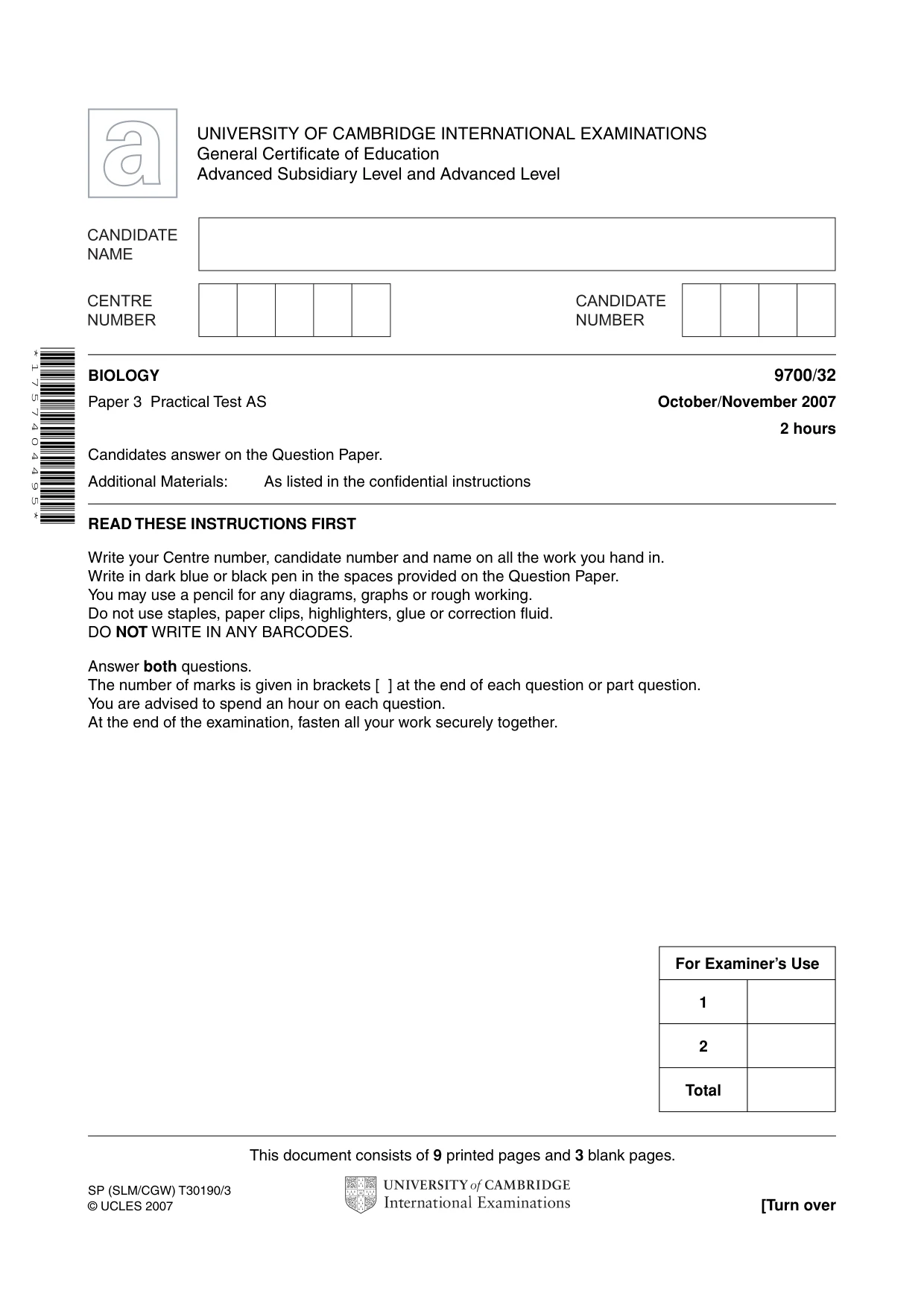
Question paper, page 1
This document consists of 9 printed pages and 3 blank pages. SP (SLM/CGW) T30190/3 © UCLES 2007 [Turn over UNIVERSITY OF CAMBRIDGE INTERNATIONAL EXAMINATIONS General Certificate of Education Advanced Subsidiary Level and Advanced Level READ THESE INSTRUCTIONS FIRST Write your Centre number, candidate number and name on all the work you hand in. Write in dark blue or black pen in the spaces provided on the Question Paper. You may use a pencil for any diagrams, graphs or rough working. Do not use staples, paper clips, highlighters, glue or correction fluid. DO NOT WRITE IN ANY BARCODES. Answer both questions. The number of marks is given in brackets [ ] at the end of each question or part question. You are advised to spend an hour on each question. At the end of the examination, fasten all your work securely together. * 1 7 5 7 4 0 4 4 9 5 * BIOLOGY 9700/32 Paper 3 Practical Test AS October/November 2007 2 hours Candidates answer on the Question Paper. Additional Materials: As listed in the confidential instructions For Examiner’s Use 1 2 Total
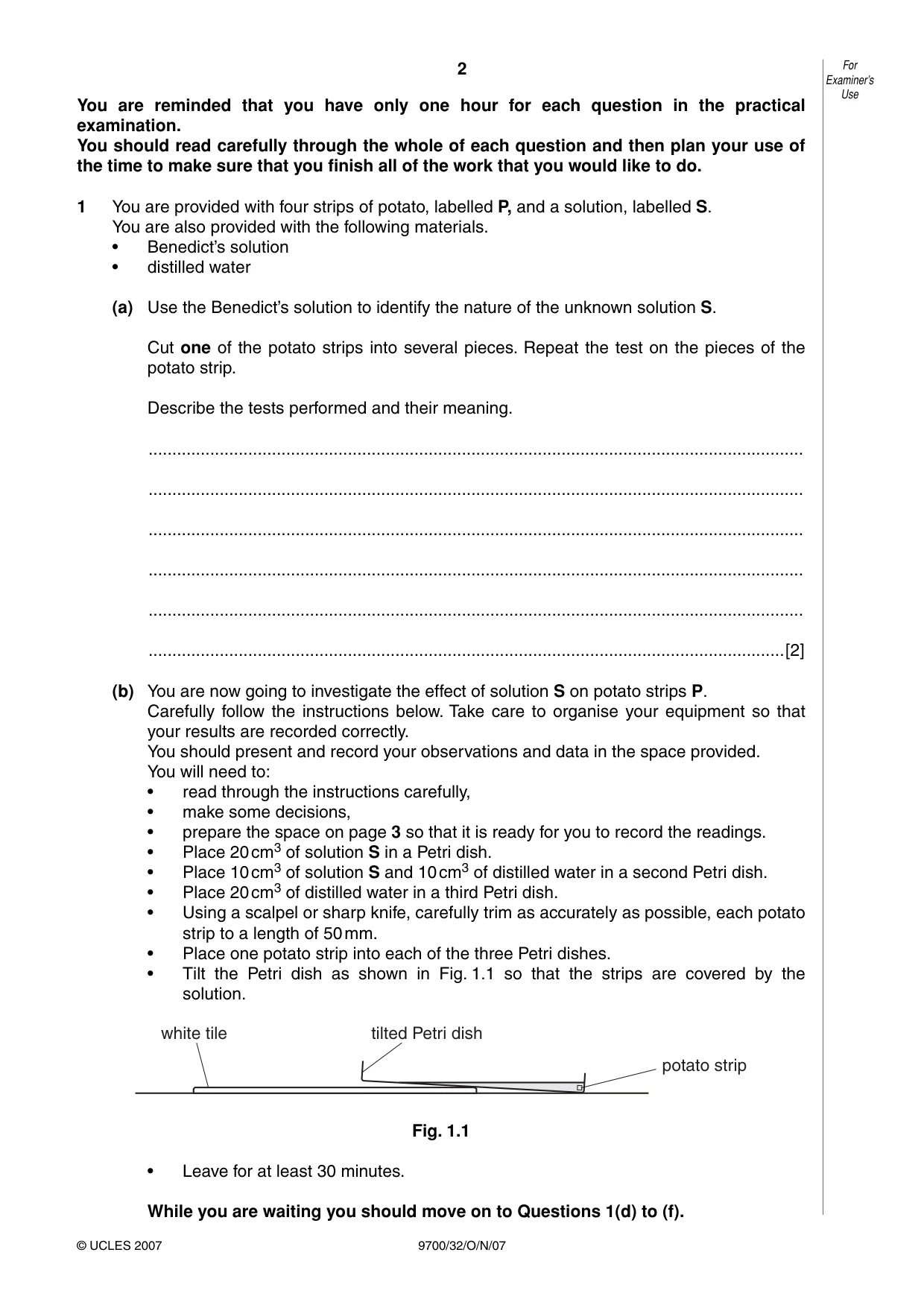
Question paper, page 2
2 9700/32/O/N/07 For Examiner’s Use © UCLES 2007 You are reminded that you have only one hour for each question in the practical examination. You should read carefully through the whole of each question and then plan your use of the time to make sure that you finish all of the work that you would like to do. 1 You are provided with four strips of potato, labelled P, and a solution, labelled S. You are also provided with the following materials. • Benedict’s solution • distilled water (a) Use the Benedict’s solution to identify the nature of the unknown solution S. Cut one of the potato strips into several pieces. Repeat the test on the pieces of the potato strip. Describe the tests performed and their meaning. … … … … … …[2] (b) You are now going to investigate the effect of solution S on potato strips P. Carefully follow the instructions below. Take care to organise your equipment so that your results are recorded correctly. You should present and record your observations and data in the space provided. You will need to: • read through the instructions carefully, • make some decisions, • prepare the space on page 3 so that it is ready for you to record the readings. • Place 20 cm3 of solution S in a Petri dish. • Place 10 cm3 of solution S and 10 cm3 of distilled water in a second Petri dish. • Place 20 cm3 of distilled water in a third Petri dish. • Using a scalpel or sharp knife, carefully trim as accurately as possible, each potato strip to a length of 50 mm. • Place one potato strip into each of the three Petri dishes. • Tilt the Petri dish as shown in Fig. 1.1 so that the strips are covered by the solution. tilted Petri dish white tile potato strip Fig. 1.1 • Leave for at least 30 minutes. While you are waiting you should move on to Questions 1(d) to (f).
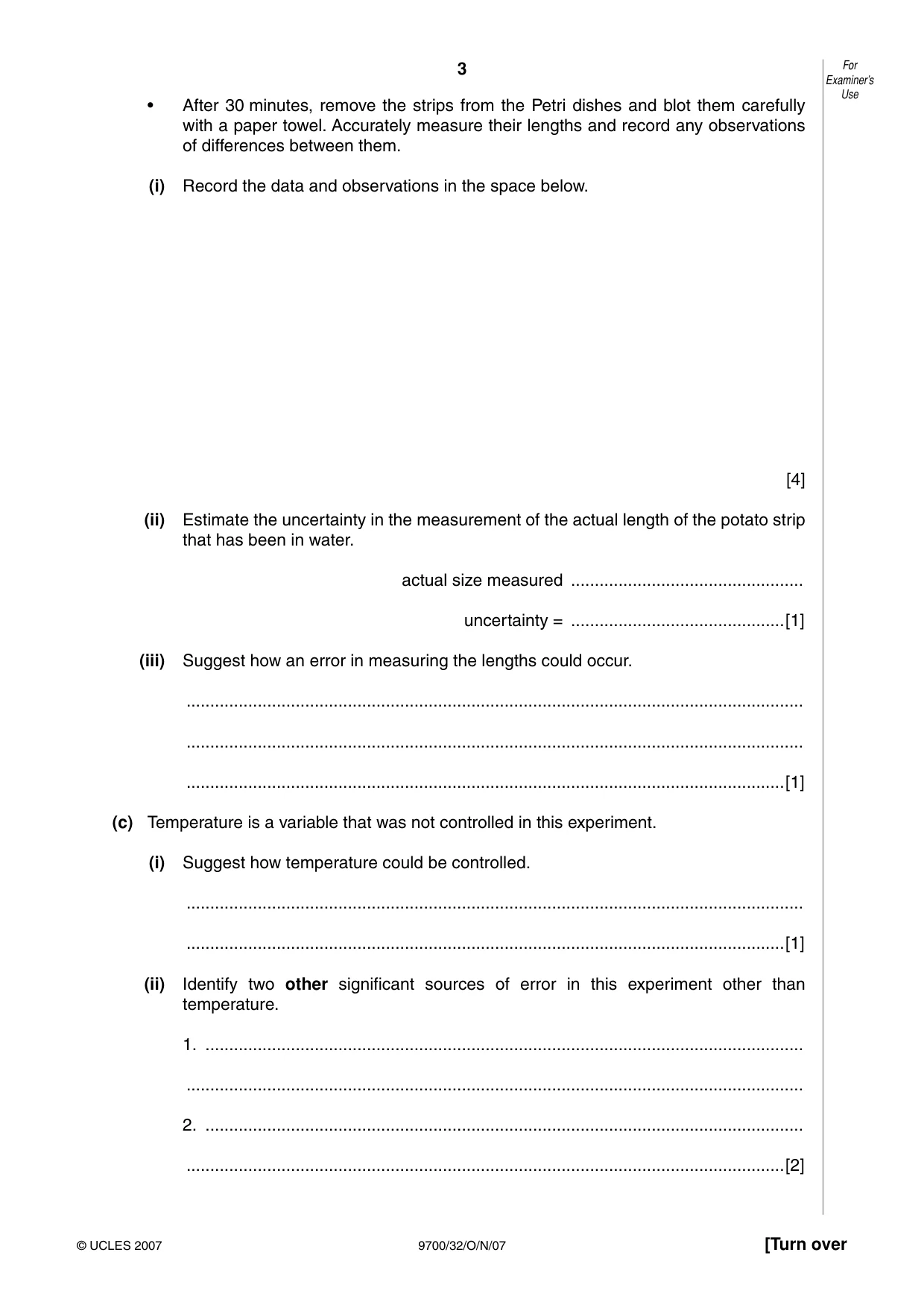
Question paper, page 3
3 9700/32/O/N/07 [Turn over For Examiner’s Use © UCLES 2007 • After 30 minutes, remove the strips from the Petri dishes and blot them carefully with a paper towel. Accurately measure their lengths and record any observations of differences between them. (i) Record the data and observations in the space below. [4] (ii) Estimate the uncertainty in the measurement of the actual length of the potato strip that has been in water. actual size measured … uncertainty = …[1] (iii) Suggest how an error in measuring the lengths could occur. … … …[1] (c) Temperature is a variable that was not controlled in this experiment. (i) Suggest how temperature could be controlled. … …[1] (ii) Identify two other significant sources of error in this experiment other than temperature. 1. … … 2. … …[2]
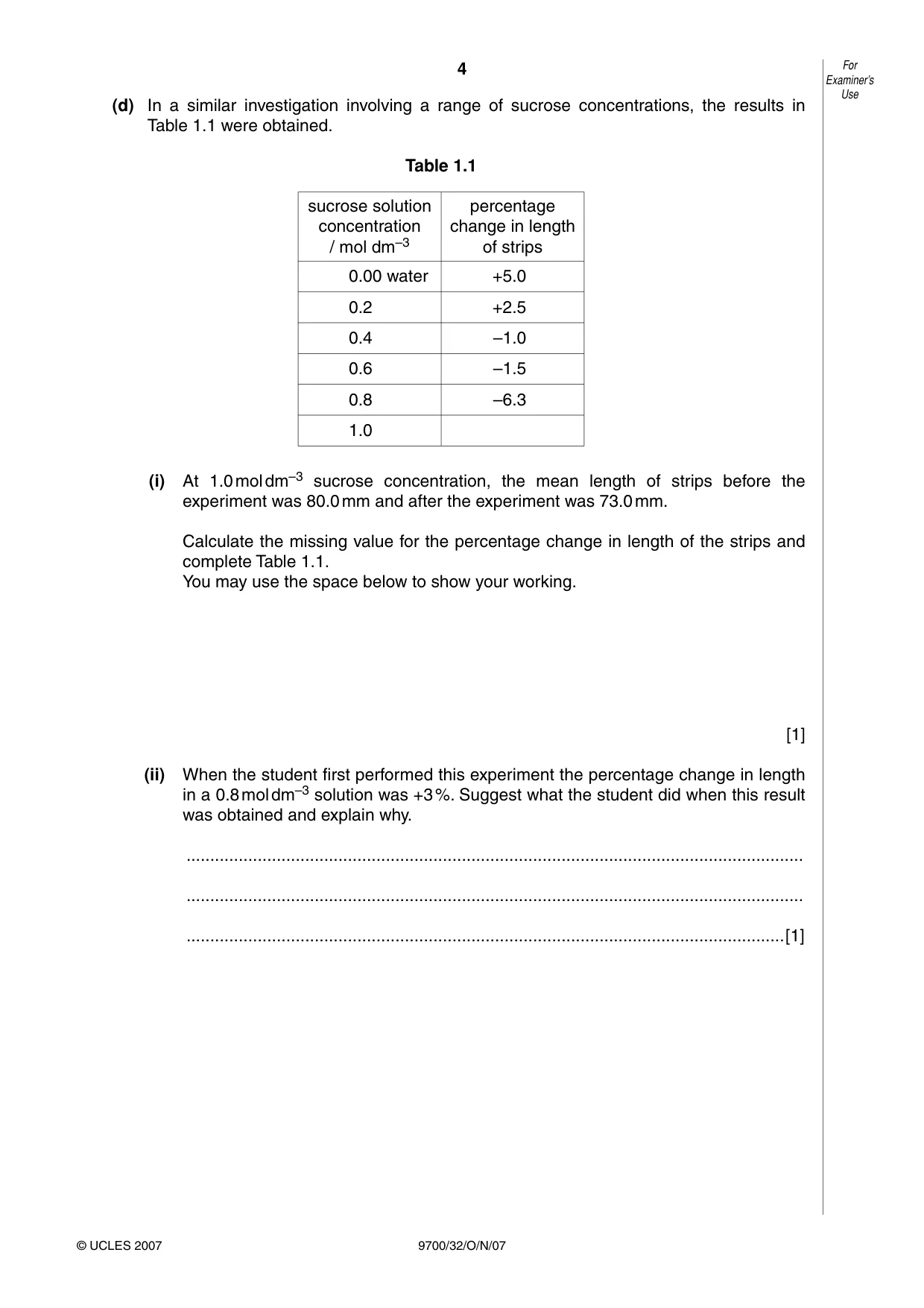
Question paper, page 4
4 9700/32/O/N/07 For Examiner’s Use © UCLES 2007 (d) In a similar investigation involving a range of sucrose concentrations, the results in Table 1.1 were obtained. Table 1.1 sucrose solution concentration / mol dm–3 percentage change in length of strips 0.00 water +5.0 0.2 +2.5 0.4 –1.0 0.6 –1.5 0.8 –6.3 1.0 (i) At 1.0 mol dm–3 sucrose concentration, the mean length of strips before the experiment was 80.0 mm and after the experiment was 73.0 mm. Calculate the missing value for the percentage change in length of the strips and complete Table 1.1. You may use the space below to show your working. [1] (ii) When the student first performed this experiment the percentage change in length in a 0.8 mol dm–3 solution was +3 %. Suggest what the student did when this result was obtained and explain why. … … …[1]
Question paper, page 5
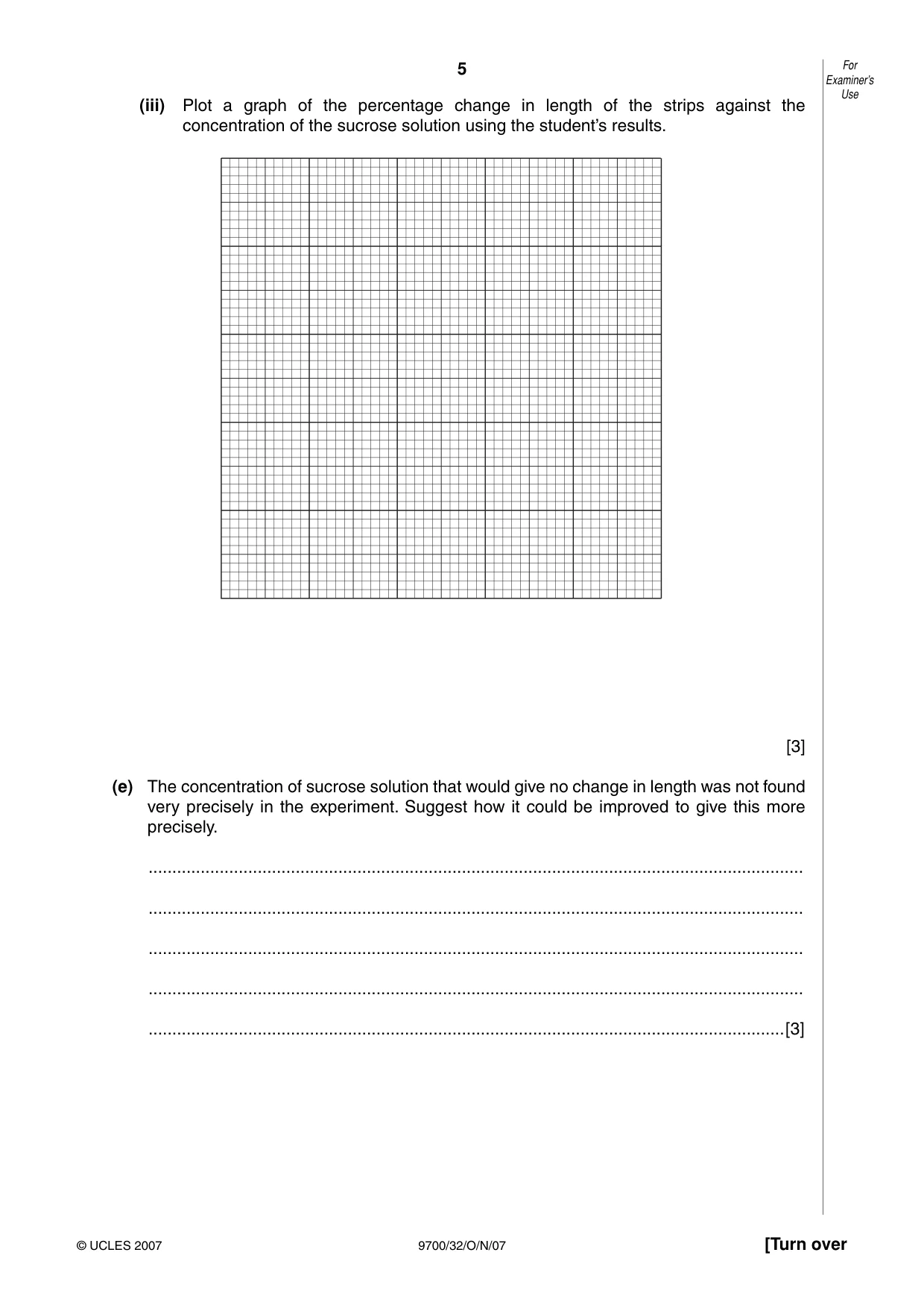
5 9700/32/O/N/07 [Turn over For Examiner’s Use © UCLES 2007 (iii) Plot a graph of the percentage change in length of the strips against the concentration of the sucrose solution using the student’s results. [3] (e) The concentration of sucrose solution that would give no change in length was not found very precisely in the experiment. Suggest how it could be improved to give this more precisely. … … … … …[3]
Question paper, page 6
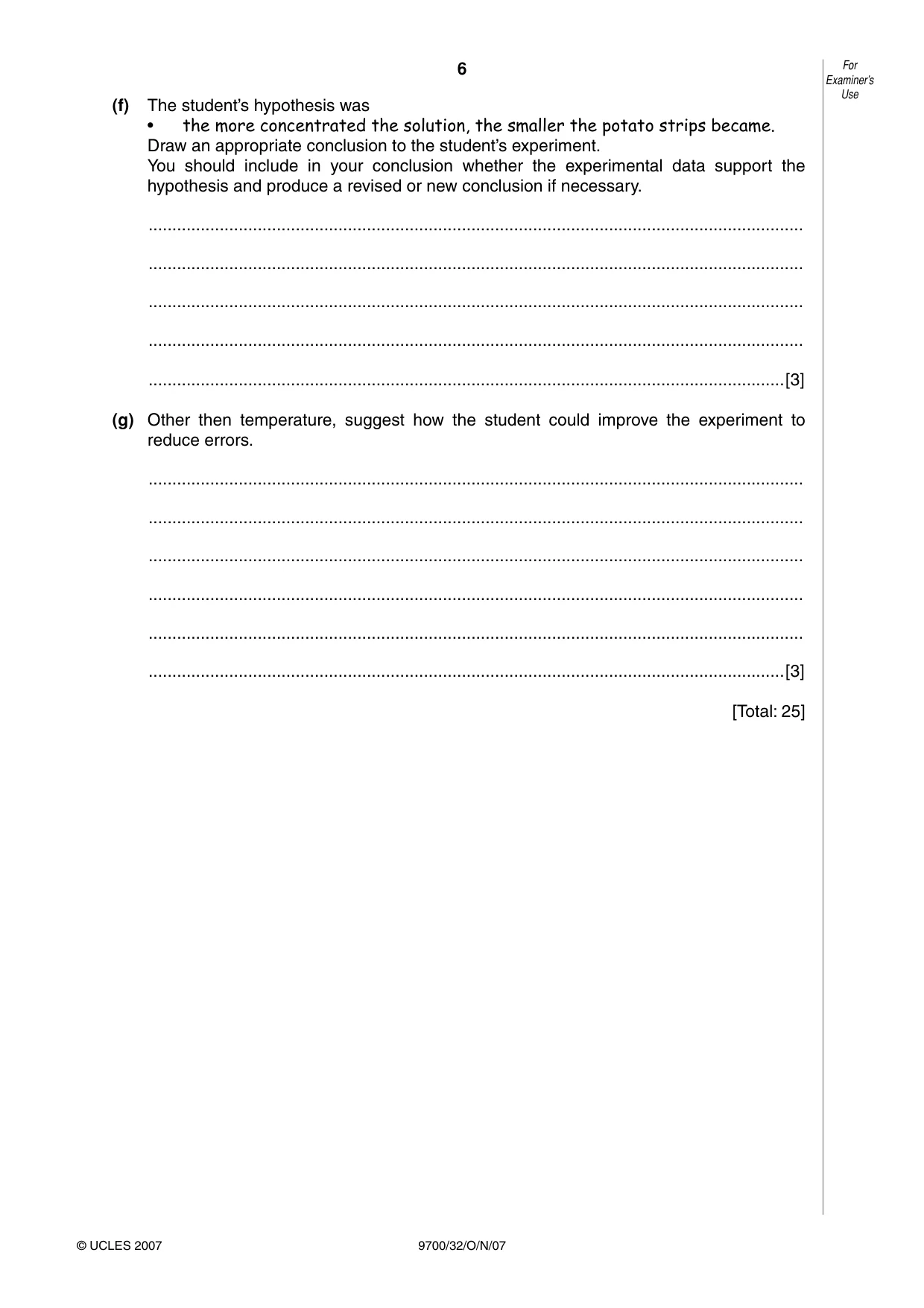
6 9700/32/O/N/07 For Examiner’s Use © UCLES 2007 (f) The student’s hypothesis was • the more concentrated the solution, the smaller the potato strips became. Draw an appropriate conclusion to the student’s experiment. You should include in your conclusion whether the experimental data support the hypothesis and produce a revised or new conclusion if necessary. … … … … …[3] (g) Other then temperature, suggest how the student could improve the experiment to reduce errors. … … … … … …[3] [Total: 25]
Question paper, page 7
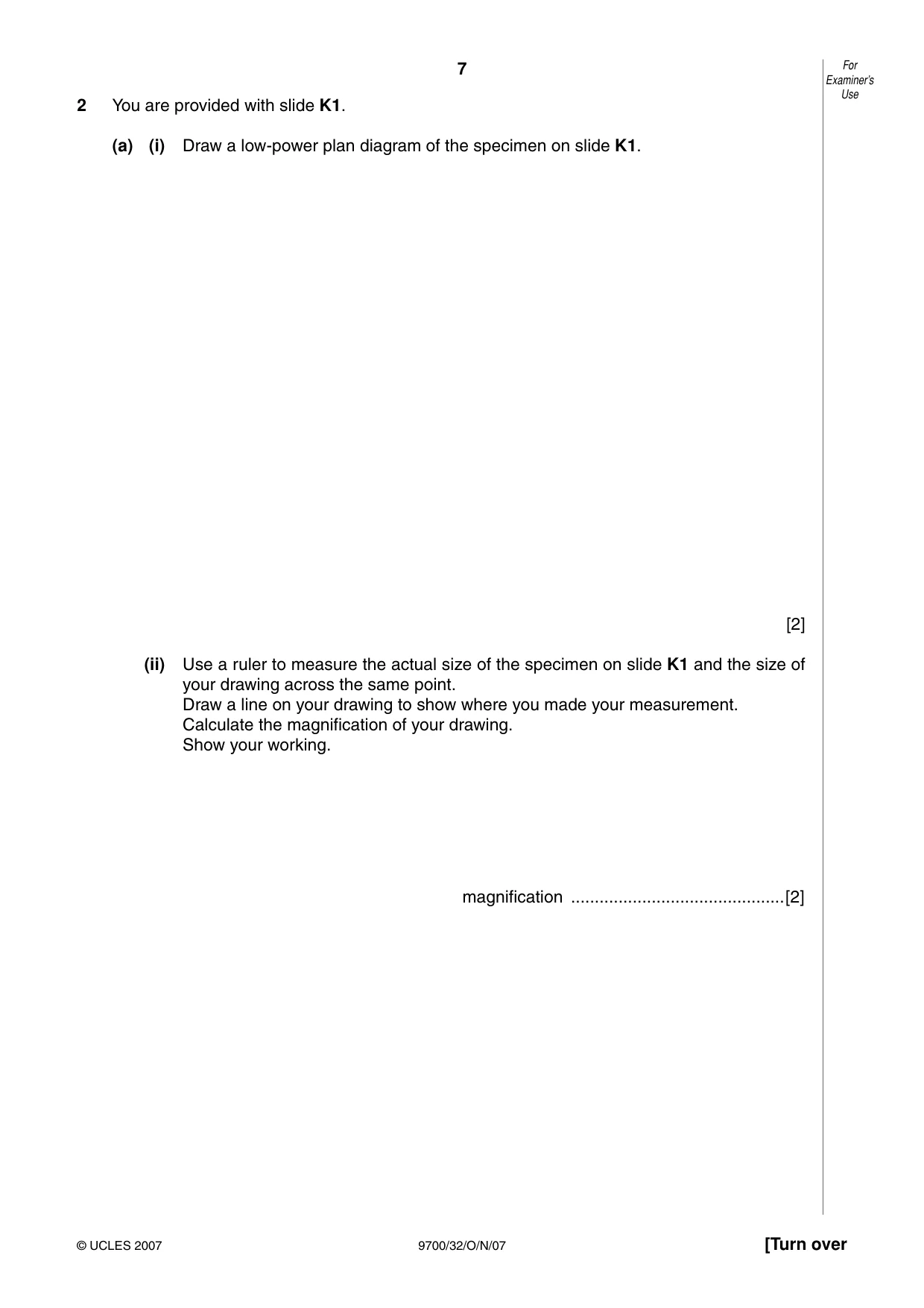
7 9700/32/O/N/07 [Turn over For Examiner’s Use © UCLES 2007 2 You are provided with slide K1. (a) (i) Draw a low-power plan diagram of the specimen on slide K1. [2] (ii) Use a ruler to measure the actual size of the specimen on slide K1 and the size of your drawing across the same point. Draw a line on your drawing to show where you made your measurement. Calculate the magnification of your drawing. Show your working. magnification …[2]
Question paper, page 8
8 9700/32/O/N/07 For Examiner’s Use © UCLES 2007 (b) The cartilage tissue on slide K1 has been stained purple. (i) In the space below, make a high-power, labelled drawing of two adjacent cells in this tissue. [6]
Question paper, page 9
9 9700/32/O/N/07 For Examiner’s Use © UCLES 2007 Fig. 2.1 is a photomicrograph of a transverse section of an aorta. Fig. 2.1 (ii) Prepare the space below so that it is suitable for you to compare and contrast specimen K1 with Fig. 2.1 and then record your observations. [4] (iii) Both the specimens, K1 and Fig. 2.1, are involved in the movement of materials. State one observation that relates to this function. … …[1] [Total: 15]
Question paper, page 12
12 9700/32/O/N/07 Permission to reproduce items where third-party owned material protected by copyright is included has been sought and cleared where possible. Every reasonable effort has been made by the publisher (UCLES) to trace copyright holders, but if any items requiring clearance have unwittingly been included, the publisher will be pleased to make amends at the earliest possible opportunity. University of Cambridge International Examinations is part of the Cambridge Assessment Group. Cambridge Assessment is the brand name of University of Cambridge Local Examinations Syndicate (UCLES), which is itself a department of the University of Cambridge. BLANK PAGE
Mark scheme, page 1
UNIVERSITY OF CAMBRIDGE INTERNATIONAL EXAMINATIONS GCE Advanced Subsidiary Level and GCE Advanced Level MARK SCHEME for the October/November 2007 question paper 9700 BIOLOGY 9700/32 Paper 32 (Advanced Practical 2), maximum raw mark 40 This mark scheme is published as an aid to teachers and candidates, to indicate the requirements of the examination. It shows the basis on which Examiners were instructed to award marks. It does not indicate the details of the discussions that took place at an Examiners’ meeting before marking began. All Examiners are instructed that alternative correct answers and unexpected approaches in candidates’ scripts must be given marks that fairly reflect the relevant knowledge and skills demonstrated. Mark schemes must be read in conjunction with the question papers and the report on the examination. • CIE will not enter into discussions or correspondence in connection with these mark schemes. CIE is publishing the mark schemes for the October/November 2007 question papers for most IGCSE, GCE Advanced Level and Advanced Subsidiary Level syllabuses and some Ordinary Level syllabuses.
Mark scheme, page 2
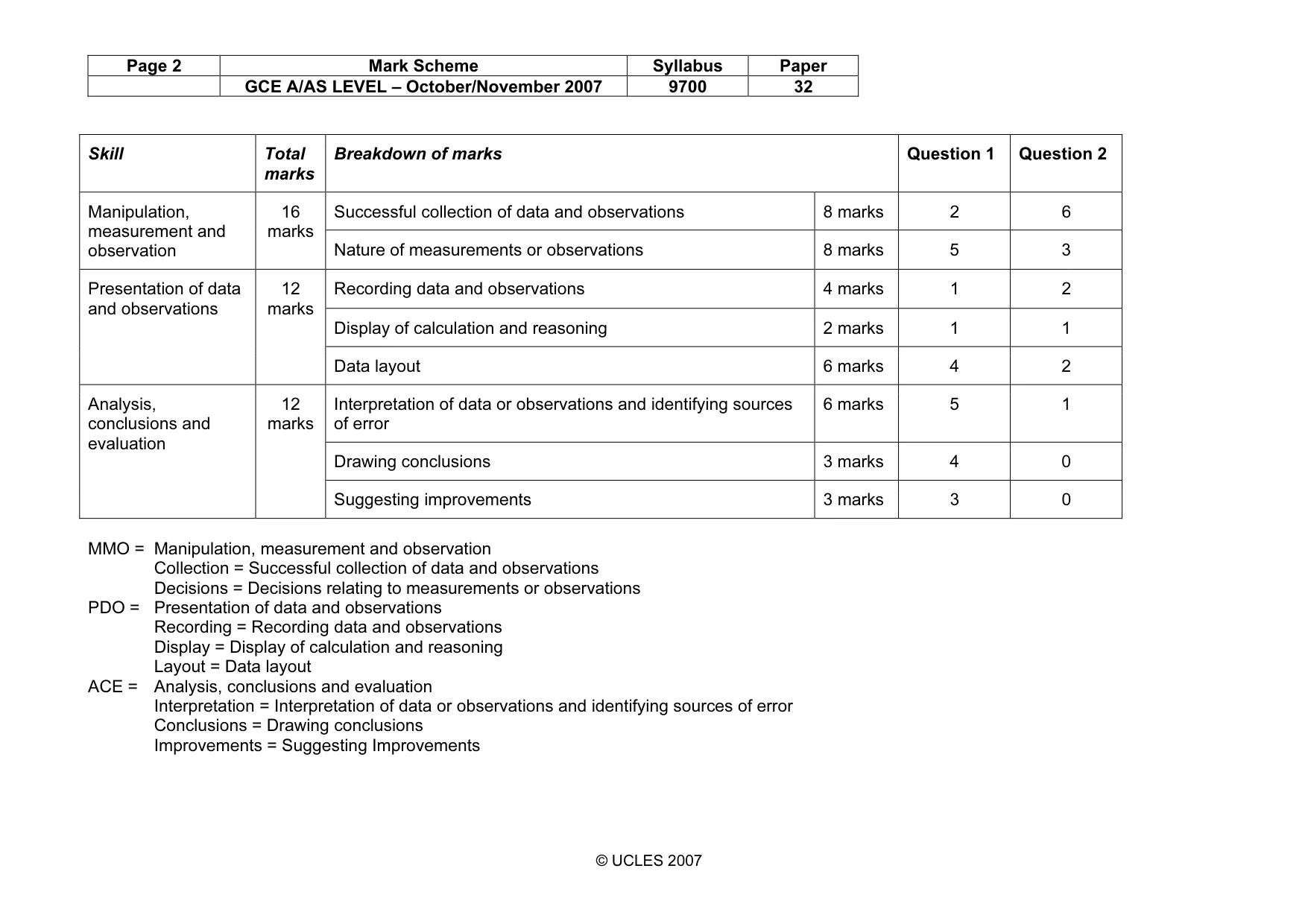
Page 2 Mark Scheme Syllabus Paper GCE A/AS LEVEL – October/November 2007 9700 32 © UCLES 2007 Skill Total marks Breakdown of marks Question 1 Question 2 Successful collection of data and observations 8 marks 2 6 Manipulation, measurement and observation 16 marks Nature of measurements or observations 8 marks 5 3 Recording data and observations 4 marks 1 2 Display of calculation and reasoning 2 marks 1 1 Presentation of data and observations 12 marks Data layout 6 marks 4 2 Interpretation of data or observations and identifying sources of error 6 marks 5 1 Drawing conclusions 3 marks 4 0 Analysis, conclusions and evaluation 12 marks Suggesting improvements 3 marks 3 0 MMO = Manipulation, measurement and observation Collection = Successful collection of data and observations Decisions = Decisions relating to measurements or observations PDO = Presentation of data and observations Recording = Recording data and observations Display = Display of calculation and reasoning Layout = Data layout ACE = Analysis, conclusions and evaluation Interpretation = Interpretation of data or observations and identifying sources of error Conclusions = Drawing conclusions Improvements = Suggesting Improvements
Mark scheme, page 3
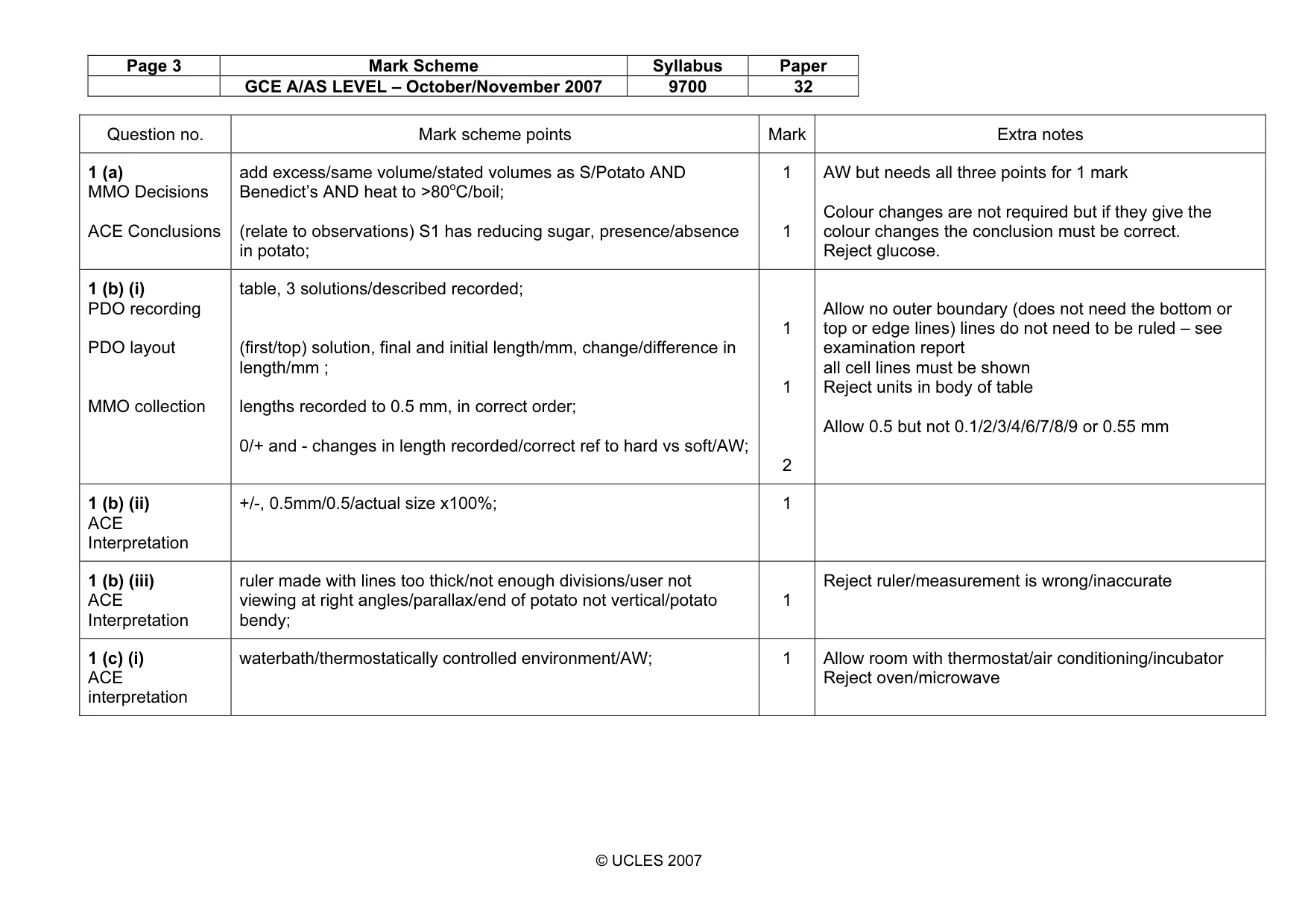
Page 3 Mark Scheme Syllabus Paper GCE A/AS LEVEL – October/November 2007 9700 32 © UCLES 2007 Question no. Mark scheme points Mark Extra notes 1 (a) MMO Decisions ACE Conclusions add excess/same volume/stated volumes as S/Potato AND Benedict’s AND heat to >80oC/boil; (relate to observations) S1 has reducing sugar, presence/absence in potato; 1 1 AW but needs all three points for 1 mark Colour changes are not required but if they give the colour changes the conclusion must be correct. Reject glucose. 1 (b) (i) PDO recording PDO layout MMO collection table, 3 solutions/described recorded; (first/top) solution, final and initial length/mm, change/difference in length/mm ; lengths recorded to 0.5 mm, in correct order; 0/+ and - changes in length recorded/correct ref to hard vs soft/AW; 1 1 2 Allow no outer boundary (does not need the bottom or top or edge lines) lines do not need to be ruled – see examination report all cell lines must be shown Reject units in body of table Allow 0.5 but not 0.1/2/3/4/6/7/8/9 or 0.55 mm 1 (b) (ii) ACE Interpretation +/-, 0.5mm/0.5/actual size x100%; 1 1 (b) (iii) ACE Interpretation ruler made with lines too thick/not enough divisions/user not viewing at right angles/parallax/end of potato not vertical/potato bendy; 1 Reject ruler/measurement is wrong/inaccurate 1 (c) (i) ACE interpretation waterbath/thermostatically controlled environment/AW; 1 Allow room with thermostat/air conditioning/incubator Reject oven/microwave
Mark scheme, page 4
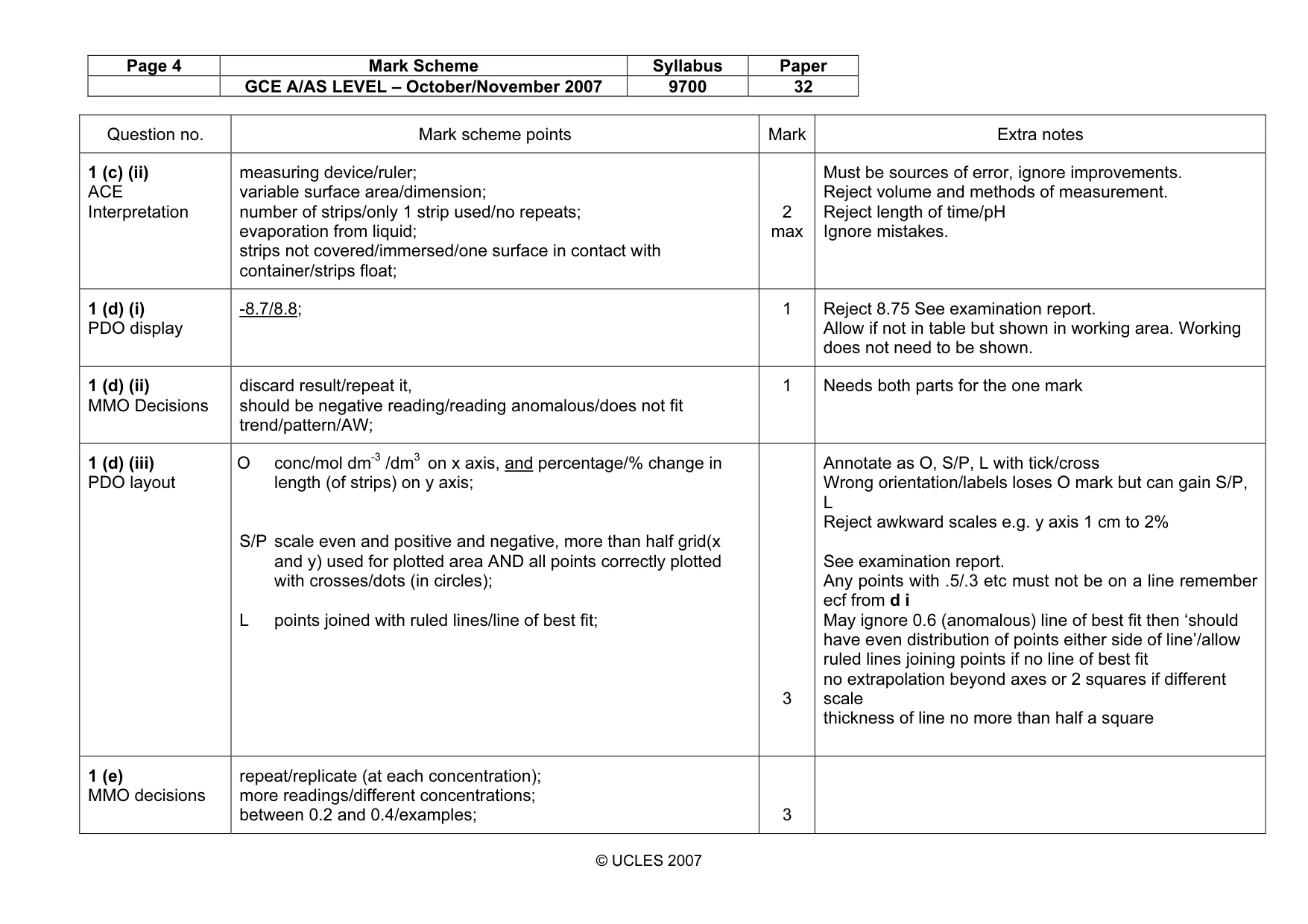
Page 4 Mark Scheme Syllabus Paper GCE A/AS LEVEL – October/November 2007 9700 32 © UCLES 2007 Question no. Mark scheme points Mark Extra notes 1 (c) (ii) ACE Interpretation measuring device/ruler; variable surface area/dimension; number of strips/only 1 strip used/no repeats; evaporation from liquid; strips not covered/immersed/one surface in contact with container/strips float; 2 max Must be sources of error, ignore improvements. Reject volume and methods of measurement. Reject length of time/pH Ignore mistakes. 1 (d) (i) PDO display -8.7/8.8; 1 Reject 8.75 See examination report. Allow if not in table but shown in working area. Working does not need to be shown. 1 (d) (ii) MMO Decisions discard result/repeat it, should be negative reading/reading anomalous/does not fit trend/pattern/AW; 1 Needs both parts for the one mark 1 (d) (iii) PDO layout O conc/mol dm-3 /dm3 on x axis, and percentage/% change in length (of strips) on y axis; S/P scale even and positive and negative, more than half grid(x and y) used for plotted area AND all points correctly plotted with crosses/dots (in circles); L points joined with ruled lines/line of best fit; 3 Annotate as O, S/P, L with tick/cross Wrong orientation/labels loses O mark but can gain S/P, L Reject awkward scales e.g. y axis 1 cm to 2% See examination report. Any points with .5/.3 etc must not be on a line remember ecf from d i May ignore 0.6 (anomalous) line of best fit then ‘should have even distribution of points either side of line’/allow ruled lines joining points if no line of best fit no extrapolation beyond axes or 2 squares if different scale thickness of line no more than half a square 1 (e) MMO decisions repeat/replicate (at each concentration); more readings/different concentrations; between 0.2 and 0.4/examples; 3
Mark scheme, page 5
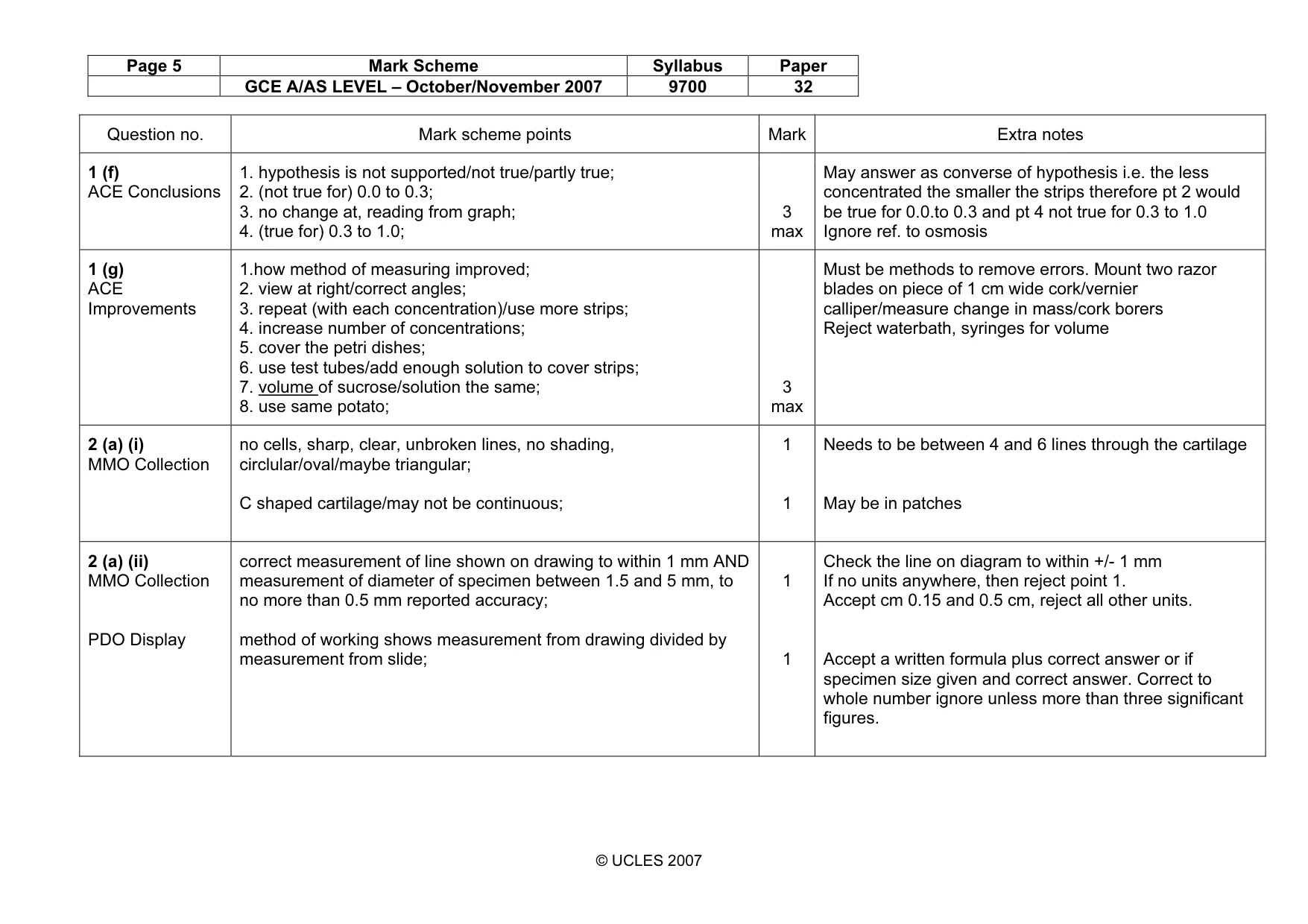
Page 5 Mark Scheme Syllabus Paper GCE A/AS LEVEL – October/November 2007 9700 32 © UCLES 2007 Question no. Mark scheme points Mark Extra notes 1 (f) ACE Conclusions 1. hypothesis is not supported/not true/partly true; 2. (not true for) 0.0 to 0.3; 3. no change at, reading from graph; 4. (true for) 0.3 to 1.0; 3 max May answer as converse of hypothesis i.e. the less concentrated the smaller the strips therefore pt 2 would be true for 0.0.to 0.3 and pt 4 not true for 0.3 to 1.0 Ignore ref. to osmosis 1 (g) ACE Improvements 1.how method of measuring improved; 2. view at right/correct angles; 3. repeat (with each concentration)/use more strips; 4. increase number of concentrations; 5. cover the petri dishes; 6. use test tubes/add enough solution to cover strips; 7. volume of sucrose/solution the same; 8. use same potato; 3 max Must be methods to remove errors. Mount two razor blades on piece of 1 cm wide cork/vernier calliper/measure change in mass/cork borers Reject waterbath, syringes for volume 2 (a) (i) MMO Collection no cells, sharp, clear, unbroken lines, no shading, circlular/oval/maybe triangular; C shaped cartilage/may not be continuous; 1 1 Needs to be between 4 and 6 lines through the cartilage May be in patches 2 (a) (ii) MMO Collection PDO Display correct measurement of line shown on drawing to within 1 mm AND measurement of diameter of specimen between 1.5 and 5 mm, to no more than 0.5 mm reported accuracy; method of working shows measurement from drawing divided by measurement from slide; 1 1 Check the line on diagram to within +/- 1 mm If no units anywhere, then reject point 1. Accept cm 0.15 and 0.5 cm, reject all other units. Accept a written formula plus correct answer or if specimen size given and correct answer. Correct to whole number ignore unless more than three significant figures.
Mark scheme, page 6
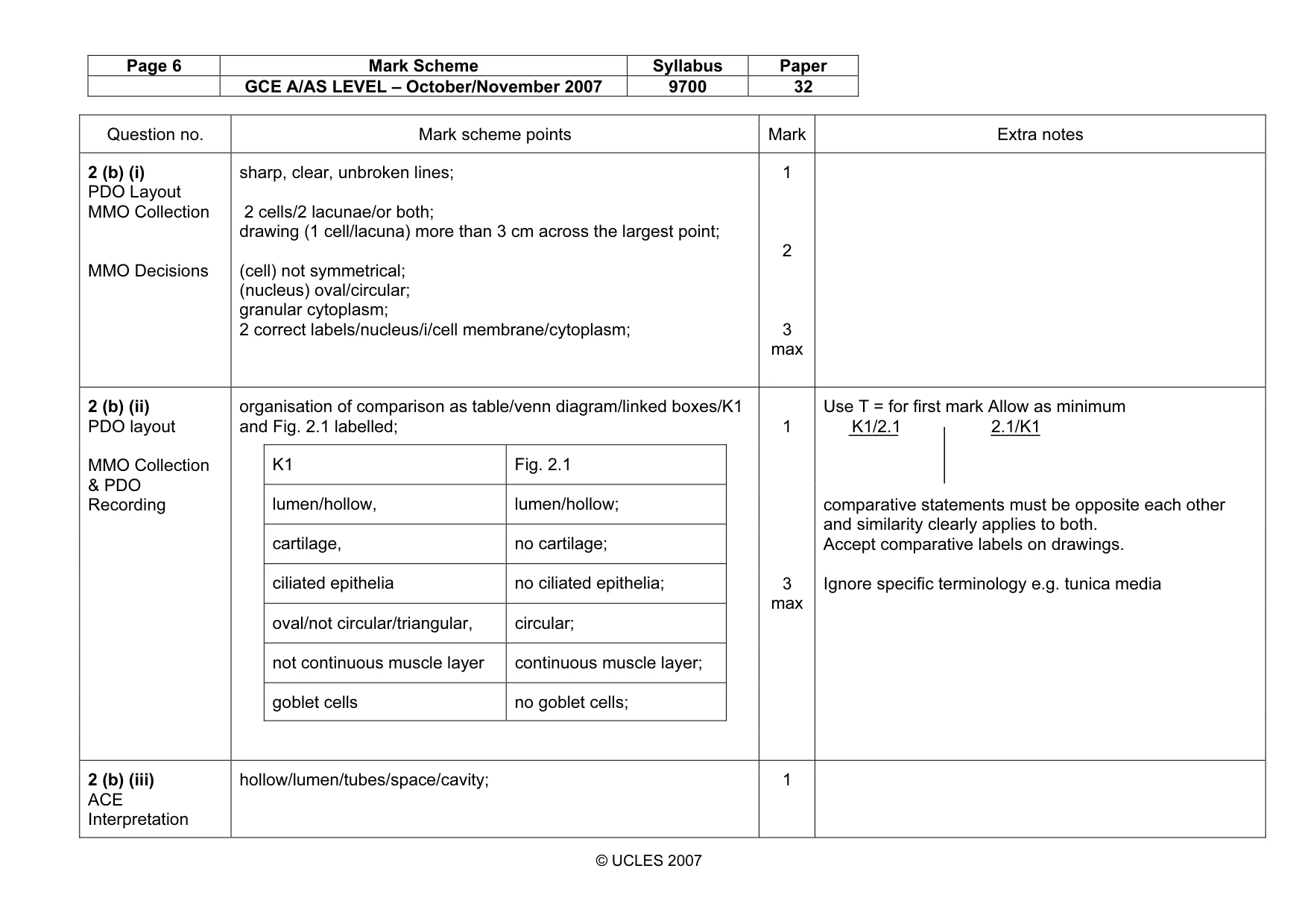
Page 6 Mark Scheme Syllabus Paper GCE A/AS LEVEL – October/November 2007 9700 32 © UCLES 2007 Question no. Mark scheme points Mark Extra notes 2 (b) (i) PDO Layout MMO Collection MMO Decisions sharp, clear, unbroken lines; 2 cells/2 lacunae/or both; drawing (1 cell/lacuna) more than 3 cm across the largest point; (cell) not symmetrical; (nucleus) oval/circular; granular cytoplasm; 2 correct labels/nucleus/i/cell membrane/cytoplasm; 1 2 3 max organisation of comparison as table/venn diagram/linked boxes/K1 and Fig. 2.1 labelled; K1 Fig. 2.1 lumen/hollow, lumen/hollow; cartilage, no cartilage; ciliated epithelia no ciliated epithelia; oval/not circular/triangular, circular; not continuous muscle layer continuous muscle layer; goblet cells no goblet cells; 2 (b) (ii) PDO layout MMO Collection & PDO Recording 1 3 max Use T = for first mark Allow as minimum K1/2.1 2.1/K1 comparative statements must be opposite each other and similarity clearly applies to both. Accept comparative labels on drawings. Ignore specific terminology e.g. tunica media 2 (b) (iii) ACE Interpretation hollow/lumen/tubes/space/cavity; 1
What you needed in this session
Cambridge’s own grade thresholds for 2007 Oct/Nov, Paper 3 · Variant 2. A higher threshold means an easier paper — the bar moves with how the cohort did.