Cambridge A Level Biology 9700 — 2006 Oct/Nov Paper 3 · Variant 1
9700/31/O/N/06 · 25 marks · ≈28 min
The question paper and its mark scheme, free to read here and free to download. This is Cambridge’s own paper, exactly as it was sat.
Question paper8 pages

Mark scheme2 pages
Answers below. Sit the paper first if you are practising.
Paper as text
Question paper, page 1
This document consists of 6 printed pages and 2 blank pages. SP (SLM) T07223/5 © UCLES 2006 [Turn over UNIVERSITY OF CAMBRIDGE INTERNATIONAL EXAMINATIONS General Certificate of Education Advanced Subsidiary Level and Advanced Level BIOLOGY 9700/03 Paper 3 Practical Test AS October/November 2006 1 hour 15 minutes CONFIDENTIAL INSTRUCTIONS Great care should be taken to ensure that any confidential information given does not reach the candidates either directly or indirectly. If you have any problems or queries regarding these Instructions, please contact CIE by e-mail: International@cie.org.uk, by phone: +44 1223 553554, by fax: +44 1223 553558, stating the Centre number, the nature of the query and the syllabus number quoted above.
Question paper, page 2
2 9700/03/CI/O/N/06 © UCLES 2006 Instructions for preparing apparatus These instructions give details of the apparatus required by each candidate for each exercise and experiment in this paper. A summary of the questions that will be presented to the candidates is included, where appropriate, to allow the Biology teacher to test the apparatus appropriately. No access to the question paper is permitted in advance of the examination. If a candidate breaks any of the apparatus, or loses any of the material supplied, the matter should be rectified and a note made in the Supervisor’s Report. Candidates must be provided with a microscope with: • Low-power objective lens, e.g. ×10 (equal to 16mm or 2–3˝) • High-power objective lens, e.g. ×40 (equal to 4mm or 1–6˝) • Eyepiece graticule fitted within the eyepiece and visible in focus at the same time as the specimen Each candidate must have sole, uninterrupted, use of the microscope for at least 35 minutes. Supervisors are advised to remind candidates that all substances in the examination should be treated with caution. Pipette fillers and safety goggles should be used where necessary. In accordance with the COSHH (Control of Substances Hazardous to Health) Regulations, operative in the UK, a hazard appraisal of the examination has been carried out. The following codes are used where relevant. C = corrosive substance F = highly flammable substance H = harmful or irritating substance O = oxidising substance T = toxic substance Centres are reminded that they are not permitted to open the question paper envelopes before the examination. Centres are also referred to the Handbook for Centres 2005, and in particular Section 3.1.2 (c) (i), Security of Question Papers and Examination Materials, as well as 3.3.11.1, Practical Examinations in Science Subjects. If there are any difficulties with any aspect of setting up this practical examination that the Centre is not able to sort out, it is essential for Centres to contact the Product Manager, Dr Rick Nelms, as soon as possible by e-mail to international@cie.org.uk, by fax to +44 1223 553558 or by phone to +44 1223 553554.
Question paper, page 3
3 9700/03/CI/O/N/06 © UCLES 2006 [Turn over Confidential Instructions Each candidate must be supplied with the following apparatus and materials. Question 1 Each candidate will require: (i) Four leaves labelled, K1, K3, K4 and K5, taken from a dicotyledonous plant, for example Impatiens (Balsam, Busy Lizzy). It is important that the leaf is not too hairy and should be soft when wilted. Leaf K1 should be freshly picked and healthy – turgid and not wilted. No petroleum jelly should be put on it. Leaf K3 should be freshly picked (within 24 hours of the examination) – turgid and not wilted. It should be covered on both sides with petroleum jelly. Leaf K4 should be picked within three days of the examination and coated on the underside with petroleum jelly. Leaf K5 should have been picked at least 1 week before the examination and coated on the upper side with petroleum jelly. K1 and K3 should appear the freshest K4 wilted but not dry K5 the most withered and dry The descriptions of the leaves in the examination paper may differ from the information above. (ii) A bottle of clear nail varnish or similar labelled, K2, with applicator brush. (iii) Forceps. (iv) Microscope with: • Low-power objective lens, e.g. ×10 (equal to 16 mm or 2–3˝) • High-power objective lens, e.g. ×40 (equal to 4 mm or 1–6˝) • Eyepiece of graticule fitted within the eyepiece and visible in focus at the same time as the specimen. Each candidate must have sole, uninterrupted, use of a microscope for at least 35 minutes. Candidates will need the microscope for question 1b and 1c. Candidates who start with question 2 will need to be given the microscopes when they have completed question 2 and question 1d. (v) Two microscope slides and two coverslips. (vi) Dropping pipette. (vii) Small beaker or similar. (viii) Access to water. Question 2 Each candidate will require: (i) No additional equipment.
Question paper, page 4
4 9700/03/CI/O/N/06 © UCLES 2006 MATERIALS TO BE SUPPLIED BY CAMBRIDGE (i) Question papers. REPORT FORM The teacher responsible for the examination is asked to fill in the Report Form on pages 7 and 8 of these Confidential Instructions. For Centres where more than one script envelope is used, there must be a copy of the complete Report Form in every script packet. These report forms are vital in order to allow the examiners to assess all candidates a fairly as possible, and should always be competed by every Centre. A copy of the seating plan for the examination room must also be enclosed in each script envelope.
Question paper, page 5
5 9700/03/CI/O/N/06 [Turn over BLANK PAGE
Question paper, page 6
6 9700/03/CI/O/N/06 BLANK PAGE Permission to reproduce items where third-party owned material protected by copyright is included has been sought and cleared where possible. Every reasonable effort has been made by the publisher (UCLES) to trace copyright holders, but if any items requiring clearance have unwittingly been included, the publisher will be pleased to make amends at the earliest possible opportunity. University of Cambridge International Examinations is part of the University of Cambridge Local Examinations Syndicate (UCLES), which is itself a department of the University of Cambridge.
Question paper, page 7
7 9700/03/CI/O/N/06 © UCLES 2006 [Turn over 9700/3 This form should be completed and sent to the examiner with the scripts. REPORT ON PRACTICAL BIOLOGY A Level October/November Session 2006 *The Supervisor or Teacher responsible for the subject should provide the following information. 1 Was any difficulty experienced in providing the necessary materials? If so, give brief details. 2 Give details of any difficulties experienced by particular candidates, giving names and candidate numbers. Reference should be made to: (a) difficulties arising from faulty specimens or microscopes; (b) accidents to apparatus or materials; (c) assistance provided in case of colour-blindness; (d) any other information that is likely to assist the Examiner, especially if this cannot be discovered from the scripts. All other cases of individual hardship, e.g. illness or disability, should be reported direct to CIE on the normal ‘Special Consideration Form’ as detailed in Part 6 of the Handbook for Centres.
Question paper, page 8
8 9700/03/CI/O/N/06 © UCLES 2006 3 Enclose a plan of work benches with the scripts, giving details of the candidate numbers of the places occupied by the candidates for each session. The space below can be used for this, or it may be on separate paper. Declaration (to be signed by the Principal) The preparation of the practical examination has been carried out so as to maintain fully the security of the examination. Signed … Name (in block capitals) … Centre number … Centre name … If scripts are required by CIE to be despatched in more than one envelope, it is essential that a copy of the relevant Supervisor’s Report and the appropriate seating plan(s) are sent inside each envelope.
Mark scheme, page 1
UNIVERSITY OF CAMBRIDGE INTERNATIONAL EXAMINATIONS GCE Advanced Subsidiary Level and GCE Advanced Level MARK SCHEME for the October/November 2006 question paper 9700 BIOLOGY 9700/03 Paper 3 (Practical 1), maximum raw mark 25 This mark scheme is published as an aid to teachers and students, to indicate the requirements of the examination. It shows the basis on which Examiners were instructed to award marks. It does not indicate the details of the discussions that took place at an Examiners’ meeting before marking began. All Examiners are instructed that alternative correct answers and unexpected approaches in candidates’ scripts must be given marks that fairly reflect the relevant knowledge and skills demonstrated. Mark schemes must be read in conjunction with the question papers and the report on the examination. The grade thresholds for various grades are published in the report on the examination for most IGCSE, GCE Advanced Level and Advanced Subsidiary Level syllabuses. • CIE will not enter into discussions or correspondence in connection with these mark schemes. CIE is publishing the mark schemes for the October/November 2006 question papers for most IGCSE, GCE Advanced Level and Advanced Subsidiary Level syllabuses and some Ordinary Level syllabuses.
Mark scheme, page 2
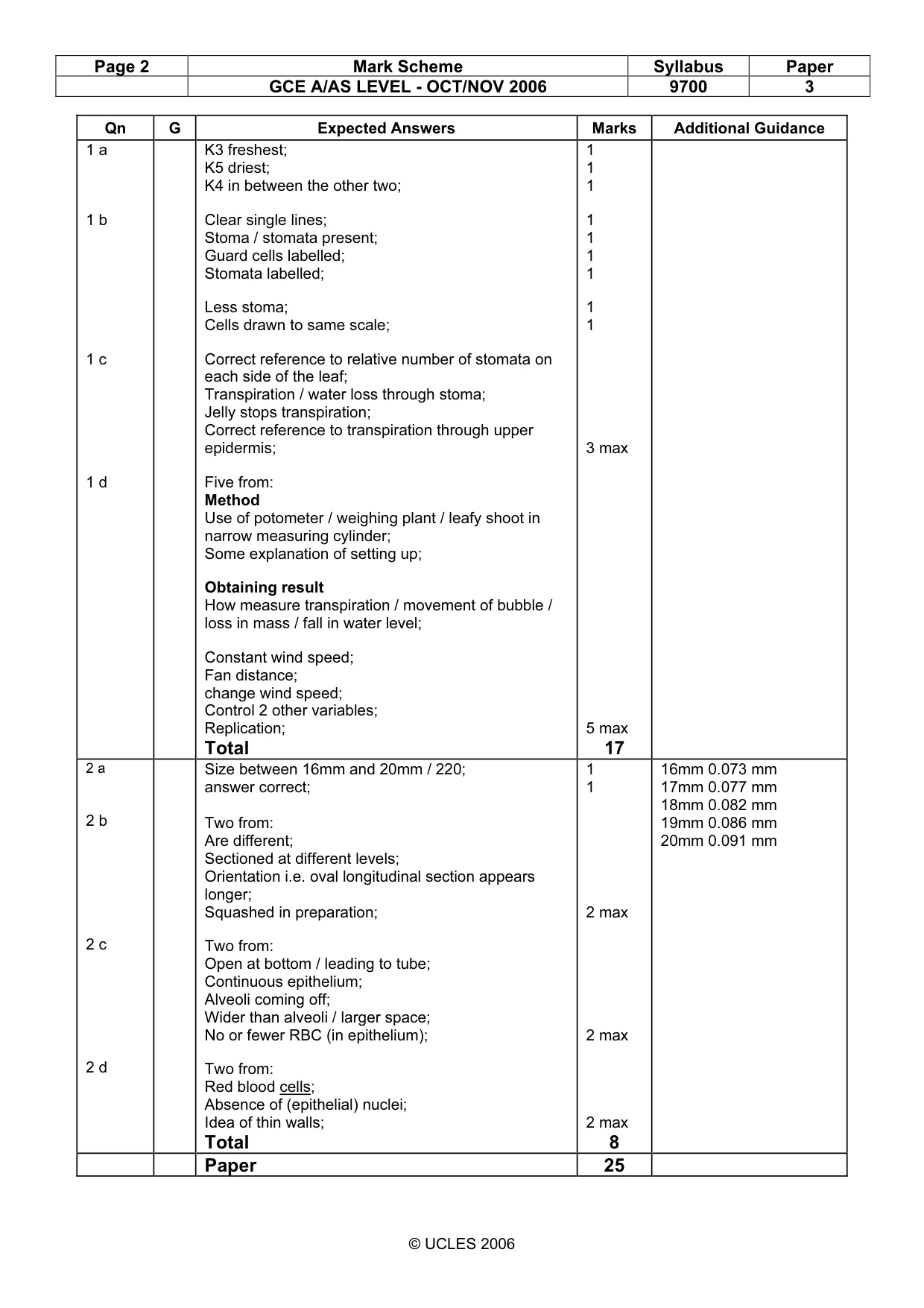
Page 2 Mark Scheme Syllabus Paper GCE A/AS LEVEL - OCT/NOV 2006 9700 3 © UCLES 2006 Qn G Expected Answers Marks Additional Guidance 1 a 1 b 1 c 1 d K3 freshest; K5 driest; K4 in between the other two; Clear single lines; Stoma / stomata present; Guard cells labelled; Stomata labelled; Less stoma; Cells drawn to same scale; Correct reference to relative number of stomata on each side of the leaf; Transpiration / water loss through stoma; Jelly stops transpiration; Correct reference to transpiration through upper epidermis; Five from: Method Use of potometer / weighing plant / leafy shoot in narrow measuring cylinder; Some explanation of setting up; Obtaining result How measure transpiration / movement of bubble / loss in mass / fall in water level; Constant wind speed; Fan distance; change wind speed; Control 2 other variables; Replication; Total 1 1 1 1 1 1 1 1 1 3 max 5 max 17 2 a 2 b 2 c 2 d Size between 16mm and 20mm / 220; answer correct; Two from: Are different; Sectioned at different levels; Orientation i.e. oval longitudinal section appears longer; Squashed in preparation; Two from: Open at bottom / leading to tube; Continuous epithelium; Alveoli coming off; Wider than alveoli / larger space; No or fewer RBC (in epithelium); Two from: Red blood cells; Absence of (epithelial) nuclei; Idea of thin walls; Total 1 1 2 max 2 max 2 max 8 16mm 0.073 mm 17mm 0.077 mm 18mm 0.082 mm 19mm 0.086 mm 20mm 0.091 mm Paper 25
What you needed in this session
Cambridge’s own grade thresholds for 2006 Oct/Nov, Paper 3 · Variant 1. A higher threshold means an easier paper — the bar moves with how the cohort did.