Cambridge A Level Biology 9700 — 2004 Oct/Nov Paper 3 · Variant 1
9700/31/O/N/04
The question paper and its mark scheme, free to read here and free to download. This is Cambridge’s own paper, exactly as it was sat.
Question paper8 pages
Mark scheme5 pages
Answers below. Sit the paper first if you are practising.
Paper as text
Question paper, page 1
This document consists of 7 printed pages and a Report Form. SP (SJF3135) S67950/4 © UCLES 2004 [Turn over UNIVERSITY OF CAMBRIDGE INTERNATIONAL EXAMINATIONS General Certificate of Education Advanced Subsidiary Level and Advanced Level BIOLOGY 9700/03 Paper 3 Practical Test AS October/November 2004 1 hour 15 minutes Candidates answer on the Question Paper. Additional Materials: As listed in Instructions to Supervisors. READ THESE INSTRUCTIONS FIRST Write your Centre number, candidate number and name on all the work you hand in. Write in dark blue or black pen in the spaces provided on the Question Paper. You may use a soft pencil for any diagrams, graphs or rough working. Do not use staples, paper clips, highlighters, glue or correction fluid. Answer all questions. At the end of the examination, fasten all your work securely together. The number of marks is given in brackets [ ] at the end of each question or part question. You are advised to spend 45 minutes on Question 1 and 30 minutes on Question 2. Centre Number Candidate Number Name If you have been given a label, look at the details. If any details are incorrect or missing, please fill in your correct details in the space given at the top of this page. Stick your personal label here, if provided. For Examiner’s Use 1 2 Total
Question paper, page 2
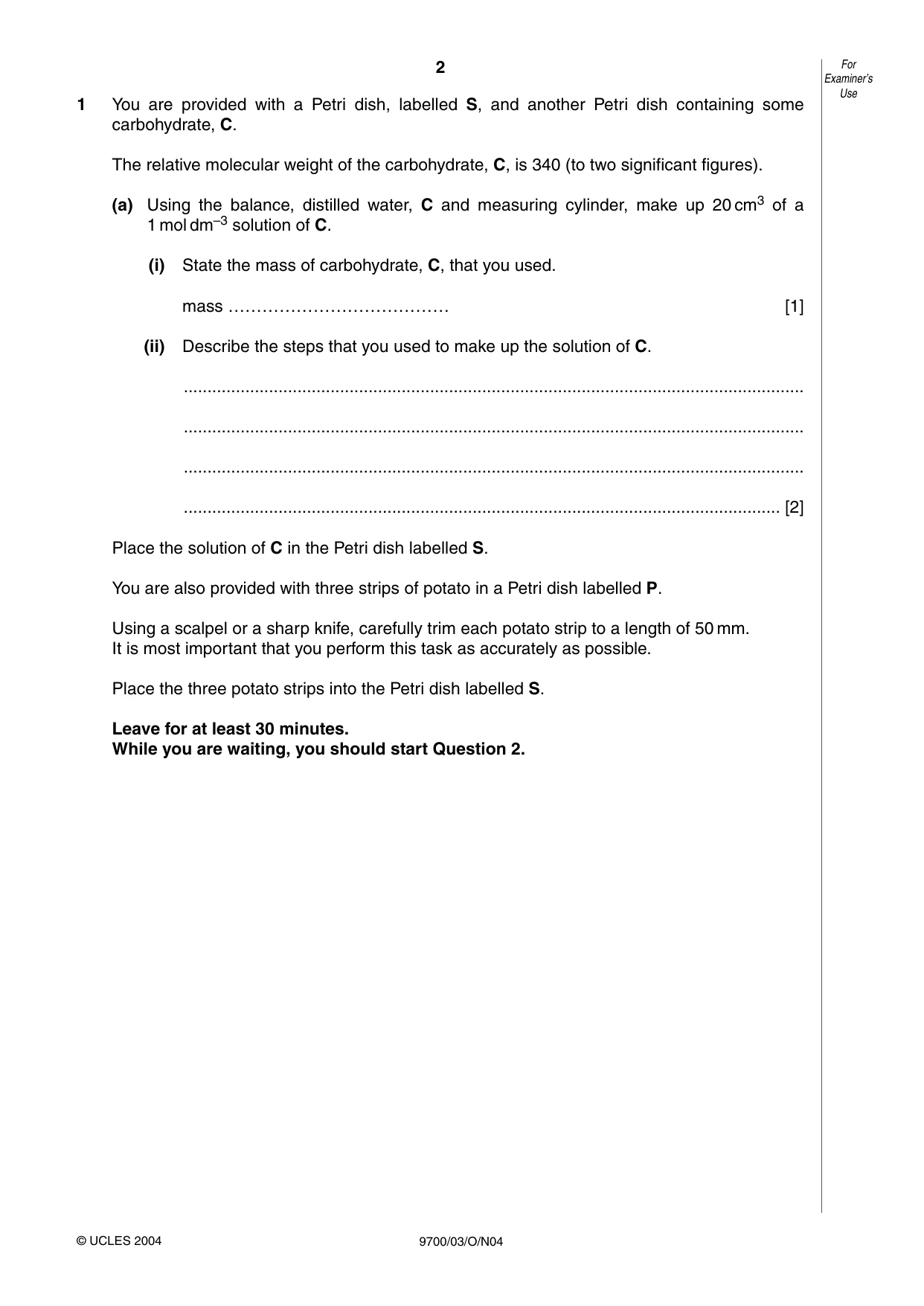
2 9700/03/O/N04 1 You are provided with a Petri dish, labelled S, and another Petri dish containing some carbohydrate, C. The relative molecular weight of the carbohydrate, C, is 340 (to two significant figures). (a) Using the balance, distilled water, C and measuring cylinder, make up 20 cm3 of a 1 mol dm–3 solution of C. (i) State the mass of carbohydrate, C, that you used. mass ………………………………… [1] (ii) Describe the steps that you used to make up the solution of C. … … … … [2] Place the solution of C in the Petri dish labelled S. You are also provided with three strips of potato in a Petri dish labelled P. Using a scalpel or a sharp knife, carefully trim each potato strip to a length of 50 mm. It is most important that you perform this task as accurately as possible. Place the three potato strips into the Petri dish labelled S. Leave for at least 30 minutes. While you are waiting, you should start Question 2. For Examiner’s Use © UCLES 2004
Question paper, page 3
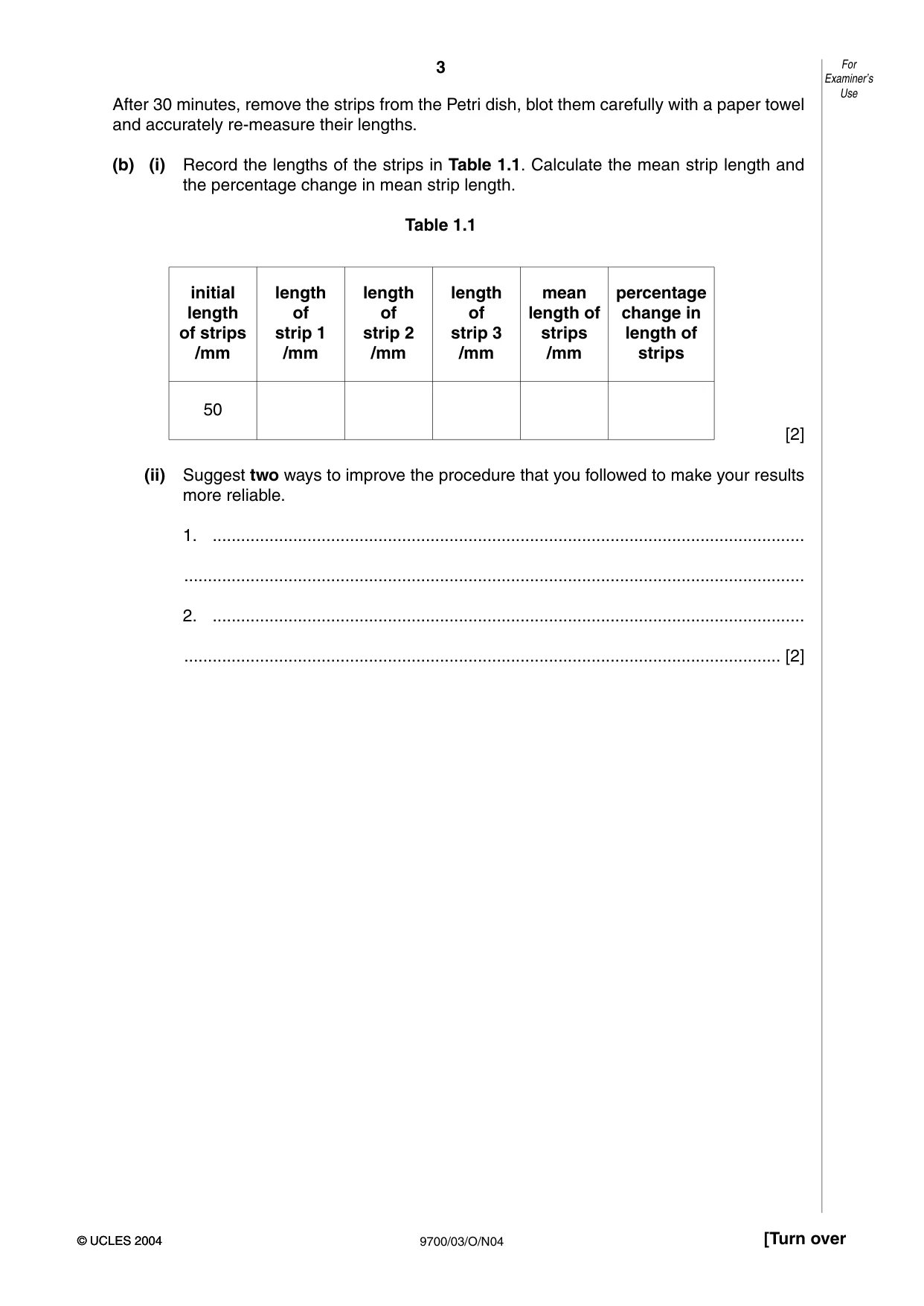
3 9700/03/O/N04 [Turn over For Examiner’s Use © UCLES 2004 © UCLES 2004 After 30 minutes, remove the strips from the Petri dish, blot them carefully with a paper towel and accurately re-measure their lengths. (b) (i) Record the lengths of the strips in Table 1.1. Calculate the mean strip length and the percentage change in mean strip length. Table 1.1 [2] (ii) Suggest two ways to improve the procedure that you followed to make your results more reliable. 1. … … 2. … … [2] initial length of strips /mm 50 length of strip 1 /mm length of strip 2 /mm length of strip 3 /mm mean length of strips /mm percentage change in length of strips
Question paper, page 4
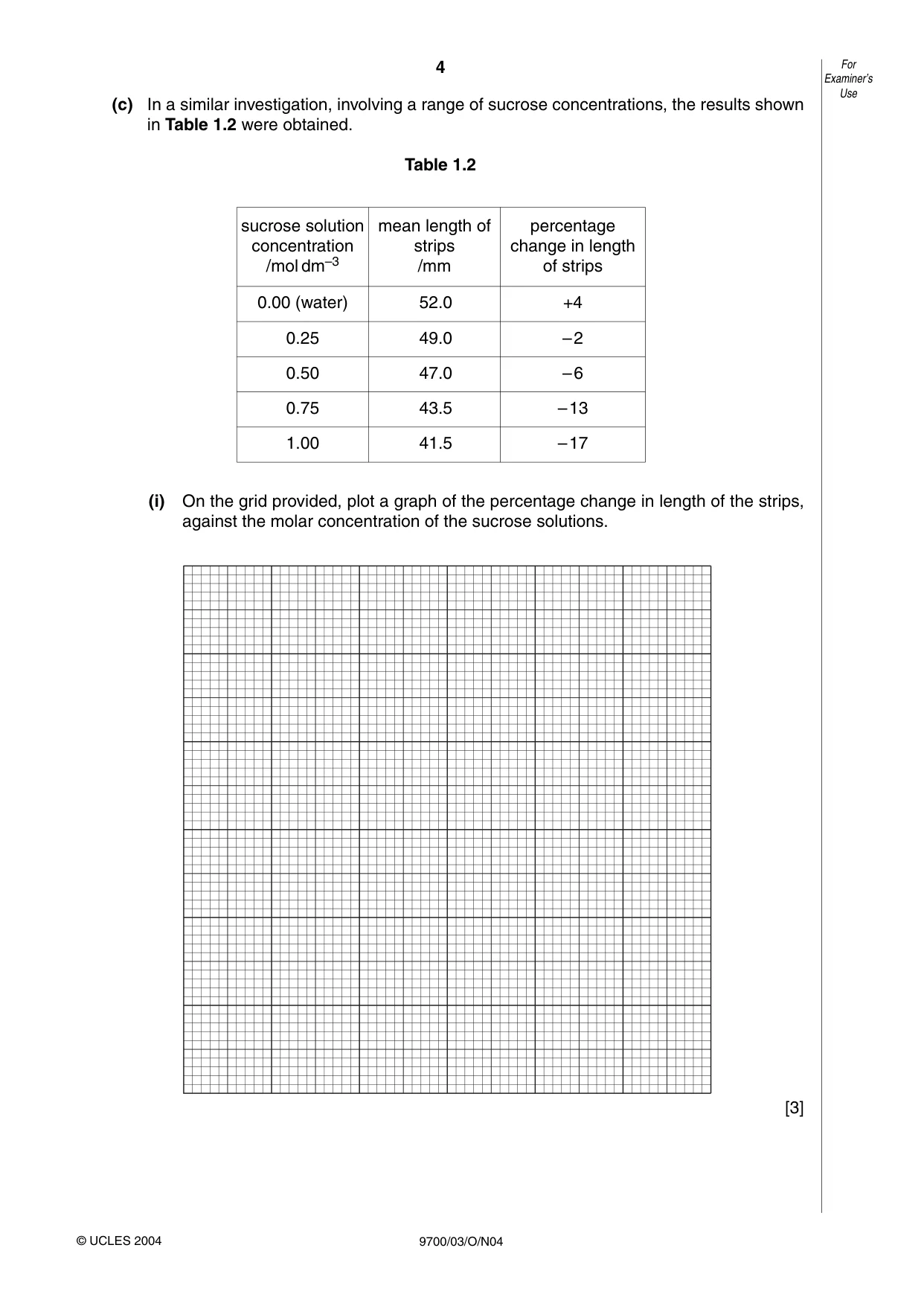
4 9700/03/O/N04 (c) In a similar investigation, involving a range of sucrose concentrations, the results shown in Table 1.2 were obtained. Table 1.2 (i) On the grid provided, plot a graph of the percentage change in length of the strips, against the molar concentration of the sucrose solutions. [3] For Examiner’s Use © UCLES 2004 sucrose solution concentration /mol dm–3 0.00 (water) 0.25 0.50 0.75 1.00 mean length of strips /mm 52.0 49.0 47.0 43.5 41.5 percentage change in length of strips +4 –2 –6 –13 –17
Question paper, page 5
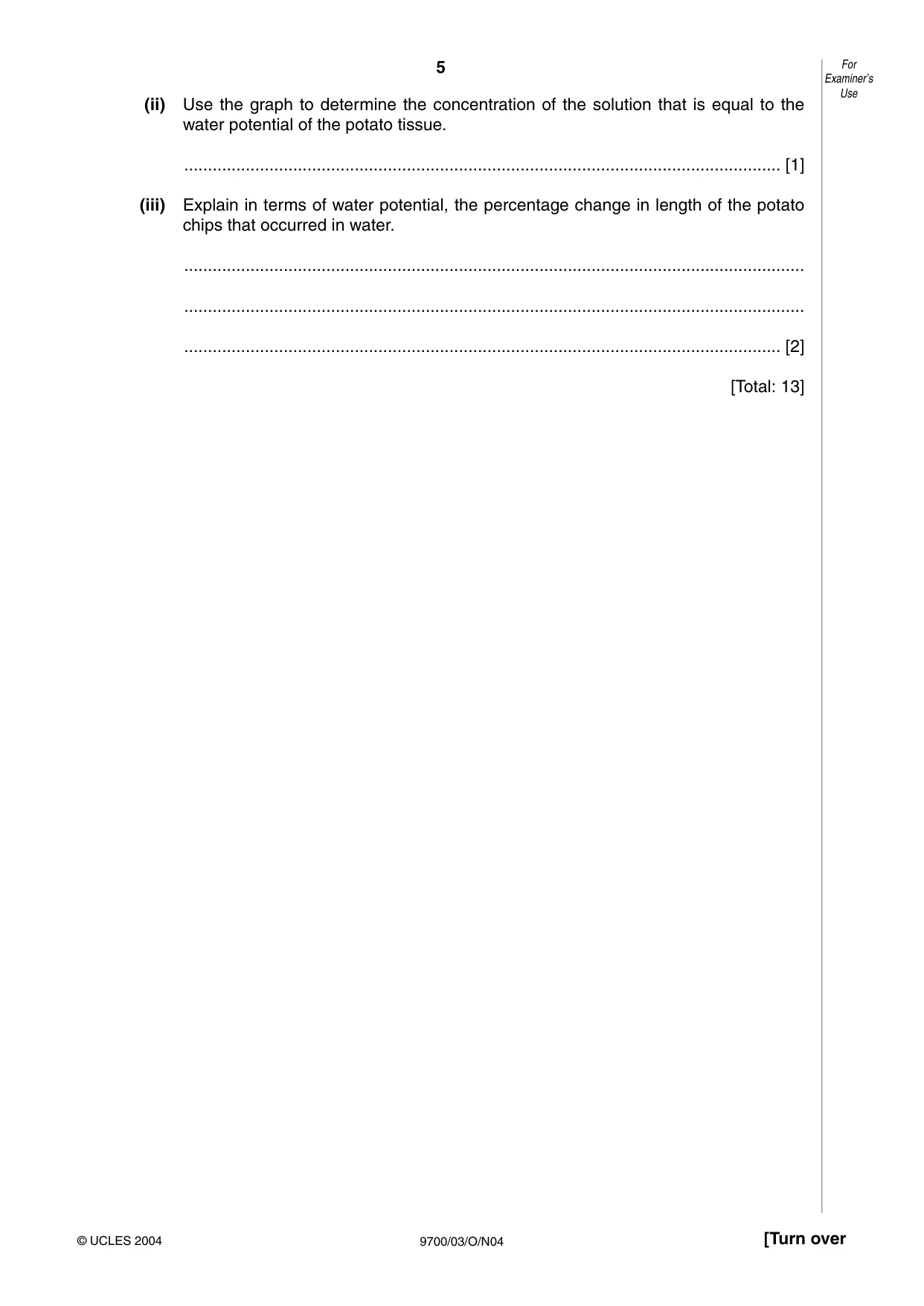
5 9700/03/O/N04 [Turn over (ii) Use the graph to determine the concentration of the solution that is equal to the water potential of the potato tissue. … [1] (iii) Explain in terms of water potential, the percentage change in length of the potato chips that occurred in water. … … … [2] [Total: 13] For Examiner’s Use © UCLES 2004
Question paper, page 6
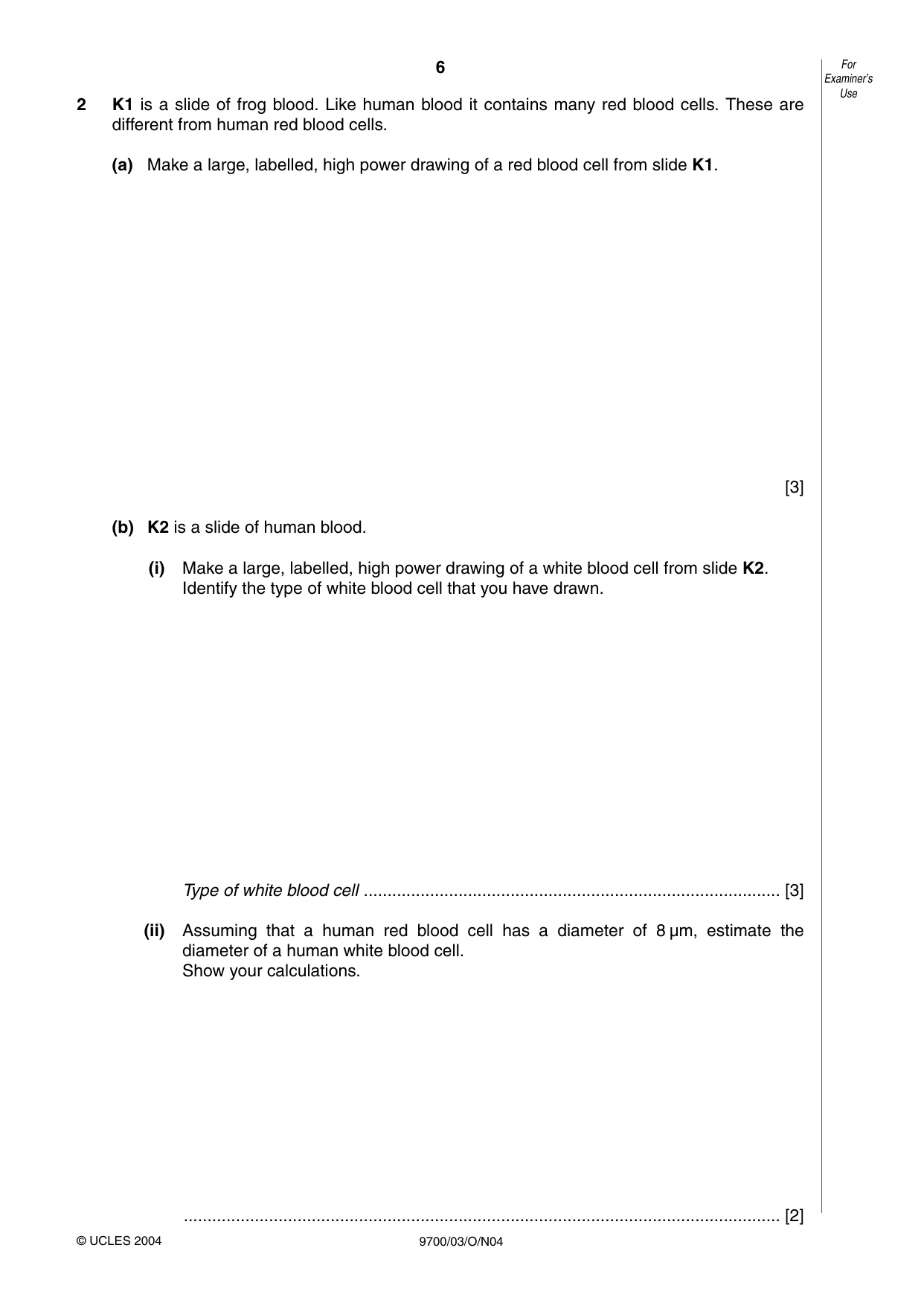
6 9700/03/O/N04 2 K1 is a slide of frog blood. Like human blood it contains many red blood cells. These are different from human red blood cells. (a) Make a large, labelled, high power drawing of a red blood cell from slide K1. [3] (b) K2 is a slide of human blood. (i) Make a large, labelled, high power drawing of a white blood cell from slide K2. Identify the type of white blood cell that you have drawn. Type of white blood cell … [3] (ii) Assuming that a human red blood cell has a diameter of 8 µm, estimate the diameter of a human white blood cell. Show your calculations. … [2] For Examiner’s Use © UCLES 2004
Question paper, page 7
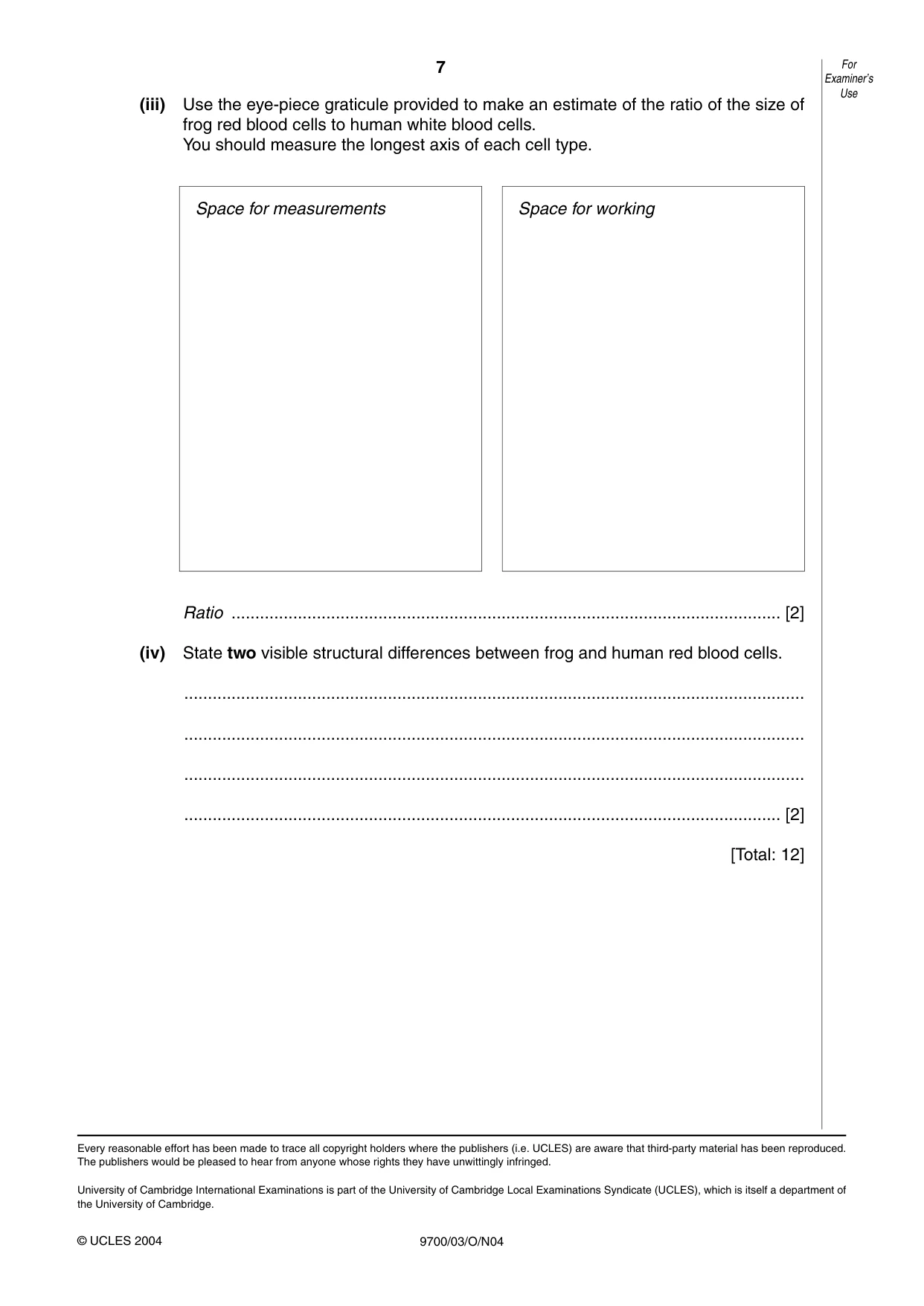
7 9700/03/O/N04 (iii) Use the eye-piece graticule provided to make an estimate of the ratio of the size of frog red blood cells to human white blood cells. You should measure the longest axis of each cell type. Ratio … [2] (iv) State two visible structural differences between frog and human red blood cells. … … … … [2] [Total: 12] For Examiner’s Use © UCLES 2004 Space for measurements Space for working Every reasonable effort has been made to trace all copyright holders where the publishers (i.e. UCLES) are aware that third-party material has been reproduced. The publishers would be pleased to hear from anyone whose rights they have unwittingly infringed. University of Cambridge International Examinations is part of the University of Cambridge Local Examinations Syndicate (UCLES), which is itself a department of the University of Cambridge.
Question paper, page 8
8 9700/03/O/N04 © UCLES 2004 REPORT FORM The teacher responsible for this subject is asked to answer the following questions. (a) Was the candidate physically handicapped in drawing or in using a microscope or is the candidate colourblind? If so, give brief details. (b) Was the candidate handicapped by deficient material or apparatus? If so, give brief details. (c) Was it necessary to make any substitutions for the materials sent from Cambridge, or recommended in the confidential instructions? If so, give brief details of the circumstances. (d) Any comments. Signed ……………………………… N.B. Information that applies to all candidates need be given on the first candidate’s answer book only.
Mark scheme, page 1
UNIVERSITY OF CAMBRIDGE INTERNATIONAL EXAMINATIONS GCE Advanced Subsidiary and Advanced Level MARK SCHEME for the November 2004 question paper 9700 BIOLOGY 9700/03 Paper 3 (Practical Test AS), maximum raw mark 25 This mark scheme is published as an aid to teachers and students, to indicate the requirements of the examination. This shows the basis on which Examiners were initially instructed to award marks. It does not indicate the details of the discussions that took place at an Examiners’ meeting before marking began. Any substantial changes to the mark scheme that arose from these discussions will be recorded in the published Report on the Examination. All Examiners are instructed that alternative correct answers and unexpected approaches in candidates’ scripts must be given marks that fairly reflect the relevant knowledge and skills demonstrated. Mark schemes must be read in conjunction with the question papers and the Report on the Examination. • CIE will not enter into discussion or correspondence in connection with these mark schemes. CIE is publishing the mark schemes for the November 2004 question papers for most IGCSE and GCE Advanced Level syllabuses.
Mark scheme, page 2
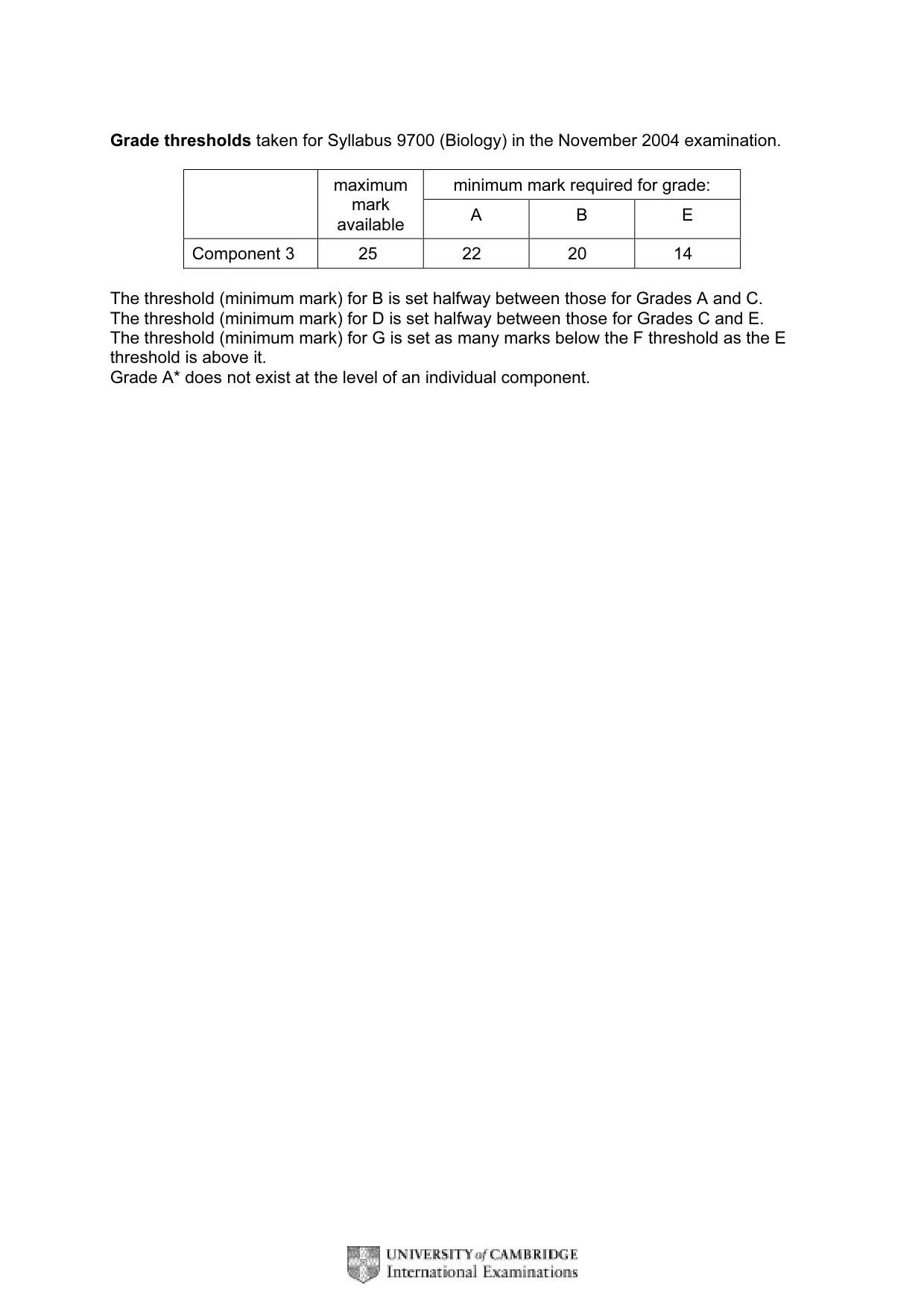
Grade thresholds taken for Syllabus 9700 (Biology) in the November 2004 examination. minimum mark required for grade: maximum mark available A B E Component 3 25 22 20 14 The threshold (minimum mark) for B is set halfway between those for Grades A and C. The threshold (minimum mark) for D is set halfway between those for Grades C and E. The threshold (minimum mark) for G is set as many marks below the F threshold as the E threshold is above it. Grade A* does not exist at the level of an individual component.
Mark scheme, page 3
November 2004 GCE AS/A LEVEL MARK SCHEME MAXIMUM MARK: 25 SYLLABUS/COMPONENT: 9700/03 BIOLOGY Paper 3 (Practical Test AS)
Mark scheme, page 4
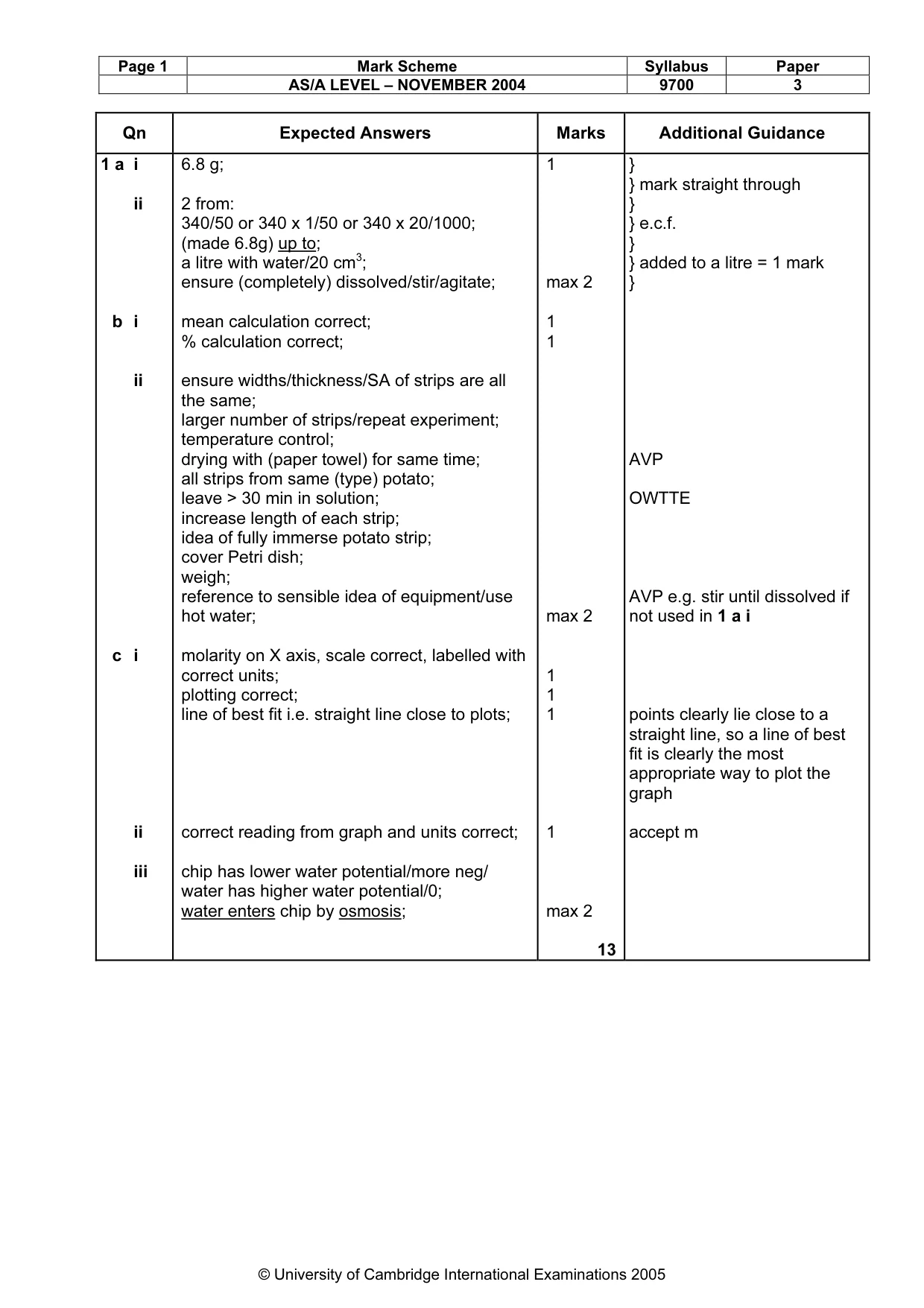
Page 1 Mark Scheme Syllabus Paper AS/A LEVEL – NOVEMBER 2004 9700 3 © University of Cambridge International Examinations 2005 Qn Expected Answers Marks Additional Guidance 1 a i ii b i ii c i ii iii 6.8 g; 2 from: 340/50 or 340 x 1/50 or 340 x 20/1000; (made 6.8g) up to; a litre with water/20 cm3; ensure (completely) dissolved/stir/agitate; mean calculation correct; % calculation correct; ensure widths/thickness/SA of strips are all the same; larger number of strips/repeat experiment; temperature control; drying with (paper towel) for same time; all strips from same (type) potato; leave > 30 min in solution; increase length of each strip; idea of fully immerse potato strip; cover Petri dish; weigh; reference to sensible idea of equipment/use hot water; molarity on X axis, scale correct, labelled with correct units; plotting correct; line of best fit i.e. straight line close to plots; correct reading from graph and units correct; chip has lower water potential/more neg/ water has higher water potential/0; water enters chip by osmosis; 1 max 2 1 1 max 2 1 1 1 1 max 2 13 } } mark straight through } } e.c.f. } } added to a litre = 1 mark } AVP OWTTE AVP e.g. stir until dissolved if not used in 1 a i points clearly lie close to a straight line, so a line of best fit is clearly the most appropriate way to plot the graph accept m
Mark scheme, page 5
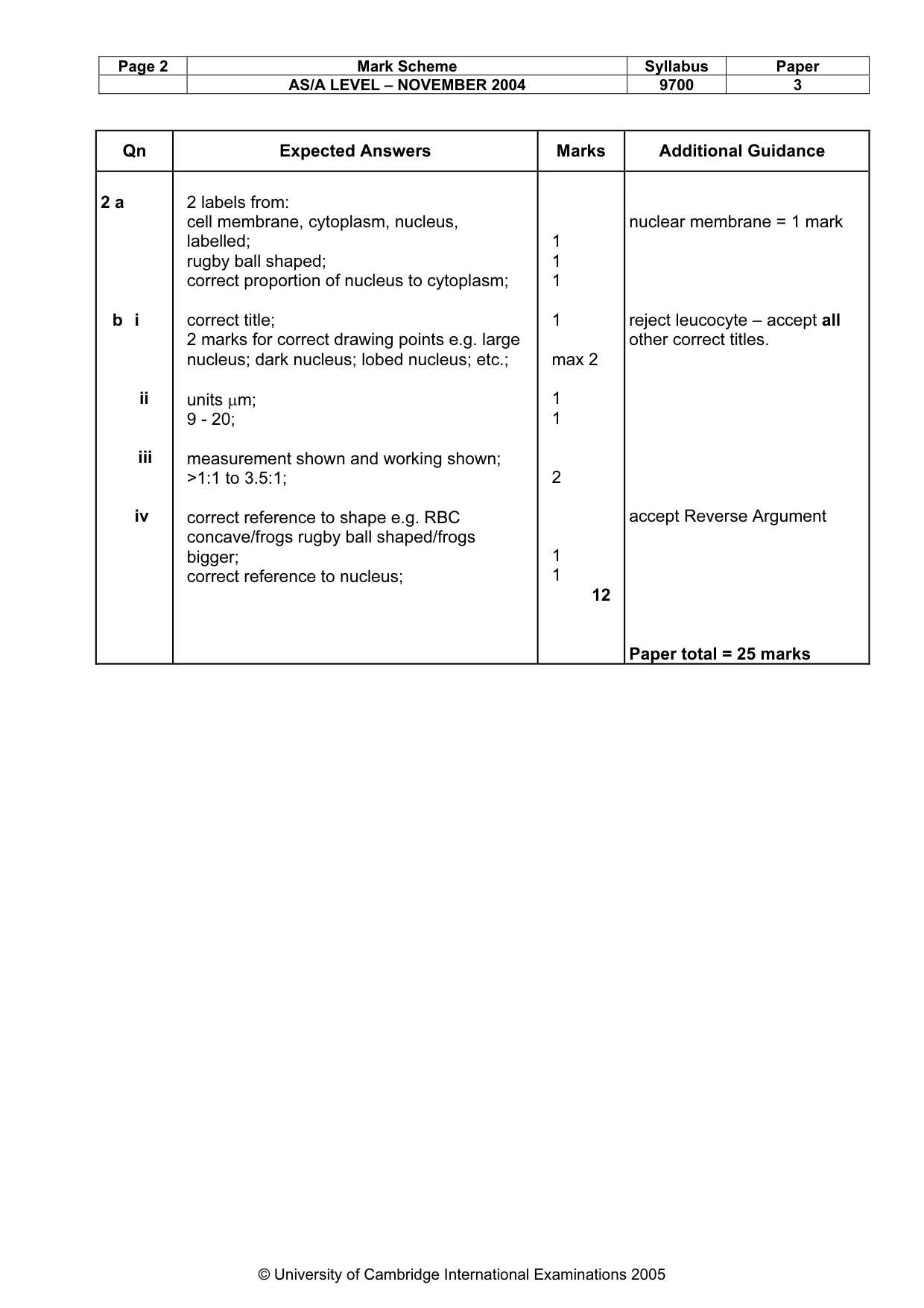
Page 2 Mark Scheme Syllabus Paper AS/A LEVEL – NOVEMBER 2004 9700 3 © University of Cambridge International Examinations 2005 Qn Expected Answers Marks Additional Guidance 2 a b i ii iii iv 2 labels from: cell membrane, cytoplasm, nucleus, labelled; rugby ball shaped; correct proportion of nucleus to cytoplasm; correct title; 2 marks for correct drawing points e.g. large nucleus; dark nucleus; lobed nucleus; etc.; units µm; 9 - 20; measurement shown and working shown; >1:1 to 3.5:1; correct reference to shape e.g. RBC concave/frogs rugby ball shaped/frogs bigger; correct reference to nucleus; 1 1 1 1 max 2 1 1 2 1 1 12 nuclear membrane = 1 mark reject leucocyte – accept all other correct titles. accept Reverse Argument Paper total = 25 marks