Cambridge A Level Biology 9700 — 2003 Oct/Nov Paper 1 · Variant 1
9700/11/O/N/03
The question paper and its mark scheme, free to read here and free to download. This is Cambridge’s own paper, exactly as it was sat.
Question paper16 pages

Mark scheme
No mark scheme is in the library for this paper.
Paper as text
Question paper, page 1
This document consists of 15 printed pages and 1 blank page. SP (BR/PW) S43731/3 © UCLES 2003 [Turn over CAMBRIDGE INTERNATIONAL EXAMINATIONS General Certificate of Education Advanced Subsidiary Level and Advanced Level BIOLOGY 9700/01 Paper 1 Multiple Choice October/November 2003 1 hour Additional Materials: Multiple Choice Answer Sheet Soft clean eraser Soft pencil (type B or HB is recommended) READ THESE INSTRUCTIONS FIRST Write in soft pencil. Do not use staples, paper clips, highlighters, glue or correction fluid. Write your name, Centre number and candidate number on the answer sheet in the spaces provided unless this has been done for you. There are forty questions on this paper. Answer all questions. For each question, there are four possible answers, A, B, C, and D. Choose the one you consider correct and record your choice in soft pencil on the separate answer sheet. Read the instructions on the Answer Sheet very carefully. Each correct answer will score one mark. A mark will not be deducted for a wrong answer. Any rough working should be done in this booklet.
Question paper, page 2
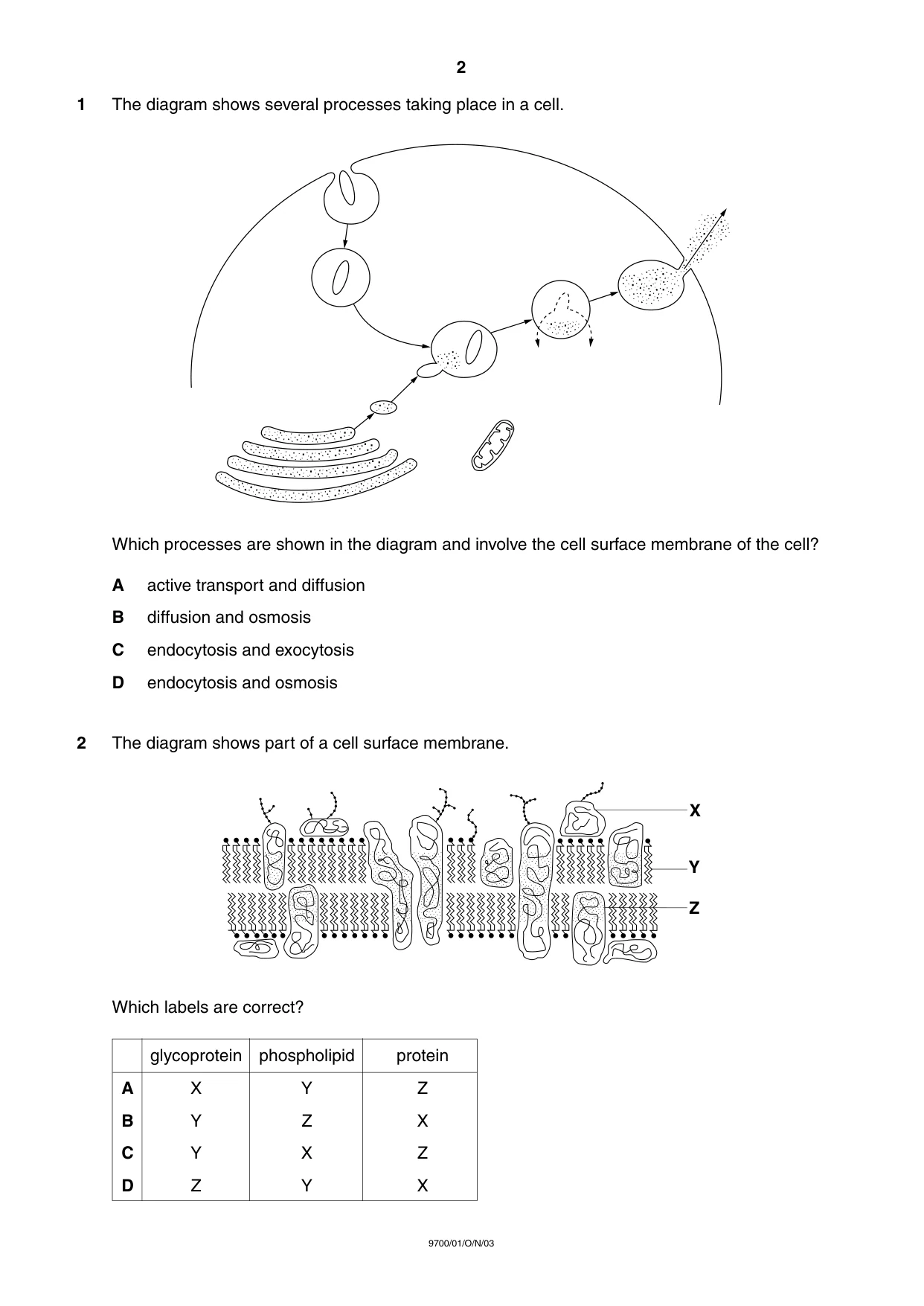
2 9700/01/O/N/03 1 The diagram shows several processes taking place in a cell. Which processes are shown in the diagram and involve the cell surface membrane of the cell? A active transport and diffusion B diffusion and osmosis C endocytosis and exocytosis D endocytosis and osmosis 2 The diagram shows part of a cell surface membrane. Which labels are correct? X Y Z glycoprotein phospholipid protein A X Y Z B Y Z X C Y X Z D Z Y X
Question paper, page 3
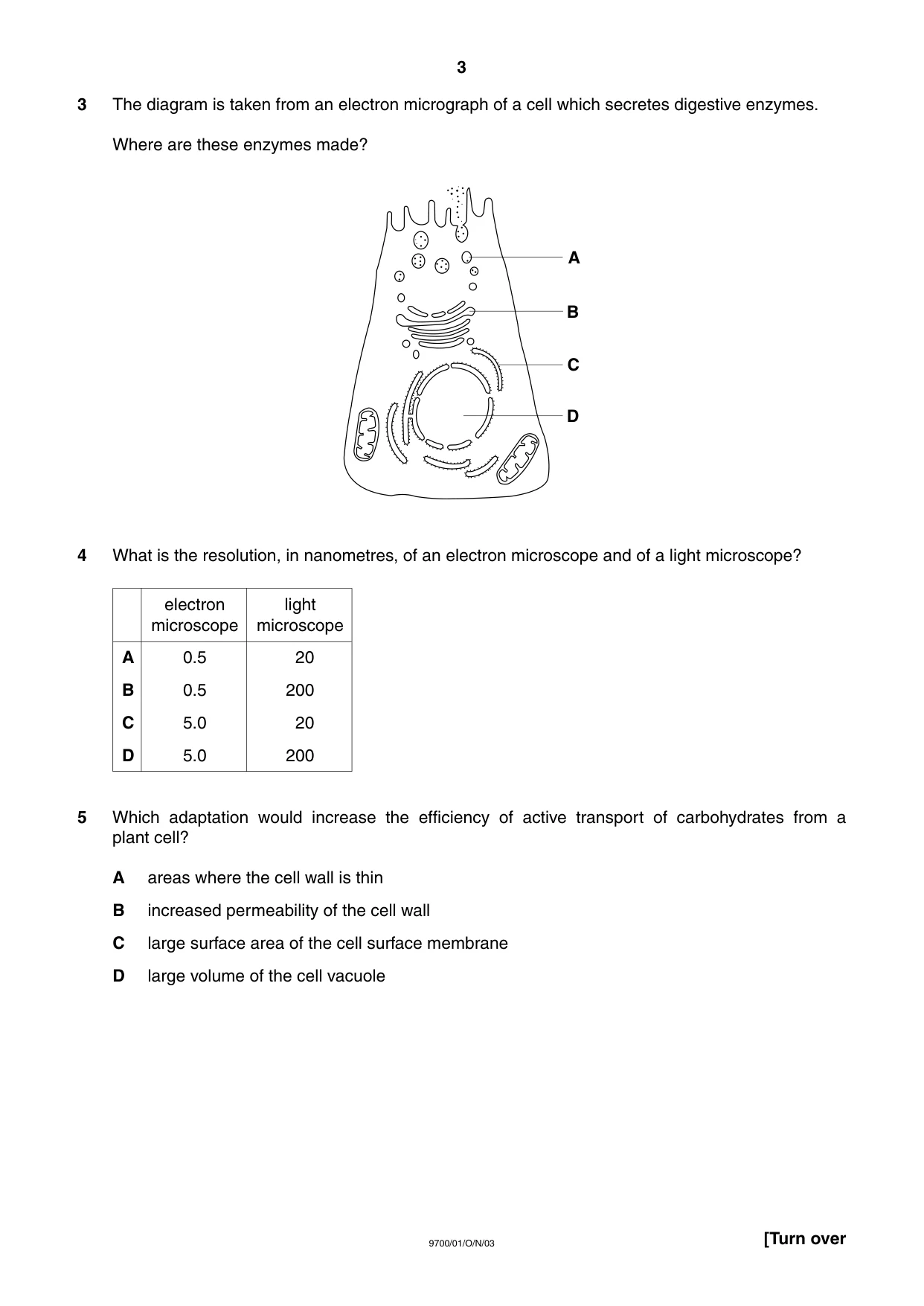
3 9700/01/O/N/03 [Turn over 3 The diagram is taken from an electron micrograph of a cell which secretes digestive enzymes. Where are these enzymes made? 4 What is the resolution, in nanometres, of an electron microscope and of a light microscope? 5 Which adaptation would increase the efficiency of active transport of carbohydrates from a plant cell? A areas where the cell wall is thin B increased permeability of the cell wall C large surface area of the cell surface membrane D large volume of the cell vacuole A D C B electron light microscope microscope A 0.5 20 B 0.5 200 C 5.0 20 D 5.0 200
Question paper, page 4
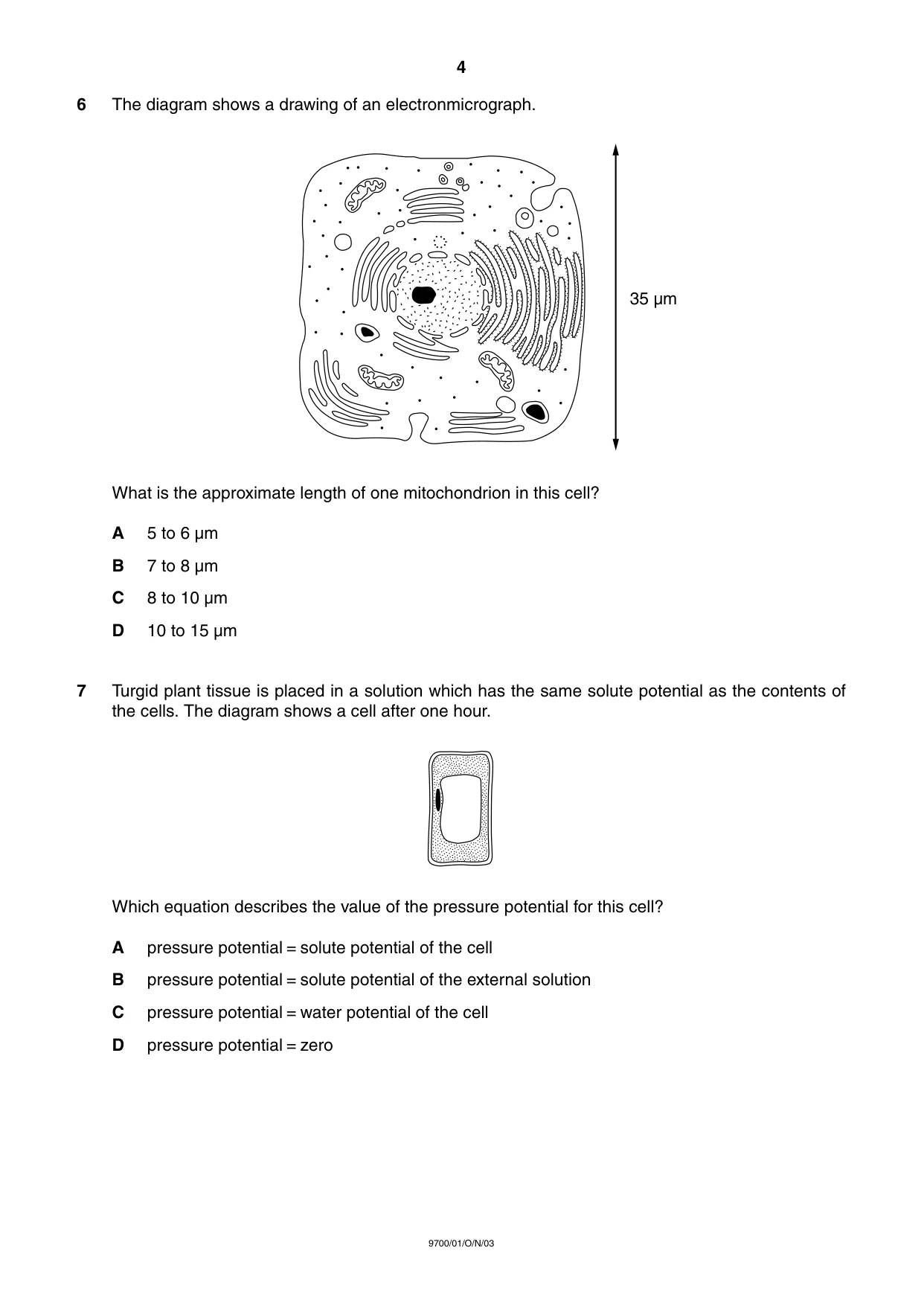
4 9700/01/O/N/03 6 The diagram shows a drawing of an electronmicrograph. What is the approximate length of one mitochondrion in this cell? A 5 to 6 µm B 7 to 8 µm C 8 to 10 µm D 10 to 15 µm 7 Turgid plant tissue is placed in a solution which has the same solute potential as the contents of the cells. The diagram shows a cell after one hour. Which equation describes the value of the pressure potential for this cell? A pressure potential = solute potential of the cell B pressure potential = solute potential of the external solution C pressure potential = water potential of the cell D pressure potential = zero 35 µm
Question paper, page 5
5 9700/01/O/N/03 [Turn over 8 Urea is a reagent which disrupts all bonds except covalent bonds in protein molecules. Which level of protein structure would remain intact when a protein is treated with urea? A primary B secondary C tertiary D quaternary 9 Which feature distinguishes starch from glycogen? A Starch contains alpha glucose. B Starch contains 1,6 glycosidic bonds. C Starch has an unbranched component. D Starch is a polysaccharide. 10 What is the function of iron in the haemoglobin molecule? A It binds oxygen to the haemoglobin molecule. B It makes the haemoglobin more soluble in the red blood cell. C It stabilises the quaternary structure of the protein. D It undergoes reversible oxidation and reduction.
Question paper, page 6
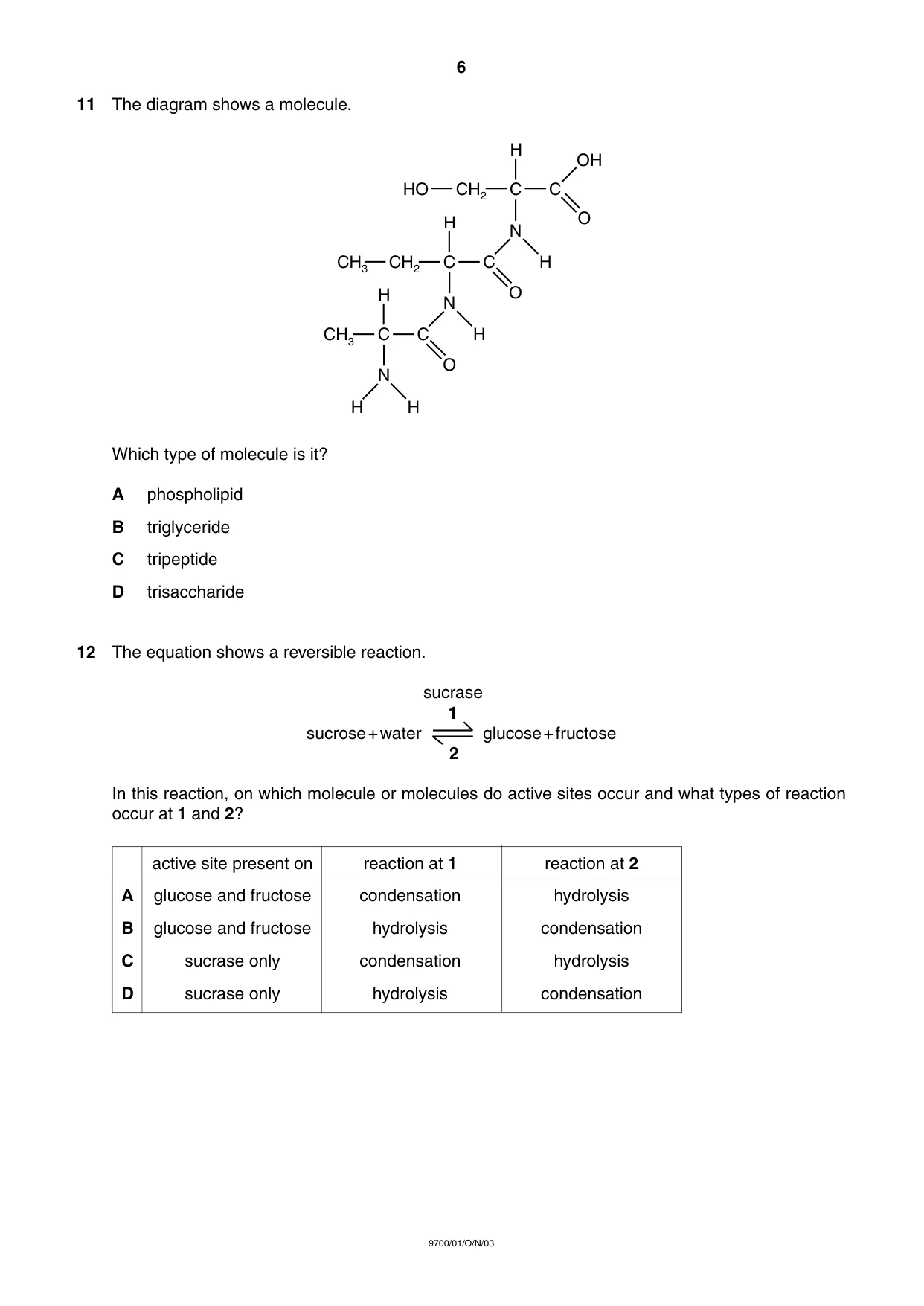
6 9700/01/O/N/03 11 The diagram shows a molecule. Which type of molecule is it? A phospholipid B triglyceride C tripeptide D trisaccharide 12 The equation shows a reversible reaction. sucrase 1 sucrose+water glucose+fructose 2 In this reaction, on which molecule or molecules do active sites occur and what types of reaction occur at 1 and 2? HO CH2 H C C OH O N H C CH2 CH3 C H O N H C O C CH3 H N H H active site present on reaction at 1 reaction at 2 A glucose and fructose condensation hydrolysis B glucose and fructose hydrolysis condensation C sucrase only condensation hydrolysis D sucrase only hydrolysis condensation
Question paper, page 7
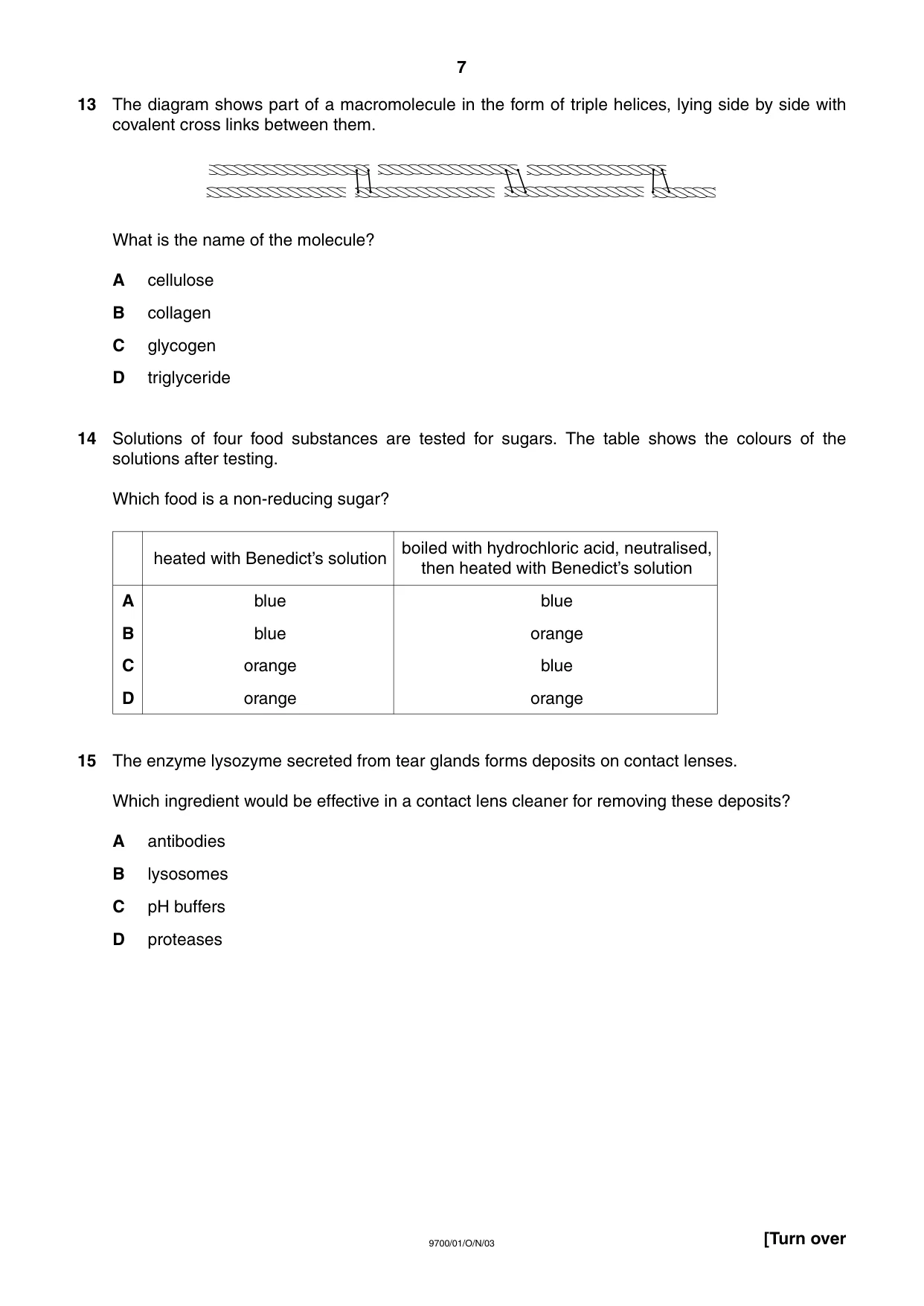
7 9700/01/O/N/03 [Turn over 13 The diagram shows part of a macromolecule in the form of triple helices, lying side by side with covalent cross links between them. What is the name of the molecule? A cellulose B collagen C glycogen D triglyceride 14 Solutions of four food substances are tested for sugars. The table shows the colours of the solutions after testing. Which food is a non-reducing sugar? 15 The enzyme lysozyme secreted from tear glands forms deposits on contact lenses. Which ingredient would be effective in a contact lens cleaner for removing these deposits? A antibodies B lysosomes C pH buffers D proteases heated with Benedict’s solution boiled with hydrochloric acid, neutralised, then heated with Benedict’s solution A blue blue B blue orange C orange blue D orange orange
Question paper, page 8
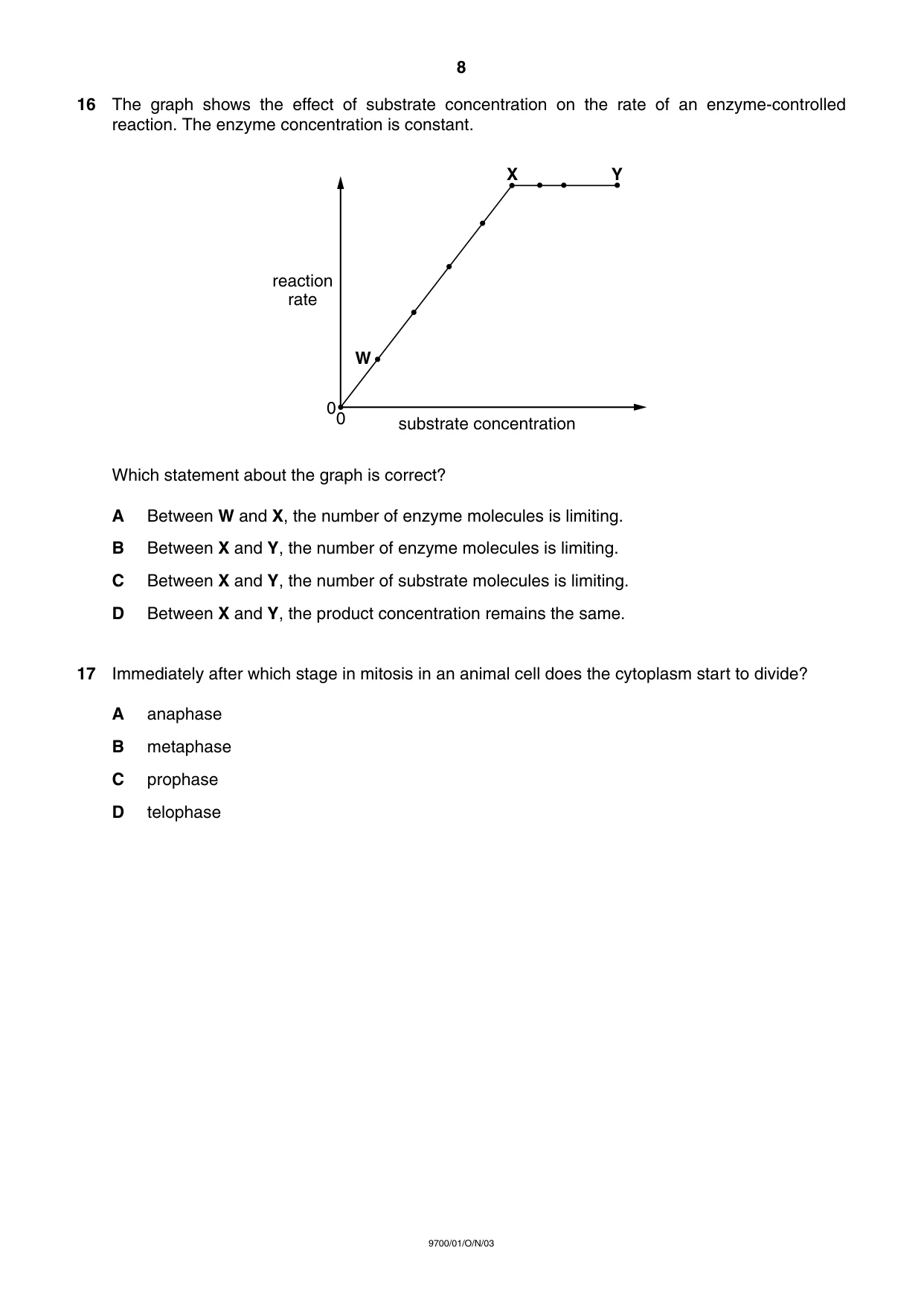
8 9700/01/O/N/03 16 The graph shows the effect of substrate concentration on the rate of an enzyme-controlled reaction. The enzyme concentration is constant. Which statement about the graph is correct? A Between W and X, the number of enzyme molecules is limiting. B Between X and Y, the number of enzyme molecules is limiting. C Between X and Y, the number of substrate molecules is limiting. D Between X and Y, the product concentration remains the same. 17 Immediately after which stage in mitosis in an animal cell does the cytoplasm start to divide? A anaphase B metaphase C prophase D telophase reaction rate substrate concentration W X Y 00
Question paper, page 9
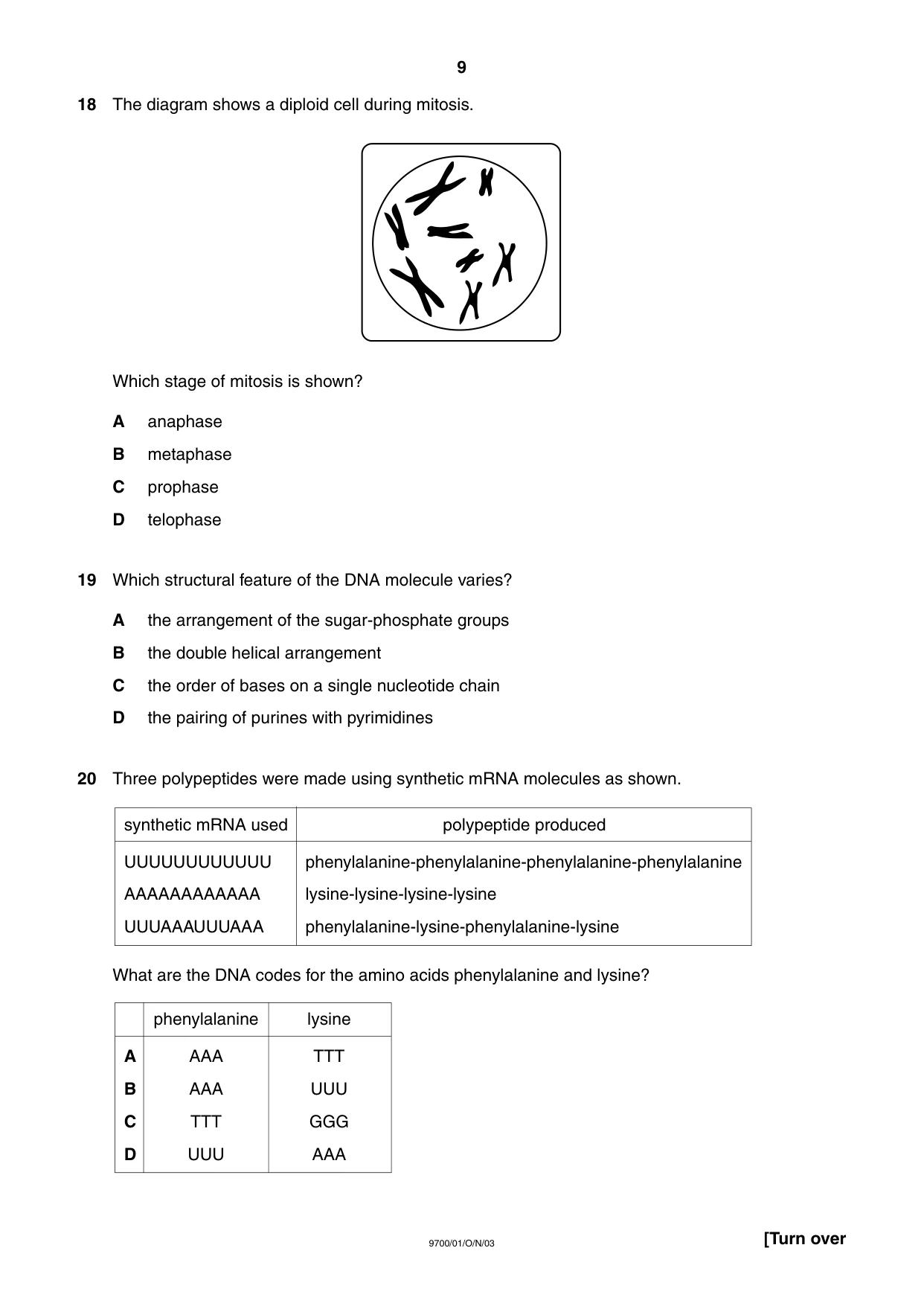
9 9700/01/O/N/03 [Turn over 18 The diagram shows a diploid cell during mitosis. Which stage of mitosis is shown? A anaphase B metaphase C prophase D telophase 19 Which structural feature of the DNA molecule varies? A the arrangement of the sugar-phosphate groups B the double helical arrangement C the order of bases on a single nucleotide chain D the pairing of purines with pyrimidines 20 Three polypeptides were made using synthetic mRNA molecules as shown. What are the DNA codes for the amino acids phenylalanine and lysine? synthetic mRNA used polypeptide produced UUUUUUUUUUUU phenylalanine-phenylalanine-phenylalanine-phenylalanine AAAAAAAAAAAA lysine-lysine-lysine-lysine UUUAAAUUUAAA phenylalanine-lysine-phenylalanine-lysine phenylalanine lysine A AAA TTT B AAA UUU C TTT GGG D UUU AAA
Question paper, page 10
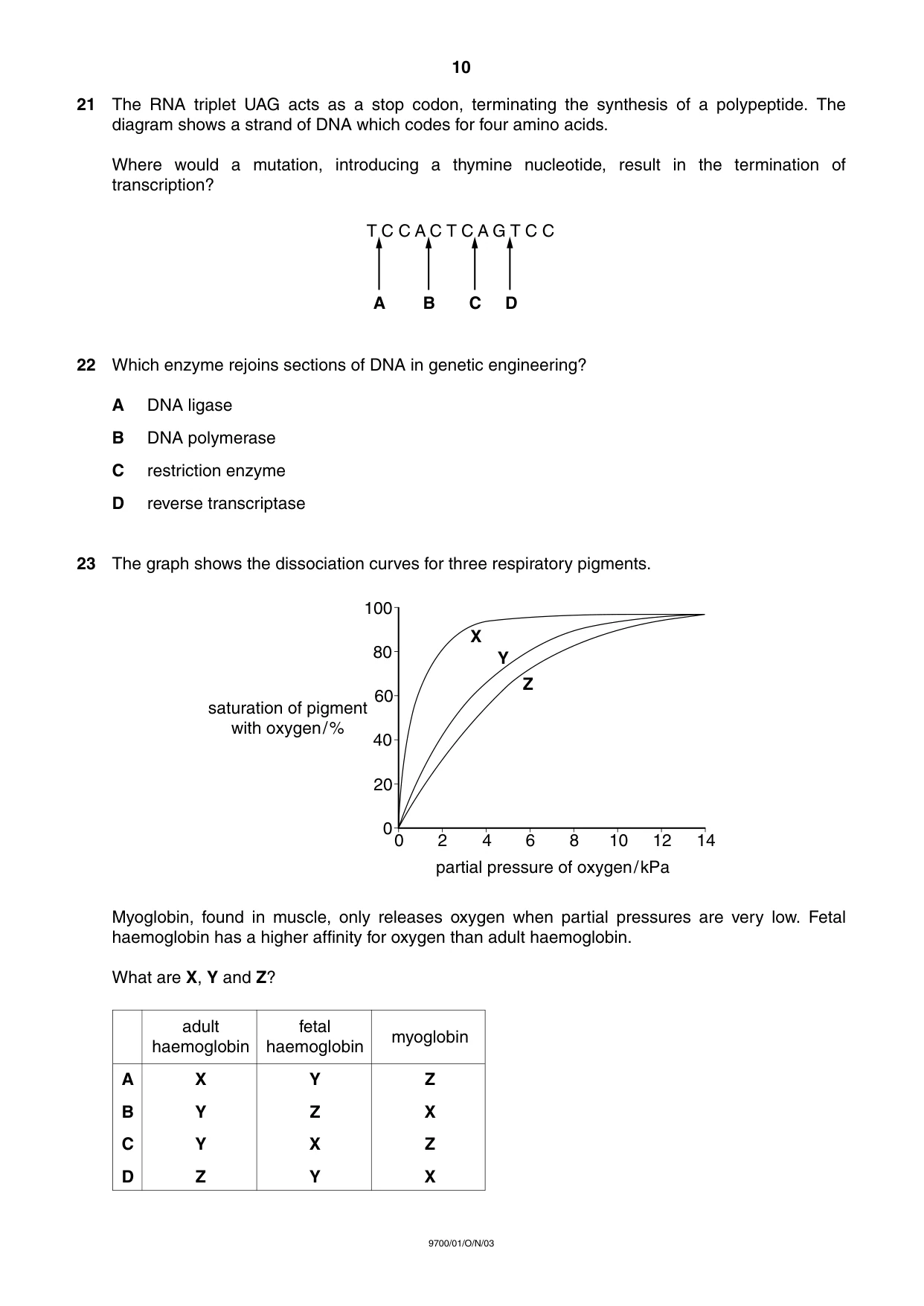
10 9700/01/O/N/03 21 The RNA triplet UAG acts as a stop codon, terminating the synthesis of a polypeptide. The diagram shows a strand of DNA which codes for four amino acids. Where would a mutation, introducing a thymine nucleotide, result in the termination of transcription? 22 Which enzyme rejoins sections of DNA in genetic engineering? A DNA ligase B DNA polymerase C restriction enzyme D reverse transcriptase 23 The graph shows the dissociation curves for three respiratory pigments. Myoglobin, found in muscle, only releases oxygen when partial pressures are very low. Fetal haemoglobin has a higher affinity for oxygen than adult haemoglobin. What are X, Y and Z? 100 80 40 60 20 00 2 4 6 8 10 12 14 saturation of pigment with oxygen/% partial pressure of oxygen/kPa X Y Z T C C A C T C A G T C C A B C D adult fetal haemoglobin haemoglobin myoglobin A X Y Z B Y Z X C Y X Z D Z Y X
Question paper, page 11
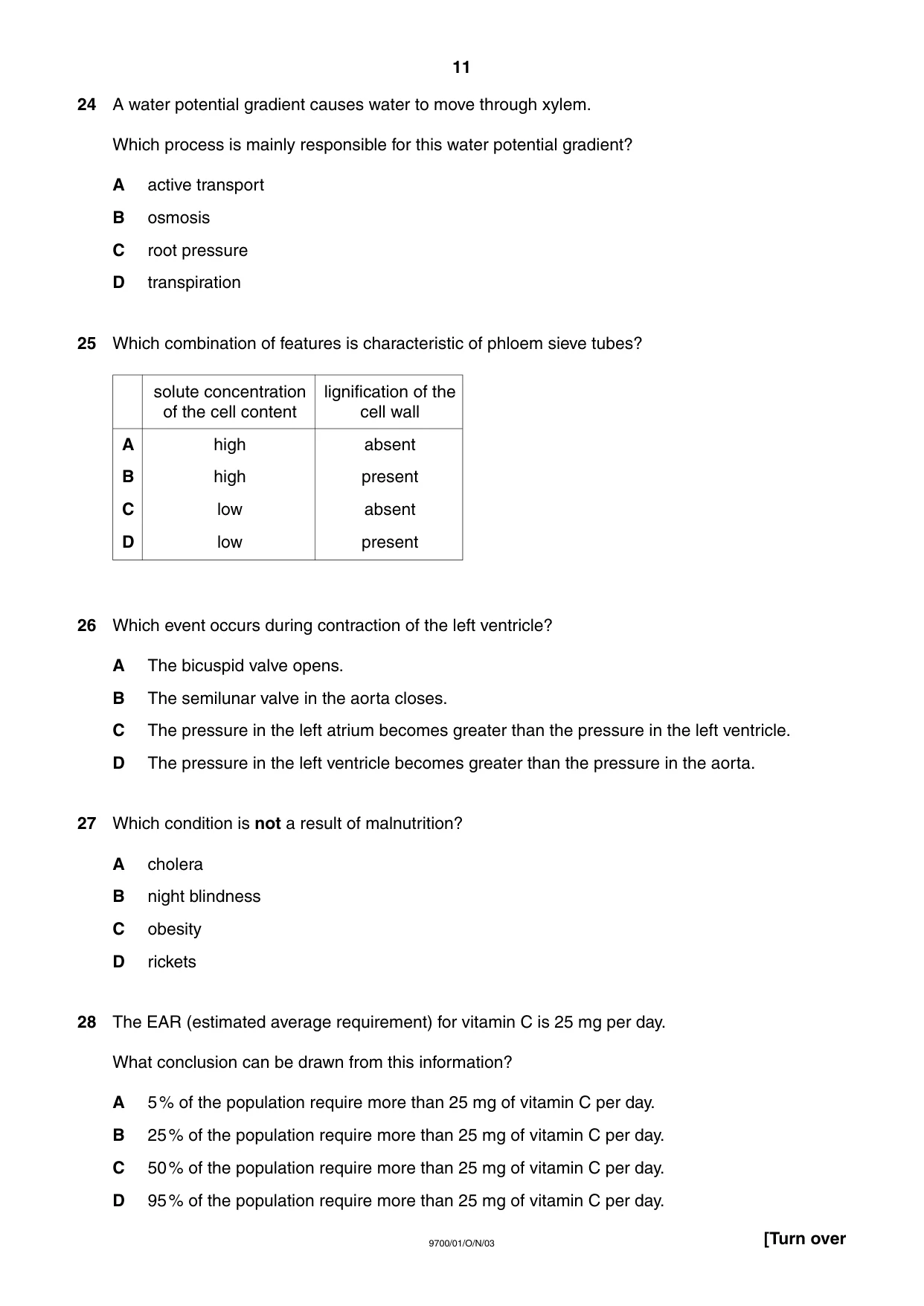
11 9700/01/O/N/03 [Turn over 24 A water potential gradient causes water to move through xylem. Which process is mainly responsible for this water potential gradient? A active transport B osmosis C root pressure D transpiration 25 Which combination of features is characteristic of phloem sieve tubes? 26 Which event occurs during contraction of the left ventricle? A The bicuspid valve opens. B The semilunar valve in the aorta closes. C The pressure in the left atrium becomes greater than the pressure in the left ventricle. D The pressure in the left ventricle becomes greater than the pressure in the aorta. 27 Which condition is not a result of malnutrition? A cholera B night blindness C obesity D rickets 28 The EAR (estimated average requirement) for vitamin C is 25 mg per day. What conclusion can be drawn from this information? A 5% of the population require more than 25 mg of vitamin C per day. B 25% of the population require more than 25 mg of vitamin C per day. C 50% of the population require more than 25 mg of vitamin C per day. D 95% of the population require more than 25 mg of vitamin C per day. solute concentration lignification of the of the cell content cell wall A high absent B high present C low absent D low present
Question paper, page 12
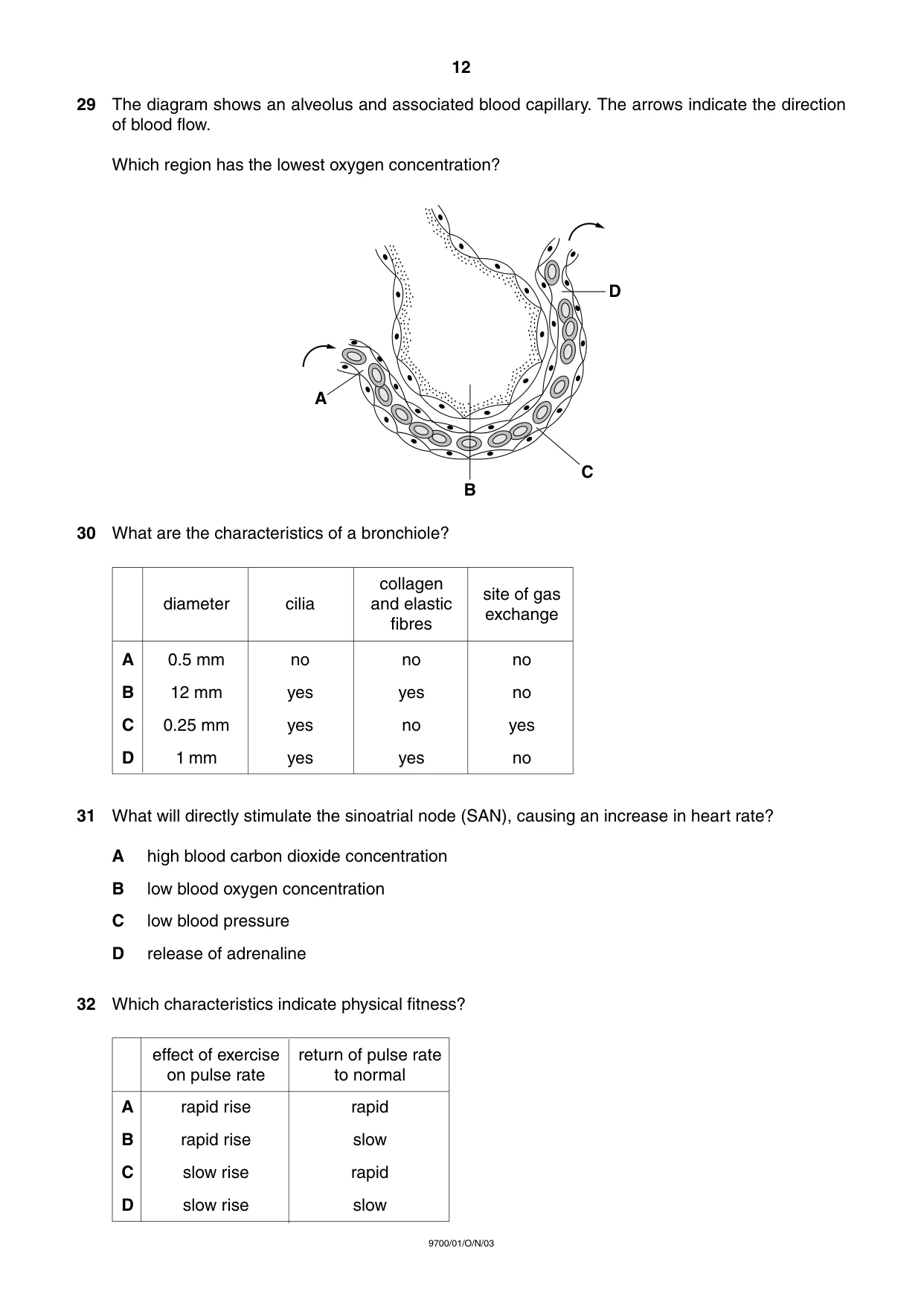
12 9700/01/O/N/03 29 The diagram shows an alveolus and associated blood capillary. The arrows indicate the direction of blood flow. Which region has the lowest oxygen concentration? 30 What are the characteristics of a bronchiole? 31 What will directly stimulate the sinoatrial node (SAN), causing an increase in heart rate? A high blood carbon dioxide concentration B low blood oxygen concentration C low blood pressure D release of adrenaline 32 Which characteristics indicate physical fitness? C B A D effect of exercise return of pulse rate on pulse rate to normal A rapid rise rapid B rapid rise slow C slow rise rapid D slow rise slow collagen site of gas diameter cilia and elastic exchange fibres A 0.5 mm no no no B 12 mm yes yes no C 0.25 mm yes no yes D 1 mm yes yes no
Question paper, page 13
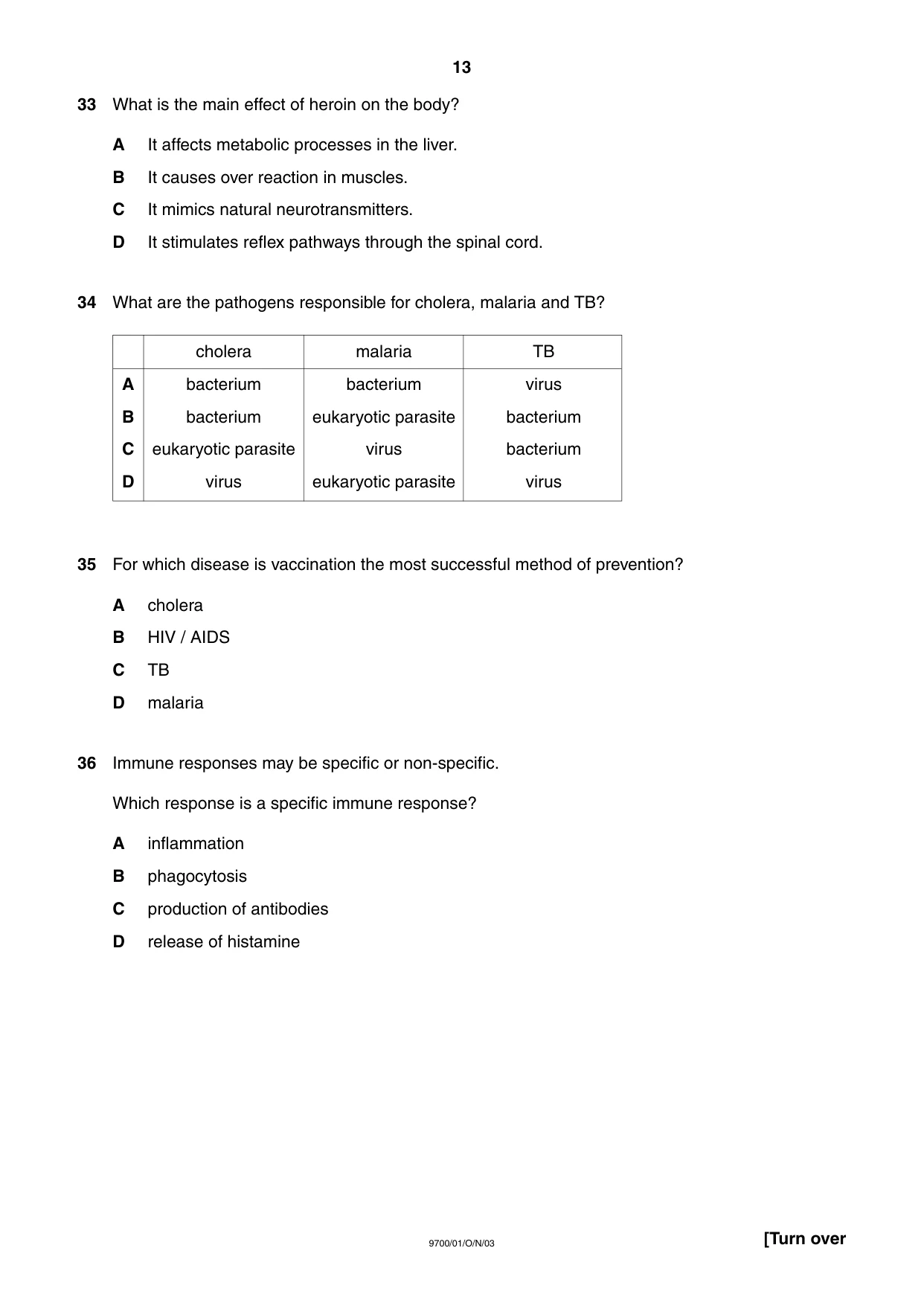
13 9700/01/O/N/03 [Turn over 33 What is the main effect of heroin on the body? A It affects metabolic processes in the liver. B It causes over reaction in muscles. C It mimics natural neurotransmitters. D It stimulates reflex pathways through the spinal cord. 34 What are the pathogens responsible for cholera, malaria and TB? 35 For which disease is vaccination the most successful method of prevention? A cholera B HIV / AIDS C TB D malaria 36 Immune responses may be specific or non-specific. Which response is a specific immune response? A inflammation B phagocytosis C production of antibodies D release of histamine cholera malaria TB A bacterium bacterium virus B bacterium eukaryotic parasite bacterium C eukaryotic parasite virus bacterium D virus eukaryotic parasite virus
Question paper, page 14
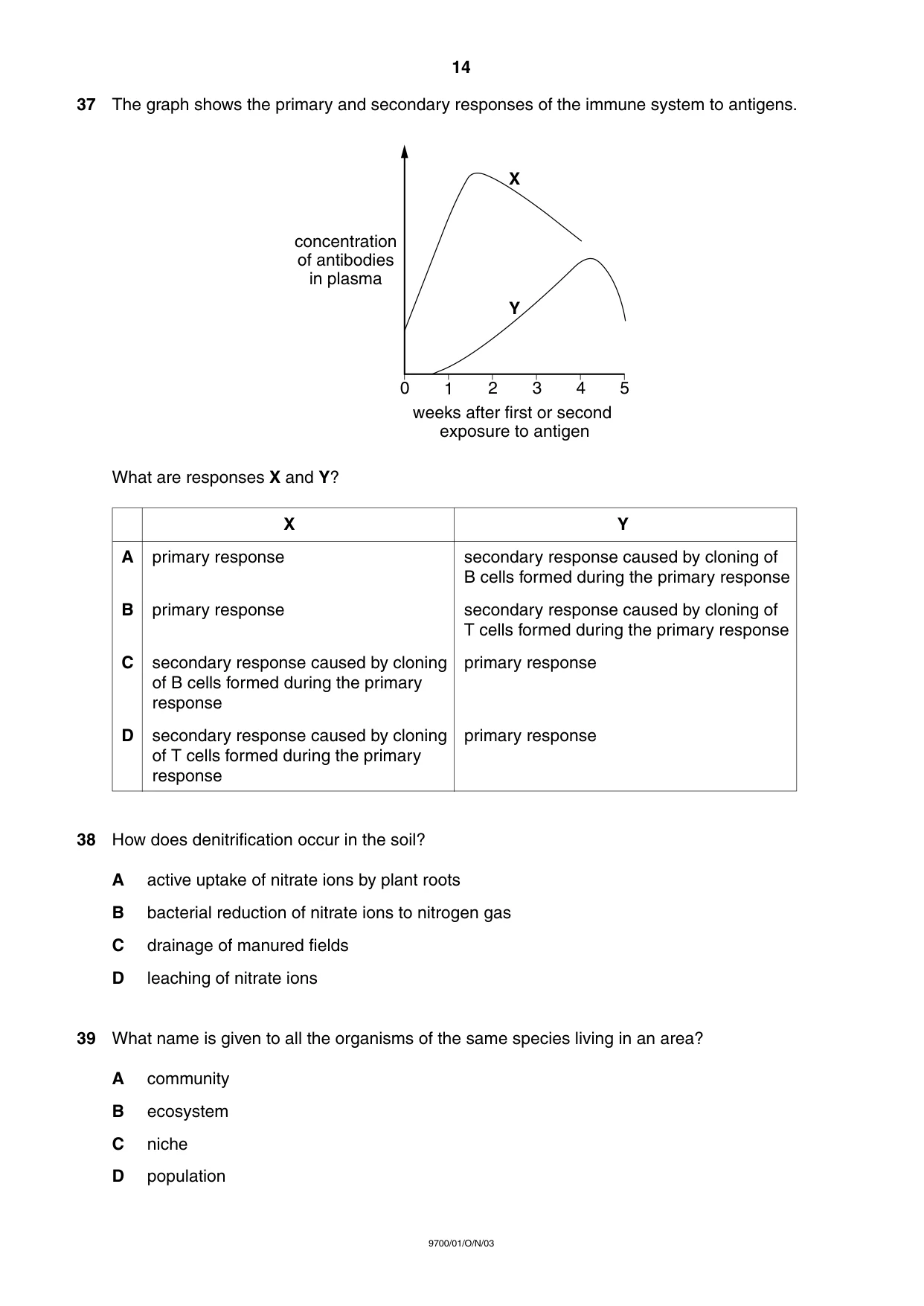
14 9700/01/O/N/03 37 The graph shows the primary and secondary responses of the immune system to antigens. What are responses X and Y? 38 How does denitrification occur in the soil? A active uptake of nitrate ions by plant roots B bacterial reduction of nitrate ions to nitrogen gas C drainage of manured fields D leaching of nitrate ions 39 What name is given to all the organisms of the same species living in an area? A community B ecosystem C niche D population 0 1 2 3 4 5 weeks after first or second exposure to antigen concentration of antibodies in plasma X Y X Y A primary response secondary response caused by cloning of B cells formed during the primary response B primary response secondary response caused by cloning of T cells formed during the primary response C secondary response caused by cloning primary response of B cells formed during the primary response D secondary response caused by cloning primary response of T cells formed during the primary response
Question paper, page 15
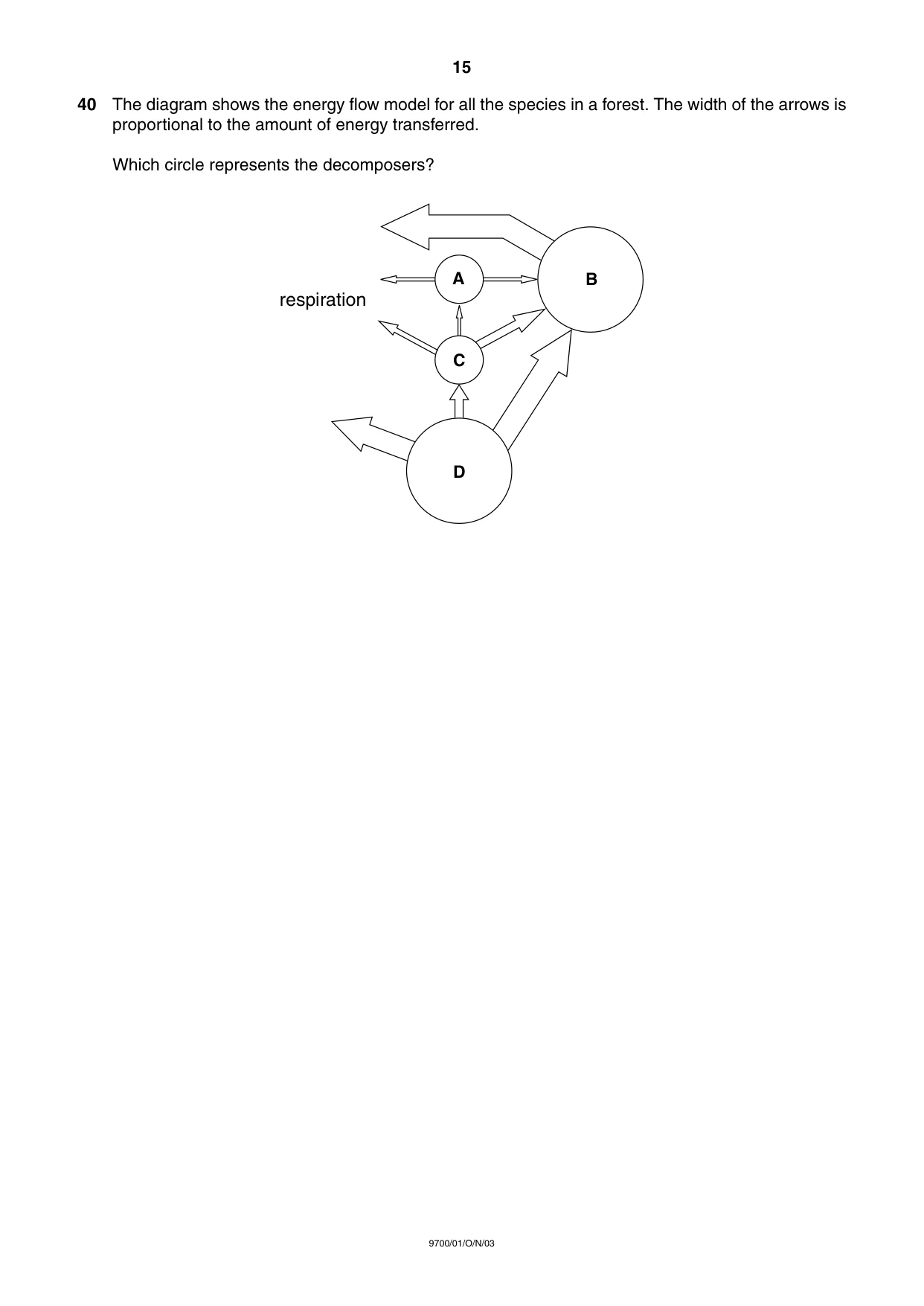
15 9700/01/O/N/03 40 The diagram shows the energy flow model for all the species in a forest. The width of the arrows is proportional to the amount of energy transferred. Which circle represents the decomposers? respiration A B C D