Cambridge A Level Biology 9700 — 2002 Oct/Nov Paper 3 · Variant 1
9700/31/O/N/02
The question paper and its mark scheme, free to read here and free to download. This is Cambridge’s own paper, exactly as it was sat.
Question paper8 pages


Mark scheme2 pages
Answers below. Sit the paper first if you are practising.
Paper as text
Question paper, page 1
This question paper consists of 5 printed pages, 2 blank pages and a Report Form. SP (SM) S24283/3 © CIE 2002 [Turn over CAMBRIDGE INTERNATIONAL EXAMINATIONS General Certificate of Education Advanced Subsidiary Level and Advanced Level BIOLOGY 9700/3 PAPER 3 Practical Test OCTOBER/NOVEMBER SESSION 2002 1 hour 15 minutes Candidates answer on the question paper. Additional materials: As listed in Instructions to Supervisors TIME 1 hour 15 minutes INSTRUCTIONS TO CANDIDATES Write your name, Centre number and candidate number in the spaces at the top of this page. Answer all parts of the question. Write your answers in the spaces provided on the question paper. INFORMATION FOR CANDIDATES The intended number of marks is given in brackets [ ] at the end of each question or part question. Candidate Centre Number Number Candidate Name FOR EXAMINER’S USE TOTAL
Question paper, page 2
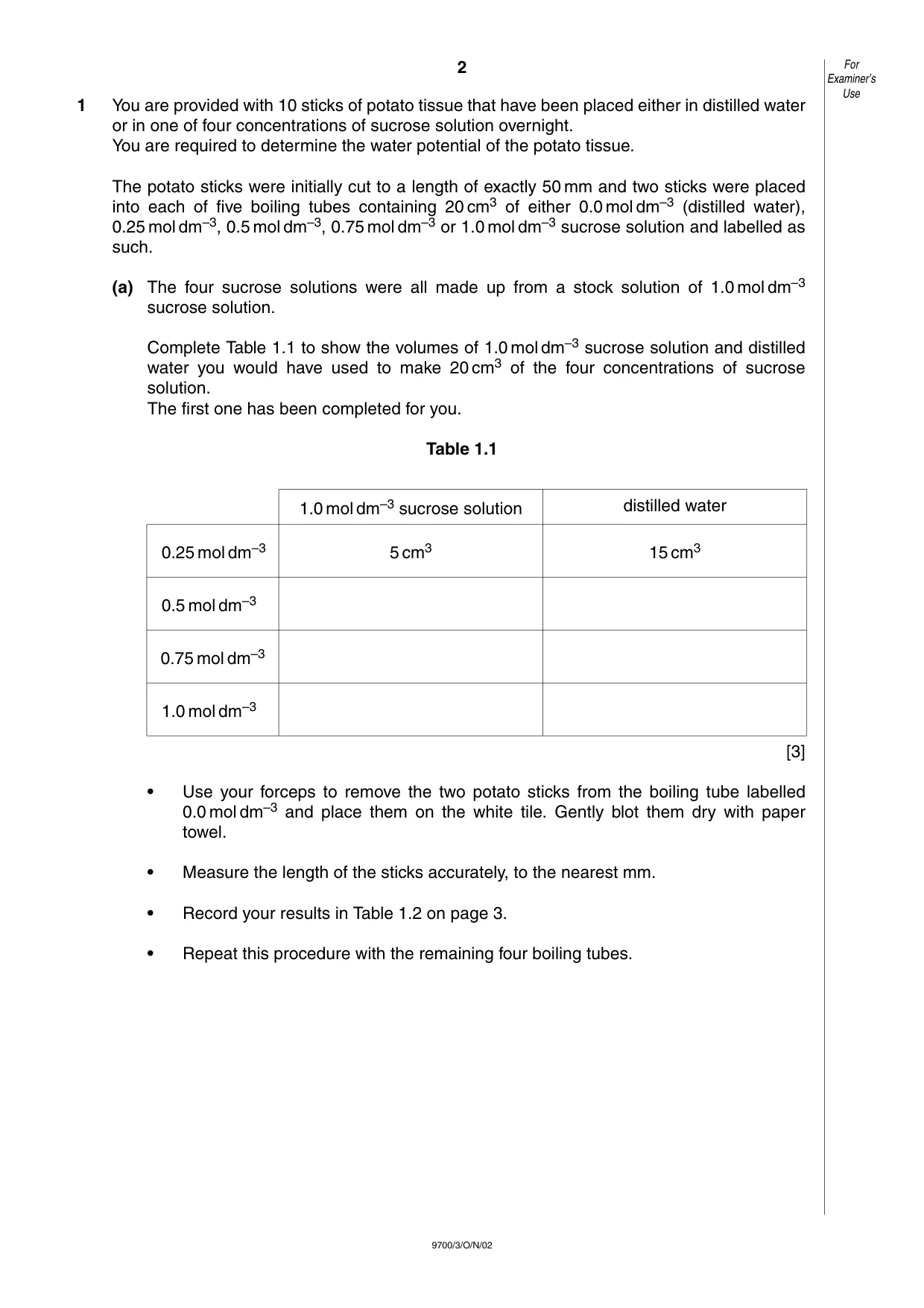
2 9700/3/O/N/02 1 You are provided with 10 sticks of potato tissue that have been placed either in distilled water or in one of four concentrations of sucrose solution overnight. You are required to determine the water potential of the potato tissue. The potato sticks were initially cut to a length of exactly 50 mm and two sticks were placed into each of five boiling tubes containing 20 cm3 of either 0.0 mol dm–3 (distilled water), 0.25 mol dm–3, 0.5 mol dm–3, 0.75 mol dm–3 or 1.0 mol dm–3 sucrose solution and labelled as such. (a) The four sucrose solutions were all made up from a stock solution of 1.0 mol dm–3 sucrose solution. Complete Table 1.1 to show the volumes of 1.0 mol dm–3 sucrose solution and distilled water you would have used to make 20 cm3 of the four concentrations of sucrose solution. The first one has been completed for you. Table 1.1 [3] • Use your forceps to remove the two potato sticks from the boiling tube labelled 0.0 mol dm–3 and place them on the white tile. Gently blot them dry with paper towel. • Measure the length of the sticks accurately, to the nearest mm. • Record your results in Table 1.2 on page 3. • Repeat this procedure with the remaining four boiling tubes. For Examiner’s Use 0.25 mol dm–3 0.5 mol dm–3 0.75 mol dm–3 1.0 mol dm–3 1.0 mol dm–3 sucrose solution 5 cm3 distilled water 15 cm3
Question paper, page 3
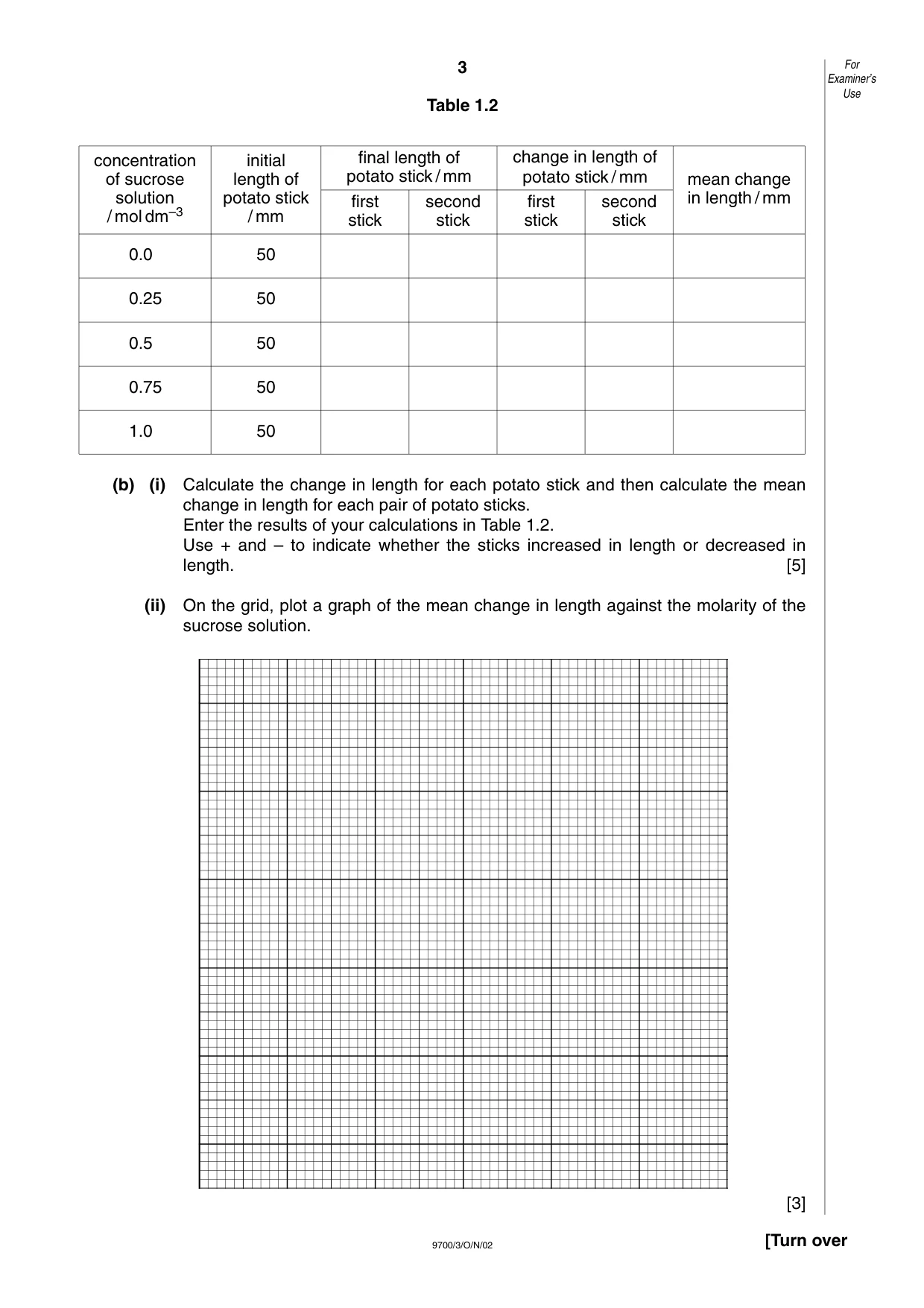
3 9700/3/O/N/02 [Turn over Table 1.2 (b) (i) Calculate the change in length for each potato stick and then calculate the mean change in length for each pair of potato sticks. Enter the results of your calculations in Table 1.2. Use + and – to indicate whether the sticks increased in length or decreased in length. [5] (ii) On the grid, plot a graph of the mean change in length against the molarity of the sucrose solution. [3] For Examiner’s Use concentration of sucrose solution / mol dm–3 0.0 50 50 50 50 50 0.25 0.5 0.75 1.0 initial length of potato stick / mm final length of potato stick / mm change in length of potato stick / mm mean change in length / mm first stick first stick second stick second stick
Question paper, page 4
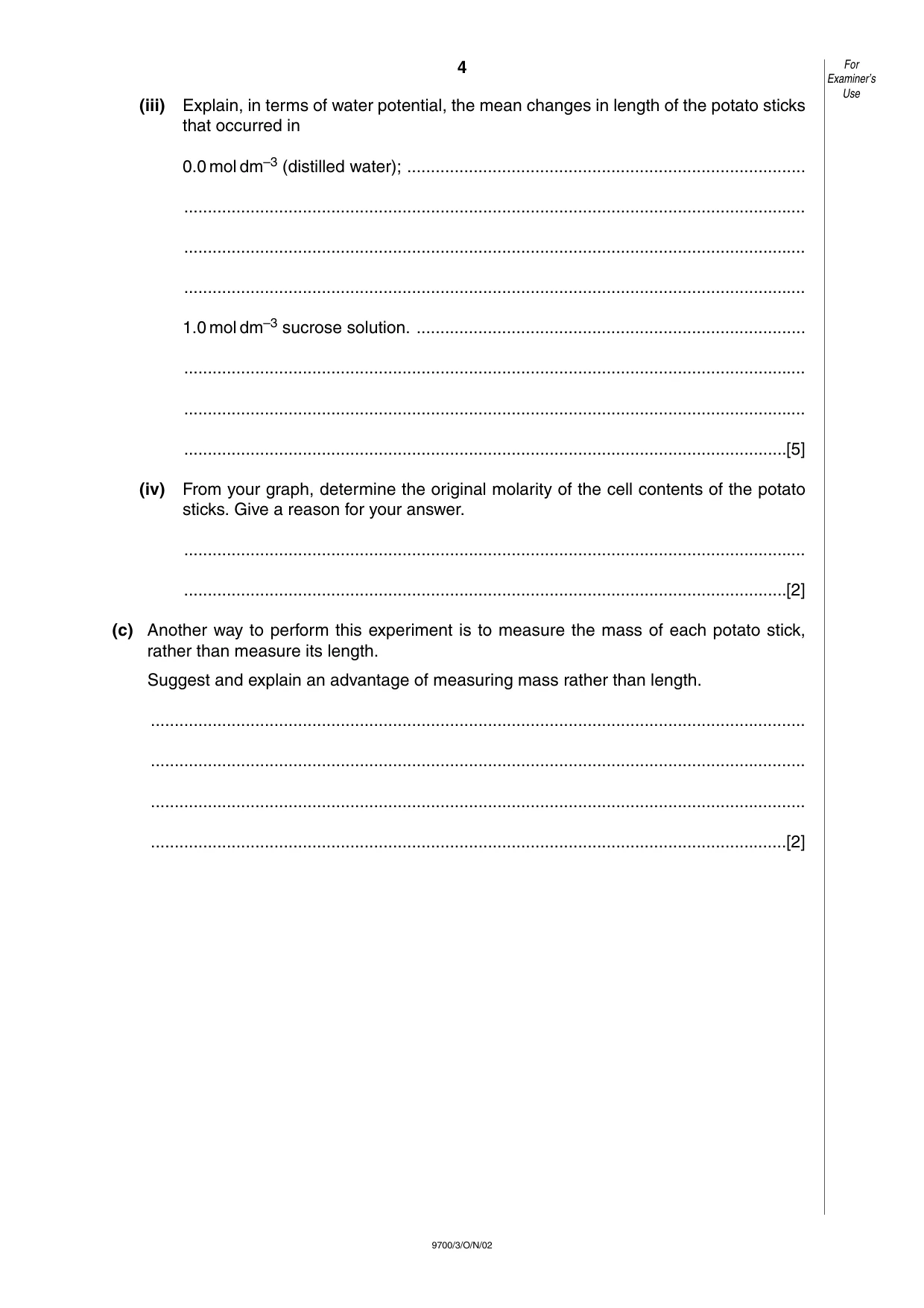
4 9700/3/O/N/02 (iii) Explain, in terms of water potential, the mean changes in length of the potato sticks that occurred in 0.0 mol dm–3 (distilled water); … … … … 1.0 mol dm–3 sucrose solution. … … … …[5] (iv) From your graph, determine the original molarity of the cell contents of the potato sticks. Give a reason for your answer. … …[2] (c) Another way to perform this experiment is to measure the mass of each potato stick, rather than measure its length. Suggest and explain an advantage of measuring mass rather than length. … … … …[2] For Examiner’s Use
Question paper, page 5
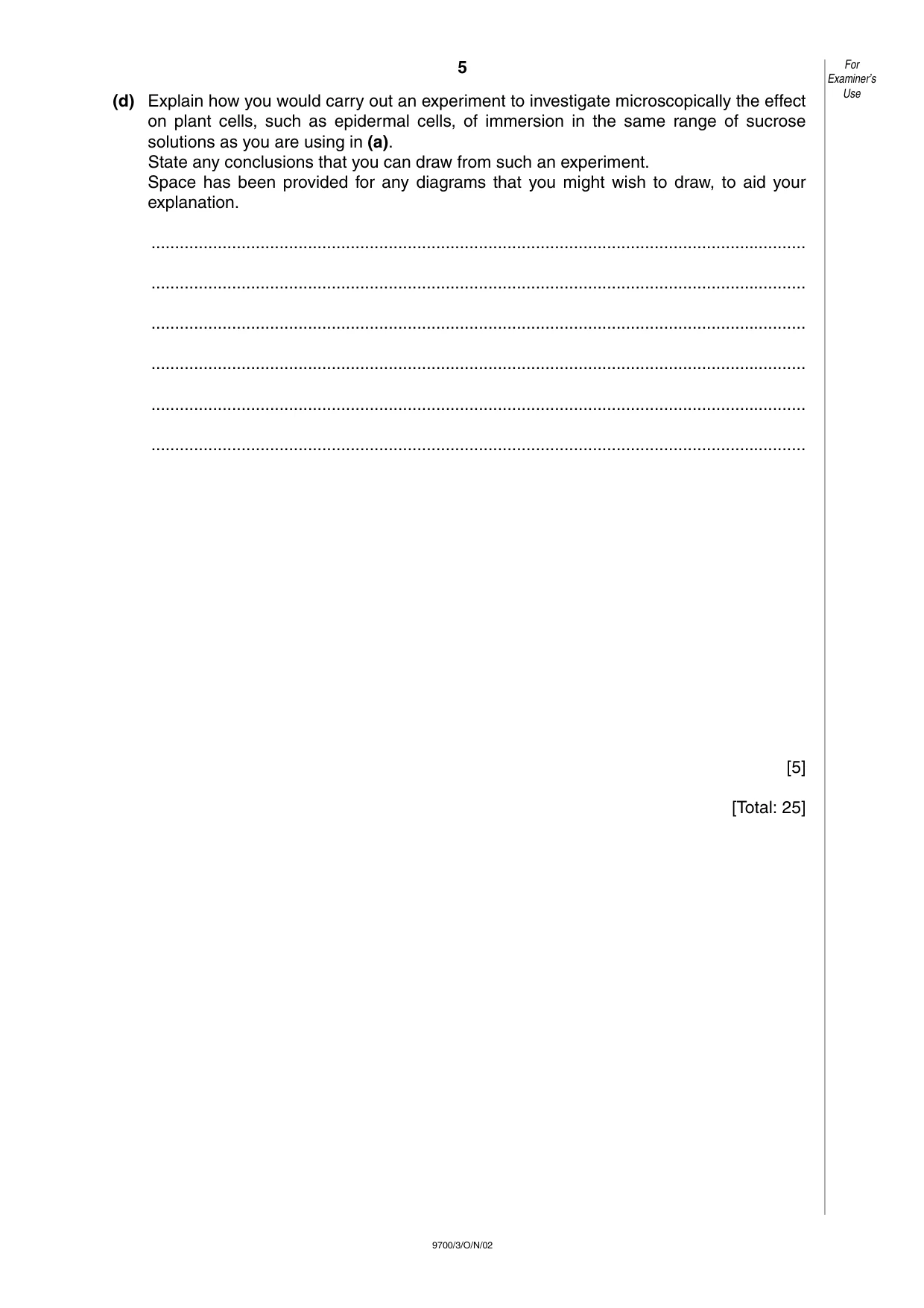
5 9700/3/O/N/02 (d) Explain how you would carry out an experiment to investigate microscopically the effect on plant cells, such as epidermal cells, of immersion in the same range of sucrose solutions as you are using in (a). State any conclusions that you can draw from such an experiment. Space has been provided for any diagrams that you might wish to draw, to aid your explanation. … … … … … … [5] [Total: 25] For Examiner’s Use
Question paper, page 8
8 9700/3/O/N/02 REPORT FORM The teacher responsible for this subject is asked to answer the following questions. (a) Was the candidate physically handicapped in drawing or in using a microscope or is the candidate colourblind? If so, give brief details. (b) Was the candidate handicapped by deficient material or apparatus? If so, give brief details. (c) Was it necessary to make any substitutions for the materials sent from Cambridge? If so, give brief details of the circumstances. (d) Any comments. Signed ……………………………… N.B. Information that applies to all candidates need only be given on the first candidate’s answer book.
Mark scheme, page 1
CAMBRIDGE INTERNATIONAL EXAMINATIONS NOVEMBER 2002 GCE Advanced Subsidiary Level University of CAMBRIDGE Local Examinations Syndicate
Mark scheme, page 2
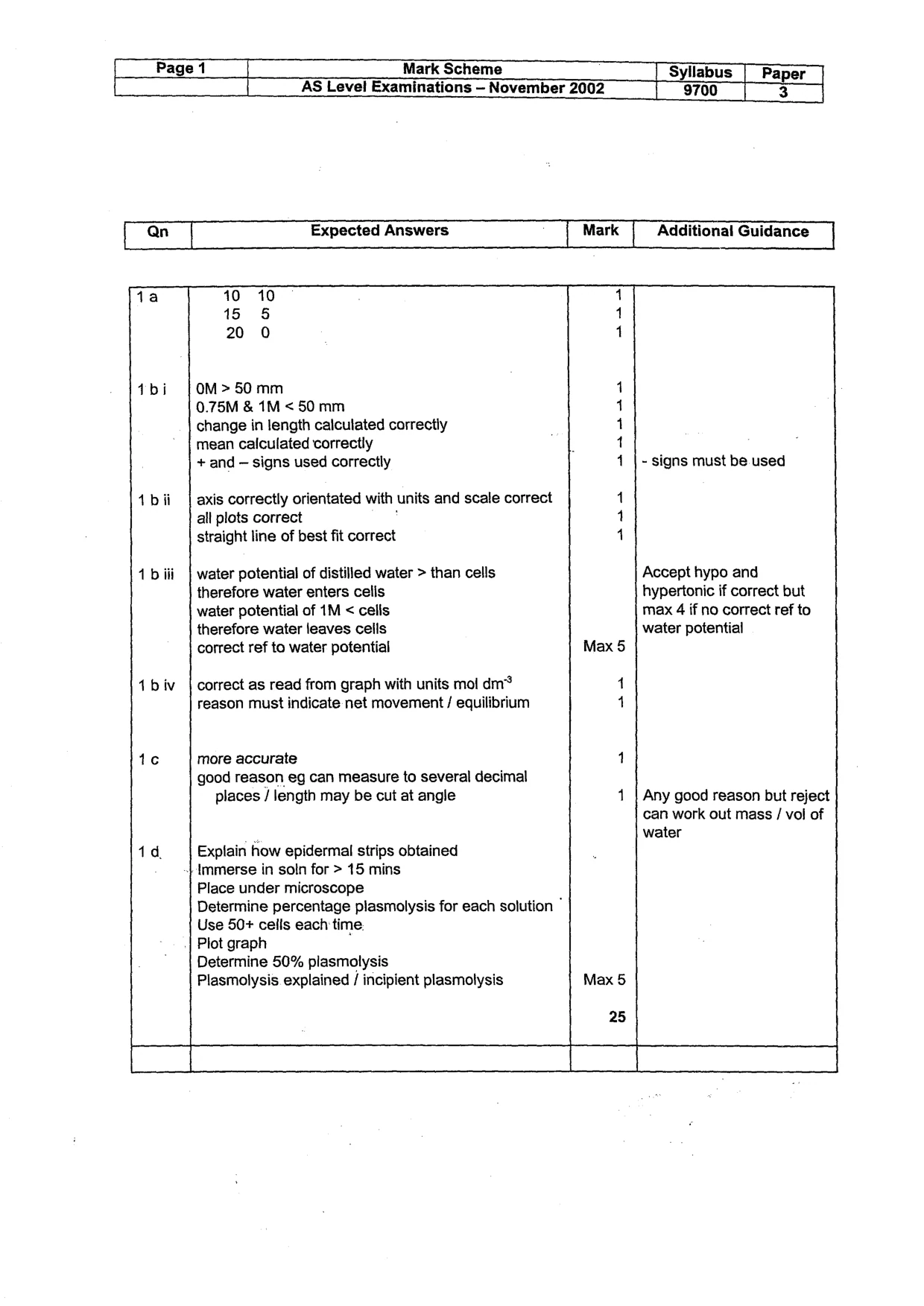
Page 1 Mark Scheme Syllabus Paper AS Level Examinations - November 2002 9700 3 Expected Answers ii Mark | Additional Guidance 1a 1bi 1bii 1 biii 1biv 14, 10 10 15 § 20 0 OM > 50 mm 0.75M & 1M <50 mm change in length calculated correctly mean calculated correctly + and — signs used correctly axis correctly orientated with units and scale correct all plots correct 7 straight line of best fit correct water potential of distilled water > than cells therefore water enters cells water potential of 1M < cells therefore water leaves cells correct ref to water potential correct as read from graph with units mol dm® reason must indicate net movement / equilibrium more accurate good reason eg can measure to several decimal places / length may be cut at angle Explain how epidermal strips obtained immerse in soln for > 15 mins Place under microscope Determine percentage plasmolysis for each solution * Use 50+ ceils each time. Plot graph Determine 50% plasmolysis Plasmolysis explained / incipient plasmolysis Max 5 Max 5 25 - Signs must be used Accept hypo and hypertonic if correct but max 4 if no correct ref to water potential Any good reason but reject can work out mass / vol of water