Cambridge A Level Biblical Studies 9484 — 2025 May/June Paper 3 · Variant 2
9484/32/M/J/25 · 5 questions · 50 marks · 90 min
The question paper and its mark scheme, free to read here and free to download. This is Cambridge’s own paper, exactly as it was sat.
Question paper4 pages
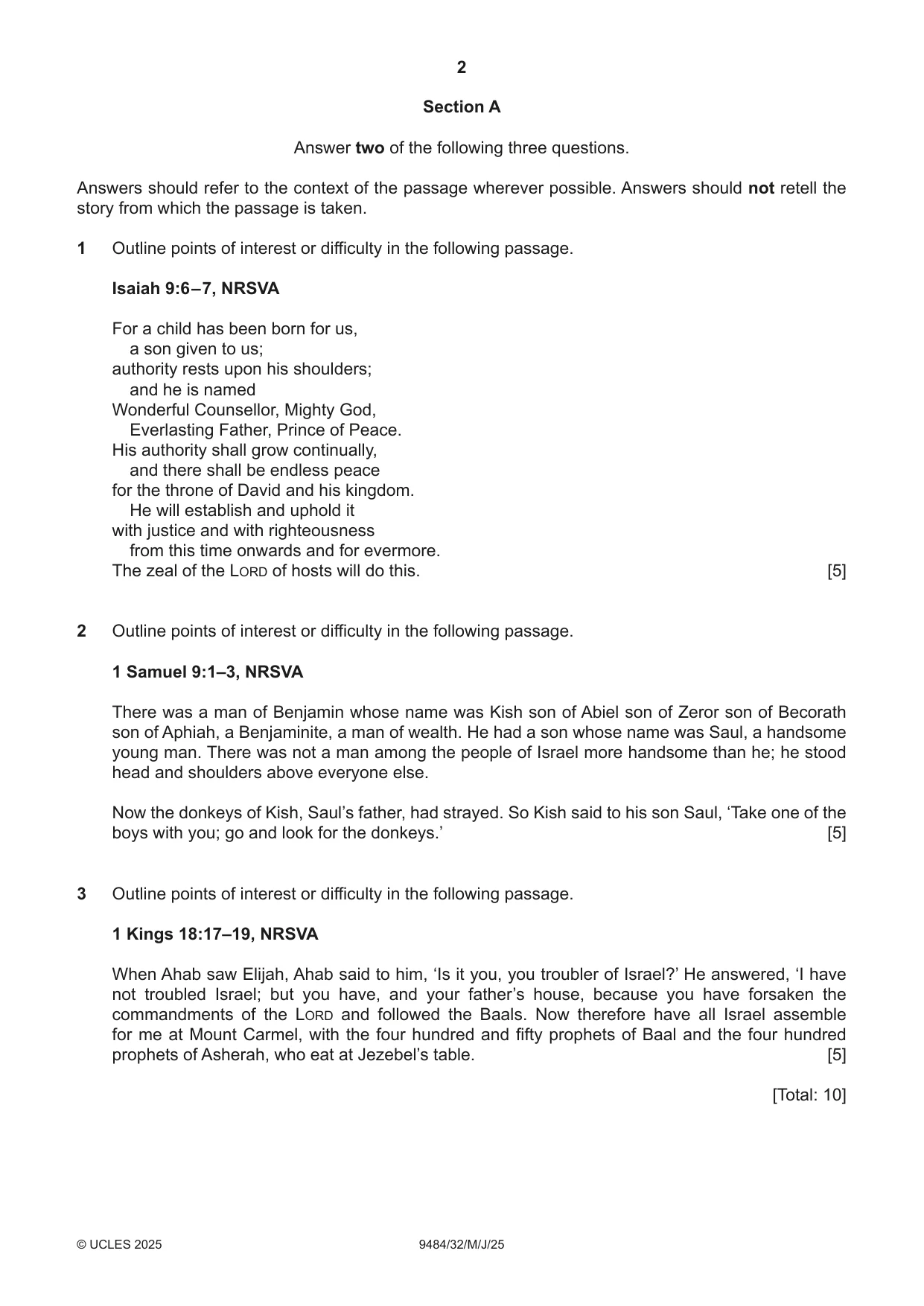
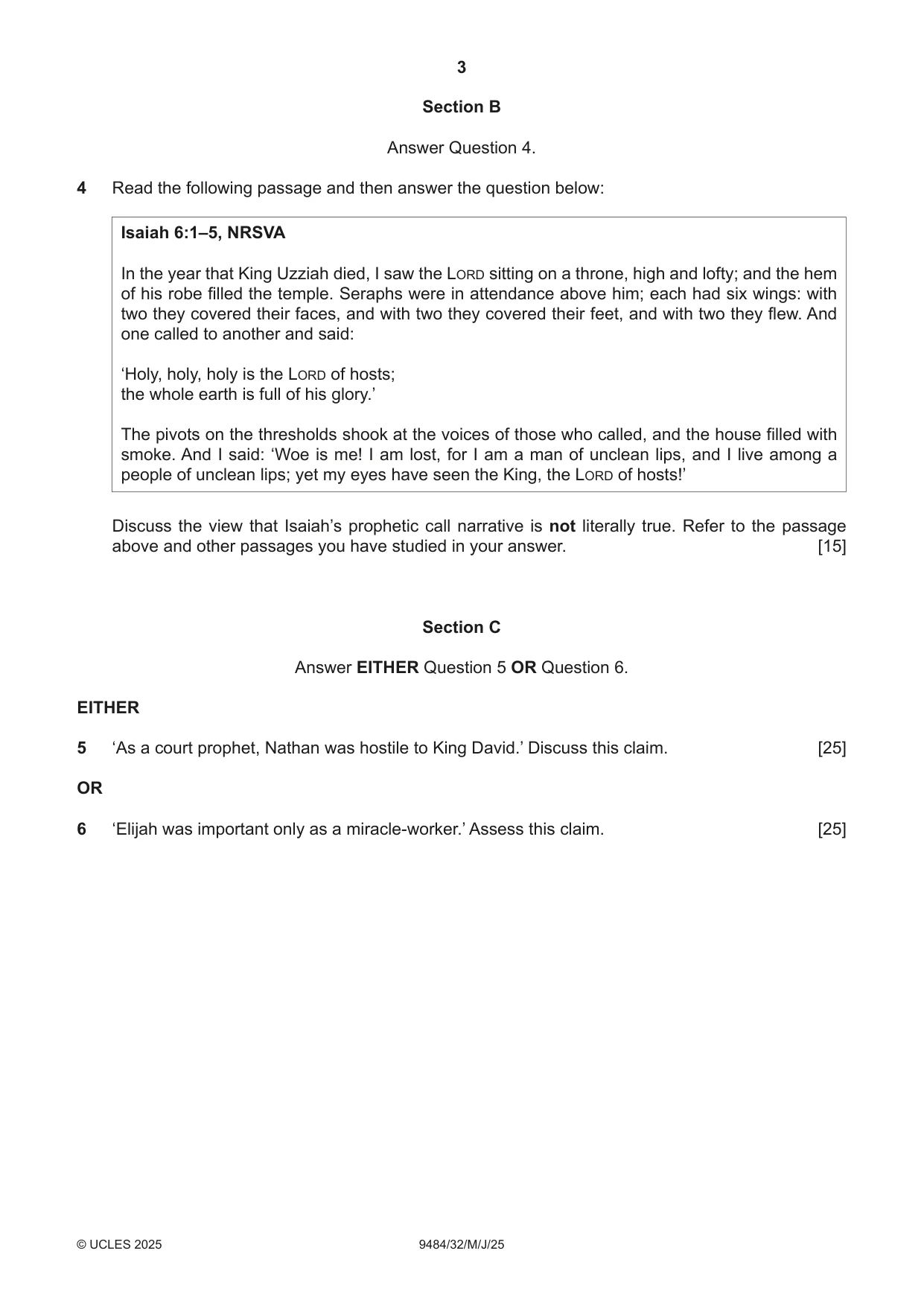

Mark scheme18 pages
Answers below. Sit the paper first if you are practising.
Questions as text
Q1 · Outline points of interest or difficulty in the following passage
1 Outline points of interest or difficulty in the following passage. Isaiah 9:6 – 7, NRSVA For a child has been born for us, a son given to us; authority rests upon his shoulders; and he is named Wonderful Counsellor, Mighty God, Everlasting Father, Prince of Peace. His authority shall grow continually, and there shall be endless peace for the throne of David and his kingdom. He will establish and uphold it with justice and with righteousness from this time onwards and for evermore. The zeal of the Lord of hosts will do this. [5]
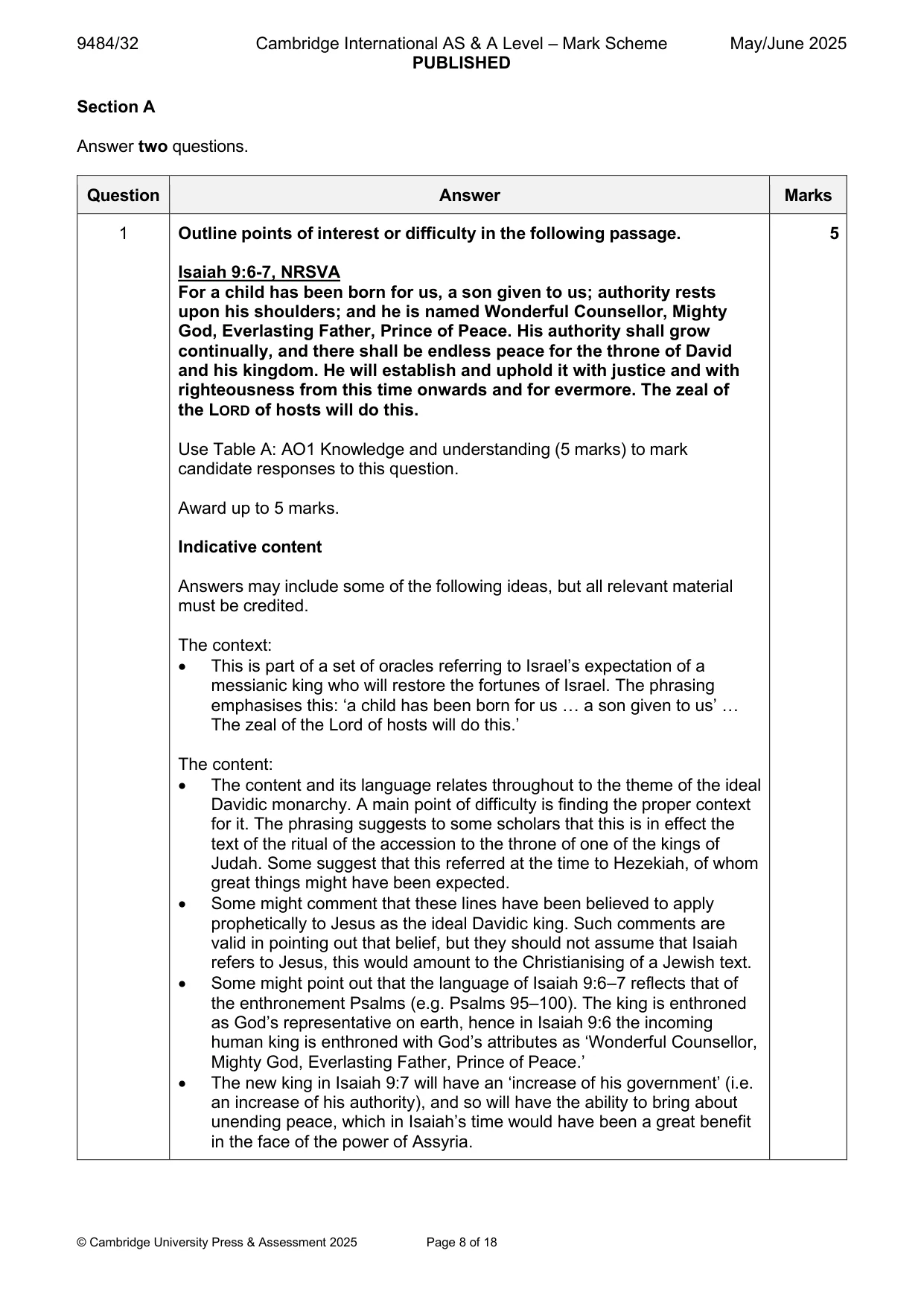
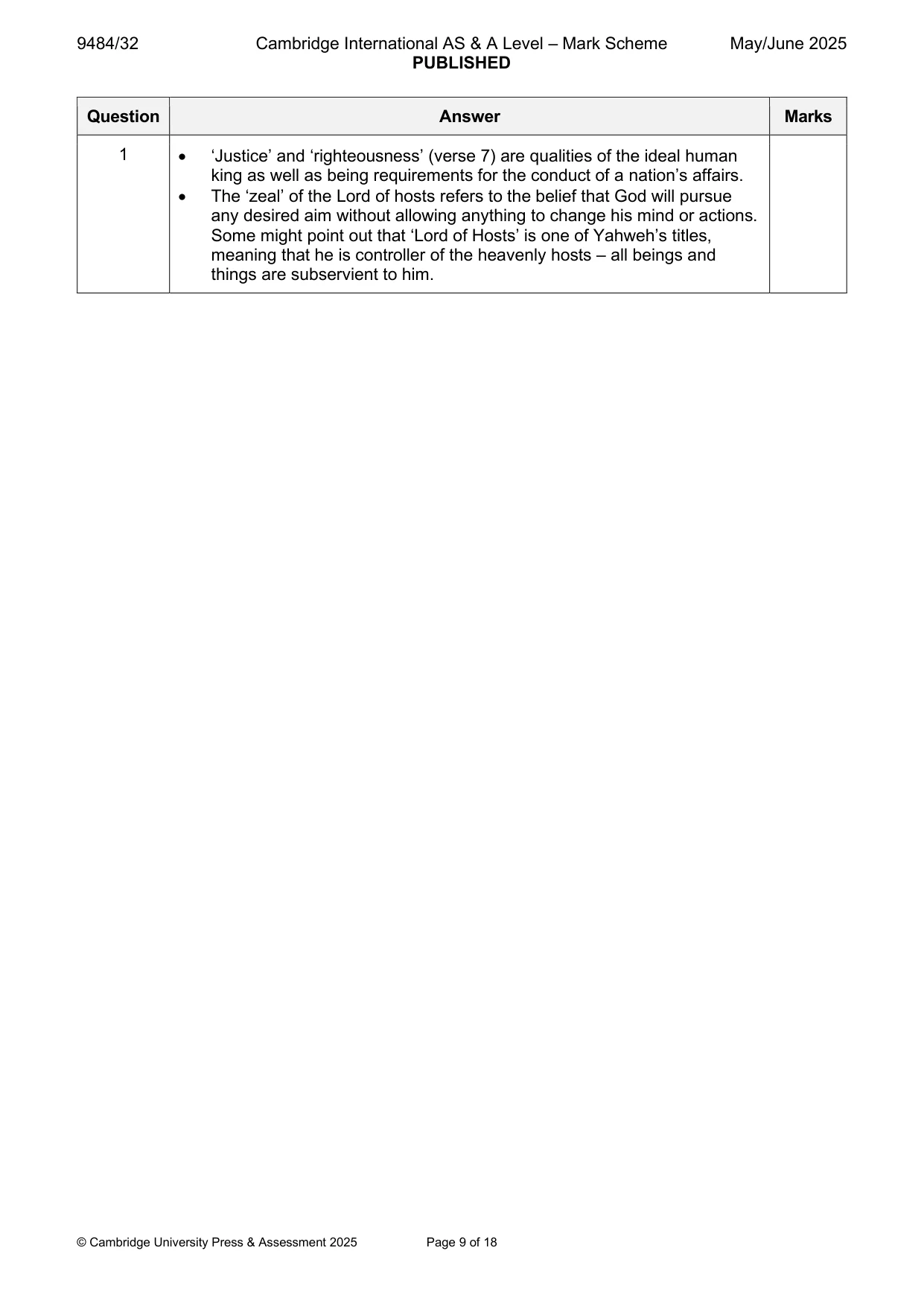
Mark scheme: Question Answer Marks 1 Outline points of interest or difficulty in the following passage. 5 Isaiah 9:6-7, NRSVA For a child has been born for us, a son given to us; authority rests upon his shoulders; and he is named Wonderful Counsellor, Mighty God, Everlasting Father, Prince of Peace. His authority shall grow continually, and there shall be endless peace for the throne of David and his kingdom. He will establish and uphold it with justice and with righteousness from this time onwards and for evermore. The zeal of the LORD of hosts will do this. Use Table A: AO1 Knowledge and understanding (5 marks) to mark candidate responses to this question. Award up to 5 marks. Indicative content Answers may include some of the following ideas, but all relevant material must be credited. The context: • This is part of a set of oracles referring to Israel’s expectation of a messianic king who will restore the fortunes of Israel. The phrasing emphasises this: ‘a child has been born for us … a son given to us’ … The zeal of the Lord of hosts will do this.’ The content: • The content and its language relates throughout to the theme of the ideal Davidic monarchy. A main point of difficulty is finding the proper context for it. The phrasing suggests to some scholars that this is in effect the text of the ritual of the accession to the throne of one of the kings of Judah. Some suggest that this referred at the time to Hezekiah, of whom great things might have been expected. • Some might comment that these lines have been believed to apply prophetically to Jesus as the ideal Davidic king. Such comments are valid in pointing out that belief, but they should not assume that Isaiah refers to Jesus, this would amount to the Christianising of a Jewish text. • Some might point out that the language of Isaiah 9:6–7 reflects that of the enthronement Psalms (e.g. Psalms 95–100). The king is enthroned as God’s representative on earth, hence in Isaiah 9:6 the incoming human king is enthroned with God’s attributes as ‘Wonderful Counsellor, Mighty God, Everlasting Father, Prince of Peace.’ • The new king in Isaiah 9:7 will have an ‘increase of his government’ (i.e. an increase of his authority), and so will have the ability to bring about unending peace, which in Isaiah’s time would have been a great benefit in the face of the power of Assyria. 1 • ‘Justice’ and ‘righteousness’ (verse 7) are qualities of the ideal human king as well as being requirements for the conduct of a nation’s affairs. • The ‘zeal’ of the Lord of hosts refers to the belief that God will pursue any desired aim without allowing anything to change his mind or actions. Some might point out that ‘Lord of Hosts’ is one of Yahweh’s titles, meaning that he is controller of the heavenly hosts – all beings and things are subservient to him.
Q2 · Outline points of interest or difficulty in the following passage
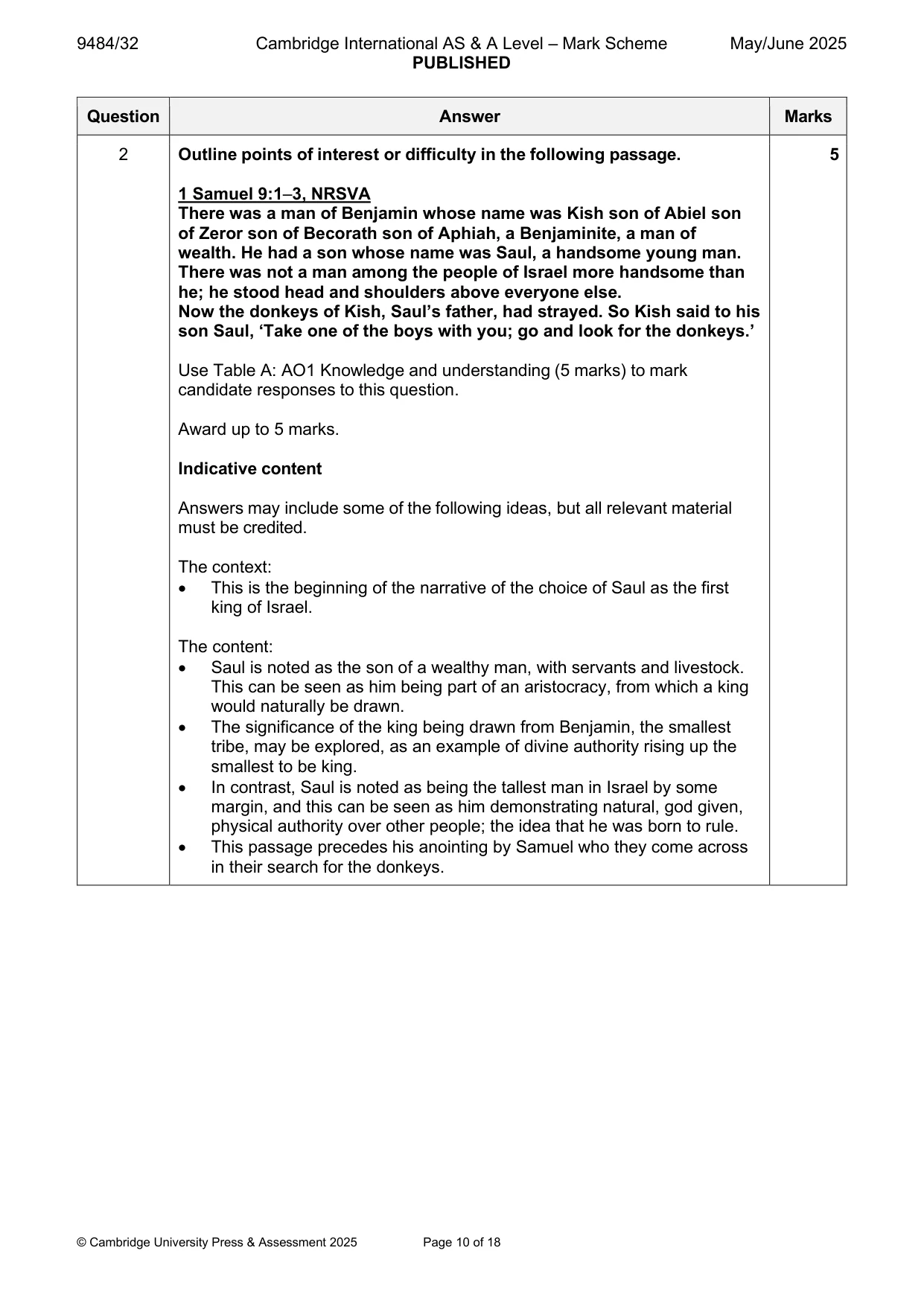
2 Outline points of interest or difficulty in the following passage. 1 Samuel 9:1–3, NRSVA There was a man of Benjamin whose name was Kish son of Abiel son of Zeror son of Becorath son of Aphiah, a Benjaminite, a man of wealth. He had a son whose name was Saul, a handsome young man. There was not a man among the people of Israel more handsome than he; he stood head and shoulders above everyone else. Now the donkeys of Kish, Saul’s father, had strayed. So Kish said to his son Saul, ‘Take one of the boys with you; go and look for the donkeys.’ [5]
Mark scheme: 2 Outline points of interest or difficulty in the following passage. 5 1 Samuel 9:1–3, NRSVA There was a man of Benjamin whose name was Kish son of Abiel son of Zeror son of Becorath son of Aphiah, a Benjaminite, a man of wealth. He had a son whose name was Saul, a handsome young man. There was not a man among the people of Israel more handsome than he; he stood head and shoulders above everyone else. Now the donkeys of Kish, Saul’s father, had strayed. So Kish said to his son Saul, ‘Take one of the boys with you; go and look for the donkeys.’ Use Table A: AO1 Knowledge and understanding (5 marks) to mark candidate responses to this question. Award up to 5 marks. Indicative content Answers may include some of the following ideas, but all relevant material must be credited. The context: • This is the beginning of the narrative of the choice of Saul as the first king of Israel. The content: • Saul is noted as the son of a wealthy man, with servants and livestock. This can be seen as him being part of an aristocracy, from which a king would naturally be drawn. • The significance of the king being drawn from Benjamin, the smallest tribe, may be explored, as an example of divine authority rising up the smallest to be king. • In contrast, Saul is noted as being the tallest man in Israel by some margin, and this can be seen as him demonstrating natural, god given, physical authority over other people; the idea that he was born to rule. • This passage precedes his anointing by Samuel who they come across in their search for the donkeys.
Q3 · Outline points of interest or difficulty in the following passage
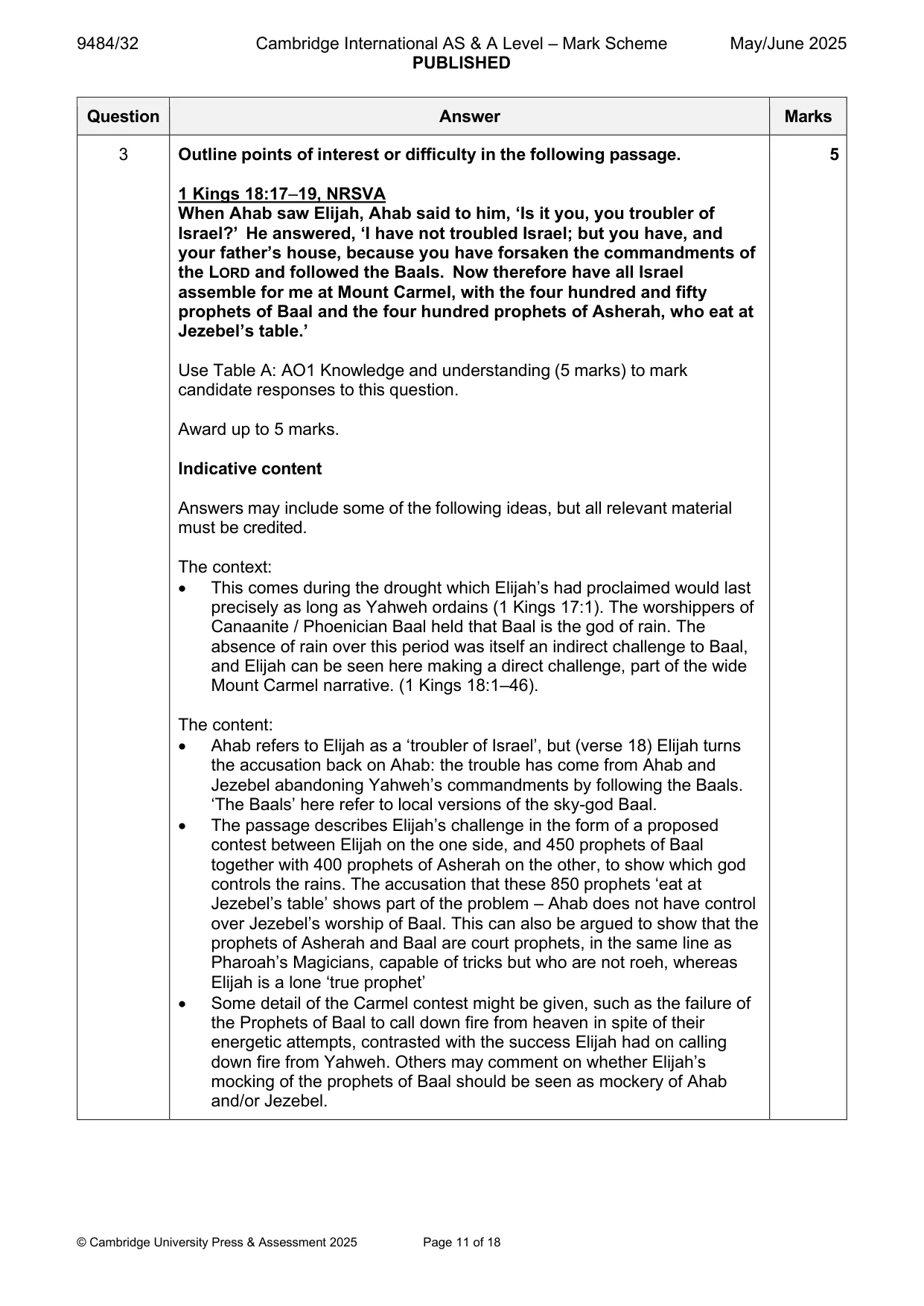
3 Outline points of interest or difficulty in the following passage. 1 Kings 18:17–19, NRSVA When Ahab saw Elijah, Ahab said to him, ‘Is it you, you troubler of Israel?’ He answered, ‘I have not troubled Israel; but you have, and your father’s house, because you have forsaken the commandments of the Lord and followed the Baals. Now therefore have all Israel assemble for me at Mount Carmel, with the four hundred and fifty prophets of Baal and the four hundred prophets of Asherah, who eat at Jezebel’s table. [5] [Total: 10]
Mark scheme: 3 Outline points of interest or difficulty in the following passage. 5 1 Kings 18:17–19, NRSVA When Ahab saw Elijah, Ahab said to him, ‘Is it you, you troubler of Israel?’ He answered, ‘I have not troubled Israel; but you have, and your father’s house, because you have forsaken the commandments of the LORD and followed the Baals. Now therefore have all Israel assemble for me at Mount Carmel, with the four hundred and fifty prophets of Baal and the four hundred prophets of Asherah, who eat at Jezebel’s table.’ Use Table A: AO1 Knowledge and understanding (5 marks) to mark candidate responses to this question. Award up to 5 marks. Indicative content Answers may include some of the following ideas, but all relevant material must be credited. The context: • This comes during the drought which Elijah’s had proclaimed would last precisely as long as Yahweh ordains (1 Kings 17:1). The worshippers of Canaanite / Phoenician Baal held that Baal is the god of rain. The absence of rain over this period was itself an indirect challenge to Baal, and Elijah can be seen here making a direct challenge, part of the wide Mount Carmel narrative. (1 Kings 18:1–46). The content: • Ahab refers to Elijah as a ‘troubler of Israel’, but (verse 18) Elijah turns the accusation back on Ahab: the trouble has come from Ahab and Jezebel abandoning Yahweh’s commandments by following the Baals. ‘The Baals’ here refer to local versions of the sky-god Baal. • The passage describes Elijah’s challenge in the form of a proposed contest between Elijah on the one side, and 450 prophets of Baal together with 400 prophets of Asherah on the other, to show which god controls the rains. The accusation that these 850 prophets ‘eat at Jezebel’s table’ shows part of the problem – Ahab does not have control over Jezebel’s worship of Baal. This can also be argued to show that the prophets of Asherah and Baal are court prophets, in the same line as Pharoah’s Magicians, capable of tricks but who are not roeh, whereas Elijah is a lone ‘true prophet’ • Some detail of the Carmel contest might be given, such as the failure of the Prophets of Baal to call down fire from heaven in spite of their energetic attempts, contrasted with the success Elijah had on calling down fire from Yahweh. Others may comment on whether Elijah’s mocking of the prophets of Baal should be seen as mockery of Ahab and/or Jezebel. 3 • After the proposed contest Elijah eventually says to Ahab that ‘there is a sound of rushing rain’ (18:41), so the narrative is brought back to the ending of the drought, showing the supremacy of Yahweh over Baal. • Some may discuss whether Elijah is suggesting that Ahab and his family have personally forsaken God’s commandments, or whether by Ahab’s father’s house Elijah is referring to Israel more broadly. Section B
Q4 · Read the following passage and then answer the question below: Isaiah 6:1–5, NRSVA In the…
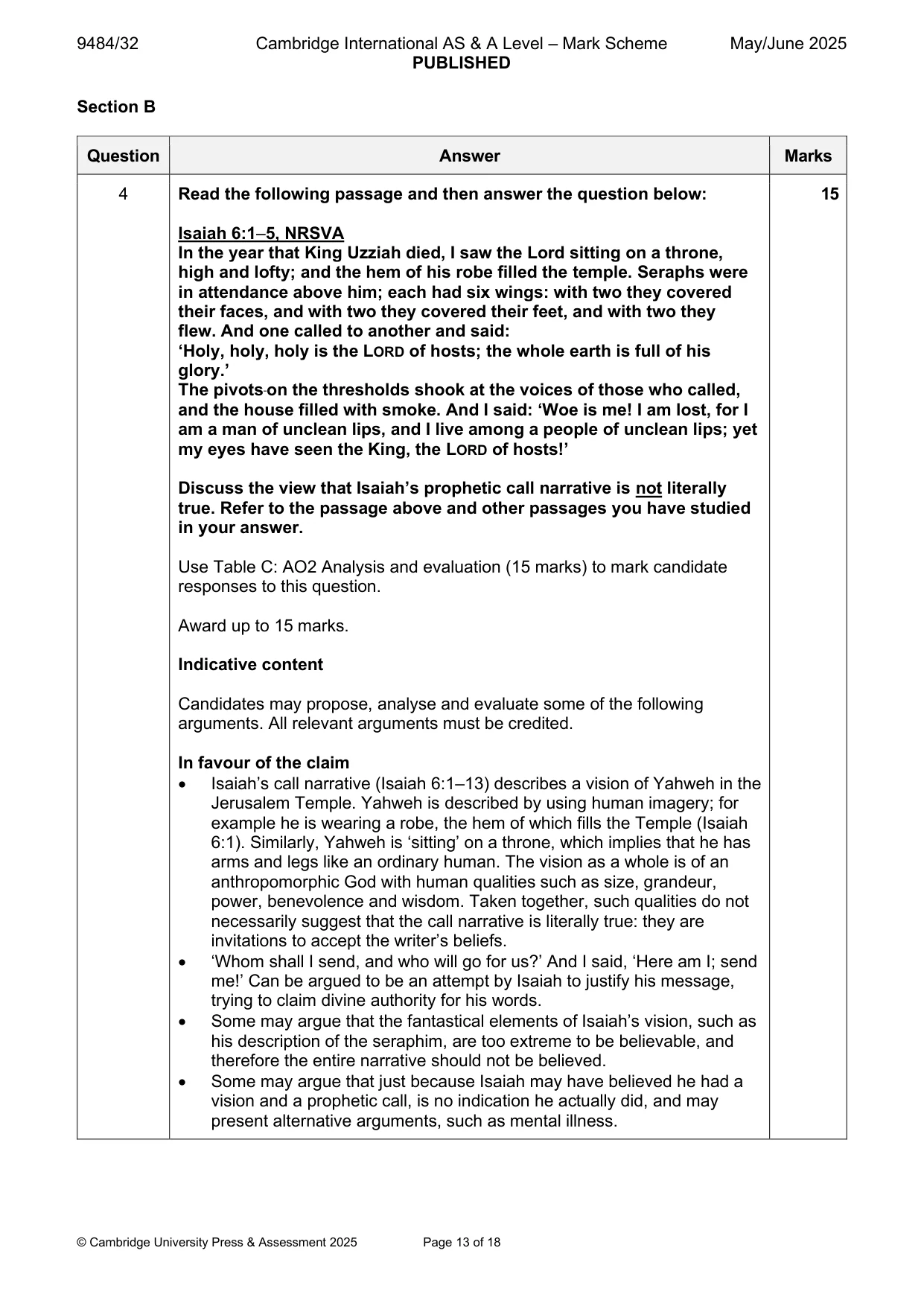
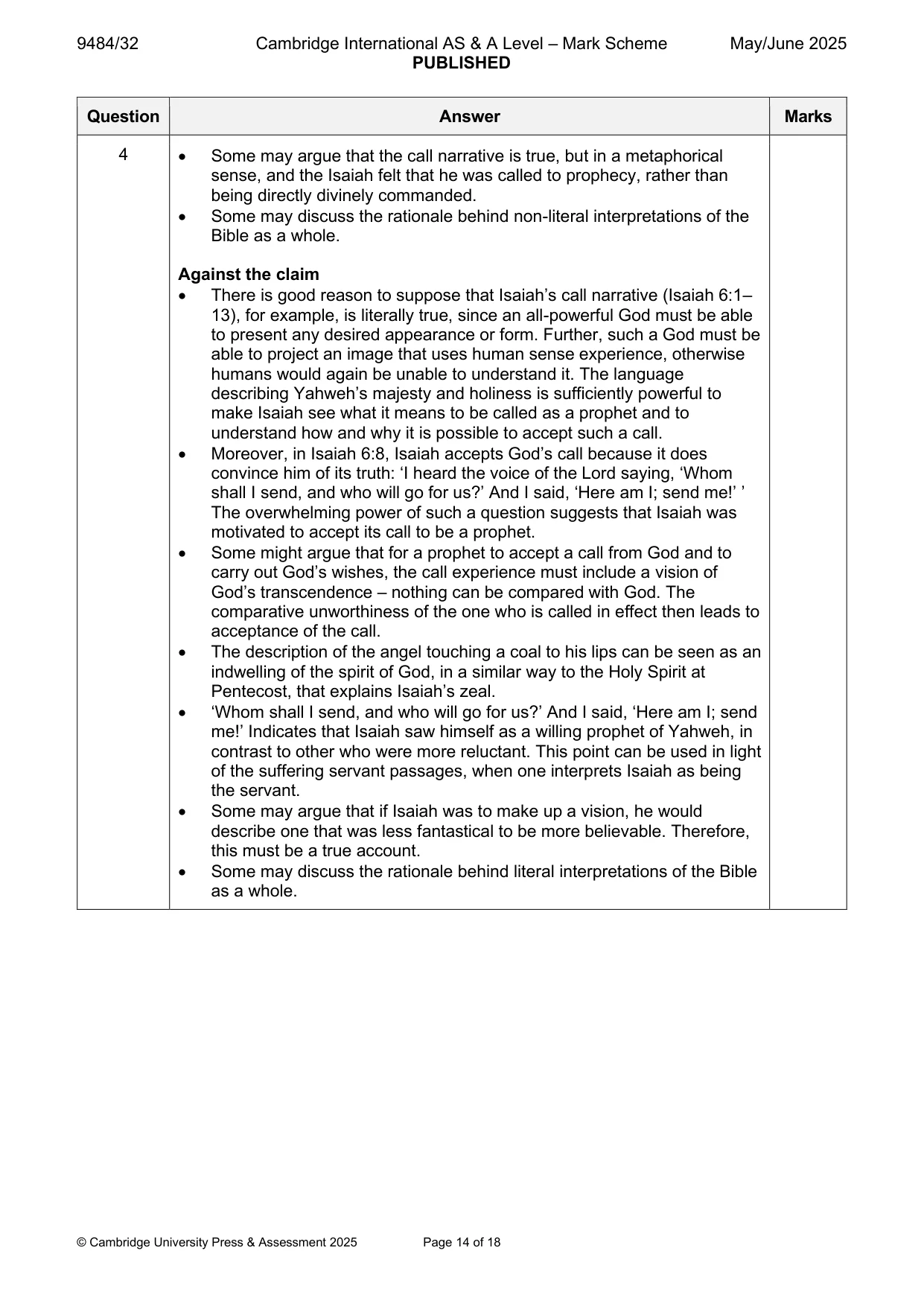
4 Read the following passage and then answer the question below: Isaiah 6:1–5, NRSVA In the year that King Uzziah died, I saw the Lord sitting on a throne, high and lofty; and the hem of his robe filled the temple. Seraphs were in attendance above him; each had six wings: with two they covered their faces, and with two they covered their feet, and with two they flew. And one called to another and said: ‘Holy, holy, holy is the Lord of hosts; the whole earth is full of his glory.’ The pivots on the thresholds shook at the voices of those who called, and the house filled with smoke. And I said: ‘Woe is me! I am lost, for I am a man of unclean lips, and I live among a people of unclean lips; yet my eyes have seen the King, the Lord of hosts!’ Discuss the view that Isaiah’s prophetic call narrative is not literally true. Refer to the passage above and other passages you have studied in your answer. [15] Section C Answer EITHER Question 5 OR Question 6. EITHER
Mark scheme: 4 Read the following passage and then answer the question below: 15 Isaiah 6:1–5, NRSVA In the year that King Uzziah died, I saw the Lord sitting on a throne, high and lofty; and the hem of his robe filled the temple. Seraphs were in attendance above him; each had six wings: with two they covered their faces, and with two they covered their feet, and with two they flew. And one called to another and said: ‘Holy, holy, holy is the LORD of hosts; the whole earth is full of his glory.’ The pivots on the thresholds shook at the voices of those who called, and the house filled with smoke. And I said: ‘Woe is me! I am lost, for I am a man of unclean lips, and I live among a people of unclean lips; yet my eyes have seen the King, the LORD of hosts!’ Discuss the view that Isaiah’s prophetic call narrative is not literally true. Refer to the passage above and other passages you have studied in your answer. Use Table C: AO2 Analysis and evaluation (15 marks) to mark candidate responses to this question. Award up to 15 marks. Indicative content Candidates may propose, analyse and evaluate some of the following arguments. All relevant arguments must be credited. In favour of the claim • Isaiah’s call narrative (Isaiah 6:1–13) describes a vision of Yahweh in the Jerusalem Temple. Yahweh is described by using human imagery; for example he is wearing a robe, the hem of which fills the Temple (Isaiah 6:1). Similarly, Yahweh is ‘sitting’ on a throne, which implies that he has arms and legs like an ordinary human. The vision as a whole is of an anthropomorphic God with human qualities such as size, grandeur, power, benevolence and wisdom. Taken together, such qualities do not necessarily suggest that the call narrative is literally true: they are invitations to accept the writer’s beliefs. • ‘Whom shall I send, and who will go for us?’ And I said, ‘Here am I; send me!’ Can be argued to be an attempt by Isaiah to justify his message, trying to claim divine authority for his words. • Some may argue that the fantastical elements of Isaiah’s vision, such as his description of the seraphim, are too extreme to be believable, and therefore the entire narrative should not be believed. • Some may argue that just because Isaiah may have believed he had a vision and a prophetic call, is no indication he actually did, and may present alternative arguments, such as mental illness. 4 • Some may argue that the call narrative is true, but in a metaphorical sense, and the Isaiah felt that he was called to prophecy, rather than being directly divinely commanded. • Some may discuss the rationale behind non-literal interpretations of the Bible as a whole. Against the claim • There is good reason to suppose that Isaiah’s call narrative (Isaiah 6:1– 13), for example, is literally true, since an all-powerful God must be able to present any desired appearance or form. Further, such a God must be able to project an image that uses human sense experience, otherwise humans would again be unable to understand it. The language describing Yahweh’s majesty and holiness is sufficiently powerful to make Isaiah see what it means to be called as a prophet and to understand how and why it is possible to accept such a call. • Moreover, in Isaiah 6:8, Isaiah accepts God’s call because it does convince him of its truth: ‘I heard the voice of the Lord saying, ‘Whom shall I send, and who will go for us?’ And I said, ‘Here am I; send me!’ ’ The overwhelming power of such a question suggests that Isaiah was motivated to accept its call to be a prophet. • Some might argue that for a prophet to accept a call from God and to carry out God’s wishes, the call experience must include a vision of God’s transcendence – nothing can be compared with God. The comparative unworthiness of the one who is called in effect then leads to acceptance of the call. • The description of the angel touching a coal to his lips can be seen as an indwelling of the spirit of God, in a similar way to the Holy Spirit at Pentecost, that explains Isaiah’s zeal. • ‘Whom shall I send, and who will go for us?’ And I said, ‘Here am I; send me!’ Indicates that Isaiah saw himself as a willing prophet of Yahweh, in contrast to other who were more reluctant. This point can be used in light of the suffering servant passages, when one interprets Isaiah as being the servant. • Some may argue that if Isaiah was to make up a vision, he would describe one that was less fantastical to be more believable. Therefore, this must be a true account. • Some may discuss the rationale behind literal interpretations of the Bible as a whole. Section C
Q5 · ‘As a court prophet, Nathan was hostile to King David.’ Discuss this claim
5 ‘As a court prophet, Nathan was hostile to King David.’ Discuss this claim. [25] OR
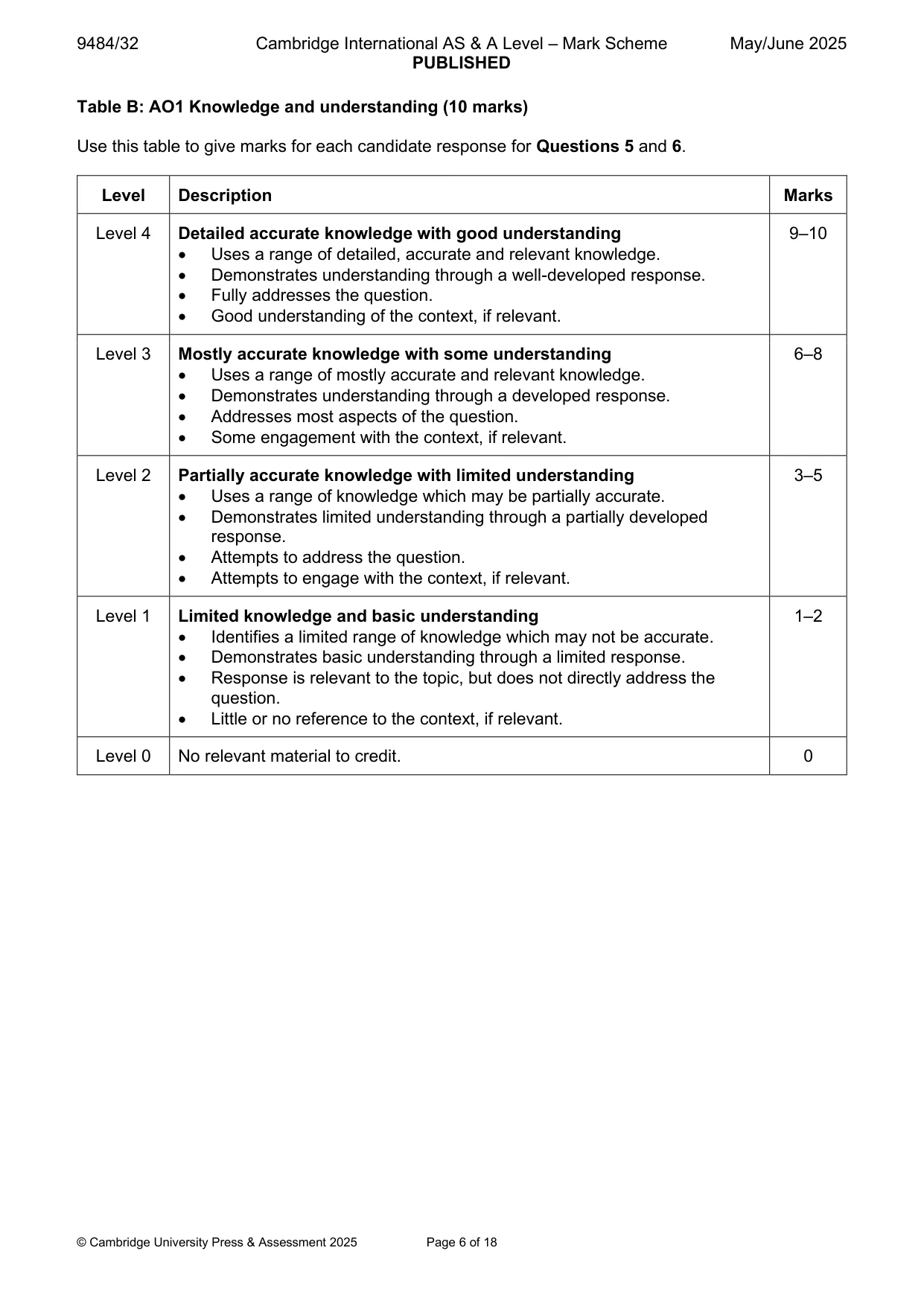
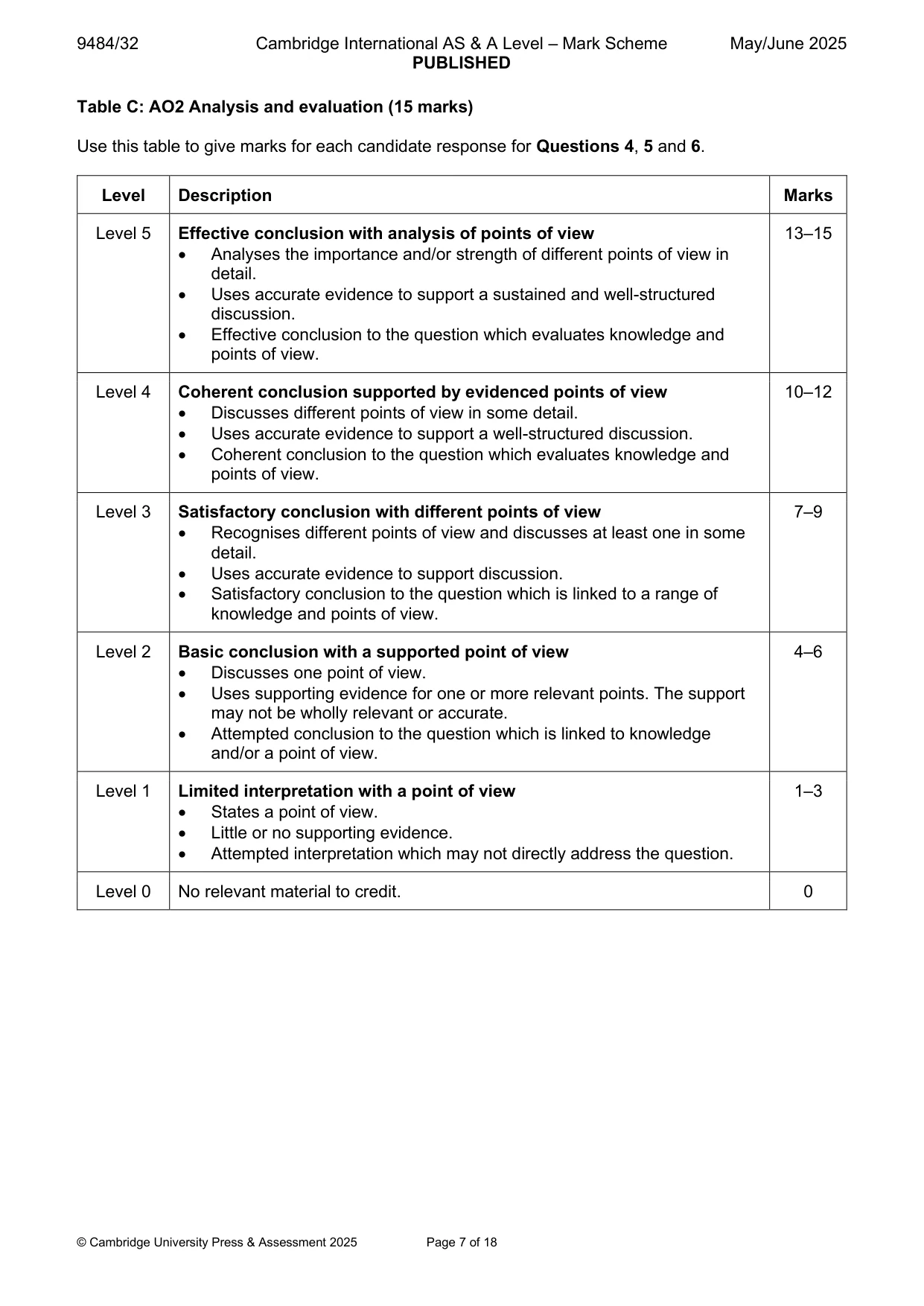
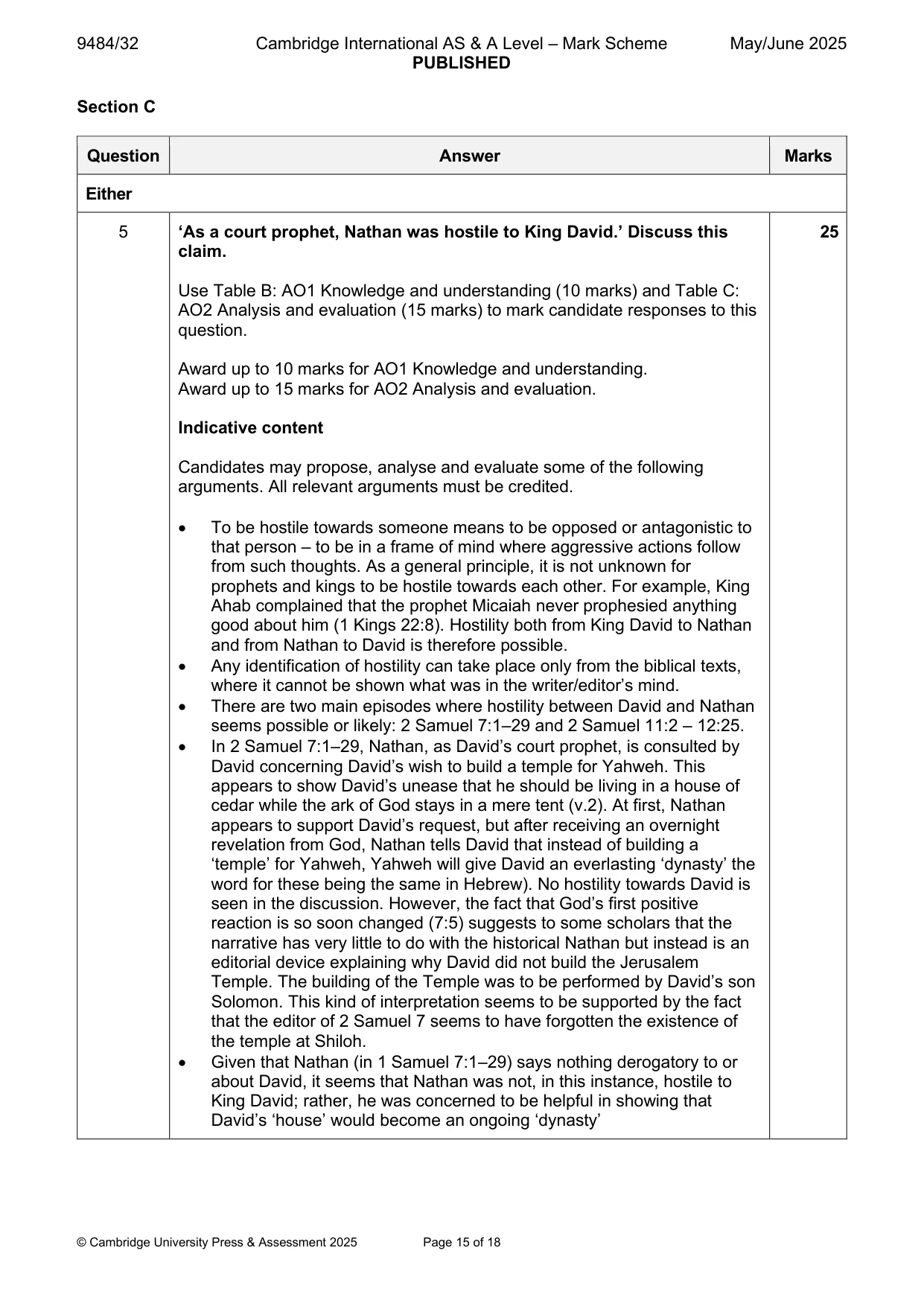
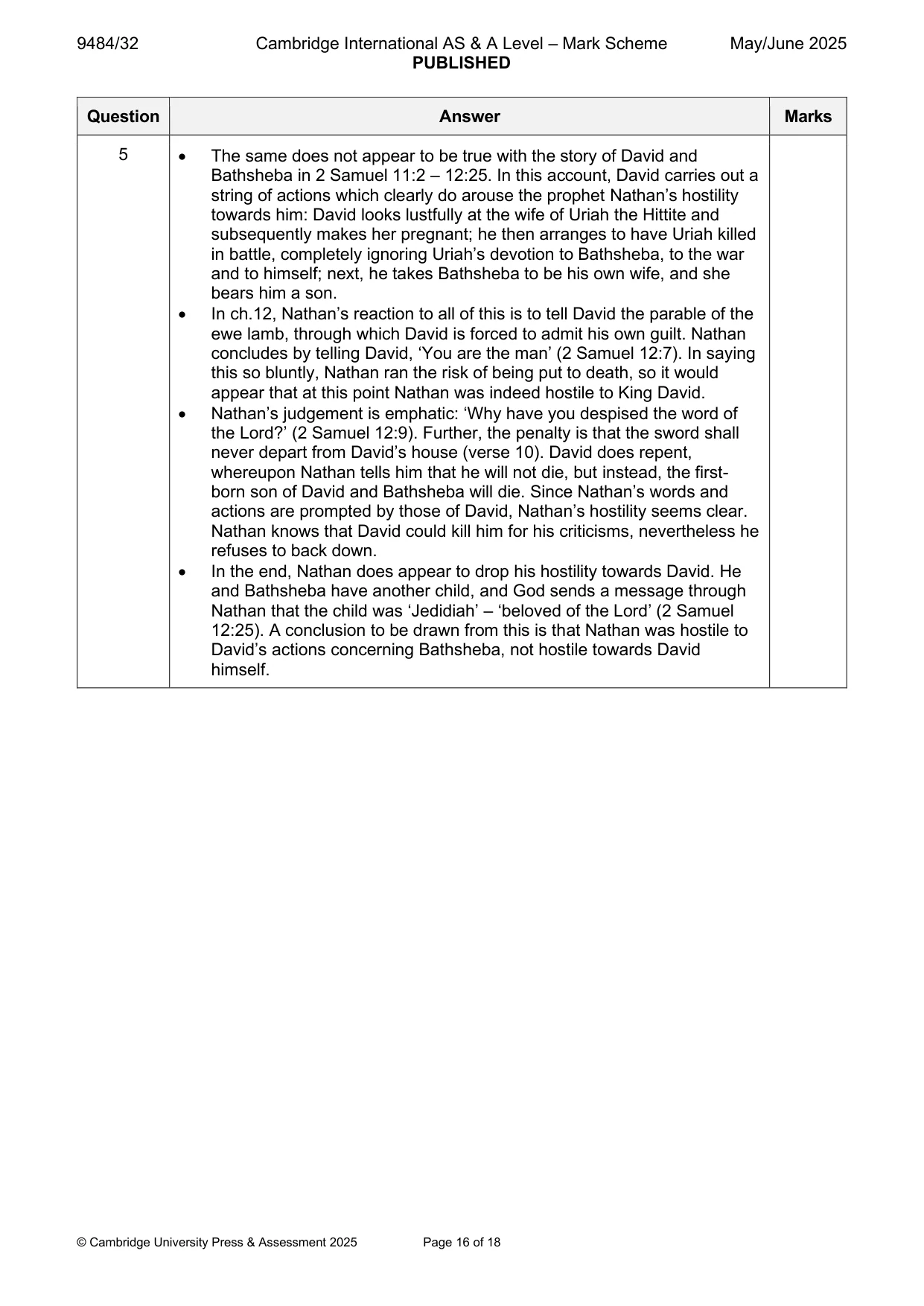
Mark scheme: 5 ‘As a court prophet, Nathan was hostile to King David.’ Discuss this 25 claim. Use Table B: AO1 Knowledge and understanding (10 marks) and Table C: AO2 Analysis and evaluation (15 marks) to mark candidate responses to this question. Award up to 10 marks for AO1 Knowledge and understanding. Award up to 15 marks for AO2 Analysis and evaluation. Indicative content Candidates may propose, analyse and evaluate some of the following arguments. All relevant arguments must be credited. • To be hostile towards someone means to be opposed or antagonistic to that person – to be in a frame of mind where aggressive actions follow from such thoughts. As a general principle, it is not unknown for prophets and kings to be hostile towards each other. For example, King Ahab complained that the prophet Micaiah never prophesied anything good about him (1 Kings 22:8). Hostility both from King David to Nathan and from Nathan to David is therefore possible. • Any identification of hostility can take place only from the biblical texts, where it cannot be shown what was in the writer/editor’s mind. • There are two main episodes where hostility between David and Nathan seems possible or likely: 2 Samuel 7:1–29 and 2 Samuel 11:2 – 12:25. • In 2 Samuel 7:1–29, Nathan, as David’s court prophet, is consulted by David concerning David’s wish to build a temple for Yahweh. This appears to show David’s unease that he should be living in a house of cedar while the ark of God stays in a mere tent (v.2). At first, Nathan appears to support David’s request, but after receiving an overnight revelation from God, Nathan tells David that instead of building a ‘temple’ for Yahweh, Yahweh will give David an everlasting ‘dynasty’ the word for these being the same in Hebrew). No hostility towards David is seen in the discussion. However, the fact that God’s first positive reaction is so soon changed (7:5) suggests to some scholars that the narrative has very little to do with the historical Nathan but instead is an editorial device explaining why David did not build the Jerusalem Temple. The building of the Temple was to be performed by David’s son Solomon. This kind of interpretation seems to be supported by the fact that the editor of 2 Samuel 7 seems to have forgotten the existence of the temple at Shiloh. • Given that Nathan (in 1 Samuel 7:1–29) says nothing derogatory to or about David, it seems that Nathan was not, in this instance, hostile to King David; rather, he was concerned to be helpful in showing that David’s ‘house’ would become an ongoing ‘dynasty’ 5 • The same does not appear to be true with the story of David and Bathsheba in 2 Samuel 11:2 – 12:25. In this account, David carries out a string of actions which clearly do arouse the prophet Nathan’s hostility towards him: David looks lustfully at the wife of Uriah the Hittite and subsequently makes her pregnant; he then arranges to have Uriah killed in battle, completely ignoring Uriah’s devotion to Bathsheba, to the war and to himself; next, he takes Bathsheba to be his own wife, and she bears him a son. • In ch.12, Nathan’s reaction to all of this is to tell David the parable of the ewe lamb, through which David is forced to admit his own guilt. Nathan concludes by telling David, ‘You are the man’ (2 Samuel 12:7). In saying this so bluntly, Nathan ran the risk of being put to death, so it would appear that at this point Nathan was indeed hostile to King David. • Nathan’s judgement is emphatic: ‘Why have you despised the word of the Lord?’ (2 Samuel 12:9). Further, the penalty is that the sword shall never depart from David’s house (verse 10). David does repent, whereupon Nathan tells him that he will not die, but instead, the first- born son of David and Bathsheba will die. Since Nathan’s words and actions are prompted by those of David, Nathan’s hostility seems clear. Nathan knows that David could kill him for his criticisms, nevertheless he refuses to back down. • In the end, Nathan does appear to drop his hostility towards David. He and Bathsheba have another child, and God sends a message through Nathan that the child was ‘Jedidiah’ – ‘beloved of the Lord’ (2 Samuel 12:25). A conclusion to be drawn from this is that Nathan was hostile to David’s actions concerning Bathsheba, not hostile towards David himself.
What was in this paper
The subtopics covered by these 5 questions, and how many questions each got. Open one in a new tab to see every Cambridge question on it.
What you needed in this session
Cambridge’s own grade thresholds for 2025 May/June, Paper 3 · Variant 2. A higher threshold means an easier paper — the bar moves with how the cohort did.