Cambridge A Level Biblical Studies 9484 — 2023 Oct/Nov Paper 3 · Variant 2
9484/32/O/N/23 · 6 questions · 50 marks · ≈56 min
The question paper and its mark scheme, free to read here and free to download. This is Cambridge’s own paper, exactly as it was sat.
Question paper4 pages

Mark scheme16 pages
Answers below. Sit the paper first if you are practising.
Questions as text
Q1 · Outline points of interest or difficulty in the following passage
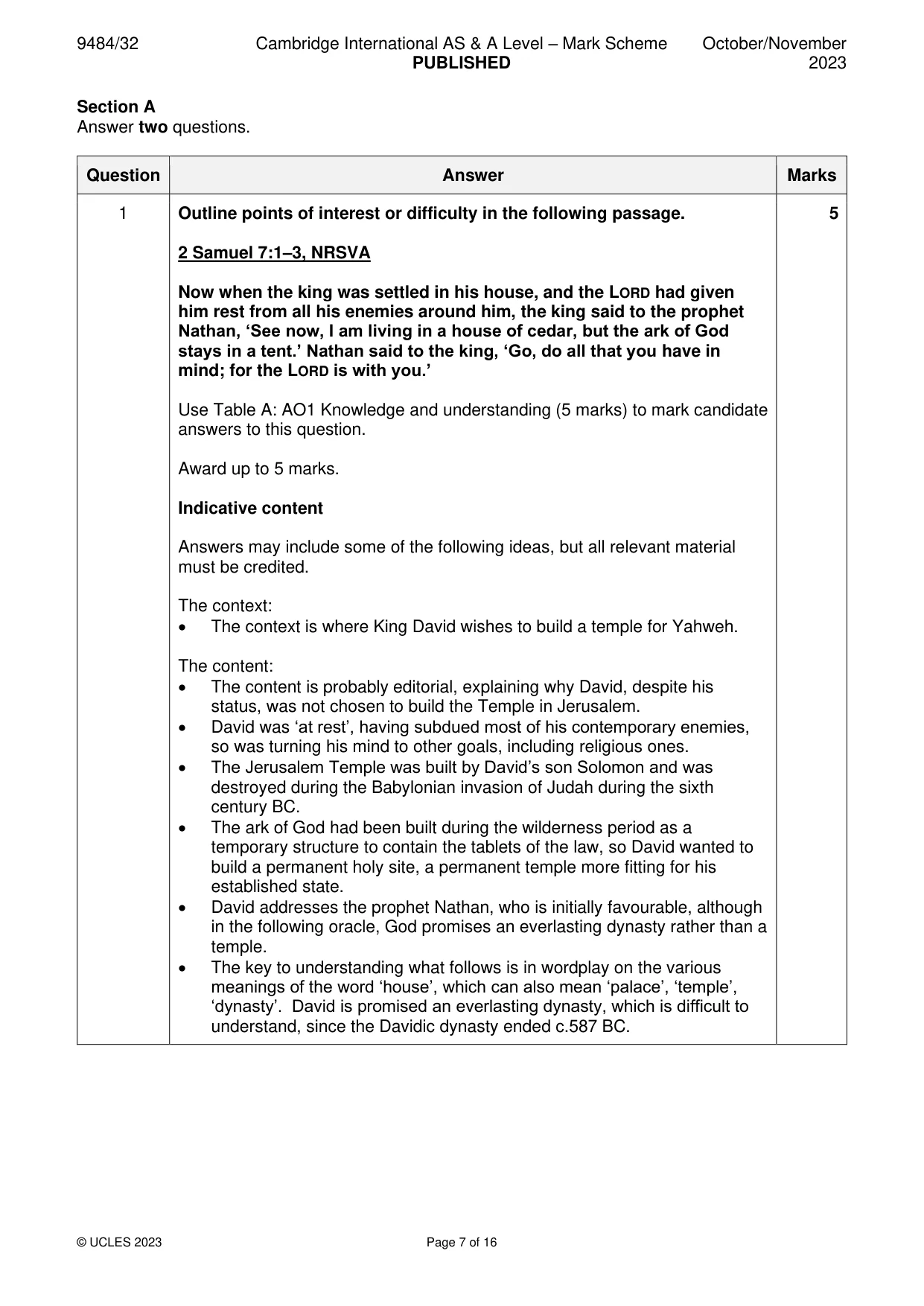
1 Outline points of interest or difficulty in the following passage. 2 Samuel 7:1–3, NRSVA Now when the king was settled in his house, and the Lord had given him rest from all his enemies around him, the king said to the prophet Nathan, ‘See now, I am living in a house of cedar, but the ark of God stays in a tent.’ Nathan said to the king, ‘Go, do all that you have in mind; for the Lord is with you.’ [5]
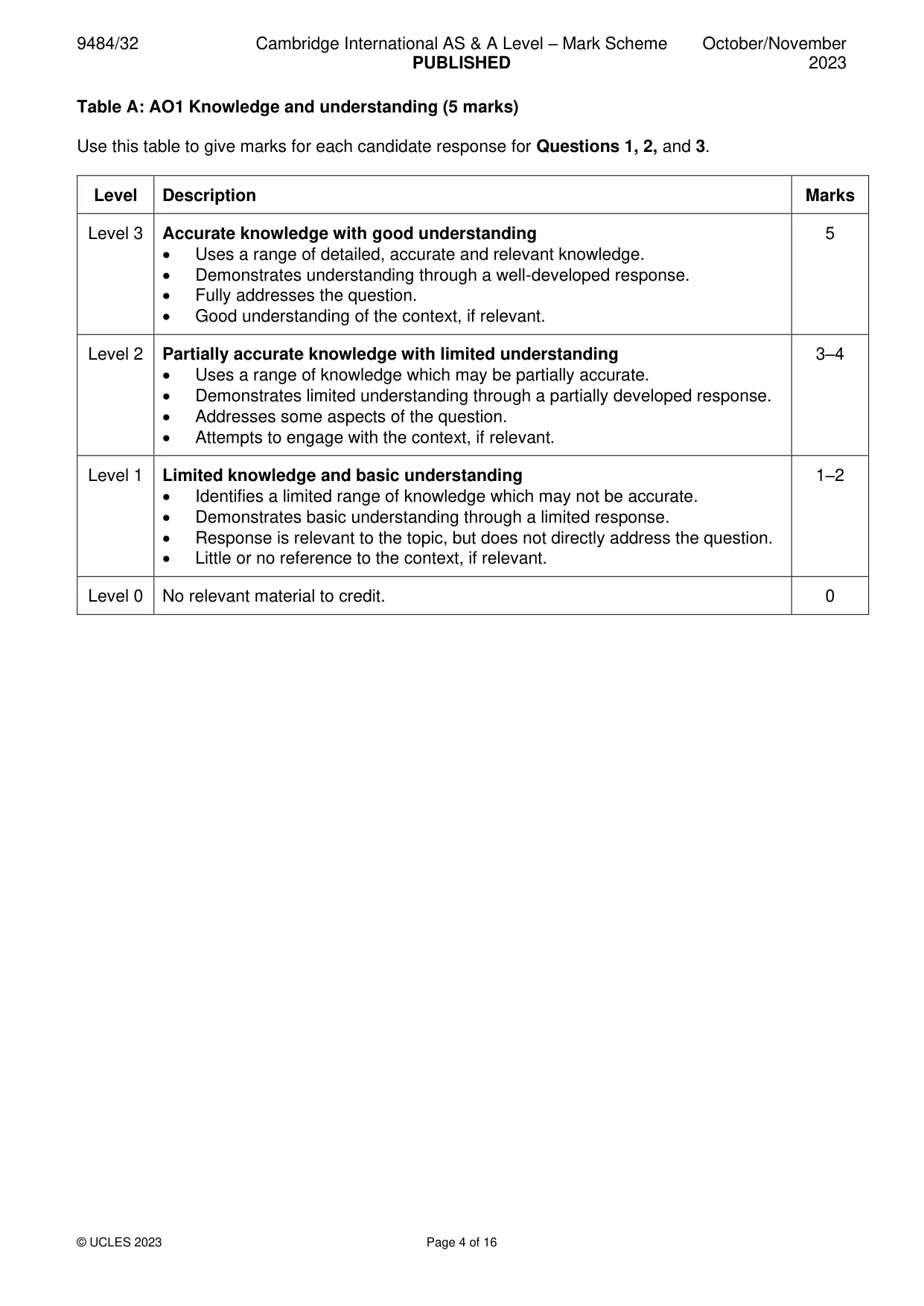
Mark scheme: Question Answer Marks 1 Outline points of interest or difficulty in the following passage. 5 2 Samuel 7:1–3, NRSVA Now when the king was settled in his house, and the LORD had given him rest from all his enemies around him, the king said to the prophet Nathan, ‘See now, I am living in a house of cedar, but the ark of God stays in a tent.’ Nathan said to the king, ‘Go, do all that you have in mind; for the LORD is with you.’ Use Table A: AO1 Knowledge and understanding (5 marks) to mark candidate answers to this question. Award up to 5 marks. Indicative content Answers may include some of the following ideas, but all relevant material must be credited. The context: • The context is where King David wishes to build a temple for Yahweh. The content: • The content is probably editorial, explaining why David, despite his status, was not chosen to build the Temple in Jerusalem. • David was ‘at rest’, having subdued most of his contemporary enemies, so was turning his mind to other goals, including religious ones. • The Jerusalem Temple was built by David’s son Solomon and was destroyed during the Babylonian invasion of Judah during the sixth century BC. • The ark of God had been built during the wilderness period as a temporary structure to contain the tablets of the law, so David wanted to build a permanent holy site, a permanent temple more fitting for his established state. • David addresses the prophet Nathan, who is initially favourable, although in the following oracle, God promises an everlasting dynasty rather than a temple. • The key to understanding what follows is in wordplay on the various meanings of the word ‘house’, which can also mean ‘palace’, ‘temple’, ‘dynasty’. David is promised an everlasting dynasty, which is difficult to understand, since the Davidic dynasty ended c.587 BC.
Q2 · Outline points of interest or difficulty in the following passage
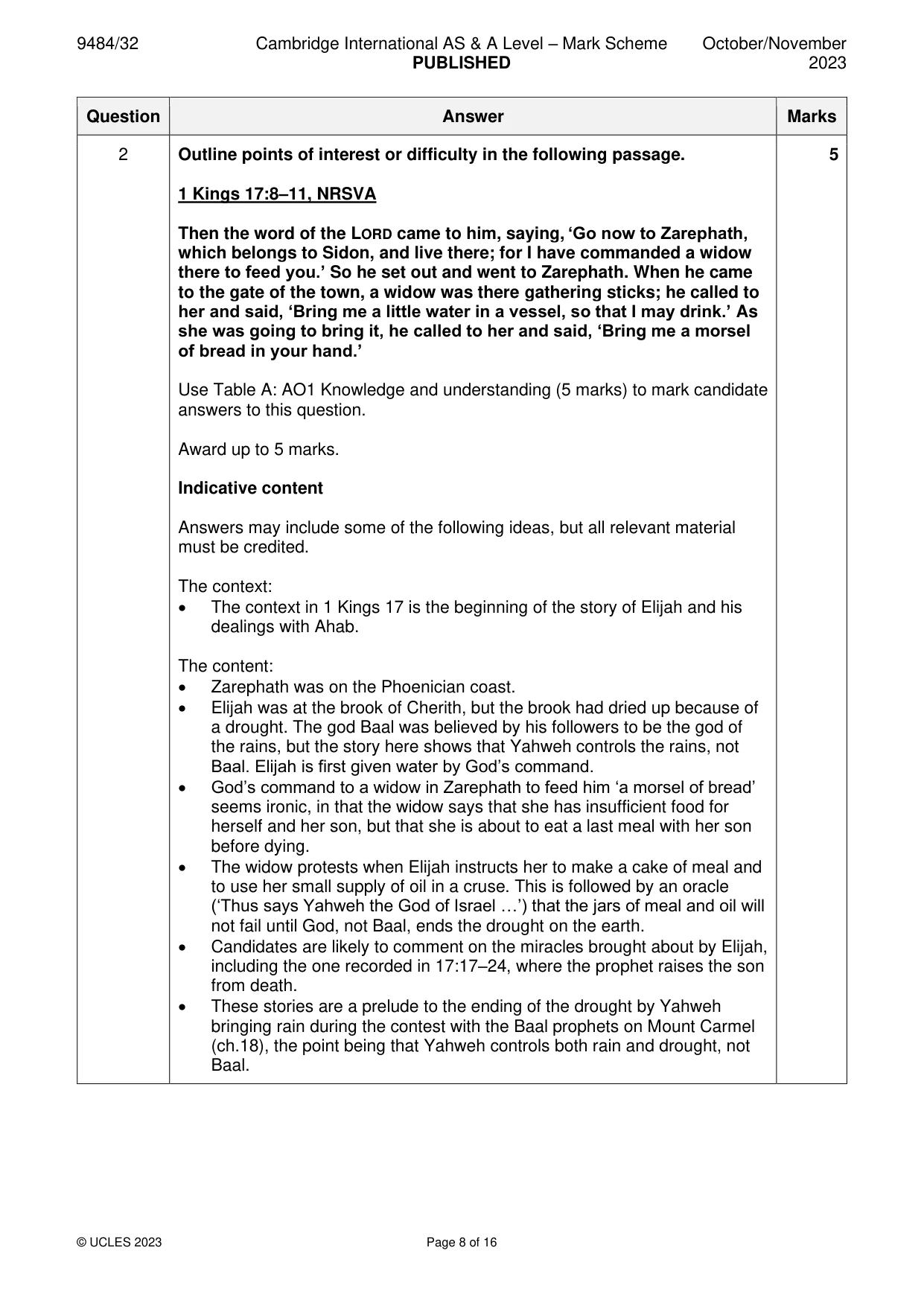
2 Outline points of interest or difficulty in the following passage. 1 Kings 17:8–11, NRSVA Then the word of the Lord came to him, saying, ‘Go now to Zarephath, which belongs to Sidon, and live there; for I have commanded a widow there to feed you.’ So he set out and went to Zarephath. When he came to the gate of the town, a widow was there gathering sticks; he called to her and said, ‘Bring me a little water in a vessel, so that I may drink.’ As she was going to bring it, he called to her and said, ‘Bring me a morsel of bread in your hand.’ [5]
Mark scheme: 2 Outline points of interest or difficulty in the following passage. 5 1 Kings 17:8–11, NRSVA Then the word of the LORD came to him, saying, ‘Go now to Zarephath, which belongs to Sidon, and live there; for I have commanded a widow there to feed you.’ So he set out and went to Zarephath. When he came to the gate of the town, a widow was there gathering sticks; he called to her and said, ‘Bring me a little water in a vessel, so that I may drink.’ As she was going to bring it, he called to her and said, ‘Bring me a morsel of bread in your hand.’ Use Table A: AO1 Knowledge and understanding (5 marks) to mark candidate answers to this question. Award up to 5 marks. Indicative content Answers may include some of the following ideas, but all relevant material must be credited. The context: • The context in 1 Kings 17 is the beginning of the story of Elijah and his dealings with Ahab. The content: • Zarephath was on the Phoenician coast. • Elijah was at the brook of Cherith, but the brook had dried up because of a drought. The god Baal was believed by his followers to be the god of the rains, but the story here shows that Yahweh controls the rains, not Baal. Elijah is first given water by God’s command. • God’s command to a widow in Zarephath to feed him ‘a morsel of bread’ seems ironic, in that the widow says that she has insufficient food for herself and her son, but that she is about to eat a last meal with her son before dying. • The widow protests when Elijah instructs her to make a cake of meal and to use her small supply of oil in a cruse. This is followed by an oracle (‘Thus says Yahweh the God of Israel …’) that the jars of meal and oil will not fail until God, not Baal, ends the drought on the earth. • Candidates are likely to comment on the miracles brought about by Elijah, including the one recorded in 17:17–24, where the prophet raises the son from death. • These stories are a prelude to the ending of the drought by Yahweh bringing rain during the contest with the Baal prophets on Mount Carmel (ch.18), the point being that Yahweh controls both rain and drought, not Baal.
Q3 · Outline points of interest or difficulty in the following passage
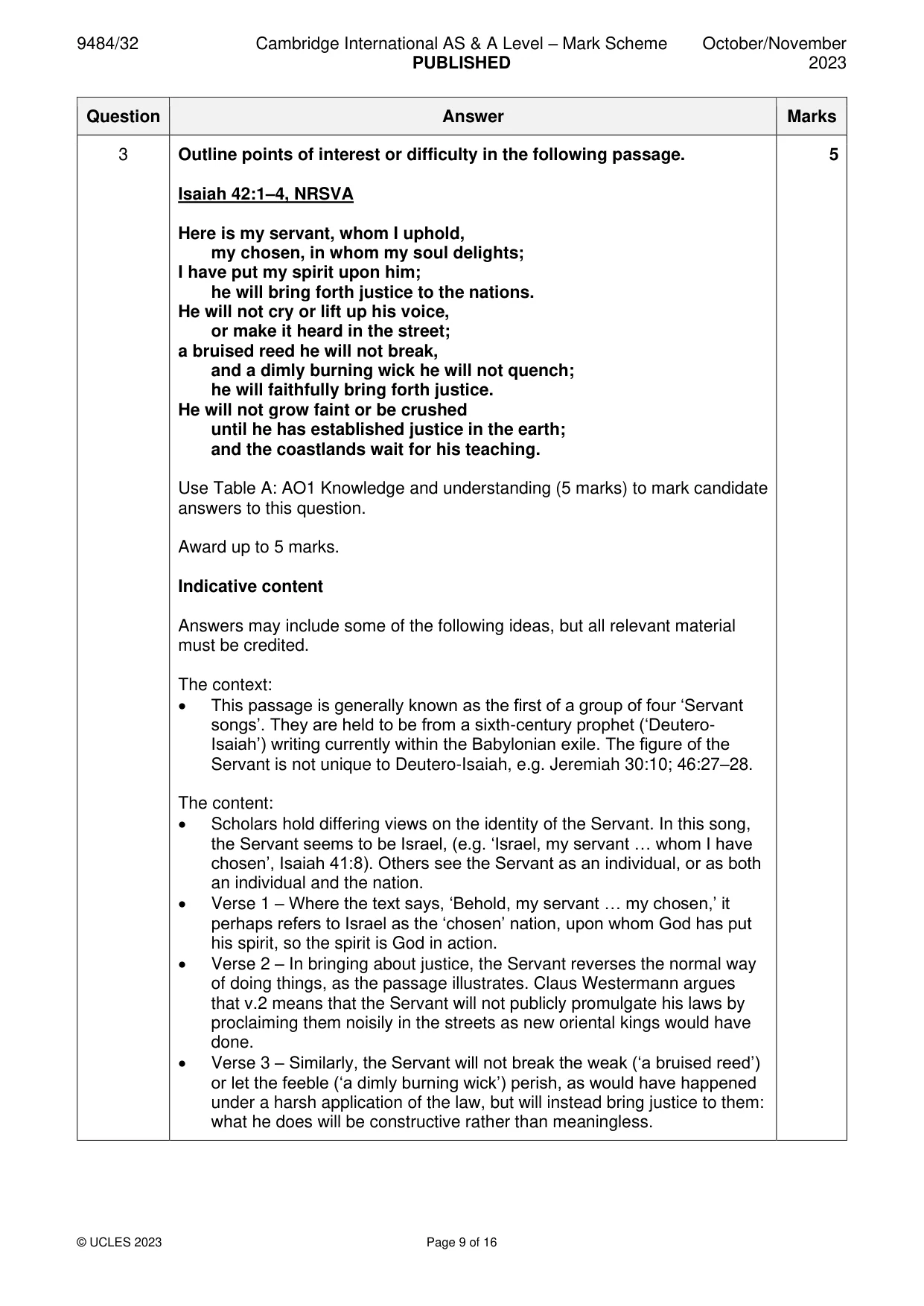
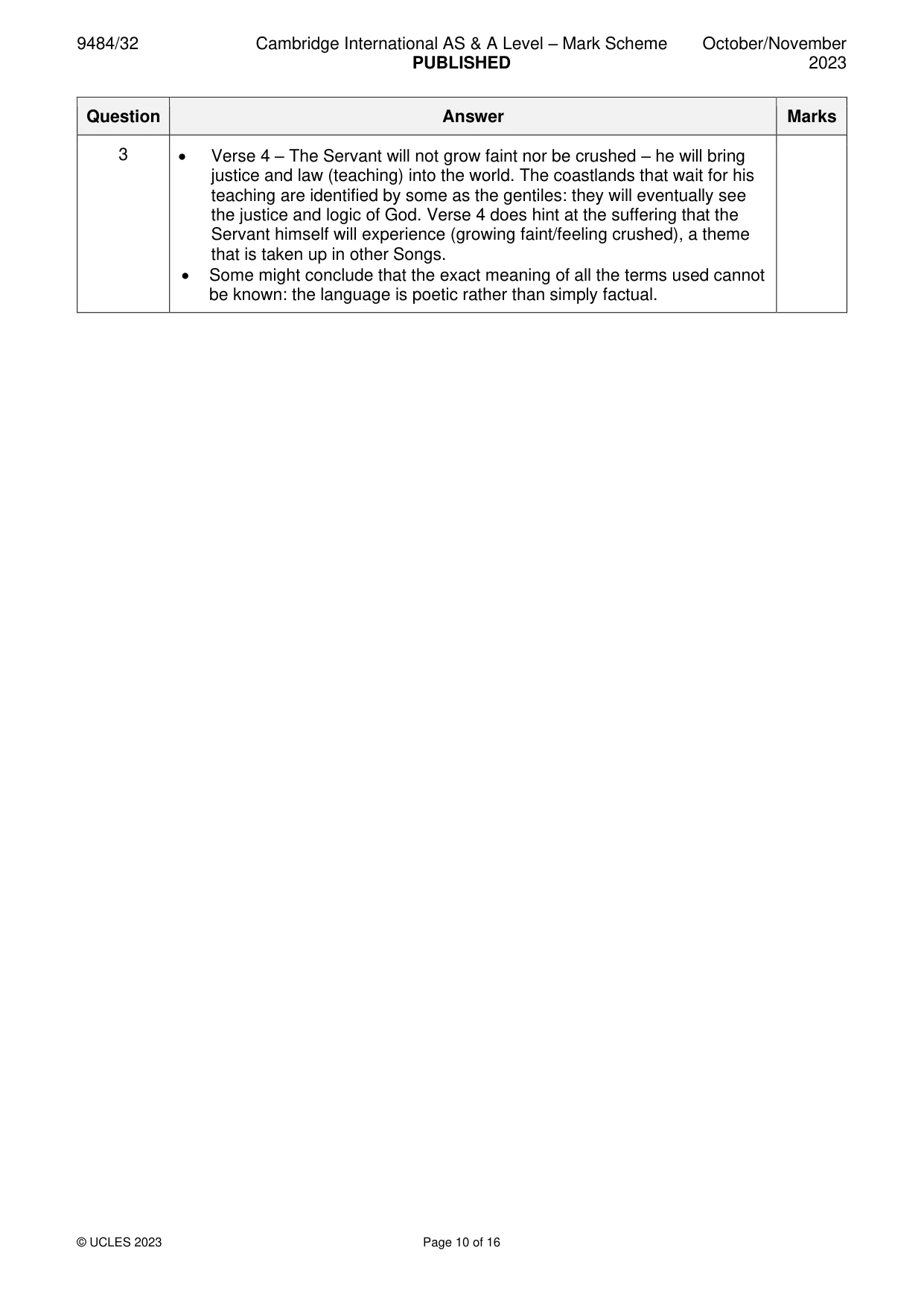
3 Outline points of interest or difficulty in the following passage. Isaiah 42:1– 4, NRSVA Here is my servant, whom I uphold, my chosen, in whom my soul delights; I have put my spirit upon him; he will bring forth justice to the nations. He will not cry or lift up his voice, or make it heard in the street; a bruised reed he will not break, and a dimly burning wick he will not quench; he will faithfully bring forth justice. He will not grow faint or be crushed until he has established justice in the earth; and the coastlands wait for his teaching. [5]
Mark scheme: 3 Outline points of interest or difficulty in the following passage. 5 Isaiah 42:1–4, NRSVA Here is my servant, whom I uphold, my chosen, in whom my soul delights; I have put my spirit upon him; he will bring forth justice to the nations. He will not cry or lift up his voice, or make it heard in the street; a bruised reed he will not break, and a dimly burning wick he will not quench; he will faithfully bring forth justice. He will not grow faint or be crushed until he has established justice in the earth; and the coastlands wait for his teaching. Use Table A: AO1 Knowledge and understanding (5 marks) to mark candidate answers to this question. Award up to 5 marks. Indicative content Answers may include some of the following ideas, but all relevant material must be credited. The context: • This passage is generally known as the first of a group of four ‘Servant songs’. They are held to be from a sixth-century prophet (‘Deutero- Isaiah’) writing currently within the Babylonian exile. The figure of the Servant is not unique to Deutero-Isaiah, e.g. Jeremiah 30:10; 46:27–28. The content: • Scholars hold differing views on the identity of the Servant. In this song, the Servant seems to be Israel, (e.g. ‘Israel, my servant … whom I have chosen’, Isaiah 41:8). Others see the Servant as an individual, or as both an individual and the nation. • Verse 1 – Where the text says, ‘Behold, my servant … my chosen,’ it perhaps refers to Israel as the ‘chosen’ nation, upon whom God has put his spirit, so the spirit is God in action. • Verse 2 – In bringing about justice, the Servant reverses the normal way of doing things, as the passage illustrates. Claus Westermann argues that v.2 means that the Servant will not publicly promulgate his laws by proclaiming them noisily in the streets as new oriental kings would have done. • Verse 3 – Similarly, the Servant will not break the weak (‘a bruised reed’) or let the feeble (‘a dimly burning wick’) perish, as would have happened under a harsh application of the law, but will instead bring justice to them: what he does will be constructive rather than meaningless. 3 • Verse 4 – The Servant will not grow faint nor be crushed – he will bring justice and law (teaching) into the world. The coastlands that wait for his teaching are identified by some as the gentiles: they will eventually see the justice and logic of God. Verse 4 does hint at the suffering that the Servant himself will experience (growing faint/feeling crushed), a theme that is taken up in other Songs. • Some might conclude that the exact meaning of all the terms used cannot be known: the language is poetic rather than simply factual.
Q4 · Read the following passage and then answer the question below: Amos 4:1–3, NRSVA Hear…
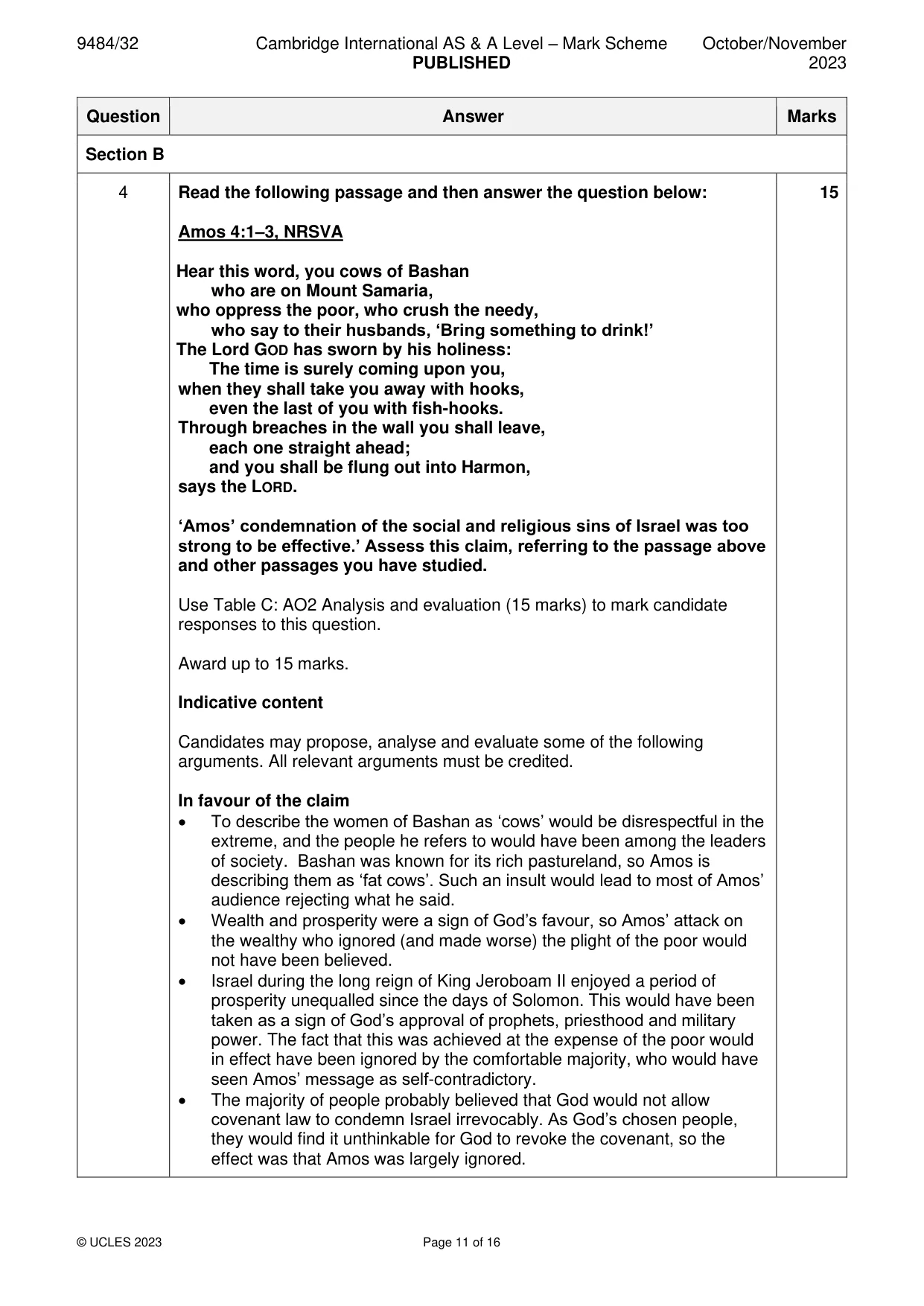
4 Read the following passage and then answer the question below: Amos 4:1–3, NRSVA Hear this word, you cows of Bashan who are on Mount Samaria, who oppress the poor, who crush the needy, who say to their husbands, ‘Bring something to drink!’ The Lord God has sworn by his holiness: The time is surely coming upon you, when they shall take you away with hooks, even the last of you with fish‑hooks. Through breaches in the wall you shall leave, each one straight ahead; and you shall be flung out into Harmon, says the Lord. ‘Amos’ condemnation of the social and religious sins of Israel was too strong to be effective.’ Assess this claim, referring to the passage above and other passages you have studied. [15] Section C Answer EITHER Question 5 OR Question 6. EITHER
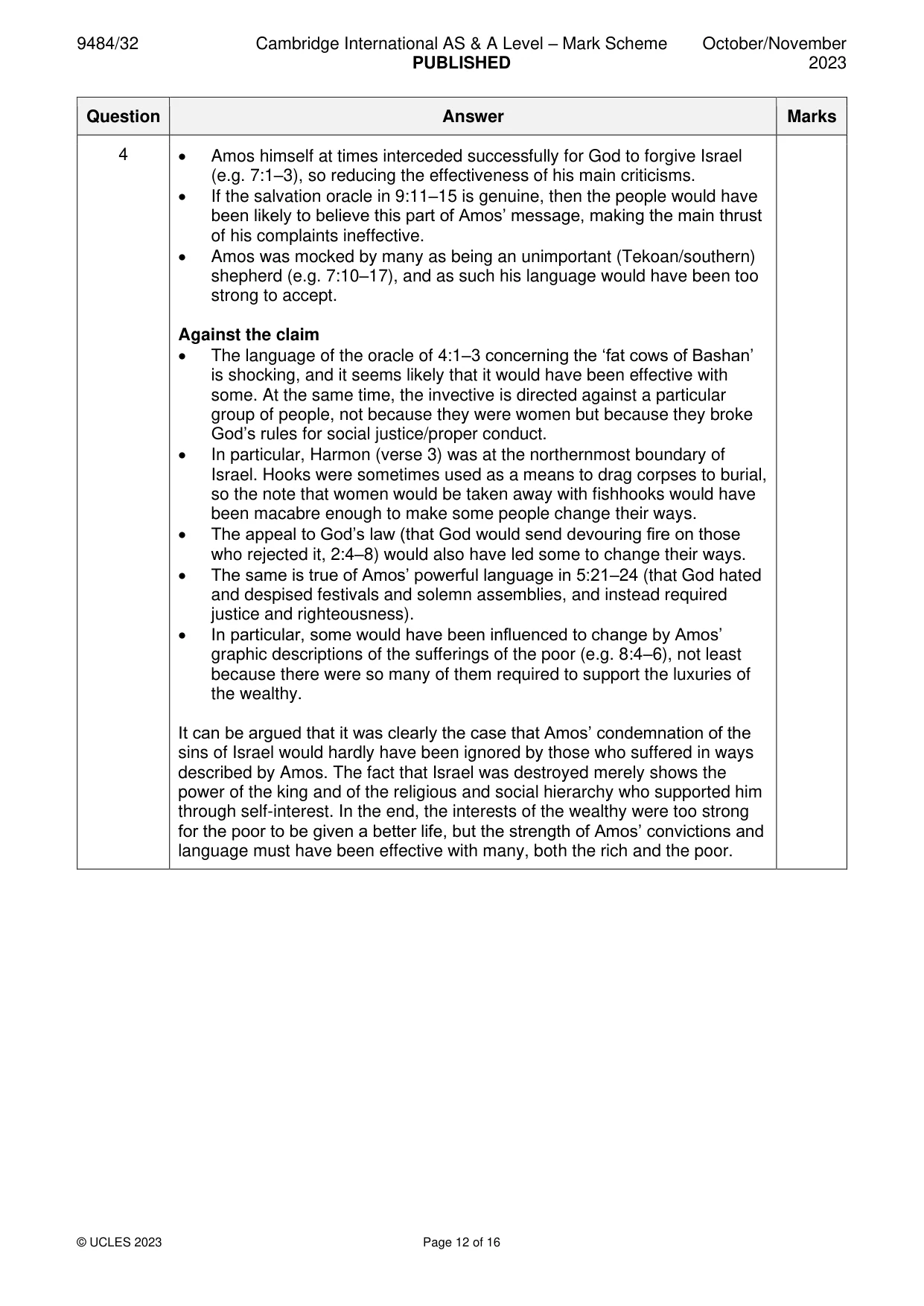
Mark scheme: 4 Read the following passage and then answer the question below: 15 Amos 4:1–3, NRSVA Hear this word, you cows of Bashan who are on Mount Samaria, who oppress the poor, who crush the needy, who say to their husbands, ‘Bring something to drink!’ The Lord GOD has sworn by his holiness: The time is surely coming upon you, when they shall take you away with hooks, even the last of you with fish-hooks. Through breaches in the wall you shall leave, each one straight ahead; and you shall be flung out into Harmon, says the LORD. ‘Amos’ condemnation of the social and religious sins of Israel was too strong to be effective.’ Assess this claim, referring to the passage above and other passages you have studied. Use Table C: AO2 Analysis and evaluation (15 marks) to mark candidate responses to this question. Award up to 15 marks. Indicative content Candidates may propose, analyse and evaluate some of the following arguments. All relevant arguments must be credited. In favour of the claim • To describe the women of Bashan as ‘cows’ would be disrespectful in the extreme, and the people he refers to would have been among the leaders of society. Bashan was known for its rich pastureland, so Amos is describing them as ‘fat cows’. Such an insult would lead to most of Amos’ audience rejecting what he said. • Wealth and prosperity were a sign of God’s favour, so Amos’ attack on the wealthy who ignored (and made worse) the plight of the poor would not have been believed. • Israel during the long reign of King Jeroboam II enjoyed a period of prosperity unequalled since the days of Solomon. This would have been taken as a sign of God’s approval of prophets, priesthood and military power. The fact that this was achieved at the expense of the poor would in effect have been ignored by the comfortable majority, who would have seen Amos’ message as self-contradictory. • The majority of people probably believed that God would not allow covenant law to condemn Israel irrevocably. As God’s chosen people, they would find it unthinkable for God to revoke the covenant, so the effect was that Amos was largely ignored. 4 • Amos himself at times interceded successfully for God to forgive Israel (e.g. 7:1–3), so reducing the effectiveness of his main criticisms. • If the salvation oracle in 9:11–15 is genuine, then the people would have been likely to believe this part of Amos’ message, making the main thrust of his complaints ineffective. • Amos was mocked by many as being an unimportant (Tekoan/southern) shepherd (e.g. 7:10–17), and as such his language would have been too strong to accept. Against the claim • The language of the oracle of 4:1–3 concerning the ‘fat cows of Bashan’ is shocking, and it seems likely that it would have been effective with some. At the same time, the invective is directed against a particular group of people, not because they were women but because they broke God’s rules for social justice/proper conduct. • In particular, Harmon (verse 3) was at the northernmost boundary of Israel. Hooks were sometimes used as a means to drag corpses to burial, so the note that women would be taken away with fishhooks would have been macabre enough to make some people change their ways. • The appeal to God’s law (that God would send devouring fire on those who rejected it, 2:4–8) would also have led some to change their ways. • The same is true of Amos’ powerful language in 5:21–24 (that God hated and despised festivals and solemn assemblies, and instead required justice and righteousness). • In particular, some would have been influenced to change by Amos’ graphic descriptions of the sufferings of the poor (e.g. 8:4–6), not least because there were so many of them required to support the luxuries of the wealthy. It can be argued that it was clearly the case that Amos’ condemnation of the sins of Israel would hardly have been ignored by those who suffered in ways described by Amos. The fact that Israel was destroyed merely shows the power of the king and of the religious and social hierarchy who supported him through self-interest. In the end, the interests of the wealthy were too strong for the poor to be given a better life, but the strength of Amos’ convictions and language must have been effective with many, both the rich and the poor.
Q5 · ‘Nathan’s criticisms of David over his affair with Bathsheba were justified.’ Assess this…
5 ‘Nathan’s criticisms of David over his affair with Bathsheba were justified.’ Assess this view. [25] OR
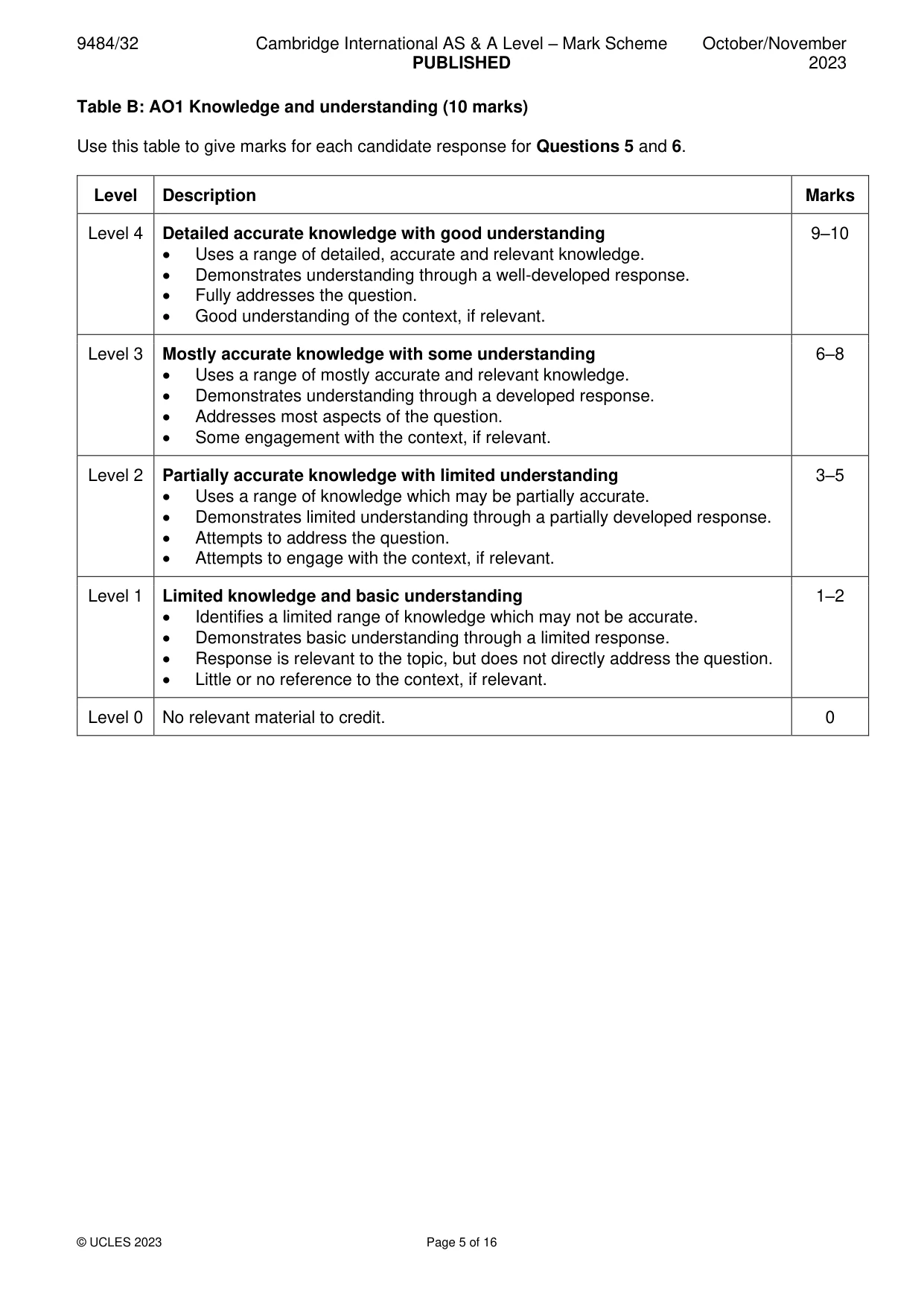
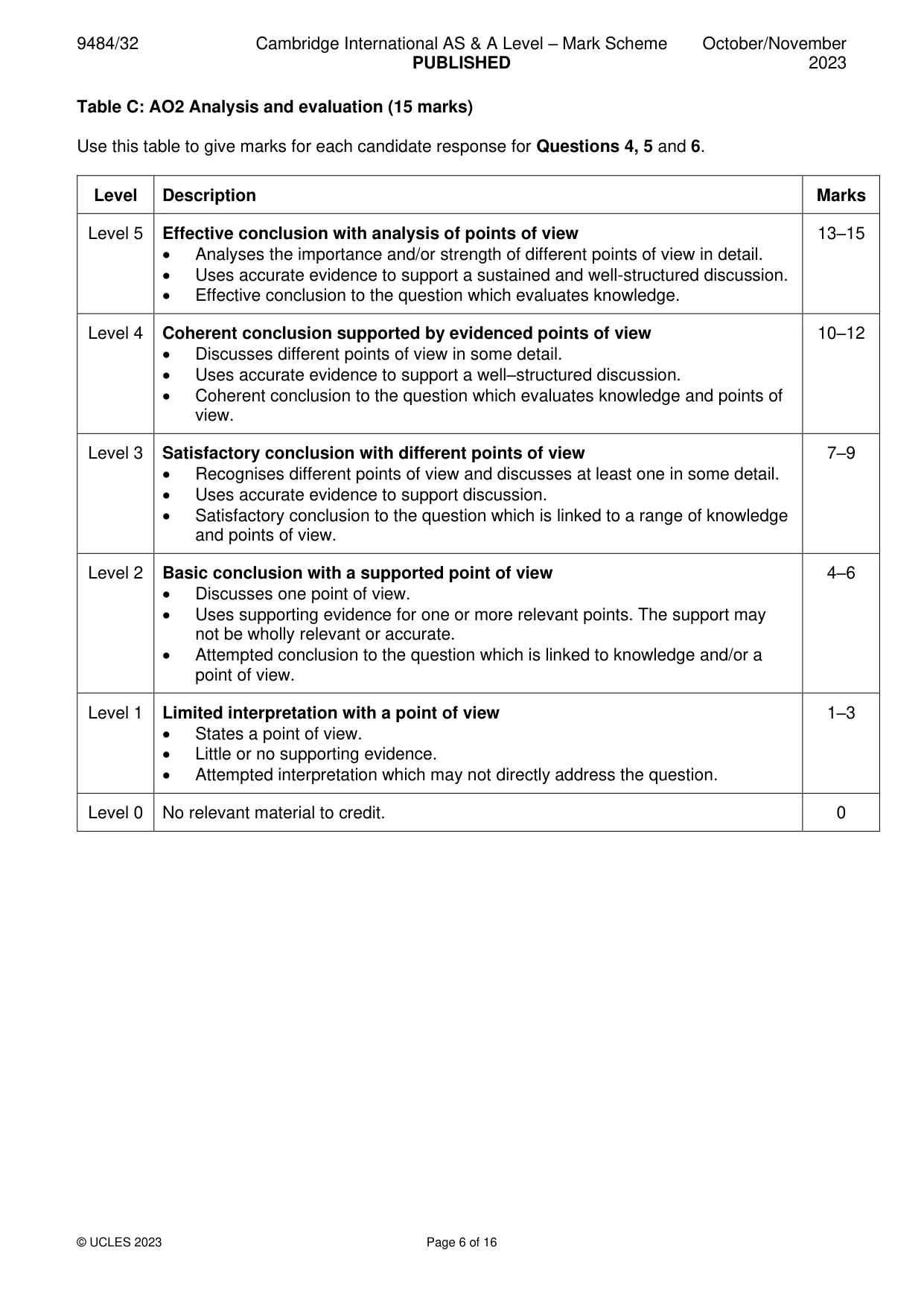
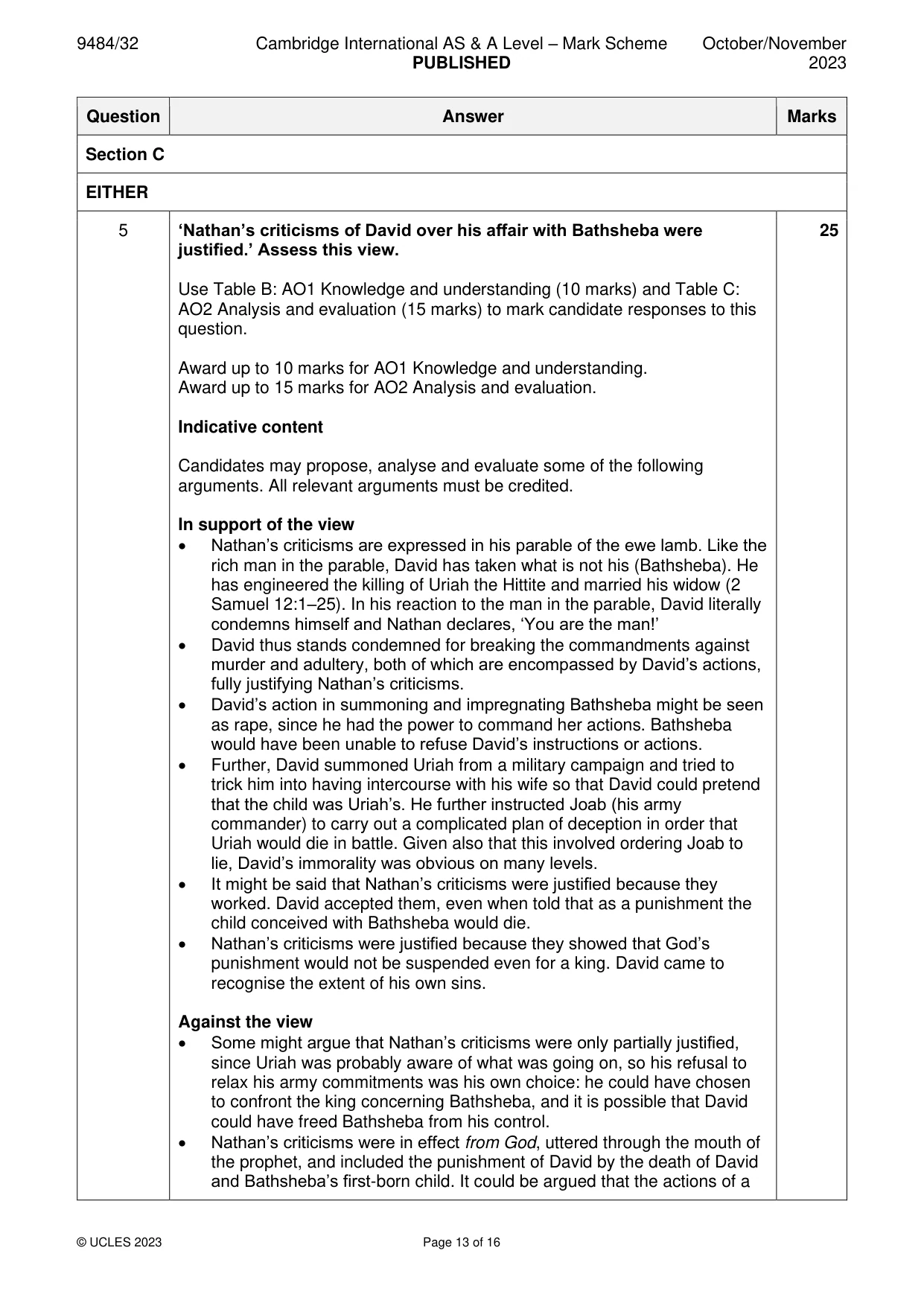
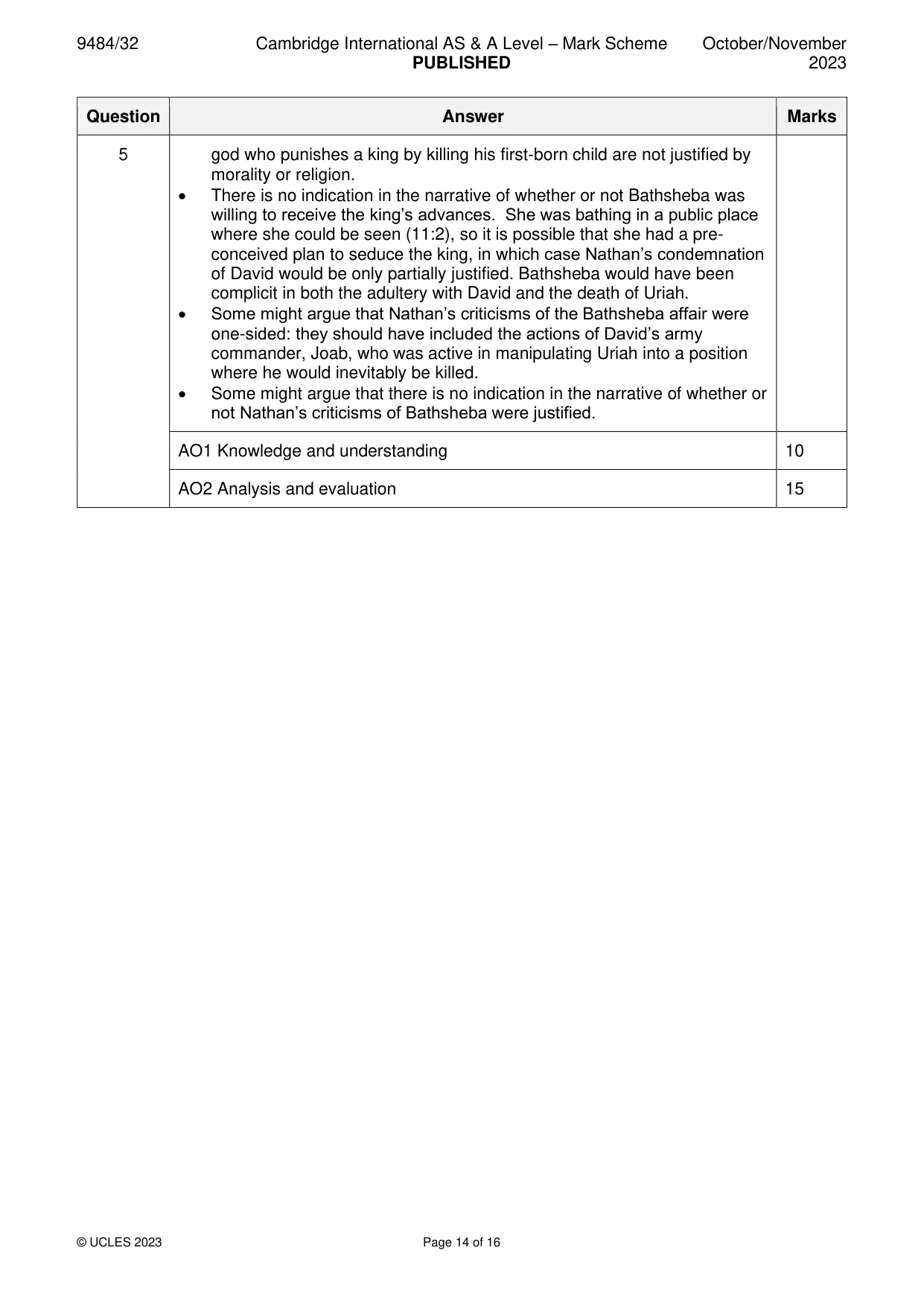
Mark scheme: 5 ‘Nathan’s criticisms of David over his affair with Bathsheba were 25 justified.’ Assess this view. Use Table B: AO1 Knowledge and understanding (10 marks) and Table C: AO2 Analysis and evaluation (15 marks) to mark candidate responses to this question. Award up to 10 marks for AO1 Knowledge and understanding. Award up to 15 marks for AO2 Analysis and evaluation. Indicative content Candidates may propose, analyse and evaluate some of the following arguments. All relevant arguments must be credited. In support of the view • Nathan’s criticisms are expressed in his parable of the ewe lamb. Like the rich man in the parable, David has taken what is not his (Bathsheba). He has engineered the killing of Uriah the Hittite and married his widow (2 Samuel 12:1–25). In his reaction to the man in the parable, David literally condemns himself and Nathan declares, ‘You are the man!’ • David thus stands condemned for breaking the commandments against murder and adultery, both of which are encompassed by David’s actions, fully justifying Nathan’s criticisms. • David’s action in summoning and impregnating Bathsheba might be seen as rape, since he had the power to command her actions. Bathsheba would have been unable to refuse David’s instructions or actions. • Further, David summoned Uriah from a military campaign and tried to trick him into having intercourse with his wife so that David could pretend that the child was Uriah’s. He further instructed Joab (his army commander) to carry out a complicated plan of deception in order that Uriah would die in battle. Given also that this involved ordering Joab to lie, David’s immorality was obvious on many levels. • It might be said that Nathan’s criticisms were justified because they worked. David accepted them, even when told that as a punishment the child conceived with Bathsheba would die. • Nathan’s criticisms were justified because they showed that God’s punishment would not be suspended even for a king. David came to recognise the extent of his own sins. Against the view • Some might argue that Nathan’s criticisms were only partially justified, since Uriah was probably aware of what was going on, so his refusal to relax his army commitments was his own choice: he could have chosen to confront the king concerning Bathsheba, and it is possible that David could have freed Bathsheba from his control. • Nathan’s criticisms were in effect from God, uttered through the mouth of the prophet, and included the punishment of David by the death of David and Bathsheba’s first-born child. It could be argued that the actions of a 5 god who punishes a king by killing his first-born child are not justified by morality or religion. • There is no indication in the narrative of whether or not Bathsheba was willing to receive the king’s advances. She was bathing in a public place where she could be seen (11:2), so it is possible that she had a pre- conceived plan to seduce the king, in which case Nathan’s condemnation of David would be only partially justified. Bathsheba would have been complicit in both the adultery with David and the death of Uriah. • Some might argue that Nathan’s criticisms of the Bathsheba affair were one-sided: they should have included the actions of David’s army commander, Joab, who was active in manipulating Uriah into a position where he would inevitably be killed. • Some might argue that there is no indication in the narrative of whether or not Nathan’s criticisms of Bathsheba were justified. AO1 Knowledge and understanding 10 AO2 Analysis and evaluation 15
Q6 · ‘Jeremiah’s criticisms of false prophets were pointless, since the people had no reason…
6 ‘Jeremiah’s criticisms of false prophets were pointless, since the people had no reason to believe him rather than those he criticised.’ Assess this claim. [25]
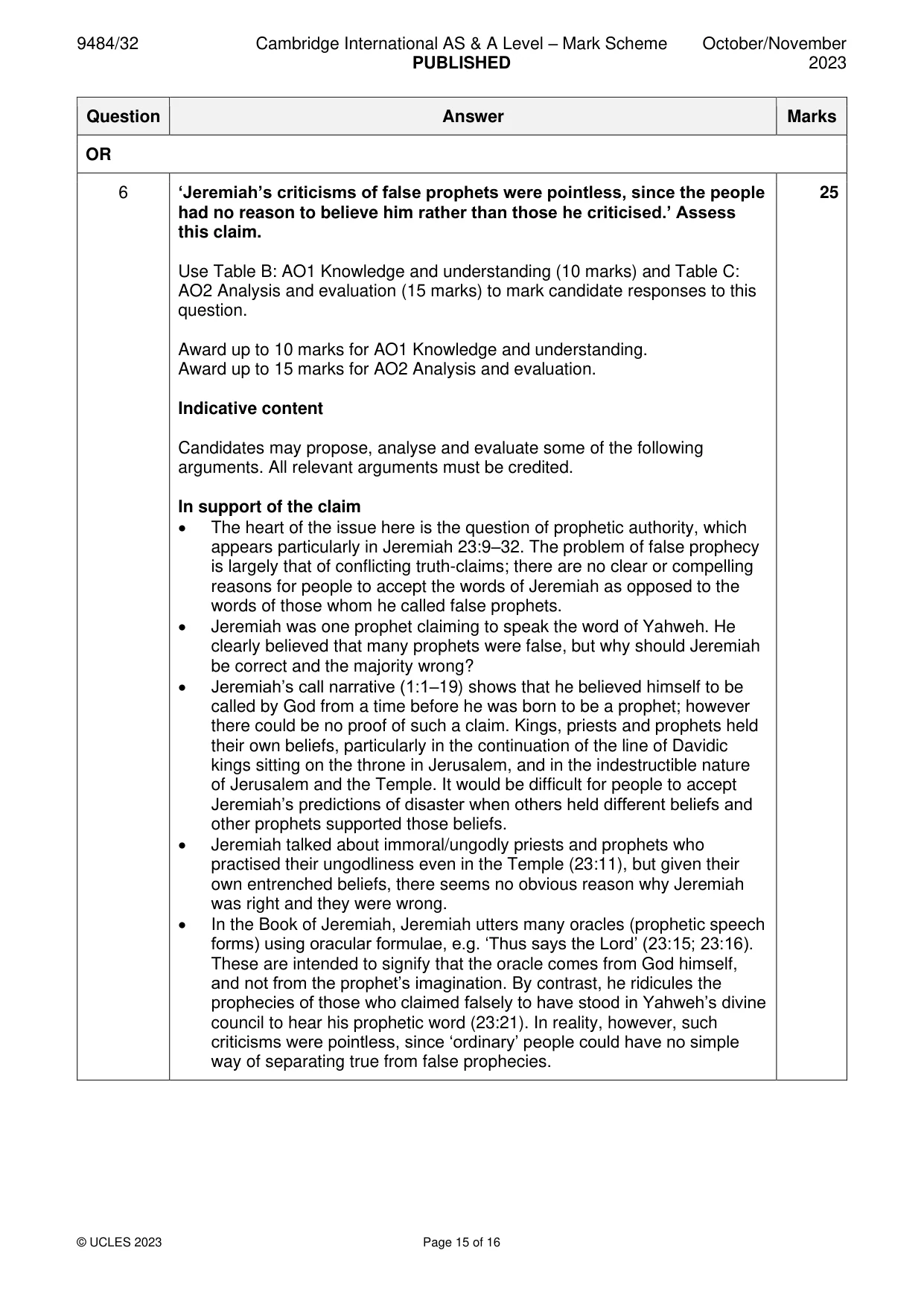
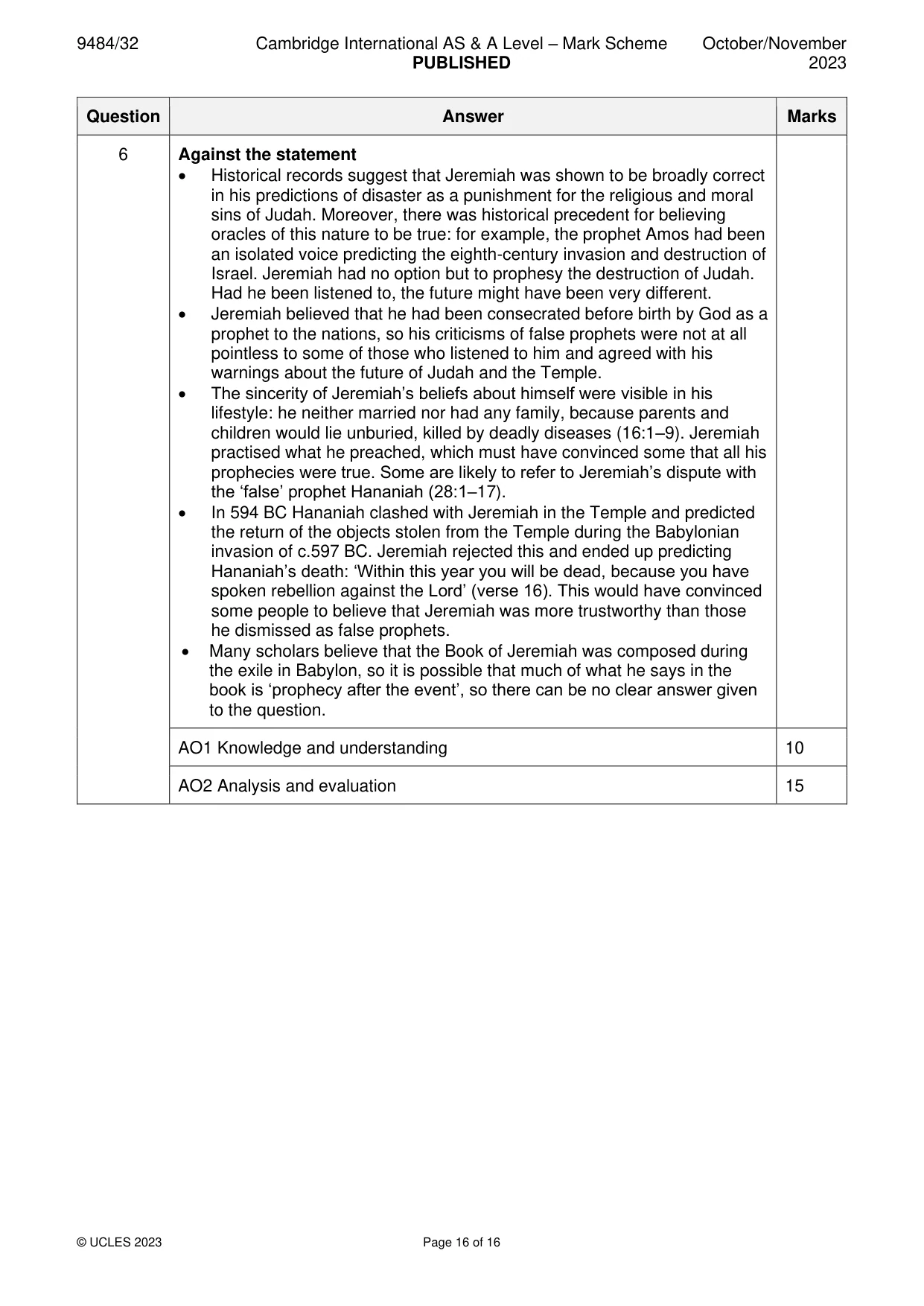
Mark scheme: 6 ‘Jeremiah’s criticisms of false prophets were pointless, since the people 25 had no reason to believe him rather than those he criticised.’ Assess this claim. Use Table B: AO1 Knowledge and understanding (10 marks) and Table C: AO2 Analysis and evaluation (15 marks) to mark candidate responses to this question. Award up to 10 marks for AO1 Knowledge and understanding. Award up to 15 marks for AO2 Analysis and evaluation. Indicative content Candidates may propose, analyse and evaluate some of the following arguments. All relevant arguments must be credited. In support of the claim • The heart of the issue here is the question of prophetic authority, which appears particularly in Jeremiah 23:9–32. The problem of false prophecy is largely that of conflicting truth-claims; there are no clear or compelling reasons for people to accept the words of Jeremiah as opposed to the words of those whom he called false prophets. • Jeremiah was one prophet claiming to speak the word of Yahweh. He clearly believed that many prophets were false, but why should Jeremiah be correct and the majority wrong? • Jeremiah’s call narrative (1:1–19) shows that he believed himself to be called by God from a time before he was born to be a prophet; however there could be no proof of such a claim. Kings, priests and prophets held their own beliefs, particularly in the continuation of the line of Davidic kings sitting on the throne in Jerusalem, and in the indestructible nature of Jerusalem and the Temple. It would be difficult for people to accept Jeremiah’s predictions of disaster when others held different beliefs and other prophets supported those beliefs. • Jeremiah talked about immoral/ungodly priests and prophets who practised their ungodliness even in the Temple (23:11), but given their own entrenched beliefs, there seems no obvious reason why Jeremiah was right and they were wrong. • In the Book of Jeremiah, Jeremiah utters many oracles (prophetic speech forms) using oracular formulae, e.g. ‘Thus says the Lord’ (23:15; 23:16). These are intended to signify that the oracle comes from God himself, and not from the prophet’s imagination. By contrast, he ridicules the prophecies of those who claimed falsely to have stood in Yahweh’s divine council to hear his prophetic word (23:21). In reality, however, such criticisms were pointless, since ‘ordinary’ people could have no simple way of separating true from false prophecies. 6 Against the statement • Historical records suggest that Jeremiah was shown to be broadly correct in his predictions of disaster as a punishment for the religious and moral sins of Judah. Moreover, there was historical precedent for believing oracles of this nature to be true: for example, the prophet Amos had been an isolated voice predicting the eighth-century invasion and destruction of Israel. Jeremiah had no option but to prophesy the destruction of Judah. Had he been listened to, the future might have been very different. • Jeremiah believed that he had been consecrated before birth by God as a prophet to the nations, so his criticisms of false prophets were not at all pointless to some of those who listened to him and agreed with his warnings about the future of Judah and the Temple. • The sincerity of Jeremiah’s beliefs about himself were visible in his lifestyle: he neither married nor had any family, because parents and children would lie unburied, killed by deadly diseases (16:1–9). Jeremiah practised what he preached, which must have convinced some that all his prophecies were true. Some are likely to refer to Jeremiah’s dispute with the ‘false’ prophet Hananiah (28:1–17). • In 594 BC Hananiah clashed with Jeremiah in the Temple and predicted the return of the objects stolen from the Temple during the Babylonian invasion of c.597 BC. Jeremiah rejected this and ended up predicting Hananiah’s death: ‘Within this year you will be dead, because you have spoken rebellion against the Lord’ (verse 16). This would have convinced some people to believe that Jeremiah was more trustworthy than those he dismissed as false prophets. • Many scholars believe that the Book of Jeremiah was composed during the exile in Babylon, so it is possible that much of what he says in the book is ‘prophecy after the event’, so there can be no clear answer given to the question. AO1 Knowledge and understanding 10 AO2 Analysis and evaluation 15
What was in this paper
The subtopics covered by these 6 questions, and how many questions each got. Open one in a new tab to see every Cambridge question on it.
What you needed in this session
Cambridge’s own grade thresholds for 2023 Oct/Nov, Paper 3 · Variant 2. A higher threshold means an easier paper — the bar moves with how the cohort did.