Cambridge A Level Biblical Studies 9484 — 2023 May/June Paper 3 · Variant 2
9484/32/M/J/23 · 5 questions · 50 marks · ≈56 min
The question paper and its mark scheme, free to read here and free to download. This is Cambridge’s own paper, exactly as it was sat.
Question paper4 pages

Mark scheme17 pages
Answers below. Sit the paper first if you are practising.
Questions as text
Q1 · Outline points of interest or difficulty in the following passage
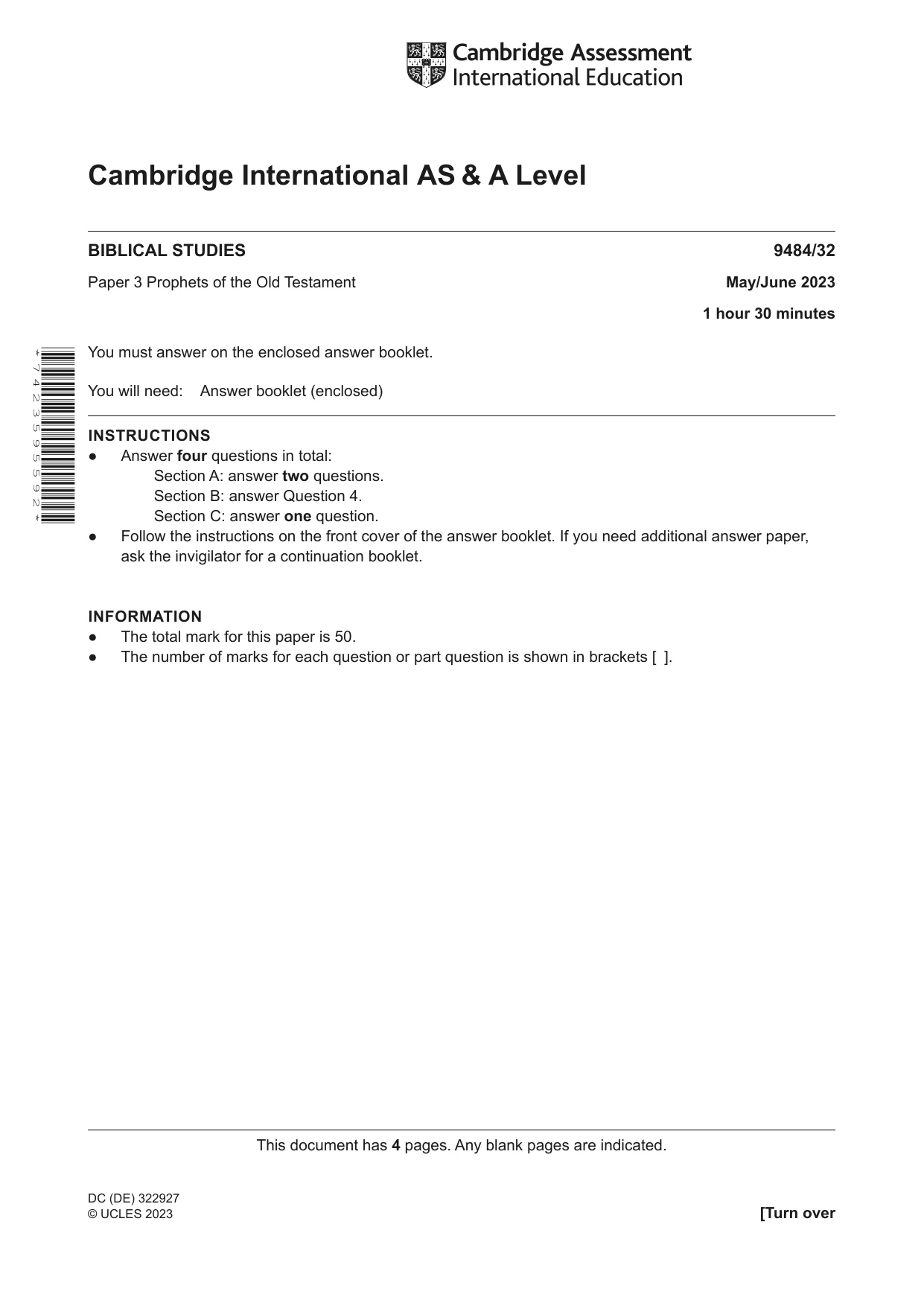
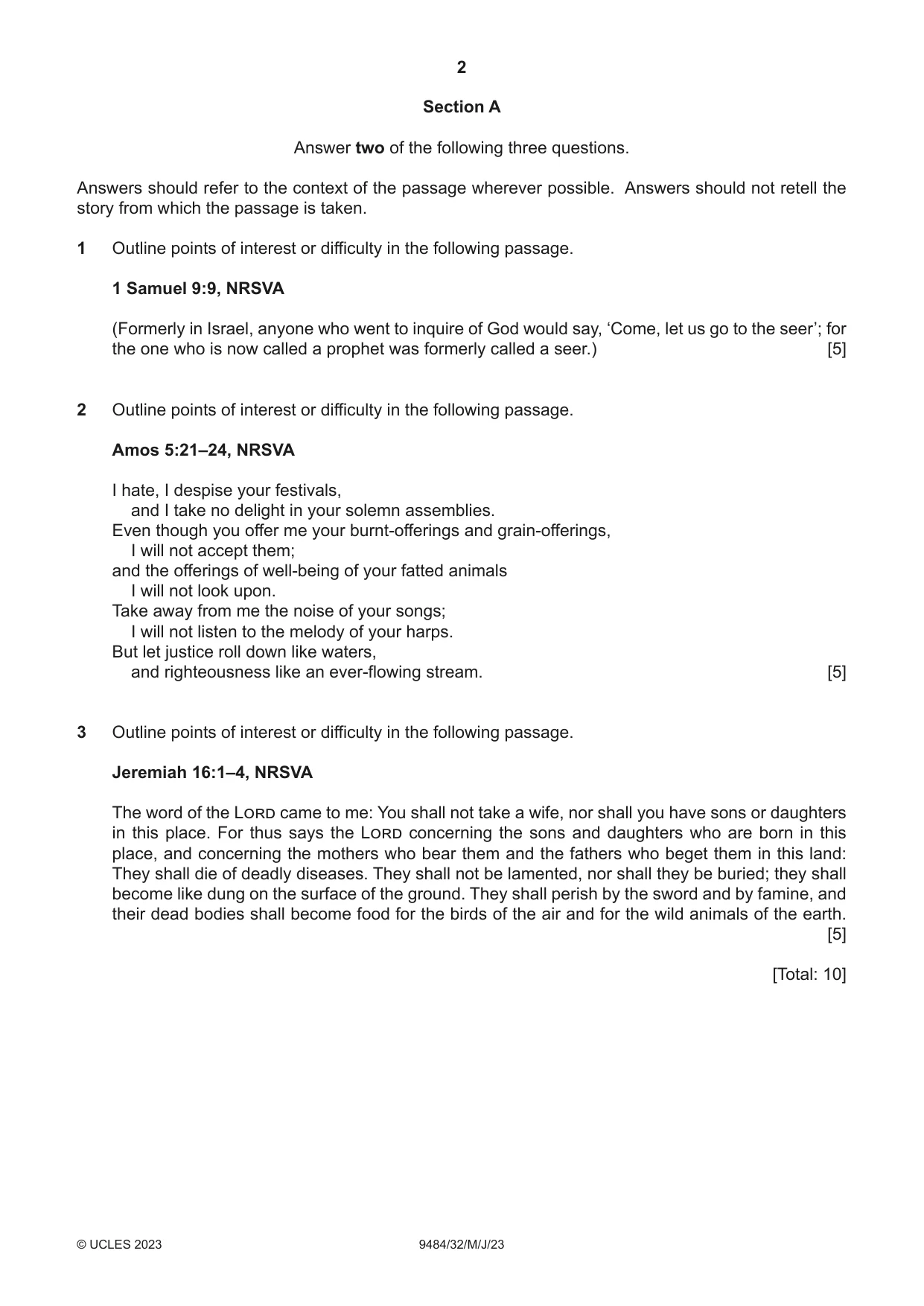
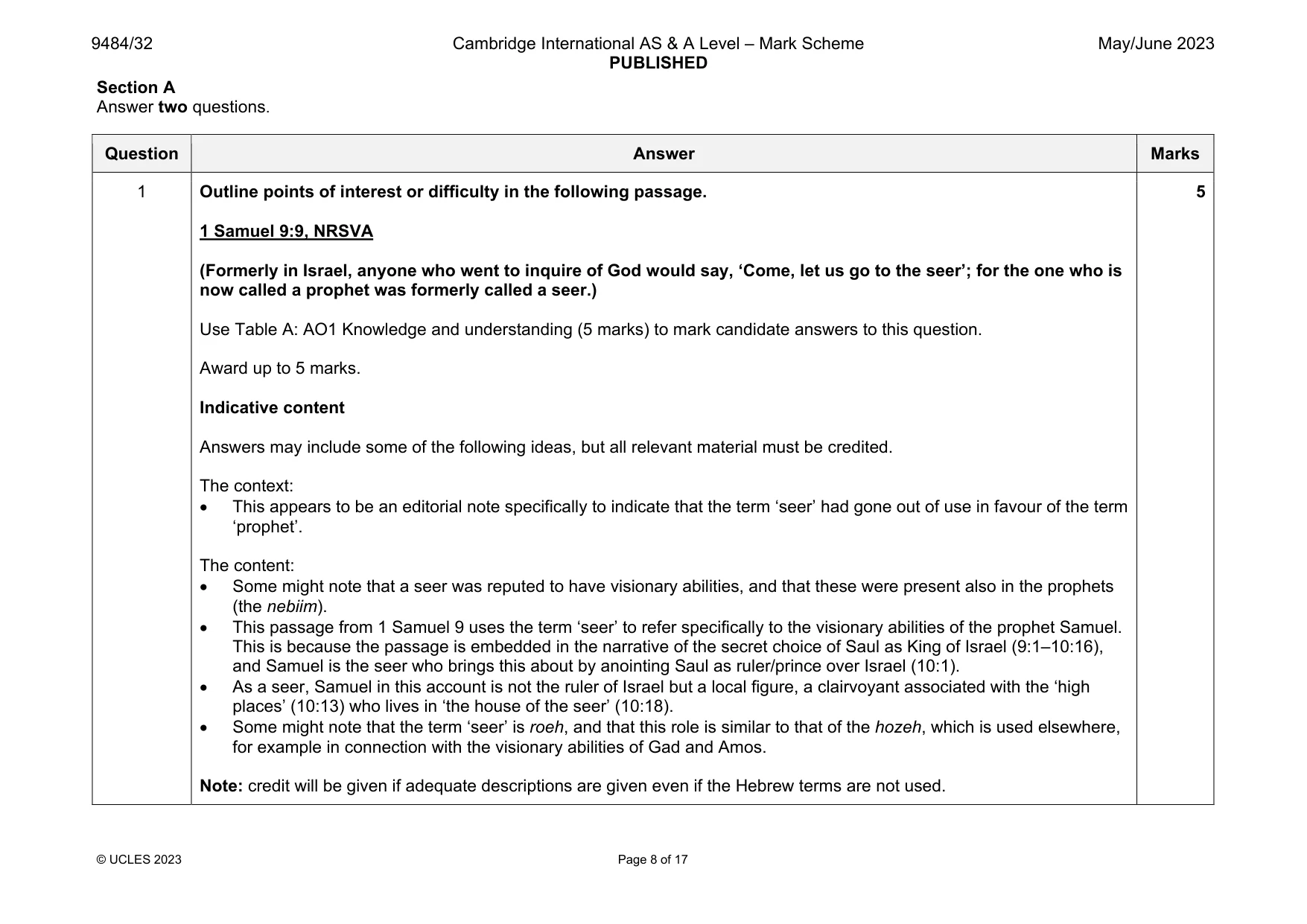
1 Outline points of interest or difficulty in the following passage. 1 Samuel 9:9, NRSVA (Formerly in Israel, anyone who went to inquire of God would say, ‘Come, let us go to the seer’; for the one who is now called a prophet was formerly called a seer.) [5]
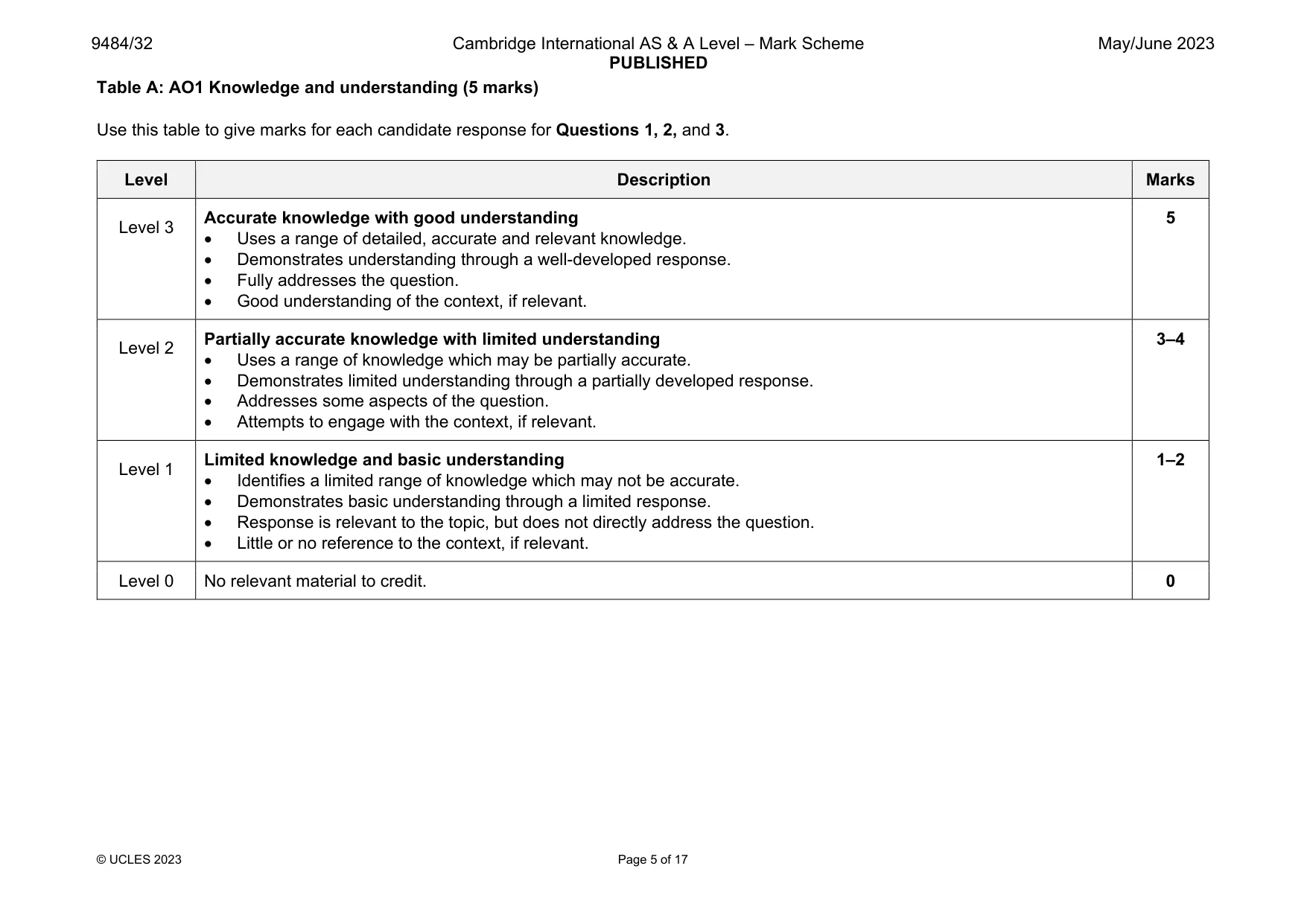
Mark scheme: 1 Outline points of interest or difficulty in the following passage. 1 Samuel 9:9, NRSVA (Formerly in Israel, anyone who went to inquire of God would say, ‘Come, let us go to the seer’; for the one who is now called a prophet was formerly called a seer.) Use Table A: AO1 Knowledge and understanding (5 marks) to mark candidate answers to this question. Award up to 5 marks. Indicative content Answers may include some of the following ideas, but all relevant material must be credited. The context: This appears to be an editorial note specifically to indicate that the term ‘seer’ had gone out of use in favour of the term ‘prophet’. The content: Some might note that a seer was reputed to have visionary abilities, and that these were present also in the prophets (the nebiim). This passage from 1 Samuel 9 uses the term ‘seer’ to refer specifically to the visionary abilities of the prophet Samuel. This is because the passage is embedded in the narrative of the secret choice of Saul as King of Israel (9:1–10:16), and Samuel is the seer who brings this about by anointing Saul as ruler/prince over Israel (10:1). As a seer, Samuel in this account is not the ruler of Israel but a local figure, a clairvoyant associated with the ‘high places’ (10:13) who lives in ‘the house of the seer’ (10:18). Some might note that the term ‘seer’ is roeh, and that this role is similar to that of the hozeh, which is used elsewhere, for example in connection with the visionary abilities of Gad and Amos. Note: credit will be given if adequate descriptions are given even if the Hebrew terms are not used.
Q2 · Outline points of interest or difficulty in the following passage
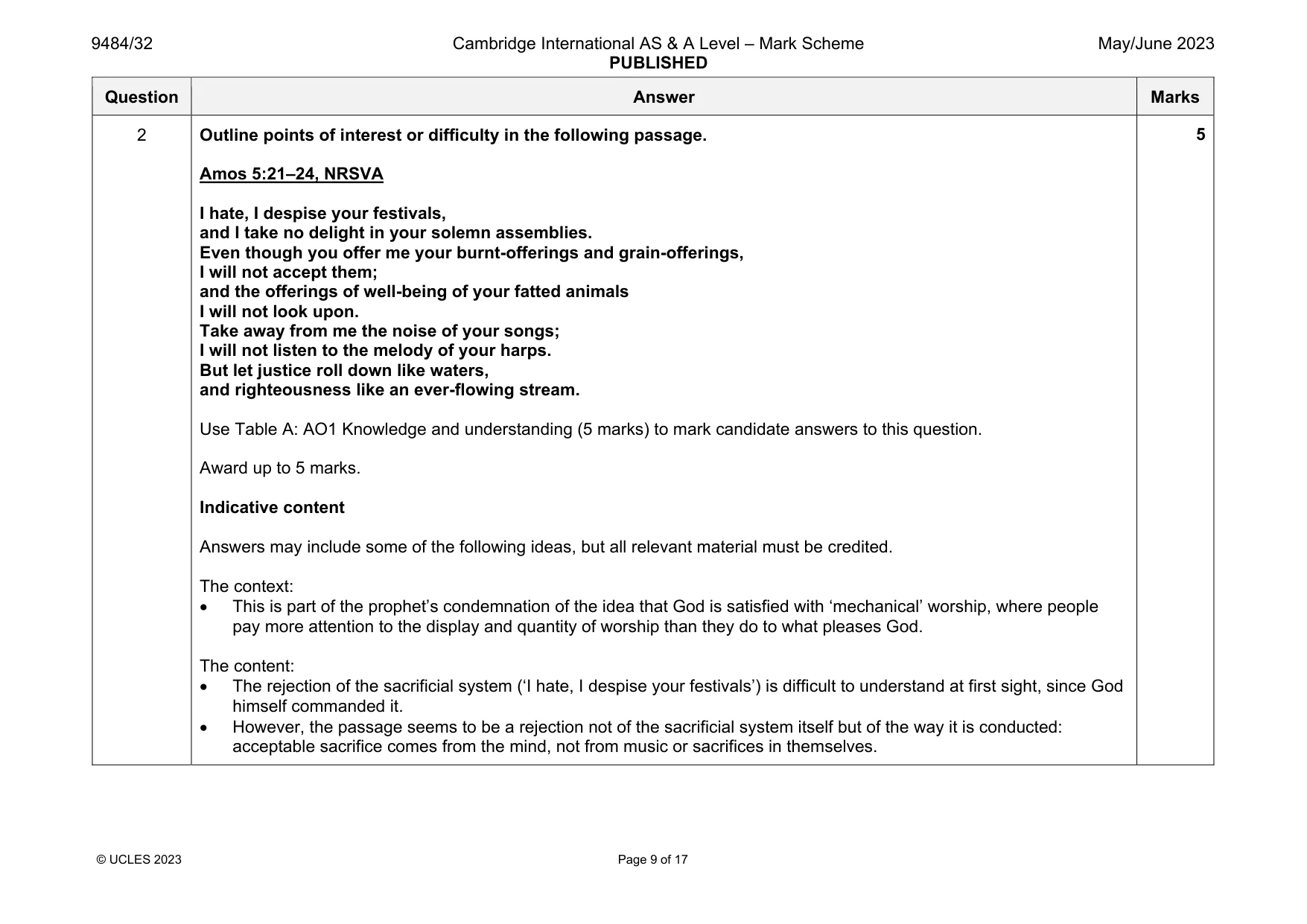
2 Outline points of interest or difficulty in the following passage. Amos 5:21–24, NRSVA I hate, I despise your festivals, and I take no delight in your solemn assemblies. Even though you offer me your burnt-offerings and grain-offerings, I will not accept them; and the offerings of well-being of your fatted animals I will not look upon. Take away from me the noise of your songs; I will not listen to the melody of your harps. But let justice roll down like waters, and righteousness like an ever-flowing stream. [5]
Mark scheme: 2 Outline points of interest or difficulty in the following passage. Amos 5:21–24, NRSVA I hate, I despise your festivals, and I take no delight in your solemn assemblies. Even though you offer me your burnt-offerings and grain-offerings, I will not accept them; and the offerings of well-being of your fatted animals I will not look upon. Take away from me the noise of your songs; I will not listen to the melody of your harps. But let justice roll down like waters, and righteousness like an ever-flowing stream. Use Table A: AO1 Knowledge and understanding (5 marks) to mark candidate answers to this question. Award up to 5 marks. Indicative content Answers may include some of the following ideas, but all relevant material must be credited. The context: This is part of the prophet’s condemnation of the idea that God is satisfied with ‘mechanical’ worship, where people pay more attention to the display and quantity of worship than they do to what pleases God. The content: The rejection of the sacrificial system (‘I hate, I despise your festivals’) is difficult to understand at first sight, since God himself commanded it. However, the passage seems to be a rejection not of the sacrificial system itself but of the way it is conducted: acceptable sacrifice comes from the mind, not from music or sacrifices in themselves. Question Answer Marks 2 Rather, God delights in moral qualities such as ‘justice’ and ‘righteousness’ rather than singing and playing the harp. Worship is useless without the right frame of mind. ‘Justice’ and ‘righteousness’ are technical moral terms in the Hebrew, and some might relate them to the New Testament command to love one’s neighbour as oneself. Some will relate this to the political and religious situation in Israel at the time, where increasing prosperity was seen as a sign of God’s approval of current religious and ethical practices.
Q3 · Outline points of interest or difficulty in the following passage
3 Outline points of interest or difficulty in the following passage. Jeremiah 16:1–4, NRSVA The word of the Lord came to me: You shall not take a wife, nor shall you have sons or daughters in this place. For thus says the Lord concerning the sons and daughters who are born in this place, and concerning the mothers who bear them and the fathers who beget them in this land: They shall die of deadly diseases. They shall not be lamented, nor shall they be buried; they shall become like dung on the surface of the ground. They shall perish by the sword and by famine, and their dead bodies shall become food for the birds of the air and for the wild animals of the earth. [5] [Total: 10]
Mark scheme: 3 Outline points of interest or difficulty in the following passage. Jeremiah 16:1–4, NRSVA The word of the LORD came to me: You shall not take a wife, nor shall you have sons or daughters in this place. For thus says the LORD concerning the sons and daughters who are born in this place, and concerning the mothers who bear them and the fathers who beget them in this land: They shall die of deadly diseases. They shall not be lamented, nor shall they be buried; they shall become like dung on the surface of the ground. They shall perish by the sword and by famine, and their dead bodies shall become food for the birds of the air and for the wild animals of the earth. Use Table A: AO1 Knowledge and understanding (5 marks) to mark candidate answers to this question. Award up to 5 marks. Indicative content Answers may include some of the following ideas, but all relevant material must be credited. The context: This passage is part of the theme that Jeremiah’s life was a symbol of impending doom for Judah as a whole (6:1–13). It follows Jeremiah’s second personal lament in which the prophet wishes that he had never been born (15:10–21). The content: On top of all the unhappiness and stress of Jeremiah’s life, God now decrees that Jeremiah must remain unmarried, and must not have sons or daughters in Judah. Children were considered to be a blessing from God, and Jeremiah is now denied that blessing. On the other hand, any children he might have had will be saved from being killed in the destruction that would come upon Judah. Marriage and children will cease because of the invasion about to overtake the land. Disease, famine and war were the three main difficulties that people had to contend with, and God now pictures these horrors overtaking families during the war leading up to the Babylonian exile. Lack of a proper burial was particularly repellent: the dead would provide food for birds and beasts (verse 4). The land itself is under sentence of death. Some might refer to the following verses, e.g. 5–9, where Jeremiah is forbidden even to take part in mourning rituals; there will be nobody left to lament the dead (verse 6). In effect, God has withdrawn his covenant loyalty from Judah: Judah has no future. 5
Q4 · Read the following passage and then answer the question below: Exodus 2:5–10, NRSVA The…
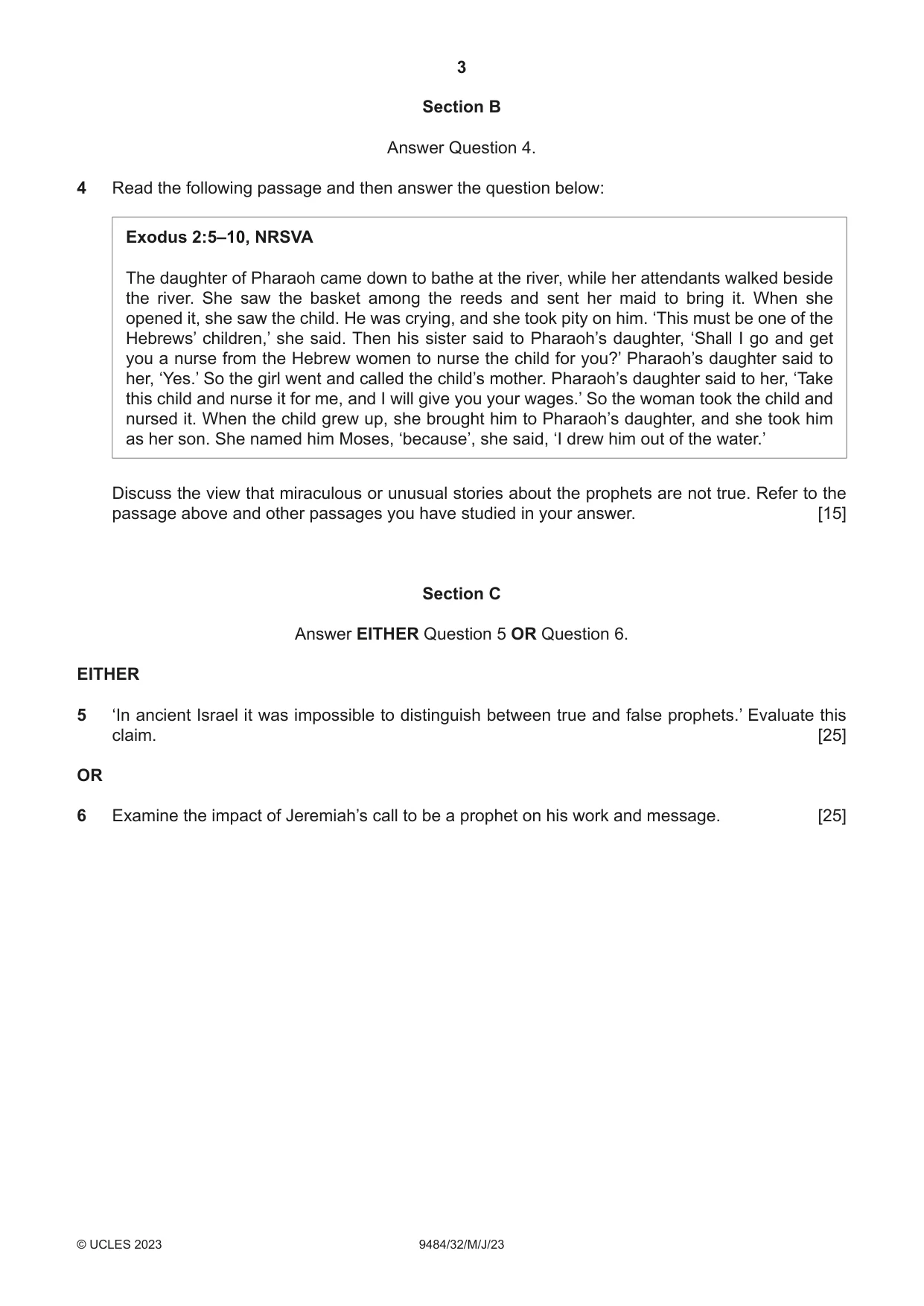
4 Read the following passage and then answer the question below: Exodus 2:5–10, NRSVA The daughter of Pharaoh came down to bathe at the river, while her attendants walked beside the river. She saw the basket among the reeds and sent her maid to bring it. When she opened it, she saw the child. He was crying, and she took pity on him. ‘This must be one of the Hebrews’ children,’ she said. Then his sister said to Pharaoh’s daughter, ‘Shall I go and get you a nurse from the Hebrew women to nurse the child for you?’ Pharaoh’s daughter said to her, ‘Yes.’ So the girl went and called the child’s mother. Pharaoh’s daughter said to her, ‘Take this child and nurse it for me, and I will give you your wages.’ So the woman took the child and nursed it. When the child grew up, she brought him to Pharaoh’s daughter, and she took him as her son. She named him Moses, ‘because’, she said, ‘I drew him out of the water.’ Discuss the view that miraculous or unusual stories about the prophets are not true. Refer to the passage above and other passages you have studied in your answer. [15] Section C Answer EITHER Question 5 OR Question 6. EITHER
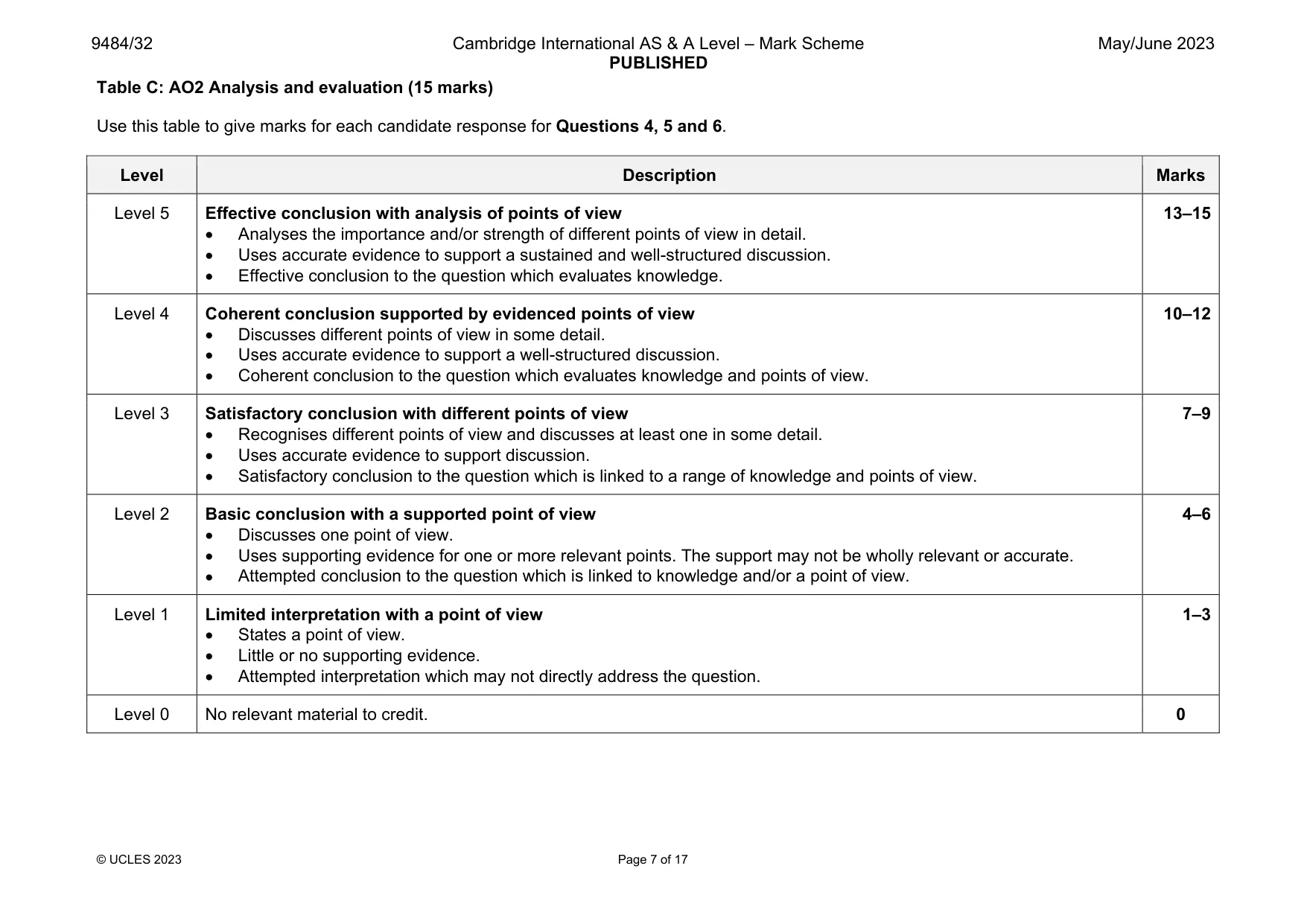
Mark scheme: 4 Read the following passage and then answer the question below: Exodus 2:5–10, NRSVA The daughter of Pharaoh came down to bathe at the river, while her attendants walked beside the river. She saw the basket among the reeds and sent her maid to bring it. When she opened it, she saw the child. He was crying, and she took pity on him. ‘This must be one of the Hebrews’ children,’ she said. Then his sister said to Pharaoh’s daughter, ‘Shall I go and get you a nurse from the Hebrew women to nurse the child for you?’ Pharaoh’s daughter said to her, ‘Yes.’ So the girl went and called the child’s mother. Pharaoh’s daughter said to her, ‘Take this child and nurse it for me, and I will give you your wages.’ So the woman took the child and nursed it. When the child grew up, she brought him to Pharaoh’s daughter, and she took him as her son. She named him Moses, ‘because’, she said, ‘I drew him out of the water.’ Discuss the view that miraculous or unusual stories about the prophets are not true. Refer to the passage above and other passages you have studied in your answer. Use Table C: AO2 Analysis and evaluation (15 marks) to mark candidate responses to this question. Award up to 15 marks. Indicative content Candidates may propose, analyse and evaluate some of the following arguments. All relevant arguments must be credited. For the view The context of Moses’ birth story is Pharaoh’s fear of the high birth-rate of Hebrew children and his command that every Hebrew male should be thrown into the Nile; but Pharaoh would hardly be afraid of unprotected slaves. Moreover the idea that Pharaoh’s evil design would be thwarted by his own daughter looks like a piece of story-telling. Accounts such as these are well known in mythology. As a type of religious literature, therefore, all such stories are probably untrue. Question Answer Marks 4 Similarly, the account of Samuel’s birth (1 Samuel 1:1–28) is typological, being a story of how a barren woman has an important child as a mark of special favour from God. Equally, the ascent of Elijah to heaven without first dying (2 Kings 2:1–12) is not a ‘true’ story but is a myth to emphasise the status of Elijah as the prophet of Judaism. Miraculous or unusual stories about prophets were used to show the connection between the world of everyday experience and the realms of the gods. Their ‘truth’ is a matter of the belief systems that gave rise to them. Against the view To label these stories simply as being ‘untrue’ is inappropriate. Religious stories are not simply ‘true’ or ‘false’, they are statements of religious belief. These stories are no less powerful through being found in different forms and in different cultures: they are expressions of faith in God and of the true meaning of life. Stories concerning the miraculous birth and death of prophets can be religiously meaningful without being literally true: ‘truth’ lies in the meaning / the theology. In the story of the rescue of Moses from the Nile and his adoption by Pharaoh’s daughter, the successful outcome depends not only on luck and coincidence, but also on the astuteness and foresight of the mother and daughter in anticipating that the child might be rescued. Some might argue that the truth about such stories depends on the authority of the Bible as a whole. If scripture is taken to be authoritative, then all parts of it must be authoritative. Note: The question title is broad, so what qualifies as a miraculous or unusual story is left in part to the candidate to define. For example, some will refer to miracle stories in the prophetic literature, and how their miraculous or unusual characteristics are to be understood.
Q5 · ‘In ancient Israel it was impossible to distinguish between true and false prophets.’…
5 ‘In ancient Israel it was impossible to distinguish between true and false prophets.’ Evaluate this claim. [25] OR
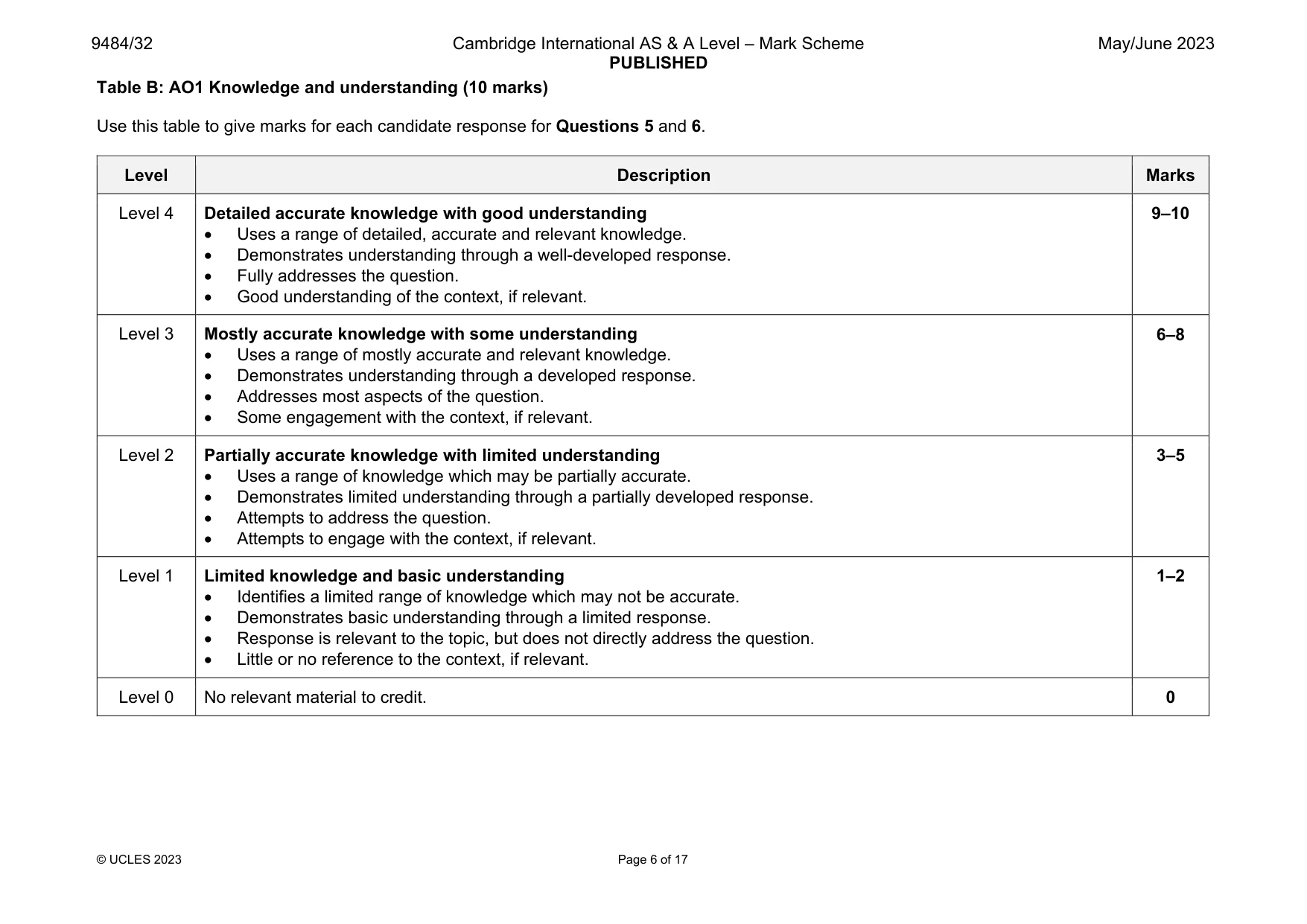
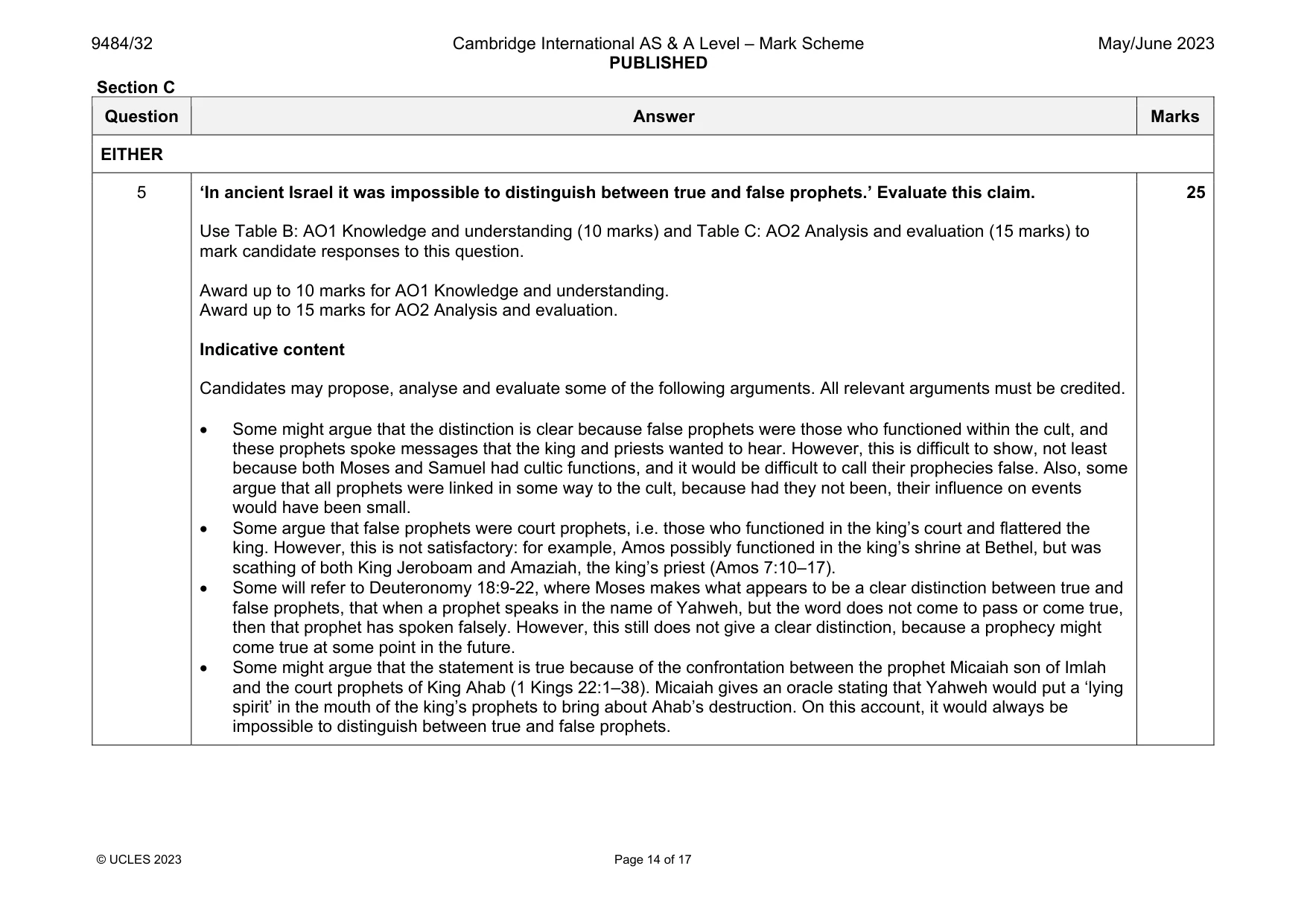
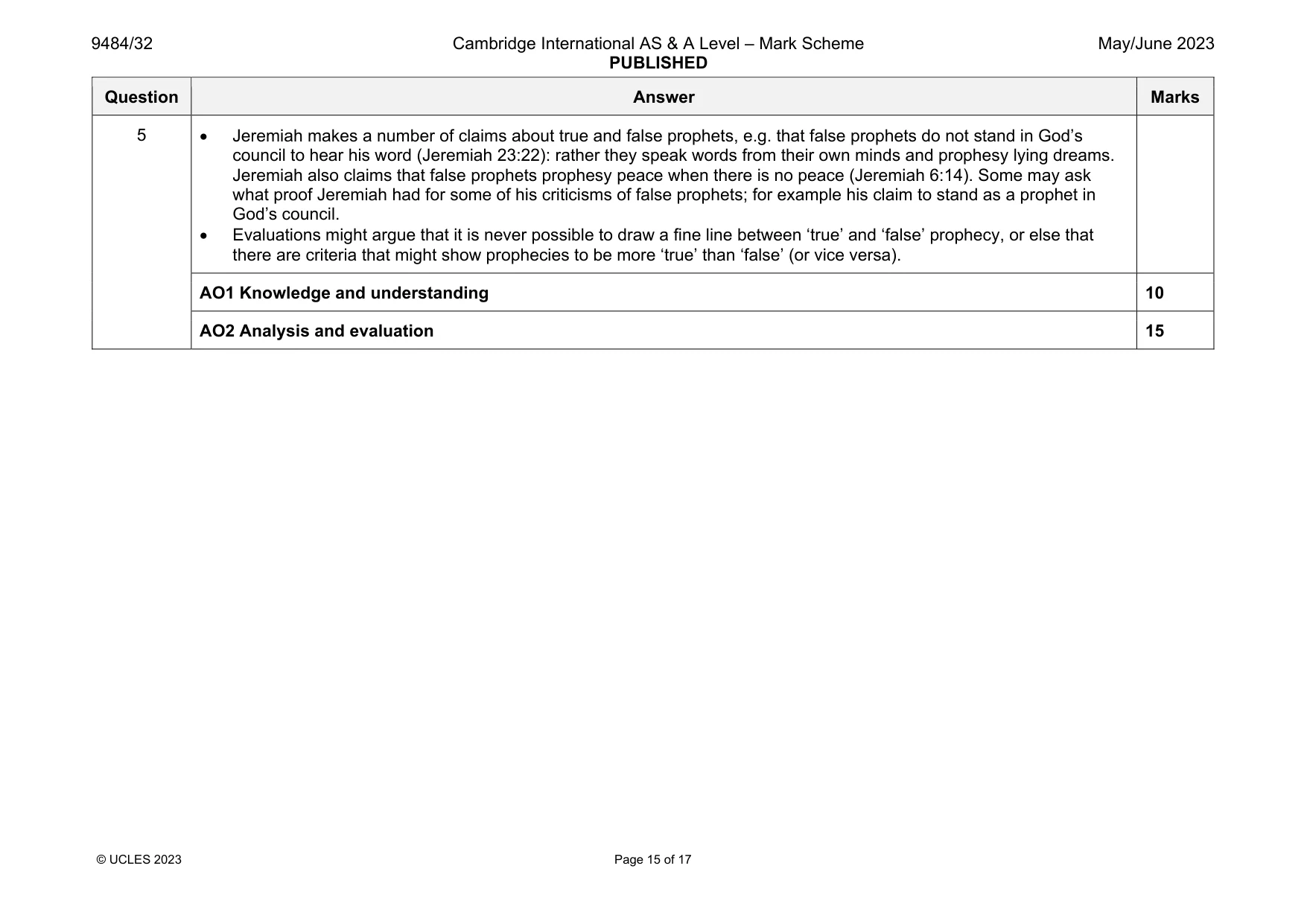
Mark scheme: 5 ‘In ancient Israel it was impossible to distinguish between true and false prophets.’ Evaluate this claim. Use Table B: AO1 Knowledge and understanding (10 marks) and Table C: AO2 Analysis and evaluation (15 marks) to mark candidate responses to this question. Award up to 10 marks for AO1 Knowledge and understanding. Award up to 15 marks for AO2 Analysis and evaluation. Indicative content Candidates may propose, analyse and evaluate some of the following arguments. All relevant arguments must be credited. Some might argue that the distinction is clear because false prophets were those who functioned within the cult, and these prophets spoke messages that the king and priests wanted to hear. However, this is difficult to show, not least because both Moses and Samuel had cultic functions, and it would be difficult to call their prophecies false. Also, some argue that all prophets were linked in some way to the cult, because had they not been, their influence on events would have been small. Some argue that false prophets were court prophets, i.e. those who functioned in the king’s court and flattered the king. However, this is not satisfactory: for example, Amos possibly functioned in the king’s shrine at Bethel, but was scathing of both King Jeroboam and Amaziah, the king’s priest (Amos 7:10–17). Some will refer to Deuteronomy 18:9-22, where Moses makes what appears to be a clear distinction between true and false prophets, that when a prophet speaks in the name of Yahweh, but the word does not come to pass or come true, then that prophet has spoken falsely. However, this still does not give a clear distinction, because a prophecy might come true at some point in the future. Some might argue that the statement is true because of the confrontation between the prophet Micaiah son of Imlah and the court prophets of King Ahab (1 Kings 22:1–38). Micaiah gives an oracle stating that Yahweh would put a ‘lying spirit’ in the mouth of the king’s prophets to bring about Ahab’s destruction. On this account, it would always be impossible to distinguish between true and false prophets. Question Answer Marks 5 Jeremiah makes a number of claims about true and false prophets, e.g. that false prophets do not stand in God’s council to hear his word (Jeremiah 23:22): rather they speak words from their own minds and prophesy lying dreams. Jeremiah also claims that false prophets prophesy peace when there is no peace (Jeremiah 6:14). Some may ask what proof Jeremiah had for some of his criticisms of false prophets; for example his claim to stand as a prophet in God’s council. Evaluations might argue that it is never possible to draw a fine line between ‘true’ and ‘false’ prophecy, or else that there are criteria that might show prophecies to be more ‘true’ than ‘false’ (or vice versa). AO1 Knowledge and understanding 10 AO2 Analysis and evaluation 15
What was in this paper
The subtopics covered by these 5 questions, and how many questions each got. Open one in a new tab to see every Cambridge question on it.
What you needed in this session
Cambridge’s own grade thresholds for 2023 May/June, Paper 3 · Variant 2. A higher threshold means an easier paper — the bar moves with how the cohort did.