Cambridge A Level Biblical Studies 9484 — 2024 Oct/Nov Paper 3 · Variant 2
9484/32/O/N/24 · 5 questions · 50 marks · 90 min
The question paper and its mark scheme, free to read here and free to download. This is Cambridge’s own paper, exactly as it was sat.
Question paper4 pages

Mark scheme19 pages
Answers below. Sit the paper first if you are practising.
Questions as text
Q1 · Outline points of interest or difficulty in the following passage
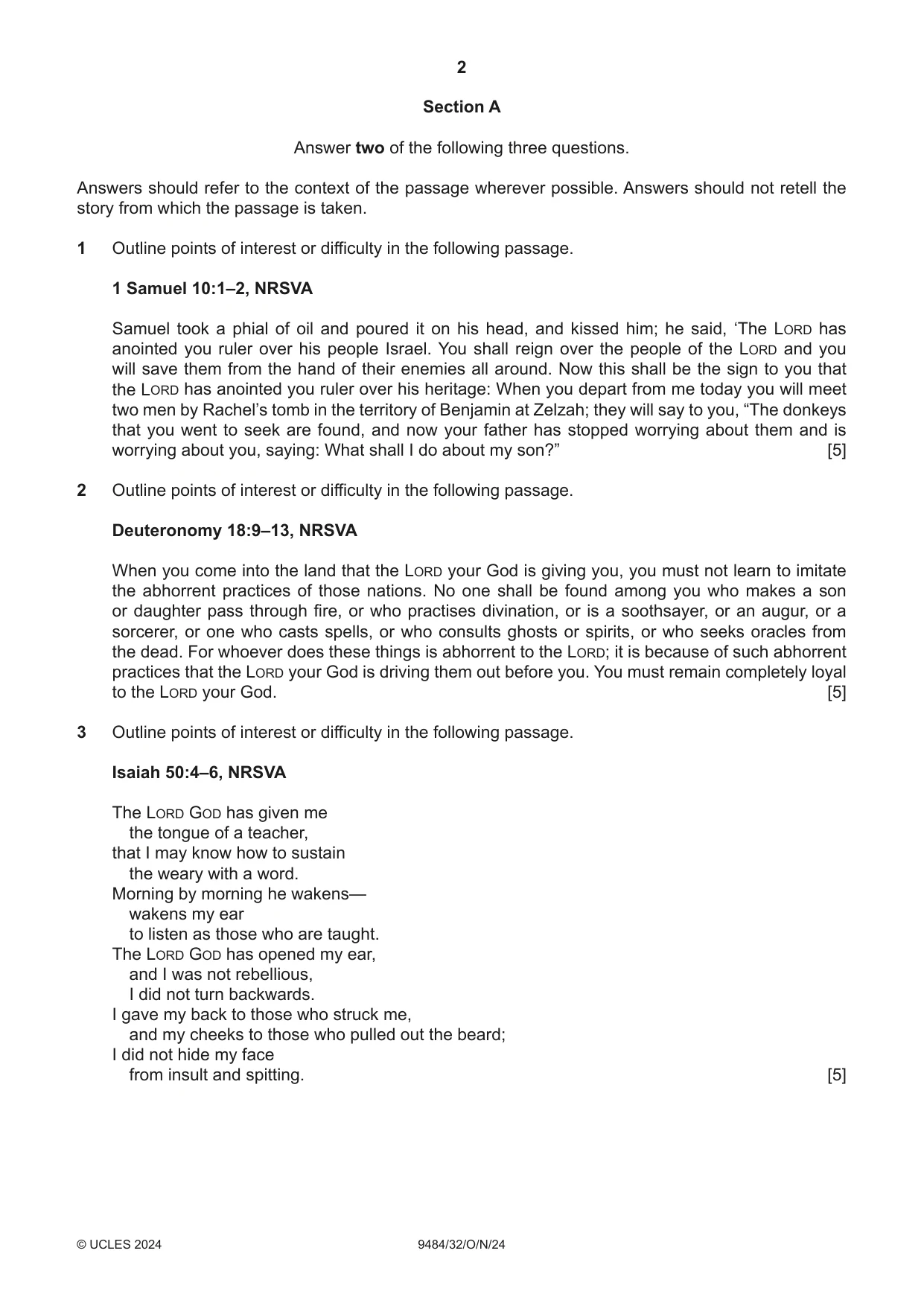
1 Outline points of interest or difficulty in the following passage. 1 Samuel 10:1–2, NRSVA Samuel took a phial of oil and poured it on his head, and kissed him; he said, ‘The Lord has anointed you ruler over his people Israel. You shall reign over the people of the Lord and you will save them from the hand of their enemies all around. Now this shall be the sign to you that the Lord has anointed you ruler over his heritage: When you depart from me today you will meet two men by Rachel’s tomb in the territory of Benjamin at Zelzah; they will say to you, “The donkeys that you went to seek are found, and now your father has stopped worrying about them and is worrying about you, saying: What shall I do about my son?” [5]
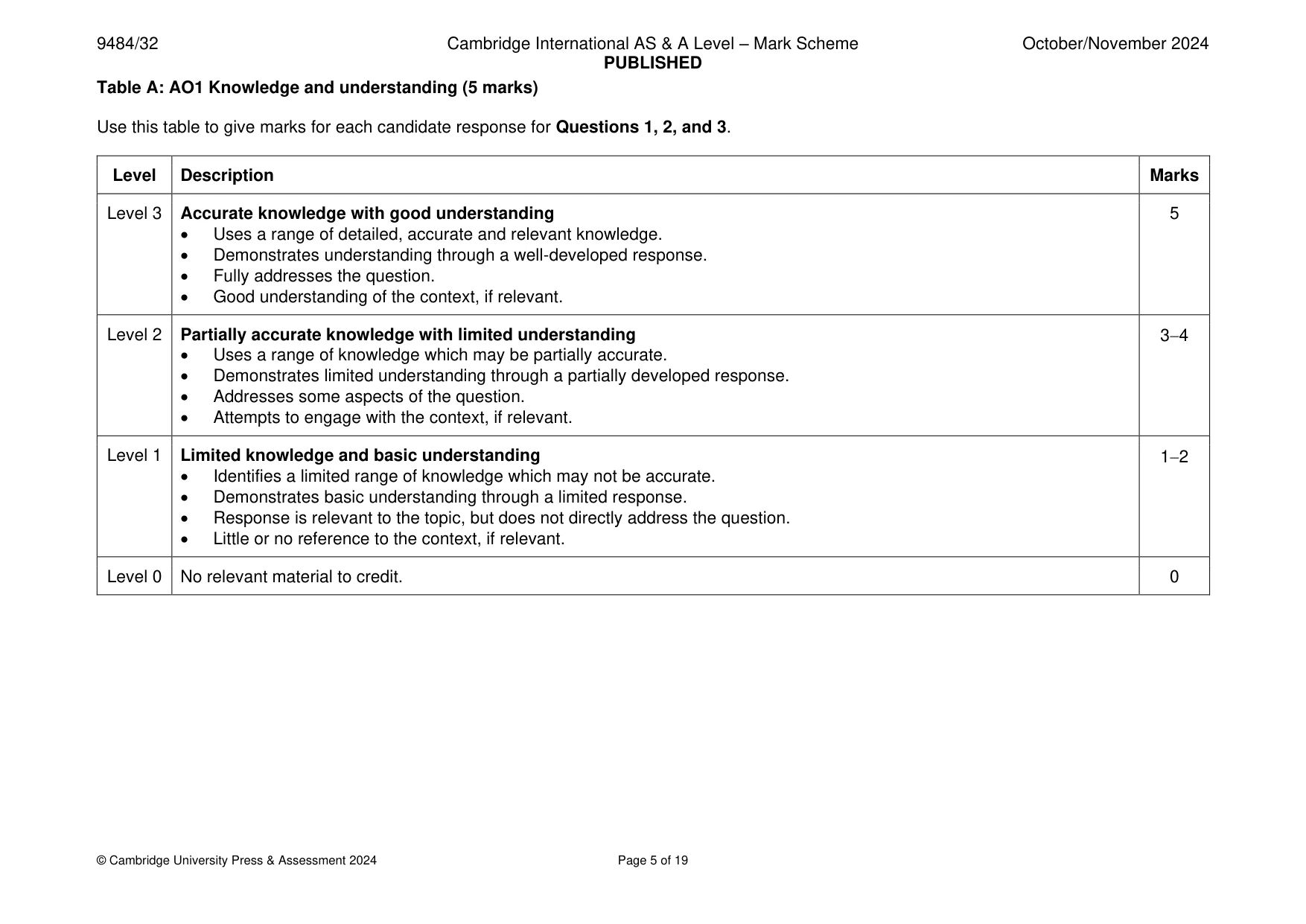
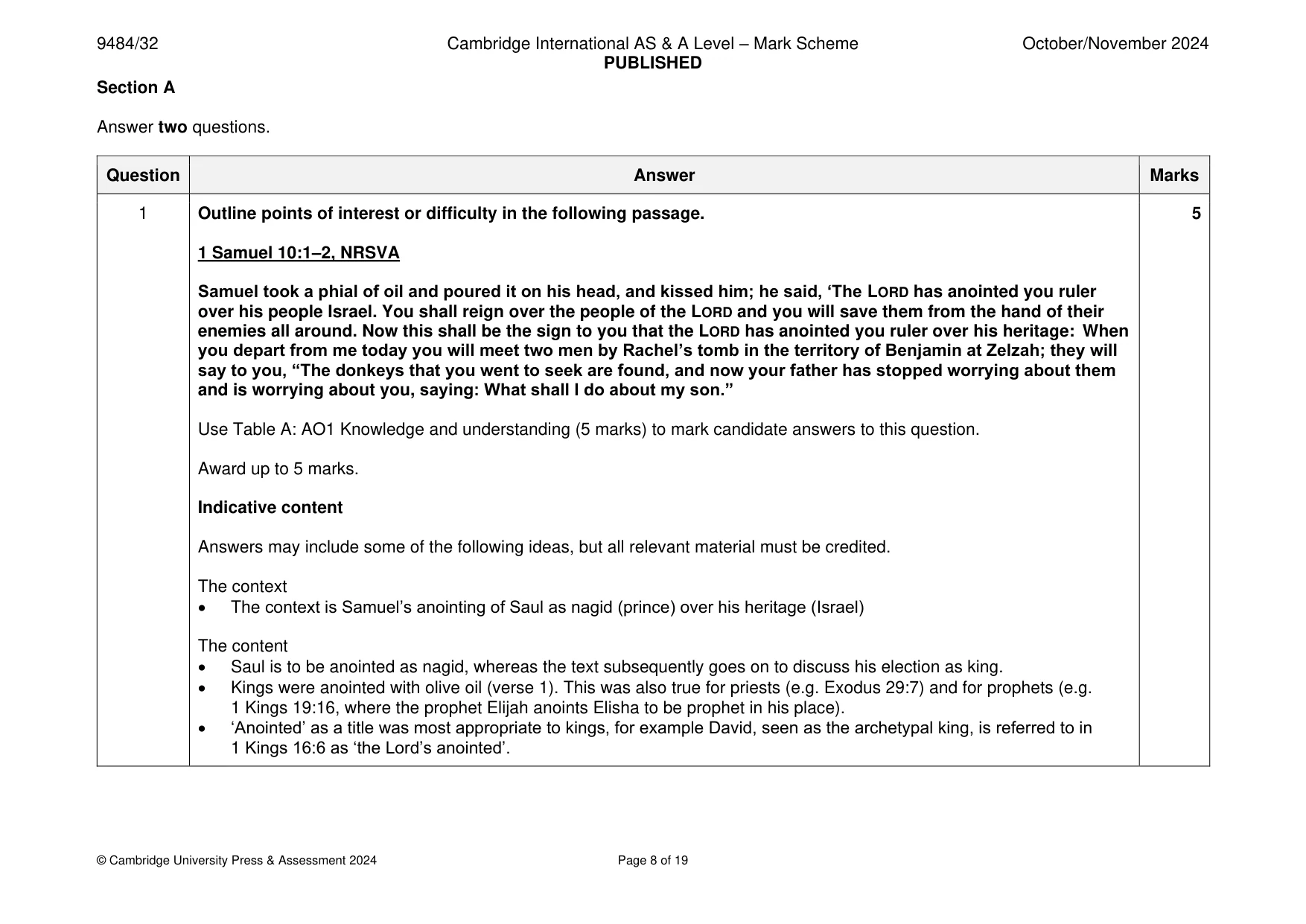
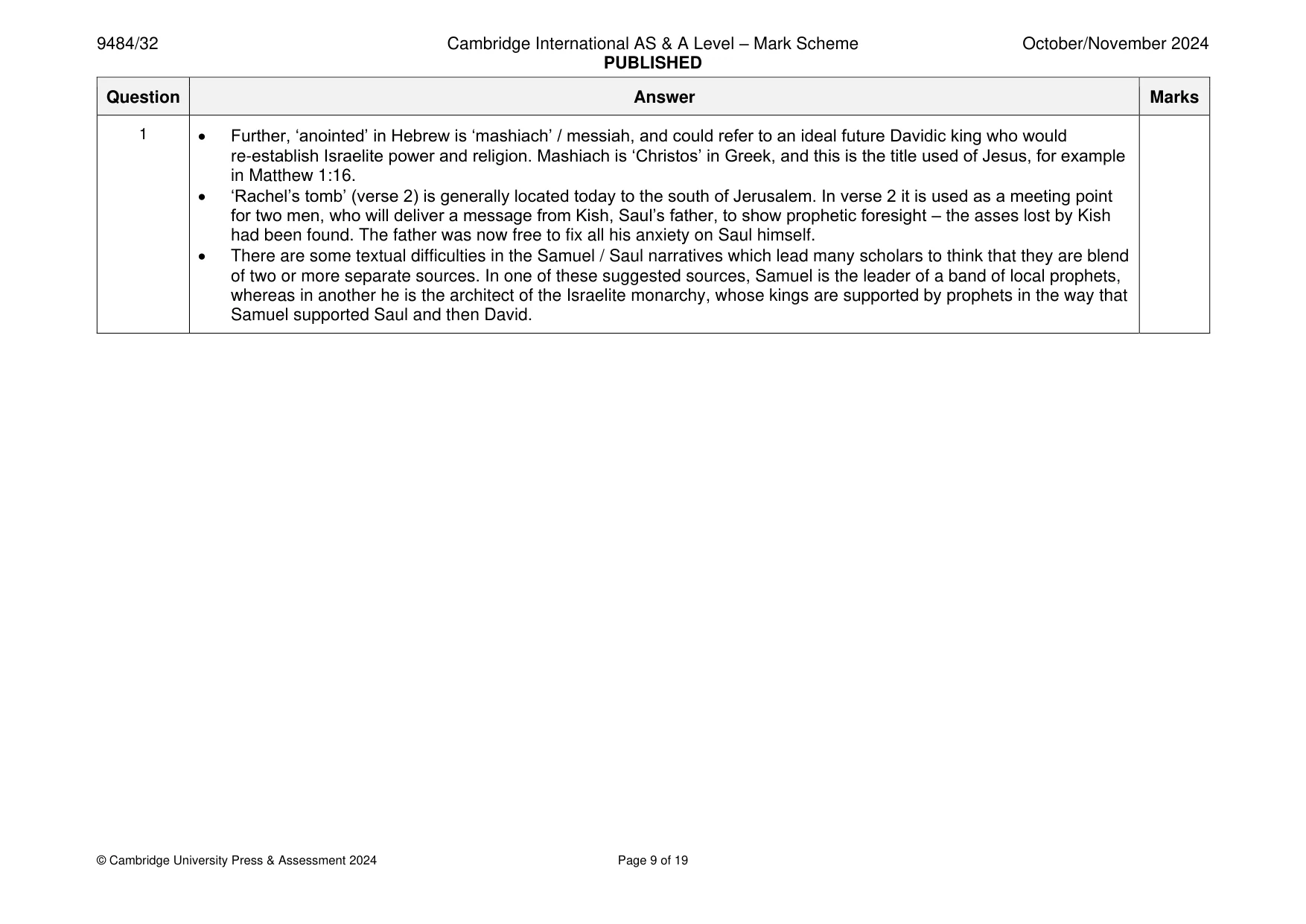
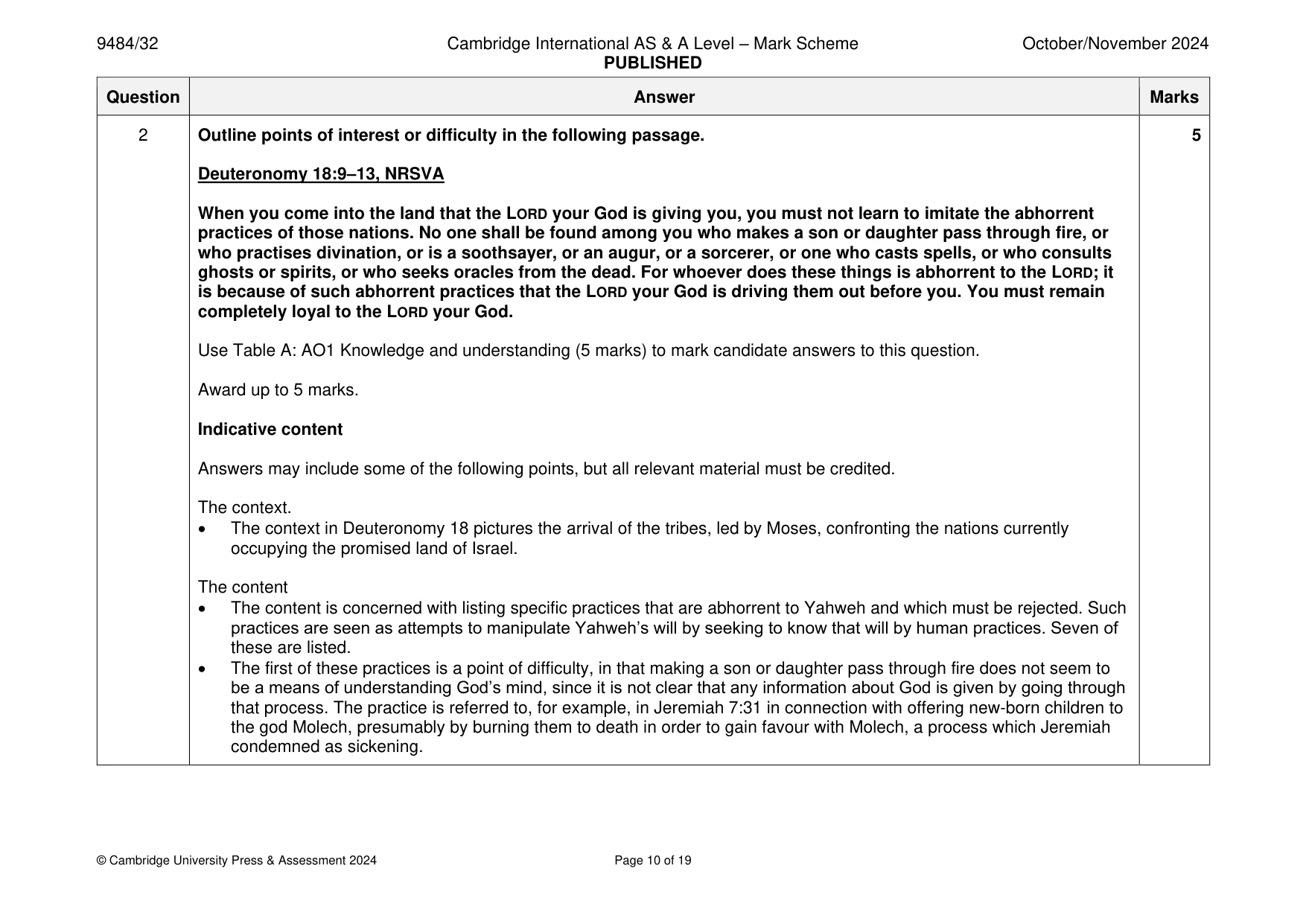
Mark scheme: Question Answer Marks 1 Outline points of interest or difficulty in the following passage. 5 1 Samuel 10:1–2, NRSVA Samuel took a phial of oil and poured it on his head, and kissed him; he said, ‘The LORD has anointed you ruler over his people Israel. You shall reign over the people of the LORD and you will save them from the hand of their enemies all around. Now this shall be the sign to you that the LORD has anointed you ruler over his heritage: When you depart from me today you will meet two men by Rachel’s tomb in the territory of Benjamin at Zelzah; they will say to you, “The donkeys that you went to seek are found, and now your father has stopped worrying about them and is worrying about you, saying: What shall I do about my son.” Use Table A: AO1 Knowledge and understanding (5 marks) to mark candidate answers to this question. Award up to 5 marks. Indicative content Answers may include some of the following ideas, but all relevant material must be credited. The context • The context is Samuel’s anointing of Saul as nagid (prince) over his heritage (Israel) The content • Saul is to be anointed as nagid, whereas the text subsequently goes on to discuss his election as king. • Kings were anointed with olive oil (verse 1). This was also true for priests (e.g. Exodus 29:7) and for prophets (e.g. 1 Kings 19:16, where the prophet Elijah anoints Elisha to be prophet in his place). • ‘Anointed’ as a title was most appropriate to kings, for example David, seen as the archetypal king, is referred to in 1 Kings 16:6 as ‘the Lord’s anointed’. 1 • Further, ‘anointed’ in Hebrew is ‘mashiach’ / messiah, and could refer to an ideal future Davidic king who would re-establish Israelite power and religion. Mashiach is ‘Christos’ in Greek, and this is the title used of Jesus, for example in Matthew 1:16. • ‘Rachel’s tomb’ (verse 2) is generally located today to the south of Jerusalem. In verse 2 it is used as a meeting point for two men, who will deliver a message from Kish, Saul’s father, to show prophetic foresight – the asses lost by Kish had been found. The father was now free to fix all his anxiety on Saul himself. • There are some textual difficulties in the Samuel / Saul narratives which lead many scholars to think that they are blend of two or more separate sources. In one of these suggested sources, Samuel is the leader of a band of local prophets, whereas in another he is the architect of the Israelite monarchy, whose kings are supported by prophets in the way that Samuel supported Saul and then David.
Q2 · Outline points of interest or difficulty in the following passage
2 Outline points of interest or difficulty in the following passage. Deuteronomy 18:9–13, NRSVA When you come into the land that the Lord your God is giving you, you must not learn to imitate the abhorrent practices of those nations. No one shall be found among you who makes a son or daughter pass through fire, or who practises divination, or is a soothsayer, or an augur, or a sorcerer, or one who casts spells, or who consults ghosts or spirits, or who seeks oracles from the dead. For whoever does these things is abhorrent to the Lord; it is because of such abhorrent practices that the Lord your God is driving them out before you. You must remain completely loyal to the Lord your God. [5]
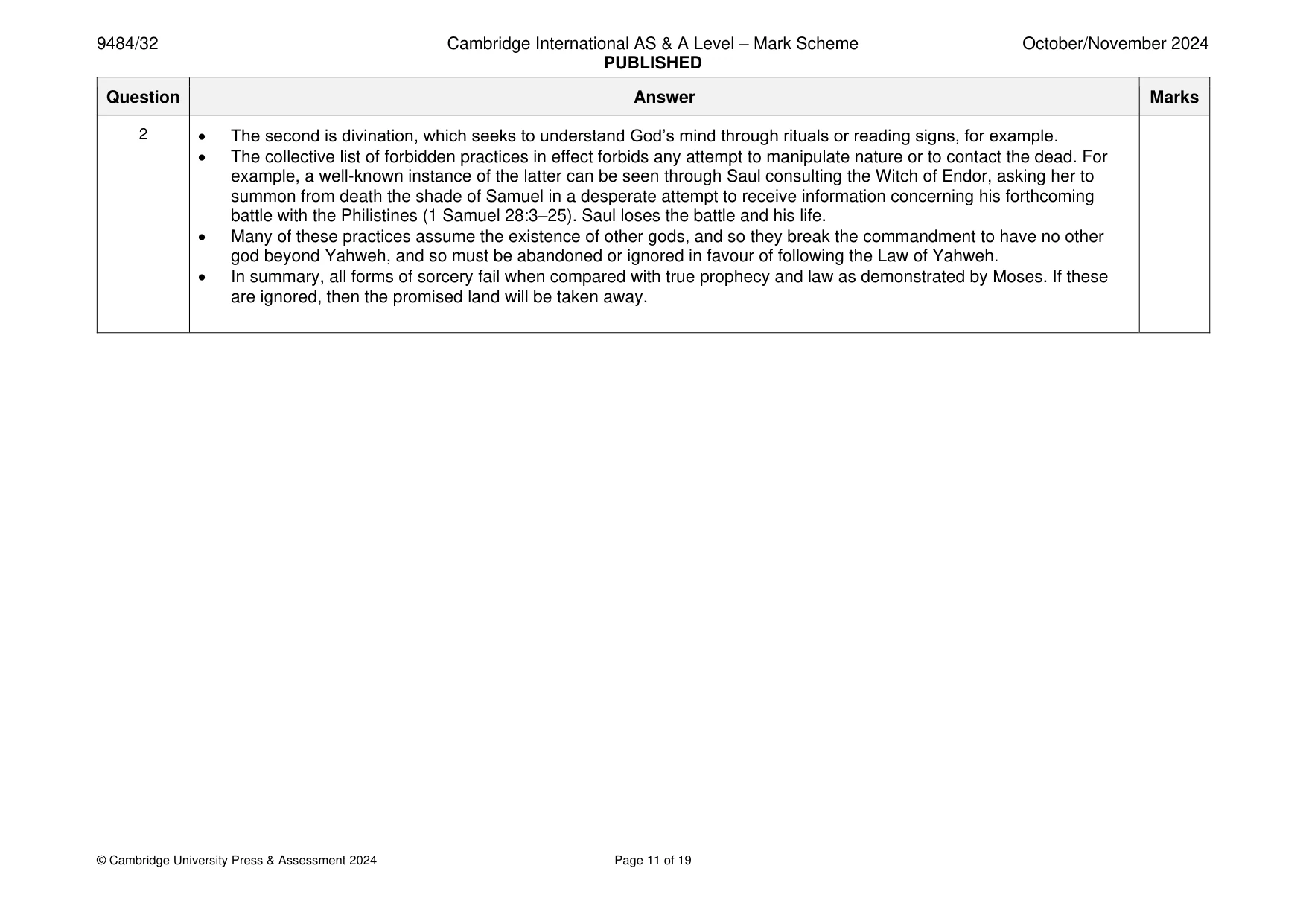
Mark scheme: 2 Outline points of interest or difficulty in the following passage. 5 Deuteronomy 18:9–13, NRSVA When you come into the land that the LORD your God is giving you, you must not learn to imitate the abhorrent practices of those nations. No one shall be found among you who makes a son or daughter pass through fire, or who practises divination, or is a soothsayer, or an augur, or a sorcerer, or one who casts spells, or who consults ghosts or spirits, or who seeks oracles from the dead. For whoever does these things is abhorrent to the LORD; it is because of such abhorrent practices that the LORD your God is driving them out before you. You must remain completely loyal to the LORD your God. Use Table A: AO1 Knowledge and understanding (5 marks) to mark candidate answers to this question. Award up to 5 marks. Indicative content Answers may include some of the following points, but all relevant material must be credited. The context. • The context in Deuteronomy 18 pictures the arrival of the tribes, led by Moses, confronting the nations currently occupying the promised land of Israel. The content • The content is concerned with listing specific practices that are abhorrent to Yahweh and which must be rejected. Such practices are seen as attempts to manipulate Yahweh’s will by seeking to know that will by human practices. Seven of these are listed. • The first of these practices is a point of difficulty, in that making a son or daughter pass through fire does not seem to be a means of understanding God’s mind, since it is not clear that any information about God is given by going through that process. The practice is referred to, for example, in Jeremiah 7:31 in connection with offering new-born children to the god Molech, presumably by burning them to death in order to gain favour with Molech, a process which Jeremiah condemned as sickening. 2 • The second is divination, which seeks to understand God’s mind through rituals or reading signs, for example. • The collective list of forbidden practices in effect forbids any attempt to manipulate nature or to contact the dead. For example, a well-known instance of the latter can be seen through Saul consulting the Witch of Endor, asking her to summon from death the shade of Samuel in a desperate attempt to receive information concerning his forthcoming battle with the Philistines (1 Samuel 28:3–25). Saul loses the battle and his life. • Many of these practices assume the existence of other gods, and so they break the commandment to have no other god beyond Yahweh, and so must be abandoned or ignored in favour of following the Law of Yahweh. • In summary, all forms of sorcery fail when compared with true prophecy and law as demonstrated by Moses. If these are ignored, then the promised land will be taken away.
Q3 · Outline points of interest or difficulty in the following passage
3 Outline points of interest or difficulty in the following passage. Isaiah 50:4–6, NRSVA The Lord God has given me the tongue of a teacher, that I may know how to sustain the weary with a word. Morning by morning he wakens— wakens my ear to listen as those who are taught. The Lord God has opened my ear, and I was not rebellious, I did not turn backwards. I gave my back to those who struck me, and my cheeks to those who pulled out the beard; I did not hide my face from insult and spitting. [5]
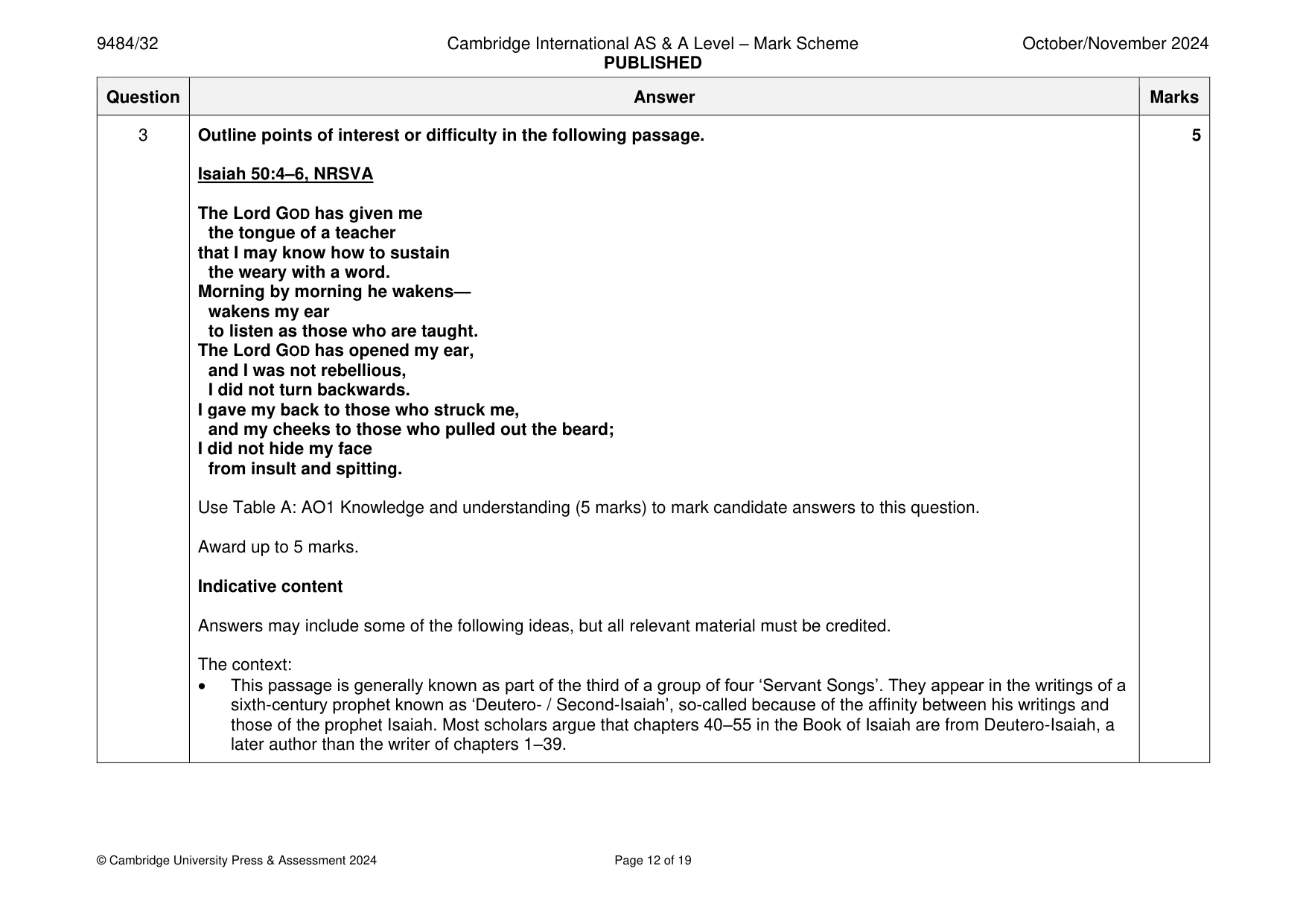
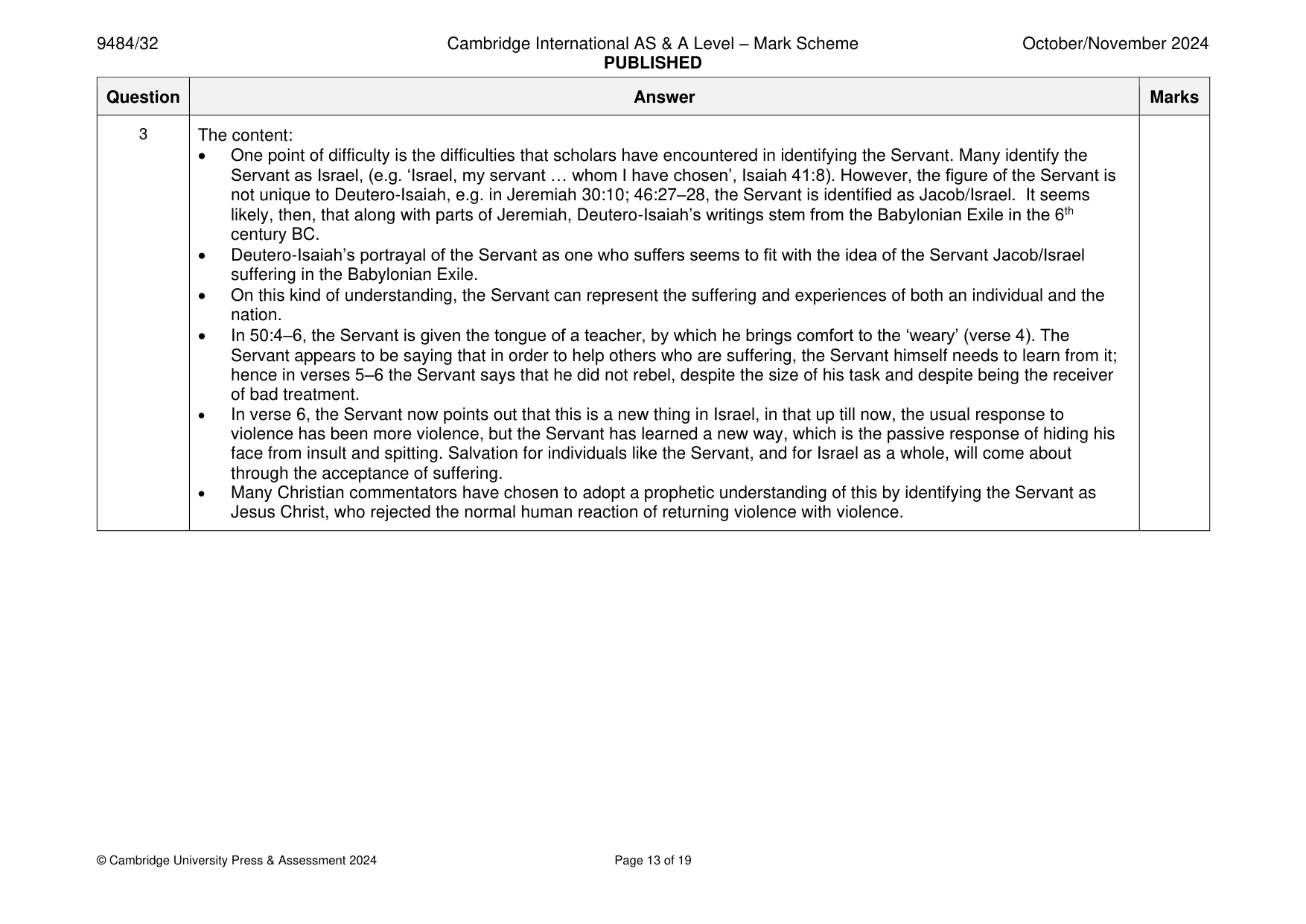
Mark scheme: 3 Outline points of interest or difficulty in the following passage. 5 Isaiah 50:4–6, NRSVA The Lord GOD has given me the tongue of a teacher that I may know how to sustain the weary with a word. Morning by morning he wakens— wakens my ear to listen as those who are taught. The Lord GOD has opened my ear, and I was not rebellious, I did not turn backwards. I gave my back to those who struck me, and my cheeks to those who pulled out the beard; I did not hide my face from insult and spitting. Use Table A: AO1 Knowledge and understanding (5 marks) to mark candidate answers to this question. Award up to 5 marks. Indicative content Answers may include some of the following ideas, but all relevant material must be credited. The context: • This passage is generally known as part of the third of a group of four ‘Servant Songs’. They appear in the writings of a sixth-century prophet known as ‘Deutero- / Second-Isaiah’, so-called because of the affinity between his writings and those of the prophet Isaiah. Most scholars argue that chapters 40–55 in the Book of Isaiah are from Deutero-Isaiah, a later author than the writer of chapters 1–39. 3 The content: • One point of difficulty is the difficulties that scholars have encountered in identifying the Servant. Many identify the Servant as Israel, (e.g. ‘Israel, my servant … whom I have chosen’, Isaiah 41:8). However, the figure of the Servant is not unique to Deutero-Isaiah, e.g. in Jeremiah 30:10; 46:27–28, the Servant is identified as Jacob/Israel. It seems likely, then, that along with parts of Jeremiah, Deutero-Isaiah’s writings stem from the Babylonian Exile in the 6th century BC. • Deutero-Isaiah’s portrayal of the Servant as one who suffers seems to fit with the idea of the Servant Jacob/Israel suffering in the Babylonian Exile. • On this kind of understanding, the Servant can represent the suffering and experiences of both an individual and the nation. • In 50:4–6, the Servant is given the tongue of a teacher, by which he brings comfort to the ‘weary’ (verse 4). The Servant appears to be saying that in order to help others who are suffering, the Servant himself needs to learn from it; hence in verses 5–6 the Servant says that he did not rebel, despite the size of his task and despite being the receiver of bad treatment. • In verse 6, the Servant now points out that this is a new thing in Israel, in that up till now, the usual response to violence has been more violence, but the Servant has learned a new way, which is the passive response of hiding his face from insult and spitting. Salvation for individuals like the Servant, and for Israel as a whole, will come about through the acceptance of suffering. • Many Christian commentators have chosen to adopt a prophetic understanding of this by identifying the Servant as Jesus Christ, who rejected the normal human reaction of returning violence with violence. Section B
Q4 · Read the following passage and then answer the question below: 2 Kings 2:9–12, NRSVA When…
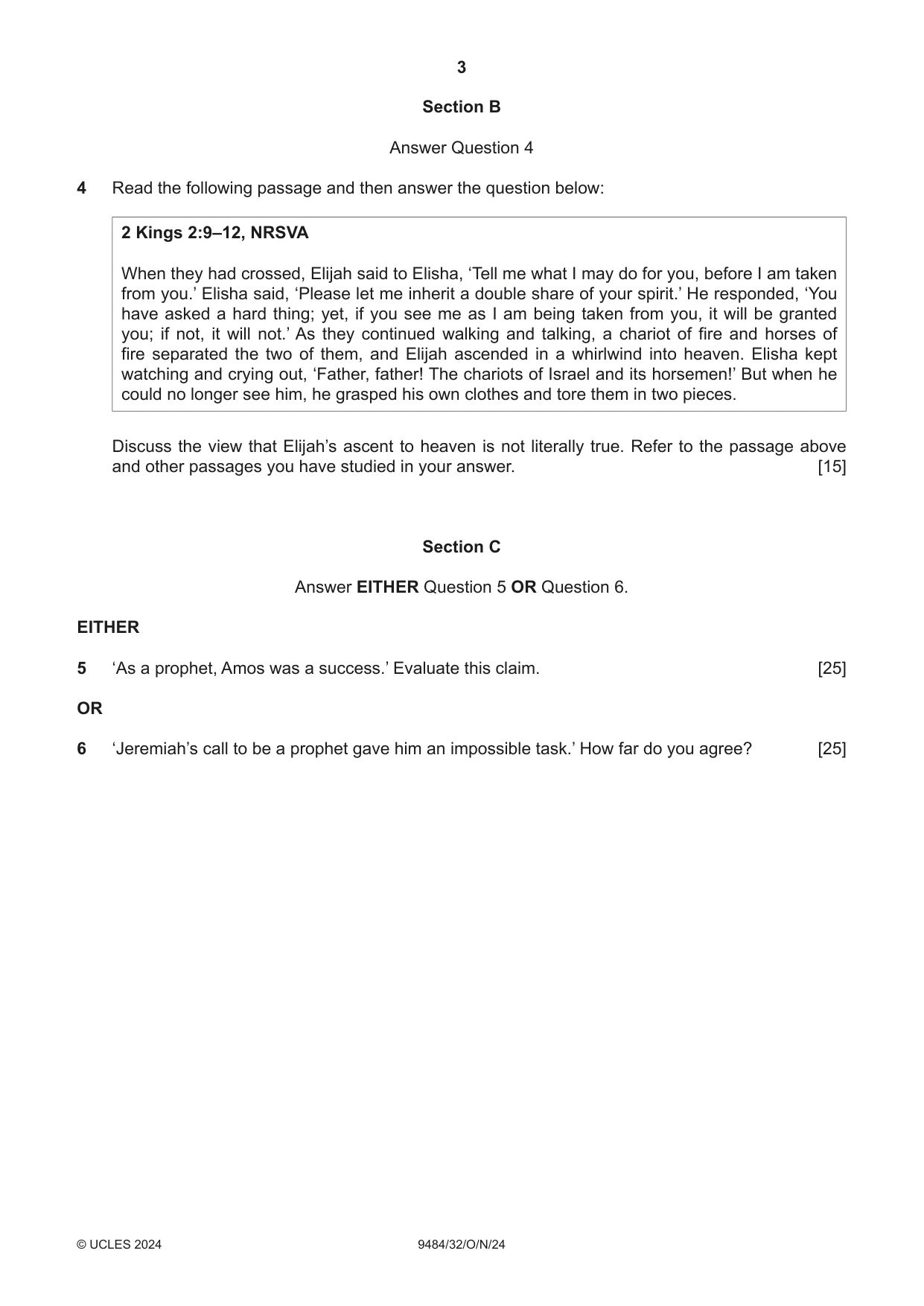
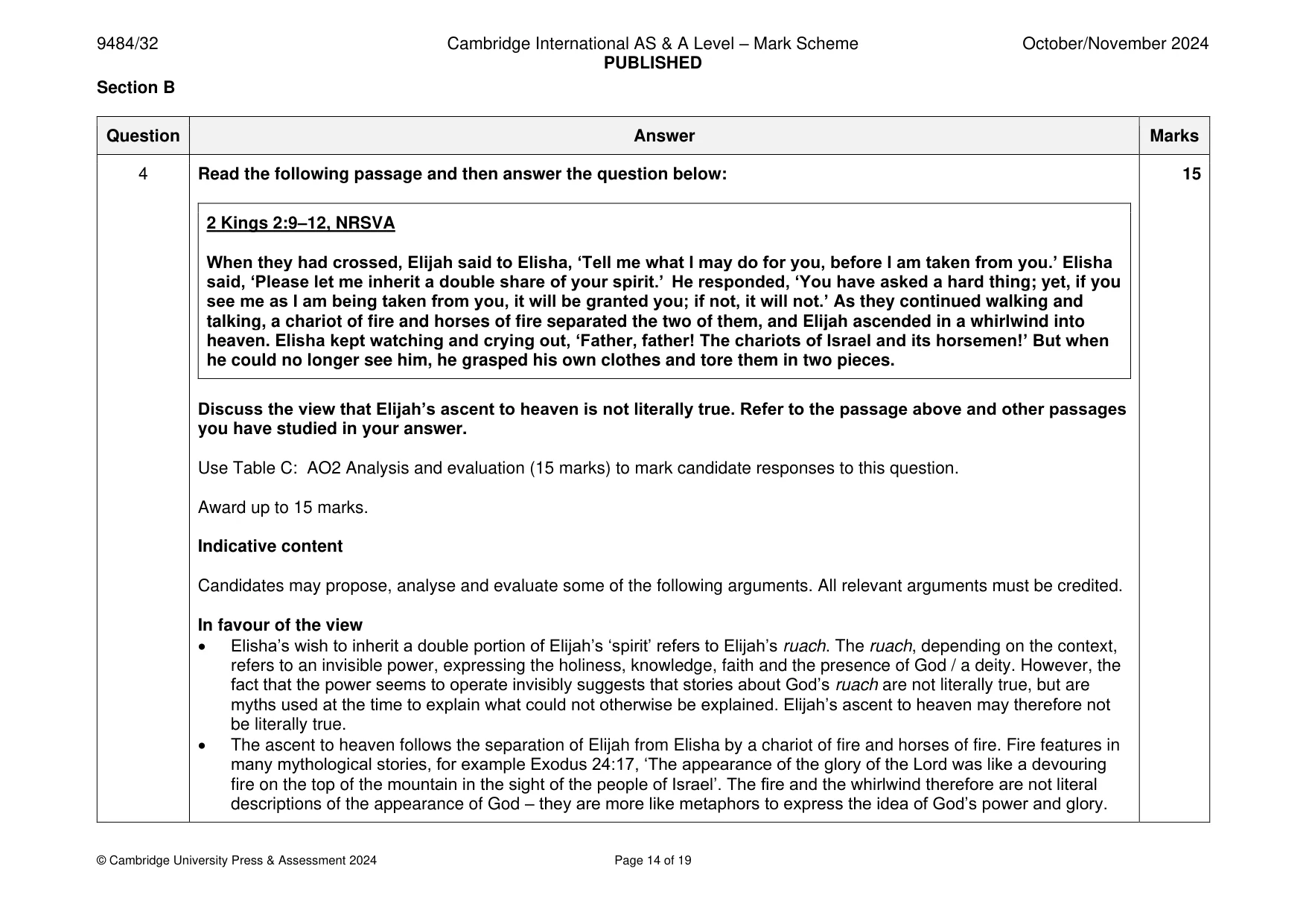
4 Read the following passage and then answer the question below: 2 Kings 2:9–12, NRSVA When they had crossed, Elijah said to Elisha, ‘Tell me what I may do for you, before I am taken from you.’ Elisha said, ‘Please let me inherit a double share of your spirit.’ He responded, ‘You have asked a hard thing; yet, if you see me as I am being taken from you, it will be granted you; if not, it will not.’ As they continued walking and talking, a chariot of fire and horses of fire separated the two of them, and Elijah ascended in a whirlwind into heaven. Elisha kept watching and crying out, ‘Father, father! The chariots of Israel and its horsemen!’ But when he could no longer see him, he grasped his own clothes and tore them in two pieces. Discuss the view that Elijah’s ascent to heaven is not literally true. Refer to the passage above and other passages you have studied in your answer. [15] Section C Answer EITHER Question 5 OR Question 6. EITHER
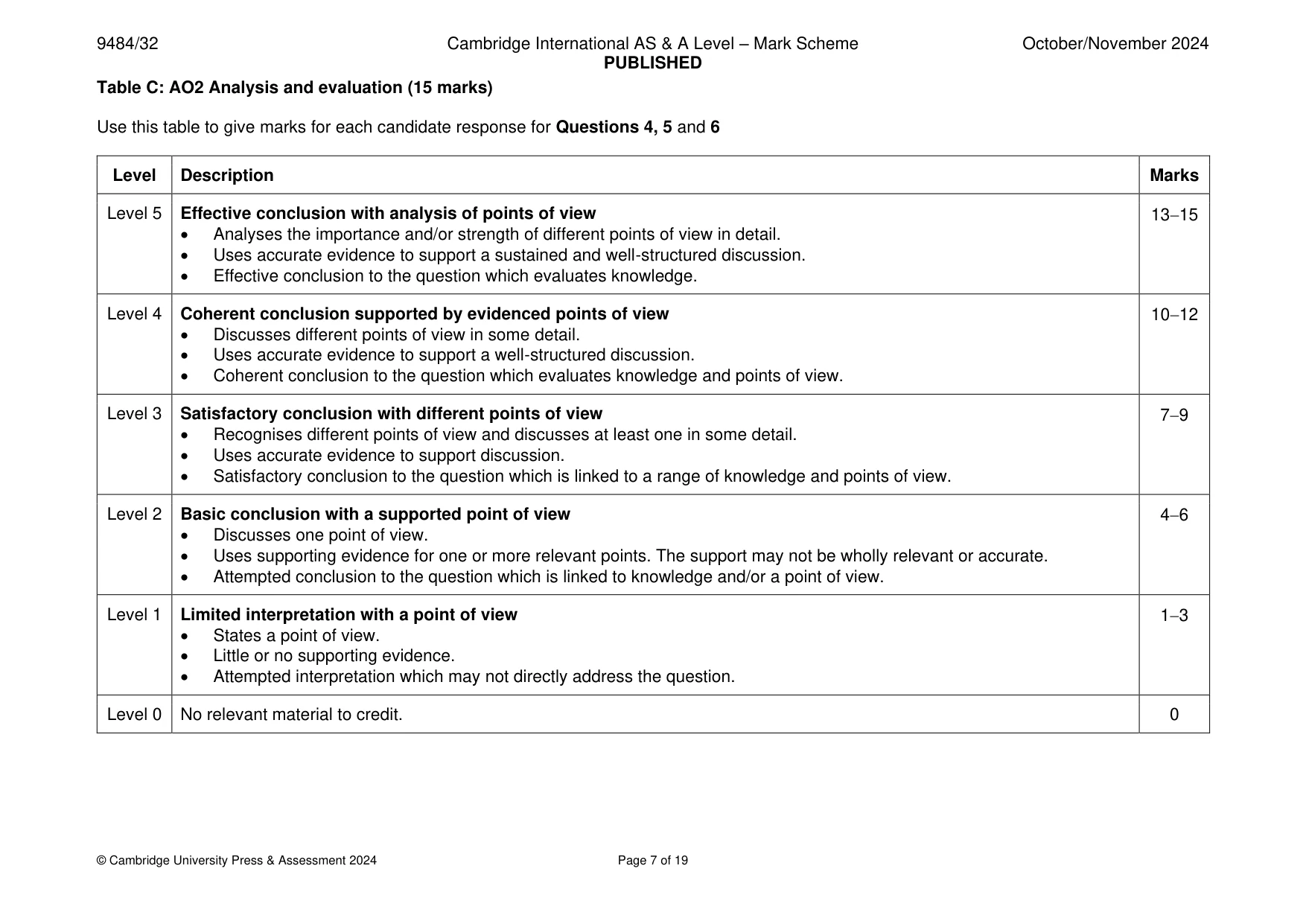
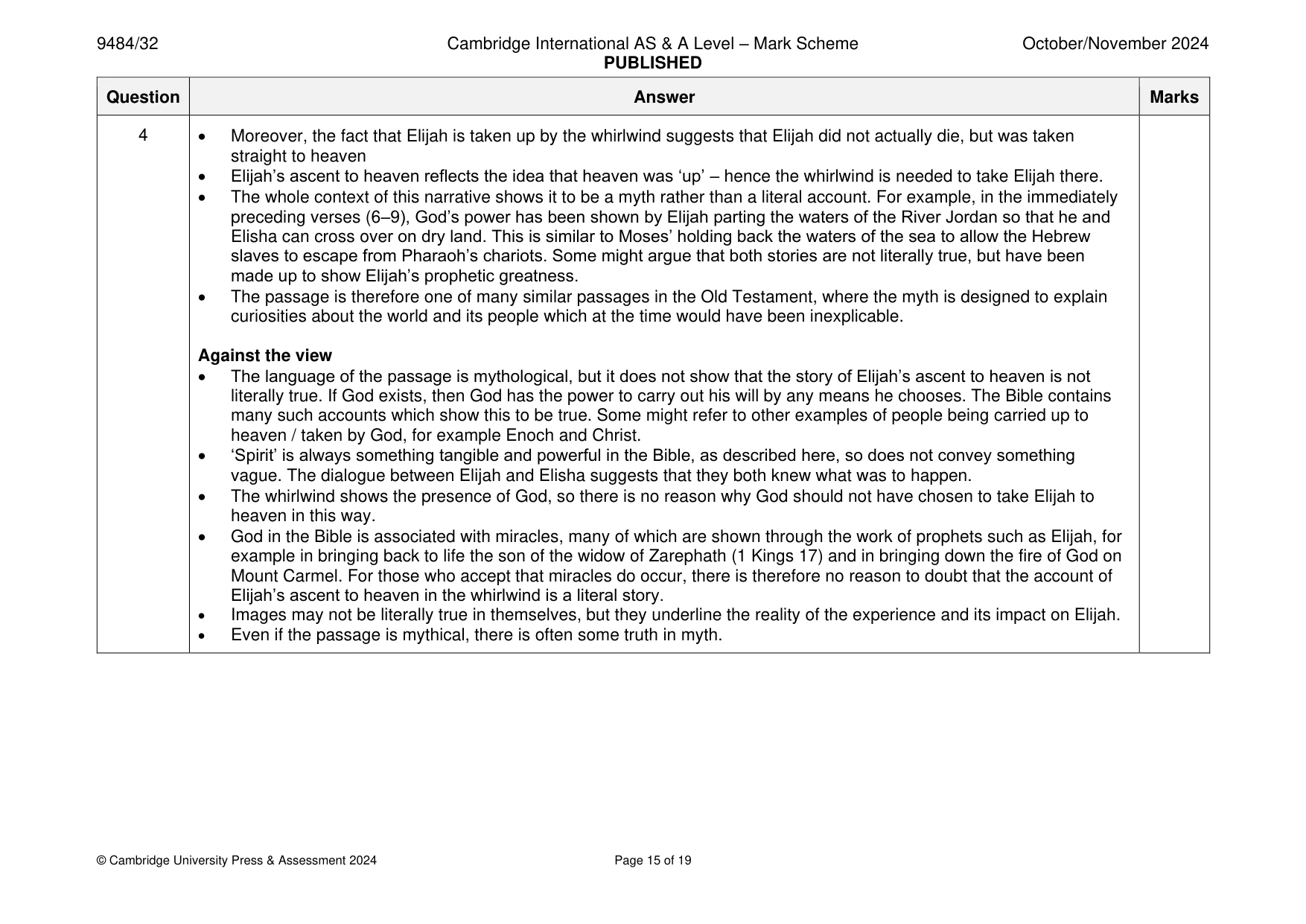
Mark scheme: 4 Read the following passage and then answer the question below: 15 2 Kings 2:9–12, NRSVA When they had crossed, Elijah said to Elisha, ‘Tell me what I may do for you, before I am taken from you.’ Elisha said, ‘Please let me inherit a double share of your spirit.’ He responded, ‘You have asked a hard thing; yet, if you see me as I am being taken from you, it will be granted you; if not, it will not.’ As they continued walking and talking, a chariot of fire and horses of fire separated the two of them, and Elijah ascended in a whirlwind into heaven. Elisha kept watching and crying out, ‘Father, father! The chariots of Israel and its horsemen!’ But when he could no longer see him, he grasped his own clothes and tore them in two pieces. Discuss the view that Elijah’s ascent to heaven is not literally true. Refer to the passage above and other passages you have studied in your answer. Use Table C: AO2 Analysis and evaluation (15 marks) to mark candidate responses to this question. Award up to 15 marks. Indicative content Candidates may propose, analyse and evaluate some of the following arguments. All relevant arguments must be credited. In favour of the view • Elisha’s wish to inherit a double portion of Elijah’s ‘spirit’ refers to Elijah’s ruach. The ruach, depending on the context, refers to an invisible power, expressing the holiness, knowledge, faith and the presence of God / a deity. However, the fact that the power seems to operate invisibly suggests that stories about God’s ruach are not literally true, but are myths used at the time to explain what could not otherwise be explained. Elijah’s ascent to heaven may therefore not be literally true. • The ascent to heaven follows the separation of Elijah from Elisha by a chariot of fire and horses of fire. Fire features in many mythological stories, for example Exodus 24:17, ‘The appearance of the glory of the Lord was like a devouring fire on the top of the mountain in the sight of the people of Israel’. The fire and the whirlwind therefore are not literal descriptions of the appearance of God – they are more like metaphors to express the idea of God’s power and glory. 4 • Moreover, the fact that Elijah is taken up by the whirlwind suggests that Elijah did not actually die, but was taken straight to heaven • Elijah’s ascent to heaven reflects the idea that heaven was ‘up’ – hence the whirlwind is needed to take Elijah there. • The whole context of this narrative shows it to be a myth rather than a literal account. For example, in the immediately preceding verses (6–9), God’s power has been shown by Elijah parting the waters of the River Jordan so that he and Elisha can cross over on dry land. This is similar to Moses’ holding back the waters of the sea to allow the Hebrew slaves to escape from Pharaoh’s chariots. Some might argue that both stories are not literally true, but have been made up to show Elijah’s prophetic greatness. • The passage is therefore one of many similar passages in the Old Testament, where the myth is designed to explain curiosities about the world and its people which at the time would have been inexplicable. Against the view • The language of the passage is mythological, but it does not show that the story of Elijah’s ascent to heaven is not literally true. If God exists, then God has the power to carry out his will by any means he chooses. The Bible contains many such accounts which show this to be true. Some might refer to other examples of people being carried up to heaven / taken by God, for example Enoch and Christ. • ‘Spirit’ is always something tangible and powerful in the Bible, as described here, so does not convey something vague. The dialogue between Elijah and Elisha suggests that they both knew what was to happen. • The whirlwind shows the presence of God, so there is no reason why God should not have chosen to take Elijah to heaven in this way. • God in the Bible is associated with miracles, many of which are shown through the work of prophets such as Elijah, for example in bringing back to life the son of the widow of Zarephath (1 Kings 17) and in bringing down the fire of God on Mount Carmel. For those who accept that miracles do occur, there is therefore no reason to doubt that the account of Elijah’s ascent to heaven in the whirlwind is a literal story. • Images may not be literally true in themselves, but they underline the reality of the experience and its impact on Elijah. • Even if the passage is mythical, there is often some truth in myth. Section C
Q5 · ‘As a prophet, Amos was a success.’ Evaluate this claim
5 ‘As a prophet, Amos was a success.’ Evaluate this claim. [25] OR
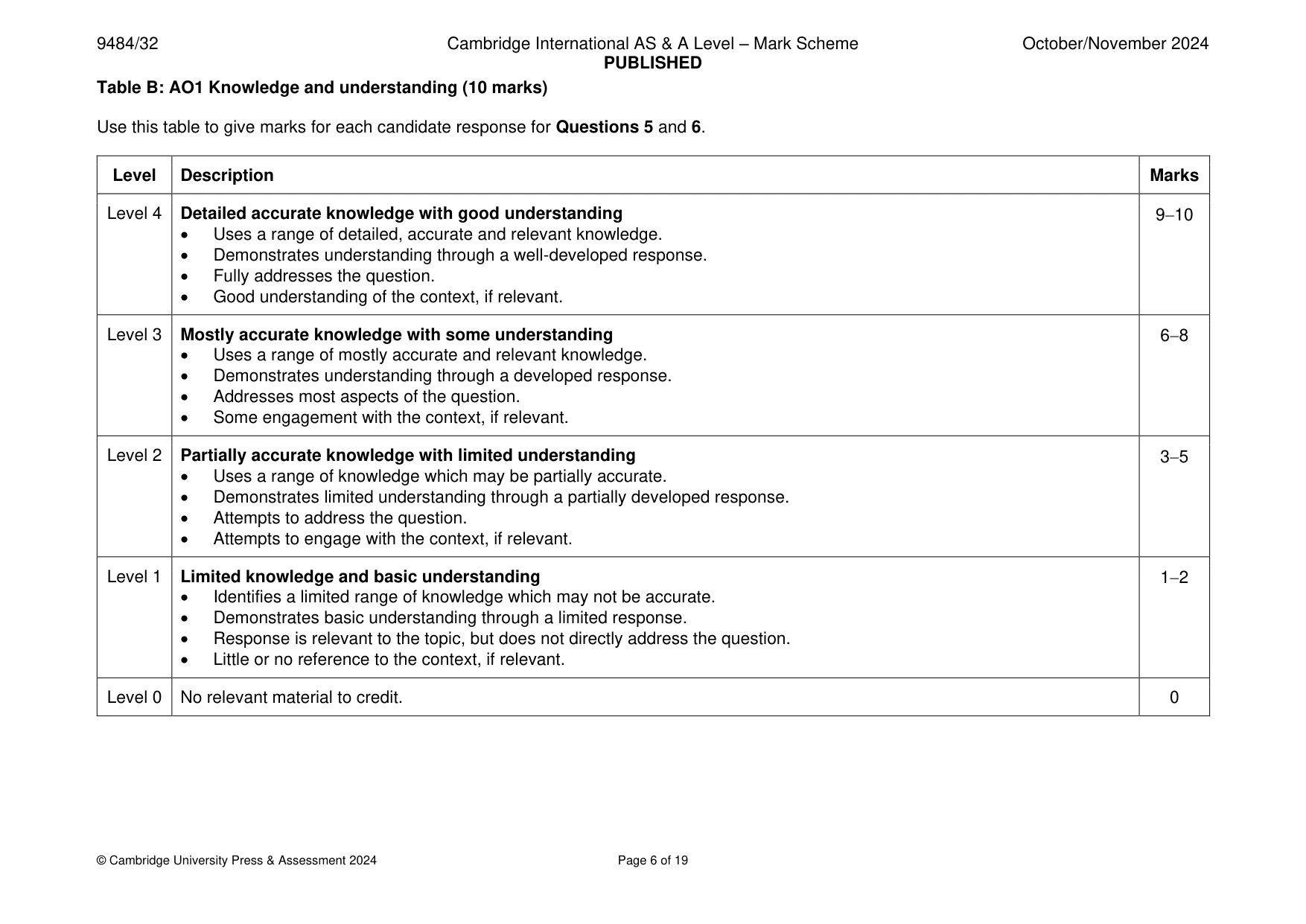
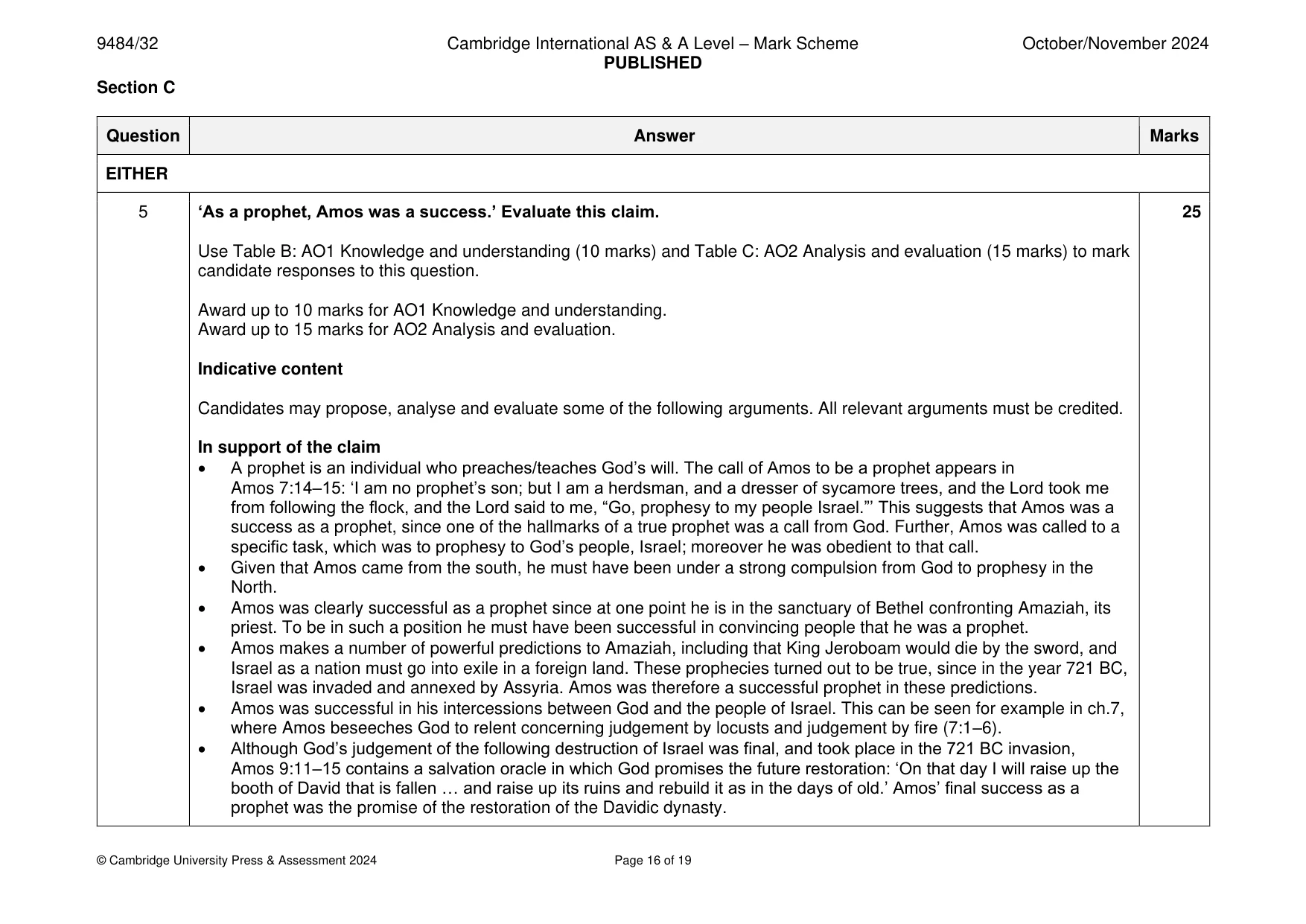
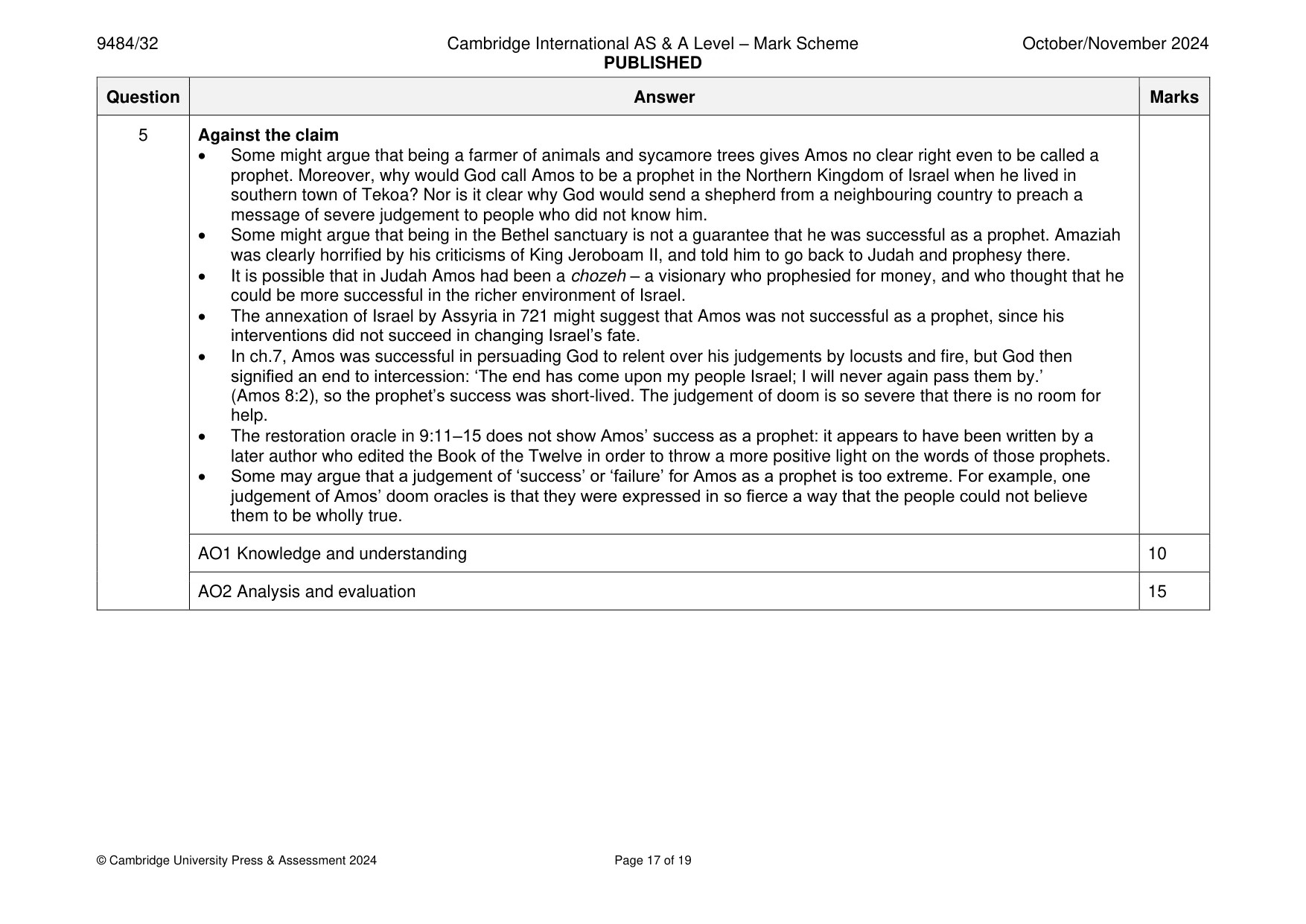
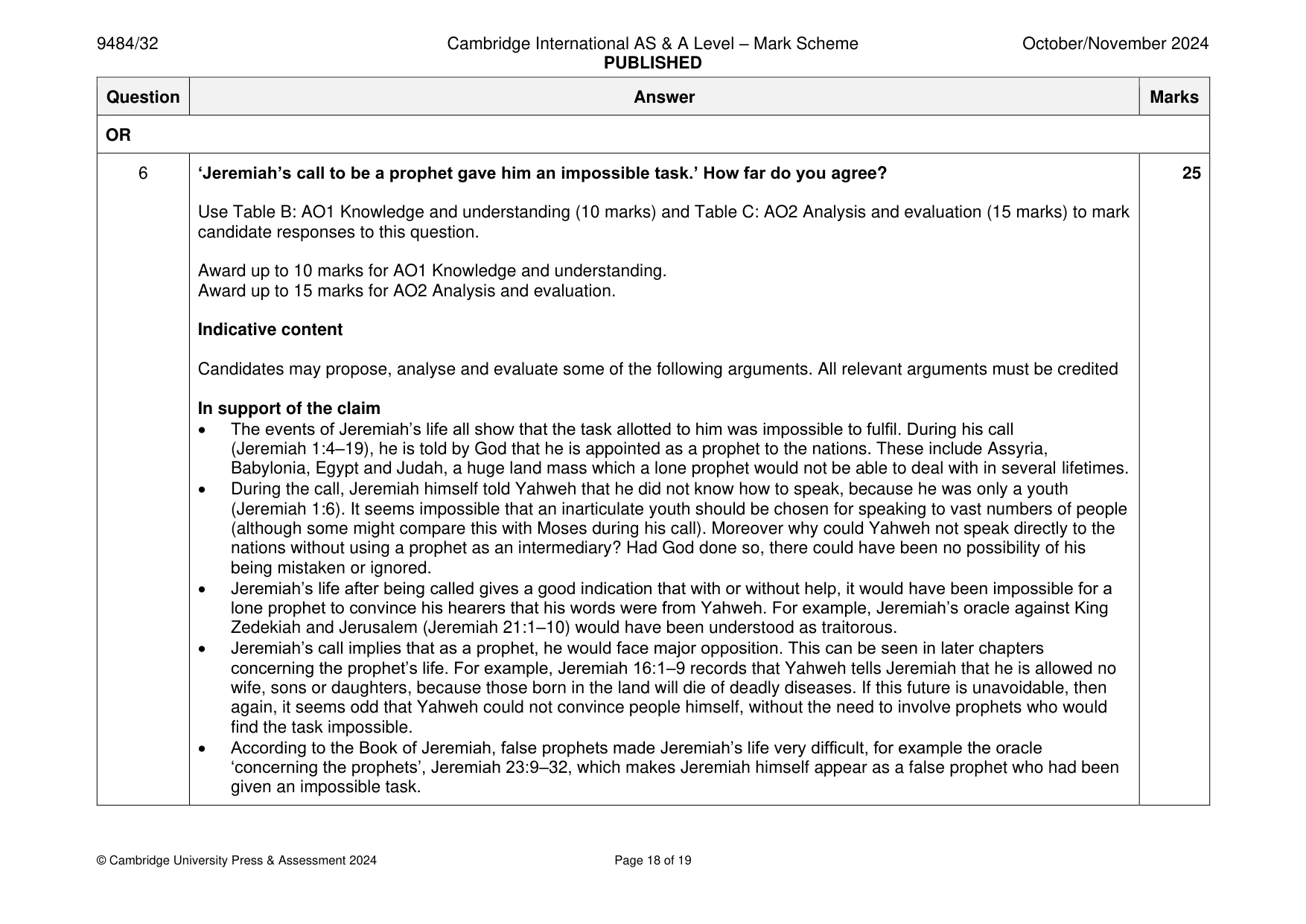
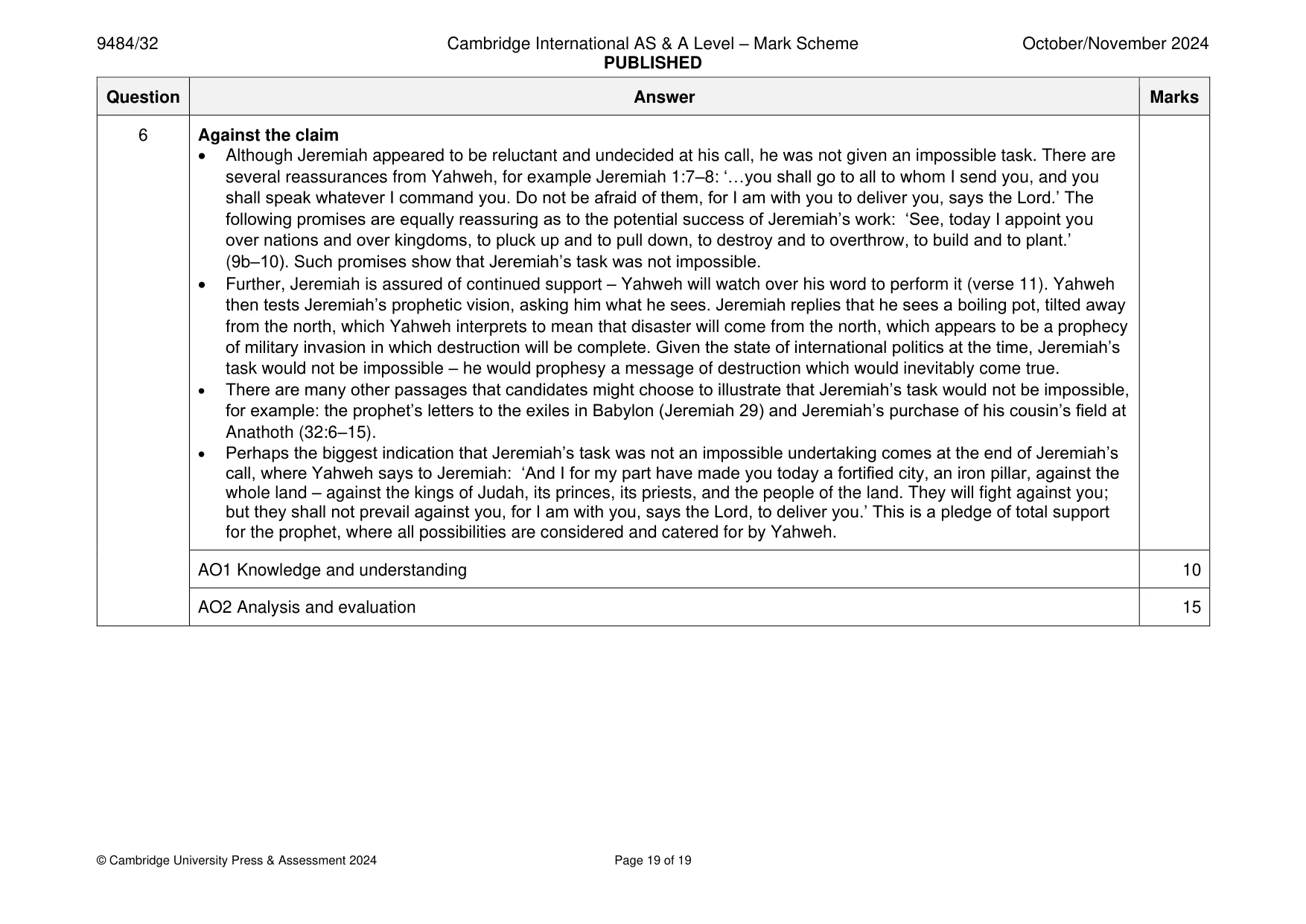
Mark scheme: 5 ‘As a prophet, Amos was a success.’ Evaluate this claim. 25 Use Table B: AO1 Knowledge and understanding (10 marks) and Table C: AO2 Analysis and evaluation (15 marks) to mark candidate responses to this question. Award up to 10 marks for AO1 Knowledge and understanding. Award up to 15 marks for AO2 Analysis and evaluation. Indicative content Candidates may propose, analyse and evaluate some of the following arguments. All relevant arguments must be credited. In support of the claim • A prophet is an individual who preaches/teaches God’s will. The call of Amos to be a prophet appears in Amos 7:14–15: ‘I am no prophet’s son; but I am a herdsman, and a dresser of sycamore trees, and the Lord took me from following the flock, and the Lord said to me, “Go, prophesy to my people Israel.”’ This suggests that Amos was a success as a prophet, since one of the hallmarks of a true prophet was a call from God. Further, Amos was called to a specific task, which was to prophesy to God’s people, Israel; moreover he was obedient to that call. • Given that Amos came from the south, he must have been under a strong compulsion from God to prophesy in the North. • Amos was clearly successful as a prophet since at one point he is in the sanctuary of Bethel confronting Amaziah, its priest. To be in such a position he must have been successful in convincing people that he was a prophet. • Amos makes a number of powerful predictions to Amaziah, including that King Jeroboam would die by the sword, and Israel as a nation must go into exile in a foreign land. These prophecies turned out to be true, since in the year 721 BC, Israel was invaded and annexed by Assyria. Amos was therefore a successful prophet in these predictions. • Amos was successful in his intercessions between God and the people of Israel. This can be seen for example in ch.7, where Amos beseeches God to relent concerning judgement by locusts and judgement by fire (7:1–6). • Although God’s judgement of the following destruction of Israel was final, and took place in the 721 BC invasion, Amos 9:11–15 contains a salvation oracle in which God promises the future restoration: ‘On that day I will raise up the booth of David that is fallen … and raise up its ruins and rebuild it as in the days of old.’ Amos’ final success as a prophet was the promise of the restoration of the Davidic dynasty. 5 Against the claim • Some might argue that being a farmer of animals and sycamore trees gives Amos no clear right even to be called a prophet. Moreover, why would God call Amos to be a prophet in the Northern Kingdom of Israel when he lived in southern town of Tekoa? Nor is it clear why God would send a shepherd from a neighbouring country to preach a message of severe judgement to people who did not know him. • Some might argue that being in the Bethel sanctuary is not a guarantee that he was successful as a prophet. Amaziah was clearly horrified by his criticisms of King Jeroboam II, and told him to go back to Judah and prophesy there. • It is possible that in Judah Amos had been a chozeh – a visionary who prophesied for money, and who thought that he could be more successful in the richer environment of Israel. • The annexation of Israel by Assyria in 721 might suggest that Amos was not successful as a prophet, since his interventions did not succeed in changing Israel’s fate. • In ch.7, Amos was successful in persuading God to relent over his judgements by locusts and fire, but God then signified an end to intercession: ‘The end has come upon my people Israel; I will never again pass them by.’ (Amos 8:2), so the prophet’s success was short-lived. The judgement of doom is so severe that there is no room for help. • The restoration oracle in 9:11–15 does not show Amos’ success as a prophet: it appears to have been written by a later author who edited the Book of the Twelve in order to throw a more positive light on the words of those prophets. • Some may argue that a judgement of ‘success’ or ‘failure’ for Amos as a prophet is too extreme. For example, one judgement of Amos’ doom oracles is that they were expressed in so fierce a way that the people could not believe them to be wholly true. AO1 Knowledge and understanding 10 AO2 Analysis and evaluation 15
What was in this paper
The subtopics covered by these 5 questions, and how many questions each got. Open one in a new tab to see every Cambridge question on it.
What you needed in this session
Cambridge’s own grade thresholds for 2024 Oct/Nov, Paper 3 · Variant 2. A higher threshold means an easier paper — the bar moves with how the cohort did.