Cambridge A Level Biblical Studies 9484 — 2025 May/June Paper 2 · Variant 2
9484/22/M/J/25 · 4 questions · 50 marks · 90 min
The question paper and its mark scheme, free to read here and free to download. This is Cambridge’s own paper, exactly as it was sat.
Question paper4 pages
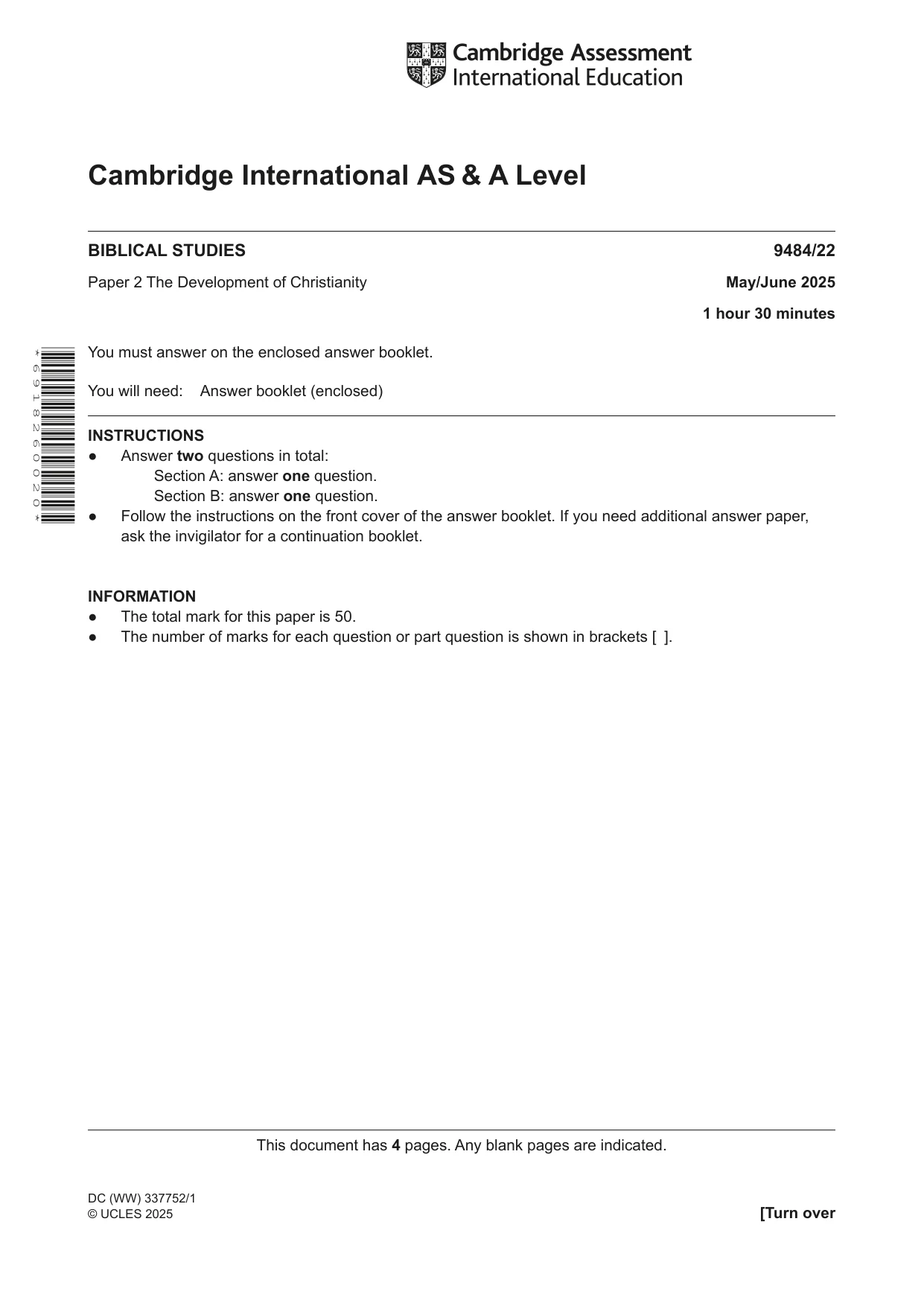
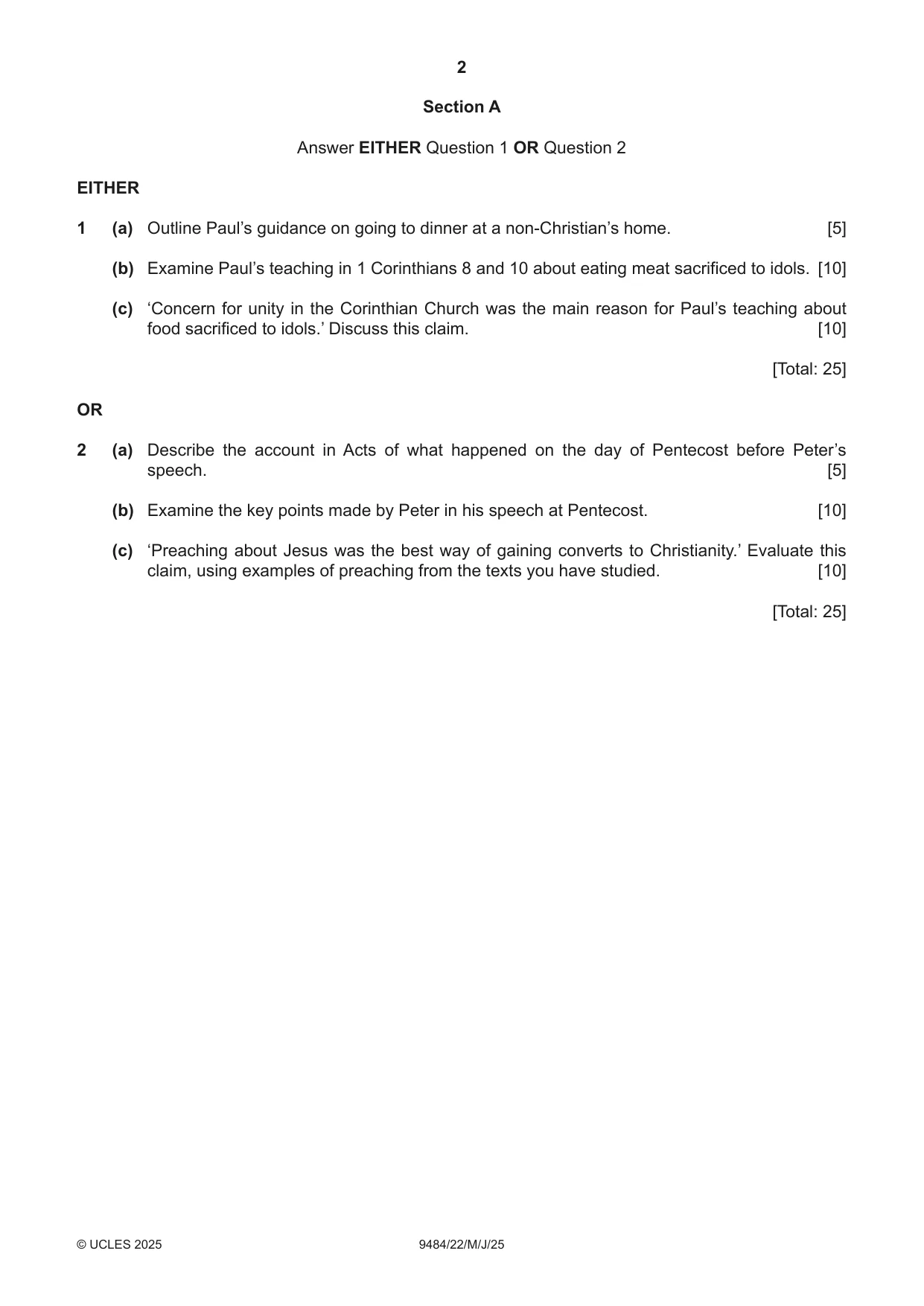
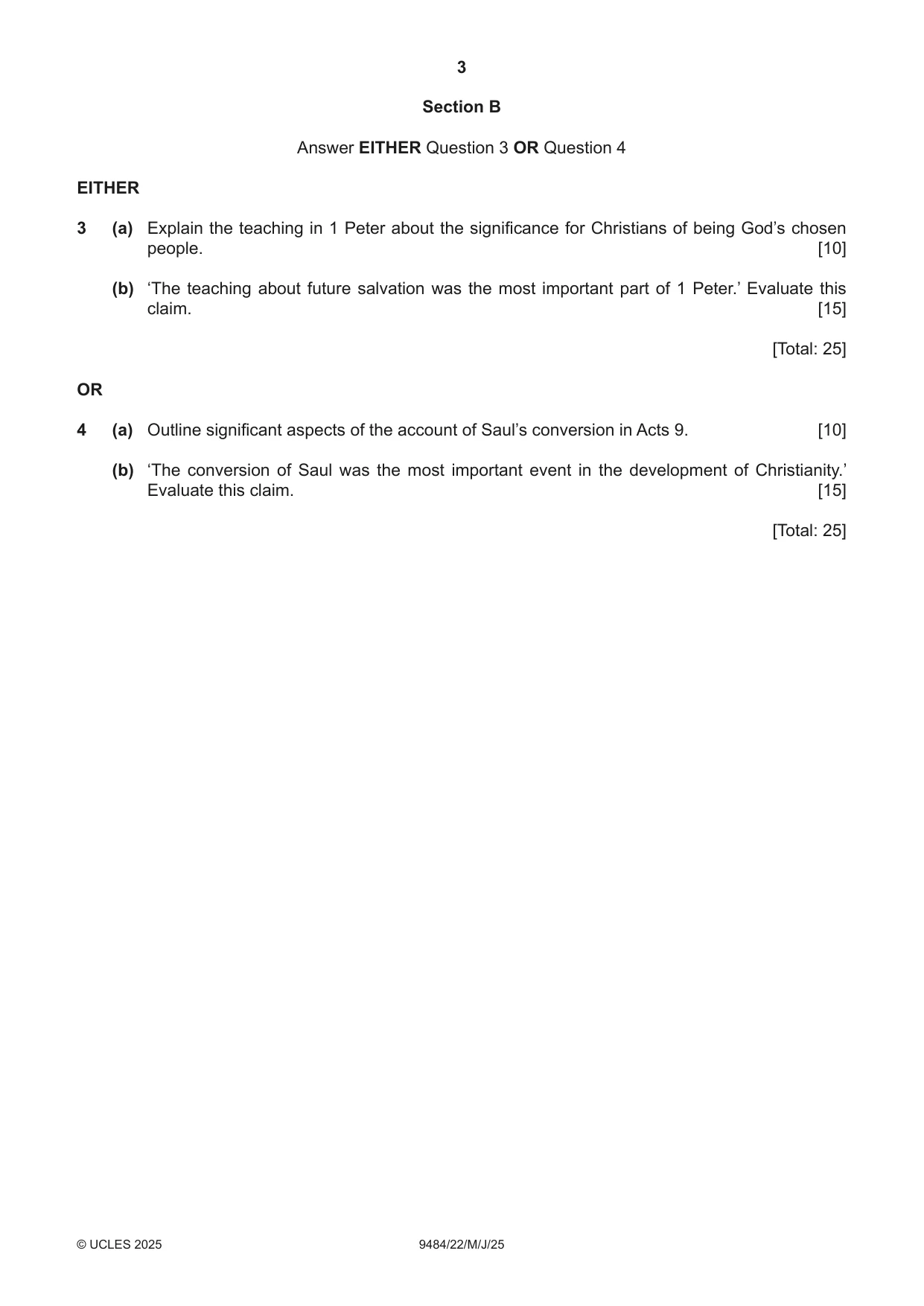

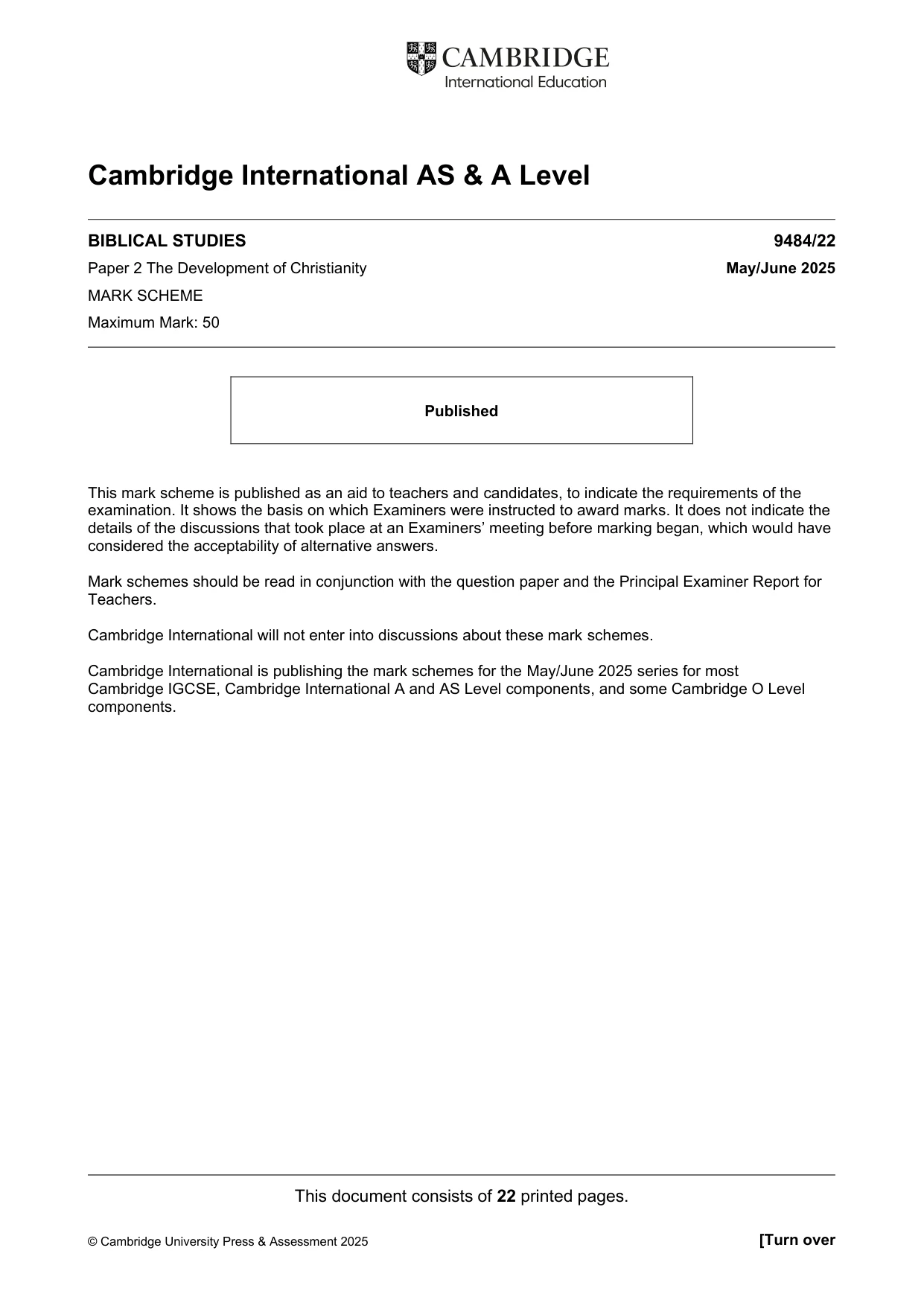
Mark scheme22 pages
Answers below. Sit the paper first if you are practising.
Questions as text
Q1 · Outline Paul’s guidance on going to dinner at a non-Christian’s home
1 (a) Outline Paul’s guidance on going to dinner at a non-Christian’s home. [5] (b) Examine Paul’s teaching in 1 Corinthians 8 and 10 about eating meat sacrificed to idols. [10] (c) ‘Concern for unity in the Corinthian Church was the main reason for Paul’s teaching about food sacrificed to idols.’ Discuss this claim. [10] [Total: 25] OR
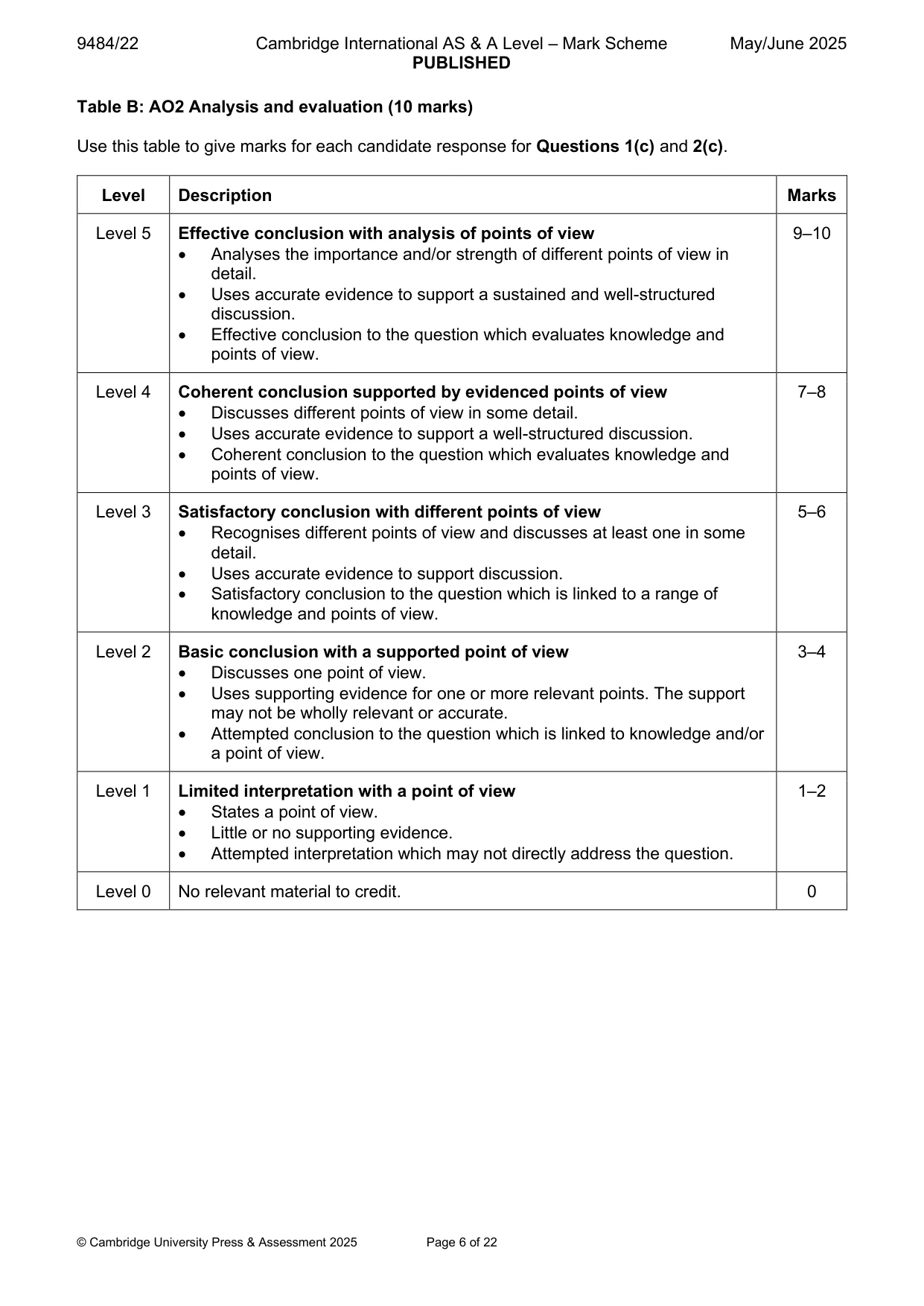
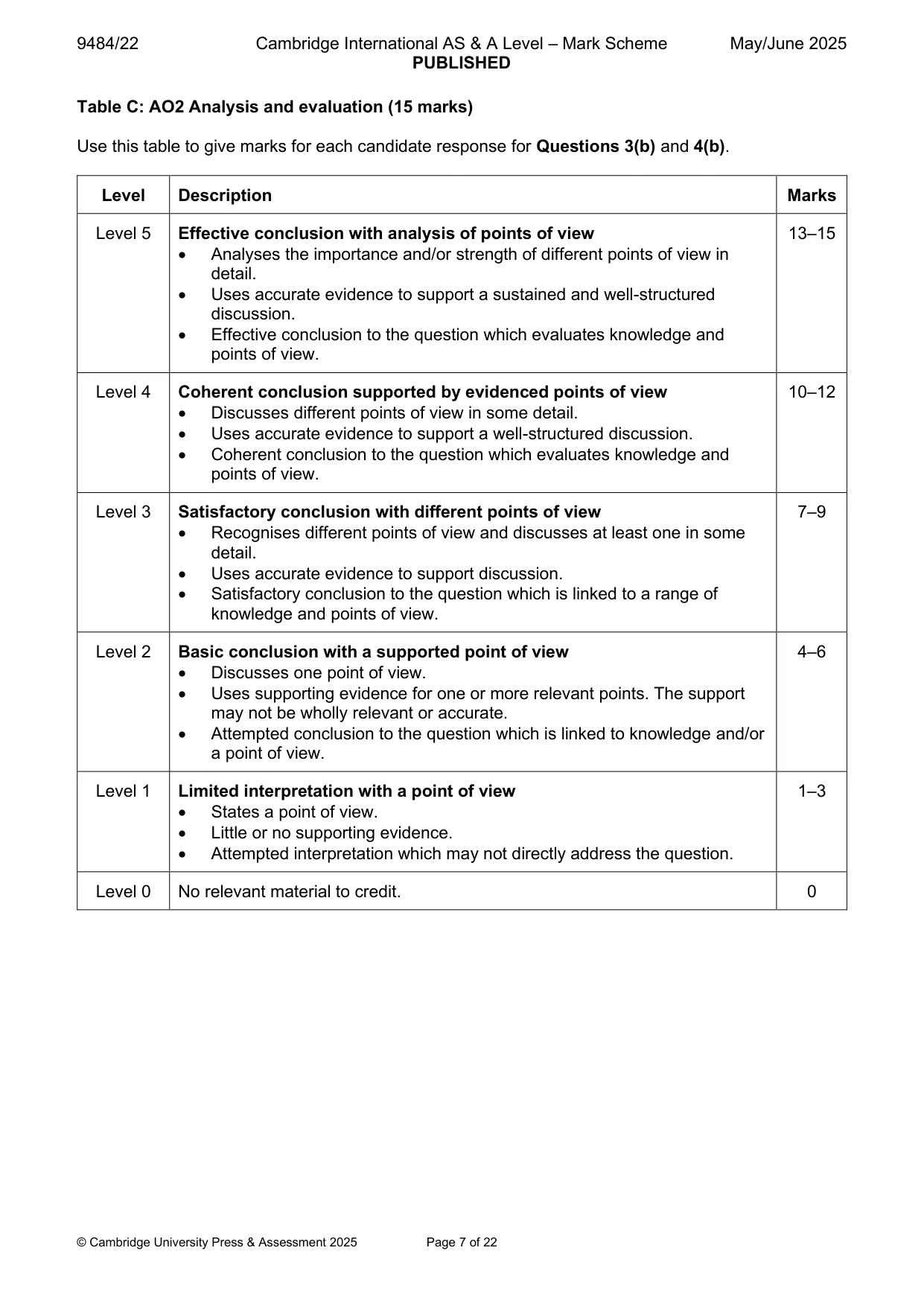
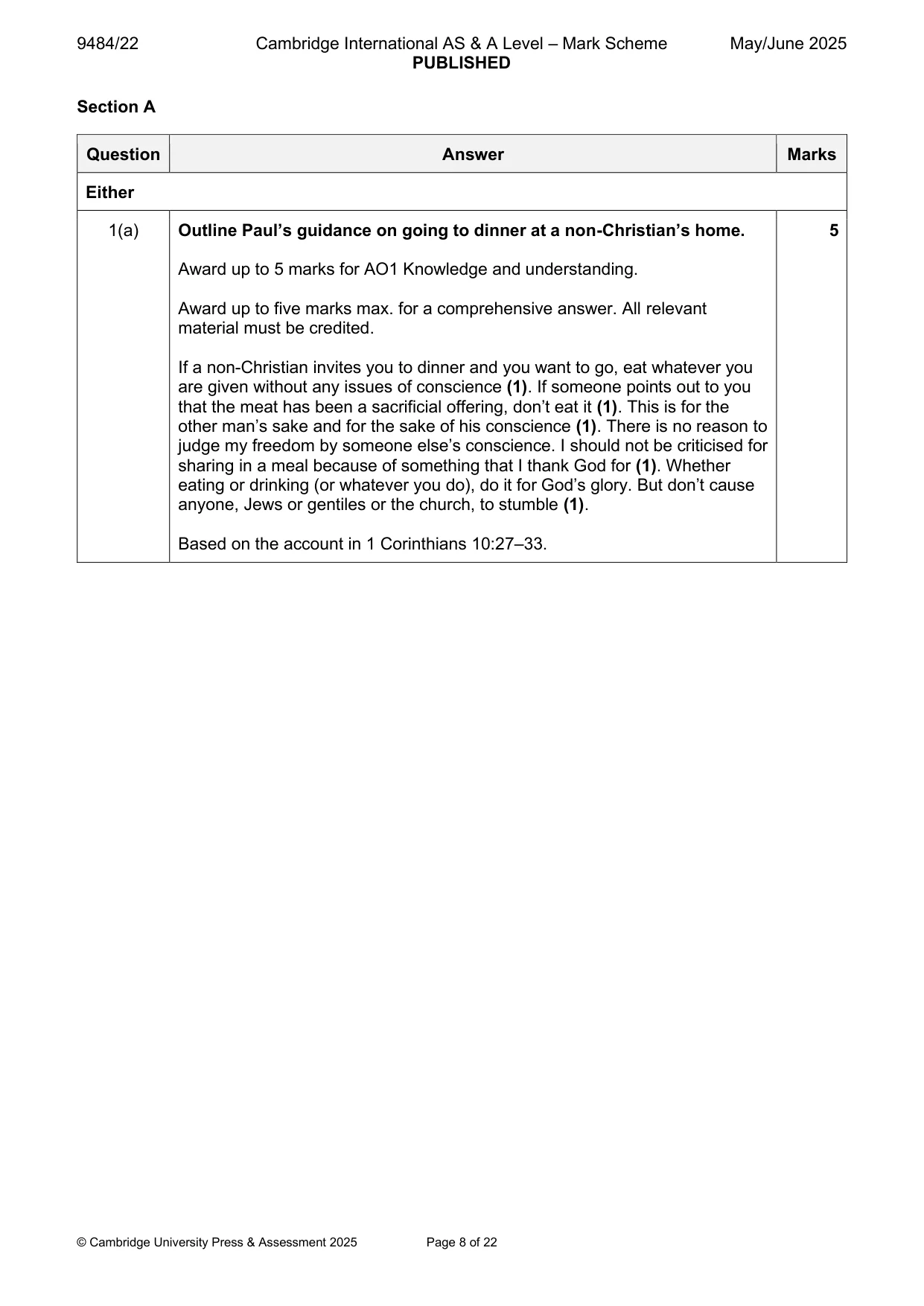
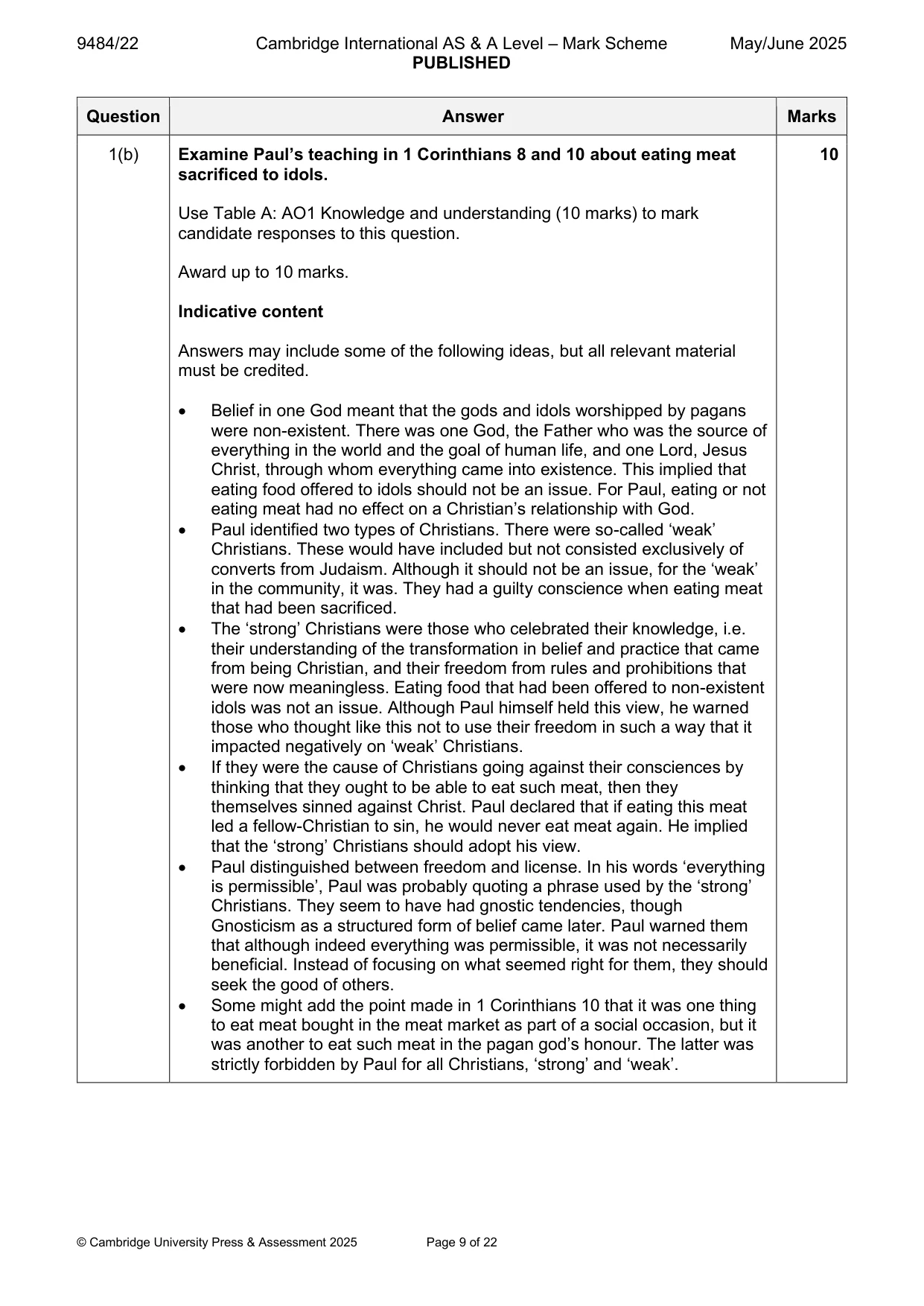
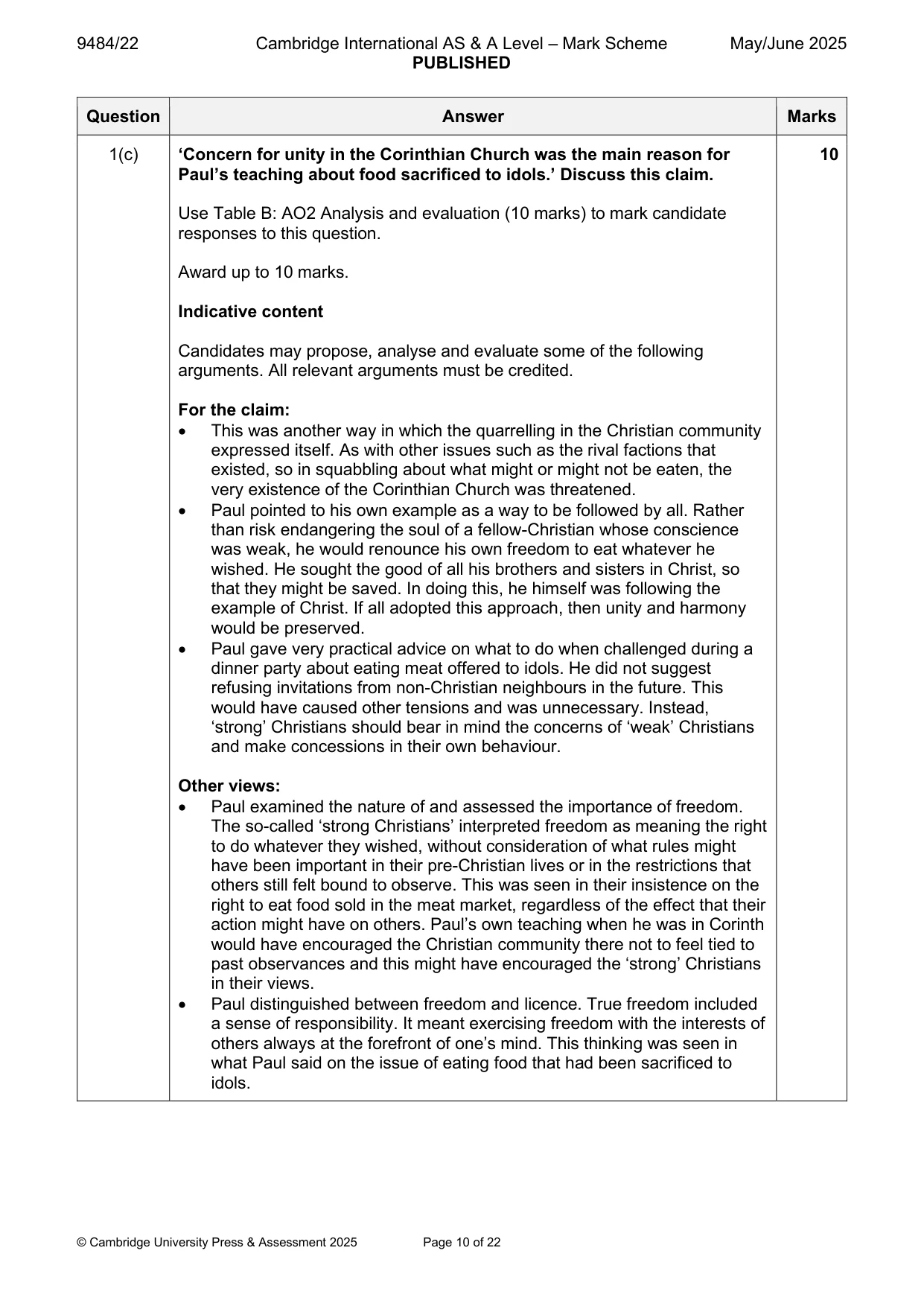
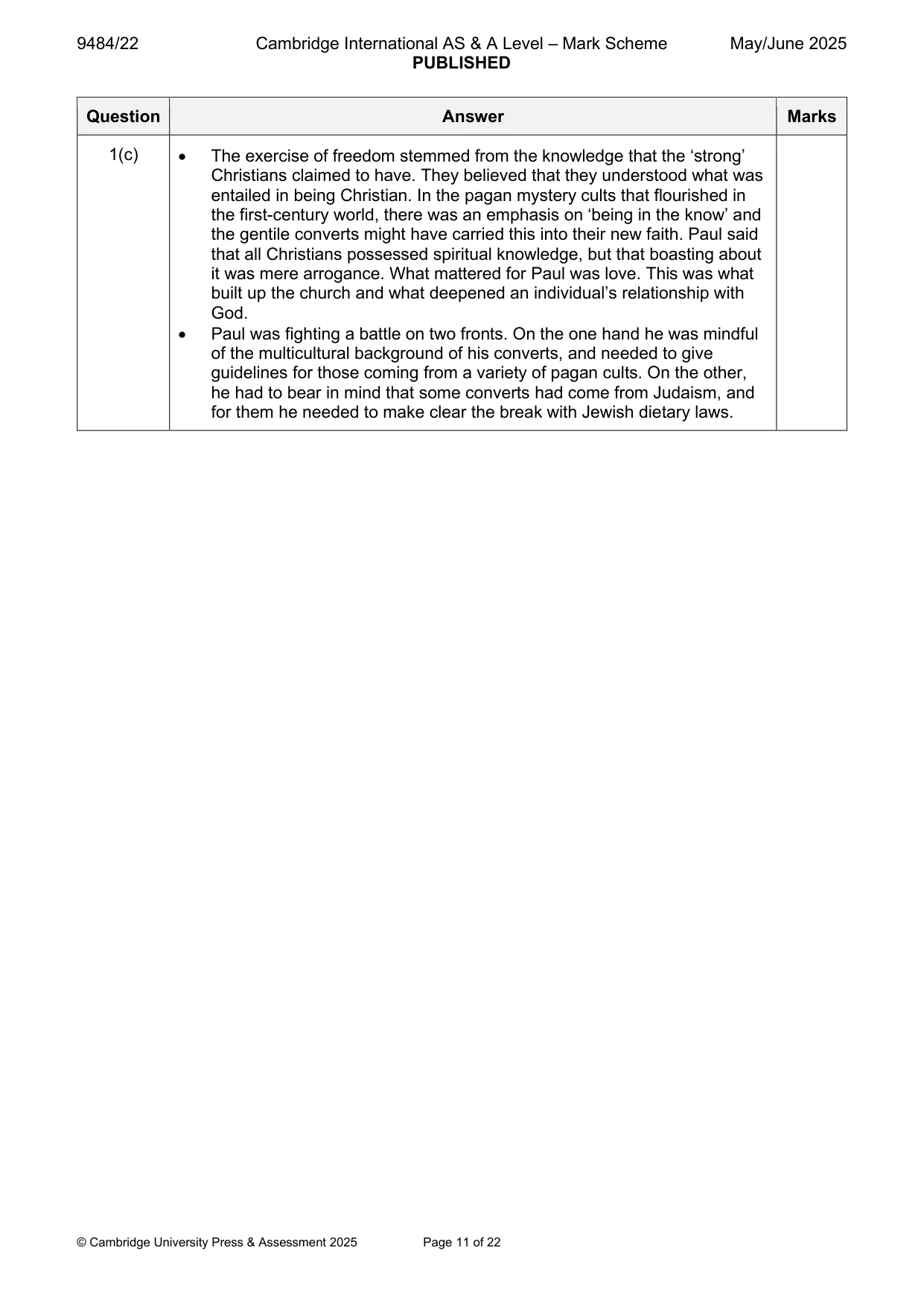
Mark scheme: Question Answer Marks Either 1(a) Outline Paul’s guidance on going to dinner at a non-Christian’s home. 5 Award up to 5 marks for AO1 Knowledge and understanding. Award up to five marks max. for a comprehensive answer. All relevant material must be credited. If a non-Christian invites you to dinner and you want to go, eat whatever you are given without any issues of conscience (1). If someone points out to you that the meat has been a sacrificial offering, don’t eat it (1). This is for the other man’s sake and for the sake of his conscience (1). There is no reason to judge my freedom by someone else’s conscience. I should not be criticised for sharing in a meal because of something that I thank God for (1). Whether eating or drinking (or whatever you do), do it for God’s glory. But don’t cause anyone, Jews or gentiles or the church, to stumble (1). Based on the account in 1 Corinthians 10:27–33. 1(b) Examine Paul’s teaching in 1 Corinthians 8 and 10 about eating meat 10 sacrificed to idols. Use Table A: AO1 Knowledge and understanding (10 marks) to mark candidate responses to this question. Award up to 10 marks. Indicative content Answers may include some of the following ideas, but all relevant material must be credited. • Belief in one God meant that the gods and idols worshipped by pagans were non-existent. There was one God, the Father who was the source of everything in the world and the goal of human life, and one Lord, Jesus Christ, through whom everything came into existence. This implied that eating food offered to idols should not be an issue. For Paul, eating or not eating meat had no effect on a Christian’s relationship with God. • Paul identified two types of Christians. There were so-called ‘weak’ Christians. These would have included but not consisted exclusively of converts from Judaism. Although it should not be an issue, for the ‘weak’ in the community, it was. They had a guilty conscience when eating meat that had been sacrificed. • The ‘strong’ Christians were those who celebrated their knowledge, i.e. their understanding of the transformation in belief and practice that came from being Christian, and their freedom from rules and prohibitions that were now meaningless. Eating food that had been offered to non-existent idols was not an issue. Although Paul himself held this view, he warned those who thought like this not to use their freedom in such a way that it impacted negatively on ‘weak’ Christians. • If they were the cause of Christians going against their consciences by thinking that they ought to be able to eat such meat, then they themselves sinned against Christ. Paul declared that if eating this meat led a fellow-Christian to sin, he would never eat meat again. He implied that the ‘strong’ Christians should adopt his view. • Paul distinguished between freedom and license. In his words ‘everything is permissible’, Paul was probably quoting a phrase used by the ‘strong’ Christians. They seem to have had gnostic tendencies, though Gnosticism as a structured form of belief came later. Paul warned them that although indeed everything was permissible, it was not necessarily beneficial. Instead of focusing on what seemed right for them, they should seek the good of others. • Some might add the point made in 1 Corinthians 10 that it was one thing to eat meat bought in the meat market as part of a social occasion, but it was another to eat such meat in the pagan god’s honour. The latter was strictly forbidden by Paul for all Christians, ‘strong’ and ‘weak’. 1(c) ‘Concern for unity in the Corinthian Church was the main reason for 10 Paul’s teaching about food sacrificed to idols.’ Discuss this claim. Use Table B: AO2 Analysis and evaluation (10 marks) to mark candidate responses to this question. Award up to 10 marks. Indicative content Candidates may propose, analyse and evaluate some of the following arguments. All relevant arguments must be credited. For the claim: • This was another way in which the quarrelling in the Christian community expressed itself. As with other issues such as the rival factions that existed, so in squabbling about what might or might not be eaten, the very existence of the Corinthian Church was threatened. • Paul pointed to his own example as a way to be followed by all. Rather than risk endangering the soul of a fellow-Christian whose conscience was weak, he would renounce his own freedom to eat whatever he wished. He sought the good of all his brothers and sisters in Christ, so that they might be saved. In doing this, he himself was following the example of Christ. If all adopted this approach, then unity and harmony would be preserved. • Paul gave very practical advice on what to do when challenged during a dinner party about eating meat offered to idols. He did not suggest refusing invitations from non-Christian neighbours in the future. This would have caused other tensions and was unnecessary. Instead, ‘strong’ Christians should bear in mind the concerns of ‘weak’ Christians and make concessions in their own behaviour. Other views: • Paul examined the nature of and assessed the importance of freedom. The so-called ‘strong Christians’ interpreted freedom as meaning the right to do whatever they wished, without consideration of what rules might have been important in their pre-Christian lives or in the restrictions that others still felt bound to observe. This was seen in their insistence on the right to eat food sold in the meat market, regardless of the effect that their action might have on others. Paul’s own teaching when he was in Corinth would have encouraged the Christian community there not to feel tied to past observances and this might have encouraged the ‘strong’ Christians in their views. • Paul distinguished between freedom and licence. True freedom included a sense of responsibility. It meant exercising freedom with the interests of others always at the forefront of one’s mind. This thinking was seen in what Paul said on the issue of eating food that had been sacrificed to idols. 1(c) • The exercise of freedom stemmed from the knowledge that the ‘strong’ Christians claimed to have. They believed that they understood what was entailed in being Christian. In the pagan mystery cults that flourished in the first-century world, there was an emphasis on ‘being in the know’ and the gentile converts might have carried this into their new faith. Paul said that all Christians possessed spiritual knowledge, but that boasting about it was mere arrogance. What mattered for Paul was love. This was what built up the church and what deepened an individual’s relationship with God. • Paul was fighting a battle on two fronts. On the one hand he was mindful of the multicultural background of his converts, and needed to give guidelines for those coming from a variety of pagan cults. On the other, he had to bear in mind that some converts had come from Judaism, and for them he needed to make clear the break with Jewish dietary laws.
Q2 · Describe the account in Acts of what happened on the day of Pentecost before Peter’s…
2 (a) Describe the account in Acts of what happened on the day of Pentecost before Peter’s speech. [5] (b) Examine the key points made by Peter in his speech at Pentecost. [10] (c) ‘Preaching about Jesus was the best way of gaining converts to Christianity.’ Evaluate this claim, using examples of preaching from the texts you have studied. [10] [Total: 25]
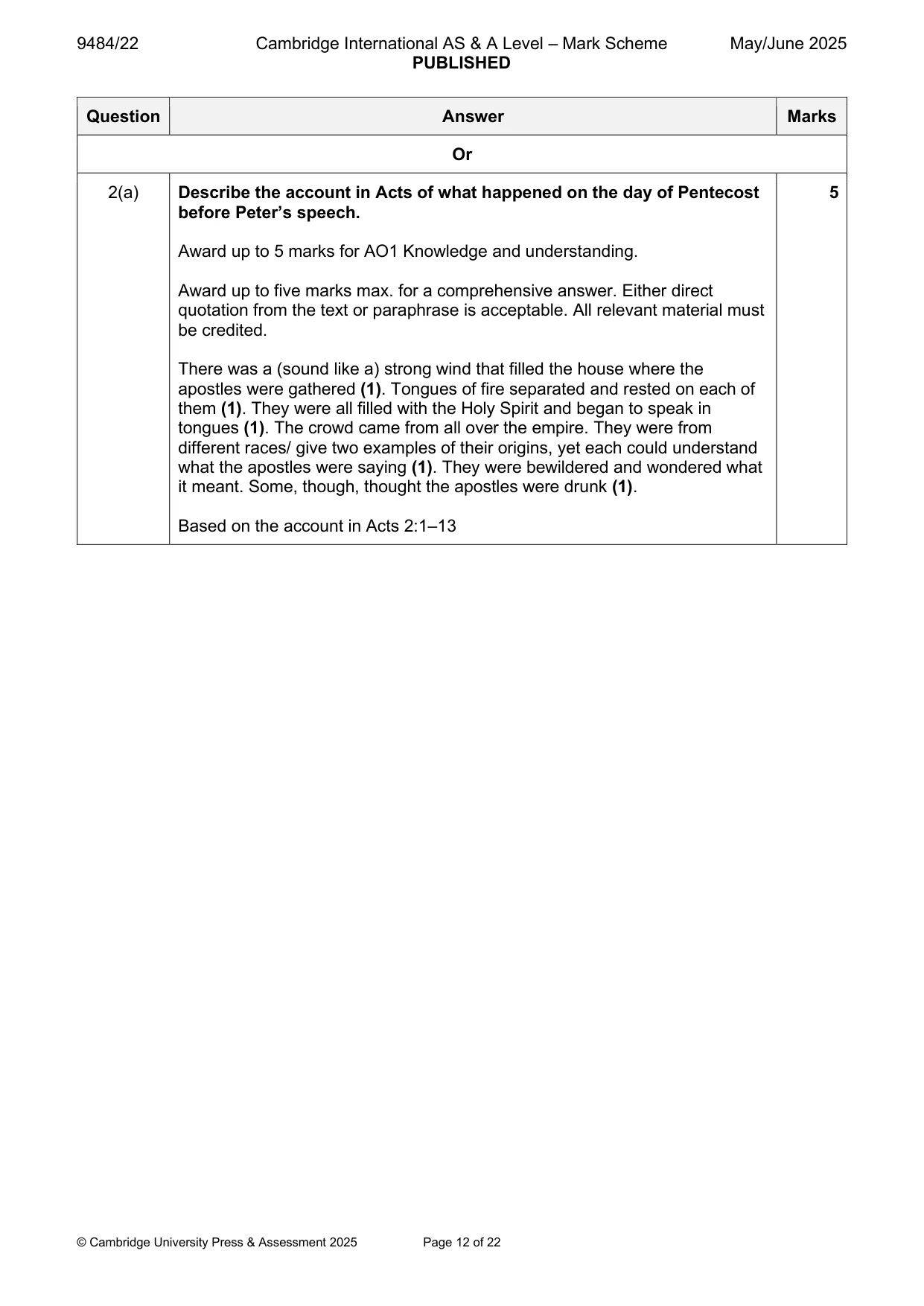
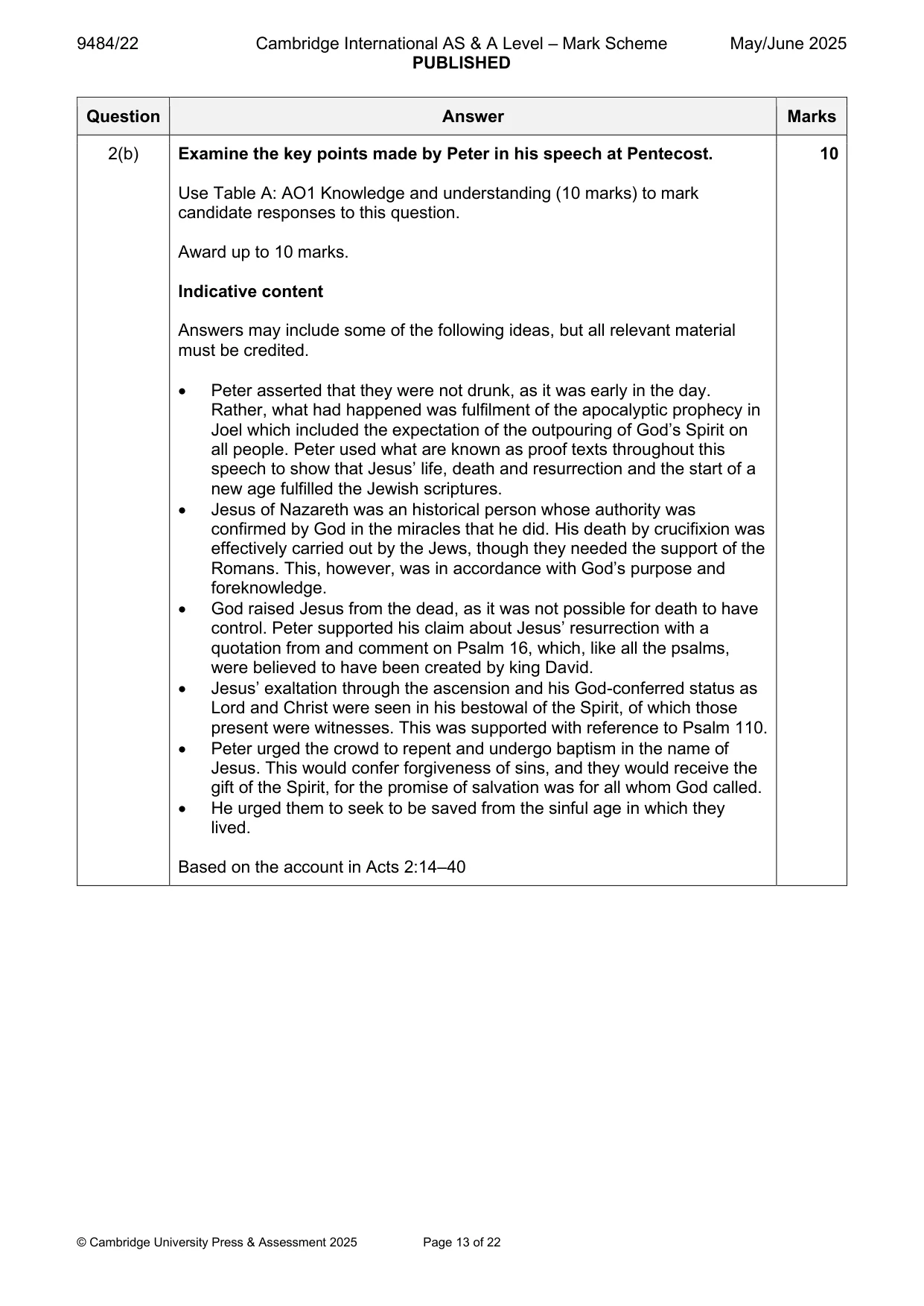
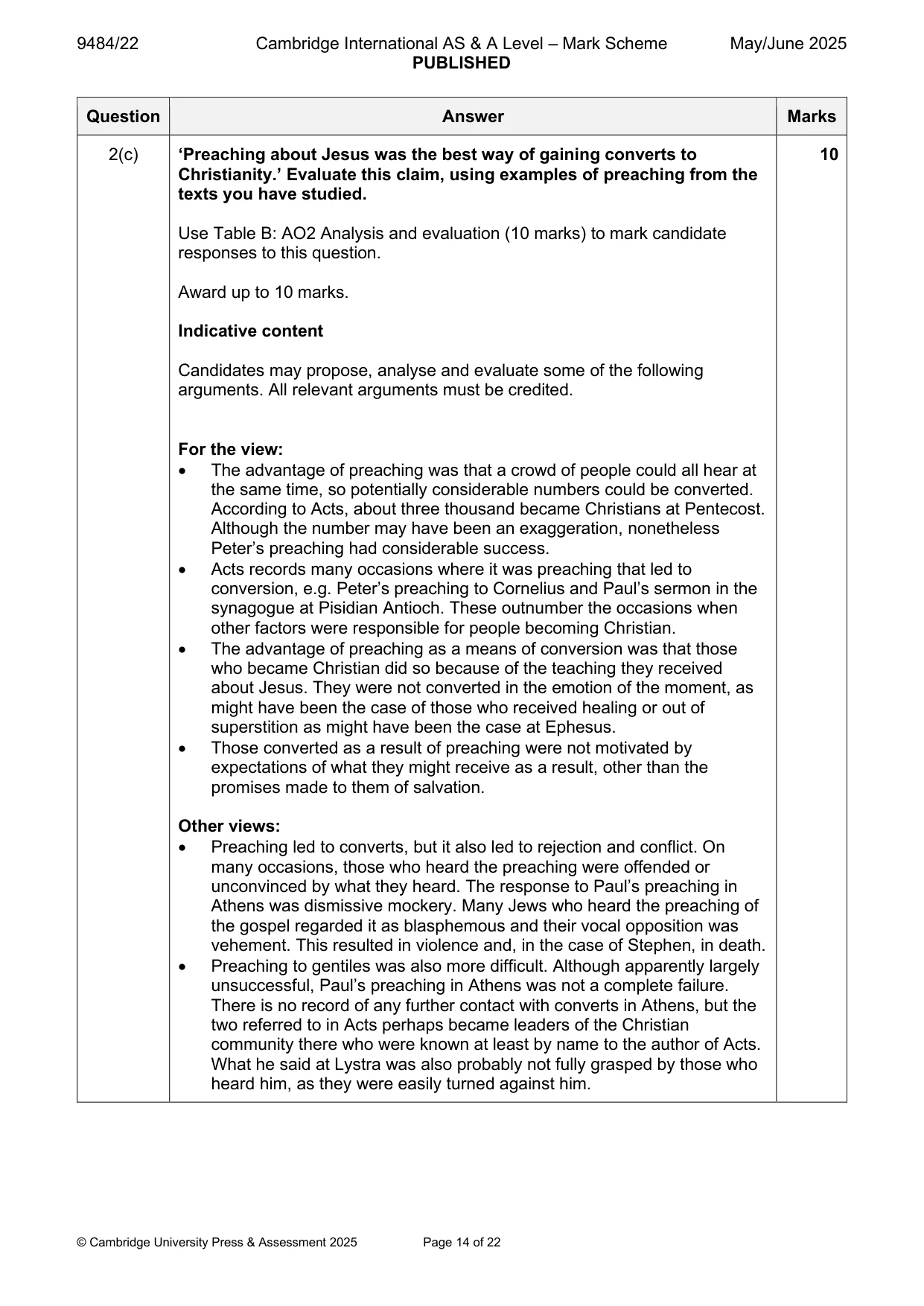
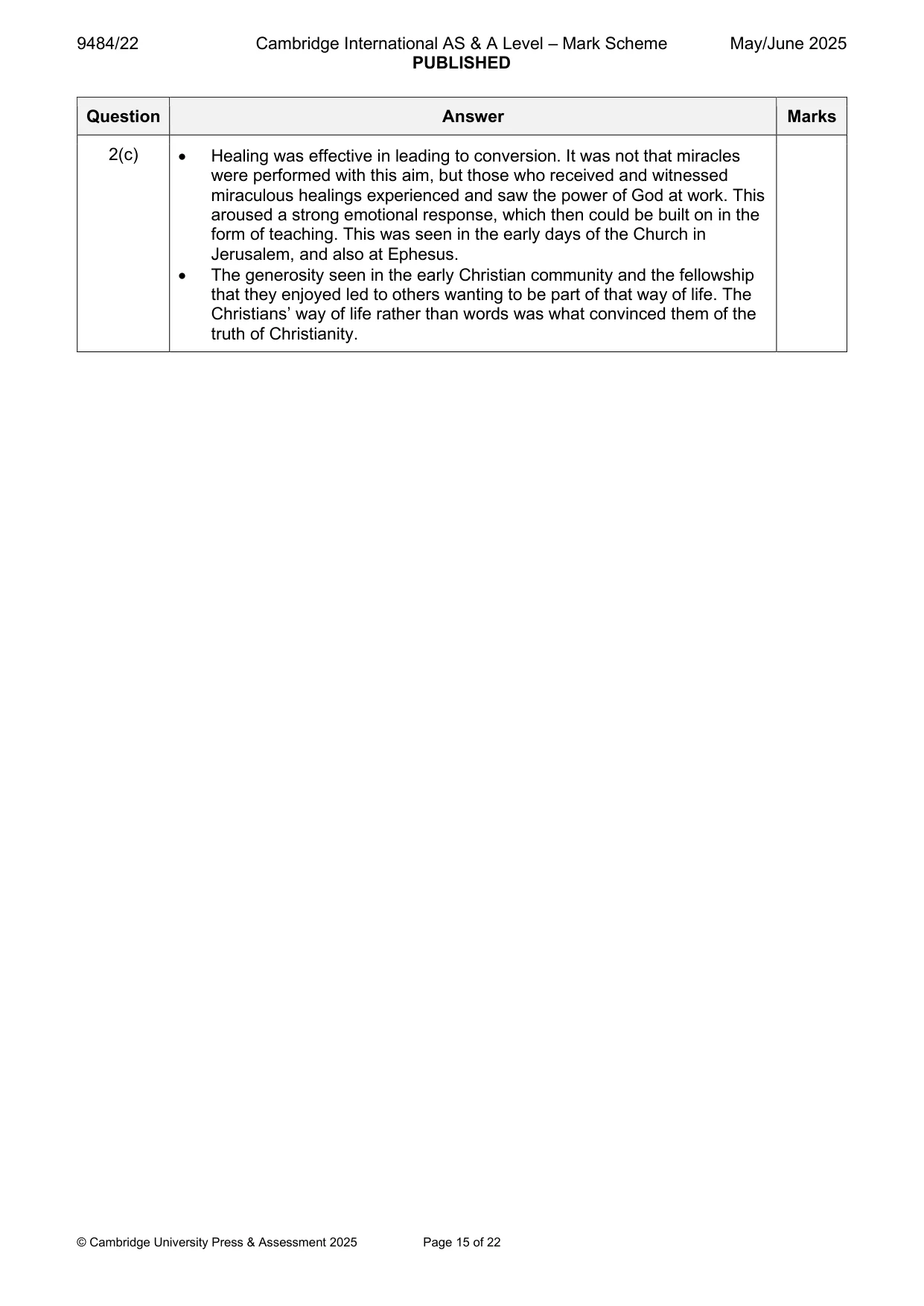
Mark scheme: 2(a) Describe the account in Acts of what happened on the day of Pentecost 5 before Peter’s speech. Award up to 5 marks for AO1 Knowledge and understanding. Award up to five marks max. for a comprehensive answer. Either direct quotation from the text or paraphrase is acceptable. All relevant material must be credited. There was a (sound like a) strong wind that filled the house where the apostles were gathered (1). Tongues of fire separated and rested on each of them (1). They were all filled with the Holy Spirit and began to speak in tongues (1). The crowd came from all over the empire. They were from different races/ give two examples of their origins, yet each could understand what the apostles were saying (1). They were bewildered and wondered what it meant. Some, though, thought the apostles were drunk (1). Based on the account in Acts 2:1–13 2(b) Examine the key points made by Peter in his speech at Pentecost. 10 Use Table A: AO1 Knowledge and understanding (10 marks) to mark candidate responses to this question. Award up to 10 marks. Indicative content Answers may include some of the following ideas, but all relevant material must be credited. • Peter asserted that they were not drunk, as it was early in the day. Rather, what had happened was fulfilment of the apocalyptic prophecy in Joel which included the expectation of the outpouring of God’s Spirit on all people. Peter used what are known as proof texts throughout this speech to show that Jesus’ life, death and resurrection and the start of a new age fulfilled the Jewish scriptures. • Jesus of Nazareth was an historical person whose authority was confirmed by God in the miracles that he did. His death by crucifixion was effectively carried out by the Jews, though they needed the support of the Romans. This, however, was in accordance with God’s purpose and foreknowledge. • God raised Jesus from the dead, as it was not possible for death to have control. Peter supported his claim about Jesus’ resurrection with a quotation from and comment on Psalm 16, which, like all the psalms, were believed to have been created by king David. • Jesus’ exaltation through the ascension and his God-conferred status as Lord and Christ were seen in his bestowal of the Spirit, of which those present were witnesses. This was supported with reference to Psalm 110. • Peter urged the crowd to repent and undergo baptism in the name of Jesus. This would confer forgiveness of sins, and they would receive the gift of the Spirit, for the promise of salvation was for all whom God called. • He urged them to seek to be saved from the sinful age in which they lived. Based on the account in Acts 2:14–40 2(c) ‘Preaching about Jesus was the best way of gaining converts to 10 Christianity.’ Evaluate this claim, using examples of preaching from the texts you have studied. Use Table B: AO2 Analysis and evaluation (10 marks) to mark candidate responses to this question. Award up to 10 marks. Indicative content Candidates may propose, analyse and evaluate some of the following arguments. All relevant arguments must be credited. For the view: • The advantage of preaching was that a crowd of people could all hear at the same time, so potentially considerable numbers could be converted. According to Acts, about three thousand became Christians at Pentecost. Although the number may have been an exaggeration, nonetheless Peter’s preaching had considerable success. • Acts records many occasions where it was preaching that led to conversion, e.g. Peter’s preaching to Cornelius and Paul’s sermon in the synagogue at Pisidian Antioch. These outnumber the occasions when other factors were responsible for people becoming Christian. • The advantage of preaching as a means of conversion was that those who became Christian did so because of the teaching they received about Jesus. They were not converted in the emotion of the moment, as might have been the case of those who received healing or out of superstition as might have been the case at Ephesus. • Those converted as a result of preaching were not motivated by expectations of what they might receive as a result, other than the promises made to them of salvation. Other views: • Preaching led to converts, but it also led to rejection and conflict. On many occasions, those who heard the preaching were offended or unconvinced by what they heard. The response to Paul’s preaching in Athens was dismissive mockery. Many Jews who heard the preaching of the gospel regarded it as blasphemous and their vocal opposition was vehement. This resulted in violence and, in the case of Stephen, in death. • Preaching to gentiles was also more difficult. Although apparently largely unsuccessful, Paul’s preaching in Athens was not a complete failure. There is no record of any further contact with converts in Athens, but the two referred to in Acts perhaps became leaders of the Christian community there who were known at least by name to the author of Acts. What he said at Lystra was also probably not fully grasped by those who heard him, as they were easily turned against him. 2(c) • Healing was effective in leading to conversion. It was not that miracles were performed with this aim, but those who received and witnessed miraculous healings experienced and saw the power of God at work. This aroused a strong emotional response, which then could be built on in the form of teaching. This was seen in the early days of the Church in Jerusalem, and also at Ephesus. • The generosity seen in the early Christian community and the fellowship that they enjoyed led to others wanting to be part of that way of life. The Christians’ way of life rather than words was what convinced them of the truth of Christianity. Section B
Q3 · Explain the teaching in 1 Peter about the significance for Christians of being God’s…
3 (a) Explain the teaching in 1 Peter about the significance for Christians of being God’s chosen people. [10] (b) ‘The teaching about future salvation was the most important part of 1 Peter.’ Evaluate this claim. [15] [Total: 25] OR
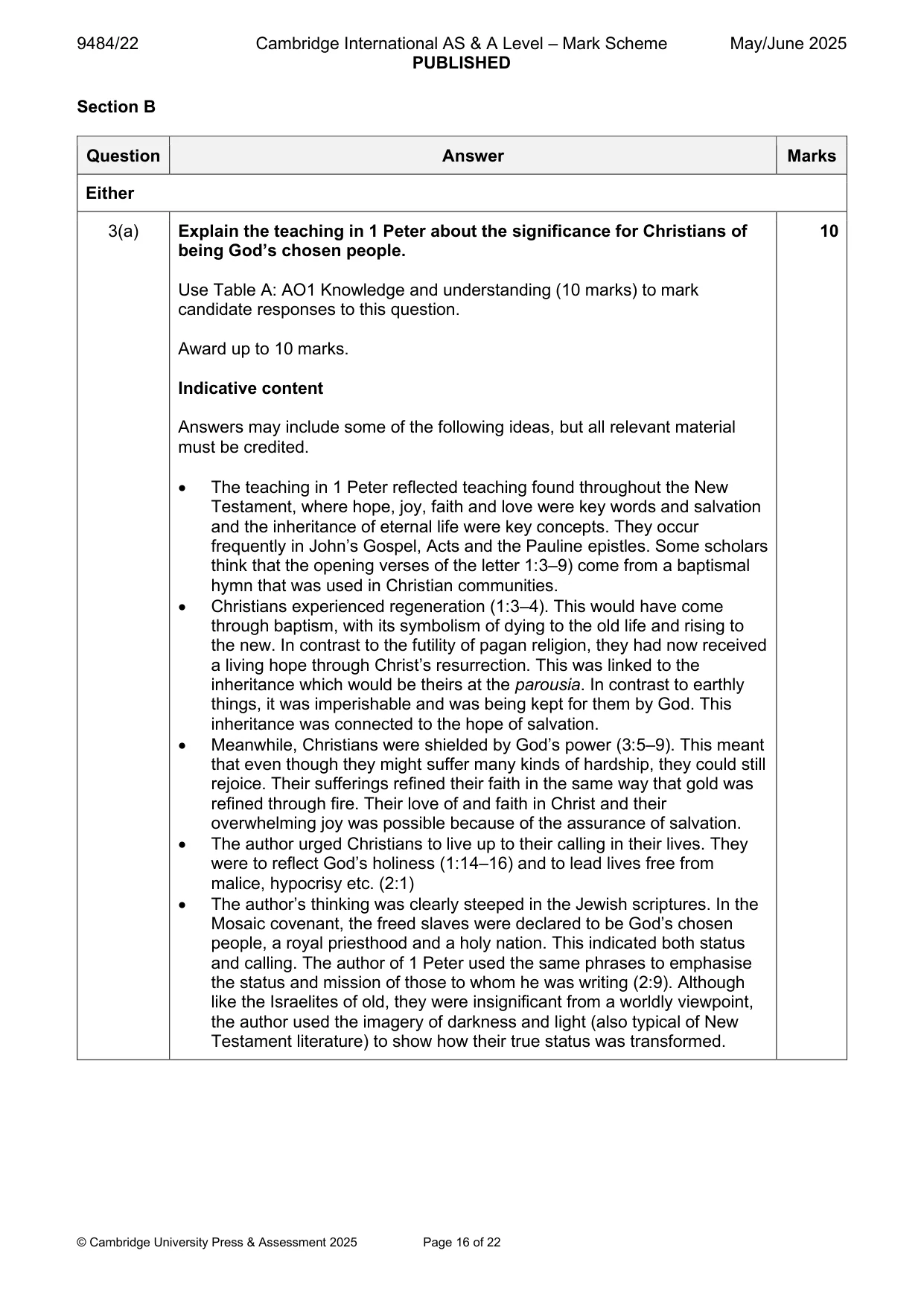
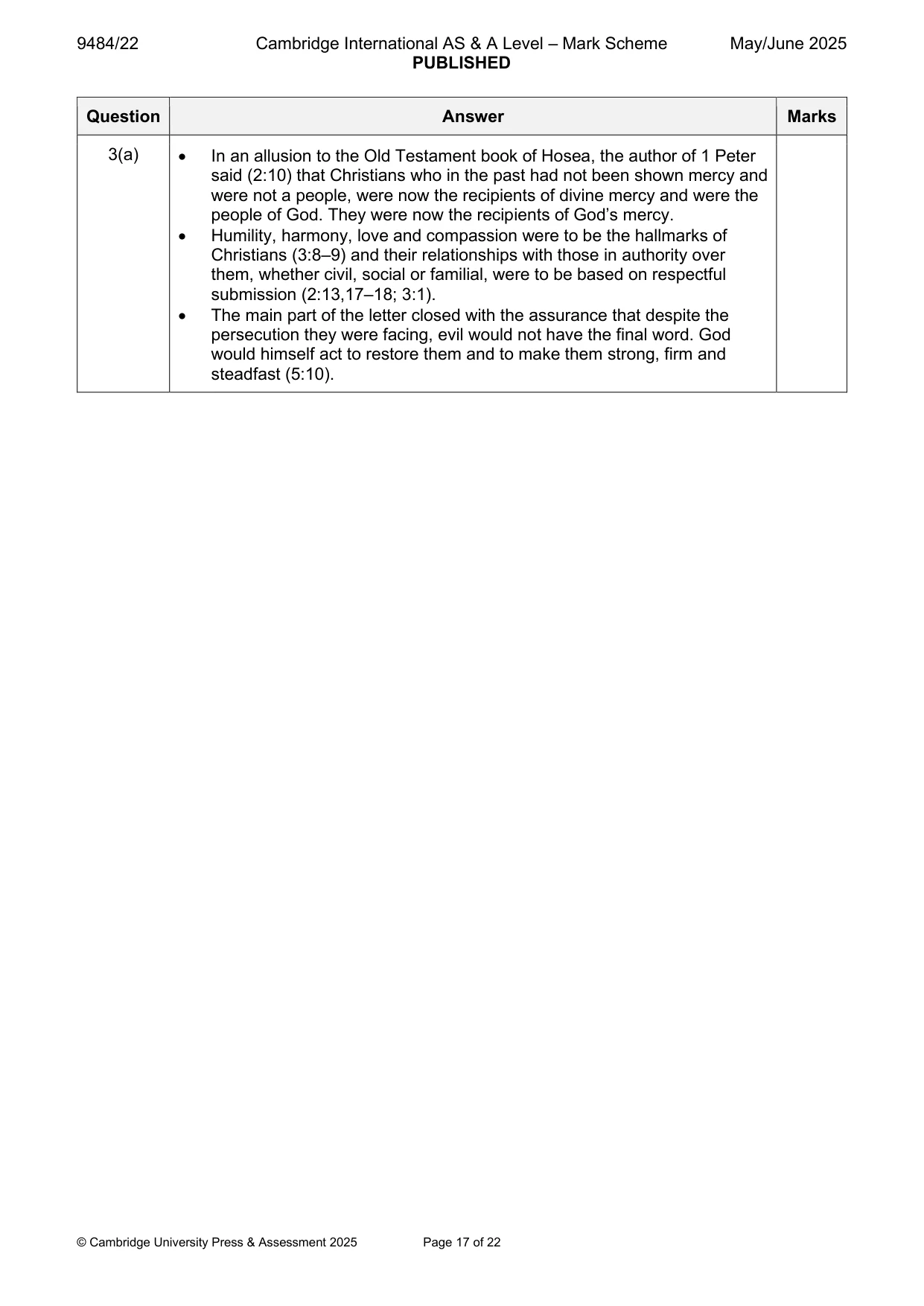
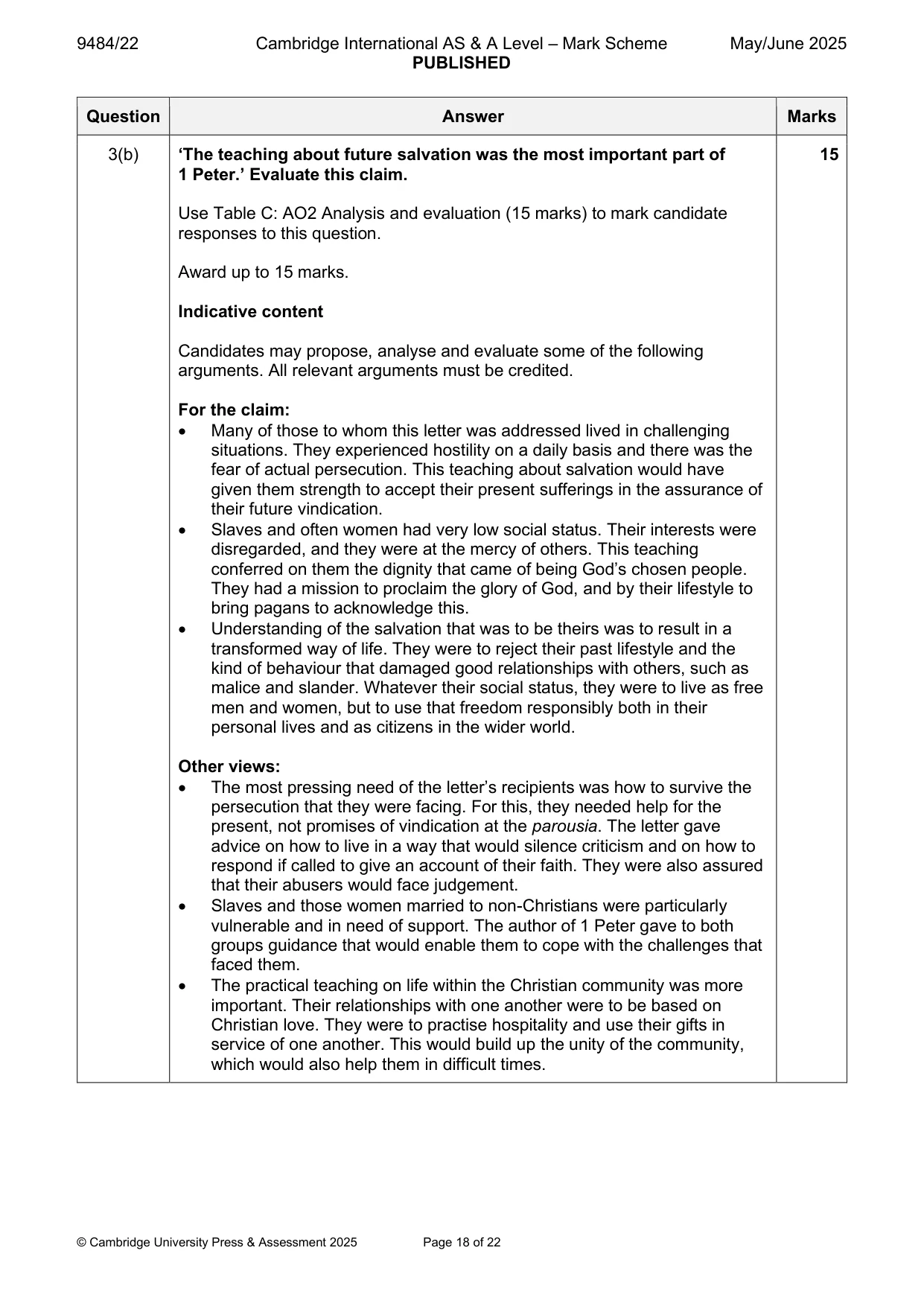
Mark scheme: 3(a) Explain the teaching in 1 Peter about the significance for Christians of 10 being God’s chosen people. Use Table A: AO1 Knowledge and understanding (10 marks) to mark candidate responses to this question. Award up to 10 marks. Indicative content Answers may include some of the following ideas, but all relevant material must be credited. • The teaching in 1 Peter reflected teaching found throughout the New Testament, where hope, joy, faith and love were key words and salvation and the inheritance of eternal life were key concepts. They occur frequently in John’s Gospel, Acts and the Pauline epistles. Some scholars think that the opening verses of the letter 1:3–9) come from a baptismal hymn that was used in Christian communities. • Christians experienced regeneration (1:3–4). This would have come through baptism, with its symbolism of dying to the old life and rising to the new. In contrast to the futility of pagan religion, they had now received a living hope through Christ’s resurrection. This was linked to the inheritance which would be theirs at the parousia. In contrast to earthly things, it was imperishable and was being kept for them by God. This inheritance was connected to the hope of salvation. • Meanwhile, Christians were shielded by God’s power (3:5–9). This meant that even though they might suffer many kinds of hardship, they could still rejoice. Their sufferings refined their faith in the same way that gold was refined through fire. Their love of and faith in Christ and their overwhelming joy was possible because of the assurance of salvation. • The author urged Christians to live up to their calling in their lives. They were to reflect God’s holiness (1:14–16) and to lead lives free from malice, hypocrisy etc. (2:1) • The author’s thinking was clearly steeped in the Jewish scriptures. In the Mosaic covenant, the freed slaves were declared to be God’s chosen people, a royal priesthood and a holy nation. This indicated both status and calling. The author of 1 Peter used the same phrases to emphasise the status and mission of those to whom he was writing (2:9). Although like the Israelites of old, they were insignificant from a worldly viewpoint, the author used the imagery of darkness and light (also typical of New Testament literature) to show how their true status was transformed. 3(a) • In an allusion to the Old Testament book of Hosea, the author of 1 Peter said (2:10) that Christians who in the past had not been shown mercy and were not a people, were now the recipients of divine mercy and were the people of God. They were now the recipients of God’s mercy. • Humility, harmony, love and compassion were to be the hallmarks of Christians (3:8–9) and their relationships with those in authority over them, whether civil, social or familial, were to be based on respectful submission (2:13,17–18; 3:1). • The main part of the letter closed with the assurance that despite the persecution they were facing, evil would not have the final word. God would himself act to restore them and to make them strong, firm and steadfast (5:10). 3(b) ‘The teaching about future salvation was the most important part of 15 1 Peter.’ Evaluate this claim. Use Table C: AO2 Analysis and evaluation (15 marks) to mark candidate responses to this question. Award up to 15 marks. Indicative content Candidates may propose, analyse and evaluate some of the following arguments. All relevant arguments must be credited. For the claim: • Many of those to whom this letter was addressed lived in challenging situations. They experienced hostility on a daily basis and there was the fear of actual persecution. This teaching about salvation would have given them strength to accept their present sufferings in the assurance of their future vindication. • Slaves and often women had very low social status. Their interests were disregarded, and they were at the mercy of others. This teaching conferred on them the dignity that came of being God’s chosen people. They had a mission to proclaim the glory of God, and by their lifestyle to bring pagans to acknowledge this. • Understanding of the salvation that was to be theirs was to result in a transformed way of life. They were to reject their past lifestyle and the kind of behaviour that damaged good relationships with others, such as malice and slander. Whatever their social status, they were to live as free men and women, but to use that freedom responsibly both in their personal lives and as citizens in the wider world. Other views: • The most pressing need of the letter’s recipients was how to survive the persecution that they were facing. For this, they needed help for the present, not promises of vindication at the parousia. The letter gave advice on how to live in a way that would silence criticism and on how to respond if called to give an account of their faith. They were also assured that their abusers would face judgement. • Slaves and those women married to non-Christians were particularly vulnerable and in need of support. The author of 1 Peter gave to both groups guidance that would enable them to cope with the challenges that faced them. • The practical teaching on life within the Christian community was more important. Their relationships with one another were to be based on Christian love. They were to practise hospitality and use their gifts in service of one another. This would build up the unity of the community, which would also help them in difficult times.
Q4 · Outline significant aspects of the account of Saul’s conversion in Acts 9
4 (a) Outline significant aspects of the account of Saul’s conversion in Acts 9. [10] (b) ‘The conversion of Saul was the most important event in the development of Christianity.’ Evaluate this claim. [15] [Total: 25]
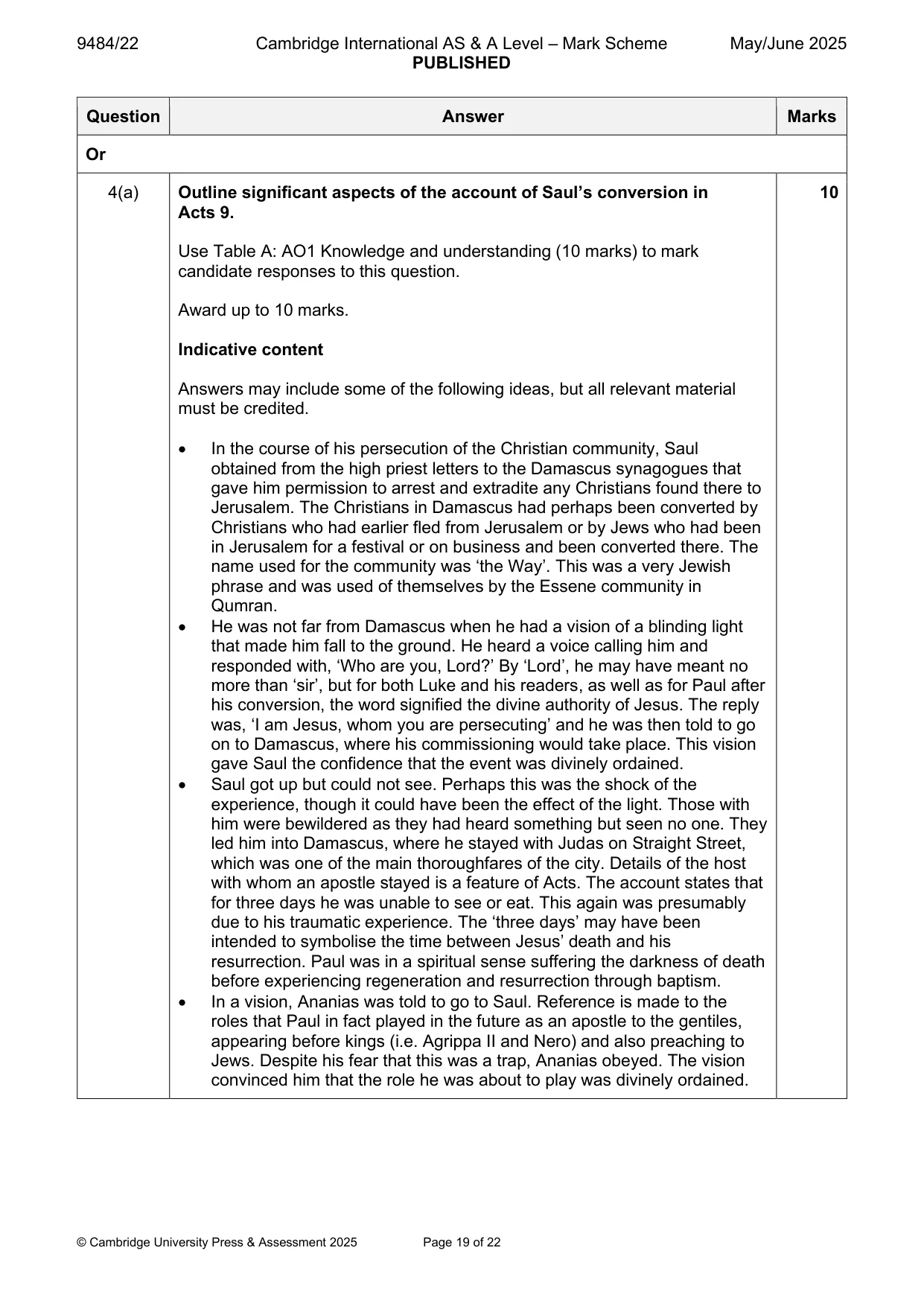
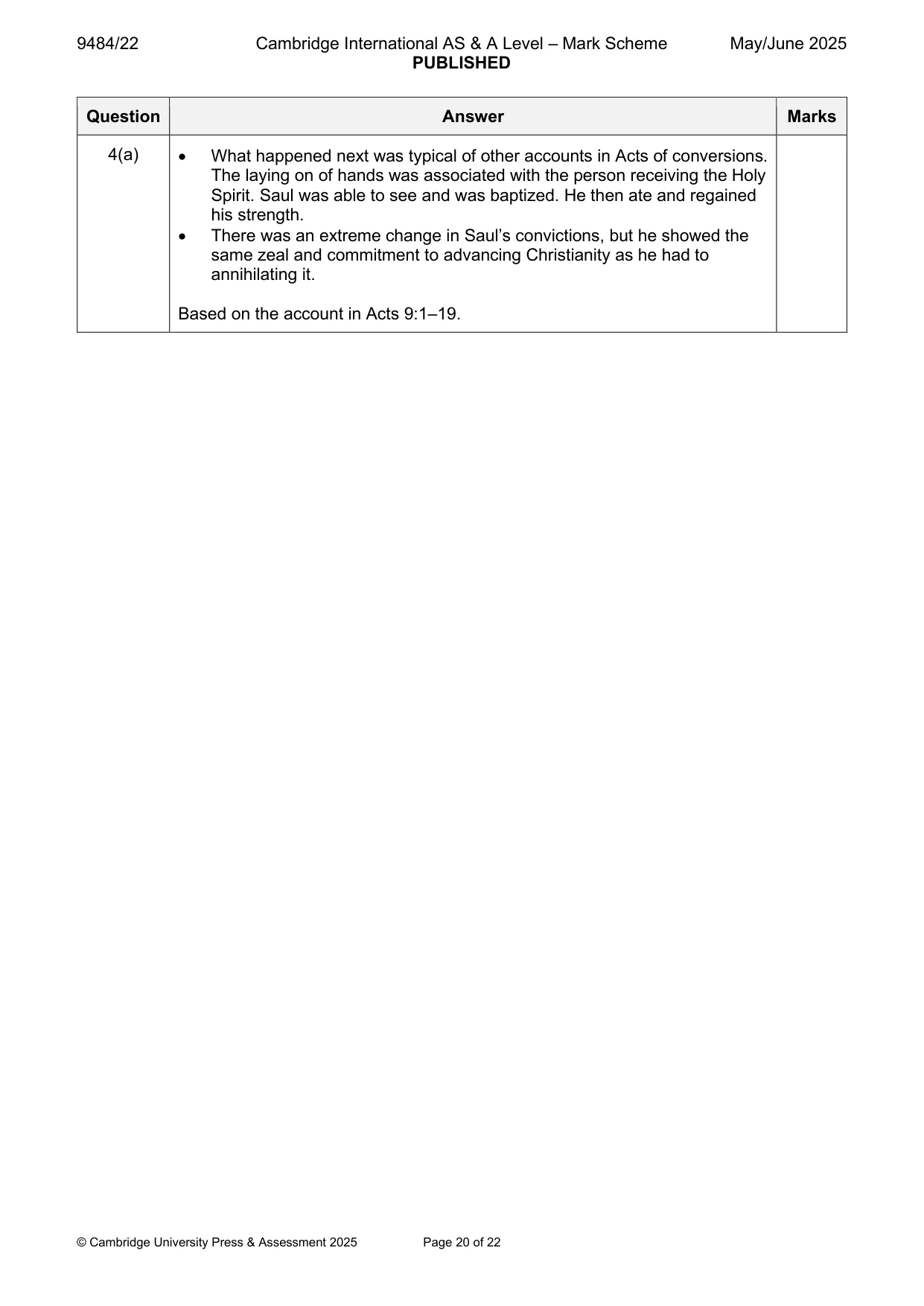
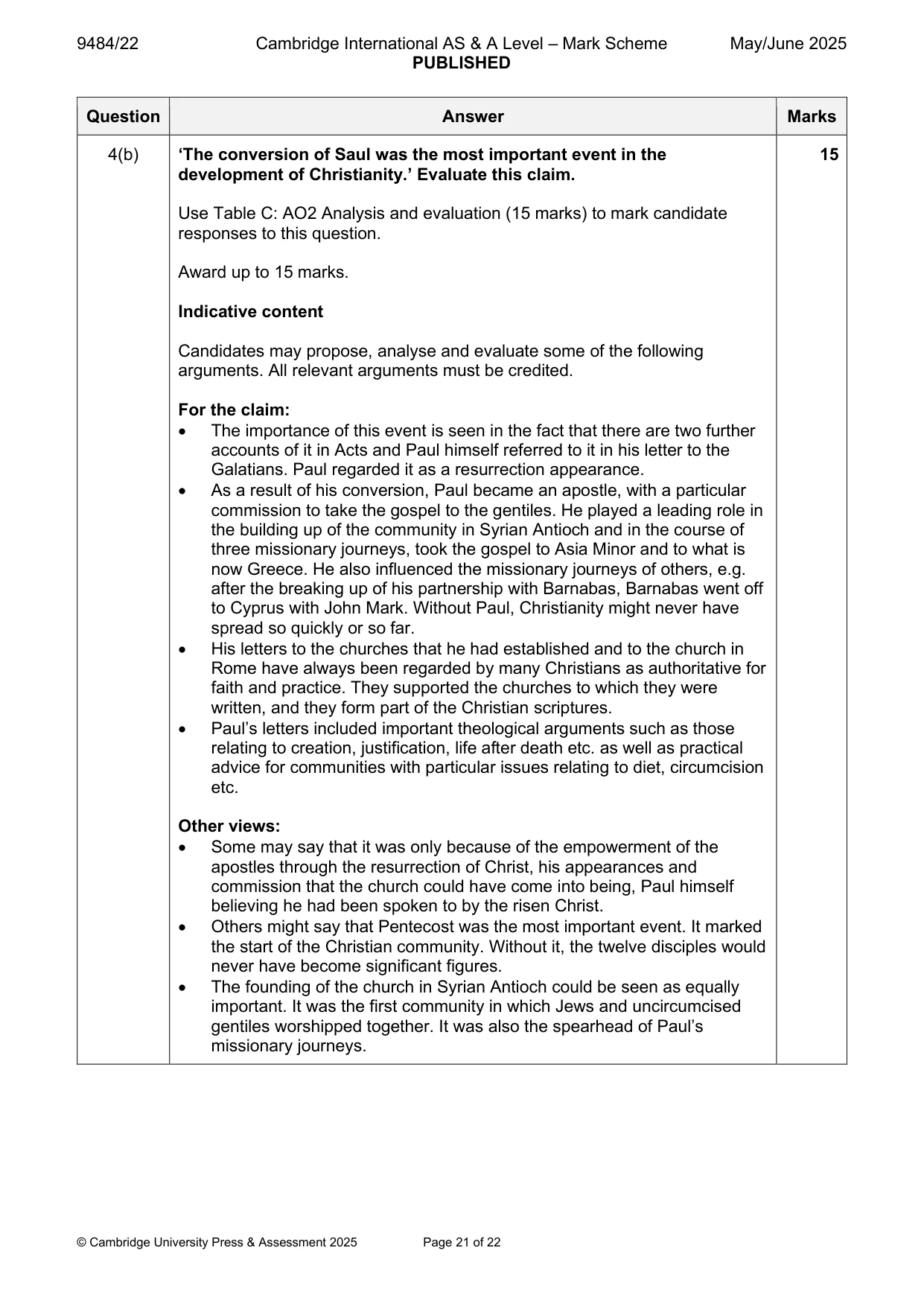
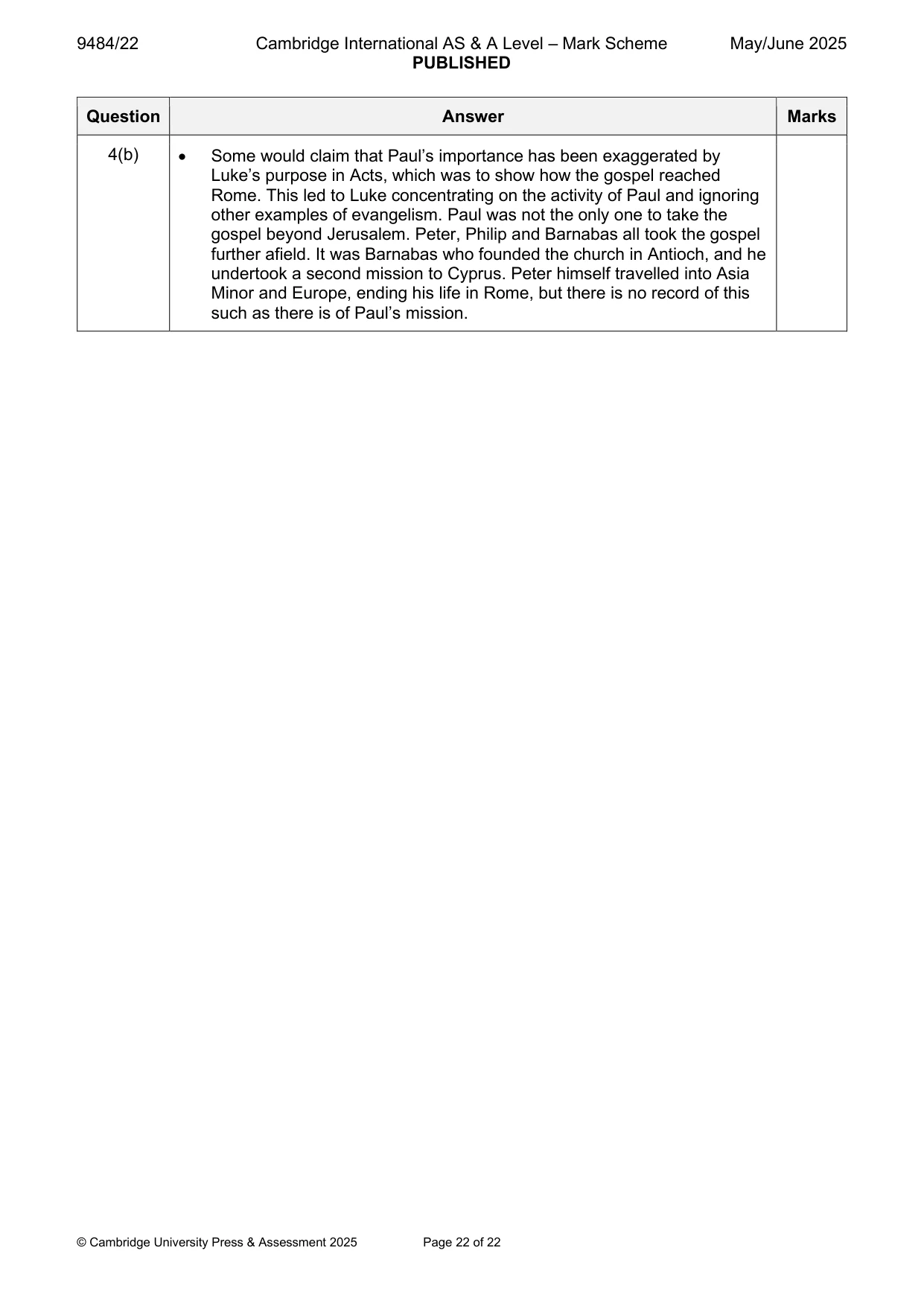
Mark scheme: 4(a) Outline significant aspects of the account of Saul’s conversion in 10 Acts 9. Use Table A: AO1 Knowledge and understanding (10 marks) to mark candidate responses to this question. Award up to 10 marks. Indicative content Answers may include some of the following ideas, but all relevant material must be credited. • In the course of his persecution of the Christian community, Saul obtained from the high priest letters to the Damascus synagogues that gave him permission to arrest and extradite any Christians found there to Jerusalem. The Christians in Damascus had perhaps been converted by Christians who had earlier fled from Jerusalem or by Jews who had been in Jerusalem for a festival or on business and been converted there. The name used for the community was ‘the Way’. This was a very Jewish phrase and was used of themselves by the Essene community in Qumran. • He was not far from Damascus when he had a vision of a blinding light that made him fall to the ground. He heard a voice calling him and responded with, ‘Who are you, Lord?’ By ‘Lord’, he may have meant no more than ‘sir’, but for both Luke and his readers, as well as for Paul after his conversion, the word signified the divine authority of Jesus. The reply was, ‘I am Jesus, whom you are persecuting’ and he was then told to go on to Damascus, where his commissioning would take place. This vision gave Saul the confidence that the event was divinely ordained. • Saul got up but could not see. Perhaps this was the shock of the experience, though it could have been the effect of the light. Those with him were bewildered as they had heard something but seen no one. They led him into Damascus, where he stayed with Judas on Straight Street, which was one of the main thoroughfares of the city. Details of the host with whom an apostle stayed is a feature of Acts. The account states that for three days he was unable to see or eat. This again was presumably due to his traumatic experience. The ‘three days’ may have been intended to symbolise the time between Jesus’ death and his resurrection. Paul was in a spiritual sense suffering the darkness of death before experiencing regeneration and resurrection through baptism. • In a vision, Ananias was told to go to Saul. Reference is made to the roles that Paul in fact played in the future as an apostle to the gentiles, appearing before kings (i.e. Agrippa II and Nero) and also preaching to Jews. Despite his fear that this was a trap, Ananias obeyed. The vision convinced him that the role he was about to play was divinely ordained. 4(a) • What happened next was typical of other accounts in Acts of conversions. The laying on of hands was associated with the person receiving the Holy Spirit. Saul was able to see and was baptized. He then ate and regained his strength. • There was an extreme change in Saul’s convictions, but he showed the same zeal and commitment to advancing Christianity as he had to annihilating it. Based on the account in Acts 9:1–19. 4(b) ‘The conversion of Saul was the most important event in the 15 development of Christianity.’ Evaluate this claim. Use Table C: AO2 Analysis and evaluation (15 marks) to mark candidate responses to this question. Award up to 15 marks. Indicative content Candidates may propose, analyse and evaluate some of the following arguments. All relevant arguments must be credited. For the claim: • The importance of this event is seen in the fact that there are two further accounts of it in Acts and Paul himself referred to it in his letter to the Galatians. Paul regarded it as a resurrection appearance. • As a result of his conversion, Paul became an apostle, with a particular commission to take the gospel to the gentiles. He played a leading role in the building up of the community in Syrian Antioch and in the course of three missionary journeys, took the gospel to Asia Minor and to what is now Greece. He also influenced the missionary journeys of others, e.g. after the breaking up of his partnership with Barnabas, Barnabas went off to Cyprus with John Mark. Without Paul, Christianity might never have spread so quickly or so far. • His letters to the churches that he had established and to the church in Rome have always been regarded by many Christians as authoritative for faith and practice. They supported the churches to which they were written, and they form part of the Christian scriptures. • Paul’s letters included important theological arguments such as those relating to creation, justification, life after death etc. as well as practical advice for communities with particular issues relating to diet, circumcision etc. Other views: • Some may say that it was only because of the empowerment of the apostles through the resurrection of Christ, his appearances and commission that the church could have come into being, Paul himself believing he had been spoken to by the risen Christ. • Others might say that Pentecost was the most important event. It marked the start of the Christian community. Without it, the twelve disciples would never have become significant figures. • The founding of the church in Syrian Antioch could be seen as equally important. It was the first community in which Jews and uncircumcised gentiles worshipped together. It was also the spearhead of Paul’s missionary journeys. 4(b) • Some would claim that Paul’s importance has been exaggerated by Luke’s purpose in Acts, which was to show how the gospel reached Rome. This led to Luke concentrating on the activity of Paul and ignoring other examples of evangelism. Paul was not the only one to take the gospel beyond Jerusalem. Peter, Philip and Barnabas all took the gospel further afield. It was Barnabas who founded the church in Antioch, and he undertook a second mission to Cyprus. Peter himself travelled into Asia Minor and Europe, ending his life in Rome, but there is no record of this such as there is of Paul’s mission.
What was in this paper
The subtopics covered by these 4 questions, and how many questions each got. Open one in a new tab to see every Cambridge question on it.
What you needed in this session
Cambridge’s own grade thresholds for 2025 May/June, Paper 2 · Variant 2. A higher threshold means an easier paper — the bar moves with how the cohort did.