Cambridge A Level Biblical Studies 9484 — 2023 May/June Paper 2 · Variant 2
9484/22/M/J/23 · 4 questions · 50 marks · ≈56 min
The question paper and its mark scheme, free to read here and free to download. This is Cambridge’s own paper, exactly as it was sat.
Question paper4 pages
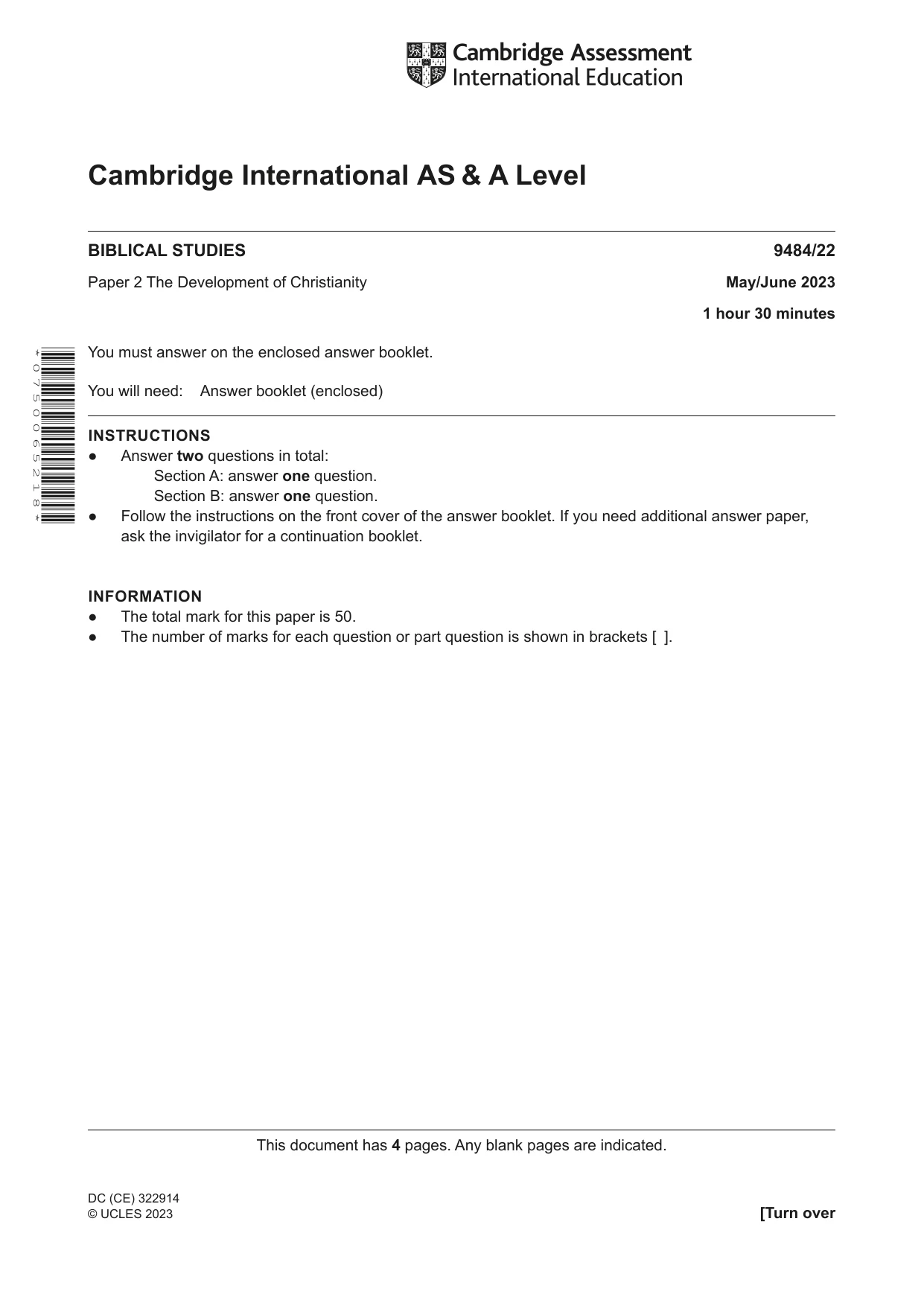
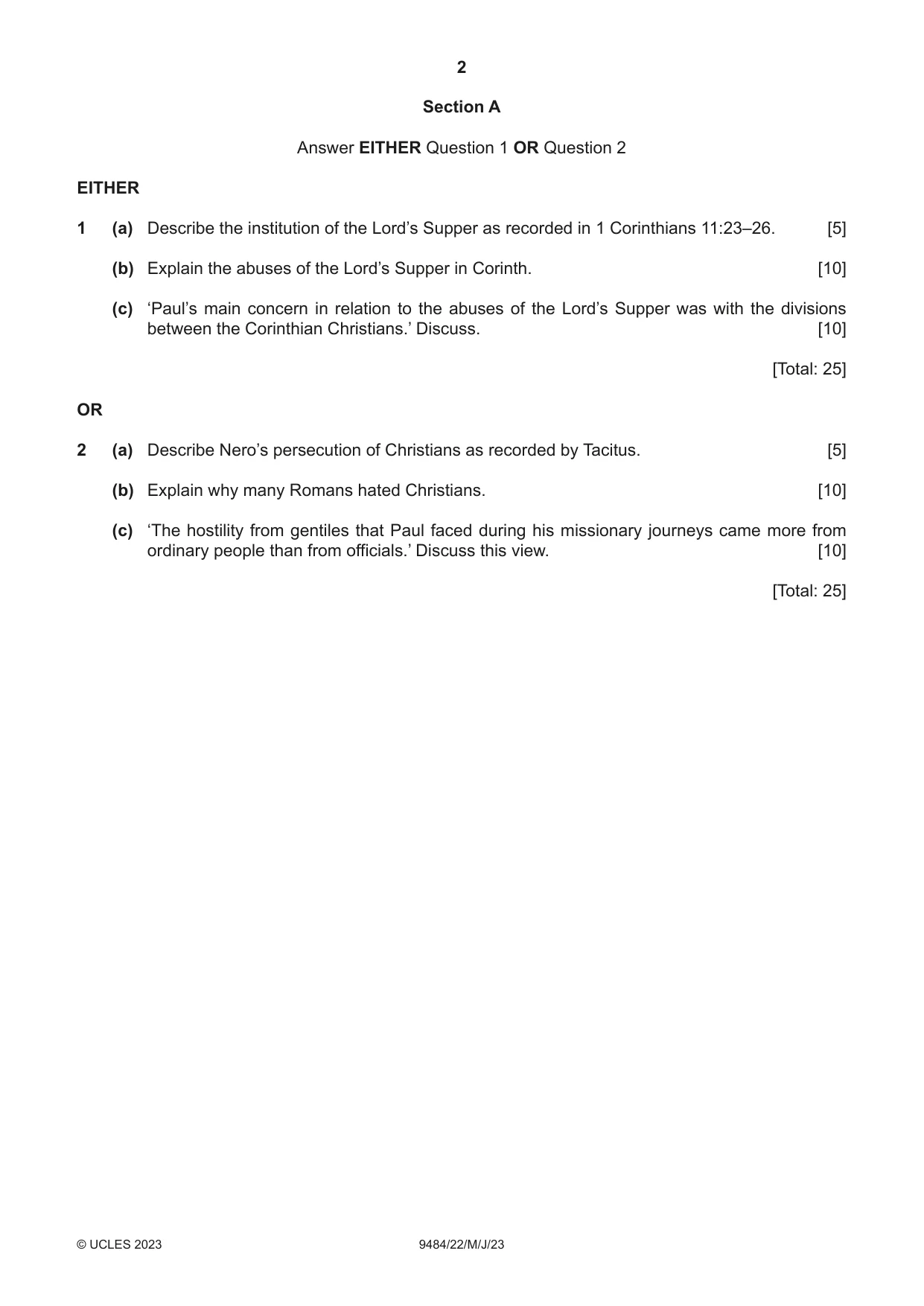
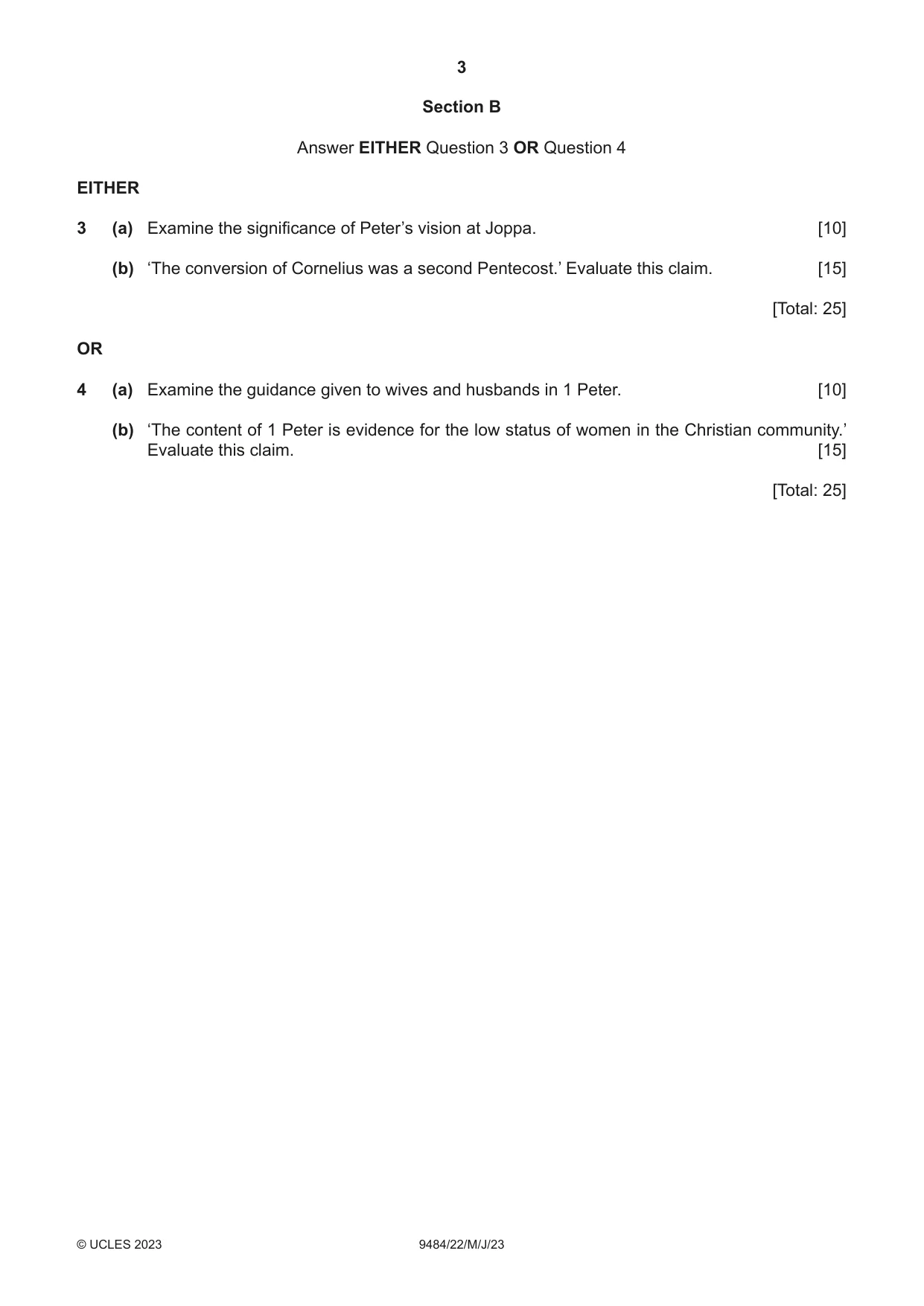

Mark scheme18 pages
Answers below. Sit the paper first if you are practising.
Questions as text
Q1 · Describe the institution of the Lord’s Supper as recorded in 1 Corinthians 11:23–26
1 (a) Describe the institution of the Lord’s Supper as recorded in 1 Corinthians 11:23–26. [5] (b) Explain the abuses of the Lord’s Supper in Corinth. [10] (c) ‘Paul’s main concern in relation to the abuses of the Lord’s Supper was with the divisions between the Corinthian Christians.’ Discuss. [10] [Total: 25] OR
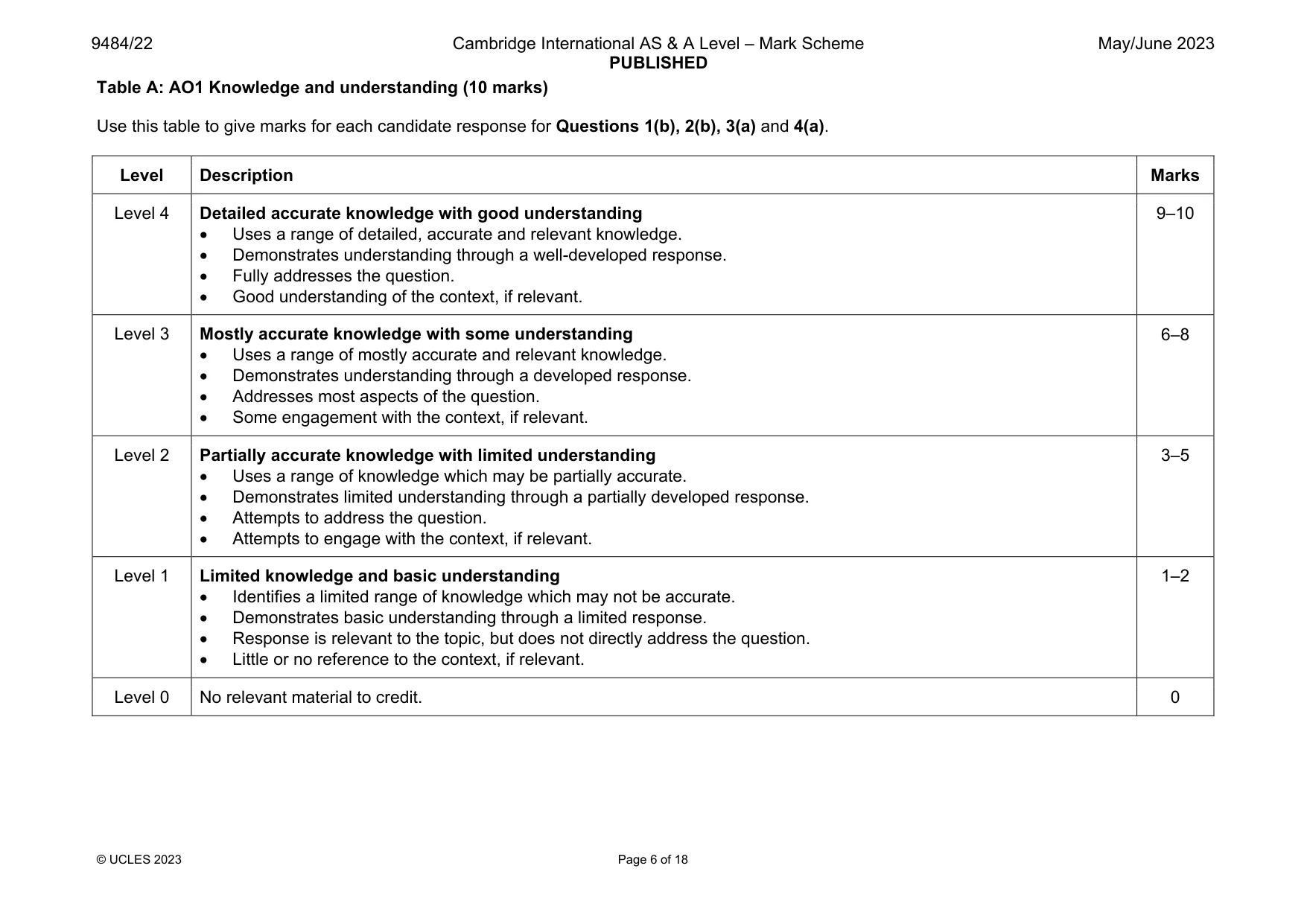
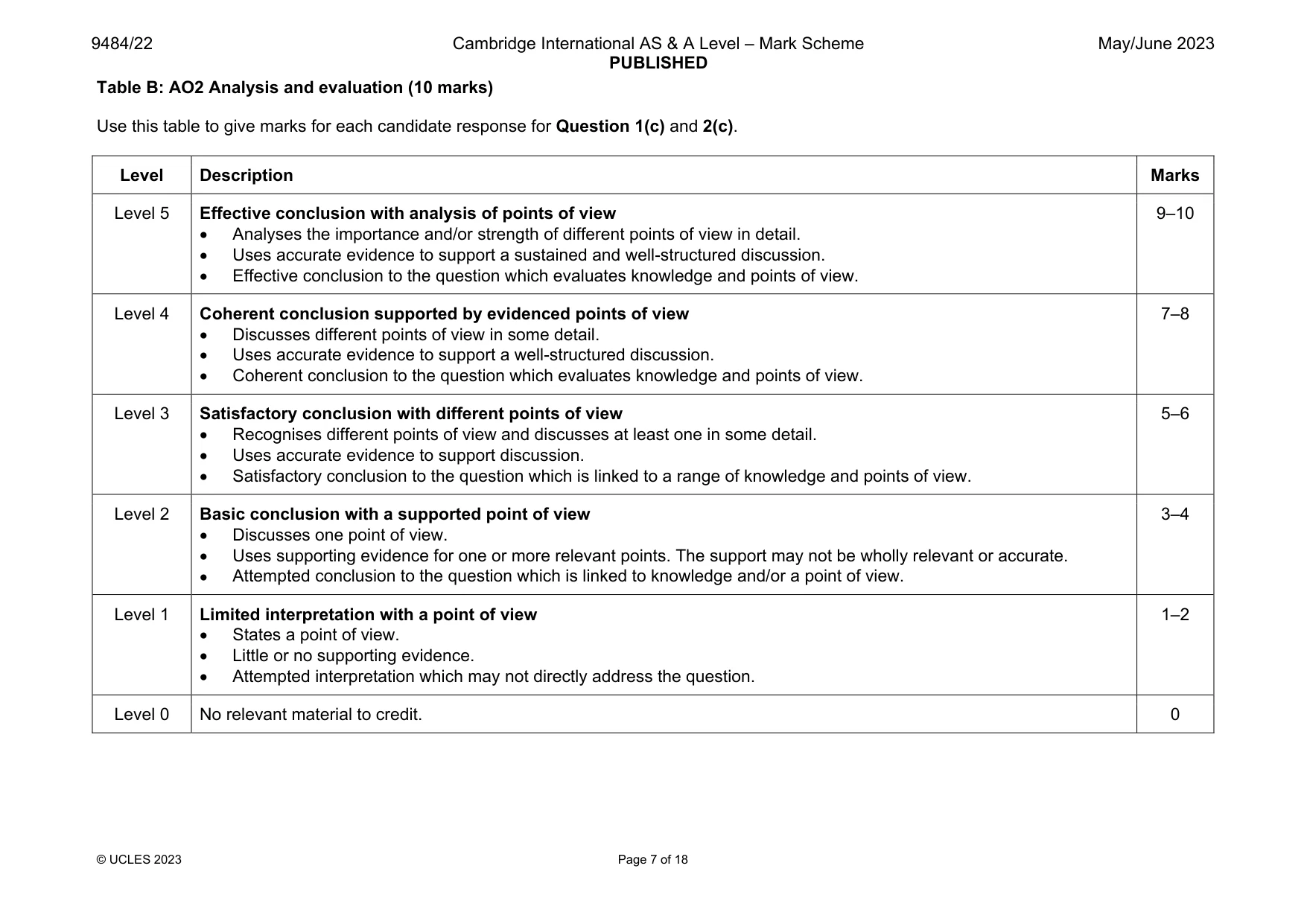
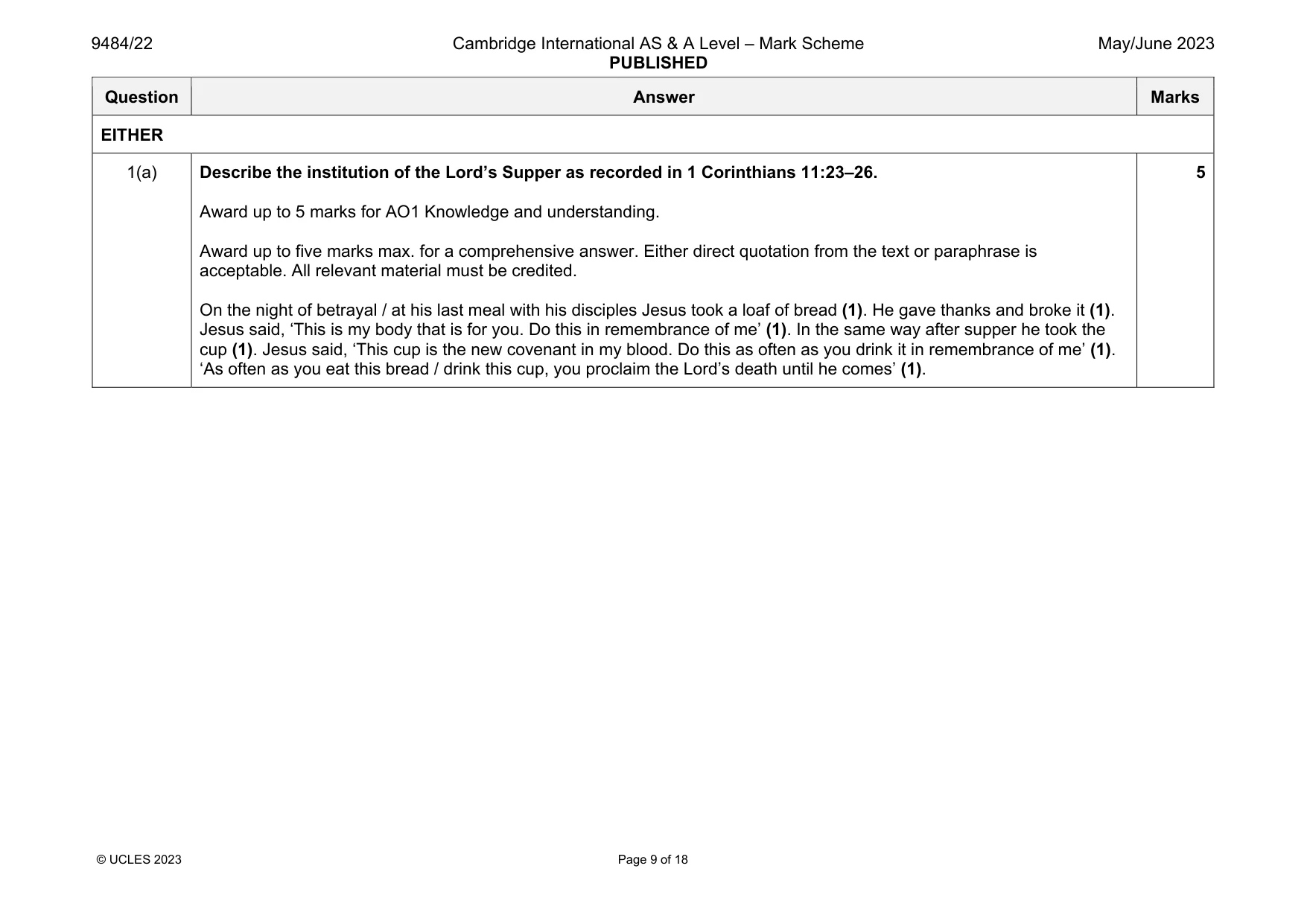
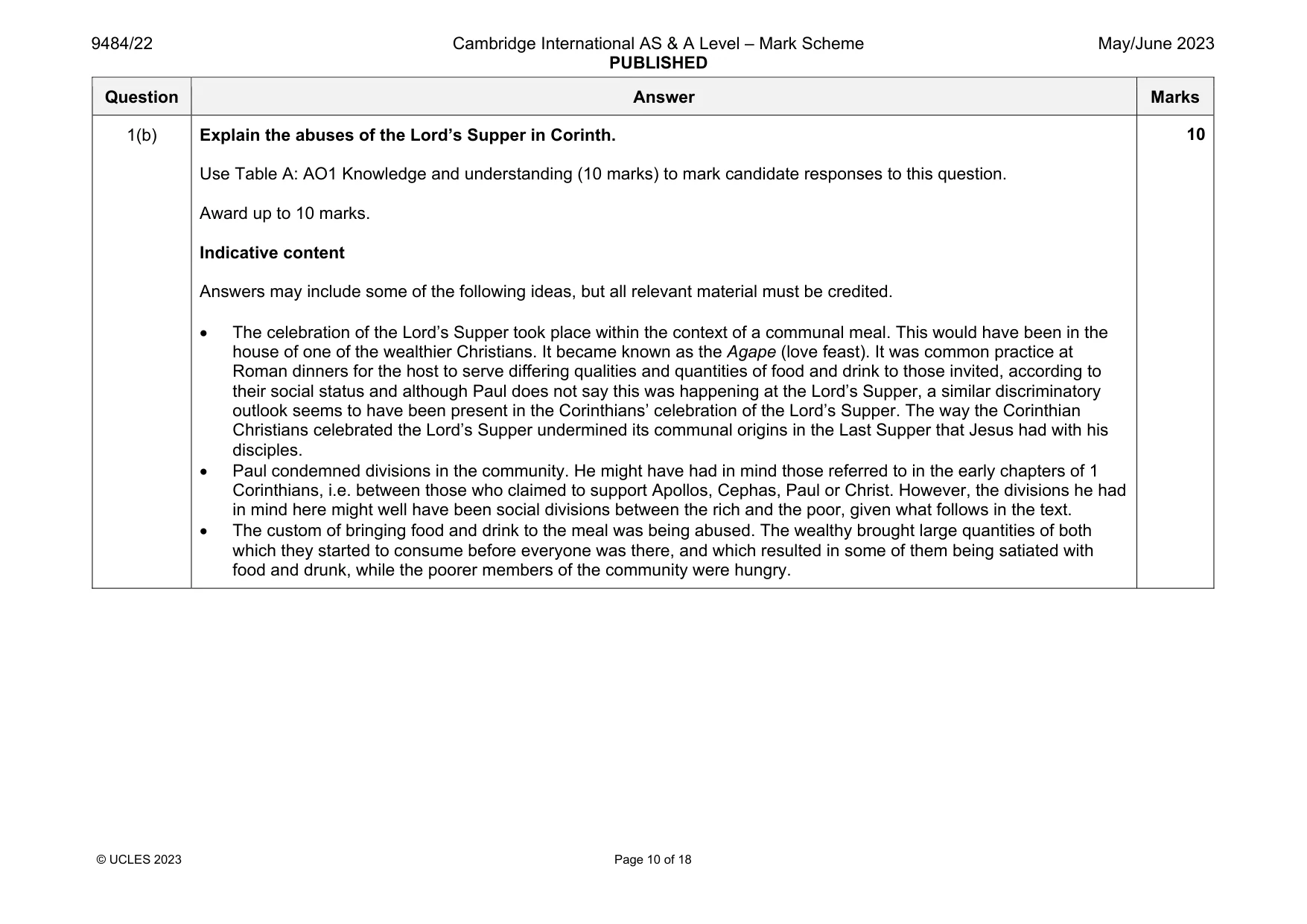
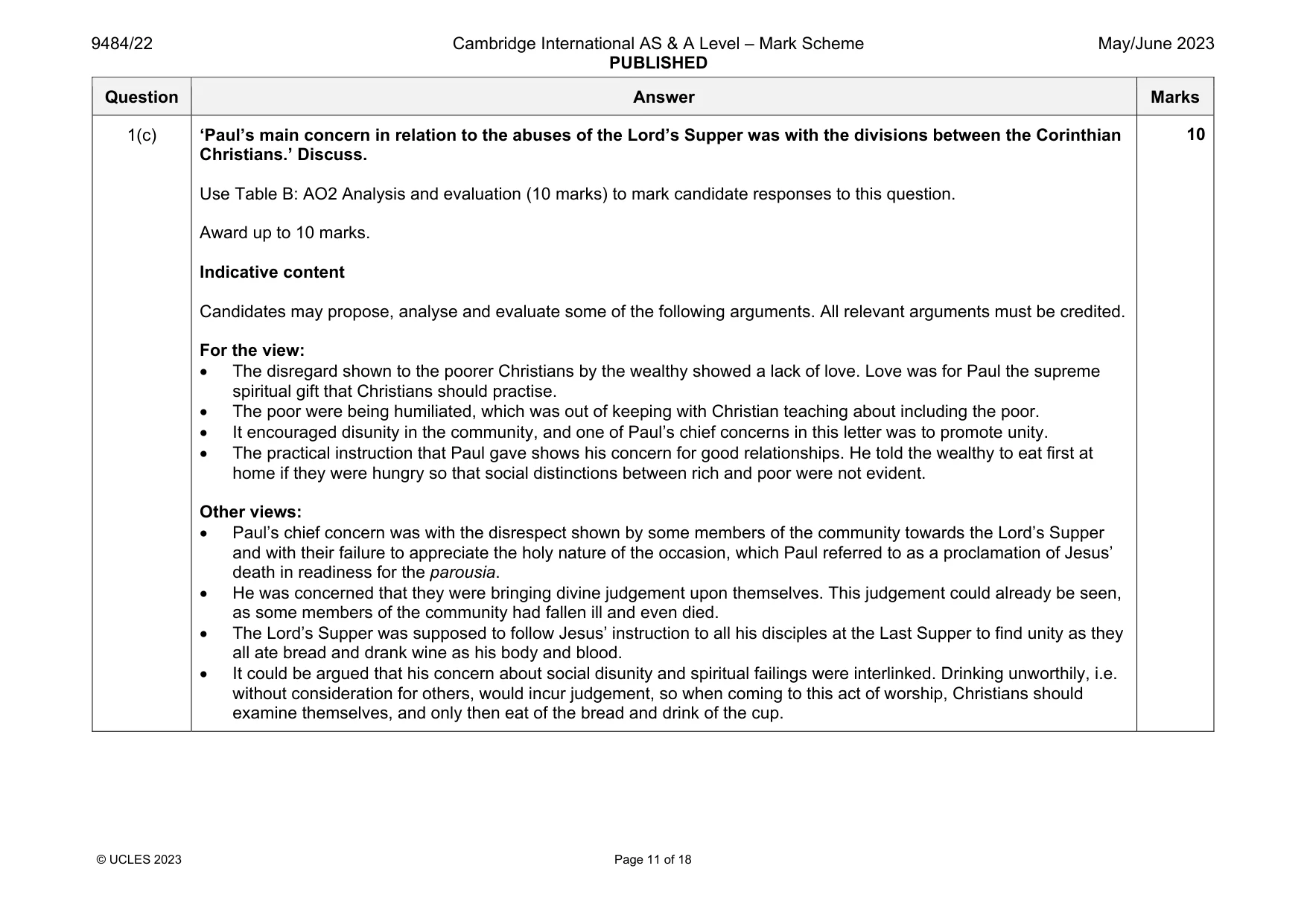
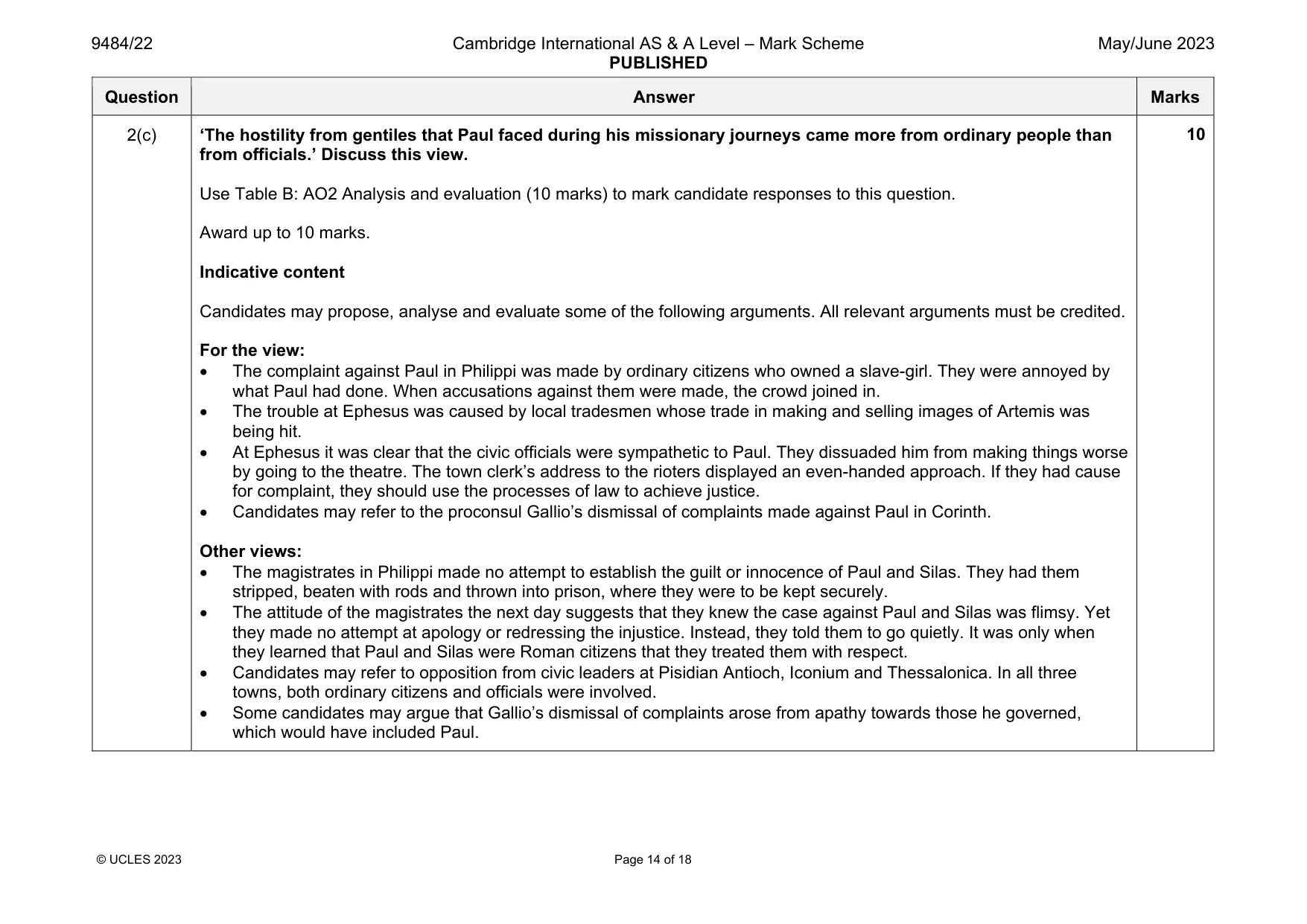
Mark scheme: 1(a) Describe the institution of the Lord’s Supper as recorded in 1 Corinthians 11:23–26. Award up to 5 marks for AO1 Knowledge and understanding. Award up to five marks max. for a comprehensive answer. Either direct quotation from the text or paraphrase is acceptable. All relevant material must be credited. On the night of betrayal / at his last meal with his disciples Jesus took a loaf of bread (1). He gave thanks and broke it (1). Jesus said, ‘This is my body that is for you. Do this in remembrance of me’ (1). In the same way after supper he took the cup (1). Jesus said, ‘This cup is the new covenant in my blood. Do this as often as you drink it in remembrance of me’ (1). ‘As often as you eat this bread / drink this cup, you proclaim the Lord’s death until he comes’ (1). Question Answer Marks 1(b) Explain the abuses of the Lord’s Supper in Corinth. Use Table A: AO1 Knowledge and understanding (10 marks) to mark candidate responses to this question. Award up to 10 marks. Indicative content Answers may include some of the following ideas, but all relevant material must be credited. The celebration of the Lord’s Supper took place within the context of a communal meal. This would have been in the house of one of the wealthier Christians. It became known as the Agape (love feast). It was common practice at Roman dinners for the host to serve differing qualities and quantities of food and drink to those invited, according to their social status and although Paul does not say this was happening at the Lord’s Supper, a similar discriminatory outlook seems to have been present in the Corinthians’ celebration of the Lord’s Supper. The way the Corinthian Christians celebrated the Lord’s Supper undermined its communal origins in the Last Supper that Jesus had with his disciples. Paul condemned divisions in the community. He might have had in mind those referred to in the early chapters of 1 Corinthians, i.e. between those who claimed to support Apollos, Cephas, Paul or Christ. However, the divisions he had in mind here might well have been social divisions between the rich and the poor, given what follows in the text. The custom of bringing food and drink to the meal was being abused. The wealthy brought large quantities of both which they started to consume before everyone was there, and which resulted in some of them being satiated with food and drunk, while the poorer members of the community were hungry. 10 Question Answer Marks 1(c) ‘Paul’s main concern in relation to the abuses of the Lord’s Supper was with the divisions between the Corinthian Christians.’ Discuss. Use Table B: AO2 Analysis and evaluation (10 marks) to mark candidate responses to this question. Award up to 10 marks. Indicative content Candidates may propose, analyse and evaluate some of the following arguments. All relevant arguments must be credited. For the view: The disregard shown to the poorer Christians by the wealthy showed a lack of love. Love was for Paul the supreme spiritual gift that Christians should practise. The poor were being humiliated, which was out of keeping with Christian teaching about including the poor. It encouraged disunity in the community, and one of Paul’s chief concerns in this letter was to promote unity. The practical instruction that Paul gave shows his concern for good relationships. He told the wealthy to eat first at home if they were hungry so that social distinctions between rich and poor were not evident. Other views: Paul’s chief concern was with the disrespect shown by some members of the community towards the Lord’s Supper and with their failure to appreciate the holy nature of the occasion, which Paul referred to as a proclamation of Jesus’ death in readiness for the parousia. He was concerned that they were bringing divine judgement upon themselves. This judgement could already be seen, as some members of the community had fallen ill and even died. The Lord’s Supper was supposed to follow Jesus’ instruction to all his disciples at the Last Supper to find unity as they all ate bread and drank wine as his body and blood. It could be argued that his concern about social disunity and spiritual failings were interlinked. Drinking unworthily, i.e. without consideration for others, would incur judgement, so when coming to this act of worship, Christians should examine themselves, and only then eat of the bread and drink of the cup. 10
Q2 · Describe Nero’s persecution of Christians as recorded by Tacitus
2 (a) Describe Nero’s persecution of Christians as recorded by Tacitus. [5] (b) Explain why many Romans hated Christians. [10] (c) ‘The hostility from gentiles that Paul faced during his missionary journeys came more from ordinary people than from officials.’ Discuss this view. [10] [Total: 25]
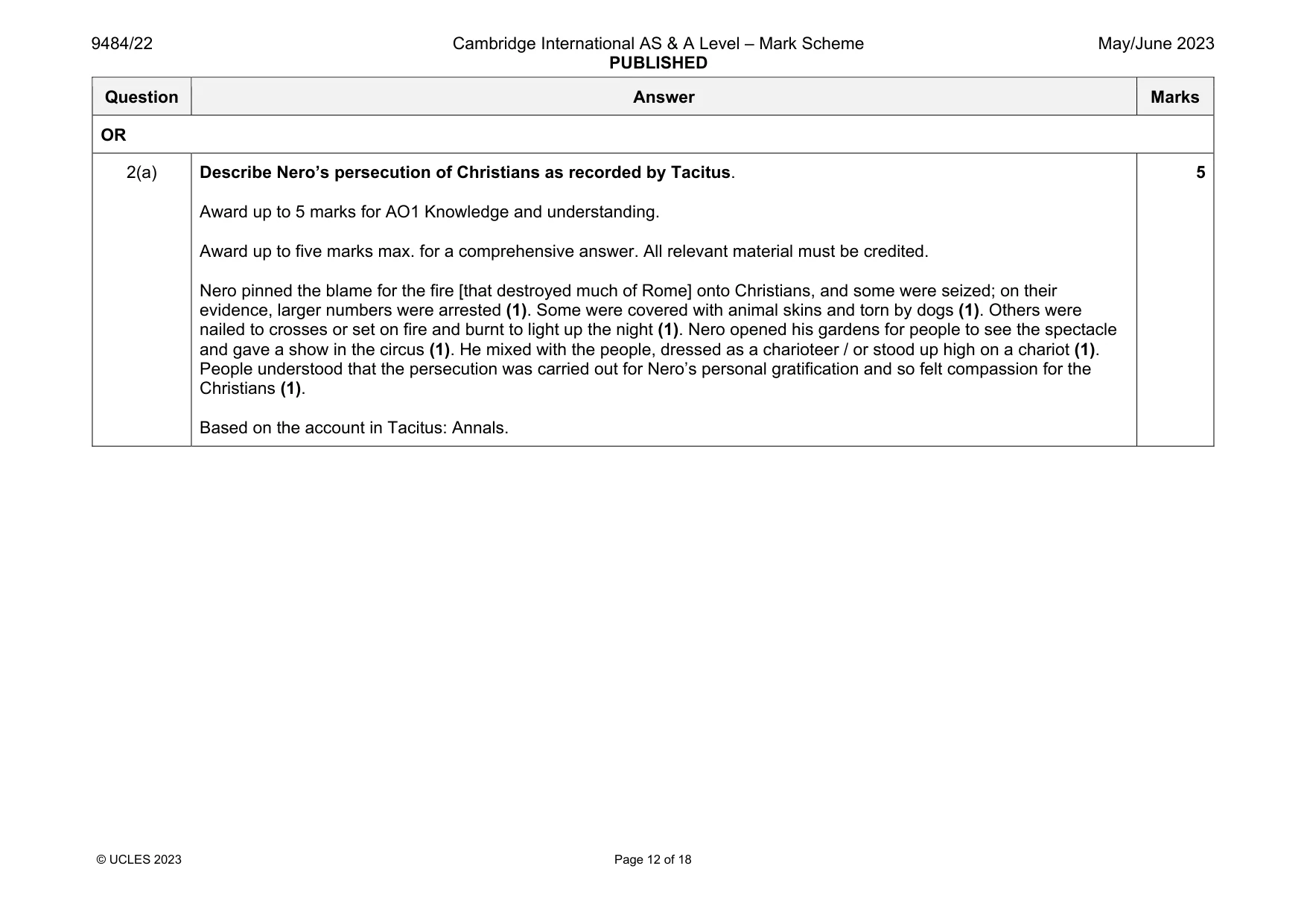
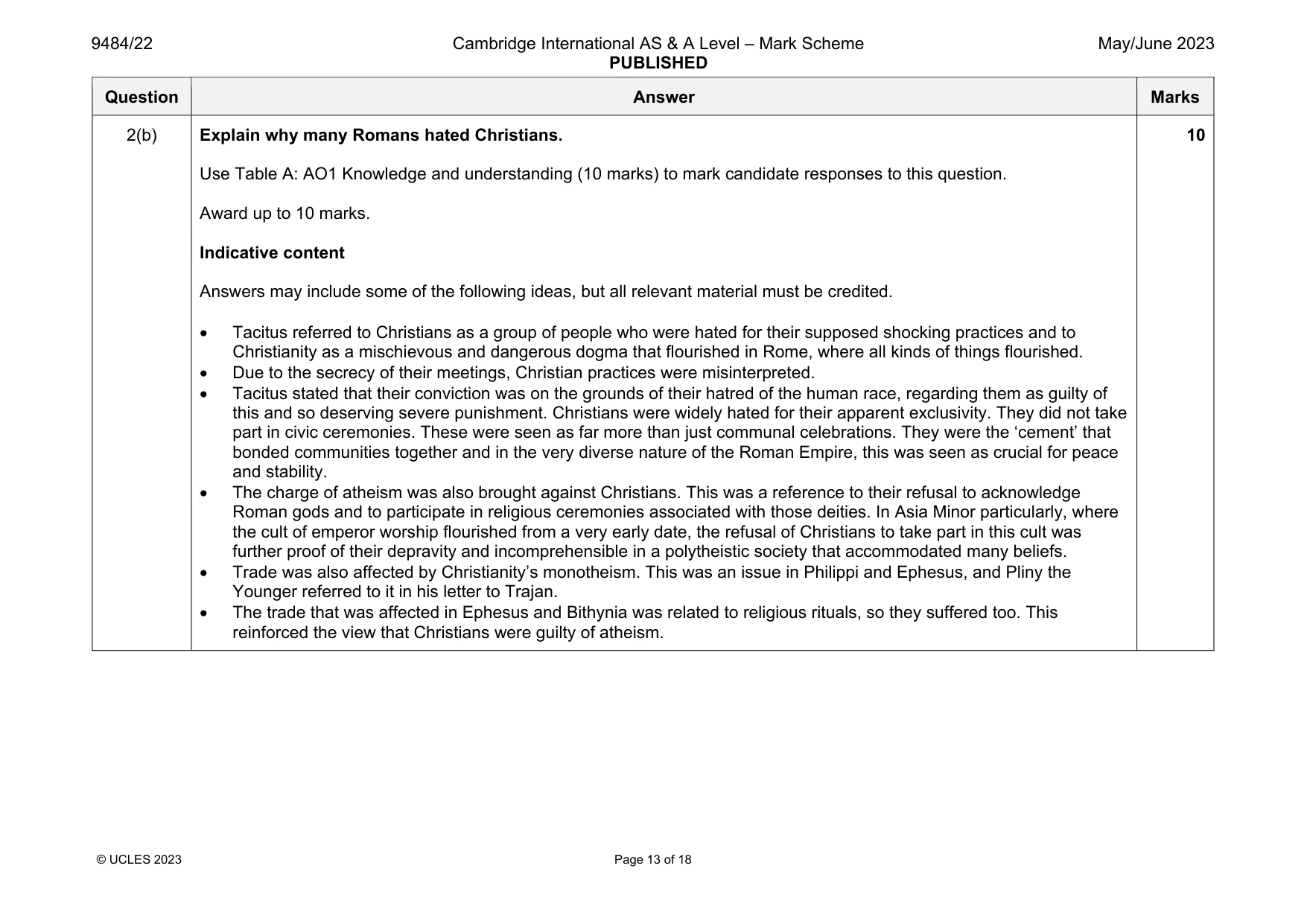
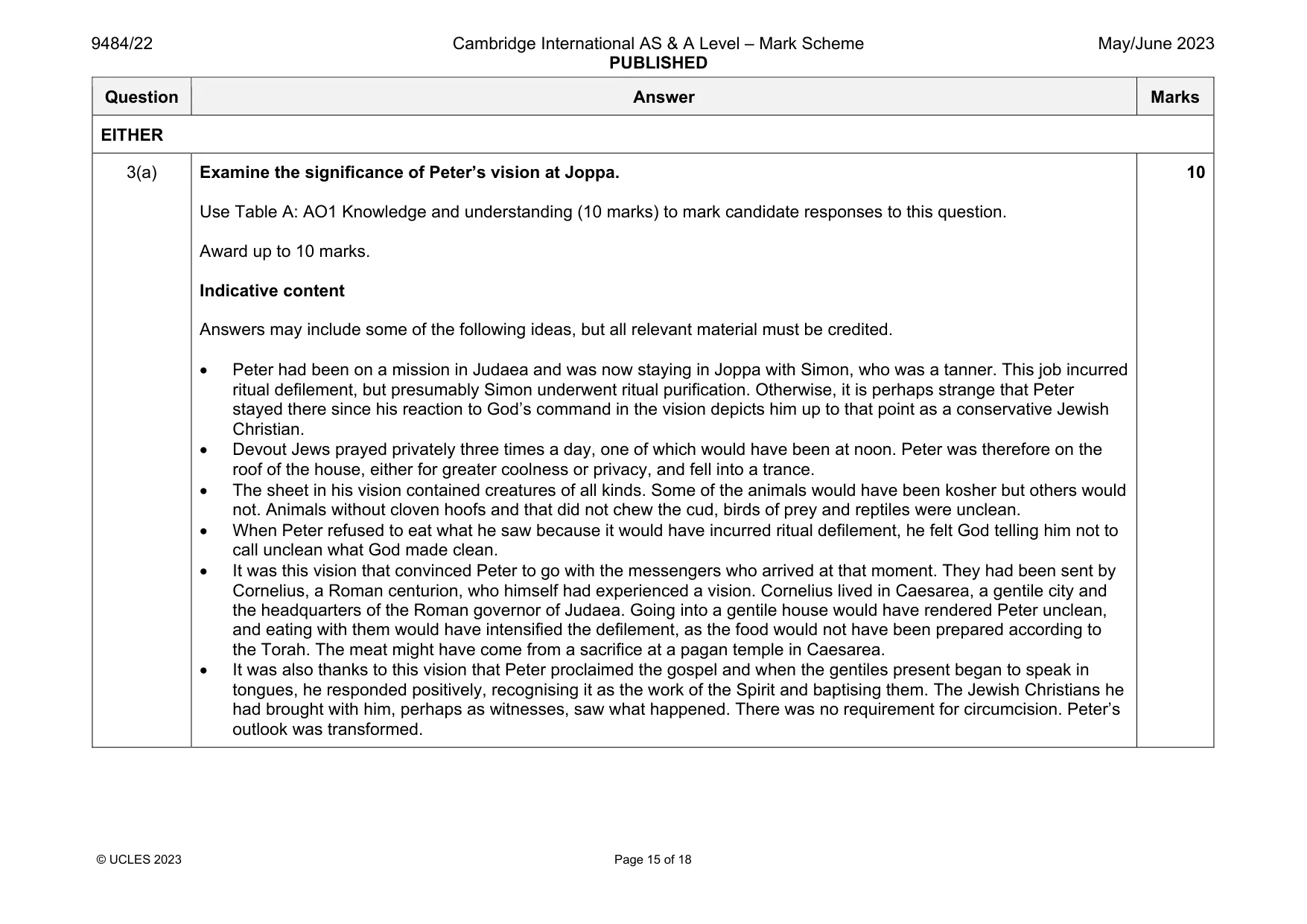
Mark scheme: 2(a) Describe Nero’s persecution of Christians as recorded by Tacitus. Award up to 5 marks for AO1 Knowledge and understanding. Award up to five marks max. for a comprehensive answer. All relevant material must be credited. Nero pinned the blame for the fire [that destroyed much of Rome] onto Christians, and some were seized; on their evidence, larger numbers were arrested (1). Some were covered with animal skins and torn by dogs (1). Others were nailed to crosses or set on fire and burnt to light up the night (1). Nero opened his gardens for people to see the spectacle and gave a show in the circus (1). He mixed with the people, dressed as a charioteer / or stood up high on a chariot (1). People understood that the persecution was carried out for Nero’s personal gratification and so felt compassion for the Christians (1). Based on the account in Tacitus: Annals. Question Answer Marks 2(b) Explain why many Romans hated Christians. Use Table A: AO1 Knowledge and understanding (10 marks) to mark candidate responses to this question. Award up to 10 marks. Indicative content Answers may include some of the following ideas, but all relevant material must be credited. Tacitus referred to Christians as a group of people who were hated for their supposed shocking practices and to Christianity as a mischievous and dangerous dogma that flourished in Rome, where all kinds of things flourished. Due to the secrecy of their meetings, Christian practices were misinterpreted. Tacitus stated that their conviction was on the grounds of their hatred of the human race, regarding them as guilty of this and so deserving severe punishment. Christians were widely hated for their apparent exclusivity. They did not take part in civic ceremonies. These were seen as far more than just communal celebrations. They were the ‘cement’ that bonded communities together and in the very diverse nature of the Roman Empire, this was seen as crucial for peace and stability. The charge of atheism was also brought against Christians. This was a reference to their refusal to acknowledge Roman gods and to participate in religious ceremonies associated with those deities. In Asia Minor particularly, where the cult of emperor worship flourished from a very early date, the refusal of Christians to take part in this cult was further proof of their depravity and incomprehensible in a polytheistic society that accommodated many beliefs. Trade was also affected by Christianity’s monotheism. This was an issue in Philippi and Ephesus, and Pliny the Younger referred to it in his letter to Trajan. The trade that was affected in Ephesus and Bithynia was related to religious rituals, so they suffered too. This reinforced the view that Christians were guilty of atheism. 10 Question Answer Marks 2(c) ‘The hostility from gentiles that Paul faced during his missionary journeys came more from ordinary people than from officials.’ Discuss this view. Use Table B: AO2 Analysis and evaluation (10 marks) to mark candidate responses to this question. Award up to 10 marks. Indicative content Candidates may propose, analyse and evaluate some of the following arguments. All relevant arguments must be credited. For the view: The complaint against Paul in Philippi was made by ordinary citizens who owned a slave-girl. They were annoyed by what Paul had done. When accusations against them were made, the crowd joined in. The trouble at Ephesus was caused by local tradesmen whose trade in making and selling images of Artemis was being hit. At Ephesus it was clear that the civic officials were sympathetic to Paul. They dissuaded him from making things worse by going to the theatre. The town clerk’s address to the rioters displayed an even-handed approach. If they had cause for complaint, they should use the processes of law to achieve justice. Candidates may refer to the proconsul Gallio’s dismissal of complaints made against Paul in Corinth. Other views: The magistrates in Philippi made no attempt to establish the guilt or innocence of Paul and Silas. They had them stripped, beaten with rods and thrown into prison, where they were to be kept securely. The attitude of the magistrates the next day suggests that they knew the case against Paul and Silas was flimsy. Yet they made no attempt at apology or redressing the injustice. Instead, they told them to go quietly. It was only when they learned that Paul and Silas were Roman citizens that they treated them with respect. Candidates may refer to opposition from civic leaders at Pisidian Antioch, Iconium and Thessalonica. In all three towns, both ordinary citizens and officials were involved. Some candidates may argue that Gallio’s dismissal of complaints arose from apathy towards those he governed, which would have included Paul. 10
Q3 · Examine the significance of Peter’s vision at Joppa
3 (a) Examine the significance of Peter’s vision at Joppa. [10] (b) ‘The conversion of Cornelius was a second Pentecost.’ Evaluate this claim. [15] [Total: 25] OR
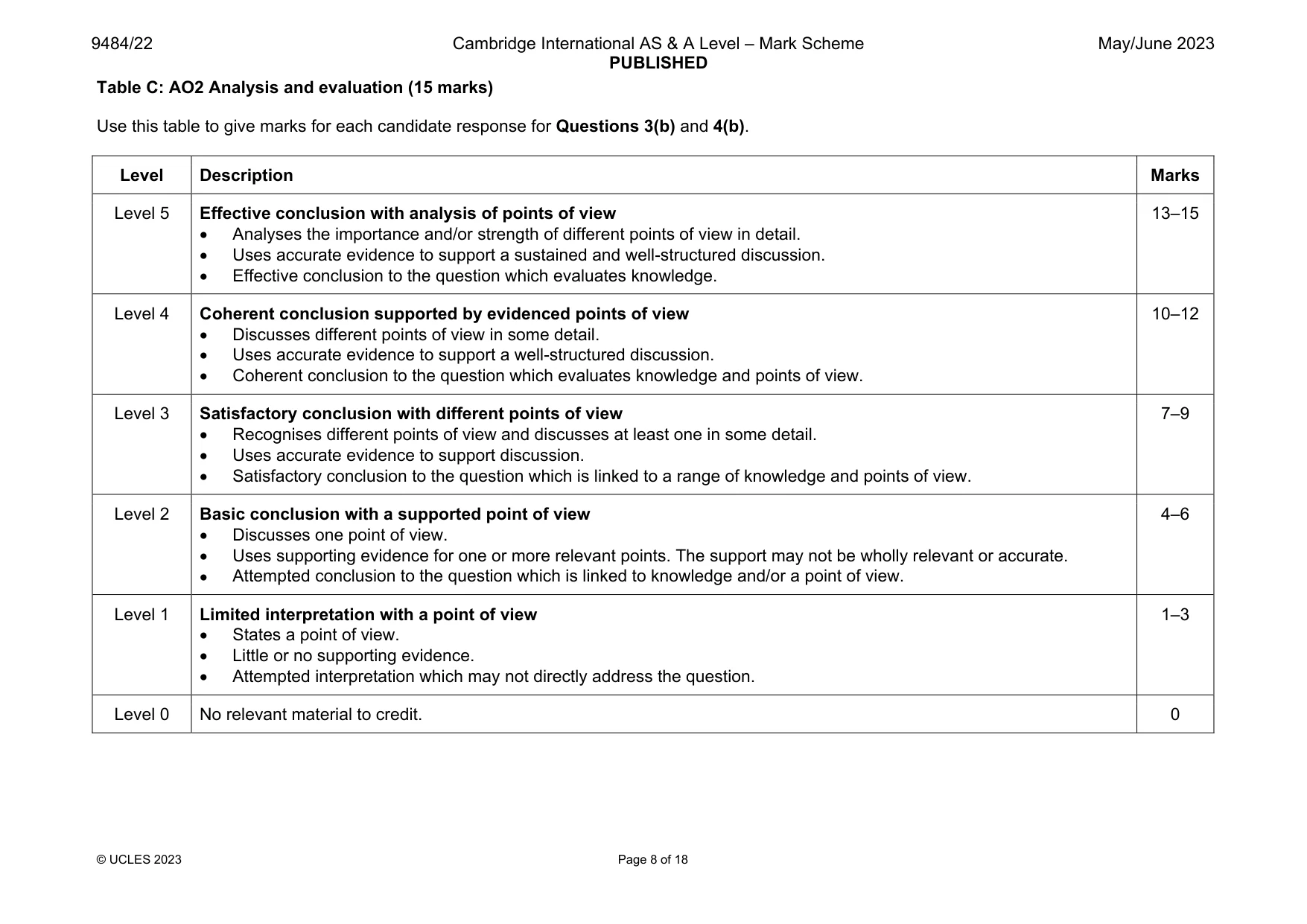
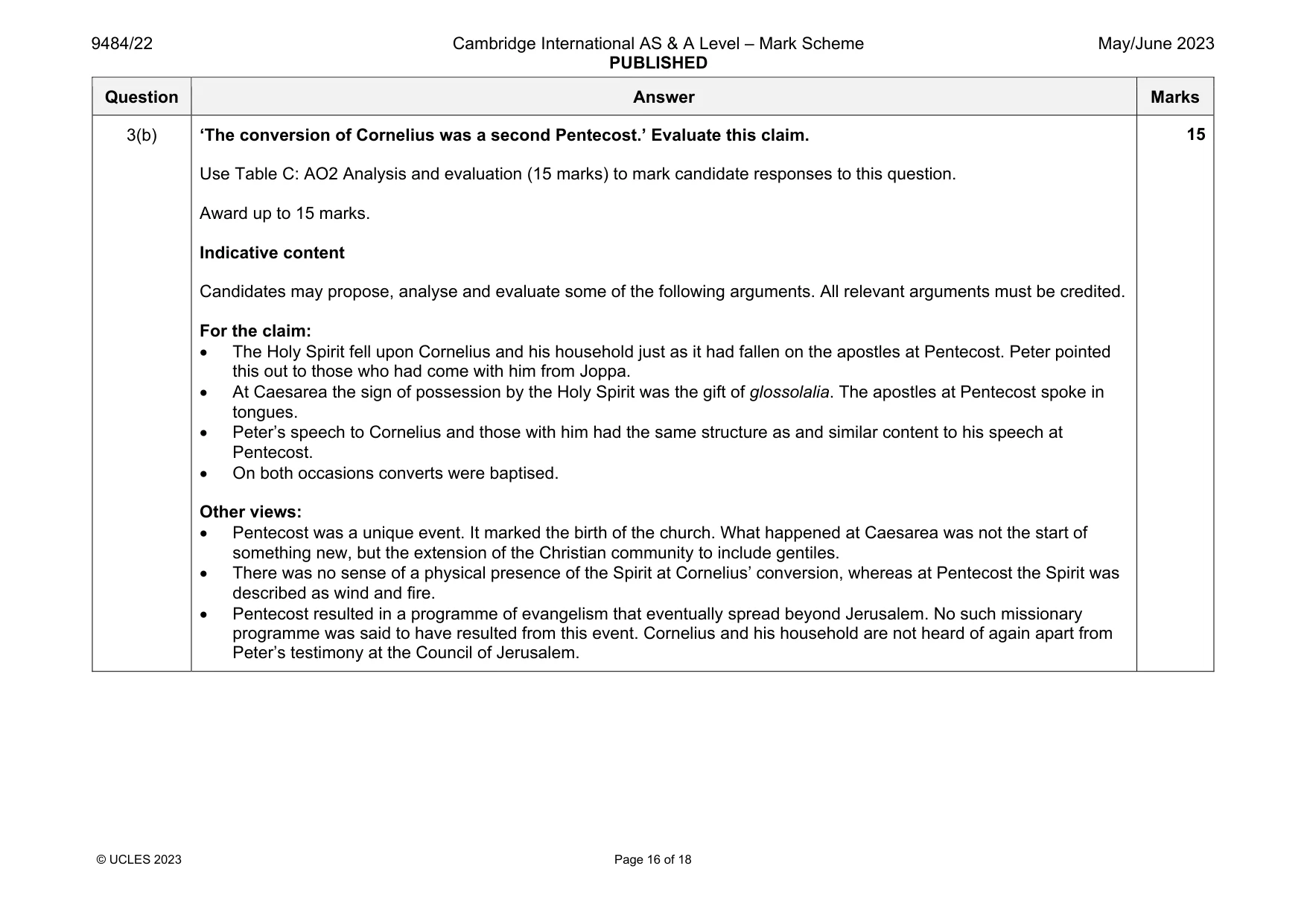
Mark scheme: 3(a) Examine the significance of Peter’s vision at Joppa. Use Table A: AO1 Knowledge and understanding (10 marks) to mark candidate responses to this question. Award up to 10 marks. Indicative content Answers may include some of the following ideas, but all relevant material must be credited. Peter had been on a mission in Judaea and was now staying in Joppa with Simon, who was a tanner. This job incurred ritual defilement, but presumably Simon underwent ritual purification. Otherwise, it is perhaps strange that Peter stayed there since his reaction to God’s command in the vision depicts him up to that point as a conservative Jewish Christian. Devout Jews prayed privately three times a day, one of which would have been at noon. Peter was therefore on the roof of the house, either for greater coolness or privacy, and fell into a trance. The sheet in his vision contained creatures of all kinds. Some of the animals would have been kosher but others would not. Animals without cloven hoofs and that did not chew the cud, birds of prey and reptiles were unclean. When Peter refused to eat what he saw because it would have incurred ritual defilement, he felt God telling him not to call unclean what God made clean. It was this vision that convinced Peter to go with the messengers who arrived at that moment. They had been sent by Cornelius, a Roman centurion, who himself had experienced a vision. Cornelius lived in Caesarea, a gentile city and the headquarters of the Roman governor of Judaea. Going into a gentile house would have rendered Peter unclean, and eating with them would have intensified the defilement, as the food would not have been prepared according to the Torah. The meat might have come from a sacrifice at a pagan temple in Caesarea. It was also thanks to this vision that Peter proclaimed the gospel and when the gentiles present began to speak in tongues, he responded positively, recognising it as the work of the Spirit and baptising them. The Jewish Christians he had brought with him, perhaps as witnesses, saw what happened. There was no requirement for circumcision. Peter’s outlook was transformed. Question Answer Marks 3(b) ‘The conversion of Cornelius was a second Pentecost.’ Evaluate this claim. Use Table C: AO2 Analysis and evaluation (15 marks) to mark candidate responses to this question. Award up to 15 marks. Indicative content Candidates may propose, analyse and evaluate some of the following arguments. All relevant arguments must be credited. For the claim: The Holy Spirit fell upon Cornelius and his household just as it had fallen on the apostles at Pentecost. Peter pointed this out to those who had come with him from Joppa. At Caesarea the sign of possession by the Holy Spirit was the gift of glossolalia. The apostles at Pentecost spoke in tongues. Peter’s speech to Cornelius and those with him had the same structure as and similar content to his speech at Pentecost. On both occasions converts were baptised. Other views: Pentecost was a unique event. It marked the birth of the church. What happened at Caesarea was not the start of something new, but the extension of the Christian community to include gentiles. There was no sense of a physical presence of the Spirit at Cornelius’ conversion, whereas at Pentecost the Spirit was described as wind and fire. Pentecost resulted in a programme of evangelism that eventually spread beyond Jerusalem. No such missionary programme was said to have resulted from this event. Cornelius and his household are not heard of again apart from Peter’s testimony at the Council of Jerusalem. 15
Q4 · Examine the guidance given to wives and husbands in 1 Peter
4 (a) Examine the guidance given to wives and husbands in 1 Peter. [10] (b) ‘The content of 1 Peter is evidence for the low status of women in the Christian community.’ Evaluate this claim. [15] [Total: 25]
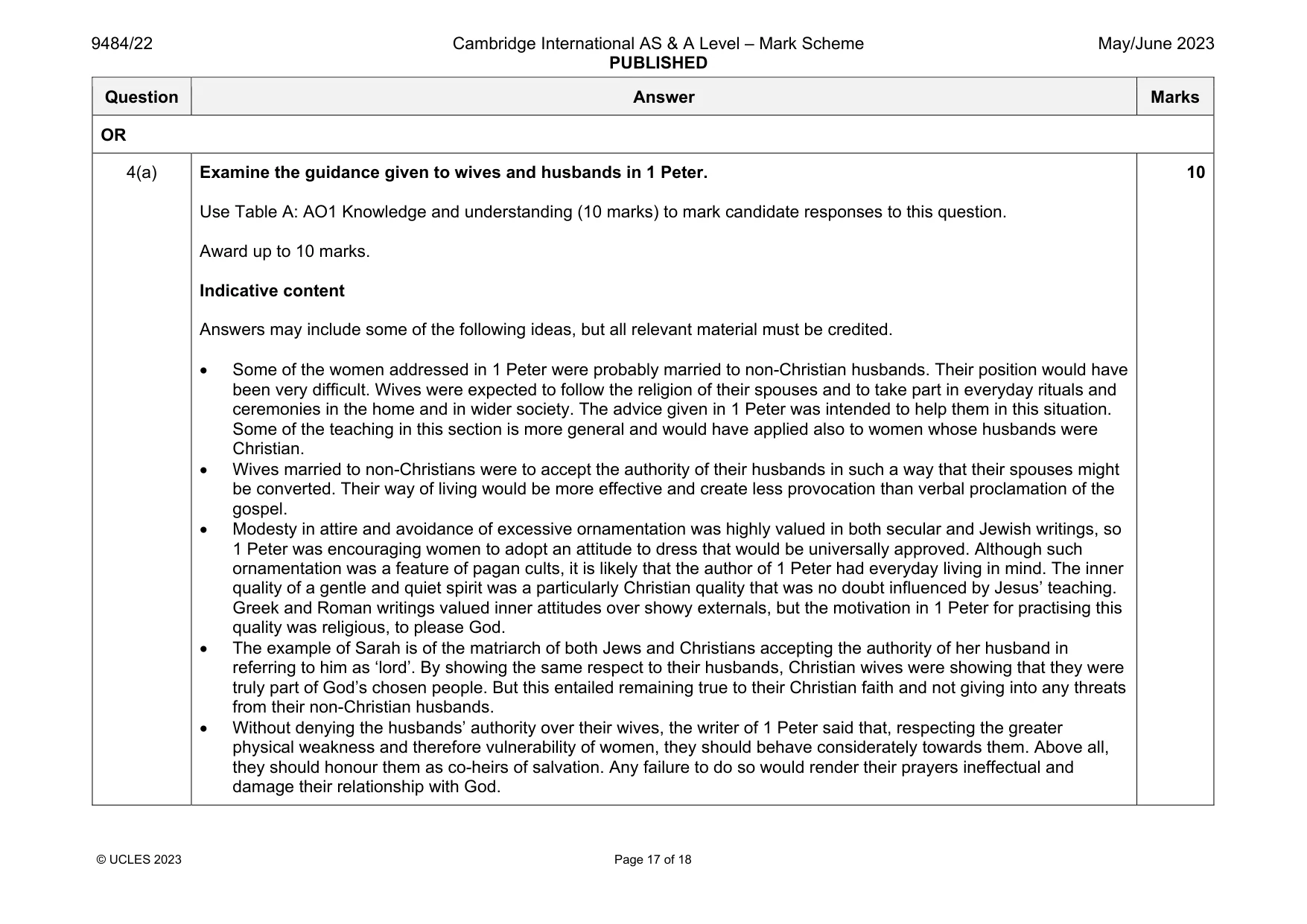
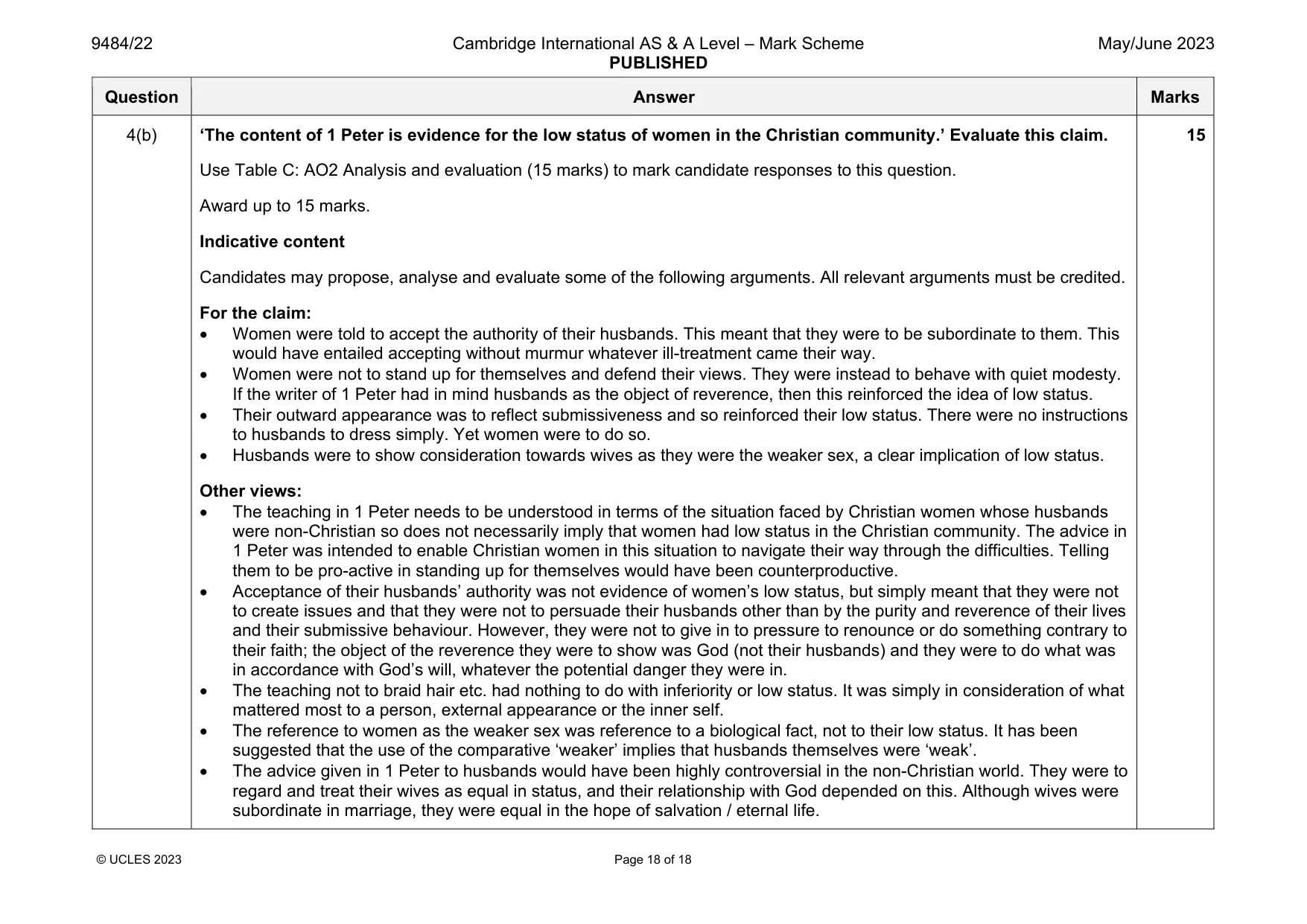
Mark scheme: 4(a) Examine the guidance given to wives and husbands in 1 Peter. Use Table A: AO1 Knowledge and understanding (10 marks) to mark candidate responses to this question. Award up to 10 marks. Indicative content Answers may include some of the following ideas, but all relevant material must be credited. Some of the women addressed in 1 Peter were probably married to non-Christian husbands. Their position would have been very difficult. Wives were expected to follow the religion of their spouses and to take part in everyday rituals and ceremonies in the home and in wider society. The advice given in 1 Peter was intended to help them in this situation. Some of the teaching in this section is more general and would have applied also to women whose husbands were Christian. Wives married to non-Christians were to accept the authority of their husbands in such a way that their spouses might be converted. Their way of living would be more effective and create less provocation than verbal proclamation of the gospel. Modesty in attire and avoidance of excessive ornamentation was highly valued in both secular and Jewish writings, so 1 Peter was encouraging women to adopt an attitude to dress that would be universally approved. Although such ornamentation was a feature of pagan cults, it is likely that the author of 1 Peter had everyday living in mind. The inner quality of a gentle and quiet spirit was a particularly Christian quality that was no doubt influenced by Jesus’ teaching. Greek and Roman writings valued inner attitudes over showy externals, but the motivation in 1 Peter for practising this quality was religious, to please God. The example of Sarah is of the matriarch of both Jews and Christians accepting the authority of her husband in referring to him as ‘lord’. By showing the same respect to their husbands, Christian wives were showing that they were truly part of God’s chosen people. But this entailed remaining true to their Christian faith and not giving into any threats from their non-Christian husbands. Without denying the husbands’ authority over their wives, the writer of 1 Peter said that, respecting the greater physical weakness and therefore vulnerability of women, they should behave considerately towards them. Above all, they should honour them as co-heirs of salvation. Any failure to do so would render their prayers ineffectual and damage their relationship with God. Question Answer Marks 4(b) ‘The content of 1 Peter is evidence for the low status of women in the Christian community.’ Evaluate this claim. Use Table C: AO2 Analysis and evaluation (15 marks) to mark candidate responses to this question. Award up to 15 marks. Indicative content Candidates may propose, analyse and evaluate some of the following arguments. All relevant arguments must be credited. For the claim: Women were told to accept the authority of their husbands. This meant that they were to be subordinate to them. This would have entailed accepting without murmur whatever ill-treatment came their way. Women were not to stand up for themselves and defend their views. They were instead to behave with quiet modesty. If the writer of 1 Peter had in mind husbands as the object of reverence, then this reinforced the idea of low status. Their outward appearance was to reflect submissiveness and so reinforced their low status. There were no instructions to husbands to dress simply. Yet women were to do so. Husbands were to show consideration towards wives as they were the weaker sex, a clear implication of low status. Other views: The teaching in 1 Peter needs to be understood in terms of the situation faced by Christian women whose husbands were non-Christian so does not necessarily imply that women had low status in the Christian community. The advice in 1 Peter was intended to enable Christian women in this situation to navigate their way through the difficulties. Telling them to be pro-active in standing up for themselves would have been counterproductive. Acceptance of their husbands’ authority was not evidence of women’s low status, but simply meant that they were not to create issues and that they were not to persuade their husbands other than by the purity and reverence of their lives and their submissive behaviour. However, they were not to give in to pressure to renounce or do something contrary to their faith; the object of the reverence they were to show was God (not their husbands) and they were to do what was in accordance with God’s will, whatever the potential danger they were in. The teaching not to braid hair etc. had nothing to do with inferiority or low status. It was simply in consideration of what mattered most to a person, external appearance or the inner self. The reference to women as the weaker sex was reference to a biological fact, not to their low status. It has been suggested that the use of the comparative ‘weaker’ implies that husbands themselves were ‘weak’. The advice given in 1 Peter to husbands would have been highly controversial in the non-Christian world. They were to regard and treat their wives as equal in status, and their relationship with God depended on this. Although wives were subordinate in marriage, they were equal in the hope of salvation / eternal life. 15
What was in this paper
The subtopics covered by these 4 questions, and how many questions each got. Open one in a new tab to see every Cambridge question on it.
What you needed in this session
Cambridge’s own grade thresholds for 2023 May/June, Paper 2 · Variant 2. A higher threshold means an easier paper — the bar moves with how the cohort did.