Cambridge A Level Biblical Studies 9484 — 2023 Oct/Nov Paper 2 · Variant 2
9484/22/O/N/23 · 4 questions · 50 marks · ≈56 min
The question paper and its mark scheme, free to read here and free to download. This is Cambridge’s own paper, exactly as it was sat.
Question paper4 pages
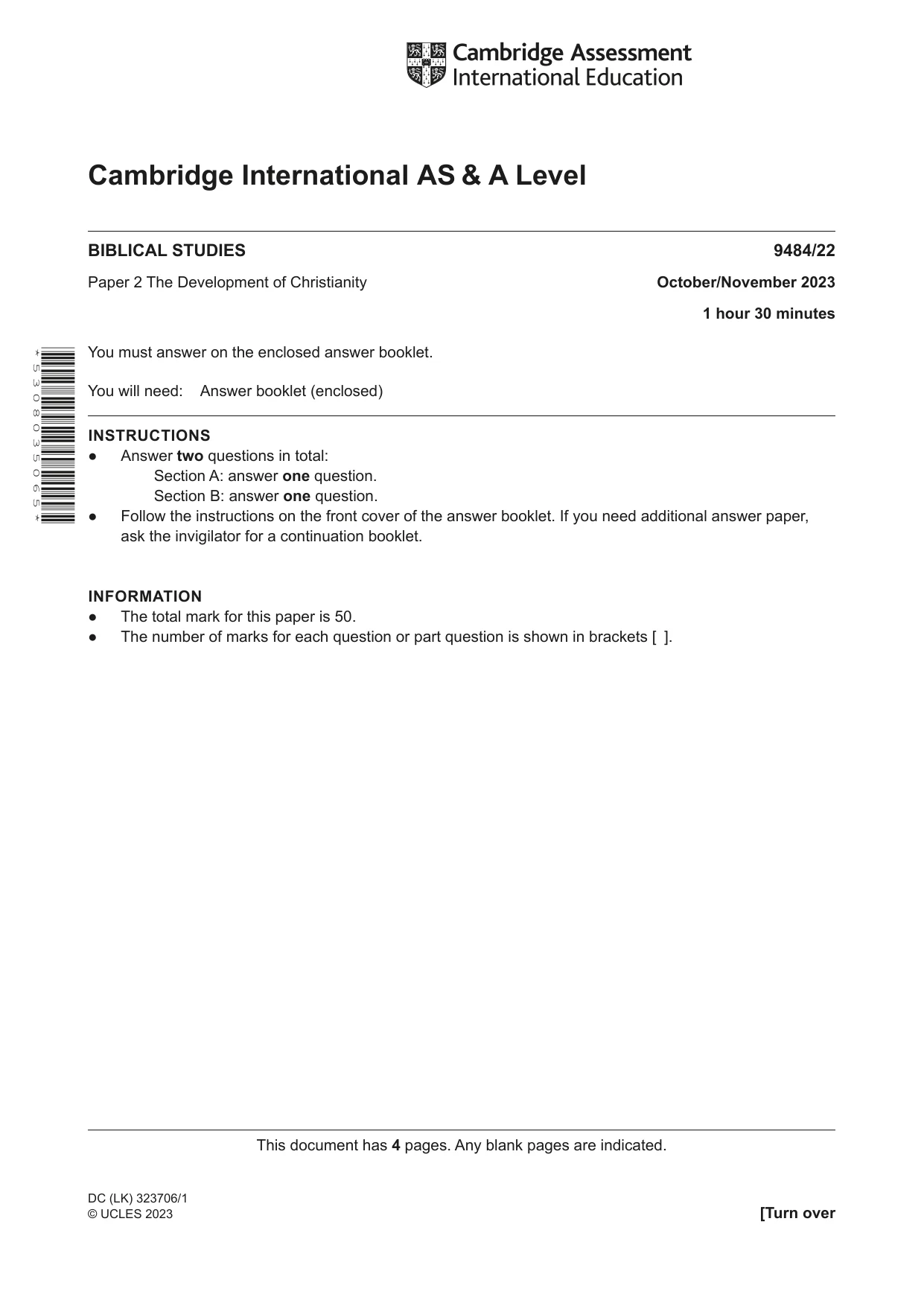
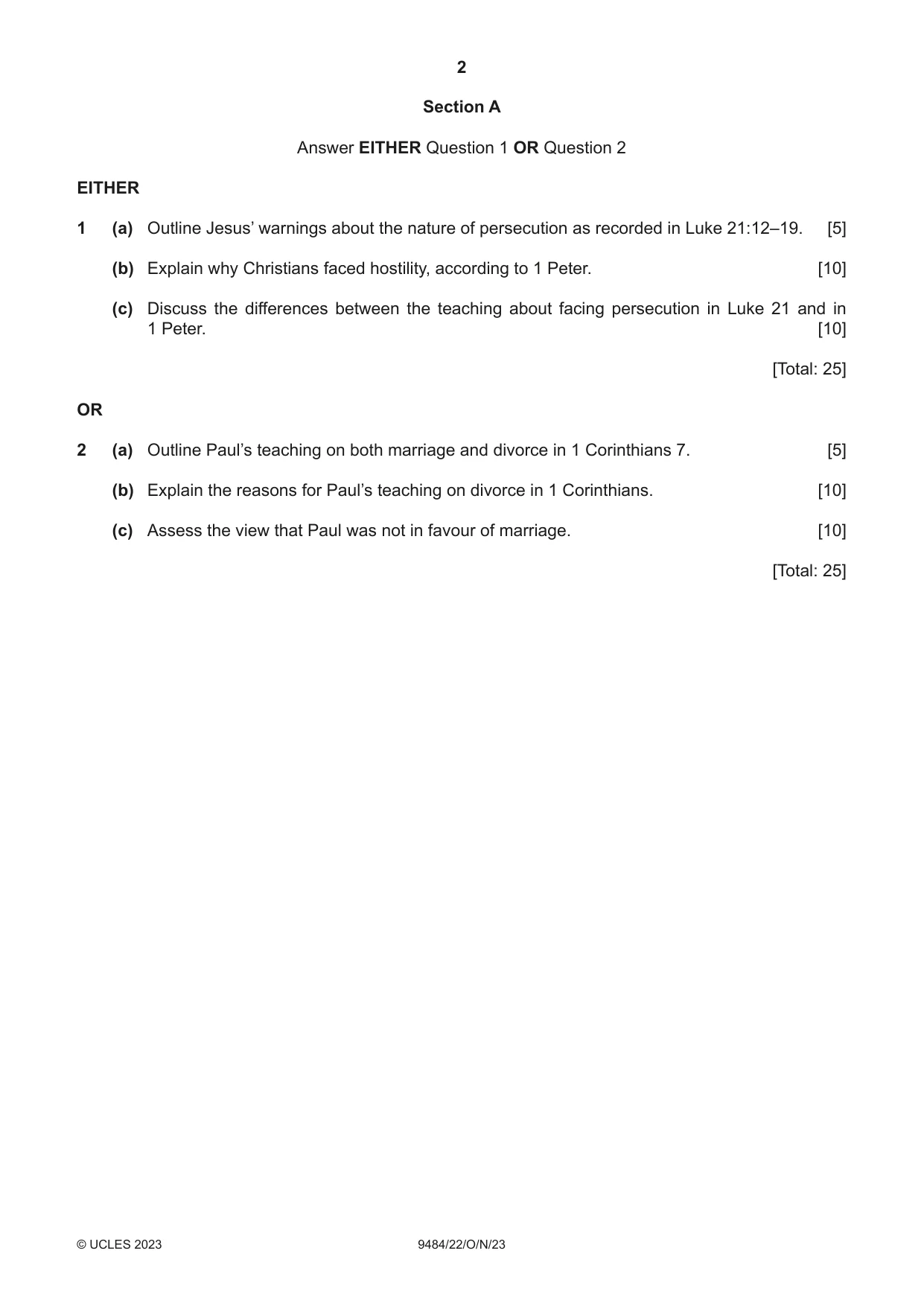
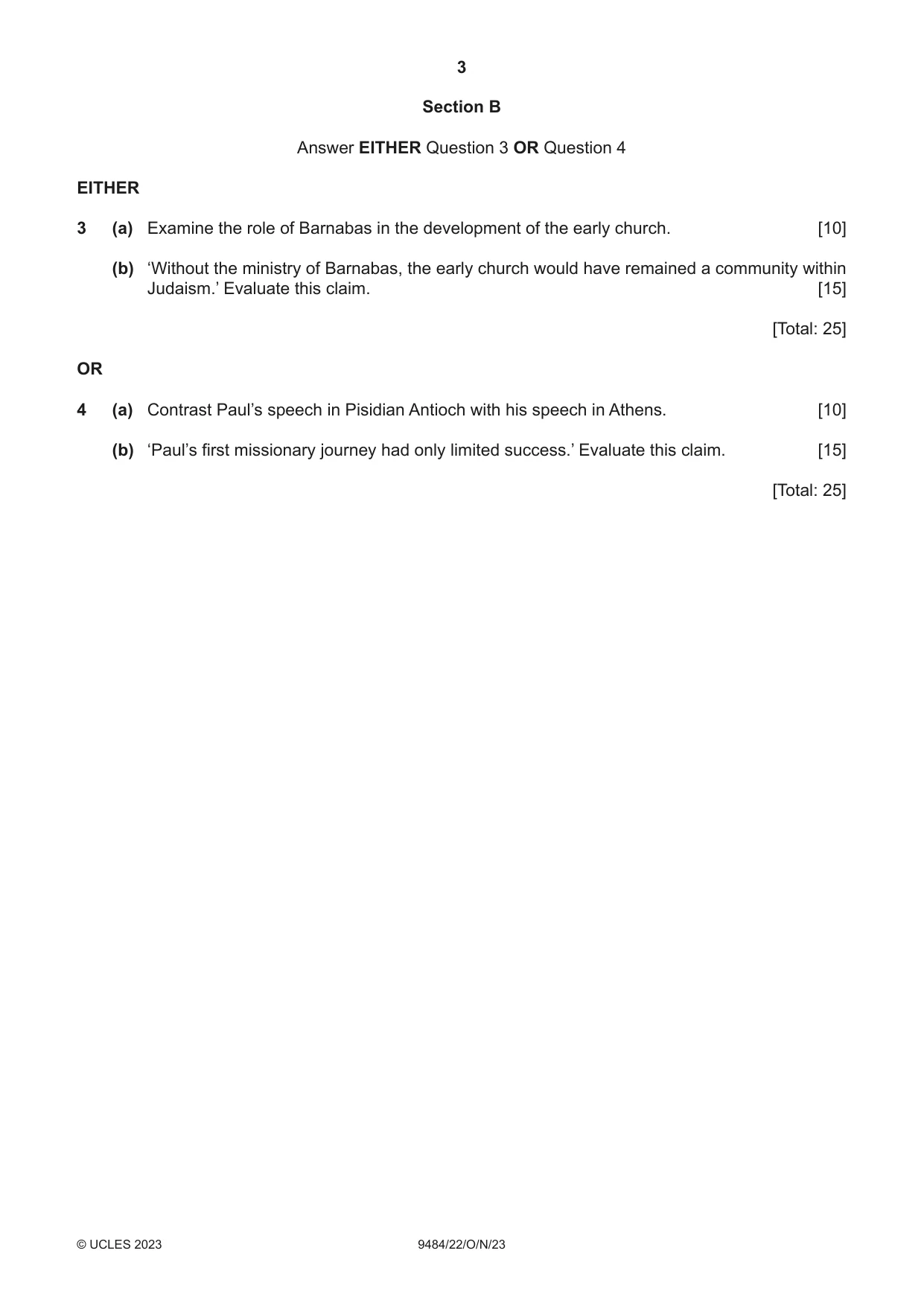

Mark scheme17 pages
Answers below. Sit the paper first if you are practising.


Questions as text
Q1 · Outline Jesus’ warnings about the nature of persecution as recorded in Luke 21:12–19
1 (a) Outline Jesus’ warnings about the nature of persecution as recorded in Luke 21:12–19. [5] (b) Explain why Christians faced hostility, according to 1 Peter. [10] (c) Discuss the differences between the teaching about facing persecution in Luke 21 and in 1 Peter. [10] [Total: 25] OR
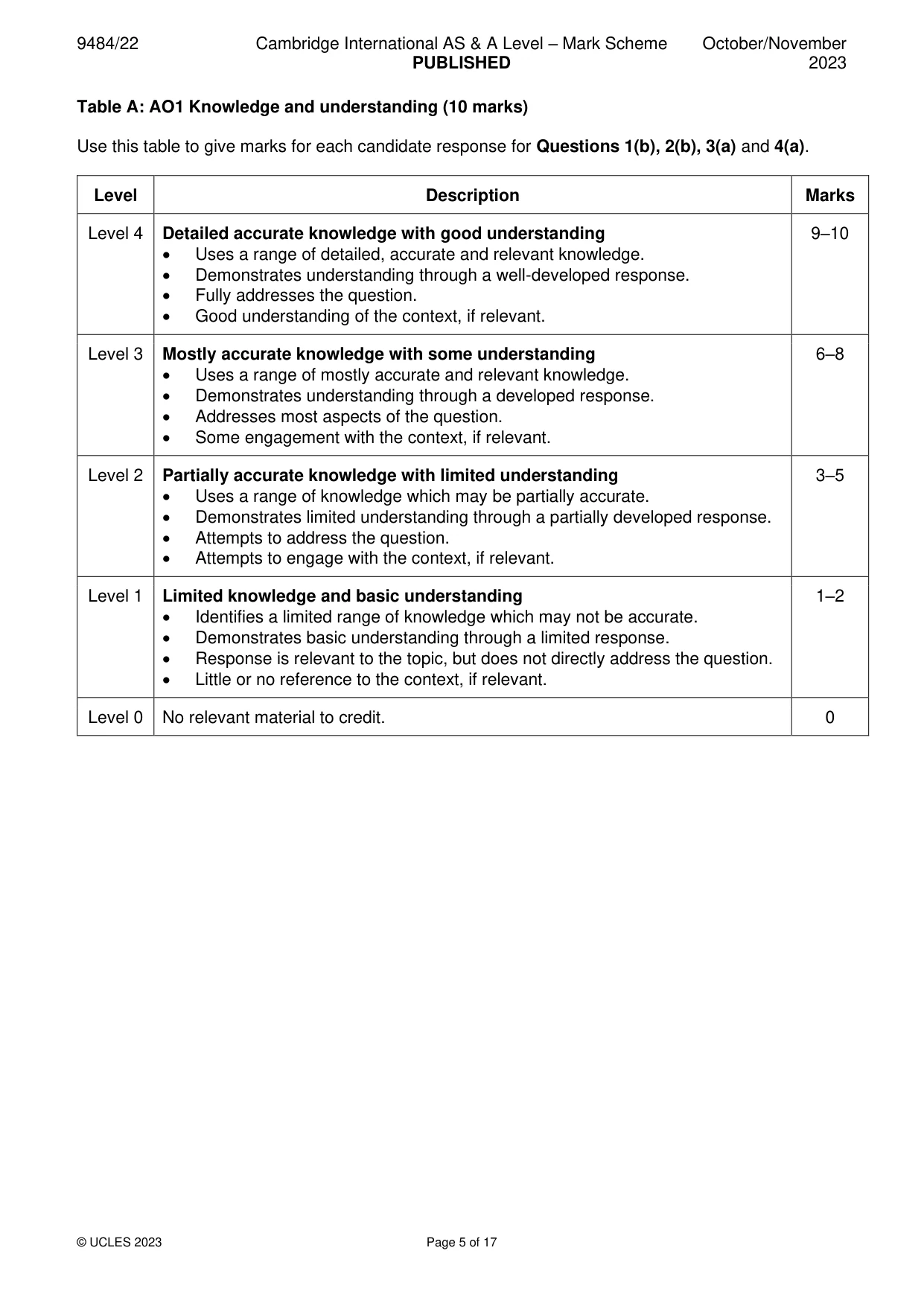
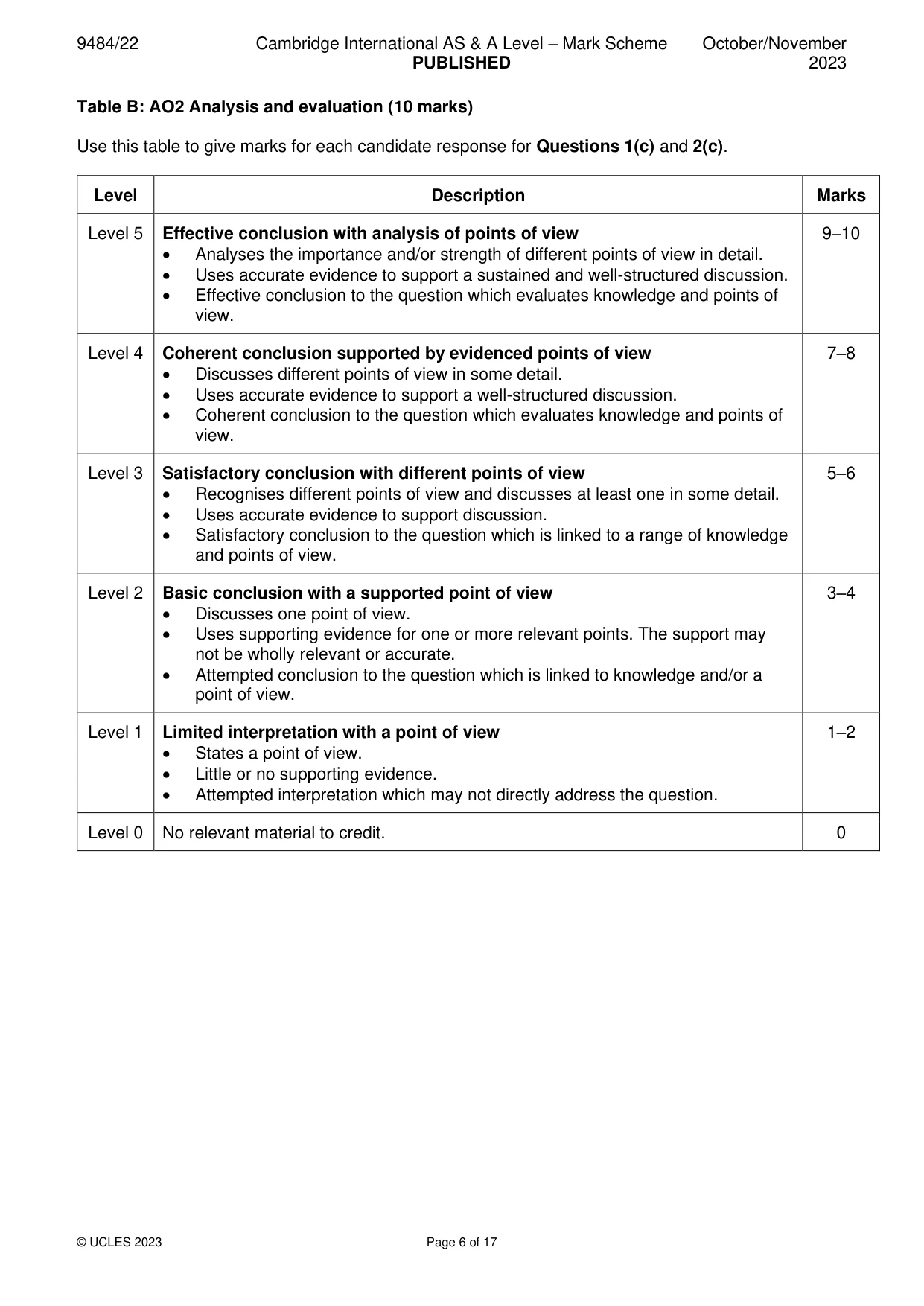
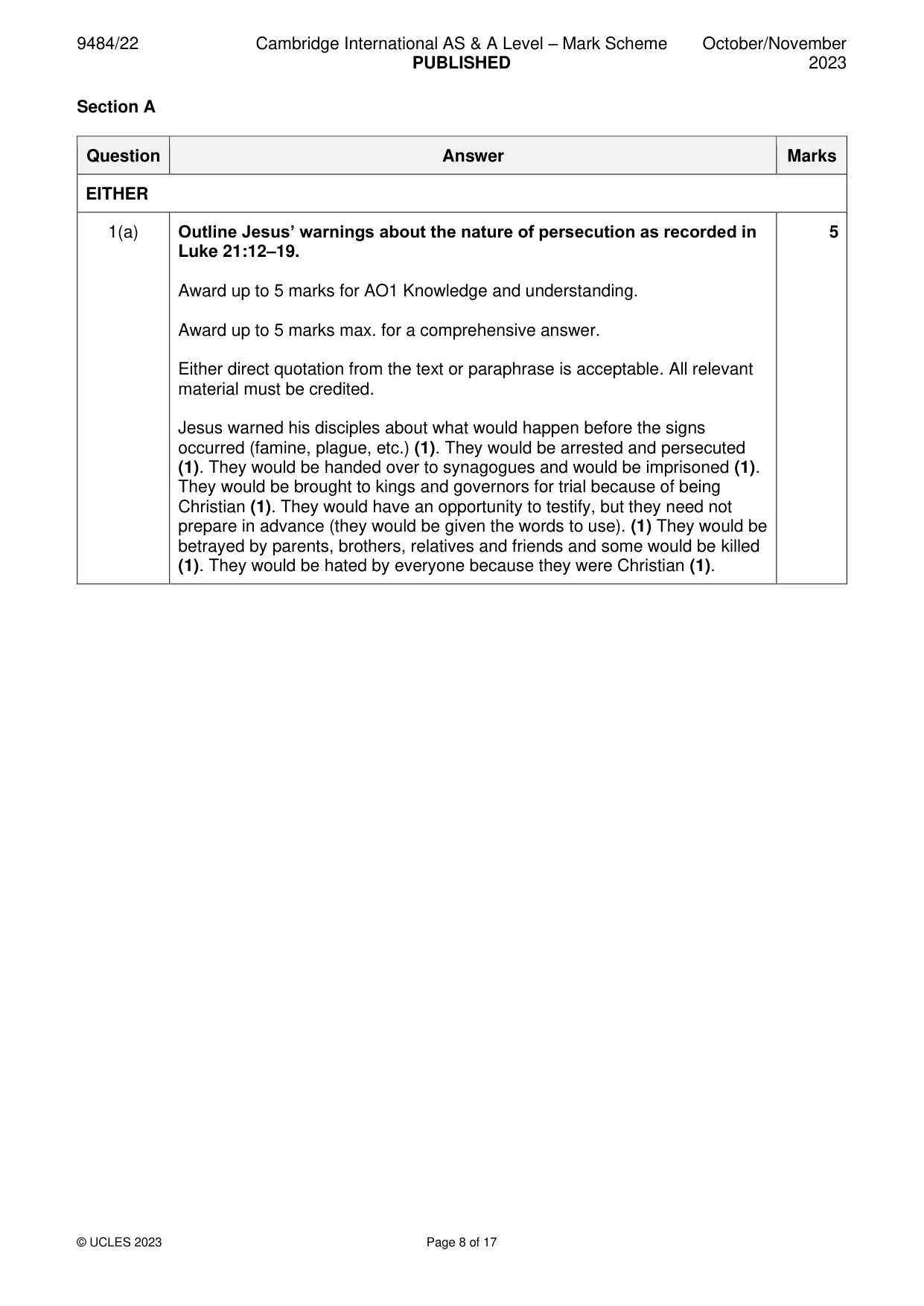
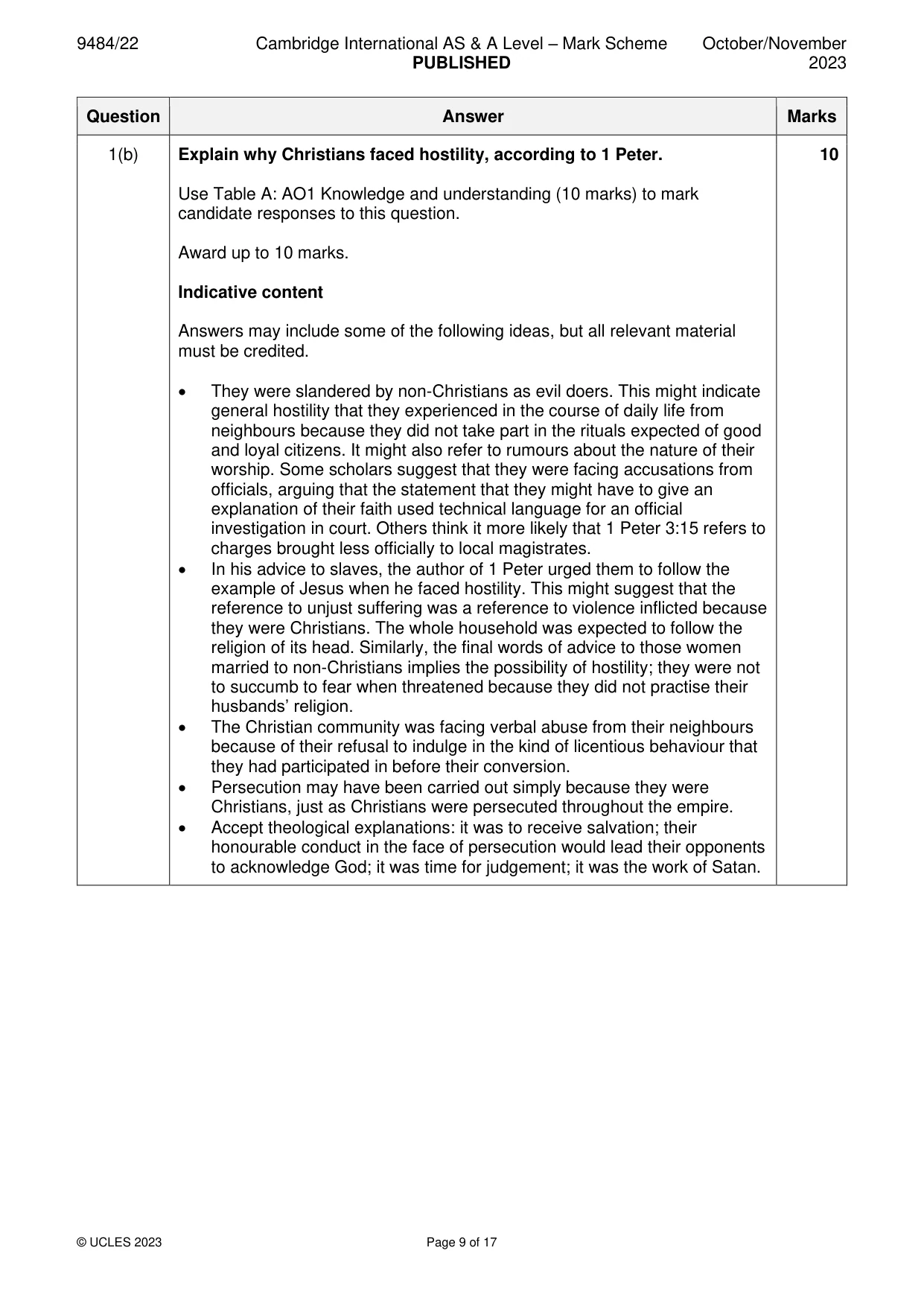
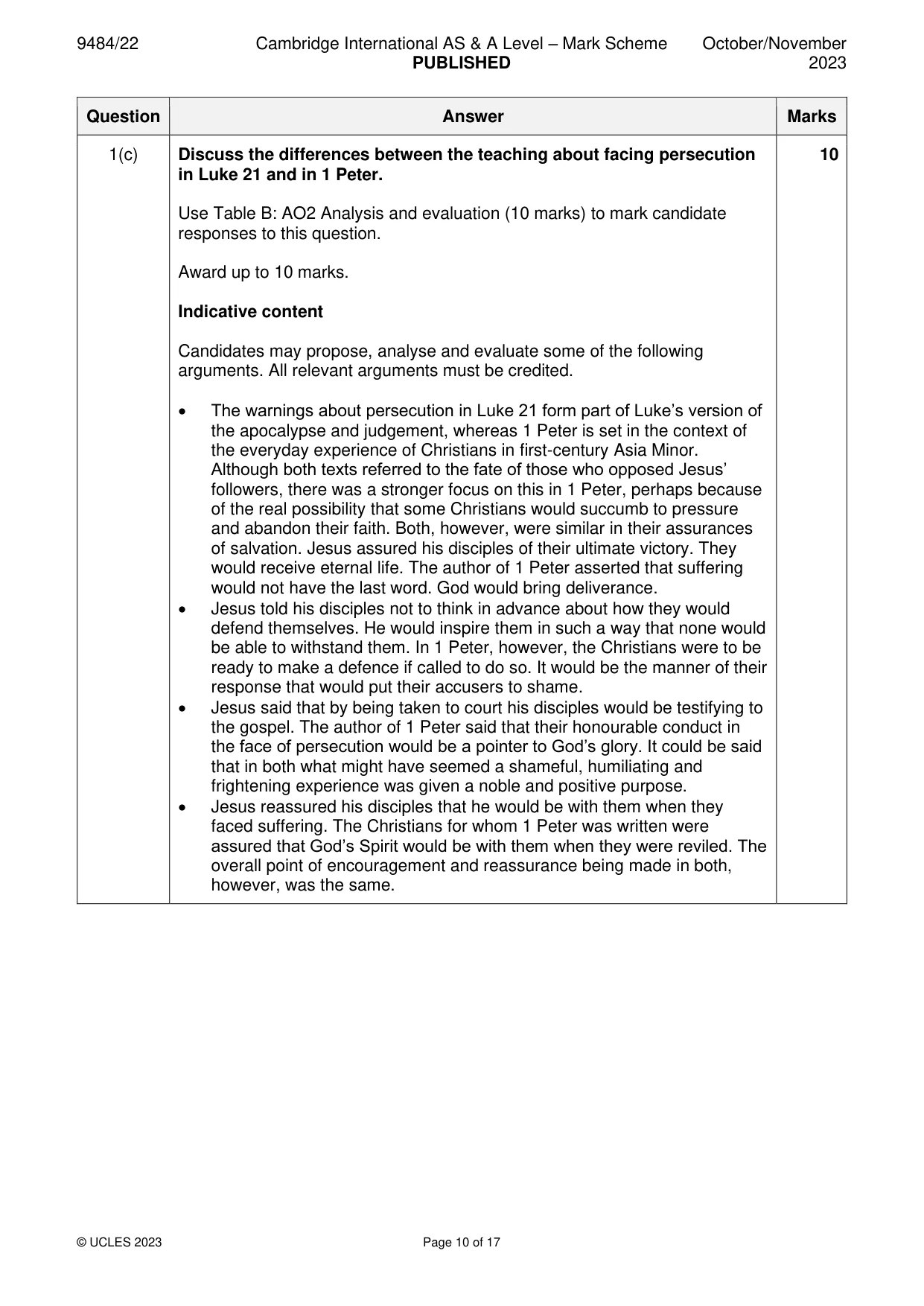
Mark scheme: Question Answer Marks EITHER 1(a) Outline Jesus’ warnings about the nature of persecution as recorded in 5 Luke 21:12–19. Award up to 5 marks for AO1 Knowledge and understanding. Award up to 5 marks max. for a comprehensive answer. Either direct quotation from the text or paraphrase is acceptable. All relevant material must be credited. Jesus warned his disciples about what would happen before the signs occurred (famine, plague, etc.) (1). They would be arrested and persecuted (1). They would be handed over to synagogues and would be imprisoned (1). They would be brought to kings and governors for trial because of being Christian (1). They would have an opportunity to testify, but they need not prepare in advance (they would be given the words to use). (1) They would be betrayed by parents, brothers, relatives and friends and some would be killed (1). They would be hated by everyone because they were Christian (1). 1(b) Explain why Christians faced hostility, according to 1 Peter. 10 Use Table A: AO1 Knowledge and understanding (10 marks) to mark candidate responses to this question. Award up to 10 marks. Indicative content Answers may include some of the following ideas, but all relevant material must be credited. • They were slandered by non-Christians as evil doers. This might indicate general hostility that they experienced in the course of daily life from neighbours because they did not take part in the rituals expected of good and loyal citizens. It might also refer to rumours about the nature of their worship. Some scholars suggest that they were facing accusations from officials, arguing that the statement that they might have to give an explanation of their faith used technical language for an official investigation in court. Others think it more likely that 1 Peter 3:15 refers to charges brought less officially to local magistrates. • In his advice to slaves, the author of 1 Peter urged them to follow the example of Jesus when he faced hostility. This might suggest that the reference to unjust suffering was a reference to violence inflicted because they were Christians. The whole household was expected to follow the religion of its head. Similarly, the final words of advice to those women married to non-Christians implies the possibility of hostility; they were not to succumb to fear when threatened because they did not practise their husbands’ religion. • The Christian community was facing verbal abuse from their neighbours because of their refusal to indulge in the kind of licentious behaviour that they had participated in before their conversion. • Persecution may have been carried out simply because they were Christians, just as Christians were persecuted throughout the empire. • Accept theological explanations: it was to receive salvation; their honourable conduct in the face of persecution would lead their opponents to acknowledge God; it was time for judgement; it was the work of Satan. 1(c) Discuss the differences between the teaching about facing persecution 10 in Luke 21 and in 1 Peter. Use Table B: AO2 Analysis and evaluation (10 marks) to mark candidate responses to this question. Award up to 10 marks. Indicative content Candidates may propose, analyse and evaluate some of the following arguments. All relevant arguments must be credited. • The warnings about persecution in Luke 21 form part of Luke’s version of the apocalypse and judgement, whereas 1 Peter is set in the context of the everyday experience of Christians in first-century Asia Minor. Although both texts referred to the fate of those who opposed Jesus’ followers, there was a stronger focus on this in 1 Peter, perhaps because of the real possibility that some Christians would succumb to pressure and abandon their faith. Both, however, were similar in their assurances of salvation. Jesus assured his disciples of their ultimate victory. They would receive eternal life. The author of 1 Peter asserted that suffering would not have the last word. God would bring deliverance. • Jesus told his disciples not to think in advance about how they would defend themselves. He would inspire them in such a way that none would be able to withstand them. In 1 Peter, however, the Christians were to be ready to make a defence if called to do so. It would be the manner of their response that would put their accusers to shame. • Jesus said that by being taken to court his disciples would be testifying to the gospel. The author of 1 Peter said that their honourable conduct in the face of persecution would be a pointer to God’s glory. It could be said that in both what might have seemed a shameful, humiliating and frightening experience was given a noble and positive purpose. • Jesus reassured his disciples that he would be with them when they faced suffering. The Christians for whom 1 Peter was written were assured that God’s Spirit would be with them when they were reviled. The overall point of encouragement and reassurance being made in both, however, was the same.
Q2 · Outline Paul’s teaching on both marriage and divorce in 1 Corinthians 7
2 (a) Outline Paul’s teaching on both marriage and divorce in 1 Corinthians 7. [5] (b) Explain the reasons for Paul’s teaching on divorce in 1 Corinthians. [10] (c) Assess the view that Paul was not in favour of marriage. [10] [Total: 25]
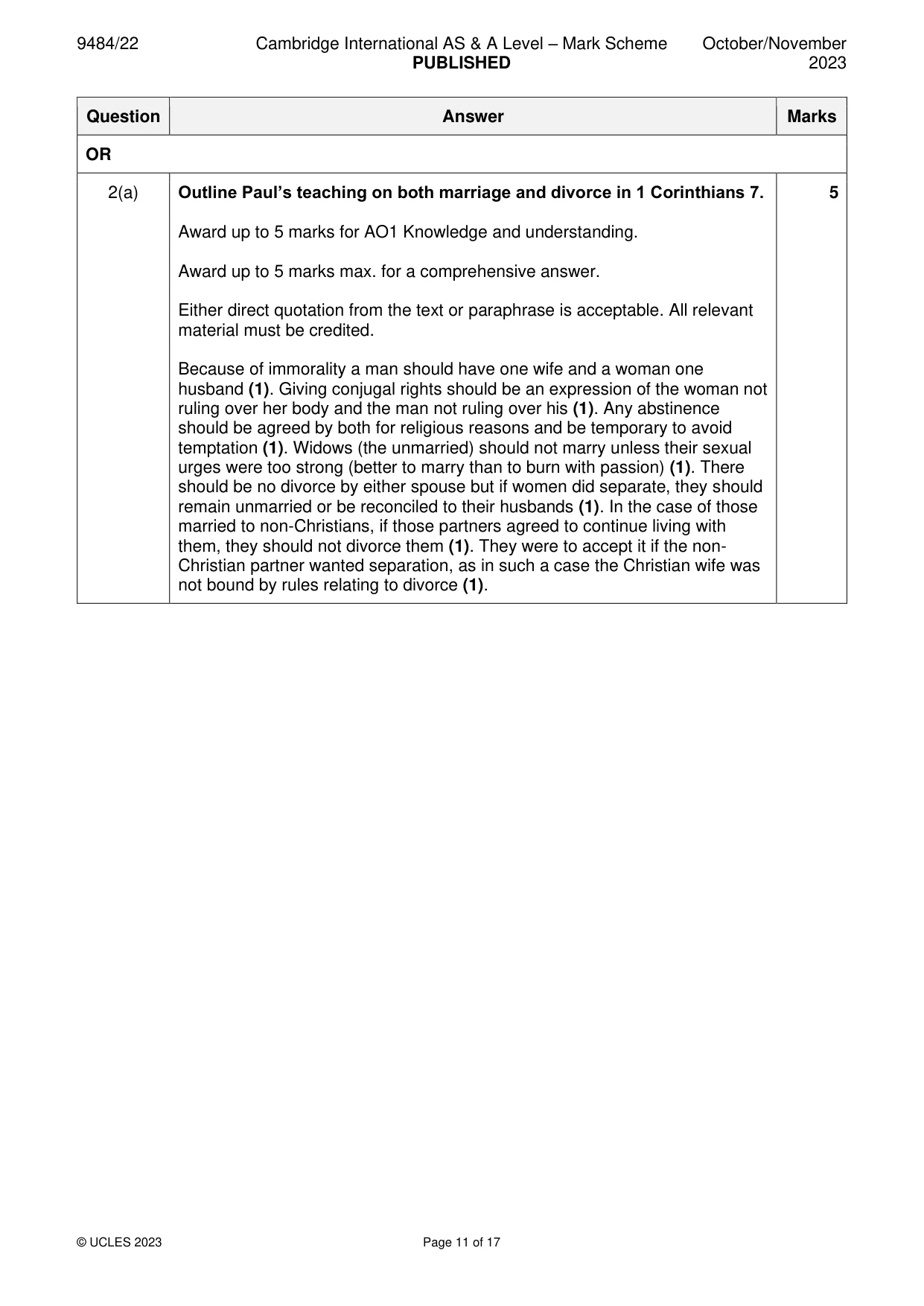
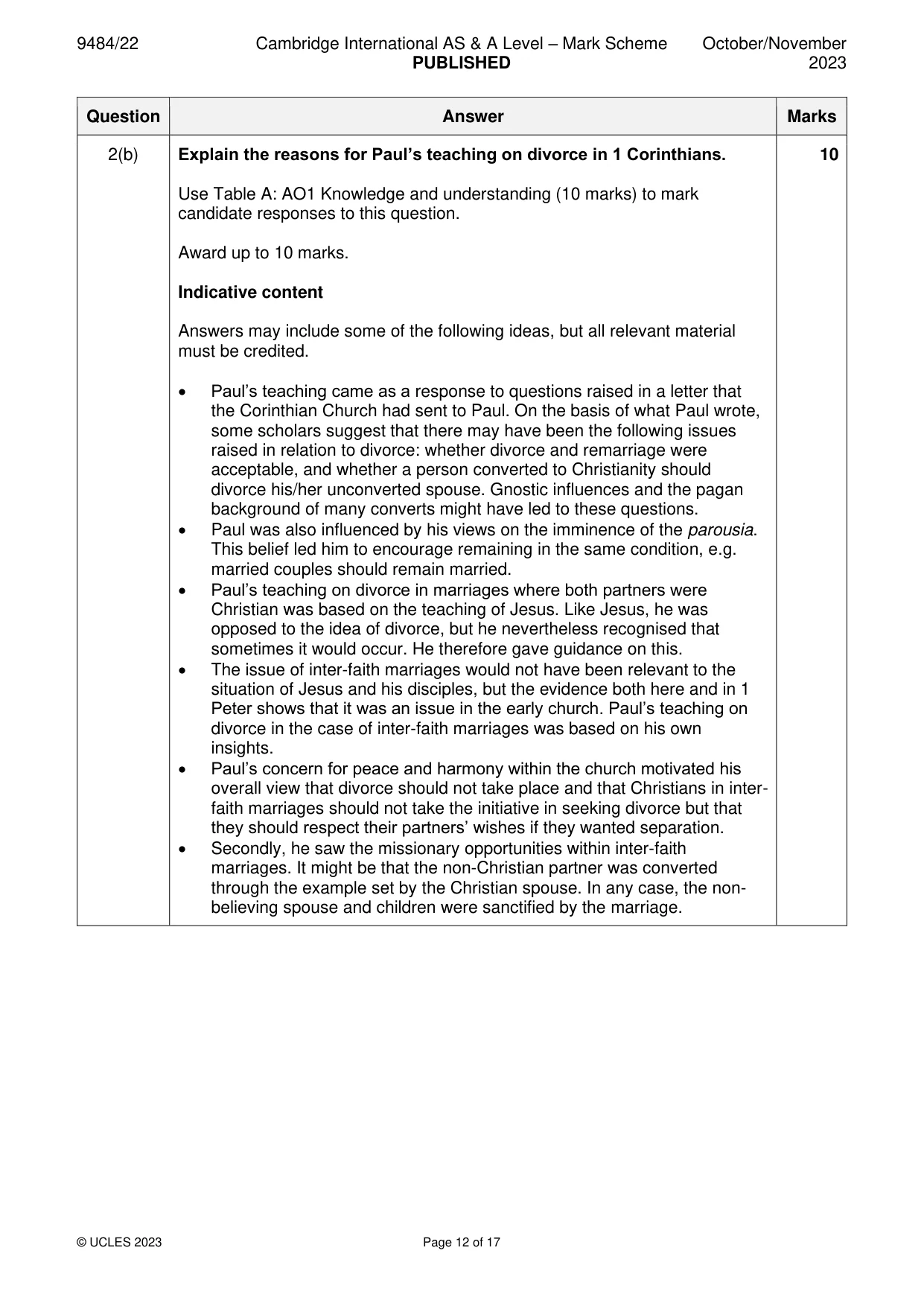
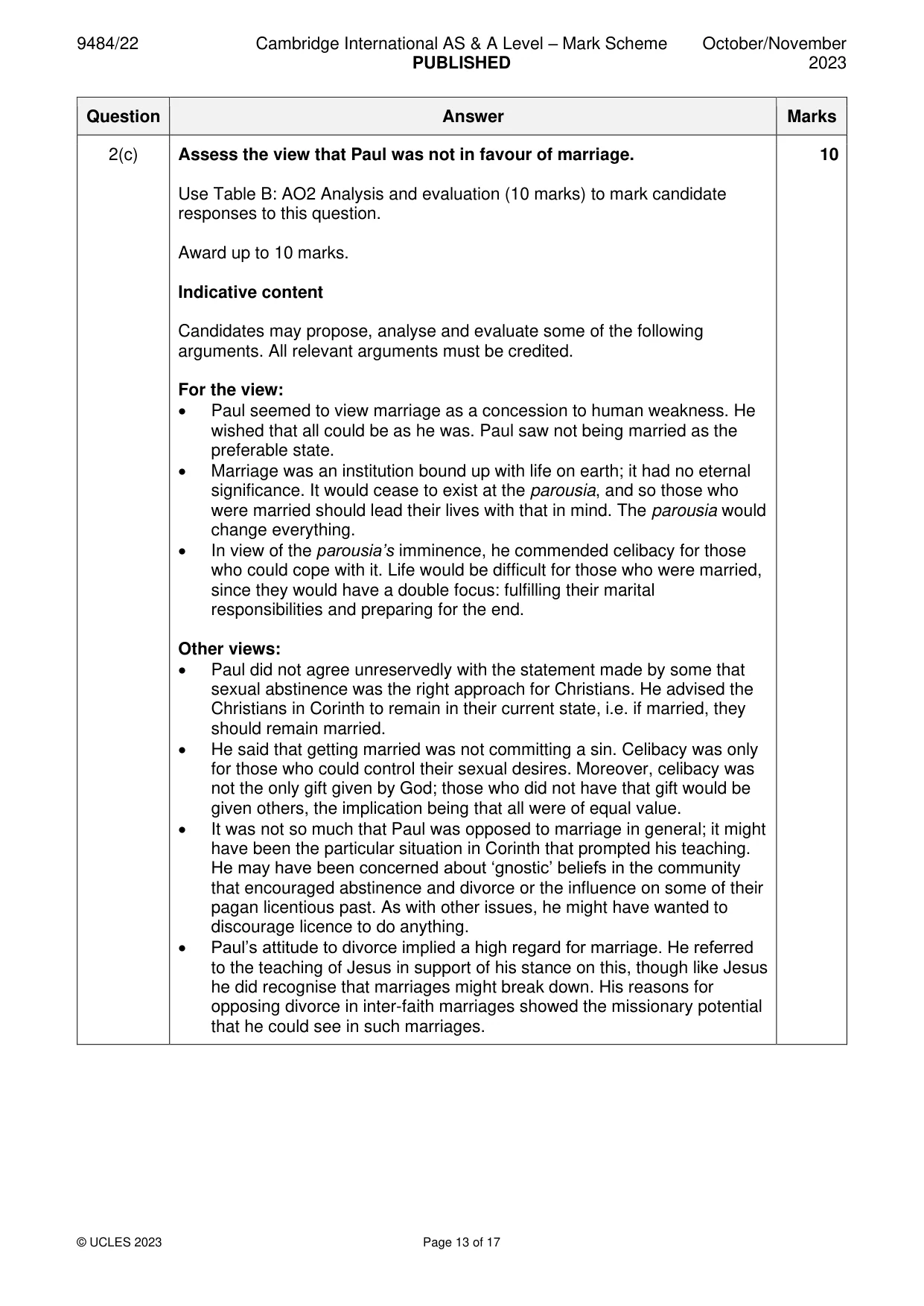
Mark scheme: 2(a) Outline Paul’s teaching on both marriage and divorce in 1 Corinthians 7. 5 Award up to 5 marks for AO1 Knowledge and understanding. Award up to 5 marks max. for a comprehensive answer. Either direct quotation from the text or paraphrase is acceptable. All relevant material must be credited. Because of immorality a man should have one wife and a woman one husband (1). Giving conjugal rights should be an expression of the woman not ruling over her body and the man not ruling over his (1). Any abstinence should be agreed by both for religious reasons and be temporary to avoid temptation (1). Widows (the unmarried) should not marry unless their sexual urges were too strong (better to marry than to burn with passion) (1). There should be no divorce by either spouse but if women did separate, they should remain unmarried or be reconciled to their husbands (1). In the case of those married to non-Christians, if those partners agreed to continue living with them, they should not divorce them (1). They were to accept it if the non- Christian partner wanted separation, as in such a case the Christian wife was not bound by rules relating to divorce (1). 2(b) Explain the reasons for Paul’s teaching on divorce in 1 Corinthians. 10 Use Table A: AO1 Knowledge and understanding (10 marks) to mark candidate responses to this question. Award up to 10 marks. Indicative content Answers may include some of the following ideas, but all relevant material must be credited. • Paul’s teaching came as a response to questions raised in a letter that the Corinthian Church had sent to Paul. On the basis of what Paul wrote, some scholars suggest that there may have been the following issues raised in relation to divorce: whether divorce and remarriage were acceptable, and whether a person converted to Christianity should divorce his/her unconverted spouse. Gnostic influences and the pagan background of many converts might have led to these questions. • Paul was also influenced by his views on the imminence of the parousia. This belief led him to encourage remaining in the same condition, e.g. married couples should remain married. • Paul’s teaching on divorce in marriages where both partners were Christian was based on the teaching of Jesus. Like Jesus, he was opposed to the idea of divorce, but he nevertheless recognised that sometimes it would occur. He therefore gave guidance on this. • The issue of inter-faith marriages would not have been relevant to the situation of Jesus and his disciples, but the evidence both here and in 1 Peter shows that it was an issue in the early church. Paul’s teaching on divorce in the case of inter-faith marriages was based on his own insights. • Paul’s concern for peace and harmony within the church motivated his overall view that divorce should not take place and that Christians in inter- faith marriages should not take the initiative in seeking divorce but that they should respect their partners’ wishes if they wanted separation. • Secondly, he saw the missionary opportunities within inter-faith marriages. It might be that the non-Christian partner was converted through the example set by the Christian spouse. In any case, the non- believing spouse and children were sanctified by the marriage. 2(c) Assess the view that Paul was not in favour of marriage. 10 Use Table B: AO2 Analysis and evaluation (10 marks) to mark candidate responses to this question. Award up to 10 marks. Indicative content Candidates may propose, analyse and evaluate some of the following arguments. All relevant arguments must be credited. For the view: • Paul seemed to view marriage as a concession to human weakness. He wished that all could be as he was. Paul saw not being married as the preferable state. • Marriage was an institution bound up with life on earth; it had no eternal significance. It would cease to exist at the parousia, and so those who were married should lead their lives with that in mind. The parousia would change everything. • In view of the parousia’s imminence, he commended celibacy for those who could cope with it. Life would be difficult for those who were married, since they would have a double focus: fulfilling their marital responsibilities and preparing for the end. Other views: • Paul did not agree unreservedly with the statement made by some that sexual abstinence was the right approach for Christians. He advised the Christians in Corinth to remain in their current state, i.e. if married, they should remain married. • He said that getting married was not committing a sin. Celibacy was only for those who could control their sexual desires. Moreover, celibacy was not the only gift given by God; those who did not have that gift would be given others, the implication being that all were of equal value. • It was not so much that Paul was opposed to marriage in general; it might have been the particular situation in Corinth that prompted his teaching. He may have been concerned about ‘gnostic’ beliefs in the community that encouraged abstinence and divorce or the influence on some of their pagan licentious past. As with other issues, he might have wanted to discourage licence to do anything. • Paul’s attitude to divorce implied a high regard for marriage. He referred to the teaching of Jesus in support of his stance on this, though like Jesus he did recognise that marriages might break down. His reasons for opposing divorce in inter-faith marriages showed the missionary potential that he could see in such marriages. Section B
Q3 · Examine the role of Barnabas in the development of the early church
3 (a) Examine the role of Barnabas in the development of the early church. [10] (b) ‘Without the ministry of Barnabas, the early church would have remained a community within Judaism.’ Evaluate this claim. [15] [Total: 25] OR
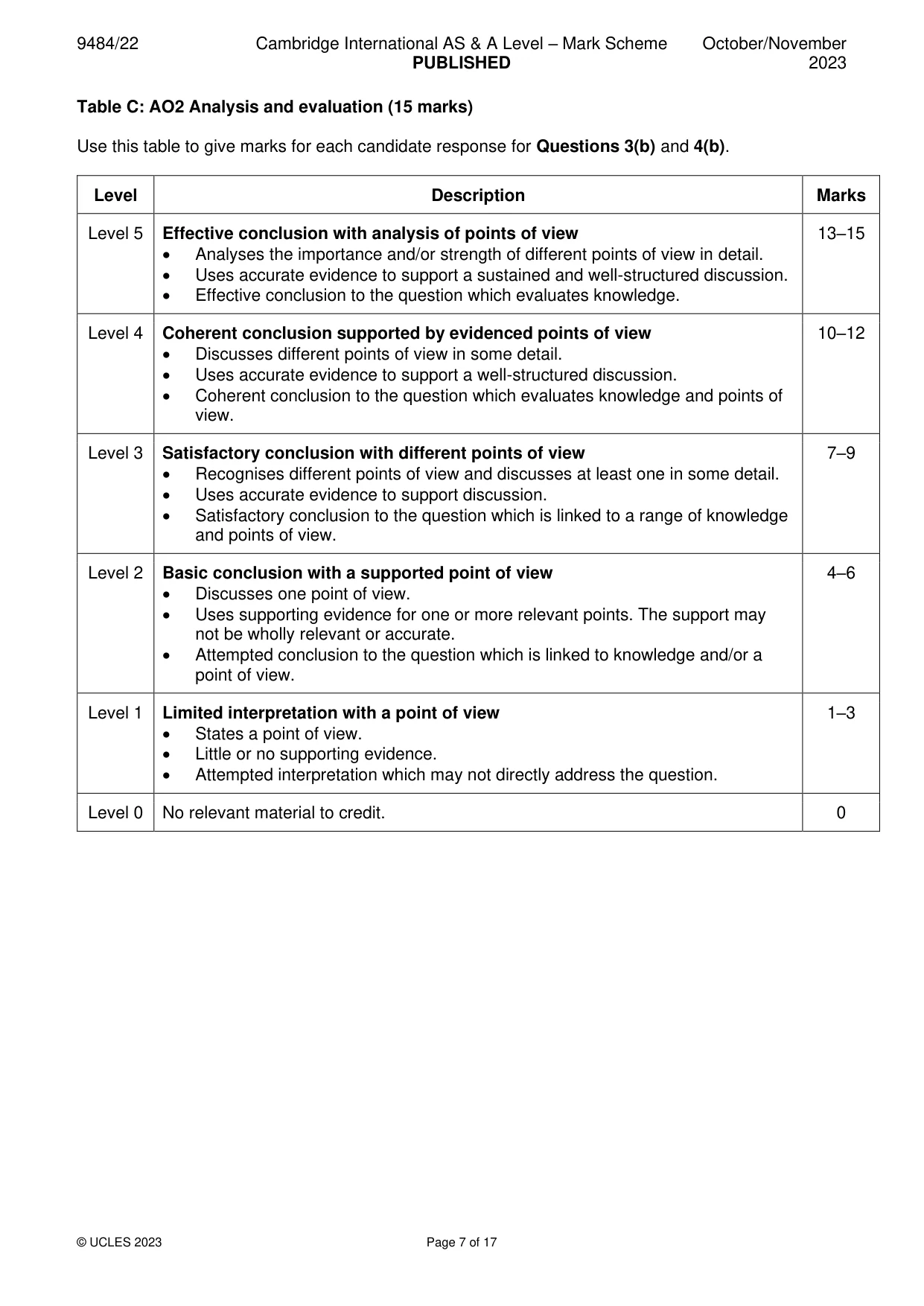
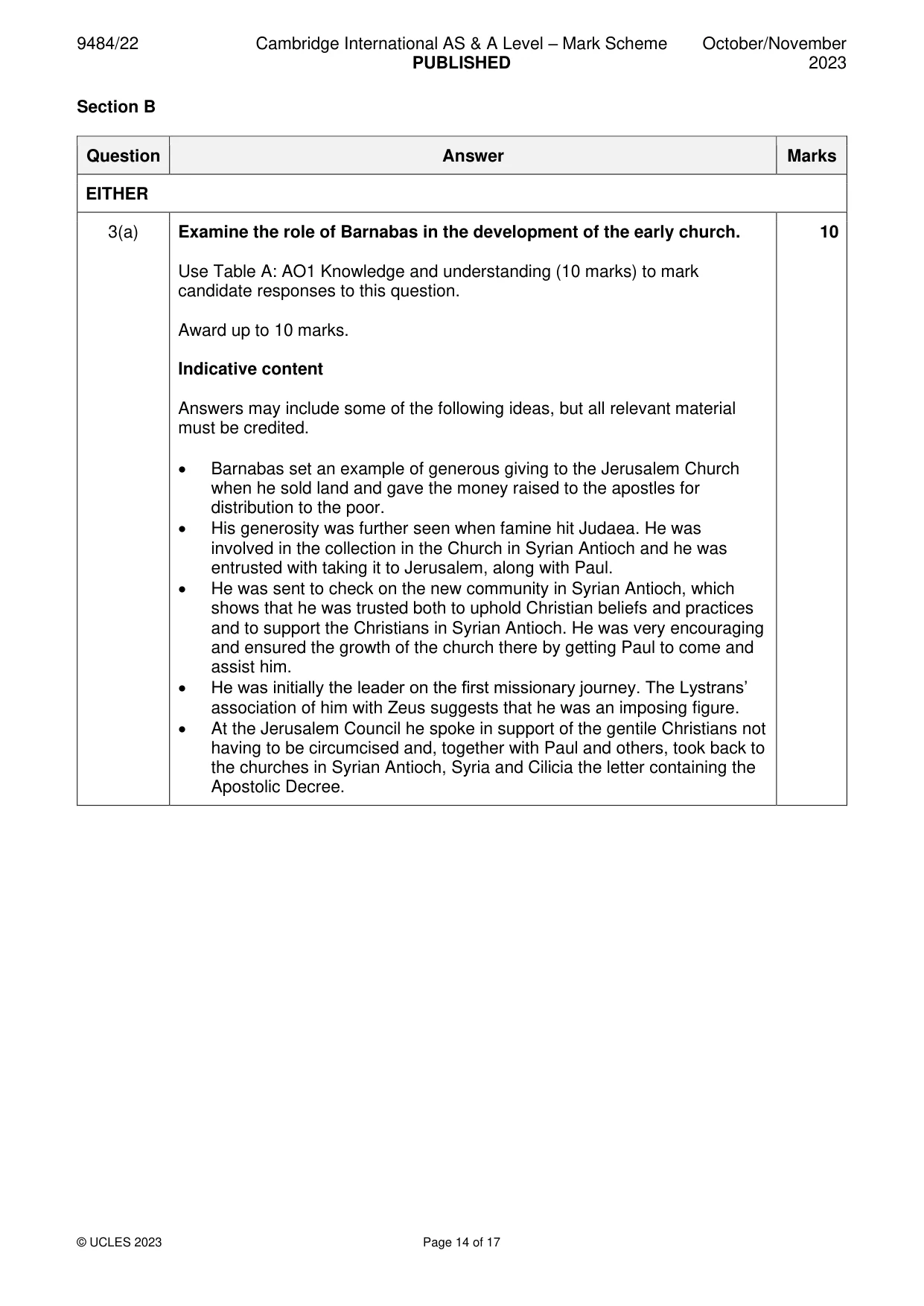
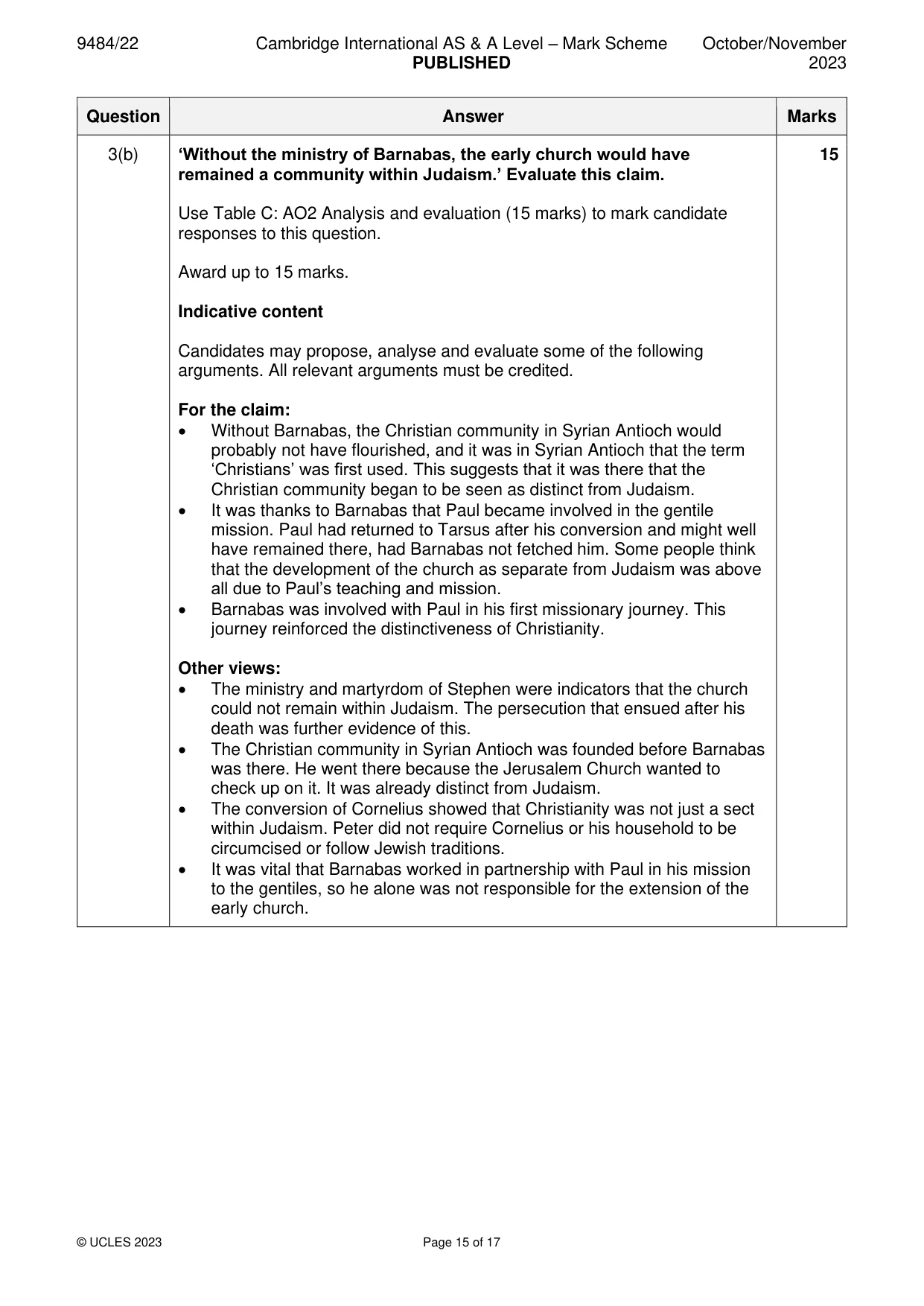
Mark scheme: 3(a) Examine the role of Barnabas in the development of the early church. 10 Use Table A: AO1 Knowledge and understanding (10 marks) to mark candidate responses to this question. Award up to 10 marks. Indicative content Answers may include some of the following ideas, but all relevant material must be credited. • Barnabas set an example of generous giving to the Jerusalem Church when he sold land and gave the money raised to the apostles for distribution to the poor. • His generosity was further seen when famine hit Judaea. He was involved in the collection in the Church in Syrian Antioch and he was entrusted with taking it to Jerusalem, along with Paul. • He was sent to check on the new community in Syrian Antioch, which shows that he was trusted both to uphold Christian beliefs and practices and to support the Christians in Syrian Antioch. He was very encouraging and ensured the growth of the church there by getting Paul to come and assist him. • He was initially the leader on the first missionary journey. The Lystrans’ association of him with Zeus suggests that he was an imposing figure. • At the Jerusalem Council he spoke in support of the gentile Christians not having to be circumcised and, together with Paul and others, took back to the churches in Syrian Antioch, Syria and Cilicia the letter containing the Apostolic Decree. 3(b) ‘Without the ministry of Barnabas, the early church would have 15 remained a community within Judaism.’ Evaluate this claim. Use Table C: AO2 Analysis and evaluation (15 marks) to mark candidate responses to this question. Award up to 15 marks. Indicative content Candidates may propose, analyse and evaluate some of the following arguments. All relevant arguments must be credited. For the claim: • Without Barnabas, the Christian community in Syrian Antioch would probably not have flourished, and it was in Syrian Antioch that the term ‘Christians’ was first used. This suggests that it was there that the Christian community began to be seen as distinct from Judaism. • It was thanks to Barnabas that Paul became involved in the gentile mission. Paul had returned to Tarsus after his conversion and might well have remained there, had Barnabas not fetched him. Some people think that the development of the church as separate from Judaism was above all due to Paul’s teaching and mission. • Barnabas was involved with Paul in his first missionary journey. This journey reinforced the distinctiveness of Christianity. Other views: • The ministry and martyrdom of Stephen were indicators that the church could not remain within Judaism. The persecution that ensued after his death was further evidence of this. • The Christian community in Syrian Antioch was founded before Barnabas was there. He went there because the Jerusalem Church wanted to check up on it. It was already distinct from Judaism. • The conversion of Cornelius showed that Christianity was not just a sect within Judaism. Peter did not require Cornelius or his household to be circumcised or follow Jewish traditions. • It was vital that Barnabas worked in partnership with Paul in his mission to the gentiles, so he alone was not responsible for the extension of the early church.
Q4 · Contrast Paul’s speech in Pisidian Antioch with his speech in Athens
4 (a) Contrast Paul’s speech in Pisidian Antioch with his speech in Athens. [10] (b) ‘Paul’s first missionary journey had only limited success.’ Evaluate this claim. [15] [Total: 25]
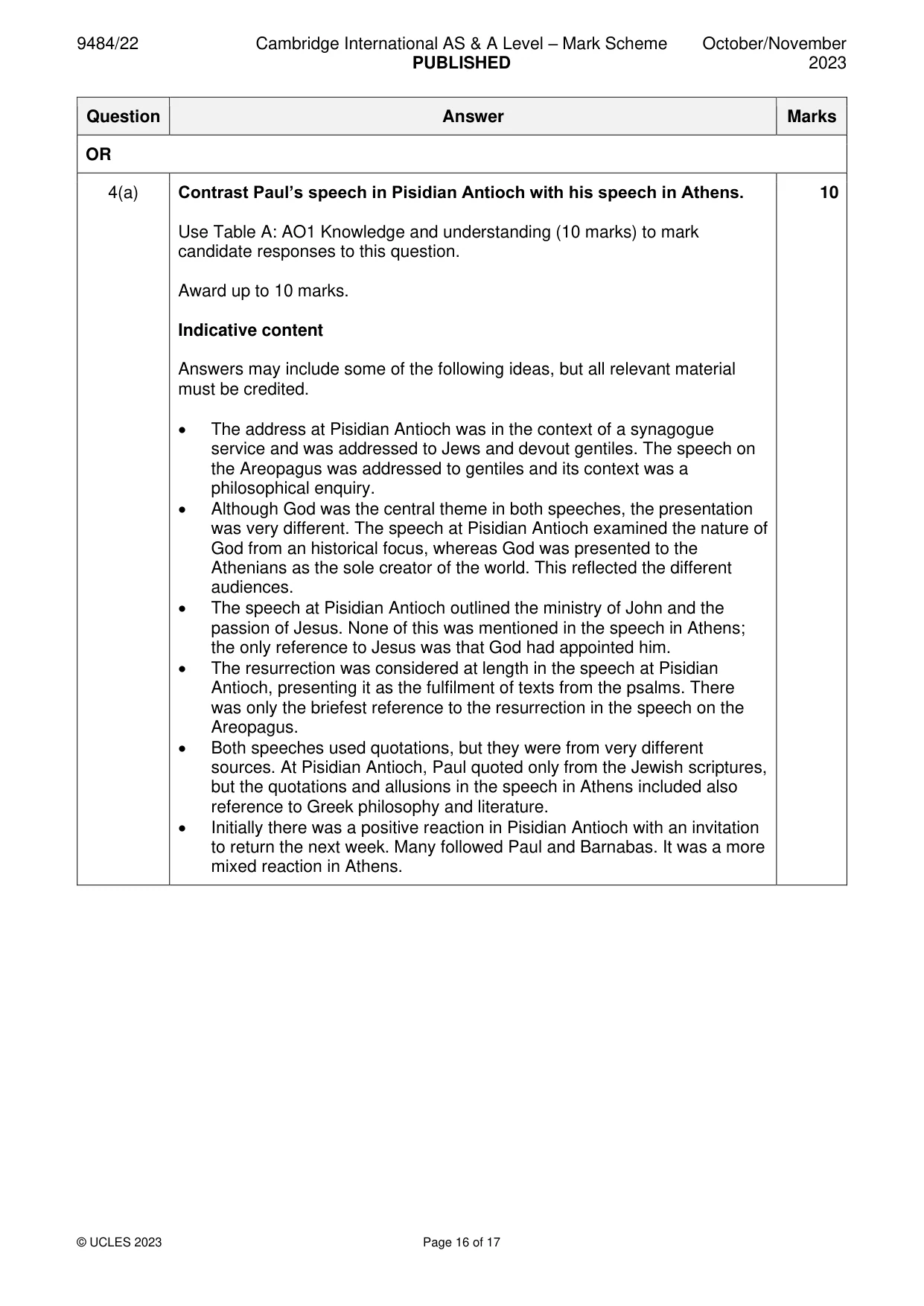
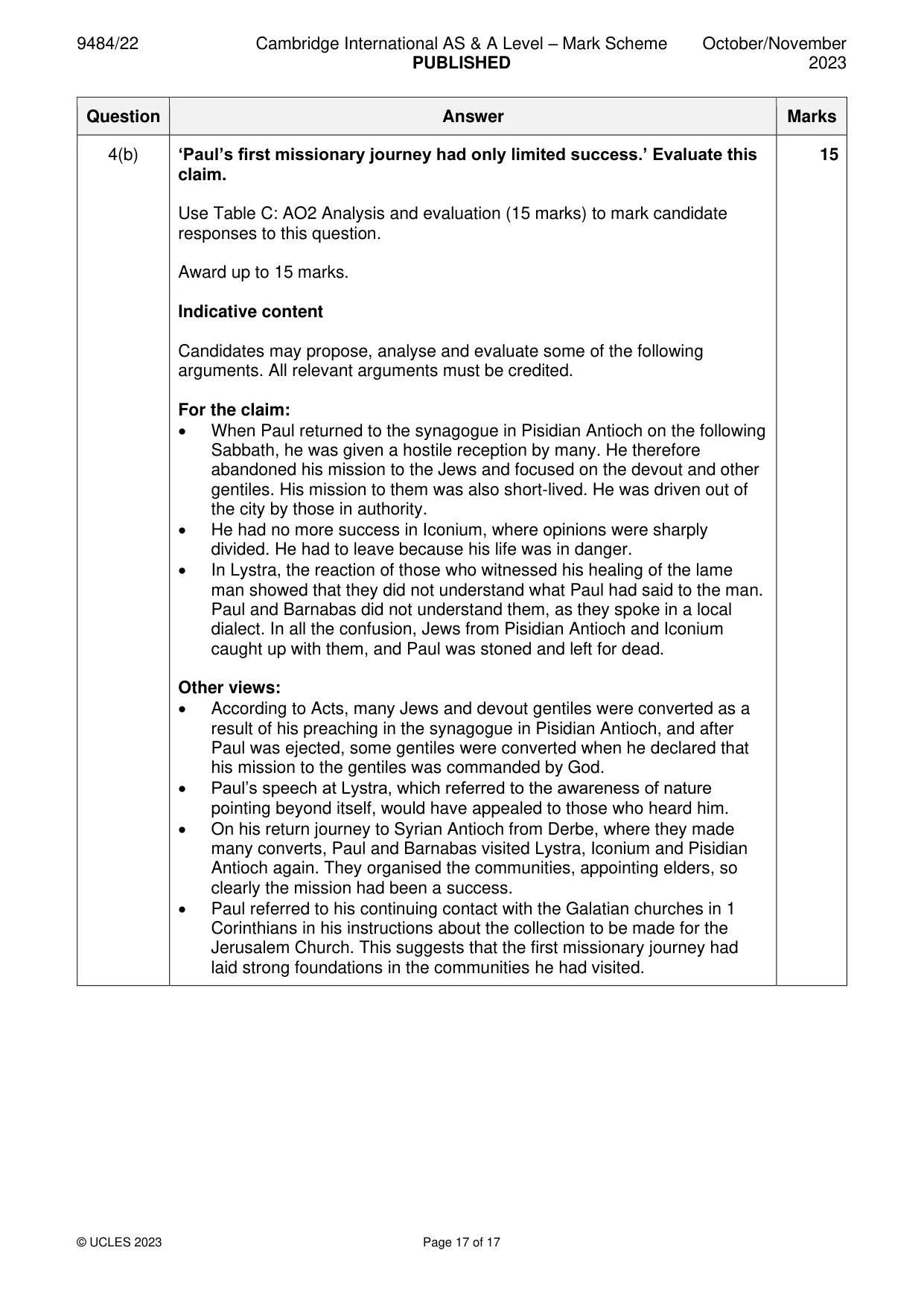
Mark scheme: 4(a) Contrast Paul’s speech in Pisidian Antioch with his speech in Athens. 10 Use Table A: AO1 Knowledge and understanding (10 marks) to mark candidate responses to this question. Award up to 10 marks. Indicative content Answers may include some of the following ideas, but all relevant material must be credited. • The address at Pisidian Antioch was in the context of a synagogue service and was addressed to Jews and devout gentiles. The speech on the Areopagus was addressed to gentiles and its context was a philosophical enquiry. • Although God was the central theme in both speeches, the presentation was very different. The speech at Pisidian Antioch examined the nature of God from an historical focus, whereas God was presented to the Athenians as the sole creator of the world. This reflected the different audiences. • The speech at Pisidian Antioch outlined the ministry of John and the passion of Jesus. None of this was mentioned in the speech in Athens; the only reference to Jesus was that God had appointed him. • The resurrection was considered at length in the speech at Pisidian Antioch, presenting it as the fulfilment of texts from the psalms. There was only the briefest reference to the resurrection in the speech on the Areopagus. • Both speeches used quotations, but they were from very different sources. At Pisidian Antioch, Paul quoted only from the Jewish scriptures, but the quotations and allusions in the speech in Athens included also reference to Greek philosophy and literature. • Initially there was a positive reaction in Pisidian Antioch with an invitation to return the next week. Many followed Paul and Barnabas. It was a more mixed reaction in Athens. 4(b) ‘Paul’s first missionary journey had only limited success.’ Evaluate this 15 claim. Use Table C: AO2 Analysis and evaluation (15 marks) to mark candidate responses to this question. Award up to 15 marks. Indicative content Candidates may propose, analyse and evaluate some of the following arguments. All relevant arguments must be credited. For the claim: • When Paul returned to the synagogue in Pisidian Antioch on the following Sabbath, he was given a hostile reception by many. He therefore abandoned his mission to the Jews and focused on the devout and other gentiles. His mission to them was also short-lived. He was driven out of the city by those in authority. • He had no more success in Iconium, where opinions were sharply divided. He had to leave because his life was in danger. • In Lystra, the reaction of those who witnessed his healing of the lame man showed that they did not understand what Paul had said to the man. Paul and Barnabas did not understand them, as they spoke in a local dialect. In all the confusion, Jews from Pisidian Antioch and Iconium caught up with them, and Paul was stoned and left for dead. Other views: • According to Acts, many Jews and devout gentiles were converted as a result of his preaching in the synagogue in Pisidian Antioch, and after Paul was ejected, some gentiles were converted when he declared that his mission to the gentiles was commanded by God. • Paul’s speech at Lystra, which referred to the awareness of nature pointing beyond itself, would have appealed to those who heard him. • On his return journey to Syrian Antioch from Derbe, where they made many converts, Paul and Barnabas visited Lystra, Iconium and Pisidian Antioch again. They organised the communities, appointing elders, so clearly the mission had been a success. • Paul referred to his continuing contact with the Galatian churches in 1 Corinthians in his instructions about the collection to be made for the Jerusalem Church. This suggests that the first missionary journey had laid strong foundations in the communities he had visited.
What was in this paper
The subtopics covered by these 4 questions, and how many questions each got. Open one in a new tab to see every Cambridge question on it.
What you needed in this session
Cambridge’s own grade thresholds for 2023 Oct/Nov, Paper 2 · Variant 2. A higher threshold means an easier paper — the bar moves with how the cohort did.