Cambridge A Level Biblical Studies 9484 — 2024 May/June Paper 2 · Variant 2
9484/22/M/J/24 · 4 questions · 50 marks · 90 min
The question paper and its mark scheme, free to read here and free to download. This is Cambridge’s own paper, exactly as it was sat.
Question paper4 pages
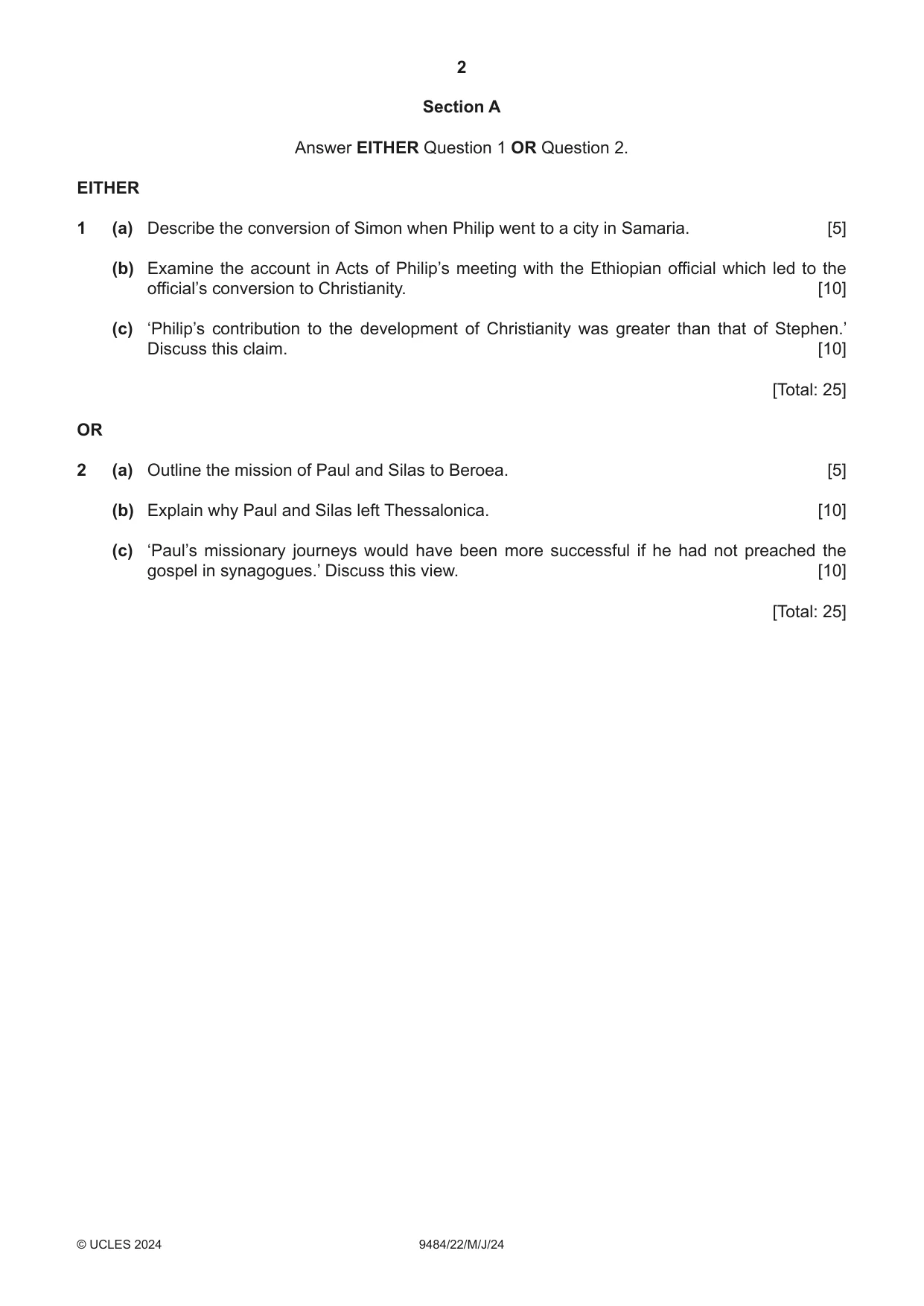
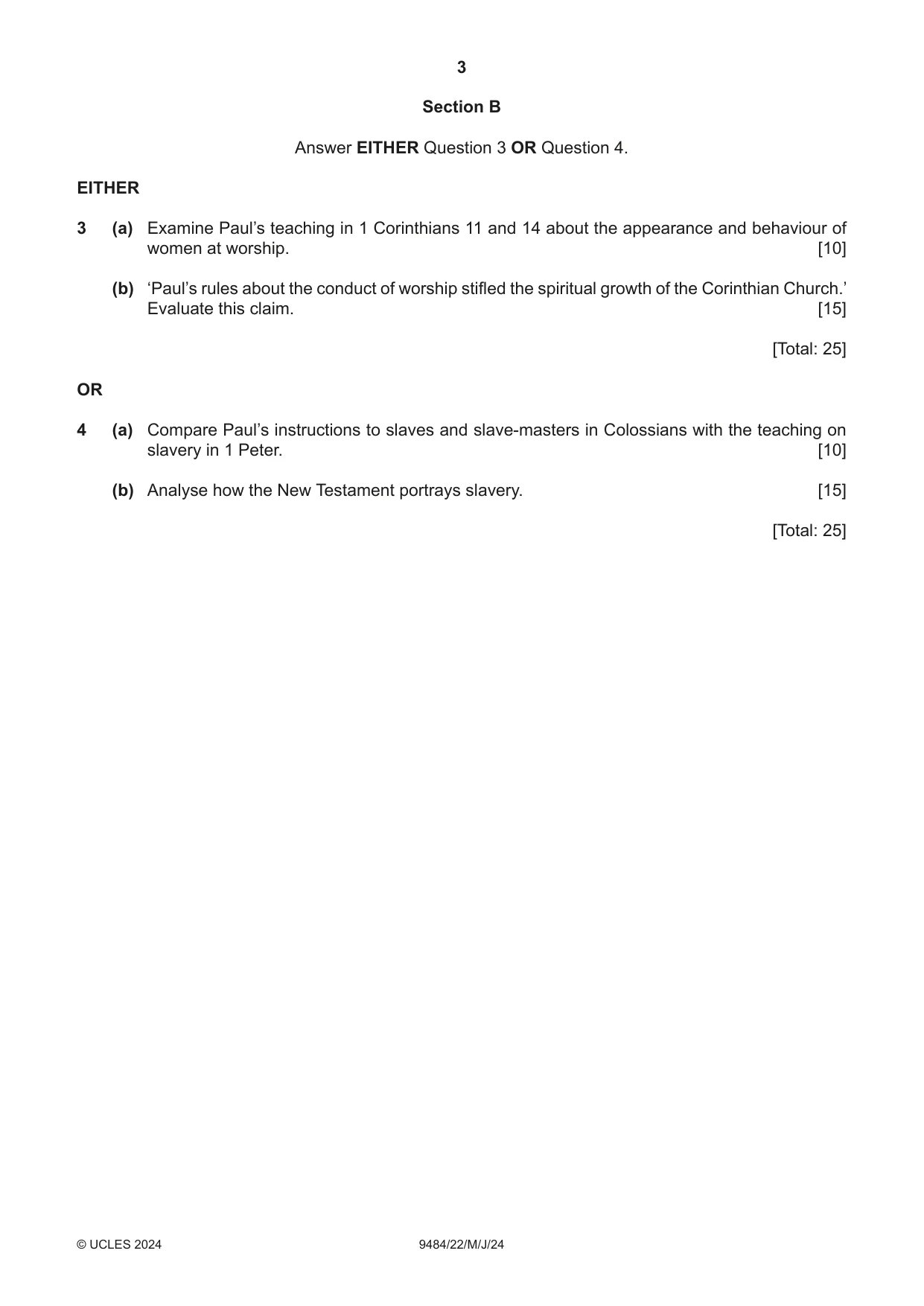

Mark scheme17 pages
Answers below. Sit the paper first if you are practising.
Questions as text
Q1 · Describe the conversion of Simon when Philip went to a city in Samaria
1 (a) Describe the conversion of Simon when Philip went to a city in Samaria. [5] (b) Examine the account in Acts of Philip’s meeting with the Ethiopian official which led to the official’s conversion to Christianity. [10] (c) ‘Philip’s contribution to the development of Christianity was greater than that of Stephen.’ Discuss this claim. [10] [Total: 25] OR
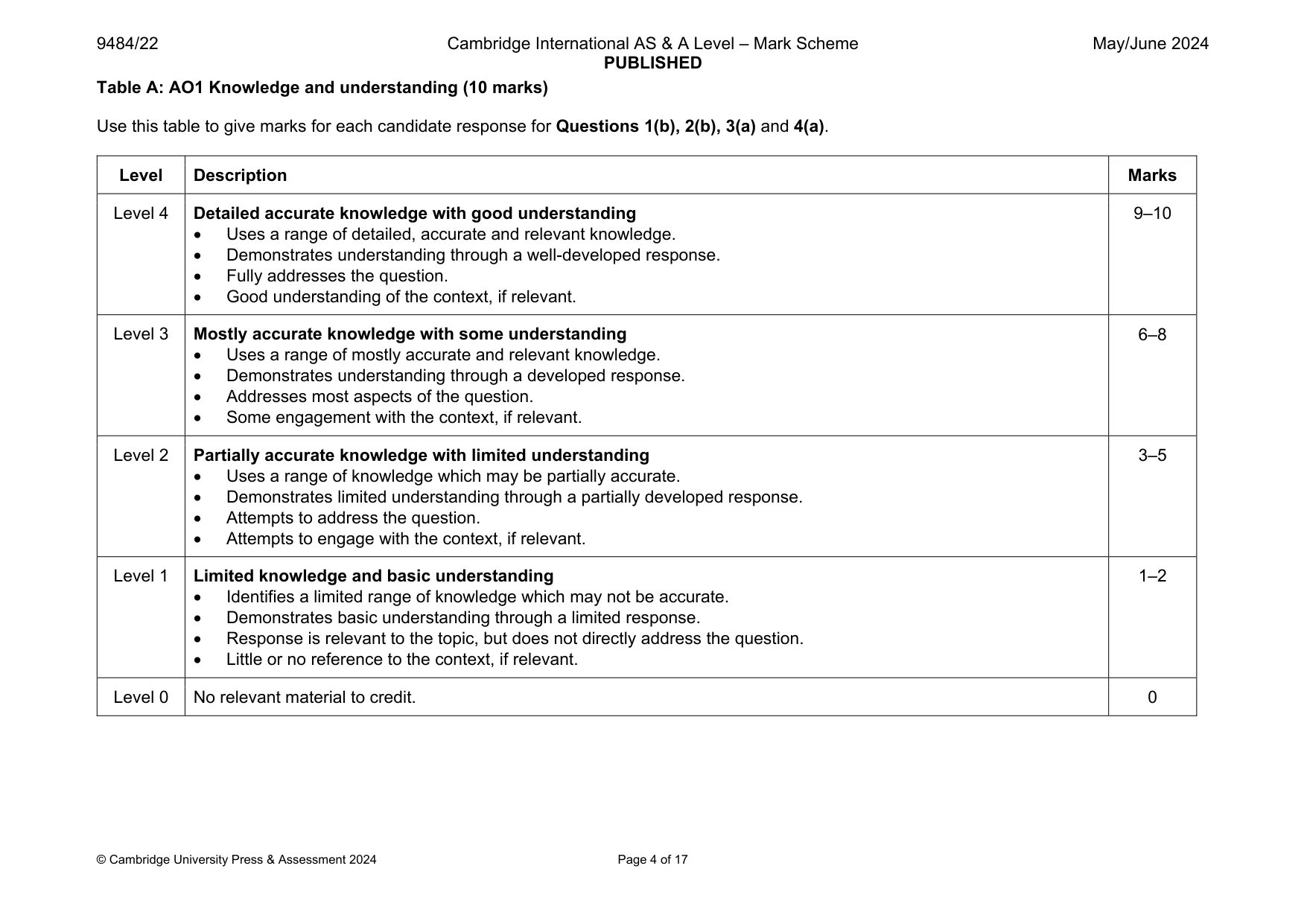
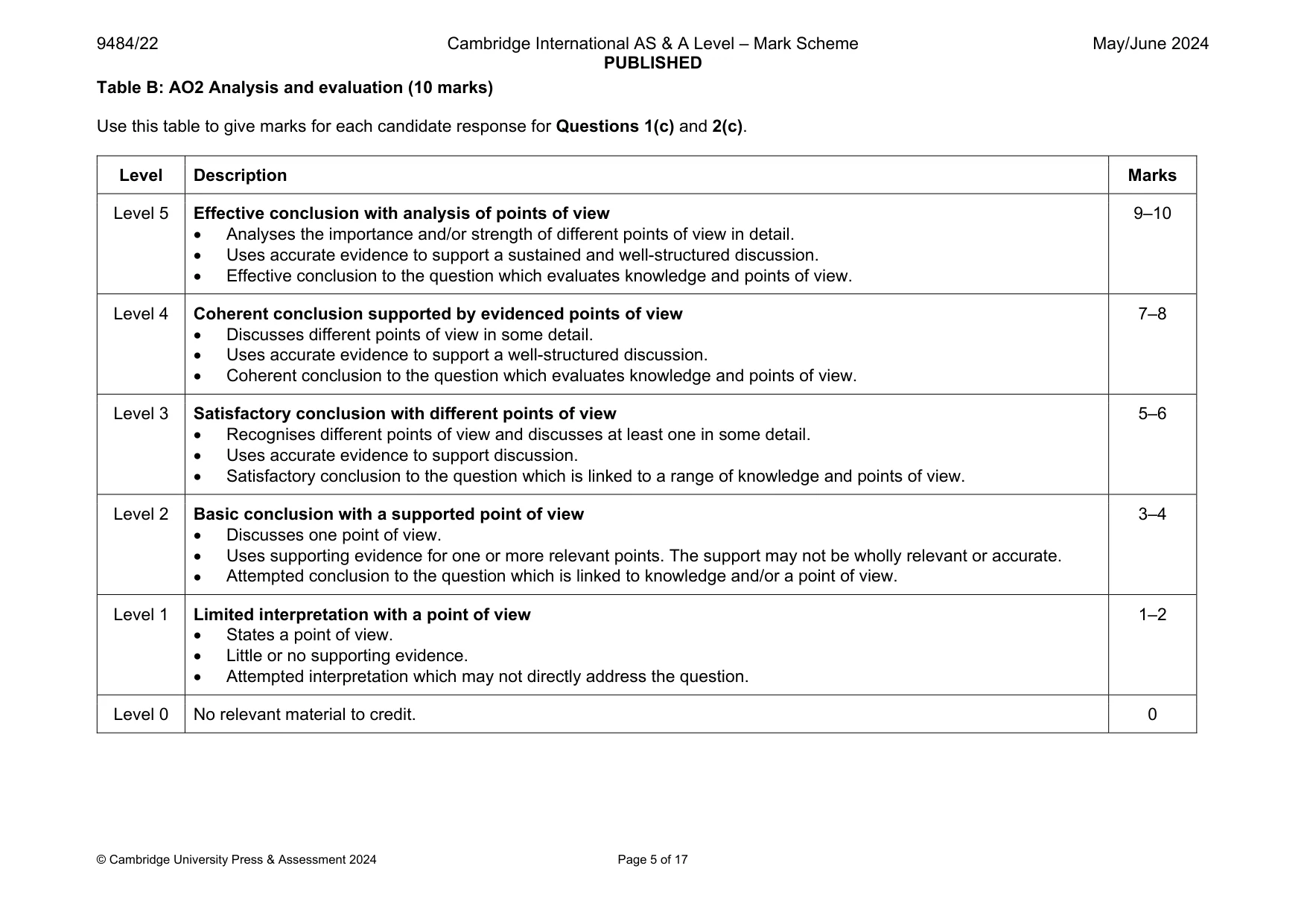
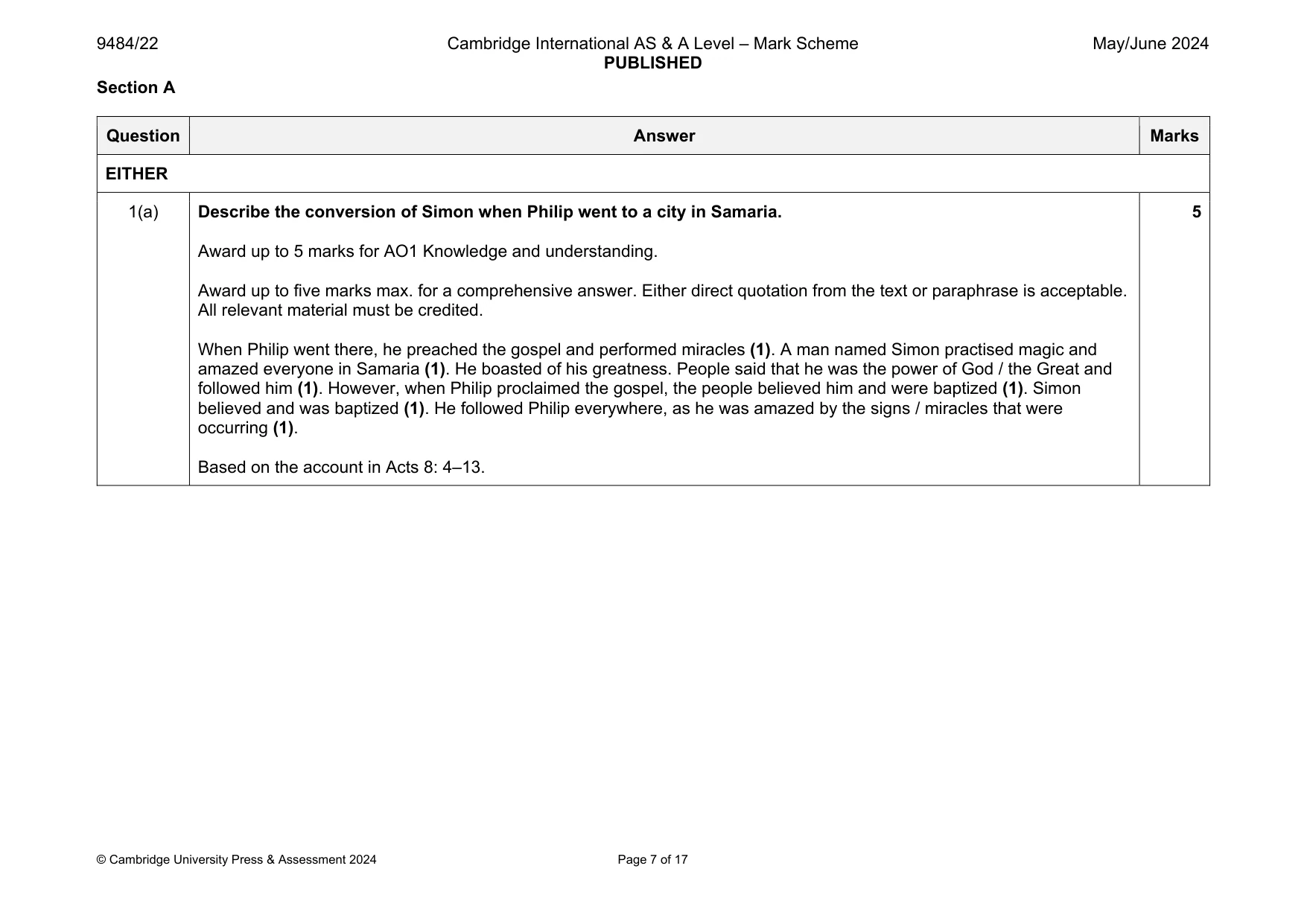
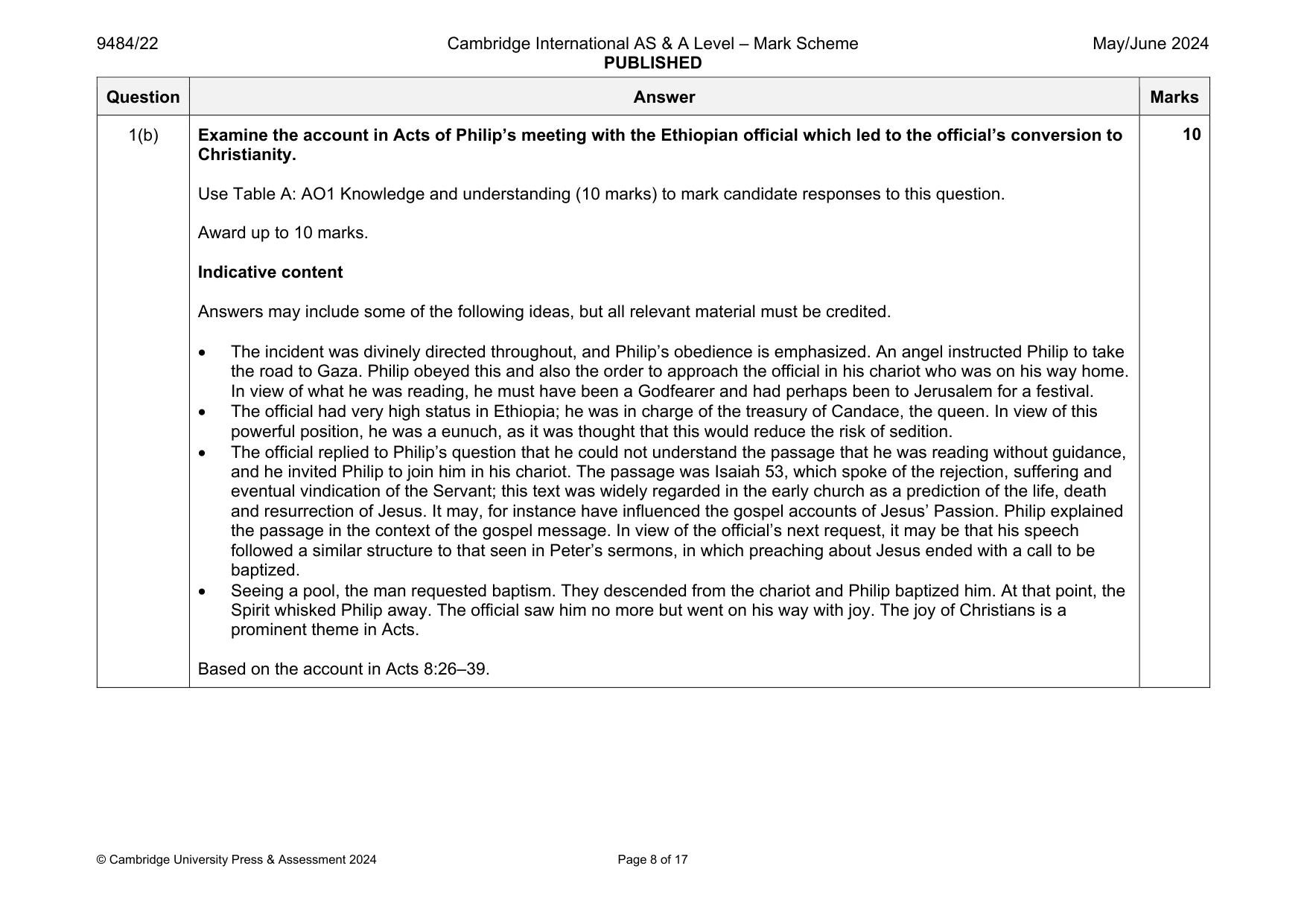
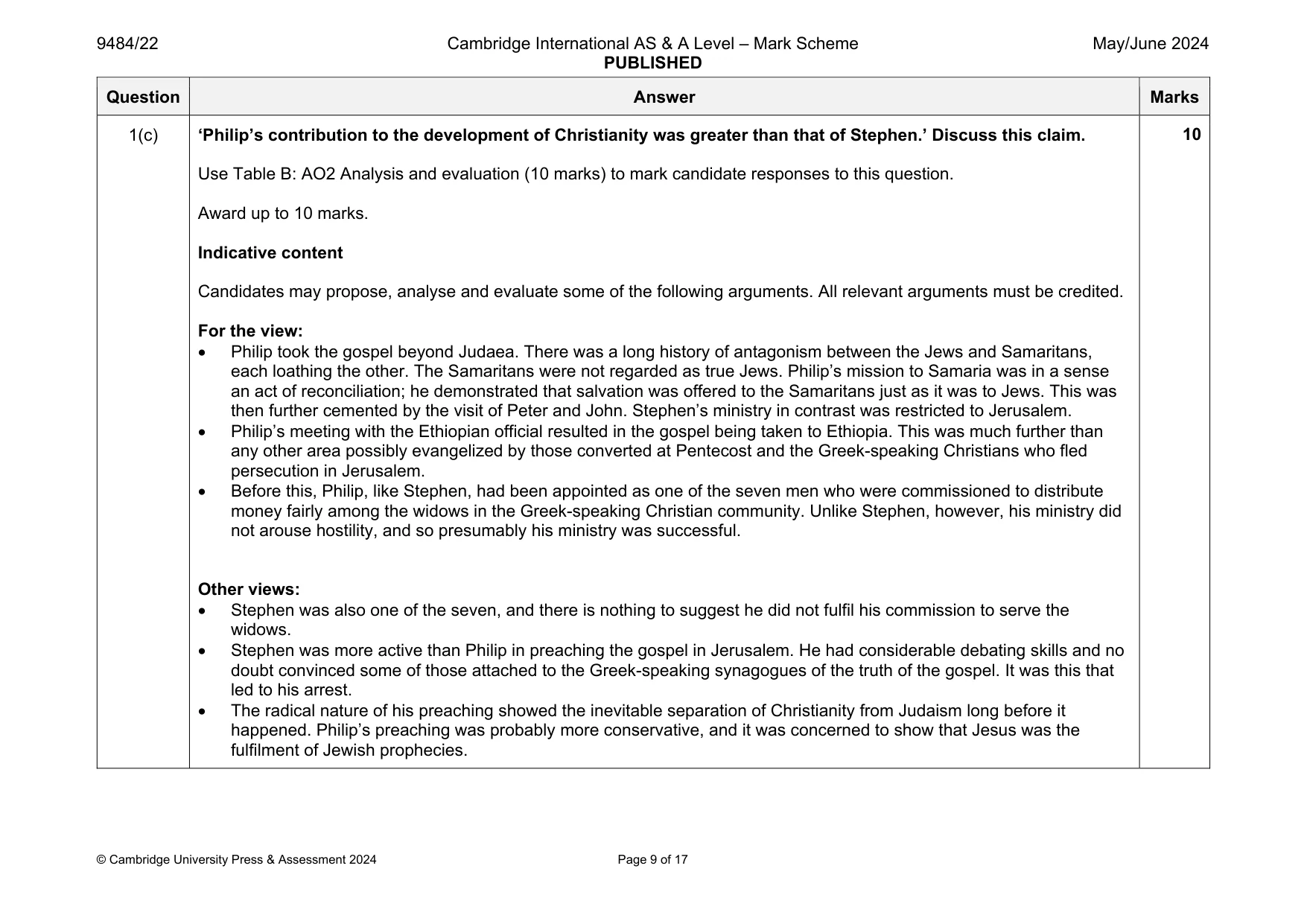
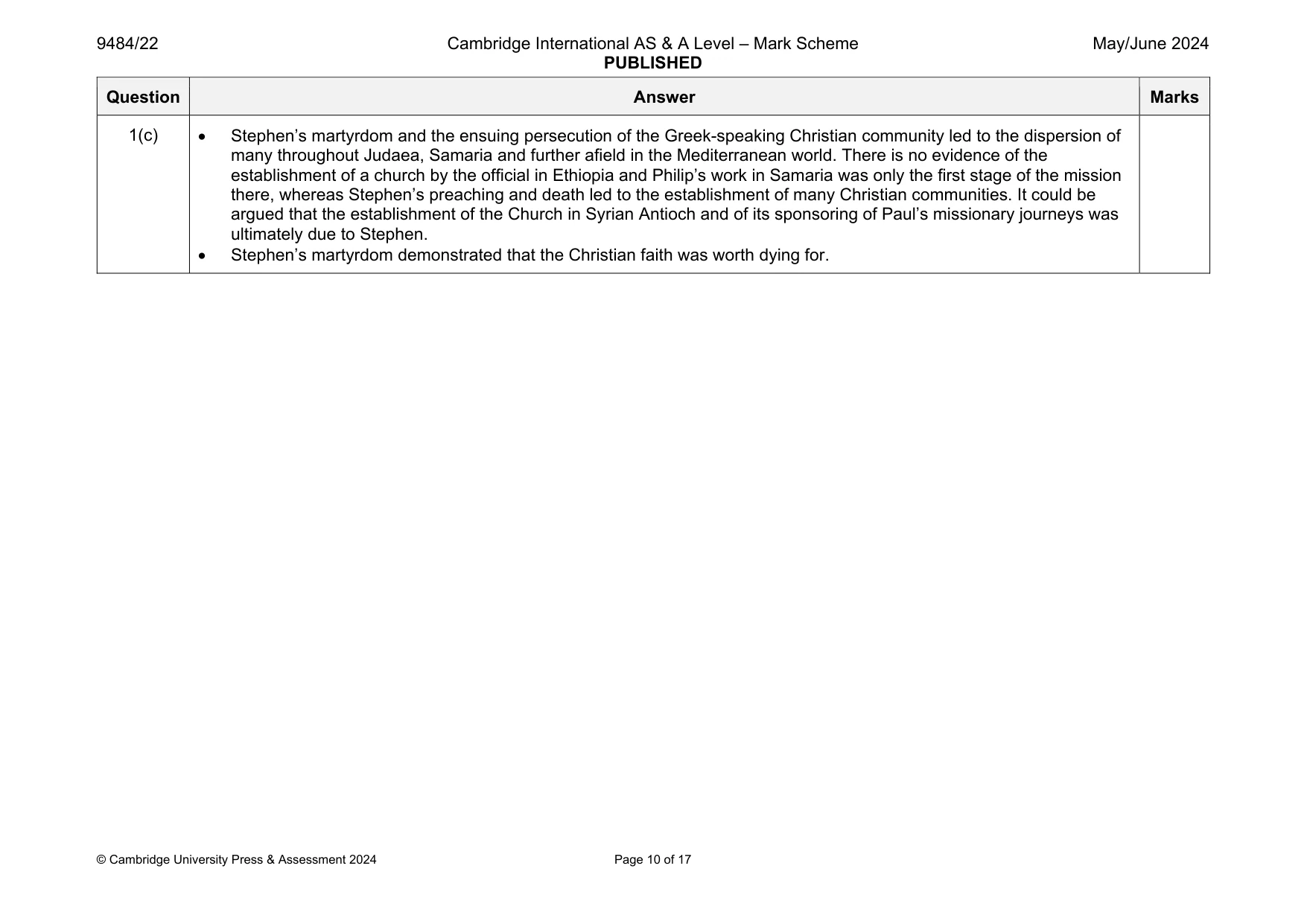
Mark scheme: 1(a) Describe the conversion of Simon when Philip went to a city in Samaria. Award up to 5 marks for AO1 Knowledge and understanding. Award up to five marks max. for a comprehensive answer. Either direct quotation from the text or paraphrase is acceptable. All relevant material must be credited. When Philip went there, he preached the gospel and performed miracles (1). A man named Simon practised magic and amazed everyone in Samaria (1). He boasted of his greatness. People said that he was the power of God / the Great and followed him (1). However, when Philip proclaimed the gospel, the people believed him and were baptized (1). Simon believed and was baptized (1). He followed Philip everywhere, as he was amazed by the signs / miracles that were occurring (1). Based on the account in Acts 8: 4–13. Question Answer Marks 1(b) Examine the account in Acts of Philip’s meeting with the Ethiopian official which led to the official’s conversion to Christianity. Use Table A: AO1 Knowledge and understanding (10 marks) to mark candidate responses to this question. Award up to 10 marks. Indicative content Answers may include some of the following ideas, but all relevant material must be credited. The incident was divinely directed throughout, and Philip’s obedience is emphasized. An angel instructed Philip to take the road to Gaza. Philip obeyed this and also the order to approach the official in his chariot who was on his way home. In view of what he was reading, he must have been a Godfearer and had perhaps been to Jerusalem for a festival. The official had very high status in Ethiopia; he was in charge of the treasury of Candace, the queen. In view of this powerful position, he was a eunuch, as it was thought that this would reduce the risk of sedition. The official replied to Philip’s question that he could not understand the passage that he was reading without guidance, and he invited Philip to join him in his chariot. The passage was Isaiah 53, which spoke of the rejection, suffering and eventual vindication of the Servant; this text was widely regarded in the early church as a prediction of the life, death and resurrection of Jesus. It may, for instance have influenced the gospel accounts of Jesus’ Passion. Philip explained the passage in the context of the gospel message. In view of the official’s next request, it may be that his speech followed a similar structure to that seen in Peter’s sermons, in which preaching about Jesus ended with a call to be baptized. Seeing a pool, the man requested baptism. They descended from the chariot and Philip baptized him. At that point, the Spirit whisked Philip away. The official saw him no more but went on his way with joy. The joy of Christians is a prominent theme in Acts. Based on the account in Acts 8:26–39. 10 Question Answer Marks 1(c) ‘Philip’s contribution to the development of Christianity was greater than that of Stephen.’ Discuss this claim. Use Table B: AO2 Analysis and evaluation (10 marks) to mark candidate responses to this question. Award up to 10 marks. Indicative content Candidates may propose, analyse and evaluate some of the following arguments. All relevant arguments must be credited. For the view: Philip took the gospel beyond Judaea. There was a long history of antagonism between the Jews and Samaritans, each loathing the other. The Samaritans were not regarded as true Jews. Philip’s mission to Samaria was in a sense an act of reconciliation; he demonstrated that salvation was offered to the Samaritans just as it was to Jews. This was then further cemented by the visit of Peter and John. Stephen’s ministry in contrast was restricted to Jerusalem. Philip’s meeting with the Ethiopian official resulted in the gospel being taken to Ethiopia. This was much further than any other area possibly evangelized by those converted at Pentecost and the Greek-speaking Christians who fled persecution in Jerusalem. Before this, Philip, like Stephen, had been appointed as one of the seven men who were commissioned to distribute money fairly among the widows in the Greek-speaking Christian community. Unlike Stephen, however, his ministry did not arouse hostility, and so presumably his ministry was successful. Other views: Stephen was also one of the seven, and there is nothing to suggest he did not fulfil his commission to serve the widows. Stephen was more active than Philip in preaching the gospel in Jerusalem. He had considerable debating skills and no doubt convinced some of those attached to the Greek-speaking synagogues of the truth of the gospel. It was this that led to his arrest. The radical nature of his preaching showed the inevitable separation of Christianity from Judaism long before it happened. Philip’s preaching was probably more conservative, and it was concerned to show that Jesus was the fulfilment of Jewish prophecies. 10 Question Answer Marks 1(c) Stephen’s martyrdom and the ensuing persecution of the Greek-speaking Christian community led to the dispersion of many throughout Judaea, Samaria and further afield in the Mediterranean world. There is no evidence of the establishment of a church by the official in Ethiopia and Philip’s work in Samaria was only the first stage of the mission there, whereas Stephen’s preaching and death led to the establishment of many Christian communities. It could be argued that the establishment of the Church in Syrian Antioch and of its sponsoring of Paul’s missionary journeys was ultimately due to Stephen. Stephen’s martyrdom demonstrated that the Christian faith was worth dying for.
Q2 · Outline the mission of Paul and Silas to Beroea
2 (a) Outline the mission of Paul and Silas to Beroea. [5] (b) Explain why Paul and Silas left Thessalonica. [10] (c) ‘Paul’s missionary journeys would have been more successful if he had not preached the gospel in synagogues.’ Discuss this view. [10] [Total: 25]
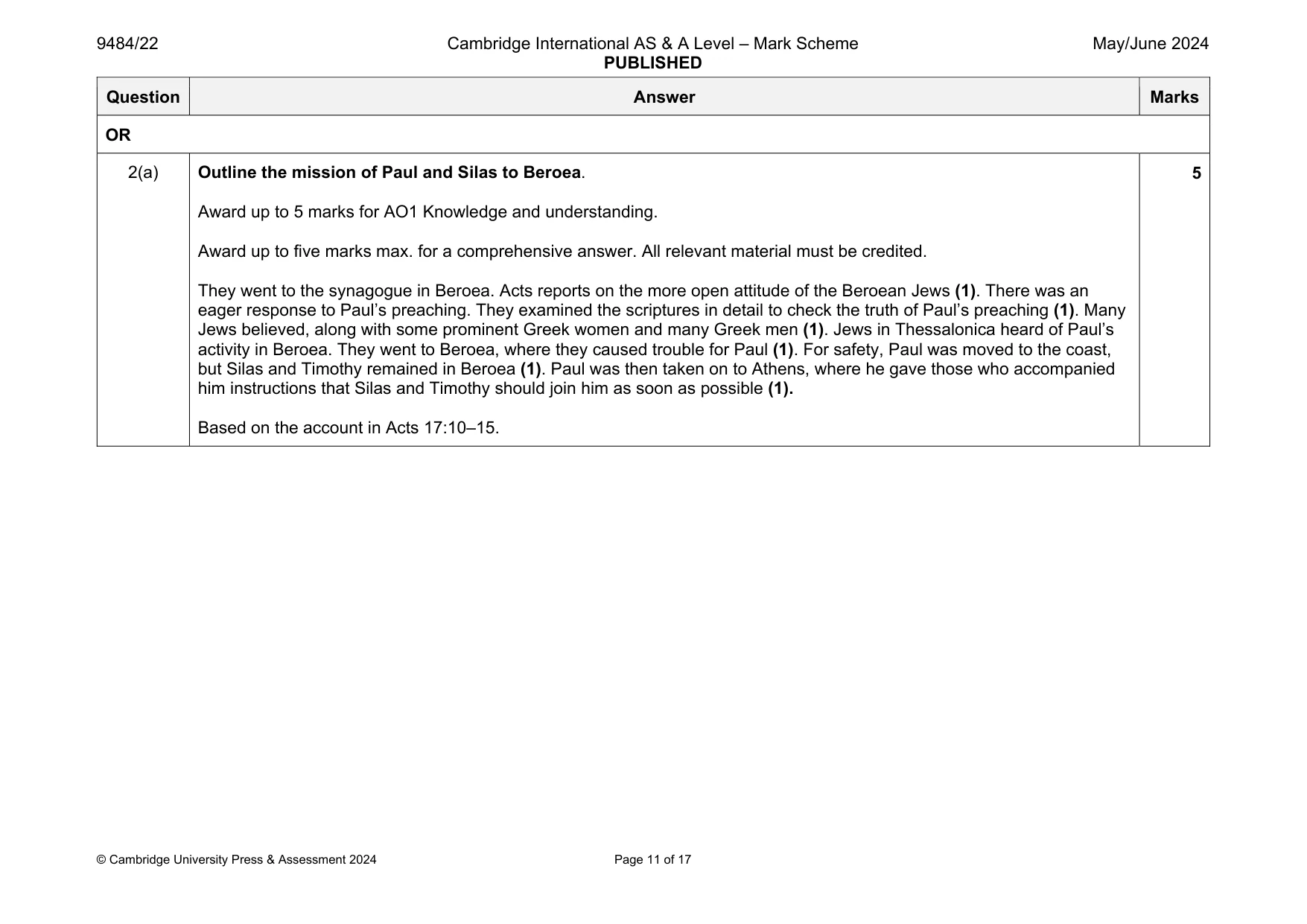
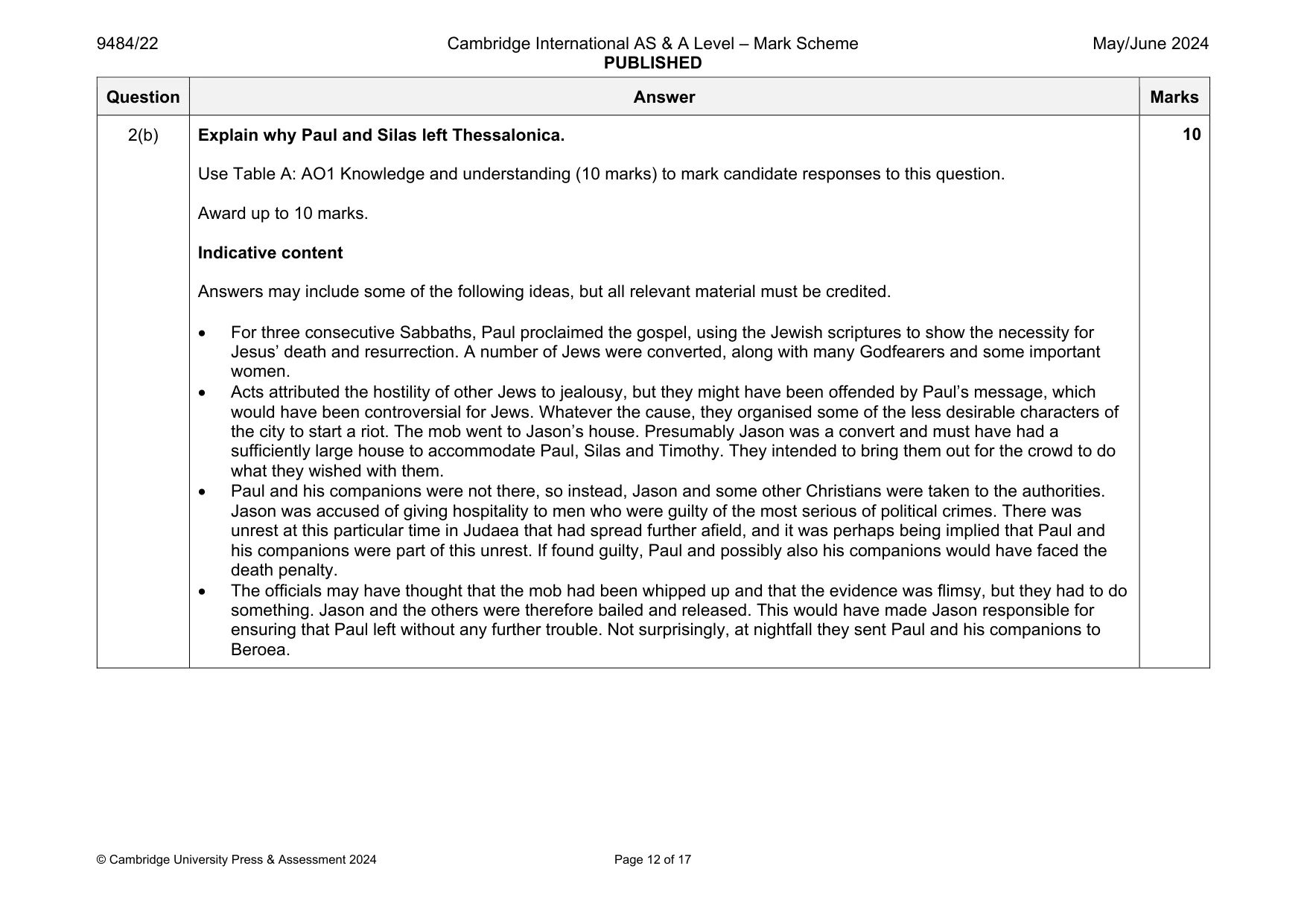
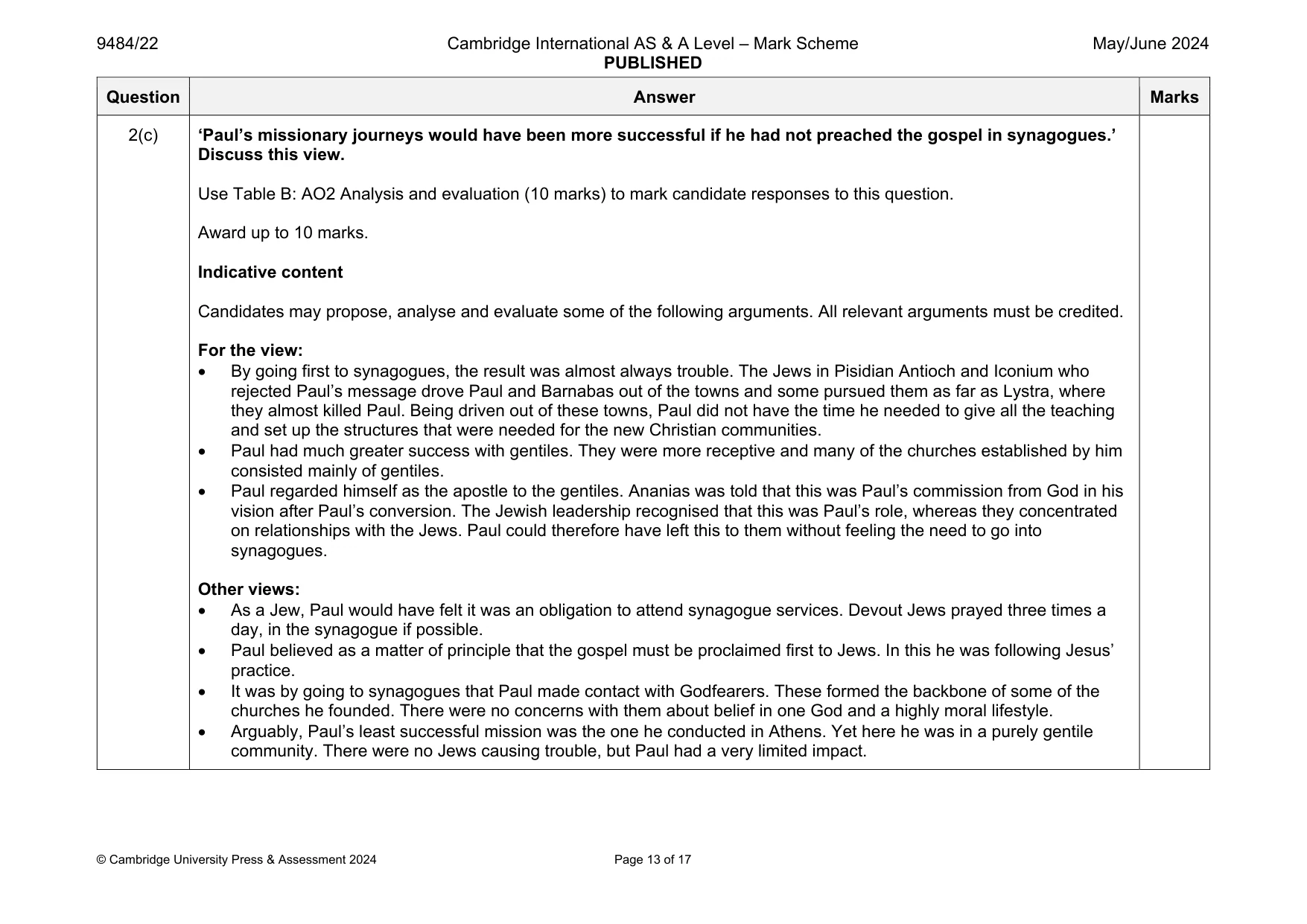
Mark scheme: 2(a) Outline the mission of Paul and Silas to Beroea. Award up to 5 marks for AO1 Knowledge and understanding. Award up to five marks max. for a comprehensive answer. All relevant material must be credited. They went to the synagogue in Beroea. Acts reports on the more open attitude of the Beroean Jews (1). There was an eager response to Paul’s preaching. They examined the scriptures in detail to check the truth of Paul’s preaching (1). Many Jews believed, along with some prominent Greek women and many Greek men (1). Jews in Thessalonica heard of Paul’s activity in Beroea. They went to Beroea, where they caused trouble for Paul (1). For safety, Paul was moved to the coast, but Silas and Timothy remained in Beroea (1). Paul was then taken on to Athens, where he gave those who accompanied him instructions that Silas and Timothy should join him as soon as possible (1). Based on the account in Acts 17:10–15. 5 Question Answer Marks 2(b) Explain why Paul and Silas left Thessalonica. Use Table A: AO1 Knowledge and understanding (10 marks) to mark candidate responses to this question. Award up to 10 marks. Indicative content Answers may include some of the following ideas, but all relevant material must be credited. For three consecutive Sabbaths, Paul proclaimed the gospel, using the Jewish scriptures to show the necessity for Jesus’ death and resurrection. A number of Jews were converted, along with many Godfearers and some important women. Acts attributed the hostility of other Jews to jealousy, but they might have been offended by Paul’s message, which would have been controversial for Jews. Whatever the cause, they organised some of the less desirable characters of the city to start a riot. The mob went to Jason’s house. Presumably Jason was a convert and must have had a sufficiently large house to accommodate Paul, Silas and Timothy. They intended to bring them out for the crowd to do what they wished with them. Paul and his companions were not there, so instead, Jason and some other Christians were taken to the authorities. Jason was accused of giving hospitality to men who were guilty of the most serious of political crimes. There was unrest at this particular time in Judaea that had spread further afield, and it was perhaps being implied that Paul and his companions were part of this unrest. If found guilty, Paul and possibly also his companions would have faced the death penalty. The officials may have thought that the mob had been whipped up and that the evidence was flimsy, but they had to do something. Jason and the others were therefore bailed and released. This would have made Jason responsible for ensuring that Paul left without any further trouble. Not surprisingly, at nightfall they sent Paul and his companions to Beroea. 10 Question Answer Marks 2(c) ‘Paul’s missionary journeys would have been more successful if he had not preached the gospel in synagogues.’ Discuss this view. Use Table B: AO2 Analysis and evaluation (10 marks) to mark candidate responses to this question. Award up to 10 marks. Indicative content Candidates may propose, analyse and evaluate some of the following arguments. All relevant arguments must be credited. For the view: By going first to synagogues, the result was almost always trouble. The Jews in Pisidian Antioch and Iconium who rejected Paul’s message drove Paul and Barnabas out of the towns and some pursued them as far as Lystra, where they almost killed Paul. Being driven out of these towns, Paul did not have the time he needed to give all the teaching and set up the structures that were needed for the new Christian communities. Paul had much greater success with gentiles. They were more receptive and many of the churches established by him consisted mainly of gentiles. Paul regarded himself as the apostle to the gentiles. Ananias was told that this was Paul’s commission from God in his vision after Paul’s conversion. The Jewish leadership recognised that this was Paul’s role, whereas they concentrated on relationships with the Jews. Paul could therefore have left this to them without feeling the need to go into synagogues. Other views: As a Jew, Paul would have felt it was an obligation to attend synagogue services. Devout Jews prayed three times a day, in the synagogue if possible. Paul believed as a matter of principle that the gospel must be proclaimed first to Jews. In this he was following Jesus’ practice. It was by going to synagogues that Paul made contact with Godfearers. These formed the backbone of some of the churches he founded. There were no concerns with them about belief in one God and a highly moral lifestyle. Arguably, Paul’s least successful mission was the one he conducted in Athens. Yet here he was in a purely gentile community. There were no Jews causing trouble, but Paul had a very limited impact.
Q3 · Examine Paul’s teaching in 1 Corinthians 11 and 14 about the appearance and behaviour of…
3 (a) Examine Paul’s teaching in 1 Corinthians 11 and 14 about the appearance and behaviour of women at worship. [10] (b) ‘Paul’s rules about the conduct of worship stifled the spiritual growth of the Corinthian Church.’ Evaluate this claim. [15] [Total: 25] OR
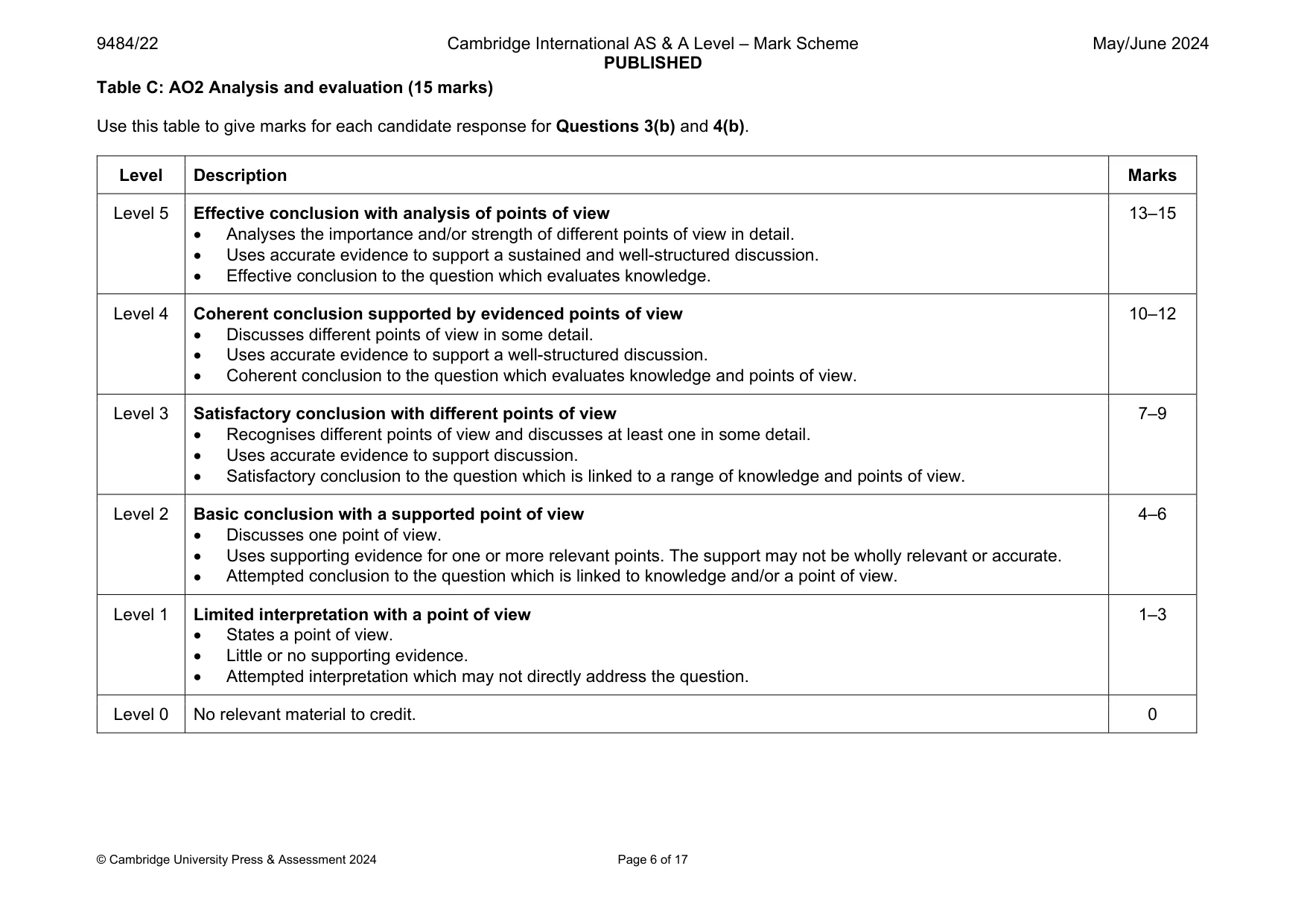
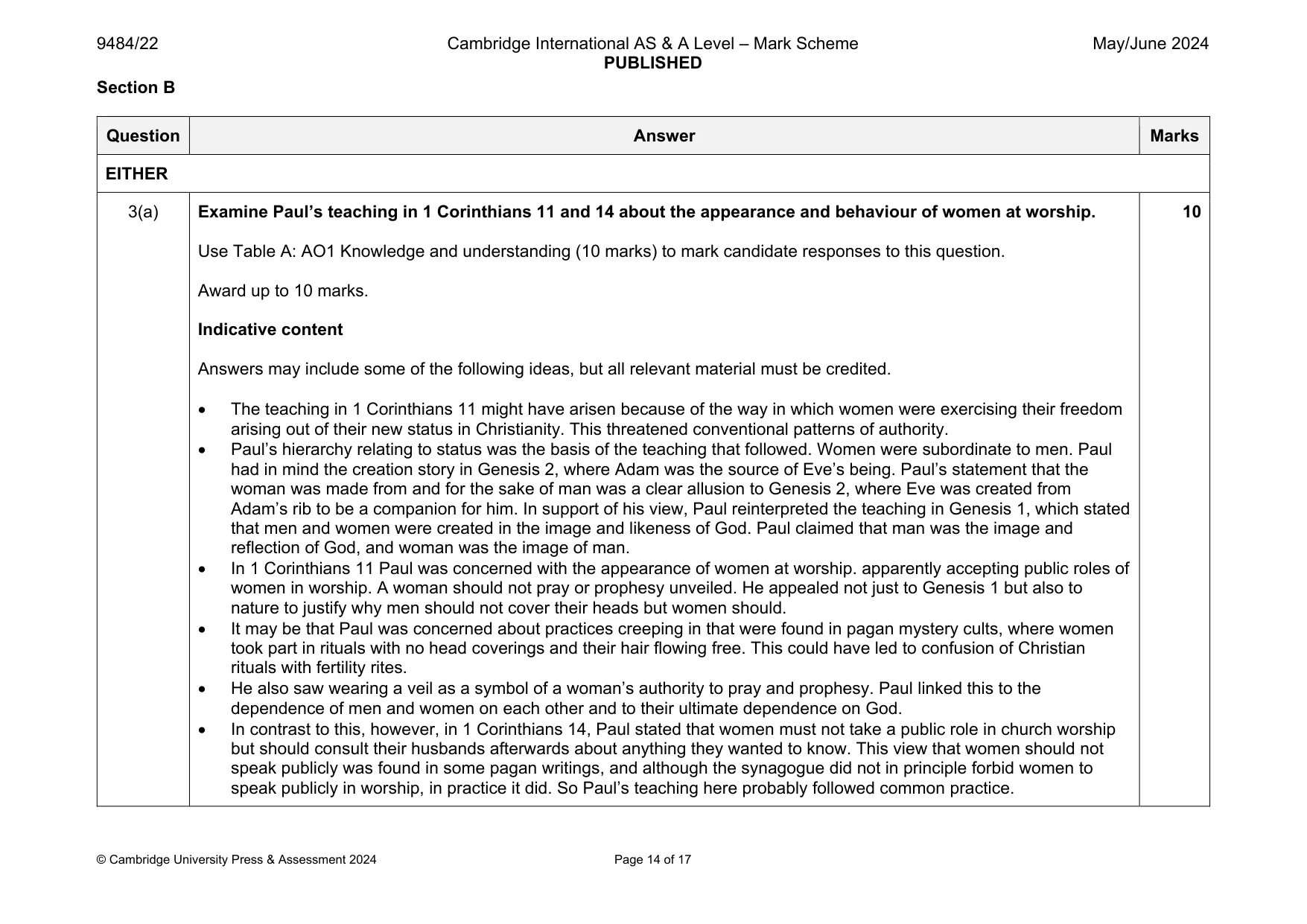
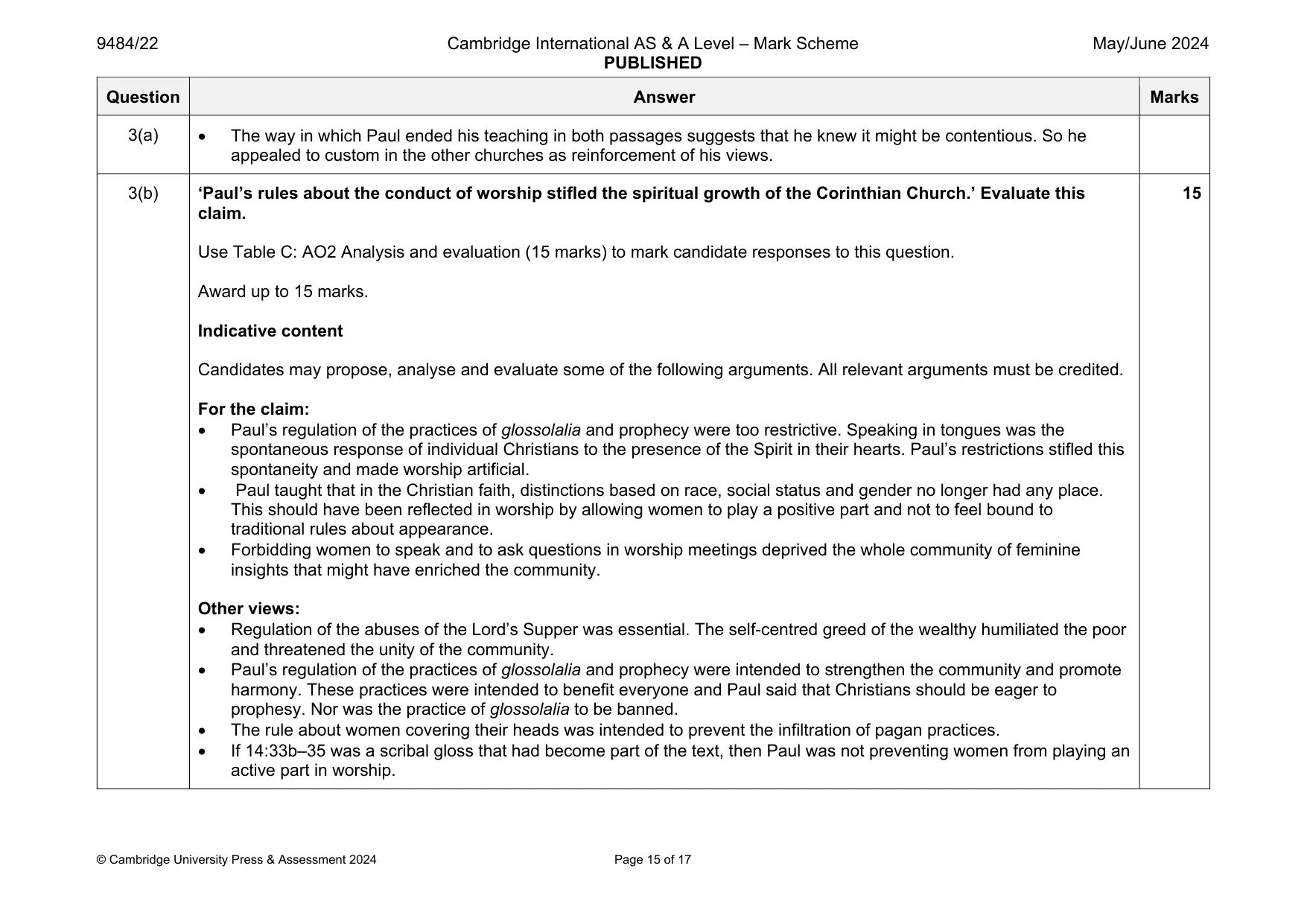
Mark scheme: 3(a) Examine Paul’s teaching in 1 Corinthians 11 and 14 about the appearance and behaviour of women at worship. Use Table A: AO1 Knowledge and understanding (10 marks) to mark candidate responses to this question. Award up to 10 marks. Indicative content Answers may include some of the following ideas, but all relevant material must be credited. The teaching in 1 Corinthians 11 might have arisen because of the way in which women were exercising their freedom arising out of their new status in Christianity. This threatened conventional patterns of authority. Paul’s hierarchy relating to status was the basis of the teaching that followed. Women were subordinate to men. Paul had in mind the creation story in Genesis 2, where Adam was the source of Eve’s being. Paul’s statement that the woman was made from and for the sake of man was a clear allusion to Genesis 2, where Eve was created from Adam’s rib to be a companion for him. In support of his view, Paul reinterpreted the teaching in Genesis 1, which stated that men and women were created in the image and likeness of God. Paul claimed that man was the image and reflection of God, and woman was the image of man. In 1 Corinthians 11 Paul was concerned with the appearance of women at worship. apparently accepting public roles of women in worship. A woman should not pray or prophesy unveiled. He appealed not just to Genesis 1 but also to nature to justify why men should not cover their heads but women should. It may be that Paul was concerned about practices creeping in that were found in pagan mystery cults, where women took part in rituals with no head coverings and their hair flowing free. This could have led to confusion of Christian rituals with fertility rites. He also saw wearing a veil as a symbol of a woman’s authority to pray and prophesy. Paul linked this to the dependence of men and women on each other and to their ultimate dependence on God. In contrast to this, however, in 1 Corinthians 14, Paul stated that women must not take a public role in church worship but should consult their husbands afterwards about anything they wanted to know. This view that women should not speak publicly was found in some pagan writings, and although the synagogue did not in principle forbid women to speak publicly in worship, in practice it did. So Paul’s teaching here probably followed common practice. Question Answer Marks 3(a) The way in which Paul ended his teaching in both passages suggests that he knew it might be contentious. So he appealed to custom in the other churches as reinforcement of his views. 3(b) ‘Paul’s rules about the conduct of worship stifled the spiritual growth of the Corinthian Church.’ Evaluate this claim. Use Table C: AO2 Analysis and evaluation (15 marks) to mark candidate responses to this question. Award up to 15 marks. Indicative content Candidates may propose, analyse and evaluate some of the following arguments. All relevant arguments must be credited. For the claim: Paul’s regulation of the practices of glossolalia and prophecy were too restrictive. Speaking in tongues was the spontaneous response of individual Christians to the presence of the Spirit in their hearts. Paul’s restrictions stifled this spontaneity and made worship artificial. Paul taught that in the Christian faith, distinctions based on race, social status and gender no longer had any place. This should have been reflected in worship by allowing women to play a positive part and not to feel bound to traditional rules about appearance. Forbidding women to speak and to ask questions in worship meetings deprived the whole community of feminine insights that might have enriched the community. Other views: Regulation of the abuses of the Lord’s Supper was essential. The self-centred greed of the wealthy humiliated the poor and threatened the unity of the community. Paul’s regulation of the practices of glossolalia and prophecy were intended to strengthen the community and promote harmony. These practices were intended to benefit everyone and Paul said that Christians should be eager to prophesy. Nor was the practice of glossolalia to be banned. The rule about women covering their heads was intended to prevent the infiltration of pagan practices. If 14:33b–35 was a scribal gloss that had become part of the text, then Paul was not preventing women from playing an active part in worship. 15
Q4 · Compare Paul’s instructions to slaves and slave-masters in Colossians with the teaching…
4 (a) Compare Paul’s instructions to slaves and slave-masters in Colossians with the teaching on slavery in 1 Peter. [10] (b) Analyse how the New Testament portrays slavery. [15] [Total: 25]
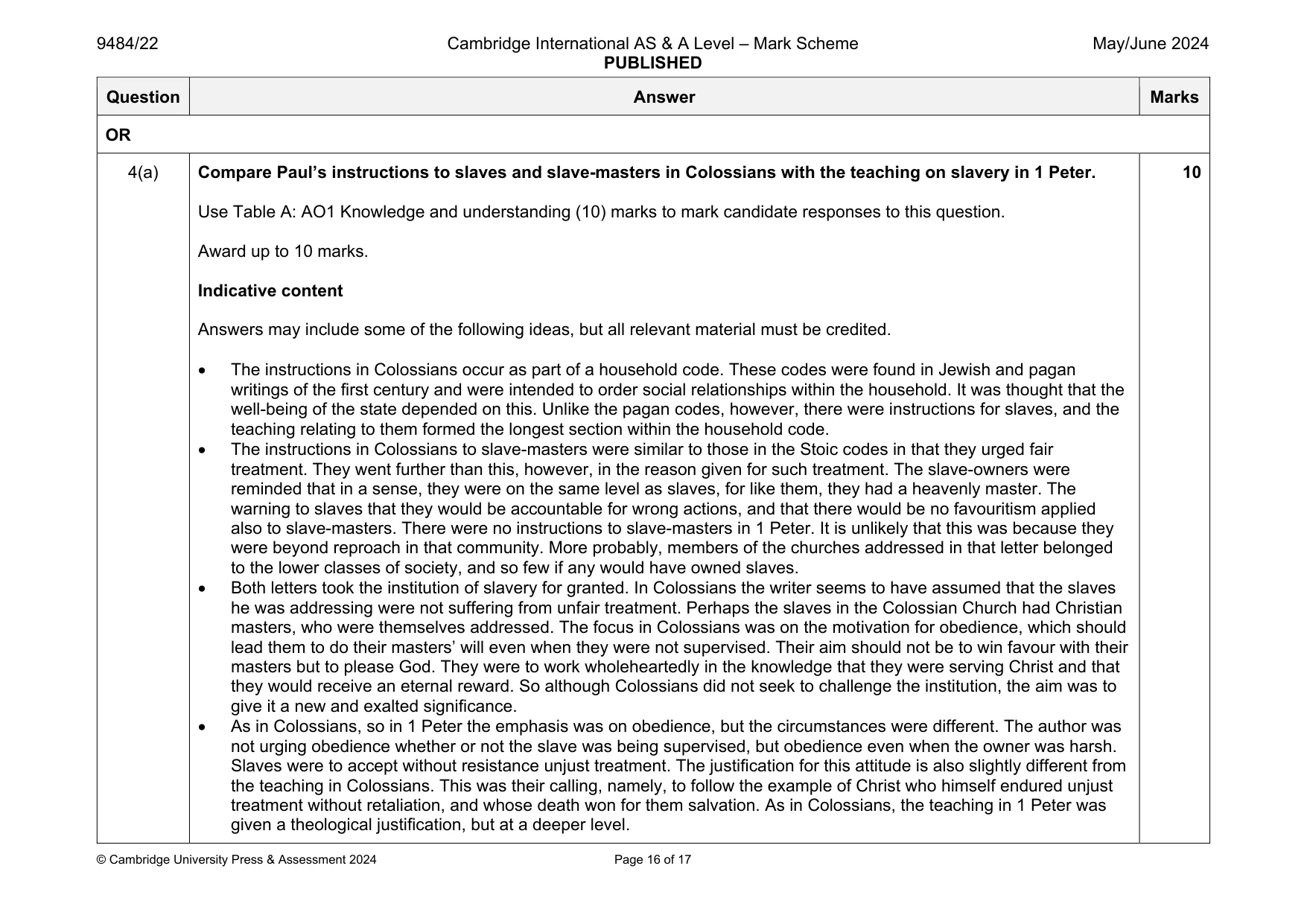
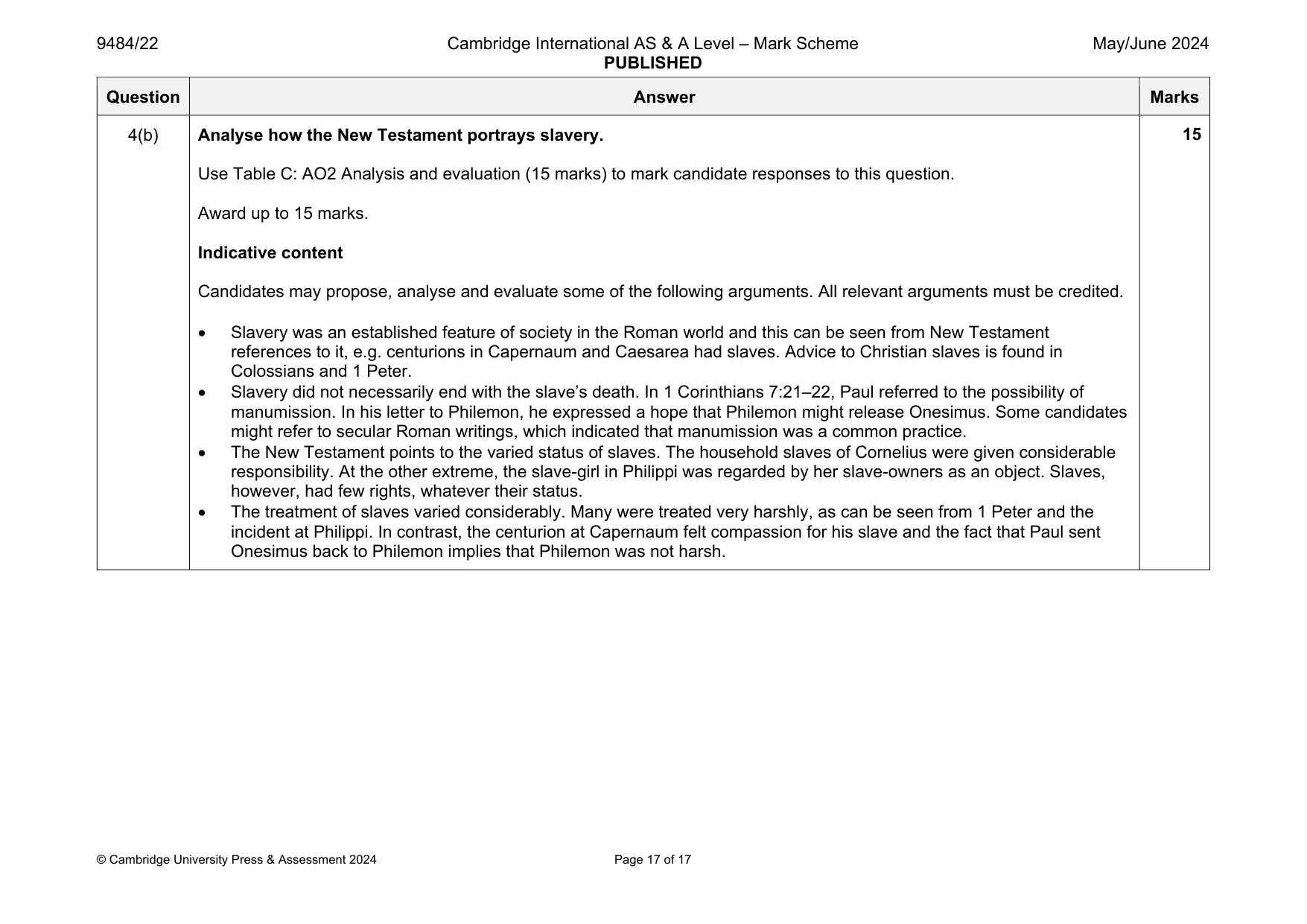
Mark scheme: 4(a) Compare Paul’s instructions to slaves and slave-masters in Colossians with the teaching on slavery in 1 Peter. Use Table A: AO1 Knowledge and understanding (10) marks to mark candidate responses to this question. Award up to 10 marks. Indicative content Answers may include some of the following ideas, but all relevant material must be credited. The instructions in Colossians occur as part of a household code. These codes were found in Jewish and pagan writings of the first century and were intended to order social relationships within the household. It was thought that the well-being of the state depended on this. Unlike the pagan codes, however, there were instructions for slaves, and the teaching relating to them formed the longest section within the household code. The instructions in Colossians to slave-masters were similar to those in the Stoic codes in that they urged fair treatment. They went further than this, however, in the reason given for such treatment. The slave-owners were reminded that in a sense, they were on the same level as slaves, for like them, they had a heavenly master. The warning to slaves that they would be accountable for wrong actions, and that there would be no favouritism applied also to slave-masters. There were no instructions to slave-masters in 1 Peter. It is unlikely that this was because they were beyond reproach in that community. More probably, members of the churches addressed in that letter belonged to the lower classes of society, and so few if any would have owned slaves. Both letters took the institution of slavery for granted. In Colossians the writer seems to have assumed that the slaves he was addressing were not suffering from unfair treatment. Perhaps the slaves in the Colossian Church had Christian masters, who were themselves addressed. The focus in Colossians was on the motivation for obedience, which should lead them to do their masters’ will even when they were not supervised. Their aim should not be to win favour with their masters but to please God. They were to work wholeheartedly in the knowledge that they were serving Christ and that they would receive an eternal reward. So although Colossians did not seek to challenge the institution, the aim was to give it a new and exalted significance. As in Colossians, so in 1 Peter the emphasis was on obedience, but the circumstances were different. The author was not urging obedience whether or not the slave was being supervised, but obedience even when the owner was harsh. Slaves were to accept without resistance unjust treatment. The justification for this attitude is also slightly different from the teaching in Colossians. This was their calling, namely, to follow the example of Christ who himself endured unjust treatment without retaliation, and whose death won for them salvation. As in Colossians, the teaching in 1 Peter was given a theological justification, but at a deeper level. Question Answer Marks 4(b) Analyse how the New Testament portrays slavery. Use Table C: AO2 Analysis and evaluation (15 marks) to mark candidate responses to this question. Award up to 15 marks. Indicative content Candidates may propose, analyse and evaluate some of the following arguments. All relevant arguments must be credited. Slavery was an established feature of society in the Roman world and this can be seen from New Testament references to it, e.g. centurions in Capernaum and Caesarea had slaves. Advice to Christian slaves is found in Colossians and 1 Peter. Slavery did not necessarily end with the slave’s death. In 1 Corinthians 7:21–22, Paul referred to the possibility of manumission. In his letter to Philemon, he expressed a hope that Philemon might release Onesimus. Some candidates might refer to secular Roman writings, which indicated that manumission was a common practice. The New Testament points to the varied status of slaves. The household slaves of Cornelius were given considerable responsibility. At the other extreme, the slave-girl in Philippi was regarded by her slave-owners as an object. Slaves, however, had few rights, whatever their status. The treatment of slaves varied considerably. Many were treated very harshly, as can be seen from 1 Peter and the incident at Philippi. In contrast, the centurion at Capernaum felt compassion for his slave and the fact that Paul sent Onesimus back to Philemon implies that Philemon was not harsh. 15
What was in this paper
The subtopics covered by these 4 questions, and how many questions each got. Open one in a new tab to see every Cambridge question on it.
What you needed in this session
Cambridge’s own grade thresholds for 2024 May/June, Paper 2 · Variant 2. A higher threshold means an easier paper — the bar moves with how the cohort did.