Cambridge A Level Biblical Studies 9484 — 2024 Oct/Nov Paper 4 · Variant 2
9484/42/O/N/24 · 2 questions · 50 marks · 90 min
The question paper and its mark scheme, free to read here and free to download. This is Cambridge’s own paper, exactly as it was sat.
Question paper4 pages


Mark scheme10 pages
Answers below. Sit the paper first if you are practising.
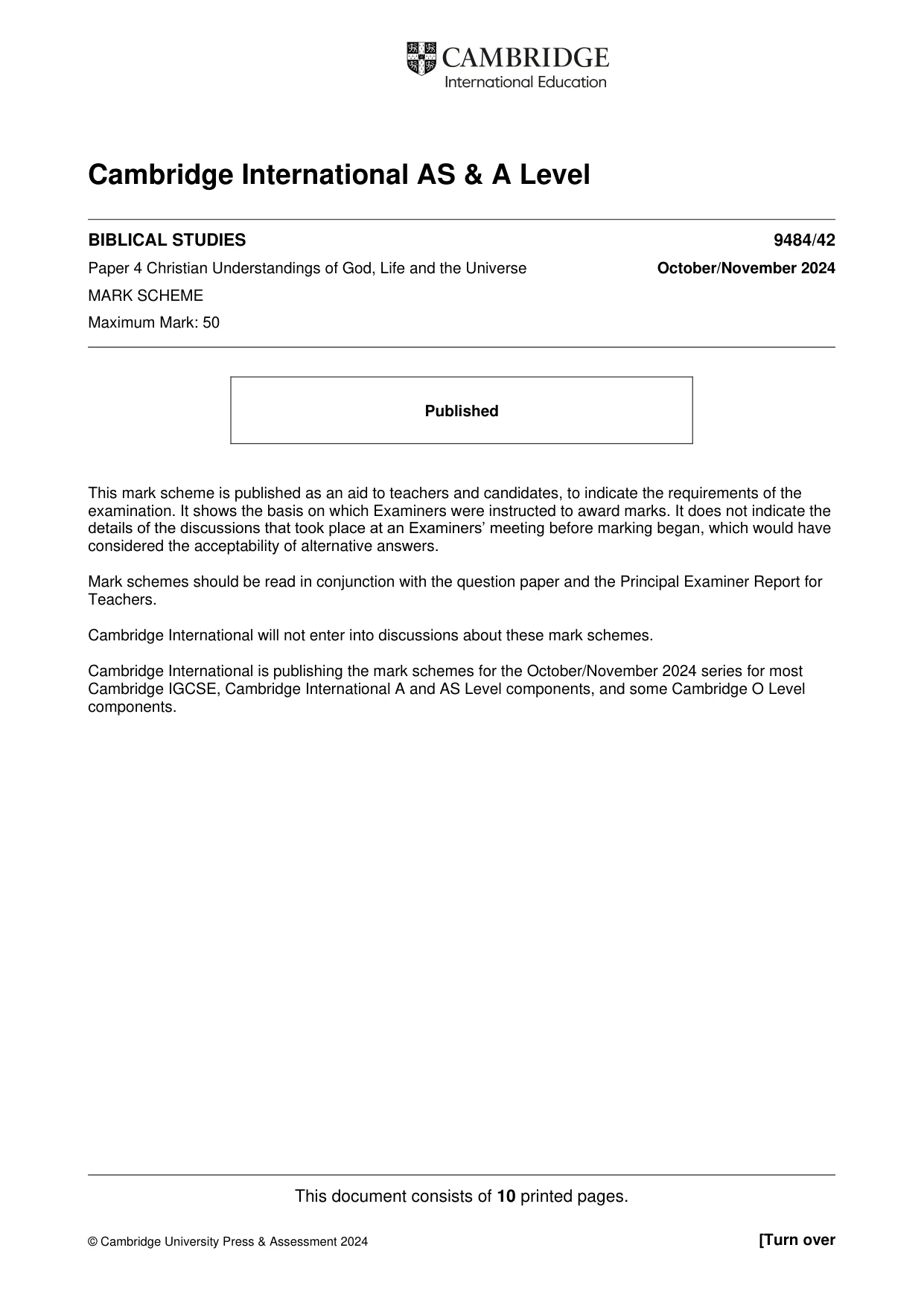
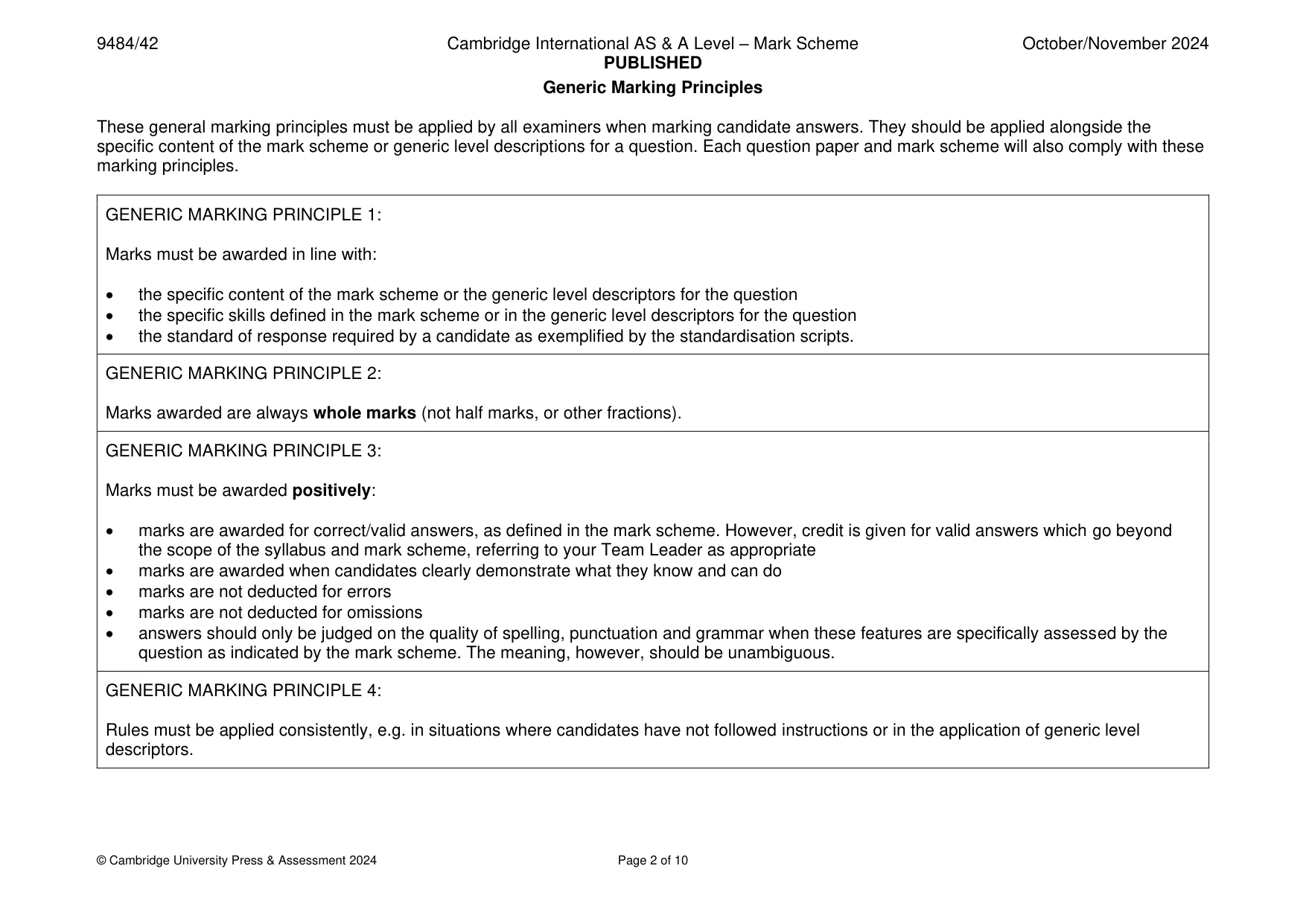
Questions as text
Q1 · Evaluate to what extent Genesis 1:1–2:3 and Genesis 2:4–19 provide complementary…
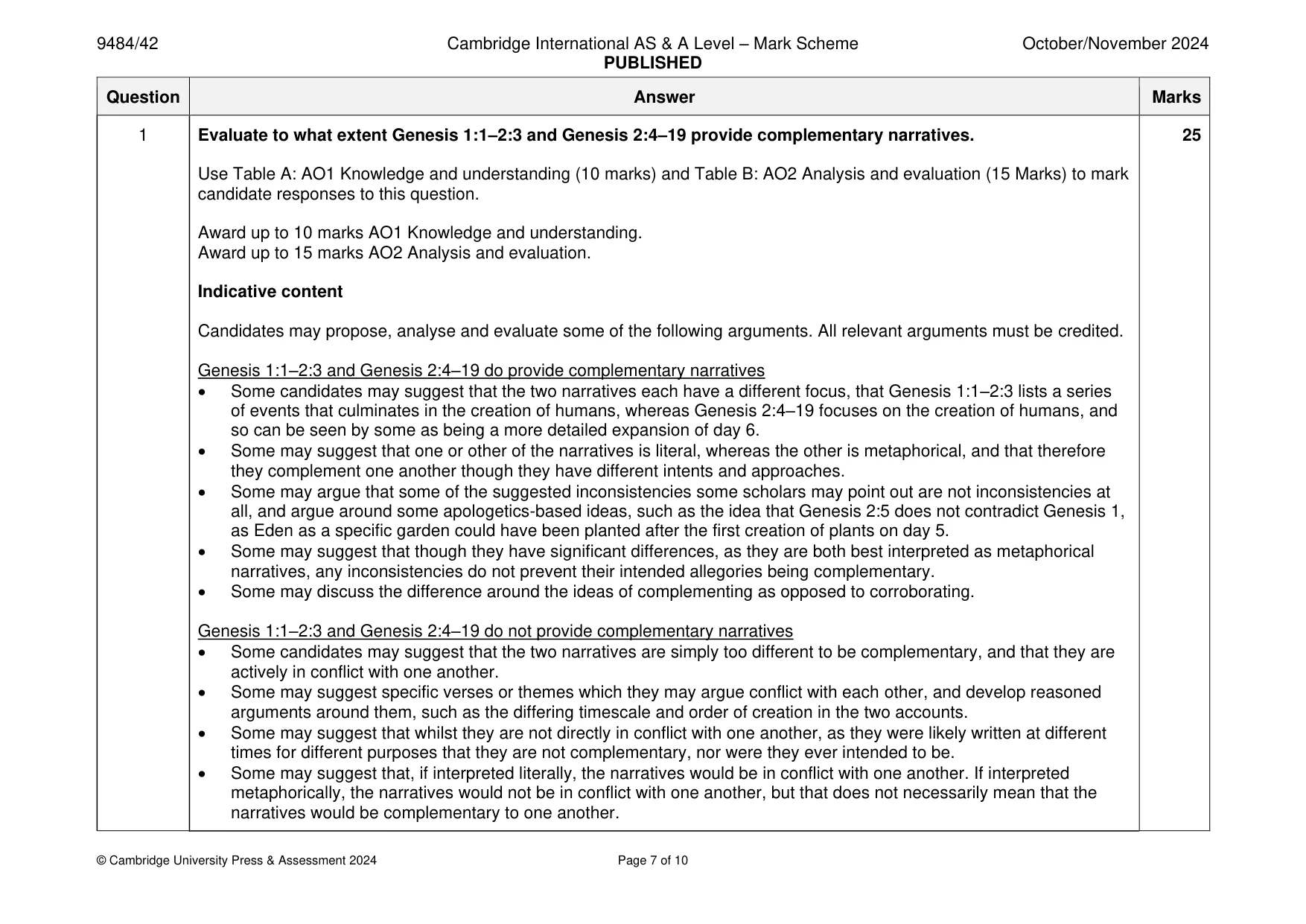
1 Evaluate to what extent Genesis 1:1–2:3 and Genesis 2:4–19 provide complementary narratives. [25]
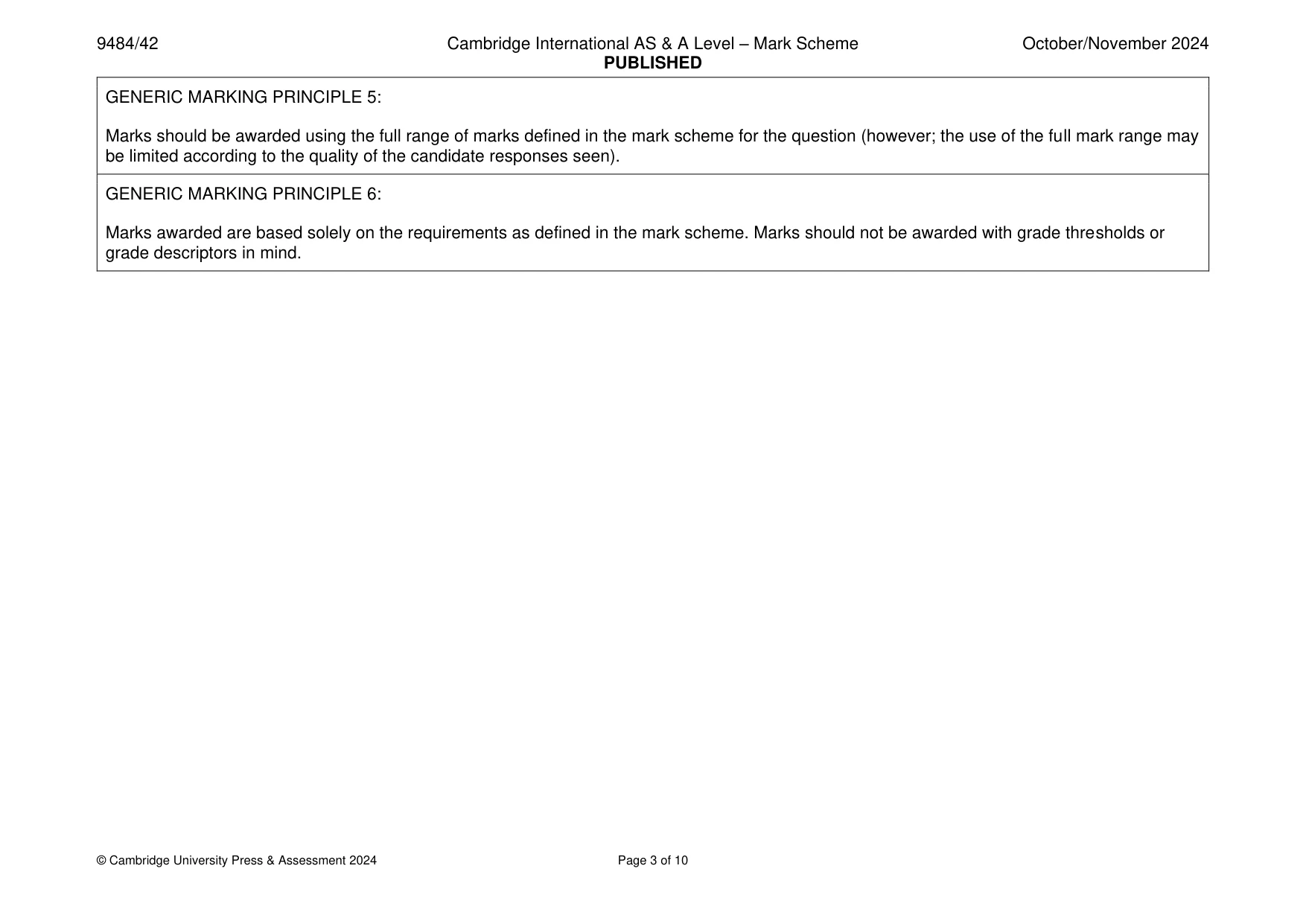
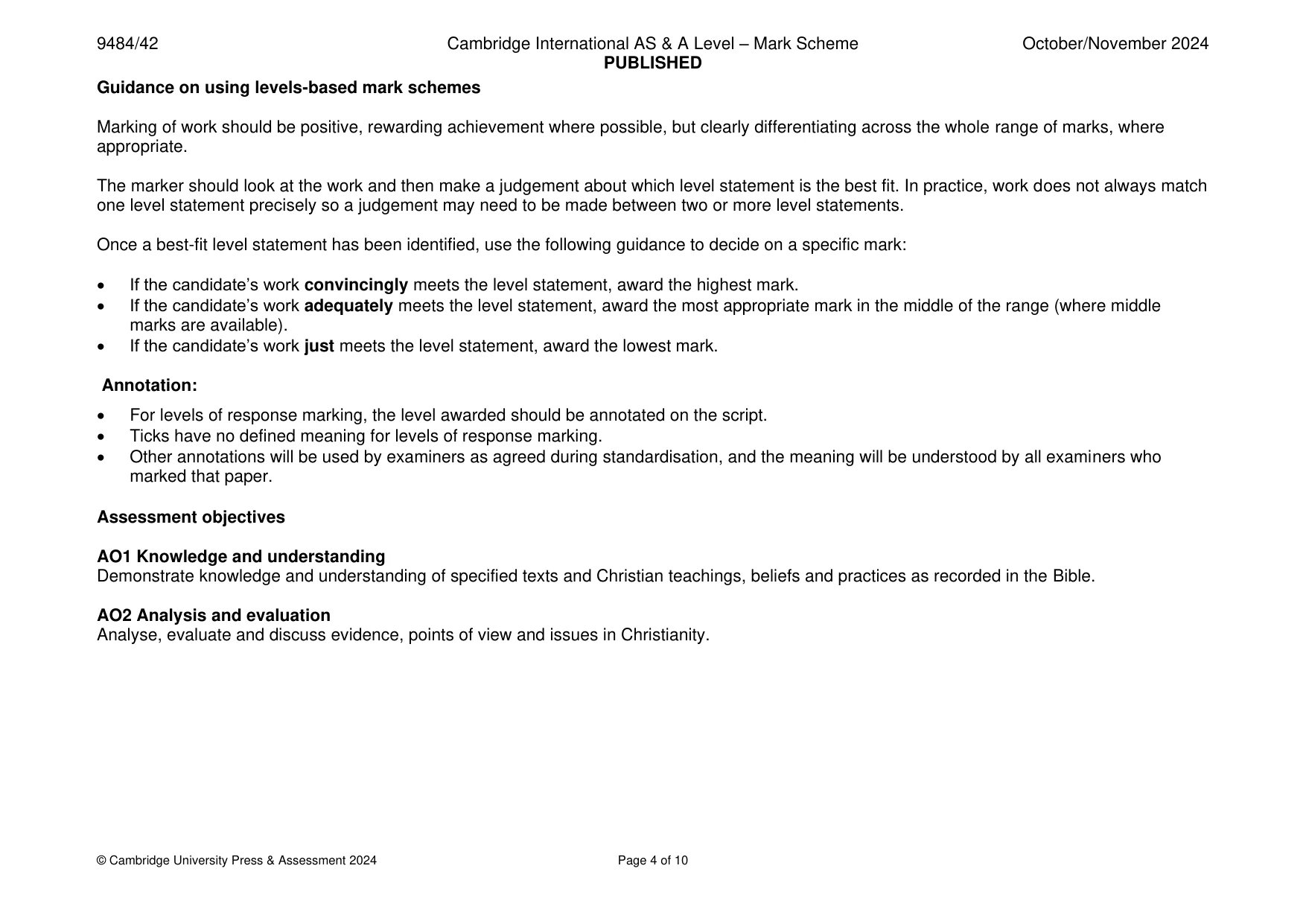
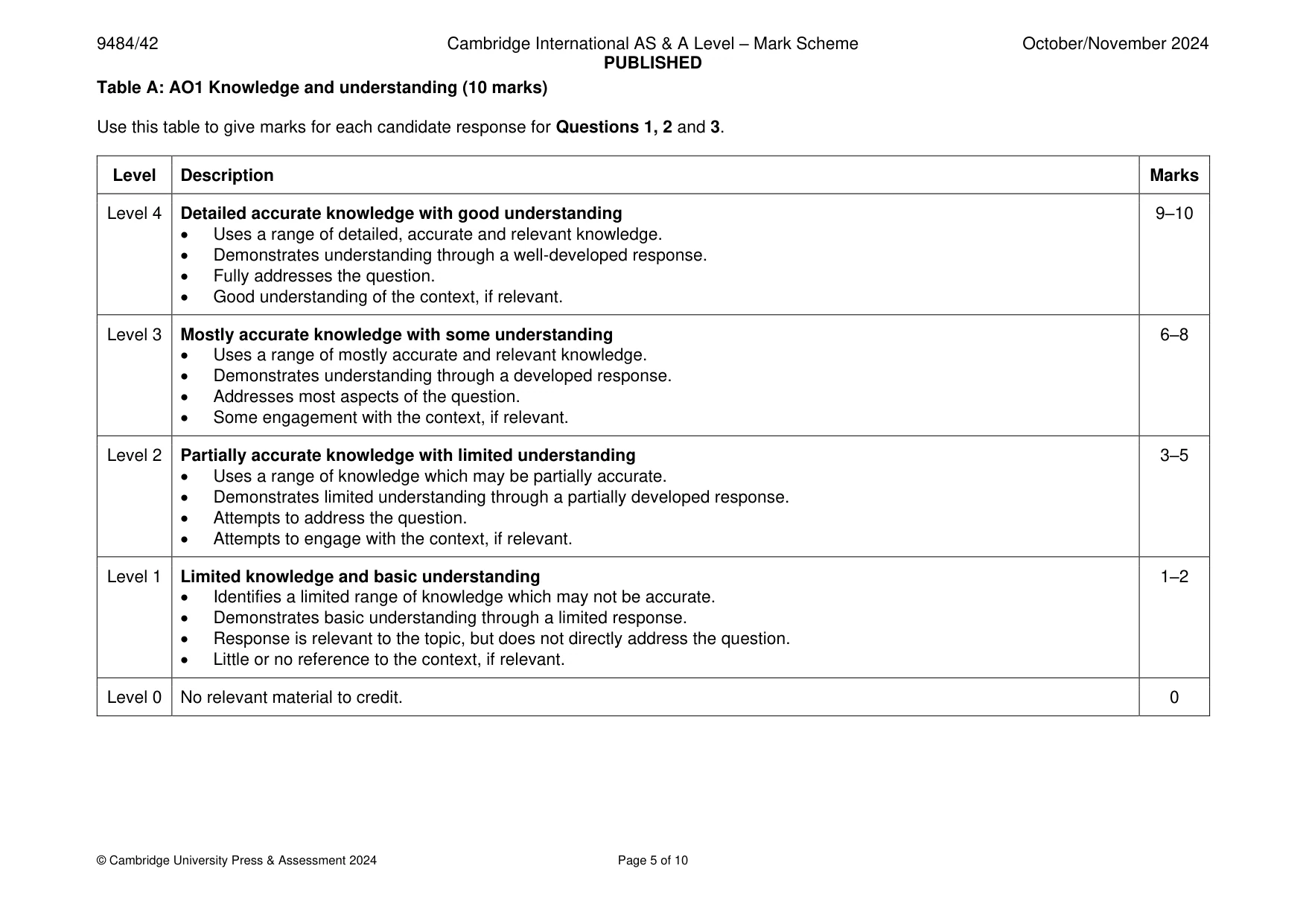
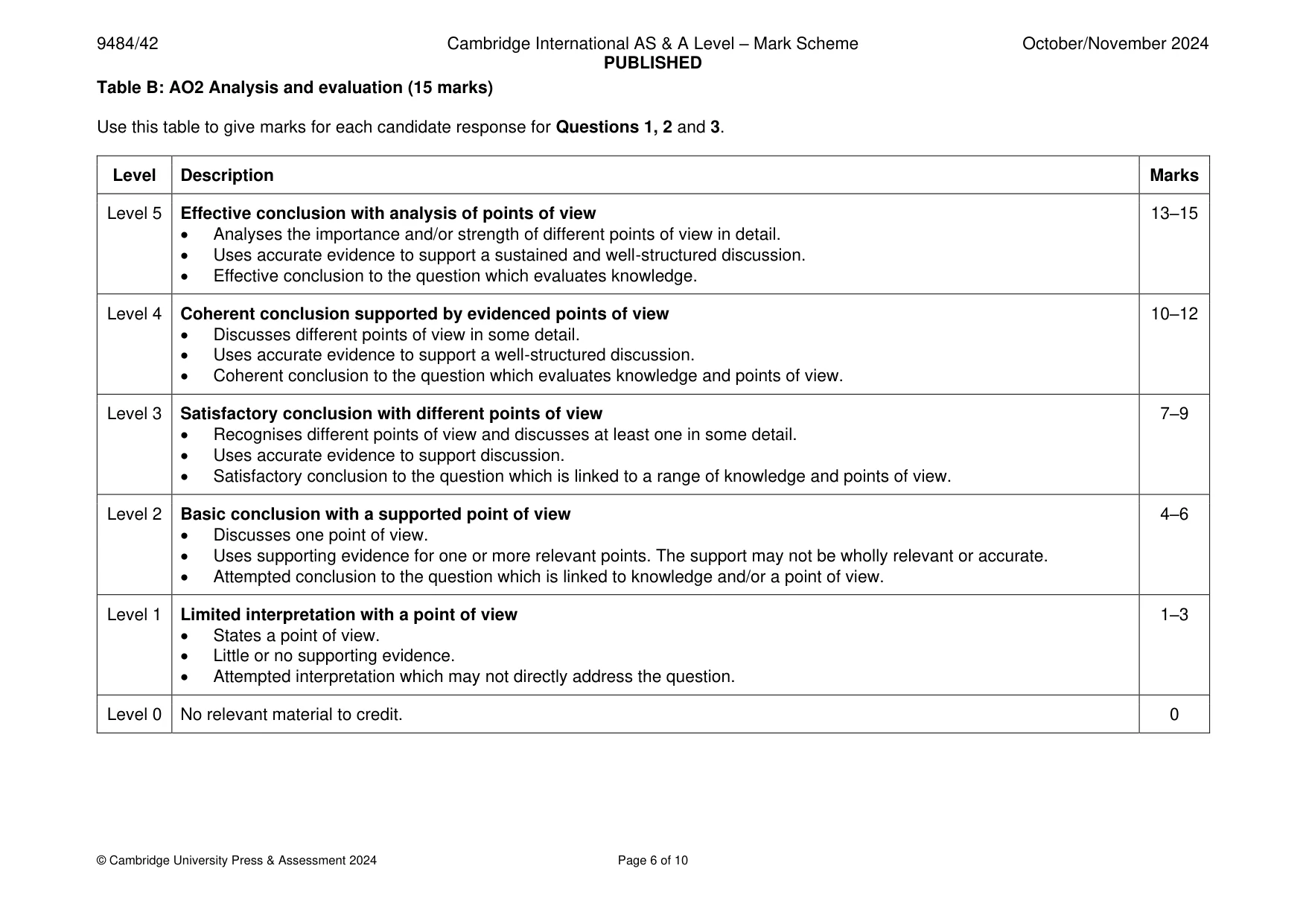
Mark scheme: Question Answer Marks 1 Evaluate to what extent Genesis 1:1–2:3 and Genesis 2:4–19 provide complementary narratives. 25 Use Table A: AO1 Knowledge and understanding (10 marks) and Table B: AO2 Analysis and evaluation (15 Marks) to mark candidate responses to this question. Award up to 10 marks AO1 Knowledge and understanding. Award up to 15 marks AO2 Analysis and evaluation. Indicative content Candidates may propose, analyse and evaluate some of the following arguments. All relevant arguments must be credited. Genesis 1:1–2:3 and Genesis 2:4–19 do provide complementary narratives • Some candidates may suggest that the two narratives each have a different focus, that Genesis 1:1–2:3 lists a series of events that culminates in the creation of humans, whereas Genesis 2:4–19 focuses on the creation of humans, and so can be seen by some as being a more detailed expansion of day 6. • Some may suggest that one or other of the narratives is literal, whereas the other is metaphorical, and that therefore they complement one another though they have different intents and approaches. • Some may argue that some of the suggested inconsistencies some scholars may point out are not inconsistencies at all, and argue around some apologetics-based ideas, such as the idea that Genesis 2:5 does not contradict Genesis 1, as Eden as a specific garden could have been planted after the first creation of plants on day 5. • Some may suggest that though they have significant differences, as they are both best interpreted as metaphorical narratives, any inconsistencies do not prevent their intended allegories being complementary. • Some may discuss the difference around the ideas of complementing as opposed to corroborating. Genesis 1:1–2:3 and Genesis 2:4–19 do not provide complementary narratives • Some candidates may suggest that the two narratives are simply too different to be complementary, and that they are actively in conflict with one another. • Some may suggest specific verses or themes which they may argue conflict with each other, and develop reasoned arguments around them, such as the differing timescale and order of creation in the two accounts. • Some may suggest that whilst they are not directly in conflict with one another, as they were likely written at different times for different purposes that they are not complementary, nor were they ever intended to be. • Some may suggest that, if interpreted literally, the narratives would be in conflict with one another. If interpreted metaphorically, the narratives would not be in conflict with one another, but that does not necessarily mean that the narratives would be complementary to one another.
Q2 · Analyse the significance of the use of the terms Sheol, Gehenna and Hades in the Bible
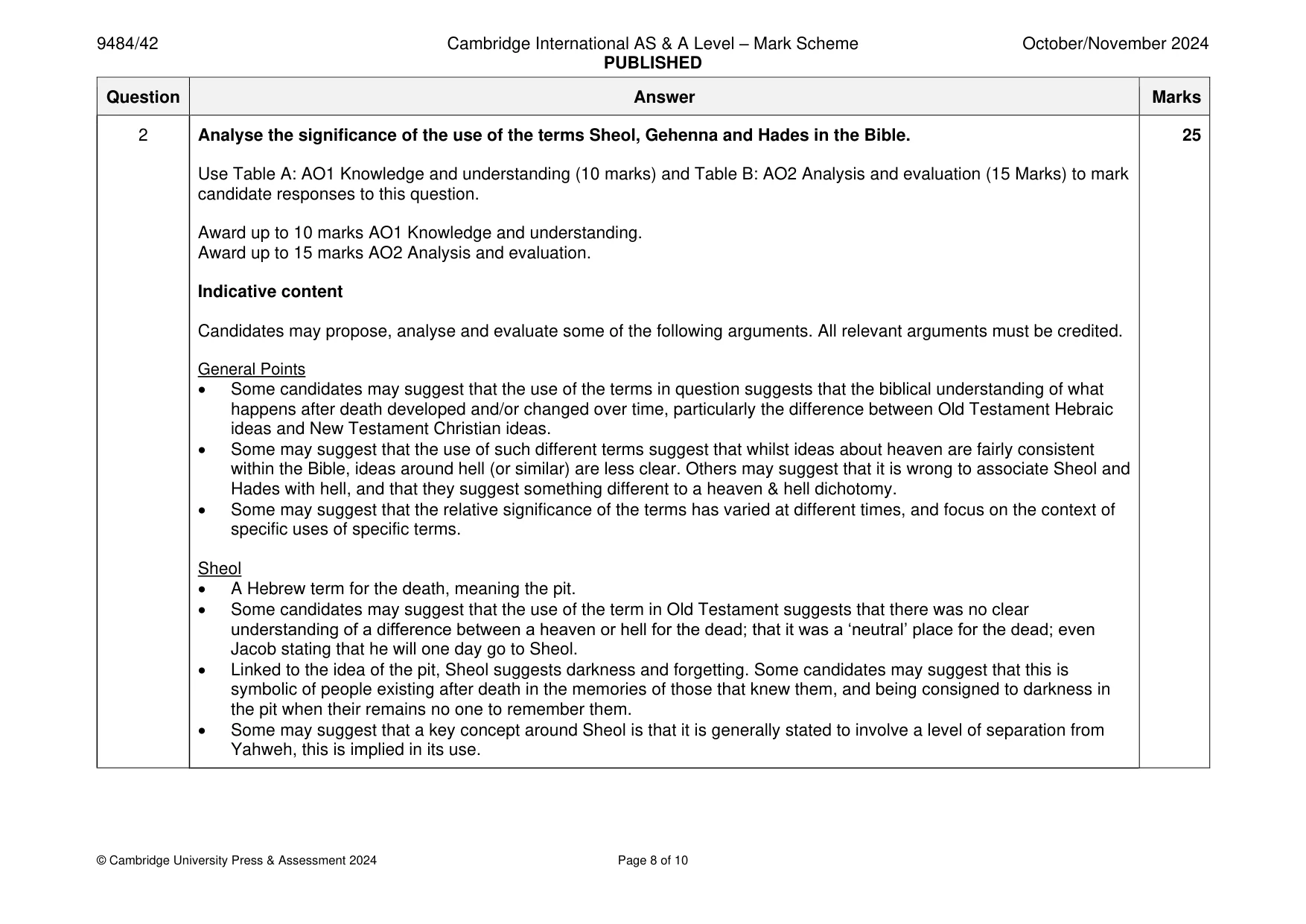
2 Analyse the significance of the use of the terms Sheol, Gehenna and Hades in the Bible. [25]
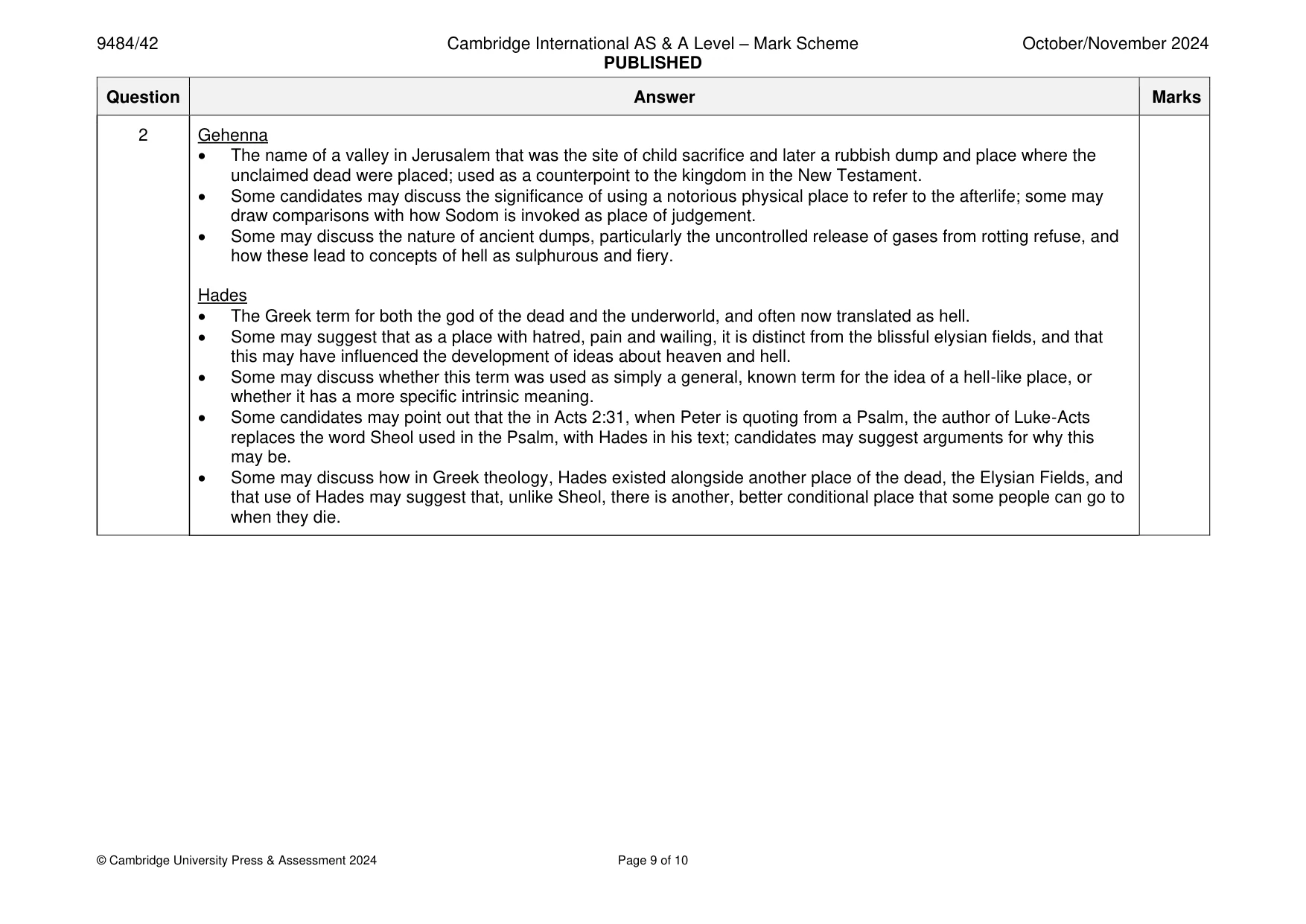
Mark scheme: 2 Analyse the significance of the use of the terms Sheol, Gehenna and Hades in the Bible. 25 Use Table A: AO1 Knowledge and understanding (10 marks) and Table B: AO2 Analysis and evaluation (15 Marks) to mark candidate responses to this question. Award up to 10 marks AO1 Knowledge and understanding. Award up to 15 marks AO2 Analysis and evaluation. Indicative content Candidates may propose, analyse and evaluate some of the following arguments. All relevant arguments must be credited. General Points • Some candidates may suggest that the use of the terms in question suggests that the biblical understanding of what happens after death developed and/or changed over time, particularly the difference between Old Testament Hebraic ideas and New Testament Christian ideas. • Some may suggest that the use of such different terms suggest that whilst ideas about heaven are fairly consistent within the Bible, ideas around hell (or similar) are less clear. Others may suggest that it is wrong to associate Sheol and Hades with hell, and that they suggest something different to a heaven & hell dichotomy. • Some may suggest that the relative significance of the terms has varied at different times, and focus on the context of specific uses of specific terms. Sheol • A Hebrew term for the death, meaning the pit. • Some candidates may suggest that the use of the term in Old Testament suggests that there was no clear understanding of a difference between a heaven or hell for the dead; that it was a ‘neutral’ place for the dead; even Jacob stating that he will one day go to Sheol. • Linked to the idea of the pit, Sheol suggests darkness and forgetting. Some candidates may suggest that this is symbolic of people existing after death in the memories of those that knew them, and being consigned to darkness in the pit when their remains no one to remember them. • Some may suggest that a key concept around Sheol is that it is generally stated to involve a level of separation from Yahweh, this is implied in its use. 2 Gehenna • The name of a valley in Jerusalem that was the site of child sacrifice and later a rubbish dump and place where the unclaimed dead were placed; used as a counterpoint to the kingdom in the New Testament. • Some candidates may discuss the significance of using a notorious physical place to refer to the afterlife; some may draw comparisons with how Sodom is invoked as place of judgement. • Some may discuss the nature of ancient dumps, particularly the uncontrolled release of gases from rotting refuse, and how these lead to concepts of hell as sulphurous and fiery. Hades • The Greek term for both the god of the dead and the underworld, and often now translated as hell. • Some may suggest that as a place with hatred, pain and wailing, it is distinct from the blissful elysian fields, and that this may have influenced the development of ideas about heaven and hell. • Some may discuss whether this term was used as simply a general, known term for the idea of a hell-like place, or whether it has a more specific intrinsic meaning. • Some candidates may point out that the in Acts 2:31, when Peter is quoting from a Psalm, the author of Luke-Acts replaces the word Sheol used in the Psalm, with Hades in his text; candidates may suggest arguments for why this may be. • Some may discuss how in Greek theology, Hades existed alongside another place of the dead, the Elysian Fields, and that use of Hades may suggest that, unlike Sheol, there is another, better conditional place that some people can go to when they die.
What was in this paper
The subtopics covered by these 2 questions, and how many questions each got. Open one in a new tab to see every Cambridge question on it.
What you needed in this session
Cambridge’s own grade thresholds for 2024 Oct/Nov, Paper 4 · Variant 2. A higher threshold means an easier paper — the bar moves with how the cohort did.