Cambridge A Level Biblical Studies 9484 — 2024 May/June Paper 4 · Variant 2
9484/42/M/J/24 · 2 questions · 50 marks · 90 min
The question paper and its mark scheme, free to read here and free to download. This is Cambridge’s own paper, exactly as it was sat.
Question paper4 pages



Mark scheme12 pages
Answers below. Sit the paper first if you are practising.
Questions as text
Q1 · ‘Archaeological developments are the greatest challenge to a literal interpretation of…
1 ‘Archaeological developments are the greatest challenge to a literal interpretation of Genesis.’ Discuss. [25]
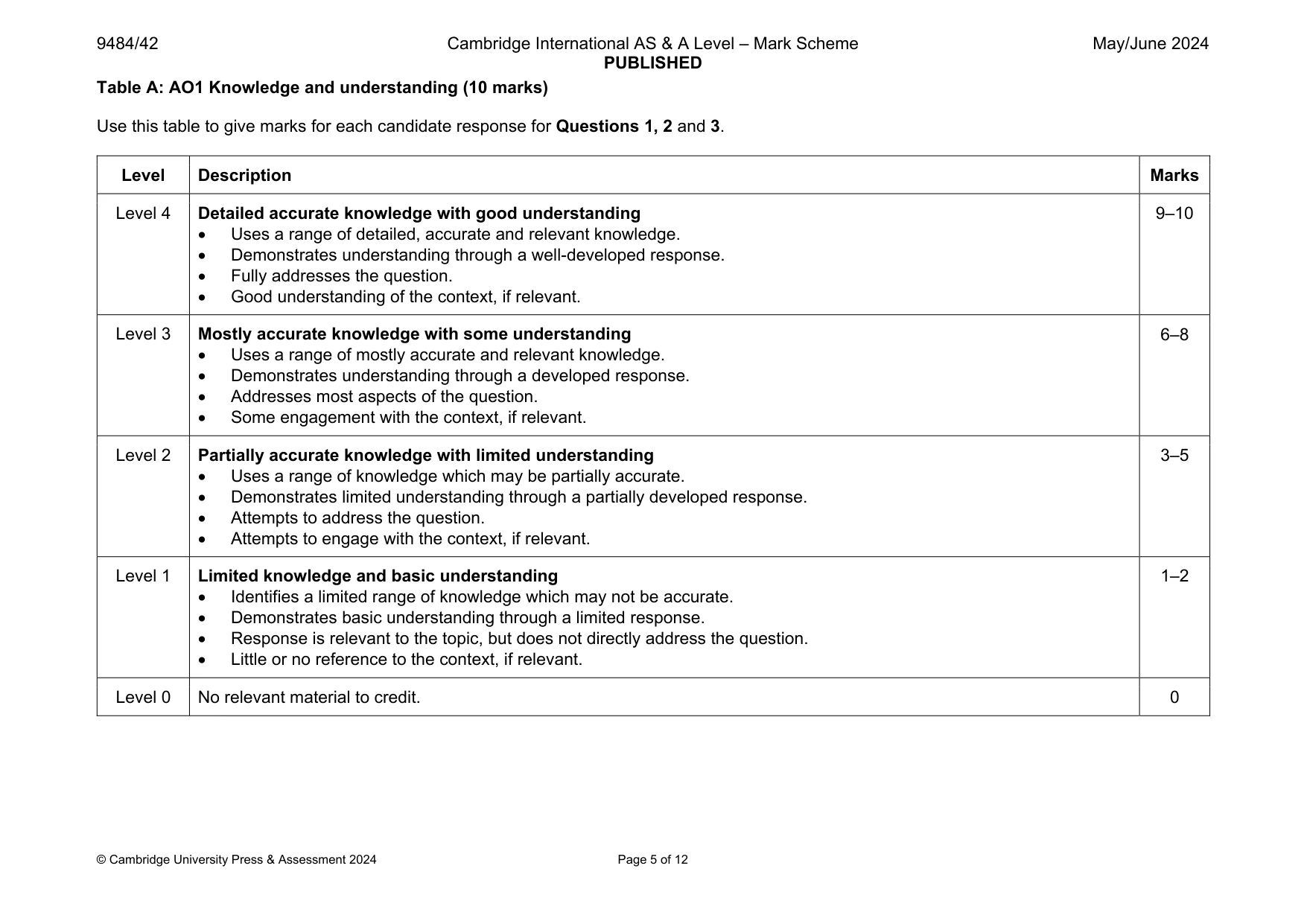
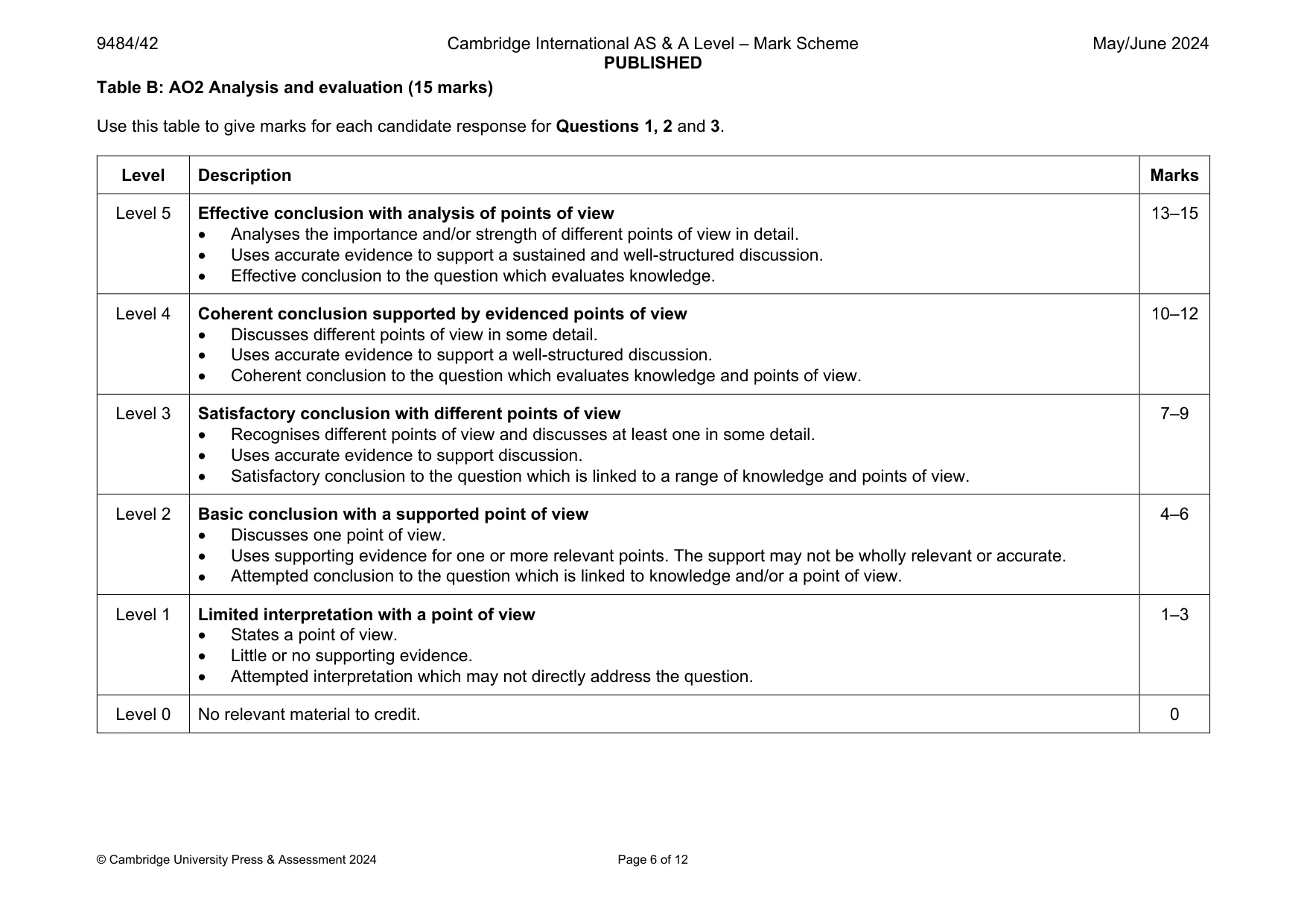
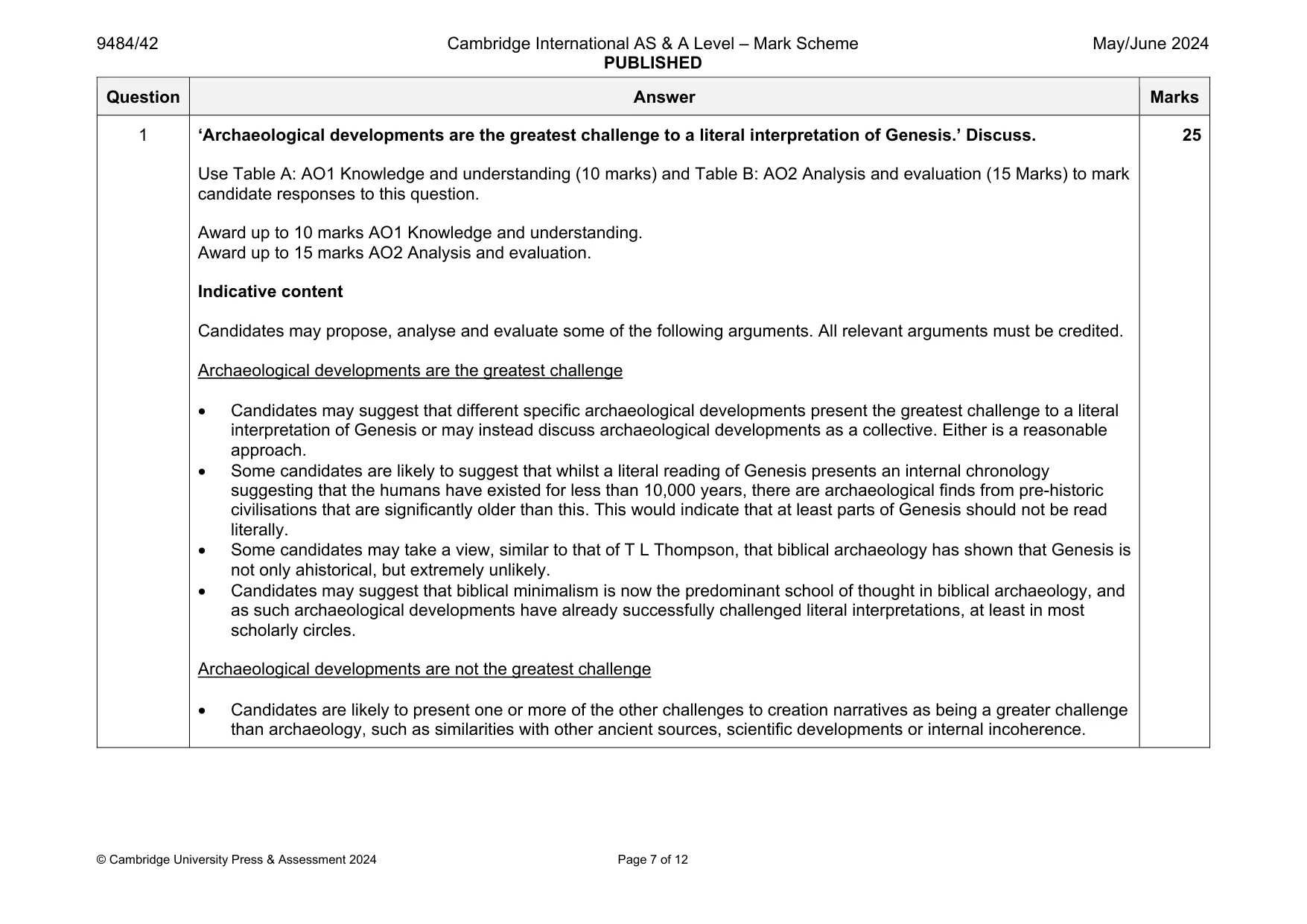
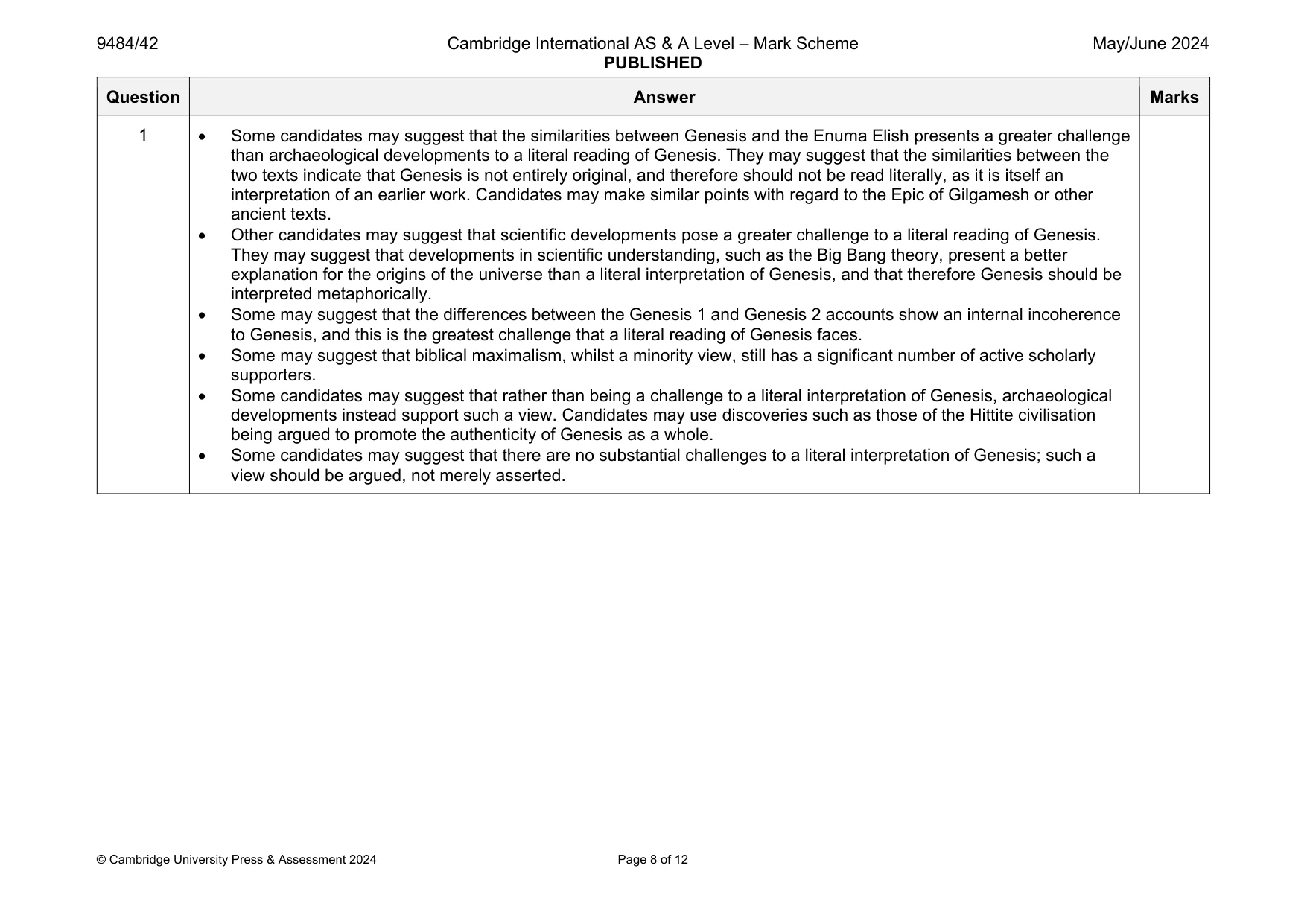
Mark scheme: 1 ‘Archaeological developments are the greatest challenge to a literal interpretation of Genesis.’ Discuss. Use Table A: AO1 Knowledge and understanding (10 marks) and Table B: AO2 Analysis and evaluation (15 Marks) to mark candidate responses to this question. Award up to 10 marks AO1 Knowledge and understanding. Award up to 15 marks AO2 Analysis and evaluation. Indicative content Candidates may propose, analyse and evaluate some of the following arguments. All relevant arguments must be credited. Archaeological developments are the greatest challenge Candidates may suggest that different specific archaeological developments present the greatest challenge to a literal interpretation of Genesis or may instead discuss archaeological developments as a collective. Either is a reasonable approach. Some candidates are likely to suggest that whilst a literal reading of Genesis presents an internal chronology suggesting that the humans have existed for less than 10,000 years, there are archaeological finds from pre-historic civilisations that are significantly older than this. This would indicate that at least parts of Genesis should not be read literally. Some candidates may take a view, similar to that of T L Thompson, that biblical archaeology has shown that Genesis is not only ahistorical, but extremely unlikely. Candidates may suggest that biblical minimalism is now the predominant school of thought in biblical archaeology, and as such archaeological developments have already successfully challenged literal interpretations, at least in most scholarly circles. Archaeological developments are not the greatest challenge Candidates are likely to present one or more of the other challenges to creation narratives as being a greater challenge than archaeology, such as similarities with other ancient sources, scientific developments or internal incoherence. 25 Question Answer Marks 1 Some candidates may suggest that the similarities between Genesis and the Enuma Elish presents a greater challenge than archaeological developments to a literal reading of Genesis. They may suggest that the similarities between the two texts indicate that Genesis is not entirely original, and therefore should not be read literally, as it is itself an interpretation of an earlier work. Candidates may make similar points with regard to the Epic of Gilgamesh or other ancient texts. Other candidates may suggest that scientific developments pose a greater challenge to a literal reading of Genesis. They may suggest that developments in scientific understanding, such as the Big Bang theory, present a better explanation for the origins of the universe than a literal interpretation of Genesis, and that therefore Genesis should be interpreted metaphorically. Some may suggest that the differences between the Genesis 1 and Genesis 2 accounts show an internal incoherence to Genesis, and this is the greatest challenge that a literal reading of Genesis faces. Some may suggest that biblical maximalism, whilst a minority view, still has a significant number of active scholarly supporters. Some candidates may suggest that rather than being a challenge to a literal interpretation of Genesis, archaeological developments instead support such a view. Candidates may use discoveries such as those of the Hittite civilisation being argued to promote the authenticity of Genesis as a whole. Some candidates may suggest that there are no substantial challenges to a literal interpretation of Genesis; such a view should be argued, not merely asserted.
Q2 · Analyse to what extent there is a conflict between biblical teachings on stewardship and…
2 Analyse to what extent there is a conflict between biblical teachings on stewardship and dominion. [25]
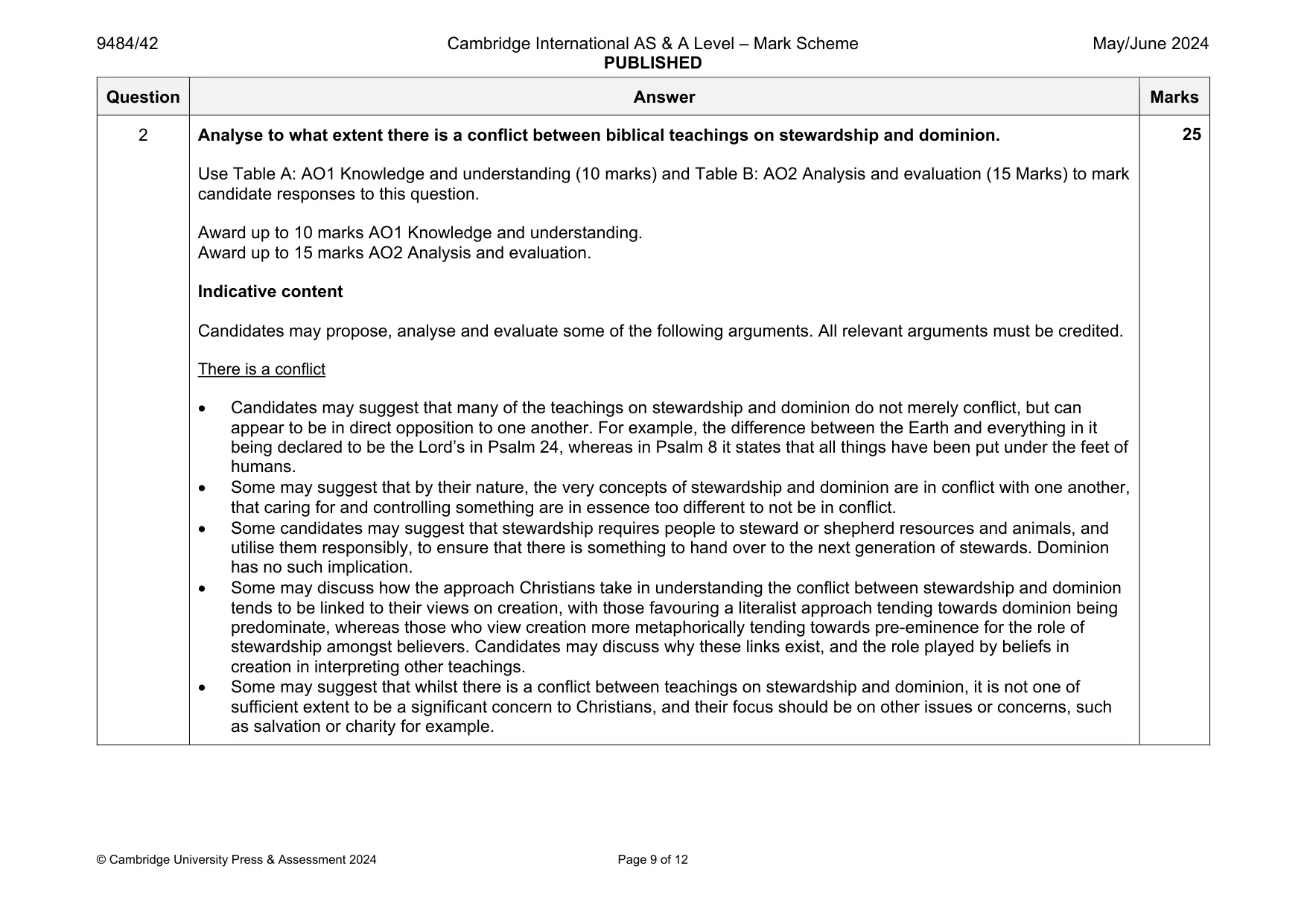
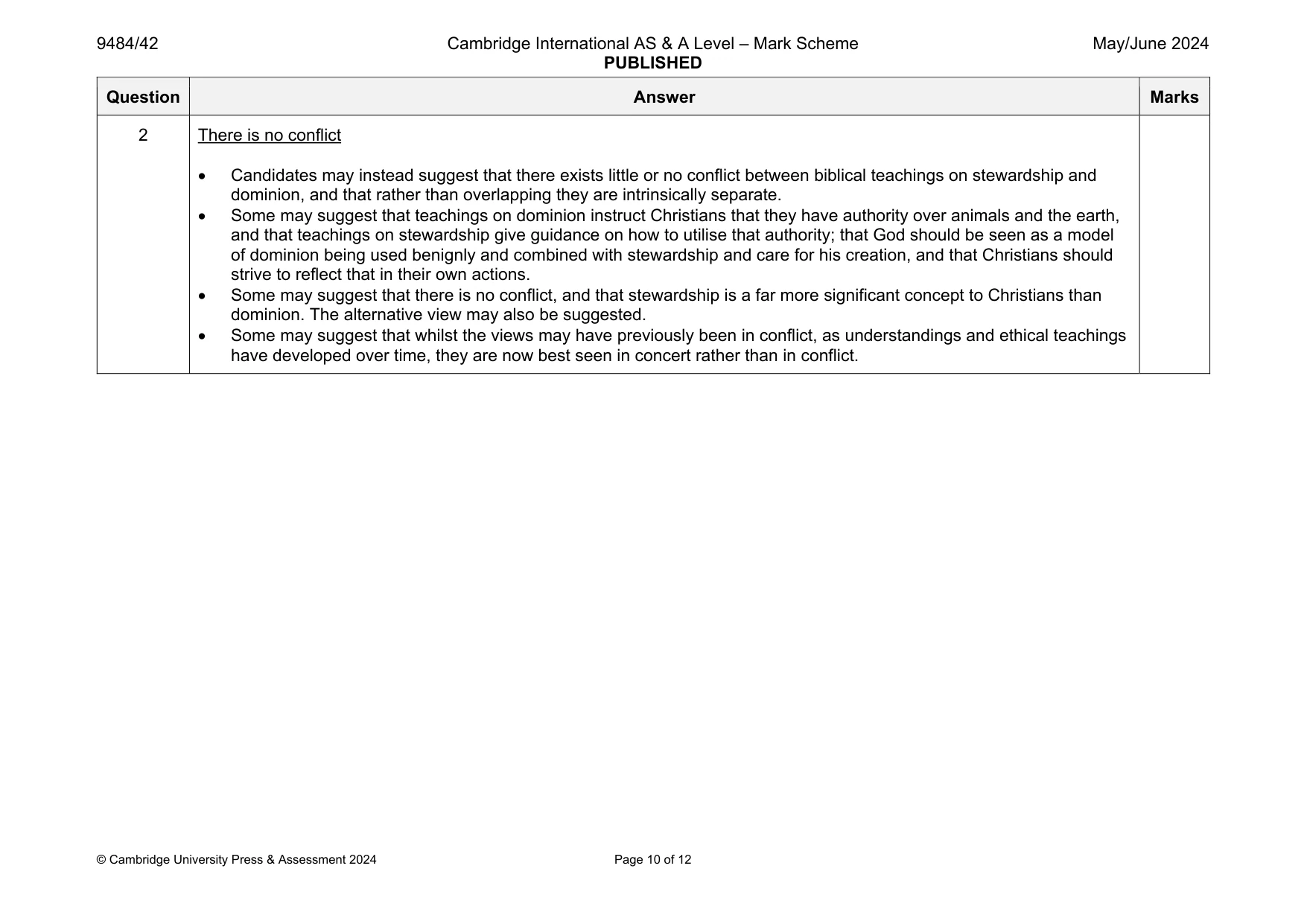
Mark scheme: 2 Analyse to what extent there is a conflict between biblical teachings on stewardship and dominion. Use Table A: AO1 Knowledge and understanding (10 marks) and Table B: AO2 Analysis and evaluation (15 Marks) to mark candidate responses to this question. Award up to 10 marks AO1 Knowledge and understanding. Award up to 15 marks AO2 Analysis and evaluation. Indicative content Candidates may propose, analyse and evaluate some of the following arguments. All relevant arguments must be credited. There is a conflict Candidates may suggest that many of the teachings on stewardship and dominion do not merely conflict, but can appear to be in direct opposition to one another. For example, the difference between the Earth and everything in it being declared to be the Lord’s in Psalm 24, whereas in Psalm 8 it states that all things have been put under the feet of humans. Some may suggest that by their nature, the very concepts of stewardship and dominion are in conflict with one another, that caring for and controlling something are in essence too different to not be in conflict. Some candidates may suggest that stewardship requires people to steward or shepherd resources and animals, and utilise them responsibly, to ensure that there is something to hand over to the next generation of stewards. Dominion has no such implication. Some may discuss how the approach Christians take in understanding the conflict between stewardship and dominion tends to be linked to their views on creation, with those favouring a literalist approach tending towards dominion being predominate, whereas those who view creation more metaphorically tending towards pre-eminence for the role of stewardship amongst believers. Candidates may discuss why these links exist, and the role played by beliefs in creation in interpreting other teachings. Some may suggest that whilst there is a conflict between teachings on stewardship and dominion, it is not one of sufficient extent to be a significant concern to Christians, and their focus should be on other issues or concerns, such as salvation or charity for example. Question Answer Marks 2 There is no conflict Candidates may instead suggest that there exists little or no conflict between biblical teachings on stewardship and dominion, and that rather than overlapping they are intrinsically separate. Some may suggest that teachings on dominion instruct Christians that they have authority over animals and the earth, and that teachings on stewardship give guidance on how to utilise that authority; that God should be seen as a model of dominion being used benignly and combined with stewardship and care for his creation, and that Christians should strive to reflect that in their own actions. Some may suggest that there is no conflict, and that stewardship is a far more significant concept to Christians than dominion. The alternative view may also be suggested. Some may suggest that whilst the views may have previously been in conflict, as understandings and ethical teachings have developed over time, they are now best seen in concert rather than in conflict.
What was in this paper
The subtopics covered by these 2 questions, and how many questions each got. Open one in a new tab to see every Cambridge question on it.
What you needed in this session
Cambridge’s own grade thresholds for 2024 May/June, Paper 4 · Variant 2. A higher threshold means an easier paper — the bar moves with how the cohort did.