Cambridge A Level Biblical Studies 9484 — 2023 May/June Paper 4 · Variant 2
9484/42/M/J/23 · 3 questions · 50 marks · ≈56 min
The question paper and its mark scheme, free to read here and free to download. This is Cambridge’s own paper, exactly as it was sat.
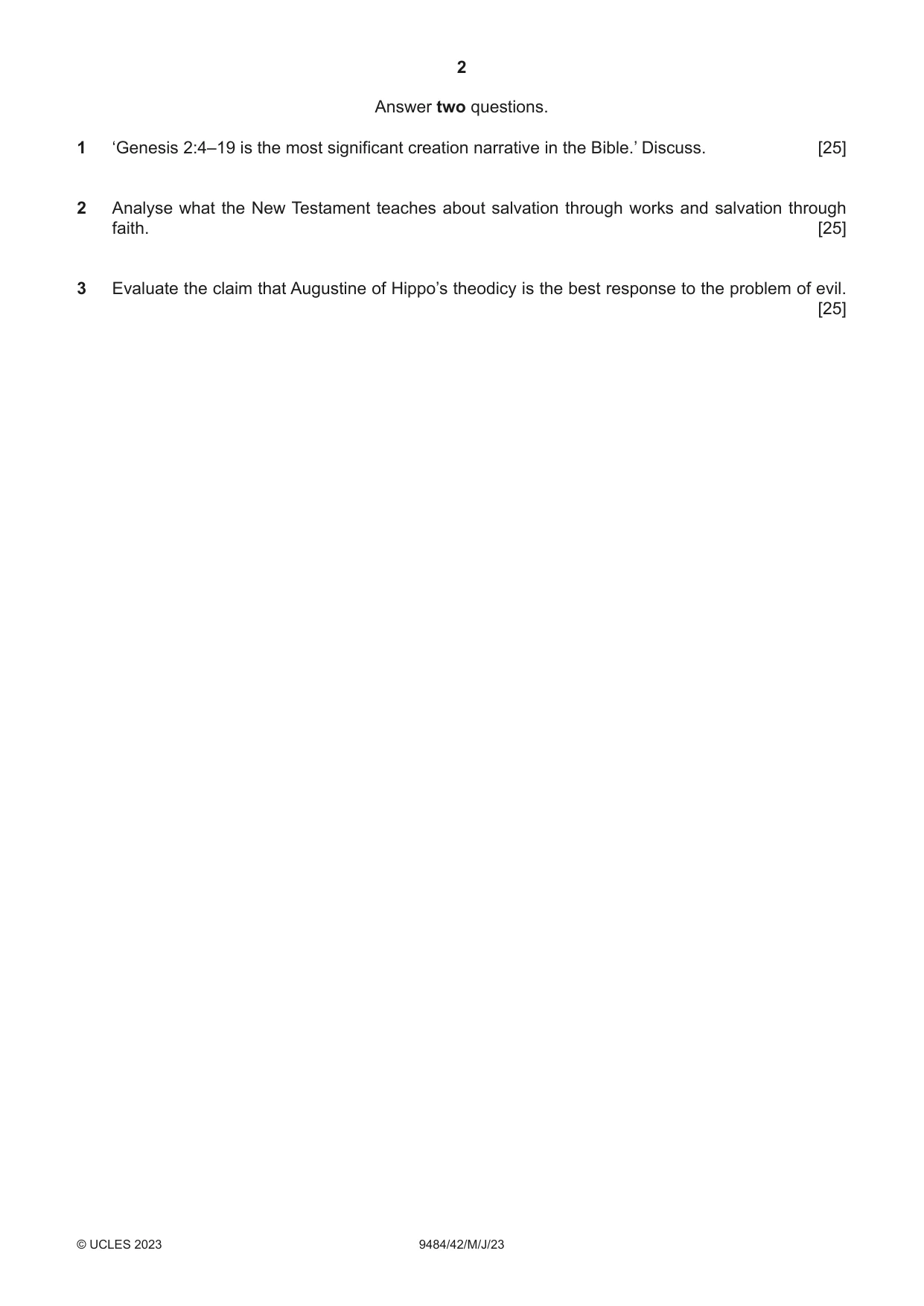
Question paper4 pages


Mark scheme12 pages
Answers below. Sit the paper first if you are practising.
Questions as text
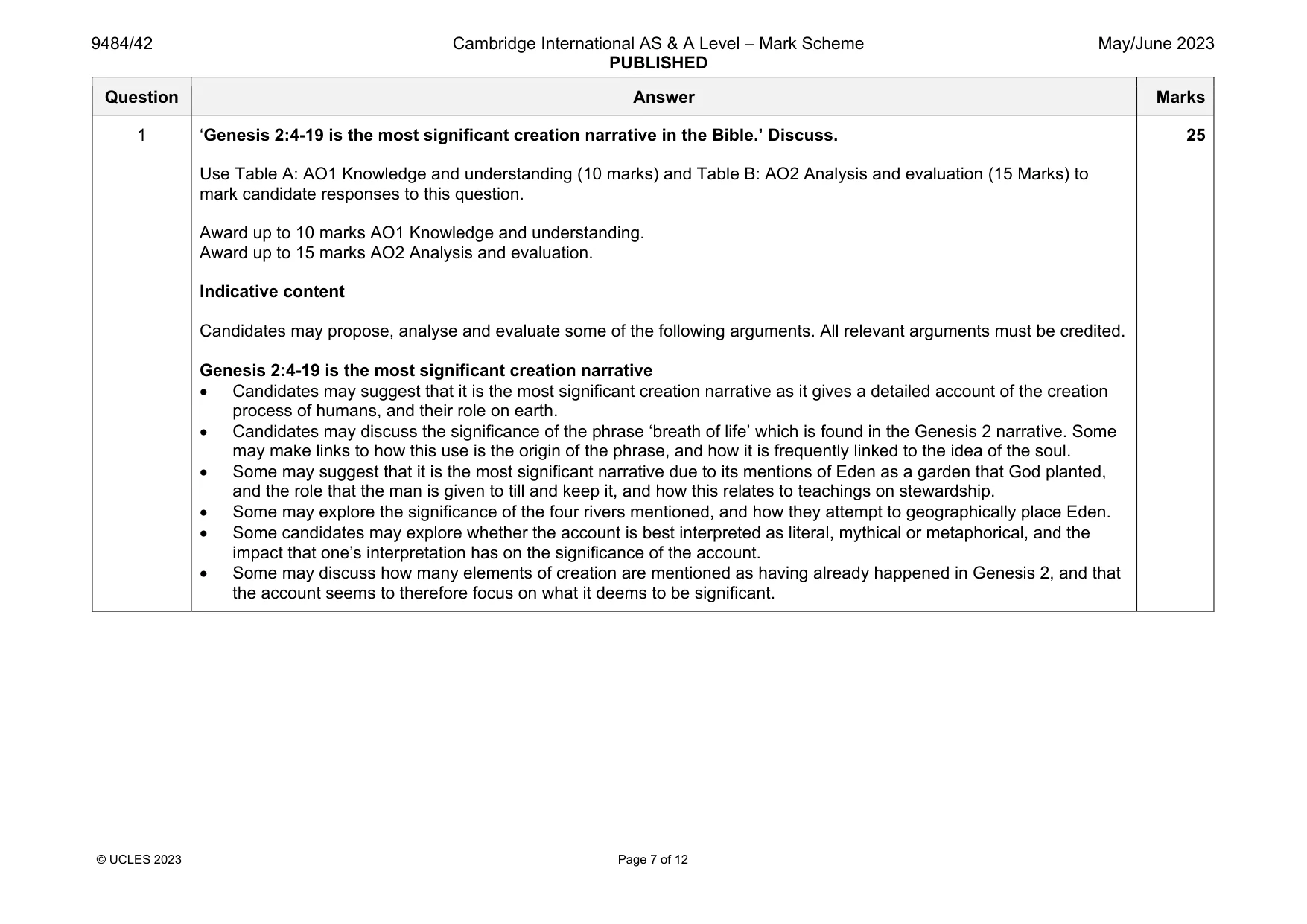
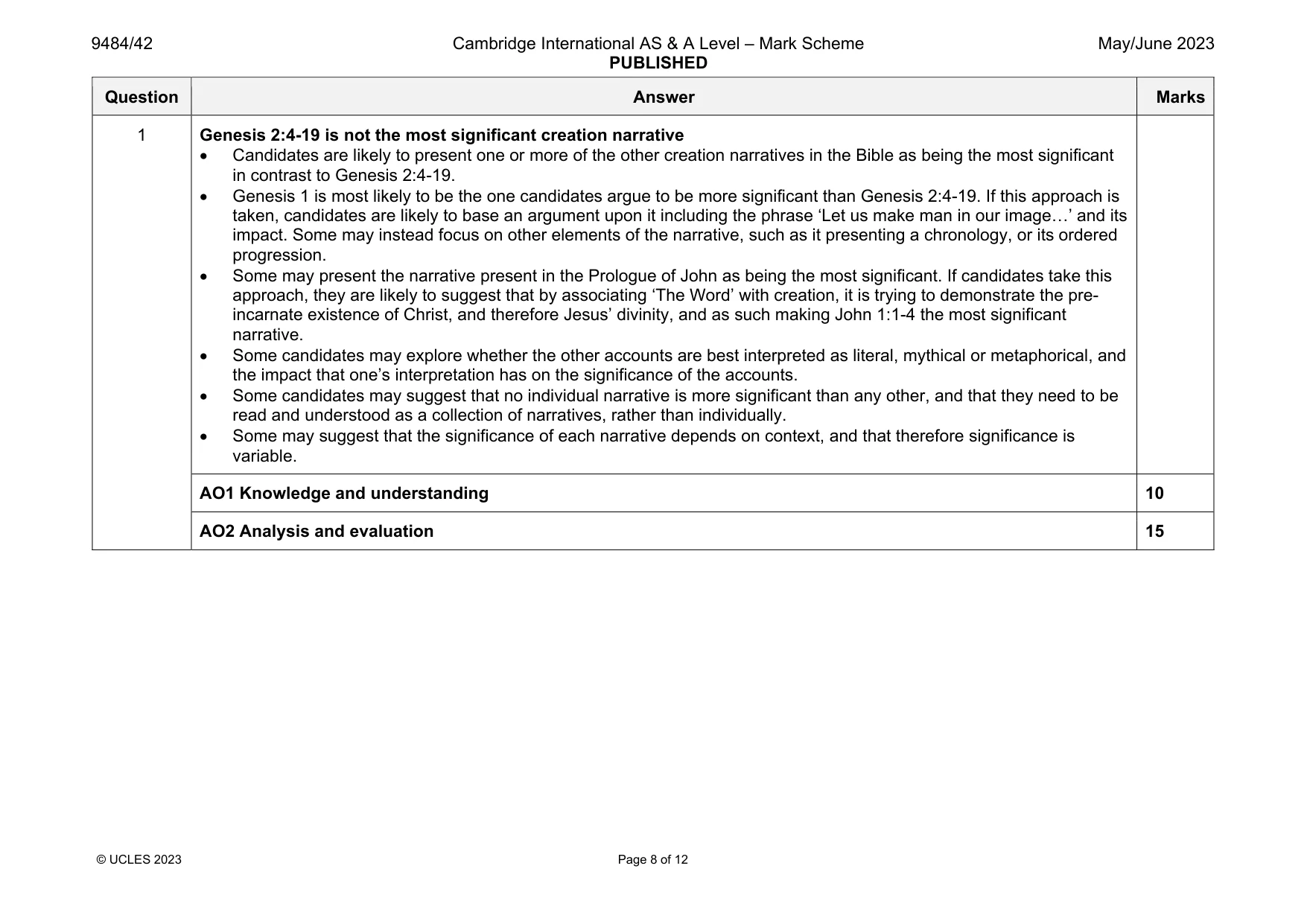
Q1 · ‘Genesis 2:4–19 is the most significant creation narrative in the Bible.’ Discuss
1 ‘Genesis 2:4–19 is the most significant creation narrative in the Bible.’ Discuss. [25]
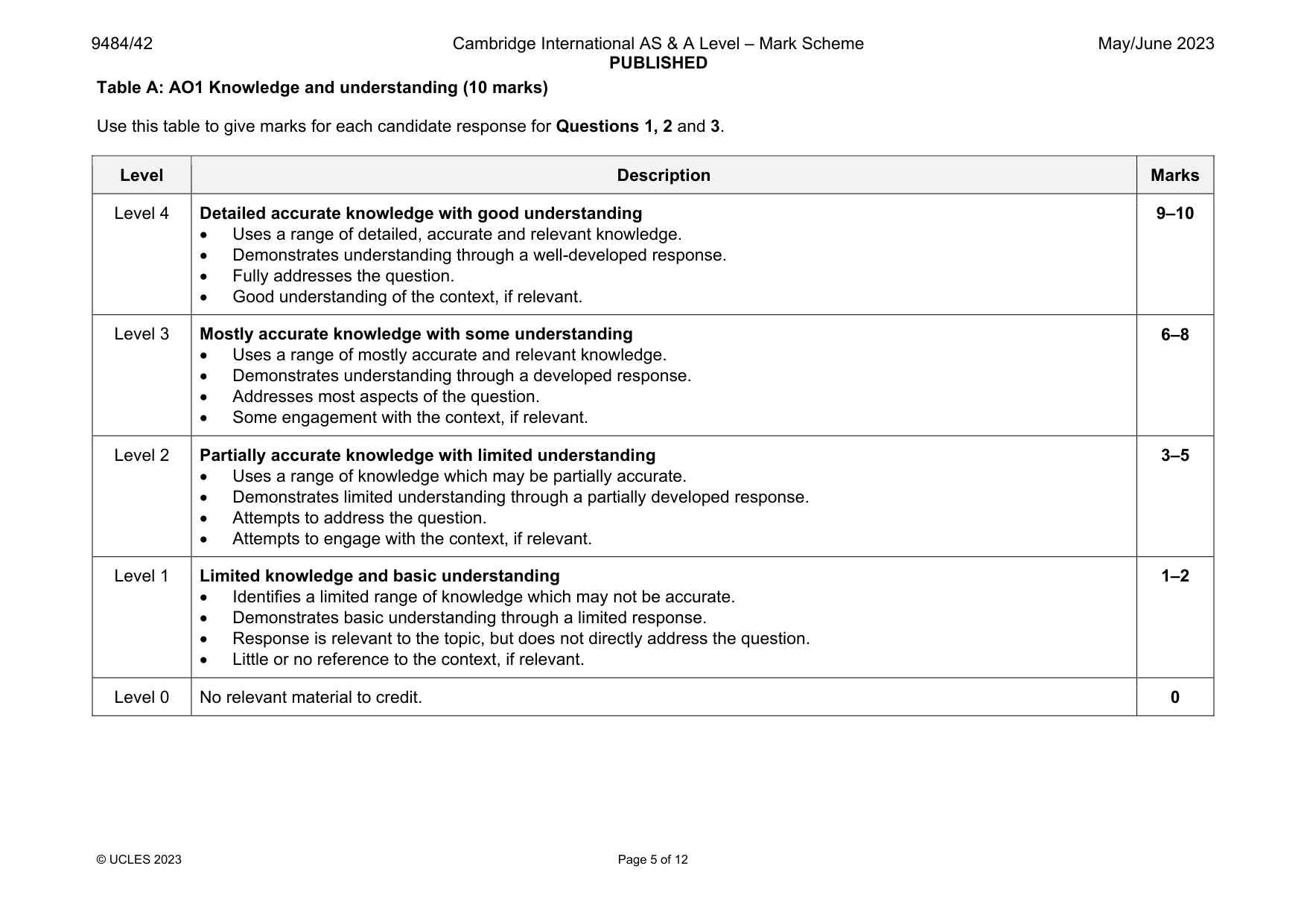
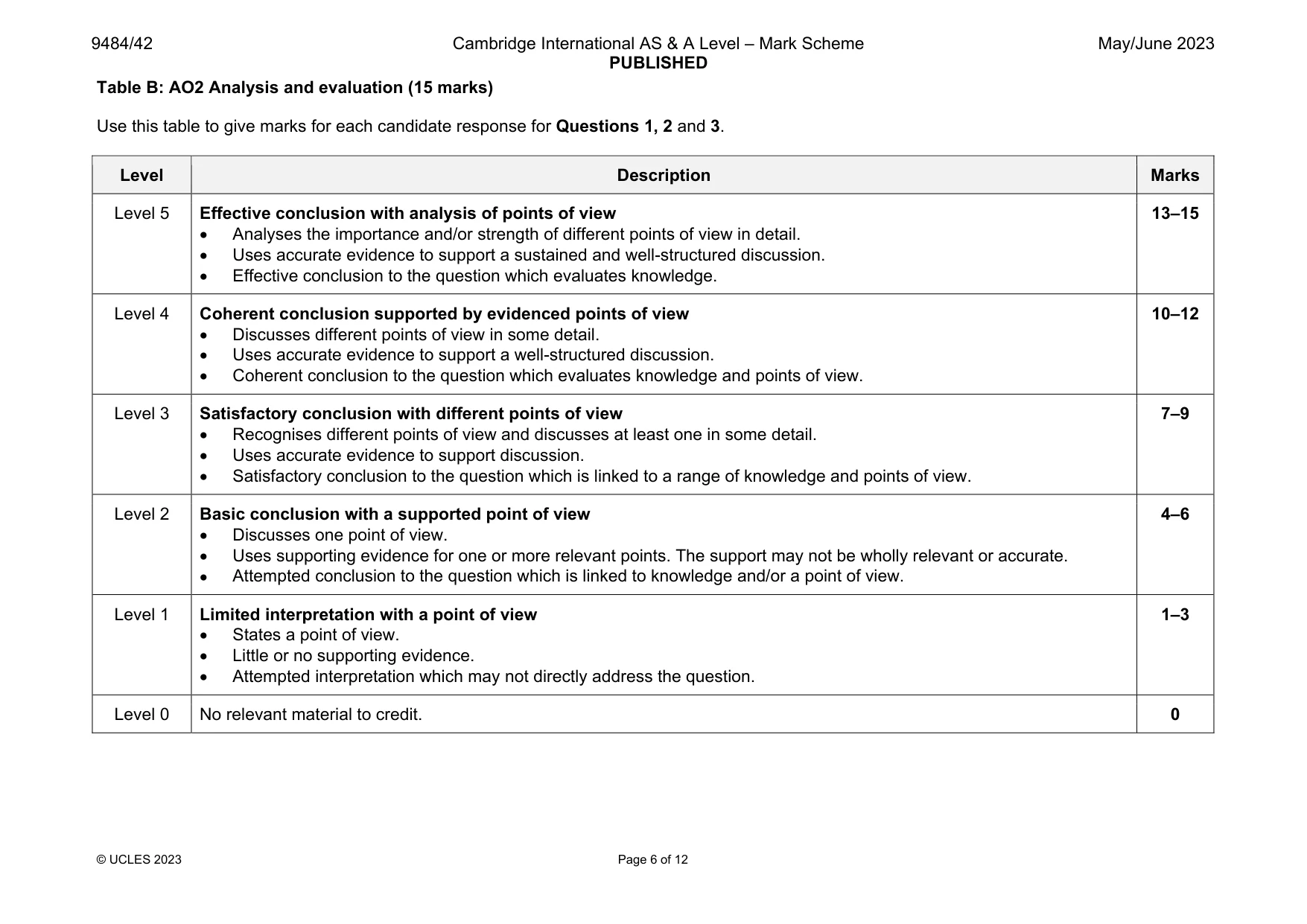
Mark scheme: 1 ‘Genesis 2:4-19 is the most significant creation narrative in the Bible.’ Discuss. Use Table A: AO1 Knowledge and understanding (10 marks) and Table B: AO2 Analysis and evaluation (15 Marks) to mark candidate responses to this question. Award up to 10 marks AO1 Knowledge and understanding. Award up to 15 marks AO2 Analysis and evaluation. Indicative content Candidates may propose, analyse and evaluate some of the following arguments. All relevant arguments must be credited. Genesis 2:4-19 is the most significant creation narrative Candidates may suggest that it is the most significant creation narrative as it gives a detailed account of the creation process of humans, and their role on earth. Candidates may discuss the significance of the phrase ‘breath of life’ which is found in the Genesis 2 narrative. Some may make links to how this use is the origin of the phrase, and how it is frequently linked to the idea of the soul. Some may suggest that it is the most significant narrative due to its mentions of Eden as a garden that God planted, and the role that the man is given to till and keep it, and how this relates to teachings on stewardship. Some may explore the significance of the four rivers mentioned, and how they attempt to geographically place Eden. Some candidates may explore whether the account is best interpreted as literal, mythical or metaphorical, and the impact that one’s interpretation has on the significance of the account. Some may discuss how many elements of creation are mentioned as having already happened in Genesis 2, and that the account seems to therefore focus on what it deems to be significant. 25 Question Answer Marks 1 Genesis 2:4-19 is not the most significant creation narrative Candidates are likely to present one or more of the other creation narratives in the Bible as being the most significant in contrast to Genesis 2:4-19. Genesis 1 is most likely to be the one candidates argue to be more significant than Genesis 2:4-19. If this approach is taken, candidates are likely to base an argument upon it including the phrase ‘Let us make man in our image…’ and its impact. Some may instead focus on other elements of the narrative, such as it presenting a chronology, or its ordered progression. Some may present the narrative present in the Prologue of John as being the most significant. If candidates take this approach, they are likely to suggest that by associating ‘The Word’ with creation, it is trying to demonstrate the pre- incarnate existence of Christ, and therefore Jesus’ divinity, and as such making John 1:1-4 the most significant narrative. Some candidates may explore whether the other accounts are best interpreted as literal, mythical or metaphorical, and the impact that one’s interpretation has on the significance of the accounts. Some candidates may suggest that no individual narrative is more significant than any other, and that they need to be read and understood as a collection of narratives, rather than individually. Some may suggest that the significance of each narrative depends on context, and that therefore significance is variable. AO1 Knowledge and understanding 10 AO2 Analysis and evaluation 15
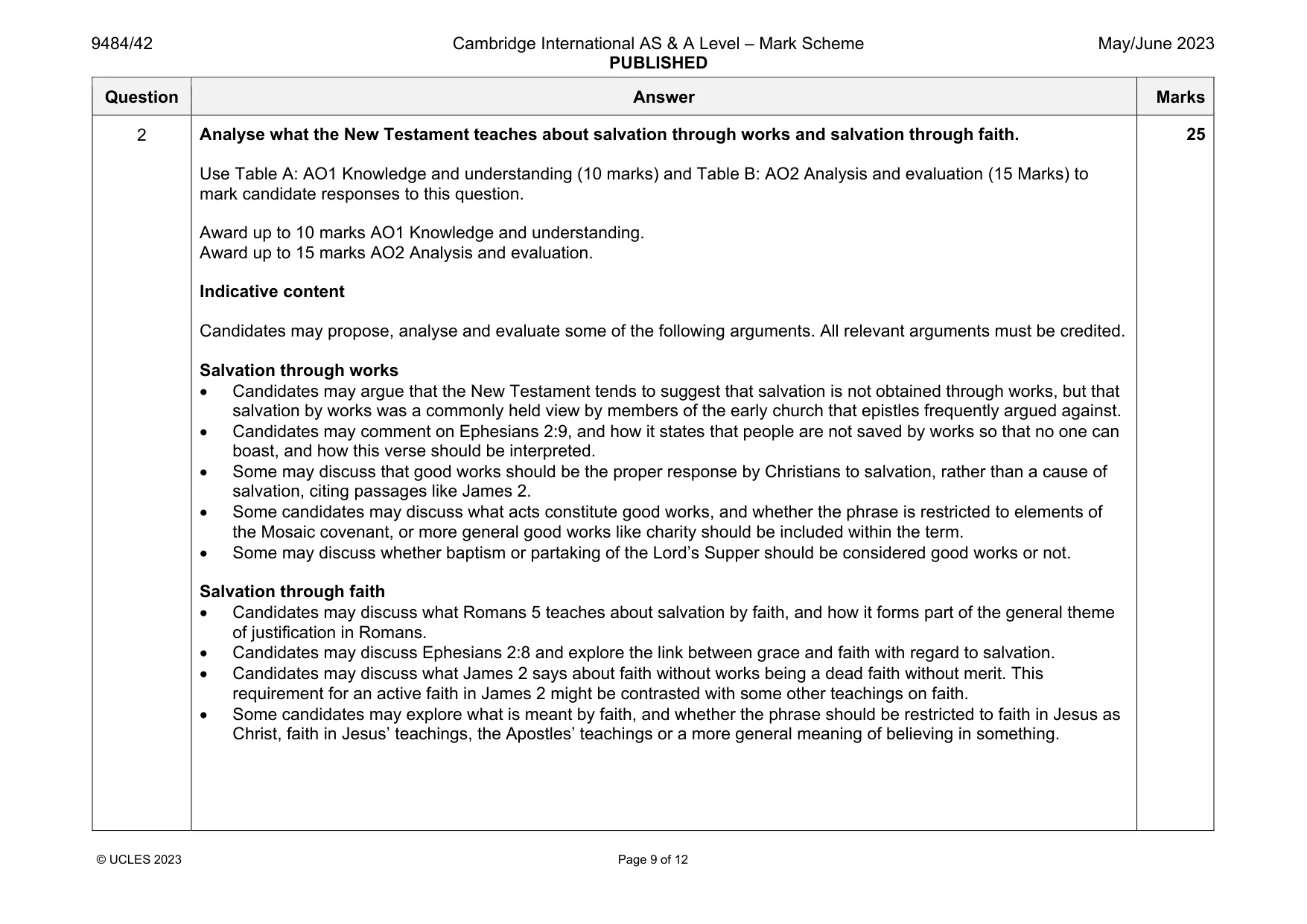
Q2 · Analyse what the New Testament teaches about salvation through works and salvation…
2 Analyse what the New Testament teaches about salvation through works and salvation through faith. [25]
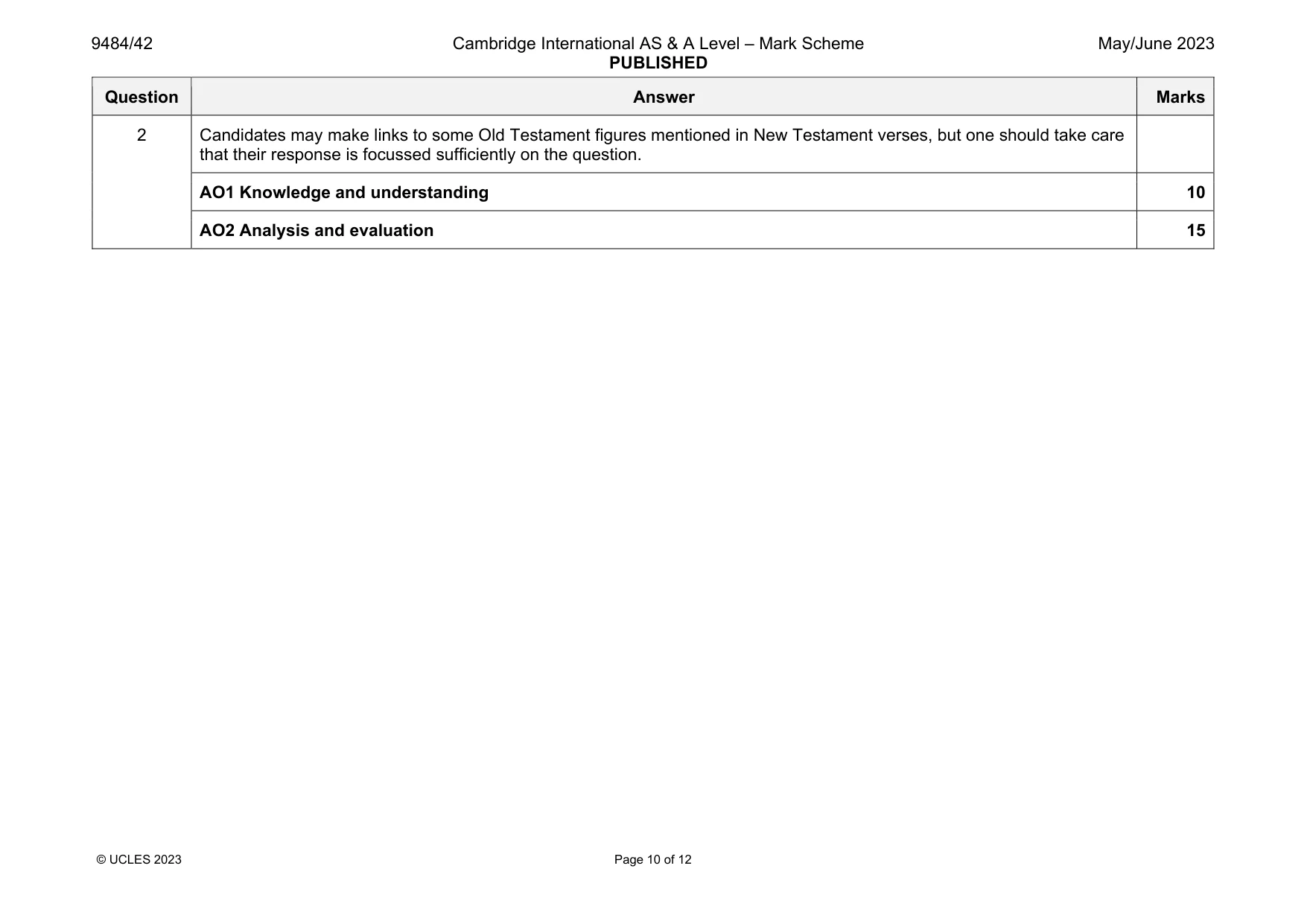
Mark scheme: 2 Use Table A: AO1 Knowledge and understanding (10 marks) and Table B: AO2 Analysis and evaluation (15 Marks) to mark candidate responses to this question. Award up to 10 marks AO1 Knowledge and understanding. Award up to 15 marks AO2 Analysis and evaluation. Indicative content Candidates may propose, analyse and evaluate some of the following arguments. All relevant arguments must be credited. Salvation through works Candidates may argue that the New Testament tends to suggest that salvation is not obtained through works, but that salvation by works was a commonly held view by members of the early church that epistles frequently argued against. Candidates may comment on Ephesians 2:9, and how it states that people are not saved by works so that no one can boast, and how this verse should be interpreted. Some may discuss that good works should be the proper response by Christians to salvation, rather than a cause of salvation, citing passages like James 2. Some candidates may discuss what acts constitute good works, and whether the phrase is restricted to elements of the Mosaic covenant, or more general good works like charity should be included within the term. Some may discuss whether baptism or partaking of the Lord’s Supper should be considered good works or not. Salvation through faith Candidates may discuss what Romans 5 teaches about salvation by faith, and how it forms part of the general theme of justification in Romans. Candidates may discuss Ephesians 2:8 and explore the link between grace and faith with regard to salvation. Candidates may discuss what James 2 says about faith without works being a dead faith without merit. This requirement for an active faith in James 2 might be contrasted with some other teachings on faith. Some candidates may explore what is meant by faith, and whether the phrase should be restricted to faith in Jesus as Christ, faith in Jesus’ teachings, the Apostles’ teachings or a more general meaning of believing in something. Question Answer Marks 2 Candidates may make links to some Old Testament figures mentioned in New Testament verses, but one should take care that their response is focussed sufficiently on the question. AO1 Knowledge and understanding 10 AO2 Analysis and evaluation 15
Q3 · Evaluate the claim that Augustine of Hippo’s theodicy is the best response to the problem…
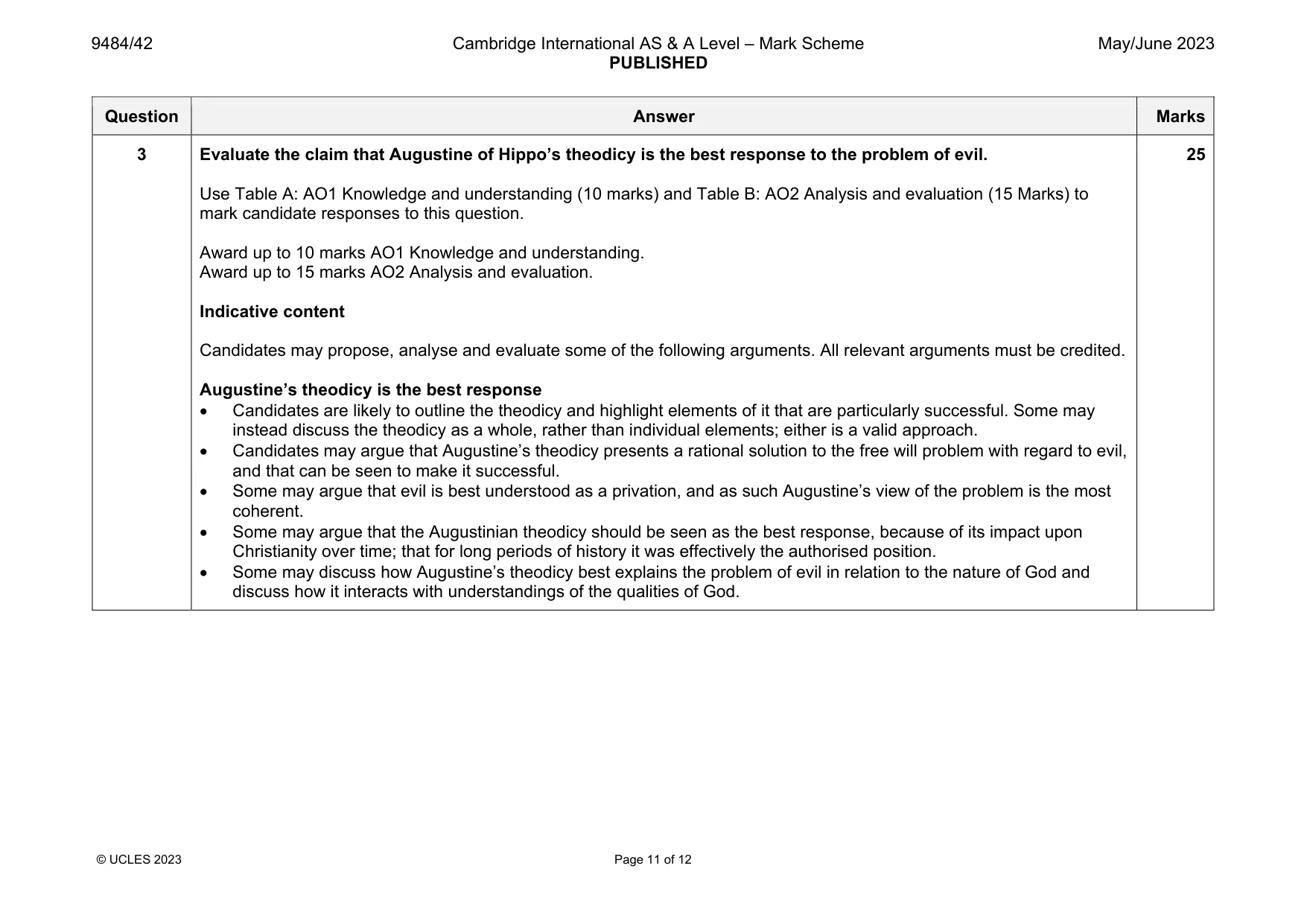
3 Evaluate the claim that Augustine of Hippo’s theodicy is the best response to the problem of evil. [25]
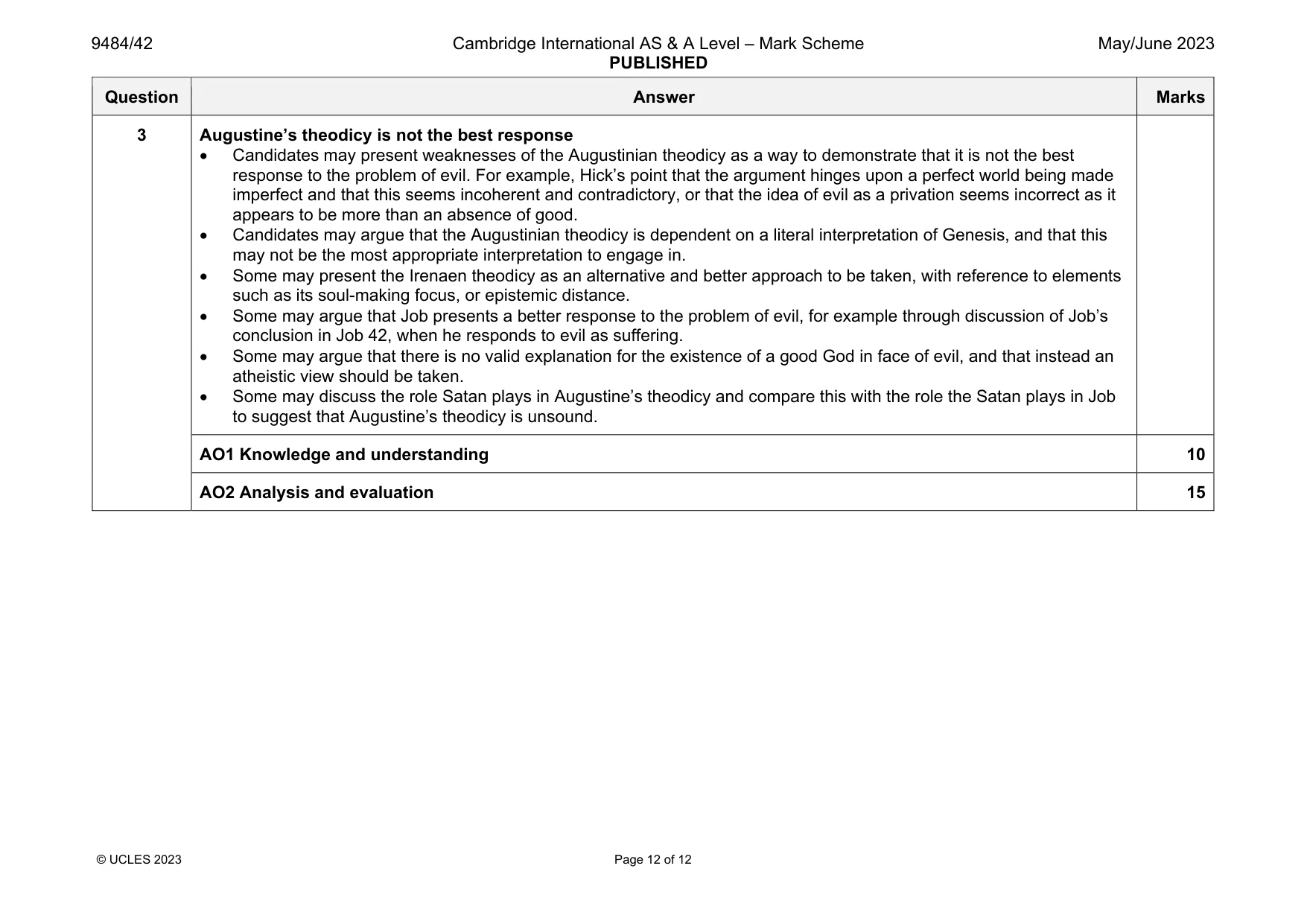
Mark scheme: 3 Evaluate the claim that Augustine of Hippo’s theodicy is the best response to the problem of evil. Use Table A: AO1 Knowledge and understanding (10 marks) and Table B: AO2 Analysis and evaluation (15 Marks) to mark candidate responses to this question. Award up to 10 marks AO1 Knowledge and understanding. Award up to 15 marks AO2 Analysis and evaluation. Indicative content Candidates may propose, analyse and evaluate some of the following arguments. All relevant arguments must be credited. Augustine’s theodicy is the best response Candidates are likely to outline the theodicy and highlight elements of it that are particularly successful. Some may instead discuss the theodicy as a whole, rather than individual elements; either is a valid approach. Candidates may argue that Augustine’s theodicy presents a rational solution to the free will problem with regard to evil, and that can be seen to make it successful. Some may argue that evil is best understood as a privation, and as such Augustine’s view of the problem is the most coherent. Some may argue that the Augustinian theodicy should be seen as the best response, because of its impact upon Christianity over time; that for long periods of history it was effectively the authorised position. Some may discuss how Augustine’s theodicy best explains the problem of evil in relation to the nature of God and discuss how it interacts with understandings of the qualities of God. Question Answer Marks 3 Augustine’s theodicy is not the best response Candidates may present weaknesses of the Augustinian theodicy as a way to demonstrate that it is not the best response to the problem of evil. For example, Hick’s point that the argument hinges upon a perfect world being made imperfect and that this seems incoherent and contradictory, or that the idea of evil as a privation seems incorrect as it appears to be more than an absence of good. Candidates may argue that the Augustinian theodicy is dependent on a literal interpretation of Genesis, and that this may not be the most appropriate interpretation to engage in. Some may present the Irenaen theodicy as an alternative and better approach to be taken, with reference to elements such as its soul-making focus, or epistemic distance. Some may argue that Job presents a better response to the problem of evil, for example through discussion of Job’s conclusion in Job 42, when he responds to evil as suffering. Some may argue that there is no valid explanation for the existence of a good God in face of evil, and that instead an atheistic view should be taken. Some may discuss the role Satan plays in Augustine’s theodicy and compare this with the role the Satan plays in Job to suggest that Augustine’s theodicy is unsound. AO1 Knowledge and understanding 10 AO2 Analysis and evaluation 15
What was in this paper
The subtopics covered by these 3 questions, and how many questions each got. Open one in a new tab to see every Cambridge question on it.
What you needed in this session
Cambridge’s own grade thresholds for 2023 May/June, Paper 4 · Variant 2. A higher threshold means an easier paper — the bar moves with how the cohort did.