Cambridge A Level Biblical Studies 9484 — 2023 Oct/Nov Paper 4 · Variant 2
9484/42/O/N/23 · 2 questions · 50 marks · ≈56 min
The question paper and its mark scheme, free to read here and free to download. This is Cambridge’s own paper, exactly as it was sat.
Question paper4 pages


Mark scheme9 pages
Answers below. Sit the paper first if you are practising.
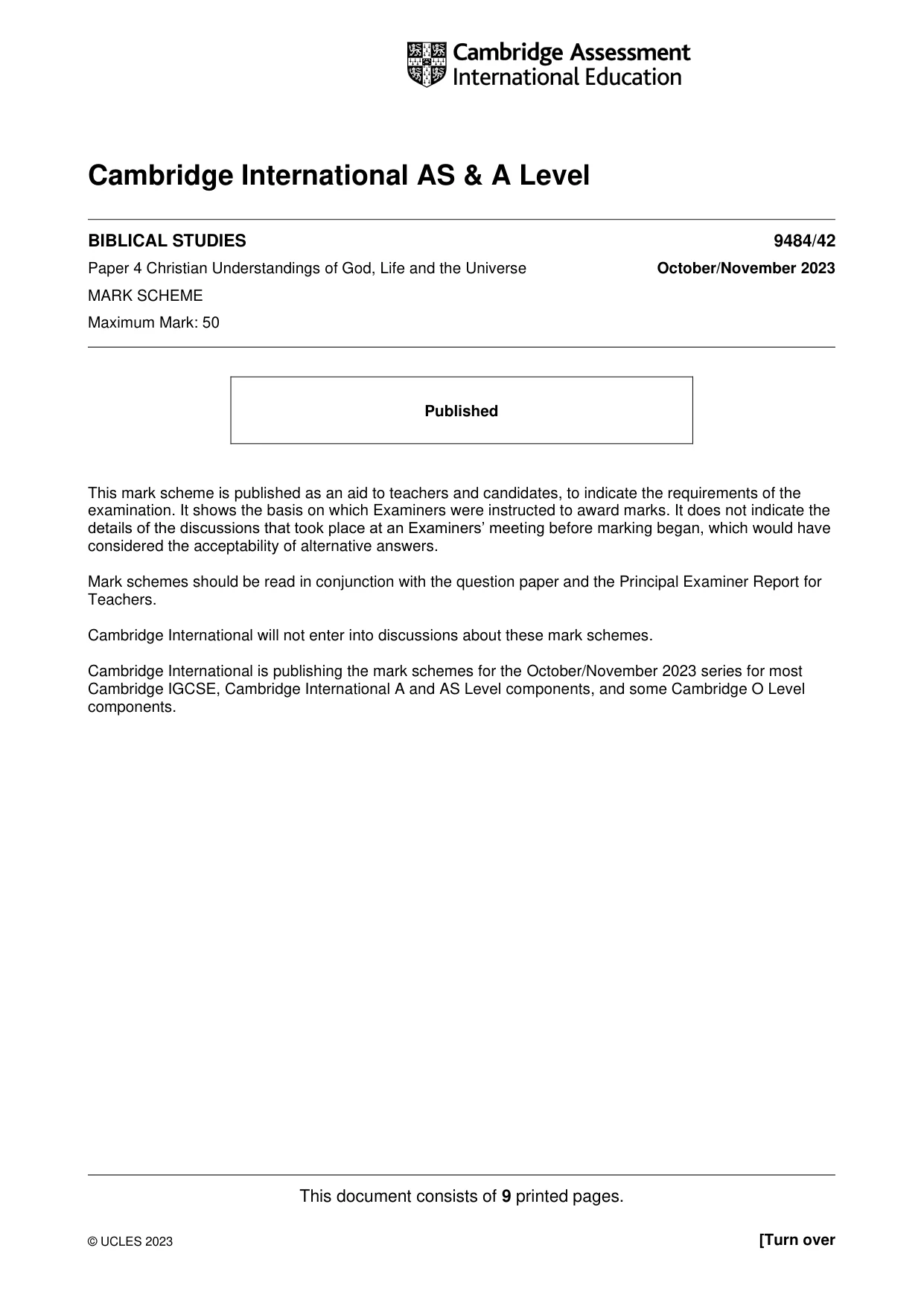
Questions as text
Q1 · ‘Christians are free to use animals however they wish.’ Discuss
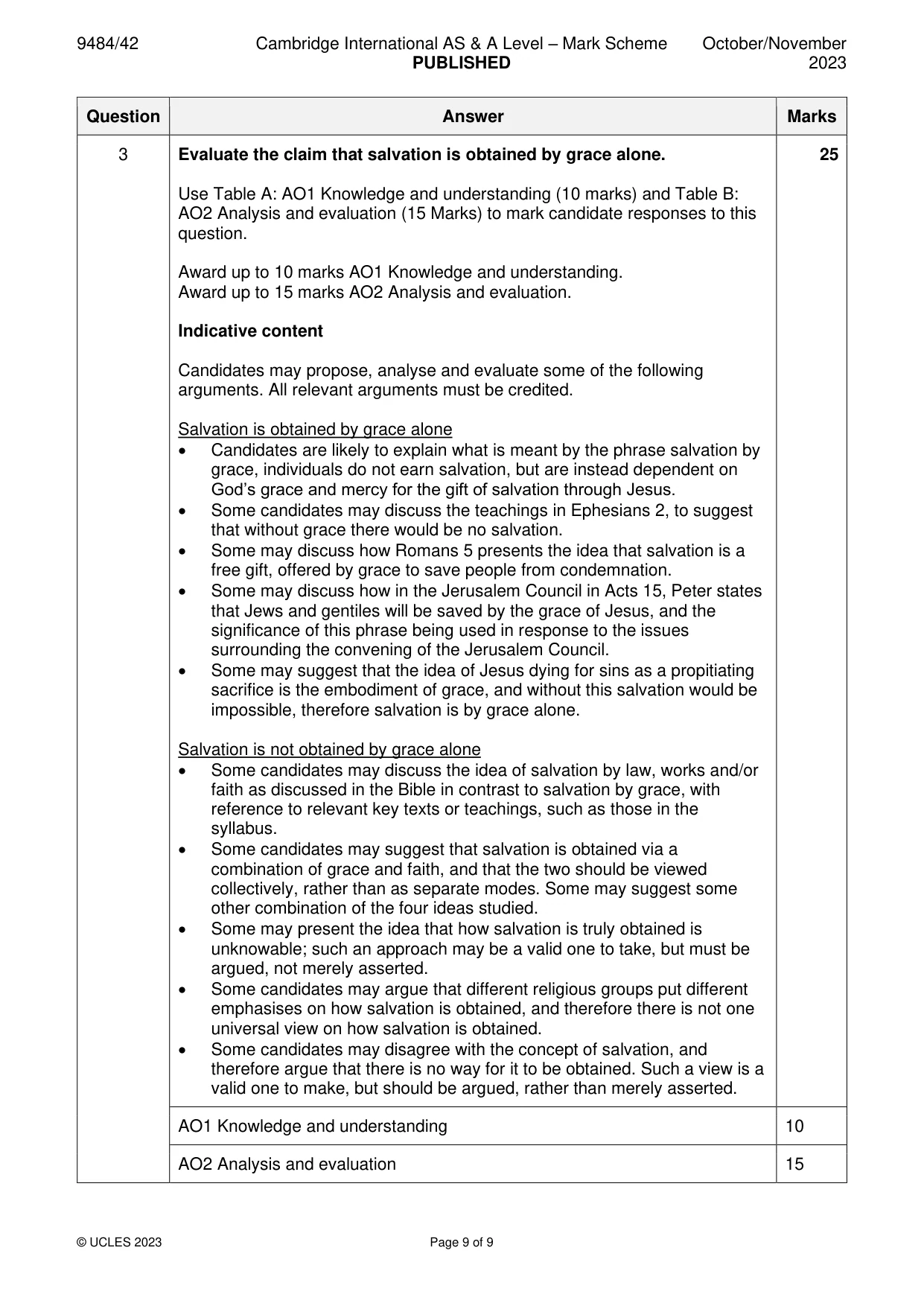
1 ‘Christians are free to use animals however they wish.’ Discuss. [25]
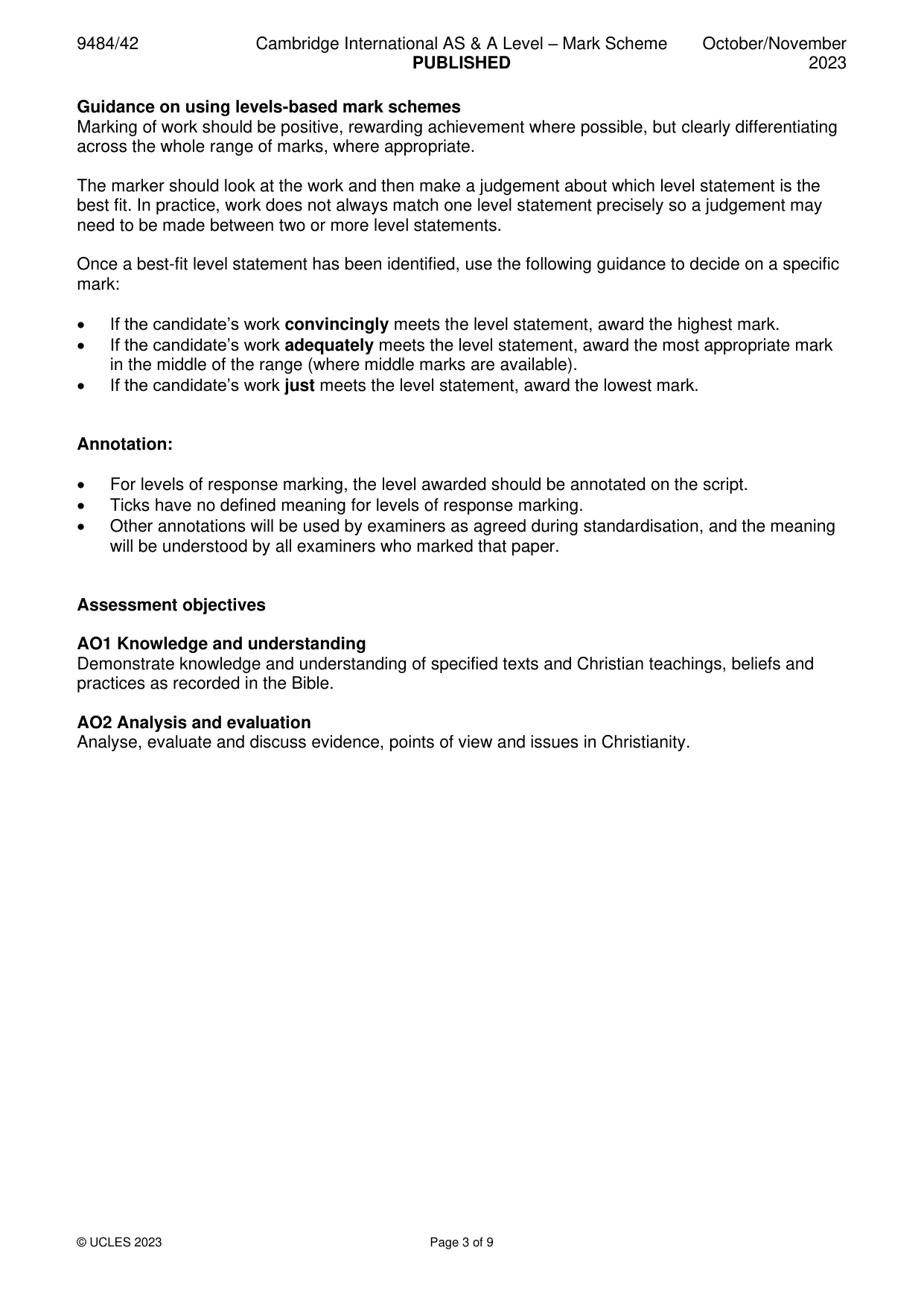
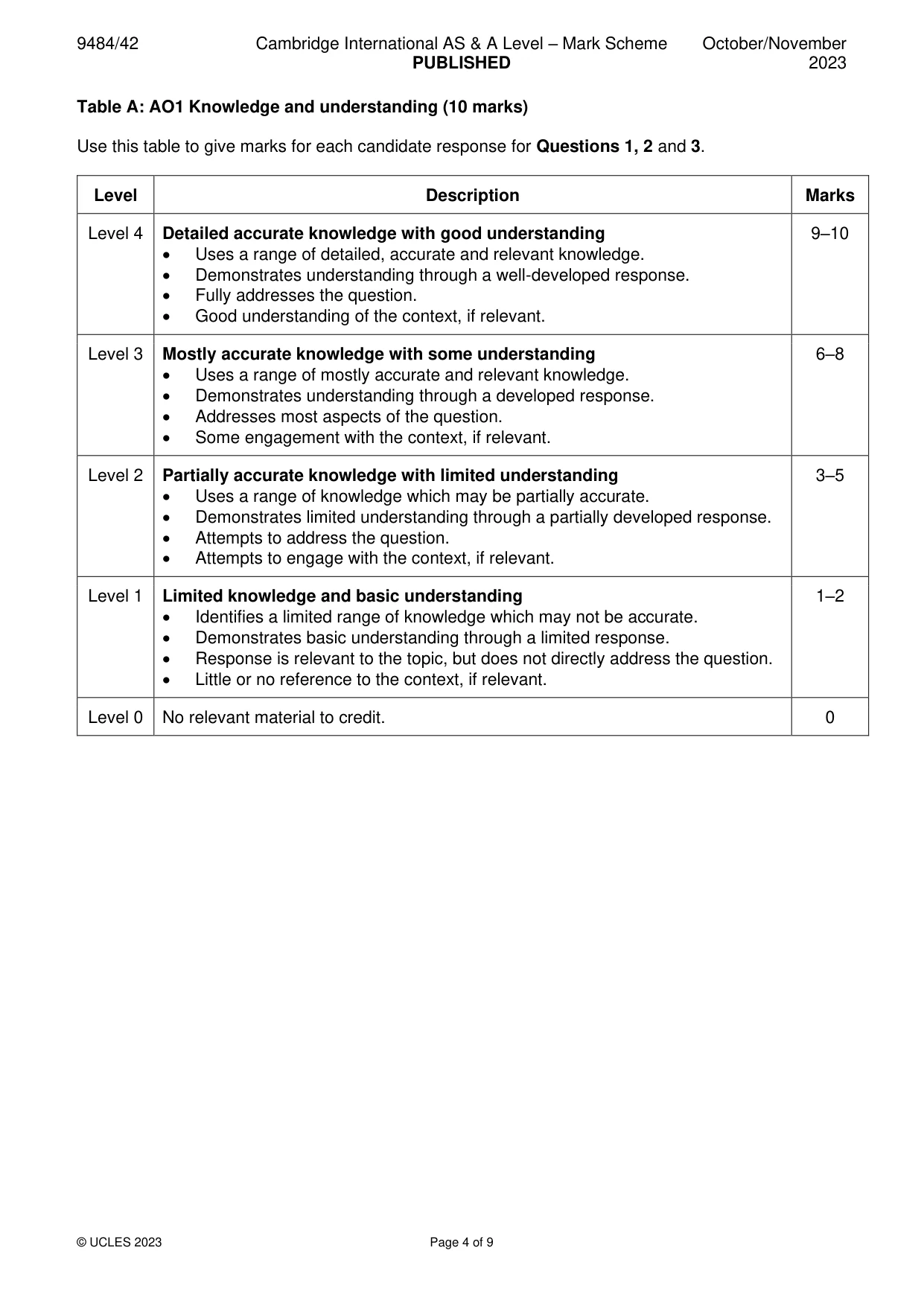
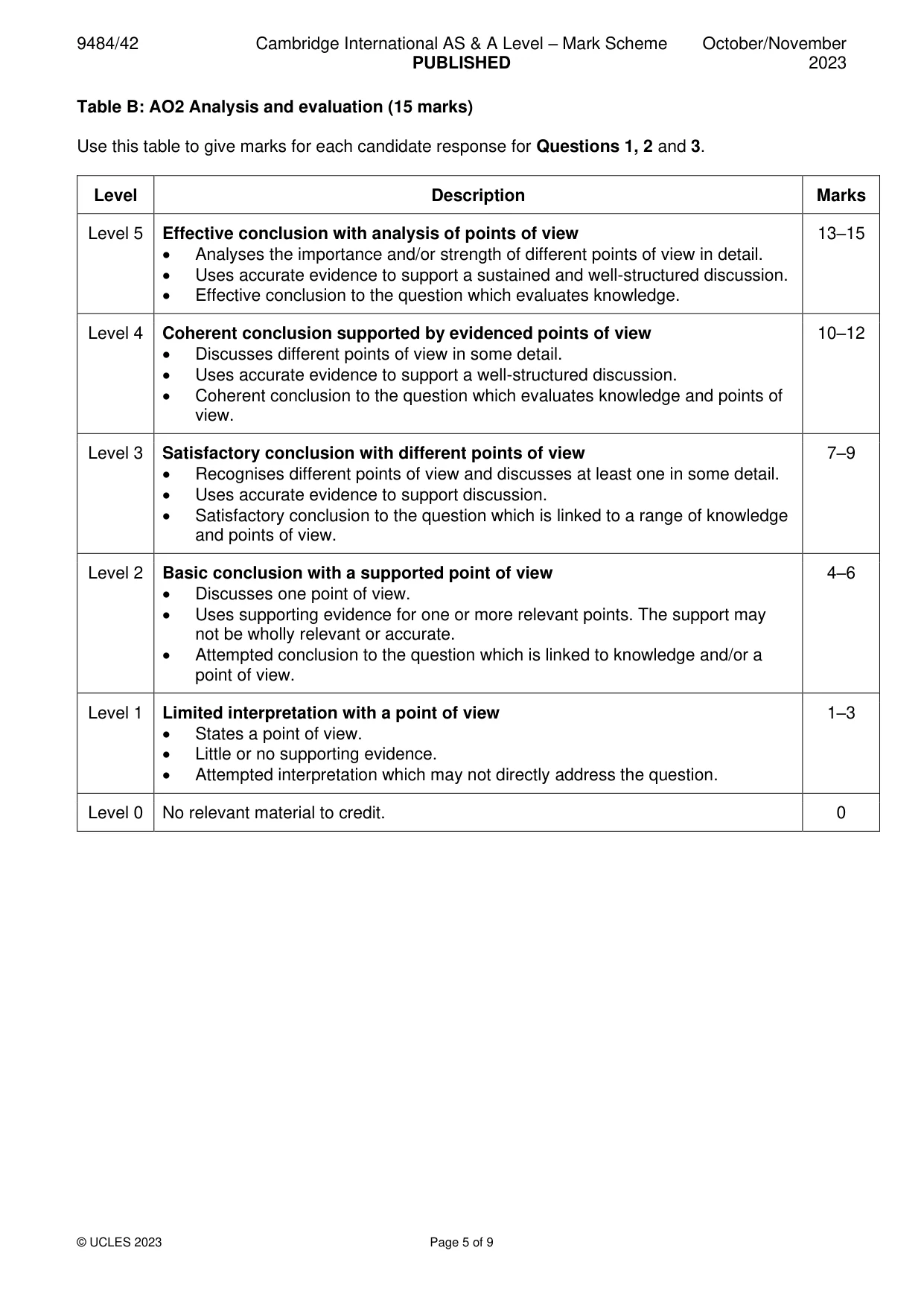
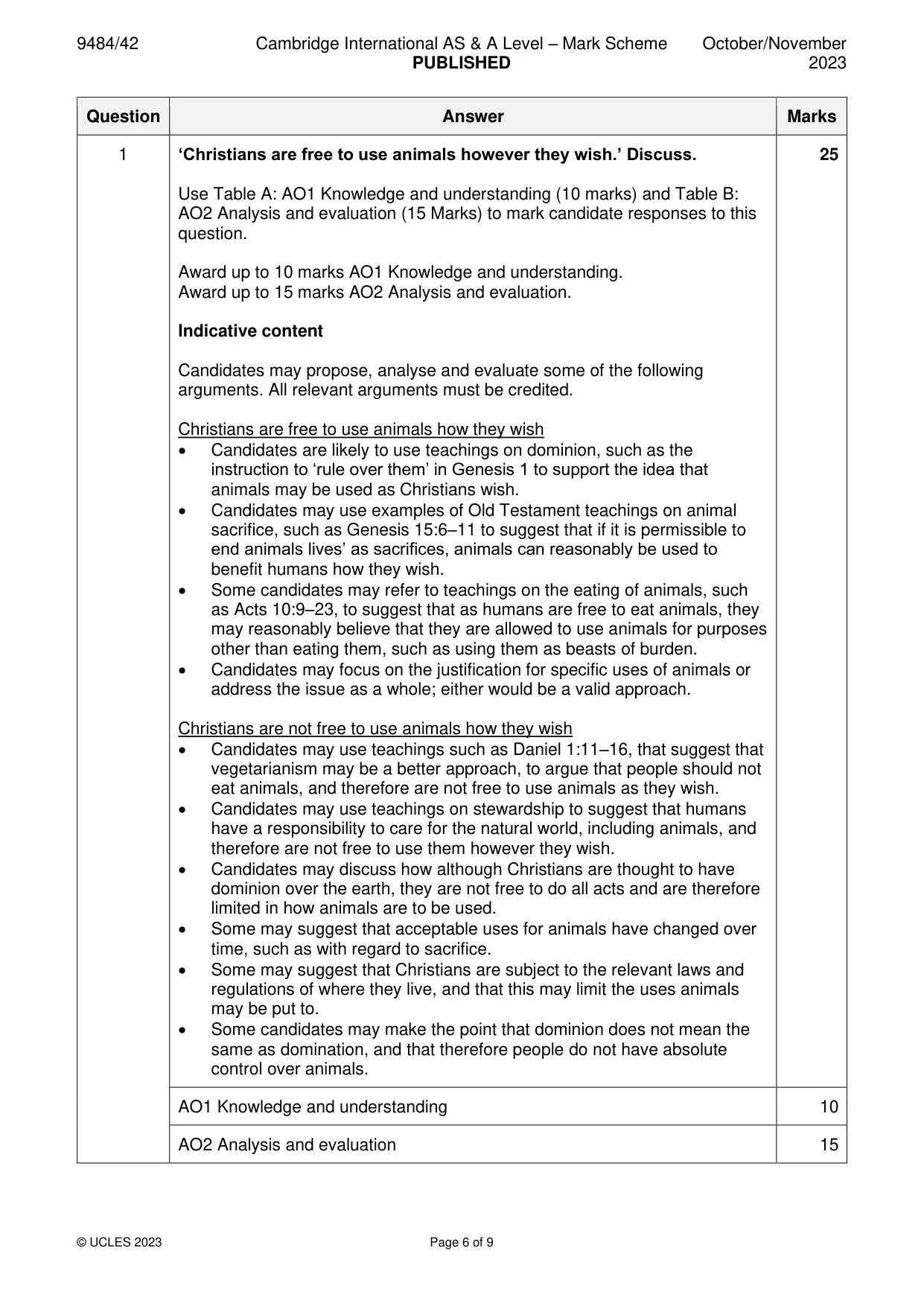
Mark scheme: Question Answer Marks 1 ‘Christians are free to use animals however they wish.’ Discuss. 25 Use Table A: AO1 Knowledge and understanding (10 marks) and Table B: AO2 Analysis and evaluation (15 Marks) to mark candidate responses to this question. Award up to 10 marks AO1 Knowledge and understanding. Award up to 15 marks AO2 Analysis and evaluation. Indicative content Candidates may propose, analyse and evaluate some of the following arguments. All relevant arguments must be credited. Christians are free to use animals how they wish • Candidates are likely to use teachings on dominion, such as the instruction to ‘rule over them’ in Genesis 1 to support the idea that animals may be used as Christians wish. • Candidates may use examples of Old Testament teachings on animal sacrifice, such as Genesis 15:6–11 to suggest that if it is permissible to end animals lives’ as sacrifices, animals can reasonably be used to benefit humans how they wish. • Some candidates may refer to teachings on the eating of animals, such as Acts 10:9–23, to suggest that as humans are free to eat animals, they may reasonably believe that they are allowed to use animals for purposes other than eating them, such as using them as beasts of burden. • Candidates may focus on the justification for specific uses of animals or address the issue as a whole; either would be a valid approach. Christians are not free to use animals how they wish • Candidates may use teachings such as Daniel 1:11–16, that suggest that vegetarianism may be a better approach, to argue that people should not eat animals, and therefore are not free to use animals as they wish. • Candidates may use teachings on stewardship to suggest that humans have a responsibility to care for the natural world, including animals, and therefore are not free to use them however they wish. • Candidates may discuss how although Christians are thought to have dominion over the earth, they are not free to do all acts and are therefore limited in how animals are to be used. • Some may suggest that acceptable uses for animals have changed over time, such as with regard to sacrifice. • Some may suggest that Christians are subject to the relevant laws and regulations of where they live, and that this may limit the uses animals may be put to. • Some candidates may make the point that dominion does not mean the same as domination, and that therefore people do not have absolute control over animals. AO1 Knowledge and understanding 10 AO2 Analysis and evaluation 15
Q2 · Compare the teachings in 1 Corinthians and 2 Corinthians on the immortality of the soul
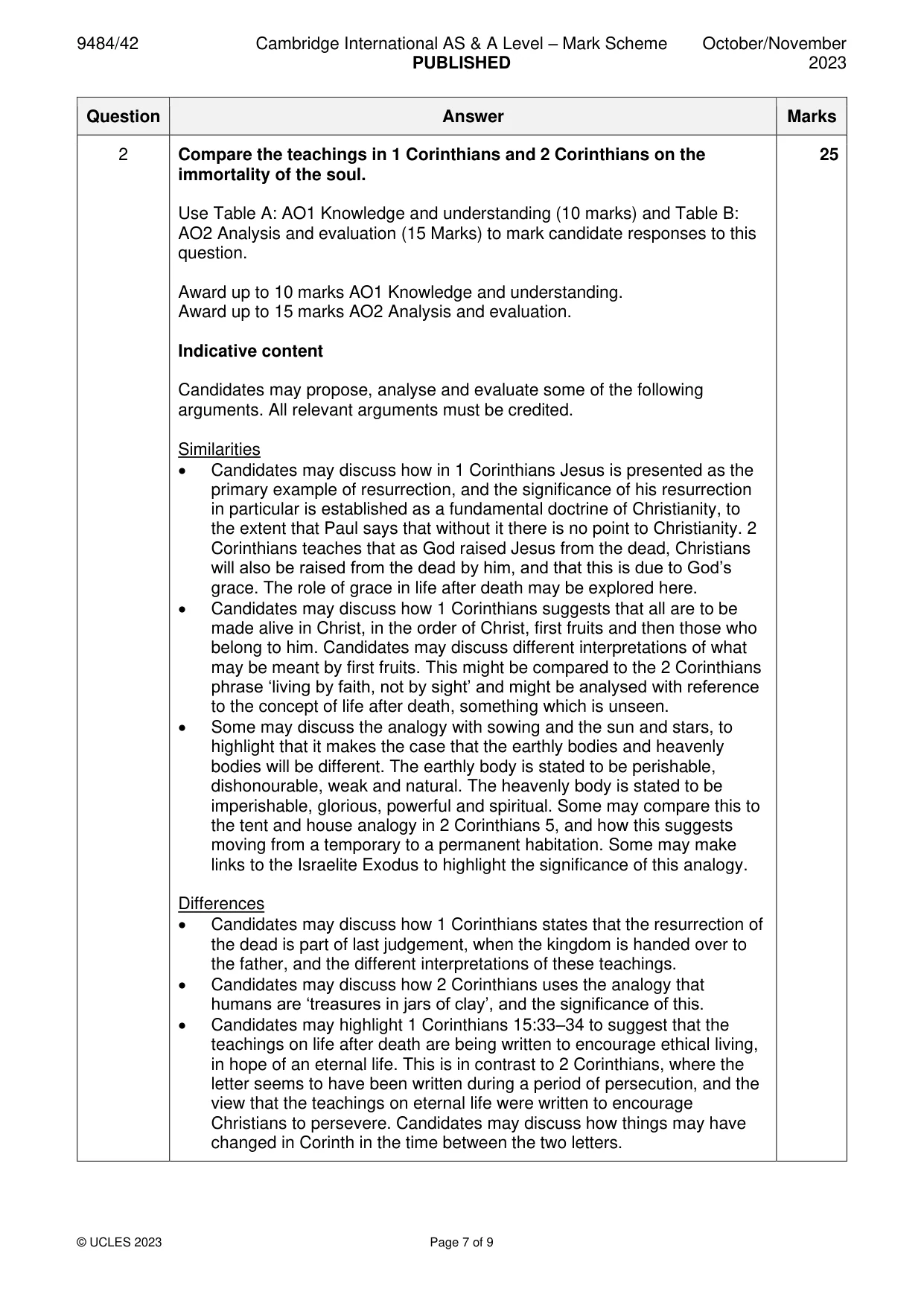
2 Compare the teachings in 1 Corinthians and 2 Corinthians on the immortality of the soul. [25]
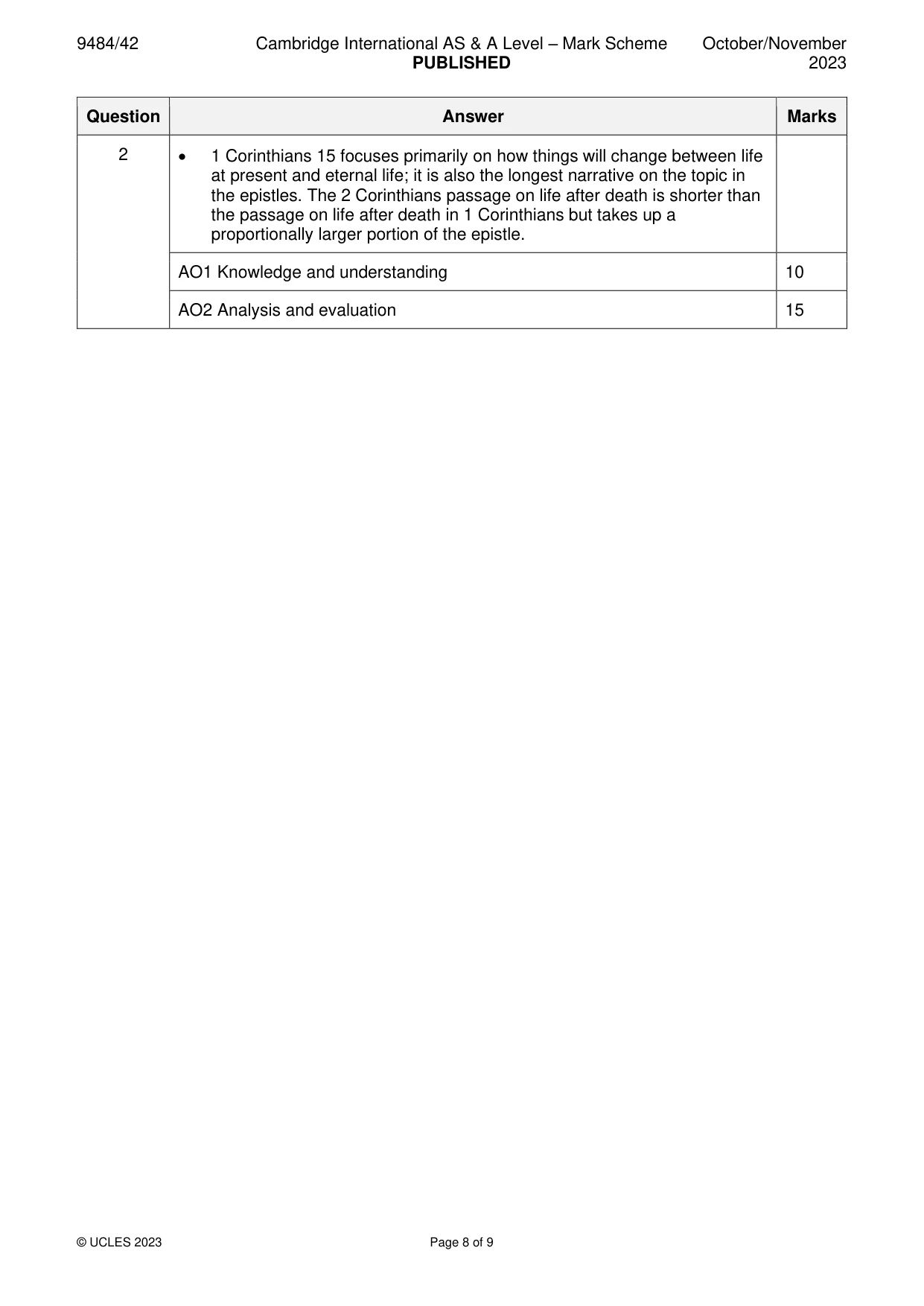
Mark scheme: 2 Compare the teachings in 1 Corinthians and 2 Corinthians on the 25 immortality of the soul. Use Table A: AO1 Knowledge and understanding (10 marks) and Table B: AO2 Analysis and evaluation (15 Marks) to mark candidate responses to this question. Award up to 10 marks AO1 Knowledge and understanding. Award up to 15 marks AO2 Analysis and evaluation. Indicative content Candidates may propose, analyse and evaluate some of the following arguments. All relevant arguments must be credited. Similarities • Candidates may discuss how in 1 Corinthians Jesus is presented as the primary example of resurrection, and the significance of his resurrection in particular is established as a fundamental doctrine of Christianity, to the extent that Paul says that without it there is no point to Christianity. 2 Corinthians teaches that as God raised Jesus from the dead, Christians will also be raised from the dead by him, and that this is due to God’s grace. The role of grace in life after death may be explored here. • Candidates may discuss how 1 Corinthians suggests that all are to be made alive in Christ, in the order of Christ, first fruits and then those who belong to him. Candidates may discuss different interpretations of what may be meant by first fruits. This might be compared to the 2 Corinthians phrase ‘living by faith, not by sight’ and might be analysed with reference to the concept of life after death, something which is unseen. • Some may discuss the analogy with sowing and the sun and stars, to highlight that it makes the case that the earthly bodies and heavenly bodies will be different. The earthly body is stated to be perishable, dishonourable, weak and natural. The heavenly body is stated to be imperishable, glorious, powerful and spiritual. Some may compare this to the tent and house analogy in 2 Corinthians 5, and how this suggests moving from a temporary to a permanent habitation. Some may make links to the Israelite Exodus to highlight the significance of this analogy. Differences • Candidates may discuss how 1 Corinthians states that the resurrection of the dead is part of last judgement, when the kingdom is handed over to the father, and the different interpretations of these teachings. • Candidates may discuss how 2 Corinthians uses the analogy that humans are ‘treasures in jars of clay’, and the significance of this. • Candidates may highlight 1 Corinthians 15:33–34 to suggest that the teachings on life after death are being written to encourage ethical living, in hope of an eternal life. This is in contrast to 2 Corinthians, where the letter seems to have been written during a period of persecution, and the view that the teachings on eternal life were written to encourage Christians to persevere. Candidates may discuss how things may have changed in Corinth in the time between the two letters. 2 • 1 Corinthians 15 focuses primarily on how things will change between life at present and eternal life; it is also the longest narrative on the topic in the epistles. The 2 Corinthians passage on life after death is shorter than the passage on life after death in 1 Corinthians but takes up a proportionally larger portion of the epistle. AO1 Knowledge and understanding 10 AO2 Analysis and evaluation 15
What was in this paper
The subtopics covered by these 2 questions, and how many questions each got. Open one in a new tab to see every Cambridge question on it.
What you needed in this session
Cambridge’s own grade thresholds for 2023 Oct/Nov, Paper 4 · Variant 2. A higher threshold means an easier paper — the bar moves with how the cohort did.