Cambridge A Level Applied Information and Communication Technology 9713 — 2016 Oct/Nov Paper 1 · Variant 3
9713/13/O/N/16 · 80 marks · ≈90 min
The question paper and its mark scheme, free to read here and free to download. This is Cambridge’s own paper, exactly as it was sat.
Question paper20 pages
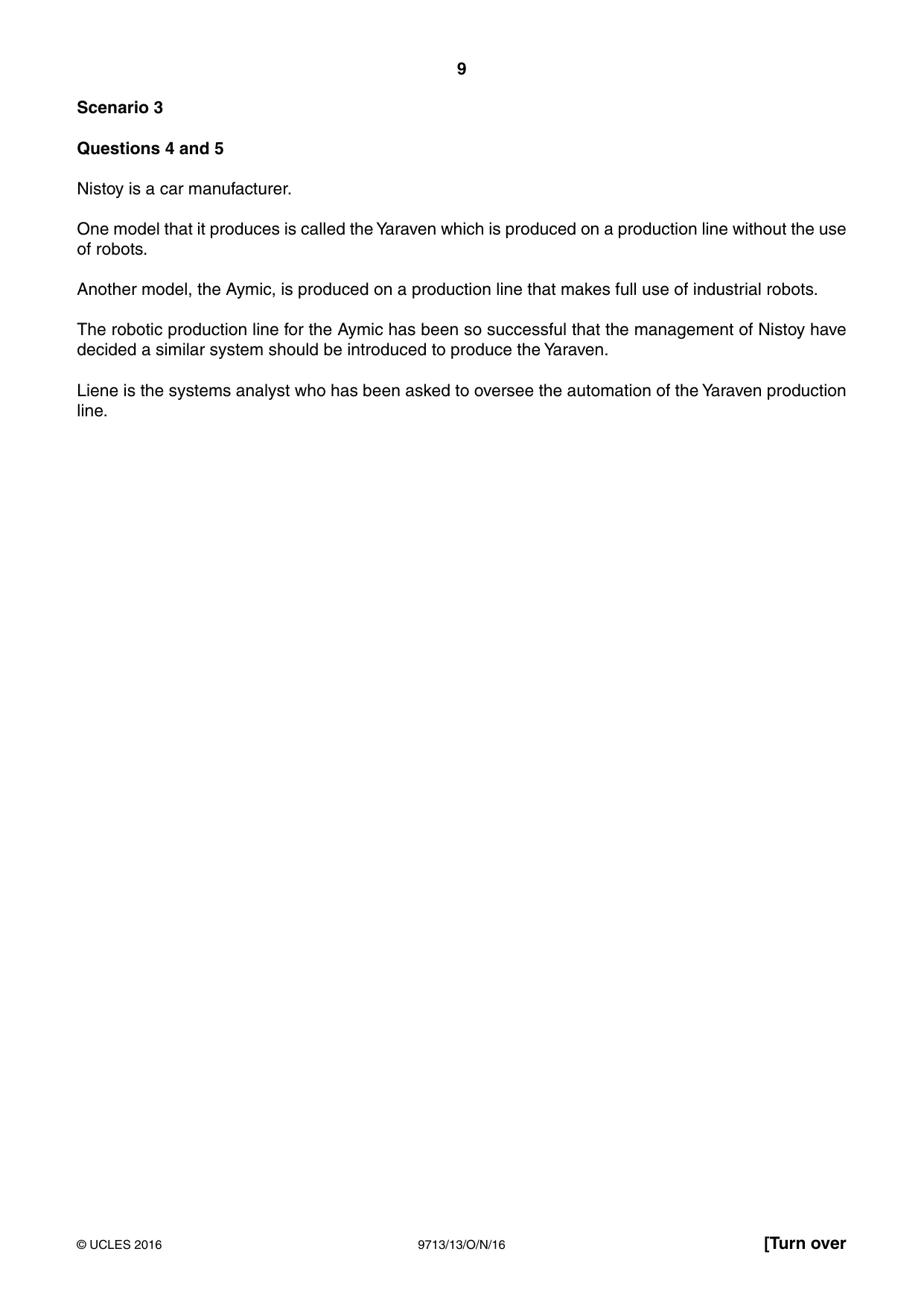
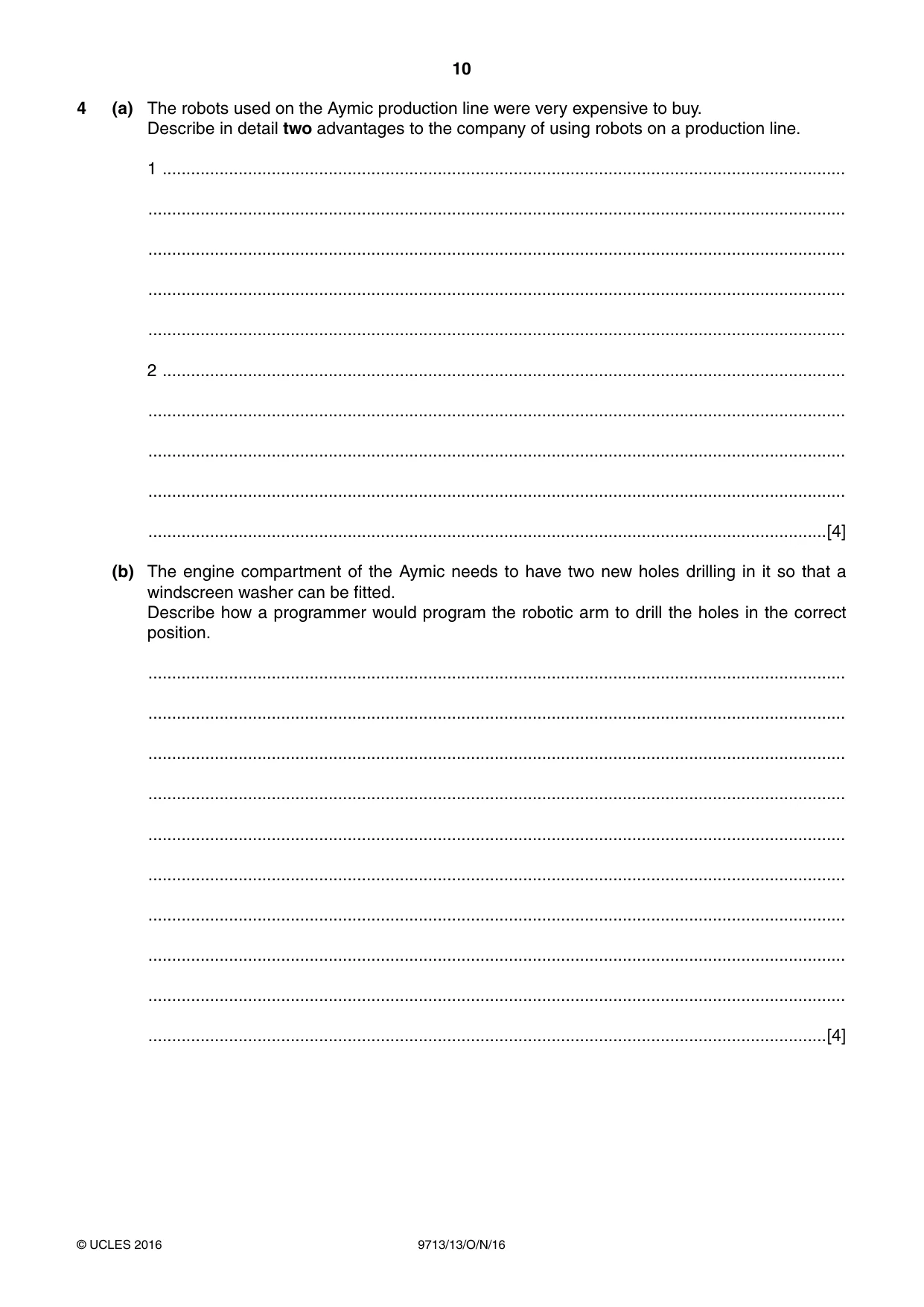
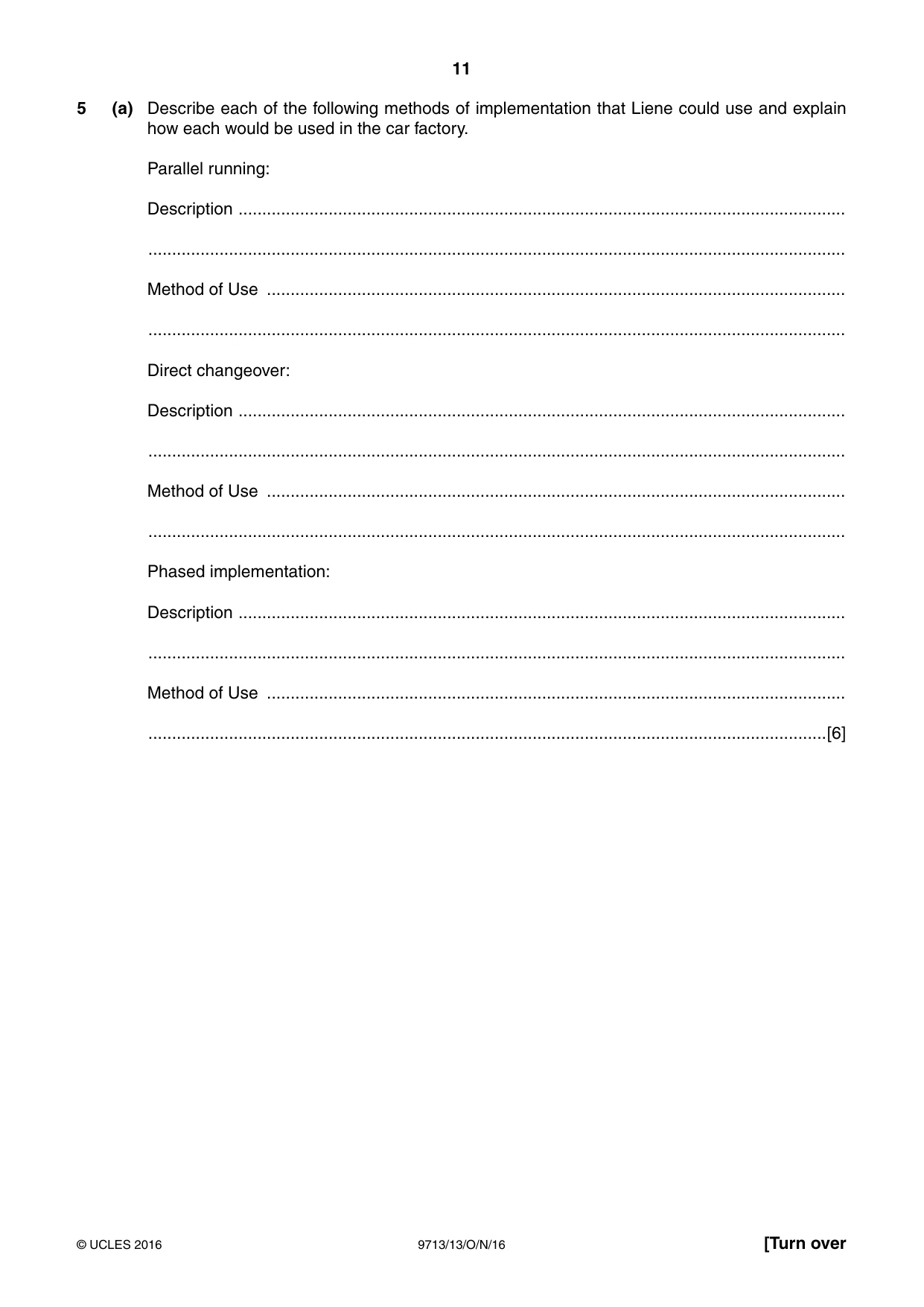
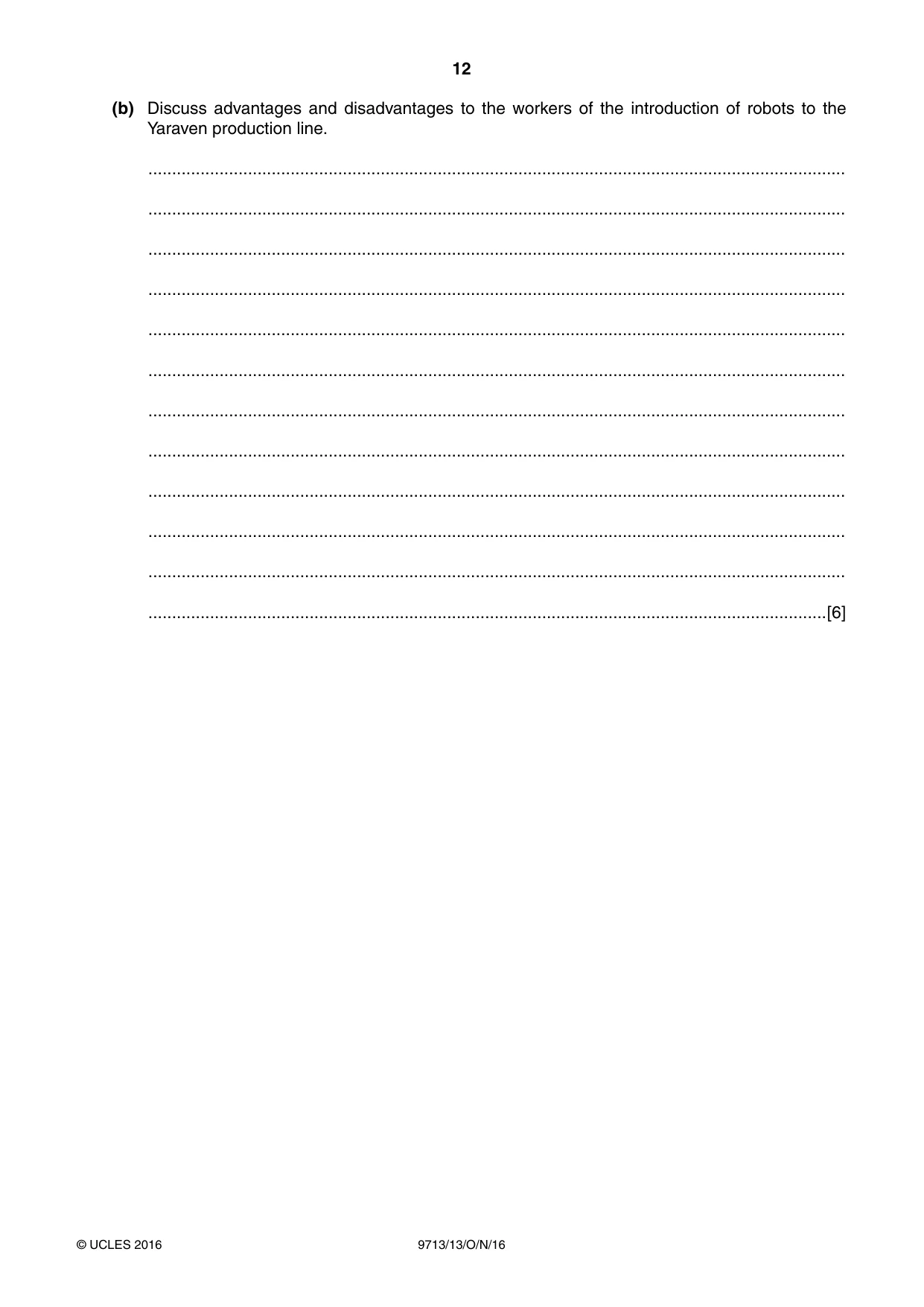



Mark scheme7 pages
Answers below. Sit the paper first if you are practising.
Paper as text
Question paper, page 1
This document consists of 17 printed pages and 3 blank pages. DC (LEG) 115297/4 © UCLES 2016 [Turn over Cambridge International Examinations Cambridge International Advanced Subsidiary and Advanced Level * 9 2 0 1 7 7 9 9 8 0 * APPLIED INFORMATION AND COMMUNICATION TECHNOLOGY 9713/13 Paper 1 October/November 2016 1 hour 15 minutes Candidates answer on the Question Paper. No Additional Materials are required. READ THESE INSTRUCTIONS FIRST Write your Centre number, candidate number and name on all the work you hand in. Write in dark blue or black pen. Do not use staples, paper clips, glue or correction fluid. You may use an HB pencil for any diagrams, graphs or rough working. DO NOT WRITE IN ANY BARCODES. Answer all questions. The number of marks is given in brackets [ ] at the end of each question or part question. The businesses described in this paper are entirely fictitious.
Question paper, page 2
2 9713/13/O/N/16 © UCLES 2016 Scenario 1 Questions 1 and 2 Paraiso College has a large number of students who attend classes at three campuses. A large number of different courses are available covering many subject areas. The technology faculty is very well equipped and supports students who are involved in completing a number of different projects. Each student at the college is issued with a plastic card containing information stored on a magnetic stripe. This card is used to gain entry to each of the college campuses. Students at the college need to use the internet in order to find background information for their project work. A large amount of information will be available when they search the internet. The Technology department at the College has decided to produce a handbook detailing the equipment that is available for use by students. The handbook needs to be as accurate as possible because it will be used as a reference by students in the department.
Question paper, page 3
3 9713/13/O/N/16 © UCLES 2016 [Turn over 1 (a) The college provides a number of devices which produce hardcopy. Describe three of these devices that could be used by the students in their project work, explaining what each device would be used for. Each use must be different. 1 … … … … … 2 … … … … … 3 … … … … …[6]
Question paper, page 4
4 9713/13/O/N/16 © UCLES 2016 (b) (i) Explain the drawbacks of using magnetic stripe cards to gain entry to the college. … … … … … … … … … …[4] (ii) Explain the different ways the card could be used by both the students and the college authorities. … … … … … … … … … … … …[5]
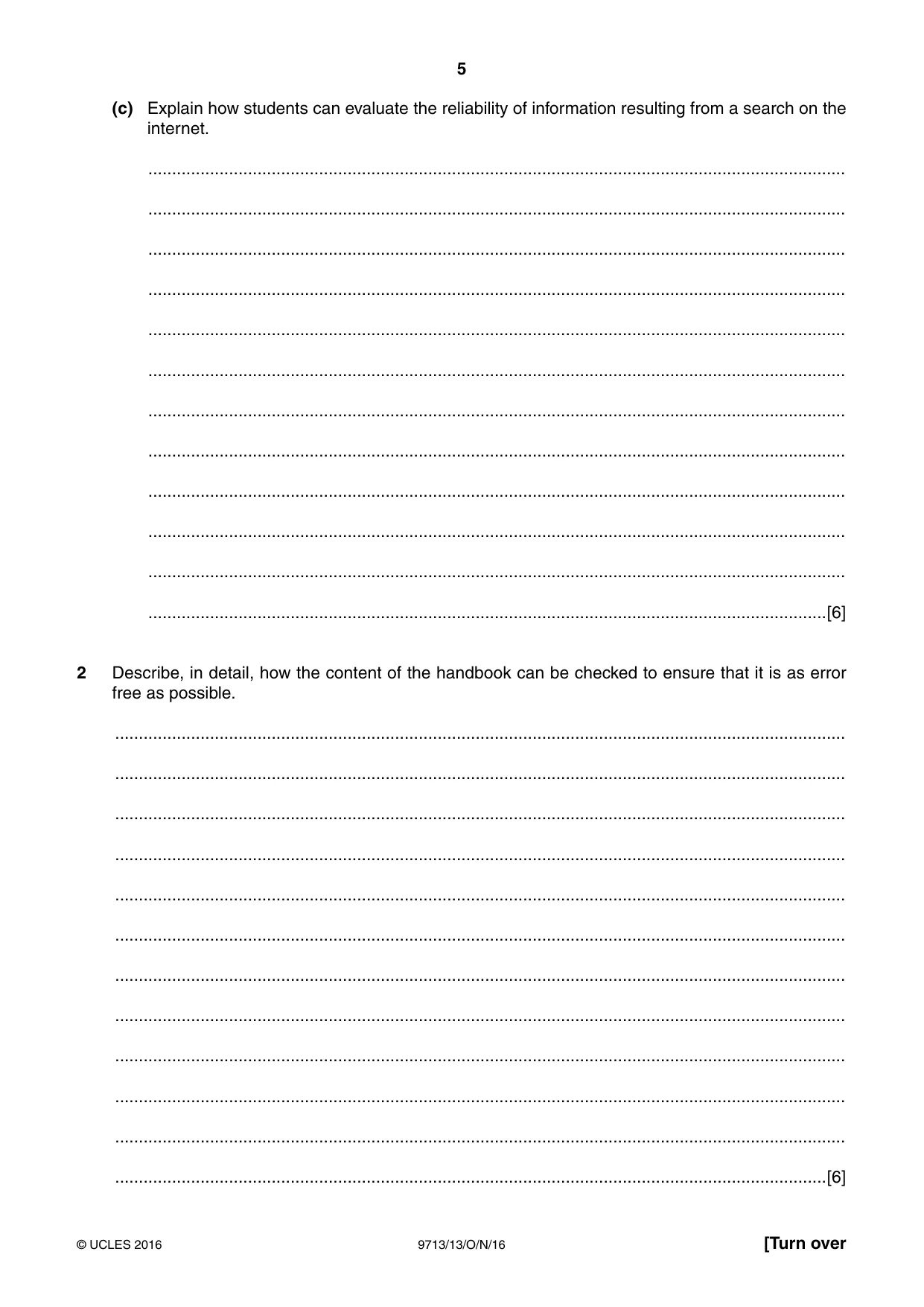
Question paper, page 5
5 9713/13/O/N/16 © UCLES 2016 [Turn over (c) Explain how students can evaluate the reliability of information resulting from a search on the internet. … … … … … … … … … … … …[6] 2 Describe, in detail, how the content of the handbook can be checked to ensure that it is as error free as possible. … … … … … … … … … … … …[6]
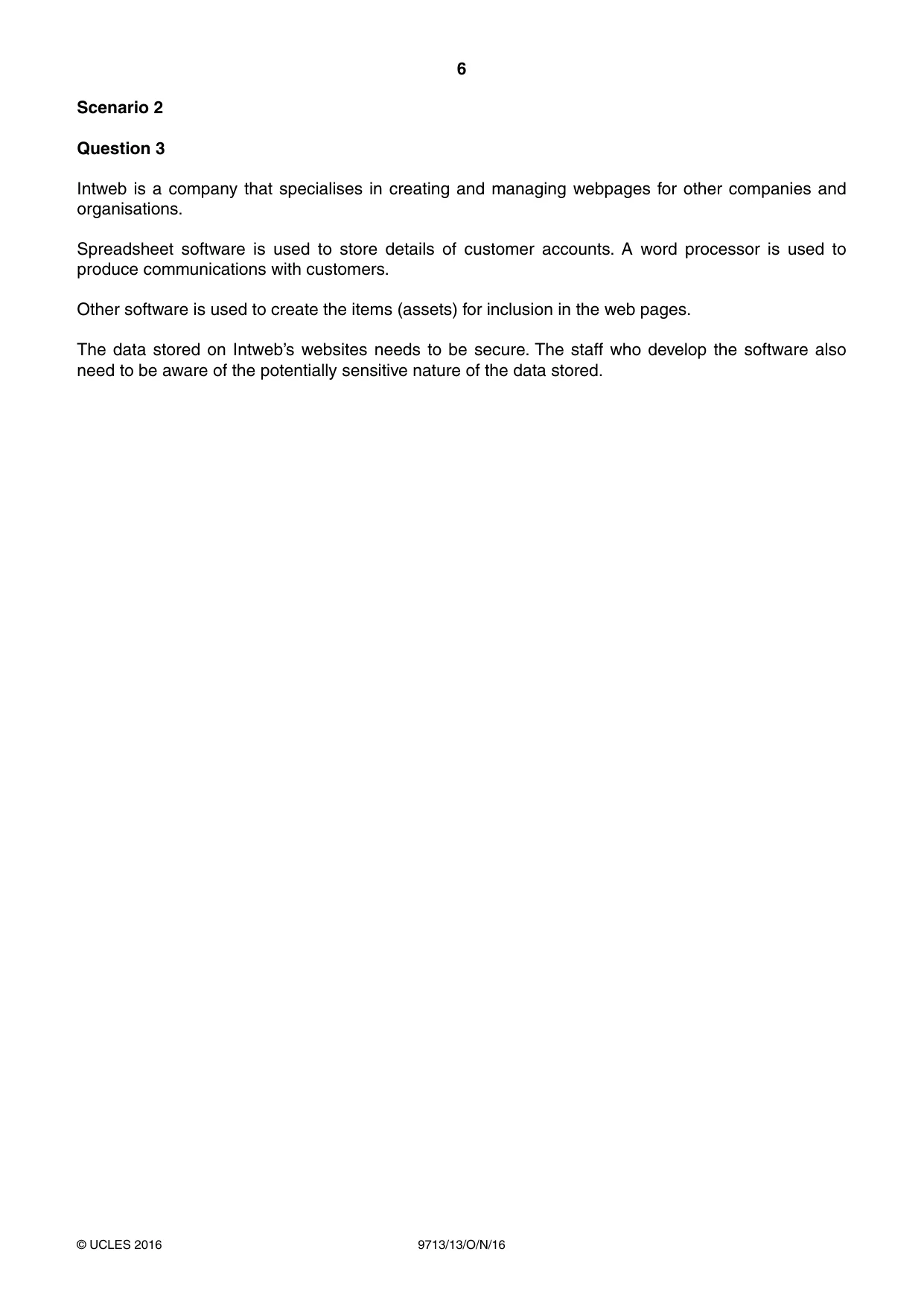
Question paper, page 6
6 9713/13/O/N/16 © UCLES 2016 Scenario 2 Question 3 Intweb is a company that specialises in creating and managing webpages for other companies and organisations. Spreadsheet software is used to store details of customer accounts. A word processor is used to produce communications with customers. Other software is used to create the items (assets) for inclusion in the web pages. The data stored on Intweb’s websites needs to be secure. The staff who develop the software also need to be aware of the potentially sensitive nature of the data stored.
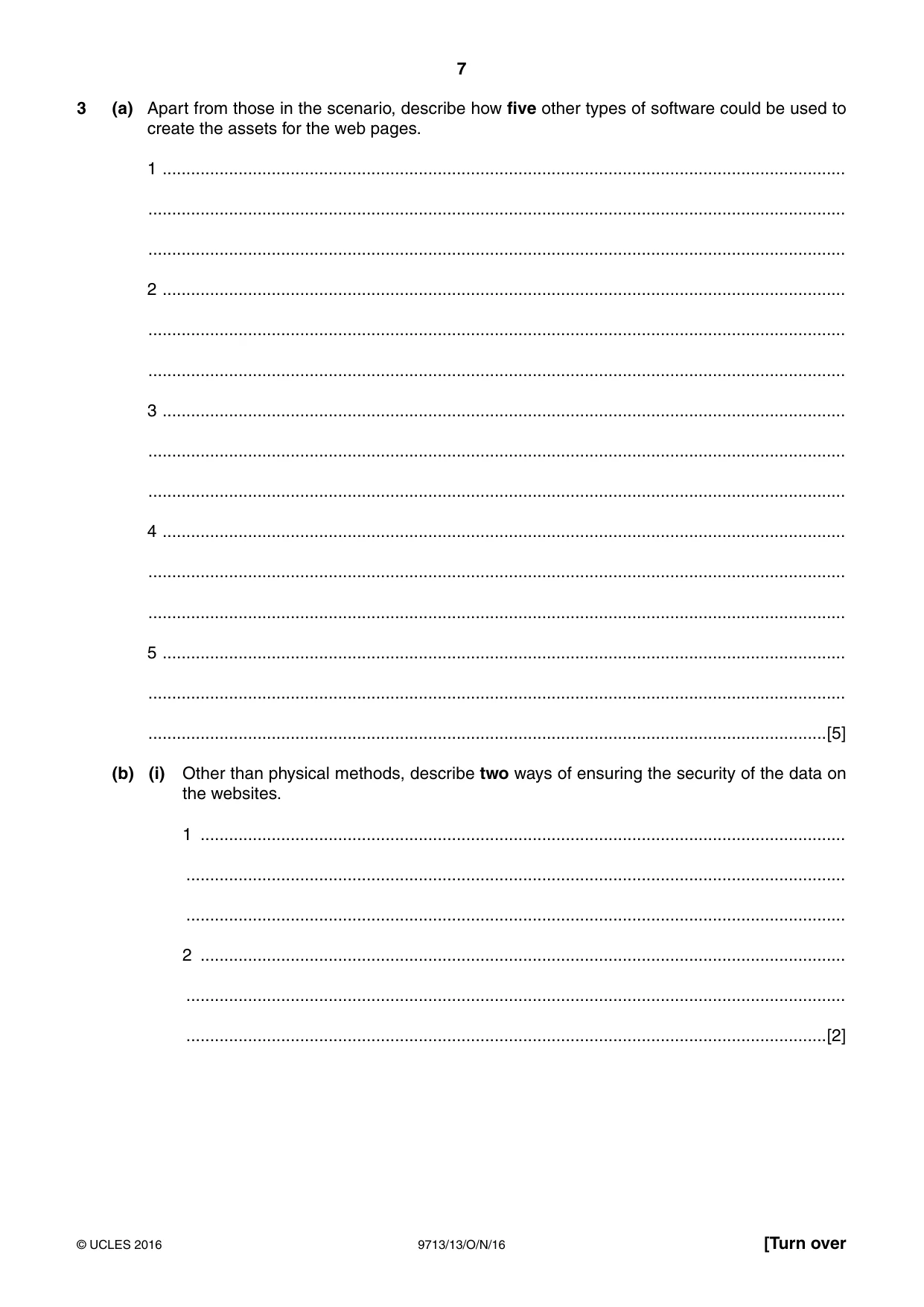
Question paper, page 7
7 9713/13/O/N/16 © UCLES 2016 [Turn over 3 (a) Apart from those in the scenario, describe how five other types of software could be used to create the assets for the web pages. 1 … … … 2 … … … 3 … … … 4 … … … 5 … … …[5] (b) (i) Other than physical methods, describe two ways of ensuring the security of the data on the websites. 1 … … … 2 … … …[2]
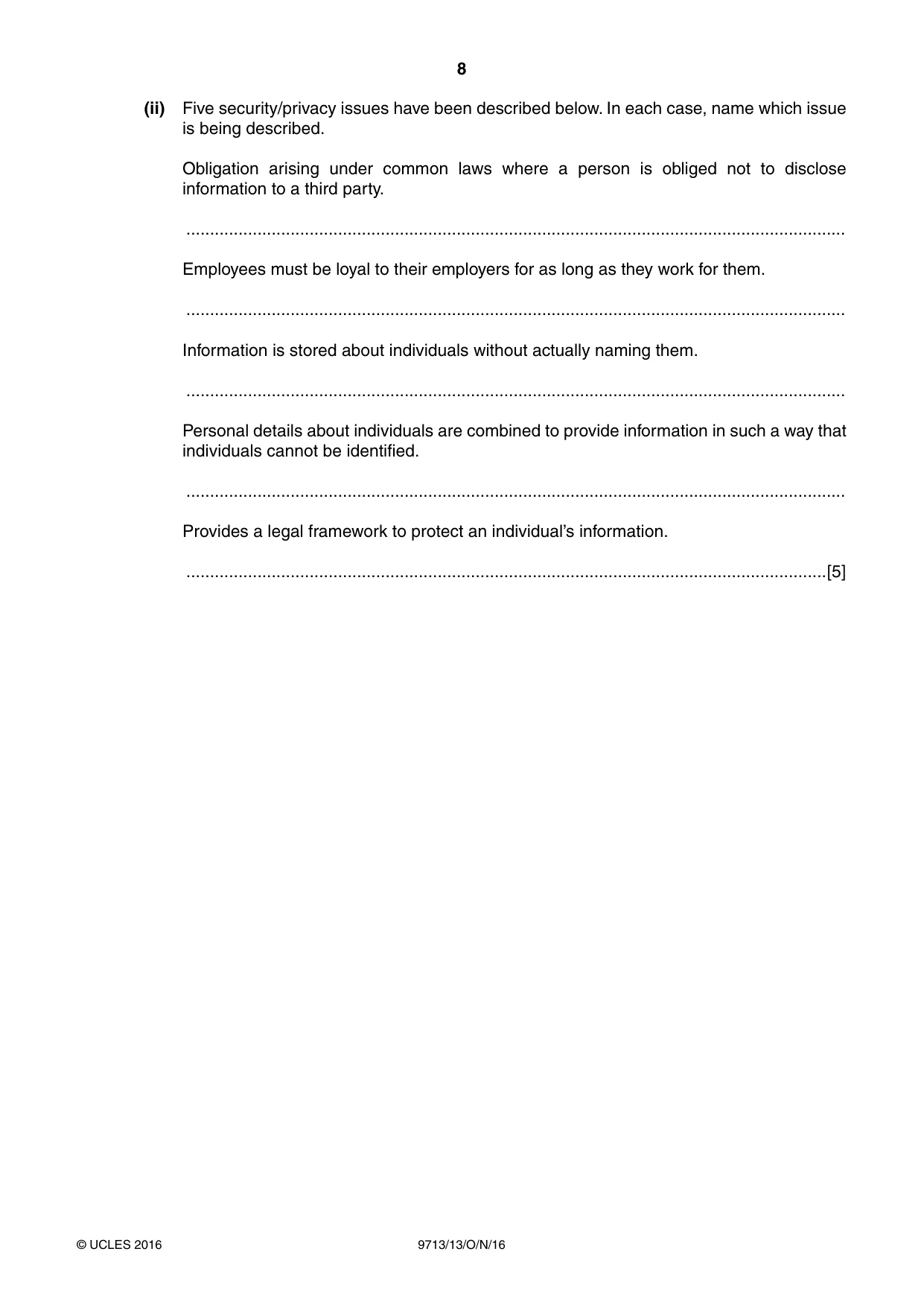
Question paper, page 8
8 9713/13/O/N/16 © UCLES 2016 (ii) Five security/privacy issues have been described below. In each case, name which issue is being described. Obligation arising under common laws where a person is obliged not to disclose information to a third party. … Employees must be loyal to their employers for as long as they work for them. … Information is stored about individuals without actually naming them. … Personal details about individuals are combined to provide information in such a way that individuals cannot be identified. … Provides a legal framework to protect an individual’s information. …[5]
Question paper, page 9
9 9713/13/O/N/16 © UCLES 2016 [Turn over Scenario 3 Questions 4 and 5 Nistoy is a car manufacturer. One model that it produces is called the Yaraven which is produced on a production line without the use of robots. Another model, the Aymic, is produced on a production line that makes full use of industrial robots. The robotic production line for the Aymic has been so successful that the management of Nistoy have decided a similar system should be introduced to produce the Yaraven. Liene is the systems analyst who has been asked to oversee the automation of the Yaraven production line.
Question paper, page 10
10 9713/13/O/N/16 © UCLES 2016 4 (a) The robots used on the Aymic production line were very expensive to buy. Describe in detail two advantages to the company of using robots on a production line. 1 … … … … … 2 … … … … …[4] (b) The engine compartment of the Aymic needs to have two new holes drilling in it so that a windscreen washer can be fitted. Describe how a programmer would program the robotic arm to drill the holes in the correct position. … … … … … … … … … …[4]
Question paper, page 11
11 9713/13/O/N/16 © UCLES 2016 [Turn over 5 (a) Describe each of the following methods of implementation that Liene could use and explain how each would be used in the car factory. Parallel running: Description … … Method of Use … … Direct changeover: Description … … Method of Use … … Phased implementation: Description … … Method of Use … …[6]
Question paper, page 12
12 9713/13/O/N/16 © UCLES 2016 (b) Discuss advantages and disadvantages to the workers of the introduction of robots to the Yaraven production line. … … … … … … … … … … … …[6]
Question paper, page 13
13 9713/13/O/N/16 © UCLES 2016 [Turn over Scenario 4 Questions 6 and 7 The government of a large region of a country has a number of departments. One of these departments is called Youngov. Youngov is concerned with young people and their problems. Youngov collects data annually and creates graphs and charts to make the data more easily understood. Another government department is concerned with the payroll.
Question paper, page 14
14 9713/13/O/N/16 © UCLES 2016 6 (a) For each of the following sets of data, explain why the type of chart or graph has been chosen. The number of young people in each age group (0–5, 6–10, 11–15 and 16–20). Type: bar chart … … … The proportion of young people in each age group (0–5, 6–10, 11–15 and 16–20). Type: pie chart … … … The number of young people in different types of educational institution (first school, secondary school, college, university) compared with the previous year. Type: comparative bar chart … … … The number of 18-year-old pupils in full time education in each of the last ten years. Type: line graph … … …[4]
Question paper, page 15
15 9713/13/O/N/16 © UCLES 2016 [Turn over (b) One of Youngov’s responsibilities is to consider the health and safety issues faced by young people who are using computers. Apart from RSI, describe three other health issues that should be considered. 1 … … … 2 … … … 3 … … …[3]
Question paper, page 16
16 9713/13/O/N/16 © UCLES 2016 7 The systems analyst who was responsible for the design of the payroll system had to decide between using a sequential access filing system and a random access filing system. (a) Compare and contrast the use of a sequential access filing system and a random access filing system. … … … … … … … … … … … … … … … … … … … …[8]
Question paper, page 17
17 9713/13/O/N/16 © UCLES 2016 (b) Describe how the payroll file is updated using sequential access for the master and transaction files. … … … … … … … … … … … … … …[6]
Question paper, page 18
18 9713/13/O/N/16 © UCLES 2016 BLANK PAGE
Question paper, page 19
19 9713/13/O/N/16 © UCLES 2016 BLANK PAGE
Question paper, page 20
20 9713/13/O/N/16 © UCLES 2016 Permission to reproduce items where third-party owned material protected by copyright is included has been sought and cleared where possible. Every reasonable effort has been made by the publisher (UCLES) to trace copyright holders, but if any items requiring clearance have unwittingly been included, the publisher will be pleased to make amends at the earliest possible opportunity. To avoid the issue of disclosure of answer-related information to candidates, all copyright acknowledgements are reproduced online in the Cambridge International Examinations Copyright Acknowledgements Booklet. This is produced for each series of examinations and is freely available to download at www.cie.org.uk after the live examination series. Cambridge International Examinations is part of the Cambridge Assessment Group. Cambridge Assessment is the brand name of University of Cambridge Local Examinations Syndicate (UCLES), which is itself a department of the University of Cambridge. BLANK PAGE
Mark scheme, page 1
® IGCSE is the registered trademark of Cambridge International Examinations. This document consists of 7 printed pages. © UCLES 2016 [Turn over Cambridge International Examinations Cambridge International Advanced Subsidiary and Advanced Level APPLIED INFORMATION AND COMMUNICATION TECHNOLOGY 9713/13 Paper 1 Written A October/November 2016 MARK SCHEME Maximum Mark: 80 Published This mark scheme is published as an aid to teachers and candidates, to indicate the requirements of the examination. It shows the basis on which Examiners were instructed to award marks. It does not indicate the details of the discussions that took place at an Examiners’ meeting before marking began, which would have considered the acceptability of alternative answers. Mark schemes should be read in conjunction with the question paper and the Principal Examiner Report for Teachers. Cambridge will not enter into discussions about these mark schemes. Cambridge is publishing the mark schemes for the October/November 2016 series for most Cambridge IGCSE®, Cambridge International A and AS Level components and some Cambridge O Level components.
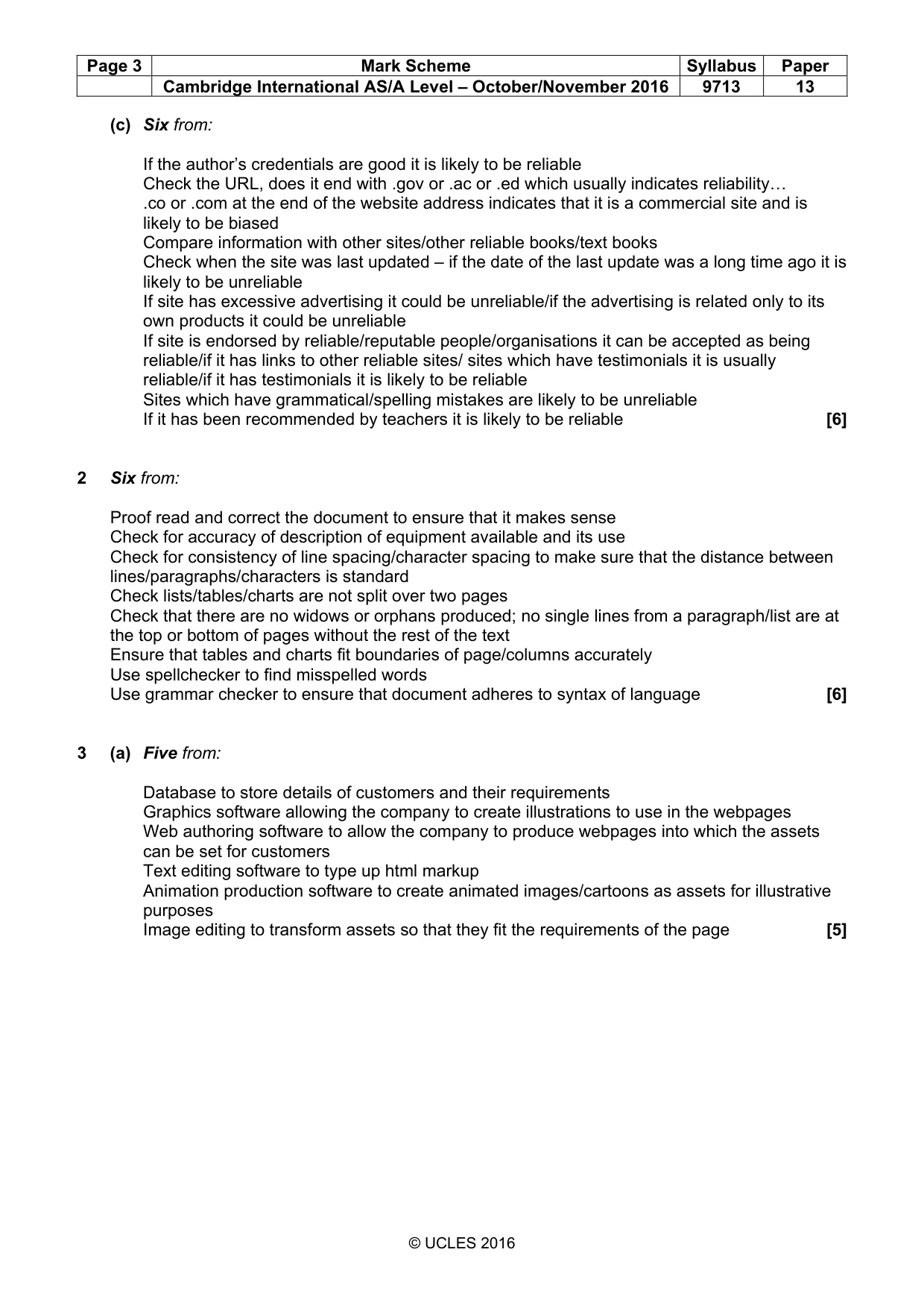
Mark scheme, page 2
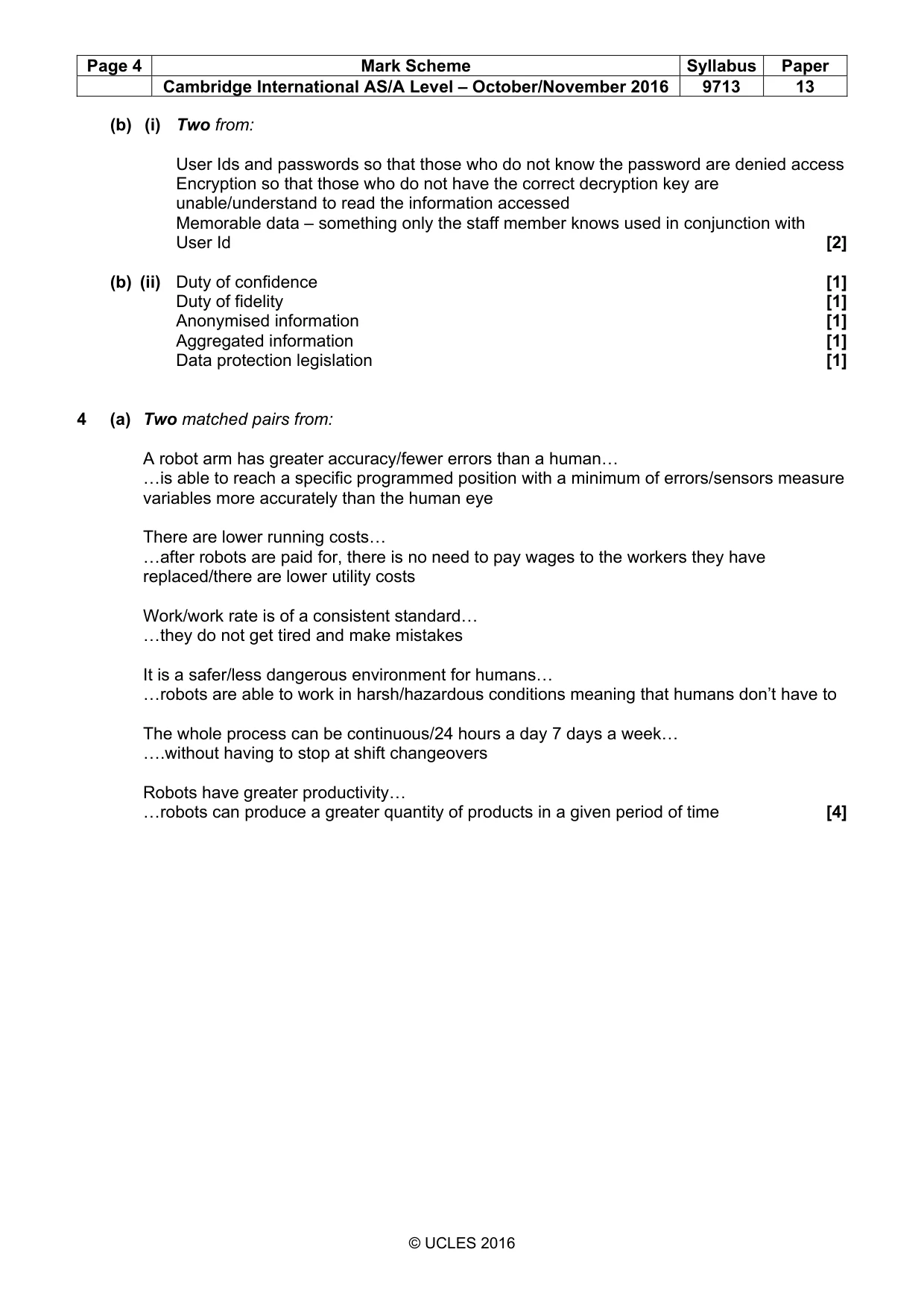
Page 2 Mark Scheme Syllabus Paper Cambridge International AS/A Level – October/November 2016 9713 13 © UCLES 2016 1 (a) Three matched pairs from: Laser printer produces high quality hard copy by using toner Used to print out projects/coursework Inkjet printer produces high quality hard copy by spraying ink onto paper Allows photo quality output of pictures to be included in the project/for draft quality of first attempts of work 3D printer to produce solid, physical outputs/objects/models by allowing layers of material to be produced Allows students to print solid objects/models for technology projects e.g. solid representation of a design from a CAD application Wide format printer uses inkjet technology on large size paper Used to produce printouts of projects produced in Art [6] (b) (i) Four from: Magnetic stripe cards are susceptible to magnetic interference which can wipe the data on them This can come from close proximity to a mobile phone If the card is lost/damaged/stolen/forgotten/misplaced student cannot enter the college If the card is lost/damaged/stolen/forgotten/misplaced student cannot access services from the college If the reader malfunctions student cannot enter the college If stolen it can be used by unauthorised person/other student to enter the college or to access services from the college Can cause queues at entry points to the college because students have to find and use the card [4] (ii) Five from: College authorities know how many students are present at any time (if card is also used for exit)... … important for emergencies e.g. fire drills College could use it for individual student attendance records Students could use card to pay for purchases like food, trips and books College authorities could collect information on which resources are being used/not used by students… …to know the times of day when the library is heavily used Students could use cards to borrow books from library College can grant different access rights/privileges to groups of students College could keep records of which students have borrowed equipment/resources [5]
Mark scheme, page 3
Page 3 Mark Scheme Syllabus Paper Cambridge International AS/A Level – October/November 2016 9713 13 © UCLES 2016 (c) Six from: If the author’s credentials are good it is likely to be reliable Check the URL, does it end with .gov or .ac or .ed which usually indicates reliability… .co or .com at the end of the website address indicates that it is a commercial site and is likely to be biased Compare information with other sites/other reliable books/text books Check when the site was last updated – if the date of the last update was a long time ago it is likely to be unreliable If site has excessive advertising it could be unreliable/if the advertising is related only to its own products it could be unreliable If site is endorsed by reliable/reputable people/organisations it can be accepted as being reliable/if it has links to other reliable sites/ sites which have testimonials it is usually reliable/if it has testimonials it is likely to be reliable Sites which have grammatical/spelling mistakes are likely to be unreliable If it has been recommended by teachers it is likely to be reliable [6] 2 Six from: Proof read and correct the document to ensure that it makes sense Check for accuracy of description of equipment available and its use Check for consistency of line spacing/character spacing to make sure that the distance between lines/paragraphs/characters is standard Check lists/tables/charts are not split over two pages Check that there are no widows or orphans produced; no single lines from a paragraph/list are at the top or bottom of pages without the rest of the text Ensure that tables and charts fit boundaries of page/columns accurately Use spellchecker to find misspelled words Use grammar checker to ensure that document adheres to syntax of language [6] 3 (a) Five from: Database to store details of customers and their requirements Graphics software allowing the company to create illustrations to use in the webpages Web authoring software to allow the company to produce webpages into which the assets can be set for customers Text editing software to type up html markup Animation production software to create animated images/cartoons as assets for illustrative purposes Image editing to transform assets so that they fit the requirements of the page [5]
Mark scheme, page 4
Page 4 Mark Scheme Syllabus Paper Cambridge International AS/A Level – October/November 2016 9713 13 © UCLES 2016 (b) (i) Two from: User Ids and passwords so that those who do not know the password are denied access Encryption so that those who do not have the correct decryption key are unable/understand to read the information accessed Memorable data – something only the staff member knows used in conjunction with User Id [2] (b) (ii) Duty of confidence [1] Duty of fidelity [1] Anonymised information [1] Aggregated information [1] Data protection legislation [1] 4 (a) Two matched pairs from: A robot arm has greater accuracy/fewer errors than a human… …is able to reach a specific programmed position with a minimum of errors/sensors measure variables more accurately than the human eye There are lower running costs… …after robots are paid for, there is no need to pay wages to the workers they have replaced/there are lower utility costs Work/work rate is of a consistent standard… …they do not get tired and make mistakes It is a safer/less dangerous environment for humans… …robots are able to work in harsh/hazardous conditions meaning that humans don’t have to The whole process can be continuous/24 hours a day 7 days a week… ….without having to stop at shift changeovers Robots have greater productivity… …robots can produce a greater quantity of products in a given period of time [4]
Mark scheme, page 5
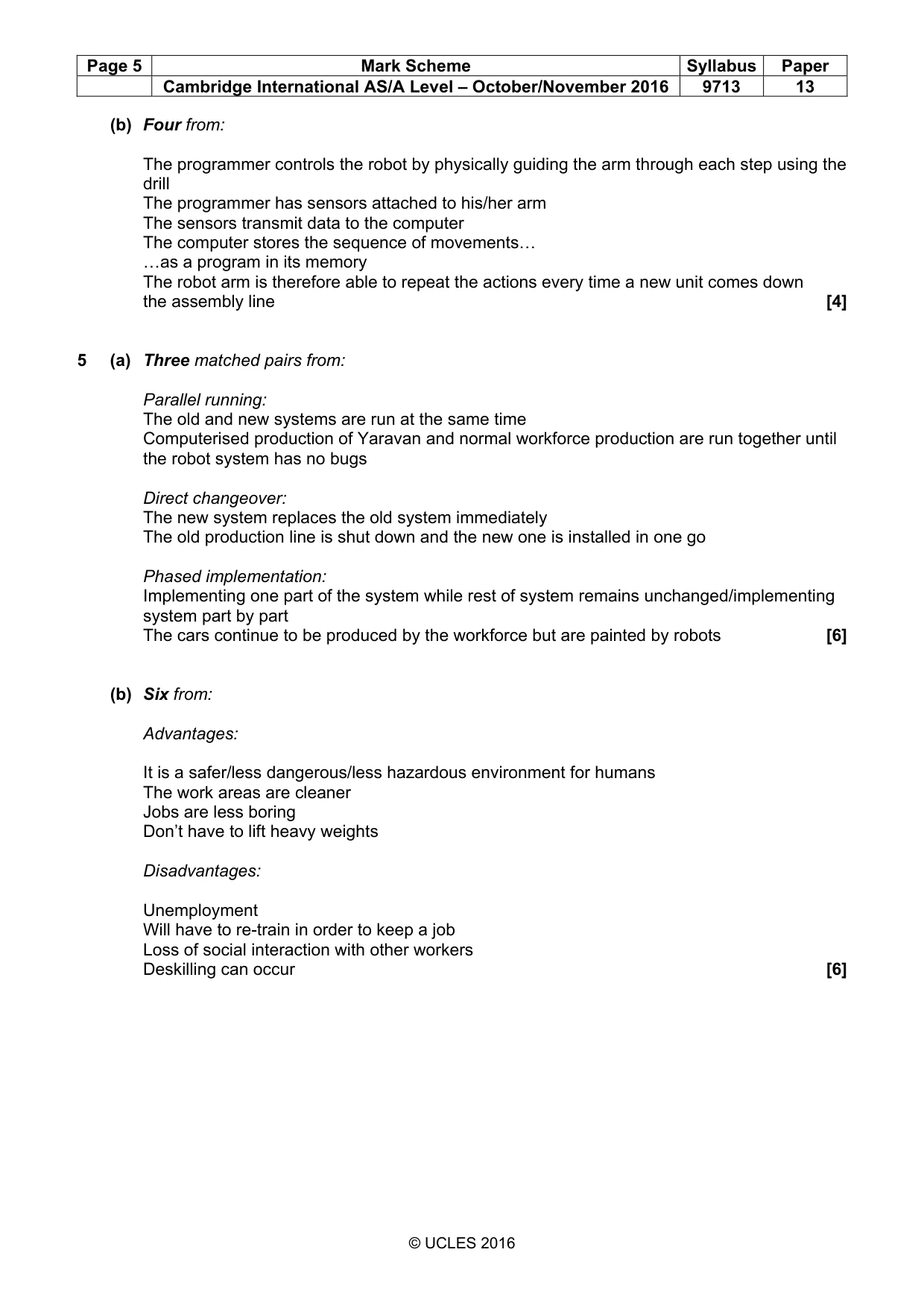
Page 5 Mark Scheme Syllabus Paper Cambridge International AS/A Level – October/November 2016 9713 13 © UCLES 2016 (b) Four from: The programmer controls the robot by physically guiding the arm through each step using the drill The programmer has sensors attached to his/her arm The sensors transmit data to the computer The computer stores the sequence of movements… …as a program in its memory The robot arm is therefore able to repeat the actions every time a new unit comes down the assembly line [4] 5 (a) Three matched pairs from: Parallel running: The old and new systems are run at the same time Computerised production of Yaravan and normal workforce production are run together until the robot system has no bugs Direct changeover: The new system replaces the old system immediately The old production line is shut down and the new one is installed in one go Phased implementation: Implementing one part of the system while rest of system remains unchanged/implementing system part by part The cars continue to be produced by the workforce but are painted by robots [6] (b) Six from: Advantages: It is a safer/less dangerous/less hazardous environment for humans The work areas are cleaner Jobs are less boring Don’t have to lift heavy weights Disadvantages: Unemployment Will have to re-train in order to keep a job Loss of social interaction with other workers Deskilling can occur [6]
Mark scheme, page 6
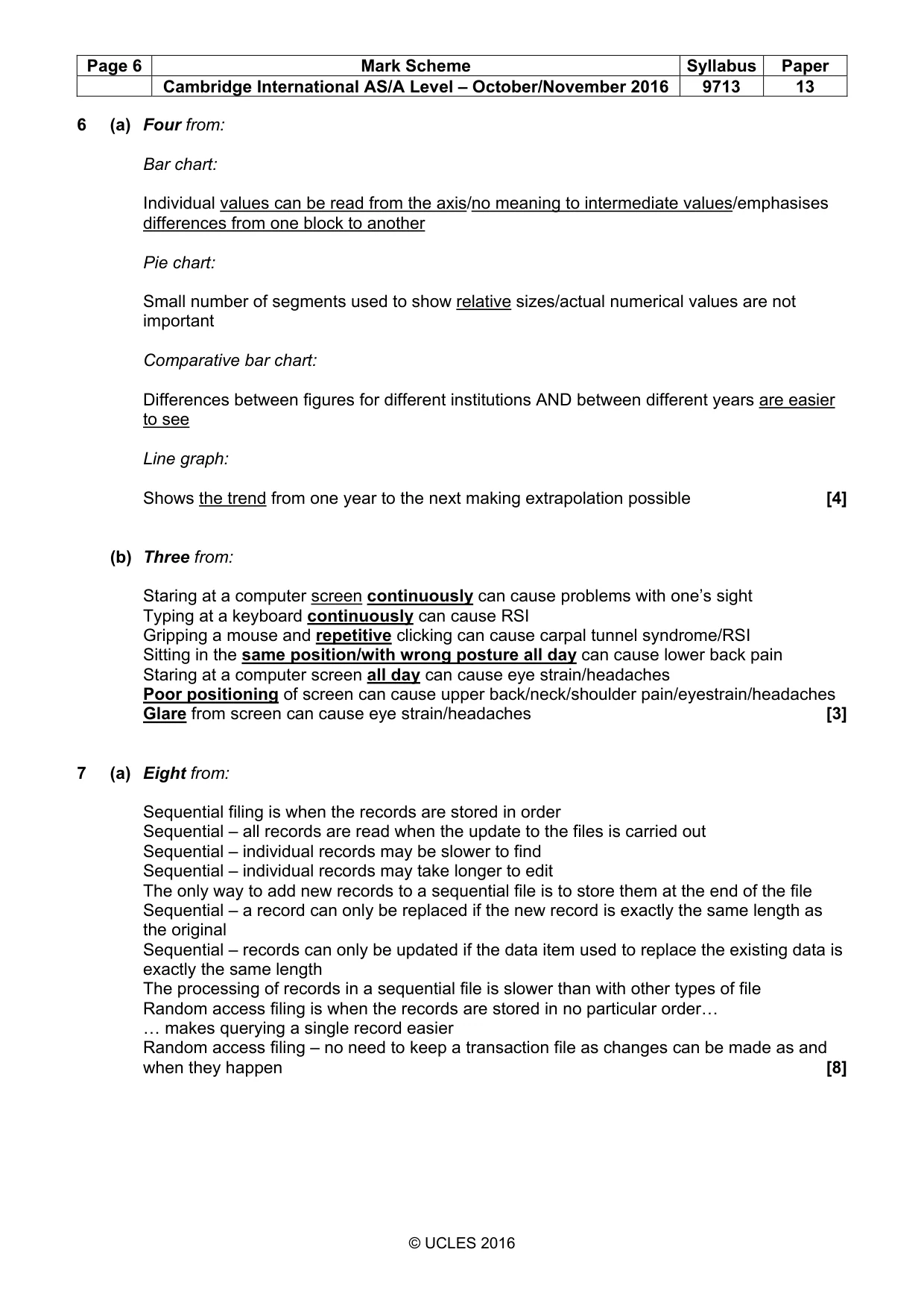
Page 6 Mark Scheme Syllabus Paper Cambridge International AS/A Level – October/November 2016 9713 13 © UCLES 2016 6 (a) Four from: Bar chart: Individual values can be read from the axis/no meaning to intermediate values/emphasises differences from one block to another Pie chart: Small number of segments used to show relative sizes/actual numerical values are not important Comparative bar chart: Differences between figures for different institutions AND between different years are easier to see Line graph: Shows the trend from one year to the next making extrapolation possible [4] (b) Three from: Staring at a computer screen continuously can cause problems with one’s sight Typing at a keyboard continuously can cause RSI Gripping a mouse and repetitive clicking can cause carpal tunnel syndrome/RSI Sitting in the same position/with wrong posture all day can cause lower back pain Staring at a computer screen all day can cause eye strain/headaches Poor positioning of screen can cause upper back/neck/shoulder pain/eyestrain/headaches Glare from screen can cause eye strain/headaches [3] 7 (a) Eight from: Sequential filing is when the records are stored in order Sequential – all records are read when the update to the files is carried out Sequential – individual records may be slower to find Sequential – individual records may take longer to edit The only way to add new records to a sequential file is to store them at the end of the file Sequential – a record can only be replaced if the new record is exactly the same length as the original Sequential – records can only be updated if the data item used to replace the existing data is exactly the same length The processing of records in a sequential file is slower than with other types of file Random access filing is when the records are stored in no particular order… … makes querying a single record easier Random access filing – no need to keep a transaction file as changes can be made as and when they happen [8]
Mark scheme, page 7
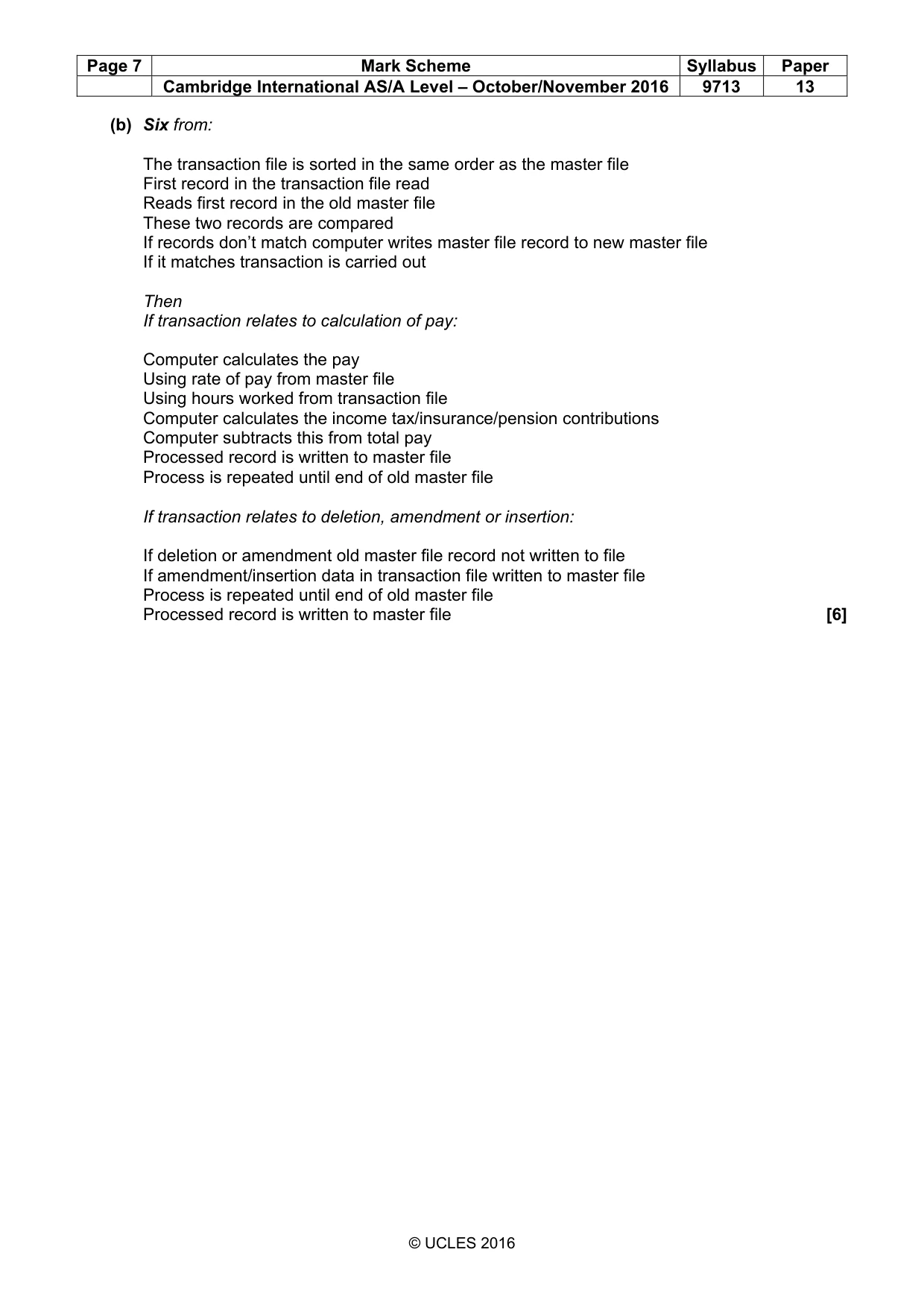
Page 7 Mark Scheme Syllabus Paper Cambridge International AS/A Level – October/November 2016 9713 13 © UCLES 2016 (b) Six from: The transaction file is sorted in the same order as the master file First record in the transaction file read Reads first record in the old master file These two records are compared If records don’t match computer writes master file record to new master file If it matches transaction is carried out Then If transaction relates to calculation of pay: Computer calculates the pay Using rate of pay from master file Using hours worked from transaction file Computer calculates the income tax/insurance/pension contributions Computer subtracts this from total pay Processed record is written to master file Process is repeated until end of old master file If transaction relates to deletion, amendment or insertion: If deletion or amendment old master file record not written to file If amendment/insertion data in transaction file written to master file Process is repeated until end of old master file Processed record is written to master file [6]
What you needed in this session
Cambridge’s own grade thresholds for 2016 Oct/Nov, Paper 1 · Variant 3. A higher threshold means an easier paper — the bar moves with how the cohort did.