Cambridge A Level Applied Information and Communication Technology 9713 — 2016 May/June Paper 1 · Variant 3
9713/13/M/J/16 · 80 marks · ≈90 min
The question paper and its mark scheme, free to read here and free to download. This is Cambridge’s own paper, exactly as it was sat.
Question paper20 pages




Mark scheme7 pages
Answers below. Sit the paper first if you are practising.
Paper as text
Question paper, page 1
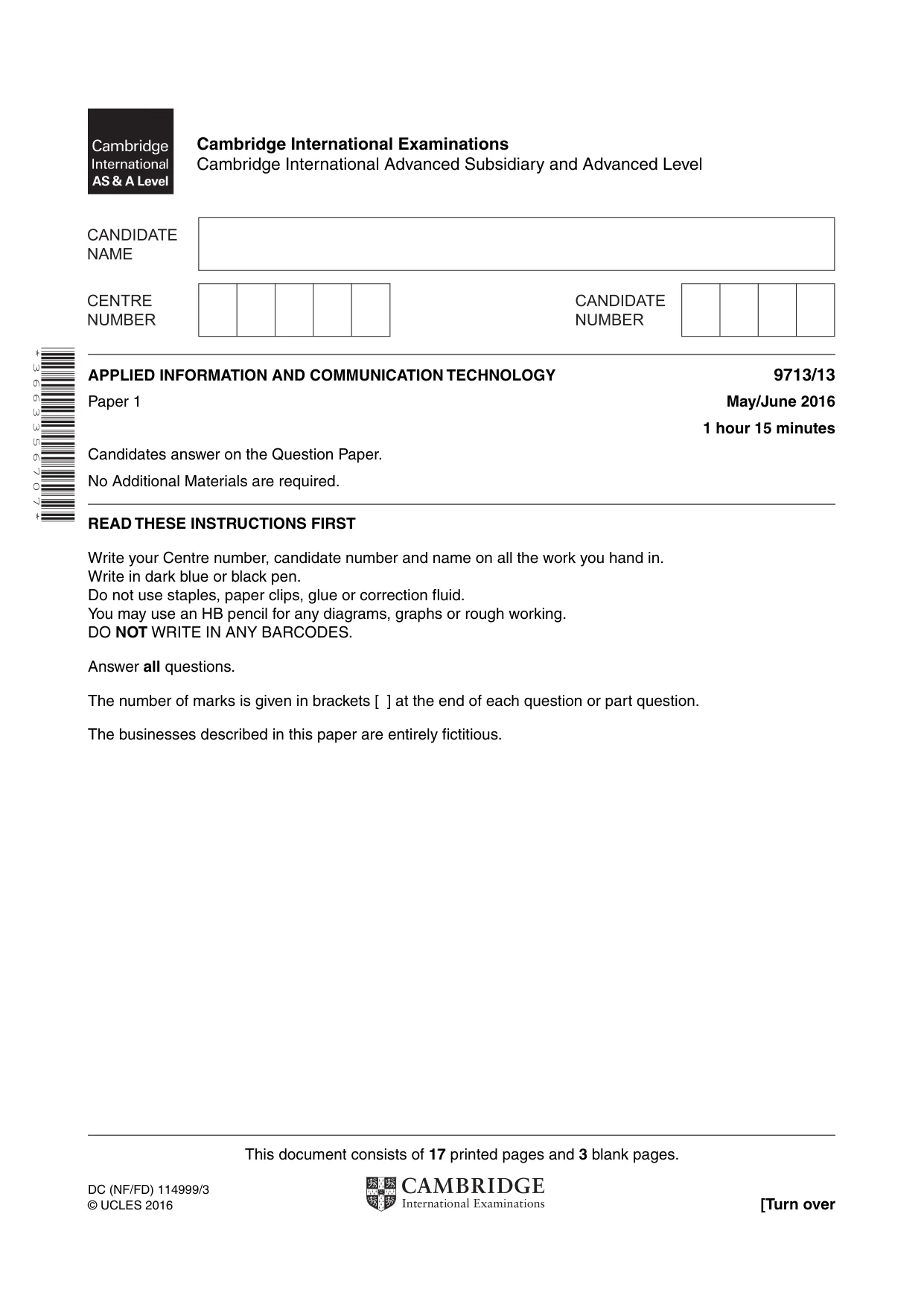
This document consists of 17 printed pages and 3 blank pages. DC (NF/FD) 114999/3 © UCLES 2016 [Turn over Cambridge International Examinations Cambridge International Advanced Subsidiary and Advanced Level * 3 6 6 3 3 5 6 7 0 7 * APPLIED INFORMATION AND COMMUNICATION TECHNOLOGY 9713/13 Paper 1 May/June 2016 1 hour 15 minutes Candidates answer on the Question Paper. No Additional Materials are required. READ THESE INSTRUCTIONS FIRST Write your Centre number, candidate number and name on all the work you hand in. Write in dark blue or black pen. Do not use staples, paper clips, glue or correction fluid. You may use an HB pencil for any diagrams, graphs or rough working. DO NOT WRITE IN ANY BARCODES. Answer all questions. The number of marks is given in brackets [ ] at the end of each question or part question. The businesses described in this paper are entirely fictitious.
Question paper, page 2
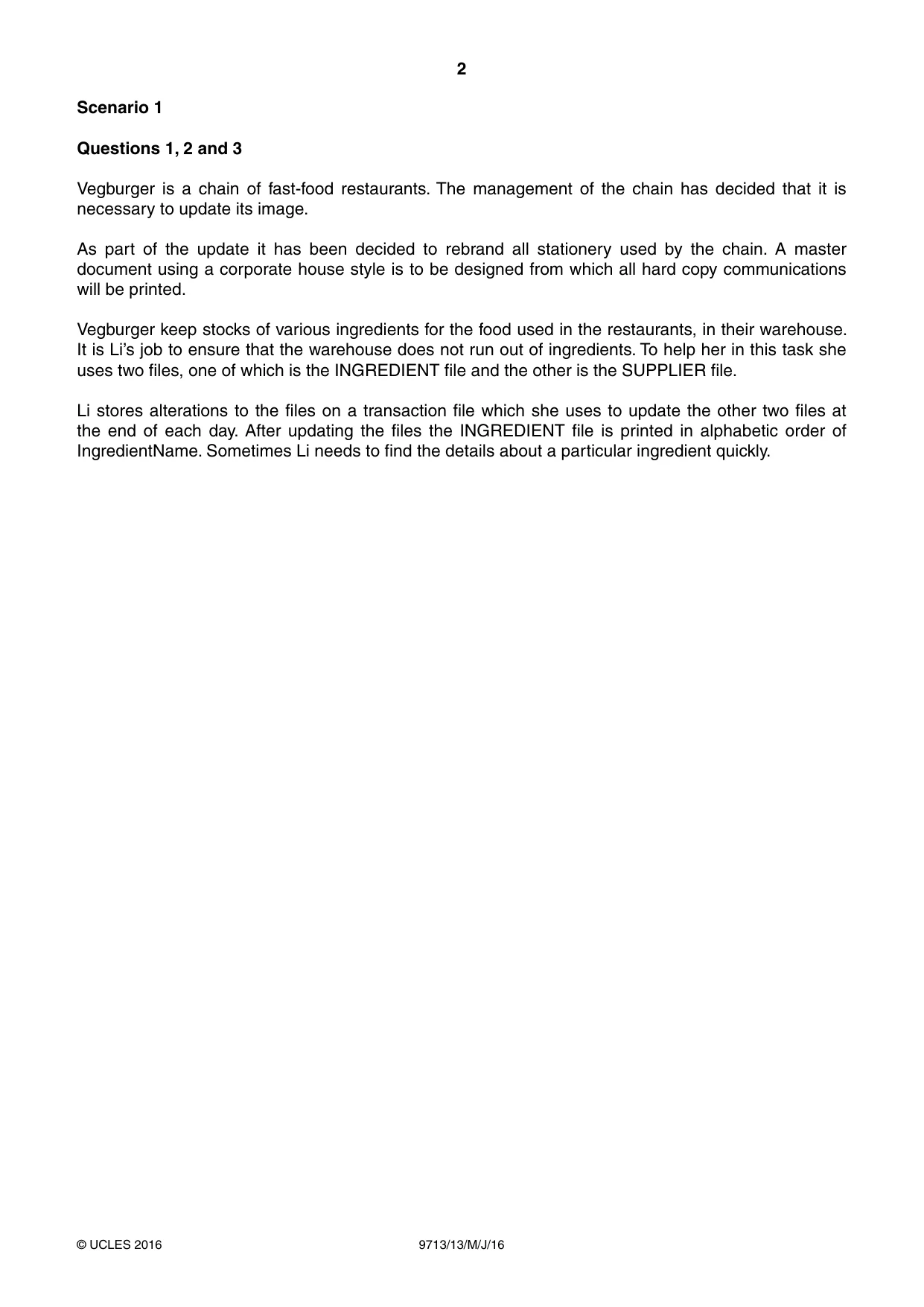
2 9713/13/M/J/16 © UCLES 2016 Scenario 1 Questions 1, 2 and 3 Vegburger is a chain of fast-food restaurants. The management of the chain has decided that it is necessary to update its image. As part of the update it has been decided to rebrand all stationery used by the chain. A master document using a corporate house style is to be designed from which all hard copy communications will be printed. Vegburger keep stocks of various ingredients for the food used in the restaurants, in their warehouse. It is Li’s job to ensure that the warehouse does not run out of ingredients. To help her in this task she uses two files, one of which is the INGREDIENT file and the other is the SUPPLIER file. Li stores alterations to the files on a transaction file which she uses to update the other two files at the end of each day. After updating the files the INGREDIENT file is printed in alphabetic order of IngredientName. Sometimes Li needs to find the details about a particular ingredient quickly.
Question paper, page 3
3 9713/13/M/J/16 © UCLES 2016 [Turn over 1 Describe the features of the master document that would help project the corporate image. … … … … … … … … … … … … … … [6]
Question paper, page 4
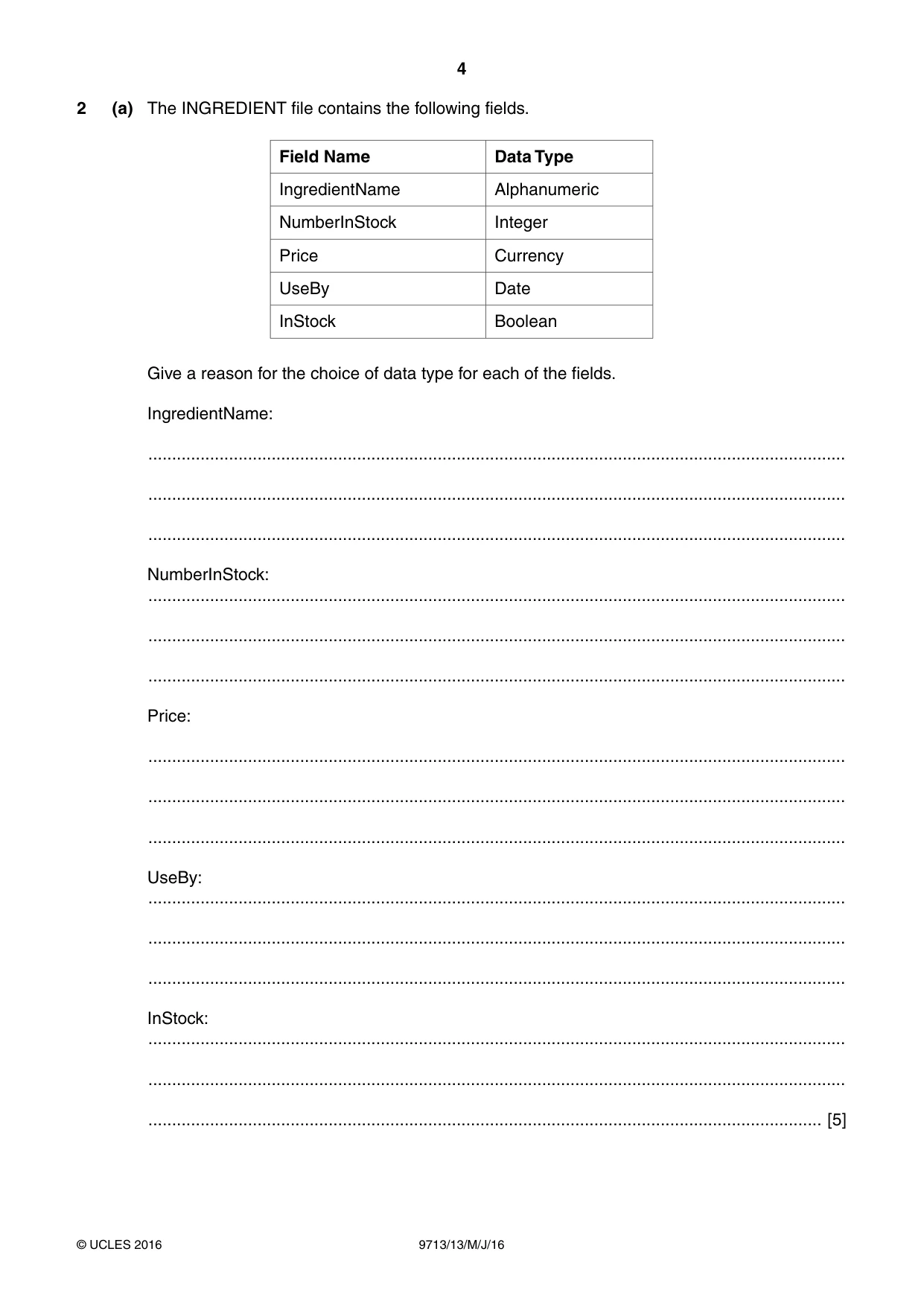
4 9713/13/M/J/16 © UCLES 2016 2 (a) The INGREDIENT file contains the following fields. Field Name Data Type IngredientName Alphanumeric NumberInStock Integer Price Currency UseBy Date InStock Boolean Give a reason for the choice of data type for each of the fields. IngredientName: … … … NumberInStock: … … … Price: … … … UseBy: … … … InStock: … … … [5]
Question paper, page 5
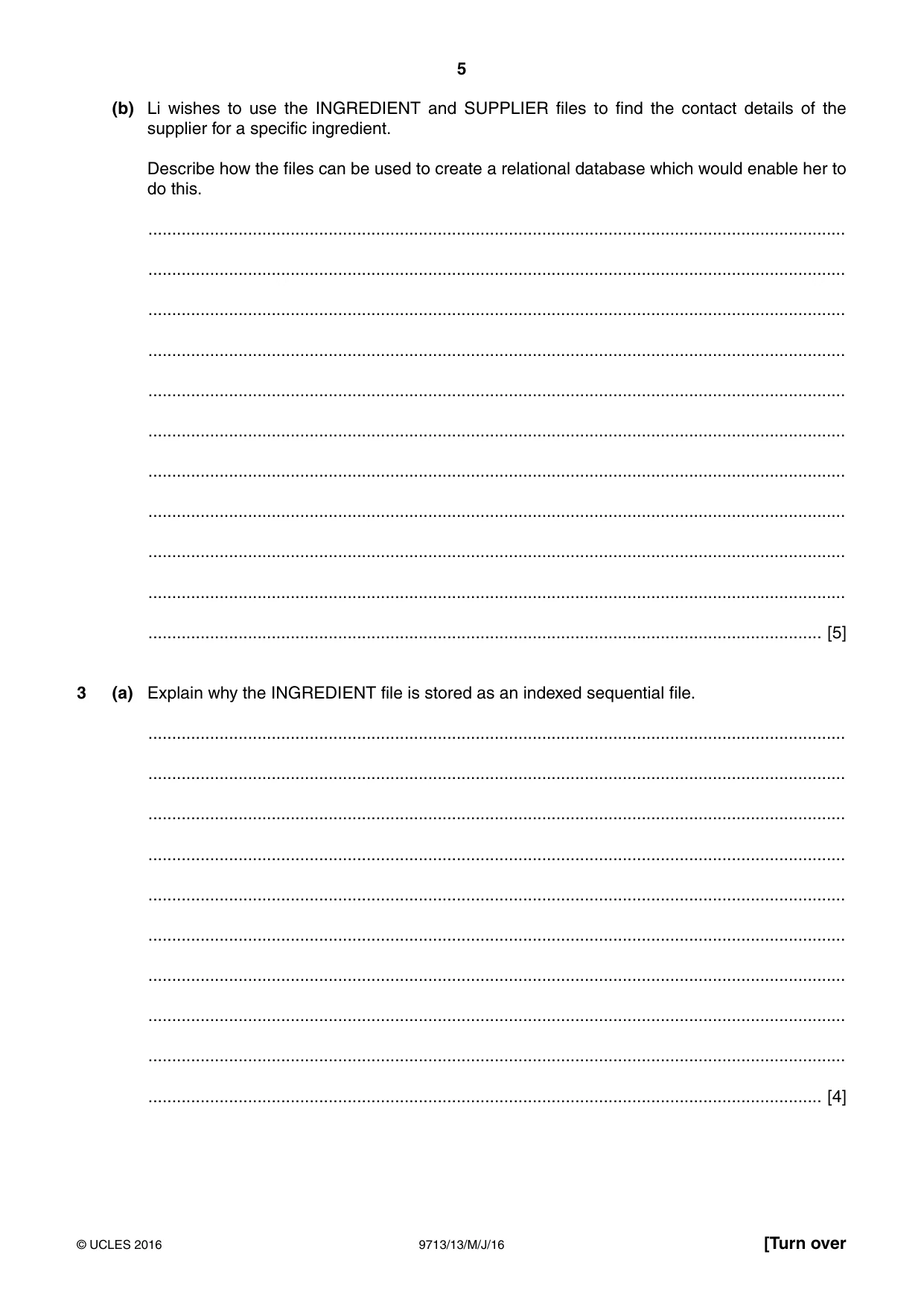
5 9713/13/M/J/16 © UCLES 2016 [Turn over (b) Li wishes to use the INGREDIENT and SUPPLIER files to find the contact details of the supplier for a specific ingredient. Describe how the files can be used to create a relational database which would enable her to do this. … … … … … … … … … … … [5] 3 (a) Explain why the INGREDIENT file is stored as an indexed sequential file. … … … … … … … … … … [4]
Question paper, page 6
6 9713/13/M/J/16 © UCLES 2016 (b) Describe the type of file access the transaction file uses and give a reason for your answer. … … … … … … [2]
Question paper, page 7
7 9713/13/M/J/16 © UCLES 2016 [Turn over Scenario 2 Questions 4 and 5 Rose is a teacher in a college. She specialises in teaching science. The students in her classes use computers, each with a keyboard and a mouse. Rose needs to be aware of safety issues when her students are using computers in the science laboratory. As part of her job, it is necessary for Rose to store a large amount of personal data about her students. In addition, the college authorities store data about Rose. Both Rose and the college authorities are covered by the data protection legislation in the country. Rose needs to teach her students to use email so that they can communicate with teachers and other students when doing project work at home.
Question paper, page 8
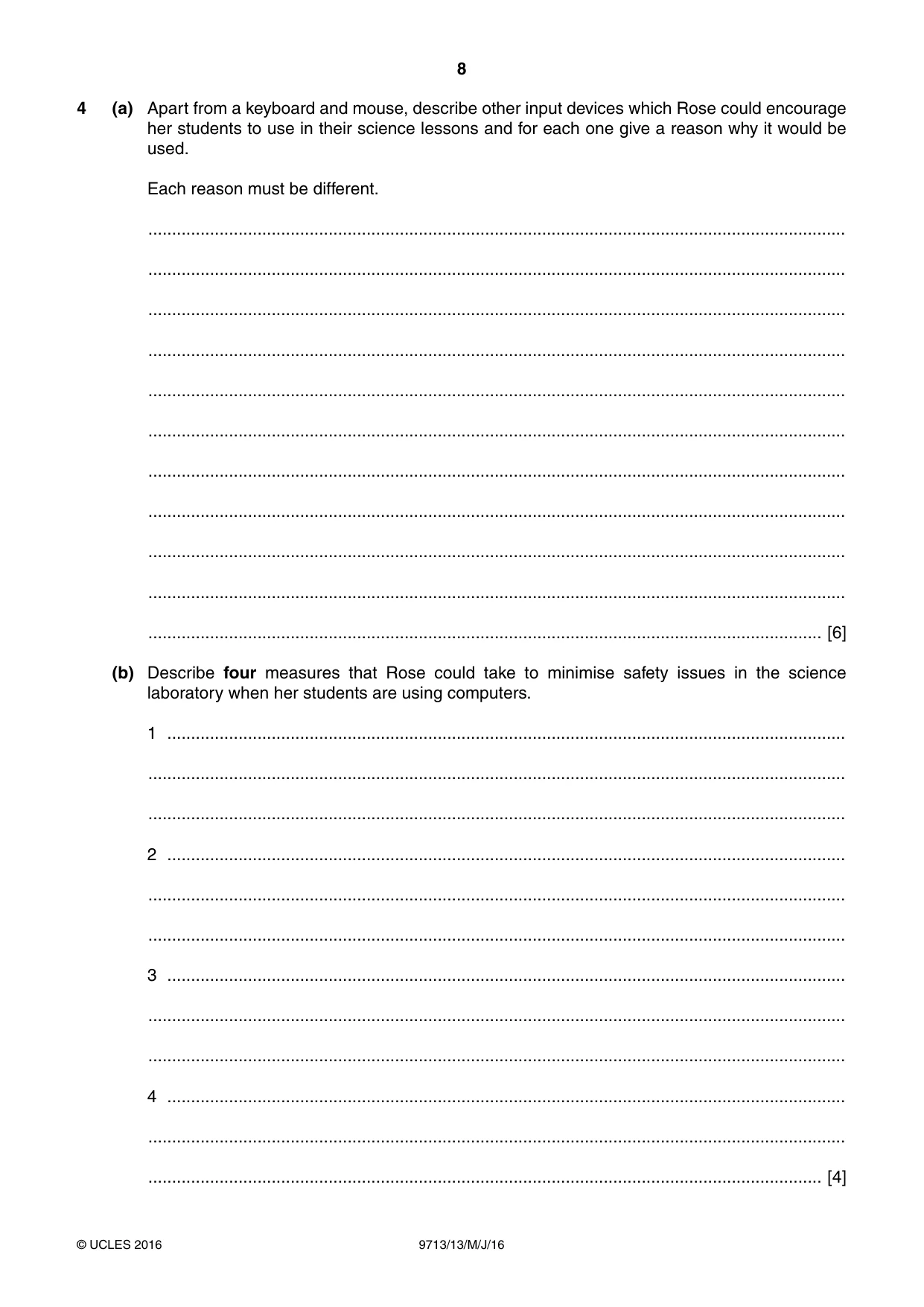
8 9713/13/M/J/16 © UCLES 2016 4 (a) Apart from a keyboard and mouse, describe other input devices which Rose could encourage her students to use in their science lessons and for each one give a reason why it would be used. Each reason must be different. … … … … … … … … … … … [6] (b) Describe four measures that Rose could take to minimise safety issues in the science laboratory when her students are using computers. 1 … … … 2 … … … 3 … … … 4 … … … [4]
Question paper, page 9
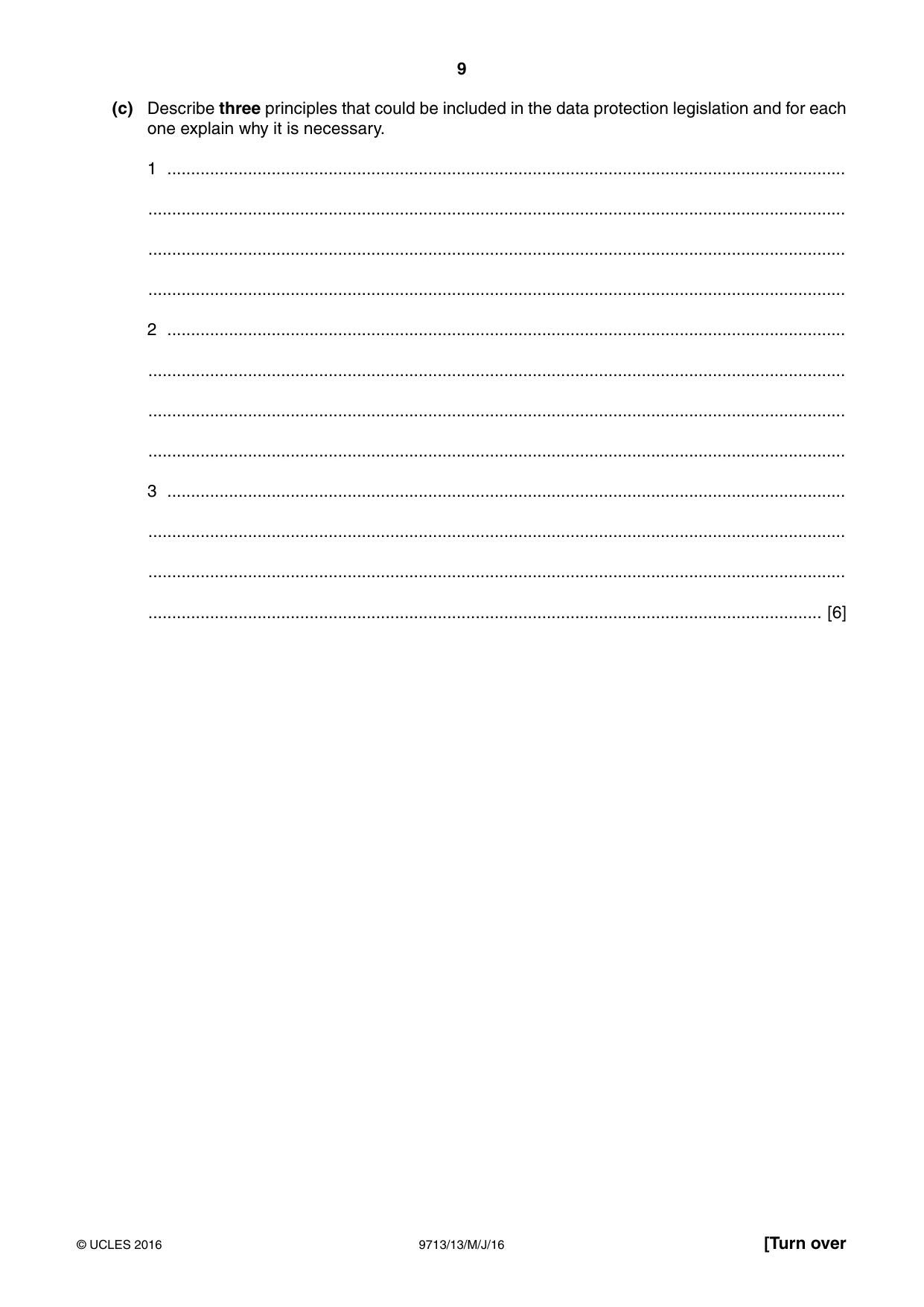
9 9713/13/M/J/16 © UCLES 2016 [Turn over (c) Describe three principles that could be included in the data protection legislation and for each one explain why it is necessary. 1 … … … … 2 … … … … 3 … … … … [6]
Question paper, page 10
10 9713/13/M/J/16 © UCLES 2016 5 Rose’s students already know how to send and receive emails. Describe other ICT skills that her students should understand in order to be able to use email appropriately. … … … … … … … … … … … … … … [6]
Question paper, page 11
11 9713/13/M/J/16 © UCLES 2016 [Turn over Scenario 3 Questions 6 and 7 Creamclot is a small company that produces cream for sale through a number of shops in local towns. Jose, the manager of Creamclot, wants to expand the business countrywide. Jose has employed Juanita, a systems analyst, to oversee the introduction of the new system. Juanita has decided that customers will telephone their orders to the company.
Question paper, page 12
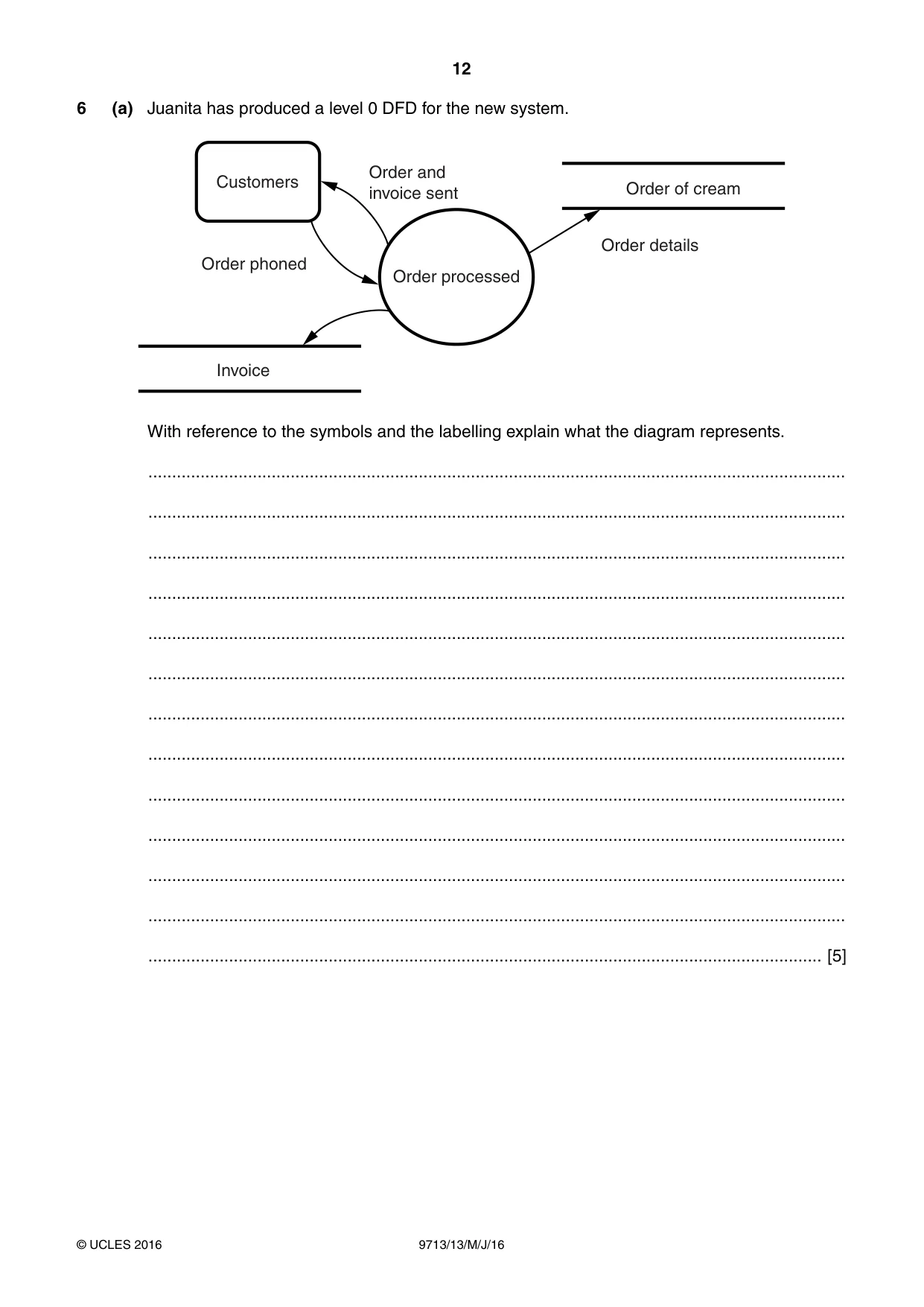
12 9713/13/M/J/16 © UCLES 2016 6 (a) Juanita has produced a level 0 DFD for the new system. Order processed Order of cream Customers Order and invoice sent Order details Order phoned Invoice With reference to the symbols and the labelling explain what the diagram represents. … … … … … … … … … … … … … [5]
Question paper, page 13
13 9713/13/M/J/16 © UCLES 2016 [Turn over (b) Before creating the new system, Juanita will need to design it. One element of the design will be specifying the required hardware and software. Describe four other sections that will be found in the design and for each one explain why it is necessary. 1 … … … … 2 … … … … 3 … … … … 4 … … … … … [8]
Question paper, page 14
14 9713/13/M/J/16 © UCLES 2016 (c) Describe four different types of software which would be used to produce different aspects of the new system. For each one state what it would be used for. 1 … … … … … 2 … … … … … 3 … … … … … 4 … … … … … [8]
Question paper, page 15
15 9713/13/M/J/16 © UCLES 2016 [Turn over 7 Creamclot’s management have decided to computerise the payroll system. A choice needs to be made between using a sequential filing system and a random access filing system for producing the payroll. (a) (i) Explain why magnetic tape is used for a sequential filing system. … … … [1] (ii) Explain why hard disk storage is used for a random access filing system. … … … [1] (b) Explain the advantages and disadvantages to Creamclot of using each of these systems. … … … … … … … … … … … … … [5]
Question paper, page 16
16 9713/13/M/J/16 © UCLES 2016 Scenario 4 Question 8 The Seaside hotel company owns hotels at many resorts along the coast. Because many of the rooms face the sun they can get very hot during the summer. Each hotel room has an air conditioning system which is controllable by the guest who is staying in the room. The guest sets the temperature that they require. Each air conditioning unit is microprocessor controlled. Enrico is the manager of one of the hotels. He decides to try to save money on the electricity bill. He plans to set the temperature for the whole hotel centrally so that guest rooms are always at the same temperature. The system will be controlled by a computer.
Question paper, page 17
17 9713/13/M/J/16 © UCLES 2016 8 (a) Explain how each room’s air conditioning system maintains the required temperature. … … … … … … … … … … … … … … [6] (b) Describe the problems that could arise with maintaining a single temperature for the whole hotel centrally. … … … … … … [2]
Question paper, page 18
18 9713/13/M/J/16 © UCLES 2016 BLANK PAGE
Question paper, page 19
19 9713/13/M/J/16 © UCLES 2016 BLANK PAGE
Question paper, page 20
20 9713/13/M/J/16 © UCLES 2016 Permission to reproduce items where third-party owned material protected by copyright is included has been sought and cleared where possible. Every reasonable effort has been made by the publisher (UCLES) to trace copyright holders, but if any items requiring clearance have unwittingly been included, the publisher will be pleased to make amends at the earliest possible opportunity. To avoid the issue of disclosure of answer-related information to candidates, all copyright acknowledgements are reproduced online in the Cambridge International Examinations Copyright Acknowledgements Booklet. This is produced for each series of examinations and is freely available to download at www.cie.org.uk after the live examination series. Cambridge International Examinations is part of the Cambridge Assessment Group. Cambridge Assessment is the brand name of University of Cambridge Local Examinations Syndicate (UCLES), which is itself a department of the University of Cambridge. BLANK PAGE
Mark scheme, page 1
® IGCSE is the registered trademark of Cambridge International Examinations. This document consists of 7 printed pages. © UCLES 2016 [Turn over Cambridge International Examinations Cambridge International Advanced Subsidiary and Advanced Level APPLIED INFORMATION & COMMUNICATION TECHNOLOGY 9713/13 Paper 1 Written A May/June 2016 MARK SCHEME Maximum Mark: 80 Published This mark scheme is published as an aid to teachers and candidates, to indicate the requirements of the examination. It shows the basis on which Examiners were instructed to award marks. It does not indicate the details of the discussions that took place at an Examiners’ meeting before marking began, which would have considered the acceptability of alternative answers. Mark schemes should be read in conjunction with the question paper and the Principal Examiner Report for Teachers. Cambridge will not enter into discussions about these mark schemes. Cambridge is publishing the mark schemes for the May/June 2016 series for most Cambridge IGCSE®, Cambridge International A and AS Level components and some Cambridge O Level components.
Mark scheme, page 2
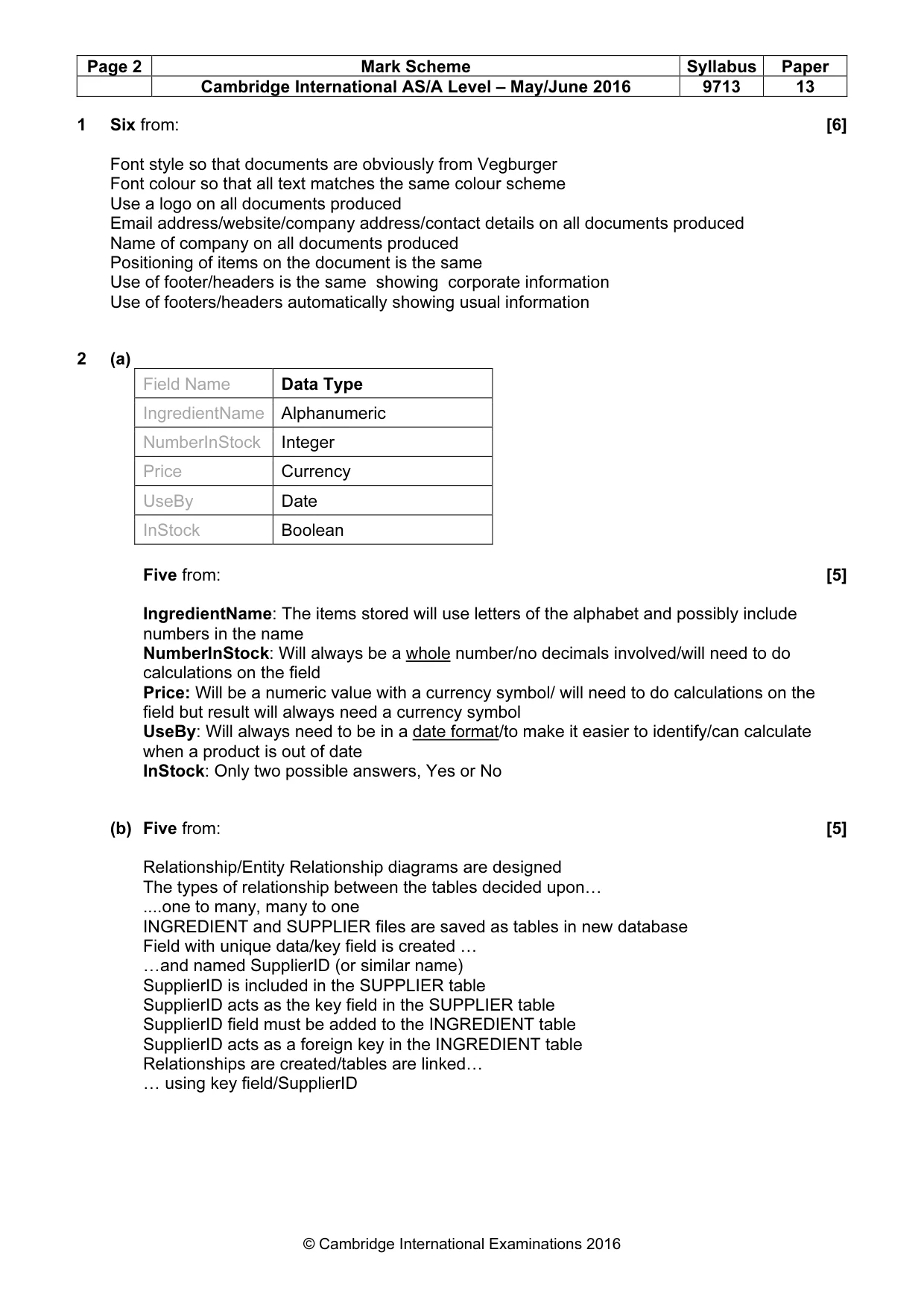
Page 2 Mark Scheme Syllabus Paper Cambridge International AS/A Level – May/June 2016 9713 13 © Cambridge International Examinations 2016 1 Six from: [6] Font style so that documents are obviously from Vegburger Font colour so that all text matches the same colour scheme Use a logo on all documents produced Email address/website/company address/contact details on all documents produced Name of company on all documents produced Positioning of items on the document is the same Use of footer/headers is the same showing corporate information Use of footers/headers automatically showing usual information 2 (a) Field Name Data Type IngredientName Alphanumeric NumberInStock Integer Price Currency UseBy Date InStock Boolean Five from: [5] IngredientName: The items stored will use letters of the alphabet and possibly include numbers in the name NumberInStock: Will always be a whole number/no decimals involved/will need to do calculations on the field Price: Will be a numeric value with a currency symbol/ will need to do calculations on the field but result will always need a currency symbol UseBy: Will always need to be in a date format/to make it easier to identify/can calculate when a product is out of date InStock: Only two possible answers, Yes or No (b) Five from: [5] Relationship/Entity Relationship diagrams are designed The types of relationship between the tables decided upon… …one to many, many to one INGREDIENT and SUPPLIER files are saved as tables in new database Field with unique data/key field is created … …and named SupplierID (or similar name) SupplierID is included in the SUPPLIER table SupplierID acts as the key field in the SUPPLIER table SupplierID field must be added to the INGREDIENT table SupplierID acts as a foreign key in the INGREDIENT table Relationships are created/tables are linked… … using key field/SupplierID
Mark scheme, page 3
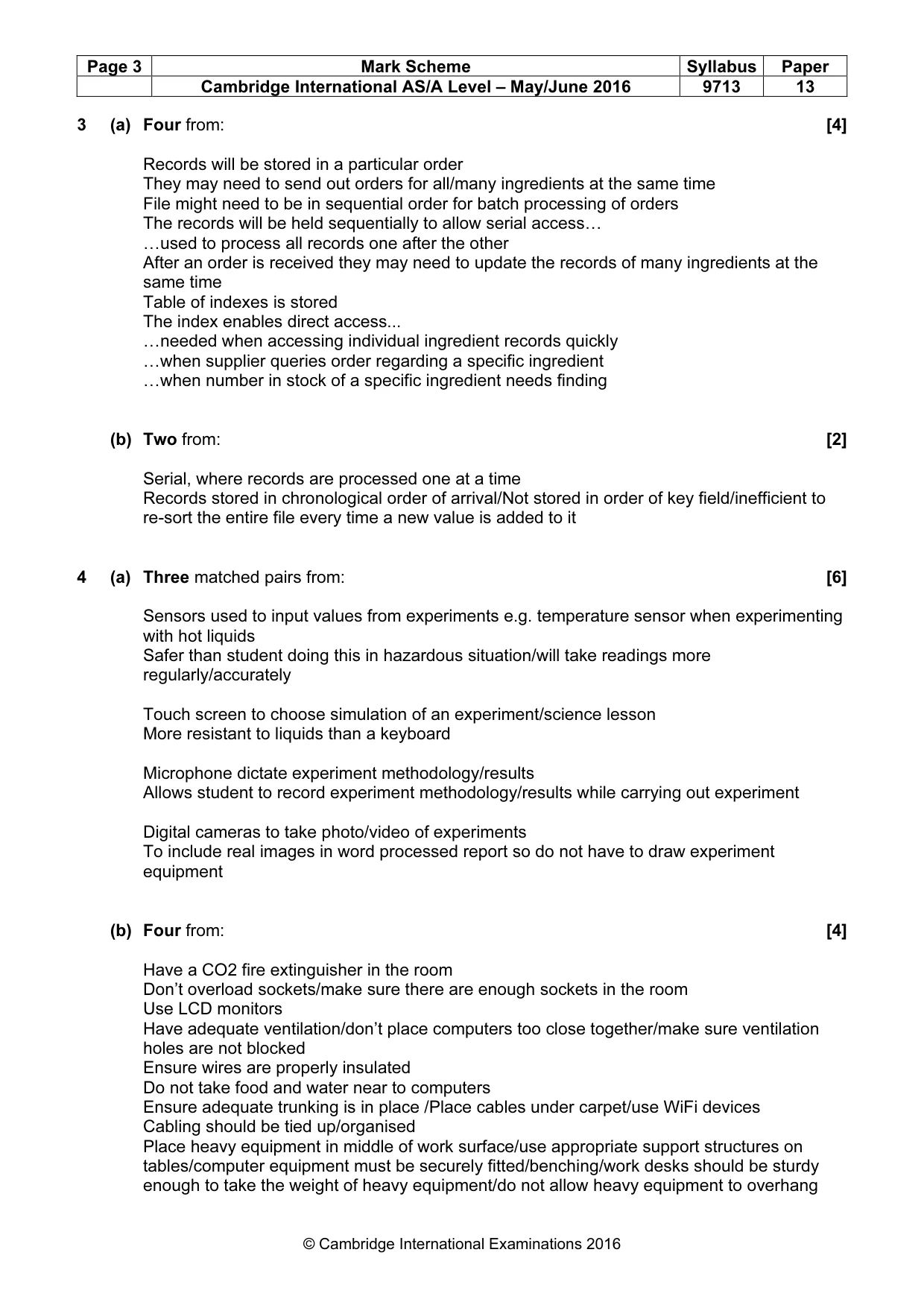
Page 3 Mark Scheme Syllabus Paper Cambridge International AS/A Level – May/June 2016 9713 13 © Cambridge International Examinations 2016 3 (a) Four from: [4] Records will be stored in a particular order They may need to send out orders for all/many ingredients at the same time File might need to be in sequential order for batch processing of orders The records will be held sequentially to allow serial access… …used to process all records one after the other After an order is received they may need to update the records of many ingredients at the same time Table of indexes is stored The index enables direct access... …needed when accessing individual ingredient records quickly …when supplier queries order regarding a specific ingredient …when number in stock of a specific ingredient needs finding (b) Two from: [2] Serial, where records are processed one at a time Records stored in chronological order of arrival/Not stored in order of key field/inefficient to re-sort the entire file every time a new value is added to it 4 (a) Three matched pairs from: [6] Sensors used to input values from experiments e.g. temperature sensor when experimenting with hot liquids Safer than student doing this in hazardous situation/will take readings more regularly/accurately Touch screen to choose simulation of an experiment/science lesson More resistant to liquids than a keyboard Microphone dictate experiment methodology/results Allows student to record experiment methodology/results while carrying out experiment Digital cameras to take photo/video of experiments To include real images in word processed report so do not have to draw experiment equipment (b) Four from: [4] Have a CO2 fire extinguisher in the room Don’t overload sockets/make sure there are enough sockets in the room Use LCD monitors Have adequate ventilation/don’t place computers too close together/make sure ventilation holes are not blocked Ensure wires are properly insulated Do not take food and water near to computers Ensure adequate trunking is in place /Place cables under carpet/use WiFi devices Cabling should be tied up/organised Place heavy equipment in middle of work surface/use appropriate support structures on tables/computer equipment must be securely fitted/benching/work desks should be sturdy enough to take the weight of heavy equipment/do not allow heavy equipment to overhang
Mark scheme, page 4
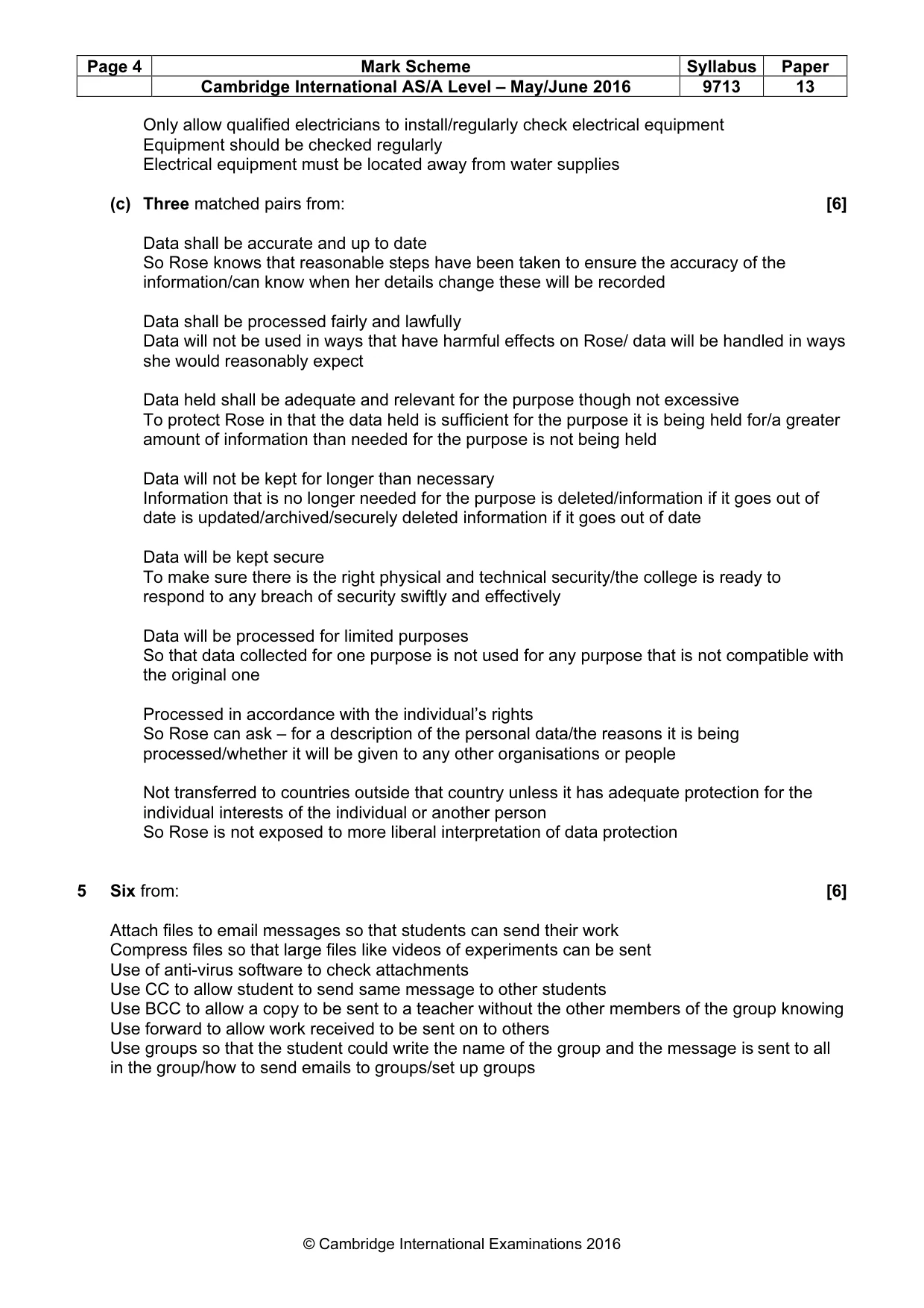
Page 4 Mark Scheme Syllabus Paper Cambridge International AS/A Level – May/June 2016 9713 13 © Cambridge International Examinations 2016 Only allow qualified electricians to install/regularly check electrical equipment Equipment should be checked regularly Electrical equipment must be located away from water supplies (c) Three matched pairs from: [6] Data shall be accurate and up to date So Rose knows that reasonable steps have been taken to ensure the accuracy of the information/can know when her details change these will be recorded Data shall be processed fairly and lawfully Data will not be used in ways that have harmful effects on Rose/ data will be handled in ways she would reasonably expect Data held shall be adequate and relevant for the purpose though not excessive To protect Rose in that the data held is sufficient for the purpose it is being held for/a greater amount of information than needed for the purpose is not being held Data will not be kept for longer than necessary Information that is no longer needed for the purpose is deleted/information if it goes out of date is updated/archived/securely deleted information if it goes out of date Data will be kept secure To make sure there is the right physical and technical security/the college is ready to respond to any breach of security swiftly and effectively Data will be processed for limited purposes So that data collected for one purpose is not used for any purpose that is not compatible with the original one Processed in accordance with the individual’s rights So Rose can ask – for a description of the personal data/the reasons it is being processed/whether it will be given to any other organisations or people Not transferred to countries outside that country unless it has adequate protection for the individual interests of the individual or another person So Rose is not exposed to more liberal interpretation of data protection 5 Six from: [6] Attach files to email messages so that students can send their work Compress files so that large files like videos of experiments can be sent Use of anti-virus software to check attachments Use CC to allow student to send same message to other students Use BCC to allow a copy to be sent to a teacher without the other members of the group knowing Use forward to allow work received to be sent on to others Use groups so that the student could write the name of the group and the message is sent to all in the group/how to send emails to groups/set up groups
Mark scheme, page 5
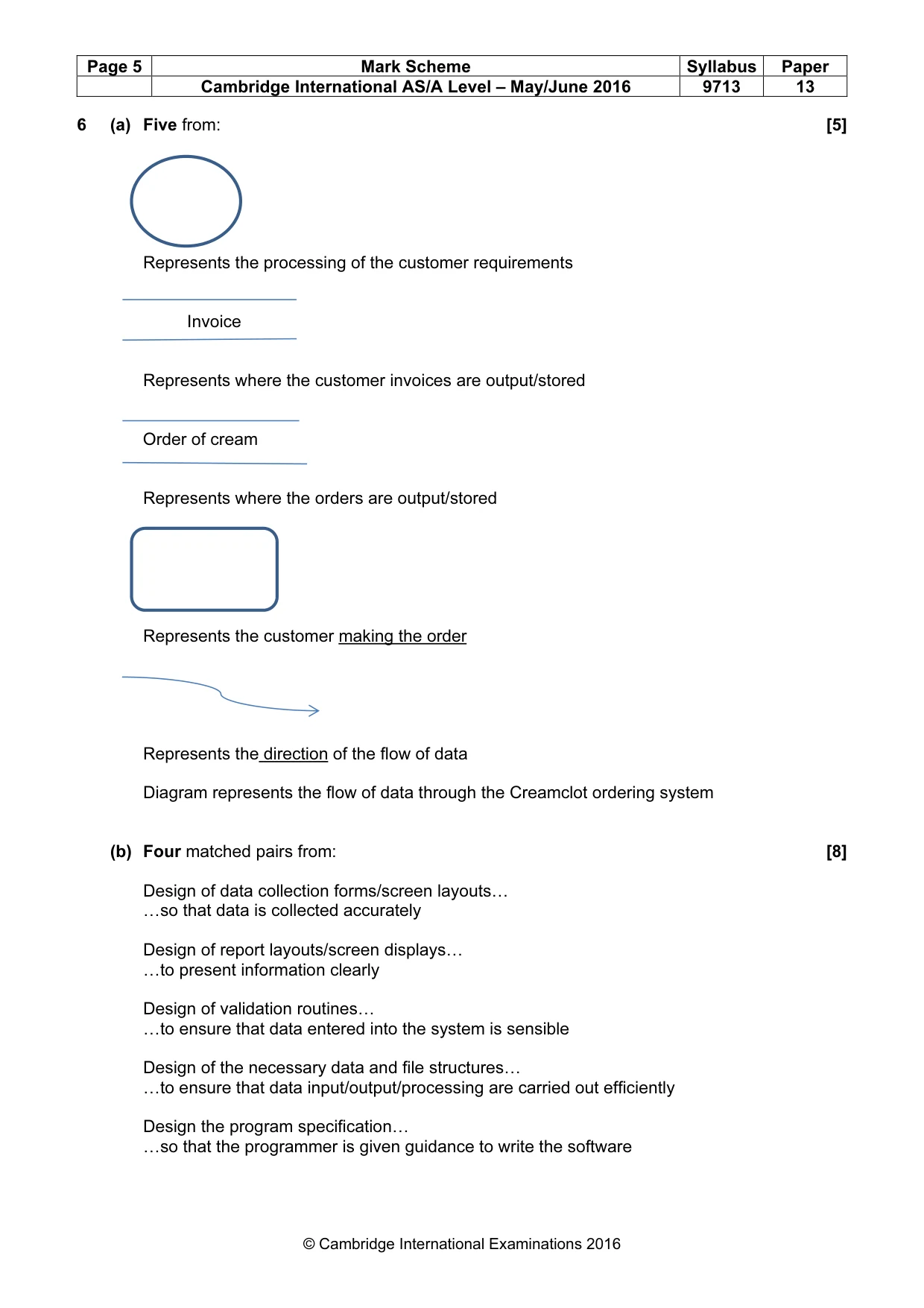
Page 5 Mark Scheme Syllabus Paper Cambridge International AS/A Level – May/June 2016 9713 13 © Cambridge International Examinations 2016 6 (a) Five from: [5] Represents the processing of the customer requirements Invoice Represents where the customer invoices are output/stored Order of cream Represents where the orders are output/stored Represents the customer making the order Represents the direction of the flow of data Diagram represents the flow of data through the Creamclot ordering system (b) Four matched pairs from: [8] Design of data collection forms/screen layouts… …so that data is collected accurately Design of report layouts/screen displays… …to present information clearly Design of validation routines… …to ensure that data entered into the system is sensible Design of the necessary data and file structures… …to ensure that data input/output/processing are carried out efficiently Design the program specification… …so that the programmer is given guidance to write the software
Mark scheme, page 6
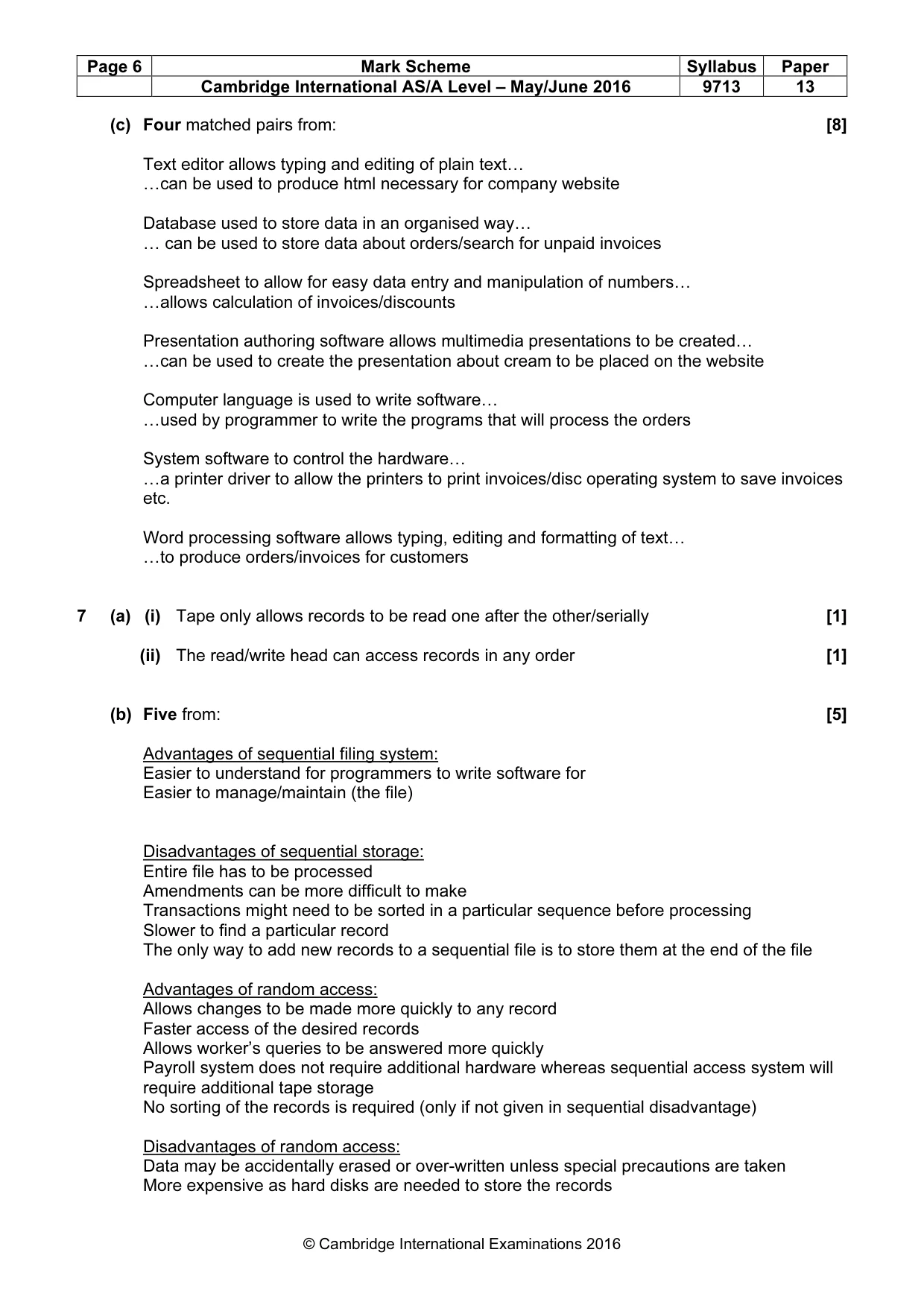
Page 6 Mark Scheme Syllabus Paper Cambridge International AS/A Level – May/June 2016 9713 13 © Cambridge International Examinations 2016 (c) Four matched pairs from: [8] Text editor allows typing and editing of plain text… …can be used to produce html necessary for company website Database used to store data in an organised way… … can be used to store data about orders/search for unpaid invoices Spreadsheet to allow for easy data entry and manipulation of numbers… …allows calculation of invoices/discounts Presentation authoring software allows multimedia presentations to be created… …can be used to create the presentation about cream to be placed on the website Computer language is used to write software… …used by programmer to write the programs that will process the orders System software to control the hardware… …a printer driver to allow the printers to print invoices/disc operating system to save invoices etc. Word processing software allows typing, editing and formatting of text… …to produce orders/invoices for customers 7 (a) (i) Tape only allows records to be read one after the other/serially [1] (ii) The read/write head can access records in any order [1] (b) Five from: [5] Advantages of sequential filing system: Easier to understand for programmers to write software for Easier to manage/maintain (the file) Disadvantages of sequential storage: Entire file has to be processed Amendments can be more difficult to make Transactions might need to be sorted in a particular sequence before processing Slower to find a particular record The only way to add new records to a sequential file is to store them at the end of the file Advantages of random access: Allows changes to be made more quickly to any record Faster access of the desired records Allows worker’s queries to be answered more quickly Payroll system does not require additional hardware whereas sequential access system will require additional tape storage No sorting of the records is required (only if not given in sequential disadvantage) Disadvantages of random access: Data may be accidentally erased or over-written unless special precautions are taken More expensive as hard disks are needed to store the records
Mark scheme, page 7
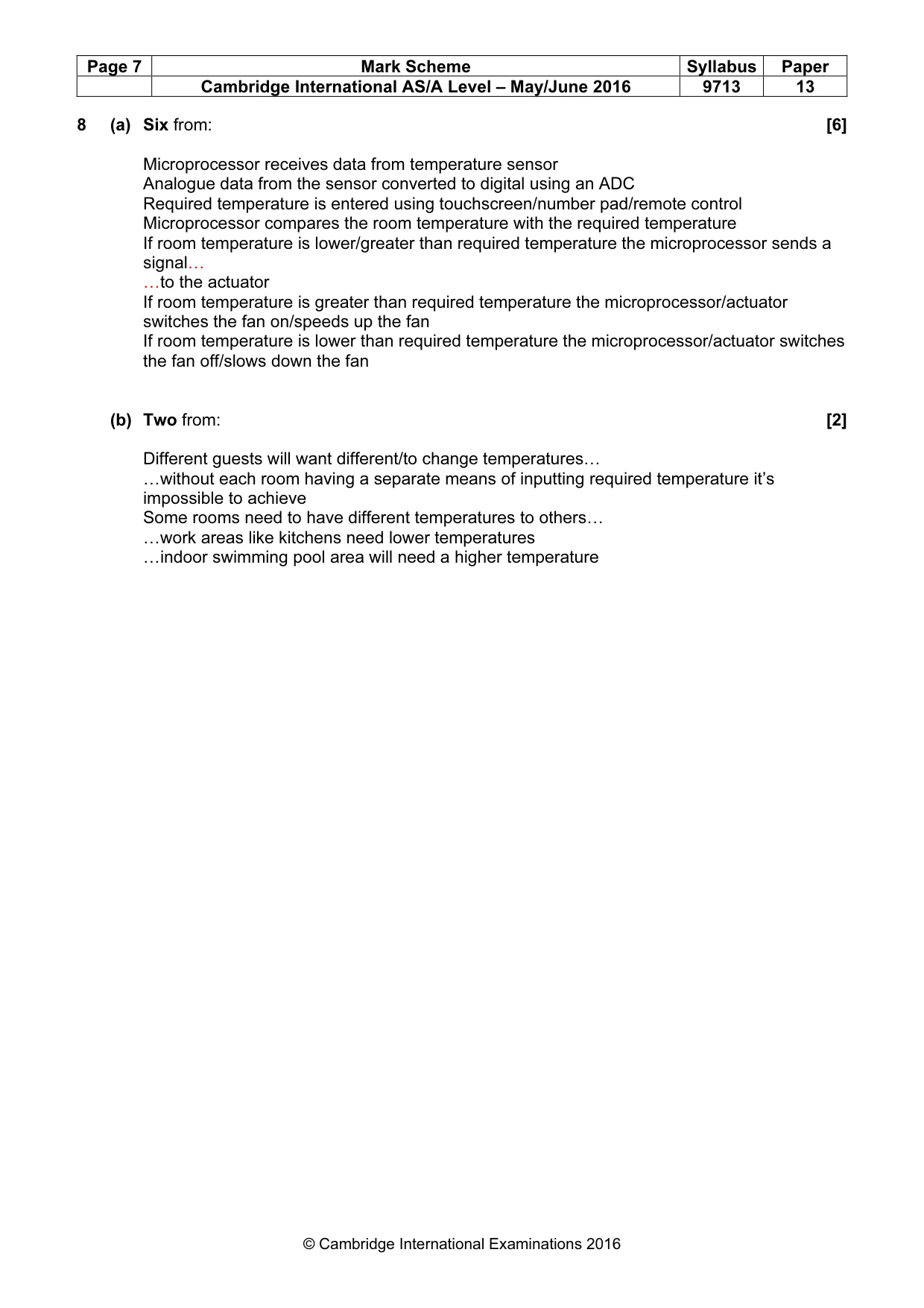
Page 7 Mark Scheme Syllabus Paper Cambridge International AS/A Level – May/June 2016 9713 13 © Cambridge International Examinations 2016 8 (a) Six from: [6] Microprocessor receives data from temperature sensor Analogue data from the sensor converted to digital using an ADC Required temperature is entered using touchscreen/number pad/remote control Microprocessor compares the room temperature with the required temperature If room temperature is lower/greater than required temperature the microprocessor sends a signal… …to the actuator If room temperature is greater than required temperature the microprocessor/actuator switches the fan on/speeds up the fan If room temperature is lower than required temperature the microprocessor/actuator switches the fan off/slows down the fan (b) Two from: [2] Different guests will want different/to change temperatures… …without each room having a separate means of inputting required temperature it’s impossible to achieve Some rooms need to have different temperatures to others… …work areas like kitchens need lower temperatures …indoor swimming pool area will need a higher temperature
What you needed in this session
Cambridge’s own grade thresholds for 2016 May/June, Paper 1 · Variant 3. A higher threshold means an easier paper — the bar moves with how the cohort did.