Cambridge A Level Applied Information and Communication Technology 9713 — 2013 May/June Paper 3 · Variant 1
9713/31/M/J/13 · 80 marks · ≈90 min
The question paper and its mark scheme, free to read here and free to download. This is Cambridge’s own paper, exactly as it was sat.
Question paper16 pages





Mark scheme8 pages
Answers below. Sit the paper first if you are practising.
Paper as text
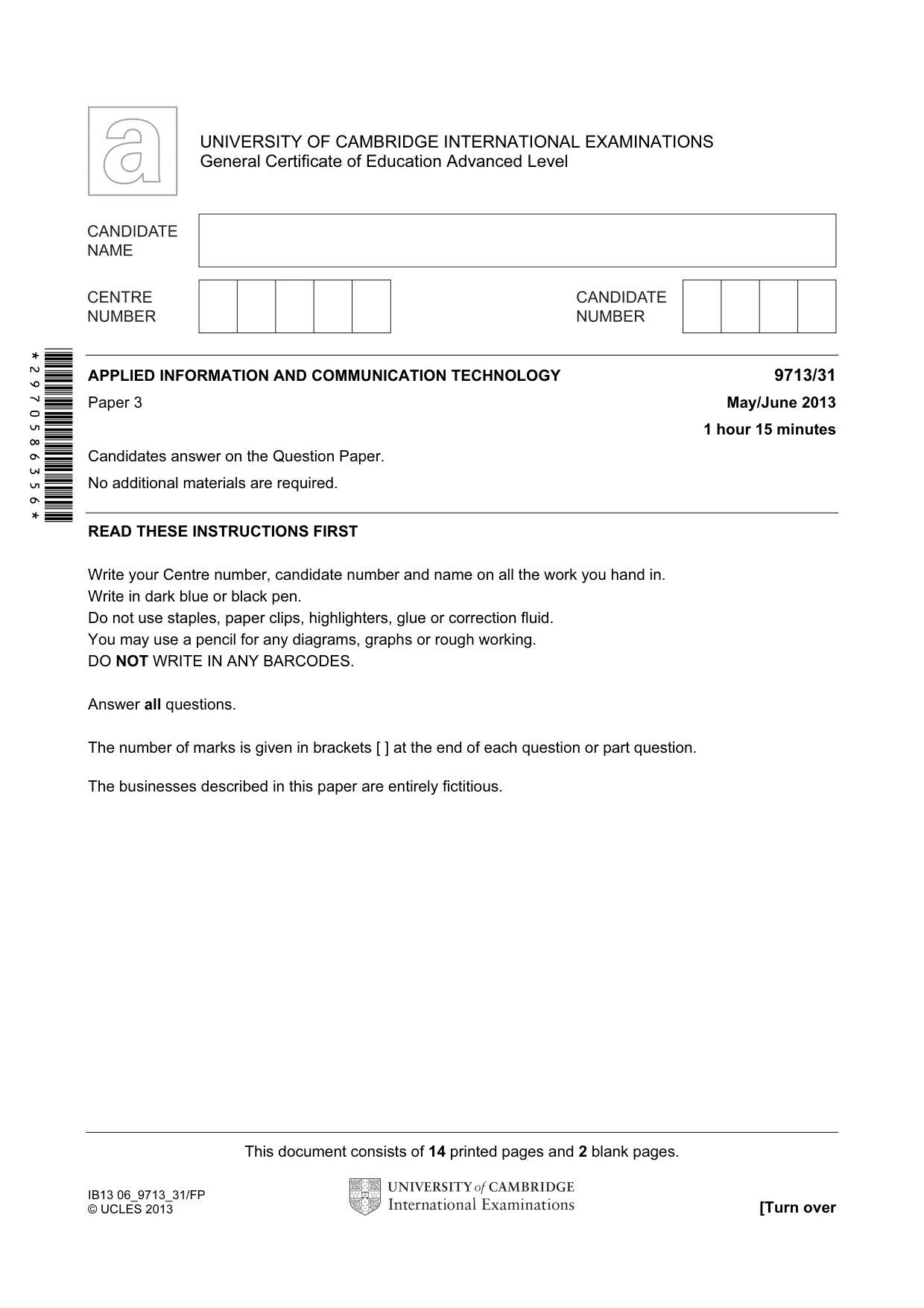
Question paper, page 1
This document consists of 14 printed pages and 2 blank pages. IB13 06_9713_31/FP © UCLES 2013 [Turn over *2970586356* UNIVERSITY OF CAMBRIDGE INTERNATIONAL EXAMINATIONS General Certificate of Education Advanced Level APPLIED INFORMATION AND COMMUNICATION TECHNOLOGY 9713/31 Paper 3 May/June 2013 1 hour 15 minutes Candidates answer on the Question Paper. No additional materials are required. READ THESE INSTRUCTIONS FIRST Write your Centre number, candidate number and name on all the work you hand in. Write in dark blue or black pen. Do not use staples, paper clips, highlighters, glue or correction fluid. You may use a pencil for any diagrams, graphs or rough working. DO NOT WRITE IN ANY BARCODES. Answer all questions. The number of marks is given in brackets [ ] at the end of each question or part question. The businesses described in this paper are entirely fictitious.
Question paper, page 2
2 © UCLES 2013 9713/31/M/J/13 For Examiner's Use Scenario 1 Question 1 A local government is concerned about the digital divide amongst its citizens. This local government provides a number of online services giving information and offering facilities for its citizens. This local government wants to reduce the digital divide in its area so that its residents have better access to information about its services and their use.
Question paper, page 3
3 © UCLES 2013 9713/31/M/J/13 [Turn over For Examiner's Use 1 (a) Identify and describe four online services that local governments may offer their citizens. 1 2 3 4 [8]
Question paper, page 4
4 © UCLES 2013 9713/31/M/J/13 For Examiner's Use (b) (i) Describe what is meant by the “digital divide”. [2] (ii) Explain three ways by which the local government can reduce the effects of the digital divide and improve access to their services. Way 1 Way 2 Way 3 [6]
Question paper, page 5
5 © UCLES 2013 9713/31/M/J/13 [Turn over For Examiner's Use Scenario 2 Question 2 Ahmed is the owner of a company that sells computers and components. Ahmed has decided to use internet auction websites to sell his goods. The auction sites will handle a lot of data which will need to be kept secure.
Question paper, page 6
6 © UCLES 2013 9713/31/M/J/13 For Examiner's Use 2 (a) Describe five steps that Ahmed would take when using an internet auction website for the first time to sell the components and computers. 1 2 3 4 5 [5] (b) Describe three security issues that could arise when using internet auction websites. 1 2 3 [3]
Question paper, page 7
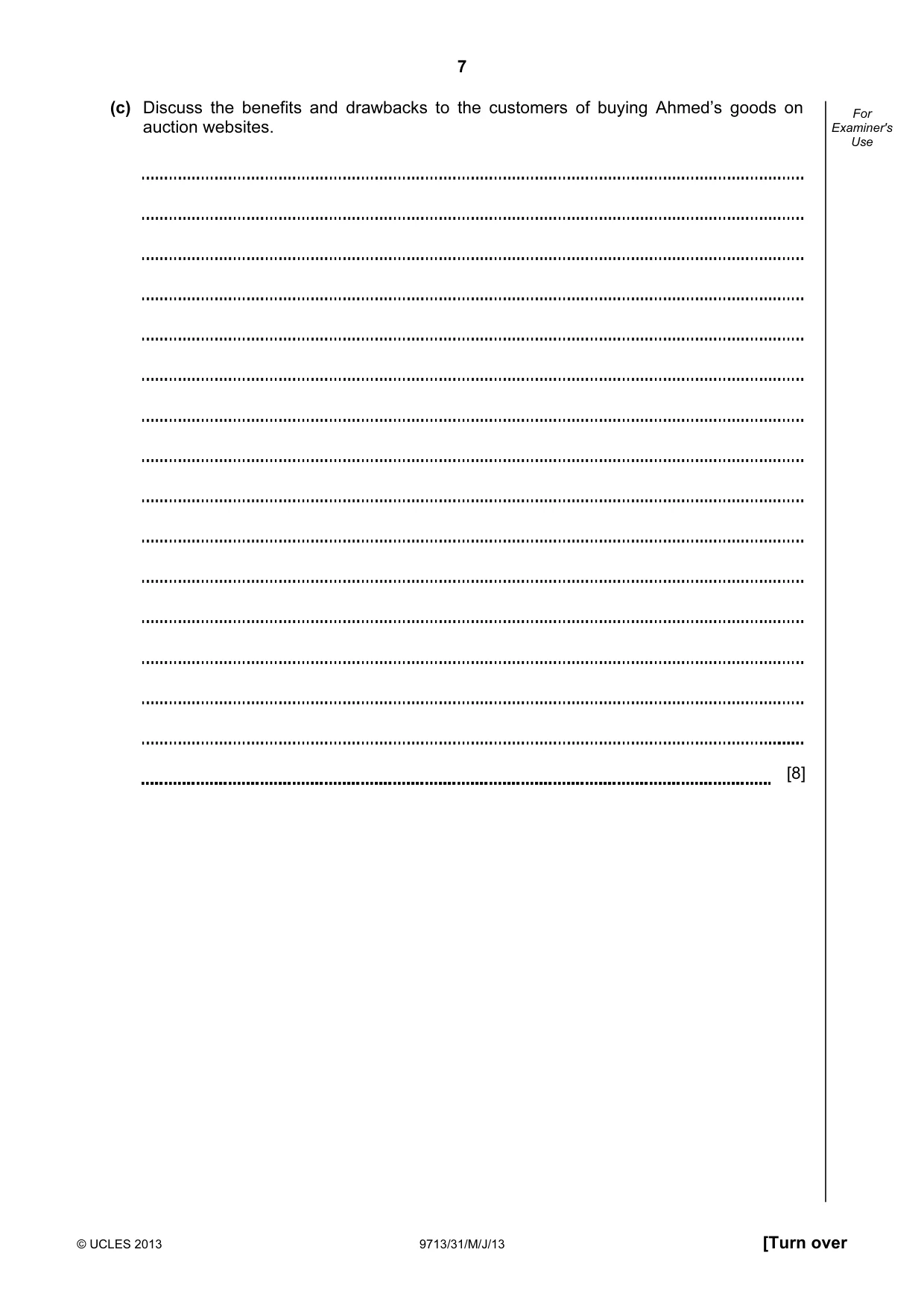
7 © UCLES 2013 9713/31/M/J/13 [Turn over For Examiner's Use (c) Discuss the benefits and drawbacks to the customers of buying Ahmed’s goods on auction websites. [8]
Question paper, page 8
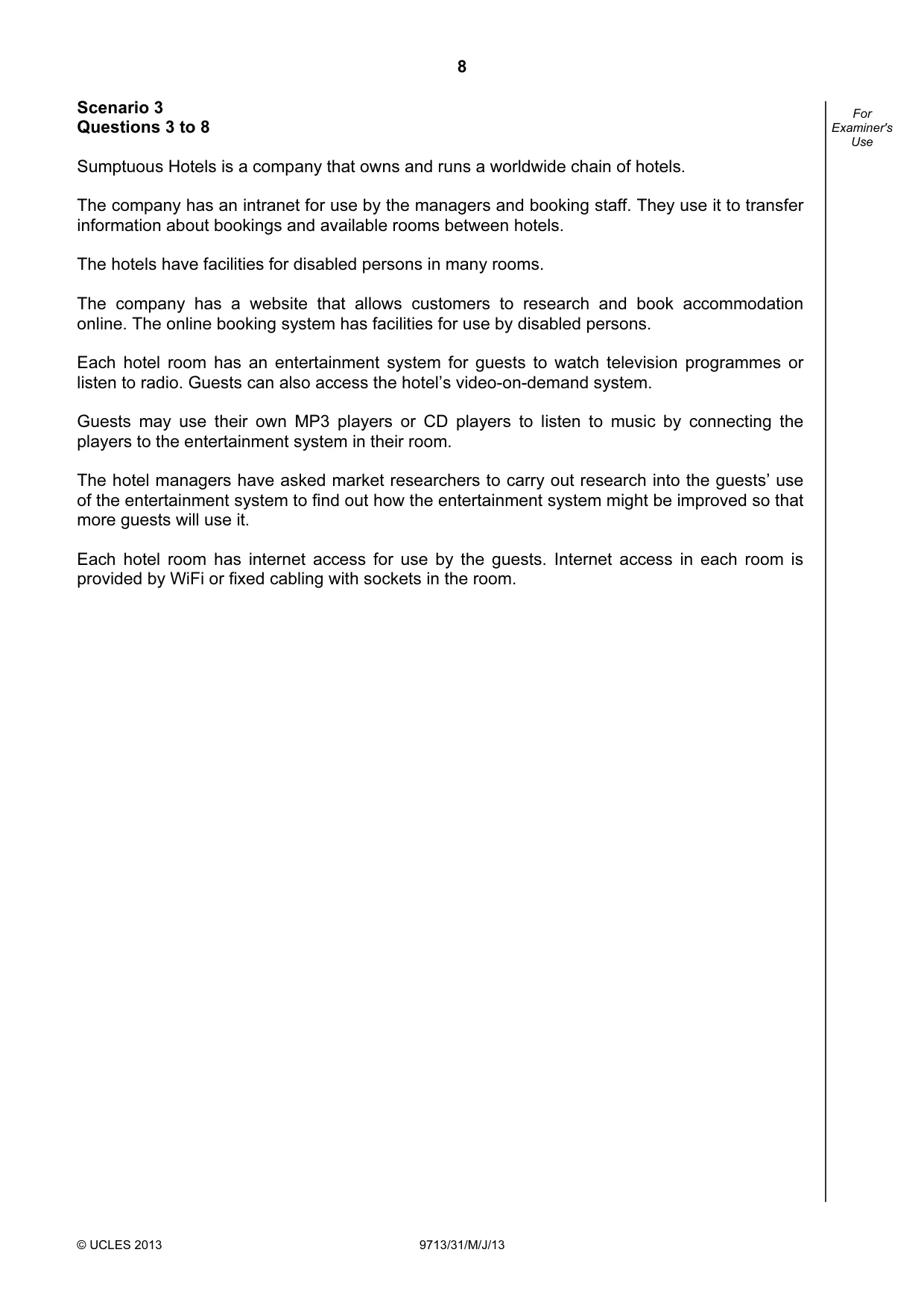
8 © UCLES 2013 9713/31/M/J/13 For Examiner's Use Scenario 3 Questions 3 to 8 Sumptuous Hotels is a company that owns and runs a worldwide chain of hotels. The company has an intranet for use by the managers and booking staff. They use it to transfer information about bookings and available rooms between hotels. The hotels have facilities for disabled persons in many rooms. The company has a website that allows customers to research and book accommodation online. The online booking system has facilities for use by disabled persons. Each hotel room has an entertainment system for guests to watch television programmes or listen to radio. Guests can also access the hotel’s video-on-demand system. Guests may use their own MP3 players or CD players to listen to music by connecting the players to the entertainment system in their room. The hotel managers have asked market researchers to carry out research into the guests’ use of the entertainment system to find out how the entertainment system might be improved so that more guests will use it. Each hotel room has internet access for use by the guests. Internet access in each room is provided by WiFi or fixed cabling with sockets in the room.
Question paper, page 9
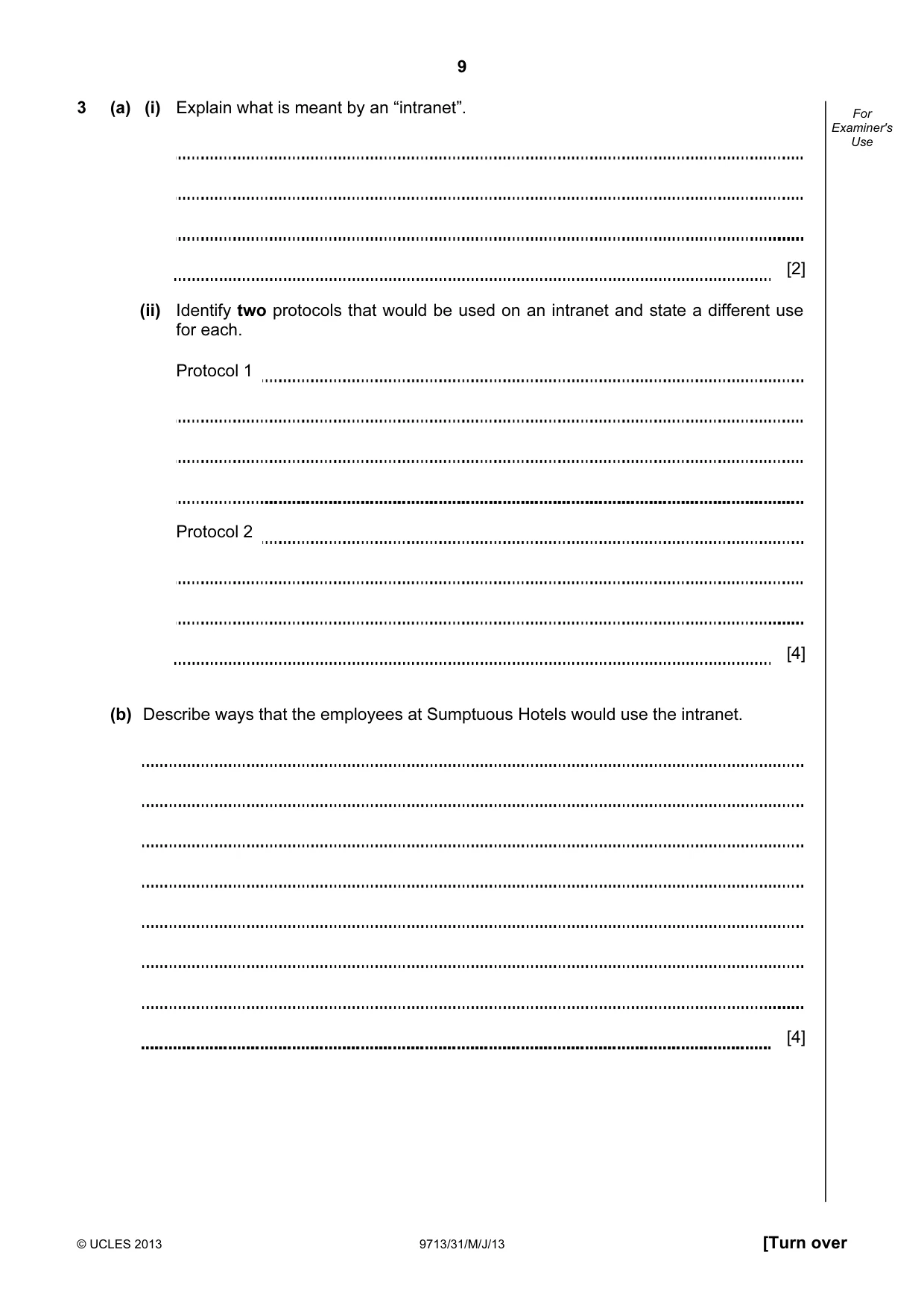
9 © UCLES 2013 9713/31/M/J/13 [Turn over For Examiner's Use 3 (a) (i) Explain what is meant by an “intranet”. [2] (ii) Identify two protocols that would be used on an intranet and state a different use for each. Protocol 1 Protocol 2 [4] (b) Describe ways that the employees at Sumptuous Hotels would use the intranet. [4]
Question paper, page 10
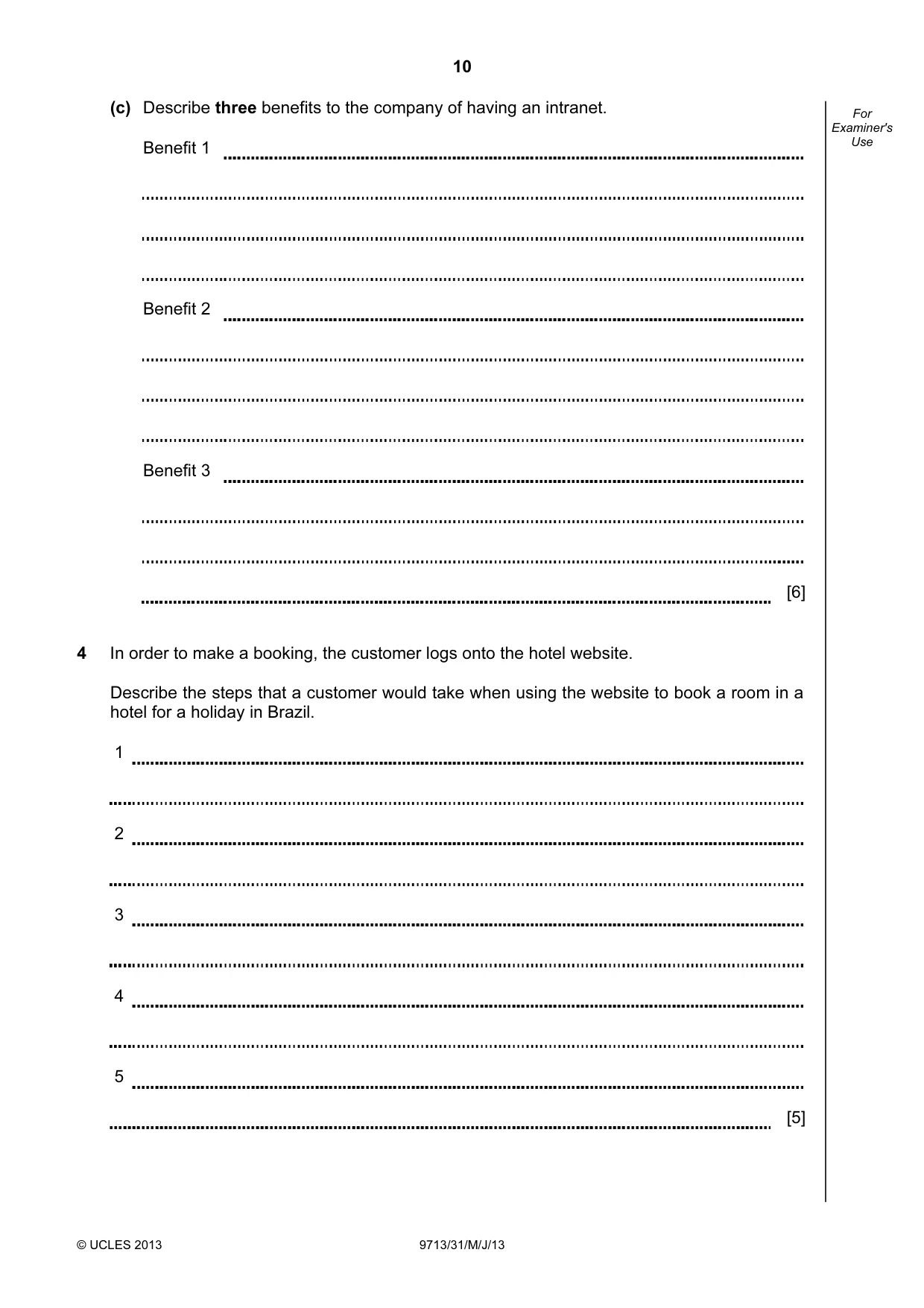
10 © UCLES 2013 9713/31/M/J/13 For Examiner's Use (c) Describe three benefits to the company of having an intranet. Benefit 1 Benefit 2 Benefit 3 [6] 4 In order to make a booking, the customer logs onto the hotel website. Describe the steps that a customer would take when using the website to book a room in a hotel for a holiday in Brazil. 1 2 3 4 5 [5]
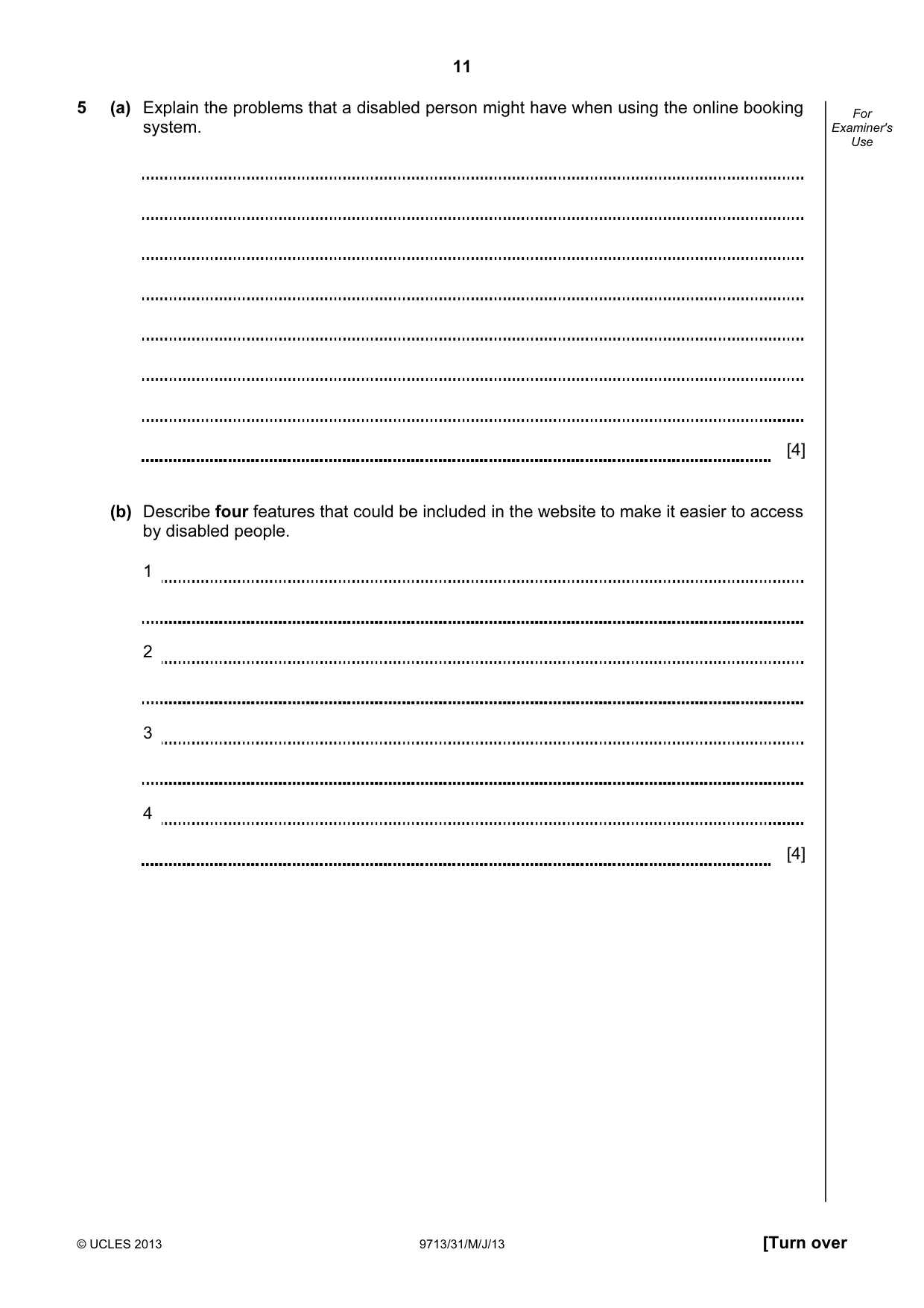
Question paper, page 11
11 © UCLES 2013 9713/31/M/J/13 [Turn over For Examiner's Use 5 (a) Explain the problems that a disabled person might have when using the online booking system. [4] (b) Describe four features that could be included in the website to make it easier to access by disabled people. 1 2 3 4 [4]
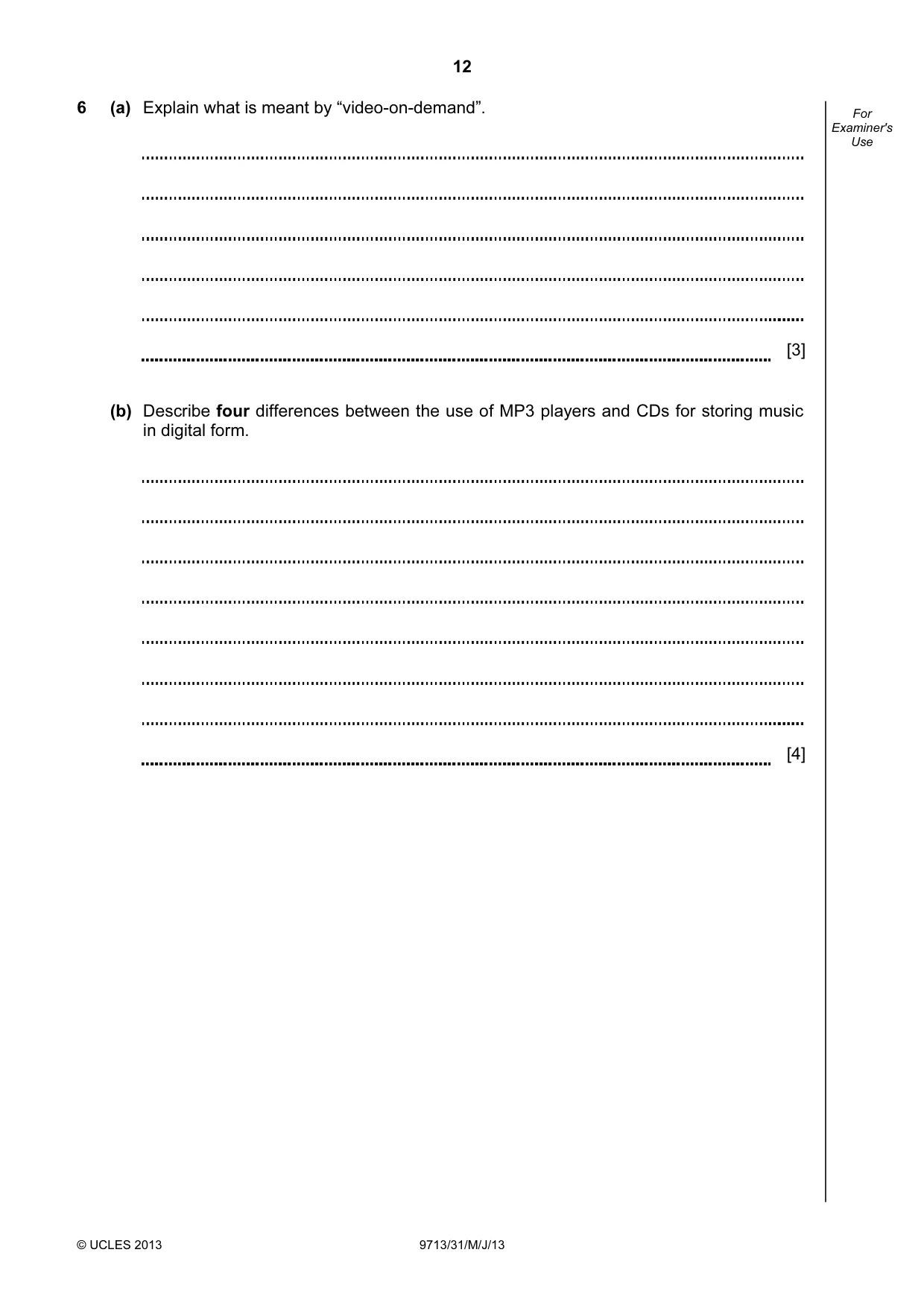
Question paper, page 12
12 © UCLES 2013 9713/31/M/J/13 For Examiner's Use 6 (a) Explain what is meant by “video-on-demand”. [3] (b) Describe four differences between the use of MP3 players and CDs for storing music in digital form. [4]
Question paper, page 13
13 © UCLES 2013 9713/31/M/J/13 [Turn over For Examiner's Use 7 Describe three methods that market researchers could use to carry out research into the uses of the entertainment system by guests. 1 2 3 [6]
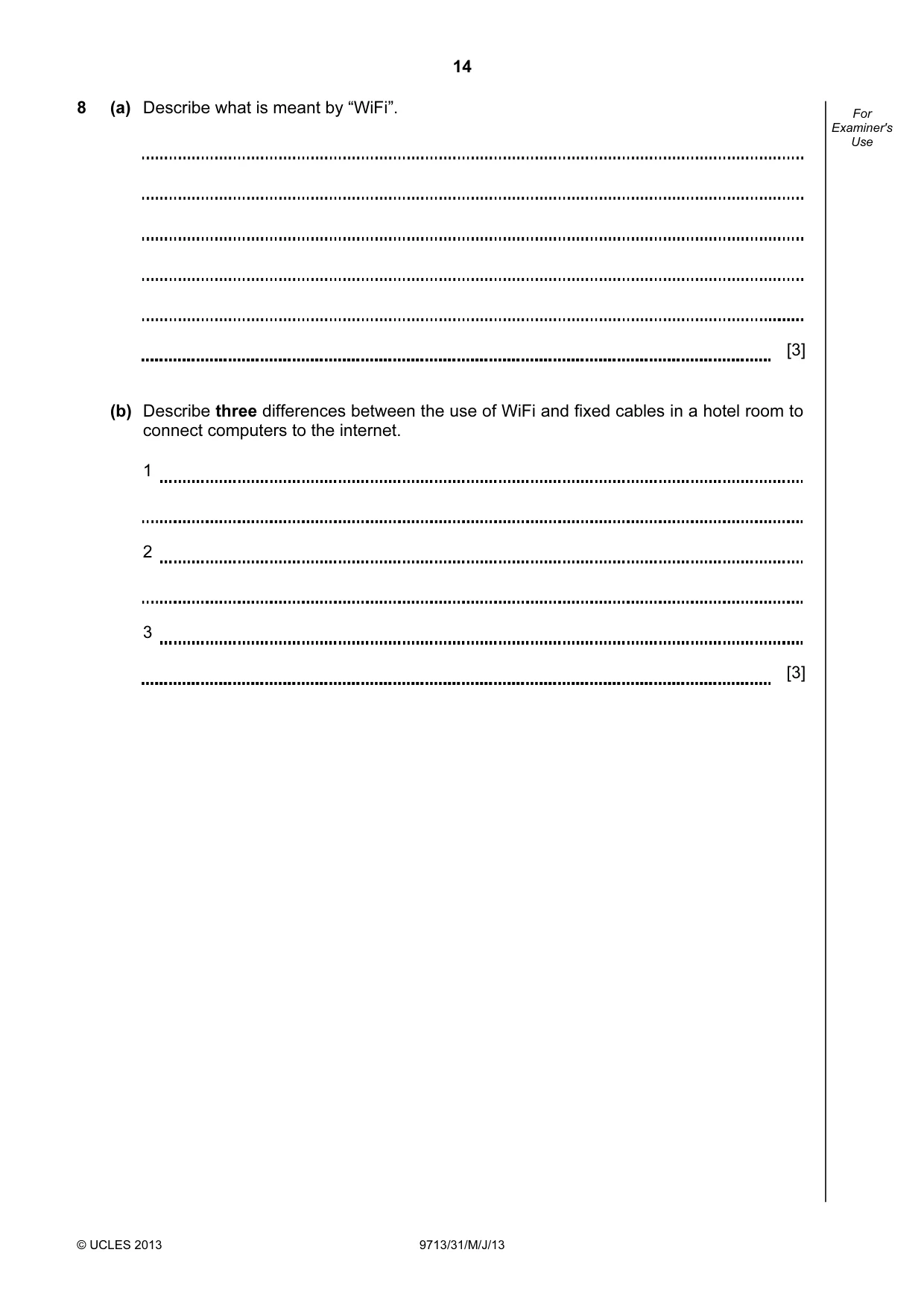
Question paper, page 14
14 © UCLES 2013 9713/31/M/J/13 For Examiner's Use 8 (a) Describe what is meant by “WiFi”. [3] (b) Describe three differences between the use of WiFi and fixed cables in a hotel room to connect computers to the internet. 1 2 3 [3]
Question paper, page 15
15 © UCLES 2013 9713/31/M/J/13 BLANK PAGE
Question paper, page 16
16 Permission to reproduce items where third-party owned material protected by copyright is included has been sought and cleared where possible. Every reasonable effort has been made by the publisher (UCLES) to trace copyright holders, but if any items requiring clearance have unwittingly been included, the publisher will be pleased to make amends at the earliest possible opportunity. University of Cambridge International Examinations is part of the Cambridge Assessment Group. Cambridge Assessment is the brand name of University of Cambridge Local Examinations Syndicate (UCLES), which is itself a department of the University of Cambridge. © UCLES 2013 9713/31/M/J/13 BLANK PAGE
Mark scheme, page 1
CAMBRIDGE INTERNATIONAL EXAMINATIONS GCE Advanced Subsidiary Level and GCE Advanced Level MARK SCHEME for the May/June 2013 series 9713 APPLIED INFORMATION AND COMMUNICATION TECHNOLOGY 9713/31 Paper 3 (Written B), maximum raw mark 80 This mark scheme is published as an aid to teachers and candidates, to indicate the requirements of the examination. It shows the basis on which Examiners were instructed to award marks. It does not indicate the details of the discussions that took place at an Examiners’ meeting before marking began, which would have considered the acceptability of alternative answers. Mark schemes should be read in conjunction with the question paper and the Principal Examiner Report for Teachers. Cambridge will not enter into discussions about these mark schemes. Cambridge is publishing the mark schemes for the May/June 2013 series for most IGCSE, GCE Advanced Level and Advanced Subsidiary Level components and some Ordinary Level components.
Mark scheme, page 2
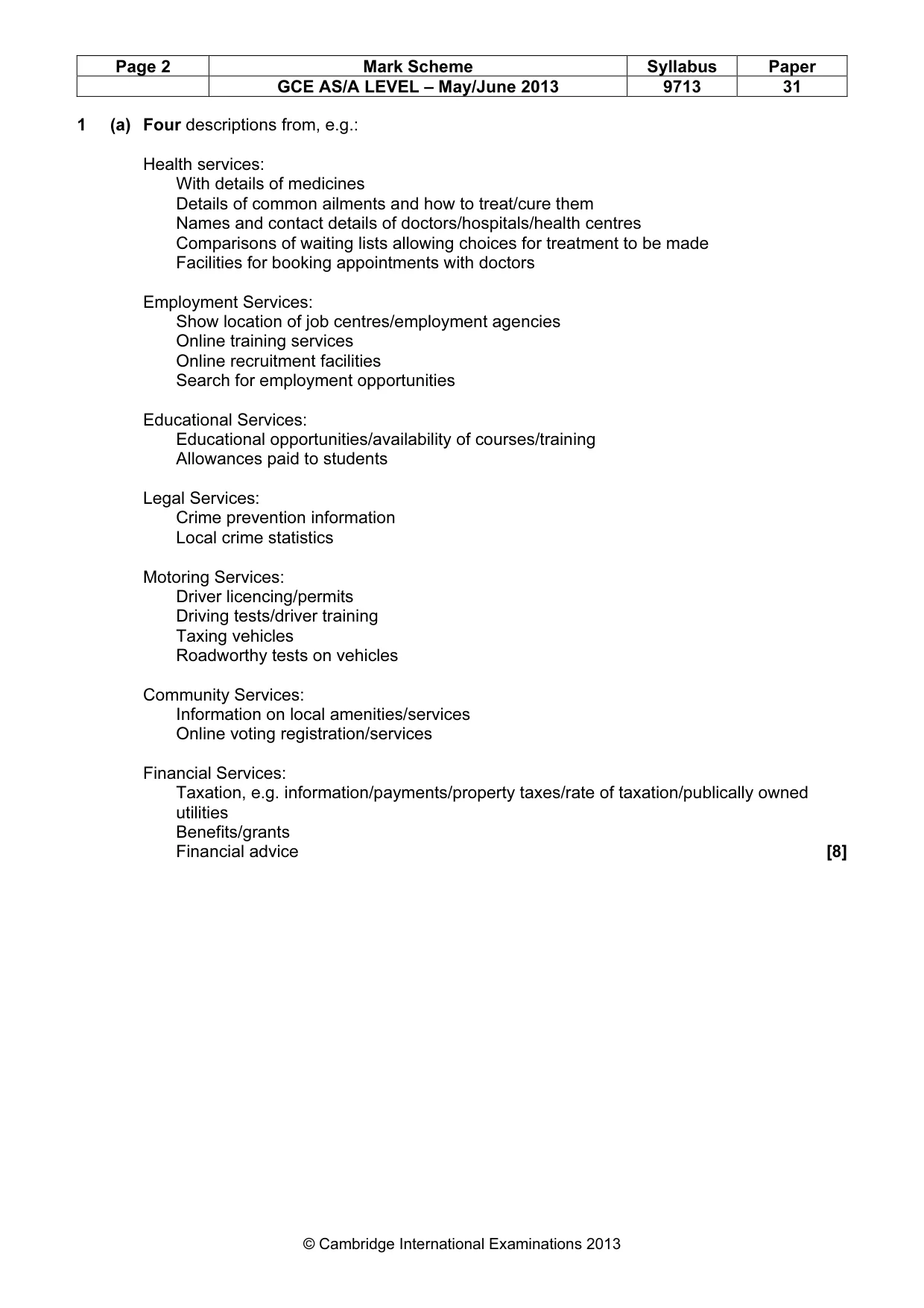
Page 2 Mark Scheme Syllabus Paper GCE AS/A LEVEL – May/June 2013 9713 31 © Cambridge International Examinations 2013 1 (a) Four descriptions from, e.g.: Health services: With details of medicines Details of common ailments and how to treat/cure them Names and contact details of doctors/hospitals/health centres Comparisons of waiting lists allowing choices for treatment to be made Facilities for booking appointments with doctors Employment Services: Show location of job centres/employment agencies Online training services Online recruitment facilities Search for employment opportunities Educational Services: Educational opportunities/availability of courses/training Allowances paid to students Legal Services: Crime prevention information Local crime statistics Motoring Services: Driver licencing/permits Driving tests/driver training Taxing vehicles Roadworthy tests on vehicles Community Services: Information on local amenities/services Online voting registration/services Financial Services: Taxation, e.g. information/payments/property taxes/rate of taxation/publically owned utilities Benefits/grants Financial advice [8]
Mark scheme, page 3
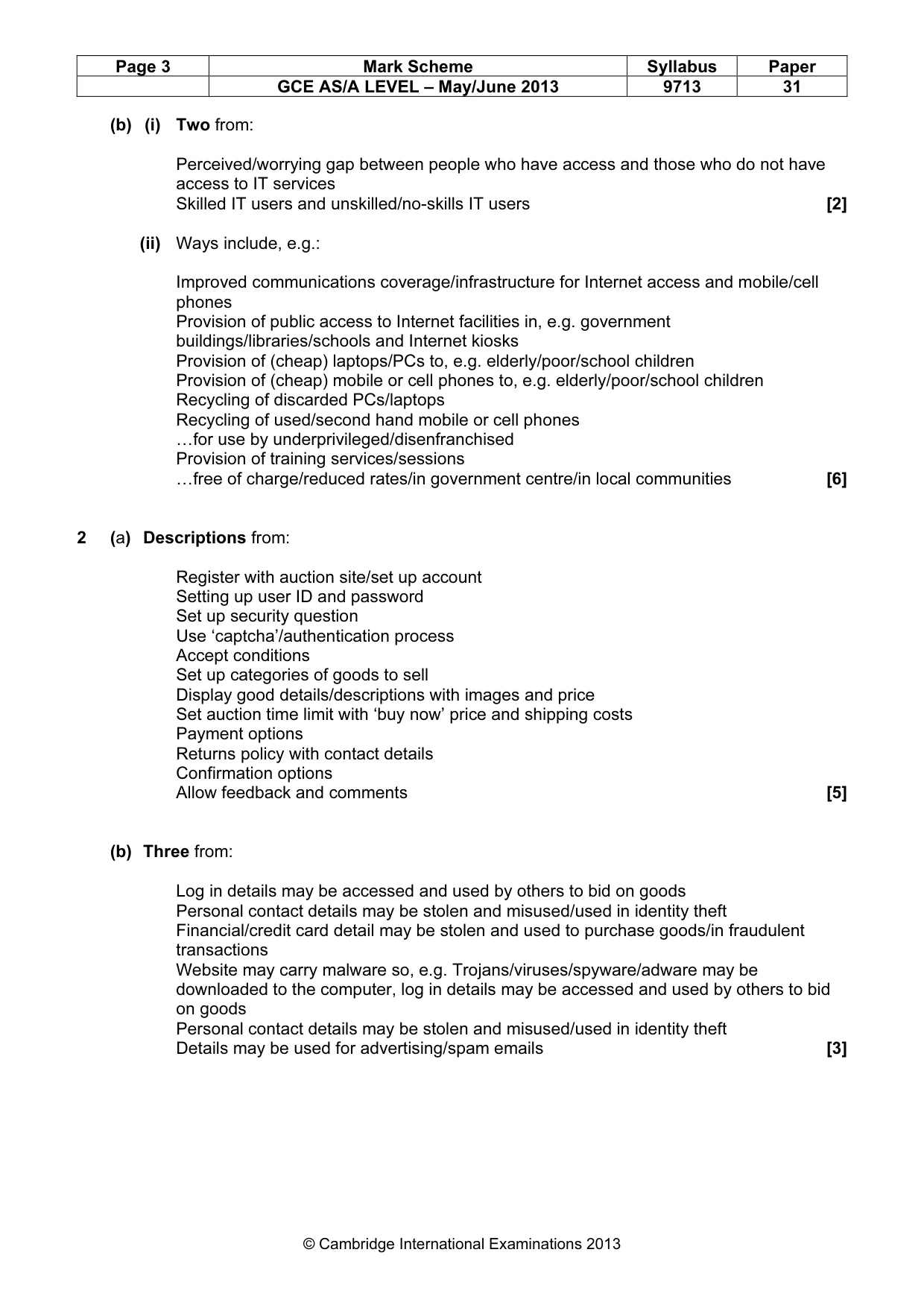
Page 3 Mark Scheme Syllabus Paper GCE AS/A LEVEL – May/June 2013 9713 31 © Cambridge International Examinations 2013 (b) (i) Two from: Perceived/worrying gap between people who have access and those who do not have access to IT services Skilled IT users and unskilled/no-skills IT users [2] (ii) Ways include, e.g.: Improved communications coverage/infrastructure for Internet access and mobile/cell phones Provision of public access to Internet facilities in, e.g. government buildings/libraries/schools and Internet kiosks Provision of (cheap) laptops/PCs to, e.g. elderly/poor/school children Provision of (cheap) mobile or cell phones to, e.g. elderly/poor/school children Recycling of discarded PCs/laptops Recycling of used/second hand mobile or cell phones …for use by underprivileged/disenfranchised Provision of training services/sessions …free of charge/reduced rates/in government centre/in local communities [6] 2 (a) Descriptions from: Register with auction site/set up account Setting up user ID and password Set up security question Use ‘captcha’/authentication process Accept conditions Set up categories of goods to sell Display good details/descriptions with images and price Set auction time limit with ‘buy now’ price and shipping costs Payment options Returns policy with contact details Confirmation options Allow feedback and comments [5] (b) Three from: Log in details may be accessed and used by others to bid on goods Personal contact details may be stolen and misused/used in identity theft Financial/credit card detail may be stolen and used to purchase goods/in fraudulent transactions Website may carry malware so, e.g. Trojans/viruses/spyware/adware may be downloaded to the computer, log in details may be accessed and used by others to bid on goods Personal contact details may be stolen and misused/used in identity theft Details may be used for advertising/spam emails [3]
Mark scheme, page 4
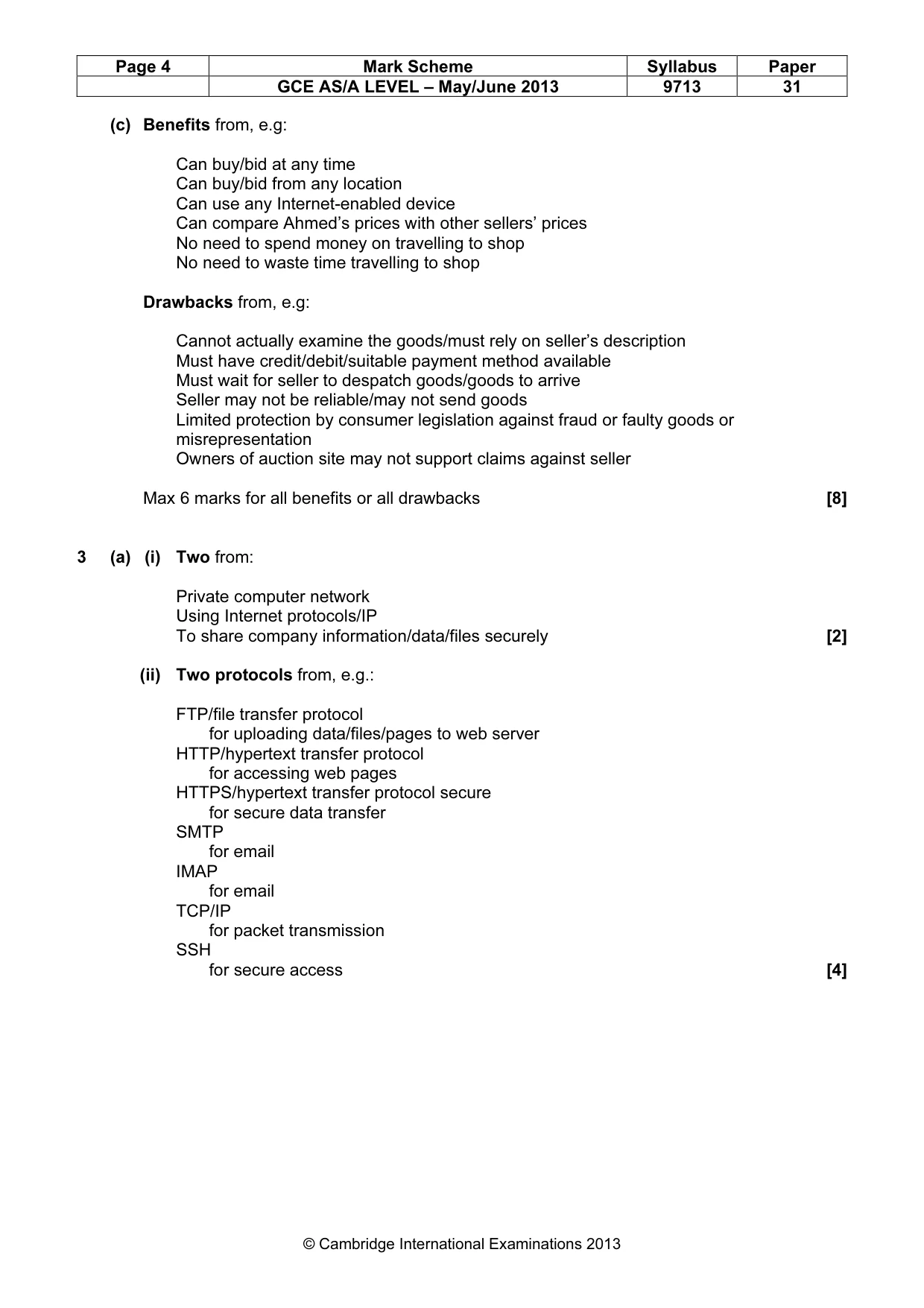
Page 4 Mark Scheme Syllabus Paper GCE AS/A LEVEL – May/June 2013 9713 31 © Cambridge International Examinations 2013 (c) Benefits from, e.g: Can buy/bid at any time Can buy/bid from any location Can use any Internet-enabled device Can compare Ahmed’s prices with other sellers’ prices No need to spend money on travelling to shop No need to waste time travelling to shop Drawbacks from, e.g: Cannot actually examine the goods/must rely on seller’s description Must have credit/debit/suitable payment method available Must wait for seller to despatch goods/goods to arrive Seller may not be reliable/may not send goods Limited protection by consumer legislation against fraud or faulty goods or misrepresentation Owners of auction site may not support claims against seller Max 6 marks for all benefits or all drawbacks [8] 3 (a) (i) Two from: Private computer network Using Internet protocols/IP To share company information/data/files securely [2] (ii) Two protocols from, e.g.: FTP/file transfer protocol for uploading data/files/pages to web server HTTP/hypertext transfer protocol for accessing web pages HTTPS/hypertext transfer protocol secure for secure data transfer SMTP for email IMAP for email TCP/IP for packet transmission SSH for secure access [4]
Mark scheme, page 5
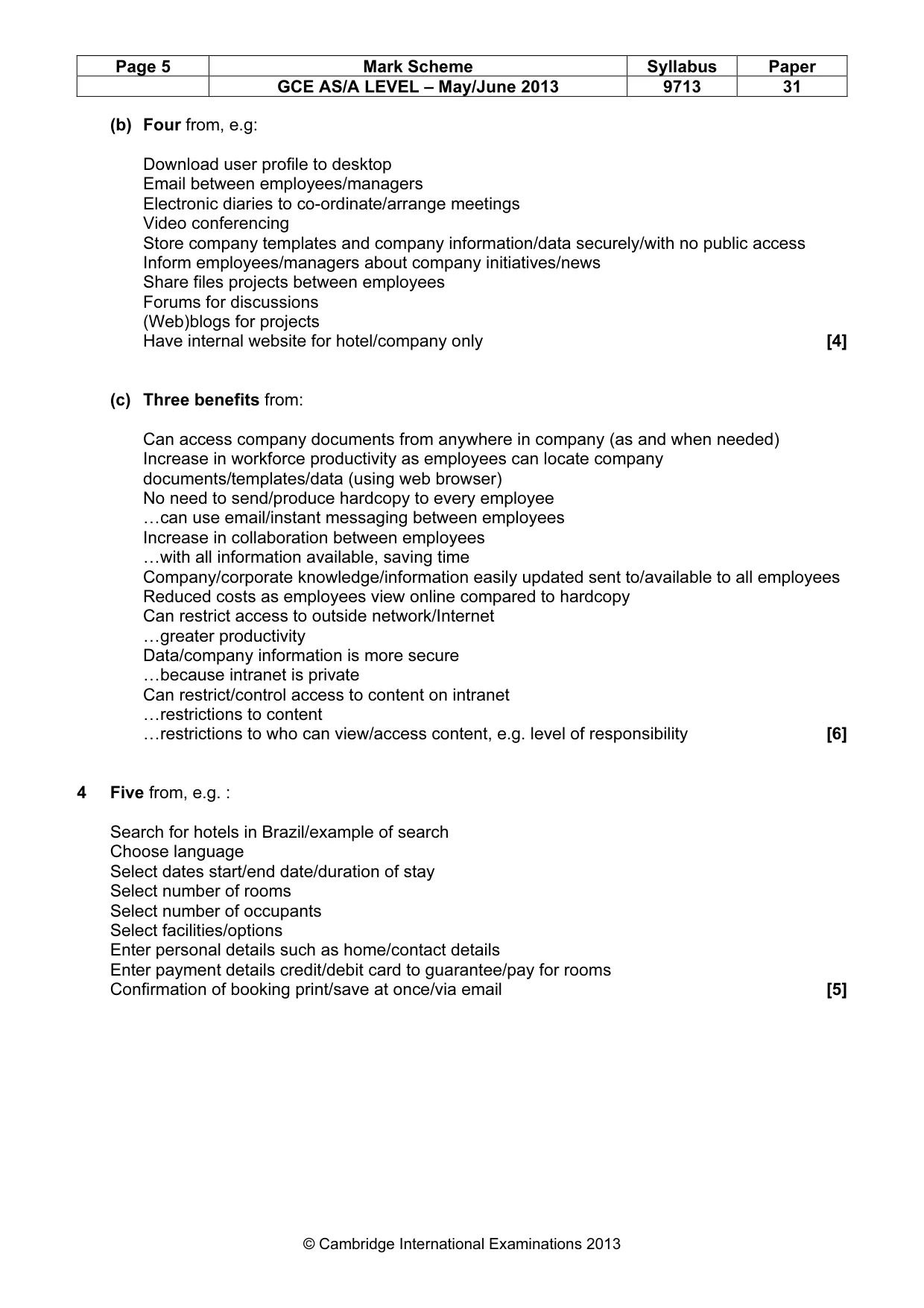
Page 5 Mark Scheme Syllabus Paper GCE AS/A LEVEL – May/June 2013 9713 31 © Cambridge International Examinations 2013 (b) Four from, e.g: Download user profile to desktop Email between employees/managers Electronic diaries to co-ordinate/arrange meetings Video conferencing Store company templates and company information/data securely/with no public access Inform employees/managers about company initiatives/news Share files projects between employees Forums for discussions (Web)blogs for projects Have internal website for hotel/company only [4] (c) Three benefits from: Can access company documents from anywhere in company (as and when needed) Increase in workforce productivity as employees can locate company documents/templates/data (using web browser) No need to send/produce hardcopy to every employee …can use email/instant messaging between employees Increase in collaboration between employees …with all information available, saving time Company/corporate knowledge/information easily updated sent to/available to all employees Reduced costs as employees view online compared to hardcopy Can restrict access to outside network/Internet …greater productivity Data/company information is more secure …because intranet is private Can restrict/control access to content on intranet …restrictions to content …restrictions to who can view/access content, e.g. level of responsibility [6] 4 Five from, e.g. : Search for hotels in Brazil/example of search Choose language Select dates start/end date/duration of stay Select number of rooms Select number of occupants Select facilities/options Enter personal details such as home/contact details Enter payment details credit/debit card to guarantee/pay for rooms Confirmation of booking print/save at once/via email [5]
Mark scheme, page 6
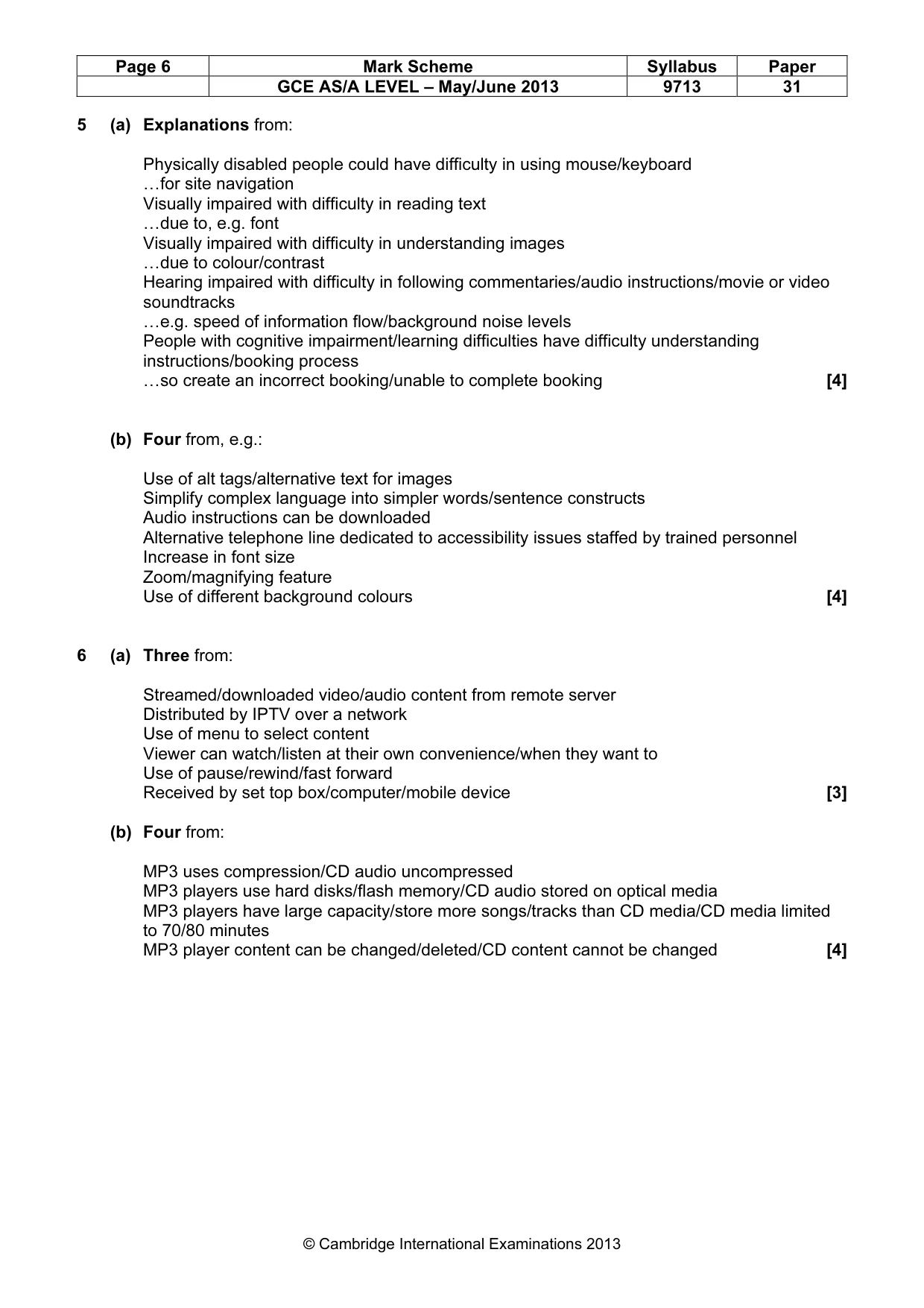
Page 6 Mark Scheme Syllabus Paper GCE AS/A LEVEL – May/June 2013 9713 31 © Cambridge International Examinations 2013 5 (a) Explanations from: Physically disabled people could have difficulty in using mouse/keyboard …for site navigation Visually impaired with difficulty in reading text …due to, e.g. font Visually impaired with difficulty in understanding images …due to colour/contrast Hearing impaired with difficulty in following commentaries/audio instructions/movie or video soundtracks …e.g. speed of information flow/background noise levels People with cognitive impairment/learning difficulties have difficulty understanding instructions/booking process …so create an incorrect booking/unable to complete booking [4] (b) Four from, e.g.: Use of alt tags/alternative text for images Simplify complex language into simpler words/sentence constructs Audio instructions can be downloaded Alternative telephone line dedicated to accessibility issues staffed by trained personnel Increase in font size Zoom/magnifying feature Use of different background colours [4] 6 (a) Three from: Streamed/downloaded video/audio content from remote server Distributed by IPTV over a network Use of menu to select content Viewer can watch/listen at their own convenience/when they want to Use of pause/rewind/fast forward Received by set top box/computer/mobile device [3] (b) Four from: MP3 uses compression/CD audio uncompressed MP3 players use hard disks/flash memory/CD audio stored on optical media MP3 players have large capacity/store more songs/tracks than CD media/CD media limited to 70/80 minutes MP3 player content can be changed/deleted/CD content cannot be changed [4]
Mark scheme, page 7
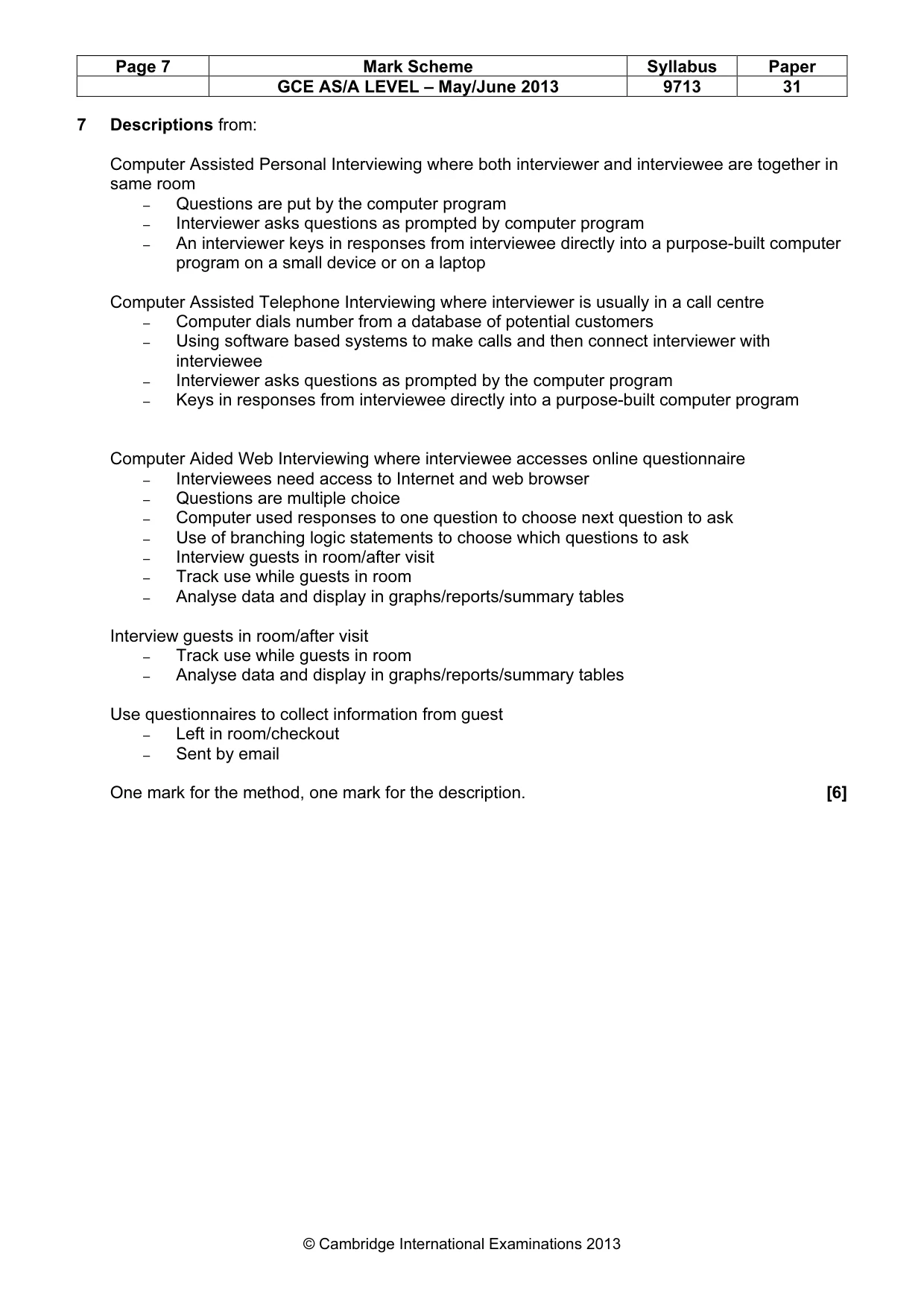
Page 7 Mark Scheme Syllabus Paper GCE AS/A LEVEL – May/June 2013 9713 31 © Cambridge International Examinations 2013 7 Descriptions from: Computer Assisted Personal Interviewing where both interviewer and interviewee are together in same room – Questions are put by the computer program – Interviewer asks questions as prompted by computer program – An interviewer keys in responses from interviewee directly into a purpose-built computer program on a small device or on a laptop Computer Assisted Telephone Interviewing where interviewer is usually in a call centre – Computer dials number from a database of potential customers – Using software based systems to make calls and then connect interviewer with interviewee – Interviewer asks questions as prompted by the computer program – Keys in responses from interviewee directly into a purpose-built computer program Computer Aided Web Interviewing where interviewee accesses online questionnaire – Interviewees need access to Internet and web browser – Questions are multiple choice – Computer used responses to one question to choose next question to ask – Use of branching logic statements to choose which questions to ask – Interview guests in room/after visit – Track use while guests in room – Analyse data and display in graphs/reports/summary tables Interview guests in room/after visit – Track use while guests in room – Analyse data and display in graphs/reports/summary tables Use questionnaires to collect information from guest – Left in room/checkout – Sent by email One mark for the method, one mark for the description. [6]
Mark scheme, page 8
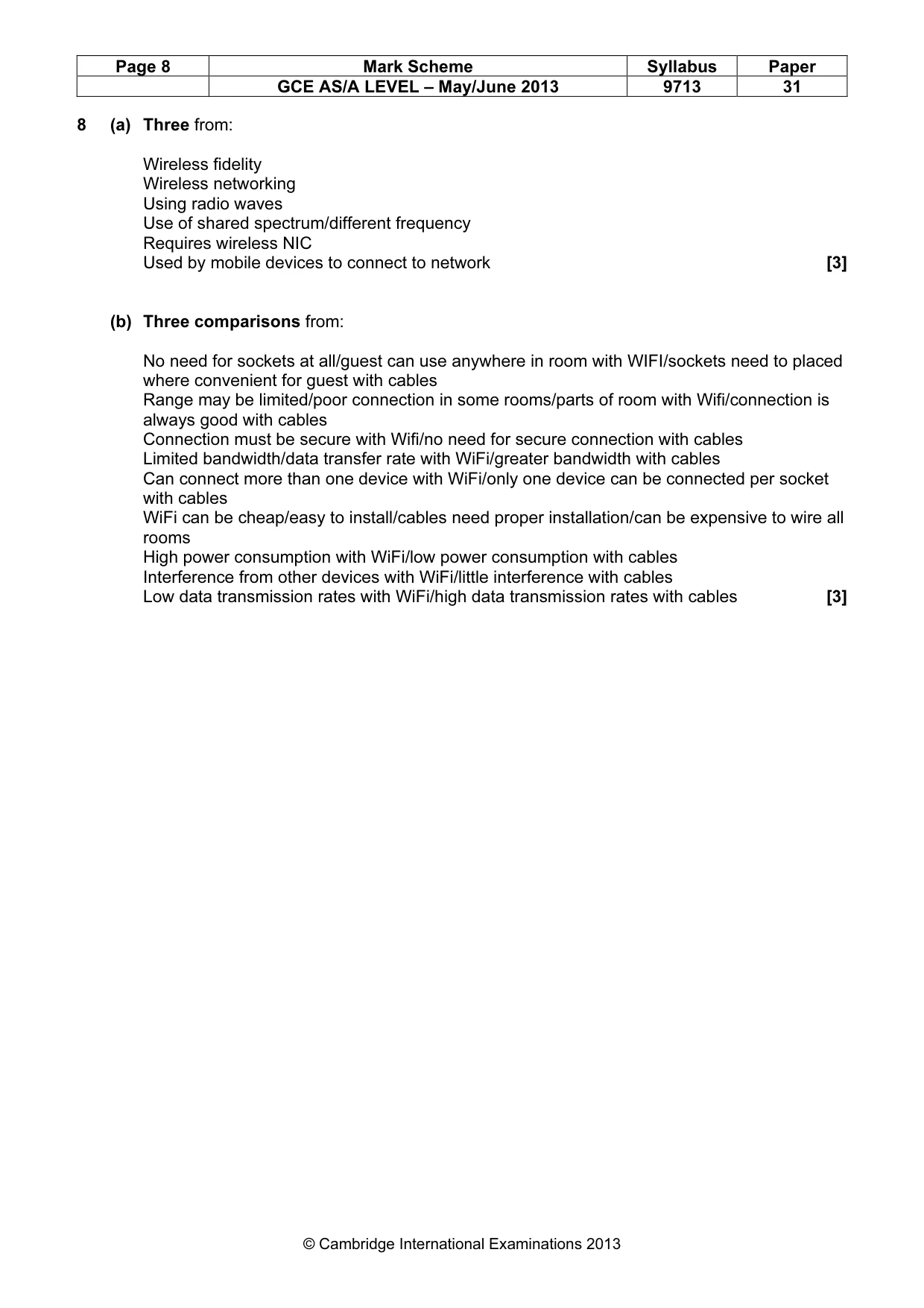
Page 8 Mark Scheme Syllabus Paper GCE AS/A LEVEL – May/June 2013 9713 31 © Cambridge International Examinations 2013 8 (a) Three from: Wireless fidelity Wireless networking Using radio waves Use of shared spectrum/different frequency Requires wireless NIC Used by mobile devices to connect to network [3] (b) Three comparisons from: No need for sockets at all/guest can use anywhere in room with WIFI/sockets need to placed where convenient for guest with cables Range may be limited/poor connection in some rooms/parts of room with Wifi/connection is always good with cables Connection must be secure with Wifi/no need for secure connection with cables Limited bandwidth/data transfer rate with WiFi/greater bandwidth with cables Can connect more than one device with WiFi/only one device can be connected per socket with cables WiFi can be cheap/easy to install/cables need proper installation/can be expensive to wire all rooms High power consumption with WiFi/low power consumption with cables Interference from other devices with WiFi/little interference with cables Low data transmission rates with WiFi/high data transmission rates with cables [3]
What you needed in this session
Cambridge’s own grade thresholds for 2013 May/June, Paper 3 · Variant 1. A higher threshold means an easier paper — the bar moves with how the cohort did.