Cambridge A Level Applied Information and Communication Technology 9713 — 2016 May/June Paper 3 · Variant 2
9713/32/M/J/16 · 80 marks · ≈90 min
The question paper and its mark scheme, free to read here and free to download. This is Cambridge’s own paper, exactly as it was sat.
Question paper20 pages




Mark scheme7 pages
Answers below. Sit the paper first if you are practising.
Paper as text
Question paper, page 1
This document consists of 16 printed pages and 4 blank pages. DC (KN) 114996/2 © UCLES 2016 [Turn over Cambridge International Examinations Cambridge International Advanced Level * 6 5 7 5 4 3 0 6 1 8 * APPLIED INFORMATION AND COMMUNICATION TECHNOLOGY 9713/32 Paper 3 May/June 2016 1 hour 15 minutes Candidates answer on the Question Paper. No additional materials are required. READ THESE INSTRUCTIONS FIRST Write your Centre number, candidate number and name on all the work you hand in. Write in dark blue or black pen. Do not use staples, paper clips, glue or correction fluid. You may use an HB pencil for any diagrams, graphs or rough working. DO NOT WRITE IN ANY BARCODES. Answer all questions. The number of marks is given in brackets [ ] at the end of each question or part question. The businesses described in this paper are entirely fictitious.
Question paper, page 2
2 9713/32/M/J/16 © UCLES 2016 Scenario 1 Questions 1, 2 and 3. Individuals and businesses use different types of internet auctions to buy and sell goods. Buyers can use the auction website to search, look at and buy items that are offered for sale by individuals or businesses. Buyers can pay sellers for the items using credit cards. Buyers can also use other ways of paying for the goods.
Question paper, page 3
3 9713/32/M/J/16 © UCLES 2016 [Turn over 1 (a) Describe, in detail, three different types of internet auction. 1 … … … … … … 2 … … … … … … 3 … … … … … …[6]
Question paper, page 4
4 9713/32/M/J/16 © UCLES 2016 (b) Explain why buyers might be worried about using internet auctions to buy goods. … … … … … … … … … …[4]
Question paper, page 5
5 9713/32/M/J/16 © UCLES 2016 [Turn over 2 (a) Explain the advantages to a buyer of using a credit card to pay for goods purchased using an internet auction. … … … … … … … … … … … … … …[5] (b) Explain the disadvantages to a seller of allowing buyers to use a credit card to pay for goods purchased using an internet auction. … … … … … … … … … …[4]
Question paper, page 6
6 9713/32/M/J/16 © UCLES 2016 3 Describe other ways that a buyer can safely pay for goods purchased using an internet auction. … … … … … … … … … …[4]
Question paper, page 7
7 9713/32/M/J/16 © UCLES 2016 [Turn over BLANK PAGE
Question paper, page 8
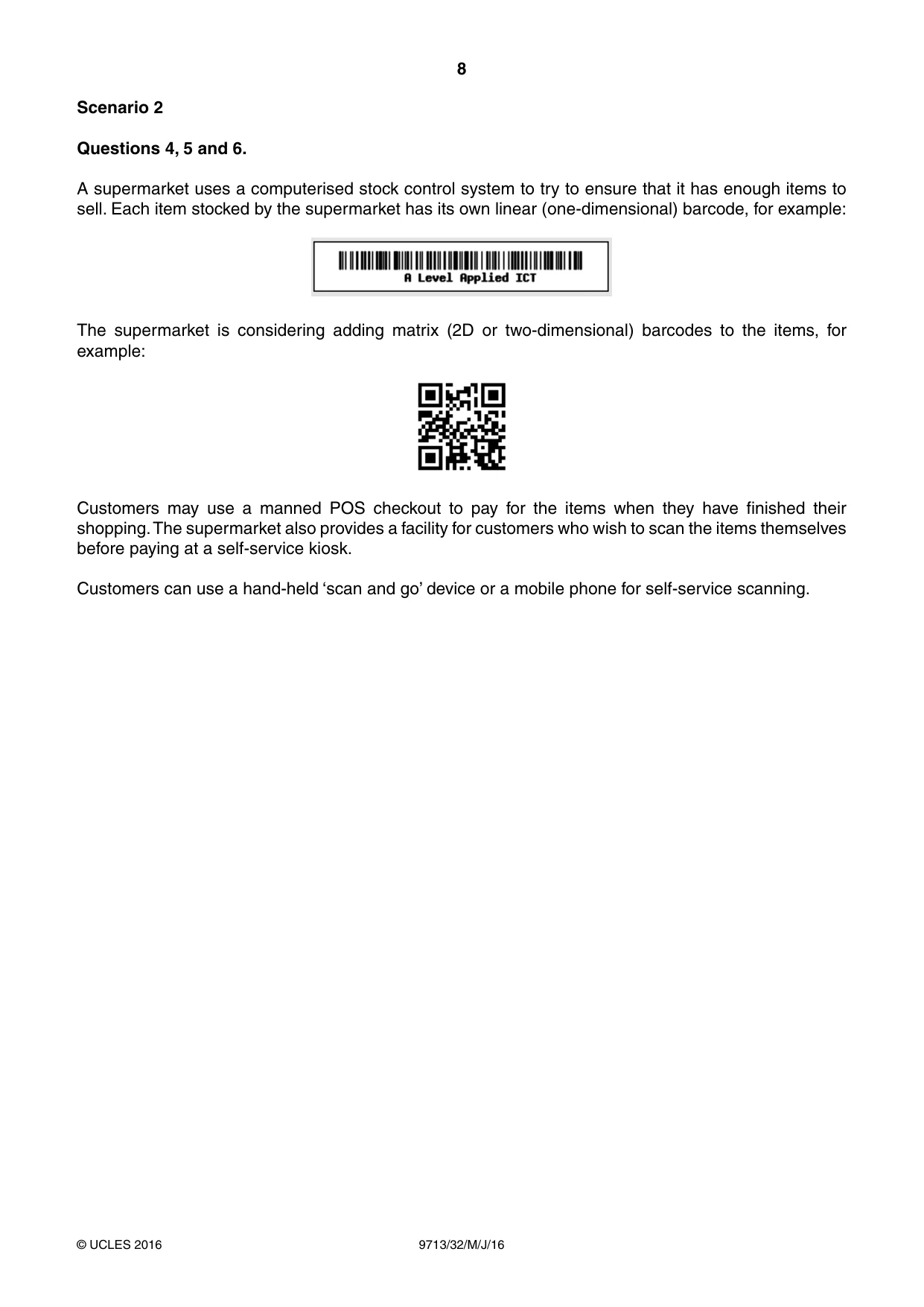
8 9713/32/M/J/16 © UCLES 2016 Scenario 2 Questions 4, 5 and 6. A supermarket uses a computerised stock control system to try to ensure that it has enough items to sell. Each item stocked by the supermarket has its own linear (one-dimensional) barcode, for example: The supermarket is considering adding matrix (2D or two-dimensional) barcodes to the items, for example: Customers may use a manned POS checkout to pay for the items when they have finished their shopping. The supermarket also provides a facility for customers who wish to scan the items themselves before paying at a self-service kiosk. Customers can use a hand-held ‘scan and go’ device or a mobile phone for self-service scanning.
Question paper, page 9
9 9713/32/M/J/16 © UCLES 2016 [Turn over 4 (a) Explain how information is represented in a linear barcode system. … … … … … … … … … … … … … …[5] (b) Describe the benefits of adding matrix barcodes on the items in the supermarket. … … … … … … … … … …[4]
Question paper, page 10
10 9713/32/M/J/16 © UCLES 2016 5 Describe how a customer would make use of the hand-held ‘scan and go’ system in order to be able to pay for items at a self-service kiosk. … … … … … … … … … …[4] 6 Describe the benefits and drawbacks of the use of self-service systems in supermarkets. … … … … … … … … … … … … … …[6]
Question paper, page 11
11 9713/32/M/J/16 © UCLES 2016 [Turn over BLANK PAGE
Question paper, page 12
12 9713/32/M/J/16 © UCLES 2016 Scenario 3 Questions 7 and 8. A group of scientists are studying the plant life found in a remote area of rain forest. The scientists have access to an expert system created especially to assist them when identifying the plants.
Question paper, page 13
13 9713/32/M/J/16 © UCLES 2016 [Turn over 7 (a) Explain four benefits to the scientists of using the expert system to assist them in identifying the plants. 1 … … … 2 … … … 3 … … … 4 … … …[4] (b) Explain four drawbacks to the scientists of using the expert system to assist them in identifying the plants. 1 … … … 2 … … … 3 … … … 4 … … …[4]
Question paper, page 14
14 9713/32/M/J/16 © UCLES 2016 8 (a) Describe how the knowledge base is set up with the facts required to identify plants. … … … … … … … … … …[4] (b) Explain how each of the following is used by the inference engine to identify a plant. (i) forward-chaining … … … … … … …[3] (ii) backward-chaining … … … … … … …[3]
Question paper, page 15
15 9713/32/M/J/16 © UCLES 2016 [Turn over BLANK PAGE
Question paper, page 16
16 9713/32/M/J/16 © UCLES 2016 Scenario 4 Questions 9, 10 and 11. A school has a computer network for use by the staff and students. A file server stores the details of the students and their academic progress. The staff are issued with a user name (user ID) and a password so that they can access the student details over the network and over the internet. The school network, protected by a firewall, allows internet access and the staff and students can use the World Wide Web via a proxy server. The geography teachers at the school use information and communication technology (ICT) in their teaching.
Question paper, page 17
17 9713/32/M/J/16 © UCLES 2016 [Turn over 9 Discuss the benefits and drawbacks to the students of being taught geography by the use of ICT. … … … … … … … … … … … … … … … … … … … …[8]
Question paper, page 18
18 9713/32/M/J/16 © UCLES 2016 10 Explain how each of the following helps to keep student data held on the school network, from being accessed by unauthorised users. (a) a firewall … … … … … … …[3] (b) encryption … … … … … … …[3]
Question paper, page 19
19 9713/32/M/J/16 © UCLES 2016 11 Explain why the school’s internet access is routed via a proxy server. … … … … … … … … … … … … … …[6]
Question paper, page 20
20 9713/32/M/J/16 © UCLES 2016 Permission to reproduce items where third-party owned material protected by copyright is included has been sought and cleared where possible. Every reasonable effort has been made by the publisher (UCLES) to trace copyright holders, but if any items requiring clearance have unwittingly been included, the publisher will be pleased to make amends at the earliest possible opportunity. To avoid the issue of disclosure of answer-related information to candidates, all copyright acknowledgements are reproduced online in the Cambridge International Examinations Copyright Acknowledgements Booklet. This is produced for each series of examinations and is freely available to download at www.cie.org.uk after the live examination series. Cambridge International Examinations is part of the Cambridge Assessment Group. Cambridge Assessment is the brand name of University of Cambridge Local Examinations Syndicate (UCLES), which is itself a department of the University of Cambridge. BLANK PAGE
Mark scheme, page 1
® IGCSE is the registered trademark of Cambridge International Examinations. This document consists of 7 printed pages. © UCLES 2016 [Turn over Cambridge International Examinations Cambridge International Advanced Level APPLIED INFORMATION & COMMUNICATION TECHNOLOGY 9713/32 Paper 3 Written B May/June 2016 MARK SCHEME Maximum Mark: 80 Published This mark scheme is published as an aid to teachers and candidates, to indicate the requirements of the examination. It shows the basis on which Examiners were instructed to award marks. It does not indicate the details of the discussions that took place at an Examiners’ meeting before marking began, which would have considered the acceptability of alternative answers. Mark schemes should be read in conjunction with the question paper and the Principal Examiner Report for Teachers. Cambridge will not enter into discussions about these mark schemes. Cambridge is publishing the mark schemes for the May/June 2016 series for most Cambridge IGCSE®, Cambridge International A and AS Level components and some Cambridge O Level components.
Mark scheme, page 2
Page 2 Mark Scheme Syllabus Paper Cambridge International A Level – May/June 2016 9713 32 © Cambridge International Examinations 2016 1 (a) Three descriptions from e.g.: [6] Ascending bid auction with all bids open for all bidders to see …time limitation on bidding process …buyers bid on item and highest bid gets the item …bid (usually) has to meet reserved price Descending bid auction price starts high but is lowered until a bid is accepted by seller Single/first-price sealed bid auction where bids not viewable by all buyers …highest bid gets the item Second price sealed bid auction where highest bidder pays price bid by the second highest bid Reverse auction which has multiple sellers competing… …on prices to attract buyers Bidding fee auction where buyers pay to bid on items …lowest unique bid wins Business-to-individual auctions where businesses auction items to individuals Individual-to-individual auctions where individuals sell to other individuals …buy it now option (b) Four from e.g.: [4] Fraud when item is not delivered/sent/provided after payment is made …item sent is not as described on auction site/item is less valuable than that shown on site …buyer payment details are used to buy goods/services not authorised by buyer The auction site may be fake and set up to defraud buyers/difficulty finding authentic auction sites Sale of stolen goods… …to unsuspecting buyers Fake bids (by seller) to unfairly raise the price so buyer pays more Seller/auction site lacks protection for buyers when payment is made and goods not received …site will not pay back money Security of personal information may be at risk …liable to e.g. identity theft/fraudulent use of financial details 2 (a) Five from e.g.: [5] There is no need to send cash in the postal system so it can’t get lost/stolen in transit Currency transactions are done by the company so no need for exchange by buyer/no need to worry about changing currencies Credit card details are often stored on the auction site so cannot be intercepted during payment Seller is guaranteed payment by credit card company so there is no delay before goods are sent/seller receives money quickly Buyer does not have to pay the full amount at once/can spread payments Consumer protection in many countries means that if goods faulty/do not arrive then money can be claimed from credit card company.
Mark scheme, page 3
Page 3 Mark Scheme Syllabus Paper Cambridge International A Level – May/June 2016 9713 32 © Cambridge International Examinations 2016 (b) Four from e.g.: [4] Credit card company will make a charge for each transaction so increased costs to seller Cost of equipment/administration fees to process credit card transactions Buyers can request a chargeback if dissatisfied up to six months after the transaction …seller has to spend time/money proving that the purchase was legitimate Credit card might be stolen/cloned so payment is refused/ reclaimed after the goods sent out 3 Four from e.g.: [4] Third-party/escrow: Buyer orders/buys goods and securely pays third-party Third-party holds the payment Third-party tells seller that payment has been received and goods can be despatched Buyer receives goods and inspects to ensure that the goods are satisfactory Third-party releases payment to seller Debit cards: Use of debit cards to immediately transfer cost from buyer account to seller account Online banking to directly transfer of funds from buyer to seller bank account Use of vouchers: Use of vouchers/tokens purchased from auction site to pay for goods Use of digital currency/bitcoins: Bitcoins purchased on exchange …kept in folder (‘wallet’) on smartphone/computer Value in bitcoins transferred from buyer to seller wallet …by peer to peer file sharing Use of cheques (which is a promise to pay) to pay before shipping/wait for clearance of cheque before shipping Cash with payment on delivery 4 (a) Five from: [5] Barcode is made up of black and white lines …widths and spacings of the lines encode numbers …code for 1 and 0 Four different thicknesses to lines …can code as thinnest is ‘1’, thickest is ‘4’ Information represents: Manufacturer code to identify the manufacturer of the item Country of origin code to identify the country of origin of item Universal Product Code (UPC) with a number of digits (12) that uniquely identify the item Product code to uniquely identify the item Checksum/check digits to ensure data integrity
Mark scheme, page 4
Page 4 Mark Scheme Syllabus Paper Cambridge International A Level – May/June 2016 9713 32 © Cambridge International Examinations 2016 (b) Four from e.g.: [4] Can hold more characters …can code for different characters e.g. symbols, text, numbers Can recover from severe damage/dirt …still scannable if only 30% of code is visible Can be scanned faster …scanned at greater angles than one-dimensional barcodes Can be scanned by apps on smartphones …customers can scan items to find out more information Can hold links to other related items… …advertising links/links to promotions/competitions Can be scanned and used at checkouts to provide lists of items purchased …during payment 5 Four from e.g.: [4] Customer collects device from kiosks at entrance to store/Customer enters personal details/scans card at kiosk to release device Scan each item as taken from shelf in store …device calculates (running) total Can enter product details/number of items manually Device displays product details/price for customer to check Can use button to remove item Take all items and device to kiosk Scan ‘finish’ code at kiosk/press button indicate finished Item details transferred wirelessly to POS terminal to kiosk …total price to pay presented to customer 6 Six from e.g.: [6] Benefits: Less staff required at checkout so reduced labour costs … one staff member can look after 4 self-service kiosks Reduced floor space taken up by kiosk so more space for goods … one self-service kiosk takes up 20% of normal checkout space Customers with few items can check out more quickly since reduced queuing time/more checkouts… … more customers can be served in given time leading to greater profits Customers are not embarrassed when buying personal items/do not have enough money to pay for all the goods Drawbacks: Increased incidence of theft from store leading to increased prices Loss of personal touch/contact by customers with checkout staff Customers can be irritated by failure to scan/identify the item being purchased/need to check age of customer… …staff member is required …time taken to remove security tags on expensive items can slow the process of checkout Spot checks of users required …triggered by too few items/previous history/unusual purchases/first use Disabled customers may have difficulties using the system Max 4 for all benefits or all drawbacks
Mark scheme, page 5
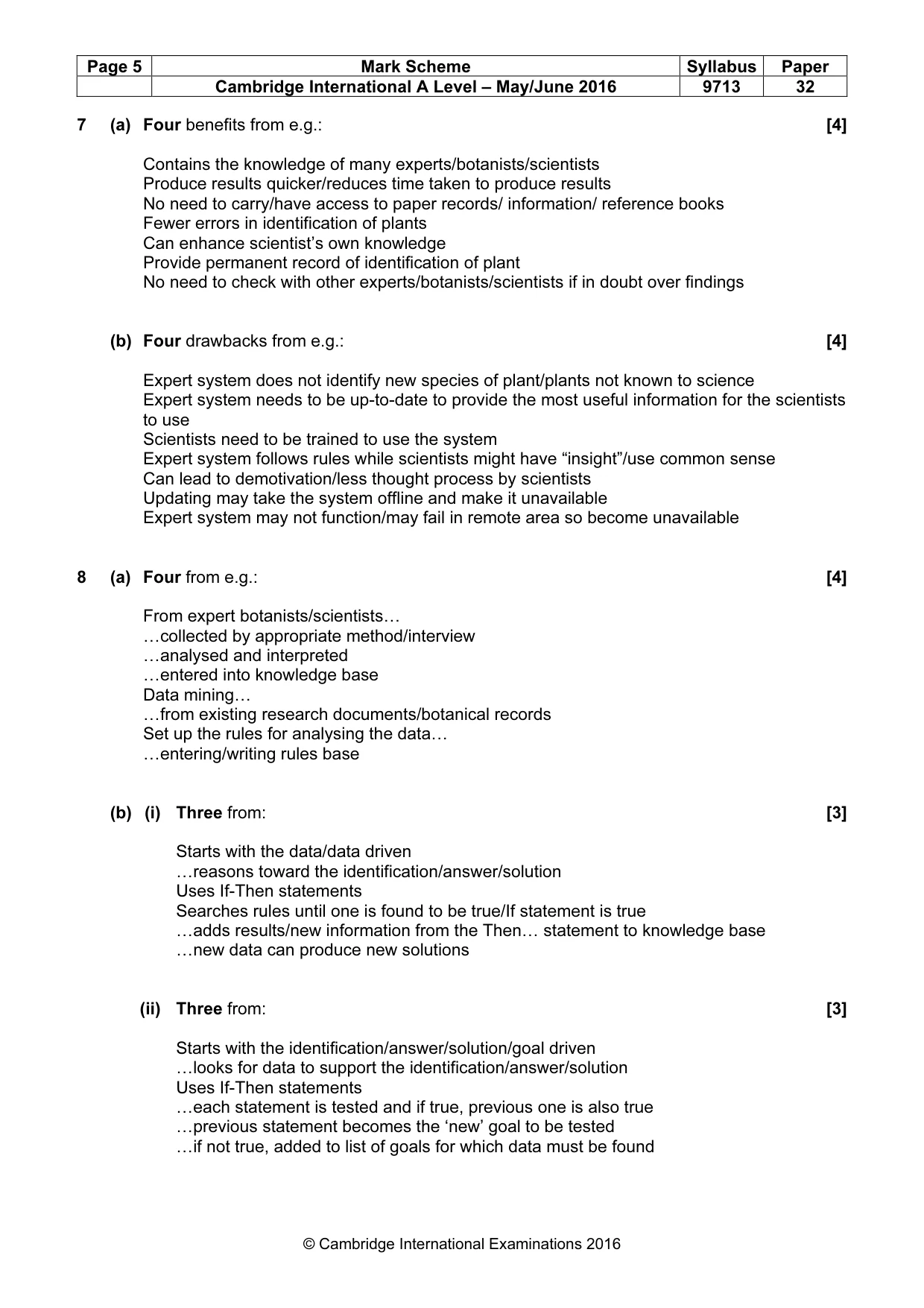
Page 5 Mark Scheme Syllabus Paper Cambridge International A Level – May/June 2016 9713 32 © Cambridge International Examinations 2016 7 (a) Four benefits from e.g.: [4] Contains the knowledge of many experts/botanists/scientists Produce results quicker/reduces time taken to produce results No need to carry/have access to paper records/ information/ reference books Fewer errors in identification of plants Can enhance scientist’s own knowledge Provide permanent record of identification of plant No need to check with other experts/botanists/scientists if in doubt over findings (b) Four drawbacks from e.g.: [4] Expert system does not identify new species of plant/plants not known to science Expert system needs to be up-to-date to provide the most useful information for the scientists to use Scientists need to be trained to use the system Expert system follows rules while scientists might have “insight”/use common sense Can lead to demotivation/less thought process by scientists Updating may take the system offline and make it unavailable Expert system may not function/may fail in remote area so become unavailable 8 (a) Four from e.g.: [4] From expert botanists/scientists… …collected by appropriate method/interview …analysed and interpreted …entered into knowledge base Data mining… …from existing research documents/botanical records Set up the rules for analysing the data… …entering/writing rules base (b) (i) Three from: [3] Starts with the data/data driven …reasons toward the identification/answer/solution Uses If-Then statements Searches rules until one is found to be true/If statement is true …adds results/new information from the Then… statement to knowledge base …new data can produce new solutions (ii) Three from: [3] Starts with the identification/answer/solution/goal driven …looks for data to support the identification/answer/solution Uses If-Then statements …each statement is tested and if true, previous one is also true …previous statement becomes the ‘new’ goal to be tested …if not true, added to list of goals for which data must be found
Mark scheme, page 6
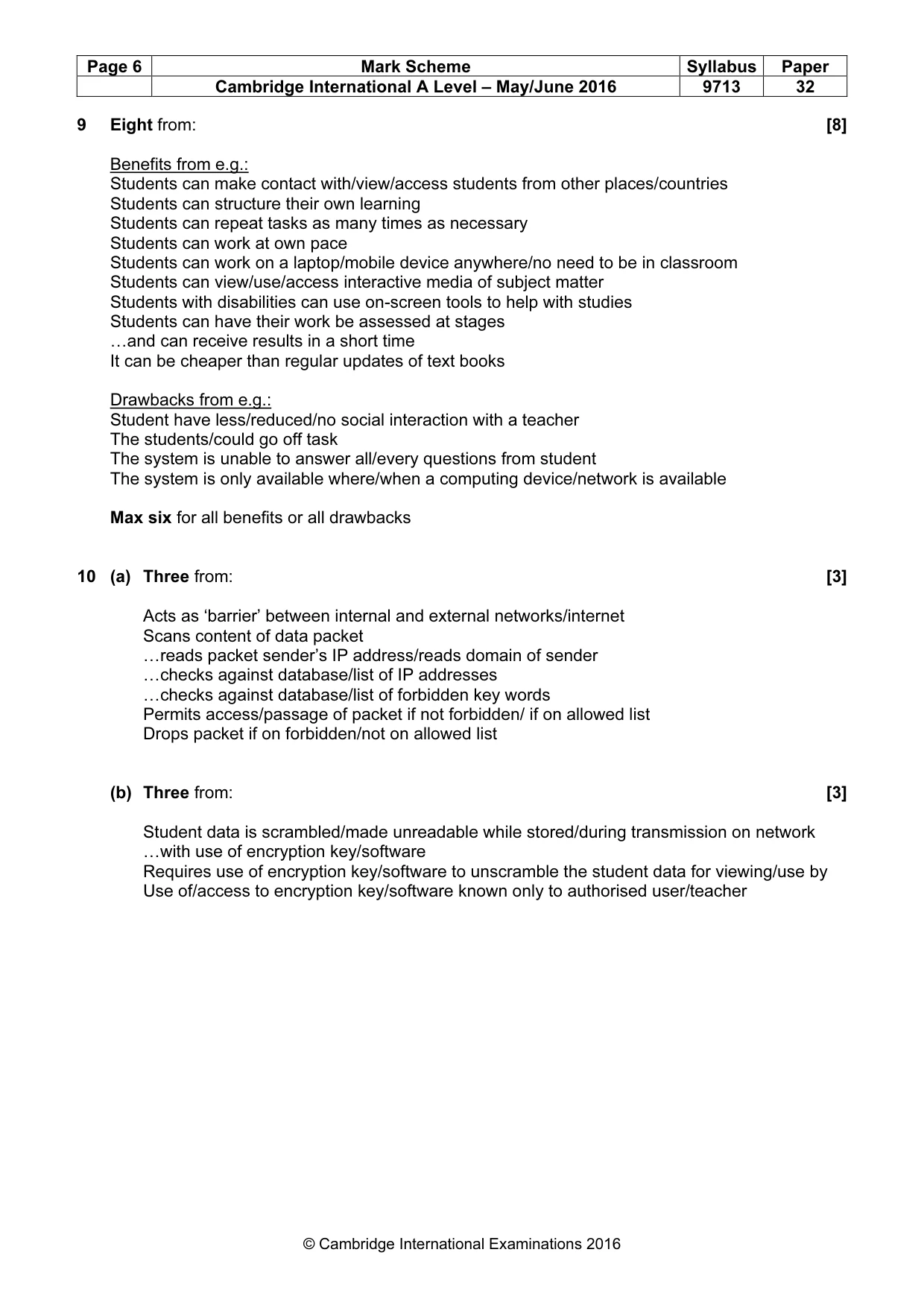
Page 6 Mark Scheme Syllabus Paper Cambridge International A Level – May/June 2016 9713 32 © Cambridge International Examinations 2016 9 Eight from: [8] Benefits from e.g.: Students can make contact with/view/access students from other places/countries Students can structure their own learning Students can repeat tasks as many times as necessary Students can work at own pace Students can work on a laptop/mobile device anywhere/no need to be in classroom Students can view/use/access interactive media of subject matter Students with disabilities can use on-screen tools to help with studies Students can have their work be assessed at stages …and can receive results in a short time It can be cheaper than regular updates of text books Drawbacks from e.g.: Student have less/reduced/no social interaction with a teacher The students/could go off task The system is unable to answer all/every questions from student The system is only available where/when a computing device/network is available Max six for all benefits or all drawbacks 10 (a) Three from: [3] Acts as ‘barrier’ between internal and external networks/internet Scans content of data packet …reads packet sender’s IP address/reads domain of sender …checks against database/list of IP addresses …checks against database/list of forbidden key words Permits access/passage of packet if not forbidden/ if on allowed list Drops packet if on forbidden/not on allowed list (b) Three from: [3] Student data is scrambled/made unreadable while stored/during transmission on network …with use of encryption key/software Requires use of encryption key/software to unscramble the student data for viewing/use by Use of/access to encryption key/software known only to authorised user/teacher
Mark scheme, page 7
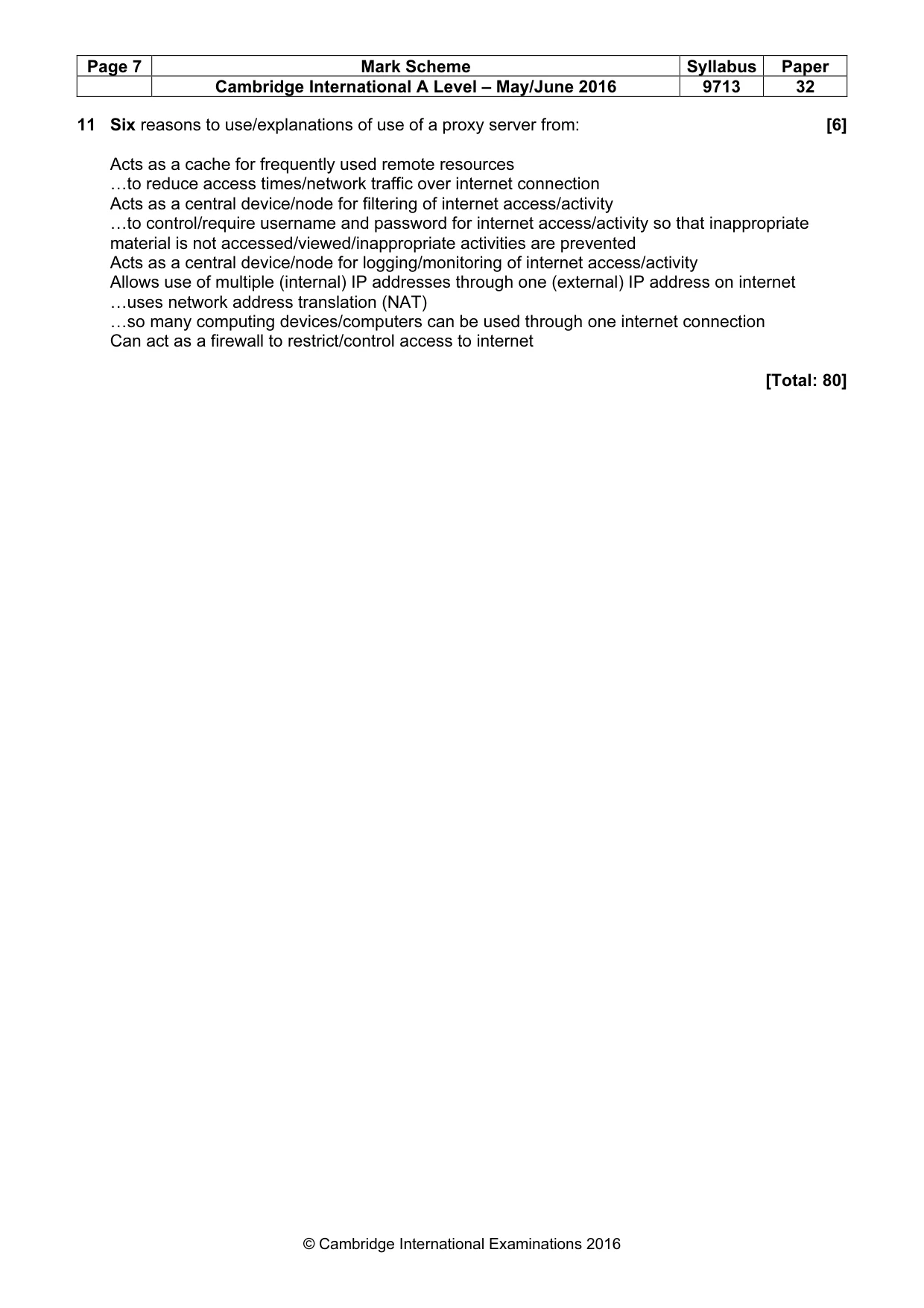
Page 7 Mark Scheme Syllabus Paper Cambridge International A Level – May/June 2016 9713 32 © Cambridge International Examinations 2016 11 Six reasons to use/explanations of use of a proxy server from: [6] Acts as a cache for frequently used remote resources …to reduce access times/network traffic over internet connection Acts as a central device/node for filtering of internet access/activity …to control/require username and password for internet access/activity so that inappropriate material is not accessed/viewed/inappropriate activities are prevented Acts as a central device/node for logging/monitoring of internet access/activity Allows use of multiple (internal) IP addresses through one (external) IP address on internet …uses network address translation (NAT) …so many computing devices/computers can be used through one internet connection Can act as a firewall to restrict/control access to internet [Total: 80]
What you needed in this session
Cambridge’s own grade thresholds for 2016 May/June, Paper 3 · Variant 2. A higher threshold means an easier paper — the bar moves with how the cohort did.