Cambridge A Level Applied Information and Communication Technology 9713 — 2014 Oct/Nov Paper 1 · Variant 2
9713/12/O/N/14 · 80 marks · ≈90 min
The question paper and its mark scheme, free to read here and free to download. This is Cambridge’s own paper, exactly as it was sat.
Question paper16 pages

Mark scheme8 pages
Answers below. Sit the paper first if you are practising.
Paper as text
Question paper, page 1
This document consists of 15 printed pages and 1 blank page. DC (NF) 99988 © UCLES 2014 [Turn over * 2 7 7 6 4 9 8 0 0 8 * APPLIED INFORMATION AND COMMUNICATION TECHNOLOGY 9713/12 Paper 1 October/November 2014 1 hour 15 minutes Candidates answer on the Question Paper. No additional materials are required. READ THESE INSTRUCTIONS FIRST Write your Centre number, candidate number and name on all the work you hand in. Write in dark blue or black pen. Do not use staples, paper clips, glue or correction fluid. You may use a pencil for any diagrams, graphs or rough working. DO NOT WRITE IN ANY BARCODES. Answer all questions. The number of marks is given in brackets [ ] at the end of each question or part question. The businesses described in this paper are entirely fictitious. Cambridge International Examinations Cambridge International Advanced Level
Question paper, page 2
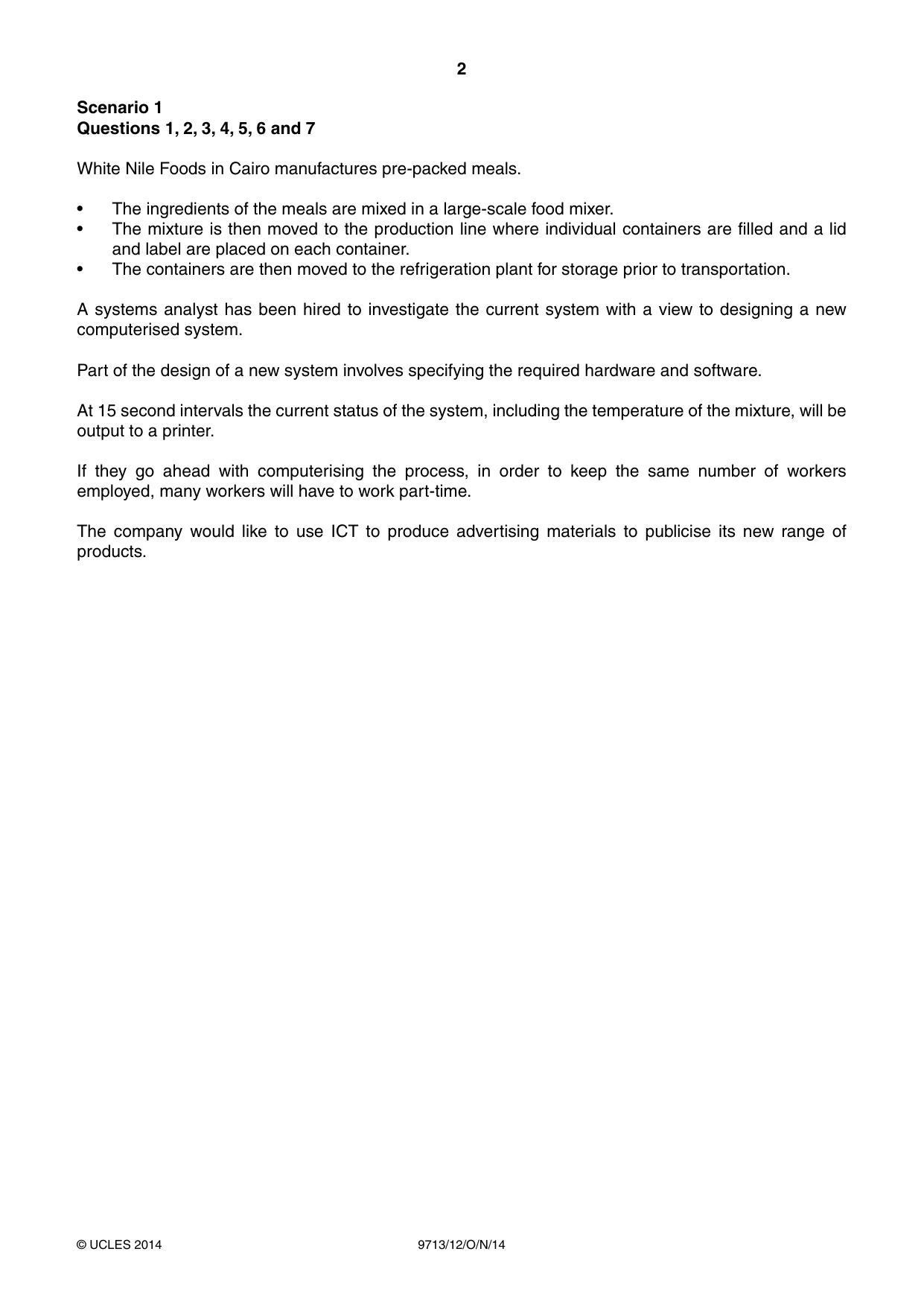
2 9713/12/O/N/14 © UCLES 2014 Scenario 1 Questions 1, 2, 3, 4, 5, 6 and 7 White Nile Foods in Cairo manufactures pre-packed meals. • The ingredients of the meals are mixed in a large-scale food mixer. • The mixture is then moved to the production line where individual containers are filled and a lid and label are placed on each container. • The containers are then moved to the refrigeration plant for storage prior to transportation. A systems analyst has been hired to investigate the current system with a view to designing a new computerised system. Part of the design of a new system involves specifying the required hardware and software. At 15 second intervals the current status of the system, including the temperature of the mixture, will be output to a printer. If they go ahead with computerising the process, in order to keep the same number of workers employed, many workers will have to work part-time. The company would like to use ICT to produce advertising materials to publicise its new range of products.
Question paper, page 3
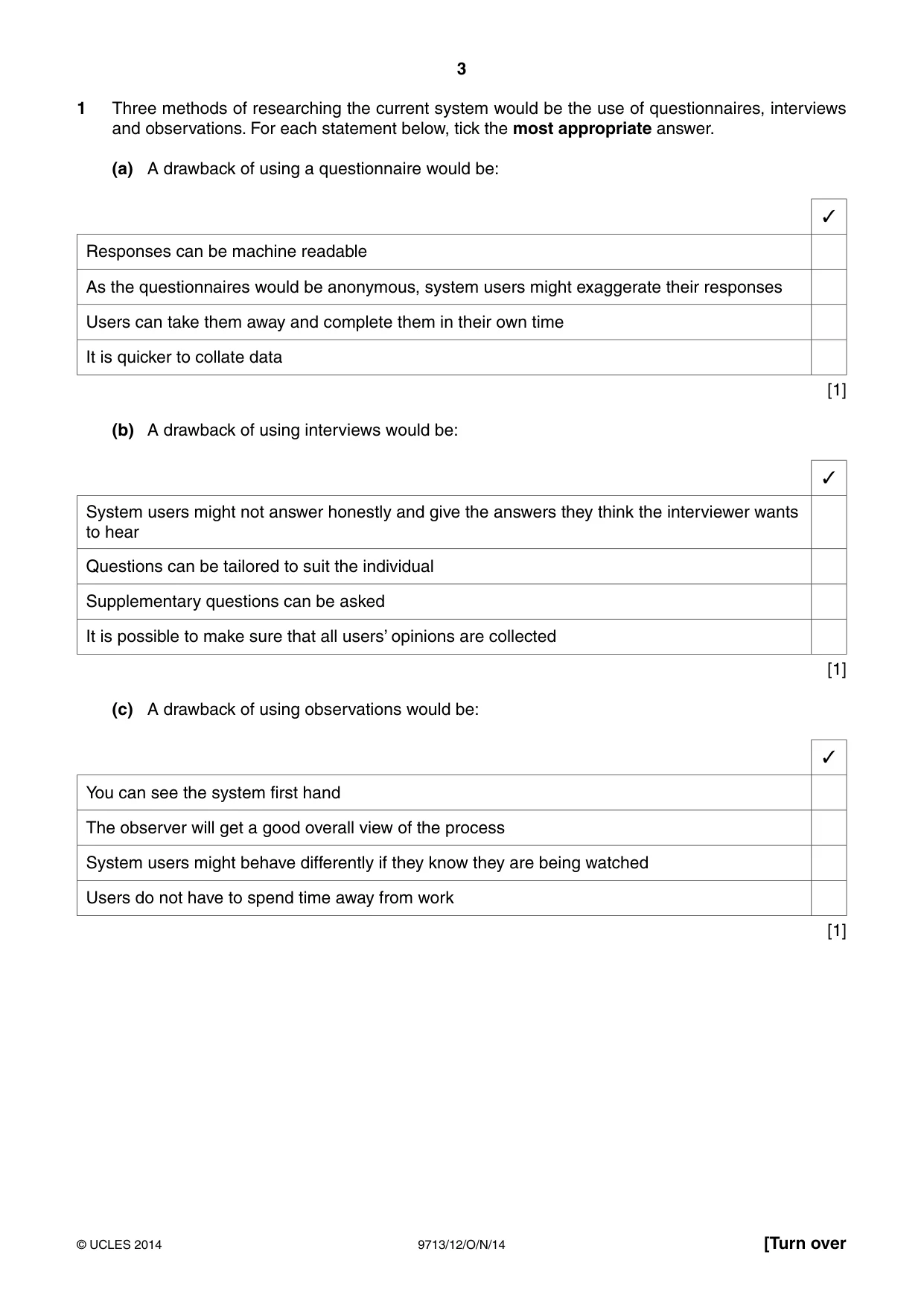
3 9713/12/O/N/14 © UCLES 2014 [Turn over 1 Three methods of researching the current system would be the use of questionnaires, interviews and observations. For each statement below, tick the most appropriate answer. (a) A drawback of using a questionnaire would be: ✓ Responses can be machine readable As the questionnaires would be anonymous, system users might exaggerate their responses Users can take them away and complete them in their own time It is quicker to collate data [1] (b) A drawback of using interviews would be: ✓ System users might not answer honestly and give the answers they think the interviewer wants to hear Questions can be tailored to suit the individual Supplementary questions can be asked It is possible to make sure that all users’ opinions are collected [1] (c) A drawback of using observations would be: ✓ You can see the system first hand The observer will get a good overall view of the process System users might behave differently if they know they are being watched Users do not have to spend time away from work [1]
Question paper, page 4
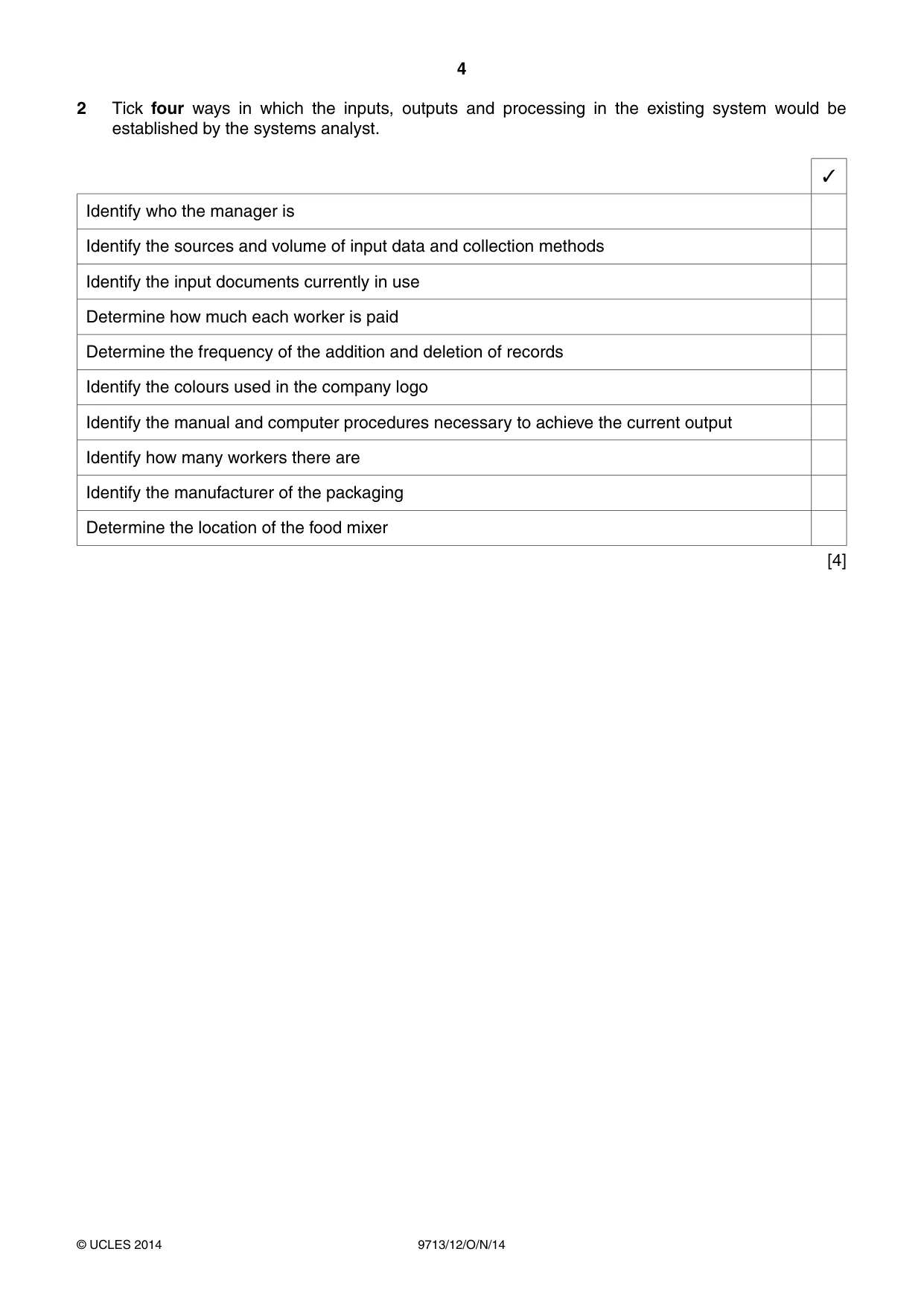
4 9713/12/O/N/14 © UCLES 2014 2 Tick four ways in which the inputs, outputs and processing in the existing system would be established by the systems analyst. ✓ Identify who the manager is Identify the sources and volume of input data and collection methods Identify the input documents currently in use Determine how much each worker is paid Determine the frequency of the addition and deletion of records Identify the colours used in the company logo Identify the manual and computer procedures necessary to achieve the current output Identify how many workers there are Identify the manufacturer of the packaging Determine the location of the food mixer [4]
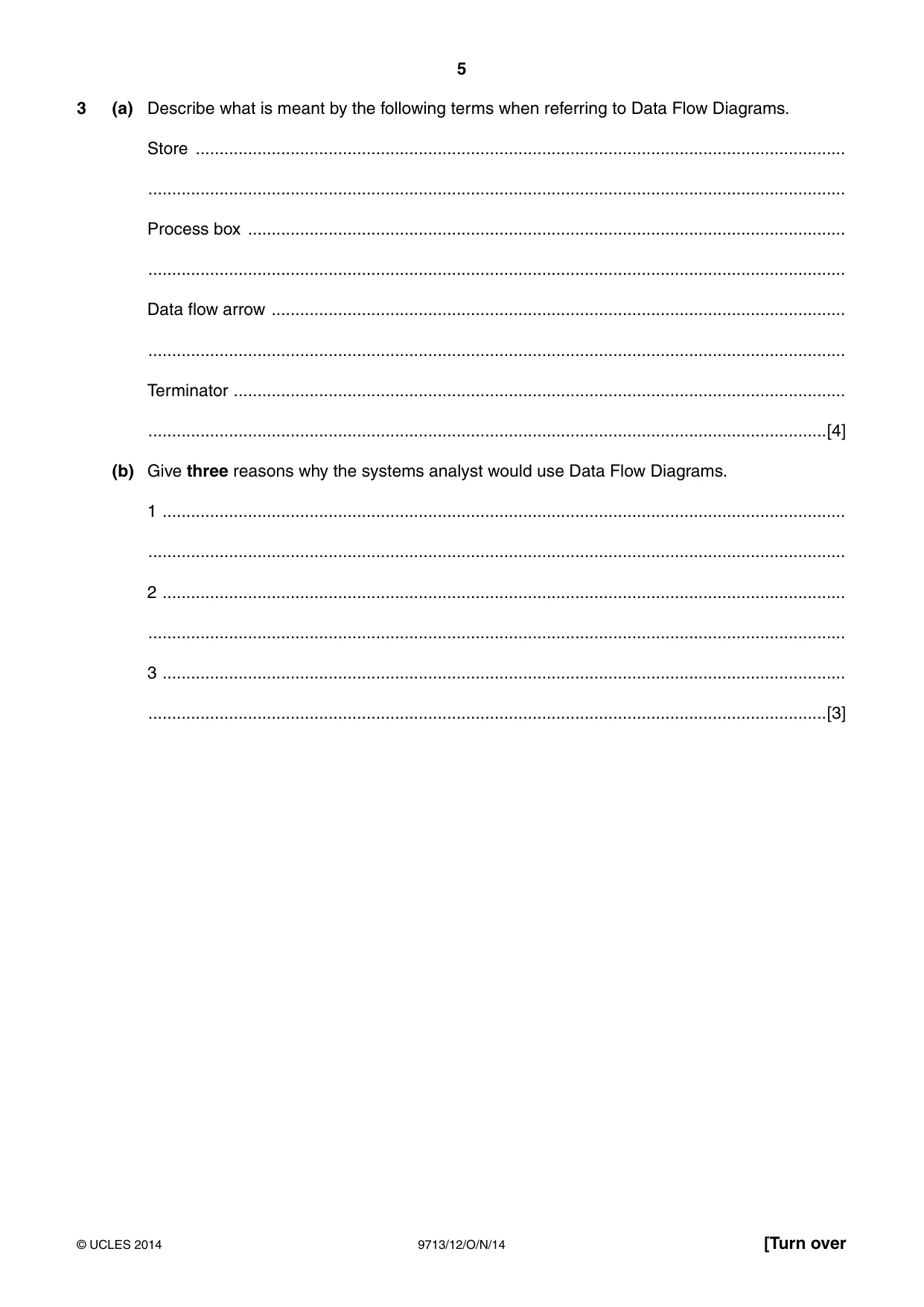
Question paper, page 5
5 9713/12/O/N/14 © UCLES 2014 [Turn over 3 (a) Describe what is meant by the following terms when referring to Data Flow Diagrams. Store … … Process box … … Data flow arrow … … Terminator … …[4] (b) Give three reasons why the systems analyst would use Data Flow Diagrams. 1 … … 2 … … 3 … …[3]
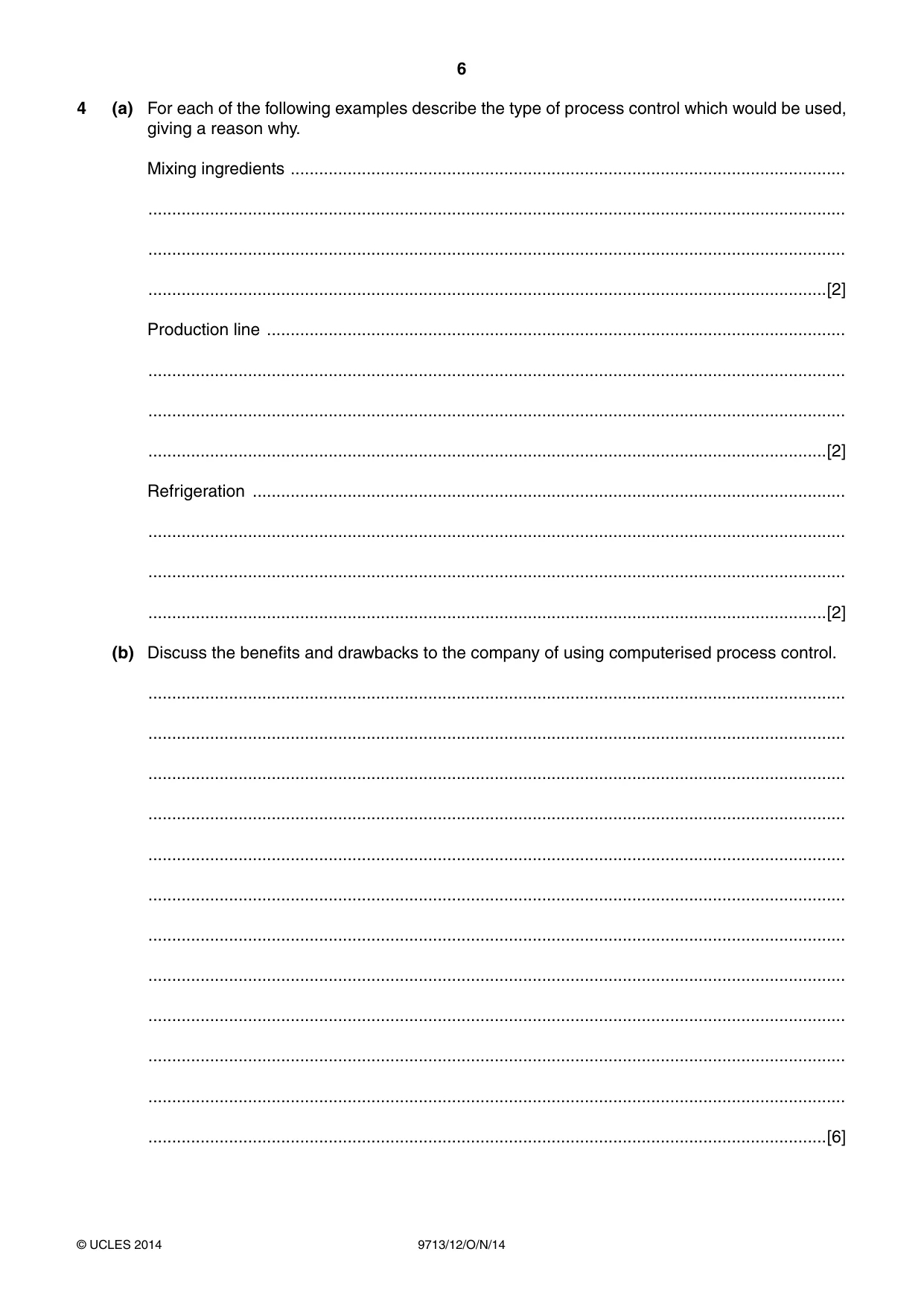
Question paper, page 6
6 9713/12/O/N/14 © UCLES 2014 4 (a) For each of the following examples describe the type of process control which would be used, giving a reason why. Mixing ingredients … … … …[2] Production line … … … …[2] Refrigeration … … … …[2] (b) Discuss the benefits and drawbacks to the company of using computerised process control. … … … … … … … … … … … …[6]
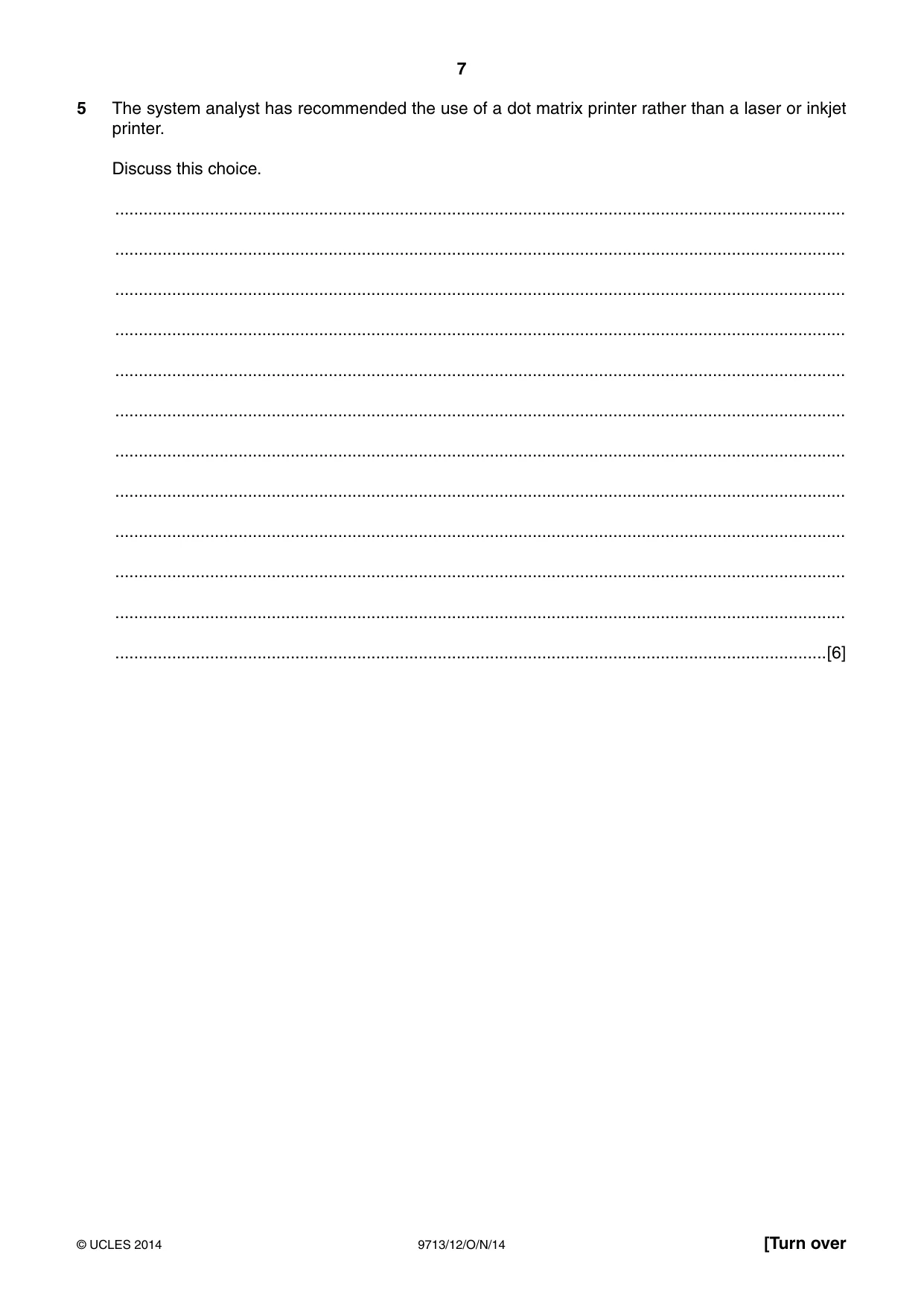
Question paper, page 7
7 9713/12/O/N/14 © UCLES 2014 [Turn over 5 The system analyst has recommended the use of a dot matrix printer rather than a laser or inkjet printer. Discuss this choice. … … … … … … … … … … … …[6]
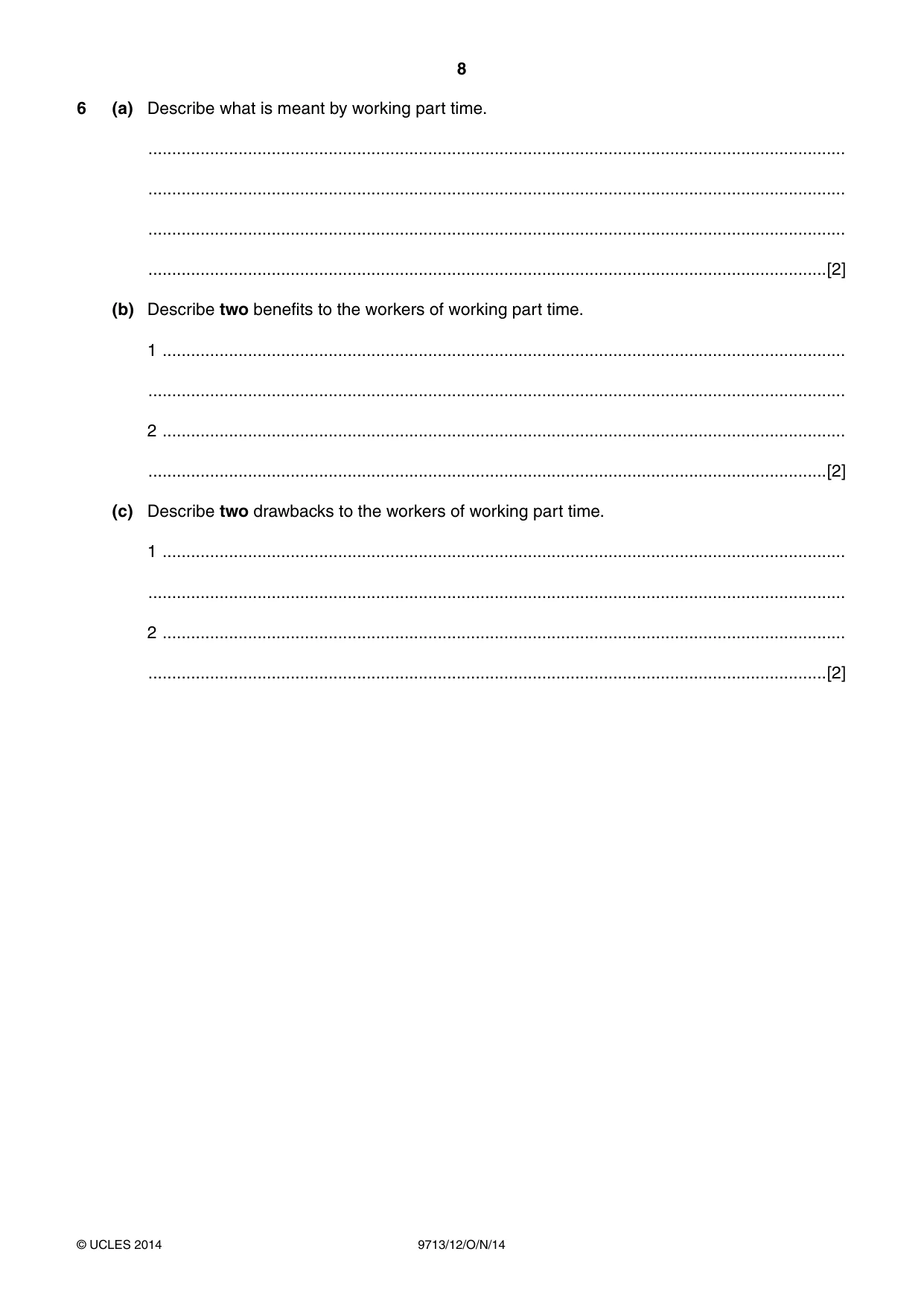
Question paper, page 8
8 9713/12/O/N/14 © UCLES 2014 6 (a) Describe what is meant by working part time. … … … …[2] (b) Describe two benefits to the workers of working part time. 1 … … 2 … …[2] (c) Describe two drawbacks to the workers of working part time. 1 … … 2 … …[2]
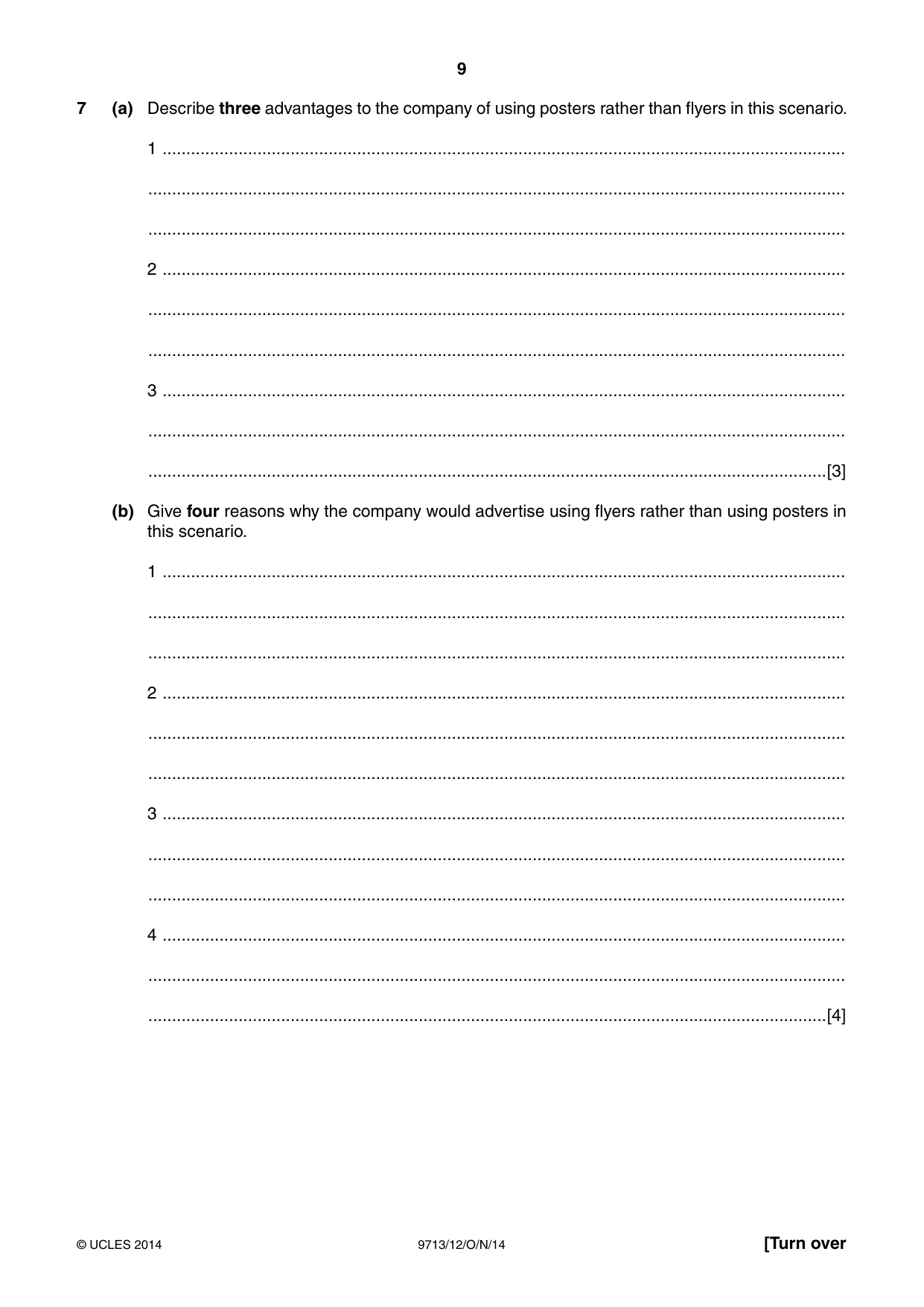
Question paper, page 9
9 9713/12/O/N/14 © UCLES 2014 [Turn over 7 (a) Describe three advantages to the company of using posters rather than flyers in this scenario. 1 … … … 2 … … … 3 … … …[3] (b) Give four reasons why the company would advertise using flyers rather than using posters in this scenario. 1 … … … 2 … … … 3 … … … 4 … … …[4]
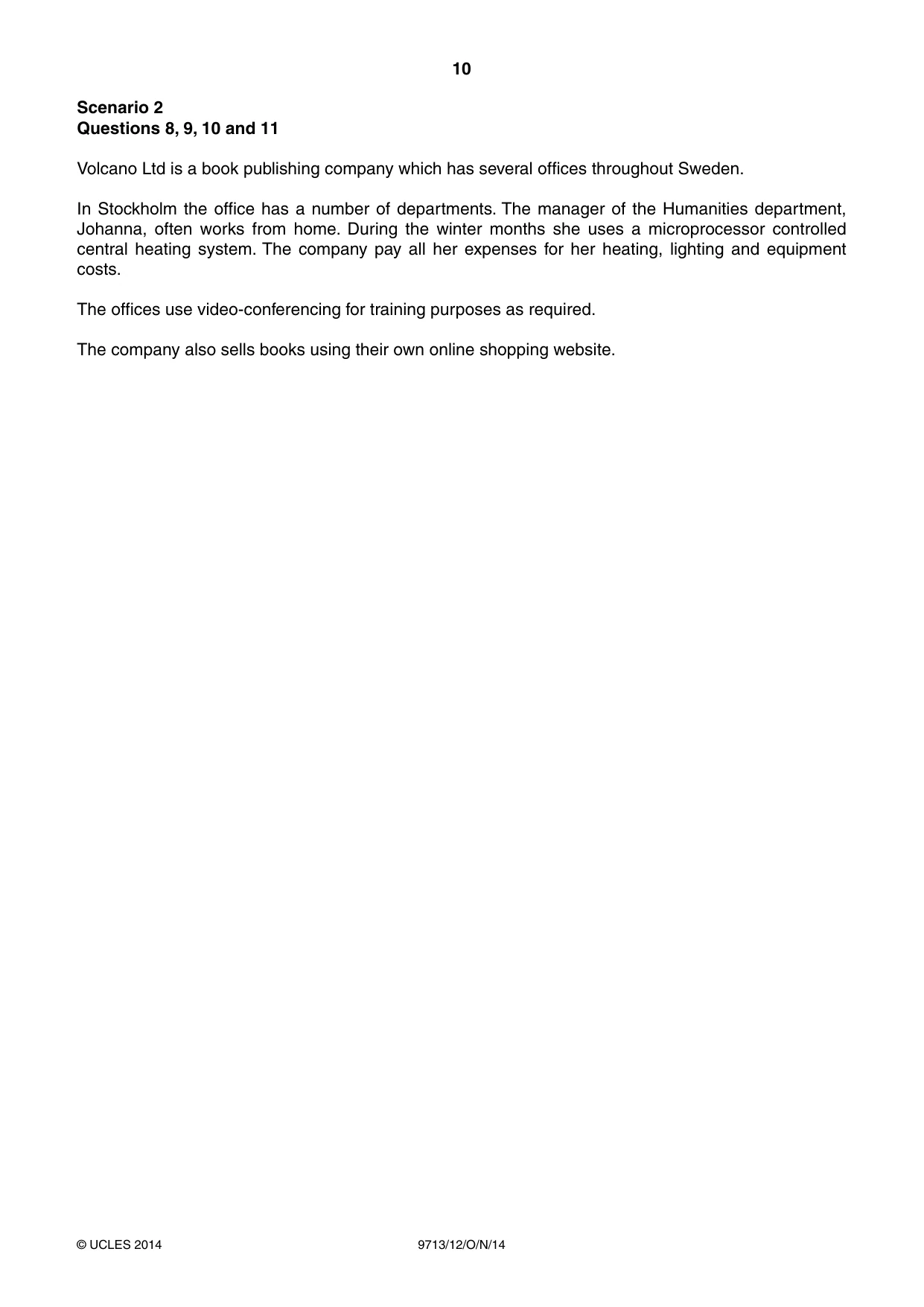
Question paper, page 10
10 9713/12/O/N/14 © UCLES 2014 Scenario 2 Questions 8, 9, 10 and 11 Volcano Ltd is a book publishing company which has several offices throughout Sweden. In Stockholm the office has a number of departments. The manager of the Humanities department, Johanna, often works from home. During the winter months she uses a microprocessor controlled central heating system. The company pay all her expenses for her heating, lighting and equipment costs. The offices use video-conferencing for training purposes as required. The company also sells books using their own online shopping website.
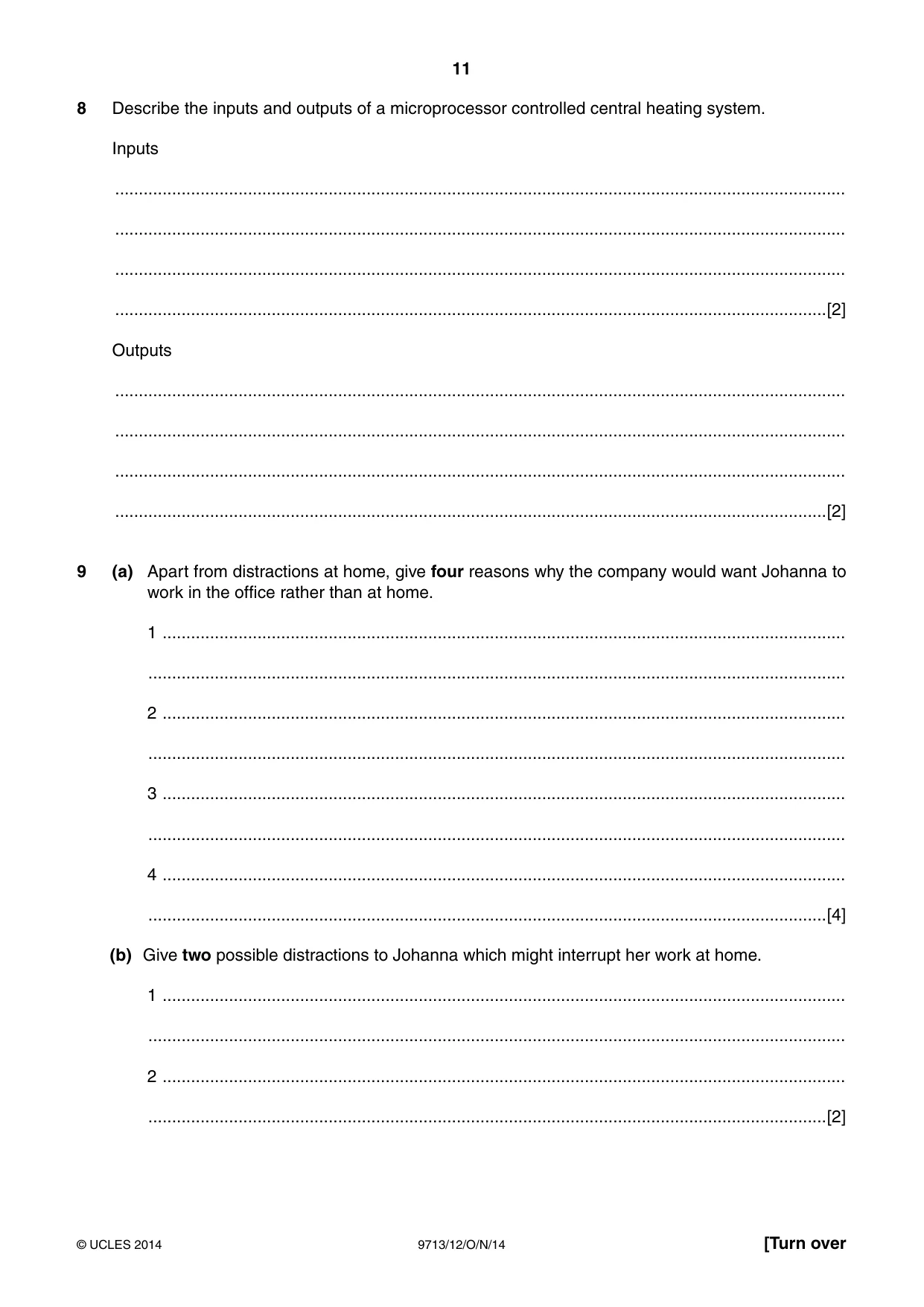
Question paper, page 11
11 9713/12/O/N/14 © UCLES 2014 [Turn over 8 Describe the inputs and outputs of a microprocessor controlled central heating system. Inputs … … … …[2] Outputs … … … …[2] 9 (a) Apart from distractions at home, give four reasons why the company would want Johanna to work in the office rather than at home. 1 … … 2 … … 3 … … 4 … …[4] (b) Give two possible distractions to Johanna which might interrupt her work at home. 1 … … 2 … …[2]
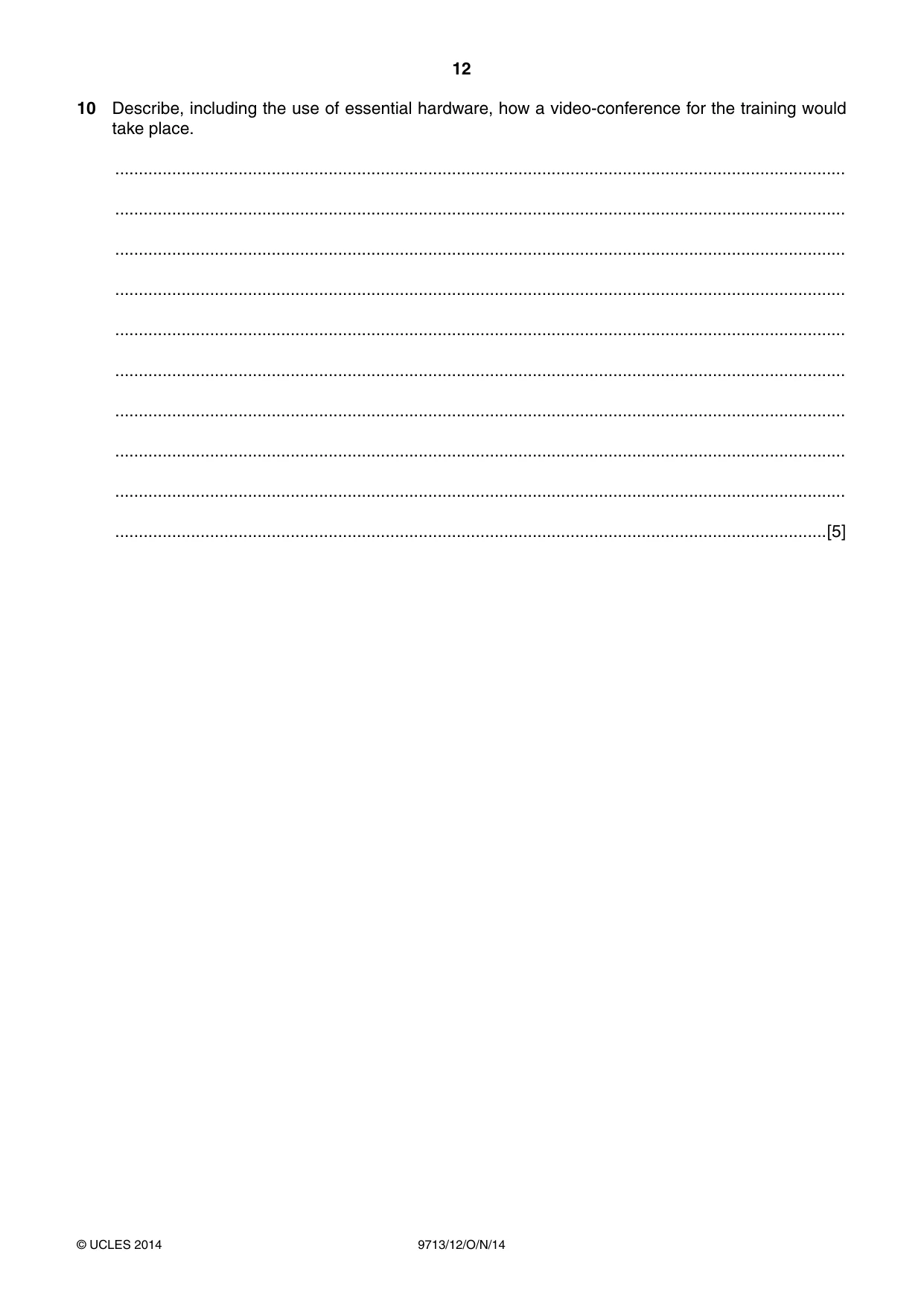
Question paper, page 12
12 9713/12/O/N/14 © UCLES 2014 10 Describe, including the use of essential hardware, how a video-conference for the training would take place. … … … … … … … … … …[5]
Question paper, page 13
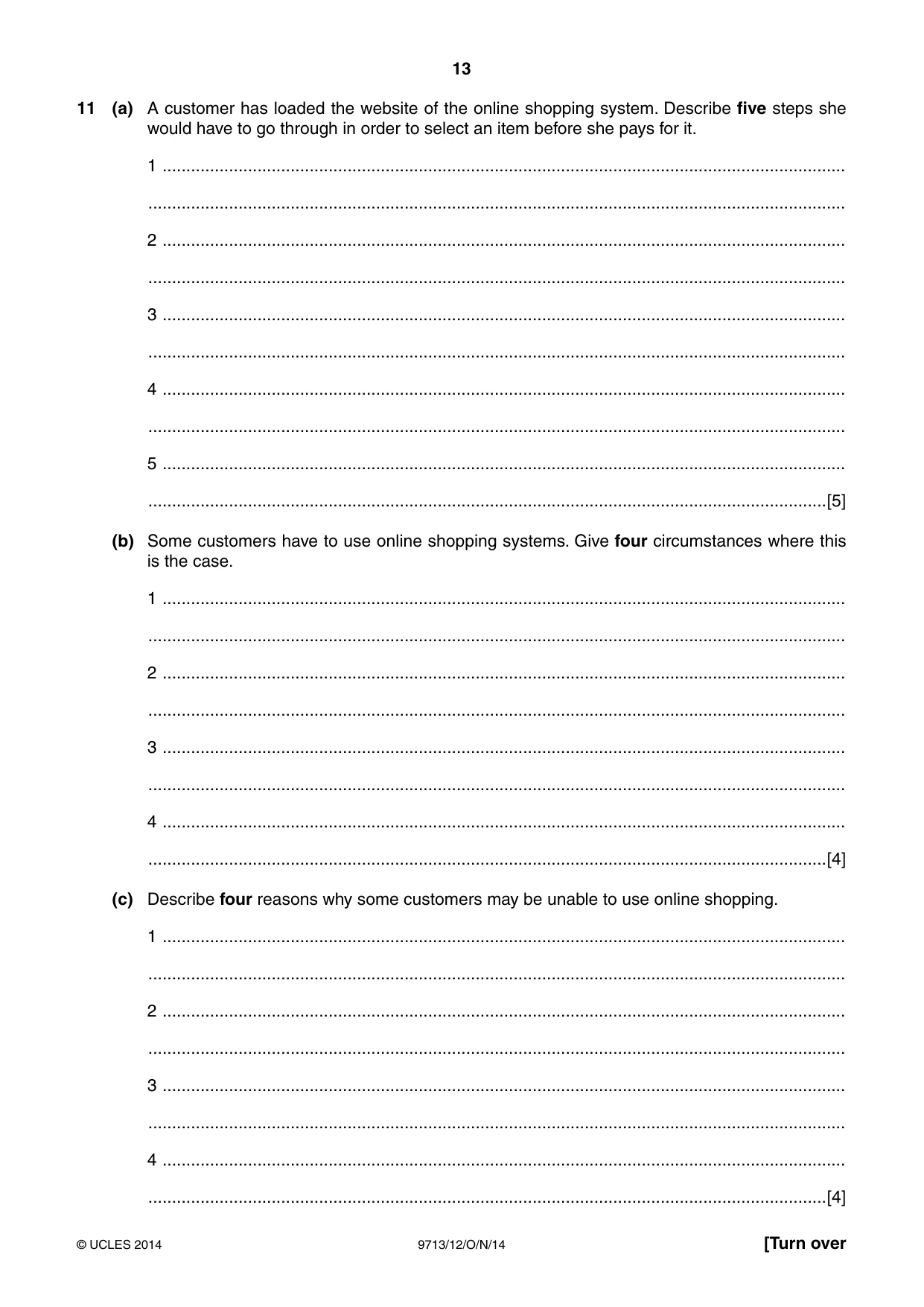
13 9713/12/O/N/14 © UCLES 2014 [Turn over 11 (a) A customer has loaded the website of the online shopping system. Describe five steps she would have to go through in order to select an item before she pays for it. 1 … … 2 … … 3 … … 4 … … 5 … …[5] (b) Some customers have to use online shopping systems. Give four circumstances where this is the case. 1 … … 2 … … 3 … … 4 … …[4] (c) Describe four reasons why some customers may be unable to use online shopping. 1 … … 2 … … 3 … … 4 … …[4]
Question paper, page 14
14 9713/12/O/N/14 © UCLES 2014 Scenario 3 Question 12 China News is a newspaper produced in Beijing. The owners have printing presses in a number of other Chinese cities. After journalists type up their stories they submit them to the editor including the photographs they have used. After the newspaper layout is completed, satellites are used to send it for printing.
Question paper, page 15
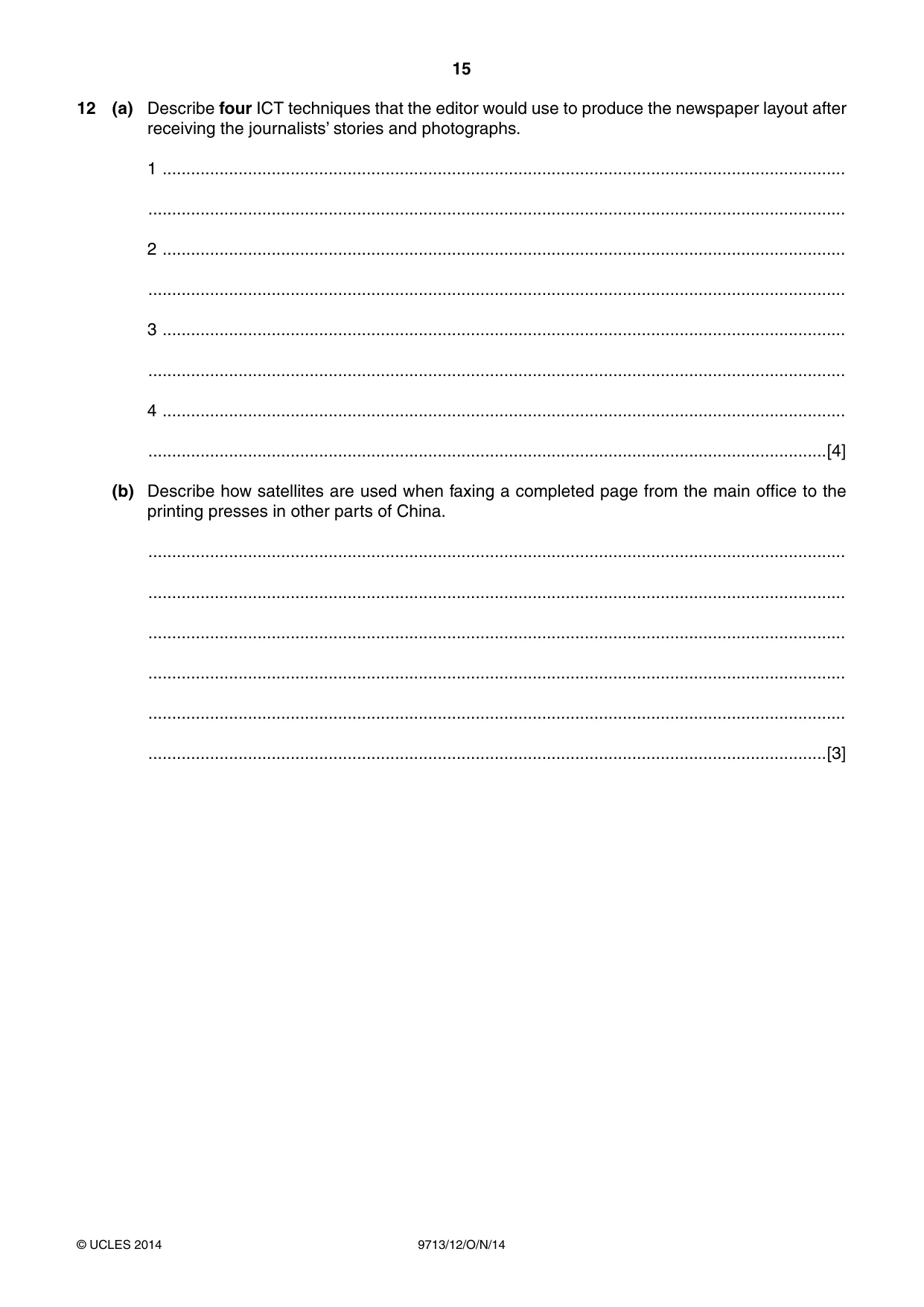
15 9713/12/O/N/14 © UCLES 2014 12 (a) Describe four ICT techniques that the editor would use to produce the newspaper layout after receiving the journalists’ stories and photographs. 1 … … 2 … … 3 … … 4 … …[4] (b) Describe how satellites are used when faxing a completed page from the main office to the printing presses in other parts of China. … … … … … …[3]
Question paper, page 16
16 9713/12/O/N/14 © UCLES 2014 BLANK PAGE Permission to reproduce items where third-party owned material protected by copyright is included has been sought and cleared where possible. Every reasonable effort has been made by the publisher (UCLES) to trace copyright holders, but if any items requiring clearance have unwittingly been included, the publisher will be pleased to make amends at the earliest possible opportunity. Cambridge International Examinations is part of the Cambridge Assessment Group. Cambridge Assessment is the brand name of University of Cambridge Local Examinations Syndicate (UCLES), which is itself a department of the University of Cambridge.
Mark scheme, page 1
® IGCSE is the registered trademark of Cambridge International Examinations. CAMBRIDGE INTERNATIONAL EXAMINATIONS Cambridge International Advanced Subsidiary and Advanced Level MARK SCHEME for the October/November 2014 series 9713 APPLIED INFORMATION AND COMMUNICATION TECHNOLOGY 9713/12 Paper 1 (Written A), maximum raw mark 80 This mark scheme is published as an aid to teachers and candidates, to indicate the requirements of the examination. It shows the basis on which Examiners were instructed to award marks. It does not indicate the details of the discussions that took place at an Examiners’ meeting before marking began, which would have considered the acceptability of alternative answers. Mark schemes should be read in conjunction with the question paper and the Principal Examiner Report for Teachers. Cambridge will not enter into discussions about these mark schemes. Cambridge is publishing the mark schemes for the October/November 2014 series for most Cambridge IGCSE®, Cambridge International A and AS Level components and some Cambridge O Level components.
Mark scheme, page 2
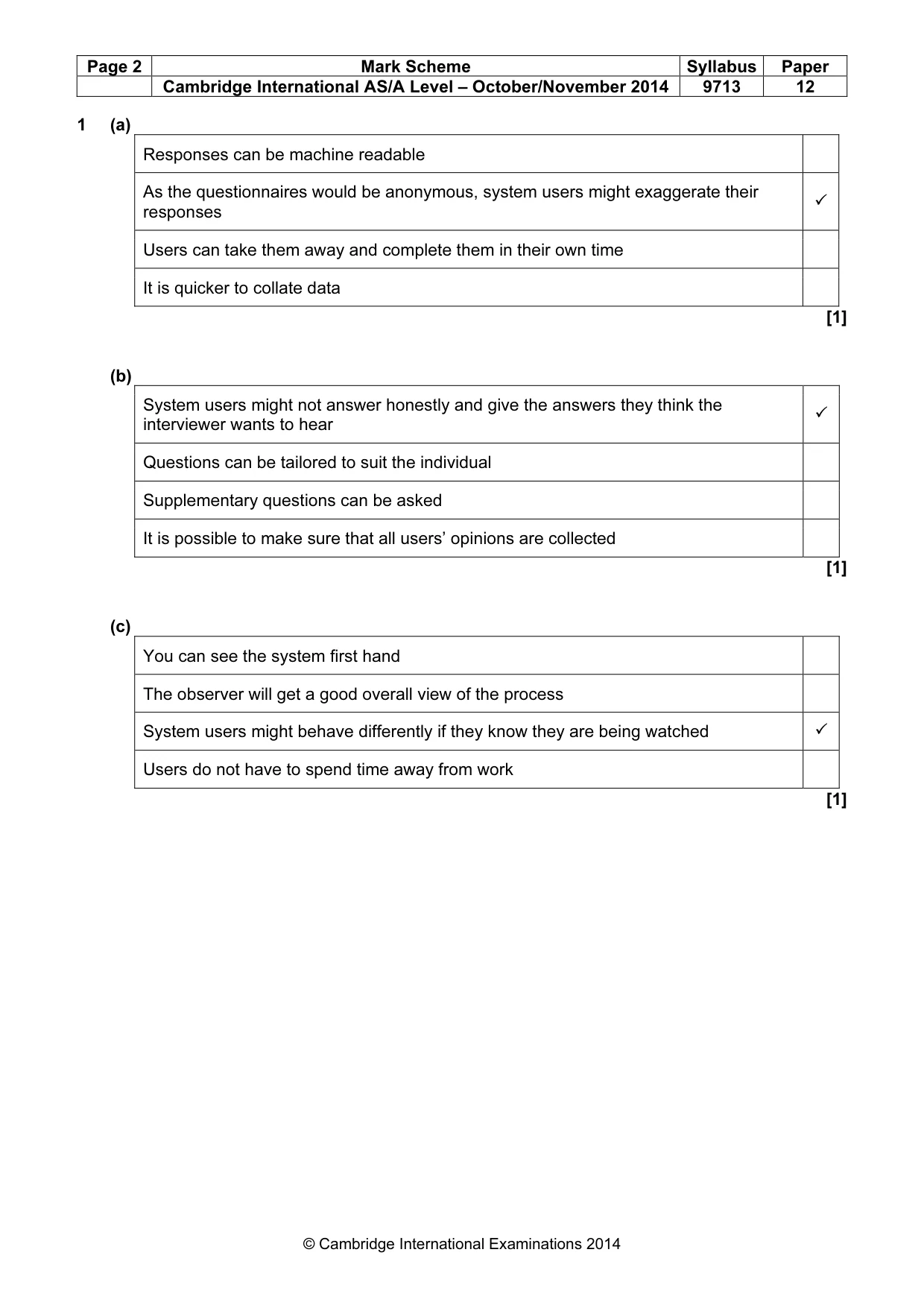
Page 2 Mark Scheme Syllabus Paper Cambridge International AS/A Level – October/November 2014 9713 12 © Cambridge International Examinations 2014 1 (a) Responses can be machine readable As the questionnaires would be anonymous, system users might exaggerate their responses ✓ Users can take them away and complete them in their own time It is quicker to collate data [1] (b) System users might not answer honestly and give the answers they think the interviewer wants to hear ✓ Questions can be tailored to suit the individual Supplementary questions can be asked It is possible to make sure that all users’ opinions are collected [1] (c) You can see the system first hand The observer will get a good overall view of the process System users might behave differently if they know they are being watched ✓ Users do not have to spend time away from work [1]
Mark scheme, page 3
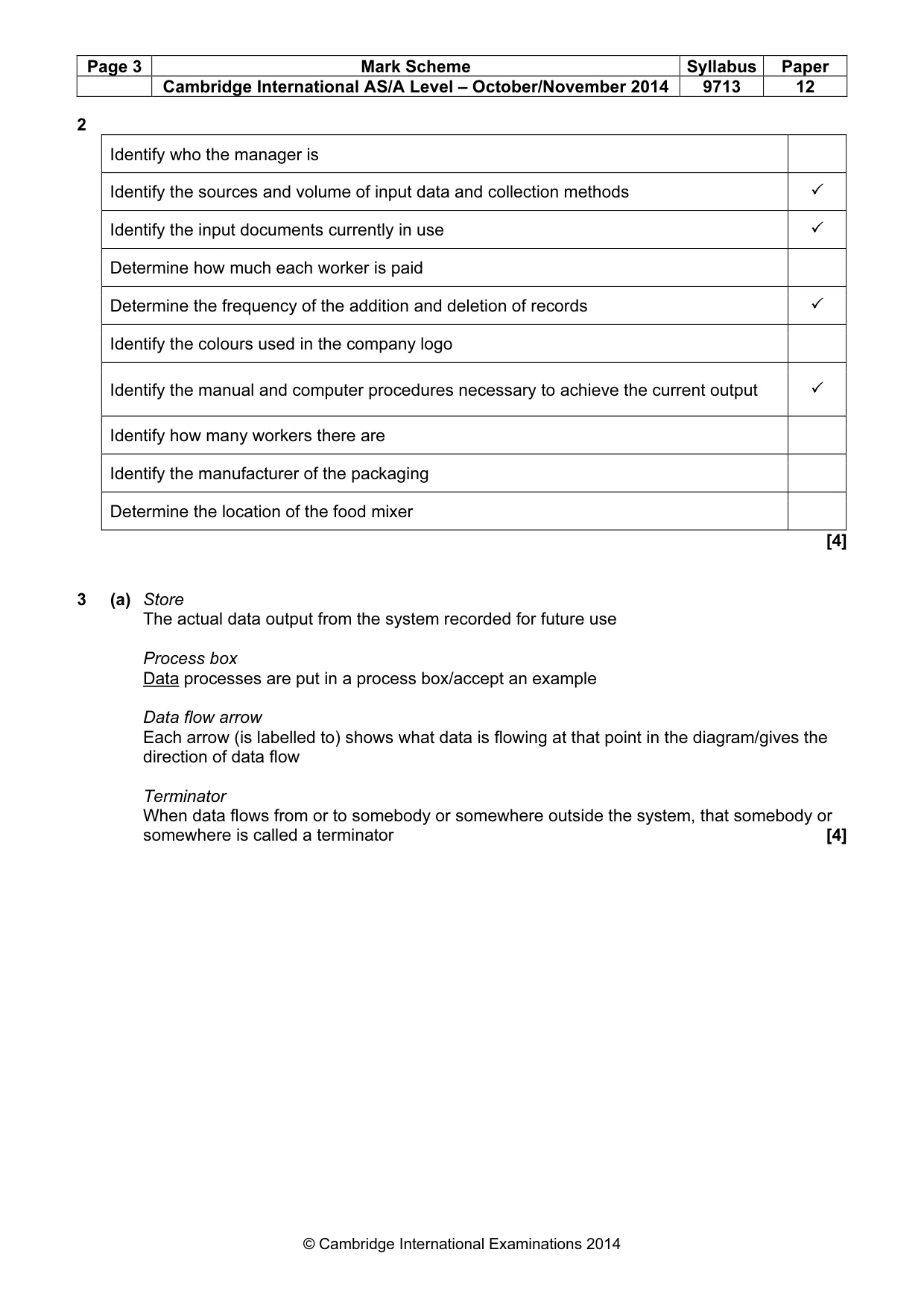
Page 3 Mark Scheme Syllabus Paper Cambridge International AS/A Level – October/November 2014 9713 12 © Cambridge International Examinations 2014 2 Identify who the manager is Identify the sources and volume of input data and collection methods ✓ Identify the input documents currently in use ✓ Determine how much each worker is paid Determine the frequency of the addition and deletion of records ✓ Identify the colours used in the company logo Identify the manual and computer procedures necessary to achieve the current output ✓ Identify how many workers there are Identify the manufacturer of the packaging Determine the location of the food mixer [4] 3 (a) Store The actual data output from the system recorded for future use Process box Data processes are put in a process box/accept an example Data flow arrow Each arrow (is labelled to) shows what data is flowing at that point in the diagram/gives the direction of data flow Terminator When data flows from or to somebody or somewhere outside the system, that somebody or somewhere is called a terminator [4]
Mark scheme, page 4
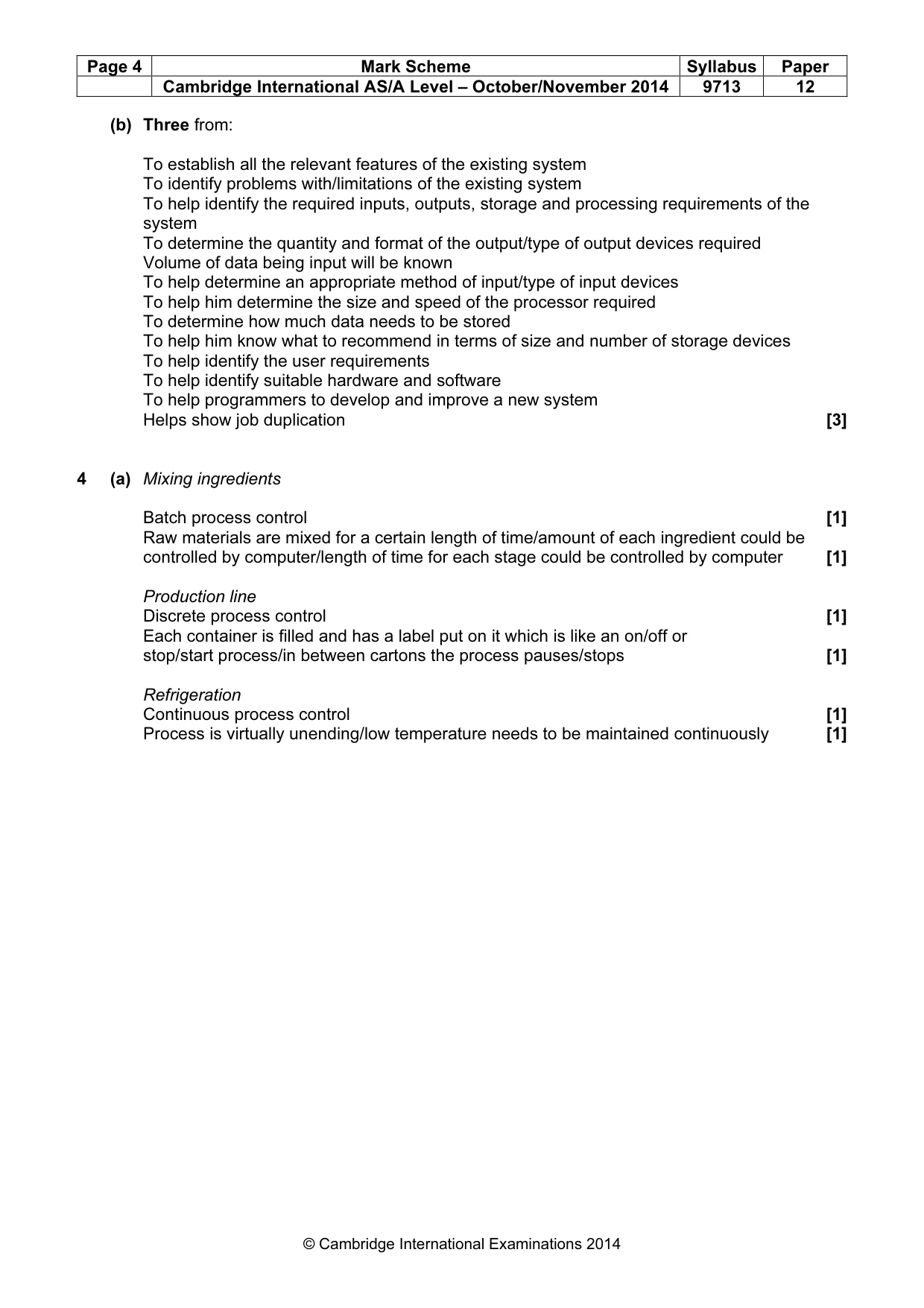
Page 4 Mark Scheme Syllabus Paper Cambridge International AS/A Level – October/November 2014 9713 12 © Cambridge International Examinations 2014 (b) Three from: To establish all the relevant features of the existing system To identify problems with/limitations of the existing system To help identify the required inputs, outputs, storage and processing requirements of the system To determine the quantity and format of the output/type of output devices required Volume of data being input will be known To help determine an appropriate method of input/type of input devices To help him determine the size and speed of the processor required To determine how much data needs to be stored To help him know what to recommend in terms of size and number of storage devices To help identify the user requirements To help identify suitable hardware and software To help programmers to develop and improve a new system Helps show job duplication [3] 4 (a) Mixing ingredients Batch process control [1] Raw materials are mixed for a certain length of time/amount of each ingredient could be controlled by computer/length of time for each stage could be controlled by computer [1] Production line Discrete process control [1] Each container is filled and has a label put on it which is like an on/off or stop/start process/in between cartons the process pauses/stops [1] Refrigeration Continuous process control [1] Process is virtually unending/low temperature needs to be maintained continuously [1]
Mark scheme, page 5
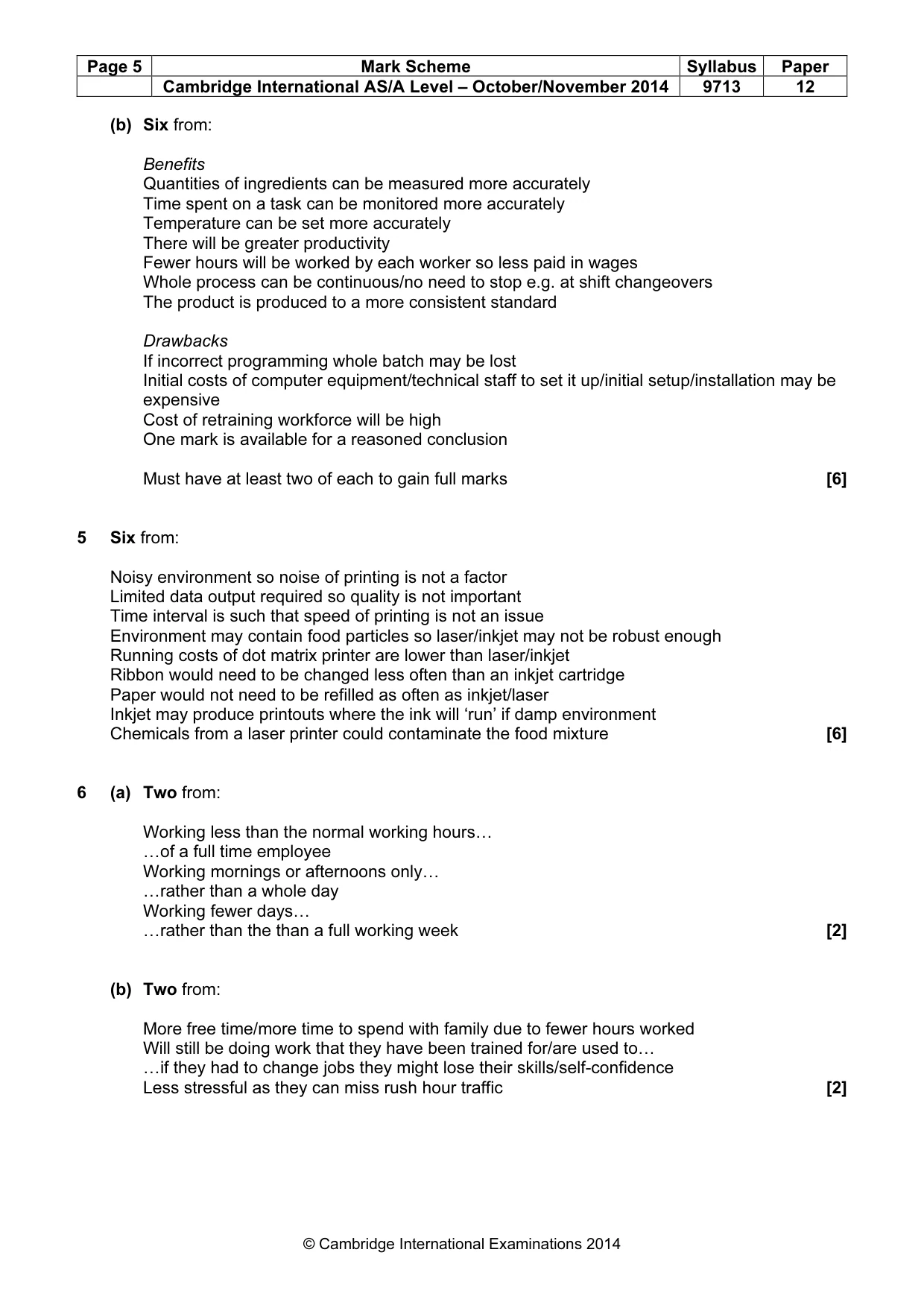
Page 5 Mark Scheme Syllabus Paper Cambridge International AS/A Level – October/November 2014 9713 12 © Cambridge International Examinations 2014 (b) Six from: Benefits Quantities of ingredients can be measured more accurately Time spent on a task can be monitored more accurately Temperature can be set more accurately There will be greater productivity Fewer hours will be worked by each worker so less paid in wages Whole process can be continuous/no need to stop e.g. at shift changeovers The product is produced to a more consistent standard Drawbacks If incorrect programming whole batch may be lost Initial costs of computer equipment/technical staff to set it up/initial setup/installation may be expensive Cost of retraining workforce will be high One mark is available for a reasoned conclusion Must have at least two of each to gain full marks [6] 5 Six from: Noisy environment so noise of printing is not a factor Limited data output required so quality is not important Time interval is such that speed of printing is not an issue Environment may contain food particles so laser/inkjet may not be robust enough Running costs of dot matrix printer are lower than laser/inkjet Ribbon would need to be changed less often than an inkjet cartridge Paper would not need to be refilled as often as inkjet/laser Inkjet may produce printouts where the ink will ‘run’ if damp environment Chemicals from a laser printer could contaminate the food mixture [6] 6 (a) Two from: Working less than the normal working hours… …of a full time employee Working mornings or afternoons only… …rather than a whole day Working fewer days… …rather than the than a full working week [2] (b) Two from: More free time/more time to spend with family due to fewer hours worked Will still be doing work that they have been trained for/are used to… …if they had to change jobs they might lose their skills/self-confidence Less stressful as they can miss rush hour traffic [2]
Mark scheme, page 6
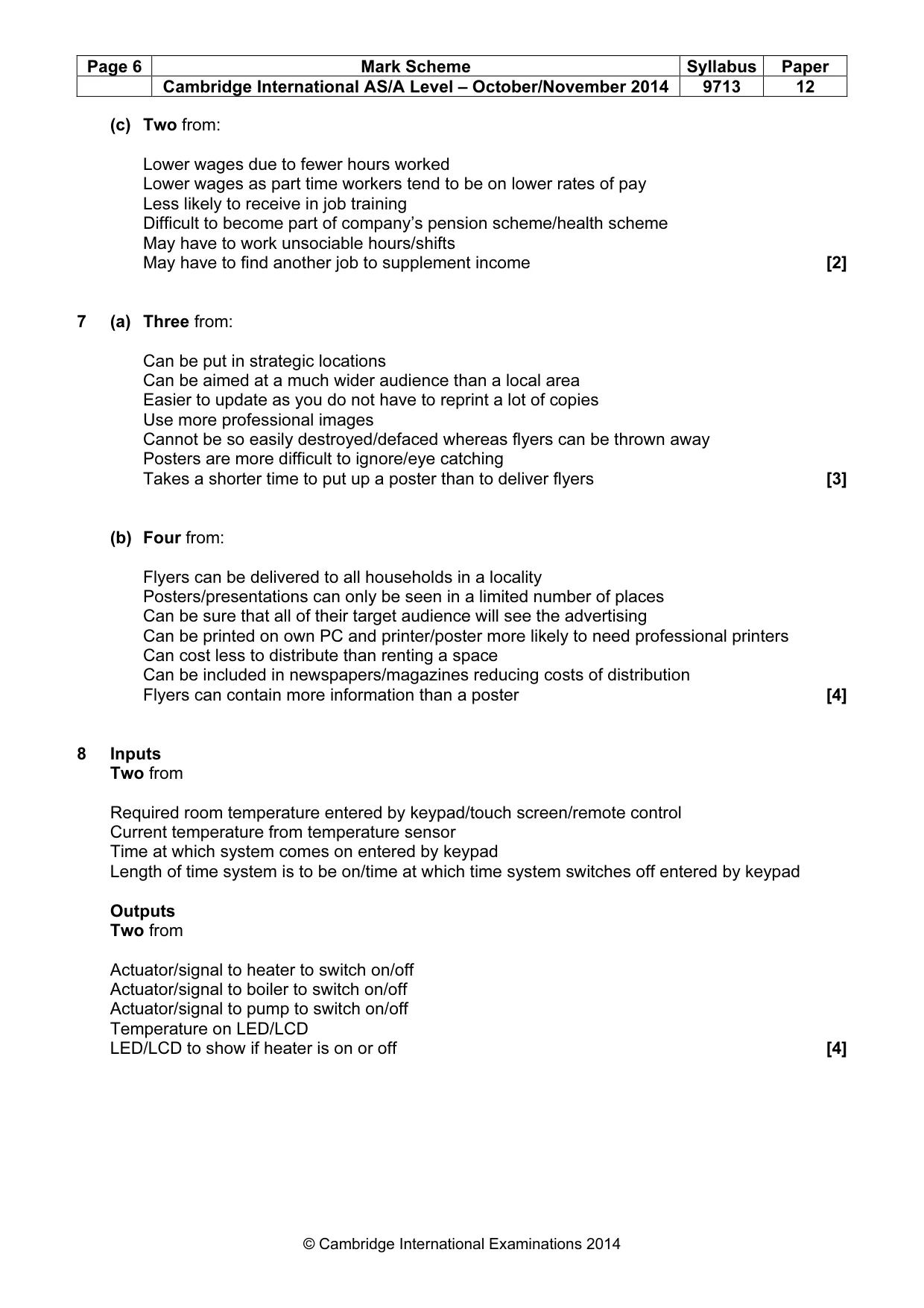
Page 6 Mark Scheme Syllabus Paper Cambridge International AS/A Level – October/November 2014 9713 12 © Cambridge International Examinations 2014 (c) Two from: Lower wages due to fewer hours worked Lower wages as part time workers tend to be on lower rates of pay Less likely to receive in job training Difficult to become part of company’s pension scheme/health scheme May have to work unsociable hours/shifts May have to find another job to supplement income [2] 7 (a) Three from: Can be put in strategic locations Can be aimed at a much wider audience than a local area Easier to update as you do not have to reprint a lot of copies Use more professional images Cannot be so easily destroyed/defaced whereas flyers can be thrown away Posters are more difficult to ignore/eye catching Takes a shorter time to put up a poster than to deliver flyers [3] (b) Four from: Flyers can be delivered to all households in a locality Posters/presentations can only be seen in a limited number of places Can be sure that all of their target audience will see the advertising Can be printed on own PC and printer/poster more likely to need professional printers Can cost less to distribute than renting a space Can be included in newspapers/magazines reducing costs of distribution Flyers can contain more information than a poster [4] 8 Inputs Two from Required room temperature entered by keypad/touch screen/remote control Current temperature from temperature sensor Time at which system comes on entered by keypad Length of time system is to be on/time at which time system switches off entered by keypad Outputs Two from Actuator/signal to heater to switch on/off Actuator/signal to boiler to switch on/off Actuator/signal to pump to switch on/off Temperature on LED/LCD LED/LCD to show if heater is on or off [4]
Mark scheme, page 7
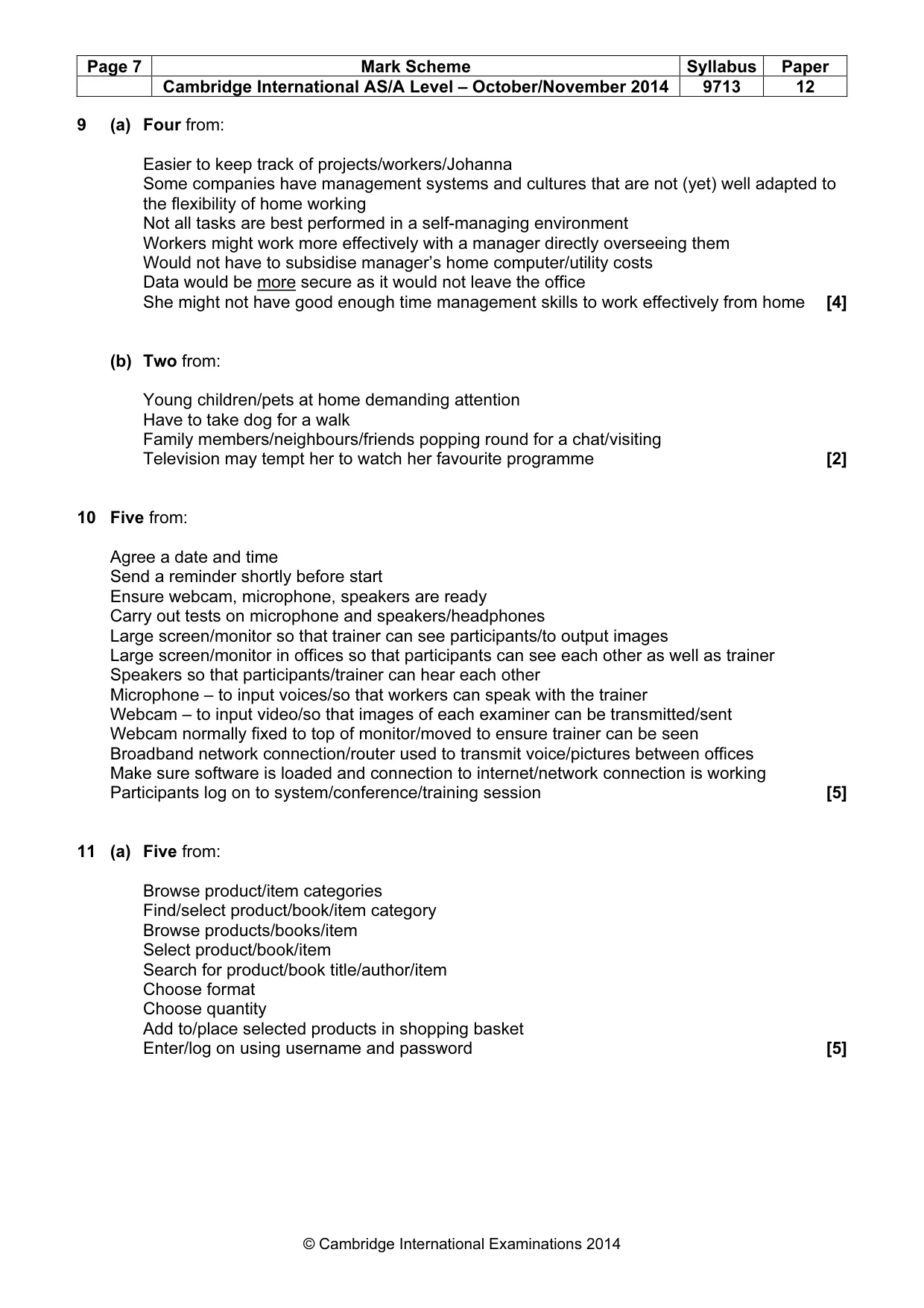
Page 7 Mark Scheme Syllabus Paper Cambridge International AS/A Level – October/November 2014 9713 12 © Cambridge International Examinations 2014 9 (a) Four from: Easier to keep track of projects/workers/Johanna Some companies have management systems and cultures that are not (yet) well adapted to the flexibility of home working Not all tasks are best performed in a self-managing environment Workers might work more effectively with a manager directly overseeing them Would not have to subsidise manager’s home computer/utility costs Data would be more secure as it would not leave the office She might not have good enough time management skills to work effectively from home [4] (b) Two from: Young children/pets at home demanding attention Have to take dog for a walk Family members/neighbours/friends popping round for a chat/visiting Television may tempt her to watch her favourite programme [2] 10 Five from: Agree a date and time Send a reminder shortly before start Ensure webcam, microphone, speakers are ready Carry out tests on microphone and speakers/headphones Large screen/monitor so that trainer can see participants/to output images Large screen/monitor in offices so that participants can see each other as well as trainer Speakers so that participants/trainer can hear each other Microphone – to input voices/so that workers can speak with the trainer Webcam – to input video/so that images of each examiner can be transmitted/sent Webcam normally fixed to top of monitor/moved to ensure trainer can be seen Broadband network connection/router used to transmit voice/pictures between offices Make sure software is loaded and connection to internet/network connection is working Participants log on to system/conference/training session [5] 11 (a) Five from: Browse product/item categories Find/select product/book/item category Browse products/books/item Select product/book/item Search for product/book title/author/item Choose format Choose quantity Add to/place selected products in shopping basket Enter/log on using username and password [5]
Mark scheme, page 8
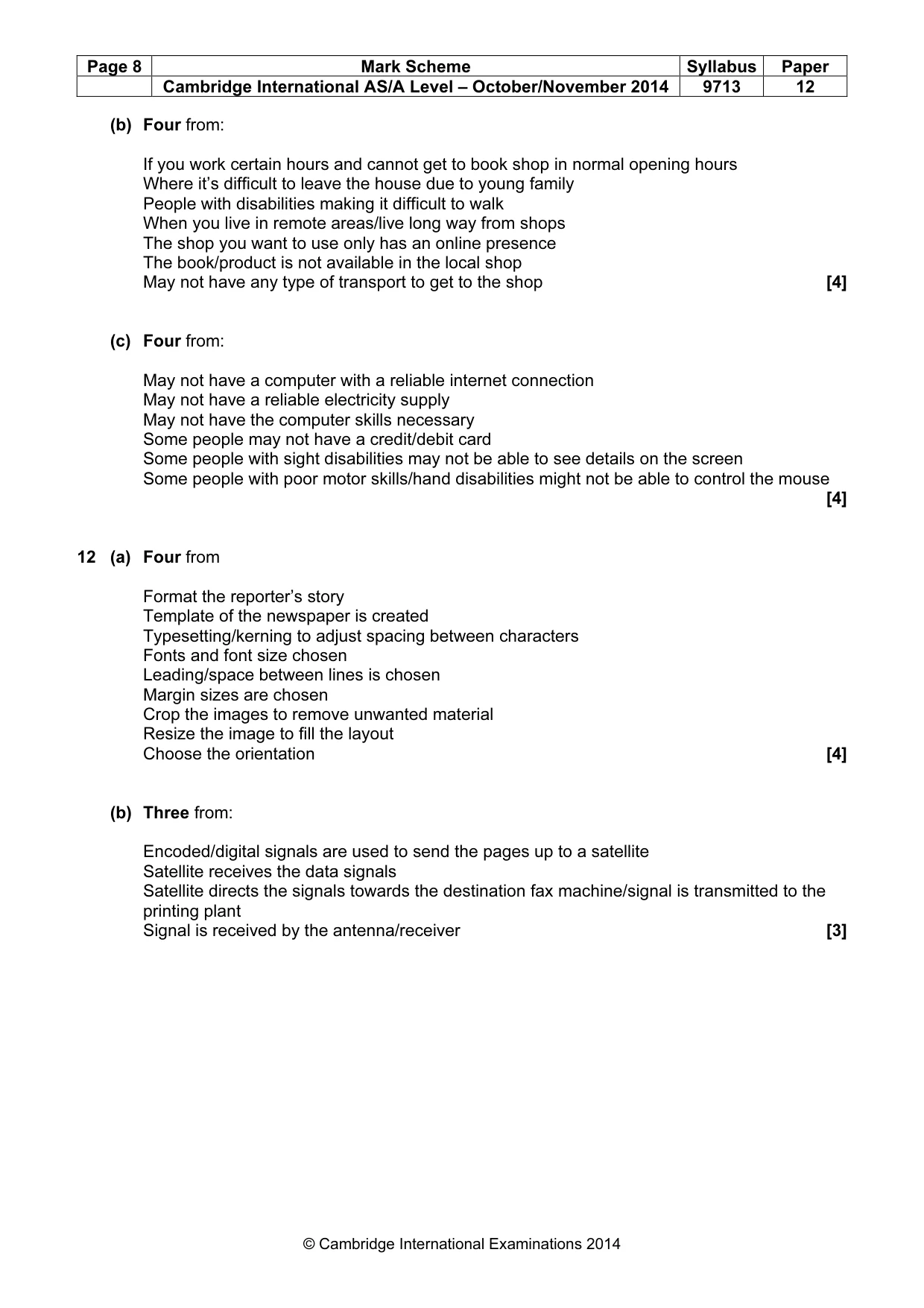
Page 8 Mark Scheme Syllabus Paper Cambridge International AS/A Level – October/November 2014 9713 12 © Cambridge International Examinations 2014 (b) Four from: If you work certain hours and cannot get to book shop in normal opening hours Where it’s difficult to leave the house due to young family People with disabilities making it difficult to walk When you live in remote areas/live long way from shops The shop you want to use only has an online presence The book/product is not available in the local shop May not have any type of transport to get to the shop [4] (c) Four from: May not have a computer with a reliable internet connection May not have a reliable electricity supply May not have the computer skills necessary Some people may not have a credit/debit card Some people with sight disabilities may not be able to see details on the screen Some people with poor motor skills/hand disabilities might not be able to control the mouse [4] 12 (a) Four from Format the reporter’s story Template of the newspaper is created Typesetting/kerning to adjust spacing between characters Fonts and font size chosen Leading/space between lines is chosen Margin sizes are chosen Crop the images to remove unwanted material Resize the image to fill the layout Choose the orientation [4] (b) Three from: Encoded/digital signals are used to send the pages up to a satellite Satellite receives the data signals Satellite directs the signals towards the destination fax machine/signal is transmitted to the printing plant Signal is received by the antenna/receiver [3]
What you needed in this session
Cambridge’s own grade thresholds for 2014 Oct/Nov, Paper 1 · Variant 2. A higher threshold means an easier paper — the bar moves with how the cohort did.