Cambridge A Level Applied Information and Communication Technology 9713 — 2014 May/June Paper 1 · Variant 1
9713/11/M/J/14 · 80 marks · ≈90 min
The question paper and its mark scheme, free to read here and free to download. This is Cambridge’s own paper, exactly as it was sat.
Question paper20 pages





Mark scheme8 pages
Answers below. Sit the paper first if you are practising.
Paper as text
Question paper, page 1
This document consists of 18 printed pages and 2 blank pages. IB14 06_9713_11/5RP © UCLES 2014 [Turn over *9959819298* Cambridge International Examinations Cambridge International Advanced Subsidiary and Advanced Level APPLIED INFORMATION AND COMMUNICATION TECHNOLOGY 9713/11 Paper 1 May/June 2014 1 hour 15 minutes Candidates answer on the Question Paper. No additional materials are required. READ THESE INSTRUCTIONS FIRST Write your Centre number, candidate number and name on all the work you hand in. Write in dark blue or black pen. Do not use staples, paper clips, glue or correction fluid. You may use an HB pencil for any diagrams, graphs or rough working. DO NOT WRITE IN ANY BARCODES. Answer all questions. The number of marks is given in brackets [ ] at the end of each question or part question. The businesses described in this paper are entirely fictitious.
Question paper, page 2
2 © UCLES 2014 9713/11/M/J/14 Scenario 1 Question 1, 2, 3 and 4 Dubai Airways (DA) is a company which carries passengers from all parts of the world to Dubai. DA’s computer system needs updating. It issues e-tickets which have a bar code and the flight details. After flights, DA invites each passenger to complete a form giving their opinions about the flight. As part of the system update DA have asked the systems analyst, Li, to design a new form. The company is undecided whether the data on the form should be captured using Optical Character Recognition (OCR) or Optical Mark Recognition (OMR). As Li develops the new system, she will supervise the testing. The new system will be evaluated after testing is completed. Li will provide DA with documentation about the system.
Question paper, page 3
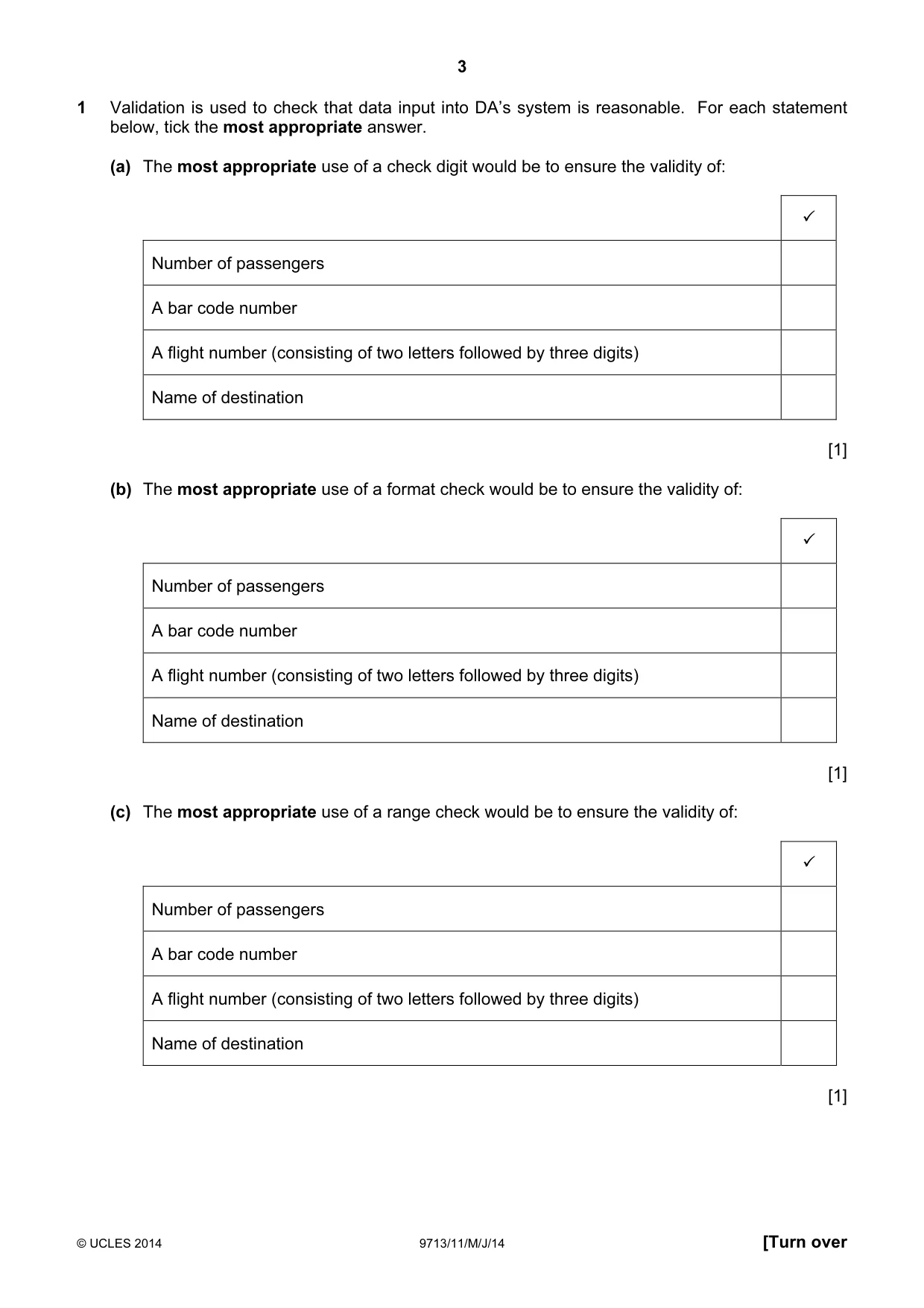
3 © UCLES 2014 9713/11/M/J/14 [Turn over 1 Validation is used to check that data input into DA’s system is reasonable. For each statement below, tick the most appropriate answer. (a) The most appropriate use of a check digit would be to ensure the validity of: ✓ Number of passengers A bar code number A flight number (consisting of two letters followed by three digits) Name of destination [1] (b) The most appropriate use of a format check would be to ensure the validity of: ✓ Number of passengers A bar code number A flight number (consisting of two letters followed by three digits) Name of destination [1] (c) The most appropriate use of a range check would be to ensure the validity of: ✓ Number of passengers A bar code number A flight number (consisting of two letters followed by three digits) Name of destination [1]
Question paper, page 4
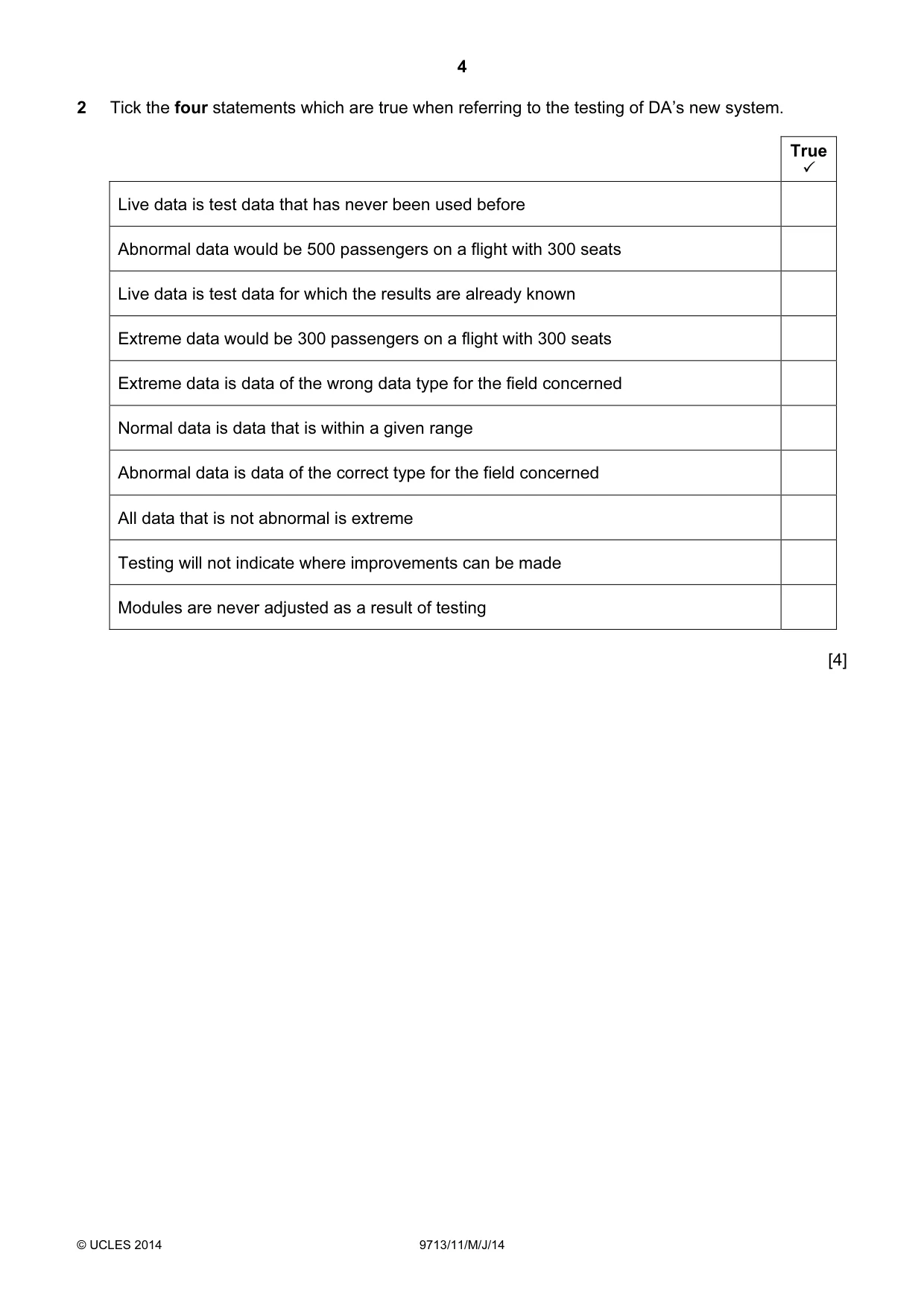
4 © UCLES 2014 9713/11/M/J/14 2 Tick the four statements which are true when referring to the testing of DA’s new system. True ✓ Live data is test data that has never been used before Abnormal data would be 500 passengers on a flight with 300 seats Live data is test data for which the results are already known Extreme data would be 300 passengers on a flight with 300 seats Extreme data is data of the wrong data type for the field concerned Normal data is data that is within a given range Abnormal data is data of the correct type for the field concerned All data that is not abnormal is extreme Testing will not indicate where improvements can be made Modules are never adjusted as a result of testing [4]
Question paper, page 5
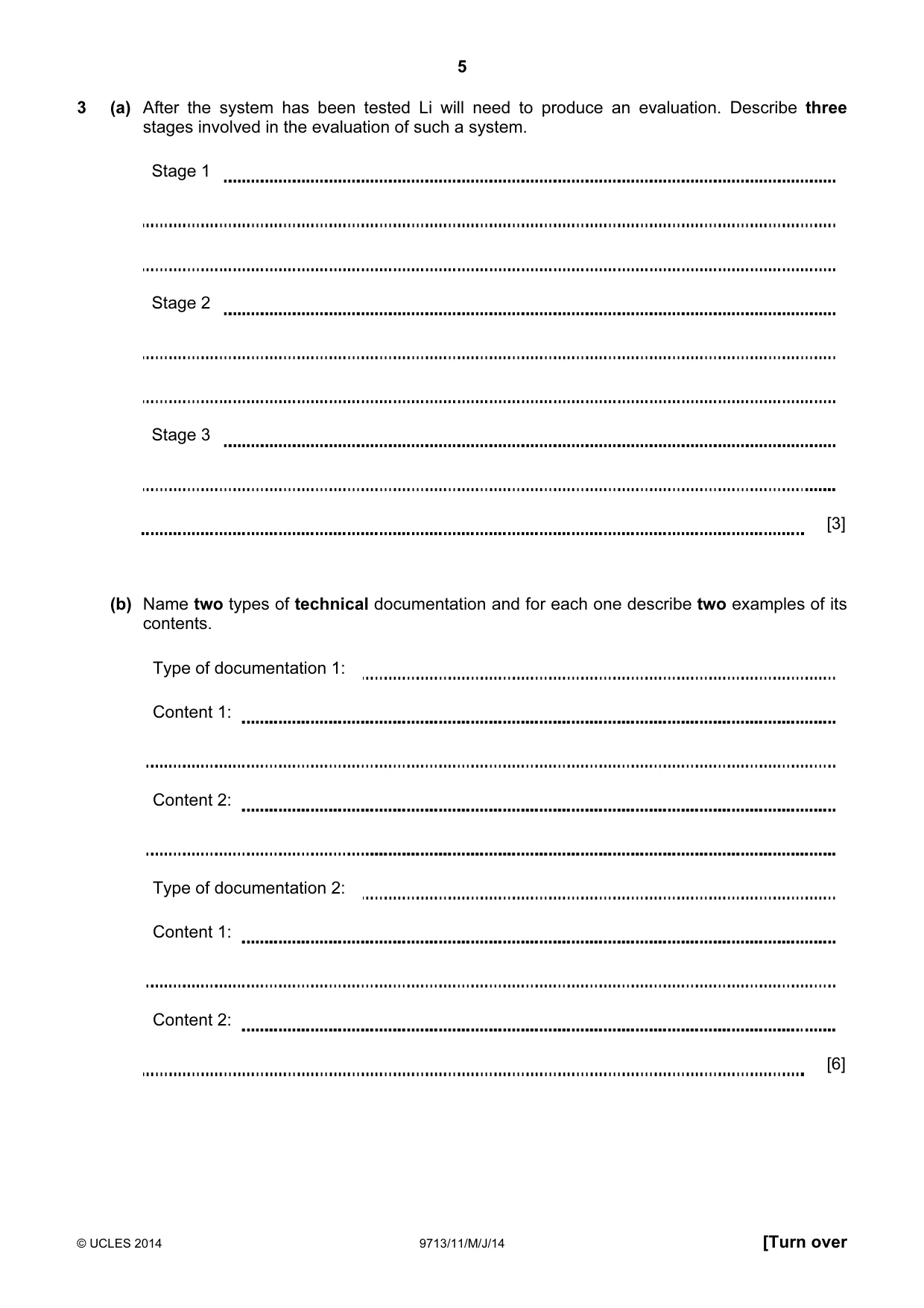
5 © UCLES 2014 9713/11/M/J/14 [Turn over 3 (a) After the system has been tested Li will need to produce an evaluation. Describe three stages involved in the evaluation of such a system. Stage 1 Stage 2 Stage 3 [3] (b) Name two types of technical documentation and for each one describe two examples of its contents. Type of documentation 1: Content 1: Content 2: Type of documentation 2: Content 1: Content 2: [6]
Question paper, page 6
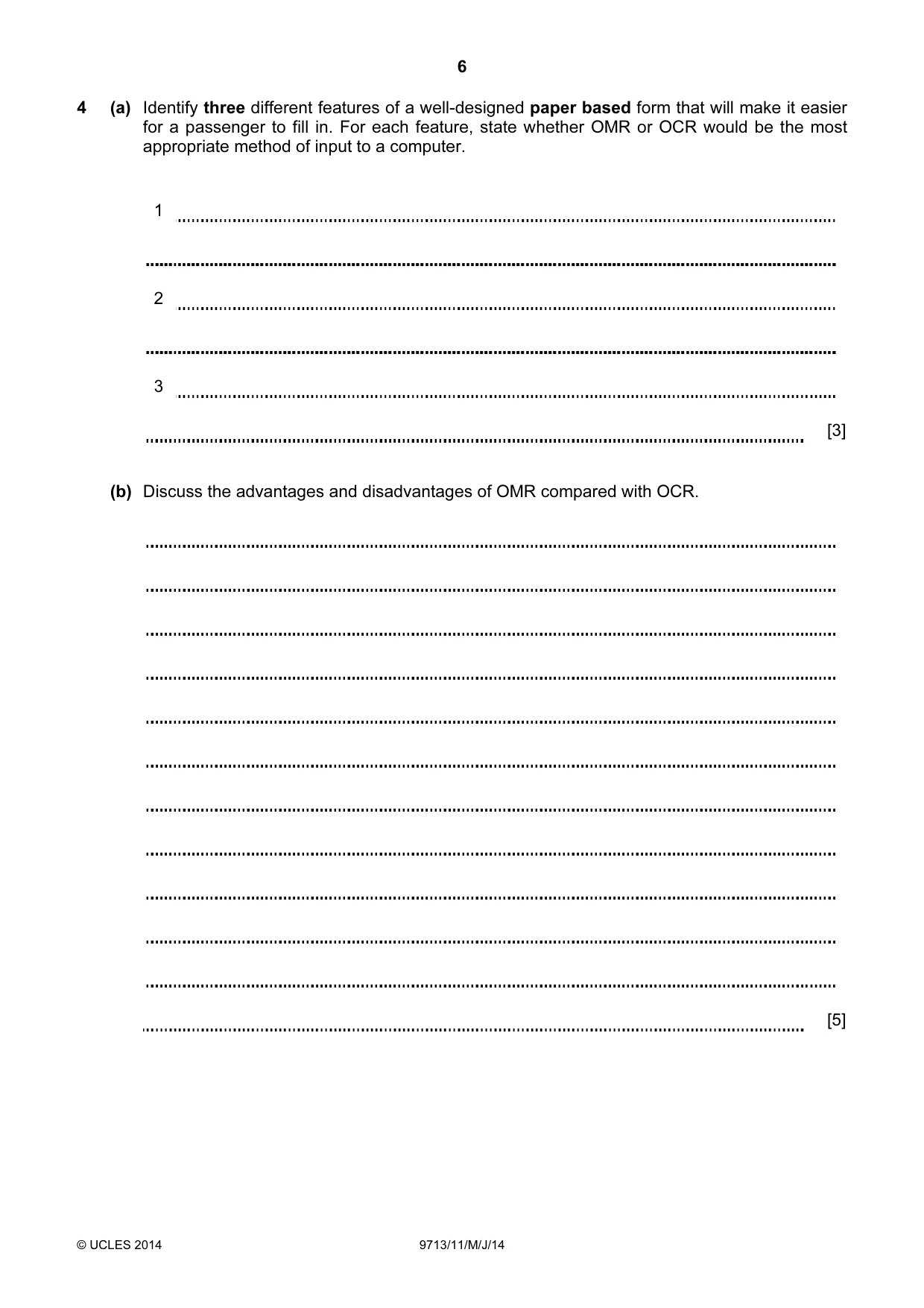
6 © UCLES 2014 9713/11/M/J/14 4 (a) Identify three different features of a well-designed paper based form that will make it easier for a passenger to fill in. For each feature, state whether OMR or OCR would be the most appropriate method of input to a computer. 1 2 3 [3] (b) Discuss the advantages and disadvantages of OMR compared with OCR. [5]
Question paper, page 7
7 © UCLES 2014 9713/11/M/J/14 [Turn over Scenario 2 Questions 5, 6 and 7 Midtown Bank in the UK operates an online banking service. A number of customers are concerned about the privacy and security of their data. This system means that bank employees have access to the personal details of customers of the bank. There are social and ethical implications which can arise because of this. As the number of customers using their online banking service has increased, there are fewer customers visiting local branches. This has led to some of the branches closing.
Question paper, page 8
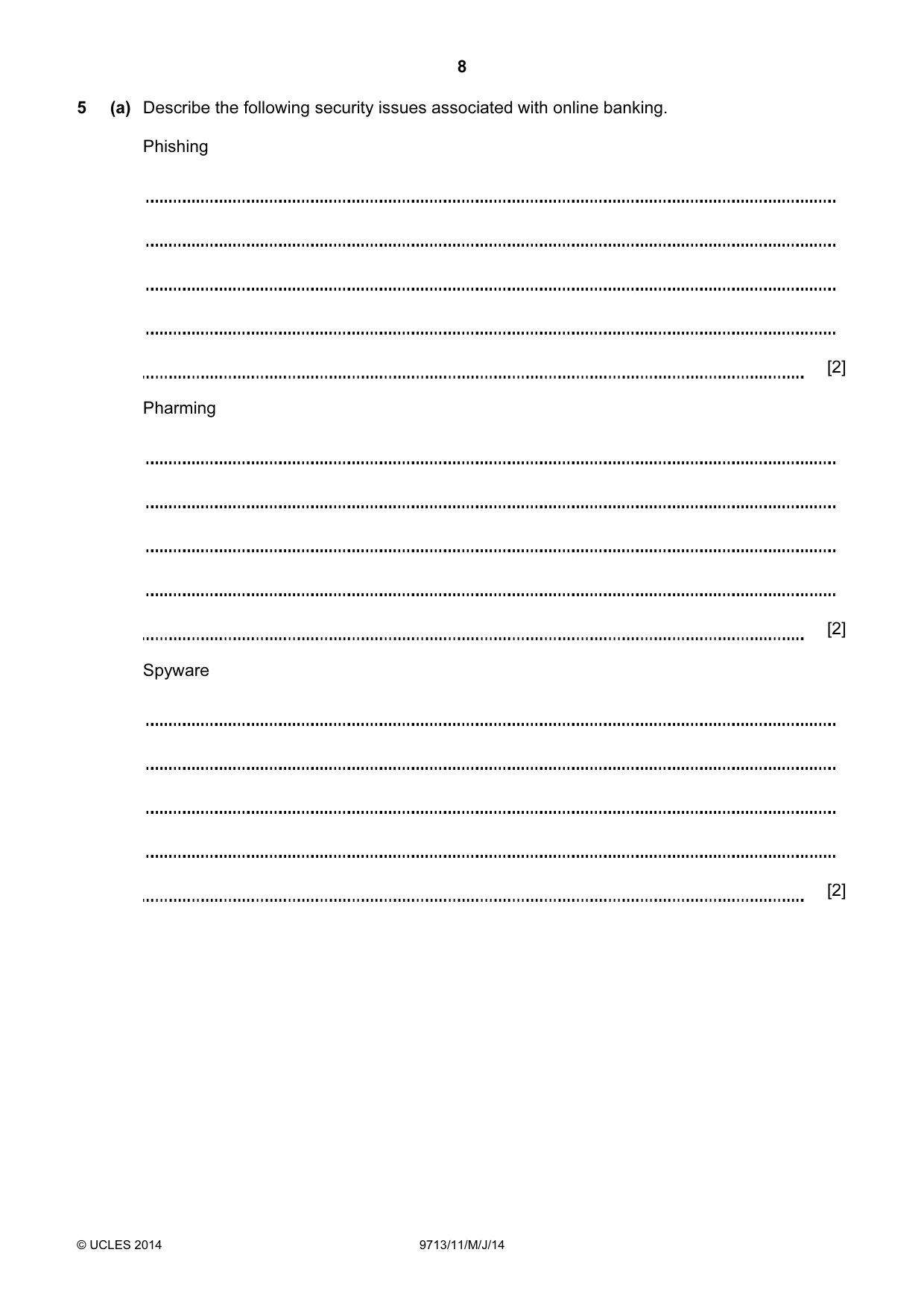
8 © UCLES 2014 9713/11/M/J/14 5 (a) Describe the following security issues associated with online banking. Phishing [2] Pharming [2] Spyware [2]
Question paper, page 9
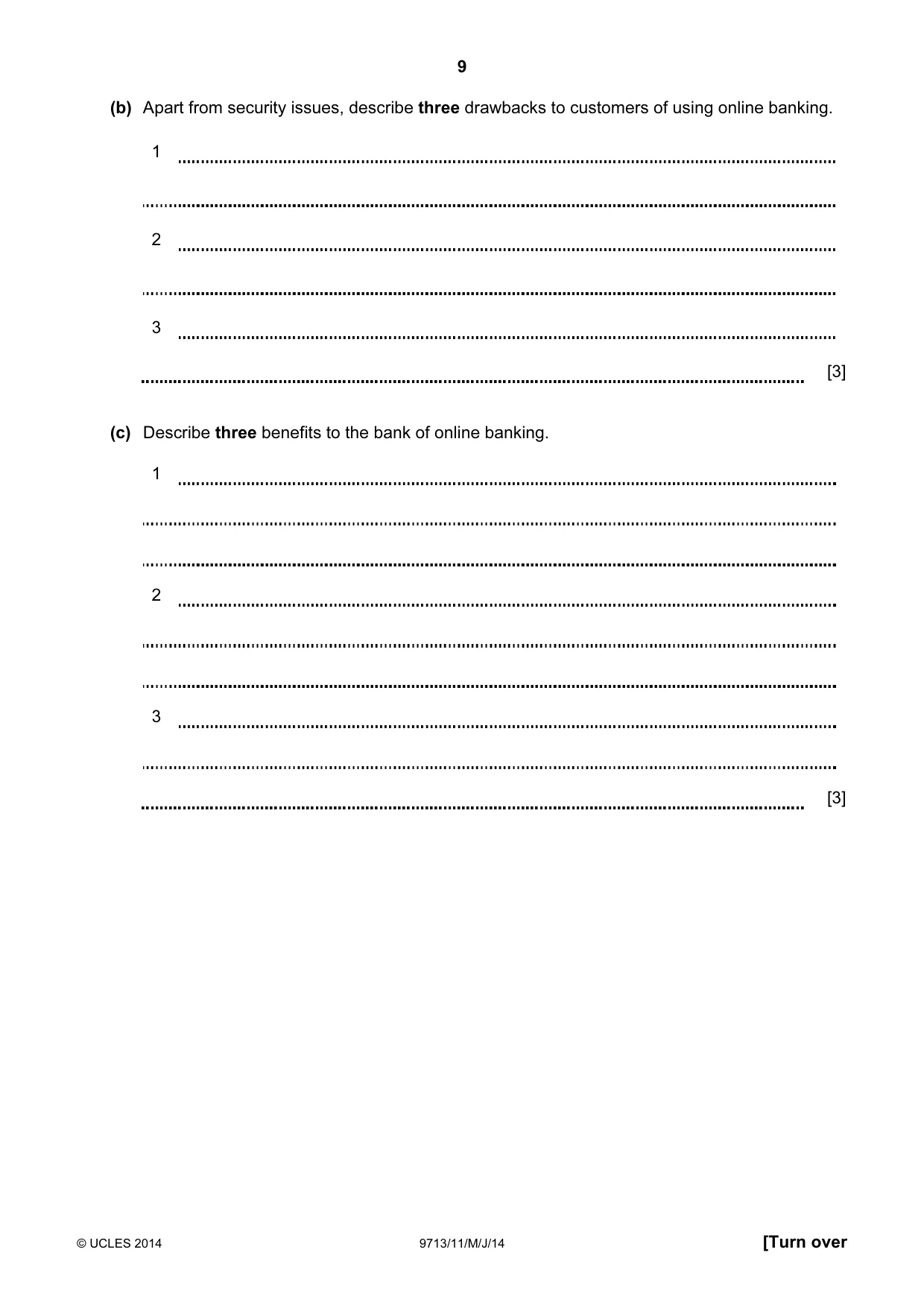
9 © UCLES 2014 9713/11/M/J/14 [Turn over (b) Apart from security issues, describe three drawbacks to customers of using online banking. 1 2 3 [3] (c) Describe three benefits to the bank of online banking. 1 2 3 [3]
Question paper, page 10
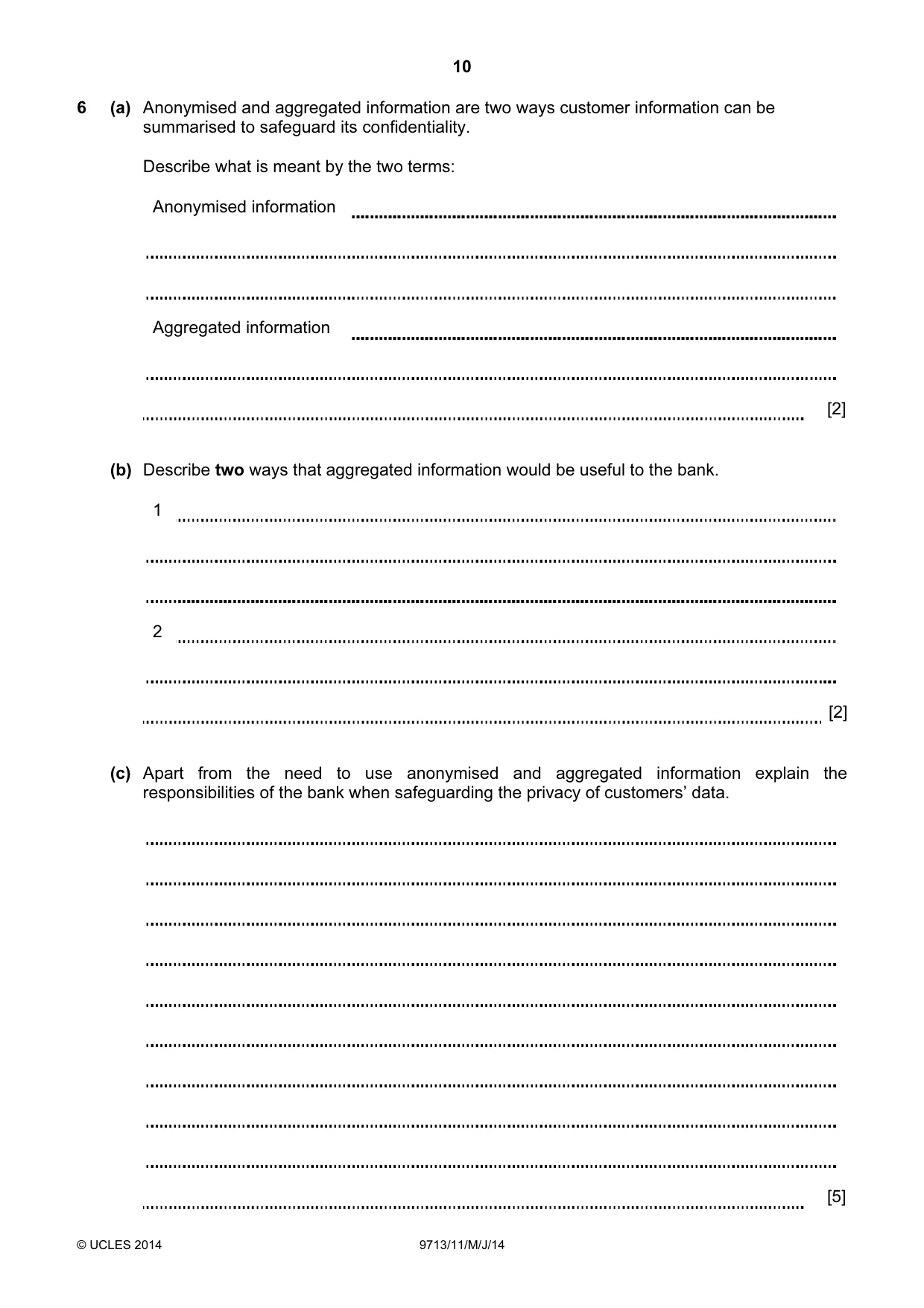
10 © UCLES 2014 9713/11/M/J/14 6 (a) Anonymised and aggregated information are two ways customer information can be summarised to safeguard its confidentiality. Describe what is meant by the two terms: Anonymised information Aggregated information [2] (b) Describe two ways that aggregated information would be useful to the bank. 1 2 [2] (c) Apart from the need to use anonymised and aggregated information explain the responsibilities of the bank when safeguarding the privacy of customers’ data. [5]
Question paper, page 11
11 © UCLES 2014 9713/11/M/J/14 [Turn over 7 As bank branches have closed, changes in working patterns have occurred as well as changes in employment status. Describe three of the changes to working patterns. 1 2 3 [3]
Question paper, page 12
12 © UCLES 2014 9713/11/M/J/14 Scenario 3 Question 8 Mrs Sharif is the head teacher of a large school with over 2000 students. Teachers keep records of test scores on the school’s computer system. The total possible mark for each test varies from test to test and subject to subject. Mrs Sharif wants the teachers to use the test scores of each student so that they can be included in a report to the student’s parents. She will need to choose a suitable printer for printing the reports.
Question paper, page 13
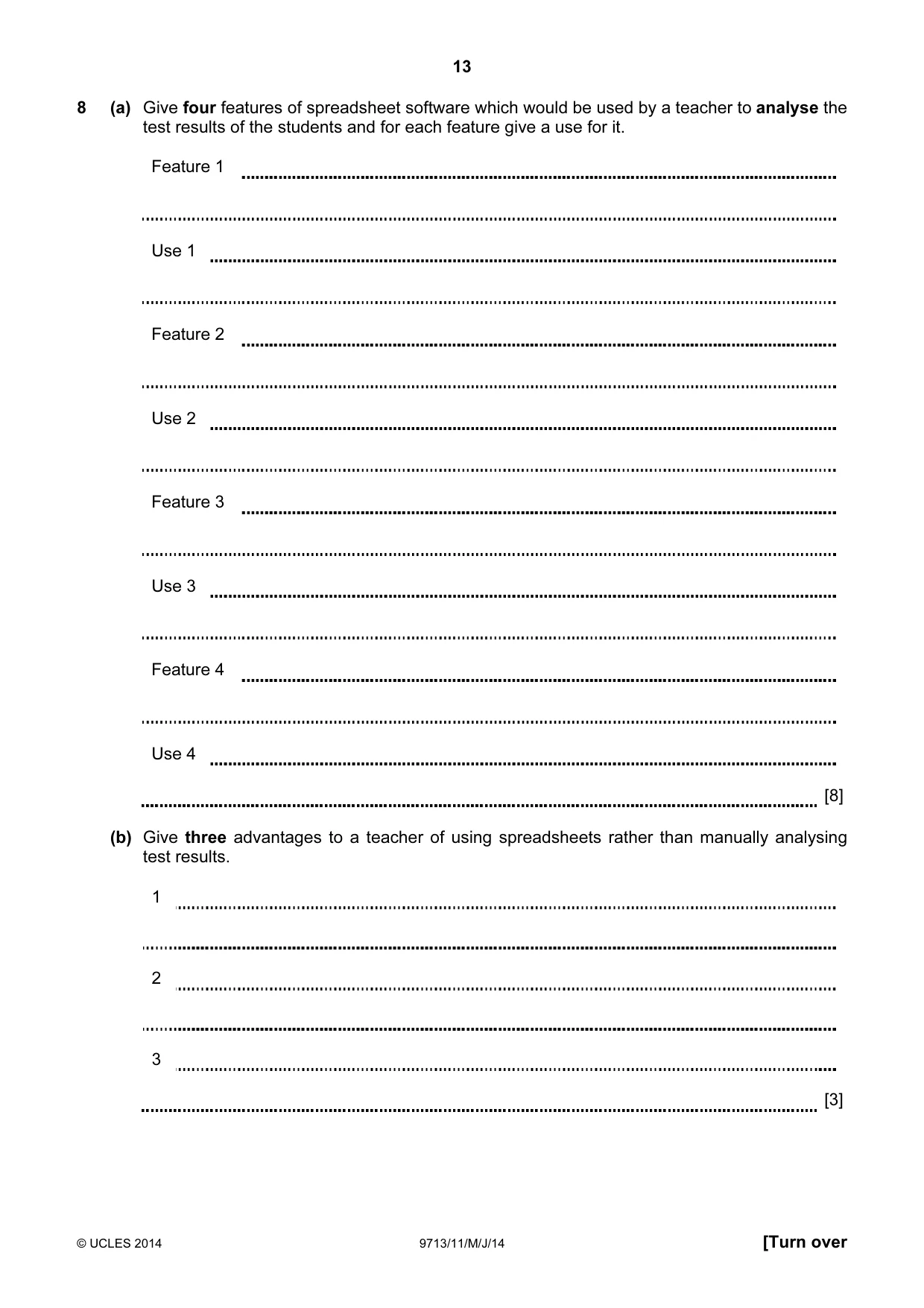
13 © UCLES 2014 9713/11/M/J/14 [Turn over 8 (a) Give four features of spreadsheet software which would be used by a teacher to analyse the test results of the students and for each feature give a use for it. Feature 1 Use 1 Feature 2 Use 2 Feature 3 Use 3 Feature 4 Use 4 [8] (b) Give three advantages to a teacher of using spreadsheets rather than manually analysing test results. 1 2 3 [3]
Question paper, page 14
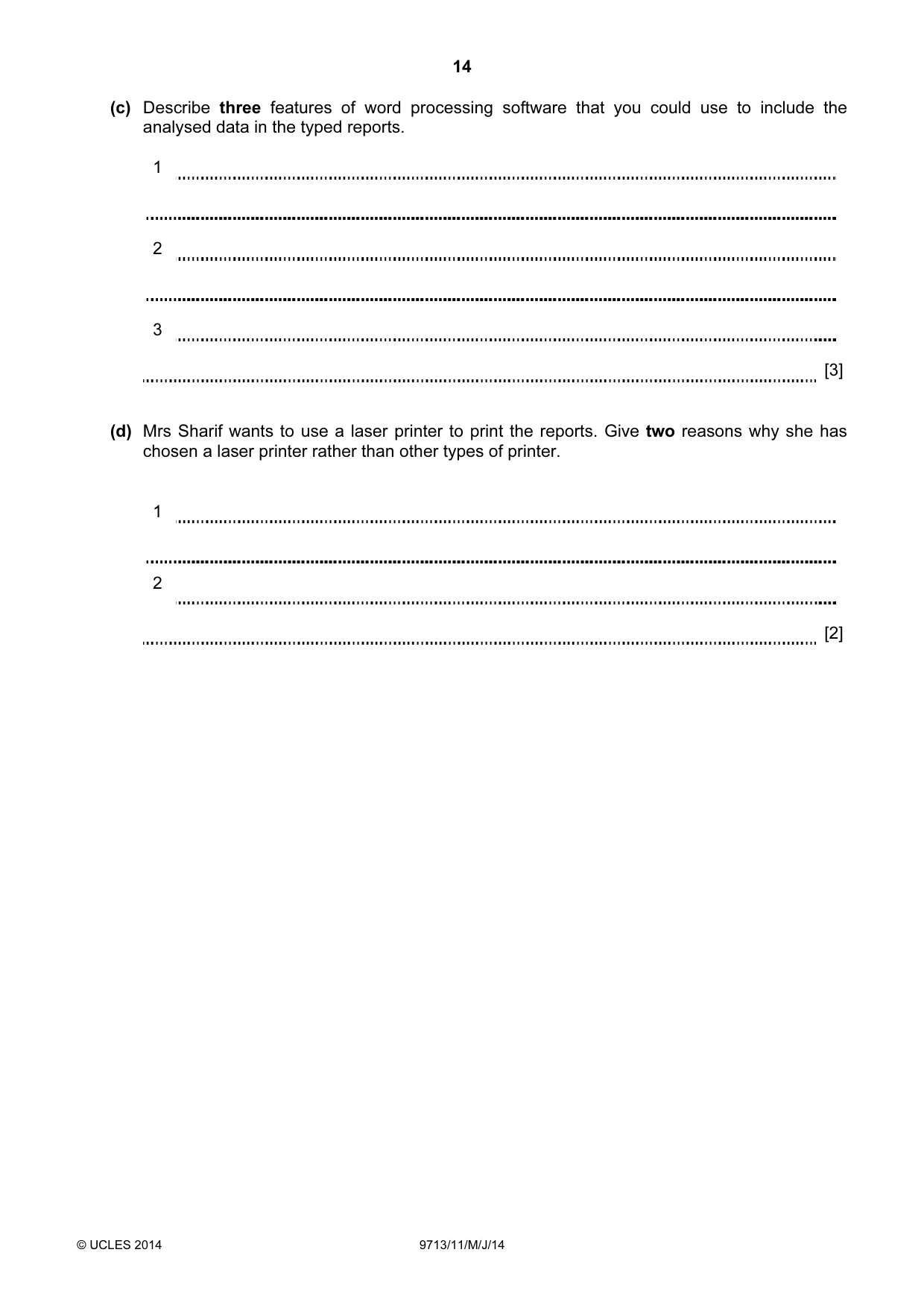
14 © UCLES 2014 9713/11/M/J/14 (c) Describe three features of word processing software that you could use to include the analysed data in the typed reports. 1 2 3 [3] (d) Mrs Sharif wants to use a laser printer to print the reports. Give two reasons why she has chosen a laser printer rather than other types of printer. 1 2 [2]
Question paper, page 15
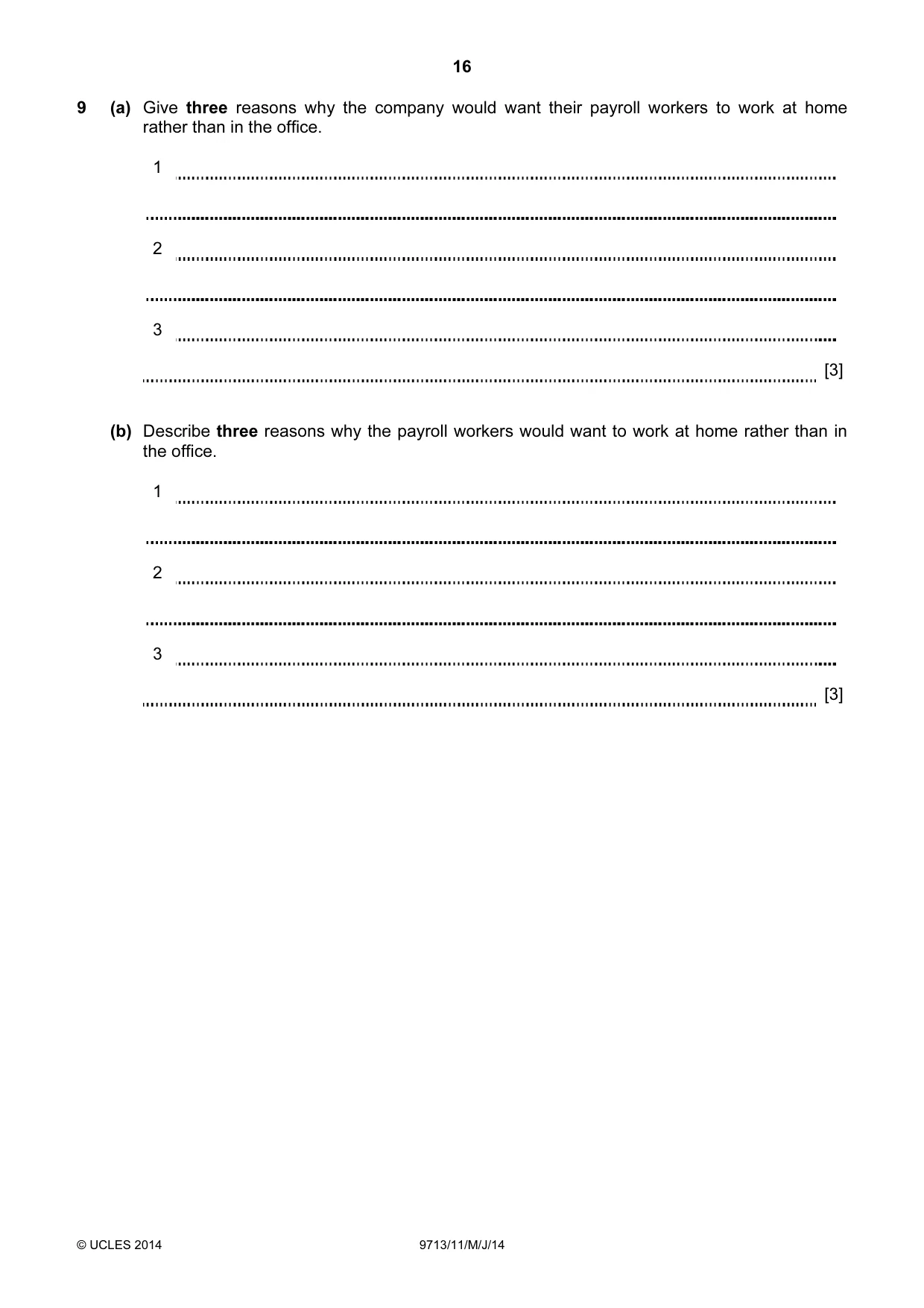
15 © UCLES 2014 9713/11/M/J/14 [Turn over Scenario 4 Questions 9, 10 and 11 RockICT has a computerised payroll system. Sequential files are used for the master and transaction files. Workers are paid on a weekly basis depending on how many hours they work. Batch processing is used to run the payroll. Because the system is computerised the payroll office workers are allowed to work from home.
Question paper, page 16
16 © UCLES 2014 9713/11/M/J/14 9 (a) Give three reasons why the company would want their payroll workers to work at home rather than in the office. 1 2 3 [3] (b) Describe three reasons why the payroll workers would want to work at home rather than in the office. 1 2 3 [3]
Question paper, page 17
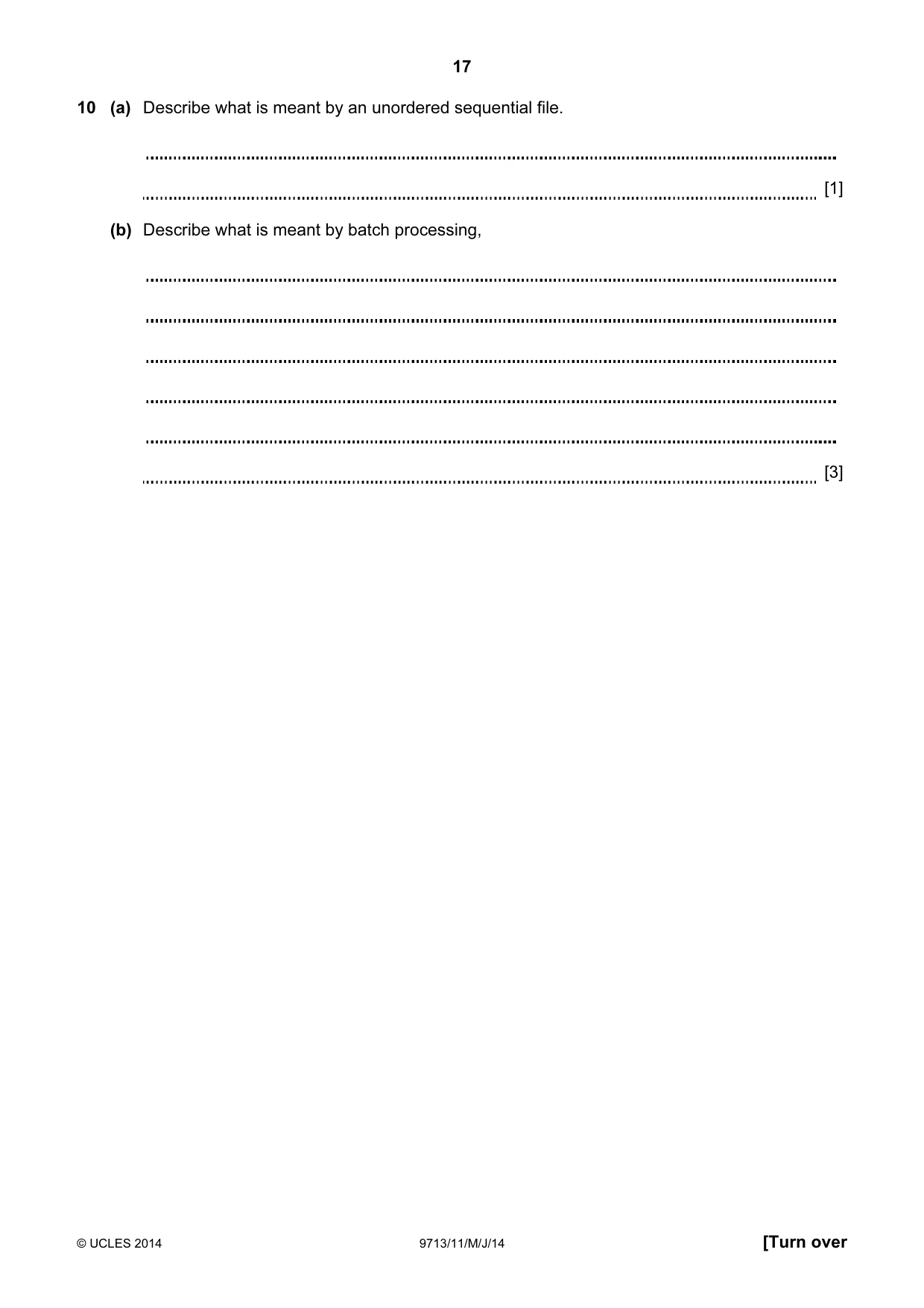
17 © UCLES 2014 9713/11/M/J/14 [Turn over 10 (a) Describe what is meant by an unordered sequential file. [1] (b) Describe what is meant by batch processing, [3]
Question paper, page 18
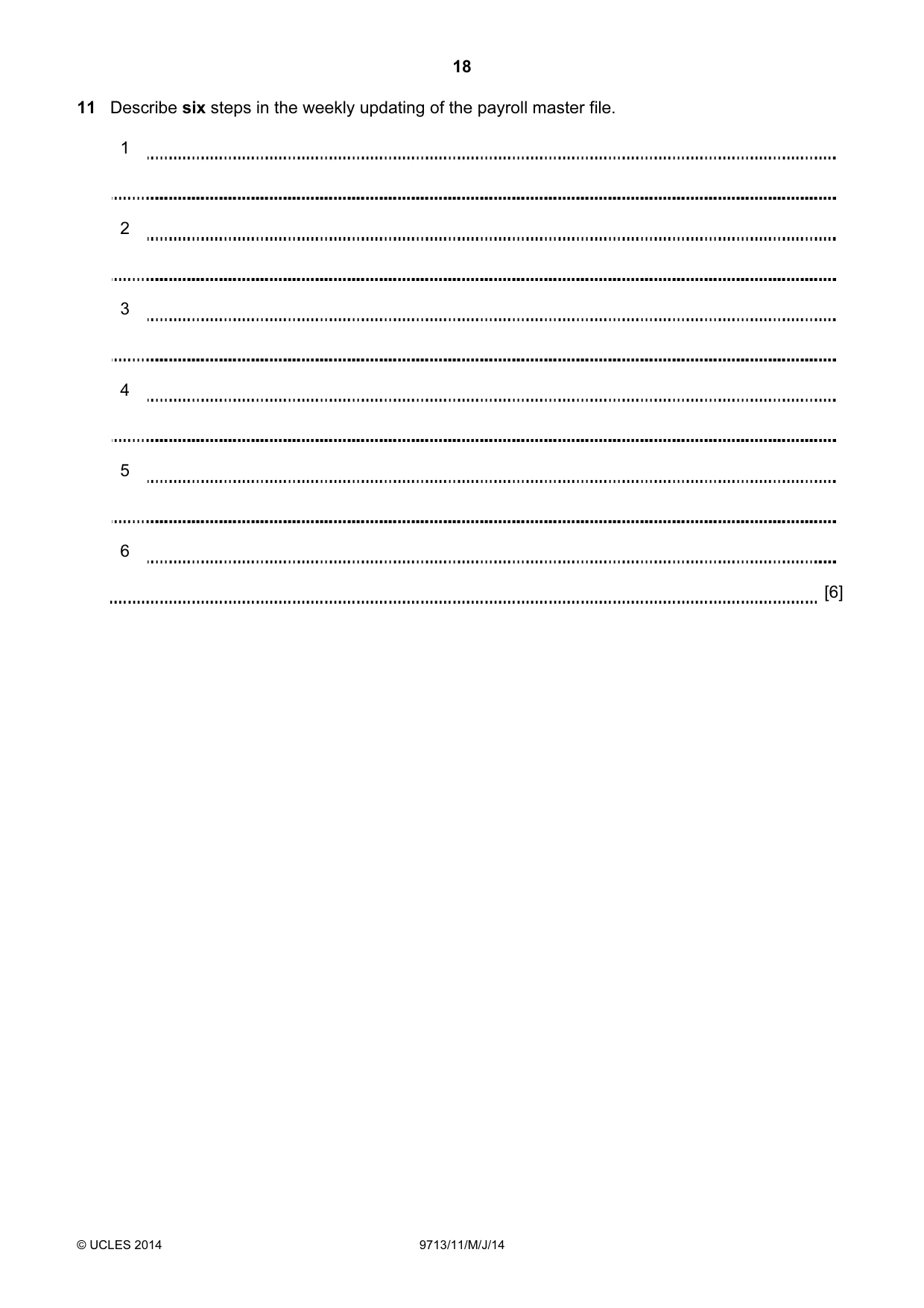
18 © UCLES 2014 9713/11/M/J/14 11 Describe six steps in the weekly updating of the payroll master file. 1 2 3 4 5 6 [6]
Question paper, page 19
19 © UCLES 2014 9713/11/M/J/14 BLANK PAGE
Question paper, page 20
20 Permission to reproduce items where third-party owned material protected by copyright is included has been sought and cleared where possible. Every reasonable effort has been made by the publisher (UCLES) to trace copyright holders, but if any items requiring clearance have unwittingly been included, the publisher will be pleased to make amends at the earliest possible opportunity. Cambridge International Examinations is part of the Cambridge Assessment Group. Cambridge Assessment is the brand name of University of Cambridge Local Examinations Syndicate (UCLES), which is itself a department of the University of Cambridge. © UCLES 2014 9713/11/M/J/14 BLANK PAGE
Mark scheme, page 1
CAMBRIDGE INTERNATIONAL EXAMINATIONS GCE Advanced Subsidiary Level and GCE Advanced Level MARK SCHEME for the May/June 2014 series 9713 APPLIED TECHNOLOGY AND COMMUNICATION TECHNOLOGY 9713/11 Paper 1 (Written A), maximum raw mark 80 This mark scheme is published as an aid to teachers and candidates, to indicate the requirements of the examination. It shows the basis on which Examiners were instructed to award marks. It does not indicate the details of the discussions that took place at an Examiners’ meeting before marking began, which would have considered the acceptability of alternative answers. Mark schemes should be read in conjunction with the question paper and the Principal Examiner Report for Teachers. Cambridge will not enter into discussions about these mark schemes. Cambridge is publishing the mark schemes for the May/June 2014 series for most IGCSE, GCE Advanced Level and Advanced Subsidiary Level components and some Ordinary Level components.
Mark scheme, page 2
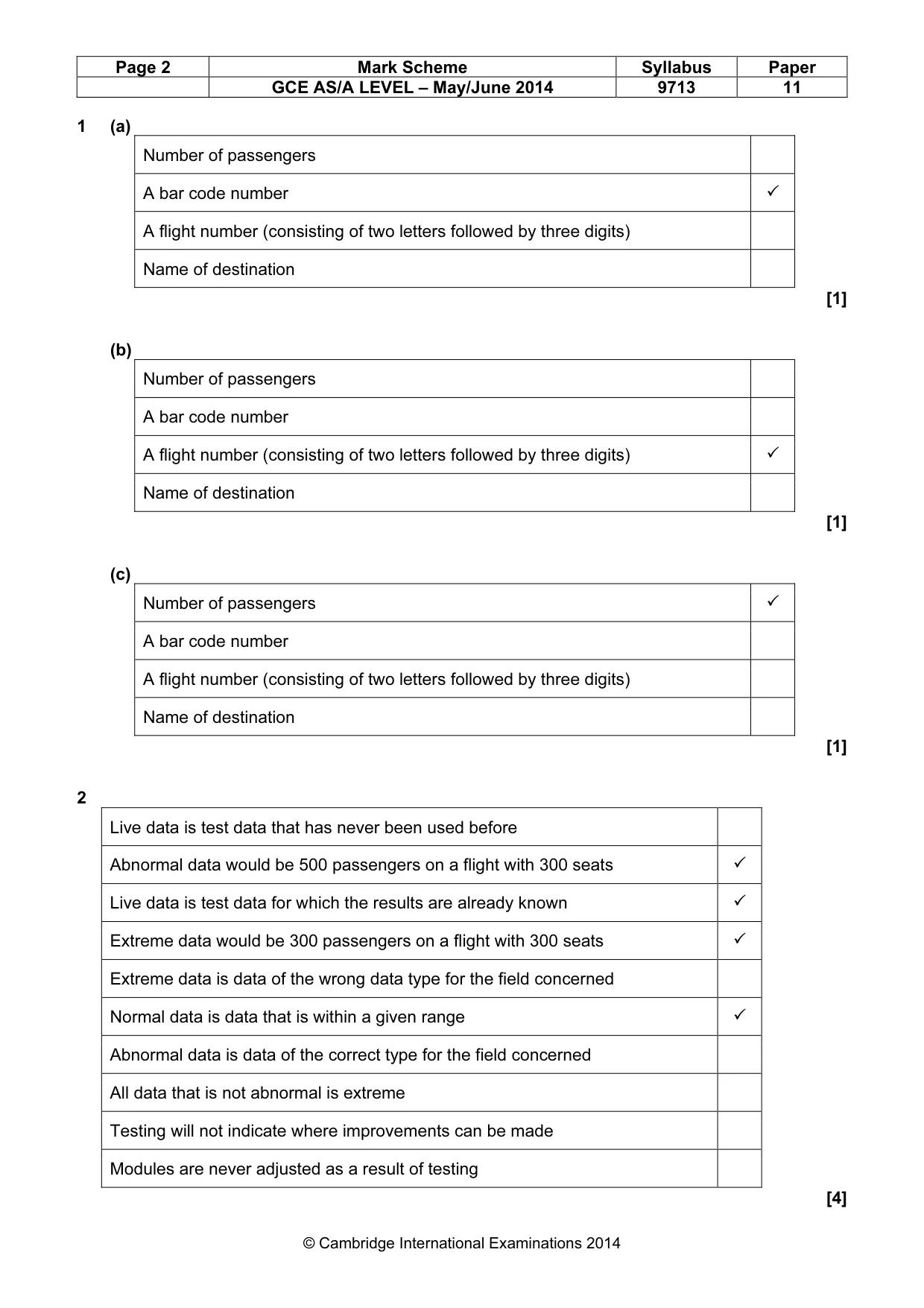
Page 2 Mark Scheme Syllabus Paper GCE AS/A LEVEL – May/June 2014 9713 11 © Cambridge International Examinations 2014 1 (a) Number of passengers A bar code number ✓ A flight number (consisting of two letters followed by three digits) Name of destination [1] (b) Number of passengers A bar code number A flight number (consisting of two letters followed by three digits) ✓ Name of destination [1] (c) Number of passengers ✓ A bar code number A flight number (consisting of two letters followed by three digits) Name of destination [1] 2 Live data is test data that has never been used before Abnormal data would be 500 passengers on a flight with 300 seats ✓ Live data is test data for which the results are already known ✓ Extreme data would be 300 passengers on a flight with 300 seats ✓ Extreme data is data of the wrong data type for the field concerned Normal data is data that is within a given range ✓ Abnormal data is data of the correct type for the field concerned All data that is not abnormal is extreme Testing will not indicate where improvements can be made Modules are never adjusted as a result of testing [4]
Mark scheme, page 3
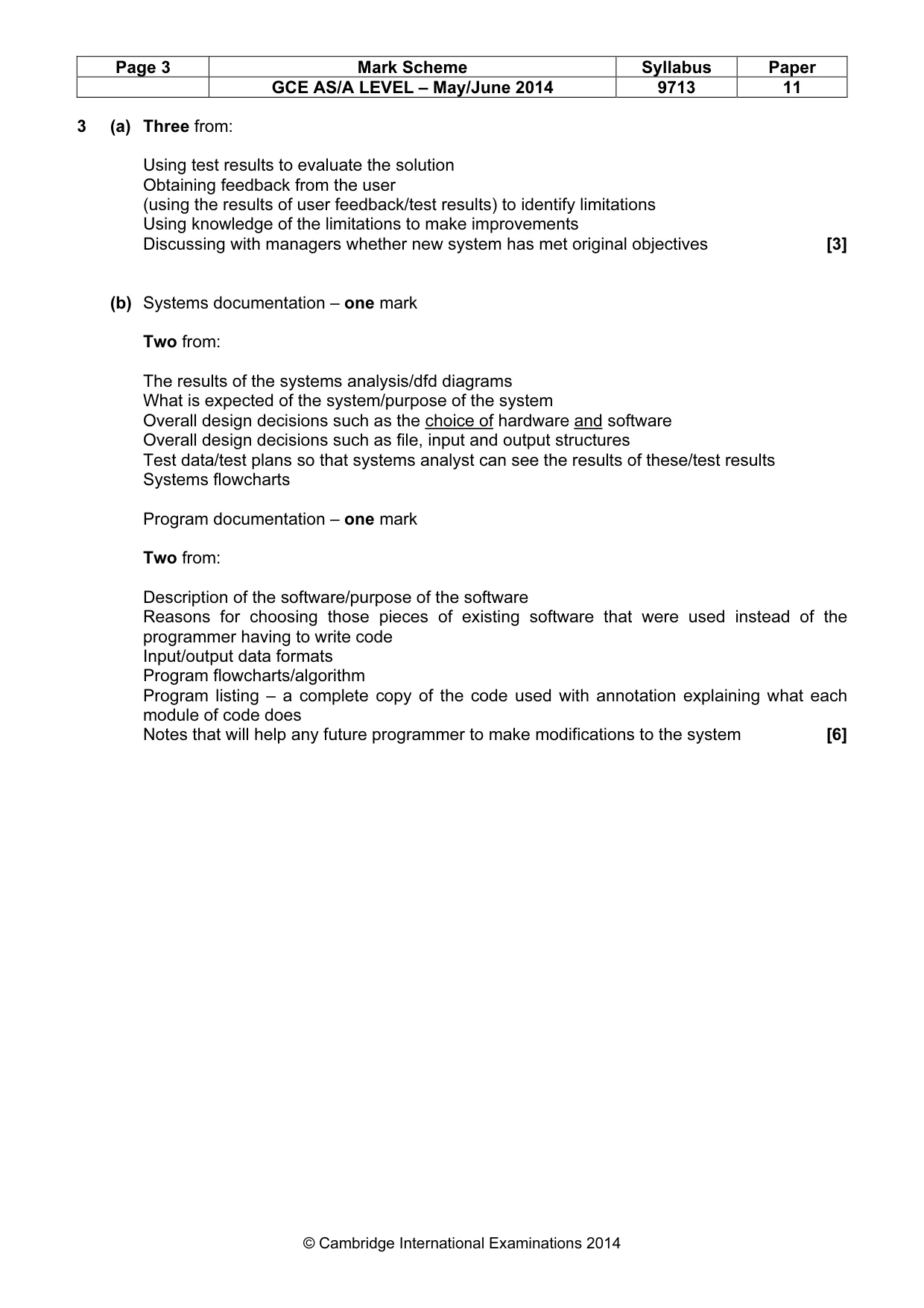
Page 3 Mark Scheme Syllabus Paper GCE AS/A LEVEL – May/June 2014 9713 11 © Cambridge International Examinations 2014 3 (a) Three from: Using test results to evaluate the solution Obtaining feedback from the user (using the results of user feedback/test results) to identify limitations Using knowledge of the limitations to make improvements Discussing with managers whether new system has met original objectives [3] (b) Systems documentation – one mark Two from: The results of the systems analysis/dfd diagrams What is expected of the system/purpose of the system Overall design decisions such as the choice of hardware and software Overall design decisions such as file, input and output structures Test data/test plans so that systems analyst can see the results of these/test results Systems flowcharts Program documentation – one mark Two from: Description of the software/purpose of the software Reasons for choosing those pieces of existing software that were used instead of the programmer having to write code Input/output data formats Program flowcharts/algorithm Program listing – a complete copy of the code used with annotation explaining what each module of code does Notes that will help any future programmer to make modifications to the system [6]
Mark scheme, page 4
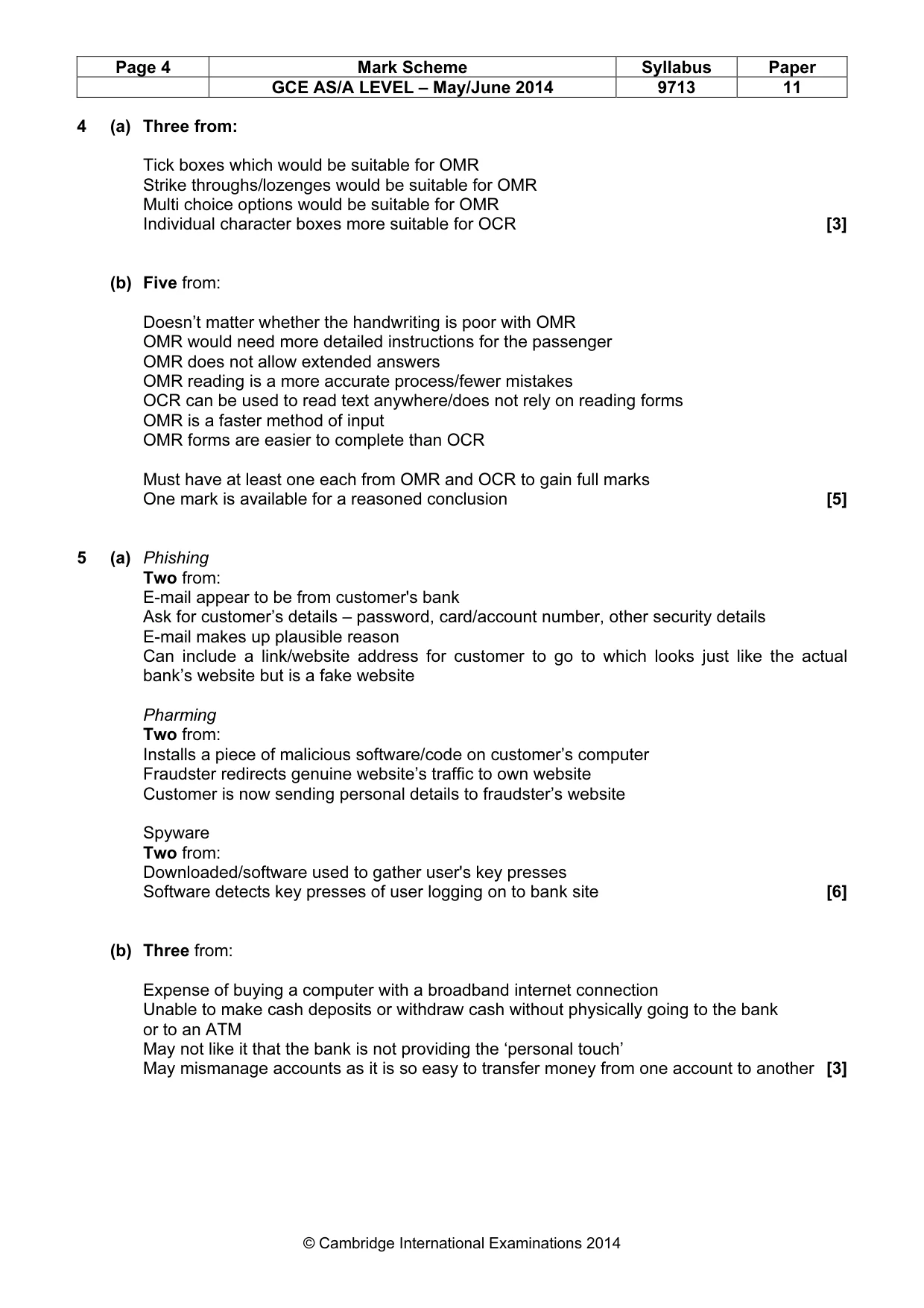
Page 4 Mark Scheme Syllabus Paper GCE AS/A LEVEL – May/June 2014 9713 11 © Cambridge International Examinations 2014 4 (a) Three from: Tick boxes which would be suitable for OMR Strike throughs/lozenges would be suitable for OMR Multi choice options would be suitable for OMR Individual character boxes more suitable for OCR [3] (b) Five from: Doesn’t matter whether the handwriting is poor with OMR OMR would need more detailed instructions for the passenger OMR does not allow extended answers OMR reading is a more accurate process/fewer mistakes OCR can be used to read text anywhere/does not rely on reading forms OMR is a faster method of input OMR forms are easier to complete than OCR Must have at least one each from OMR and OCR to gain full marks One mark is available for a reasoned conclusion [5] 5 (a) Phishing Two from: E-mail appear to be from customer's bank Ask for customer’s details – password, card/account number, other security details E-mail makes up plausible reason Can include a link/website address for customer to go to which looks just like the actual bank’s website but is a fake website Pharming Two from: Installs a piece of malicious software/code on customer’s computer Fraudster redirects genuine website’s traffic to own website Customer is now sending personal details to fraudster’s website Spyware Two from: Downloaded/software used to gather user's key presses Software detects key presses of user logging on to bank site [6] (b) Three from: Expense of buying a computer with a broadband internet connection Unable to make cash deposits or withdraw cash without physically going to the bank or to an ATM May not like it that the bank is not providing the ‘personal touch’ May mismanage accounts as it is so easy to transfer money from one account to another [3]
Mark scheme, page 5
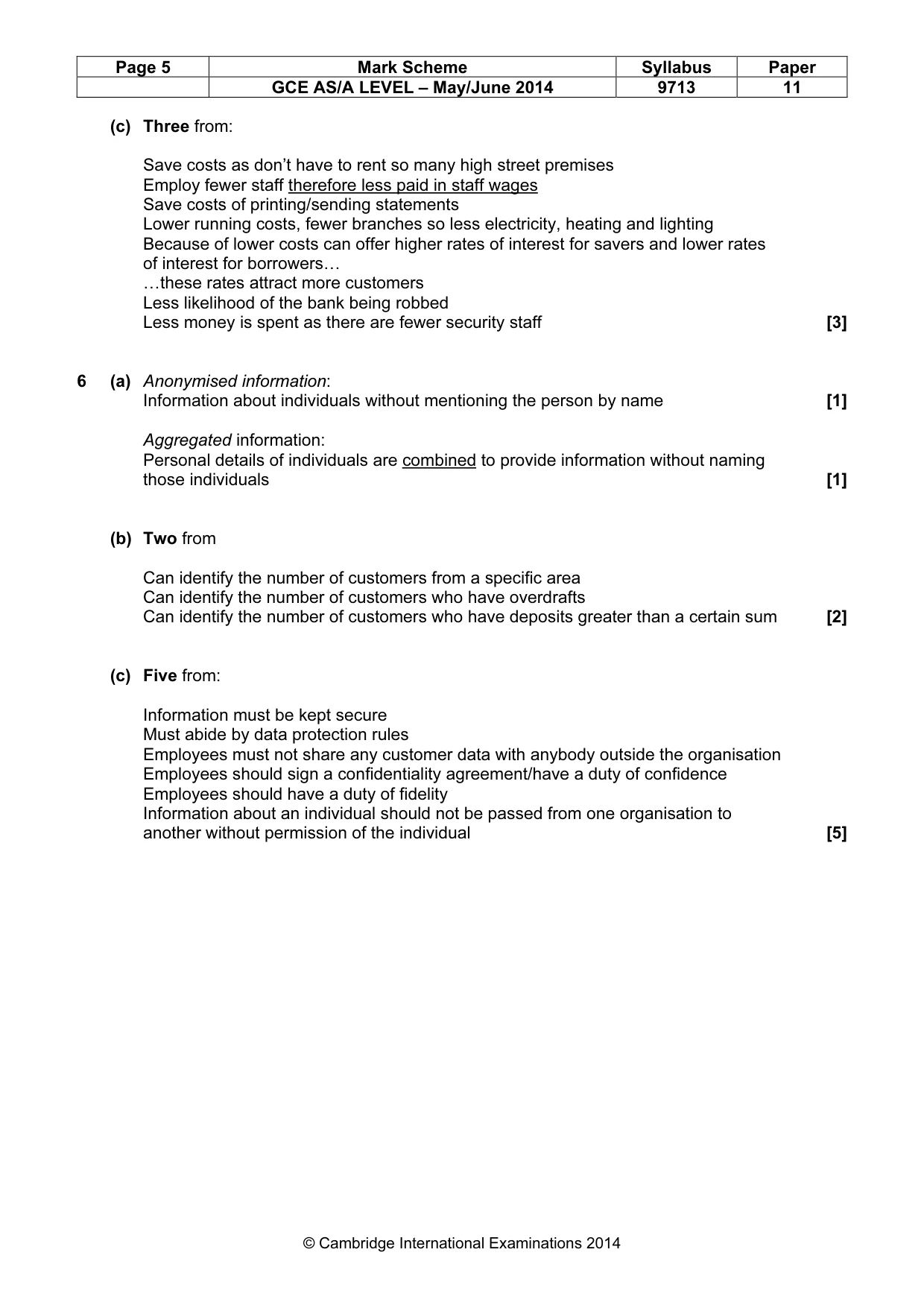
Page 5 Mark Scheme Syllabus Paper GCE AS/A LEVEL – May/June 2014 9713 11 © Cambridge International Examinations 2014 (c) Three from: Save costs as don’t have to rent so many high street premises Employ fewer staff therefore less paid in staff wages Save costs of printing/sending statements Lower running costs, fewer branches so less electricity, heating and lighting Because of lower costs can offer higher rates of interest for savers and lower rates of interest for borrowers… …these rates attract more customers Less likelihood of the bank being robbed Less money is spent as there are fewer security staff [3] 6 (a) Anonymised information: Information about individuals without mentioning the person by name [1] Aggregated information: Personal details of individuals are combined to provide information without naming those individuals [1] (b) Two from Can identify the number of customers from a specific area Can identify the number of customers who have overdrafts Can identify the number of customers who have deposits greater than a certain sum [2] (c) Five from: Information must be kept secure Must abide by data protection rules Employees must not share any customer data with anybody outside the organisation Employees should sign a confidentiality agreement/have a duty of confidence Employees should have a duty of fidelity Information about an individual should not be passed from one organisation to another without permission of the individual [5]
Mark scheme, page 6
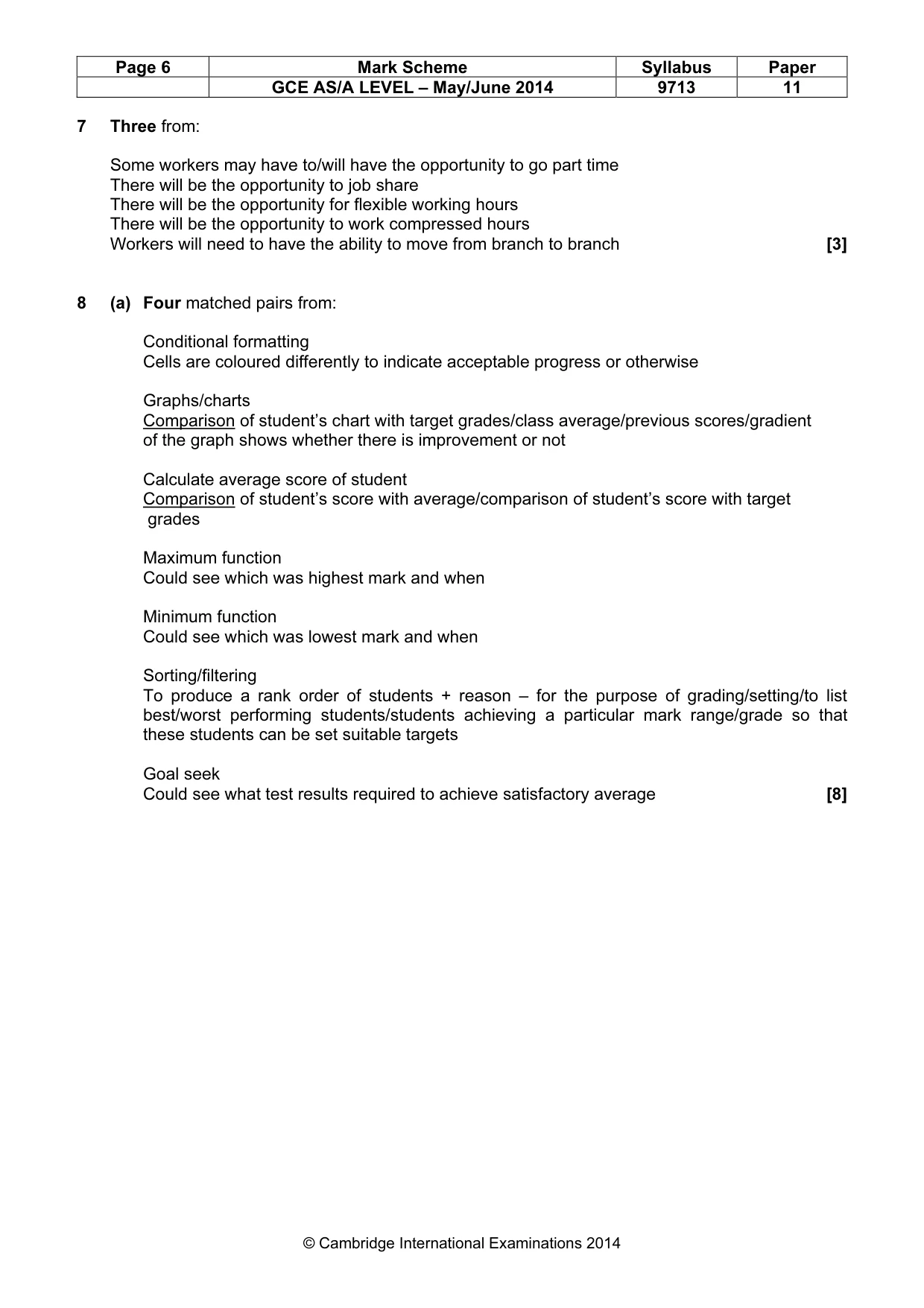
Page 6 Mark Scheme Syllabus Paper GCE AS/A LEVEL – May/June 2014 9713 11 © Cambridge International Examinations 2014 7 Three from: Some workers may have to/will have the opportunity to go part time There will be the opportunity to job share There will be the opportunity for flexible working hours There will be the opportunity to work compressed hours Workers will need to have the ability to move from branch to branch [3] 8 (a) Four matched pairs from: Conditional formatting Cells are coloured differently to indicate acceptable progress or otherwise Graphs/charts Comparison of student’s chart with target grades/class average/previous scores/gradient of the graph shows whether there is improvement or not Calculate average score of student Comparison of student’s score with average/comparison of student’s score with target grades Maximum function Could see which was highest mark and when Minimum function Could see which was lowest mark and when Sorting/filtering To produce a rank order of students + reason – for the purpose of grading/setting/to list best/worst performing students/students achieving a particular mark range/grade so that these students can be set suitable targets Goal seek Could see what test results required to achieve satisfactory average [8]
Mark scheme, page 7
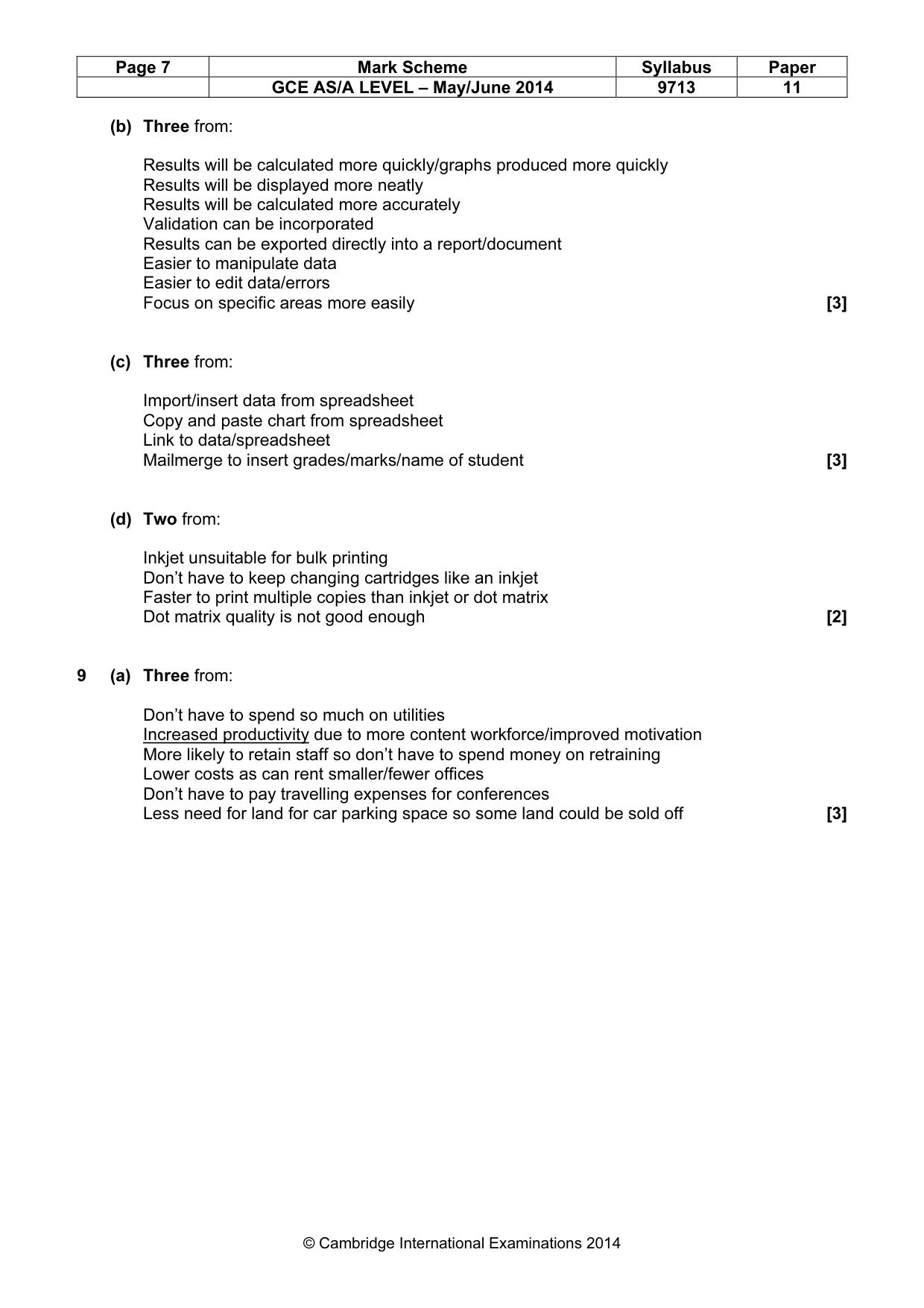
Page 7 Mark Scheme Syllabus Paper GCE AS/A LEVEL – May/June 2014 9713 11 © Cambridge International Examinations 2014 (b) Three from: Results will be calculated more quickly/graphs produced more quickly Results will be displayed more neatly Results will be calculated more accurately Validation can be incorporated Results can be exported directly into a report/document Easier to manipulate data Easier to edit data/errors Focus on specific areas more easily [3] (c) Three from: Import/insert data from spreadsheet Copy and paste chart from spreadsheet Link to data/spreadsheet Mailmerge to insert grades/marks/name of student [3] (d) Two from: Inkjet unsuitable for bulk printing Don’t have to keep changing cartridges like an inkjet Faster to print multiple copies than inkjet or dot matrix Dot matrix quality is not good enough [2] 9 (a) Three from: Don’t have to spend so much on utilities Increased productivity due to more content workforce/improved motivation More likely to retain staff so don’t have to spend money on retraining Lower costs as can rent smaller/fewer offices Don’t have to pay travelling expenses for conferences Less need for land for car parking space so some land could be sold off [3]
Mark scheme, page 8
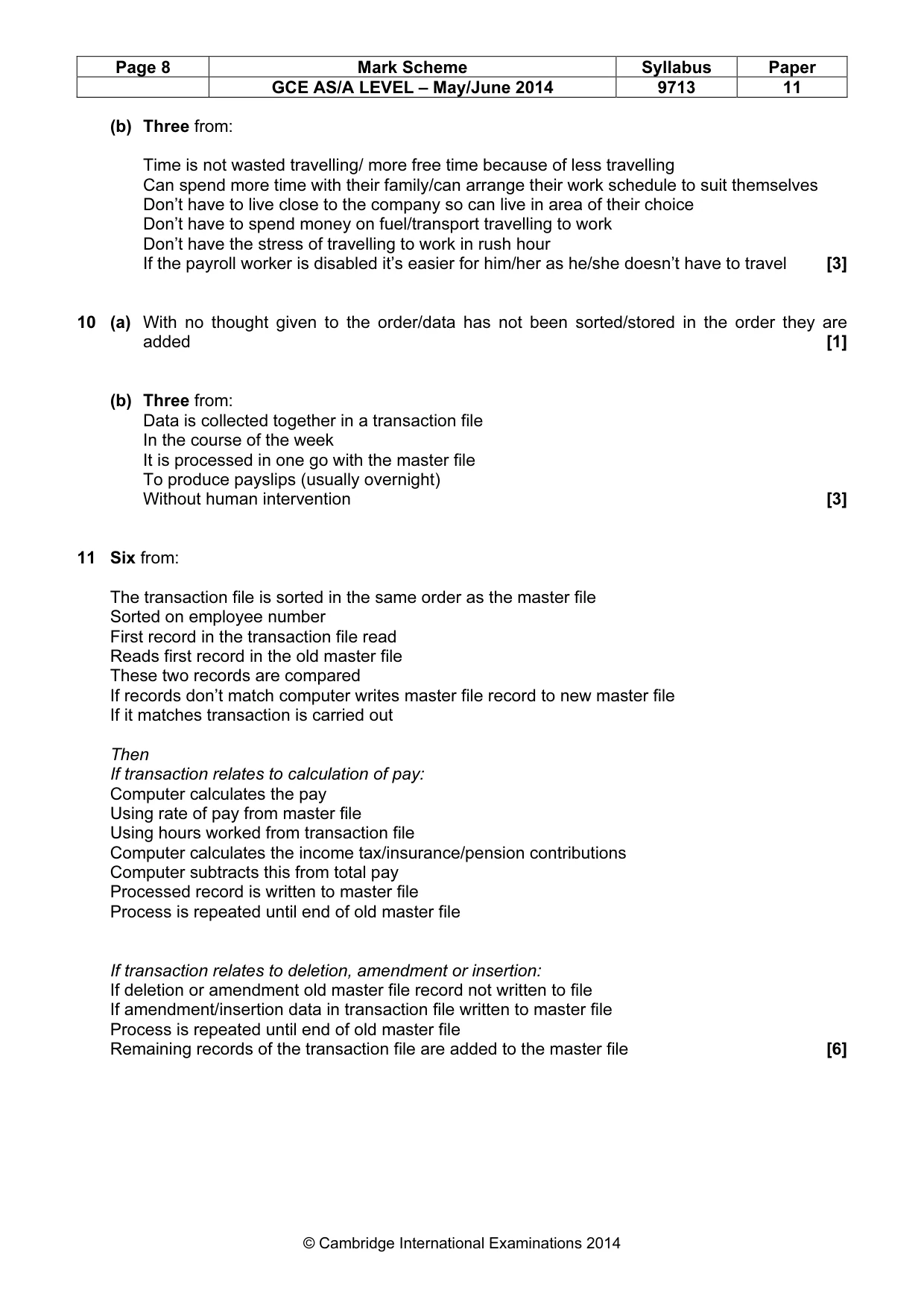
Page 8 Mark Scheme Syllabus Paper GCE AS/A LEVEL – May/June 2014 9713 11 © Cambridge International Examinations 2014 (b) Three from: Time is not wasted travelling/ more free time because of less travelling Can spend more time with their family/can arrange their work schedule to suit themselves Don’t have to live close to the company so can live in area of their choice Don’t have to spend money on fuel/transport travelling to work Don’t have the stress of travelling to work in rush hour If the payroll worker is disabled it’s easier for him/her as he/she doesn’t have to travel [3] 10 (a) With no thought given to the order/data has not been sorted/stored in the order they are added [1] (b) Three from: Data is collected together in a transaction file In the course of the week It is processed in one go with the master file To produce payslips (usually overnight) Without human intervention [3] 11 Six from: The transaction file is sorted in the same order as the master file Sorted on employee number First record in the transaction file read Reads first record in the old master file These two records are compared If records don’t match computer writes master file record to new master file If it matches transaction is carried out Then If transaction relates to calculation of pay: Computer calculates the pay Using rate of pay from master file Using hours worked from transaction file Computer calculates the income tax/insurance/pension contributions Computer subtracts this from total pay Processed record is written to master file Process is repeated until end of old master file If transaction relates to deletion, amendment or insertion: If deletion or amendment old master file record not written to file If amendment/insertion data in transaction file written to master file Process is repeated until end of old master file Remaining records of the transaction file are added to the master file [6]
What you needed in this session
Cambridge’s own grade thresholds for 2014 May/June, Paper 1 · Variant 1. A higher threshold means an easier paper — the bar moves with how the cohort did.