Cambridge A Level Applied Information and Communication Technology 9713 — 2017 May/June Paper 1 · Variant 1
9713/11/M/J/17 · 80 marks · ≈90 min
The question paper and its mark scheme, free to read here and free to download. This is Cambridge’s own paper, exactly as it was sat.
Question paper16 pages
Mark scheme9 pages
Answers below. Sit the paper first if you are practising.
Paper as text
Question paper, page 1
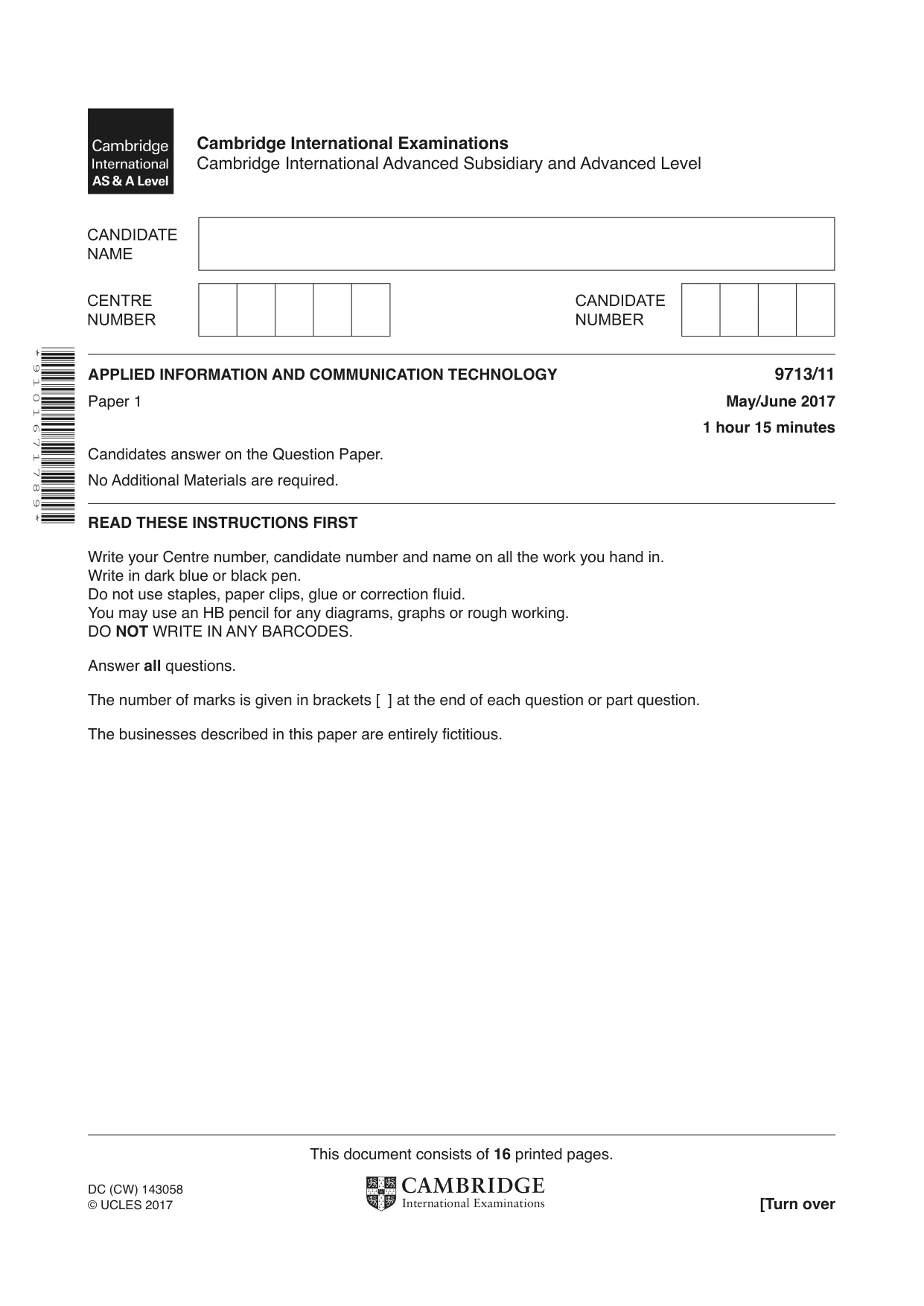
* 9 1 0 1 6 7 1 7 8 9 * This document consists of 16 printed pages. DC (CW) 143058 © UCLES 2017 [Turn over Cambridge International Examinations Cambridge International Advanced Subsidiary and Advanced Level APPLIED INFORMATION AND COMMUNICATION TECHNOLOGY 9713/11 Paper 1 May/June 2017 1 hour 15 minutes Candidates answer on the Question Paper. No Additional Materials are required. READ THESE INSTRUCTIONS FIRST Write your Centre number, candidate number and name on all the work you hand in. Write in dark blue or black pen. Do not use staples, paper clips, glue or correction fluid. You may use an HB pencil for any diagrams, graphs or rough working. DO NOT WRITE IN ANY BARCODES. Answer all questions. The number of marks is given in brackets [ ] at the end of each question or part question. The businesses described in this paper are entirely fictitious.
Question paper, page 2
2 9713/11/M/J/17 © UCLES 2017 Scenario 1 Questions 1, 2 and 3 International Computers Lesotho is a rapidly expanding computer manufacturer based in Africa. They are currently considering the various ways ICT could be used to advertise their latest computer. Jacob is the manager of the advertising department. Jacob has agreed to let his employees work compressed hours.
Question paper, page 3
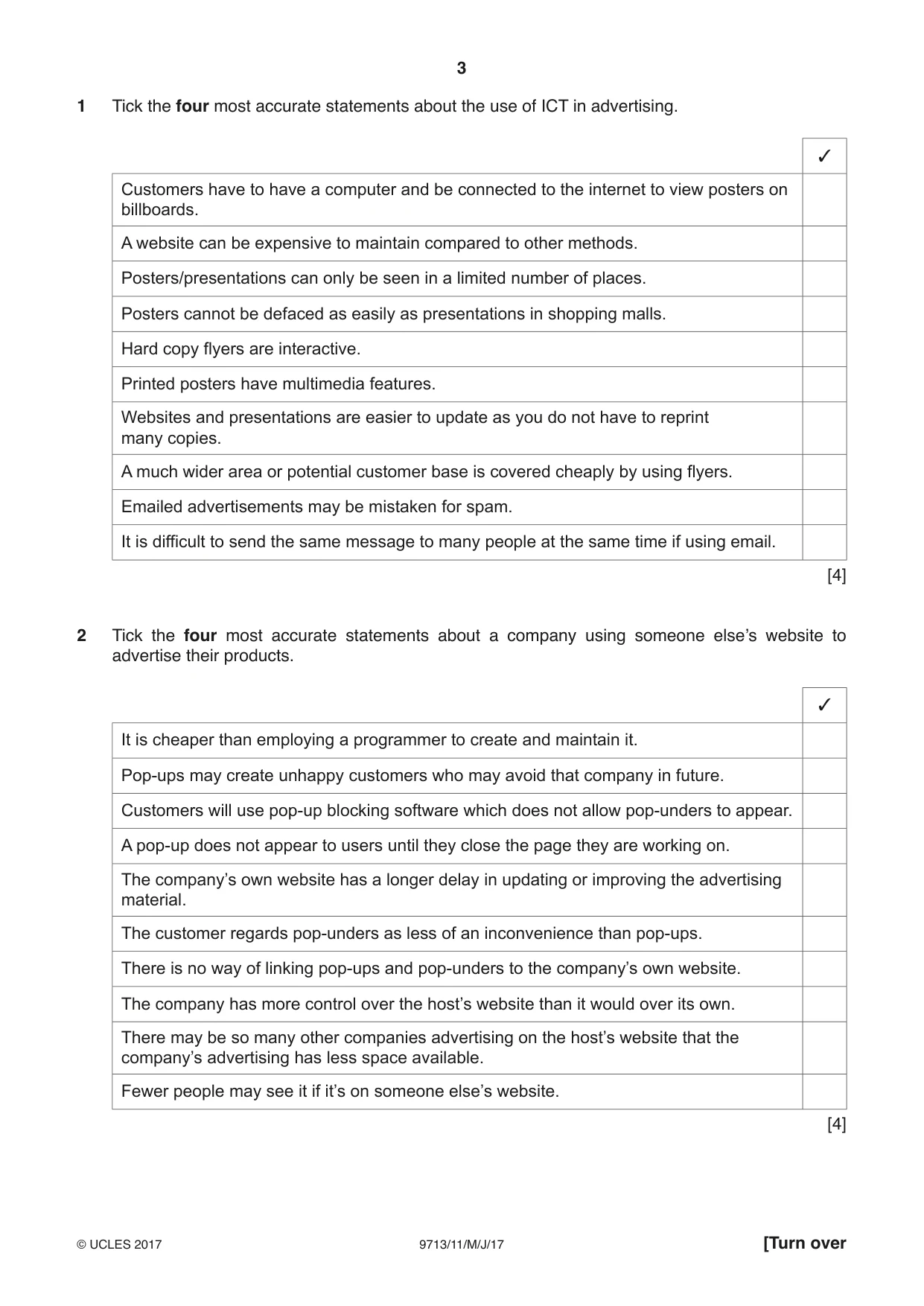
3 9713/11/M/J/17 © UCLES 2017 [Turn over 1 Tick the four most accurate statements about the use of ICT in advertising. 3 Customers have to have a computer and be connected to the internet to view posters on billboards. A website can be expensive to maintain compared to other methods. Posters/presentations can only be seen in a limited number of places. Posters cannot be defaced as easily as presentations in shopping malls. Hard copy flyers are interactive. Printed posters have multimedia features. Websites and presentations are easier to update as you do not have to reprint many copies. A much wider area or potential customer base is covered cheaply by using flyers. Emailed advertisements may be mistaken for spam. It is difficult to send the same message to many people at the same time if using email. [4] 2 Tick the four most accurate statements about a company using someone else’s website to advertise their products. 3 It is cheaper than employing a programmer to create and maintain it. Pop-ups may create unhappy customers who may avoid that company in future. Customers will use pop-up blocking software which does not allow pop-unders to appear. A pop-up does not appear to users until they close the page they are working on. The company’s own website has a longer delay in updating or improving the advertising material. The customer regards pop-unders as less of an inconvenience than pop-ups. There is no way of linking pop-ups and pop-unders to the company’s own website. The company has more control over the host’s website than it would over its own. There may be so many other companies advertising on the host’s website that the company’s advertising has less space available. Fewer people may see it if it’s on someone else’s website. [4]
Question paper, page 4
4 9713/11/M/J/17 © UCLES 2017 3 (a) Describe what is meant by working compressed hours. … … … …[2] (b) Discuss the benefits and drawbacks to the company and its workers of working compressed hours. … … … … … … … … … … … … … … … … … … … …[8]
Question paper, page 5
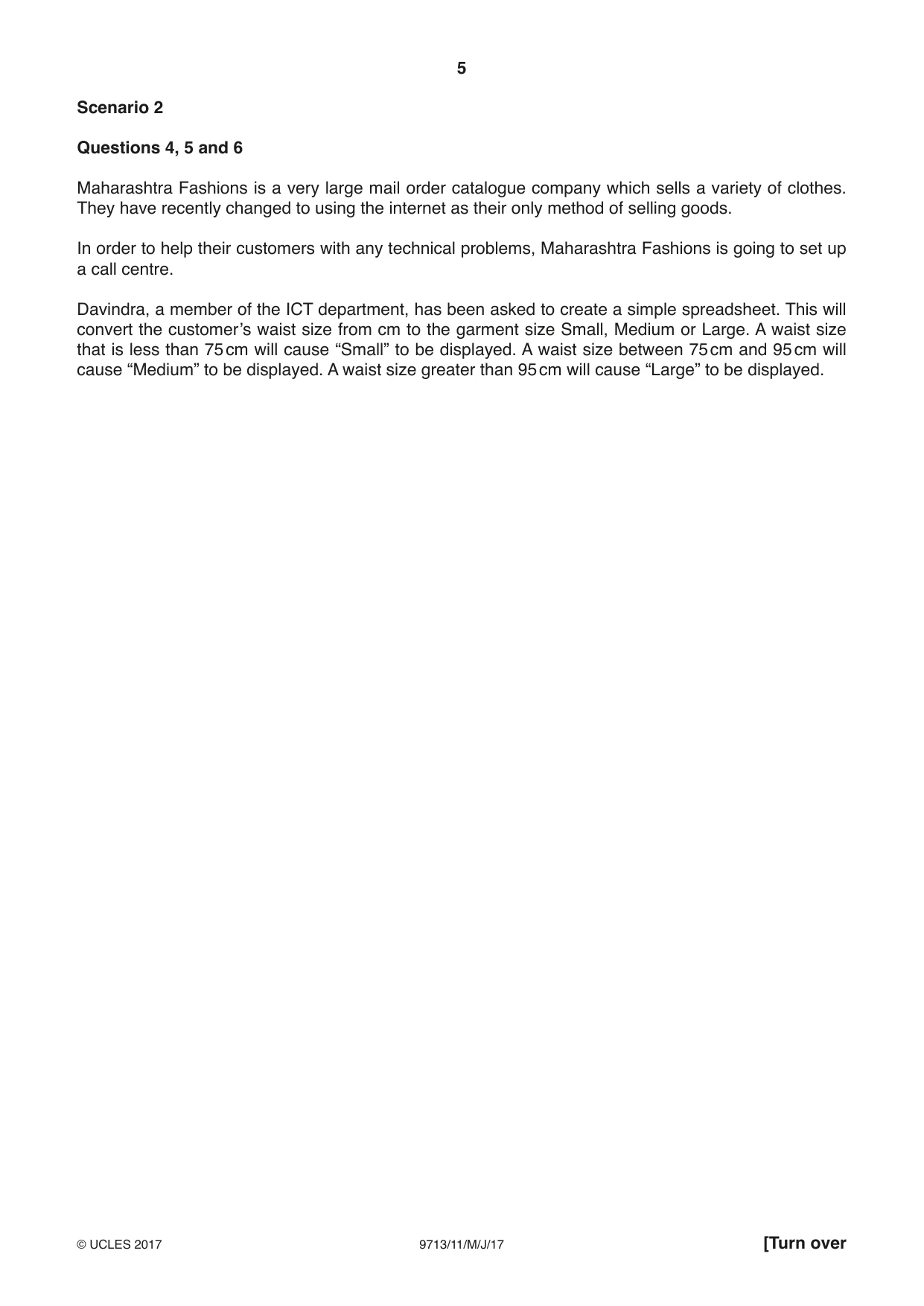
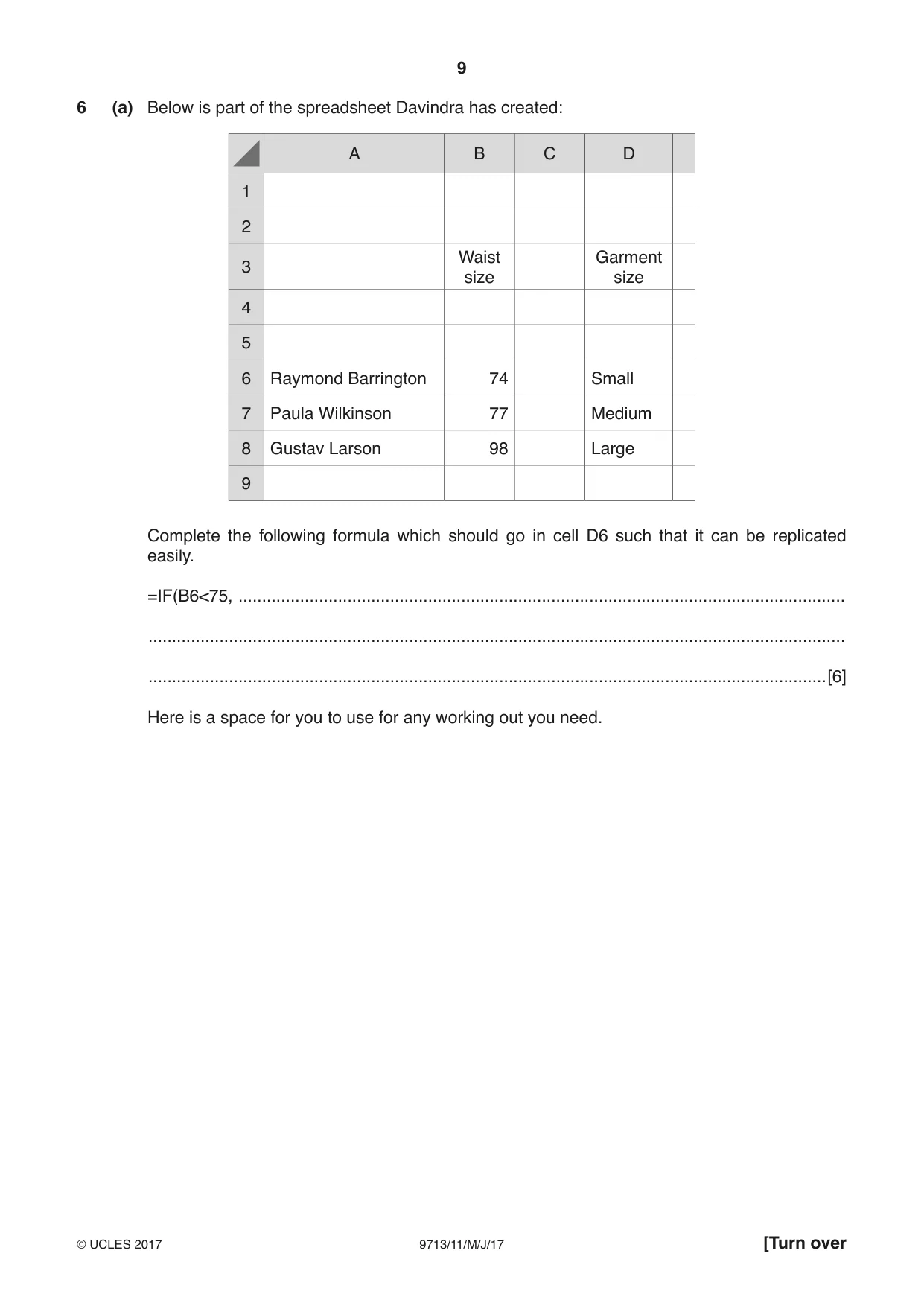
5 9713/11/M/J/17 © UCLES 2017 [Turn over Scenario 2 Questions 4, 5 and 6 Maharashtra Fashions is a very large mail order catalogue company which sells a variety of clothes. They have recently changed to using the internet as their only method of selling goods. In order to help their customers with any technical problems, Maharashtra Fashions is going to set up a call centre. Davindra, a member of the ICT department, has been asked to create a simple spreadsheet. This will convert the customer’s waist size from cm to the garment size Small, Medium or Large. A waist size that is less than 75 cm will cause “Small” to be displayed. A waist size between 75 cm and 95 cm will cause “Medium” to be displayed. A waist size greater than 95 cm will cause “Large” to be displayed.
Question paper, page 6
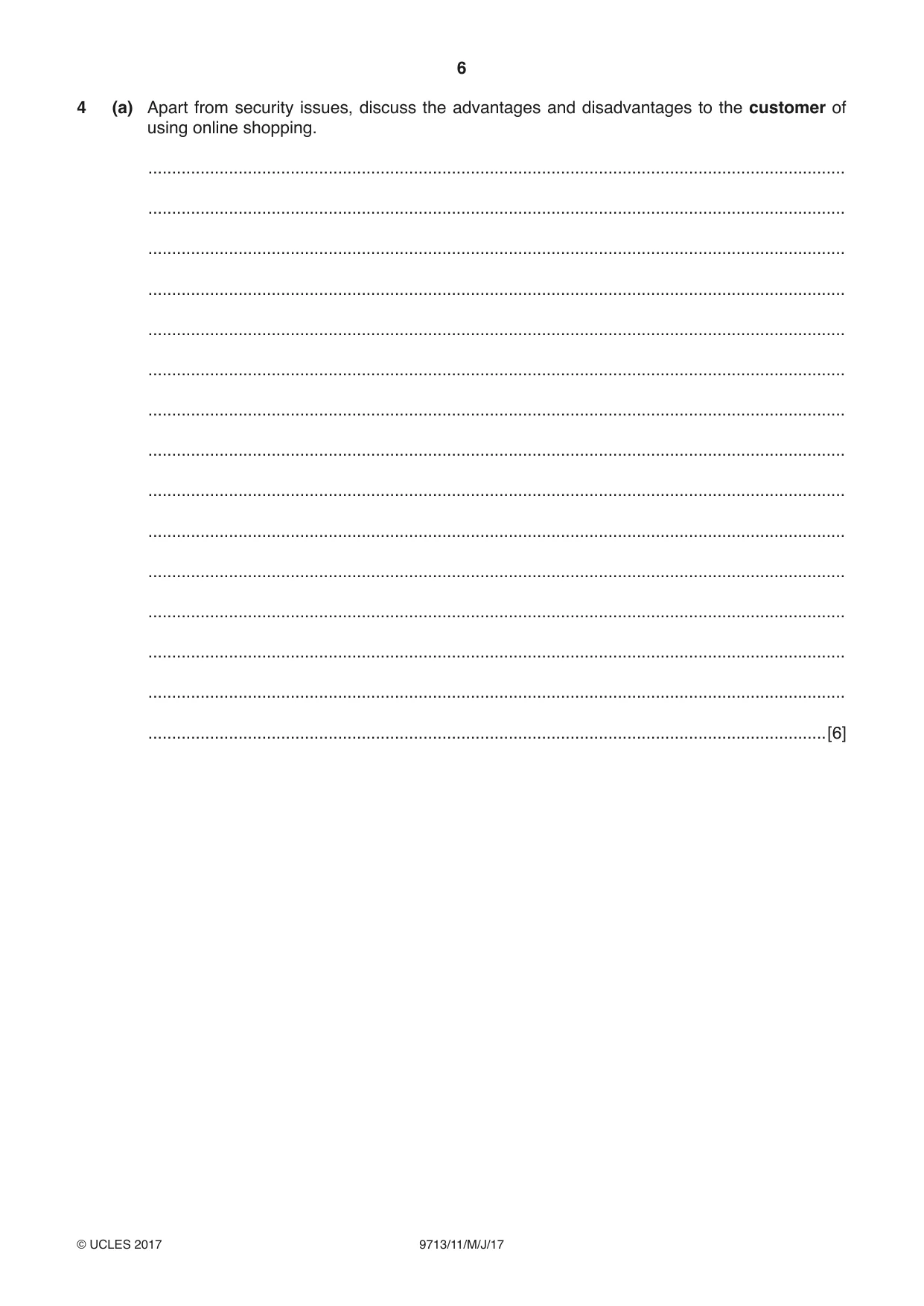
6 9713/11/M/J/17 © UCLES 2017 4 (a) Apart from security issues, discuss the advantages and disadvantages to the customer of using online shopping. … … … … … … … … … … … … … … …[6]
Question paper, page 7
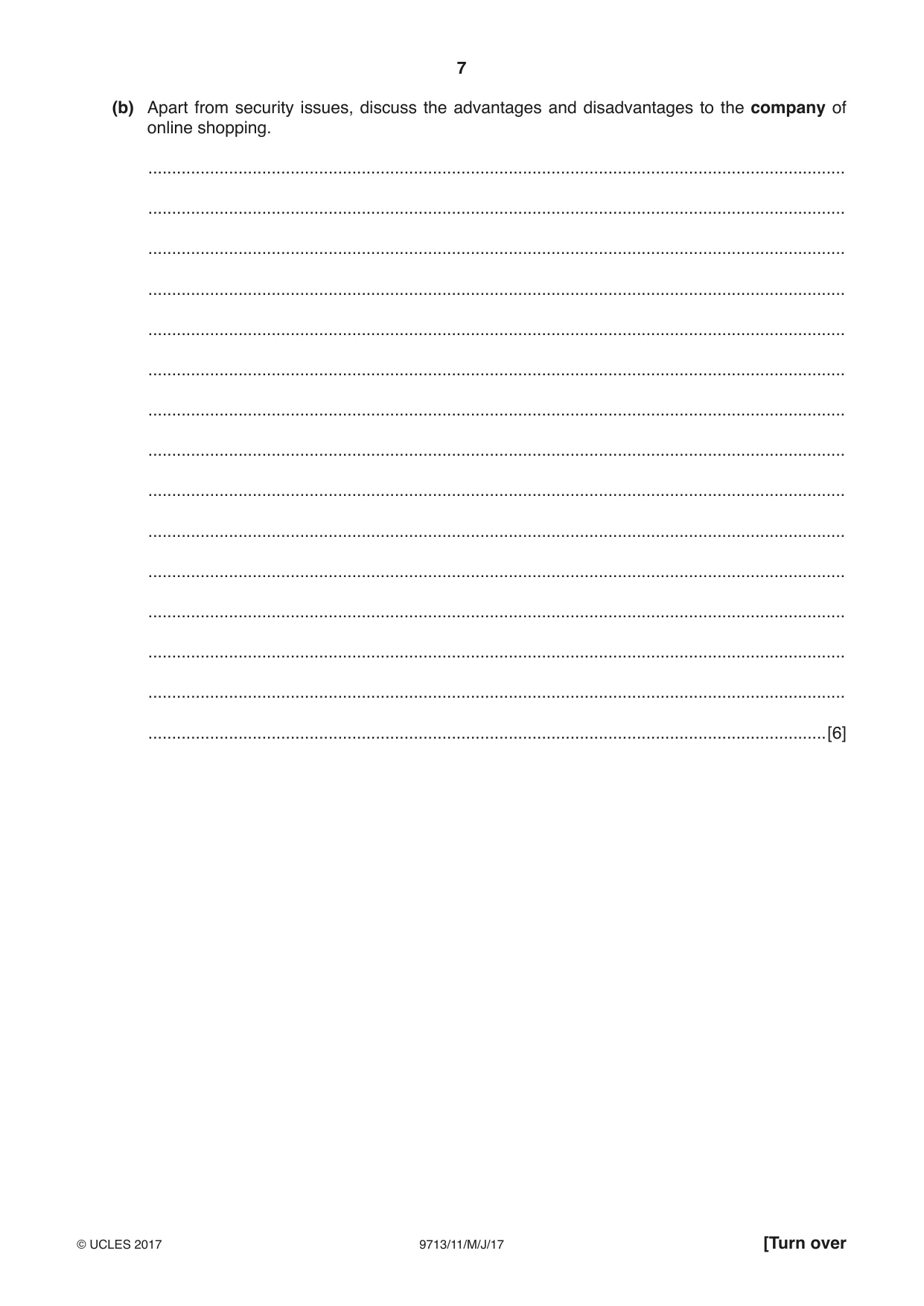
7 9713/11/M/J/17 © UCLES 2017 [Turn over (b) Apart from security issues, discuss the advantages and disadvantages to the company of online shopping. … … … … … … … … … … … … … … …[6]
Question paper, page 8
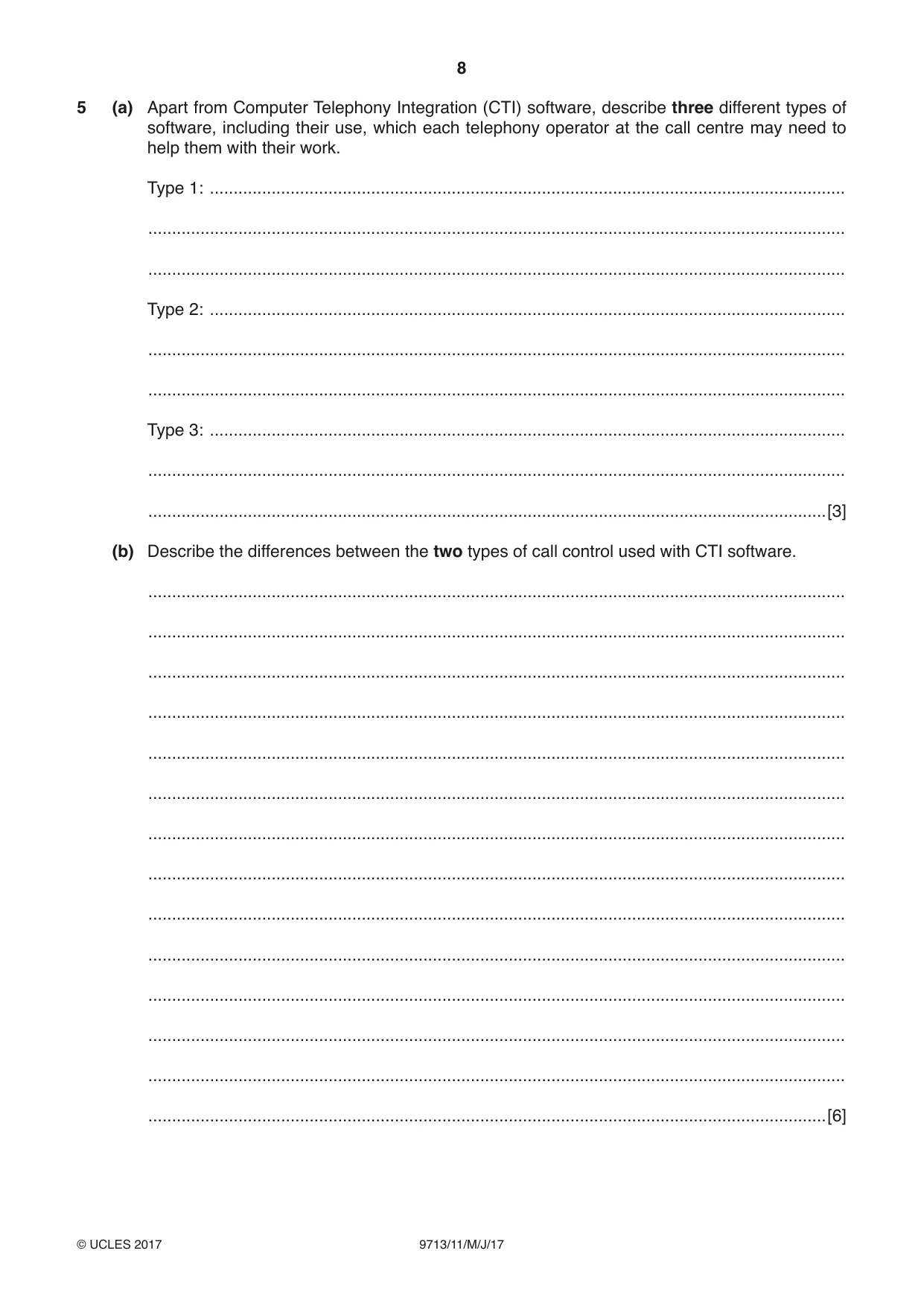
8 9713/11/M/J/17 © UCLES 2017 5 (a) Apart from Computer Telephony Integration (CTI) software, describe three different types of software, including their use, which each telephony operator at the call centre may need to help them with their work. Type 1: … … … Type 2: … … … Type 3: … … …[3] (b) Describe the differences between the two types of call control used with CTI software. … … … … … … … … … … … … … …[6]
Question paper, page 9
9 9713/11/M/J/17 © UCLES 2017 [Turn over 6 (a) Below is part of the spreadsheet Davindra has created: A B C D 1 2 3 Waist size Garment size 4 5 6 Raymond Barrington 74 Small 7 Paula Wilkinson 77 Medium 8 Gustav Larson 98 Large 9 Complete the following formula which should go in cell D6 such that it can be replicated easily. =IF(B6<75, … … …[6] Here is a space for you to use for any working out you need.
Question paper, page 10
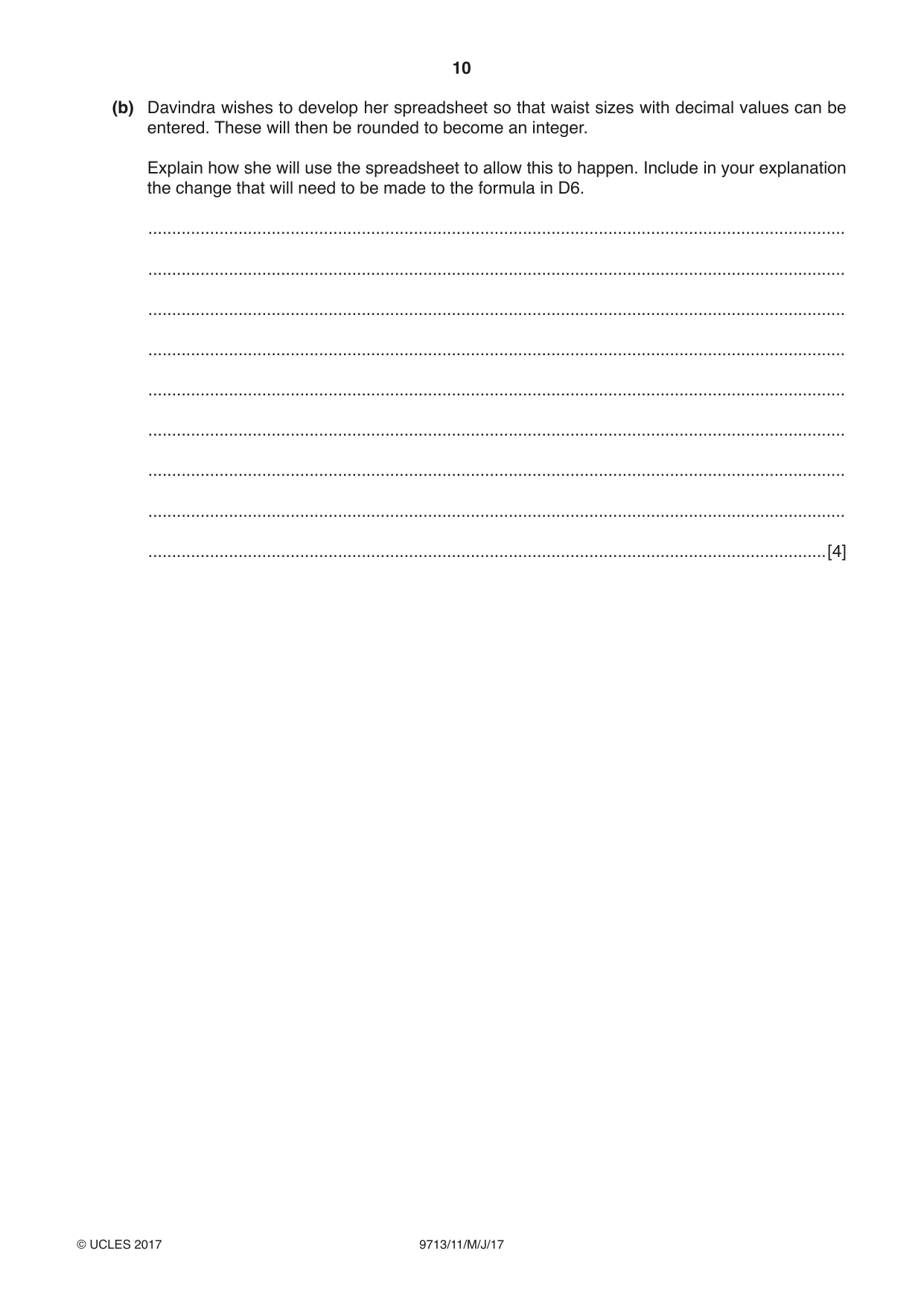
10 9713/11/M/J/17 © UCLES 2017 (b) Davindra wishes to develop her spreadsheet so that waist sizes with decimal values can be entered. These will then be rounded to become an integer. Explain how she will use the spreadsheet to allow this to happen. Include in your explanation the change that will need to be made to the formula in D6. … … … … … … … … …[4]
Question paper, page 11
11 9713/11/M/J/17 © UCLES 2017 [Turn over Scenario 3 Questions 7, 8, 9, 10 and 11 Queen Mary’s Hospital has recently decided to upgrade its patient records system. One of the uses of the new system will be to provide the patient’s family doctor with information about the treatment received by the patient. Jasvir, a systems analyst, has been asked to collect information about the current system and to develop a new improved system. Jasvir has a team of programmers that he meets with regularly to discuss the progress of the project. The data held about patients is personal and employees in the hospital are required to respect the confidentiality of the patients’ data.
Question paper, page 12
12 9713/11/M/J/17 © UCLES 2017 7 Apart from observation, describe three methods of researching the current system and for each give a benefit of using it. Method 1 … … … Benefit … … … Method 2 … … … Benefit … … … Method 3 … … … Benefit … … …[6]
Question paper, page 13
13 9713/11/M/J/17 © UCLES 2017 [Turn over 8 After the data has been collected a data flow diagram will be produced. Using examples from the scenario, name and describe, including their use, the components of this data flow diagram. … … … … … … … … … … … … … …[6]
Question paper, page 14
14 9713/11/M/J/17 © UCLES 2017 9 Explain the social and ethical implications of hospital workers being able to access patients’ personal information. … … … … … … … … … … … … … …[6]
Question paper, page 15
15 9713/11/M/J/17 © UCLES 2017 [Turn over 10 Describe a suitable test plan that Jasvir could use to test the developed system. … … … … … … … … … … …[5] 11 (a) Describe Jasvir’s use of calendars in time management software when arranging a new meeting with the programmers. … … … … … … … …[3]
Question paper, page 16
16 9713/11/M/J/17 © UCLES 2017 (b) Describe how other features of time management software would help to ensure the project is completed successfully. … … … … … … … … … … …[5] Permission to reproduce items where third-party owned material protected by copyright is included has been sought and cleared where possible. Every reasonable effort has been made by the publisher (UCLES) to trace copyright holders, but if any items requiring clearance have unwittingly been included, the publisher will be pleased to make amends at the earliest possible opportunity. To avoid the issue of disclosure of answer-related information to candidates, all copyright acknowledgements are reproduced online in the Cambridge International Examinations Copyright Acknowledgements Booklet. This is produced for each series of examinations and is freely available to download at www.cie.org.uk after the live examination series. Cambridge International Examinations is part of the Cambridge Assessment Group. Cambridge Assessment is the brand name of University of Cambridge Local Examinations Syndicate (UCLES), which is itself a department of the University of Cambridge.
Mark scheme, page 1
® IGCSE is a registered trademark. This document consists of 9 printed pages. © UCLES 2017 [Turn over Cambridge International Examinations Cambridge International Advanced Subsidiary and Advanced Level APPLIED INFORMATION AND COMMUNICATION TECHNOLOGY 9713/11 Paper 1 Written A May/June 2017 MARK SCHEME Maximum Mark: 80 Published This mark scheme is published as an aid to teachers and candidates, to indicate the requirements of the examination. It shows the basis on which Examiners were instructed to award marks. It does not indicate the details of the discussions that took place at an Examiners’ meeting before marking began, which would have considered the acceptability of alternative answers. Mark schemes should be read in conjunction with the question paper and the Principal Examiner Report for Teachers. Cambridge will not enter into discussions about these mark schemes. Cambridge is publishing the mark schemes for the May/June 2017 series for most Cambridge IGCSE®, Cambridge International A and AS Level and Cambridge Pre-U components, and some Cambridge O Level components.
Mark scheme, page 2
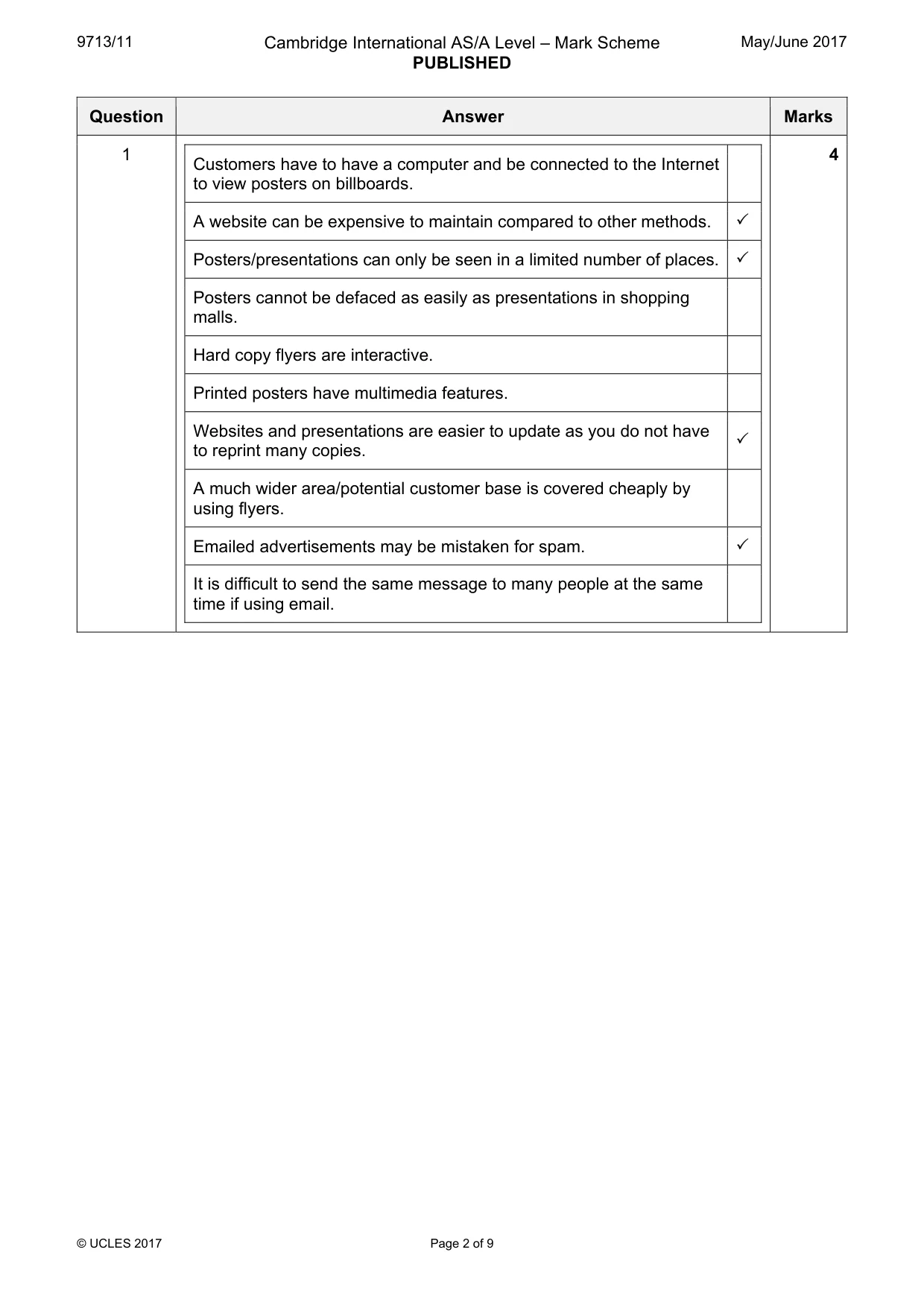
9713/11 Cambridge International AS/A Level – Mark Scheme PUBLISHED May/June 2017 © UCLES 2017 Page 2 of 9 Question Answer Marks 1 Customers have to have a computer and be connected to the Internet to view posters on billboards. A website can be expensive to maintain compared to other methods. 3 Posters/presentations can only be seen in a limited number of places. 3 Posters cannot be defaced as easily as presentations in shopping malls. Hard copy flyers are interactive. Printed posters have multimedia features. Websites and presentations are easier to update as you do not have to reprint many copies. 3 A much wider area/potential customer base is covered cheaply by using flyers. Emailed advertisements may be mistaken for spam. 3 It is difficult to send the same message to many people at the same time if using email. 4
Mark scheme, page 3
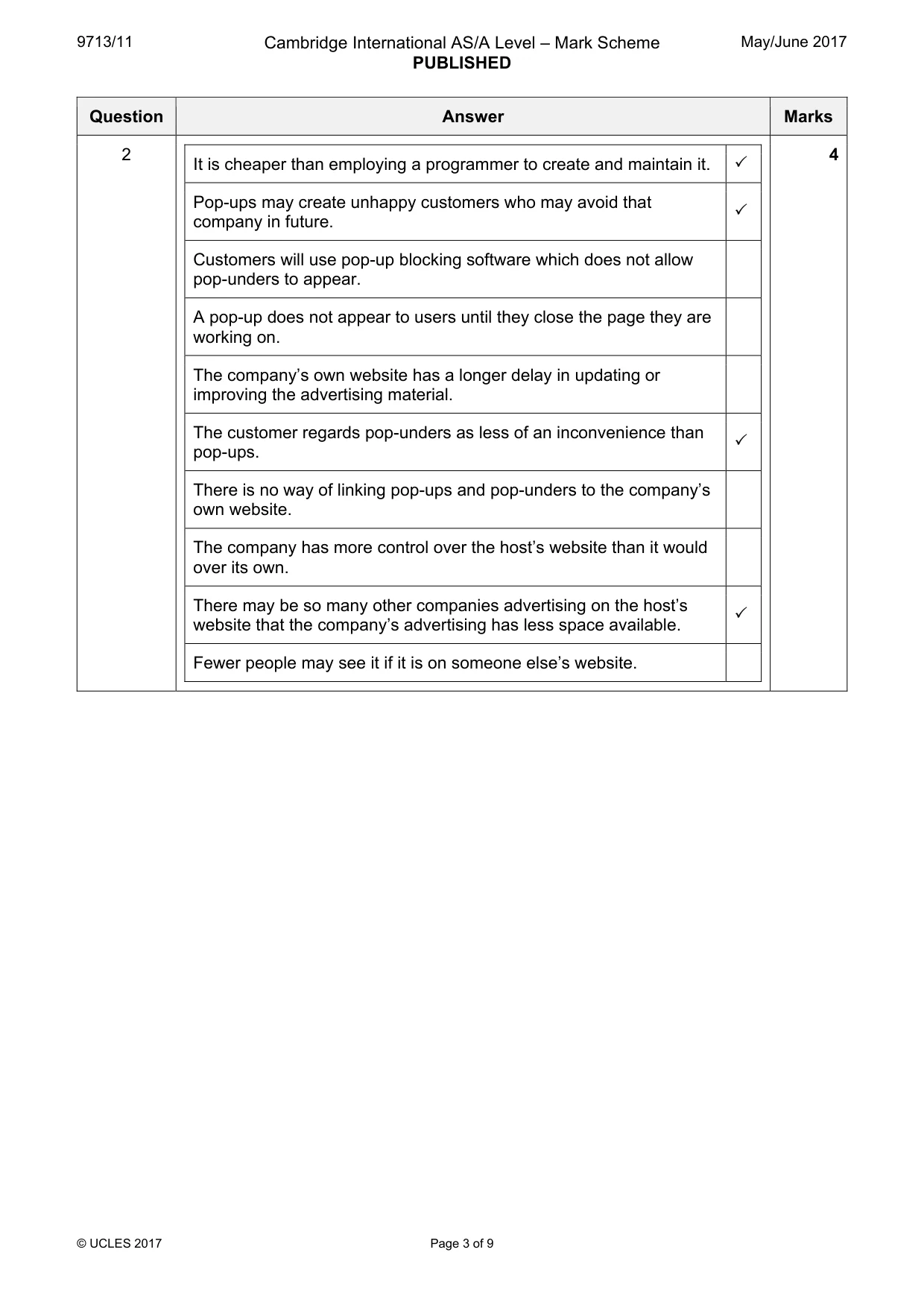
9713/11 Cambridge International AS/A Level – Mark Scheme PUBLISHED May/June 2017 © UCLES 2017 Page 3 of 9 Question Answer Marks 2 It is cheaper than employing a programmer to create and maintain it. 3 Pop-ups may create unhappy customers who may avoid that company in future. 3 Customers will use pop-up blocking software which does not allow pop-unders to appear. A pop-up does not appear to users until they close the page they are working on. The company’s own website has a longer delay in updating or improving the advertising material. The customer regards pop-unders as less of an inconvenience than pop-ups. 3 There is no way of linking pop-ups and pop-unders to the company’s own website. The company has more control over the host’s website than it would over its own. There may be so many other companies advertising on the host’s website that the company’s advertising has less space available. 3 Fewer people may see it if it is on someone else’s website. 4
Mark scheme, page 4
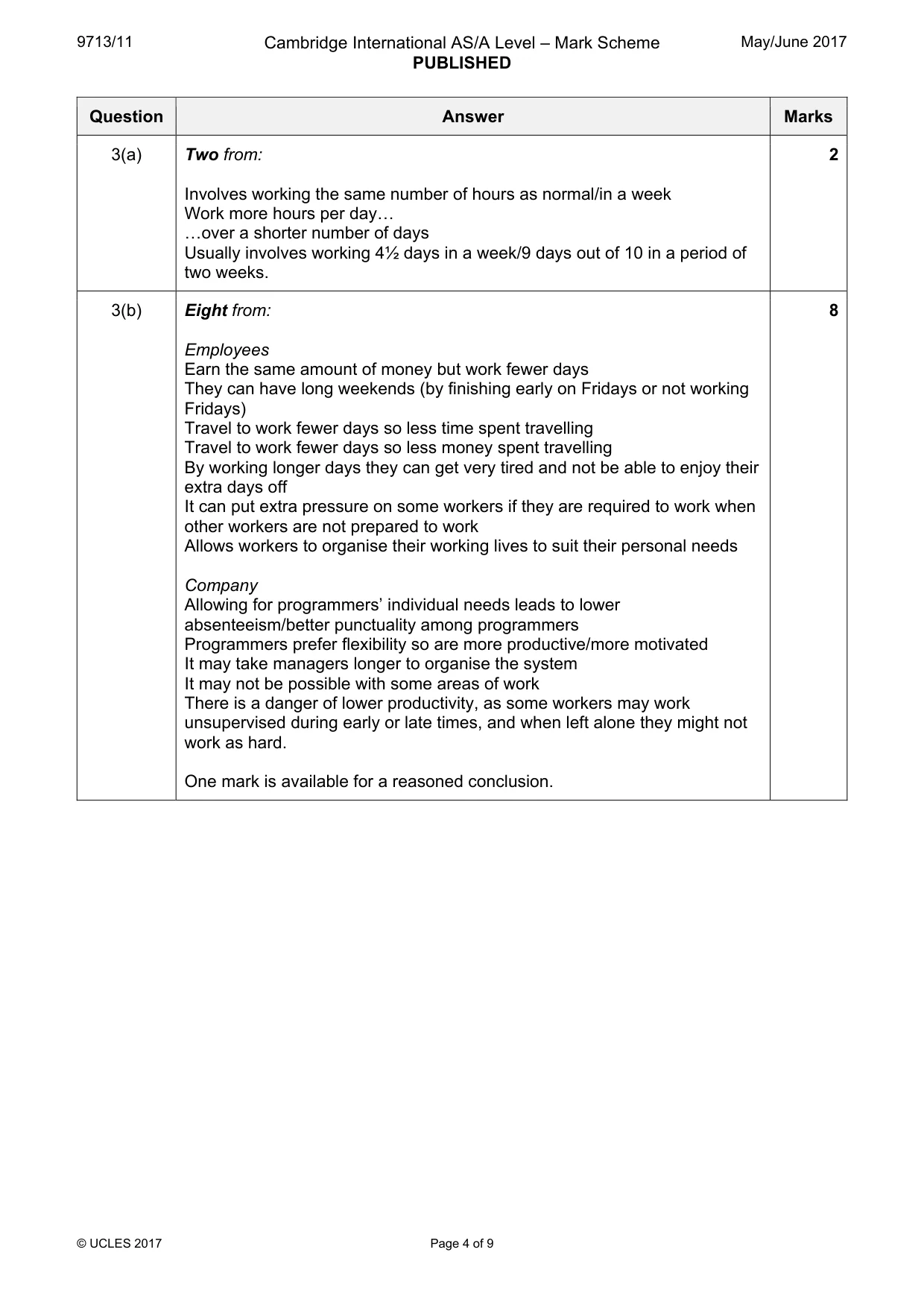
9713/11 Cambridge International AS/A Level – Mark Scheme PUBLISHED May/June 2017 © UCLES 2017 Page 4 of 9 Question Answer Marks 3(a) Two from: Involves working the same number of hours as normal/in a week Work more hours per day« «over a shorter number of days Usually involves working 4½ days in a week/9 days out of 10 in a period of two weeks. 2 3(b) Eight from: Employees Earn the same amount of money but work fewer days They can have long weekends (by finishing early on Fridays or not working Fridays) Travel to work fewer days so less time spent travelling Travel to work fewer days so less money spent travelling By working longer days they can get very tired and not be able to enjoy their extra days off It can put extra pressure on some workers if they are required to work when other workers are not prepared to work Allows workers to organise their working lives to suit their personal needs Company Allowing for programmers’ individual needs leads to lower absenteeism/better punctuality among programmers Programmers prefer flexibility so are more productive/more motivated It may take managers longer to organise the system It may not be possible with some areas of work There is a danger of lower productivity, as some workers may work unsupervised during early or late times, and when left alone they might not work as hard. One mark is available for a reasoned conclusion. 8
Mark scheme, page 5
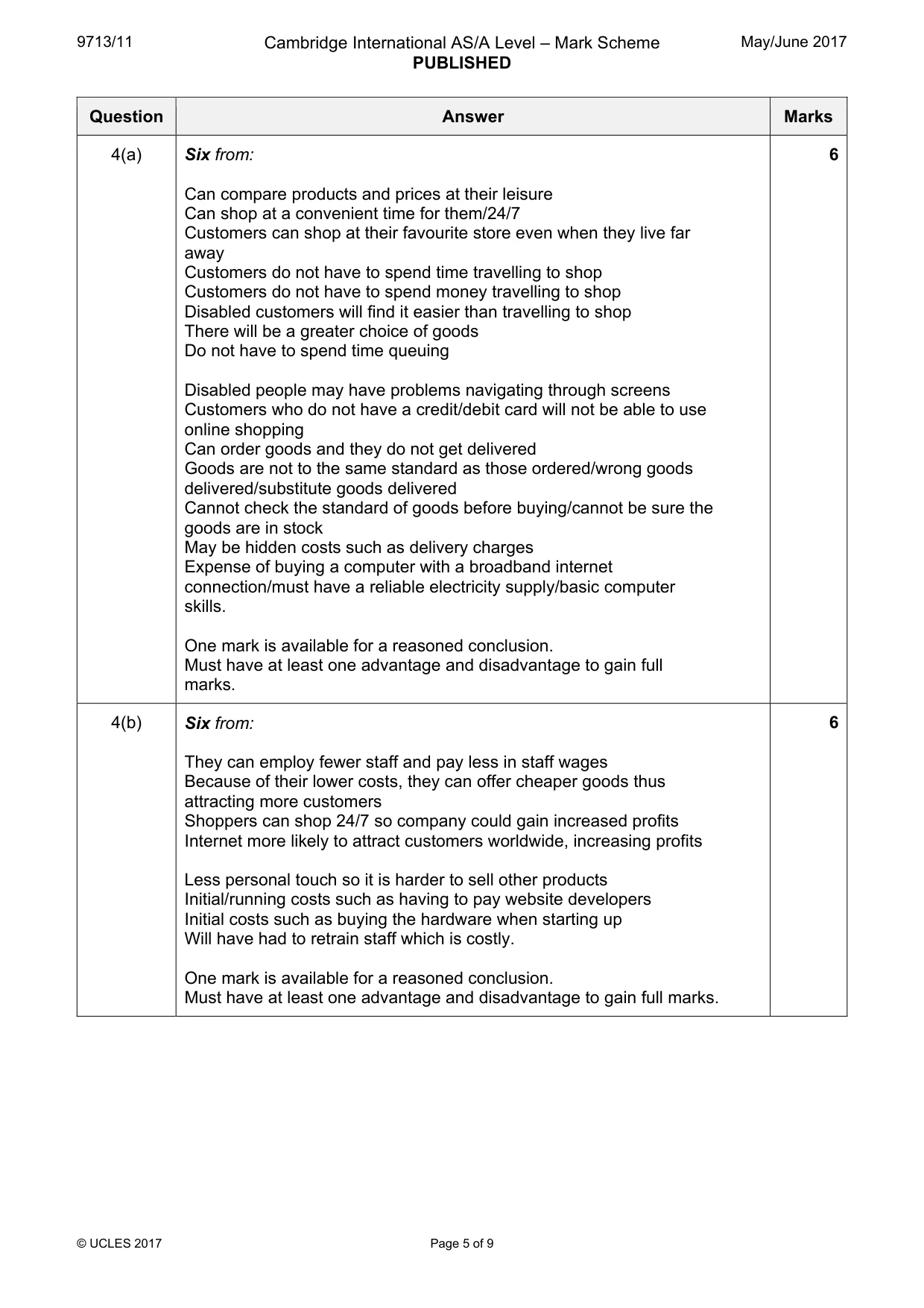
9713/11 Cambridge International AS/A Level – Mark Scheme PUBLISHED May/June 2017 © UCLES 2017 Page 5 of 9 Question Answer Marks 4(a) Six from: Can compare products and prices at their leisure Can shop at a convenient time for them/24/7 Customers can shop at their favourite store even when they live far away Customers do not have to spend time travelling to shop Customers do not have to spend money travelling to shop Disabled customers will find it easier than travelling to shop There will be a greater choice of goods Do not have to spend time queuing Disabled people may have problems navigating through screens Customers who do not have a credit/debit card will not be able to use online shopping Can order goods and they do not get delivered Goods are not to the same standard as those ordered/wrong goods delivered/substitute goods delivered Cannot check the standard of goods before buying/cannot be sure the goods are in stock May be hidden costs such as delivery charges Expense of buying a computer with a broadband internet connection/must have a reliable electricity supply/basic computer skills. One mark is available for a reasoned conclusion. Must have at least one advantage and disadvantage to gain full marks. 6 4(b) Six from: They can employ fewer staff and pay less in staff wages Because of their lower costs, they can offer cheaper goods thus attracting more customers Shoppers can shop 24/7 so company could gain increased profits Internet more likely to attract customers worldwide, increasing profits Less personal touch so it is harder to sell other products Initial/running costs such as having to pay website developers Initial costs such as buying the hardware when starting up Will have had to retrain staff which is costly. One mark is available for a reasoned conclusion. Must have at least one advantage and disadvantage to gain full marks. 6
Mark scheme, page 6
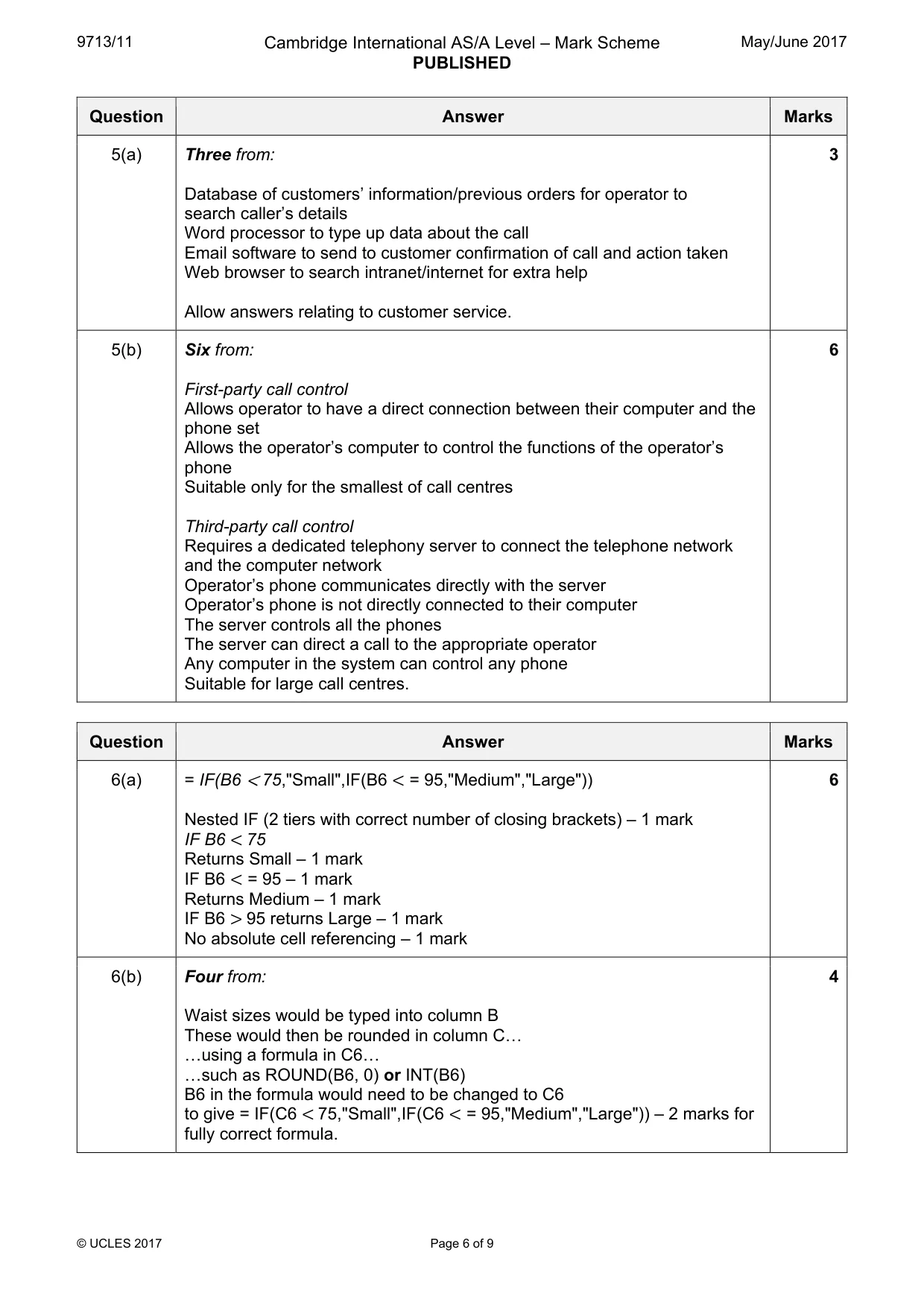
9713/11 Cambridge International AS/A Level – Mark Scheme PUBLISHED May/June 2017 © UCLES 2017 Page 6 of 9 Question Answer Marks 5(a) Three from: Database of customers’ information/previous orders for operator to search caller’s details Word processor to type up data about the call Email software to send to customer confirmation of call and action taken Web browser to search intranet/internet for extra help Allow answers relating to customer service. 3 5(b) Six from: First-party call control Allows operator to have a direct connection between their computer and the phone set Allows the operator’s computer to control the functions of the operator’s phone Suitable only for the smallest of call centres Third-party call control Requires a dedicated telephony server to connect the telephone network and the computer network Operator’s phone communicates directly with the server Operator’s phone is not directly connected to their computer The server controls all the phones The server can direct a call to the appropriate operator Any computer in the system can control any phone Suitable for large call centres. 6 Question Answer Marks 6(a) = IF(B6 < 75,"Small",IF(B6 < = 95,"Medium","Large")) Nested IF (2 tiers with correct number of closing brackets) – 1 mark IF B6 < 75 Returns Small – 1 mark IF B6 < = 95 – 1 mark Returns Medium – 1 mark IF B6 > 95 returns Large – 1 mark No absolute cell referencing – 1 mark 6 6(b) Four from: Waist sizes would be typed into column B These would then be rounded in column C« «using a formula in C6« «such as ROUND(B6, 0) or INT(B6) B6 in the formula would need to be changed to C6 to give = IF(C6 < 75,"Small",IF(C6 < = 95,"Medium","Large")) – 2 marks for fully correct formula. 4
Mark scheme, page 7
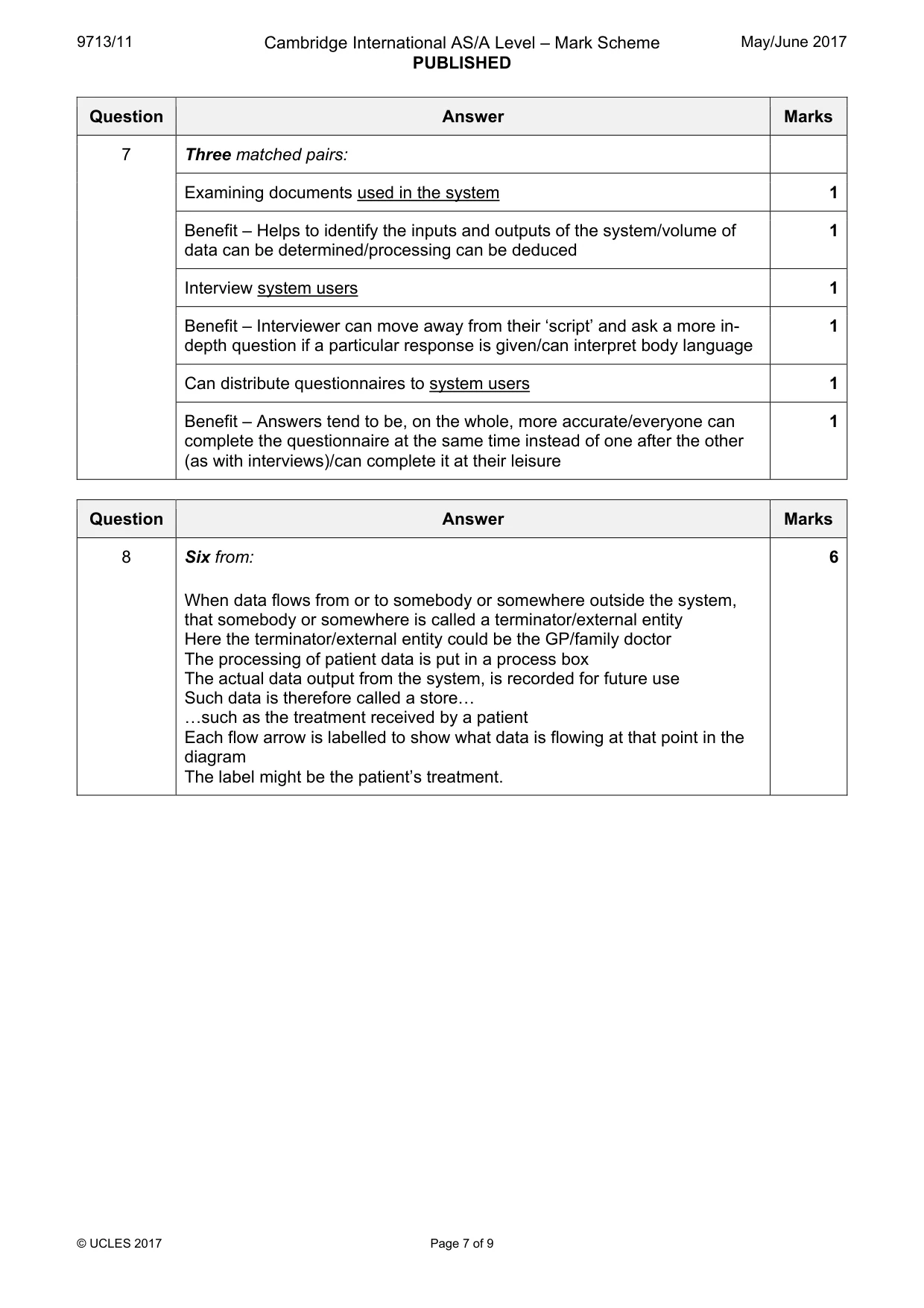
9713/11 Cambridge International AS/A Level – Mark Scheme PUBLISHED May/June 2017 © UCLES 2017 Page 7 of 9 Question Answer Marks 7 Three matched pairs: Examining documents used in the system 1 Benefit – Helps to identify the inputs and outputs of the system/volume of data can be determined/processing can be deduced 1 Interview system users 1 Benefit – Interviewer can move away from their ‘script’ and ask a more in- depth question if a particular response is given/can interpret body language 1 Can distribute questionnaires to system users 1 Benefit – Answers tend to be, on the whole, more accurate/everyone can complete the questionnaire at the same time instead of one after the other (as with interviews)/can complete it at their leisure 1 Question Answer Marks 8 Six from: When data flows from or to somebody or somewhere outside the system, that somebody or somewhere is called a terminator/external entity Here the terminator/external entity could be the GP/family doctor The processing of patient data is put in a process box The actual data output from the system, is recorded for future use Such data is therefore called a store« «such as the treatment received by a patient Each flow arrow is labelled to show what data is flowing at that point in the diagram The label might be the patient’s treatment. 6
Mark scheme, page 8
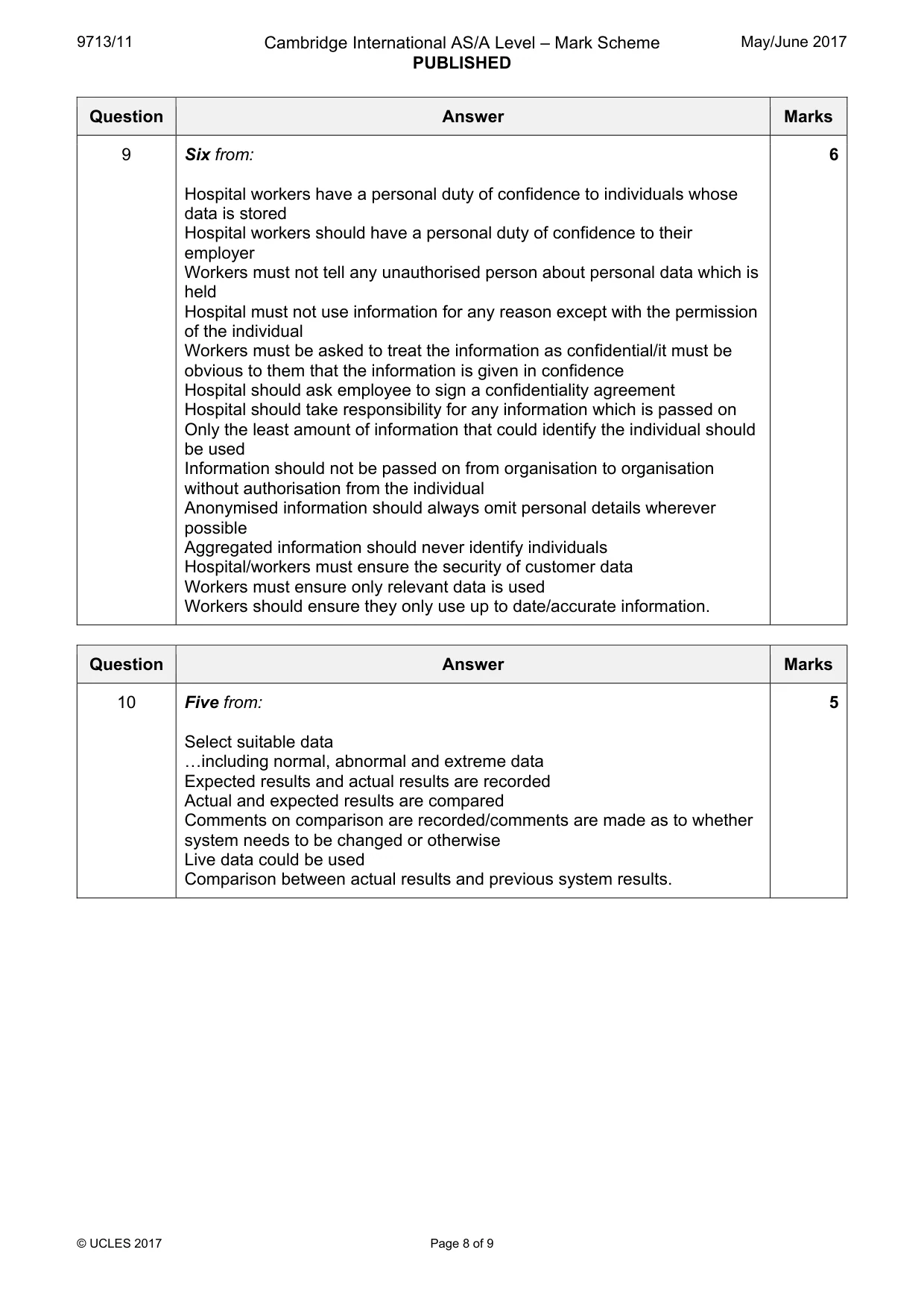
9713/11 Cambridge International AS/A Level – Mark Scheme PUBLISHED May/June 2017 © UCLES 2017 Page 8 of 9 Question Answer Marks 9 Six from: Hospital workers have a personal duty of confidence to individuals whose data is stored Hospital workers should have a personal duty of confidence to their employer Workers must not tell any unauthorised person about personal data which is held Hospital must not use information for any reason except with the permission of the individual Workers must be asked to treat the information as confidential/it must be obvious to them that the information is given in confidence Hospital should ask employee to sign a confidentiality agreement Hospital should take responsibility for any information which is passed on Only the least amount of information that could identify the individual should be used Information should not be passed on from organisation to organisation without authorisation from the individual Anonymised information should always omit personal details wherever possible Aggregated information should never identify individuals Hospital/workers must ensure the security of customer data Workers must ensure only relevant data is used Workers should ensure they only use up to date/accurate information. 6 Question Answer Marks 10 Five from: Select suitable data «including normal, abnormal and extreme data Expected results and actual results are recorded Actual and expected results are compared Comments on comparison are recorded/comments are made as to whether system needs to be changed or otherwise Live data could be used Comparison between actual results and previous system results. 5
Mark scheme, page 9
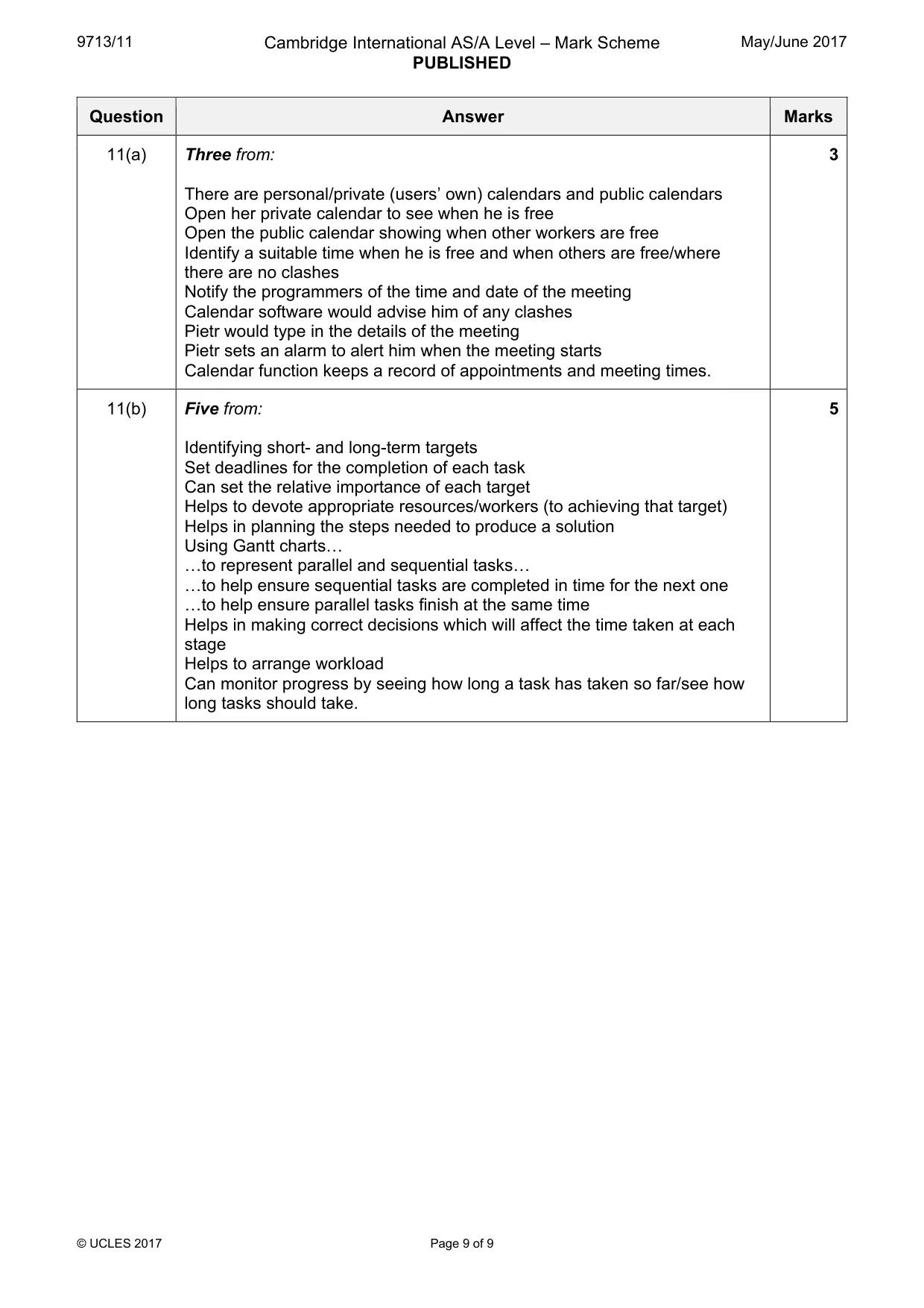
9713/11 Cambridge International AS/A Level – Mark Scheme PUBLISHED May/June 2017 © UCLES 2017 Page 9 of 9 Question Answer Marks 11(a) Three from: There are personal/private (users’ own) calendars and public calendars Open her private calendar to see when he is free Open the public calendar showing when other workers are free Identify a suitable time when he is free and when others are free/where there are no clashes Notify the programmers of the time and date of the meeting Calendar software would advise him of any clashes Pietr would type in the details of the meeting Pietr sets an alarm to alert him when the meeting starts Calendar function keeps a record of appointments and meeting times. 3 11(b) Five from: Identifying short- and long-term targets Set deadlines for the completion of each task Can set the relative importance of each target Helps to devote appropriate resources/workers (to achieving that target) Helps in planning the steps needed to produce a solution Using Gantt charts« «to represent parallel and sequential tasks« «to help ensure sequential tasks are completed in time for the next one «to help ensure parallel tasks finish at the same time Helps in making correct decisions which will affect the time taken at each stage Helps to arrange workload Can monitor progress by seeing how long a task has taken so far/see how long tasks should take. 5
What you needed in this session
Cambridge’s own grade thresholds for 2017 May/June, Paper 1 · Variant 1. A higher threshold means an easier paper — the bar moves with how the cohort did.