Cambridge A Level Applied Information and Communication Technology 9713 — 2013 Oct/Nov Paper 1 · Variant 3
9713/13/O/N/13 · 80 marks · ≈90 min
The question paper and its mark scheme, free to read here and free to download. This is Cambridge’s own paper, exactly as it was sat.
Question paper16 pages




Mark scheme6 pages
Answers below. Sit the paper first if you are practising.
Paper as text
Question paper, page 1
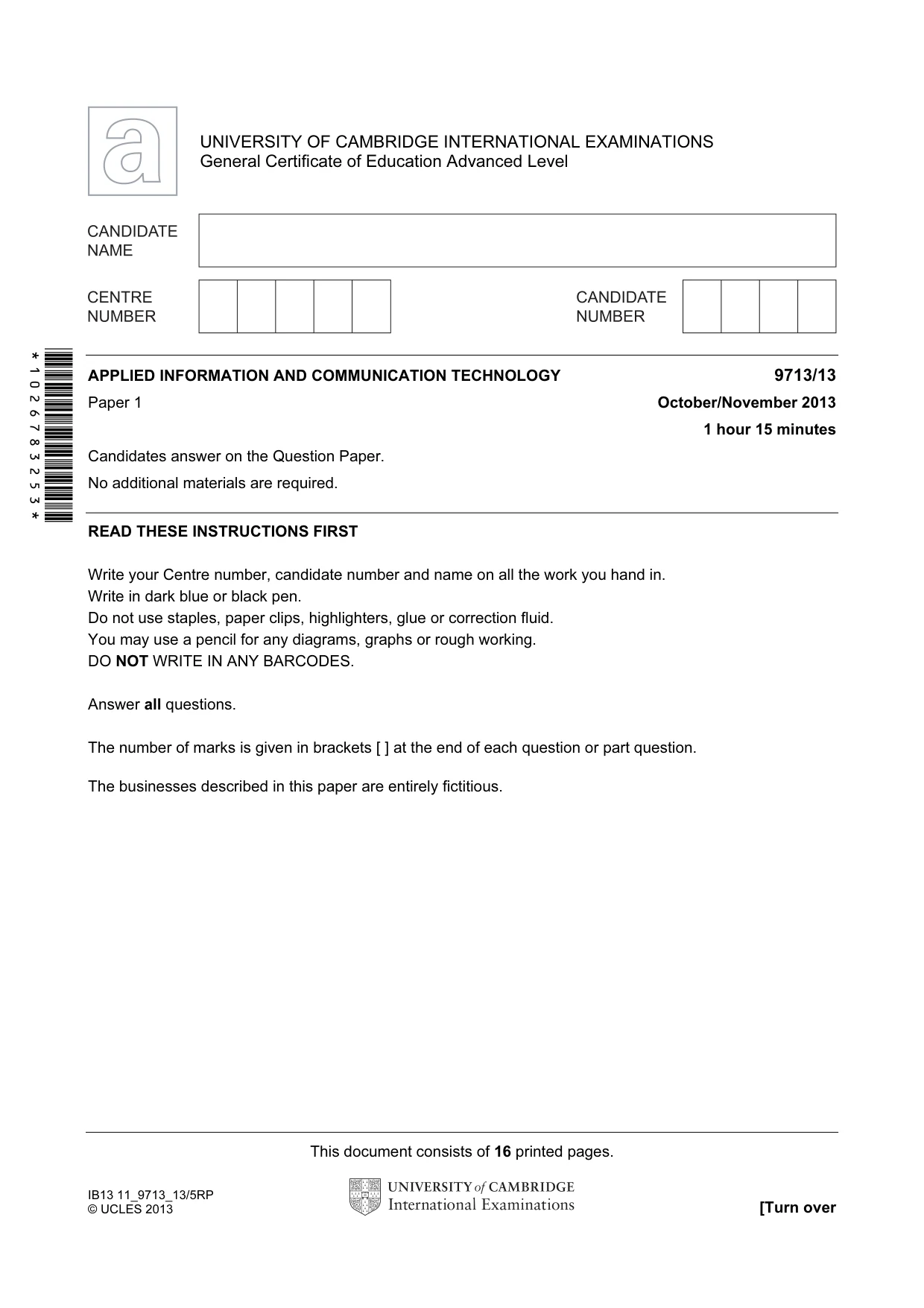
This document consists of 16 printed pages. IB13 11_9713_13/5RP © UCLES 2013 [Turn over *1026783253* UNIVERSITY OF CAMBRIDGE INTERNATIONAL EXAMINATIONS General Certificate of Education Advanced Level APPLIED INFORMATION AND COMMUNICATION TECHNOLOGY 9713/13 Paper 1 October/November 2013 1 hour 15 minutes Candidates answer on the Question Paper. No additional materials are required. READ THESE INSTRUCTIONS FIRST Write your Centre number, candidate number and name on all the work you hand in. Write in dark blue or black pen. Do not use staples, paper clips, highlighters, glue or correction fluid. You may use a pencil for any diagrams, graphs or rough working. DO NOT WRITE IN ANY BARCODES. Answer all questions. The number of marks is given in brackets [ ] at the end of each question or part question. The businesses described in this paper are entirely fictitious.
Question paper, page 2
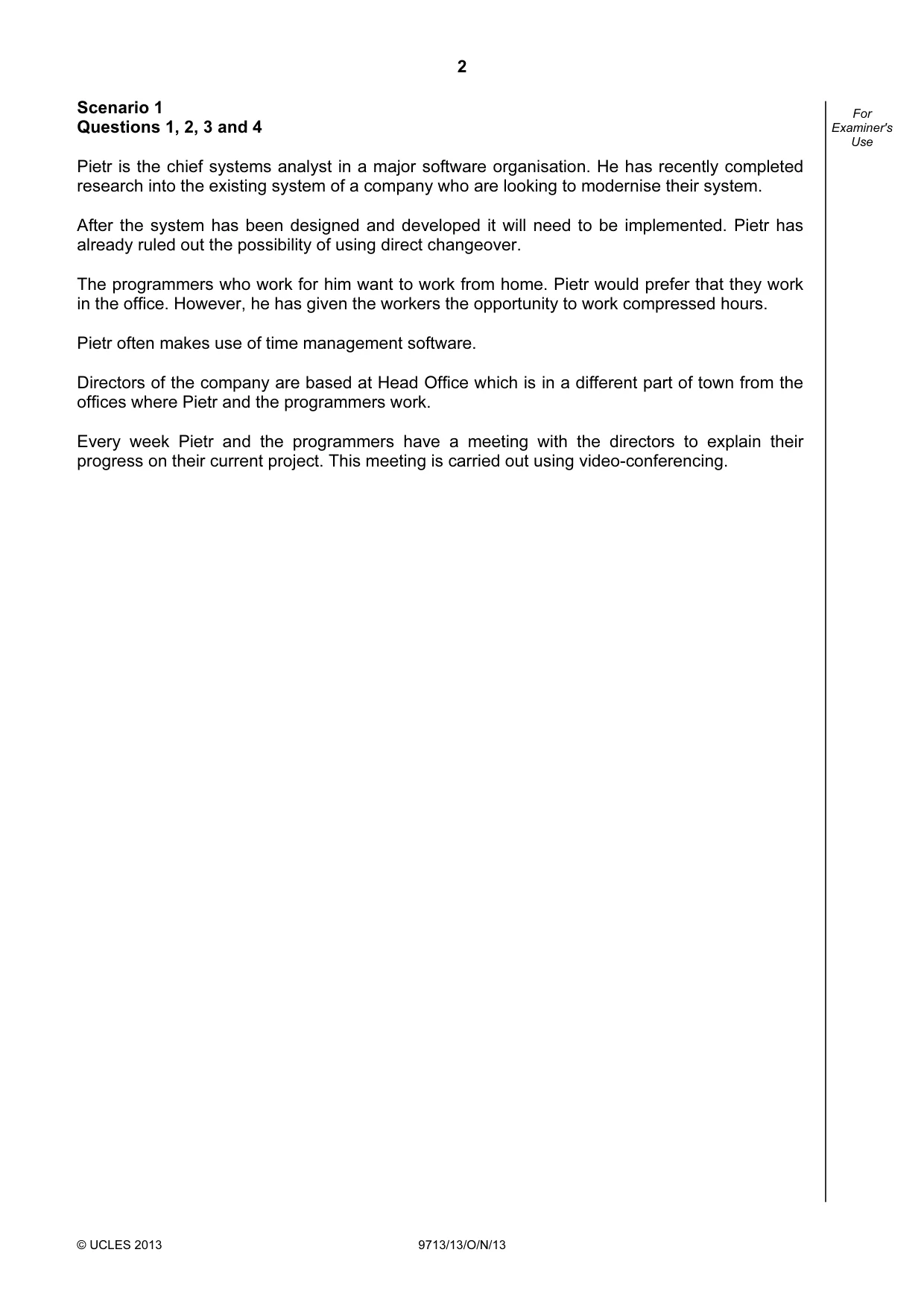
2 © UCLES 2013 9713/13/O/N/13 For Examiner's Use Scenario 1 Questions 1, 2, 3 and 4 Pietr is the chief systems analyst in a major software organisation. He has recently completed research into the existing system of a company who are looking to modernise their system. After the system has been designed and developed it will need to be implemented. Pietr has already ruled out the possibility of using direct changeover. The programmers who work for him want to work from home. Pietr would prefer that they work in the office. However, he has given the workers the opportunity to work compressed hours. Pietr often makes use of time management software. Directors of the company are based at Head Office which is in a different part of town from the offices where Pietr and the programmers work. Every week Pietr and the programmers have a meeting with the directors to explain their progress on their current project. This meeting is carried out using video-conferencing.
Question paper, page 3
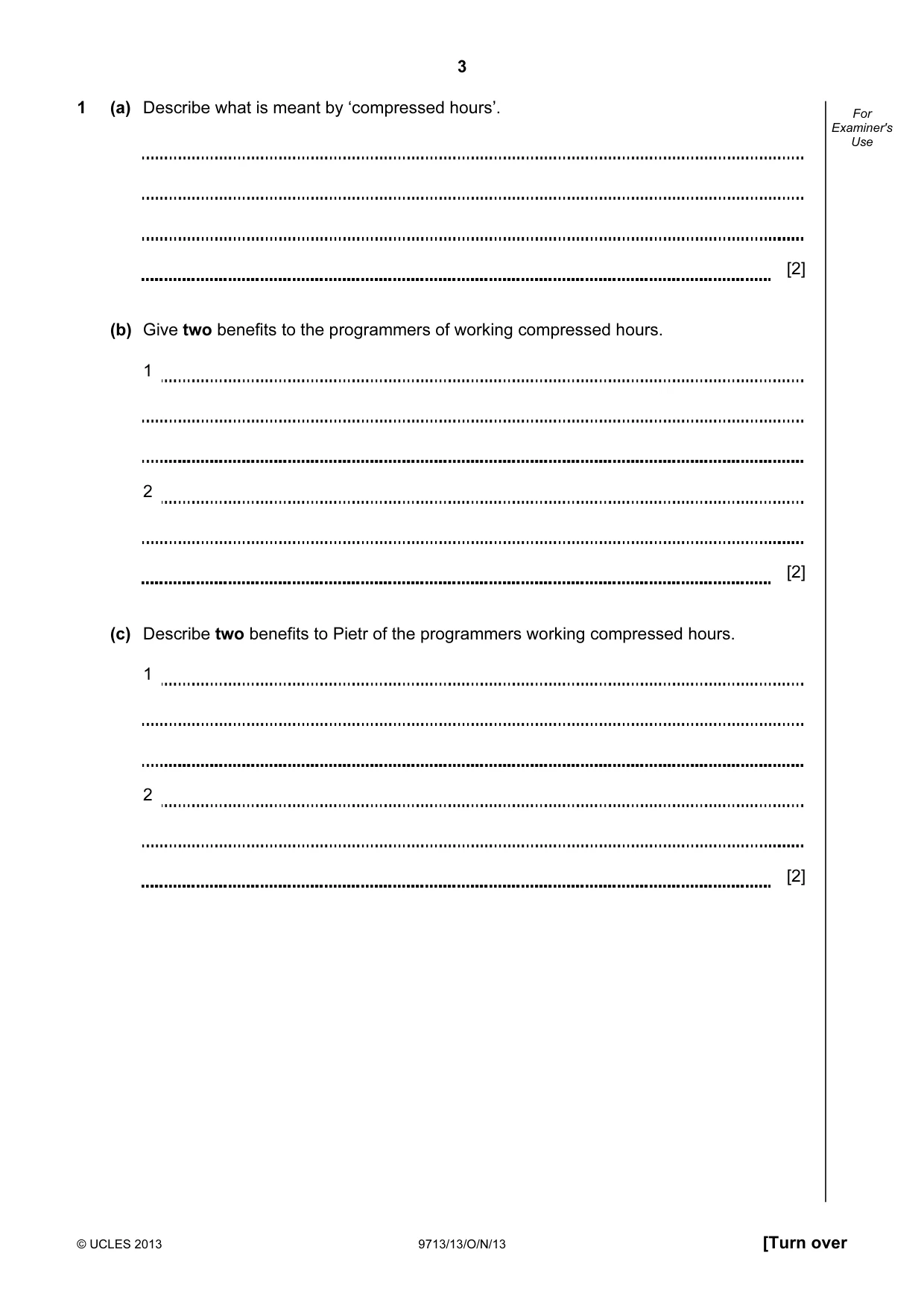
3 © UCLES 2013 9713/13/O/N/13 [Turn over For Examiner's Use 1 (a) Describe what is meant by ‘compressed hours’. [2] (b) Give two benefits to the programmers of working compressed hours. 1 2 [2] (c) Describe two benefits to Pietr of the programmers working compressed hours. 1 2 [2]
Question paper, page 4
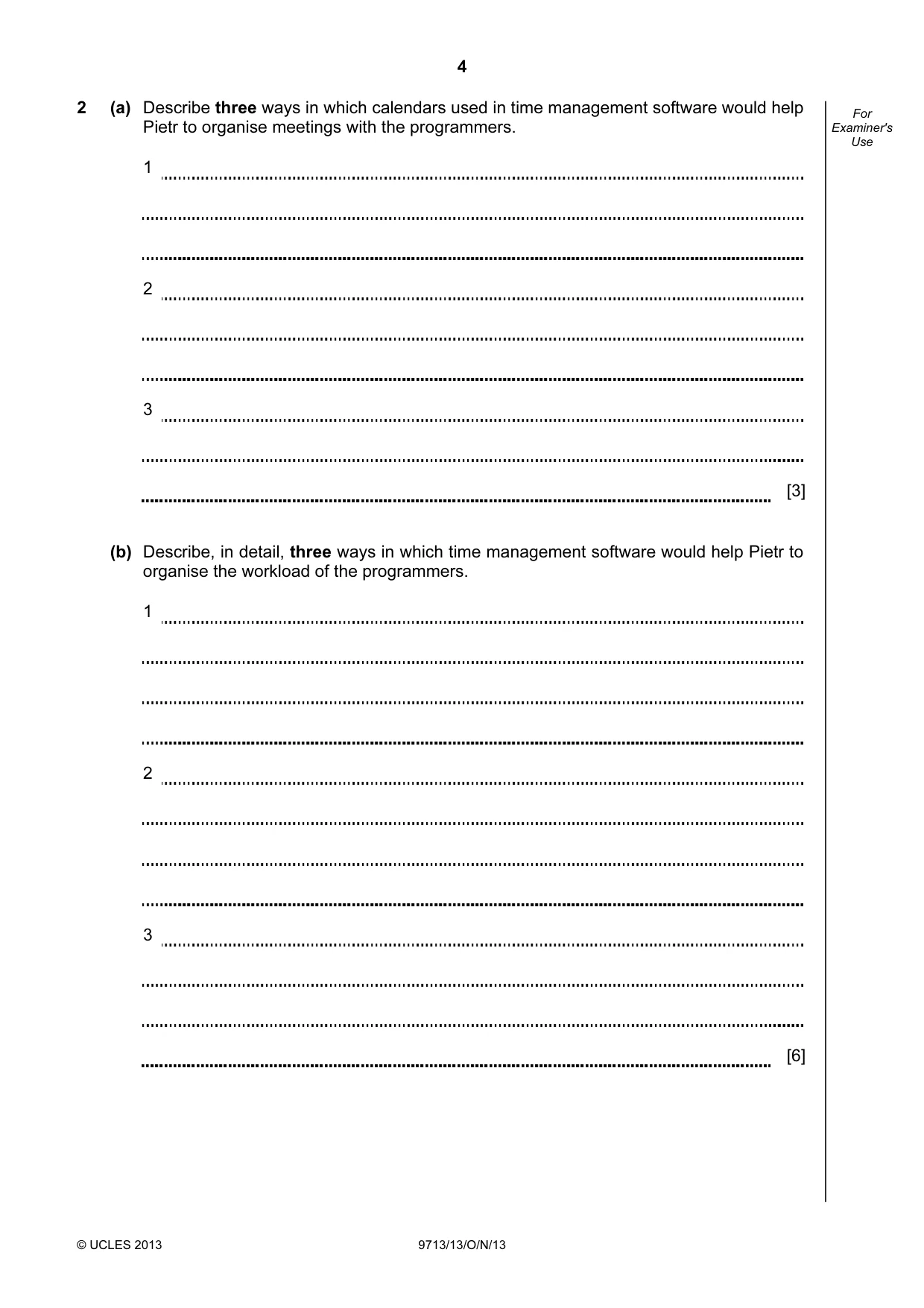
4 © UCLES 2013 9713/13/O/N/13 For Examiner's Use 2 (a) Describe three ways in which calendars used in time management software would help Pietr to organise meetings with the programmers. 1 2 3 [3] (b) Describe, in detail, three ways in which time management software would help Pietr to organise the workload of the programmers. 1 2 3 [6]
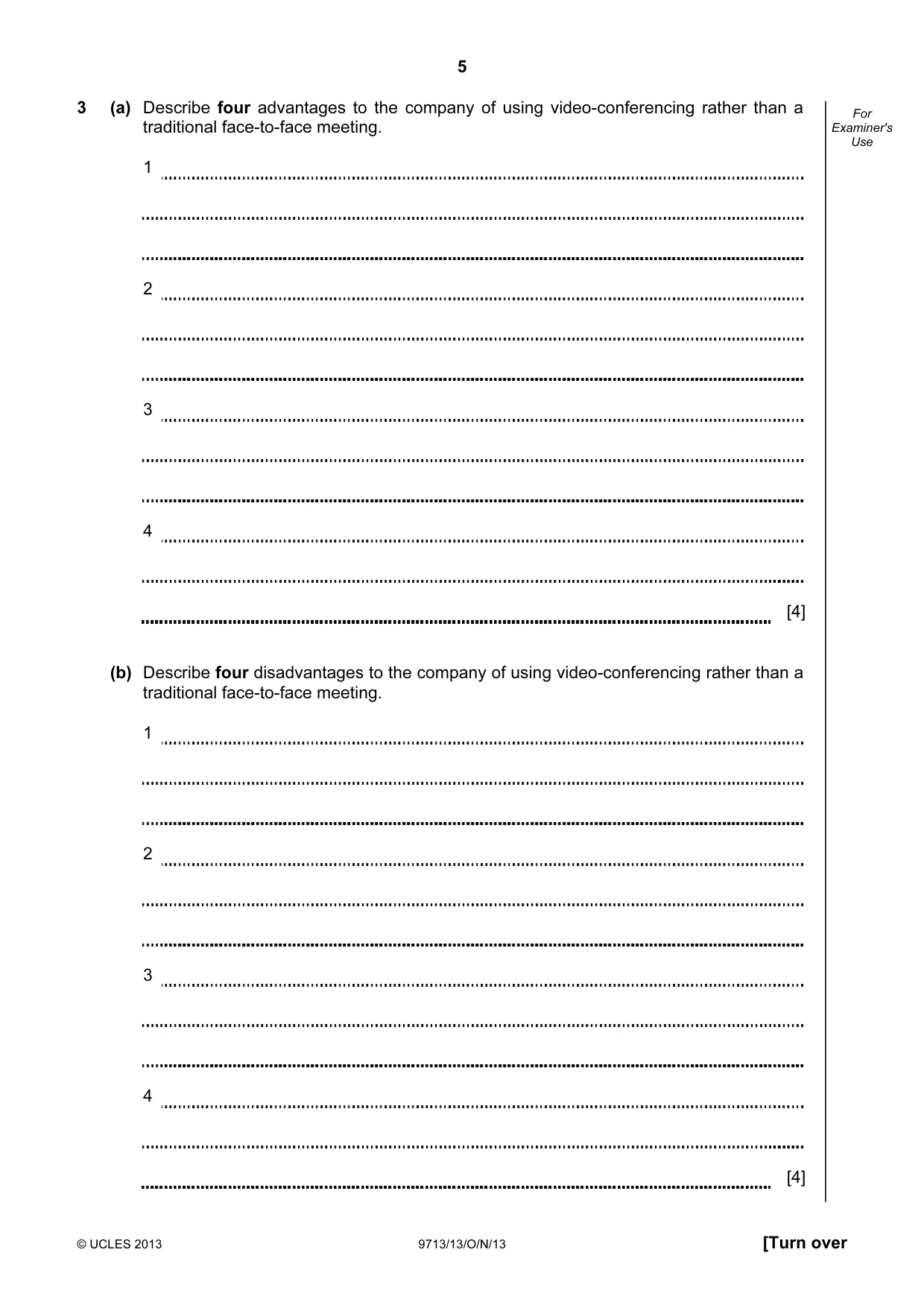
Question paper, page 5
5 © UCLES 2013 9713/13/O/N/13 [Turn over For Examiner's Use 3 (a) Describe four advantages to the company of using video-conferencing rather than a traditional face-to-face meeting. 1 2 3 4 [4] (b) Describe four disadvantages to the company of using video-conferencing rather than a traditional face-to-face meeting. 1 2 3 4 [4]
Question paper, page 6
6 © UCLES 2013 9713/13/O/N/13 For Examiner's Use 4 (a) Explain what is meant by a requirements specification and how the research Pietr carried out would have helped him to produce one. [5] (b) Describe five factors that the programmers will need to consider when designing appropriate screen displays. 1 2 3 4 5 [5]
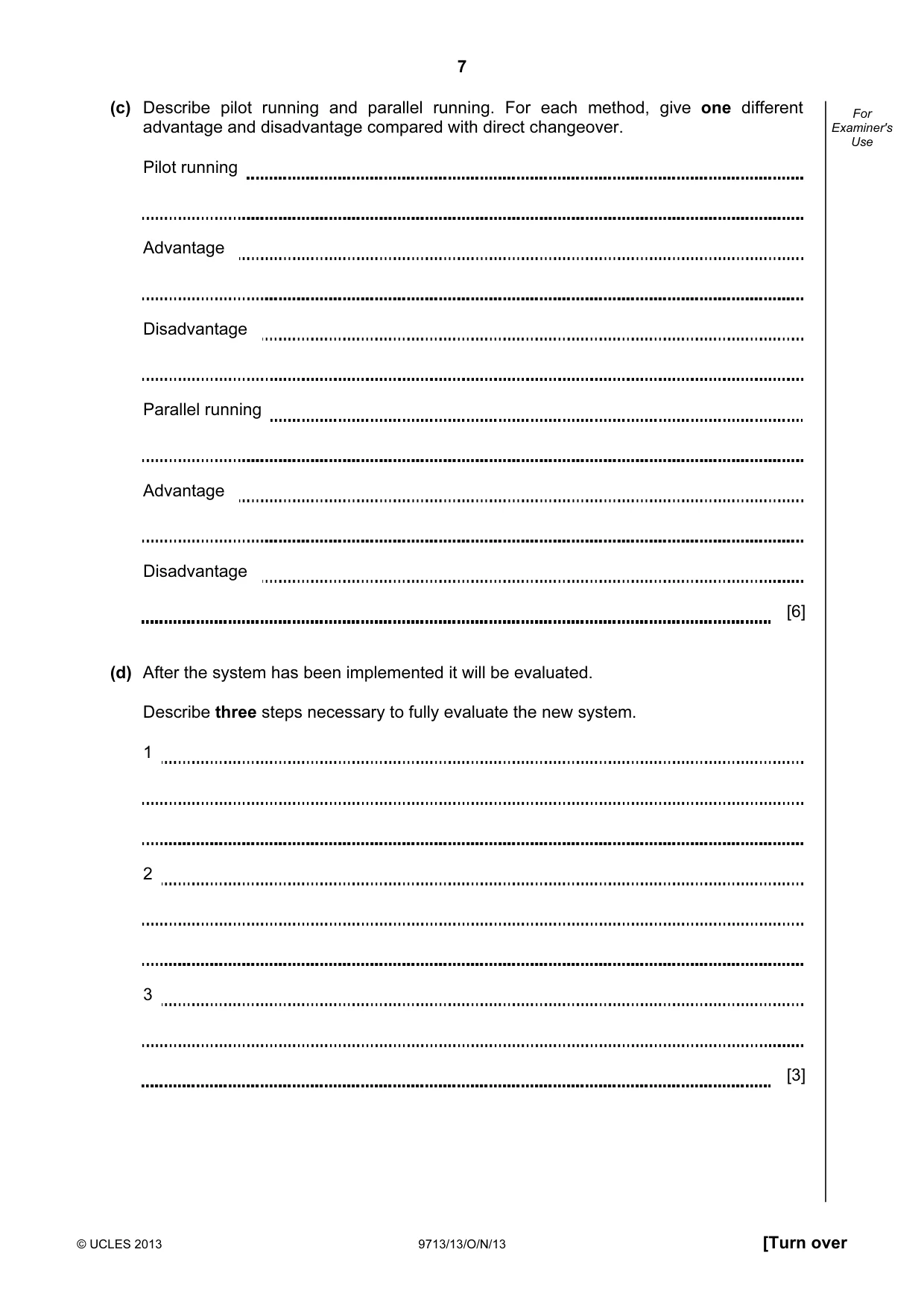
Question paper, page 7
7 © UCLES 2013 9713/13/O/N/13 [Turn over For Examiner's Use (c) Describe pilot running and parallel running. For each method, give one different advantage and disadvantage compared with direct changeover. Pilot running Advantage Disadvantage Parallel running Advantage Disadvantage [6] (d) After the system has been implemented it will be evaluated. Describe three steps necessary to fully evaluate the new system. 1 2 3 [3]
Question paper, page 8
8 © UCLES 2013 9713/13/O/N/13 For Examiner's Use Scenario 2 Question 5 North China Media, based in Tianjin, owns the China Weekly magazine. It uses the latest technology to print the magazine, including computerised plate making and typesetting techniques. It employs a number of journalists to write articles. These journalists tend to work from home and they provide their own images to illustrate their articles. They email their material to the editor in the editor’s office in Tianjin. The editor sets out each page in the magazine. The magazine is not only printed in Tianjin but also on printing presses in a number of Chinese cities. After the magazine layout is completed it is sent for printing via the use of satellites.
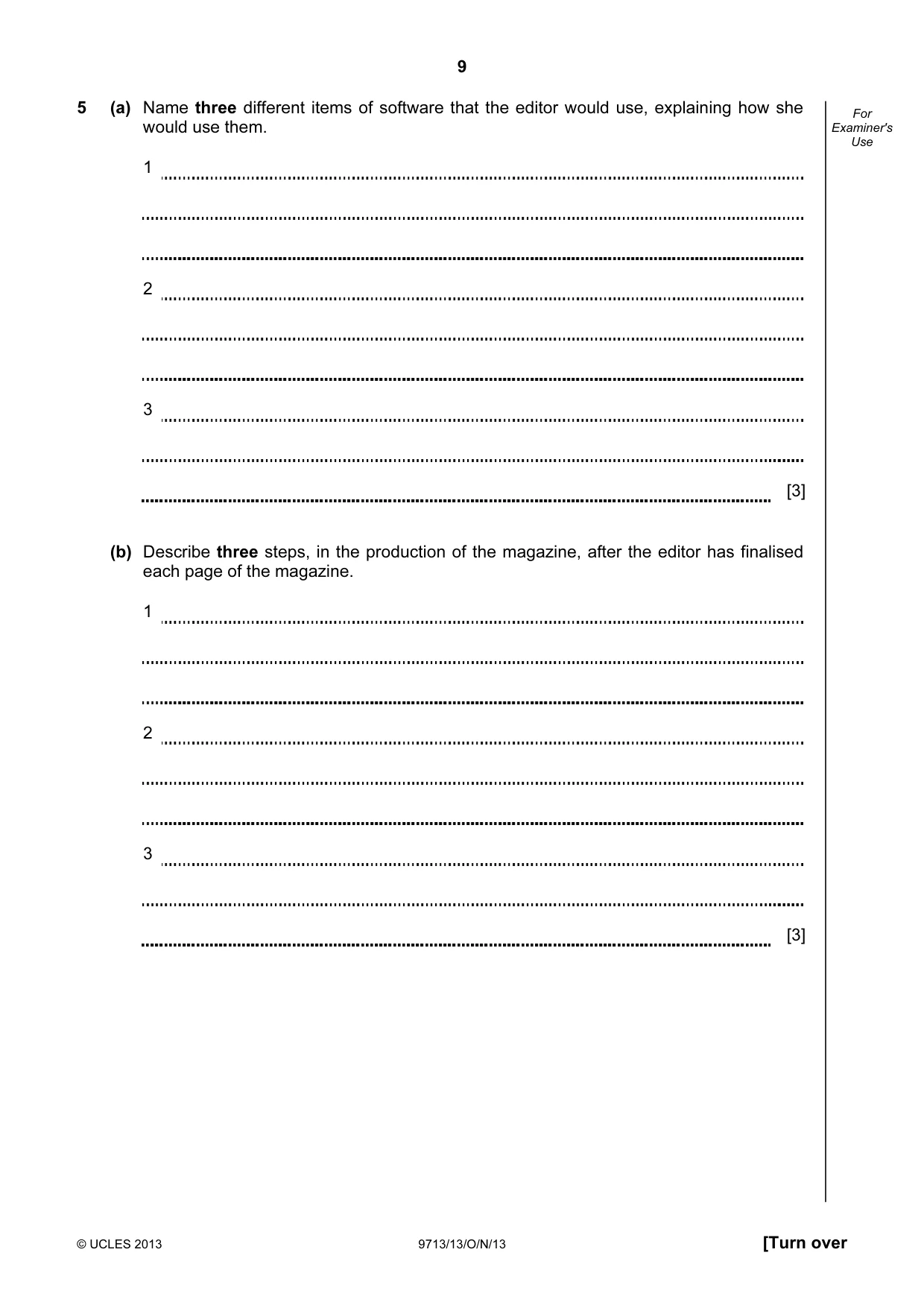
Question paper, page 9
9 © UCLES 2013 9713/13/O/N/13 [Turn over For Examiner's Use 5 (a) Name three different items of software that the editor would use, explaining how she would use them. 1 2 3 [3] (b) Describe three steps, in the production of the magazine, after the editor has finalised each page of the magazine. 1 2 3 [3]
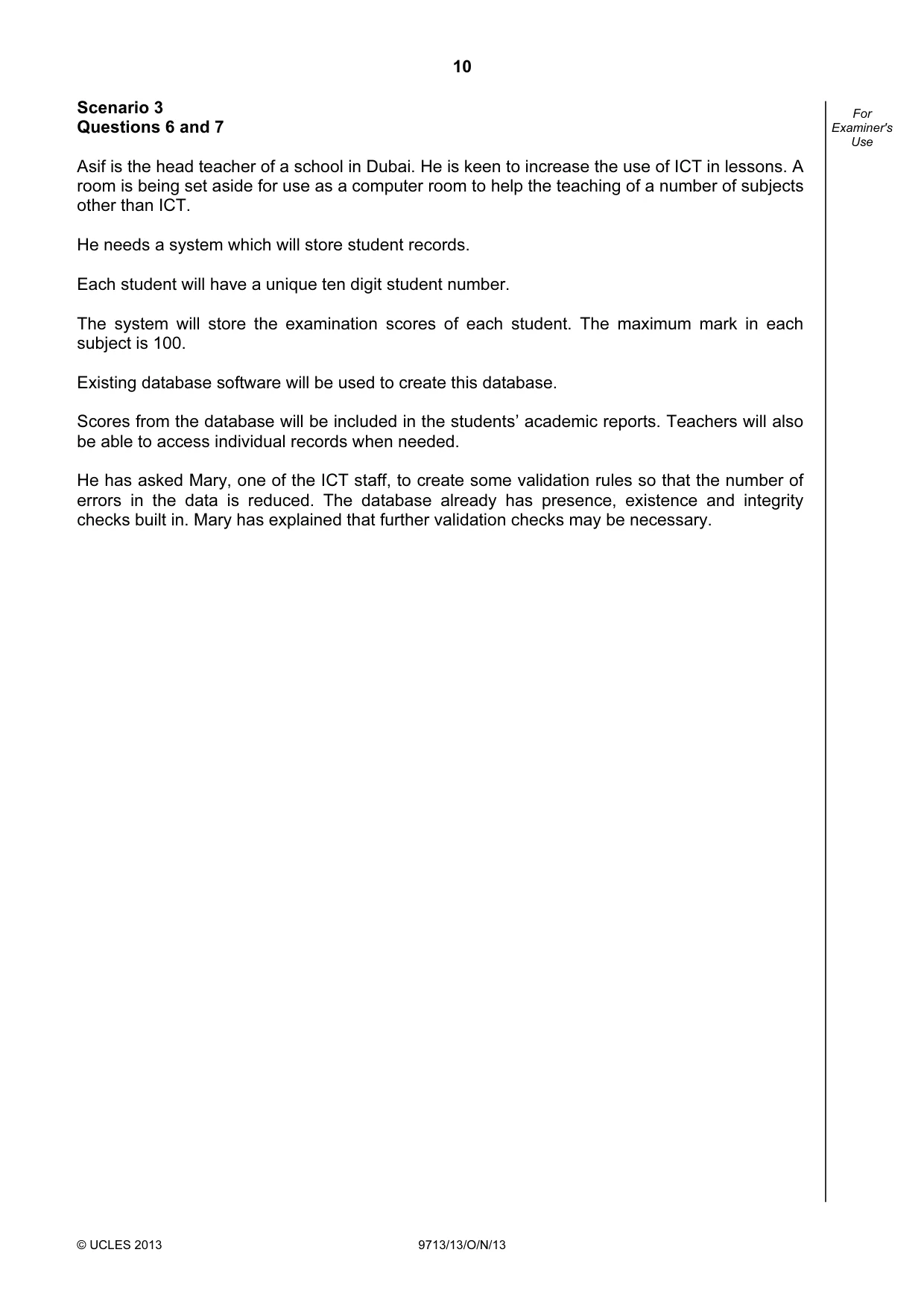
Question paper, page 10
10 © UCLES 2013 9713/13/O/N/13 For Examiner's Use Scenario 3 Questions 6 and 7 Asif is the head teacher of a school in Dubai. He is keen to increase the use of ICT in lessons. A room is being set aside for use as a computer room to help the teaching of a number of subjects other than ICT. He needs a system which will store student records. Each student will have a unique ten digit student number. The system will store the examination scores of each student. The maximum mark in each subject is 100. Existing database software will be used to create this database. Scores from the database will be included in the students’ academic reports. Teachers will also be able to access individual records when needed. He has asked Mary, one of the ICT staff, to create some validation rules so that the number of errors in the data is reduced. The database already has presence, existence and integrity checks built in. Mary has explained that further validation checks may be necessary.
Question paper, page 11
11 © UCLES 2013 9713/13/O/N/13 [Turn over For Examiner's Use 6 Describe six ways in which teaching and learning will be helped by the use of ICT in lessons. 1 2 3 4 5 6 [6]
Question paper, page 12
12 © UCLES 2013 9713/13/O/N/13 For Examiner's Use 7 (a) Describe four features of storing data using the indexed sequential method. 1 2 3 4 [4] (b) Using examples, explain why the student records might need to be stored in an indexed sequential manner. [4]
Question paper, page 13
13 © UCLES 2013 9713/13/O/N/13 [Turn over For Examiner's Use (c) Using the examples of student number and exam scores describe three additional validation rules. For each rule give a different reason why it might still allow inaccurate data to be entered. Rule 1 Reason 1 Rule 2 Reason 2 Rule 3 Reason 3 [6]
Question paper, page 14
14 © UCLES 2013 9713/13/O/N/13 For Examiner's Use Scenario 4 Question 8 Lavender Books, a chain of bookshops, has recently opened an online shopping website. In order to purchase books from the website, customers must first register their personal data with the company. When they purchase items they have to give their credit or debit card details.
Question paper, page 15
15 © UCLES 2013 9713/13/O/N/13 [Turn over For Examiner's Use 8 (a) Describe three benefits to the company of the online shopping system. 1 2 3 [3] (b) Apart from security issues, describe three drawbacks to the customer of online shopping. 1 2 3 [3]
Question paper, page 16
16 Permission to reproduce items where third-party owned material protected by copyright is included has been sought and cleared where possible. Every reasonable effort has been made by the publisher (UCLES) to trace copyright holders, but if any items requiring clearance have unwittingly been included, the publisher will be pleased to make amends at the earliest possible opportunity. University of Cambridge International Examinations is part of the Cambridge Assessment Group. Cambridge Assessment is the brand name of University of Cambridge Local Examinations Syndicate (UCLES), which is itself a department of the University of Cambridge. © UCLES 2013 9713/13/O/N/13 For Examiner's Use (c) Describe, in detail, three methods that a hacker could use to obtain a customer’s details. 1 2 3 [6]
Mark scheme, page 1
CAMBRIDGE INTERNATIONAL EXAMINATIONS GCE Advanced Subsidiary Level and GCE Advanced Level MARK SCHEME for the October/November 2013 series 9713 APPLIED INFORMATION AND COMMUNICATION TECHNOLOGY 9713/13 Paper 1 (Written A), maximum raw mark 80 This mark scheme is published as an aid to teachers and candidates, to indicate the requirements of the examination. It shows the basis on which Examiners were instructed to award marks. It does not indicate the details of the discussions that took place at an Examiners’ meeting before marking began, which would have considered the acceptability of alternative answers. Mark schemes should be read in conjunction with the question paper and the Principal Examiner Report for Teachers. Cambridge will not enter into discussions about these mark schemes. Cambridge is publishing the mark schemes for the October/November 2013 series for most IGCSE, GCE Advanced Level and Advanced Subsidiary Level components and some Ordinary Level components.
Mark scheme, page 2
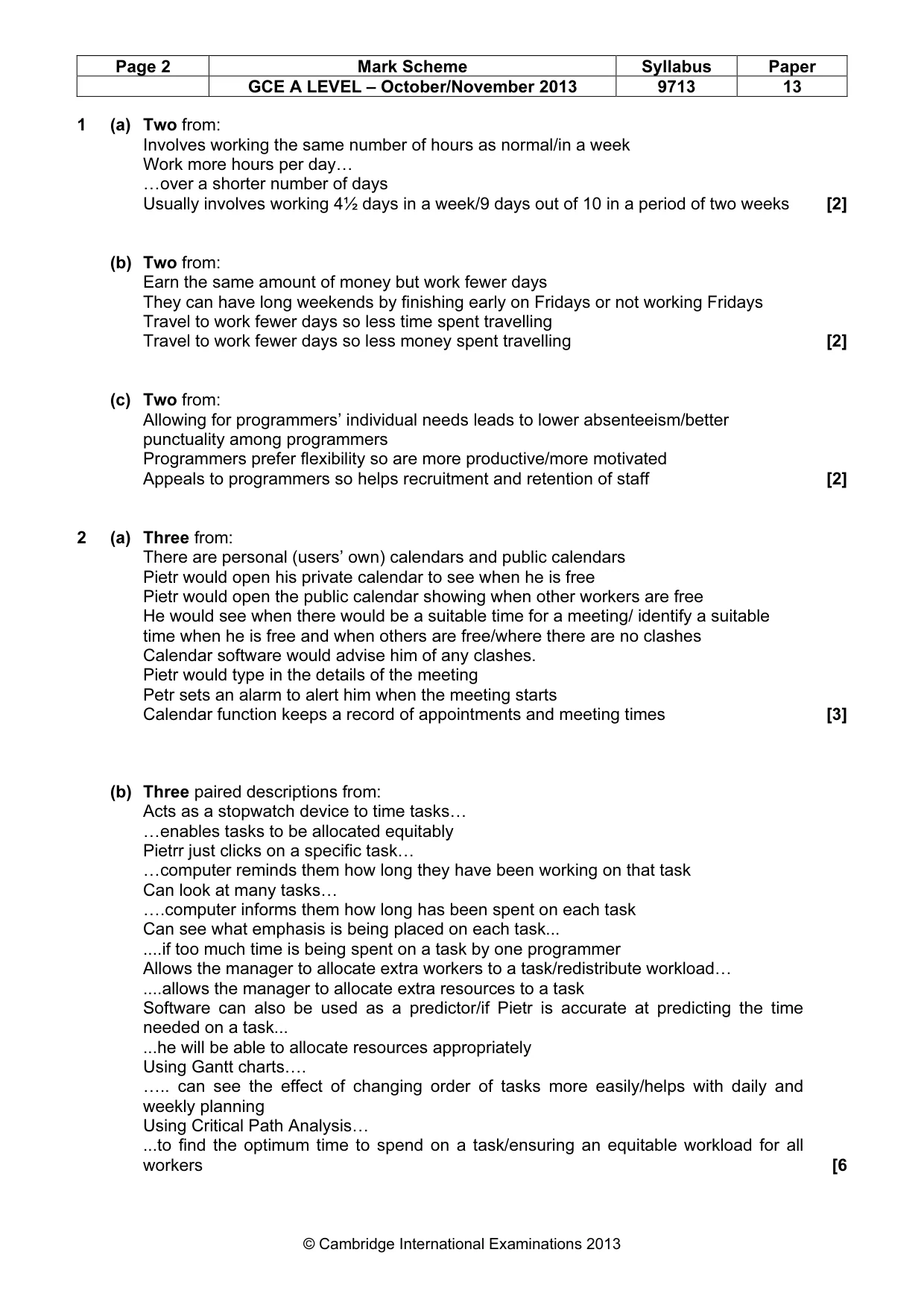
Page 2 Mark Scheme Syllabus Paper GCE A LEVEL – October/November 2013 9713 13 © Cambridge International Examinations 2013 1 (a) Two from: Involves working the same number of hours as normal/in a week Work more hours per day… …over a shorter number of days Usually involves working 4½ days in a week/9 days out of 10 in a period of two weeks [2] (b) Two from: Earn the same amount of money but work fewer days They can have long weekends by finishing early on Fridays or not working Fridays Travel to work fewer days so less time spent travelling Travel to work fewer days so less money spent travelling [2] (c) Two from: Allowing for programmers’ individual needs leads to lower absenteeism/better punctuality among programmers Programmers prefer flexibility so are more productive/more motivated Appeals to programmers so helps recruitment and retention of staff [2] 2 (a) Three from: There are personal (users’ own) calendars and public calendars Pietr would open his private calendar to see when he is free Pietr would open the public calendar showing when other workers are free He would see when there would be a suitable time for a meeting/ identify a suitable time when he is free and when others are free/where there are no clashes Calendar software would advise him of any clashes. Pietr would type in the details of the meeting Petr sets an alarm to alert him when the meeting starts Calendar function keeps a record of appointments and meeting times [3] (b) Three paired descriptions from: Acts as a stopwatch device to time tasks… …enables tasks to be allocated equitably Pietrr just clicks on a specific task… …computer reminds them how long they have been working on that task Can look at many tasks… ….computer informs them how long has been spent on each task Can see what emphasis is being placed on each task... …if too much time is being spent on a task by one programmer Allows the manager to allocate extra workers to a task/redistribute workload… …allows the manager to allocate extra resources to a task Software can also be used as a predictor/if Pietr is accurate at predicting the time needed on a task... ...he will be able to allocate resources appropriately Using Gantt charts…. ….. can see the effect of changing order of tasks more easily/helps with daily and weekly planning Using Critical Path Analysis… ...to find the optimum time to spend on a task/ensuring an equitable workload for all workers [6
Mark scheme, page 3
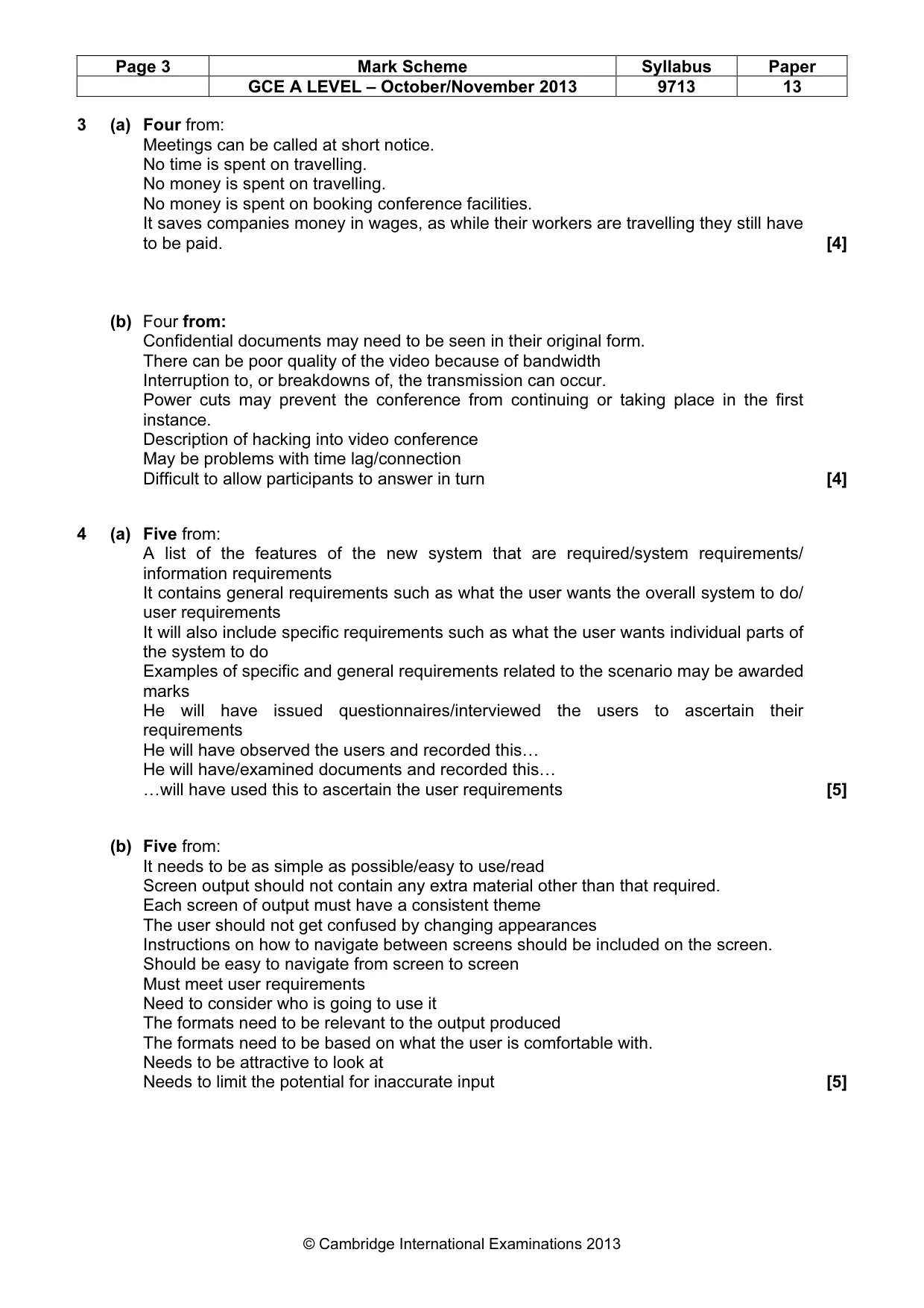
Page 3 Mark Scheme Syllabus Paper GCE A LEVEL – October/November 2013 9713 13 © Cambridge International Examinations 2013 3 (a) Four from: Meetings can be called at short notice. No time is spent on travelling. No money is spent on travelling. No money is spent on booking conference facilities. It saves companies money in wages, as while their workers are travelling they still have to be paid. [4] (b) Four from: Confidential documents may need to be seen in their original form. There can be poor quality of the video because of bandwidth Interruption to, or breakdowns of, the transmission can occur. Power cuts may prevent the conference from continuing or taking place in the first instance. Description of hacking into video conference May be problems with time lag/connection Difficult to allow participants to answer in turn [4] 4 (a) Five from: A list of the features of the new system that are required/system requirements/ information requirements It contains general requirements such as what the user wants the overall system to do/ user requirements It will also include specific requirements such as what the user wants individual parts of the system to do Examples of specific and general requirements related to the scenario may be awarded marks He will have issued questionnaires/interviewed the users to ascertain their requirements He will have observed the users and recorded this… He will have/examined documents and recorded this… …will have used this to ascertain the user requirements [5] (b) Five from: It needs to be as simple as possible/easy to use/read Screen output should not contain any extra material other than that required. Each screen of output must have a consistent theme The user should not get confused by changing appearances Instructions on how to navigate between screens should be included on the screen. Should be easy to navigate from screen to screen Must meet user requirements Need to consider who is going to use it The formats need to be relevant to the output produced The formats need to be based on what the user is comfortable with. Needs to be attractive to look at Needs to limit the potential for inaccurate input [5]
Mark scheme, page 4
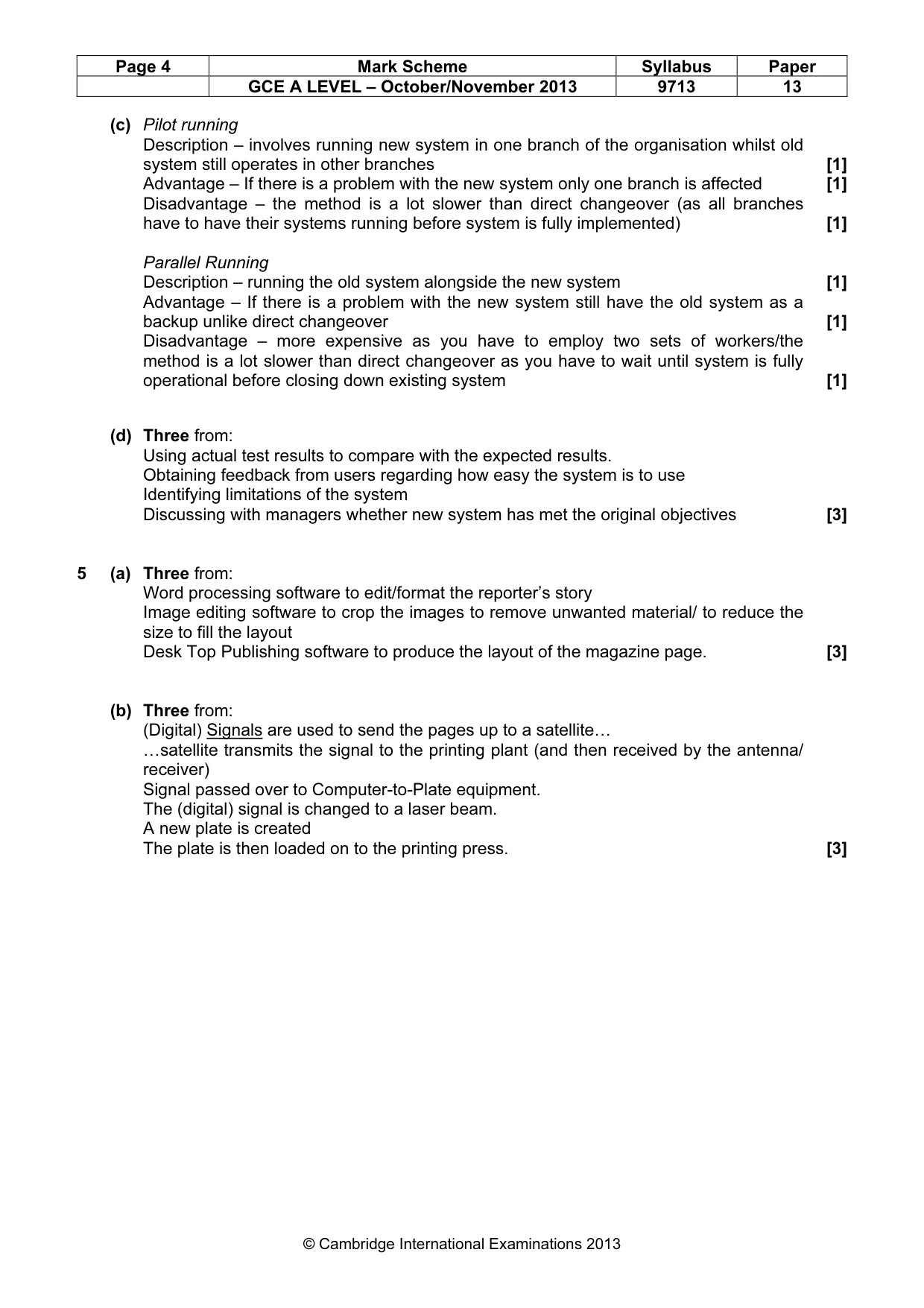
Page 4 Mark Scheme Syllabus Paper GCE A LEVEL – October/November 2013 9713 13 © Cambridge International Examinations 2013 (c) Pilot running Description – involves running new system in one branch of the organisation whilst old system still operates in other branches [1] Advantage – If there is a problem with the new system only one branch is affected [1] Disadvantage – the method is a lot slower than direct changeover (as all branches have to have their systems running before system is fully implemented) [1] Parallel Running Description – running the old system alongside the new system [1] Advantage – If there is a problem with the new system still have the old system as a backup unlike direct changeover [1] Disadvantage – more expensive as you have to employ two sets of workers/the method is a lot slower than direct changeover as you have to wait until system is fully operational before closing down existing system [1] (d) Three from: Using actual test results to compare with the expected results. Obtaining feedback from users regarding how easy the system is to use Identifying limitations of the system Discussing with managers whether new system has met the original objectives [3] 5 (a) Three from: Word processing software to edit/format the reporter’s story Image editing software to crop the images to remove unwanted material/ to reduce the size to fill the layout Desk Top Publishing software to produce the layout of the magazine page. [3] (b) Three from: (Digital) Signals are used to send the pages up to a satellite… …satellite transmits the signal to the printing plant (and then received by the antenna/ receiver) Signal passed over to Computer-to-Plate equipment. The (digital) signal is changed to a laser beam. A new plate is created The plate is then loaded on to the printing press. [3]
Mark scheme, page 5
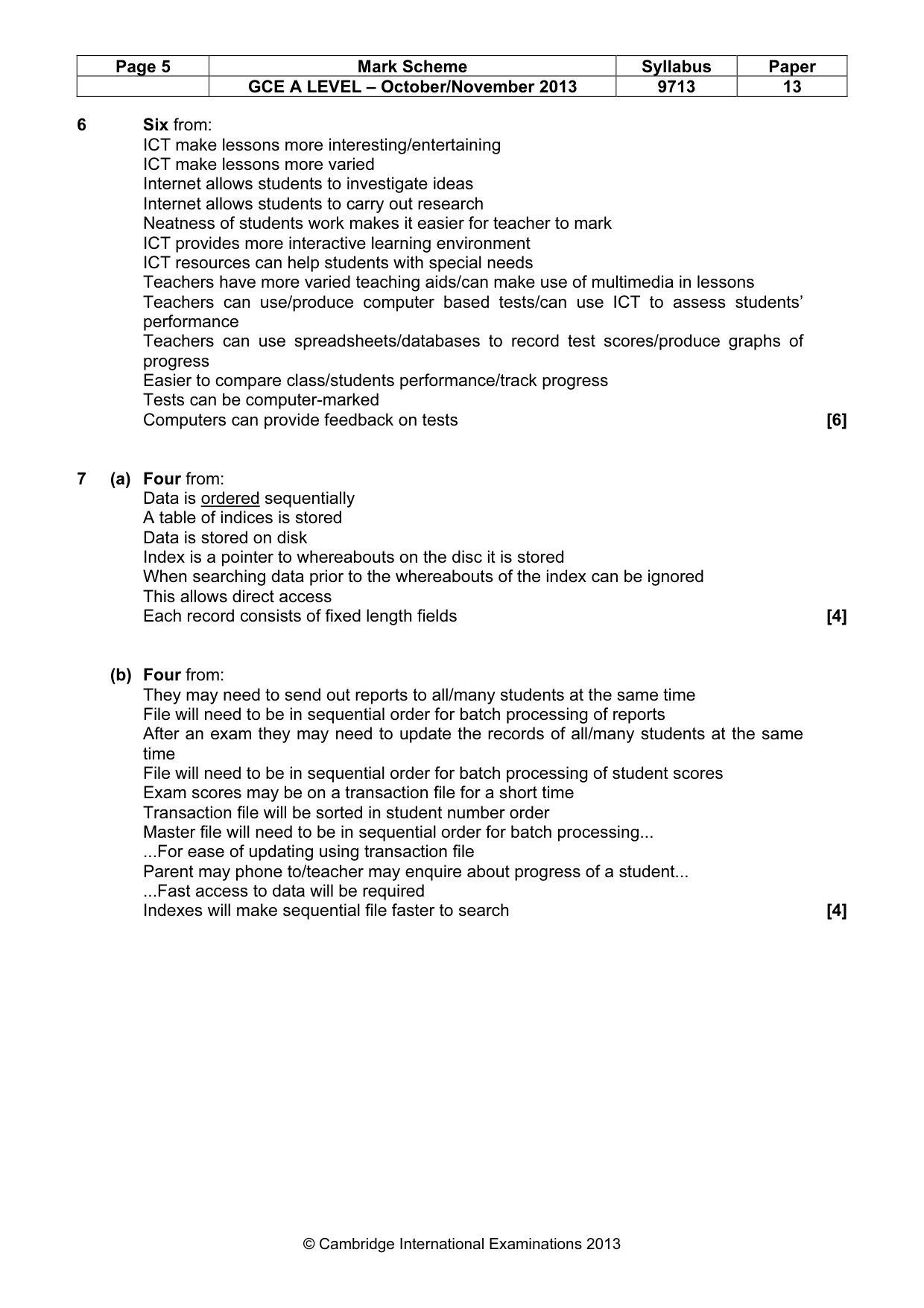
Page 5 Mark Scheme Syllabus Paper GCE A LEVEL – October/November 2013 9713 13 © Cambridge International Examinations 2013 6 Six from: ICT make lessons more interesting/entertaining ICT make lessons more varied Internet allows students to investigate ideas Internet allows students to carry out research Neatness of students work makes it easier for teacher to mark ICT provides more interactive learning environment ICT resources can help students with special needs Teachers have more varied teaching aids/can make use of multimedia in lessons Teachers can use/produce computer based tests/can use ICT to assess students’ performance Teachers can use spreadsheets/databases to record test scores/produce graphs of progress Easier to compare class/students performance/track progress Tests can be computer-marked Computers can provide feedback on tests [6] 7 (a) Four from: Data is ordered sequentially A table of indices is stored Data is stored on disk Index is a pointer to whereabouts on the disc it is stored When searching data prior to the whereabouts of the index can be ignored This allows direct access Each record consists of fixed length fields [4] (b) Four from: They may need to send out reports to all/many students at the same time File will need to be in sequential order for batch processing of reports After an exam they may need to update the records of all/many students at the same time File will need to be in sequential order for batch processing of student scores Exam scores may be on a transaction file for a short time Transaction file will be sorted in student number order Master file will need to be in sequential order for batch processing... ...For ease of updating using transaction file Parent may phone to/teacher may enquire about progress of a student... ...Fast access to data will be required Indexes will make sequential file faster to search [4]
Mark scheme, page 6
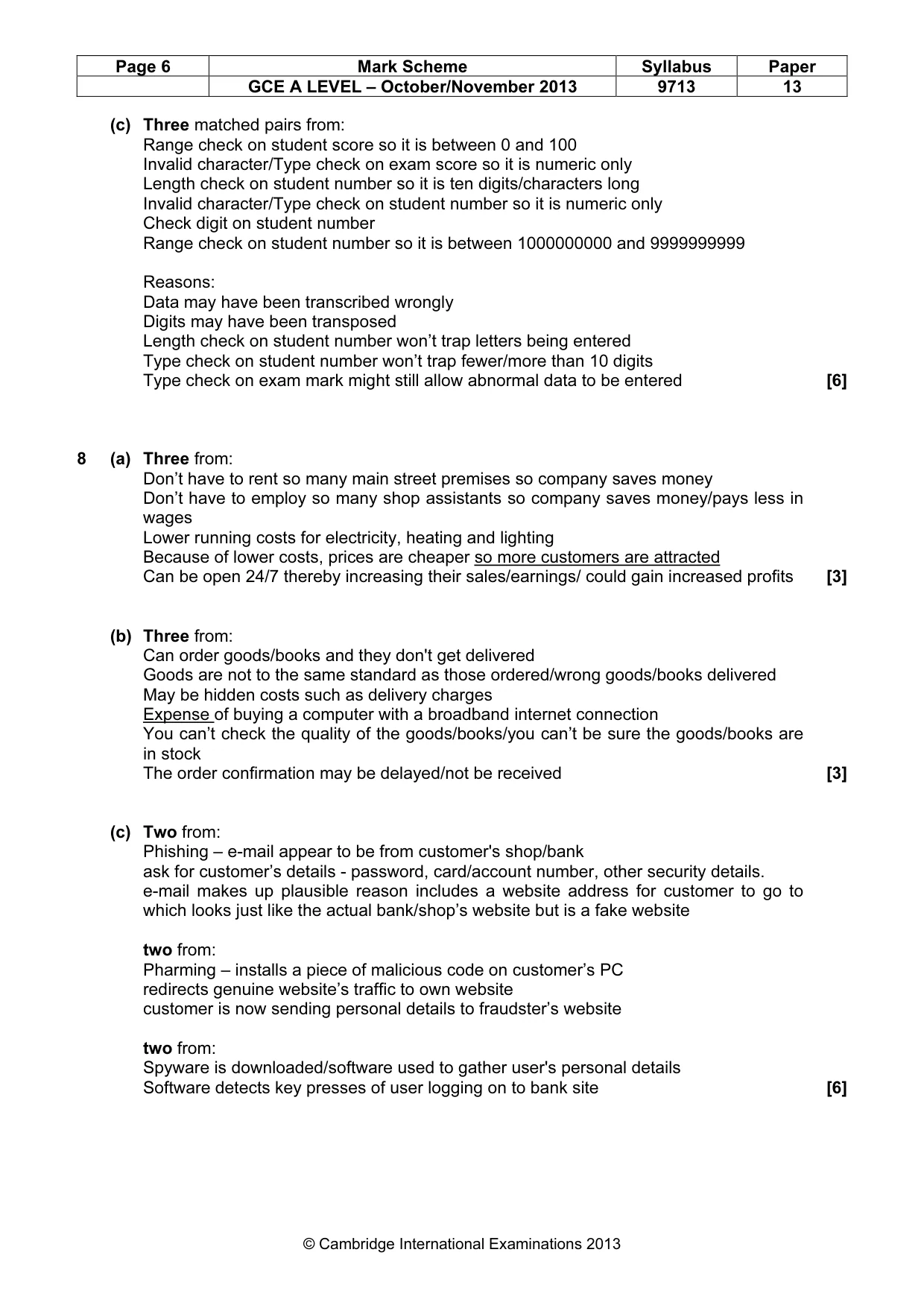
Page 6 Mark Scheme Syllabus Paper GCE A LEVEL – October/November 2013 9713 13 © Cambridge International Examinations 2013 (c) Three matched pairs from: Range check on student score so it is between 0 and 100 Invalid character/Type check on exam score so it is numeric only Length check on student number so it is ten digits/characters long Invalid character/Type check on student number so it is numeric only Check digit on student number Range check on student number so it is between 1000000000 and 9999999999 Reasons: Data may have been transcribed wrongly Digits may have been transposed Length check on student number won’t trap letters being entered Type check on student number won’t trap fewer/more than 10 digits Type check on exam mark might still allow abnormal data to be entered [6] 8 (a) Three from: Don’t have to rent so many main street premises so company saves money Don’t have to employ so many shop assistants so company saves money/pays less in wages Lower running costs for electricity, heating and lighting Because of lower costs, prices are cheaper so more customers are attracted Can be open 24/7 thereby increasing their sales/earnings/ could gain increased profits [3] (b) Three from: Can order goods/books and they don't get delivered Goods are not to the same standard as those ordered/wrong goods/books delivered May be hidden costs such as delivery charges Expense of buying a computer with a broadband internet connection You can’t check the quality of the goods/books/you can’t be sure the goods/books are in stock The order confirmation may be delayed/not be received [3] (c) Two from: Phishing – e-mail appear to be from customer's shop/bank ask for customer’s details - password, card/account number, other security details. e-mail makes up plausible reason includes a website address for customer to go to which looks just like the actual bank/shop’s website but is a fake website two from: Pharming – installs a piece of malicious code on customer’s PC redirects genuine website’s traffic to own website customer is now sending personal details to fraudster’s website two from: Spyware is downloaded/software used to gather user's personal details Software detects key presses of user logging on to bank site [6]
What you needed in this session
Cambridge’s own grade thresholds for 2013 Oct/Nov, Paper 1 · Variant 3. A higher threshold means an easier paper — the bar moves with how the cohort did.