Cambridge A Level Applied Information and Communication Technology 9713 — 2012 Oct/Nov Paper 1 · Variant 3
9713/13/O/N/12 · 80 marks · ≈90 min
The question paper and its mark scheme, free to read here and free to download. This is Cambridge’s own paper, exactly as it was sat.
Question paper24 pages




Mark scheme6 pages
Answers below. Sit the paper first if you are practising.
Paper as text
Question paper, page 1
This document consists of 22 printed pages and 2 blank pages. IB12 11_9713_13/2RP © UCLES 2012 [Turn over *5672833076* UNIVERSITY OF CAMBRIDGE INTERNATIONAL EXAMINATIONS General Certificate of Education Advanced Level APPLIED INFORMATION AND COMMUNICATION TECHNOLOGY 9713/13 Paper 1 October/November 2012 1 hour 15 minutes Candidates answer on the Question Paper. No additional materials are required. READ THESE INSTRUCTIONS FIRST Write your Centre number, candidate number and name on all the work you hand in. Write in dark blue or black pen. Do not use staples, paper clips, highlighters, glue or correction fluid. You may use a pencil for any diagrams, graphs or rough working. DO NOT WRITE IN ANY BARCODES. Answer all questions. The number of marks is given in brackets [ ] at the end of each question or part question. The businesses described in this paper are entirely fictitious.
Question paper, page 2
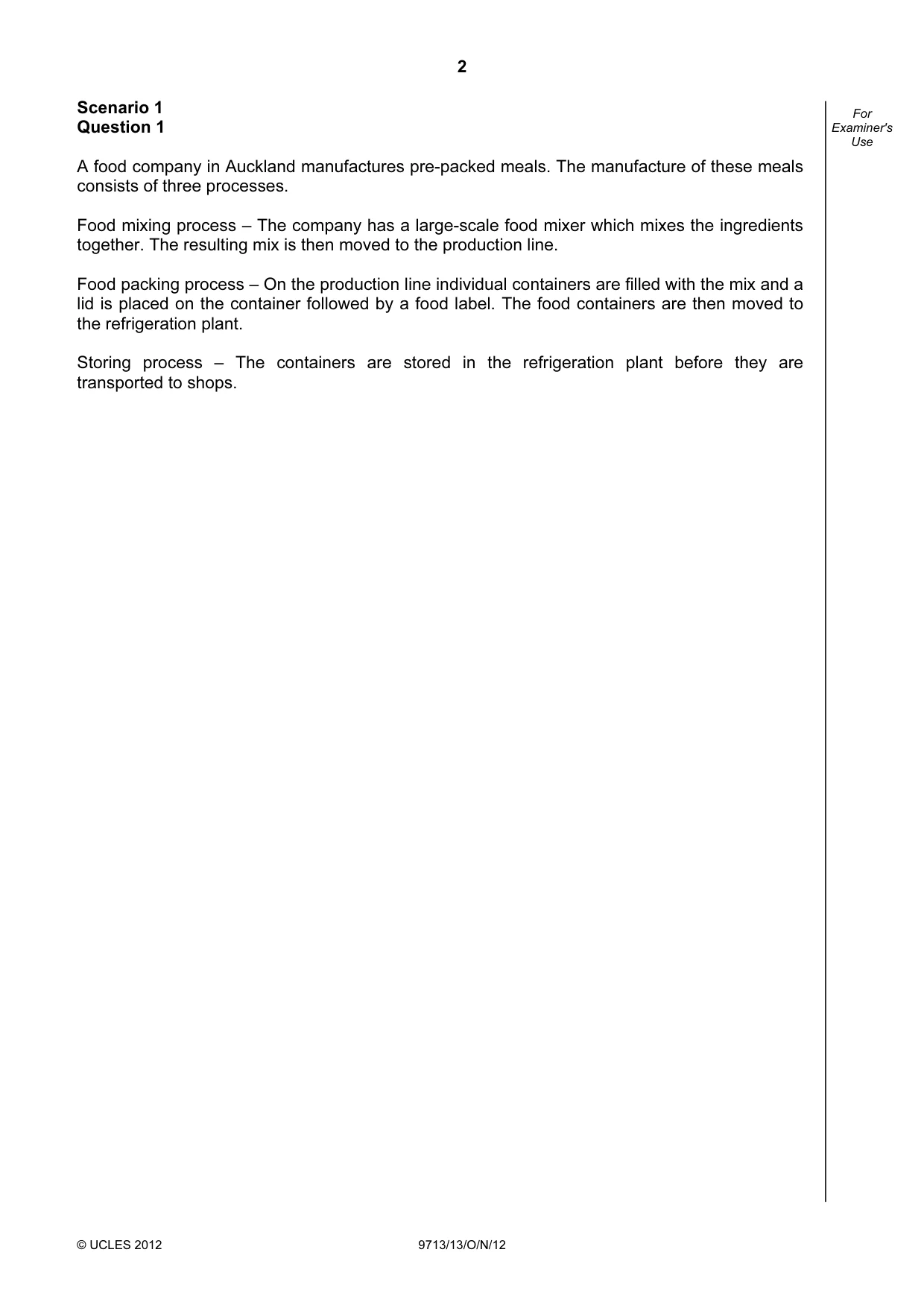
2 © UCLES 2012 9713/13/O/N/12 For Examiner's Use Scenario 1 Question 1 A food company in Auckland manufactures pre-packed meals. The manufacture of these meals consists of three processes. Food mixing process – The company has a large-scale food mixer which mixes the ingredients together. The resulting mix is then moved to the production line. Food packing process – On the production line individual containers are filled with the mix and a lid is placed on the container followed by a food label. The food containers are then moved to the refrigeration plant. Storing process – The containers are stored in the refrigeration plant before they are transported to shops.
Question paper, page 3
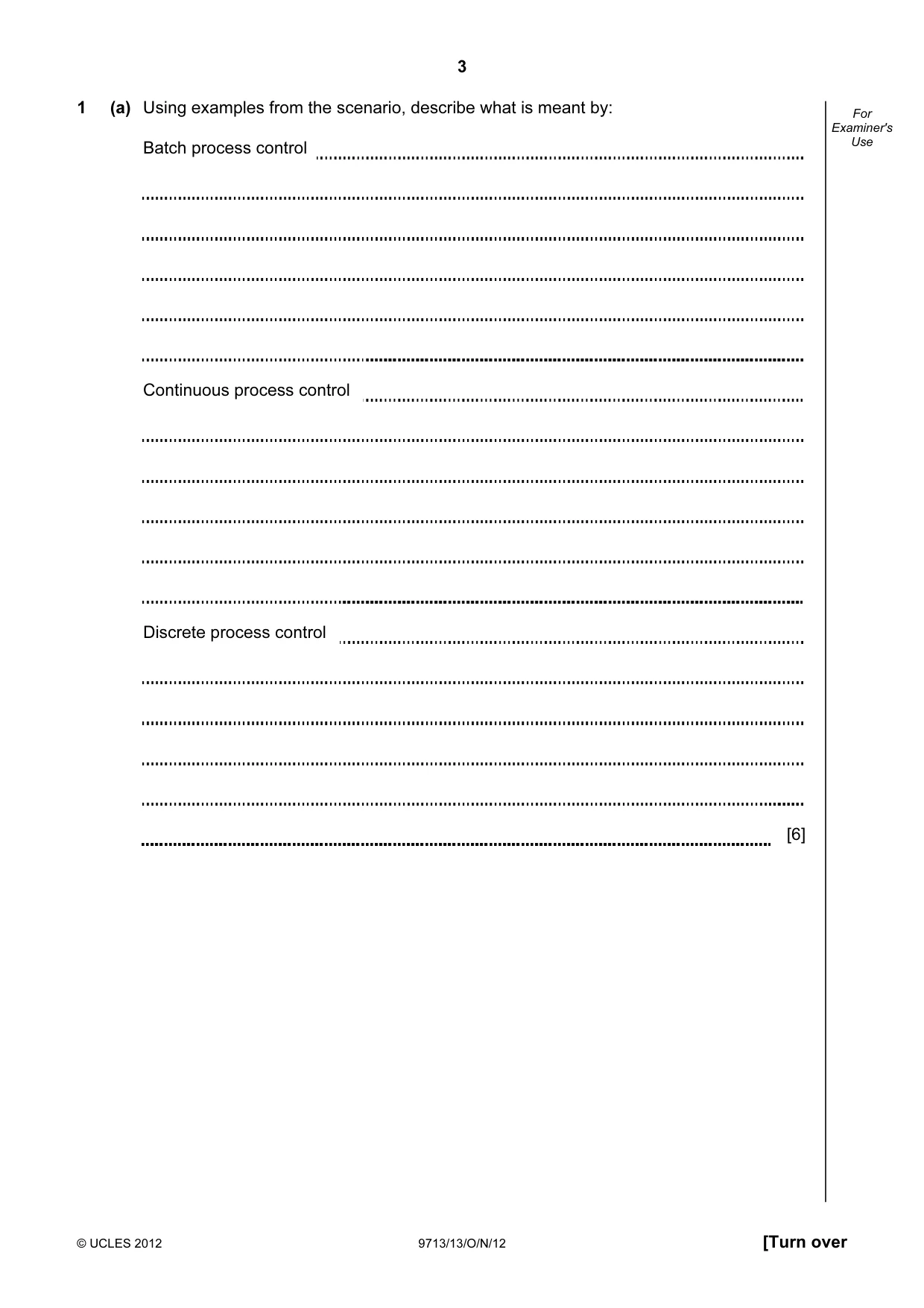
3 © UCLES 2012 9713/13/O/N/12 [Turn over For Examiner's Use 1 (a) Using examples from the scenario, describe what is meant by: Batch process control Continuous process control Discrete process control [6]
Question paper, page 4
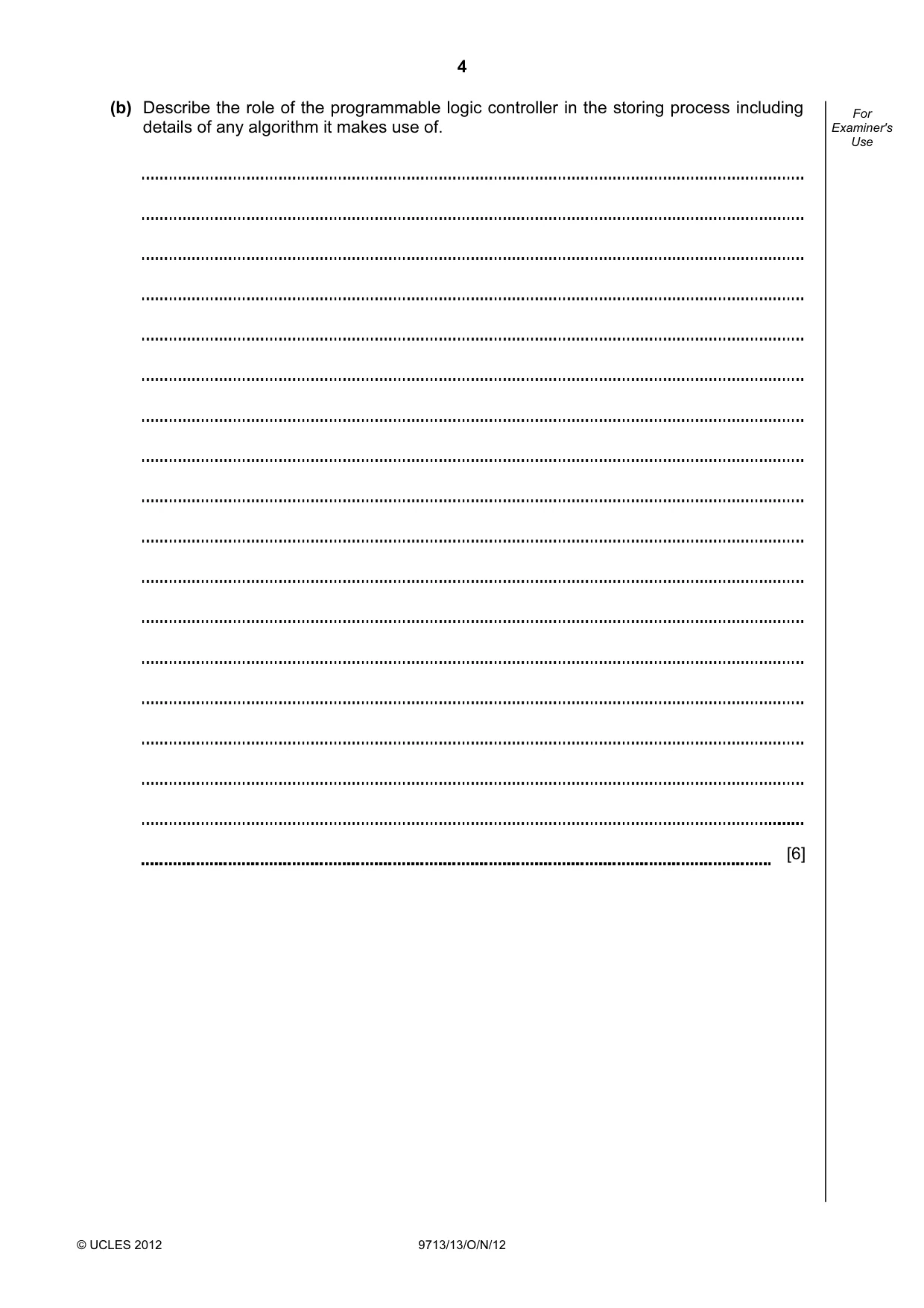
4 © UCLES 2012 9713/13/O/N/12 For Examiner's Use (b) Describe the role of the programmable logic controller in the storing process including details of any algorithm it makes use of. [6]
Question paper, page 5
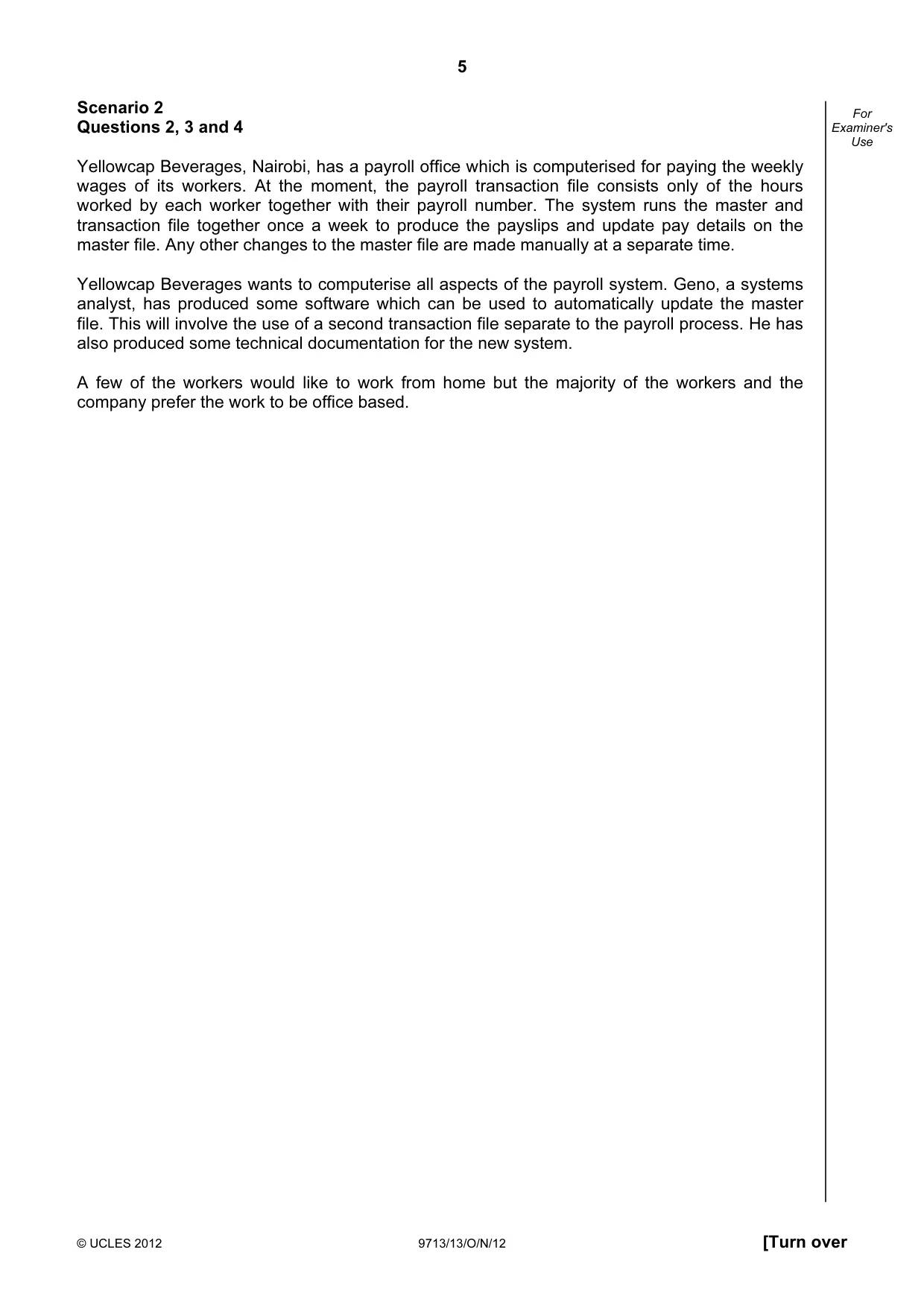
5 © UCLES 2012 9713/13/O/N/12 [Turn over For Examiner's Use Scenario 2 Questions 2, 3 and 4 Yellowcap Beverages, Nairobi, has a payroll office which is computerised for paying the weekly wages of its workers. At the moment, the payroll transaction file consists only of the hours worked by each worker together with their payroll number. The system runs the master and transaction file together once a week to produce the payslips and update pay details on the master file. Any other changes to the master file are made manually at a separate time. Yellowcap Beverages wants to computerise all aspects of the payroll system. Geno, a systems analyst, has produced some software which can be used to automatically update the master file. This will involve the use of a second transaction file separate to the payroll process. He has also produced some technical documentation for the new system. A few of the workers would like to work from home but the majority of the workers and the company prefer the work to be office based.
Question paper, page 6
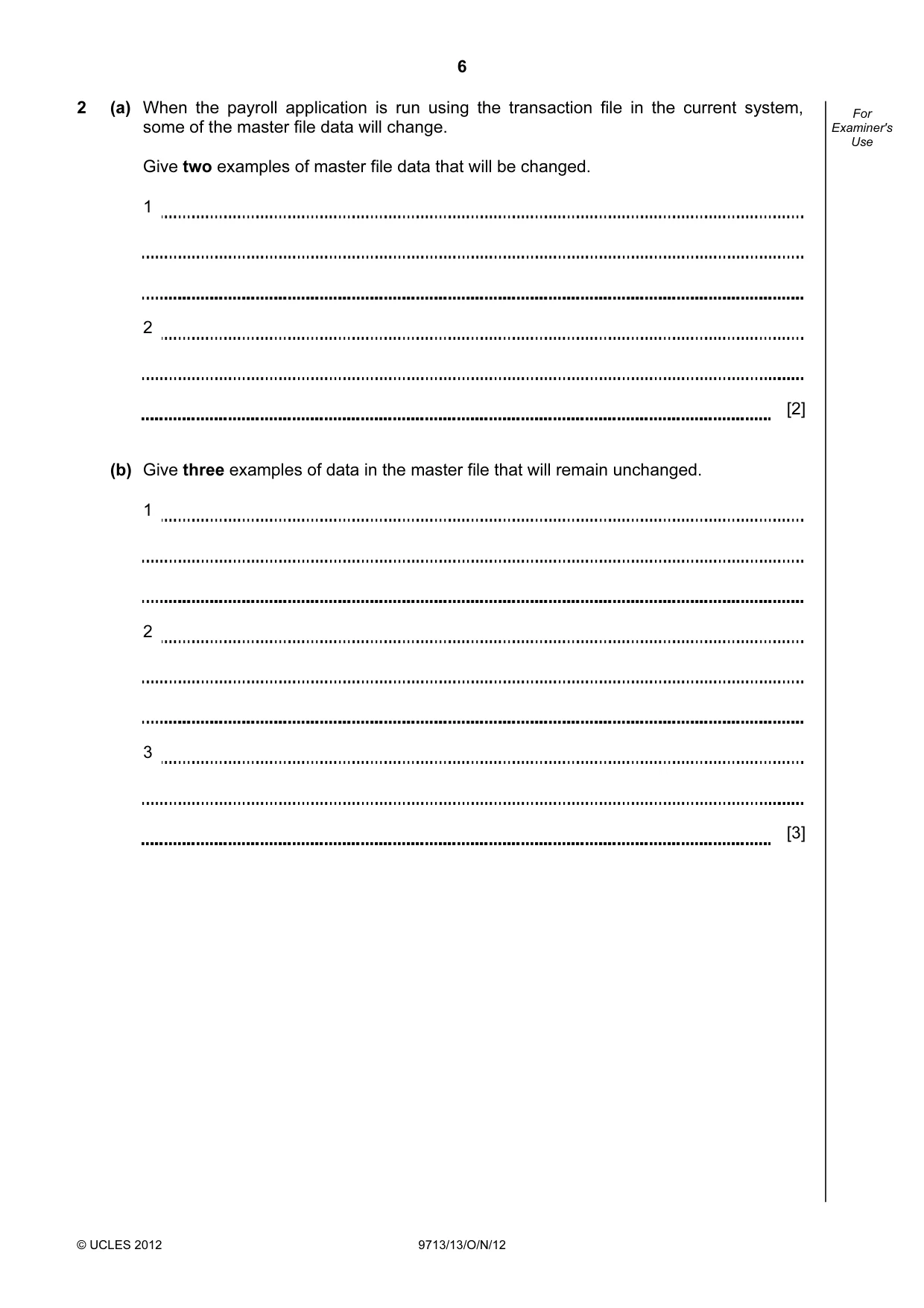
6 © UCLES 2012 9713/13/O/N/12 For Examiner's Use 2 (a) When the payroll application is run using the transaction file in the current system, some of the master file data will change. Give two examples of master file data that will be changed. 1 2 [2] (b) Give three examples of data in the master file that will remain unchanged. 1 2 3 [3]
Question paper, page 7
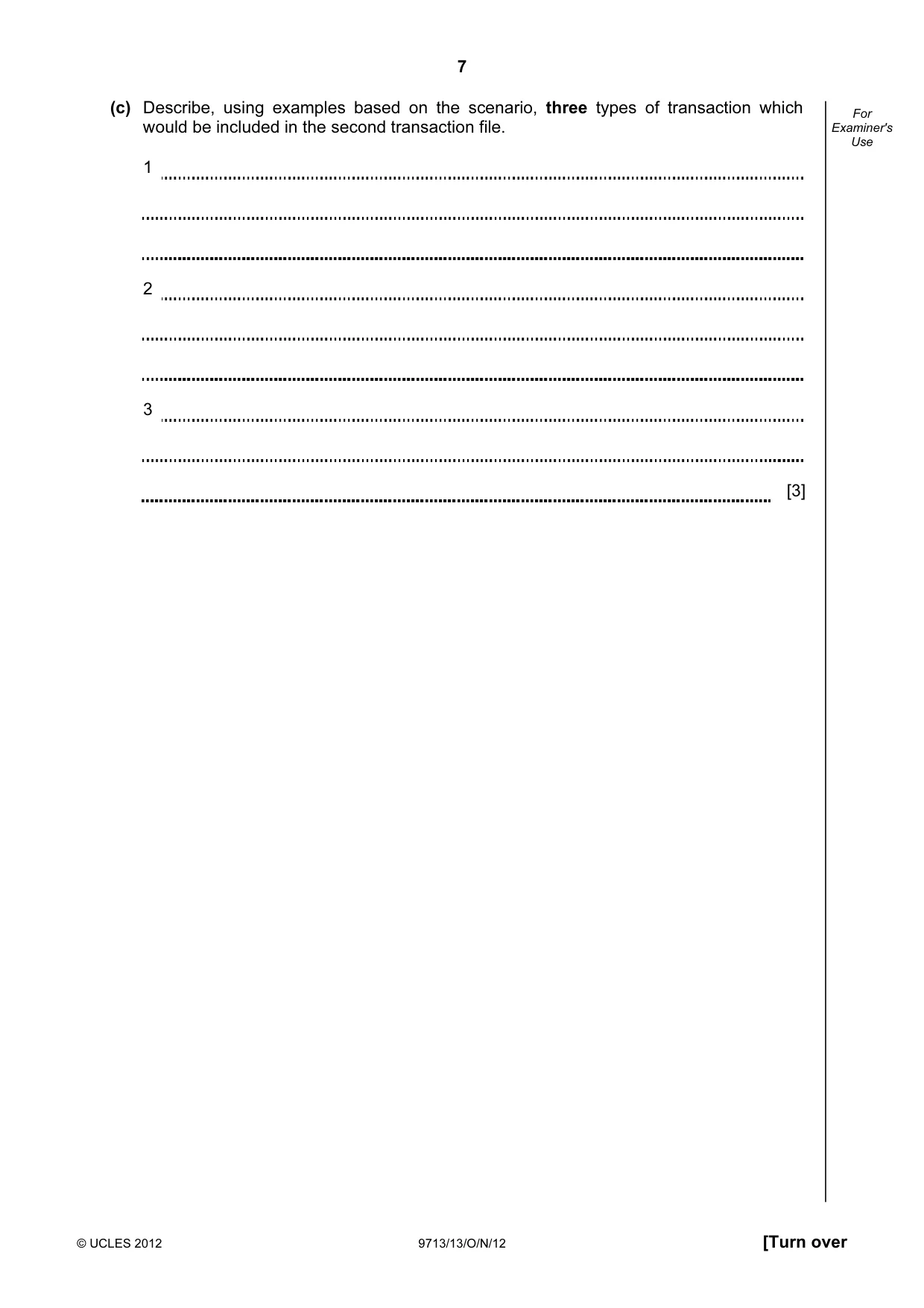
7 © UCLES 2012 9713/13/O/N/12 [Turn over For Examiner's Use (c) Describe, using examples based on the scenario, three types of transaction which would be included in the second transaction file. 1 2 3 [3]
Question paper, page 8
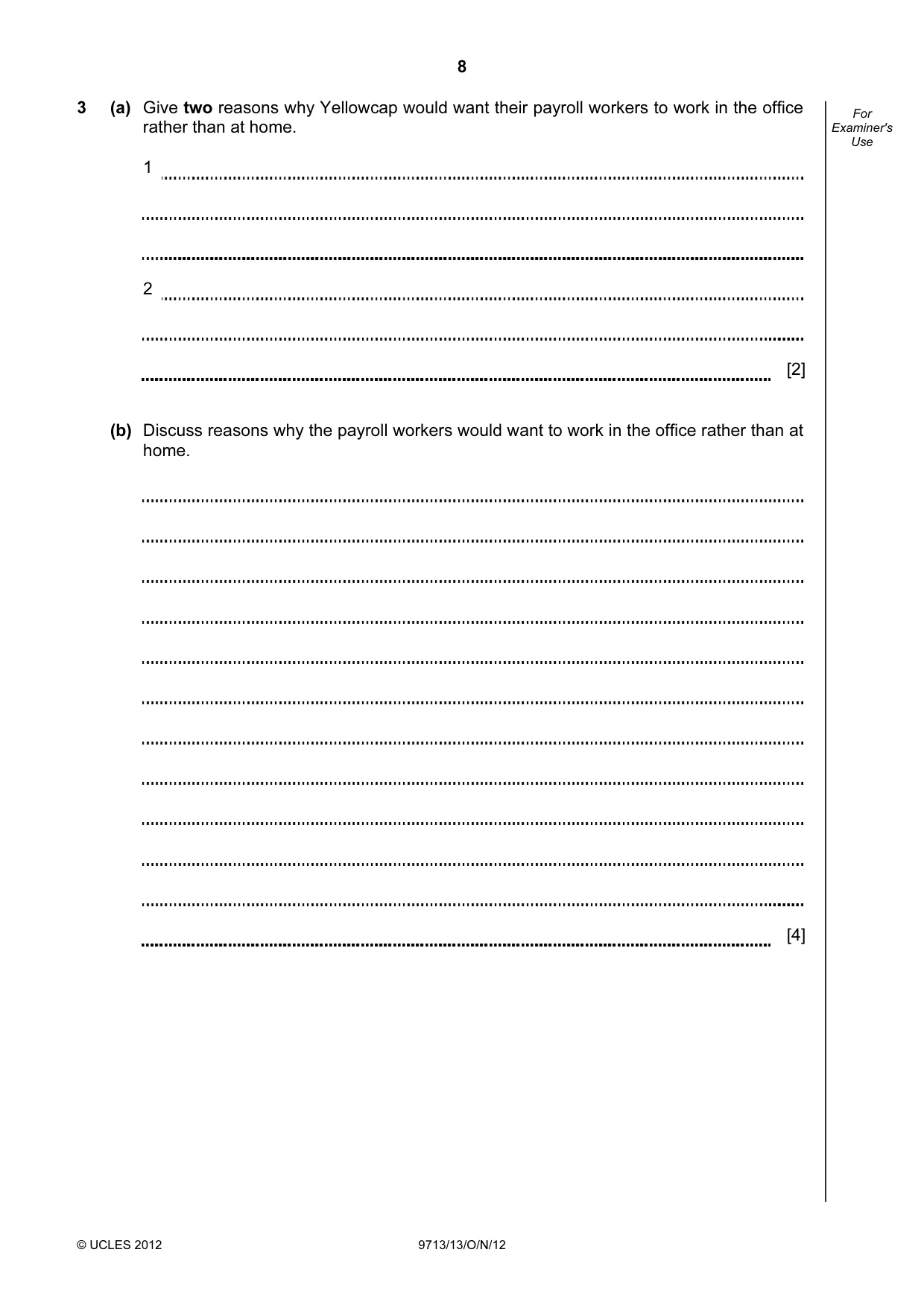
8 © UCLES 2012 9713/13/O/N/12 For Examiner's Use 3 (a) Give two reasons why Yellowcap would want their payroll workers to work in the office rather than at home. 1 2 [2] (b) Discuss reasons why the payroll workers would want to work in the office rather than at home. [4]
Question paper, page 9
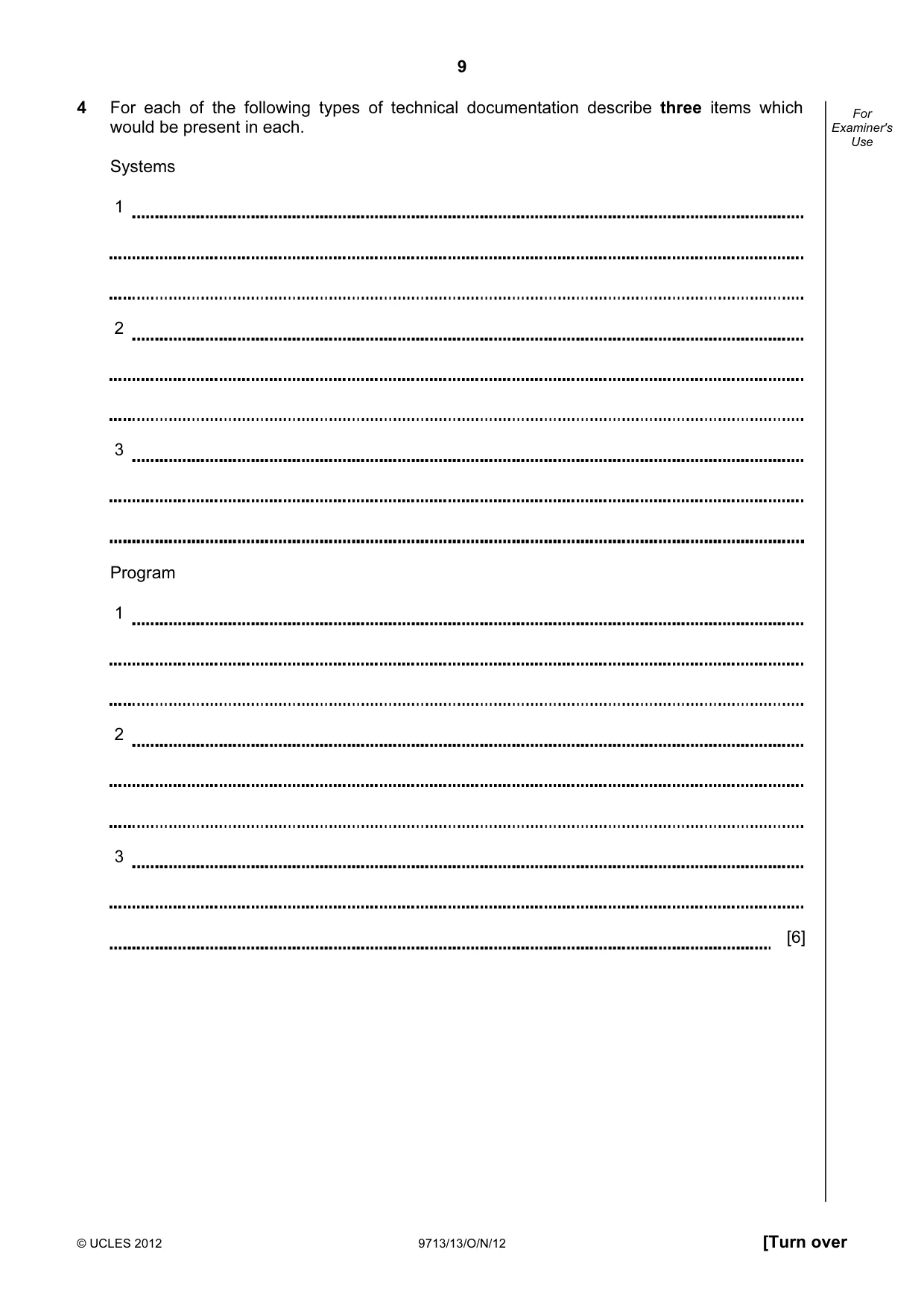
9 © UCLES 2012 9713/13/O/N/12 [Turn over For Examiner's Use 4 For each of the following types of technical documentation describe three items which would be present in each. Systems 1 2 3 Program 1 2 3 [6]
Question paper, page 10
10 © UCLES 2012 9713/13/O/N/12 For Examiner's Use Scenario 3 Question 5 Russia Newspapers owns the St Petersburg Chronicle. Many of its reporters work abroad covering foreign news stories. They are generally based in hotels and are usually able to communicate with the editor using ICT. It is the editor’s responsibility to collect the stories from the reporters and create the newspaper layout. As well as a printing press at the main offices in St Petersburg, Russia Newspapers owns several printing presses in other cities in Russia.
Question paper, page 11
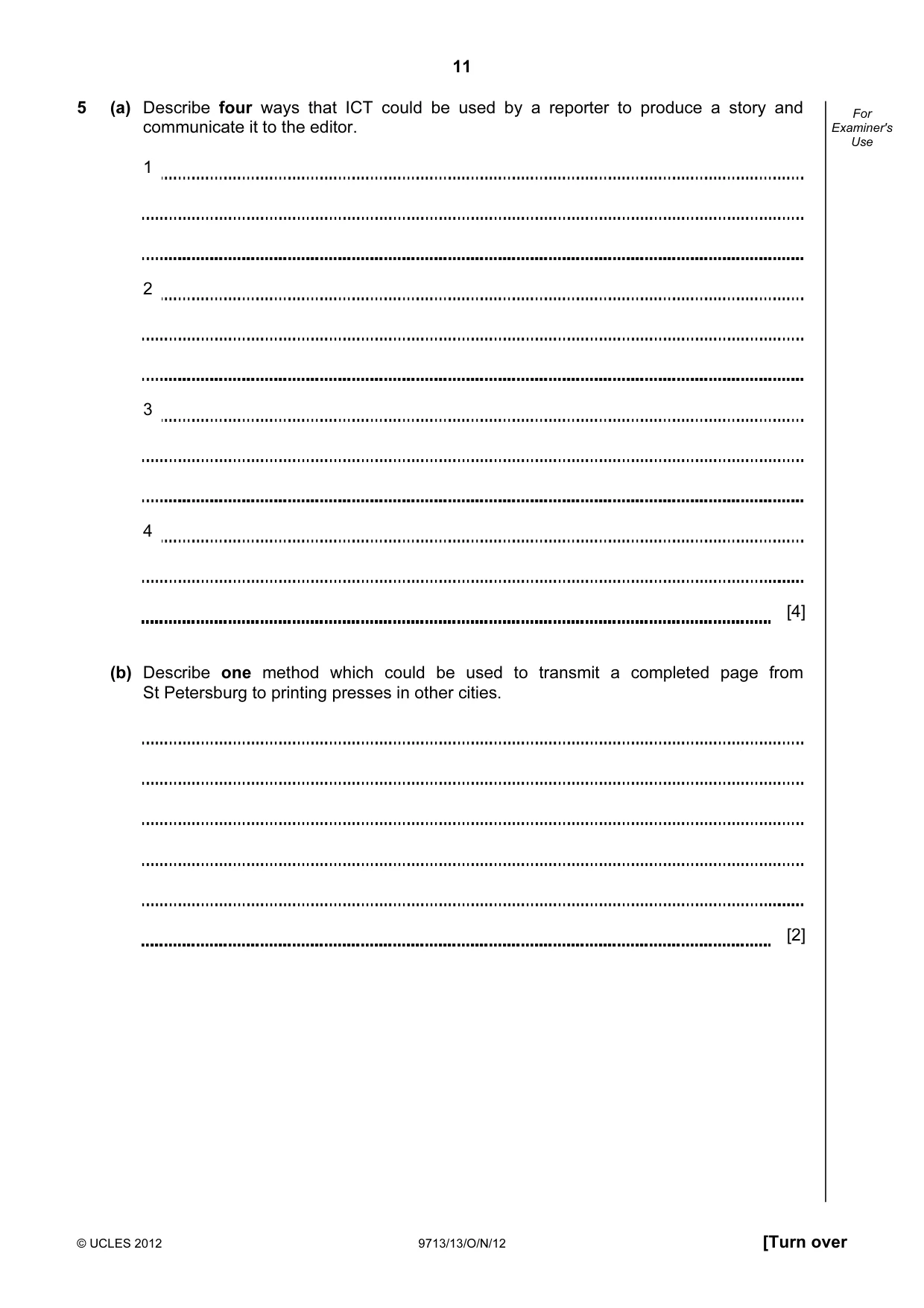
11 © UCLES 2012 9713/13/O/N/12 [Turn over For Examiner's Use 5 (a) Describe four ways that ICT could be used by a reporter to produce a story and communicate it to the editor. 1 2 3 4 [4] (b) Describe one method which could be used to transmit a completed page from St Petersburg to printing presses in other cities. [2]
Question paper, page 12
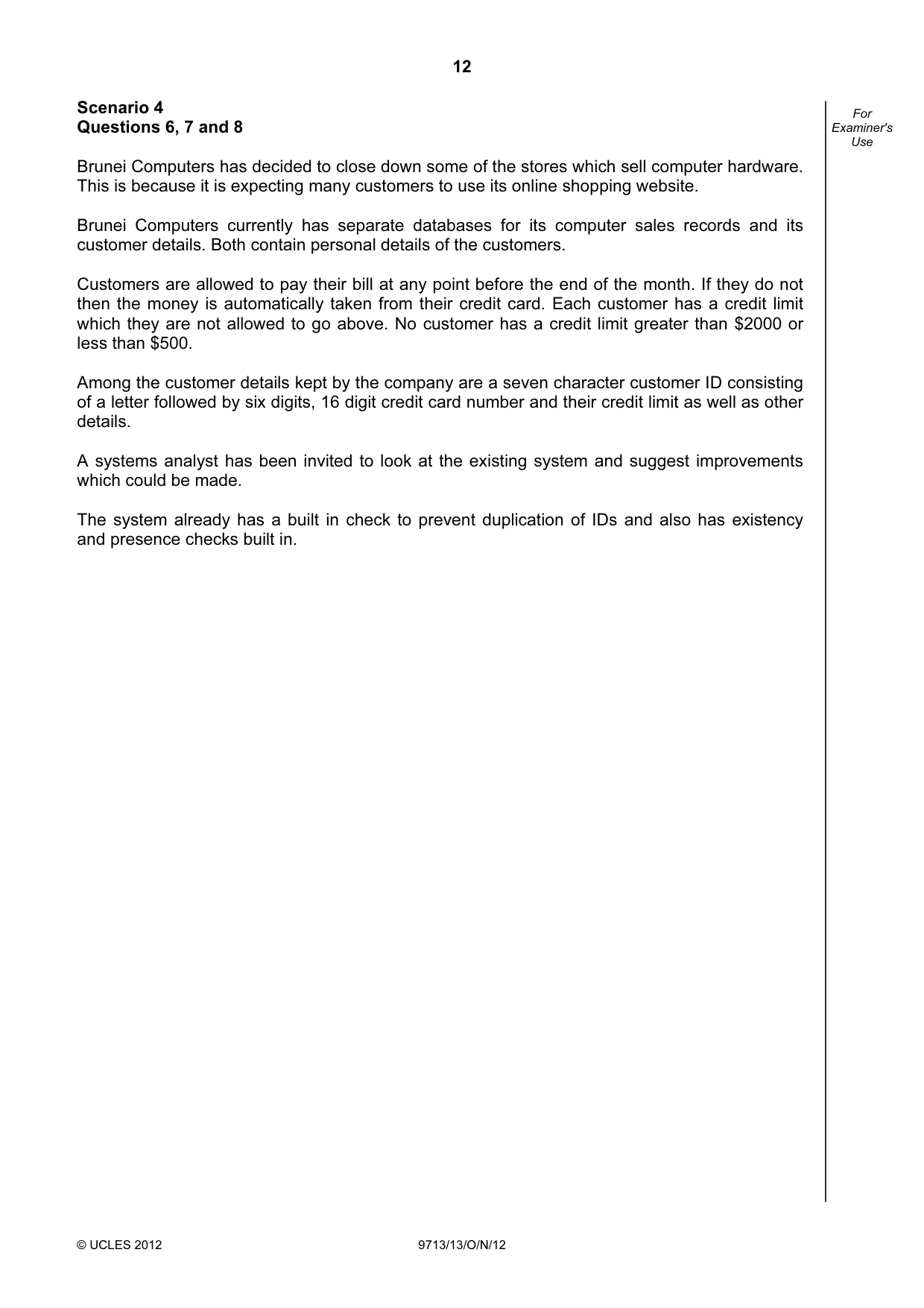
12 © UCLES 2012 9713/13/O/N/12 For Examiner's Use Scenario 4 Questions 6, 7 and 8 Brunei Computers has decided to close down some of the stores which sell computer hardware. This is because it is expecting many customers to use its online shopping website. Brunei Computers currently has separate databases for its computer sales records and its customer details. Both contain personal details of the customers. Customers are allowed to pay their bill at any point before the end of the month. If they do not then the money is automatically taken from their credit card. Each customer has a credit limit which they are not allowed to go above. No customer has a credit limit greater than $2000 or less than $500. Among the customer details kept by the company are a seven character customer ID consisting of a letter followed by six digits, 16 digit credit card number and their credit limit as well as other details. A systems analyst has been invited to look at the existing system and suggest improvements which could be made. The system already has a built in check to prevent duplication of IDs and also has existency and presence checks built in.
Question paper, page 13
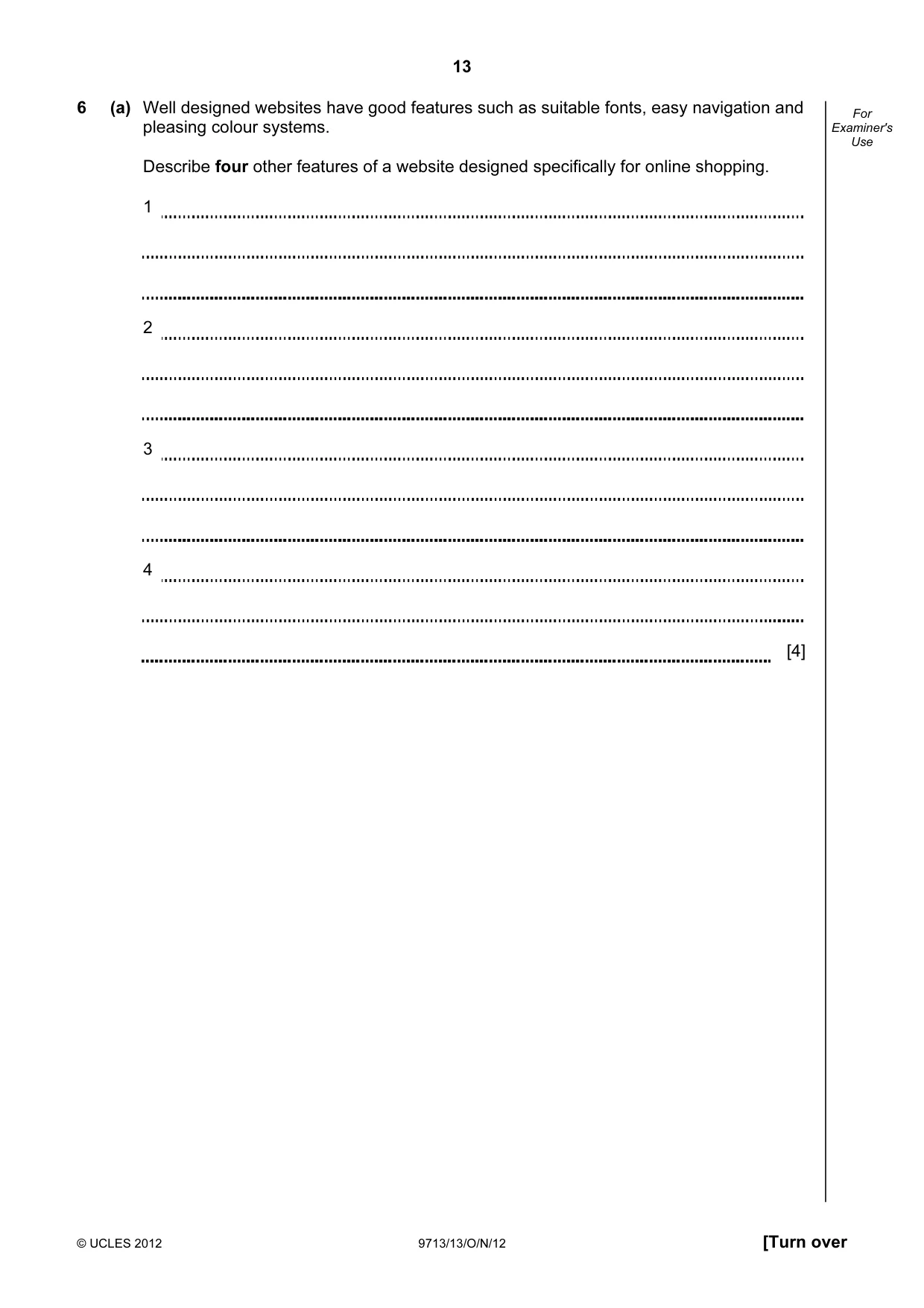
13 © UCLES 2012 9713/13/O/N/12 [Turn over For Examiner's Use 6 (a) Well designed websites have good features such as suitable fonts, easy navigation and pleasing colour systems. Describe four other features of a website designed specifically for online shopping. 1 2 3 4 [4]
Question paper, page 14
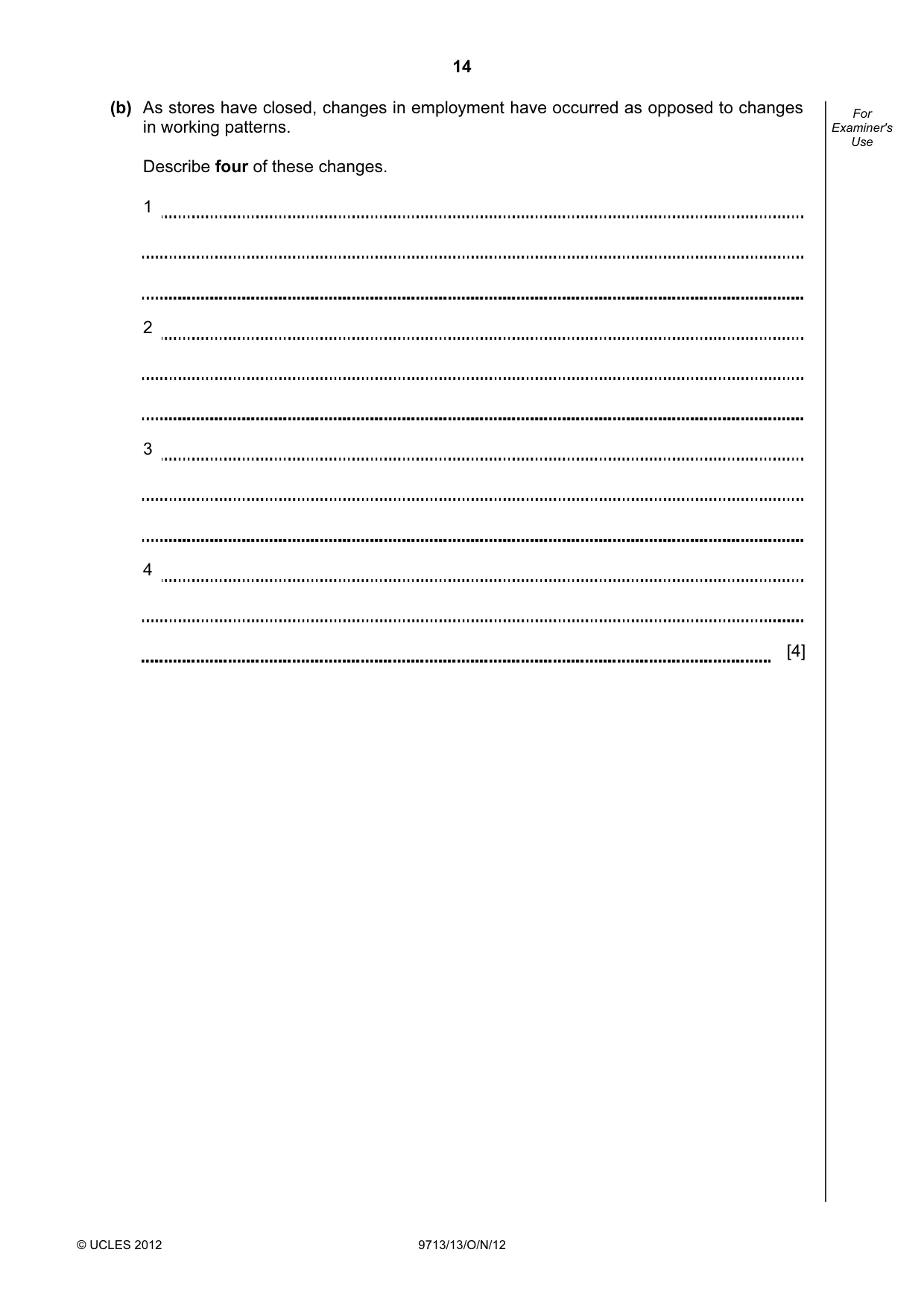
14 © UCLES 2012 9713/13/O/N/12 For Examiner's Use (b) As stores have closed, changes in employment have occurred as opposed to changes in working patterns. Describe four of these changes. 1 2 3 4 [4]
Question paper, page 15
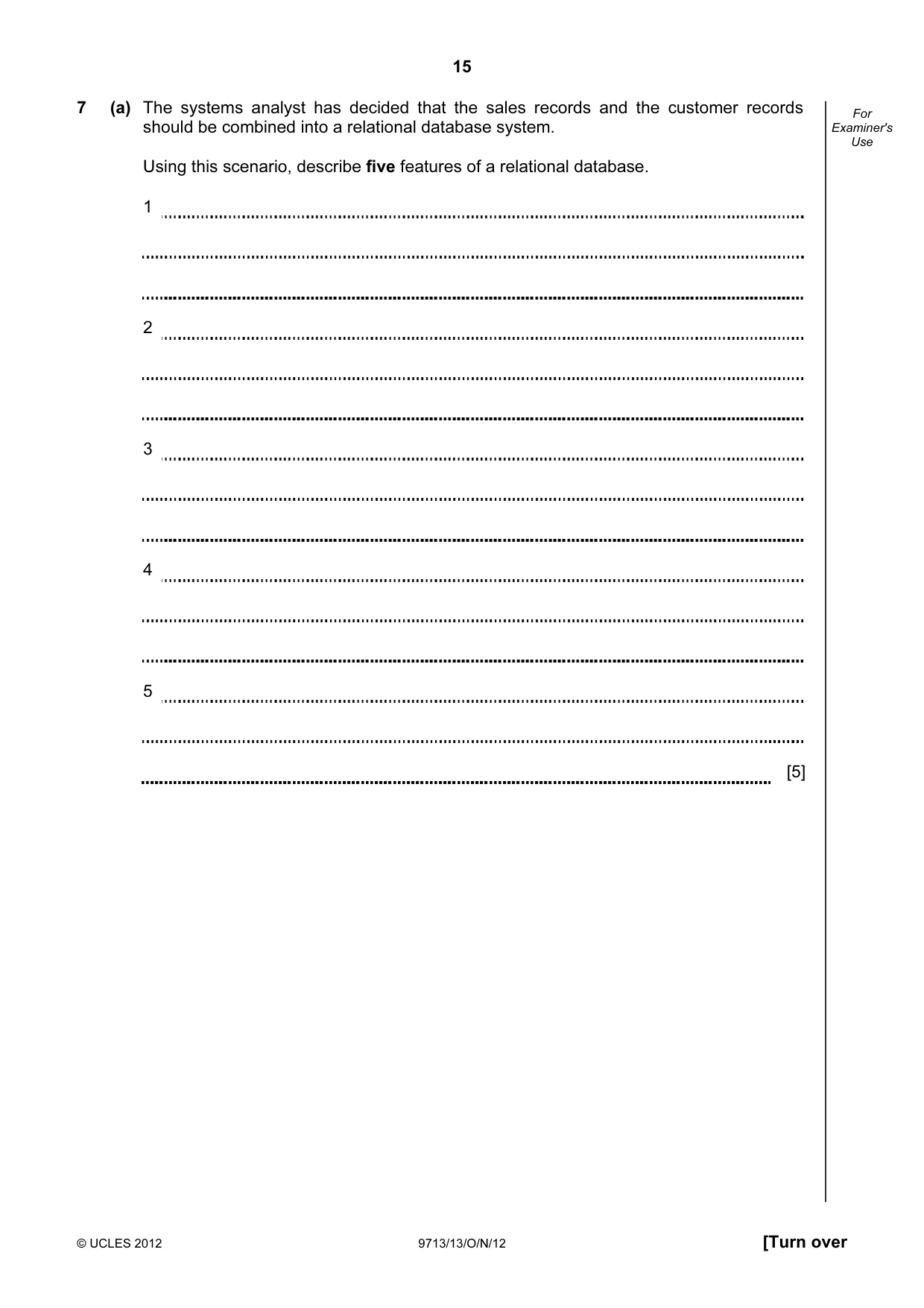
15 © UCLES 2012 9713/13/O/N/12 [Turn over For Examiner's Use 7 (a) The systems analyst has decided that the sales records and the customer records should be combined into a relational database system. Using this scenario, describe five features of a relational database. 1 2 3 4 5 [5]
Question paper, page 16
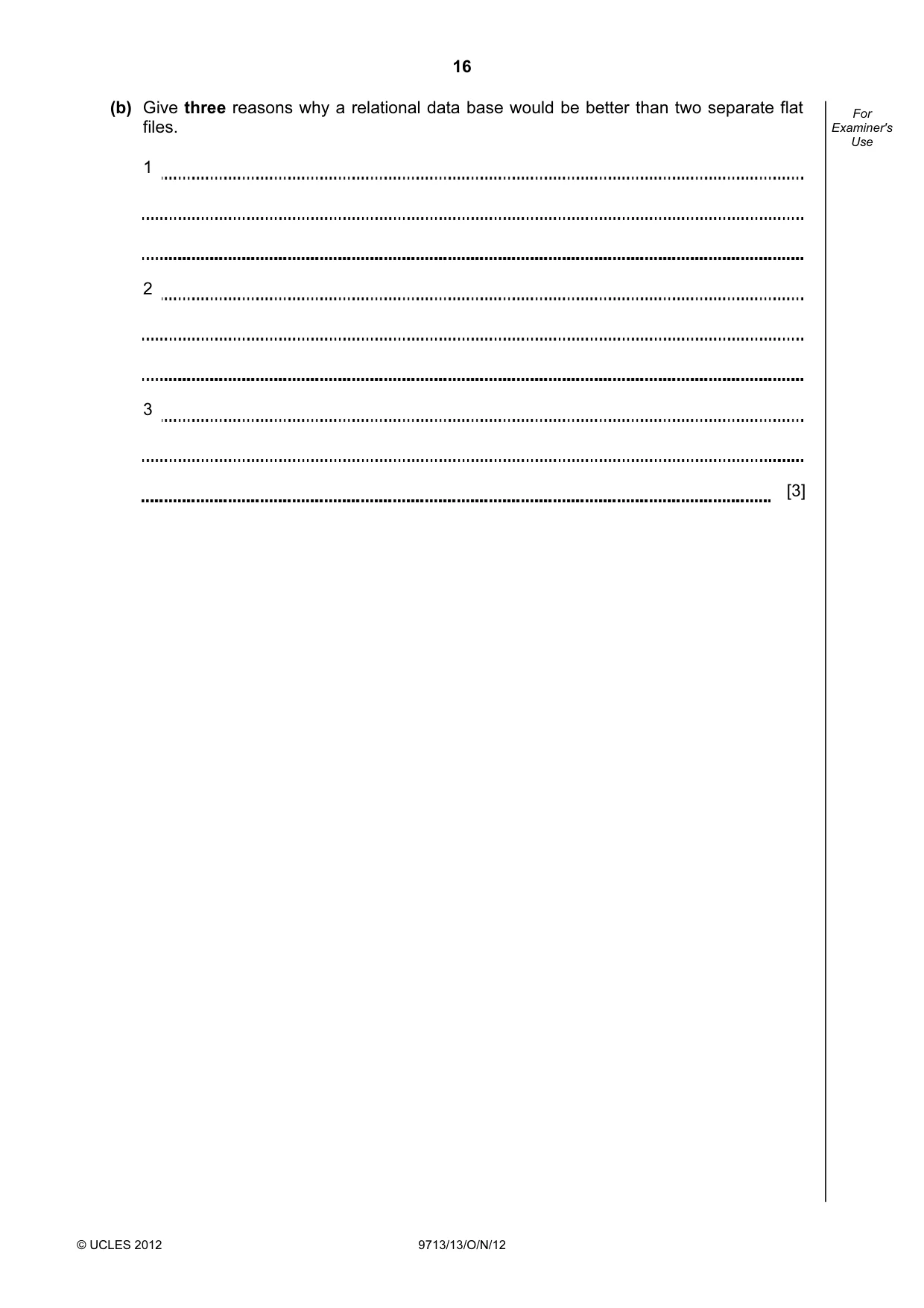
16 © UCLES 2012 9713/13/O/N/12 For Examiner's Use (b) Give three reasons why a relational data base would be better than two separate flat files. 1 2 3 [3]
Question paper, page 17
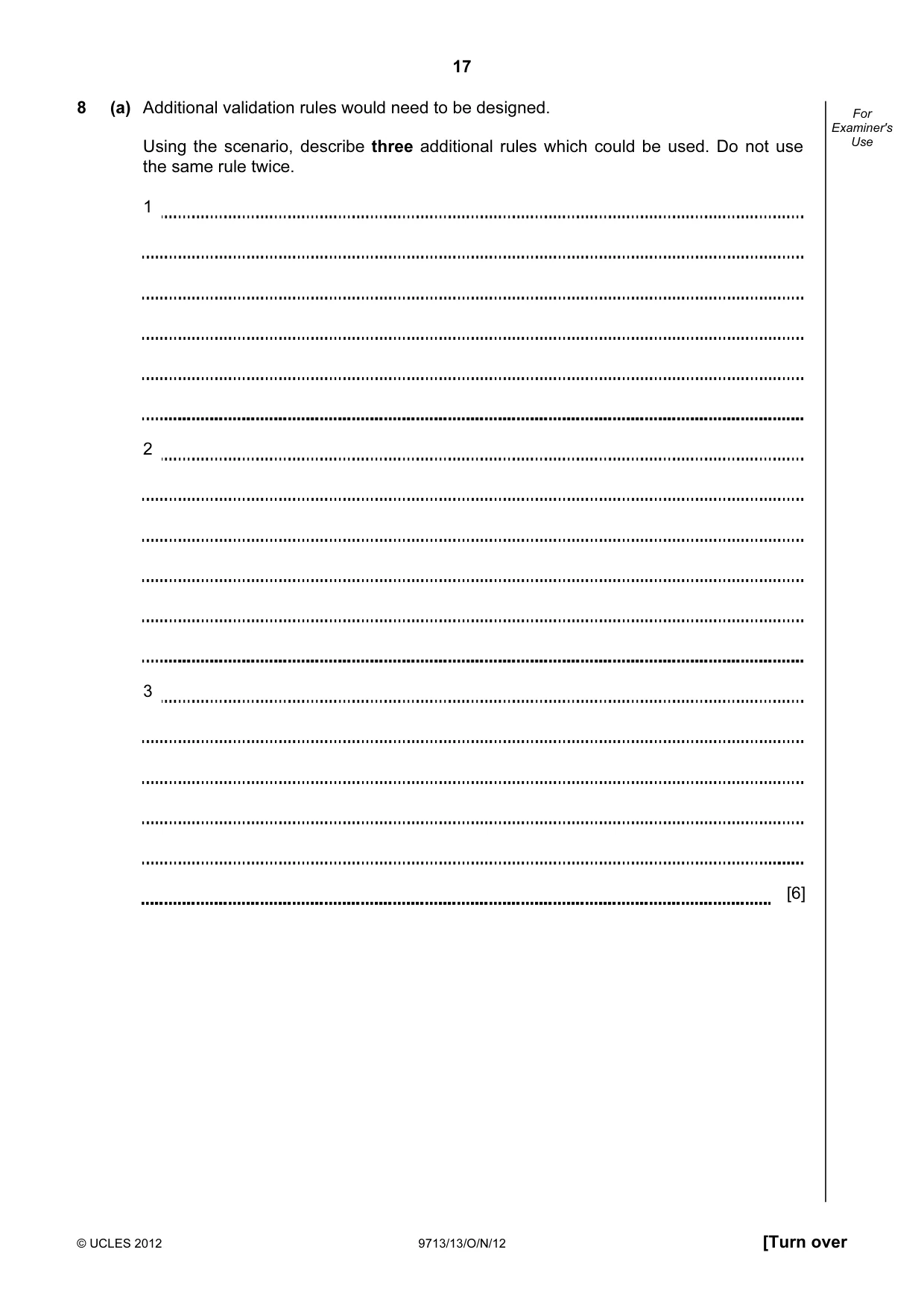
17 © UCLES 2012 9713/13/O/N/12 [Turn over For Examiner's Use 8 (a) Additional validation rules would need to be designed. Using the scenario, describe three additional rules which could be used. Do not use the same rule twice. 1 2 3 [6]
Question paper, page 18
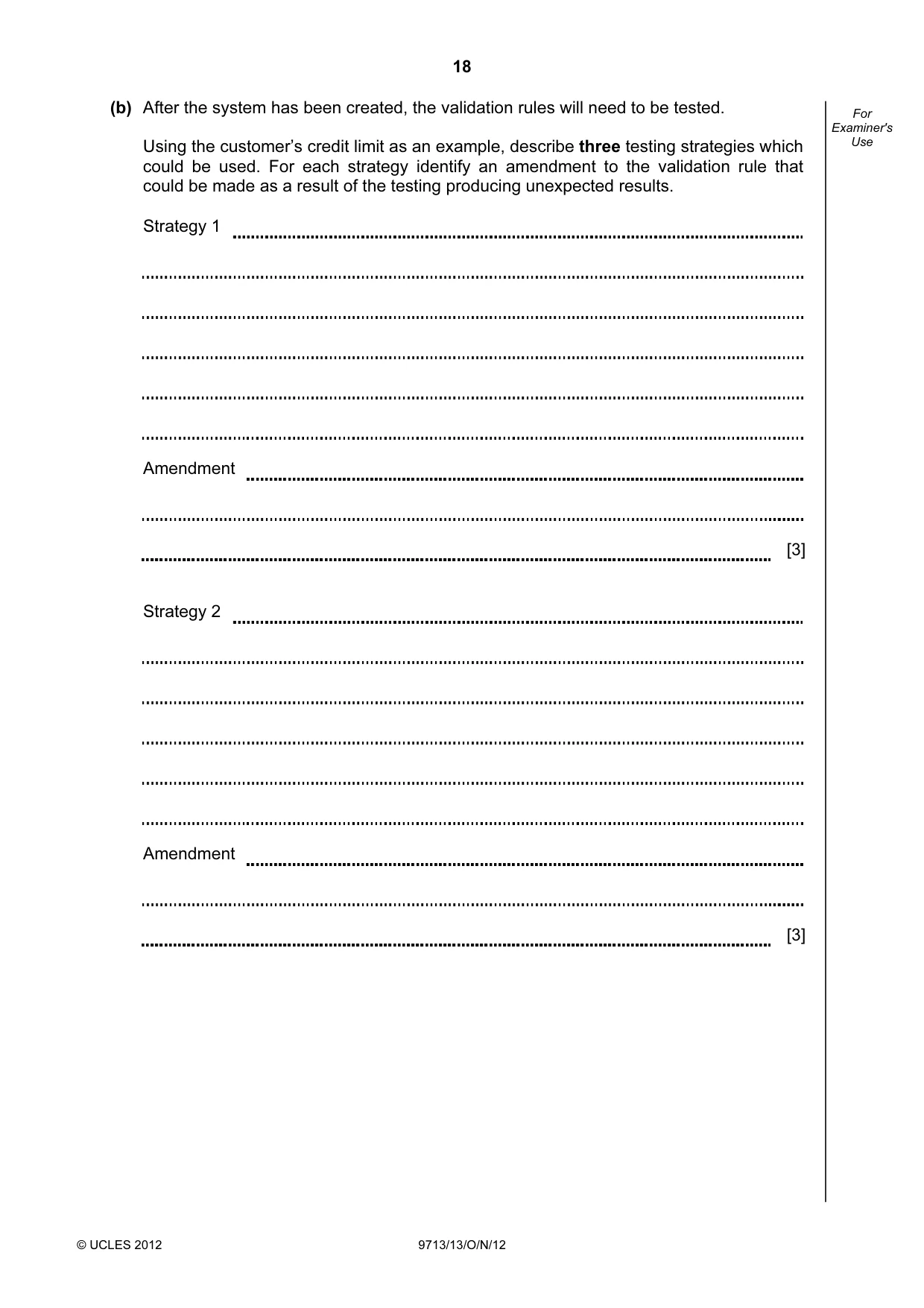
18 © UCLES 2012 9713/13/O/N/12 For Examiner's Use (b) After the system has been created, the validation rules will need to be tested. Using the customer’s credit limit as an example, describe three testing strategies which could be used. For each strategy identify an amendment to the validation rule that could be made as a result of the testing producing unexpected results. Strategy 1 Amendment [3] Strategy 2 Amendment [3]
Question paper, page 19
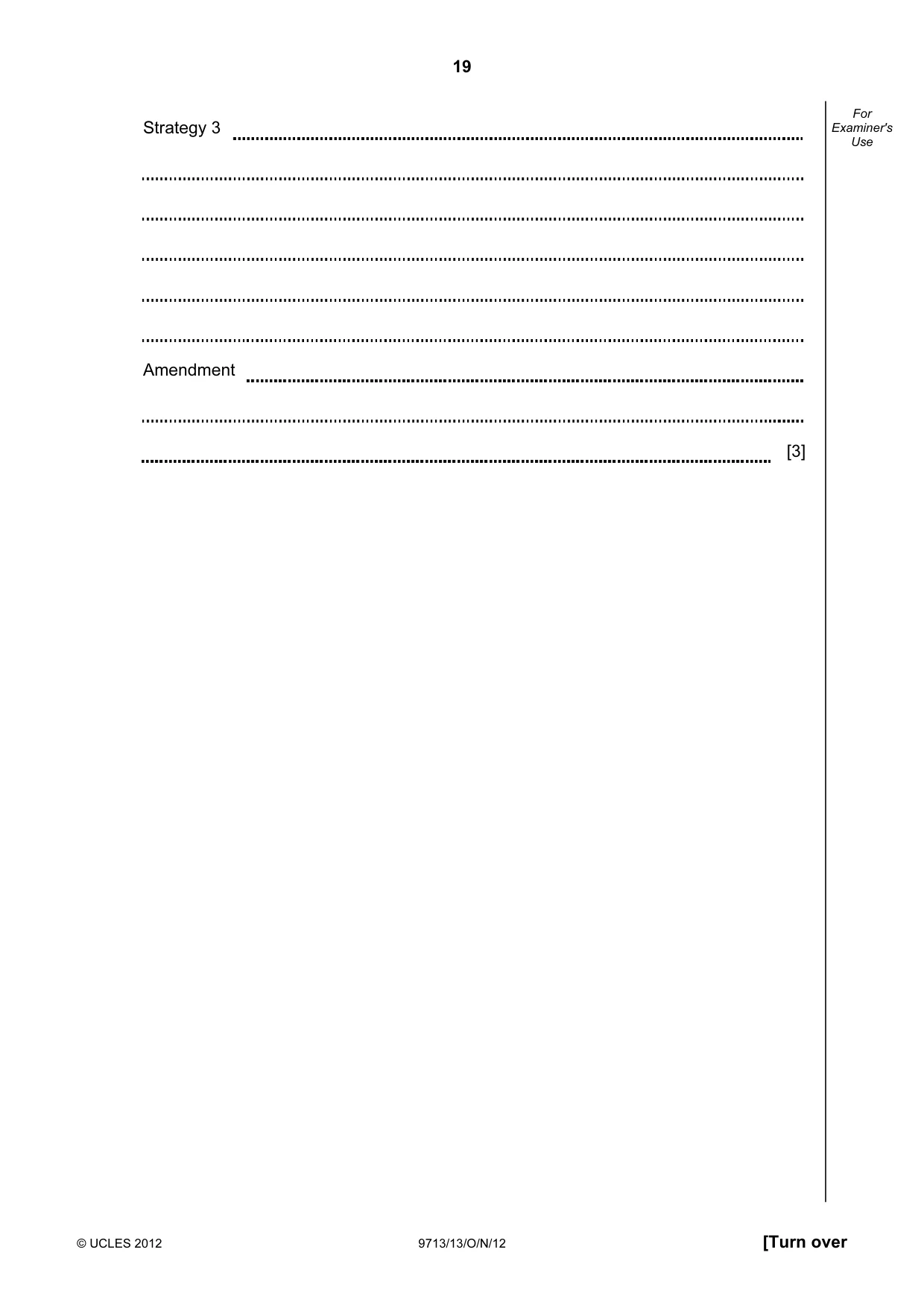
19 © UCLES 2012 9713/13/O/N/12 [Turn over For Examiner's Use Strategy 3 Amendment [3]
Question paper, page 20
20 © UCLES 2012 9713/13/O/N/12 For Examiner's Use Scenario 5 Questions 9 and 10 Mr Devlin is the principal of a college of education. He is concerned that the college is not attracting a sufficient number of students to its courses. He wants to advertise the courses offered by the college. He is encouraging the teachers to record details of the students they teach. To begin with, he just wants the teachers to record student test marks. He does not want additional data such as exam results or attendance records to be recorded.
Question paper, page 21
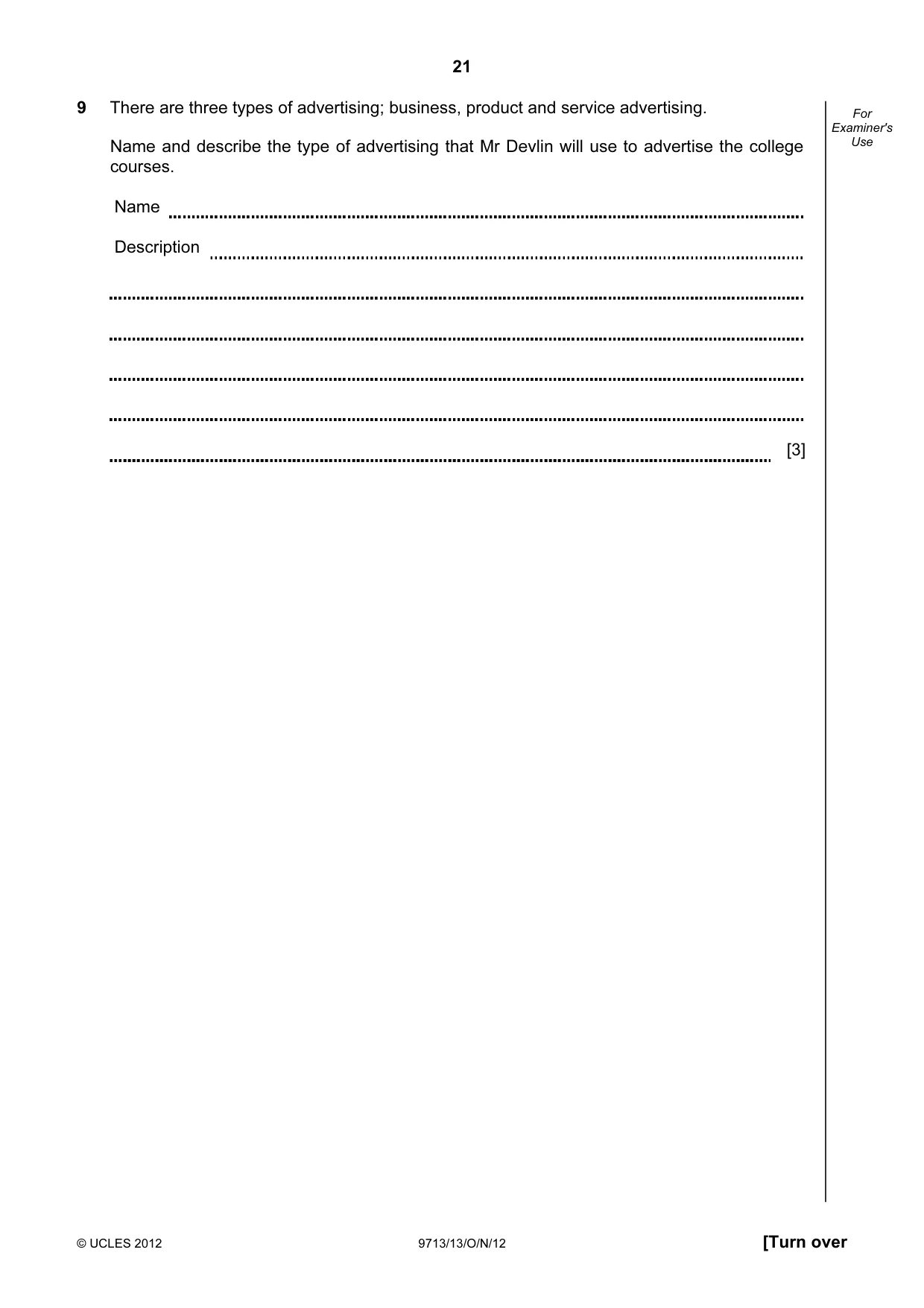
21 © UCLES 2012 9713/13/O/N/12 [Turn over For Examiner's Use 9 There are three types of advertising; business, product and service advertising. Name and describe the type of advertising that Mr Devlin will use to advertise the college courses. Name Description [3]
Question paper, page 22
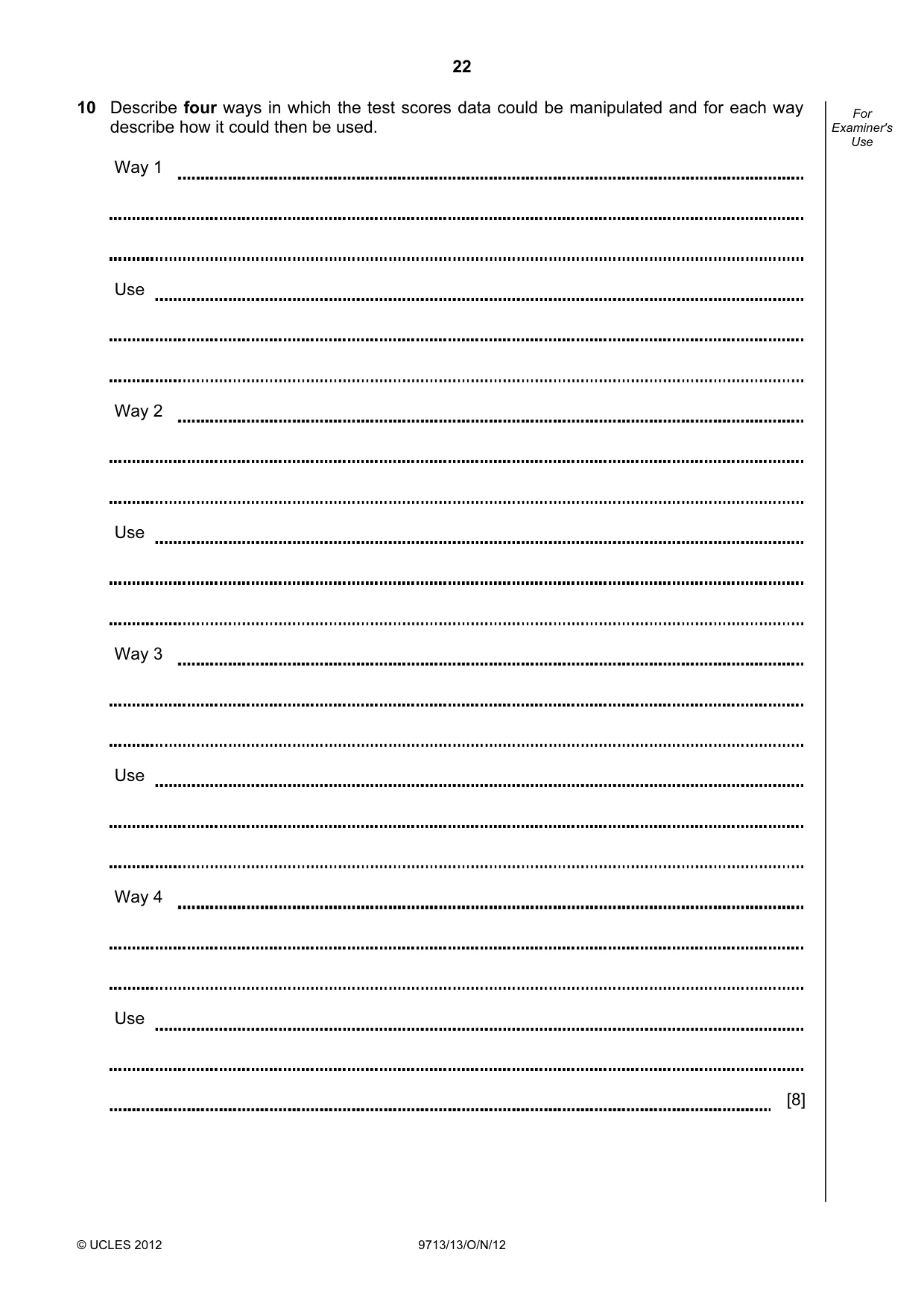
22 © UCLES 2012 9713/13/O/N/12 For Examiner's Use 10 Describe four ways in which the test scores data could be manipulated and for each way describe how it could then be used. Way 1 Use Way 2 Use Way 3 Use Way 4 Use [8]
Question paper, page 23
23 © UCLES 2012 9713/13/O/N/12 BLANK PAGE
Question paper, page 24
24 Permission to reproduce items where third-party owned material protected by copyright is included has been sought and cleared where possible. Every reasonable effort has been made by the publisher (UCLES) to trace copyright holders, but if any items requiring clearance have unwittingly been included, the publisher will be pleased to make amends at the earliest possible opportunity. University of Cambridge International Examinations is part of the Cambridge Assessment Group. Cambridge Assessment is the brand name of University of Cambridge Local Examinations Syndicate (UCLES), which is itself a department of the University of Cambridge. © UCLES 2012 9713/13/O/N/12 BLANK PAGE
Mark scheme, page 1
CAMBRIDGE INTERNATIONAL EXAMINATIONS GCE Advanced Subsidiary Level and GCE Advanced Level MARK SCHEME for the October/November 2012 series 9713 APPLIED ICT 9713/13 Paper 1 (Written A), maximum raw mark 80 This mark scheme is published as an aid to teachers and candidates, to indicate the requirements of the examination. It shows the basis on which Examiners were instructed to award marks. It does not indicate the details of the discussions that took place at an Examiners’ meeting before marking began, which would have considered the acceptability of alternative answers. Mark schemes should be read in conjunction with the question paper and the Principal Examiner Report for Teachers. Cambridge will not enter into discussions about these mark schemes. Cambridge is publishing the mark schemes for the October/November 2012 series for most IGCSE, GCE Advanced Level and Advanced Subsidiary Level components and some Ordinary Level components.
Mark scheme, page 2
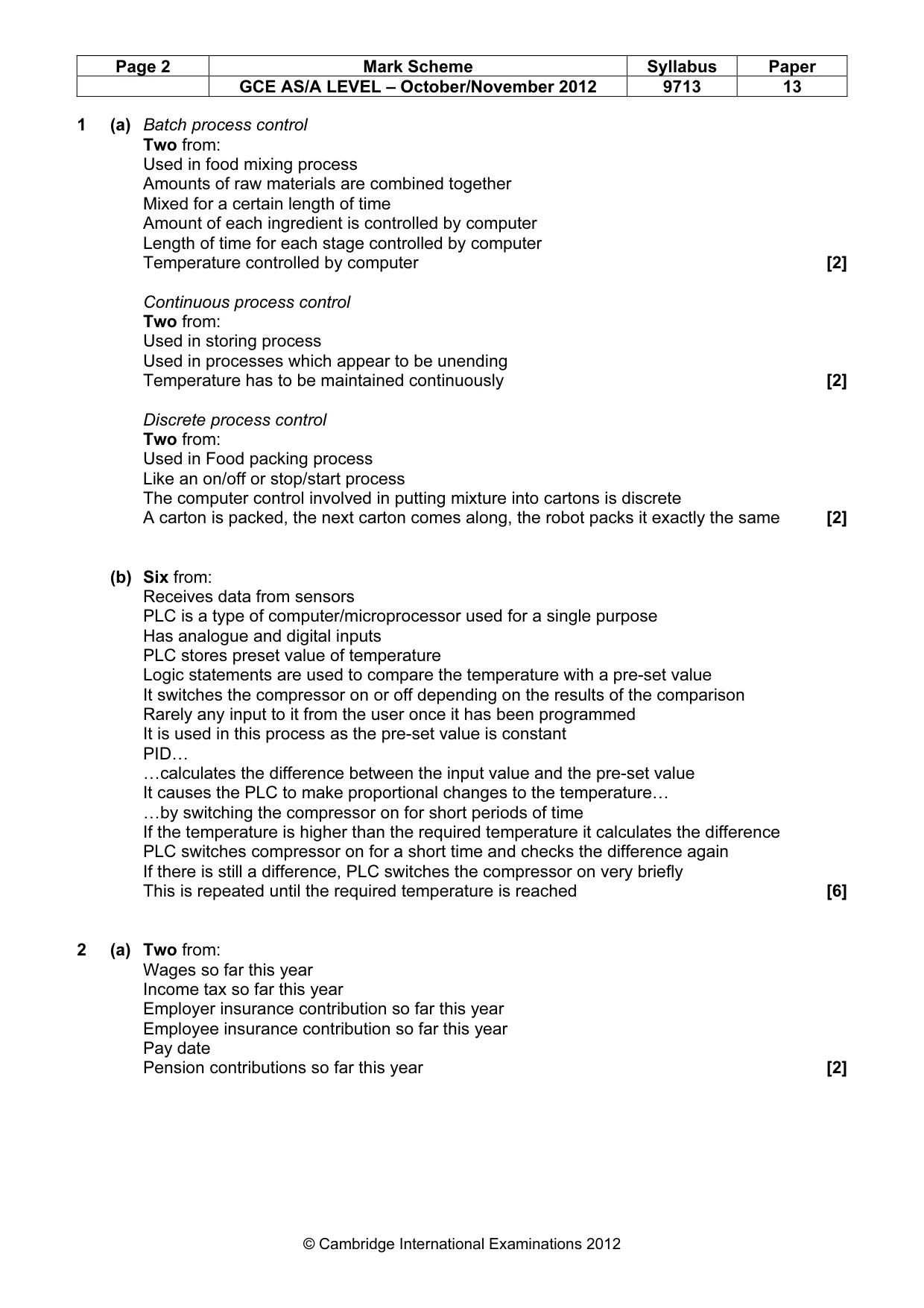
Page 2 Mark Scheme Syllabus Paper GCE AS/A LEVEL – October/November 2012 9713 13 © Cambridge International Examinations 2012 1 (a) Batch process control Two from: Used in food mixing process Amounts of raw materials are combined together Mixed for a certain length of time Amount of each ingredient is controlled by computer Length of time for each stage controlled by computer Temperature controlled by computer [2] Continuous process control Two from: Used in storing process Used in processes which appear to be unending Temperature has to be maintained continuously [2] Discrete process control Two from: Used in Food packing process Like an on/off or stop/start process The computer control involved in putting mixture into cartons is discrete A carton is packed, the next carton comes along, the robot packs it exactly the same [2] (b) Six from: Receives data from sensors PLC is a type of computer/microprocessor used for a single purpose Has analogue and digital inputs PLC stores preset value of temperature Logic statements are used to compare the temperature with a pre-set value It switches the compressor on or off depending on the results of the comparison Rarely any input to it from the user once it has been programmed It is used in this process as the pre-set value is constant PID… …calculates the difference between the input value and the pre-set value It causes the PLC to make proportional changes to the temperature… …by switching the compressor on for short periods of time If the temperature is higher than the required temperature it calculates the difference PLC switches compressor on for a short time and checks the difference again If there is still a difference, PLC switches the compressor on very briefly This is repeated until the required temperature is reached [6] 2 (a) Two from: Wages so far this year Income tax so far this year Employer insurance contribution so far this year Employee insurance contribution so far this year Pay date Pension contributions so far this year [2]
Mark scheme, page 3
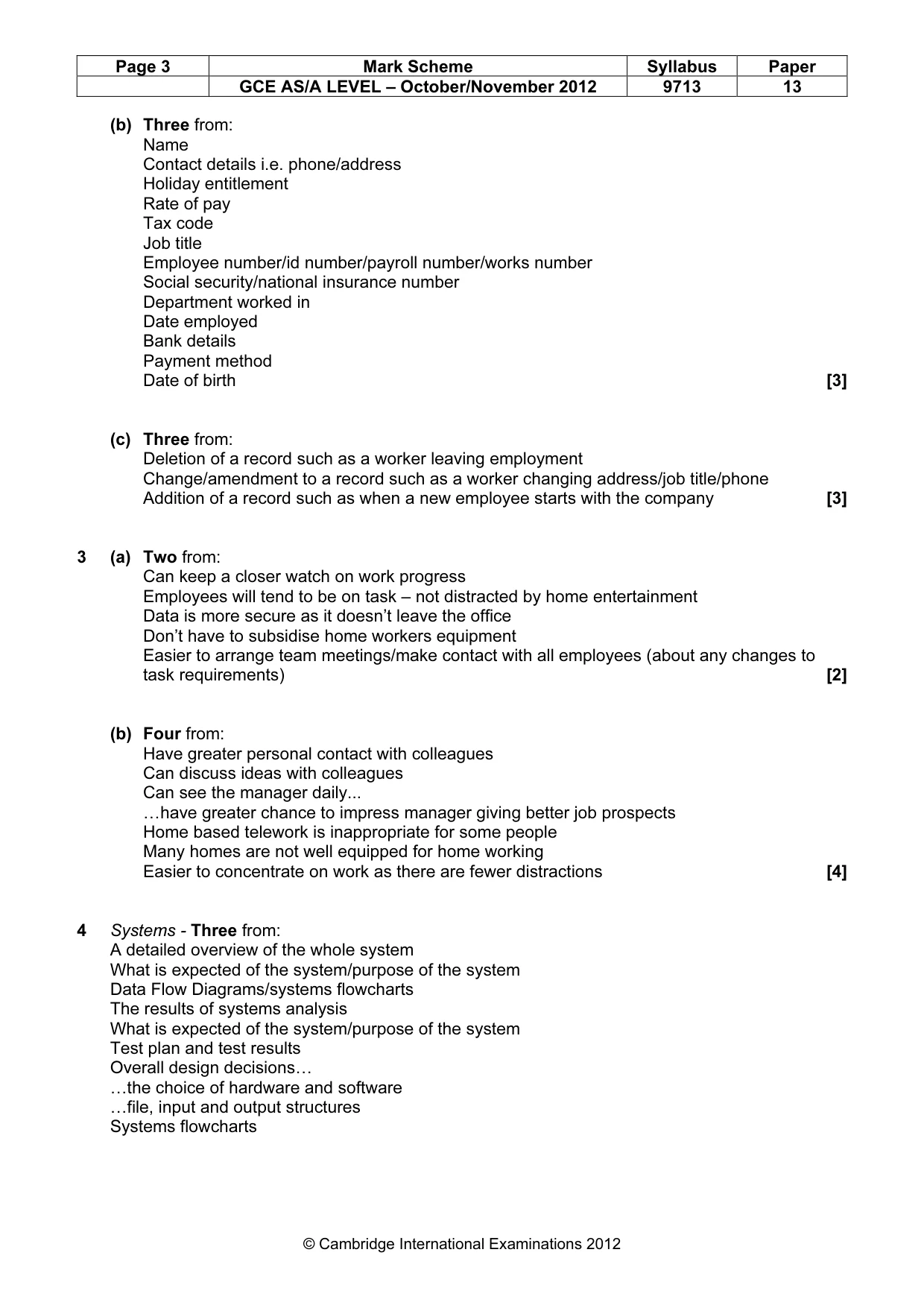
Page 3 Mark Scheme Syllabus Paper GCE AS/A LEVEL – October/November 2012 9713 13 © Cambridge International Examinations 2012 (b) Three from: Name Contact details i.e. phone/address Holiday entitlement Rate of pay Tax code Job title Employee number/id number/payroll number/works number Social security/national insurance number Department worked in Date employed Bank details Payment method Date of birth [3] (c) Three from: Deletion of a record such as a worker leaving employment Change/amendment to a record such as a worker changing address/job title/phone Addition of a record such as when a new employee starts with the company [3] 3 (a) Two from: Can keep a closer watch on work progress Employees will tend to be on task – not distracted by home entertainment Data is more secure as it doesn’t leave the office Don’t have to subsidise home workers equipment Easier to arrange team meetings/make contact with all employees (about any changes to task requirements) [2] (b) Four from: Have greater personal contact with colleagues Can discuss ideas with colleagues Can see the manager daily... …have greater chance to impress manager giving better job prospects Home based telework is inappropriate for some people Many homes are not well equipped for home working Easier to concentrate on work as there are fewer distractions [4] 4 Systems - Three from: A detailed overview of the whole system What is expected of the system/purpose of the system Data Flow Diagrams/systems flowcharts The results of systems analysis What is expected of the system/purpose of the system Test plan and test results Overall design decisions… …the choice of hardware and software …file, input and output structures Systems flowcharts
Mark scheme, page 4
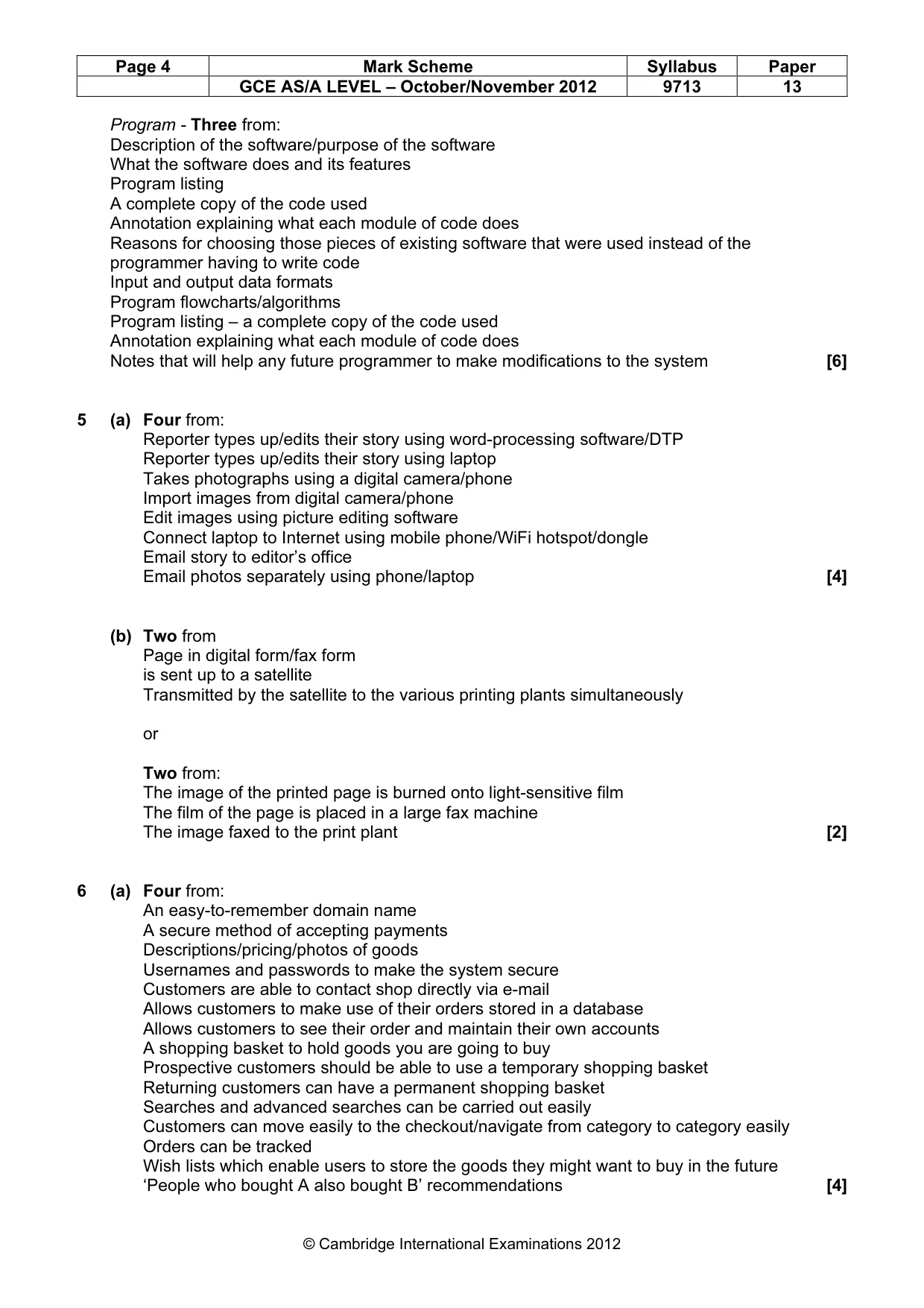
Page 4 Mark Scheme Syllabus Paper GCE AS/A LEVEL – October/November 2012 9713 13 © Cambridge International Examinations 2012 Program - Three from: Description of the software/purpose of the software What the software does and its features Program listing A complete copy of the code used Annotation explaining what each module of code does Reasons for choosing those pieces of existing software that were used instead of the programmer having to write code Input and output data formats Program flowcharts/algorithms Program listing – a complete copy of the code used Annotation explaining what each module of code does Notes that will help any future programmer to make modifications to the system [6] 5 (a) Four from: Reporter types up/edits their story using word-processing software/DTP Reporter types up/edits their story using laptop Takes photographs using a digital camera/phone Import images from digital camera/phone Edit images using picture editing software Connect laptop to Internet using mobile phone/WiFi hotspot/dongle Email story to editor’s office Email photos separately using phone/laptop [4] (b) Two from Page in digital form/fax form is sent up to a satellite Transmitted by the satellite to the various printing plants simultaneously or Two from: The image of the printed page is burned onto light-sensitive film The film of the page is placed in a large fax machine The image faxed to the print plant [2] 6 (a) Four from: An easy-to-remember domain name A secure method of accepting payments Descriptions/pricing/photos of goods Usernames and passwords to make the system secure Customers are able to contact shop directly via e-mail Allows customers to make use of their orders stored in a database Allows customers to see their order and maintain their own accounts A shopping basket to hold goods you are going to buy Prospective customers should be able to use a temporary shopping basket Returning customers can have a permanent shopping basket Searches and advanced searches can be carried out easily Customers can move easily to the checkout/navigate from category to category easily Orders can be tracked Wish lists which enable users to store the goods they might want to buy in the future ‘People who bought A also bought B’ recommendations [4]
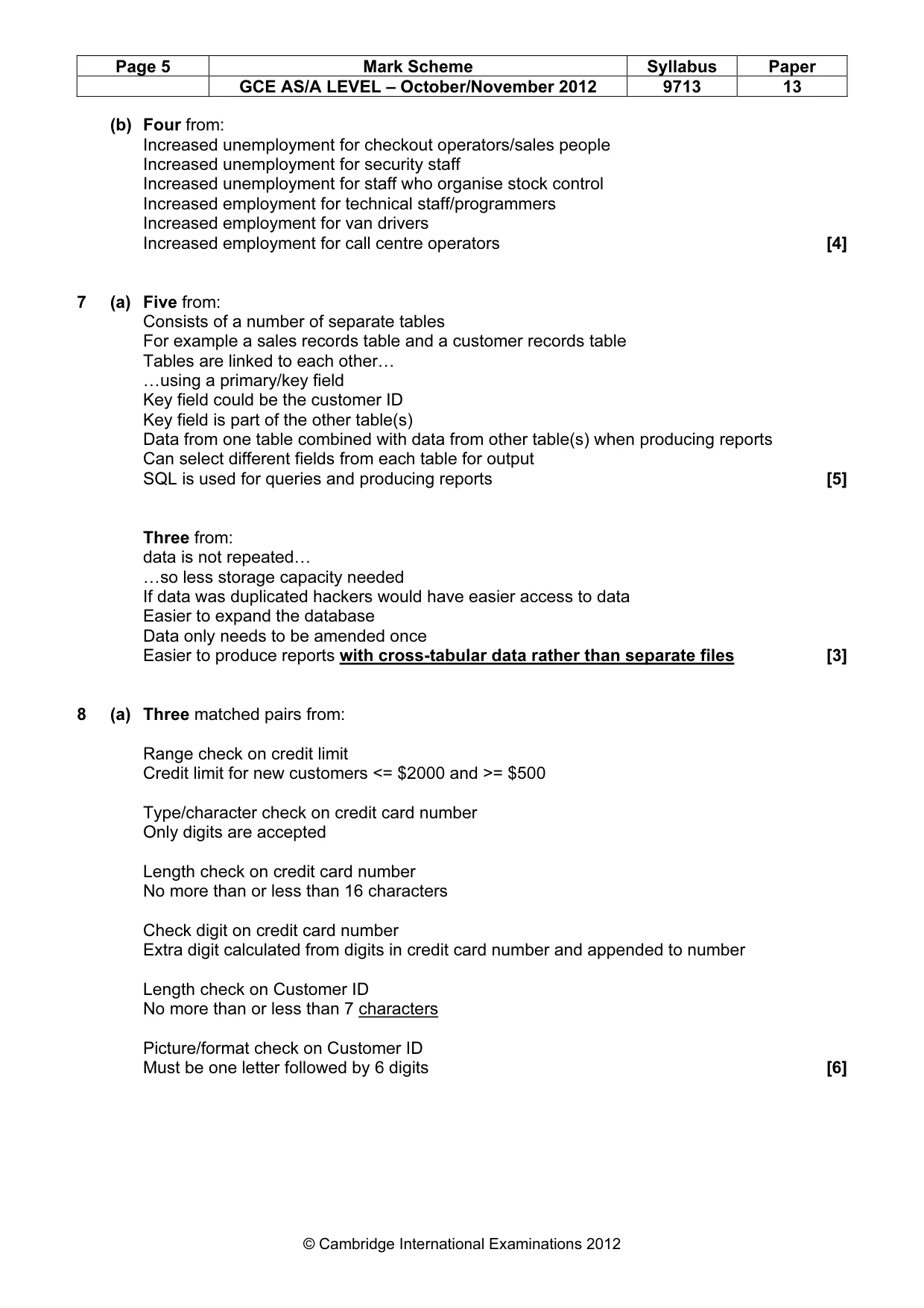
Mark scheme, page 5
Page 5 Mark Scheme Syllabus Paper GCE AS/A LEVEL – October/November 2012 9713 13 © Cambridge International Examinations 2012 (b) Four from: Increased unemployment for checkout operators/sales people Increased unemployment for security staff Increased unemployment for staff who organise stock control Increased employment for technical staff/programmers Increased employment for van drivers Increased employment for call centre operators [4] 7 (a) Five from: Consists of a number of separate tables For example a sales records table and a customer records table Tables are linked to each other… …using a primary/key field Key field could be the customer ID Key field is part of the other table(s) Data from one table combined with data from other table(s) when producing reports Can select different fields from each table for output SQL is used for queries and producing reports [5] Three from: data is not repeated… …so less storage capacity needed If data was duplicated hackers would have easier access to data Easier to expand the database Data only needs to be amended once Easier to produce reports with cross-tabular data rather than separate files [3] 8 (a) Three matched pairs from: Range check on credit limit Credit limit for new customers <= $2000 and >= $500 Type/character check on credit card number Only digits are accepted Length check on credit card number No more than or less than 16 characters Check digit on credit card number Extra digit calculated from digits in credit card number and appended to number Length check on Customer ID No more than or less than 7 characters Picture/format check on Customer ID Must be one letter followed by 6 digits [6]
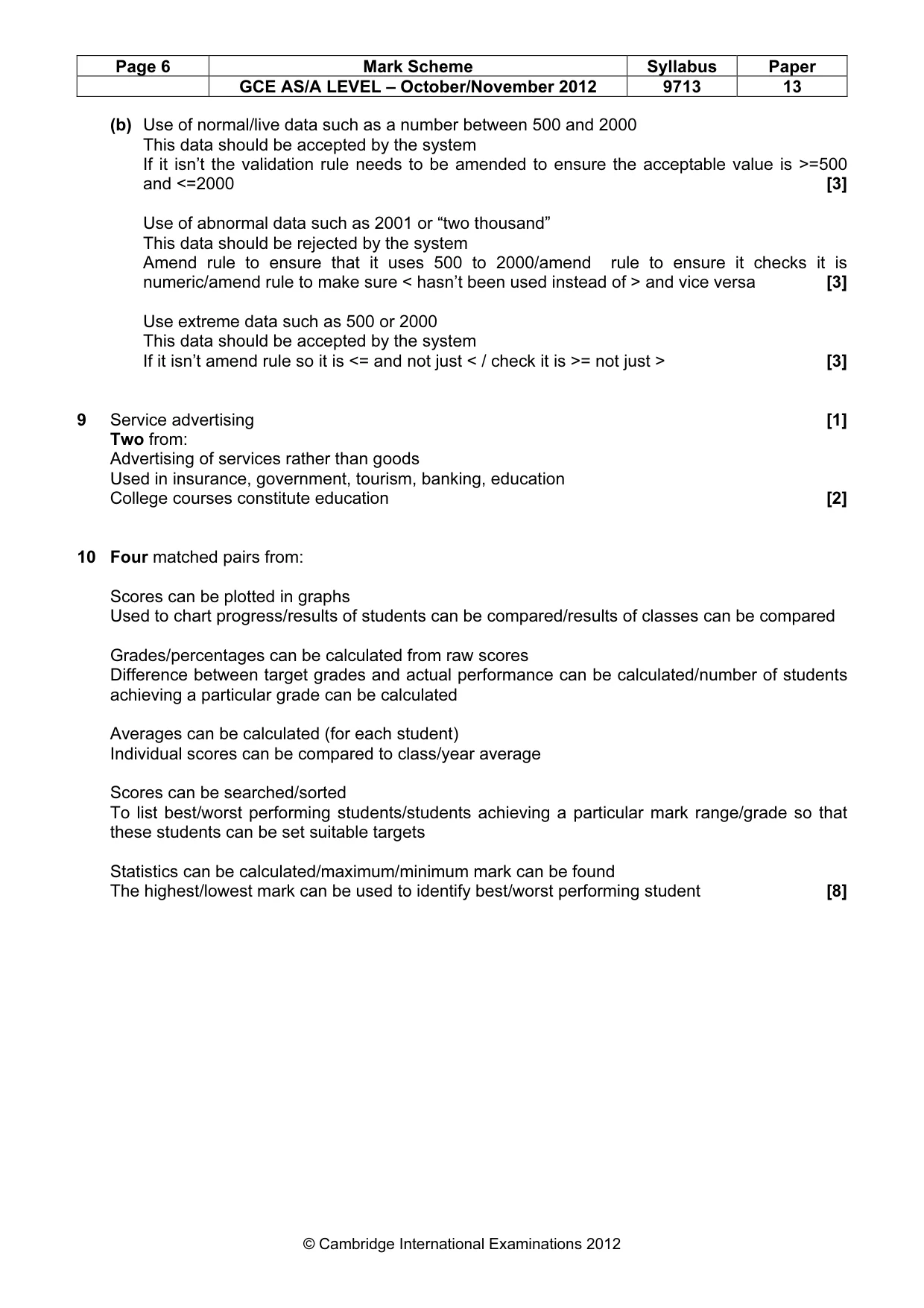
Mark scheme, page 6
Page 6 Mark Scheme Syllabus Paper GCE AS/A LEVEL – October/November 2012 9713 13 © Cambridge International Examinations 2012 (b) Use of normal/live data such as a number between 500 and 2000 This data should be accepted by the system If it isn’t the validation rule needs to be amended to ensure the acceptable value is >=500 and <=2000 [3] Use of abnormal data such as 2001 or “two thousand” This data should be rejected by the system Amend rule to ensure that it uses 500 to 2000/amend rule to ensure it checks it is numeric/amend rule to make sure < hasn’t been used instead of > and vice versa [3] Use extreme data such as 500 or 2000 This data should be accepted by the system If it isn’t amend rule so it is <= and not just < / check it is >= not just > [3] 9 Service advertising [1] Two from: Advertising of services rather than goods Used in insurance, government, tourism, banking, education College courses constitute education [2] 10 Four matched pairs from: Scores can be plotted in graphs Used to chart progress/results of students can be compared/results of classes can be compared Grades/percentages can be calculated from raw scores Difference between target grades and actual performance can be calculated/number of students achieving a particular grade can be calculated Averages can be calculated (for each student) Individual scores can be compared to class/year average Scores can be searched/sorted To list best/worst performing students/students achieving a particular mark range/grade so that these students can be set suitable targets Statistics can be calculated/maximum/minimum mark can be found The highest/lowest mark can be used to identify best/worst performing student [8]
What you needed in this session
Cambridge’s own grade thresholds for 2012 Oct/Nov, Paper 1 · Variant 3. A higher threshold means an easier paper — the bar moves with how the cohort did.