Cambridge A Level Applied Information and Communication Technology 9713 — 2012 May/June Paper 3 · Variant 3
9713/33/M/J/12 · 80 marks · ≈90 min
The question paper and its mark scheme, free to read here and free to download. This is Cambridge’s own paper, exactly as it was sat.
Question paper20 pages



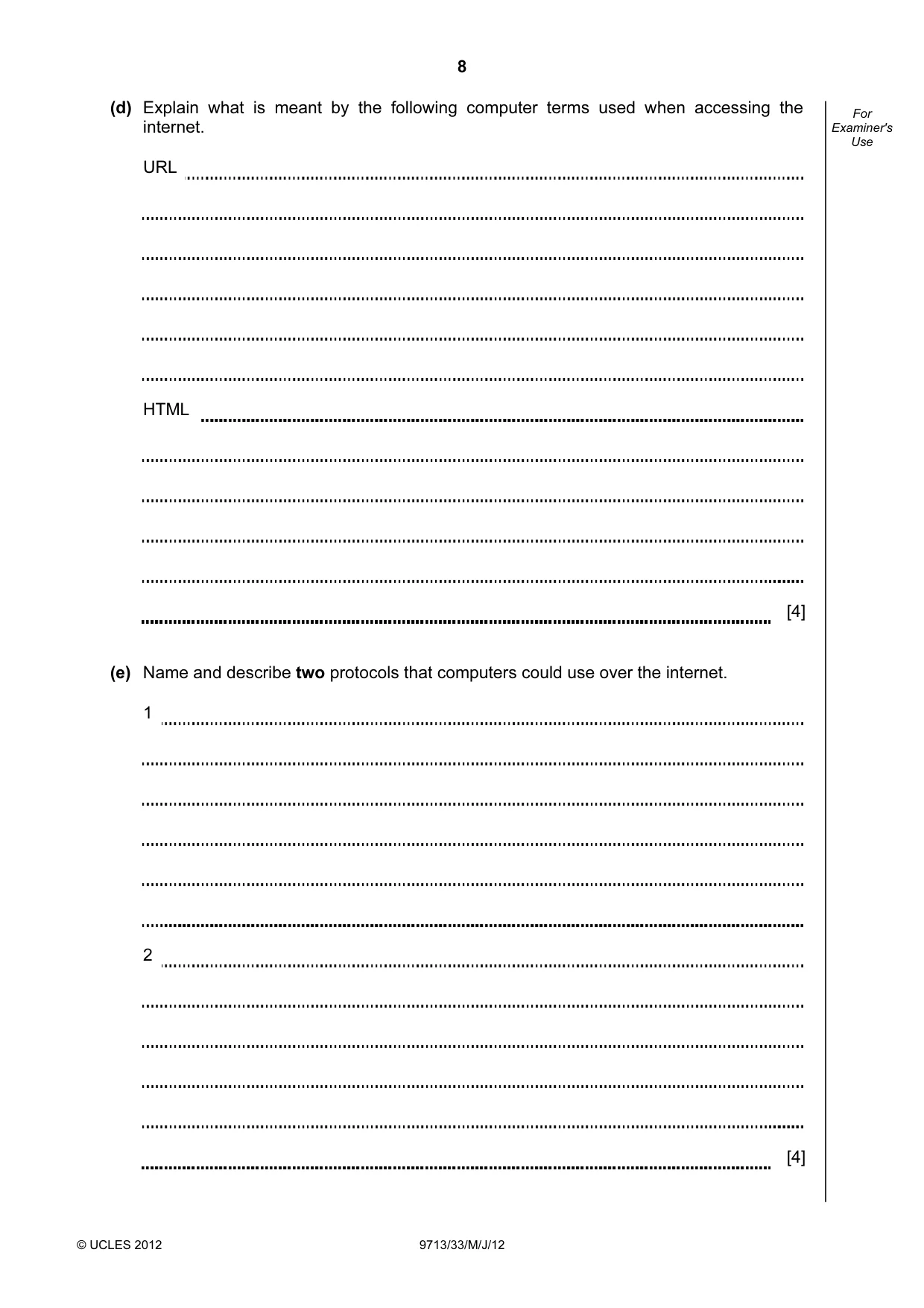






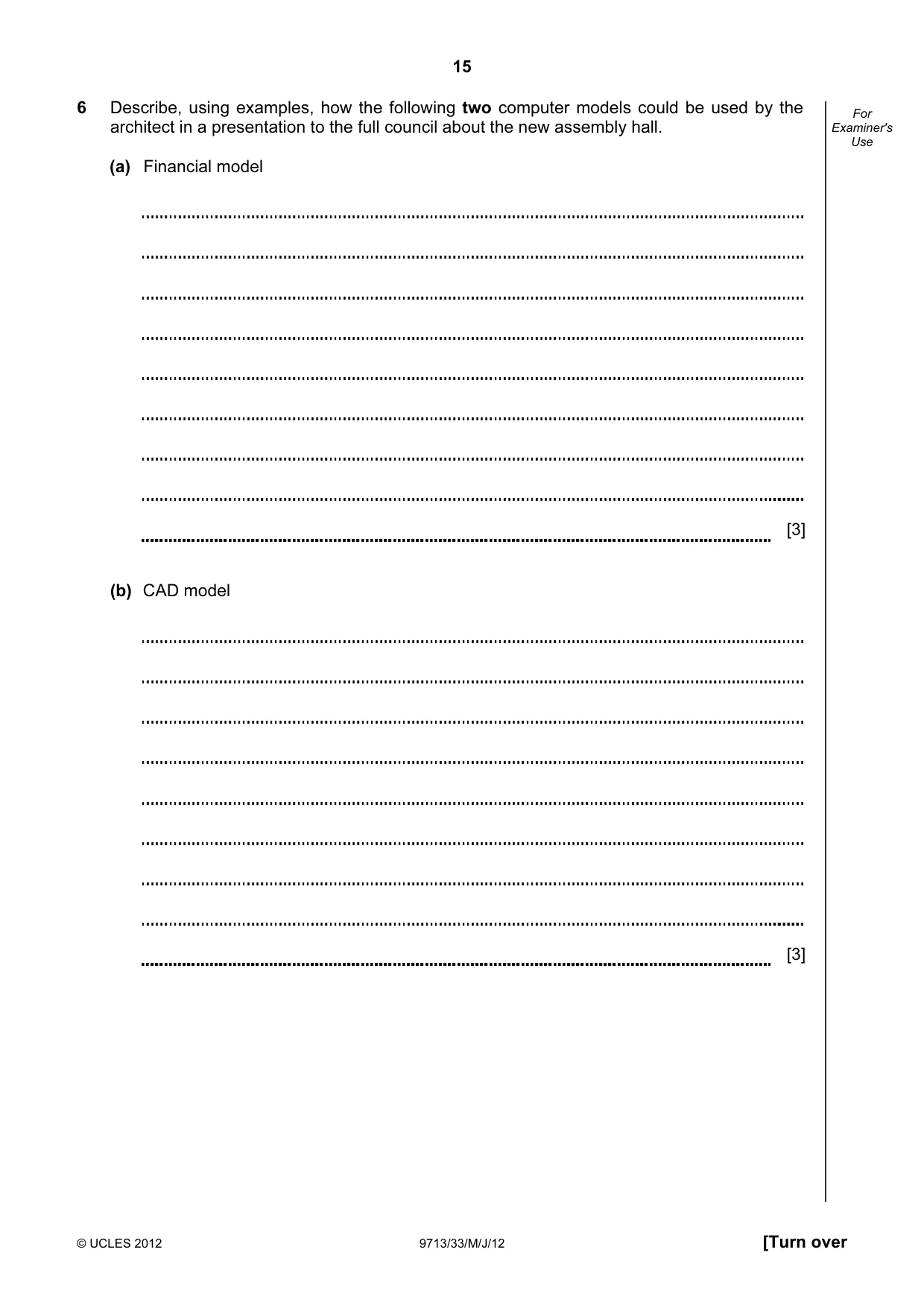





Mark scheme6 pages
Answers below. Sit the paper first if you are practising.

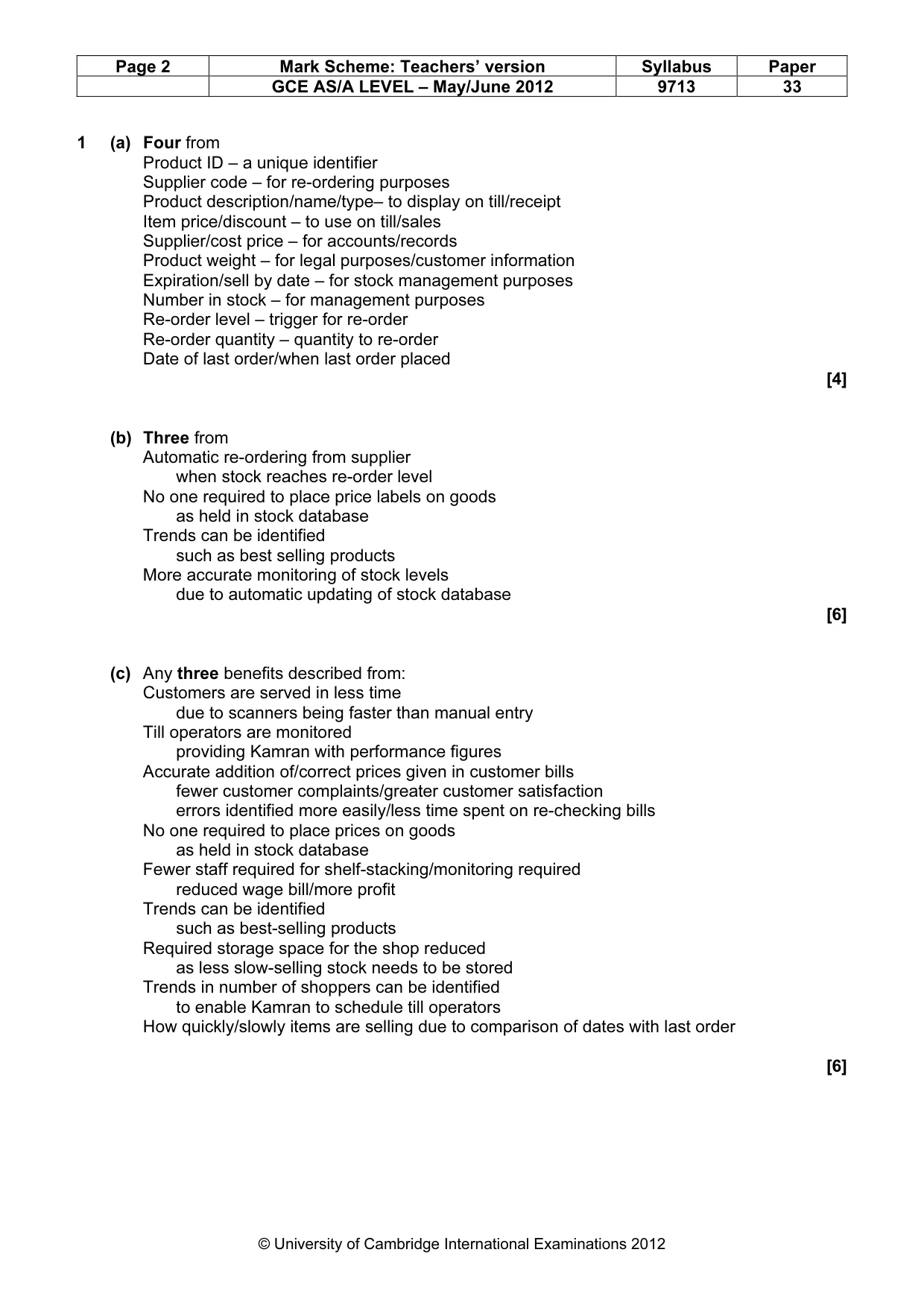
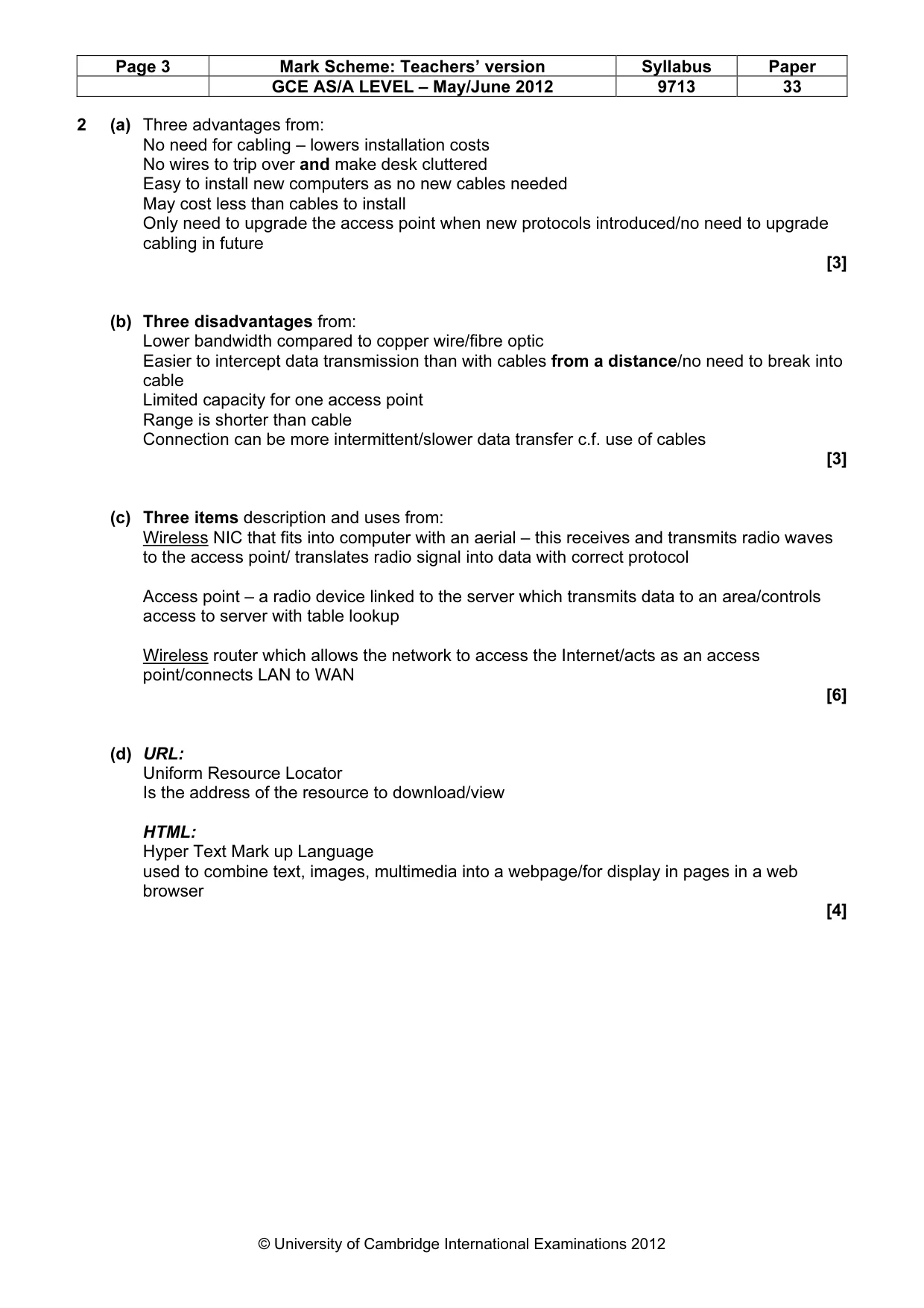
Paper as text
Question paper, page 1
This document consists of 18 printed pages and 2 blank pages. IB12 06_9713_33/RP © UCLES 2012 [Turn over *2379640945* UNIVERSITY OF CAMBRIDGE INTERNATIONAL EXAMINATIONS General Certificate of Education Advanced Level APPLIED INFORMATION AND COMMUNICATION TECHNOLOGY 9713/33 Paper 3 May/June 2012 1 hour 15 minutes Candidates answer on the Question Paper. No additional materials are required. READ THESE INSTRUCTIONS FIRST Write your Centre number, candidate number and name on all the work you hand in. Write in dark blue or black pen. Do not use staples, paper clips, highlighters, glue or correction fluid. You may use a pencil for any diagrams, graphs or rough working. DO NOT WRITE IN ANY BARCODES. Answer all questions. The number of marks is given in brackets [ ] at the end of each question or part question. The businesses described in this paper are entirely fictitious.
Question paper, page 2
2 © UCLES 2012 9713/33/M/J/12 For Examiner's Use Scenario 1 Questions 1 and 2 Kamran runs a small supermarket which includes an internet café in Islamabad. He is going to expand the business and needs to replace manual tills with EFTPOS terminals. These terminals will be networked together with computers used for administration. He uses a stock control program to help him manage his business.
Question paper, page 3
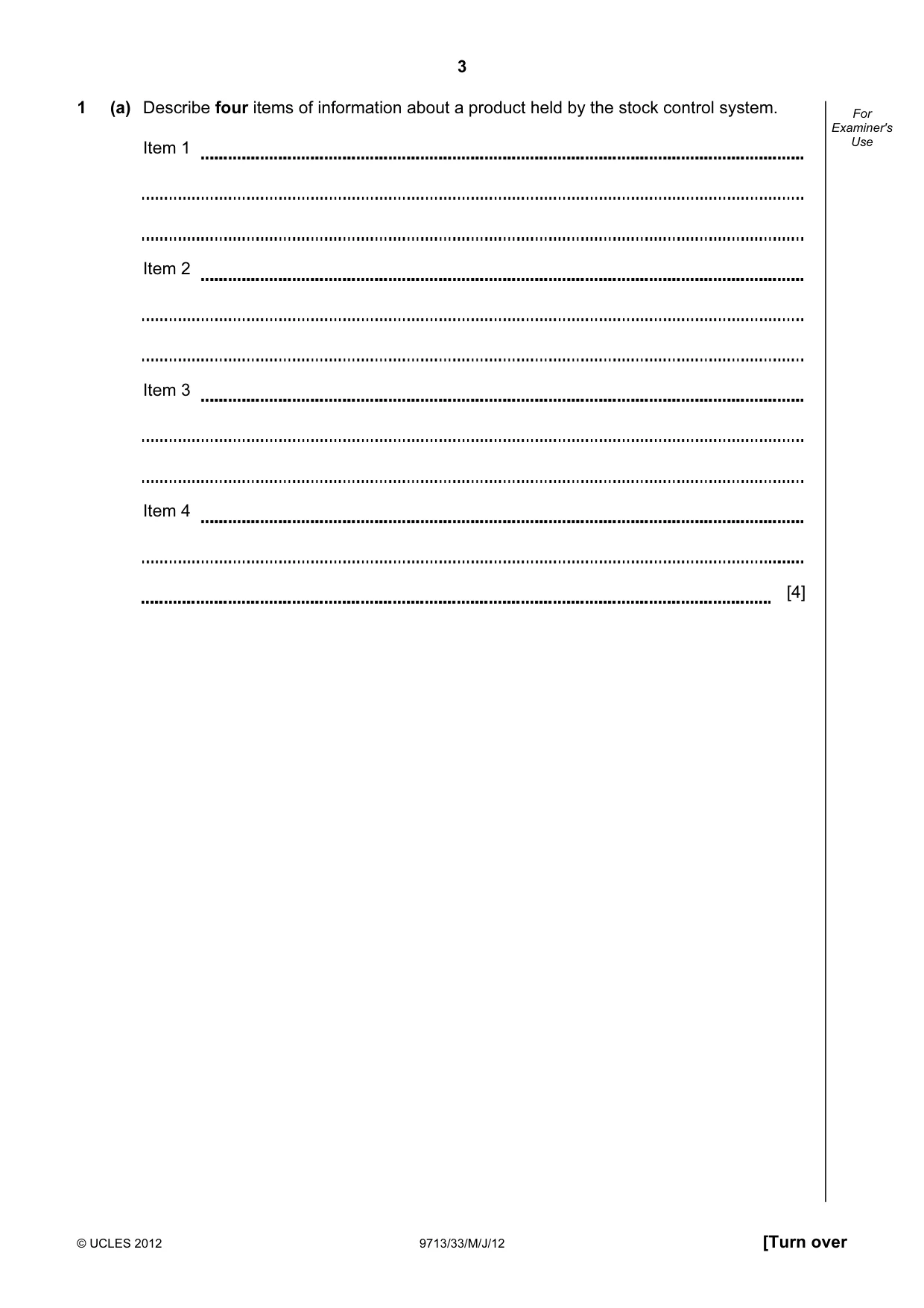
3 © UCLES 2012 9713/33/M/J/12 [Turn over For Examiner's Use 1 (a) Describe four items of information about a product held by the stock control system. Item 1 Item 2 Item 3 Item 4 [4]
Question paper, page 4
4 © UCLES 2012 9713/33/M/J/12 For Examiner's Use (b) Describe three ways that a stock control program will help Kamran in managing the business. Way 1 Way 2 Way 3 [6]
Question paper, page 5
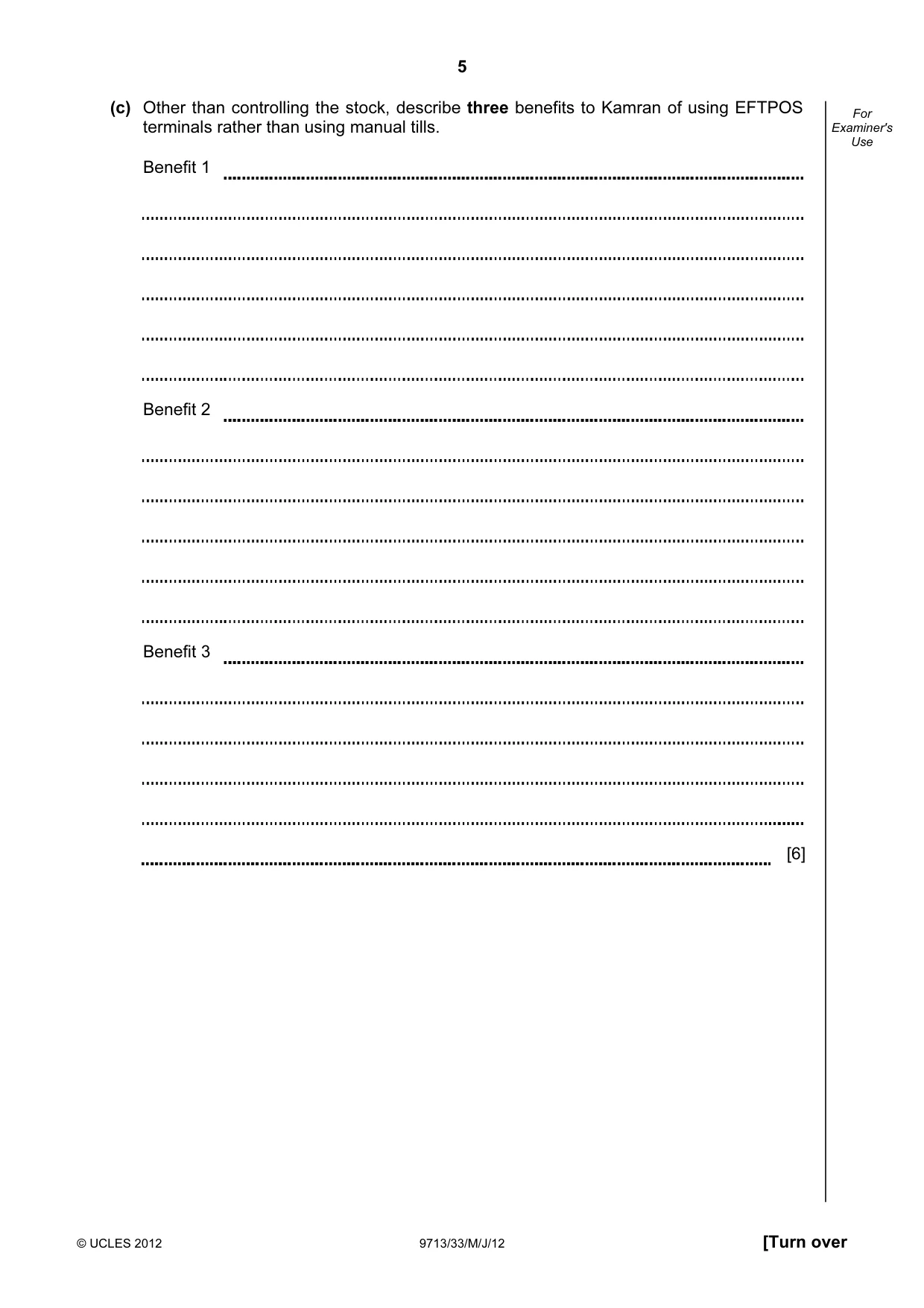
5 © UCLES 2012 9713/33/M/J/12 [Turn over For Examiner's Use (c) Other than controlling the stock, describe three benefits to Kamran of using EFTPOS terminals rather than using manual tills. Benefit 1 Benefit 2 Benefit 3 [6]
Question paper, page 6
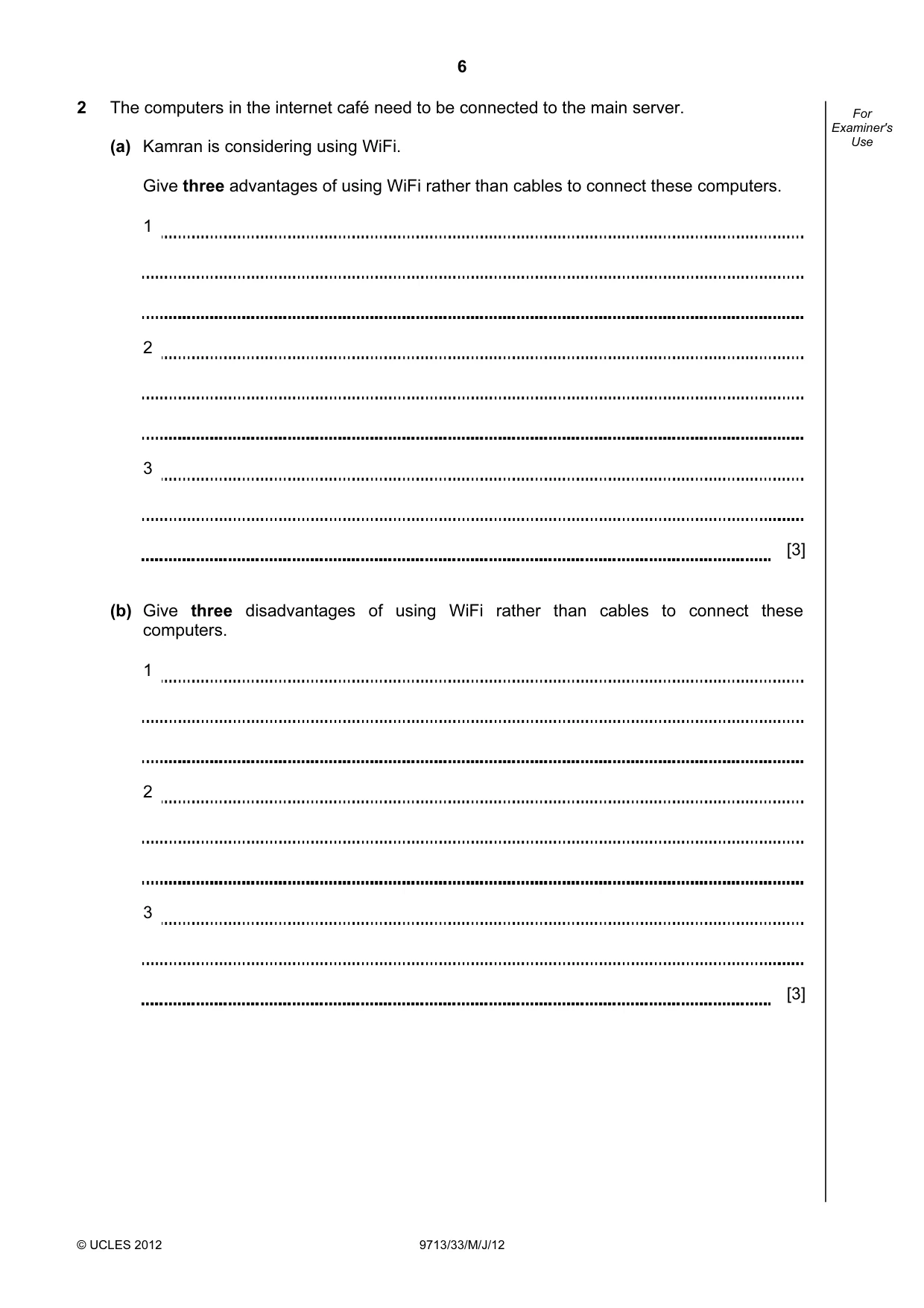
6 © UCLES 2012 9713/33/M/J/12 For Examiner's Use 2 The computers in the internet café need to be connected to the main server. (a) Kamran is considering using WiFi. Give three advantages of using WiFi rather than cables to connect these computers. 1 2 3 [3] (b) Give three disadvantages of using WiFi rather than cables to connect these computers. 1 2 3 [3]
Question paper, page 7
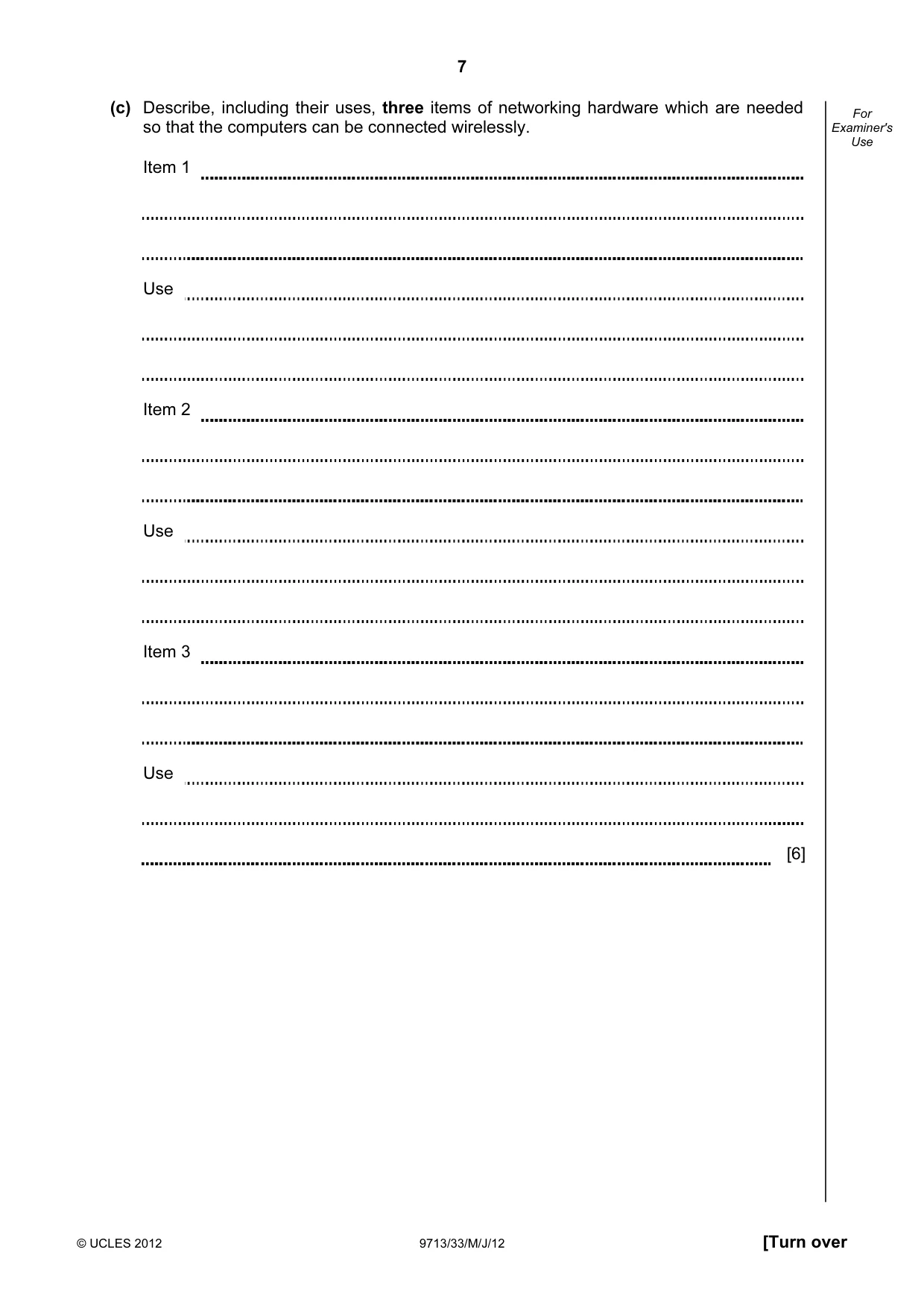
7 © UCLES 2012 9713/33/M/J/12 [Turn over For Examiner's Use (c) Describe, including their uses, three items of networking hardware which are needed so that the computers can be connected wirelessly. Item 1 Use Item 2 Use Item 3 Use [6]
Question paper, page 8
8 © UCLES 2012 9713/33/M/J/12 For Examiner's Use (d) Explain what is meant by the following computer terms used when accessing the internet. URL HTML [4] (e) Name and describe two protocols that computers could use over the internet. 1 2 [4]
Question paper, page 9
9 © UCLES 2012 9713/33/M/J/12 [Turn over For Examiner's Use Scenario 2 Questions 3 and 4 The botany department of a university has recently discovered a number of rare plants in a remote region of the country. The department wants to use ICT to monitor the weather conditions in the region where the plants were found. They will need an expert system to help classify the rare plants.
Question paper, page 10
10 © UCLES 2012 9713/33/M/J/12 For Examiner's Use 3 Describe in detail five sensors that will be used in a weather monitoring system. 1 2 3 4 5 [5]
Question paper, page 11
11 © UCLES 2012 9713/33/M/J/12 [Turn over For Examiner's Use 4 Explain the role of the following in an expert system. (a) Knowledge engineer [4] (b) Inference engine [4]
Question paper, page 12
12 © UCLES 2012 9713/33/M/J/12 For Examiner's Use Scenario 3 Questions 5 and 6 Jamestown District Council have employed an architect to design a new assembly hall. The architect will use computer modelling to show her ideas to the council. The council will put information about the new assembly hall onto its website so that members of the public can see the designs and make comments. As members of the public can access and download the information, the council is concerned about the security of the website.
Question paper, page 13
13 © UCLES 2012 9713/33/M/J/12 [Turn over For Examiner's Use 5 (a) Discuss four actions that a hacker might take when attempting to breach the security of the website and for each one state how it can be prevented. 1 2 3 4 [8]
Question paper, page 14
14 © UCLES 2012 9713/33/M/J/12 For Examiner's Use (b) Describe how the information could be put on the site so that it can be easily downloaded. Include in your description any storage media that could be used. [5]
Question paper, page 15
15 © UCLES 2012 9713/33/M/J/12 [Turn over For Examiner's Use 6 Describe, using examples, how the following two computer models could be used by the architect in a presentation to the full council about the new assembly hall. (a) Financial model [3] (b) CAD model [3]
Question paper, page 16
16 © UCLES 2012 9713/33/M/J/12 For Examiner's Use Scenario 4 Question 7 Joe is a disabled person living in Chicago. His hobby is stamp collecting and he enjoys using online auctions for the buying and selling of stamps.
Question paper, page 17
17 © UCLES 2012 9713/33/M/J/12 [Turn over For Examiner's Use 7 (a) Explain how the use of ICT will improve his access to the following: (i) Booking a theatre ticket [2] (ii) Employment [2] (iii) Health care [2]
Question paper, page 18
18 © UCLES 2012 9713/33/M/J/12 For Examiner's Use (b) There are a number of problems associated with online auctions. Describe in detail how these could be overcome. [6]
Question paper, page 19
19 © UCLES 2012 9713/33/M/J/12 BLANK PAGE
Question paper, page 20
20 Permission to reproduce items where third-party owned material protected by copyright is included has been sought and cleared where possible. Every reasonable effort has been made by the publisher (UCLES) to trace copyright holders, but if any items requiring clearance have unwittingly been included, the publisher will be pleased to make amends at the earliest possible opportunity. University of Cambridge International Examinations is part of the Cambridge Assessment Group. Cambridge Assessment is the brand name of University of Cambridge Local Examinations Syndicate (UCLES), which is itself a department of the University of Cambridge. © UCLES 2012 9713/33/M/J/12 BLANK PAGE
Mark scheme, page 1
UNIVERSITY OF CAMBRIDGE INTERNATIONAL EXAMINATIONS GCE Advanced Subsidiary Level and GCE Advanced Level MARK SCHEME for the May/June 2012 question paper for the guidance of teachers 9713 APPLIED ICT 9713/33 Paper 3 (Written B), maximum raw mark 80 This mark scheme is published as an aid to teachers and candidates, to indicate the requirements of the examination. It shows the basis on which Examiners were instructed to award marks. It does not indicate the details of the discussions that took place at an Examiners’ meeting before marking began, which would have considered the acceptability of alternative answers. Mark schemes must be read in conjunction with the question papers and the report on the examination. • Cambridge will not enter into discussions or correspondence in connection with these mark schemes. Cambridge is publishing the mark schemes for the May/June 2012 question papers for most IGCSE, GCE Advanced Level and Advanced Subsidiary Level syllabuses and some Ordinary Level syllabuses.
Mark scheme, page 2
Page 2 Mark Scheme: Teachers’ version Syllabus Paper GCE AS/A LEVEL – May/June 2012 9713 33 © University of Cambridge International Examinations 2012 1 (a) Four from Product ID – a unique identifier Supplier code – for re-ordering purposes Product description/name/type– to display on till/receipt Item price/discount – to use on till/sales Supplier/cost price – for accounts/records Product weight – for legal purposes/customer information Expiration/sell by date – for stock management purposes Number in stock – for management purposes Re-order level – trigger for re-order Re-order quantity – quantity to re-order Date of last order/when last order placed [4] (b) Three from Automatic re-ordering from supplier when stock reaches re-order level No one required to place price labels on goods as held in stock database Trends can be identified such as best selling products More accurate monitoring of stock levels due to automatic updating of stock database [6] (c) Any three benefits described from: Customers are served in less time due to scanners being faster than manual entry Till operators are monitored providing Kamran with performance figures Accurate addition of/correct prices given in customer bills fewer customer complaints/greater customer satisfaction errors identified more easily/less time spent on re-checking bills No one required to place prices on goods as held in stock database Fewer staff required for shelf-stacking/monitoring required reduced wage bill/more profit Trends can be identified such as best-selling products Required storage space for the shop reduced as less slow-selling stock needs to be stored Trends in number of shoppers can be identified to enable Kamran to schedule till operators How quickly/slowly items are selling due to comparison of dates with last order [6]
Mark scheme, page 3
Page 3 Mark Scheme: Teachers’ version Syllabus Paper GCE AS/A LEVEL – May/June 2012 9713 33 © University of Cambridge International Examinations 2012 2 (a) Three advantages from: No need for cabling – lowers installation costs No wires to trip over and make desk cluttered Easy to install new computers as no new cables needed May cost less than cables to install Only need to upgrade the access point when new protocols introduced/no need to upgrade cabling in future [3] (b) Three disadvantages from: Lower bandwidth compared to copper wire/fibre optic Easier to intercept data transmission than with cables from a distance/no need to break into cable Limited capacity for one access point Range is shorter than cable Connection can be more intermittent/slower data transfer c.f. use of cables [3] (c) Three items description and uses from: Wireless NIC that fits into computer with an aerial – this receives and transmits radio waves to the access point/ translates radio signal into data with correct protocol Access point – a radio device linked to the server which transmits data to an area/controls access to server with table lookup Wireless router which allows the network to access the Internet/acts as an access point/connects LAN to WAN [6] (d) URL: Uniform Resource Locator Is the address of the resource to download/view HTML: Hyper Text Mark up Language used to combine text, images, multimedia into a webpage/for display in pages in a web browser [4]
Mark scheme, page 4
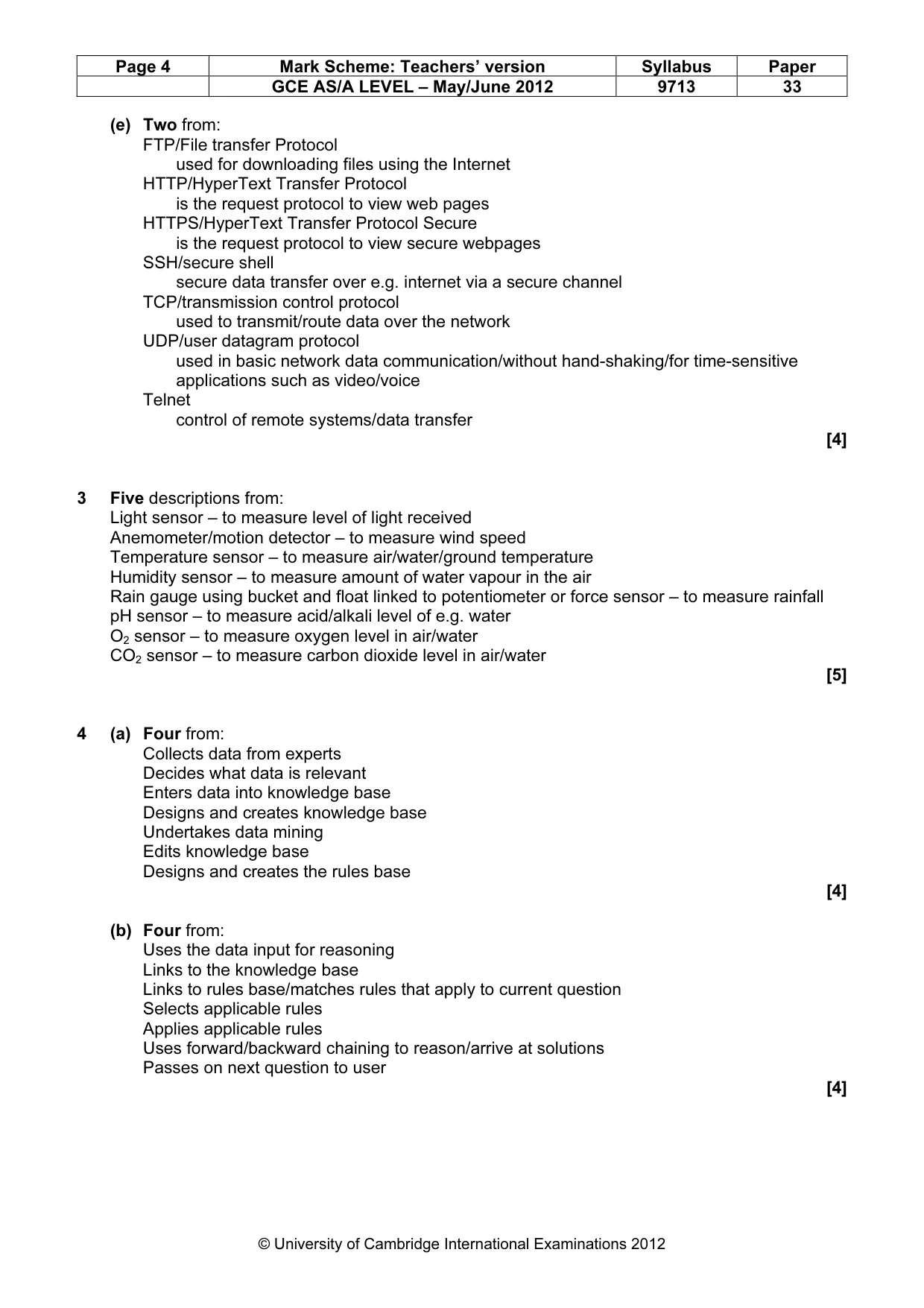
Page 4 Mark Scheme: Teachers’ version Syllabus Paper GCE AS/A LEVEL – May/June 2012 9713 33 © University of Cambridge International Examinations 2012 (e) Two from: FTP/File transfer Protocol used for downloading files using the Internet HTTP/HyperText Transfer Protocol is the request protocol to view web pages HTTPS/HyperText Transfer Protocol Secure is the request protocol to view secure webpages SSH/secure shell secure data transfer over e.g. internet via a secure channel TCP/transmission control protocol used to transmit/route data over the network UDP/user datagram protocol used in basic network data communication/without hand-shaking/for time-sensitive applications such as video/voice Telnet control of remote systems/data transfer [4] 3 Five descriptions from: Light sensor – to measure level of light received Anemometer/motion detector – to measure wind speed Temperature sensor – to measure air/water/ground temperature Humidity sensor – to measure amount of water vapour in the air Rain gauge using bucket and float linked to potentiometer or force sensor – to measure rainfall pH sensor – to measure acid/alkali level of e.g. water O2 sensor – to measure oxygen level in air/water CO2 sensor – to measure carbon dioxide level in air/water [5] 4 (a) Four from: Collects data from experts Decides what data is relevant Enters data into knowledge base Designs and creates knowledge base Undertakes data mining Edits knowledge base Designs and creates the rules base [4] (b) Four from: Uses the data input for reasoning Links to the knowledge base Links to rules base/matches rules that apply to current question Selects applicable rules Applies applicable rules Uses forward/backward chaining to reason/arrive at solutions Passes on next question to user [4]
Mark scheme, page 5
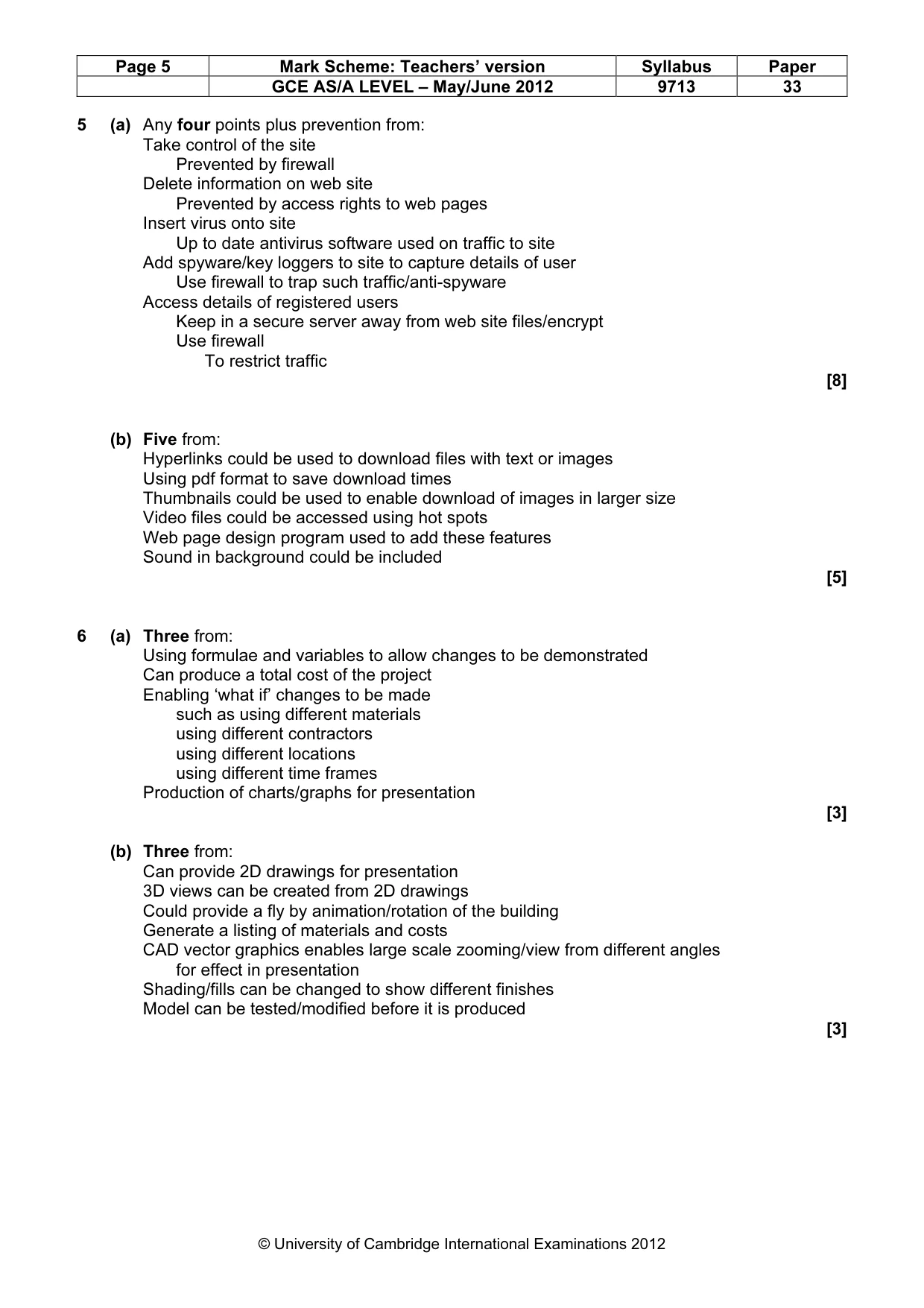
Page 5 Mark Scheme: Teachers’ version Syllabus Paper GCE AS/A LEVEL – May/June 2012 9713 33 © University of Cambridge International Examinations 2012 5 (a) Any four points plus prevention from: Take control of the site Prevented by firewall Delete information on web site Prevented by access rights to web pages Insert virus onto site Up to date antivirus software used on traffic to site Add spyware/key loggers to site to capture details of user Use firewall to trap such traffic/anti-spyware Access details of registered users Keep in a secure server away from web site files/encrypt Use firewall To restrict traffic [8] (b) Five from: Hyperlinks could be used to download files with text or images Using pdf format to save download times Thumbnails could be used to enable download of images in larger size Video files could be accessed using hot spots Web page design program used to add these features Sound in background could be included [5] 6 (a) Three from: Using formulae and variables to allow changes to be demonstrated Can produce a total cost of the project Enabling ‘what if’ changes to be made such as using different materials using different contractors using different locations using different time frames Production of charts/graphs for presentation [3] (b) Three from: Can provide 2D drawings for presentation 3D views can be created from 2D drawings Could provide a fly by animation/rotation of the building Generate a listing of materials and costs CAD vector graphics enables large scale zooming/view from different angles for effect in presentation Shading/fills can be changed to show different finishes Model can be tested/modified before it is produced [3]
Mark scheme, page 6
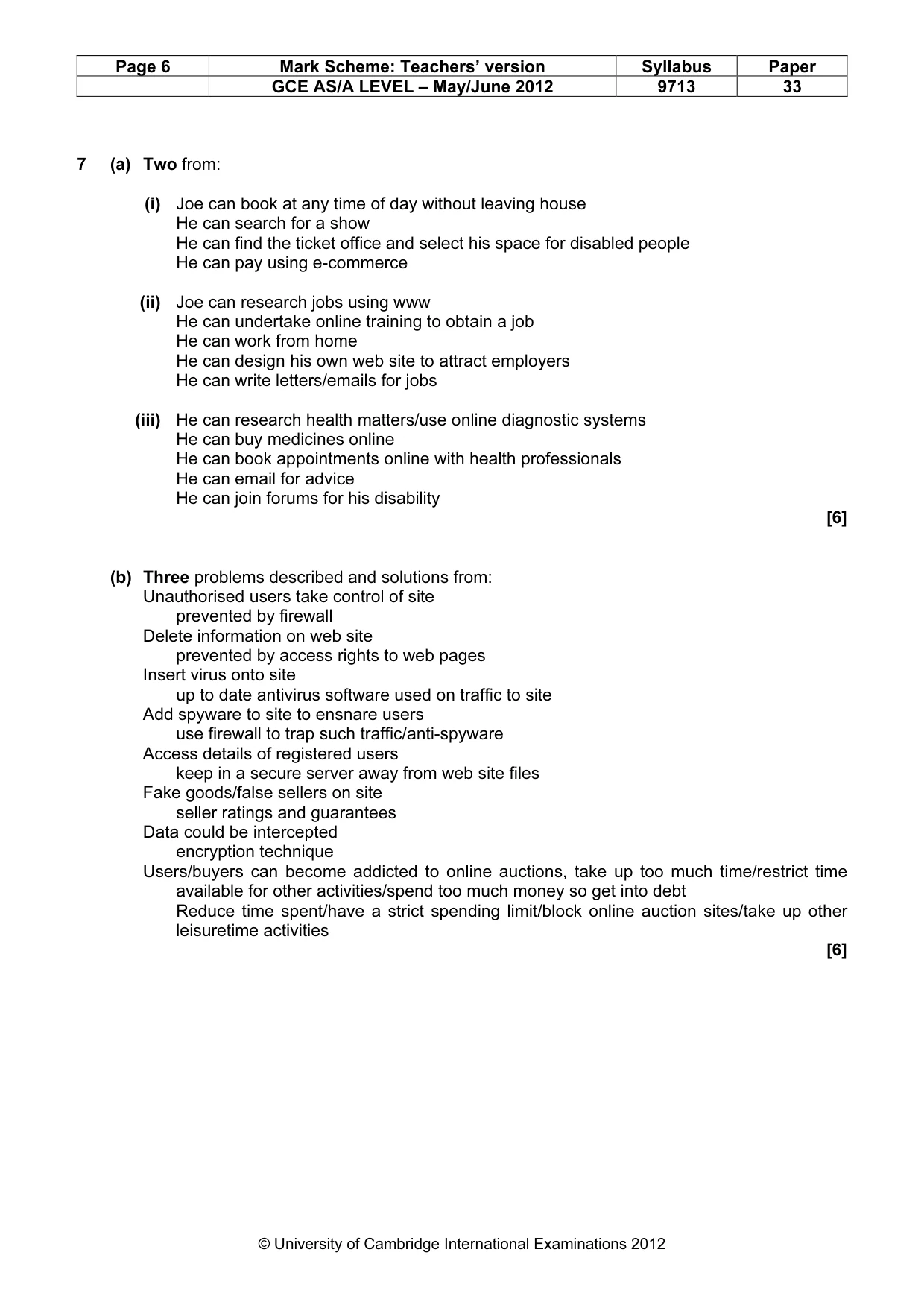
Page 6 Mark Scheme: Teachers’ version Syllabus Paper GCE AS/A LEVEL – May/June 2012 9713 33 © University of Cambridge International Examinations 2012 7 (a) Two from: (i) Joe can book at any time of day without leaving house He can search for a show He can find the ticket office and select his space for disabled people He can pay using e-commerce (ii) Joe can research jobs using www He can undertake online training to obtain a job He can work from home He can design his own web site to attract employers He can write letters/emails for jobs (iii) He can research health matters/use online diagnostic systems He can buy medicines online He can book appointments online with health professionals He can email for advice He can join forums for his disability [6] (b) Three problems described and solutions from: Unauthorised users take control of site prevented by firewall Delete information on web site prevented by access rights to web pages Insert virus onto site up to date antivirus software used on traffic to site Add spyware to site to ensnare users use firewall to trap such traffic/anti-spyware Access details of registered users keep in a secure server away from web site files Fake goods/false sellers on site seller ratings and guarantees Data could be intercepted encryption technique Users/buyers can become addicted to online auctions, take up too much time/restrict time available for other activities/spend too much money so get into debt Reduce time spent/have a strict spending limit/block online auction sites/take up other leisuretime activities [6]
What you needed in this session
Cambridge’s own grade thresholds for 2012 May/June, Paper 3 · Variant 3. A higher threshold means an easier paper — the bar moves with how the cohort did.