Cambridge A Level Applied Information and Communication Technology 9713 — 2011 Oct/Nov Paper 1 · Variant 3
9713/13/O/N/11 · 80 marks · ≈90 min
The question paper and its mark scheme, free to read here and free to download. This is Cambridge’s own paper, exactly as it was sat.
Question paper20 pages

Mark scheme7 pages
Answers below. Sit the paper first if you are practising.
Paper as text
Question paper, page 1
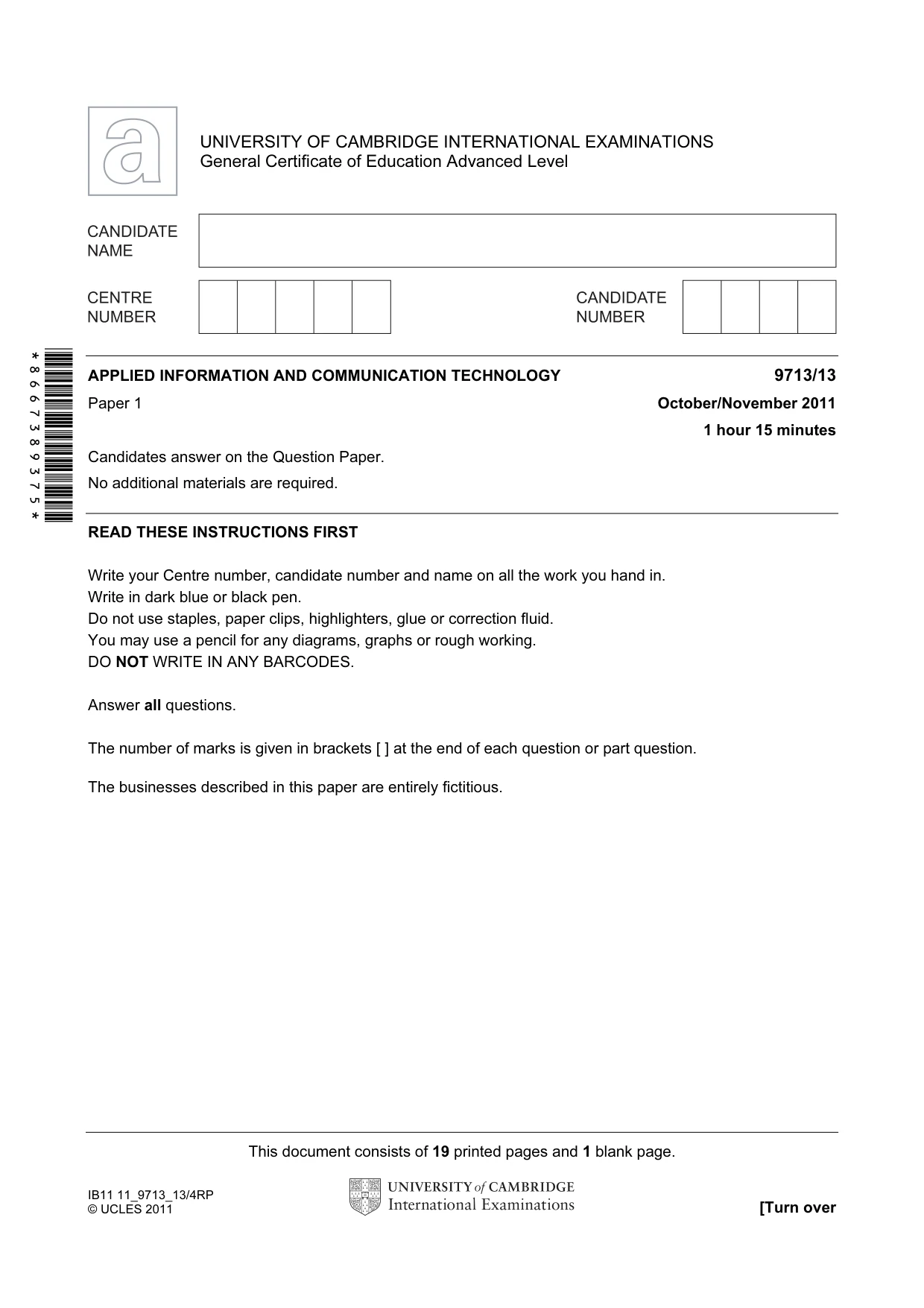
This document consists of 19 printed pages and 1 blank page. IB11 11_9713_13/4RP © UCLES 2011 [Turn over *8667389375* UNIVERSITY OF CAMBRIDGE INTERNATIONAL EXAMINATIONS General Certificate of Education Advanced Level APPLIED INFORMATION AND COMMUNICATION TECHNOLOGY 9713/13 Paper 1 October/November 2011 1 hour 15 minutes Candidates answer on the Question Paper. No additional materials are required. READ THESE INSTRUCTIONS FIRST Write your Centre number, candidate number and name on all the work you hand in. Write in dark blue or black pen. Do not use staples, paper clips, highlighters, glue or correction fluid. You may use a pencil for any diagrams, graphs or rough working. DO NOT WRITE IN ANY BARCODES. Answer all questions. The number of marks is given in brackets [ ] at the end of each question or part question. The businesses described in this paper are entirely fictitious.
Question paper, page 2
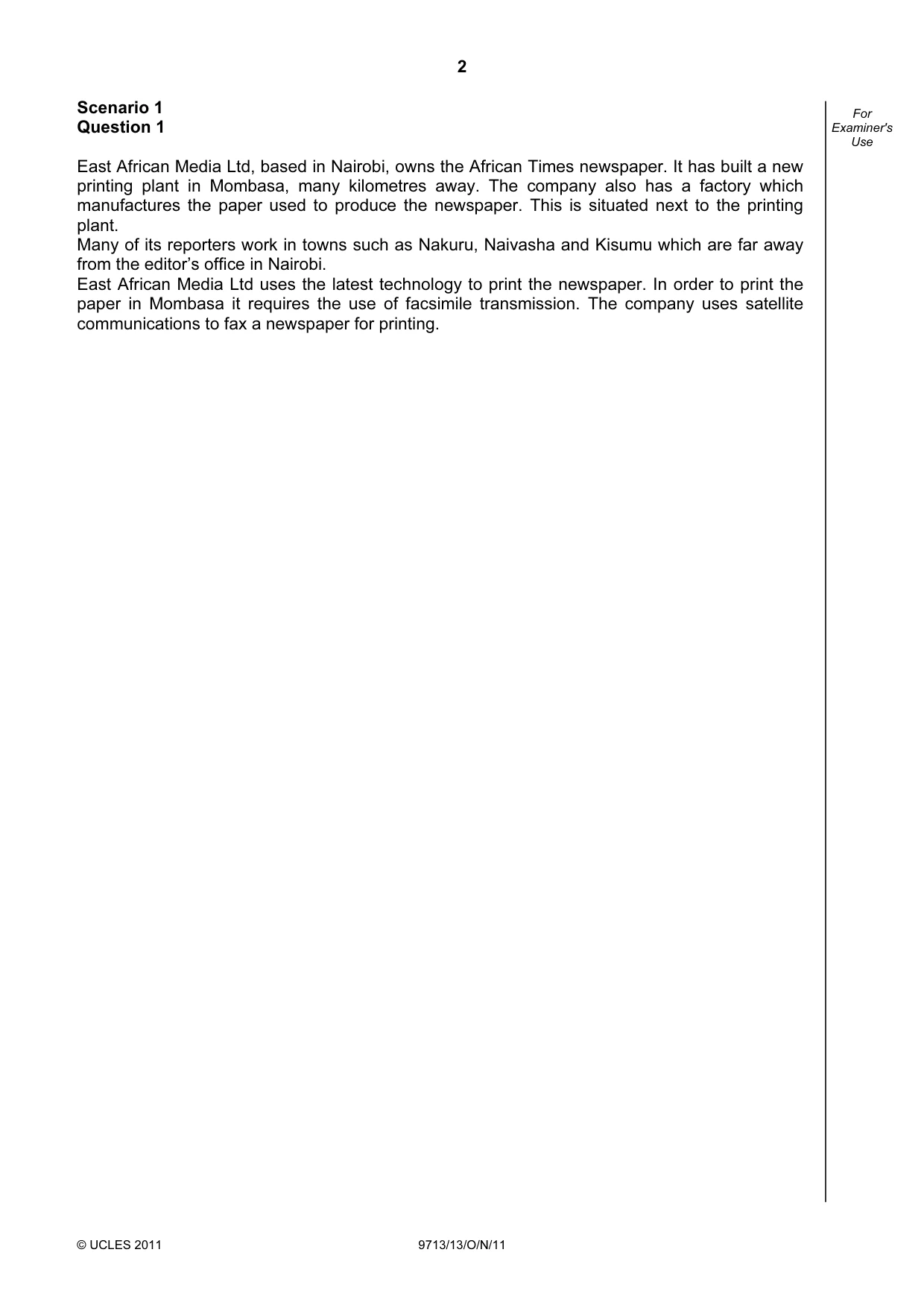
2 © UCLES 2011 9713/13/O/N/11 For Examiner's Use Scenario 1 Question 1 East African Media Ltd, based in Nairobi, owns the African Times newspaper. It has built a new printing plant in Mombasa, many kilometres away. The company also has a factory which manufactures the paper used to produce the newspaper. This is situated next to the printing plant. Many of its reporters work in towns such as Nakuru, Naivasha and Kisumu which are far away from the editor’s office in Nairobi. East African Media Ltd uses the latest technology to print the newspaper. In order to print the paper in Mombasa it requires the use of facsimile transmission. The company uses satellite communications to fax a newspaper for printing.
Question paper, page 3
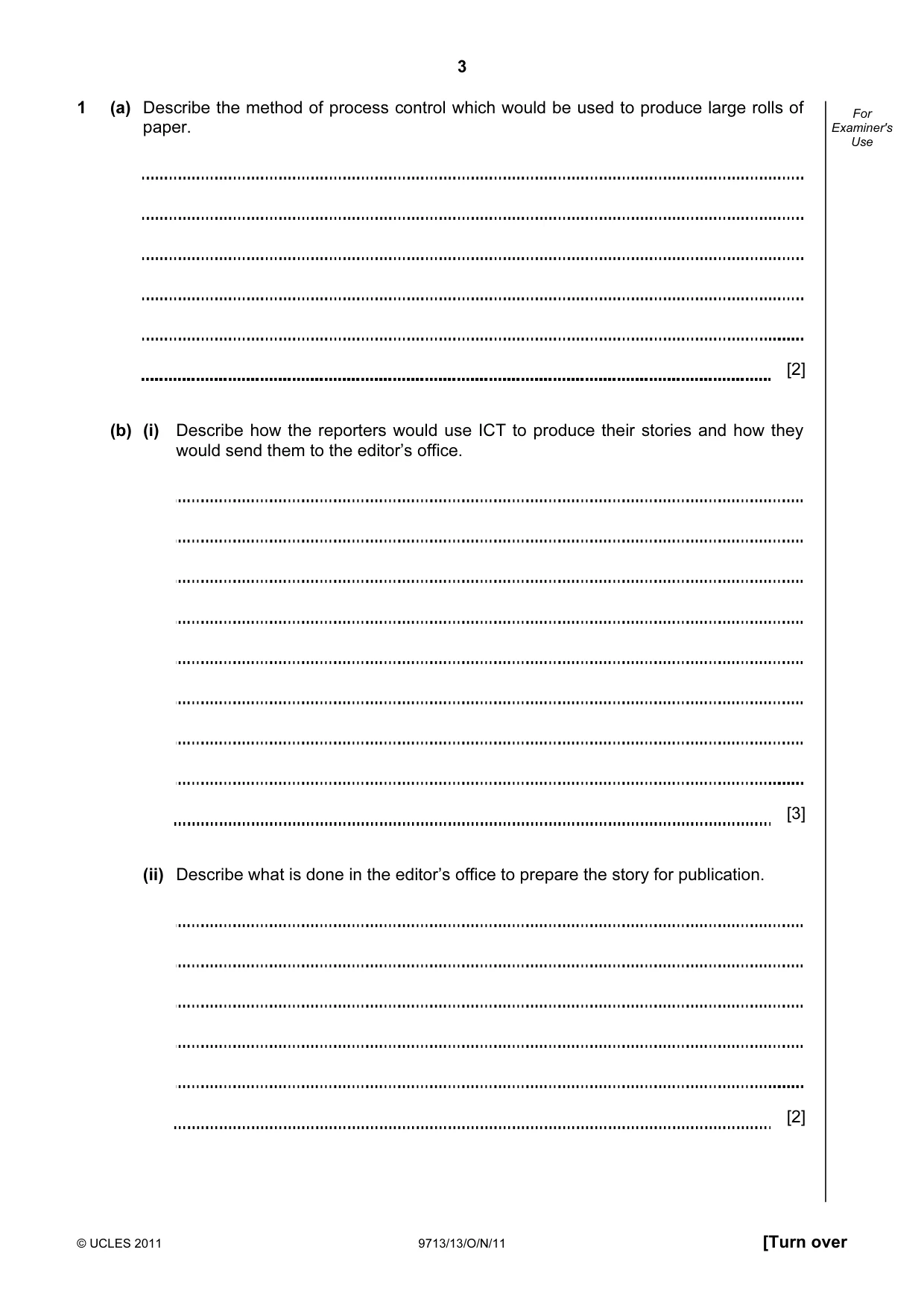
3 © UCLES 2011 9713/13/O/N/11 [Turn over For Examiner's Use 1 (a) Describe the method of process control which would be used to produce large rolls of paper. [2] (b) (i) Describe how the reporters would use ICT to produce their stories and how they would send them to the editor’s office. [3] (ii) Describe what is done in the editor’s office to prepare the story for publication. [2]
Question paper, page 4
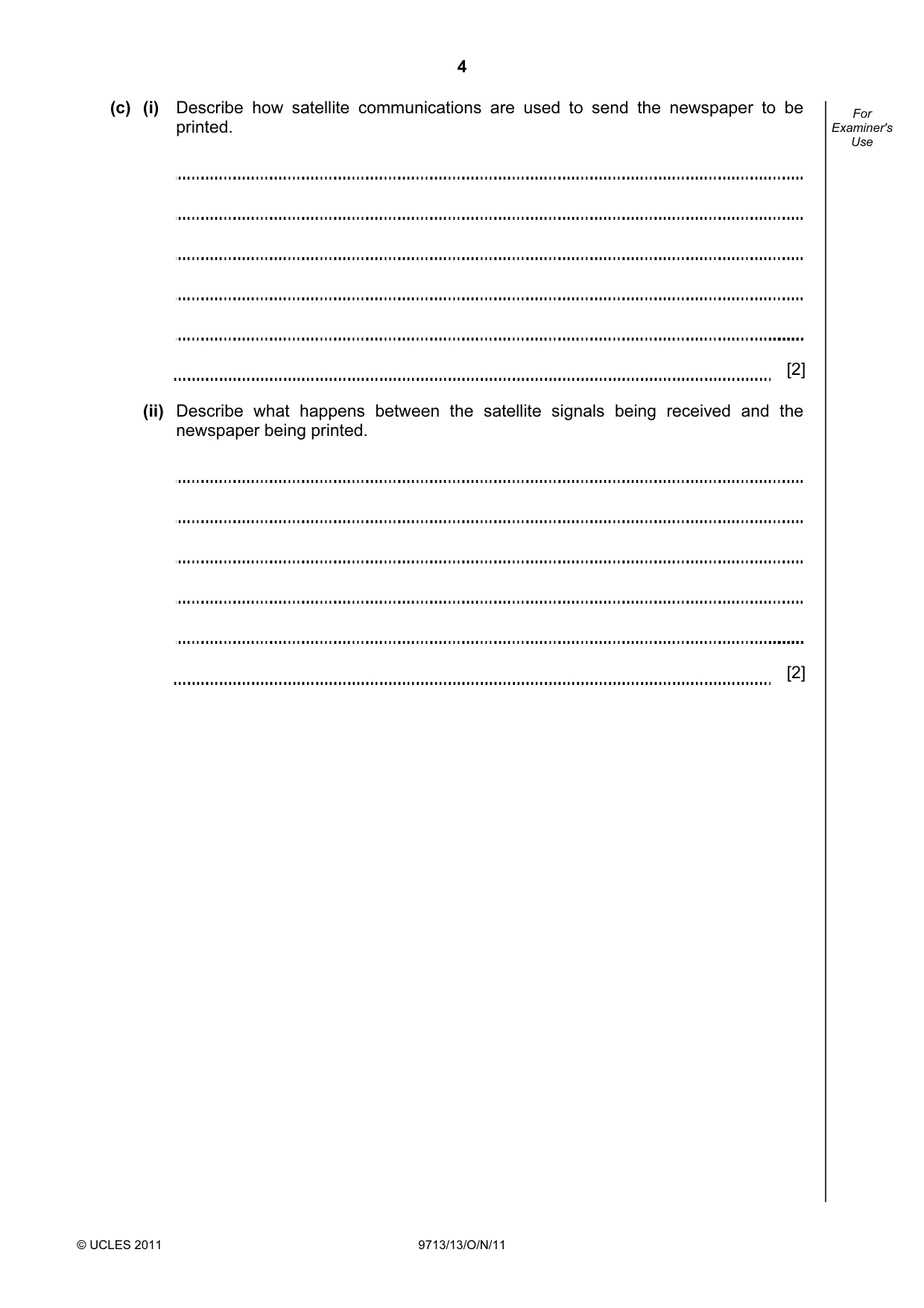
4 © UCLES 2011 9713/13/O/N/11 For Examiner's Use (c) (i) Describe how satellite communications are used to send the newspaper to be printed. [2] (ii) Describe what happens between the satellite signals being received and the newspaper being printed. [2]
Question paper, page 5
5 © UCLES 2011 9713/13/O/N/11 [Turn over For Examiner's Use Scenario 2 Questions 2 and 3 Teachers at the International School in Paris use both formative and summative assessment. Formative assessment is the use of test results by the teacher to inform the students of their progress. Summative assessment is the use of the final test result by the teacher to indicate the students’ level of achievement. The teachers use ICT to carry out testing of students. The teachers like to stay in touch with other international schools and they do this using video conferencing because these schools are very far away. They often share documents such as schemes of work and lesson plans.
Question paper, page 6
6 © UCLES 2011 9713/13/O/N/11 For Examiner's Use 2 Describe how ICT is used to carry out (a) summative assessment [2] (b) formative assessment [2]
Question paper, page 7
7 © UCLES 2011 9713/13/O/N/11 [Turn over For Examiner's Use 3 A teacher at another school wants a teacher at the International School to help them change a lesson plan document. Describe five of the steps needed to enable a video conference to take place so this can happen. 1 2 3 4 5 [5]
Question paper, page 8
8 © UCLES 2011 9713/13/O/N/11 For Examiner's Use Scenario 3 Questions 4 and 5 The North Indian Motor Company has decided to computerise its system of keeping staff records. It currently has personal and payroll details of all its staff. On the new system human resources staff will need to be able to access records quickly. The payroll system will run using all the data on a weekly basis. The master payroll file is sorted in worker number order. Jasbir, a systems analyst, has collected a large amount of information about the existing system. The information will be analysed before the system is designed.
Question paper, page 9
9 © UCLES 2011 9713/13/O/N/11 [Turn over For Examiner's Use 4 Describe, in detail, the most appropriate method of organising the data on the master file. [4]
Question paper, page 10
10 © UCLES 2011 9713/13/O/N/11 For Examiner's Use 5 (a) Describe five ways in which Jasbir will use the collected information to identify the user and system requirements. 1 2 3 4 5 [5]
Question paper, page 11
11 © UCLES 2011 9713/13/O/N/11 [Turn over For Examiner's Use (b) Describe the different items that Jasbir will need to include at the design stage. Using examples, explain a factor that will influence the choice for each item. Item 1 Factor 1 Item 2 Factor 2 Item 3 Factor 3 Item 4 Factor 4 [8]
Question paper, page 12
12 © UCLES 2011 9713/13/O/N/11 For Examiner's Use (c) After the system has been designed it will be implemented. Describe four methods which could be used to implement the new system. For each method give a different advantage when compared to the other methods. Method 1 Advantage Method 2 Advantage Method 3 Advantage Method 4 Advantage [8]
Question paper, page 13
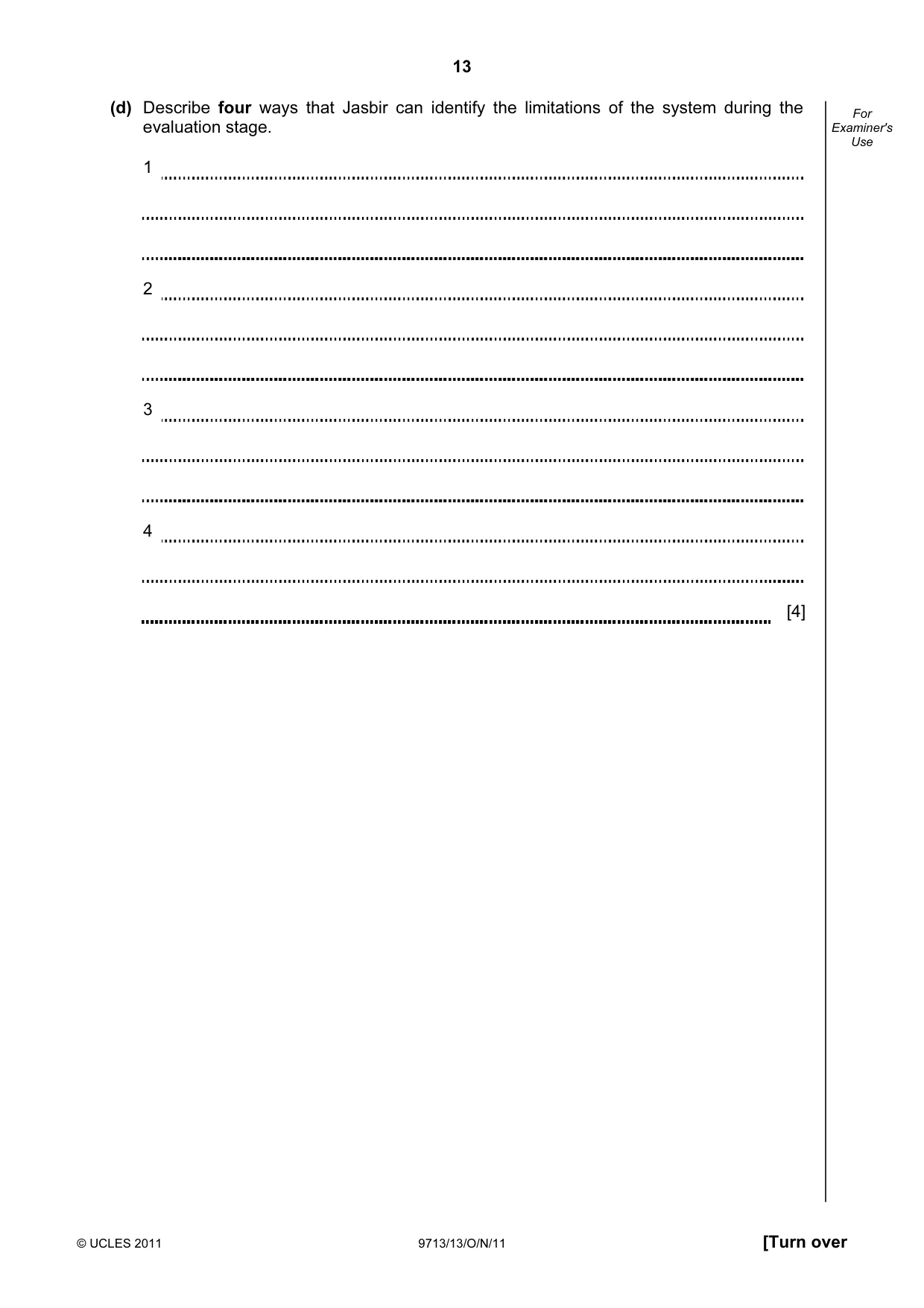
13 © UCLES 2011 9713/13/O/N/11 [Turn over For Examiner's Use (d) Describe four ways that Jasbir can identify the limitations of the system during the evaluation stage. 1 2 3 4 [4]
Question paper, page 14
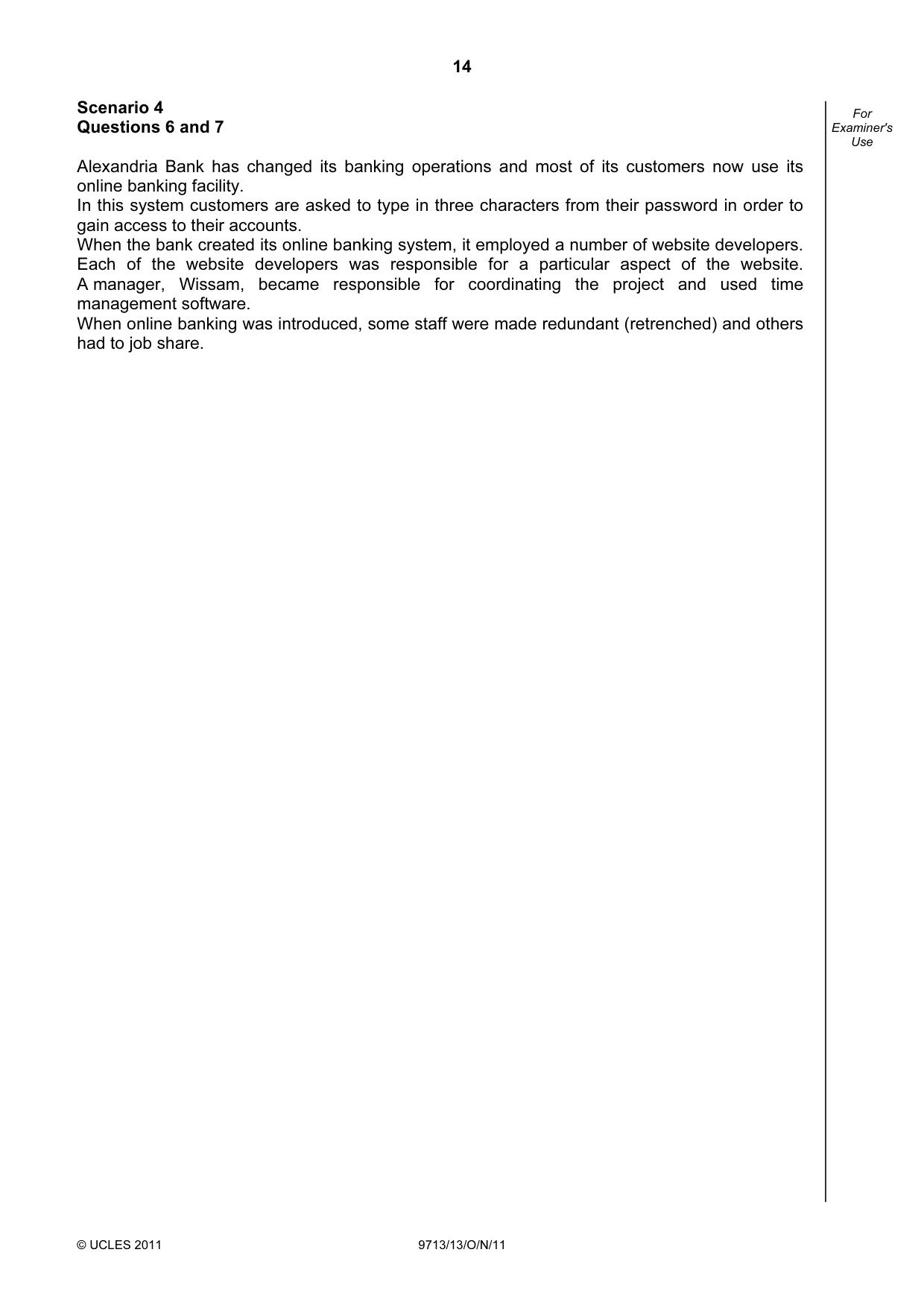
14 © UCLES 2011 9713/13/O/N/11 For Examiner's Use Scenario 4 Questions 6 and 7 Alexandria Bank has changed its banking operations and most of its customers now use its online banking facility. In this system customers are asked to type in three characters from their password in order to gain access to their accounts. When the bank created its online banking system, it employed a number of website developers. Each of the website developers was responsible for a particular aspect of the website. A manager, Wissam, became responsible for coordinating the project and used time management software. When online banking was introduced, some staff were made redundant (retrenched) and others had to job share.
Question paper, page 15
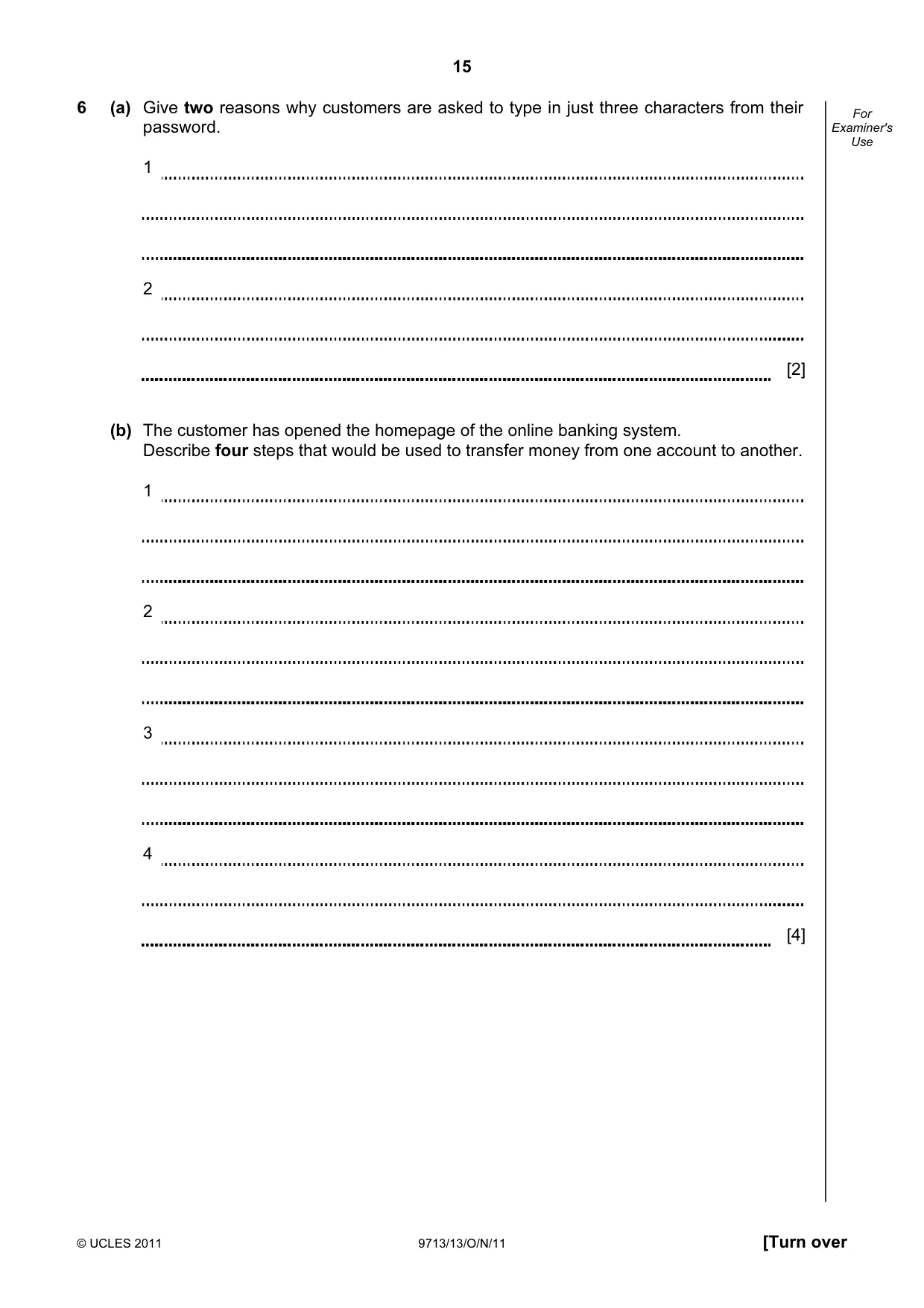
15 © UCLES 2011 9713/13/O/N/11 [Turn over For Examiner's Use 6 (a) Give two reasons why customers are asked to type in just three characters from their password. 1 2 [2] (b) The customer has opened the homepage of the online banking system. Describe four steps that would be used to transfer money from one account to another. 1 2 3 4 [4]
Question paper, page 16
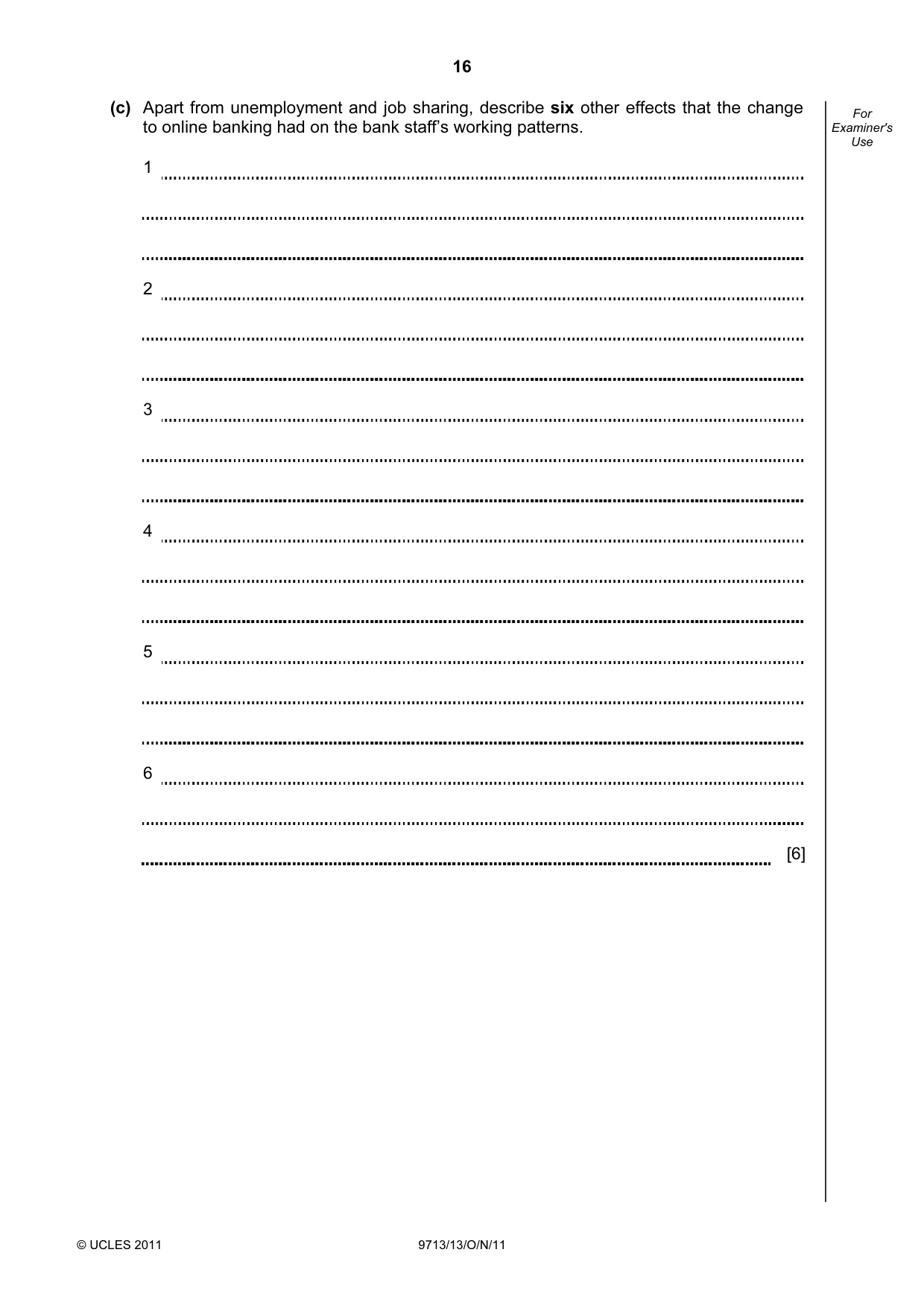
16 © UCLES 2011 9713/13/O/N/11 For Examiner's Use (c) Apart from unemployment and job sharing, describe six other effects that the change to online banking had on the bank staff’s working patterns. 1 2 3 4 5 6 [6]
Question paper, page 17
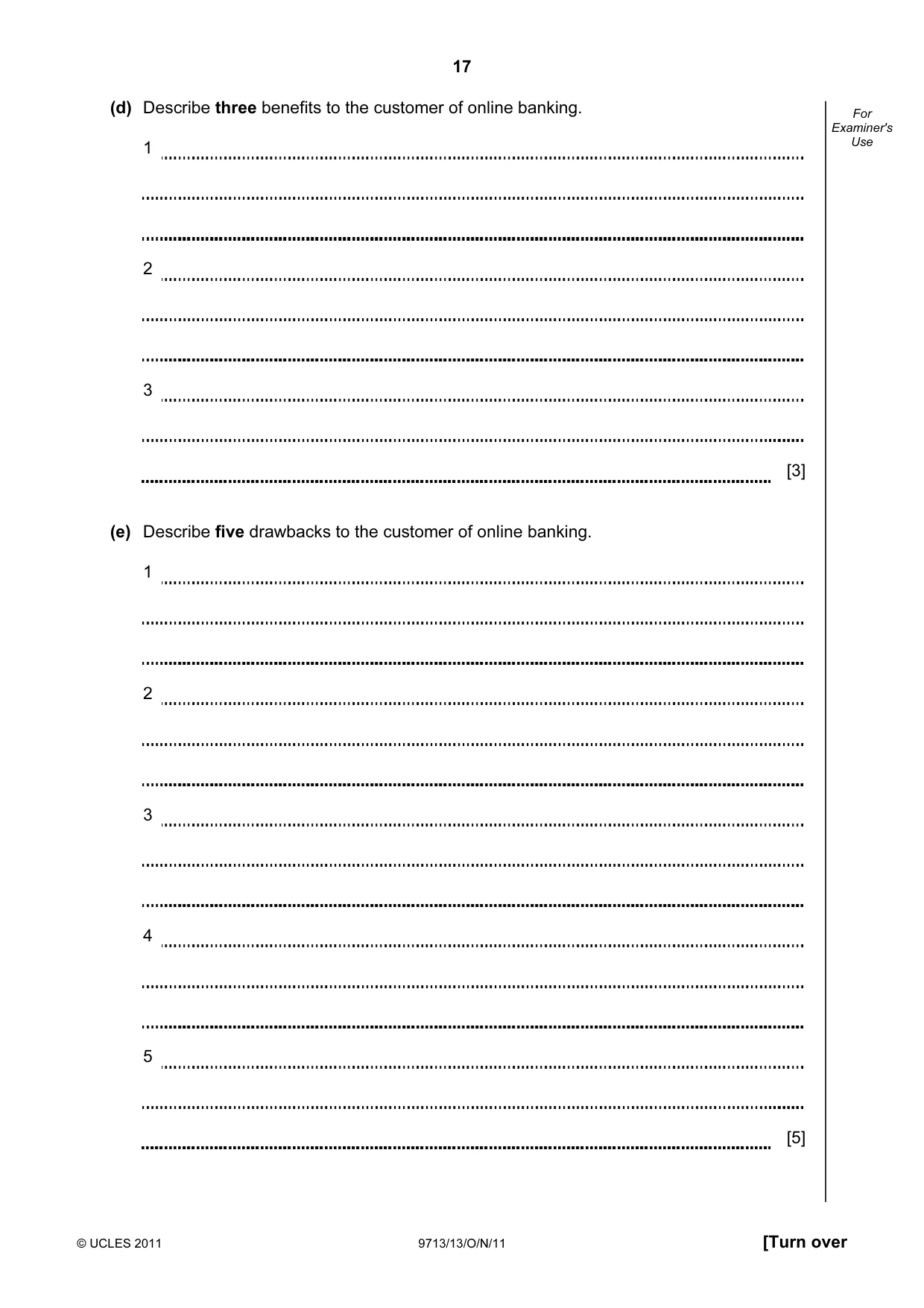
17 © UCLES 2011 9713/13/O/N/11 [Turn over For Examiner's Use (d) Describe three benefits to the customer of online banking. 1 2 3 [3] (e) Describe five drawbacks to the customer of online banking. 1 2 3 4 5 [5]
Question paper, page 18
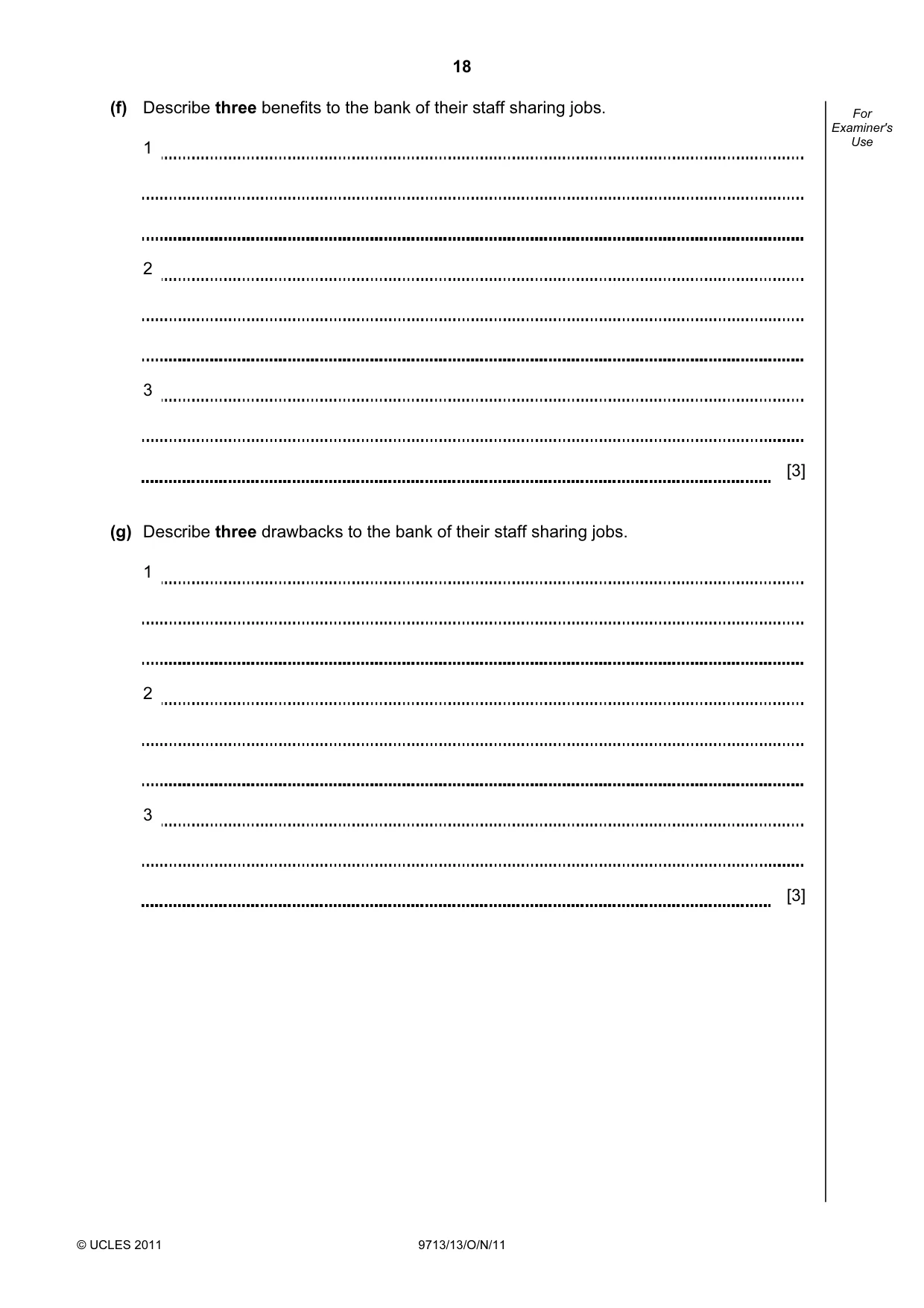
18 © UCLES 2011 9713/13/O/N/11 For Examiner's Use (f) Describe three benefits to the bank of their staff sharing jobs. 1 2 3 [3] (g) Describe three drawbacks to the bank of their staff sharing jobs. 1 2 3 [3]
Question paper, page 19
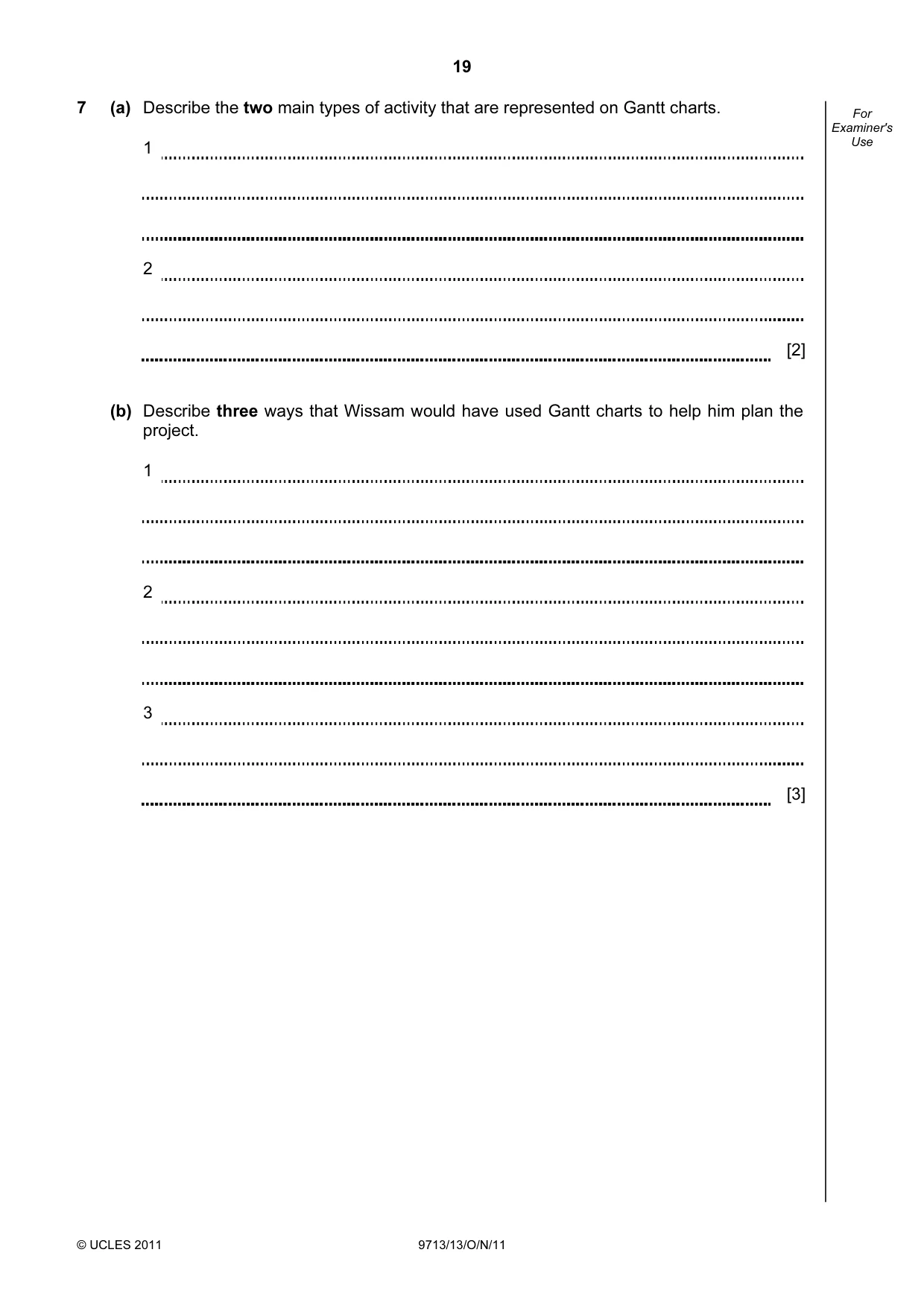
19 © UCLES 2011 9713/13/O/N/11 For Examiner's Use 7 (a) Describe the two main types of activity that are represented on Gantt charts. 1 2 [2] (b) Describe three ways that Wissam would have used Gantt charts to help him plan the project. 1 2 3 [3]
Question paper, page 20
20 Permission to reproduce items where third-party owned material protected by copyright is included has been sought and cleared where possible. Every reasonable effort has been made by the publisher (UCLES) to trace copyright holders, but if any items requiring clearance have unwittingly been included, the publisher will be pleased to make amends at the earliest possible opportunity. University of Cambridge International Examinations is part of the Cambridge Assessment Group. Cambridge Assessment is the brand name of University of Cambridge Local Examinations Syndicate (UCLES), which is itself a department of the University of Cambridge. © UCLES 2011 9713/13/O/N/11 BLANK PAGE
Mark scheme, page 1
UNIVERSITY OF CAMBRIDGE INTERNATIONAL EXAMINATIONS GCE Advanced Subsidiary Level and GCE Advanced Level MARK SCHEME for the October/November 2011 question paper for the guidance of teachers 9713 APPLIED ICT 9713/13 Paper 1 (Written A), maximum raw mark 80 This mark scheme is published as an aid to teachers and candidates, to indicate the requirements of the examination. It shows the basis on which Examiners were instructed to award marks. It does not indicate the details of the discussions that took place at an Examiners’ meeting before marking began, which would have considered the acceptability of alternative answers. Mark schemes must be read in conjunction with the question papers and the report on the examination. • Cambridge will not enter into discussions or correspondence in connection with these mark schemes. Cambridge is publishing the mark schemes for the October/November 2011 question papers for most IGCSE, GCE Advanced Level and Advanced Subsidiary Level syllabuses and some Ordinary Level syllabuses.
Mark scheme, page 2
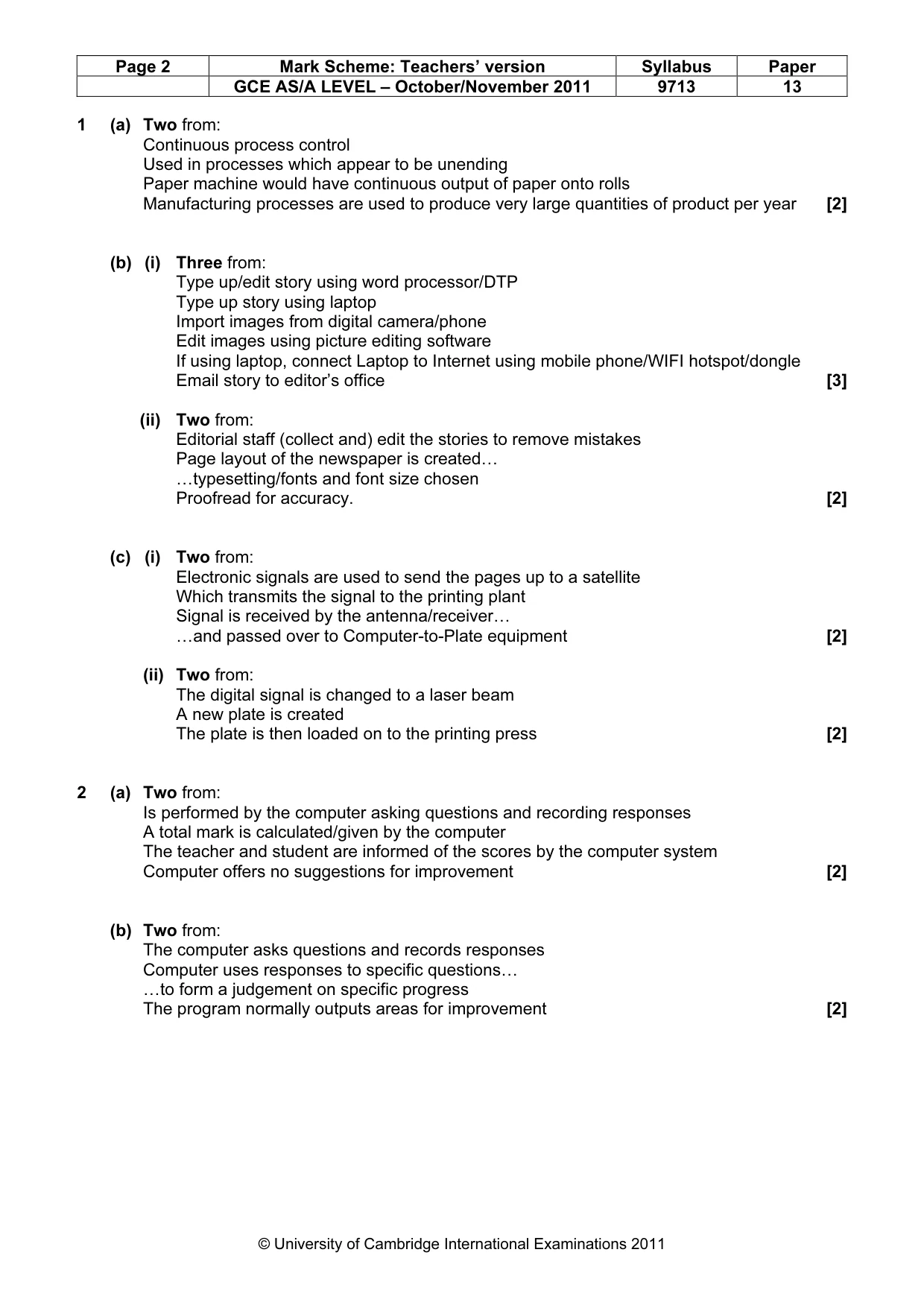
Page 2 Mark Scheme: Teachers’ version Syllabus Paper GCE AS/A LEVEL – October/November 2011 9713 13 © University of Cambridge International Examinations 2011 1 (a) Two from: Continuous process control Used in processes which appear to be unending Paper machine would have continuous output of paper onto rolls Manufacturing processes are used to produce very large quantities of product per year [2] (b) (i) Three from: Type up/edit story using word processor/DTP Type up story using laptop Import images from digital camera/phone Edit images using picture editing software If using laptop, connect Laptop to Internet using mobile phone/WIFI hotspot/dongle Email story to editor’s office [3] (ii) Two from: Editorial staff (collect and) edit the stories to remove mistakes Page layout of the newspaper is created… …typesetting/fonts and font size chosen Proofread for accuracy. [2] (c) (i) Two from: Electronic signals are used to send the pages up to a satellite Which transmits the signal to the printing plant Signal is received by the antenna/receiver… …and passed over to Computer-to-Plate equipment [2] (ii) Two from: The digital signal is changed to a laser beam A new plate is created The plate is then loaded on to the printing press [2] 2 (a) Two from: Is performed by the computer asking questions and recording responses A total mark is calculated/given by the computer The teacher and student are informed of the scores by the computer system Computer offers no suggestions for improvement [2] (b) Two from: The computer asks questions and records responses Computer uses responses to specific questions… …to form a judgement on specific progress The program normally outputs areas for improvement [2]
Mark scheme, page 3
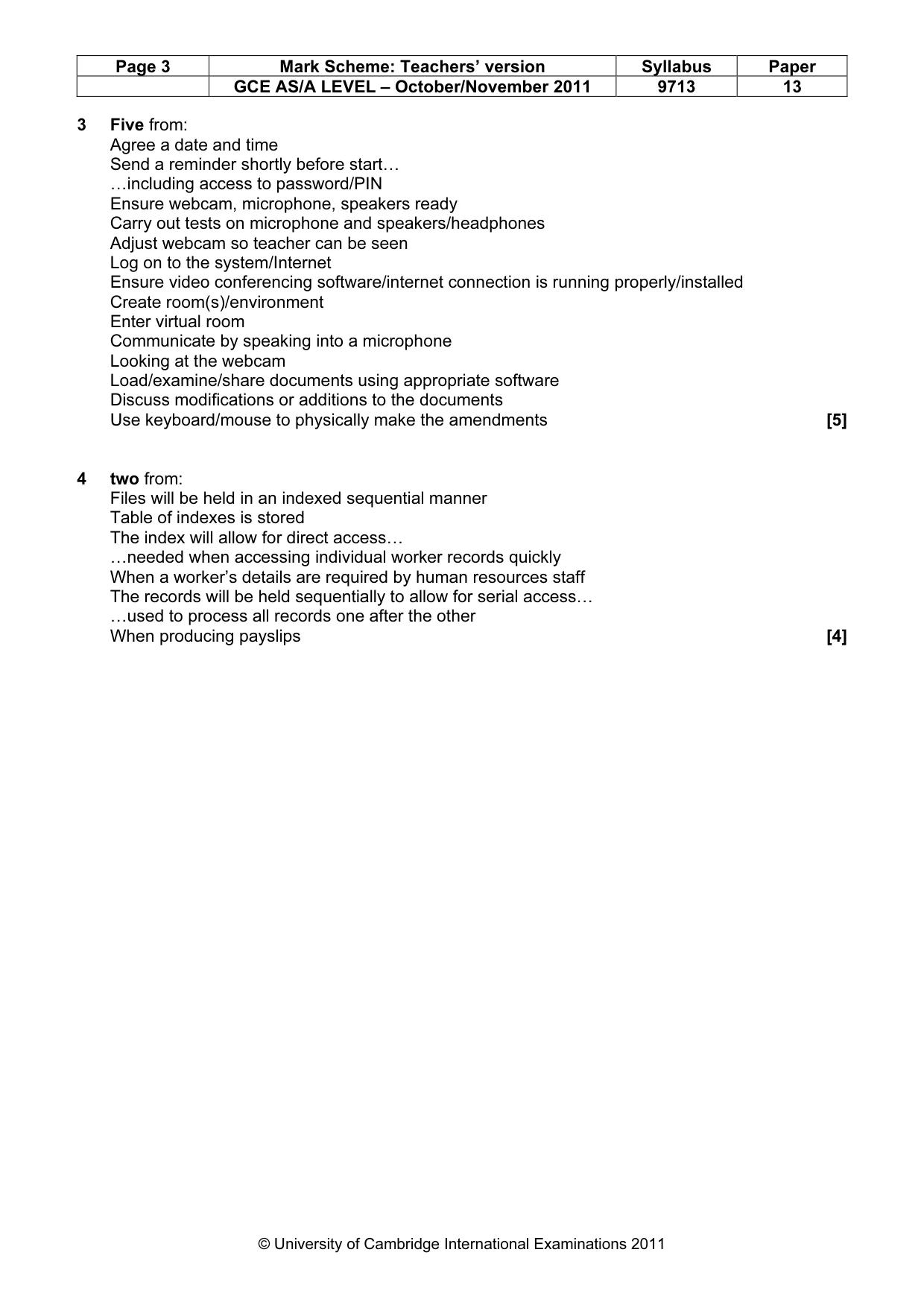
Page 3 Mark Scheme: Teachers’ version Syllabus Paper GCE AS/A LEVEL – October/November 2011 9713 13 © University of Cambridge International Examinations 2011 3 Five from: Agree a date and time Send a reminder shortly before start… …including access to password/PIN Ensure webcam, microphone, speakers ready Carry out tests on microphone and speakers/headphones Adjust webcam so teacher can be seen Log on to the system/Internet Ensure video conferencing software/internet connection is running properly/installed Create room(s)/environment Enter virtual room Communicate by speaking into a microphone Looking at the webcam Load/examine/share documents using appropriate software Discuss modifications or additions to the documents Use keyboard/mouse to physically make the amendments [5] 4 two from: Files will be held in an indexed sequential manner Table of indexes is stored The index will allow for direct access… …needed when accessing individual worker records quickly When a worker’s details are required by human resources staff The records will be held sequentially to allow for serial access… …used to process all records one after the other When producing payslips [4]
Mark scheme, page 4
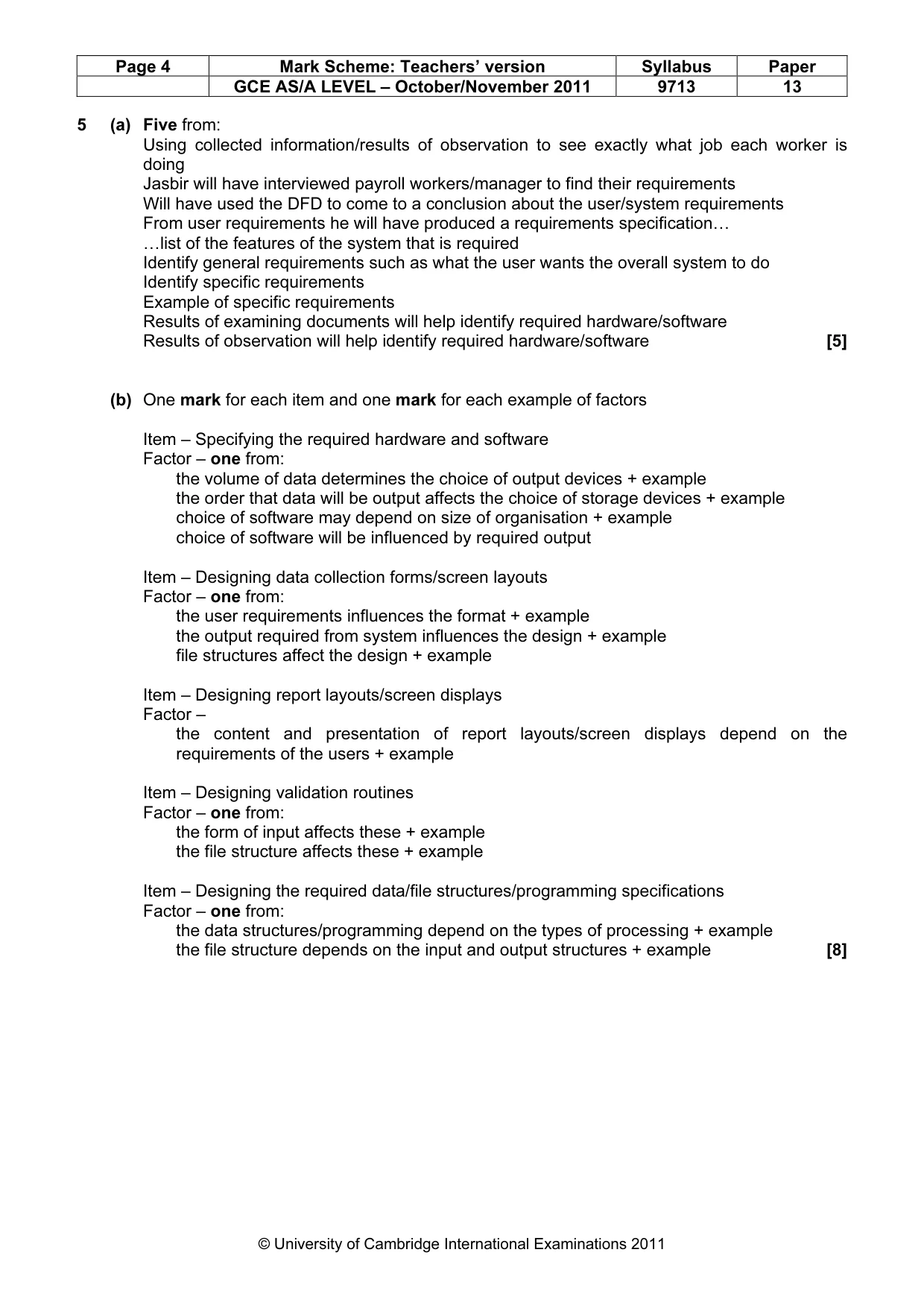
Page 4 Mark Scheme: Teachers’ version Syllabus Paper GCE AS/A LEVEL – October/November 2011 9713 13 © University of Cambridge International Examinations 2011 5 (a) Five from: Using collected information/results of observation to see exactly what job each worker is doing Jasbir will have interviewed payroll workers/manager to find their requirements Will have used the DFD to come to a conclusion about the user/system requirements From user requirements he will have produced a requirements specification… …list of the features of the system that is required Identify general requirements such as what the user wants the overall system to do Identify specific requirements Example of specific requirements Results of examining documents will help identify required hardware/software Results of observation will help identify required hardware/software [5] (b) One mark for each item and one mark for each example of factors Item – Specifying the required hardware and software Factor – one from: the volume of data determines the choice of output devices + example the order that data will be output affects the choice of storage devices + example choice of software may depend on size of organisation + example choice of software will be influenced by required output Item – Designing data collection forms/screen layouts Factor – one from: the user requirements influences the format + example the output required from system influences the design + example file structures affect the design + example Item – Designing report layouts/screen displays Factor – the content and presentation of report layouts/screen displays depend on the requirements of the users + example Item – Designing validation routines Factor – one from: the form of input affects these + example the file structure affects these + example Item – Designing the required data/file structures/programming specifications Factor – one from: the data structures/programming depend on the types of processing + example the file structure depends on the input and output structures + example [8]
Mark scheme, page 5
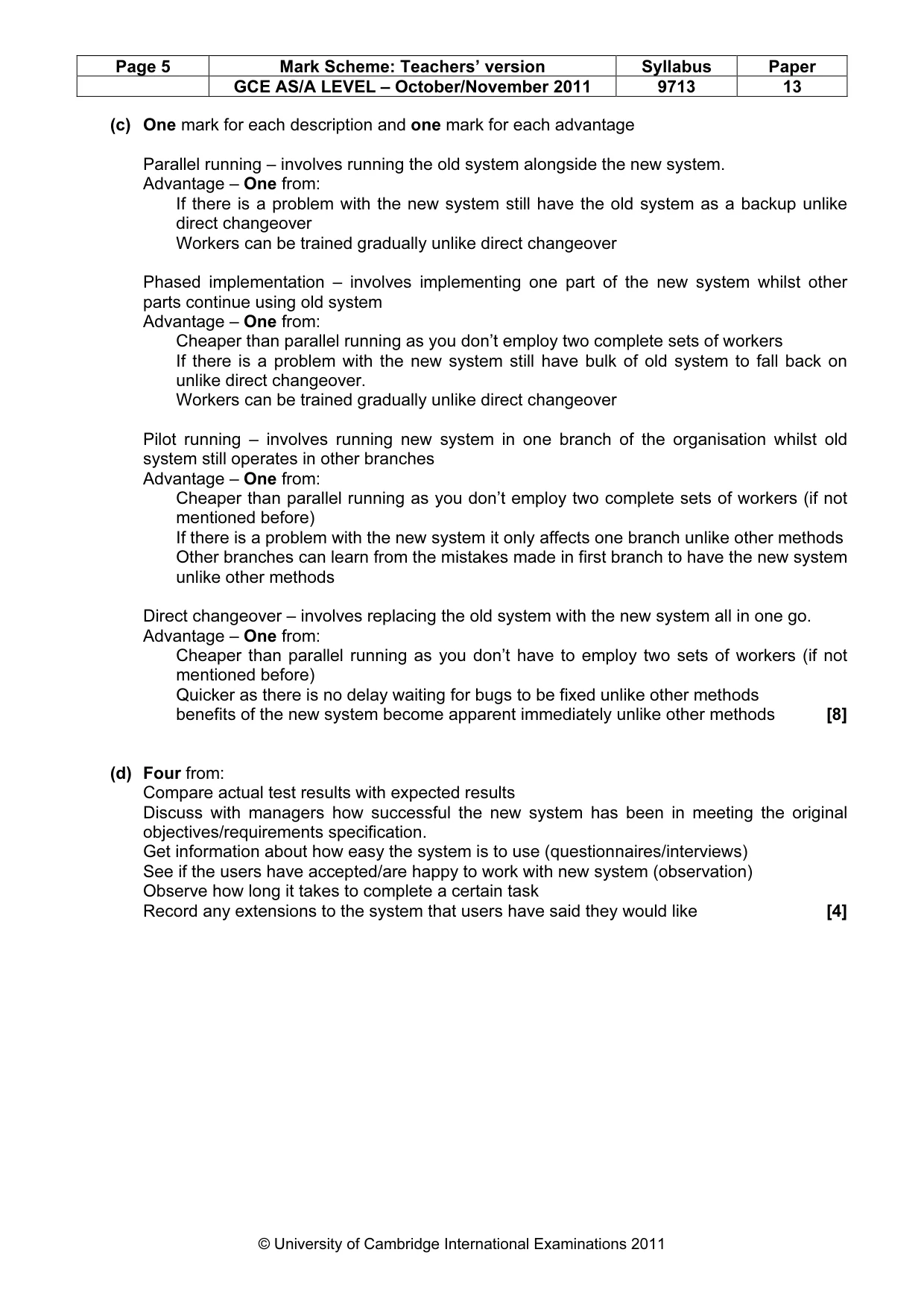
Page 5 Mark Scheme: Teachers’ version Syllabus Paper GCE AS/A LEVEL – October/November 2011 9713 13 © University of Cambridge International Examinations 2011 (c) One mark for each description and one mark for each advantage Parallel running – involves running the old system alongside the new system. Advantage – One from: If there is a problem with the new system still have the old system as a backup unlike direct changeover Workers can be trained gradually unlike direct changeover Phased implementation – involves implementing one part of the new system whilst other parts continue using old system Advantage – One from: Cheaper than parallel running as you don’t employ two complete sets of workers If there is a problem with the new system still have bulk of old system to fall back on unlike direct changeover. Workers can be trained gradually unlike direct changeover Pilot running – involves running new system in one branch of the organisation whilst old system still operates in other branches Advantage – One from: Cheaper than parallel running as you don’t employ two complete sets of workers (if not mentioned before) If there is a problem with the new system it only affects one branch unlike other methods Other branches can learn from the mistakes made in first branch to have the new system unlike other methods Direct changeover – involves replacing the old system with the new system all in one go. Advantage – One from: Cheaper than parallel running as you don’t have to employ two sets of workers (if not mentioned before) Quicker as there is no delay waiting for bugs to be fixed unlike other methods benefits of the new system become apparent immediately unlike other methods [8] (d) Four from: Compare actual test results with expected results Discuss with managers how successful the new system has been in meeting the original objectives/requirements specification. Get information about how easy the system is to use (questionnaires/interviews) See if the users have accepted/are happy to work with new system (observation) Observe how long it takes to complete a certain task Record any extensions to the system that users have said they would like [4]
Mark scheme, page 6
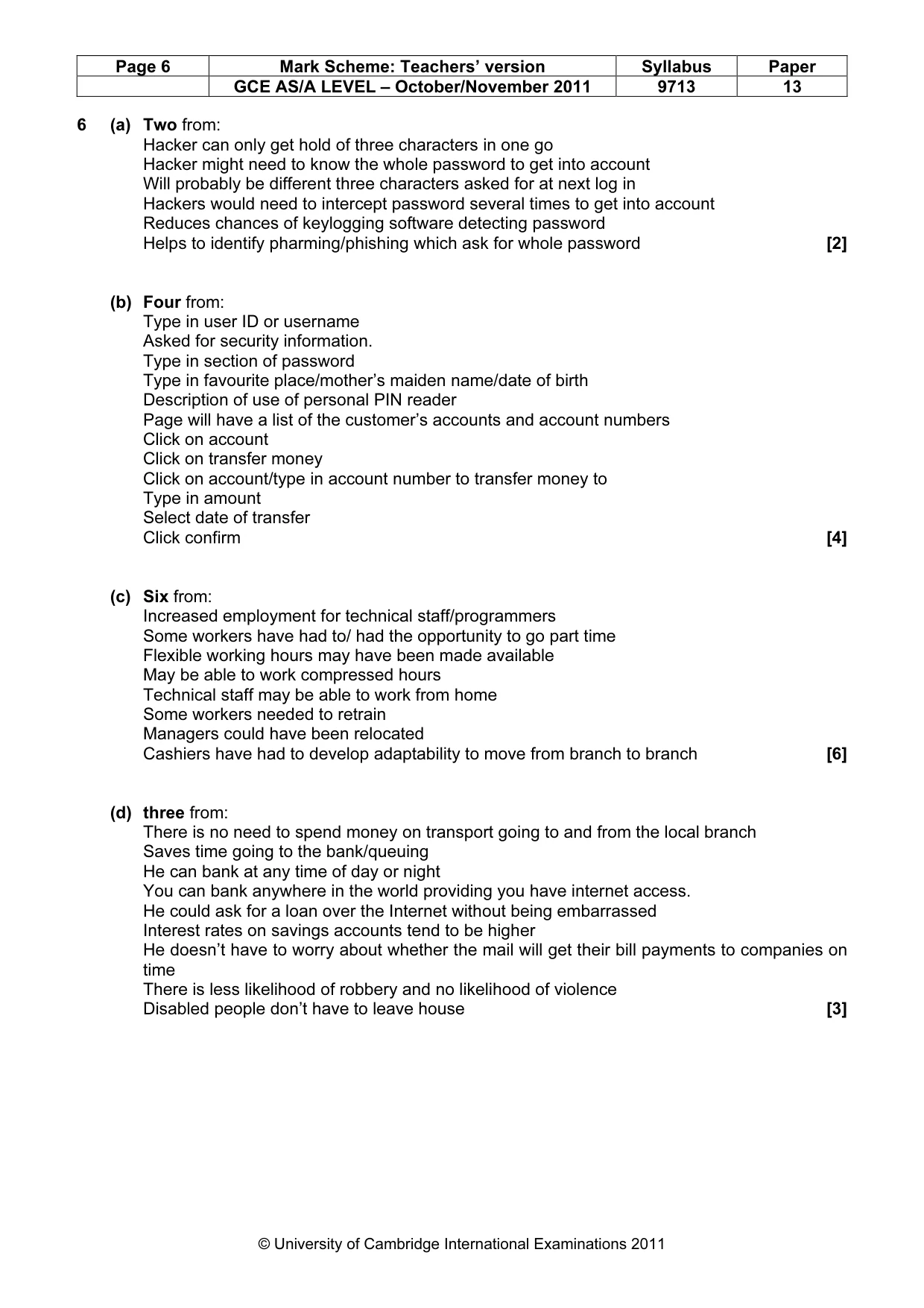
Page 6 Mark Scheme: Teachers’ version Syllabus Paper GCE AS/A LEVEL – October/November 2011 9713 13 © University of Cambridge International Examinations 2011 6 (a) Two from: Hacker can only get hold of three characters in one go Hacker might need to know the whole password to get into account Will probably be different three characters asked for at next log in Hackers would need to intercept password several times to get into account Reduces chances of keylogging software detecting password Helps to identify pharming/phishing which ask for whole password [2] (b) Four from: Type in user ID or username Asked for security information. Type in section of password Type in favourite place/mother’s maiden name/date of birth Description of use of personal PIN reader Page will have a list of the customer’s accounts and account numbers Click on account Click on transfer money Click on account/type in account number to transfer money to Type in amount Select date of transfer Click confirm [4] (c) Six from: Increased employment for technical staff/programmers Some workers have had to/ had the opportunity to go part time Flexible working hours may have been made available May be able to work compressed hours Technical staff may be able to work from home Some workers needed to retrain Managers could have been relocated Cashiers have had to develop adaptability to move from branch to branch [6] (d) three from: There is no need to spend money on transport going to and from the local branch Saves time going to the bank/queuing He can bank at any time of day or night You can bank anywhere in the world providing you have internet access. He could ask for a loan over the Internet without being embarrassed Interest rates on savings accounts tend to be higher He doesn’t have to worry about whether the mail will get their bill payments to companies on time There is less likelihood of robbery and no likelihood of violence Disabled people don’t have to leave house [3]
Mark scheme, page 7
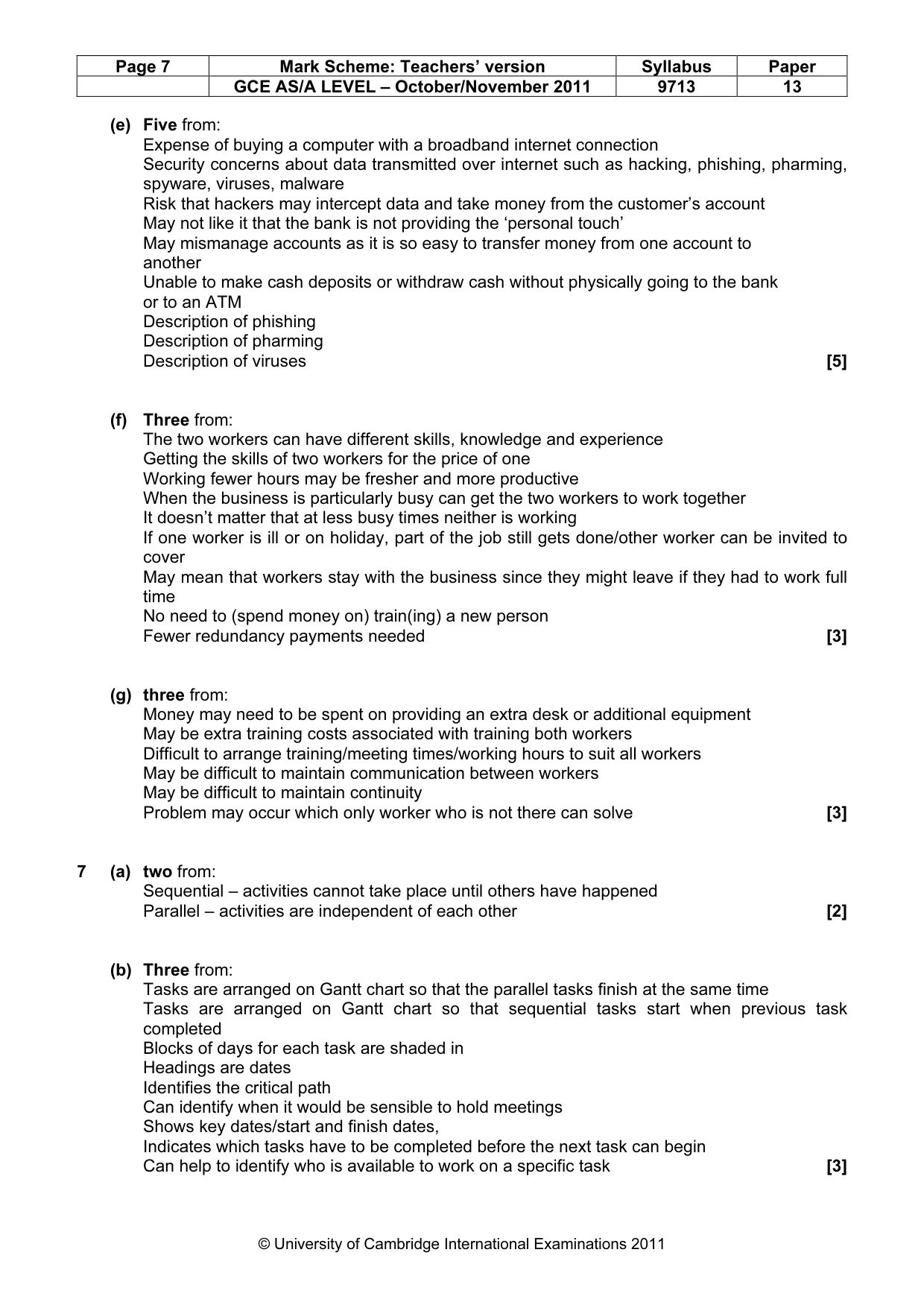
Page 7 Mark Scheme: Teachers’ version Syllabus Paper GCE AS/A LEVEL – October/November 2011 9713 13 © University of Cambridge International Examinations 2011 (e) Five from: Expense of buying a computer with a broadband internet connection Security concerns about data transmitted over internet such as hacking, phishing, pharming, spyware, viruses, malware Risk that hackers may intercept data and take money from the customer’s account May not like it that the bank is not providing the ‘personal touch’ May mismanage accounts as it is so easy to transfer money from one account to another Unable to make cash deposits or withdraw cash without physically going to the bank or to an ATM Description of phishing Description of pharming Description of viruses [5] (f) Three from: The two workers can have different skills, knowledge and experience Getting the skills of two workers for the price of one Working fewer hours may be fresher and more productive When the business is particularly busy can get the two workers to work together It doesn’t matter that at less busy times neither is working If one worker is ill or on holiday, part of the job still gets done/other worker can be invited to cover May mean that workers stay with the business since they might leave if they had to work full time No need to (spend money on) train(ing) a new person Fewer redundancy payments needed [3] (g) three from: Money may need to be spent on providing an extra desk or additional equipment May be extra training costs associated with training both workers Difficult to arrange training/meeting times/working hours to suit all workers May be difficult to maintain communication between workers May be difficult to maintain continuity Problem may occur which only worker who is not there can solve [3] 7 (a) two from: Sequential – activities cannot take place until others have happened Parallel – activities are independent of each other [2] (b) Three from: Tasks are arranged on Gantt chart so that the parallel tasks finish at the same time Tasks are arranged on Gantt chart so that sequential tasks start when previous task completed Blocks of days for each task are shaded in Headings are dates Identifies the critical path Can identify when it would be sensible to hold meetings Shows key dates/start and finish dates, Indicates which tasks have to be completed before the next task can begin Can help to identify who is available to work on a specific task [3]
What you needed in this session
Cambridge’s own grade thresholds for 2011 Oct/Nov, Paper 1 · Variant 3. A higher threshold means an easier paper — the bar moves with how the cohort did.