Cambridge A Level Applied Information and Communication Technology 9713 — 2011 May/June Paper 1 · Variant 1
9713/11/M/J/11 · 80 marks · ≈90 min
The question paper and its mark scheme, free to read here and free to download. This is Cambridge’s own paper, exactly as it was sat.
Question paper20 pages





Mark scheme7 pages
Answers below. Sit the paper first if you are practising.
Paper as text
Question paper, page 1
This document consists of 19 printed pages and 1 blank page. IB11 06_9713_11/4RP © UCLES 2011 [Turn over *6509415991* UNIVERSITY OF CAMBRIDGE INTERNATIONAL EXAMINATIONS General Certificate of Education Advanced Level APPLIED INFORMATION AND COMMUNICATION TECHNOLOGY 9713/11 Paper 1 May/June 2011 1 hour 15 minutes Candidates answer on the Question Paper. No additional materials are required. READ THESE INSTRUCTIONS FIRST Write your Centre number, candidate number and name on all the work you hand in. Write in dark blue or black pen. Do not use staples, paper clips, highlighters, glue or correction fluid. You may use a pencil for any diagrams, graphs or rough working. DO NOT WRITE IN ANY BARCODES. Answer all questions. The number of marks is given in brackets [ ] at the end of each question or part question. The businesses described in this paper are entirely fictitious.
Question paper, page 2
2 © UCLES 2011 9713/11/M/J/11 For Examiner's Use Scenario 1 Questions 1, 2, 3 and 4 Asif is the headteacher of a school in Dubai. He is keen to increase the use of ICT in lessons. A room is being set aside for use as a computer room to help the teaching of geography and history. He has already made sure that the room has air-conditioning which is microprocessor- controlled. He has asked Safina, a systems analyst, to research the current facilities and recommend which hardware and software should be purchased. When she has completed the analysis and design phases of this project, Safina will need to supervise the setting up of the hardware and software for the new classroom. This will require an approach using construction project management.
Question paper, page 3
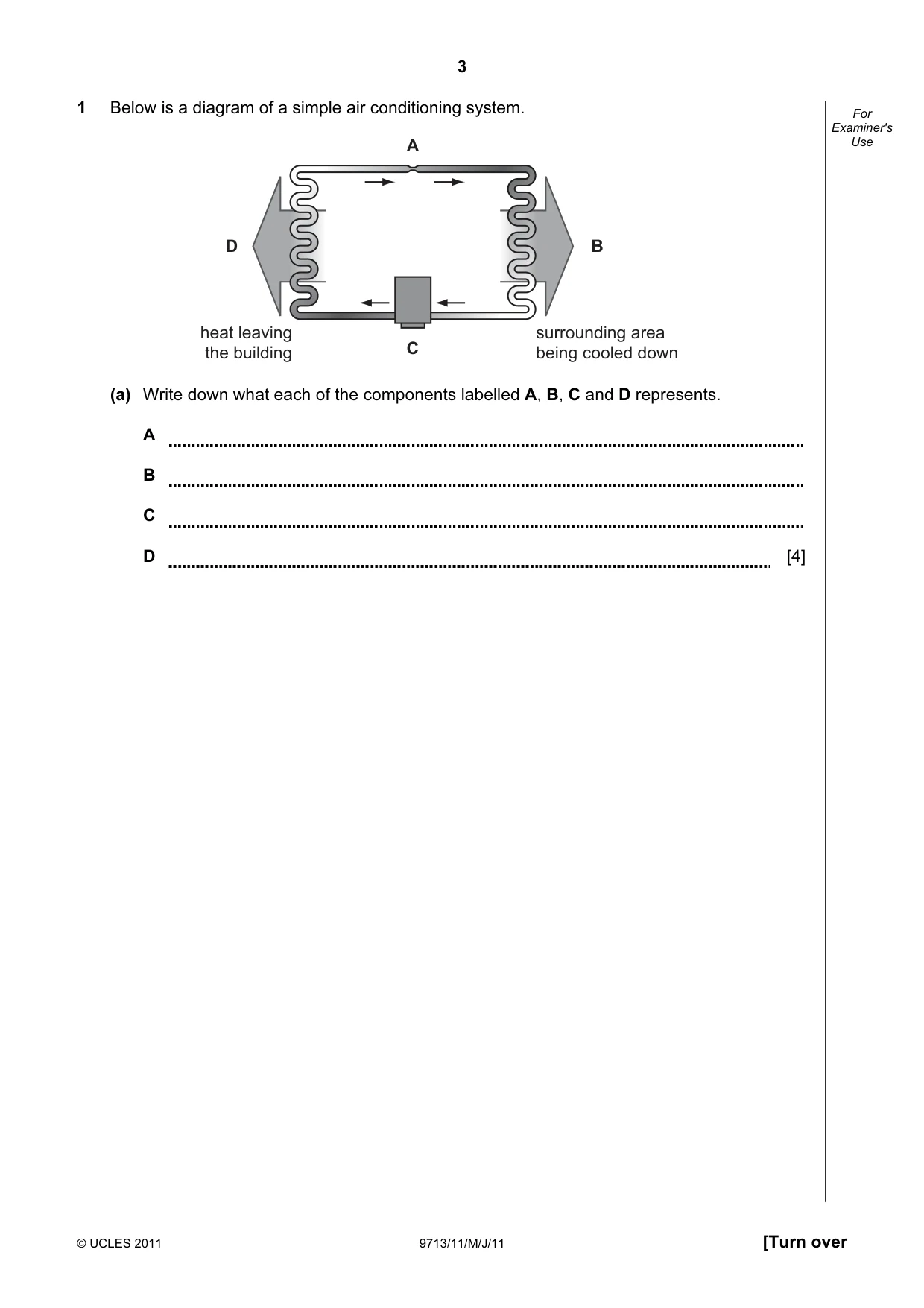
3 © UCLES 2011 9713/11/M/J/11 [Turn over For Examiner's Use 1 Below is a diagram of a simple air conditioning system. A C D B heat leaving the building surrounding area being cooled down (a) Write down what each of the components labelled A, B, C and D represents. A B C D [4]
Question paper, page 4
4 © UCLES 2011 9713/11/M/J/11 For Examiner's Use (b) Describe how microprocessor control is used in this air conditioning system. [5]
Question paper, page 5
5 © UCLES 2011 9713/11/M/J/11 [Turn over For Examiner's Use 2 (a) Safina has to obtain information about the current system from the network manager and the teachers. Describe one advantage and one disadvantage for each of the four methods she could use to research the current system. Advantage of Method 1 Disadvantage of Method 1 Advantage of Method 2 Disadvantage of Method 2 Advantage of Method 3 Disadvantage of Method 3 Advantage of Method 4 Disadvantage of Method 4 [8]
Question paper, page 6
6 © UCLES 2011 9713/11/M/J/11 For Examiner's Use (b) In her analysis of the current system, Safina identified the software and hardware required for the new system. Give detailed descriptions of three results of the analysis that enabled her to do this. 1 2 3 [6]
Question paper, page 7
7 © UCLES 2011 9713/11/M/J/11 [Turn over For Examiner's Use 3 Using the scenario, describe four features of Computer Aided Learning. 1 2 3 4 [4] 4 Describe four features of construction project management which will improve the probability of finishing the project on time. 1 2 3 4 [4]
Question paper, page 8
8 © UCLES 2011 9713/11/M/J/11 For Examiner's Use Scenario 2 Questions 5 and 6 Square Peg Readers is a national chain of book shops in Pakistan. It has just set up an online shopping website so that customers can order books online and have them delivered to their home. As this is a new website the majority of customers will need to register with the system giving their personal details before they are able to use it. After making a purchase many customers will want to check that the correct amount of money has been taken from their bank account. To do this they will use on-line banking. Many shop assistants could become unemployed as a result of this new website.
Question paper, page 9
9 © UCLES 2011 9713/11/M/J/11 [Turn over For Examiner's Use 5 (a) Describe five steps that a new customer would have to follow in order to register online with this system. 1 2 3 4 5 [5]
Question paper, page 10
10 © UCLES 2011 9713/11/M/J/11 For Examiner's Use (b) Describe three security threats that the bank and the customer must guard against because of the use of on-line banking. 1 2 3 [6]
Question paper, page 11
11 © UCLES 2011 9713/11/M/J/11 [Turn over For Examiner's Use 6 (a) Describe the working patterns the company could introduce to avoid staff redundancies or retrenchment. [2] (b) The introduction of the website will affect the work of the technical staff. Describe two opportunities this may present. 1 2 [2]
Question paper, page 12
12 © UCLES 2011 9713/11/M/J/11 For Examiner's Use Scenario 3 Questions 7, 8 and 9 The Wuhan-Yangtse is one of the largest water companies in China. It operates a call centre for customers to use when they have problems with their water supply. It has just computerised its payroll system so that payslips can be produced at the end of the month for each worker.
Question paper, page 13
13 © UCLES 2011 9713/11/M/J/11 [Turn over For Examiner's Use 7 (a) Before the payroll system was created the database file structure was designed. Describe four features of a typical file structure. 1 2 3 4 [4] (b) Give three examples of the data that will be contained in the master file which will change for each worker every time the payroll application is run. 1 2 3 [3]
Question paper, page 14
14 © UCLES 2011 9713/11/M/J/11 For Examiner's Use (c) Describe, using examples of data from the master and transaction files, five steps in the processing used in the production of payslips. 1 2 3 4 5 [5]
Question paper, page 15
15 © UCLES 2011 9713/11/M/J/11 [Turn over For Examiner's Use 8 When the new system was implemented the systems analyst would have produced some systems documentation. Describe what is included in systems documentation and explain why each item is needed. [5]
Question paper, page 16
16 © UCLES 2011 9713/11/M/J/11 For Examiner's Use 9 Describe five differences between first party control and third party control and suggest which type Wuhan-Yangtse would choose to use in their call centre, giving a reason for your choice. 1 2 3 4 5 Choice [6]
Question paper, page 17
17 © UCLES 2011 9713/11/M/J/11 [Turn over For Examiner's Use Scenario 4 Question 10 Polar Bear Ltd. is a Tanzanian book publishing company. The manager, Issa, often works from home. When he is working from home, he needs to keep in contact with workers in the company office. This is achieved by using a landline connection to have phone conferences. The company’s computer system is unreliable and not connected to the Internet.
Question paper, page 18
18 © UCLES 2011 9713/11/M/J/11 For Examiner's Use 10 (a) Describe three benefits and three drawbacks to the company of Issa working from home. Benefit 1 Benefit 2 Benefit 3 Drawback 1 Drawback 2 Drawback 3 [6]
Question paper, page 19
19 © UCLES 2011 9713/11/M/J/11 For Examiner's Use (b) Describe four steps involved in Issa setting up a phone conference and give a description of the type of phone required. 1 2 3 4 Phone required [5]
Question paper, page 20
20 Permission to reproduce items where third-party owned material protected by copyright is included has been sought and cleared where possible. Every reasonable effort has been made by the publisher (UCLES) to trace copyright holders, but if any items requiring clearance have unwittingly been included, the publisher will be pleased to make amends at the earliest possible opportunity. University of Cambridge International Examinations is part of the Cambridge Assessment Group. Cambridge Assessment is the brand name of University of Cambridge Local Examinations Syndicate (UCLES), which is itself a department of the University of Cambridge. © UCLES 2011 9713/11/M/J/11 BLANK PAGE
Mark scheme, page 1
UNIVERSITY OF CAMBRIDGE INTERNATIONAL EXAMINATIONS GCE Advanced Subsidiary Level and GCE Advanced Level MARK SCHEME for the May/June 2011 question paper for the guidance of teachers 9713 APPLIED ICT 9713/11 Paper 1 (Written A), maximum raw mark 80 This mark scheme is published as an aid to teachers and candidates, to indicate the requirements of the examination. It shows the basis on which Examiners were instructed to award marks. It does not indicate the details of the discussions that took place at an Examiners’ meeting before marking began, which would have considered the acceptability of alternative answers. Mark schemes must be read in conjunction with the question papers and the report on the examination. • Cambridge will not enter into discussions or correspondence in connection with these mark schemes. Cambridge is publishing the mark schemes for the May/June 2011 question papers for most IGCSE, GCE Advanced Level and Advanced Subsidiary Level syllabuses and some Ordinary Level syllabuses.
Mark scheme, page 2
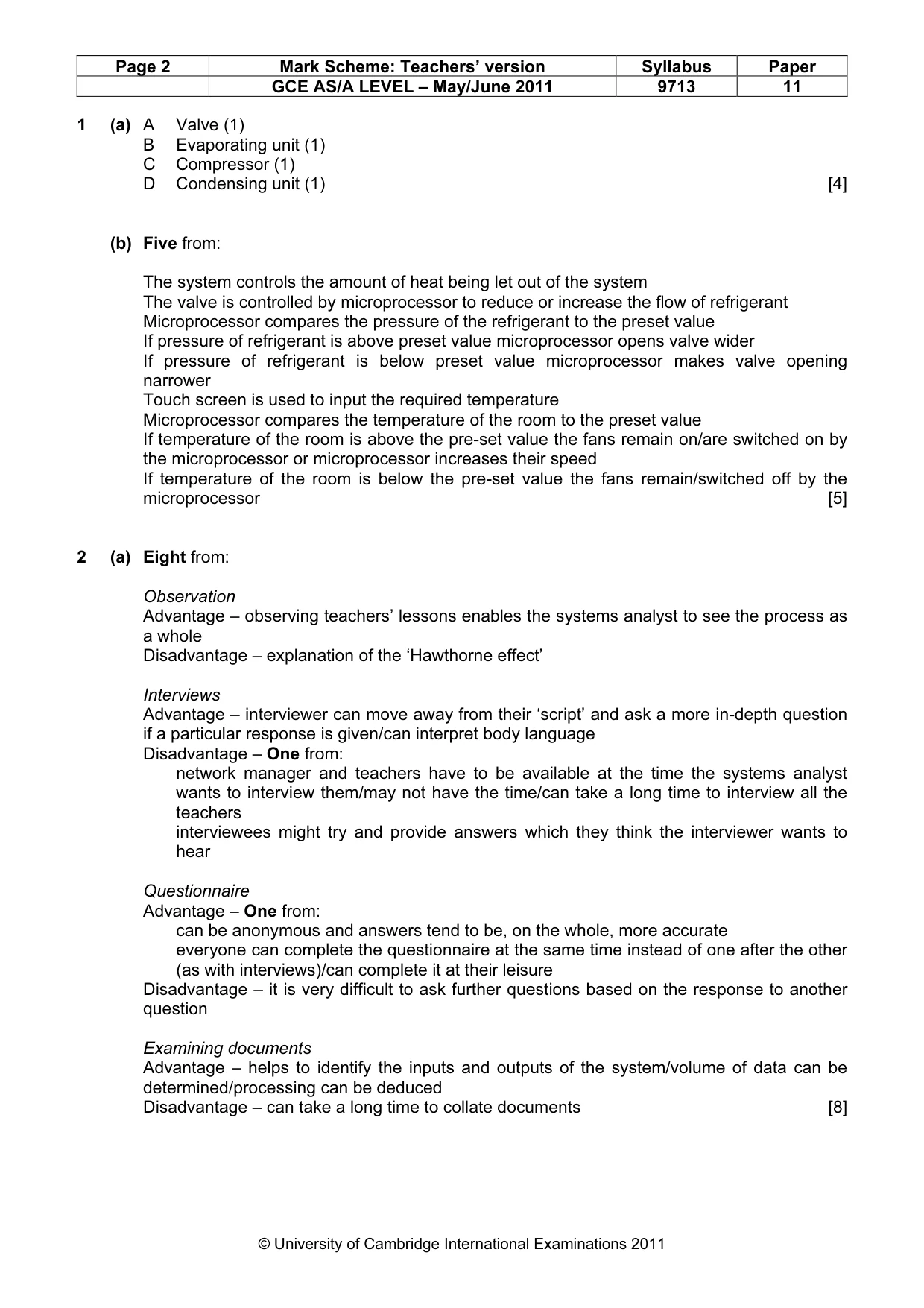
Page 2 Mark Scheme: Teachers’ version Syllabus Paper GCE AS/A LEVEL – May/June 2011 9713 11 © University of Cambridge International Examinations 2011 1 (a) A Valve (1) B Evaporating unit (1) C Compressor (1) D Condensing unit (1) [4] (b) Five from: The system controls the amount of heat being let out of the system The valve is controlled by microprocessor to reduce or increase the flow of refrigerant Microprocessor compares the pressure of the refrigerant to the preset value If pressure of refrigerant is above preset value microprocessor opens valve wider If pressure of refrigerant is below preset value microprocessor makes valve opening narrower Touch screen is used to input the required temperature Microprocessor compares the temperature of the room to the preset value If temperature of the room is above the pre-set value the fans remain on/are switched on by the microprocessor or microprocessor increases their speed If temperature of the room is below the pre-set value the fans remain/switched off by the microprocessor [5] 2 (a) Eight from: Observation Advantage – observing teachers’ lessons enables the systems analyst to see the process as a whole Disadvantage – explanation of the ‘Hawthorne effect’ Interviews Advantage – interviewer can move away from their ‘script’ and ask a more in-depth question if a particular response is given/can interpret body language Disadvantage – One from: network manager and teachers have to be available at the time the systems analyst wants to interview them/may not have the time/can take a long time to interview all the teachers interviewees might try and provide answers which they think the interviewer wants to hear Questionnaire Advantage – One from: can be anonymous and answers tend to be, on the whole, more accurate everyone can complete the questionnaire at the same time instead of one after the other (as with interviews)/can complete it at their leisure Disadvantage – it is very difficult to ask further questions based on the response to another question Examining documents Advantage – helps to identify the inputs and outputs of the system/volume of data can be determined/processing can be deduced Disadvantage – can take a long time to collate documents [8]
Mark scheme, page 3
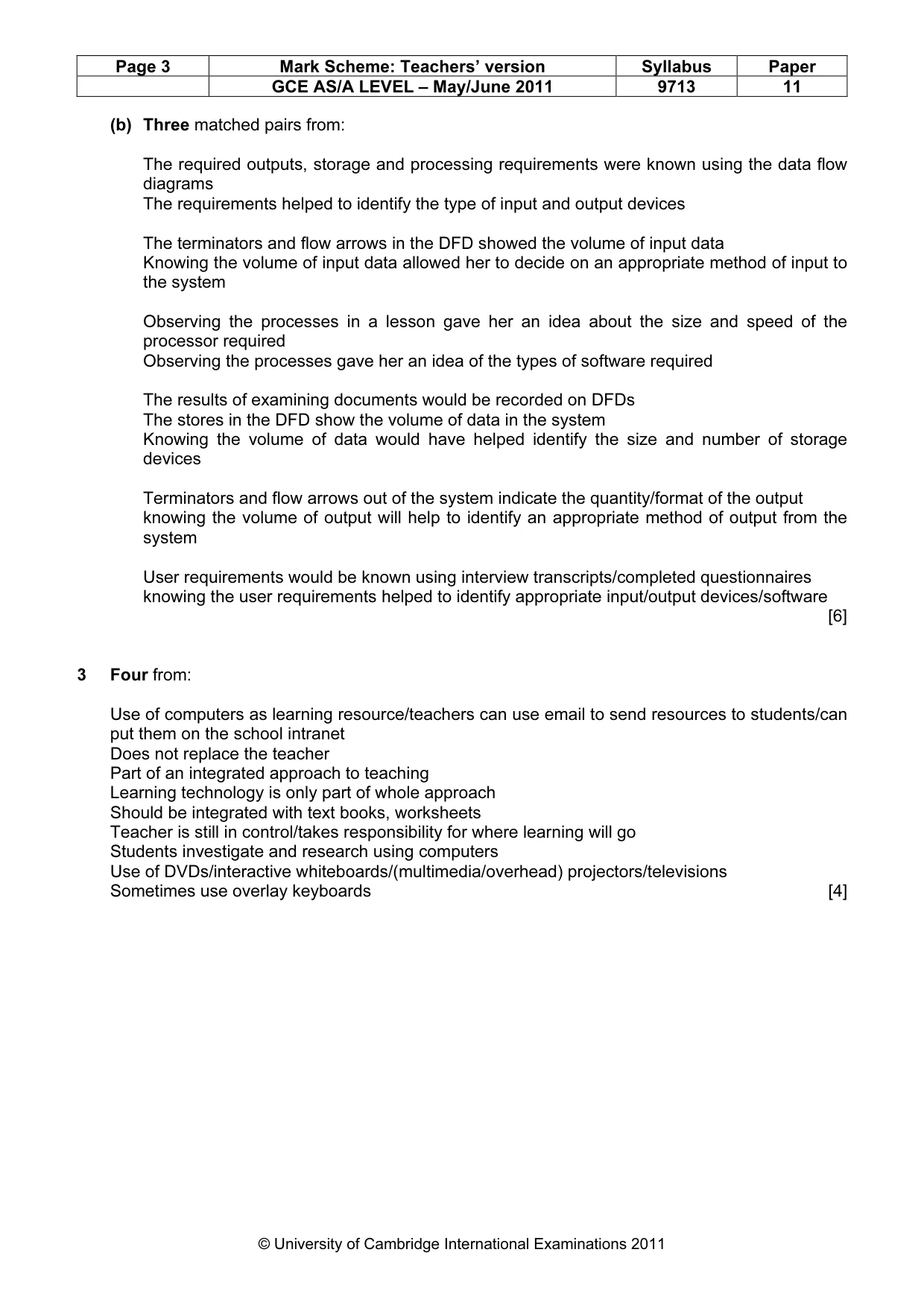
Page 3 Mark Scheme: Teachers’ version Syllabus Paper GCE AS/A LEVEL – May/June 2011 9713 11 © University of Cambridge International Examinations 2011 (b) Three matched pairs from: The required outputs, storage and processing requirements were known using the data flow diagrams The requirements helped to identify the type of input and output devices The terminators and flow arrows in the DFD showed the volume of input data Knowing the volume of input data allowed her to decide on an appropriate method of input to the system Observing the processes in a lesson gave her an idea about the size and speed of the processor required Observing the processes gave her an idea of the types of software required The results of examining documents would be recorded on DFDs The stores in the DFD show the volume of data in the system Knowing the volume of data would have helped identify the size and number of storage devices Terminators and flow arrows out of the system indicate the quantity/format of the output knowing the volume of output will help to identify an appropriate method of output from the system User requirements would be known using interview transcripts/completed questionnaires knowing the user requirements helped to identify appropriate input/output devices/software [6] 3 Four from: Use of computers as learning resource/teachers can use email to send resources to students/can put them on the school intranet Does not replace the teacher Part of an integrated approach to teaching Learning technology is only part of whole approach Should be integrated with text books, worksheets Teacher is still in control/takes responsibility for where learning will go Students investigate and research using computers Use of DVDs/interactive whiteboards/(multimedia/overhead) projectors/televisions Sometimes use overlay keyboards [4]
Mark scheme, page 4
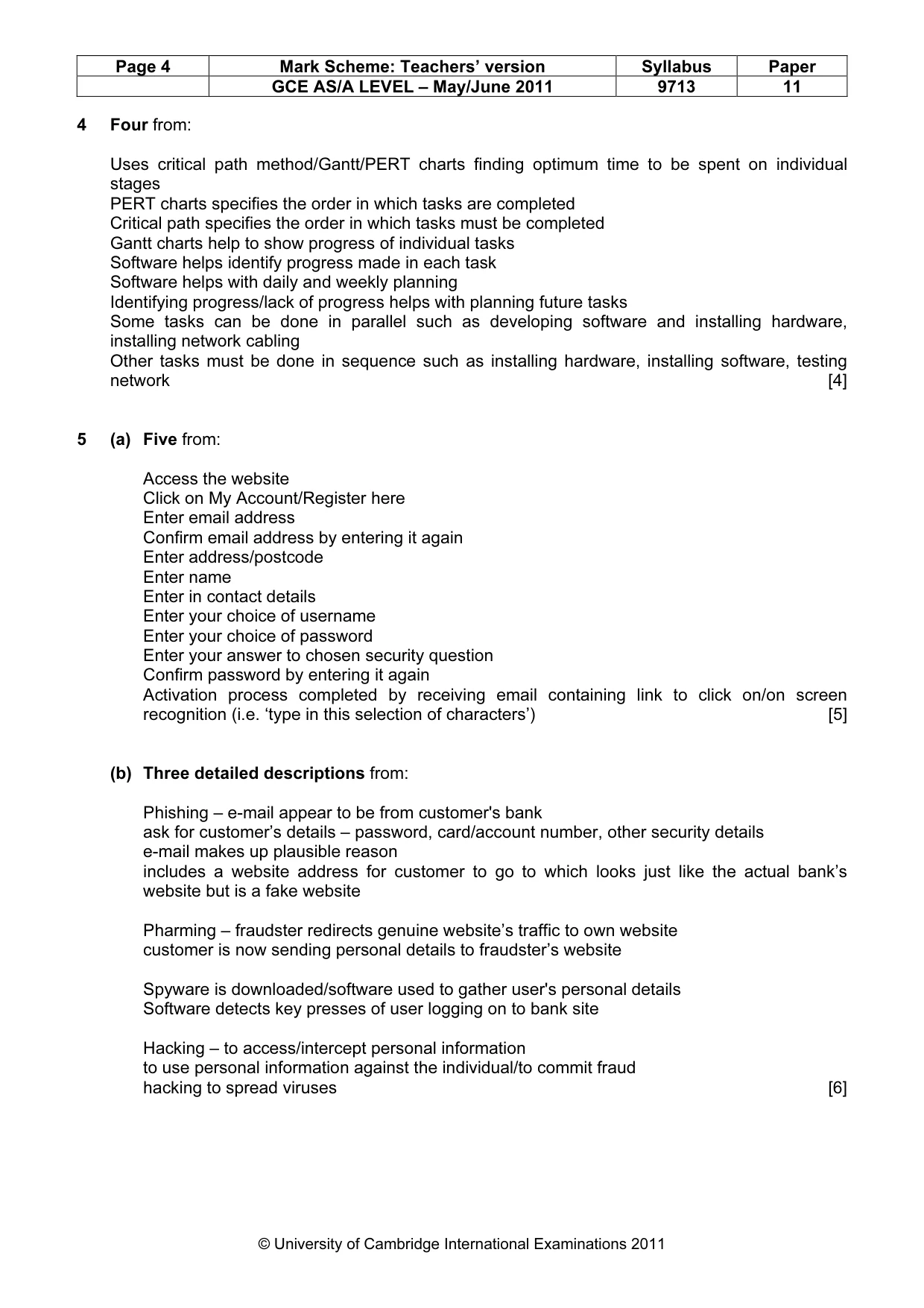
Page 4 Mark Scheme: Teachers’ version Syllabus Paper GCE AS/A LEVEL – May/June 2011 9713 11 © University of Cambridge International Examinations 2011 4 Four from: Uses critical path method/Gantt/PERT charts finding optimum time to be spent on individual stages PERT charts specifies the order in which tasks are completed Critical path specifies the order in which tasks must be completed Gantt charts help to show progress of individual tasks Software helps identify progress made in each task Software helps with daily and weekly planning Identifying progress/lack of progress helps with planning future tasks Some tasks can be done in parallel such as developing software and installing hardware, installing network cabling Other tasks must be done in sequence such as installing hardware, installing software, testing network [4] 5 (a) Five from: Access the website Click on My Account/Register here Enter email address Confirm email address by entering it again Enter address/postcode Enter name Enter in contact details Enter your choice of username Enter your choice of password Enter your answer to chosen security question Confirm password by entering it again Activation process completed by receiving email containing link to click on/on screen recognition (i.e. ‘type in this selection of characters’) [5] (b) Three detailed descriptions from: Phishing – e-mail appear to be from customer's bank ask for customer’s details – password, card/account number, other security details e-mail makes up plausible reason includes a website address for customer to go to which looks just like the actual bank’s website but is a fake website Pharming – fraudster redirects genuine website’s traffic to own website customer is now sending personal details to fraudster’s website Spyware is downloaded/software used to gather user's personal details Software detects key presses of user logging on to bank site Hacking – to access/intercept personal information to use personal information against the individual/to commit fraud hacking to spread viruses [6]
Mark scheme, page 5
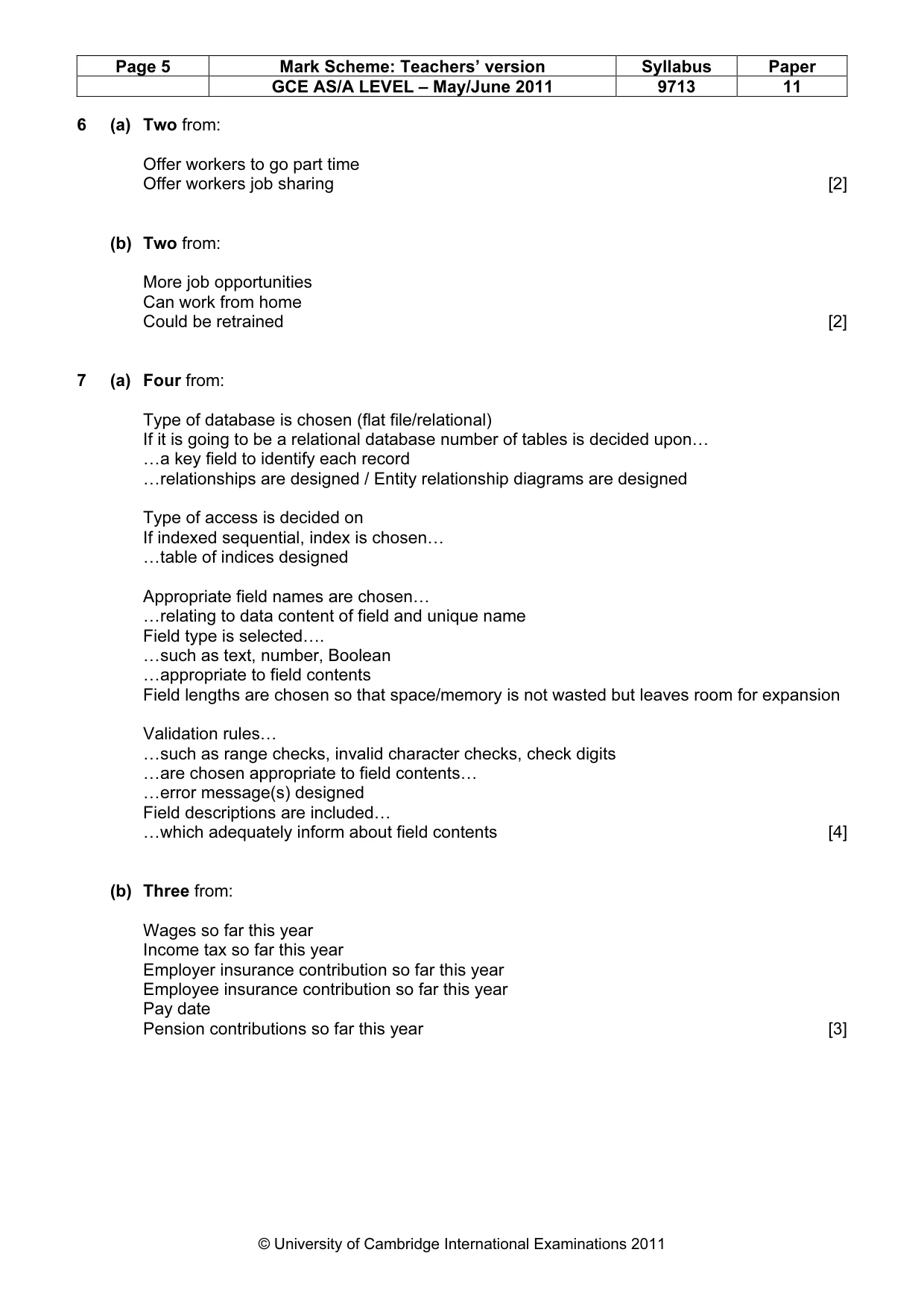
Page 5 Mark Scheme: Teachers’ version Syllabus Paper GCE AS/A LEVEL – May/June 2011 9713 11 © University of Cambridge International Examinations 2011 6 (a) Two from: Offer workers to go part time Offer workers job sharing [2] (b) Two from: More job opportunities Can work from home Could be retrained [2] 7 (a) Four from: Type of database is chosen (flat file/relational) If it is going to be a relational database number of tables is decided upon… …a key field to identify each record …relationships are designed / Entity relationship diagrams are designed Type of access is decided on If indexed sequential, index is chosen… …table of indices designed Appropriate field names are chosen… …relating to data content of field and unique name Field type is selected…. …such as text, number, Boolean …appropriate to field contents Field lengths are chosen so that space/memory is not wasted but leaves room for expansion Validation rules… …such as range checks, invalid character checks, check digits …are chosen appropriate to field contents… …error message(s) designed Field descriptions are included… …which adequately inform about field contents [4] (b) Three from: Wages so far this year Income tax so far this year Employer insurance contribution so far this year Employee insurance contribution so far this year Pay date Pension contributions so far this year [3]
Mark scheme, page 6
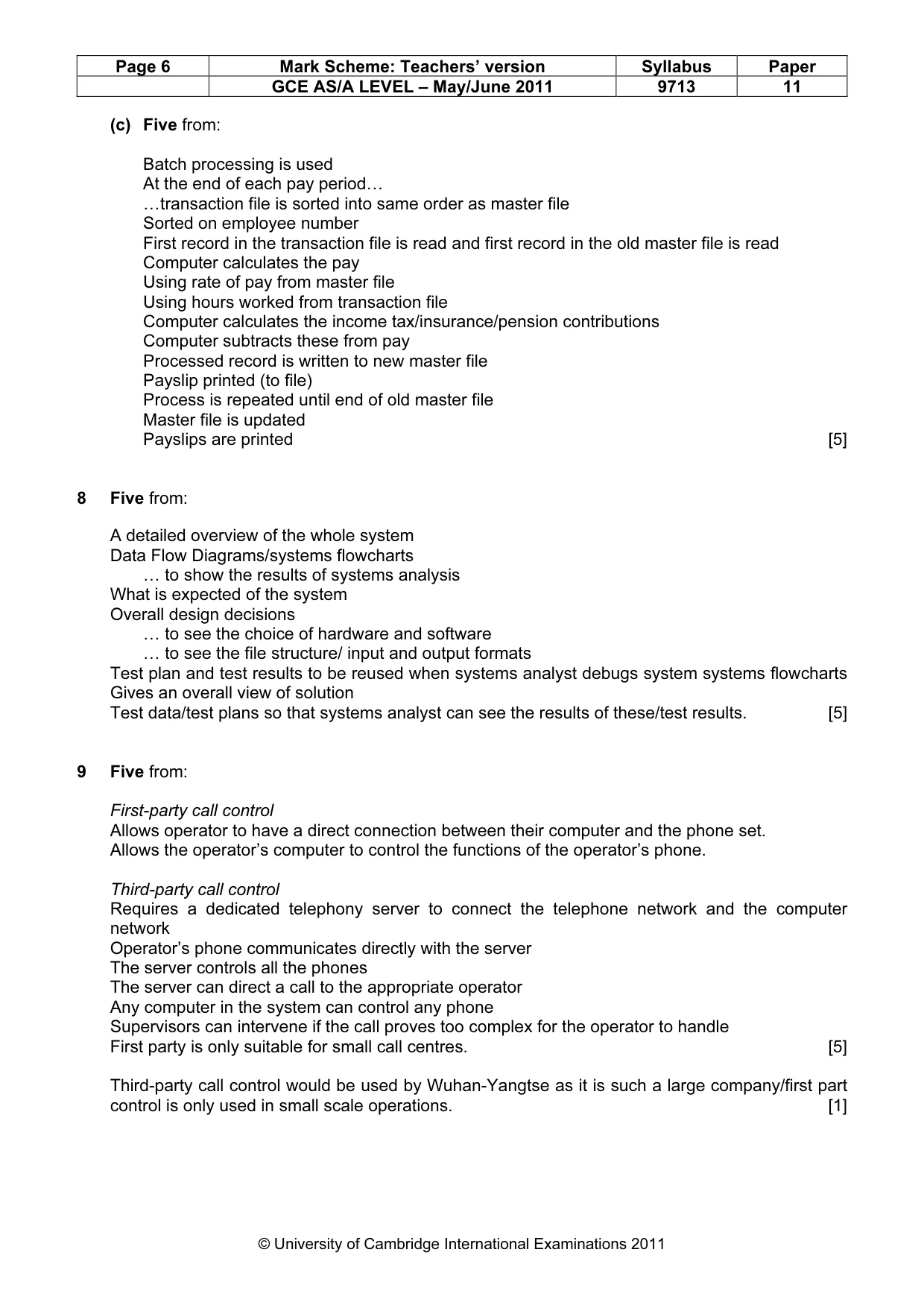
Page 6 Mark Scheme: Teachers’ version Syllabus Paper GCE AS/A LEVEL – May/June 2011 9713 11 © University of Cambridge International Examinations 2011 (c) Five from: Batch processing is used At the end of each pay period… …transaction file is sorted into same order as master file Sorted on employee number First record in the transaction file is read and first record in the old master file is read Computer calculates the pay Using rate of pay from master file Using hours worked from transaction file Computer calculates the income tax/insurance/pension contributions Computer subtracts these from pay Processed record is written to new master file Payslip printed (to file) Process is repeated until end of old master file Master file is updated Payslips are printed [5] 8 Five from: A detailed overview of the whole system Data Flow Diagrams/systems flowcharts … to show the results of systems analysis What is expected of the system Overall design decisions … to see the choice of hardware and software … to see the file structure/ input and output formats Test plan and test results to be reused when systems analyst debugs system systems flowcharts Gives an overall view of solution Test data/test plans so that systems analyst can see the results of these/test results. [5] 9 Five from: First-party call control Allows operator to have a direct connection between their computer and the phone set. Allows the operator’s computer to control the functions of the operator’s phone. Third-party call control Requires a dedicated telephony server to connect the telephone network and the computer network Operator’s phone communicates directly with the server The server controls all the phones The server can direct a call to the appropriate operator Any computer in the system can control any phone Supervisors can intervene if the call proves too complex for the operator to handle First party is only suitable for small call centres. [5] Third-party call control would be used by Wuhan-Yangtse as it is such a large company/first part control is only used in small scale operations. [1]
Mark scheme, page 7
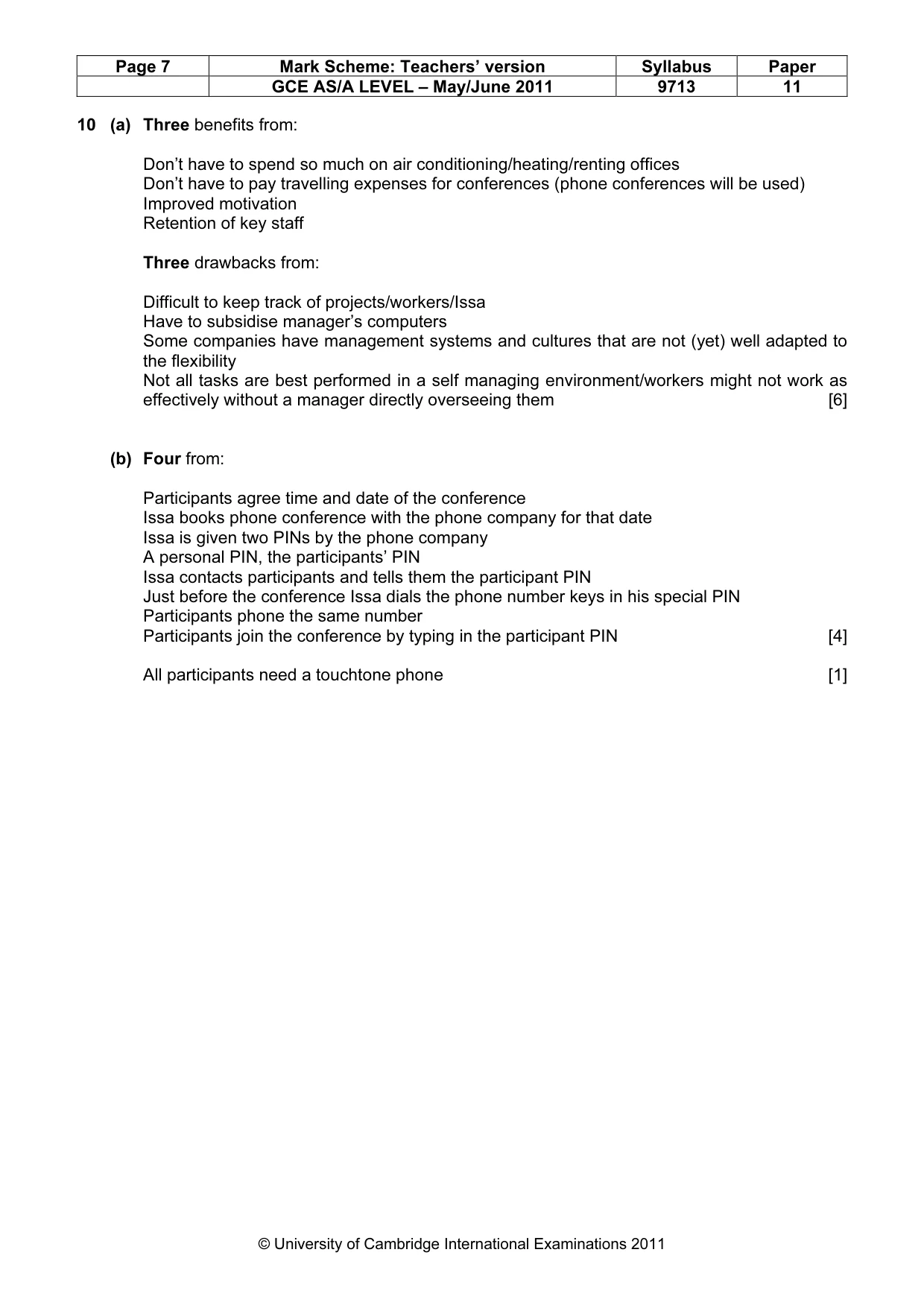
Page 7 Mark Scheme: Teachers’ version Syllabus Paper GCE AS/A LEVEL – May/June 2011 9713 11 © University of Cambridge International Examinations 2011 10 (a) Three benefits from: Don’t have to spend so much on air conditioning/heating/renting offices Don’t have to pay travelling expenses for conferences (phone conferences will be used) Improved motivation Retention of key staff Three drawbacks from: Difficult to keep track of projects/workers/Issa Have to subsidise manager’s computers Some companies have management systems and cultures that are not (yet) well adapted to the flexibility Not all tasks are best performed in a self managing environment/workers might not work as effectively without a manager directly overseeing them [6] (b) Four from: Participants agree time and date of the conference Issa books phone conference with the phone company for that date Issa is given two PINs by the phone company A personal PIN, the participants’ PIN Issa contacts participants and tells them the participant PIN Just before the conference Issa dials the phone number keys in his special PIN Participants phone the same number Participants join the conference by typing in the participant PIN [4] All participants need a touchtone phone [1]
What you needed in this session
Cambridge’s own grade thresholds for 2011 May/June, Paper 1 · Variant 1. A higher threshold means an easier paper — the bar moves with how the cohort did.