Cambridge A Level Applied Information and Communication Technology 9713 — 2010 Oct/Nov Paper 1 · Variant 1
9713/11/O/N/10 · 80 marks · ≈90 min
The question paper and its mark scheme, free to read here and free to download. This is Cambridge’s own paper, exactly as it was sat.
Question paper20 pages












Mark scheme8 pages
Answers below. Sit the paper first if you are practising.
Paper as text
Question paper, page 1
This document consists of 18 printed pages and 2 blank pages. IB10 11_9713_11/9RP © UCLES 2010 [Turn over *2993048403* UNIVERSITY OF CAMBRIDGE INTERNATIONAL EXAMINATIONS General Certificate of Education Advanced Level APPLIED INFORMATION AND COMMUNICATION TECHNOLOGY 9713/11 Paper 1 October/November 2010 1 hour and 15 minutes Candidates answer on the Question Paper. No additional materials are required. READ THESE INSTRUCTIONS FIRST Write your Centre number, candidate number and name on all the work you hand in. Write in dark blue or black pen. Do not use staples, paper clips, highlighters, glue or correction fluid. You may use a pencil for any diagrams, graphs or rough working. DO NOT WRITE IN ANY BARCODES. Answer all questions. The number of marks is given in brackets [ ] at the end of each question or part question. The businesses described in this paper are entirely fictitious.
Question paper, page 2
2 © UCLES 2010 9713/11/O/N/10 For Examiner's Use Scenario 1 Questions 1 and 2 The North India Motor Company is a manufacturer of cars and vans. It has a modern factory and a computerised production line in New Delhi. Robot arms are used in the manufacture of each car. The company is planning to introduce a new sports car and wishes to advertise this car. It is trying to decide between advertising on its own website and advertising on somebody else’s website using pop-ups.
Question paper, page 3
3 © UCLES 2010 9713/11/O/N/10 [Turn over For Examiner's Use 1 (a) Describe four end effectors, other than a drill, in terms of the tasks each would perform assembling the cars. [4] (b) Describe how a robot arm would be programmed to drill holes in the car body. [4]
Question paper, page 4
4 © UCLES 2010 9713/11/O/N/10 For Examiner's Use (c) Discuss the advantages and disadvantages to the car company of using robot arms rather than humans. [6]
Question paper, page 5
5 © UCLES 2010 9713/11/O/N/10 [Turn over For Examiner's Use 2 (a) There are three types of advertising; business, product and service advertising. Name and describe the type of advertising that is used to promote sales of a sports car. [3] (b) Text can be entered into a website using a keyboard. Describe how other input devices can be used to enter information for inclusion in a website. [4]
Question paper, page 6
6 © UCLES 2010 9713/11/O/N/10 For Examiner's Use (c) Describe pop-ups, their drawbacks to the company and how these drawbacks can be overcome. [6]
Question paper, page 7
7 © UCLES 2010 9713/11/O/N/10 [Turn over For Examiner's Use Scenario 2 Questions 3 and 4 Some teachers at the Nairobi International School use computers to store records of their students including examination results. The Headteacher Peter Onyango has decided that all teachers will use computers to keep their assessment records and that this information will be stored centrally. In order to introduce this new system Peter has asked Mary, a systems analyst, to analyse the existing paper based system that a number of teachers are still using. Each student has a unique ten digit student number. After the analysis phase Mary will design the new system. Part of this process will be the design of validation checks. Mary will use presence checks and existency checks on the student number and presence checks on the examination scores, which are marks out of 100. In addition, Mary will need to decide on other validation checks.
Question paper, page 8
8 © UCLES 2010 9713/11/O/N/10 For Examiner's Use 3 Explain how the teachers would make use of spreadsheets to record and use student data. [6]
Question paper, page 9
9 © UCLES 2010 9713/11/O/N/10 [Turn over For Examiner's Use 4 (a) Describe two methods that Mary could use to record the information about the current system. [6]
Question paper, page 10
10 © UCLES 2010 9713/11/O/N/10 For Examiner's Use (b) Discuss the suitability of the additional validation checks that Mary could use on the student number and the examination scores. [8]
Question paper, page 11
11 © UCLES 2010 9713/11/O/N/10 [Turn over For Examiner's Use (c) After the system has been developed, the entry of examination results will be tested. Describe a suitable test plan with appropriate test data. [5]
Question paper, page 12
12 © UCLES 2010 9713/11/O/N/10 For Examiner's Use Scenario 3 Question 5 Jaypeg is a graphics company whose workload varies from week to week. It employs a number of permanent staff and as the amount of work increases additional staff have to be employed on a temporary basis. The permanent staff are paid monthly but the temporary staff are paid weekly according to the number of hours worked. The company is to introduce a computerised payroll system which will consist of a separate system for the permanent workers and one for the temporary workers. The payroll department is the only department to be given a new computer system. Cost is important and the company do not wish to pay more than they have to for the new system.
Question paper, page 13
13 © UCLES 2010 9713/11/O/N/10 [Turn over For Examiner's Use 5 (a) Describe the information that will need to be stored about the temporary workers on the (i) master file [3] (ii) transaction file [1]
Question paper, page 14
14 © UCLES 2010 9713/11/O/N/10 For Examiner's Use (b) Using examples, describe the contents of the financial reports that will be produced when creating payslips. [5]
Question paper, page 15
15 © UCLES 2010 9713/11/O/N/10 [Turn over For Examiner's Use (c) Compare and contrast the methods Jaypeg could use to implement the payroll system. [7]
Question paper, page 16
16 © UCLES 2010 9713/11/O/N/10 For Examiner's Use Scenario 4 Question 6 Daniel is a surveyor. His job includes the accurate measuring of the dimensions of buildings in order to calculate the area of land being used. He also needs to be able to access information about each property very quickly in addition to writing reports. As he is frequently away from his office, time management software is an important tool he must use to organise his day. While he is out of the office, he must remain in contact with his colleagues in order to receive or give instructions about particular jobs. Owing to work commitments Daniel has little time for visiting banks and so uses online banking.
Question paper, page 17
17 © UCLES 2010 9713/11/O/N/10 [Turn over For Examiner's Use 6 (a) Other than time management software, describe, with examples of their use, the hardware and software that Daniel needs when he is away from the office. [5] (b) Describe how Daniel would use time management software to help him organise meeting times. [3]
Question paper, page 18
18 © UCLES 2010 9713/11/O/N/10 For Examiner's Use (c) Describe the benefits to Daniel of using online banking. [4]
Question paper, page 19
19 © UCLES 2010 9713/11/O/N/10 BLANK PAGE
Question paper, page 20
20 Permission to reproduce items where third-party owned material protected by copyright is included has been sought and cleared where possible. Every reasonable effort has been made by the publisher (UCLES) to trace copyright holders, but if any items requiring clearance have unwittingly been included, the publisher will be pleased to make amends at the earliest possible opportunity. University of Cambridge International Examinations is part of the Cambridge Assessment Group. Cambridge Assessment is the brand name of University of Cambridge Local Examinations Syndicate (UCLES), which is itself a department of the University of Cambridge. © UCLES 2010 9713/11/O/N/10 BLANK PAGE
Mark scheme, page 1
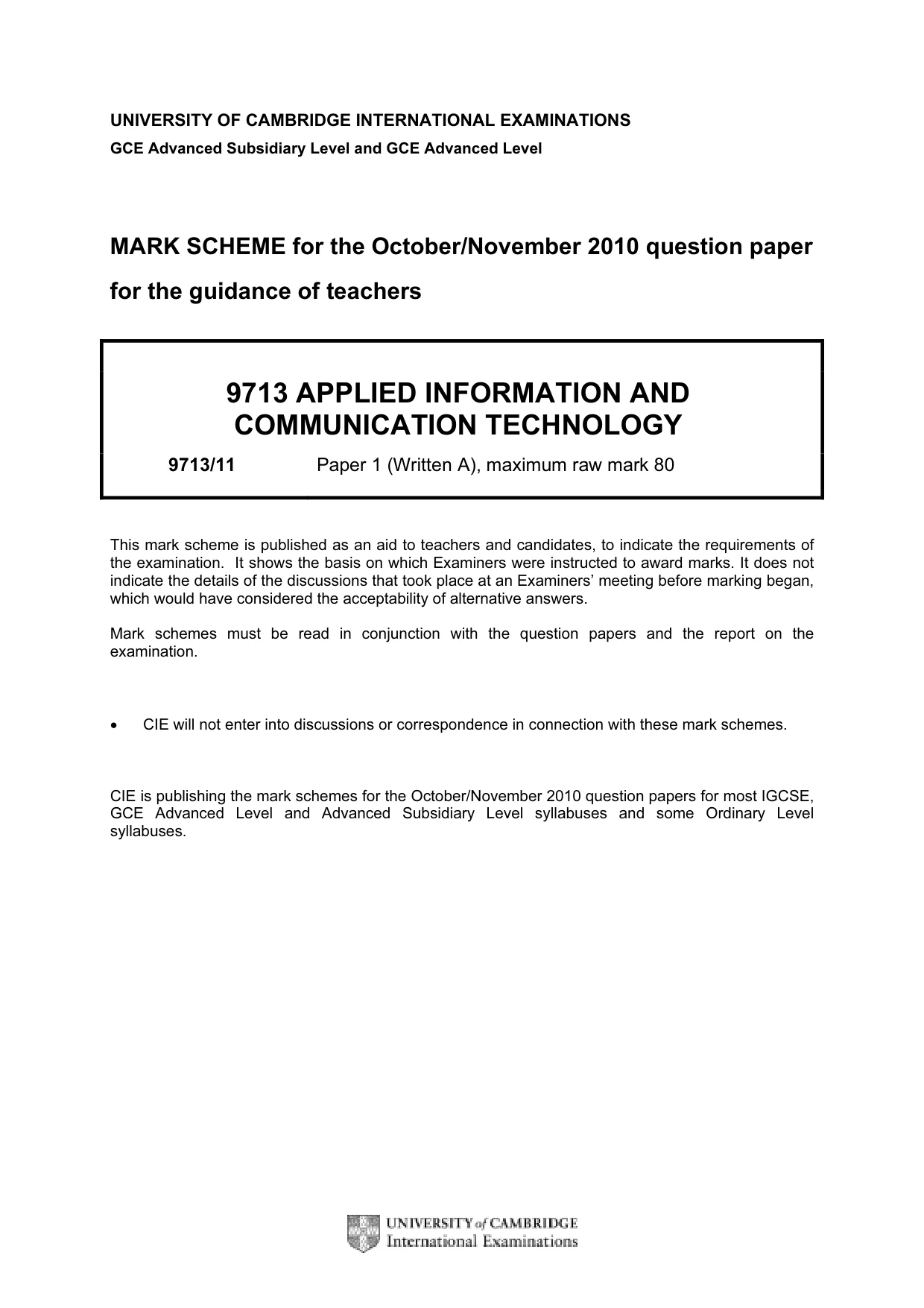
UNIVERSITY OF CAMBRIDGE INTERNATIONAL EXAMINATIONS GCE Advanced Subsidiary Level and GCE Advanced Level MARK SCHEME for the October/November 2010 question paper for the guidance of teachers 9713 APPLIED INFORMATION AND COMMUNICATION TECHNOLOGY 9713/11 Paper 1 (Written A), maximum raw mark 80 This mark scheme is published as an aid to teachers and candidates, to indicate the requirements of the examination. It shows the basis on which Examiners were instructed to award marks. It does not indicate the details of the discussions that took place at an Examiners’ meeting before marking began, which would have considered the acceptability of alternative answers. Mark schemes must be read in conjunction with the question papers and the report on the examination. • CIE will not enter into discussions or correspondence in connection with these mark schemes. CIE is publishing the mark schemes for the October/November 2010 question papers for most IGCSE, GCE Advanced Level and Advanced Subsidiary Level syllabuses and some Ordinary Level syllabuses.
Mark scheme, page 2
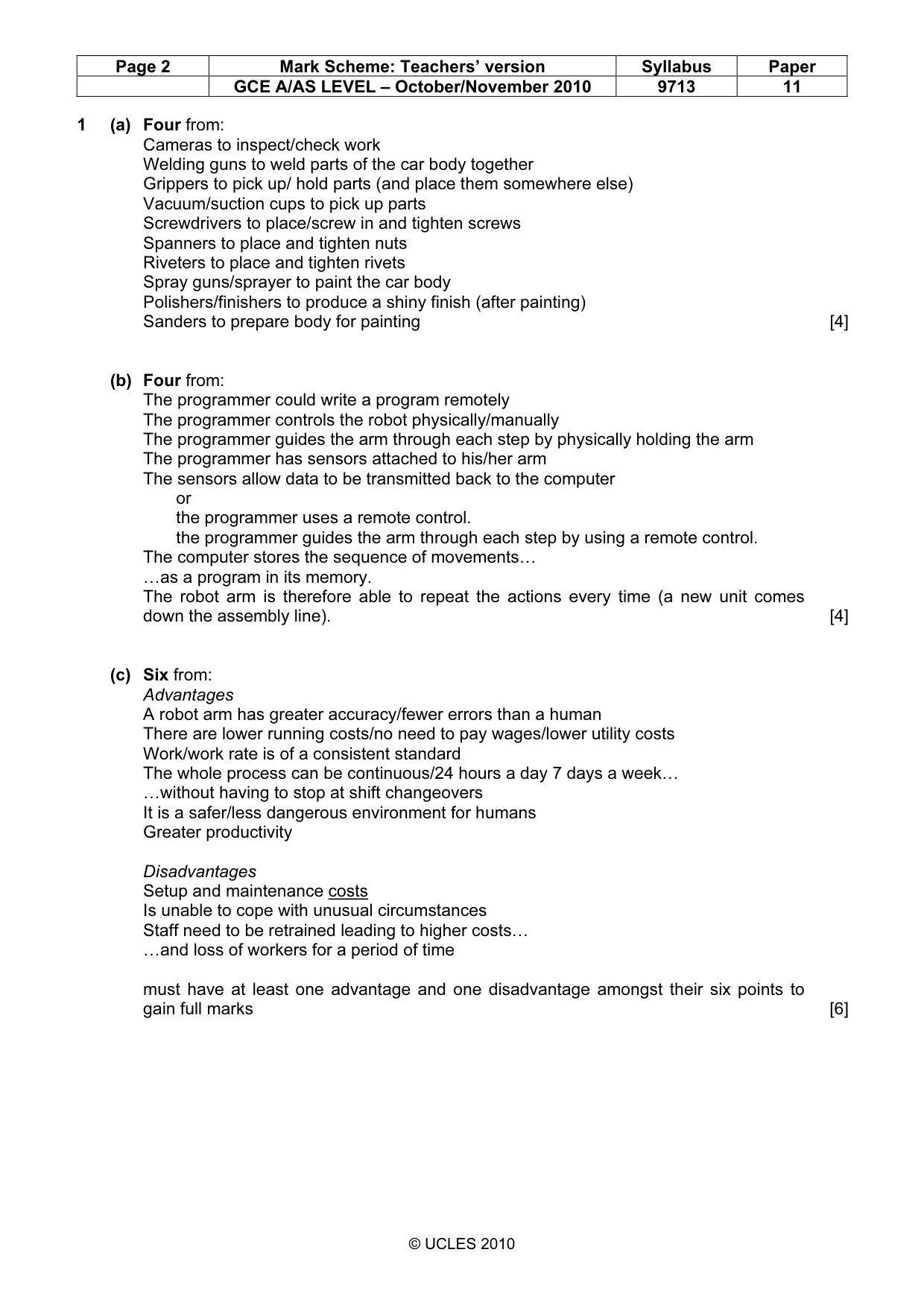
Page 2 Mark Scheme: Teachers’ version Syllabus Paper GCE A/AS LEVEL – October/November 2010 9713 11 © UCLES 2010 1 (a) Four from: Cameras to inspect/check work Welding guns to weld parts of the car body together Grippers to pick up/ hold parts (and place them somewhere else) Vacuum/suction cups to pick up parts Screwdrivers to place/screw in and tighten screws Spanners to place and tighten nuts Riveters to place and tighten rivets Spray guns/sprayer to paint the car body Polishers/finishers to produce a shiny finish (after painting) Sanders to prepare body for painting [4] (b) Four from: The programmer could write a program remotely The programmer controls the robot physically/manually The programmer guides the arm through each step by physically holding the arm The programmer has sensors attached to his/her arm The sensors allow data to be transmitted back to the computer or the programmer uses a remote control. the programmer guides the arm through each step by using a remote control. The computer stores the sequence of movements… …as a program in its memory. The robot arm is therefore able to repeat the actions every time (a new unit comes down the assembly line). [4] (c) Six from: Advantages A robot arm has greater accuracy/fewer errors than a human There are lower running costs/no need to pay wages/lower utility costs Work/work rate is of a consistent standard The whole process can be continuous/24 hours a day 7 days a week… …without having to stop at shift changeovers It is a safer/less dangerous environment for humans Greater productivity Disadvantages Setup and maintenance costs Is unable to cope with unusual circumstances Staff need to be retrained leading to higher costs… …and loss of workers for a period of time must have at least one advantage and one disadvantage amongst their six points to gain full marks [6]
Mark scheme, page 3
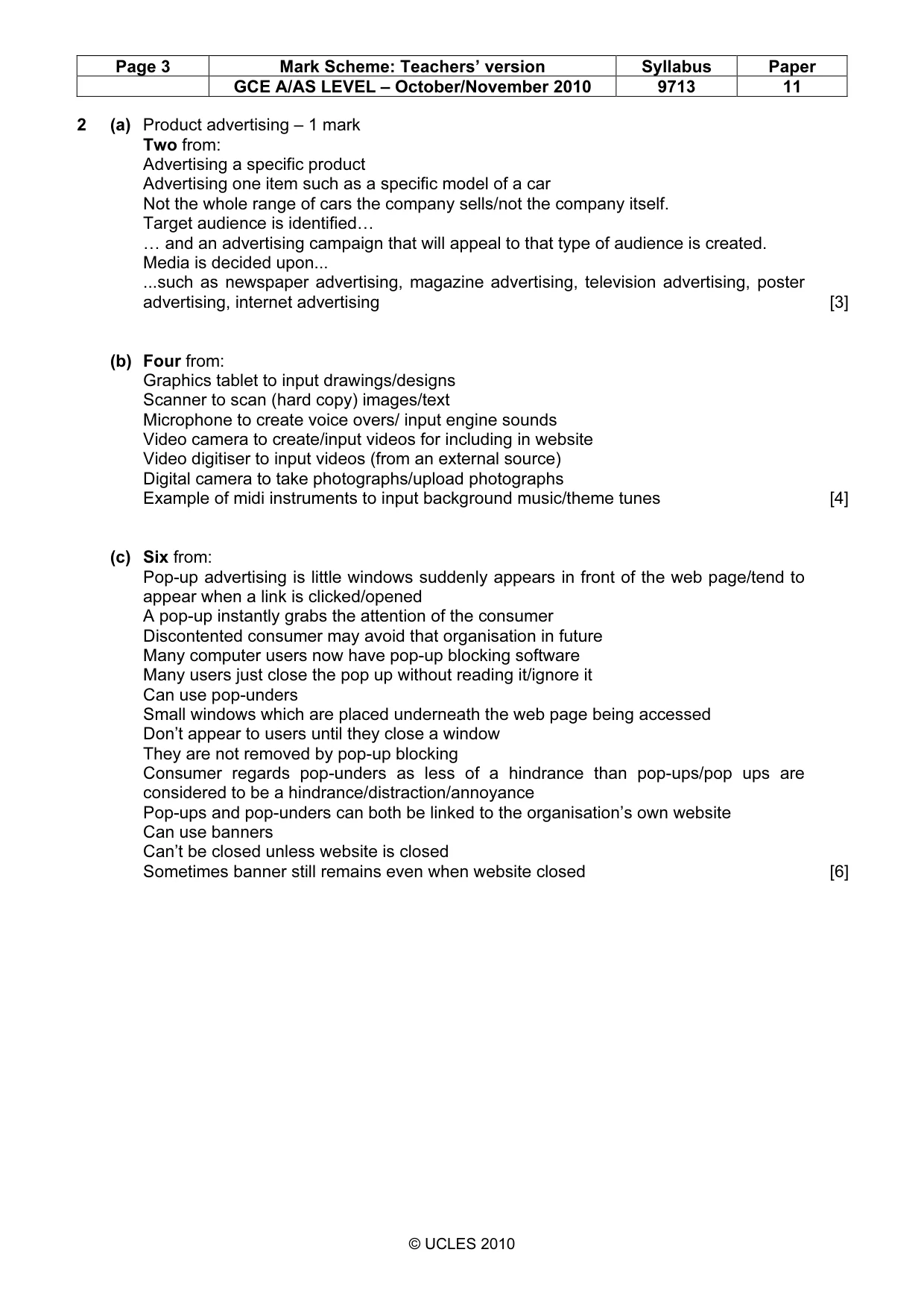
Page 3 Mark Scheme: Teachers’ version Syllabus Paper GCE A/AS LEVEL – October/November 2010 9713 11 © UCLES 2010 2 (a) Product advertising – 1 mark Two from: Advertising a specific product Advertising one item such as a specific model of a car Not the whole range of cars the company sells/not the company itself. Target audience is identified… … and an advertising campaign that will appeal to that type of audience is created. Media is decided upon... ...such as newspaper advertising, magazine advertising, television advertising, poster advertising, internet advertising [3] (b) Four from: Graphics tablet to input drawings/designs Scanner to scan (hard copy) images/text Microphone to create voice overs/ input engine sounds Video camera to create/input videos for including in website Video digitiser to input videos (from an external source) Digital camera to take photographs/upload photographs Example of midi instruments to input background music/theme tunes [4] (c) Six from: Pop-up advertising is little windows suddenly appears in front of the web page/tend to appear when a link is clicked/opened A pop-up instantly grabs the attention of the consumer Discontented consumer may avoid that organisation in future Many computer users now have pop-up blocking software Many users just close the pop up without reading it/ignore it Can use pop-unders Small windows which are placed underneath the web page being accessed Don’t appear to users until they close a window They are not removed by pop-up blocking Consumer regards pop-unders as less of a hindrance than pop-ups/pop ups are considered to be a hindrance/distraction/annoyance Pop-ups and pop-unders can both be linked to the organisation’s own website Can use banners Can’t be closed unless website is closed Sometimes banner still remains even when website closed [6]
Mark scheme, page 4
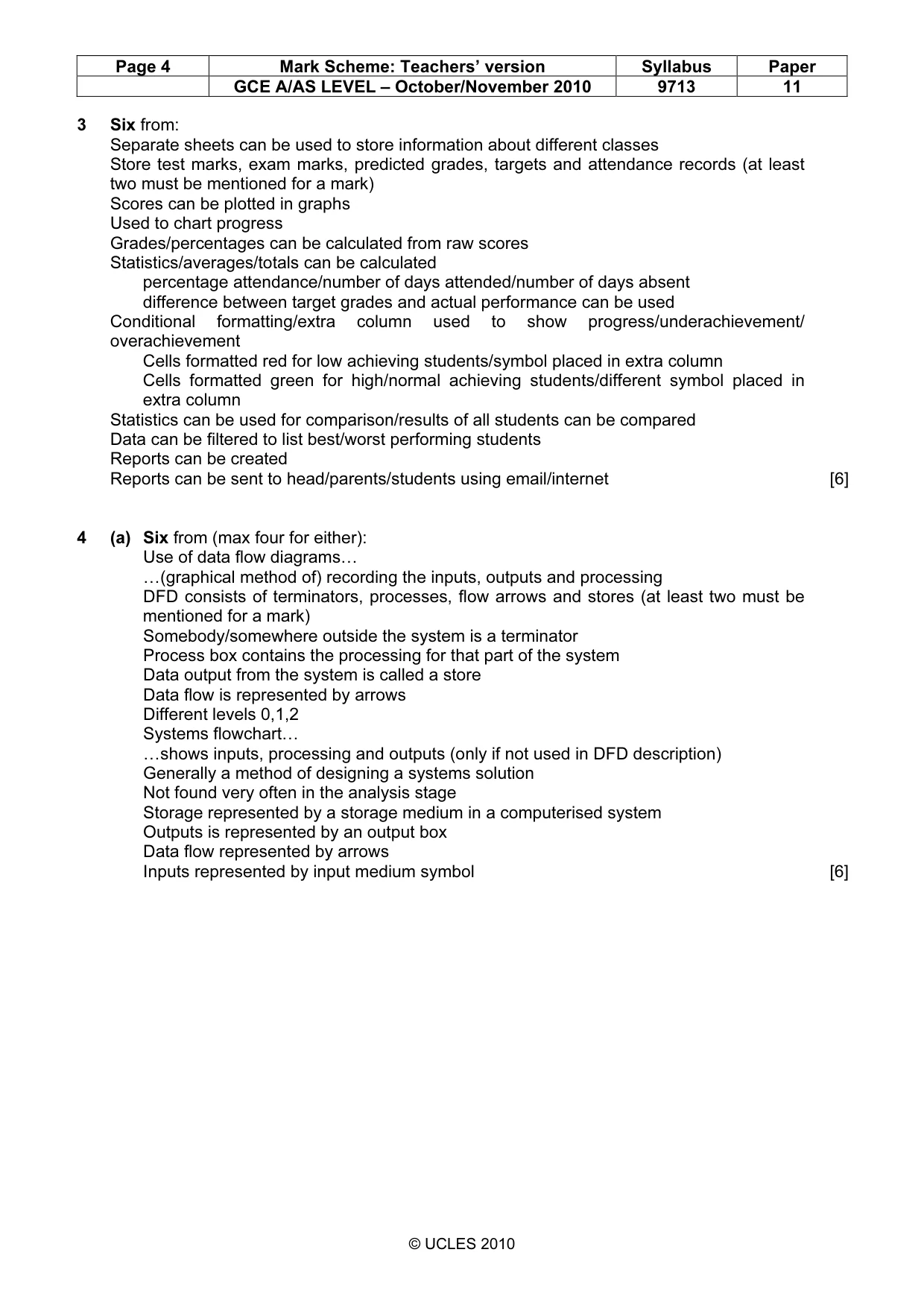
Page 4 Mark Scheme: Teachers’ version Syllabus Paper GCE A/AS LEVEL – October/November 2010 9713 11 © UCLES 2010 3 Six from: Separate sheets can be used to store information about different classes Store test marks, exam marks, predicted grades, targets and attendance records (at least two must be mentioned for a mark) Scores can be plotted in graphs Used to chart progress Grades/percentages can be calculated from raw scores Statistics/averages/totals can be calculated percentage attendance/number of days attended/number of days absent difference between target grades and actual performance can be used Conditional formatting/extra column used to show progress/underachievement/ overachievement Cells formatted red for low achieving students/symbol placed in extra column Cells formatted green for high/normal achieving students/different symbol placed in extra column Statistics can be used for comparison/results of all students can be compared Data can be filtered to list best/worst performing students Reports can be created Reports can be sent to head/parents/students using email/internet [6] 4 (a) Six from (max four for either): Use of data flow diagrams… …(graphical method of) recording the inputs, outputs and processing DFD consists of terminators, processes, flow arrows and stores (at least two must be mentioned for a mark) Somebody/somewhere outside the system is a terminator Process box contains the processing for that part of the system Data output from the system is called a store Data flow is represented by arrows Different levels 0,1,2 Systems flowchart… …shows inputs, processing and outputs (only if not used in DFD description) Generally a method of designing a systems solution Not found very often in the analysis stage Storage represented by a storage medium in a computerised system Outputs is represented by an output box Data flow represented by arrows Inputs represented by input medium symbol [6]
Mark scheme, page 5
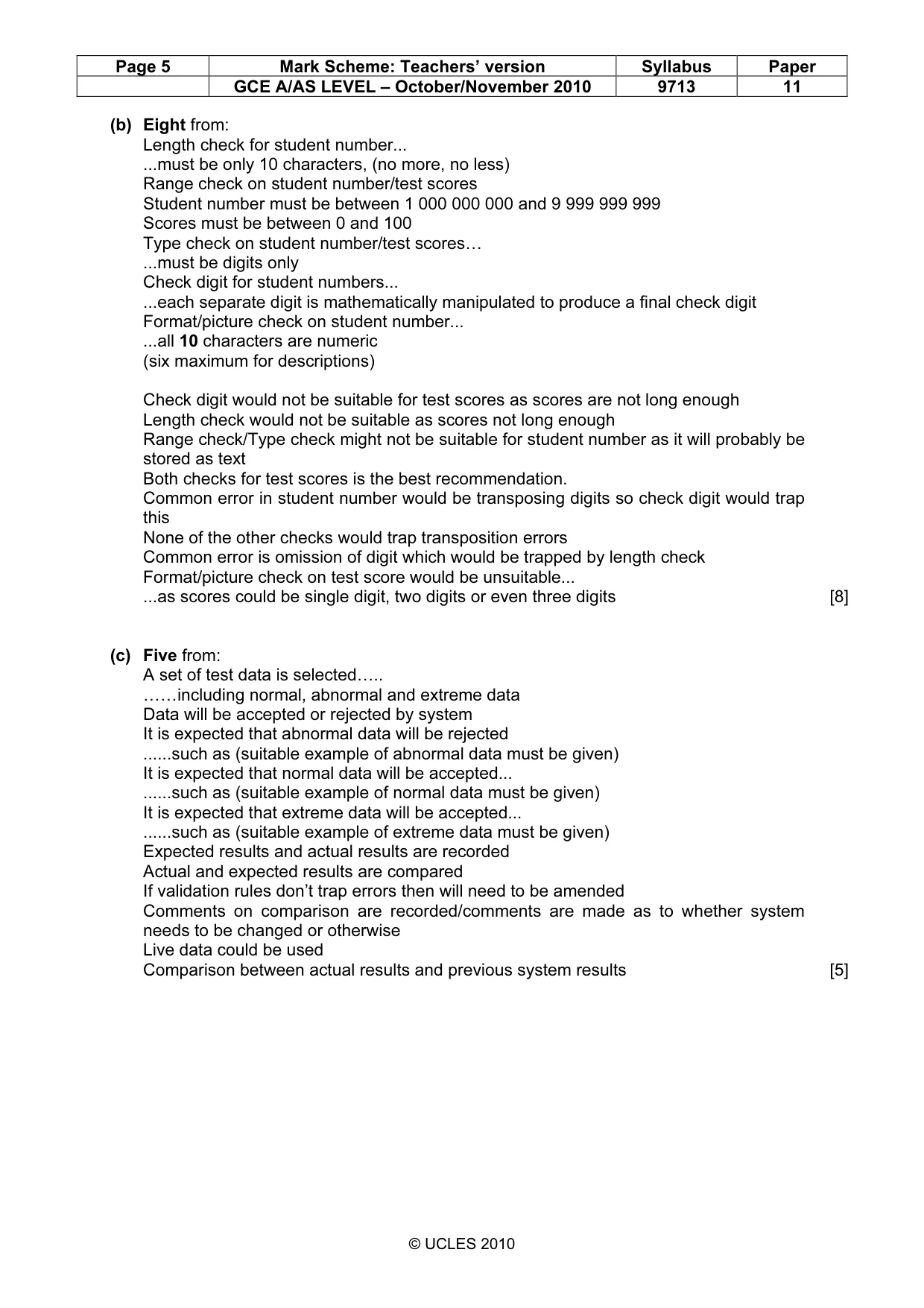
Page 5 Mark Scheme: Teachers’ version Syllabus Paper GCE A/AS LEVEL – October/November 2010 9713 11 © UCLES 2010 (b) Eight from: Length check for student number... ...must be only 10 characters, (no more, no less) Range check on student number/test scores Student number must be between 1 000 000 000 and 9 999 999 999 Scores must be between 0 and 100 Type check on student number/test scores… ...must be digits only Check digit for student numbers... ...each separate digit is mathematically manipulated to produce a final check digit Format/picture check on student number... ...all 10 characters are numeric (six maximum for descriptions) Check digit would not be suitable for test scores as scores are not long enough Length check would not be suitable as scores not long enough Range check/Type check might not be suitable for student number as it will probably be stored as text Both checks for test scores is the best recommendation. Common error in student number would be transposing digits so check digit would trap this None of the other checks would trap transposition errors Common error is omission of digit which would be trapped by length check Format/picture check on test score would be unsuitable... ...as scores could be single digit, two digits or even three digits [8] (c) Five from: A set of test data is selected….. ……including normal, abnormal and extreme data Data will be accepted or rejected by system It is expected that abnormal data will be rejected …such as (suitable example of abnormal data must be given) It is expected that normal data will be accepted... …such as (suitable example of normal data must be given) It is expected that extreme data will be accepted... …such as (suitable example of extreme data must be given) Expected results and actual results are recorded Actual and expected results are compared If validation rules don’t trap errors then will need to be amended Comments on comparison are recorded/comments are made as to whether system needs to be changed or otherwise Live data could be used Comparison between actual results and previous system results [5]
Mark scheme, page 6
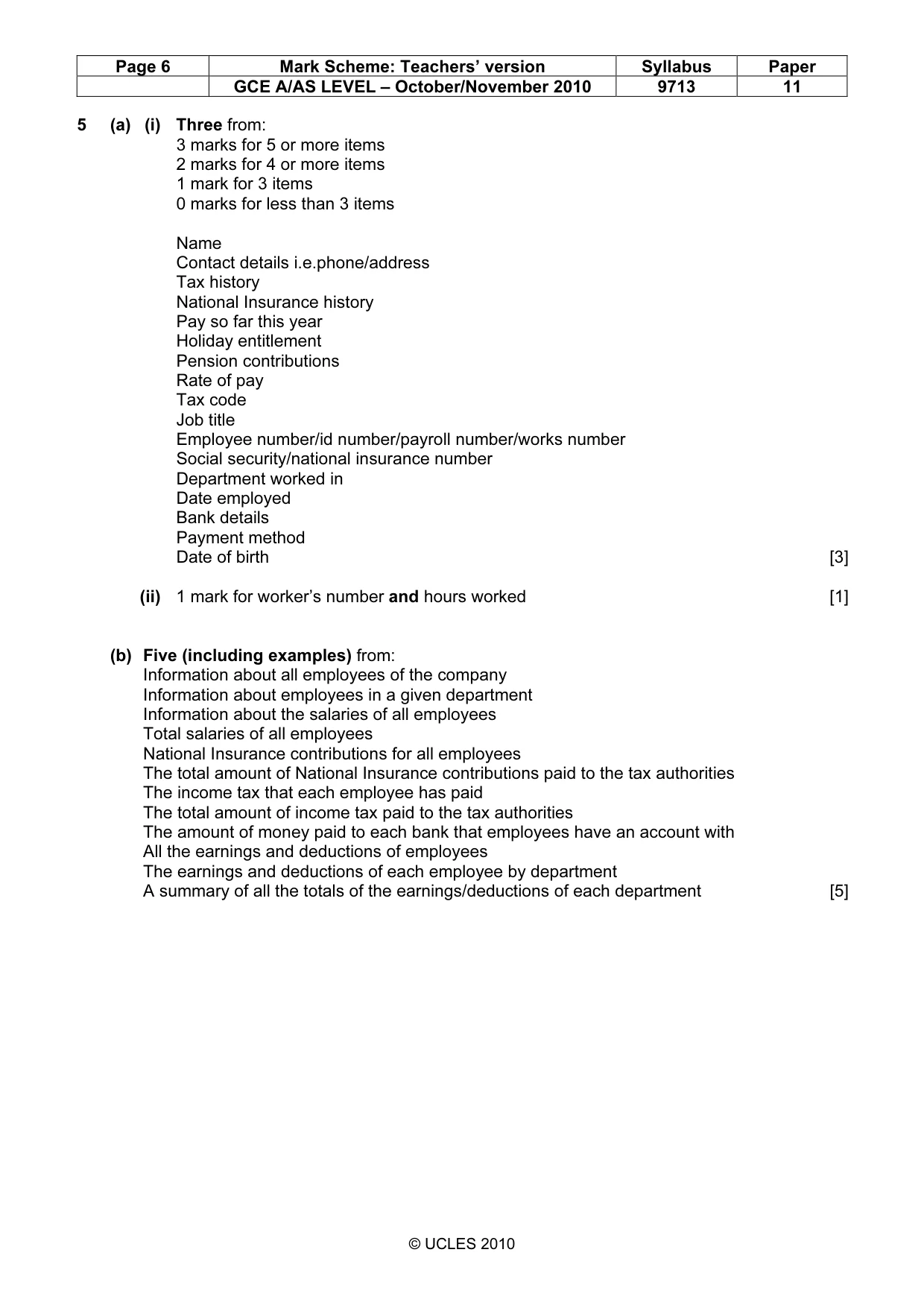
Page 6 Mark Scheme: Teachers’ version Syllabus Paper GCE A/AS LEVEL – October/November 2010 9713 11 © UCLES 2010 5 (a) (i) Three from: 3 marks for 5 or more items 2 marks for 4 or more items 1 mark for 3 items 0 marks for less than 3 items Name Contact details i.e.phone/address Tax history National Insurance history Pay so far this year Holiday entitlement Pension contributions Rate of pay Tax code Job title Employee number/id number/payroll number/works number Social security/national insurance number Department worked in Date employed Bank details Payment method Date of birth [3] (ii) 1 mark for worker’s number and hours worked [1] (b) Five (including examples) from: Information about all employees of the company Information about employees in a given department Information about the salaries of all employees Total salaries of all employees National Insurance contributions for all employees The total amount of National Insurance contributions paid to the tax authorities The income tax that each employee has paid The total amount of income tax paid to the tax authorities The amount of money paid to each bank that employees have an account with All the earnings and deductions of employees The earnings and deductions of each employee by department A summary of all the totals of the earnings/deductions of each department [5]
Mark scheme, page 7
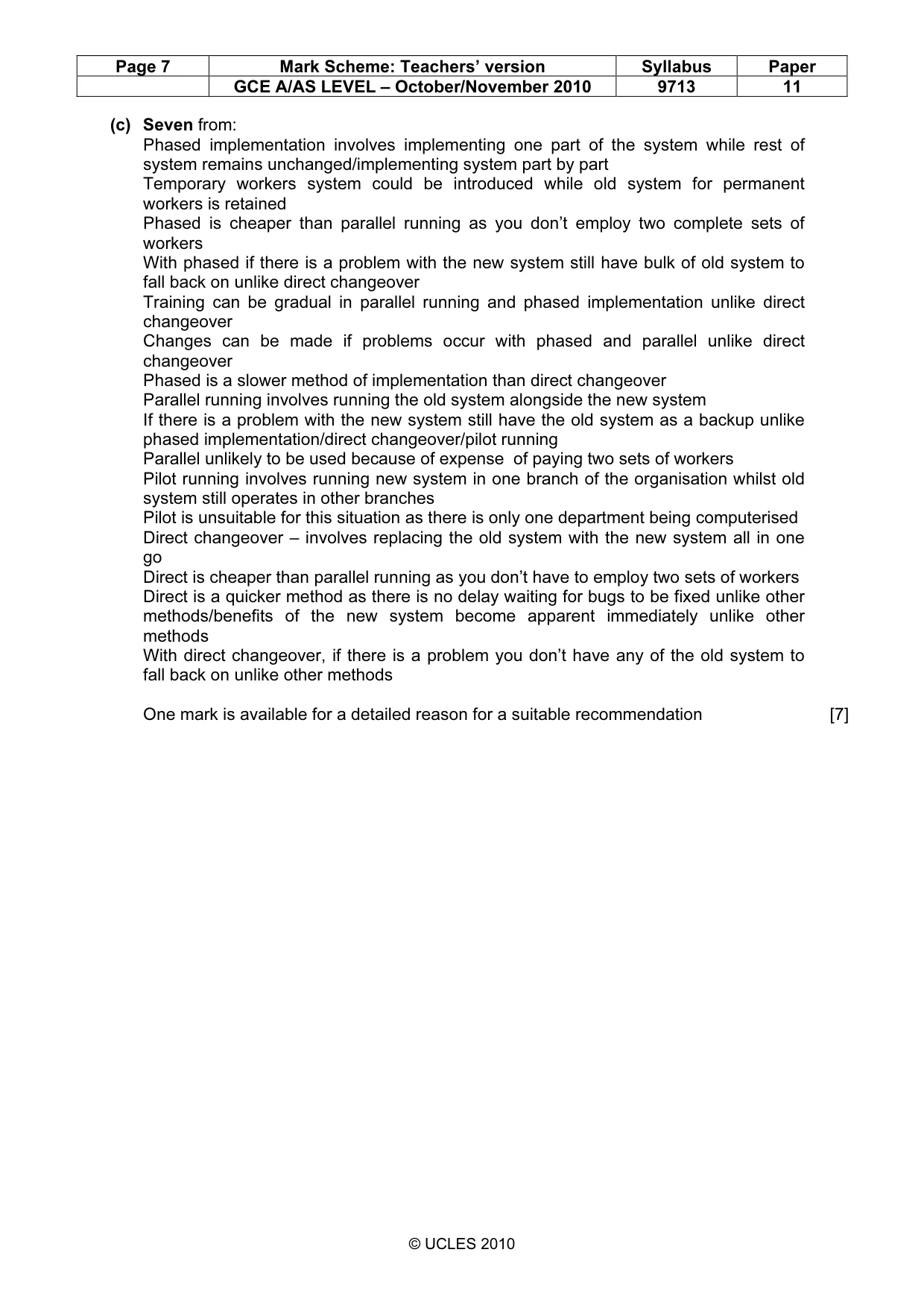
Page 7 Mark Scheme: Teachers’ version Syllabus Paper GCE A/AS LEVEL – October/November 2010 9713 11 © UCLES 2010 (c) Seven from: Phased implementation involves implementing one part of the system while rest of system remains unchanged/implementing system part by part Temporary workers system could be introduced while old system for permanent workers is retained Phased is cheaper than parallel running as you don’t employ two complete sets of workers With phased if there is a problem with the new system still have bulk of old system to fall back on unlike direct changeover Training can be gradual in parallel running and phased implementation unlike direct changeover Changes can be made if problems occur with phased and parallel unlike direct changeover Phased is a slower method of implementation than direct changeover Parallel running involves running the old system alongside the new system If there is a problem with the new system still have the old system as a backup unlike phased implementation/direct changeover/pilot running Parallel unlikely to be used because of expense of paying two sets of workers Pilot running involves running new system in one branch of the organisation whilst old system still operates in other branches Pilot is unsuitable for this situation as there is only one department being computerised Direct changeover – involves replacing the old system with the new system all in one go Direct is cheaper than parallel running as you don’t have to employ two sets of workers Direct is a quicker method as there is no delay waiting for bugs to be fixed unlike other methods/benefits of the new system become apparent immediately unlike other methods With direct changeover, if there is a problem you don’t have any of the old system to fall back on unlike other methods One mark is available for a detailed reason for a suitable recommendation [7]
Mark scheme, page 8
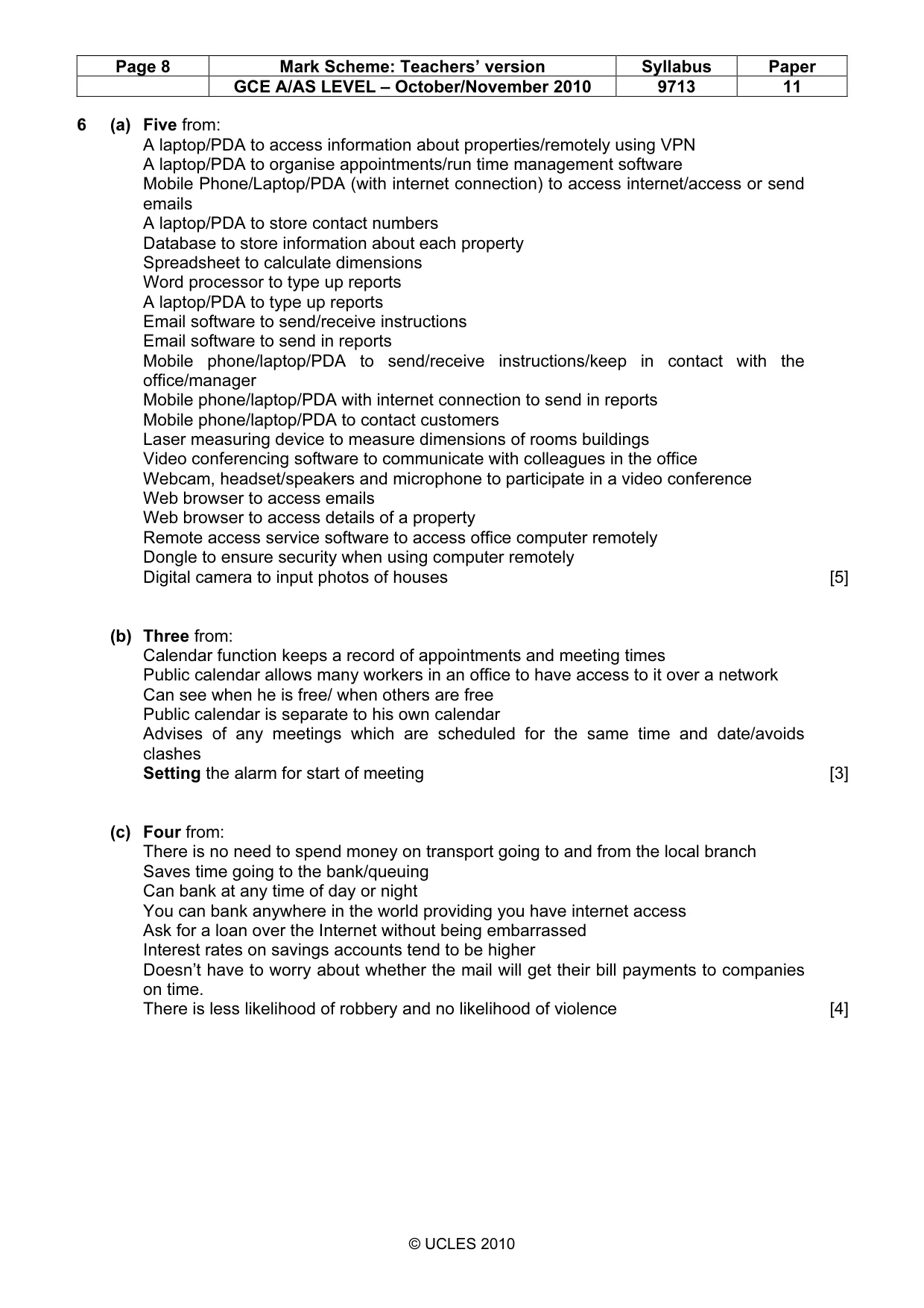
Page 8 Mark Scheme: Teachers’ version Syllabus Paper GCE A/AS LEVEL – October/November 2010 9713 11 © UCLES 2010 6 (a) Five from: A laptop/PDA to access information about properties/remotely using VPN A laptop/PDA to organise appointments/run time management software Mobile Phone/Laptop/PDA (with internet connection) to access internet/access or send emails A laptop/PDA to store contact numbers Database to store information about each property Spreadsheet to calculate dimensions Word processor to type up reports A laptop/PDA to type up reports Email software to send/receive instructions Email software to send in reports Mobile phone/laptop/PDA to send/receive instructions/keep in contact with the office/manager Mobile phone/laptop/PDA with internet connection to send in reports Mobile phone/laptop/PDA to contact customers Laser measuring device to measure dimensions of rooms buildings Video conferencing software to communicate with colleagues in the office Webcam, headset/speakers and microphone to participate in a video conference Web browser to access emails Web browser to access details of a property Remote access service software to access office computer remotely Dongle to ensure security when using computer remotely Digital camera to input photos of houses [5] (b) Three from: Calendar function keeps a record of appointments and meeting times Public calendar allows many workers in an office to have access to it over a network Can see when he is free/ when others are free Public calendar is separate to his own calendar Advises of any meetings which are scheduled for the same time and date/avoids clashes Setting the alarm for start of meeting [3] (c) Four from: There is no need to spend money on transport going to and from the local branch Saves time going to the bank/queuing Can bank at any time of day or night You can bank anywhere in the world providing you have internet access Ask for a loan over the Internet without being embarrassed Interest rates on savings accounts tend to be higher Doesn’t have to worry about whether the mail will get their bill payments to companies on time. There is less likelihood of robbery and no likelihood of violence [4]
What you needed in this session
Cambridge’s own grade thresholds for 2010 Oct/Nov, Paper 1 · Variant 1. A higher threshold means an easier paper — the bar moves with how the cohort did.