Cambridge A Level Afrikaans 9679 — 2019 Oct/Nov Paper 2 · Variant 1
9679/21/O/N/19 · 70 marks · ≈79 min
The question paper and its mark scheme, free to read here and free to download. This is Cambridge’s own paper, exactly as it was sat.
Question paper12 pages


Mark scheme11 pages
Answers below. Sit the paper first if you are practising.
Paper as text
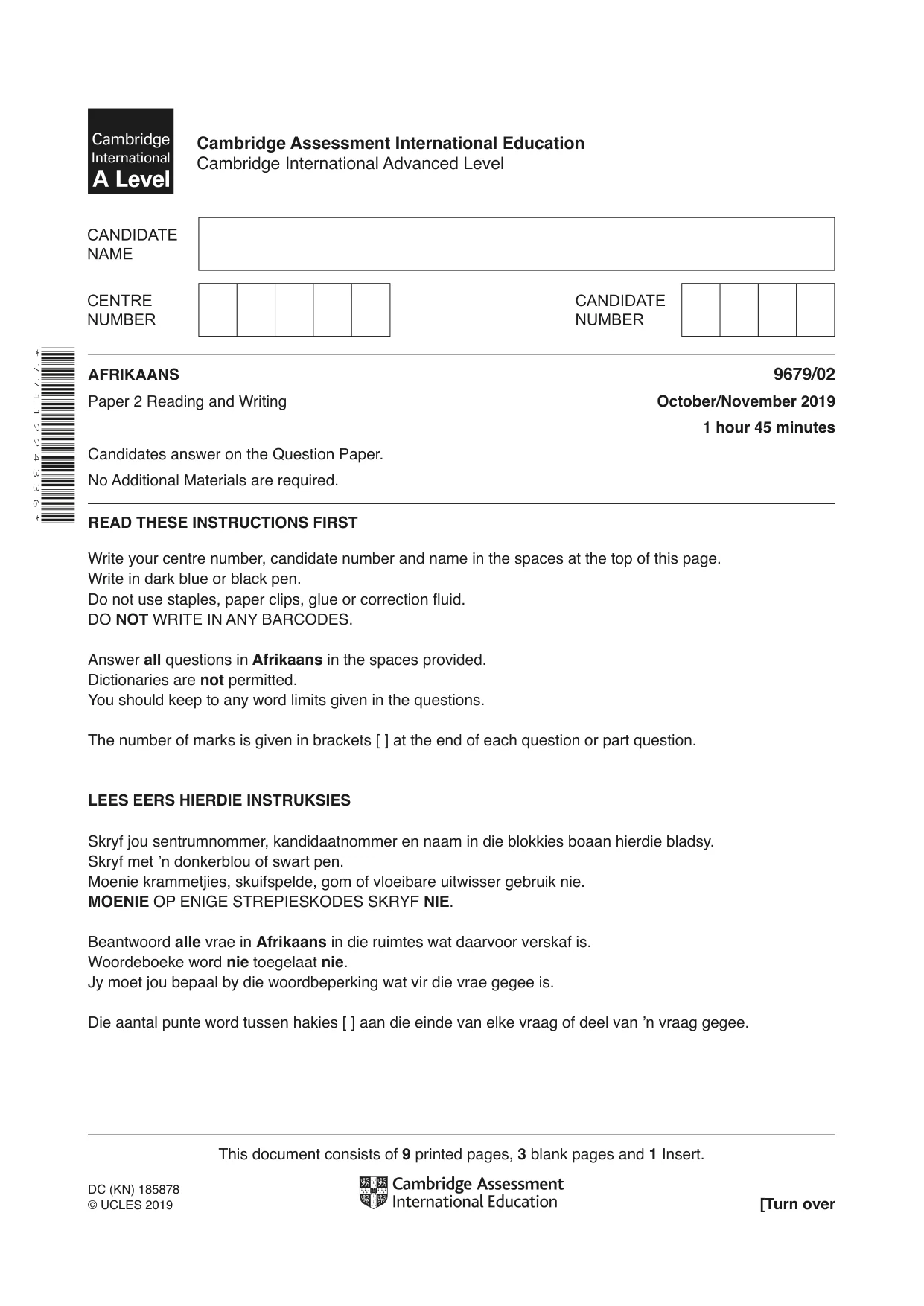
Question paper, page 1
This document consists of 9 printed pages, 3 blank pages and 1 Insert. DC (KN) 185878 © UCLES 2019 [Turn over Cambridge Assessment International Education Cambridge International Advanced Level * 7 7 1 1 2 2 4 3 3 6 * AFRIKAANS 9679/02 Paper 2 Reading and Writing October/November 2019 1 hour 45 minutes Candidates answer on the Question Paper. No Additional Materials are required. READ THESE INSTRUCTIONS FIRST Write your centre number, candidate number and name in the spaces at the top of this page. Write in dark blue or black pen. Do not use staples, paper clips, glue or correction fluid. DO NOT WRITE IN ANY BARCODES. Answer all questions in Afrikaans in the spaces provided. Dictionaries are not permitted. You should keep to any word limits given in the questions. The number of marks is given in brackets [ ] at the end of each question or part question. LEES EERS HIERDIE INSTRUKSIES Skryf jou sentrumnommer, kandidaatnommer en naam in die blokkies boaan hierdie bladsy. Skryf met ’n donkerblou of swart pen. Moenie krammetjies, skuifspelde, gom of vloeibare uitwisser gebruik nie. MOENIE OP ENIGE STREPIESKODES SKRYF NIE. Beantwoord alle vrae in Afrikaans in die ruimtes wat daarvoor verskaf is. Woordeboeke word nie toegelaat nie. Jy moet jou bepaal by die woordbeperking wat vir die vrae gegee is. Die aantal punte word tussen hakies [ ] aan die einde van elke vraag of deel van ’n vraag gegee.
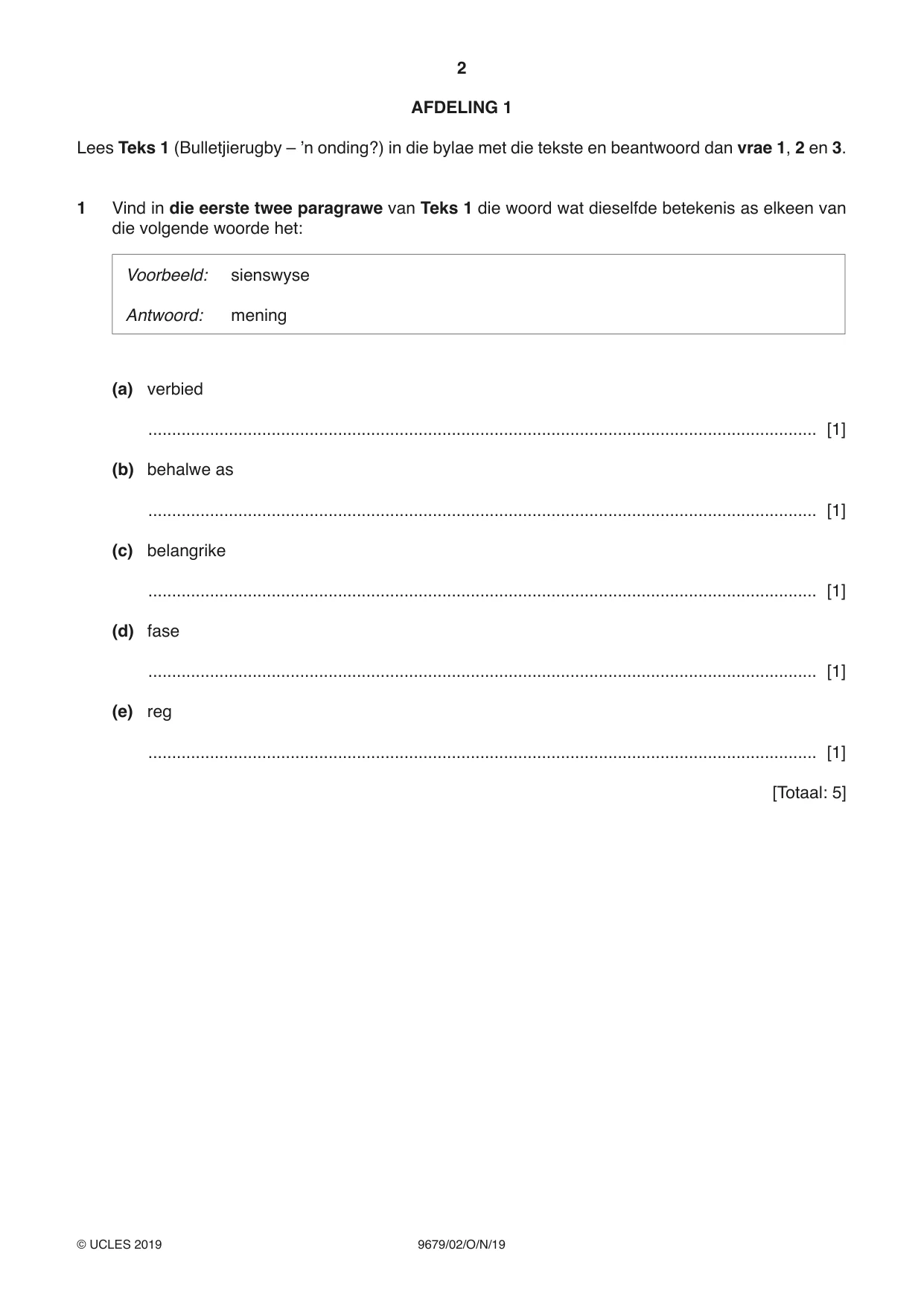
Question paper, page 2
2 9679/02/O/N/19 © UCLES 2019 AFDELING 1 Lees Teks 1 (Bulletjierugby – ’n onding?) in die bylae met die tekste en beantwoord dan vrae 1, 2 en 3. 1 Vind in die eerste twee paragrawe van Teks 1 die woord wat dieselfde betekenis as elkeen van die volgende woorde het: Voorbeeld: sienswyse Antwoord: mening (a) verbied … [1] (b) behalwe as … [1] (c) belangrike … [1] (d) fase … [1] (e) reg … [1] [Totaal: 5]
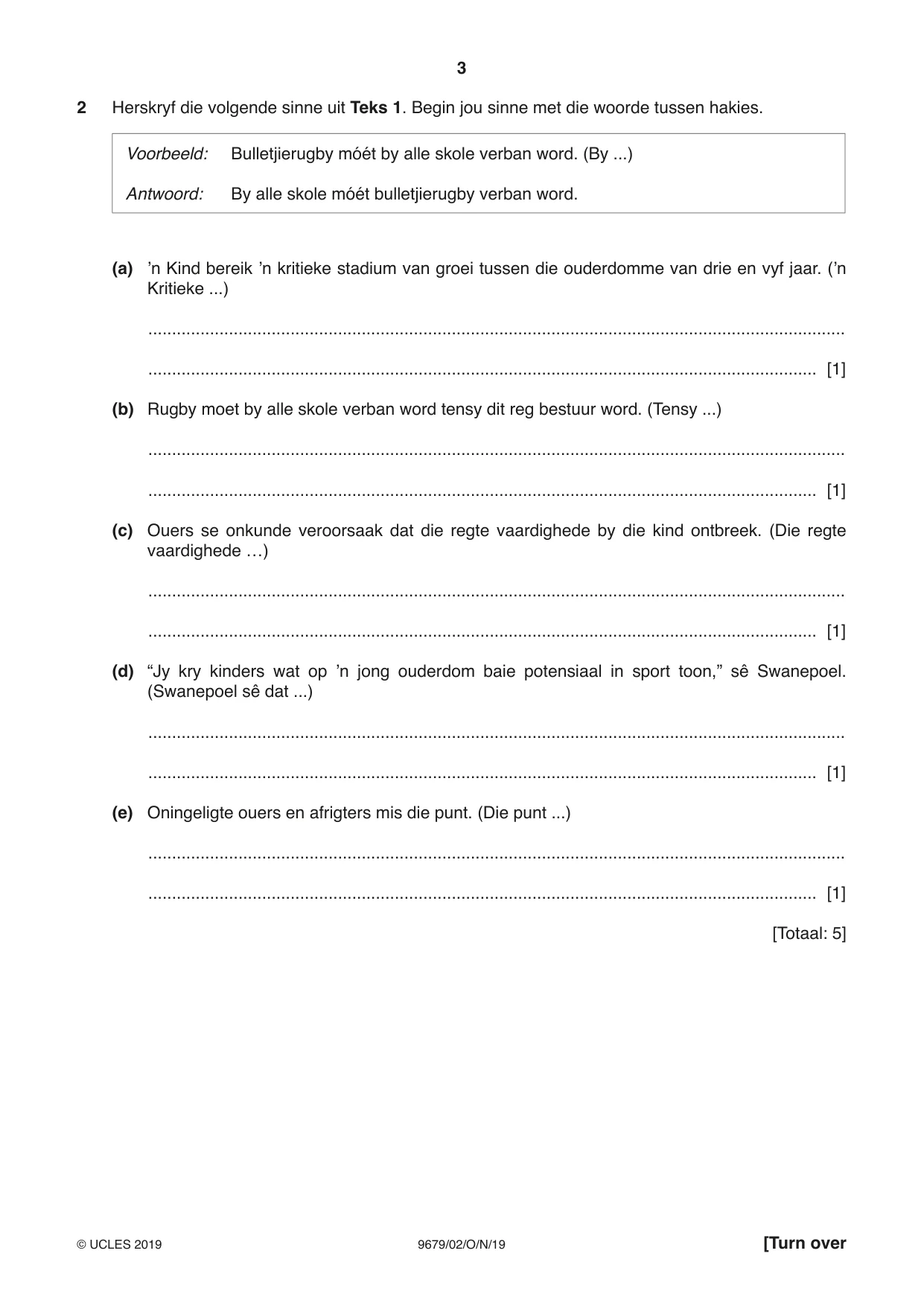
Question paper, page 3
3 9679/02/O/N/19 © UCLES 2019 [Turn over 2 Herskryf die volgende sinne uit Teks 1. Begin jou sinne met die woorde tussen hakies. Voorbeeld: Bulletjierugby móét by alle skole verban word. (By ...) Antwoord: By alle skole móét bulletjierugby verban word. (a) ’n Kind bereik ’n kritieke stadium van groei tussen die ouderdomme van drie en vyf jaar. (’n Kritieke ...) … … [1] (b) Rugby moet by alle skole verban word tensy dit reg bestuur word. (Tensy ...) … … [1] (c) Ouers se onkunde veroorsaak dat die regte vaardighede by die kind ontbreek. (Die regte vaardighede …) … … [1] (d) “Jy kry kinders wat op ’n jong ouderdom baie potensiaal in sport toon,” sê Swanepoel. (Swanepoel sê dat ...) … … [1] (e) Oningeligte ouers en afrigters mis die punt. (Die punt ...) … … [1] [Totaal: 5]
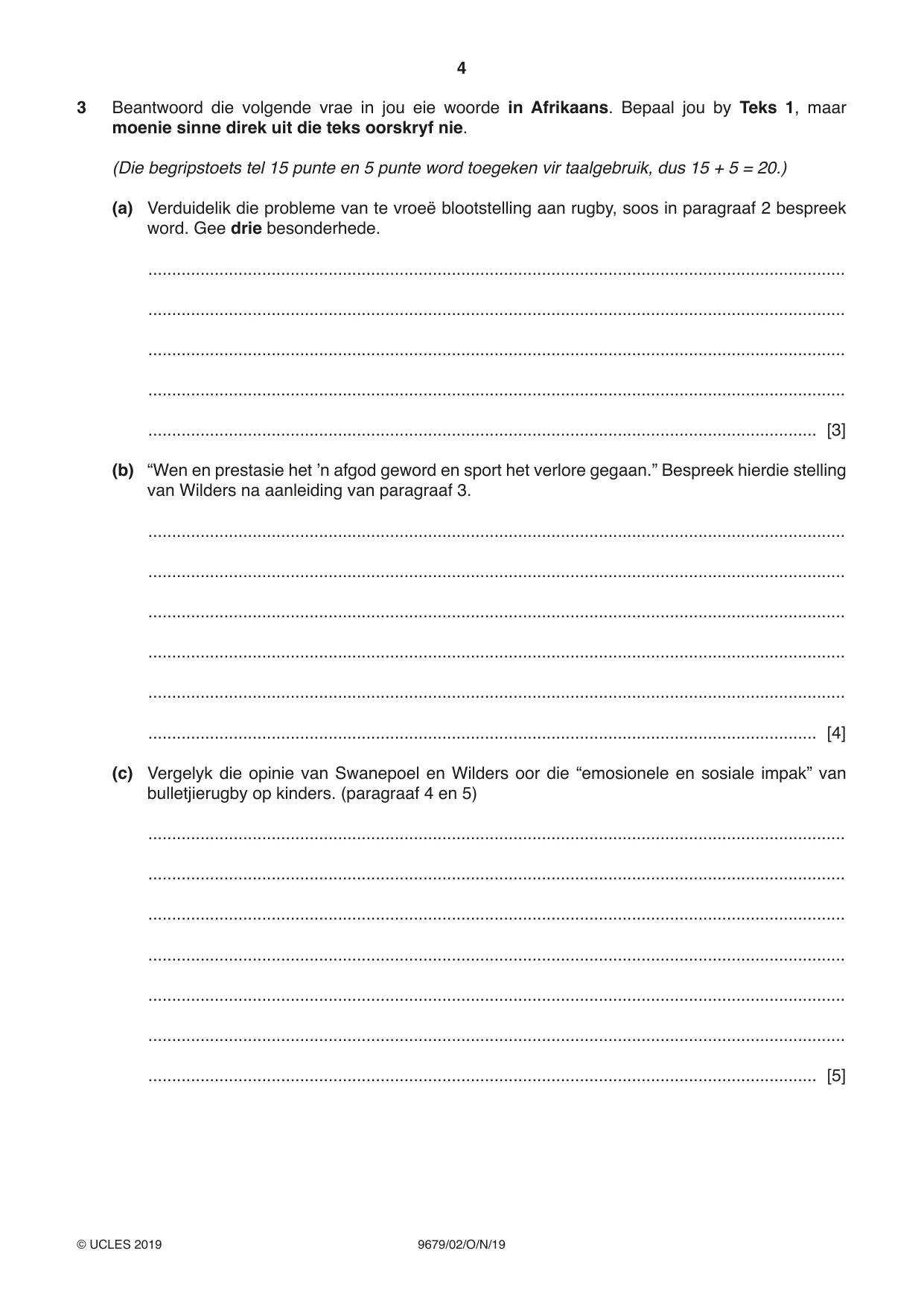
Question paper, page 4
4 9679/02/O/N/19 © UCLES 2019 3 Beantwoord die volgende vrae in jou eie woorde in Afrikaans. Bepaal jou by Teks 1, maar moenie sinne direk uit die teks oorskryf nie. (Die begripstoets tel 15 punte en 5 punte word toegeken vir taalgebruik, dus 15 + 5 = 20.) (a) Verduidelik die probleme van te vroeë blootstelling aan rugby, soos in paragraaf 2 bespreek word. Gee drie besonderhede. … … … … … [3] (b) “Wen en prestasie het ’n afgod geword en sport het verlore gegaan.” Bespreek hierdie stelling van Wilders na aanleiding van paragraaf 3. … … … … … … [4] (c) Vergelyk die opinie van Swanepoel en Wilders oor die “emosionele en sosiale impak” van bulletjierugby op kinders. (paragraaf 4 en 5) … … … … … … … [5]
Question paper, page 5
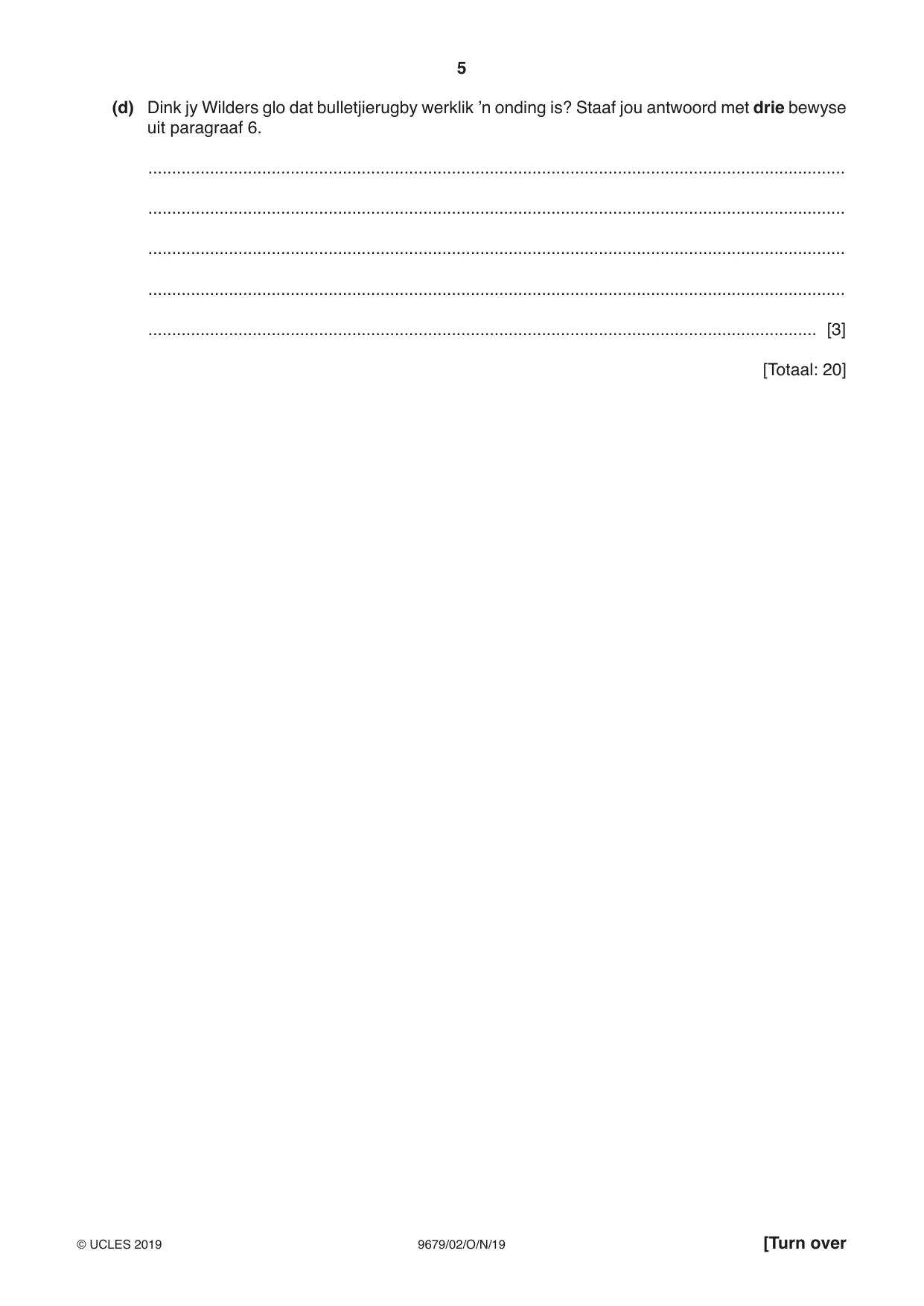
5 9679/02/O/N/19 © UCLES 2019 [Turn over (d) Dink jy Wilders glo dat bulletjierugby werklik ’n onding is? Staaf jou antwoord met drie bewyse uit paragraaf 6. … … … … … [3] [Totaal: 20]
Question paper, page 6
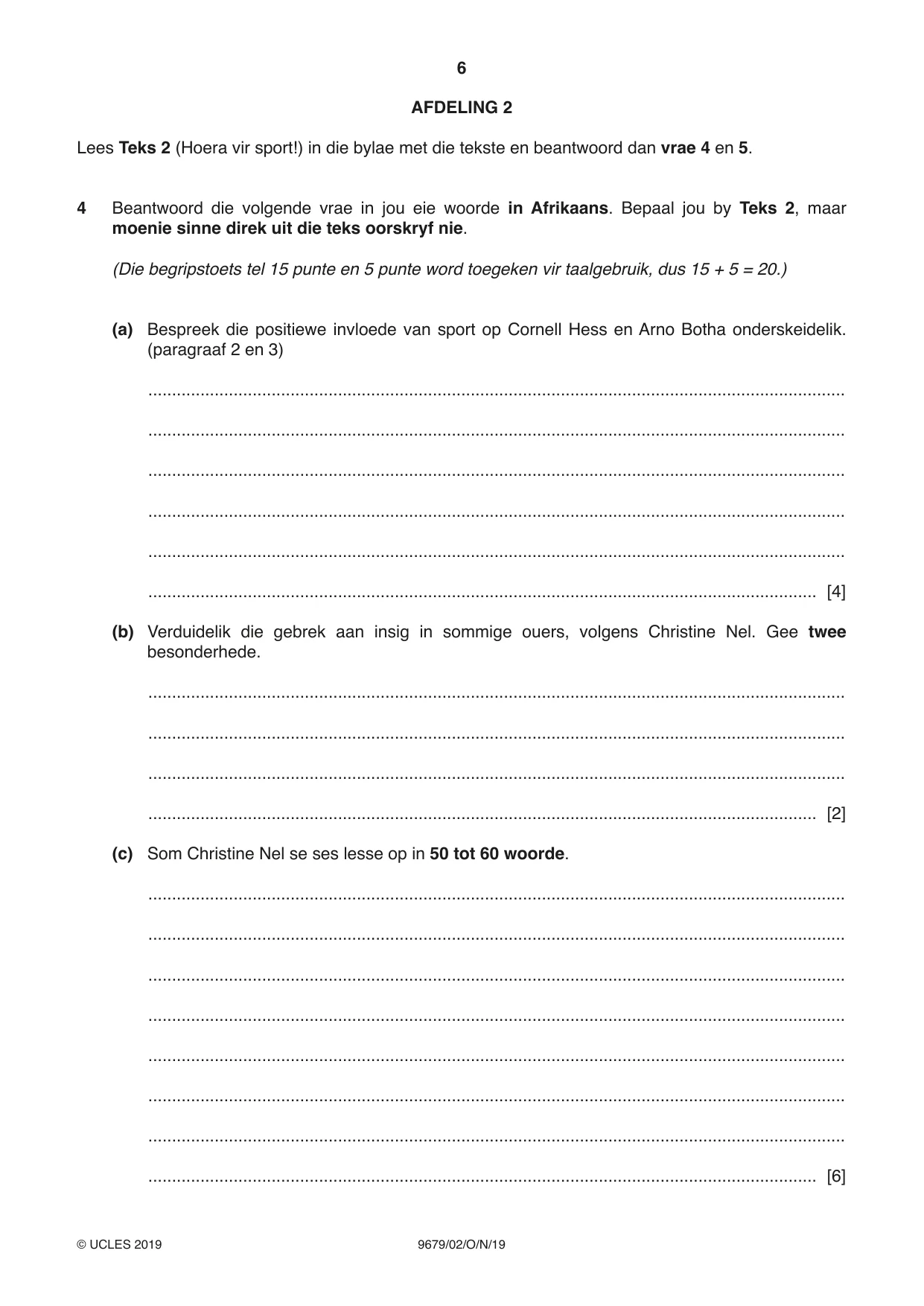
6 9679/02/O/N/19 © UCLES 2019 AFDELING 2 Lees Teks 2 (Hoera vir sport!) in die bylae met die tekste en beantwoord dan vrae 4 en 5. 4 Beantwoord die volgende vrae in jou eie woorde in Afrikaans. Bepaal jou by Teks 2, maar moenie sinne direk uit die teks oorskryf nie. (Die begripstoets tel 15 punte en 5 punte word toegeken vir taalgebruik, dus 15 + 5 = 20.) (a) Bespreek die positiewe invloede van sport op Cornell Hess en Arno Botha onderskeidelik. (paragraaf 2 en 3) … … … … … … [4] (b) Verduidelik die gebrek aan insig in sommige ouers, volgens Christine Nel. Gee twee besonderhede. … … … … [2] (c) Som Christine Nel se ses lesse op in 50 tot 60 woorde. … … … … … … … … [6]
Question paper, page 7
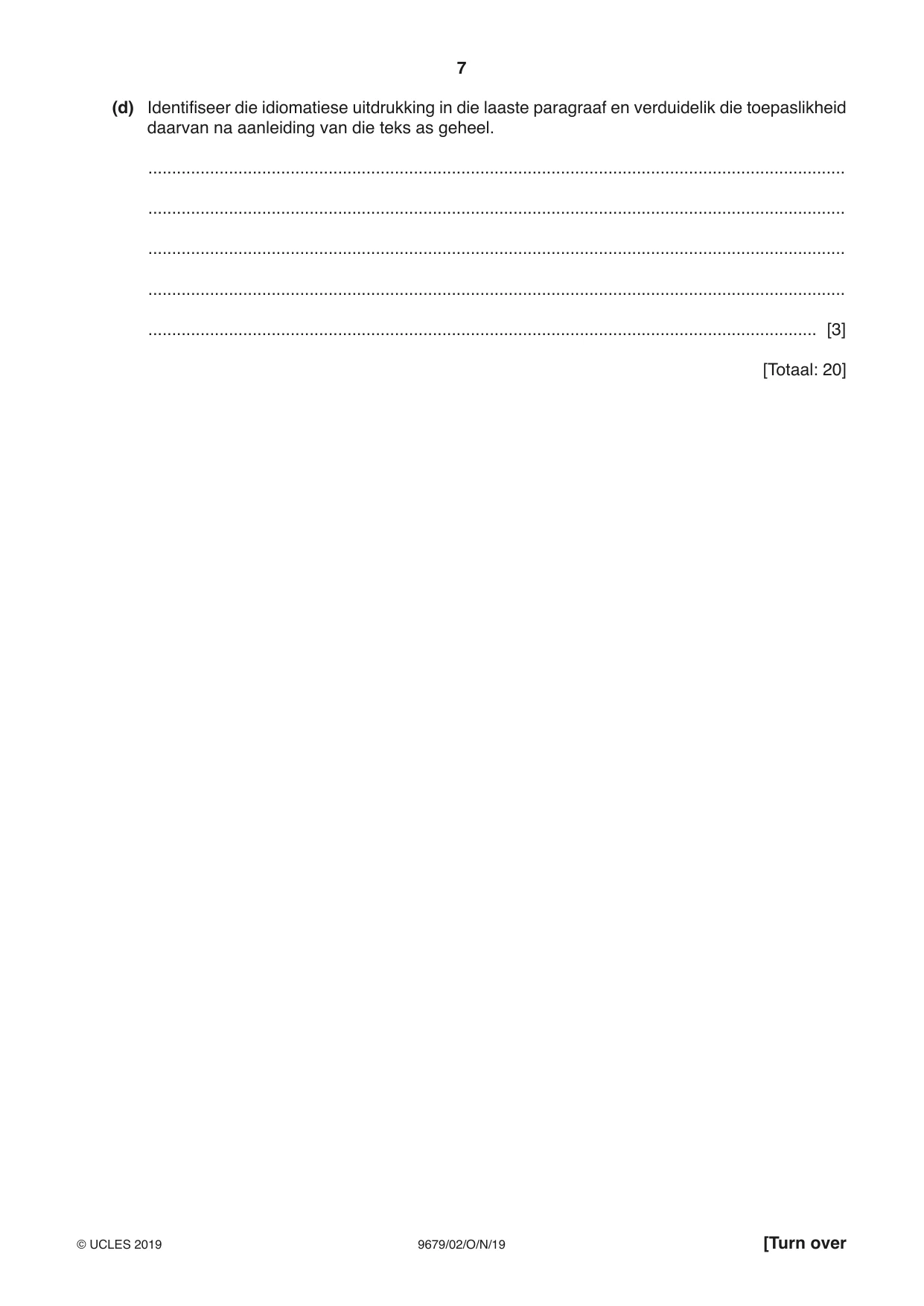
7 9679/02/O/N/19 © UCLES 2019 [Turn over (d) Identifiseer die idiomatiese uitdrukking in die laaste paragraaf en verduidelik die toepaslikheid daarvan na aanleiding van die teks as geheel. … … … … … [3] [Totaal: 20]
Question paper, page 8
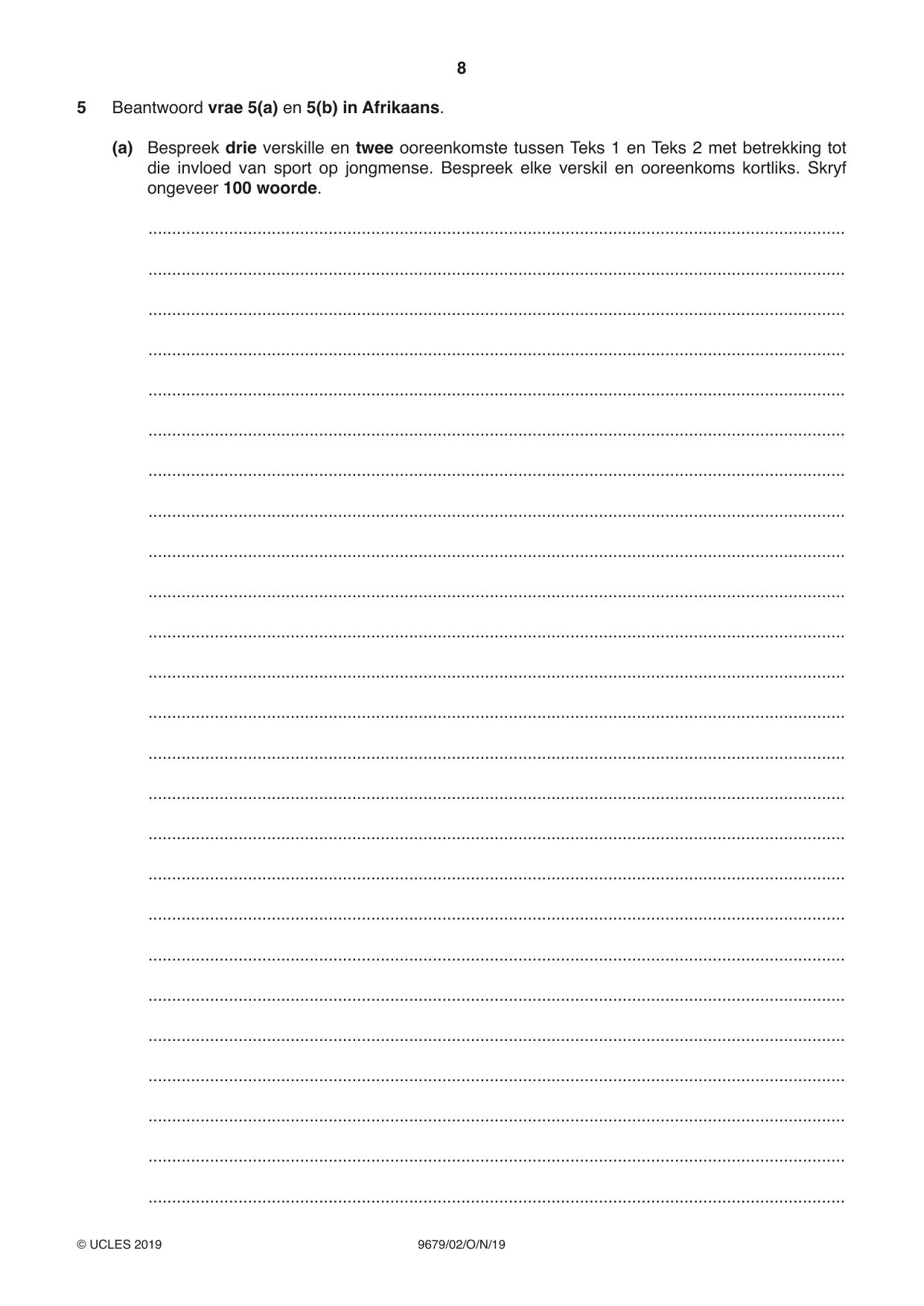
8 9679/02/O/N/19 © UCLES 2019 5 Beantwoord vrae 5(a) en 5(b) in Afrikaans. (a) Bespreek drie verskille en twee ooreenkomste tussen Teks 1 en Teks 2 met betrekking tot die invloed van sport op jongmense. Bespreek elke verskil en ooreenkoms kortliks. Skryf ongeveer 100 woorde. … … … … … … … … … … … … … … … … … … … … … … … … …
Question paper, page 9
9 9679/02/O/N/19 © UCLES 2019 … … … … … [10] (b) Speel sport ’n te groot rol in Suid-Afrika of Namibië op skoolvlak volgens jou? Bespreek jou mening in ongeveer 40 woorde. … … … … … … … … … … [5] [Taalgebruik: 5] [Totaal: 20]
Question paper, page 10
10 9679/02/O/N/19 © UCLES 2019 BLANK PAGE
Question paper, page 11
11 9679/02/O/N/19 © UCLES 2019 BLANK PAGE
Question paper, page 12
12 9679/02/O/N/19 © UCLES 2019 BLANK PAGE Permission to reproduce items where third-party owned material protected by copyright is included has been sought and cleared where possible. Every reasonable effort has been made by the publisher (UCLES) to trace copyright holders, but if any items requiring clearance have unwittingly been included, the publisher will be pleased to make amends at the earliest possible opportunity. To avoid the issue of disclosure of answer-related information to candidates, all copyright acknowledgements are reproduced online in the Cambridge Assessment International Education Copyright Acknowledgements Booklet. This is produced for each series of examinations and is freely available to download at www.cambridgeinternational.org after the live examination series. Cambridge Assessment International Education is part of the Cambridge Assessment Group. Cambridge Assessment is the brand name of the University of Cambridge Local Examinations Syndicate (UCLES), which itself is a department of the University of Cambridge.
Mark scheme, page 1
This document consists of 11 printed pages. © UCLES 2019 [Turn over Cambridge Assessment International Education Cambridge International Advanced Level AFRIKAANS 9679/02 Paper 2 Reading and Writing October/November 2019 MARK SCHEME Maximum Mark: 70 Published This mark scheme is published as an aid to teachers and candidates, to indicate the requirements of the examination. It shows the basis on which Examiners were instructed to award marks. It does not indicate the details of the discussions that took place at an Examiners’ meeting before marking began, which would have considered the acceptability of alternative answers. Mark schemes should be read in conjunction with the question paper and the Principal Examiner Report for Teachers. Cambridge International will not enter into discussions about these mark schemes. Cambridge International is publishing the mark schemes for the October/November 2019 series for most Cambridge IGCSE™, Cambridge International A and AS Level components and some Cambridge O Level components.
Mark scheme, page 2
9679/02 Cambridge International A Level – Mark Scheme PUBLISHED October/November 2019 © UCLES 2019 Page 2 of 11 Generic Marking Principles These general marking principles must be applied by all examiners when marking candidate answers. They should be applied alongside the specific content of the mark scheme or generic level descriptors for a question. Each question paper and mark scheme will also comply with these marking principles. GENERIC MARKING PRINCIPLE 1: Marks must be awarded in line with: • the specific content of the mark scheme or the generic level descriptors for the question • the specific skills defined in the mark scheme or in the generic level descriptors for the question • the standard of response required by a candidate as exemplified by the standardisation scripts. GENERIC MARKING PRINCIPLE 2: Marks awarded are always whole marks (not half marks, or other fractions). GENERIC MARKING PRINCIPLE 3: Marks must be awarded positively: • marks are awarded for correct/valid answers, as defined in the mark scheme. However, credit is given for valid answers which go beyond the scope of the syllabus and mark scheme, referring to your Team Leader as appropriate • marks are awarded when candidates clearly demonstrate what they know and can do • marks are not deducted for errors • marks are not deducted for omissions • answers should only be judged on the quality of spelling, punctuation and grammar when these features are specifically assessed by the question as indicated by the mark scheme. The meaning, however, should be unambiguous. GENERIC MARKING PRINCIPLE 4: Rules must be applied consistently e.g. in situations where candidates have not followed instructions or in the application of generic level descriptors. GENERIC MARKING PRINCIPLE 5: Marks should be awarded using the full range of marks defined in the mark scheme for the question (however; the use of the full mark range may be limited according to the quality of the candidate responses seen). GENERIC MARKING PRINCIPLE 6: Marks awarded are based solely on the requirements as defined in the mark scheme. Marks should not be awarded with grade thresholds or grade descriptors in mind.
Mark scheme, page 3
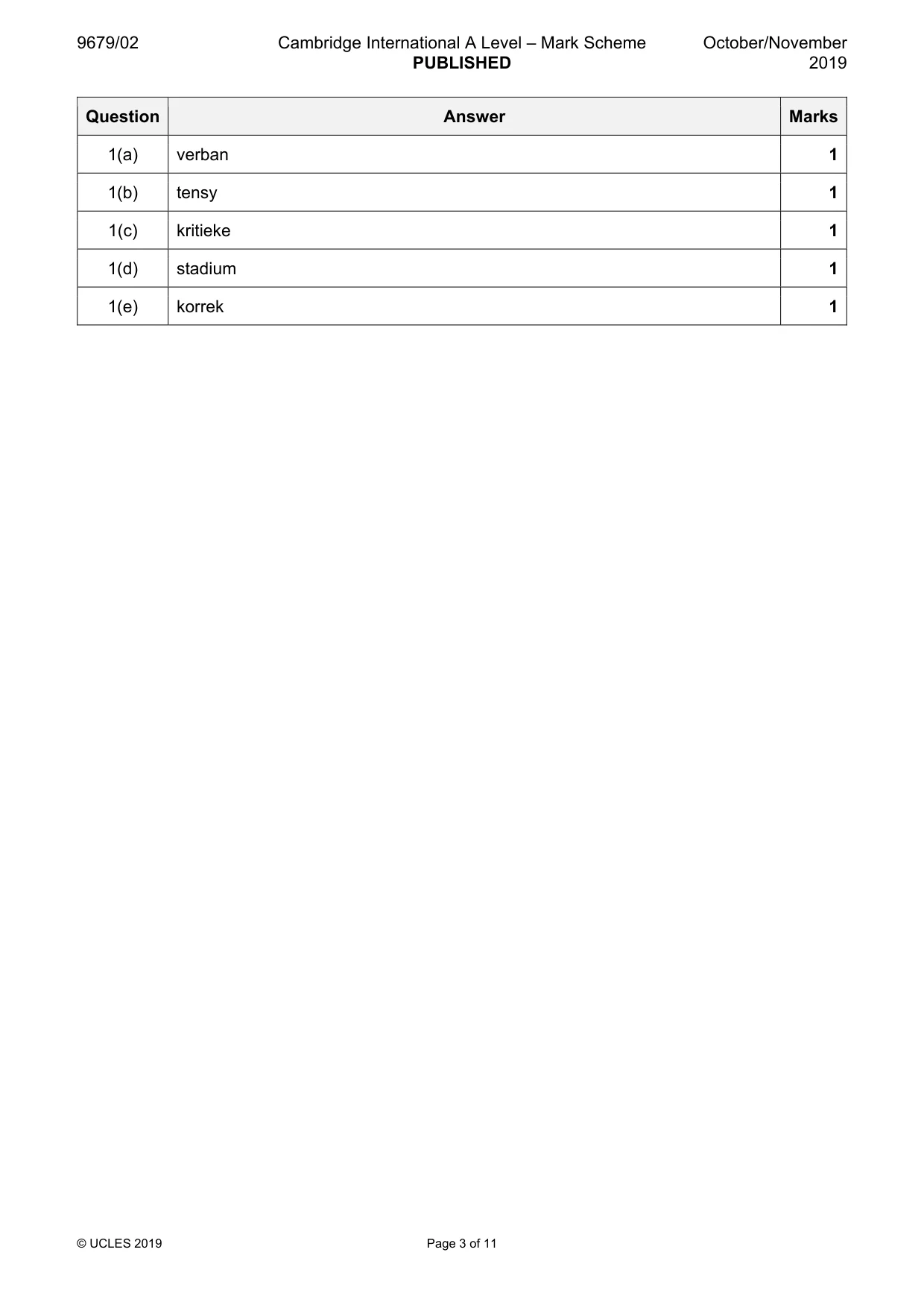
9679/02 Cambridge International A Level – Mark Scheme PUBLISHED October/November 2019 © UCLES 2019 Page 3 of 11 Question Answer Marks 1(a) verban 1 1(b) tensy 1 1(c) kritieke 1 1(d) stadium 1 1(e) korrek 1
Mark scheme, page 4
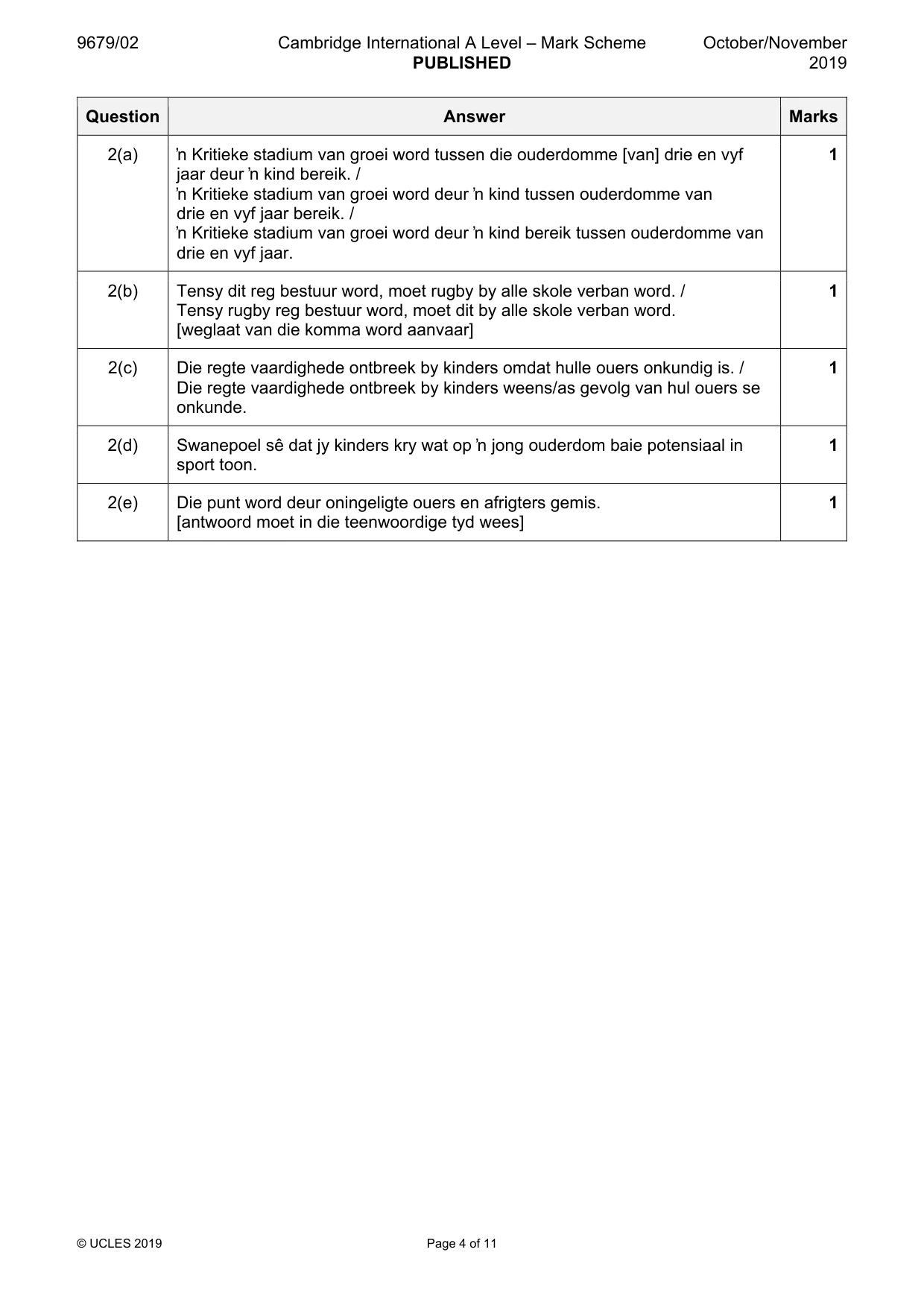
9679/02 Cambridge International A Level – Mark Scheme PUBLISHED October/November 2019 © UCLES 2019 Page 4 of 11 Question Answer Marks 2(a) ʼn Kritieke stadium van groei word tussen die ouderdomme [van] drie en vyf jaar deur ʼn kind bereik. / ʼn Kritieke stadium van groei word deur ʼn kind tussen ouderdomme van drie en vyf jaar bereik. / ʼn Kritieke stadium van groei word deur ʼn kind bereik tussen ouderdomme van drie en vyf jaar. 1 2(b) Tensy dit reg bestuur word, moet rugby by alle skole verban word. / Tensy rugby reg bestuur word, moet dit by alle skole verban word. [weglaat van die komma word aanvaar] 1 2(c) Die regte vaardighede ontbreek by kinders omdat hulle ouers onkundig is. / Die regte vaardighede ontbreek by kinders weens/as gevolg van hul ouers se onkunde. 1 2(d) Swanepoel sê dat jy kinders kry wat op ʼn jong ouderdom baie potensiaal in sport toon. 1 2(e) Die punt word deur oningeligte ouers en afrigters gemis. [antwoord moet in die teenwoordige tyd wees] 1
Mark scheme, page 5
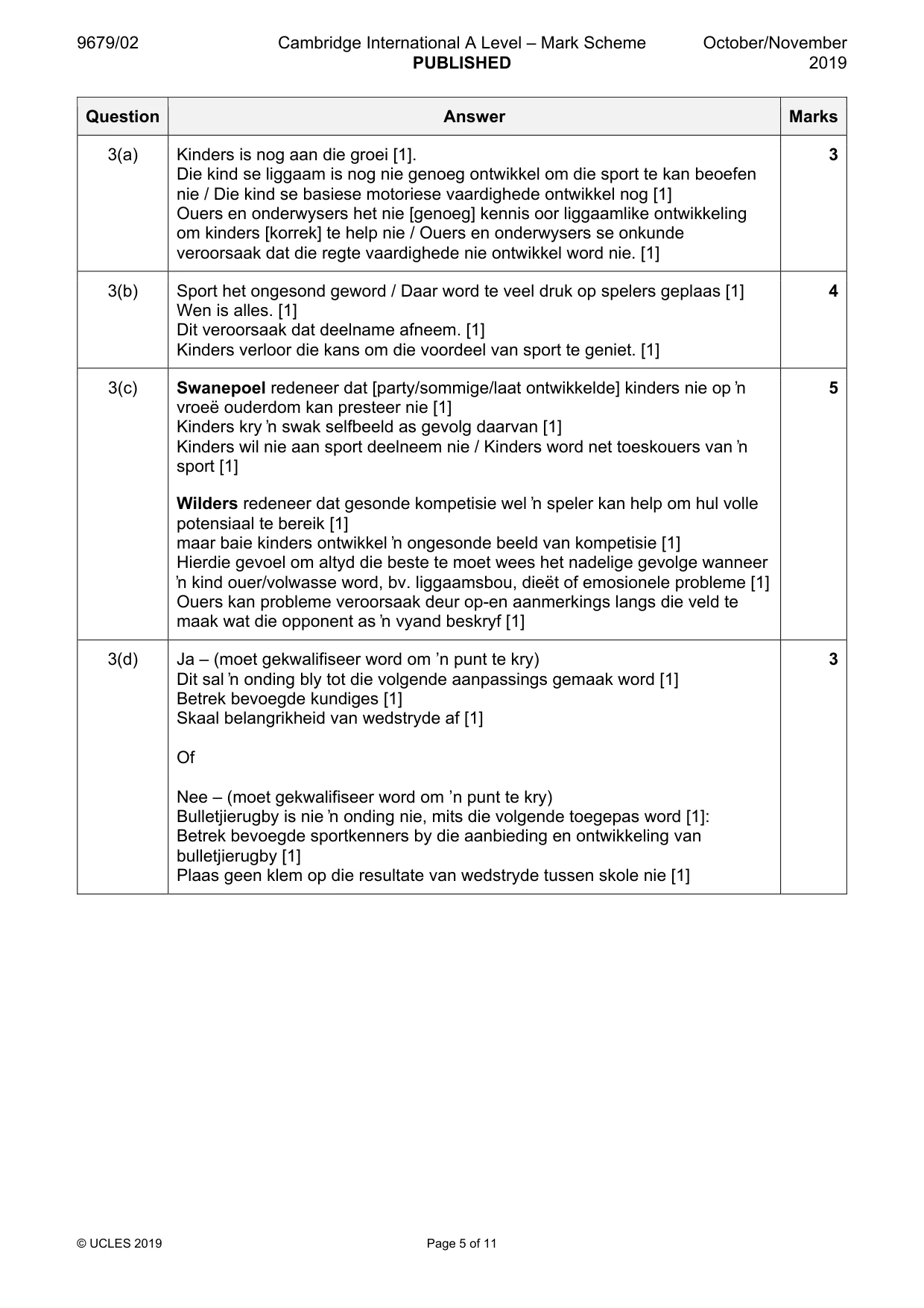
9679/02 Cambridge International A Level – Mark Scheme PUBLISHED October/November 2019 © UCLES 2019 Page 5 of 11 Question Answer Marks 3(a) Kinders is nog aan die groei [1]. Die kind se liggaam is nog nie genoeg ontwikkel om die sport te kan beoefen nie / Die kind se basiese motoriese vaardighede ontwikkel nog [1] Ouers en onderwysers het nie [genoeg] kennis oor liggaamlike ontwikkeling om kinders [korrek] te help nie / Ouers en onderwysers se onkunde veroorsaak dat die regte vaardighede nie ontwikkel word nie. [1] 3 3(b) Sport het ongesond geword / Daar word te veel druk op spelers geplaas [1] Wen is alles. [1] Dit veroorsaak dat deelname afneem. [1] Kinders verloor die kans om die voordeel van sport te geniet. [1] 4 3(c) Swanepoel redeneer dat [party/sommige/laat ontwikkelde] kinders nie op ʼn vroeë ouderdom kan presteer nie [1] Kinders kry ʼn swak selfbeeld as gevolg daarvan [1] Kinders wil nie aan sport deelneem nie / Kinders word net toeskouers van ʼn sport [1] Wilders redeneer dat gesonde kompetisie wel ʼn speler kan help om hul volle potensiaal te bereik [1] maar baie kinders ontwikkel ʼn ongesonde beeld van kompetisie [1] Hierdie gevoel om altyd die beste te moet wees het nadelige gevolge wanneer ʼn kind ouer/volwasse word, bv. liggaamsbou, dieët of emosionele probleme [1] Ouers kan probleme veroorsaak deur op-en aanmerkings langs die veld te maak wat die opponent as ʼn vyand beskryf [1] 5 3(d) Ja – (moet gekwalifiseer word om ’n punt te kry) Dit sal ʼn onding bly tot die volgende aanpassings gemaak word [1] Betrek bevoegde kundiges [1] Skaal belangrikheid van wedstryde af [1] Of Nee – (moet gekwalifiseer word om ’n punt te kry) Bulletjierugby is nie ʼn onding nie, mits die volgende toegepas word [1]: Betrek bevoegde sportkenners by die aanbieding en ontwikkeling van bulletjierugby [1] Plaas geen klem op die resultate van wedstryde tussen skole nie [1] 3
Mark scheme, page 6
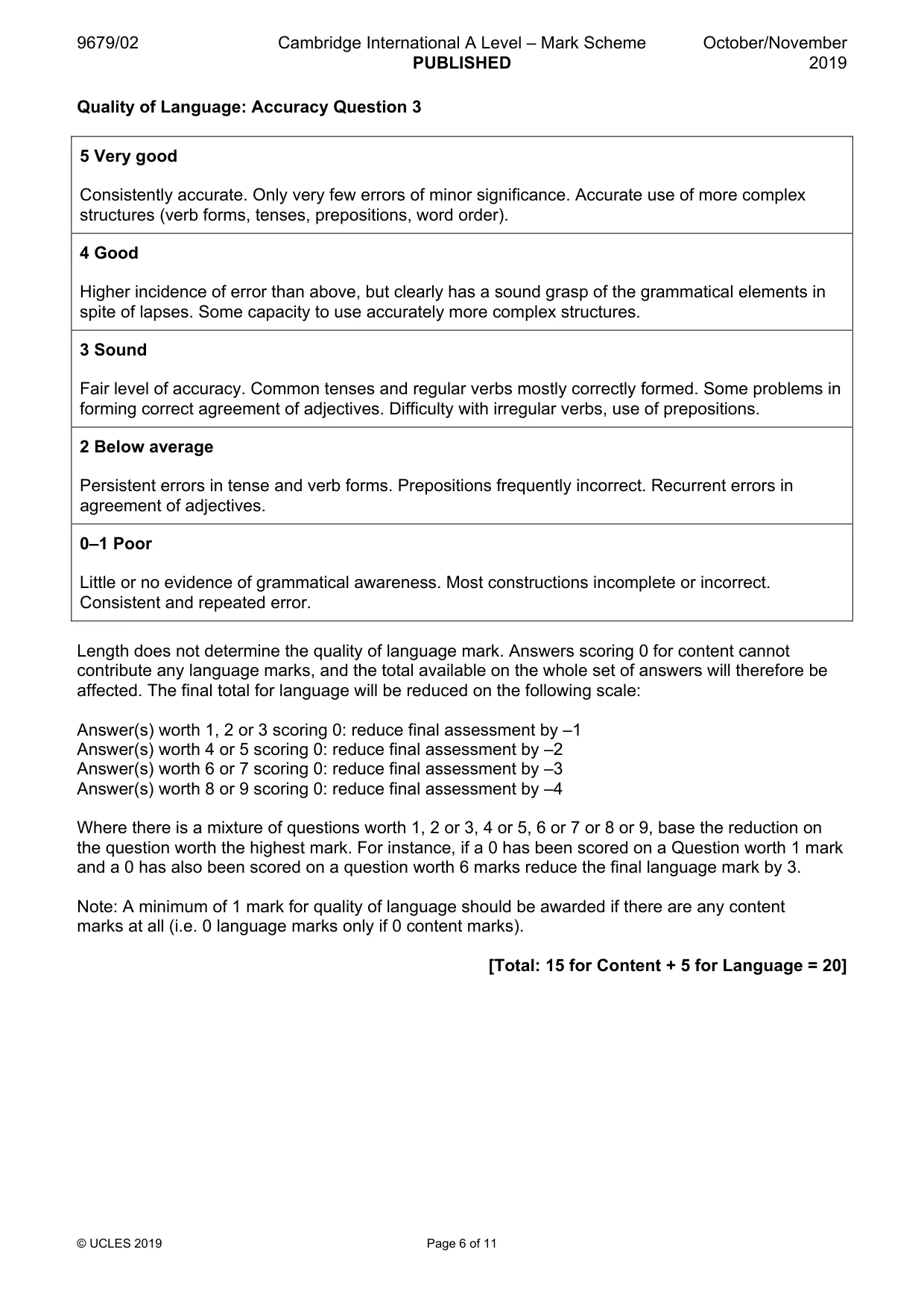
9679/02 Cambridge International A Level – Mark Scheme PUBLISHED October/November 2019 © UCLES 2019 Page 6 of 11 Quality of Language: Accuracy Question 3 5 Very good Consistently accurate. Only very few errors of minor significance. Accurate use of more complex structures (verb forms, tenses, prepositions, word order). 4 Good Higher incidence of error than above, but clearly has a sound grasp of the grammatical elements in spite of lapses. Some capacity to use accurately more complex structures. 3 Sound Fair level of accuracy. Common tenses and regular verbs mostly correctly formed. Some problems in forming correct agreement of adjectives. Difficulty with irregular verbs, use of prepositions. 2 Below average Persistent errors in tense and verb forms. Prepositions frequently incorrect. Recurrent errors in agreement of adjectives. 0–1 Poor Little or no evidence of grammatical awareness. Most constructions incomplete or incorrect. Consistent and repeated error. Length does not determine the quality of language mark. Answers scoring 0 for content cannot contribute any language marks, and the total available on the whole set of answers will therefore be affected. The final total for language will be reduced on the following scale: Answer(s) worth 1, 2 or 3 scoring 0: reduce final assessment by –1 Answer(s) worth 4 or 5 scoring 0: reduce final assessment by –2 Answer(s) worth 6 or 7 scoring 0: reduce final assessment by –3 Answer(s) worth 8 or 9 scoring 0: reduce final assessment by –4 Where there is a mixture of questions worth 1, 2 or 3, 4 or 5, 6 or 7 or 8 or 9, base the reduction on the question worth the highest mark. For instance, if a 0 has been scored on a Question worth 1 mark and a 0 has also been scored on a question worth 6 marks reduce the final language mark by 3. Note: A minimum of 1 mark for quality of language should be awarded if there are any content marks at all (i.e. 0 language marks only if 0 content marks). [Total: 15 for Content + 5 for Language = 20]
Mark scheme, page 7
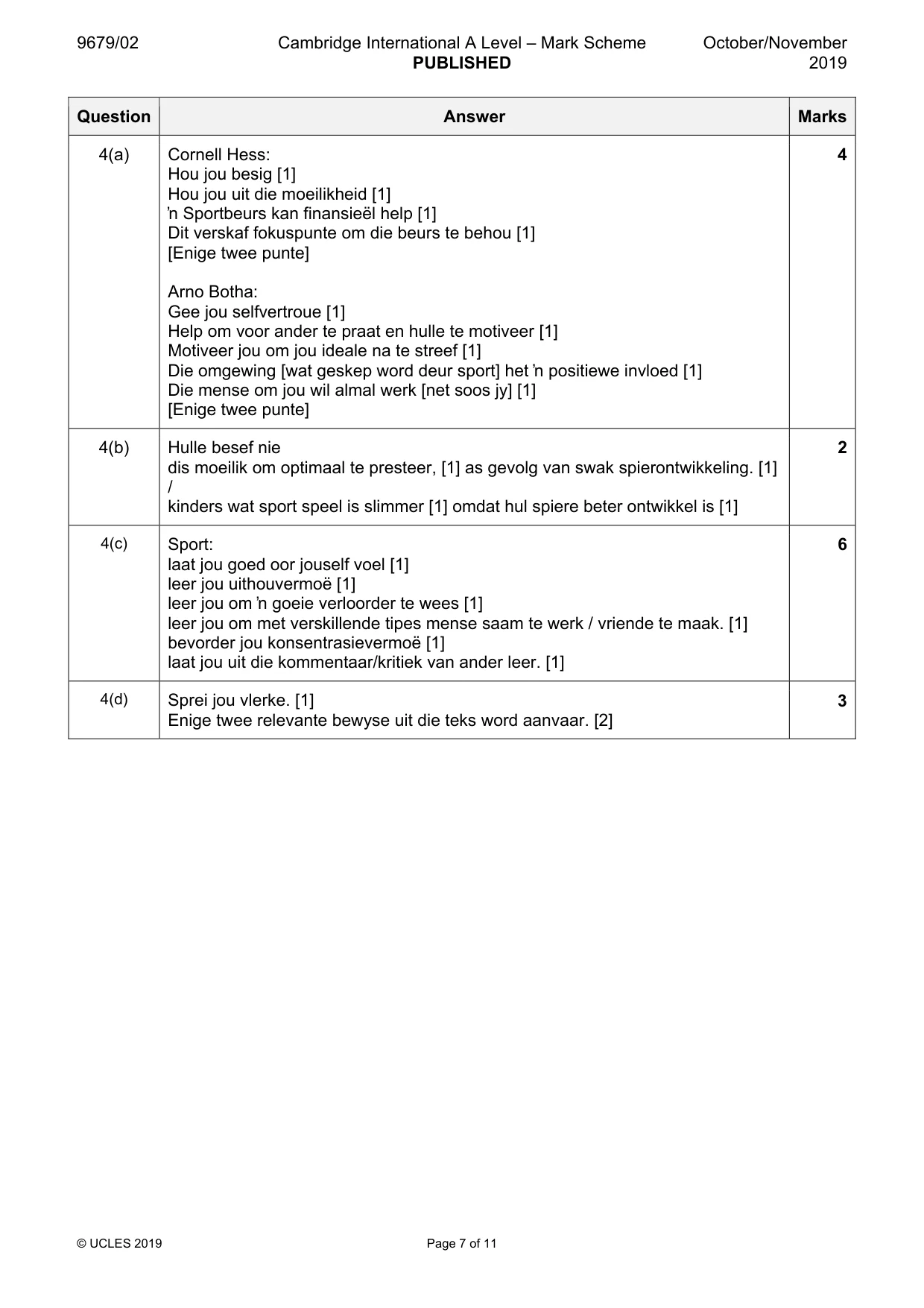
9679/02 Cambridge International A Level – Mark Scheme PUBLISHED October/November 2019 © UCLES 2019 Page 7 of 11 Question Answer Marks 4(a) Cornell Hess: Hou jou besig [1] Hou jou uit die moeilikheid [1] ʼn Sportbeurs kan finansieël help [1] Dit verskaf fokuspunte om die beurs te behou [1] [Enige twee punte] Arno Botha: Gee jou selfvertroue [1] Help om voor ander te praat en hulle te motiveer [1] Motiveer jou om jou ideale na te streef [1] Die omgewing [wat geskep word deur sport] het ʼn positiewe invloed [1] Die mense om jou wil almal werk [net soos jy] [1] [Enige twee punte] 4 4(b) Hulle besef nie dis moeilik om optimaal te presteer, [1] as gevolg van swak spierontwikkeling. [1] / kinders wat sport speel is slimmer [1] omdat hul spiere beter ontwikkel is [1] 2 4(c) Sport: laat jou goed oor jouself voel [1] leer jou uithouvermoë [1] leer jou om ʼn goeie verloorder te wees [1] leer jou om met verskillende tipes mense saam te werk / vriende te maak. [1] bevorder jou konsentrasievermoë [1] laat jou uit die kommentaar/kritiek van ander leer. [1] 6 4(d) Sprei jou vlerke. [1] Enige twee relevante bewyse uit die teks word aanvaar. [2] 3
Mark scheme, page 8
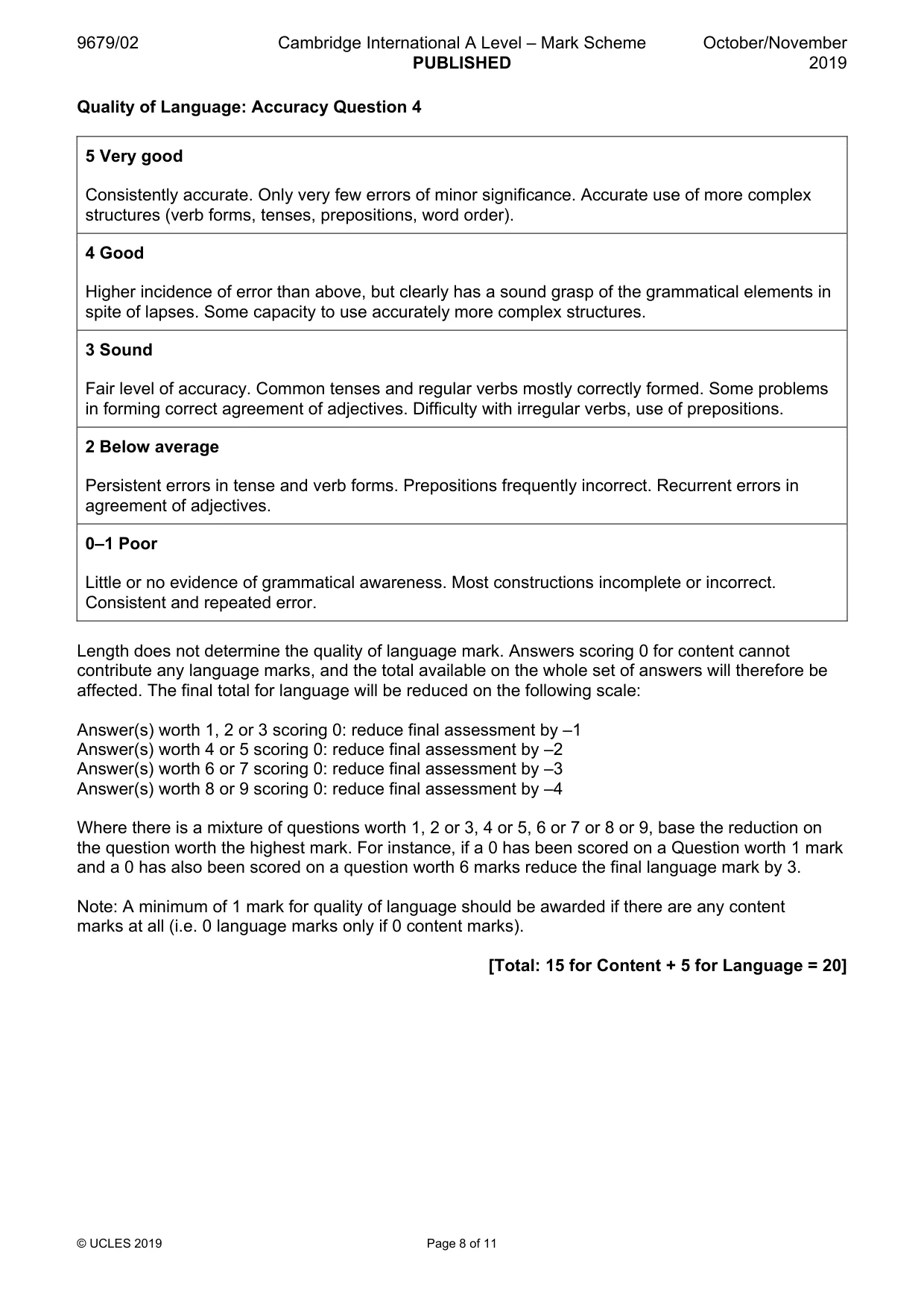
9679/02 Cambridge International A Level – Mark Scheme PUBLISHED October/November 2019 © UCLES 2019 Page 8 of 11 Quality of Language: Accuracy Question 4 5 Very good Consistently accurate. Only very few errors of minor significance. Accurate use of more complex structures (verb forms, tenses, prepositions, word order). 4 Good Higher incidence of error than above, but clearly has a sound grasp of the grammatical elements in spite of lapses. Some capacity to use accurately more complex structures. 3 Sound Fair level of accuracy. Common tenses and regular verbs mostly correctly formed. Some problems in forming correct agreement of adjectives. Difficulty with irregular verbs, use of prepositions. 2 Below average Persistent errors in tense and verb forms. Prepositions frequently incorrect. Recurrent errors in agreement of adjectives. 0–1 Poor Little or no evidence of grammatical awareness. Most constructions incomplete or incorrect. Consistent and repeated error. Length does not determine the quality of language mark. Answers scoring 0 for content cannot contribute any language marks, and the total available on the whole set of answers will therefore be affected. The final total for language will be reduced on the following scale: Answer(s) worth 1, 2 or 3 scoring 0: reduce final assessment by –1 Answer(s) worth 4 or 5 scoring 0: reduce final assessment by –2 Answer(s) worth 6 or 7 scoring 0: reduce final assessment by –3 Answer(s) worth 8 or 9 scoring 0: reduce final assessment by –4 Where there is a mixture of questions worth 1, 2 or 3, 4 or 5, 6 or 7 or 8 or 9, base the reduction on the question worth the highest mark. For instance, if a 0 has been scored on a Question worth 1 mark and a 0 has also been scored on a question worth 6 marks reduce the final language mark by 3. Note: A minimum of 1 mark for quality of language should be awarded if there are any content marks at all (i.e. 0 language marks only if 0 content marks). [Total: 15 for Content + 5 for Language = 20]
Mark scheme, page 9
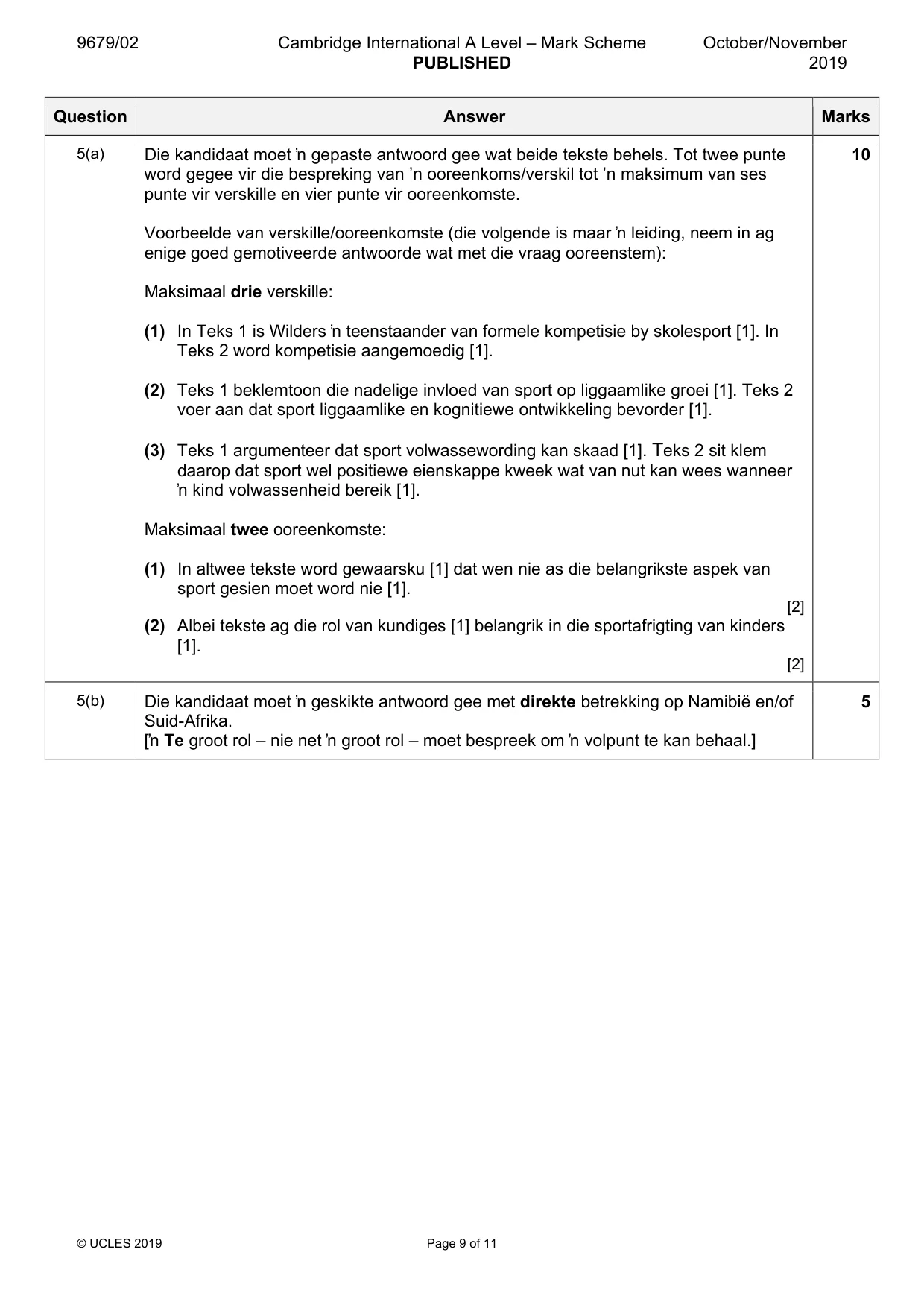
9679/02 Cambridge International A Level – Mark Scheme PUBLISHED October/November 2019 © UCLES 2019 Page 9 of 11 Question Answer Marks 5(a) Die kandidaat moet ʼn gepaste antwoord gee wat beide tekste behels. Tot twee punte word gegee vir die bespreking van ’n ooreenkoms/verskil tot ’n maksimum van ses punte vir verskille en vier punte vir ooreenkomste. Voorbeelde van verskille/ooreenkomste (die volgende is maar ʼn leiding, neem in ag enige goed gemotiveerde antwoorde wat met die vraag ooreenstem): Maksimaal drie verskille: (1) In Teks 1 is Wilders ʼn teenstaander van formele kompetisie by skolesport [1]. In Teks 2 word kompetisie aangemoedig [1]. (2) Teks 1 beklemtoon die nadelige invloed van sport op liggaamlike groei [1]. Teks 2 voer aan dat sport liggaamlike en kognitiewe ontwikkeling bevorder [1]. (3) Teks 1 argumenteer dat sport volwassewording kan skaad [1]. Teks 2 sit klem daarop dat sport wel positiewe eienskappe kweek wat van nut kan wees wanneer ʼn kind volwassenheid bereik [1]. Maksimaal twee ooreenkomste: (1) In altwee tekste word gewaarsku [1] dat wen nie as die belangrikste aspek van sport gesien moet word nie [1]. [2] (2) Albei tekste ag die rol van kundiges [1] belangrik in die sportafrigting van kinders [1]. [2] 10 5(b) Die kandidaat moet ʼn geskikte antwoord gee met direkte betrekking op Namibië en/of Suid-Afrika. [ʼn Te groot rol – nie net ʼn groot rol – moet bespreek om ʼn volpunt te kan behaal.] 5
Mark scheme, page 10
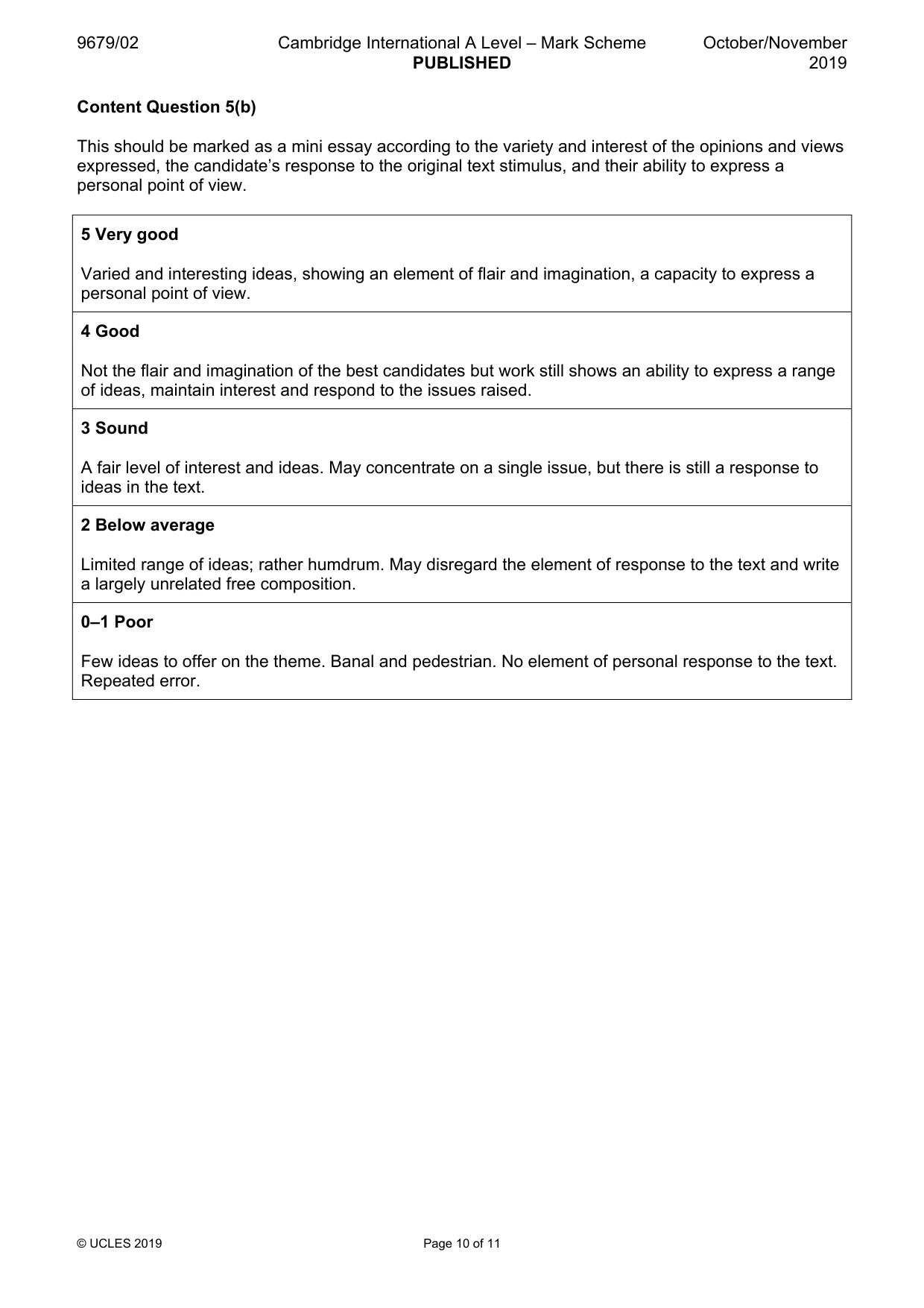
9679/02 Cambridge International A Level – Mark Scheme PUBLISHED October/November 2019 © UCLES 2019 Page 10 of 11 Content Question 5(b) This should be marked as a mini essay according to the variety and interest of the opinions and views expressed, the candidate’s response to the original text stimulus, and their ability to express a personal point of view. 5 Very good Varied and interesting ideas, showing an element of flair and imagination, a capacity to express a personal point of view. 4 Good Not the flair and imagination of the best candidates but work still shows an ability to express a range of ideas, maintain interest and respond to the issues raised. 3 Sound A fair level of interest and ideas. May concentrate on a single issue, but there is still a response to ideas in the text. 2 Below average Limited range of ideas; rather humdrum. May disregard the element of response to the text and write a largely unrelated free composition. 0–1 Poor Few ideas to offer on the theme. Banal and pedestrian. No element of personal response to the text. Repeated error.
Mark scheme, page 11
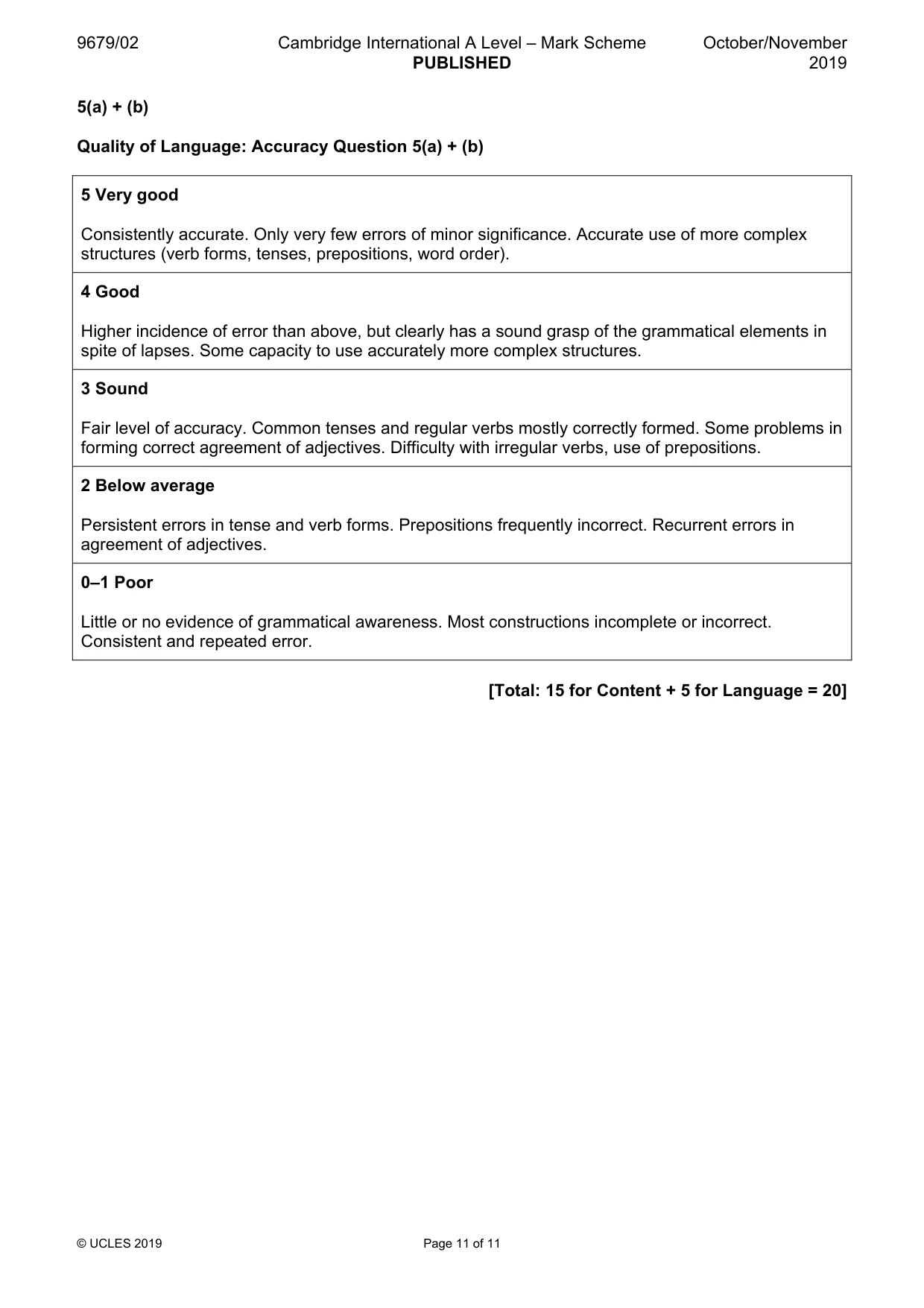
9679/02 Cambridge International A Level – Mark Scheme PUBLISHED October/November 2019 © UCLES 2019 Page 11 of 11 5(a) + (b) Quality of Language: Accuracy Question 5(a) + (b) 5 Very good Consistently accurate. Only very few errors of minor significance. Accurate use of more complex structures (verb forms, tenses, prepositions, word order). 4 Good Higher incidence of error than above, but clearly has a sound grasp of the grammatical elements in spite of lapses. Some capacity to use accurately more complex structures. 3 Sound Fair level of accuracy. Common tenses and regular verbs mostly correctly formed. Some problems in forming correct agreement of adjectives. Difficulty with irregular verbs, use of prepositions. 2 Below average Persistent errors in tense and verb forms. Prepositions frequently incorrect. Recurrent errors in agreement of adjectives. 0–1 Poor Little or no evidence of grammatical awareness. Most constructions incomplete or incorrect. Consistent and repeated error. [Total: 15 for Content + 5 for Language = 20]
What you needed in this session
Cambridge’s own grade thresholds for 2019 Oct/Nov, Paper 2 · Variant 1. A higher threshold means an easier paper — the bar moves with how the cohort did.