Cambridge A Level Accounting 9706 — 2020 Oct/Nov Paper 3 · Variant 3
9706/33/O/N/20 · 150 marks · ≈169 min
The question paper and its mark scheme, free to read here and free to download. This is Cambridge’s own paper, exactly as it was sat.
Question paper20 pages


Mark scheme15 pages
Answers below. Sit the paper first if you are practising.
Paper as text
Question paper, page 1
ACCOUNTING 9706/33 Paper 3 Structured Questions October/November 2020 3 hours You must answer on the question paper. You will need: Insert (enclosed) INSTRUCTIONS ● Answer all questions. ● Use a black or dark blue pen. ● Write your name, centre number and candidate number in the boxes at the top of the page. ● Write your answer to each question in the space provided. ● Do not use an erasable pen or correction fluid. ● Do not write on any bar codes. ● You may use an HB pencil for any diagrams, graphs or rough working. ● You may use a calculator. ● International accounting terms and formats should be used as appropriate. ● You should show your workings. INFORMATION ● The total mark for this paper is 150. ● The number of marks for each question or part question is shown in brackets [ ]. ● The insert contains all of the required information and questions. Cambridge International AS & A Level This document has 20 pages. Blank pages are indicated. DC (RCL (GO)) 187379/5 © UCLES 2020 [Turn over * 2 0 2 3 9 8 5 3 7 1 *
Question paper, page 2
2 9706/33/O/N/20 © UCLES 2020 Section A: Financial Accounting Answer all questions. 1 Read Source A1 in the insert. (a) Calculate the correct values of: (i) inventory at 30 June 2020 … … … … … … … … [4] (ii) cost of sales for the year ended 30 June 2020. … … … … … … [2]
Question paper, page 3
3 9706/33/O/N/20 © UCLES 2020 [Turn over (b) Prepare a corrected income statement for the year ended 30 June 2020. … … … … … … … … … … … … … … … Workings: [15]
Question paper, page 4
4 9706/33/O/N/20 © UCLES 2020 (c) Explain how your treatment of item 8 would be different if there was a 25% possibility of the company losing the case. … … … … … … [4] [Total: 25]
Question paper, page 5
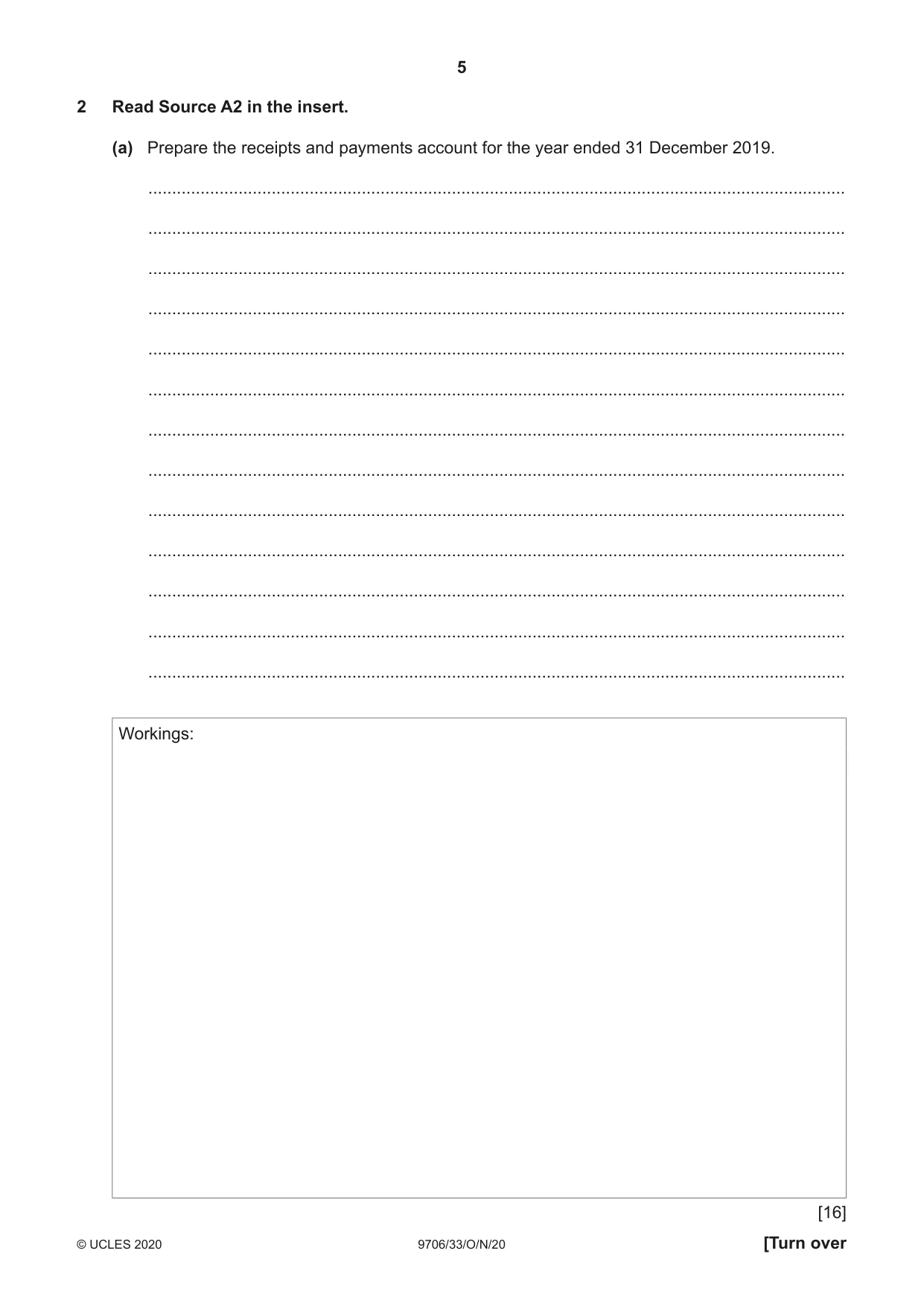
5 9706/33/O/N/20 © UCLES 2020 [Turn over 2 Read Source A2 in the insert. (a) Prepare the receipts and payments account for the year ended 31 December 2019. … … … … … … … … … … … … … Workings: [16]
Question paper, page 6
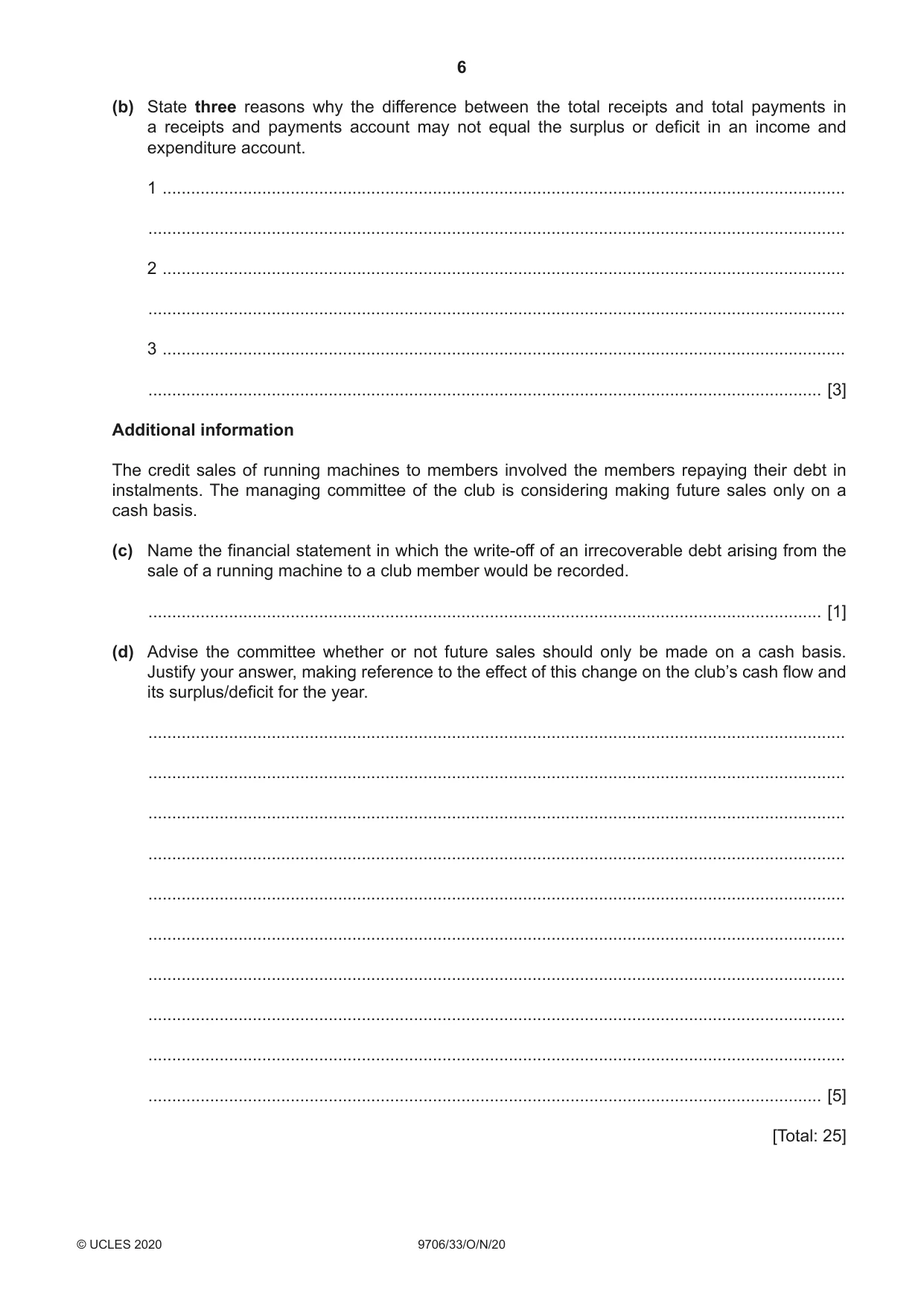
6 9706/33/O/N/20 © UCLES 2020 (b) State three reasons why the difference between the total receipts and total payments in a receipts and payments account may not equal the surplus or deficit in an income and expenditure account. 1 … … 2 … … 3 … … [3] Additional information The credit sales of running machines to members involved the members repaying their debt in instalments. The managing committee of the club is considering making future sales only on a cash basis. (c) Name the financial statement in which the write-off of an irrecoverable debt arising from the sale of a running machine to a club member would be recorded. … [1] (d) Advise the committee whether or not future sales should only be made on a cash basis. Justify your answer, making reference to the effect of this change on the club’s cash flow and its surplus/deficit for the year. … … … … … … … … … … [5] [Total: 25]
Question paper, page 7
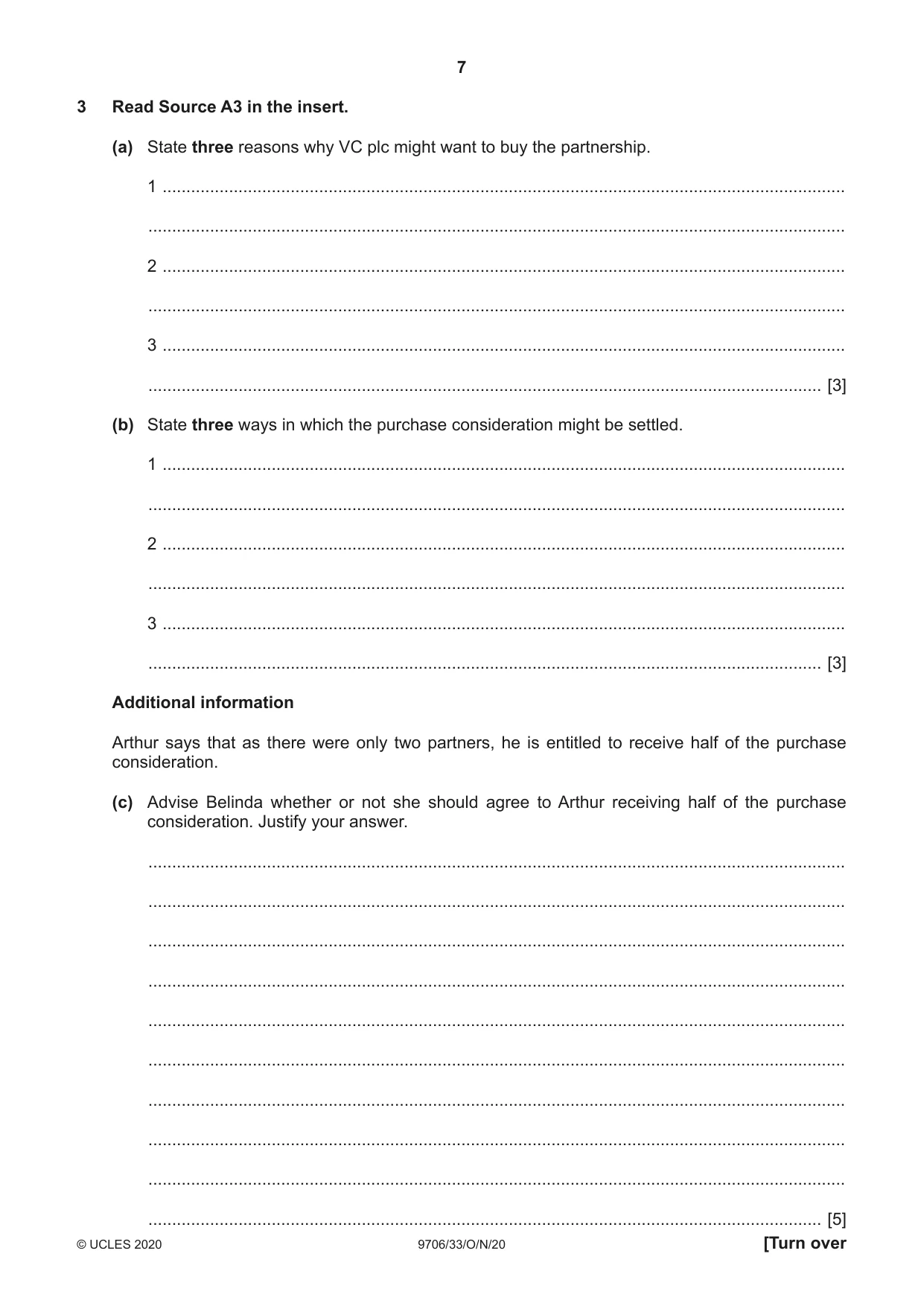
7 9706/33/O/N/20 © UCLES 2020 [Turn over 3 Read Source A3 in the insert. (a) State three reasons why VC plc might want to buy the partnership. 1 … … 2 … … 3 … … [3] (b) State three ways in which the purchase consideration might be settled. 1 … … 2 … … 3 … … [3] Additional information Arthur says that as there were only two partners, he is entitled to receive half of the purchase consideration. (c) Advise Belinda whether or not she should agree to Arthur receiving half of the purchase consideration. Justify your answer. … … … … … … … … … … [5]
Question paper, page 8
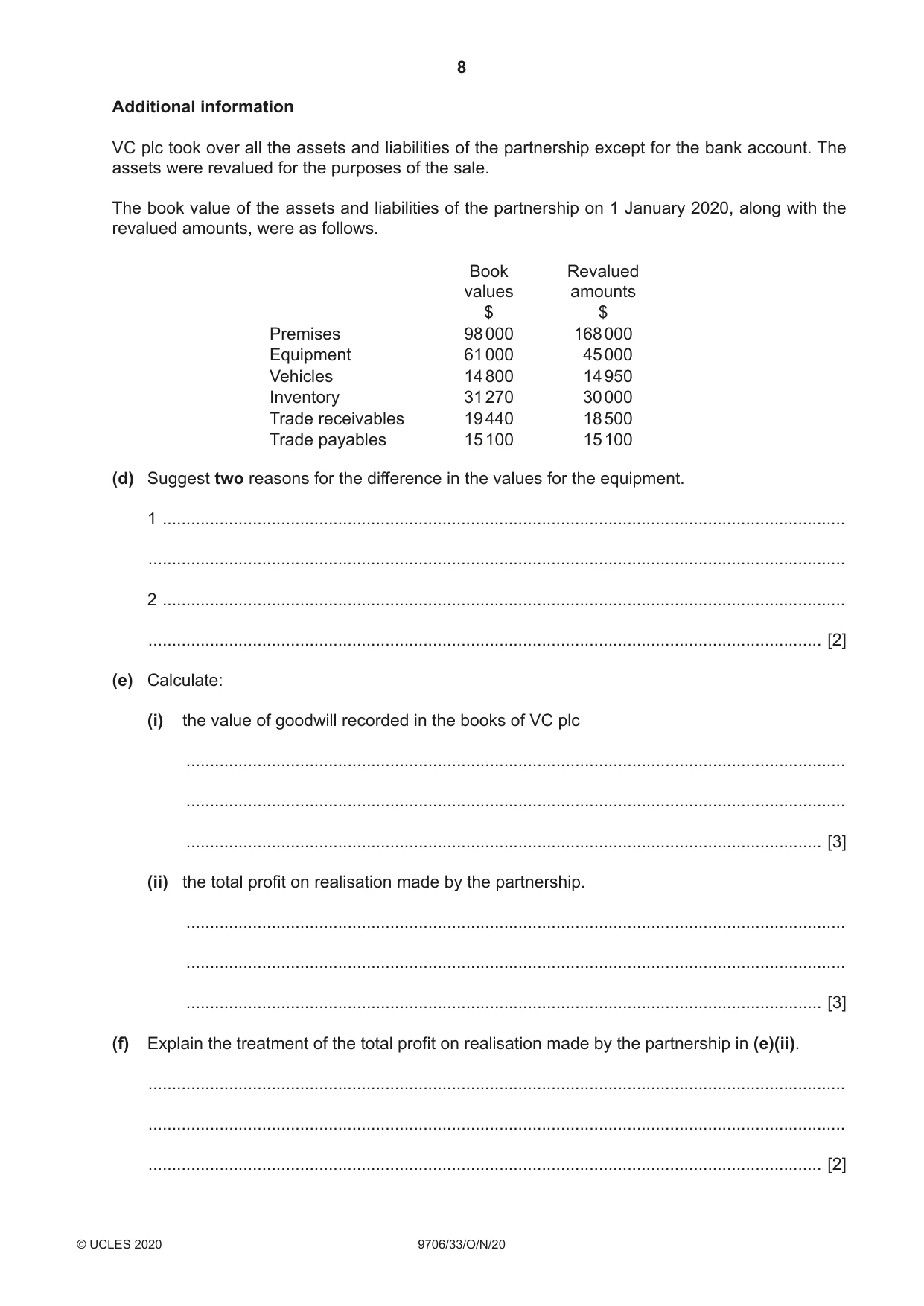
8 9706/33/O/N/20 © UCLES 2020 Additional information VC plc took over all the assets and liabilities of the partnership except for the bank account. The assets were revalued for the purposes of the sale. The book value of the assets and liabilities of the partnership on 1 January 2020, along with the revalued amounts, were as follows. Book values Revalued amounts $ $ Premises 98 000 168 000 Equipment 61 000 45 000 Vehicles 14 800 14 950 Inventory 31 270 30 000 Trade receivables 19 440 18 500 Trade payables 15 100 15 100 (d) Suggest two reasons for the difference in the values for the equipment. 1 … … 2 … … [2] (e) Calculate: (i) the value of goodwill recorded in the books of VC plc … … … [3] (ii) the total profit on realisation made by the partnership. … … … [3] (f) Explain the treatment of the total profit on realisation made by the partnership in (e)(ii). … … … [2]
Question paper, page 9
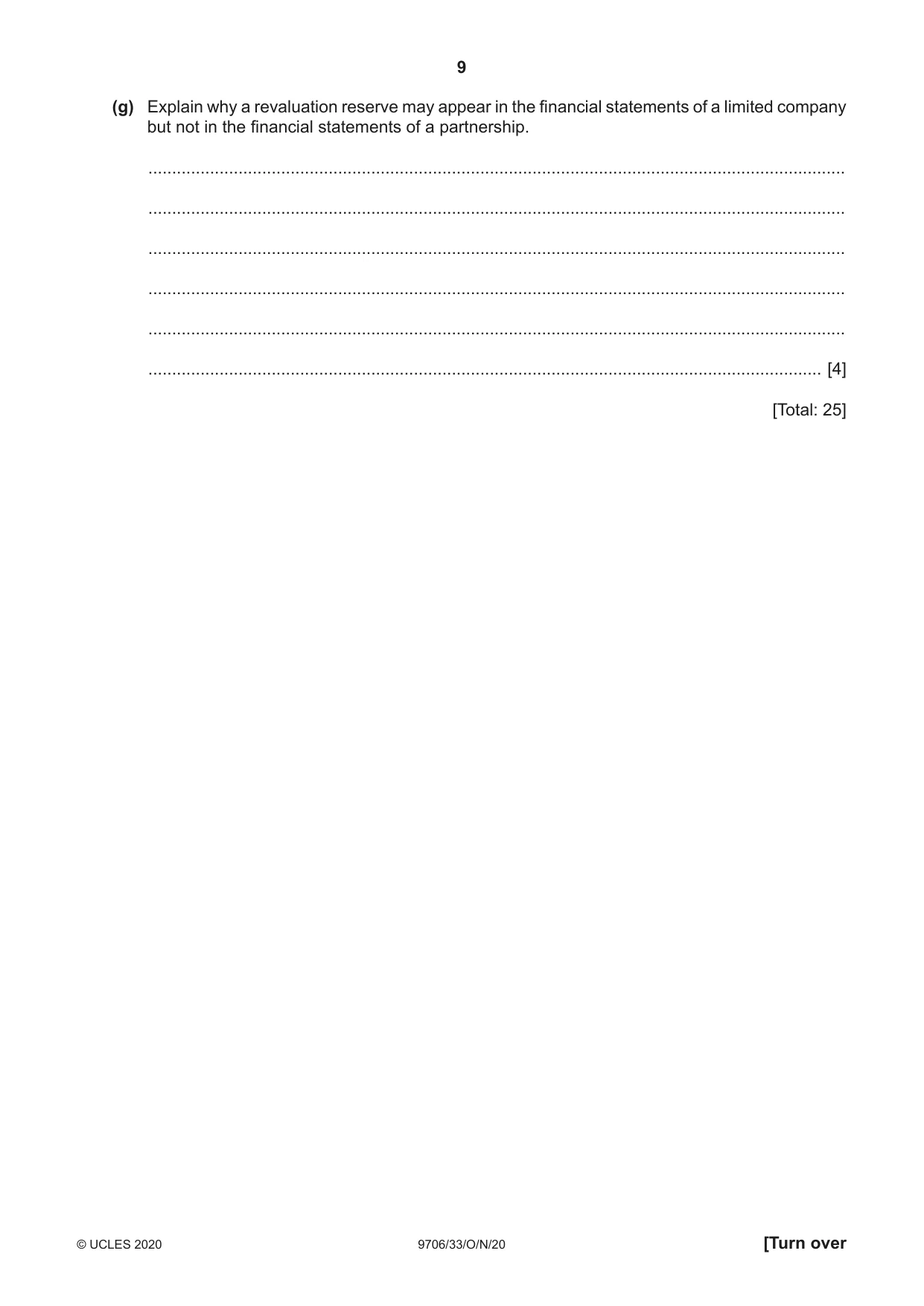
9 9706/33/O/N/20 © UCLES 2020 [Turn over (g) Explain why a revaluation reserve may appear in the financial statements of a limited company but not in the financial statements of a partnership. … … … … … … [4] [Total: 25]
Question paper, page 10
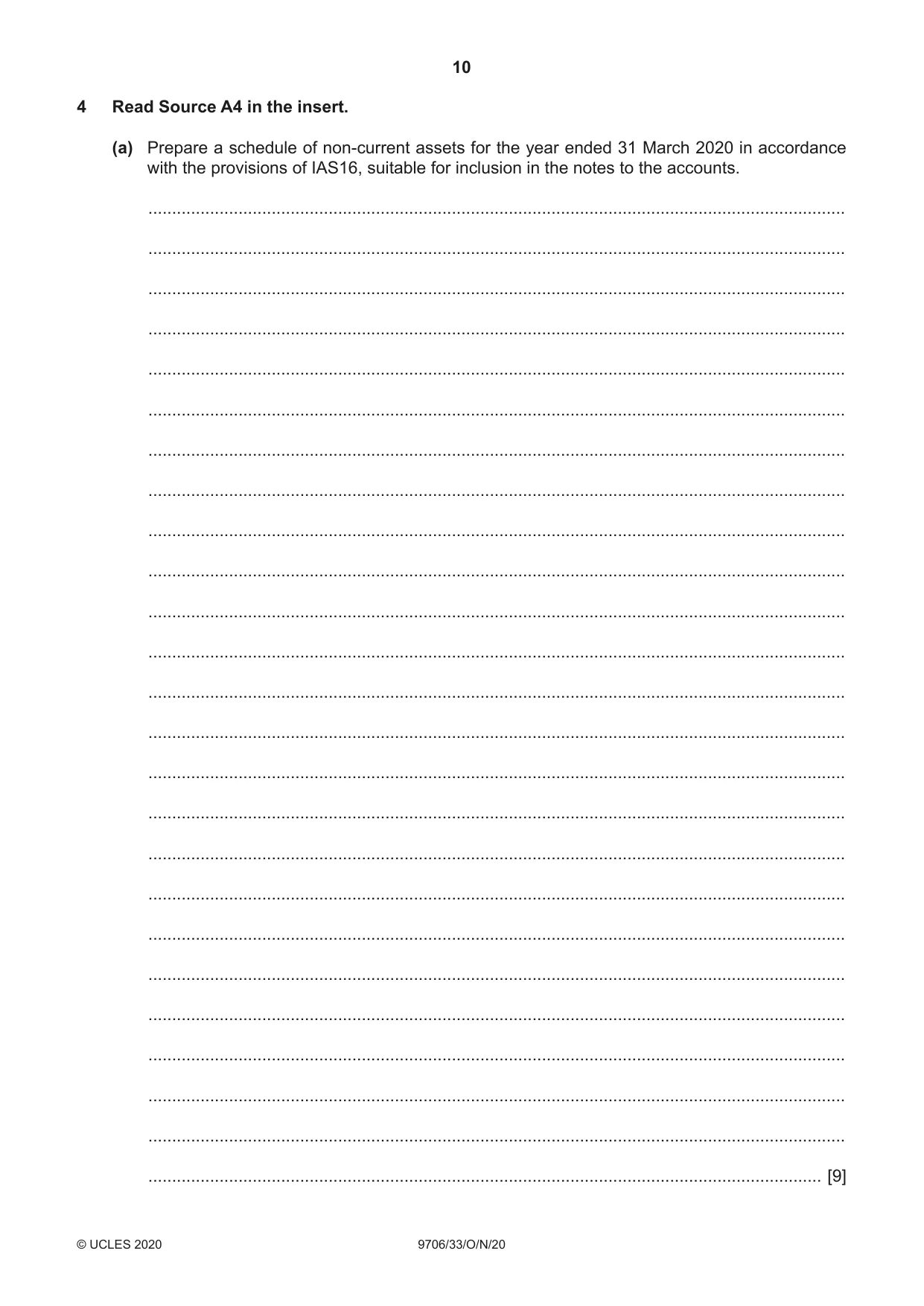
10 9706/33/O/N/20 © UCLES 2020 4 Read Source A4 in the insert. (a) Prepare a schedule of non-current assets for the year ended 31 March 2020 in accordance with the provisions of IAS16, suitable for inclusion in the notes to the accounts. … … … … … … … … … … … … … … … … … … … … … … … … … [9]
Question paper, page 11
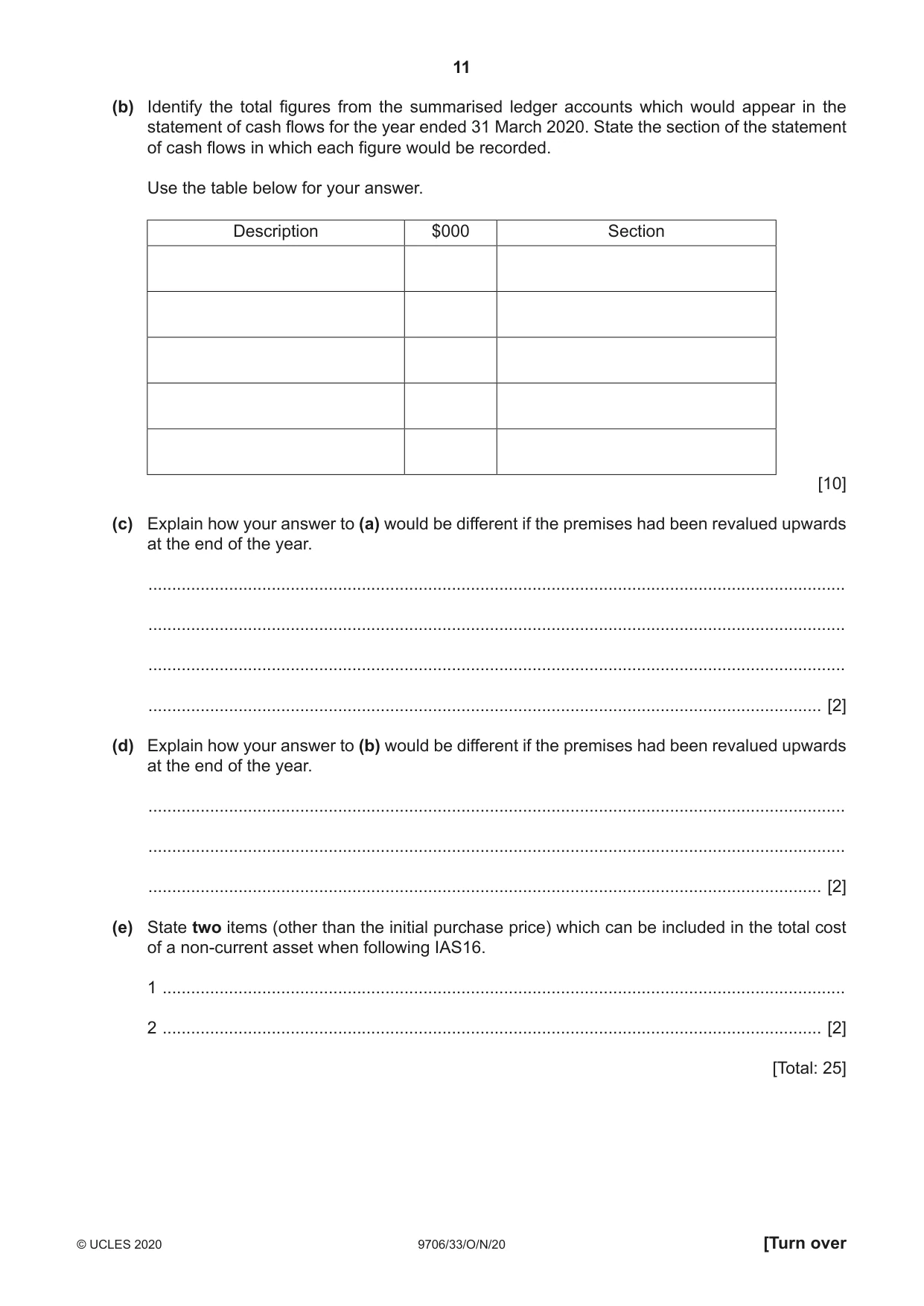
11 9706/33/O/N/20 © UCLES 2020 [Turn over (b) Identify the total figures from the summarised ledger accounts which would appear in the statement of cash flows for the year ended 31 March 2020. State the section of the statement of cash flows in which each figure would be recorded. Use the table below for your answer. Description $000 Section [10] (c) Explain how your answer to (a) would be different if the premises had been revalued upwards at the end of the year. … … … … [2] (d) Explain how your answer to (b) would be different if the premises had been revalued upwards at the end of the year. … … … [2] (e) State two items (other than the initial purchase price) which can be included in the total cost of a non-current asset when following IAS16. 1 … 2 … [2] [Total: 25]
Question paper, page 12
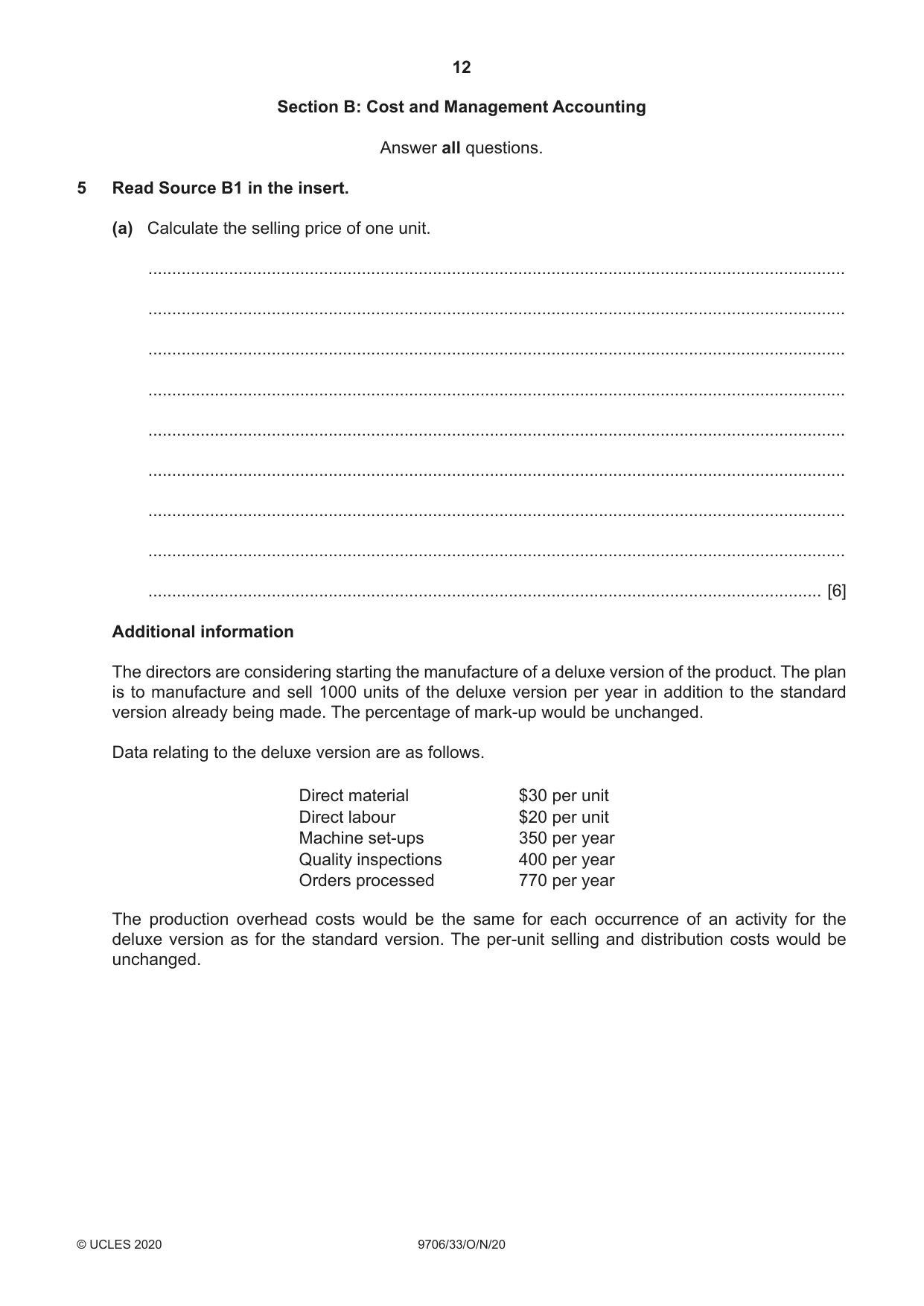
12 9706/33/O/N/20 © UCLES 2020 Section B: Cost and Management Accounting Answer all questions. 5 Read Source B1 in the insert. (a) Calculate the selling price of one unit. … … … … … … … … … [6] Additional information The directors are considering starting the manufacture of a deluxe version of the product. The plan is to manufacture and sell 1000 units of the deluxe version per year in addition to the standard version already being made. The percentage of mark-up would be unchanged. Data relating to the deluxe version are as follows. Direct material $30 per unit Direct labour $20 per unit Machine set-ups 350 per year Quality inspections 400 per year Orders processed 770 per year The production overhead costs would be the same for each occurrence of an activity for the deluxe version as for the standard version. The per-unit selling and distribution costs would be unchanged.
Question paper, page 13
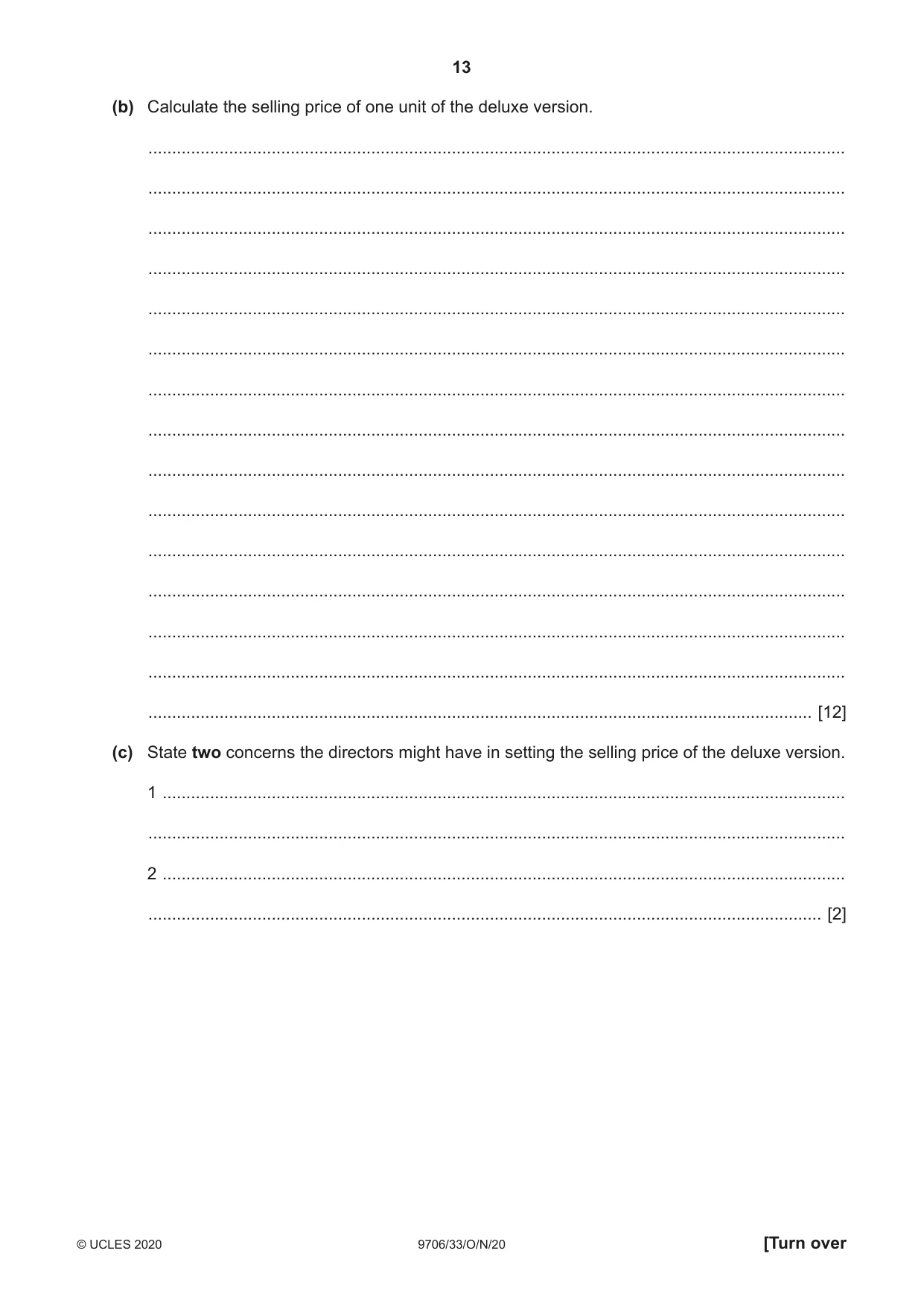
13 9706/33/O/N/20 © UCLES 2020 [Turn over (b) Calculate the selling price of one unit of the deluxe version. … … … … … … … … … … … … … … … [12] (c) State two concerns the directors might have in setting the selling price of the deluxe version. 1 … … 2 … … [2]
Question paper, page 14
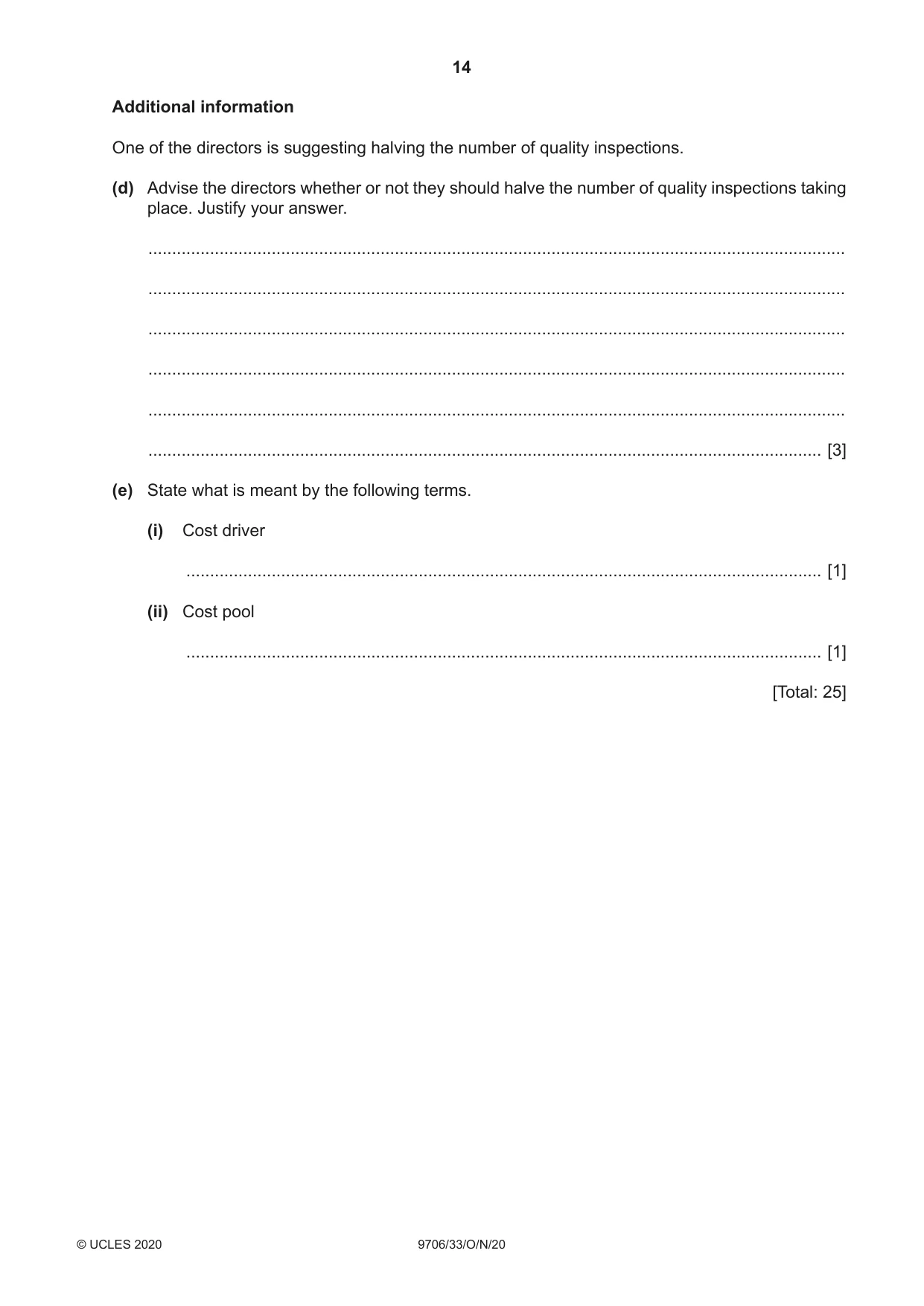
14 9706/33/O/N/20 © UCLES 2020 Additional information One of the directors is suggesting halving the number of quality inspections. (d) Advise the directors whether or not they should halve the number of quality inspections taking place. Justify your answer. … … … … … … [3] (e) State what is meant by the following terms. (i) Cost driver … [1] (ii) Cost pool … [1] [Total: 25]
Question paper, page 15
15 9706/33/O/N/20 © UCLES 2020 [Turn over PLEASE TURN OVER
Question paper, page 16
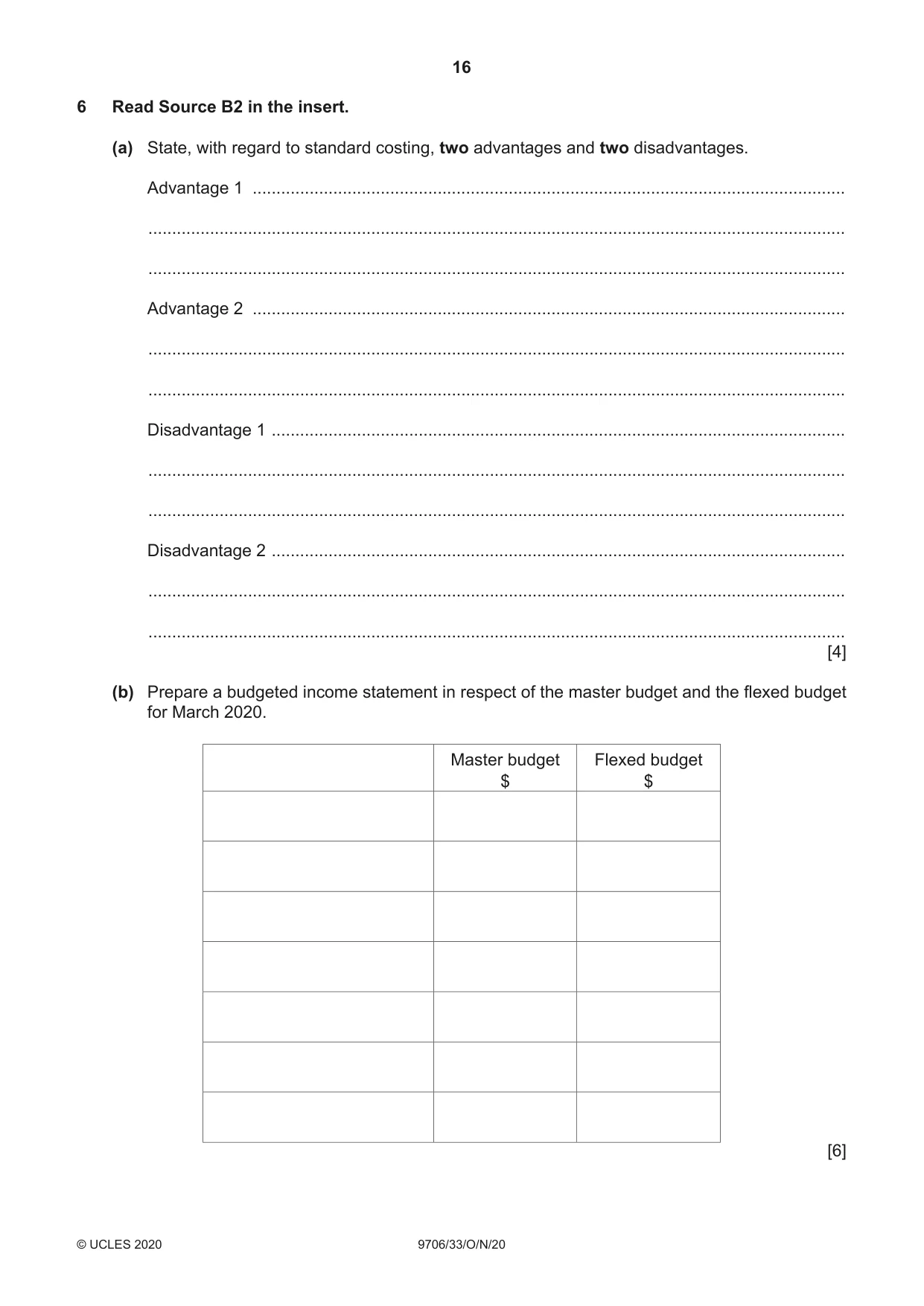
16 9706/33/O/N/20 © UCLES 2020 6 Read Source B2 in the insert. (a) State, with regard to standard costing, two advantages and two disadvantages. Advantage 1 … … … Advantage 2 … … … Disadvantage 1 … … … Disadvantage 2 … … … [4] (b) Prepare a budgeted income statement in respect of the master budget and the flexed budget for March 2020. Master budget Flexed budget $ $ [6]
Question paper, page 17
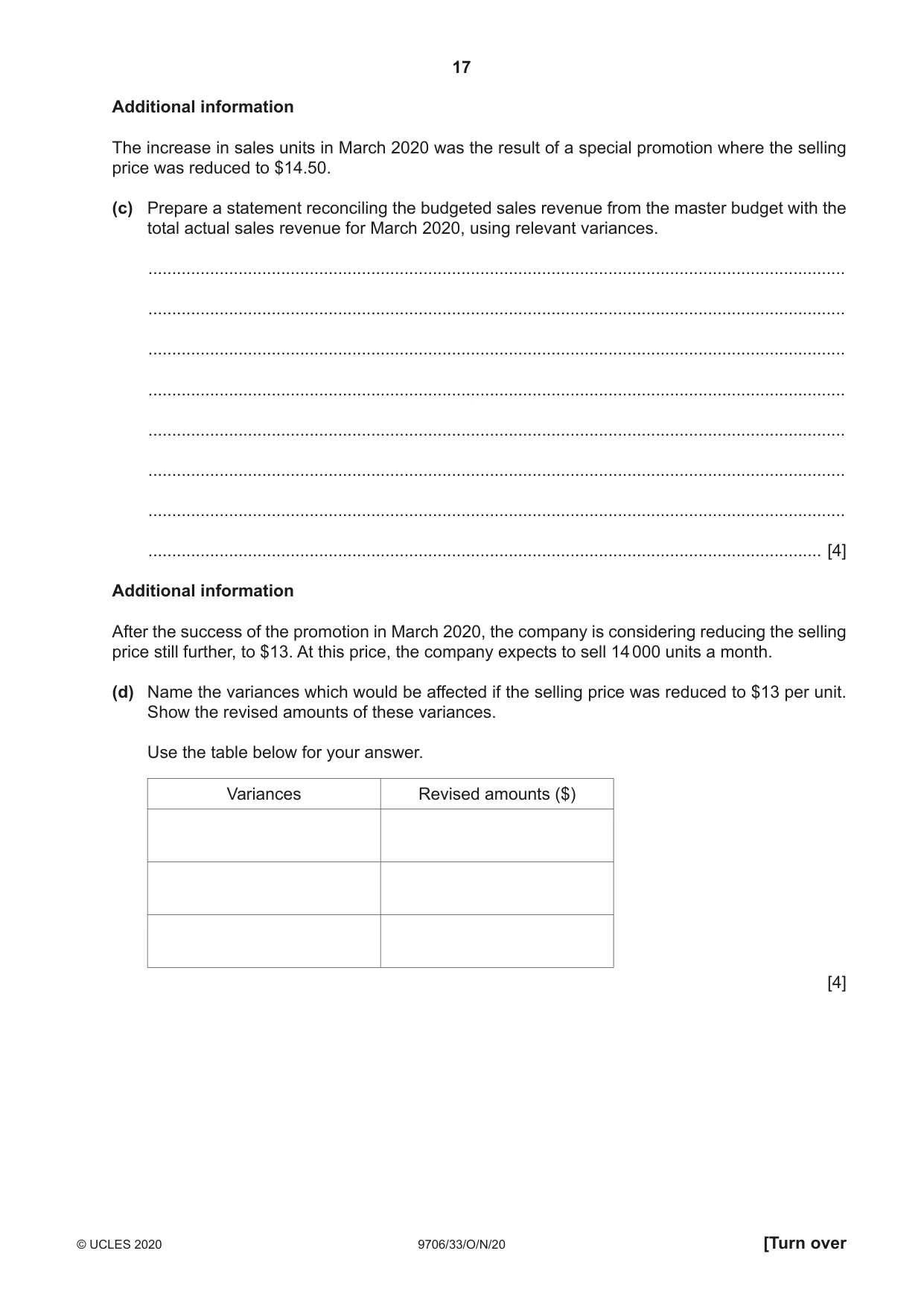
17 9706/33/O/N/20 © UCLES 2020 [Turn over Additional information The increase in sales units in March 2020 was the result of a special promotion where the selling price was reduced to $14.50. (c) Prepare a statement reconciling the budgeted sales revenue from the master budget with the total actual sales revenue for March 2020, using relevant variances. … … … … … … … … [4] Additional information After the success of the promotion in March 2020, the company is considering reducing the selling price still further, to $13. At this price, the company expects to sell 14 000 units a month. (d) Name the variances which would be affected if the selling price was reduced to $13 per unit. Show the revised amounts of these variances. Use the table below for your answer. Variances Revised amounts ($) [4]
Question paper, page 18
18 9706/33/O/N/20 © UCLES 2020 (e) Advise the directors whether or not they should proceed with the suggested reduction in selling price to $13 a unit. Support your answer with calculations. … … … … … … … … … … … … … … [7] [Total: 25]
Question paper, page 19
19 9706/33/O/N/20 © UCLES 2020 BLANK PAGE
Question paper, page 20
20 9706/33/O/N/20 © UCLES 2020 Permission to reproduce items where third-party owned material protected by copyright is included has been sought and cleared where possible. Every reasonable effort has been made by the publisher (UCLES) to trace copyright holders, but if any items requiring clearance have unwittingly been included, the publisher will be pleased to make amends at the earliest possible opportunity. To avoid the issue of disclosure of answer-related information to candidates, all copyright acknowledgements are reproduced online in the Cambridge Assessment International Education Copyright Acknowledgements Booklet. This is produced for each series of examinations and is freely available to download at www.cambridgeinternational.org after the live examination series. Cambridge Assessment International Education is part of the Cambridge Assessment Group. Cambridge Assessment is the brand name of the University of Cambridge Local Examinations Syndicate (UCLES), which itself is a department of the University of Cambridge. BLANK PAGE
Mark scheme, page 1
This document consists of 15 printed pages. © UCLES 2020 [Turn over Cambridge International AS & A Level ACCOUNTING 9706/33 Paper 3 Structured Questions October/November 2020 MARK SCHEME Maximum Mark: 150 Published This mark scheme is published as an aid to teachers and candidates, to indicate the requirements of the examination. It shows the basis on which Examiners were instructed to award marks. It does not indicate the details of the discussions that took place at an Examiners’ meeting before marking began, which would have considered the acceptability of alternative answers. Mark schemes should be read in conjunction with the question paper and the Principal Examiner Report for Teachers. Cambridge International will not enter into discussions about these mark schemes. Cambridge International is publishing the mark schemes for the October/November 2020 series for most Cambridge IGCSE™, Cambridge International A and AS Level and Cambridge Pre-U components, and some Cambridge O Level components.
Mark scheme, page 2
9706/33 Cambridge International AS & A Level – Mark Scheme PUBLISHED October/November 2020 © UCLES 2020 Page 2 of 15 Generic Marking Principles These general marking principles must be applied by all examiners when marking candidate answers. They should be applied alongside the specific content of the mark scheme or generic level descriptors for a question. Each question paper and mark scheme will also comply with these marking principles. GENERIC MARKING PRINCIPLE 1: Marks must be awarded in line with: • the specific content of the mark scheme or the generic level descriptors for the question • the specific skills defined in the mark scheme or in the generic level descriptors for the question • the standard of response required by a candidate as exemplified by the standardisation scripts. GENERIC MARKING PRINCIPLE 2: Marks awarded are always whole marks (not half marks, or other fractions). GENERIC MARKING PRINCIPLE 3: Marks must be awarded positively: • marks are awarded for correct/valid answers, as defined in the mark scheme. However, credit is given for valid answers which go beyond the scope of the syllabus and mark scheme, referring to your Team Leader as appropriate • marks are awarded when candidates clearly demonstrate what they know and can do • marks are not deducted for errors • marks are not deducted for omissions • answers should only be judged on the quality of spelling, punctuation and grammar when these features are specifically assessed by the question as indicated by the mark scheme. The meaning, however, should be unambiguous. GENERIC MARKING PRINCIPLE 4: Rules must be applied consistently, e.g. in situations where candidates have not followed instructions or in the application of generic level descriptors.
Mark scheme, page 3
9706/33 Cambridge International AS & A Level – Mark Scheme PUBLISHED October/November 2020 © UCLES 2020 Page 3 of 15 GENERIC MARKING PRINCIPLE 5: Marks should be awarded using the full range of marks defined in the mark scheme for the question (however; the use of the full mark range may be limited according to the quality of the candidate responses seen). GENERIC MARKING PRINCIPLE 6: Marks awarded are based solely on the requirements as defined in the mark scheme. Marks should not be awarded with grade thresholds or grade descriptors in mind.
Mark scheme, page 4
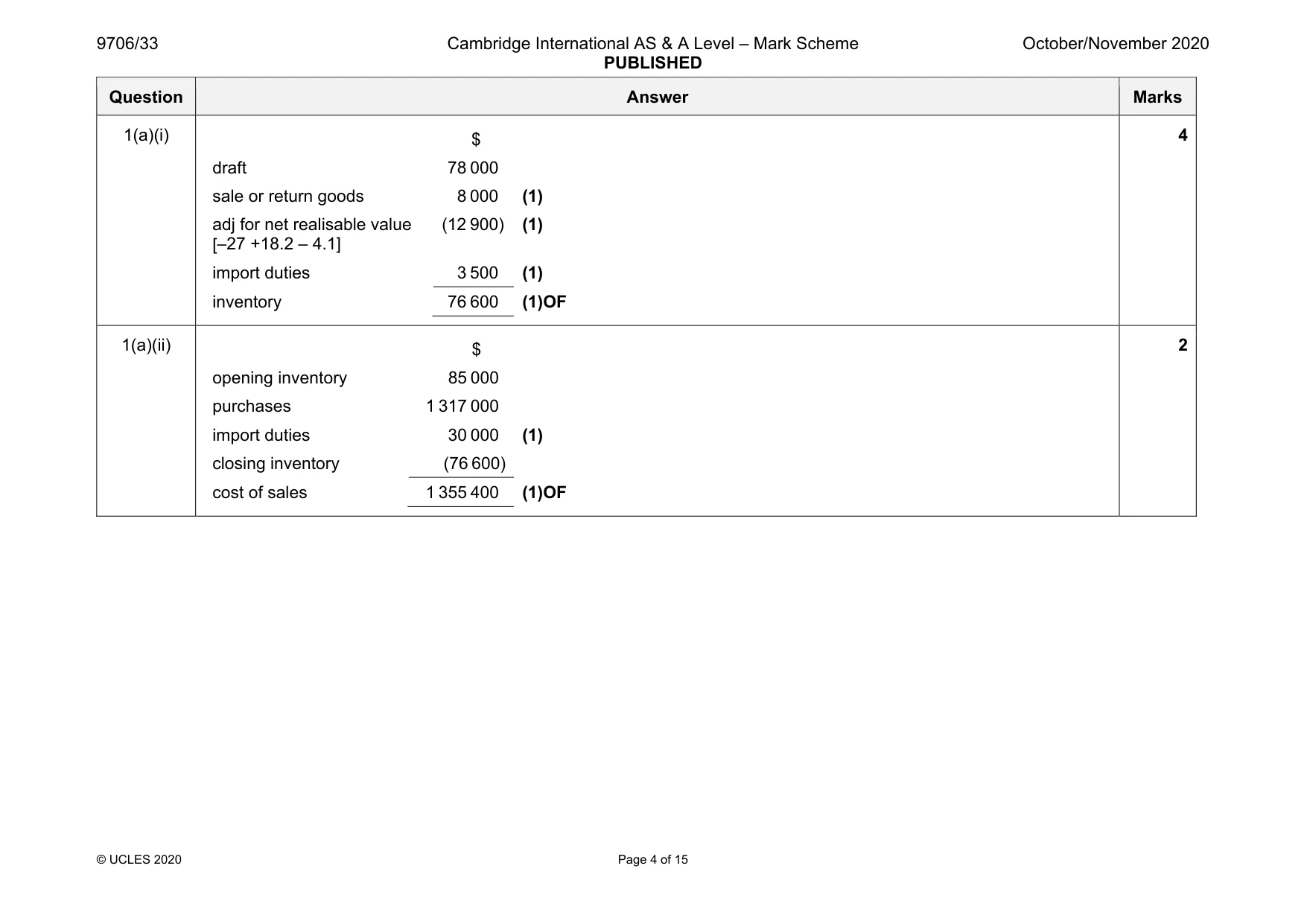
9706/33 Cambridge International AS & A Level – Mark Scheme PUBLISHED October/November 2020 © UCLES 2020 Page 4 of 15 Question Answer Marks 1(a)(i) $ draft 78 000 sale or return goods 8 000 (1) adj for net realisable value [–27 +18.2 – 4.1] (12 900) (1) import duties 3 500 (1) inventory 76 600 (1)OF 4 1(a)(ii) $ opening inventory 85 000 purchases 1 317 000 import duties 30 000 (1) closing inventory (76 600) cost of sales 1 355 400 (1)OF 2
Mark scheme, page 5
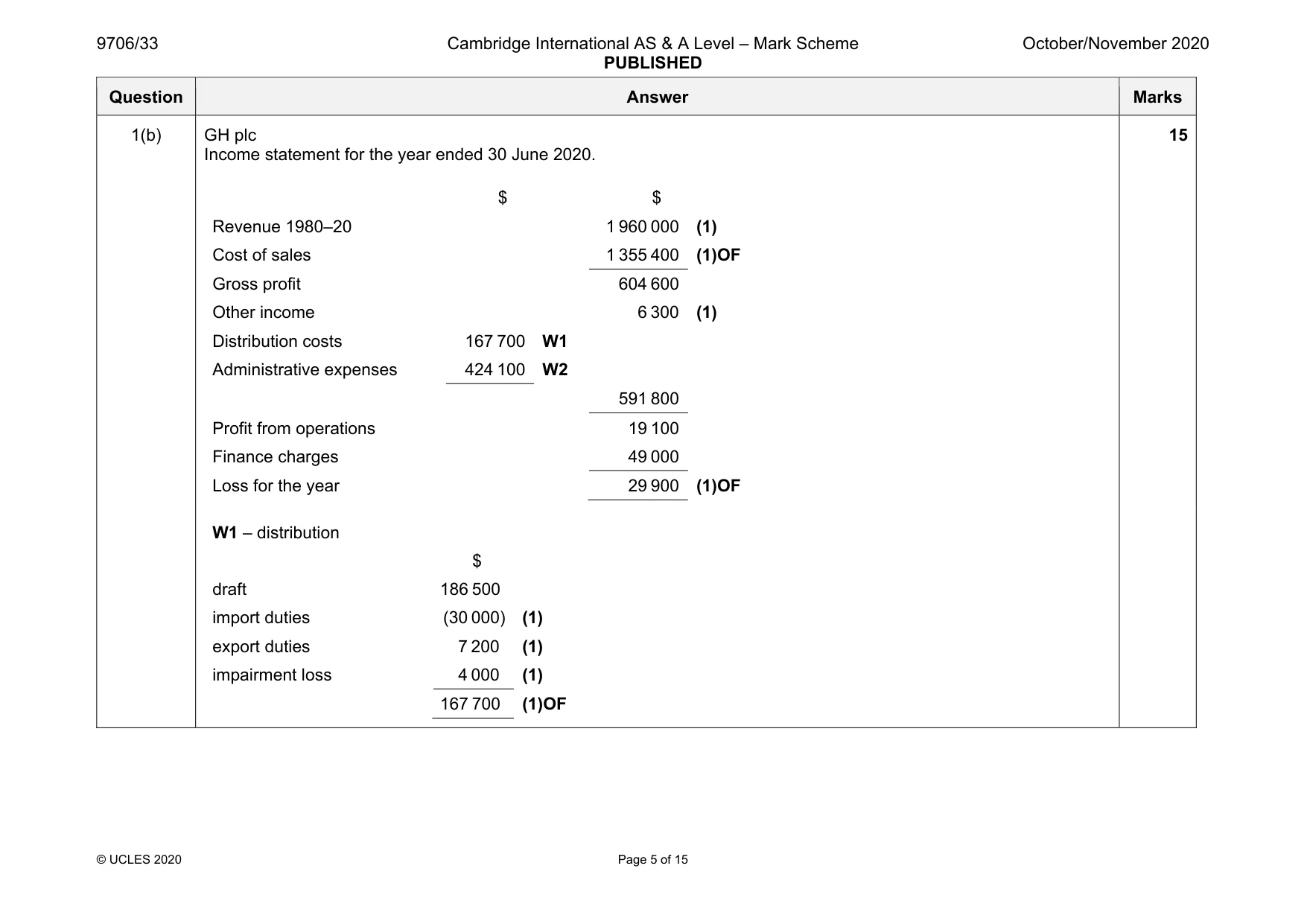
9706/33 Cambridge International AS & A Level – Mark Scheme PUBLISHED October/November 2020 © UCLES 2020 Page 5 of 15 Question Answer Marks 1(b) GH plc Income statement for the year ended 30 June 2020. $ $ Revenue 1980–20 1 960 000 (1) Cost of sales 1 355 400 (1)OF Gross profit 604 600 Other income 6 300 (1) Distribution costs 167 700 W1 Administrative expenses 424 100 W2 591 800 Profit from operations 19 100 Finance charges 49 000 Loss for the year 29 900 (1)OF 15 W1 – distribution $ draft 186 500 import duties (30 000) (1) export duties 7 200 (1) impairment loss 4 000 (1) 167 700 (1)OF
Mark scheme, page 6
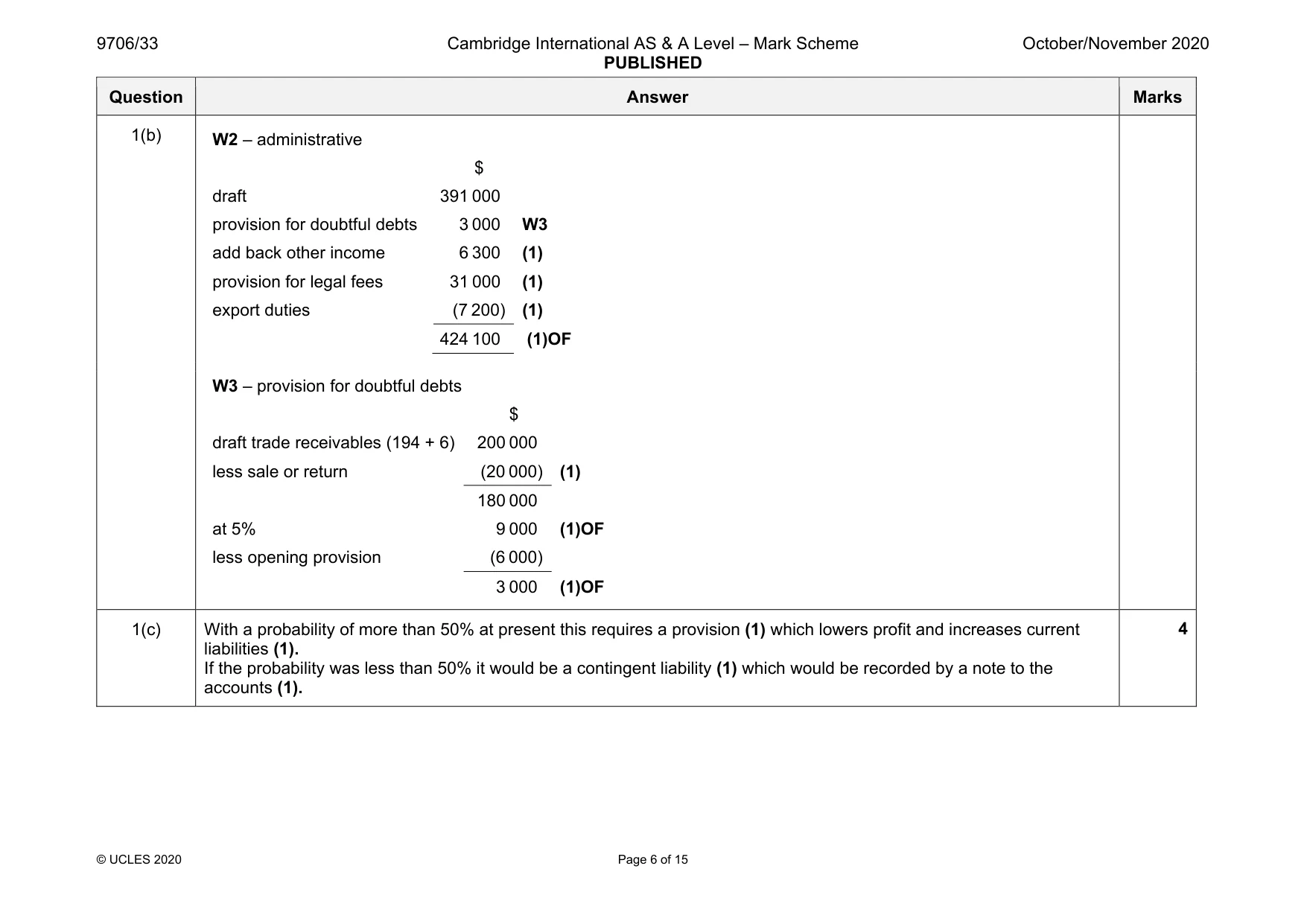
9706/33 Cambridge International AS & A Level – Mark Scheme PUBLISHED October/November 2020 © UCLES 2020 Page 6 of 15 Question Answer Marks 1(b) W2 – administrative $ draft 391 000 provision for doubtful debts 3 000 W3 add back other income 6 300 (1) provision for legal fees 31 000 (1) export duties (7 200) (1) 424 100 (1)OF W3 – provision for doubtful debts $ draft trade receivables (194 + 6) 200 000 less sale or return (20 000) (1) 180 000 at 5% 9 000 (1)OF less opening provision (6 000) 3 000 (1)OF 1(c) With a probability of more than 50% at present this requires a provision (1) which lowers profit and increases current liabilities (1). If the probability was less than 50% it would be a contingent liability (1) which would be recorded by a note to the accounts (1). 4
Mark scheme, page 7
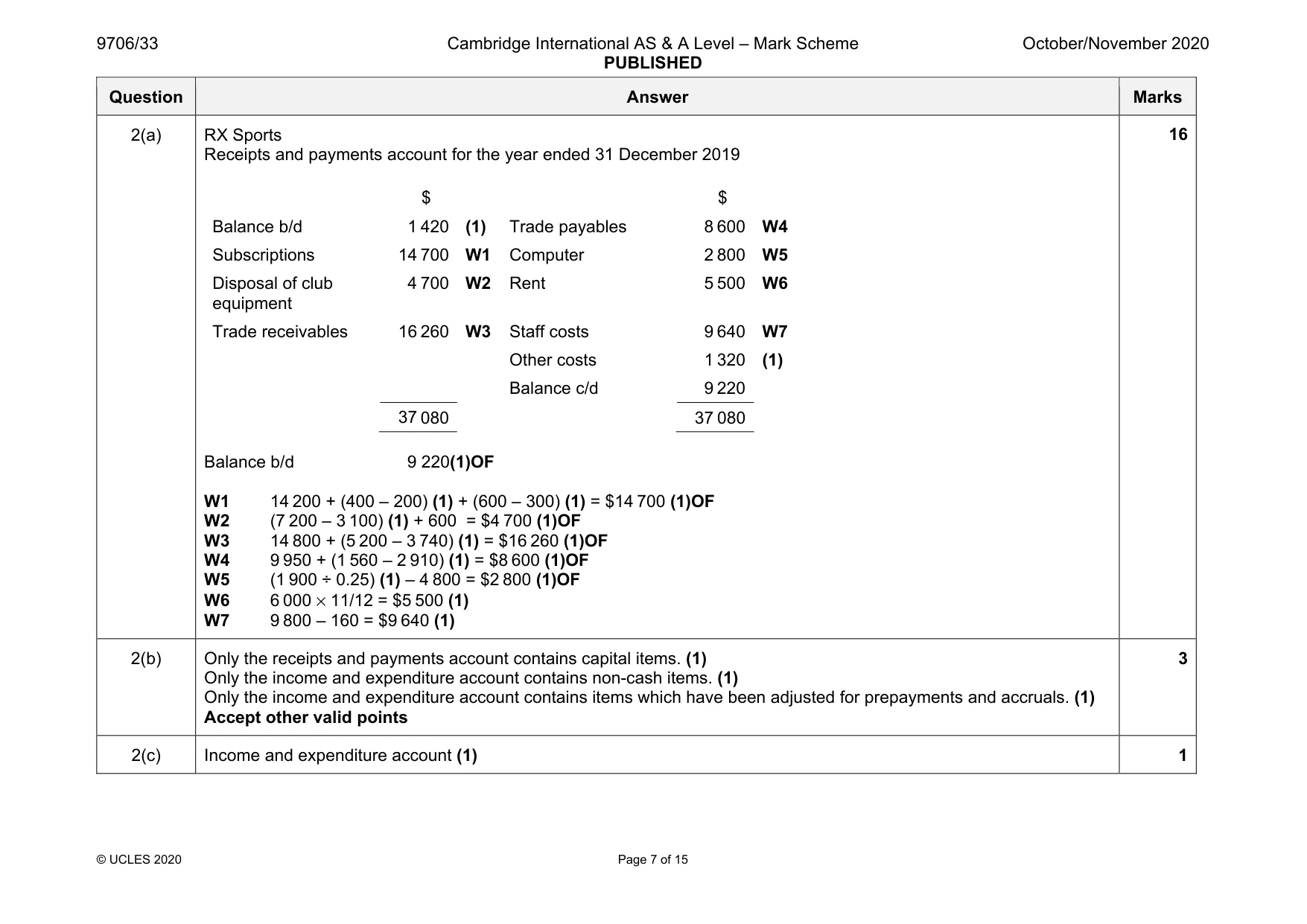
9706/33 Cambridge International AS & A Level – Mark Scheme PUBLISHED October/November 2020 © UCLES 2020 Page 7 of 15 Question Answer Marks 2(a) RX Sports Receipts and payments account for the year ended 31 December 2019 $ $ Balance b/d 1 420 (1) Trade payables 8 600 W4 Subscriptions 14 700 W1 Computer 2 800 W5 Disposal of club equipment 4 700 W2 Rent 5 500 W6 Trade receivables 16 260 W3 Staff costs 9 640 W7 Other costs 1 320 (1) Balance c/d 9 220 37 080 37 080 Balance b/d 9 220(1)OF W1 14 200 + (400 – 200) (1) + (600 – 300) (1) = $14 700 (1)OF W2 (7 200 – 3 100) (1) + 600 = $4 700 (1)OF W3 14 800 + (5 200 – 3 740) (1) = $16 260 (1)OF W4 9 950 + (1 560 – 2 910) (1) = $8 600 (1)OF W5 (1 900 ÷ 0.25) (1) – 4 800 = $2 800 (1)OF W6 6 000 × 11/12 = $5 500 (1) W7 9 800 – 160 = $9 640 (1) 16 2(b) Only the receipts and payments account contains capital items. (1) Only the income and expenditure account contains non-cash items. (1) Only the income and expenditure account contains items which have been adjusted for prepayments and accruals. (1) Accept other valid points 3 2(c) Income and expenditure account (1) 1
Mark scheme, page 8
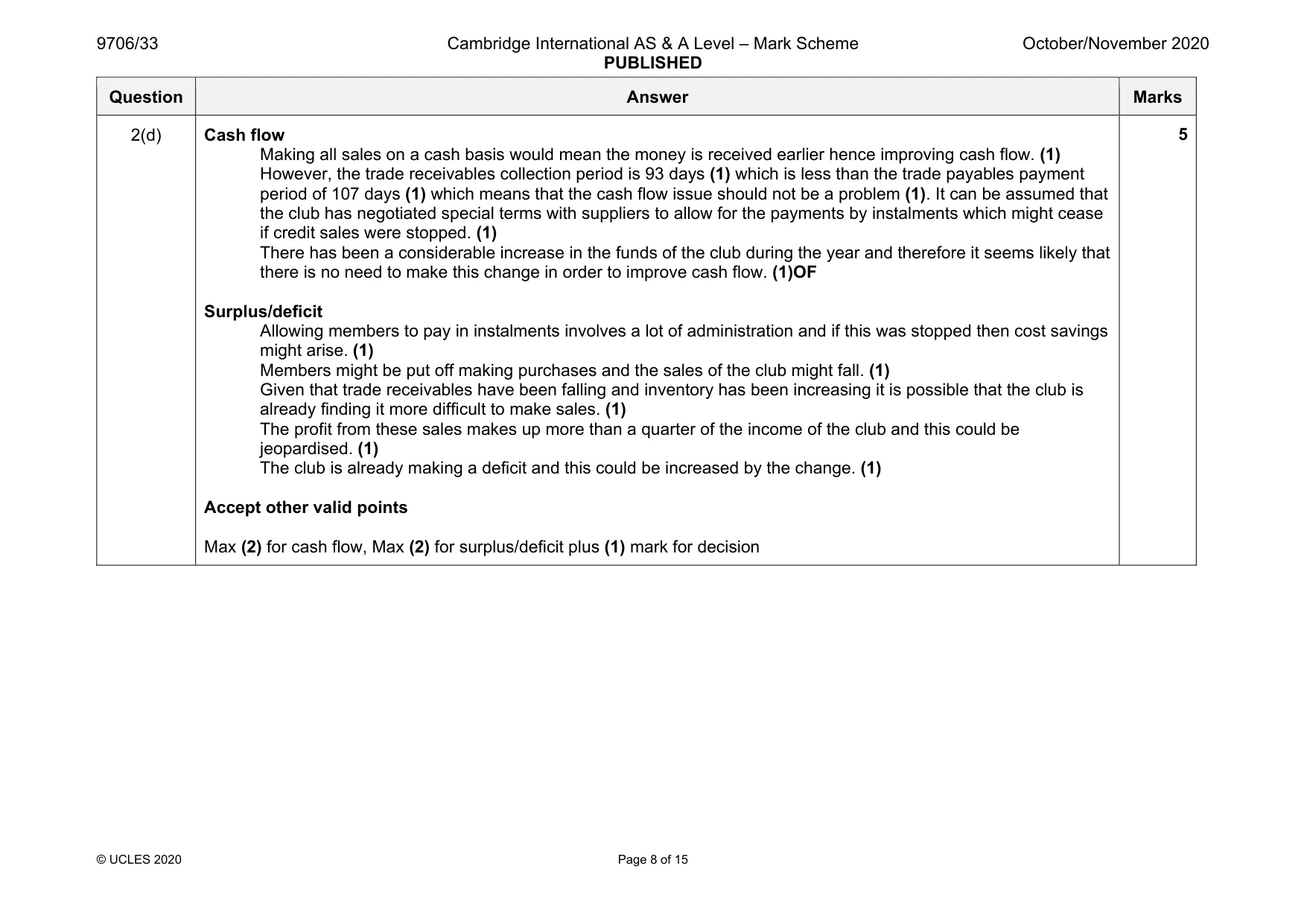
9706/33 Cambridge International AS & A Level – Mark Scheme PUBLISHED October/November 2020 © UCLES 2020 Page 8 of 15 Question Answer Marks 2(d) Cash flow Making all sales on a cash basis would mean the money is received earlier hence improving cash flow. (1) However, the trade receivables collection period is 93 days (1) which is less than the trade payables payment period of 107 days (1) which means that the cash flow issue should not be a problem (1). It can be assumed that the club has negotiated special terms with suppliers to allow for the payments by instalments which might cease if credit sales were stopped. (1) There has been a considerable increase in the funds of the club during the year and therefore it seems likely that there is no need to make this change in order to improve cash flow. (1)OF Surplus/deficit Allowing members to pay in instalments involves a lot of administration and if this was stopped then cost savings might arise. (1) Members might be put off making purchases and the sales of the club might fall. (1) Given that trade receivables have been falling and inventory has been increasing it is possible that the club is already finding it more difficult to make sales. (1) The profit from these sales makes up more than a quarter of the income of the club and this could be jeopardised. (1) The club is already making a deficit and this could be increased by the change. (1) Accept other valid points Max (2) for cash flow, Max (2) for surplus/deficit plus (1) mark for decision 5
Mark scheme, page 9
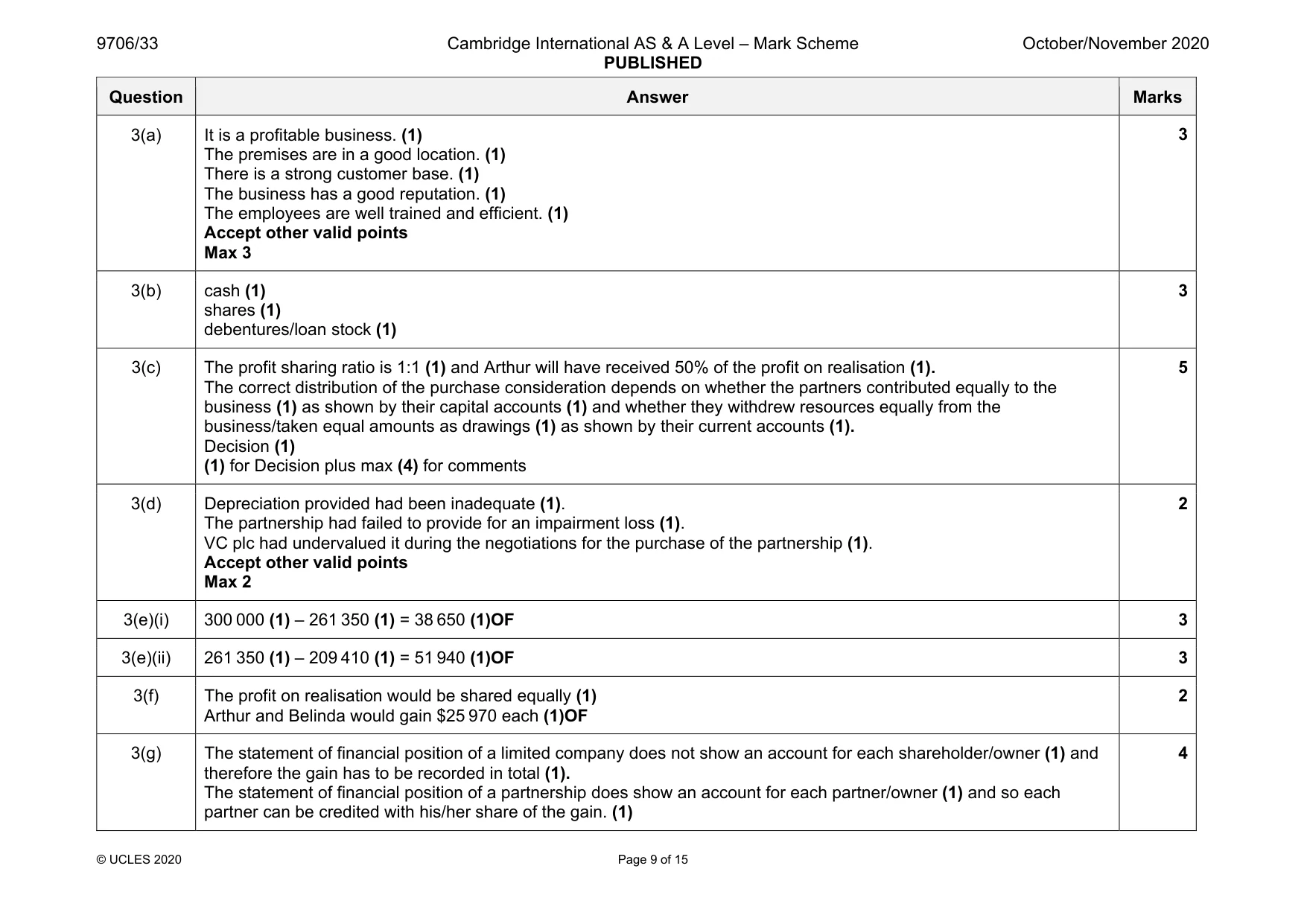
9706/33 Cambridge International AS & A Level – Mark Scheme PUBLISHED October/November 2020 © UCLES 2020 Page 9 of 15 Question Answer Marks 3(a) It is a profitable business. (1) The premises are in a good location. (1) There is a strong customer base. (1) The business has a good reputation. (1) The employees are well trained and efficient. (1) Accept other valid points Max 3 3 3(b) cash (1) shares (1) debentures/loan stock (1) 3 3(c) The profit sharing ratio is 1:1 (1) and Arthur will have received 50% of the profit on realisation (1). The correct distribution of the purchase consideration depends on whether the partners contributed equally to the business (1) as shown by their capital accounts (1) and whether they withdrew resources equally from the business/taken equal amounts as drawings (1) as shown by their current accounts (1). Decision (1) (1) for Decision plus max (4) for comments 5 3(d) Depreciation provided had been inadequate (1). The partnership had failed to provide for an impairment loss (1). VC plc had undervalued it during the negotiations for the purchase of the partnership (1). Accept other valid points Max 2 2 3(e)(i) 300 000 (1) – 261 350 (1) = 38 650 (1)OF 3 3(e)(ii) 261 350 (1) – 209 410 (1) = 51 940 (1)OF 3 3(f) The profit on realisation would be shared equally (1) Arthur and Belinda would gain $25 970 each (1)OF 2 3(g) The statement of financial position of a limited company does not show an account for each shareholder/owner (1) and therefore the gain has to be recorded in total (1). The statement of financial position of a partnership does show an account for each partner/owner (1) and so each partner can be credited with his/her share of the gain. (1) 4
Mark scheme, page 10
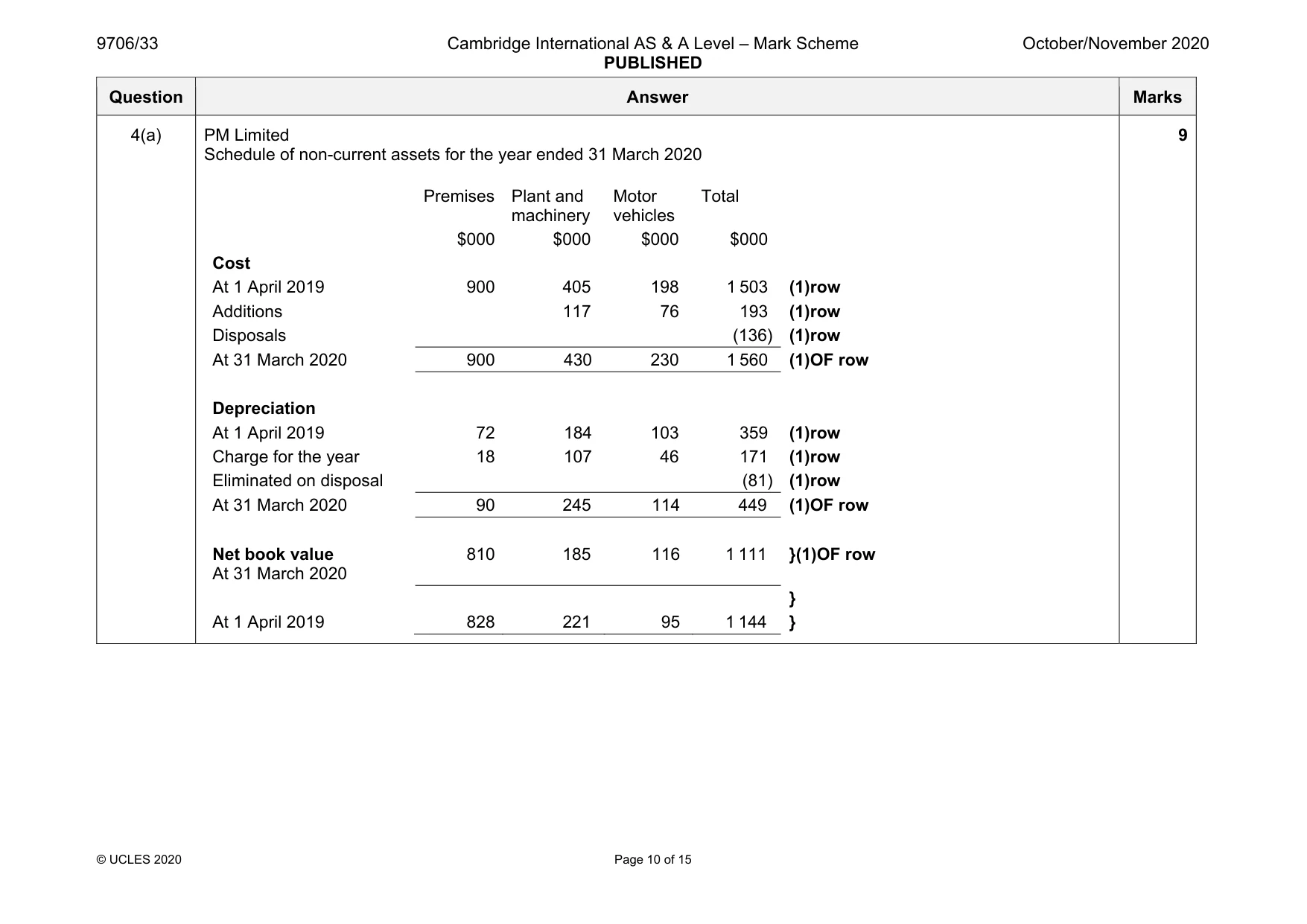
9706/33 Cambridge International AS & A Level – Mark Scheme PUBLISHED October/November 2020 © UCLES 2020 Page 10 of 15 Question Answer Marks 4(a) PM Limited Schedule of non-current assets for the year ended 31 March 2020 Premises Plant and machinery Motor vehicles Total $000 $000 $000 $000 Cost At 1 April 2019 900 405 198 1 503 (1)row Additions 117 76 193 (1)row Disposals (136) (1)row At 31 March 2020 900 430 230 1 560 (1)OF row Depreciation At 1 April 2019 72 184 103 359 (1)row Charge for the year 18 107 46 171 (1)row Eliminated on disposal (81) (1)row At 31 March 2020 90 245 114 449 (1)OF row Net book value At 31 March 2020 810 185 116 1 111 }(1)OF row } At 1 April 2019 828 221 95 1 144 } 9
Mark scheme, page 11
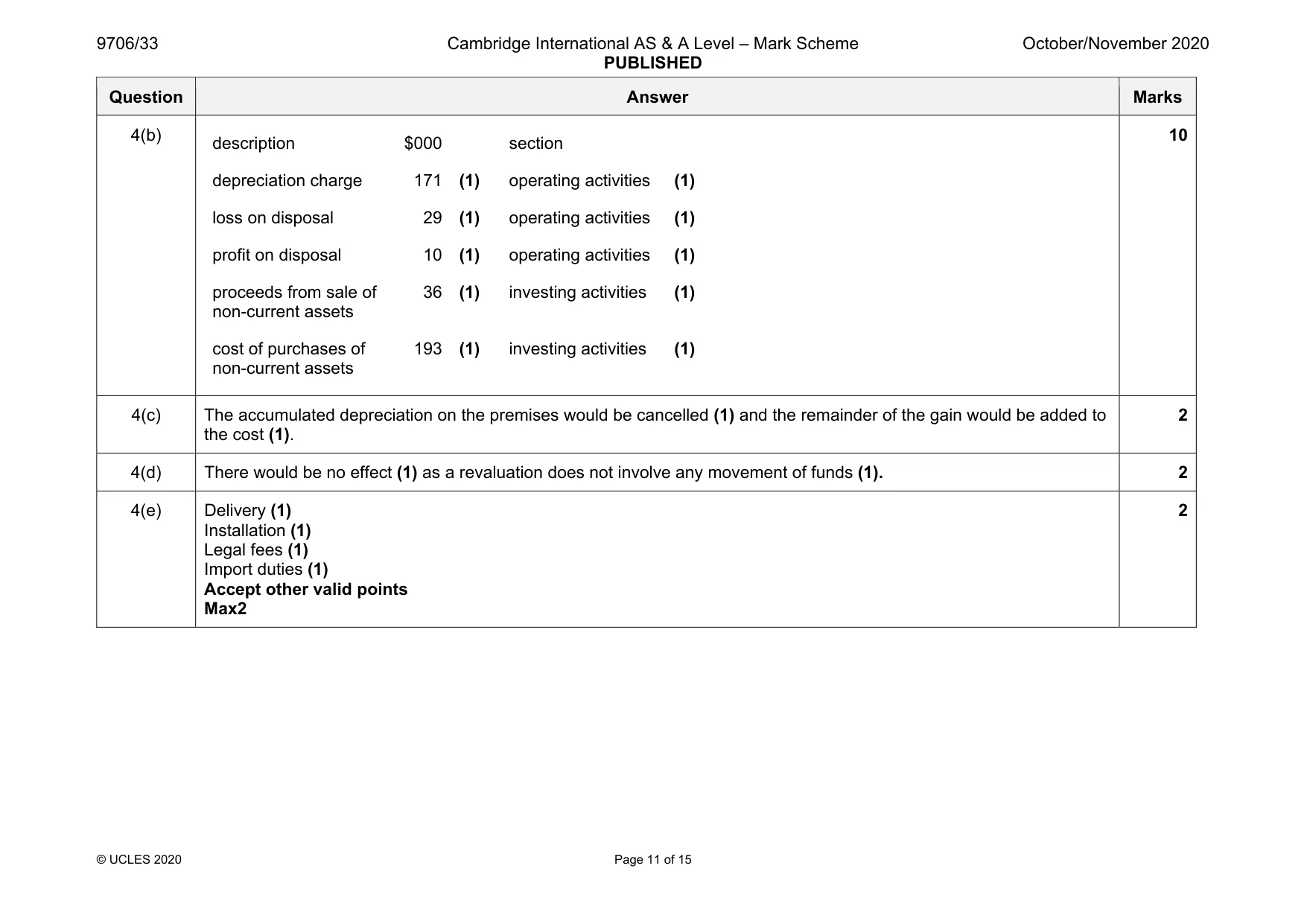
9706/33 Cambridge International AS & A Level – Mark Scheme PUBLISHED October/November 2020 © UCLES 2020 Page 11 of 15 Question Answer Marks 4(b) description $000 section depreciation charge 171 (1) operating activities (1) loss on disposal 29 (1) operating activities (1) profit on disposal 10 (1) operating activities (1) proceeds from sale of non-current assets 36 (1) investing activities (1) cost of purchases of non-current assets 193 (1) investing activities (1) 10 4(c) The accumulated depreciation on the premises would be cancelled (1) and the remainder of the gain would be added to the cost (1). 2 4(d) There would be no effect (1) as a revaluation does not involve any movement of funds (1). 2 4(e) Delivery (1) Installation (1) Legal fees (1) Import duties (1) Accept other valid points Max2 2
Mark scheme, page 12
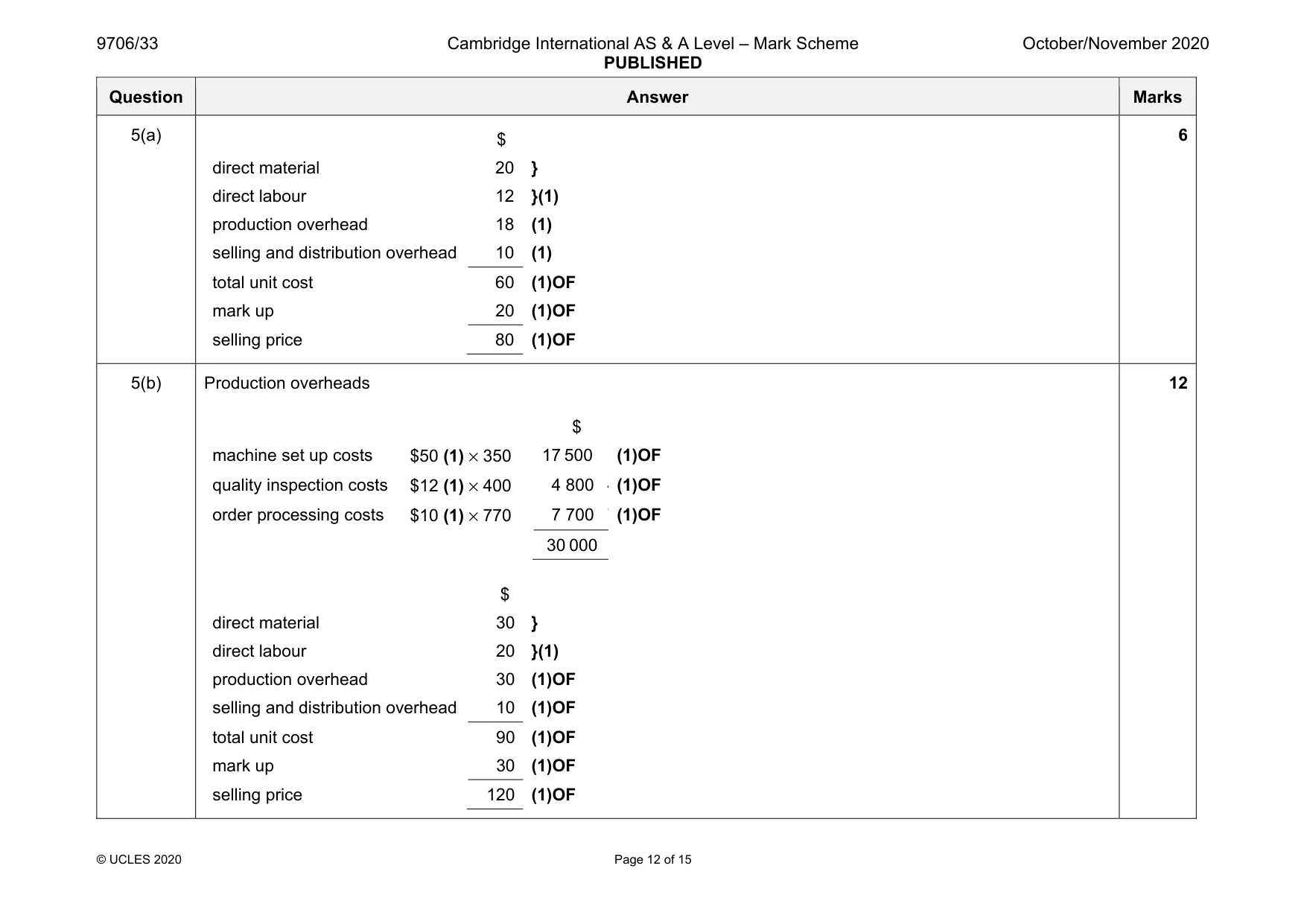
9706/33 Cambridge International AS & A Level – Mark Scheme PUBLISHED October/November 2020 © UCLES 2020 Page 12 of 15 Question Answer Marks 5(a) $ direct material 20 } direct labour 12 }(1) production overhead 18 (1) selling and distribution overhead 10 (1) total unit cost 60 (1)OF mark up 20 (1)OF selling price 80 (1)OF 6 5(b) Production overheads $ machine set up costs $50 (1) × 350 17 500 (1)OF quality inspection costs $12 (1) × 400 4 800 4(1)OF order processing costs $10 (1) × 770 7 700 7(1)OF 30 000 $ direct material 30 } direct labour 20 }(1) production overhead 30 (1)OF selling and distribution overhead 10 (1)OF total unit cost 90 (1)OF mark up 30 (1)OF selling price 120 (1)OF 12
Mark scheme, page 13
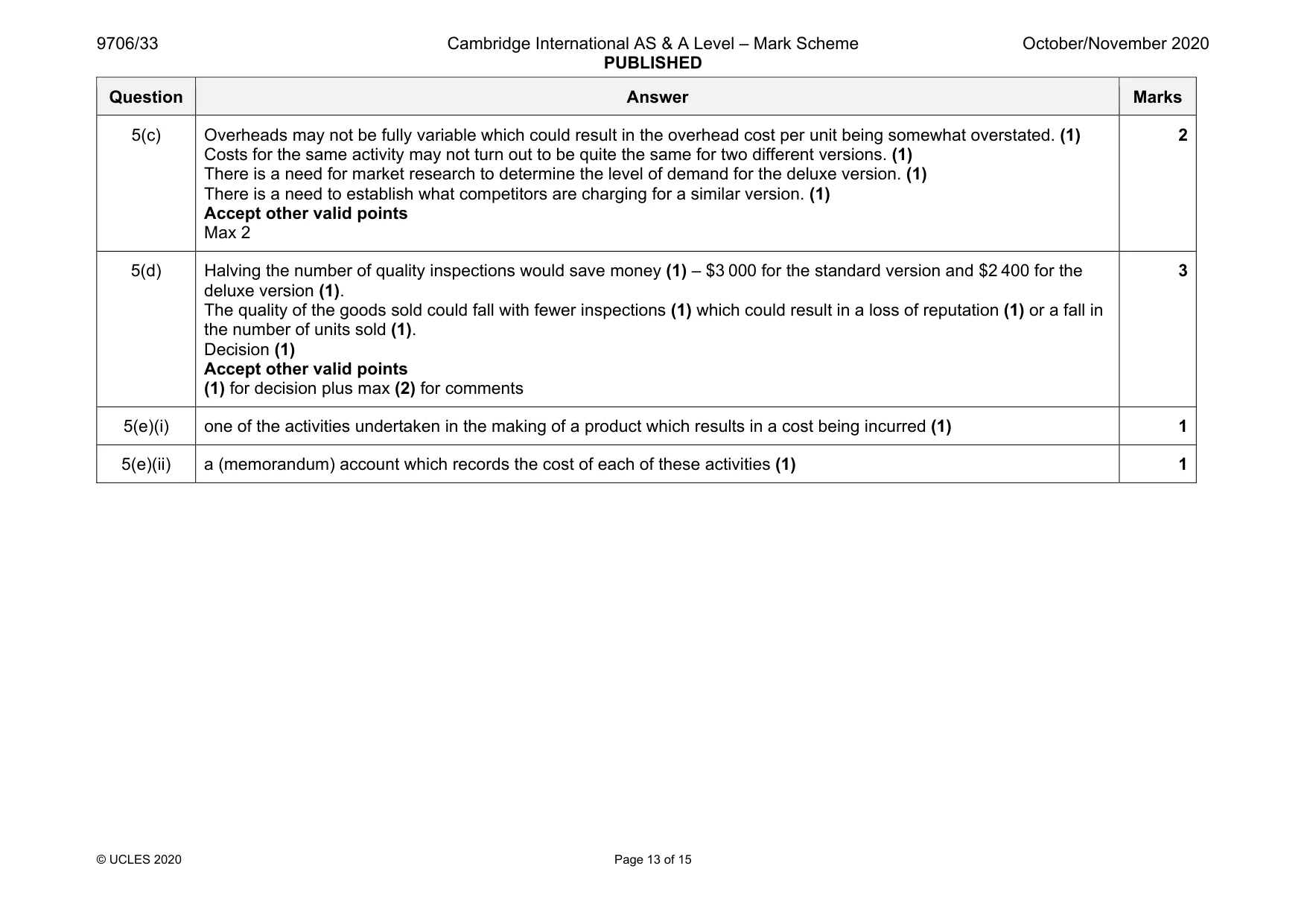
9706/33 Cambridge International AS & A Level – Mark Scheme PUBLISHED October/November 2020 © UCLES 2020 Page 13 of 15 Question Answer Marks 5(c) Overheads may not be fully variable which could result in the overhead cost per unit being somewhat overstated. (1) Costs for the same activity may not turn out to be quite the same for two different versions. (1) There is a need for market research to determine the level of demand for the deluxe version. (1) There is a need to establish what competitors are charging for a similar version. (1) Accept other valid points Max 2 2 5(d) Halving the number of quality inspections would save money (1) – $3 000 for the standard version and $2 400 for the deluxe version (1). The quality of the goods sold could fall with fewer inspections (1) which could result in a loss of reputation (1) or a fall in the number of units sold (1). Decision (1) Accept other valid points (1) for decision plus max (2) for comments 3 5(e)(i) one of the activities undertaken in the making of a product which results in a cost being incurred (1) 1 5(e)(ii) a (memorandum) account which records the cost of each of these activities (1) 1
Mark scheme, page 14
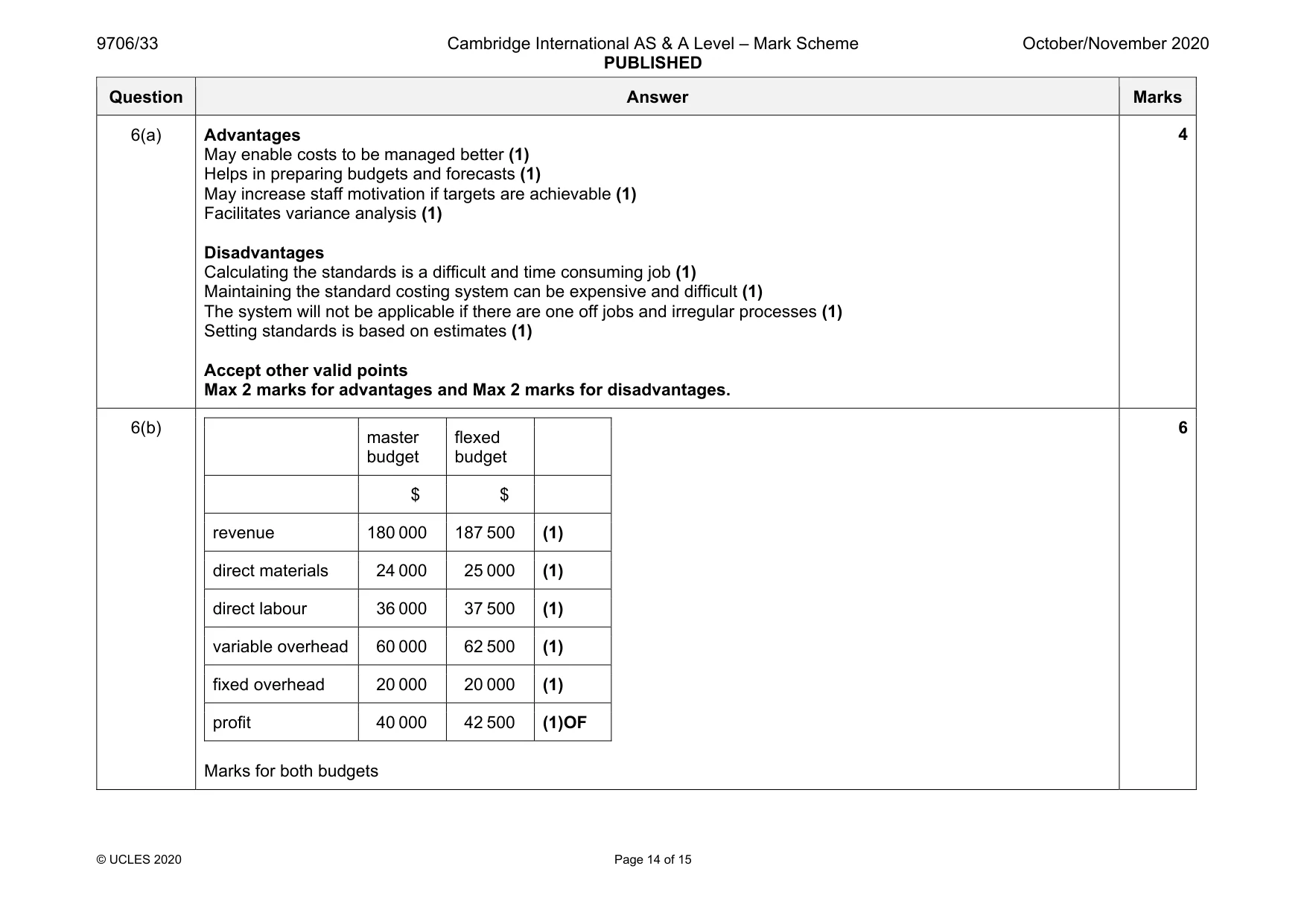
9706/33 Cambridge International AS & A Level – Mark Scheme PUBLISHED October/November 2020 © UCLES 2020 Page 14 of 15 Question Answer Marks 6(a) Advantages May enable costs to be managed better (1) Helps in preparing budgets and forecasts (1) May increase staff motivation if targets are achievable (1) Facilitates variance analysis (1) Disadvantages Calculating the standards is a difficult and time consuming job (1) Maintaining the standard costing system can be expensive and difficult (1) The system will not be applicable if there are one off jobs and irregular processes (1) Setting standards is based on estimates (1) Accept other valid points Max 2 marks for advantages and Max 2 marks for disadvantages. 4 6(b) master budget flexed budget $ $ revenue 180 000 187 500 (1) direct materials 24 000 25 000 (1) direct labour 36 000 37 500 (1) variable overhead 60 000 62 500 (1) fixed overhead 20 000 20 000 (1) profit 40 000 42 500 (1)OF Marks for both budgets 6
Mark scheme, page 15
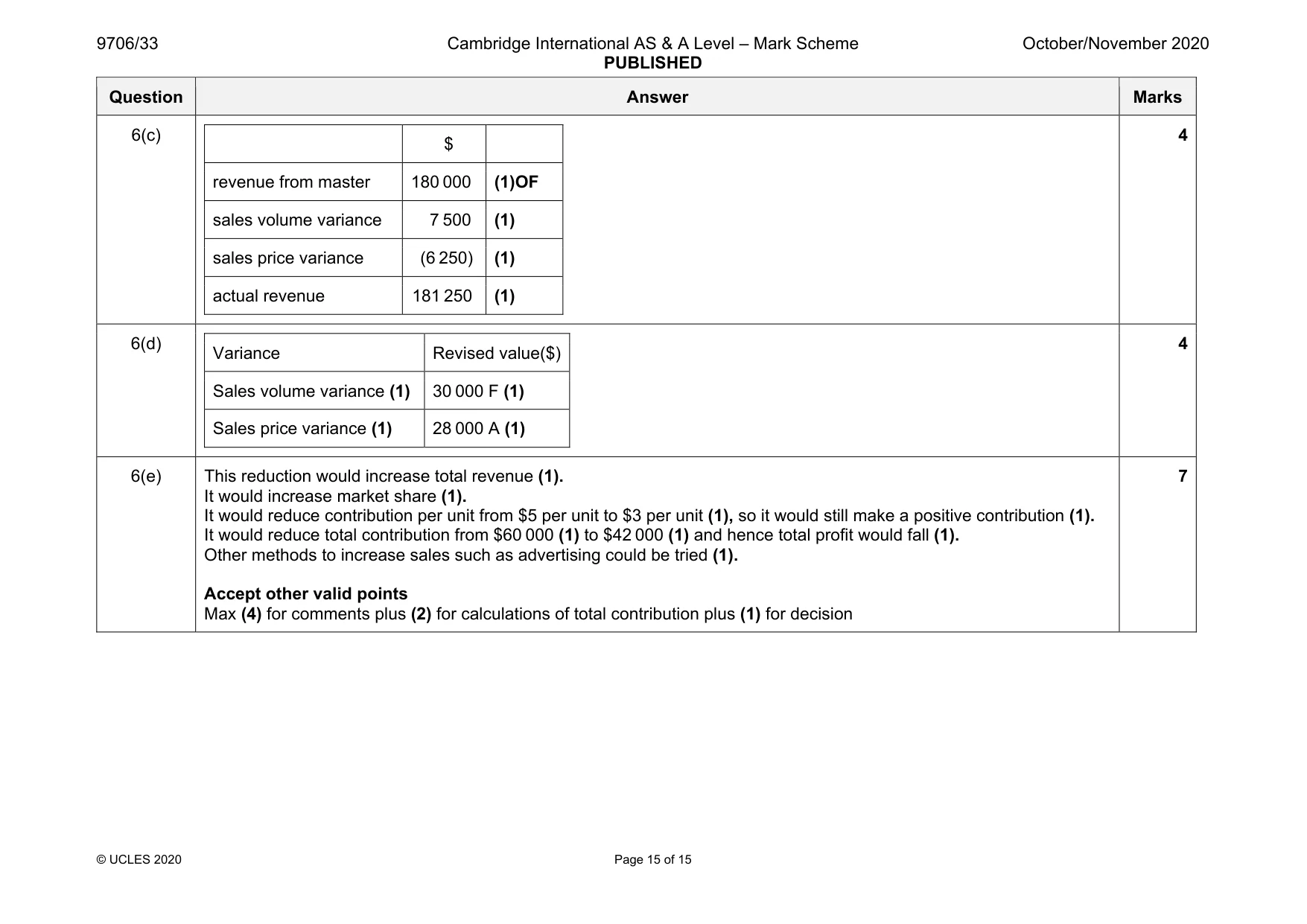
9706/33 Cambridge International AS & A Level – Mark Scheme PUBLISHED October/November 2020 © UCLES 2020 Page 15 of 15 Question Answer Marks 6(c) $ revenue from master 180 000 (1)OF sales volume variance 7 500 (1) sales price variance (6 250) (1) actual revenue 181 250 (1) 4 6(d) Variance Revised value($) Sales volume variance (1) 30 000 F (1) Sales price variance (1) 28 000 A (1) 4 6(e) This reduction would increase total revenue (1). It would increase market share (1). It would reduce contribution per unit from $5 per unit to $3 per unit (1), so it would still make a positive contribution (1). It would reduce total contribution from $60 000 (1) to $42 000 (1) and hence total profit would fall (1). Other methods to increase sales such as advertising could be tried (1). Accept other valid points Max (4) for comments plus (2) for calculations of total contribution plus (1) for decision 7
What you needed in this session
Cambridge’s own grade thresholds for 2020 Oct/Nov, Paper 3 · Variant 3. A higher threshold means an easier paper — the bar moves with how the cohort did.