Cambridge A Level Accounting 9706 — 2023 Oct/Nov Paper 3 · Variant 3
9706/33/O/N/23 · 75 marks · ≈84 min
The question paper and its mark scheme, free to read here and free to download. This is Cambridge’s own paper, exactly as it was sat.
Question paper12 pages


Mark scheme14 pages
Answers below. Sit the paper first if you are practising.
Paper as text
Question paper, page 1
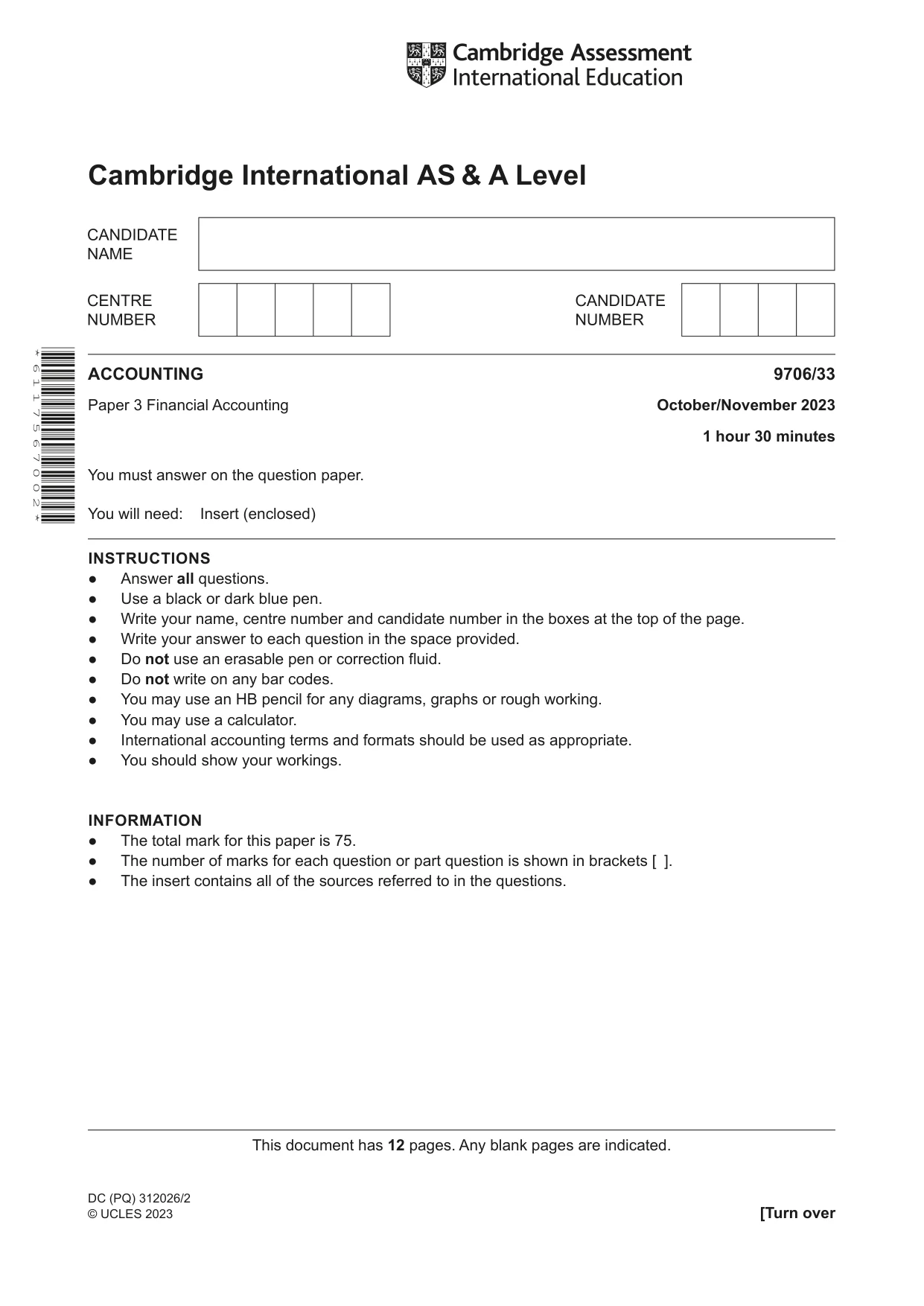
This document has 12 pages. Any blank pages are indicated. [Turn over Cambridge International AS & A Level ACCOUNTING 9706/33 Paper 3 Financial Accounting October/November 2023 1 hour 30 minutes You must answer on the question paper. You will need: Insert (enclosed) INSTRUCTIONS ● Answer all questions. ● Use a black or dark blue pen. ● Write your name, centre number and candidate number in the boxes at the top of the page. ● Write your answer to each question in the space provided. ● Do not use an erasable pen or correction fluid. ● Do not write on any bar codes. ● You may use an HB pencil for any diagrams, graphs or rough working. ● You may use a calculator. ● International accounting terms and formats should be used as appropriate. ● You should show your workings. INFORMATION ● The total mark for this paper is 75. ● The number of marks for each question or part question is shown in brackets [ ]. ● The insert contains all of the sources referred to in the questions. * 6 1 1 7 5 6 7 0 0 2 * DC (PQ) 312026/2 © UCLES 2023
Question paper, page 2
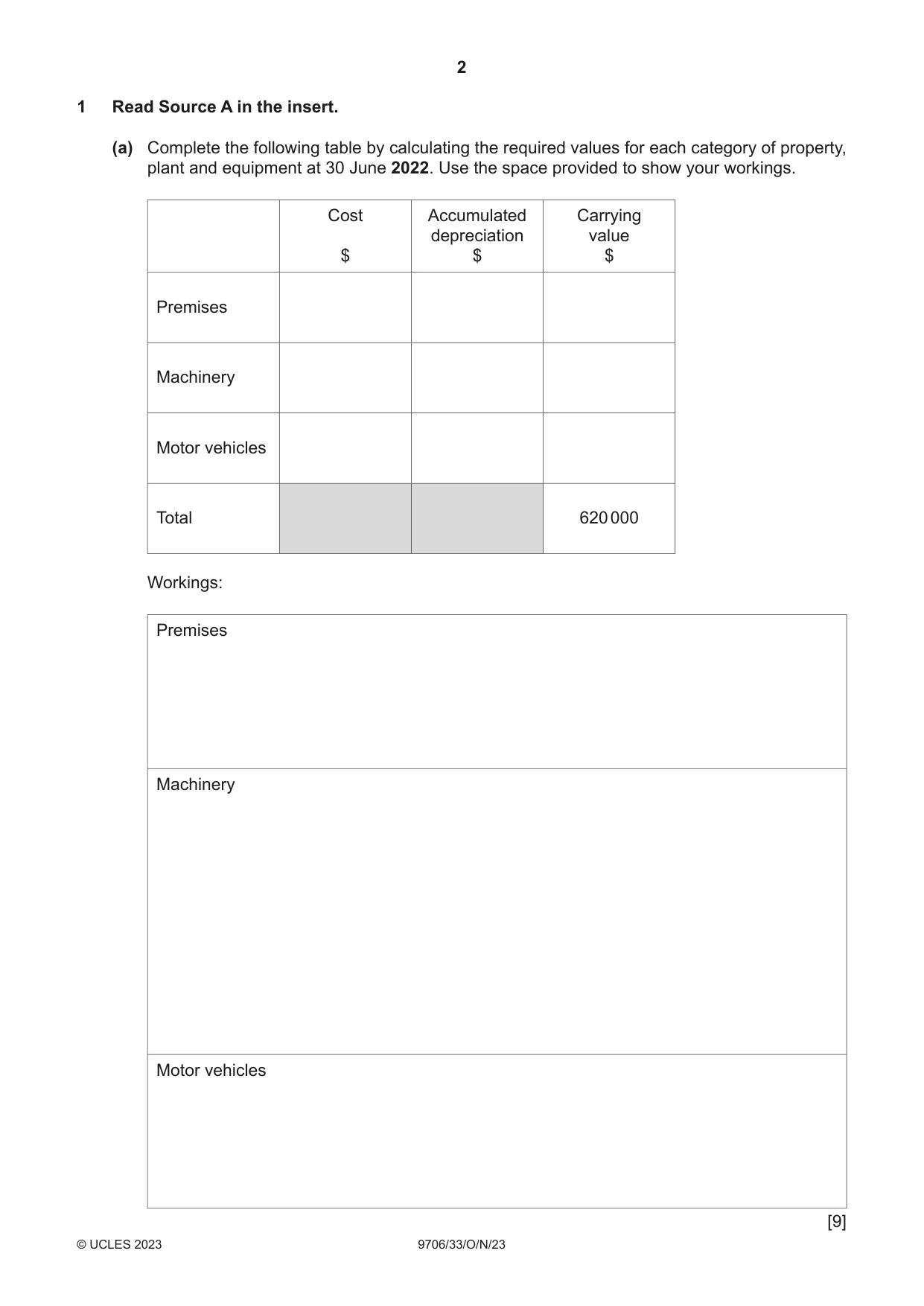
2 9706/33/O/N/23 © UCLES 2023 1 Read Source A in the insert. (a) Complete the following table by calculating the required values for each category of property, plant and equipment at 30 June 2022. Use the space provided to show your workings. Cost $ Accumulated depreciation $ Carrying value $ Premises Machinery Motor vehicles Total 620 000 Workings: Premises Machinery Motor vehicles [9]
Question paper, page 3
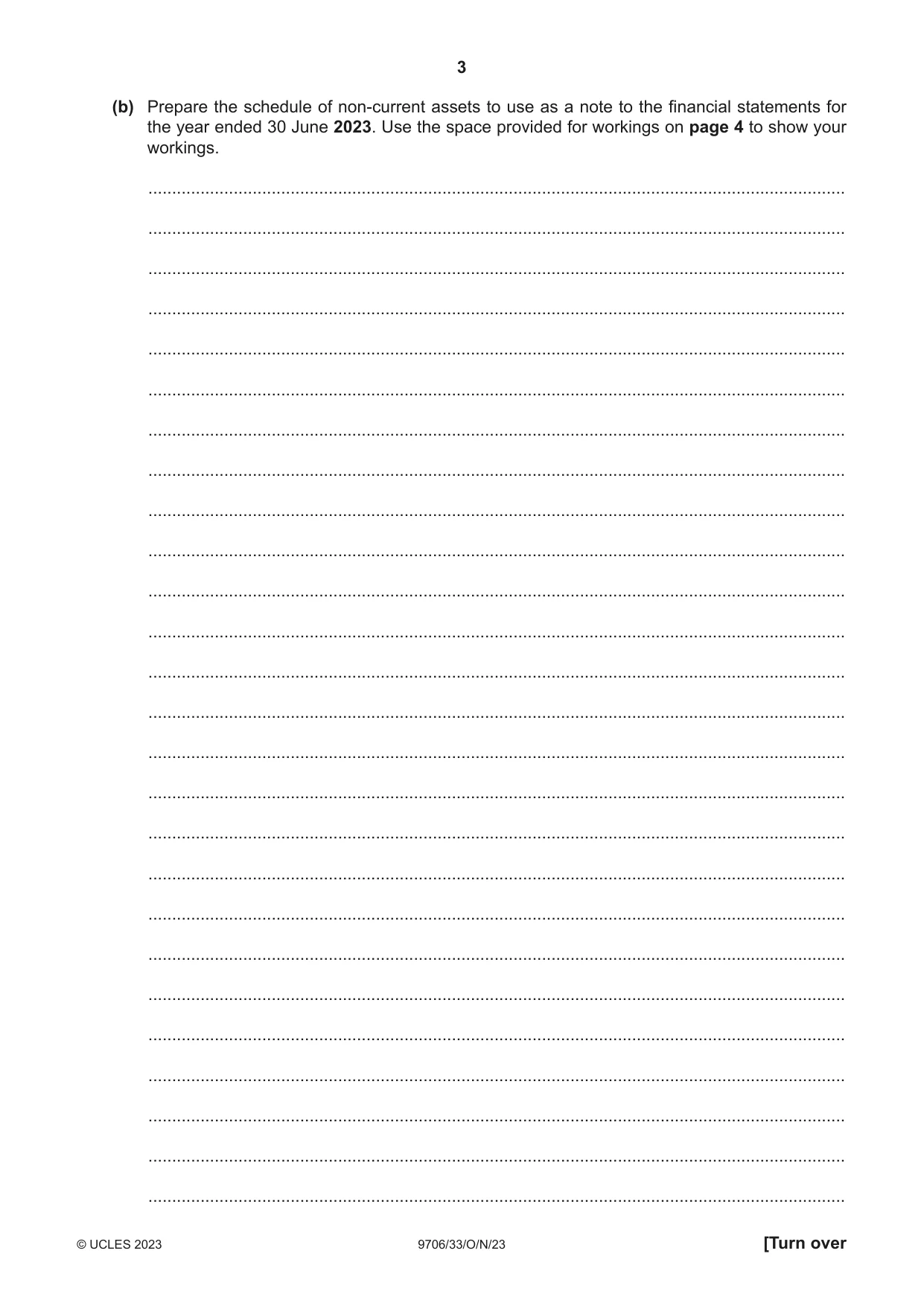
3 9706/33/O/N/23 © UCLES 2023 [Turn over (b) Prepare the schedule of non-current assets to use as a note to the financial statements for the year ended 30 June 2023. Use the space provided for workings on page 4 to show your workings. … … … … … … … … … … … … … … … … … … … … … … … … … …
Question paper, page 4
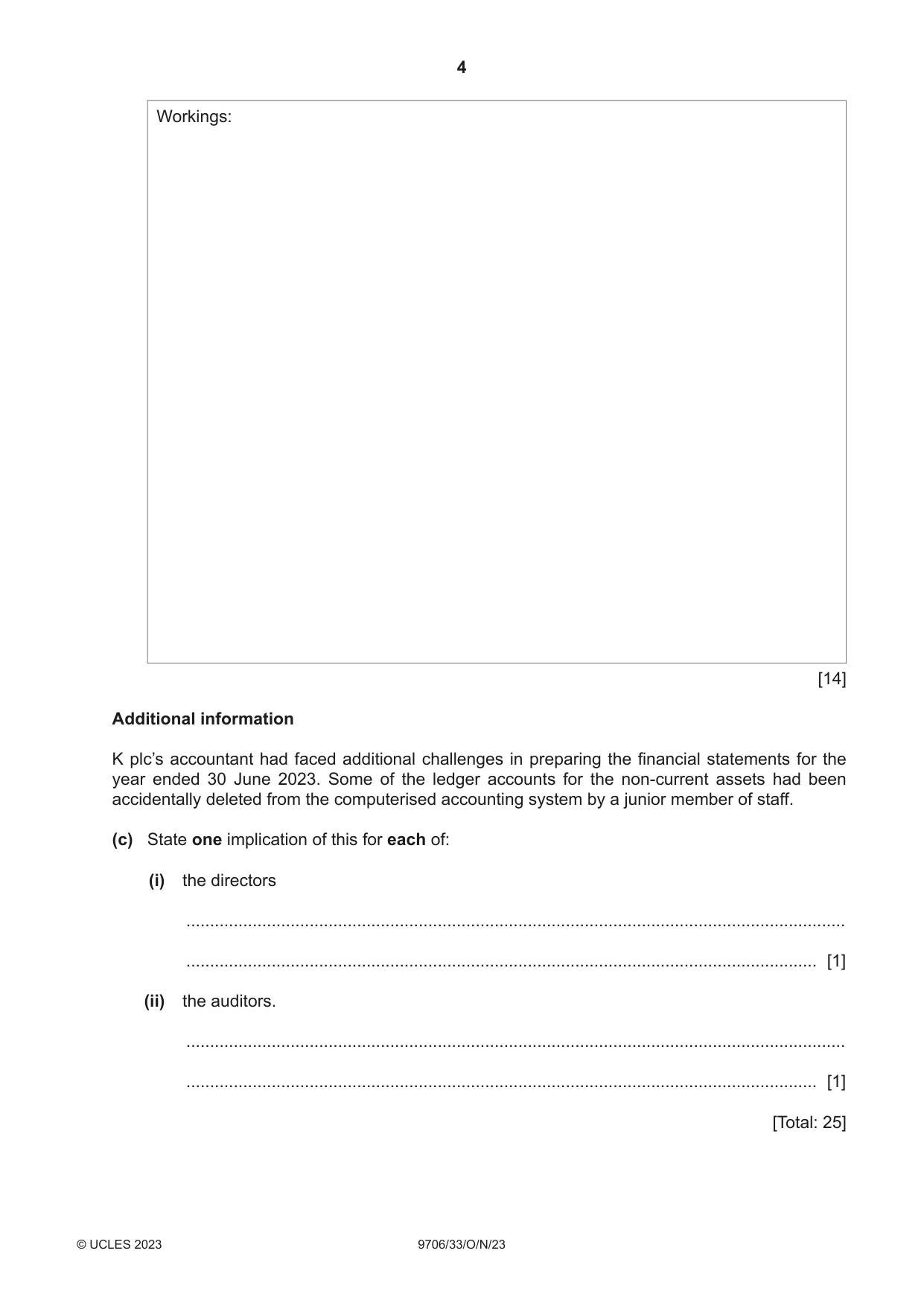
4 9706/33/O/N/23 © UCLES 2023 Workings: [14] Additional information K plc’s accountant had faced additional challenges in preparing the financial statements for the year ended 30 June 2023. Some of the ledger accounts for the non-current assets had been accidentally deleted from the computerised accounting system by a junior member of staff. (c) State one implication of this for each of: (i) the directors … … [1] (ii) the auditors. … … [1] [Total: 25]
Question paper, page 5
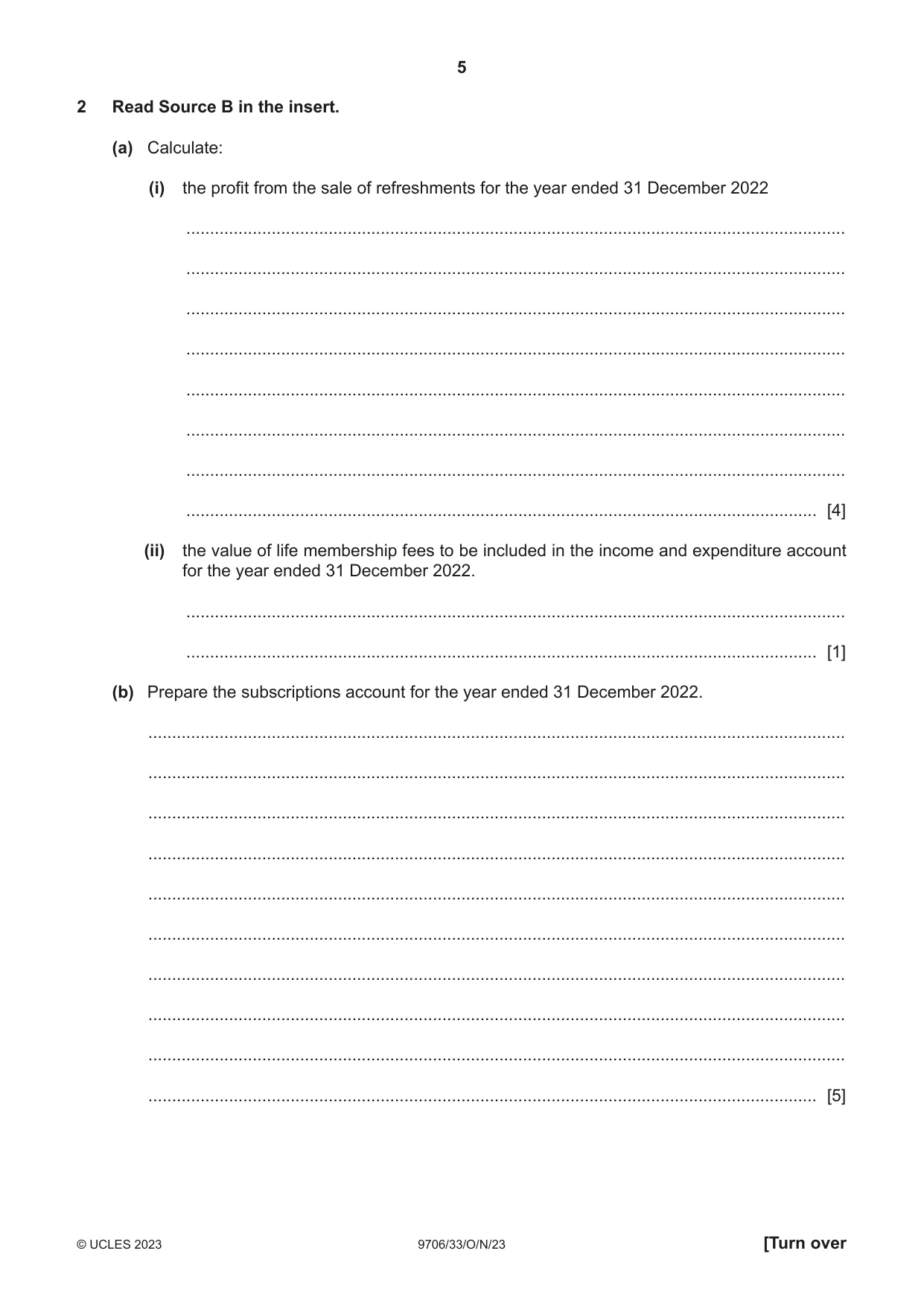
5 9706/33/O/N/23 © UCLES 2023 [Turn over 2 Read Source B in the insert. (a) Calculate: (i) the profit from the sale of refreshments for the year ended 31 December 2022 … … … … … … … … [4] (ii) the value of life membership fees to be included in the income and expenditure account for the year ended 31 December 2022. … … [1] (b) Prepare the subscriptions account for the year ended 31 December 2022. … … … … … … … … … … [5]
Question paper, page 6
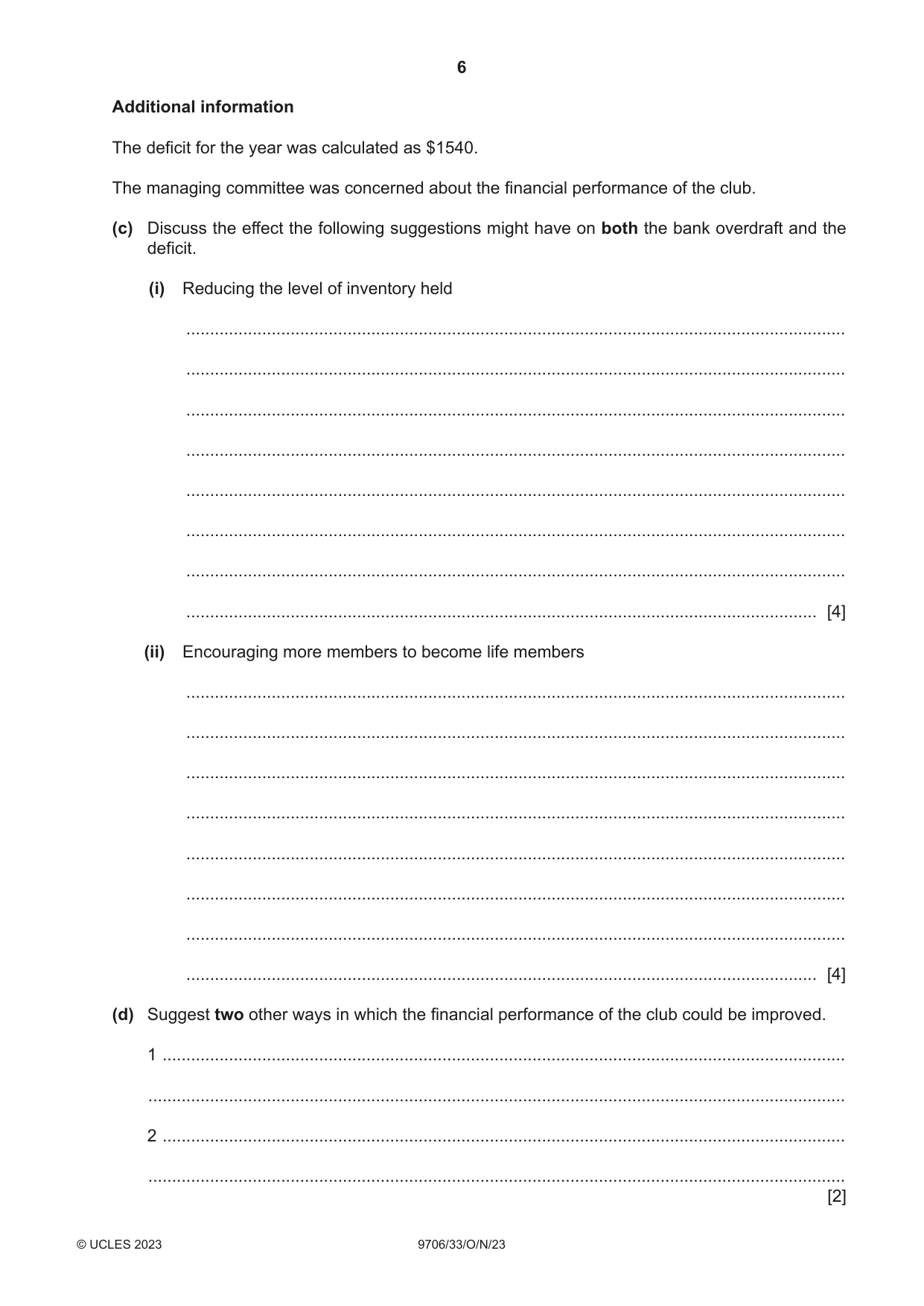
6 9706/33/O/N/23 © UCLES 2023 Additional information The deficit for the year was calculated as $1540. The managing committee was concerned about the financial performance of the club. (c) Discuss the effect the following suggestions might have on both the bank overdraft and the deficit. (i) Reducing the level of inventory held … … … … … … … … [4] (ii) Encouraging more members to become life members … … … … … … … … [4] (d) Suggest two other ways in which the financial performance of the club could be improved. 1 … … 2 … … [2]
Question paper, page 7
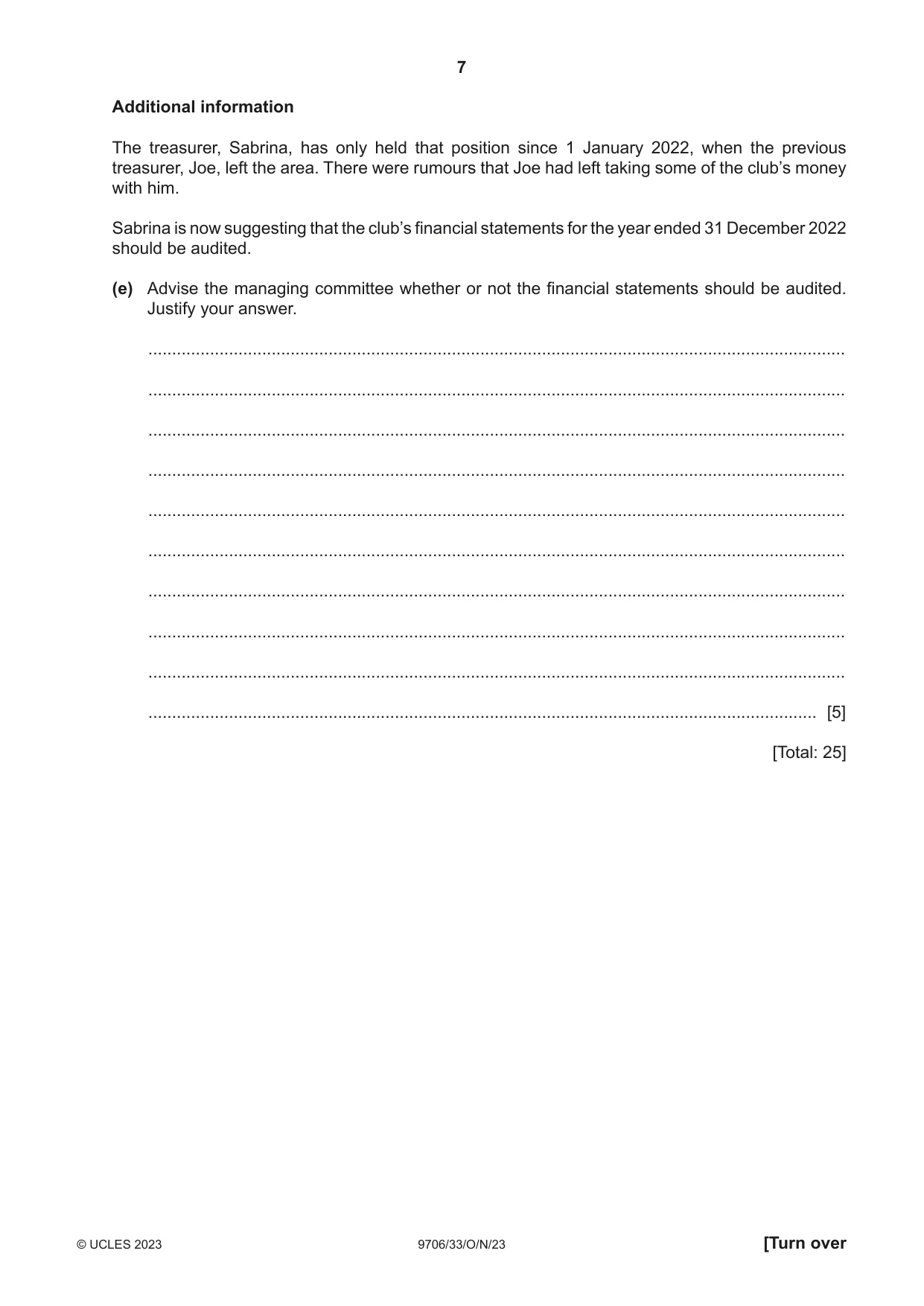
7 9706/33/O/N/23 © UCLES 2023 [Turn over Additional information The treasurer, Sabrina, has only held that position since 1 January 2022, when the previous treasurer, Joe, left the area. There were rumours that Joe had left taking some of the club’s money with him. Sabrina is now suggesting that the club’s financial statements for the year ended 31 December 2022 should be audited. (e) Advise the managing committee whether or not the financial statements should be audited. Justify your answer. … … … … … … … … … … [5] [Total: 25]
Question paper, page 8
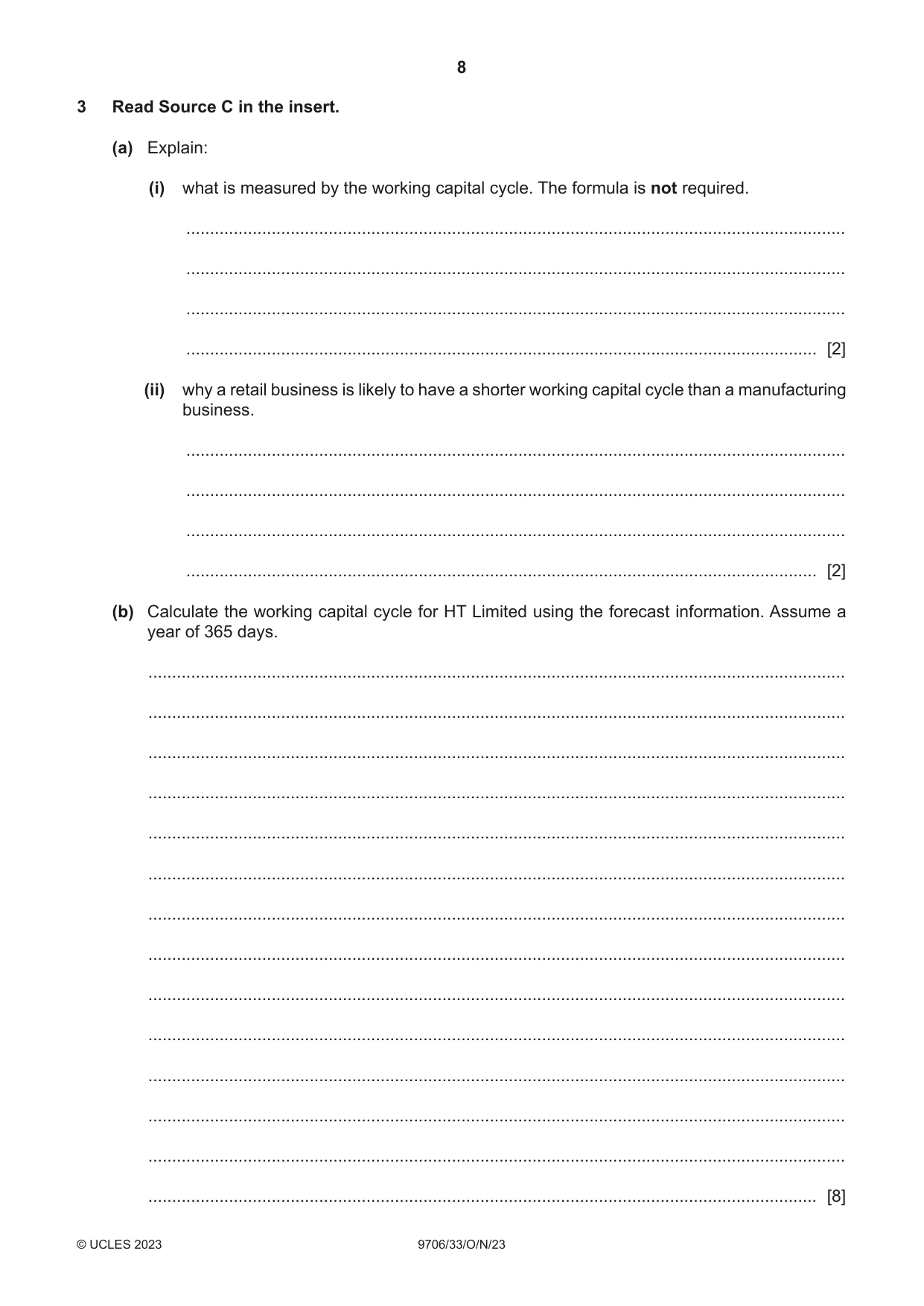
8 9706/33/O/N/23 © UCLES 2023 3 Read Source C in the insert. (a) Explain: (i) what is measured by the working capital cycle. The formula is not required. … … … … [2] (ii) why a retail business is likely to have a shorter working capital cycle than a manufacturing business. … … … … [2] (b) Calculate the working capital cycle for HT Limited using the forecast information. Assume a year of 365 days. … … … … … … … … … … … … … … [8]
Question paper, page 9
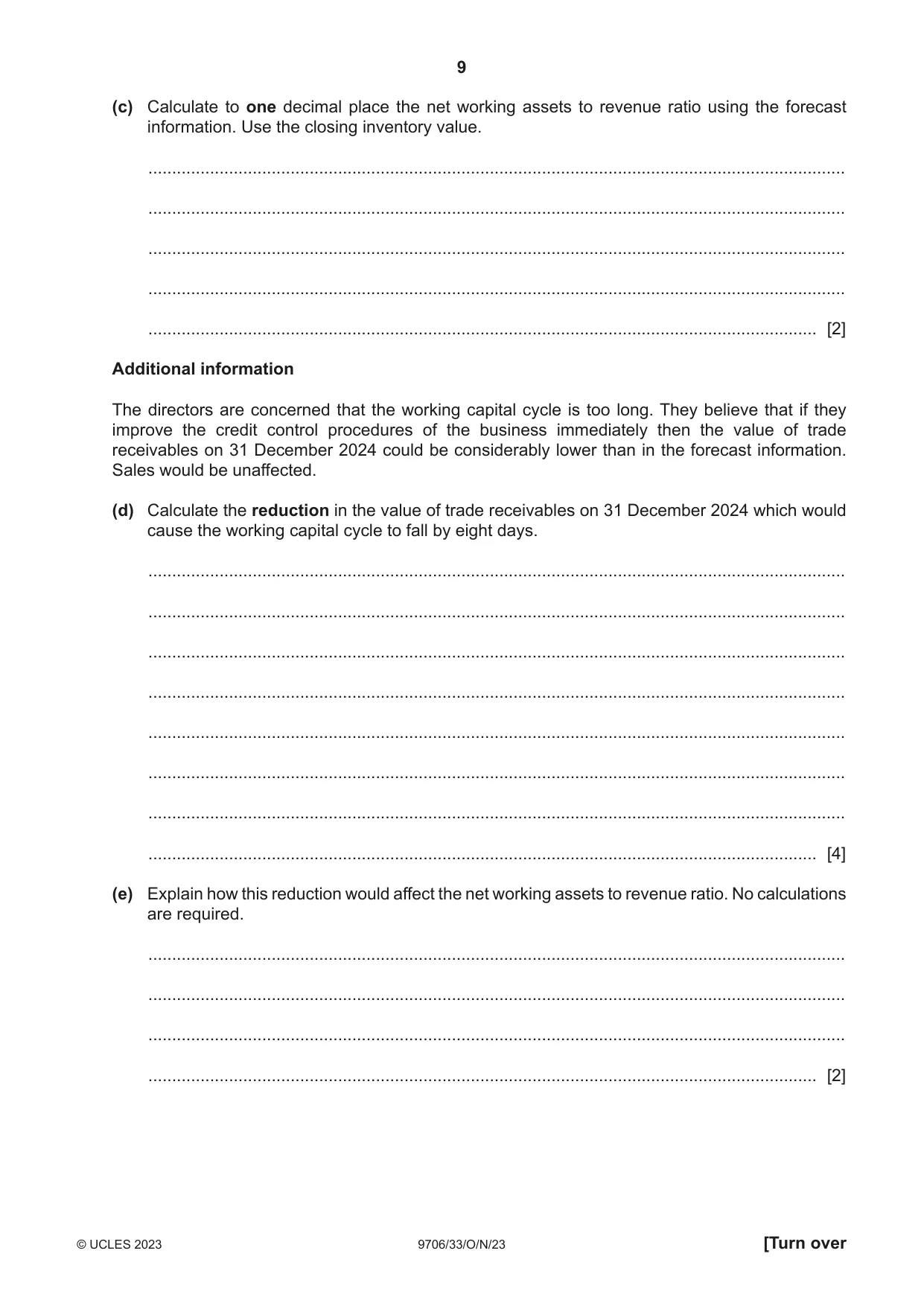
9 9706/33/O/N/23 © UCLES 2023 [Turn over (c) Calculate to one decimal place the net working assets to revenue ratio using the forecast information. Use the closing inventory value. … … … … … [2] Additional information The directors are concerned that the working capital cycle is too long. They believe that if they improve the credit control procedures of the business immediately then the value of trade receivables on 31 December 2024 could be considerably lower than in the forecast information. Sales would be unaffected. (d) Calculate the reduction in the value of trade receivables on 31 December 2024 which would cause the working capital cycle to fall by eight days. … … … … … … … … [4] (e) Explain how this reduction would affect the net working assets to revenue ratio. No calculations are required. … … … … [2]
Question paper, page 10
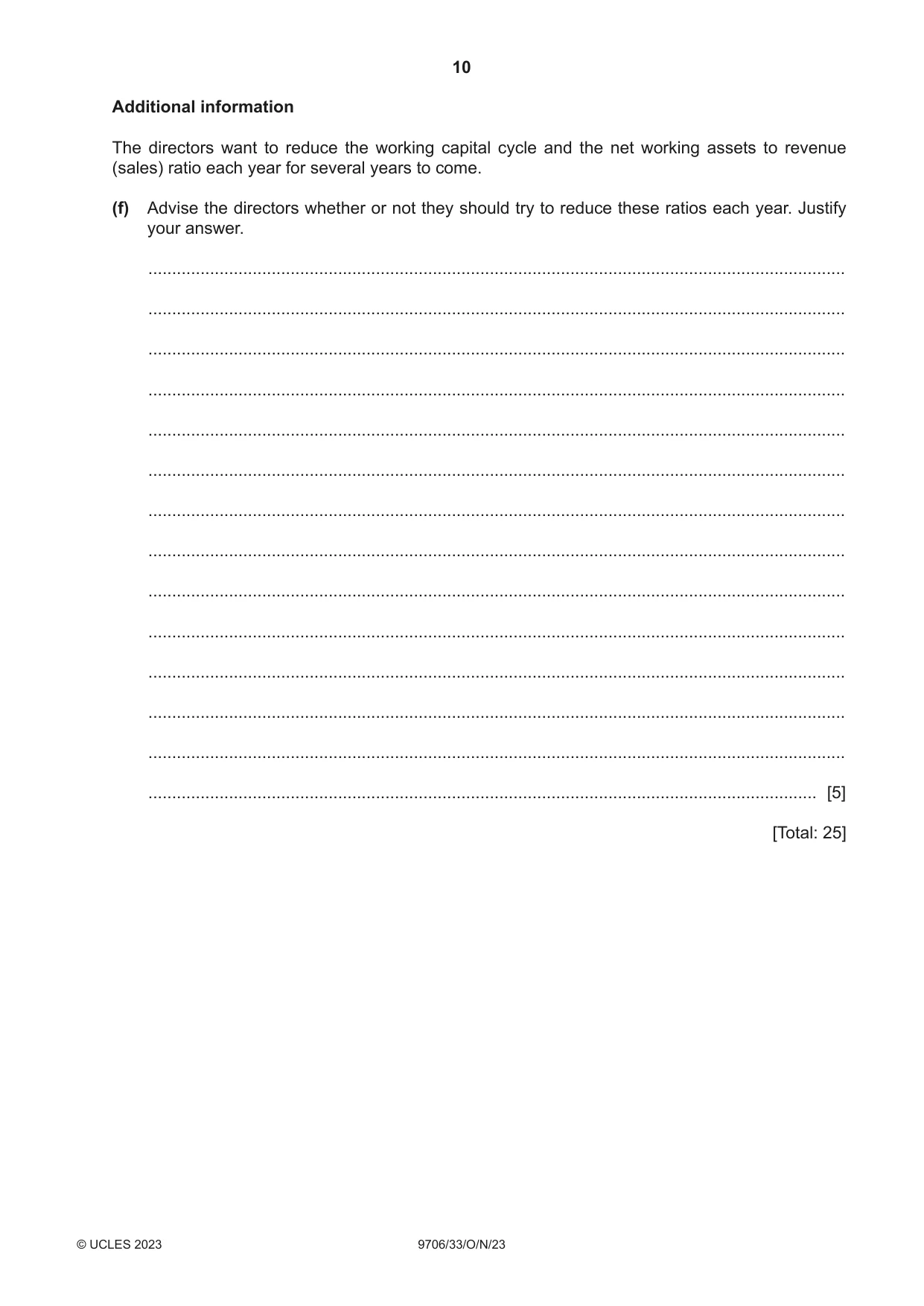
10 9706/33/O/N/23 © UCLES 2023 Additional information The directors want to reduce the working capital cycle and the net working assets to revenue (sales) ratio each year for several years to come. (f) Advise the directors whether or not they should try to reduce these ratios each year. Justify your answer. … … … … … … … … … … … … … … [5] [Total: 25]
Question paper, page 11
11 9706/33/O/N/23 © UCLES 2023 BLANK PAGE
Question paper, page 12
12 9706/33/O/N/23 © UCLES 2023 Permission to reproduce items where third-party owned material protected by copyright is included has been sought and cleared where possible. Every reasonable effort has been made by the publisher (UCLES) to trace copyright holders, but if any items requiring clearance have unwittingly been included, the publisher will be pleased to make amends at the earliest possible opportunity. To avoid the issue of disclosure of answer-related information to candidates, all copyright acknowledgements are reproduced online in the Cambridge Assessment International Education Copyright Acknowledgements Booklet. This is produced for each series of examinations and is freely available to download at www.cambridgeinternational.org after the live examination series. Cambridge Assessment International Education is part of Cambridge Assessment. Cambridge Assessment is the brand name of the University of Cambridge Local Examinations Syndicate (UCLES), which is a department of the University of Cambridge. BLANK PAGE
Mark scheme, page 1
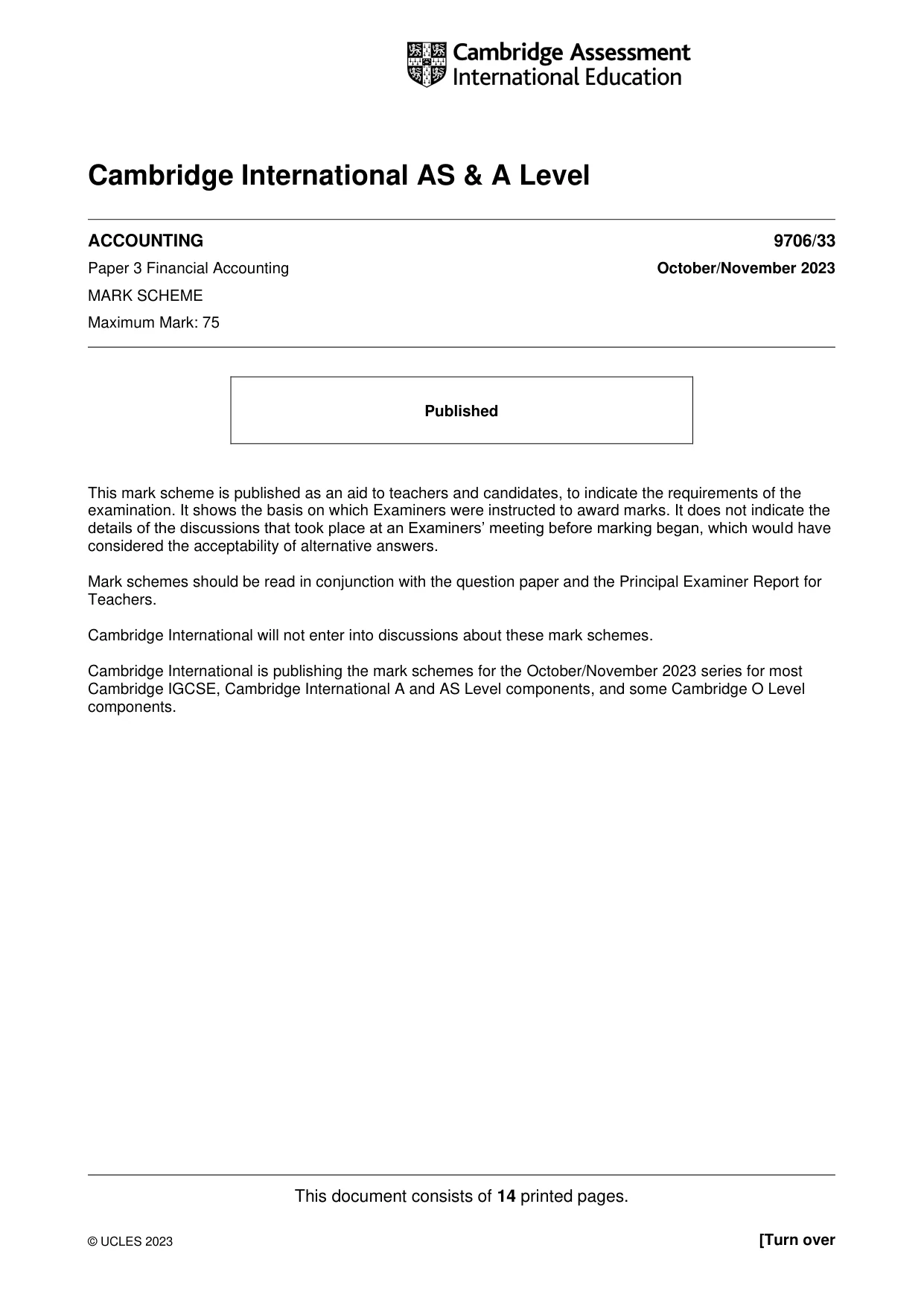
This document consists of 14 printed pages. © UCLES 2023 [Turn over Cambridge International AS & A Level ACCOUNTING 9706/33 Paper 3 Financial Accounting October/November 2023 MARK SCHEME Maximum Mark: 75 Published This mark scheme is published as an aid to teachers and candidates, to indicate the requirements of the examination. It shows the basis on which Examiners were instructed to award marks. It does not indicate the details of the discussions that took place at an Examiners’ meeting before marking began, which would have considered the acceptability of alternative answers. Mark schemes should be read in conjunction with the question paper and the Principal Examiner Report for Teachers. Cambridge International will not enter into discussions about these mark schemes. Cambridge International is publishing the mark schemes for the October/November 2023 series for most Cambridge IGCSE, Cambridge International A and AS Level components, and some Cambridge O Level components.
Mark scheme, page 2
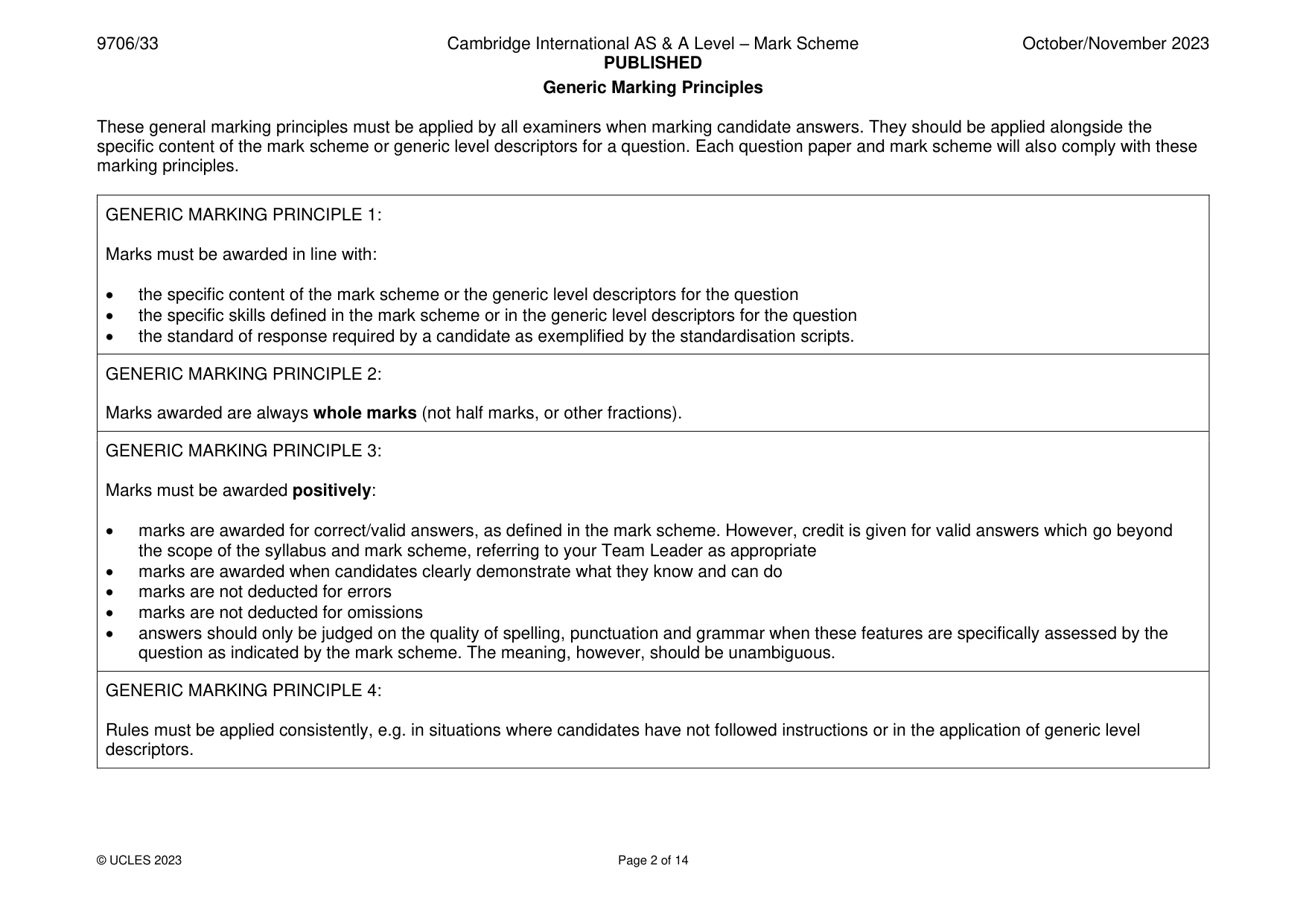
9706/33 Cambridge International AS & A Level – Mark Scheme PUBLISHED October/November 2023 © UCLES 2023 Page 2 of 14 Generic Marking Principles These general marking principles must be applied by all examiners when marking candidate answers. They should be applied alongside the specific content of the mark scheme or generic level descriptors for a question. Each question paper and mark scheme will also comply with these marking principles. GENERIC MARKING PRINCIPLE 1: Marks must be awarded in line with: • the specific content of the mark scheme or the generic level descriptors for the question • the specific skills defined in the mark scheme or in the generic level descriptors for the question • the standard of response required by a candidate as exemplified by the standardisation scripts. GENERIC MARKING PRINCIPLE 2: Marks awarded are always whole marks (not half marks, or other fractions). GENERIC MARKING PRINCIPLE 3: Marks must be awarded positively: • marks are awarded for correct/valid answers, as defined in the mark scheme. However, credit is given for valid answers which go beyond the scope of the syllabus and mark scheme, referring to your Team Leader as appropriate • marks are awarded when candidates clearly demonstrate what they know and can do • marks are not deducted for errors • marks are not deducted for omissions • answers should only be judged on the quality of spelling, punctuation and grammar when these features are specifically assessed by the question as indicated by the mark scheme. The meaning, however, should be unambiguous. GENERIC MARKING PRINCIPLE 4: Rules must be applied consistently, e.g. in situations where candidates have not followed instructions or in the application of generic level descriptors.
Mark scheme, page 3
9706/33 Cambridge International AS & A Level – Mark Scheme PUBLISHED October/November 2023 © UCLES 2023 Page 3 of 14 GENERIC MARKING PRINCIPLE 5: Marks should be awarded using the full range of marks defined in the mark scheme for the question (however; the use of the full mark range may be limited according to the quality of the candidate responses seen). GENERIC MARKING PRINCIPLE 6: Marks awarded are based solely on the requirements as defined in the mark scheme. Marks should not be awarded with grade thresholds or grade descriptors in mind.
Mark scheme, page 4
9706/33 Cambridge International AS & A Level – Mark Scheme PUBLISHED October/November 2023 © UCLES 2023 Page 4 of 14 Social Science-Specific Marking Principles (for point-based marking) 1 Components using point-based marking: • Point marking is often used to reward knowledge, understanding and application of skills. We give credit where the candidate’s answer shows relevant knowledge, understanding and application of skills in answering the question. We do not give credit where the answer shows confusion. From this it follows that we: a DO credit answers which are worded differently from the mark scheme if they clearly convey the same meaning (unless the mark scheme requires a specific term) b DO credit alternative answers/examples which are not written in the mark scheme if they are correct c DO credit answers where candidates give more than one correct answer in one prompt/numbered/scaffolded space where extended writing is required rather than list-type answers. For example, questions that require n reasons (e.g. State two reasons …). d DO NOT credit answers simply for using a ‘key term’ unless that is all that is required. (Check for evidence it is understood and not used wrongly.) e DO NOT credit answers which are obviously self-contradicting or trying to cover all possibilities f DO NOT give further credit for what is effectively repetition of a correct point already credited unless the language itself is being tested. This applies equally to ‘mirror statements’ (i.e. polluted/not polluted). g DO NOT require spellings to be correct, unless this is part of the test. However spellings of syllabus terms must allow for clear and unambiguous separation from other syllabus terms with which they may be confused (e.g. Corrasion/Corrosion) 2 Presentation of mark scheme: • Slashes (/) or the word ‘or’ separate alternative ways of making the same point. • Semi colons (;) bullet points (•) or figures in brackets (1) separate different points. • Content in the answer column in brackets is for examiner information/context to clarify the marking but is not required to earn the mark (except Accounting syllabuses where they indicate negative numbers).
Mark scheme, page 5
9706/33 Cambridge International AS & A Level – Mark Scheme PUBLISHED October/November 2023 © UCLES 2023 Page 5 of 14 3 Calculation questions: • The mark scheme will show the steps in the most likely correct method(s), the mark for each step, the correct answer(s) and the mark for each answer • If working/explanation is considered essential for full credit, this will be indicated in the question paper and in the mark scheme. In all other instances, the correct answer to a calculation should be given full credit, even if no supporting working is shown. • Where the candidate uses a valid method which is not covered by the mark scheme, award equivalent marks for reaching equivalent stages. • Where an answer makes use of a candidate’s own incorrect figure from previous working, the ‘own figure rule’ applies: full marks will be given if a correct and complete method is used. Further guidance will be included in the mark scheme where necessary and any exceptions to this general principle will be noted. 4 Annotation: • For point marking, ticks can be used to indicate correct answers and crosses can be used to indicate wrong answers. There is no direct relationship between ticks and marks. Ticks have no defined meaning for levels of response marking. • For levels of response marking, the level awarded should be annotated on the script. • Other annotations will be used by examiners as agreed during standardisation, and the meaning will be understood by all examiners who marked that paper.
Mark scheme, page 6
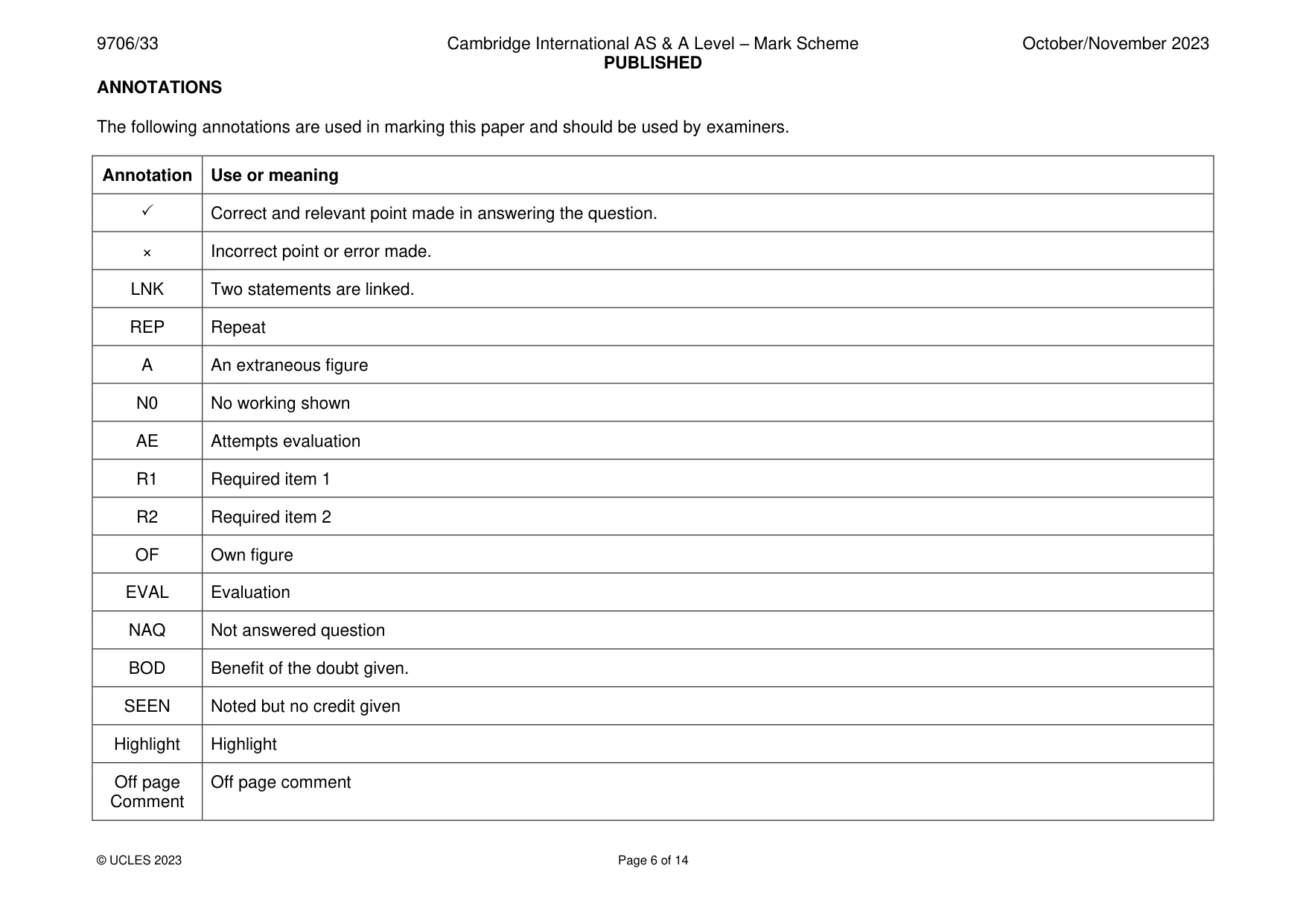
9706/33 Cambridge International AS & A Level – Mark Scheme PUBLISHED October/November 2023 © UCLES 2023 Page 6 of 14 ANNOTATIONS The following annotations are used in marking this paper and should be used by examiners. Annotation Use or meaning Correct and relevant point made in answering the question. × Incorrect point or error made. LNK Two statements are linked. REP Repeat A An extraneous figure N0 No working shown AE Attempts evaluation R1 Required item 1 R2 Required item 2 OF Own figure EVAL Evaluation NAQ Not answered question BOD Benefit of the doubt given. SEEN Noted but no credit given Highlight Highlight Off page Comment Off page comment
Mark scheme, page 7
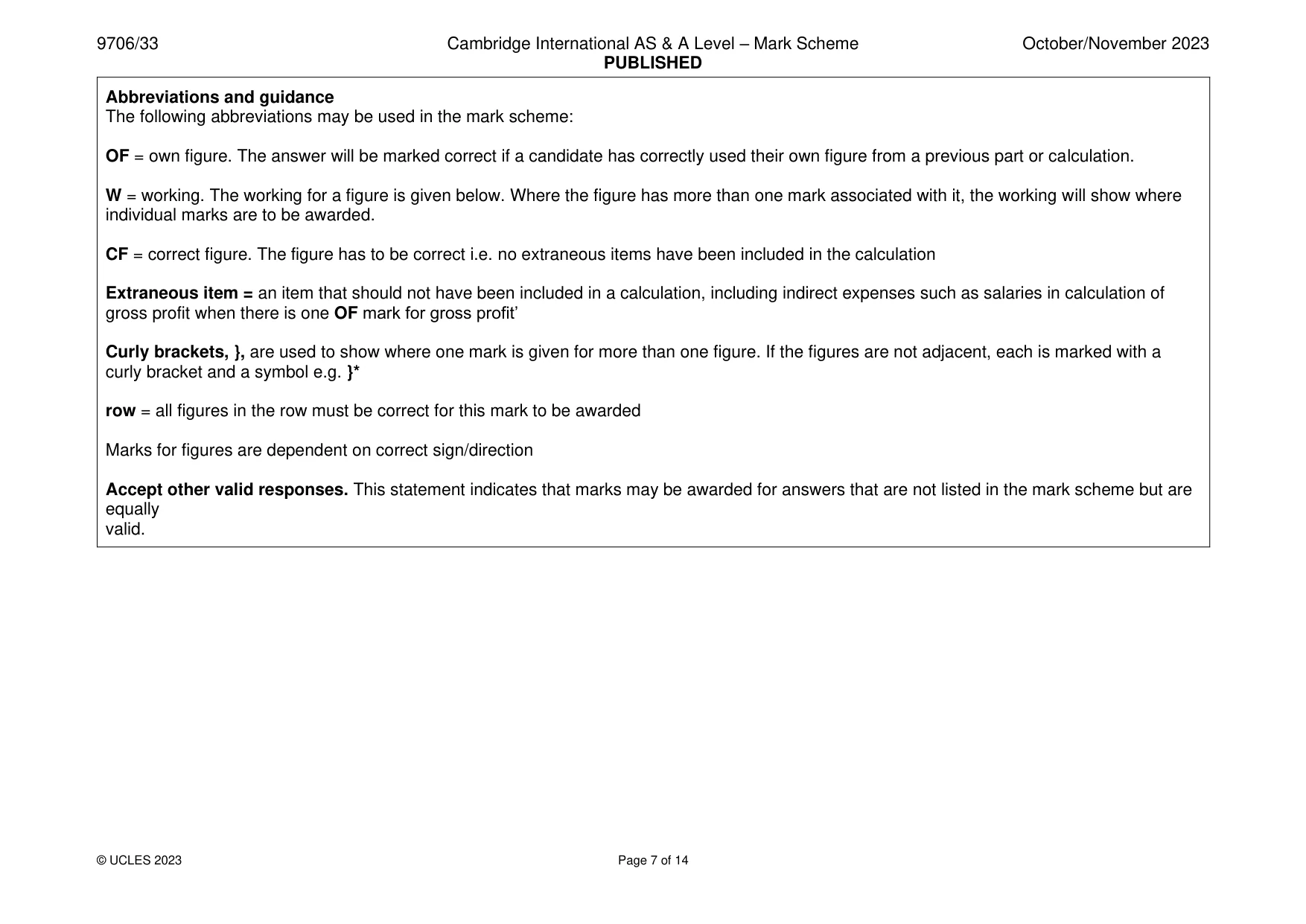
9706/33 Cambridge International AS & A Level – Mark Scheme PUBLISHED October/November 2023 © UCLES 2023 Page 7 of 14 Abbreviations and guidance The following abbreviations may be used in the mark scheme: OF = own figure. The answer will be marked correct if a candidate has correctly used their own figure from a previous part or calculation. W = working. The working for a figure is given below. Where the figure has more than one mark associated with it, the working will show where individual marks are to be awarded. CF = correct figure. The figure has to be correct i.e. no extraneous items have been included in the calculation Extraneous item = an item that should not have been included in a calculation, including indirect expenses such as salaries in calculation of gross profit when there is one OF mark for gross profit’ Curly brackets, }, are used to show where one mark is given for more than one figure. If the figures are not adjacent, each is marked with a curly bracket and a symbol e.g. }* row = all figures in the row must be correct for this mark to be awarded Marks for figures are dependent on correct sign/direction Accept other valid responses. This statement indicates that marks may be awarded for answers that are not listed in the mark scheme but are equally valid.
Mark scheme, page 8
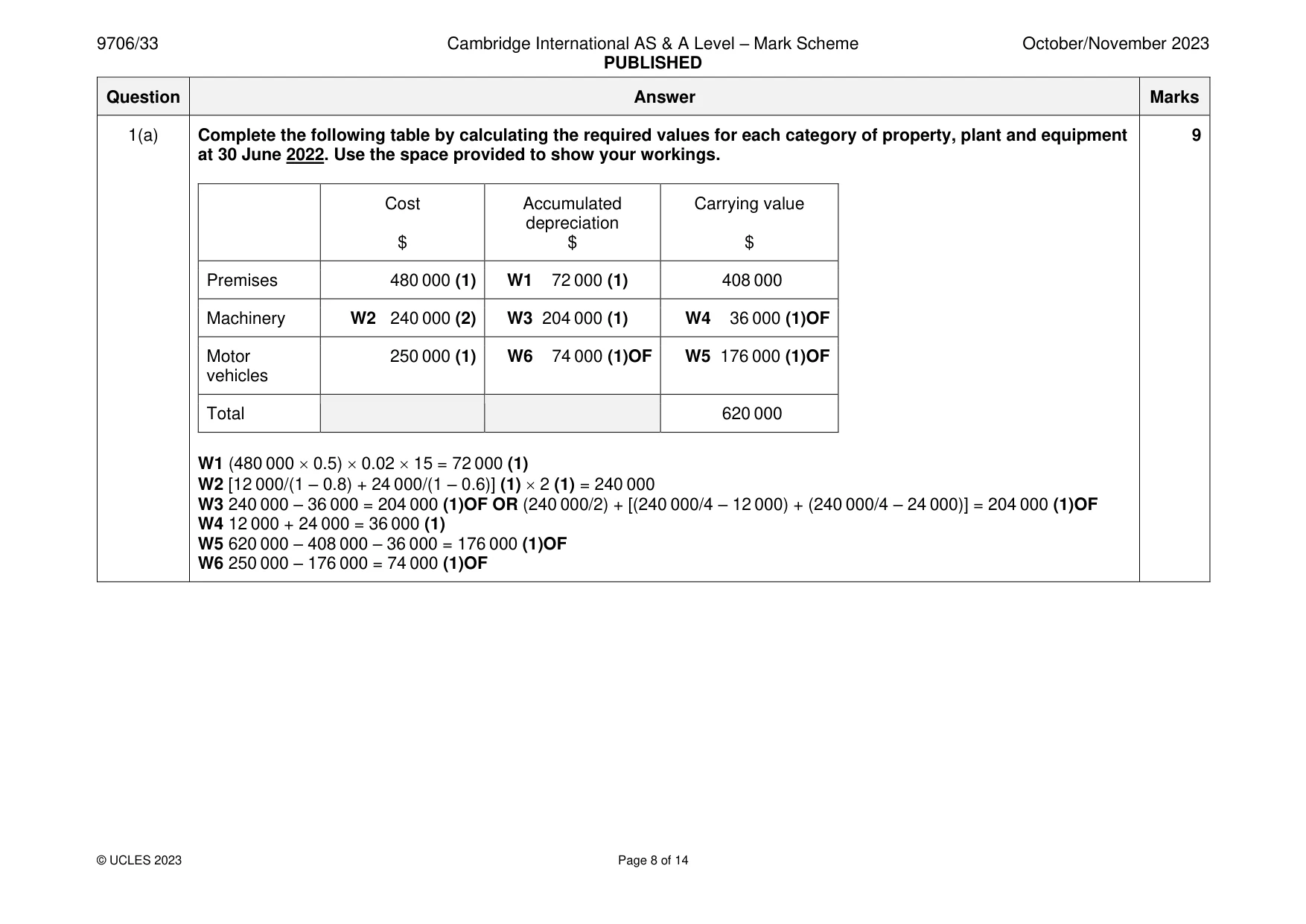
9706/33 Cambridge International AS & A Level – Mark Scheme PUBLISHED October/November 2023 © UCLES 2023 Page 8 of 14 Question Answer Marks 1(a) Complete the following table by calculating the required values for each category of property, plant and equipment at 30 June 2022. Use the space provided to show your workings. Cost $ Accumulated depreciation $ Carrying value $ Premises 480 000 (1) W1 72 000 (1) 408 000 Machinery W2 240 000 (2) W3 204 000 (1) W4 36 000 (1)OF Motor vehicles 250 000 (1) W6 74 000 (1)OF W5 176 000 (1)OF Total 620 000 W1 (480 000 0.5) 0.02 15 = 72 000 (1) W2 [12 000/(1 – 0.8) + 24 000/(1 – 0.6)] (1) 2 (1) = 240 000 W3 240 000 – 36 000 = 204 000 (1)OF OR (240 000/2) + [(240 000/4 – 12 000) + (240 000/4 – 24 000)] = 204 000 (1)OF W4 12 000 + 24 000 = 36 000 (1) W5 620 000 – 408 000 – 36 000 = 176 000 (1)OF W6 250 000 – 176 000 = 74 000 (1)OF 9
Mark scheme, page 9
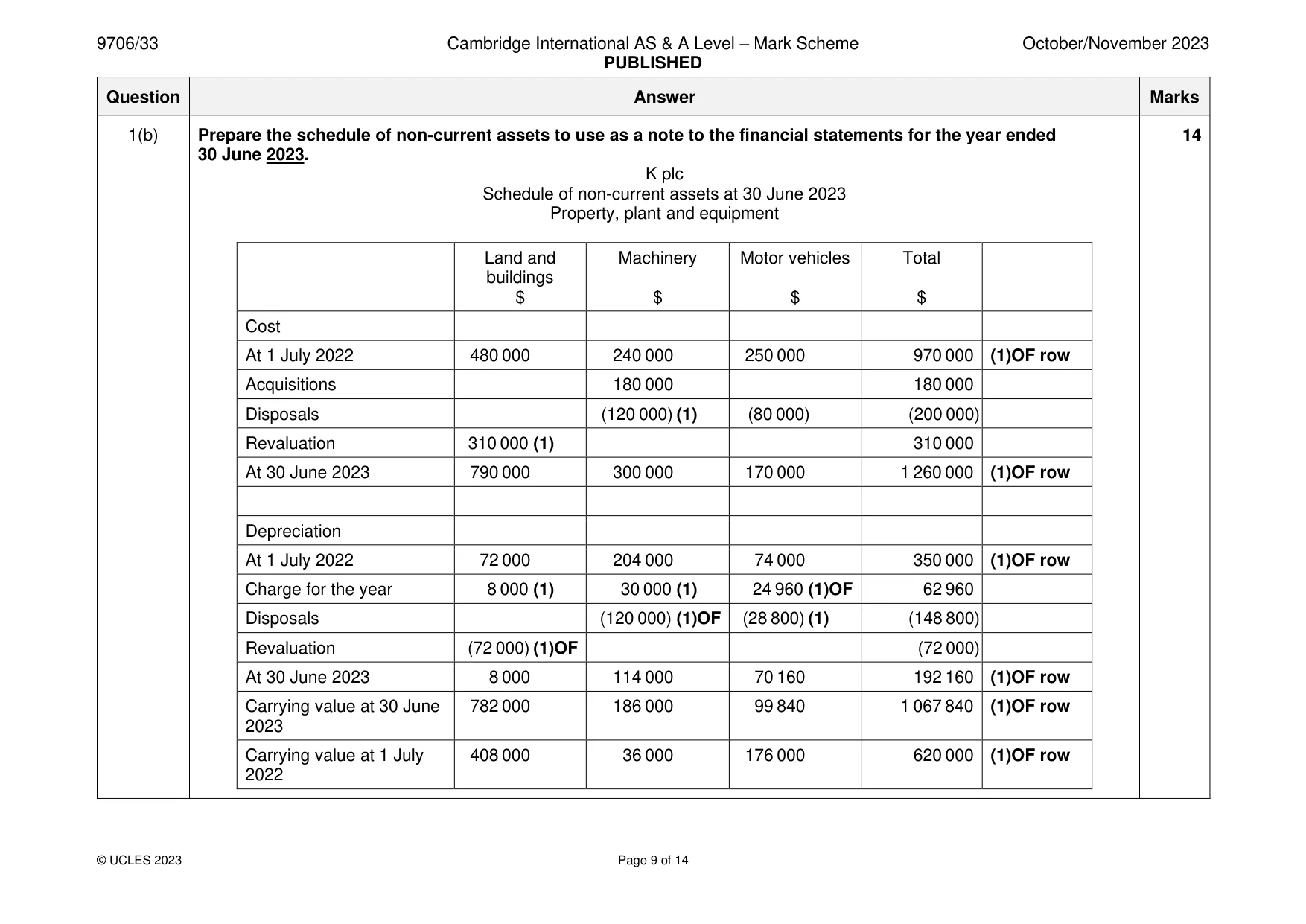
9706/33 Cambridge International AS & A Level – Mark Scheme PUBLISHED October/November 2023 © UCLES 2023 Page 9 of 14 Question Answer Marks 1(b) Prepare the schedule of non-current assets to use as a note to the financial statements for the year ended 30 June 2023. K plc Schedule of non-current assets at 30 June 2023 Property, plant and equipment Land and buildings $ Machinery $ Motor vehicles $ Total $ Cost At 1 July 2022 480 000 240 000 250 000 970 000 (1)OF row Acquisitions 180 000 180 000 Disposals (120 000) (1) (80 000) (200 000) Revaluation 310 000 (1) 310 000 At 30 June 2023 790 000 300 000 170 000 1 260 000 (1)OF row Depreciation At 1 July 2022 72 000 204 000 74 000 350 000 (1)OF row Charge for the year 8 000 (1) 30 000 (1) 24 960 (1)OF 62 960 Disposals (120 000) (1)OF (28 800) (1) (148 800) Revaluation (72 000) (1)OF (72 000) At 30 June 2023 8 000 114 000 70 160 192 160 (1)OF row Carrying value at 30 June 2023 782 000 186 000 99 840 1 067 840 (1)OF row Carrying value at 1 July 2022 408 000 36 000 176 000 620 000 (1)OF row 14
Mark scheme, page 10
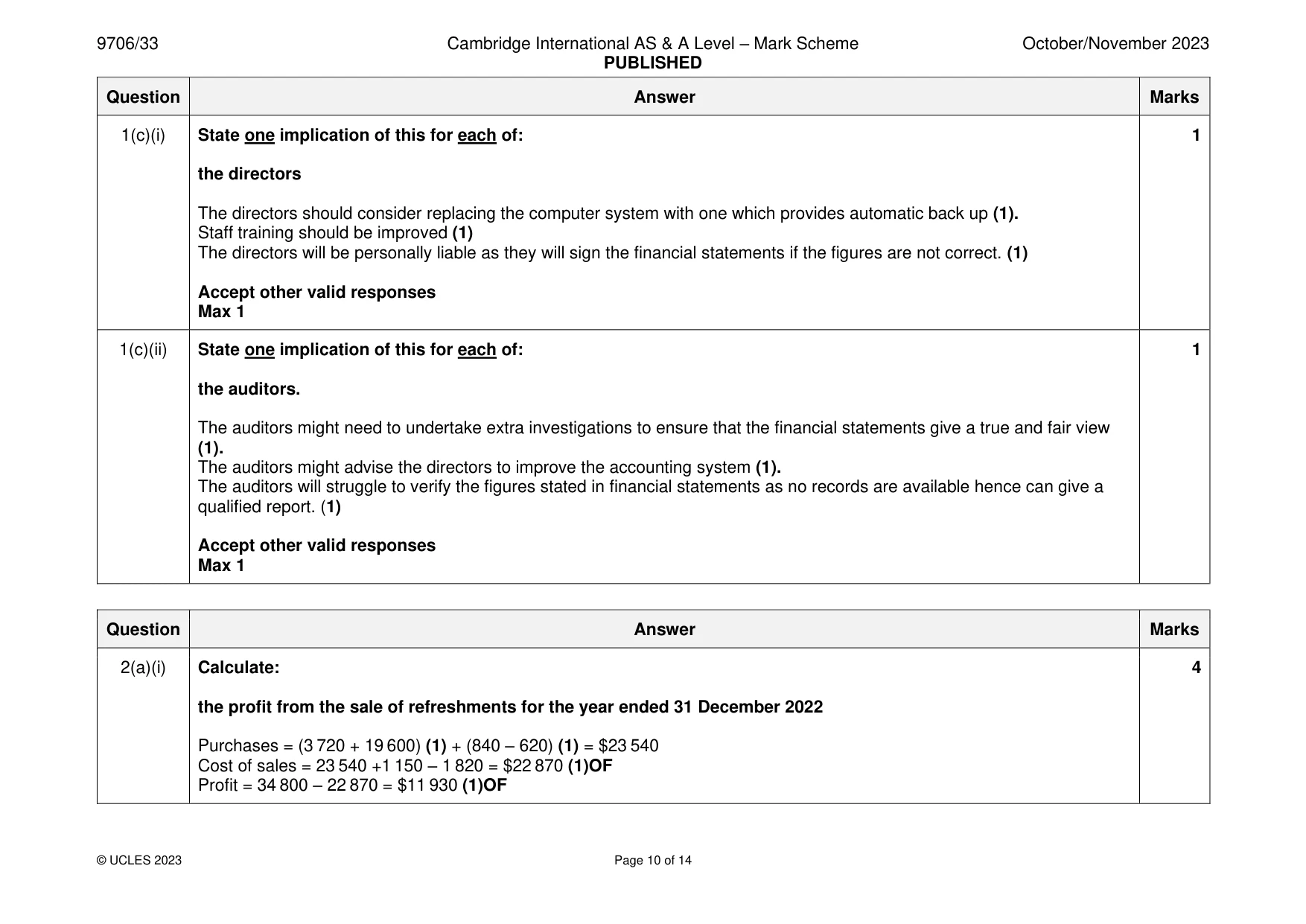
9706/33 Cambridge International AS & A Level – Mark Scheme PUBLISHED October/November 2023 © UCLES 2023 Page 10 of 14 Question Answer Marks 1(c)(i) State one implication of this for each of: the directors The directors should consider replacing the computer system with one which provides automatic back up (1). Staff training should be improved (1) The directors will be personally liable as they will sign the financial statements if the figures are not correct. (1) Accept other valid responses Max 1 1 1(c)(ii) State one implication of this for each of: the auditors. The auditors might need to undertake extra investigations to ensure that the financial statements give a true and fair view (1). The auditors might advise the directors to improve the accounting system (1). The auditors will struggle to verify the figures stated in financial statements as no records are available hence can give a qualified report. (1) Accept other valid responses Max 1 1 Question Answer Marks 2(a)(i) Calculate: the profit from the sale of refreshments for the year ended 31 December 2022 Purchases = (3 720 + 19 600) (1) + (840 – 620) (1) = $23 540 Cost of sales = 23 540 +1 150 – 1 820 = $22 870 (1)OF Profit = 34 800 – 22 870 = $11 930 (1)OF 4
Mark scheme, page 11
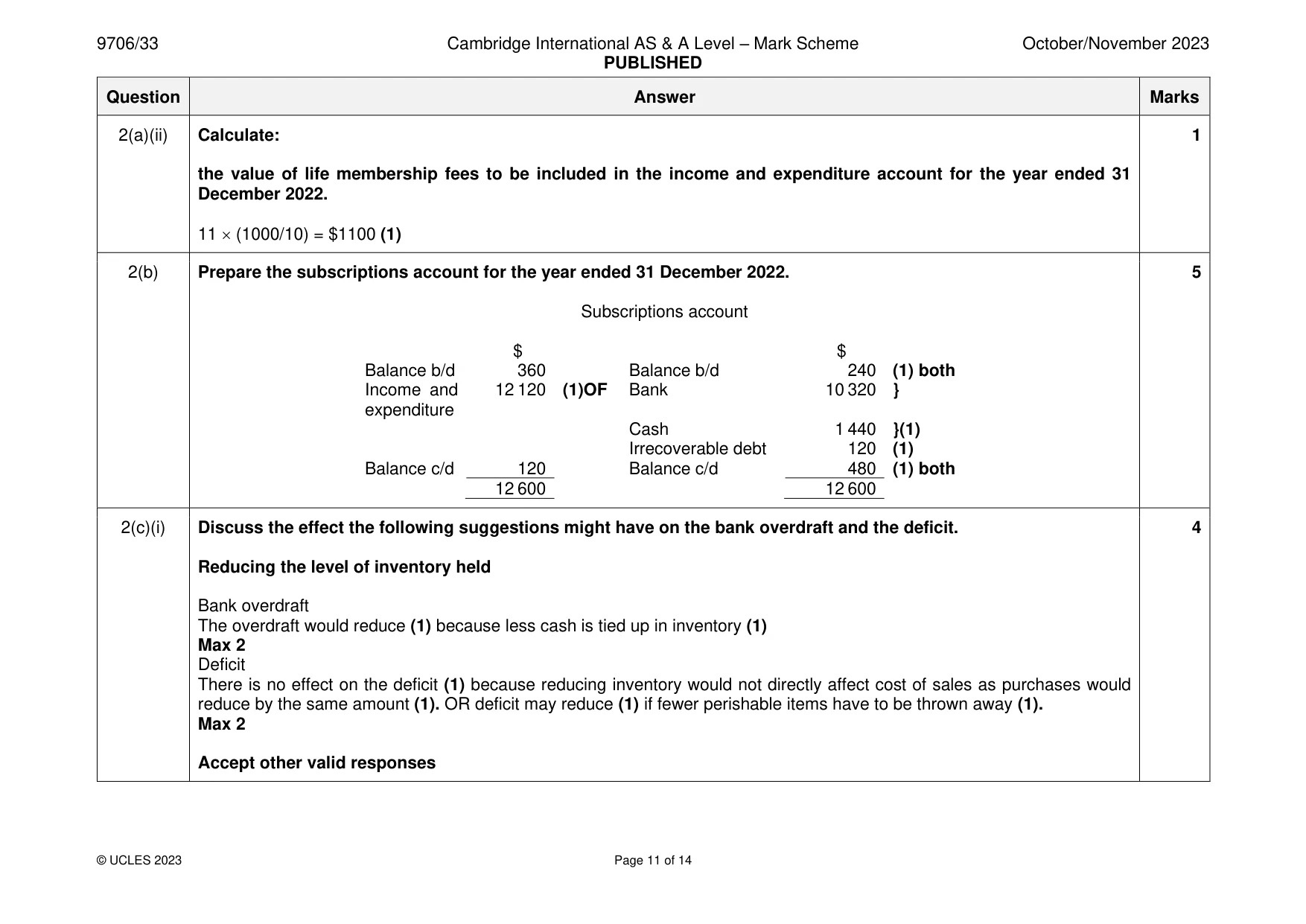
9706/33 Cambridge International AS & A Level – Mark Scheme PUBLISHED October/November 2023 © UCLES 2023 Page 11 of 14 Question Answer Marks 2(a)(ii) Calculate: the value of life membership fees to be included in the income and expenditure account for the year ended 31 December 2022. 11 (1000/10) = $1100 (1) 1 2(b) Prepare the subscriptions account for the year ended 31 December 2022. Subscriptions account $ $ Balance b/d 360 Balance b/d 240 (1) both Income and expenditure 12 120 (1)OF Bank 10 320 } Cash 1 440 }(1) Irrecoverable debt 120 (1) Balance c/d 120 Balance c/d 480 (1) both 12 600 12 600 5 2(c)(i) Discuss the effect the following suggestions might have on the bank overdraft and the deficit. Reducing the level of inventory held Bank overdraft The overdraft would reduce (1) because less cash is tied up in inventory (1) Max 2 Deficit There is no effect on the deficit (1) because reducing inventory would not directly affect cost of sales as purchases would reduce by the same amount (1). OR deficit may reduce (1) if fewer perishable items have to be thrown away (1). Max 2 Accept other valid responses 4
Mark scheme, page 12
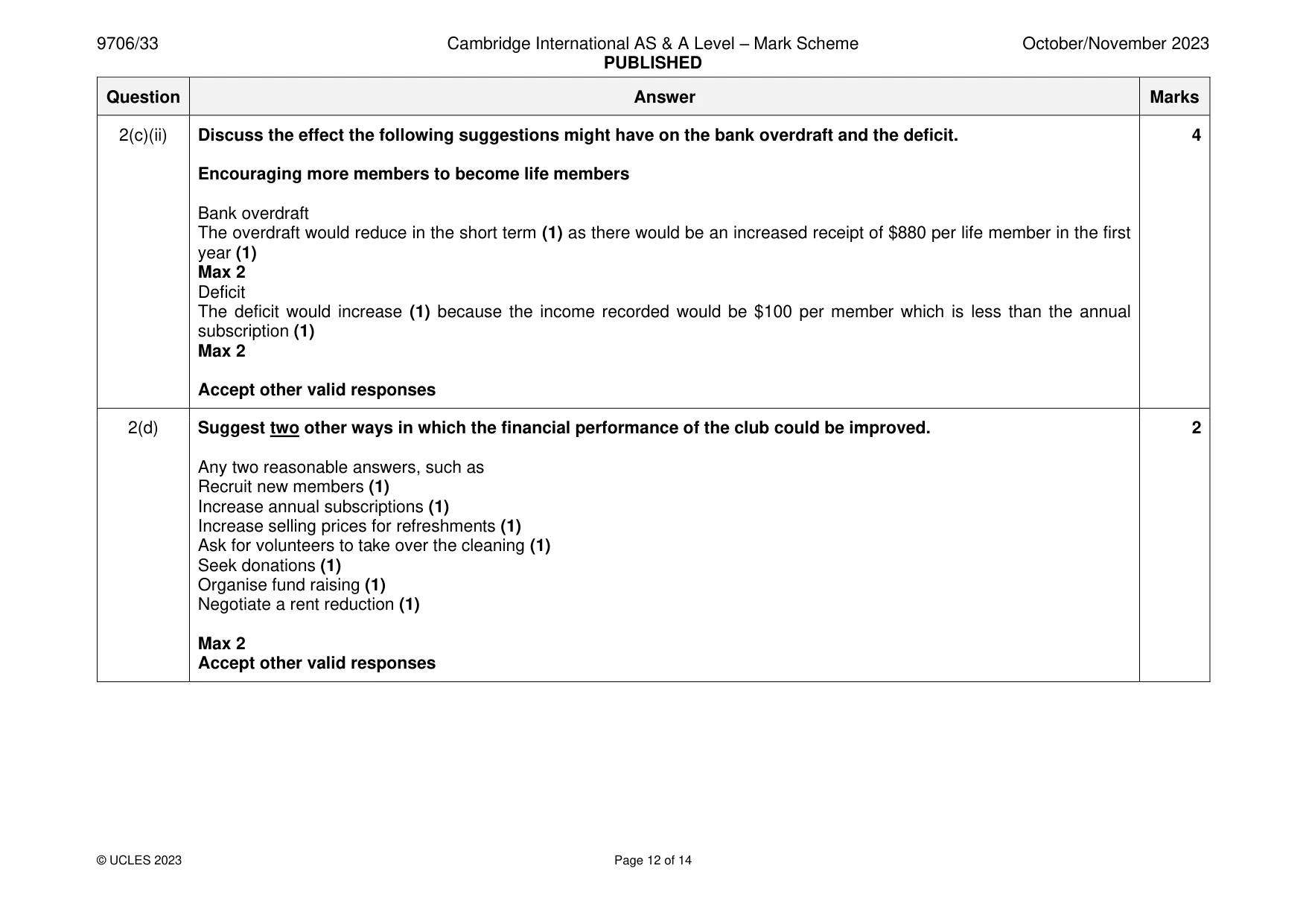
9706/33 Cambridge International AS & A Level – Mark Scheme PUBLISHED October/November 2023 © UCLES 2023 Page 12 of 14 Question Answer Marks 2(c)(ii) Discuss the effect the following suggestions might have on the bank overdraft and the deficit. Encouraging more members to become life members Bank overdraft The overdraft would reduce in the short term (1) as there would be an increased receipt of $880 per life member in the first year (1) Max 2 Deficit The deficit would increase (1) because the income recorded would be $100 per member which is less than the annual subscription (1) Max 2 Accept other valid responses 4 2(d) Suggest two other ways in which the financial performance of the club could be improved. Any two reasonable answers, such as Recruit new members (1) Increase annual subscriptions (1) Increase selling prices for refreshments (1) Ask for volunteers to take over the cleaning (1) Seek donations (1) Organise fund raising (1) Negotiate a rent reduction (1) Max 2 Accept other valid responses 2
Mark scheme, page 13
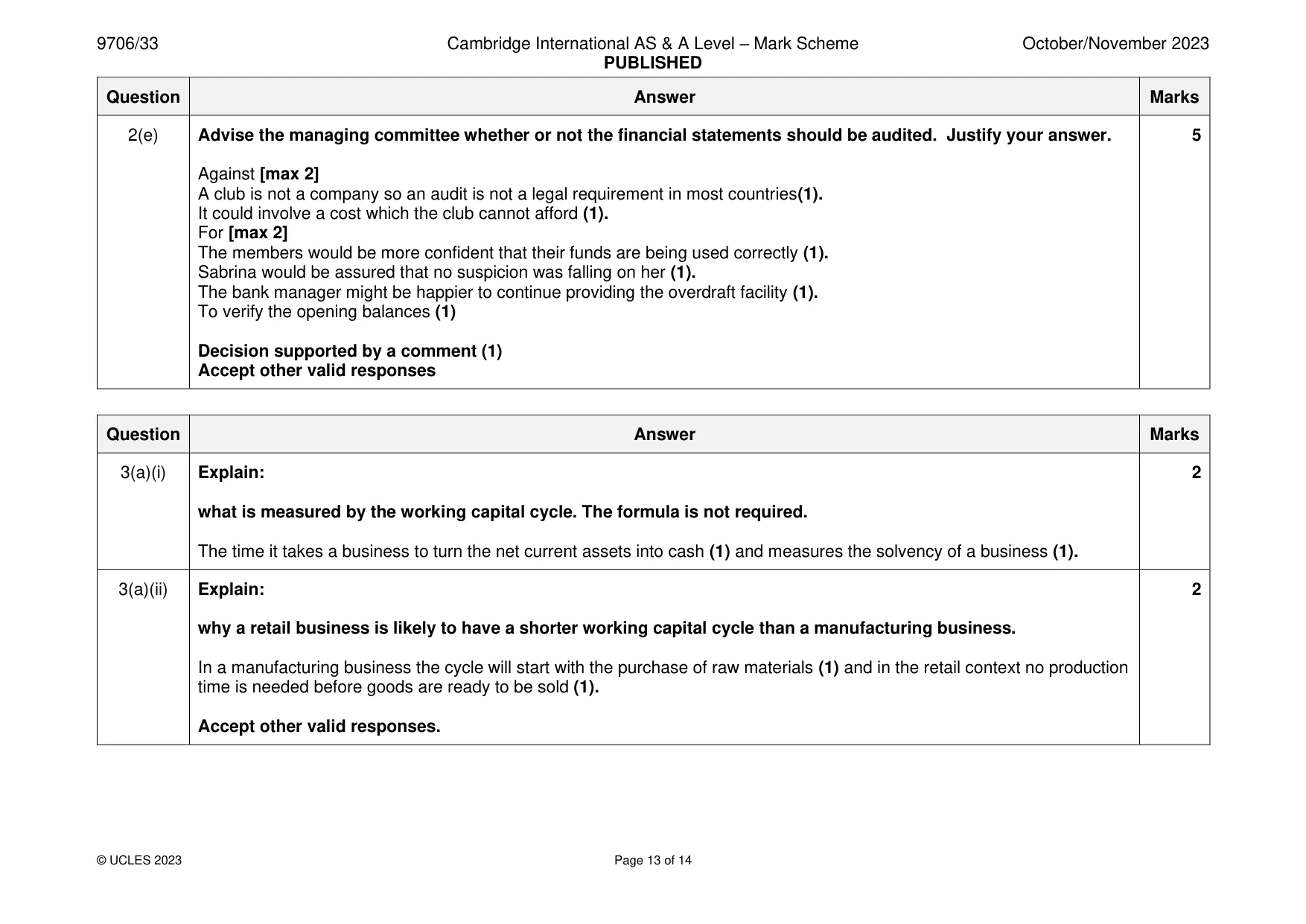
9706/33 Cambridge International AS & A Level – Mark Scheme PUBLISHED October/November 2023 © UCLES 2023 Page 13 of 14 Question Answer Marks 2(e) Advise the managing committee whether or not the financial statements should be audited. Justify your answer. Against [max 2] A club is not a company so an audit is not a legal requirement in most countries(1). It could involve a cost which the club cannot afford (1). For [max 2] The members would be more confident that their funds are being used correctly (1). Sabrina would be assured that no suspicion was falling on her (1). The bank manager might be happier to continue providing the overdraft facility (1). To verify the opening balances (1) Decision supported by a comment (1) Accept other valid responses 5 Question Answer Marks 3(a)(i) Explain: what is measured by the working capital cycle. The formula is not required. The time it takes a business to turn the net current assets into cash (1) and measures the solvency of a business (1). 2 3(a)(ii) Explain: why a retail business is likely to have a shorter working capital cycle than a manufacturing business. In a manufacturing business the cycle will start with the purchase of raw materials (1) and in the retail context no production time is needed before goods are ready to be sold (1). Accept other valid responses. 2
Mark scheme, page 14
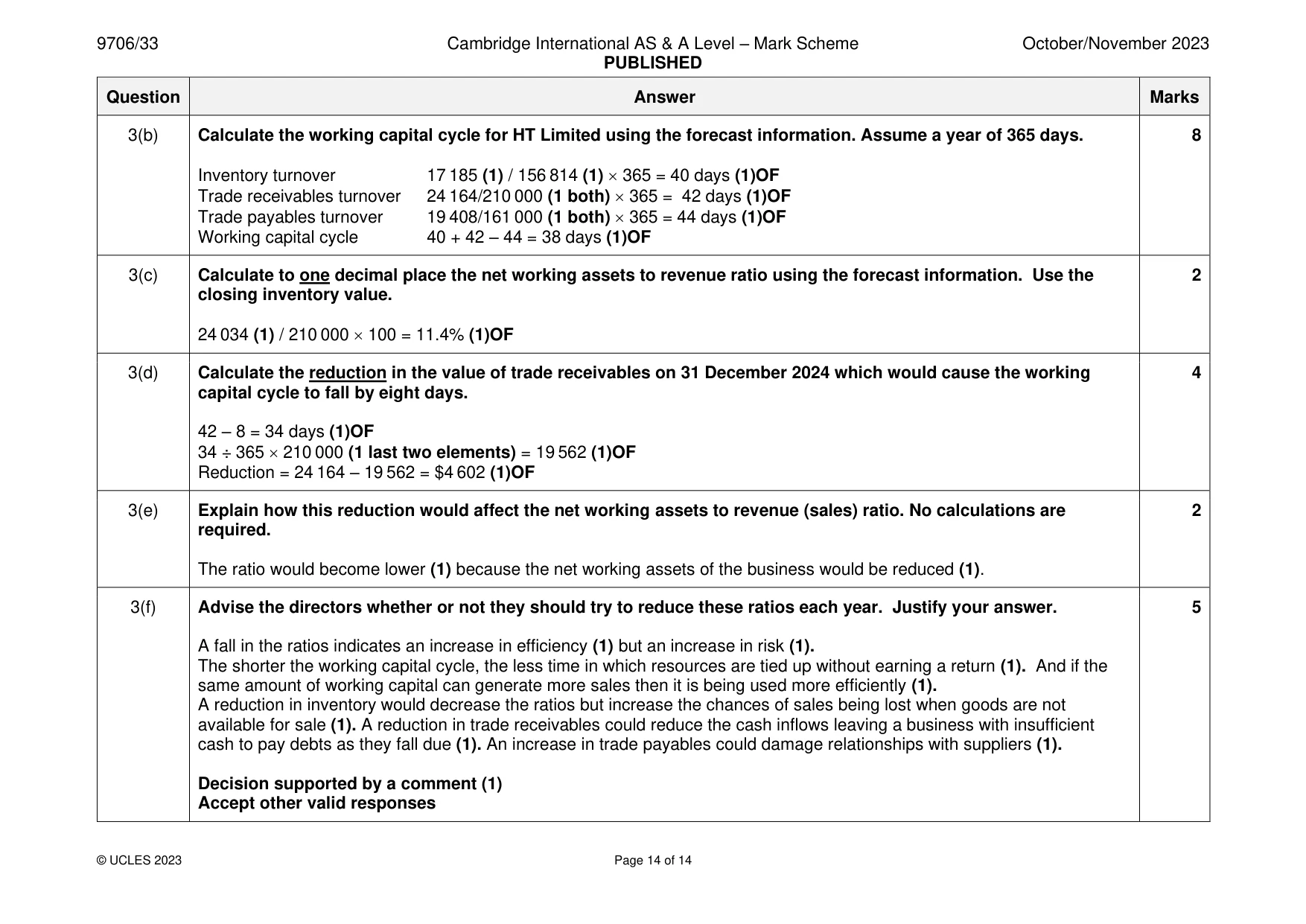
9706/33 Cambridge International AS & A Level – Mark Scheme PUBLISHED October/November 2023 © UCLES 2023 Page 14 of 14 Question Answer Marks 3(b) Calculate the working capital cycle for HT Limited using the forecast information. Assume a year of 365 days. Inventory turnover 17 185 (1) / 156 814 (1) 365 = 40 days (1)OF Trade receivables turnover 24 164/210 000 (1 both) 365 = 42 days (1)OF Trade payables turnover 19 408/161 000 (1 both) 365 = 44 days (1)OF Working capital cycle 40 + 42 – 44 = 38 days (1)OF 8 3(c) Calculate to one decimal place the net working assets to revenue ratio using the forecast information. Use the closing inventory value. 24 034 (1) / 210 000 100 = 11.4% (1)OF 2 3(d) Calculate the reduction in the value of trade receivables on 31 December 2024 which would cause the working capital cycle to fall by eight days. 42 – 8 = 34 days (1)OF 34 ÷ 365 210 000 (1 last two elements) = 19 562 (1)OF Reduction = 24 164 – 19 562 = $4 602 (1)OF 4 3(e) Explain how this reduction would affect the net working assets to revenue (sales) ratio. No calculations are required. The ratio would become lower (1) because the net working assets of the business would be reduced (1). 2 3(f) Advise the directors whether or not they should try to reduce these ratios each year. Justify your answer. A fall in the ratios indicates an increase in efficiency (1) but an increase in risk (1). The shorter the working capital cycle, the less time in which resources are tied up without earning a return (1). And if the same amount of working capital can generate more sales then it is being used more efficiently (1). A reduction in inventory would decrease the ratios but increase the chances of sales being lost when goods are not available for sale (1). A reduction in trade receivables could reduce the cash inflows leaving a business with insufficient cash to pay debts as they fall due (1). An increase in trade payables could damage relationships with suppliers (1). Decision supported by a comment (1) Accept other valid responses 5
What you needed in this session
Cambridge’s own grade thresholds for 2023 Oct/Nov, Paper 3 · Variant 3. A higher threshold means an easier paper — the bar moves with how the cohort did.