Cambridge A Level Accounting 9706 — 2020 Oct/Nov Paper 3 · Variant 1
9706/31/O/N/20 · 150 marks · ≈169 min
The question paper and its mark scheme, free to read here and free to download. This is Cambridge’s own paper, exactly as it was sat.
Question paper20 pages



Mark scheme9 pages
Answers below. Sit the paper first if you are practising.
Paper as text
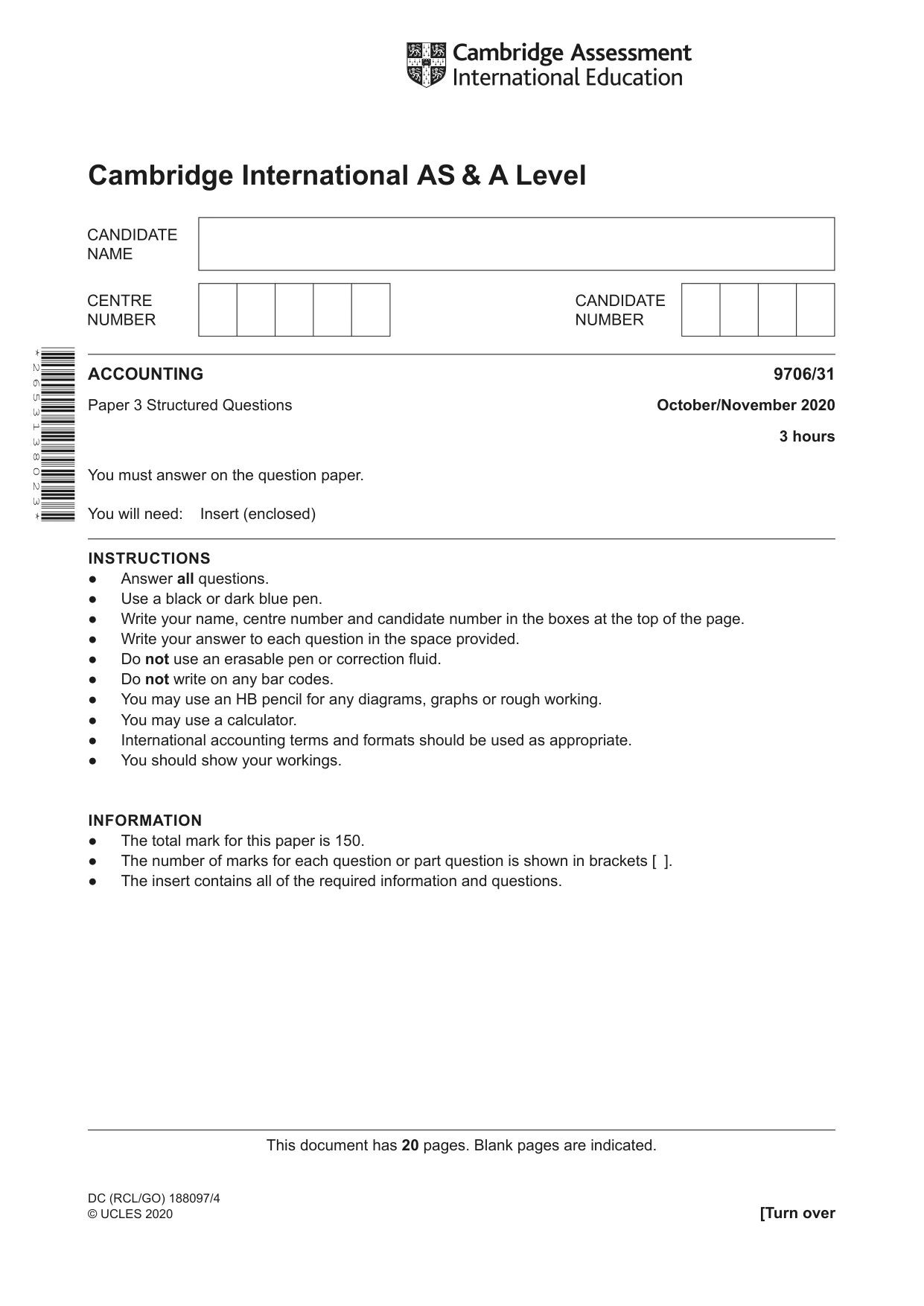
Question paper, page 1
ACCOUNTING 9706/31 Paper 3 Structured Questions October/November 2020 3 hours You must answer on the question paper. You will need: Insert (enclosed) INSTRUCTIONS ● Answer all questions. ● Use a black or dark blue pen. ● Write your name, centre number and candidate number in the boxes at the top of the page. ● Write your answer to each question in the space provided. ● Do not use an erasable pen or correction fluid. ● Do not write on any bar codes. ● You may use an HB pencil for any diagrams, graphs or rough working. ● You may use a calculator. ● International accounting terms and formats should be used as appropriate. ● You should show your workings. INFORMATION ● The total mark for this paper is 150. ● The number of marks for each question or part question is shown in brackets [ ]. ● The insert contains all of the required information and questions. Cambridge International AS & A Level This document has 20 pages. Blank pages are indicated. DC (RCL/GO) 188097/4 © UCLES 2020 [Turn over * 2 6 5 3 1 3 8 0 2 3 *
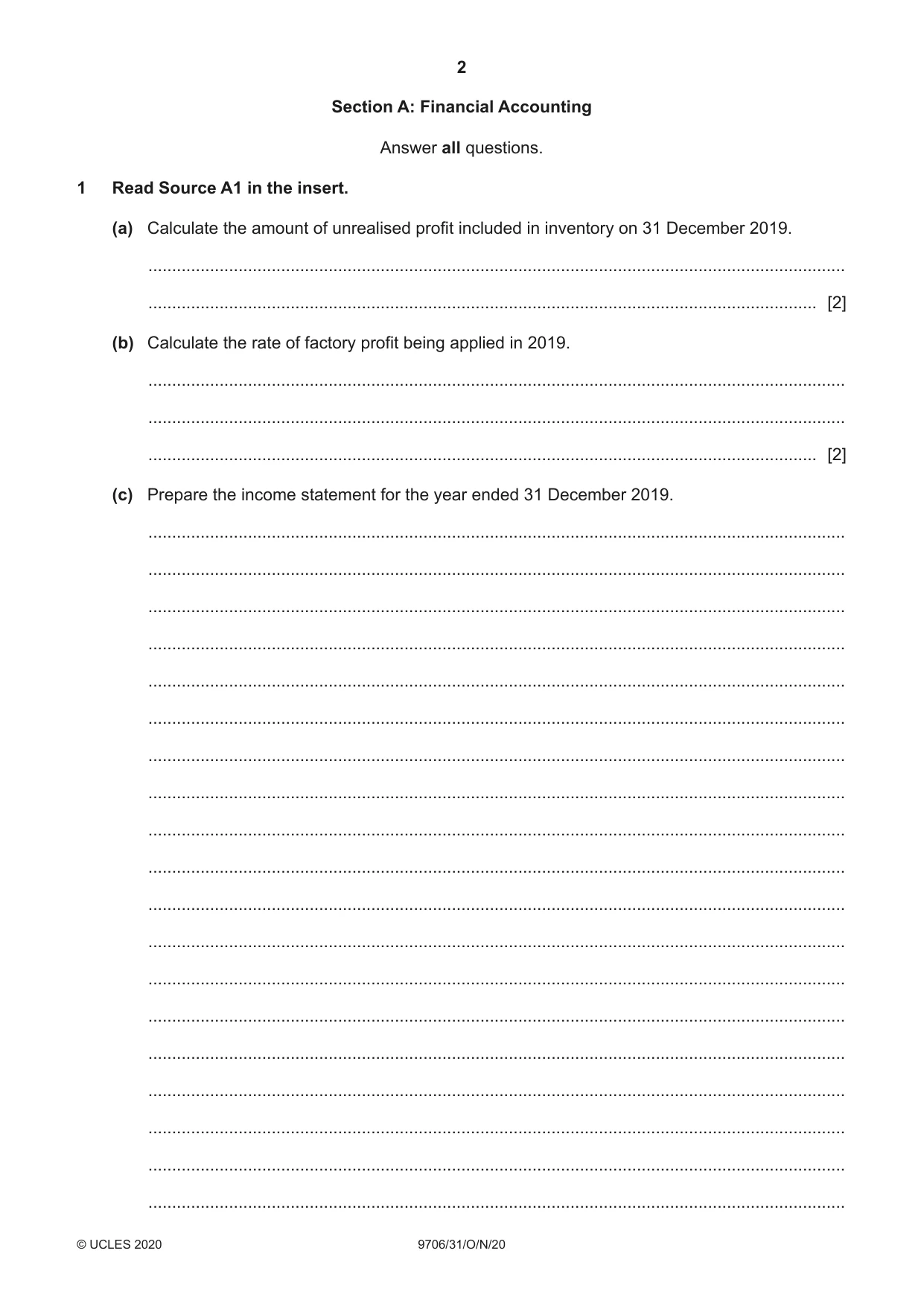
Question paper, page 2
2 9706/31/O/N/20 © UCLES 2020 Section A: Financial Accounting Answer all questions. 1 Read Source A1 in the insert. (a) Calculate the amount of unrealised profit included in inventory on 31 December 2019. … … [2] (b) Calculate the rate of factory profit being applied in 2019. … … … [2] (c) Prepare the income statement for the year ended 31 December 2019. … … … … … … … … … … … … … … … … … … …
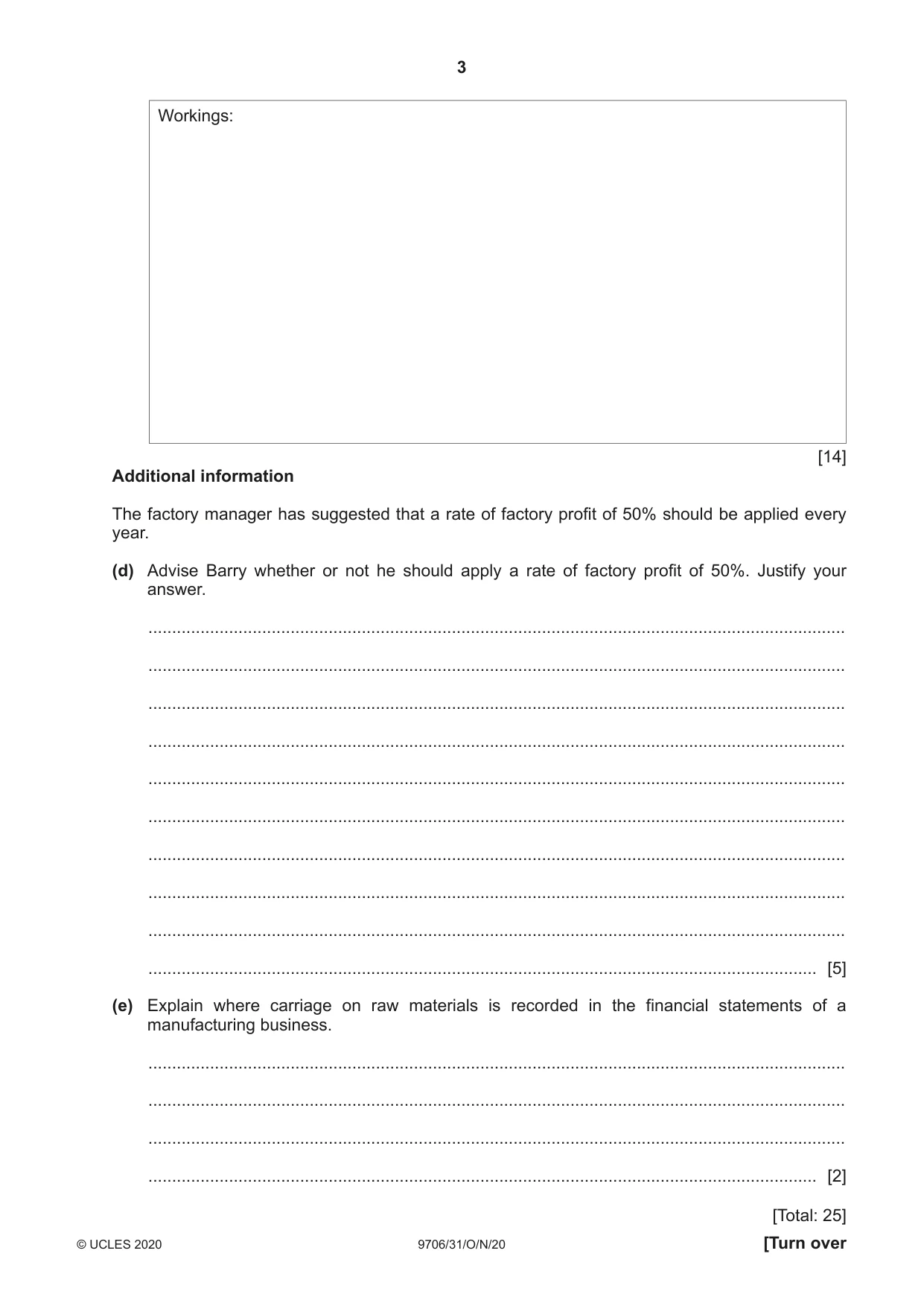
Question paper, page 3
3 9706/31/O/N/20 © UCLES 2020 [Turn over Workings: [14] Additional information The factory manager has suggested that a rate of factory profit of 50% should be applied every year. (d) Advise Barry whether or not he should apply a rate of factory profit of 50%. Justify your answer. … … … … … … … … … … [5] (e) Explain where carriage on raw materials is recorded in the financial statements of a manufacturing business. … … … … [2] [Total: 25]
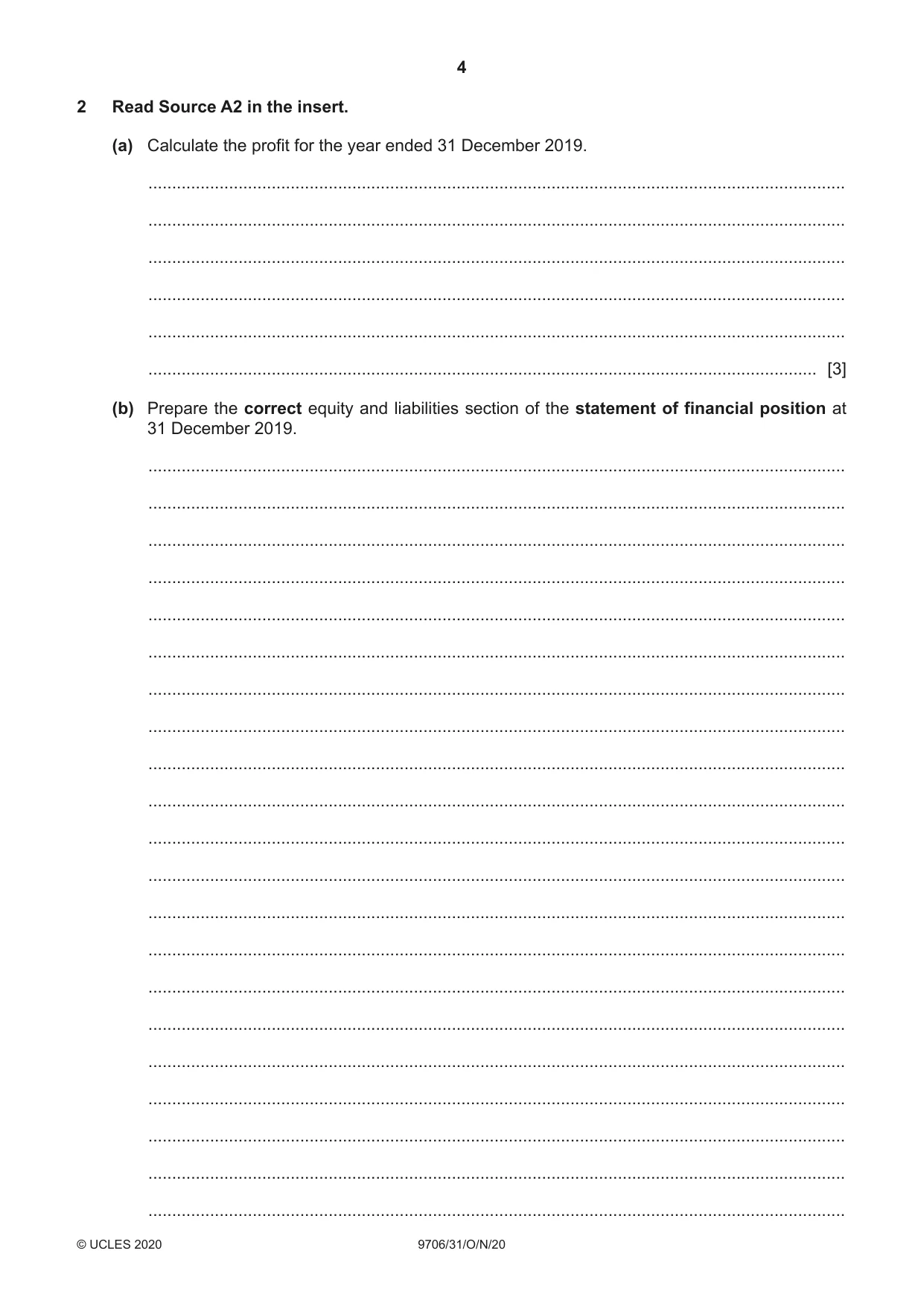
Question paper, page 4
4 9706/31/O/N/20 © UCLES 2020 2 Read Source A2 in the insert. (a) Calculate the profit for the year ended 31 December 2019. … … … … … … [3] (b) Prepare the correct equity and liabilities section of the statement of financial position at 31 December 2019. … … … … … … … … … … … … … … … … … … … … …
Question paper, page 5
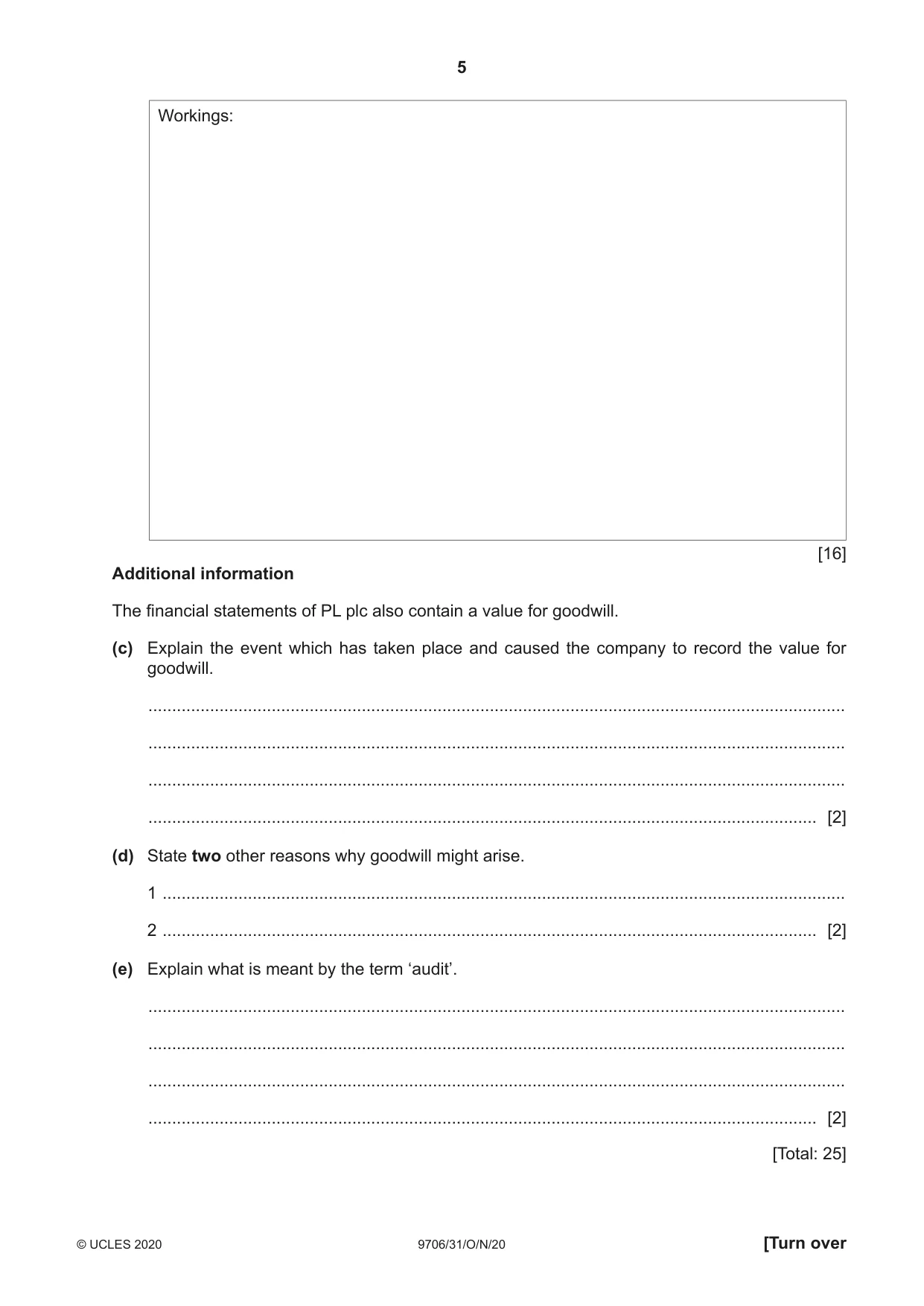
5 9706/31/O/N/20 © UCLES 2020 [Turn over Workings: [16] Additional information The financial statements of PL plc also contain a value for goodwill. (c) Explain the event which has taken place and caused the company to record the value for goodwill. … … … … [2] (d) State two other reasons why goodwill might arise. 1 … 2 … [2] (e) Explain what is meant by the term ‘audit’. … … … … [2] [Total: 25]
Question paper, page 6
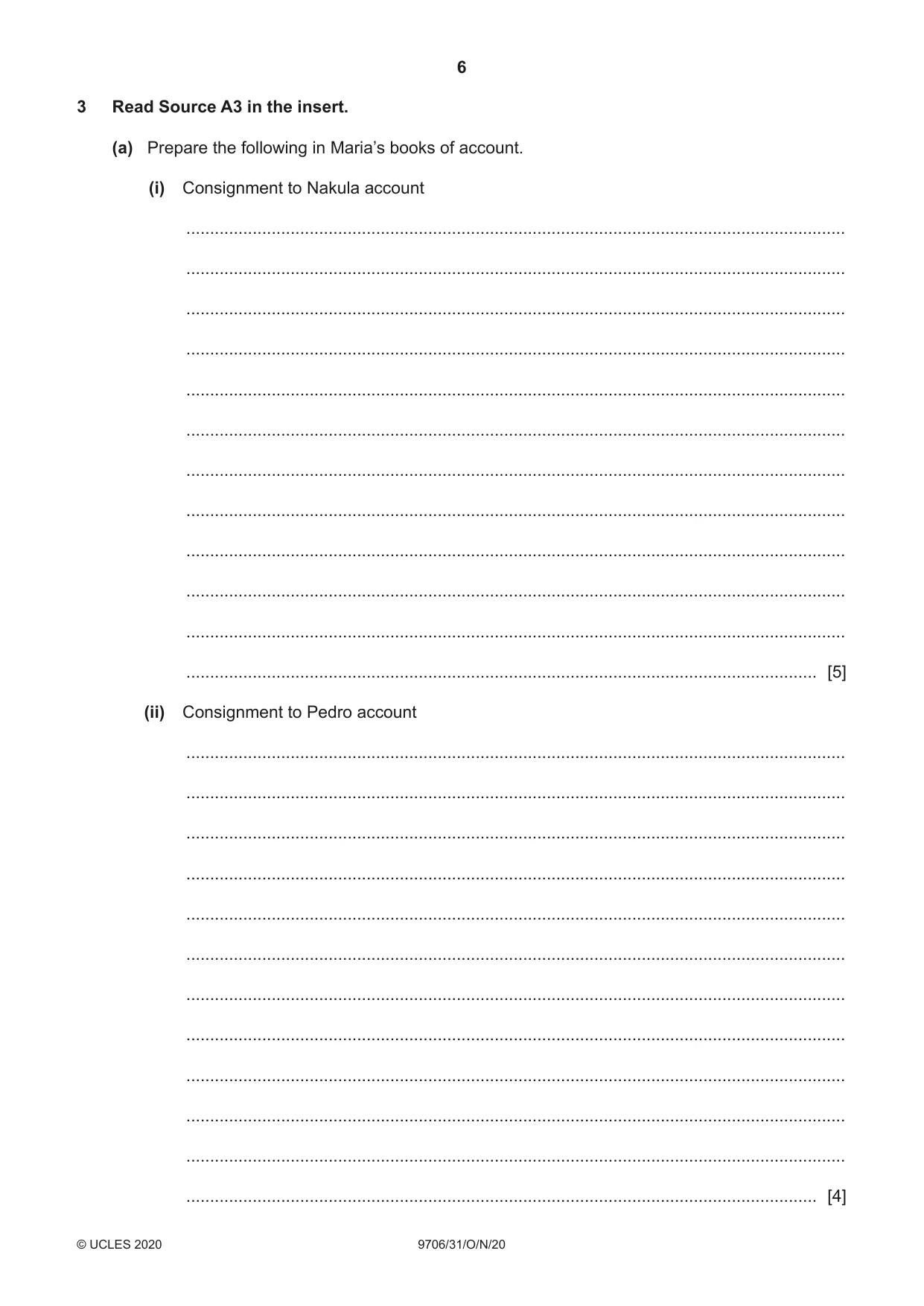
6 9706/31/O/N/20 © UCLES 2020 3 Read Source A3 in the insert. (a) Prepare the following in Maria’s books of account. (i) Consignment to Nakula account … … … … … … … … … … … … [5] (ii) Consignment to Pedro account … … … … … … … … … … … … [4]
Question paper, page 7
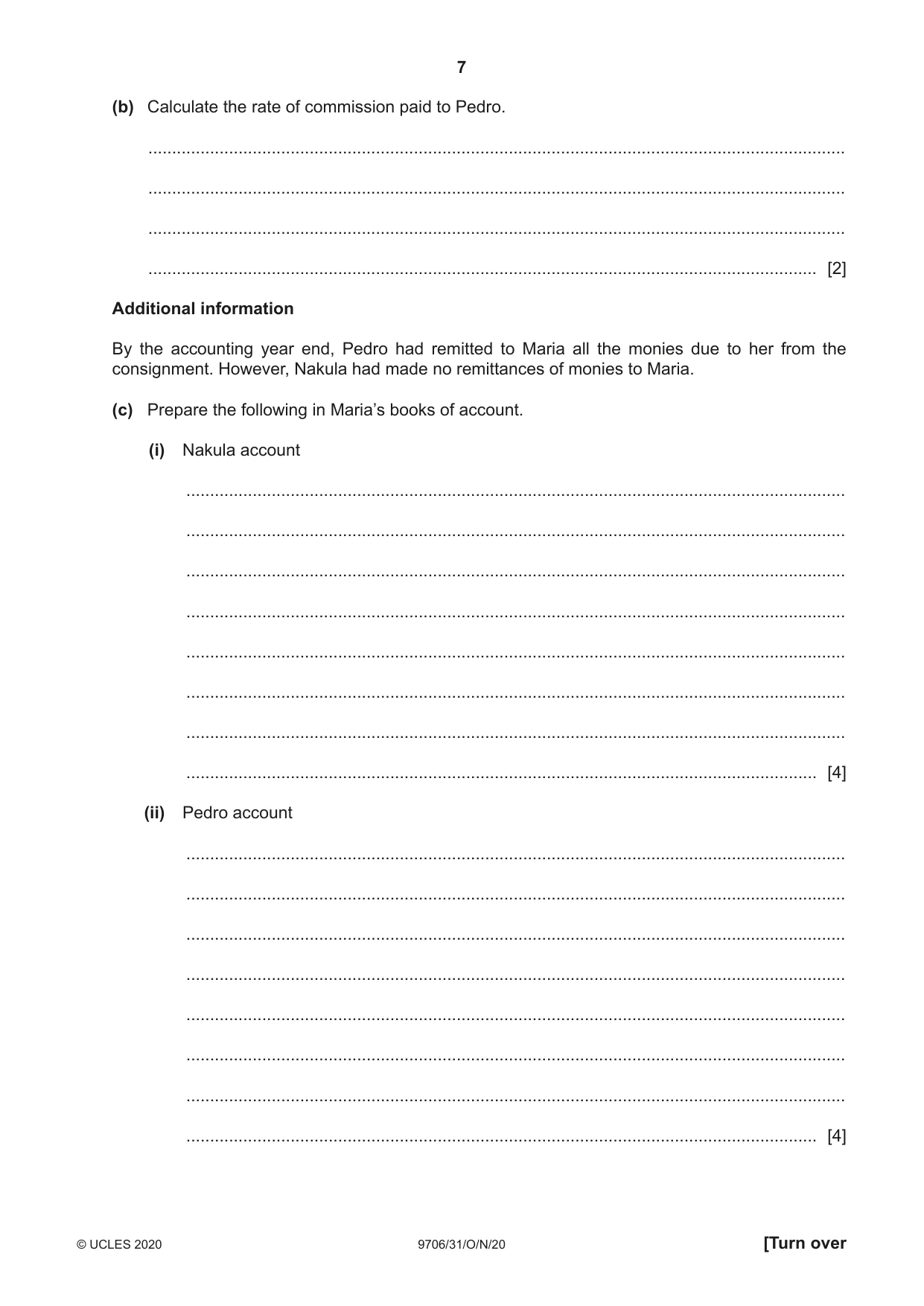
7 9706/31/O/N/20 © UCLES 2020 [Turn over (b) Calculate the rate of commission paid to Pedro. … … … … [2] Additional information By the accounting year end, Pedro had remitted to Maria all the monies due to her from the consignment. However, Nakula had made no remittances of monies to Maria. (c) Prepare the following in Maria’s books of account. (i) Nakula account … … … … … … … … [4] (ii) Pedro account … … … … … … … … [4]
Question paper, page 8
8 9706/31/O/N/20 © UCLES 2020 (d) Explain how unsold goods held by an agent are valued. … … … … [3] (e) Calculate the number of units held in inventory by Nakula at 31 March 2020. … … … … [3] [Total: 25]
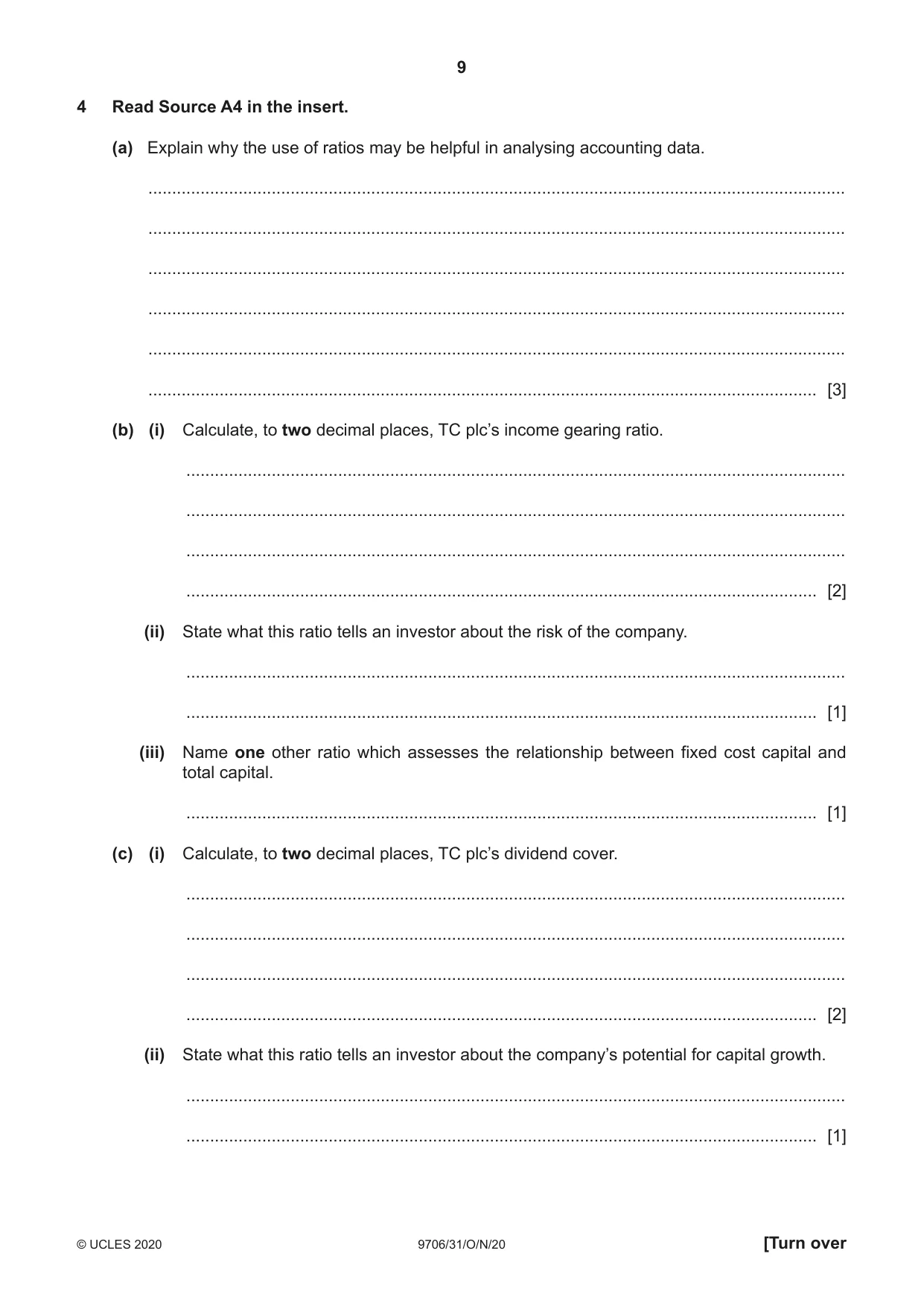
Question paper, page 9
9 9706/31/O/N/20 © UCLES 2020 [Turn over 4 Read Source A4 in the insert. (a) Explain why the use of ratios may be helpful in analysing accounting data. … … … … … … [3] (b) (i) Calculate, to two decimal places, TC plc’s income gearing ratio. … … … … [2] (ii) State what this ratio tells an investor about the risk of the company. … … [1] (iii) Name one other ratio which assesses the relationship between fixed cost capital and total capital. … [1] (c) (i) Calculate, to two decimal places, TC plc’s dividend cover. … … … … [2] (ii) State what this ratio tells an investor about the company’s potential for capital growth. … … [1]
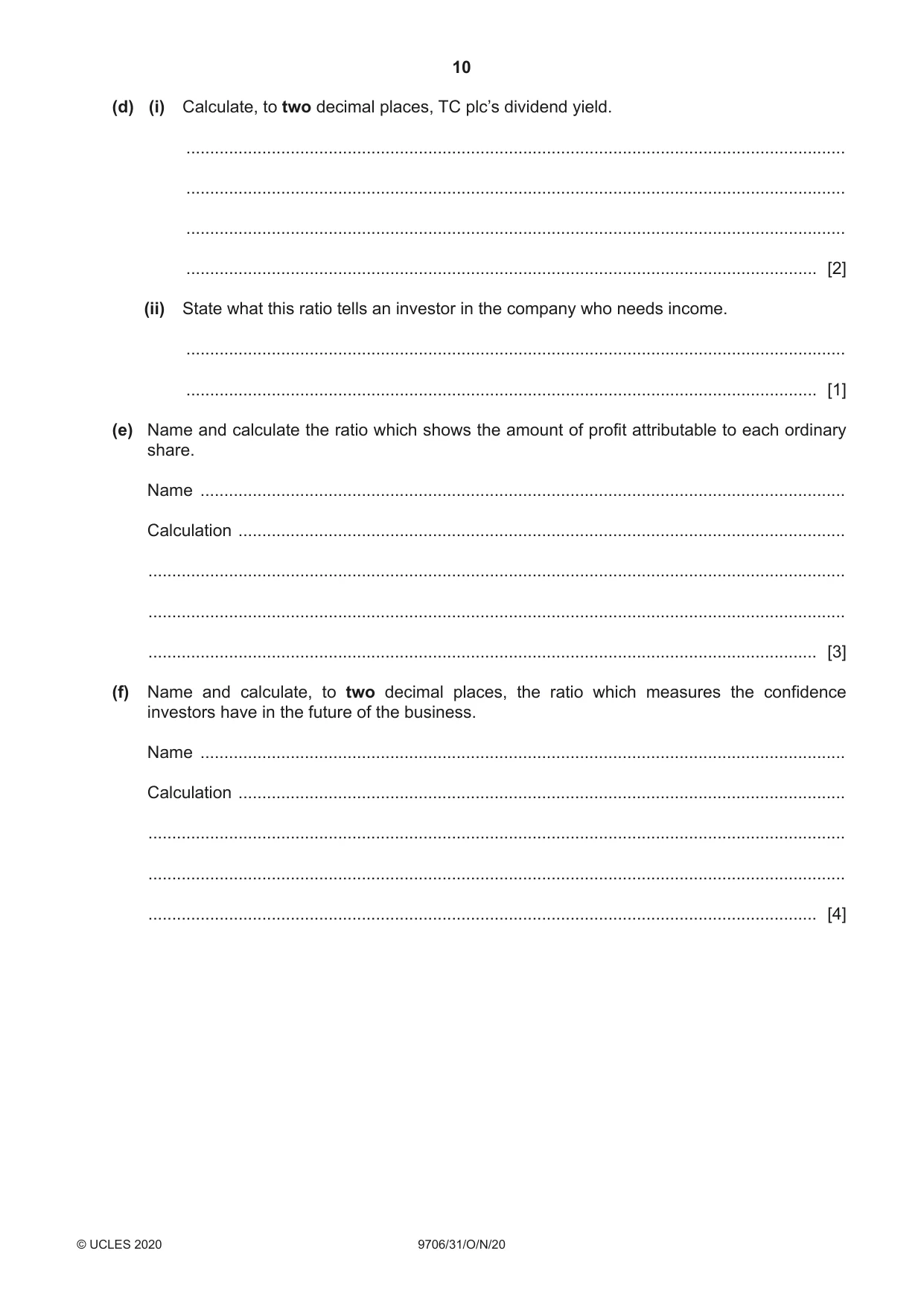
Question paper, page 10
10 9706/31/O/N/20 © UCLES 2020 (d) (i) Calculate, to two decimal places, TC plc’s dividend yield. … … … … [2] (ii) State what this ratio tells an investor in the company who needs income. … … [1] (e) Name and calculate the ratio which shows the amount of profit attributable to each ordinary share. Name … Calculation … … … … [3] (f) Name and calculate, to two decimal places, the ratio which measures the confidence investors have in the future of the business. Name … Calculation … … … … [4]
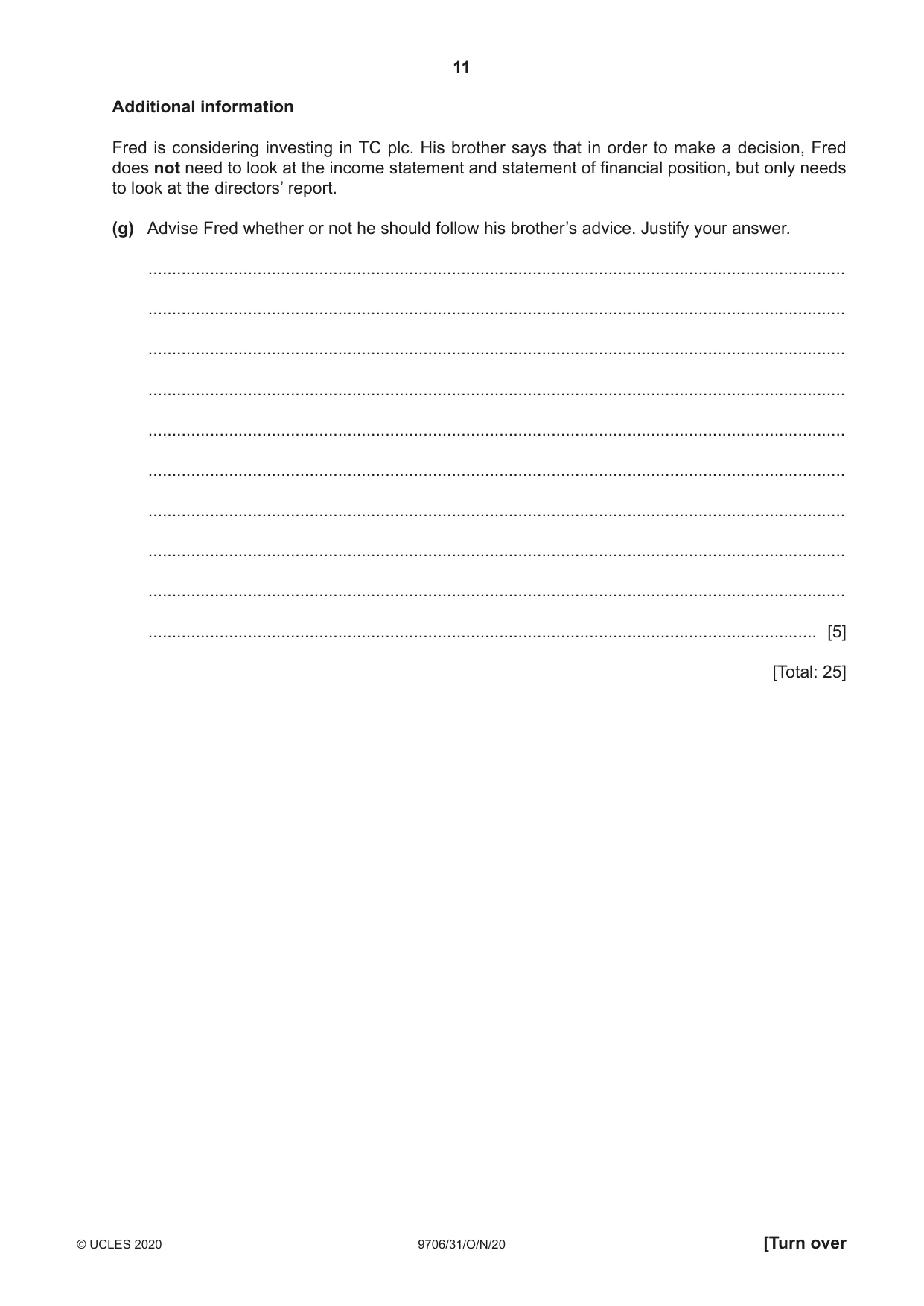
Question paper, page 11
11 9706/31/O/N/20 © UCLES 2020 [Turn over Additional information Fred is considering investing in TC plc. His brother says that in order to make a decision, Fred does not need to look at the income statement and statement of financial position, but only needs to look at the directors’ report. (g) Advise Fred whether or not he should follow his brother’s advice. Justify your answer. … … … … … … … … … … [5] [Total: 25]
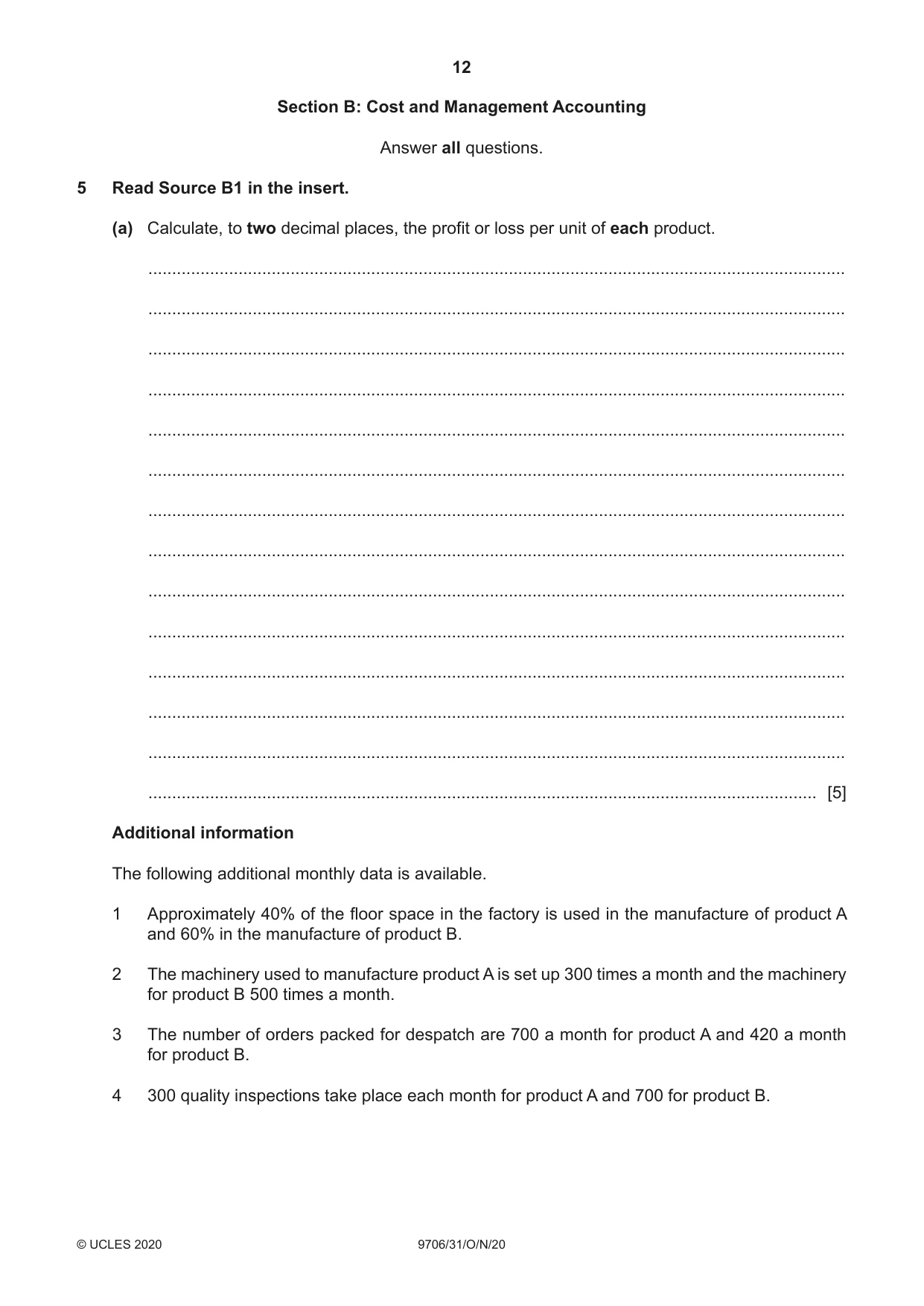
Question paper, page 12
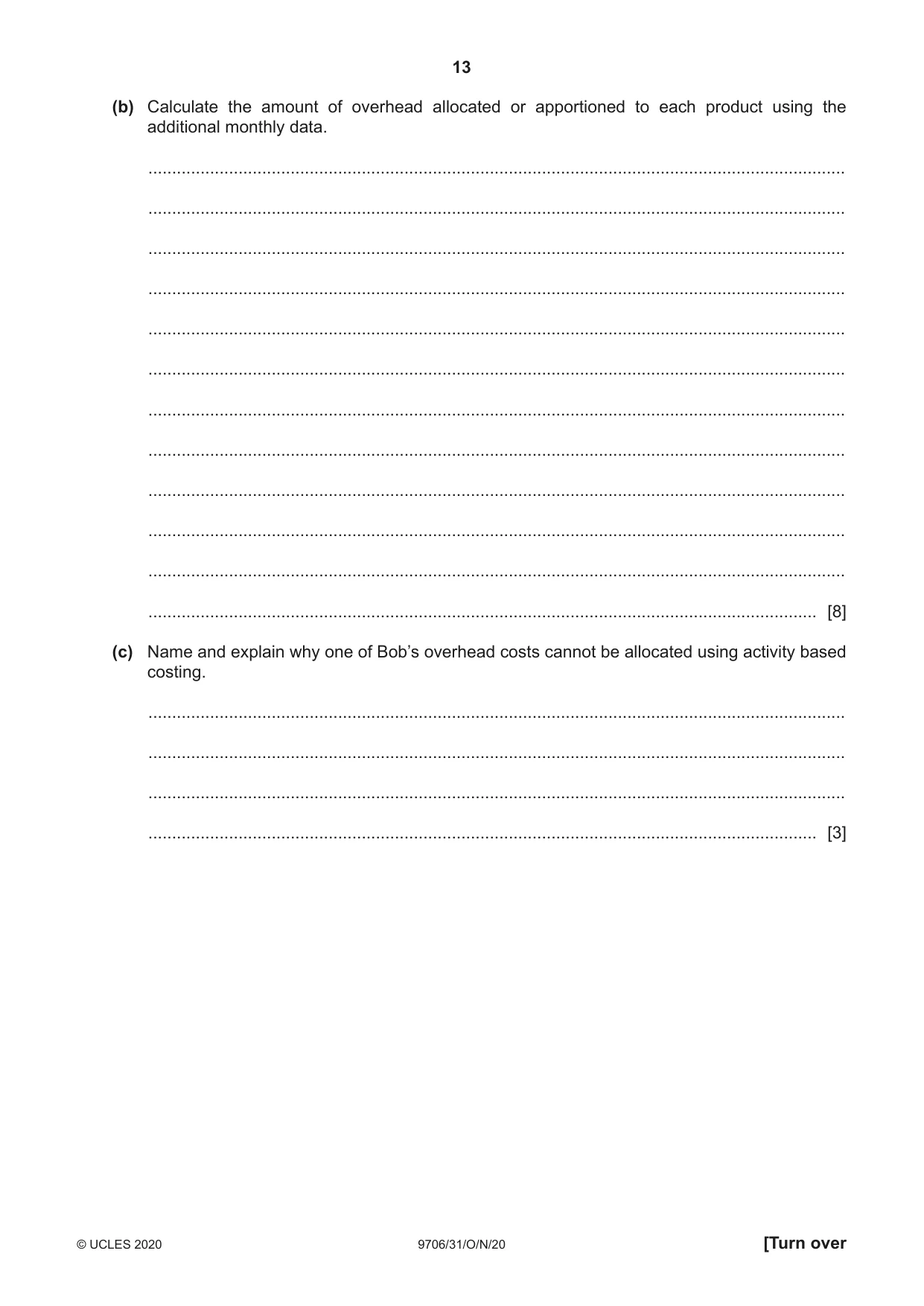
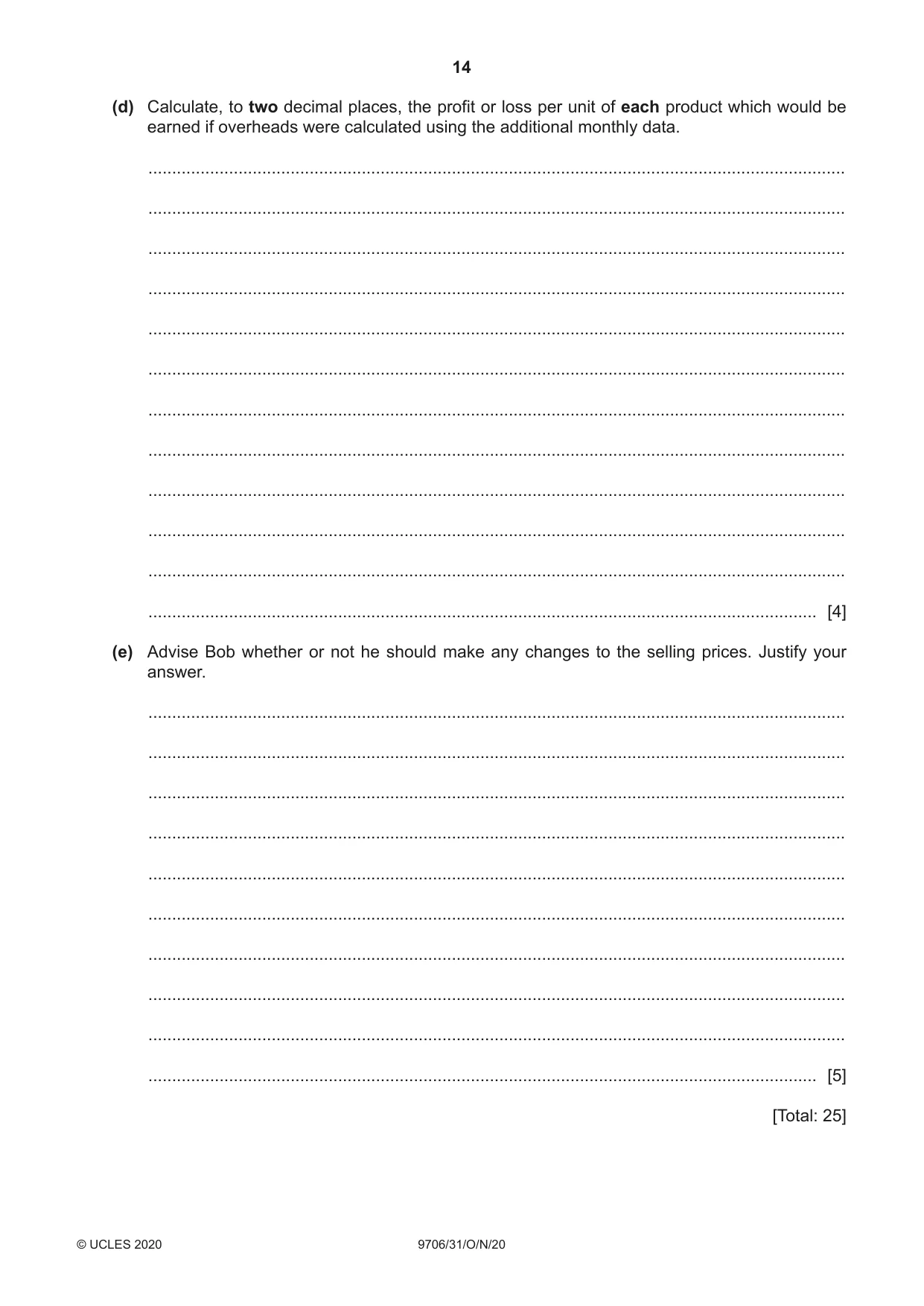
12 9706/31/O/N/20 © UCLES 2020 Section B: Cost and Management Accounting Answer all questions. 5 Read Source B1 in the insert. (a) Calculate, to two decimal places, the profit or loss per unit of each product. … … … … … … … … … … … … … … [5] Additional information The following additional monthly data is available. 1 Approximately 40% of the floor space in the factory is used in the manufacture of product A and 60% in the manufacture of product B. 2 The machinery used to manufacture product A is set up 300 times a month and the machinery for product B 500 times a month. 3 The number of orders packed for despatch are 700 a month for product A and 420 a month for product B. 4 300 quality inspections take place each month for product A and 700 for product B.
Question paper, page 13
13 9706/31/O/N/20 © UCLES 2020 [Turn over (b) Calculate the amount of overhead allocated or apportioned to each product using the additional monthly data. … … … … … … … … … … … … [8] (c) Name and explain why one of Bob’s overhead costs cannot be allocated using activity based costing. … … … … [3]
Question paper, page 14
14 9706/31/O/N/20 © UCLES 2020 (d) Calculate, to two decimal places, the profit or loss per unit of each product which would be earned if overheads were calculated using the additional monthly data. … … … … … … … … … … … … [4] (e) Advise Bob whether or not he should make any changes to the selling prices. Justify your answer. … … … … … … … … … … [5] [Total: 25]
Question paper, page 15
15 9706/31/O/N/20 © UCLES 2020 [Turn over PLEASE TURN OVER
Question paper, page 16
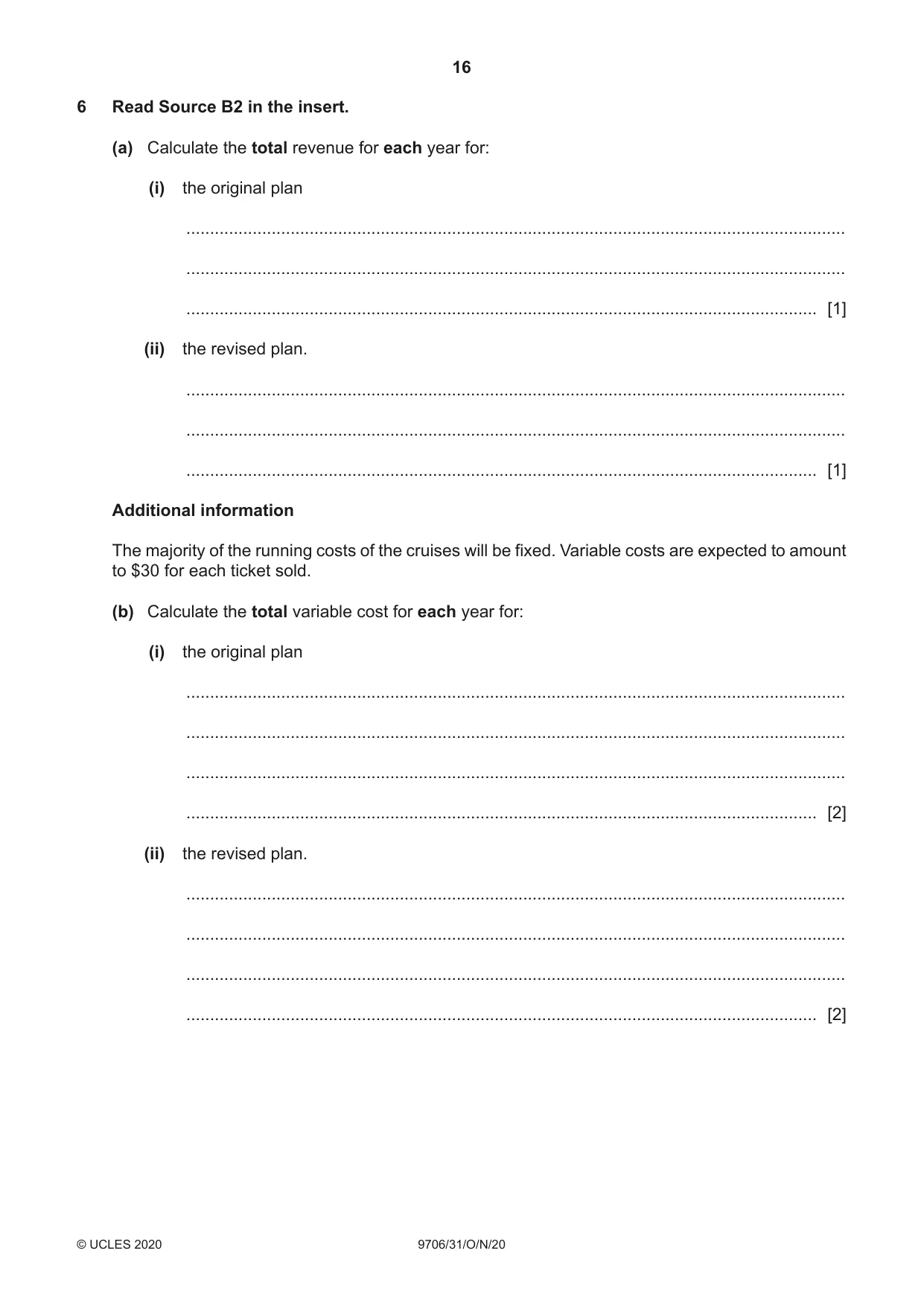
16 9706/31/O/N/20 © UCLES 2020 6 Read Source B2 in the insert. (a) Calculate the total revenue for each year for: (i) the original plan … … … [1] (ii) the revised plan. … … … [1] Additional information The majority of the running costs of the cruises will be fixed. Variable costs are expected to amount to $30 for each ticket sold. (b) Calculate the total variable cost for each year for: (i) the original plan … … … … [2] (ii) the revised plan. … … … … [2]
Question paper, page 17
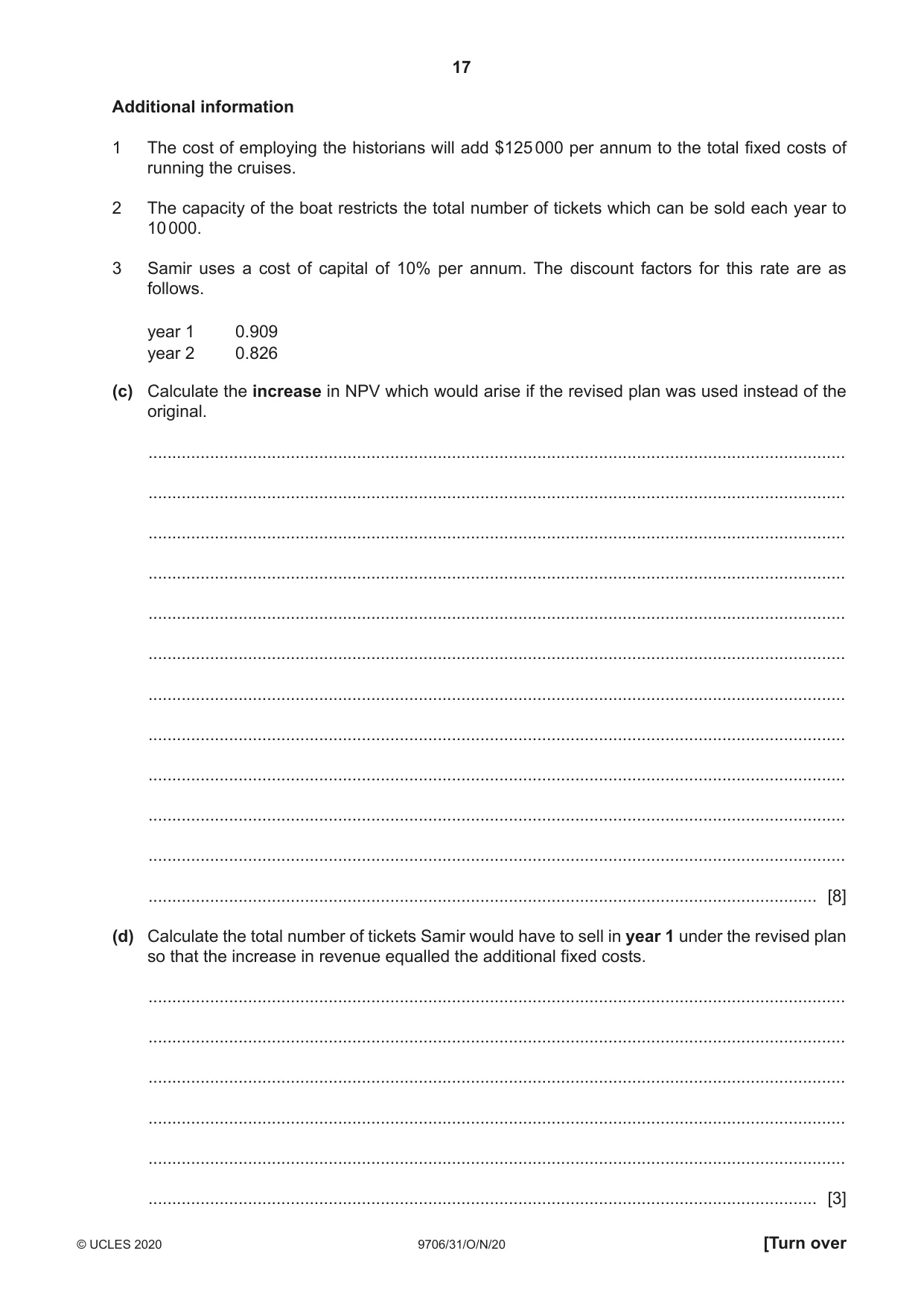
17 9706/31/O/N/20 © UCLES 2020 [Turn over Additional information 1 The cost of employing the historians will add $125 000 per annum to the total fixed costs of running the cruises. 2 The capacity of the boat restricts the total number of tickets which can be sold each year to 10 000. 3 Samir uses a cost of capital of 10% per annum. The discount factors for this rate are as follows. year 1 0.909 year 2 0.826 (c) Calculate the increase in NPV which would arise if the revised plan was used instead of the original. … … … … … … … … … … … … [8] (d) Calculate the total number of tickets Samir would have to sell in year 1 under the revised plan so that the increase in revenue equalled the additional fixed costs. … … … … … … [3]
Question paper, page 18
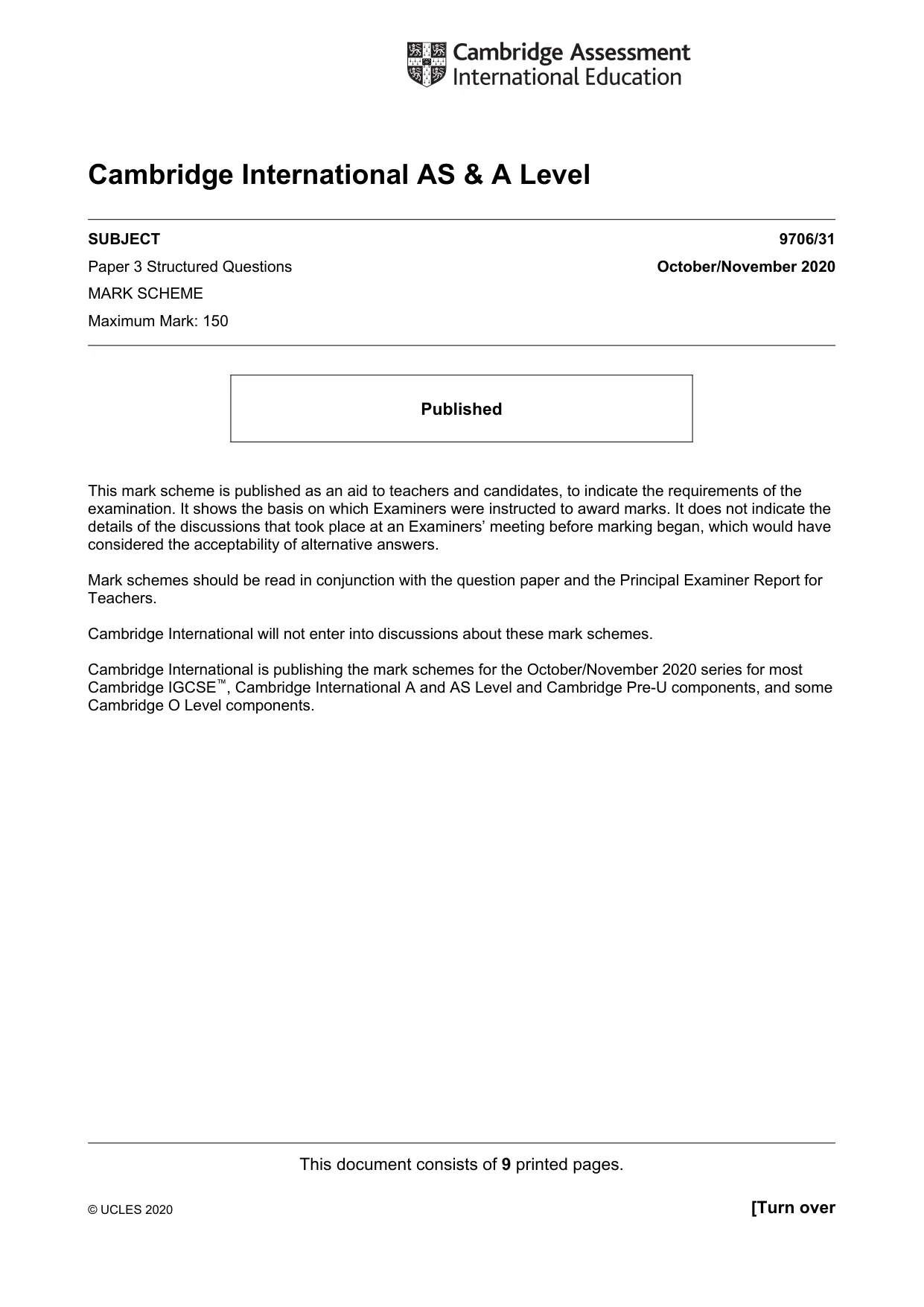
18 9706/31/O/N/20 © UCLES 2020 (e) Assess any concerns Samir might have about the revised plan. … … … … … [2] (f) Advise Samir whether or not he should implement the revised plan. Justify your answer. … … … … … … [3] (g) Explain how sensitivity analysis helps in investment appraisal. … … … … [3] [Total: 25]
Question paper, page 19
19 9706/31/O/N/20 © UCLES 2020 BLANK PAGE
Question paper, page 20
20 9706/31/O/N/20 © UCLES 2020 Permission to reproduce items where third-party owned material protected by copyright is included has been sought and cleared where possible. Every reasonable effort has been made by the publisher (UCLES) to trace copyright holders, but if any items requiring clearance have unwittingly been included, the publisher will be pleased to make amends at the earliest possible opportunity. To avoid the issue of disclosure of answer-related information to candidates, all copyright acknowledgements are reproduced online in the Cambridge Assessment International Education Copyright Acknowledgements Booklet. This is produced for each series of examinations and is freely available to download at www.cambridgeinternational.org after the live examination series. Cambridge Assessment International Education is part of the Cambridge Assessment Group. Cambridge Assessment is the brand name of the University of Cambridge Local Examinations Syndicate (UCLES), which itself is a department of the University of Cambridge. BLANK PAGE
Mark scheme, page 1
This document consists of 9 printed pages. © UCLES 2020 [Turn over Cambridge International AS & A Level SUBJECT 9706/31 Paper 3 Structured Questions October/November 2020 MARK SCHEME Maximum Mark: 150 Published This mark scheme is published as an aid to teachers and candidates, to indicate the requirements of the examination. It shows the basis on which Examiners were instructed to award marks. It does not indicate the details of the discussions that took place at an Examiners’ meeting before marking began, which would have considered the acceptability of alternative answers. Mark schemes should be read in conjunction with the question paper and the Principal Examiner Report for Teachers. Cambridge International will not enter into discussions about these mark schemes. Cambridge International is publishing the mark schemes for the October/November 2020 series for most Cambridge IGCSE™, Cambridge International A and AS Level and Cambridge Pre-U components, and some Cambridge O Level components.
Mark scheme, page 2
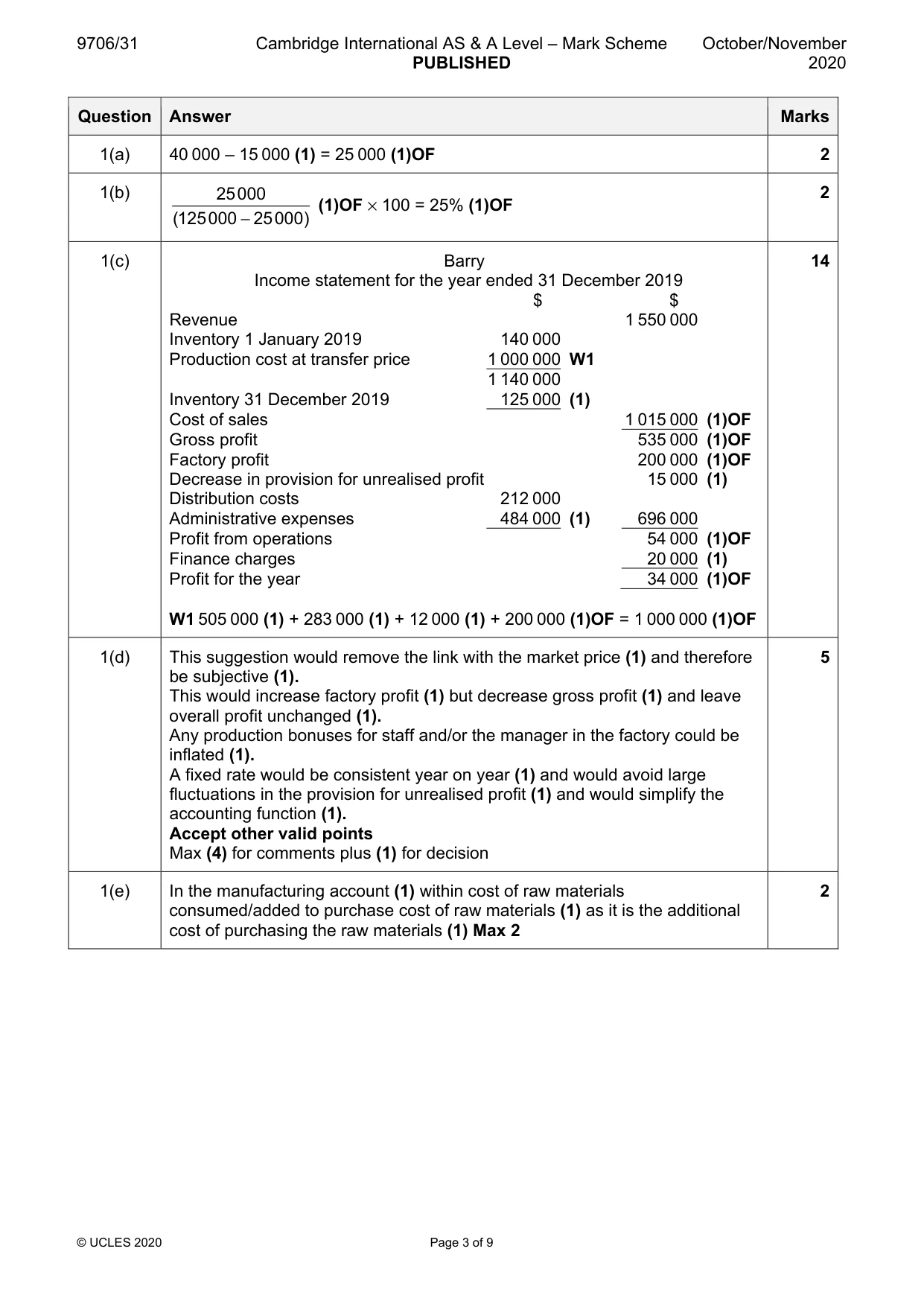
9706/31 Cambridge International AS & A Level – Mark Scheme PUBLISHED October/November 2020 © UCLES 2020 Page 2 of 9 Generic Marking Principles These general marking principles must be applied by all examiners when marking candidate answers. They should be applied alongside the specific content of the mark scheme or generic level descriptors for a question. Each question paper and mark scheme will also comply with these marking principles. GENERIC MARKING PRINCIPLE 1: Marks must be awarded in line with: • the specific content of the mark scheme or the generic level descriptors for the question • the specific skills defined in the mark scheme or in the generic level descriptors for the question • the standard of response required by a candidate as exemplified by the standardisation scripts. GENERIC MARKING PRINCIPLE 2: Marks awarded are always whole marks (not half marks, or other fractions). GENERIC MARKING PRINCIPLE 3: Marks must be awarded positively: • marks are awarded for correct/valid answers, as defined in the mark scheme. However, credit is given for valid answers which go beyond the scope of the syllabus and mark scheme, referring to your Team Leader as appropriate • marks are awarded when candidates clearly demonstrate what they know and can do • marks are not deducted for errors • marks are not deducted for omissions • answers should only be judged on the quality of spelling, punctuation and grammar when these features are specifically assessed by the question as indicated by the mark scheme. The meaning, however, should be unambiguous. GENERIC MARKING PRINCIPLE 4: Rules must be applied consistently, e.g. in situations where candidates have not followed instructions or in the application of generic level descriptors. GENERIC MARKING PRINCIPLE 5: Marks should be awarded using the full range of marks defined in the mark scheme for the question (however; the use of the full mark range may be limited according to the quality of the candidate responses seen). GENERIC MARKING PRINCIPLE 6: Marks awarded are based solely on the requirements as defined in the mark scheme. Marks should not be awarded with grade thresholds or grade descriptors in mind.
Mark scheme, page 3
9706/31 Cambridge International AS & A Level – Mark Scheme PUBLISHED October/November 2020 © UCLES 2020 Page 3 of 9 Question Answer Marks 1(a) 40 000 – 15 000 (1) = 25 000 (1)OF 2 1(b) 25000 (125000 25000) − (1)OF × 100 = 25% (1)OF 2 1(c) Barry Income statement for the year ended 31 December 2019 $ $ Revenue 1 550 000 Inventory 1 January 2019 140 000 Production cost at transfer price 1 000 000 W1 1 140 000 Inventory 31 December 2019 125 000 (1) Cost of sales 1 015 000 (1)OF Gross profit 535 000 (1)OF Factory profit 200 000 (1)OF Decrease in provision for unrealised profit 15 000 (1) Distribution costs 212 000 Administrative expenses 484 000 (1) 696 000 Profit from operations 54 000 (1)OF Finance charges 20 000 (1) Profit for the year 34 000 (1)OF W1 505 000 (1) + 283 000 (1) + 12 000 (1) + 200 000 (1)OF = 1 000 000 (1)OF 14 1(d) This suggestion would remove the link with the market price (1) and therefore be subjective (1). This would increase factory profit (1) but decrease gross profit (1) and leave overall profit unchanged (1). Any production bonuses for staff and/or the manager in the factory could be inflated (1). A fixed rate would be consistent year on year (1) and would avoid large fluctuations in the provision for unrealised profit (1) and would simplify the accounting function (1). Accept other valid points Max (4) for comments plus (1) for decision 5 1(e) In the manufacturing account (1) within cost of raw materials consumed/added to purchase cost of raw materials (1) as it is the additional cost of purchasing the raw materials (1) Max 2 2
Mark scheme, page 4
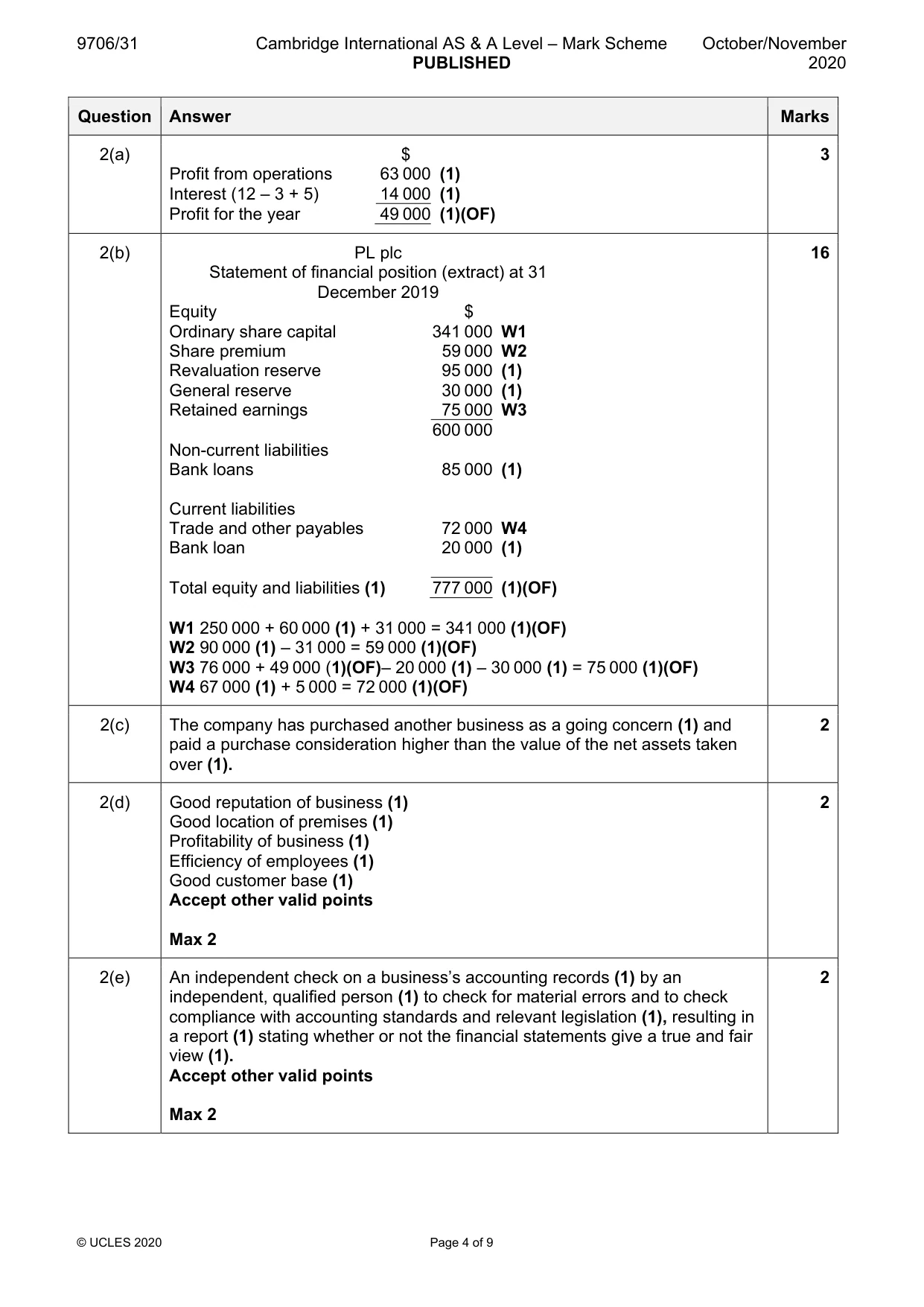
9706/31 Cambridge International AS & A Level – Mark Scheme PUBLISHED October/November 2020 © UCLES 2020 Page 4 of 9 Question Answer Marks 2(a) $ Profit from operations 63 000 (1) Interest (12 – 3 + 5) 14 000 (1) Profit for the year 49 000 (1)(OF) 3 2(b) PL plc Statement of financial position (extract) at 31 December 2019 Equity $ Ordinary share capital 341 000 W1 Share premium 59 000 W2 Revaluation reserve 95 000 (1) General reserve 30 000 (1) Retained earnings 75 000 W3 600 000 Non-current liabilities Bank loans 85 000 (1) Current liabilities Trade and other payables 72 000 W4 Bank loan 20 000 (1) Total equity and liabilities (1) 777 000 (1)(OF) W1 250 000 + 60 000 (1) + 31 000 = 341 000 (1)(OF) W2 90 000 (1) – 31 000 = 59 000 (1)(OF) W3 76 000 + 49 000 (1)(OF)– 20 000 (1) – 30 000 (1) = 75 000 (1)(OF) W4 67 000 (1) + 5 000 = 72 000 (1)(OF) 16 2(c) The company has purchased another business as a going concern (1) and paid a purchase consideration higher than the value of the net assets taken over (1). 2 2(d) Good reputation of business (1) Good location of premises (1) Profitability of business (1) Efficiency of employees (1) Good customer base (1) Accept other valid points Max 2 2 2(e) An independent check on a business’s accounting records (1) by an independent, qualified person (1) to check for material errors and to check compliance with accounting standards and relevant legislation (1), resulting in a report (1) stating whether or not the financial statements give a true and fair view (1). Accept other valid points Max 2 2
Mark scheme, page 5
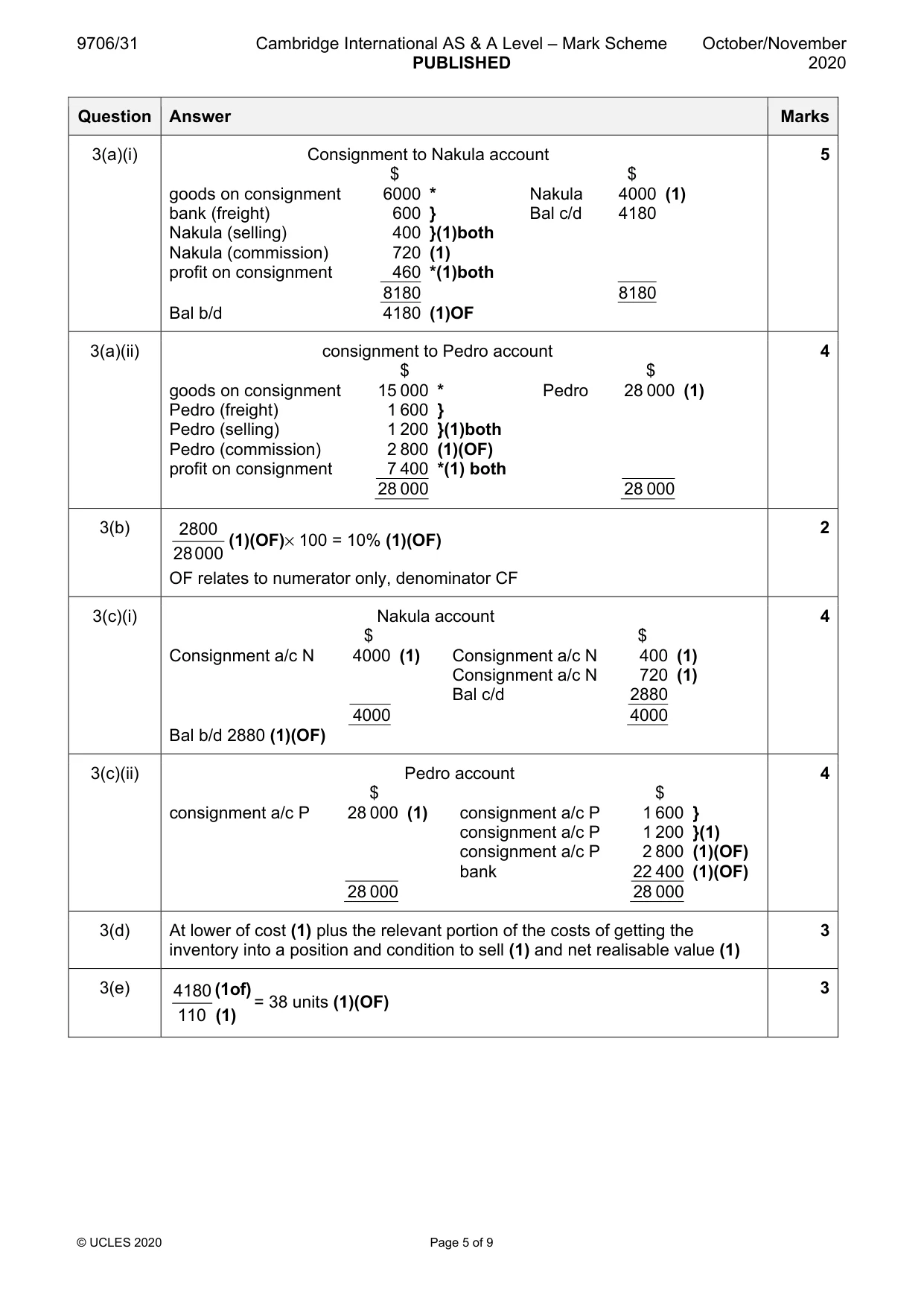
9706/31 Cambridge International AS & A Level – Mark Scheme PUBLISHED October/November 2020 © UCLES 2020 Page 5 of 9 Question Answer Marks 3(a)(i) Consignment to Nakula account $ $ goods on consignment 6000 * Nakula 4000 (1) bank (freight) 600 } Bal c/d 4180 Nakula (selling) 400 }(1)both Nakula (commission) 720 (1) profit on consignment 460 *(1)both 8180 8180 Bal b/d 4180 (1)OF 5 3(a)(ii) consignment to Pedro account $ $ goods on consignment 15 000 * Pedro 28 000 (1) Pedro (freight) 1 600 } Pedro (selling) 1 200 }(1)both Pedro (commission) 2 800 (1)(OF) profit on consignment 7 400 *(1) both 28 000 28 000 4 3(b) 2800 28000 (1)(OF)× 100 = 10% (1)(OF) OF relates to numerator only, denominator CF 2 3(c)(i) Nakula account $ $ Consignment a/c N 4000 (1) Consignment a/c N 400 (1) Consignment a/c N 720 (1) Bal c/d 2880 4000 4000 Bal b/d 2880 (1)(OF) 4 3(c)(ii) Pedro account $ $ consignment a/c P 28 000 (1) consignment a/c P 1 600 } consignment a/c P 1 200 }(1) consignment a/c P 2 800 (1)(OF) bank 22 400 (1)(OF) 28 000 28 000 4 3(d) At lower of cost (1) plus the relevant portion of the costs of getting the inventory into a position and condition to sell (1) and net realisable value (1) 3 3(e) 4180 110 (1of) (1) = 38 units (1)(OF) 3
Mark scheme, page 6
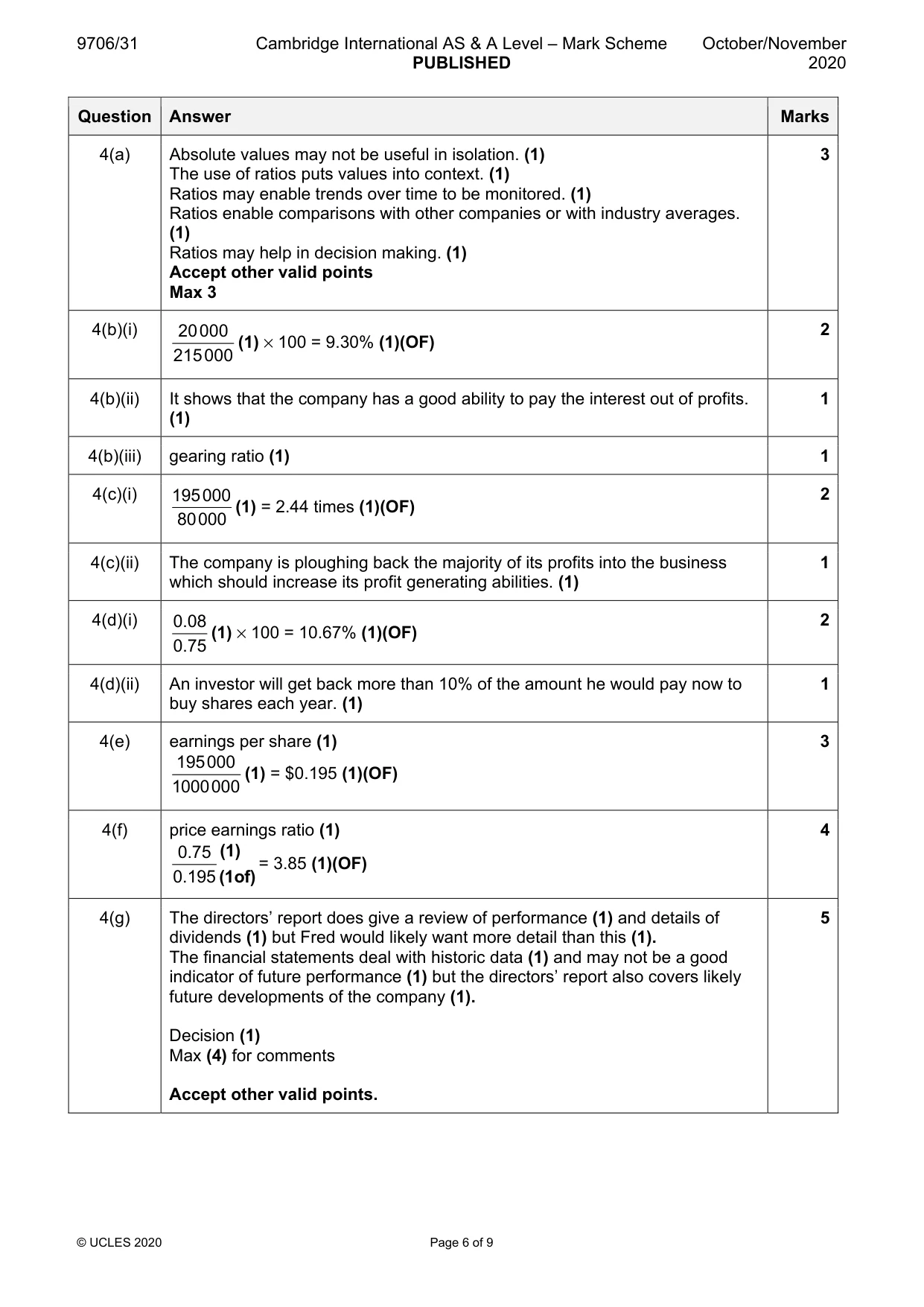
9706/31 Cambridge International AS & A Level – Mark Scheme PUBLISHED October/November 2020 © UCLES 2020 Page 6 of 9 Question Answer Marks 4(a) Absolute values may not be useful in isolation. (1) The use of ratios puts values into context. (1) Ratios may enable trends over time to be monitored. (1) Ratios enable comparisons with other companies or with industry averages. (1) Ratios may help in decision making. (1) Accept other valid points Max 3 3 4(b)(i) 20000 215000 (1) × 100 = 9.30% (1)(OF) 2 4(b)(ii) It shows that the company has a good ability to pay the interest out of profits. (1) 1 4(b)(iii) gearing ratio (1) 1 4(c)(i) 195000 80000 (1) = 2.44 times (1)(OF) 2 4(c)(ii) The company is ploughing back the majority of its profits into the business which should increase its profit generating abilities. (1) 1 4(d)(i) 0.08 0.75 (1) × 100 = 10.67% (1)(OF) 2 4(d)(ii) An investor will get back more than 10% of the amount he would pay now to buy shares each year. (1) 1 4(e) earnings per share (1) 195000 1000000 (1) = $0.195 (1)(OF) 3 4(f) price earnings ratio (1) 0.75 0.195 (1) (1of) = 3.85 (1)(OF) 4 4(g) The directors’ report does give a review of performance (1) and details of dividends (1) but Fred would likely want more detail than this (1). The financial statements deal with historic data (1) and may not be a good indicator of future performance (1) but the directors’ report also covers likely future developments of the company (1). Decision (1) Max (4) for comments Accept other valid points. 5
Mark scheme, page 7
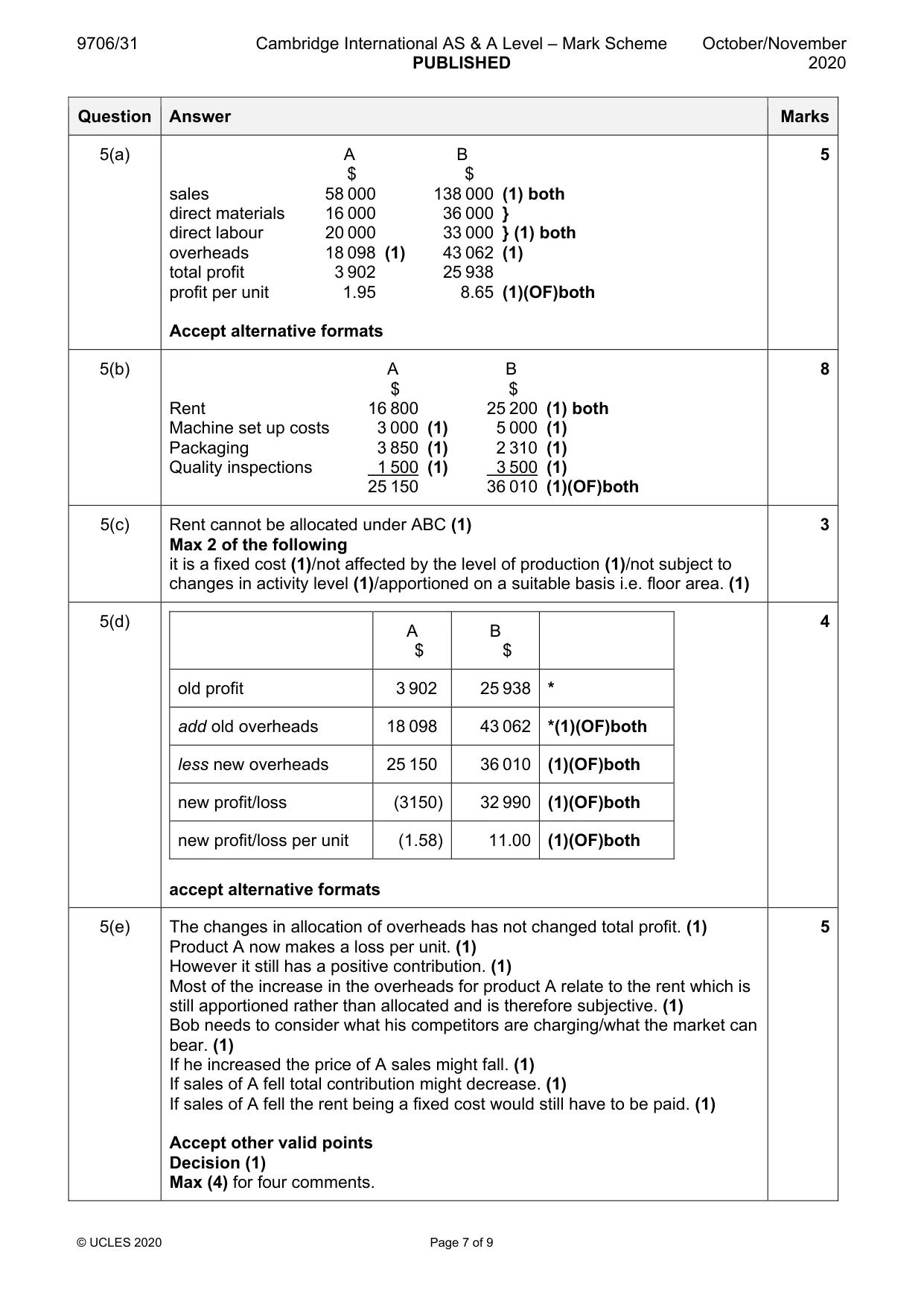
9706/31 Cambridge International AS & A Level – Mark Scheme PUBLISHED October/November 2020 © UCLES 2020 Page 7 of 9 Question Answer Marks 5(a) A $ B $ sales 58 000 138 000 (1) both direct materials 16 000 36 000 } direct labour 20 000 33 000 } (1) both overheads 18 098 (1) 43 062 (1) total profit 3 902 25 938 profit per unit 1.95 8.65 (1)(OF)both Accept alternative formats 5 5(b) A $ B $ Rent 16 800 25 200 (1) both Machine set up costs 3 000 (1) 5 000 (1) Packaging 3 850 (1) 2 310 (1) Quality inspections 1 500 (1) 3 500 (1) 25 150 36 010 (1)(OF)both 8 5(c) Rent cannot be allocated under ABC (1) Max 2 of the following it is a fixed cost (1)/not affected by the level of production (1)/not subject to changes in activity level (1)/apportioned on a suitable basis i.e. floor area. (1) 3 5(d) A $ B $ old profit 3 902 25 938 * add old overheads 18 098 43 062 *(1)(OF)both less new overheads 25 150 36 010 (1)(OF)both new profit/loss (3150) 32 990 (1)(OF)both new profit/loss per unit (1.58) 11.00 (1)(OF)both accept alternative formats 4 5(e) The changes in allocation of overheads has not changed total profit. (1) Product A now makes a loss per unit. (1) However it still has a positive contribution. (1) Most of the increase in the overheads for product A relate to the rent which is still apportioned rather than allocated and is therefore subjective. (1) Bob needs to consider what his competitors are charging/what the market can bear. (1) If he increased the price of A sales might fall. (1) If sales of A fell total contribution might decrease. (1) If sales of A fell the rent being a fixed cost would still have to be paid. (1) Accept other valid points Decision (1) Max (4) for four comments. 5
Mark scheme, page 8
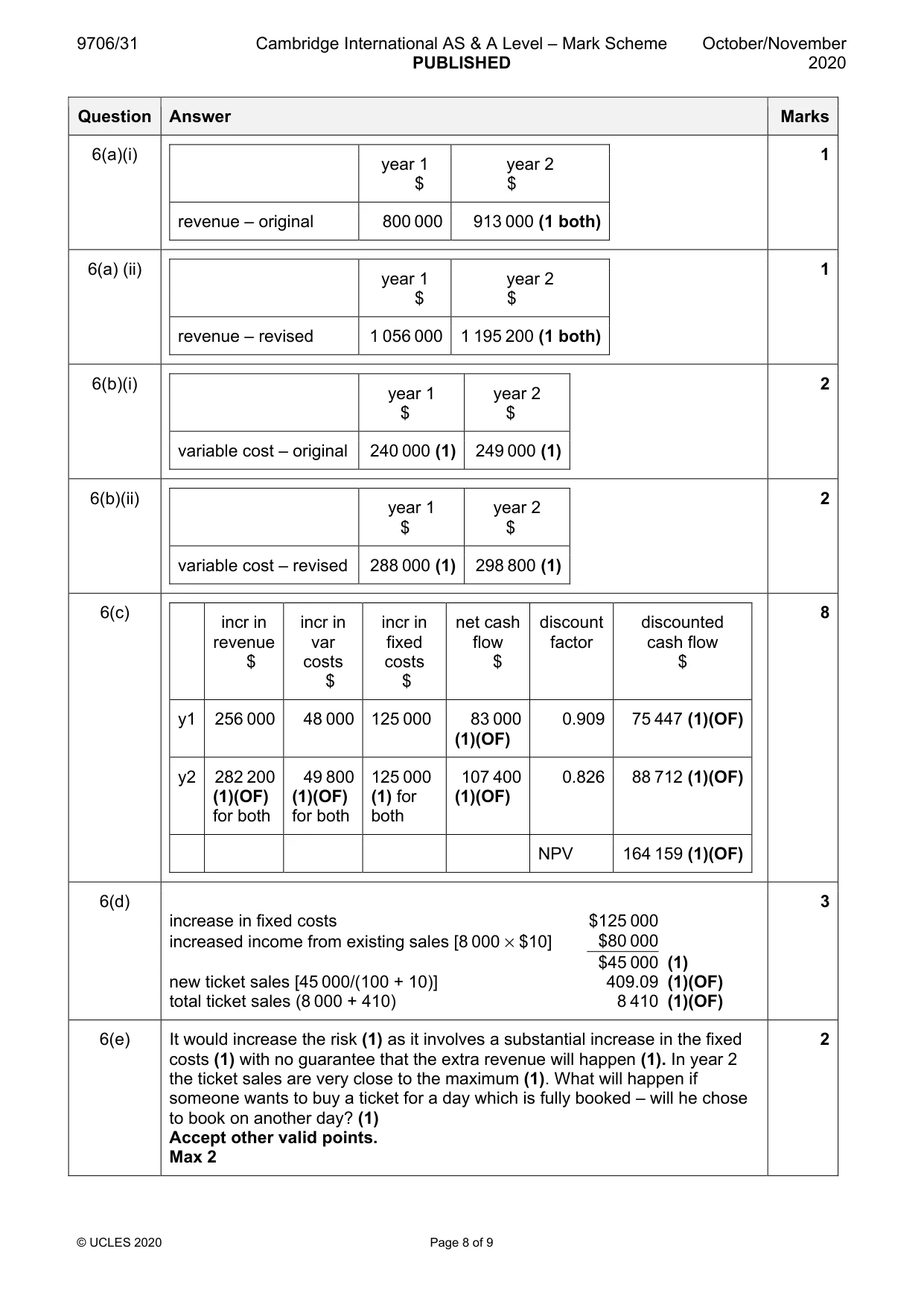
9706/31 Cambridge International AS & A Level – Mark Scheme PUBLISHED October/November 2020 © UCLES 2020 Page 8 of 9 Question Answer Marks 6(a)(i) year 1 $ year 2 $ revenue – original 800 000 913 000 (1 both) 1 6(a) (ii) year 1 $ year 2 $ revenue – revised 1 056 000 1 195 200 (1 both) 1 6(b)(i) year 1 $ year 2 $ variable cost – original 240 000 (1) 249 000 (1) 2 6(b)(ii) year 1 $ year 2 $ variable cost – revised 288 000 (1) 298 800 (1) 2 6(c) incr in revenue $ incr in var costs $ incr in fixed costs $ net cash flow $ discount factor discounted cash flow $ y1 256 000 48 000 125 000 83 000 (1)(OF) 0.909 75 447 (1)(OF) y2 282 200 (1)(OF) for both 49 800 (1)(OF) for both 125 000 (1) for both 107 400 (1)(OF) 0.826 88 712 (1)(OF) NPV 164 159 (1)(OF) 8 6(d) increase in fixed costs $125 000 increased income from existing sales [8 000 × $10] $80 000 $45 000 (1) new ticket sales [45 000/(100 + 10)] 409.09 (1)(OF) total ticket sales (8 000 + 410) 8 410 (1)(OF) 3 6(e) It would increase the risk (1) as it involves a substantial increase in the fixed costs (1) with no guarantee that the extra revenue will happen (1). In year 2 the ticket sales are very close to the maximum (1). What will happen if someone wants to buy a ticket for a day which is fully booked – will he chose to book on another day? (1) Accept other valid points. Max 2 2
Mark scheme, page 9
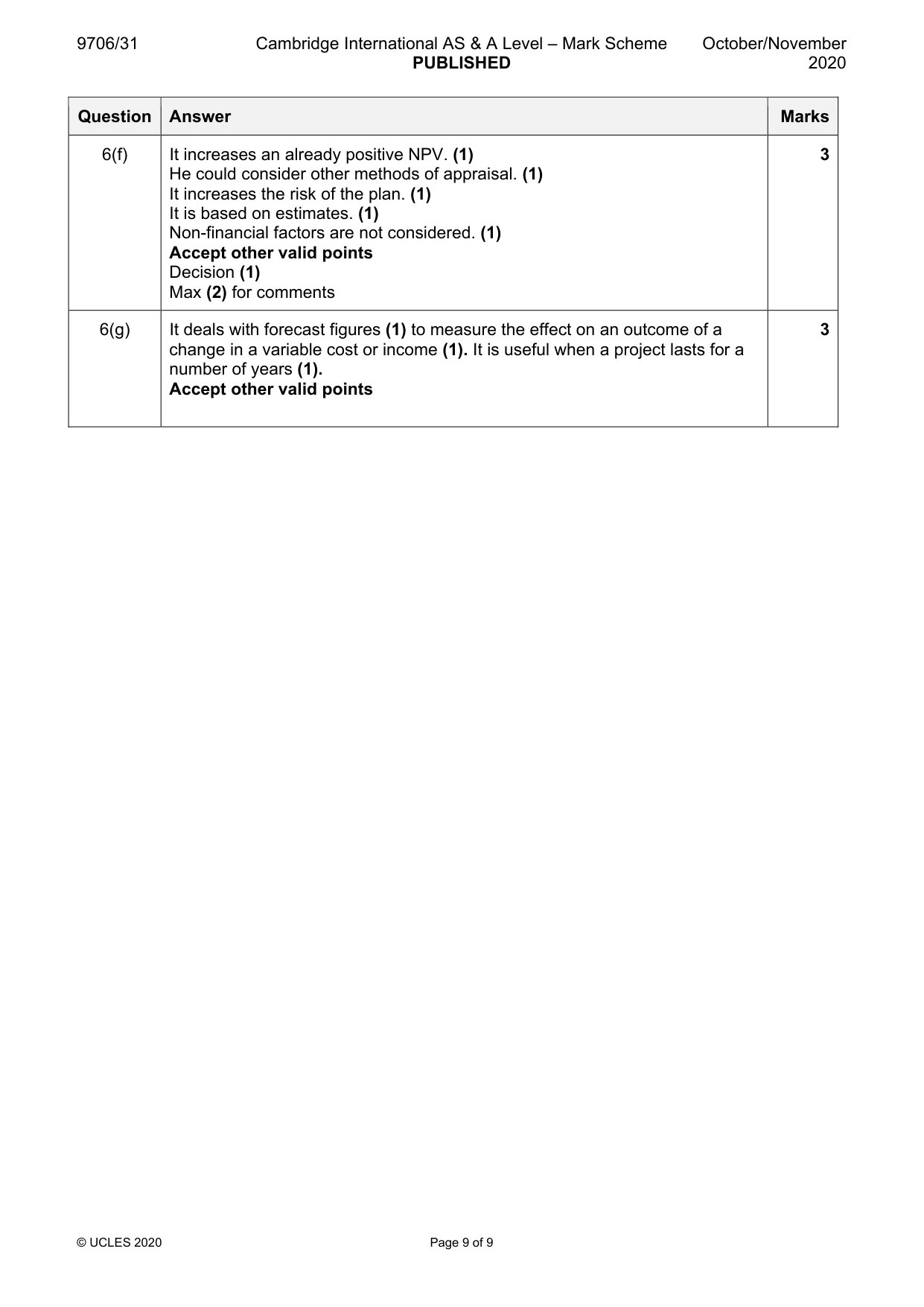
9706/31 Cambridge International AS & A Level – Mark Scheme PUBLISHED October/November 2020 © UCLES 2020 Page 9 of 9 Question Answer Marks 6(f) It increases an already positive NPV. (1) He could consider other methods of appraisal. (1) It increases the risk of the plan. (1) It is based on estimates. (1) Non-financial factors are not considered. (1) Accept other valid points Decision (1) Max (2) for comments 3 6(g) It deals with forecast figures (1) to measure the effect on an outcome of a change in a variable cost or income (1). It is useful when a project lasts for a number of years (1). Accept other valid points 3
What you needed in this session
Cambridge’s own grade thresholds for 2020 Oct/Nov, Paper 3 · Variant 1. A higher threshold means an easier paper — the bar moves with how the cohort did.