Cambridge A Level Accounting 9706 — 2020 Oct/Nov Paper 3 · Variant 2
9706/32/O/N/20 · 150 marks · ≈169 min
The question paper and its mark scheme, free to read here and free to download. This is Cambridge’s own paper, exactly as it was sat.
Question paper20 pages


Mark scheme11 pages
Answers below. Sit the paper first if you are practising.
Paper as text
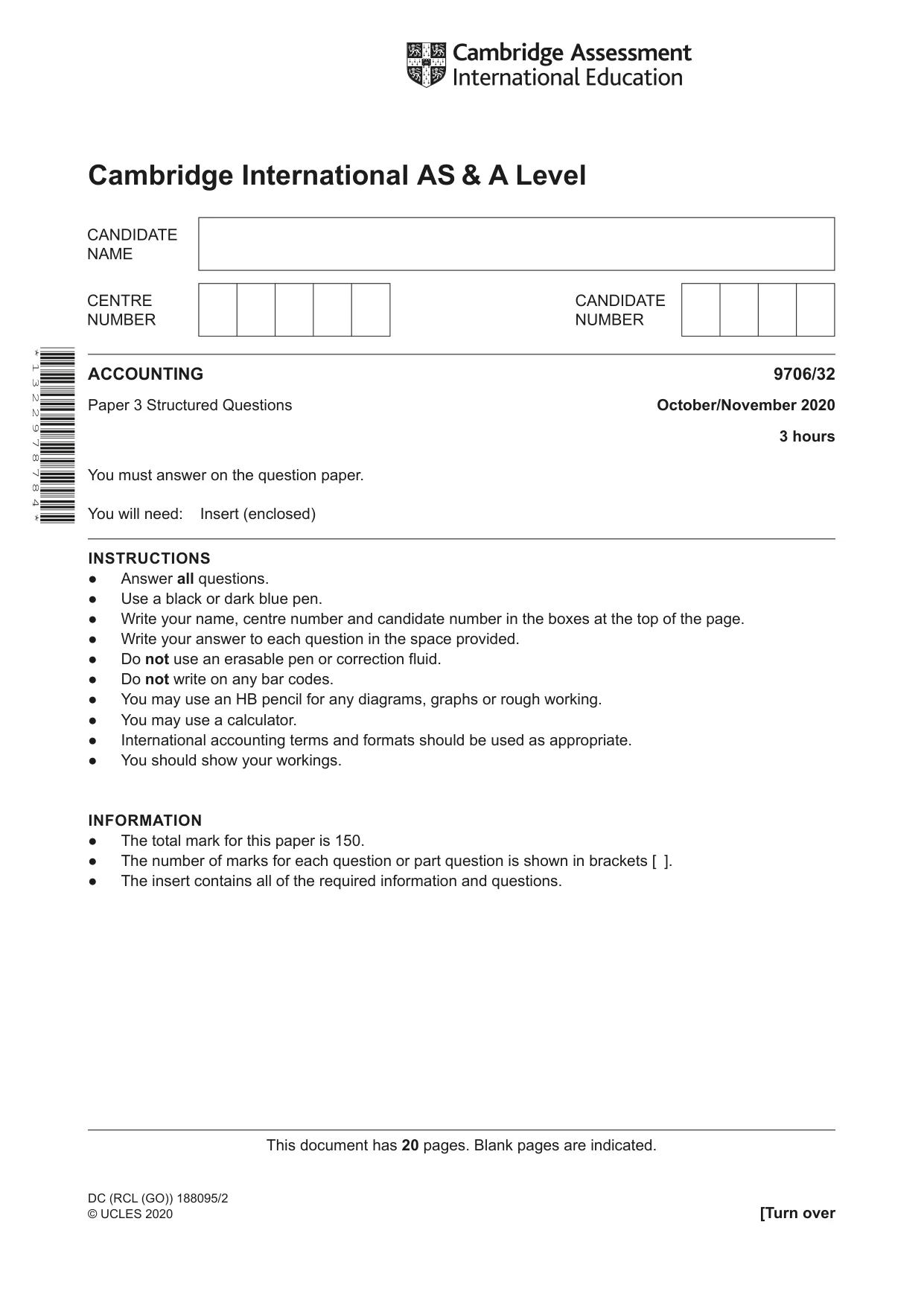
Question paper, page 1
ACCOUNTING 9706/32 Paper 3 Structured Questions October/November 2020 3 hours You must answer on the question paper. You will need: Insert (enclosed) INSTRUCTIONS ● Answer all questions. ● Use a black or dark blue pen. ● Write your name, centre number and candidate number in the boxes at the top of the page. ● Write your answer to each question in the space provided. ● Do not use an erasable pen or correction fluid. ● Do not write on any bar codes. ● You may use an HB pencil for any diagrams, graphs or rough working. ● You may use a calculator. ● International accounting terms and formats should be used as appropriate. ● You should show your workings. INFORMATION ● The total mark for this paper is 150. ● The number of marks for each question or part question is shown in brackets [ ]. ● The insert contains all of the required information and questions. Cambridge International AS & A Level This document has 20 pages. Blank pages are indicated. DC (RCL (GO)) 188095/2 © UCLES 2020 [Turn over * 1 3 2 2 9 7 8 7 8 4 *
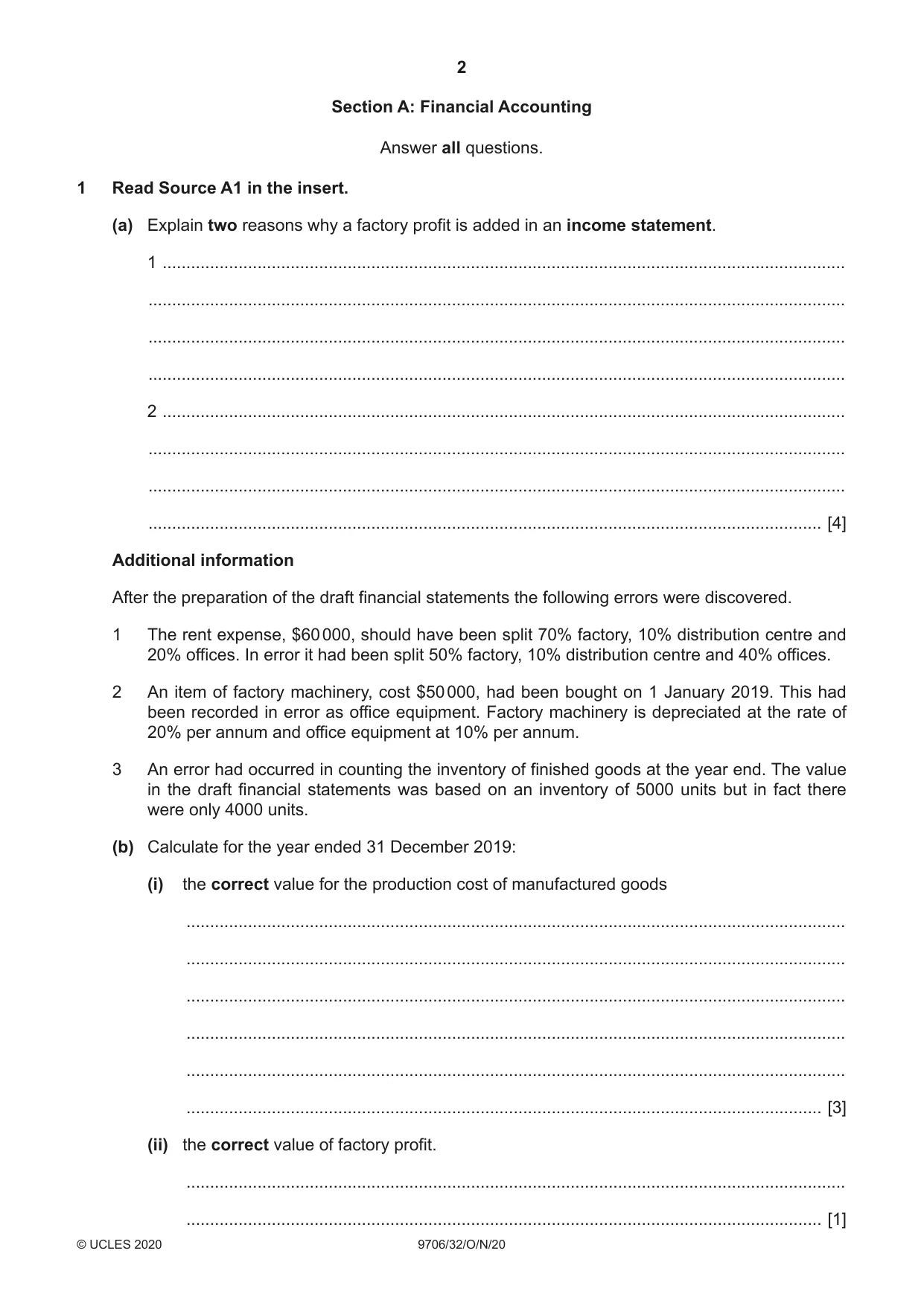
Question paper, page 2
2 9706/32/O/N/20 © UCLES 2020 Section A: Financial Accounting Answer all questions. 1 Read Source A1 in the insert. (a) Explain two reasons why a factory profit is added in an income statement. 1 … … … … 2 … … … … [4] Additional information After the preparation of the draft financial statements the following errors were discovered. 1 The rent expense, $60 000, should have been split 70% factory, 10% distribution centre and 20% offices. In error it had been split 50% factory, 10% distribution centre and 40% offices. 2 An item of factory machinery, cost $50 000, had been bought on 1 January 2019. This had been recorded in error as office equipment. Factory machinery is depreciated at the rate of 20% per annum and office equipment at 10% per annum. 3 An error had occurred in counting the inventory of finished goods at the year end. The value in the draft financial statements was based on an inventory of 5000 units but in fact there were only 4000 units. (b) Calculate for the year ended 31 December 2019: (i) the correct value for the production cost of manufactured goods … … … … … … [3] (ii) the correct value of factory profit. … … [1]
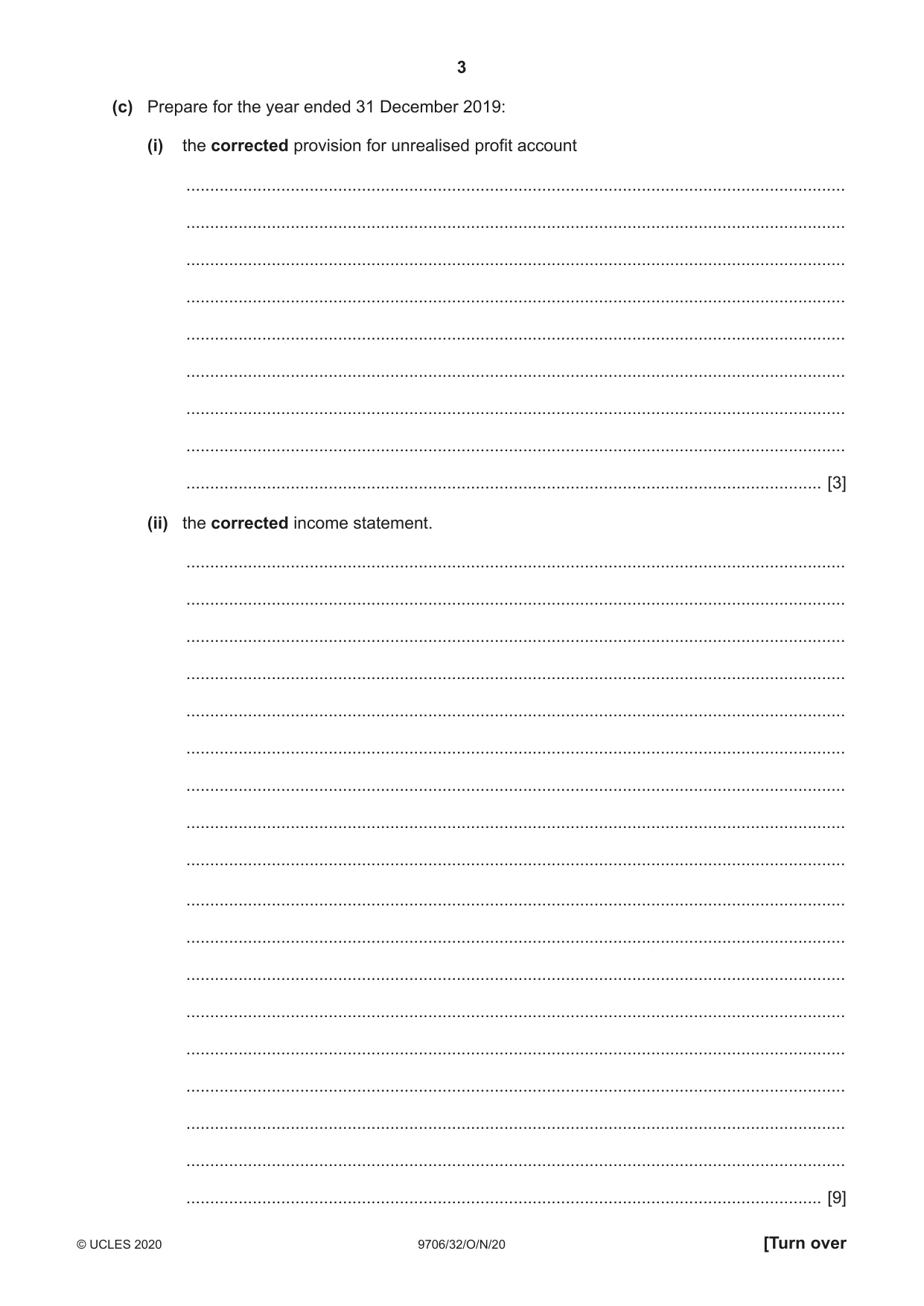
Question paper, page 3
3 9706/32/O/N/20 © UCLES 2020 [Turn over (c) Prepare for the year ended 31 December 2019: (i) the corrected provision for unrealised profit account … … … … … … … … … [3] (ii) the corrected income statement. … … … … … … … … … … … … … … … … … … [9]
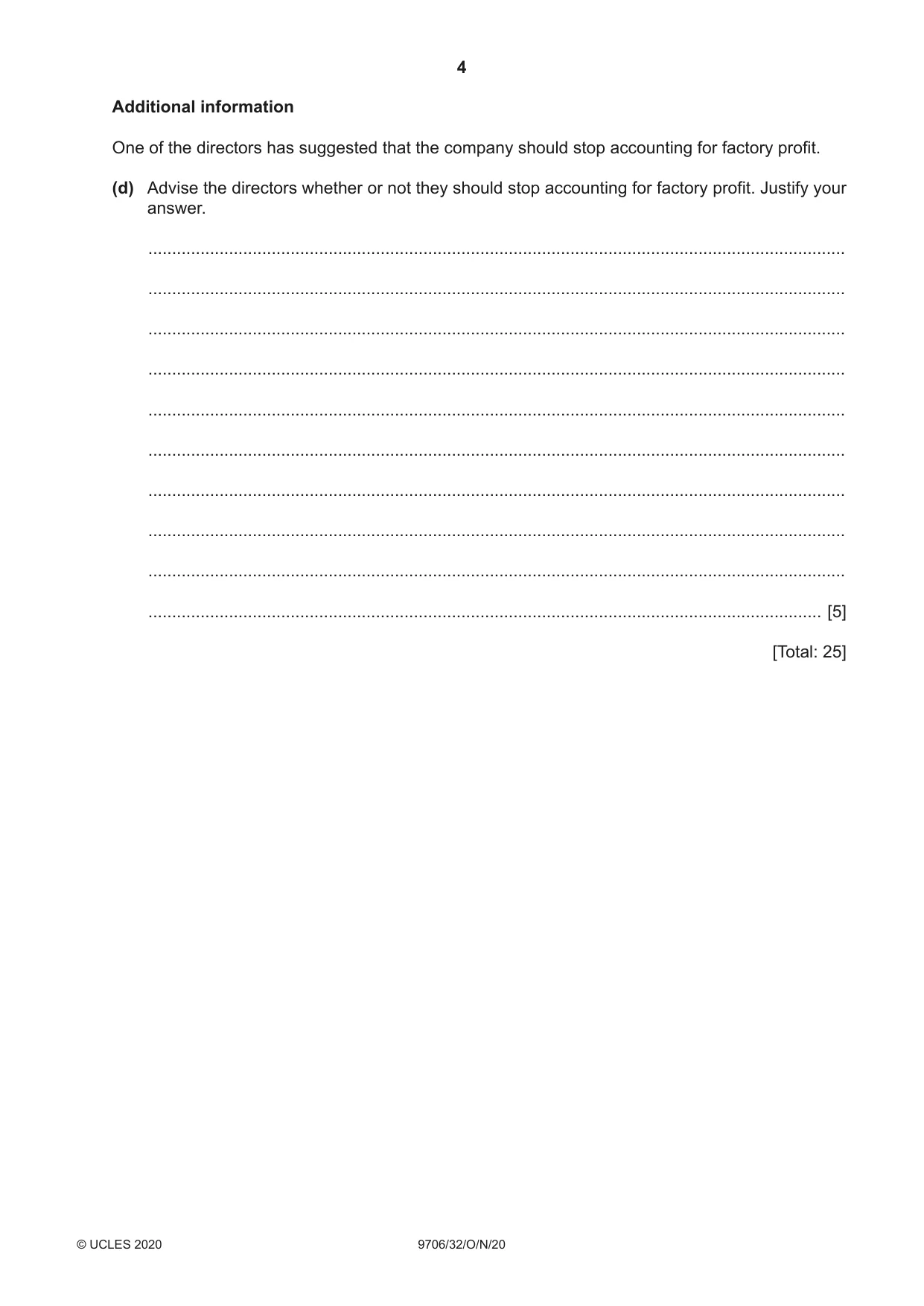
Question paper, page 4
4 9706/32/O/N/20 © UCLES 2020 Additional information One of the directors has suggested that the company should stop accounting for factory profit. (d) Advise the directors whether or not they should stop accounting for factory profit. Justify your answer. … … … … … … … … … … [5] [Total: 25]
Question paper, page 5
5 9706/32/O/N/20 © UCLES 2020 [Turn over PLEASE TURN OVER
Question paper, page 6
6 9706/32/O/N/20 © UCLES 2020 2 Read Source A2 in the insert. (a) Prepare the statement of cash flows for the year ended 31 December 2019. (Ignore taxation.) … … … … … … … … … … … … … … … … … … … … … … … … … …
Question paper, page 7
7 9706/32/O/N/20 © UCLES 2020 [Turn over … … … … … … … … … … … … … … [19] (b) Explain how a premium on an issue of shares is dealt with differently in a statement of cash flows as compared to the books of account of a company. … … … … … … [3] (c) State three reasons why a company might prepare a statement of cash flows. 1 … … 2 … … 3 … … [3] [Total: 25]
Question paper, page 8
8 9706/32/O/N/20 © UCLES 2020 3 Read Source A3 in the insert. (a) Suggest two items, purchased by a business, which could be included in its intangible assets. 1 … 2 … [2] (b) Prepare, showing the adjustments made during the merger on 1 January 2020, (i) the capital account of Babak … … … … … … … … [3] (ii) the capital account of Alice. … … … … … … … … [6]
Question paper, page 9
9 9706/32/O/N/20 © UCLES 2020 [Turn over (c) Prepare the statement of financial position of the partnership immediately after the merger on 1 January 2020. … … … … … … … … … … … … … … … … … … … … … … … … … …[9]
Question paper, page 10
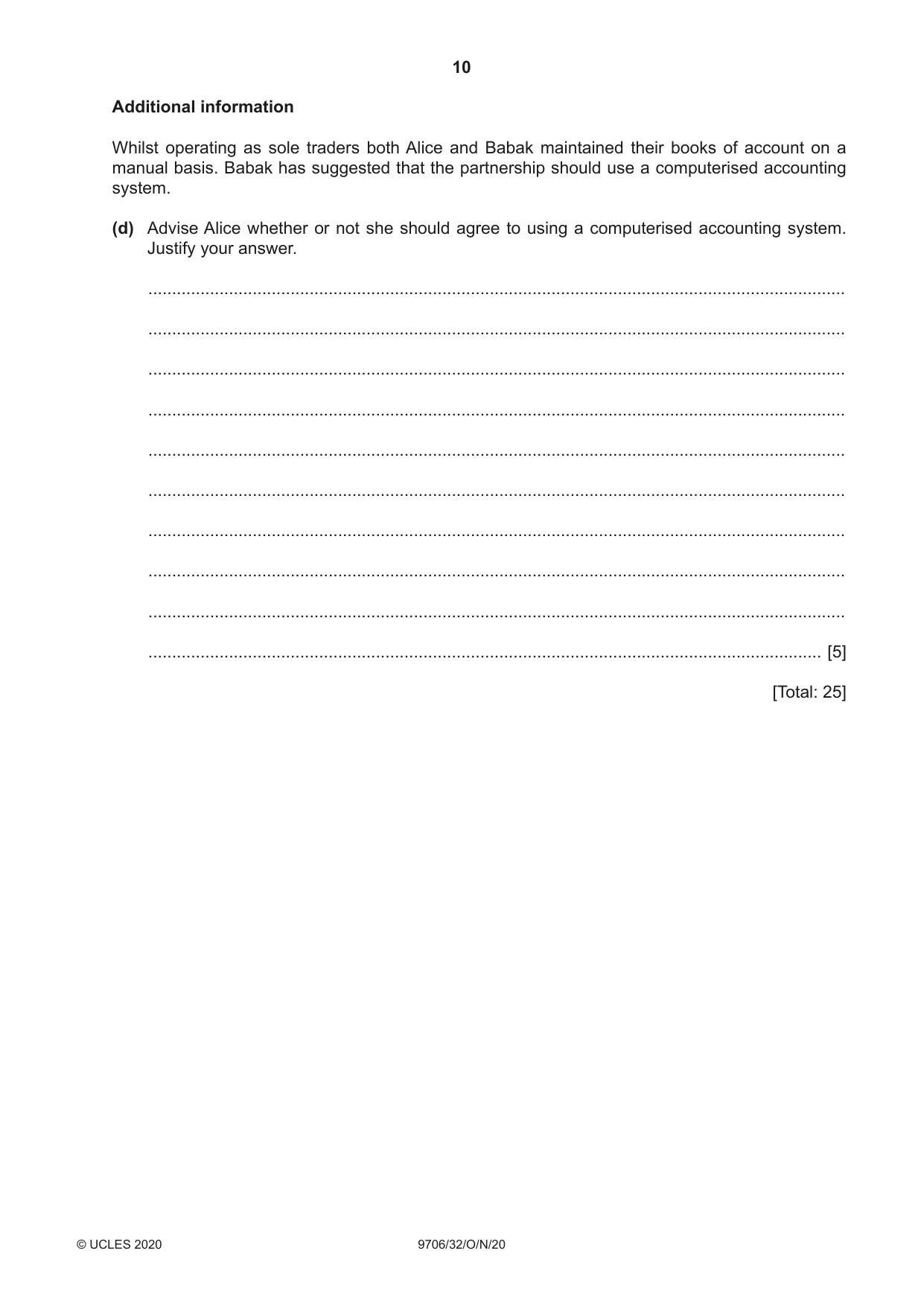
10 9706/32/O/N/20 © UCLES 2020 Additional information Whilst operating as sole traders both Alice and Babak maintained their books of account on a manual basis. Babak has suggested that the partnership should use a computerised accounting system. (d) Advise Alice whether or not she should agree to using a computerised accounting system. Justify your answer. … … … … … … … … … … [5] [Total: 25]
Question paper, page 11
11 9706/32/O/N/20 © UCLES 2020 [Turn over PLEASE TURN OVER
Question paper, page 12
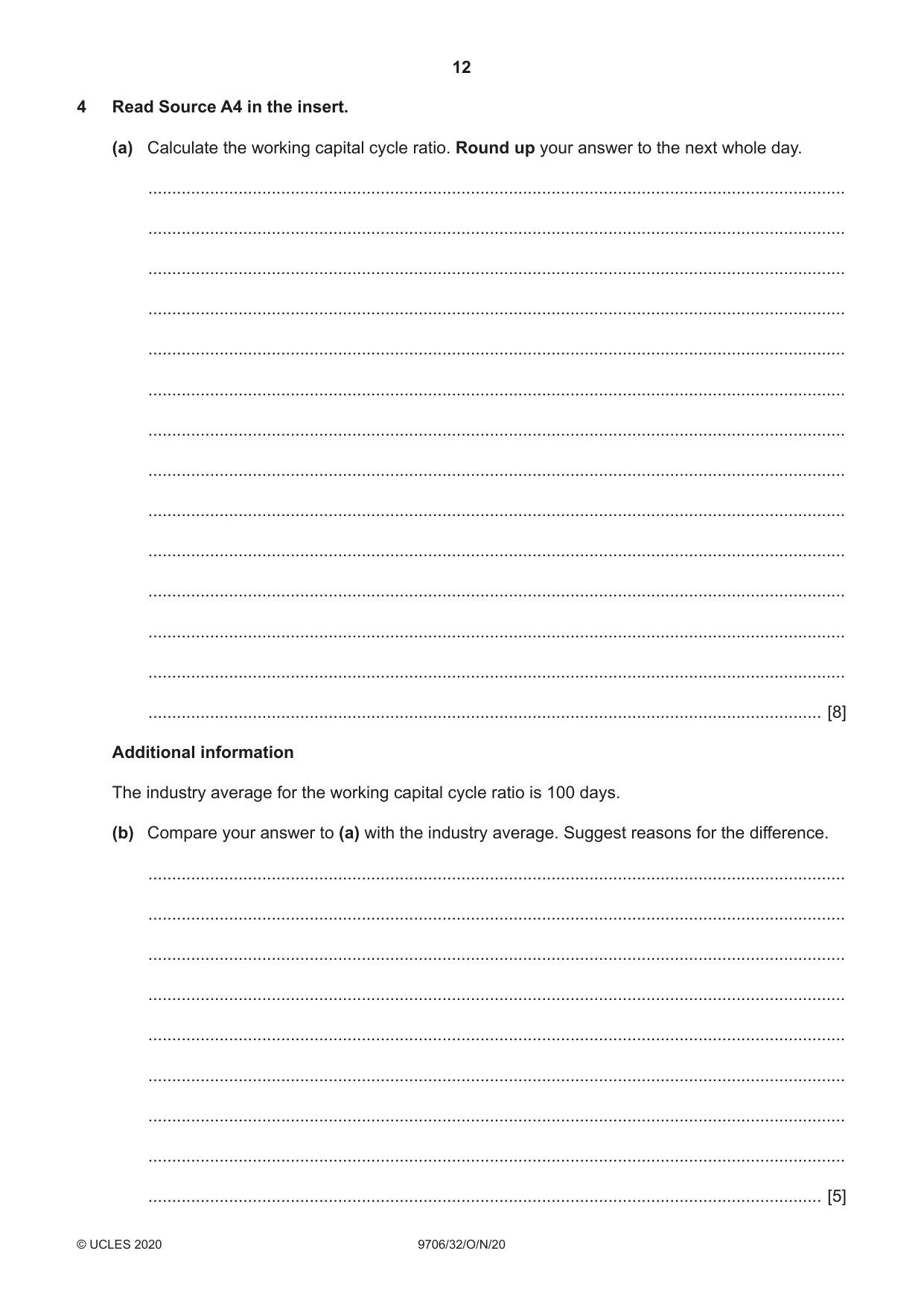
12 9706/32/O/N/20 © UCLES 2020 4 Read Source A4 in the insert. (a) Calculate the working capital cycle ratio. Round up your answer to the next whole day. … … … … … … … … … … … … … … [8] Additional information The industry average for the working capital cycle ratio is 100 days. (b) Compare your answer to (a) with the industry average. Suggest reasons for the difference. … … … … … … … … … [5]
Question paper, page 13
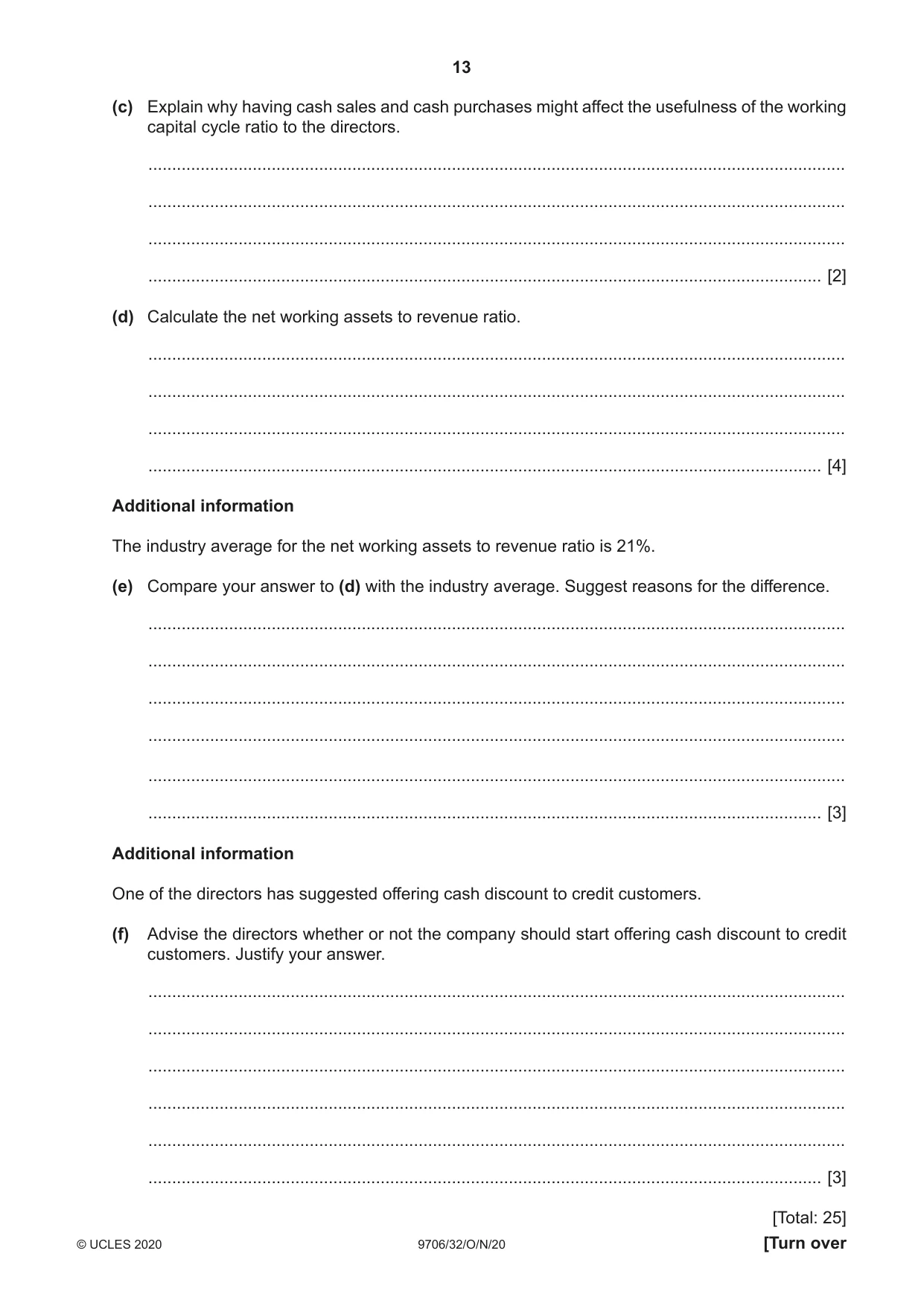
13 9706/32/O/N/20 © UCLES 2020 [Turn over (c) Explain why having cash sales and cash purchases might affect the usefulness of the working capital cycle ratio to the directors. … … … … [2] (d) Calculate the net working assets to revenue ratio. … … … … [4] Additional information The industry average for the net working assets to revenue ratio is 21%. (e) Compare your answer to (d) with the industry average. Suggest reasons for the difference. … … … … … … [3] Additional information One of the directors has suggested offering cash discount to credit customers. (f) Advise the directors whether or not the company should start offering cash discount to credit customers. Justify your answer. … … … … … … [3] [Total: 25]
Question paper, page 14
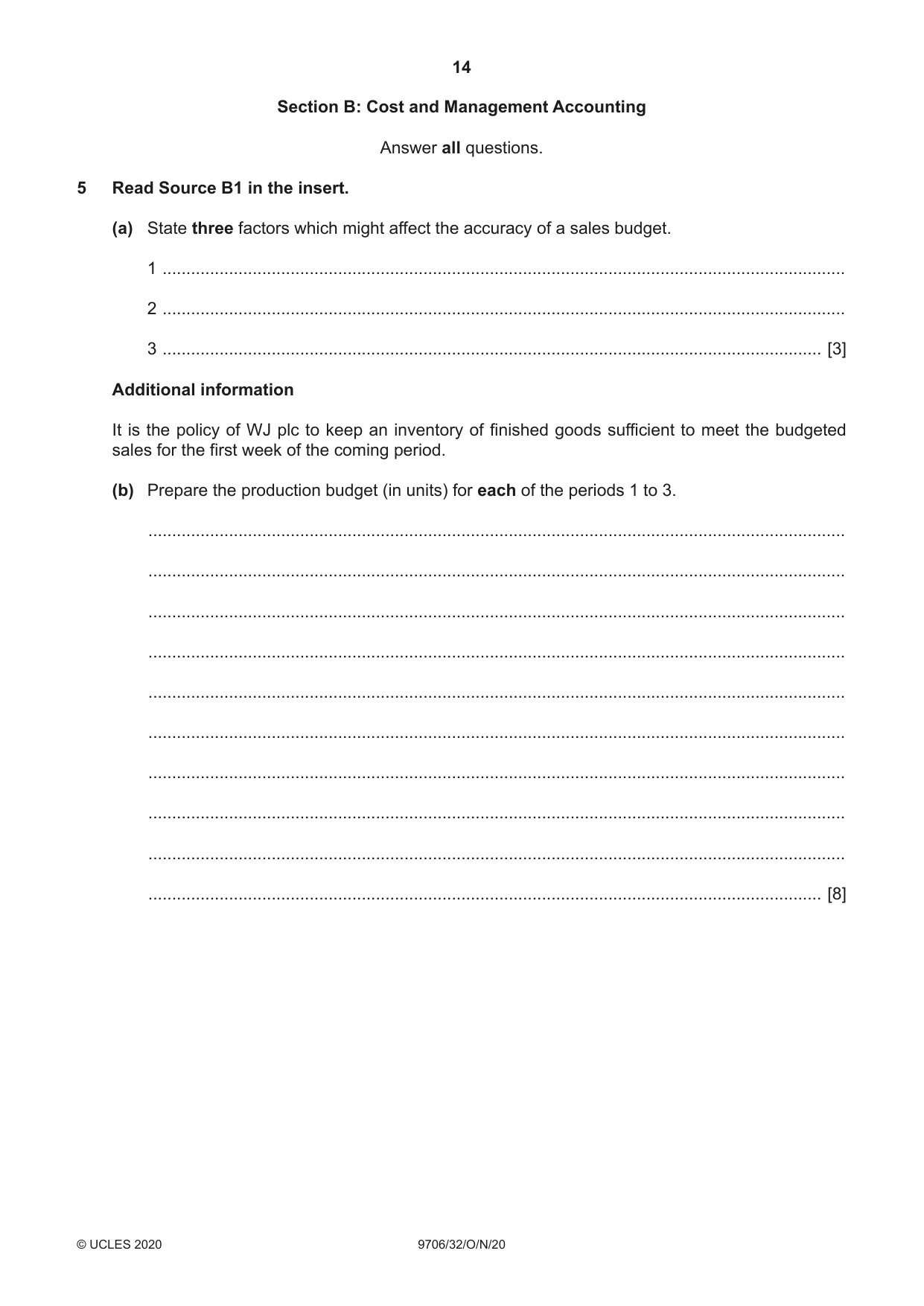
14 9706/32/O/N/20 © UCLES 2020 Section B: Cost and Management Accounting Answer all questions. 5 Read Source B1 in the insert. (a) State three factors which might affect the accuracy of a sales budget. 1 … 2 … 3 … [3] Additional information It is the policy of WJ plc to keep an inventory of finished goods sufficient to meet the budgeted sales for the first week of the coming period. (b) Prepare the production budget (in units) for each of the periods 1 to 3. … … … … … … … … … … [8]
Question paper, page 15
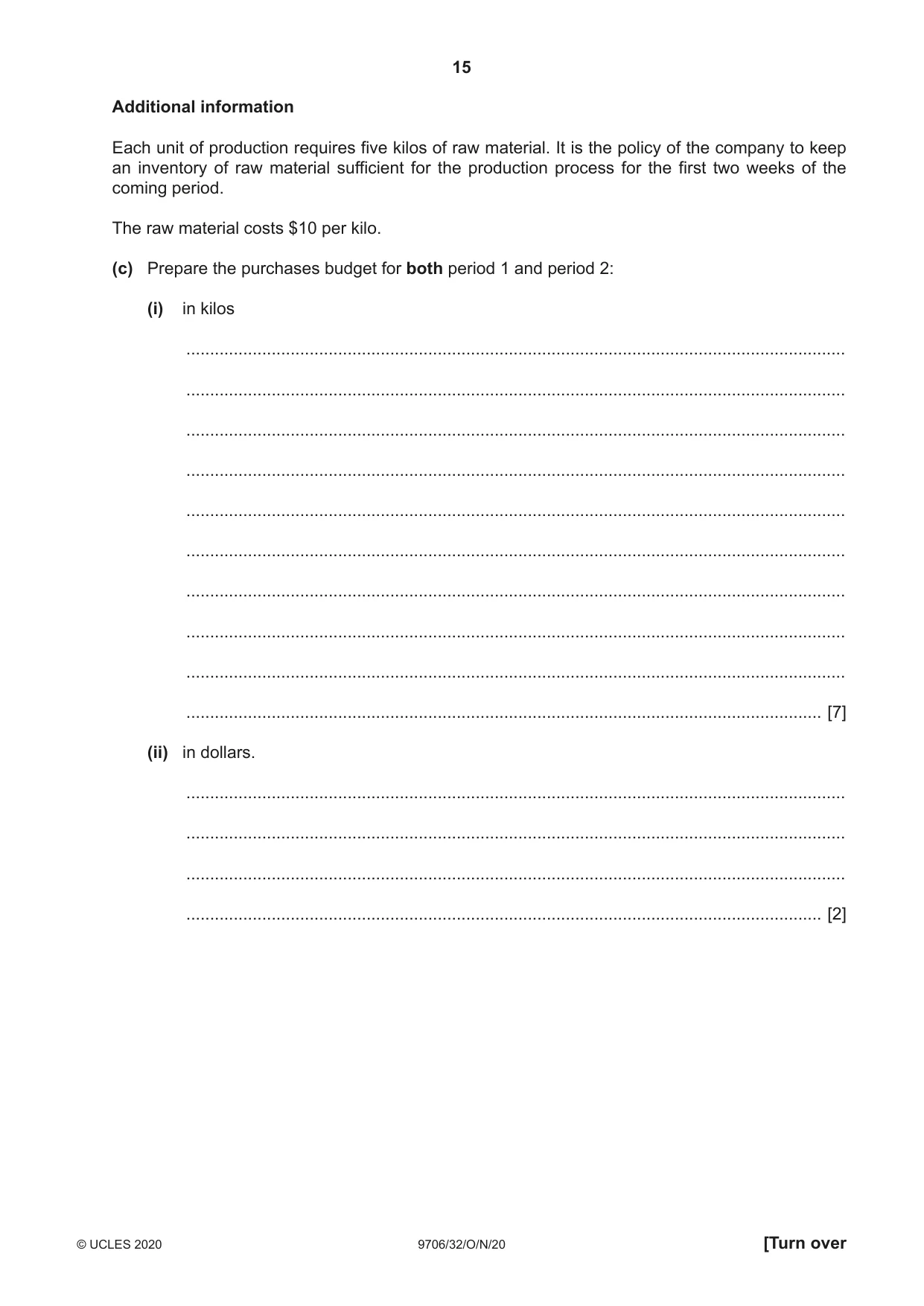
15 9706/32/O/N/20 © UCLES 2020 [Turn over Additional information Each unit of production requires five kilos of raw material. It is the policy of the company to keep an inventory of raw material sufficient for the production process for the first two weeks of the coming period. The raw material costs $10 per kilo. (c) Prepare the purchases budget for both period 1 and period 2: (i) in kilos … … … … … … … … … … [7] (ii) in dollars. … … … … [2]
Question paper, page 16
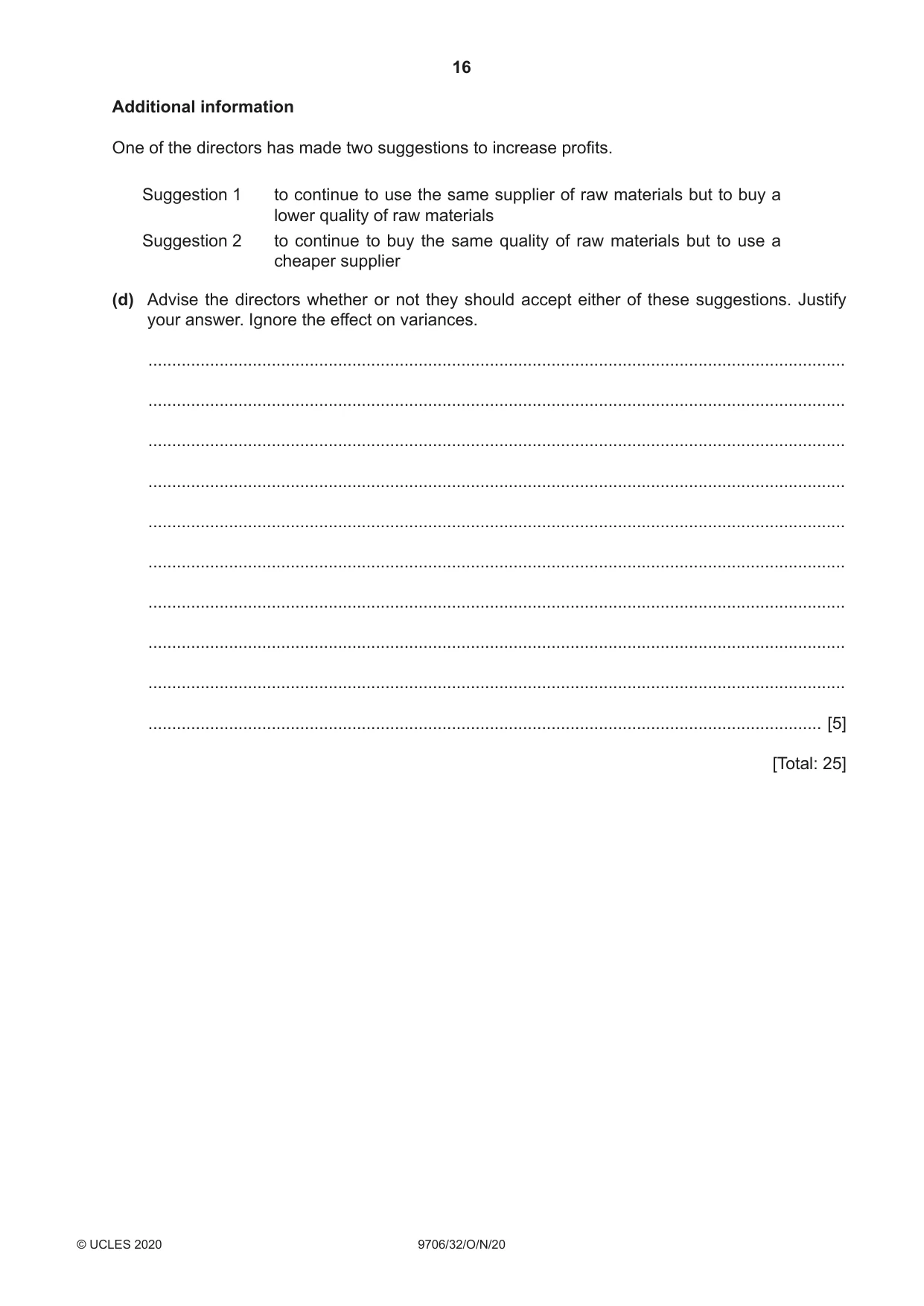
16 9706/32/O/N/20 © UCLES 2020 Additional information One of the directors has made two suggestions to increase profits. Suggestion 1 to continue to use the same supplier of raw materials but to buy a lower quality of raw materials Suggestion 2 to continue to buy the same quality of raw materials but to use a cheaper supplier (d) Advise the directors whether or not they should accept either of these suggestions. Justify your answer. Ignore the effect on variances. … … … … … … … … … … [5] [Total: 25]
Question paper, page 17
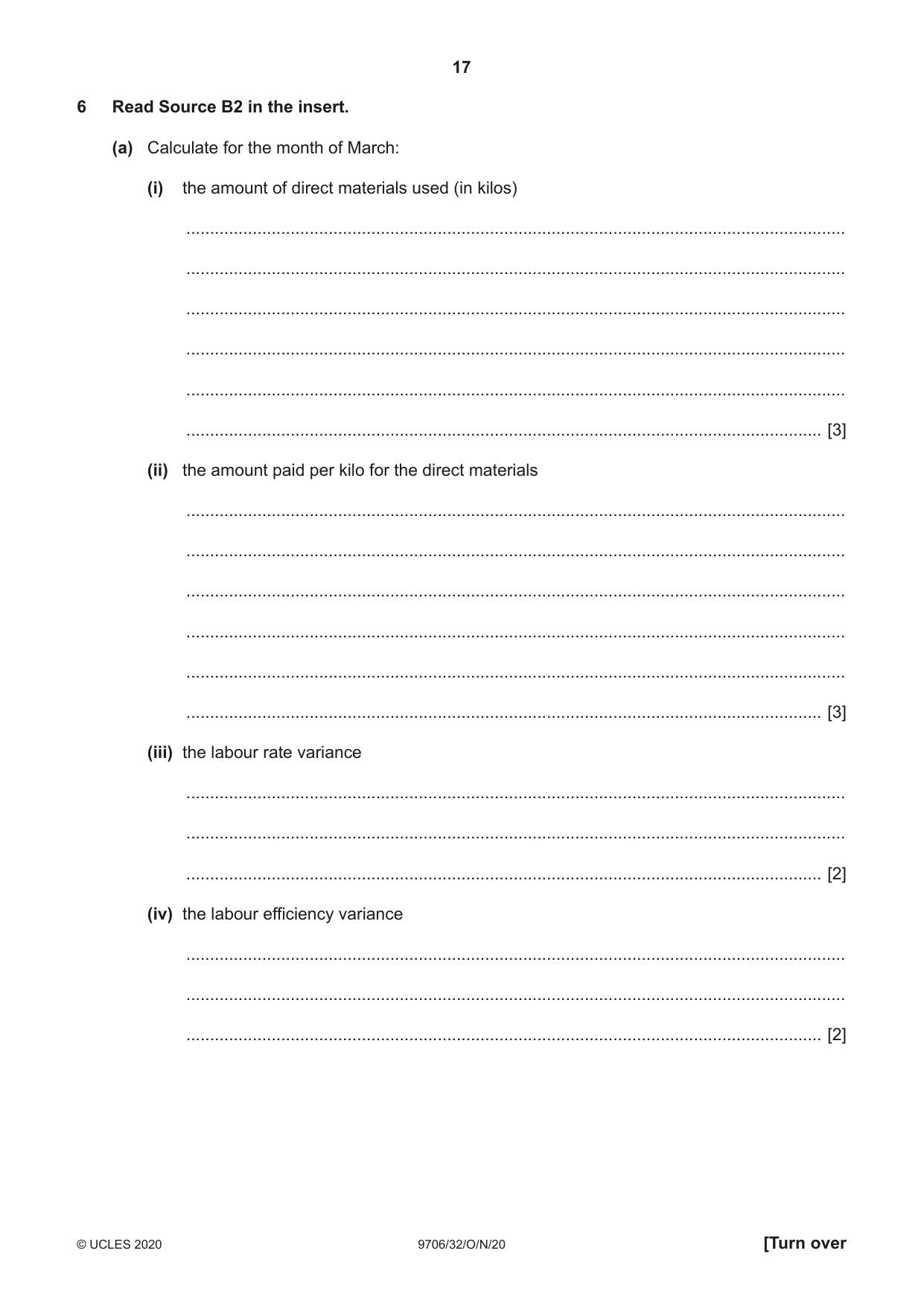
17 9706/32/O/N/20 © UCLES 2020 [Turn over 6 Read Source B2 in the insert. (a) Calculate for the month of March: (i) the amount of direct materials used (in kilos) … … … … … … [3] (ii) the amount paid per kilo for the direct materials … … … … … … [3] (iii) the labour rate variance … … … [2] (iv) the labour efficiency variance … … … [2]
Question paper, page 18
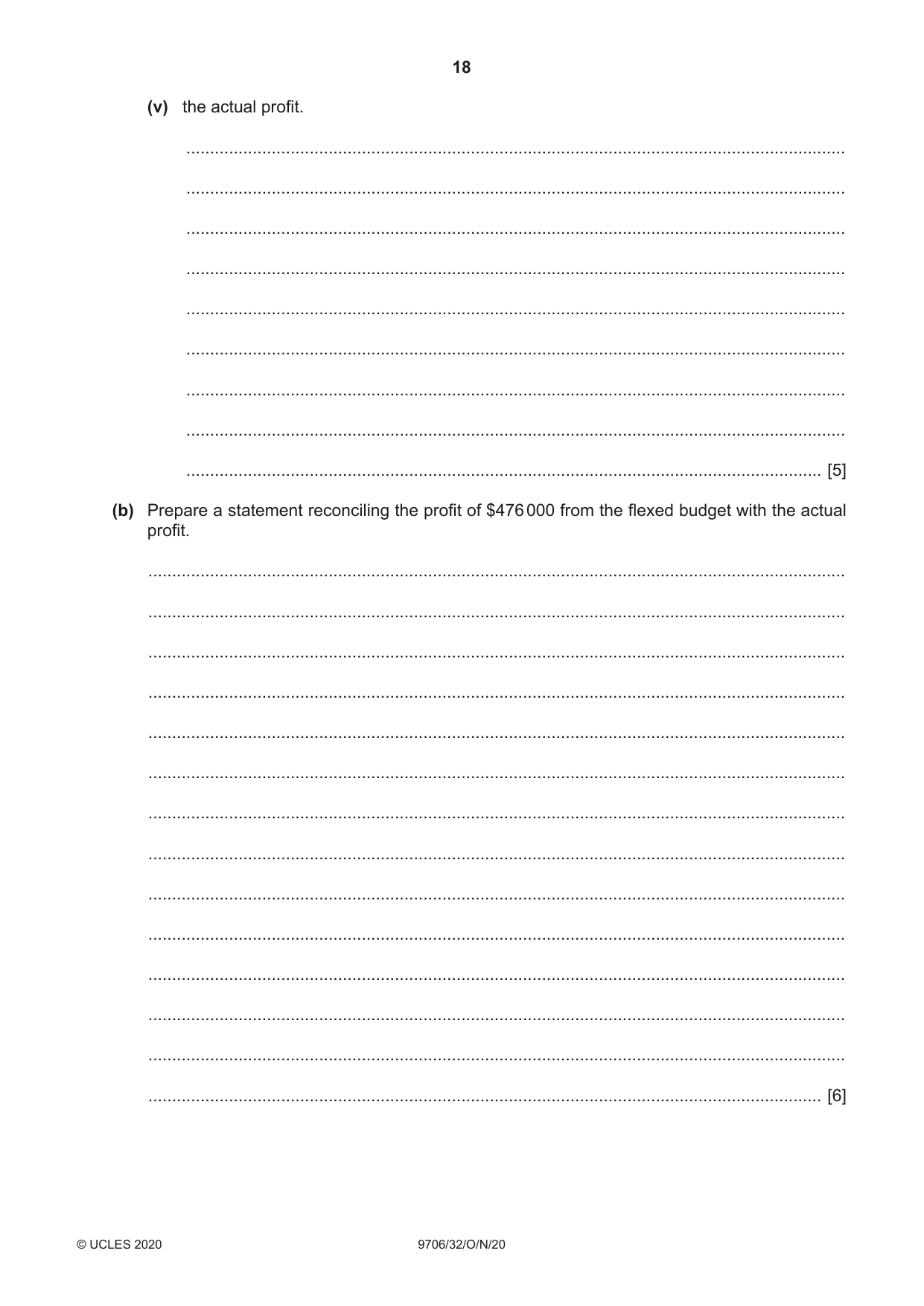
18 9706/32/O/N/20 © UCLES 2020 (v) the actual profit. … … … … … … … … … [5] (b) Prepare a statement reconciling the profit of $476 000 from the flexed budget with the actual profit. … … … … … … … … … … … … … … [6]
Question paper, page 19
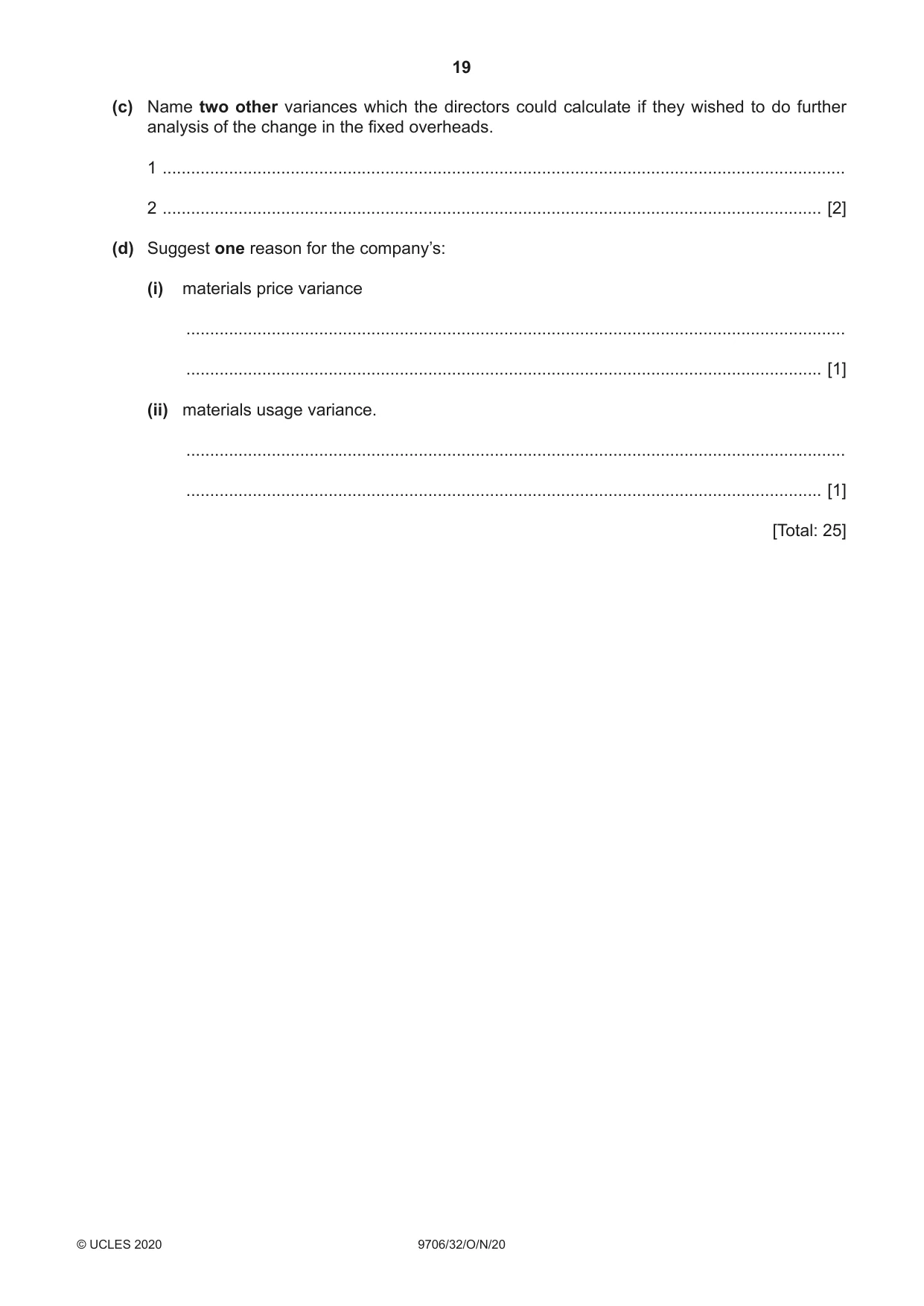
19 9706/32/O/N/20 © UCLES 2020 (c) Name two other variances which the directors could calculate if they wished to do further analysis of the change in the fixed overheads. 1 … 2 … [2] (d) Suggest one reason for the company’s: (i) materials price variance … … [1] (ii) materials usage variance. … … [1] [Total: 25]
Question paper, page 20
20 9706/32/O/N/20 © UCLES 2020 Permission to reproduce items where third-party owned material protected by copyright is included has been sought and cleared where possible. Every reasonable effort has been made by the publisher (UCLES) to trace copyright holders, but if any items requiring clearance have unwittingly been included, the publisher will be pleased to make amends at the earliest possible opportunity. To avoid the issue of disclosure of answer-related information to candidates, all copyright acknowledgements are reproduced online in the Cambridge Assessment International Education Copyright Acknowledgements Booklet. This is produced for each series of examinations and is freely available to download at www.cambridgeinternational.org after the live examination series. Cambridge Assessment International Education is part of the Cambridge Assessment Group. Cambridge Assessment is the brand name of the University of Cambridge Local Examinations Syndicate (UCLES), which itself is a department of the University of Cambridge. BLANK PAGE
Mark scheme, page 1
This document consists of 11 printed pages. © UCLES 2020 [Turn over Cambridge International AS & A Level ACCOUNTING 9706/32 Paper 3 Structured Questions October/November 2020 MARK SCHEME Maximum Mark: 150 Published This mark scheme is published as an aid to teachers and candidates, to indicate the requirements of the examination. It shows the basis on which Examiners were instructed to award marks. It does not indicate the details of the discussions that took place at an Examiners’ meeting before marking began, which would have considered the acceptability of alternative answers. Mark schemes should be read in conjunction with the question paper and the Principal Examiner Report for Teachers. Cambridge International will not enter into discussions about these mark schemes. Cambridge International is publishing the mark schemes for the October/November 2020 series for most Cambridge IGCSE™, Cambridge International A and AS Level and Cambridge Pre-U components, and some Cambridge O Level components.
Mark scheme, page 2
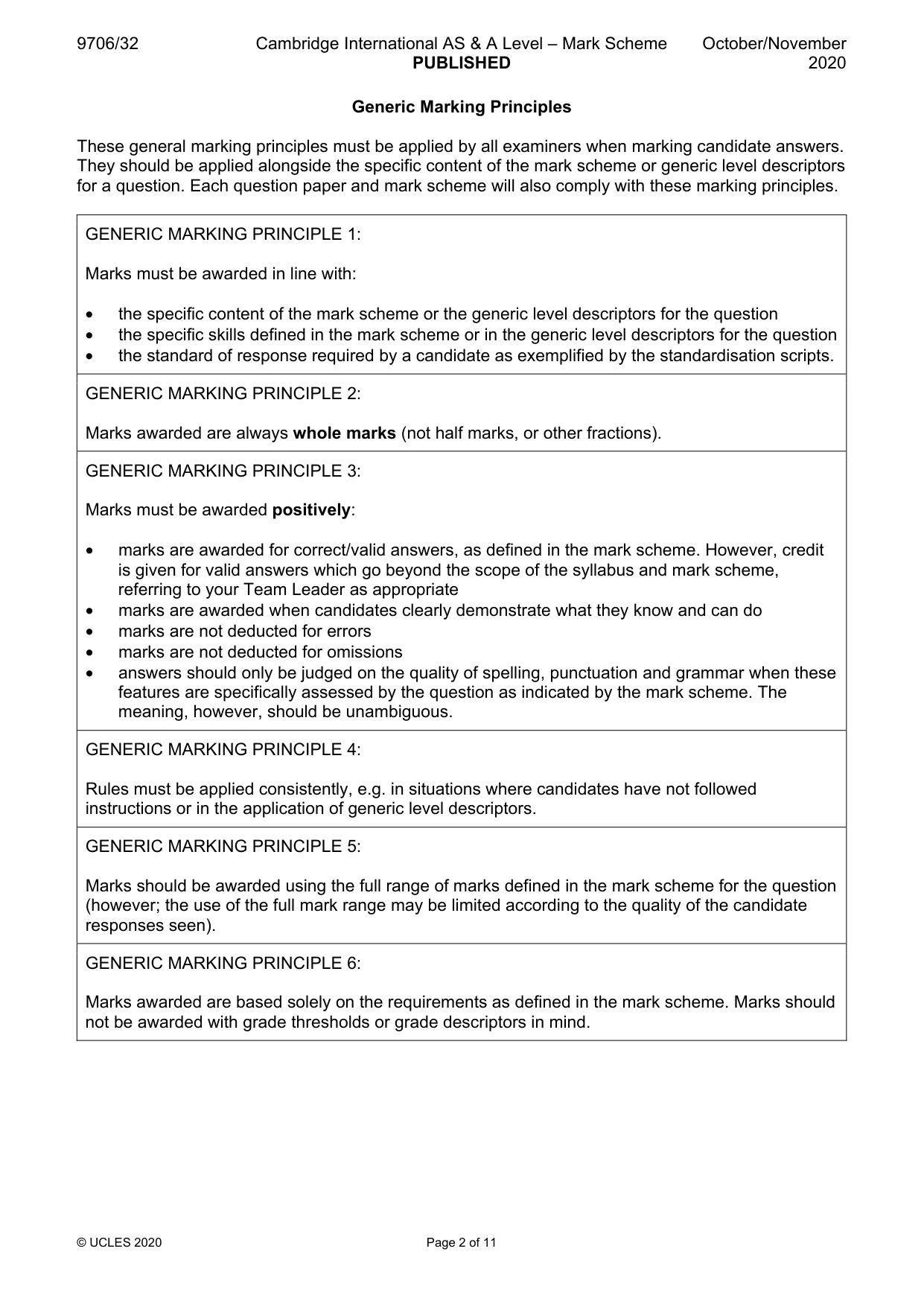
9706/32 Cambridge International AS & A Level – Mark Scheme PUBLISHED October/November 2020 © UCLES 2020 Page 2 of 11 Generic Marking Principles These general marking principles must be applied by all examiners when marking candidate answers. They should be applied alongside the specific content of the mark scheme or generic level descriptors for a question. Each question paper and mark scheme will also comply with these marking principles. GENERIC MARKING PRINCIPLE 1: Marks must be awarded in line with: • the specific content of the mark scheme or the generic level descriptors for the question • the specific skills defined in the mark scheme or in the generic level descriptors for the question • the standard of response required by a candidate as exemplified by the standardisation scripts. GENERIC MARKING PRINCIPLE 2: Marks awarded are always whole marks (not half marks, or other fractions). GENERIC MARKING PRINCIPLE 3: Marks must be awarded positively: • marks are awarded for correct/valid answers, as defined in the mark scheme. However, credit is given for valid answers which go beyond the scope of the syllabus and mark scheme, referring to your Team Leader as appropriate • marks are awarded when candidates clearly demonstrate what they know and can do • marks are not deducted for errors • marks are not deducted for omissions • answers should only be judged on the quality of spelling, punctuation and grammar when these features are specifically assessed by the question as indicated by the mark scheme. The meaning, however, should be unambiguous. GENERIC MARKING PRINCIPLE 4: Rules must be applied consistently, e.g. in situations where candidates have not followed instructions or in the application of generic level descriptors. GENERIC MARKING PRINCIPLE 5: Marks should be awarded using the full range of marks defined in the mark scheme for the question (however; the use of the full mark range may be limited according to the quality of the candidate responses seen). GENERIC MARKING PRINCIPLE 6: Marks awarded are based solely on the requirements as defined in the mark scheme. Marks should not be awarded with grade thresholds or grade descriptors in mind.
Mark scheme, page 3
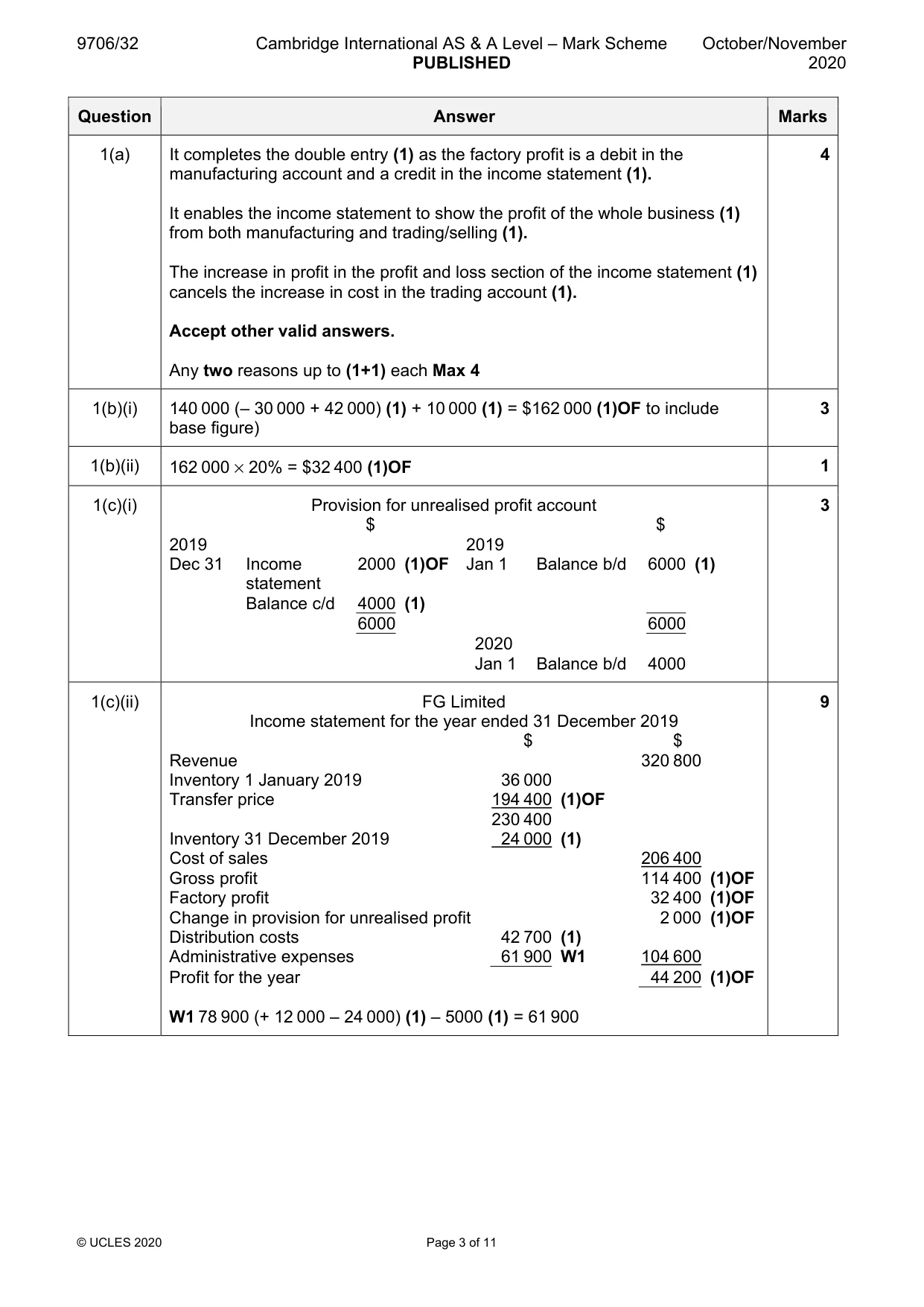
9706/32 Cambridge International AS & A Level – Mark Scheme PUBLISHED October/November 2020 © UCLES 2020 Page 3 of 11 Question Answer Marks 1(a) It completes the double entry (1) as the factory profit is a debit in the manufacturing account and a credit in the income statement (1). It enables the income statement to show the profit of the whole business (1) from both manufacturing and trading/selling (1). The increase in profit in the profit and loss section of the income statement (1) cancels the increase in cost in the trading account (1). Accept other valid answers. Any two reasons up to (1+1) each Max 4 4 1(b)(i) 140 000 (– 30 000 + 42 000) (1) + 10 000 (1) = $162 000 (1)OF to include base figure) 3 1(b)(ii) 162 000 × 20% = $32 400 (1)OF 1 1(c)(i) Provision for unrealised profit account $ $ 2019 2019 Dec 31 Income statement 2000 (1)OF Jan 1 Balance b/d 6000 (1) Balance c/d 4000 (1) 6000 6000 2020 Jan 1 Balance b/d 4000 3 1(c)(ii) FG Limited Income statement for the year ended 31 December 2019 $ $ Revenue 320 800 Inventory 1 January 2019 36 000 Transfer price 194 400 (1)OF 230 400 Inventory 31 December 2019 24 000 (1) Cost of sales 206 400 Gross profit 114 400 (1)OF Factory profit 32 400 (1)OF Change in provision for unrealised profit 2 000 (1)OF Distribution costs 42 700 (1) Administrative expenses 61 900 W1 104 600 Profit for the year 44 200 (1)OF W1 78 900 (+ 12 000 – 24 000) (1) – 5000 (1) = 61 900 9
Mark scheme, page 4
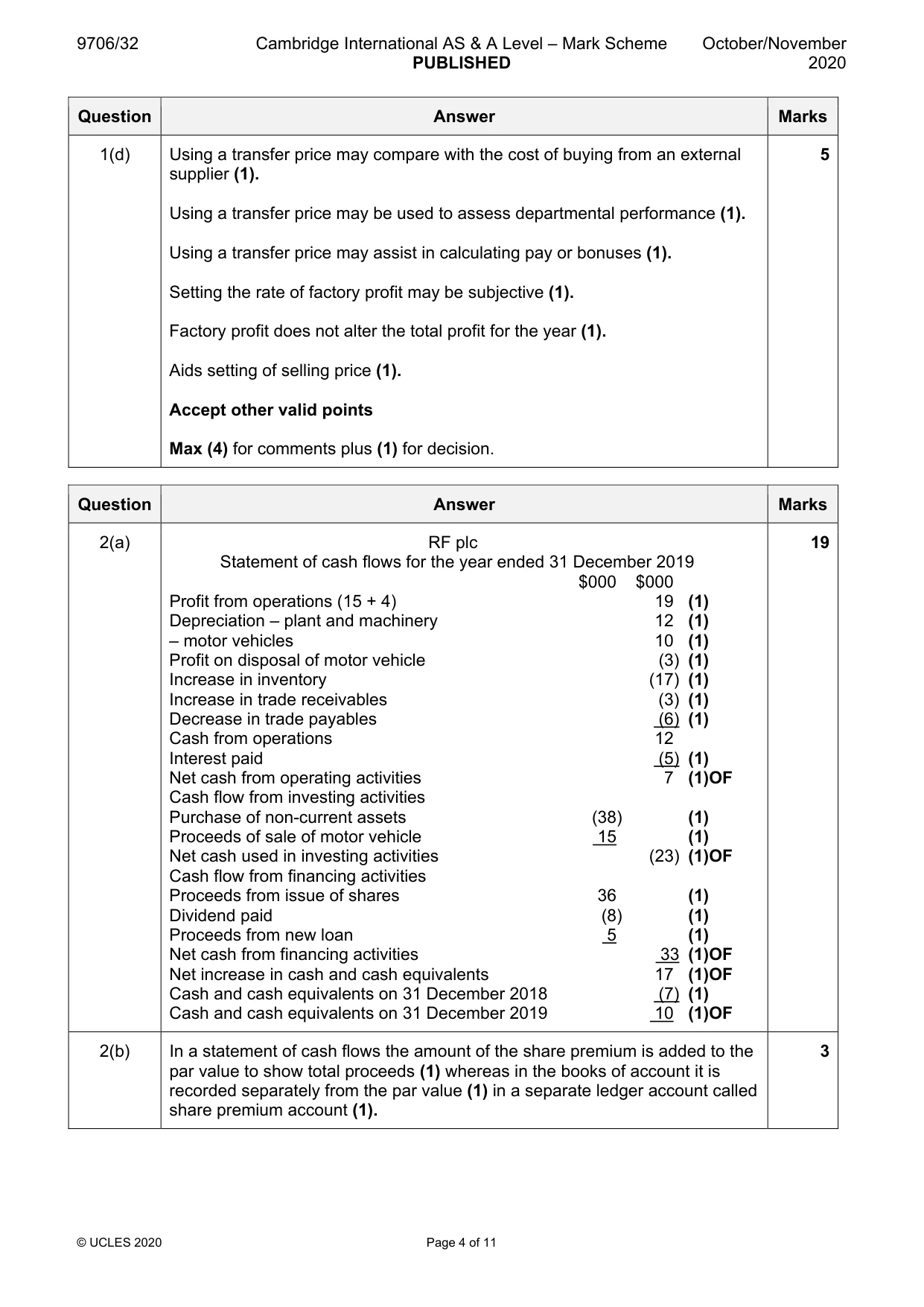
9706/32 Cambridge International AS & A Level – Mark Scheme PUBLISHED October/November 2020 © UCLES 2020 Page 4 of 11 Question Answer Marks 1(d) Using a transfer price may compare with the cost of buying from an external supplier (1). Using a transfer price may be used to assess departmental performance (1). Using a transfer price may assist in calculating pay or bonuses (1). Setting the rate of factory profit may be subjective (1). Factory profit does not alter the total profit for the year (1). Aids setting of selling price (1). Accept other valid points Max (4) for comments plus (1) for decision. 5 Question Answer Marks 2(a) RF plc Statement of cash flows for the year ended 31 December 2019 $000 $000 Profit from operations (15 + 4) 19 (1) Depreciation – plant and machinery 12 (1) – motor vehicles 10 (1) Profit on disposal of motor vehicle (3) (1) Increase in inventory (17) (1) Increase in trade receivables (3) (1) Decrease in trade payables (6) (1) Cash from operations 12 Interest paid (5) (1) Net cash from operating activities 7 (1)OF Cash flow from investing activities Purchase of non-current assets (38) (1) Proceeds of sale of motor vehicle 15 (1) Net cash used in investing activities (23) (1)OF Cash flow from financing activities Proceeds from issue of shares 36 (1) Dividend paid (8) (1) Proceeds from new loan 5 (1) Net cash from financing activities 33 (1)OF Net increase in cash and cash equivalents 17 (1)OF Cash and cash equivalents on 31 December 2018 (7) (1) Cash and cash equivalents on 31 December 2019 10 (1)OF 19 2(b) In a statement of cash flows the amount of the share premium is added to the par value to show total proceeds (1) whereas in the books of account it is recorded separately from the par value (1) in a separate ledger account called share premium account (1). 3
Mark scheme, page 5
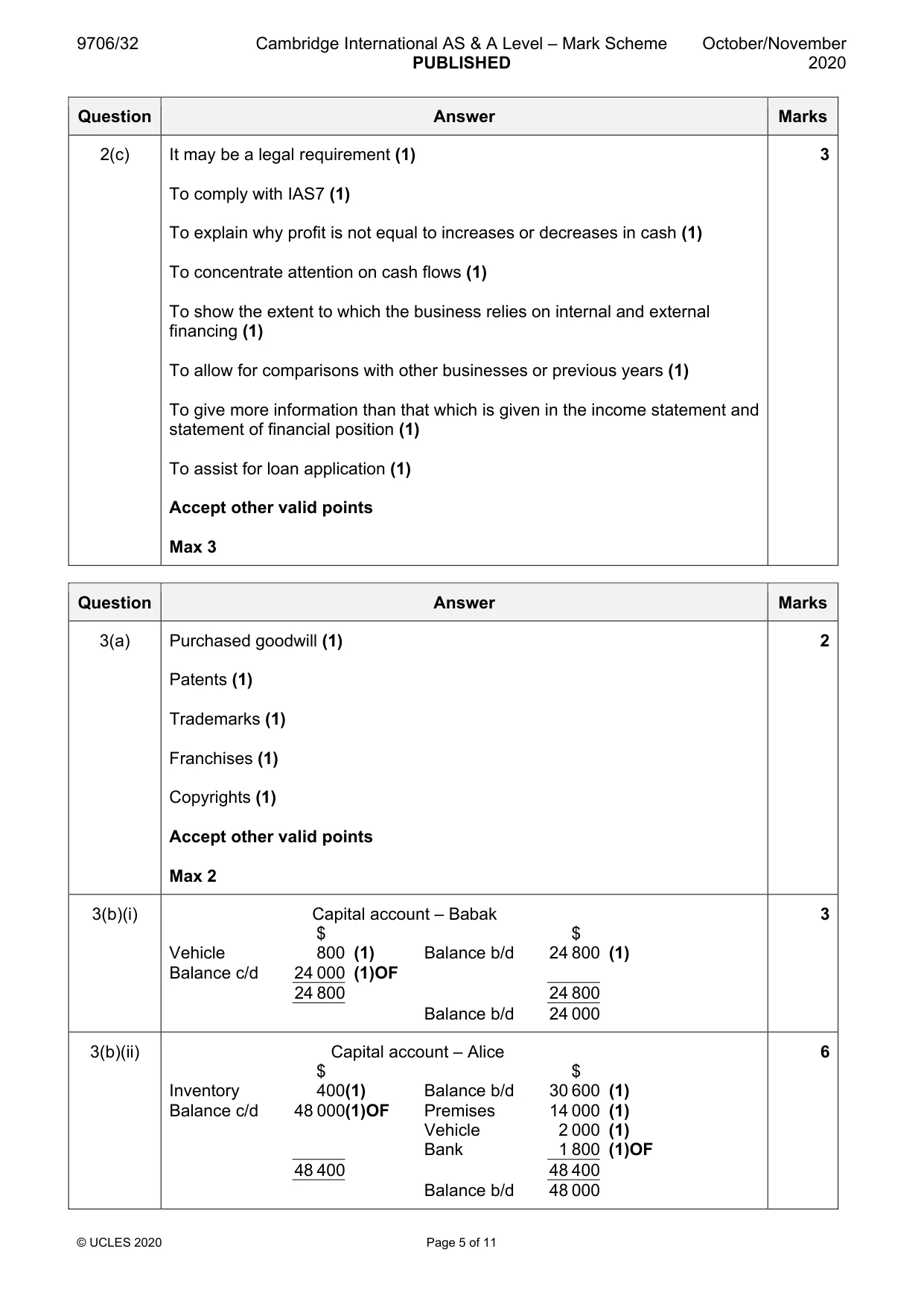
9706/32 Cambridge International AS & A Level – Mark Scheme PUBLISHED October/November 2020 © UCLES 2020 Page 5 of 11 Question Answer Marks 2(c) It may be a legal requirement (1) To comply with IAS7 (1) To explain why profit is not equal to increases or decreases in cash (1) To concentrate attention on cash flows (1) To show the extent to which the business relies on internal and external financing (1) To allow for comparisons with other businesses or previous years (1) To give more information than that which is given in the income statement and statement of financial position (1) To assist for loan application (1) Accept other valid points Max 3 3 Question Answer Marks 3(a) Purchased goodwill (1) Patents (1) Trademarks (1) Franchises (1) Copyrights (1) Accept other valid points Max 2 2 3(b)(i) Capital account – Babak $ $ Vehicle 800 (1) Balance b/d 24 800 (1) Balance c/d 24 000 (1)OF 24 800 24 800 Balance b/d 24 000 3 3(b)(ii) Capital account – Alice $ $ Inventory 400(1) Balance b/d 30 600 (1) Balance c/d 48 000(1)OF Premises 14 000 (1) Vehicle 2 000 (1) Bank 1 800 (1)OF 48 400 48 400 Balance b/d 48 000 6
Mark scheme, page 6
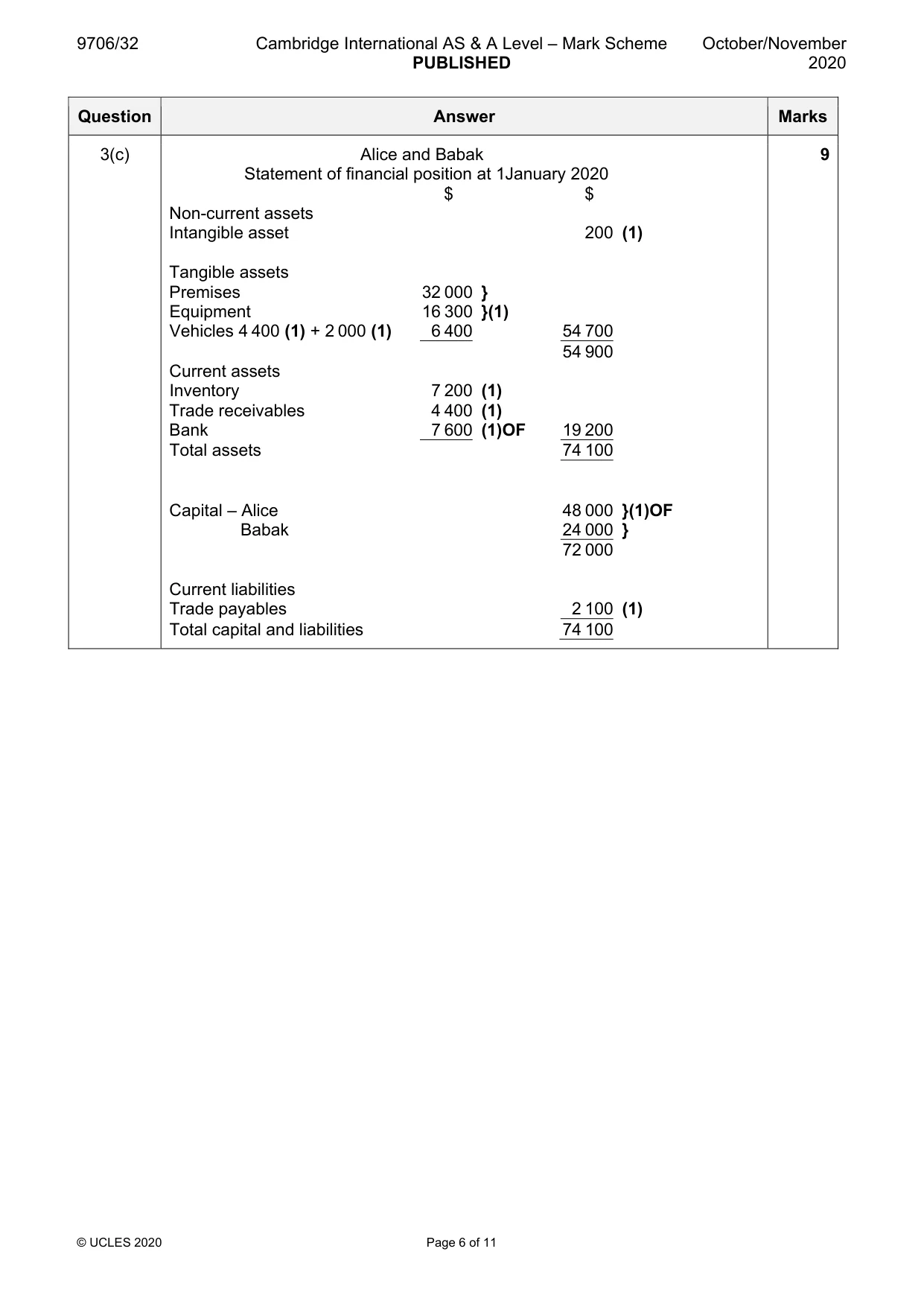
9706/32 Cambridge International AS & A Level – Mark Scheme PUBLISHED October/November 2020 © UCLES 2020 Page 6 of 11 Question Answer Marks 3(c) Alice and Babak Statement of financial position at 1January 2020 $ $ Non-current assets Intangible asset 200 (1) Tangible assets Premises 32 000 } Equipment 16 300 }(1) Vehicles 4 400 (1) + 2 000 (1) 6 400 54 700 54 900 Current assets Inventory 7 200 (1) Trade receivables 4 400 (1) Bank 7 600 (1)OF 19 200 Total assets 74 100 Capital – Alice 48 000 }(1)OF Babak 24 000 } 72 000 Current liabilities Trade payables 2 100 (1) Total capital and liabilities 74 100 9
Mark scheme, page 7
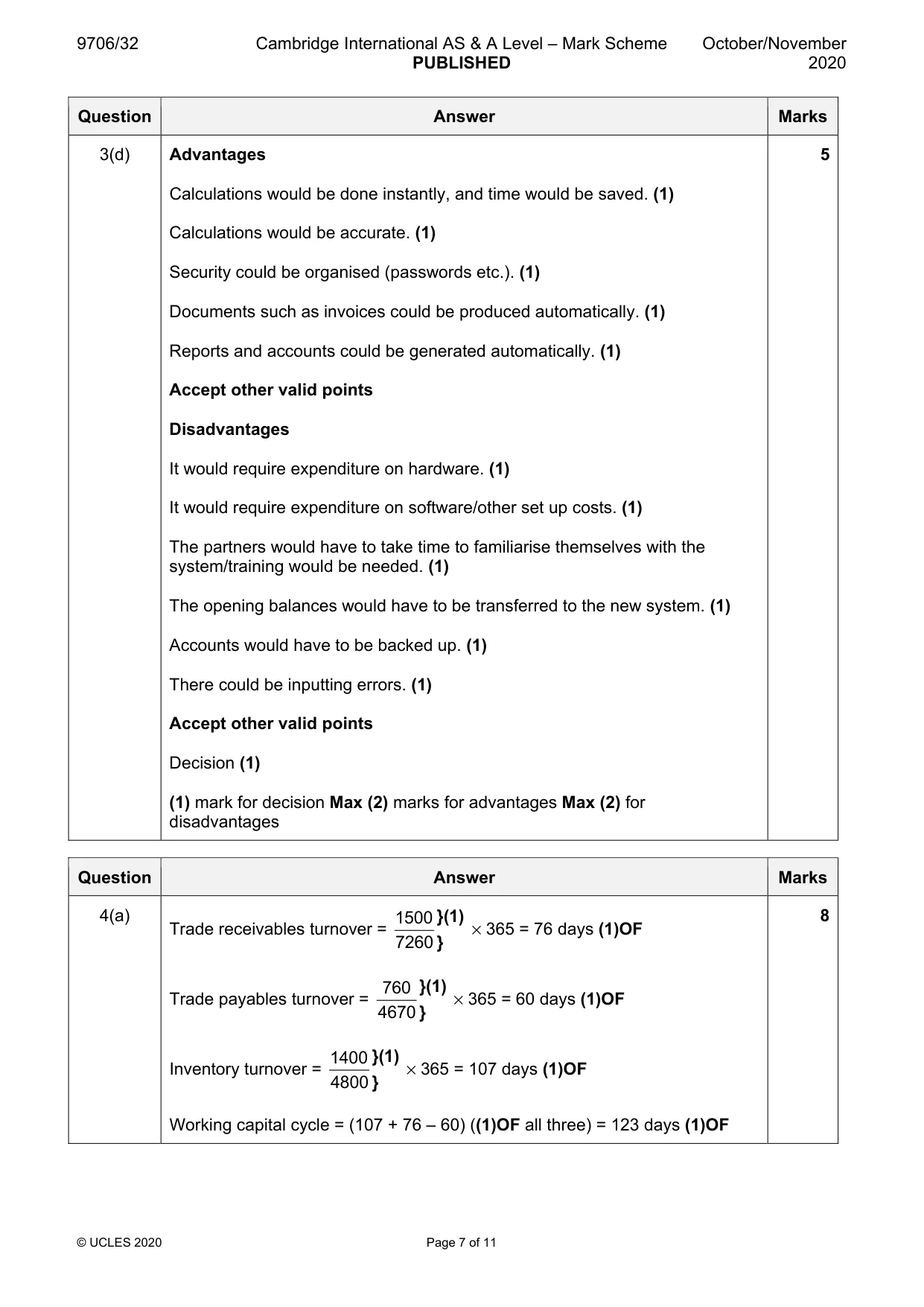
9706/32 Cambridge International AS & A Level – Mark Scheme PUBLISHED October/November 2020 © UCLES 2020 Page 7 of 11 Question Answer Marks 3(d) Advantages Calculations would be done instantly, and time would be saved. (1) Calculations would be accurate. (1) Security could be organised (passwords etc.). (1) Documents such as invoices could be produced automatically. (1) Reports and accounts could be generated automatically. (1) Accept other valid points Disadvantages It would require expenditure on hardware. (1) It would require expenditure on software/other set up costs. (1) The partners would have to take time to familiarise themselves with the system/training would be needed. (1) The opening balances would have to be transferred to the new system. (1) Accounts would have to be backed up. (1) There could be inputting errors. (1) Accept other valid points Decision (1) (1) mark for decision Max (2) marks for advantages Max (2) for disadvantages 5 Question Answer Marks 4(a) Trade receivables turnover = 1500 7260 }(1) } × 365 = 76 days (1)OF Trade payables turnover = 760 4670 }(1) } × 365 = 60 days (1)OF Inventory turnover = 1400 4800 }(1) } × 365 = 107 days (1)OF Working capital cycle = (107 + 76 – 60) ((1)OF all three) = 123 days (1)OF 8
Mark scheme, page 8
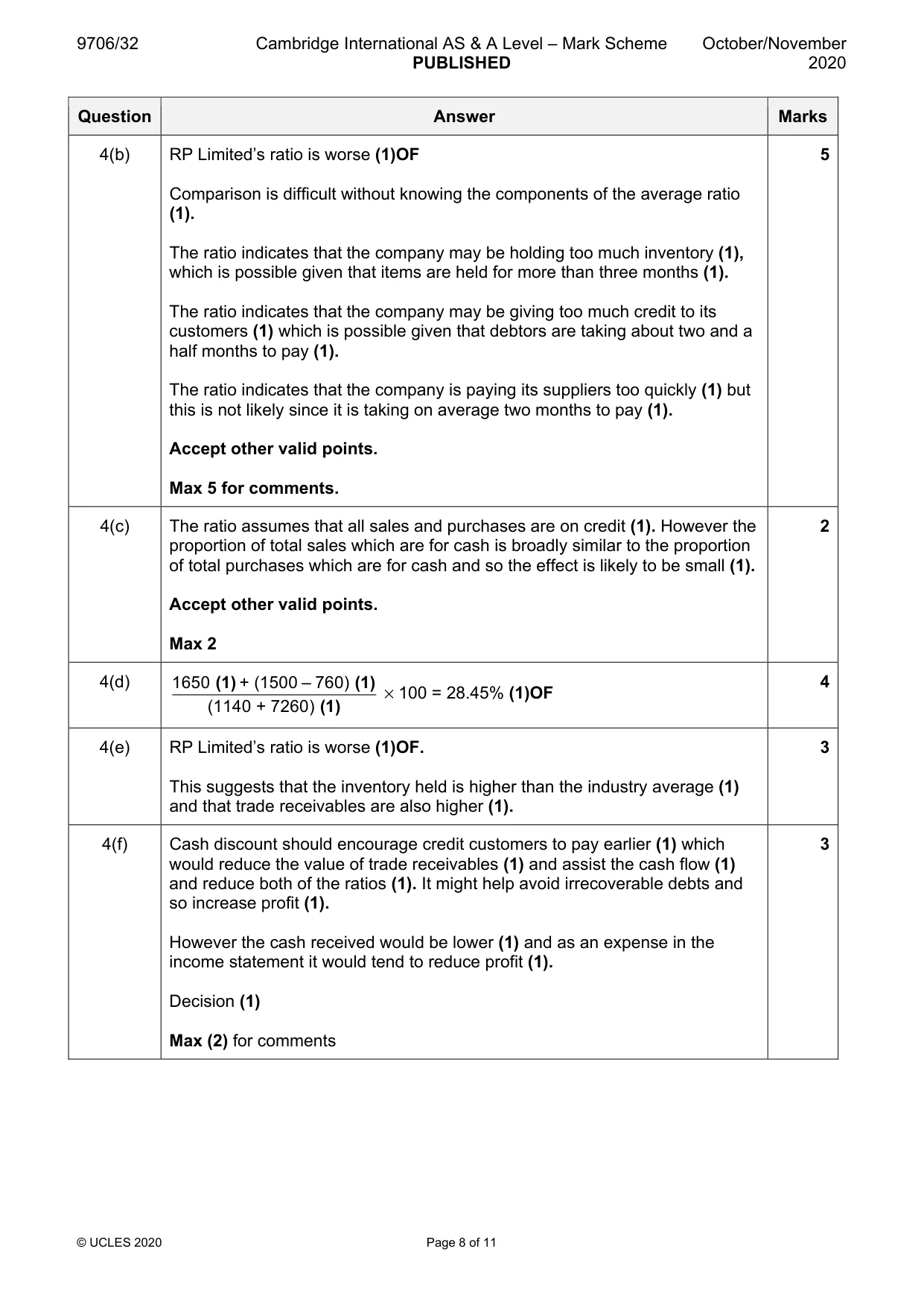
9706/32 Cambridge International AS & A Level – Mark Scheme PUBLISHED October/November 2020 © UCLES 2020 Page 8 of 11 Question Answer Marks 4(b) RP Limited’s ratio is worse (1)OF Comparison is difficult without knowing the components of the average ratio (1). The ratio indicates that the company may be holding too much inventory (1), which is possible given that items are held for more than three months (1). The ratio indicates that the company may be giving too much credit to its customers (1) which is possible given that debtors are taking about two and a half months to pay (1). The ratio indicates that the company is paying its suppliers too quickly (1) but this is not likely since it is taking on average two months to pay (1). Accept other valid points. Max 5 for comments. 5 4(c) The ratio assumes that all sales and purchases are on credit (1). However the proportion of total sales which are for cash is broadly similar to the proportion of total purchases which are for cash and so the effect is likely to be small (1). Accept other valid points. Max 2 2 4(d) 1650 + (1500 – 760) (1140 + 7260) (1) (1) (1) × 100 = 28.45% (1)OF 4 4(e) RP Limited’s ratio is worse (1)OF. This suggests that the inventory held is higher than the industry average (1) and that trade receivables are also higher (1). 3 4(f) Cash discount should encourage credit customers to pay earlier (1) which would reduce the value of trade receivables (1) and assist the cash flow (1) and reduce both of the ratios (1). It might help avoid irrecoverable debts and so increase profit (1). However the cash received would be lower (1) and as an expense in the income statement it would tend to reduce profit (1). Decision (1) Max (2) for comments 3
Mark scheme, page 9
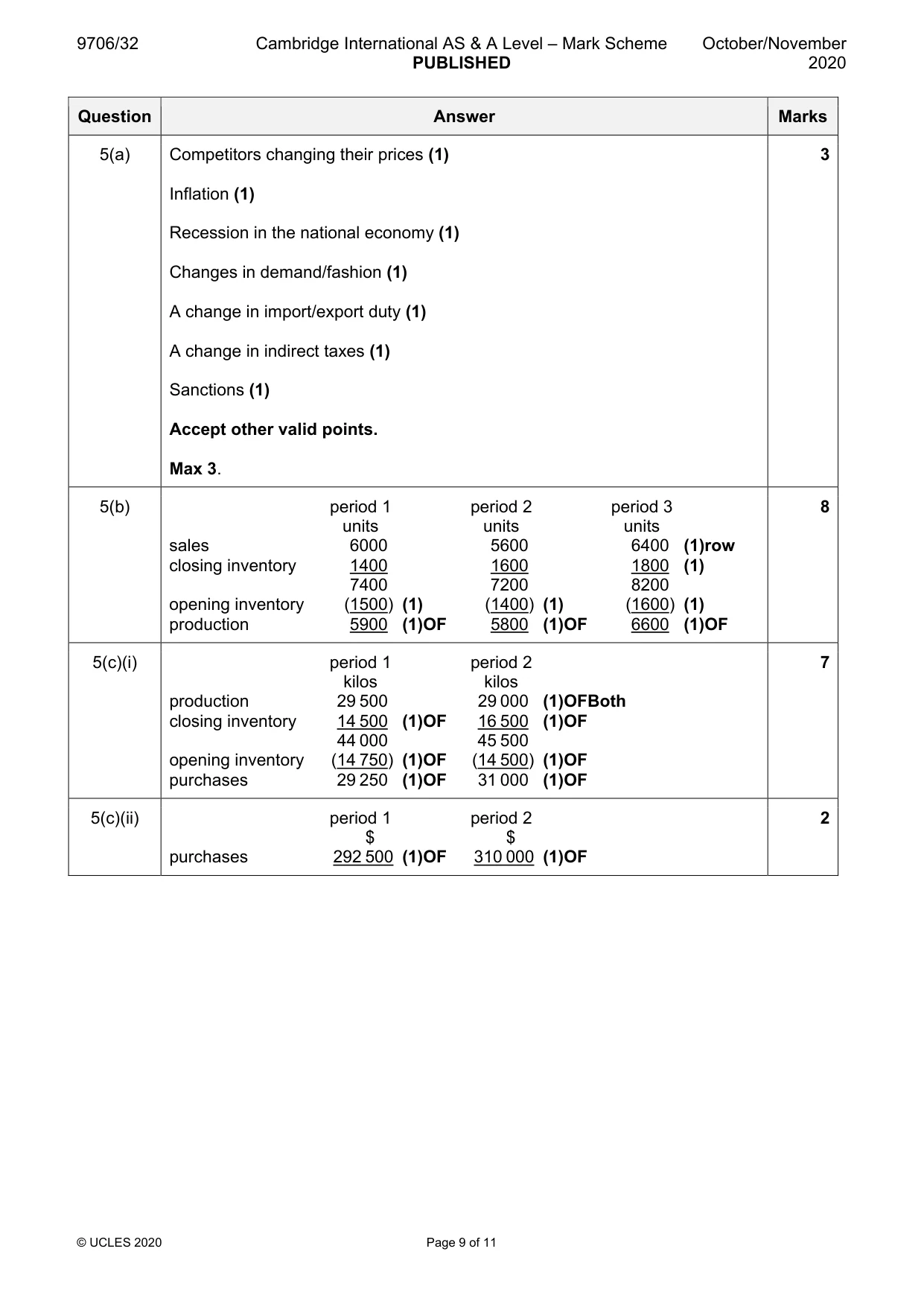
9706/32 Cambridge International AS & A Level – Mark Scheme PUBLISHED October/November 2020 © UCLES 2020 Page 9 of 11 Question Answer Marks 5(a) Competitors changing their prices (1) Inflation (1) Recession in the national economy (1) Changes in demand/fashion (1) A change in import/export duty (1) A change in indirect taxes (1) Sanctions (1) Accept other valid points. Max 3. 3 5(b) period 1 units period 2 units period 3 units sales 6000 5600 6400 (1)row closing inventory 1400 1600 1800 (1) 7400 7200 8200 opening inventory (1500) (1) (1400) (1) (1600) (1) production 5900 (1)OF 5800 (1)OF 6600 (1)OF 8 5(c)(i) period 1 kilos period 2 kilos production 29 500 29 000 (1)OFBoth closing inventory 14 500 (1)OF 16 500 (1)OF 44 000 45 500 opening inventory (14 750) (1)OF (14 500) (1)OF purchases 29 250 (1)OF 31 000 (1)OF 7 5(c)(ii) period 1 $ period 2 $ purchases 292 500 (1)OF 310 000 (1)OF 2
Mark scheme, page 10
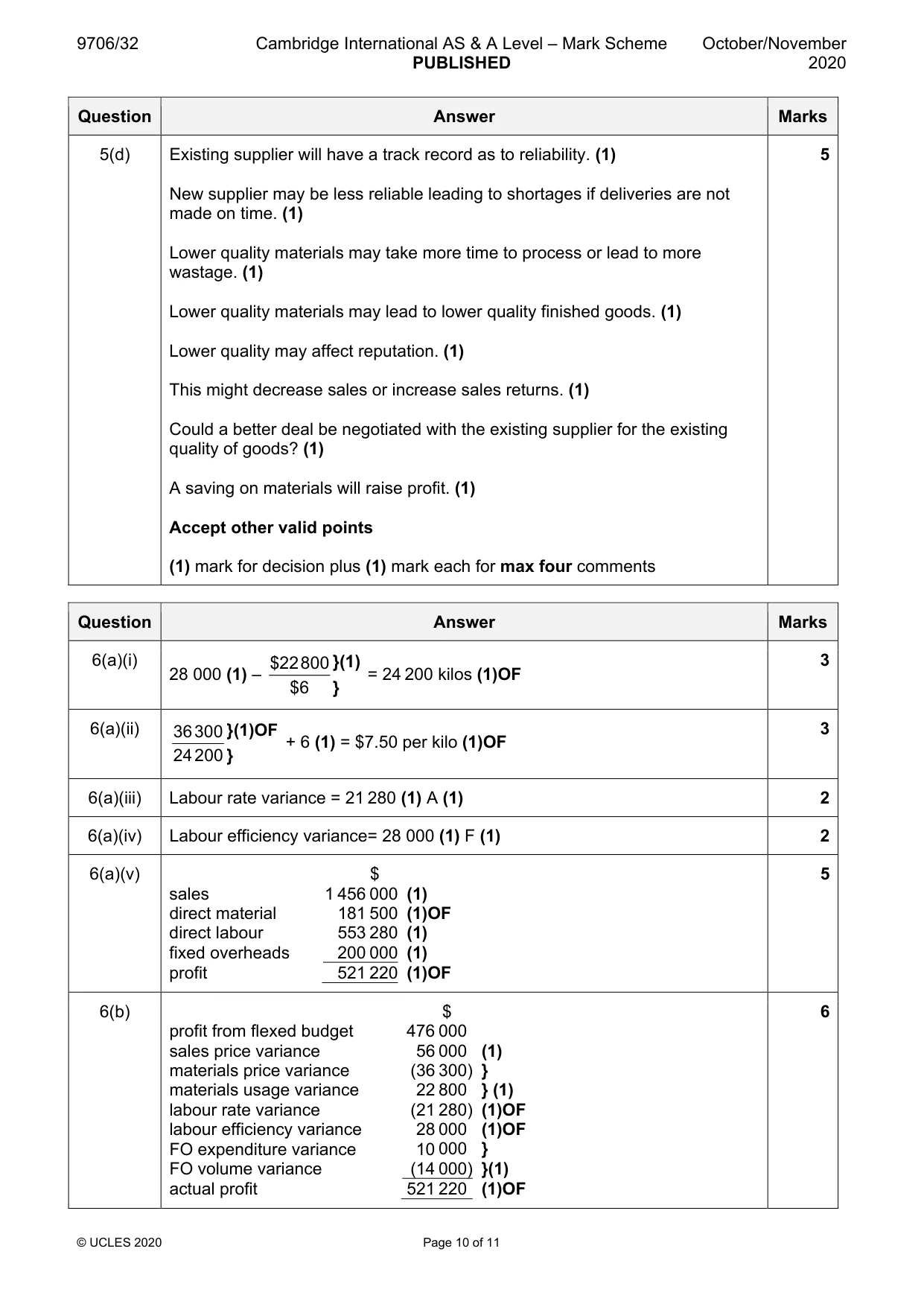
9706/32 Cambridge International AS & A Level – Mark Scheme PUBLISHED October/November 2020 © UCLES 2020 Page 10 of 11 Question Answer Marks 5(d) Existing supplier will have a track record as to reliability. (1) New supplier may be less reliable leading to shortages if deliveries are not made on time. (1) Lower quality materials may take more time to process or lead to more wastage. (1) Lower quality materials may lead to lower quality finished goods. (1) Lower quality may affect reputation. (1) This might decrease sales or increase sales returns. (1) Could a better deal be negotiated with the existing supplier for the existing quality of goods? (1) A saving on materials will raise profit. (1) Accept other valid points (1) mark for decision plus (1) mark each for max four comments 5 Question Answer Marks 6(a)(i) 28 000 (1) – $22800 $6 }(1) } = 24 200 kilos (1)OF 3 6(a)(ii) 36300 24200 }(1)OF } + 6 (1) = $7.50 per kilo (1)OF 3 6(a)(iii) Labour rate variance = 21 280 (1) A (1) 2 6(a)(iv) Labour efficiency variance= 28 000 (1) F (1) 2 6(a)(v) $ sales 1 456 000 (1) direct material 181 500 (1)OF direct labour 553 280 (1) fixed overheads 200 000 (1) profit 521 220 (1)OF 5 6(b) $ profit from flexed budget 476 000 sales price variance 56 000 (1) materials price variance (36 300) } materials usage variance 22 800 } (1) labour rate variance (21 280) (1)OF labour efficiency variance 28 000 (1)OF FO expenditure variance 10 000 } FO volume variance (14 000) }(1) actual profit 521 220 (1)OF 6
Mark scheme, page 11
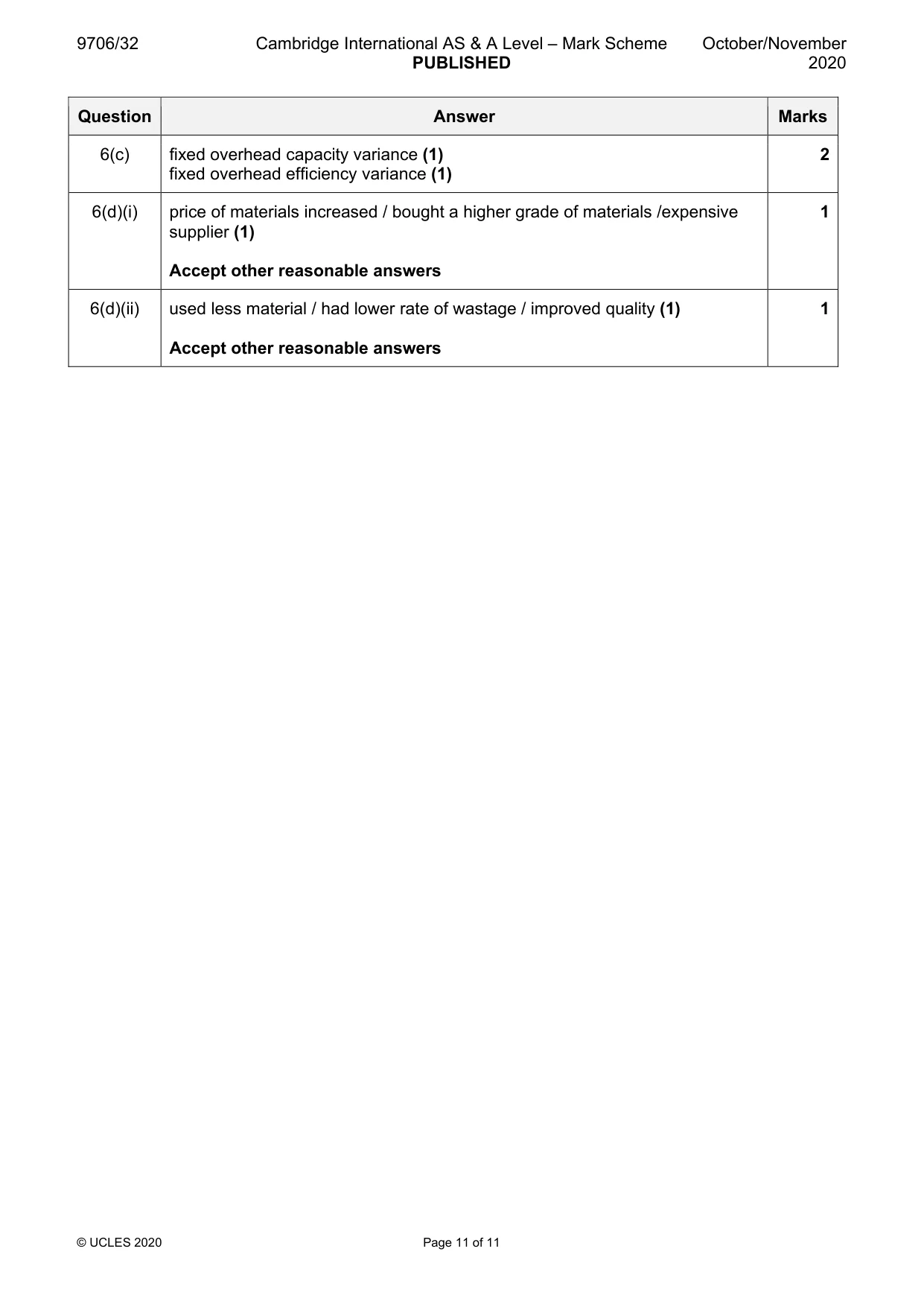
9706/32 Cambridge International AS & A Level – Mark Scheme PUBLISHED October/November 2020 © UCLES 2020 Page 11 of 11 Question Answer Marks 6(c) fixed overhead capacity variance (1) fixed overhead efficiency variance (1) 2 6(d)(i) price of materials increased / bought a higher grade of materials /expensive supplier (1) Accept other reasonable answers 1 6(d)(ii) used less material / had lower rate of wastage / improved quality (1) Accept other reasonable answers 1
What you needed in this session
Cambridge’s own grade thresholds for 2020 Oct/Nov, Paper 3 · Variant 2. A higher threshold means an easier paper — the bar moves with how the cohort did.