Cambridge A Level Accounting 9706 — 2019 Oct/Nov Paper 3 · Variant 3
9706/33/O/N/19 · 150 marks · ≈169 min
The question paper and its mark scheme, free to read here and free to download. This is Cambridge’s own paper, exactly as it was sat.
Question paper12 pages
Mark scheme15 pages
Answers below. Sit the paper first if you are practising.
Paper as text
Question paper, page 1
This document consists of 11 printed pages and 1 blank page. IB19 11_9706_33/5RP © UCLES 2019 [Turn over Cambridge Assessment International Education Cambridge International Advanced Subsidiary and Advanced Level ACCOUNTING 9706/33 Paper 3 Structured Questions October/November 2019 INSERT 3 hours READ THESE INSTRUCTIONS FIRST This Insert contains all of the required information and questions. The questions are provided in the Insert for reference only. Anything you write in this Insert will not be marked. The businesses described in this Insert are entirely fictitious.
Question paper, page 2
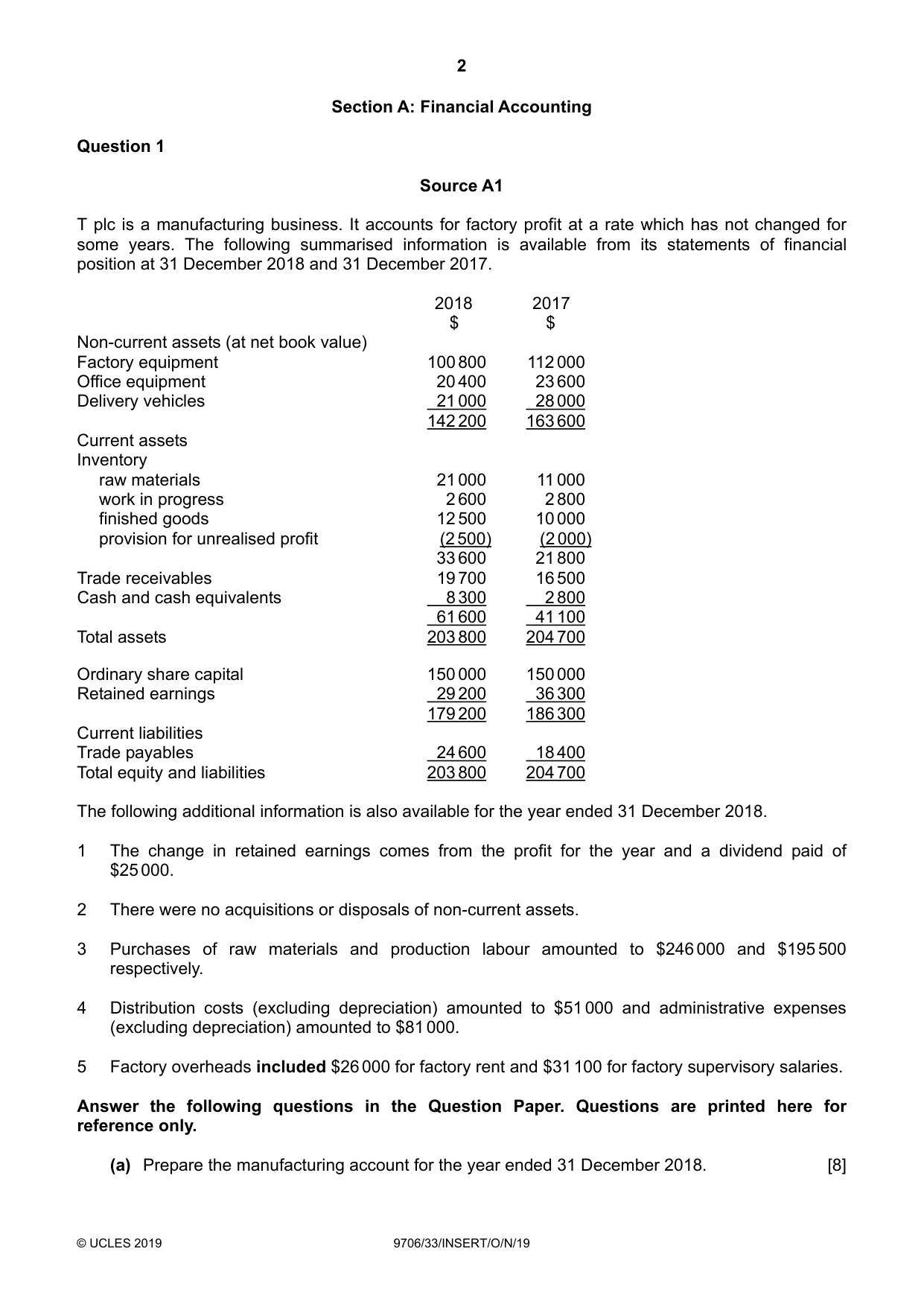
2 © UCLES 2019 9706/33/INSERT/O/N/19 Section A: Financial Accounting Question 1 Source A1 T plc is a manufacturing business. It accounts for factory profit at a rate which has not changed for some years. The following summarised information is available from its statements of financial position at 31 December 2018 and 31 December 2017. 2018 2017 $ $ Non-current assets (at net book value) Factory equipment 100 800 112 000 Office equipment 20 400 23 600 Delivery vehicles 21 000 28 000 142 200 163 600 Current assets Inventory raw materials 21 000 11 000 work in progress 2 600 2 800 finished goods 12 500 10 000 provision for unrealised profit (2 500) (2 000) 33 600 21 800 Trade receivables 19 700 16 500 Cash and cash equivalents 8 300 2 800 61 600 41 100 Total assets 203 800 204 700 Ordinary share capital 150 000 150 000 Retained earnings 29 200 36 300 179 200 186 300 Current liabilities Trade payables 24 600 18 400 Total equity and liabilities 203 800 204 700 The following additional information is also available for the year ended 31 December 2018. 1 The change in retained earnings comes from the profit for the year and a dividend paid of $25 000. 2 There were no acquisitions or disposals of non-current assets. 3 Purchases of raw materials and production labour amounted to $246 000 and $195 500 respectively. 4 Distribution costs (excluding depreciation) amounted to $51 000 and administrative expenses (excluding depreciation) amounted to $81 000. 5 Factory overheads included $26 000 for factory rent and $31 100 for factory supervisory salaries. Answer the following questions in the Question Paper. Questions are printed here for reference only. (a) Prepare the manufacturing account for the year ended 31 December 2018. [8]
Question paper, page 3
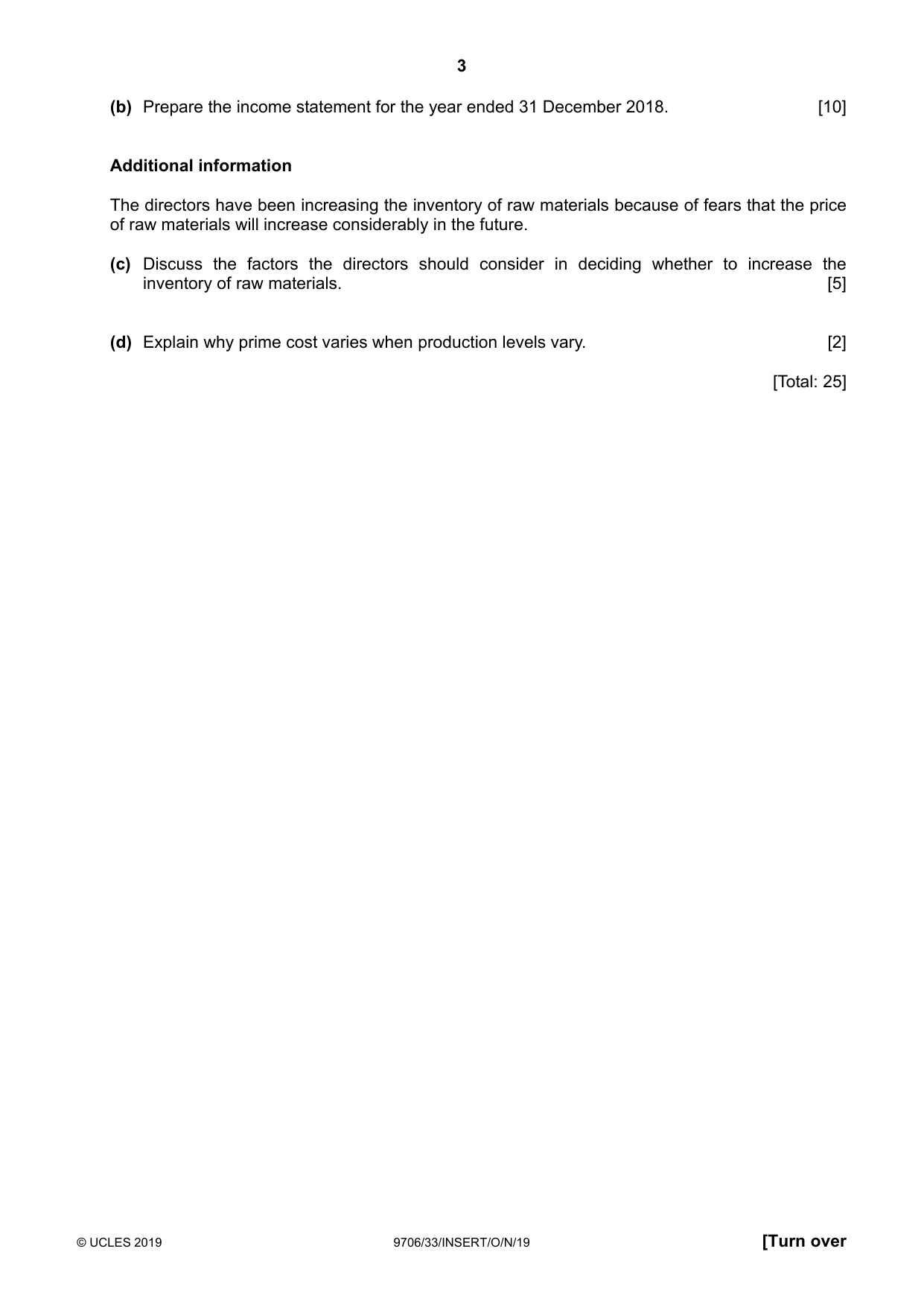
3 © UCLES 2019 9706/33/INSERT/O/N/19 [Turn over (b) Prepare the income statement for the year ended 31 December 2018. [10] Additional information The directors have been increasing the inventory of raw materials because of fears that the price of raw materials will increase considerably in the future. (c) Discuss the factors the directors should consider in deciding whether to increase the inventory of raw materials. [5] (d) Explain why prime cost varies when production levels vary. [2] [Total: 25]
Question paper, page 4
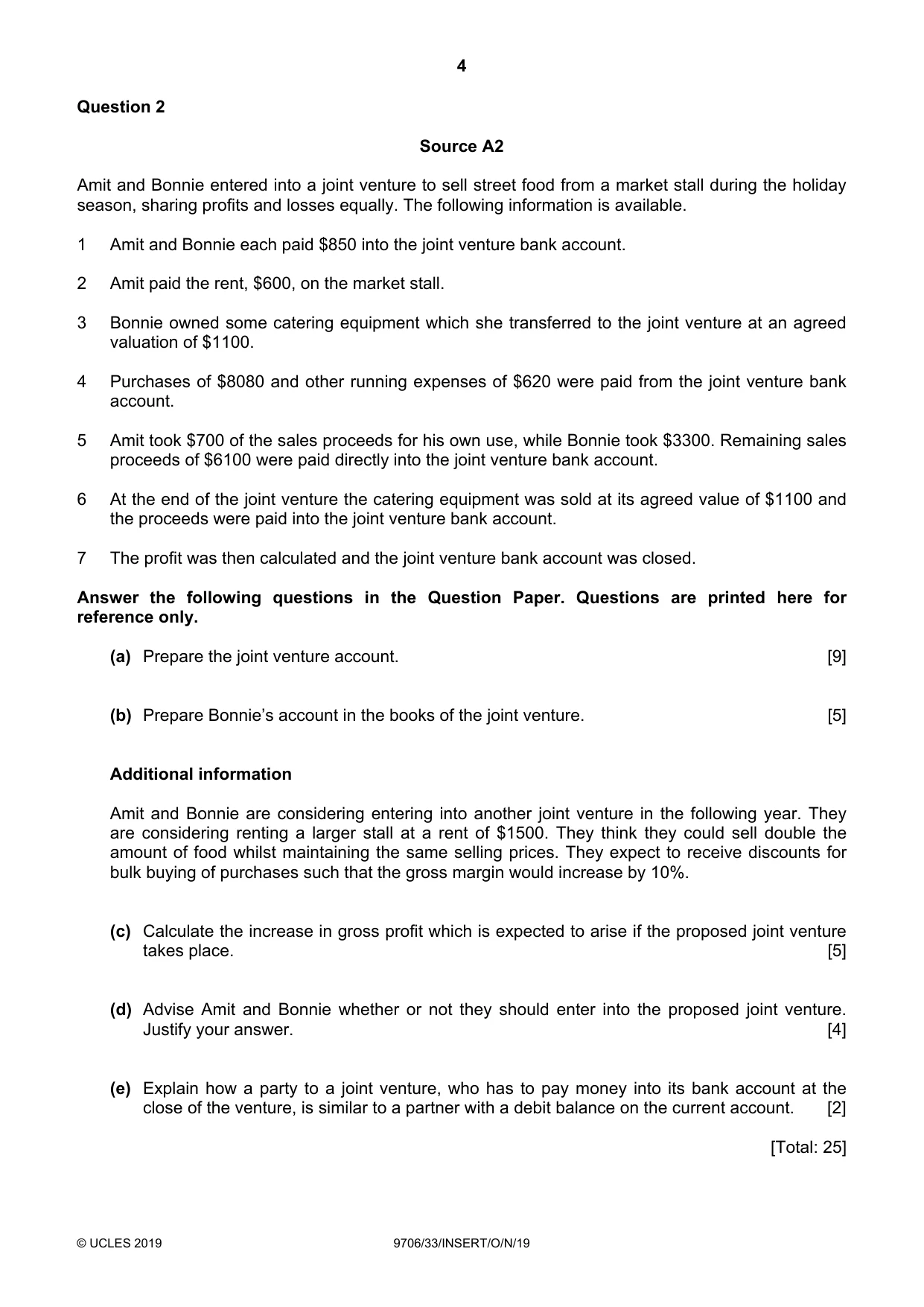
4 © UCLES 2019 9706/33/INSERT/O/N/19 Question 2 Source A2 Amit and Bonnie entered into a joint venture to sell street food from a market stall during the holiday season, sharing profits and losses equally. The following information is available. 1 Amit and Bonnie each paid $850 into the joint venture bank account. 2 Amit paid the rent, $600, on the market stall. 3 Bonnie owned some catering equipment which she transferred to the joint venture at an agreed valuation of $1100. 4 Purchases of $8080 and other running expenses of $620 were paid from the joint venture bank account. 5 Amit took $700 of the sales proceeds for his own use, while Bonnie took $3300. Remaining sales proceeds of $6100 were paid directly into the joint venture bank account. 6 At the end of the joint venture the catering equipment was sold at its agreed value of $1100 and the proceeds were paid into the joint venture bank account. 7 The profit was then calculated and the joint venture bank account was closed. Answer the following questions in the Question Paper. Questions are printed here for reference only. (a) Prepare the joint venture account. [9] (b) Prepare Bonnie’s account in the books of the joint venture. [5] Additional information Amit and Bonnie are considering entering into another joint venture in the following year. They are considering renting a larger stall at a rent of $1500. They think they could sell double the amount of food whilst maintaining the same selling prices. They expect to receive discounts for bulk buying of purchases such that the gross margin would increase by 10%. (c) Calculate the increase in gross profit which is expected to arise if the proposed joint venture takes place. [5] (d) Advise Amit and Bonnie whether or not they should enter into the proposed joint venture. Justify your answer. [4] (e) Explain how a party to a joint venture, who has to pay money into its bank account at the close of the venture, is similar to a partner with a debit balance on the current account. [2] [Total: 25]
Question paper, page 5
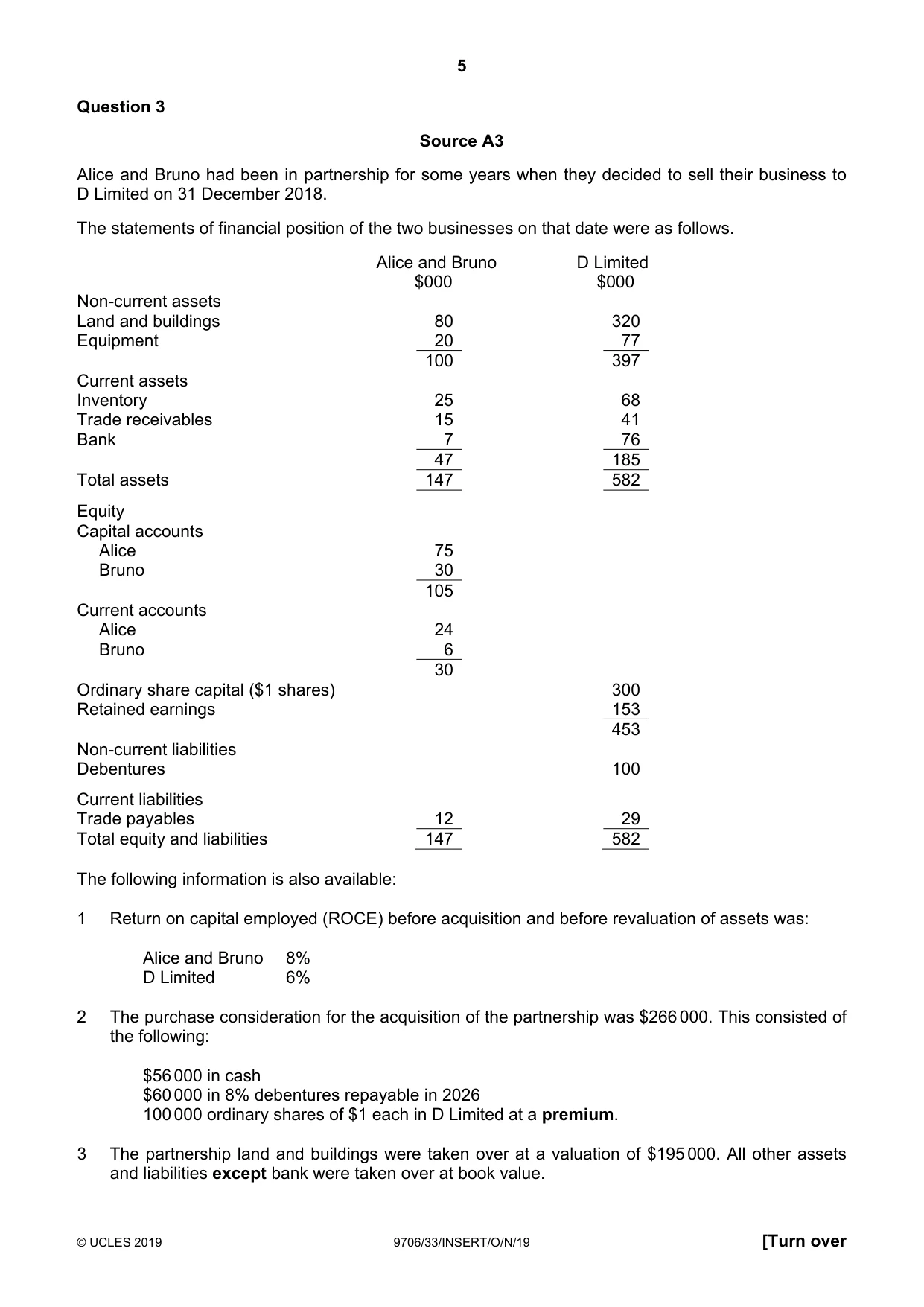
5 © UCLES 2019 9706/33/INSERT/O/N/19 [Turn over Question 3 Source A3 Alice and Bruno had been in partnership for some years when they decided to sell their business to D Limited on 31 December 2018. The statements of financial position of the two businesses on that date were as follows. Alice and Bruno D Limited $000 $000 Non-current assets Land and buildings 80 320 Equipment 20 77 100 397 Current assets Inventory 25 68 Trade receivables 15 41 Bank 7 76 47 185 Total assets 147 582 Equity Capital accounts Alice 75 Bruno 30 105 Current accounts Alice 24 Bruno 6 30 Ordinary share capital ($1 shares) 300 Retained earnings 153 453 Non-current liabilities Debentures 100 Current liabilities Trade payables 12 29 Total equity and liabilities 147 582 The following information is also available: 1 Return on capital employed (ROCE) before acquisition and before revaluation of assets was: Alice and Bruno 8% D Limited 6% 2 The purchase consideration for the acquisition of the partnership was $266 000. This consisted of the following: $56 000 in cash $60 000 in 8% debentures repayable in 2026 100 000 ordinary shares of $1 each in D Limited at a premium. 3 The partnership land and buildings were taken over at a valuation of $195 000. All other assets and liabilities except bank were taken over at book value.
Question paper, page 6
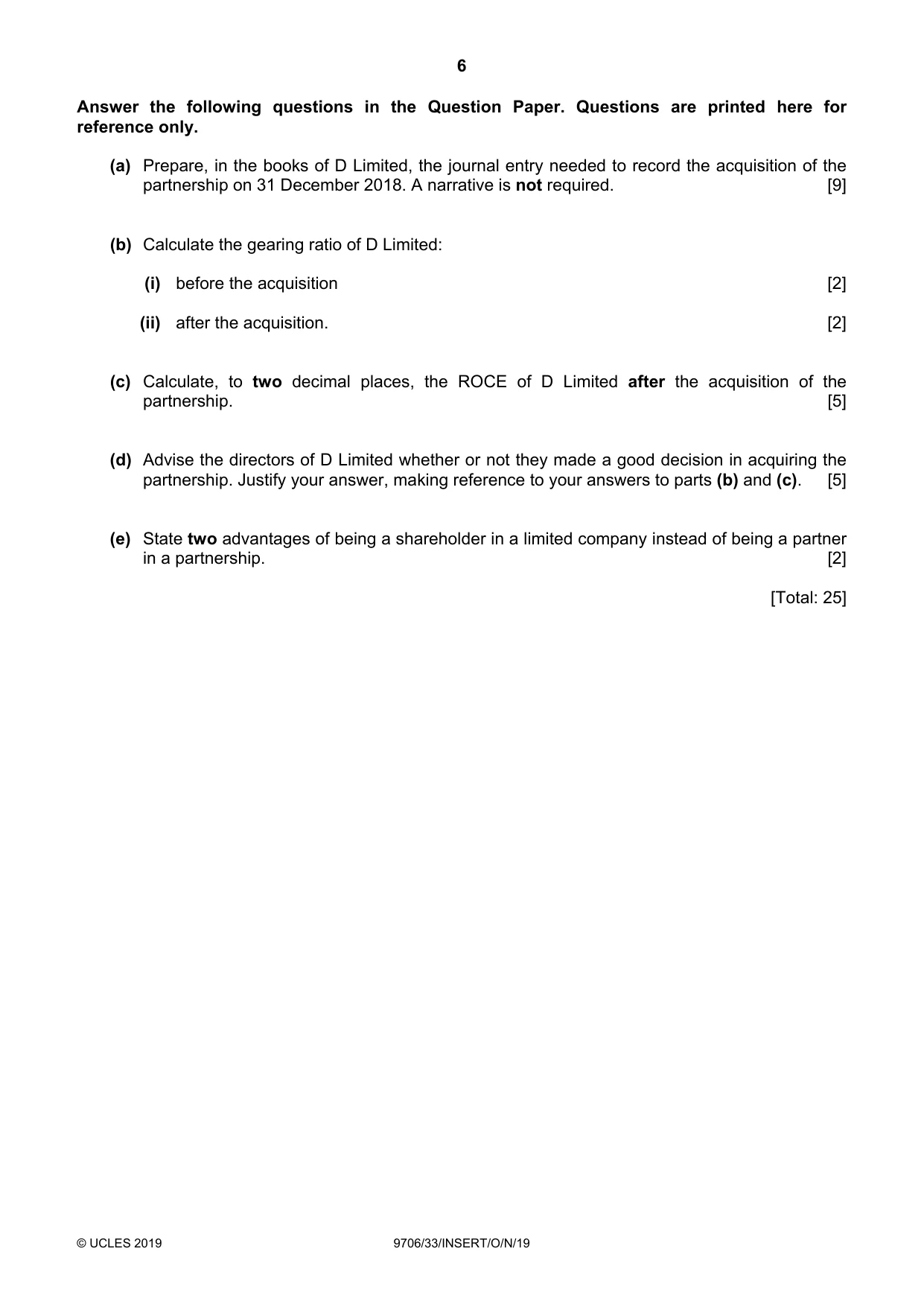
6 © UCLES 2019 9706/33/INSERT/O/N/19 Answer the following questions in the Question Paper. Questions are printed here for reference only. (a) Prepare, in the books of D Limited, the journal entry needed to record the acquisition of the partnership on 31 December 2018. A narrative is not required. [9] (b) Calculate the gearing ratio of D Limited: (i) before the acquisition [2] (ii) after the acquisition. [2] (c) Calculate, to two decimal places, the ROCE of D Limited after the acquisition of the partnership. [5] (d) Advise the directors of D Limited whether or not they made a good decision in acquiring the partnership. Justify your answer, making reference to your answers to parts (b) and (c). [5] (e) State two advantages of being a shareholder in a limited company instead of being a partner in a partnership. [2] [Total: 25]
Question paper, page 7
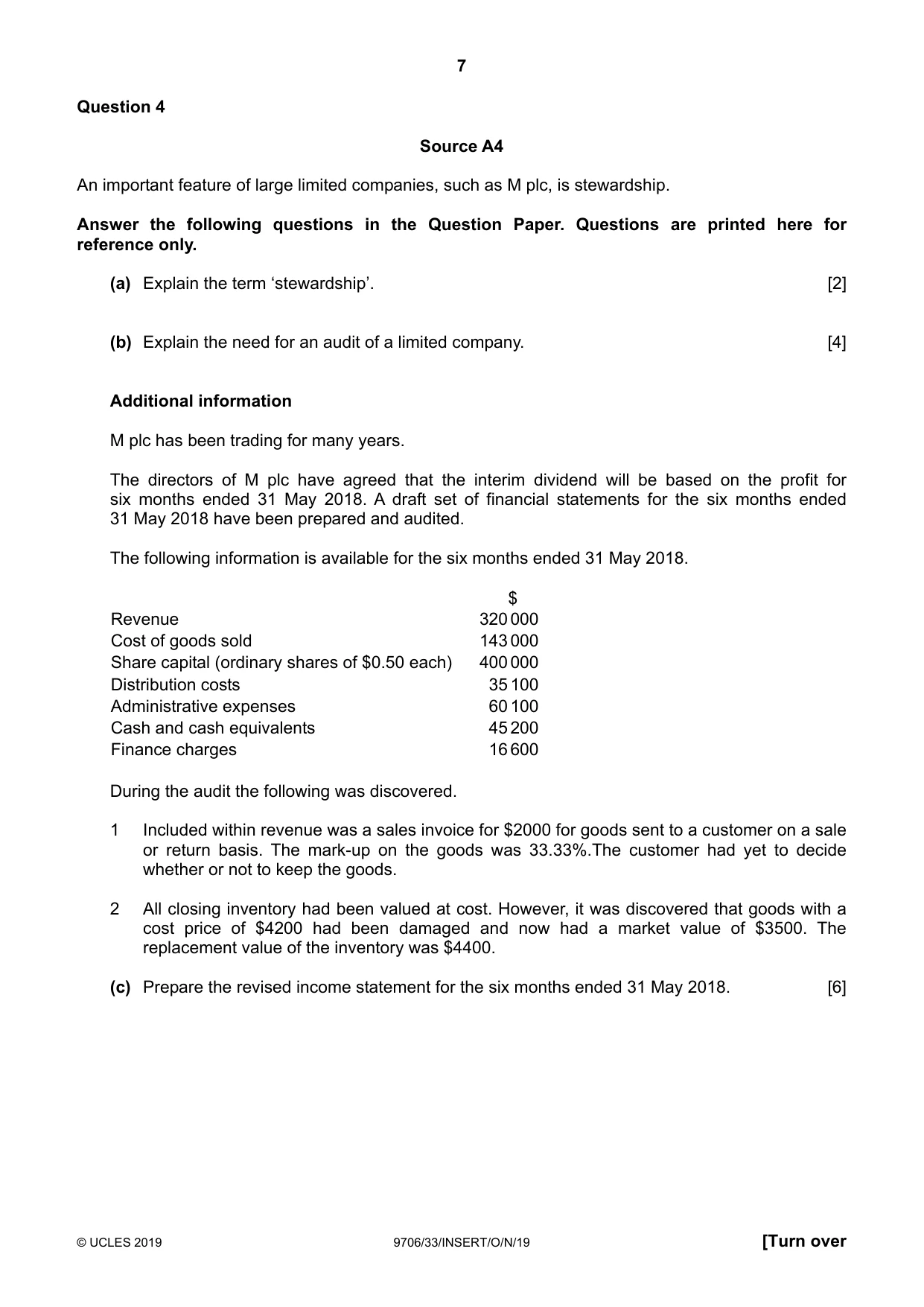
7 © UCLES 2019 9706/33/INSERT/O/N/19 [Turn over Question 4 Source A4 An important feature of large limited companies, such as M plc, is stewardship. Answer the following questions in the Question Paper. Questions are printed here for reference only. (a) Explain the term ‘stewardship’. [2] (b) Explain the need for an audit of a limited company. [4] Additional information M plc has been trading for many years. The directors of M plc have agreed that the interim dividend will be based on the profit for six months ended 31 May 2018. A draft set of financial statements for the six months ended 31 May 2018 have been prepared and audited. The following information is available for the six months ended 31 May 2018. $ Revenue 320 000 Cost of goods sold 143 000 Share capital (ordinary shares of $0.50 each) 400 000 Distribution costs 35 100 Administrative expenses 60 100 Cash and cash equivalents 45 200 Finance charges 16 600 During the audit the following was discovered. 1 Included within revenue was a sales invoice for $2000 for goods sent to a customer on a sale or return basis. The mark-up on the goods was 33.33%.The customer had yet to decide whether or not to keep the goods. 2 All closing inventory had been valued at cost. However, it was discovered that goods with a cost price of $4200 had been damaged and now had a market value of $3500. The replacement value of the inventory was $4400. (c) Prepare the revised income statement for the six months ended 31 May 2018. [6]
Question paper, page 8
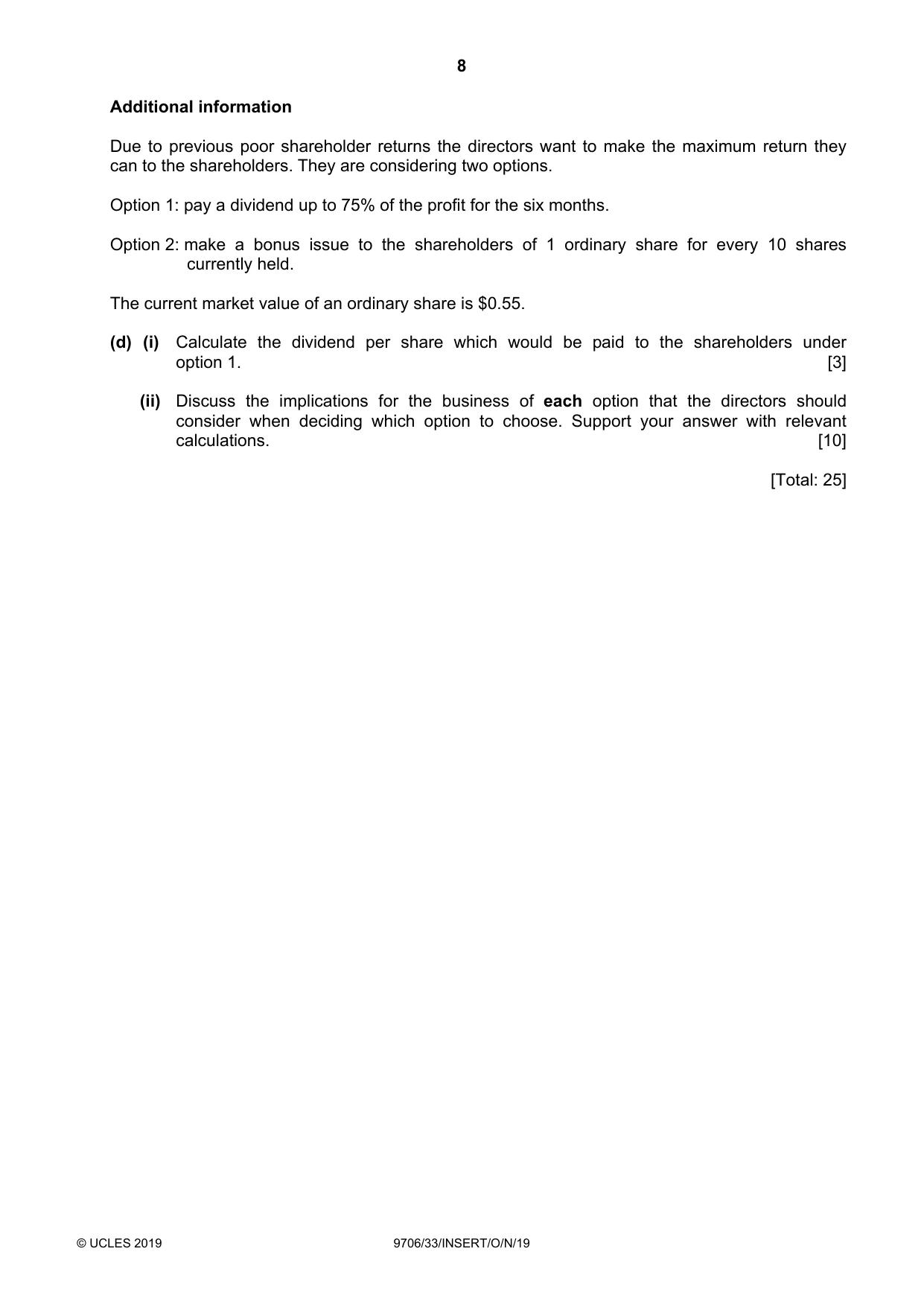
8 © UCLES 2019 9706/33/INSERT/O/N/19 Additional information Due to previous poor shareholder returns the directors want to make the maximum return they can to the shareholders. They are considering two options. Option 1: pay a dividend up to 75% of the profit for the six months. Option 2: make a bonus issue to the shareholders of 1 ordinary share for every 10 shares currently held. The current market value of an ordinary share is $0.55. (d) (i) Calculate the dividend per share which would be paid to the shareholders under option 1. [3] (ii) Discuss the implications for the business of each option that the directors should consider when deciding which option to choose. Support your answer with relevant calculations. [10] [Total: 25]
Question paper, page 9
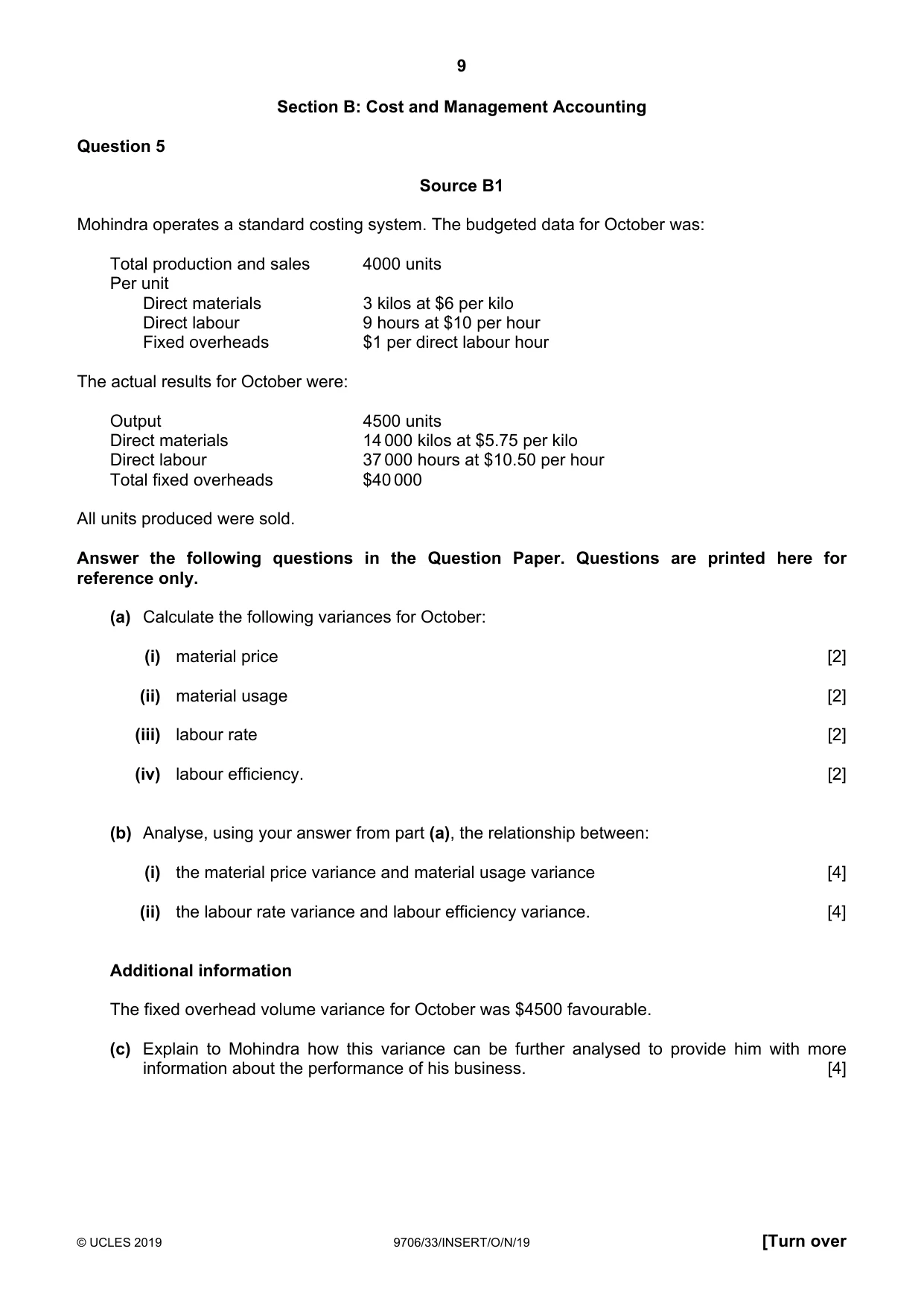
9 © UCLES 2019 9706/33/INSERT/O/N/19 [Turn over Section B: Cost and Management Accounting Question 5 Source B1 Mohindra operates a standard costing system. The budgeted data for October was: Total production and sales 4000 units Per unit Direct materials 3 kilos at $6 per kilo Direct labour 9 hours at $10 per hour Fixed overheads $1 per direct labour hour The actual results for October were: Output 4500 units Direct materials 14 000 kilos at $5.75 per kilo Direct labour 37 000 hours at $10.50 per hour Total fixed overheads $40 000 All units produced were sold. Answer the following questions in the Question Paper. Questions are printed here for reference only. (a) Calculate the following variances for October: (i) material price [2] (ii) material usage [2] (iii) labour rate [2] (iv) labour efficiency. [2] (b) Analyse, using your answer from part (a), the relationship between: (i) the material price variance and material usage variance [4] (ii) the labour rate variance and labour efficiency variance. [4] Additional information The fixed overhead volume variance for October was $4500 favourable. (c) Explain to Mohindra how this variance can be further analysed to provide him with more information about the performance of his business. [4]
Question paper, page 10
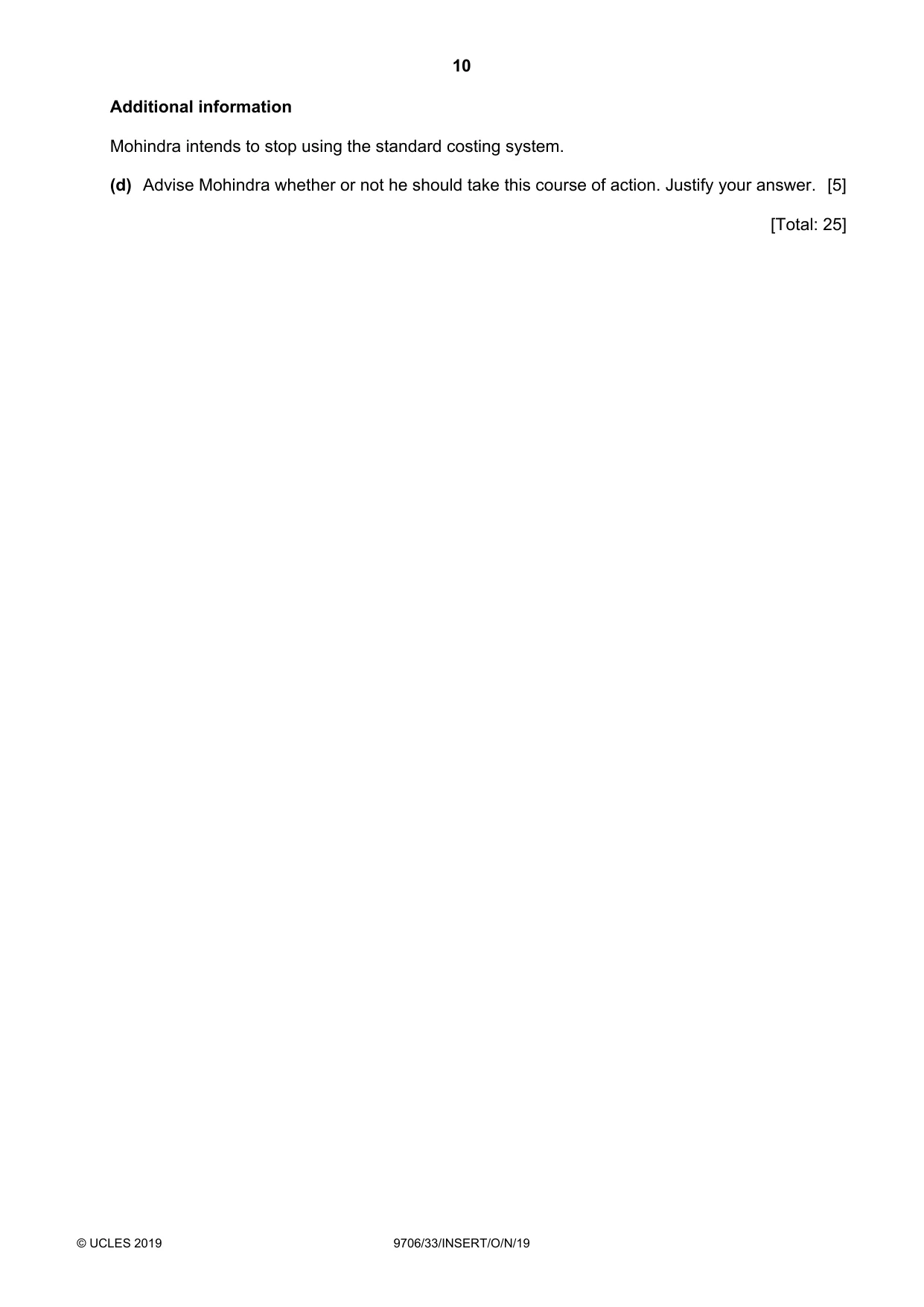
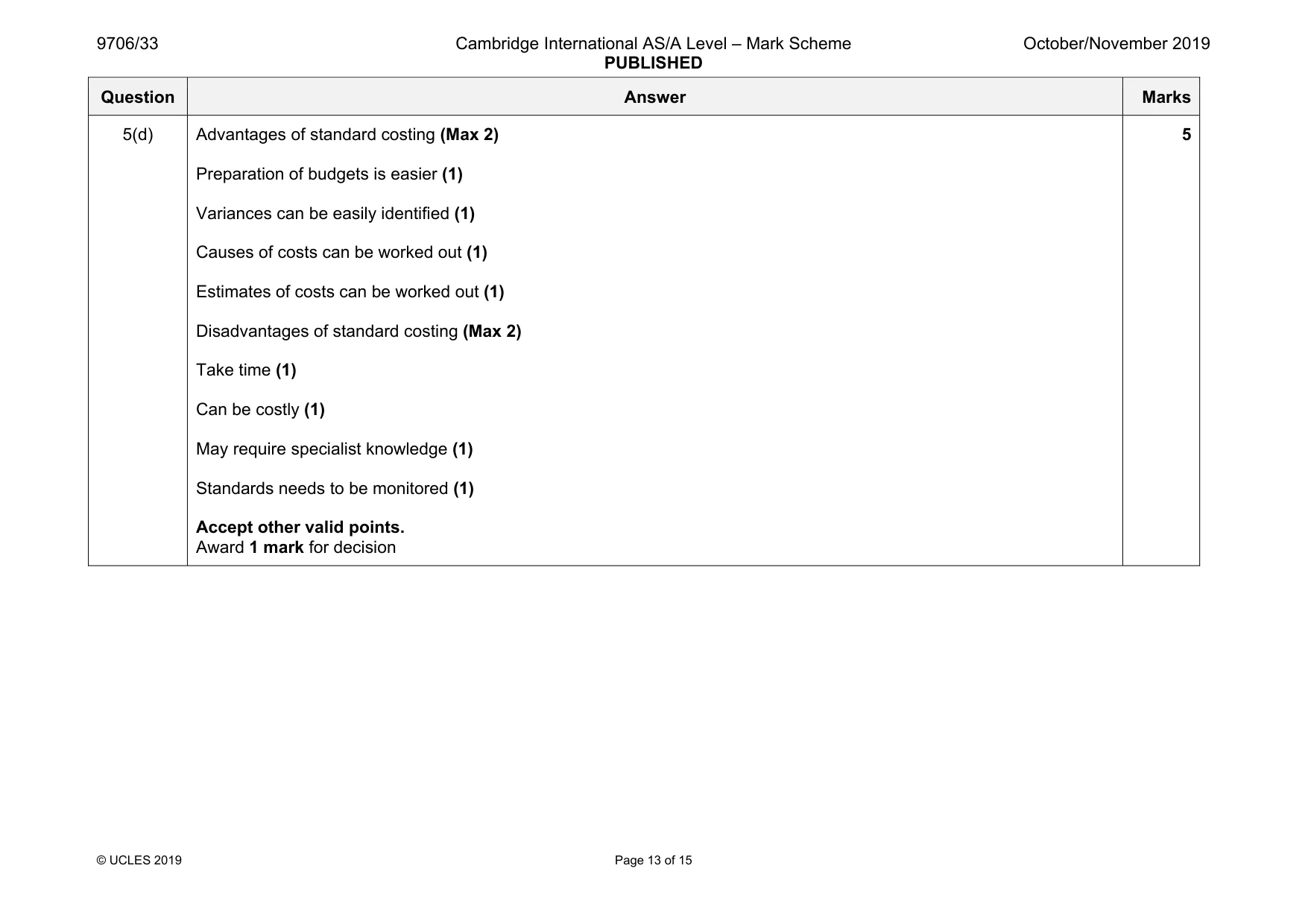
10 © UCLES 2019 9706/33/INSERT/O/N/19 Additional information Mohindra intends to stop using the standard costing system. (d) Advise Mohindra whether or not he should take this course of action. Justify your answer. [5] [Total: 25]
Question paper, page 11
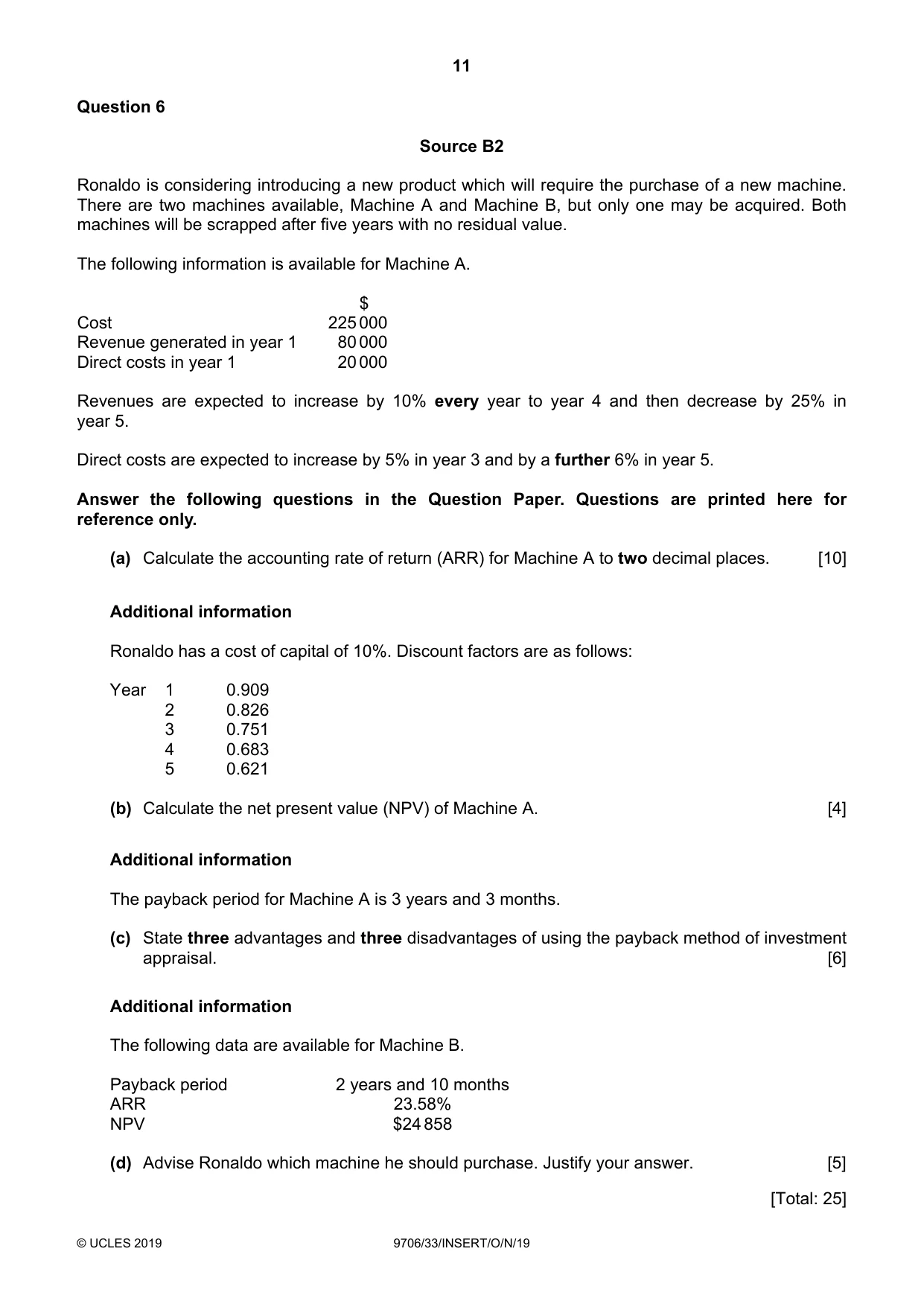
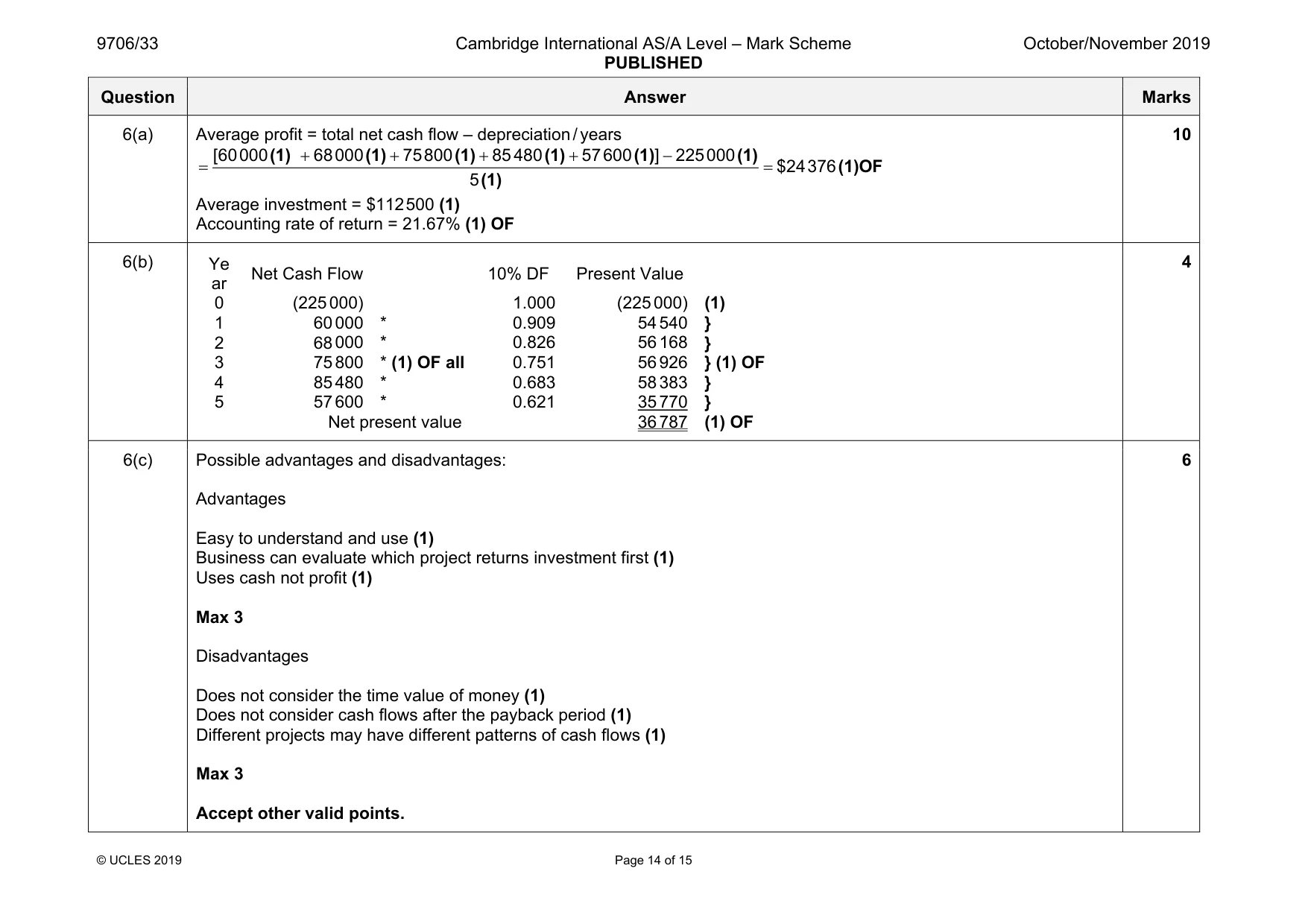
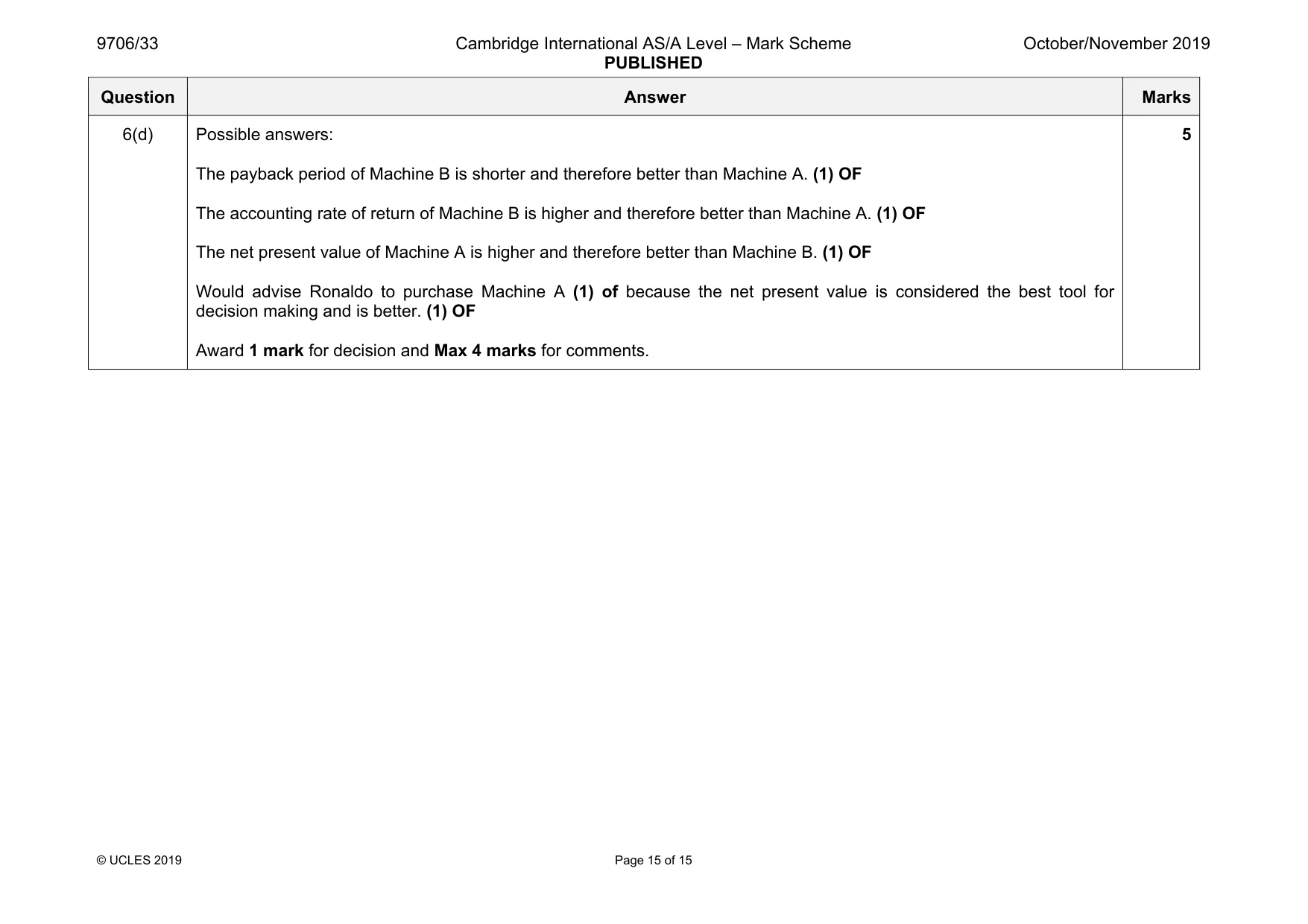
11 © UCLES 2019 9706/33/INSERT/O/N/19 Question 6 Source B2 Ronaldo is considering introducing a new product which will require the purchase of a new machine. There are two machines available, Machine A and Machine B, but only one may be acquired. Both machines will be scrapped after five years with no residual value. The following information is available for Machine A. $ Cost 225 000 Revenue generated in year 1 80 000 Direct costs in year 1 20 000 Revenues are expected to increase by 10% every year to year 4 and then decrease by 25% in year 5. Direct costs are expected to increase by 5% in year 3 and by a further 6% in year 5. Answer the following questions in the Question Paper. Questions are printed here for reference only. (a) Calculate the accounting rate of return (ARR) for Machine A to two decimal places. [10] Additional information Ronaldo has a cost of capital of 10%. Discount factors are as follows: Year 1 0.909 2 0.826 3 0.751 4 0.683 5 0.621 (b) Calculate the net present value (NPV) of Machine A. [4] Additional information The payback period for Machine A is 3 years and 3 months. (c) State three advantages and three disadvantages of using the payback method of investment appraisal. [6] Additional information The following data are available for Machine B. Payback period 2 years and 10 months ARR 23.58% NPV $24 858 (d) Advise Ronaldo which machine he should purchase. Justify your answer. [5] [Total: 25]
Question paper, page 12
12 Permission to reproduce items where third-party owned material protected by copyright is included has been sought and cleared where possible. Every reasonable effort has been made by the publisher (UCLES) to trace copyright holders, but if any items requiring clearance have unwittingly been included, the publisher will be pleased to make amends at the earliest possible opportunity. To avoid the issue of disclosure of answer-related information to candidates, all copyright acknowledgements are reproduced online in the Cambridge Assessment International Education Copyright Acknowledgements Booklet. This is produced for each series of examinations and is freely available to download at www.cambridgeinternational.org after the live examination series. Cambridge Assessment International Education is part of the Cambridge Assessment Group. Cambridge Assessment is the brand name of the University of Cambridge Local Examinations Syndicate (UCLES), which itself is a department of the University of Cambridge. © UCLES 2019 9706/33/INSERT/O/N/19 BLANK PAGE
Mark scheme, page 1
This document consists of 15 printed pages. © UCLES 2019 [Turn over Cambridge Assessment International Education Cambridge International Advanced Subsidiary and Advanced Level ACCOUNTING 9706/33 Paper 3 Structured Questions October/November 2019 MARK SCHEME Maximum Mark: 150 Published This mark scheme is published as an aid to teachers and candidates, to indicate the requirements of the examination. It shows the basis on which Examiners were instructed to award marks. It does not indicate the details of the discussions that took place at an Examiners’ meeting before marking began, which would have considered the acceptability of alternative answers. Mark schemes should be read in conjunction with the question paper and the Principal Examiner Report for Teachers. Cambridge International will not enter into discussions about these mark schemes. Cambridge International is publishing the mark schemes for the October/November 2019 series for most Cambridge IGCSE™, Cambridge International A and AS Level components and some Cambridge O Level components.
Mark scheme, page 2
9706/33 Cambridge International AS/A Level – Mark Scheme PUBLISHED October/November 2019 © UCLES 2019 Page 2 of 15 Generic Marking Principles These general marking principles must be applied by all examiners when marking candidate answers. They should be applied alongside the specific content of the mark scheme or generic level descriptors for a question. Each question paper and mark scheme will also comply with these marking principles. GENERIC MARKING PRINCIPLE 1: Marks must be awarded in line with: • the specific content of the mark scheme or the generic level descriptors for the question • the specific skills defined in the mark scheme or in the generic level descriptors for the question • the standard of response required by a candidate as exemplified by the standardisation scripts. GENERIC MARKING PRINCIPLE 2: Marks awarded are always whole marks (not half marks, or other fractions). GENERIC MARKING PRINCIPLE 3: Marks must be awarded positively: • marks are awarded for correct/valid answers, as defined in the mark scheme. However, credit is given for valid answers which go beyond the scope of the syllabus and mark scheme, referring to your Team Leader as appropriate • marks are awarded when candidates clearly demonstrate what they know and can do • marks are not deducted for errors • marks are not deducted for omissions • answers should only be judged on the quality of spelling, punctuation and grammar when these features are specifically assessed by the question as indicated by the mark scheme. The meaning, however, should be unambiguous. GENERIC MARKING PRINCIPLE 4: Rules must be applied consistently e.g. in situations where candidates have not followed instructions or in the application of generic level descriptors.
Mark scheme, page 3
9706/33 Cambridge International AS/A Level – Mark Scheme PUBLISHED October/November 2019 © UCLES 2019 Page 3 of 15 GENERIC MARKING PRINCIPLE 5: Marks should be awarded using the full range of marks defined in the mark scheme for the question (however; the use of the full mark range may be limited according to the quality of the candidate responses seen). GENERIC MARKING PRINCIPLE 6: Marks awarded are based solely on the requirements as defined in the mark scheme. Marks should not be awarded with grade thresholds or grade descriptors in mind.
Mark scheme, page 4
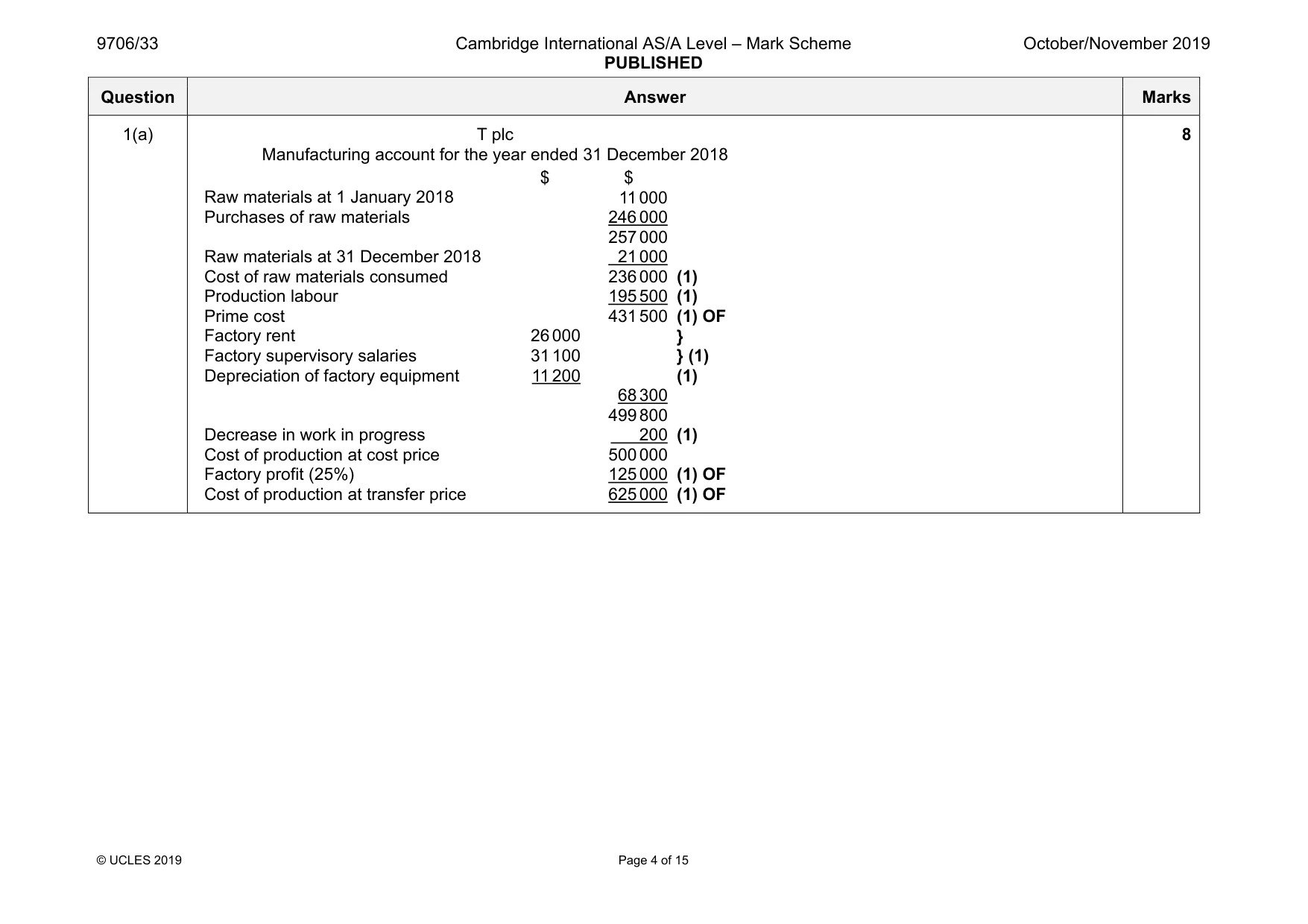
9706/33 Cambridge International AS/A Level – Mark Scheme PUBLISHED October/November 2019 © UCLES 2019 Page 4 of 15 Question Answer Marks 1(a) T plc Manufacturing account for the year ended 31 December 2018 $ $ Raw materials at 1 January 2018 11 000 Purchases of raw materials 246 000 257 000 Raw materials at 31 December 2018 21 000 Cost of raw materials consumed 236 000 (1) Production labour 195 500 (1) Prime cost 431 500 (1) OF Factory rent 26 000 } Factory supervisory salaries 31 100 } (1) Depreciation of factory equipment 11 200 (1) 68 300 499 800 Decrease in work in progress 200 (1) Cost of production at cost price 500 000 Factory profit (25%) 125 000 (1) OF Cost of production at transfer price 625 000 (1) OF 8
Mark scheme, page 5
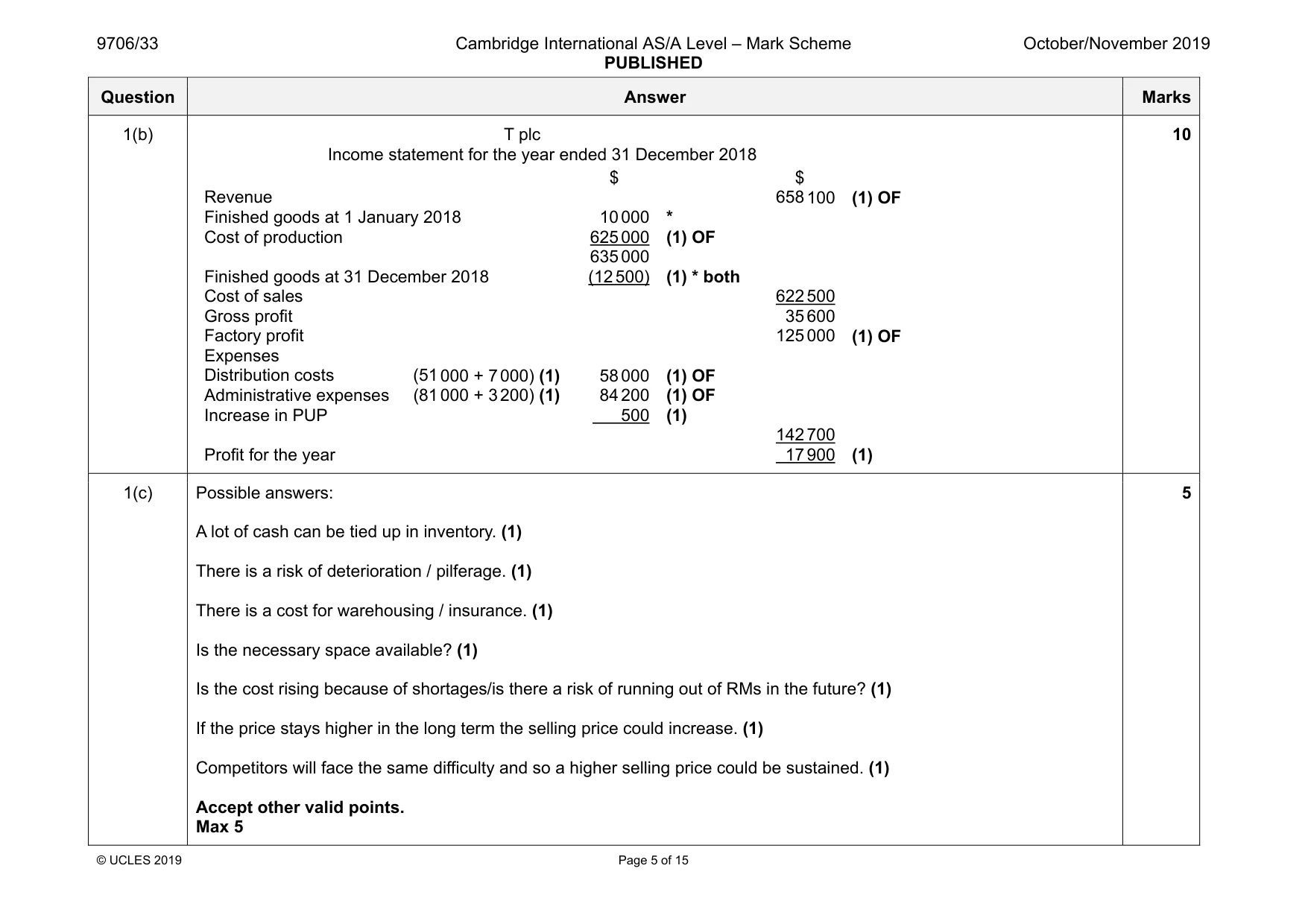
9706/33 Cambridge International AS/A Level – Mark Scheme PUBLISHED October/November 2019 © UCLES 2019 Page 5 of 15 Question Answer Marks 1(b) T plc Income statement for the year ended 31 December 2018 $ $ Revenue 658 100 (1) OF Finished goods at 1 January 2018 10 000 * Cost of production 625 000 (1) OF 635 000 Finished goods at 31 December 2018 (12 500) (1) * both Cost of sales 622 500 Gross profit 35 600 Factory profit 125 000 (1) OF Expenses Distribution costs (51 000 + 7 000) (1) 58 000 (1) OF Administrative expenses (81 000 + 3 200) (1) 84 200 (1) OF Increase in PUP 500 (1) 142 700 Profit for the year 17 900 (1) 10 1(c) Possible answers: A lot of cash can be tied up in inventory. (1) There is a risk of deterioration / pilferage. (1) There is a cost for warehousing / insurance. (1) Is the necessary space available? (1) Is the cost rising because of shortages/is there a risk of running out of RMs in the future? (1) If the price stays higher in the long term the selling price could increase. (1) Competitors will face the same difficulty and so a higher selling price could be sustained. (1) Accept other valid points. Max 5 5
Mark scheme, page 6
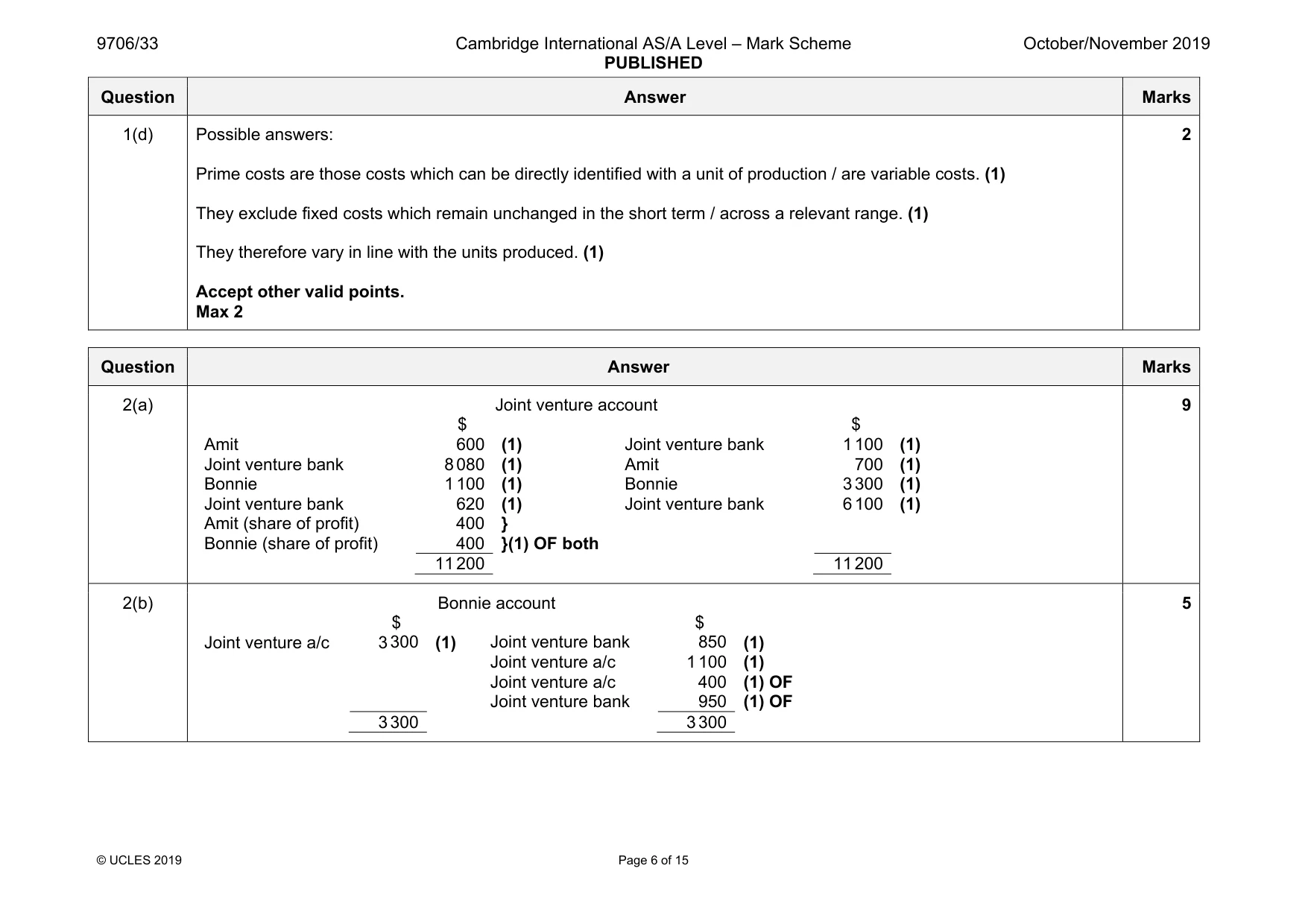
9706/33 Cambridge International AS/A Level – Mark Scheme PUBLISHED October/November 2019 © UCLES 2019 Page 6 of 15 Question Answer Marks 1(d) Possible answers: Prime costs are those costs which can be directly identified with a unit of production / are variable costs. (1) They exclude fixed costs which remain unchanged in the short term / across a relevant range. (1) They therefore vary in line with the units produced. (1) Accept other valid points. Max 2 2 Question Answer Marks 2(a) Joint venture account $ $ Amit 600 (1) Joint venture bank 1 100 (1) Joint venture bank 8 080 (1) Amit 700 (1) Bonnie 1 100 (1) Bonnie 3 300 (1) Joint venture bank 620 (1) Joint venture bank 6 100 (1) Amit (share of profit) 400 } Bonnie (share of profit) 400 }(1) OF both 11 200 11 200 9 2(b) Bonnie account $ $ Joint venture a/c 3 300 (1) Joint venture bank 850 (1) Joint venture a/c 1 100 (1) Joint venture a/c 400 (1) OF Joint venture bank 950 (1) OF 3 300 3 300 5
Mark scheme, page 7
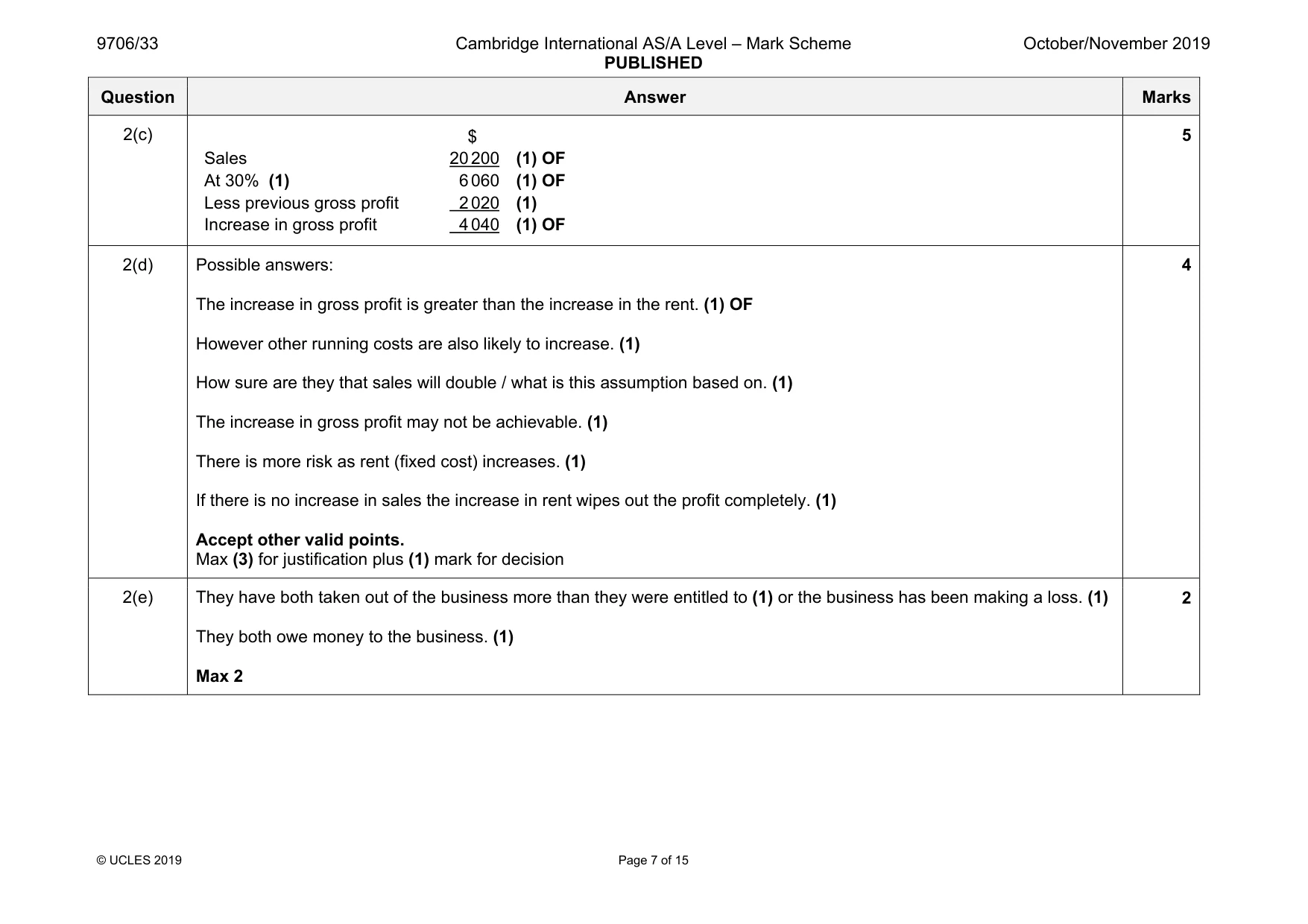
9706/33 Cambridge International AS/A Level – Mark Scheme PUBLISHED October/November 2019 © UCLES 2019 Page 7 of 15 Question Answer Marks 2(c) $ Sales 20 200 (1) OF At 30% (1) 6 060 (1) OF Less previous gross profit 2 020 (1) Increase in gross profit 4 040 (1) OF 5 2(d) Possible answers: The increase in gross profit is greater than the increase in the rent. (1) OF However other running costs are also likely to increase. (1) How sure are they that sales will double / what is this assumption based on. (1) The increase in gross profit may not be achievable. (1) There is more risk as rent (fixed cost) increases. (1) If there is no increase in sales the increase in rent wipes out the profit completely. (1) Accept other valid points. Max (3) for justification plus (1) mark for decision 4 2(e) They have both taken out of the business more than they were entitled to (1) or the business has been making a loss. (1) They both owe money to the business. (1) Max 2 2
Mark scheme, page 8
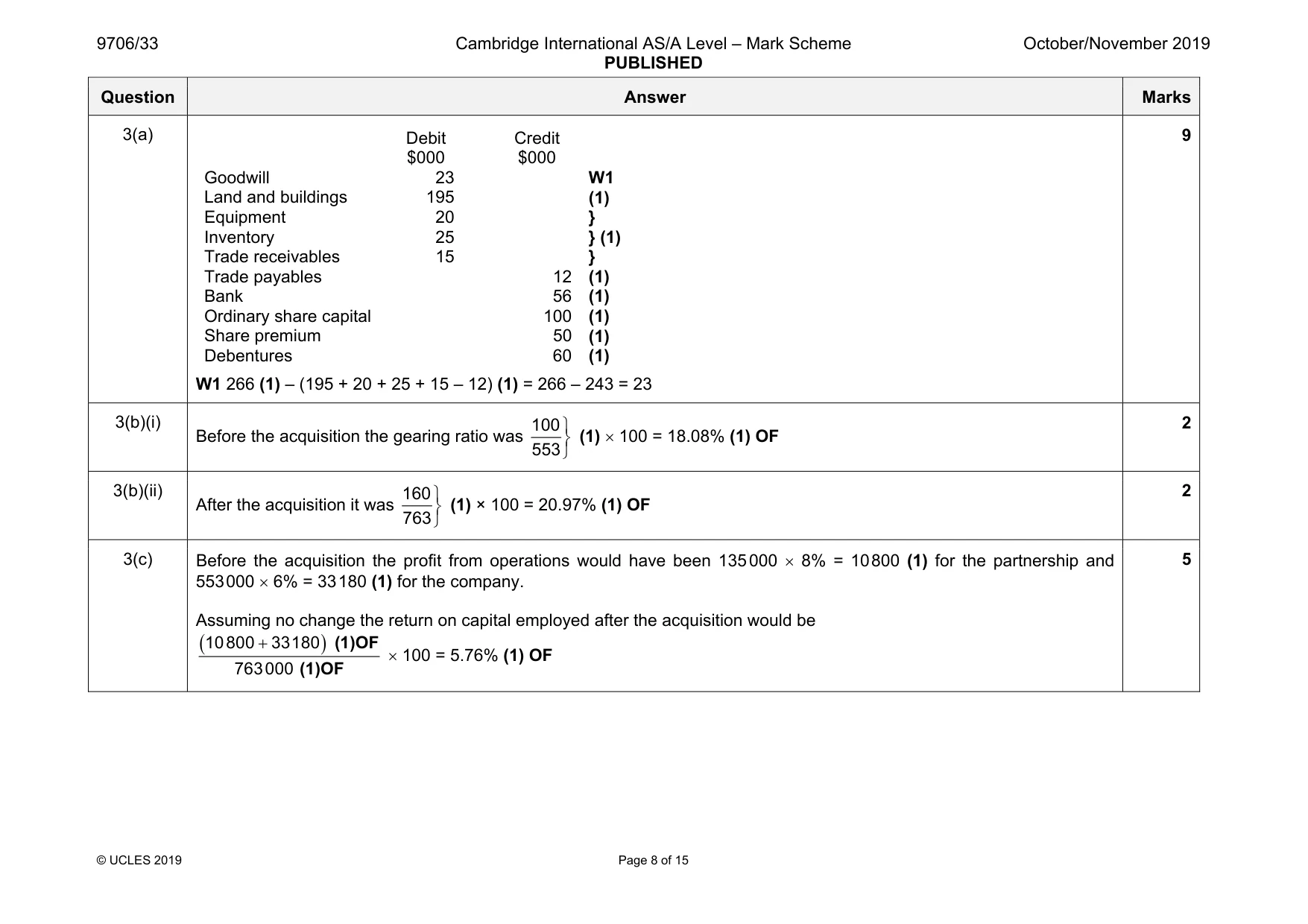
9706/33 Cambridge International AS/A Level – Mark Scheme PUBLISHED October/November 2019 © UCLES 2019 Page 8 of 15 Question Answer Marks 3(a) Debit $000 Credit $000 Goodwill 23 W1 Land and buildings 195 (1) Equipment 20 } Inventory 25 } (1) Trade receivables 15 } Trade payables 12 (1) Bank 56 (1) Ordinary share capital 100 (1) Share premium 50 (1) Debentures 60 (1) W1 266 (1) – (195 + 20 + 25 + 15 – 12) (1) = 266 – 243 = 23 9 3(b)(i) Before the acquisition the gearing ratio was 100 553 (1) × 100 = 18.08% (1) OF 2 3(b)(ii) After the acquisition it was 160 763 (1) × 100 = 20.97% (1) OF 2 3(c) Before the acquisition the profit from operations would have been 135 000 × 8% = 10 800 (1) for the partnership and 553 000 × 6% = 33 180 (1) for the company. Assuming no change the return on capital employed after the acquisition would be ( ) 10800 33180 763000 + (1)OF (1)OF × 100 = 5.76% (1) OF 5
Mark scheme, page 9
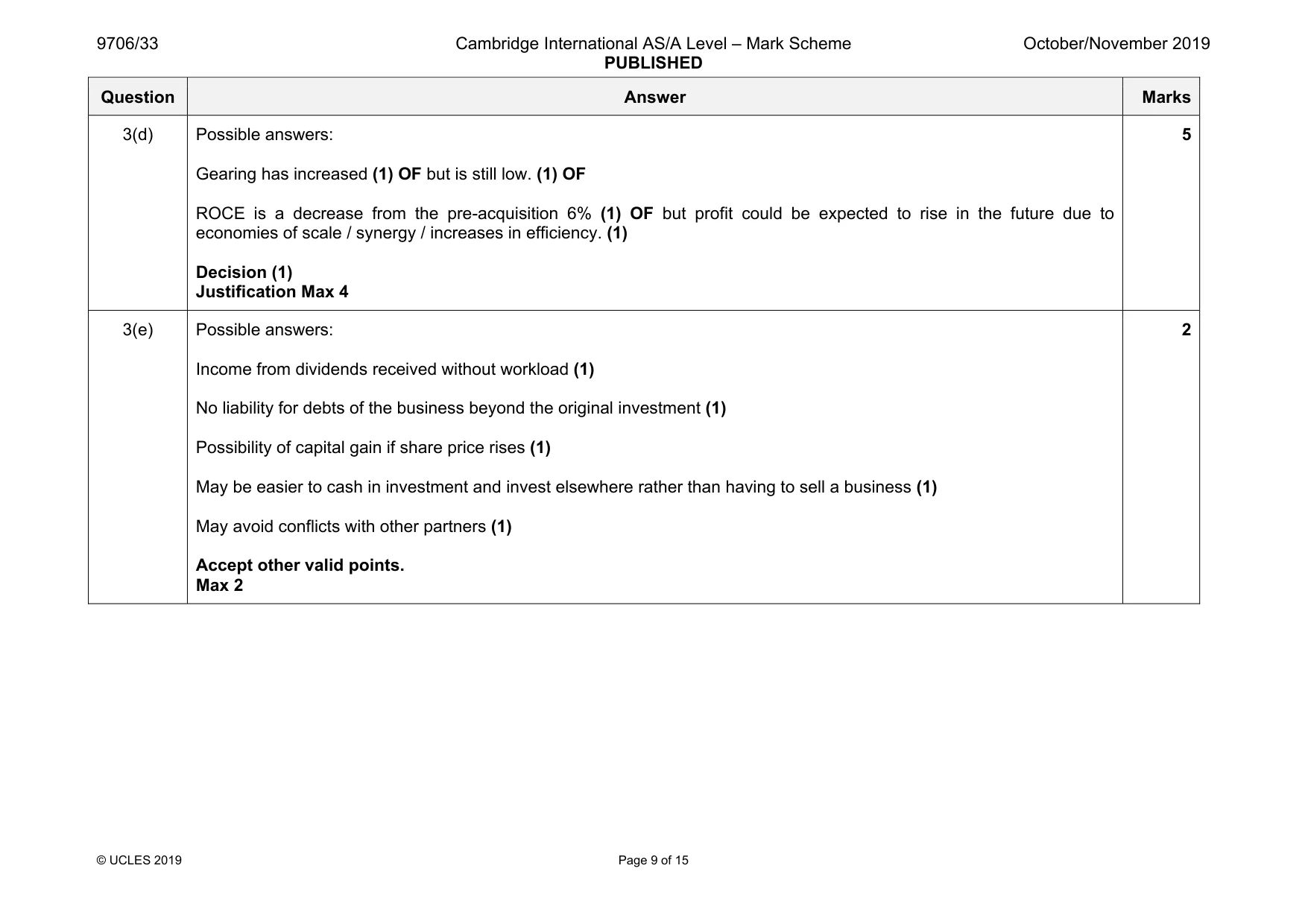
9706/33 Cambridge International AS/A Level – Mark Scheme PUBLISHED October/November 2019 © UCLES 2019 Page 9 of 15 Question Answer Marks 3(d) Possible answers: Gearing has increased (1) OF but is still low. (1) OF ROCE is a decrease from the pre-acquisition 6% (1) OF but profit could be expected to rise in the future due to economies of scale / synergy / increases in efficiency. (1) Decision (1) Justification Max 4 5 3(e) Possible answers: Income from dividends received without workload (1) No liability for debts of the business beyond the original investment (1) Possibility of capital gain if share price rises (1) May be easier to cash in investment and invest elsewhere rather than having to sell a business (1) May avoid conflicts with other partners (1) Accept other valid points. Max 2 2
Mark scheme, page 10
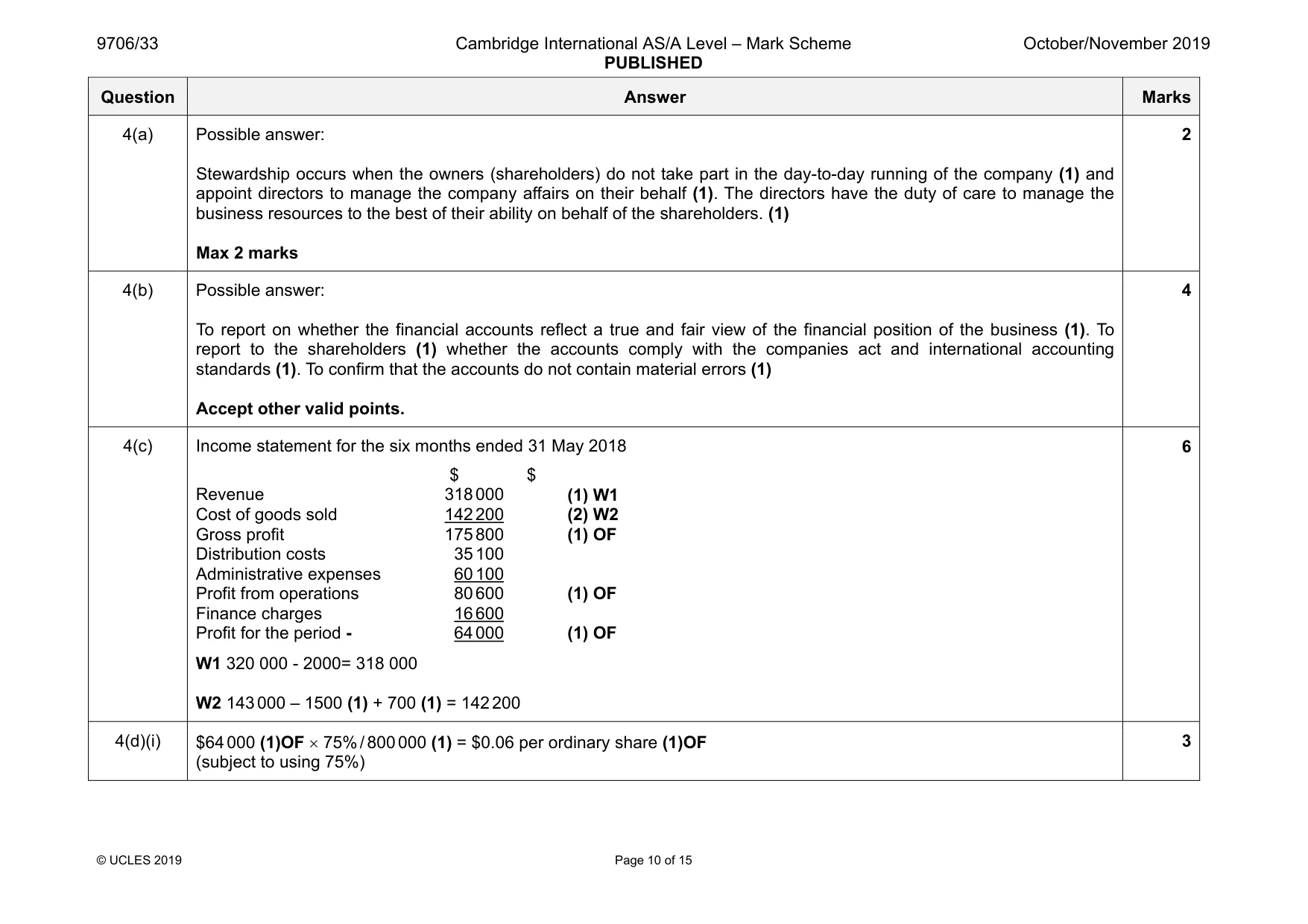
9706/33 Cambridge International AS/A Level – Mark Scheme PUBLISHED October/November 2019 © UCLES 2019 Page 10 of 15 Question Answer Marks 4(a) Possible answer: Stewardship occurs when the owners (shareholders) do not take part in the day-to-day running of the company (1) and appoint directors to manage the company affairs on their behalf (1). The directors have the duty of care to manage the business resources to the best of their ability on behalf of the shareholders. (1) Max 2 marks 2 4(b) Possible answer: To report on whether the financial accounts reflect a true and fair view of the financial position of the business (1). To report to the shareholders (1) whether the accounts comply with the companies act and international accounting standards (1). To confirm that the accounts do not contain material errors (1) Accept other valid points. 4 4(c) Income statement for the six months ended 31 May 2018 $ $ Revenue 318 000 (1) W1 Cost of goods sold 142 200 (2) W2 Gross profit 175 800 (1) OF Distribution costs 35 100 Administrative expenses 60 100 Profit from operations 80 600 (1) OF Finance charges 16 600 Profit for the period - 64 000 (1) OF W1 320 000 - 2000= 318 000 W2 143 000 – 1500 (1) + 700 (1) = 142 200 6 4(d)(i) $64 000 (1)OF × 75% / 800 000 (1) = $0.06 per ordinary share (1)OF (subject to using 75%) 3
Mark scheme, page 11
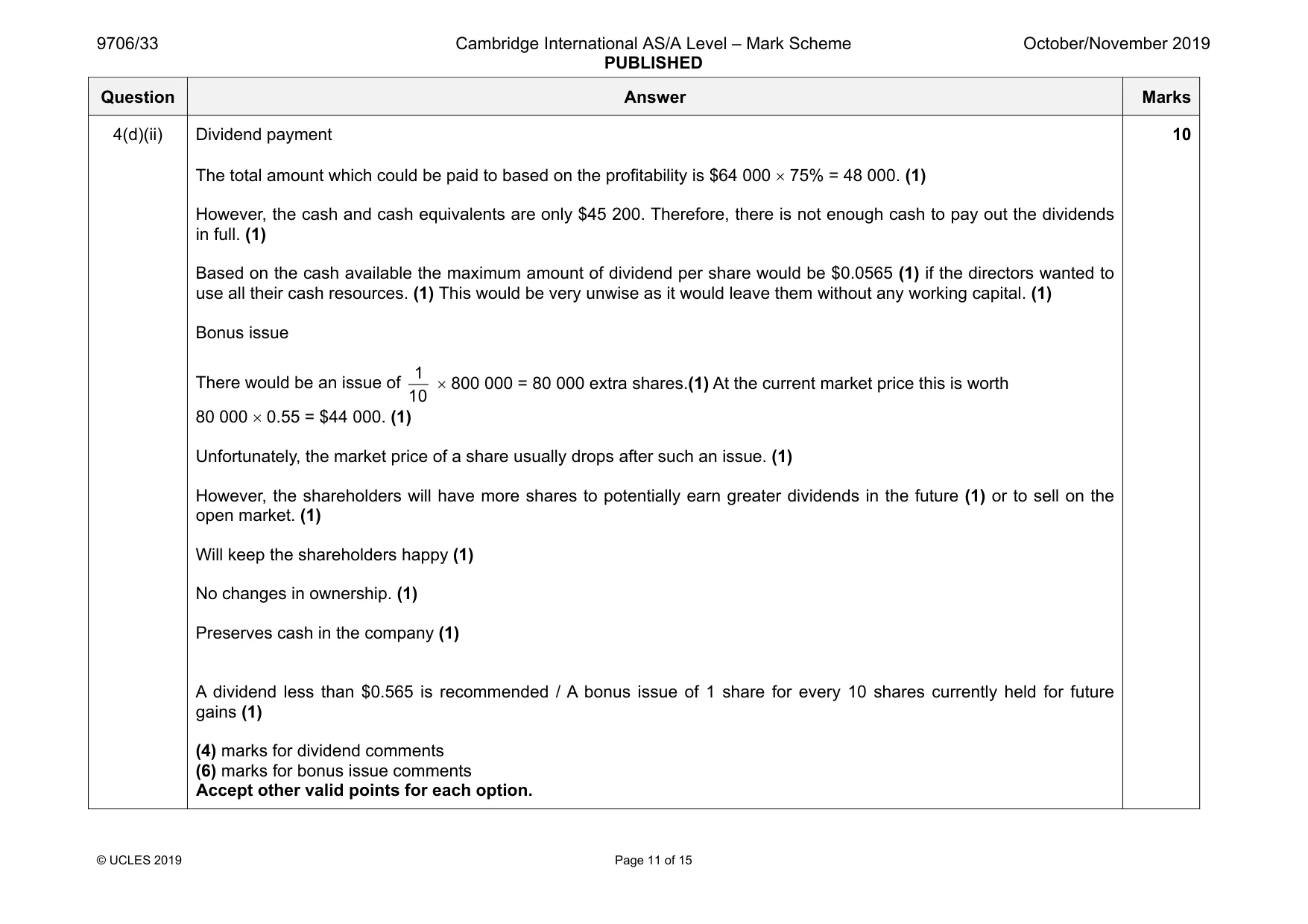
9706/33 Cambridge International AS/A Level – Mark Scheme PUBLISHED October/November 2019 © UCLES 2019 Page 11 of 15 Question Answer Marks 4(d)(ii) Dividend payment The total amount which could be paid to based on the profitability is $64 000 × 75% = 48 000. (1) However, the cash and cash equivalents are only $45 200. Therefore, there is not enough cash to pay out the dividends in full. (1) Based on the cash available the maximum amount of dividend per share would be $0.0565 (1) if the directors wanted to use all their cash resources. (1) This would be very unwise as it would leave them without any working capital. (1) Bonus issue There would be an issue of 1 10 × 800 000 = 80 000 extra shares.(1) At the current market price this is worth 80 000 × 0.55 = $44 000. (1) Unfortunately, the market price of a share usually drops after such an issue. (1) However, the shareholders will have more shares to potentially earn greater dividends in the future (1) or to sell on the open market. (1) Will keep the shareholders happy (1) No changes in ownership. (1) Preserves cash in the company (1) A dividend less than $0.565 is recommended / A bonus issue of 1 share for every 10 shares currently held for future gains (1) (4) marks for dividend comments (6) marks for bonus issue comments Accept other valid points for each option. 10
Mark scheme, page 12
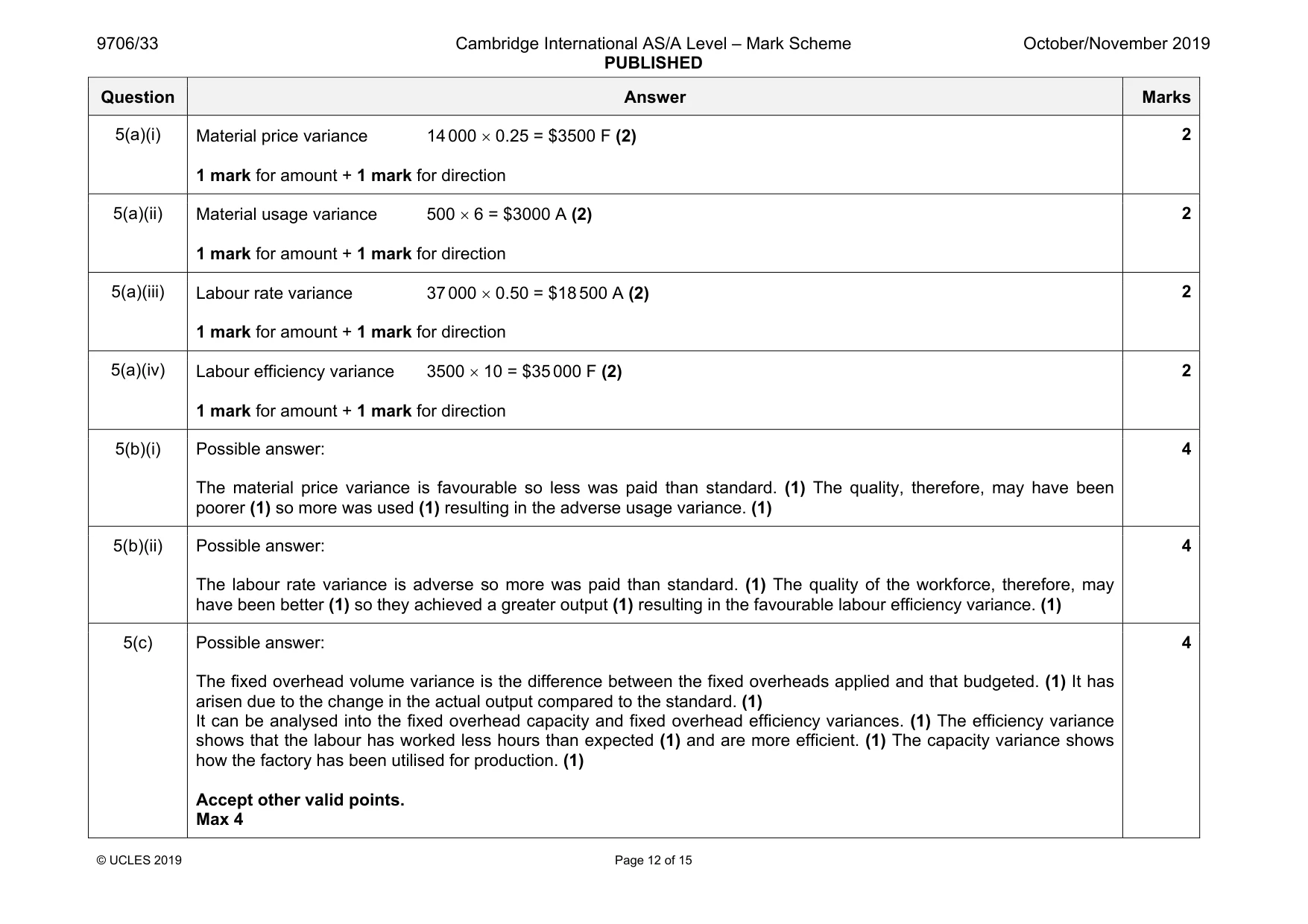
9706/33 Cambridge International AS/A Level – Mark Scheme PUBLISHED October/November 2019 © UCLES 2019 Page 12 of 15 Question Answer Marks 5(a)(i) Material price variance 14 000 × 0.25 = $3500 F (2) 1 mark for amount + 1 mark for direction 2 5(a)(ii) Material usage variance 500 × 6 = $3000 A (2) 1 mark for amount + 1 mark for direction 2 5(a)(iii) Labour rate variance 37 000 × 0.50 = $18 500 A (2) 1 mark for amount + 1 mark for direction 2 5(a)(iv) Labour efficiency variance 3500 × 10 = $35 000 F (2) 1 mark for amount + 1 mark for direction 2 5(b)(i) Possible answer: The material price variance is favourable so less was paid than standard. (1) The quality, therefore, may have been poorer (1) so more was used (1) resulting in the adverse usage variance. (1) 4 5(b)(ii) Possible answer: The labour rate variance is adverse so more was paid than standard. (1) The quality of the workforce, therefore, may have been better (1) so they achieved a greater output (1) resulting in the favourable labour efficiency variance. (1) 4 5(c) Possible answer: The fixed overhead volume variance is the difference between the fixed overheads applied and that budgeted. (1) It has arisen due to the change in the actual output compared to the standard. (1) It can be analysed into the fixed overhead capacity and fixed overhead efficiency variances. (1) The efficiency variance shows that the labour has worked less hours than expected (1) and are more efficient. (1) The capacity variance shows how the factory has been utilised for production. (1) Accept other valid points. Max 4 4
Mark scheme, page 13
9706/33 Cambridge International AS/A Level – Mark Scheme PUBLISHED October/November 2019 © UCLES 2019 Page 13 of 15 Question Answer Marks 5(d) Advantages of standard costing (Max 2) Preparation of budgets is easier (1) Variances can be easily identified (1) Causes of costs can be worked out (1) Estimates of costs can be worked out (1) Disadvantages of standard costing (Max 2) Take time (1) Can be costly (1) May require specialist knowledge (1) Standards needs to be monitored (1) Accept other valid points. Award 1 mark for decision 5
Mark scheme, page 14
9706/33 Cambridge International AS/A Level – Mark Scheme PUBLISHED October/November 2019 © UCLES 2019 Page 14 of 15 Question Answer Marks 6(a) Average profit = total net cash flow – depreciation / years [60000 68000 75800 85480 57600 ] 225000 $24376 5 + + + + − = = (1) (1) (1) (1) (1) (1) (1)OF (1) Average investment = $112 500 (1) Accounting rate of return = 21.67% (1) OF 10 6(b) Ye ar Net Cash Flow 10% DF Present Value 0 (225 000) 1.000 (225 000) (1) 1 60 000 * 0.909 54 540 } 2 68 000 * 0.826 56 168 } 3 75 800 * (1) OF all 0.751 56 926 } (1) OF 4 85 480 * 0.683 58 383 } 5 57 600 * 0.621 35 770 } Net present value 36 787 (1) OF 4 6(c) Possible advantages and disadvantages: Advantages Easy to understand and use (1) Business can evaluate which project returns investment first (1) Uses cash not profit (1) Max 3 Disadvantages Does not consider the time value of money (1) Does not consider cash flows after the payback period (1) Different projects may have different patterns of cash flows (1) Max 3 Accept other valid points. 6
Mark scheme, page 15
9706/33 Cambridge International AS/A Level – Mark Scheme PUBLISHED October/November 2019 © UCLES 2019 Page 15 of 15 Question Answer Marks 6(d) Possible answers: The payback period of Machine B is shorter and therefore better than Machine A. (1) OF The accounting rate of return of Machine B is higher and therefore better than Machine A. (1) OF The net present value of Machine A is higher and therefore better than Machine B. (1) OF Would advise Ronaldo to purchase Machine A (1) of because the net present value is considered the best tool for decision making and is better. (1) OF Award 1 mark for decision and Max 4 marks for comments. 5
What you needed in this session
Cambridge’s own grade thresholds for 2019 Oct/Nov, Paper 3 · Variant 3. A higher threshold means an easier paper — the bar moves with how the cohort did.