Cambridge A Level Accounting 9706 — 2019 Oct/Nov Paper 3 · Variant 1
9706/31/O/N/19 · 150 marks · ≈169 min
The question paper and its mark scheme, free to read here and free to download. This is Cambridge’s own paper, exactly as it was sat.
Question paper12 pages


Mark scheme18 pages
Answers below. Sit the paper first if you are practising.
Paper as text
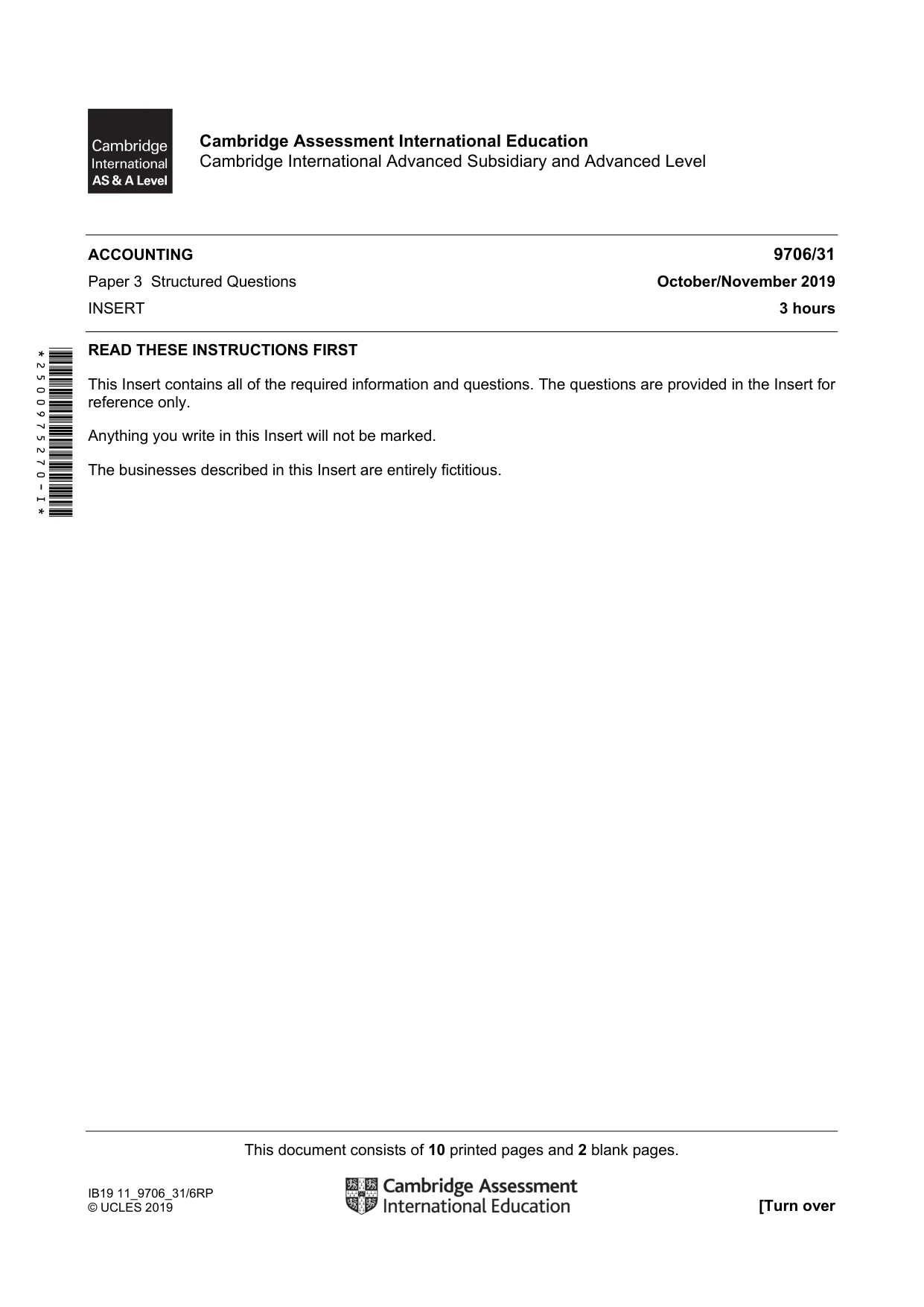
Question paper, page 1
This document consists of 10 printed pages and 2 blank pages. IB19 11_9706_31/6RP © UCLES 2019 [Turn over Cambridge Assessment International Education Cambridge International Advanced Subsidiary and Advanced Level ACCOUNTING 9706/31 Paper 3 Structured Questions October/November 2019 INSERT 3 hours READ THESE INSTRUCTIONS FIRST This Insert contains all of the required information and questions. The questions are provided in the Insert for reference only. Anything you write in this Insert will not be marked. The businesses described in this Insert are entirely fictitious.
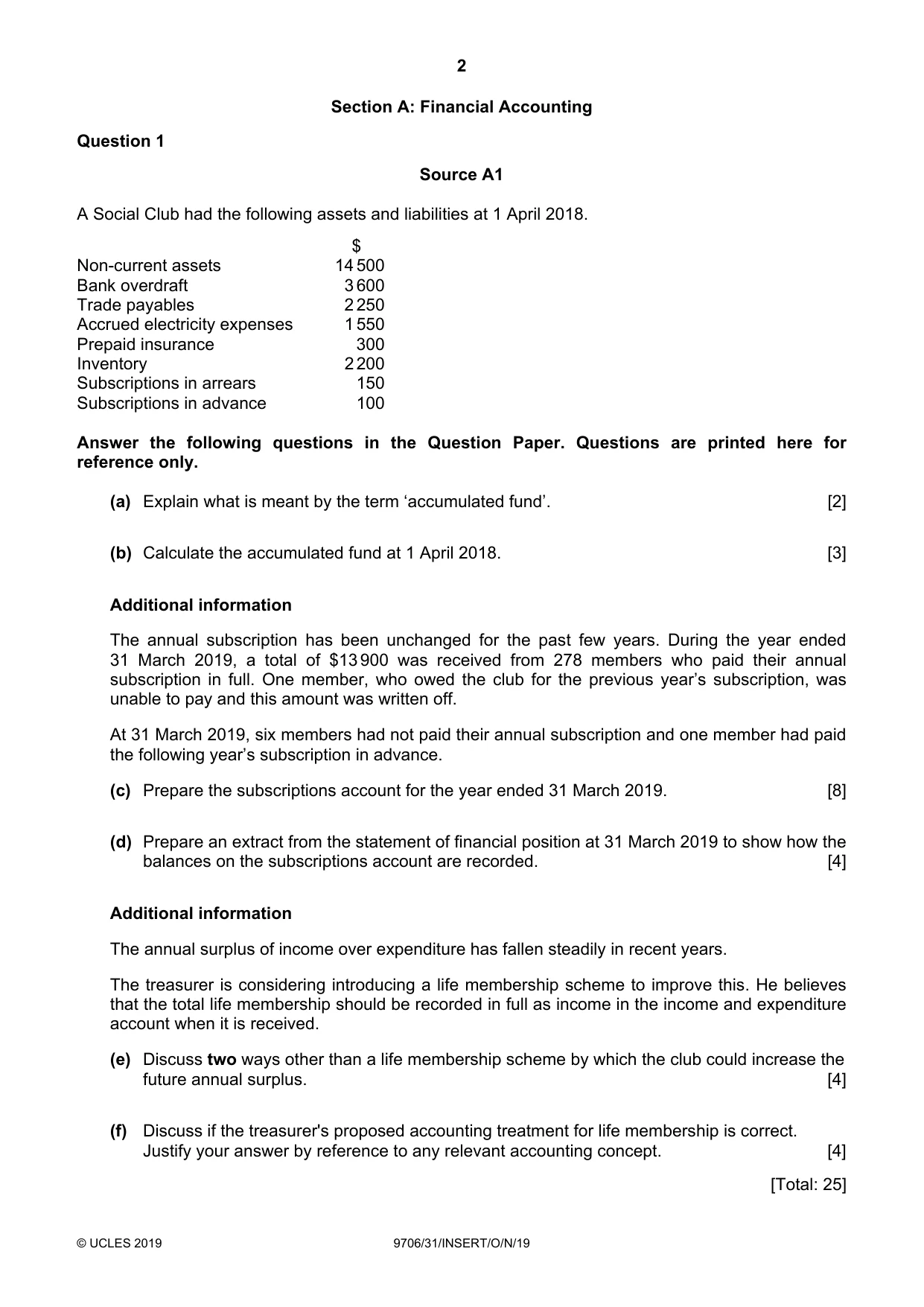
Question paper, page 2
2 © UCLES 2019 9706/31/INSERT/O/N/19 Section A: Financial Accounting Question 1 Source A1 A Social Club had the following assets and liabilities at 1 April 2018. $ Non-current assets 14 500 Bank overdraft 3 600 Trade payables 2 250 Accrued electricity expenses 1 550 Prepaid insurance 300 Inventory 2 200 Subscriptions in arrears 150 Subscriptions in advance 100 Answer the following questions in the Question Paper. Questions are printed here for reference only. (a) Explain what is meant by the term ‘accumulated fund’. [2] (b) Calculate the accumulated fund at 1 April 2018. [3] Additional information The annual subscription has been unchanged for the past few years. During the year ended 31 March 2019, a total of $13 900 was received from 278 members who paid their annual subscription in full. One member, who owed the club for the previous year’s subscription, was unable to pay and this amount was written off. At 31 March 2019, six members had not paid their annual subscription and one member had paid the following year’s subscription in advance. (c) Prepare the subscriptions account for the year ended 31 March 2019. [8] (d) Prepare an extract from the statement of financial position at 31 March 2019 to show how the balances on the subscriptions account are recorded. [4] Additional information The annual surplus of income over expenditure has fallen steadily in recent years. The treasurer is considering introducing a life membership scheme to improve this. He believes that the total life membership should be recorded in full as income in the income and expenditure account when it is received. (e) Discuss two ways other than a life membership scheme by which the club could increase the future annual surplus. [4] (f) Discuss if the treasurer's proposed accounting treatment for life membership is correct. Justify your answer by reference to any relevant accounting concept. [4] [Total: 25]
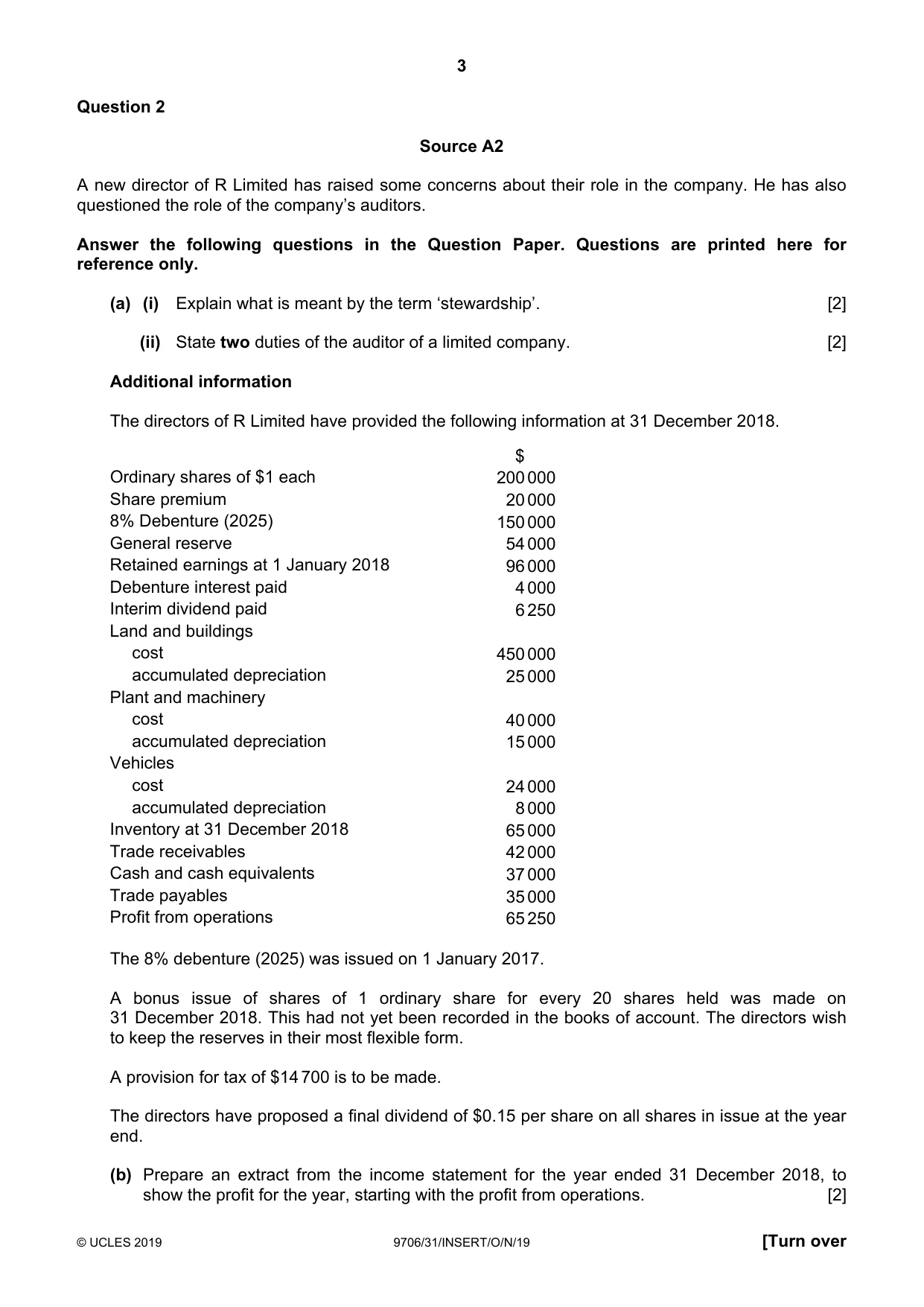
Question paper, page 3
3 © UCLES 2019 9706/31/INSERT/O/N/19 [Turn over Question 2 Source A2 A new director of R Limited has raised some concerns about their role in the company. He has also questioned the role of the company’s auditors. Answer the following questions in the Question Paper. Questions are printed here for reference only. (a) (i) Explain what is meant by the term ‘stewardship’. [2] (ii) State two duties of the auditor of a limited company. [2] Additional information The directors of R Limited have provided the following information at 31 December 2018. $ Ordinary shares of $1 each 200 000 Share premium 20 000 8% Debenture (2025) 150 000 General reserve 54 000 Retained earnings at 1 January 2018 96 000 Debenture interest paid 4 000 Interim dividend paid 6 250 Land and buildings cost 450 000 accumulated depreciation 25 000 Plant and machinery cost 40 000 accumulated depreciation 15 000 Vehicles cost 24 000 accumulated depreciation 8 000 Inventory at 31 December 2018 65 000 Trade receivables 42 000 Cash and cash equivalents 37 000 Trade payables 35 000 Profit from operations 65 250 The 8% debenture (2025) was issued on 1 January 2017. A bonus issue of shares of 1 ordinary share for every 20 shares held was made on 31 December 2018. This had not yet been recorded in the books of account. The directors wish to keep the reserves in their most flexible form. A provision for tax of $14 700 is to be made. The directors have proposed a final dividend of $0.15 per share on all shares in issue at the year end. (b) Prepare an extract from the income statement for the year ended 31 December 2018, to show the profit for the year, starting with the profit from operations. [2]
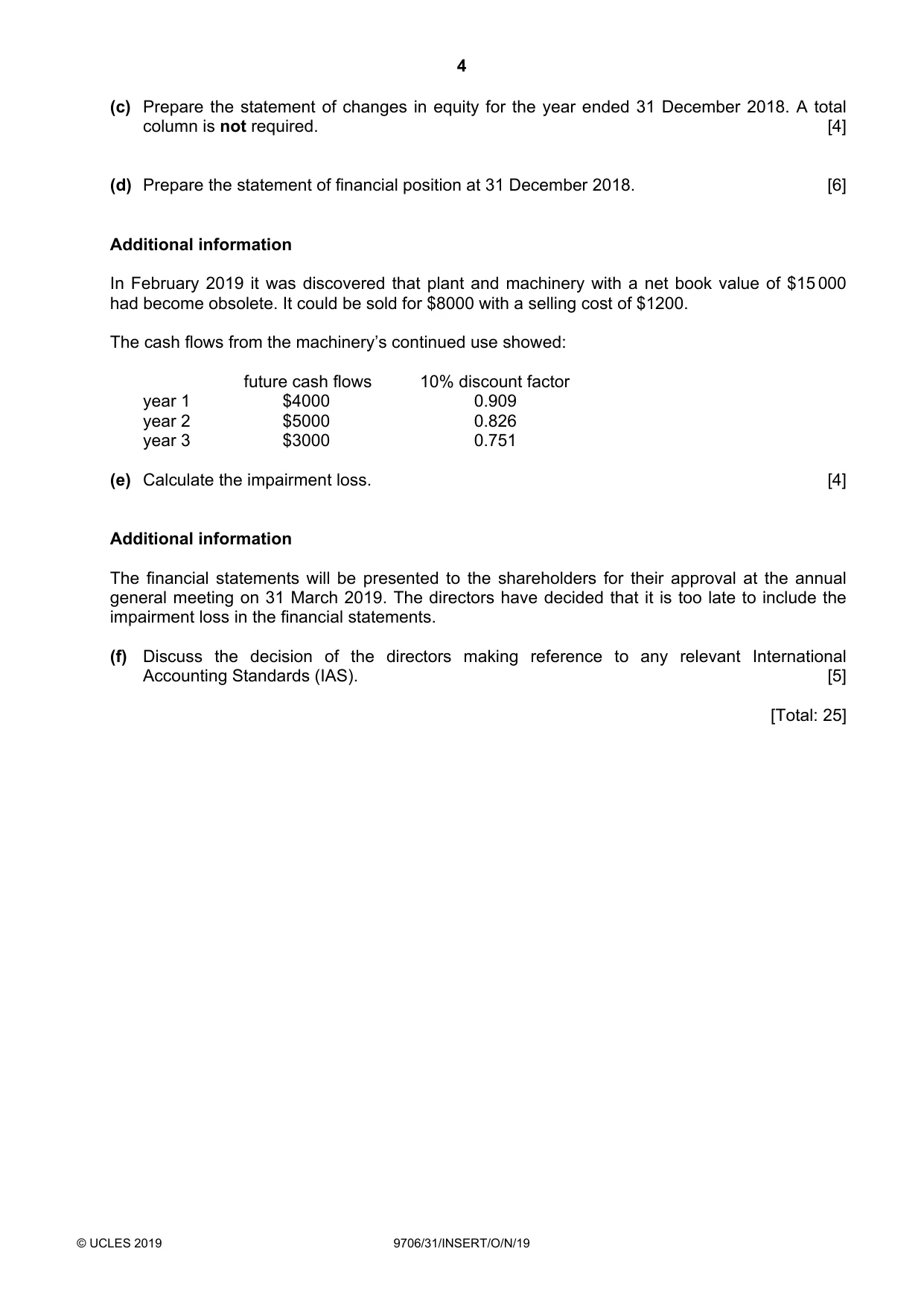
Question paper, page 4
4 © UCLES 2019 9706/31/INSERT/O/N/19 (c) Prepare the statement of changes in equity for the year ended 31 December 2018. A total column is not required. [4] (d) Prepare the statement of financial position at 31 December 2018. [6] Additional information In February 2019 it was discovered that plant and machinery with a net book value of $15 000 had become obsolete. It could be sold for $8000 with a selling cost of $1200. The cash flows from the machinery’s continued use showed: future cash flows 10% discount factor year 1 $4000 0.909 year 2 $5000 0.826 year 3 $3000 0.751 (e) Calculate the impairment loss. [4] Additional information The financial statements will be presented to the shareholders for their approval at the annual general meeting on 31 March 2019. The directors have decided that it is too late to include the impairment loss in the financial statements. (f) Discuss the decision of the directors making reference to any relevant International Accounting Standards (IAS). [5] [Total: 25]
Question paper, page 5
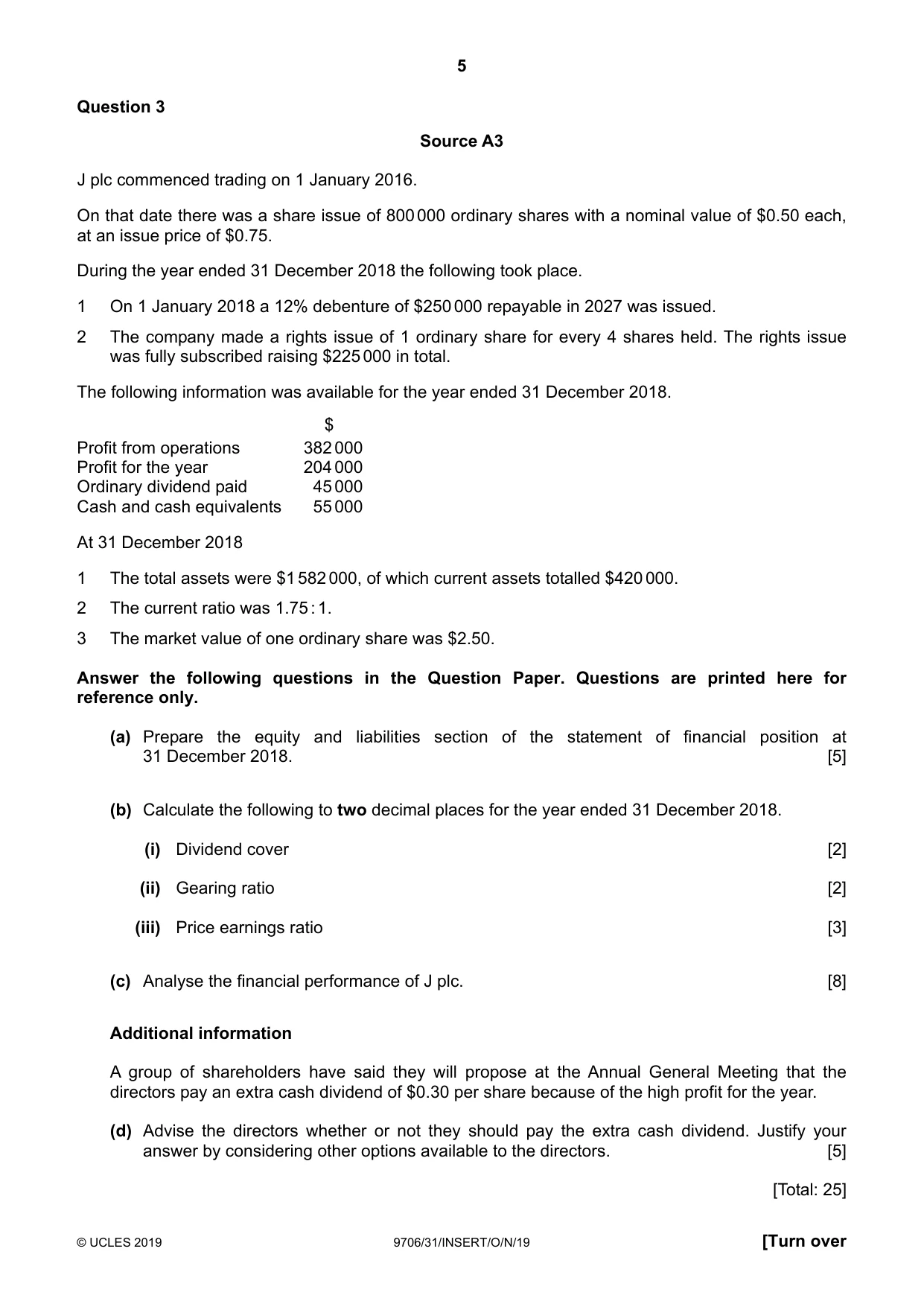
5 © UCLES 2019 9706/31/INSERT/O/N/19 [Turn over Question 3 Source A3 J plc commenced trading on 1 January 2016. On that date there was a share issue of 800 000 ordinary shares with a nominal value of $0.50 each, at an issue price of $0.75. During the year ended 31 December 2018 the following took place. 1 On 1 January 2018 a 12% debenture of $250 000 repayable in 2027 was issued. 2 The company made a rights issue of 1 ordinary share for every 4 shares held. The rights issue was fully subscribed raising $225 000 in total. The following information was available for the year ended 31 December 2018. $ Profit from operations 382 000 Profit for the year 204 000 Ordinary dividend paid 45 000 Cash and cash equivalents 55 000 At 31 December 2018 1 The total assets were $1 582 000, of which current assets totalled $420 000. 2 The current ratio was 1.75 : 1. 3 The market value of one ordinary share was $2.50. Answer the following questions in the Question Paper. Questions are printed here for reference only. (a) Prepare the equity and liabilities section of the statement of financial position at 31 December 2018. [5] (b) Calculate the following to two decimal places for the year ended 31 December 2018. (i) Dividend cover [2] (ii) Gearing ratio [2] (iii) Price earnings ratio [3] (c) Analyse the financial performance of J plc. [8] Additional information A group of shareholders have said they will propose at the Annual General Meeting that the directors pay an extra cash dividend of $0.30 per share because of the high profit for the year. (d) Advise the directors whether or not they should pay the extra cash dividend. Justify your answer by considering other options available to the directors. [5] [Total: 25]
Question paper, page 6
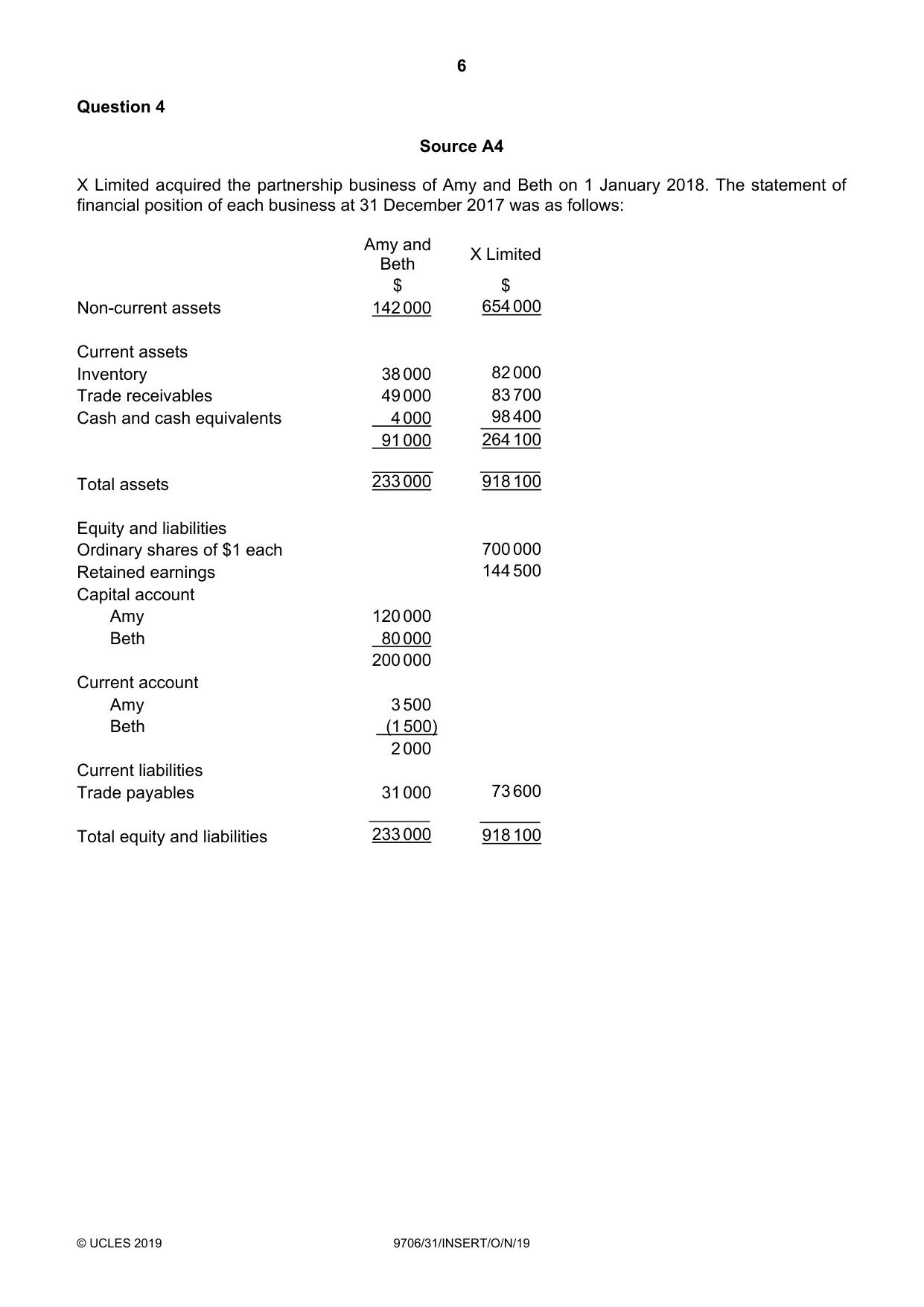
6 © UCLES 2019 9706/31/INSERT/O/N/19 Question 4 Source A4 X Limited acquired the partnership business of Amy and Beth on 1 January 2018. The statement of financial position of each business at 31 December 2017 was as follows: Amy and Beth X Limited $ $ Non-current assets 142 000 654 000 Current assets Inventory 38 000 82 000 Trade receivables 49 000 83 700 Cash and cash equivalents 4 000 98 400 91 000 264 100 Total assets 233 000 918 100 Equity and liabilities Ordinary shares of $1 each 700 000 Retained earnings 144 500 Capital account Amy 120 000 Beth 80 000 200 000 Current account Amy 3 500 Beth (1 500) 2 000 Current liabilities Trade payables 31 000 73 600 Total equity and liabilities 233 000 918 100
Question paper, page 7
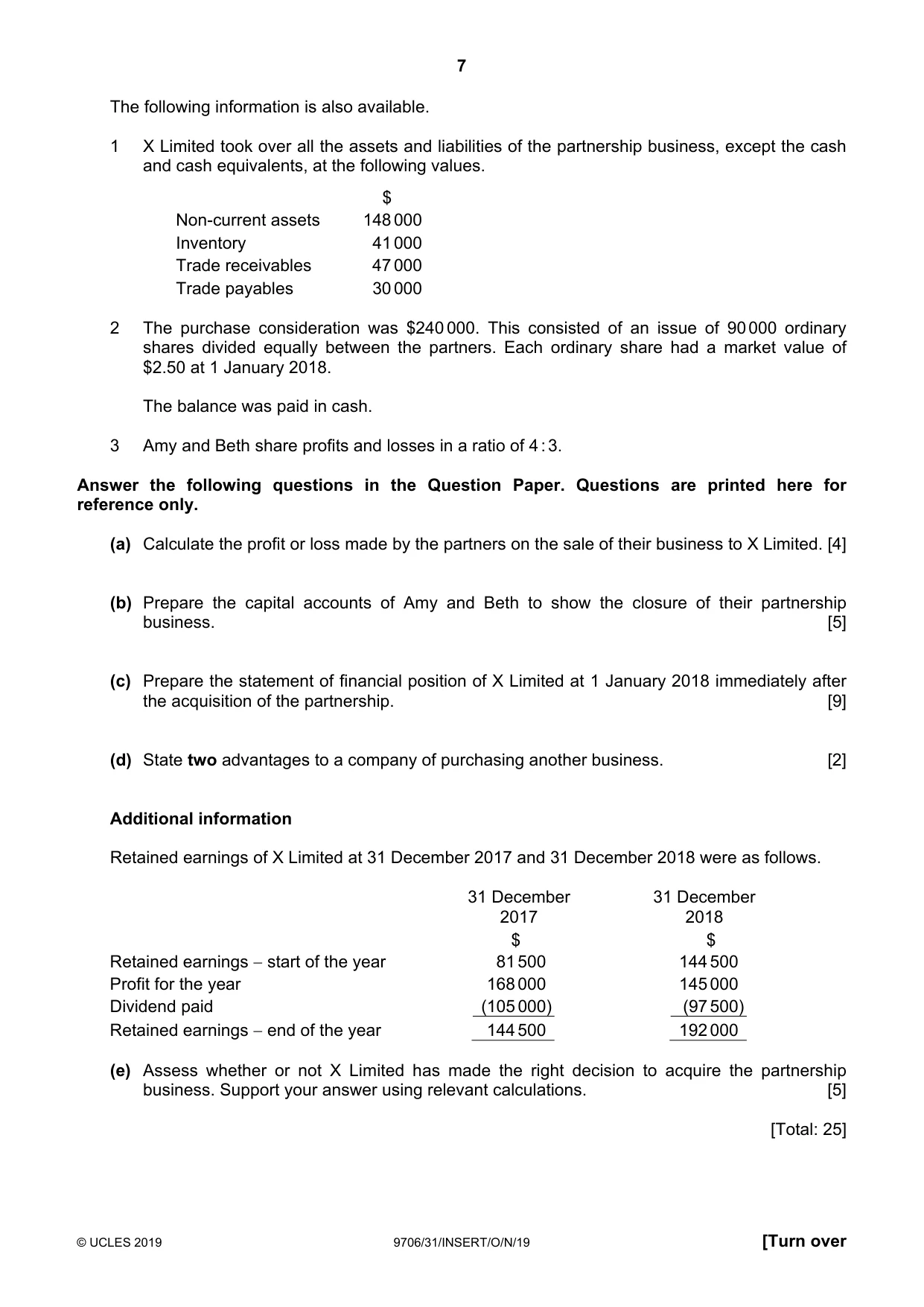
7 © UCLES 2019 9706/31/INSERT/O/N/19 [Turn over The following information is also available. 1 X Limited took over all the assets and liabilities of the partnership business, except the cash and cash equivalents, at the following values. $ Non-current assets 148 000 Inventory 41 000 Trade receivables 47 000 Trade payables 30 000 2 The purchase consideration was $240 000. This consisted of an issue of 90 000 ordinary shares divided equally between the partners. Each ordinary share had a market value of $2.50 at 1 January 2018. The balance was paid in cash. 3 Amy and Beth share profits and losses in a ratio of 4 : 3. Answer the following questions in the Question Paper. Questions are printed here for reference only. (a) Calculate the profit or loss made by the partners on the sale of their business to X Limited. [4] (b) Prepare the capital accounts of Amy and Beth to show the closure of their partnership business. [5] (c) Prepare the statement of financial position of X Limited at 1 January 2018 immediately after the acquisition of the partnership. [9] (d) State two advantages to a company of purchasing another business. [2] Additional information Retained earnings of X Limited at 31 December 2017 and 31 December 2018 were as follows. 31 December 2017 31 December 2018 $ $ Retained earnings start of the year 81 500 144 500 Profit for the year 168 000 145 000 Dividend paid (105 000) (97 500) Retained earnings end of the year 144 500 192 000 (e) Assess whether or not X Limited has made the right decision to acquire the partnership business. Support your answer using relevant calculations. [5] [Total: 25]
Question paper, page 8
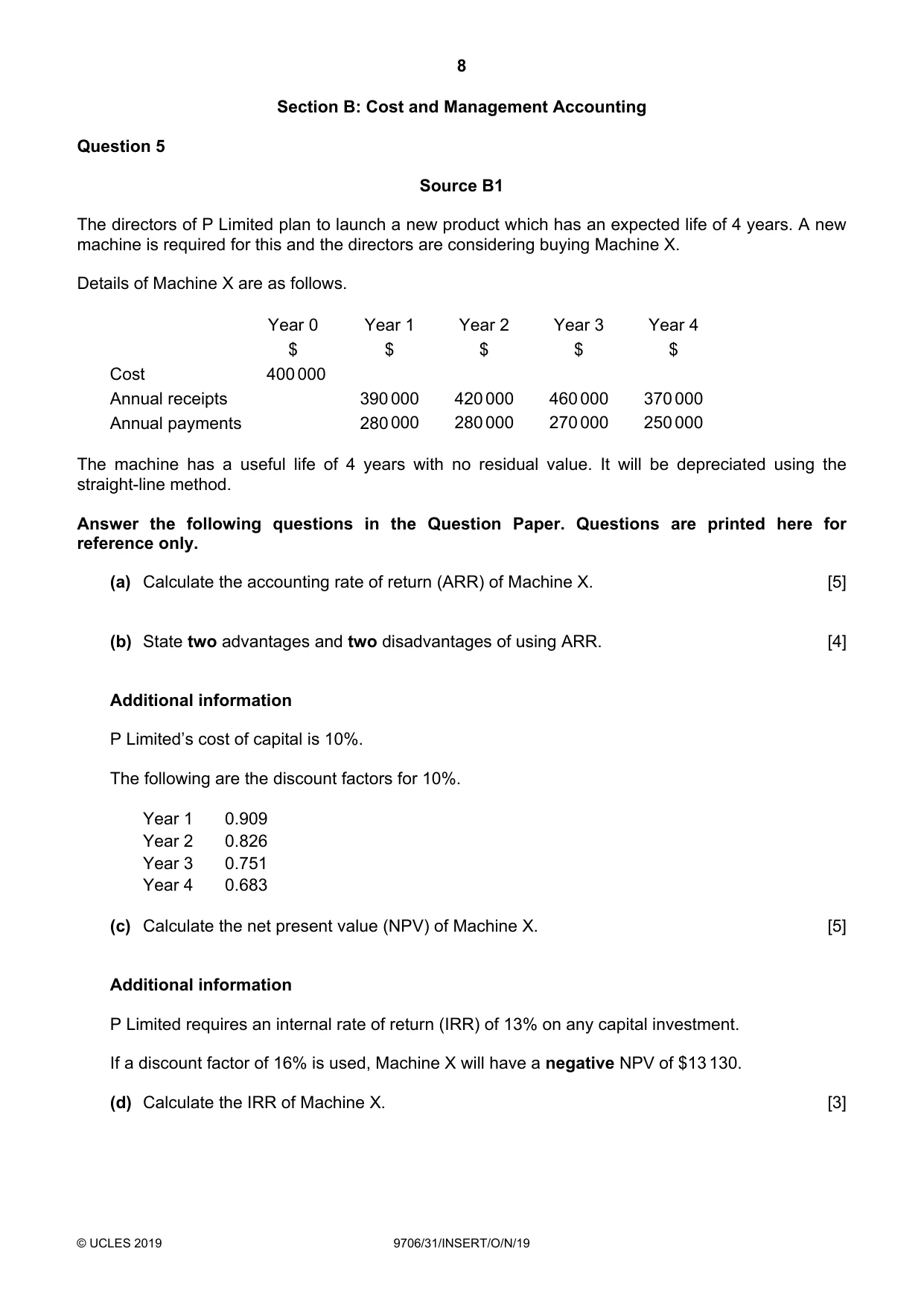
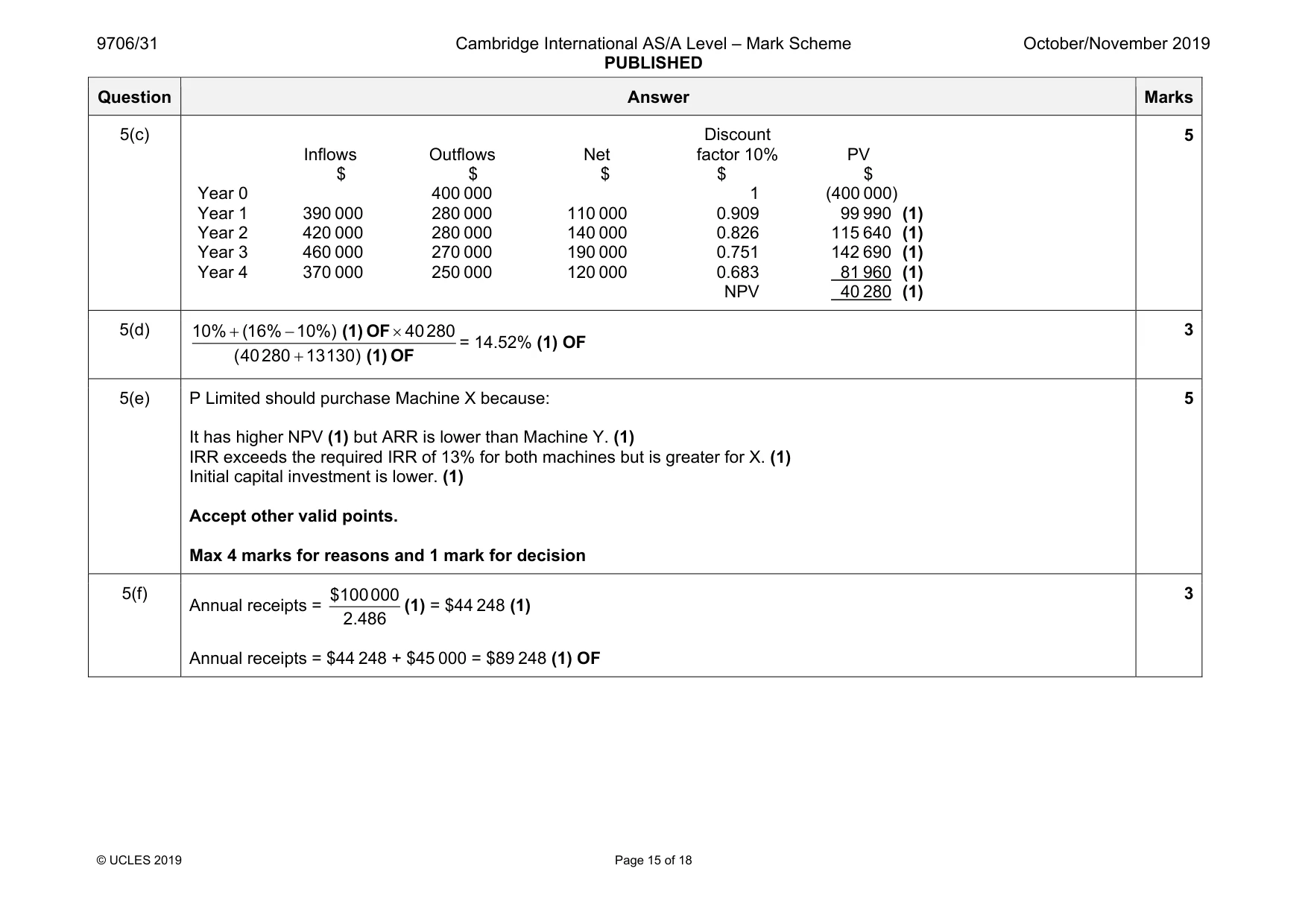
8 © UCLES 2019 9706/31/INSERT/O/N/19 Section B: Cost and Management Accounting Question 5 Source B1 The directors of P Limited plan to launch a new product which has an expected life of 4 years. A new machine is required for this and the directors are considering buying Machine X. Details of Machine X are as follows. Year 0 Year 1 Year 2 Year 3 Year 4 $ $ $ $ $ Cost 400 000 Annual receipts 390 000 420 000 460 000 370 000 Annual payments 280 000 280 000 270 000 250 000 The machine has a useful life of 4 years with no residual value. It will be depreciated using the straight-line method. Answer the following questions in the Question Paper. Questions are printed here for reference only. (a) Calculate the accounting rate of return (ARR) of Machine X. [5] (b) State two advantages and two disadvantages of using ARR. [4] Additional information P Limited’s cost of capital is 10%. The following are the discount factors for 10%. Year 1 0.909 Year 2 0.826 Year 3 0.751 Year 4 0.683 (c) Calculate the net present value (NPV) of Machine X. [5] Additional information P Limited requires an internal rate of return (IRR) of 13% on any capital investment. If a discount factor of 16% is used, Machine X will have a negative NPV of $13 130. (d) Calculate the IRR of Machine X. [3]
Question paper, page 9
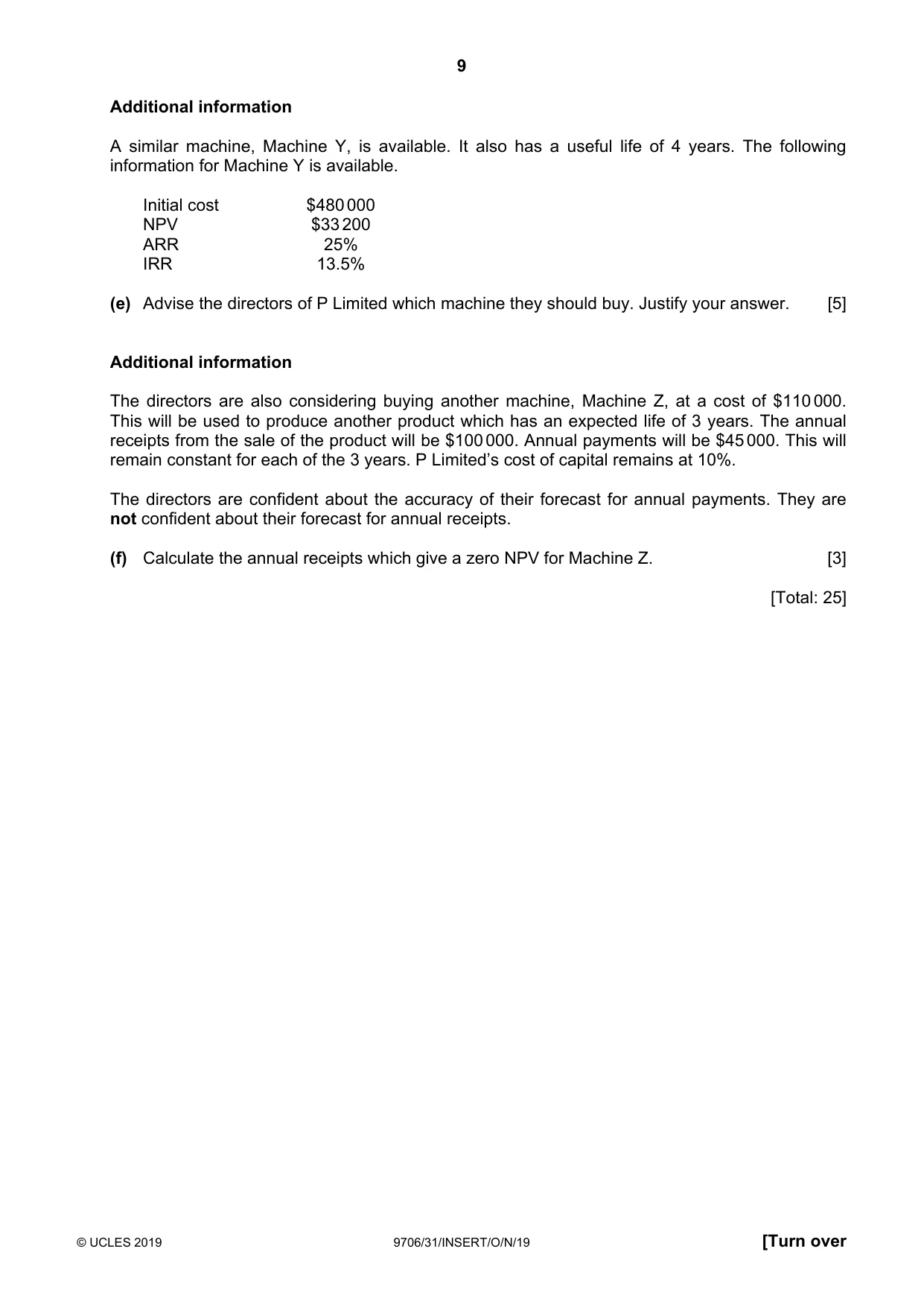
9 © UCLES 2019 9706/31/INSERT/O/N/19 [Turn over Additional information A similar machine, Machine Y, is available. It also has a useful life of 4 years. The following information for Machine Y is available. Initial cost $480 000 NPV $33 200 ARR 25% IRR 13.5% (e) Advise the directors of P Limited which machine they should buy. Justify your answer. [5] Additional information The directors are also considering buying another machine, Machine Z, at a cost of $110 000. This will be used to produce another product which has an expected life of 3 years. The annual receipts from the sale of the product will be $100 000. Annual payments will be $45 000. This will remain constant for each of the 3 years. P Limited’s cost of capital remains at 10%. The directors are confident about the accuracy of their forecast for annual payments. They are not confident about their forecast for annual receipts. (f) Calculate the annual receipts which give a zero NPV for Machine Z. [3] [Total: 25]
Question paper, page 10
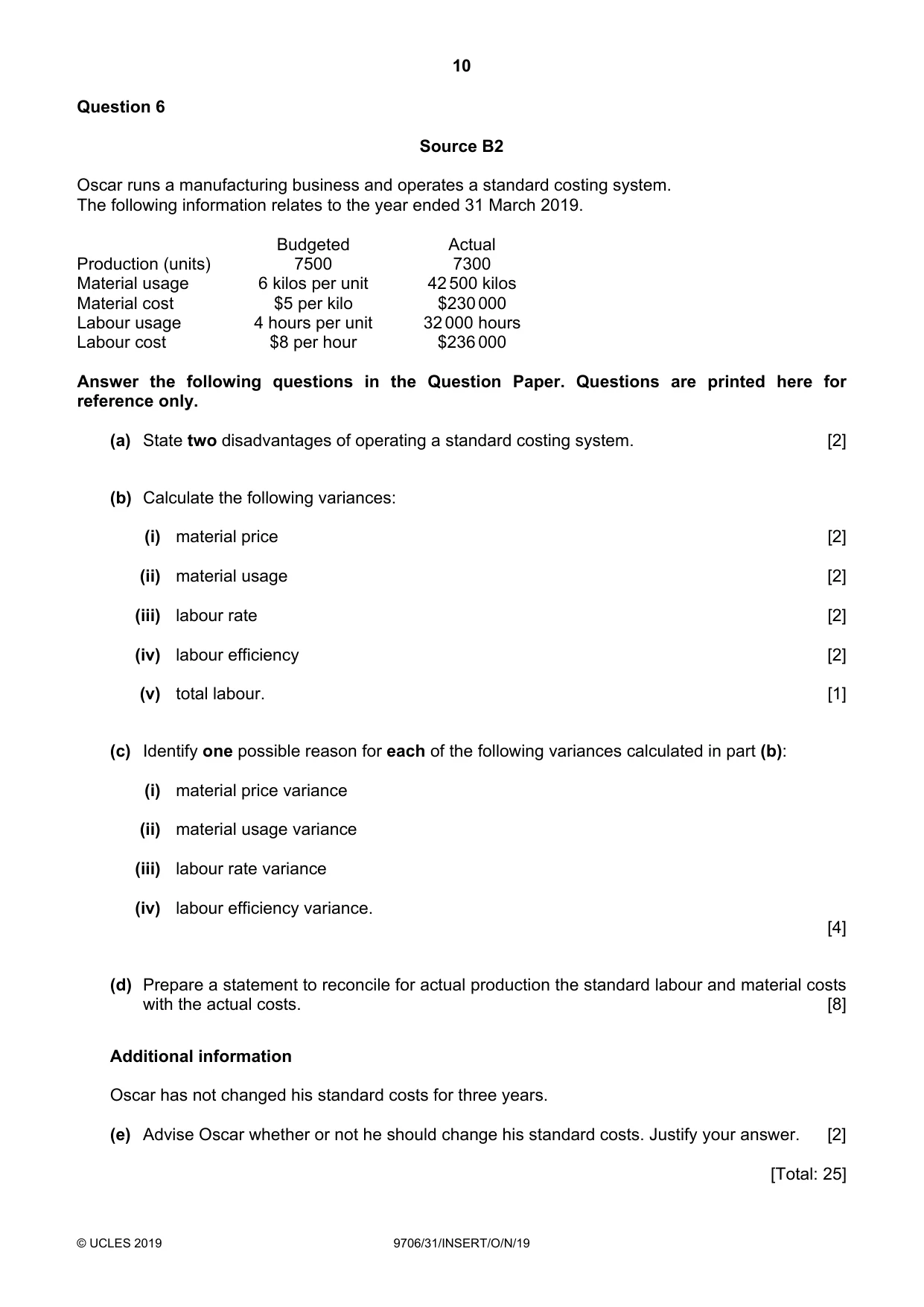
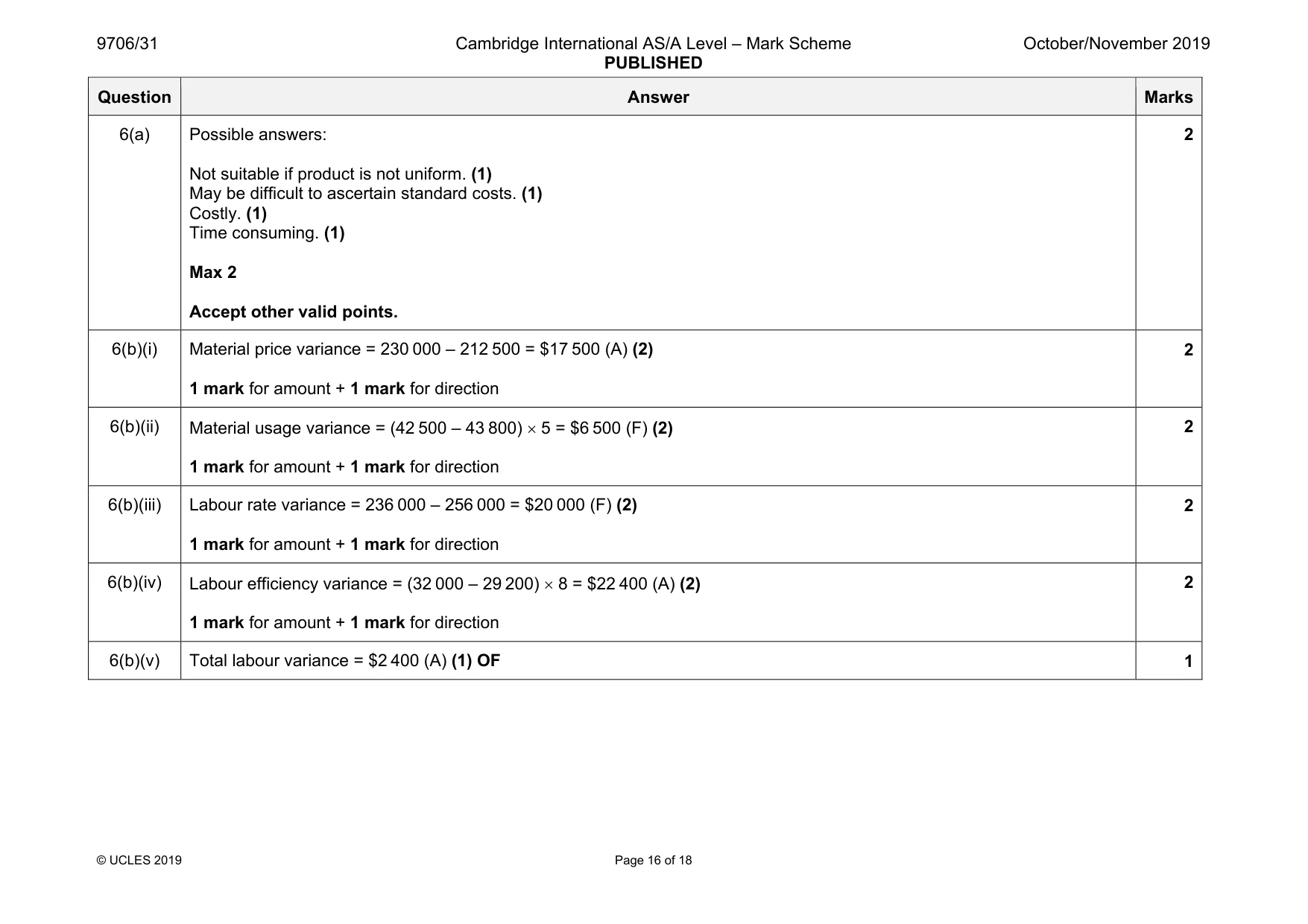
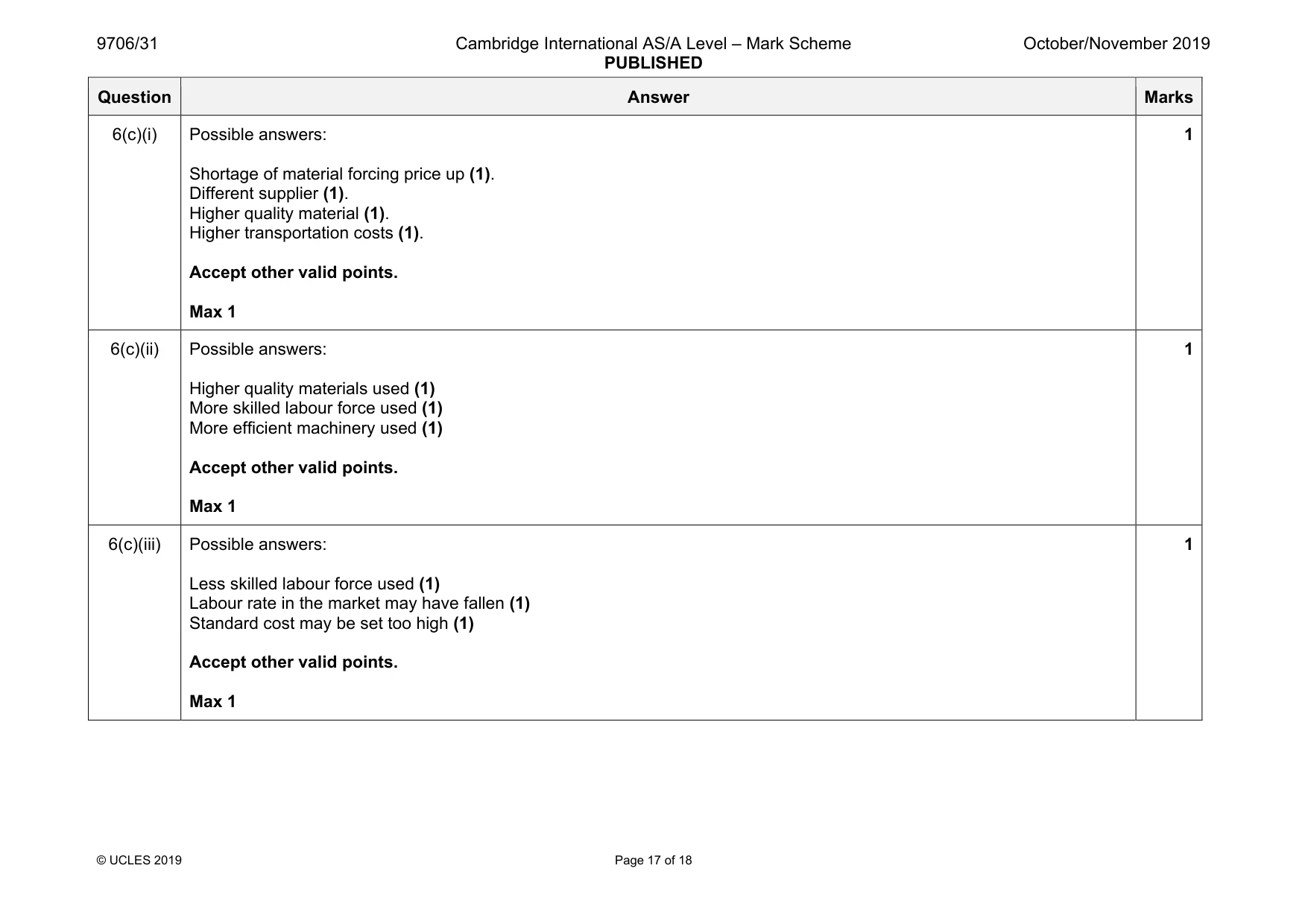
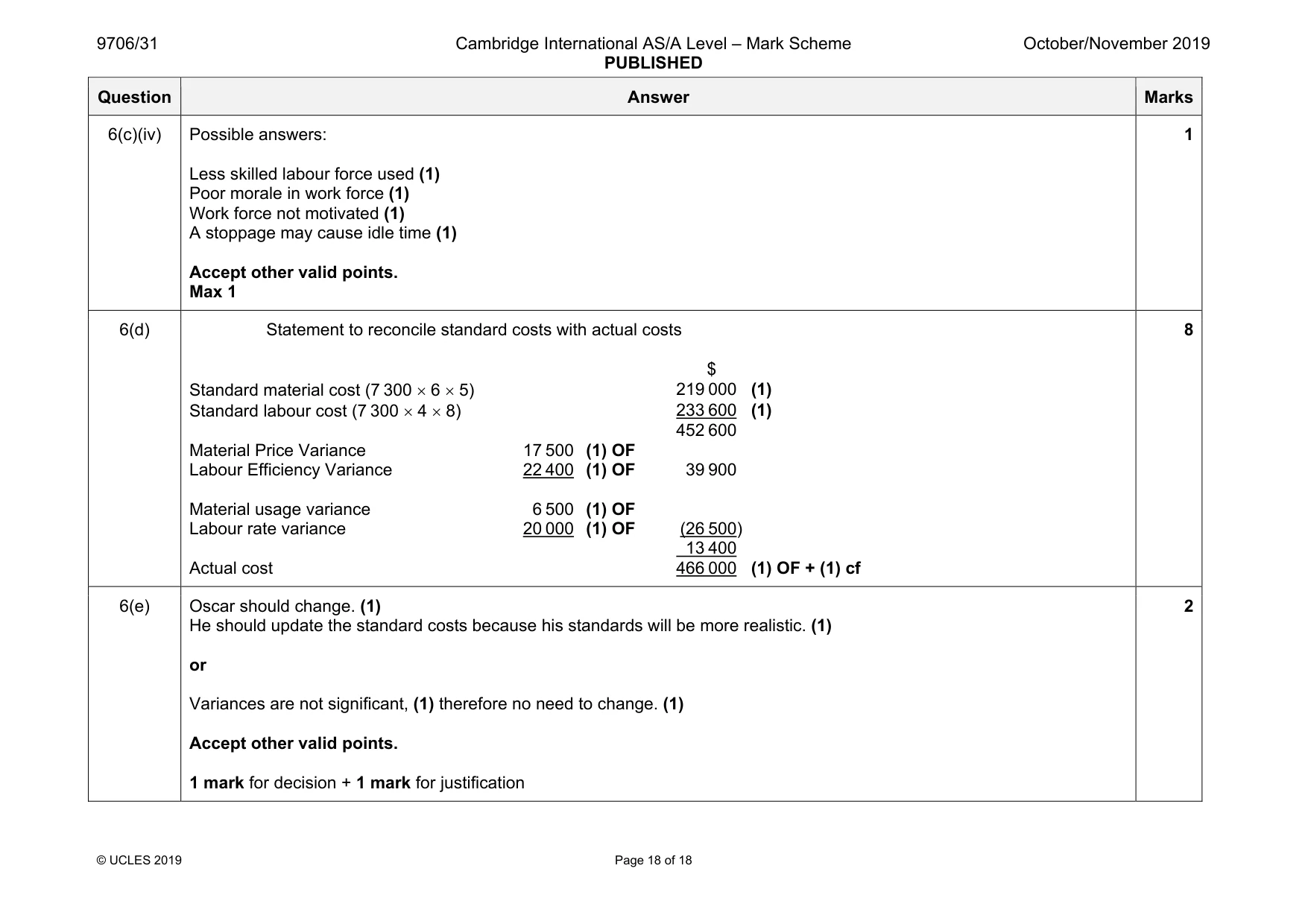
10 © UCLES 2019 9706/31/INSERT/O/N/19 Question 6 Source B2 Oscar runs a manufacturing business and operates a standard costing system. The following information relates to the year ended 31 March 2019. Budgeted Actual Production (units) 7500 7300 Material usage 6 kilos per unit 42 500 kilos Material cost $5 per kilo $230 000 Labour usage 4 hours per unit 32 000 hours Labour cost $8 per hour $236 000 Answer the following questions in the Question Paper. Questions are printed here for reference only. (a) State two disadvantages of operating a standard costing system. [2] (b) Calculate the following variances: (i) material price [2] (ii) material usage [2] (iii) labour rate [2] (iv) labour efficiency [2] (v) total labour. [1] (c) Identify one possible reason for each of the following variances calculated in part (b): (i) material price variance (ii) material usage variance (iii) labour rate variance (iv) labour efficiency variance. [4] (d) Prepare a statement to reconcile for actual production the standard labour and material costs with the actual costs. [8] Additional information Oscar has not changed his standard costs for three years. (e) Advise Oscar whether or not he should change his standard costs. Justify your answer. [2] [Total: 25]
Question paper, page 11
11 © UCLES 2019 9706/31/INSERT/O/N/19 BLANK PAGE
Question paper, page 12
12 Permission to reproduce items where third-party owned material protected by copyright is included has been sought and cleared where possible. Every reasonable effort has been made by the publisher (UCLES) to trace copyright holders, but if any items requiring clearance have unwittingly been included, the publisher will be pleased to make amends at the earliest possible opportunity. To avoid the issue of disclosure of answer-related information to candidates, all copyright acknowledgements are reproduced online in the Cambridge Assessment International Education Copyright Acknowledgements Booklet. This is produced for each series of examinations and is freely available to download at www.cambridgeinternational.org after the live examination series. Cambridge Assessment International Education is part of the Cambridge Assessment Group. Cambridge Assessment is the brand name of the University of Cambridge Local Examinations Syndicate (UCLES), which itself is a department of the University of Cambridge. © UCLES 2019 9706/31/INSERT/O/N/19 BLANK PAGE
Mark scheme, page 1
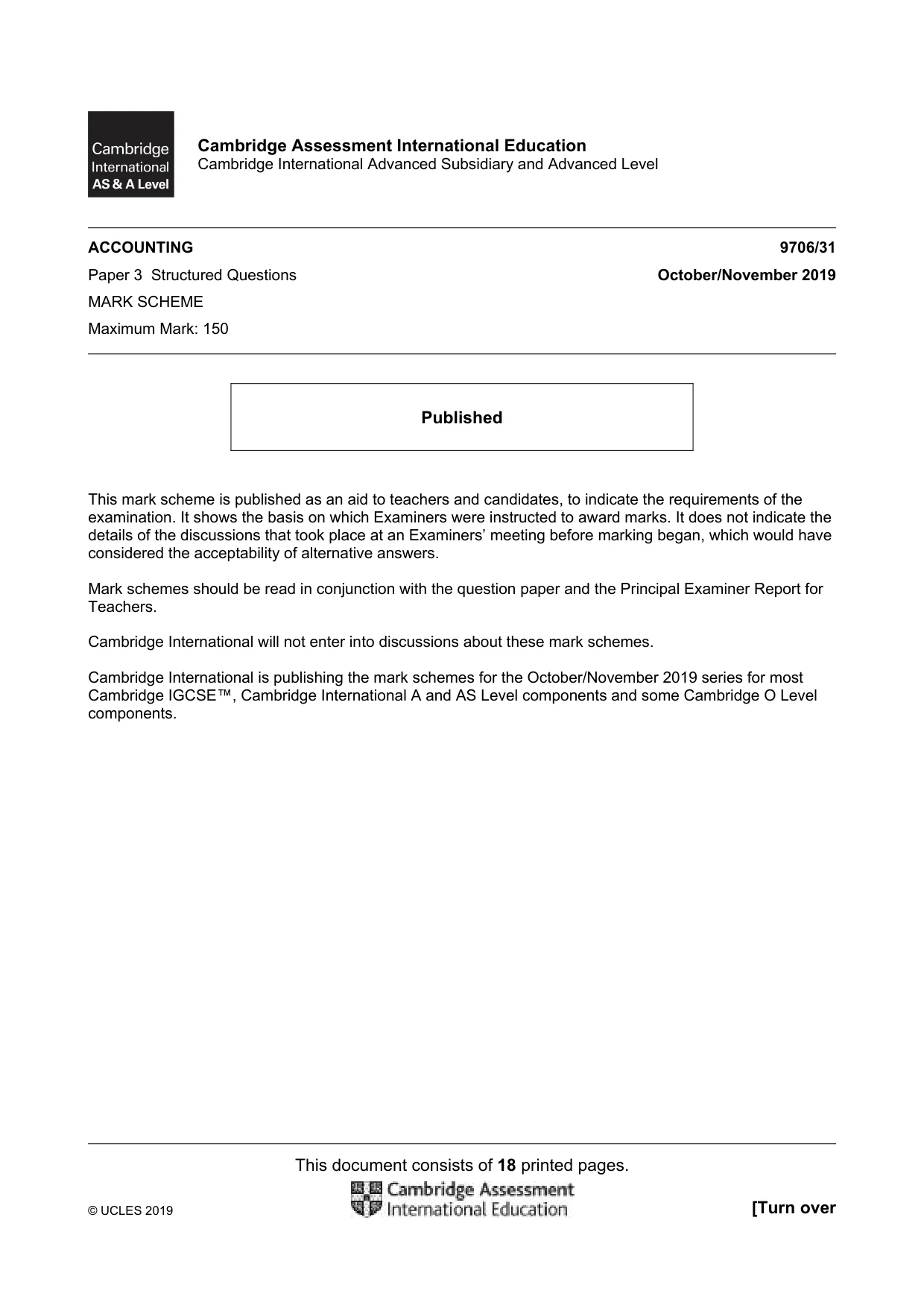
This document consists of 18 printed pages. © UCLES 2019 [Turn over Cambridge Assessment International Education Cambridge International Advanced Subsidiary and Advanced Level ACCOUNTING 9706/31 Paper 3 Structured Questions October/November 2019 MARK SCHEME Maximum Mark: 150 Published This mark scheme is published as an aid to teachers and candidates, to indicate the requirements of the examination. It shows the basis on which Examiners were instructed to award marks. It does not indicate the details of the discussions that took place at an Examiners’ meeting before marking began, which would have considered the acceptability of alternative answers. Mark schemes should be read in conjunction with the question paper and the Principal Examiner Report for Teachers. Cambridge International will not enter into discussions about these mark schemes. Cambridge International is publishing the mark schemes for the October/November 2019 series for most Cambridge IGCSE™, Cambridge International A and AS Level components and some Cambridge O Level components.
Mark scheme, page 2
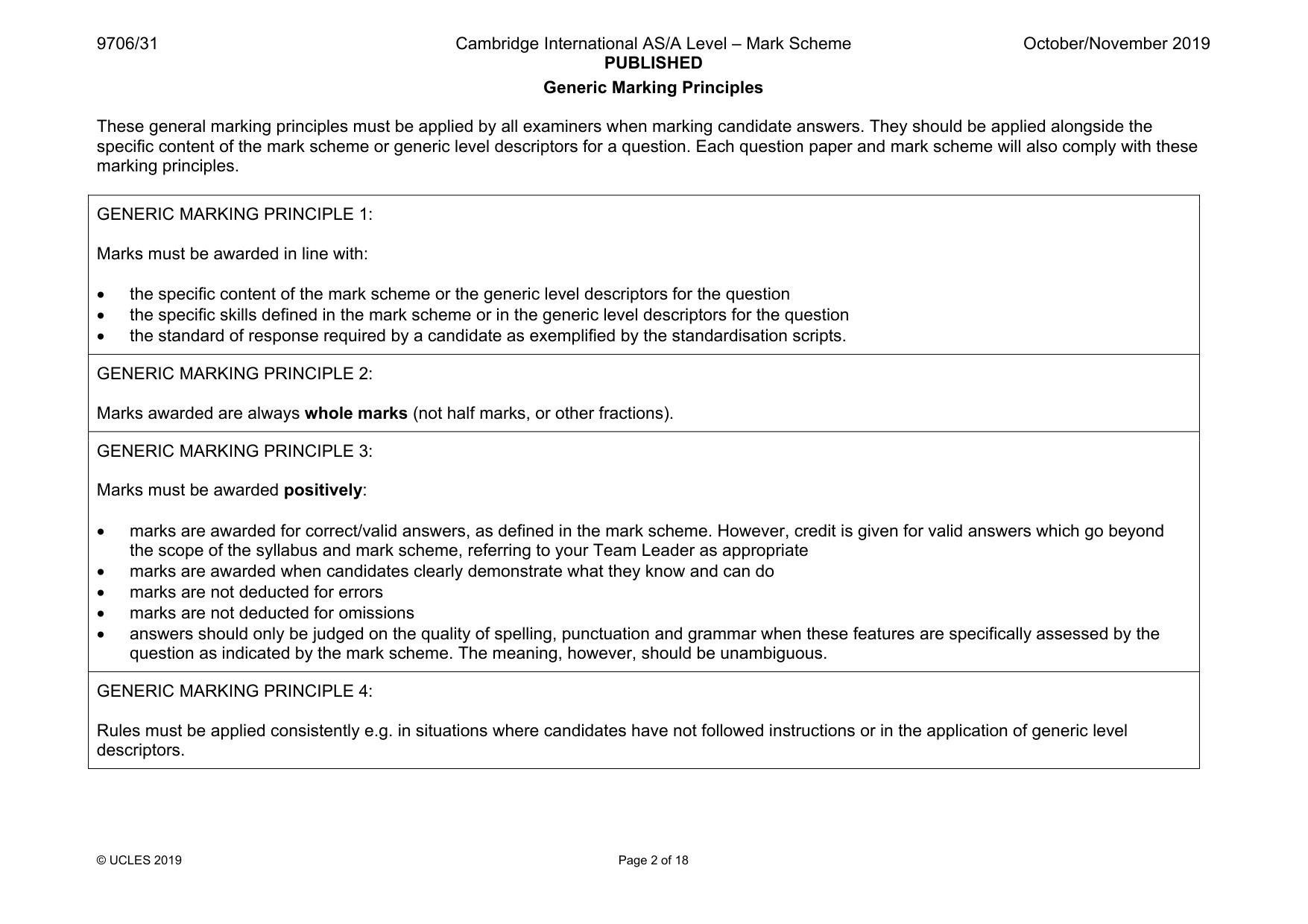
9706/31 Cambridge International AS/A Level – Mark Scheme PUBLISHED October/November 2019 © UCLES 2019 Page 2 of 18 Generic Marking Principles These general marking principles must be applied by all examiners when marking candidate answers. They should be applied alongside the specific content of the mark scheme or generic level descriptors for a question. Each question paper and mark scheme will also comply with these marking principles. GENERIC MARKING PRINCIPLE 1: Marks must be awarded in line with: • the specific content of the mark scheme or the generic level descriptors for the question • the specific skills defined in the mark scheme or in the generic level descriptors for the question • the standard of response required by a candidate as exemplified by the standardisation scripts. GENERIC MARKING PRINCIPLE 2: Marks awarded are always whole marks (not half marks, or other fractions). GENERIC MARKING PRINCIPLE 3: Marks must be awarded positively: • marks are awarded for correct/valid answers, as defined in the mark scheme. However, credit is given for valid answers which go beyond the scope of the syllabus and mark scheme, referring to your Team Leader as appropriate • marks are awarded when candidates clearly demonstrate what they know and can do • marks are not deducted for errors • marks are not deducted for omissions • answers should only be judged on the quality of spelling, punctuation and grammar when these features are specifically assessed by the question as indicated by the mark scheme. The meaning, however, should be unambiguous. GENERIC MARKING PRINCIPLE 4: Rules must be applied consistently e.g. in situations where candidates have not followed instructions or in the application of generic level descriptors.
Mark scheme, page 3
9706/31 Cambridge International AS/A Level – Mark Scheme PUBLISHED October/November 2019 © UCLES 2019 Page 3 of 18 GENERIC MARKING PRINCIPLE 5: Marks should be awarded using the full range of marks defined in the mark scheme for the question (however; the use of the full mark range may be limited according to the quality of the candidate responses seen). GENERIC MARKING PRINCIPLE 6: Marks awarded are based solely on the requirements as defined in the mark scheme. Marks should not be awarded with grade thresholds or grade descriptors in mind.
Mark scheme, page 4
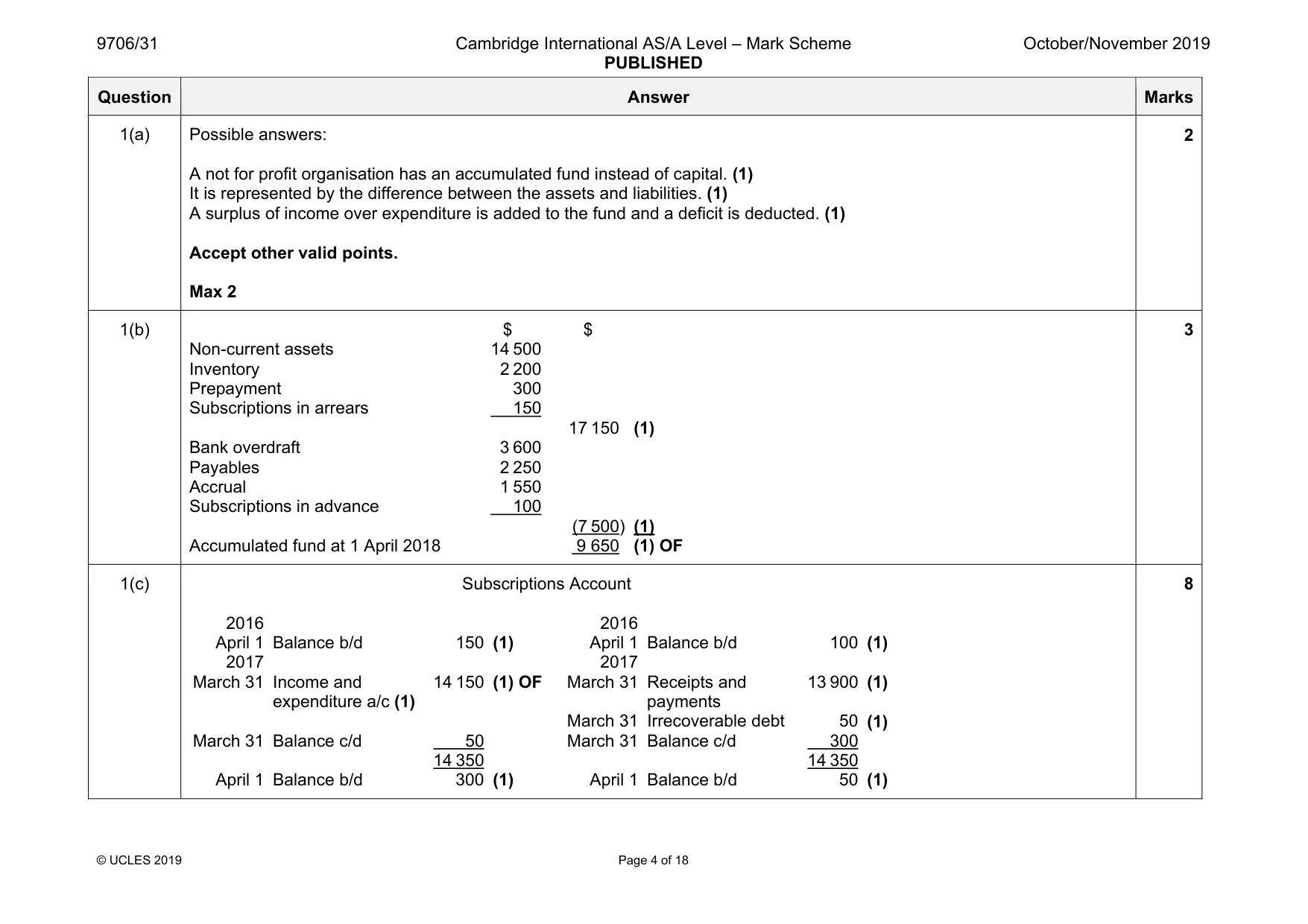
9706/31 Cambridge International AS/A Level – Mark Scheme PUBLISHED October/November 2019 © UCLES 2019 Page 4 of 18 Question Answer Marks 1(a) Possible answers: A not for profit organisation has an accumulated fund instead of capital. (1) It is represented by the difference between the assets and liabilities. (1) A surplus of income over expenditure is added to the fund and a deficit is deducted. (1) Accept other valid points. Max 2 2 1(b) $ $ Non-current assets 14 500 Inventory 2 200 Prepayment 300 Subscriptions in arrears 150 17 150 (1) Bank overdraft 3 600 Payables 2 250 Accrual 1 550 Subscriptions in advance 100 (7 500) (1) Accumulated fund at 1 April 2018 9 650 (1) OF 3 1(c) Subscriptions Account 2016 2016 April 1 Balance b/d 150 (1) April 1 Balance b/d 100 (1) 2017 2017 March 31 Income and expenditure a/c (1) 14 150 (1) OF March 31 Receipts and payments 13 900 (1) March 31 Irrecoverable debt 50 (1) March 31 Balance c/d 50 March 31 Balance c/d 300 14 350 14 350 April 1 Balance b/d 300 (1) April 1 Balance b/d 50 (1) 8
Mark scheme, page 5
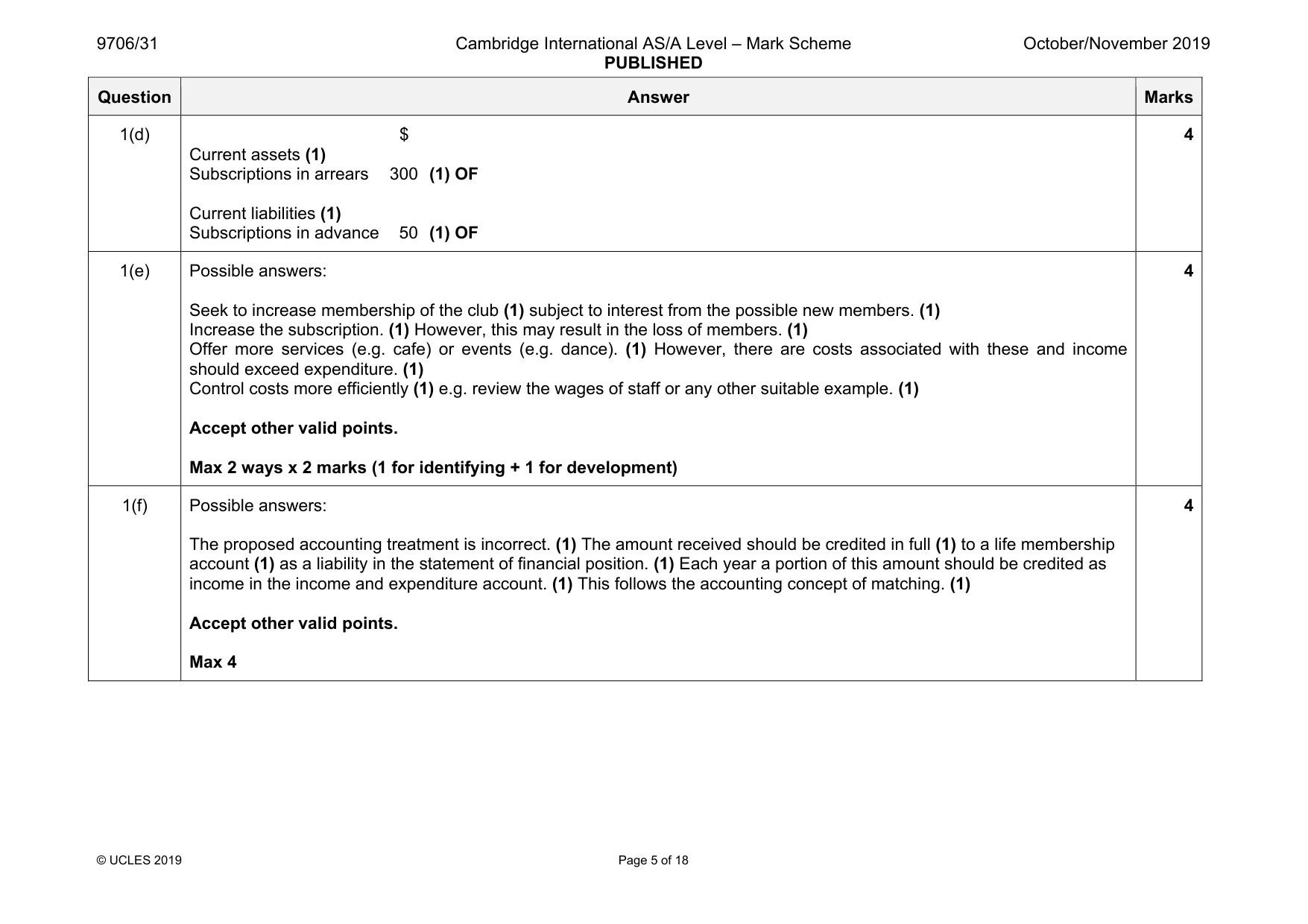
9706/31 Cambridge International AS/A Level – Mark Scheme PUBLISHED October/November 2019 © UCLES 2019 Page 5 of 18 Question Answer Marks 1(d) $ Current assets (1) Subscriptions in arrears 300 (1) OF Current liabilities (1) Subscriptions in advance 50 (1) OF 4 1(e) Possible answers: Seek to increase membership of the club (1) subject to interest from the possible new members. (1) Increase the subscription. (1) However, this may result in the loss of members. (1) Offer more services (e.g. cafe) or events (e.g. dance). (1) However, there are costs associated with these and income should exceed expenditure. (1) Control costs more efficiently (1) e.g. review the wages of staff or any other suitable example. (1) Accept other valid points. Max 2 ways x 2 marks (1 for identifying + 1 for development) 4 1(f) Possible answers: The proposed accounting treatment is incorrect. (1) The amount received should be credited in full (1) to a life membership account (1) as a liability in the statement of financial position. (1) Each year a portion of this amount should be credited as income in the income and expenditure account. (1) This follows the accounting concept of matching. (1) Accept other valid points. Max 4 4
Mark scheme, page 6
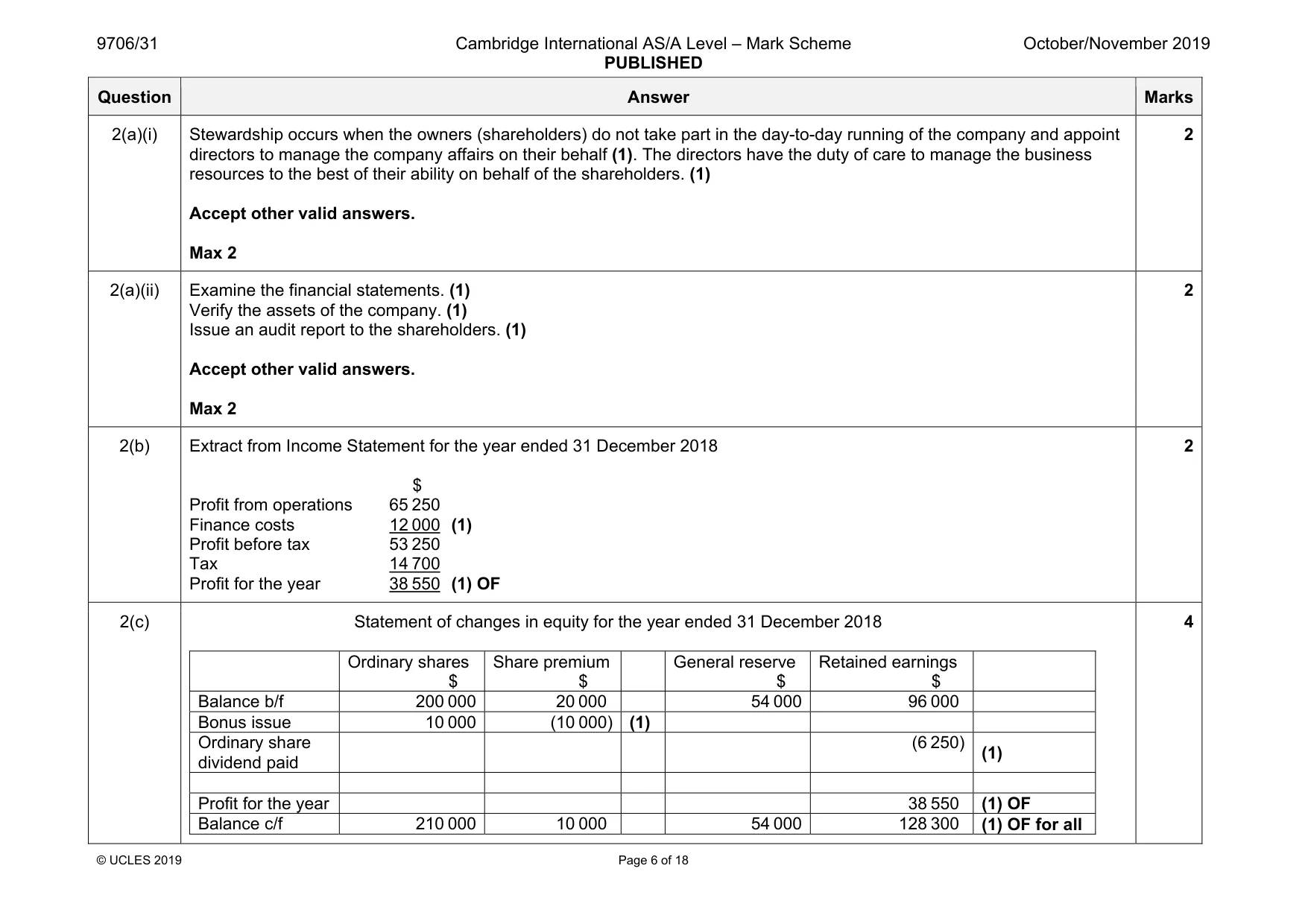
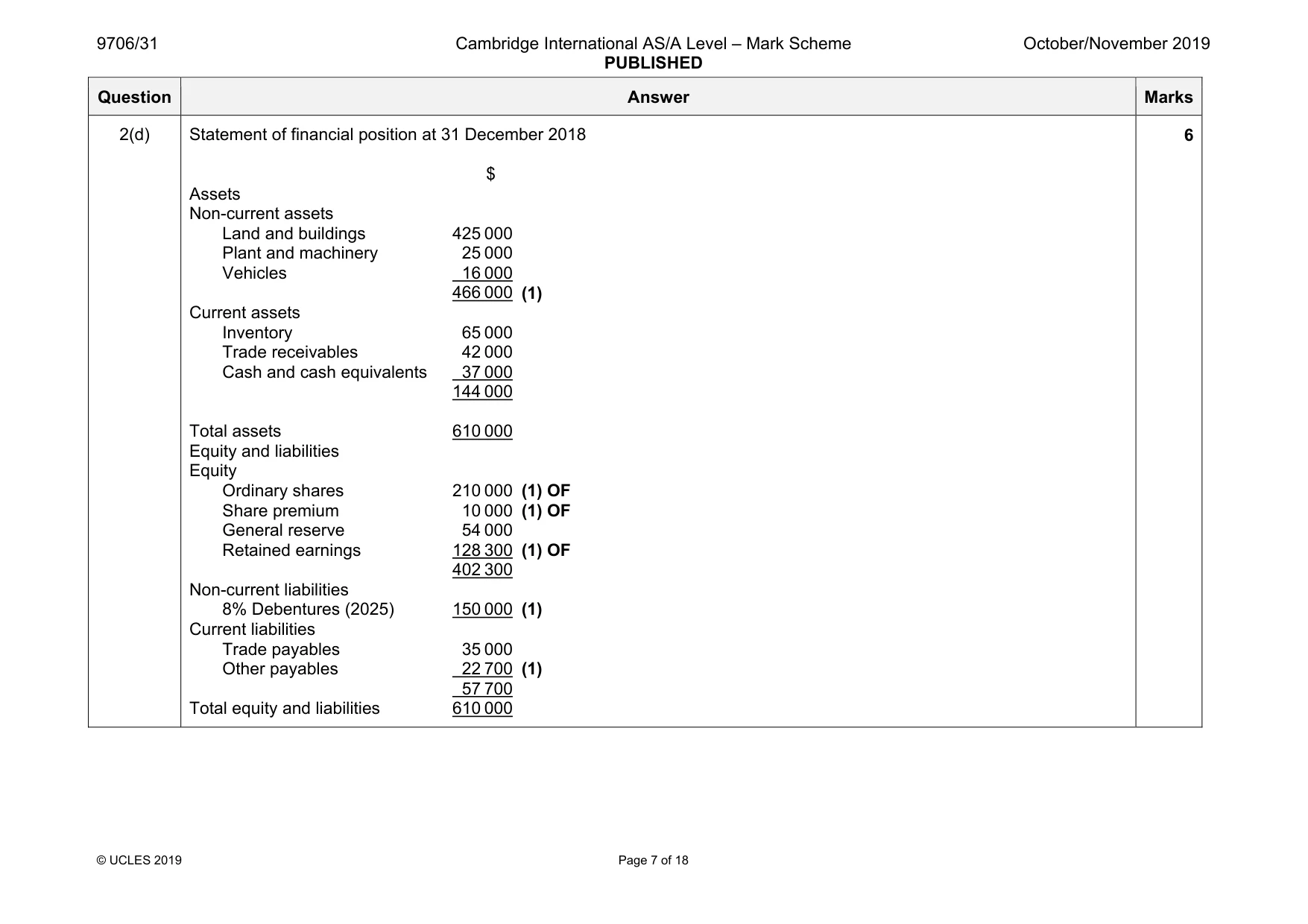
9706/31 Cambridge International AS/A Level – Mark Scheme PUBLISHED October/November 2019 © UCLES 2019 Page 6 of 18 Question Answer Marks 2(a)(i) Stewardship occurs when the owners (shareholders) do not take part in the day-to-day running of the company and appoint directors to manage the company affairs on their behalf (1). The directors have the duty of care to manage the business resources to the best of their ability on behalf of the shareholders. (1) Accept other valid answers. Max 2 2 2(a)(ii) Examine the financial statements. (1) Verify the assets of the company. (1) Issue an audit report to the shareholders. (1) Accept other valid answers. Max 2 2 2(b) Extract from Income Statement for the year ended 31 December 2018 $ Profit from operations 65 250 Finance costs 12 000 (1) Profit before tax 53 250 Tax 14 700 Profit for the year 38 550 (1) OF 2 2(c) Statement of changes in equity for the year ended 31 December 2018 Ordinary shares $ Share premium $ General reserve $ Retained earnings $ Balance b/f 200 000 20 000 54 000 96 000 Bonus issue 10 000 (10 000) (1) Ordinary share dividend paid (6 250) (1) Profit for the year 38 550 (1) OF Balance c/f 210 000 10 000 54 000 128 300 (1) OF for all 4
Mark scheme, page 7
9706/31 Cambridge International AS/A Level – Mark Scheme PUBLISHED October/November 2019 © UCLES 2019 Page 7 of 18 Question Answer Marks 2(d) Statement of financial position at 31 December 2018 $ Assets Non-current assets Land and buildings 425 000 Plant and machinery 25 000 Vehicles 16 000 466 000 (1) Current assets Inventory 65 000 Trade receivables 42 000 Cash and cash equivalents 37 000 144 000 Total assets 610 000 Equity and liabilities Equity Ordinary shares 210 000 (1) OF Share premium 10 000 (1) OF General reserve 54 000 Retained earnings 128 300 (1) OF 402 300 Non-current liabilities 8% Debentures (2025) 150 000 (1) Current liabilities Trade payables 35 000 Other payables 22 700 (1) 57 700 Total equity and liabilities 610 000 6
Mark scheme, page 8
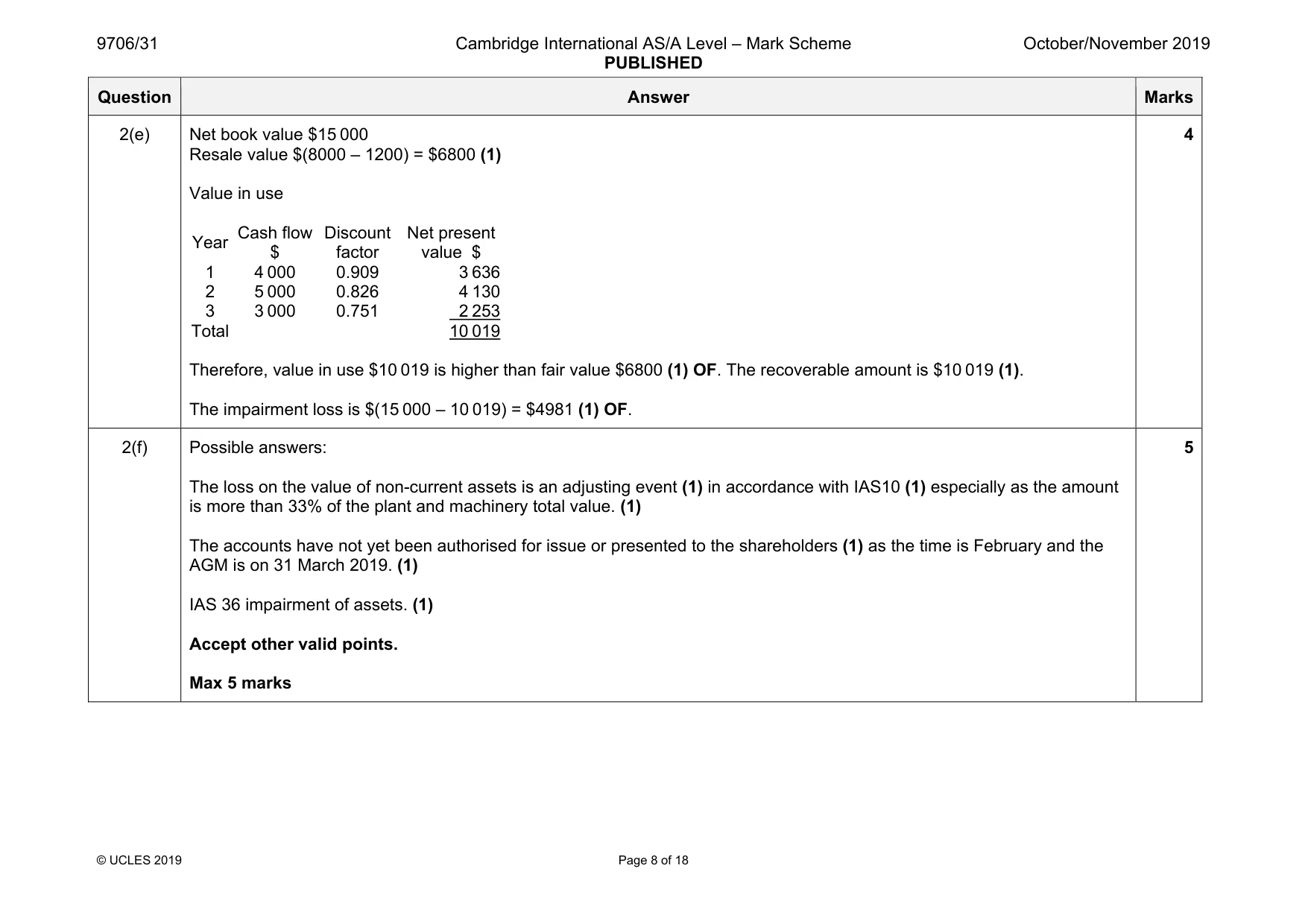
9706/31 Cambridge International AS/A Level – Mark Scheme PUBLISHED October/November 2019 © UCLES 2019 Page 8 of 18 Question Answer Marks 2(e) Net book value $15 000 Resale value $(8000 – 1200) = $6800 (1) Value in use Year Cash flow $ Discount factor Net present value $ 1 4 000 0.909 3 636 2 5 000 0.826 4 130 3 3 000 0.751 2 253 Total 10 019 Therefore, value in use $10 019 is higher than fair value $6800 (1) OF. The recoverable amount is $10 019 (1). The impairment loss is $(15 000 – 10 019) = $4981 (1) OF. 4 2(f) Possible answers: The loss on the value of non-current assets is an adjusting event (1) in accordance with IAS10 (1) especially as the amount is more than 33% of the plant and machinery total value. (1) The accounts have not yet been authorised for issue or presented to the shareholders (1) as the time is February and the AGM is on 31 March 2019. (1) IAS 36 impairment of assets. (1) Accept other valid points. Max 5 marks 5
Mark scheme, page 9
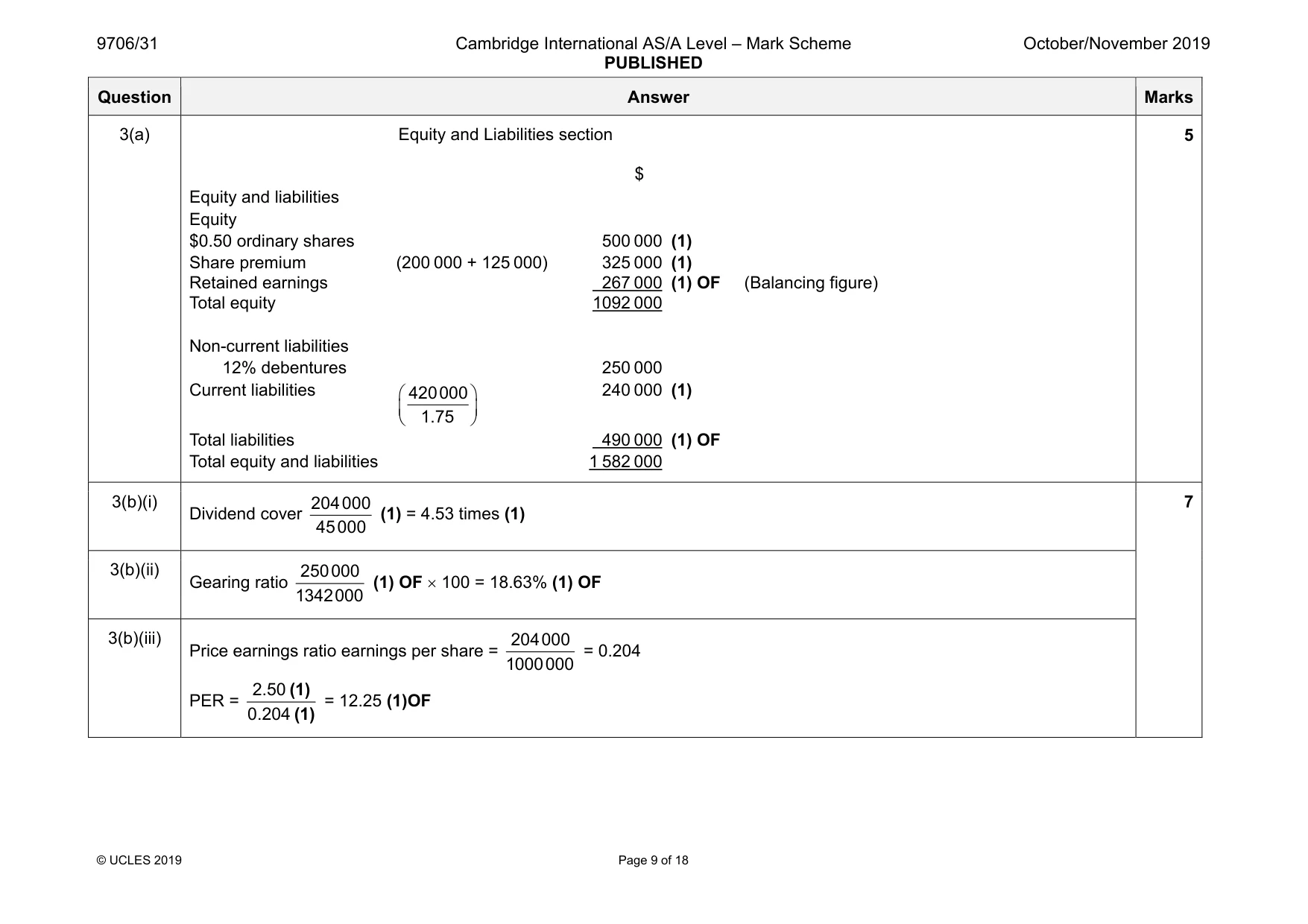
9706/31 Cambridge International AS/A Level – Mark Scheme PUBLISHED October/November 2019 © UCLES 2019 Page 9 of 18 Question Answer Marks 3(a) Equity and Liabilities section $ Equity and liabilities Equity $0.50 ordinary shares 500 000 (1) Share premium (200 000 + 125 000) 325 000 (1) Retained earnings 267 000 (1) OF (Balancing figure) Total equity 1092 000 Non-current liabilities 12% debentures 250 000 Current liabilities 420000 1.75 240 000 (1) Total liabilities 490 000 (1) OF Total equity and liabilities 1 582 000 5 3(b)(i) Dividend cover 204000 45000 (1) = 4.53 times (1) 7 3(b)(ii) Gearing ratio 250000 1342000 (1) OF × 100 = 18.63% (1) OF 3(b)(iii) Price earnings ratio earnings per share = 204000 1000000 = 0.204 PER = 2.50 0.204 (1) (1) = 12.25 (1)OF
Mark scheme, page 10
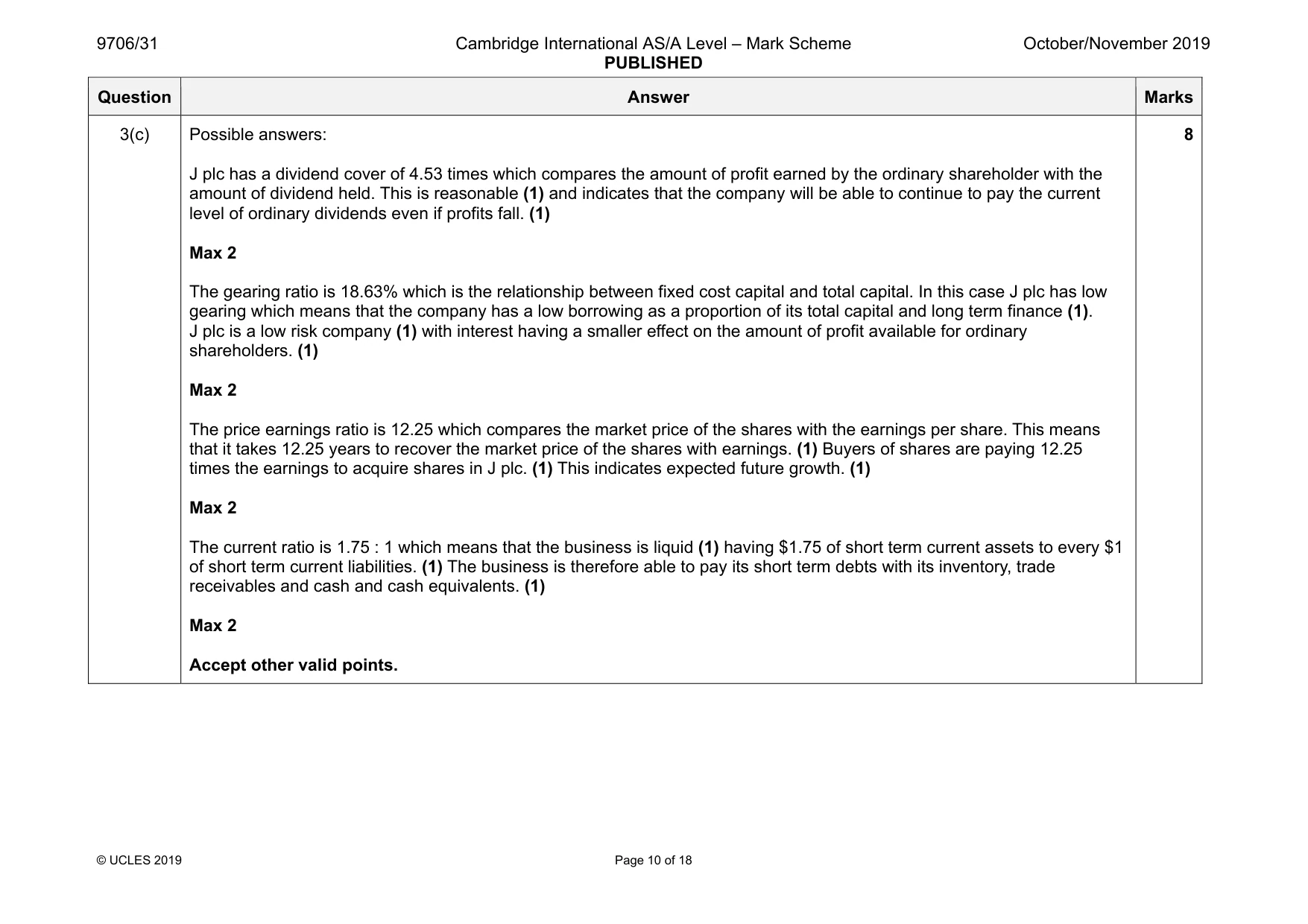
9706/31 Cambridge International AS/A Level – Mark Scheme PUBLISHED October/November 2019 © UCLES 2019 Page 10 of 18 Question Answer Marks 3(c) Possible answers: J plc has a dividend cover of 4.53 times which compares the amount of profit earned by the ordinary shareholder with the amount of dividend held. This is reasonable (1) and indicates that the company will be able to continue to pay the current level of ordinary dividends even if profits fall. (1) Max 2 The gearing ratio is 18.63% which is the relationship between fixed cost capital and total capital. In this case J plc has low gearing which means that the company has a low borrowing as a proportion of its total capital and long term finance (1). J plc is a low risk company (1) with interest having a smaller effect on the amount of profit available for ordinary shareholders. (1) Max 2 The price earnings ratio is 12.25 which compares the market price of the shares with the earnings per share. This means that it takes 12.25 years to recover the market price of the shares with earnings. (1) Buyers of shares are paying 12.25 times the earnings to acquire shares in J plc. (1) This indicates expected future growth. (1) Max 2 The current ratio is 1.75 : 1 which means that the business is liquid (1) having $1.75 of short term current assets to every $1 of short term current liabilities. (1) The business is therefore able to pay its short term debts with its inventory, trade receivables and cash and cash equivalents. (1) Max 2 Accept other valid points. 8
Mark scheme, page 11
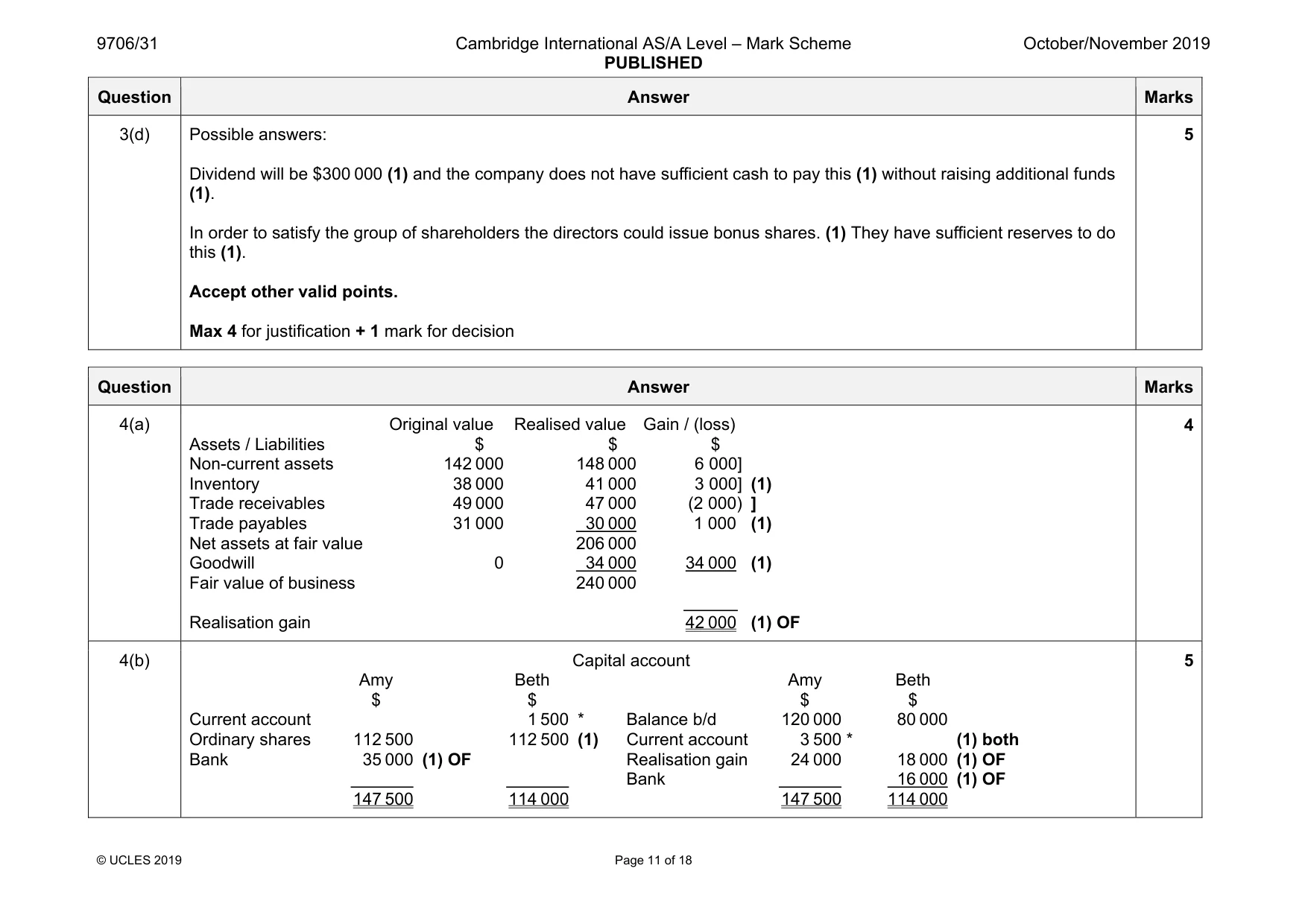
9706/31 Cambridge International AS/A Level – Mark Scheme PUBLISHED October/November 2019 © UCLES 2019 Page 11 of 18 Question Answer Marks 3(d) Possible answers: Dividend will be $300 000 (1) and the company does not have sufficient cash to pay this (1) without raising additional funds (1). In order to satisfy the group of shareholders the directors could issue bonus shares. (1) They have sufficient reserves to do this (1). Accept other valid points. Max 4 for justification + 1 mark for decision 5 Question Answer Marks 4(a) Assets / Liabilities Original value $ Realised value $ Gain / (loss) $ Non-current assets 142 000 148 000 6 000] Inventory 38 000 41 000 3 000] (1) Trade receivables 49 000 47 000 (2 000) ] Trade payables 31 000 30 000 1 000 (1) Net assets at fair value 206 000 Goodwill 0 34 000 34 000 (1) Fair value of business 240 000 Realisation gain 42 000 (1) OF 4 4(b) Capital account Amy Beth Amy Beth $ $ $ $ Current account 1 500 * Balance b/d 120 000 80 000 Ordinary shares 112 500 112 500 (1) Current account 3 500 * (1) both Bank 35 000 (1) OF Realisation gain 24 000 18 000 (1) OF Bank 16 000 (1) OF 147 500 114 000 147 500 114 000 5
Mark scheme, page 12
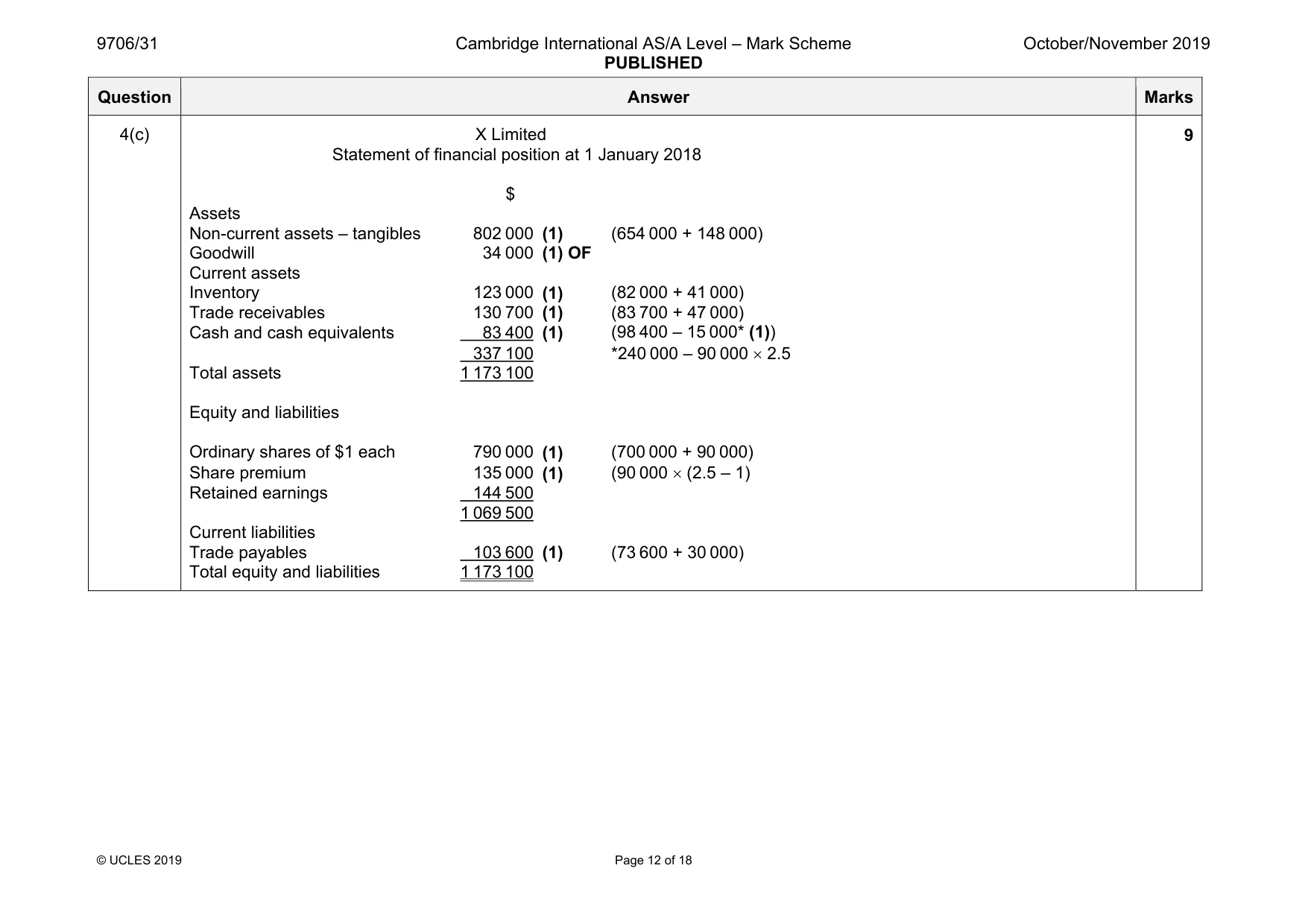
9706/31 Cambridge International AS/A Level – Mark Scheme PUBLISHED October/November 2019 © UCLES 2019 Page 12 of 18 Question Answer Marks 4(c) X Limited Statement of financial position at 1 January 2018 $ Assets Non-current assets – tangibles 802 000 (1) (654 000 + 148 000) Goodwill 34 000 (1) OF Current assets Inventory 123 000 (1) (82 000 + 41 000) Trade receivables 130 700 (1) (83 700 + 47 000) Cash and cash equivalents 83 400 (1) (98 400 – 15 000* (1)) 337 100 *240 000 – 90 000 × 2.5 Total assets 1 173 100 Equity and liabilities Ordinary shares of $1 each 790 000 (1) (700 000 + 90 000) Share premium 135 000 (1) (90 000 × (2.5 – 1) Retained earnings 144 500 1 069 500 Current liabilities Trade payables 103 600 (1) (73 600 + 30 000) Total equity and liabilities 1 173 100 9
Mark scheme, page 13
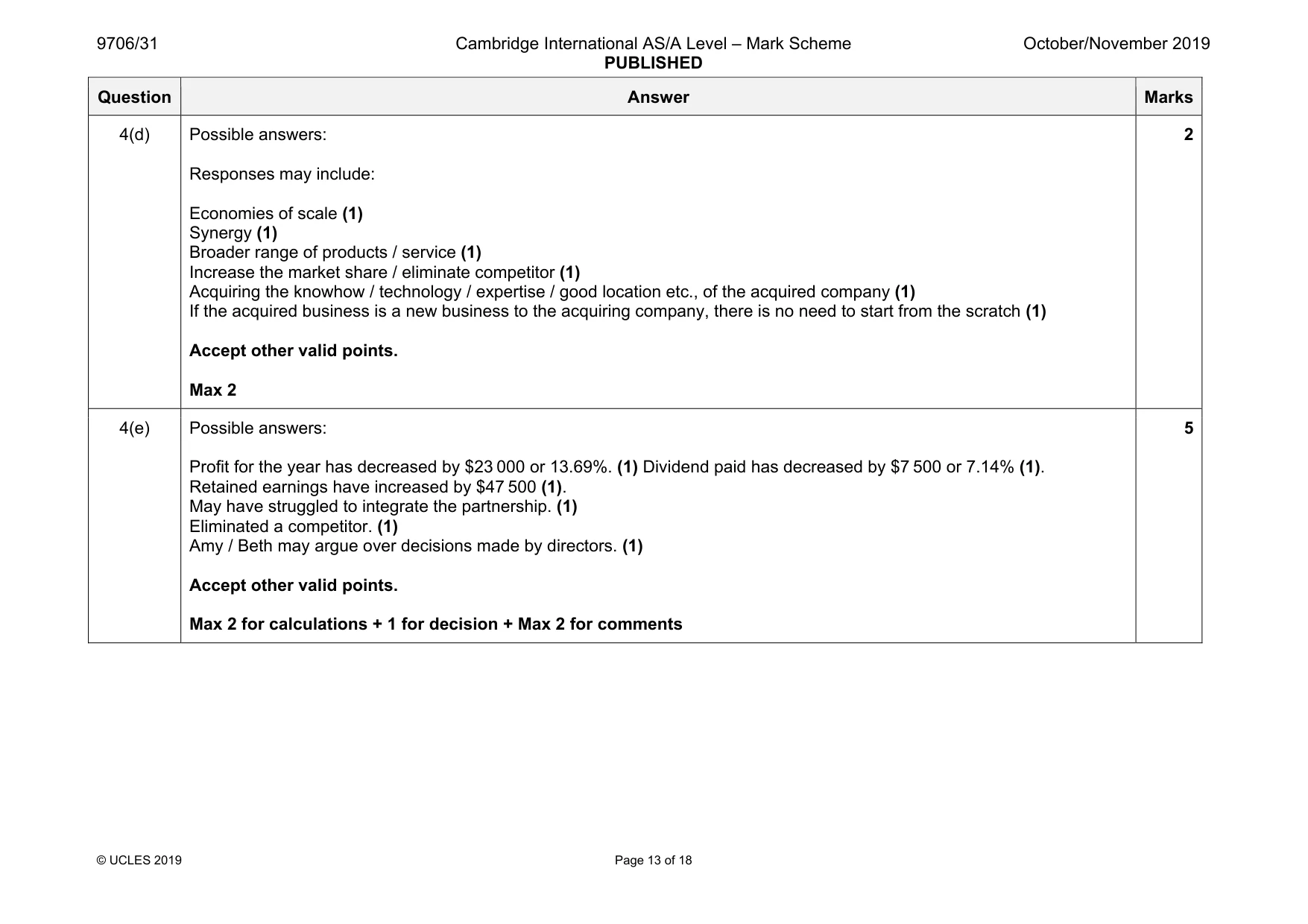
9706/31 Cambridge International AS/A Level – Mark Scheme PUBLISHED October/November 2019 © UCLES 2019 Page 13 of 18 Question Answer Marks 4(d) Possible answers: Responses may include: Economies of scale (1) Synergy (1) Broader range of products / service (1) Increase the market share / eliminate competitor (1) Acquiring the knowhow / technology / expertise / good location etc., of the acquired company (1) If the acquired business is a new business to the acquiring company, there is no need to start from the scratch (1) Accept other valid points. Max 2 2 4(e) Possible answers: Profit for the year has decreased by $23 000 or 13.69%. (1) Dividend paid has decreased by $7 500 or 7.14% (1). Retained earnings have increased by $47 500 (1). May have struggled to integrate the partnership. (1) Eliminated a competitor. (1) Amy / Beth may argue over decisions made by directors. (1) Accept other valid points. Max 2 for calculations + 1 for decision + Max 2 for comments 5
Mark scheme, page 14
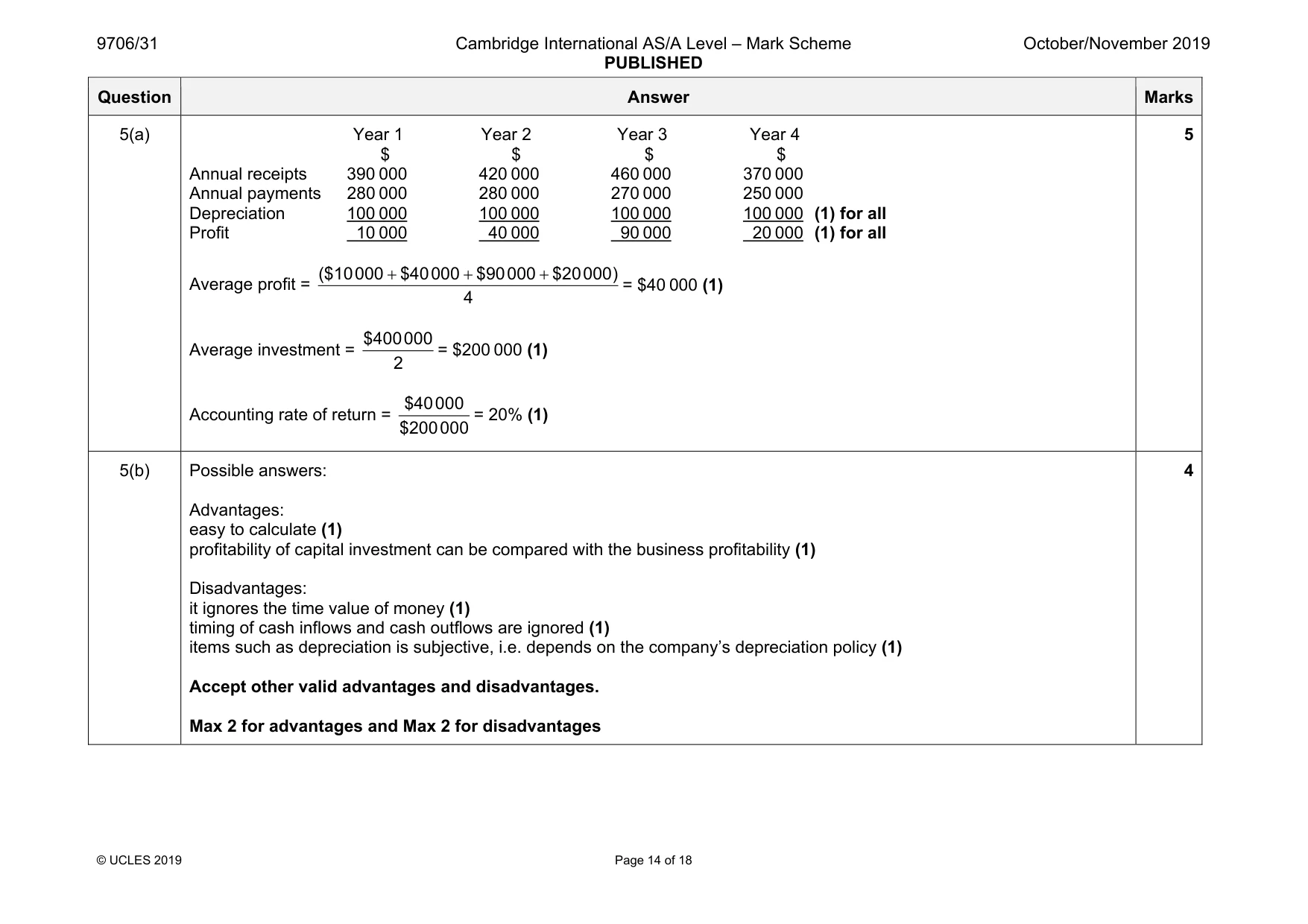
9706/31 Cambridge International AS/A Level – Mark Scheme PUBLISHED October/November 2019 © UCLES 2019 Page 14 of 18 Question Answer Marks 5(a) Year 1 Year 2 Year 3 Year 4 $ $ $ $ Annual receipts 390 000 420 000 460 000 370 000 Annual payments 280 000 280 000 270 000 250 000 Depreciation 100 000 100 000 100 000 100 000 (1) for all Profit 10 000 40 000 90 000 20 000 (1) for all Average profit = ($10000 $40000 $90000 $20000) 4 + + + = $40 000 (1) Average investment = $400000 2 = $200 000 (1) Accounting rate of return = $40000 $200000 = 20% (1) 5 5(b) Possible answers: Advantages: easy to calculate (1) profitability of capital investment can be compared with the business profitability (1) Disadvantages: it ignores the time value of money (1) timing of cash inflows and cash outflows are ignored (1) items such as depreciation is subjective, i.e. depends on the company’s depreciation policy (1) Accept other valid advantages and disadvantages. Max 2 for advantages and Max 2 for disadvantages 4
Mark scheme, page 15
9706/31 Cambridge International AS/A Level – Mark Scheme PUBLISHED October/November 2019 © UCLES 2019 Page 15 of 18 Question Answer Marks 5(c) Discount Inflows Outflows Net factor 10% PV $ $ $ $ $ Year 0 400 000 1 (400 000) Year 1 390 000 280 000 110 000 0.909 99 990 (1) Year 2 420 000 280 000 140 000 0.826 115 640 (1) Year 3 460 000 270 000 190 000 0.751 142 690 (1) Year 4 370 000 250 000 120 000 0.683 81 960 (1) NPV 40 280 (1) 5 5(d) 10% (16% 10%) 40280 (40280 13130) + − × + (1) OF (1) OF = 14.52% (1) OF 3 5(e) P Limited should purchase Machine X because: It has higher NPV (1) but ARR is lower than Machine Y. (1) IRR exceeds the required IRR of 13% for both machines but is greater for X. (1) Initial capital investment is lower. (1) Accept other valid points. Max 4 marks for reasons and 1 mark for decision 5 5(f) Annual receipts = $100000 2.486 (1) = $44 248 (1) Annual receipts = $44 248 + $45 000 = $89 248 (1) OF 3
Mark scheme, page 16
9706/31 Cambridge International AS/A Level – Mark Scheme PUBLISHED October/November 2019 © UCLES 2019 Page 16 of 18 Question Answer Marks 6(a) Possible answers: Not suitable if product is not uniform. (1) May be difficult to ascertain standard costs. (1) Costly. (1) Time consuming. (1) Max 2 Accept other valid points. 2 6(b)(i) Material price variance = 230 000 – 212 500 = $17 500 (A) (2) 1 mark for amount + 1 mark for direction 2 6(b)(ii) Material usage variance = (42 500 – 43 800) × 5 = $6 500 (F) (2) 1 mark for amount + 1 mark for direction 2 6(b)(iii) Labour rate variance = 236 000 – 256 000 = $20 000 (F) (2) 1 mark for amount + 1 mark for direction 2 6(b)(iv) Labour efficiency variance = (32 000 – 29 200) × 8 = $22 400 (A) (2) 1 mark for amount + 1 mark for direction 2 6(b)(v) Total labour variance = $2 400 (A) (1) OF 1
Mark scheme, page 17
9706/31 Cambridge International AS/A Level – Mark Scheme PUBLISHED October/November 2019 © UCLES 2019 Page 17 of 18 Question Answer Marks 6(c)(i) Possible answers: Shortage of material forcing price up (1). Different supplier (1). Higher quality material (1). Higher transportation costs (1). Accept other valid points. Max 1 1 6(c)(ii) Possible answers: Higher quality materials used (1) More skilled labour force used (1) More efficient machinery used (1) Accept other valid points. Max 1 1 6(c)(iii) Possible answers: Less skilled labour force used (1) Labour rate in the market may have fallen (1) Standard cost may be set too high (1) Accept other valid points. Max 1 1
Mark scheme, page 18
9706/31 Cambridge International AS/A Level – Mark Scheme PUBLISHED October/November 2019 © UCLES 2019 Page 18 of 18 Question Answer Marks 6(c)(iv) Possible answers: Less skilled labour force used (1) Poor morale in work force (1) Work force not motivated (1) A stoppage may cause idle time (1) Accept other valid points. Max 1 1 6(d) Statement to reconcile standard costs with actual costs $ Standard material cost (7 300 × 6 × 5) 219 000 (1) Standard labour cost (7 300 × 4 × 8) 233 600 (1) 452 600 Material Price Variance 17 500 (1) OF Labour Efficiency Variance 22 400 (1) OF 39 900 Material usage variance 6 500 (1) OF Labour rate variance 20 000 (1) OF (26 500) 13 400 Actual cost 466 000 (1) OF + (1) cf 8 6(e) Oscar should change. (1) He should update the standard costs because his standards will be more realistic. (1) or Variances are not significant, (1) therefore no need to change. (1) Accept other valid points. 1 mark for decision + 1 mark for justification 2
What you needed in this session
Cambridge’s own grade thresholds for 2019 Oct/Nov, Paper 3 · Variant 1. A higher threshold means an easier paper — the bar moves with how the cohort did.