Cambridge A Level Accounting 9706 — 2019 Oct/Nov Paper 3 · Variant 2
9706/32/O/N/19 · 150 marks · ≈169 min
The question paper and its mark scheme, free to read here and free to download. This is Cambridge’s own paper, exactly as it was sat.
Question paper12 pages
Mark scheme20 pages
Answers below. Sit the paper first if you are practising.
Paper as text
Question paper, page 1
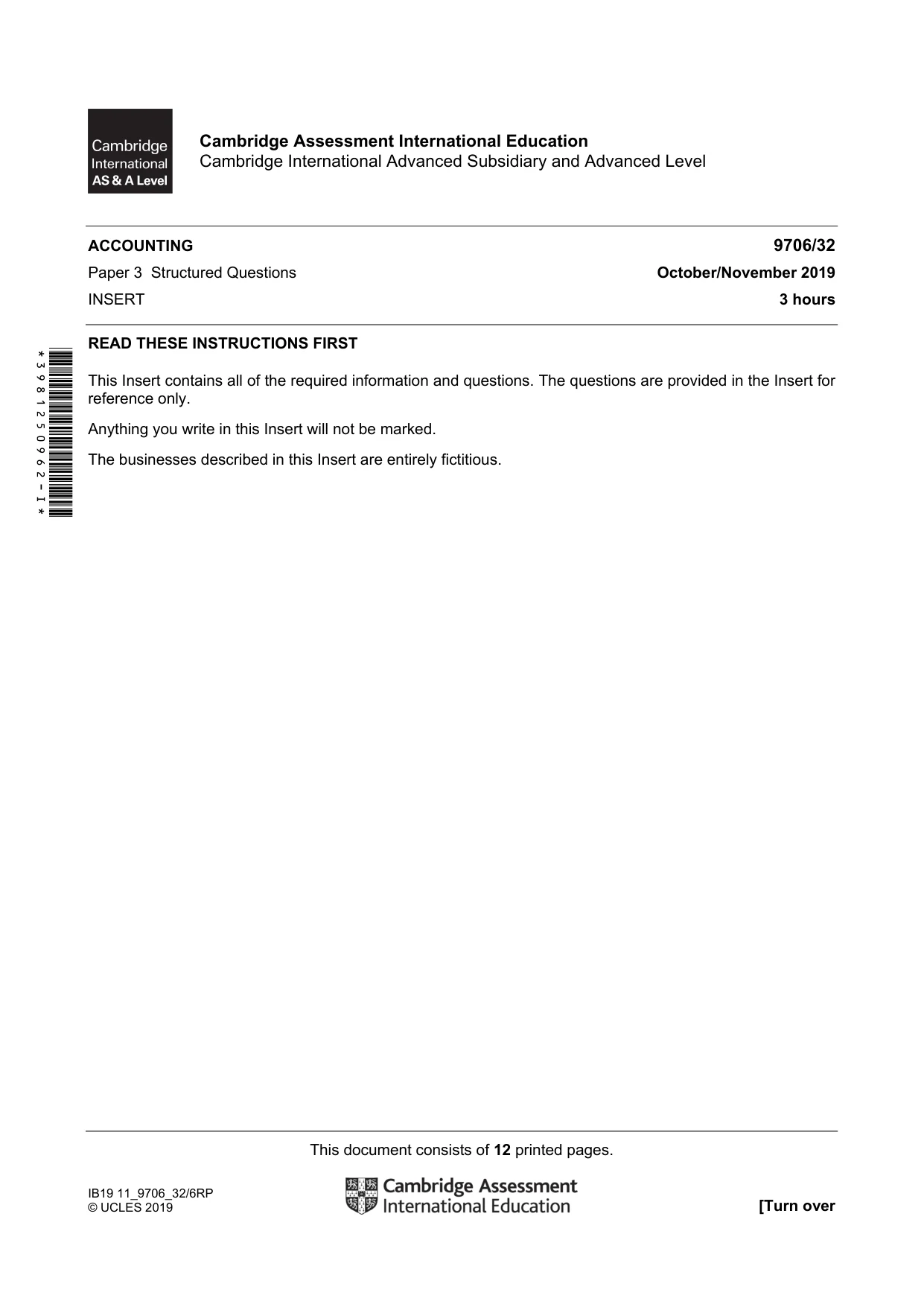
This document consists of 12 printed pages. IB19 11_9706_32/6RP © UCLES 2019 [Turn over Cambridge Assessment International Education Cambridge International Advanced Subsidiary and Advanced Level ACCOUNTING 9706/32 Paper 3 Structured Questions October/November 2019 INSERT 3 hours READ THESE INSTRUCTIONS FIRST This Insert contains all of the required information and questions. The questions are provided in the Insert for reference only. Anything you write in this Insert will not be marked. The businesses described in this Insert are entirely fictitious.
Question paper, page 2
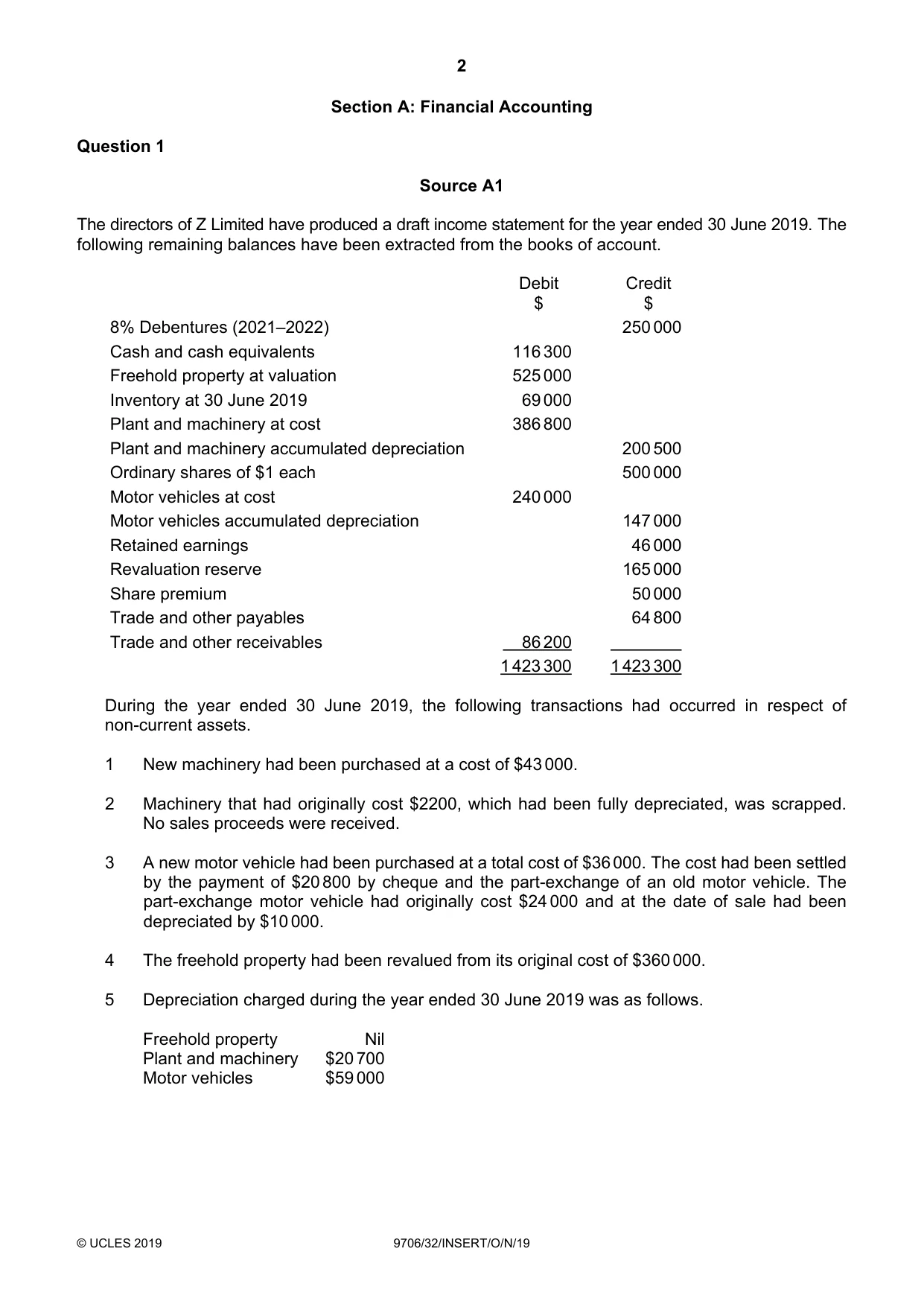
2 © UCLES 2019 9706/32/INSERT/O/N/19 Section A: Financial Accounting Question 1 Source A1 The directors of Z Limited have produced a draft income statement for the year ended 30 June 2019. The following remaining balances have been extracted from the books of account. Debit $ Credit $ 8% Debentures (2021–2022) 250 000 Cash and cash equivalents 116 300 Freehold property at valuation 525 000 Inventory at 30 June 2019 69 000 Plant and machinery at cost 386 800 Plant and machinery accumulated depreciation 200 500 Ordinary shares of $1 each 500 000 Motor vehicles at cost 240 000 Motor vehicles accumulated depreciation 147 000 Retained earnings 46 000 Revaluation reserve 165 000 Share premium 50 000 Trade and other payables 64 800 Trade and other receivables 86 200 1 423 300 1 423 300 During the year ended 30 June 2019, the following transactions had occurred in respect of non-current assets. 1 New machinery had been purchased at a cost of $43 000. 2 Machinery that had originally cost $2200, which had been fully depreciated, was scrapped. No sales proceeds were received. 3 A new motor vehicle had been purchased at a total cost of $36 000. The cost had been settled by the payment of $20 800 by cheque and the part-exchange of an old motor vehicle. The part-exchange motor vehicle had originally cost $24 000 and at the date of sale had been depreciated by $10 000. 4 The freehold property had been revalued from its original cost of $360 000. 5 Depreciation charged during the year ended 30 June 2019 was as follows. Freehold property Nil Plant and machinery $20 700 Motor vehicles $59 000
Question paper, page 3
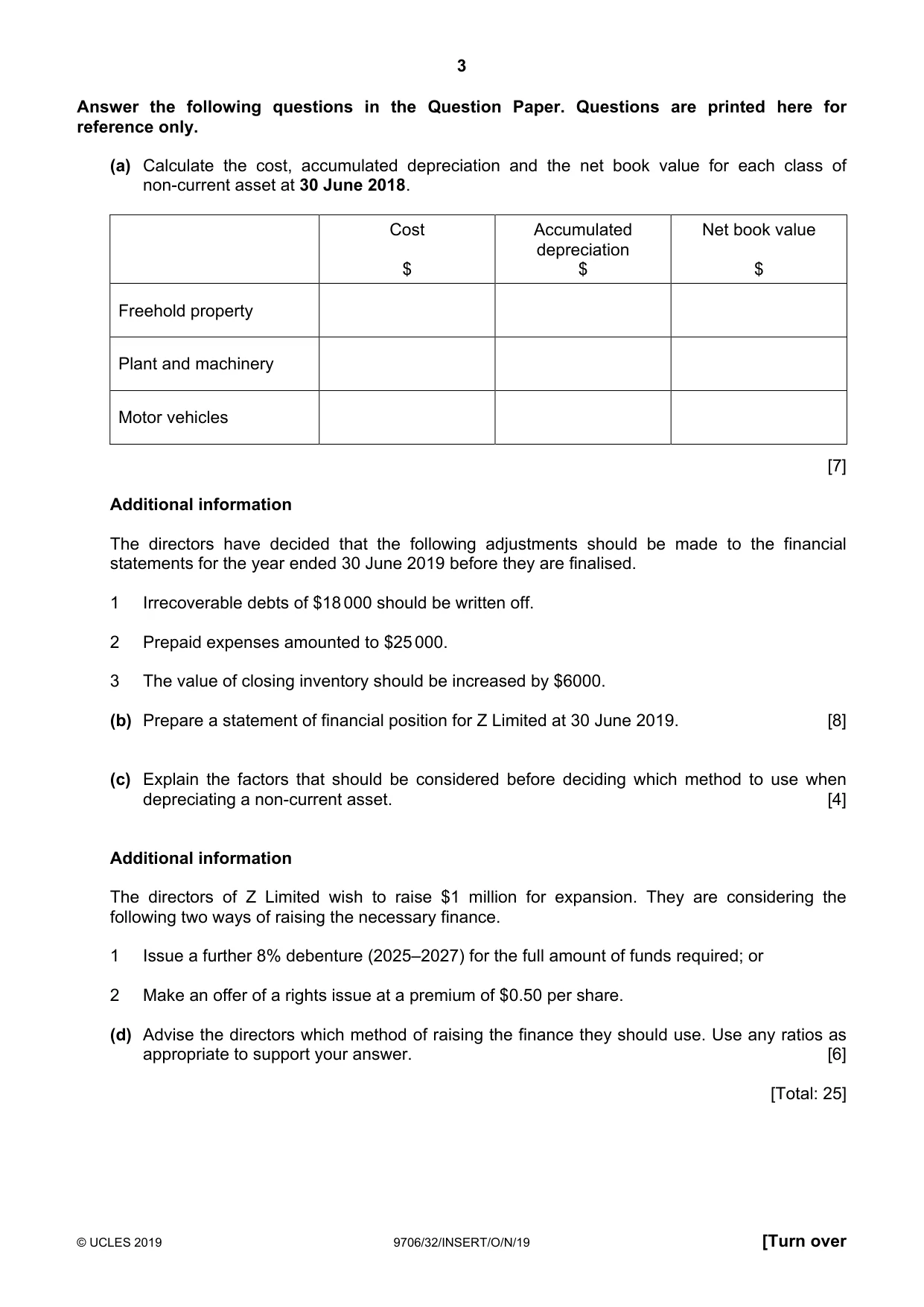
3 © UCLES 2019 9706/32/INSERT/O/N/19 [Turn over Answer the following questions in the Question Paper. Questions are printed here for reference only. (a) Calculate the cost, accumulated depreciation and the net book value for each class of non-current asset at 30 June 2018. Cost $ Accumulated depreciation $ Net book value $ Freehold property Plant and machinery Motor vehicles [7] Additional information The directors have decided that the following adjustments should be made to the financial statements for the year ended 30 June 2019 before they are finalised. 1 Irrecoverable debts of $18 000 should be written off. 2 Prepaid expenses amounted to $25 000. 3 The value of closing inventory should be increased by $6000. (b) Prepare a statement of financial position for Z Limited at 30 June 2019. [8] (c) Explain the factors that should be considered before deciding which method to use when depreciating a non-current asset. [4] Additional information The directors of Z Limited wish to raise $1 million for expansion. They are considering the following two ways of raising the necessary finance. 1 Issue a further 8% debenture (2025–2027) for the full amount of funds required; or 2 Make an offer of a rights issue at a premium of $0.50 per share. (d) Advise the directors which method of raising the finance they should use. Use any ratios as appropriate to support your answer. [6] [Total: 25]
Question paper, page 4
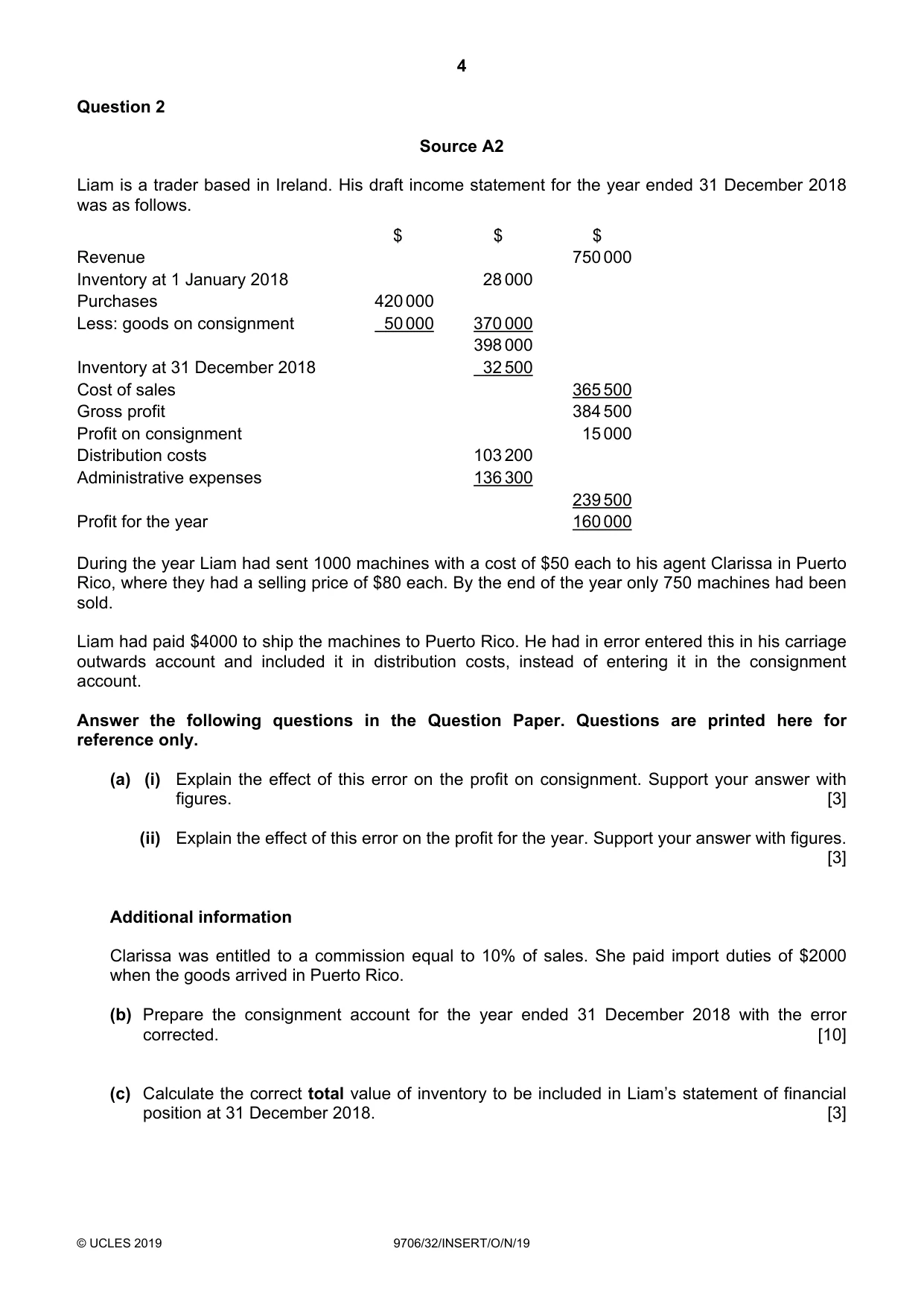
4 © UCLES 2019 9706/32/INSERT/O/N/19 Question 2 Source A2 Liam is a trader based in Ireland. His draft income statement for the year ended 31 December 2018 was as follows. $ $ $ Revenue 750 000 Inventory at 1 January 2018 28 000 Purchases 420 000 Less: goods on consignment 50 000 370 000 398 000 Inventory at 31 December 2018 32 500 Cost of sales 365 500 Gross profit 384 500 Profit on consignment 15 000 Distribution costs 103 200 Administrative expenses 136 300 239 500 Profit for the year 160 000 During the year Liam had sent 1000 machines with a cost of $50 each to his agent Clarissa in Puerto Rico, where they had a selling price of $80 each. By the end of the year only 750 machines had been sold. Liam had paid $4000 to ship the machines to Puerto Rico. He had in error entered this in his carriage outwards account and included it in distribution costs, instead of entering it in the consignment account. Answer the following questions in the Question Paper. Questions are printed here for reference only. (a) (i) Explain the effect of this error on the profit on consignment. Support your answer with figures. [3] (ii) Explain the effect of this error on the profit for the year. Support your answer with figures. [3] Additional information Clarissa was entitled to a commission equal to 10% of sales. She paid import duties of $2000 when the goods arrived in Puerto Rico. (b) Prepare the consignment account for the year ended 31 December 2018 with the error corrected. [10] (c) Calculate the correct total value of inventory to be included in Liam’s statement of financial position at 31 December 2018. [3]
Question paper, page 5
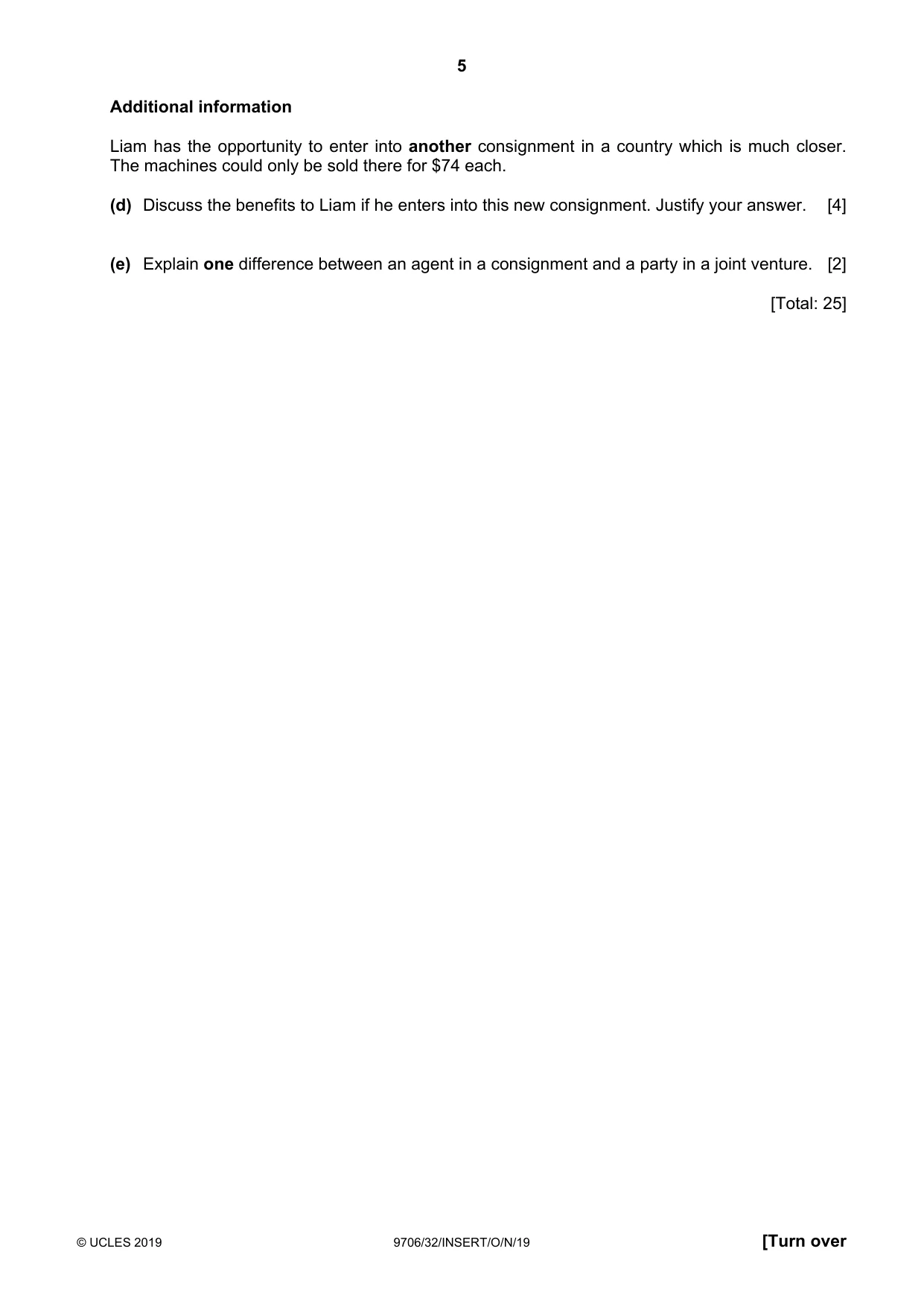
5 © UCLES 2019 9706/32/INSERT/O/N/19 [Turn over Additional information Liam has the opportunity to enter into another consignment in a country which is much closer. The machines could only be sold there for $74 each. (d) Discuss the benefits to Liam if he enters into this new consignment. Justify your answer. [4] (e) Explain one difference between an agent in a consignment and a party in a joint venture. [2] [Total: 25]
Question paper, page 6
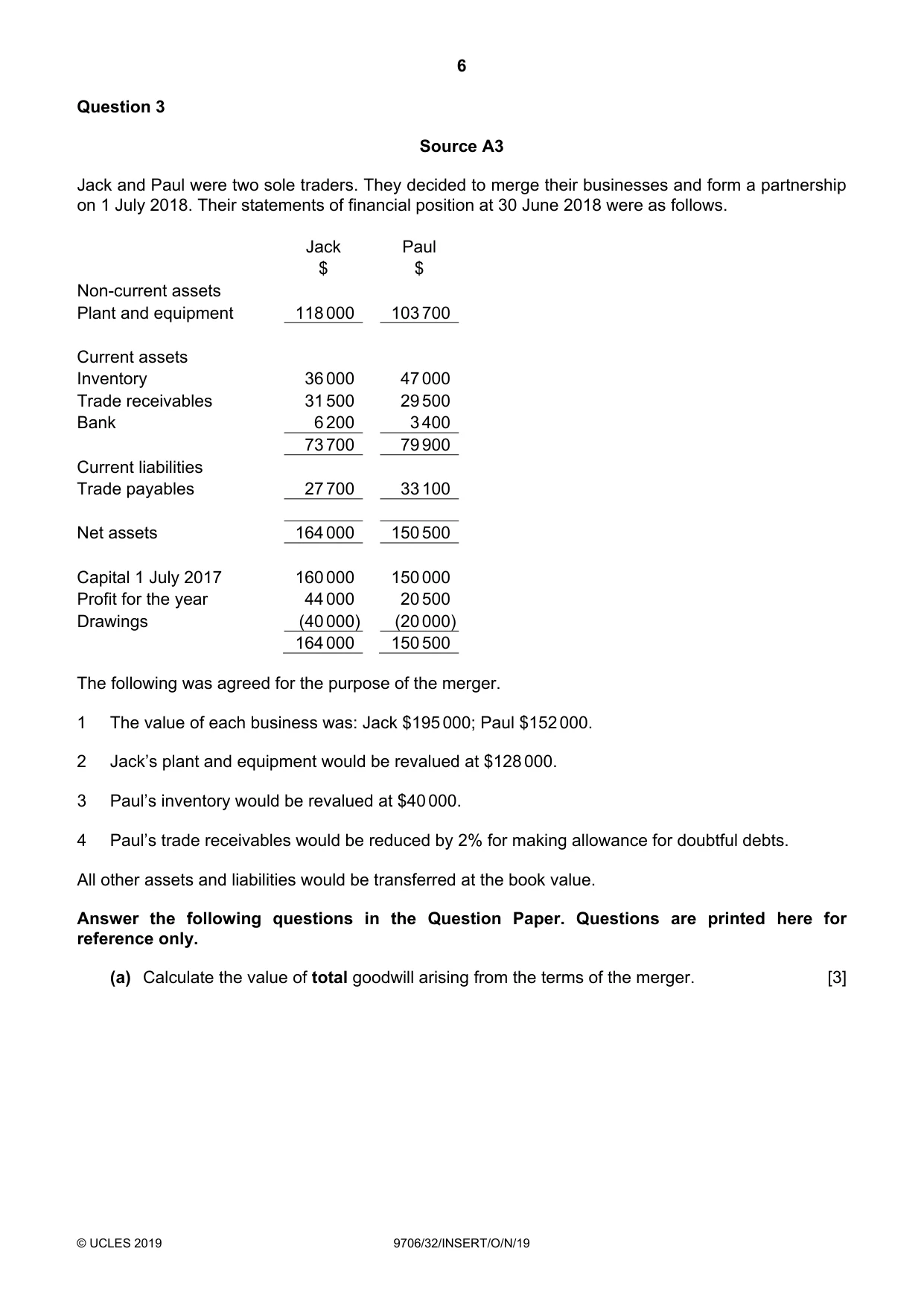
6 © UCLES 2019 9706/32/INSERT/O/N/19 Question 3 Source A3 Jack and Paul were two sole traders. They decided to merge their businesses and form a partnership on 1 July 2018. Their statements of financial position at 30 June 2018 were as follows. Jack Paul $ $ Non-current assets Plant and equipment 118 000 103 700 Current assets Inventory 36 000 47 000 Trade receivables 31 500 29 500 Bank 6 200 3 400 73 700 79 900 Current liabilities Trade payables 27 700 33 100 Net assets 164 000 150 500 Capital 1 July 2017 160 000 150 000 Profit for the year 44 000 20 500 Drawings (40 000) (20 000) 164 000 150 500 The following was agreed for the purpose of the merger. 1 The value of each business was: Jack $195 000; Paul $152 000. 2 Jack’s plant and equipment would be revalued at $128 000. 3 Paul’s inventory would be revalued at $40 000. 4 Paul’s trade receivables would be reduced by 2% for making allowance for doubtful debts. All other assets and liabilities would be transferred at the book value. Answer the following questions in the Question Paper. Questions are printed here for reference only. (a) Calculate the value of total goodwill arising from the terms of the merger. [3]
Question paper, page 7
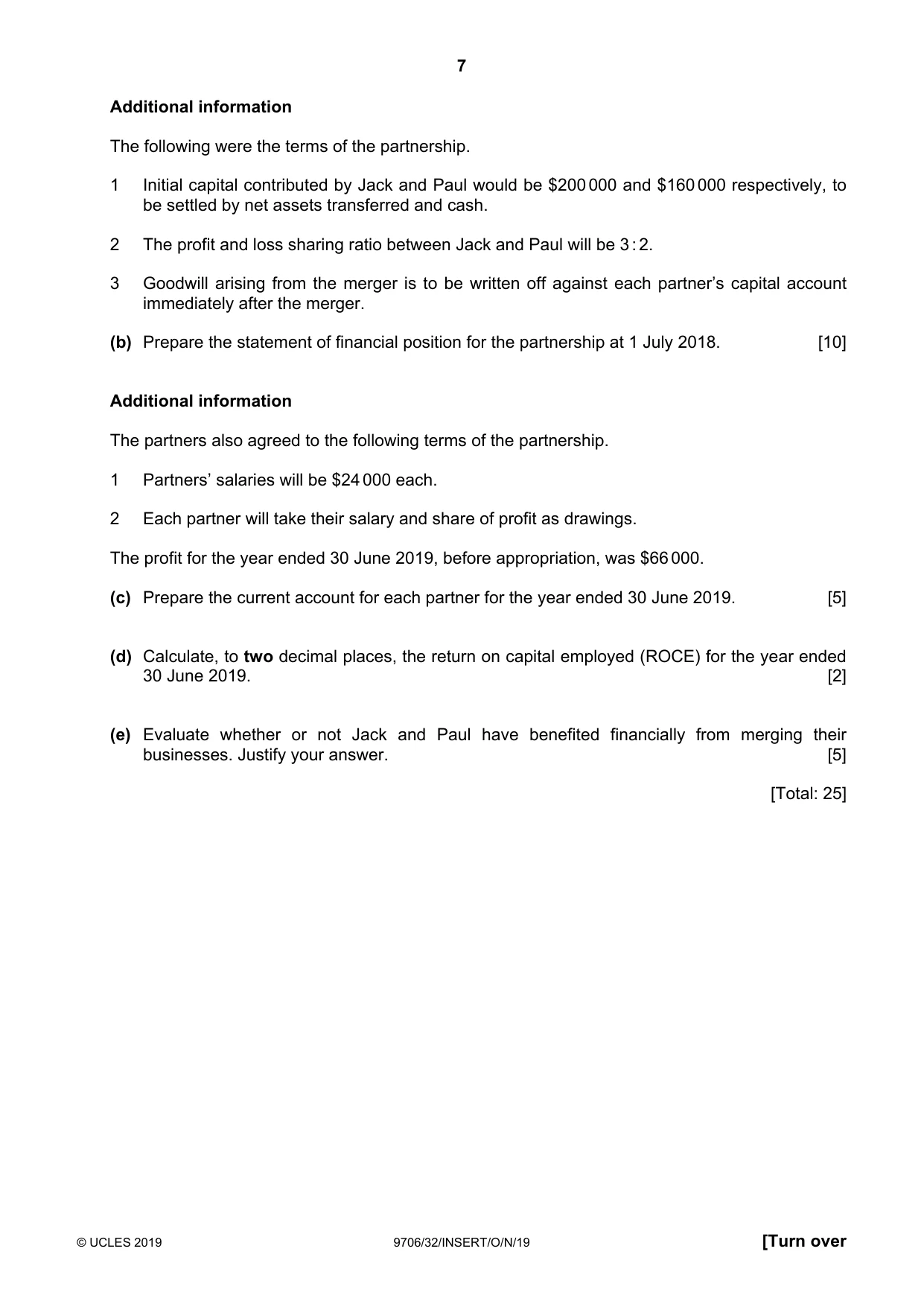
7 © UCLES 2019 9706/32/INSERT/O/N/19 [Turn over Additional information The following were the terms of the partnership. 1 Initial capital contributed by Jack and Paul would be $200 000 and $160 000 respectively, to be settled by net assets transferred and cash. 2 The profit and loss sharing ratio between Jack and Paul will be 3 : 2. 3 Goodwill arising from the merger is to be written off against each partner’s capital account immediately after the merger. (b) Prepare the statement of financial position for the partnership at 1 July 2018. [10] Additional information The partners also agreed to the following terms of the partnership. 1 Partners’ salaries will be $24 000 each. 2 Each partner will take their salary and share of profit as drawings. The profit for the year ended 30 June 2019, before appropriation, was $66 000. (c) Prepare the current account for each partner for the year ended 30 June 2019. [5] (d) Calculate, to two decimal places, the return on capital employed (ROCE) for the year ended 30 June 2019. [2] (e) Evaluate whether or not Jack and Paul have benefited financially from merging their businesses. Justify your answer. [5] [Total: 25]
Question paper, page 8
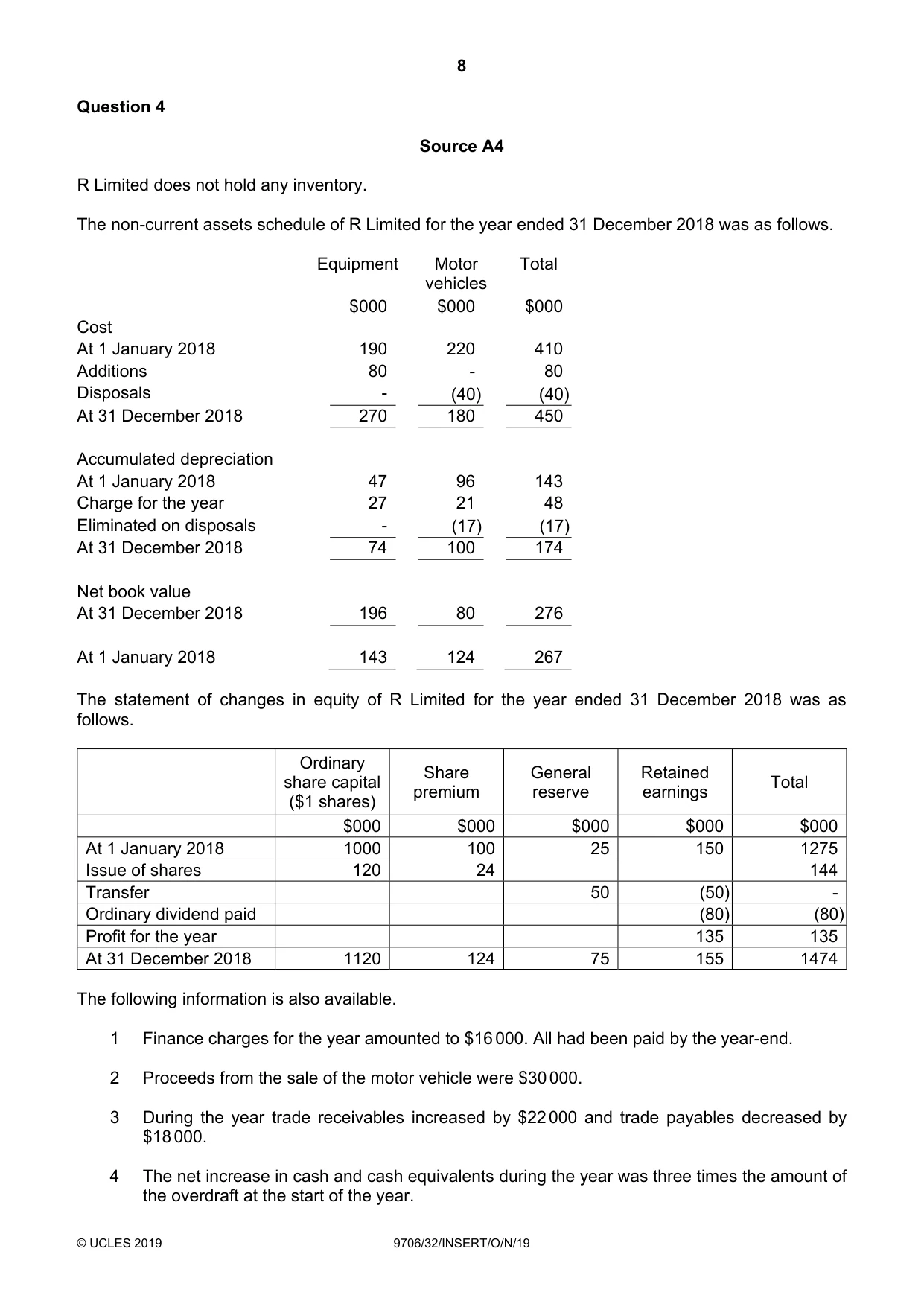
8 © UCLES 2019 9706/32/INSERT/O/N/19 Question 4 Source A4 R Limited does not hold any inventory. The non-current assets schedule of R Limited for the year ended 31 December 2018 was as follows. Equipment Motor vehicles Total $000 $000 $000 Cost At 1 January 2018 190 220 410 Additions 80 - 80 Disposals - (40) (40) At 31 December 2018 270 180 450 Accumulated depreciation At 1 January 2018 47 96 143 Charge for the year 27 21 48 Eliminated on disposals - (17) (17) At 31 December 2018 74 100 174 Net book value At 31 December 2018 196 80 276 At 1 January 2018 143 124 267 The statement of changes in equity of R Limited for the year ended 31 December 2018 was as follows. Ordinary share capital ($1 shares) Share premium General reserve Retained earnings Total $000 $000 $000 $000 $000 At 1 January 2018 1000 100 25 150 1275 Issue of shares 120 24 144 Transfer 50 (50) - Ordinary dividend paid (80) (80) Profit for the year 135 135 At 31 December 2018 1120 124 75 155 1474 The following information is also available. 1 Finance charges for the year amounted to $16 000. All had been paid by the year-end. 2 Proceeds from the sale of the motor vehicle were $30 000. 3 During the year trade receivables increased by $22 000 and trade payables decreased by $18 000. 4 The net increase in cash and cash equivalents during the year was three times the amount of the overdraft at the start of the year.
Question paper, page 9
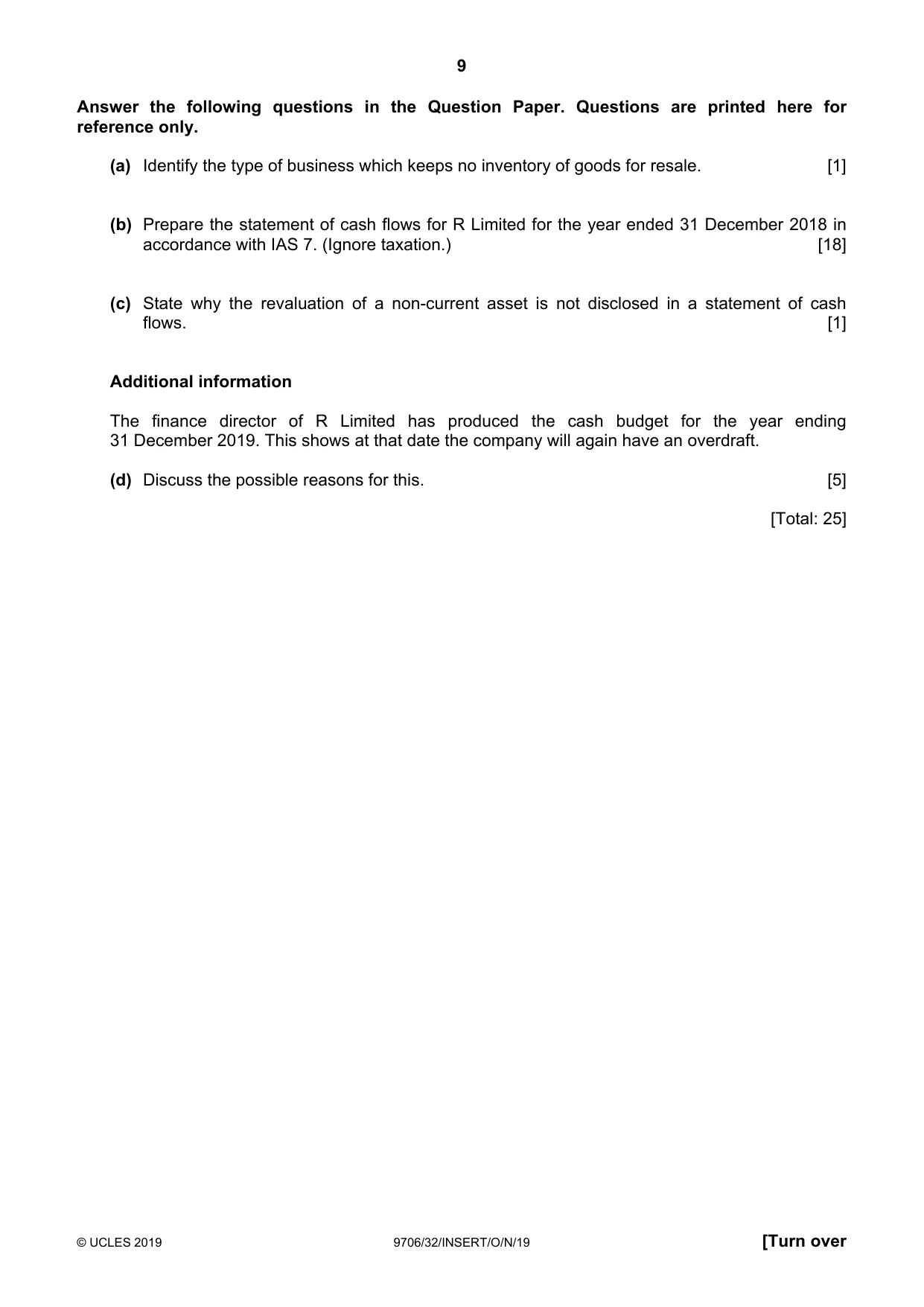
9 © UCLES 2019 9706/32/INSERT/O/N/19 [Turn over Answer the following questions in the Question Paper. Questions are printed here for reference only. (a) Identify the type of business which keeps no inventory of goods for resale. [1] (b) Prepare the statement of cash flows for R Limited for the year ended 31 December 2018 in accordance with IAS 7. (Ignore taxation.) [18] (c) State why the revaluation of a non-current asset is not disclosed in a statement of cash flows. [1] Additional information The finance director of R Limited has produced the cash budget for the year ending 31 December 2019. This shows at that date the company will again have an overdraft. (d) Discuss the possible reasons for this. [5] [Total: 25]
Question paper, page 10
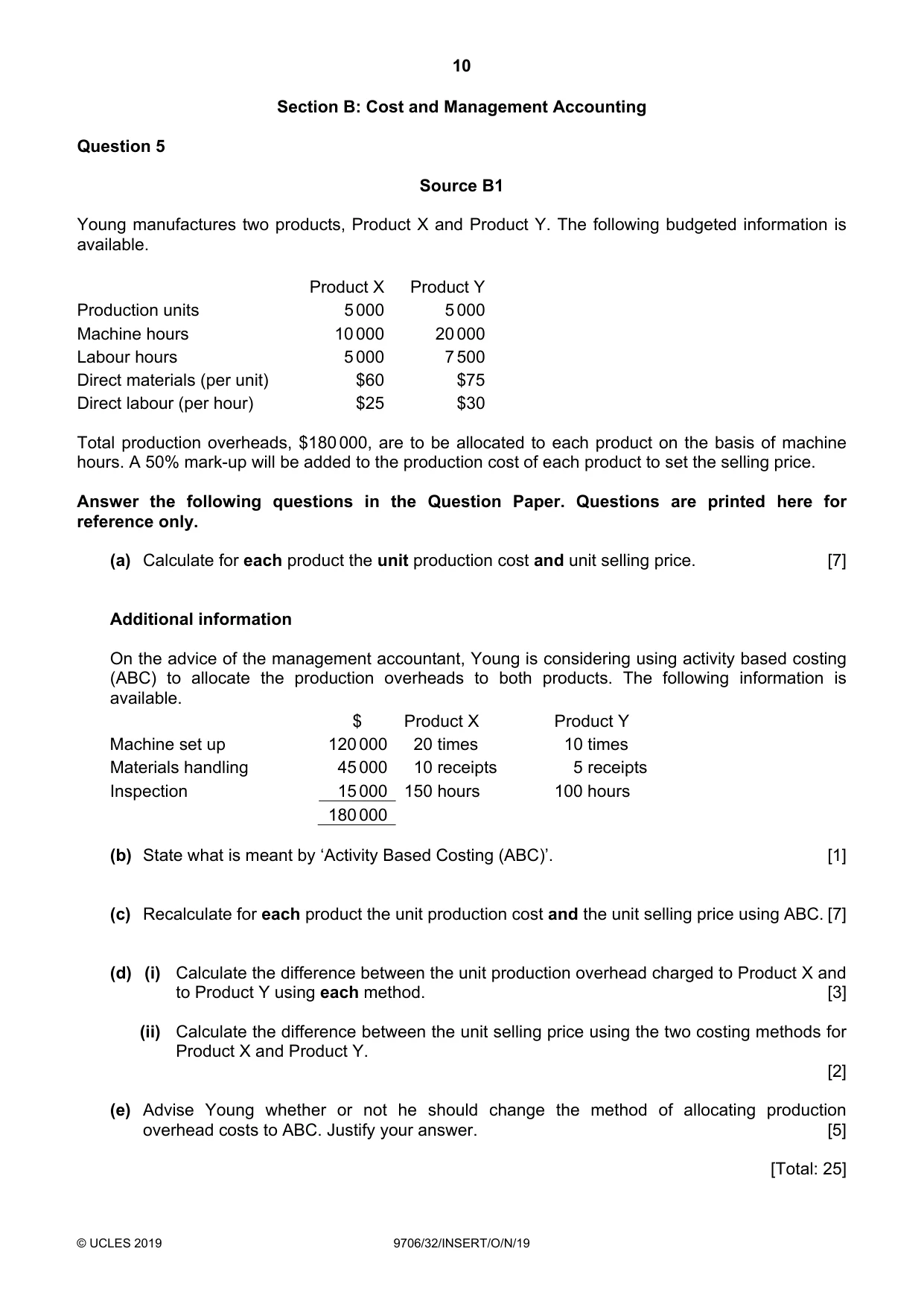
10 © UCLES 2019 9706/32/INSERT/O/N/19 Section B: Cost and Management Accounting Question 5 Source B1 Young manufactures two products, Product X and Product Y. The following budgeted information is available. Product X Product Y Production units 5 000 5 000 Machine hours 10 000 20 000 Labour hours 5 000 7 500 Direct materials (per unit) $60 $75 Direct labour (per hour) $25 $30 Total production overheads, $180 000, are to be allocated to each product on the basis of machine hours. A 50% mark-up will be added to the production cost of each product to set the selling price. Answer the following questions in the Question Paper. Questions are printed here for reference only. (a) Calculate for each product the unit production cost and unit selling price. [7] Additional information On the advice of the management accountant, Young is considering using activity based costing (ABC) to allocate the production overheads to both products. The following information is available. $ Product X Product Y Machine set up 120 000 20 times 10 times Materials handling 45 000 10 receipts 5 receipts Inspection 15 000 150 hours 100 hours 180 000 (b) State what is meant by ‘Activity Based Costing (ABC)’. [1] (c) Recalculate for each product the unit production cost and the unit selling price using ABC. [7] (d) (i) Calculate the difference between the unit production overhead charged to Product X and to Product Y using each method. [3] (ii) Calculate the difference between the unit selling price using the two costing methods for Product X and Product Y. [2] (e) Advise Young whether or not he should change the method of allocating production overhead costs to ABC. Justify your answer. [5] [Total: 25]
Question paper, page 11
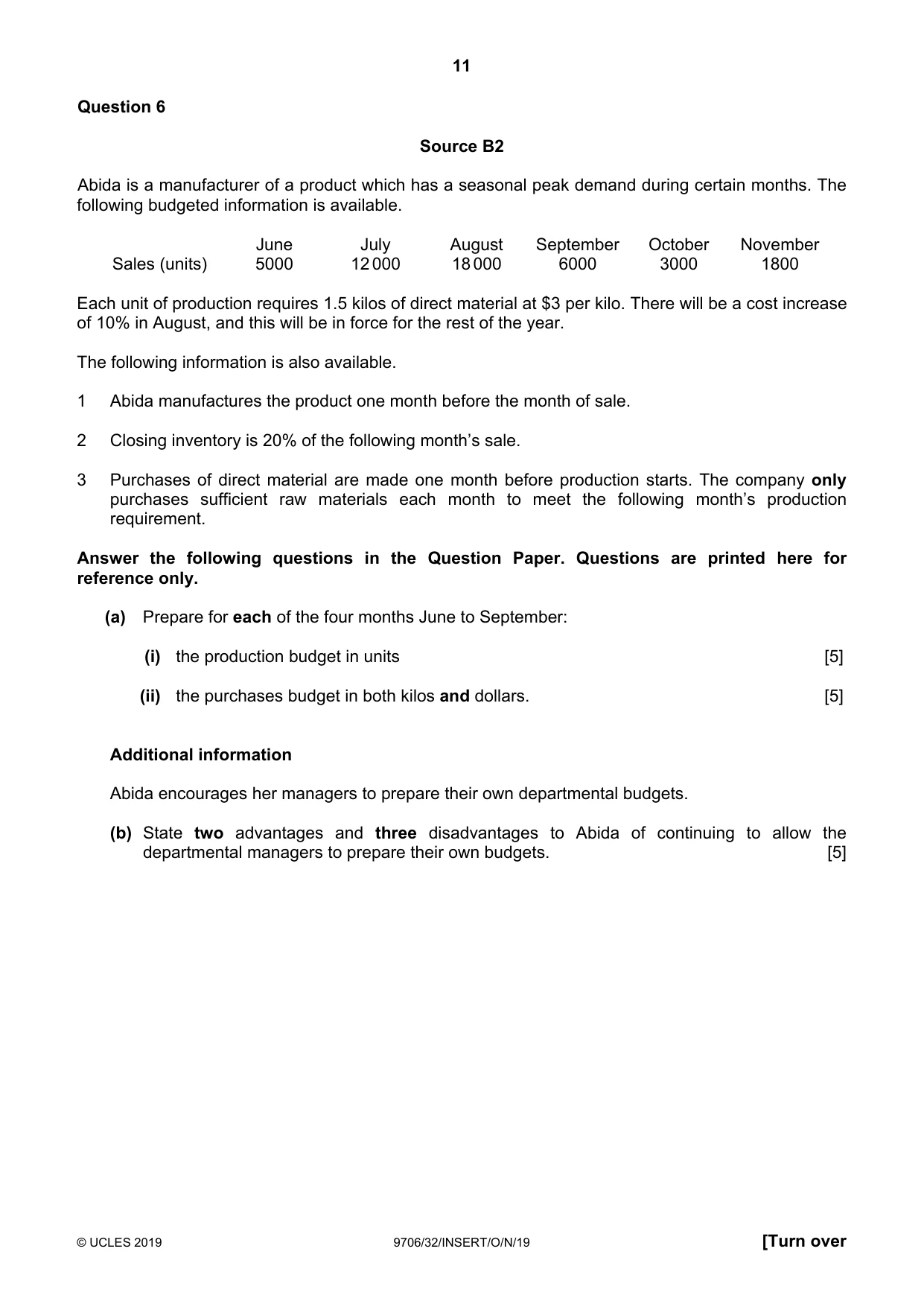
11 © UCLES 2019 9706/32/INSERT/O/N/19 [Turn over Question 6 Source B2 Abida is a manufacturer of a product which has a seasonal peak demand during certain months. The following budgeted information is available. June July August September October November Sales (units) 5000 12 000 18 000 6000 3000 1800 Each unit of production requires 1.5 kilos of direct material at $3 per kilo. There will be a cost increase of 10% in August, and this will be in force for the rest of the year. The following information is also available. 1 Abida manufactures the product one month before the month of sale. 2 Closing inventory is 20% of the following month’s sale. 3 Purchases of direct material are made one month before production starts. The company only purchases sufficient raw materials each month to meet the following month’s production requirement. Answer the following questions in the Question Paper. Questions are printed here for reference only. (a) Prepare for each of the four months June to September: (i) the production budget in units [5] (ii) the purchases budget in both kilos and dollars. [5] Additional information Abida encourages her managers to prepare their own departmental budgets. (b) State two advantages and three disadvantages to Abida of continuing to allow the departmental managers to prepare their own budgets. [5]
Question paper, page 12
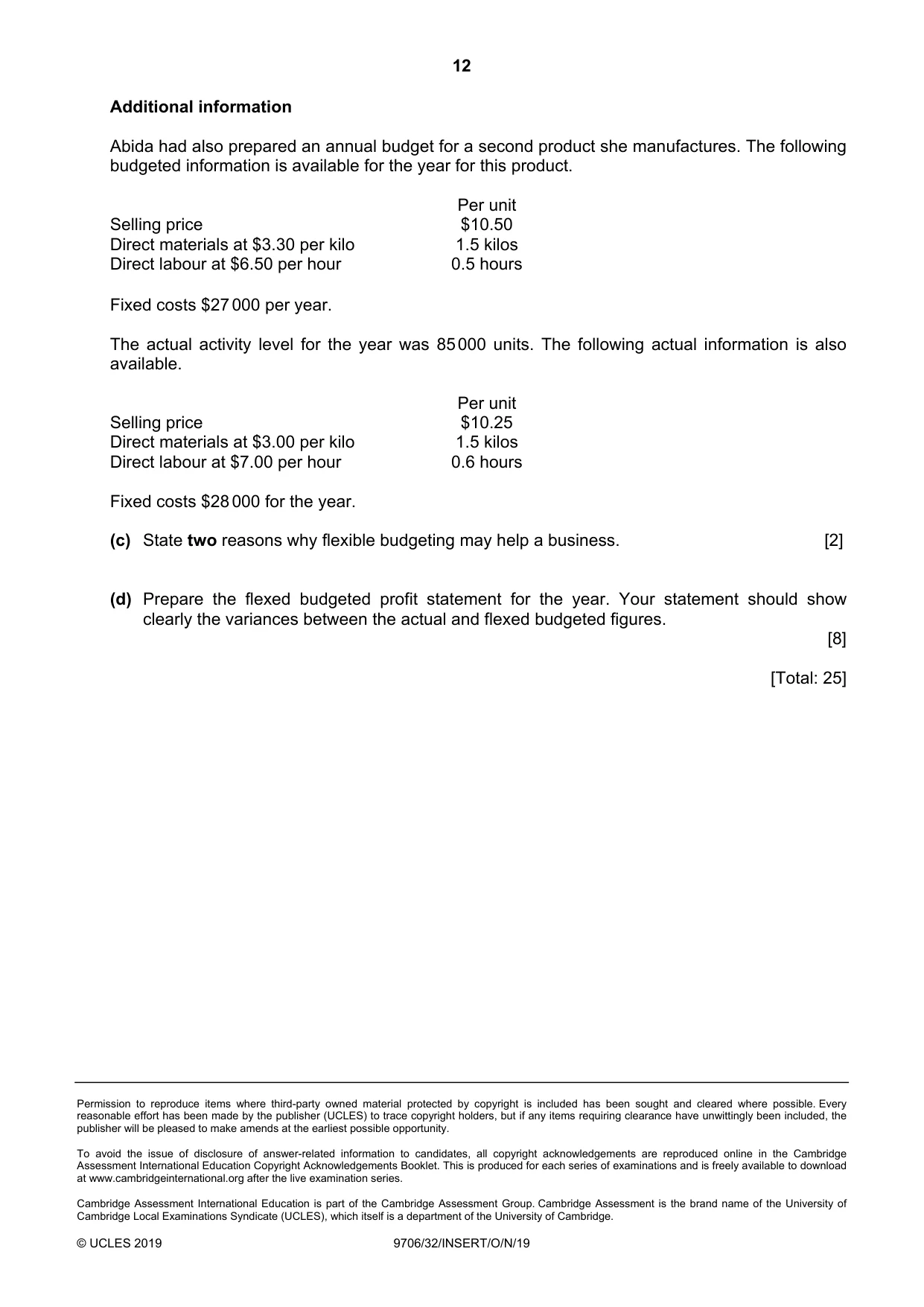
12 Permission to reproduce items where third-party owned material protected by copyright is included has been sought and cleared where possible. Every reasonable effort has been made by the publisher (UCLES) to trace copyright holders, but if any items requiring clearance have unwittingly been included, the publisher will be pleased to make amends at the earliest possible opportunity. To avoid the issue of disclosure of answer-related information to candidates, all copyright acknowledgements are reproduced online in the Cambridge Assessment International Education Copyright Acknowledgements Booklet. This is produced for each series of examinations and is freely available to download at www.cambridgeinternational.org after the live examination series. Cambridge Assessment International Education is part of the Cambridge Assessment Group. Cambridge Assessment is the brand name of the University of Cambridge Local Examinations Syndicate (UCLES), which itself is a department of the University of Cambridge. © UCLES 2019 9706/32/INSERT/O/N/19 Additional information Abida had also prepared an annual budget for a second product she manufactures. The following budgeted information is available for the year for this product. Per unit Selling price $10.50 Direct materials at $3.30 per kilo 1.5 kilos Direct labour at $6.50 per hour 0.5 hours Fixed costs $27 000 per year. The actual activity level for the year was 85 000 units. The following actual information is also available. Per unit Selling price $10.25 Direct materials at $3.00 per kilo 1.5 kilos Direct labour at $7.00 per hour 0.6 hours Fixed costs $28 000 for the year. (c) State two reasons why flexible budgeting may help a business. [2] (d) Prepare the flexed budgeted profit statement for the year. Your statement should show clearly the variances between the actual and flexed budgeted figures. [8] [Total: 25]
Mark scheme, page 1
This document consists of 20 printed pages. © UCLES 2019 [Turn over Cambridge Assessment International Education Cambridge International Advanced Subsidiary and Advanced Level ACCOUNTING 9706/32 Paper 3 Structured Questions October/November 2019 MARK SCHEME Maximum Mark: 150 Published This mark scheme is published as an aid to teachers and candidates, to indicate the requirements of the examination. It shows the basis on which Examiners were instructed to award marks. It does not indicate the details of the discussions that took place at an Examiners’ meeting before marking began, which would have considered the acceptability of alternative answers. Mark schemes should be read in conjunction with the question paper and the Principal Examiner Report for Teachers. Cambridge International will not enter into discussions about these mark schemes. Cambridge International is publishing the mark schemes for the October/November 2019 series for most Cambridge IGCSE™, Cambridge International A and AS Level components and some Cambridge O Level components.
Mark scheme, page 2
9706/32 Cambridge International AS/A Level – Mark Scheme PUBLISHED October/November 2019 © UCLES 2019 Page 2 of 20 Generic Marking Principles These general marking principles must be applied by all examiners when marking candidate answers. They should be applied alongside the specific content of the mark scheme or generic level descriptors for a question. Each question paper and mark scheme will also comply with these marking principles. GENERIC MARKING PRINCIPLE 1: Marks must be awarded in line with: • the specific content of the mark scheme or the generic level descriptors for the question • the specific skills defined in the mark scheme or in the generic level descriptors for the question • the standard of response required by a candidate as exemplified by the standardisation scripts. GENERIC MARKING PRINCIPLE 2: Marks awarded are always whole marks (not half marks, or other fractions). GENERIC MARKING PRINCIPLE 3: Marks must be awarded positively: • marks are awarded for correct/valid answers, as defined in the mark scheme. However, credit is given for valid answers which go beyond the scope of the syllabus and mark scheme, referring to your Team Leader as appropriate • marks are awarded when candidates clearly demonstrate what they know and can do • marks are not deducted for errors • marks are not deducted for omissions • answers should only be judged on the quality of spelling, punctuation and grammar when these features are specifically assessed by the question as indicated by the mark scheme. The meaning, however, should be unambiguous. GENERIC MARKING PRINCIPLE 4: Rules must be applied consistently e.g. in situations where candidates have not followed instructions or in the application of generic level descriptors.
Mark scheme, page 3
9706/32 Cambridge International AS/A Level – Mark Scheme PUBLISHED October/November 2019 © UCLES 2019 Page 3 of 20 GENERIC MARKING PRINCIPLE 5: Marks should be awarded using the full range of marks defined in the mark scheme for the question (however; the use of the full mark range may be limited according to the quality of the candidate responses seen). GENERIC MARKING PRINCIPLE 6: Marks awarded are based solely on the requirements as defined in the mark scheme. Marks should not be awarded with grade thresholds or grade descriptors in mind.
Mark scheme, page 4
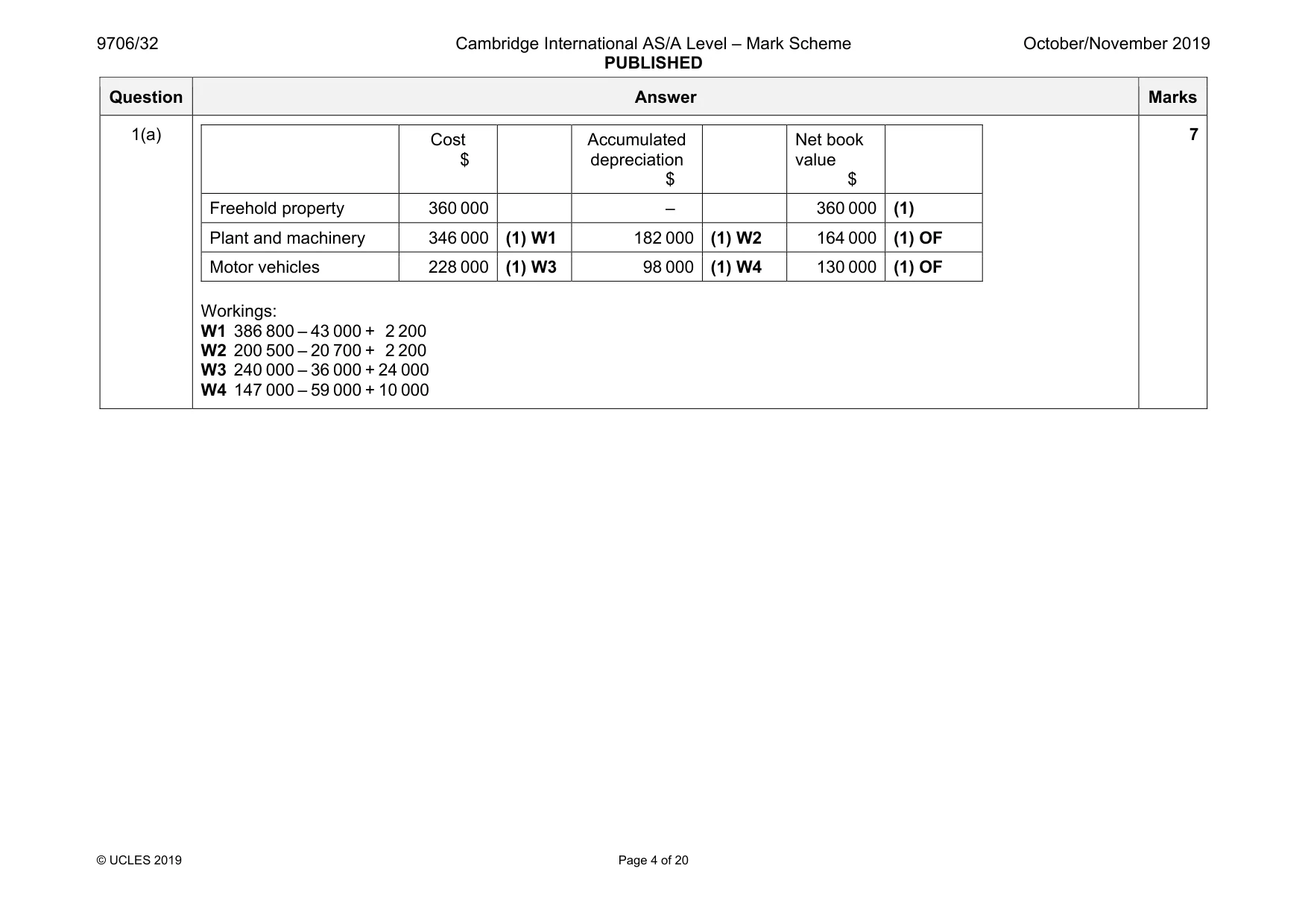
9706/32 Cambridge International AS/A Level – Mark Scheme PUBLISHED October/November 2019 © UCLES 2019 Page 4 of 20 Question Answer Marks 1(a) Cost $ Accumulated depreciation $ Net book value $ Freehold property 360 000 – 360 000 (1) Plant and machinery 346 000 (1) W1 182 000 (1) W2 164 000 (1) OF Motor vehicles 228 000 (1) W3 98 000 (1) W4 130 000 (1) OF Workings: W1 386 800 – 43 000 + 2 200 W2 200 500 – 20 700 + 2 200 W3 240 000 – 36 000 + 24 000 W4 147 000 – 59 000 + 10 000 7
Mark scheme, page 5
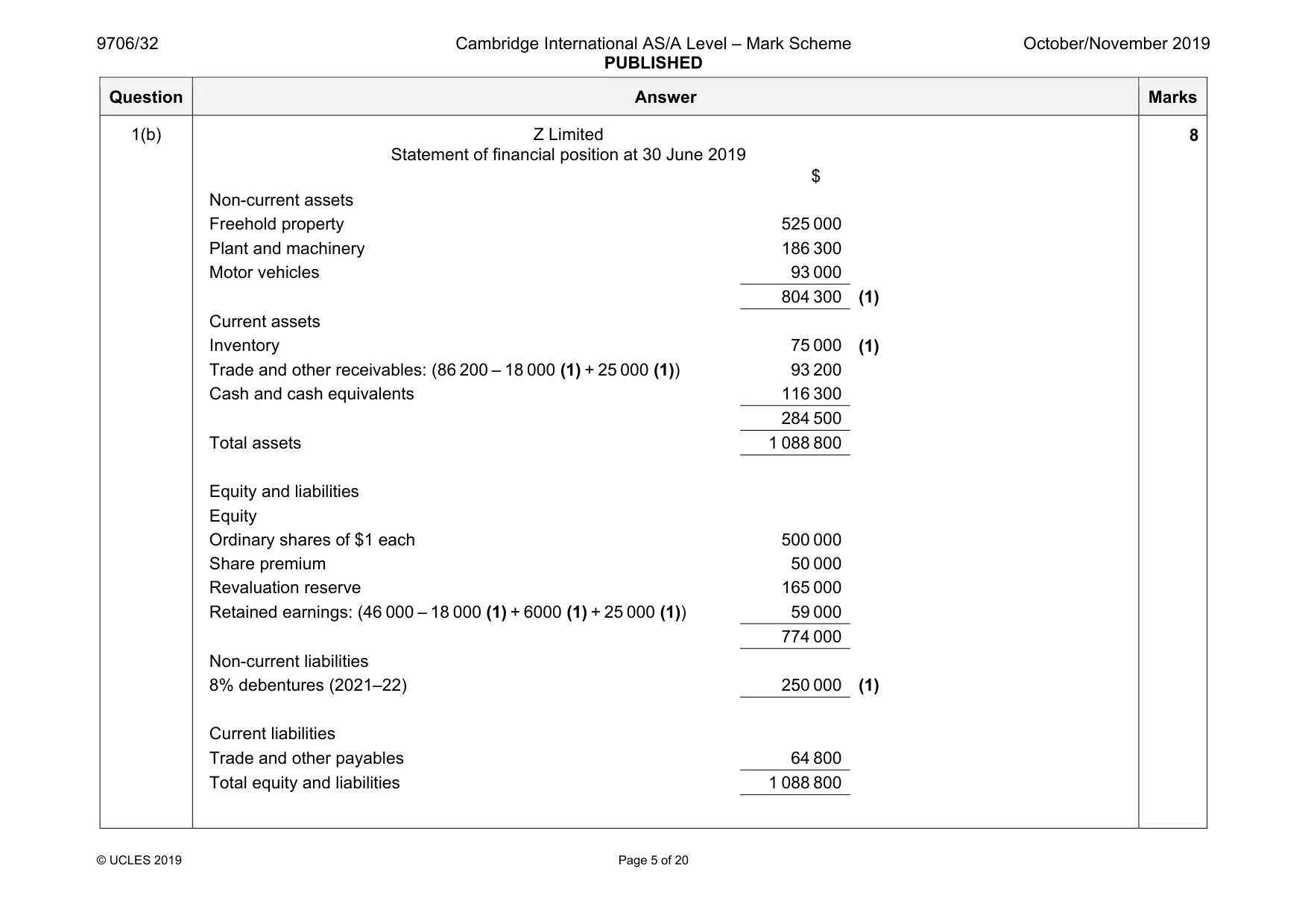
9706/32 Cambridge International AS/A Level – Mark Scheme PUBLISHED October/November 2019 © UCLES 2019 Page 5 of 20 Question Answer Marks 1(b) Z Limited Statement of financial position at 30 June 2019 $ Non-current assets Freehold property 525 000 Plant and machinery 186 300 Motor vehicles 93 000 804 300 (1) Current assets Inventory 75 000 (1) Trade and other receivables: (86 200 – 18 000 (1) + 25 000 (1)) 93 200 Cash and cash equivalents 116 300 284 500 Total assets 1 088 800 Equity and liabilities Equity Ordinary shares of $1 each 500 000 Share premium 50 000 Revaluation reserve 165 000 Retained earnings: (46 000 – 18 000 (1) + 6000 (1) + 25 000 (1)) 59 000 774 000 Non-current liabilities 8% debentures (2021–22) 250 000 (1) Current liabilities Trade and other payables 64 800 Total equity and liabilities 1 088 800 8
Mark scheme, page 6
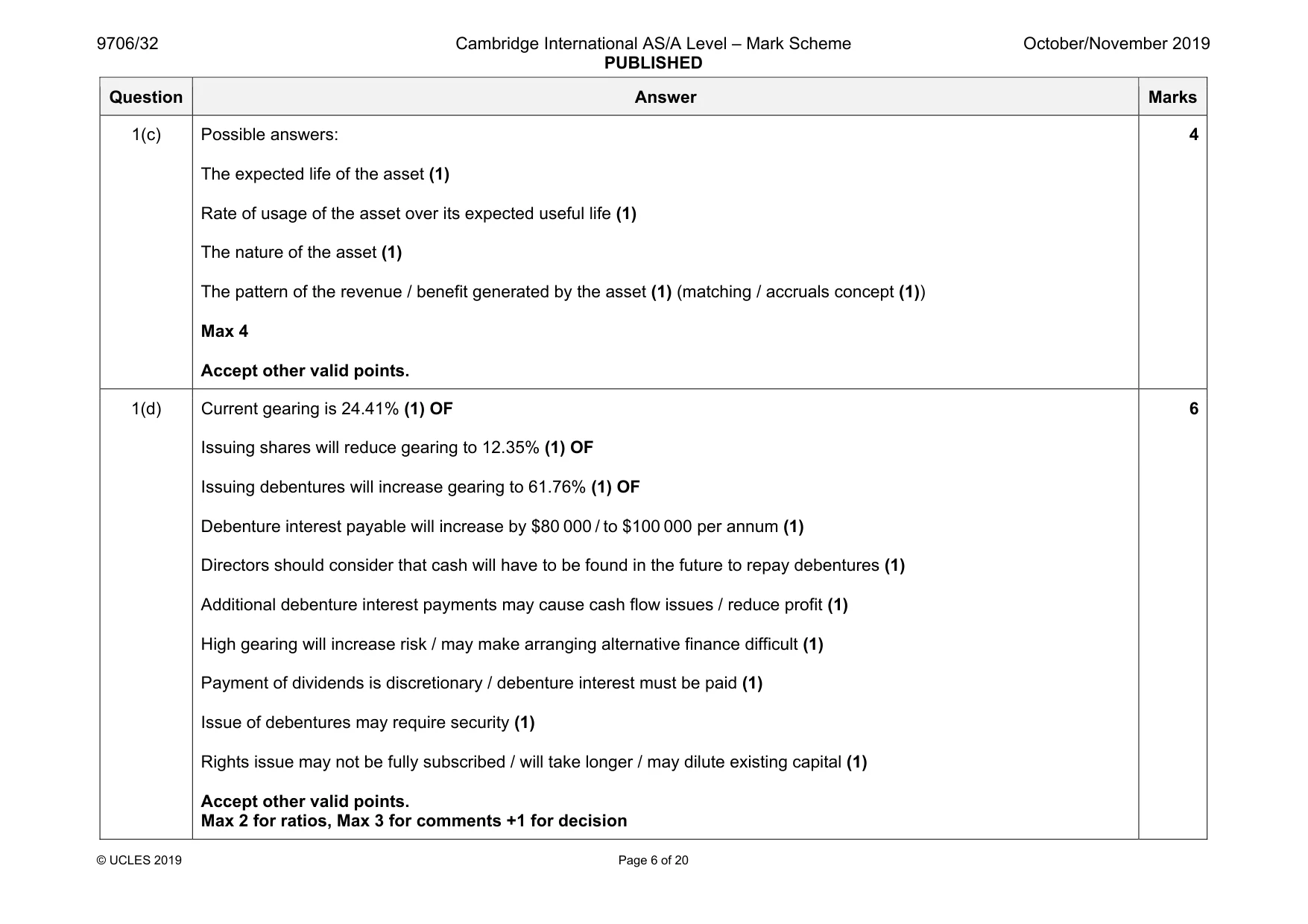
9706/32 Cambridge International AS/A Level – Mark Scheme PUBLISHED October/November 2019 © UCLES 2019 Page 6 of 20 Question Answer Marks 1(c) Possible answers: The expected life of the asset (1) Rate of usage of the asset over its expected useful life (1) The nature of the asset (1) The pattern of the revenue / benefit generated by the asset (1) (matching / accruals concept (1)) Max 4 Accept other valid points. 4 1(d) Current gearing is 24.41% (1) OF Issuing shares will reduce gearing to 12.35% (1) OF Issuing debentures will increase gearing to 61.76% (1) OF Debenture interest payable will increase by $80 000 / to $100 000 per annum (1) Directors should consider that cash will have to be found in the future to repay debentures (1) Additional debenture interest payments may cause cash flow issues / reduce profit (1) High gearing will increase risk / may make arranging alternative finance difficult (1) Payment of dividends is discretionary / debenture interest must be paid (1) Issue of debentures may require security (1) Rights issue may not be fully subscribed / will take longer / may dilute existing capital (1) Accept other valid points. Max 2 for ratios, Max 3 for comments +1 for decision 6
Mark scheme, page 7
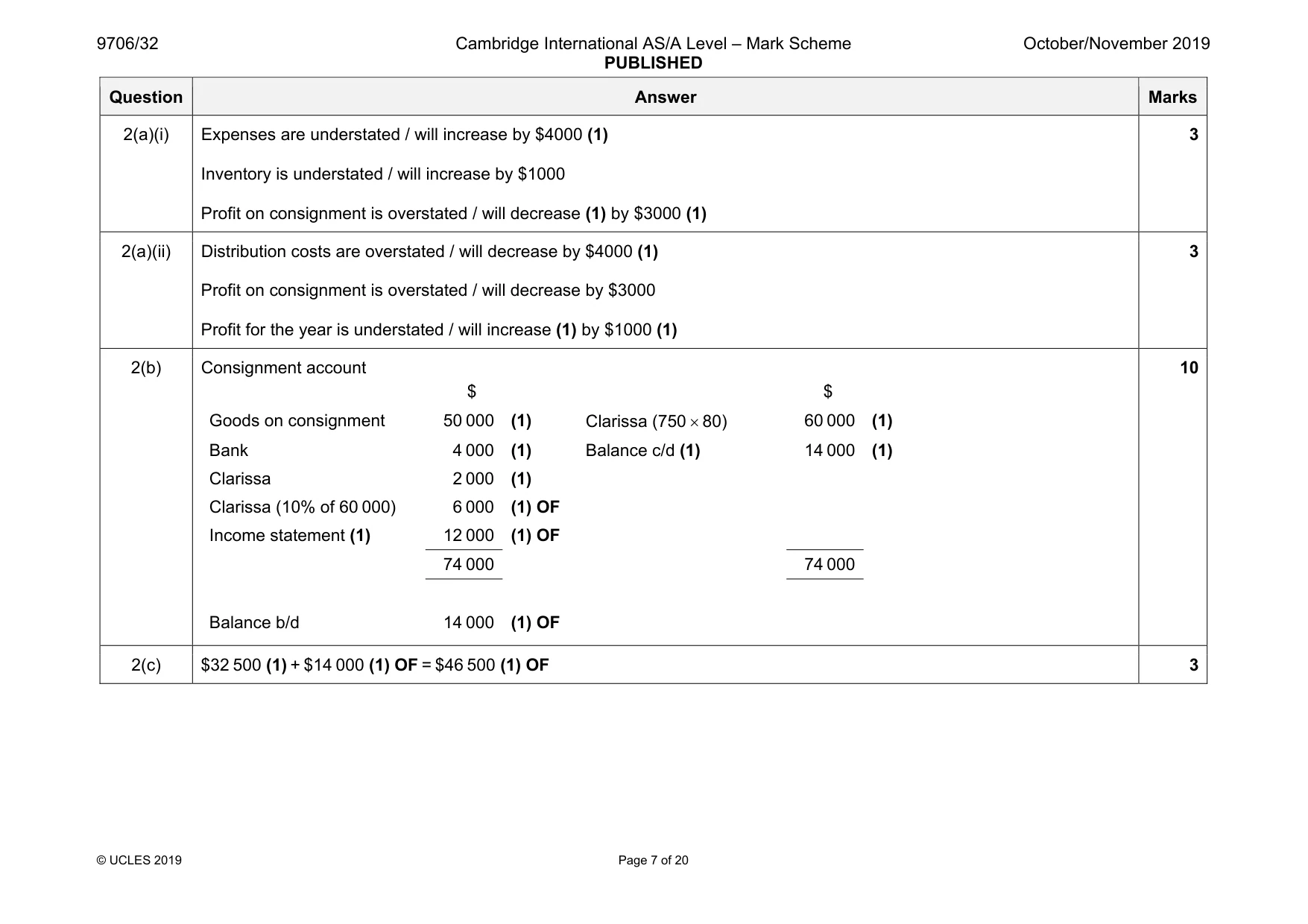
9706/32 Cambridge International AS/A Level – Mark Scheme PUBLISHED October/November 2019 © UCLES 2019 Page 7 of 20 Question Answer Marks 2(a)(i) Expenses are understated / will increase by $4000 (1) Inventory is understated / will increase by $1000 Profit on consignment is overstated / will decrease (1) by $3000 (1) 3 2(a)(ii) Distribution costs are overstated / will decrease by $4000 (1) Profit on consignment is overstated / will decrease by $3000 Profit for the year is understated / will increase (1) by $1000 (1) 3 2(b) Consignment account $ $ Goods on consignment 50 000 (1) Clarissa (750 × 80) 60 000 (1) Bank 4 000 (1) Balance c/d (1) 14 000 (1) Clarissa 2 000 (1) Clarissa (10% of 60 000) 6 000 (1) OF Income statement (1) 12 000 (1) OF 74 000 74 000 Balance b/d 14 000 (1) OF 10 2(c) $32 500 (1) + $14 000 (1) OF = $46 500 (1) OF 3
Mark scheme, page 8
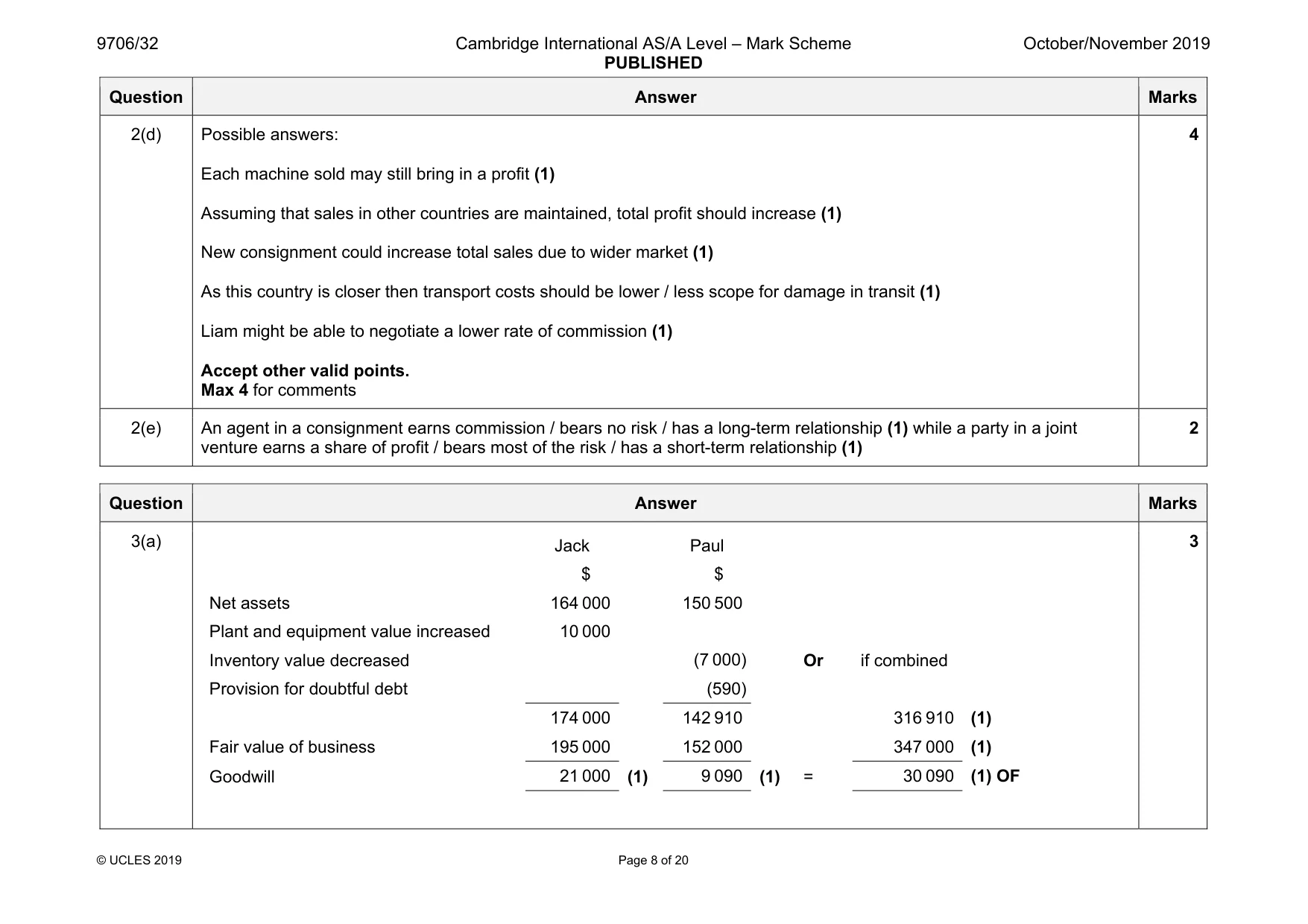
9706/32 Cambridge International AS/A Level – Mark Scheme PUBLISHED October/November 2019 © UCLES 2019 Page 8 of 20 Question Answer Marks 2(d) Possible answers: Each machine sold may still bring in a profit (1) Assuming that sales in other countries are maintained, total profit should increase (1) New consignment could increase total sales due to wider market (1) As this country is closer then transport costs should be lower / less scope for damage in transit (1) Liam might be able to negotiate a lower rate of commission (1) Accept other valid points. Max 4 for comments 4 2(e) An agent in a consignment earns commission / bears no risk / has a long-term relationship (1) while a party in a joint venture earns a share of profit / bears most of the risk / has a short-term relationship (1) 2 Question Answer Marks 3(a) Jack Paul $ $ Net assets 164 000 150 500 Plant and equipment value increased 10 000 Inventory value decreased (7 000) Or if combined Provision for doubtful debt (590) 174 000 142 910 316 910 (1) Fair value of business 195 000 152 000 347 000 (1) Goodwill 21 000 (1) 9 090 (1) = 30 090 (1) OF 3
Mark scheme, page 9
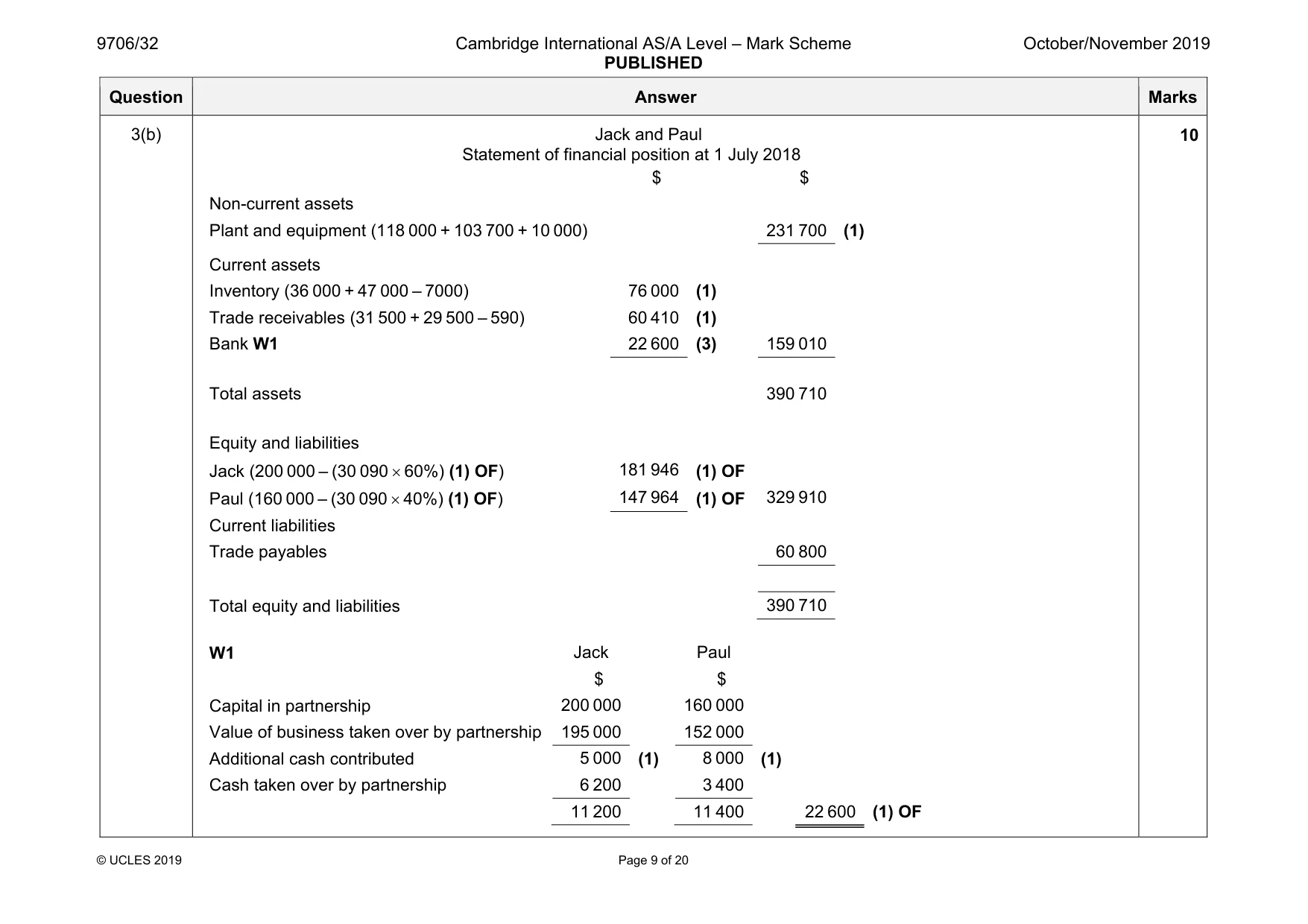
9706/32 Cambridge International AS/A Level – Mark Scheme PUBLISHED October/November 2019 © UCLES 2019 Page 9 of 20 Question Answer Marks 3(b) Jack and Paul Statement of financial position at 1 July 2018 $ $ Non-current assets Plant and equipment (118 000 + 103 700 + 10 000) 231 700 (1) Current assets Inventory (36 000 + 47 000 – 7000) 76 000 (1) Trade receivables (31 500 + 29 500 – 590) 60 410 (1) Bank W1 22 600 (3) 159 010 Total assets 390 710 Equity and liabilities Jack (200 000 – (30 090 × 60%) (1) OF) 181 946 (1) OF Paul (160 000 – (30 090 × 40%) (1) OF) 147 964 (1) OF 329 910 Current liabilities Trade payables 60 800 Total equity and liabilities 390 710 W1 Jack Paul $ $ Capital in partnership 200 000 160 000 Value of business taken over by partnership 195 000 152 000 Additional cash contributed 5 000 (1) 8 000 (1) Cash taken over by partnership 6 200 3 400 11 200 11 400 22 600 (1) OF 10
Mark scheme, page 10
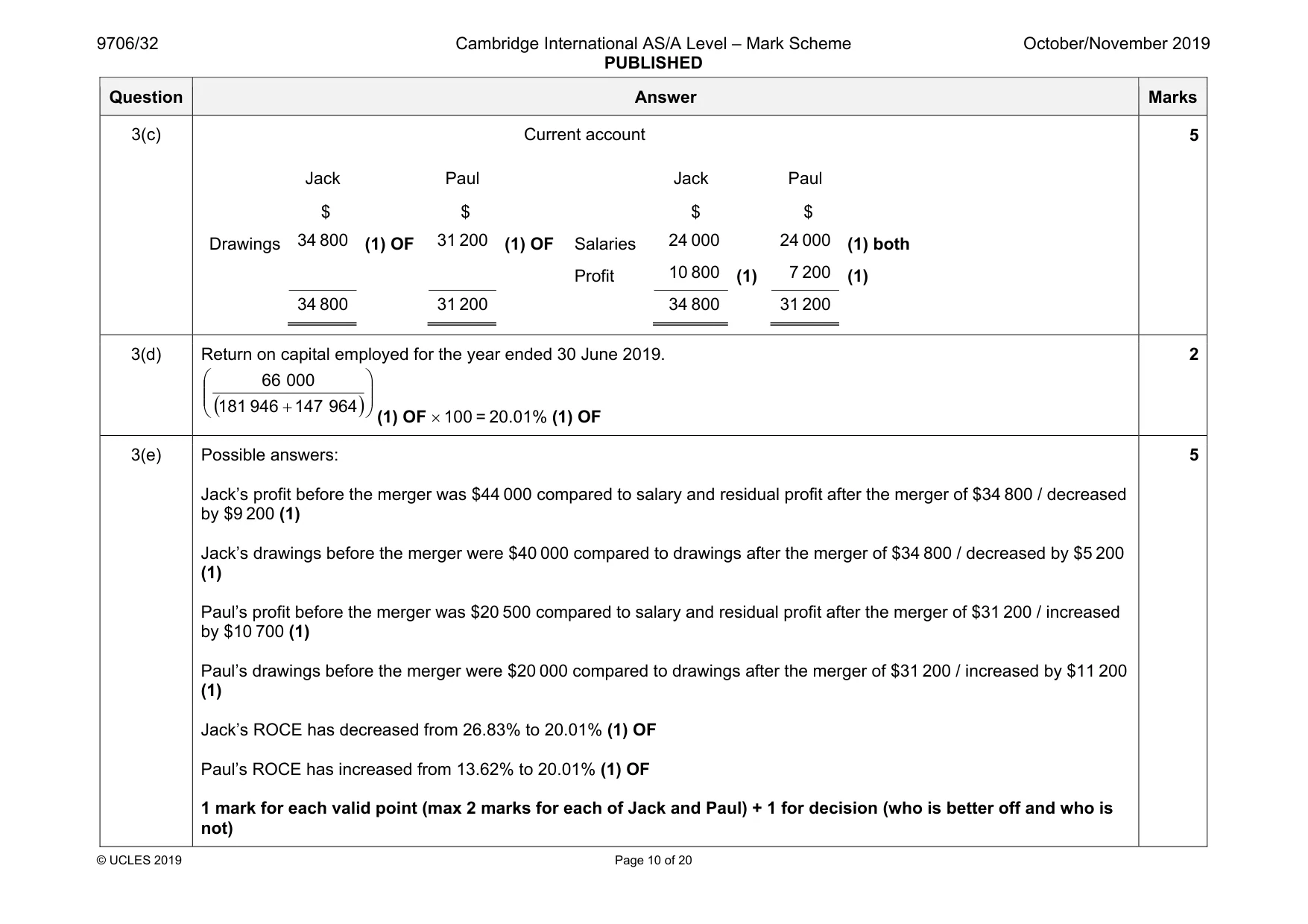
9706/32 Cambridge International AS/A Level – Mark Scheme PUBLISHED October/November 2019 © UCLES 2019 Page 10 of 20 Question Answer Marks 3(c) Current account Jack Paul Jack Paul $ $ $ $ Drawings 34 800 (1) OF 31 200 (1) OF Salaries 24 000 24 000 (1) both Profit 10 800 (1) 7 200 (1) 34 800 31 200 34 800 31 200 5 3(d) Return on capital employed for the year ended 30 June 2019. ( ) + 964 147 946 181 000 66 (1) OF × 100 = 20.01% (1) OF 2 3(e) Possible answers: Jack’s profit before the merger was $44 000 compared to salary and residual profit after the merger of $34 800 / decreased by $9 200 (1) Jack’s drawings before the merger were $40 000 compared to drawings after the merger of $34 800 / decreased by $5 200 (1) Paul’s profit before the merger was $20 500 compared to salary and residual profit after the merger of $31 200 / increased by $10 700 (1) Paul’s drawings before the merger were $20 000 compared to drawings after the merger of $31 200 / increased by $11 200 (1) Jack’s ROCE has decreased from 26.83% to 20.01% (1) OF Paul’s ROCE has increased from 13.62% to 20.01% (1) OF 1 mark for each valid point (max 2 marks for each of Jack and Paul) + 1 for decision (who is better off and who is not) 5
Mark scheme, page 11
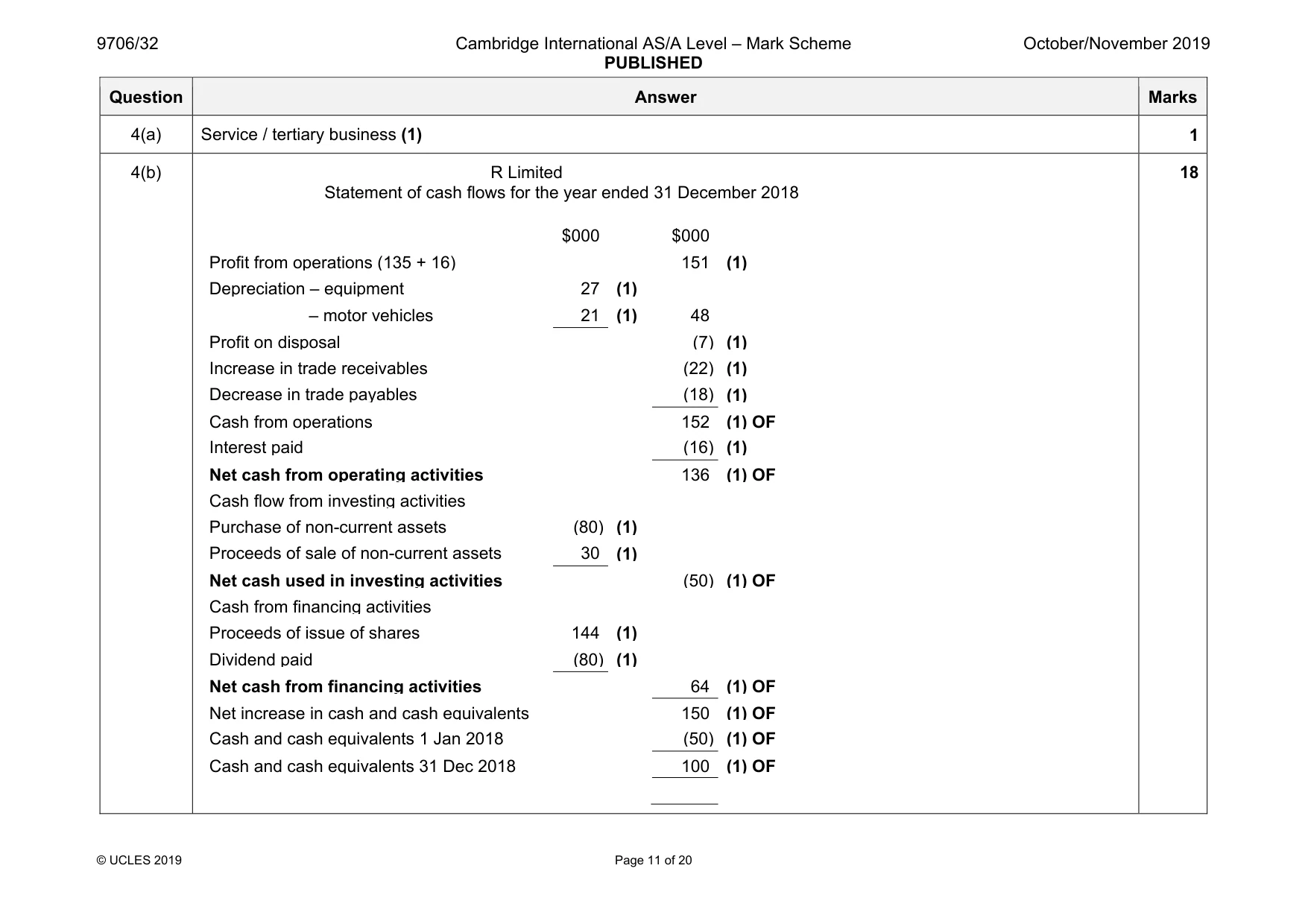
9706/32 Cambridge International AS/A Level – Mark Scheme PUBLISHED October/November 2019 © UCLES 2019 Page 11 of 20 Question Answer Marks 4(a) Service / tertiary business (1) 1 4(b) R Limited Statement of cash flows for the year ended 31 December 2018 $000 $000 Profit from operations (135 + 16) 151 (1) Depreciation – equipment 27 (1) – motor vehicles 21 (1) 48 Profit on disposal (7) (1) Increase in trade receivables (22) (1) Decrease in trade payables (18) (1) Cash from operations 152 (1) OF Interest paid (16) (1) Net cash from operating activities 136 (1) OF Cash flow from investing activities Purchase of non-current assets (80) (1) Proceeds of sale of non-current assets 30 (1) Net cash used in investing activities (50) (1) OF Cash from financing activities Proceeds of issue of shares 144 (1) Dividend paid (80) (1) Net cash from financing activities 64 (1) OF Net increase in cash and cash equivalents 150 (1) OF Cash and cash equivalents 1 Jan 2018 (50) (1) OF Cash and cash equivalents 31 Dec 2018 100 (1) OF 18
Mark scheme, page 12
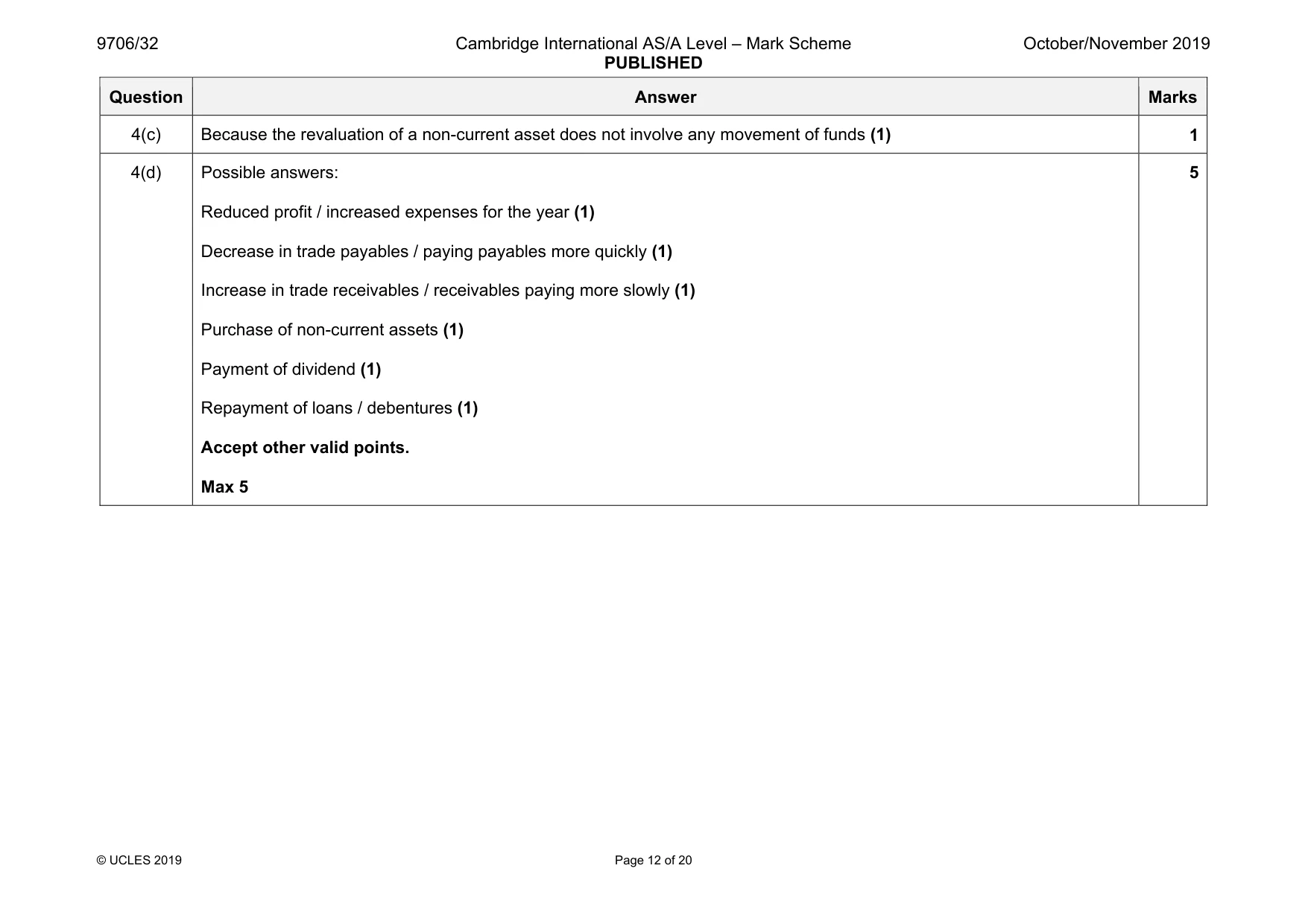
9706/32 Cambridge International AS/A Level – Mark Scheme PUBLISHED October/November 2019 © UCLES 2019 Page 12 of 20 Question Answer Marks 4(c) Because the revaluation of a non-current asset does not involve any movement of funds (1) 1 4(d) Possible answers: Reduced profit / increased expenses for the year (1) Decrease in trade payables / paying payables more quickly (1) Increase in trade receivables / receivables paying more slowly (1) Purchase of non-current assets (1) Payment of dividend (1) Repayment of loans / debentures (1) Accept other valid points. Max 5 5
Mark scheme, page 13
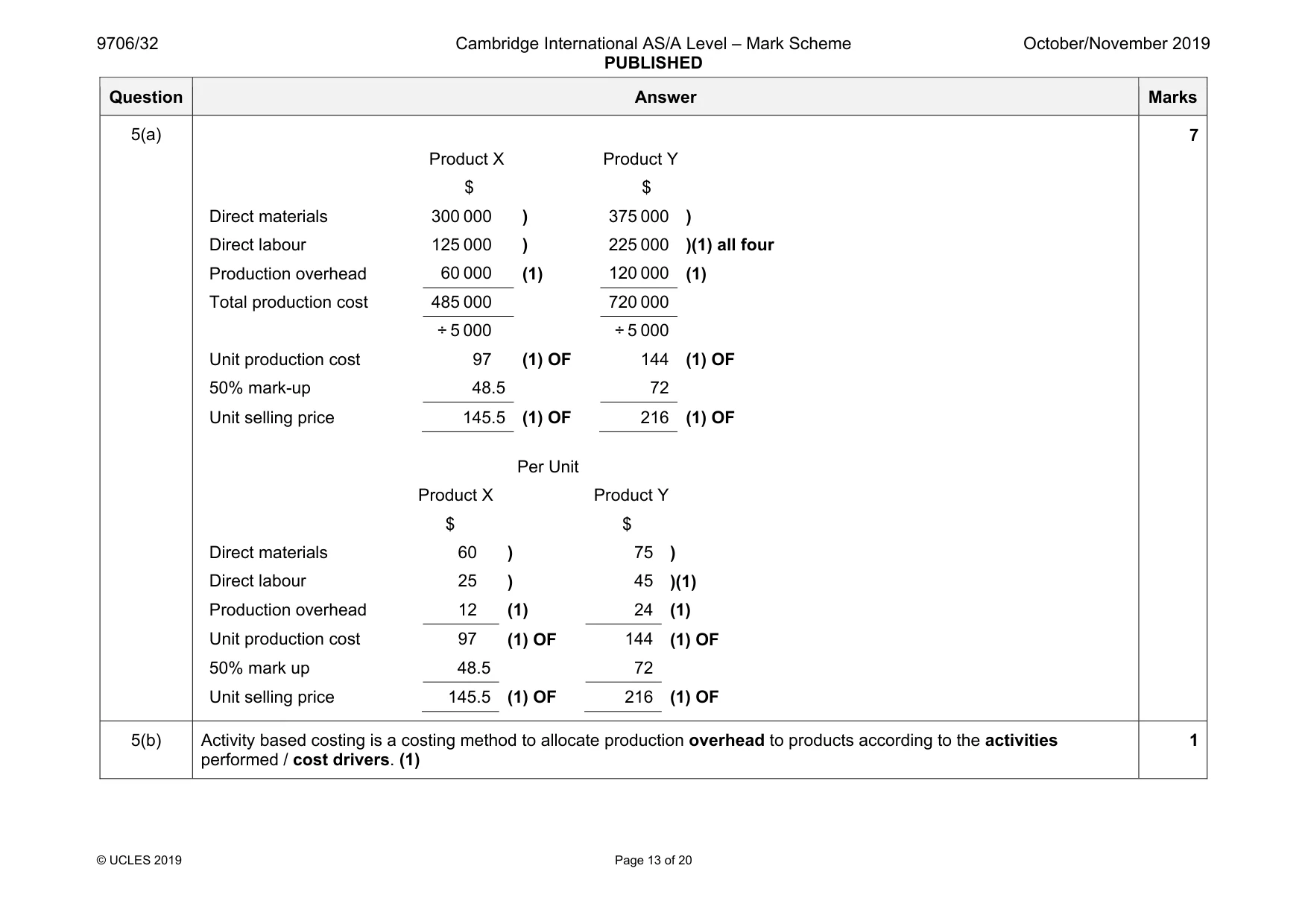
9706/32 Cambridge International AS/A Level – Mark Scheme PUBLISHED October/November 2019 © UCLES 2019 Page 13 of 20 Question Answer Marks 5(a) Product X Product Y $ $ Direct materials 300 000 ) 375 000 ) Direct labour 125 000 ) 225 000 )(1) all four Production overhead 60 000 (1) 120 000 (1) Total production cost 485 000 720 000 ÷ 5 000 ÷ 5 000 Unit production cost 97 (1) OF 144 (1) OF 50% mark-up 48.5 72 Unit selling price 145.5 (1) OF 216 (1) OF Per Unit Product X Product Y $ $ Direct materials 60 ) 75 ) Direct labour 25 ) 45 )(1) Production overhead 12 (1) 24 (1) Unit production cost 97 (1) OF 144 (1) OF 50% mark up 48.5 72 Unit selling price 145.5 (1) OF 216 (1) OF 7 5(b) Activity based costing is a costing method to allocate production overhead to products according to the activities performed / cost drivers. (1) 1
Mark scheme, page 14
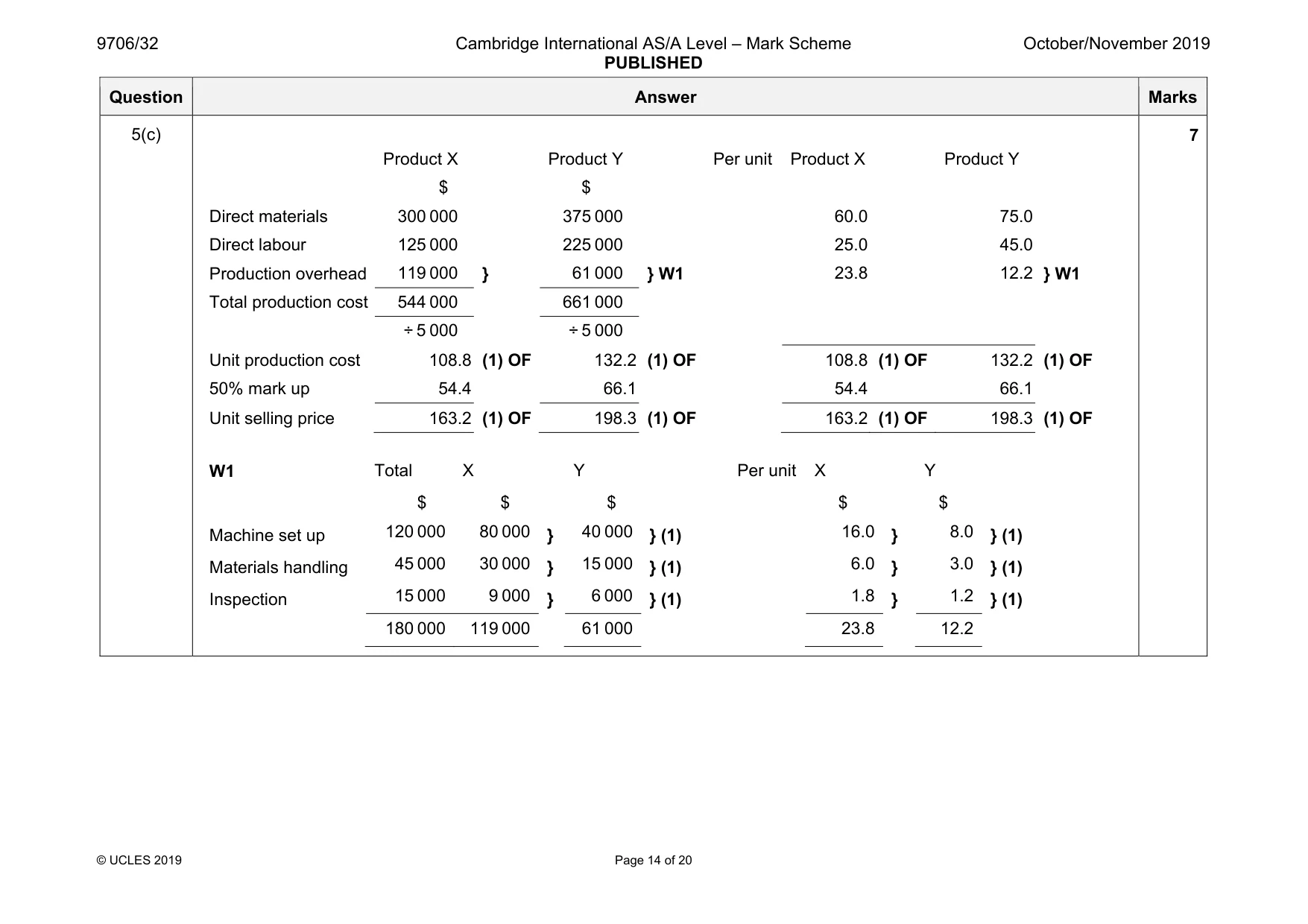
9706/32 Cambridge International AS/A Level – Mark Scheme PUBLISHED October/November 2019 © UCLES 2019 Page 14 of 20 Question Answer Marks 5(c) Product X Product Y Per unit Product X Product Y $ $ Direct materials 300 000 375 000 60.0 75.0 Direct labour 125 000 225 000 25.0 45.0 Production overhead 119 000 } 61 000 } W1 23.8 12.2 } W1 Total production cost 544 000 661 000 ÷ 5 000 ÷ 5 000 Unit production cost 108.8 (1) OF 132.2 (1) OF 108.8 (1) OF 132.2 (1) OF 50% mark up 54.4 66.1 54.4 66.1 Unit selling price 163.2 (1) OF 198.3 (1) OF 163.2 (1) OF 198.3 (1) OF W1 Total X Y Per unit X Y $ $ $ $ $ Machine set up 120 000 80 000 } 40 000 } (1) 16.0 } 8.0 } (1) Materials handling 45 000 30 000 } 15 000 } (1) 6.0 } 3.0 } (1) Inspection 15 000 9 000 } 6 000 } (1) 1.8 } 1.2 } (1) 180 000 119 000 61 000 23.8 12.2 7
Mark scheme, page 15
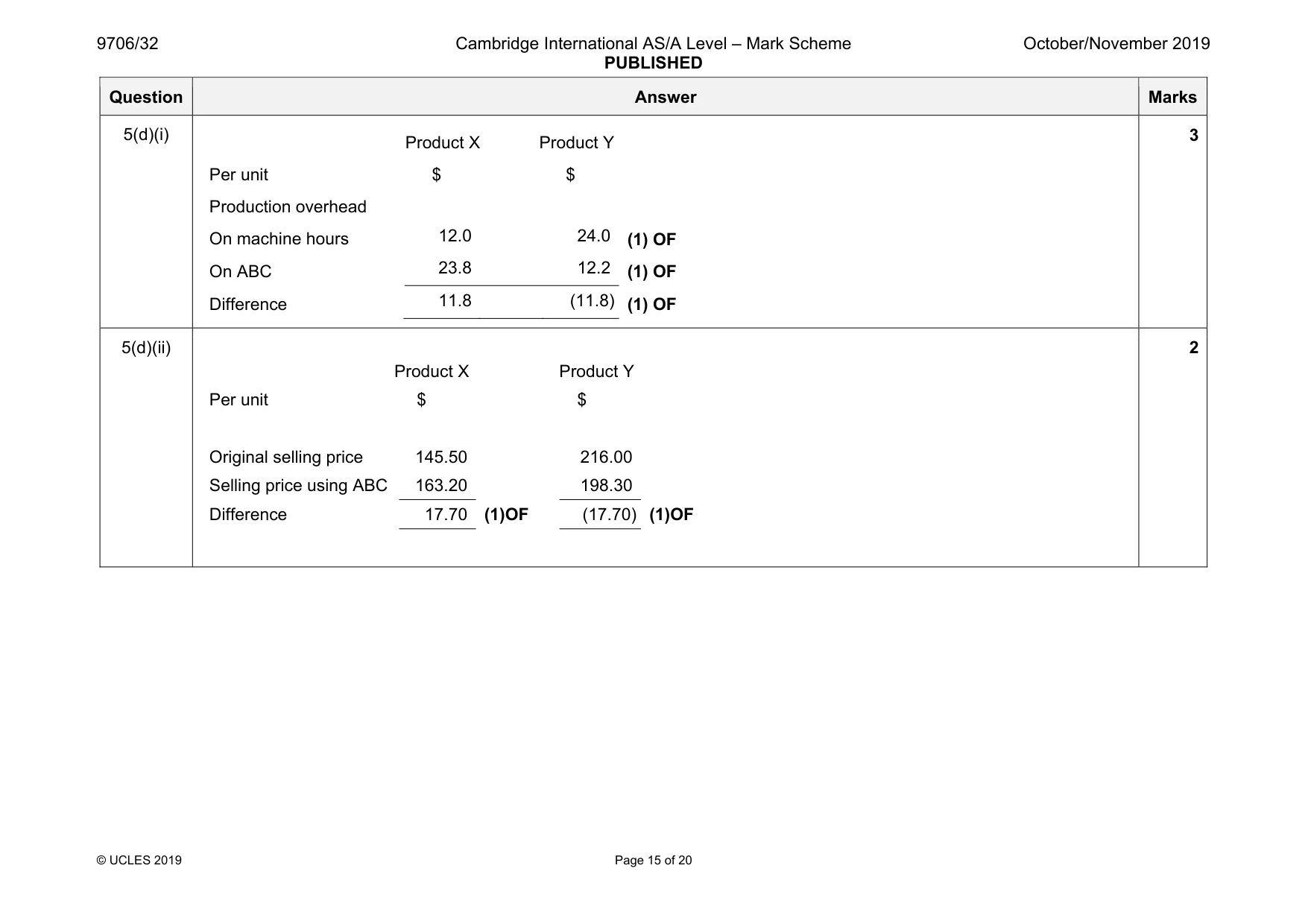
9706/32 Cambridge International AS/A Level – Mark Scheme PUBLISHED October/November 2019 © UCLES 2019 Page 15 of 20 Question Answer Marks 5(d)(i) Product X Product Y Per unit $ $ Production overhead On machine hours 12.0 24.0 (1) OF On ABC 23.8 12.2 (1) OF Difference 11.8 (11.8) (1) OF 3 5(d)(ii) Product X Product Y Per unit $ $ Original selling price 145.50 216.00 Selling price using ABC 163.20 198.30 Difference 17.70 (1)OF (17.70) (1)OF 2
Mark scheme, page 16
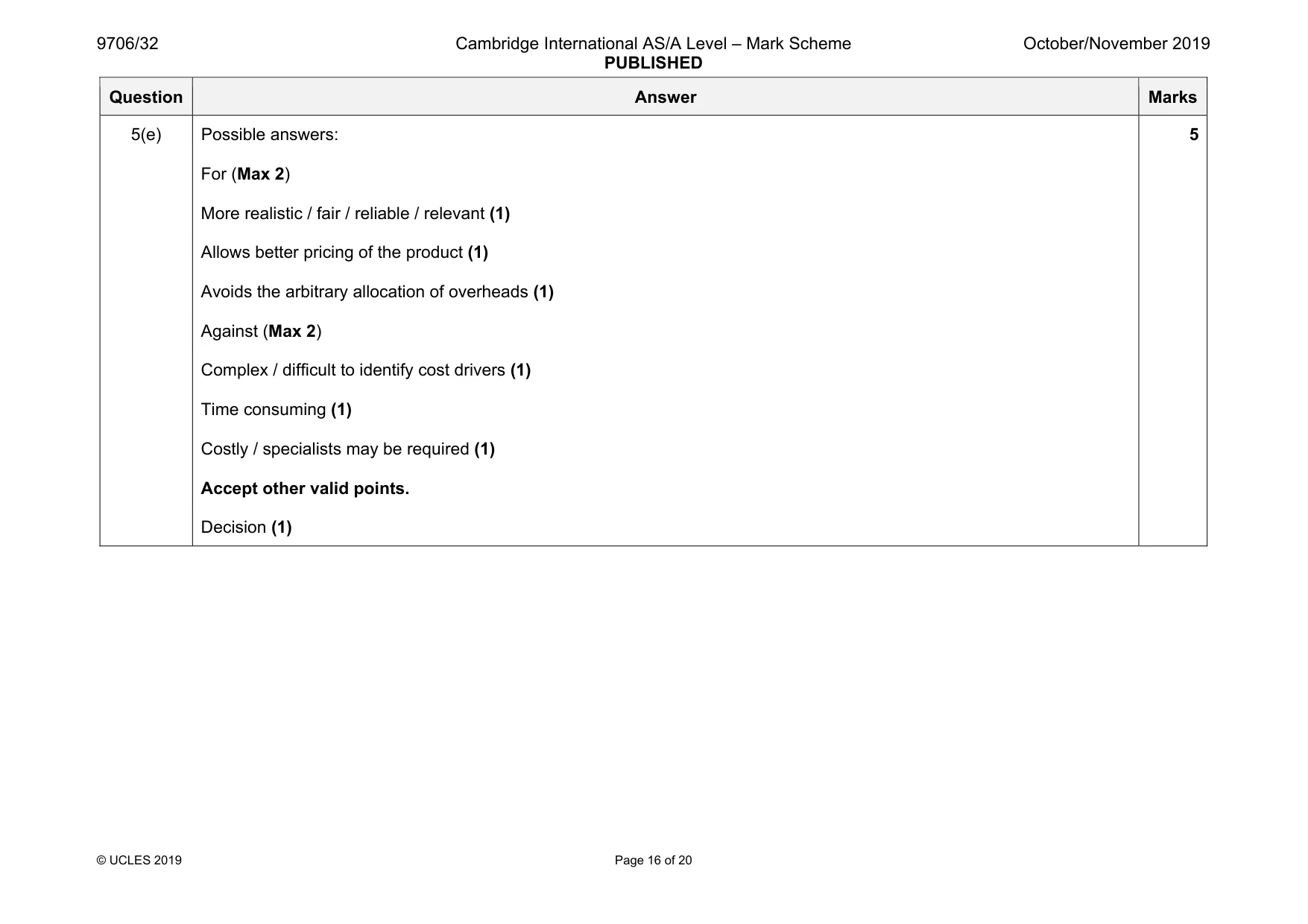
9706/32 Cambridge International AS/A Level – Mark Scheme PUBLISHED October/November 2019 © UCLES 2019 Page 16 of 20 Question Answer Marks 5(e) Possible answers: For (Max 2) More realistic / fair / reliable / relevant (1) Allows better pricing of the product (1) Avoids the arbitrary allocation of overheads (1) Against (Max 2) Complex / difficult to identify cost drivers (1) Time consuming (1) Costly / specialists may be required (1) Accept other valid points. Decision (1) 5
Mark scheme, page 17
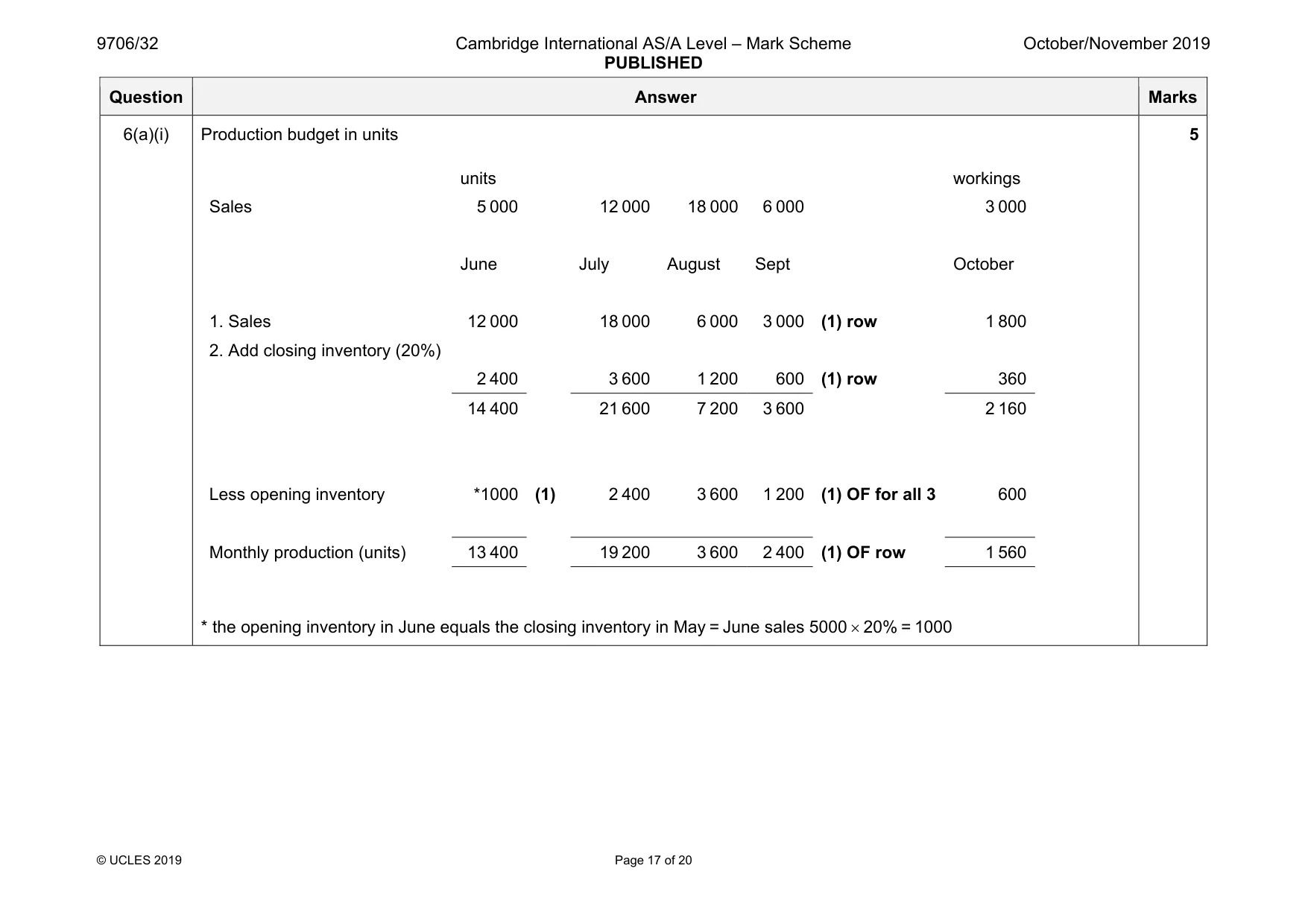
9706/32 Cambridge International AS/A Level – Mark Scheme PUBLISHED October/November 2019 © UCLES 2019 Page 17 of 20 Question Answer Marks 6(a)(i) Production budget in units units workings Sales 5 000 12 000 18 000 6 000 3 000 June July August Sept October 1. Sales 12 000 18 000 6 000 3 000 (1) row 1 800 2. Add closing inventory (20%) 2 400 3 600 1 200 600 (1) row 360 14 400 21 600 7 200 3 600 2 160 Less opening inventory *1000 (1) 2 400 3 600 1 200 (1) OF for all 3 600 Monthly production (units) 13 400 19 200 3 600 2 400 (1) OF row 1 560 * the opening inventory in June equals the closing inventory in May = June sales 5000 × 20% = 1000 5
Mark scheme, page 18
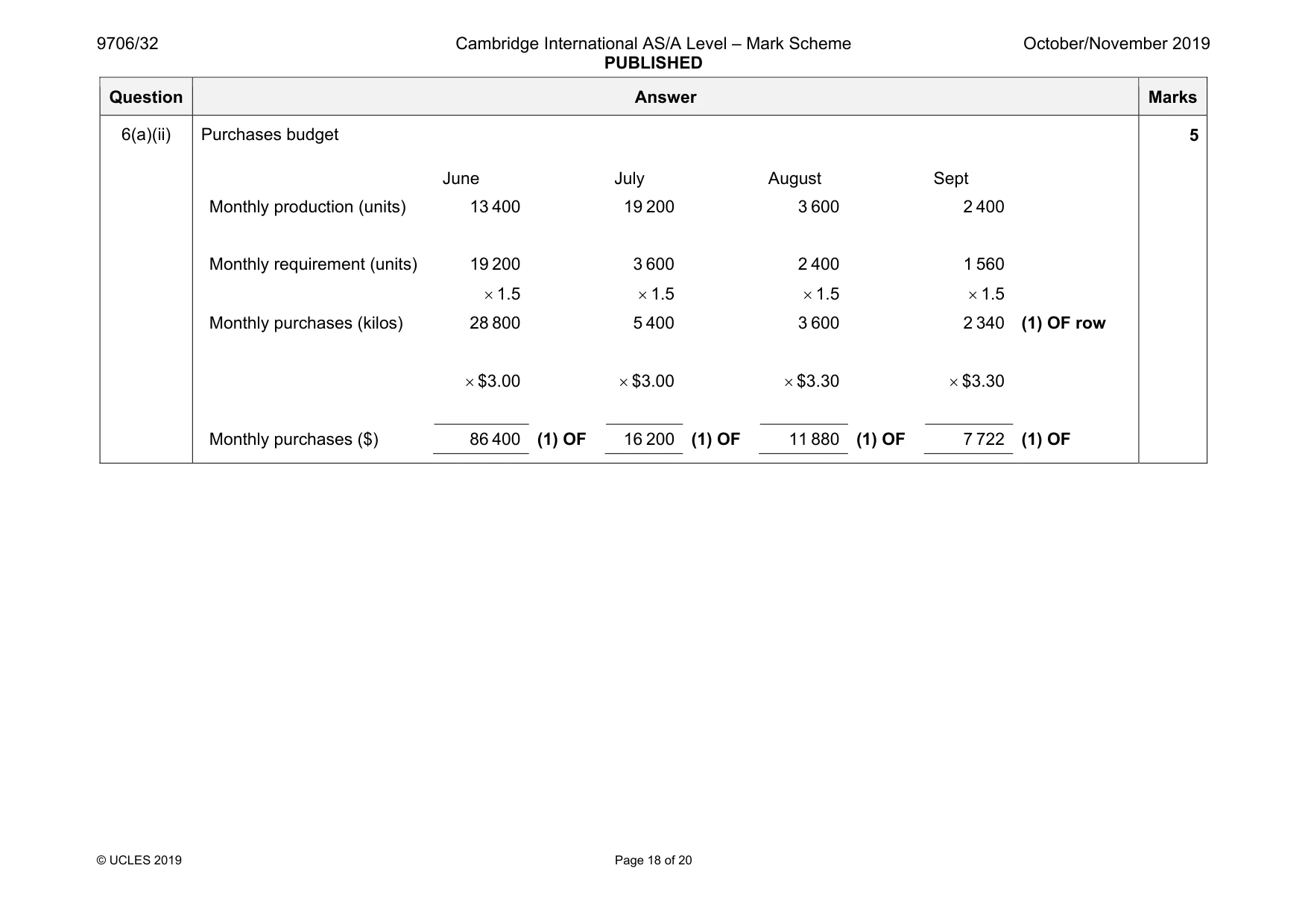
9706/32 Cambridge International AS/A Level – Mark Scheme PUBLISHED October/November 2019 © UCLES 2019 Page 18 of 20 Question Answer Marks 6(a)(ii) Purchases budget June July August Sept Monthly production (units) 13 400 19 200 3 600 2 400 Monthly requirement (units) 19 200 3 600 2 400 1 560 × 1.5 × 1.5 × 1.5 × 1.5 Monthly purchases (kilos) 28 800 5 400 3 600 2 340 (1) OF row × $3.00 × $3.00 × $3.30 × $3.30 Monthly purchases ($) 86 400 (1) OF 16 200 (1) OF 11 880 (1) OF 7 722 (1) OF 5
Mark scheme, page 19
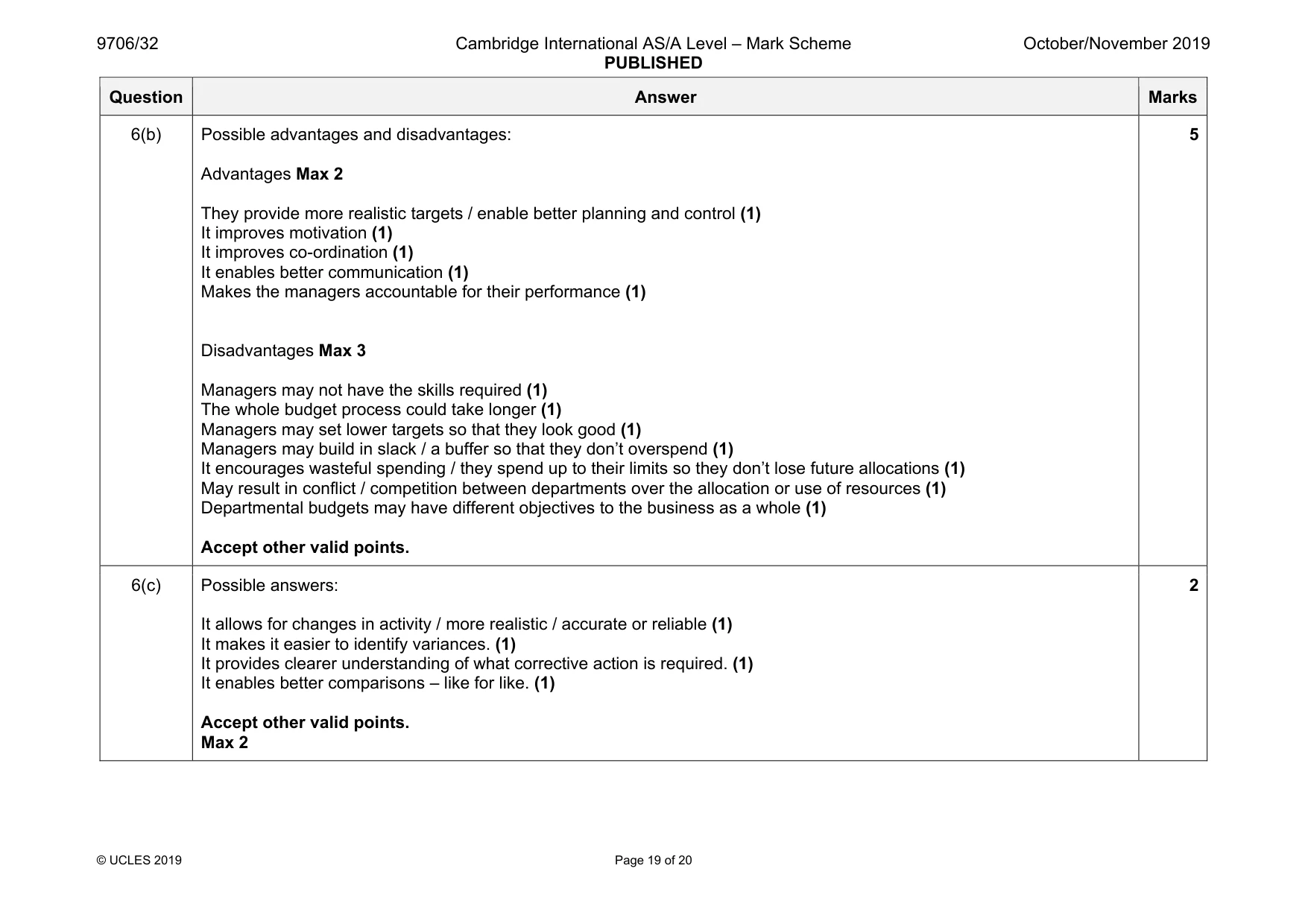
9706/32 Cambridge International AS/A Level – Mark Scheme PUBLISHED October/November 2019 © UCLES 2019 Page 19 of 20 Question Answer Marks 6(b) Possible advantages and disadvantages: Advantages Max 2 They provide more realistic targets / enable better planning and control (1) It improves motivation (1) It improves co-ordination (1) It enables better communication (1) Makes the managers accountable for their performance (1) Disadvantages Max 3 Managers may not have the skills required (1) The whole budget process could take longer (1) Managers may set lower targets so that they look good (1) Managers may build in slack / a buffer so that they don’t overspend (1) It encourages wasteful spending / they spend up to their limits so they don’t lose future allocations (1) May result in conflict / competition between departments over the allocation or use of resources (1) Departmental budgets may have different objectives to the business as a whole (1) Accept other valid points. 5 6(c) Possible answers: It allows for changes in activity / more realistic / accurate or reliable (1) It makes it easier to identify variances. (1) It provides clearer understanding of what corrective action is required. (1) It enables better comparisons – like for like. (1) Accept other valid points. Max 2 2
Mark scheme, page 20
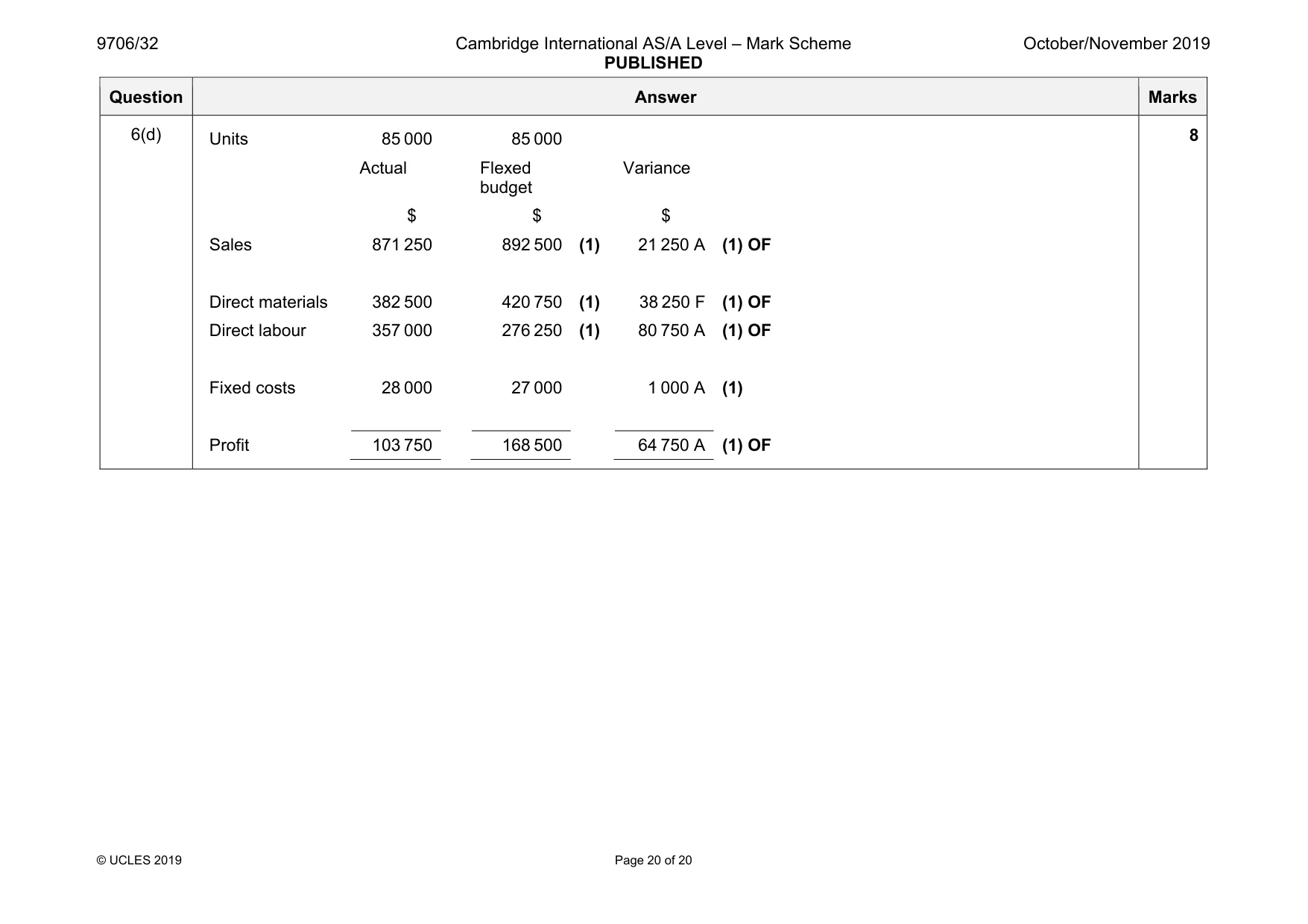
9706/32 Cambridge International AS/A Level – Mark Scheme PUBLISHED October/November 2019 © UCLES 2019 Page 20 of 20 Question Answer Marks 6(d) Units 85 000 85 000 Actual Flexed budget Variance $ $ $ Sales 871 250 892 500 (1) 21 250 A (1) OF Direct materials 382 500 420 750 (1) 38 250 F (1) OF Direct labour 357 000 276 250 (1) 80 750 A (1) OF Fixed costs 28 000 27 000 1 000 A (1) Profit 103 750 168 500 64 750 A (1) OF 8
What you needed in this session
Cambridge’s own grade thresholds for 2019 Oct/Nov, Paper 3 · Variant 2. A higher threshold means an easier paper — the bar moves with how the cohort did.