Cambridge A Level Accounting 9706 — 2018 Oct/Nov Paper 3 · Variant 3
9706/33/O/N/18 · 150 marks · ≈169 min
The question paper and its mark scheme, free to read here and free to download. This is Cambridge’s own paper, exactly as it was sat.
Question paper12 pages

Mark scheme17 pages
Answers below. Sit the paper first if you are practising.
Paper as text
Question paper, page 1
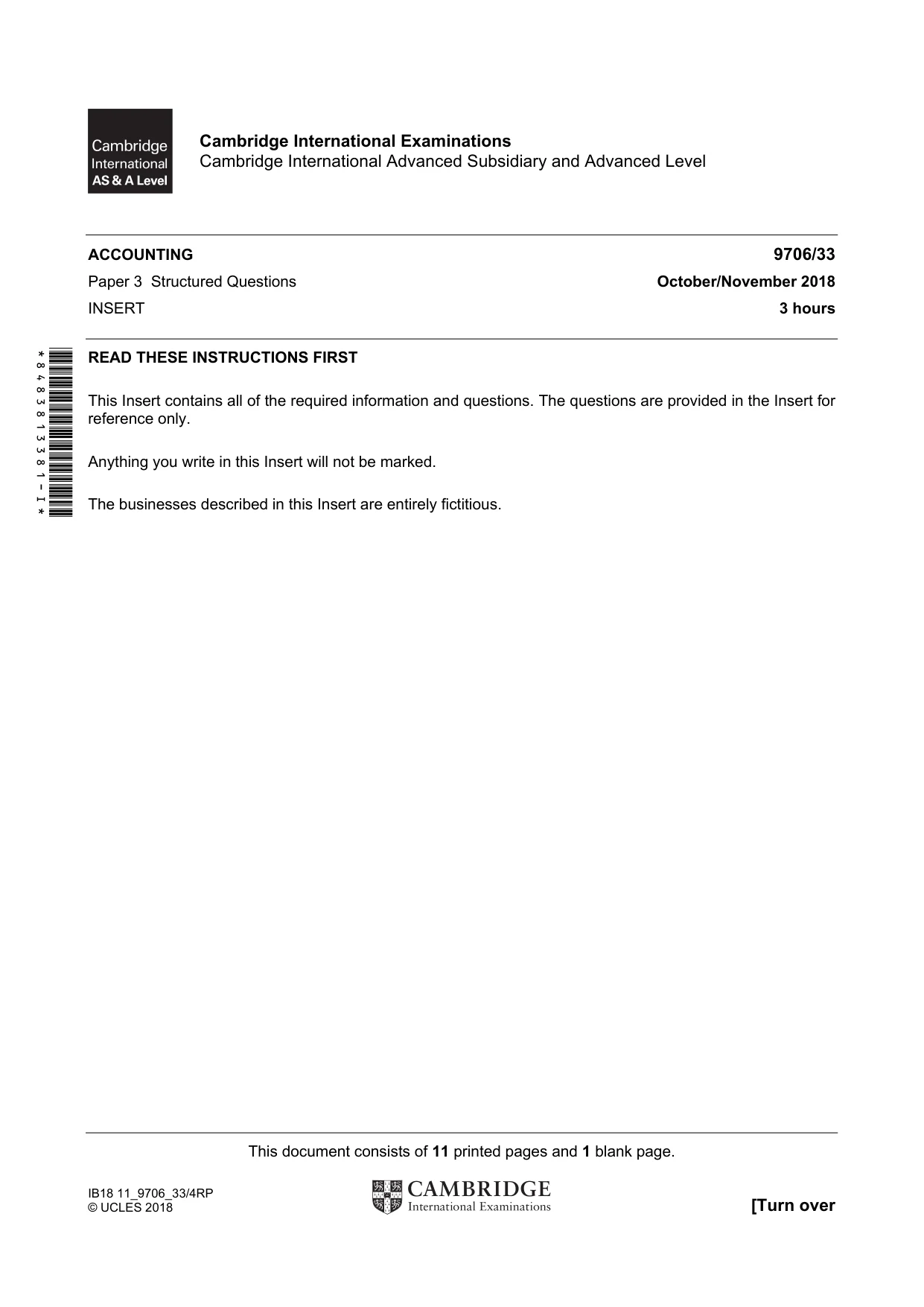
This document consists of 11 printed pages and 1 blank page. IB18 11_9706_33/4RP © UCLES 2018 [Turn over Cambridge International Examinations Cambridge International Advanced Subsidiary and Advanced Level ACCOUNTING 9706/33 Paper 3 Structured Questions October/November 2018 INSERT 3 hours READ THESE INSTRUCTIONS FIRST This Insert contains all of the required information and questions. The questions are provided in the Insert for reference only. Anything you write in this Insert will not be marked. The businesses described in this Insert are entirely fictitious.
Question paper, page 2
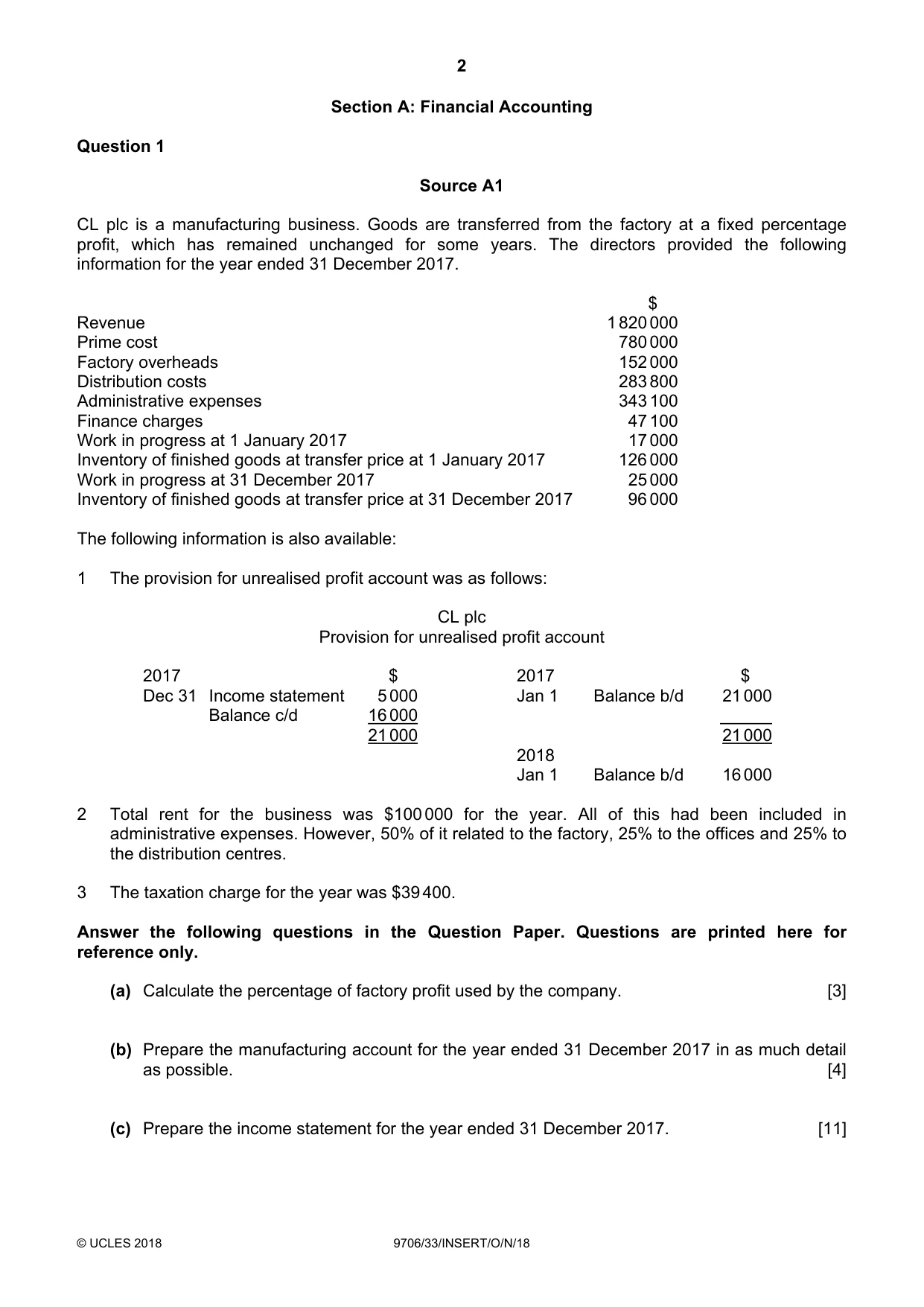
2 © UCLES 2018 9706/33/INSERT/O/N/18 Section A: Financial Accounting Question 1 Source A1 CL plc is a manufacturing business. Goods are transferred from the factory at a fixed percentage profit, which has remained unchanged for some years. The directors provided the following information for the year ended 31 December 2017. $ Revenue 1 820 000 Prime cost 780 000 Factory overheads 152 000 Distribution costs 283 800 Administrative expenses 343 100 Finance charges 47 100 Work in progress at 1 January 2017 17 000 Inventory of finished goods at transfer price at 1 January 2017 126 000 Work in progress at 31 December 2017 25 000 Inventory of finished goods at transfer price at 31 December 2017 96 000 The following information is also available: 1 The provision for unrealised profit account was as follows: CL plc Provision for unrealised profit account 2017 $ 2017 $ Dec 31 Income statement 5 000 Jan 1 Balance b/d 21 000 Balance c/d 16 000 21 000 21 000 2018 Jan 1 Balance b/d 16 000 2 Total rent for the business was $100 000 for the year. All of this had been included in administrative expenses. However, 50% of it related to the factory, 25% to the offices and 25% to the distribution centres. 3 The taxation charge for the year was $39 400. Answer the following questions in the Question Paper. Questions are printed here for reference only. (a) Calculate the percentage of factory profit used by the company. [3] (b) Prepare the manufacturing account for the year ended 31 December 2017 in as much detail as possible. [4] (c) Prepare the income statement for the year ended 31 December 2017. [11]
Question paper, page 3
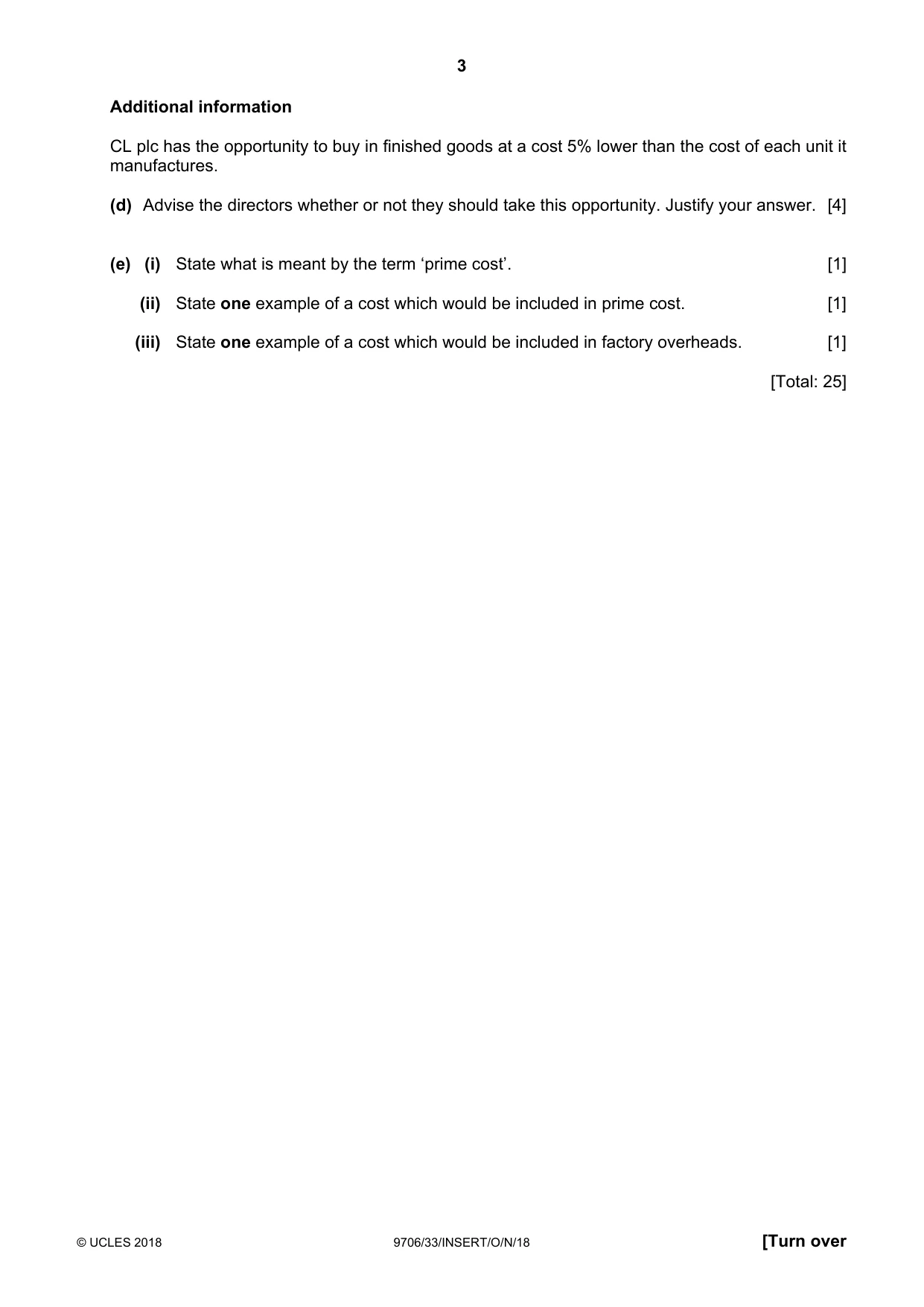
3 © UCLES 2018 9706/33/INSERT/O/N/18 [Turn over Additional information CL plc has the opportunity to buy in finished goods at a cost 5% lower than the cost of each unit it manufactures. (d) Advise the directors whether or not they should take this opportunity. Justify your answer. [4] (e) (i) State what is meant by the term ‘prime cost’. [1] (ii) State one example of a cost which would be included in prime cost. [1] (iii) State one example of a cost which would be included in factory overheads. [1] [Total: 25]
Question paper, page 4
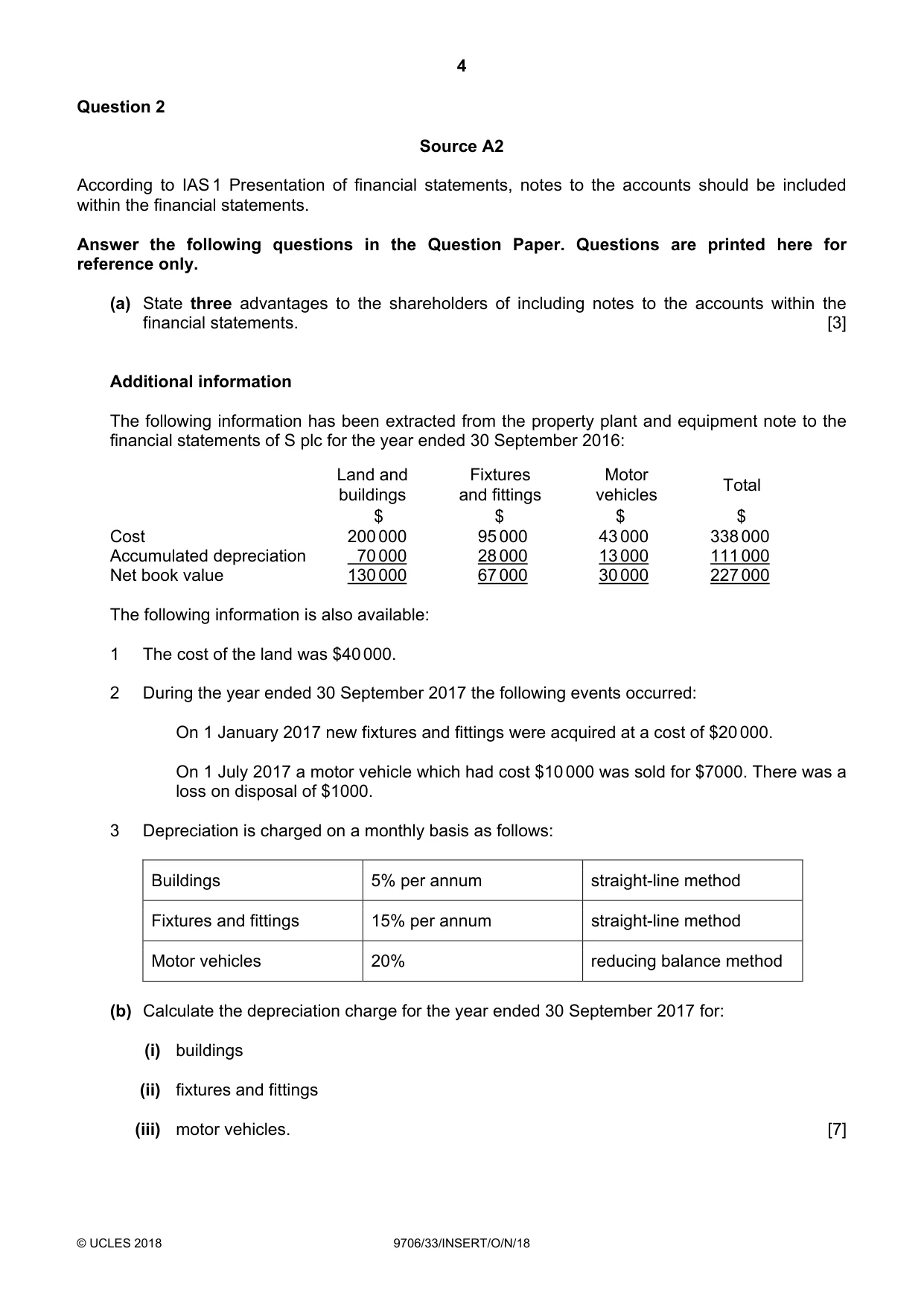
4 © UCLES 2018 9706/33/INSERT/O/N/18 Question 2 Source A2 According to IAS 1 Presentation of financial statements, notes to the accounts should be included within the financial statements. Answer the following questions in the Question Paper. Questions are printed here for reference only. (a) State three advantages to the shareholders of including notes to the accounts within the financial statements. [3] Additional information The following information has been extracted from the property plant and equipment note to the financial statements of S plc for the year ended 30 September 2016: Land and buildings Fixtures and fittings Motor vehicles Total $ $ $ $ Cost 200 000 95 000 43 000 338 000 Accumulated depreciation 70 000 28 000 13 000 111 000 Net book value 130 000 67 000 30 000 227 000 The following information is also available: 1 The cost of the land was $40 000. 2 During the year ended 30 September 2017 the following events occurred: On 1 January 2017 new fixtures and fittings were acquired at a cost of $20 000. On 1 July 2017 a motor vehicle which had cost $10 000 was sold for $7000. There was a loss on disposal of $1000. 3 Depreciation is charged on a monthly basis as follows: Buildings 5% per annum straight-line method Fixtures and fittings 15% per annum straight-line method Motor vehicles 20% reducing balance method (b) Calculate the depreciation charge for the year ended 30 September 2017 for: (i) buildings (ii) fixtures and fittings (iii) motor vehicles. [7]
Question paper, page 5
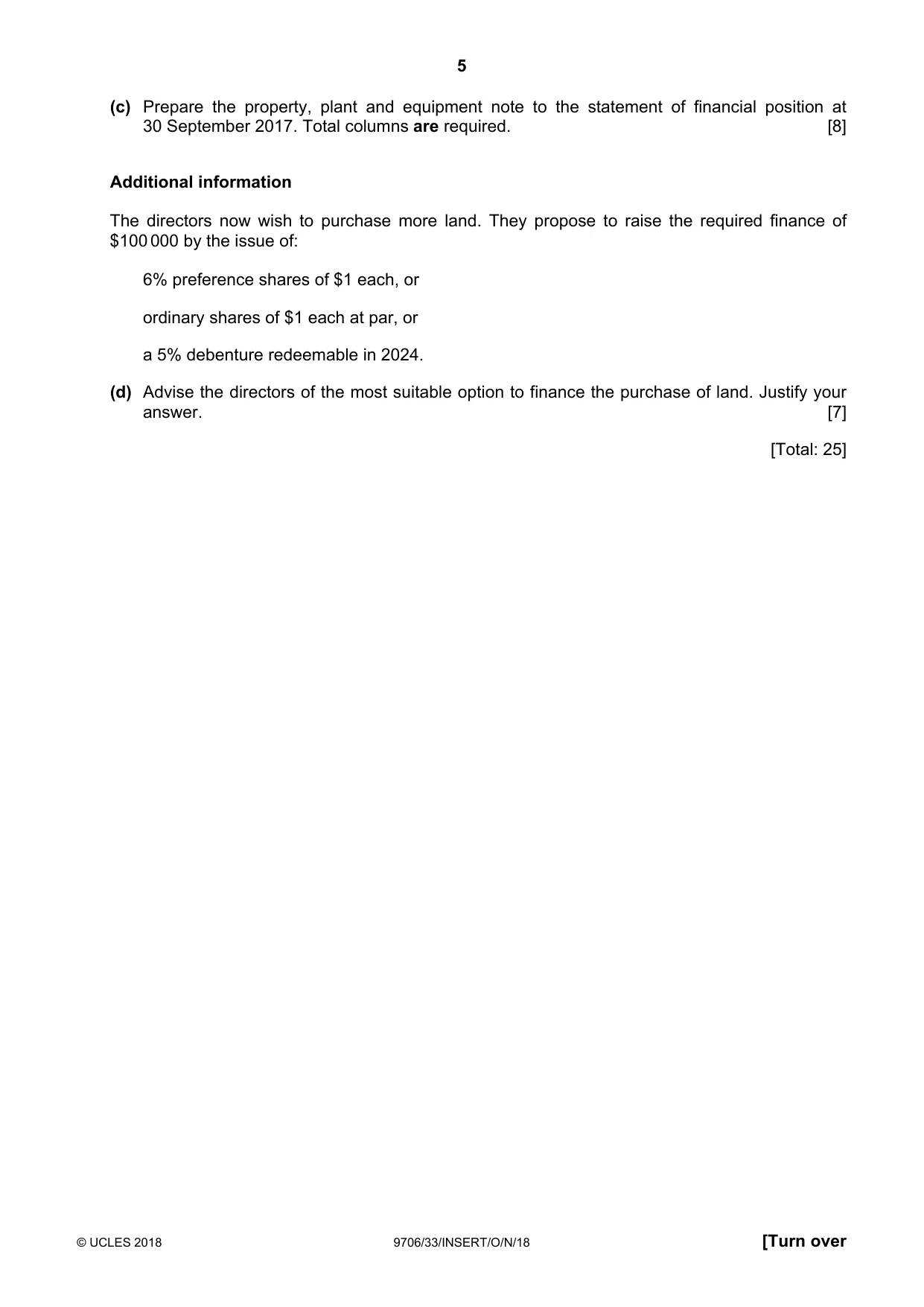
5 © UCLES 2018 9706/33/INSERT/O/N/18 [Turn over (c) Prepare the property, plant and equipment note to the statement of financial position at 30 September 2017. Total columns are required. [8] Additional information The directors now wish to purchase more land. They propose to raise the required finance of $100 000 by the issue of: 6% preference shares of $1 each, or ordinary shares of $1 each at par, or a 5% debenture redeemable in 2024. (d) Advise the directors of the most suitable option to finance the purchase of land. Justify your answer. [7] [Total: 25]
Question paper, page 6
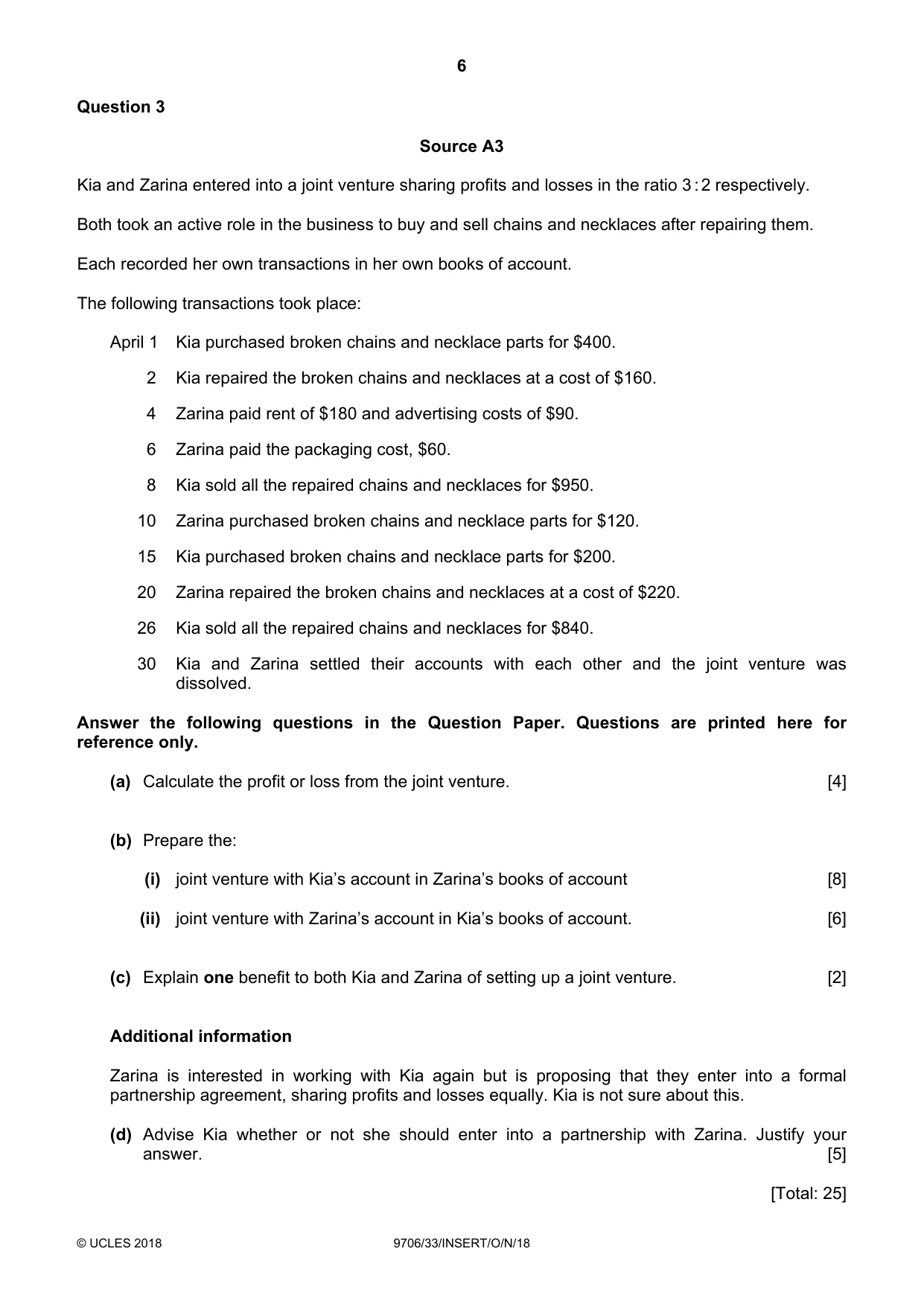
6 © UCLES 2018 9706/33/INSERT/O/N/18 Question 3 Source A3 Kia and Zarina entered into a joint venture sharing profits and losses in the ratio 3 : 2 respectively. Both took an active role in the business to buy and sell chains and necklaces after repairing them. Each recorded her own transactions in her own books of account. The following transactions took place: April 1 Kia purchased broken chains and necklace parts for $400. 2 Kia repaired the broken chains and necklaces at a cost of $160. 4 Zarina paid rent of $180 and advertising costs of $90. 6 Zarina paid the packaging cost, $60. 8 Kia sold all the repaired chains and necklaces for $950. 10 Zarina purchased broken chains and necklace parts for $120. 15 Kia purchased broken chains and necklace parts for $200. 20 Zarina repaired the broken chains and necklaces at a cost of $220. 26 Kia sold all the repaired chains and necklaces for $840. 30 Kia and Zarina settled their accounts with each other and the joint venture was dissolved. Answer the following questions in the Question Paper. Questions are printed here for reference only. (a) Calculate the profit or loss from the joint venture. [4] (b) Prepare the: (i) joint venture with Kia’s account in Zarina’s books of account [8] (ii) joint venture with Zarina’s account in Kia’s books of account. [6] (c) Explain one benefit to both Kia and Zarina of setting up a joint venture. [2] Additional information Zarina is interested in working with Kia again but is proposing that they enter into a formal partnership agreement, sharing profits and losses equally. Kia is not sure about this. (d) Advise Kia whether or not she should enter into a partnership with Zarina. Justify your answer. [5] [Total: 25]
Question paper, page 7
7 © UCLES 2018 9706/33/INSERT/O/N/18 [Turn over PLEASE TURN OVER
Question paper, page 8
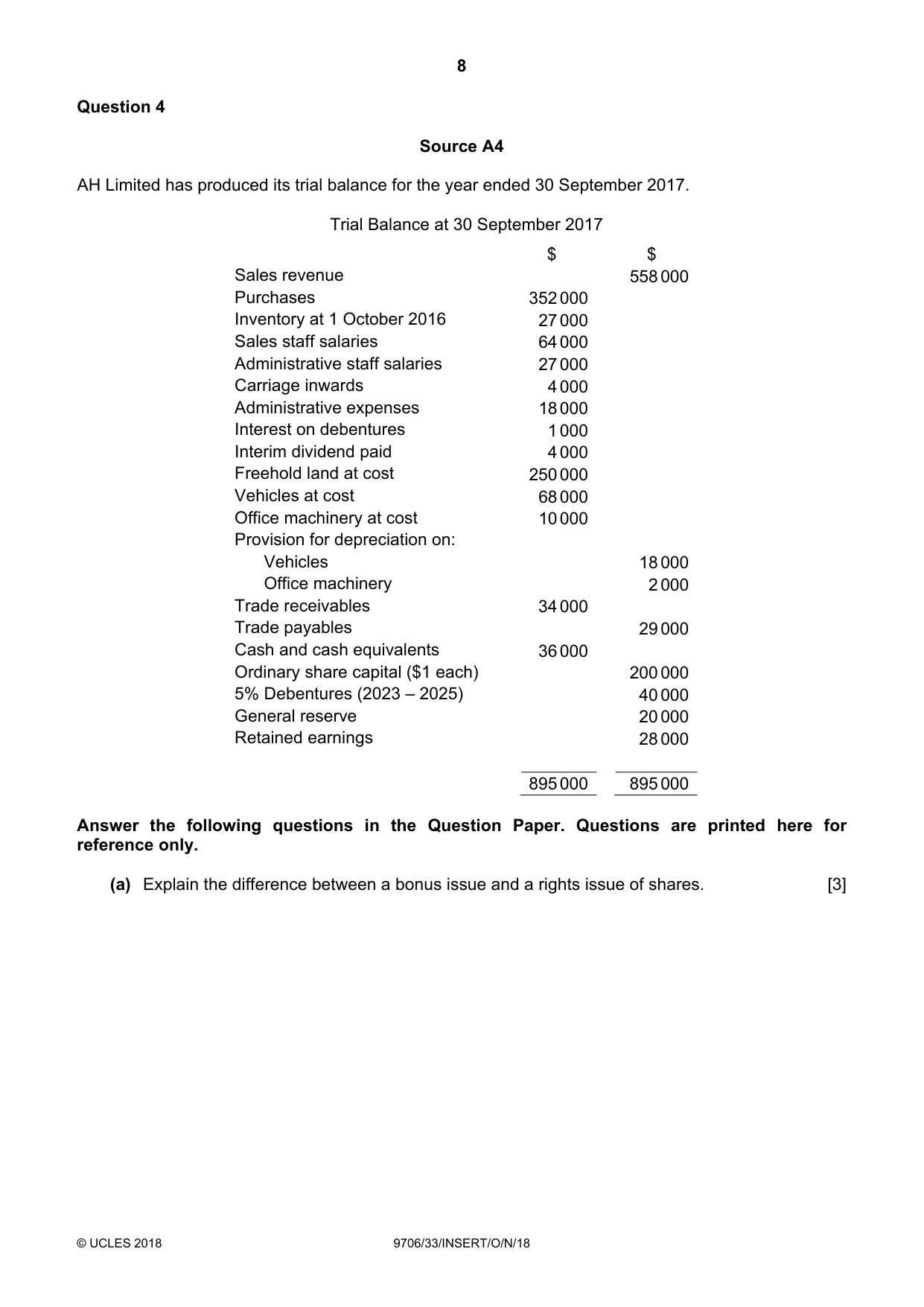
8 © UCLES 2018 9706/33/INSERT/O/N/18 Question 4 Source A4 AH Limited has produced its trial balance for the year ended 30 September 2017. Trial Balance at 30 September 2017 $ $ Sales revenue 558 000 Purchases 352 000 Inventory at 1 October 2016 27 000 Sales staff salaries 64 000 Administrative staff salaries 27 000 Carriage inwards 4 000 Administrative expenses 18 000 Interest on debentures 1 000 Interim dividend paid 4 000 Freehold land at cost 250 000 Vehicles at cost 68 000 Office machinery at cost 10 000 Provision for depreciation on: Vehicles 18 000 Office machinery 2 000 Trade receivables 34 000 Trade payables 29 000 Cash and cash equivalents 36 000 Ordinary share capital ($1 each) 200 000 5% Debentures (2023 – 2025) 40 000 General reserve 20 000 Retained earnings 28 000 895 000 895 000 Answer the following questions in the Question Paper. Questions are printed here for reference only. (a) Explain the difference between a bonus issue and a rights issue of shares. [3]
Question paper, page 9
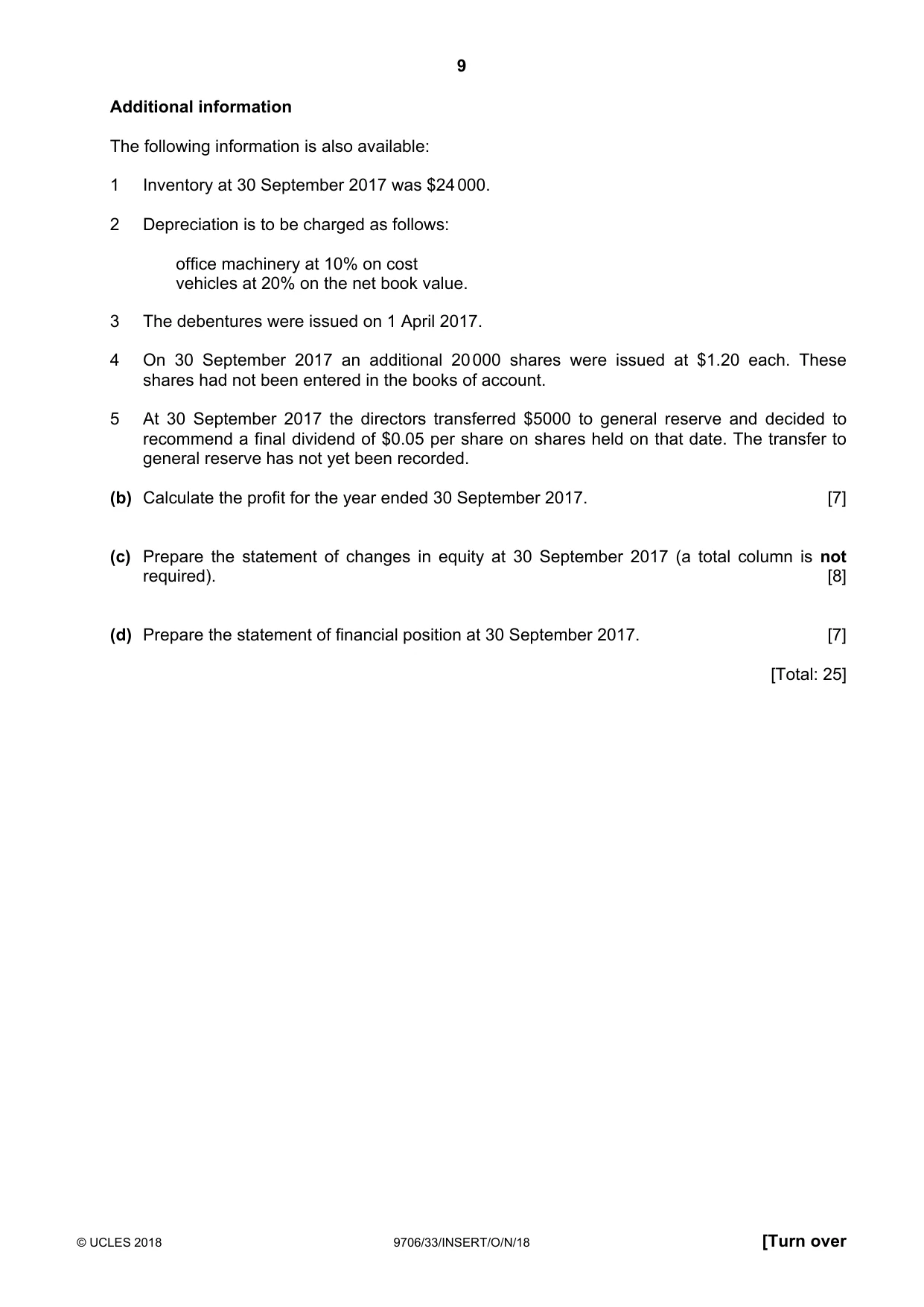
9 © UCLES 2018 9706/33/INSERT/O/N/18 [Turn over Additional information The following information is also available: 1 Inventory at 30 September 2017 was $24 000. 2 Depreciation is to be charged as follows: office machinery at 10% on cost vehicles at 20% on the net book value. 3 The debentures were issued on 1 April 2017. 4 On 30 September 2017 an additional 20 000 shares were issued at $1.20 each. These shares had not been entered in the books of account. 5 At 30 September 2017 the directors transferred $5000 to general reserve and decided to recommend a final dividend of $0.05 per share on shares held on that date. The transfer to general reserve has not yet been recorded. (b) Calculate the profit for the year ended 30 September 2017. [7] (c) Prepare the statement of changes in equity at 30 September 2017 (a total column is not required). [8] (d) Prepare the statement of financial position at 30 September 2017. [7] [Total: 25]
Question paper, page 10
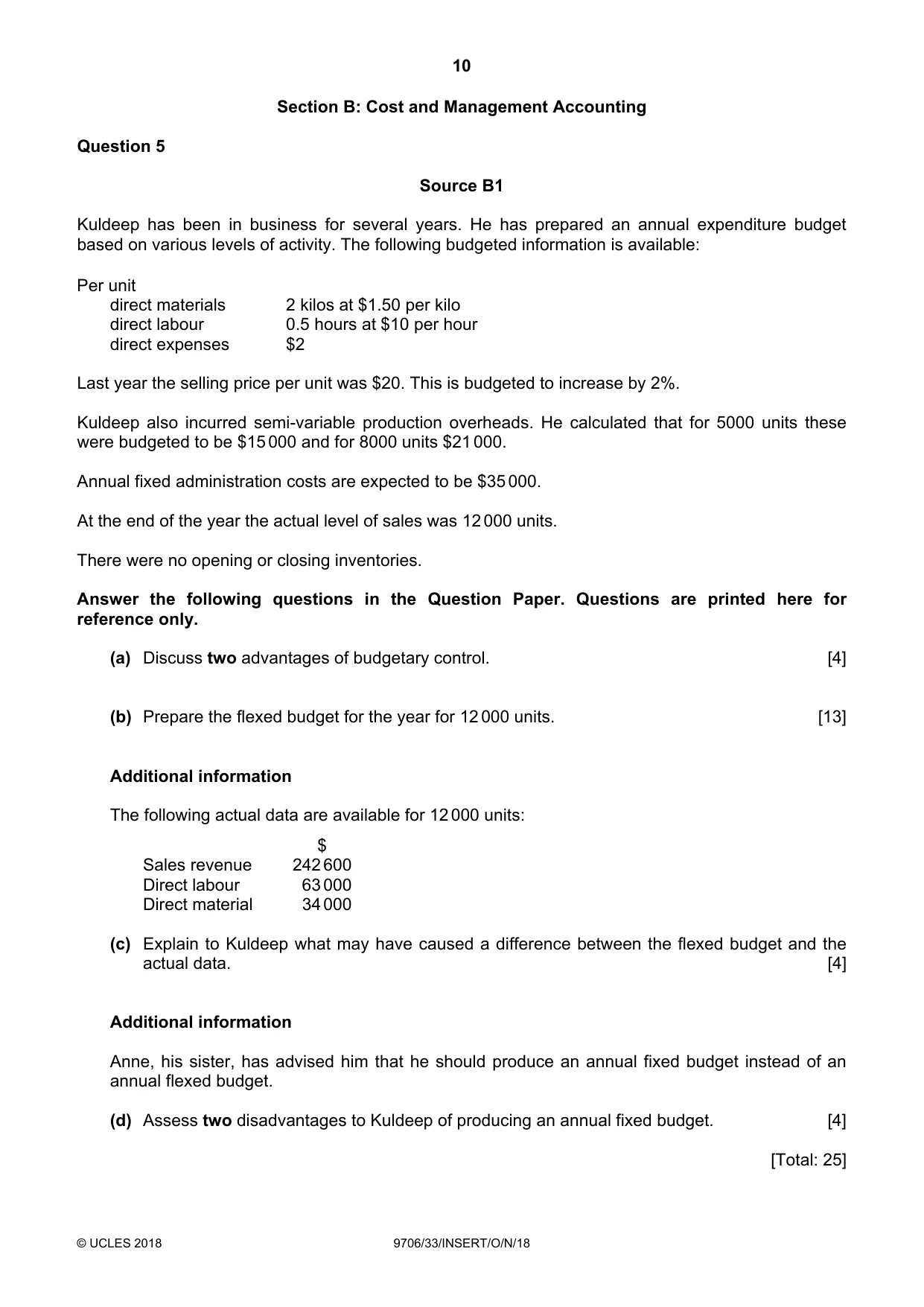
10 © UCLES 2018 9706/33/INSERT/O/N/18 Section B: Cost and Management Accounting Question 5 Source B1 Kuldeep has been in business for several years. He has prepared an annual expenditure budget based on various levels of activity. The following budgeted information is available: Per unit direct materials 2 kilos at $1.50 per kilo direct labour 0.5 hours at $10 per hour direct expenses $2 Last year the selling price per unit was $20. This is budgeted to increase by 2%. Kuldeep also incurred semi-variable production overheads. He calculated that for 5000 units these were budgeted to be $15 000 and for 8000 units $21 000. Annual fixed administration costs are expected to be $35 000. At the end of the year the actual level of sales was 12 000 units. There were no opening or closing inventories. Answer the following questions in the Question Paper. Questions are printed here for reference only. (a) Discuss two advantages of budgetary control. [4] (b) Prepare the flexed budget for the year for 12 000 units. [13] Additional information The following actual data are available for 12 000 units: $ Sales revenue 242 600 Direct labour 63 000 Direct material 34 000 (c) Explain to Kuldeep what may have caused a difference between the flexed budget and the actual data. [4] Additional information Anne, his sister, has advised him that he should produce an annual fixed budget instead of an annual flexed budget. (d) Assess two disadvantages to Kuldeep of producing an annual fixed budget. [4] [Total: 25]
Question paper, page 11
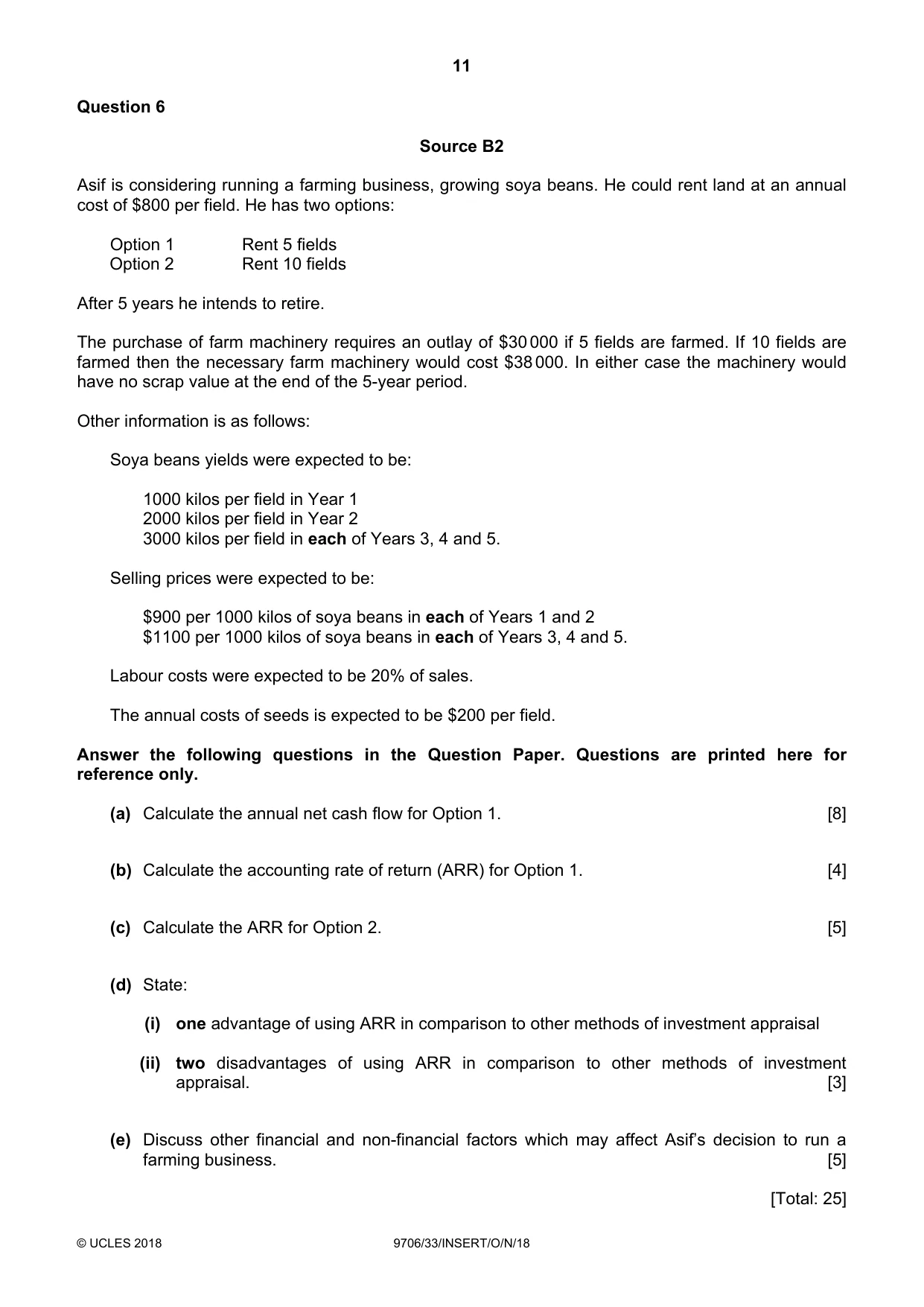
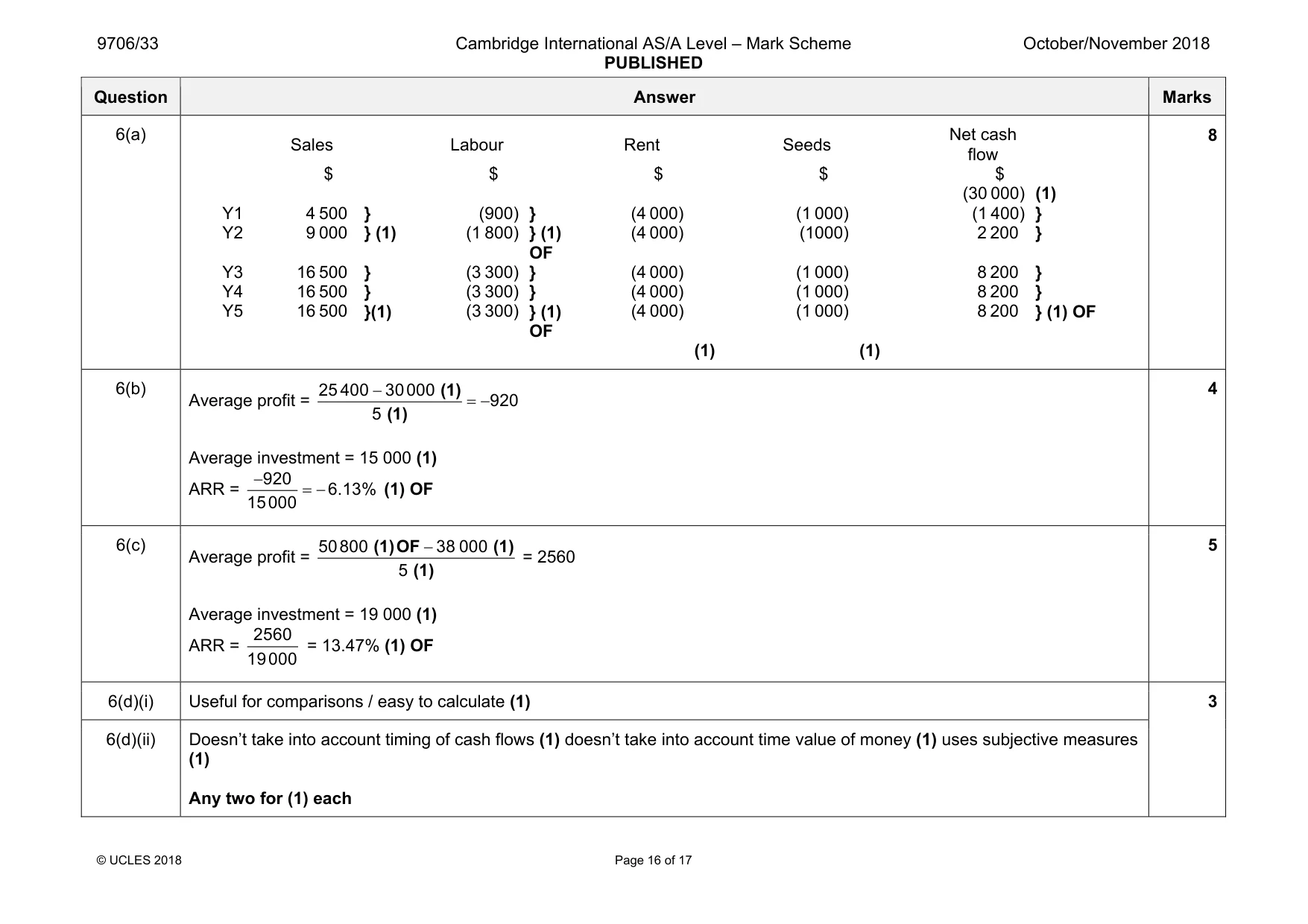
11 © UCLES 2018 9706/33/INSERT/O/N/18 Question 6 Source B2 Asif is considering running a farming business, growing soya beans. He could rent land at an annual cost of $800 per field. He has two options: Option 1 Rent 5 fields Option 2 Rent 10 fields After 5 years he intends to retire. The purchase of farm machinery requires an outlay of $30 000 if 5 fields are farmed. If 10 fields are farmed then the necessary farm machinery would cost $38 000. In either case the machinery would have no scrap value at the end of the 5-year period. Other information is as follows: Soya beans yields were expected to be: 1000 kilos per field in Year 1 2000 kilos per field in Year 2 3000 kilos per field in each of Years 3, 4 and 5. Selling prices were expected to be: $900 per 1000 kilos of soya beans in each of Years 1 and 2 $1100 per 1000 kilos of soya beans in each of Years 3, 4 and 5. Labour costs were expected to be 20% of sales. The annual costs of seeds is expected to be $200 per field. Answer the following questions in the Question Paper. Questions are printed here for reference only. (a) Calculate the annual net cash flow for Option 1. [8] (b) Calculate the accounting rate of return (ARR) for Option 1. [4] (c) Calculate the ARR for Option 2. [5] (d) State: (i) one advantage of using ARR in comparison to other methods of investment appraisal (ii) two disadvantages of using ARR in comparison to other methods of investment appraisal. [3] (e) Discuss other financial and non-financial factors which may affect Asif’s decision to run a farming business. [5] [Total: 25]
Question paper, page 12
12 Permission to reproduce items where third-party owned material protected by copyright is included has been sought and cleared where possible. Every reasonable effort has been made by the publisher (UCLES) to trace copyright holders, but if any items requiring clearance have unwittingly been included, the publisher will be pleased to make amends at the earliest possible opportunity. To avoid the issue of disclosure of answer-related information to candidates, all copyright acknowledgements are reproduced online in the Cambridge International Examinations Copyright Acknowledgements Booklet. This is produced for each series of examinations and is freely available to download at www.cie.org.uk after the live examination series. Cambridge International Examinations is part of the Cambridge Assessment Group. Cambridge Assessment is the brand name of University of Cambridge Local Examinations Syndicate (UCLES), which is itself a department of the University of Cambridge. © UCLES 2018 9706/33/INSERT /O/N/18 BLANK PAGE
Mark scheme, page 1
This document consists of 17 printed pages. © UCLES 2018 [Turn over Cambridge Assessment International Education Cambridge International Advanced Subsidiary and Advanced Level ACCOUNTING 9706/33 Paper 3 Structured Questions October/November 2018 MARK SCHEME Maximum Mark: 150 Published This mark scheme is published as an aid to teachers and candidates, to indicate the requirements of the examination. It shows the basis on which Examiners were instructed to award marks. It does not indicate the details of the discussions that took place at an Examiners’ meeting before marking began, which would have considered the acceptability of alternative answers. Mark schemes should be read in conjunction with the question paper and the Principal Examiner Report for Teachers. Cambridge International will not enter into discussions about these mark schemes. Cambridge International is publishing the mark schemes for the October/November 2018 series for most Cambridge IGCSE™, Cambridge International A and AS Level components and some Cambridge O Level components.
Mark scheme, page 2
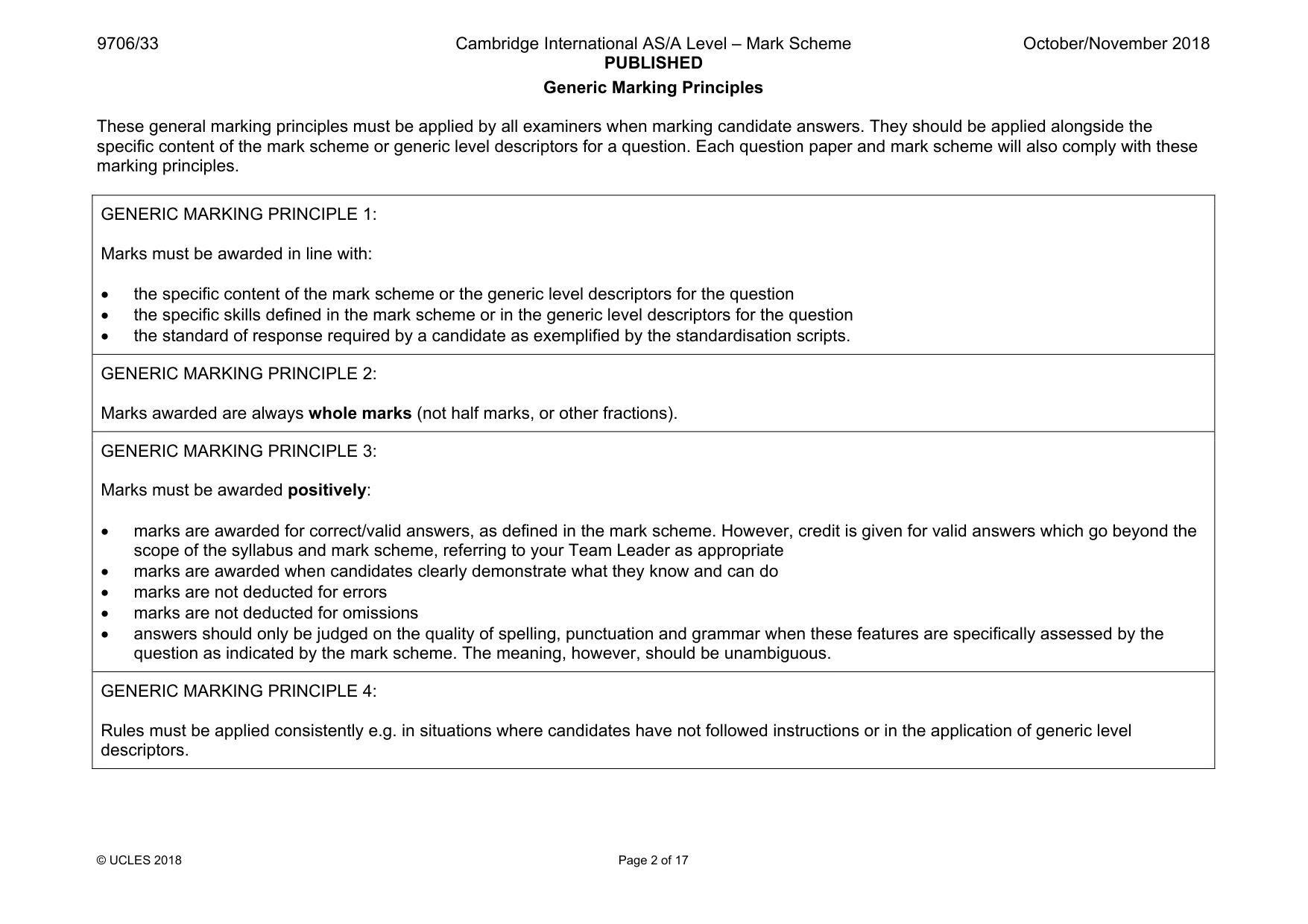
9706/33 Cambridge International AS/A Level – Mark Scheme PUBLISHED October/November 2018 © UCLES 2018 Page 2 of 17 Generic Marking Principles These general marking principles must be applied by all examiners when marking candidate answers. They should be applied alongside the specific content of the mark scheme or generic level descriptors for a question. Each question paper and mark scheme will also comply with these marking principles. GENERIC MARKING PRINCIPLE 1: Marks must be awarded in line with: • the specific content of the mark scheme or the generic level descriptors for the question • the specific skills defined in the mark scheme or in the generic level descriptors for the question • the standard of response required by a candidate as exemplified by the standardisation scripts. GENERIC MARKING PRINCIPLE 2: Marks awarded are always whole marks (not half marks, or other fractions). GENERIC MARKING PRINCIPLE 3: Marks must be awarded positively: • marks are awarded for correct/valid answers, as defined in the mark scheme. However, credit is given for valid answers which go beyond the scope of the syllabus and mark scheme, referring to your Team Leader as appropriate • marks are awarded when candidates clearly demonstrate what they know and can do • marks are not deducted for errors • marks are not deducted for omissions • answers should only be judged on the quality of spelling, punctuation and grammar when these features are specifically assessed by the question as indicated by the mark scheme. The meaning, however, should be unambiguous. GENERIC MARKING PRINCIPLE 4: Rules must be applied consistently e.g. in situations where candidates have not followed instructions or in the application of generic level descriptors.
Mark scheme, page 3
9706/33 Cambridge International AS/A Level – Mark Scheme PUBLISHED October/November 2018 © UCLES 2018 Page 3 of 17 GENERIC MARKING PRINCIPLE 5: Marks should be awarded using the full range of marks defined in the mark scheme for the question (however; the use of the full mark range may be limited according to the quality of the candidate responses seen). GENERIC MARKING PRINCIPLE 6: Marks awarded are based solely on the requirements as defined in the mark scheme. Marks should not be awarded with grade thresholds or grade descriptors in mind.
Mark scheme, page 4
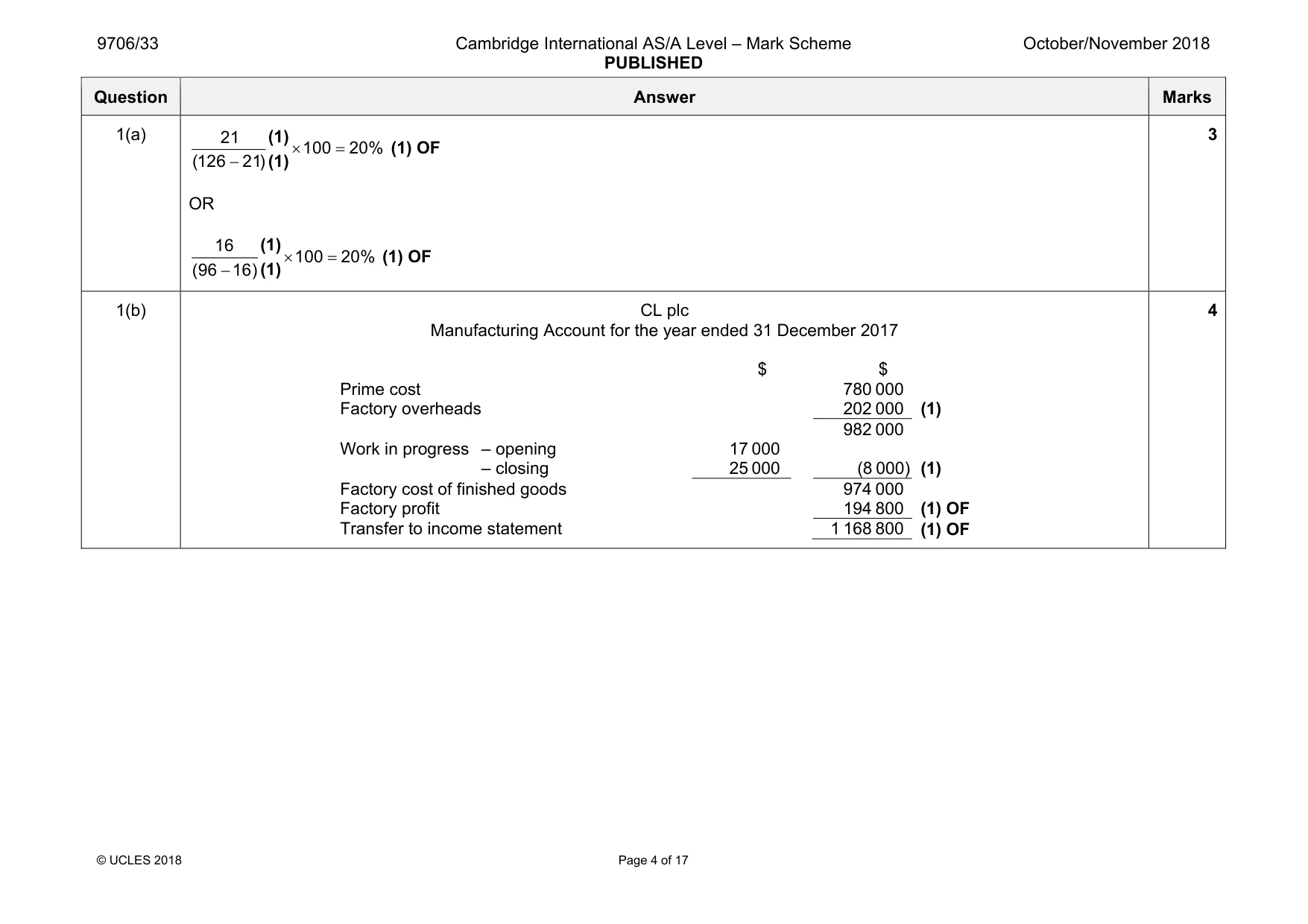
9706/33 Cambridge International AS/A Level – Mark Scheme PUBLISHED October/November 2018 © UCLES 2018 Page 4 of 17 Question Answer Marks 1(a) × = − 21 100 20% (126 21) (1) (1) (1) OF OR × = − 16 100 20% (96 16) (1) (1) (1) OF 3 1(b) CL plc Manufacturing Account for the year ended 31 December 2017 $ $ Prime cost 780 000 Factory overheads 202 000 (1) 982 000 Work in progress – opening 17 000 – closing 25 000 (8 000) (1) Factory cost of finished goods 974 000 Factory profit 194 800 (1) OF Transfer to income statement 1 168 800 (1) OF 4
Mark scheme, page 5
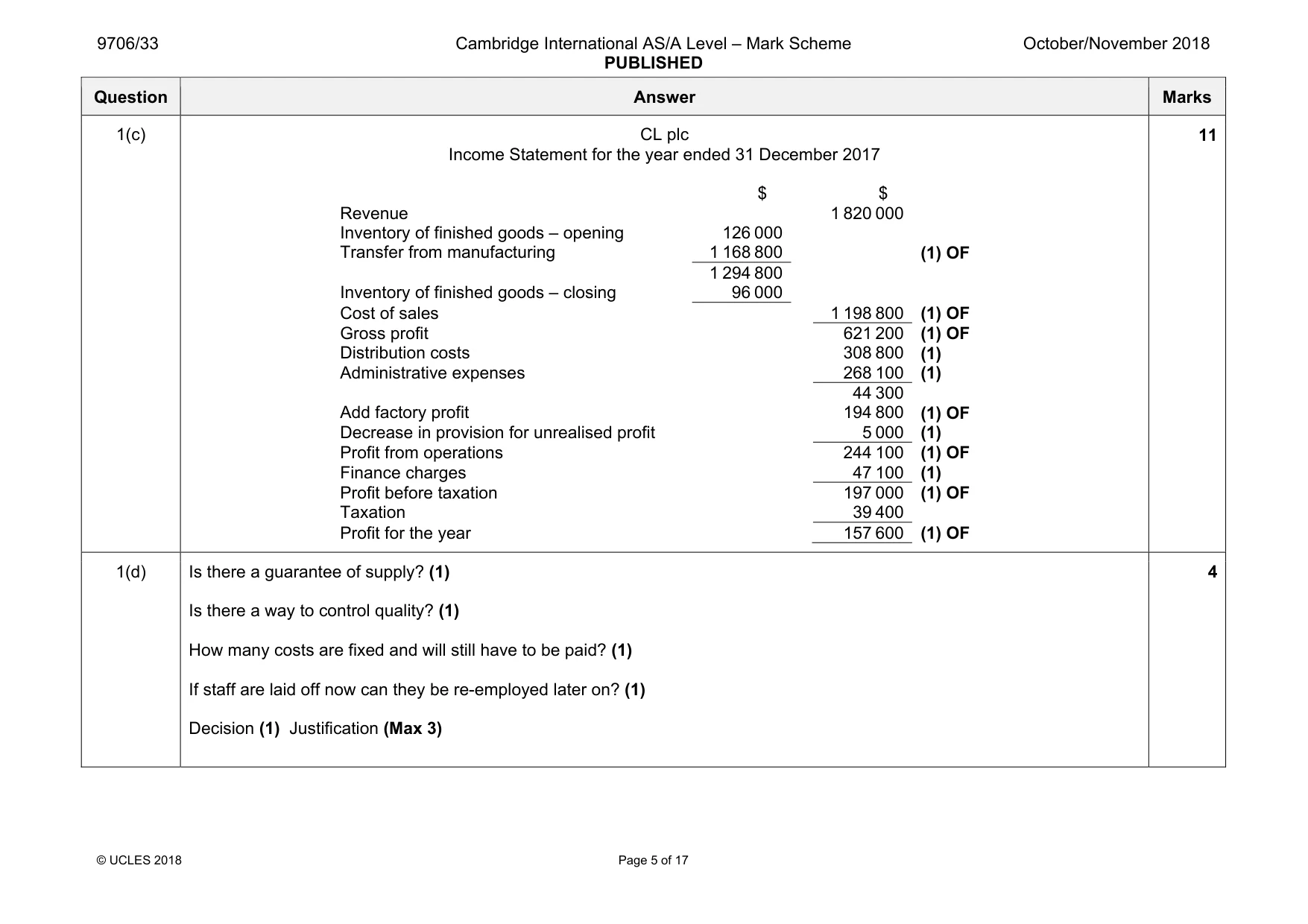
9706/33 Cambridge International AS/A Level – Mark Scheme PUBLISHED October/November 2018 © UCLES 2018 Page 5 of 17 Question Answer Marks 1(c) CL plc Income Statement for the year ended 31 December 2017 $ $ Revenue 1 820 000 Inventory of finished goods – opening 126 000 Transfer from manufacturing 1 168 800 (1) OF 1 294 800 Inventory of finished goods – closing 96 000 Cost of sales 1 198 800 (1) OF Gross profit 621 200 (1) OF Distribution costs 308 800 (1) Administrative expenses 268 100 (1) 44 300 Add factory profit 194 800 (1) OF Decrease in provision for unrealised profit 5 000 (1) Profit from operations 244 100 (1) OF Finance charges 47 100 (1) Profit before taxation 197 000 (1) OF Taxation 39 400 Profit for the year 157 600 (1) OF 11 1(d) Is there a guarantee of supply? (1) Is there a way to control quality? (1) How many costs are fixed and will still have to be paid? (1) If staff are laid off now can they be re-employed later on? (1) Decision (1) Justification (Max 3) 4
Mark scheme, page 6
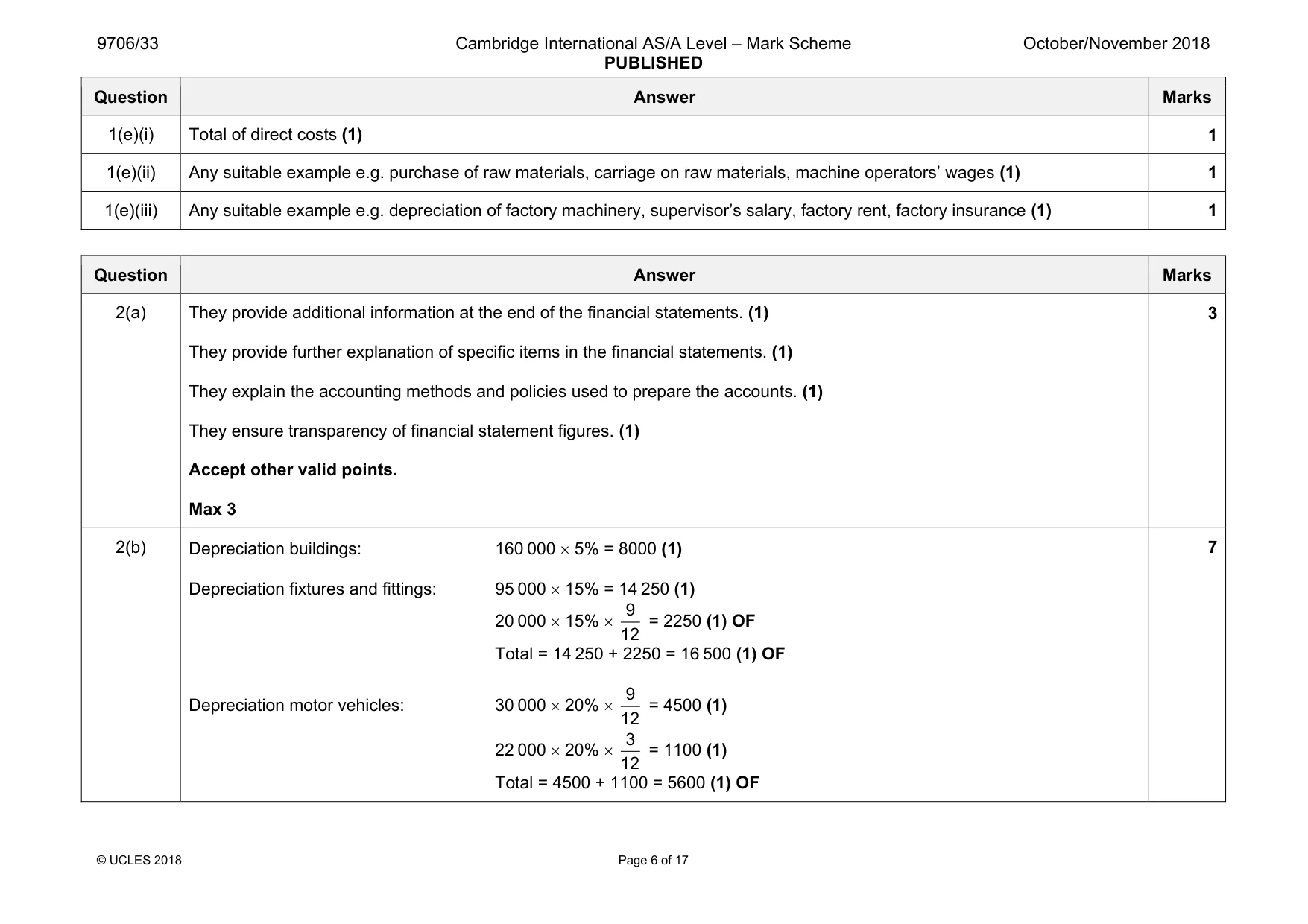
9706/33 Cambridge International AS/A Level – Mark Scheme PUBLISHED October/November 2018 © UCLES 2018 Page 6 of 17 Question Answer Marks 1(e)(i) Total of direct costs (1) 1 1(e)(ii) Any suitable example e.g. purchase of raw materials, carriage on raw materials, machine operators’ wages (1) 1 1(e)(iii) Any suitable example e.g. depreciation of factory machinery, supervisor’s salary, factory rent, factory insurance (1) 1 Question Answer Marks 2(a) They provide additional information at the end of the financial statements. (1) They provide further explanation of specific items in the financial statements. (1) They explain the accounting methods and policies used to prepare the accounts. (1) They ensure transparency of financial statement figures. (1) Accept other valid points. Max 3 3 2(b) Depreciation buildings: 160 000 × 5% = 8000 (1) Depreciation fixtures and fittings: 95 000 × 15% = 14 250 (1) 20 000 × 15% × 9 12 = 2250 (1) OF Total = 14 250 + 2250 = 16 500 (1) OF Depreciation motor vehicles: 30 000 × 20% × 9 12 = 4500 (1) 22 000 × 20% × 3 12 = 1100 (1) Total = 4500 + 1100 = 5600 (1) OF 7
Mark scheme, page 7
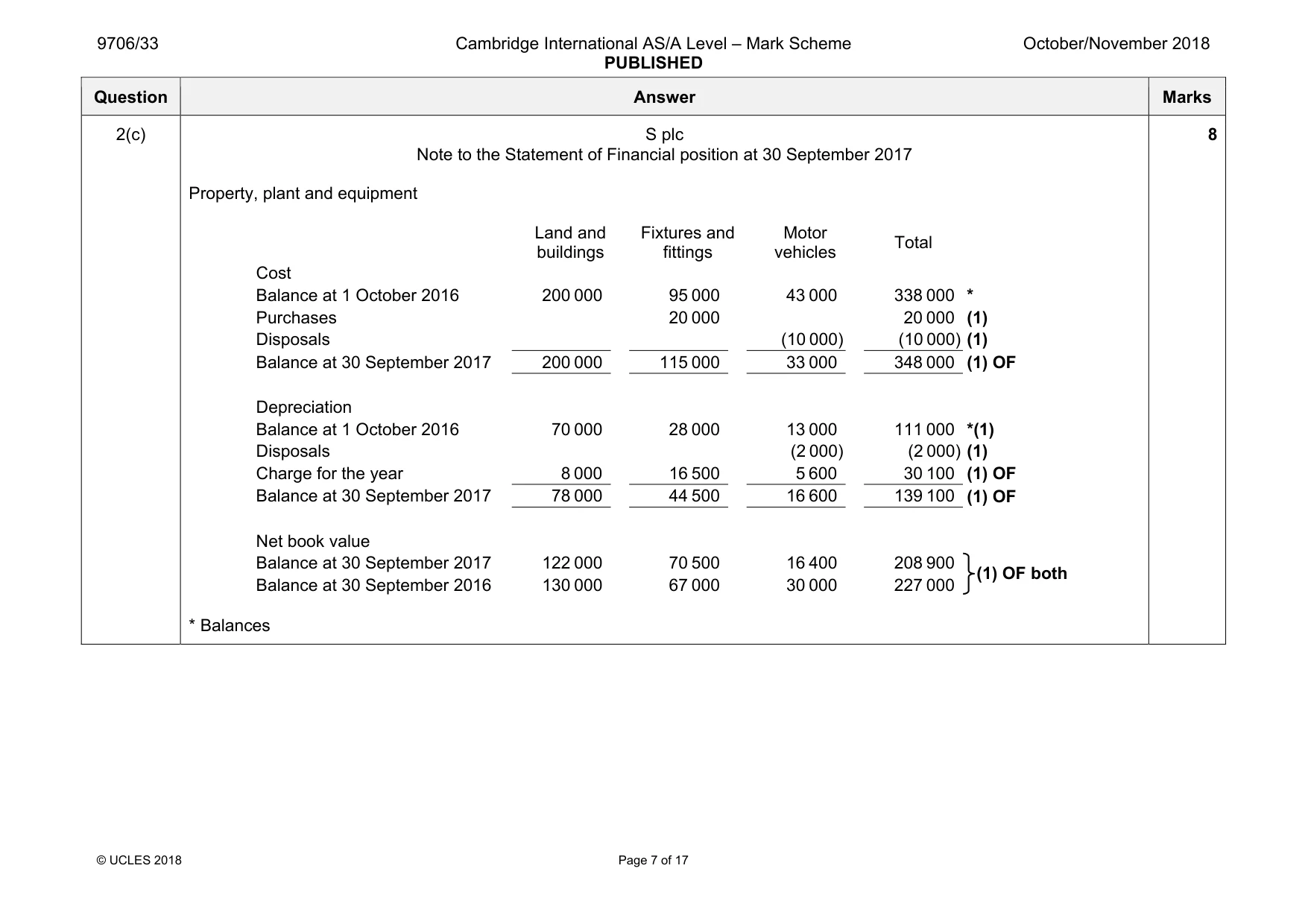
9706/33 Cambridge International AS/A Level – Mark Scheme PUBLISHED October/November 2018 © UCLES 2018 Page 7 of 17 Question Answer Marks 2(c) S plc Note to the Statement of Financial position at 30 September 2017 Property, plant and equipment Land and buildings Fixtures and fittings Motor vehicles Total Cost Balance at 1 October 2016 200 000 95 000 43 000 338 000 * Purchases 20 000 20 000 (1) Disposals (10 000) (10 000) (1) Balance at 30 September 2017 200 000 115 000 33 000 348 000 (1) OF Depreciation Balance at 1 October 2016 70 000 28 000 13 000 111 000 *(1) Disposals (2 000) (2 000) (1) Charge for the year 8 000 16 500 5 600 30 100 (1) OF Balance at 30 September 2017 78 000 44 500 16 600 139 100 (1) OF Net book value Balance at 30 September 2017 122 000 70 500 16 400 208 900 (1) OF both Balance at 30 September 2016 130 000 67 000 30 000 227 000 * Balances 8
Mark scheme, page 8
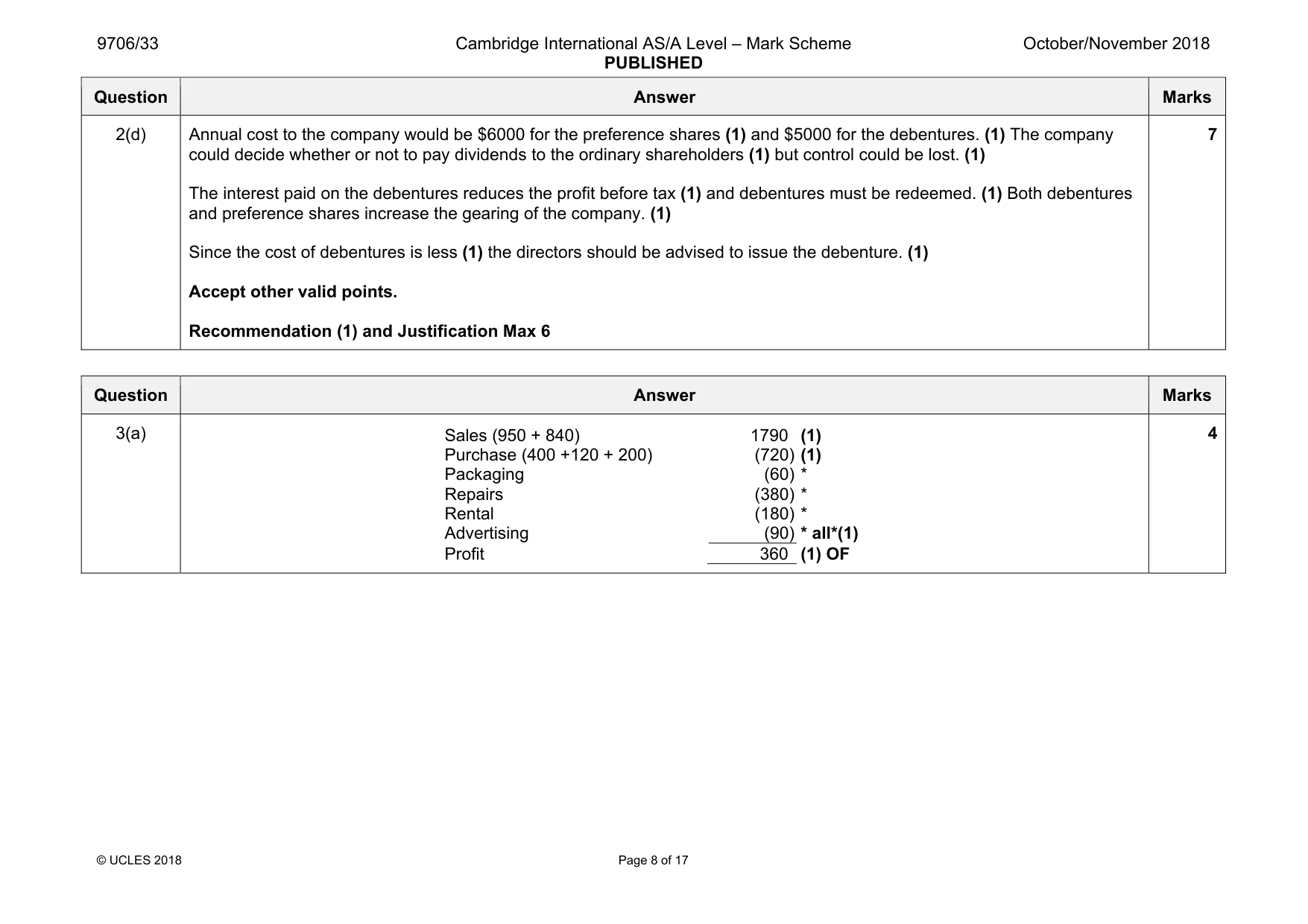
9706/33 Cambridge International AS/A Level – Mark Scheme PUBLISHED October/November 2018 © UCLES 2018 Page 8 of 17 Question Answer Marks 2(d) Annual cost to the company would be $6000 for the preference shares (1) and $5000 for the debentures. (1) The company could decide whether or not to pay dividends to the ordinary shareholders (1) but control could be lost. (1) The interest paid on the debentures reduces the profit before tax (1) and debentures must be redeemed. (1) Both debentures and preference shares increase the gearing of the company. (1) Since the cost of debentures is less (1) the directors should be advised to issue the debenture. (1) Accept other valid points. Recommendation (1) and Justification Max 6 7 Question Answer Marks 3(a) Sales (950 + 840) 1790 (1) Purchase (400 +120 + 200) (720) (1) Packaging (60) * Repairs (380) * Rental (180) * Advertising (90) * all*(1) Profit 360 (1) OF 4
Mark scheme, page 9
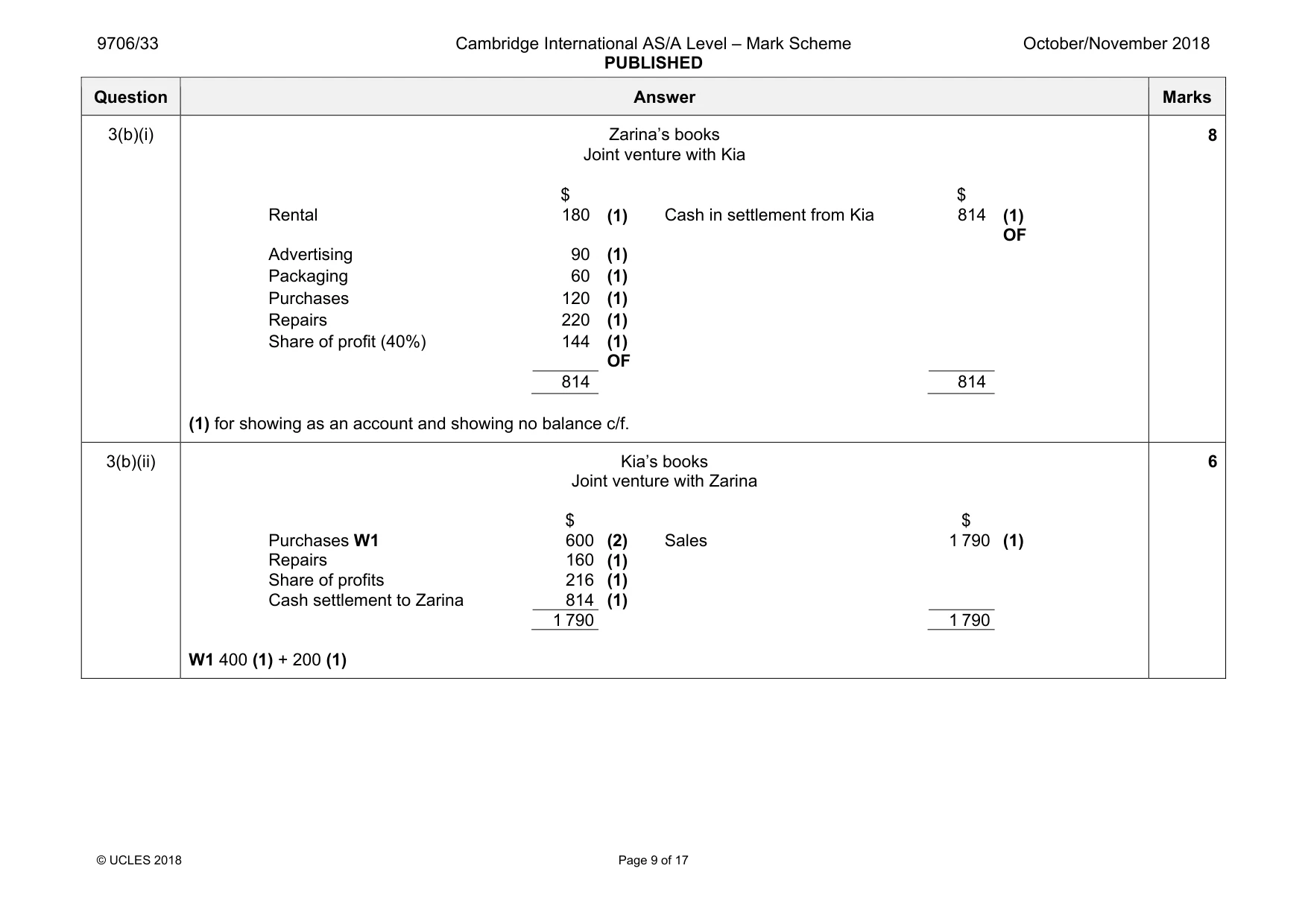
9706/33 Cambridge International AS/A Level – Mark Scheme PUBLISHED October/November 2018 © UCLES 2018 Page 9 of 17 Question Answer Marks 3(b)(i) Zarina’s books Joint venture with Kia $ $ Rental 180 (1) Cash in settlement from Kia 814 (1) OF Advertising 90 (1) Packaging 60 (1) Purchases 120 (1) Repairs 220 (1) Share of profit (40%) 144 (1) OF 814 814 (1) for showing as an account and showing no balance c/f. 8 3(b)(ii) Kia’s books Joint venture with Zarina $ $ Purchases W1 600 (2) Sales 1 790 (1) Repairs 160 (1) Share of profits 216 (1) Cash settlement to Zarina 814 (1) 1 790 1 790 W1 400 (1) + 200 (1) 6
Mark scheme, page 10
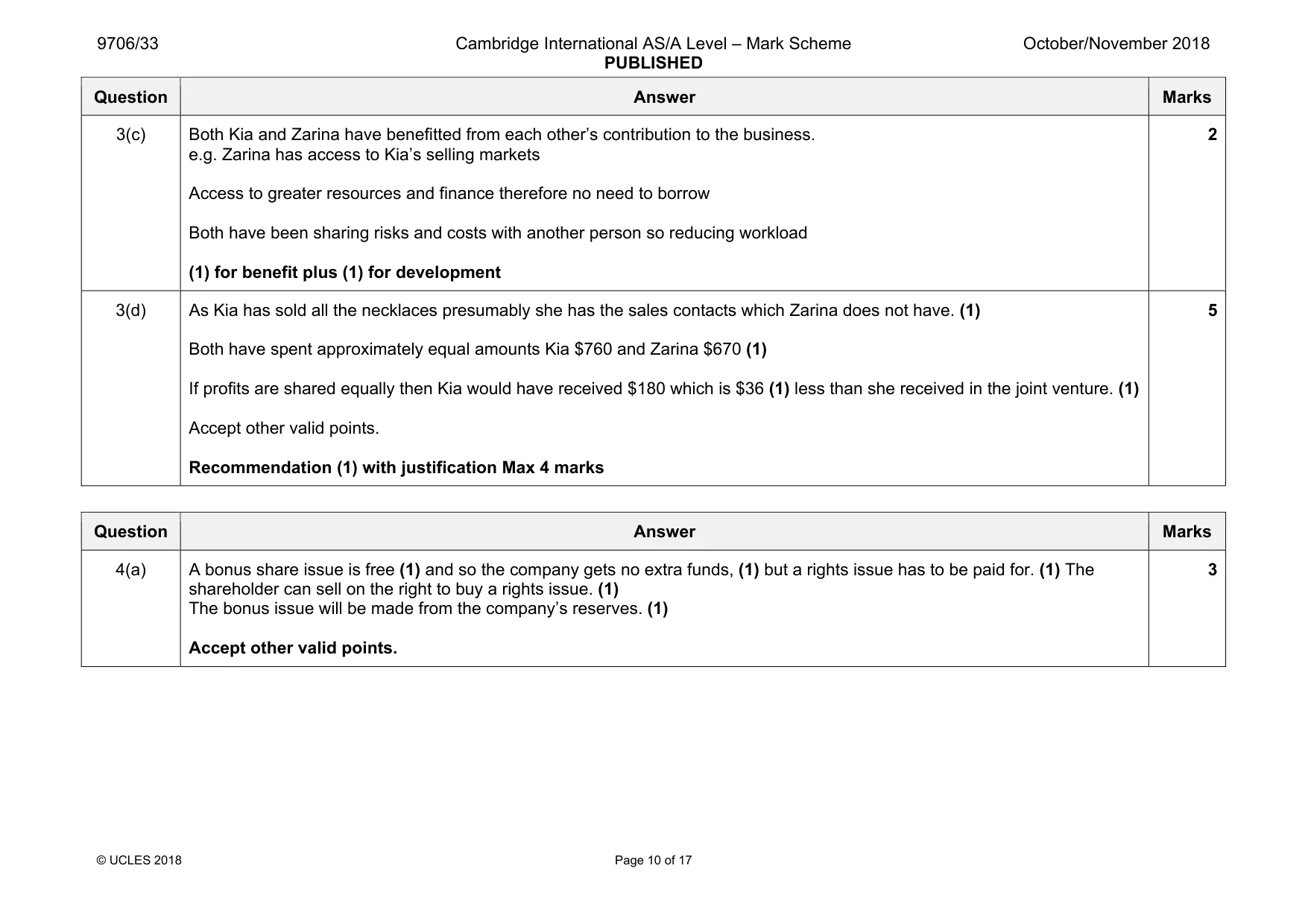
9706/33 Cambridge International AS/A Level – Mark Scheme PUBLISHED October/November 2018 © UCLES 2018 Page 10 of 17 Question Answer Marks 3(c) Both Kia and Zarina have benefitted from each other’s contribution to the business. e.g. Zarina has access to Kia’s selling markets Access to greater resources and finance therefore no need to borrow Both have been sharing risks and costs with another person so reducing workload (1) for benefit plus (1) for development 2 3(d) As Kia has sold all the necklaces presumably she has the sales contacts which Zarina does not have. (1) Both have spent approximately equal amounts Kia $760 and Zarina $670 (1) If profits are shared equally then Kia would have received $180 which is $36 (1) less than she received in the joint venture. (1) Accept other valid points. Recommendation (1) with justification Max 4 marks 5 Question Answer Marks 4(a) A bonus share issue is free (1) and so the company gets no extra funds, (1) but a rights issue has to be paid for. (1) The shareholder can sell on the right to buy a rights issue. (1) The bonus issue will be made from the company’s reserves. (1) Accept other valid points. 3
Mark scheme, page 11
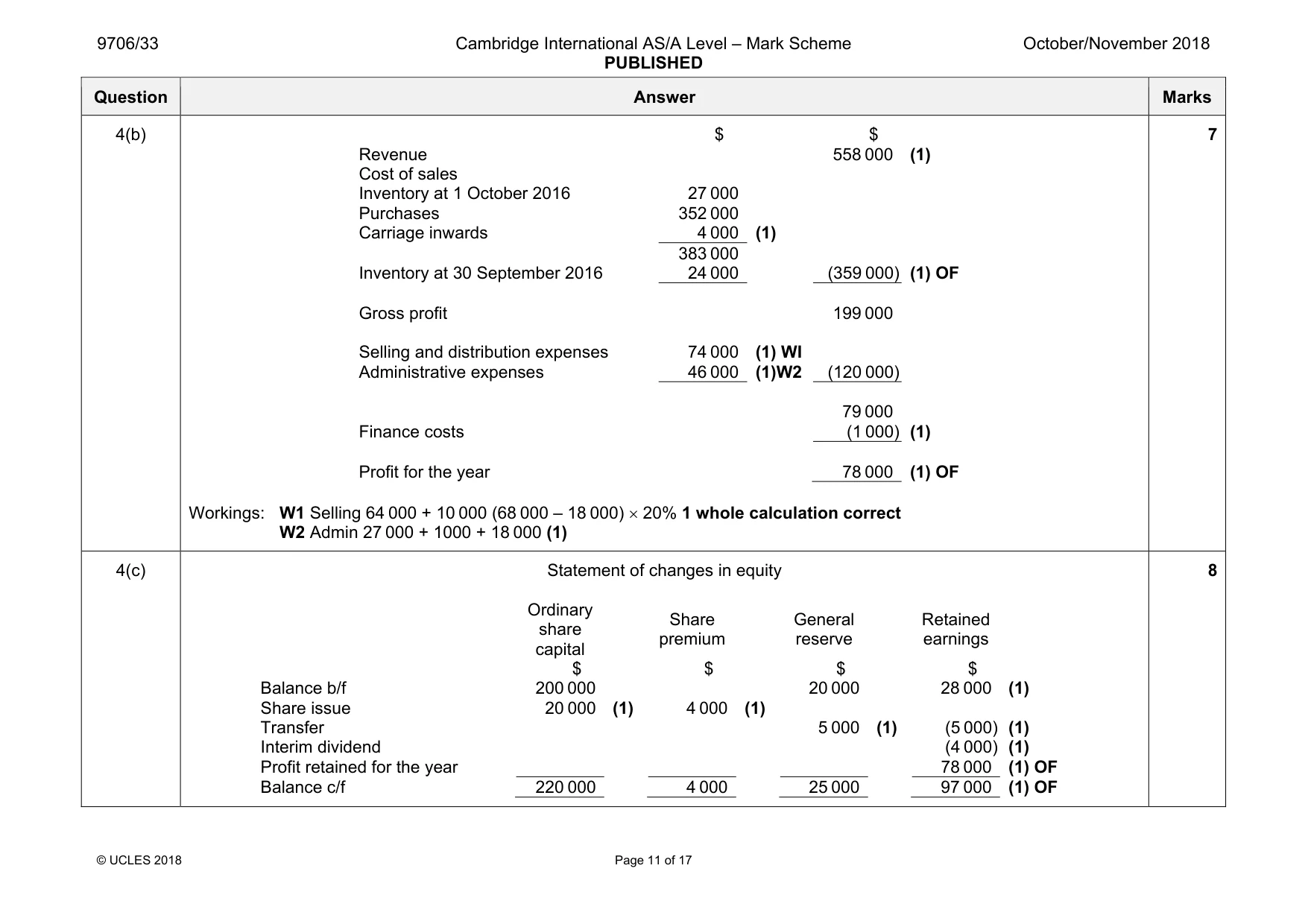
9706/33 Cambridge International AS/A Level – Mark Scheme PUBLISHED October/November 2018 © UCLES 2018 Page 11 of 17 Question Answer Marks 4(b) $ $ Revenue 558 000 (1) Cost of sales Inventory at 1 October 2016 27 000 Purchases 352 000 Carriage inwards 4 000 (1) 383 000 Inventory at 30 September 2016 24 000 (359 000) (1) OF Gross profit 199 000 Selling and distribution expenses 74 000 (1) WI Administrative expenses 46 000 (1)W2 (120 000) 79 000 Finance costs (1 000) (1) Profit for the year 78 000 (1) OF Workings: W1 Selling 64 000 + 10 000 (68 000 – 18 000) × 20% 1 whole calculation correct W2 Admin 27 000 + 1000 + 18 000 (1) 7 4(c) Statement of changes in equity Ordinary share capital Share premium General reserve Retained earnings $ $ $ $ Balance b/f 200 000 20 000 28 000 (1) Share issue 20 000 (1) 4 000 (1) Transfer 5 000 (1) (5 000) (1) Interim dividend (4 000) (1) Profit retained for the year 78 000 (1) OF Balance c/f 220 000 4 000 25 000 97 000 (1) OF 8
Mark scheme, page 12
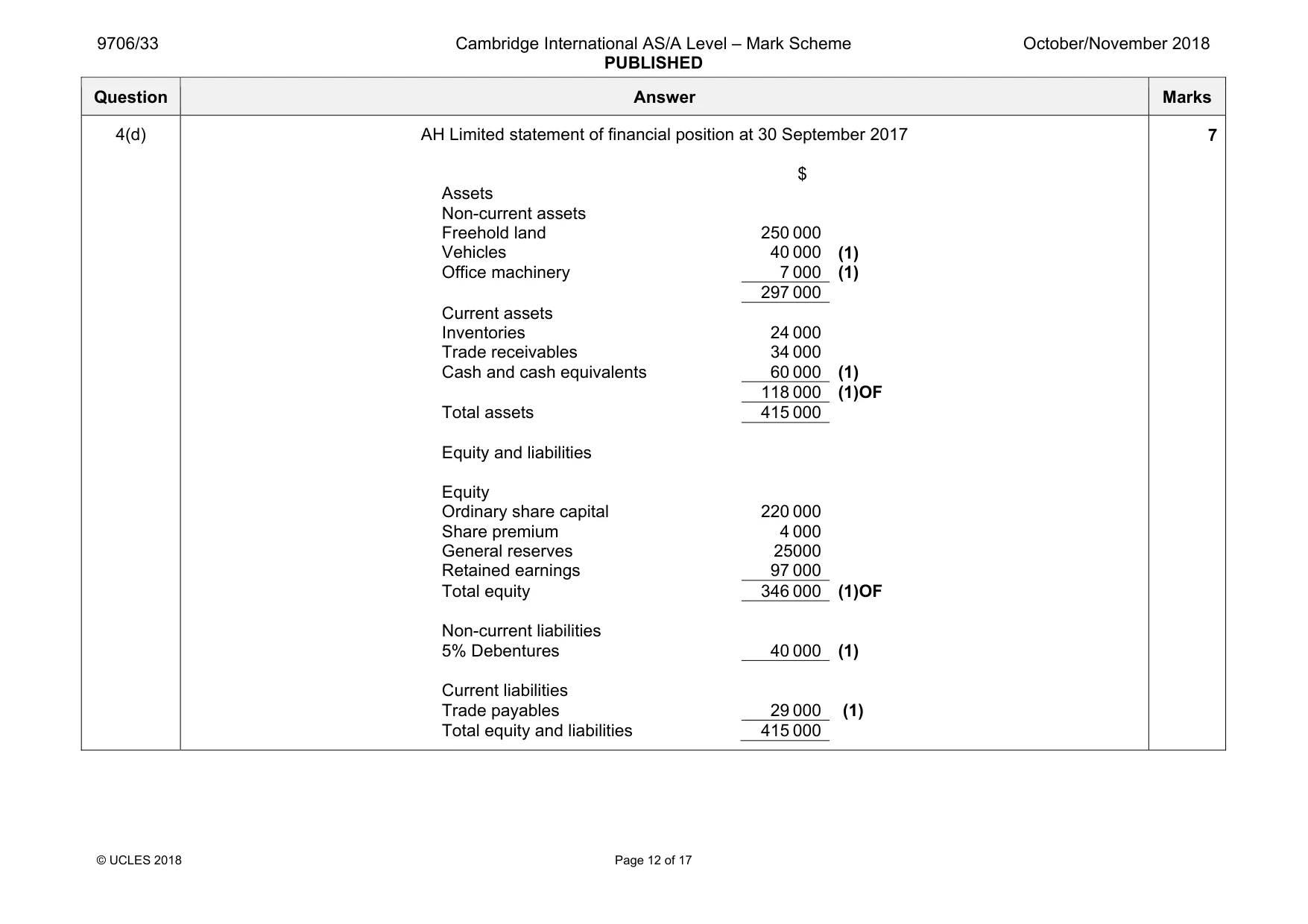
9706/33 Cambridge International AS/A Level – Mark Scheme PUBLISHED October/November 2018 © UCLES 2018 Page 12 of 17 Question Answer Marks 4(d) AH Limited statement of financial position at 30 September 2017 $ Assets Non-current assets Freehold land 250 000 Vehicles 40 000 (1) Office machinery 7 000 (1) 297 000 Current assets Inventories 24 000 Trade receivables 34 000 Cash and cash equivalents 60 000 (1) 118 000 (1)OF Total assets 415 000 Equity and liabilities Equity Ordinary share capital 220 000 Share premium 4 000 General reserves 25000 Retained earnings 97 000 Total equity 346 000 (1)OF Non-current liabilities 5% Debentures 40 000 (1) Current liabilities Trade payables 29 000 (1) Total equity and liabilities 415 000 7
Mark scheme, page 13
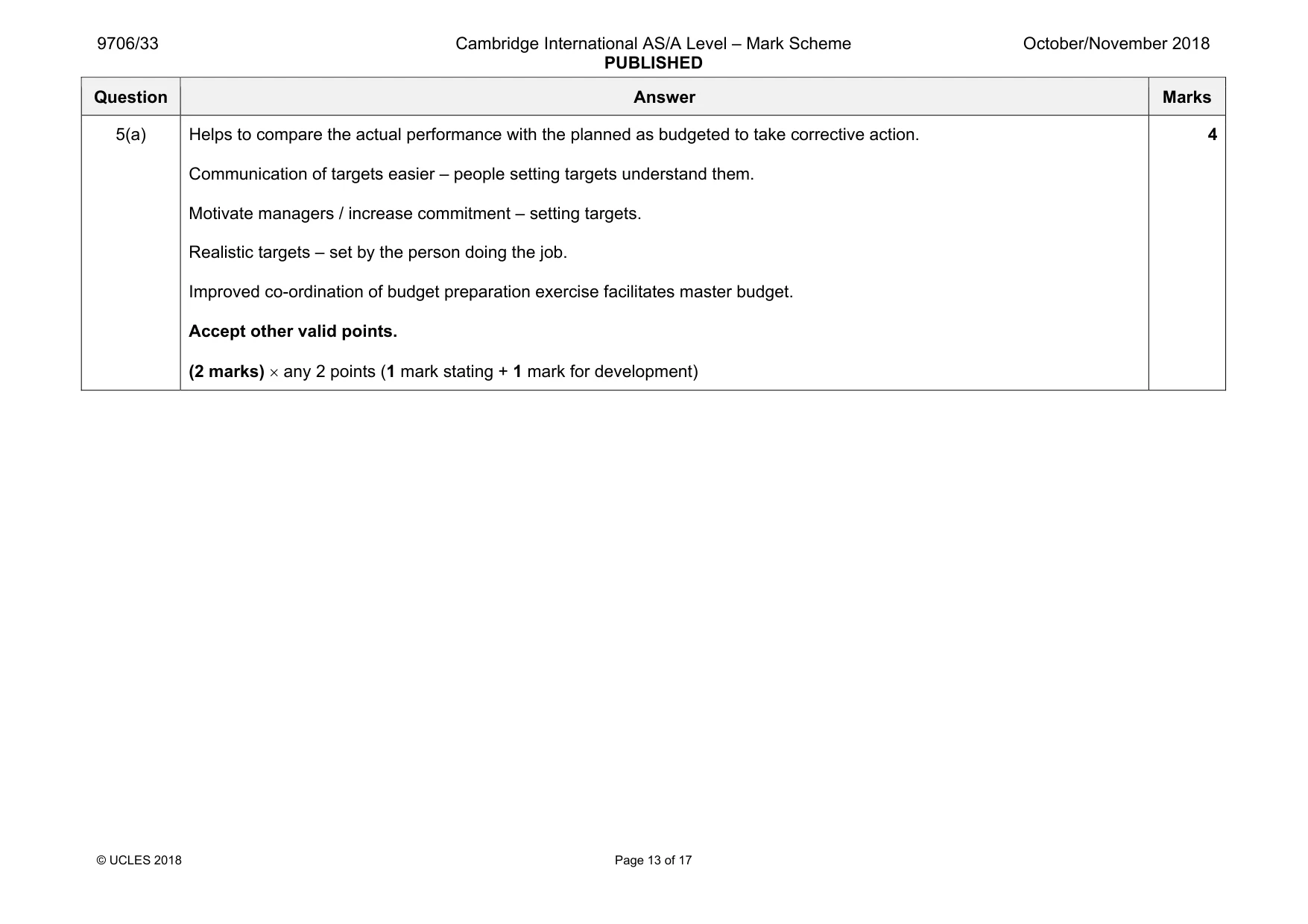
9706/33 Cambridge International AS/A Level – Mark Scheme PUBLISHED October/November 2018 © UCLES 2018 Page 13 of 17 Question Answer Marks 5(a) Helps to compare the actual performance with the planned as budgeted to take corrective action. Communication of targets easier – people setting targets understand them. Motivate managers / increase commitment – setting targets. Realistic targets – set by the person doing the job. Improved co-ordination of budget preparation exercise facilitates master budget. Accept other valid points. (2 marks) × any 2 points (1 mark stating + 1 mark for development) 4
Mark scheme, page 14
9706/33 Cambridge International AS/A Level – Mark Scheme PUBLISHED October/November 2018 © UCLES 2018 Page 14 of 17 Question Answer Marks 5(b) Units 12 000 $ Sales revenue 244 800 (1) Variable costs Direct materials 36 000 (2) W1 Direct labour 60 000 (2) W2 Direct expenses 24 000 (1) W3 Semi variable costs Production overhead 29 000 (5) W4 Fixed costs Administration 35 000 (1) 184 000 Profit for the year 60 800 (1) OF *Only if there is administration. Workings: W1: Direct materials 2 kg × $1.50 = $3 (1) × 12 000 units = $36 000 (1) W2: Direct labour 0.5 hrs × $10 = $5 (1) × 12 000 units = $60 000 (1) W3: Direct expenses $2 × 12 000 units = $24 000 (1) W4: Semi variable costs – using high low method VC 000 $16 units 8000 $2 3 6 units 5000 units 8000 000 $15 000 $21 = × = = − − (1) OF (1) TC $21 000 – VC $16 000 = FC $5 000 (1) $2 × 12 000 units = $24 000 VC (1) OF $5 000 FC $29 000 TC (1) OF 13
Mark scheme, page 15
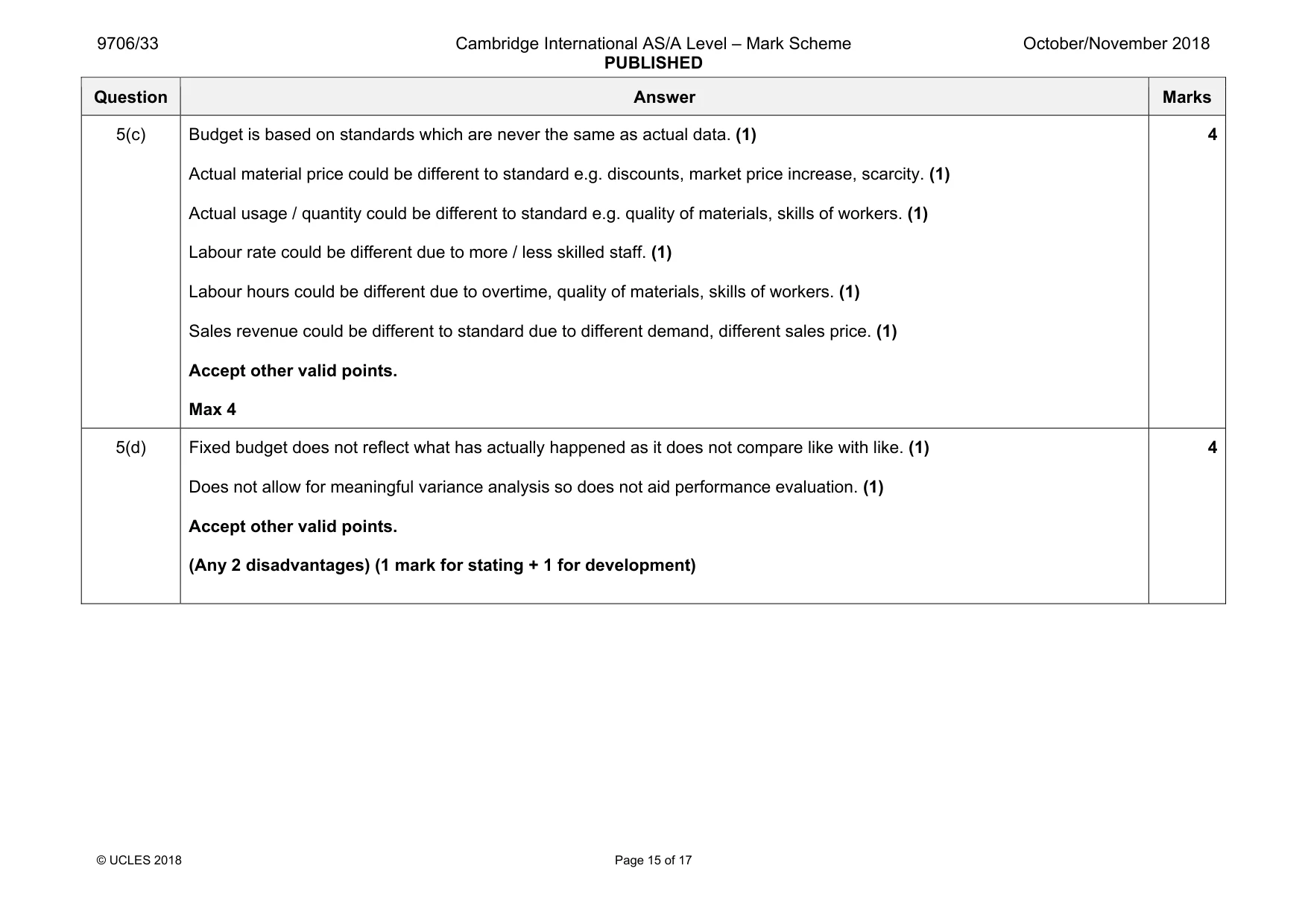
9706/33 Cambridge International AS/A Level – Mark Scheme PUBLISHED October/November 2018 © UCLES 2018 Page 15 of 17 Question Answer Marks 5(c) Budget is based on standards which are never the same as actual data. (1) Actual material price could be different to standard e.g. discounts, market price increase, scarcity. (1) Actual usage / quantity could be different to standard e.g. quality of materials, skills of workers. (1) Labour rate could be different due to more / less skilled staff. (1) Labour hours could be different due to overtime, quality of materials, skills of workers. (1) Sales revenue could be different to standard due to different demand, different sales price. (1) Accept other valid points. Max 4 4 5(d) Fixed budget does not reflect what has actually happened as it does not compare like with like. (1) Does not allow for meaningful variance analysis so does not aid performance evaluation. (1) Accept other valid points. (Any 2 disadvantages) (1 mark for stating + 1 for development) 4
Mark scheme, page 16
9706/33 Cambridge International AS/A Level – Mark Scheme PUBLISHED October/November 2018 © UCLES 2018 Page 16 of 17 Question Answer Marks 6(a) Sales Labour Rent Seeds Net cash flow $ $ $ $ $ (30 000) (1) Y1 4 500 } (900) } (4 000) (1 000) (1 400) } Y2 9 000 } (1) (1 800) } (1) OF (4 000) (1000) 2 200 } Y3 16 500 } (3 300) } (4 000) (1 000) 8 200 } Y4 16 500 } (3 300) } (4 000) (1 000) 8 200 } Y5 16 500 }(1) (3 300) } (1) OF (4 000) (1 000) 8 200 } (1) OF (1) (1) 8 6(b) Average profit = − = − 25 400 30000 920 5 (1) (1) Average investment = 15 000 (1) ARR = − = − 920 6.13% 15000 (1) OF 4 6(c) Average profit = − 50800 38 000 5 (1)OF (1) (1) = 2560 Average investment = 19 000 (1) ARR = 2560 19000 = 13.47% (1) OF 5 6(d)(i) Useful for comparisons / easy to calculate (1) 3 6(d)(ii) Doesn’t take into account timing of cash flows (1) doesn’t take into account time value of money (1) uses subjective measures (1) Any two for (1) each
Mark scheme, page 17
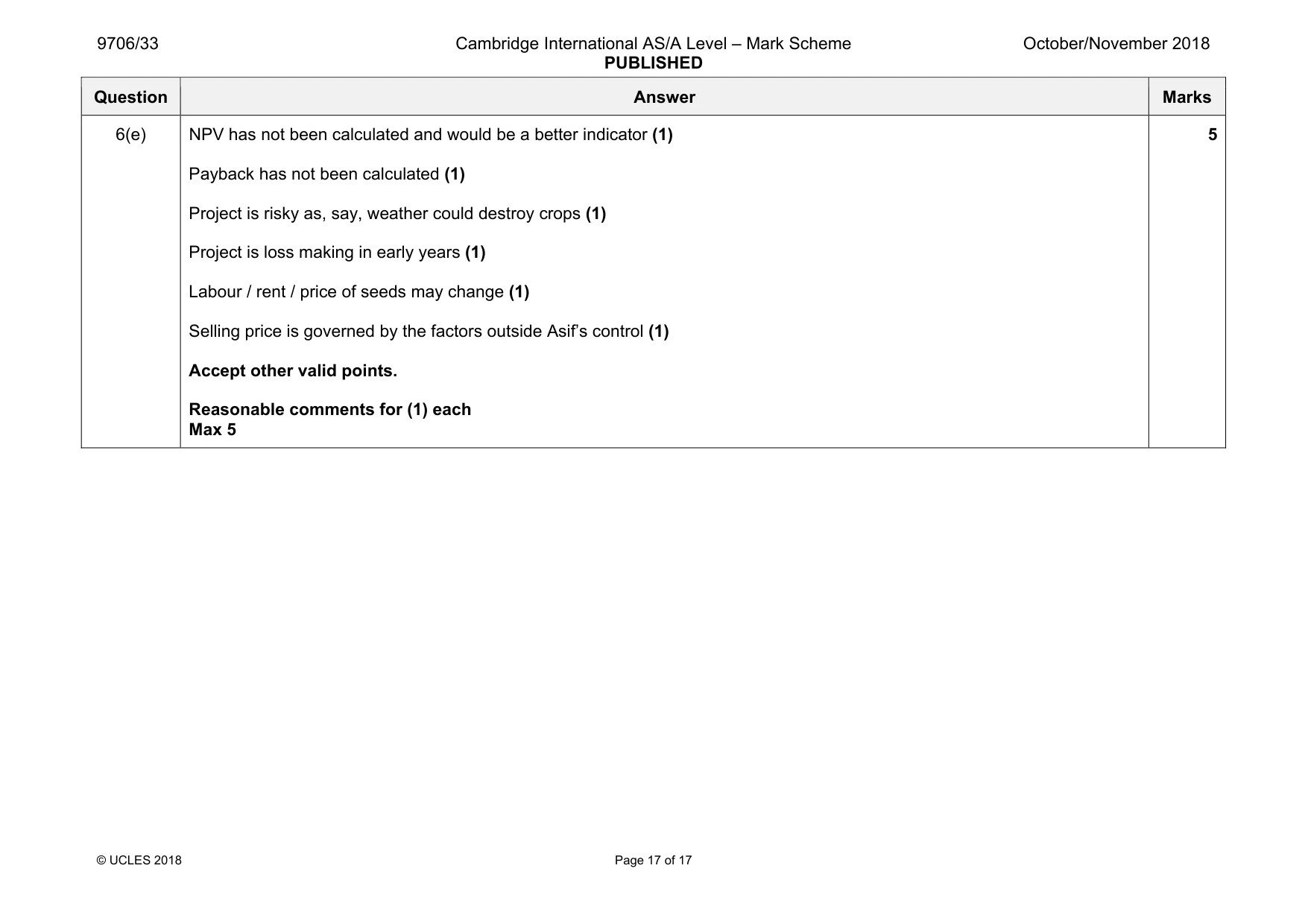
9706/33 Cambridge International AS/A Level – Mark Scheme PUBLISHED October/November 2018 © UCLES 2018 Page 17 of 17 Question Answer Marks 6(e) NPV has not been calculated and would be a better indicator (1) Payback has not been calculated (1) Project is risky as, say, weather could destroy crops (1) Project is loss making in early years (1) Labour / rent / price of seeds may change (1) Selling price is governed by the factors outside Asif’s control (1) Accept other valid points. Reasonable comments for (1) each Max 5 5
What you needed in this session
Cambridge’s own grade thresholds for 2018 Oct/Nov, Paper 3 · Variant 3. A higher threshold means an easier paper — the bar moves with how the cohort did.