Cambridge A Level Accounting 9706 — 2018 Oct/Nov Paper 3 · Variant 2
9706/32/O/N/18 · 150 marks · ≈169 min
The question paper and its mark scheme, free to read here and free to download. This is Cambridge’s own paper, exactly as it was sat.
Question paper12 pages


Mark scheme17 pages
Answers below. Sit the paper first if you are practising.
Paper as text
Question paper, page 1
This document consists of 11 printed pages and 1 blank page. IB18 11_9706_32/6RP © UCLES 2018 [Turn over Cambridge International Examinations Cambridge International Advanced Subsidiary and Advanced Level ACCOUNTING 9706/32 Paper 3 Structured Questions October/November 2018 INSERT 3 hours READ THESE INSTRUCTIONS FIRST This Insert contains all of the required information and questions. The questions are provided in the Insert for reference only. Anything you write in this Insert will not be marked. The businesses described in this Insert are entirely fictitious.
Question paper, page 2
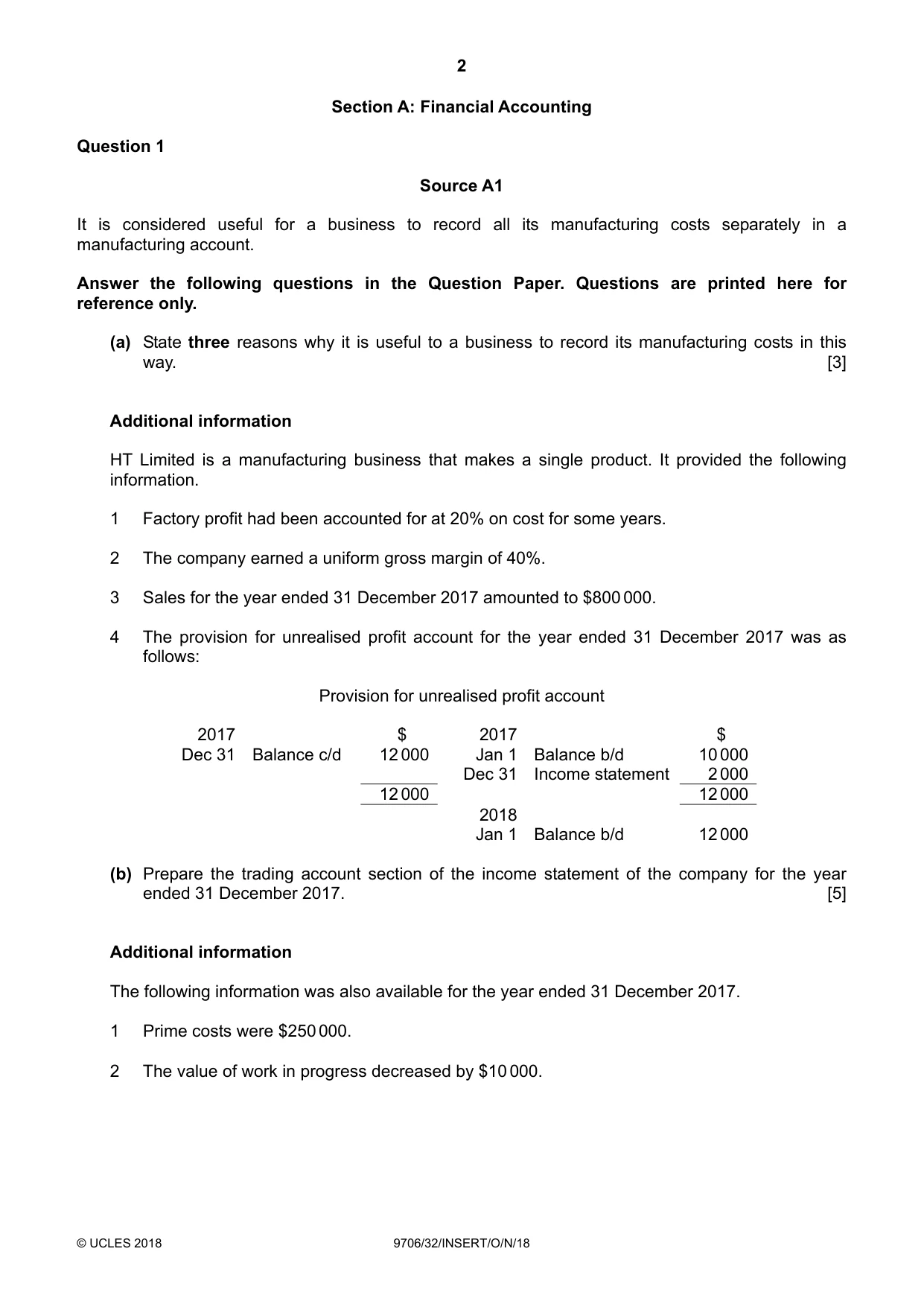
2 © UCLES 2018 9706/32/INSERT/O/N/18 Section A: Financial Accounting Question 1 Source A1 It is considered useful for a business to record all its manufacturing costs separately in a manufacturing account. Answer the following questions in the Question Paper. Questions are printed here for reference only. (a) State three reasons why it is useful to a business to record its manufacturing costs in this way. [3] Additional information HT Limited is a manufacturing business that makes a single product. It provided the following information. 1 Factory profit had been accounted for at 20% on cost for some years. 2 The company earned a uniform gross margin of 40%. 3 Sales for the year ended 31 December 2017 amounted to $800 000. 4 The provision for unrealised profit account for the year ended 31 December 2017 was as follows: Provision for unrealised profit account 2017 $ 2017 $ Dec 31 Balance c/d 12 000 Jan 1 Balance b/d 10 000 Dec 31 Income statement 2 000 12 000 12 000 2018 Jan 1 Balance b/d 12 000 (b) Prepare the trading account section of the income statement of the company for the year ended 31 December 2017. [5] Additional information The following information was also available for the year ended 31 December 2017. 1 Prime costs were $250 000. 2 The value of work in progress decreased by $10 000.
Question paper, page 3
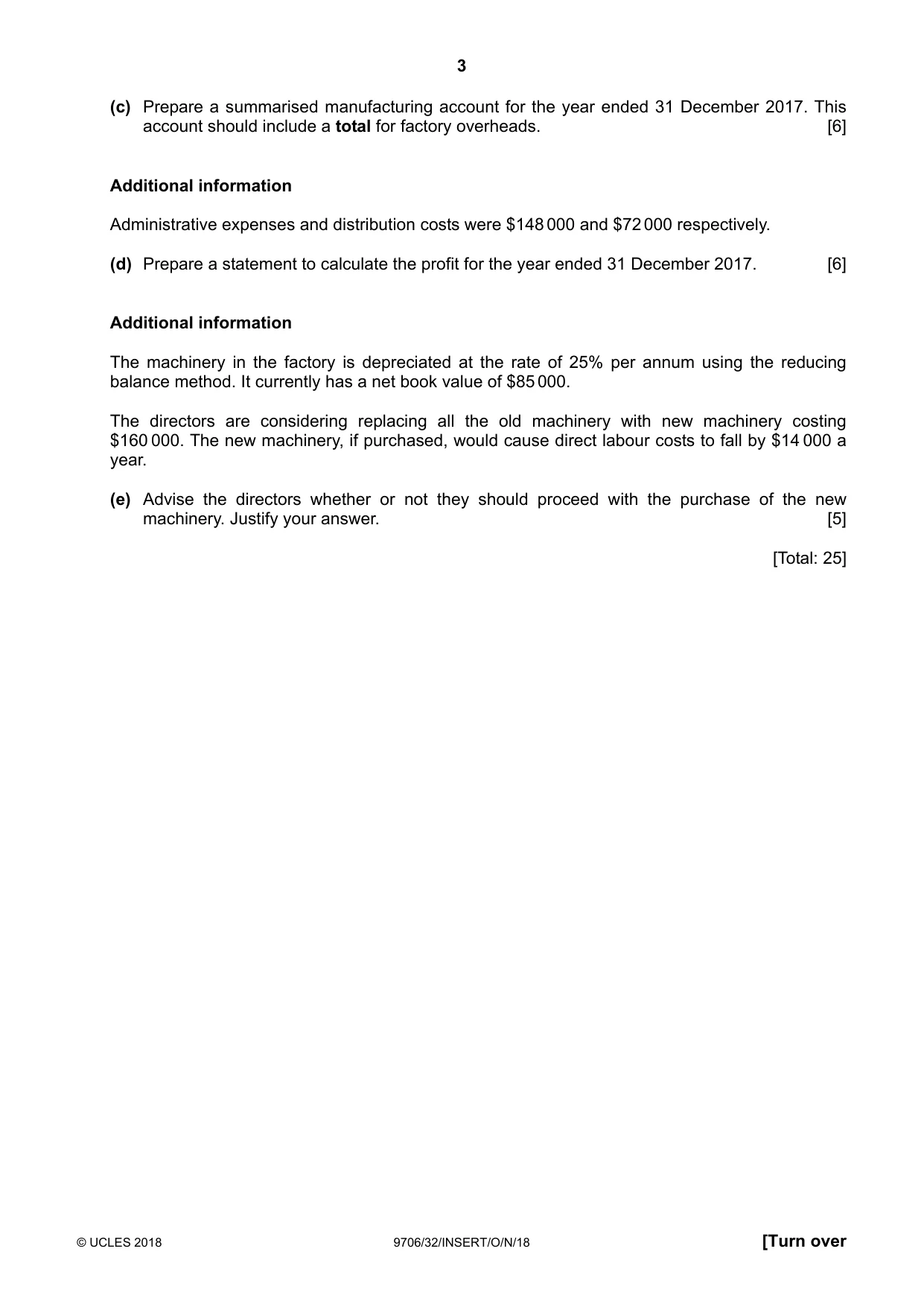
3 © UCLES 2018 9706/32/INSERT/O/N/18 [Turn over (c) Prepare a summarised manufacturing account for the year ended 31 December 2017. This account should include a total for factory overheads. [6] Additional information Administrative expenses and distribution costs were $148 000 and $72 000 respectively. (d) Prepare a statement to calculate the profit for the year ended 31 December 2017. [6] Additional information The machinery in the factory is depreciated at the rate of 25% per annum using the reducing balance method. It currently has a net book value of $85 000. The directors are considering replacing all the old machinery with new machinery costing $160 000. The new machinery, if purchased, would cause direct labour costs to fall by $14 000 a year. (e) Advise the directors whether or not they should proceed with the purchase of the new machinery. Justify your answer. [5] [Total: 25]
Question paper, page 4
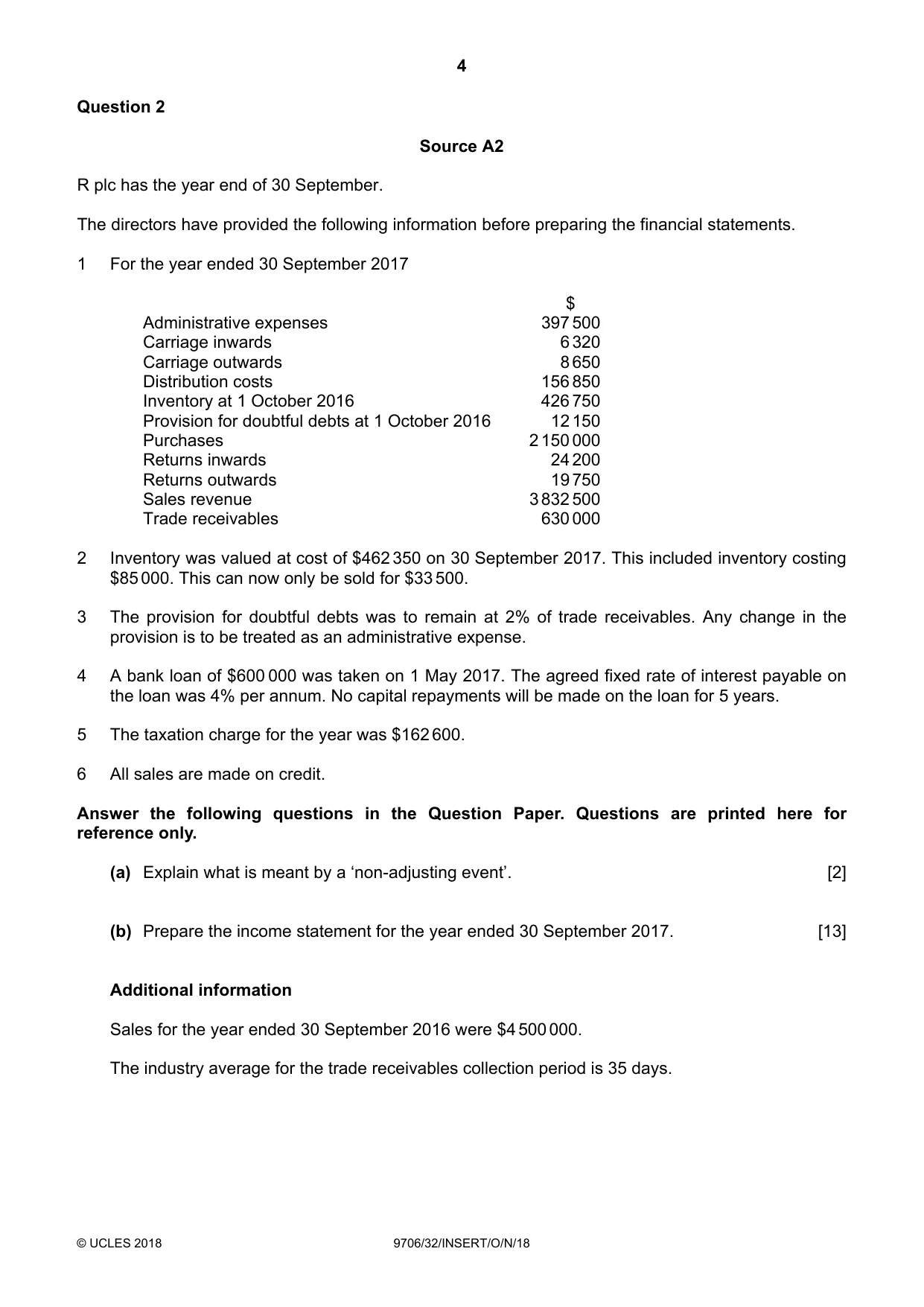
4 © UCLES 2018 9706/32/INSERT/O/N/18 Question 2 Source A2 R plc has the year end of 30 September. The directors have provided the following information before preparing the financial statements. 1 For the year ended 30 September 2017 $ Administrative expenses 397 500 Carriage inwards 6 320 Carriage outwards 8 650 Distribution costs 156 850 Inventory at 1 October 2016 426 750 Provision for doubtful debts at 1 October 2016 12 150 Purchases 2 150 000 Returns inwards 24 200 Returns outwards 19 750 Sales revenue 3 832 500 Trade receivables 630 000 2 Inventory was valued at cost of $462 350 on 30 September 2017. This included inventory costing $85 000. This can now only be sold for $33 500. 3 The provision for doubtful debts was to remain at 2% of trade receivables. Any change in the provision is to be treated as an administrative expense. 4 A bank loan of $600 000 was taken on 1 May 2017. The agreed fixed rate of interest payable on the loan was 4% per annum. No capital repayments will be made on the loan for 5 years. 5 The taxation charge for the year was $162 600. 6 All sales are made on credit. Answer the following questions in the Question Paper. Questions are printed here for reference only. (a) Explain what is meant by a ‘non-adjusting event’. [2] (b) Prepare the income statement for the year ended 30 September 2017. [13] Additional information Sales for the year ended 30 September 2016 were $4 500 000. The industry average for the trade receivables collection period is 35 days.
Question paper, page 5
5 © UCLES 2018 9706/32/INSERT/O/N/18 [Turn over (c) Calculate the percentage change in trade receivables during the year ended 30 September 2017. [3] (d) (i) Calculate the trade receivables collection period for both years. [2] (ii) Advise the directors whether or not their present credit control procedures are satisfactory. Justify your answer. [5] [Total: 25]
Question paper, page 6
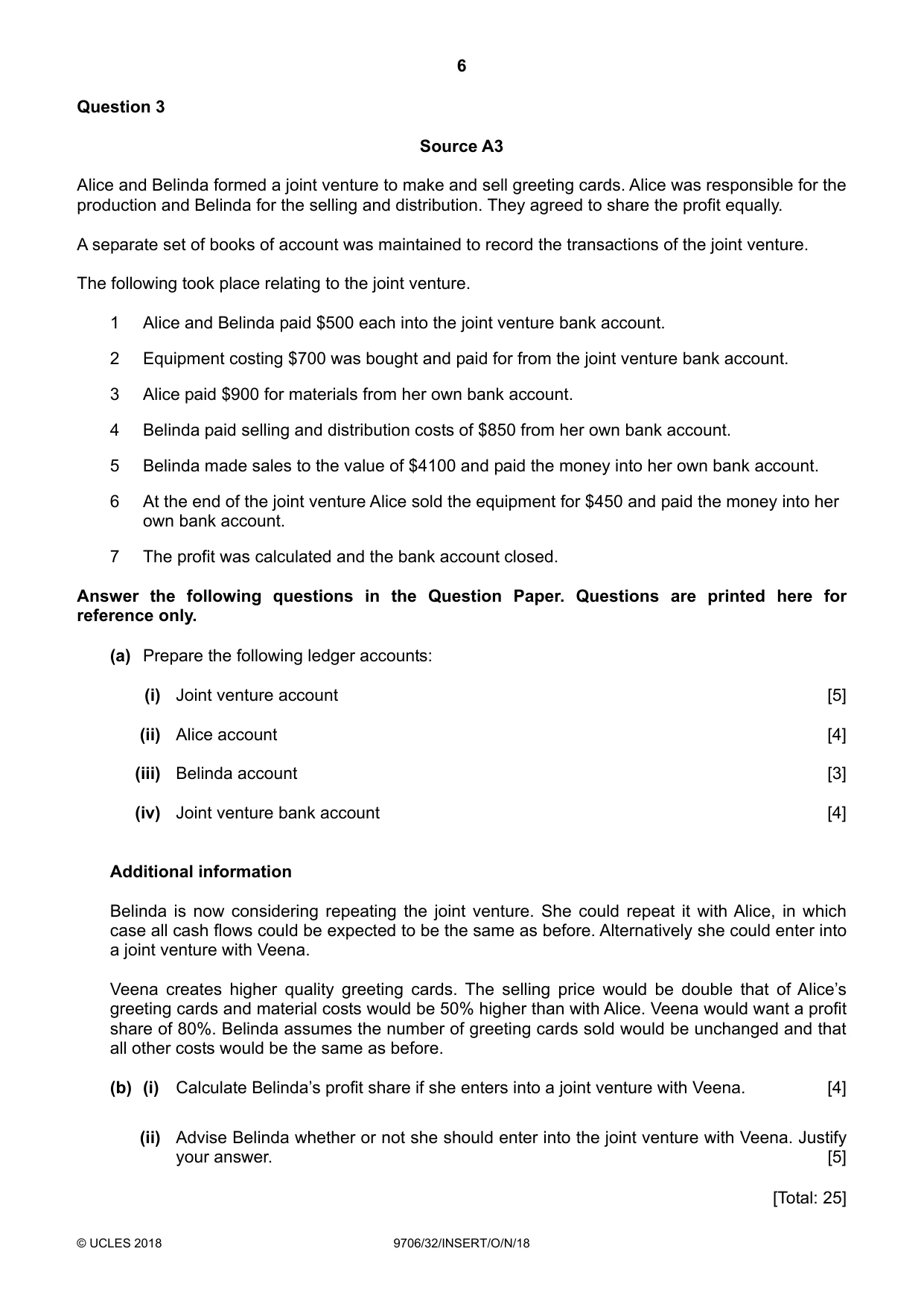
6 © UCLES 2018 9706/32/INSERT/O/N/18 Question 3 Source A3 Alice and Belinda formed a joint venture to make and sell greeting cards. Alice was responsible for the production and Belinda for the selling and distribution. They agreed to share the profit equally. A separate set of books of account was maintained to record the transactions of the joint venture. The following took place relating to the joint venture. 1 Alice and Belinda paid $500 each into the joint venture bank account. 2 Equipment costing $700 was bought and paid for from the joint venture bank account. 3 Alice paid $900 for materials from her own bank account. 4 Belinda paid selling and distribution costs of $850 from her own bank account. 5 Belinda made sales to the value of $4100 and paid the money into her own bank account. 6 At the end of the joint venture Alice sold the equipment for $450 and paid the money into her own bank account. 7 The profit was calculated and the bank account closed. Answer the following questions in the Question Paper. Questions are printed here for reference only. (a) Prepare the following ledger accounts: (i) Joint venture account [5] (ii) Alice account [4] (iii) Belinda account [3] (iv) Joint venture bank account [4] Additional information Belinda is now considering repeating the joint venture. She could repeat it with Alice, in which case all cash flows could be expected to be the same as before. Alternatively she could enter into a joint venture with Veena. Veena creates higher quality greeting cards. The selling price would be double that of Alice’s greeting cards and material costs would be 50% higher than with Alice. Veena would want a profit share of 80%. Belinda assumes the number of greeting cards sold would be unchanged and that all other costs would be the same as before. (b) (i) Calculate Belinda’s profit share if she enters into a joint venture with Veena. [4] (ii) Advise Belinda whether or not she should enter into the joint venture with Veena. Justify your answer. [5] [Total: 25]
Question paper, page 7
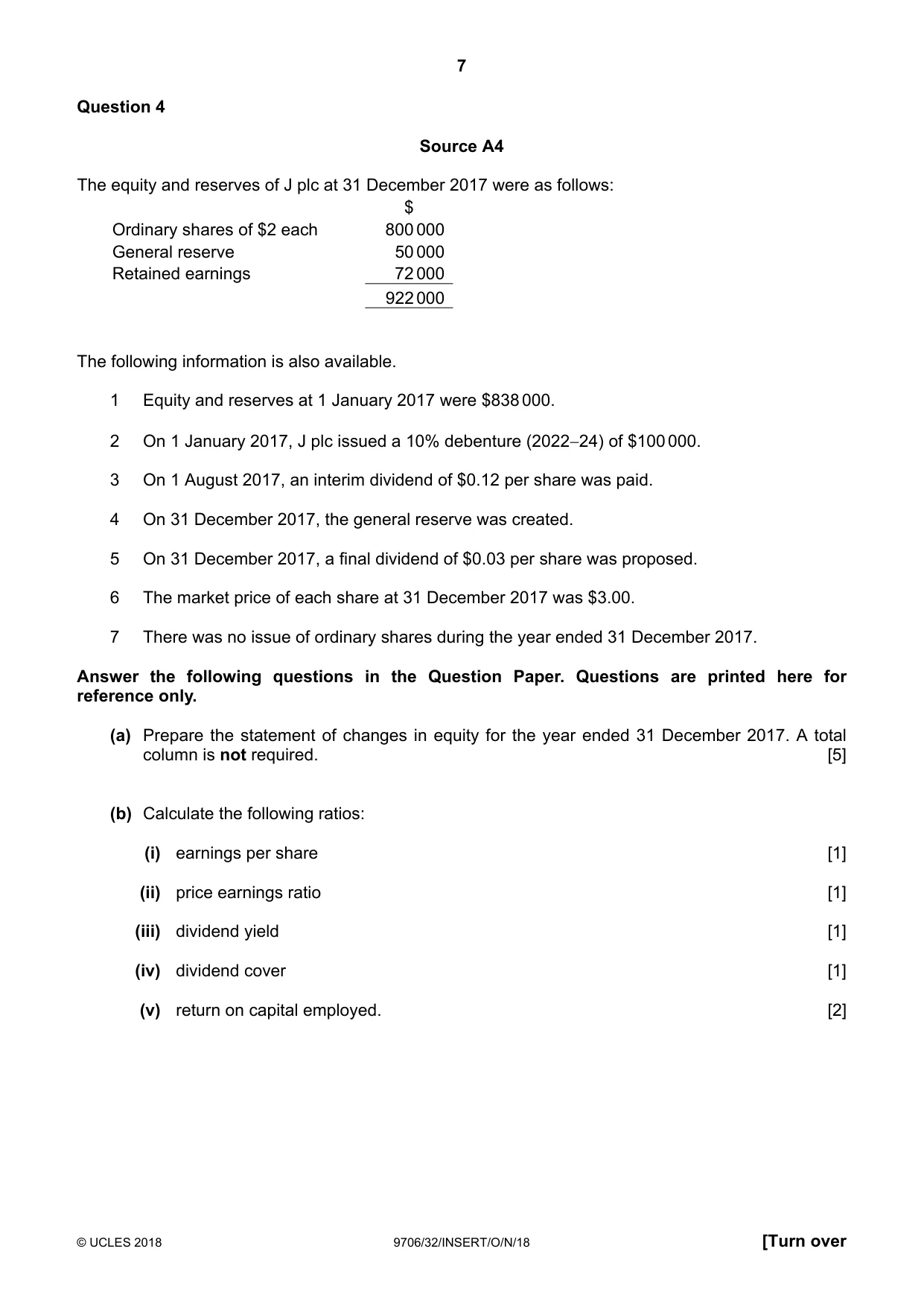
7 © UCLES 2018 9706/32/INSERT/O/N/18 [Turn over Question 4 Source A4 The equity and reserves of J plc at 31 December 2017 were as follows: $ Ordinary shares of $2 each 800 000 General reserve 50 000 Retained earnings 72 000 922 000 The following information is also available. 1 Equity and reserves at 1 January 2017 were $838 000. 2 On 1 January 2017, J plc issued a 10% debenture (202224) of $100 000. 3 On 1 August 2017, an interim dividend of $0.12 per share was paid. 4 On 31 December 2017, the general reserve was created. 5 On 31 December 2017, a final dividend of $0.03 per share was proposed. 6 The market price of each share at 31 December 2017 was $3.00. 7 There was no issue of ordinary shares during the year ended 31 December 2017. Answer the following questions in the Question Paper. Questions are printed here for reference only. (a) Prepare the statement of changes in equity for the year ended 31 December 2017. A total column is not required. [5] (b) Calculate the following ratios: (i) earnings per share [1] (ii) price earnings ratio [1] (iii) dividend yield [1] (iv) dividend cover [1] (v) return on capital employed. [2]
Question paper, page 8
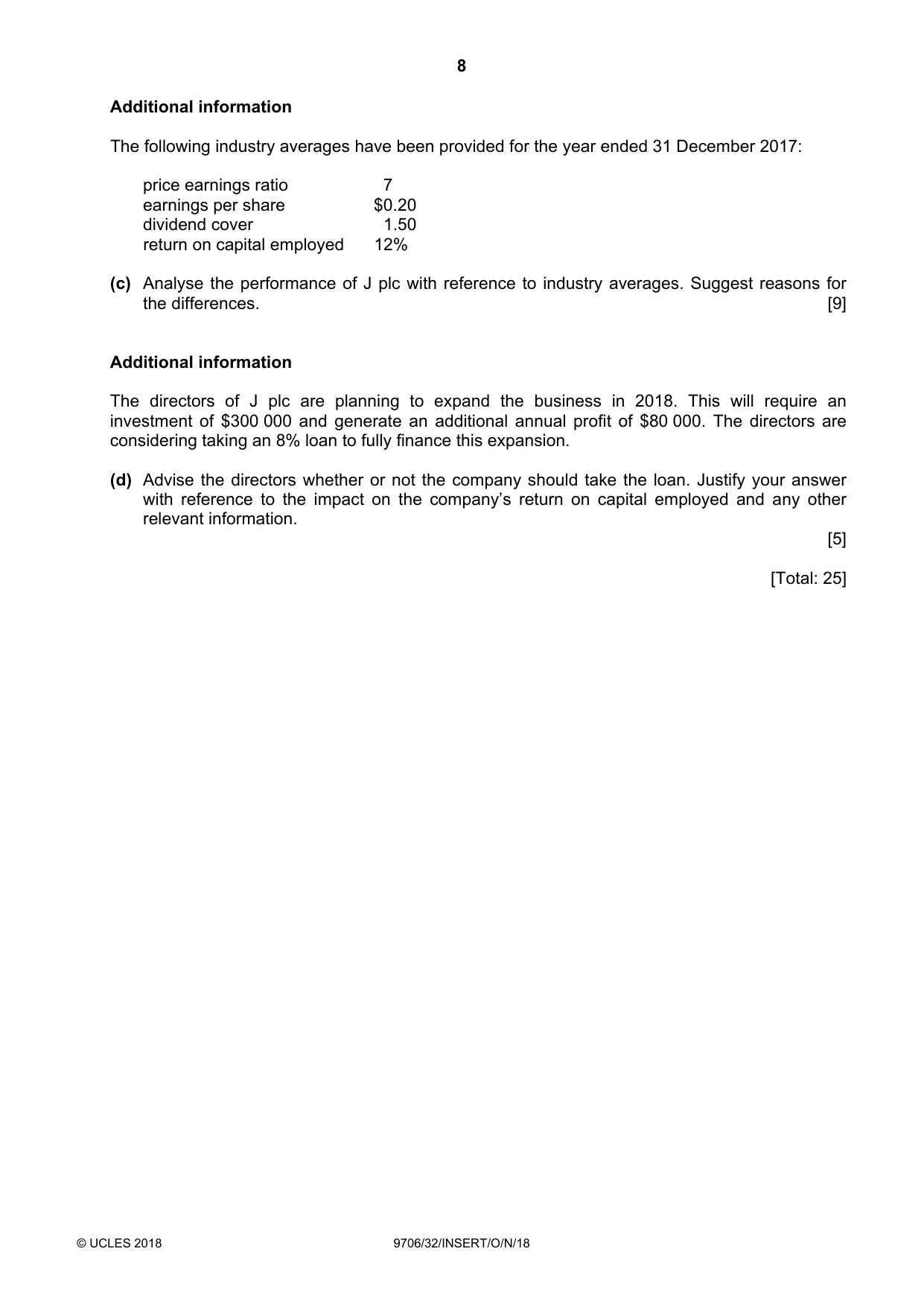
8 © UCLES 2018 9706/32/INSERT/O/N/18 Additional information The following industry averages have been provided for the year ended 31 December 2017: price earnings ratio 7 earnings per share $0.20 dividend cover 1.50 return on capital employed 12% (c) Analyse the performance of J plc with reference to industry averages. Suggest reasons for the differences. [9] Additional information The directors of J plc are planning to expand the business in 2018. This will require an investment of $300 000 and generate an additional annual profit of $80 000. The directors are considering taking an 8% loan to fully finance this expansion. (d) Advise the directors whether or not the company should take the loan. Justify your answer with reference to the impact on the company’s return on capital employed and any other relevant information. [5] [Total: 25]
Question paper, page 9
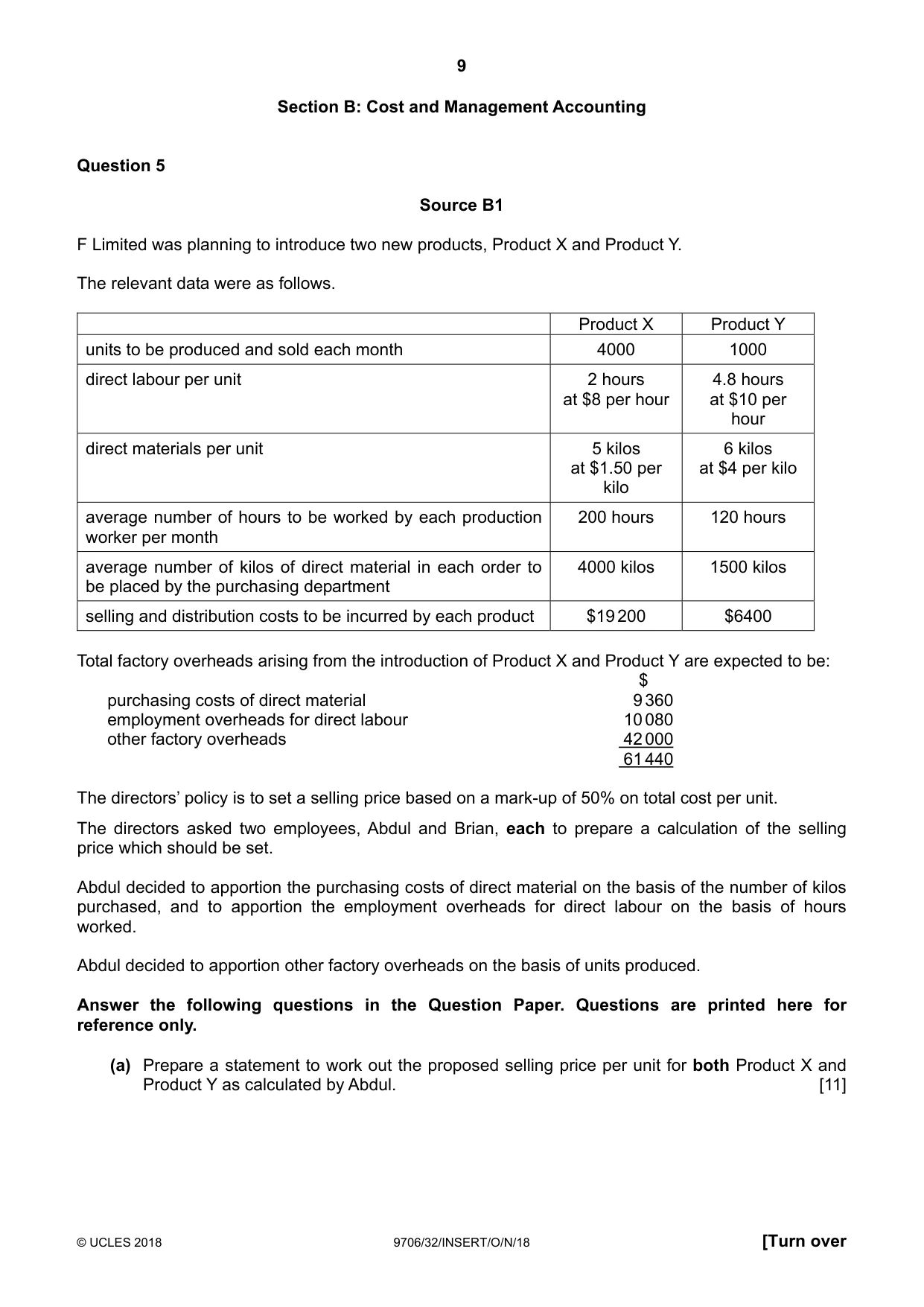
9 © UCLES 2018 9706/32/INSERT/O/N/18 [Turn over Section B: Cost and Management Accounting Question 5 Source B1 F Limited was planning to introduce two new products, Product X and Product Y. The relevant data were as follows. Product X Product Y units to be produced and sold each month 4000 1000 direct labour per unit 2 hours at $8 per hour 4.8 hours at $10 per hour direct materials per unit 5 kilos at $1.50 per kilo 6 kilos at $4 per kilo average number of hours to be worked by each production worker per month 200 hours 120 hours average number of kilos of direct material in each order to be placed by the purchasing department 4000 kilos 1500 kilos selling and distribution costs to be incurred by each product $19 200 $6400 Total factory overheads arising from the introduction of Product X and Product Y are expected to be: $ purchasing costs of direct material 9 360 employment overheads for direct labour 10 080 other factory overheads 42 000 61 440 The directors’ policy is to set a selling price based on a mark-up of 50% on total cost per unit. The directors asked two employees, Abdul and Brian, each to prepare a calculation of the selling price which should be set. Abdul decided to apportion the purchasing costs of direct material on the basis of the number of kilos purchased, and to apportion the employment overheads for direct labour on the basis of hours worked. Abdul decided to apportion other factory overheads on the basis of units produced. Answer the following questions in the Question Paper. Questions are printed here for reference only. (a) Prepare a statement to work out the proposed selling price per unit for both Product X and Product Y as calculated by Abdul. [11]
Question paper, page 10
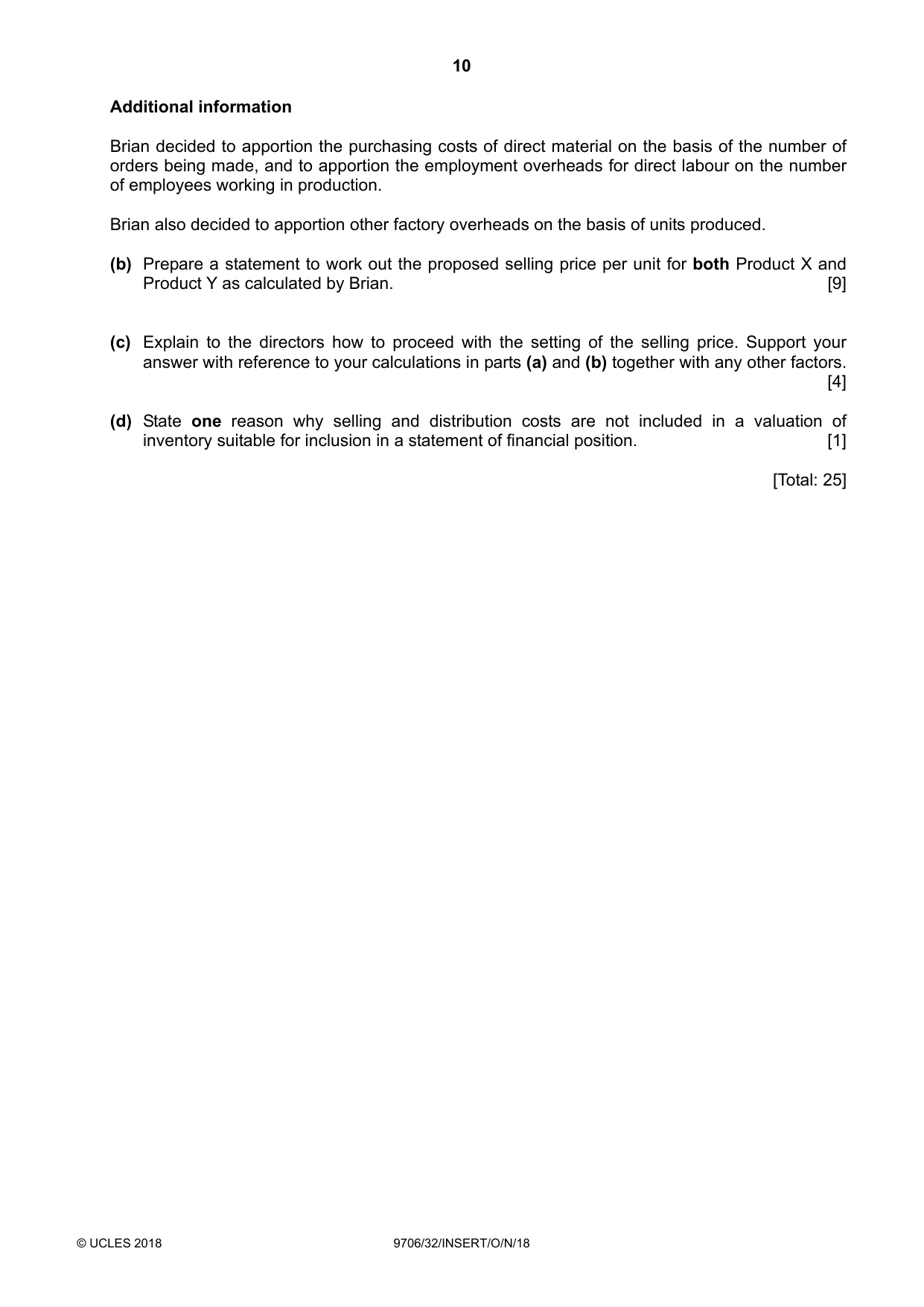
10 © UCLES 2018 9706/32/INSERT/O/N/18 Additional information Brian decided to apportion the purchasing costs of direct material on the basis of the number of orders being made, and to apportion the employment overheads for direct labour on the number of employees working in production. Brian also decided to apportion other factory overheads on the basis of units produced. (b) Prepare a statement to work out the proposed selling price per unit for both Product X and Product Y as calculated by Brian. [9] (c) Explain to the directors how to proceed with the setting of the selling price. Support your answer with reference to your calculations in parts (a) and (b) together with any other factors. [4] (d) State one reason why selling and distribution costs are not included in a valuation of inventory suitable for inclusion in a statement of financial position. [1] [Total: 25]
Question paper, page 11
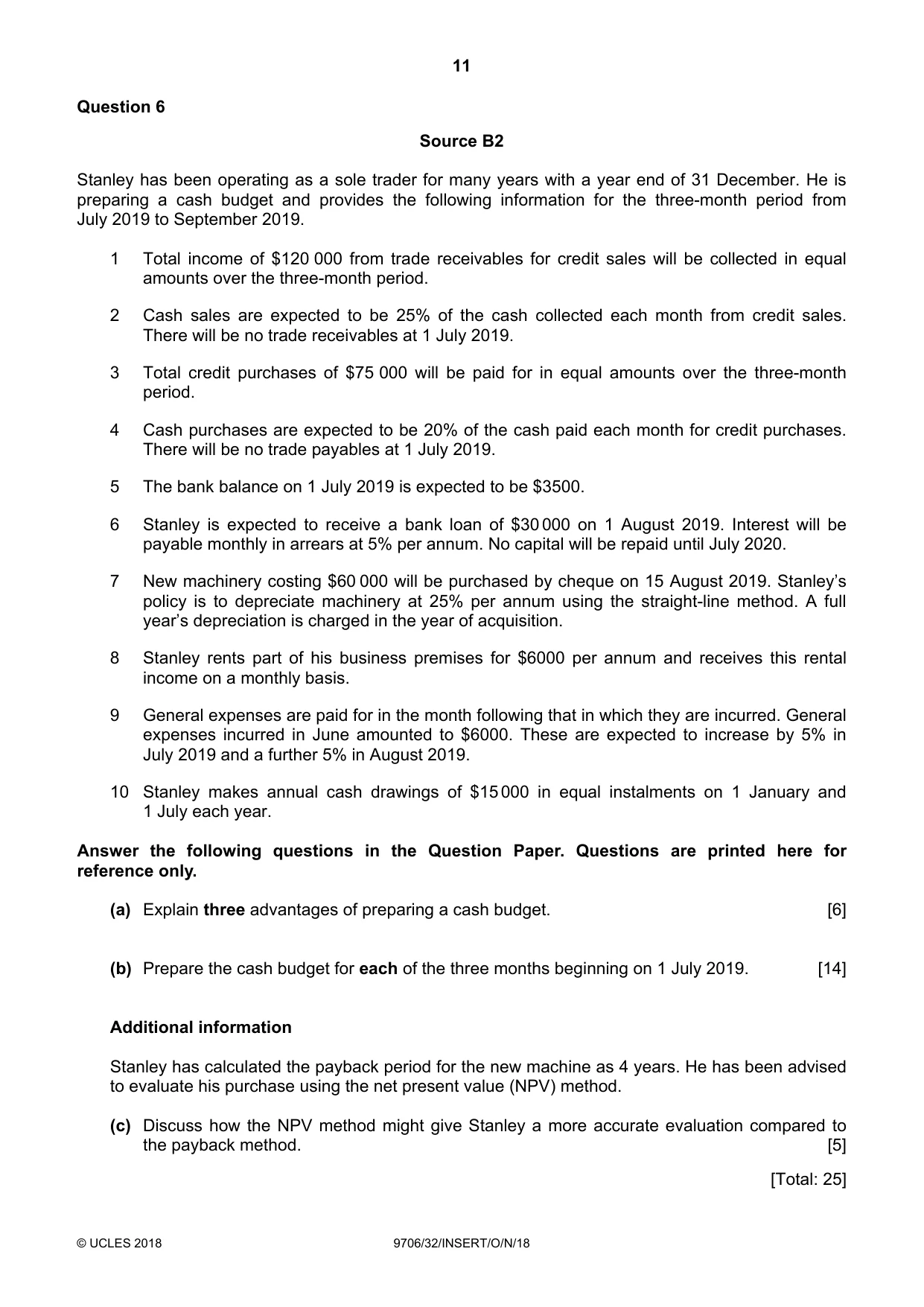
11 © UCLES 2018 9706/32/INSERT/O/N/18 Question 6 Source B2 Stanley has been operating as a sole trader for many years with a year end of 31 December. He is preparing a cash budget and provides the following information for the three-month period from July 2019 to September 2019. 1 Total income of $120 000 from trade receivables for credit sales will be collected in equal amounts over the three-month period. 2 Cash sales are expected to be 25% of the cash collected each month from credit sales. There will be no trade receivables at 1 July 2019. 3 Total credit purchases of $75 000 will be paid for in equal amounts over the three-month period. 4 Cash purchases are expected to be 20% of the cash paid each month for credit purchases. There will be no trade payables at 1 July 2019. 5 The bank balance on 1 July 2019 is expected to be $3500. 6 Stanley is expected to receive a bank loan of $30 000 on 1 August 2019. Interest will be payable monthly in arrears at 5% per annum. No capital will be repaid until July 2020. 7 New machinery costing $60 000 will be purchased by cheque on 15 August 2019. Stanley’s policy is to depreciate machinery at 25% per annum using the straight-line method. A full year’s depreciation is charged in the year of acquisition. 8 Stanley rents part of his business premises for $6000 per annum and receives this rental income on a monthly basis. 9 General expenses are paid for in the month following that in which they are incurred. General expenses incurred in June amounted to $6000. These are expected to increase by 5% in July 2019 and a further 5% in August 2019. 10 Stanley makes annual cash drawings of $15 000 in equal instalments on 1 January and 1 July each year. Answer the following questions in the Question Paper. Questions are printed here for reference only. (a) Explain three advantages of preparing a cash budget. [6] (b) Prepare the cash budget for each of the three months beginning on 1 July 2019. [14] Additional information Stanley has calculated the payback period for the new machine as 4 years. He has been advised to evaluate his purchase using the net present value (NPV) method. (c) Discuss how the NPV method might give Stanley a more accurate evaluation compared to the payback method. [5] [Total: 25]
Question paper, page 12
12 Permission to reproduce items where third-party owned material protected by copyright is included has been sought and cleared where possible. Every reasonable effort has been made by the publisher (UCLES) to trace copyright holders, but if any items requiring clearance have unwittingly been included, the publisher will be pleased to make amends at the earliest possible opportunity. To avoid the issue of disclosure of answer-related information to candidates, all copyright acknowledgements are reproduced online in the Cambridge International Examinations Copyright Acknowledgements Booklet. This is produced for each series of examinations and is freely available to download at www.cie.org.uk after the live examination series. Cambridge International Examinations is part of the Cambridge Assessment Group. Cambridge Assessment is the brand name of University of Cambridge Local Examinations Syndicate (UCLES), which is itself a department of the University of Cambridge. © UCLES 2018 9706/32/INSERT/O/N/18 BLANK PAGE
Mark scheme, page 1
This document consists of 17 printed pages. © UCLES 2018 [Turn over Cambridge Assessment International Education Cambridge International Advanced Subsidiary and Advanced Level ACCOUNTING 9706/32 Paper 3 Structured Questions October/November 2018 MARK SCHEME Maximum Mark: 150 Published This mark scheme is published as an aid to teachers and candidates, to indicate the requirements of the examination. It shows the basis on which Examiners were instructed to award marks. It does not indicate the details of the discussions that took place at an Examiners’ meeting before marking began, which would have considered the acceptability of alternative answers. Mark schemes should be read in conjunction with the question paper and the Principal Examiner Report for Teachers. Cambridge International will not enter into discussions about these mark schemes. Cambridge International is publishing the mark schemes for the October/November 2018 series for most Cambridge IGCSE™, Cambridge International A and AS Level components and some Cambridge O Level components.
Mark scheme, page 2
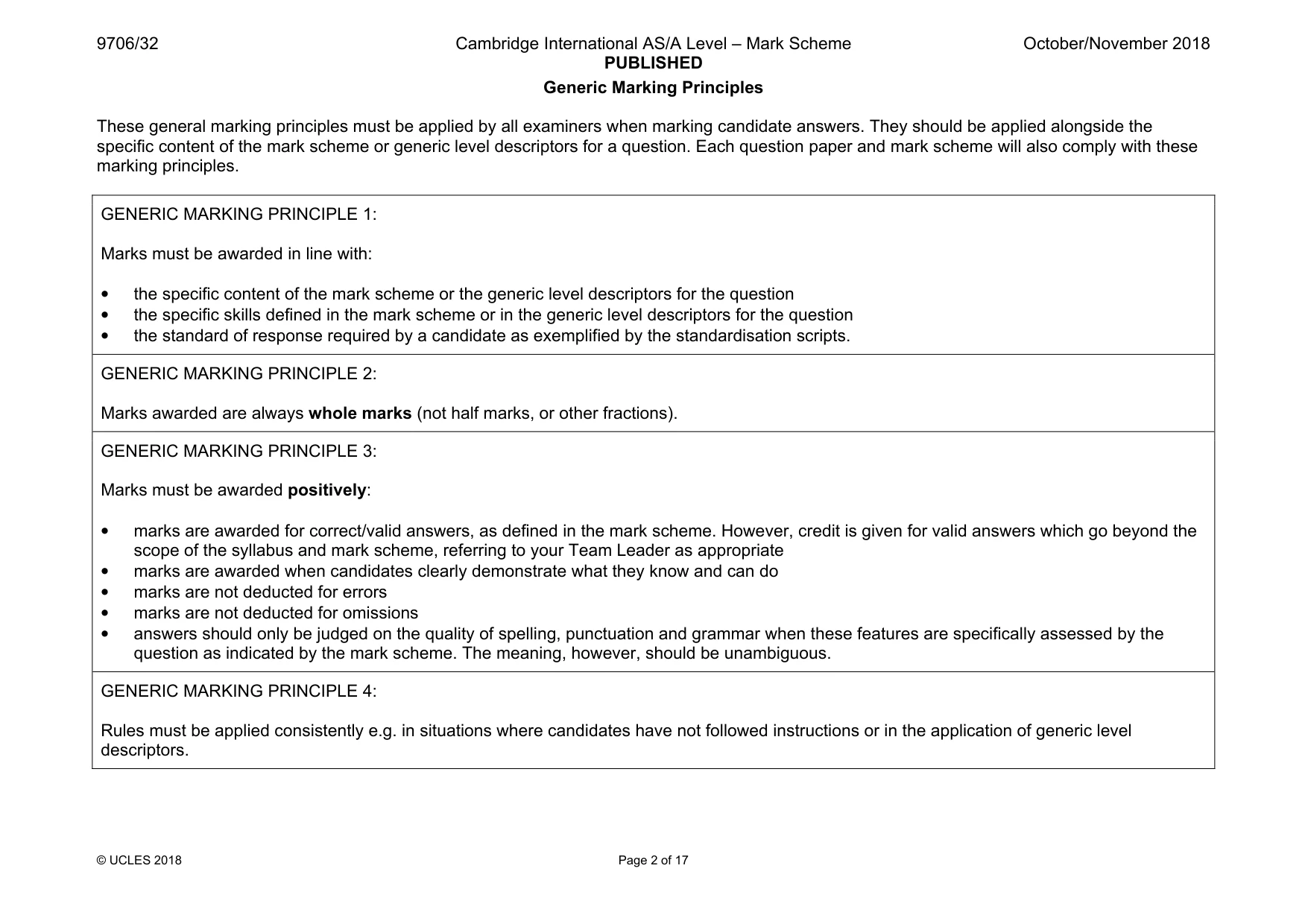
9706/32 Cambridge International AS/A Level – Mark Scheme PUBLISHED October/November 2018 © UCLES 2018 Page 2 of 17 Generic Marking Principles These general marking principles must be applied by all examiners when marking candidate answers. They should be applied alongside the specific content of the mark scheme or generic level descriptors for a question. Each question paper and mark scheme will also comply with these marking principles. GENERIC MARKING PRINCIPLE 1: Marks must be awarded in line with: • the specific content of the mark scheme or the generic level descriptors for the question • the specific skills defined in the mark scheme or in the generic level descriptors for the question • the standard of response required by a candidate as exemplified by the standardisation scripts. GENERIC MARKING PRINCIPLE 2: Marks awarded are always whole marks (not half marks, or other fractions). GENERIC MARKING PRINCIPLE 3: Marks must be awarded positively: • marks are awarded for correct/valid answers, as defined in the mark scheme. However, credit is given for valid answers which go beyond the scope of the syllabus and mark scheme, referring to your Team Leader as appropriate • marks are awarded when candidates clearly demonstrate what they know and can do • marks are not deducted for errors • marks are not deducted for omissions • answers should only be judged on the quality of spelling, punctuation and grammar when these features are specifically assessed by the question as indicated by the mark scheme. The meaning, however, should be unambiguous. GENERIC MARKING PRINCIPLE 4: Rules must be applied consistently e.g. in situations where candidates have not followed instructions or in the application of generic level descriptors.
Mark scheme, page 3
9706/32 Cambridge International AS/A Level – Mark Scheme PUBLISHED October/November 2018 © UCLES 2018 Page 3 of 17 GENERIC MARKING PRINCIPLE 5: Marks should be awarded using the full range of marks defined in the mark scheme for the question (however; the use of the full mark range may be limited according to the quality of the candidate responses seen). GENERIC MARKING PRINCIPLE 6: Marks awarded are based solely on the requirements as defined in the mark scheme. Marks should not be awarded with grade thresholds or grade descriptors in mind.
Mark scheme, page 4
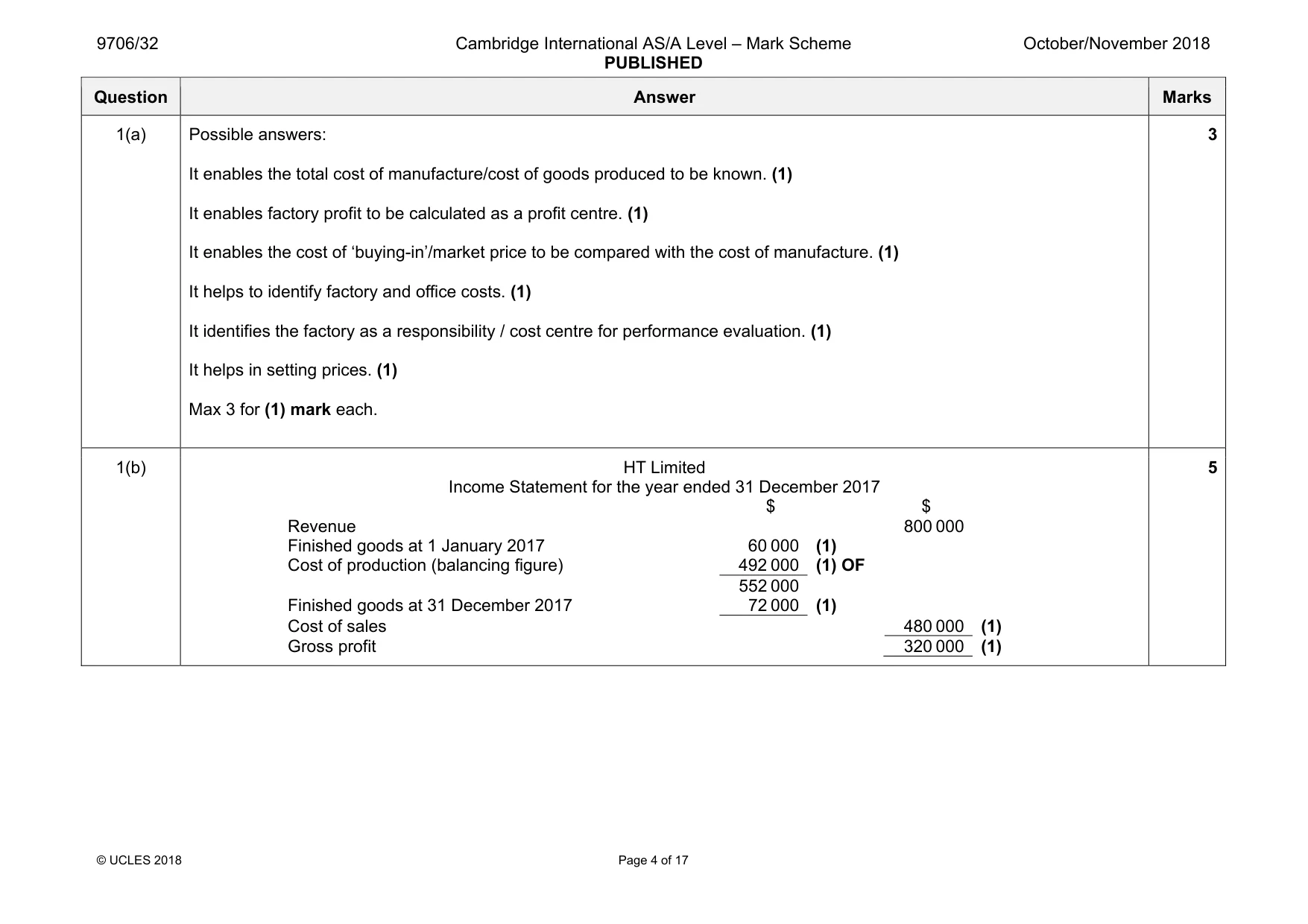
9706/32 Cambridge International AS/A Level – Mark Scheme PUBLISHED October/November 2018 © UCLES 2018 Page 4 of 17 Question Answer Marks 1(a) Possible answers: It enables the total cost of manufacture/cost of goods produced to be known. (1) It enables factory profit to be calculated as a profit centre. (1) It enables the cost of ‘buying-in’/market price to be compared with the cost of manufacture. (1) It helps to identify factory and office costs. (1) It identifies the factory as a responsibility / cost centre for performance evaluation. (1) It helps in setting prices. (1) Max 3 for (1) mark each. 3 1(b) HT Limited Income Statement for the year ended 31 December 2017 $ $ Revenue 800 000 Finished goods at 1 January 2017 60 000 (1) Cost of production (balancing figure) 492 000 (1) OF 552 000 Finished goods at 31 December 2017 72 000 (1) Cost of sales 480 000 (1) Gross profit 320 000 (1) 5
Mark scheme, page 5
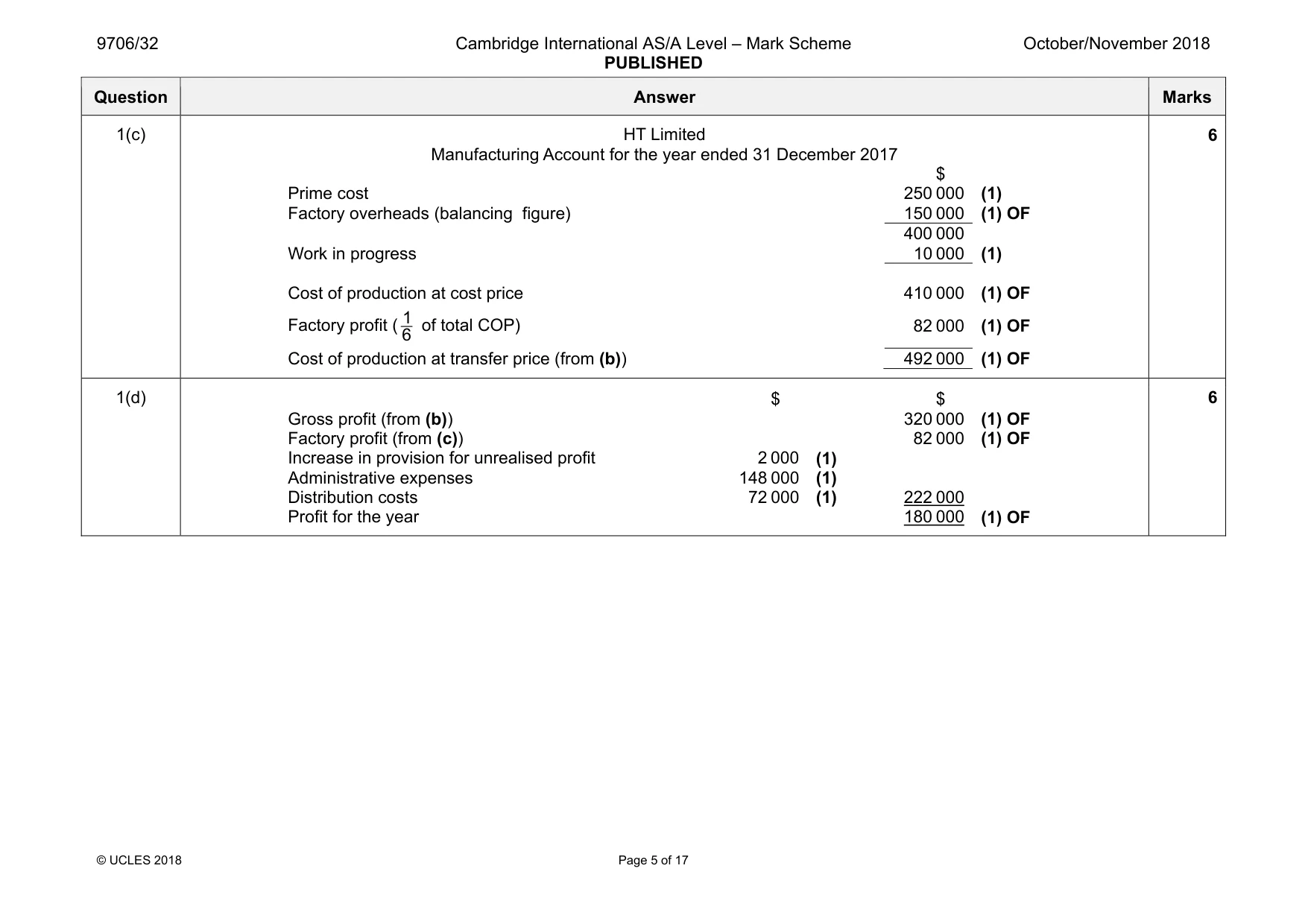
9706/32 Cambridge International AS/A Level – Mark Scheme PUBLISHED October/November 2018 © UCLES 2018 Page 5 of 17 Question Answer Marks 1(c) HT Limited Manufacturing Account for the year ended 31 December 2017 $ Prime cost 250 000 (1) Factory overheads (balancing figure) 150 000 (1) OF 400 000 Work in progress 10 000 (1) Cost of production at cost price 410 000 (1) OF Factory profit ( 1 6 of total COP) 82 000 (1) OF Cost of production at transfer price (from (b)) 492 000 (1) OF 6 1(d) $ $ Gross profit (from (b)) 320 000 (1) OF Factory profit (from (c)) 82 000 (1) OF Increase in provision for unrealised profit 2 000 (1) Administrative expenses 148 000 (1) Distribution costs 72 000 (1) 222 000 Profit for the year 180 000 (1) OF 6
Mark scheme, page 6
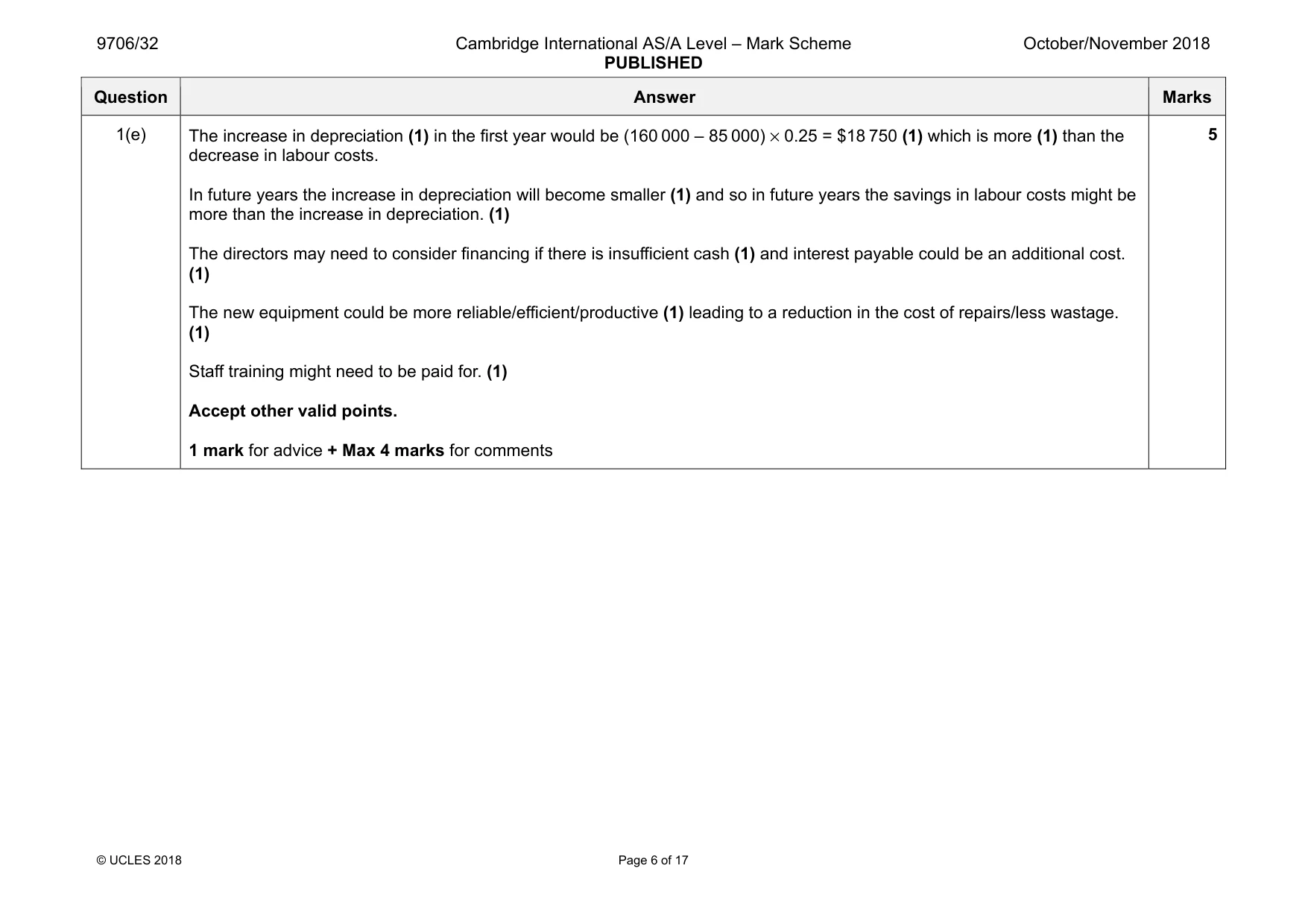
9706/32 Cambridge International AS/A Level – Mark Scheme PUBLISHED October/November 2018 © UCLES 2018 Page 6 of 17 Question Answer Marks 1(e) The increase in depreciation (1) in the first year would be (160 000 – 85 000) × 0.25 = $18 750 (1) which is more (1) than the decrease in labour costs. In future years the increase in depreciation will become smaller (1) and so in future years the savings in labour costs might be more than the increase in depreciation. (1) The directors may need to consider financing if there is insufficient cash (1) and interest payable could be an additional cost. (1) The new equipment could be more reliable/efficient/productive (1) leading to a reduction in the cost of repairs/less wastage. (1) Staff training might need to be paid for. (1) Accept other valid points. 1 mark for advice + Max 4 marks for comments 5
Mark scheme, page 7
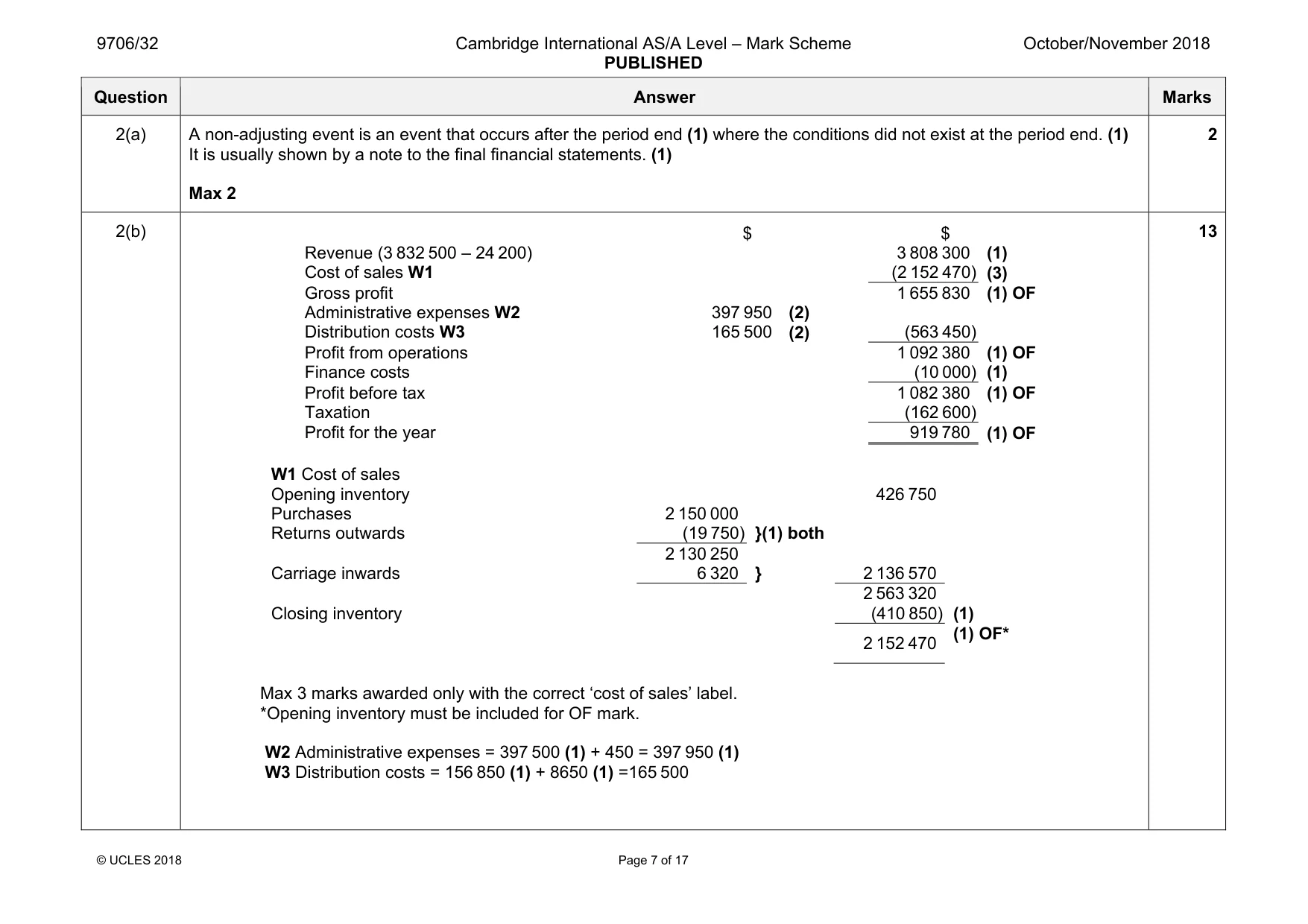
9706/32 Cambridge International AS/A Level – Mark Scheme PUBLISHED October/November 2018 © UCLES 2018 Page 7 of 17 Question Answer Marks 2(a) A non-adjusting event is an event that occurs after the period end (1) where the conditions did not exist at the period end. (1) It is usually shown by a note to the final financial statements. (1) Max 2 2 2(b) $ $ Revenue (3 832 500 – 24 200) 3 808 300 (1) Cost of sales W1 (2 152 470) (3) Gross profit 1 655 830 (1) OF Administrative expenses W2 397 950 (2) Distribution costs W3 165 500 (2) (563 450) Profit from operations 1 092 380 (1) OF Finance costs (10 000) (1) Profit before tax 1 082 380 (1) OF Taxation (162 600) Profit for the year 919 780 (1) OF W1 Cost of sales Opening inventory 426 750 Purchases 2 150 000 Returns outwards (19 750) }(1) both 2 130 250 Carriage inwards 6 320 } 2 136 570 2 563 320 Closing inventory (410 850) (1) 2 152 470 (1) OF* Max 3 marks awarded only with the correct ‘cost of sales’ label. *Opening inventory must be included for OF mark. W2 Administrative expenses = 397 500 (1) + 450 = 397 950 (1) W3 Distribution costs = 156 850 (1) + 8650 (1) =165 500 13
Mark scheme, page 8
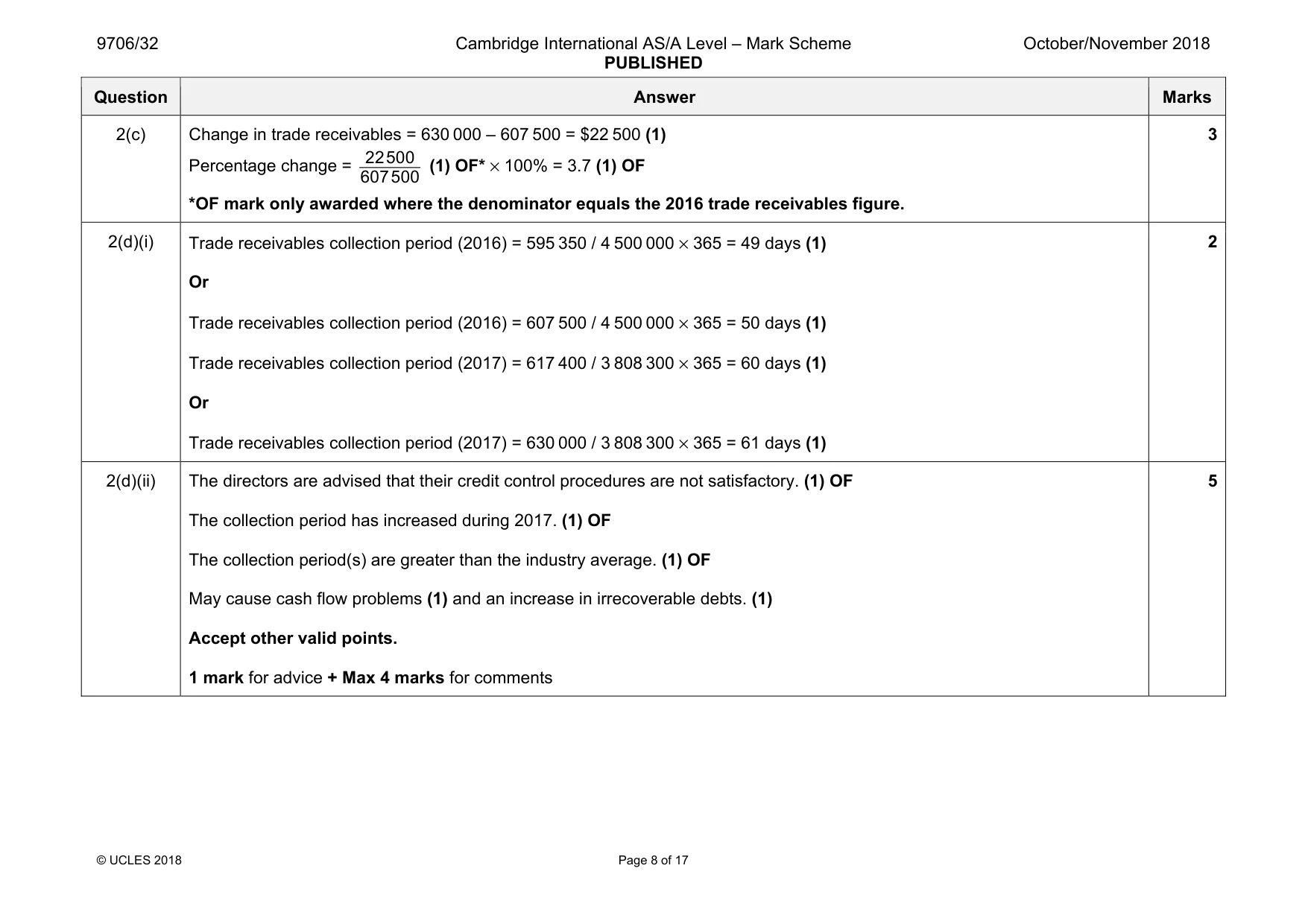
9706/32 Cambridge International AS/A Level – Mark Scheme PUBLISHED October/November 2018 © UCLES 2018 Page 8 of 17 Question Answer Marks 2(c) Change in trade receivables = 630 000 – 607 500 = $22 500 (1) Percentage change = 22500 607500 (1) OF* × 100% = 3.7 (1) OF *OF mark only awarded where the denominator equals the 2016 trade receivables figure. 3 2(d)(i) Trade receivables collection period (2016) = 595 350 / 4 500 000 × 365 = 49 days (1) Or Trade receivables collection period (2016) = 607 500 / 4 500 000 × 365 = 50 days (1) Trade receivables collection period (2017) = 617 400 / 3 808 300 × 365 = 60 days (1) Or Trade receivables collection period (2017) = 630 000 / 3 808 300 × 365 = 61 days (1) 2 2(d)(ii) The directors are advised that their credit control procedures are not satisfactory. (1) OF The collection period has increased during 2017. (1) OF The collection period(s) are greater than the industry average. (1) OF May cause cash flow problems (1) and an increase in irrecoverable debts. (1) Accept other valid points. 1 mark for advice + Max 4 marks for comments 5
Mark scheme, page 9
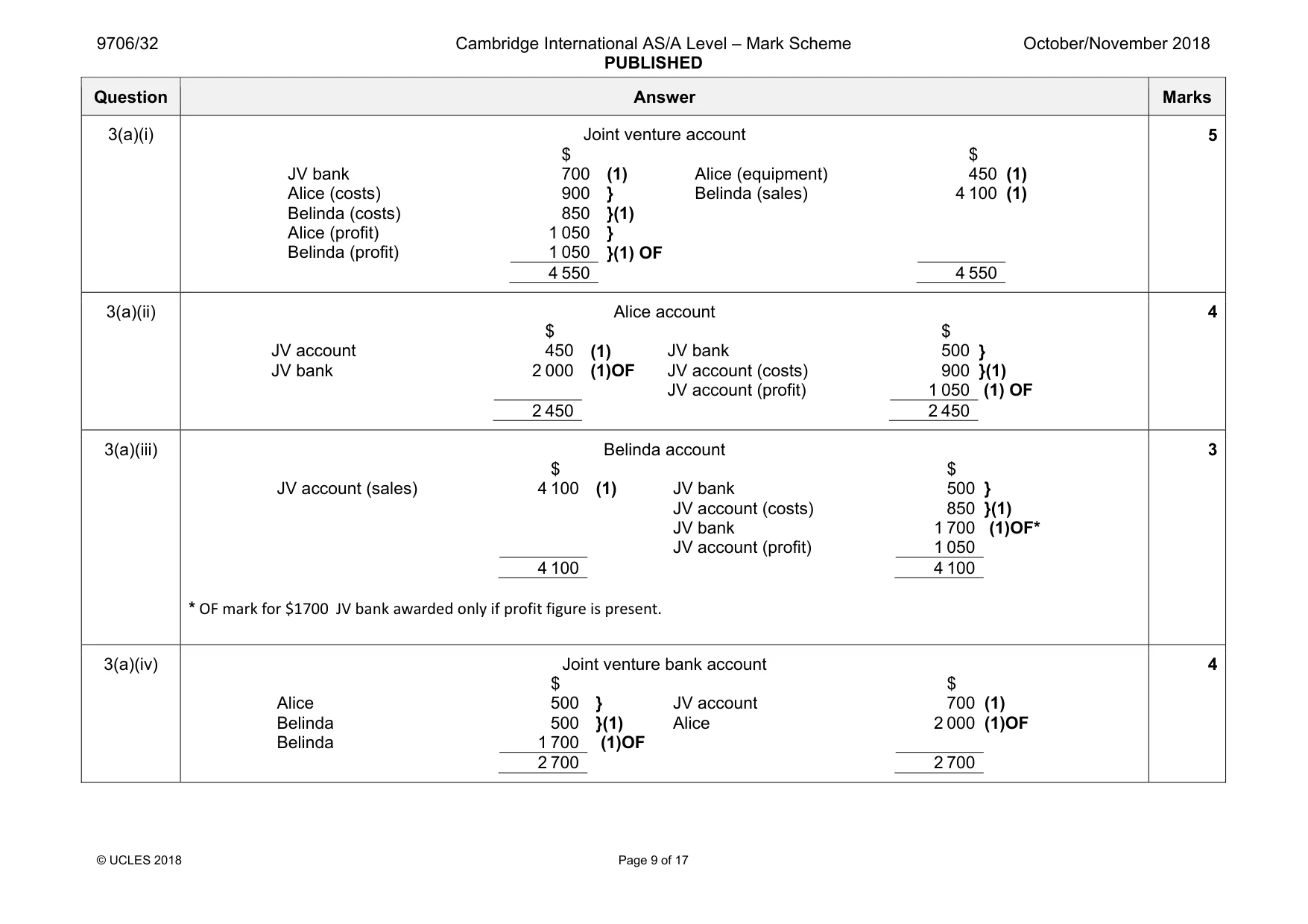
9706/32 Cambridge International AS/A Level – Mark Scheme PUBLISHED October/November 2018 © UCLES 2018 Page 9 of 17 Question Answer Marks 3(a)(i) Joint venture account $ $ JV bank 700 (1) Alice (equipment) 450 (1) Alice (costs) 900 } Belinda (sales) 4 100 (1) Belinda (costs) 850 }(1) Alice (profit) 1 050 } Belinda (profit) 1 050 }(1) OF 4 550 4 550 5 3(a)(ii) Alice account $ $ } JV account 450 (1) JV bank 500 JV bank 2 000 (1)OF JV account (costs) 900 }(1) JV account (profit) 1 050 (1) OF 2 450 2 450 4 3(a)(iii) Belinda account $ $ JV account (sales) 4 100 (1) JV bank 500 } JV account (costs) 850 }(1) JV bank 1 700 (1)OF* JV account (profit) 1 050 4 100 4 100 * OF mark for $1700 JV bank awarded only if profit figure is present. 3 3(a)(iv) Joint venture bank account $ $ Alice 500 } JV account 700 (1) Belinda 500 }(1) Alice 2 000 (1)OF Belinda 1 700 (1)OF 2 700 2 700 4
Mark scheme, page 10
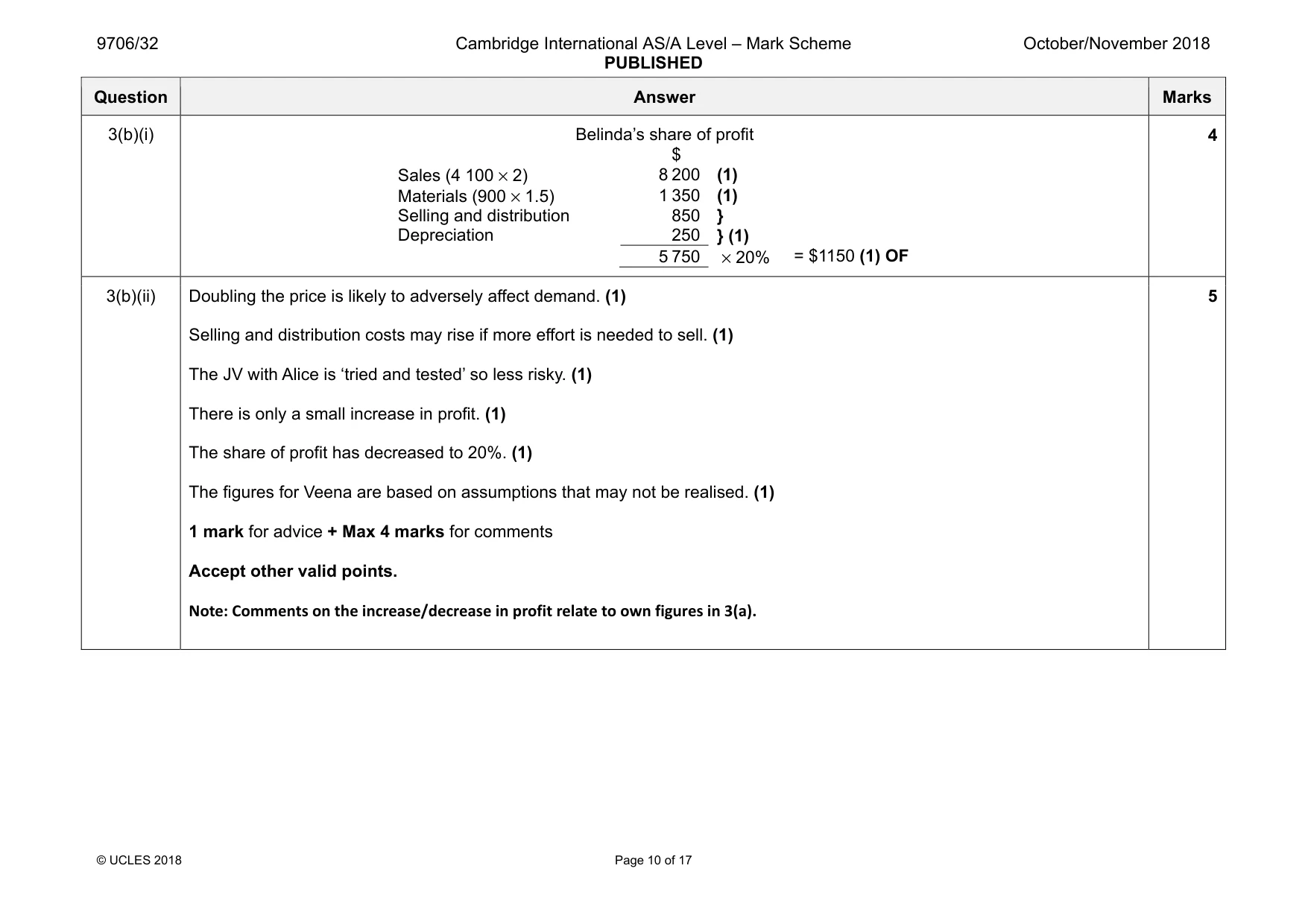
9706/32 Cambridge International AS/A Level – Mark Scheme PUBLISHED October/November 2018 © UCLES 2018 Page 10 of 17 Question Answer Marks 3(b)(i) Belinda’s share of profit $ Sales (4 100 × 2) 8 200 (1) Materials (900 × 1.5) 1 350 (1) Selling and distribution 850 } Depreciation 250 } (1) 5 750 × 20% = $1150 (1) OF 4 3(b)(ii) Doubling the price is likely to adversely affect demand. (1) Selling and distribution costs may rise if more effort is needed to sell. (1) The JV with Alice is ‘tried and tested’ so less risky. (1) There is only a small increase in profit. (1) The share of profit has decreased to 20%. (1) The figures for Veena are based on assumptions that may not be realised. (1) 1 mark for advice + Max 4 marks for comments Accept other valid points. Note: Comments on the increase/decrease in profit relate to own figures in 3(a). 5
Mark scheme, page 11
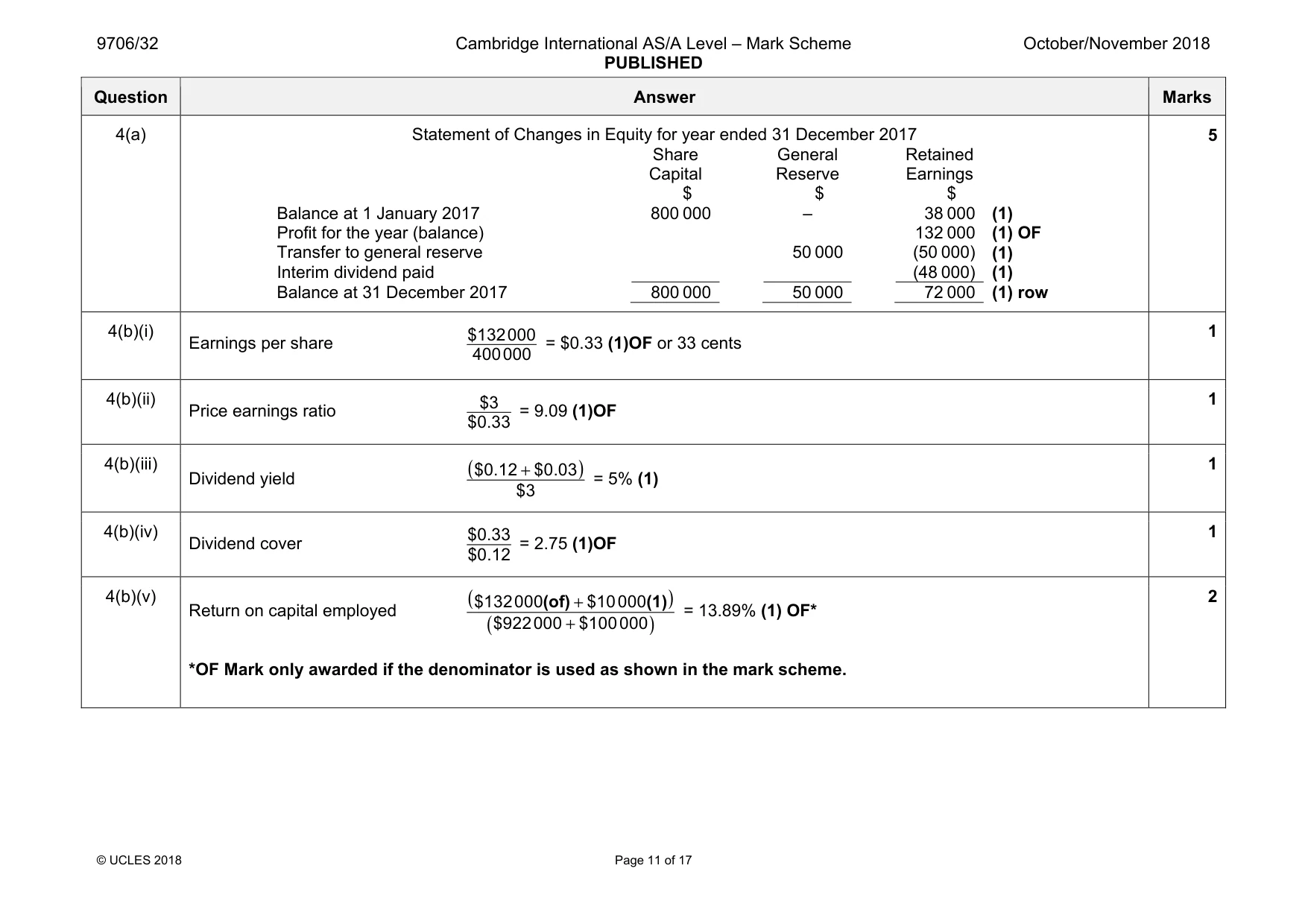
9706/32 Cambridge International AS/A Level – Mark Scheme PUBLISHED October/November 2018 © UCLES 2018 Page 11 of 17 Question Answer Marks 4(a) Statement of Changes in Equity for year ended 31 December 2017 Share General Retained Capital Reserve Earnings $ $ $ Balance at 1 January 2017 800 000 – 38 000 (1) Profit for the year (balance) 132 000 (1) OF Transfer to general reserve 50 000 (50 000) (1) Interim dividend paid (48 000) (1) Balance at 31 December 2017 800 000 50 000 72 000 (1) row 5 4(b)(i) Earnings per share $132000 400000 = $0.33 (1)OF or 33 cents 1 4(b)(ii) Price earnings ratio $3 $0.33 = 9.09 (1)OF 1 4(b)(iii) Dividend yield ( ) $0.12 $0.03 $3 + = 5% (1) 1 4(b)(iv) Dividend cover $0.33 $0.12 = 2.75 (1)OF 1 4(b)(v) Return on capital employed ( ) ( ) $132000 $10000 $922000 $100000 + + (of) (1) = 13.89% (1) OF* *OF Mark only awarded if the denominator is used as shown in the mark scheme. 2
Mark scheme, page 12
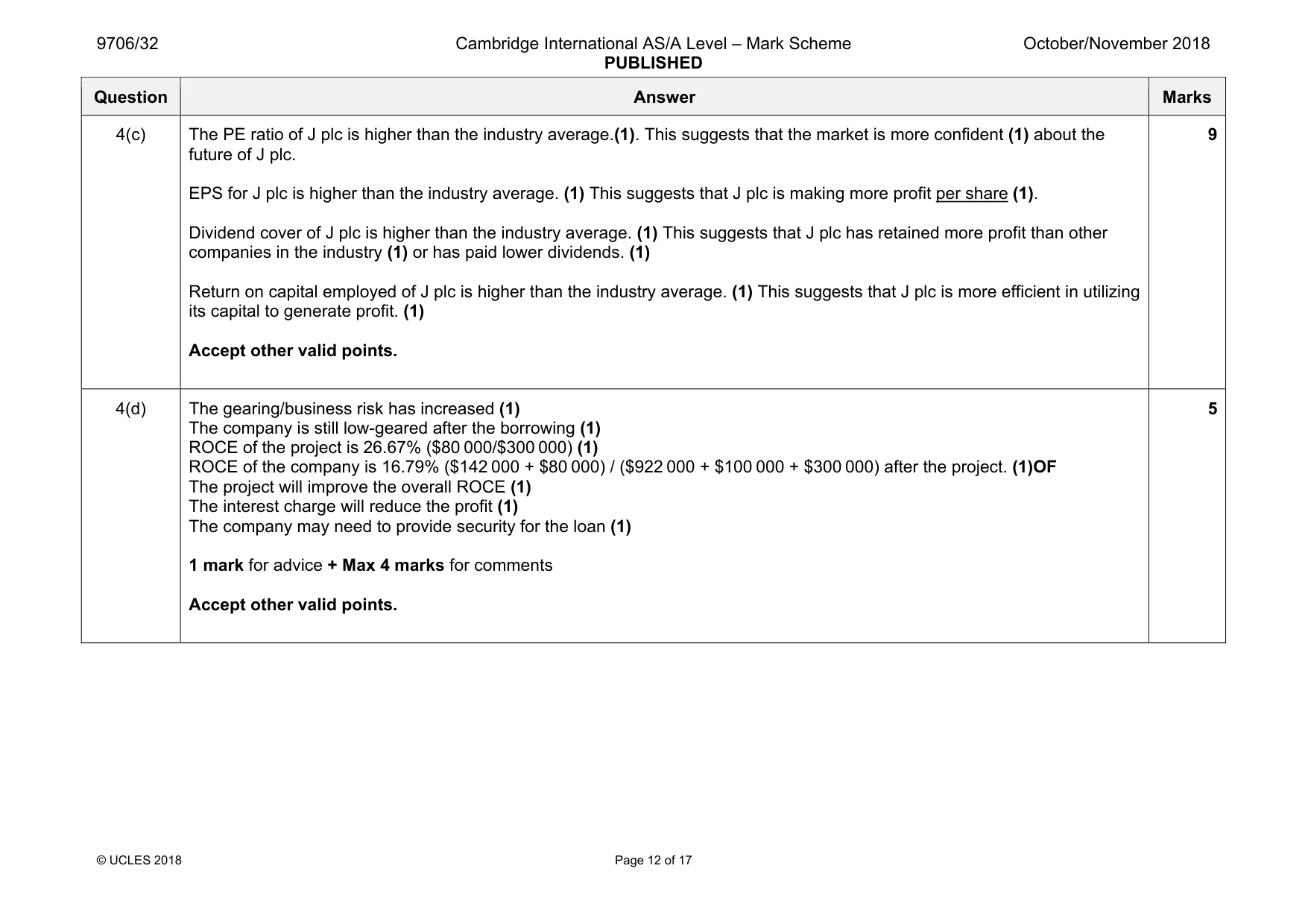
9706/32 Cambridge International AS/A Level – Mark Scheme PUBLISHED October/November 2018 © UCLES 2018 Page 12 of 17 Question Answer Marks 4(c) The PE ratio of J plc is higher than the industry average.(1). This suggests that the market is more confident (1) about the future of J plc. EPS for J plc is higher than the industry average. (1) This suggests that J plc is making more profit per share (1). Dividend cover of J plc is higher than the industry average. (1) This suggests that J plc has retained more profit than other companies in the industry (1) or has paid lower dividends. (1) Return on capital employed of J plc is higher than the industry average. (1) This suggests that J plc is more efficient in utilizing its capital to generate profit. (1) Accept other valid points. 9 4(d) The gearing/business risk has increased (1) The company is still low-geared after the borrowing (1) ROCE of the project is 26.67% ($80 000/$300 000) (1) ROCE of the company is 16.79% ($142 000 + $80 000) / ($922 000 + $100 000 + $300 000) after the project. (1)OF The project will improve the overall ROCE (1) The interest charge will reduce the profit (1) The company may need to provide security for the loan (1) 1 mark for advice + Max 4 marks for comments Accept other valid points. 5
Mark scheme, page 13
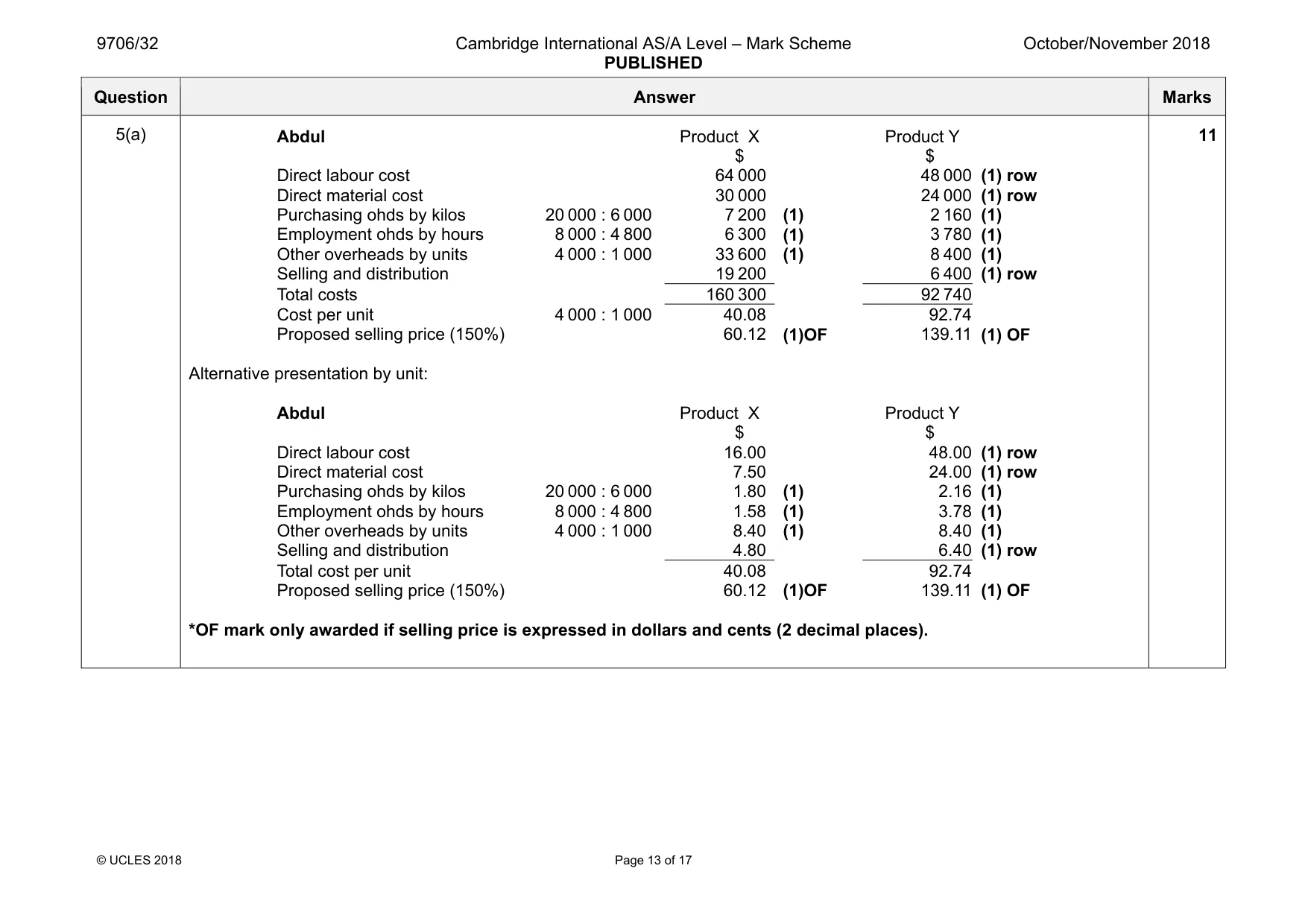
9706/32 Cambridge International AS/A Level – Mark Scheme PUBLISHED October/November 2018 © UCLES 2018 Page 13 of 17 Question Answer Marks 5(a) Abdul Product X Product Y $ $ Direct labour cost 64 000 48 000 (1) row Direct material cost 30 000 24 000 (1) row Purchasing ohds by kilos 20 000 : 6 000 7 200 (1) 2 160 (1) Employment ohds by hours 8 000 : 4 800 6 300 (1) 3 780 (1) Other overheads by units 4 000 : 1 000 33 600 (1) 8 400 (1) Selling and distribution 19 200 6 400 (1) row Total costs 160 300 92 740 Cost per unit 4 000 : 1 000 40.08 92.74 Proposed selling price (150%) 60.12 (1)OF 139.11 (1) OF Alternative presentation by unit: Abdul Product X Product Y $ $ Direct labour cost 16.00 48.00 (1) row Direct material cost 7.50 24.00 (1) row Purchasing ohds by kilos 20 000 : 6 000 1.80 (1) 2.16 (1) Employment ohds by hours 8 000 : 4 800 1.58 (1) 3.78 (1) Other overheads by units 4 000 : 1 000 8.40 (1) 8.40 (1) Selling and distribution 4.80 6.40 (1) row Total cost per unit 40.08 92.74 Proposed selling price (150%) 60.12 (1)OF 139.11 (1) OF *OF mark only awarded if selling price is expressed in dollars and cents (2 decimal places). 11
Mark scheme, page 14
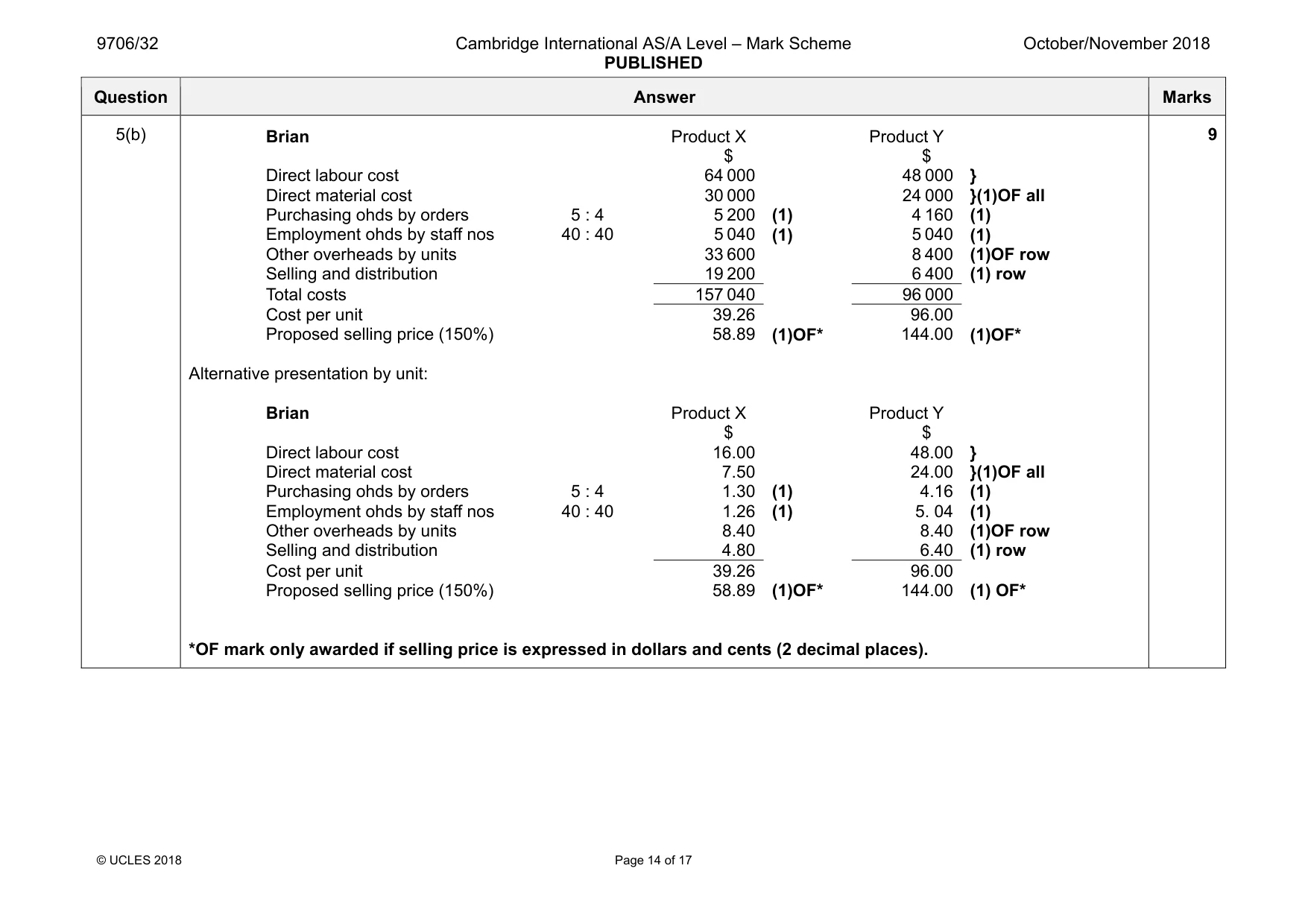
9706/32 Cambridge International AS/A Level – Mark Scheme PUBLISHED October/November 2018 © UCLES 2018 Page 14 of 17 Question Answer Marks 5(b) Brian Product X Product Y $ $ Direct labour cost 64 000 48 000 } Direct material cost 30 000 24 000 }(1)OF all Purchasing ohds by orders 5 : 4 5 200 (1) 4 160 (1) Employment ohds by staff nos 40 : 40 5 040 (1) 5 040 (1) Other overheads by units 33 600 8 400 (1)OF row Selling and distribution 19 200 6 400 (1) row Total costs 157 040 96 000 Cost per unit 39.26 96.00 Proposed selling price (150%) 58.89 (1)OF* 144.00 (1)OF* Alternative presentation by unit: Brian Product X Product Y $ $ Direct labour cost 16.00 48.00 } Direct material cost 7.50 24.00 }(1)OF all Purchasing ohds by orders 5 : 4 1.30 (1) 4.16 (1) Employment ohds by staff nos 40 : 40 1.26 (1) 5. 04 (1) Other overheads by units 8.40 8.40 (1)OF row Selling and distribution 4.80 6.40 (1) row Cost per unit 39.26 96.00 Proposed selling price (150%) 58.89 (1)OF* 144.00 (1) OF* *OF mark only awarded if selling price is expressed in dollars and cents (2 decimal places). 9
Mark scheme, page 15
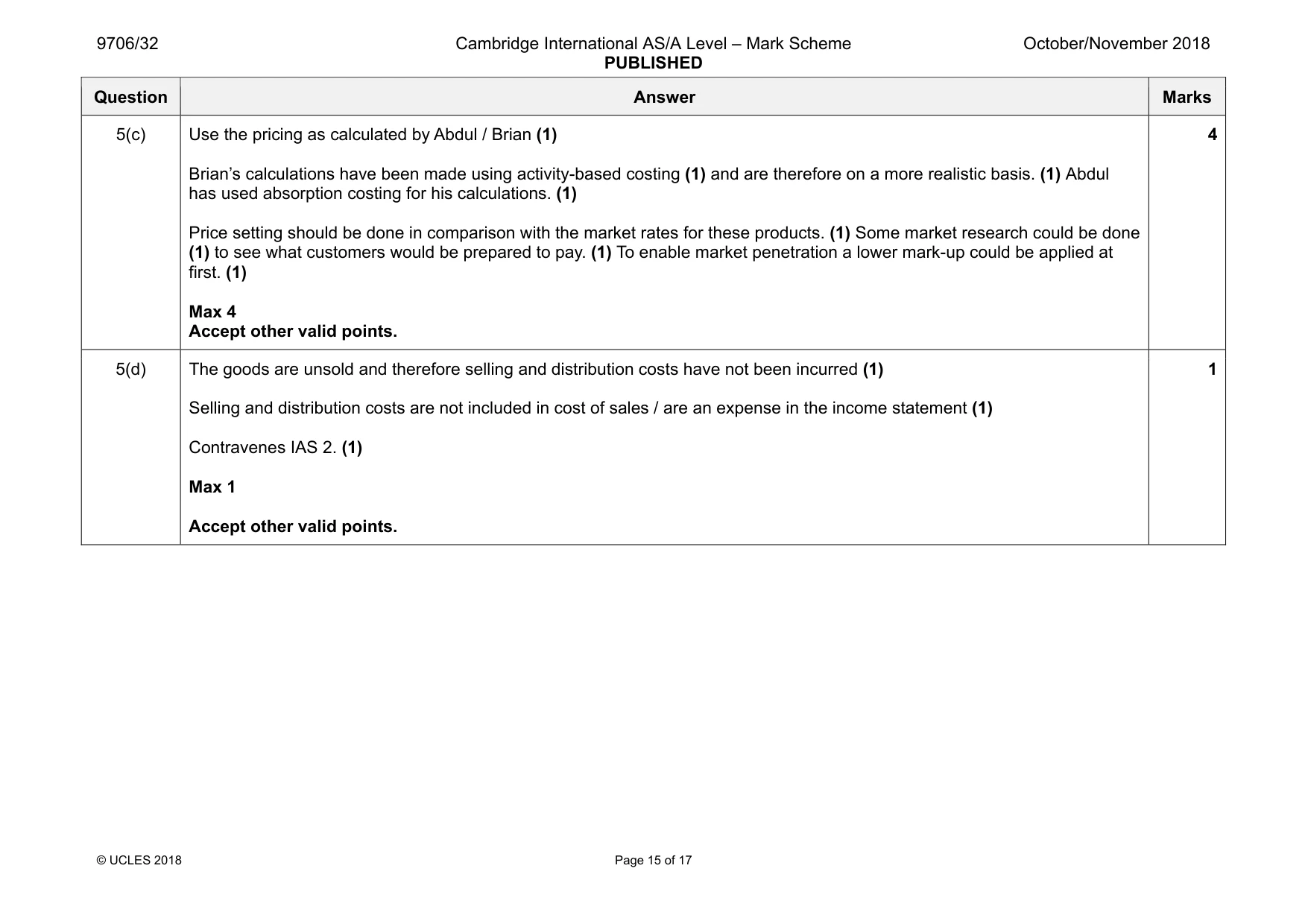
9706/32 Cambridge International AS/A Level – Mark Scheme PUBLISHED October/November 2018 © UCLES 2018 Page 15 of 17 Question Answer Marks 5(c) Use the pricing as calculated by Abdul / Brian (1) Brian’s calculations have been made using activity-based costing (1) and are therefore on a more realistic basis. (1) Abdul has used absorption costing for his calculations. (1) Price setting should be done in comparison with the market rates for these products. (1) Some market research could be done (1) to see what customers would be prepared to pay. (1) To enable market penetration a lower mark-up could be applied at first. (1) Max 4 Accept other valid points. 4 5(d) The goods are unsold and therefore selling and distribution costs have not been incurred (1) Selling and distribution costs are not included in cost of sales / are an expense in the income statement (1) Contravenes IAS 2. (1) Max 1 Accept other valid points. 1
Mark scheme, page 16
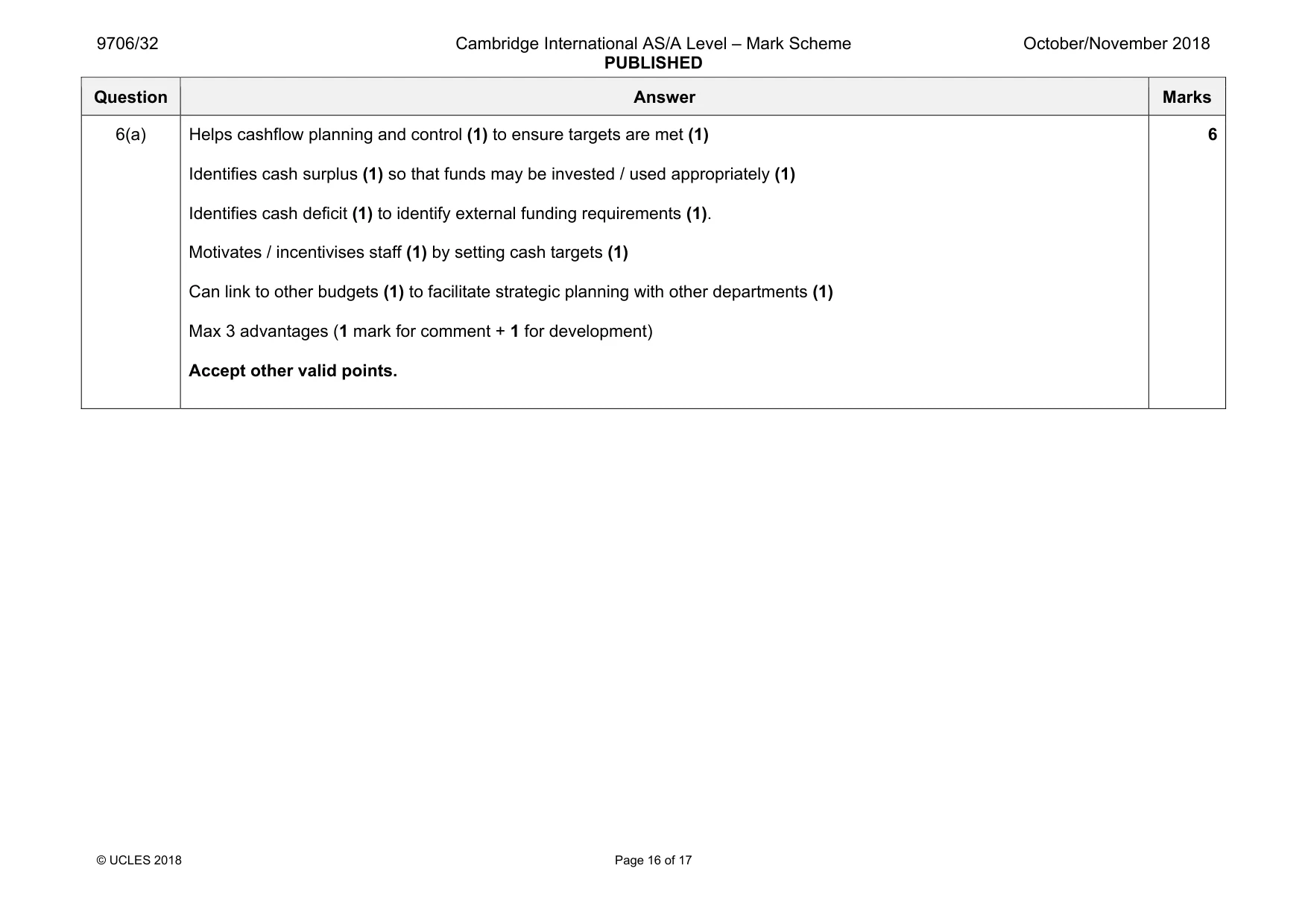
9706/32 Cambridge International AS/A Level – Mark Scheme PUBLISHED October/November 2018 © UCLES 2018 Page 16 of 17 Question Answer Marks 6(a) Helps cashflow planning and control (1) to ensure targets are met (1) Identifies cash surplus (1) so that funds may be invested / used appropriately (1) Identifies cash deficit (1) to identify external funding requirements (1). Motivates / incentivises staff (1) by setting cash targets (1) Can link to other budgets (1) to facilitate strategic planning with other departments (1) Max 3 advantages (1 mark for comment + 1 for development) Accept other valid points. 6
Mark scheme, page 17
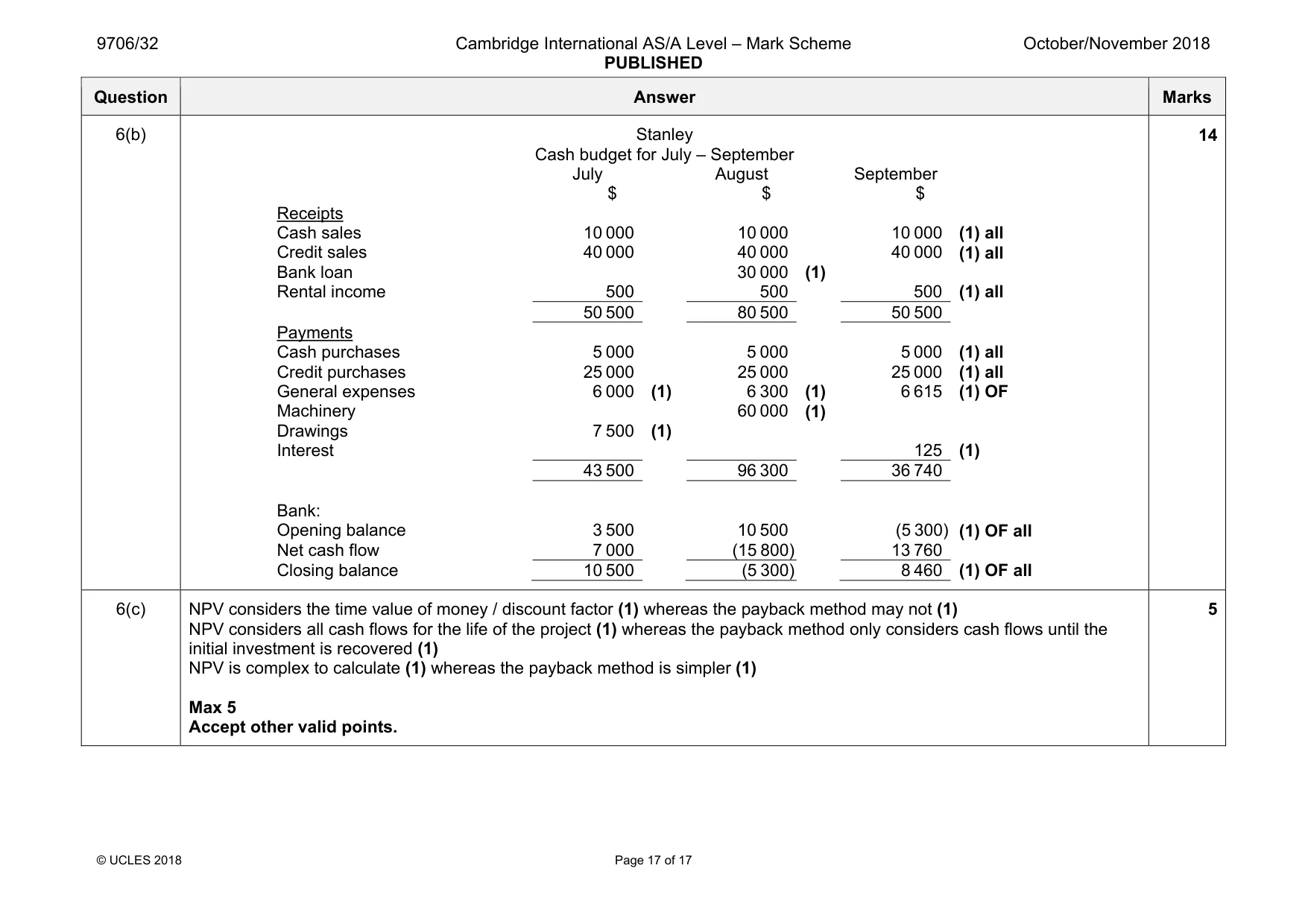
9706/32 Cambridge International AS/A Level – Mark Scheme PUBLISHED October/November 2018 © UCLES 2018 Page 17 of 17 Question Answer Marks 6(b) Stanley Cash budget for July – September July August September $ $ $ Receipts Cash sales 10 000 10 000 10 000 (1) all Credit sales 40 000 40 000 40 000 (1) all Bank loan 30 000 (1) Rental income 500 500 500 (1) all 50 500 80 500 50 500 Payments Cash purchases 5 000 5 000 5 000 (1) all Credit purchases 25 000 25 000 25 000 (1) all General expenses 6 000 (1) 6 300 (1) 6 615 (1) OF Machinery 60 000 (1) Drawings 7 500 (1) Interest 125 (1) 43 500 96 300 36 740 Bank: Opening balance 3 500 10 500 (5 300) (1) OF all Net cash flow 7 000 (15 800) 13 760 Closing balance 10 500 (5 300) 8 460 (1) OF all 14 6(c) NPV considers the time value of money / discount factor (1) whereas the payback method may not (1) NPV considers all cash flows for the life of the project (1) whereas the payback method only considers cash flows until the initial investment is recovered (1) NPV is complex to calculate (1) whereas the payback method is simpler (1) Max 5 Accept other valid points. 5
What you needed in this session
Cambridge’s own grade thresholds for 2018 Oct/Nov, Paper 3 · Variant 2. A higher threshold means an easier paper — the bar moves with how the cohort did.