Cambridge A Level Accounting 9706 — 2018 Oct/Nov Paper 3 · Variant 1
9706/31/O/N/18 · 150 marks · ≈169 min
The question paper and its mark scheme, free to read here and free to download. This is Cambridge’s own paper, exactly as it was sat.
Question paper12 pages
Mark scheme19 pages
Answers below. Sit the paper first if you are practising.
Paper as text
Question paper, page 1
This document consists of 12 printed pages. IB18 11_9706_31/6RP © UCLES 2018 [Turn over Cambridge International Examinations Cambridge International Advanced Subsidiary and Advanced Level ACCOUNTING 9706/31 Paper 3 Structured Questions October/November 2018 INSERT 3 hours READ THESE INSTRUCTIONS FIRST This Insert contains all of the required information and questions. The questions are provided in the Insert for reference only. Anything you write in this Insert will not be marked. The businesses described in this Insert are entirely fictitious.
Question paper, page 2
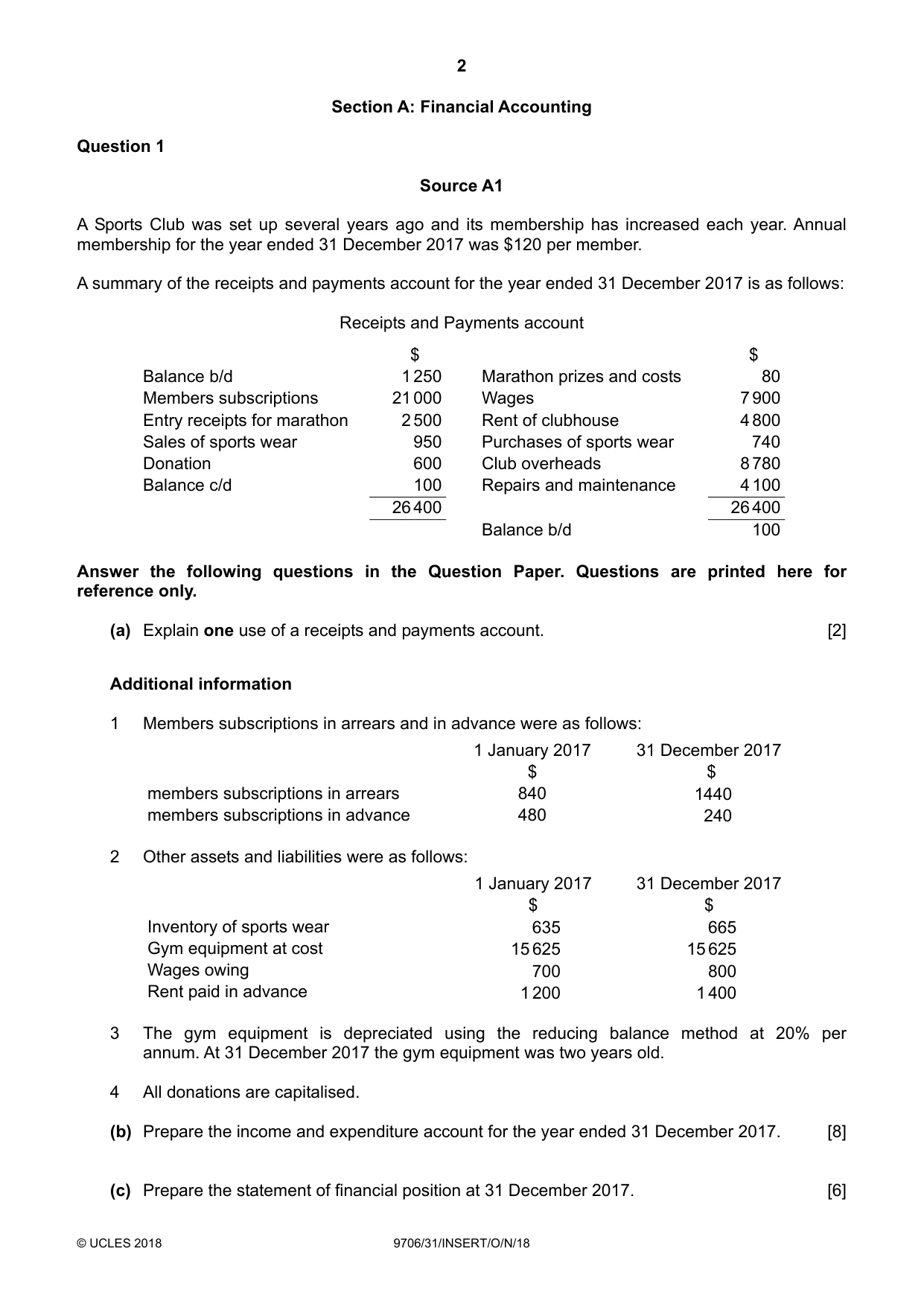
2 © UCLES 2018 9706/31/INSERT/O/N/18 Section A: Financial Accounting Question 1 Source A1 A Sports Club was set up several years ago and its membership has increased each year. Annual membership for the year ended 31 December 2017 was $120 per member. A summary of the receipts and payments account for the year ended 31 December 2017 is as follows: Receipts and Payments account $ $ Balance b/d 1 250 Marathon prizes and costs 80 Members subscriptions 21 000 Wages 7 900 Entry receipts for marathon 2 500 Rent of clubhouse 4 800 Sales of sports wear 950 Purchases of sports wear 740 Donation 600 Club overheads 8 780 Balance c/d 100 Repairs and maintenance 4 100 26 400 26 400 Balance b/d 100 Answer the following questions in the Question Paper. Questions are printed here for reference only. (a) Explain one use of a receipts and payments account. [2] Additional information 1 Members subscriptions in arrears and in advance were as follows: 1 January 2017 31 December 2017 $ $ members subscriptions in arrears 840 1440 members subscriptions in advance 480 240 2 Other assets and liabilities were as follows: 1 January 2017 31 December 2017 $ $ Inventory of sports wear 635 665 Gym equipment at cost 15 625 15 625 Wages owing 700 800 Rent paid in advance 1 200 1 400 3 The gym equipment is depreciated using the reducing balance method at 20% per annum. At 31 December 2017 the gym equipment was two years old. 4 All donations are capitalised. (b) Prepare the income and expenditure account for the year ended 31 December 2017. [8] (c) Prepare the statement of financial position at 31 December 2017. [6]
Question paper, page 3
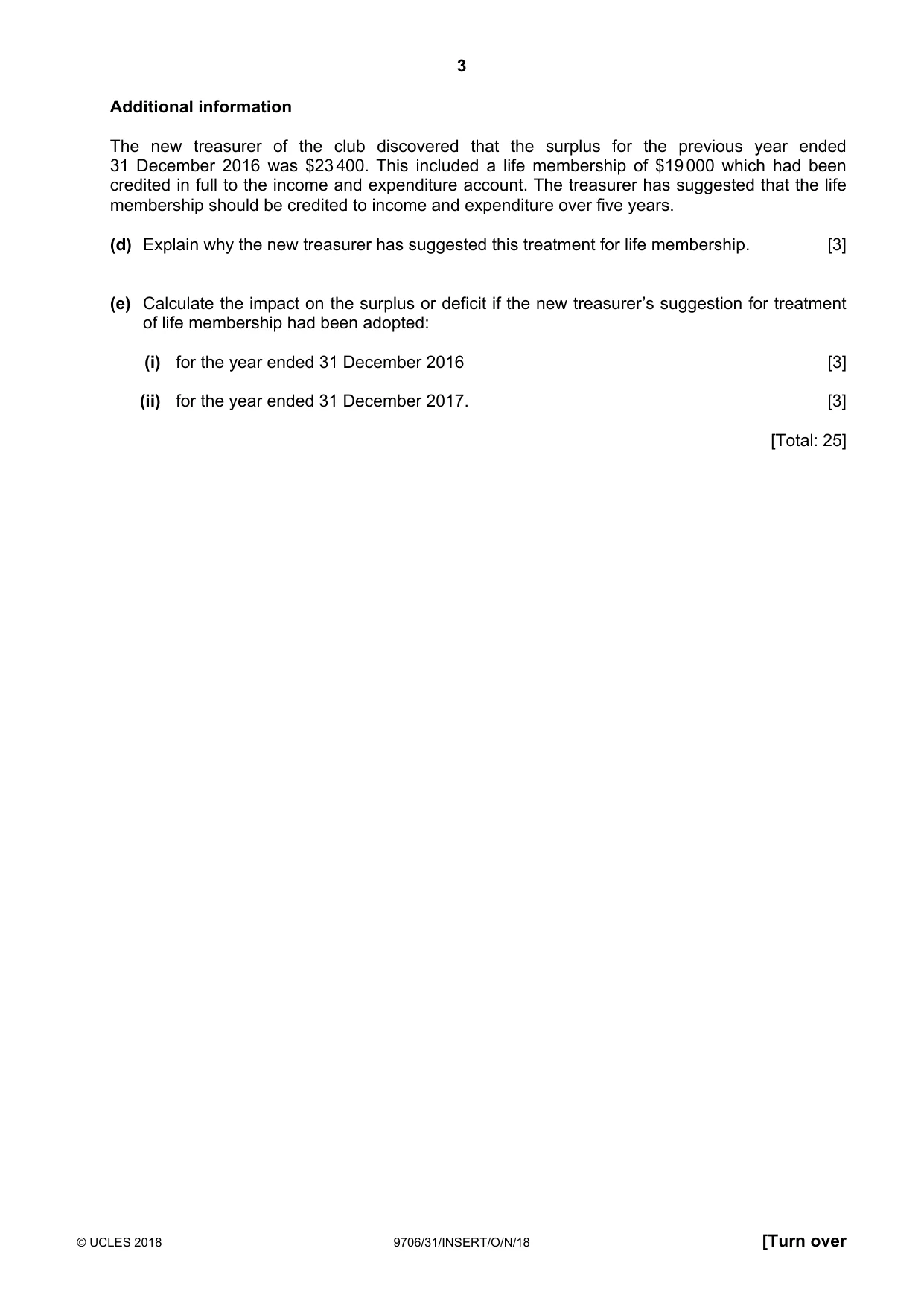
3 © UCLES 2018 9706/31/INSERT/O/N/18 [Turn over Additional information The new treasurer of the club discovered that the surplus for the previous year ended 31 December 2016 was $23 400. This included a life membership of $19 000 which had been credited in full to the income and expenditure account. The treasurer has suggested that the life membership should be credited to income and expenditure over five years. (d) Explain why the new treasurer has suggested this treatment for life membership. [3] (e) Calculate the impact on the surplus or deficit if the new treasurer’s suggestion for treatment of life membership had been adopted: (i) for the year ended 31 December 2016 [3] (ii) for the year ended 31 December 2017. [3] [Total: 25]
Question paper, page 4
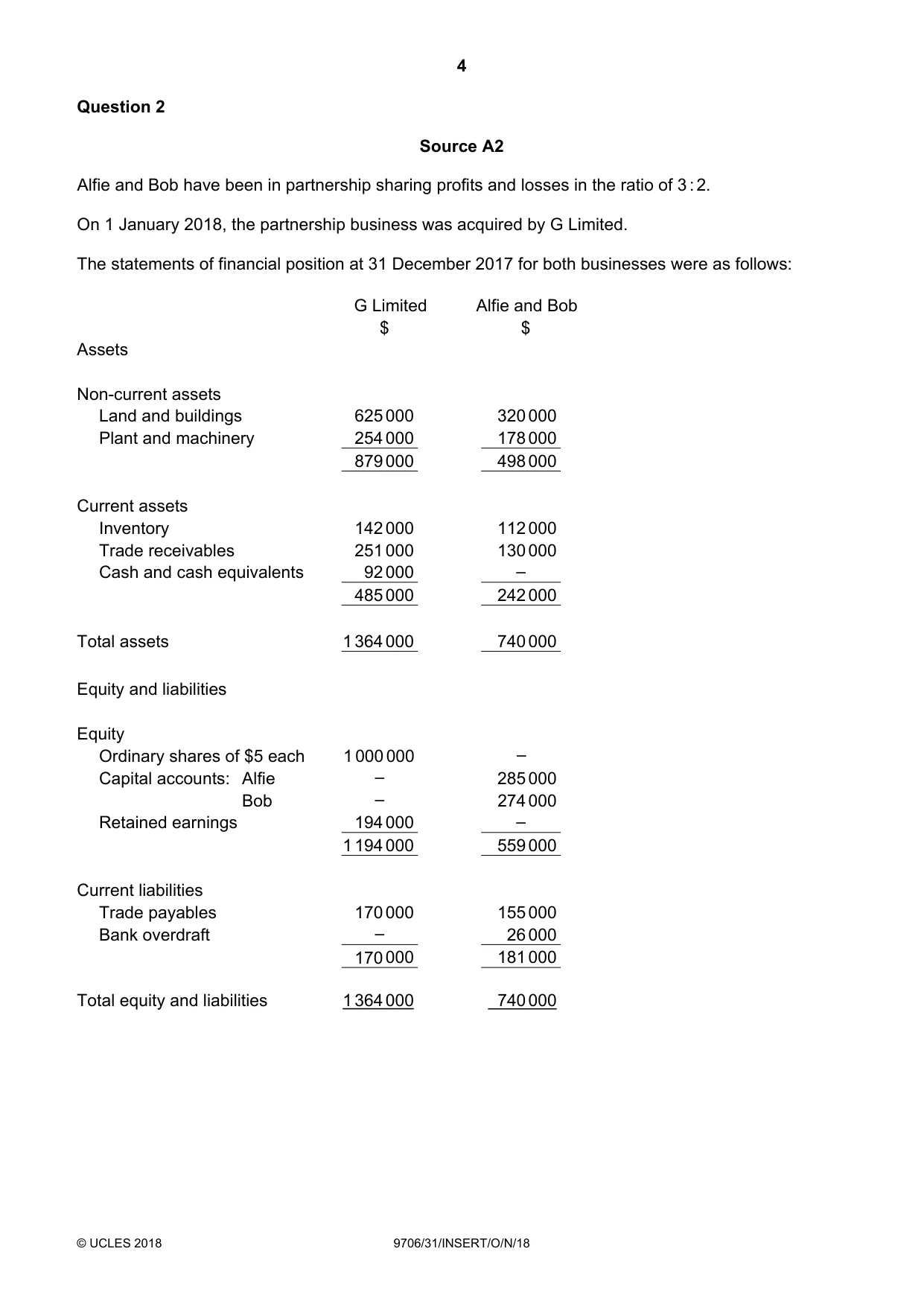
4 © UCLES 2018 9706/31/INSERT/O/N/18 Question 2 Source A2 Alfie and Bob have been in partnership sharing profits and losses in the ratio of 3 : 2. On 1 January 2018, the partnership business was acquired by G Limited. The statements of financial position at 31 December 2017 for both businesses were as follows: G Limited Alfie and Bob $ $ Assets Non-current assets Land and buildings 625 000 320 000 Plant and machinery 254 000 178 000 879 000 498 000 Current assets Inventory 142 000 112 000 Trade receivables 251 000 130 000 Cash and cash equivalents 92 000 – 485 000 242 000 Total assets 1 364 000 740 000 Equity and liabilities Equity Ordinary shares of $5 each 1 000 000 – Capital accounts: Alfie – 285 000 Bob – 274 000 Retained earnings 194 000 – 1 194 000 559 000 Current liabilities Trade payables 170 000 155 000 Bank overdraft – 26 000 170 000 181 000 Total equity and liabilities 1 364 000 740 000
Question paper, page 5
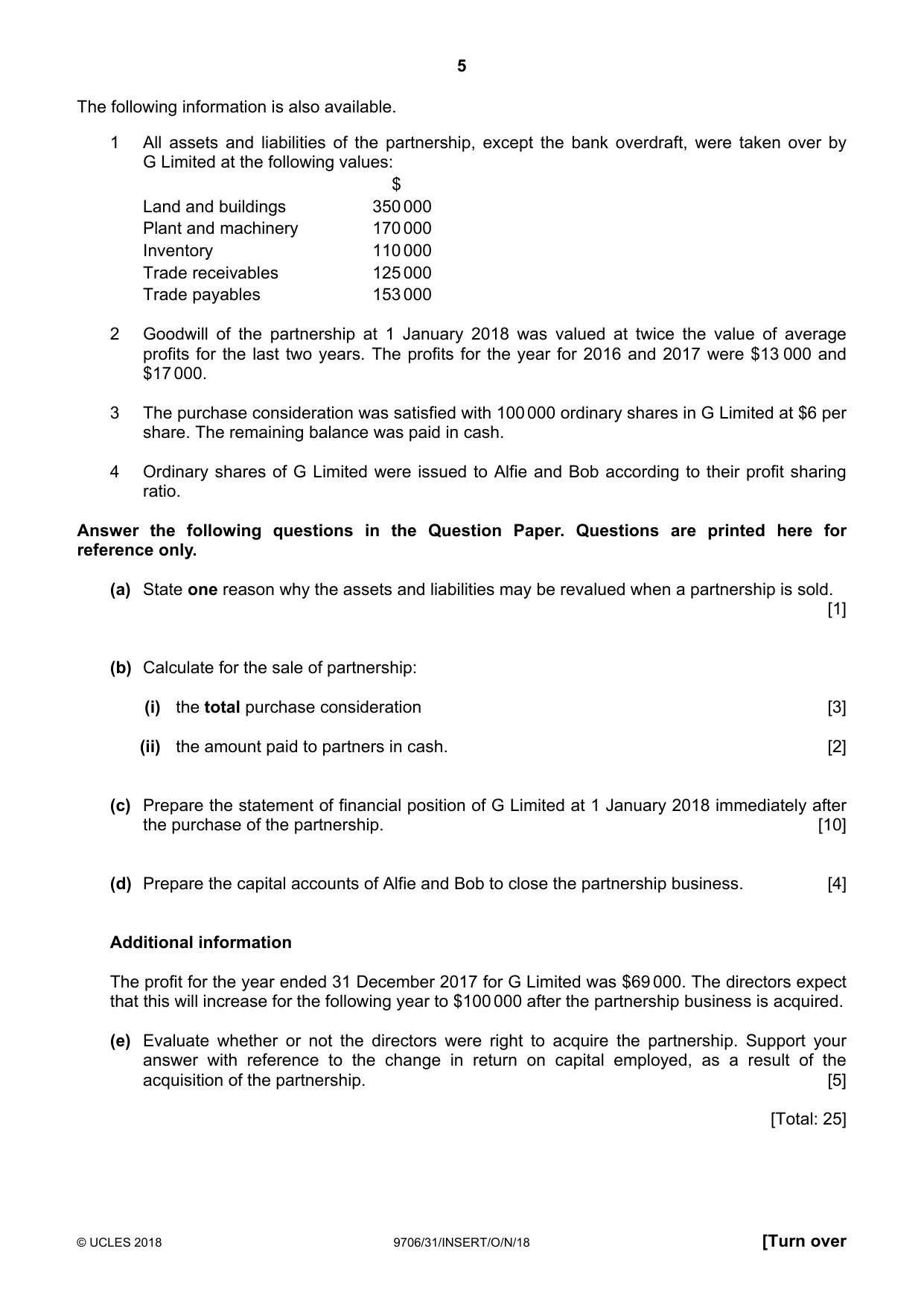
5 © UCLES 2018 9706/31/INSERT/O/N/18 [Turn over The following information is also available. 1 All assets and liabilities of the partnership, except the bank overdraft, were taken over by G Limited at the following values: $ Land and buildings 350 000 Plant and machinery 170 000 Inventory 110 000 Trade receivables 125 000 Trade payables 153 000 2 Goodwill of the partnership at 1 January 2018 was valued at twice the value of average profits for the last two years. The profits for the year for 2016 and 2017 were $13 000 and $17 000. 3 The purchase consideration was satisfied with 100 000 ordinary shares in G Limited at $6 per share. The remaining balance was paid in cash. 4 Ordinary shares of G Limited were issued to Alfie and Bob according to their profit sharing ratio. Answer the following questions in the Question Paper. Questions are printed here for reference only. (a) State one reason why the assets and liabilities may be revalued when a partnership is sold. [1] (b) Calculate for the sale of partnership: (i) the total purchase consideration [3] (ii) the amount paid to partners in cash. [2] (c) Prepare the statement of financial position of G Limited at 1 January 2018 immediately after the purchase of the partnership. [10] (d) Prepare the capital accounts of Alfie and Bob to close the partnership business. [4] Additional information The profit for the year ended 31 December 2017 for G Limited was $69 000. The directors expect that this will increase for the following year to $100 000 after the partnership business is acquired. (e) Evaluate whether or not the directors were right to acquire the partnership. Support your answer with reference to the change in return on capital employed, as a result of the acquisition of the partnership. [5] [Total: 25]
Question paper, page 6
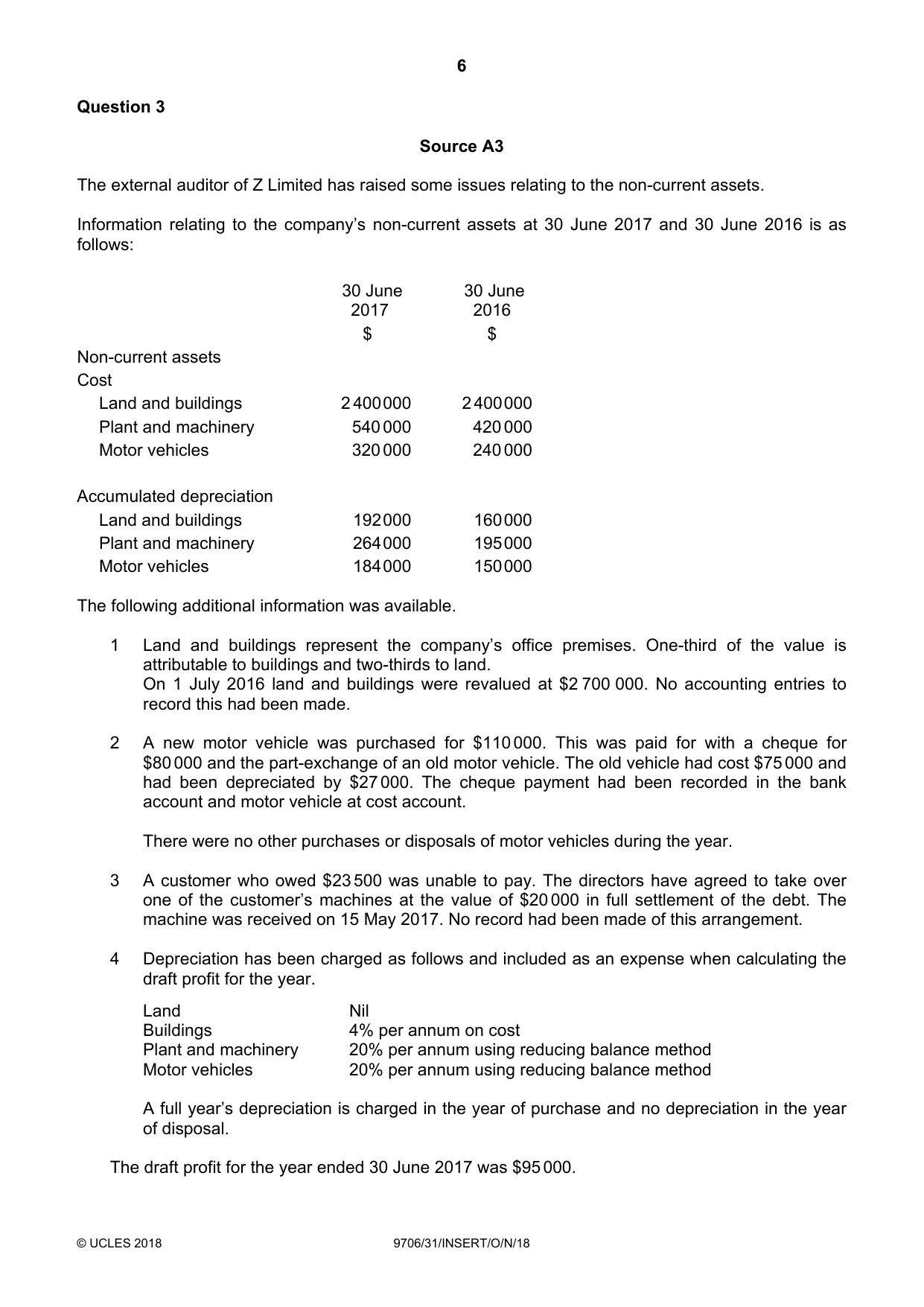
6 © UCLES 2018 9706/31/INSERT/O/N/18 Question 3 Source A3 The external auditor of Z Limited has raised some issues relating to the non-current assets. Information relating to the company’s non-current assets at 30 June 2017 and 30 June 2016 is as follows: 30 June 2017 30 June 2016 $ $ Non-current assets Cost Land and buildings 2 400 000 2 400 000 Plant and machinery 540 000 420 000 Motor vehicles 320 000 240 000 Accumulated depreciation Land and buildings 192 000 160 000 Plant and machinery 264 000 195 000 Motor vehicles 184 000 150 000 The following additional information was available. 1 Land and buildings represent the company’s office premises. One-third of the value is attributable to buildings and two-thirds to land. On 1 July 2016 land and buildings were revalued at $2 700 000. No accounting entries to record this had been made. 2 A new motor vehicle was purchased for $110 000. This was paid for with a cheque for $80 000 and the part-exchange of an old motor vehicle. The old vehicle had cost $75 000 and had been depreciated by $27 000. The cheque payment had been recorded in the bank account and motor vehicle at cost account. There were no other purchases or disposals of motor vehicles during the year. 3 A customer who owed $23 500 was unable to pay. The directors have agreed to take over one of the customer’s machines at the value of $20 000 in full settlement of the debt. The machine was received on 15 May 2017. No record had been made of this arrangement. 4 Depreciation has been charged as follows and included as an expense when calculating the draft profit for the year. Land Nil Buildings 4% per annum on cost Plant and machinery 20% per annum using reducing balance method Motor vehicles 20% per annum using reducing balance method A full year’s depreciation is charged in the year of purchase and no depreciation in the year of disposal. The draft profit for the year ended 30 June 2017 was $95 000.
Question paper, page 7
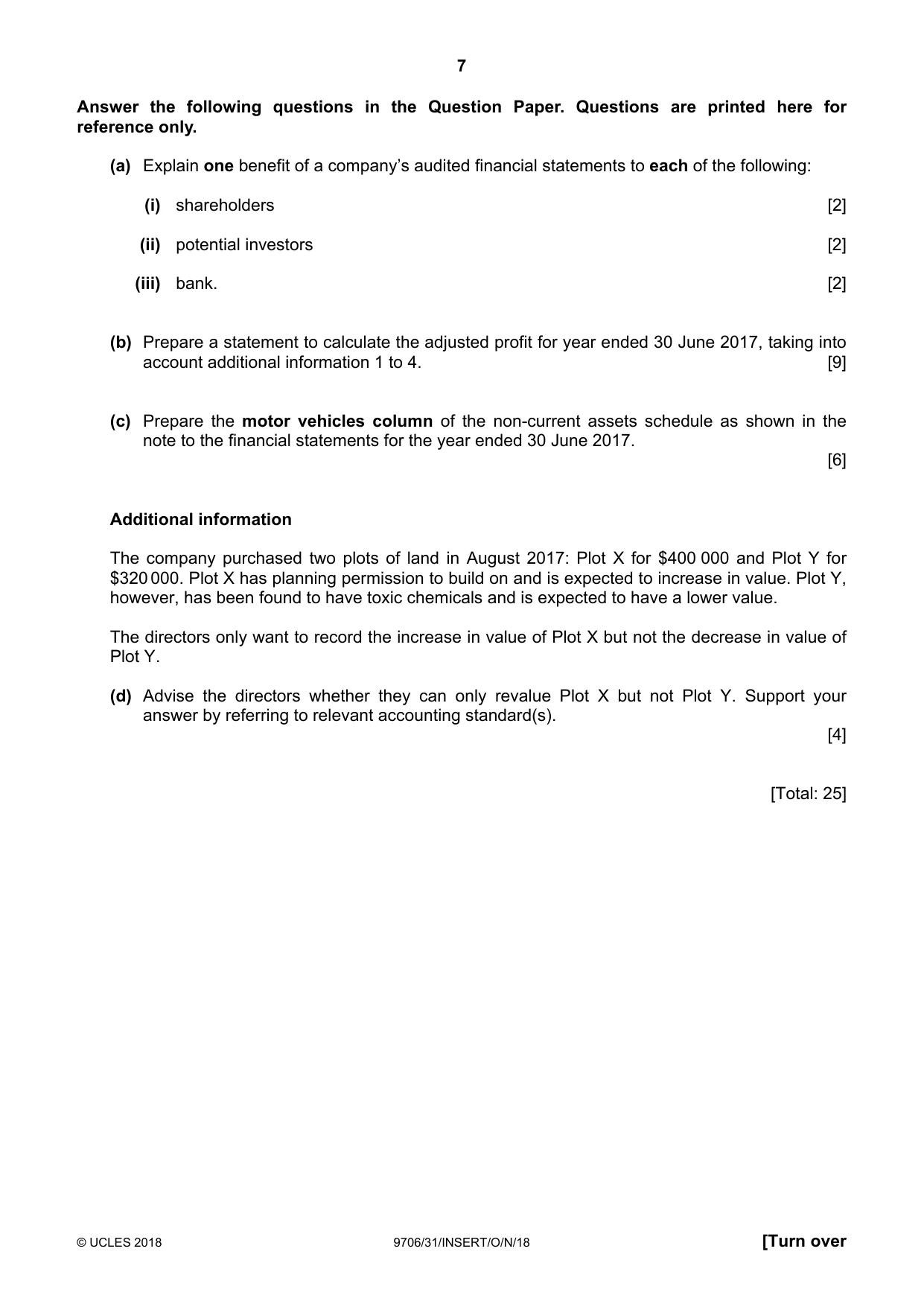
7 © UCLES 2018 9706/31/INSERT/O/N/18 [Turn over Answer the following questions in the Question Paper. Questions are printed here for reference only. (a) Explain one benefit of a company’s audited financial statements to each of the following: (i) shareholders [2] (ii) potential investors [2] (iii) bank. [2] (b) Prepare a statement to calculate the adjusted profit for year ended 30 June 2017, taking into account additional information 1 to 4. [9] (c) Prepare the motor vehicles column of the non-current assets schedule as shown in the note to the financial statements for the year ended 30 June 2017. [6] Additional information The company purchased two plots of land in August 2017: Plot X for $400 000 and Plot Y for $320 000. Plot X has planning permission to build on and is expected to increase in value. Plot Y, however, has been found to have toxic chemicals and is expected to have a lower value. The directors only want to record the increase in value of Plot X but not the decrease in value of Plot Y. (d) Advise the directors whether they can only revalue Plot X but not Plot Y. Support your answer by referring to relevant accounting standard(s). [4] [Total: 25]
Question paper, page 8
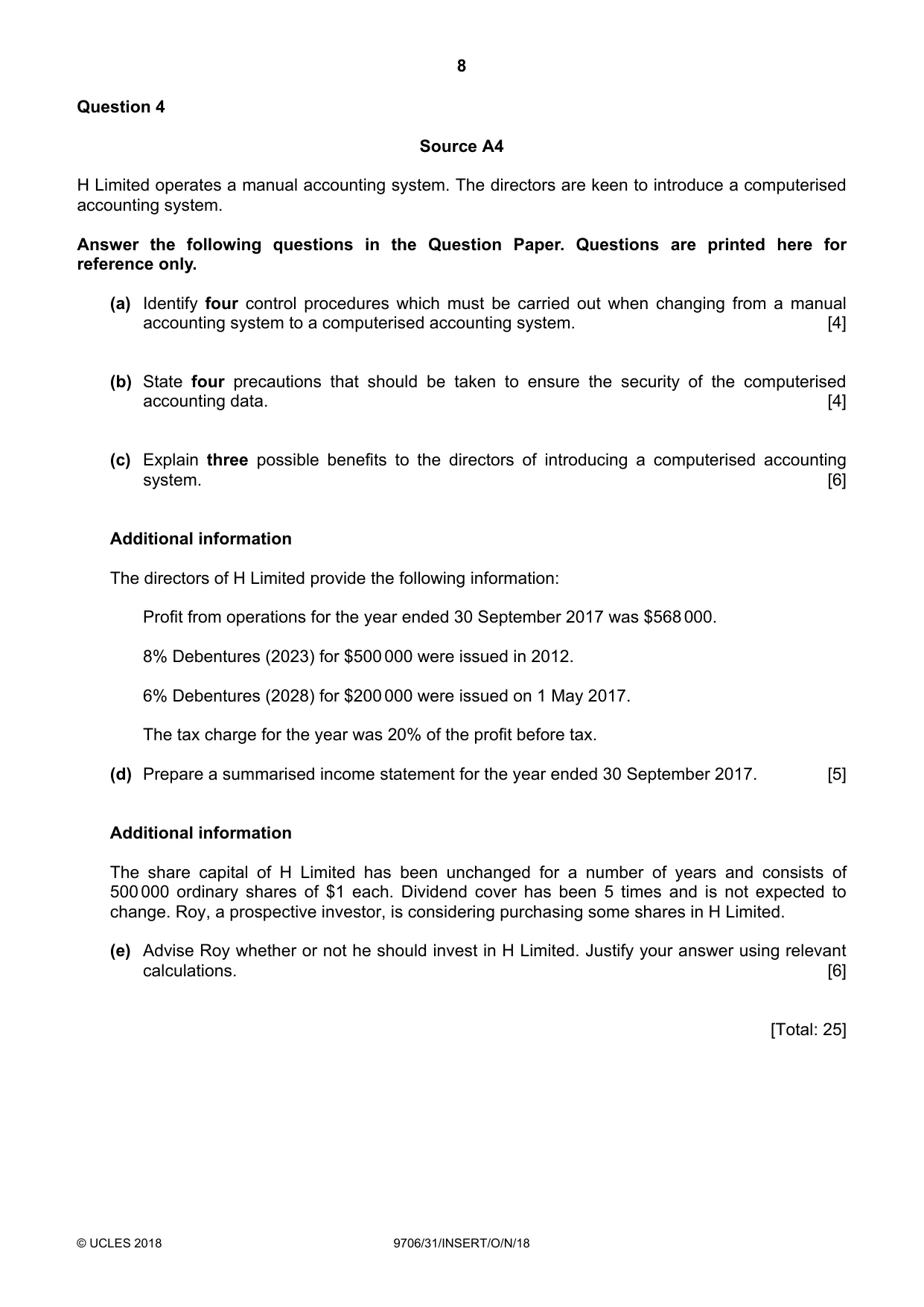
8 © UCLES 2018 9706/31/INSERT/O/N/18 Question 4 Source A4 H Limited operates a manual accounting system. The directors are keen to introduce a computerised accounting system. Answer the following questions in the Question Paper. Questions are printed here for reference only. (a) Identify four control procedures which must be carried out when changing from a manual accounting system to a computerised accounting system. [4] (b) State four precautions that should be taken to ensure the security of the computerised accounting data. [4] (c) Explain three possible benefits to the directors of introducing a computerised accounting system. [6] Additional information The directors of H Limited provide the following information: Profit from operations for the year ended 30 September 2017 was $568 000. 8% Debentures (2023) for $500 000 were issued in 2012. 6% Debentures (2028) for $200 000 were issued on 1 May 2017. The tax charge for the year was 20% of the profit before tax. (d) Prepare a summarised income statement for the year ended 30 September 2017. [5] Additional information The share capital of H Limited has been unchanged for a number of years and consists of 500 000 ordinary shares of $1 each. Dividend cover has been 5 times and is not expected to change. Roy, a prospective investor, is considering purchasing some shares in H Limited. (e) Advise Roy whether or not he should invest in H Limited. Justify your answer using relevant calculations. [6] [Total: 25]
Question paper, page 9
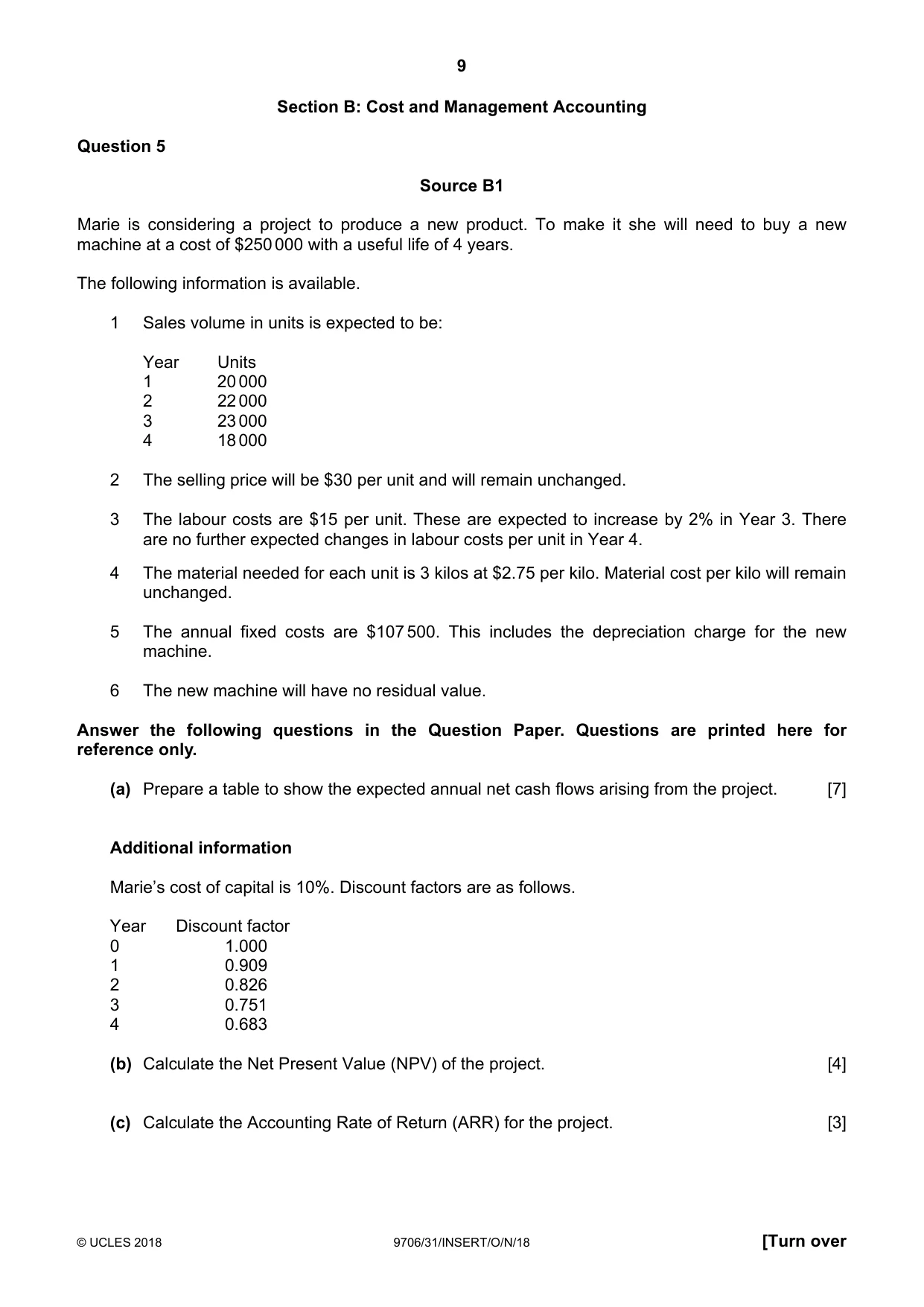
9 © UCLES 2018 9706/31/INSERT/O/N/18 [Turn over Section B: Cost and Management Accounting Question 5 Source B1 Marie is considering a project to produce a new product. To make it she will need to buy a new machine at a cost of $250 000 with a useful life of 4 years. The following information is available. 1 Sales volume in units is expected to be: Year Units 1 20 000 2 22 000 3 23 000 4 18 000 2 The selling price will be $30 per unit and will remain unchanged. 3 The labour costs are $15 per unit. These are expected to increase by 2% in Year 3. There are no further expected changes in labour costs per unit in Year 4. 4 The material needed for each unit is 3 kilos at $2.75 per kilo. Material cost per kilo will remain unchanged. 5 The annual fixed costs are $107 500. This includes the depreciation charge for the new machine. 6 The new machine will have no residual value. Answer the following questions in the Question Paper. Questions are printed here for reference only. (a) Prepare a table to show the expected annual net cash flows arising from the project. [7] Additional information Marie’s cost of capital is 10%. Discount factors are as follows. Year Discount factor 0 1.000 1 0.909 2 0.826 3 0.751 4 0.683 (b) Calculate the Net Present Value (NPV) of the project. [4] (c) Calculate the Accounting Rate of Return (ARR) for the project. [3]
Question paper, page 10
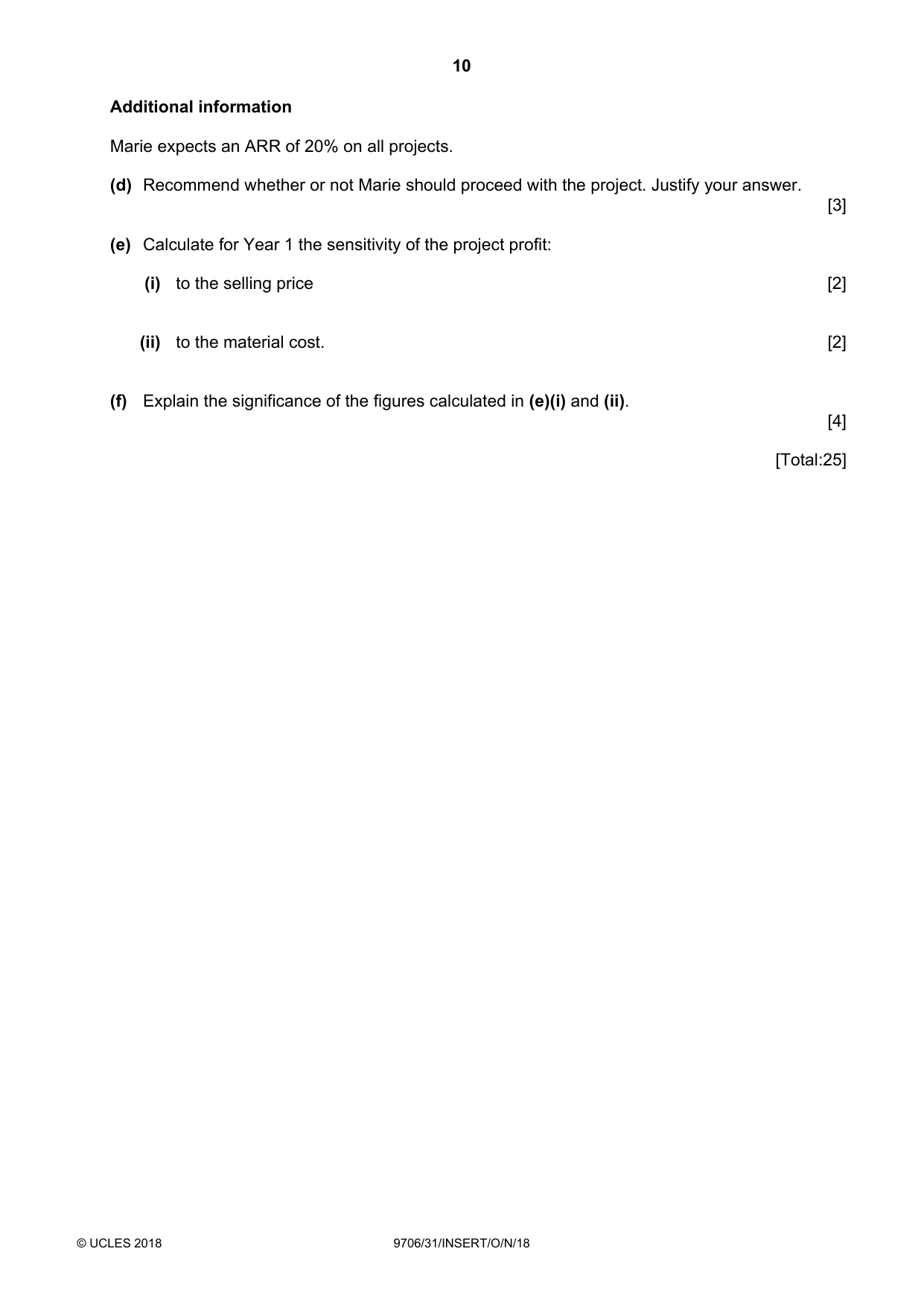
10 © UCLES 2018 9706/31/INSERT/O/N/18 Additional information Marie expects an ARR of 20% on all projects. (d) Recommend whether or not Marie should proceed with the project. Justify your answer. [3] (e) Calculate for Year 1 the sensitivity of the project profit: (i) to the selling price [2] (ii) to the material cost. [2] (f) Explain the significance of the figures calculated in (e)(i) and (ii). [4] [Total:25]
Question paper, page 11
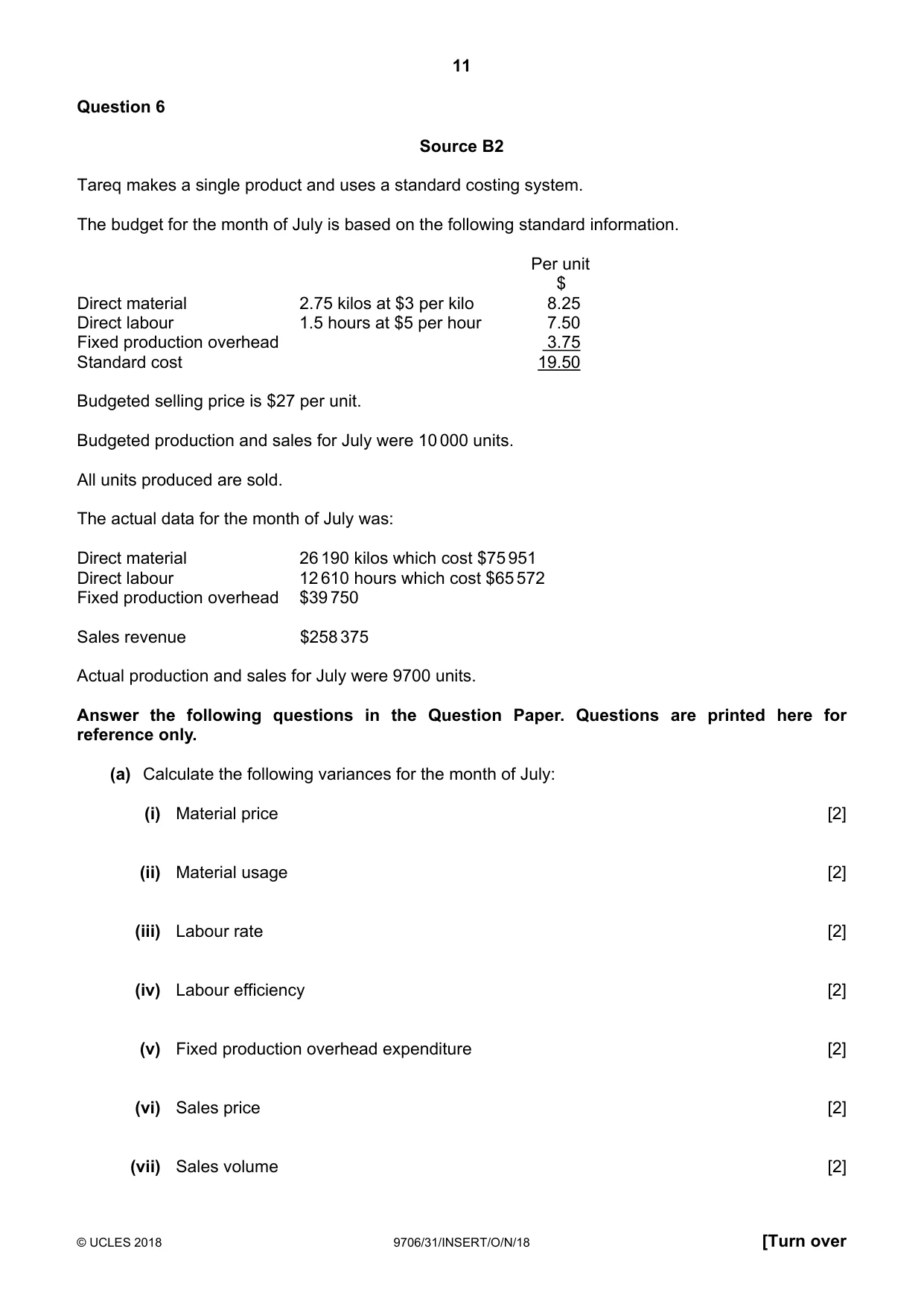
11 © UCLES 2018 9706/31/INSERT/O/N/18 [Turn over Question 6 Source B2 Tareq makes a single product and uses a standard costing system. The budget for the month of July is based on the following standard information. Per unit $ Direct material 2.75 kilos at $3 per kilo 8.25 Direct labour 1.5 hours at $5 per hour 7.50 Fixed production overhead 3.75 Standard cost 19.50 Budgeted selling price is $27 per unit. Budgeted production and sales for July were 10 000 units. All units produced are sold. The actual data for the month of July was: Direct material 26 190 kilos which cost $75 951 Direct labour 12 610 hours which cost $65 572 Fixed production overhead $39 750 Sales revenue $258 375 Actual production and sales for July were 9700 units. Answer the following questions in the Question Paper. Questions are printed here for reference only. (a) Calculate the following variances for the month of July: (i) Material price [2] (ii) Material usage [2] (iii) Labour rate [2] (iv) Labour efficiency [2] (v) Fixed production overhead expenditure [2] (vi) Sales price [2] (vii) Sales volume [2]
Question paper, page 12
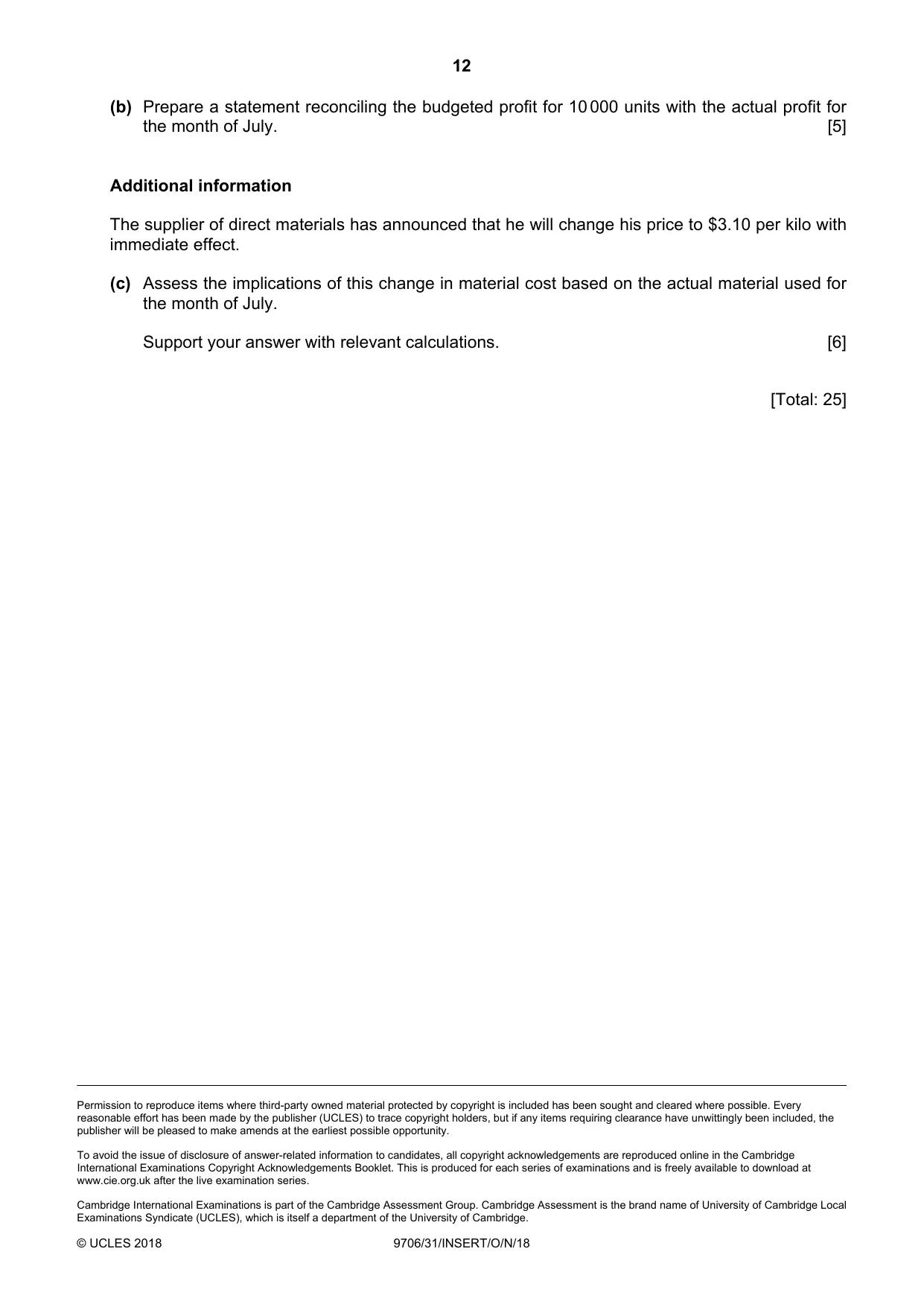
12 Permission to reproduce items where third-party owned material protected by copyright is included has been sought and cleared where possible. Every reasonable effort has been made by the publisher (UCLES) to trace copyright holders, but if any items requiring clearance have unwittingly been included, the publisher will be pleased to make amends at the earliest possible opportunity. To avoid the issue of disclosure of answer-related information to candidates, all copyright acknowledgements are reproduced online in the Cambridge International Examinations Copyright Acknowledgements Booklet. This is produced for each series of examinations and is freely available to download at www.cie.org.uk after the live examination series. Cambridge International Examinations is part of the Cambridge Assessment Group. Cambridge Assessment is the brand name of University of Cambridge Local Examinations Syndicate (UCLES), which is itself a department of the University of Cambridge. © UCLES 2018 9706/31/INSERT/O/N/18 (b) Prepare a statement reconciling the budgeted profit for 10 000 units with the actual profit for the month of July. [5] Additional information The supplier of direct materials has announced that he will change his price to $3.10 per kilo with immediate effect. (c) Assess the implications of this change in material cost based on the actual material used for the month of July. Support your answer with relevant calculations. [6] [Total: 25]
Mark scheme, page 1
This document consists of 19 printed pages. © UCLES 2018 [Turn over Cambridge Assessment International Education Cambridge International Advanced Subsidiary and Advanced Level ACCOUNTING 9706/31 Paper 3 Structured Questions October/November 2018 MARK SCHEME Maximum Mark: 150 Published This mark scheme is published as an aid to teachers and candidates, to indicate the requirements of the examination. It shows the basis on which Examiners were instructed to award marks. It does not indicate the details of the discussions that took place at an Examiners’ meeting before marking began, which would have considered the acceptability of alternative answers. Mark schemes should be read in conjunction with the question paper and the Principal Examiner Report for Teachers. Cambridge International will not enter into discussions about these mark schemes. Cambridge International is publishing the mark schemes for the October/November 2018 series for most Cambridge IGCSE™, Cambridge International A and AS Level components and some Cambridge O Level components.
Mark scheme, page 2
9706/31 Cambridge International AS/A Level – Mark Scheme PUBLISHED October/November 2018 © UCLES 2018 Page 2 of 19 Generic Marking Principles These general marking principles must be applied by all examiners when marking candidate answers. They should be applied alongside the specific content of the mark scheme or generic level descriptors for a question. Each question paper and mark scheme will also comply with these marking principles. GENERIC MARKING PRINCIPLE 1: Marks must be awarded in line with: • the specific content of the mark scheme or the generic level descriptors for the question • the specific skills defined in the mark scheme or in the generic level descriptors for the question • the standard of response required by a candidate as exemplified by the standardisation scripts. GENERIC MARKING PRINCIPLE 2: Marks awarded are always whole marks (not half marks, or other fractions). GENERIC MARKING PRINCIPLE 3: Marks must be awarded positively: • marks are awarded for correct/valid answers, as defined in the mark scheme. However, credit is given for valid answers which go beyond the scope of the syllabus and mark scheme, referring to your Team Leader as appropriate • marks are awarded when candidates clearly demonstrate what they know and can do • marks are not deducted for errors • marks are not deducted for omissions • answers should only be judged on the quality of spelling, punctuation and grammar when these features are specifically assessed by the question as indicated by the mark scheme. The meaning, however, should be unambiguous. GENERIC MARKING PRINCIPLE 4: Rules must be applied consistently e.g. in situations where candidates have not followed instructions or in the application of generic level descriptors.
Mark scheme, page 3
9706/31 Cambridge International AS/A Level – Mark Scheme PUBLISHED October/November 2018 © UCLES 2018 Page 3 of 19 GENERIC MARKING PRINCIPLE 5: Marks should be awarded using the full range of marks defined in the mark scheme for the question (however; the use of the full mark range may be limited according to the quality of the candidate responses seen). GENERIC MARKING PRINCIPLE 6: Marks awarded are based solely on the requirements as defined in the mark scheme. Marks should not be awarded with grade thresholds or grade descriptors in mind.
Mark scheme, page 4
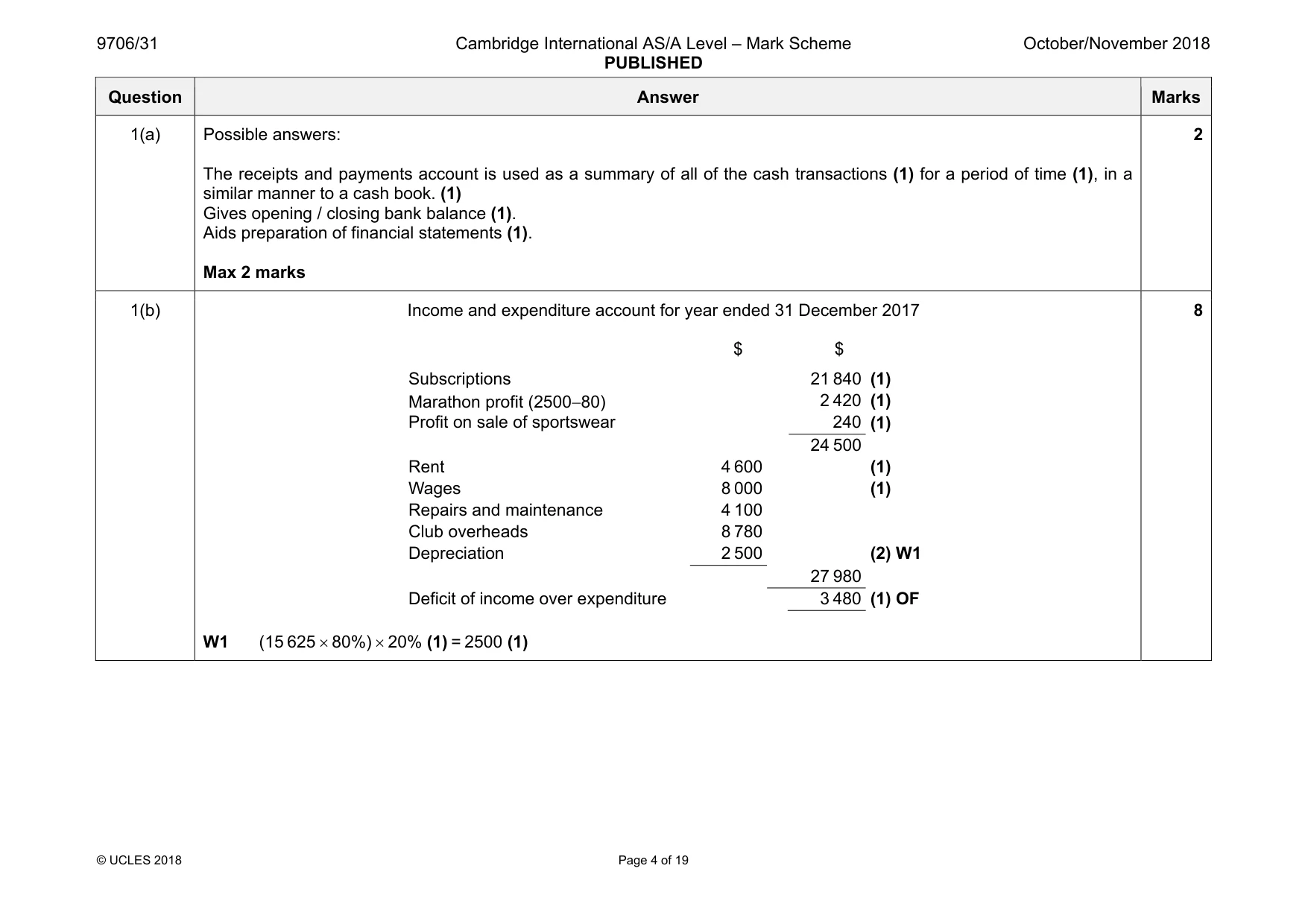
9706/31 Cambridge International AS/A Level – Mark Scheme PUBLISHED October/November 2018 © UCLES 2018 Page 4 of 19 Question Answer Marks 1(a) Possible answers: The receipts and payments account is used as a summary of all of the cash transactions (1) for a period of time (1), in a similar manner to a cash book. (1) Gives opening / closing bank balance (1). Aids preparation of financial statements (1). Max 2 marks 2 1(b) Income and expenditure account for year ended 31 December 2017 $ $ Subscriptions 21 840 (1) Marathon profit (2500−80) 2 420 (1) Profit on sale of sportswear 240 (1) 24 500 Rent 4 600 (1) Wages 8 000 (1) Repairs and maintenance 4 100 Club overheads 8 780 Depreciation 2 500 (2) W1 27 980 Deficit of income over expenditure 3 480 (1) OF W1 (15 625 × 80%) × 20% (1) = 2500 (1) 8
Mark scheme, page 5
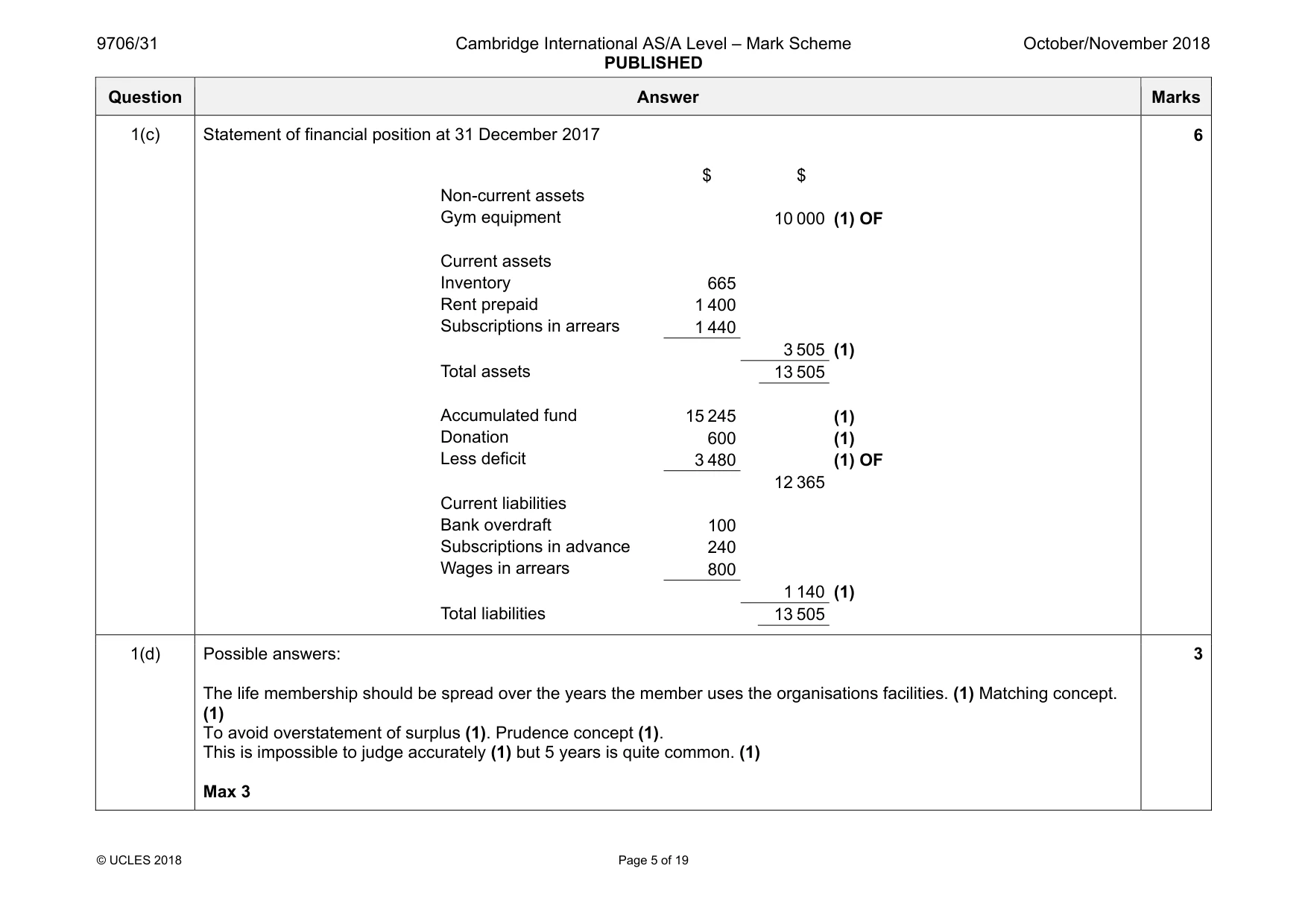
9706/31 Cambridge International AS/A Level – Mark Scheme PUBLISHED October/November 2018 © UCLES 2018 Page 5 of 19 Question Answer Marks 1(c) Statement of financial position at 31 December 2017 $ $ Non-current assets Gym equipment 10 000 (1) OF Current assets Inventory 665 Rent prepaid 1 400 Subscriptions in arrears 1 440 3 505 (1) Total assets 13 505 Accumulated fund 15 245 (1) Donation 600 (1) Less deficit 3 480 (1) OF 12 365 Current liabilities Bank overdraft 100 Subscriptions in advance 240 Wages in arrears 800 1 140 (1) Total liabilities 13 505 6 1(d) Possible answers: The life membership should be spread over the years the member uses the organisations facilities. (1) Matching concept. (1) To avoid overstatement of surplus (1). Prudence concept (1). This is impossible to judge accurately (1) but 5 years is quite common. (1) Max 3 3
Mark scheme, page 6
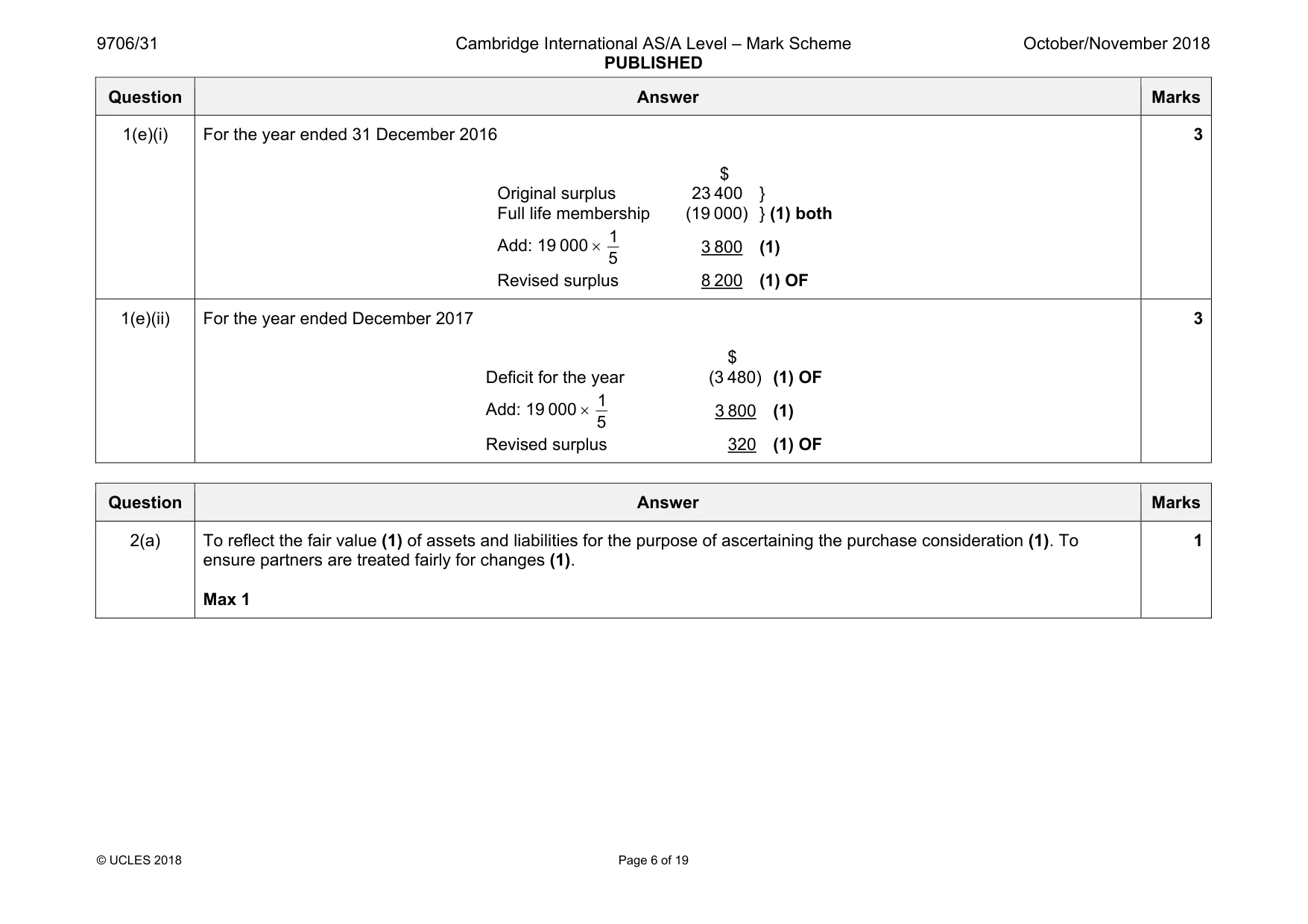
9706/31 Cambridge International AS/A Level – Mark Scheme PUBLISHED October/November 2018 © UCLES 2018 Page 6 of 19 Question Answer Marks 1(e)(i) For the year ended 31 December 2016 $ Original surplus 23 400 } Full life membership (19 000) } (1) both Add: 19 000 × 5 1 3 800 (1) Revised surplus 8 200 (1) OF 3 1(e)(ii) For the year ended December 2017 $ Deficit for the year (3 480) (1) OF Add: 19 000 × 5 1 3 800 (1) Revised surplus 320 (1) OF 3 Question Answer Marks 2(a) To reflect the fair value (1) of assets and liabilities for the purpose of ascertaining the purchase consideration (1). To ensure partners are treated fairly for changes (1). Max 1 1
Mark scheme, page 7
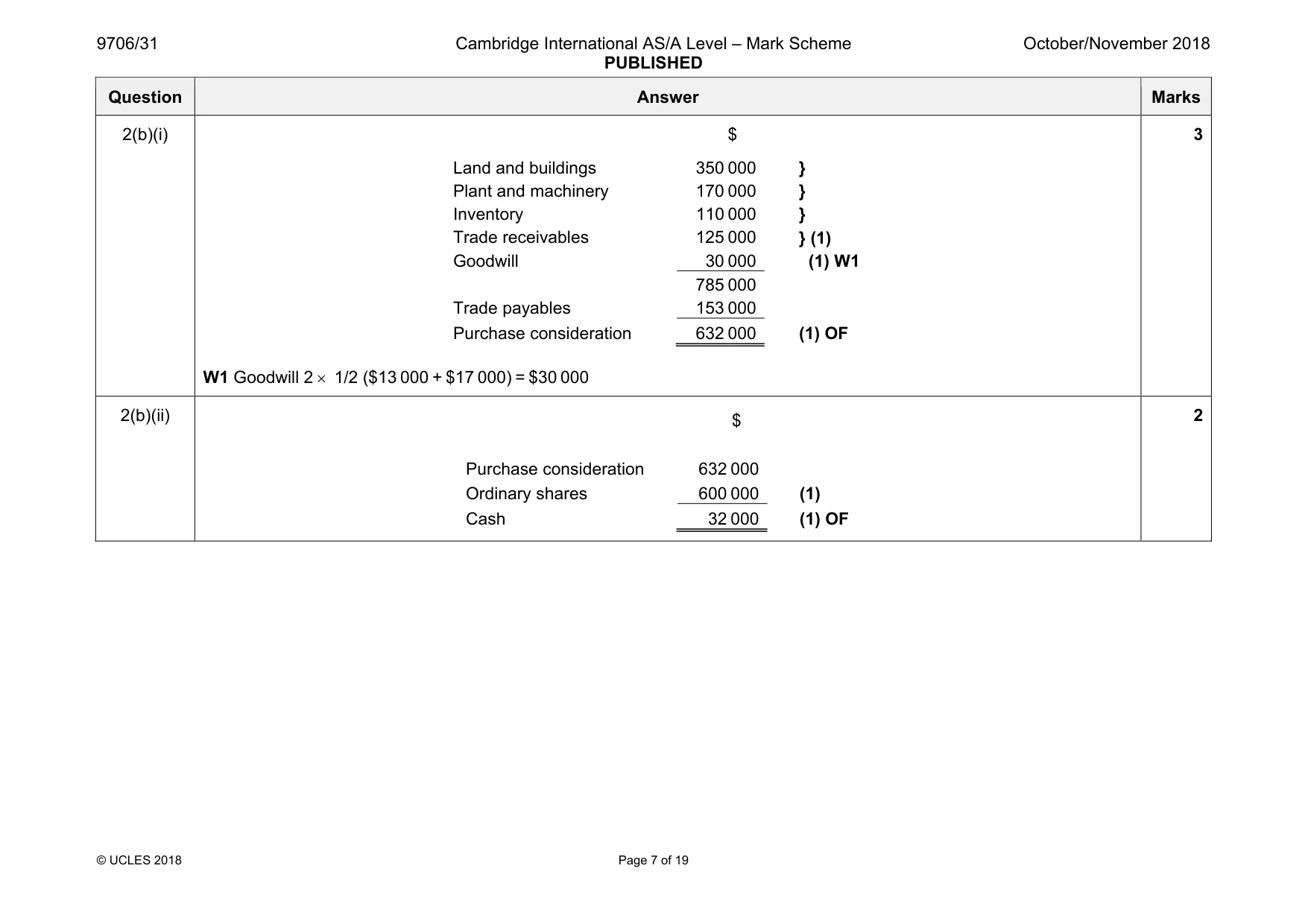
9706/31 Cambridge International AS/A Level – Mark Scheme PUBLISHED October/November 2018 © UCLES 2018 Page 7 of 19 Question Answer Marks 2(b)(i) $ Land and buildings 350 000 } Plant and machinery 170 000 } Inventory 110 000 } Trade receivables 125 000 } (1) Goodwill 30 000 (1) W1 785 000 Trade payables 153 000 Purchase consideration 632 000 (1) OF W1 Goodwill 2 × 1/2 ($13 000 + $17 000) = $30 000 3 2(b)(ii) $ Purchase consideration 632 000 Ordinary shares 600 000 (1) Cash 32 000 (1) OF 2
Mark scheme, page 8
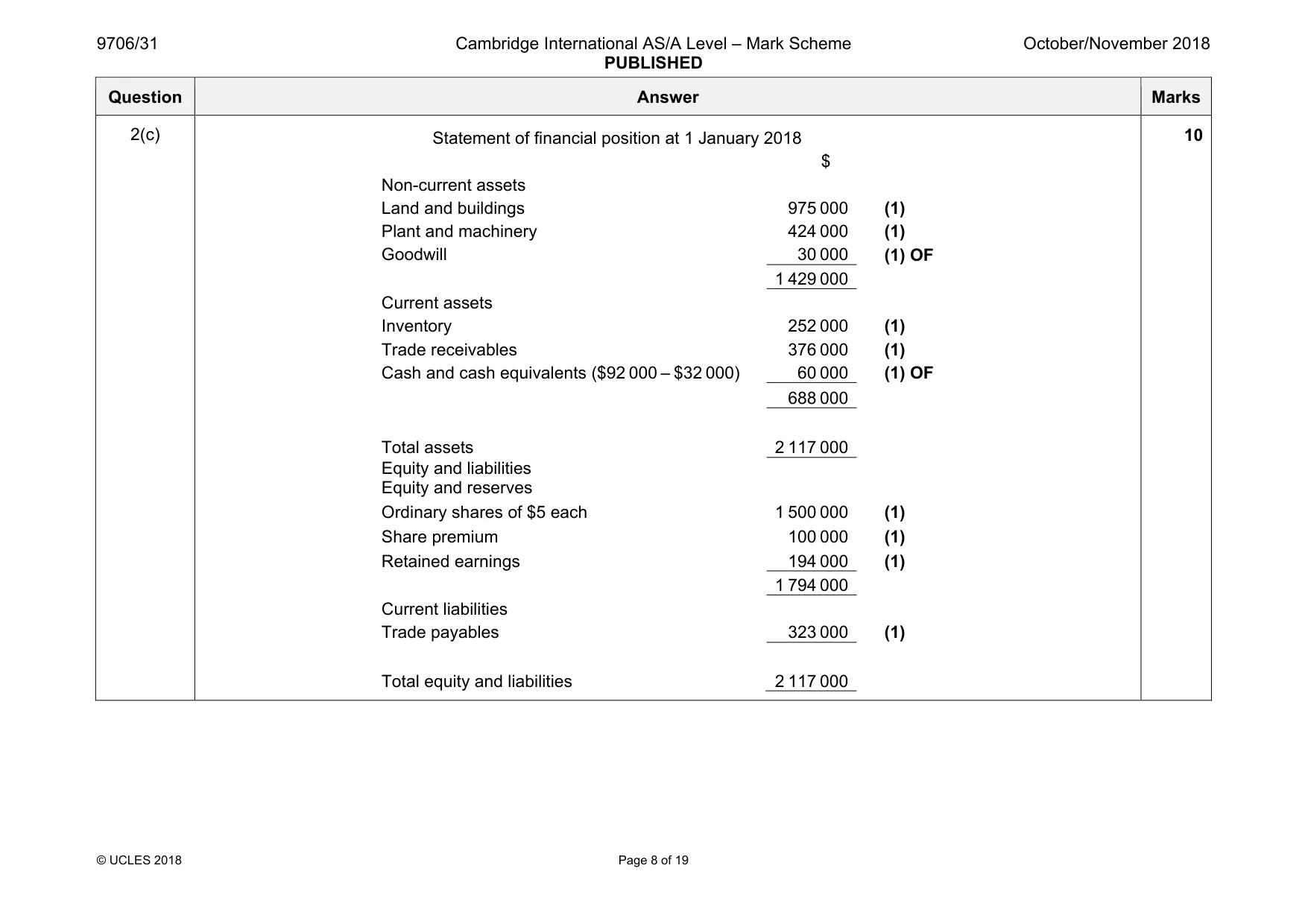
9706/31 Cambridge International AS/A Level – Mark Scheme PUBLISHED October/November 2018 © UCLES 2018 Page 8 of 19 Question Answer Marks 2(c) Statement of financial position at 1 January 2018 $ Non-current assets Land and buildings 975 000 (1) Plant and machinery 424 000 (1) Goodwill 30 000 (1) OF 1 429 000 Current assets Inventory 252 000 (1) Trade receivables 376 000 (1) Cash and cash equivalents ($92 000 – $32 000) 60 000 (1) OF 688 000 Total assets 2 117 000 Equity and liabilities Equity and reserves Ordinary shares of $5 each 1 500 000 (1) Share premium 100 000 (1) Retained earnings 194 000 (1) 1 794 000 Current liabilities Trade payables 323 000 (1) Total equity and liabilities 2 117 000 10
Mark scheme, page 9
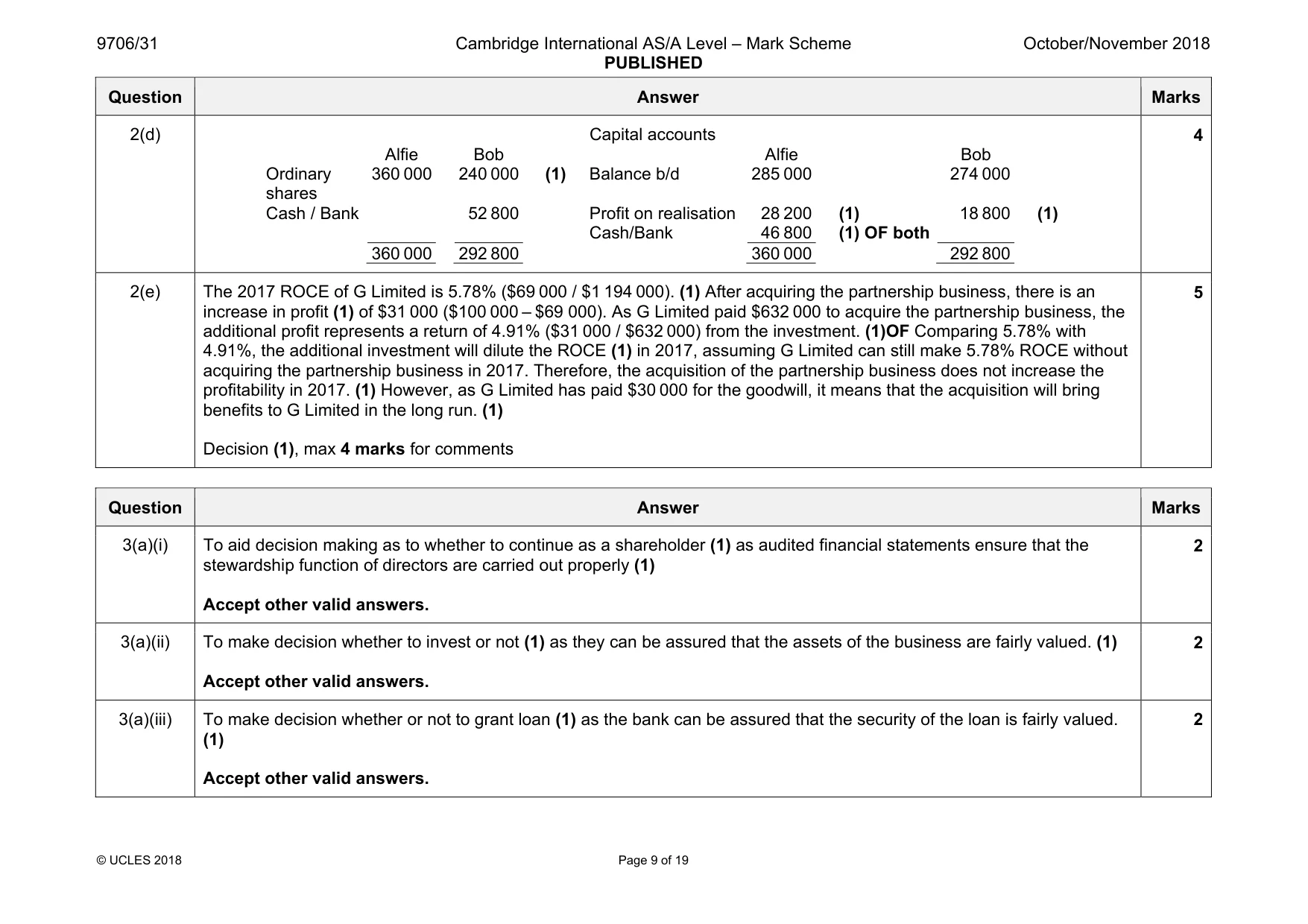
9706/31 Cambridge International AS/A Level – Mark Scheme PUBLISHED October/November 2018 © UCLES 2018 Page 9 of 19 Question Answer Marks 2(d) Capital accounts Alfie Bob Alfie Bob Ordinary shares 360 000 240 000 (1) Balance b/d 285 000 274 000 Cash / Bank 52 800 Profit on realisation 28 200 (1) 18 800 (1) Cash/Bank 46 800 (1) OF both 360 000 292 800 360 000 292 800 4 2(e) The 2017 ROCE of G Limited is 5.78% ($69 000 / $1 194 000). (1) After acquiring the partnership business, there is an increase in profit (1) of $31 000 ($100 000 – $69 000). As G Limited paid $632 000 to acquire the partnership business, the additional profit represents a return of 4.91% ($31 000 / $632 000) from the investment. (1)OF Comparing 5.78% with 4.91%, the additional investment will dilute the ROCE (1) in 2017, assuming G Limited can still make 5.78% ROCE without acquiring the partnership business in 2017. Therefore, the acquisition of the partnership business does not increase the profitability in 2017. (1) However, as G Limited has paid $30 000 for the goodwill, it means that the acquisition will bring benefits to G Limited in the long run. (1) Decision (1), max 4 marks for comments 5 Question Answer Marks 3(a)(i) To aid decision making as to whether to continue as a shareholder (1) as audited financial statements ensure that the stewardship function of directors are carried out properly (1) Accept other valid answers. 2 3(a)(ii) To make decision whether to invest or not (1) as they can be assured that the assets of the business are fairly valued. (1) Accept other valid answers. 2 3(a)(iii) To make decision whether or not to grant loan (1) as the bank can be assured that the security of the loan is fairly valued. (1) Accept other valid answers. 2
Mark scheme, page 10
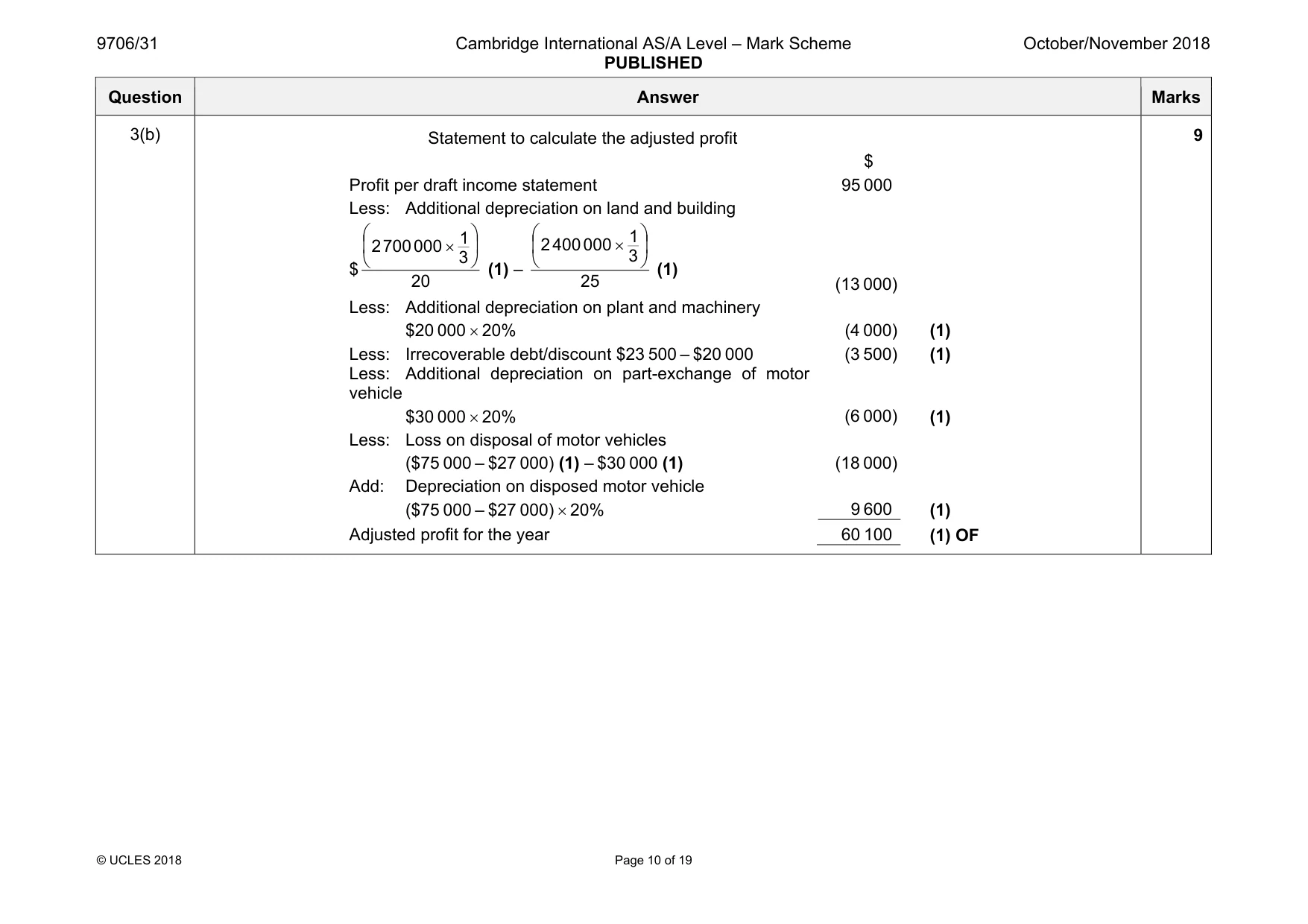
9706/31 Cambridge International AS/A Level – Mark Scheme PUBLISHED October/November 2018 © UCLES 2018 Page 10 of 19 Question Answer Marks 3(b) Statement to calculate the adjusted profit $ Profit per draft income statement 95 000 Less: Additional depreciation on land and building $ 20 3 1 000 700 2 × (1) – 25 3 1 000 400 2 × (1) (13 000) Less: Additional depreciation on plant and machinery $20 000 × 20% (4 000) (1) Less: Irrecoverable debt/discount $23 500 – $20 000 (3 500) (1) Less: Additional depreciation on part-exchange of motor vehicle $30 000 × 20% (6 000) (1) Less: Loss on disposal of motor vehicles ($75 000 – $27 000) (1) – $30 000 (1) (18 000) Add: Depreciation on disposed motor vehicle ($75 000 – $27 000) × 20% 9 600 (1) Adjusted profit for the year 60 100 (1) OF 9
Mark scheme, page 11
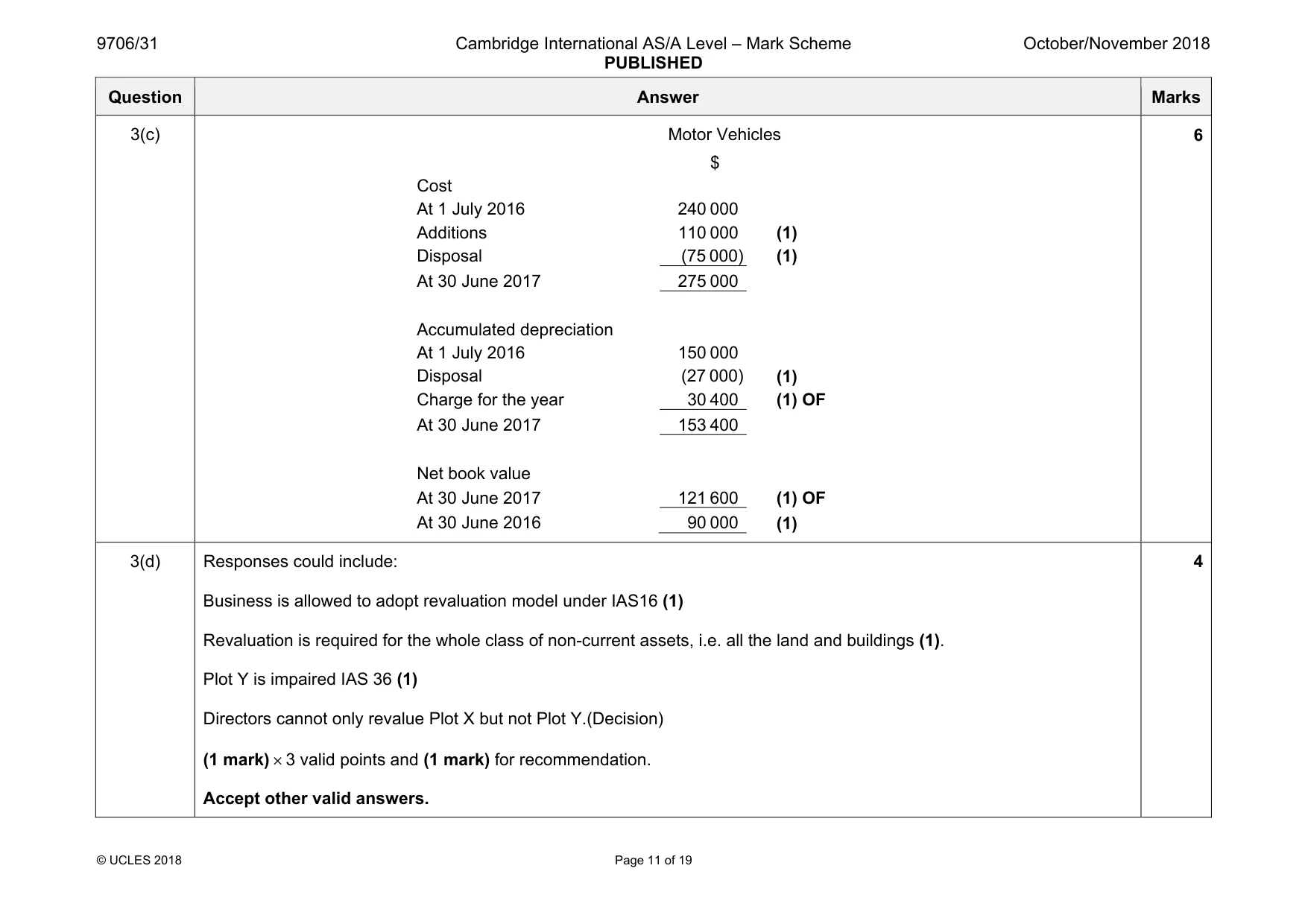
9706/31 Cambridge International AS/A Level – Mark Scheme PUBLISHED October/November 2018 © UCLES 2018 Page 11 of 19 Question Answer Marks 3(c) Motor Vehicles $ Cost At 1 July 2016 240 000 Additions 110 000 (1) Disposal (75 000) (1) At 30 June 2017 275 000 Accumulated depreciation At 1 July 2016 150 000 Disposal (27 000) (1) Charge for the year 30 400 (1) OF At 30 June 2017 153 400 Net book value At 30 June 2017 121 600 (1) OF At 30 June 2016 90 000 (1) 6 3(d) Responses could include: Business is allowed to adopt revaluation model under IAS16 (1) Revaluation is required for the whole class of non-current assets, i.e. all the land and buildings (1). Plot Y is impaired IAS 36 (1) Directors cannot only revalue Plot X but not Plot Y.(Decision) (1 mark) × 3 valid points and (1 mark) for recommendation. Accept other valid answers. 4
Mark scheme, page 12
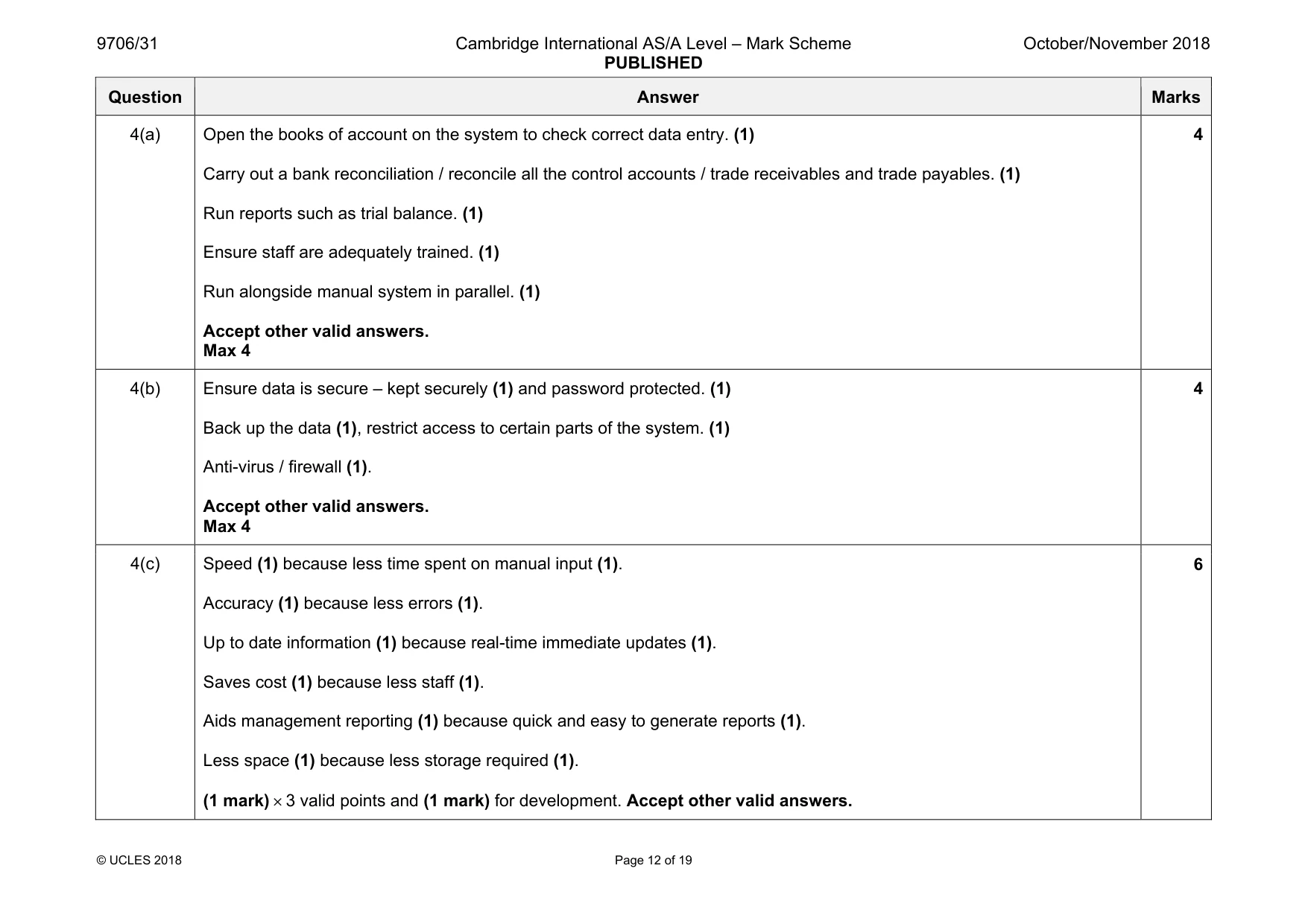
9706/31 Cambridge International AS/A Level – Mark Scheme PUBLISHED October/November 2018 © UCLES 2018 Page 12 of 19 Question Answer Marks 4(a) Open the books of account on the system to check correct data entry. (1) Carry out a bank reconciliation / reconcile all the control accounts / trade receivables and trade payables. (1) Run reports such as trial balance. (1) Ensure staff are adequately trained. (1) Run alongside manual system in parallel. (1) Accept other valid answers. Max 4 4 4(b) Ensure data is secure – kept securely (1) and password protected. (1) Back up the data (1), restrict access to certain parts of the system. (1) Anti-virus / firewall (1). Accept other valid answers. Max 4 4 4(c) Speed (1) because less time spent on manual input (1). Accuracy (1) because less errors (1). Up to date information (1) because real-time immediate updates (1). Saves cost (1) because less staff (1). Aids management reporting (1) because quick and easy to generate reports (1). Less space (1) because less storage required (1). (1 mark) × 3 valid points and (1 mark) for development. Accept other valid answers. 6
Mark scheme, page 13
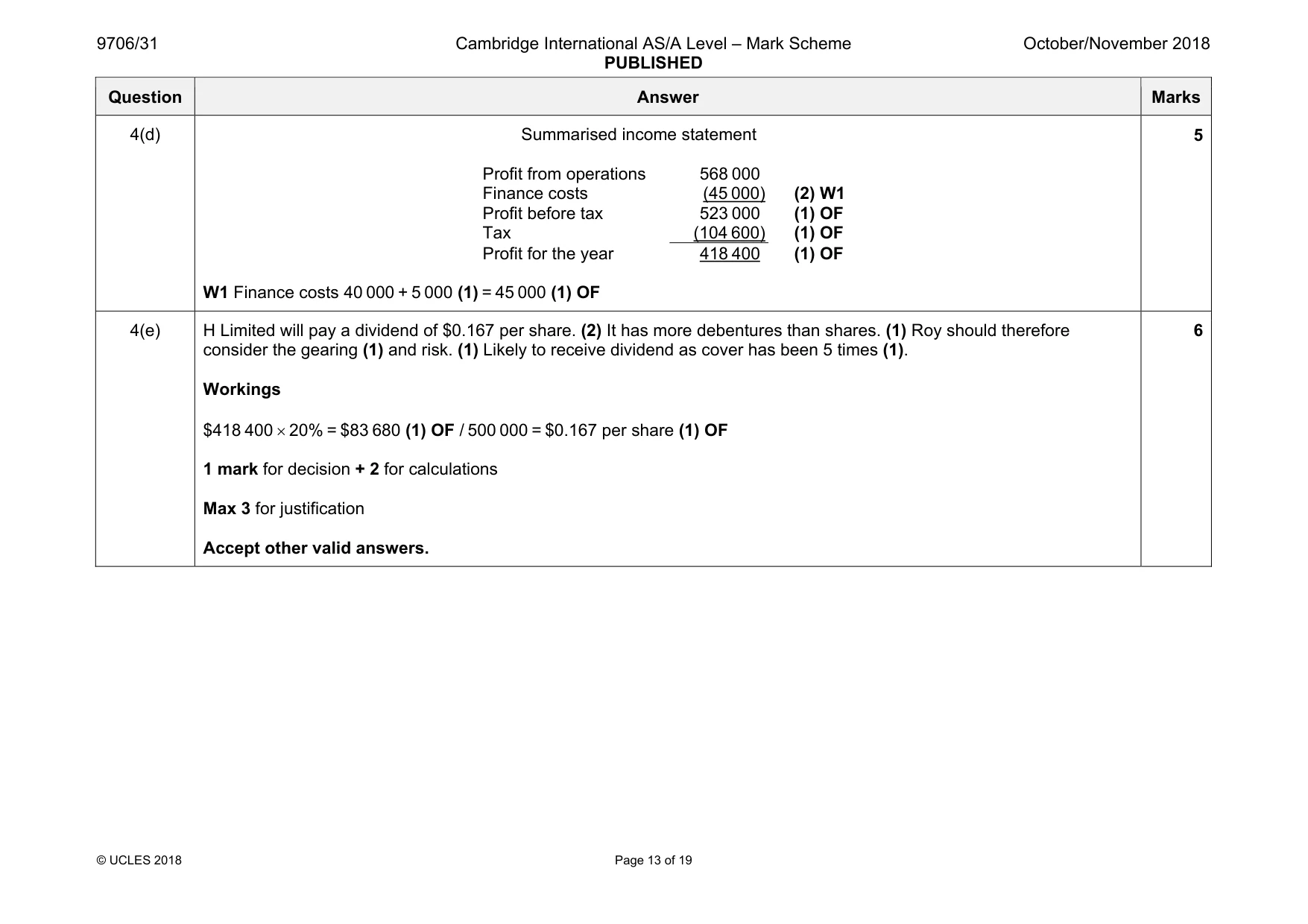
9706/31 Cambridge International AS/A Level – Mark Scheme PUBLISHED October/November 2018 © UCLES 2018 Page 13 of 19 Question Answer Marks 4(d) Summarised income statement Profit from operations 568 000 Finance costs (45 000) (2) W1 Profit before tax 523 000 (1) OF Tax (104 600) (1) OF Profit for the year 418 400 (1) OF W1 Finance costs 40 000 + 5 000 (1) = 45 000 (1) OF 5 4(e) H Limited will pay a dividend of $0.167 per share. (2) It has more debentures than shares. (1) Roy should therefore consider the gearing (1) and risk. (1) Likely to receive dividend as cover has been 5 times (1). Workings $418 400 × 20% = $83 680 (1) OF / 500 000 = $0.167 per share (1) OF 1 mark for decision + 2 for calculations Max 3 for justification Accept other valid answers. 6
Mark scheme, page 14
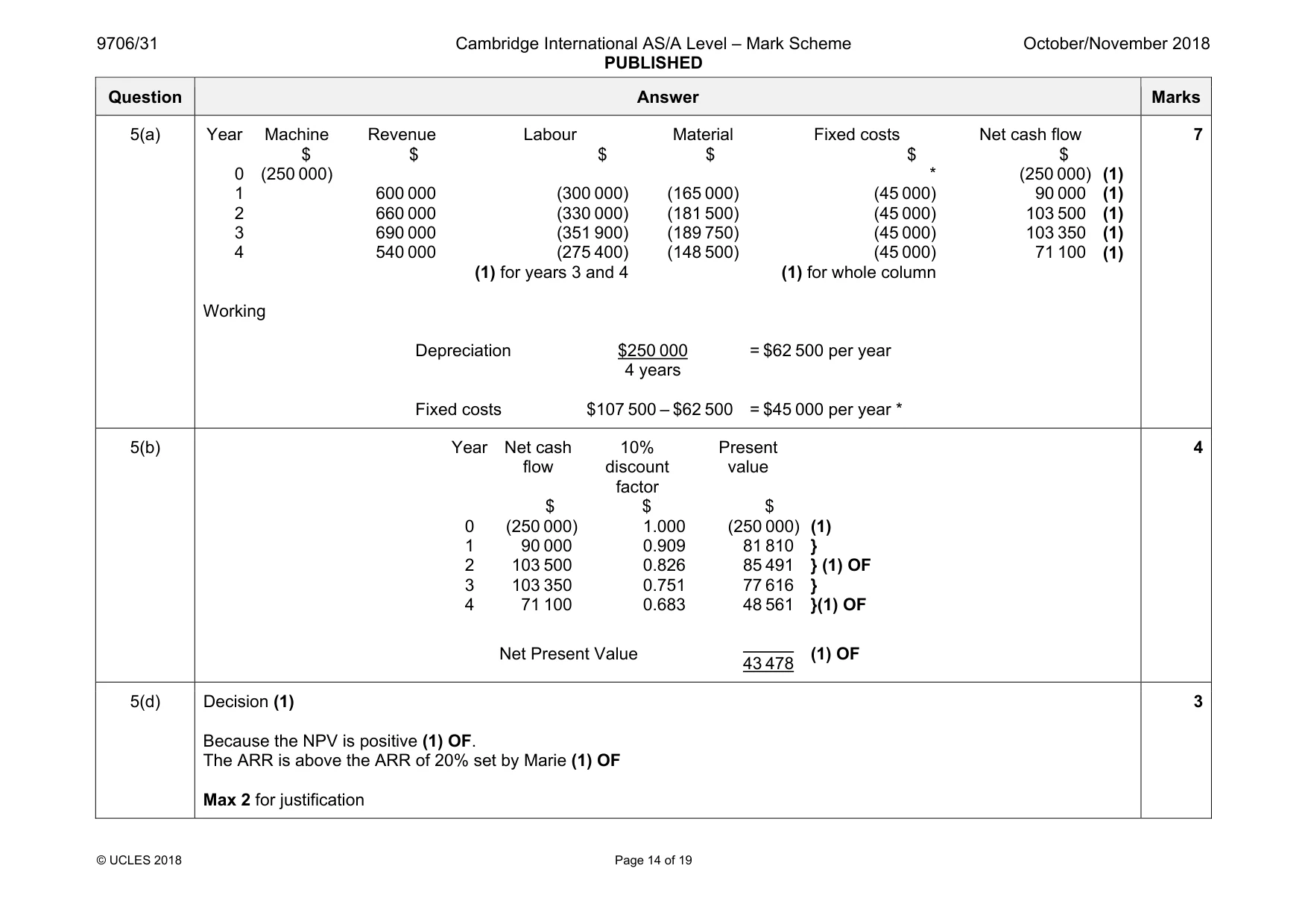
9706/31 Cambridge International AS/A Level – Mark Scheme PUBLISHED October/November 2018 © UCLES 2018 Page 14 of 19 Question Answer Marks 5(a) Year Machine Revenue Labour Material Fixed costs Net cash flow $ $ $ $ $ $ 0 (250 000) * (250 000) (1) 1 600 000 (300 000) (165 000) (45 000) 90 000 (1) 2 660 000 (330 000) (181 500) (45 000) 103 500 (1) 3 690 000 (351 900) (189 750) (45 000) 103 350 (1) 4 540 000 (275 400) (148 500) (45 000) 71 100 (1) (1) for years 3 and 4 (1) for whole column Working Depreciation $250 000 = $62 500 per year 4 years Fixed costs $107 500 – $62 500 = $45 000 per year * 7 5(b) Year Net cash flow 10% discount factor Present value $ $ $ 0 (250 000) 1.000 (250 000) (1) 1 90 000 0.909 81 810 } 2 103 500 0.826 85 491 } (1) OF 3 103 350 0.751 77 616 } 4 71 100 0.683 48 561 }(1) OF Net Present Value 43 478 (1) OF 4 5(d) Decision (1) Because the NPV is positive (1) OF. The ARR is above the ARR of 20% set by Marie (1) OF Max 2 for justification 3
Mark scheme, page 15
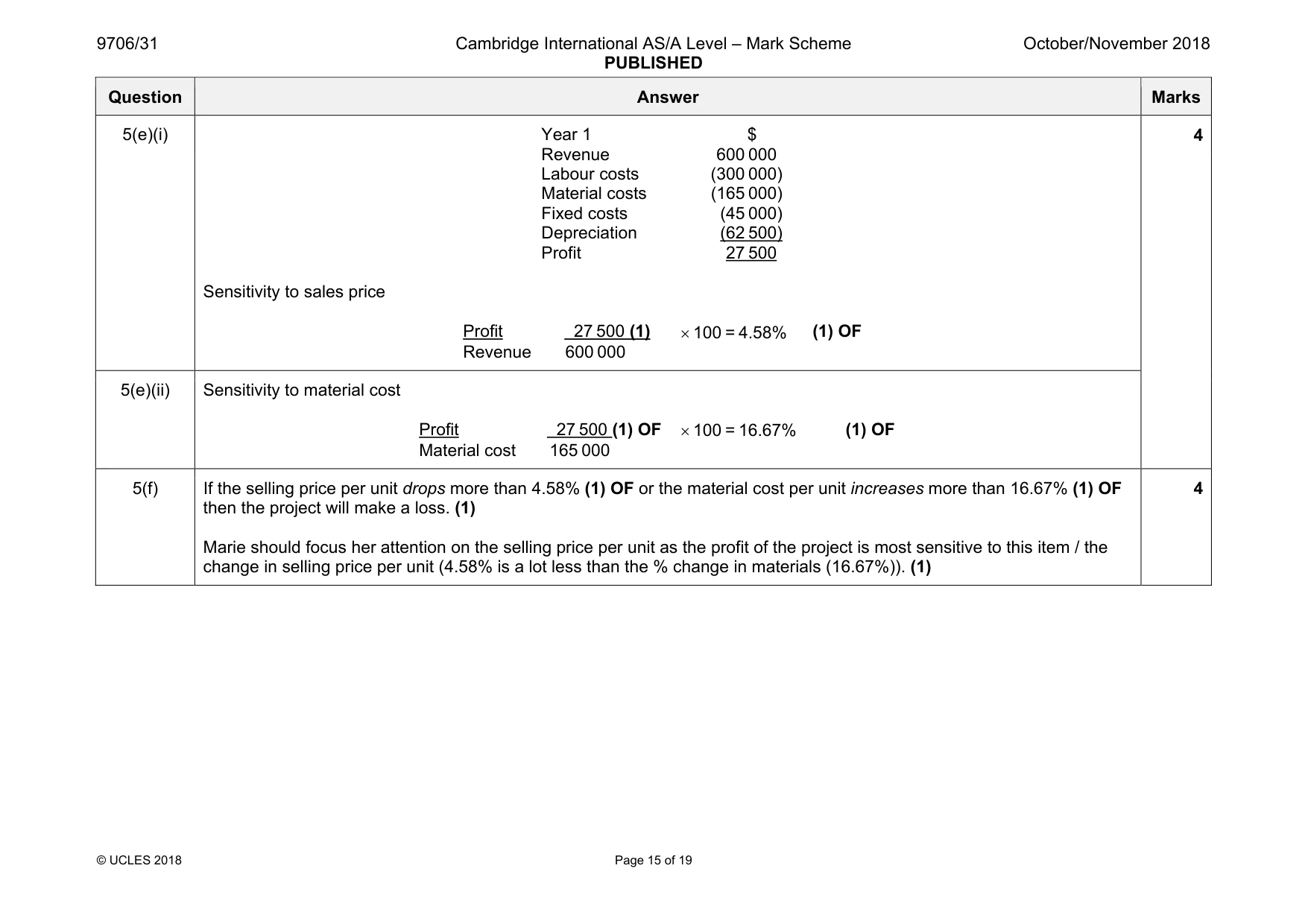
9706/31 Cambridge International AS/A Level – Mark Scheme PUBLISHED October/November 2018 © UCLES 2018 Page 15 of 19 Question Answer Marks 5(e)(i) Year 1 $ Revenue 600 000 Labour costs (300 000) Material costs (165 000) Fixed costs (45 000) Depreciation (62 500) Profit 27 500 Sensitivity to sales price Profit 27 500 (1) × 100 = 4.58% (1) OF Revenue 600 000 4 5(e)(ii) Sensitivity to material cost Profit 27 500 (1) OF × 100 = 16.67% (1) OF Material cost 165 000 5(f) If the selling price per unit drops more than 4.58% (1) OF or the material cost per unit increases more than 16.67% (1) OF then the project will make a loss. (1) Marie should focus her attention on the selling price per unit as the profit of the project is most sensitive to this item / the change in selling price per unit (4.58% is a lot less than the % change in materials (16.67%)). (1) 4
Mark scheme, page 16
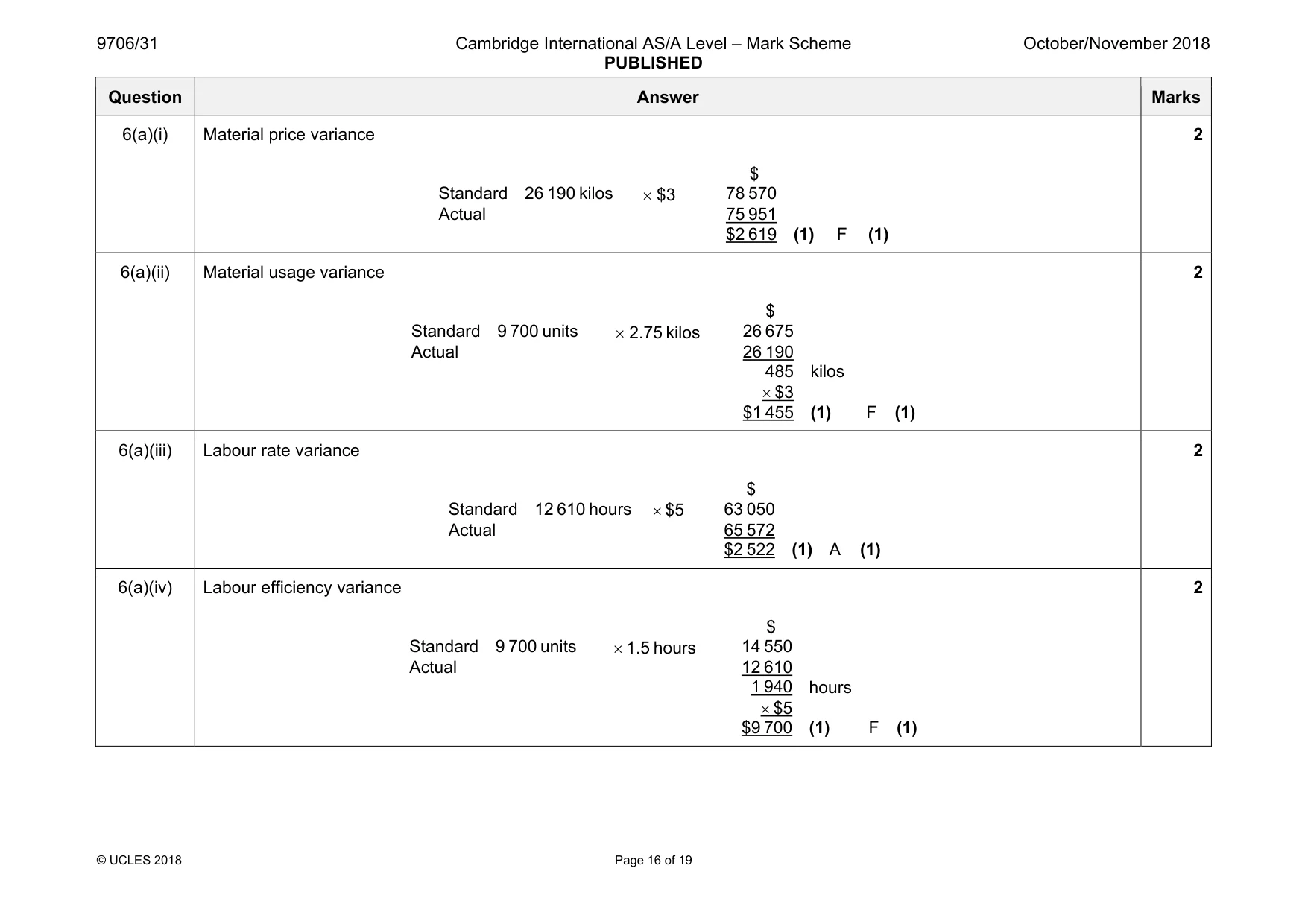
9706/31 Cambridge International AS/A Level – Mark Scheme PUBLISHED October/November 2018 © UCLES 2018 Page 16 of 19 Question Answer Marks 6(a)(i) Material price variance $ Standard 26 190 kilos × $3 78 570 Actual 75 951 $2 619 (1) F (1) 2 6(a)(ii) Material usage variance $ Standard 9 700 units × 2.75 kilos 26 675 Actual 26 190 485 kilos × $3 $1 455 (1) F (1) 2 6(a)(iii) Labour rate variance $ Standard 12 610 hours × $5 63 050 Actual 65 572 $2 522 (1) A (1) 2 6(a)(iv) Labour efficiency variance $ Standard 9 700 units × 1.5 hours 14 550 Actual 12 610 1 940 hours × $5 $9 700 (1) F (1) 2
Mark scheme, page 17
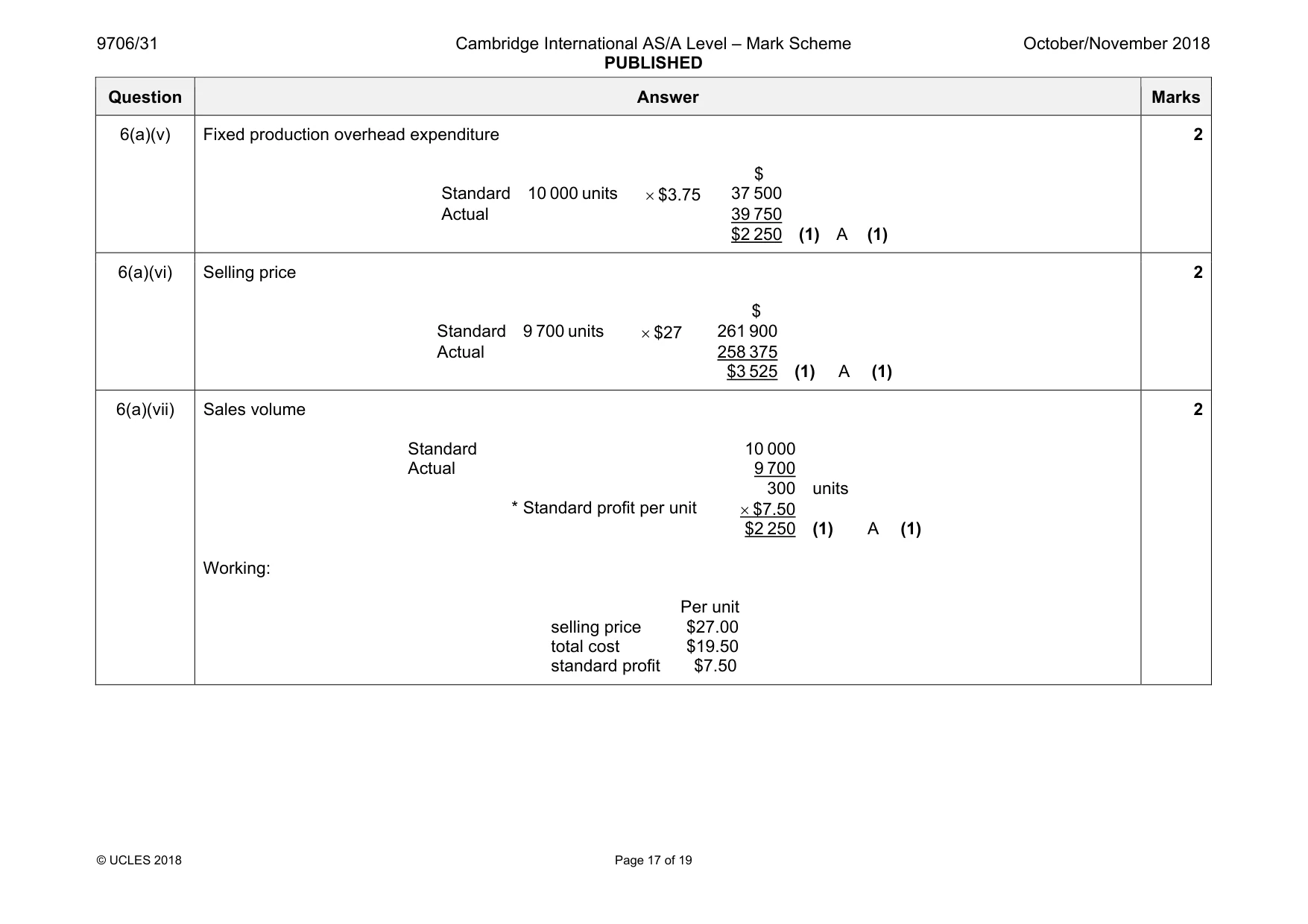
9706/31 Cambridge International AS/A Level – Mark Scheme PUBLISHED October/November 2018 © UCLES 2018 Page 17 of 19 Question Answer Marks 6(a)(v) Fixed production overhead expenditure $ Standard 10 000 units × $3.75 37 500 Actual 39 750 $2 250 (1) A (1) 2 6(a)(vi) Selling price $ Standard 9 700 units × $27 261 900 Actual 258 375 $3 525 (1) A (1) 2 6(a)(vii) Sales volume Standard 10 000 Actual 9 700 300 units * Standard profit per unit × $7.50 $2 250 (1) A (1) Working: Per unit selling price $27.00 total cost $19.50 standard profit $7.50 2
Mark scheme, page 18
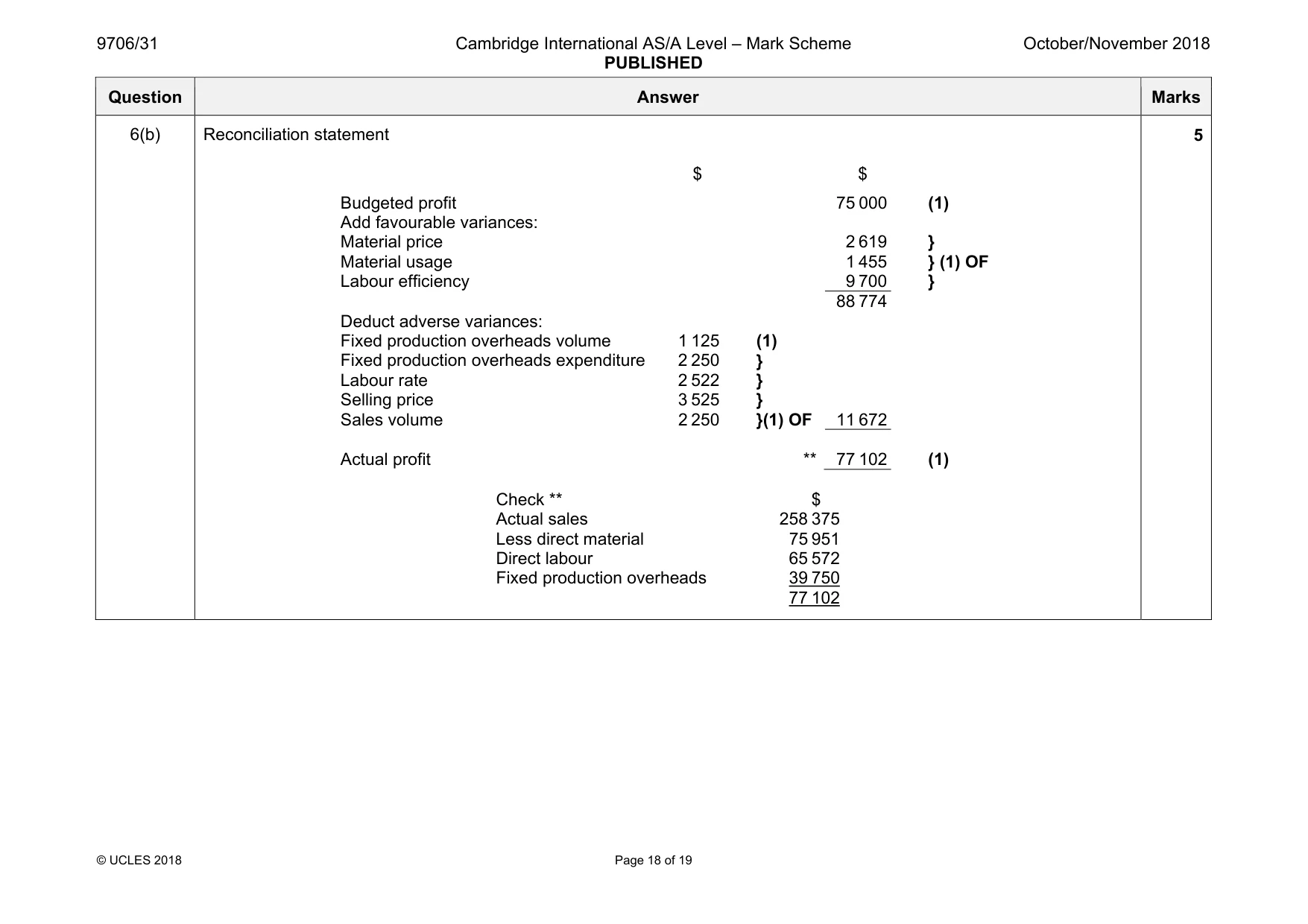
9706/31 Cambridge International AS/A Level – Mark Scheme PUBLISHED October/November 2018 © UCLES 2018 Page 18 of 19 Question Answer Marks 6(b) Reconciliation statement $ $ Budgeted profit 75 000 (1) Add favourable variances: Material price 2 619 } Material usage 1 455 } (1) OF Labour efficiency 9 700 } 88 774 Deduct adverse variances: Fixed production overheads volume 1 125 (1) Fixed production overheads expenditure 2 250 } Labour rate 2 522 } Selling price 3 525 } Sales volume 2 250 }(1) OF 11 672 Actual profit ** 77 102 (1) Check ** $ Actual sales 258 375 Less direct material 75 951 Direct labour 65 572 Fixed production overheads 39 750 77 102 5
Mark scheme, page 19
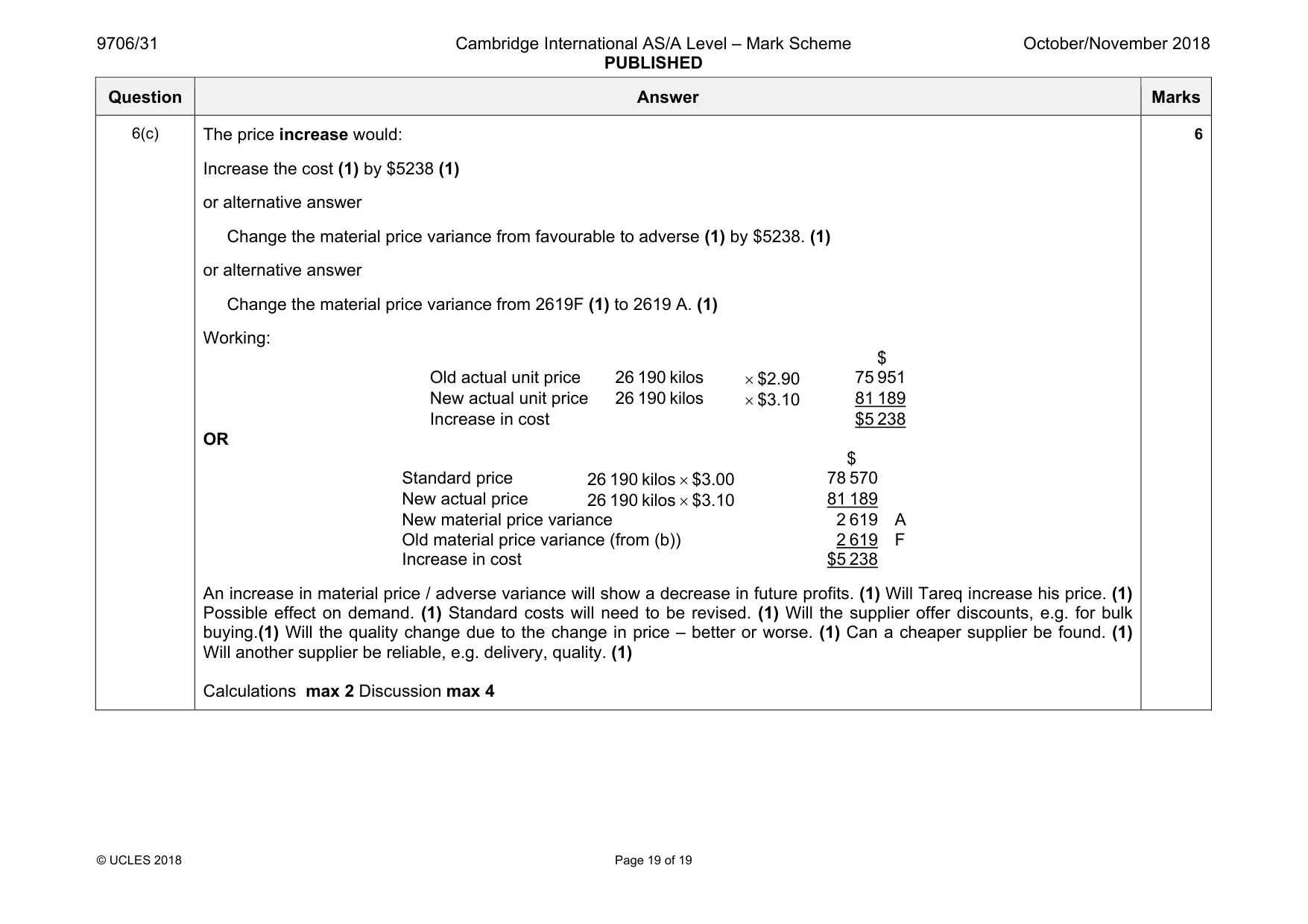
9706/31 Cambridge International AS/A Level – Mark Scheme PUBLISHED October/November 2018 © UCLES 2018 Page 19 of 19 Question Answer Marks 6(c) The price increase would: Increase the cost (1) by $5238 (1) or alternative answer Change the material price variance from favourable to adverse (1) by $5238. (1) or alternative answer Change the material price variance from 2619F (1) to 2619 A. (1) Working: $ Old actual unit price 26 190 kilos × $2.90 75 951 New actual unit price 26 190 kilos × $3.10 81 189 Increase in cost $5 238 OR $ Standard price 26 190 kilos × $3.00 78 570 New actual price 26 190 kilos × $3.10 81 189 New material price variance Old material price variance (from (b)) Increase in cost 2 619 A 2 619 F $5 238 An increase in material price / adverse variance will show a decrease in future profits. (1) Will Tareq increase his price. (1) Possible effect on demand. (1) Standard costs will need to be revised. (1) Will the supplier offer discounts, e.g. for bulk buying.(1) Will the quality change due to the change in price – better or worse. (1) Can a cheaper supplier be found. (1) Will another supplier be reliable, e.g. delivery, quality. (1) Calculations max 2 Discussion max 4 6
What you needed in this session
Cambridge’s own grade thresholds for 2018 Oct/Nov, Paper 3 · Variant 1. A higher threshold means an easier paper — the bar moves with how the cohort did.