Cambridge A Level Accounting 9706 — 2016 Oct/Nov Paper 3 · Variant 3
9706/33/O/N/16 · 150 marks · ≈169 min
The question paper and its mark scheme, free to read here and free to download. This is Cambridge’s own paper, exactly as it was sat.
Question paper12 pages

Mark scheme10 pages
Answers below. Sit the paper first if you are practising.
Paper as text
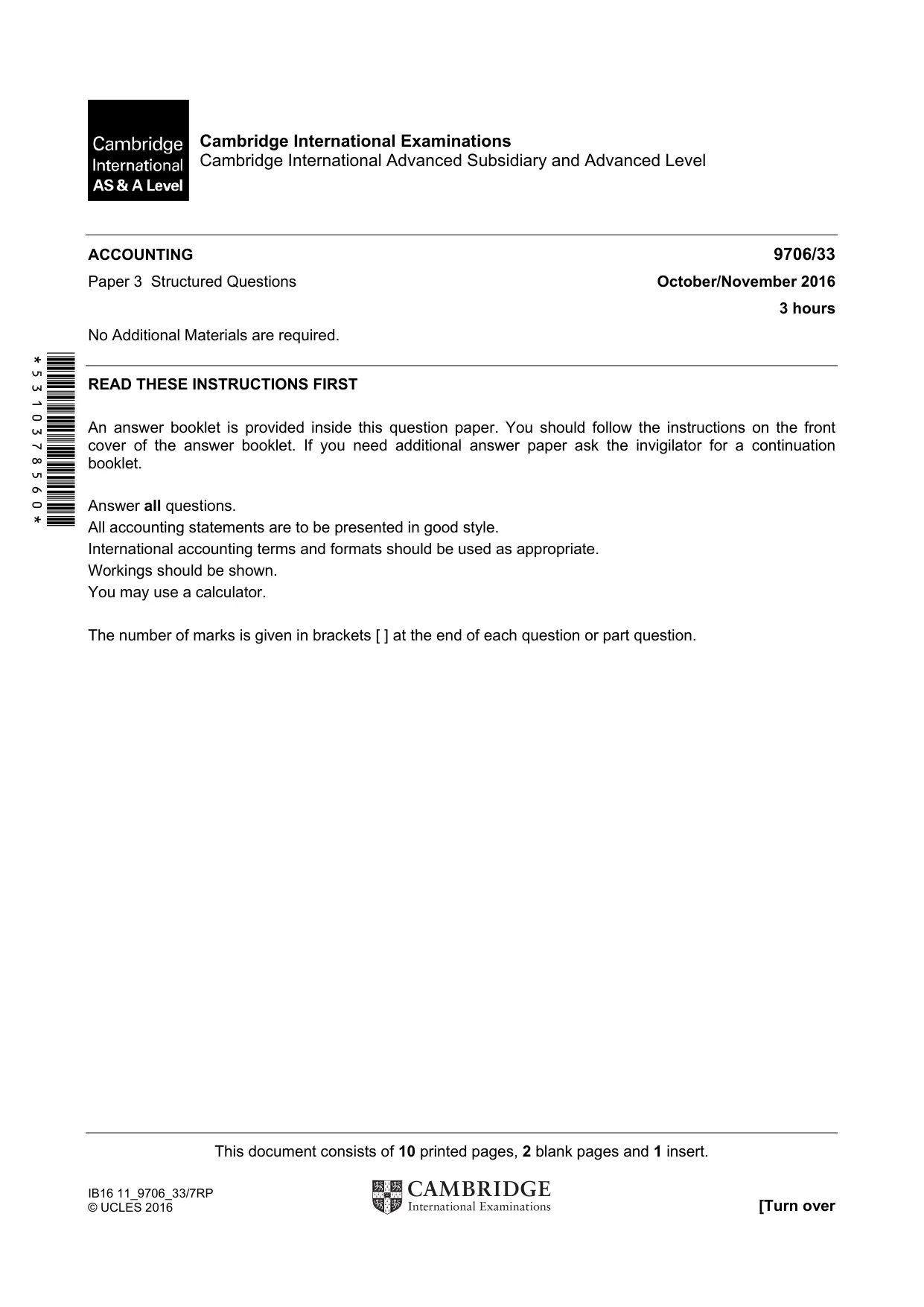
Question paper, page 1
This document consists of 10 printed pages, 2 blank pages and 1 insert. IB16 11_9706_33/7RP © UCLES 2016 [Turn over Cambridge International Examinations Cambridge International Advanced Subsidiary and Advanced Level ACCOUNTING 9706/33 Paper 3 Structured Questions October/November 2016 3 hours No Additional Materials are required. READ THESE INSTRUCTIONS FIRST An answer booklet is provided inside this question paper. You should follow the instructions on the front cover of the answer booklet. If you need additional answer paper ask the invigilator for a continuation booklet. Answer all questions. All accounting statements are to be presented in good style. International accounting terms and formats should be used as appropriate. Workings should be shown. You may use a calculator. The number of marks is given in brackets [ ] at the end of each question or part question.
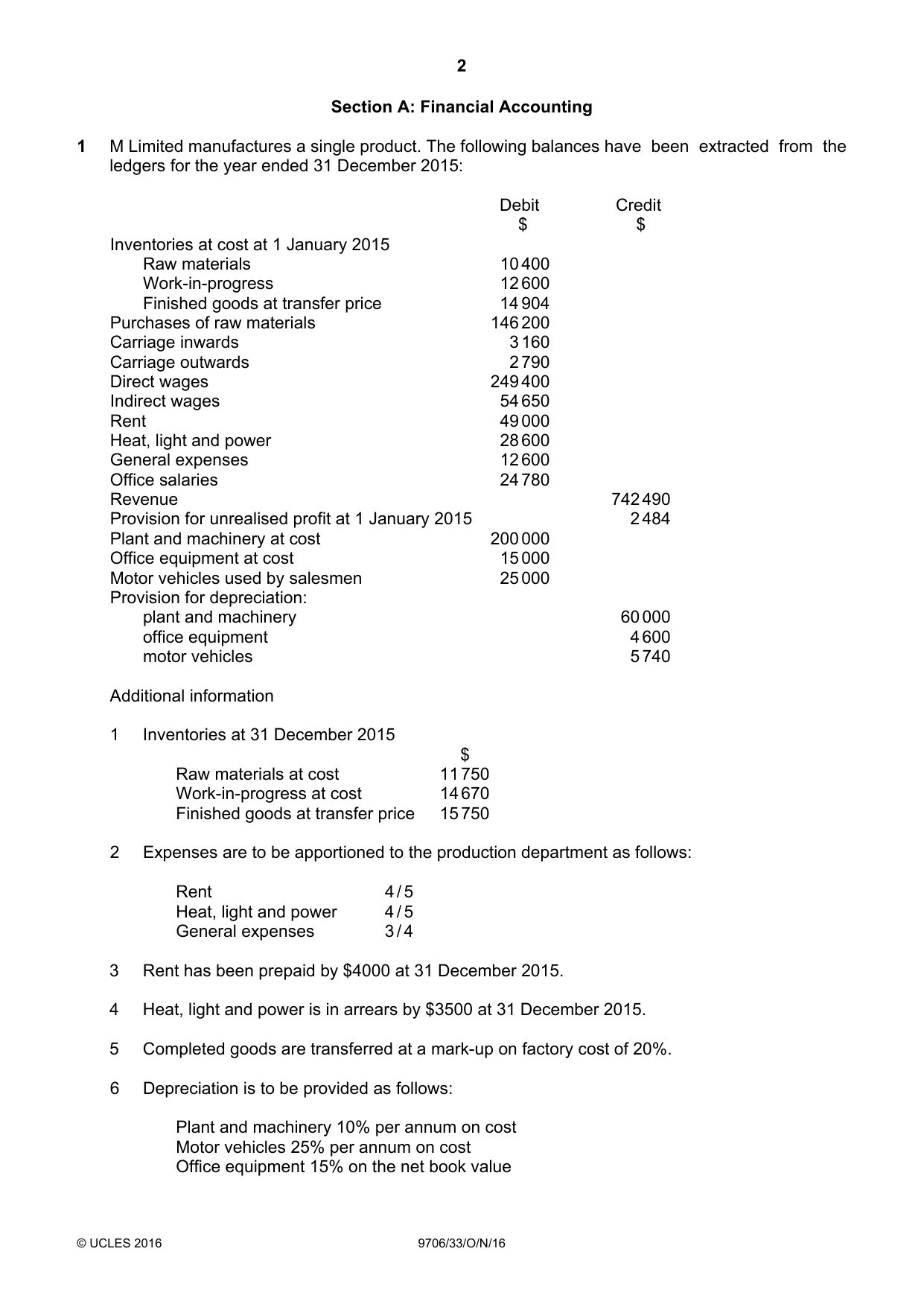
Question paper, page 2
2 © UCLES 2016 9706/33/O/N/16 Section A: Financial Accounting 1 M Limited manufactures a single product. The following balances have been extracted from the ledgers for the year ended 31 December 2015: Debit Credit $ $ Inventories at cost at 1 January 2015 Raw materials 10 400 Work-in-progress 12 600 Finished goods at transfer price 14 904 Purchases of raw materials 146 200 Carriage inwards 3 160 Carriage outwards 2 790 Direct wages 249 400 Indirect wages 54 650 Rent 49 000 Heat, light and power 28 600 General expenses 12 600 Office salaries 24 780 Revenue 742 490 Provision for unrealised profit at 1 January 2015 2 484 Plant and machinery at cost 200 000 Office equipment at cost 15 000 Motor vehicles used by salesmen 25 000 Provision for depreciation: plant and machinery 60 000 office equipment 4 600 motor vehicles 5 740 Additional information 1 Inventories at 31 December 2015 $ Raw materials at cost 11 750 Work-in-progress at cost 14 670 Finished goods at transfer price 15 750 2 Expenses are to be apportioned to the production department as follows: Rent 4 / 5 Heat, light and power 4 / 5 General expenses 3 / 4 3 Rent has been prepaid by $4000 at 31 December 2015. 4 Heat, light and power is in arrears by $3500 at 31 December 2015. 5 Completed goods are transferred at a mark-up on factory cost of 20%. 6 Depreciation is to be provided as follows: Plant and machinery 10% per annum on cost Motor vehicles 25% per annum on cost Office equipment 15% on the net book value
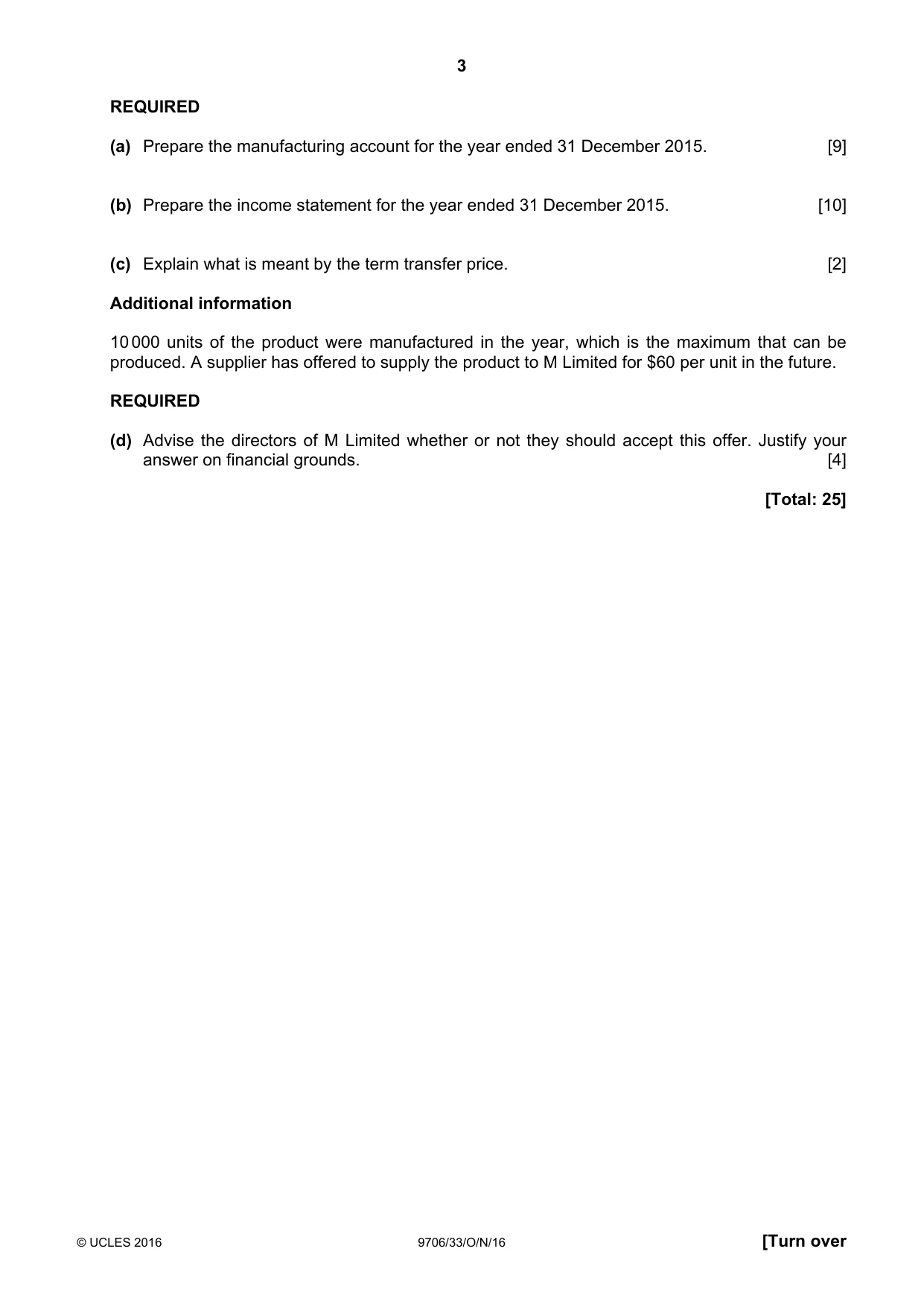
Question paper, page 3
3 © UCLES 2016 9706/33/O/N/16 [Turn over REQUIRED (a) Prepare the manufacturing account for the year ended 31 December 2015. [9] (b) Prepare the income statement for the year ended 31 December 2015. [10] (c) Explain what is meant by the term transfer price. [2] Additional information 10 000 units of the product were manufactured in the year, which is the maximum that can be produced. A supplier has offered to supply the product to M Limited for $60 per unit in the future. REQUIRED (d) Advise the directors of M Limited whether or not they should accept this offer. Justify your answer on financial grounds. [4] [Total: 25]
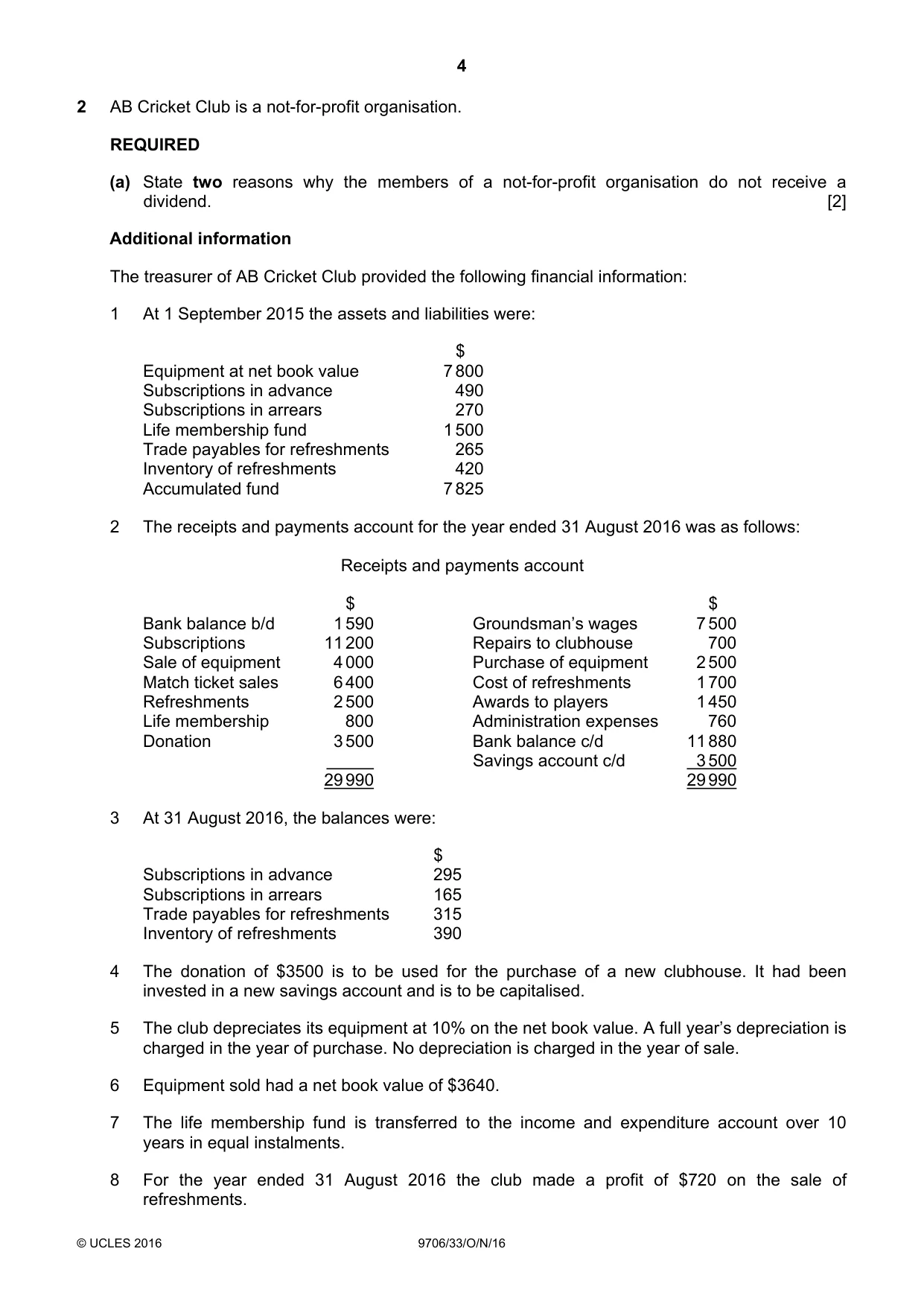
Question paper, page 4
4 © UCLES 2016 9706/33/O/N/16 2 AB Cricket Club is a not-for-profit organisation. REQUIRED (a) State two reasons why the members of a not-for-profit organisation do not receive a dividend. [2] Additional information The treasurer of AB Cricket Club provided the following financial information: 1 At 1 September 2015 the assets and liabilities were: $ Equipment at net book value 7 800 Subscriptions in advance 490 Subscriptions in arrears 270 Life membership fund 1 500 Trade payables for refreshments 265 Inventory of refreshments 420 Accumulated fund 7 825 2 The receipts and payments account for the year ended 31 August 2016 was as follows: Receipts and payments account $ $ Bank balance b/d 1 590 Groundsman’s wages 7 500 Subscriptions 11 200 Repairs to clubhouse 700 Sale of equipment 4 000 Purchase of equipment 2 500 Match ticket sales 6 400 Cost of refreshments 1 700 Refreshments 2 500 Awards to players 1 450 Life membership 800 Administration expenses 760 Donation 3 500 Bank balance c/d 11 880 Savings account c/d 3 500 29 990 29 990 3 At 31 August 2016, the balances were: $ Subscriptions in advance 295 Subscriptions in arrears 165 Trade payables for refreshments 315 Inventory of refreshments 390 4 The donation of $3500 is to be used for the purchase of a new clubhouse. It had been invested in a new savings account and is to be capitalised. 5 The club depreciates its equipment at 10% on the net book value. A full year’s depreciation is charged in the year of purchase. No depreciation is charged in the year of sale. 6 Equipment sold had a net book value of $3640. 7 The life membership fund is transferred to the income and expenditure account over 10 years in equal instalments. 8 For the year ended 31 August 2016 the club made a profit of $720 on the sale of refreshments.
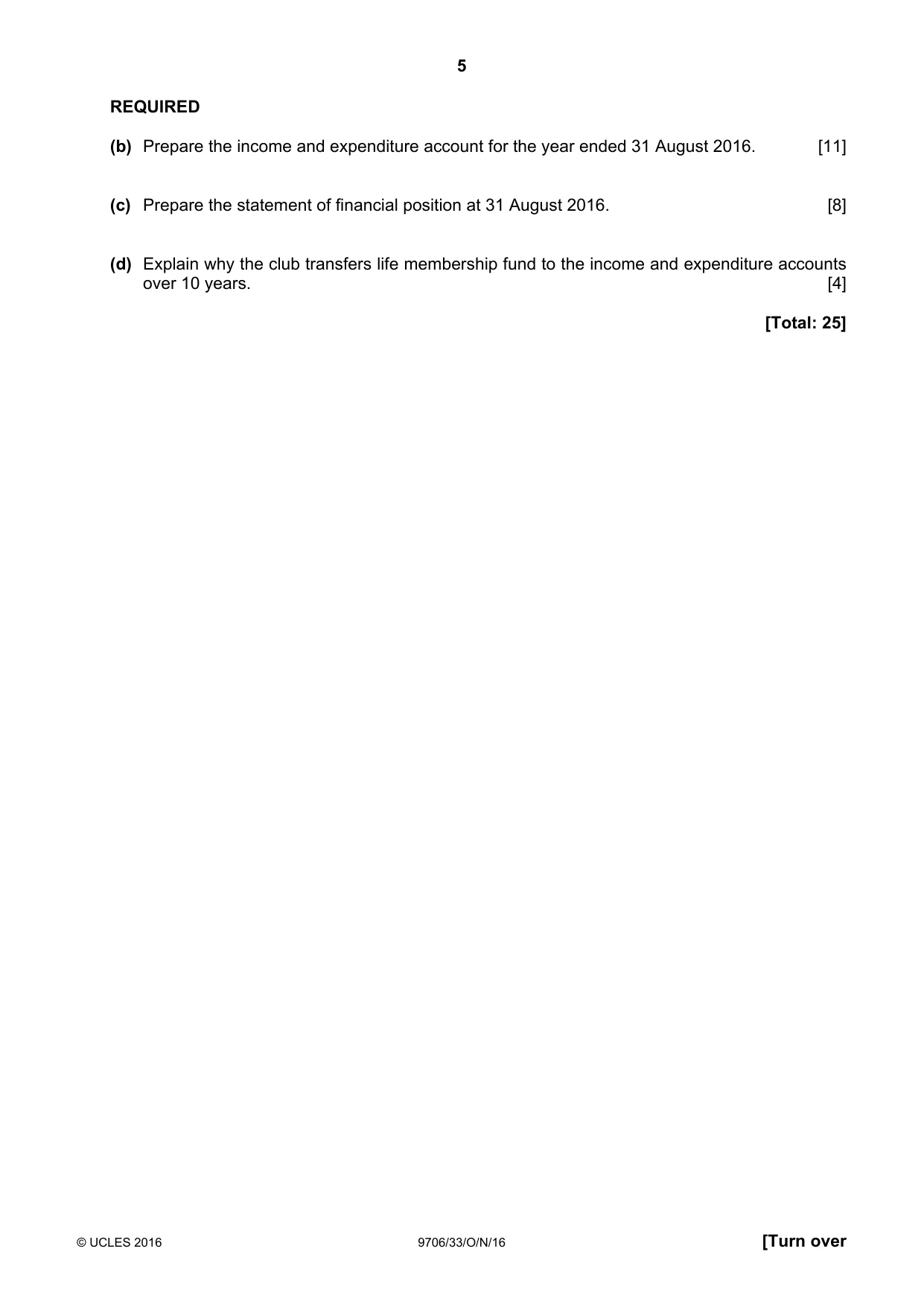
Question paper, page 5
5 © UCLES 2016 9706/33/O/N/16 [Turn over REQUIRED (b) Prepare the income and expenditure account for the year ended 31 August 2016. [11] (c) Prepare the statement of financial position at 31 August 2016. [8] (d) Explain why the club transfers life membership fund to the income and expenditure accounts over 10 years. [4] [Total: 25]
Question paper, page 6
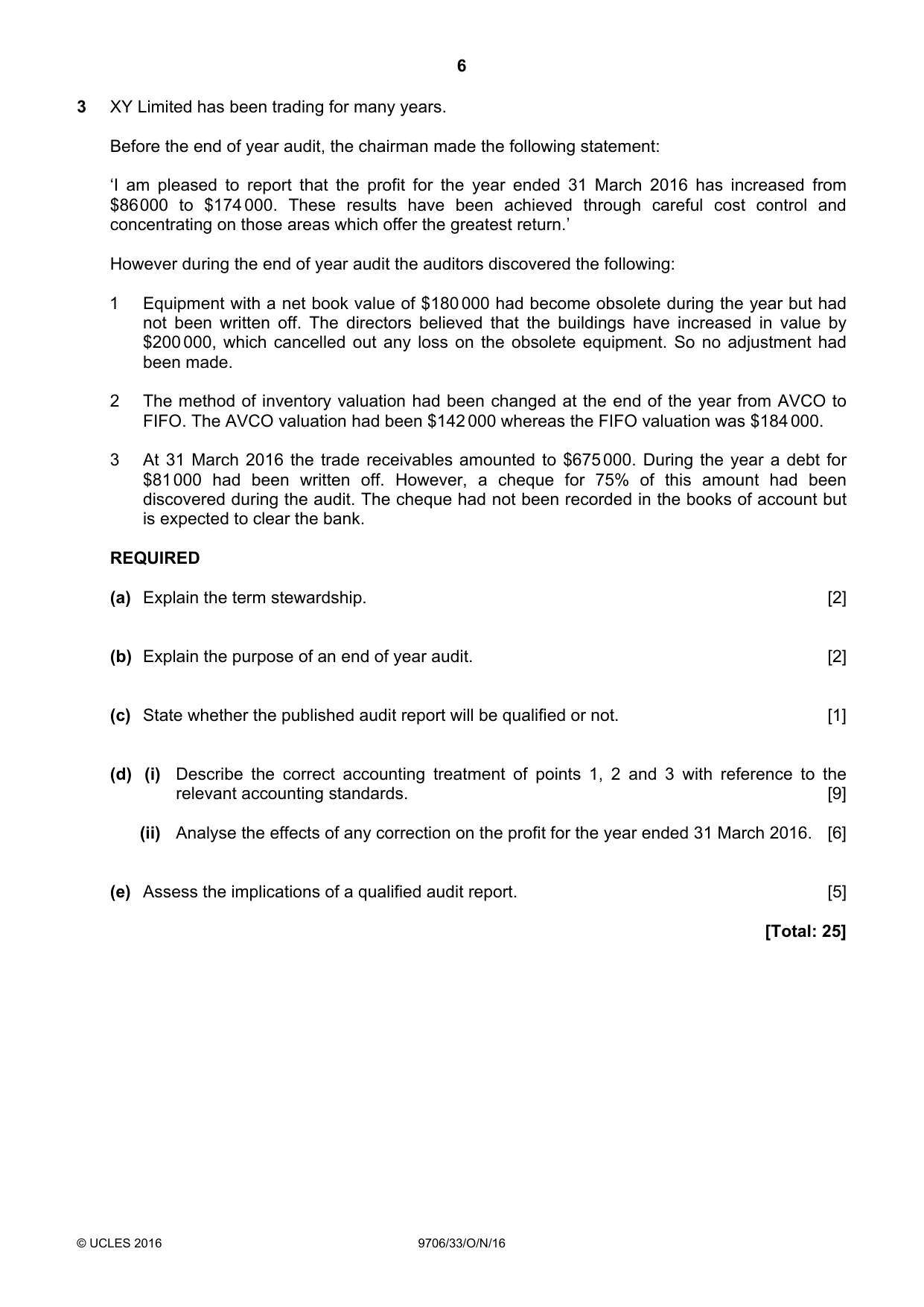
6 © UCLES 2016 9706/33/O/N/16 3 XY Limited has been trading for many years. Before the end of year audit, the chairman made the following statement: ‘I am pleased to report that the profit for the year ended 31 March 2016 has increased from $86 000 to $174 000. These results have been achieved through careful cost control and concentrating on those areas which offer the greatest return.’ However during the end of year audit the auditors discovered the following: 1 Equipment with a net book value of $180 000 had become obsolete during the year but had not been written off. The directors believed that the buildings have increased in value by $200 000, which cancelled out any loss on the obsolete equipment. So no adjustment had been made. 2 The method of inventory valuation had been changed at the end of the year from AVCO to FIFO. The AVCO valuation had been $142 000 whereas the FIFO valuation was $184 000. 3 At 31 March 2016 the trade receivables amounted to $675 000. During the year a debt for $81 000 had been written off. However, a cheque for 75% of this amount had been discovered during the audit. The cheque had not been recorded in the books of account but is expected to clear the bank. REQUIRED (a) Explain the term stewardship. [2] (b) Explain the purpose of an end of year audit. [2] (c) State whether the published audit report will be qualified or not. [1] (d) (i) Describe the correct accounting treatment of points 1, 2 and 3 with reference to the relevant accounting standards. [9] (ii) Analyse the effects of any correction on the profit for the year ended 31 March 2016. [6] (e) Assess the implications of a qualified audit report. [5] [Total: 25]
Question paper, page 7
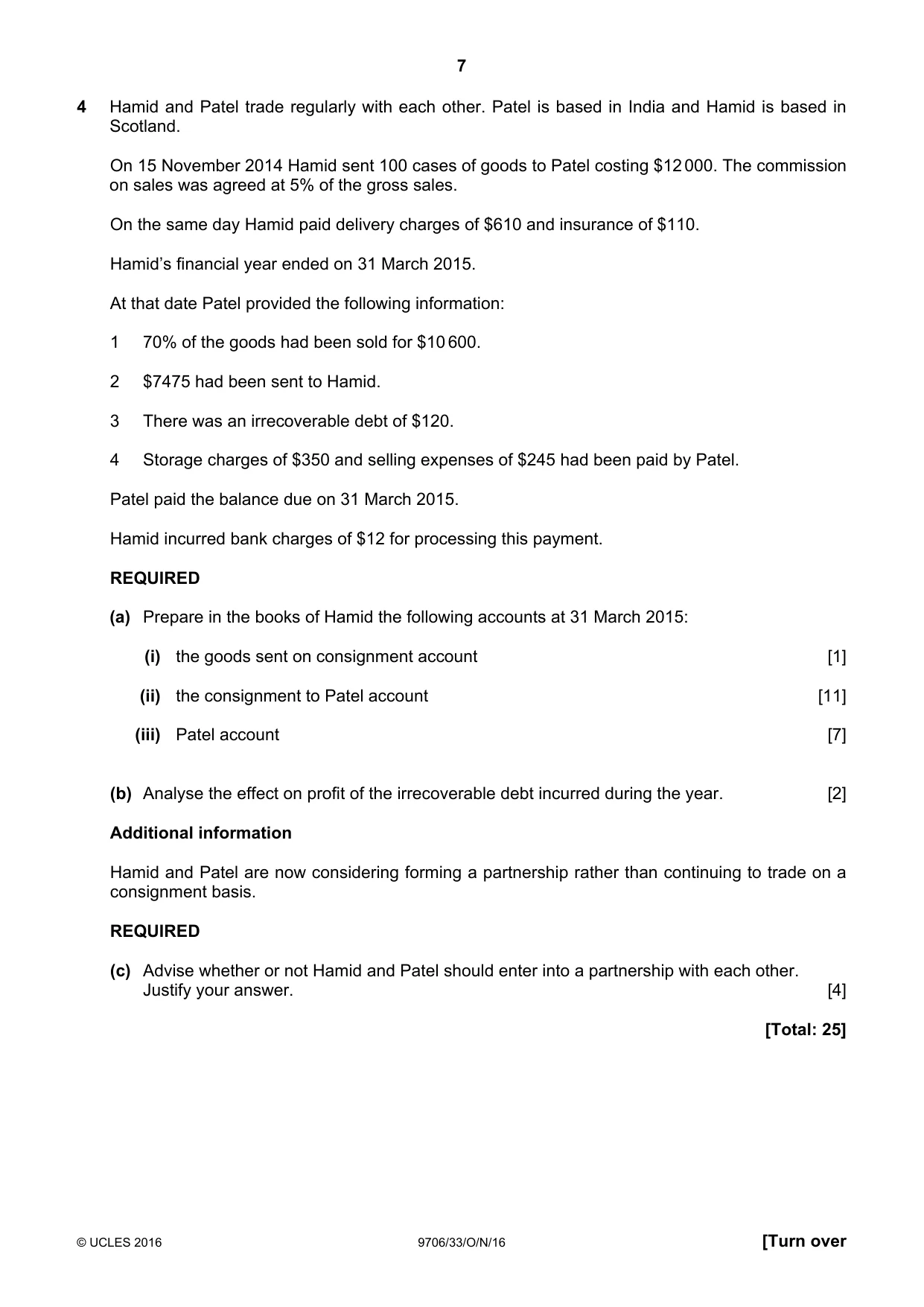
7 © UCLES 2016 9706/33/O/N/16 [Turn over 4 Hamid and Patel trade regularly with each other. Patel is based in India and Hamid is based in Scotland. On 15 November 2014 Hamid sent 100 cases of goods to Patel costing $12 000. The commission on sales was agreed at 5% of the gross sales. On the same day Hamid paid delivery charges of $610 and insurance of $110. Hamid’s financial year ended on 31 March 2015. At that date Patel provided the following information: 1 70% of the goods had been sold for $10 600. 2 $7475 had been sent to Hamid. 3 There was an irrecoverable debt of $120. 4 Storage charges of $350 and selling expenses of $245 had been paid by Patel. Patel paid the balance due on 31 March 2015. Hamid incurred bank charges of $12 for processing this payment. REQUIRED (a) Prepare in the books of Hamid the following accounts at 31 March 2015: (i) the goods sent on consignment account [1] (ii) the consignment to Patel account [11] (iii) Patel account [7] (b) Analyse the effect on profit of the irrecoverable debt incurred during the year. [2] Additional information Hamid and Patel are now considering forming a partnership rather than continuing to trade on a consignment basis. REQUIRED (c) Advise whether or not Hamid and Patel should enter into a partnership with each other. Justify your answer. [4] [Total: 25]
Question paper, page 8
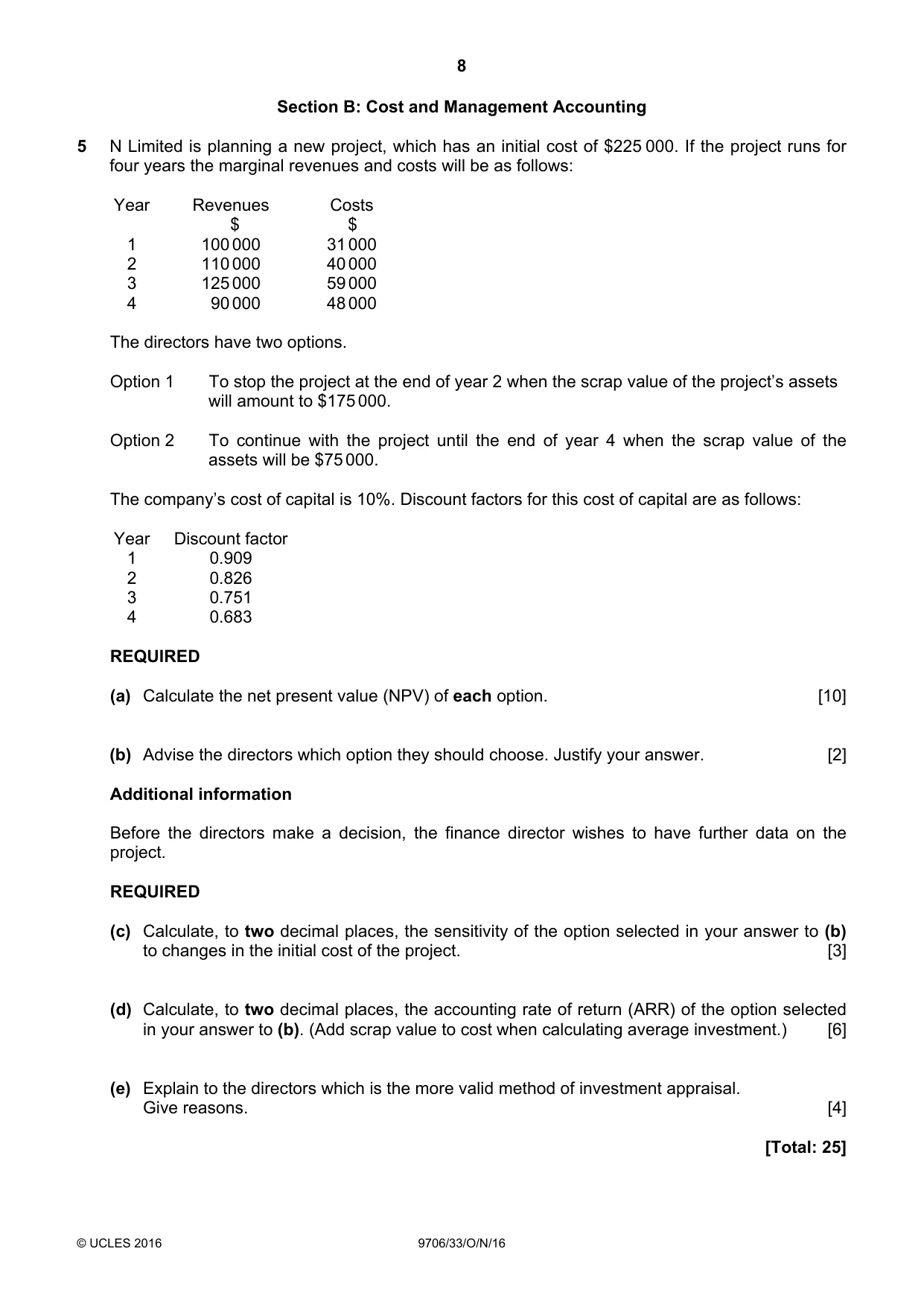
8 © UCLES 2016 9706/33/O/N/16 Section B: Cost and Management Accounting 5 N Limited is planning a new project, which has an initial cost of $225 000. If the project runs for four years the marginal revenues and costs will be as follows: Year Revenues Costs $ $ 1 100 000 31 000 2 110 000 40 000 3 125 000 59 000 4 90 000 48 000 The directors have two options. Option 1 To stop the project at the end of year 2 when the scrap value of the project’s assets will amount to $175 000. Option 2 To continue with the project until the end of year 4 when the scrap value of the assets will be $75 000. The company’s cost of capital is 10%. Discount factors for this cost of capital are as follows: Year Discount factor 1 0.909 2 0.826 3 0.751 4 0.683 REQUIRED (a) Calculate the net present value (NPV) of each option. [10] (b) Advise the directors which option they should choose. Justify your answer. [2] Additional information Before the directors make a decision, the finance director wishes to have further data on the project. REQUIRED (c) Calculate, to two decimal places, the sensitivity of the option selected in your answer to (b) to changes in the initial cost of the project. [3] (d) Calculate, to two decimal places, the accounting rate of return (ARR) of the option selected in your answer to (b). (Add scrap value to cost when calculating average investment.) [6] (e) Explain to the directors which is the more valid method of investment appraisal. Give reasons. [4] [Total: 25]
Question paper, page 9
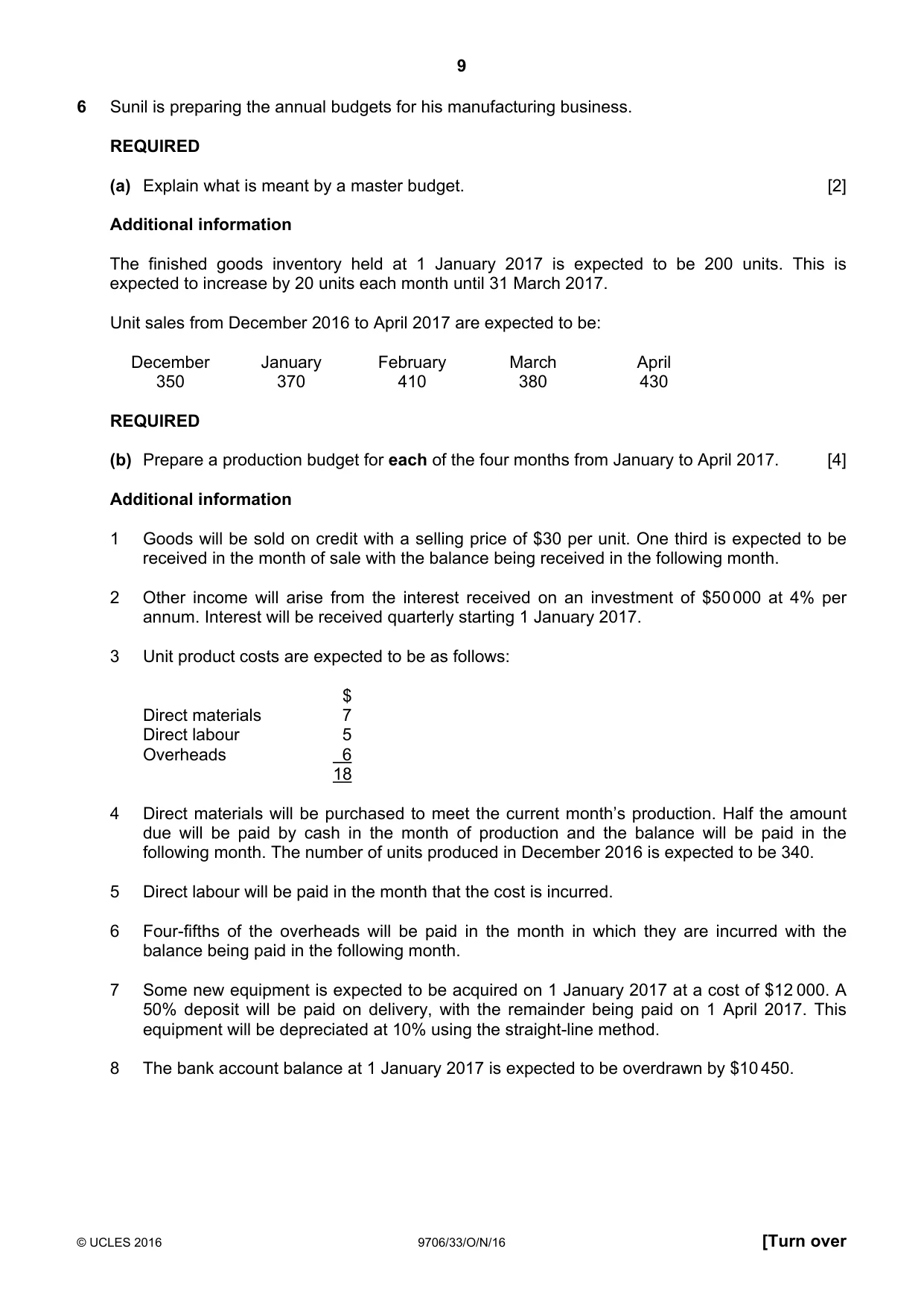
9 © UCLES 2016 9706/33/O/N/16 [Turn over 6 Sunil is preparing the annual budgets for his manufacturing business. REQUIRED (a) Explain what is meant by a master budget. [2] Additional information The finished goods inventory held at 1 January 2017 is expected to be 200 units. This is expected to increase by 20 units each month until 31 March 2017. Unit sales from December 2016 to April 2017 are expected to be: December January February March April 350 370 410 380 430 REQUIRED (b) Prepare a production budget for each of the four months from January to April 2017. [4] Additional information 1 Goods will be sold on credit with a selling price of $30 per unit. One third is expected to be received in the month of sale with the balance being received in the following month. 2 Other income will arise from the interest received on an investment of $50 000 at 4% per annum. Interest will be received quarterly starting 1 January 2017. 3 Unit product costs are expected to be as follows: $ Direct materials 7 Direct labour 5 Overheads 6 18 4 Direct materials will be purchased to meet the current month’s production. Half the amount due will be paid by cash in the month of production and the balance will be paid in the following month. The number of units produced in December 2016 is expected to be 340. 5 Direct labour will be paid in the month that the cost is incurred. 6 Four-fifths of the overheads will be paid in the month in which they are incurred with the balance being paid in the following month. 7 Some new equipment is expected to be acquired on 1 January 2017 at a cost of $12 000. A 50% deposit will be paid on delivery, with the remainder being paid on 1 April 2017. This equipment will be depreciated at 10% using the straight-line method. 8 The bank account balance at 1 January 2017 is expected to be overdrawn by $10 450.
Question paper, page 10
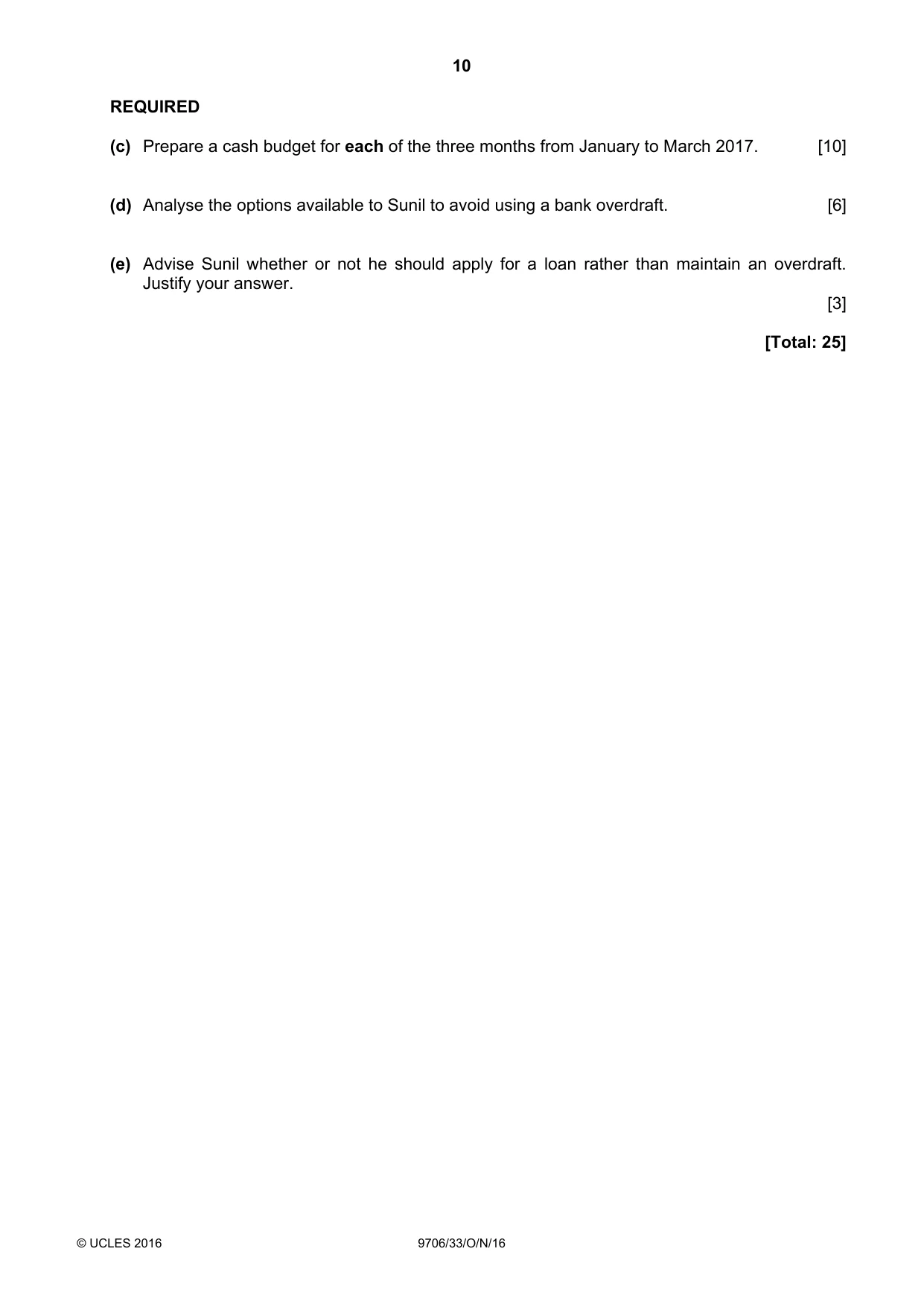
10 © UCLES 2016 9706/33/O/N/16 REQUIRED (c) Prepare a cash budget for each of the three months from January to March 2017. [10] (d) Analyse the options available to Sunil to avoid using a bank overdraft. [6] (e) Advise Sunil whether or not he should apply for a loan rather than maintain an overdraft. Justify your answer. [3] [Total: 25]
Question paper, page 11
11 © UCLES 2016 9706/33/O/N/16 BLANK PAGE
Question paper, page 12
12 Permission to reproduce items where third-party owned material protected by copyright is included has been sought and cleared where possible. Every reasonable effort has been made by the publisher (UCLES) to trace copyright holders, but if any items requiring clearance have unwittingly been included, the publisher will be pleased to make amends at the earliest possible opportunity. To avoid the issue of disclosure of answer-related information to candidates, all copyright acknowledgements are reproduced online in the Cambridge International Examinations Copyright Acknowledgements Booklet. This is produced for each series of examinations and is freely available to download at www.cie.org.uk after the live examination series. Cambridge International Examinations is part of the Cambridge Assessment Group. Cambridge Assessment is the brand name of University of Cambridge Local Examinations Syndicate (UCLES), which is itself a department of the University of Cambridge. © UCLES 2016 9706/33/O/N/16 BLANK PAGE
Mark scheme, page 1
® IGCSE is the registered trademark of Cambridge International Examinations. This document consists of 10 printed pages. © UCLES 2016 [Turn over Cambridge International Examinations Cambridge International Advanced Level ACCOUNTING 9706/33 Paper 3 Structured Questions October/November 2016 MARK SCHEME Maximum Mark: 150 Published This mark scheme is published as an aid to teachers and candidates, to indicate the requirements of the examination. It shows the basis on which Examiners were instructed to award marks. It does not indicate the details of the discussions that took place at an Examiners’ meeting before marking began, which would have considered the acceptability of alternative answers. Mark schemes should be read in conjunction with the question paper and the Principal Examiner Report for Teachers. Cambridge will not enter into discussions about these mark schemes. Cambridge is publishing the mark schemes for the October/November 2016 series for most Cambridge IGCSE®, Cambridge International A and AS Level components and some Cambridge O Level components.
Mark scheme, page 2
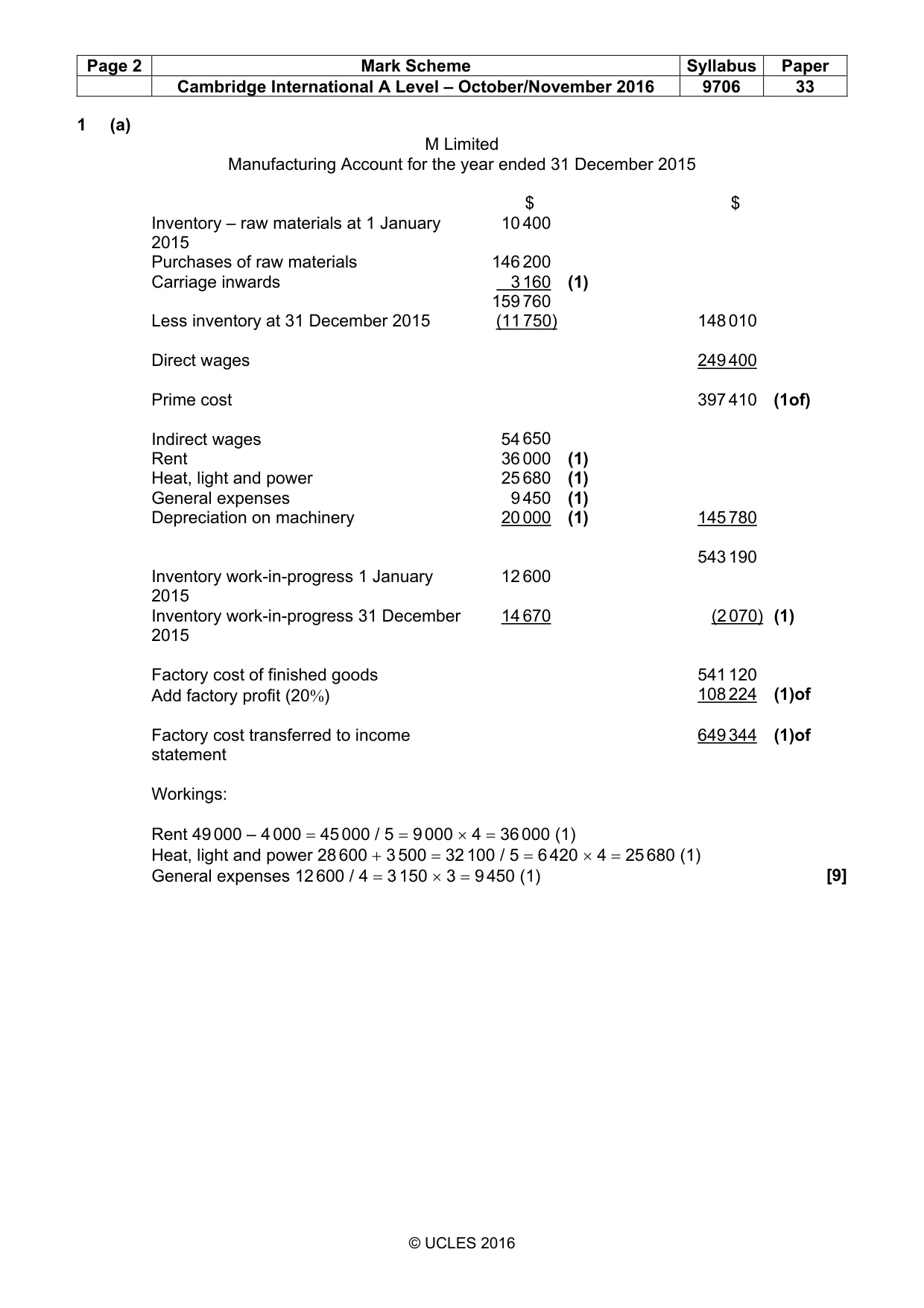
Page 2 Mark Scheme Syllabus Paper Cambridge International A Level – October/November 2016 9706 33 © UCLES 2016 1 (a) M Limited Manufacturing Account for the year ended 31 December 2015 $ $ Inventory – raw materials at 1 January 2015 10 400 Purchases of raw materials 146 200 Carriage inwards 3 160 (1) 159 760 Less inventory at 31 December 2015 (11 750) 148 010 Direct wages 249 400 Prime cost 397 410 (1of) Indirect wages 54 650 Rent 36 000 (1) Heat, light and power 25 680 (1) General expenses 9 450 (1) Depreciation on machinery 20 000 (1) 145 780 543 190 Inventory work-in-progress 1 January 2015 12 600 Inventory work-in-progress 31 December 2015 14 670 (2 070) (1) Factory cost of finished goods 541 120 Add factory profit (20%) 108 224 (1)of Factory cost transferred to income statement 649 344 (1)of Workings: Rent 49 000 – 4 000 = 45 000 / 5 = 9 000 × 4 = 36 000 (1) Heat, light and power 28 600 + 3 500 = 32 100 / 5 = 6 420 × 4 = 25 680 (1) General expenses 12 600 / 4 = 3 150 × 3 = 9 450 (1) [9]
Mark scheme, page 3
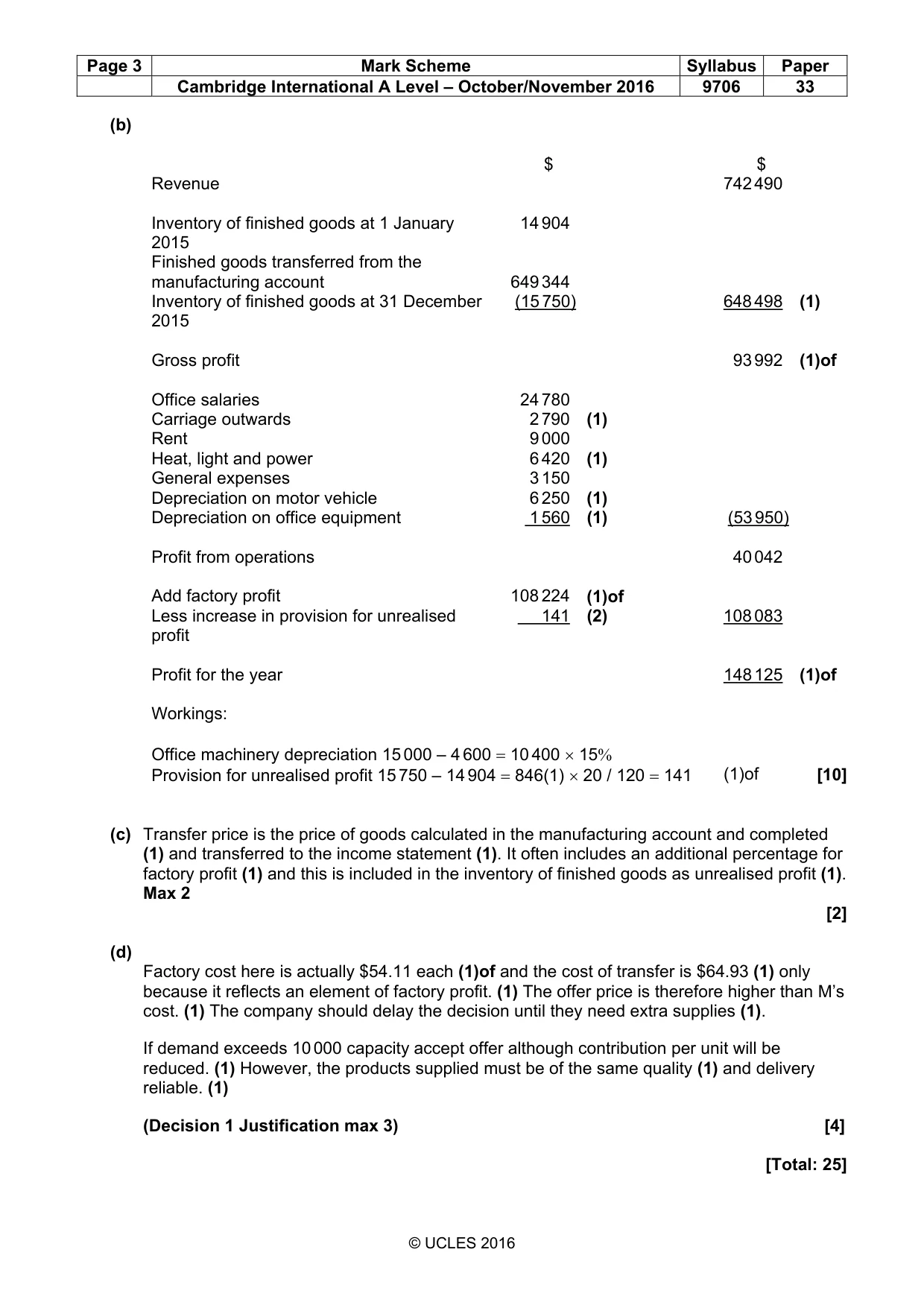
Page 3 Mark Scheme Syllabus Paper Cambridge International A Level – October/November 2016 9706 33 © UCLES 2016 (b) $ $ Revenue 742 490 Inventory of finished goods at 1 January 2015 14 904 Finished goods transferred from the manufacturing account 649 344 Inventory of finished goods at 31 December 2015 (15 750) 648 498 (1) Gross profit 93 992 (1)of Office salaries 24 780 Carriage outwards 2 790 (1) Rent 9 000 Heat, light and power 6 420 (1) General expenses 3 150 Depreciation on motor vehicle 6 250 (1) Depreciation on office equipment 1 560 (1) (53 950) Profit from operations 40 042 Add factory profit 108 224 (1)of Less increase in provision for unrealised profit 141 (2) 108 083 Profit for the year 148 125 (1)of Workings: Office machinery depreciation 15 000 – 4 600 = 10 400 × 15% Provision for unrealised profit 15 750 – 14 904 = 846(1) × 20 / 120 = 141 (1)of [10] (c) Transfer price is the price of goods calculated in the manufacturing account and completed (1) and transferred to the income statement (1). It often includes an additional percentage for factory profit (1) and this is included in the inventory of finished goods as unrealised profit (1). Max 2 [2] (d) Factory cost here is actually $54.11 each (1)of and the cost of transfer is $64.93 (1) only because it reflects an element of factory profit. (1) The offer price is therefore higher than M’s cost. (1) The company should delay the decision until they need extra supplies (1). If demand exceeds 10 000 capacity accept offer although contribution per unit will be reduced. (1) However, the products supplied must be of the same quality (1) and delivery reliable. (1) (Decision 1 Justification max 3) [4] [Total: 25]
Mark scheme, page 4
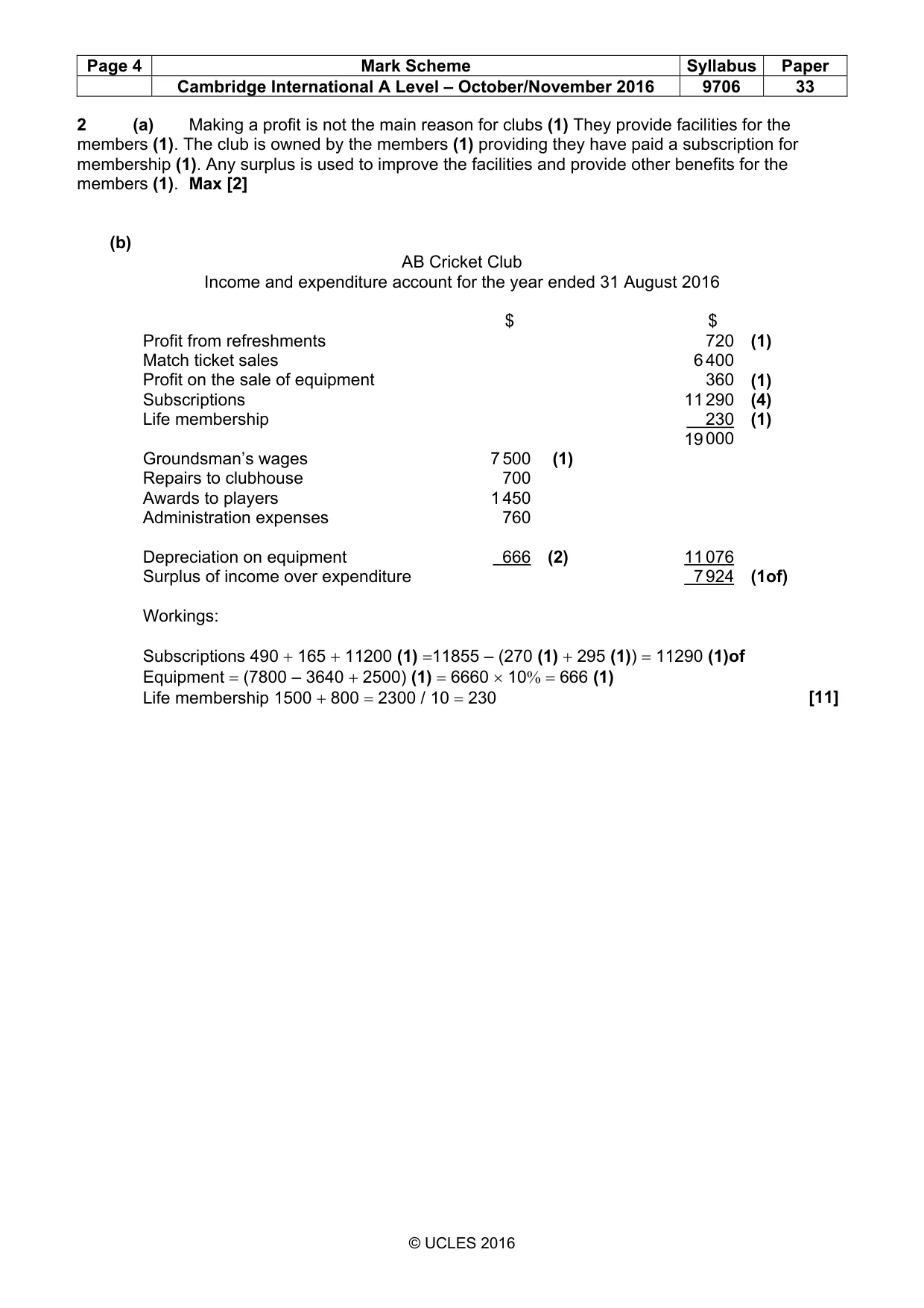
Page 4 Mark Scheme Syllabus Paper Cambridge International A Level – October/November 2016 9706 33 © UCLES 2016 2 (a) Making a profit is not the main reason for clubs (1) They provide facilities for the members (1). The club is owned by the members (1) providing they have paid a subscription for membership (1). Any surplus is used to improve the facilities and provide other benefits for the members (1). Max [2] (b) AB Cricket Club Income and expenditure account for the year ended 31 August 2016 $ $ Profit from refreshments 720 (1) Match ticket sales 6 400 Profit on the sale of equipment 360 (1) Subscriptions 11 290 (4) Life membership 230 (1) 19 000 Groundsman’s wages 7 500 (1) Repairs to clubhouse 700 Awards to players 1 450 Administration expenses 760 Depreciation on equipment 666 (2) 11 076 Surplus of income over expenditure 7 924 (1of) Workings: Subscriptions 490 + 165 + 11200 (1) =11855 – (270 (1) + 295 (1)) = 11290 (1)of Equipment = (7800 – 3640 + 2500) (1) = 6660 × 10% = 666 (1) Life membership 1500 + 800 = 2300 / 10 = 230 [11]
Mark scheme, page 5
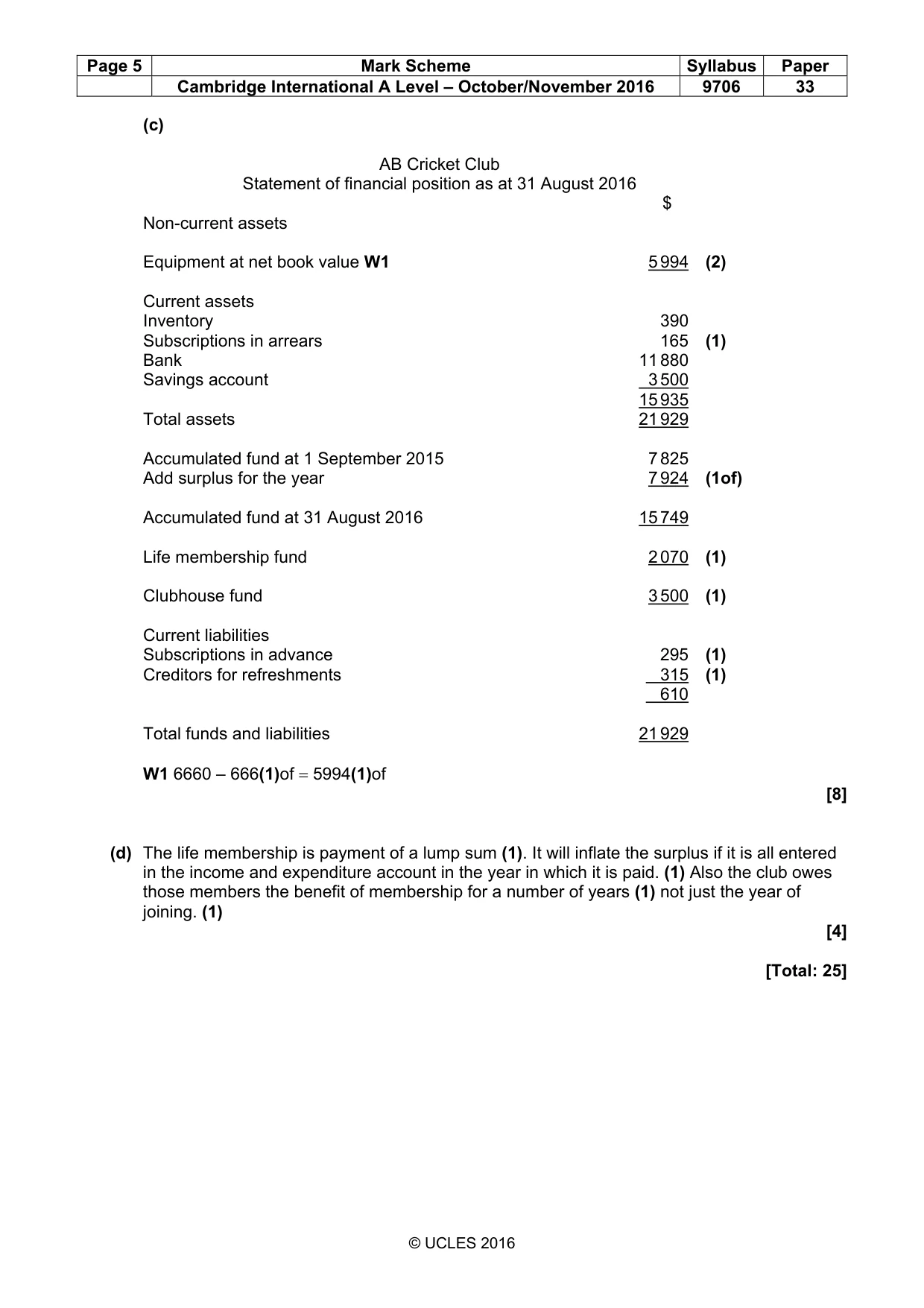
Page 5 Mark Scheme Syllabus Paper Cambridge International A Level – October/November 2016 9706 33 © UCLES 2016 (c) AB Cricket Club Statement of financial position as at 31 August 2016 $ Non-current assets Equipment at net book value W1 5 994 (2) Current assets Inventory 390 Subscriptions in arrears 165 (1) Bank 11 880 Savings account 3 500 15 935 Total assets 21 929 Accumulated fund at 1 September 2015 7 825 Add surplus for the year 7 924 (1of) Accumulated fund at 31 August 2016 15 749 Life membership fund 2 070 (1) Clubhouse fund 3 500 (1) Current liabilities Subscriptions in advance 295 (1) Creditors for refreshments 315 (1) 610 Total funds and liabilities 21 929 W1 6660 – 666(1)of = 5994(1)of [8] (d) The life membership is payment of a lump sum (1). It will inflate the surplus if it is all entered in the income and expenditure account in the year in which it is paid. (1) Also the club owes those members the benefit of membership for a number of years (1) not just the year of joining. (1) [4] [Total: 25]
Mark scheme, page 6
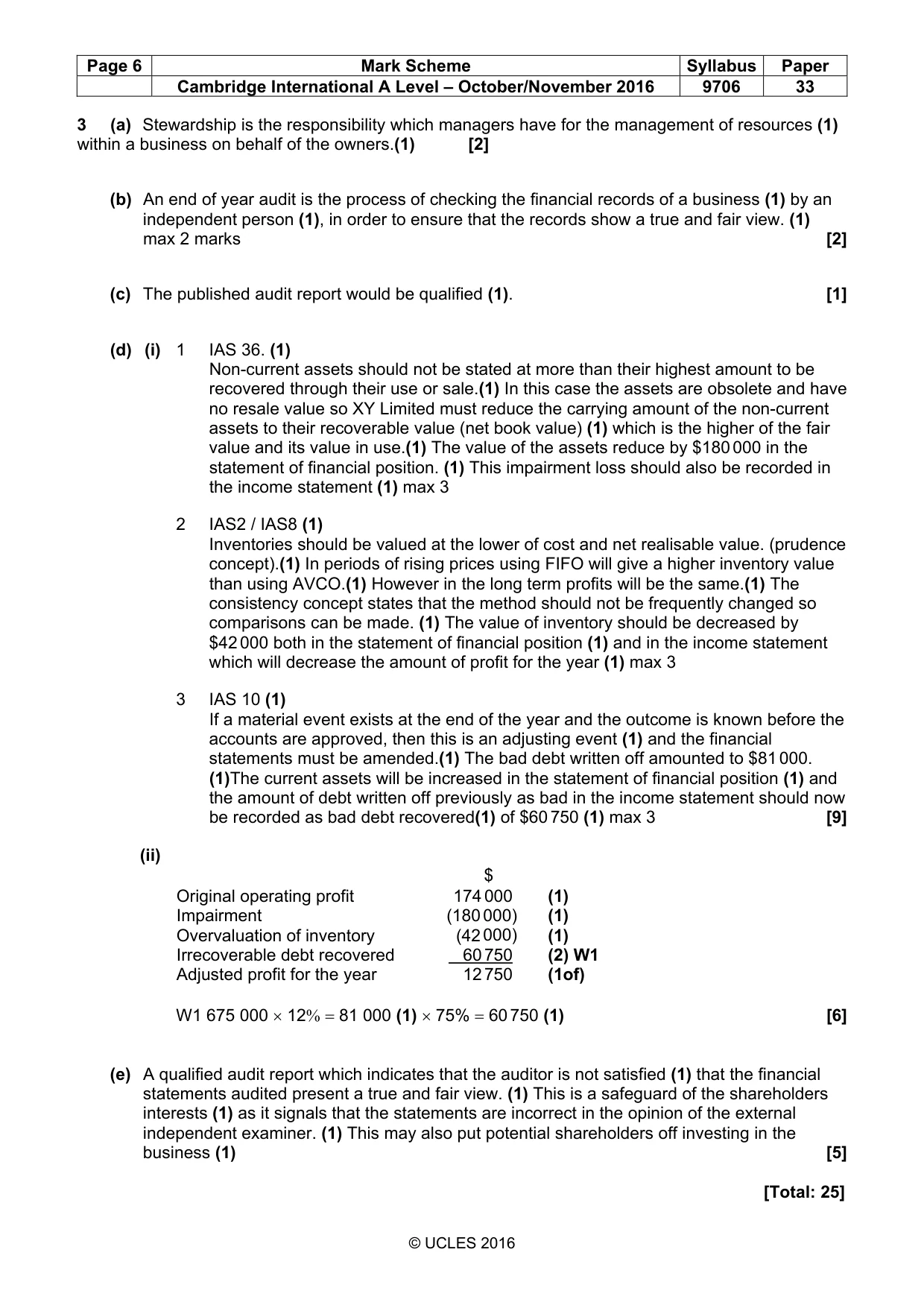
Page 6 Mark Scheme Syllabus Paper Cambridge International A Level – October/November 2016 9706 33 © UCLES 2016 3 (a) Stewardship is the responsibility which managers have for the management of resources (1) within a business on behalf of the owners.(1) [2] (b) An end of year audit is the process of checking the financial records of a business (1) by an independent person (1), in order to ensure that the records show a true and fair view. (1) max 2 marks [2] (c) The published audit report would be qualified (1). [1] (d) (i) 1 IAS 36. (1) Non-current assets should not be stated at more than their highest amount to be recovered through their use or sale.(1) In this case the assets are obsolete and have no resale value so XY Limited must reduce the carrying amount of the non-current assets to their recoverable value (net book value) (1) which is the higher of the fair value and its value in use.(1) The value of the assets reduce by $180 000 in the statement of financial position. (1) This impairment loss should also be recorded in the income statement (1) max 3 2 IAS2 / IAS8 (1) Inventories should be valued at the lower of cost and net realisable value. (prudence concept).(1) In periods of rising prices using FIFO will give a higher inventory value than using AVCO.(1) However in the long term profits will be the same.(1) The consistency concept states that the method should not be frequently changed so comparisons can be made. (1) The value of inventory should be decreased by $42 000 both in the statement of financial position (1) and in the income statement which will decrease the amount of profit for the year (1) max 3 3 IAS 10 (1) If a material event exists at the end of the year and the outcome is known before the accounts are approved, then this is an adjusting event (1) and the financial statements must be amended.(1) The bad debt written off amounted to $81 000. (1)The current assets will be increased in the statement of financial position (1) and the amount of debt written off previously as bad in the income statement should now be recorded as bad debt recovered(1) of $60 750 (1) max 3 [9] (ii) $ Original operating profit 174 000 (1) Impairment (180 000) (1) Overvaluation of inventory (42 000) (1) Irrecoverable debt recovered 60 750 (2) W1 Adjusted profit for the year 12 750 (1of) W1 675 000 × 12% = 81 000 (1) × 75% = 60 750 (1) [6] (e) A qualified audit report which indicates that the auditor is not satisfied (1) that the financial statements audited present a true and fair view. (1) This is a safeguard of the shareholders interests (1) as it signals that the statements are incorrect in the opinion of the external independent examiner. (1) This may also put potential shareholders off investing in the business (1) [5] [Total: 25]
Mark scheme, page 7
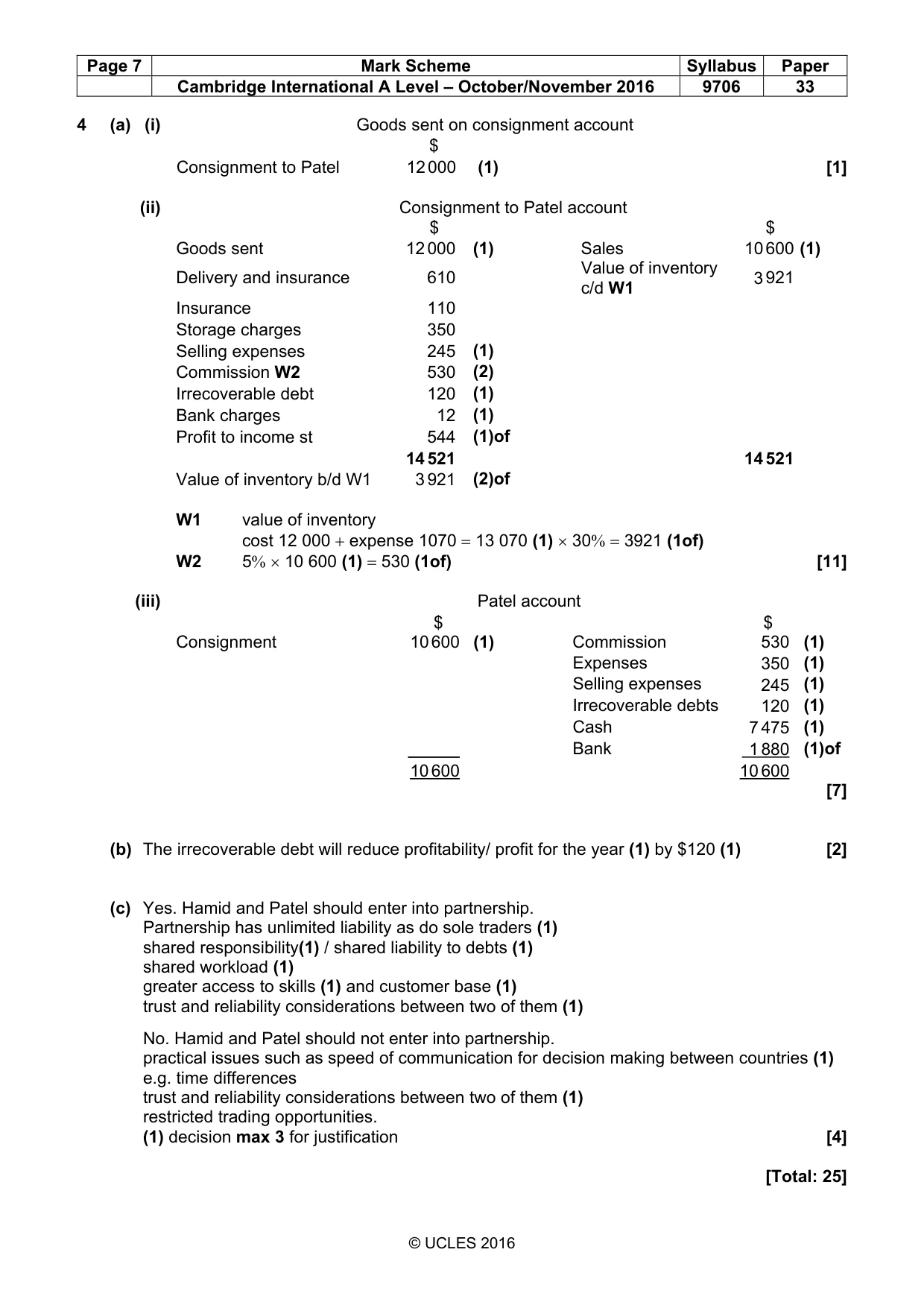
Page 7 Mark Scheme Syllabus Paper Cambridge International A Level – October/November 2016 9706 33 © UCLES 2016 4 (a) (i) Goods sent on consignment account $ Consignment to Patel 12 000 (1) [1] (ii) Consignment to Patel account $ $ Goods sent 12 000 (1) Sales 10 600 (1) Delivery and insurance 610 Value of inventory c/d W1 3 921 Insurance 110 Storage charges 350 Selling expenses 245 (1) Commission W2 530 (2) Irrecoverable debt 120 (1) Bank charges 12 (1) Profit to income st 544 (1)of 14 521 14 521 Value of inventory b/d W1 3 921 (2)of W1 value of inventory cost 12 000 + expense 1070 = 13 070 (1) × 30% = 3921 (1of) W2 5% × 10 600 (1) = 530 (1of) [11] (iii) Patel account $ $ Consignment 10 600 (1) Commission 530 (1) Expenses 350 (1) Selling expenses 245 (1) Irrecoverable debts 120 (1) Cash 7 475 (1) Bank 1 880 (1)of 10 600 10 600 [7] (b) The irrecoverable debt will reduce profitability/ profit for the year (1) by $120 (1) [2] (c) Yes. Hamid and Patel should enter into partnership. Partnership has unlimited liability as do sole traders (1) shared responsibility(1) / shared liability to debts (1) shared workload (1) greater access to skills (1) and customer base (1) trust and reliability considerations between two of them (1) No. Hamid and Patel should not enter into partnership. practical issues such as speed of communication for decision making between countries (1) e.g. time differences trust and reliability considerations between two of them (1) restricted trading opportunities. (1) decision max 3 for justification [4] [Total: 25]
Mark scheme, page 8
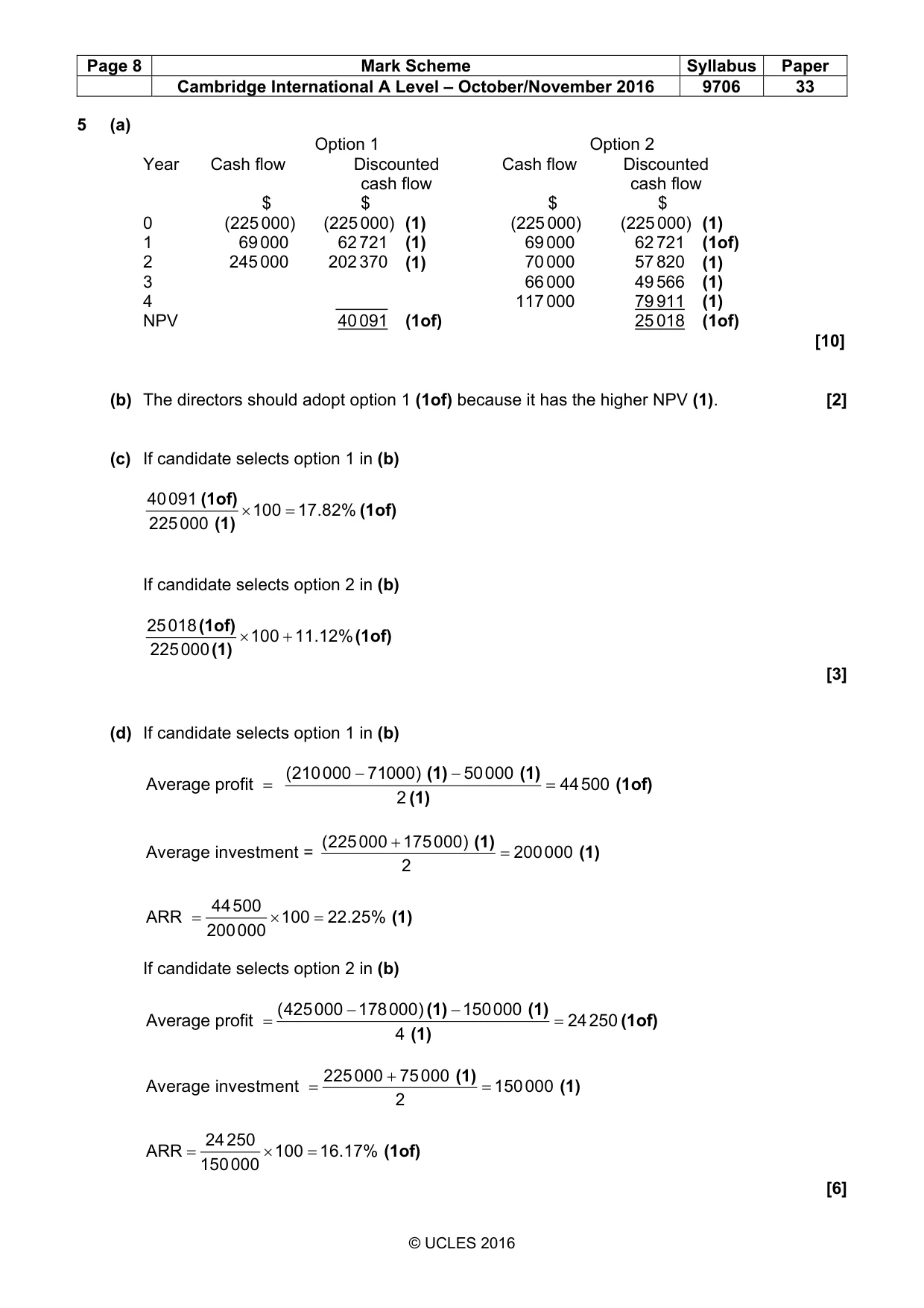
Page 8 Mark Scheme Syllabus Paper Cambridge International A Level – October/November 2016 9706 33 © UCLES 2016 5 (a) Option 1 Option 2 Year Cash flow Discounted cash flow Cash flow Discounted cash flow $ $ $ $ 0 (225 000) (225 000) (1) (225 000) (225 000) (1) 1 69 000 62 721 (1) 69 000 62 721 (1of) 2 245 000 202 370 (1) 70 000 57 820 (1) 3 66 000 49 566 (1) 4 117 000 79 911 (1) NPV 40 091 (1of) 25 018 (1of) [10] (b) The directors should adopt option 1 (1of) because it has the higher NPV (1). [2] (c) If candidate selects option 1 in (b) 40091 100 17.82% 225000 × = (1of) (1of) (1) If candidate selects option 2 in (b) 25018 100 11.12% 225000 × + (1of) (1of) (1) [3] (d) If candidate selects option 1 in (b) (210000 71000) 50000 Average profit 44500 2 − − = = (1) (1) (1of) (1) (225000 175000) Average investment = 200000 2 + = (1) (1) 44500 ARR 100 22.25% 200000 = × = (1) If candidate selects option 2 in (b) (425000 178000) 150000 Average profit 24250 4 − − = = (1) (1) (1of) (1) 225000 75000 Average investment 150000 2 + = = (1) (1) 24250 ARR 100 16.17% 150000 = × = (1of) [6]
Mark scheme, page 9
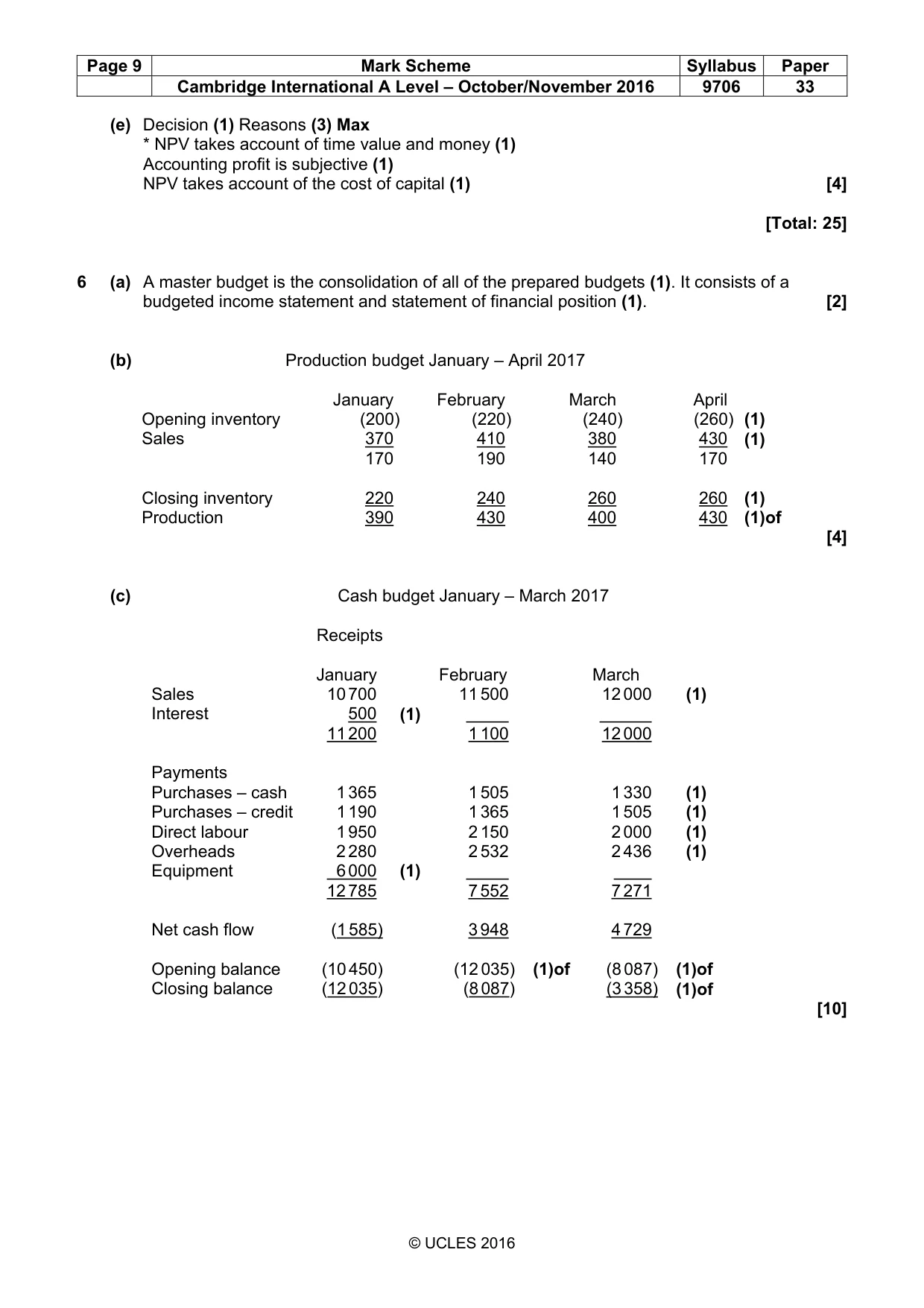
Page 9 Mark Scheme Syllabus Paper Cambridge International A Level – October/November 2016 9706 33 © UCLES 2016 (e) Decision (1) Reasons (3) Max * NPV takes account of time value and money (1) Accounting profit is subjective (1) NPV takes account of the cost of capital (1) [4] [Total: 25] 6 (a) A master budget is the consolidation of all of the prepared budgets (1). It consists of a budgeted income statement and statement of financial position (1). [2] (b) Production budget January – April 2017 January February March April Opening inventory (200) (220) (240) (260) (1) Sales 370 410 380 430 (1) 170 190 140 170 Closing inventory 220 240 260 260 (1) Production 390 430 400 430 (1)of [4] (c) Cash budget January – March 2017 Receipts January February March Sales 10 700 11 500 12 000 (1) Interest 500 (1) 11 200 1 100 12 000 Payments Purchases – cash 1 365 1 505 1 330 (1) Purchases – credit 1 190 1 365 1 505 (1) Direct labour 1 950 2 150 2 000 (1) Overheads 2 280 2 532 2 436 (1) Equipment 6 000 (1) 12 785 7 552 7 271 Net cash flow (1 585) 3 948 4 729 Opening balance (10 450) (12 035) (1)of (8 087) (1)of Closing balance (12 035) (8 087) (3 358) (1)of [10]
Mark scheme, page 10
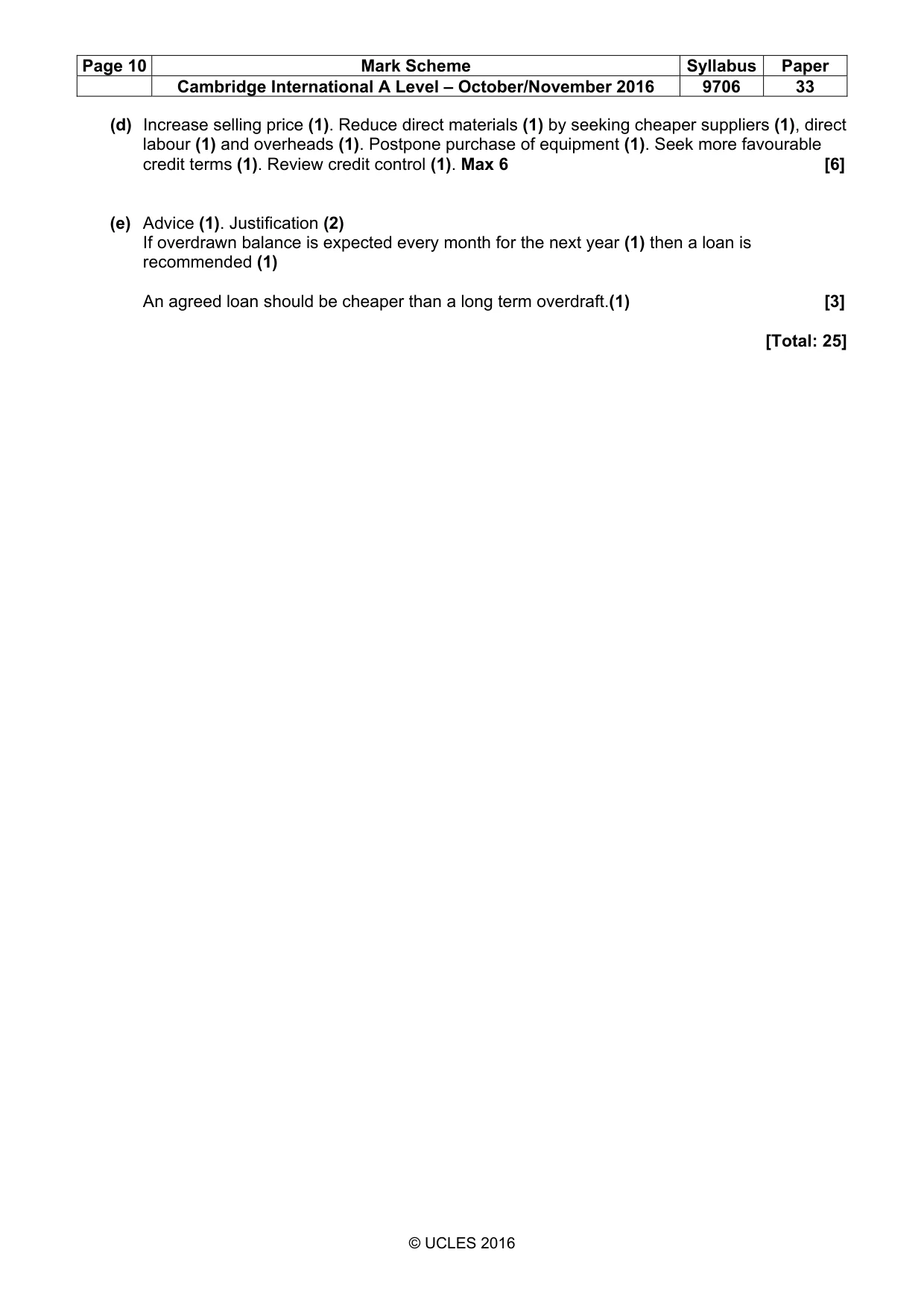
Page 10 Mark Scheme Syllabus Paper Cambridge International A Level – October/November 2016 9706 33 © UCLES 2016 (d) Increase selling price (1). Reduce direct materials (1) by seeking cheaper suppliers (1), direct labour (1) and overheads (1). Postpone purchase of equipment (1). Seek more favourable credit terms (1). Review credit control (1). Max 6 [6] (e) Advice (1). Justification (2) If overdrawn balance is expected every month for the next year (1) then a loan is recommended (1) An agreed loan should be cheaper than a long term overdraft.(1) [3] [Total: 25]
What you needed in this session
Cambridge’s own grade thresholds for 2016 Oct/Nov, Paper 3 · Variant 3. A higher threshold means an easier paper — the bar moves with how the cohort did.