Cambridge A Level Accounting 9706 — 2016 Oct/Nov Paper 3 · Variant 2
9706/32/O/N/16 · 150 marks · ≈169 min
The question paper and its mark scheme, free to read here and free to download. This is Cambridge’s own paper, exactly as it was sat.
Question paper12 pages

Mark scheme10 pages
Answers below. Sit the paper first if you are practising.
Paper as text
Question paper, page 1
This document consists of 10 printed pages, 2 blank pages and 1 insert. IB16 11_9706_32/7RP © UCLES 2016 [Turn over Cambridge International Examinations Cambridge International Advanced Subsidiary and Advanced Level ACCOUNTING 9706/32 Paper 3 Structured Questions October/November 2016 3 hours No Additional Materials are required. READ THESE INSTRUCTIONS FIRST An answer booklet is provided inside this question paper. You should follow the instructions on the front cover of the answer booklet. If you need additional answer paper ask the invigilator for a continuation booklet. Answer all questions. All accounting statements are to be presented in good style. International accounting terms and formats should be used as appropriate. Workings should be shown. You may use a calculator. The number of marks is given in brackets [ ] at the end of each question or part question.
Question paper, page 2
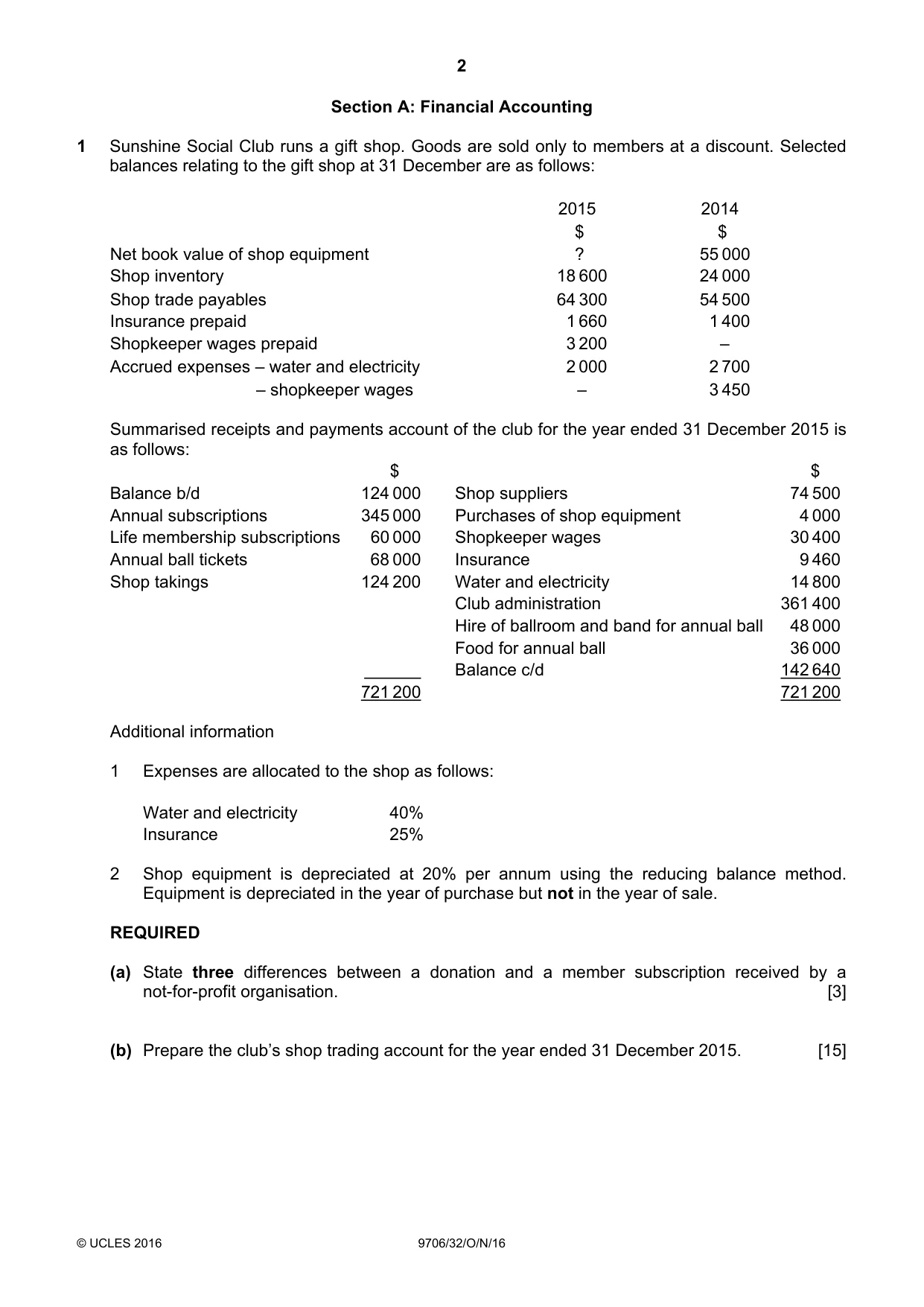
2 © UCLES 2016 9706/32/O/N/16 Section A: Financial Accounting 1 Sunshine Social Club runs a gift shop. Goods are sold only to members at a discount. Selected balances relating to the gift shop at 31 December are as follows: 2015 2014 $ $ Net book value of shop equipment ? 55 000 Shop inventory 18 600 24 000 Shop trade payables 64 300 54 500 Insurance prepaid 1 660 1 400 Shopkeeper wages prepaid 3 200 – Accrued expenses – water and electricity 2 000 2 700 – shopkeeper wages – 3 450 Summarised receipts and payments account of the club for the year ended 31 December 2015 is as follows: $ $ Balance b/d 124 000 Shop suppliers 74 500 Annual subscriptions 345 000 Purchases of shop equipment 4 000 Life membership subscriptions 60 000 Shopkeeper wages 30 400 Annual ball tickets 68 000 Insurance 9 460 Shop takings 124 200 Water and electricity 14 800 Club administration 361 400 Hire of ballroom and band for annual ball 48 000 Food for annual ball 36 000 Balance c/d 142 640 721 200 721 200 Additional information 1 Expenses are allocated to the shop as follows: Water and electricity 40% Insurance 25% 2 Shop equipment is depreciated at 20% per annum using the reducing balance method. Equipment is depreciated in the year of purchase but not in the year of sale. REQUIRED (a) State three differences between a donation and a member subscription received by a not-for-profit organisation. [3] (b) Prepare the club’s shop trading account for the year ended 31 December 2015. [15]
Question paper, page 3
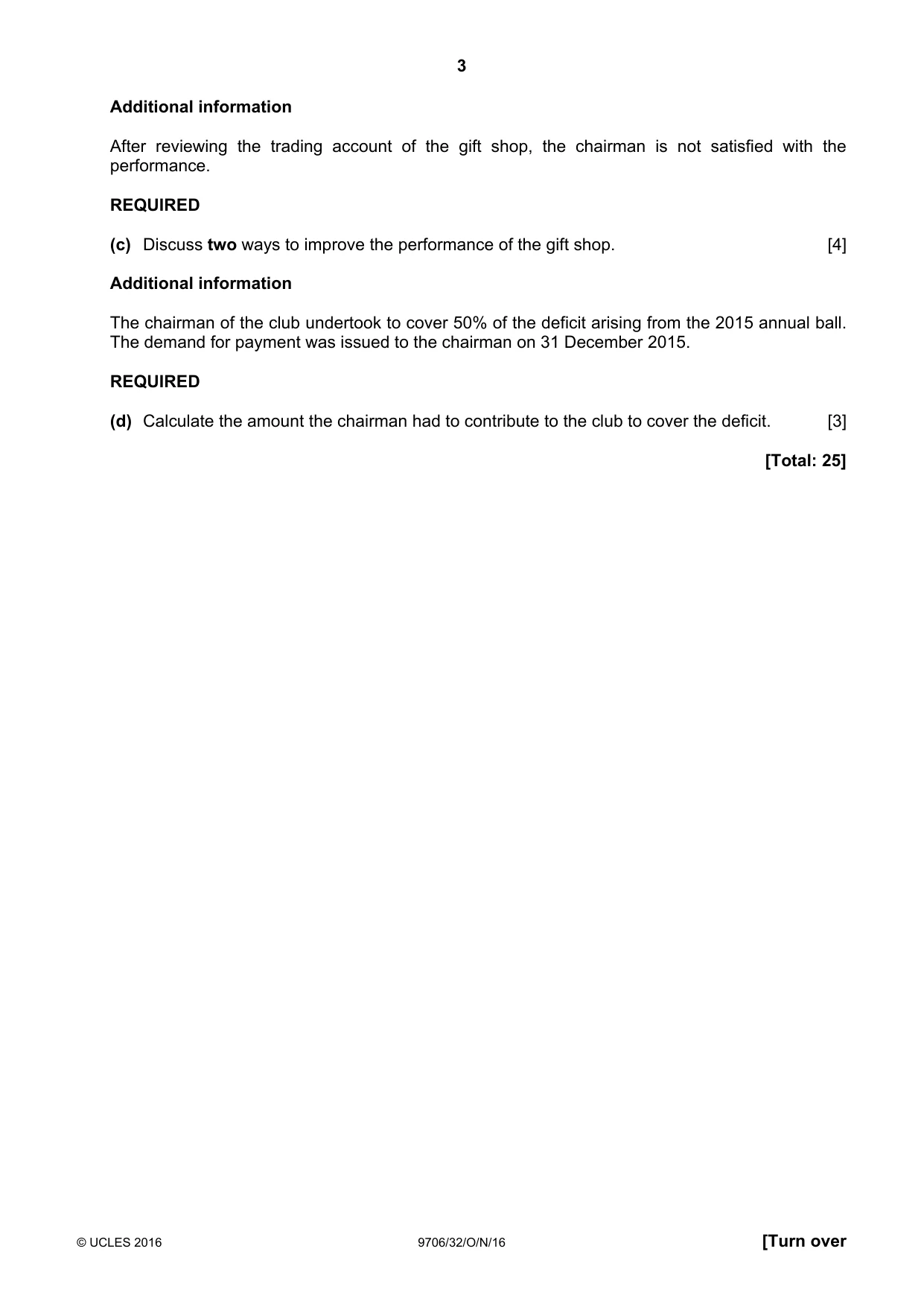
3 © UCLES 2016 9706/32/O/N/16 [Turn over Additional information After reviewing the trading account of the gift shop, the chairman is not satisfied with the performance. REQUIRED (c) Discuss two ways to improve the performance of the gift shop. [4] Additional information The chairman of the club undertook to cover 50% of the deficit arising from the 2015 annual ball. The demand for payment was issued to the chairman on 31 December 2015. REQUIRED (d) Calculate the amount the chairman had to contribute to the club to cover the deficit. [3] [Total: 25]
Question paper, page 4
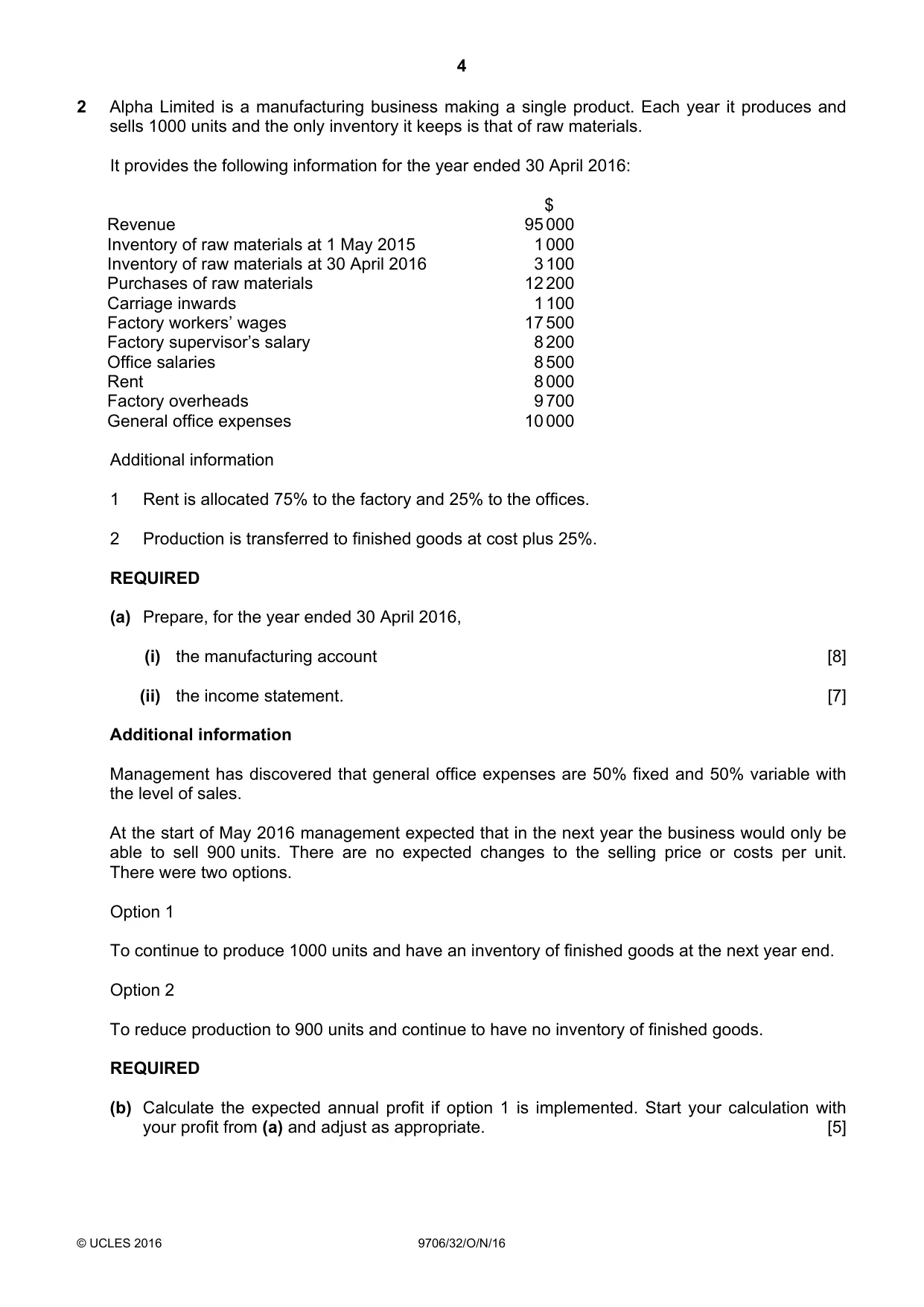
4 © UCLES 2016 9706/32/O/N/16 2 Alpha Limited is a manufacturing business making a single product. Each year it produces and sells 1000 units and the only inventory it keeps is that of raw materials. It provides the following information for the year ended 30 April 2016: $ Revenue 95 000 Inventory of raw materials at 1 May 2015 1 000 Inventory of raw materials at 30 April 2016 3 100 Purchases of raw materials 12 200 Carriage inwards 1 100 Factory workers’ wages 17 500 Factory supervisor’s salary 8 200 Office salaries 8 500 Rent 8 000 Factory overheads 9 700 General office expenses 10 000 Additional information 1 Rent is allocated 75% to the factory and 25% to the offices. 2 Production is transferred to finished goods at cost plus 25%. REQUIRED (a) Prepare, for the year ended 30 April 2016, (i) the manufacturing account [8] (ii) the income statement. [7] Additional information Management has discovered that general office expenses are 50% fixed and 50% variable with the level of sales. At the start of May 2016 management expected that in the next year the business would only be able to sell 900 units. There are no expected changes to the selling price or costs per unit. There were two options. Option 1 To continue to produce 1000 units and have an inventory of finished goods at the next year end. Option 2 To reduce production to 900 units and continue to have no inventory of finished goods. REQUIRED (b) Calculate the expected annual profit if option 1 is implemented. Start your calculation with your profit from (a) and adjust as appropriate. [5]
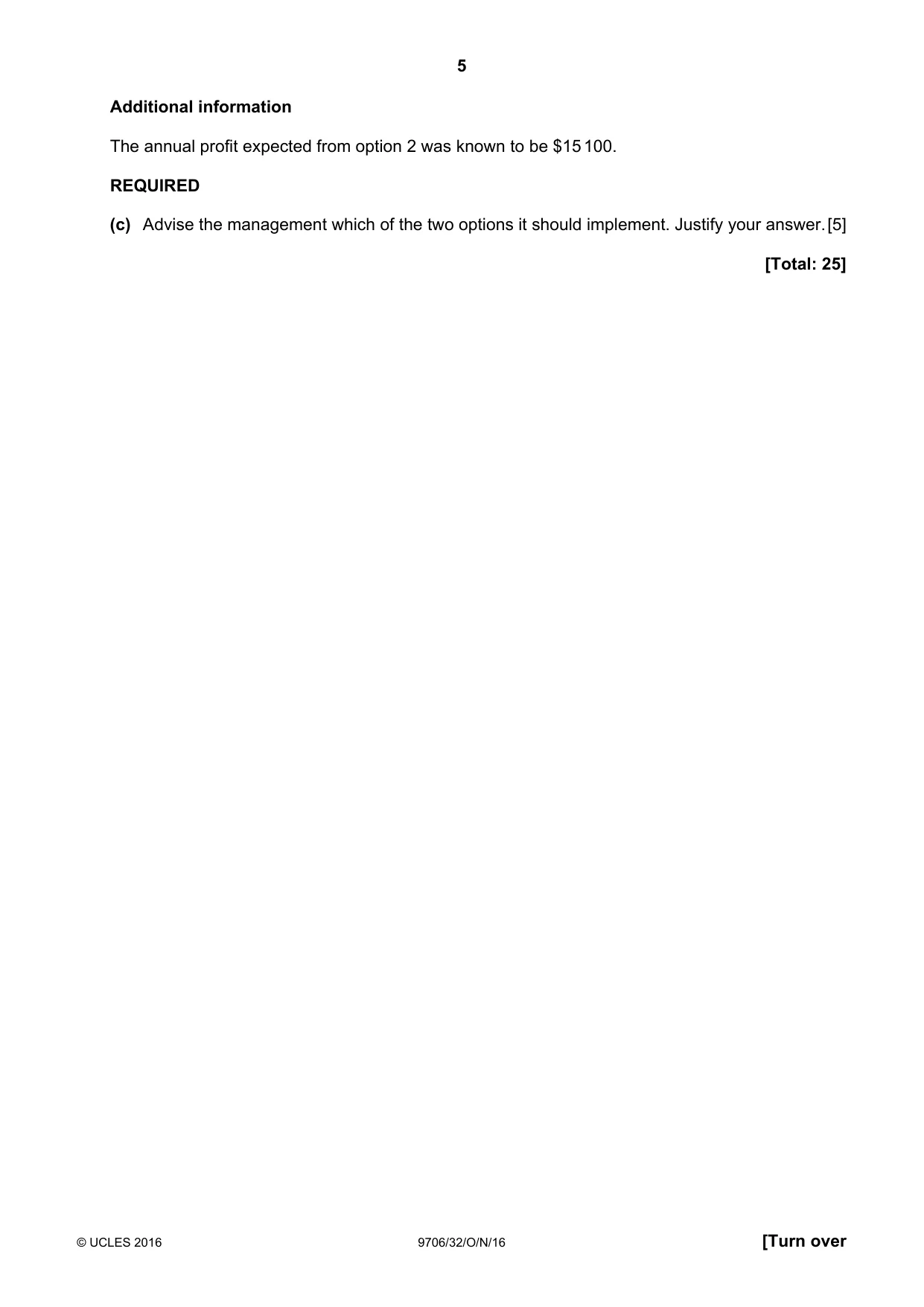
Question paper, page 5
5 © UCLES 2016 9706/32/O/N/16 [Turn over Additional information The annual profit expected from option 2 was known to be $15 100. REQUIRED (c) Advise the management which of the two options it should implement. Justify your answer. [5] [Total: 25]
Question paper, page 6
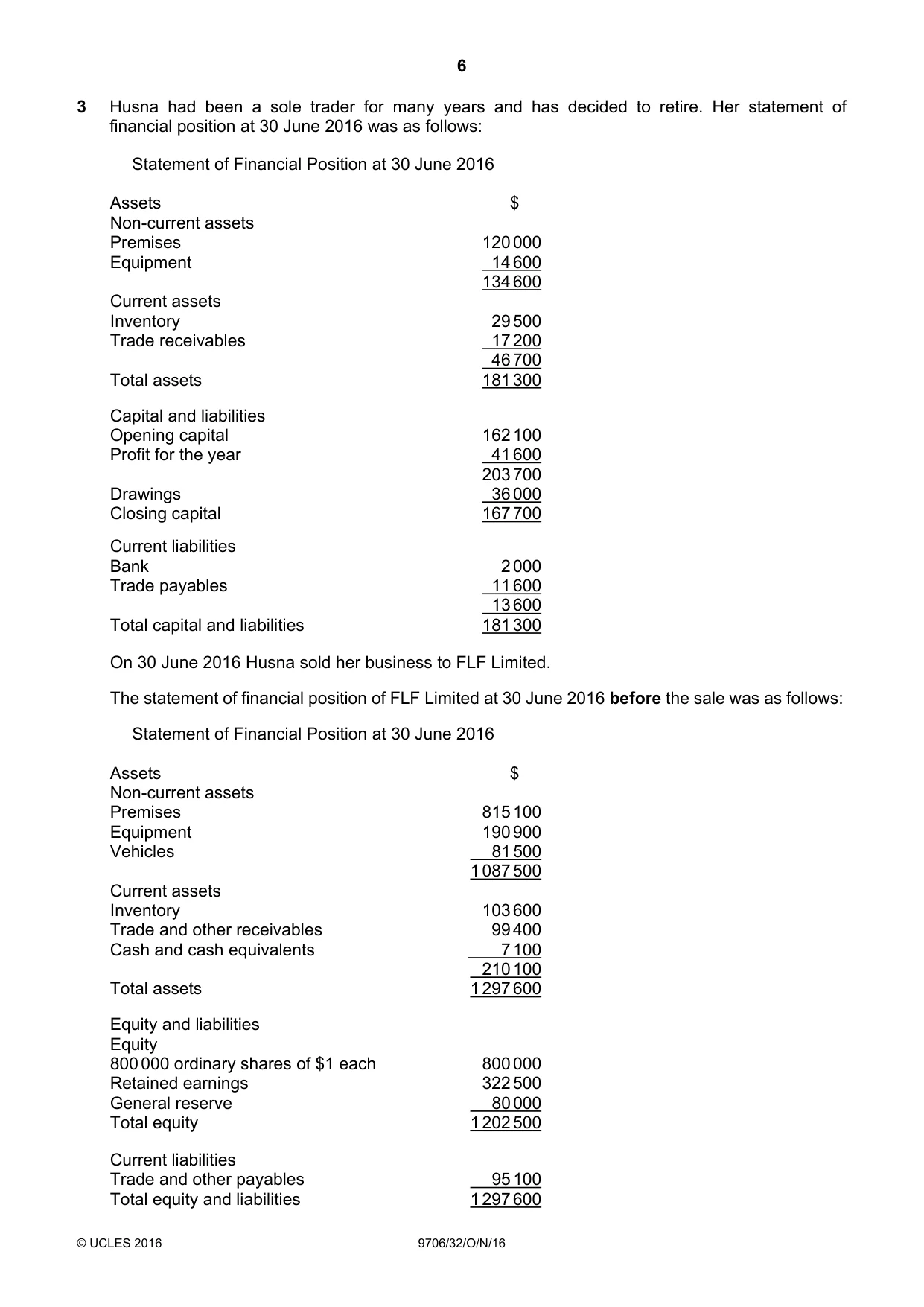
6 © UCLES 2016 9706/32/O/N/16 3 Husna had been a sole trader for many years and has decided to retire. Her statement of financial position at 30 June 2016 was as follows: Statement of Financial Position at 30 June 2016 Assets $ Non-current assets Premises 120 000 Equipment 14 600 134 600 Current assets Inventory 29 500 Trade receivables 17 200 46 700 Total assets 181 300 Capital and liabilities Opening capital 162 100 Profit for the year 41 600 203 700 Drawings 36 000 Closing capital 167 700 Current liabilities Bank 2 000 Trade payables 11 600 13 600 Total capital and liabilities 181 300 On 30 June 2016 Husna sold her business to FLF Limited. The statement of financial position of FLF Limited at 30 June 2016 before the sale was as follows: Statement of Financial Position at 30 June 2016 Assets $ Non-current assets Premises 815 100 Equipment 190 900 Vehicles 81 500 1 087 500 Current assets Inventory 103 600 Trade and other receivables 99 400 Cash and cash equivalents 7 100 210 100 Total assets 1 297 600 Equity and liabilities Equity 800 000 ordinary shares of $1 each 800 000 Retained earnings 322 500 General reserve 80 000 Total equity 1 202 500 Current liabilities Trade and other payables 95 100 Total equity and liabilities 1 297 600
Question paper, page 7
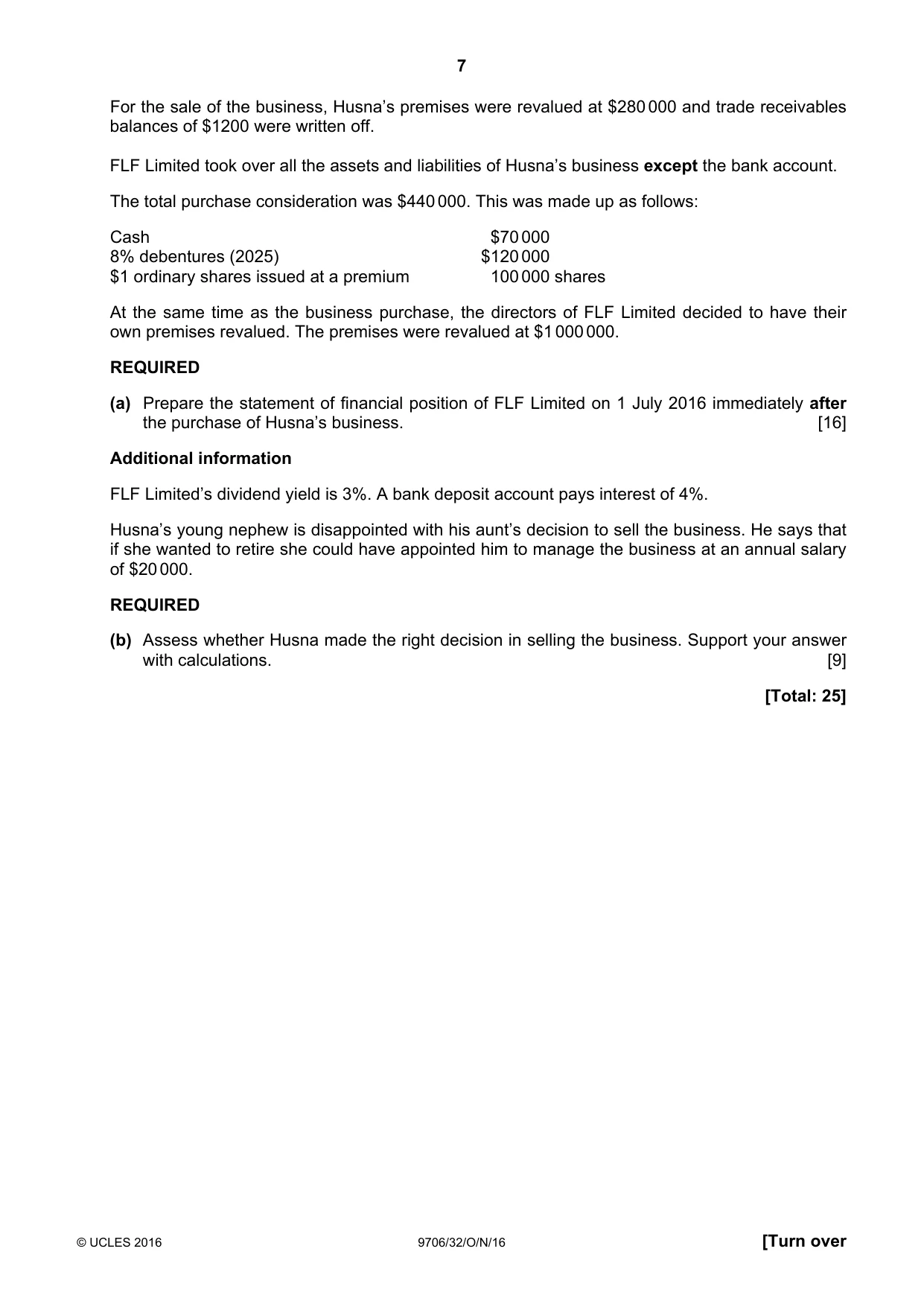
7 © UCLES 2016 9706/32/O/N/16 [Turn over For the sale of the business, Husna’s premises were revalued at $280 000 and trade receivables balances of $1200 were written off. FLF Limited took over all the assets and liabilities of Husna’s business except the bank account. The total purchase consideration was $440 000. This was made up as follows: Cash $70 000 8% debentures (2025) $120 000 $1 ordinary shares issued at a premium 100 000 shares At the same time as the business purchase, the directors of FLF Limited decided to have their own premises revalued. The premises were revalued at $1 000 000. REQUIRED (a) Prepare the statement of financial position of FLF Limited on 1 July 2016 immediately after the purchase of Husna’s business. [16] Additional information FLF Limited’s dividend yield is 3%. A bank deposit account pays interest of 4%. Husna’s young nephew is disappointed with his aunt’s decision to sell the business. He says that if she wanted to retire she could have appointed him to manage the business at an annual salary of $20 000. REQUIRED (b) Assess whether Husna made the right decision in selling the business. Support your answer with calculations. [9] [Total: 25]
Question paper, page 8
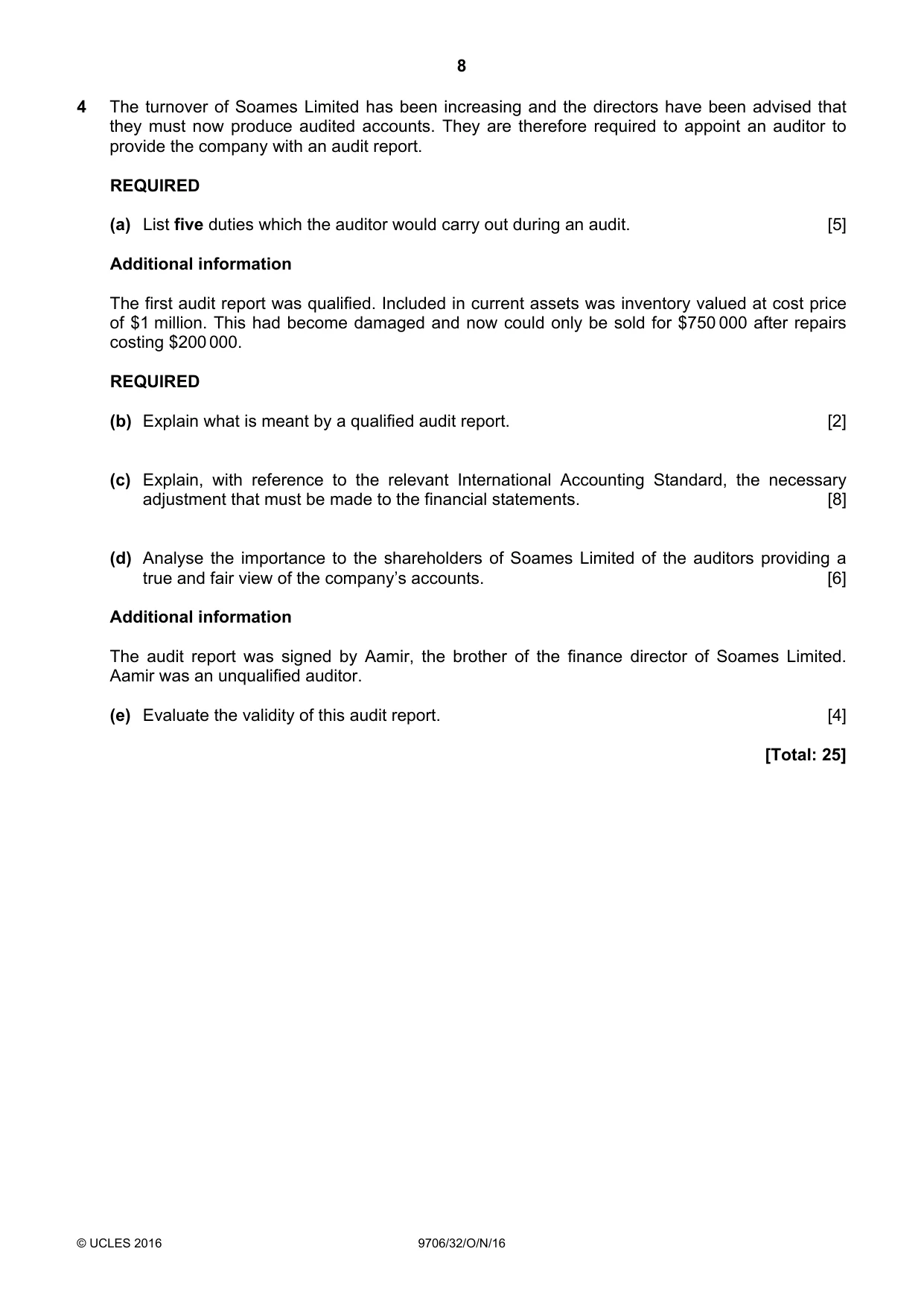
8 © UCLES 2016 9706/32/O/N/16 4 The turnover of Soames Limited has been increasing and the directors have been advised that they must now produce audited accounts. They are therefore required to appoint an auditor to provide the company with an audit report. REQUIRED (a) List five duties which the auditor would carry out during an audit. [5] Additional information The first audit report was qualified. Included in current assets was inventory valued at cost price of $1 million. This had become damaged and now could only be sold for $750 000 after repairs costing $200 000. REQUIRED (b) Explain what is meant by a qualified audit report. [2] (c) Explain, with reference to the relevant International Accounting Standard, the necessary adjustment that must be made to the financial statements. [8] (d) Analyse the importance to the shareholders of Soames Limited of the auditors providing a true and fair view of the company’s accounts. [6] Additional information The audit report was signed by Aamir, the brother of the finance director of Soames Limited. Aamir was an unqualified auditor. (e) Evaluate the validity of this audit report. [4] [Total: 25]
Question paper, page 9
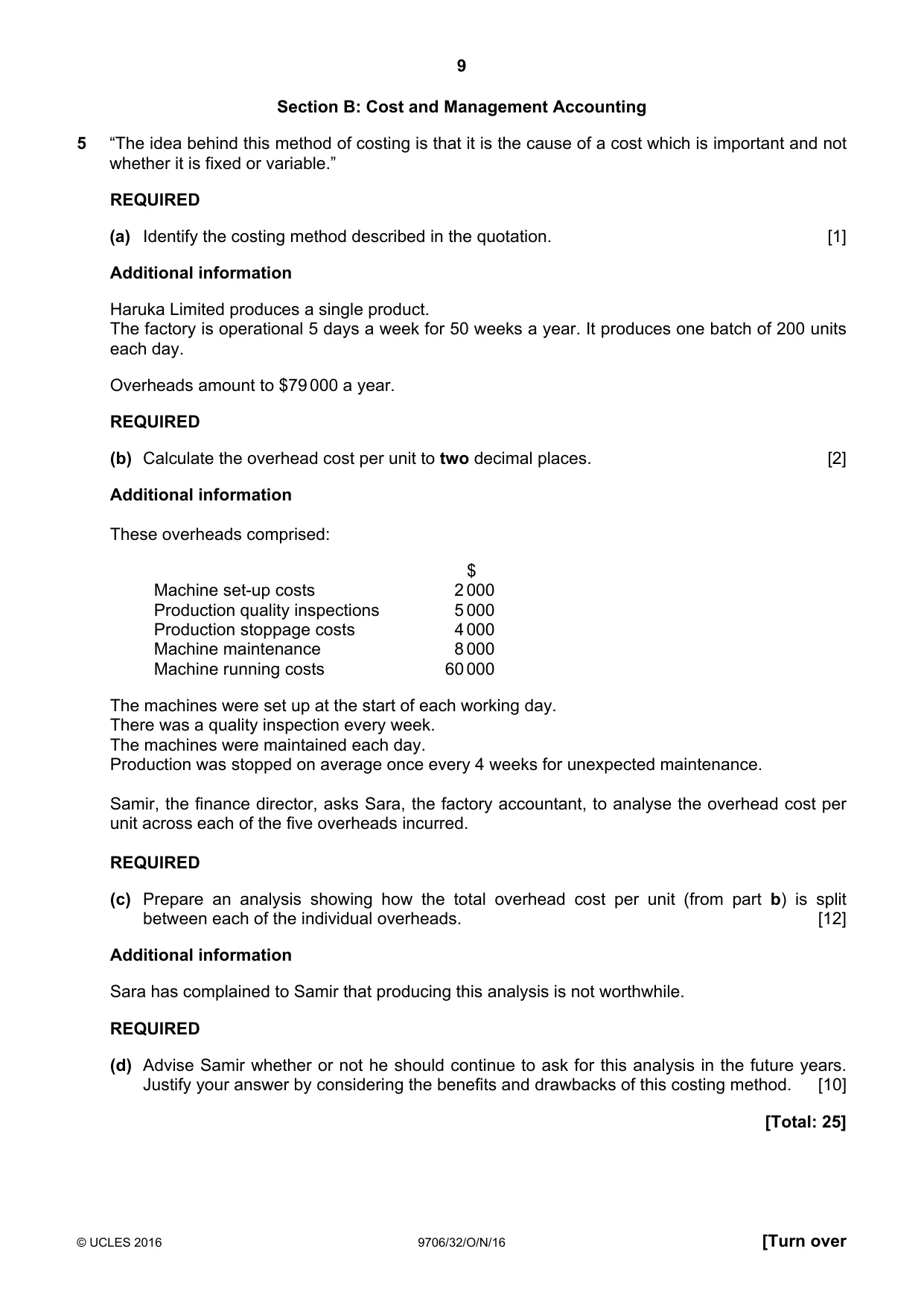
9 © UCLES 2016 9706/32/O/N/16 [Turn over Section B: Cost and Management Accounting 5 “The idea behind this method of costing is that it is the cause of a cost which is important and not whether it is fixed or variable.” REQUIRED (a) Identify the costing method described in the quotation. [1] Additional information Haruka Limited produces a single product. The factory is operational 5 days a week for 50 weeks a year. It produces one batch of 200 units each day. Overheads amount to $79 000 a year. REQUIRED (b) Calculate the overhead cost per unit to two decimal places. [2] Additional information These overheads comprised: $ Machine set-up costs 2 000 Production quality inspections 5 000 Production stoppage costs 4 000 Machine maintenance 8 000 Machine running costs 60 000 The machines were set up at the start of each working day. There was a quality inspection every week. The machines were maintained each day. Production was stopped on average once every 4 weeks for unexpected maintenance. Samir, the finance director, asks Sara, the factory accountant, to analyse the overhead cost per unit across each of the five overheads incurred. REQUIRED (c) Prepare an analysis showing how the total overhead cost per unit (from part b) is split between each of the individual overheads. [12] Additional information Sara has complained to Samir that producing this analysis is not worthwhile. REQUIRED (d) Advise Samir whether or not he should continue to ask for this analysis in the future years. Justify your answer by considering the benefits and drawbacks of this costing method. [10] [Total: 25]
Question paper, page 10
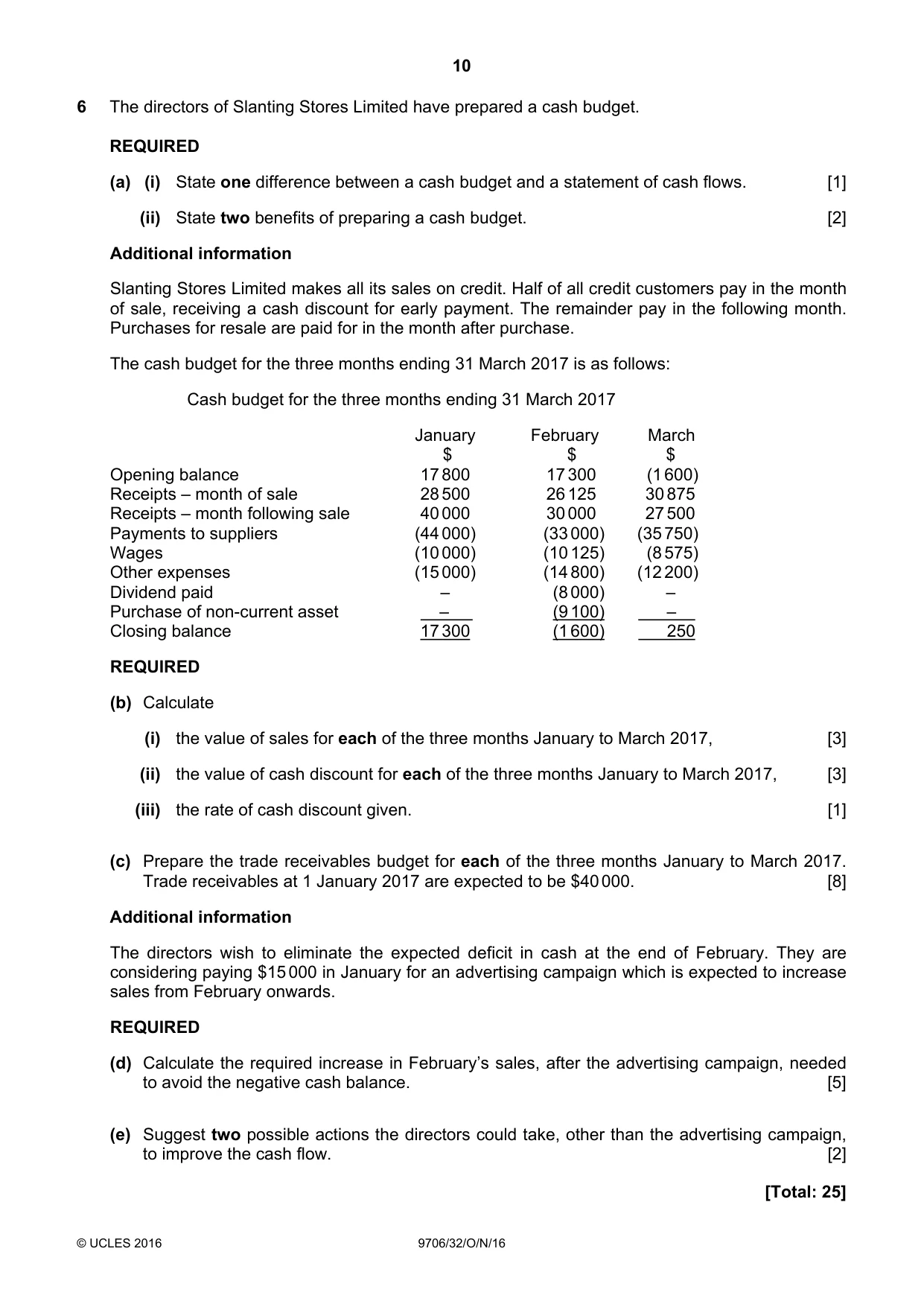
10 © UCLES 2016 9706/32/O/N/16 6 The directors of Slanting Stores Limited have prepared a cash budget. REQUIRED (a) (i) State one difference between a cash budget and a statement of cash flows. [1] (ii) State two benefits of preparing a cash budget. [2] Additional information Slanting Stores Limited makes all its sales on credit. Half of all credit customers pay in the month of sale, receiving a cash discount for early payment. The remainder pay in the following month. Purchases for resale are paid for in the month after purchase. The cash budget for the three months ending 31 March 2017 is as follows: Cash budget for the three months ending 31 March 2017 January February March $ $ $ Opening balance 17 800 17 300 (1 600) Receipts – month of sale 28 500 26 125 30 875 Receipts – month following sale 40 000 30 000 27 500 Payments to suppliers (44 000) (33 000) (35 750) Wages (10 000) (10 125) (8 575) Other expenses (15 000) (14 800) (12 200) Dividend paid – (8 000) – Purchase of non-current asset – (9 100) – Closing balance 17 300 (1 600) 250 REQUIRED (b) Calculate (i) the value of sales for each of the three months January to March 2017, [3] (ii) the value of cash discount for each of the three months January to March 2017, [3] (iii) the rate of cash discount given. [1] (c) Prepare the trade receivables budget for each of the three months January to March 2017. Trade receivables at 1 January 2017 are expected to be $40 000. [8] Additional information The directors wish to eliminate the expected deficit in cash at the end of February. They are considering paying $15 000 in January for an advertising campaign which is expected to increase sales from February onwards. REQUIRED (d) Calculate the required increase in February’s sales, after the advertising campaign, needed to avoid the negative cash balance. [5] (e) Suggest two possible actions the directors could take, other than the advertising campaign, to improve the cash flow. [2] [Total: 25]
Question paper, page 11
11 © UCLES 2016 9706/32/O/N/16 BLANK PAGE
Question paper, page 12
12 Permission to reproduce items where third-party owned material protected by copyright is included has been sought and cleared where possible. Every reasonable effort has been made by the publisher (UCLES) to trace copyright holders, but if any items requiring clearance have unwittingly been included, the publisher will be pleased to make amends at the earliest possible opportunity. To avoid the issue of disclosure of answer-related information to candidates, all copyright acknowledgements are reproduced online in the Cambridge International Examinations Copyright Acknowledgements Booklet. This is produced for each series of examinations and is freely available to download at www.cie.org.uk after the live examination series. Cambridge International Examinations is part of the Cambridge Assessment Group. Cambridge Assessment is the brand name of University of Cambridge Local Examinations Syndicate (UCLES), which is itself a department of the University of Cambridge. © UCLES 2016 9706/32/O/N/16 BLANK PAGE
Mark scheme, page 1
® IGCSE is the registered trademark of Cambridge International Examinations. This document consists of 10 printed pages. © UCLES 2016 [Turn over Cambridge International Examinations Cambridge International Advanced Level ACCOUNTING 9706/32 Paper 3 Structured Questions October/November 2016 MARK SCHEME Maximum Mark: 150 Published This mark scheme is published as an aid to teachers and candidates, to indicate the requirements of the examination. It shows the basis on which Examiners were instructed to award marks. It does not indicate the details of the discussions that took place at an Examiners’ meeting before marking began, which would have considered the acceptability of alternative answers. Mark schemes should be read in conjunction with the question paper and the Principal Examiner Report for Teachers. Cambridge will not enter into discussions about these mark schemes. Cambridge is publishing the mark schemes for the October/November 2016 series for most Cambridge IGCSE®, Cambridge International A and AS Level components and some Cambridge O Level components.
Mark scheme, page 2
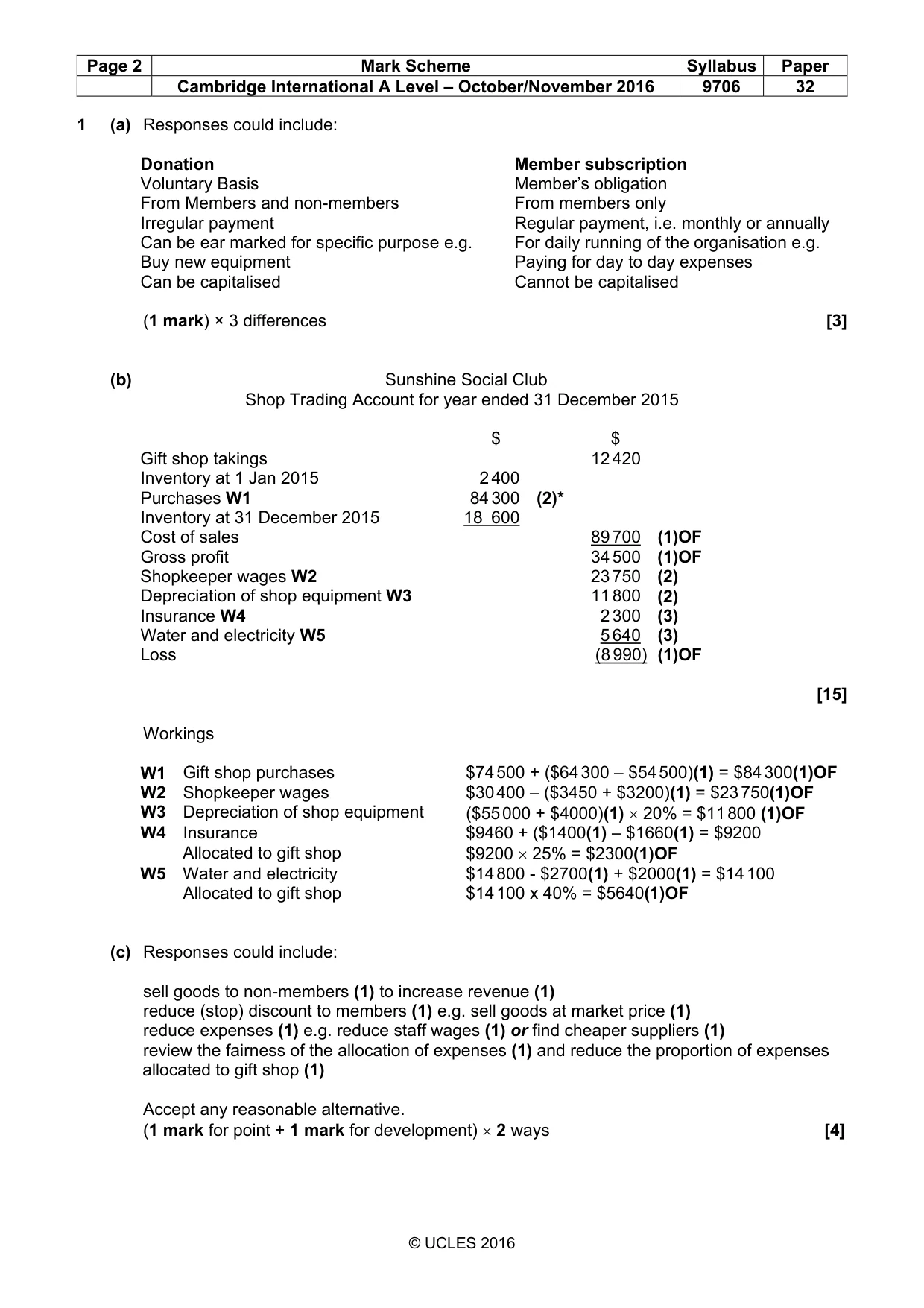
Page 2 Mark Scheme Syllabus Paper Cambridge International A Level – October/November 2016 9706 32 © UCLES 2016 1 (a) Responses could include: Donation Member subscription Voluntary Basis Member’s obligation From Members and non-members From members only Irregular payment Regular payment, i.e. monthly or annually Can be ear marked for specific purpose e.g. For daily running of the organisation e.g. Buy new equipment Paying for day to day expenses Can be capitalised Cannot be capitalised (1 mark) × 3 differences [3] (b) Sunshine Social Club Shop Trading Account for year ended 31 December 2015 $ $ Gift shop takings 12 420 Inventory at 1 Jan 2015 2 400 Purchases W1 84 300 (2)* Inventory at 31 December 2015 18 600 Cost of sales 89 700 (1)OF Gross profit 34 500 (1)OF Shopkeeper wages W2 23 750 (2) Depreciation of shop equipment W3 11 800 (2) Insurance W4 2 300 (3) Water and electricity W5 5 640 (3) Loss (8 990) (1)OF [15] Workings W1 Gift shop purchases $74 500 + ($64 300 – $54 500)(1) = $84 300(1)OF W2 Shopkeeper wages $30 400 – ($3450 + $3200)(1) = $23 750(1)OF W3 Depreciation of shop equipment ($55 000 + $4000)(1) × 20% = $11 800 (1)OF W4 Insurance $9460 + ($1400(1) – $1660(1) = $9200 Allocated to gift shop $9200 × 25% = $2300(1)OF W5 Water and electricity $14 800 - $2700(1) + $2000(1) = $14 100 Allocated to gift shop $14 100 x 40% = $5640(1)OF (c) Responses could include: sell goods to non-members (1) to increase revenue (1) reduce (stop) discount to members (1) e.g. sell goods at market price (1) reduce expenses (1) e.g. reduce staff wages (1) or find cheaper suppliers (1) review the fairness of the allocation of expenses (1) and reduce the proportion of expenses allocated to gift shop (1) Accept any reasonable alternative. (1 mark for point + 1 mark for development) × 2 ways [4]
Mark scheme, page 3
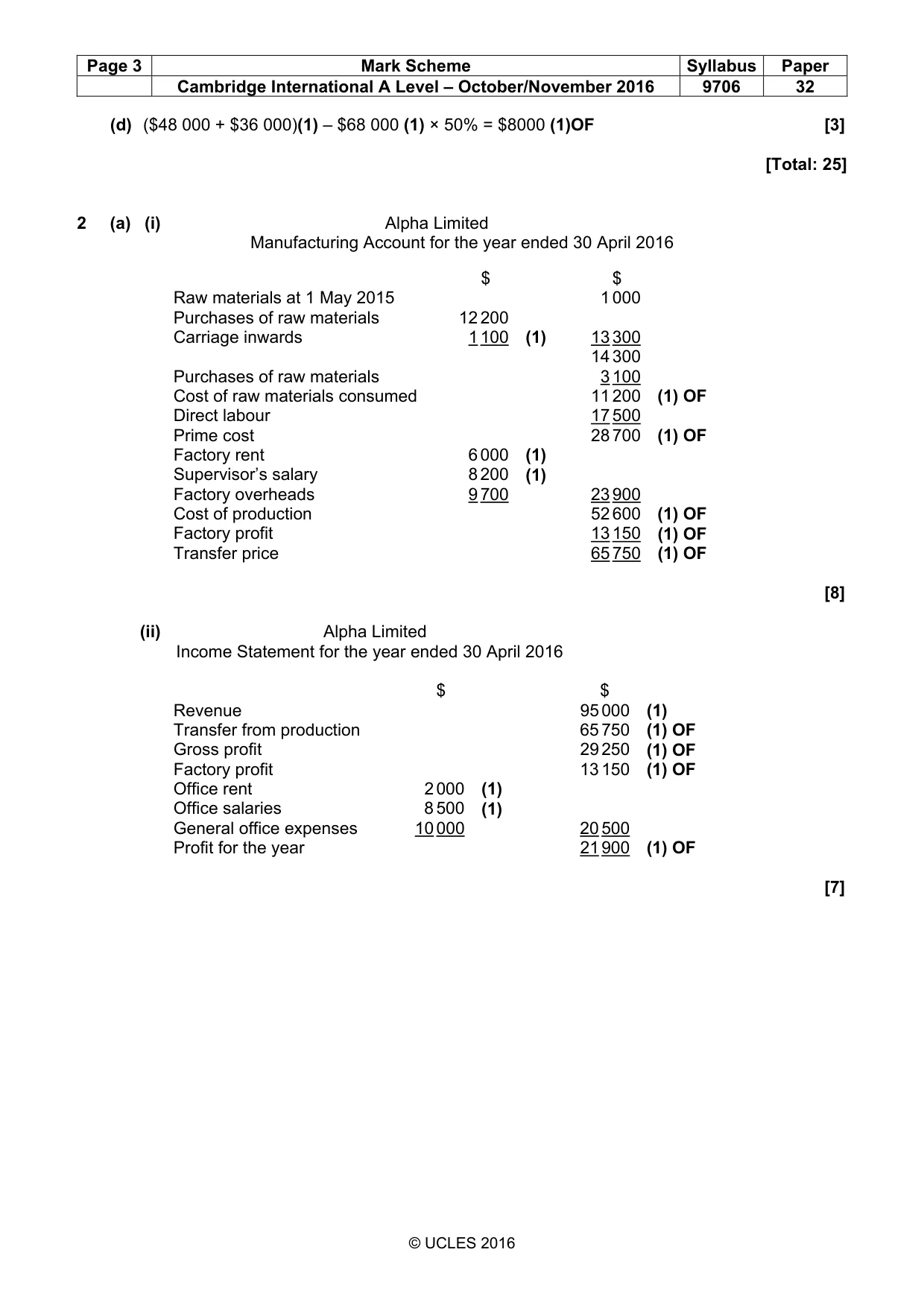
Page 3 Mark Scheme Syllabus Paper Cambridge International A Level – October/November 2016 9706 32 © UCLES 2016 (d) ($48 000 + $36 000)(1) – $68 000 (1) × 50% = $8000 (1)OF [3] [Total: 25] 2 (a) (i) Alpha Limited Manufacturing Account for the year ended 30 April 2016 $ $ Raw materials at 1 May 2015 1 000 Purchases of raw materials 12 200 Carriage inwards 1 100 (1) 13 300 14 300 Purchases of raw materials 3 100 Cost of raw materials consumed 11 200 (1) OF Direct labour 17 500 Prime cost 28 700 (1) OF Factory rent 6 000 (1) Supervisor’s salary 8 200 (1) Factory overheads 9 700 23 900 Cost of production 52 600 (1) OF Factory profit 13 150 (1) OF Transfer price 65 750 (1) OF [8] (ii) Alpha Limited Income Statement for the year ended 30 April 2016 $ $ Revenue 95 000 (1) Transfer from production 65 750 (1) OF Gross profit 29 250 (1) OF Factory profit 13 150 (1) OF Office rent 2 000 (1) Office salaries 8 500 (1) General office expenses 10 000 20 500 Profit for the year 21 900 (1) OF [7]
Mark scheme, page 4
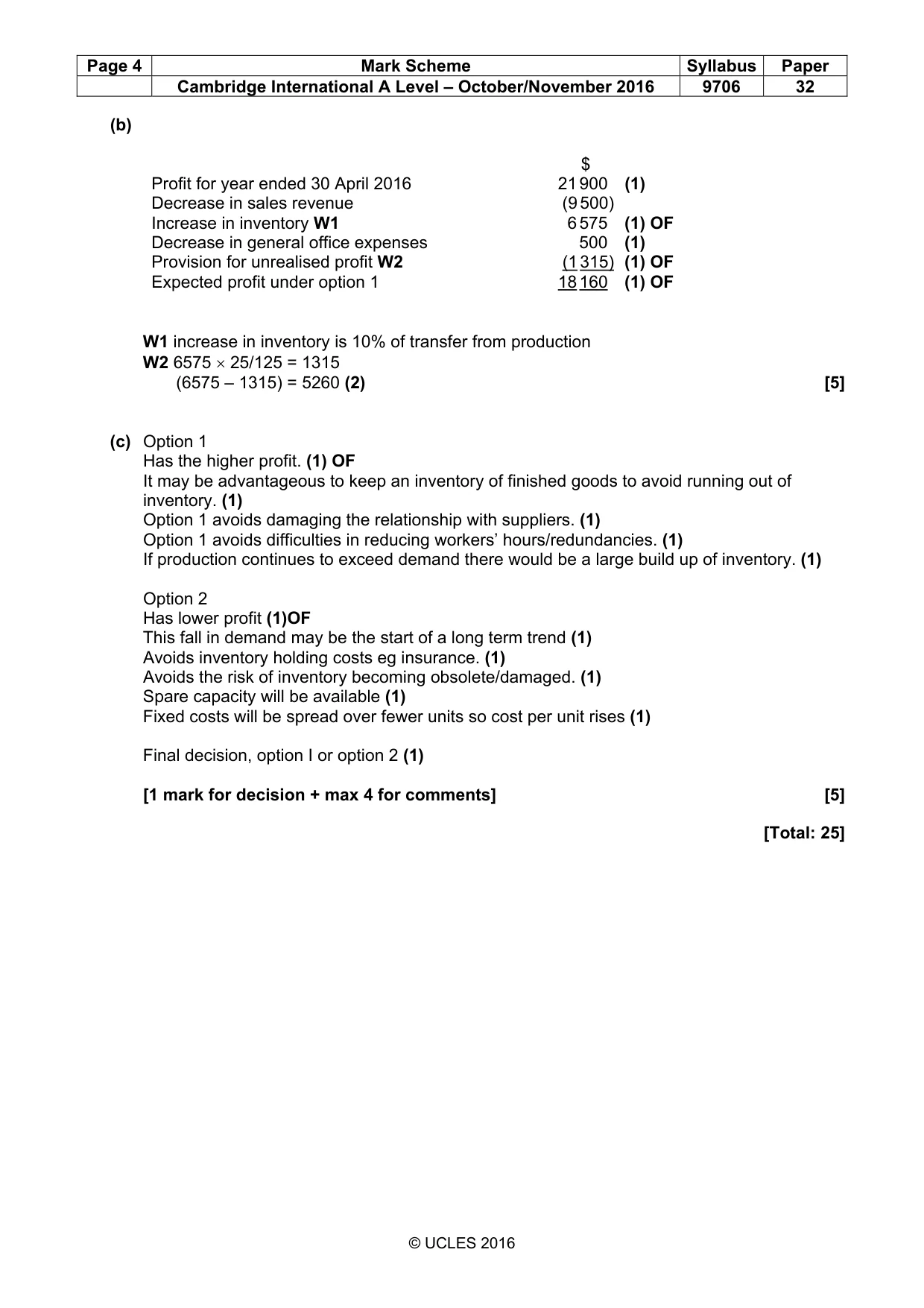
Page 4 Mark Scheme Syllabus Paper Cambridge International A Level – October/November 2016 9706 32 © UCLES 2016 (b) $ Profit for year ended 30 April 2016 21 900 (1) Decrease in sales revenue (9 500) Increase in inventory W1 6 575 (1) OF Decrease in general office expenses 500 (1) Provision for unrealised profit W2 (1 315) (1) OF Expected profit under option 1 18 160 (1) OF W1 increase in inventory is 10% of transfer from production W2 6575 × 25/125 = 1315 (6575 – 1315) = 5260 (2) [5] (c) Option 1 Has the higher profit. (1) OF It may be advantageous to keep an inventory of finished goods to avoid running out of inventory. (1) Option 1 avoids damaging the relationship with suppliers. (1) Option 1 avoids difficulties in reducing workers’ hours/redundancies. (1) If production continues to exceed demand there would be a large build up of inventory. (1) Option 2 Has lower profit (1)OF This fall in demand may be the start of a long term trend (1) Avoids inventory holding costs eg insurance. (1) Avoids the risk of inventory becoming obsolete/damaged. (1) Spare capacity will be available (1) Fixed costs will be spread over fewer units so cost per unit rises (1) Final decision, option I or option 2 (1) [1 mark for decision + max 4 for comments] [5] [Total: 25]
Mark scheme, page 5
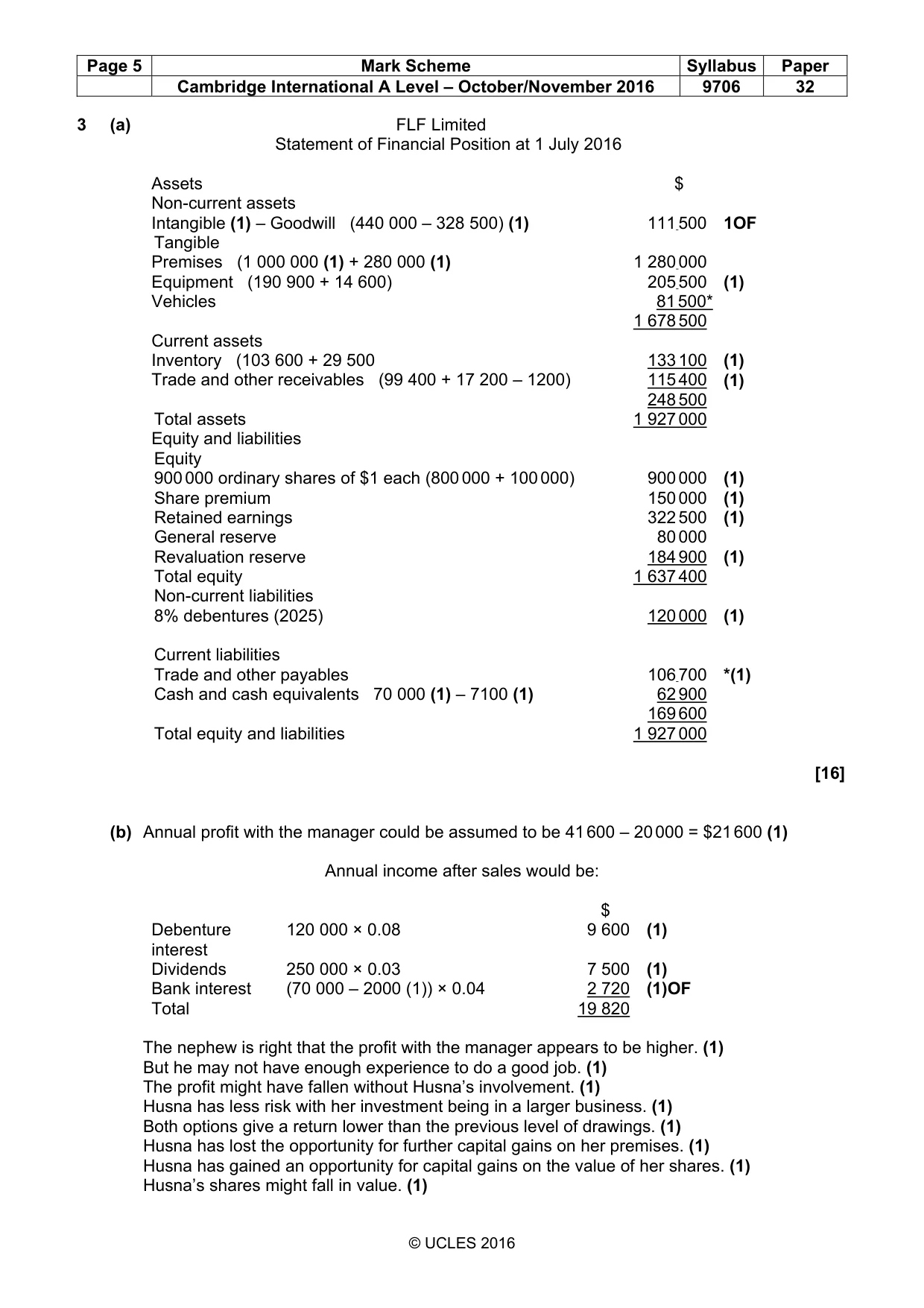
Page 5 Mark Scheme Syllabus Paper Cambridge International A Level – October/November 2016 9706 32 © UCLES 2016 3 (a) FLF Limited Statement of Financial Position at 1 July 2016 Assets $ Non-current assets Intangible (1) – Goodwill (440 000 – 328 500) (1) 111 500 1OF Tangible Premises (1 000 000 (1) + 280 000 (1) 1 280 000 Equipment (190 900 + 14 600) 205 500 (1) Vehicles 81 500* 1 678 500 Current assets Inventory (103 600 + 29 500 133 100 (1) Trade and other receivables (99 400 + 17 200 – 1200) 115 400 (1) 248 500 Total assets 1 927 000 Equity and liabilities Equity 900 000 ordinary shares of $1 each (800 000 + 100 000) 900 000 (1) Share premium 150 000 (1) Retained earnings 322 500 (1) General reserve 80 000 Revaluation reserve 184 900 (1) Total equity 1 637 400 Non-current liabilities 8% debentures (2025) 120 000 (1) Current liabilities Trade and other payables 106 700 *(1) Cash and cash equivalents 70 000 (1) – 7100 (1) 62 900 169 600 Total equity and liabilities 1 927 000 [16] (b) Annual profit with the manager could be assumed to be 41 600 – 20 000 = $21 600 (1) Annual income after sales would be: $ Debenture interest 120 000 × 0.08 9 600 (1) Dividends 250 000 × 0.03 7 500 (1) Bank interest (70 000 – 2000 (1)) × 0.04 2 720 (1)OF Total 19 820 The nephew is right that the profit with the manager appears to be higher. (1) But he may not have enough experience to do a good job. (1) The profit might have fallen without Husna’s involvement. (1) Husna has less risk with her investment being in a larger business. (1) Both options give a return lower than the previous level of drawings. (1) Husna has lost the opportunity for further capital gains on her premises. (1) Husna has gained an opportunity for capital gains on the value of her shares. (1) Husna’s shares might fall in value. (1)
Mark scheme, page 6
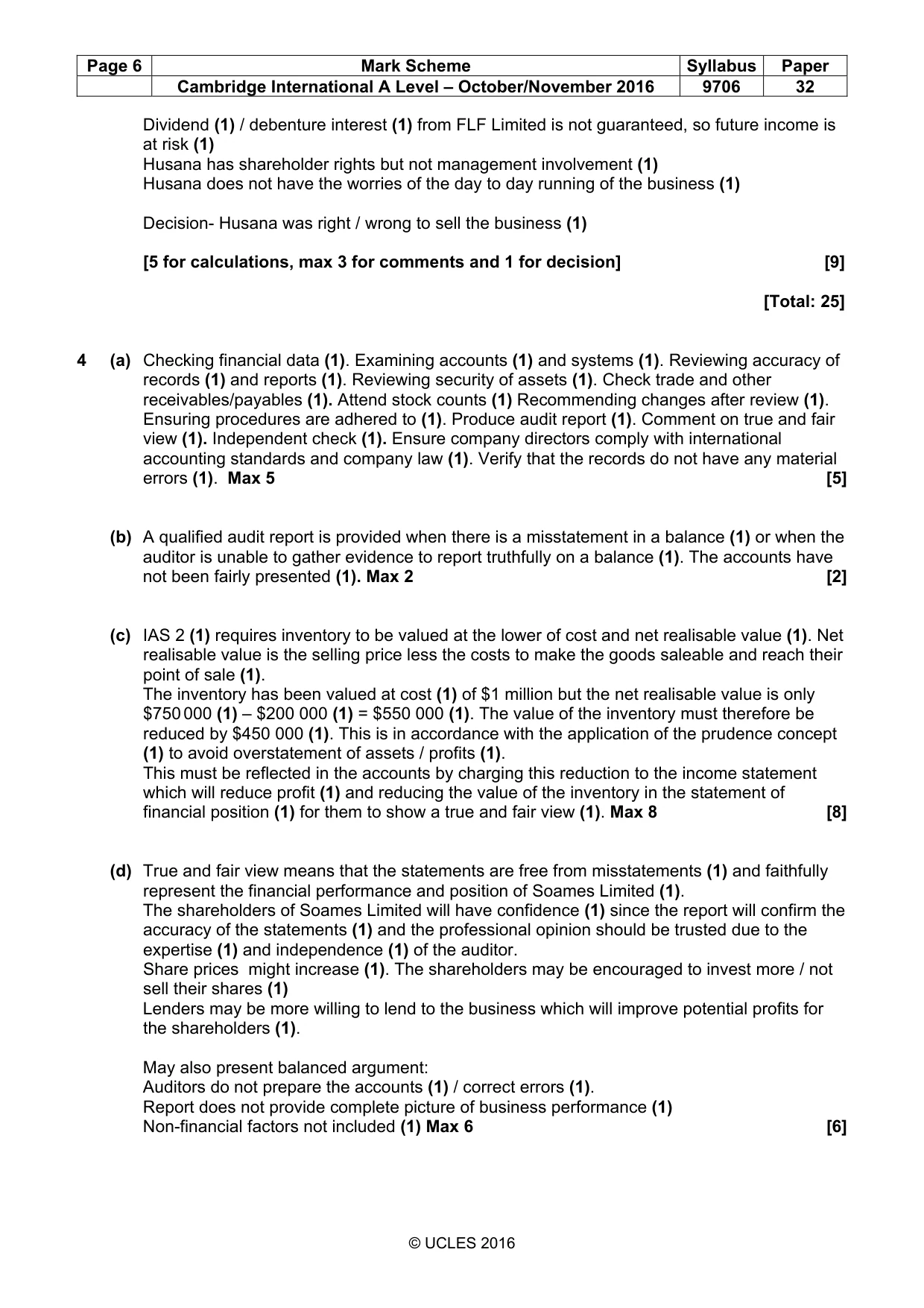
Page 6 Mark Scheme Syllabus Paper Cambridge International A Level – October/November 2016 9706 32 © UCLES 2016 Dividend (1) / debenture interest (1) from FLF Limited is not guaranteed, so future income is at risk (1) Husana has shareholder rights but not management involvement (1) Husana does not have the worries of the day to day running of the business (1) Decision- Husana was right / wrong to sell the business (1) [5 for calculations, max 3 for comments and 1 for decision] [9] [Total: 25] 4 (a) Checking financial data (1). Examining accounts (1) and systems (1). Reviewing accuracy of records (1) and reports (1). Reviewing security of assets (1). Check trade and other receivables/payables (1). Attend stock counts (1) Recommending changes after review (1). Ensuring procedures are adhered to (1). Produce audit report (1). Comment on true and fair view (1). Independent check (1). Ensure company directors comply with international accounting standards and company law (1). Verify that the records do not have any material errors (1). Max 5 [5] (b) A qualified audit report is provided when there is a misstatement in a balance (1) or when the auditor is unable to gather evidence to report truthfully on a balance (1). The accounts have not been fairly presented (1). Max 2 [2] (c) IAS 2 (1) requires inventory to be valued at the lower of cost and net realisable value (1). Net realisable value is the selling price less the costs to make the goods saleable and reach their point of sale (1). The inventory has been valued at cost (1) of $1 million but the net realisable value is only $750 000 (1) – $200 000 (1) = $550 000 (1). The value of the inventory must therefore be reduced by $450 000 (1). This is in accordance with the application of the prudence concept (1) to avoid overstatement of assets / profits (1). This must be reflected in the accounts by charging this reduction to the income statement which will reduce profit (1) and reducing the value of the inventory in the statement of financial position (1) for them to show a true and fair view (1). Max 8 [8] (d) True and fair view means that the statements are free from misstatements (1) and faithfully represent the financial performance and position of Soames Limited (1). The shareholders of Soames Limited will have confidence (1) since the report will confirm the accuracy of the statements (1) and the professional opinion should be trusted due to the expertise (1) and independence (1) of the auditor. Share prices might increase (1). The shareholders may be encouraged to invest more / not sell their shares (1) Lenders may be more willing to lend to the business which will improve potential profits for the shareholders (1). May also present balanced argument: Auditors do not prepare the accounts (1) / correct errors (1). Report does not provide complete picture of business performance (1) Non-financial factors not included (1) Max 6 [6]
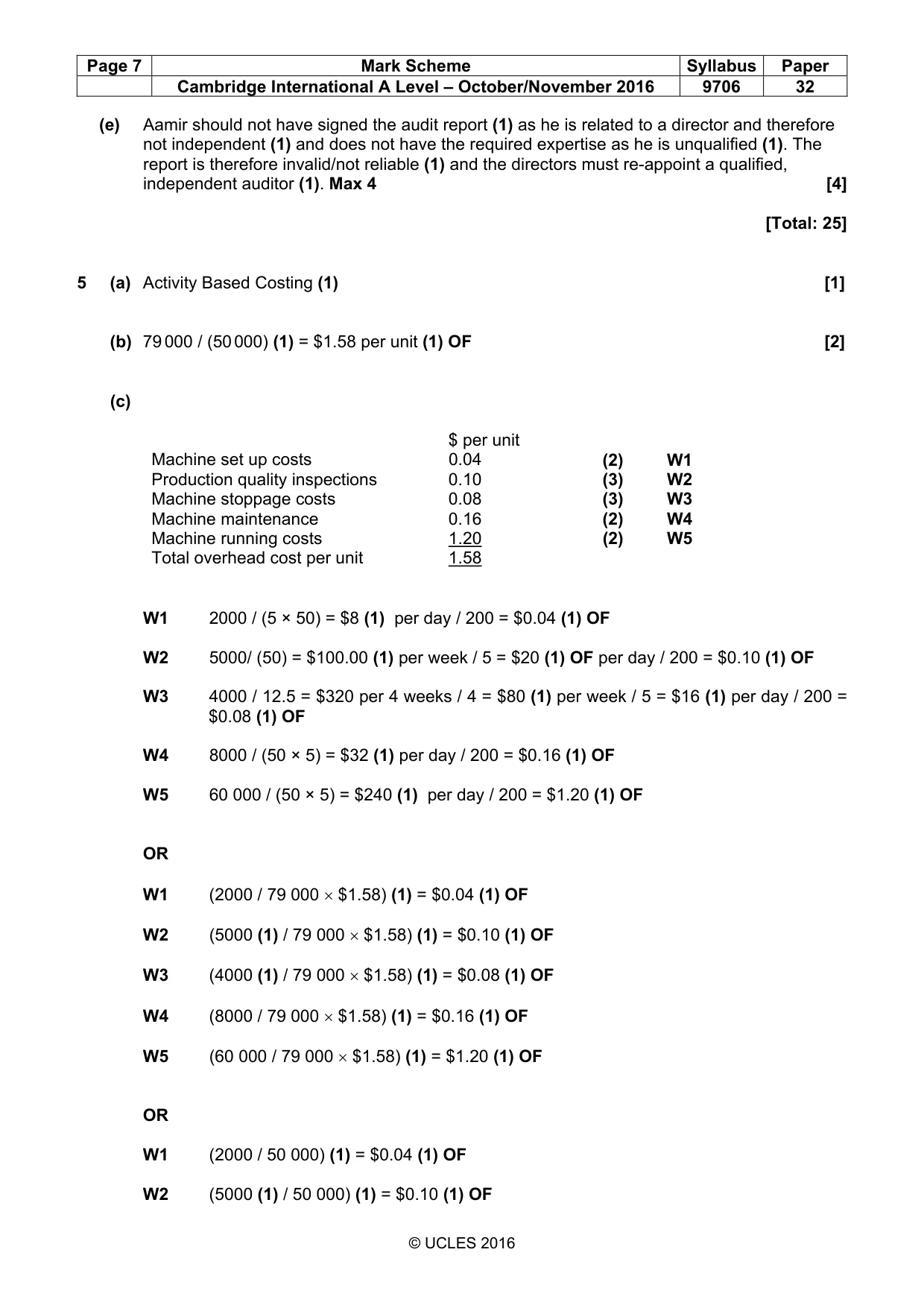
Mark scheme, page 7
Page 7 Mark Scheme Syllabus Paper Cambridge International A Level – October/November 2016 9706 32 © UCLES 2016 (e) Aamir should not have signed the audit report (1) as he is related to a director and therefore not independent (1) and does not have the required expertise as he is unqualified (1). The report is therefore invalid/not reliable (1) and the directors must re-appoint a qualified, independent auditor (1). Max 4 [4] [Total: 25] 5 (a) Activity Based Costing (1) [1] (b) 79 000 / (50 000) (1) = $1.58 per unit (1) OF [2] (c) $ per unit Machine set up costs 0.04 (2) W1 Production quality inspections 0.10 (3) W2 Machine stoppage costs 0.08 (3) W3 Machine maintenance 0.16 (2) W4 Machine running costs 1.20 (2) W5 Total overhead cost per unit 1.58 W1 2000 / (5 × 50) = $8 (1) per day / 200 = $0.04 (1) OF W2 5000/ (50) = $100.00 (1) per week / 5 = $20 (1) OF per day / 200 = $0.10 (1) OF W3 4000 / 12.5 = $320 per 4 weeks / 4 = $80 (1) per week / 5 = $16 (1) per day / 200 = $0.08 (1) OF W4 8000 / (50 × 5) = $32 (1) per day / 200 = $0.16 (1) OF W5 60 000 / (50 × 5) = $240 (1) per day / 200 = $1.20 (1) OF OR W1 (2000 / 79 000 × $1.58) (1) = $0.04 (1) OF W2 (5000 (1) / 79 000 × $1.58) (1) = $0.10 (1) OF W3 (4000 (1) / 79 000 × $1.58) (1) = $0.08 (1) OF W4 (8000 / 79 000 × $1.58) (1) = $0.16 (1) OF W5 (60 000 / 79 000 × $1.58) (1) = $1.20 (1) OF OR W1 (2000 / 50 000) (1) = $0.04 (1) OF W2 (5000 (1) / 50 000) (1) = $0.10 (1) OF
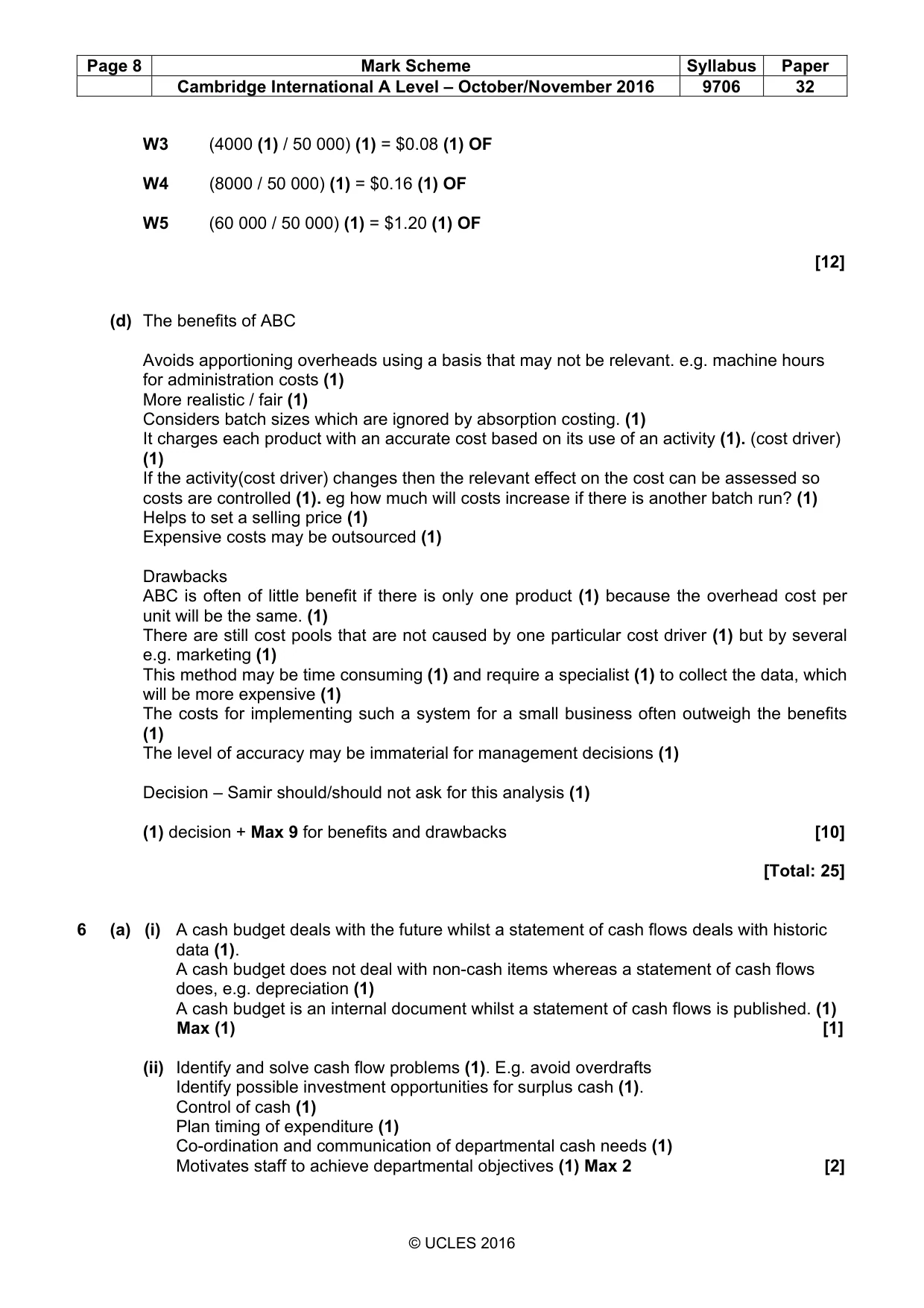
Mark scheme, page 8
Page 8 Mark Scheme Syllabus Paper Cambridge International A Level – October/November 2016 9706 32 © UCLES 2016 W3 (4000 (1) / 50 000) (1) = $0.08 (1) OF W4 (8000 / 50 000) (1) = $0.16 (1) OF W5 (60 000 / 50 000) (1) = $1.20 (1) OF [12] (d) The benefits of ABC Avoids apportioning overheads using a basis that may not be relevant. e.g. machine hours for administration costs (1) More realistic / fair (1) Considers batch sizes which are ignored by absorption costing. (1) It charges each product with an accurate cost based on its use of an activity (1). (cost driver) (1) If the activity(cost driver) changes then the relevant effect on the cost can be assessed so costs are controlled (1). eg how much will costs increase if there is another batch run? (1) Helps to set a selling price (1) Expensive costs may be outsourced (1) Drawbacks ABC is often of little benefit if there is only one product (1) because the overhead cost per unit will be the same. (1) There are still cost pools that are not caused by one particular cost driver (1) but by several e.g. marketing (1) This method may be time consuming (1) and require a specialist (1) to collect the data, which will be more expensive (1) The costs for implementing such a system for a small business often outweigh the benefits (1) The level of accuracy may be immaterial for management decisions (1) Decision – Samir should/should not ask for this analysis (1) (1) decision + Max 9 for benefits and drawbacks [10] [Total: 25] 6 (a) (i) A cash budget deals with the future whilst a statement of cash flows deals with historic data (1). A cash budget does not deal with non-cash items whereas a statement of cash flows does, e.g. depreciation (1) A cash budget is an internal document whilst a statement of cash flows is published. (1) Max (1) [1] (ii) Identify and solve cash flow problems (1). E.g. avoid overdrafts Identify possible investment opportunities for surplus cash (1). Control of cash (1) Plan timing of expenditure (1) Co-ordination and communication of departmental cash needs (1) Motivates staff to achieve departmental objectives (1) Max 2 [2]
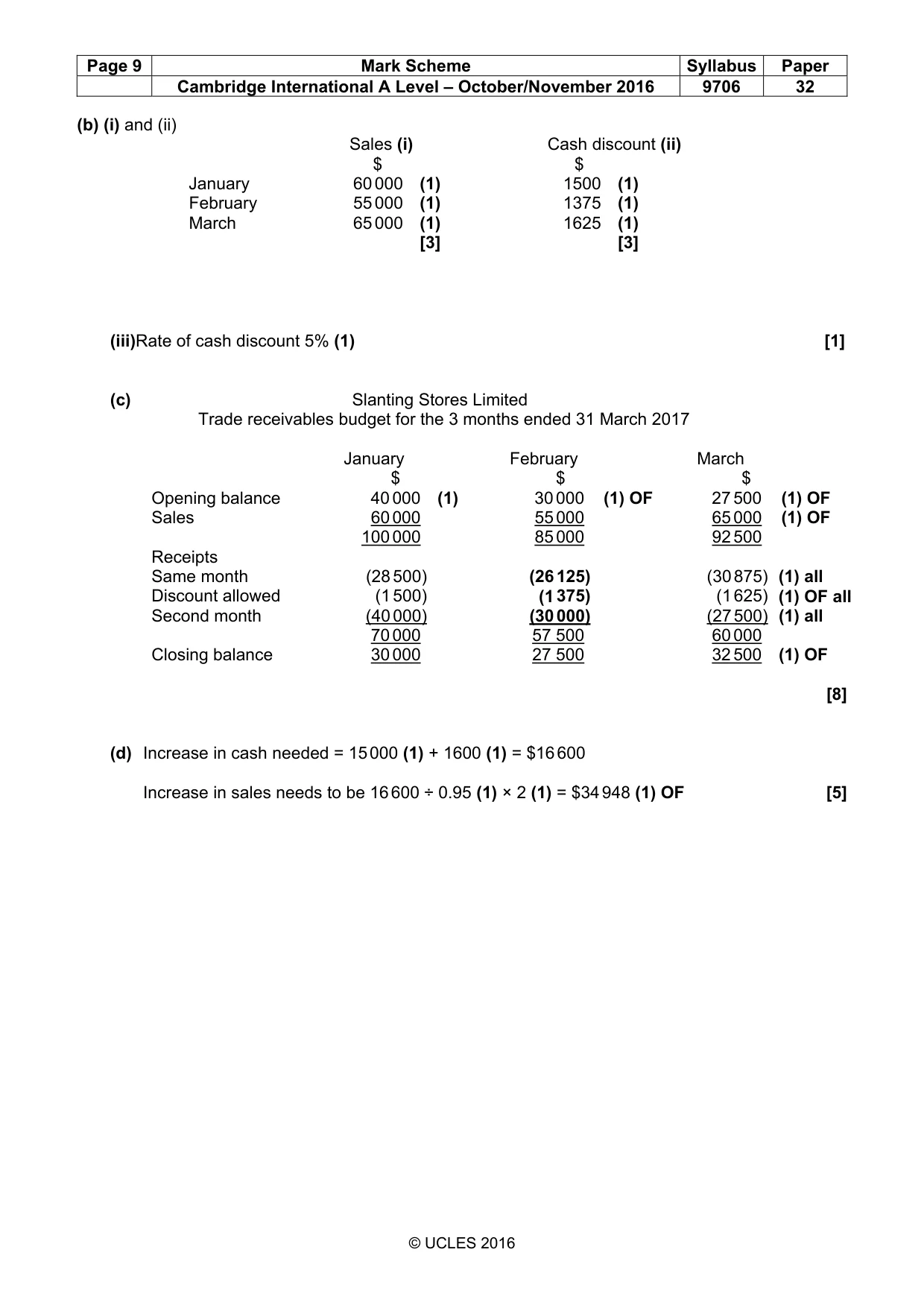
Mark scheme, page 9
Page 9 Mark Scheme Syllabus Paper Cambridge International A Level – October/November 2016 9706 32 © UCLES 2016 (b) (i) and (ii) Sales (i) Cash discount (ii) $ $ January 60 000 (1) 1500 (1) February 55 000 (1) 1375 (1) March 65 000 (1) 1625 (1) [3] [3] (iii)Rate of cash discount 5% (1) [1] (c) Slanting Stores Limited Trade receivables budget for the 3 months ended 31 March 2017 January February March $ $ $ Opening balance 40 000 (1) 30 000 (1) OF 27 500 (1) OF Sales 60 000 55 000 65 000 (1) OF 100 000 85 000 92 500 Receipts Same month (28 500) (26 125) (30 875) (1) all Discount allowed (1 500) (1 375) (1 625) (1) OF all Second month (40 000) (30 000) (27 500) (1) all 70 000 57 500 60 000 Closing balance 30 000 27 500 32 500 (1) OF [8] (d) Increase in cash needed = 15 000 (1) + 1600 (1) = $16 600 Increase in sales needs to be 16 600 ÷ 0.95 (1) × 2 (1) = $34 948 (1) OF [5]
Mark scheme, page 10
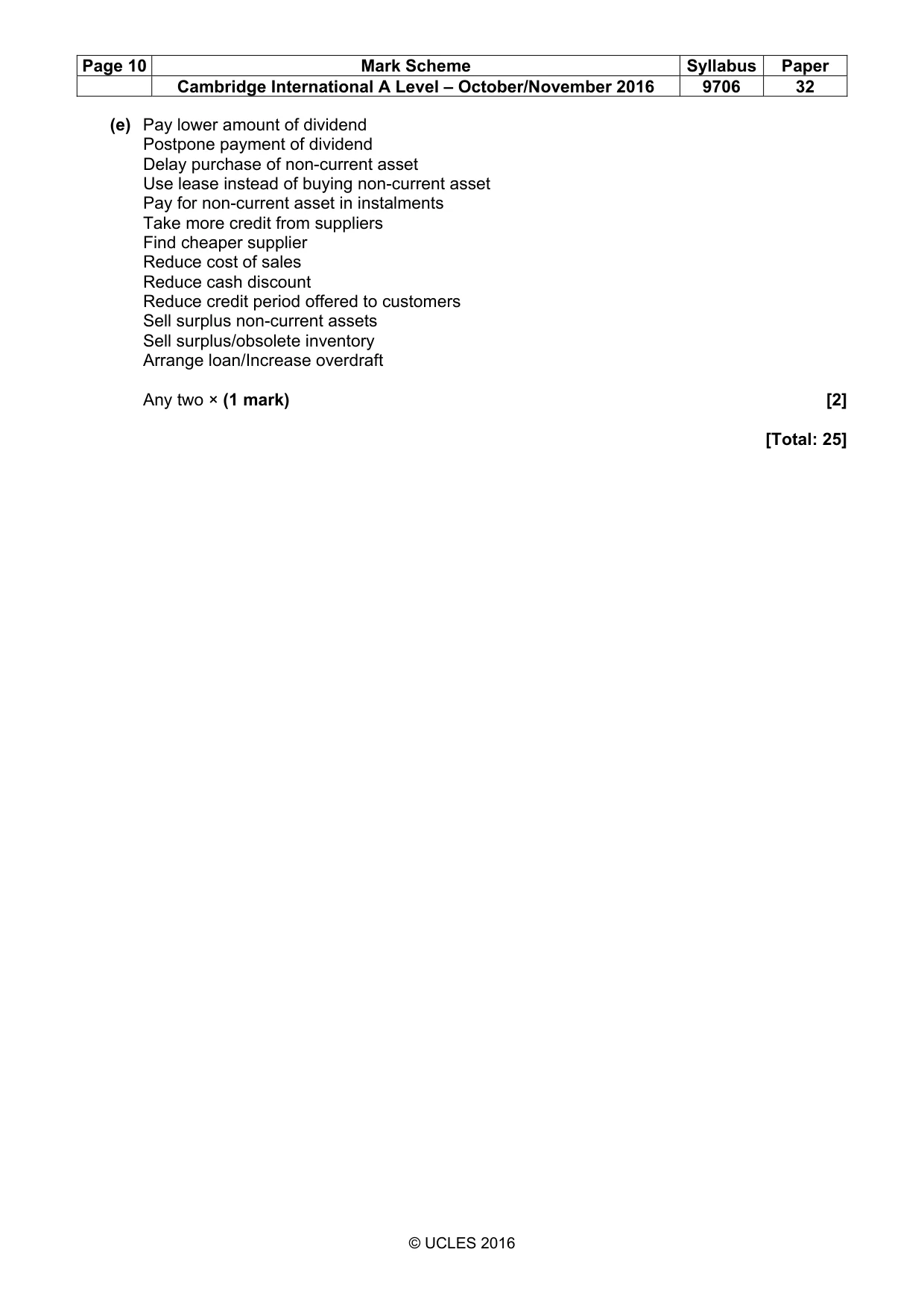
Page 10 Mark Scheme Syllabus Paper Cambridge International A Level – October/November 2016 9706 32 © UCLES 2016 (e) Pay lower amount of dividend Postpone payment of dividend Delay purchase of non-current asset Use lease instead of buying non-current asset Pay for non-current asset in instalments Take more credit from suppliers Find cheaper supplier Reduce cost of sales Reduce cash discount Reduce credit period offered to customers Sell surplus non-current assets Sell surplus/obsolete inventory Arrange loan/Increase overdraft Any two × (1 mark) [2] [Total: 25]
What you needed in this session
Cambridge’s own grade thresholds for 2016 Oct/Nov, Paper 3 · Variant 2. A higher threshold means an easier paper — the bar moves with how the cohort did.