Cambridge A Level Accounting 9706 — 2016 Oct/Nov Paper 3 · Variant 1
9706/31/O/N/16 · 150 marks · ≈169 min
The question paper and its mark scheme, free to read here and free to download. This is Cambridge’s own paper, exactly as it was sat.
Question paper12 pages
Mark scheme8 pages
Answers below. Sit the paper first if you are practising.
Paper as text
Question paper, page 1
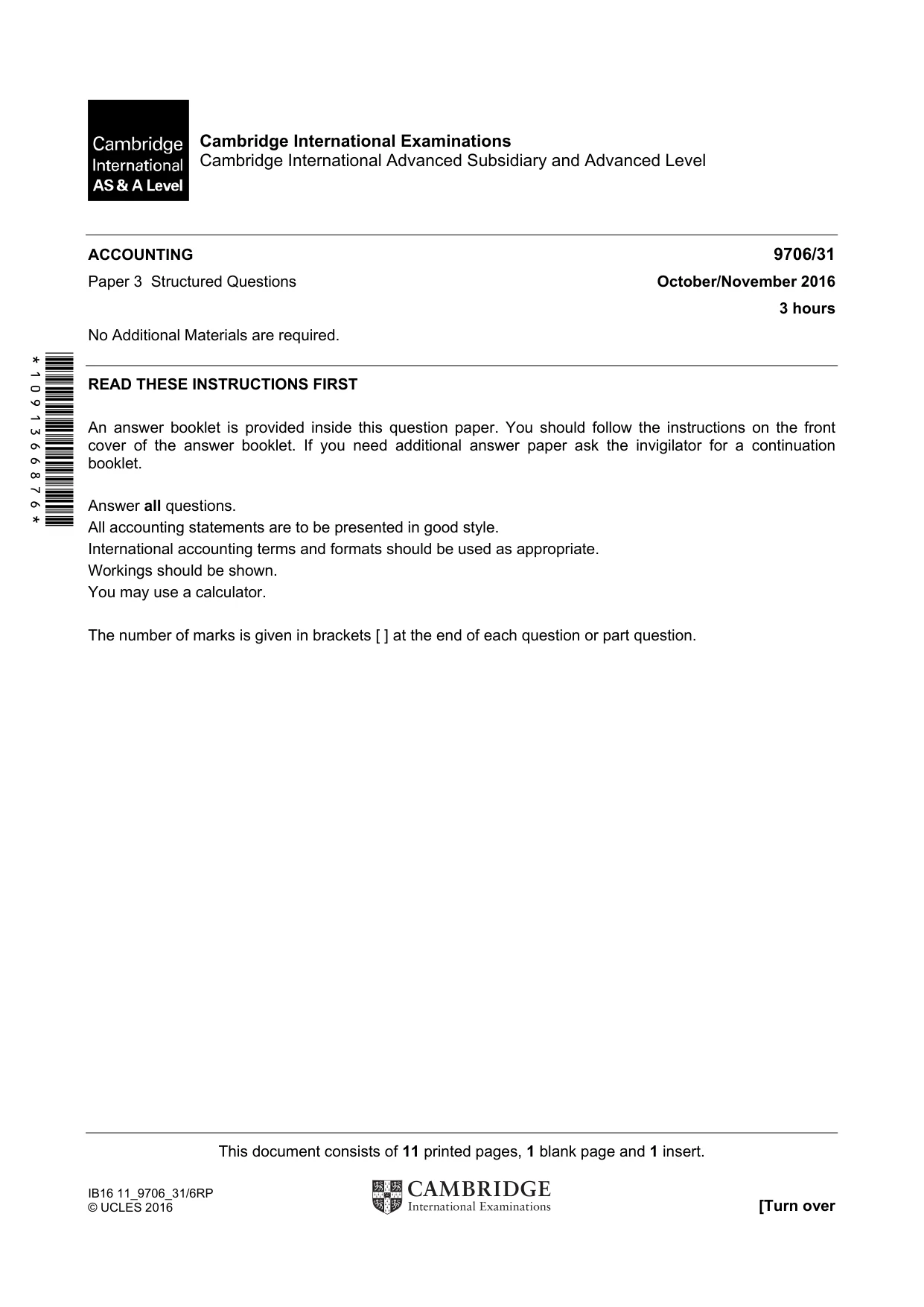
This document consists of 11 printed pages, 1 blank page and 1 insert. IB16 11_9706_31/6RP © UCLES 2016 [Turn over Cambridge International Examinations Cambridge International Advanced Subsidiary and Advanced Level ACCOUNTING 9706/31 Paper 3 Structured Questions October/November 2016 3 hours No Additional Materials are required. READ THESE INSTRUCTIONS FIRST An answer booklet is provided inside this question paper. You should follow the instructions on the front cover of the answer booklet. If you need additional answer paper ask the invigilator for a continuation booklet. Answer all questions. All accounting statements are to be presented in good style. International accounting terms and formats should be used as appropriate. Workings should be shown. You may use a calculator. The number of marks is given in brackets [ ] at the end of each question or part question.
Question paper, page 2
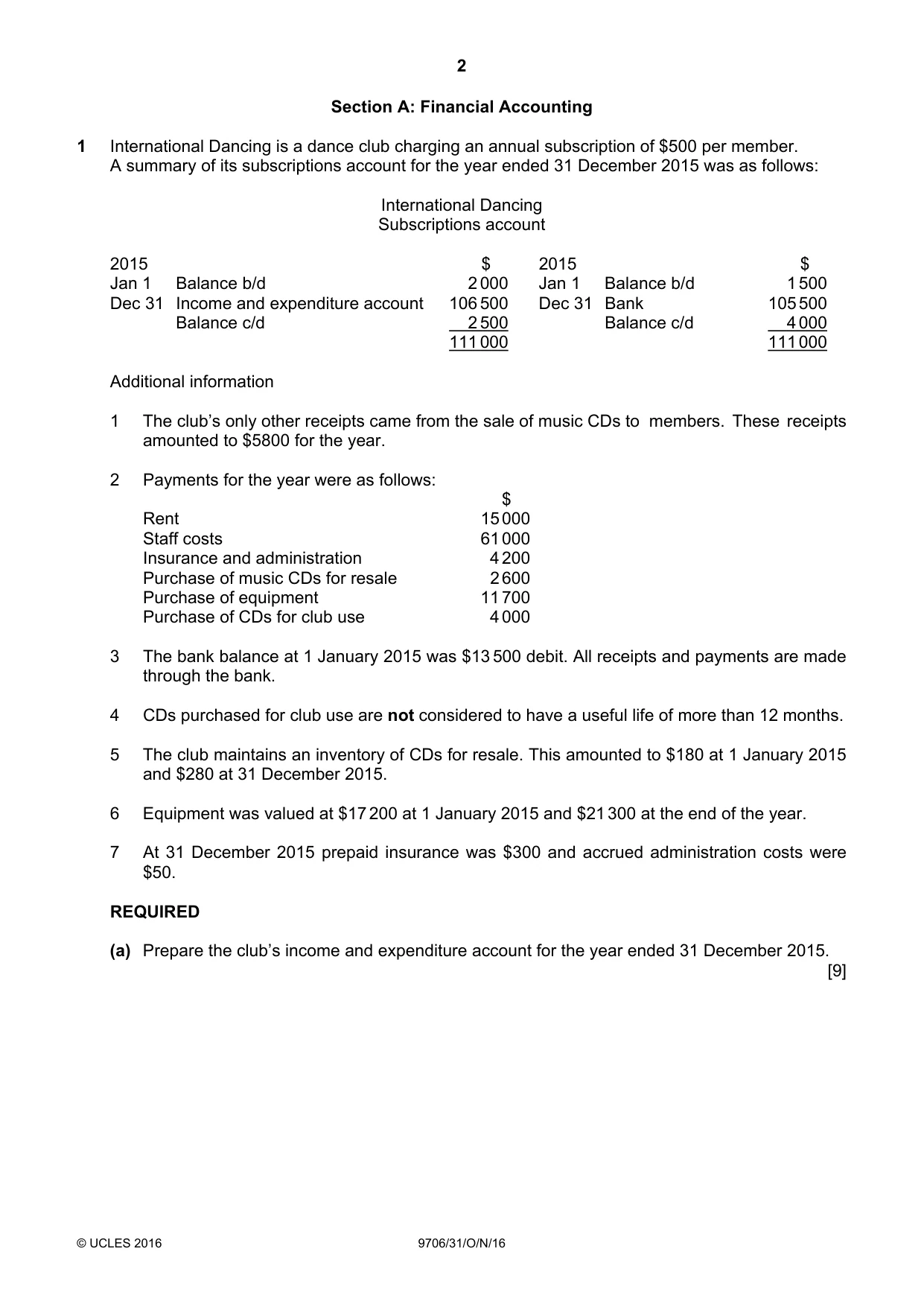
2 © UCLES 2016 9706/31/O/N/16 Section A: Financial Accounting 1 International Dancing is a dance club charging an annual subscription of $500 per member. A summary of its subscriptions account for the year ended 31 December 2015 was as follows: International Dancing Subscriptions account 2015 $ 2015 $ Jan 1 Balance b/d 2 000 Jan 1 Balance b/d 1 500 Dec 31 Income and expenditure account 106 500 Dec 31 Bank 105 500 Balance c/d 2 500 Balance c/d 4 000 111 000 111 000 Additional information 1 The club’s only other receipts came from the sale of music CDs to members. These receipts amounted to $5800 for the year. 2 Payments for the year were as follows: $ Rent 15 000 Staff costs 61 000 Insurance and administration 4 200 Purchase of music CDs for resale 2 600 Purchase of equipment 11 700 Purchase of CDs for club use 4 000 3 The bank balance at 1 January 2015 was $13 500 debit. All receipts and payments are made through the bank. 4 CDs purchased for club use are not considered to have a useful life of more than 12 months. 5 The club maintains an inventory of CDs for resale. This amounted to $180 at 1 January 2015 and $280 at 31 December 2015. 6 Equipment was valued at $17 200 at 1 January 2015 and $21 300 at the end of the year. 7 At 31 December 2015 prepaid insurance was $300 and accrued administration costs were $50. REQUIRED (a) Prepare the club’s income and expenditure account for the year ended 31 December 2015. [9]
Question paper, page 3
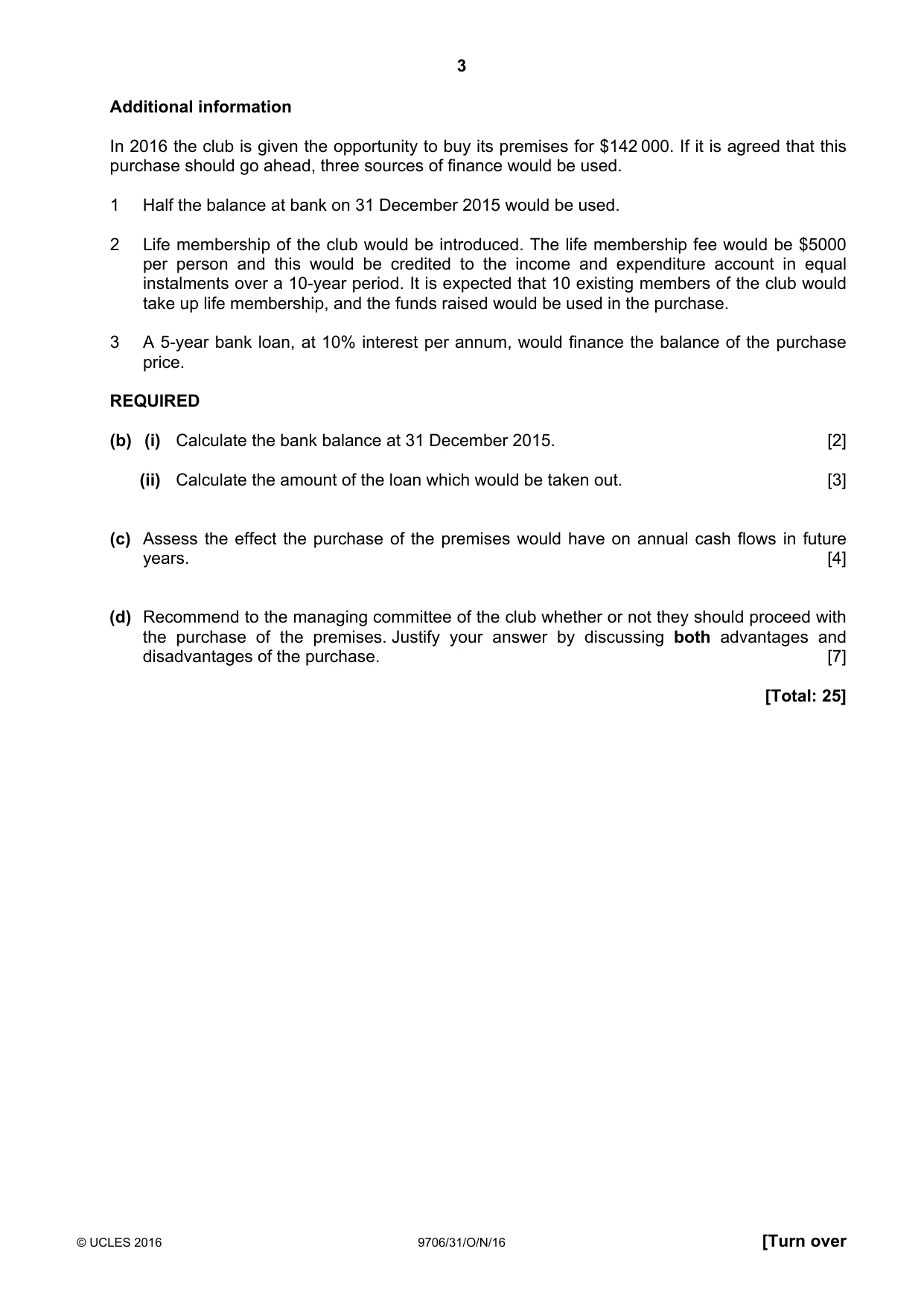
3 © UCLES 2016 9706/31/O/N/16 [Turn over Additional information In 2016 the club is given the opportunity to buy its premises for $142 000. If it is agreed that this purchase should go ahead, three sources of finance would be used. 1 Half the balance at bank on 31 December 2015 would be used. 2 Life membership of the club would be introduced. The life membership fee would be $5000 per person and this would be credited to the income and expenditure account in equal instalments over a 10-year period. It is expected that 10 existing members of the club would take up life membership, and the funds raised would be used in the purchase. 3 A 5-year bank loan, at 10% interest per annum, would finance the balance of the purchase price. REQUIRED (b) (i) Calculate the bank balance at 31 December 2015. [2] (ii) Calculate the amount of the loan which would be taken out. [3] (c) Assess the effect the purchase of the premises would have on annual cash flows in future years. [4] (d) Recommend to the managing committee of the club whether or not they should proceed with the purchase of the premises. Justify your answer by discussing both advantages and disadvantages of the purchase. [7] [Total: 25]
Question paper, page 4
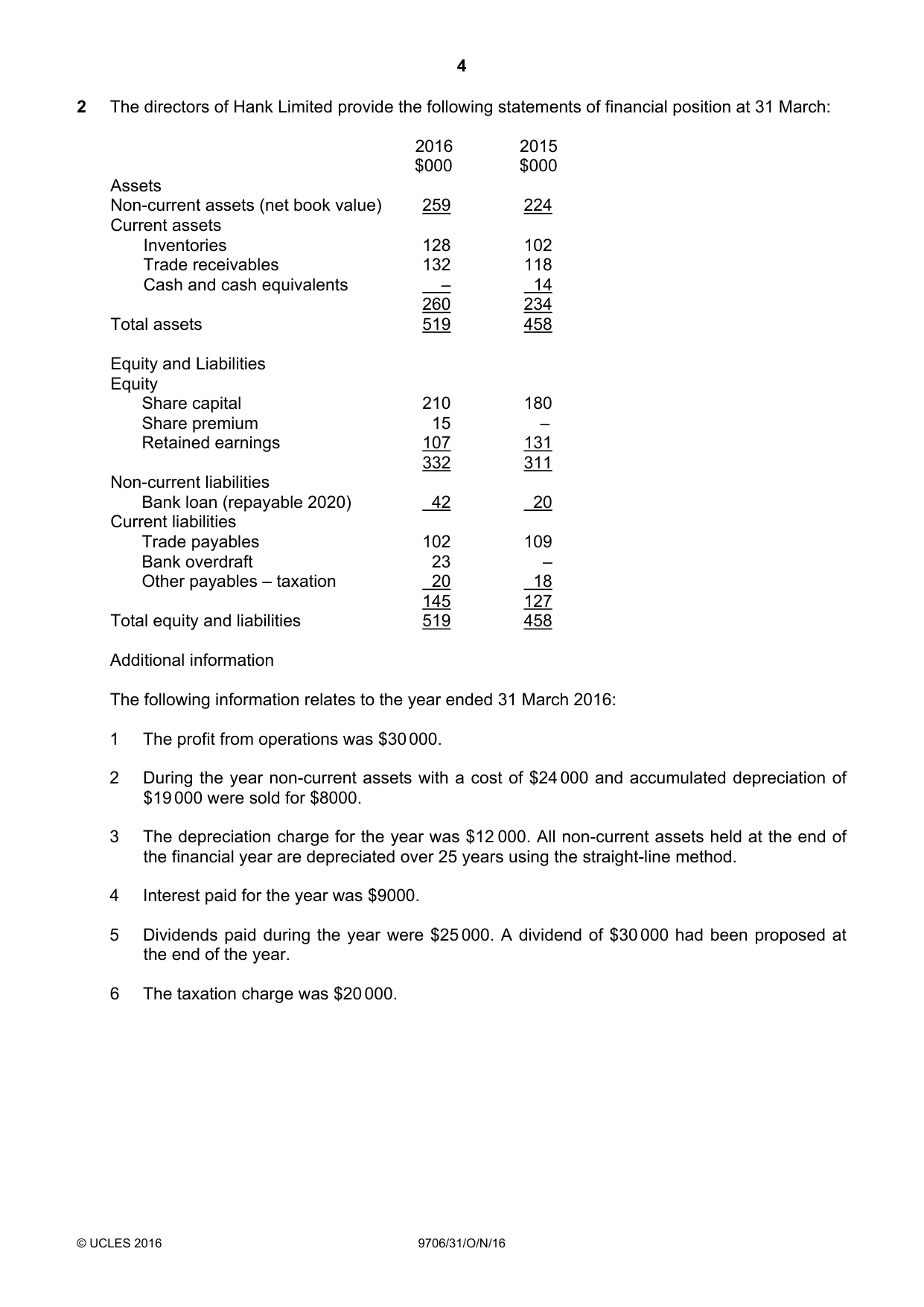
4 © UCLES 2016 9706/31/O/N/16 2 The directors of Hank Limited provide the following statements of financial position at 31 March: 2016 2015 $000 $000 Assets Non-current assets (net book value) 259 224 Current assets Inventories 128 102 Trade receivables 132 118 Cash and cash equivalents – 14 260 234 Total assets 519 458 Equity and Liabilities Equity Share capital 210 180 Share premium 15 – Retained earnings 107 131 332 311 Non-current liabilities Bank loan (repayable 2020) 42 20 Current liabilities Trade payables 102 109 Bank overdraft 23 – Other payables – taxation 20 18 145 127 Total equity and liabilities 519 458 Additional information The following information relates to the year ended 31 March 2016: 1 The profit from operations was $30 000. 2 During the year non-current assets with a cost of $24 000 and accumulated depreciation of $19 000 were sold for $8000. 3 The depreciation charge for the year was $12 000. All non-current assets held at the end of the financial year are depreciated over 25 years using the straight-line method. 4 Interest paid for the year was $9000. 5 Dividends paid during the year were $25 000. A dividend of $30 000 had been proposed at the end of the year. 6 The taxation charge was $20 000.
Question paper, page 5
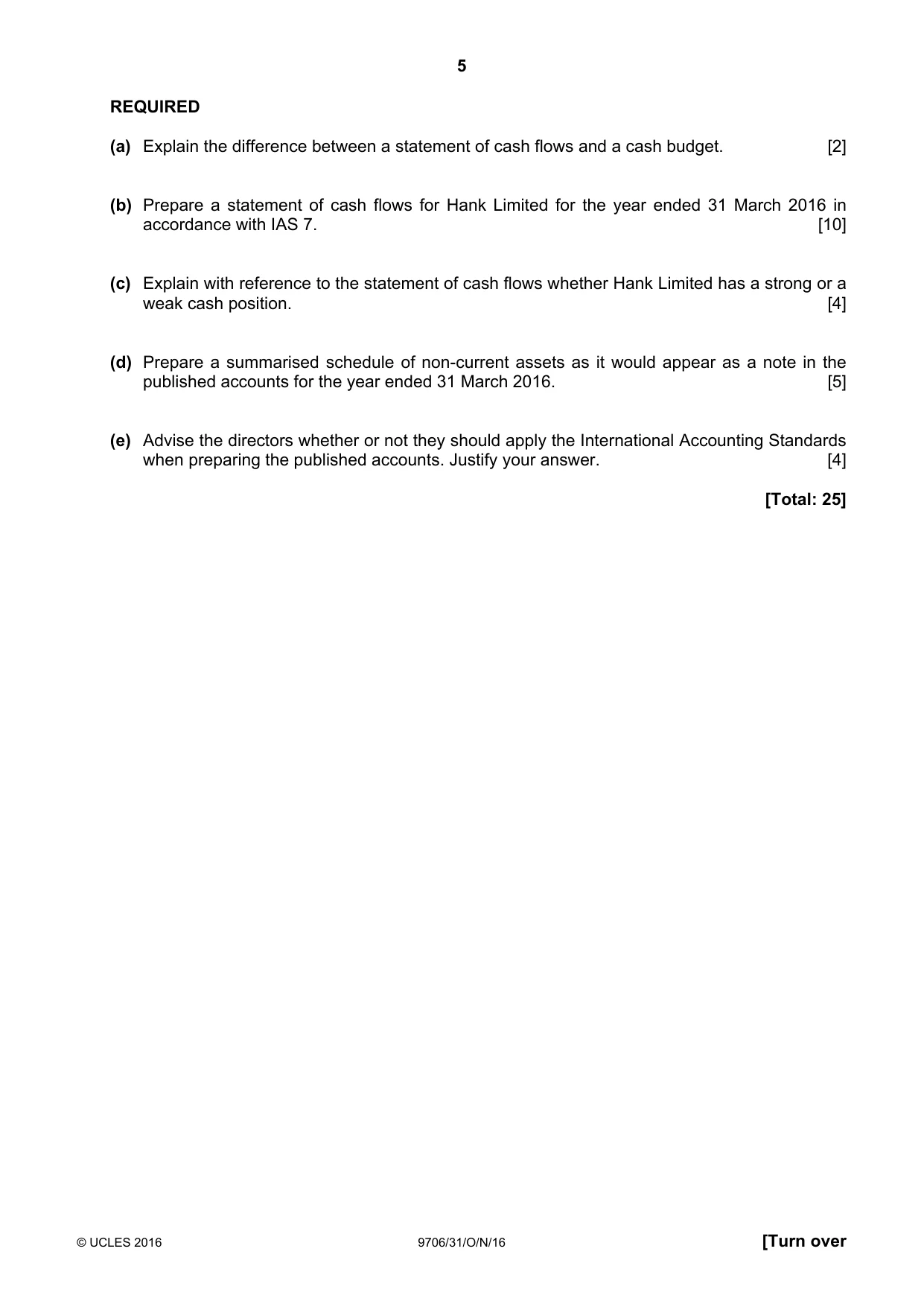
5 © UCLES 2016 9706/31/O/N/16 [Turn over REQUIRED (a) Explain the difference between a statement of cash flows and a cash budget. [2] (b) Prepare a statement of cash flows for Hank Limited for the year ended 31 March 2016 in accordance with IAS 7. [10] (c) Explain with reference to the statement of cash flows whether Hank Limited has a strong or a weak cash position. [4] (d) Prepare a summarised schedule of non-current assets as it would appear as a note in the published accounts for the year ended 31 March 2016. [5] (e) Advise the directors whether or not they should apply the International Accounting Standards when preparing the published accounts. Justify your answer. [4] [Total: 25]
Question paper, page 6
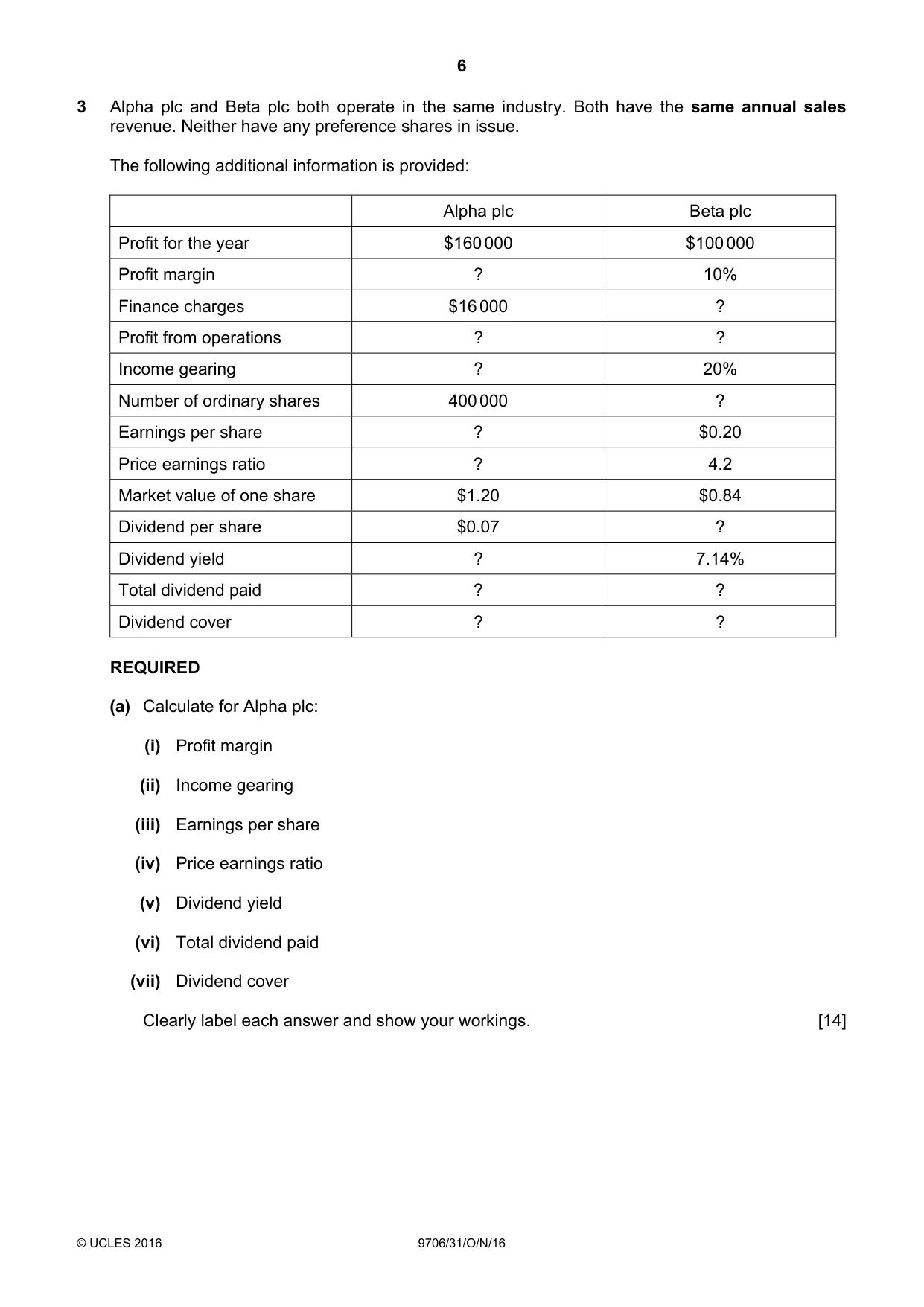
6 © UCLES 2016 9706/31/O/N/16 3 Alpha plc and Beta plc both operate in the same industry. Both have the same annual sales revenue. Neither have any preference shares in issue. The following additional information is provided: Alpha plc Beta plc Profit for the year $160 000 $100 000 Profit margin ? 10% Finance charges $16 000 ? Profit from operations ? ? Income gearing ? 20% Number of ordinary shares 400 000 ? Earnings per share ? $0.20 Price earnings ratio ? 4.2 Market value of one share $1.20 $0.84 Dividend per share $0.07 ? Dividend yield ? 7.14% Total dividend paid ? ? Dividend cover ? ? REQUIRED (a) Calculate for Alpha plc: (i) Profit margin (ii) Income gearing (iii) Earnings per share (iv) Price earnings ratio (v) Dividend yield (vi) Total dividend paid (vii) Dividend cover Clearly label each answer and show your workings. [14]
Question paper, page 7
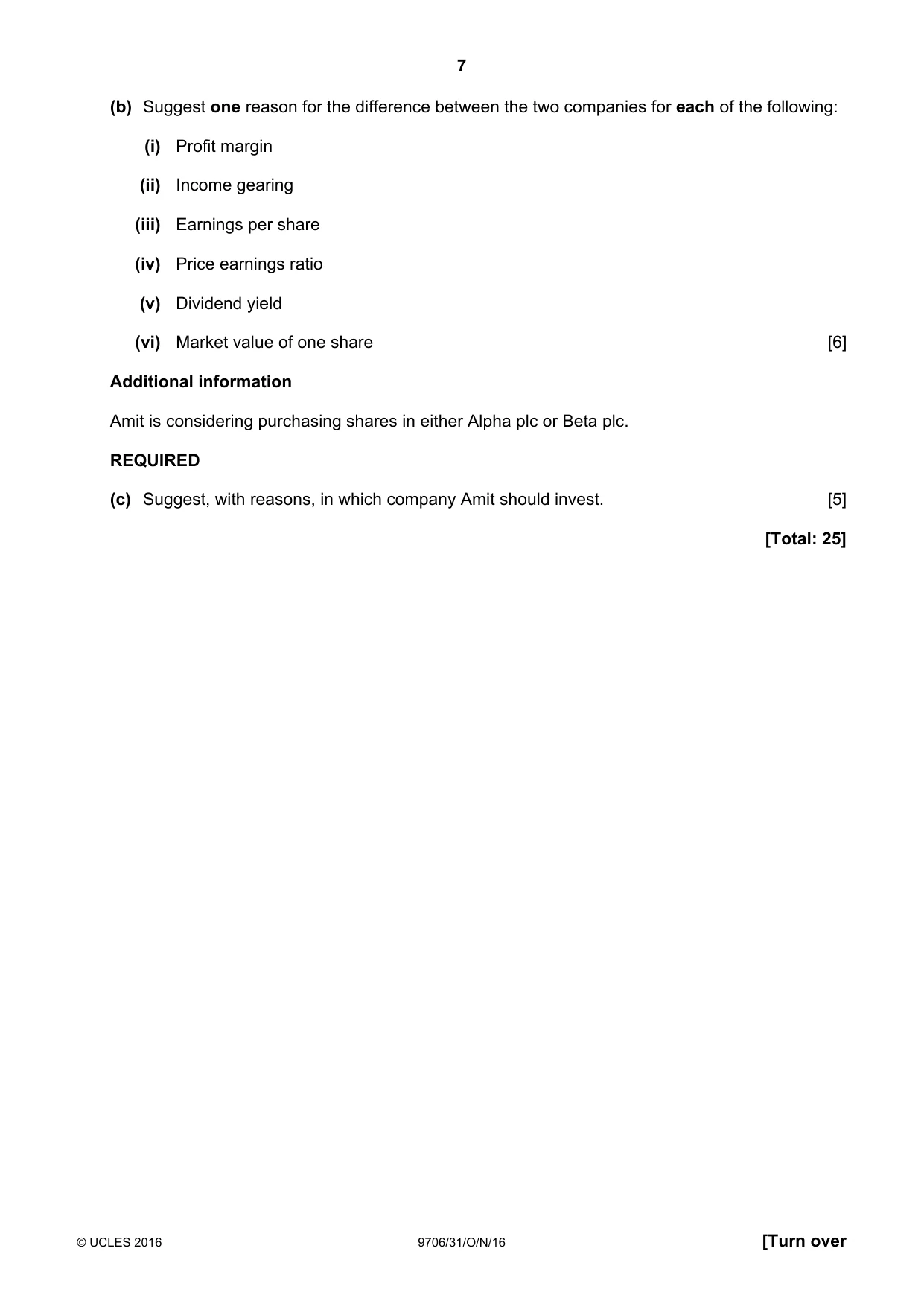
7 © UCLES 2016 9706/31/O/N/16 [Turn over (b) Suggest one reason for the difference between the two companies for each of the following: (i) Profit margin (ii) Income gearing (iii) Earnings per share (iv) Price earnings ratio (v) Dividend yield (vi) Market value of one share [6] Additional information Amit is considering purchasing shares in either Alpha plc or Beta plc. REQUIRED (c) Suggest, with reasons, in which company Amit should invest. [5] [Total: 25]
Question paper, page 8
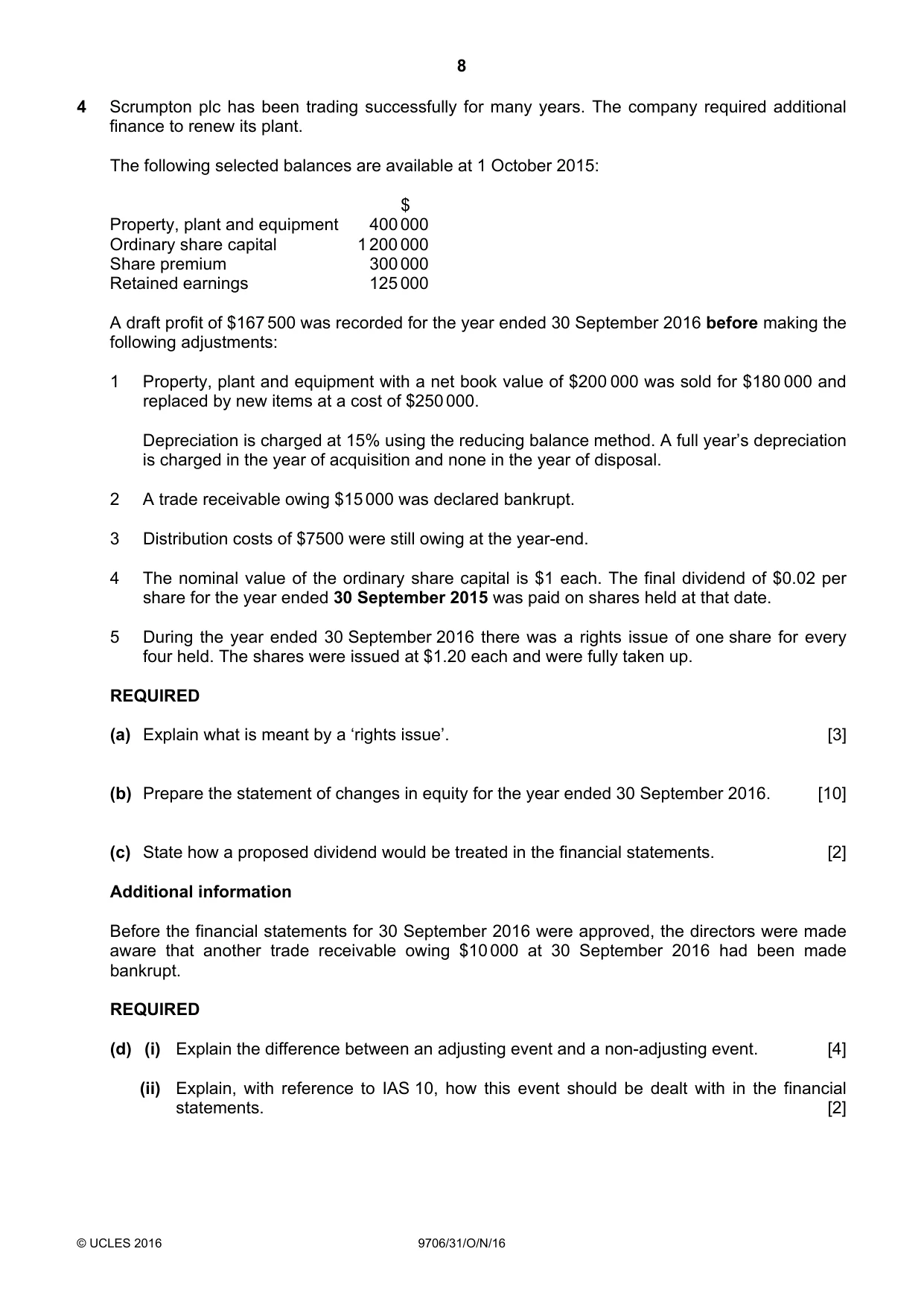
8 © UCLES 2016 9706/31/O/N/16 4 Scrumpton plc has been trading successfully for many years. The company required additional finance to renew its plant. The following selected balances are available at 1 October 2015: $ Property, plant and equipment 400 000 Ordinary share capital 1 200 000 Share premium 300 000 Retained earnings 125 000 A draft profit of $167 500 was recorded for the year ended 30 September 2016 before making the following adjustments: 1 Property, plant and equipment with a net book value of $200 000 was sold for $180 000 and replaced by new items at a cost of $250 000. Depreciation is charged at 15% using the reducing balance method. A full year’s depreciation is charged in the year of acquisition and none in the year of disposal. 2 A trade receivable owing $15 000 was declared bankrupt. 3 Distribution costs of $7500 were still owing at the year-end. 4 The nominal value of the ordinary share capital is $1 each. The final dividend of $0.02 per share for the year ended 30 September 2015 was paid on shares held at that date. 5 During the year ended 30 September 2016 there was a rights issue of one share for every four held. The shares were issued at $1.20 each and were fully taken up. REQUIRED (a) Explain what is meant by a ‘rights issue’. [3] (b) Prepare the statement of changes in equity for the year ended 30 September 2016. [10] (c) State how a proposed dividend would be treated in the financial statements. [2] Additional information Before the financial statements for 30 September 2016 were approved, the directors were made aware that another trade receivable owing $10 000 at 30 September 2016 had been made bankrupt. REQUIRED (d) (i) Explain the difference between an adjusting event and a non-adjusting event. [4] (ii) Explain, with reference to IAS 10, how this event should be dealt with in the financial statements. [2]
Question paper, page 9
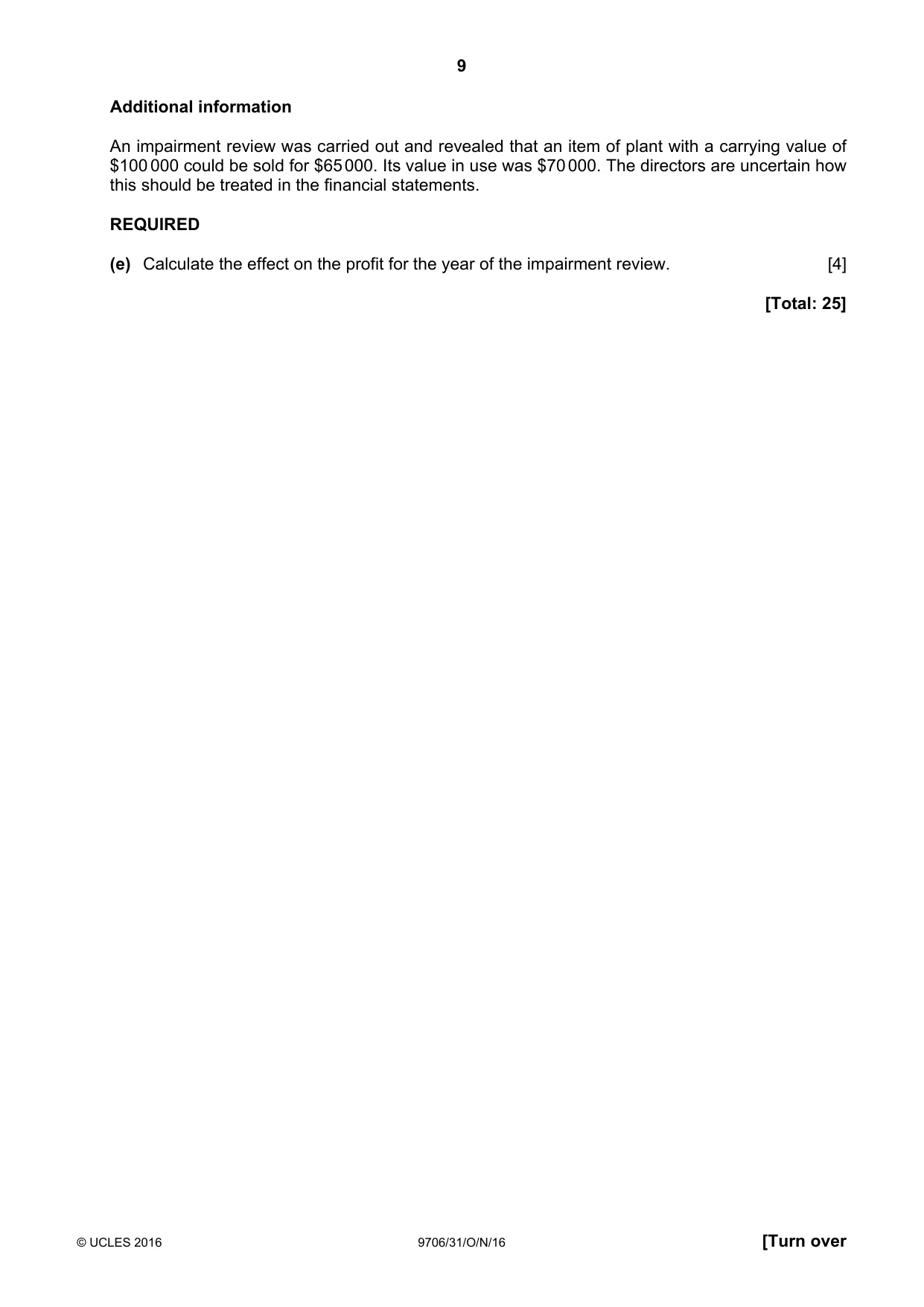
9 © UCLES 2016 9706/31/O/N/16 [Turn over Additional information An impairment review was carried out and revealed that an item of plant with a carrying value of $100 000 could be sold for $65 000. Its value in use was $70 000. The directors are uncertain how this should be treated in the financial statements. REQUIRED (e) Calculate the effect on the profit for the year of the impairment review. [4] [Total: 25]
Question paper, page 10
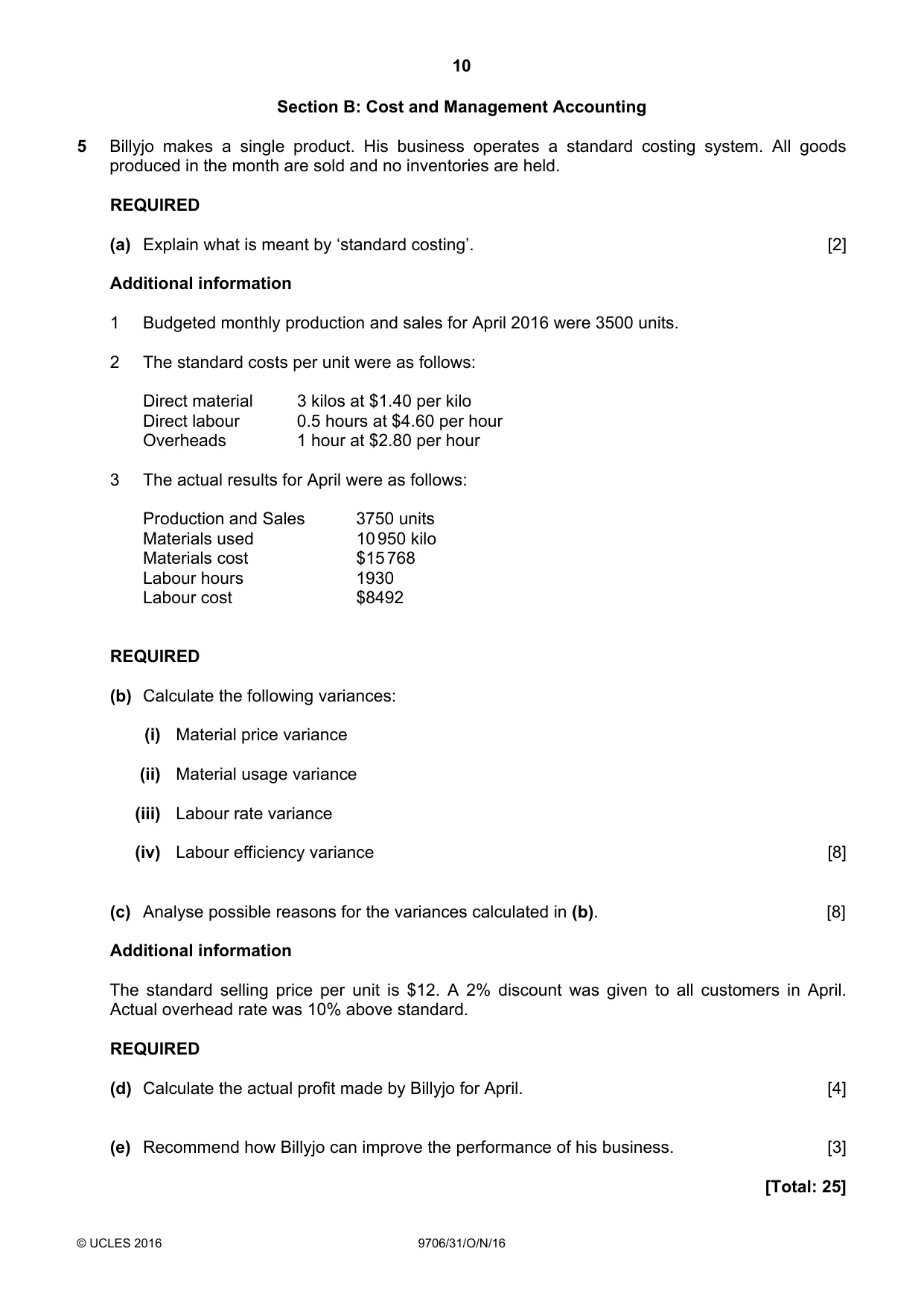
10 © UCLES 2016 9706/31/O/N/16 Section B: Cost and Management Accounting 5 Billyjo makes a single product. His business operates a standard costing system. All goods produced in the month are sold and no inventories are held. REQUIRED (a) Explain what is meant by ‘standard costing’. [2] Additional information 1 Budgeted monthly production and sales for April 2016 were 3500 units. 2 The standard costs per unit were as follows: Direct material 3 kilos at $1.40 per kilo Direct labour 0.5 hours at $4.60 per hour Overheads 1 hour at $2.80 per hour 3 The actual results for April were as follows: Production and Sales 3750 units Materials used 10 950 kilo Materials cost $15 768 Labour hours 1930 Labour cost $8492 REQUIRED (b) Calculate the following variances: (i) Material price variance (ii) Material usage variance (iii) Labour rate variance (iv) Labour efficiency variance [8] (c) Analyse possible reasons for the variances calculated in (b). [8] Additional information The standard selling price per unit is $12. A 2% discount was given to all customers in April. Actual overhead rate was 10% above standard. REQUIRED (d) Calculate the actual profit made by Billyjo for April. [4] (e) Recommend how Billyjo can improve the performance of his business. [3] [Total: 25]
Question paper, page 11
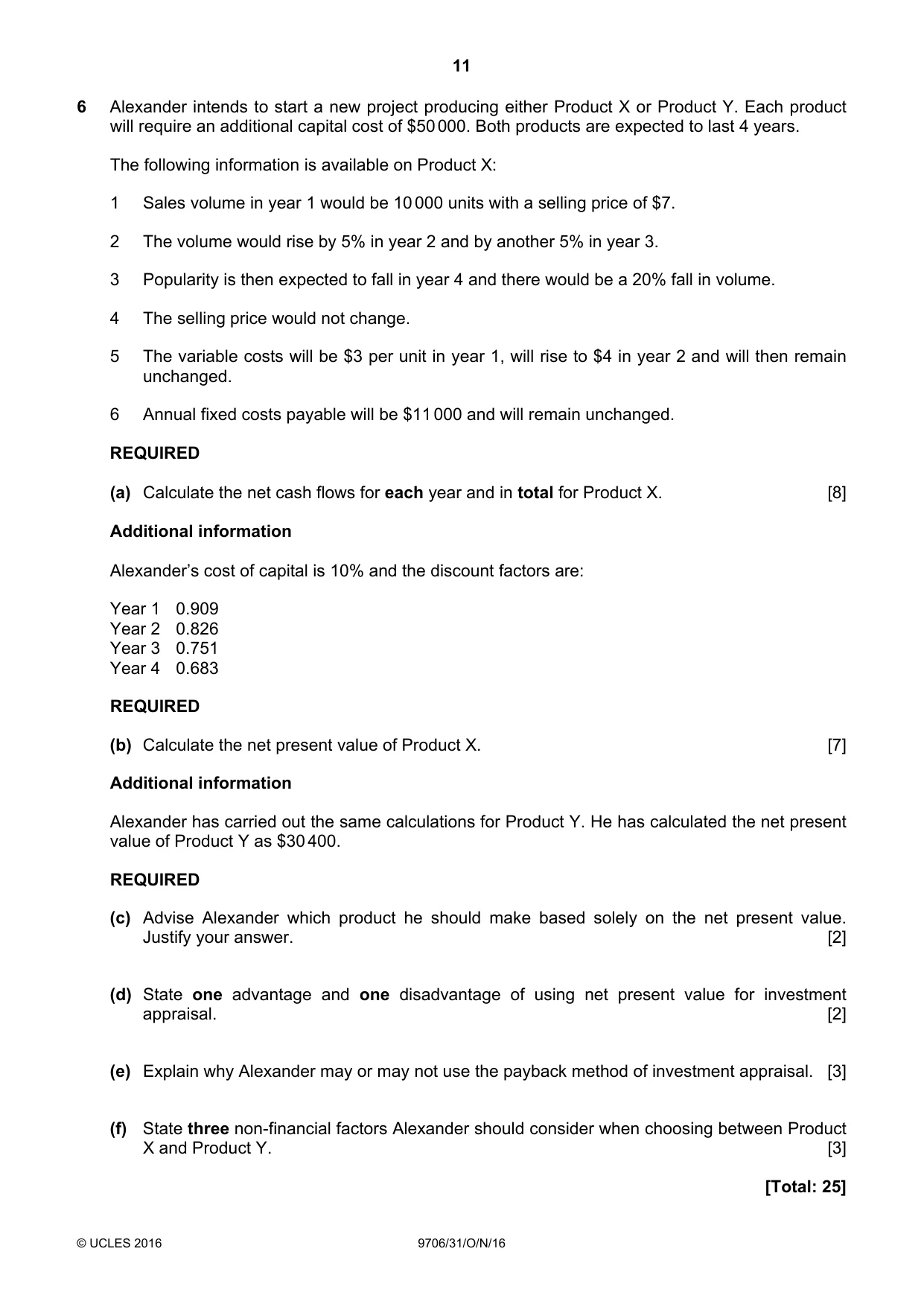
11 © UCLES 2016 9706/31/O/N/16 6 Alexander intends to start a new project producing either Product X or Product Y. Each product will require an additional capital cost of $50 000. Both products are expected to last 4 years. The following information is available on Product X: 1 Sales volume in year 1 would be 10 000 units with a selling price of $7. 2 The volume would rise by 5% in year 2 and by another 5% in year 3. 3 Popularity is then expected to fall in year 4 and there would be a 20% fall in volume. 4 The selling price would not change. 5 The variable costs will be $3 per unit in year 1, will rise to $4 in year 2 and will then remain unchanged. 6 Annual fixed costs payable will be $11 000 and will remain unchanged. REQUIRED (a) Calculate the net cash flows for each year and in total for Product X. [8] Additional information Alexander’s cost of capital is 10% and the discount factors are: Year 1 0.909 Year 2 0.826 Year 3 0.751 Year 4 0.683 REQUIRED (b) Calculate the net present value of Product X. [7] Additional information Alexander has carried out the same calculations for Product Y. He has calculated the net present value of Product Y as $30 400. REQUIRED (c) Advise Alexander which product he should make based solely on the net present value. Justify your answer. [2] (d) State one advantage and one disadvantage of using net present value for investment appraisal. [2] (e) Explain why Alexander may or may not use the payback method of investment appraisal. [3] (f) State three non-financial factors Alexander should consider when choosing between Product X and Product Y. [3] [Total: 25]
Question paper, page 12
12 Permission to reproduce items where third-party owned material protected by copyright is included has been sought and cleared where possible. Every reasonable effort has been made by the publisher (UCLES) to trace copyright holders, but if any items requiring clearance have unwittingly been included, the publisher will be pleased to make amends at the earliest possible opportunity. To avoid the issue of disclosure of answer-related information to candidates, all copyright acknowledgements are reproduced online in the Cambridge International Examinations Copyright Acknowledgements Booklet. This is produced for each series of examinations and is freely available to download at www.cie.org.uk after the live examination series. Cambridge International Examinations is part of the Cambridge Assessment Group. Cambridge Assessment is the brand name of University of Cambridge Local Examinations Syndicate (UCLES), which is itself a department of the University of Cambridge. © UCLES 2016 9706/31/O/N/16 BLANK PAGE
Mark scheme, page 1
Cambridge International Examinations Cambridge International Advanced Level ACCOUNTING 9706/31 Paper 3 Structured Questions October/November 2016 MARK SCHEME Maximum Mark: 150 Published This mark scheme is published as an aid to teachers and candidates, to indicate the requirements of the examination. It shows the basis on which Examiners were instructed to award marks. It does not indicate the details of the discussions that took place at an Examiners’ meeting before marking began, which would have considered the acceptability of alternative answers. Mark schemes should be read in conjunction with the question paper and the Principal Examiner Report for Teachers. Cambridge will not enter into discussions about these mark schemes. Cambridge is publishing the mark schemes for the October/November 2016 series for most Cambridge IGCSE®, Cambridge International A and AS Level components and some Cambridge O Level components. ® IGCSE is the registered trademark of Cambridge International Examinations. This document consists of 8 printed pages. © UCLES 2016 [Turn over
Mark scheme, page 2
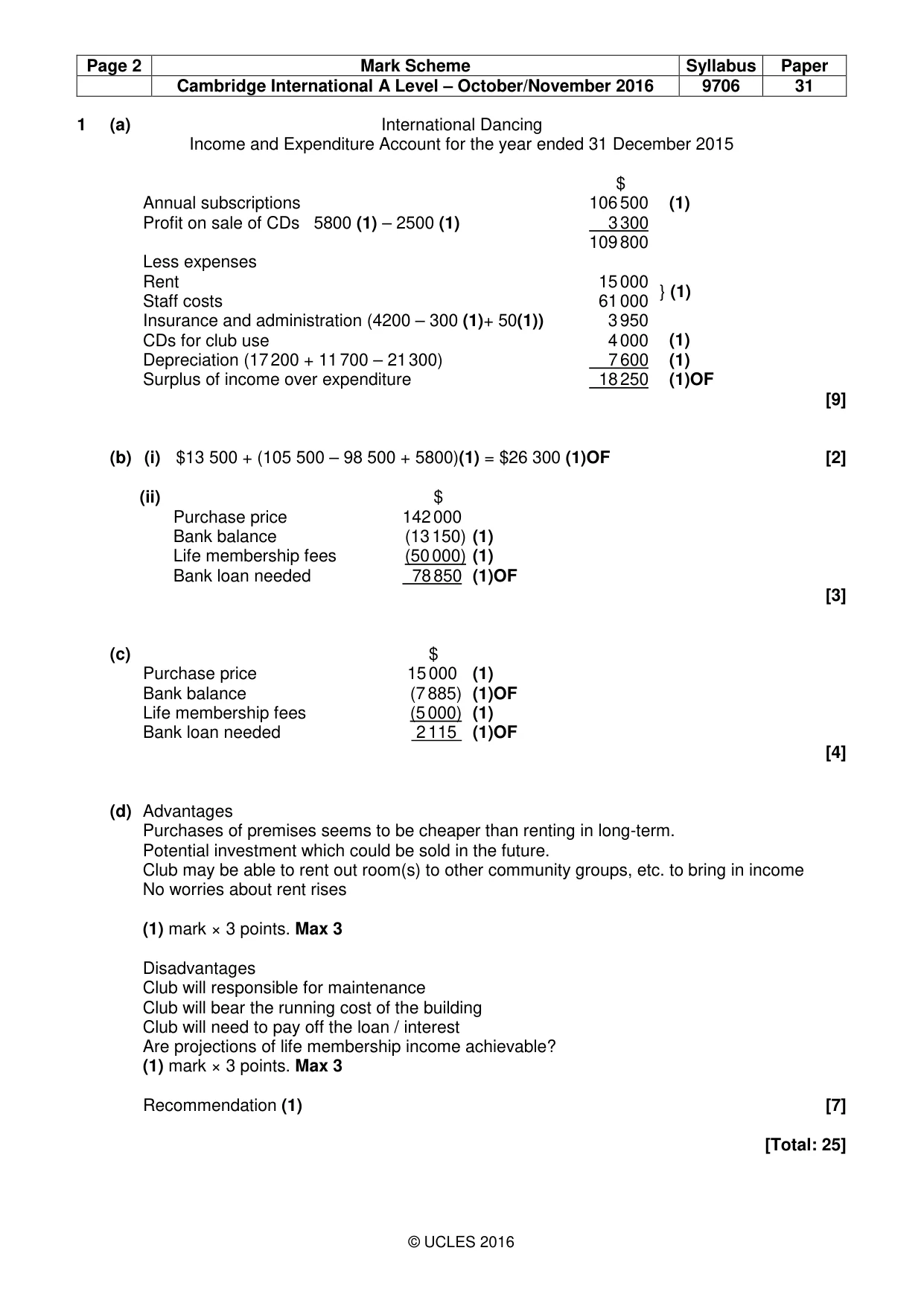
Page 2 Mark Scheme Syllabus Paper Cambridge International A Level – October/November 2016 9706 31 1 (a) International Dancing Income and Expenditure Account for the year ended 31 December 2015 $ Annual subscriptions 106 500 (1) Profit on sale of CDs 5800 (1) – 2500 (1) 3 300 109 800 Less expenses Rent 15 000 } (1) Staff costs 61 000 Insurance and administration (4200 – 300 (1)+ 50(1)) 3 950 CDs for club use 4 000 (1) Depreciation (17 200 + 11 700 – 21 300) 7 600 (1) Surplus of income over expenditure 18 250 (1)OF [9] (b) (i) $13 500 + (105 500 – 98 500 + 5800)(1) = $26 300 (1)OF [2] (ii) $ Purchase price 142 000 Bank balance (13 150) (1) Life membership fees (50 000) (1) Bank loan needed 78 850 (1)OF [3] (c) $ Purchase price 15 000 (1) Bank balance (7 885) (1)OF Life membership fees (5 000) (1) Bank loan needed 2 115 (1)OF [4] (d) Advantages Purchases of premises seems to be cheaper than renting in long-term. Potential investment which could be sold in the future. Club may be able to rent out room(s) to other community groups, etc. to bring in income No worries about rent rises (1) mark × 3 points. Max 3 Disadvantages Club will responsible for maintenance Club will bear the running cost of the building Club will need to pay off the loan / interest Are projections of life membership income achievable? (1) mark × 3 points. Max 3 Recommendation (1) [7] [Total: 25] © UCLES 2016
Mark scheme, page 3
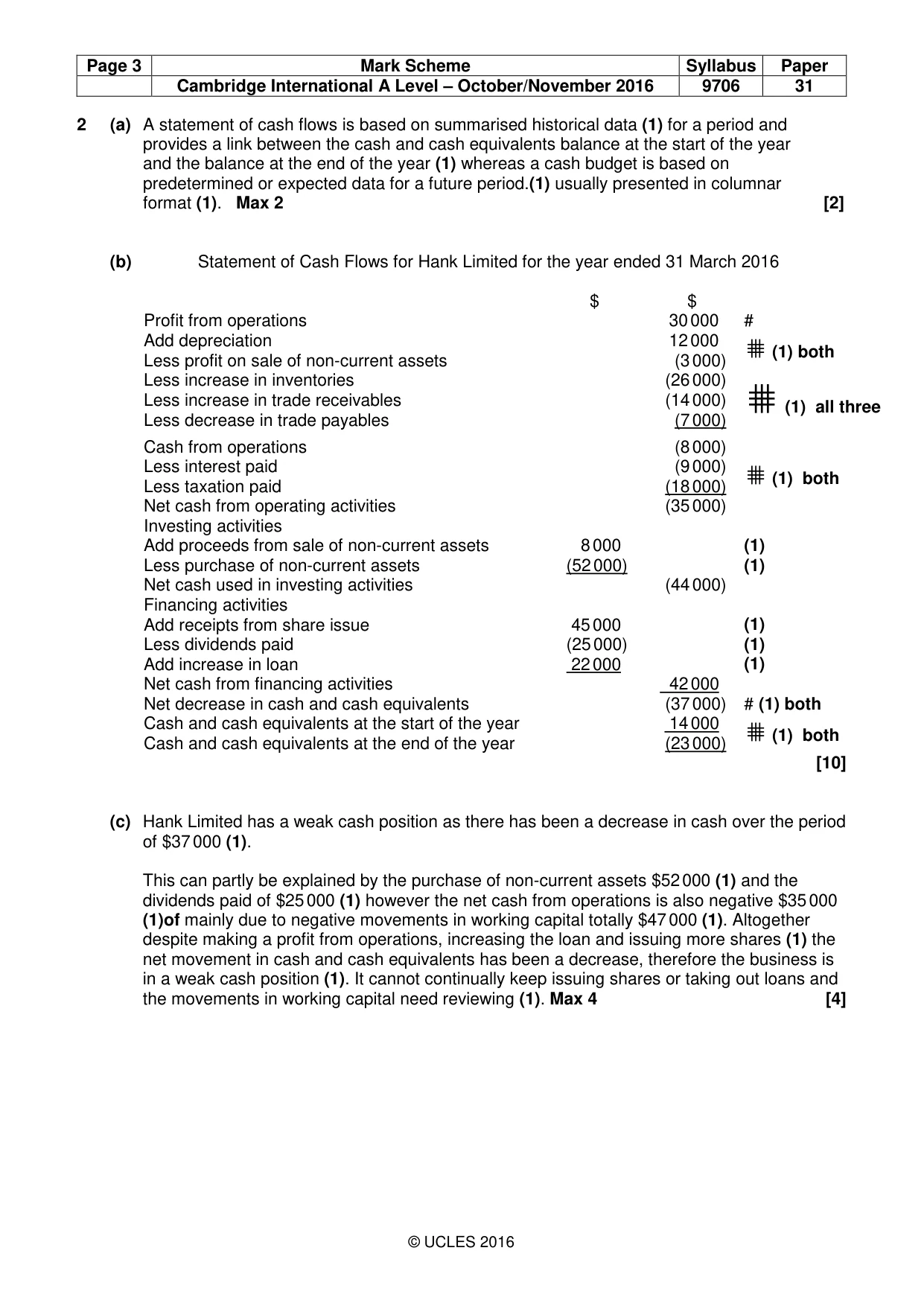
Page 3 Mark Scheme Syllabus Paper Cambridge International A Level – October/November 2016 9706 31 2 (a) A statement of cash flows is based on summarised historical data (1) for a period and provides a link between the cash and cash equivalents balance at the start of the year and the balance at the end of the year (1) whereas a cash budget is based on predetermined or expected data for a future period.(1) usually presented in columnar format (1). Max 2 [2] (b) Statement of Cash Flows for Hank Limited for the year ended 31 March 2016 $ $ Profit from operations 30 000 # Add depreciation 12 000 (1) both Less profit on sale of non-current assets (3 000) Less increase in inventories (26 000) (1) all three Less increase in trade receivables (14 000) Less decrease in trade payables (7 000) Cash from operations (8 000) Less interest paid (9 000) (1) both Less taxation paid (18 000) Net cash from operating activities (35 000) Investing activities Add proceeds from sale of non-current assets 8 000 (1) Less purchase of non-current assets (52 000) (1) Net cash used in investing activities (44 000) Financing activities Add receipts from share issue 45 000 (1) Less dividends paid (25 000) (1) Add increase in loan 22 000 (1) Net cash from financing activities 42 000 Net decrease in cash and cash equivalents (37 000) # (1) both Cash and cash equivalents at the start of the year 14 000 (1) both Cash and cash equivalents at the end of the year (23 000) [10] (c) Hank Limited has a weak cash position as there has been a decrease in cash over the period of $37 000 (1). This can partly be explained by the purchase of non-current assets $52 000 (1) and the dividends paid of $25 000 (1) however the net cash from operations is also negative $35 000 (1)of mainly due to negative movements in working capital totally $47 000 (1). Altogether despite making a profit from operations, increasing the loan and issuing more shares (1) the net movement in cash and cash equivalents has been a decrease, therefore the business is in a weak cash position (1). It cannot continually keep issuing shares or taking out loans and the movements in working capital need reviewing (1). Max 4 [4] © UCLES 2016
Mark scheme, page 4
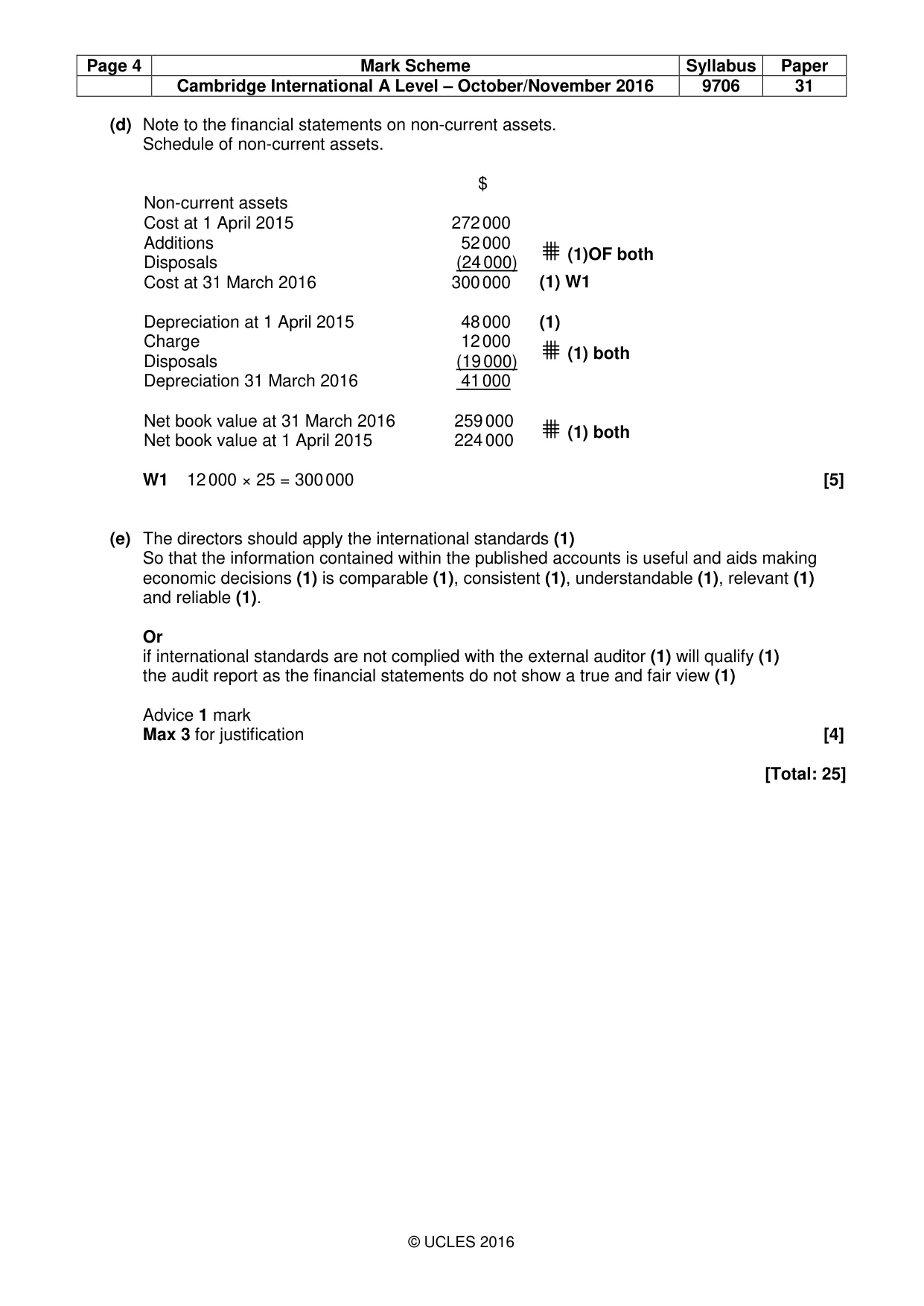
Page 4 Mark Scheme Syllabus Paper Cambridge International A Level – October/November 2016 9706 31 (d) Note to the financial statements on non-current assets. Schedule of non-current assets. $ Non-current assets Cost at 1 April 2015 272 000 Additions 52 000 (1)OF both Disposals (24 000) Cost at 31 March 2016 300 000 (1) W1 Depreciation at 1 April 2015 48 000 (1) Charge 12 000 (1) both Disposals (19 000) Depreciation 31 March 2016 41 000 Net book value at 31 March 2016 259 000 (1) both Net book value at 1 April 2015 224 000 W1 12 000 × 25 = 300 000 [5] (e) The directors should apply the international standards (1) So that the information contained within the published accounts is useful and aids making economic decisions (1) is comparable (1), consistent (1), understandable (1), relevant (1) and reliable (1). Or if international standards are not complied with the external auditor (1) will qualify (1) the audit report as the financial statements do not show a true and fair view (1) Advice 1 mark Max 3 for justification [4] [Total: 25] © UCLES 2016
Mark scheme, page 5
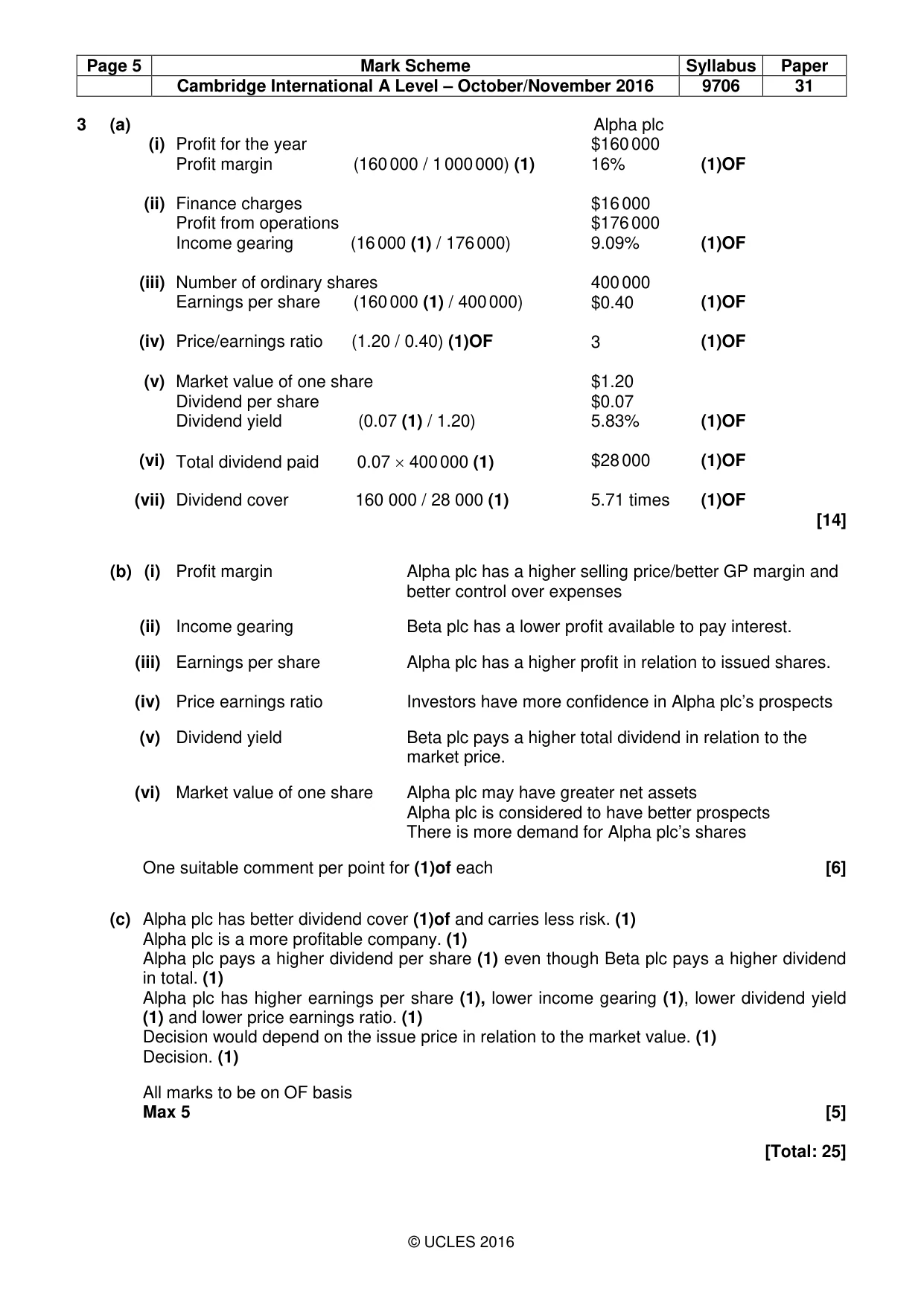
Page 5 Mark Scheme Syllabus Paper Cambridge International A Level – October/November 2016 9706 31 3 (a) Alpha plc (i) Profit for the year $160 000 Profit margin (160 000 / 1 000 000) (1) 16% (1)OF (ii) Finance charges $16 000 Profit from operations $176 000 Income gearing (16 000 (1) / 176 000) 9.09% (1)OF (iii) Number of ordinary shares 400 000 Earnings per share (160 000 (1) / 400 000) $0.40 (1)OF (iv) Price/earnings ratio (1.20 / 0.40) (1)OF 3 (1)OF (v) Market value of one share $1.20 Dividend per share $0.07 Dividend yield (0.07 (1) / 1.20) 5.83% (1)OF (vi) Total dividend paid 0.07 × 400 000 (1) $28 000 (1)OF (vii) Dividend cover 160 000 / 28 000 (1) 5.71 times (1)OF [14] (b) (i) Profit margin Alpha plc has a higher selling price/better GP margin and better control over expenses (ii) Income gearing Beta plc has a lower profit available to pay interest. (iii) Earnings per share Alpha plc has a higher profit in relation to issued shares. (iv) Price earnings ratio Investors have more confidence in Alpha plc’s prospects (v) Dividend yield Beta plc pays a higher total dividend in relation to the market price. (vi) Market value of one share Alpha plc may have greater net assets Alpha plc is considered to have better prospects There is more demand for Alpha plc’s shares One suitable comment per point for (1)of each [6] (c) Alpha plc has better dividend cover (1)of and carries less risk. (1) Alpha plc is a more profitable company. (1) Alpha plc pays a higher dividend per share (1) even though Beta plc pays a higher dividend in total. (1) Alpha plc has higher earnings per share (1), lower income gearing (1), lower dividend yield (1) and lower price earnings ratio. (1) Decision would depend on the issue price in relation to the market value. (1) Decision. (1) All marks to be on OF basis Max 5 [5] [Total: 25] © UCLES 2016
Mark scheme, page 6
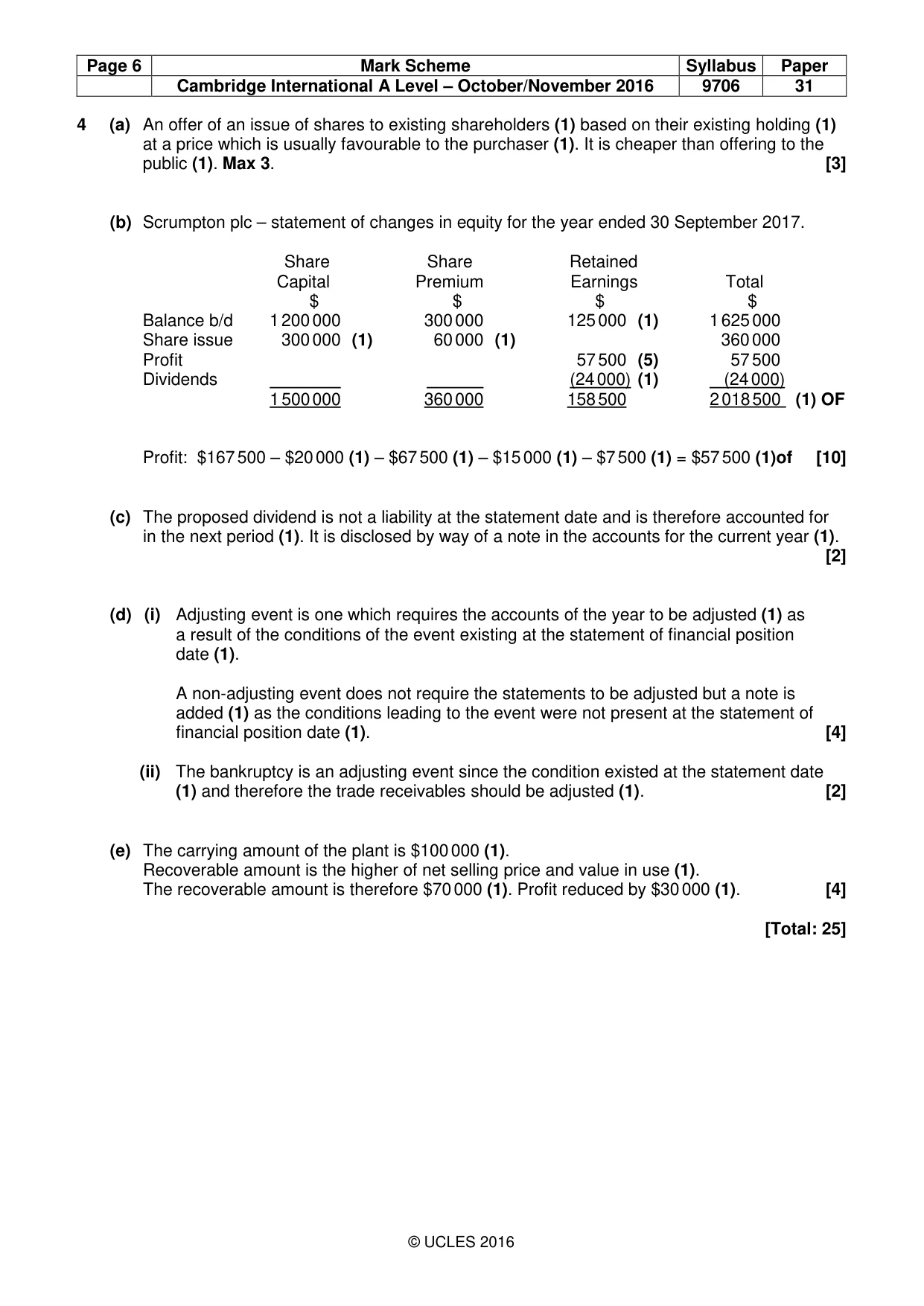
Page 6 Mark Scheme Syllabus Paper Cambridge International A Level – October/November 2016 9706 31 4 (a) An offer of an issue of shares to existing shareholders (1) based on their existing holding (1) at a price which is usually favourable to the purchaser (1). It is cheaper than offering to the public (1). Max 3. [3] (b) Scrumpton plc – statement of changes in equity for the year ended 30 September 2017. Share Share Retained Capital Premium Earnings Total $ $ $ $ Balance b/d 1 200 000 300 000 125 000 (1) 1 625 000 Share issue 300 000 (1) 60 000 (1) 360 000 Profit 57 500 (5) 57 500 Dividends (24 000) (1) (24 000) 1 500 000 360 000 158 500 2 018 500 (1) OF Profit: $167 500 – $20 000 (1) – $67 500 (1) – $15 000 (1) – $7 500 (1) = $57 500 (1)of [10] (c) The proposed dividend is not a liability at the statement date and is therefore accounted for in the next period (1). It is disclosed by way of a note in the accounts for the current year (1). [2] (d) (i) Adjusting event is one which requires the accounts of the year to be adjusted (1) as a result of the conditions of the event existing at the statement of financial position date (1). A non-adjusting event does not require the statements to be adjusted but a note is added (1) as the conditions leading to the event were not present at the statement of financial position date (1). [4] (ii) The bankruptcy is an adjusting event since the condition existed at the statement date (1) and therefore the trade receivables should be adjusted (1). [2] (e) The carrying amount of the plant is $100 000 (1). Recoverable amount is the higher of net selling price and value in use (1). The recoverable amount is therefore $70 000 (1). Profit reduced by $30 000 (1). [4] [Total: 25] © UCLES 2016
Mark scheme, page 7
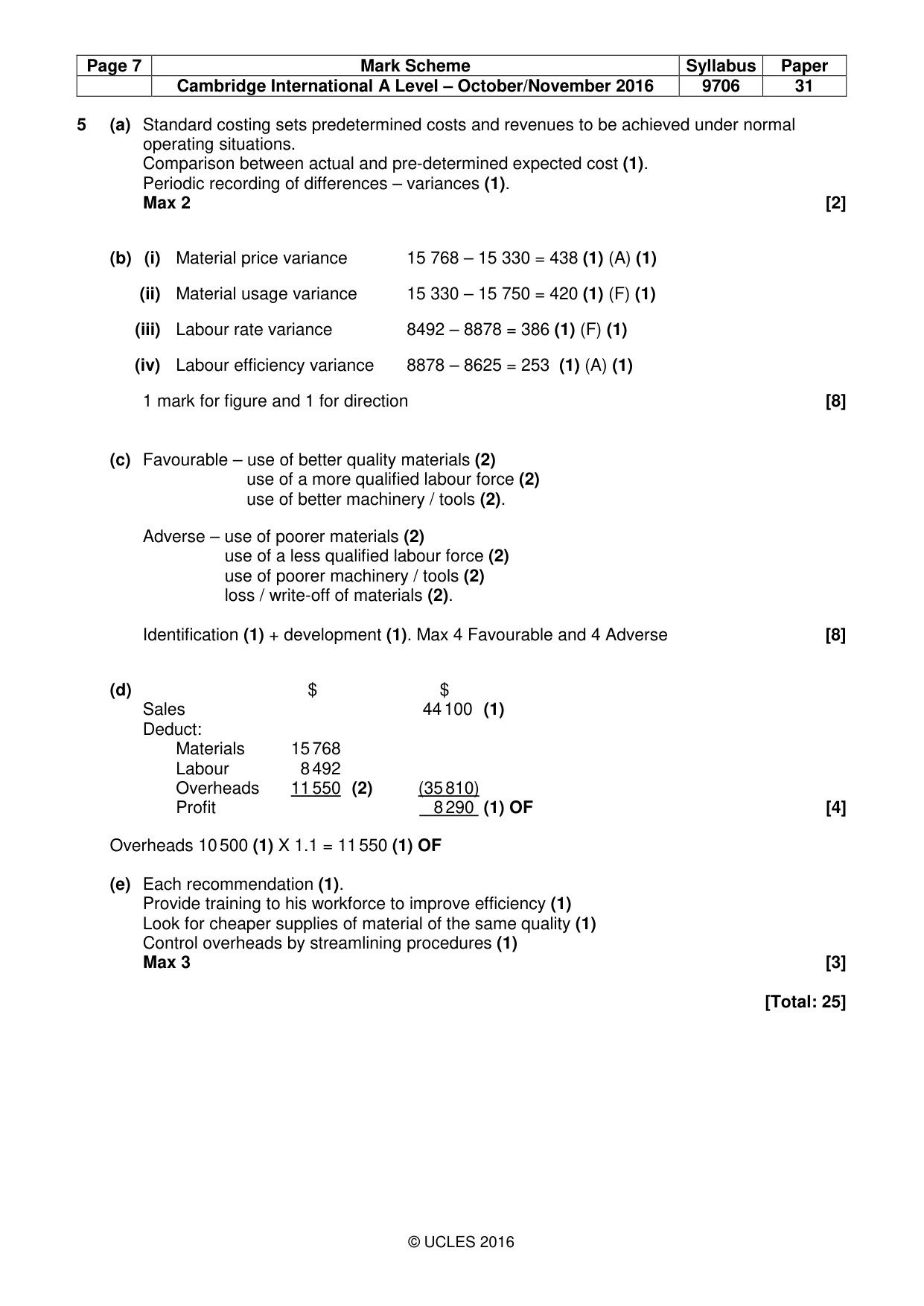
Page 7 Mark Scheme Syllabus Paper Cambridge International A Level – October/November 2016 9706 31 5 (a) Standard costing sets predetermined costs and revenues to be achieved under normal operating situations. Comparison between actual and pre-determined expected cost (1). Periodic recording of differences – variances (1). Max 2 [2] (b) (i) Material price variance 15 768 – 15 330 = 438 (1) (A) (1) (ii) Material usage variance 15 330 – 15 750 = 420 (1) (F) (1) (iii) Labour rate variance 8492 – 8878 = 386 (1) (F) (1) (iv) Labour efficiency variance 8878 – 8625 = 253 (1) (A) (1) 1 mark for figure and 1 for direction [8] (c) Favourable – use of better quality materials (2) use of a more qualified labour force (2) use of better machinery / tools (2). Adverse – use of poorer materials (2) use of a less qualified labour force (2) use of poorer machinery / tools (2) loss / write-off of materials (2). Identification (1) + development (1). Max 4 Favourable and 4 Adverse [8] (d) $ $ Sales 44 100 (1) Deduct: Materials 15 768 Labour 8 492 Overheads 11 550 (2) (35 810) Profit 8 290 (1) OF [4] Overheads 10 500 (1) X 1.1 = 11 550 (1) OF (e) Each recommendation (1). Provide training to his workforce to improve efficiency (1) Look for cheaper supplies of material of the same quality (1) Control overheads by streamlining procedures (1) Max 3 [3] [Total: 25] © UCLES 2016
Mark scheme, page 8
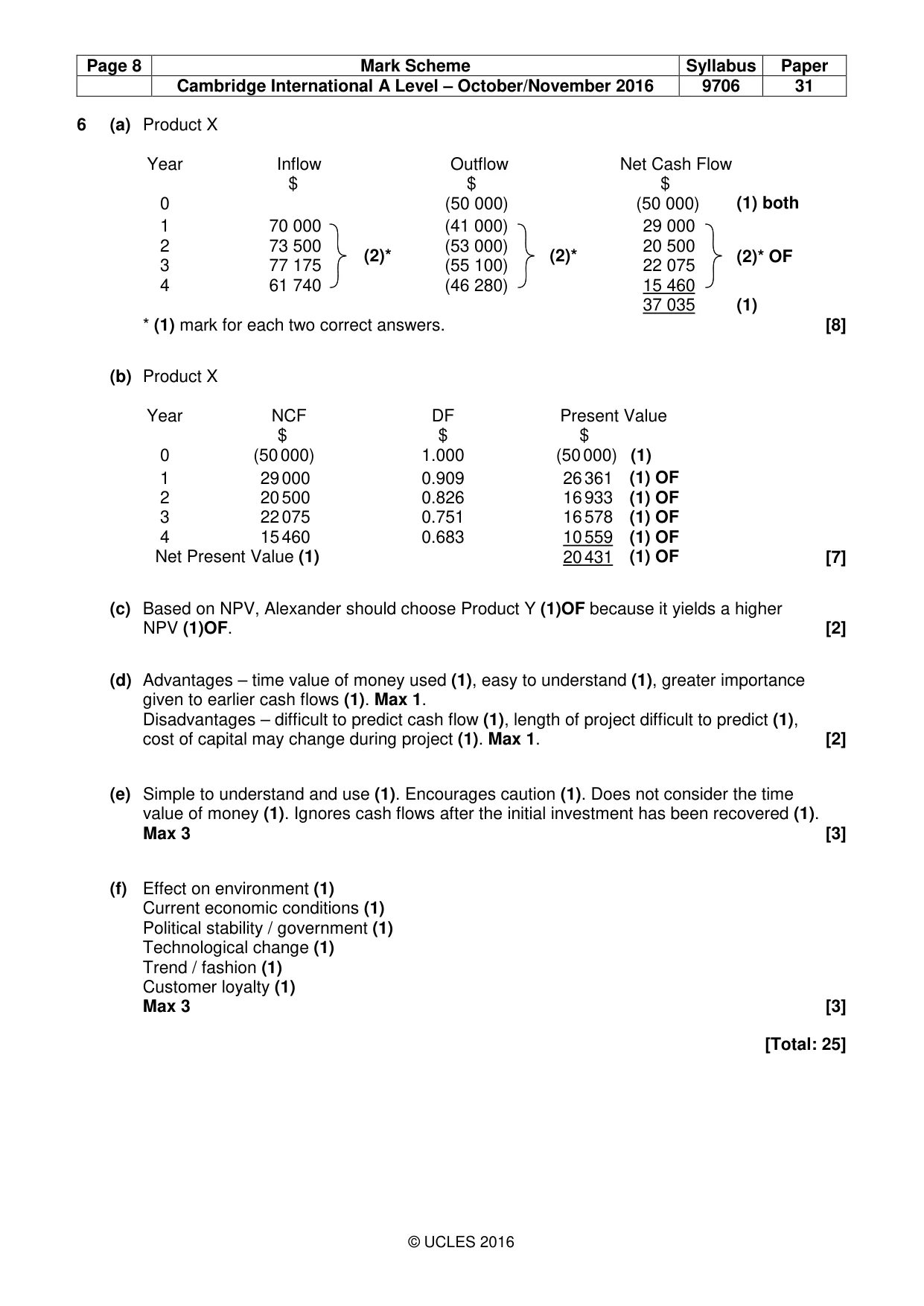
Page 8 Mark Scheme Syllabus Paper Cambridge International A Level – October/November 2016 9706 31 6 (a) Product X Year Inflow Outflow Net Cash Flow $ $ $ 0 (50 000) (50 000) (1) both (2)* OF 1 70 000 (2)* (41 000) (2)* 29 000 2 73 500 (53 000) 20 500 3 77 175 (55 100) 22 075 4 61 740 (46 280) 15 460 37 035 (1) * (1) mark for each two correct answers. [8] (b) Product X Year NCF DF Present Value $ $ $ 0 (50 000) 1.000 (50 000) (1) [7] 1 29 000 0.909 26 361 (1) OF 2 20 500 0.826 16 933 (1) OF 3 22 075 0.751 16 578 (1) OF 4 15 460 0.683 10 559 (1) OF Net Present Value (1) 20 431 (1) OF (c) Based on NPV, Alexander should choose Product Y (1)OF because it yields a higher NPV (1)OF. [2] (d) Advantages – time value of money used (1), easy to understand (1), greater importance given to earlier cash flows (1). Max 1. Disadvantages – difficult to predict cash flow (1), length of project difficult to predict (1), cost of capital may change during project (1). Max 1. [2] (e) Simple to understand and use (1). Encourages caution (1). Does not consider the time value of money (1). Ignores cash flows after the initial investment has been recovered (1). Max 3 [3] (f) Effect on environment (1) Current economic conditions (1) Political stability / government (1) Technological change (1) Trend / fashion (1) Customer loyalty (1) Max 3 [3] [Total: 25] © UCLES 2016
What you needed in this session
Cambridge’s own grade thresholds for 2016 Oct/Nov, Paper 3 · Variant 1. A higher threshold means an easier paper — the bar moves with how the cohort did.