Cambridge A Level Accounting 9706 — 2015 Oct/Nov Paper 3 · Variant 3
9706/33/O/N/15 · 30 marks · ≈34 min
The question paper and its mark scheme, free to read here and free to download. This is Cambridge’s own paper, exactly as it was sat.
Question paper12 pages
Mark scheme
No mark scheme is in the library for this paper.
Paper as text
Question paper, page 1
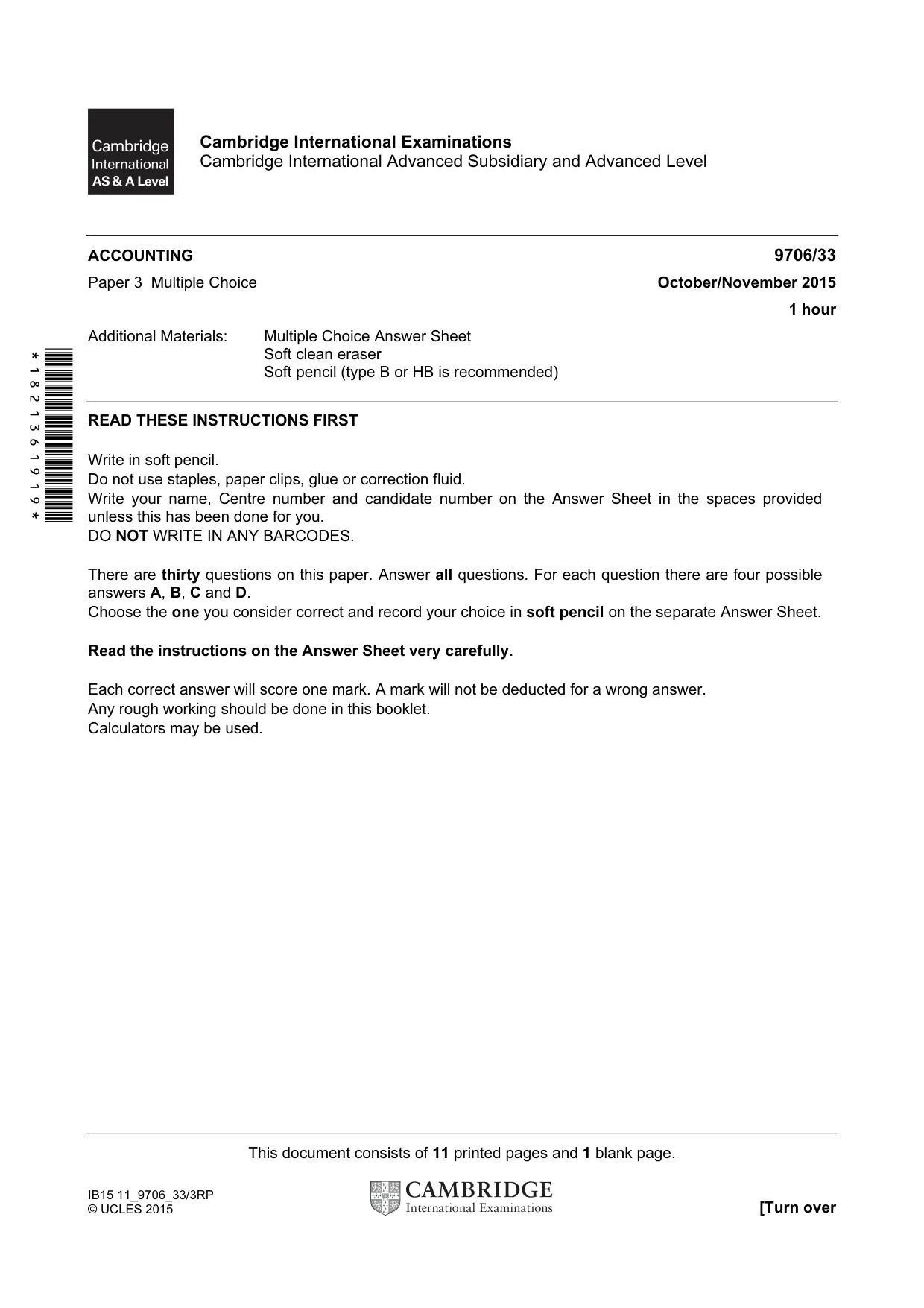
This document consists of 11 printed pages and 1 blank page. IB15 11_9706_33/3RP © UCLES 2015 [Turn over *1821361919* Cambridge International Examinations Cambridge International Advanced Subsidiary and Advanced Level ACCOUNTING 9706/33 Paper 3 Multiple Choice October/November 2015 1 hour Additional Materials: Multiple Choice Answer Sheet Soft clean eraser Soft pencil (type B or HB is recommended) READ THESE INSTRUCTIONS FIRST Write in soft pencil. Do not use staples, paper clips, glue or correction fluid. Write your name, Centre number and candidate number on the Answer Sheet in the spaces provided unless this has been done for you. DO NOT WRITE IN ANY BARCODES. There are thirty questions on this paper. Answer all questions. For each question there are four possible answers A, B, C and D. Choose the one you consider correct and record your choice in soft pencil on the separate Answer Sheet. Read the instructions on the Answer Sheet very carefully. Each correct answer will score one mark. A mark will not be deducted for a wrong answer. Any rough working should be done in this booklet. Calculators may be used.
Question paper, page 2
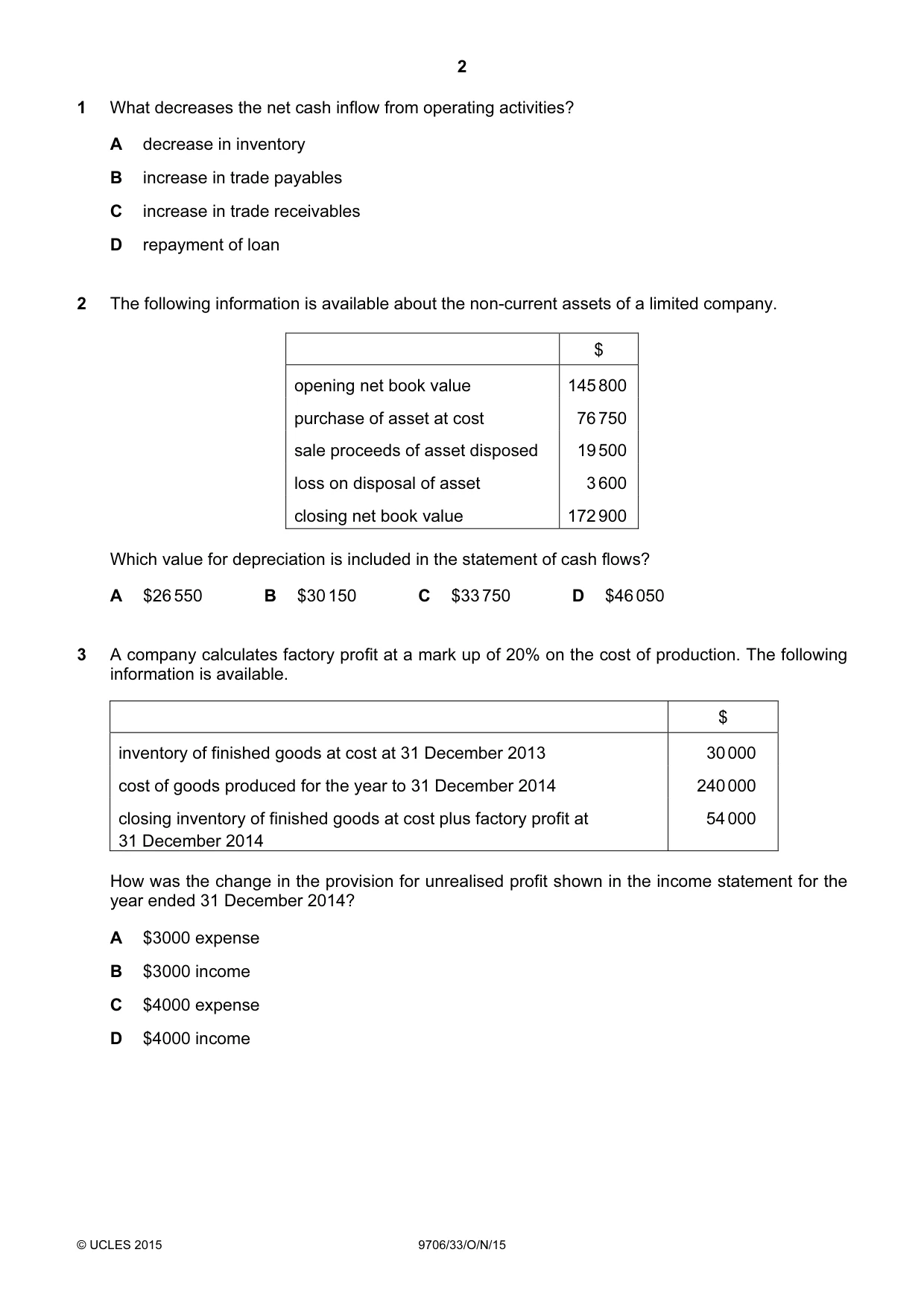
2 © UCLES 2015 9706/33/O/N/15 1 What decreases the net cash inflow from operating activities? A decrease in inventory B increase in trade payables C increase in trade receivables D repayment of loan 2 The following information is available about the non-current assets of a limited company. $ opening net book value 145 800 purchase of asset at cost 76 750 sale proceeds of asset disposed 19 500 loss on disposal of asset 3 600 closing net book value 172 900 Which value for depreciation is included in the statement of cash flows? A $26 550 B $30 150 C $33 750 D $46 050 3 A company calculates factory profit at a mark up of 20% on the cost of production. The following information is available. $ inventory of finished goods at cost at 31 December 2013 30 000 cost of goods produced for the year to 31 December 2014 240 000 closing inventory of finished goods at cost plus factory profit at 31 December 2014 54 000 How was the change in the provision for unrealised profit shown in the income statement for the year ended 31 December 2014? A $3000 expense B $3000 income C $4000 expense D $4000 income
Question paper, page 3
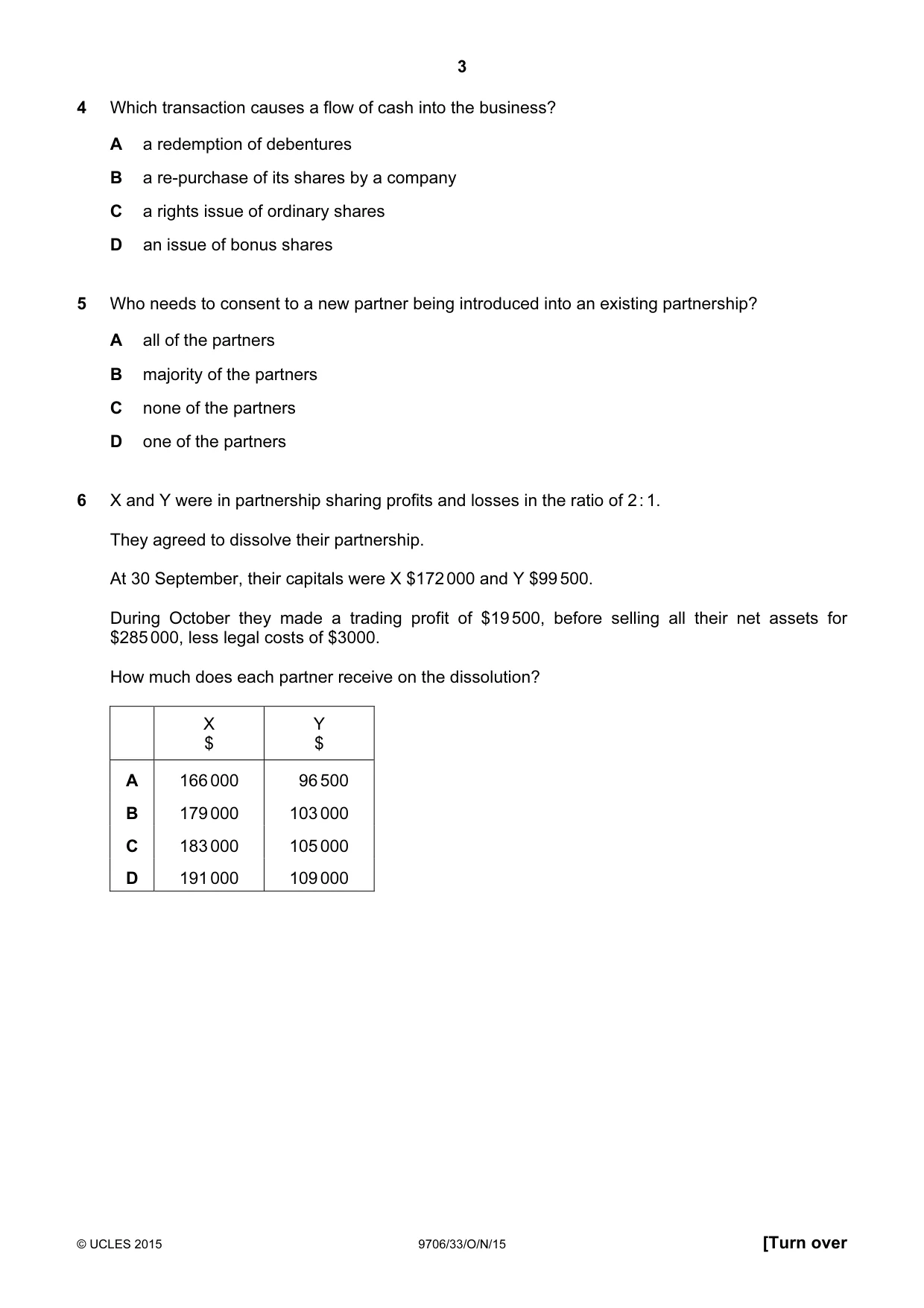
3 © UCLES 2015 9706/33/O/N/15 [Turn over 4 Which transaction causes a flow of cash into the business? A a redemption of debentures B a re-purchase of its shares by a company C a rights issue of ordinary shares D an issue of bonus shares 5 Who needs to consent to a new partner being introduced into an existing partnership? A all of the partners B majority of the partners C none of the partners D one of the partners 6 X and Y were in partnership sharing profits and losses in the ratio of 2 : 1. They agreed to dissolve their partnership. At 30 September, their capitals were X $172 000 and Y $99 500. During October they made a trading profit of $19 500, before selling all their net assets for $285 000, less legal costs of $3000. How much does each partner receive on the dissolution? X $ Y $ A 166 000 96 500 B 179 000 103 000 C 183 000 105 000 D 191 000 109 000
Question paper, page 4
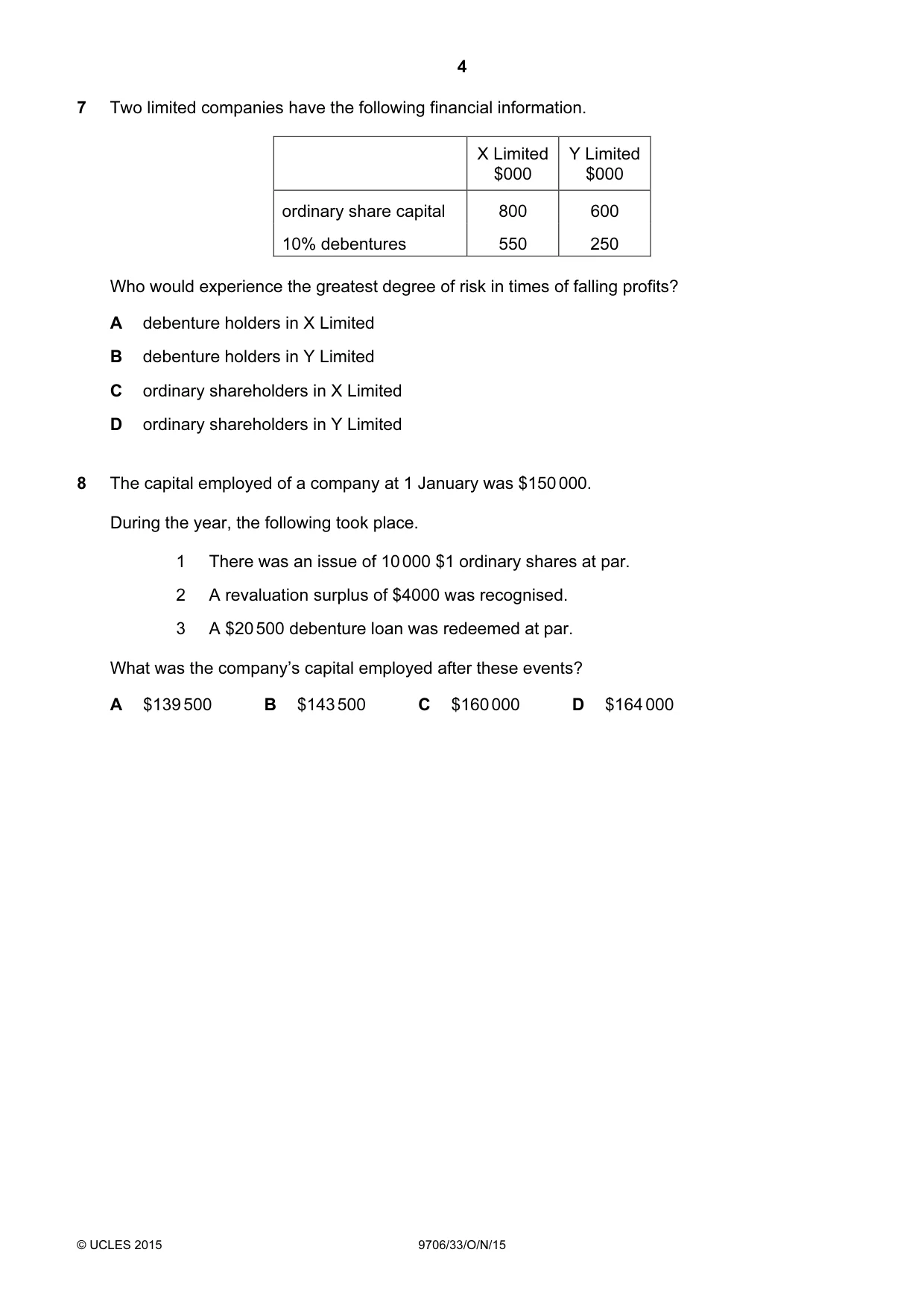
4 © UCLES 2015 9706/33/O/N/15 7 Two limited companies have the following financial information. X Limited $000 Y Limited $000 ordinary share capital 800 600 10% debentures 550 250 Who would experience the greatest degree of risk in times of falling profits? A debenture holders in X Limited B debenture holders in Y Limited C ordinary shareholders in X Limited D ordinary shareholders in Y Limited 8 The capital employed of a company at 1 January was $150 000. During the year, the following took place. 1 There was an issue of 10 000 $1 ordinary shares at par. 2 A revaluation surplus of $4000 was recognised. 3 A $20 500 debenture loan was redeemed at par. What was the company’s capital employed after these events? A $139 500 B $143 500 C $160 000 D $164 000
Question paper, page 5
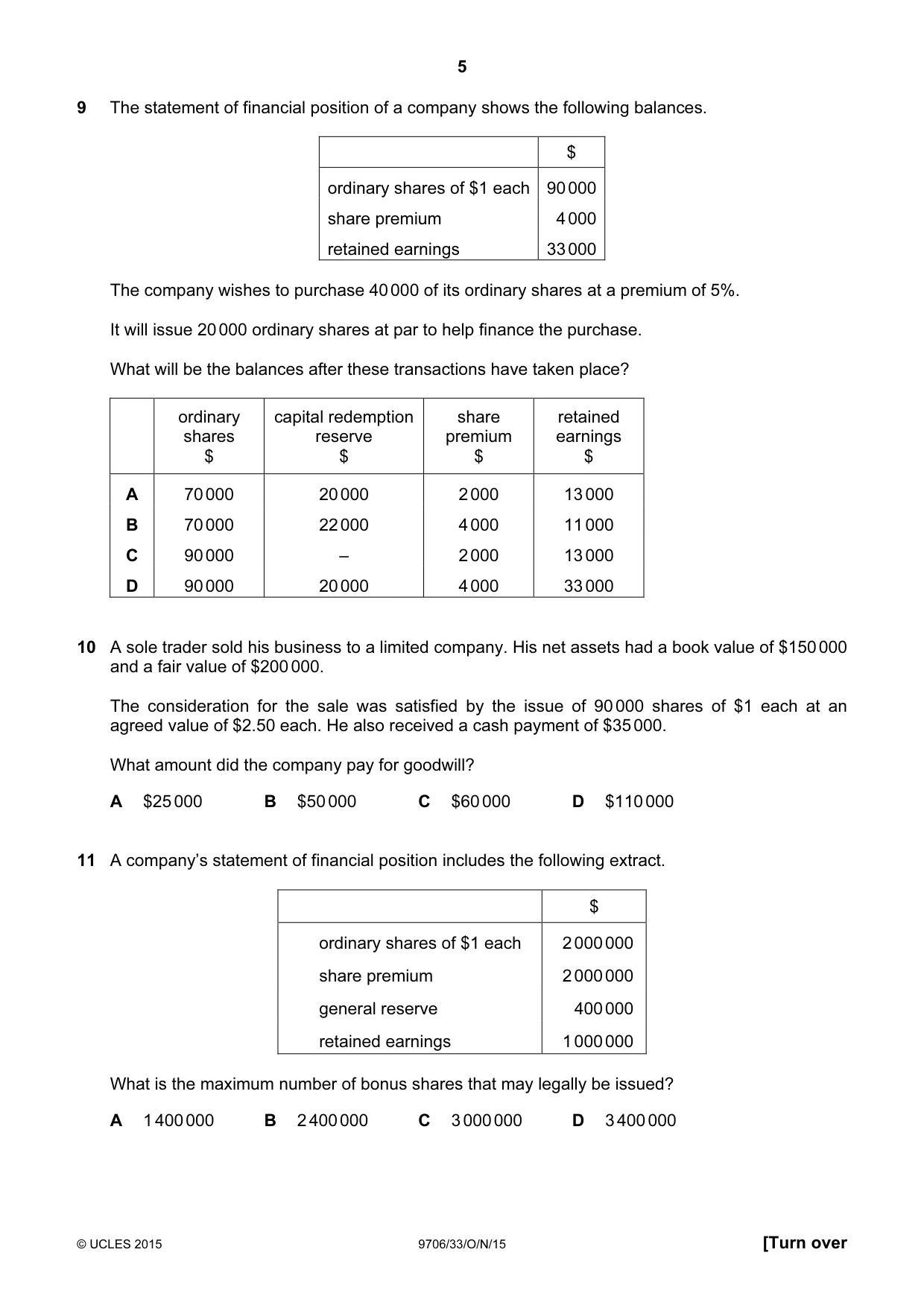
5 © UCLES 2015 9706/33/O/N/15 [Turn over 9 The statement of financial position of a company shows the following balances. $ ordinary shares of $1 each 90 000 share premium 4 000 retained earnings 33 000 The company wishes to purchase 40 000 of its ordinary shares at a premium of 5%. It will issue 20 000 ordinary shares at par to help finance the purchase. What will be the balances after these transactions have taken place? ordinary shares $ capital redemption reserve $ share premium $ retained earnings $ A 70 000 20 000 2 000 13 000 B 70 000 22 000 4 000 11 000 C 90 000 – 2 000 13 000 D 90 000 20 000 4 000 33 000 10 A sole trader sold his business to a limited company. His net assets had a book value of $150 000 and a fair value of $200 000. The consideration for the sale was satisfied by the issue of 90 000 shares of $1 each at an agreed value of $2.50 each. He also received a cash payment of $35 000. What amount did the company pay for goodwill? A $25 000 B $50 000 C $60 000 D $110 000 11 A company’s statement of financial position includes the following extract. $ ordinary shares of $1 each 2 000 000 share premium 2 000 000 general reserve 400 000 retained earnings 1 000 000 What is the maximum number of bonus shares that may legally be issued? A 1 400 000 B 2 400 000 C 3 000 000 D 3 400 000
Question paper, page 6
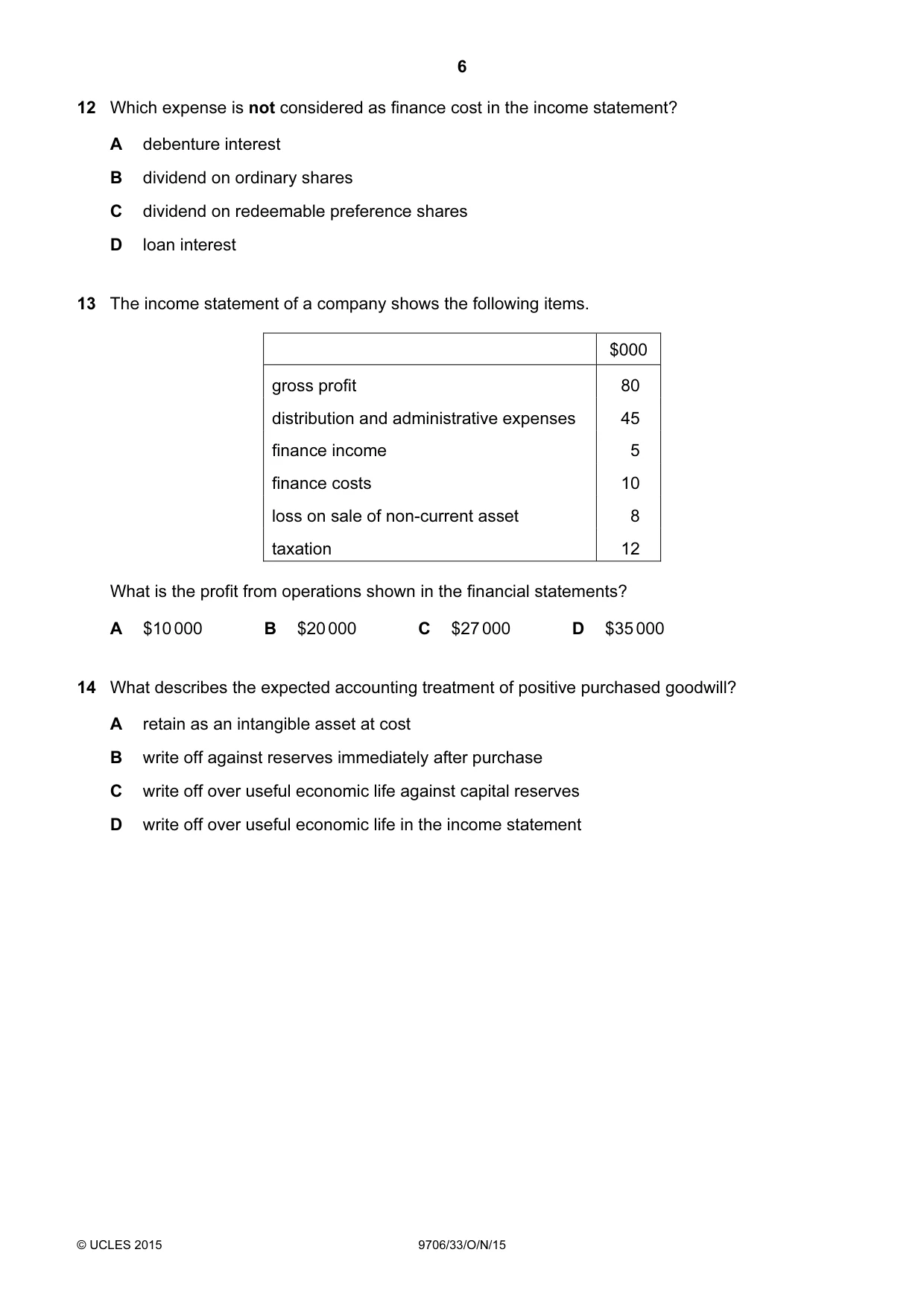
6 © UCLES 2015 9706/33/O/N/15 12 Which expense is not considered as finance cost in the income statement? A debenture interest B dividend on ordinary shares C dividend on redeemable preference shares D loan interest 13 The income statement of a company shows the following items. $000 gross profit 80 distribution and administrative expenses 45 finance income 5 finance costs 10 loss on sale of non-current asset 8 taxation 12 What is the profit from operations shown in the financial statements? A $10 000 B $20 000 C $27 000 D $35 000 14 What describes the expected accounting treatment of positive purchased goodwill? A retain as an intangible asset at cost B write off against reserves immediately after purchase C write off over useful economic life against capital reserves D write off over useful economic life in the income statement
Question paper, page 7
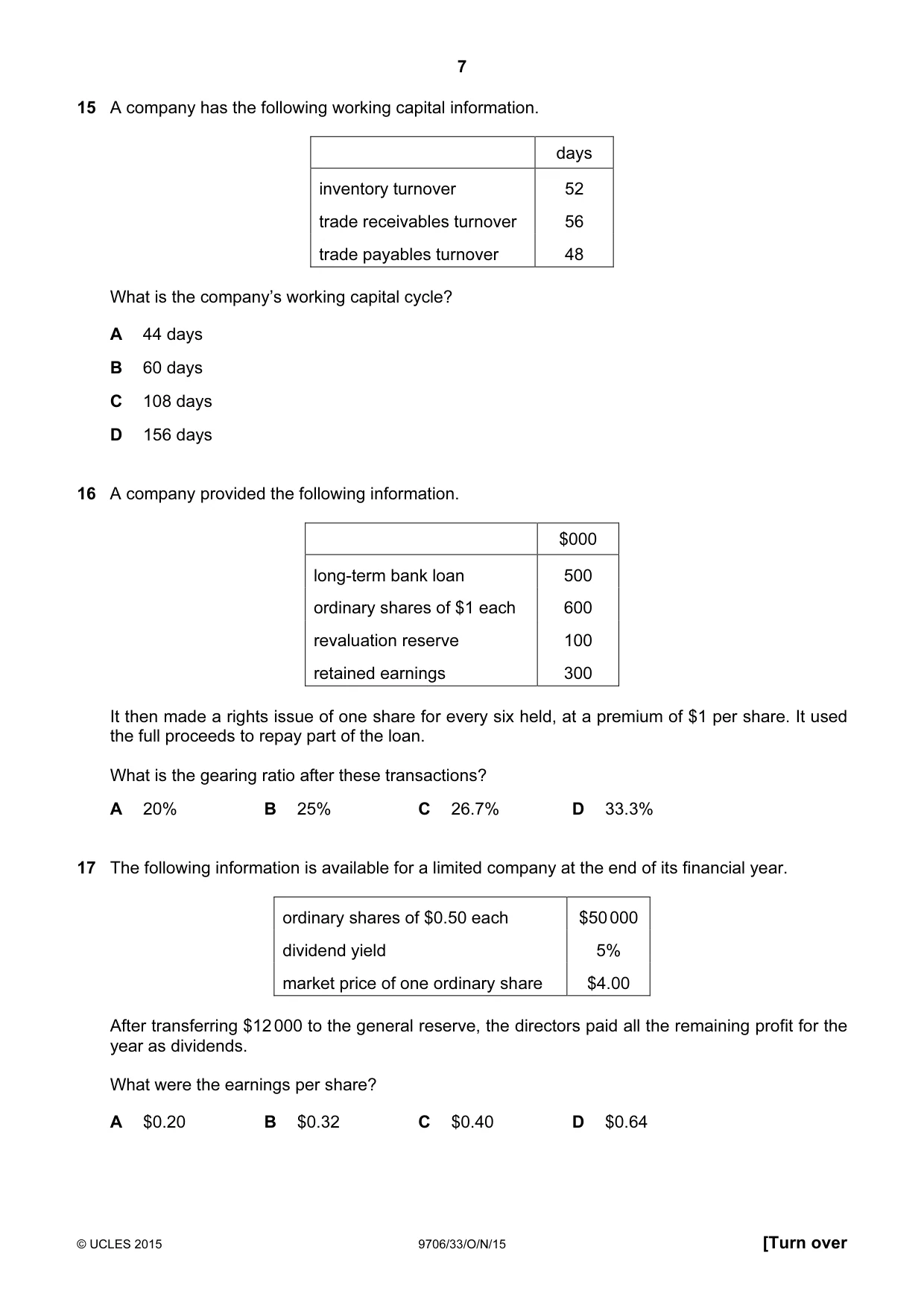
7 © UCLES 2015 9706/33/O/N/15 [Turn over 15 A company has the following working capital information. days inventory turnover 52 trade receivables turnover 56 trade payables turnover 48 What is the company’s working capital cycle? A 44 days B 60 days C 108 days D 156 days 16 A company provided the following information. $000 long-term bank loan 500 ordinary shares of $1 each 600 revaluation reserve 100 retained earnings 300 It then made a rights issue of one share for every six held, at a premium of $1 per share. It used the full proceeds to repay part of the loan. What is the gearing ratio after these transactions? A 20% B 25% C 26.7% D 33.3% 17 The following information is available for a limited company at the end of its financial year. ordinary shares of $0.50 each $50 000 dividend yield 5% market price of one ordinary share $4.00 After transferring $12 000 to the general reserve, the directors paid all the remaining profit for the year as dividends. What were the earnings per share? A $0.20 B $0.32 C $0.40 D $0.64
Question paper, page 8
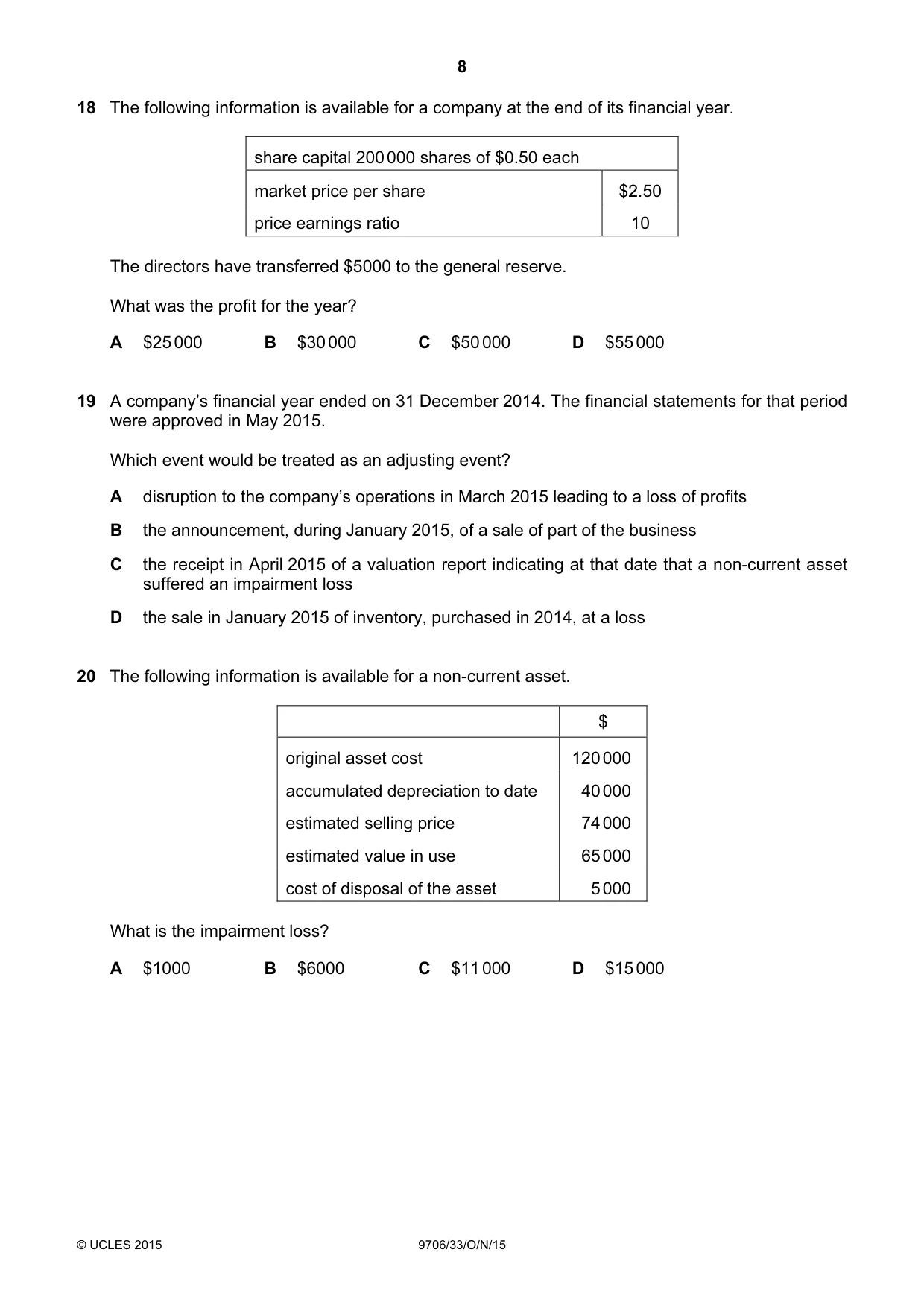
8 © UCLES 2015 9706/33/O/N/15 18 The following information is available for a company at the end of its financial year. share capital 200 000 shares of $0.50 each market price per share $2.50 price earnings ratio 10 The directors have transferred $5000 to the general reserve. What was the profit for the year? A $25 000 B $30 000 C $50 000 D $55 000 19 A company’s financial year ended on 31 December 2014. The financial statements for that period were approved in May 2015. Which event would be treated as an adjusting event? A disruption to the company’s operations in March 2015 leading to a loss of profits B the announcement, during January 2015, of a sale of part of the business C the receipt in April 2015 of a valuation report indicating at that date that a non-current asset suffered an impairment loss D the sale in January 2015 of inventory, purchased in 2014, at a loss 20 The following information is available for a non-current asset. $ original asset cost 120 000 accumulated depreciation to date 40 000 estimated selling price 74 000 estimated value in use 65 000 cost of disposal of the asset 5 000 What is the impairment loss? A $1000 B $6000 C $11 000 D $15 000
Question paper, page 9
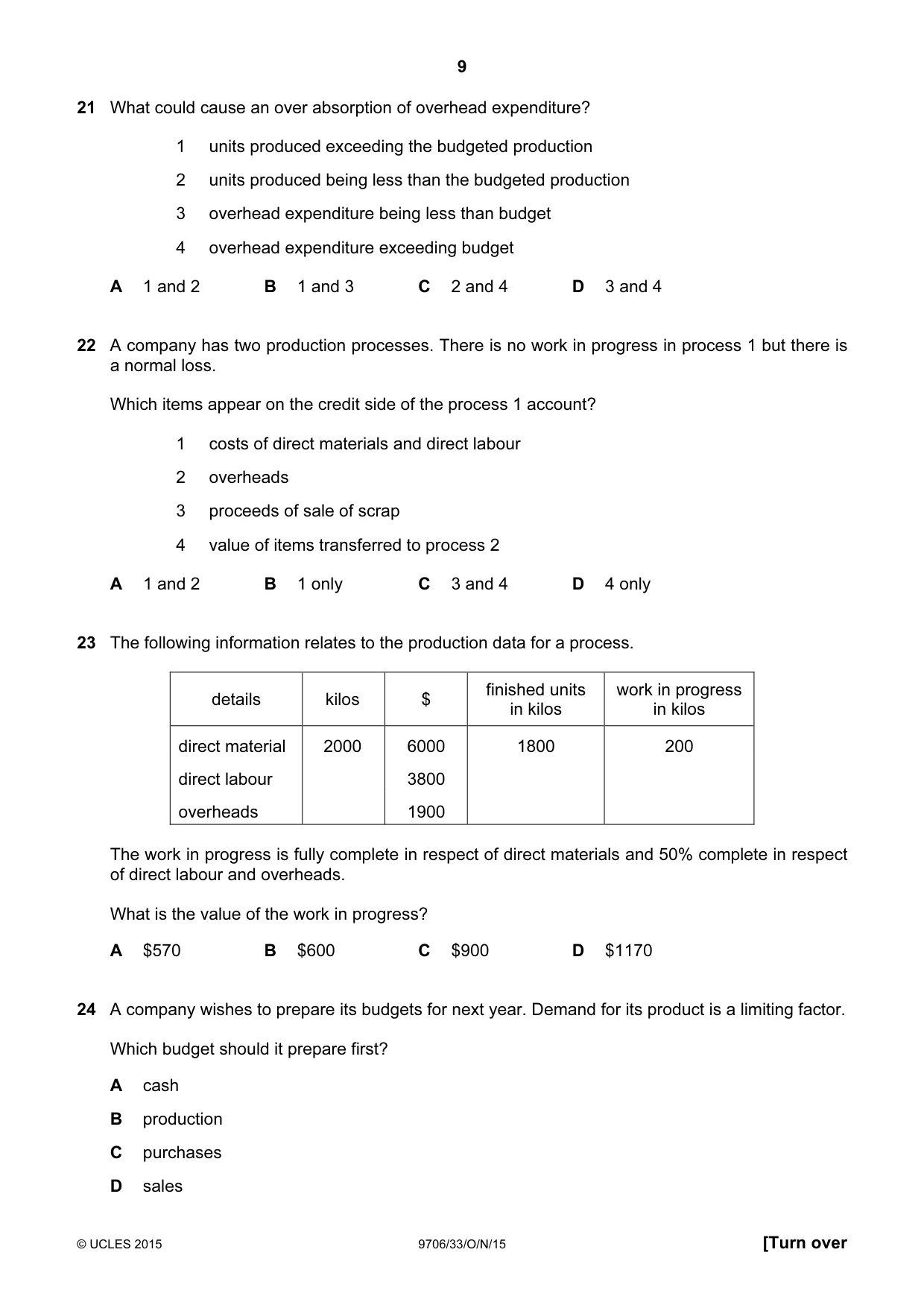
9 © UCLES 2015 9706/33/O/N/15 [Turn over 21 What could cause an over absorption of overhead expenditure? 1 units produced exceeding the budgeted production 2 units produced being less than the budgeted production 3 overhead expenditure being less than budget 4 overhead expenditure exceeding budget A 1 and 2 B 1 and 3 C 2 and 4 D 3 and 4 22 A company has two production processes. There is no work in progress in process 1 but there is a normal loss. Which items appear on the credit side of the process 1 account? 1 costs of direct materials and direct labour 2 overheads 3 proceeds of sale of scrap 4 value of items transferred to process 2 A 1 and 2 B 1 only C 3 and 4 D 4 only 23 The following information relates to the production data for a process. details kilos $ finished units in kilos work in progress in kilos direct material 2000 6000 1800 200 direct labour 3800 overheads 1900 The work in progress is fully complete in respect of direct materials and 50% complete in respect of direct labour and overheads. What is the value of the work in progress? A $570 B $600 C $900 D $1170 24 A company wishes to prepare its budgets for next year. Demand for its product is a limiting factor. Which budget should it prepare first? A cash B production C purchases D sales
Question paper, page 10
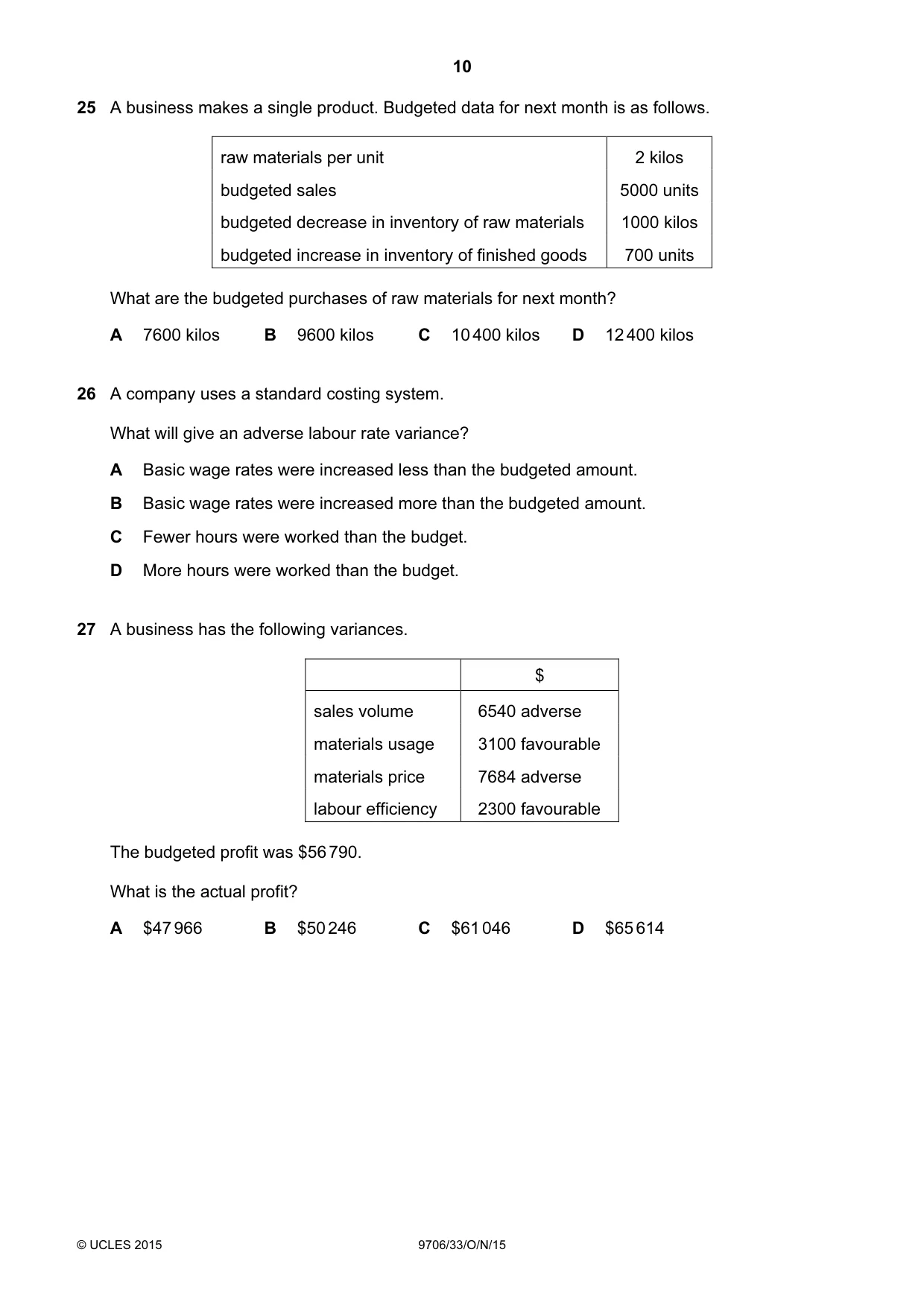
10 © UCLES 2015 9706/33/O/N/15 25 A business makes a single product. Budgeted data for next month is as follows. raw materials per unit 2 kilos budgeted sales 5000 units budgeted decrease in inventory of raw materials 1000 kilos budgeted increase in inventory of finished goods 700 units What are the budgeted purchases of raw materials for next month? A 7600 kilos B 9600 kilos C 10 400 kilos D 12 400 kilos 26 A company uses a standard costing system. What will give an adverse labour rate variance? A Basic wage rates were increased less than the budgeted amount. B Basic wage rates were increased more than the budgeted amount. C Fewer hours were worked than the budget. D More hours were worked than the budget. 27 A business has the following variances. $ sales volume 6540 adverse materials usage 3100 favourable materials price 7684 adverse labour efficiency 2300 favourable The budgeted profit was $56 790. What is the actual profit? A $47 966 B $50 246 C $61 046 D $65 614
Question paper, page 11
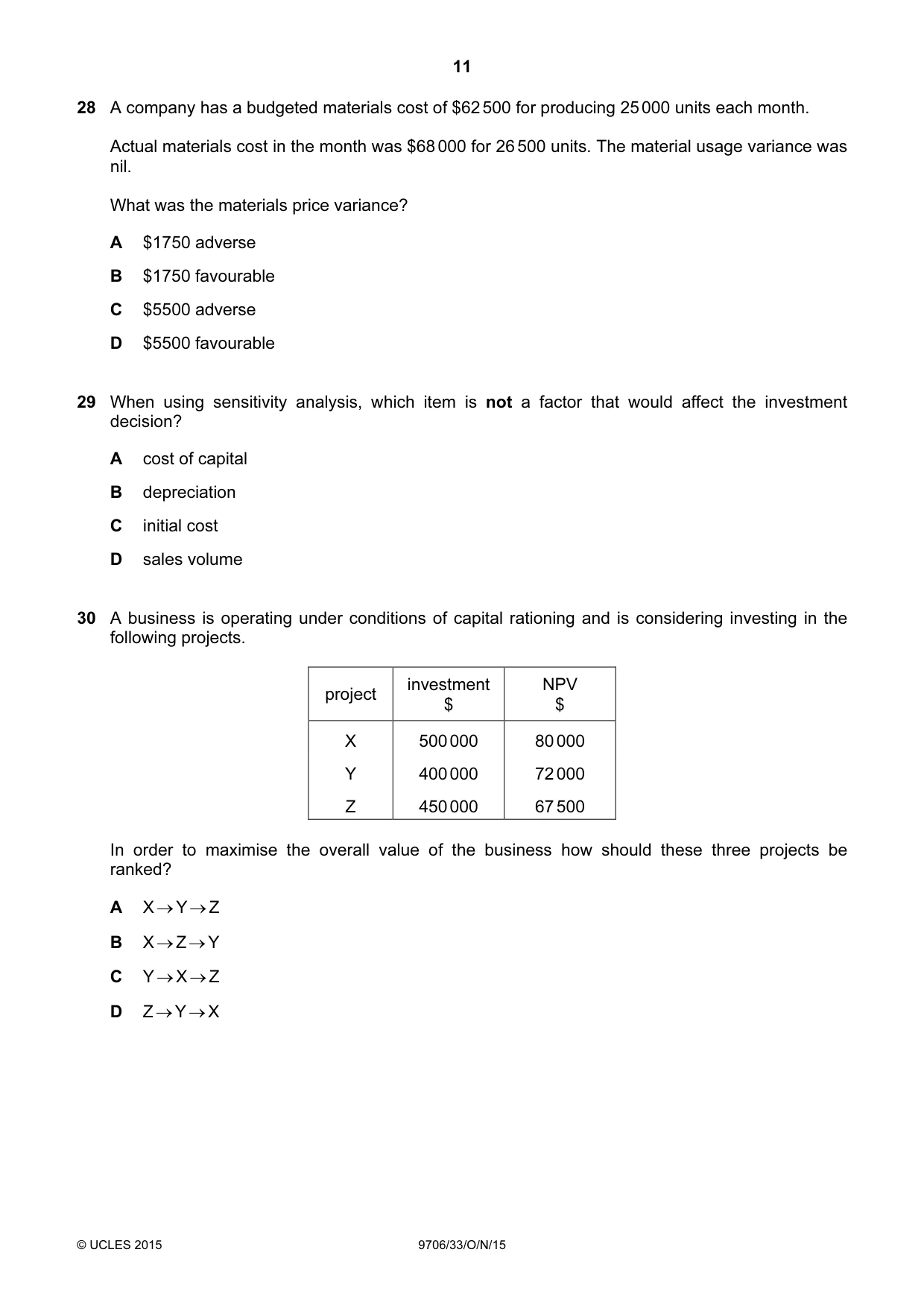
11 © UCLES 2015 9706/33/O/N/15 28 A company has a budgeted materials cost of $62 500 for producing 25 000 units each month. Actual materials cost in the month was $68 000 for 26 500 units. The material usage variance was nil. What was the materials price variance? A $1750 adverse B $1750 favourable C $5500 adverse D $5500 favourable 29 When using sensitivity analysis, which item is not a factor that would affect the investment decision? A cost of capital B depreciation C initial cost D sales volume 30 A business is operating under conditions of capital rationing and is considering investing in the following projects. project investment $ NPV $ X 500 000 80 000 Y 400 000 72 000 Z 450 000 67 500 In order to maximise the overall value of the business how should these three projects be ranked? A X → Y → Z B X → Z → Y C Y → X → Z D Z → Y → X
Question paper, page 12
12 Permission to reproduce items where third-party owned material protected by copyright is included has been sought and cleared where possible. Every reasonable effort has been made by the publisher (UCLES) to trace copyright holders, but if any items requiring clearance have unwittingly been included, the publisher will be pleased to make amends at the earliest possible opportunity. To avoid the issue of disclosure of answer-related information to candidates, all copyright acknowledgements are reproduced online in the Cambridge International Examinations Copyright Acknowledgements Booklet. This is produced for each series of examinations and is freely available to download at www.cie.org.uk after the live examination series. Cambridge International Examinations is part of the Cambridge Assessment Group. Cambridge Assessment is the brand name of University of Cambridge Local Examinations Syndicate (UCLES), which is itself a department of the University of Cambridge. © UCLES 2015 9706/33/O/N/15 BLANK PAGE
What you needed in this session
Cambridge’s own grade thresholds for 2015 Oct/Nov, Paper 3 · Variant 3. A higher threshold means an easier paper — the bar moves with how the cohort did.