Cambridge IGCSE Twenty-First Century Science 0608 — 2010 Oct/Nov Paper 4 · Variant 1
0608/41/O/N/10 · 60 marks · ≈68 min
The question paper and its mark scheme, free to read here and free to download. This is Cambridge’s own paper, exactly as it was sat.
Question paper16 pages
Mark scheme6 pages
Answers below. Sit the paper first if you are practising.
Paper as text
Question paper, page 1
This document consists of 16 printed pages. DC (LEO/SW) 29040/2 © UCLES 2010 [Turn over UNIVERSITY OF CAMBRIDGE INTERNATIONAL EXAMINATIONS International General Certificate of Secondary Education READ THESE INSTRUCTIONS FIRST Write your Centre number, candidate number and name on all the work you hand in. Write in dark blue or black pen. You may use a pencil for any diagrams or graphs. Do not use staples, paper clips, highlighters, glue or correction fluid. DO NOT WRITE IN ANY BARCODES. Answer all questions. At the end of the examination, fasten all your work securely together. The number of marks is given in brackets [ ] at the end of each question or part question. * 4 7 4 6 2 8 5 8 6 7 * TWENTY FIRST CENTURY SCIENCE 0608/04 Paper 4 October/November 2010 1 hour 30 minutes Candidates answer on the Question Paper. No Additional Materials are required. For Examiner’s Use 1 2 3 4 5 6 7 8 9 Total www.XtremePapers.com
Question paper, page 2
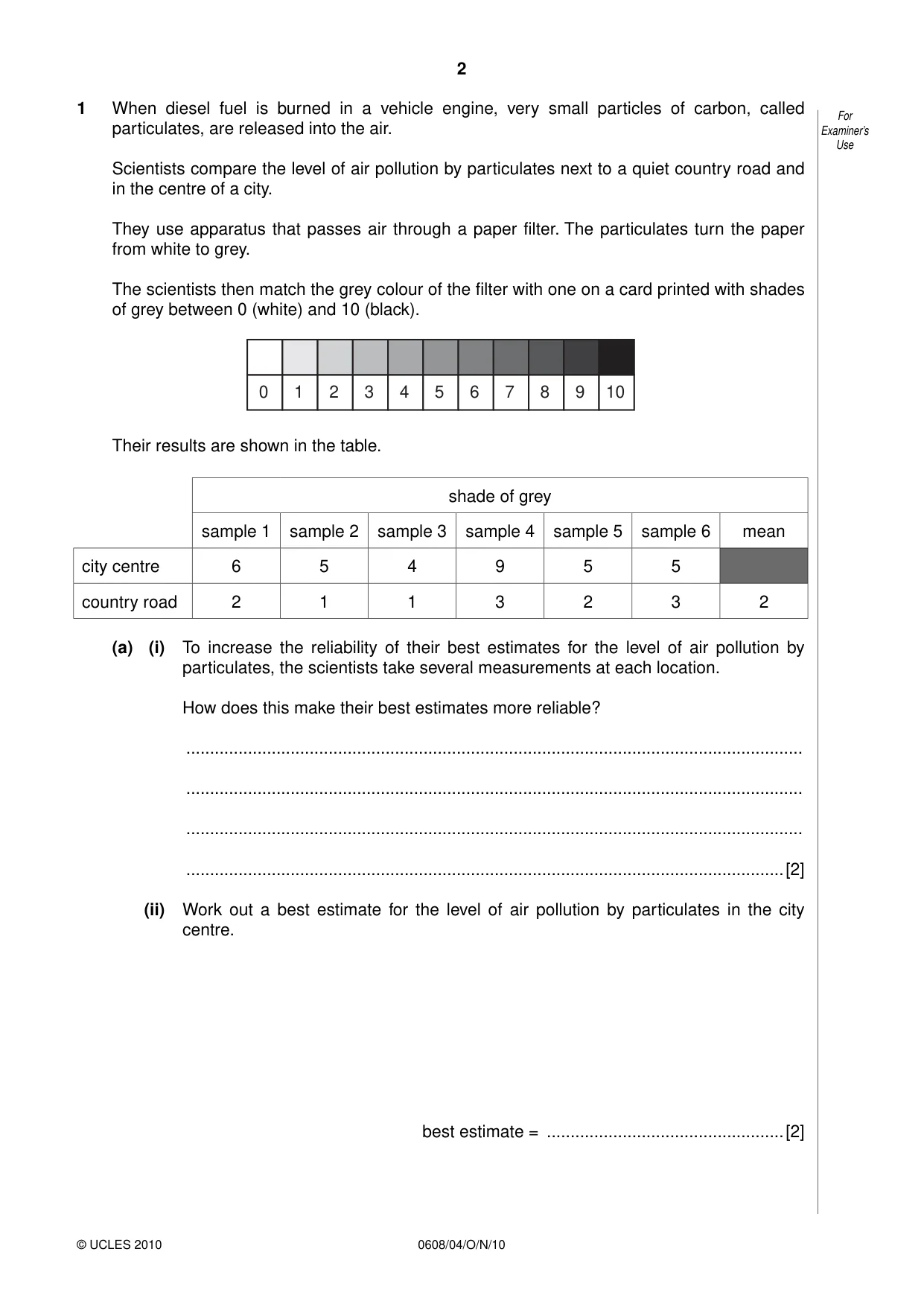
2 0608/04/O/N/10 © UCLES 2010 For Examiner’s Use 1 When diesel fuel is burned in a vehicle engine, very small particles of carbon, called particulates, are released into the air. Scientists compare the level of air pollution by particulates next to a quiet country road and in the centre of a city. They use apparatus that passes air through a paper filter. The particulates turn the paper from white to grey. The scientists then match the grey colour of the filter with one on a card printed with shades of grey between 0 (white) and 10 (black). 0 1 2 3 4 5 6 7 8 9 10 Their results are shown in the table. shade of grey sample 1 sample 2 sample 3 sample 4 sample 5 sample 6 mean city centre 6 5 4 9 5 5 country road 2 1 1 3 2 3 2 (a) (i) To increase the reliability of their best estimates for the level of air pollution by particulates, the scientists take several measurements at each location. How does this make their best estimates more reliable? … … … …[2] (ii) Work out a best estimate for the level of air pollution by particulates in the city centre. best estimate = …[2]
Question paper, page 3
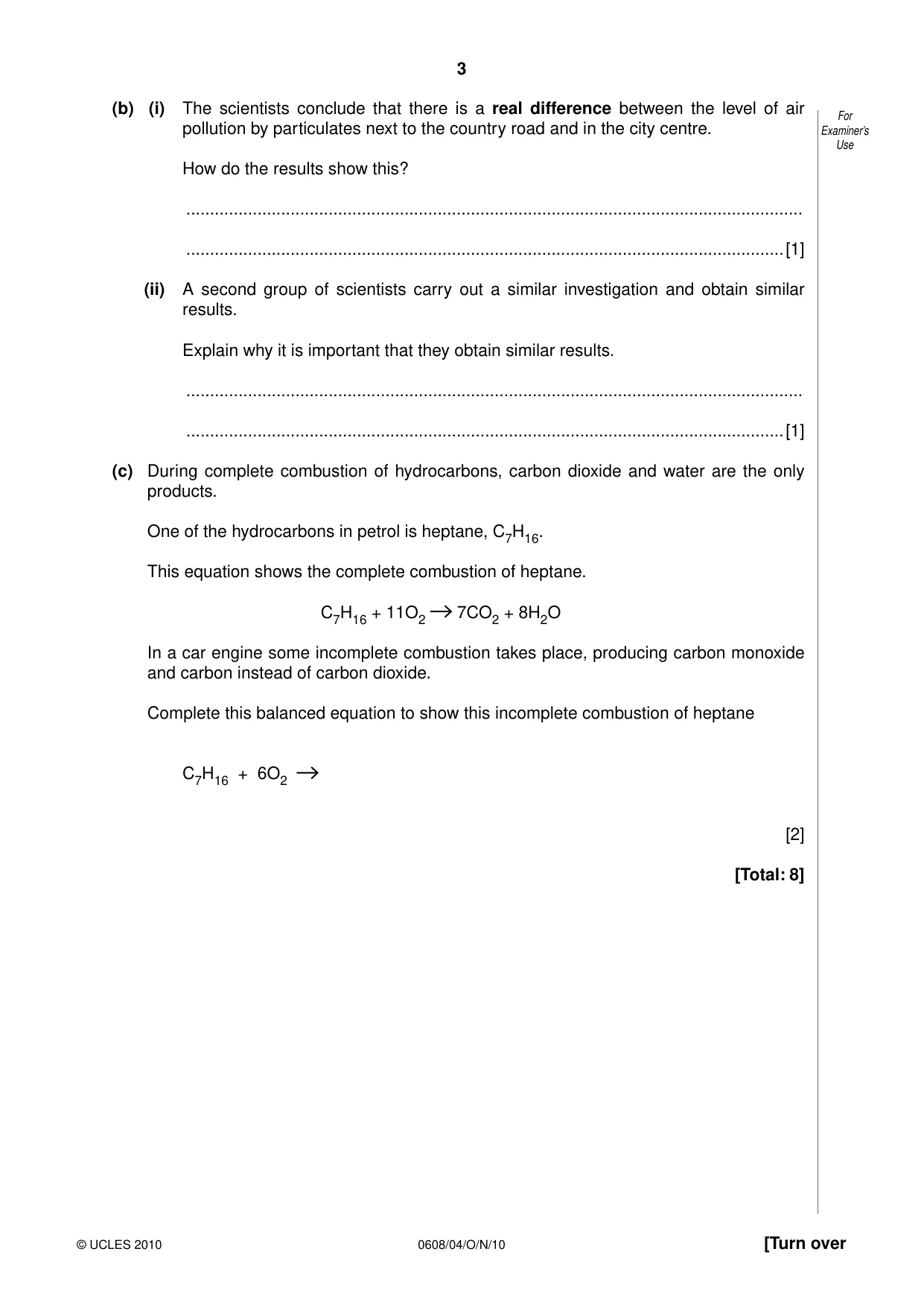
3 0608/04/O/N/10 © UCLES 2010 [Turn over For Examiner’s Use (b) (i) The scientists conclude that there is a real difference between the level of air pollution by particulates next to the country road and in the city centre. How do the results show this? … …[1] (ii) A second group of scientists carry out a similar investigation and obtain similar results. Explain why it is important that they obtain similar results. … …[1] (c) During complete combustion of hydrocarbons, carbon dioxide and water are the only products. One of the hydrocarbons in petrol is heptane, C7H16. This equation shows the complete combustion of heptane. C7H16 + 11O2 7CO2 + 8H2O In a car engine some incomplete combustion takes place, producing carbon monoxide and carbon instead of carbon dioxide. Complete this balanced equation to show this incomplete combustion of heptane C7H16 + 6O2 [2] [Total: 8]
Question paper, page 4
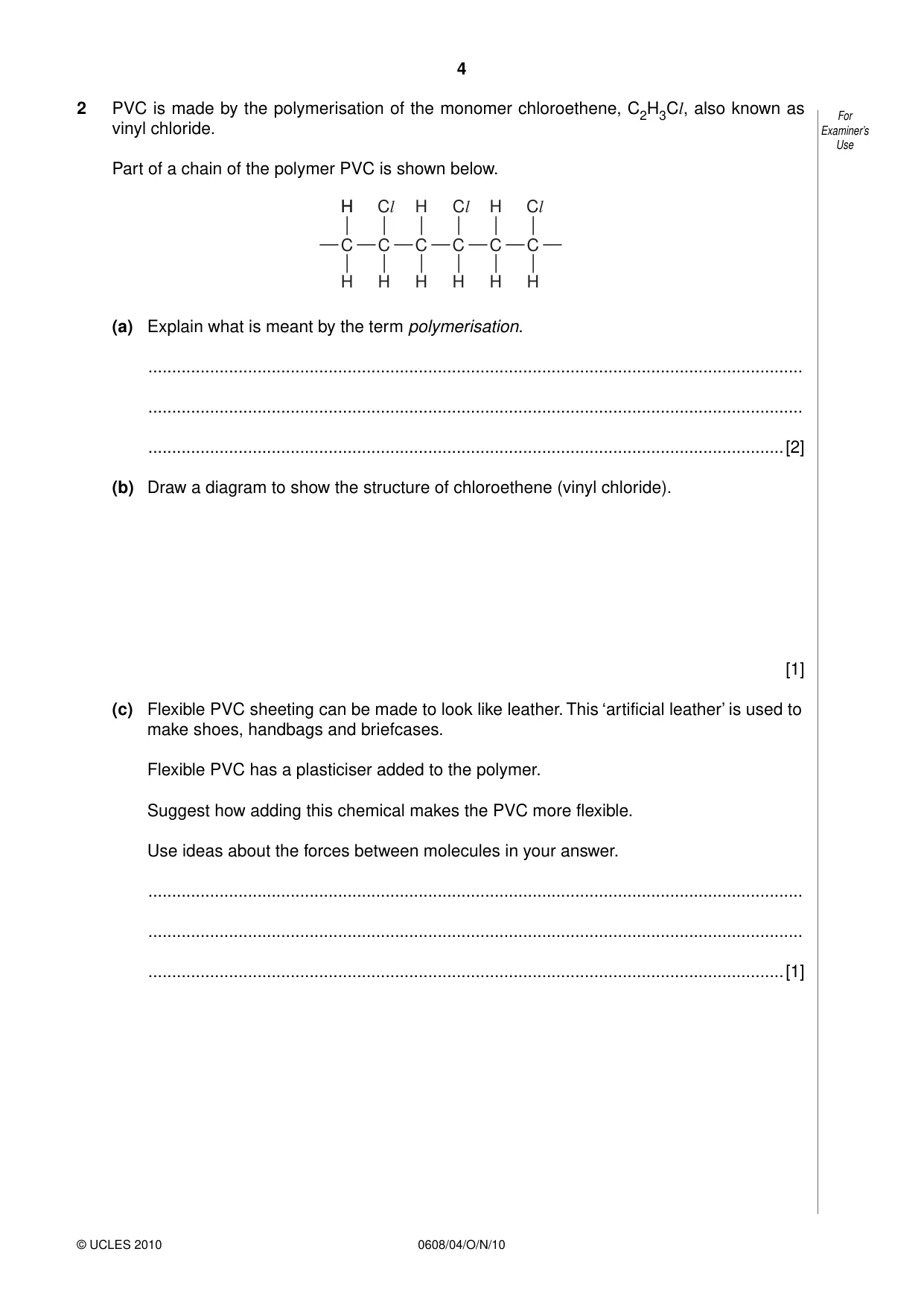
4 0608/04/O/N/10 © UCLES 2010 For Examiner’s Use 2 PVC is made by the polymerisation of the monomer chloroethene, C2H3Cl, also known as vinyl chloride. Part of a chain of the polymer PVC is shown below. C H H C Cl Cl Cl H C H H C H C H H C H (a) Explain what is meant by the term polymerisation. … … …[2] (b) Draw a diagram to show the structure of chloroethene (vinyl chloride). [1] (c) Flexible PVC sheeting can be made to look like leather. This ‘artificial leather’ is used to make shoes, handbags and briefcases. Flexible PVC has a plasticiser added to the polymer. Suggest how adding this chemical makes the PVC more flexible. Use ideas about the forces between molecules in your answer. … … …[1]
Question paper, page 5
5 0608/04/O/N/10 © UCLES 2010 [Turn over For Examiner’s Use (d) PVC is also used to make rigid window frames. The outcome for a Life Cycle Assessment for PVC ‘artificial leather’ is different from the outcome for a Life Cycle Assessment for PVC window frames. Suggest and explain one difference in the Life Cycle Assessments for these two uses of the same material. … … … …[2] [Total: 6]
Question paper, page 6
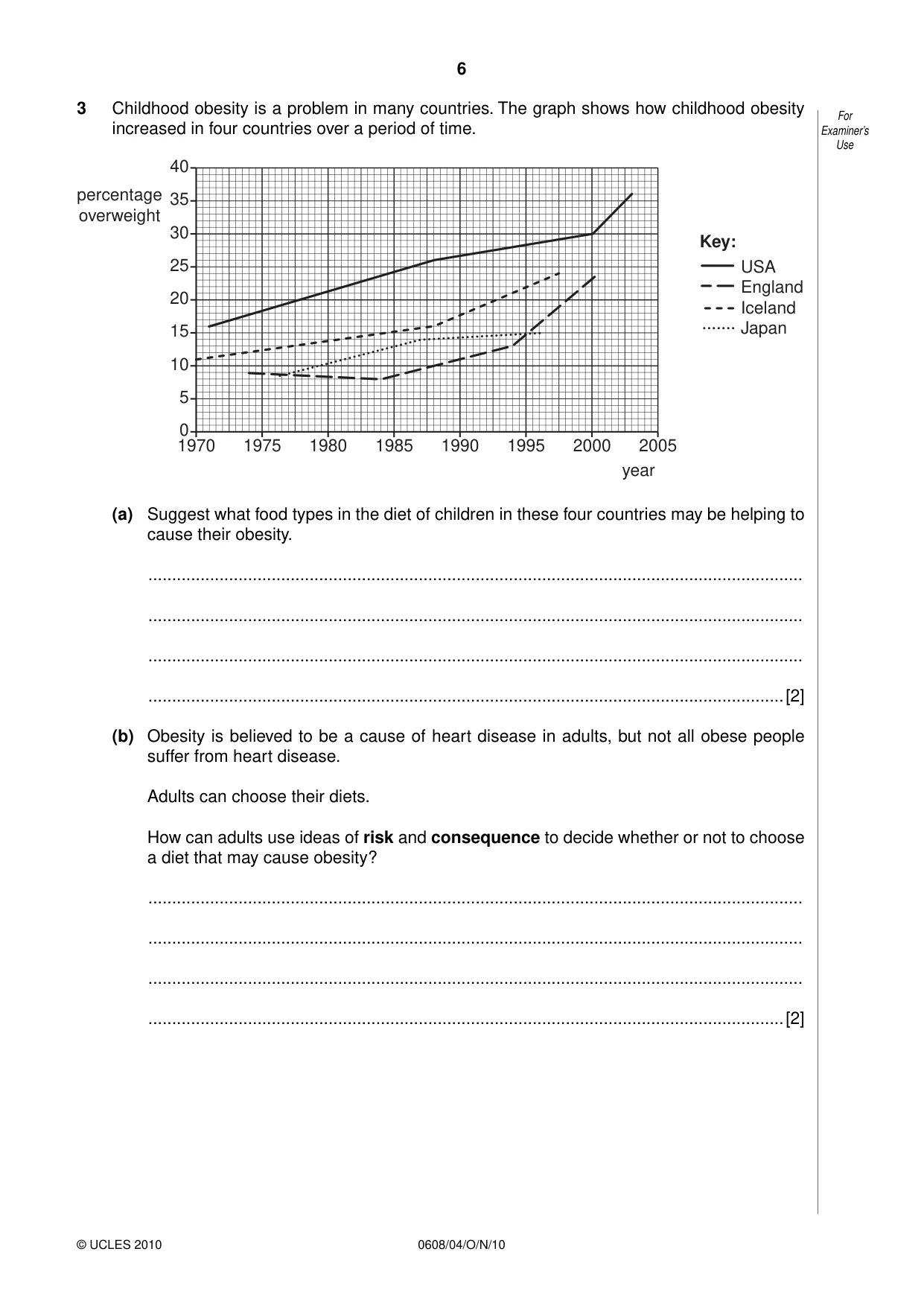
6 0608/04/O/N/10 © UCLES 2010 For Examiner’s Use 3 Childhood obesity is a problem in many countries. The graph shows how childhood obesity increased in four countries over a period of time. 1970 0 5 10 15 20 25 30 35 40 1975 1980 1985 1990 1995 2000 2005 percentage overweight USA England Iceland Japan Key: year (a) Suggest what food types in the diet of children in these four countries may be helping to cause their obesity. … … … …[2] (b) Obesity is believed to be a cause of heart disease in adults, but not all obese people suffer from heart disease. Adults can choose their diets. How can adults use ideas of risk and consequence to decide whether or not to choose a diet that may cause obesity? … … … …[2]
Question paper, page 7
7 0608/04/O/N/10 © UCLES 2010 [Turn over For Examiner’s Use (c) In these four countries the number of adults who have heart disease is increasing. The link between obesity and heart disease is well established. Despite this fact many adults remain obese. Suggest two reasons why these people are willing to accept this increased risk of getting heart disease. 1. … … 2. … …[2] [Total: 6]
Question paper, page 8
8 0608/04/O/N/10 © UCLES 2010 For Examiner’s Use 4 In 1912, Alfred Wegener presented his idea of continental drift. (a) (i) Wegener had evidence to support his theory. Write down two facts that supported Wegener’s theory. 1. … … 2. … …[2] (ii) Most scientists did not believe Wegener’s theory in 1912. Explain why these scientists did not accept Wegener’s theory. … …[1] (b) The discovery of seafloor spreading supported Wegener’s theory. Describe the process of seafloor spreading, and explain how it supported Wegener’s theory. … … … …[2] (c) Understanding where earthquakes happen allows governments to prepare for them before they happen. Suggest and explain two actions that governments could take to reduce the damage caused by earthquakes. 1. … … 2. … …[2] [Total: 7]
Question paper, page 9
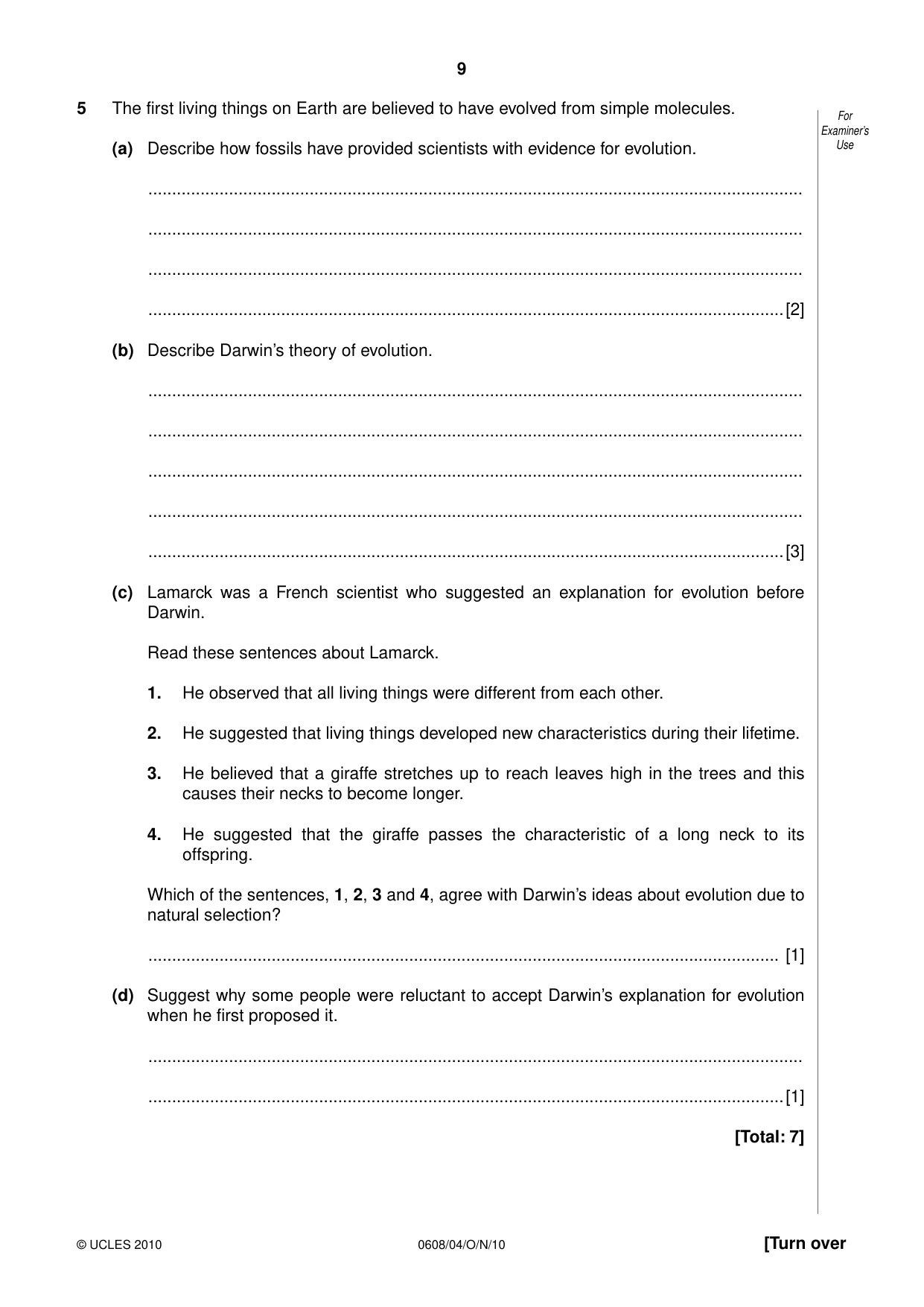
9 0608/04/O/N/10 © UCLES 2010 [Turn over For Examiner’s Use 5 The first living things on Earth are believed to have evolved from simple molecules. (a) Describe how fossils have provided scientists with evidence for evolution. … … … …[2] (b) Describe Darwin’s theory of evolution. … … … … …[3] (c) Lamarck was a French scientist who suggested an explanation for evolution before Darwin. Read these sentences about Lamarck. 1. He observed that all living things were different from each other. 2. He suggested that living things developed new characteristics during their lifetime. 3. He believed that a giraffe stretches up to reach leaves high in the trees and this causes their necks to become longer. 4. He suggested that the giraffe passes the characteristic of a long neck to its offspring. Which of the sentences, 1, 2, 3 and 4, agree with Darwin’s ideas about evolution due to natural selection? … [1] (d) Suggest why some people were reluctant to accept Darwin’s explanation for evolution when he first proposed it. … …[1] [Total: 7]
Question paper, page 10
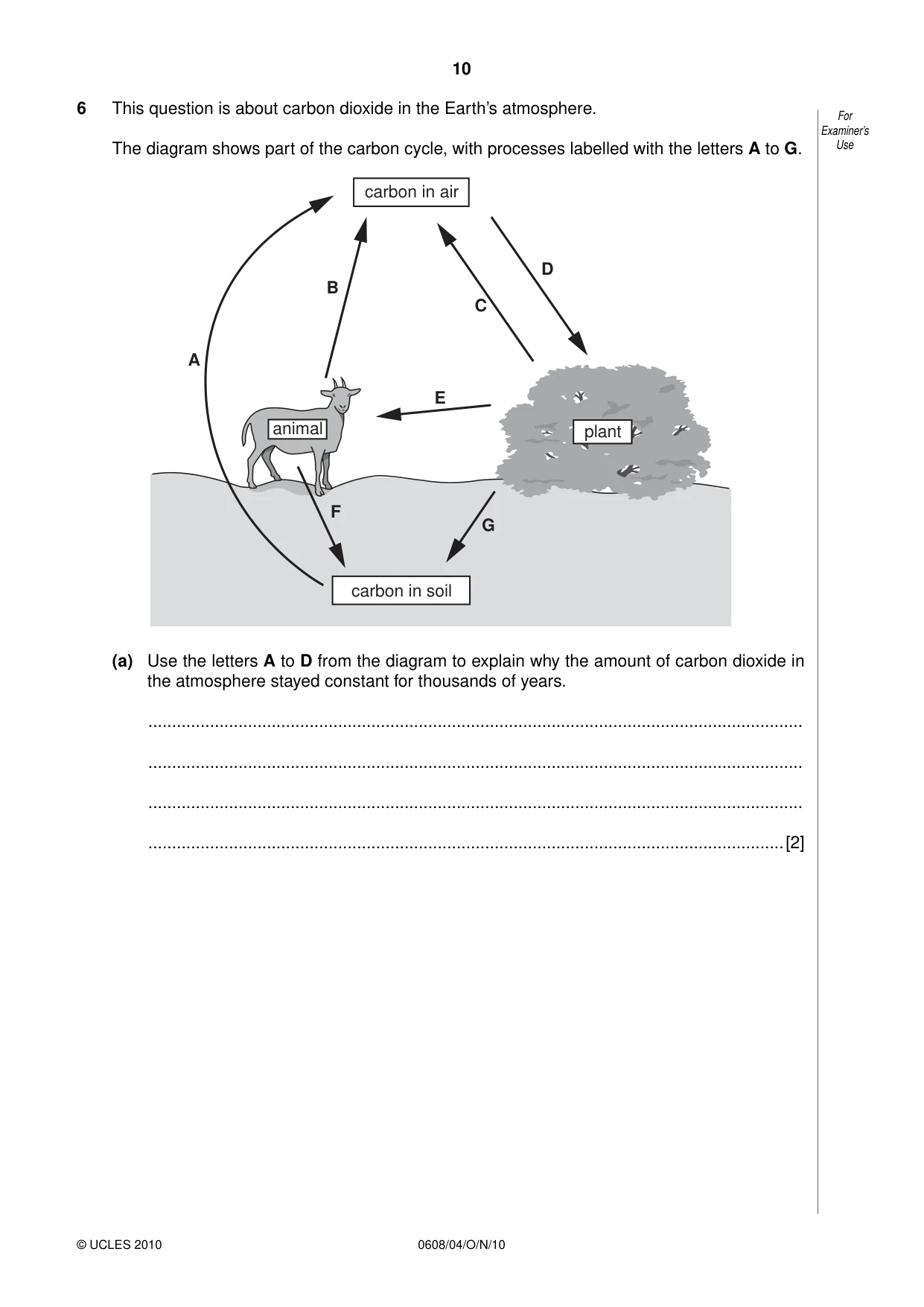
10 0608/04/O/N/10 © UCLES 2010 For Examiner’s Use 6 This question is about carbon dioxide in the Earth’s atmosphere. The diagram shows part of the carbon cycle, with processes labelled with the letters A to G. carbon in air A B C D E G F animal plant carbon in soil (a) Use the letters A to D from the diagram to explain why the amount of carbon dioxide in the atmosphere stayed constant for thousands of years. … … … …[2]
Question paper, page 11
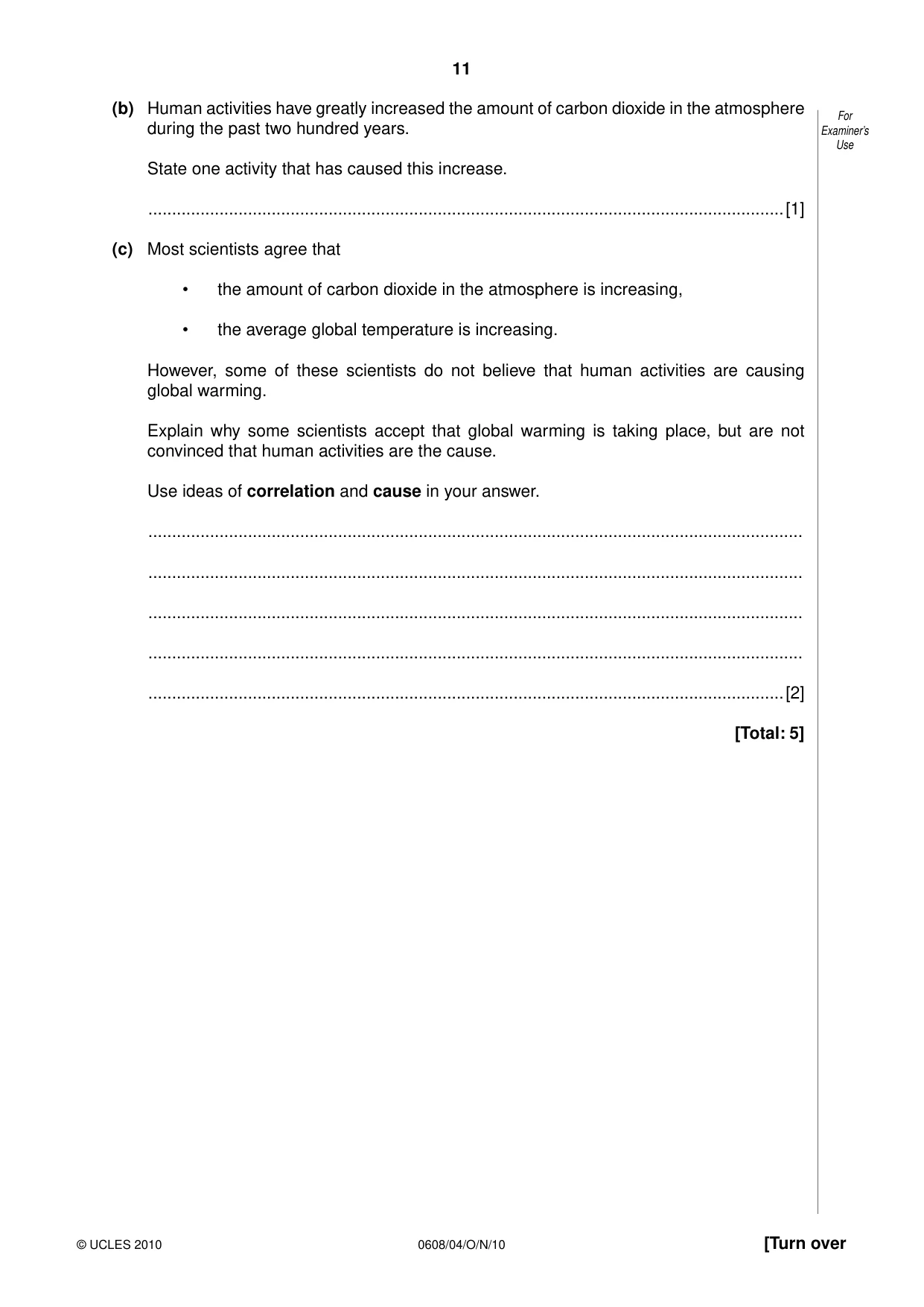
11 0608/04/O/N/10 © UCLES 2010 [Turn over For Examiner’s Use (b) Human activities have greatly increased the amount of carbon dioxide in the atmosphere during the past two hundred years. State one activity that has caused this increase. …[1] (c) Most scientists agree that • the amount of carbon dioxide in the atmosphere is increasing, • the average global temperature is increasing. However, some of these scientists do not believe that human activities are causing global warming. Explain why some scientists accept that global warming is taking place, but are not convinced that human activities are the cause. Use ideas of correlation and cause in your answer. … … … … …[2] [Total: 5]
Question paper, page 12
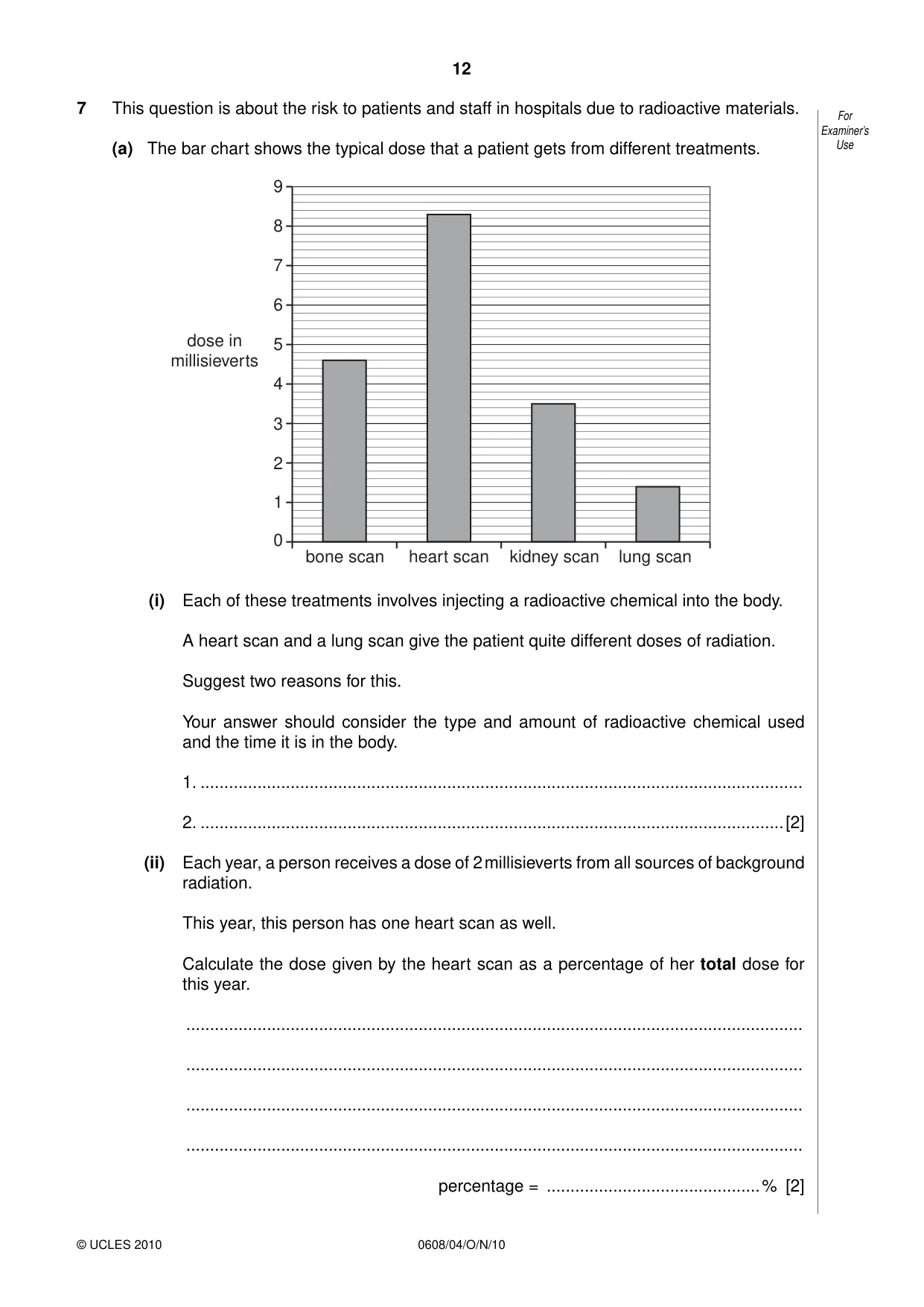
12 0608/04/O/N/10 © UCLES 2010 For Examiner’s Use 7 This question is about the risk to patients and staff in hospitals due to radioactive materials. (a) The bar chart shows the typical dose that a patient gets from different treatments. 9 8 7 6 5 4 dose in millisieverts 3 2 1 0 bone scan heart scan kidney scan lung scan (i) Each of these treatments involves injecting a radioactive chemical into the body. A heart scan and a lung scan give the patient quite different doses of radiation. Suggest two reasons for this. Your answer should consider the type and amount of radioactive chemical used and the time it is in the body. 1. … 2. …[2] (ii) Each year, a person receives a dose of 2 millisieverts from all sources of background radiation. This year, this person has one heart scan as well. Calculate the dose given by the heart scan as a percentage of her total dose for this year. … … … … percentage = …% [2]
Question paper, page 13
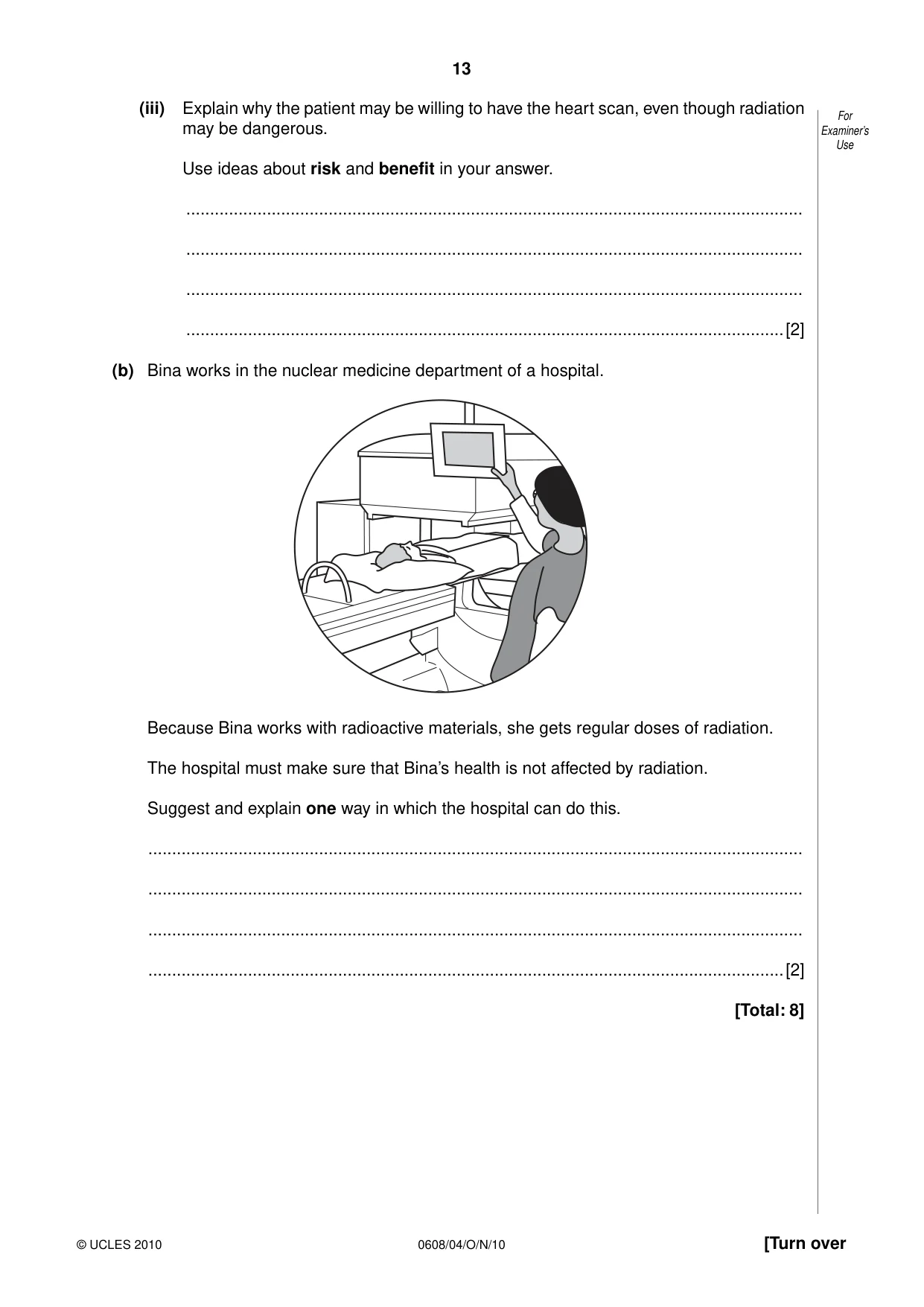
13 0608/04/O/N/10 © UCLES 2010 [Turn over For Examiner’s Use (iii) Explain why the patient may be willing to have the heart scan, even though radiation may be dangerous. Use ideas about risk and benefit in your answer. … … … …[2] (b) Bina works in the nuclear medicine department of a hospital. Because Bina works with radioactive materials, she gets regular doses of radiation. The hospital must make sure that Bina’s health is not affected by radiation. Suggest and explain one way in which the hospital can do this. … … … …[2] [Total: 8]
Question paper, page 14
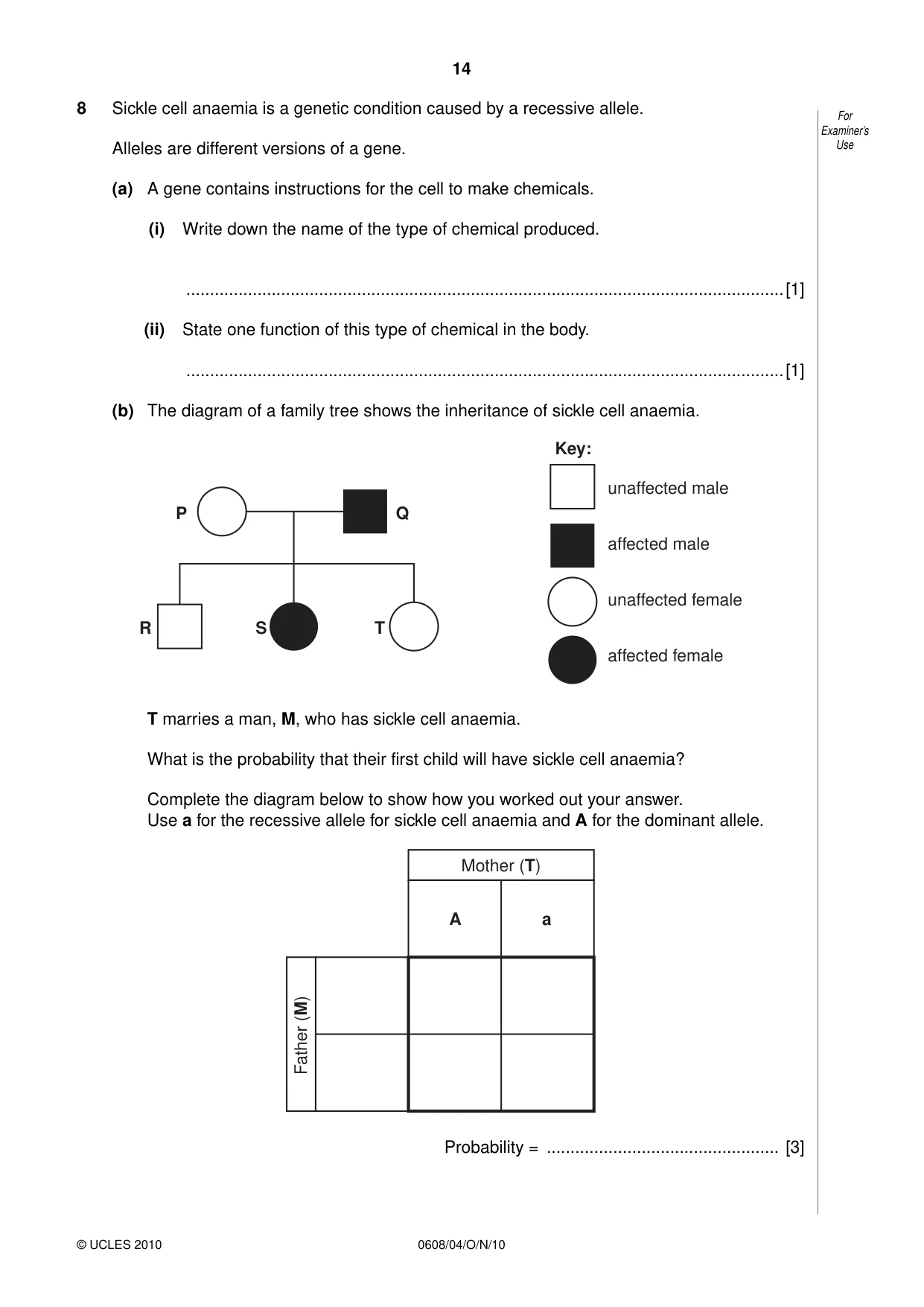
14 0608/04/O/N/10 © UCLES 2010 For Examiner’s Use 8 Sickle cell anaemia is a genetic condition caused by a recessive allele. Alleles are different versions of a gene. (a) A gene contains instructions for the cell to make chemicals. (i) Write down the name of the type of chemical produced. …[1] (ii) State one function of this type of chemical in the body. …[1] (b) The diagram of a family tree shows the inheritance of sickle cell anaemia. unaffected male affected male unaffected female affected female Key: Q R S T P T marries a man, M, who has sickle cell anaemia. What is the probability that their first child will have sickle cell anaemia? Complete the diagram below to show how you worked out your answer. Use a for the recessive allele for sickle cell anaemia and A for the dominant allele. Mother (T) Father (M) A a Probability = … [3]
Question paper, page 15
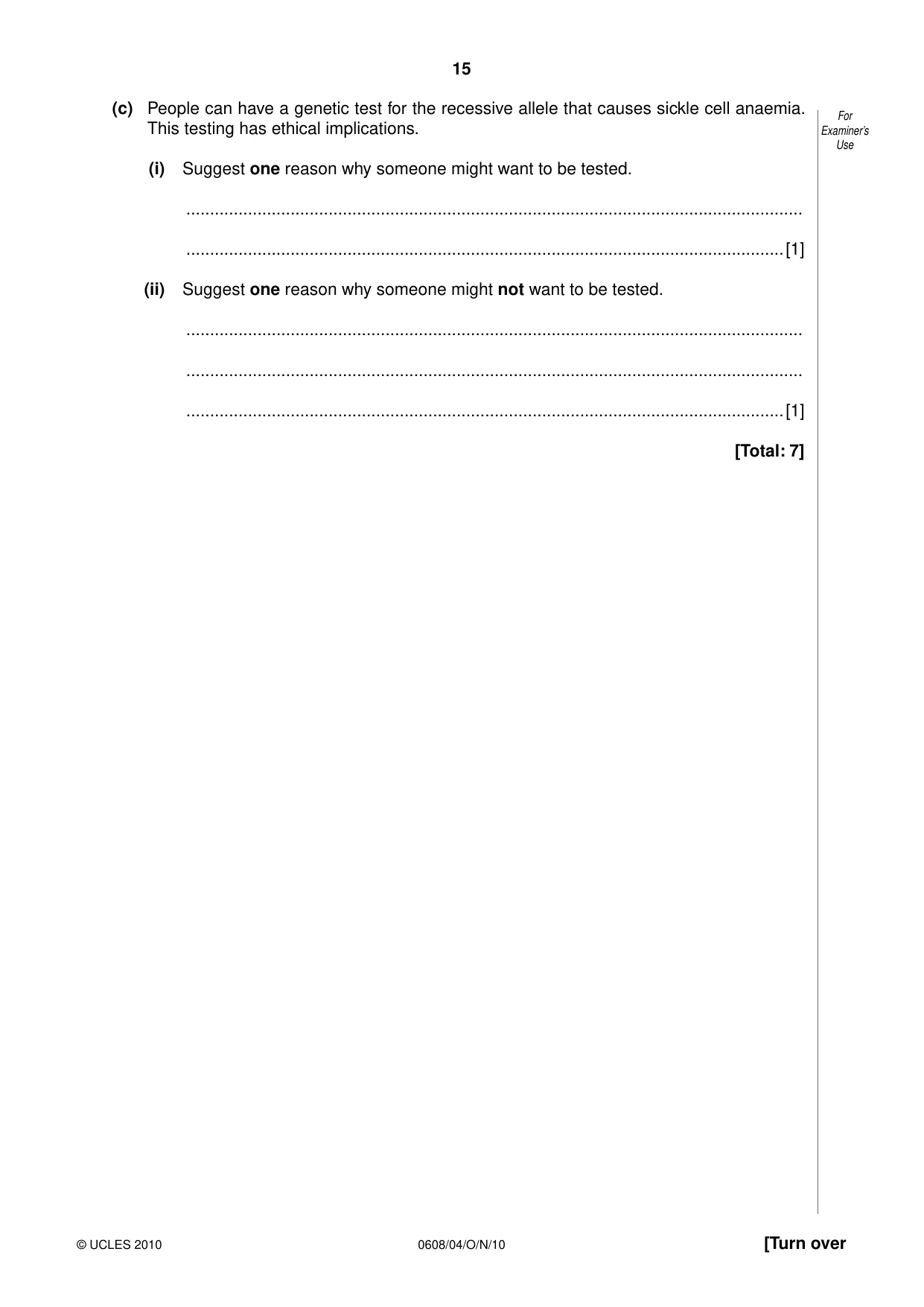
15 0608/04/O/N/10 © UCLES 2010 [Turn over For Examiner’s Use (c) People can have a genetic test for the recessive allele that causes sickle cell anaemia. This testing has ethical implications. (i) Suggest one reason why someone might want to be tested. … …[1] (ii) Suggest one reason why someone might not want to be tested. … … …[1] [Total: 7]
Question paper, page 16
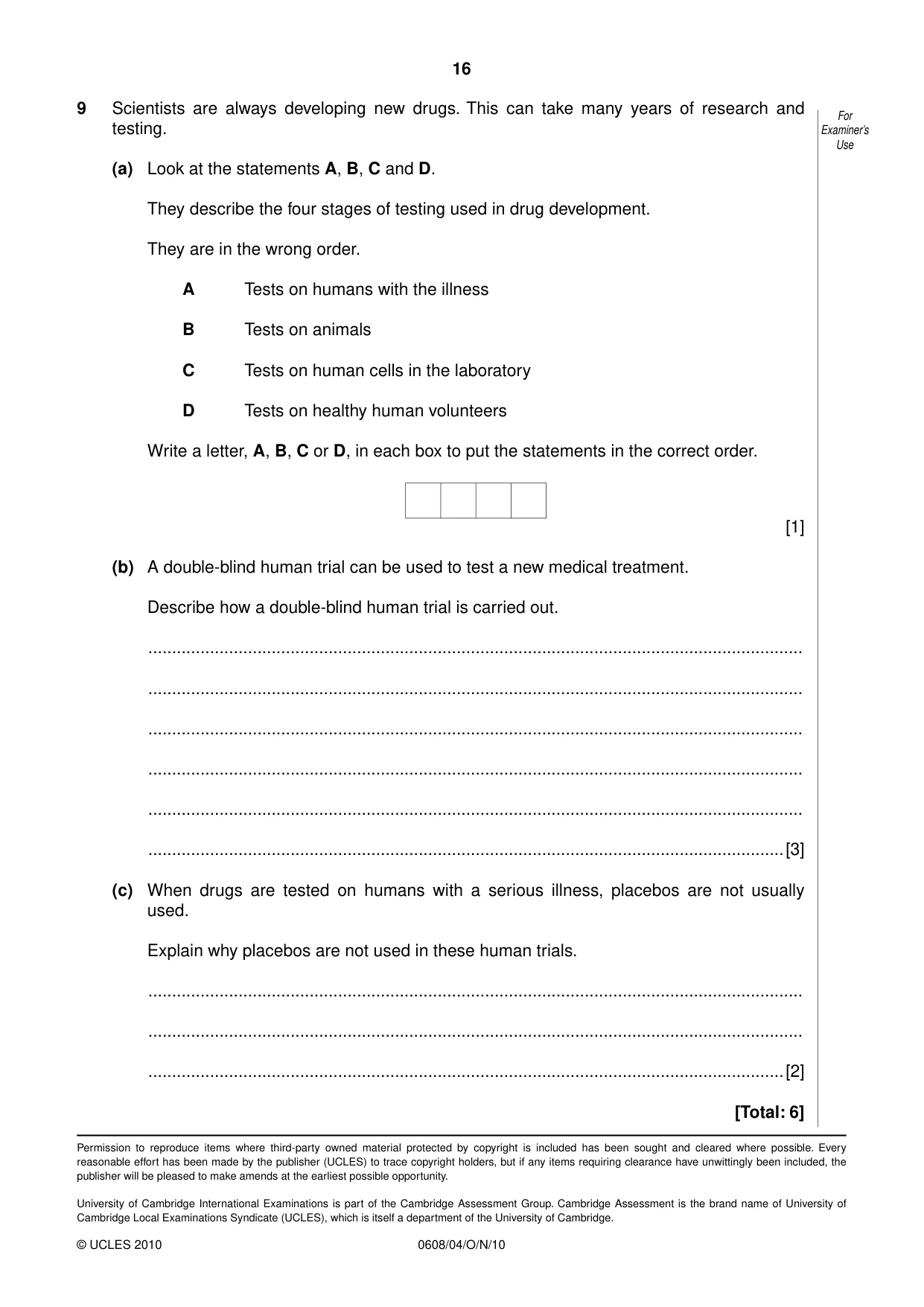
16 0608/04/O/N/10 © UCLES 2010 For Examiner’s Use 9 Scientists are always developing new drugs. This can take many years of research and testing. (a) Look at the statements A, B, C and D. They describe the four stages of testing used in drug development. They are in the wrong order. A Tests on humans with the illness B Tests on animals C Tests on human cells in the laboratory D Tests on healthy human volunteers Write a letter, A, B, C or D, in each box to put the statements in the correct order. [1] (b) A double-blind human trial can be used to test a new medical treatment. Describe how a double-blind human trial is carried out. … … … … … …[3] (c) When drugs are tested on humans with a serious illness, placebos are not usually used. Explain why placebos are not used in these human trials. … … …[2] [Total: 6] Permission to reproduce items where third-party owned material protected by copyright is included has been sought and cleared where possible. Every reasonable effort has been made by the publisher (UCLES) to trace copyright holders, but if any items requiring clearance have unwittingly been included, the publisher will be pleased to make amends at the earliest possible opportunity. University of Cambridge International Examinations is part of the Cambridge Assessment Group. Cambridge Assessment is the brand name of University of Cambridge Local Examinations Syndicate (UCLES), which is itself a department of the University of Cambridge.
Mark scheme, page 1
UNIVERSITY OF CAMBRIDGE INTERNATIONAL EXAMINATIONS International General Certificate of Secondary Education MARK SCHEME for the October/November 2010 question paper for the guidance of teachers 0608 TWENTY FIRST CENTURY SCIENCE 0608/04 Paper 4 (Extended Written), maximum raw mark 60 This mark scheme is published as an aid to teachers and candidates, to indicate the requirements of the examination. It shows the basis on which Examiners were instructed to award marks. It does not indicate the details of the discussions that took place at an Examiners’ meeting before marking began, which would have considered the acceptability of alternative answers. Mark schemes must be read in conjunction with the question papers and the report on the examination. • CIE will not enter into discussions or correspondence in connection with these mark schemes. CIE is publishing the mark schemes for the October/November 2010 question papers for most IGCSE, GCE Advanced Level and Advanced Subsidiary Level syllabuses and some Ordinary Level syllabuses. www.XtremePapers.com
Mark scheme, page 2
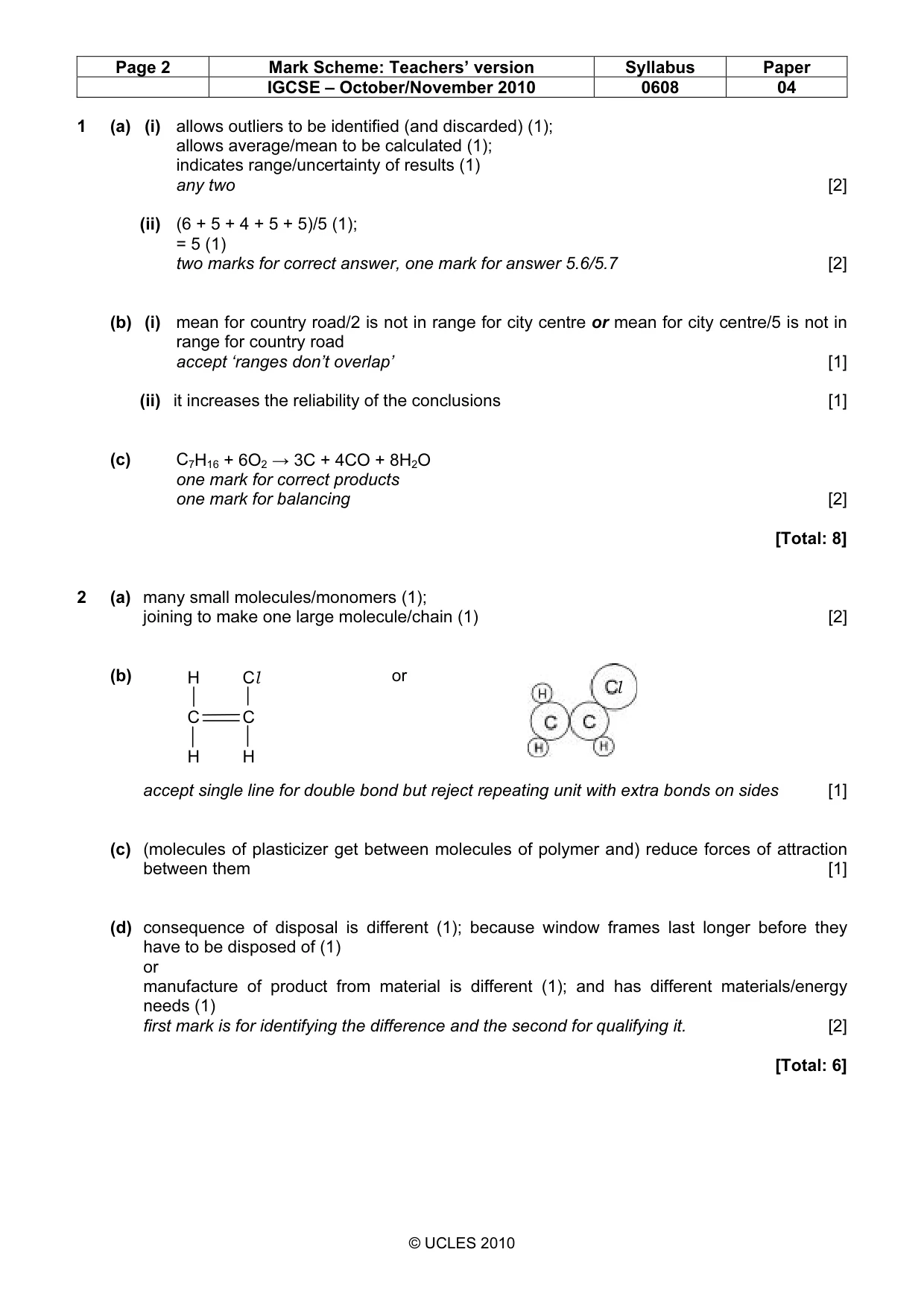
Page 2 Mark Scheme: Teachers’ version Syllabus Paper IGCSE – October/November 2010 0608 04 © UCLES 2010 1 (a) (i) allows outliers to be identified (and discarded) (1); allows average/mean to be calculated (1); indicates range/uncertainty of results (1) any two [2] (ii) (6 + 5 + 4 + 5 + 5)/5 (1); = 5 (1) two marks for correct answer, one mark for answer 5.6/5.7 [2] (b) (i) mean for country road/2 is not in range for city centre or mean for city centre/5 is not in range for country road accept ‘ranges don’t overlap’ [1] (ii) it increases the reliability of the conclusions [1] (c) C7H16 + 6O2 → 3C + 4CO + 8H2O one mark for correct products one mark for balancing [2] [Total: 8] 2 (a) many small molecules/monomers (1); joining to make one large molecule/chain (1) [2] (b) or accept single line for double bond but reject repeating unit with extra bonds on sides [1] (c) (molecules of plasticizer get between molecules of polymer and) reduce forces of attraction between them [1] (d) consequence of disposal is different (1); because window frames last longer before they have to be disposed of (1) or manufacture of product from material is different (1); and has different materials/energy needs (1) first mark is for identifying the difference and the second for qualifying it. [2] [Total: 6] H Cl C C H H l
Mark scheme, page 3
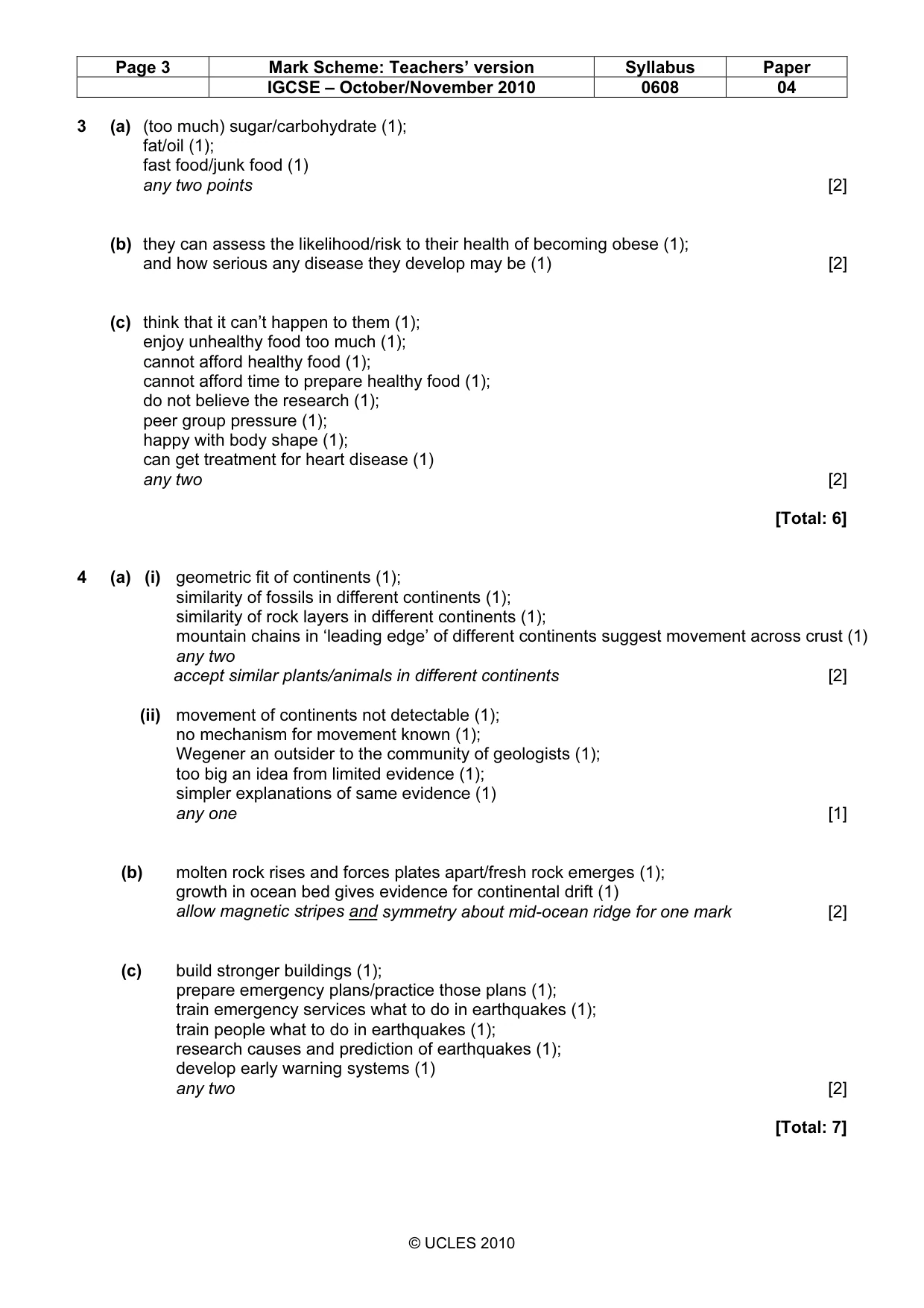
Page 3 Mark Scheme: Teachers’ version Syllabus Paper IGCSE – October/November 2010 0608 04 © UCLES 2010 3 (a) (too much) sugar/carbohydrate (1); fat/oil (1); fast food/junk food (1) any two points [2] (b) they can assess the likelihood/risk to their health of becoming obese (1); and how serious any disease they develop may be (1) [2] (c) think that it can’t happen to them (1); enjoy unhealthy food too much (1); cannot afford healthy food (1); cannot afford time to prepare healthy food (1); do not believe the research (1); peer group pressure (1); happy with body shape (1); can get treatment for heart disease (1) any two [2] [Total: 6] 4 (a) (i) geometric fit of continents (1); similarity of fossils in different continents (1); similarity of rock layers in different continents (1); mountain chains in ‘leading edge’ of different continents suggest movement across crust (1) any two accept similar plants/animals in different continents [2] (ii) movement of continents not detectable (1); no mechanism for movement known (1); Wegener an outsider to the community of geologists (1); too big an idea from limited evidence (1); simpler explanations of same evidence (1) any one [1] (b) molten rock rises and forces plates apart/fresh rock emerges (1); growth in ocean bed gives evidence for continental drift (1) allow magnetic stripes and symmetry about mid-ocean ridge for one mark [2] (c) build stronger buildings (1); prepare emergency plans/practice those plans (1); train emergency services what to do in earthquakes (1); train people what to do in earthquakes (1); research causes and prediction of earthquakes (1); develop early warning systems (1) any two [2] [Total: 7]
Mark scheme, page 4
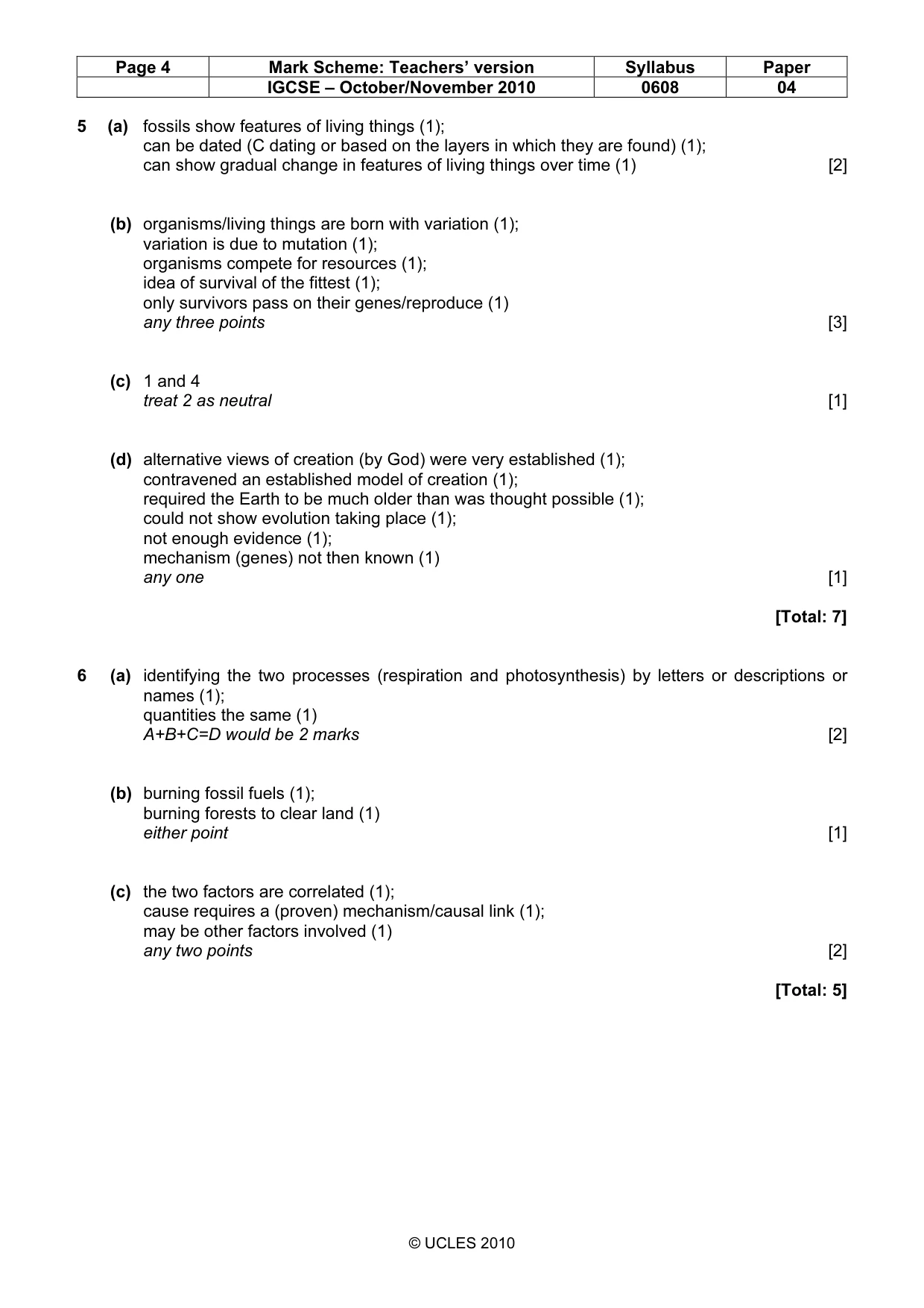
Page 4 Mark Scheme: Teachers’ version Syllabus Paper IGCSE – October/November 2010 0608 04 © UCLES 2010 5 (a) fossils show features of living things (1); can be dated (C dating or based on the layers in which they are found) (1); can show gradual change in features of living things over time (1) [2] (b) organisms/living things are born with variation (1); variation is due to mutation (1); organisms compete for resources (1); idea of survival of the fittest (1); only survivors pass on their genes/reproduce (1) any three points [3] (c) 1 and 4 treat 2 as neutral [1] (d) alternative views of creation (by God) were very established (1); contravened an established model of creation (1); required the Earth to be much older than was thought possible (1); could not show evolution taking place (1); not enough evidence (1); mechanism (genes) not then known (1) any one [1] [Total: 7] 6 (a) identifying the two processes (respiration and photosynthesis) by letters or descriptions or names (1); quantities the same (1) A+B+C=D would be 2 marks [2] (b) burning fossil fuels (1); burning forests to clear land (1) either point [1] (c) the two factors are correlated (1); cause requires a (proven) mechanism/causal link (1); may be other factors involved (1) any two points [2] [Total: 5]
Mark scheme, page 5
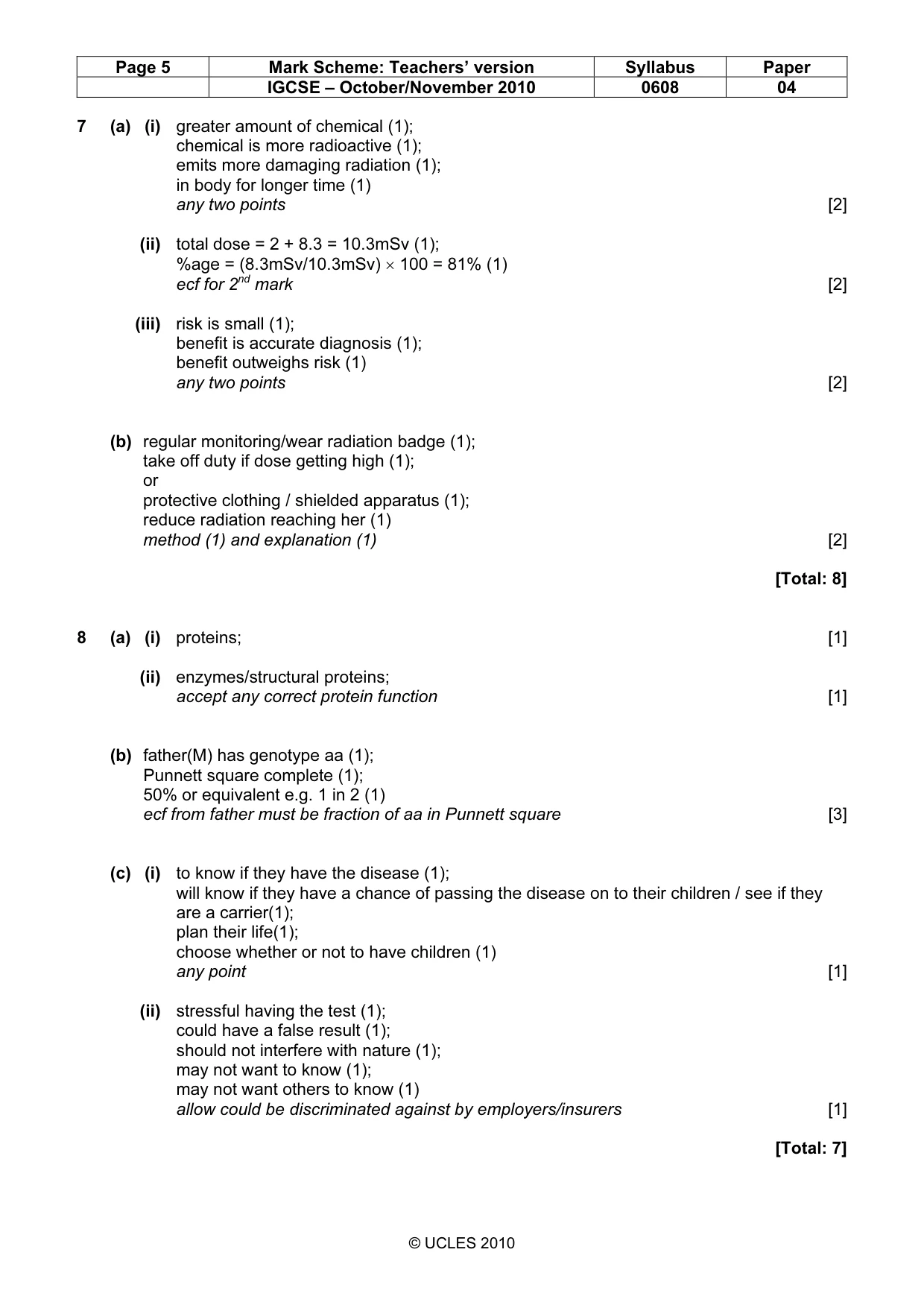
Page 5 Mark Scheme: Teachers’ version Syllabus Paper IGCSE – October/November 2010 0608 04 © UCLES 2010 7 (a) (i) greater amount of chemical (1); chemical is more radioactive (1); emits more damaging radiation (1); in body for longer time (1) any two points [2] (ii) total dose = 2 + 8.3 = 10.3mSv (1); %age = (8.3mSv/10.3mSv) × 100 = 81% (1) ecf for 2nd mark [2] (iii) risk is small (1); benefit is accurate diagnosis (1); benefit outweighs risk (1) any two points [2] (b) regular monitoring/wear radiation badge (1); take off duty if dose getting high (1); or protective clothing / shielded apparatus (1); reduce radiation reaching her (1) method (1) and explanation (1) [2] [Total: 8] 8 (a) (i) proteins; [1] (ii) enzymes/structural proteins; accept any correct protein function [1] (b) father(M) has genotype aa (1); Punnett square complete (1); 50% or equivalent e.g. 1 in 2 (1) ecf from father must be fraction of aa in Punnett square [3] (c) (i) to know if they have the disease (1); will know if they have a chance of passing the disease on to their children / see if they are a carrier(1); plan their life(1); choose whether or not to have children (1) any point [1] (ii) stressful having the test (1); could have a false result (1); should not interfere with nature (1); may not want to know (1); may not want others to know (1) allow could be discriminated against by employers/insurers [1] [Total: 7]
Mark scheme, page 6
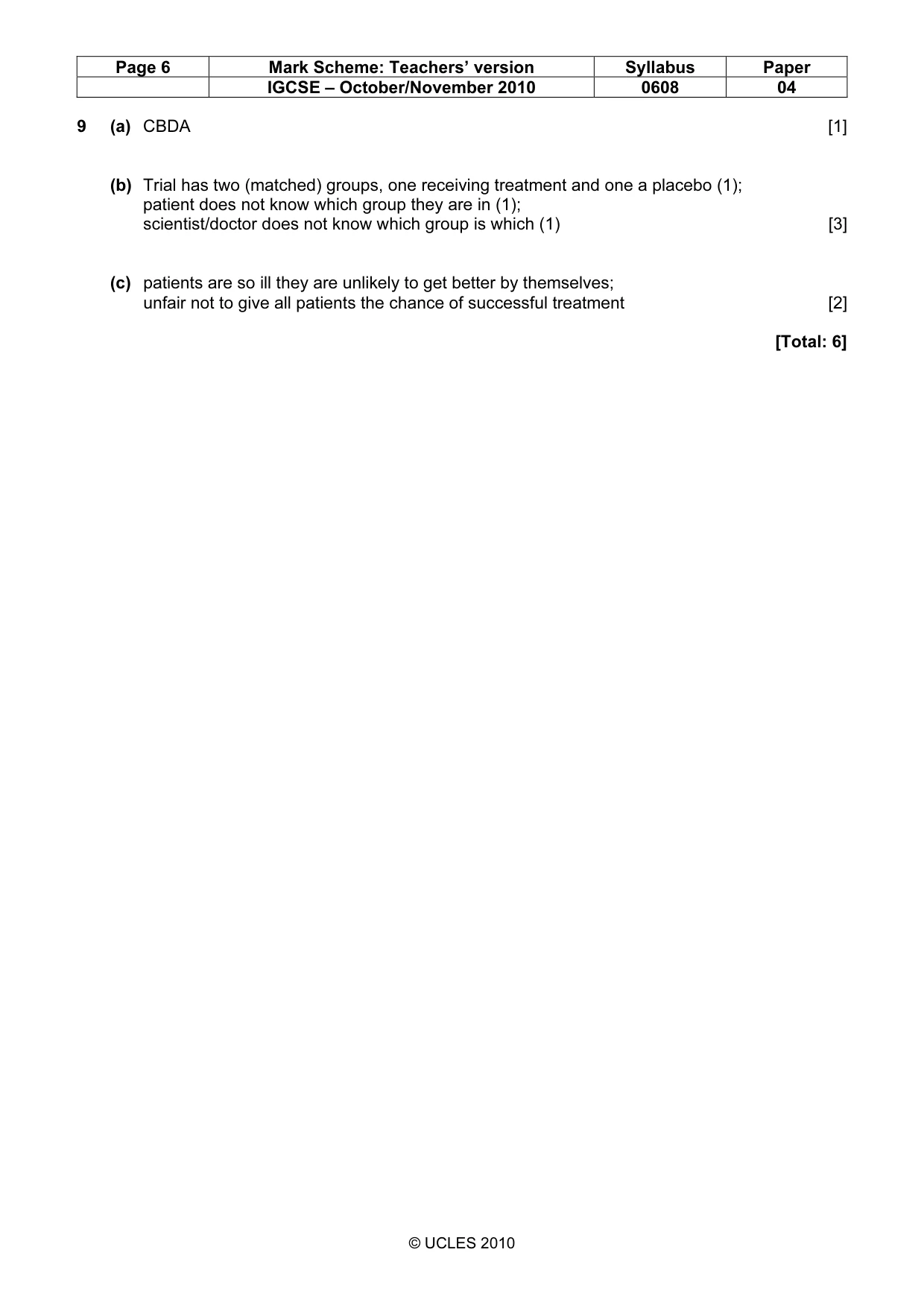
Page 6 Mark Scheme: Teachers’ version Syllabus Paper IGCSE – October/November 2010 0608 04 © UCLES 2010 9 (a) CBDA [1] (b) Trial has two (matched) groups, one receiving treatment and one a placebo (1); patient does not know which group they are in (1); scientist/doctor does not know which group is which (1) [3] (c) patients are so ill they are unlikely to get better by themselves; unfair not to give all patients the chance of successful treatment [2] [Total: 6]
What you needed in this session
Cambridge’s own grade thresholds for 2010 Oct/Nov, Paper 4 · Variant 1. A higher threshold means an easier paper — the bar moves with how the cohort did.