Cambridge IGCSE Twenty-First Century Science 0608 — 2012 Oct/Nov Paper 4 · Variant 1
0608/41/O/N/12
The question paper and its mark scheme, free to read here and free to download. This is Cambridge’s own paper, exactly as it was sat.
Question paper16 pages

Mark scheme6 pages
Answers below. Sit the paper first if you are practising.
Paper as text
Question paper, page 1
This document consists of 16 printed pages. DC (NS/SW) 51970/5 © UCLES 2012 [Turn over UNIVERSITY OF CAMBRIDGE INTERNATIONAL EXAMINATIONS International General Certificate of Secondary Education * 9 3 3 2 9 2 9 0 8 3 * TWENTY FIRST CENTURY SCIENCE 0608/04 Paper 4 October/November 2012 1 hour 30 minutes Candidates answer on the Question Paper. No Additional Materials are required. READ THESE INSTRUCTIONS FIRST Write your Centre number, candidate number and name on all the work you hand in. Write in dark blue or black pen. You may use a pencil for any diagrams or graphs. Do not use staples, paper clips, highlighters, glue or correction fluid. DO NOT WRITE IN ANY BARCODES. Answer all questions. At the end of the examination, fasten all your work securely together. The number of marks is given in brackets [ ] at the end of each question or part question. For Examiner’s Use 1 2 3 4 5 6 7 8 9 Total www.XtremePapers.com
Question paper, page 2
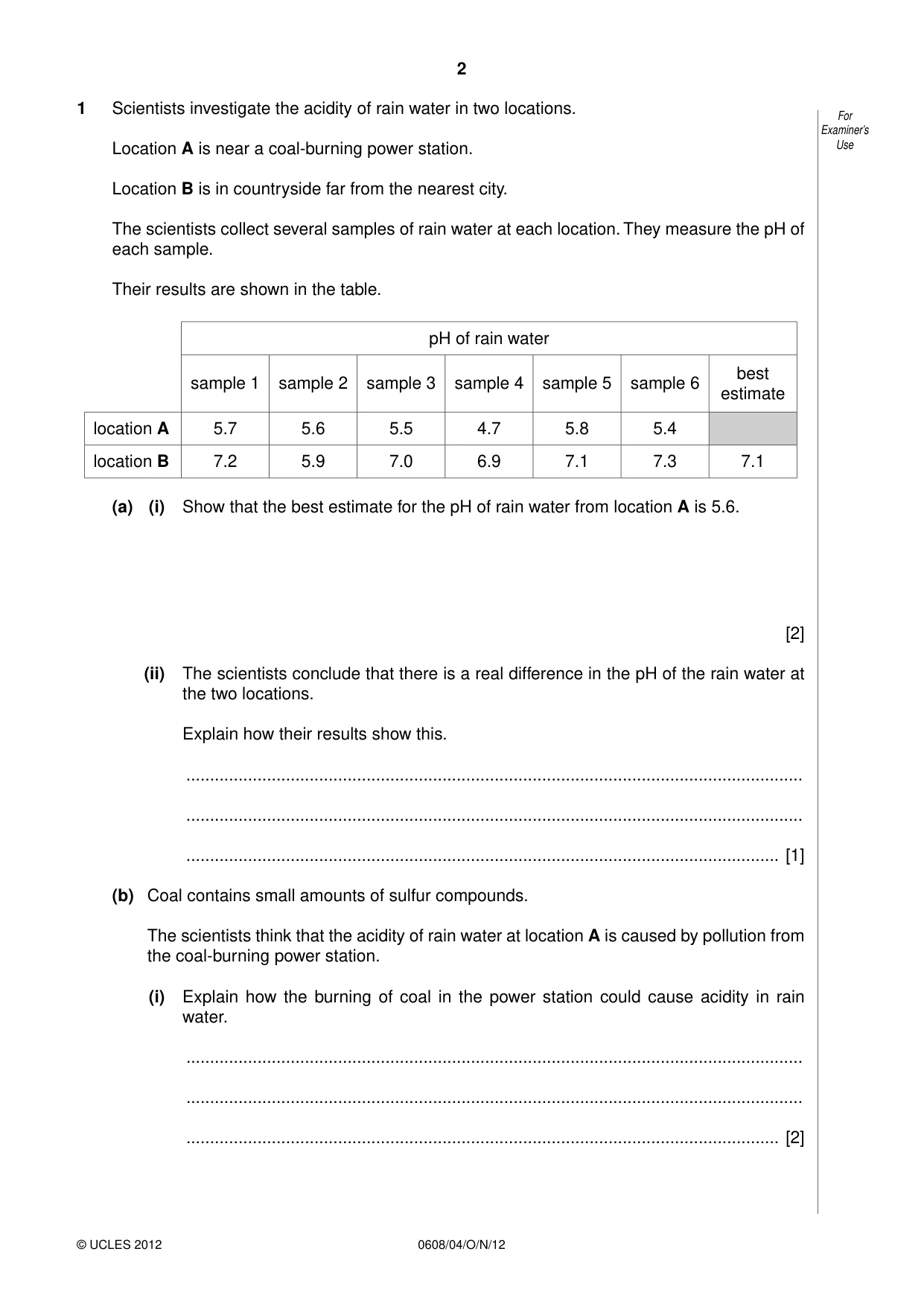
2 0608/04/O/N/12 © UCLES 2012 For Examiner’s Use 1 Scientists investigate the acidity of rain water in two locations. Location A is near a coal-burning power station. Location B is in countryside far from the nearest city. The scientists collect several samples of rain water at each location. They measure the pH of each sample. Their results are shown in the table. pH of rain water sample 1 sample 2 sample 3 sample 4 sample 5 sample 6 best estimate location A 5.7 5.6 5.5 4.7 5.8 5.4 location B 7.2 5.9 7.0 6.9 7.1 7.3 7.1 (a) (i) Show that the best estimate for the pH of rain water from location A is 5.6. [2] (ii) The scientists conclude that there is a real difference in the pH of the rain water at the two locations. Explain how their results show this. … … … [1] (b) Coal contains small amounts of sulfur compounds. The scientists think that the acidity of rain water at location A is caused by pollution from the coal-burning power station. (i) Explain how the burning of coal in the power station could cause acidity in rain water. … … … [2]
Question paper, page 3
3 0608/04/O/N/12 © UCLES 2012 [Turn over For Examiner’s Use (ii) The pollution from the power station causes harm to humans indirectly. Explain how. … … … [2] [Total: 7]
Question paper, page 4
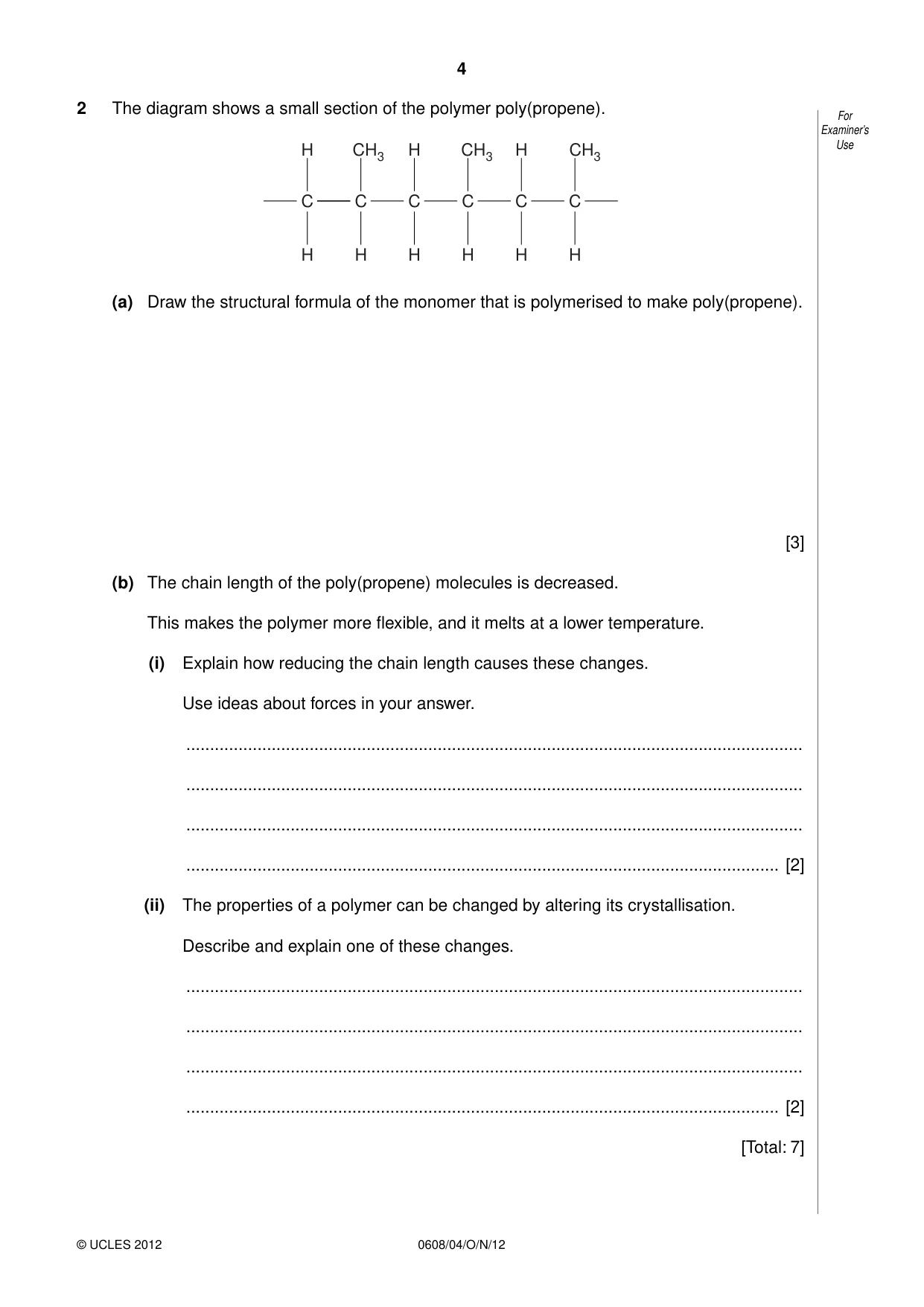
4 0608/04/O/N/12 © UCLES 2012 For Examiner’s Use 2 The diagram shows a small section of the polymer poly(propene). C H H C H CH3 CH3 CH3 C H H C H C H H C H (a) Draw the structural formula of the monomer that is polymerised to make poly(propene). [3] (b) The chain length of the poly(propene) molecules is decreased. This makes the polymer more flexible, and it melts at a lower temperature. (i) Explain how reducing the chain length causes these changes. Use ideas about forces in your answer. … … … … [2] (ii) The properties of a polymer can be changed by altering its crystallisation. Describe and explain one of these changes. … … … … [2] [Total: 7]
Question paper, page 5
5 0608/04/O/N/12 © UCLES 2012 [Turn over For Examiner’s Use 3 Farmers grow crops in their soil and then harvest them. (a) If the same crop is grown on the same ground, the yield decreases each year. Explain the reason for this decrease in yield. … … … … [2] (b) To maintain crop yield, synthetic fertilisers can be applied to the soil. (i) Synthetic fertilisers are used extensively in some countries but not in others. Suggest why they are not used in these other countries. … … … … [2] (ii) Using synthetic fertilisers is not sustainable. Explain how crop yield can be maintained by more sustainable methods. … … … … [2] [Total: 6]
Question paper, page 6
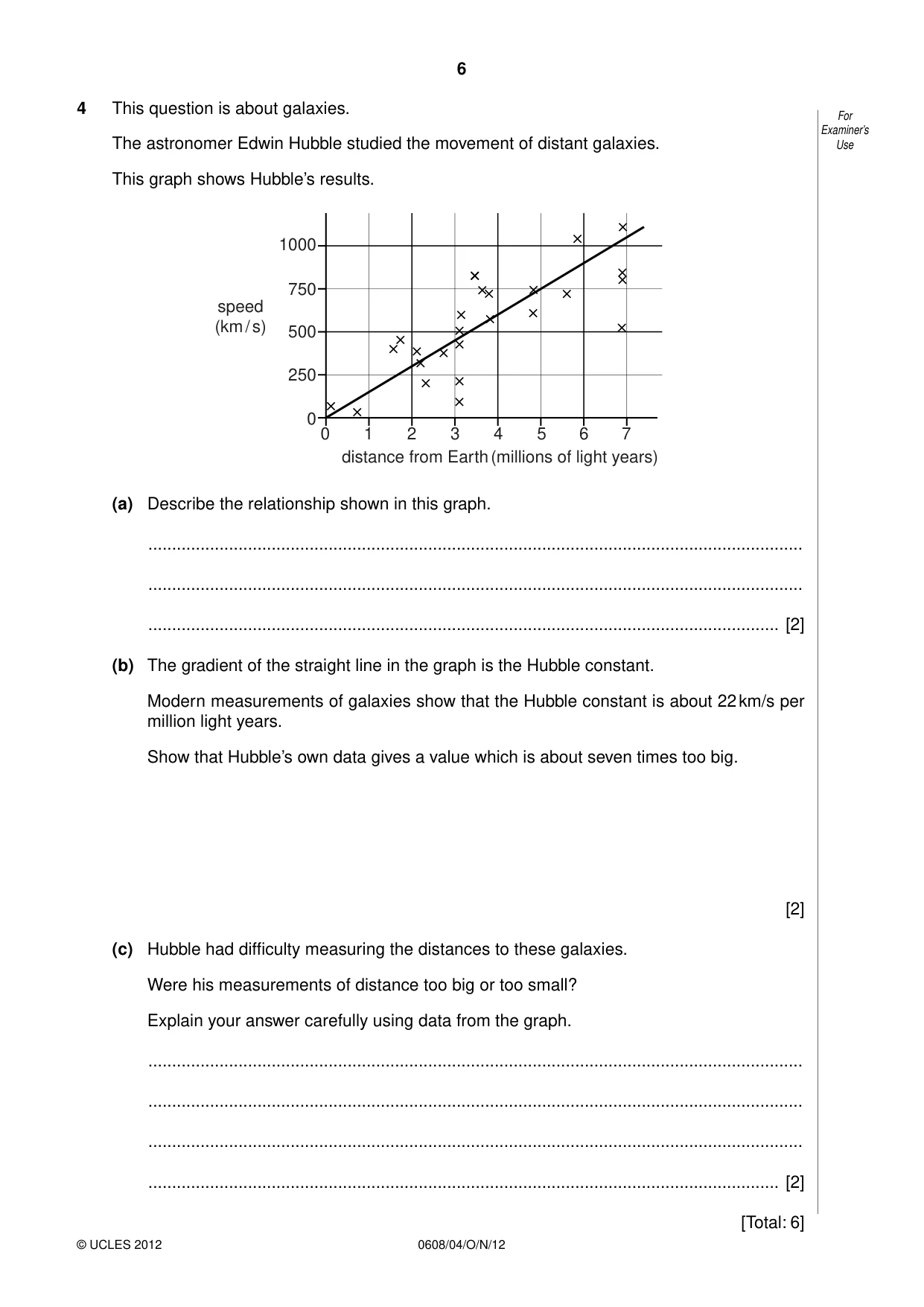
6 0608/04/O/N/12 © UCLES 2012 For Examiner’s Use 4 This question is about galaxies. The astronomer Edwin Hubble studied the movement of distant galaxies. This graph shows Hubble’s results. 0 0 500 1000 750 250 speed (km / s) 1 2 3 4 distance from Earth (millions of light years) 5 6 7 (a) Describe the relationship shown in this graph. … … … [2] (b) The gradient of the straight line in the graph is the Hubble constant. Modern measurements of galaxies show that the Hubble constant is about 22 km/s per million light years. Show that Hubble’s own data gives a value which is about seven times too big. [2] (c) Hubble had difficulty measuring the distances to these galaxies. Were his measurements of distance too big or too small? Explain your answer carefully using data from the graph. … … … … [2] [Total: 6]
Question paper, page 7
7 0608/04/O/N/12 © UCLES 2012 [Turn over QUESTION 5 BEGINS ON PAGE 8.
Question paper, page 8
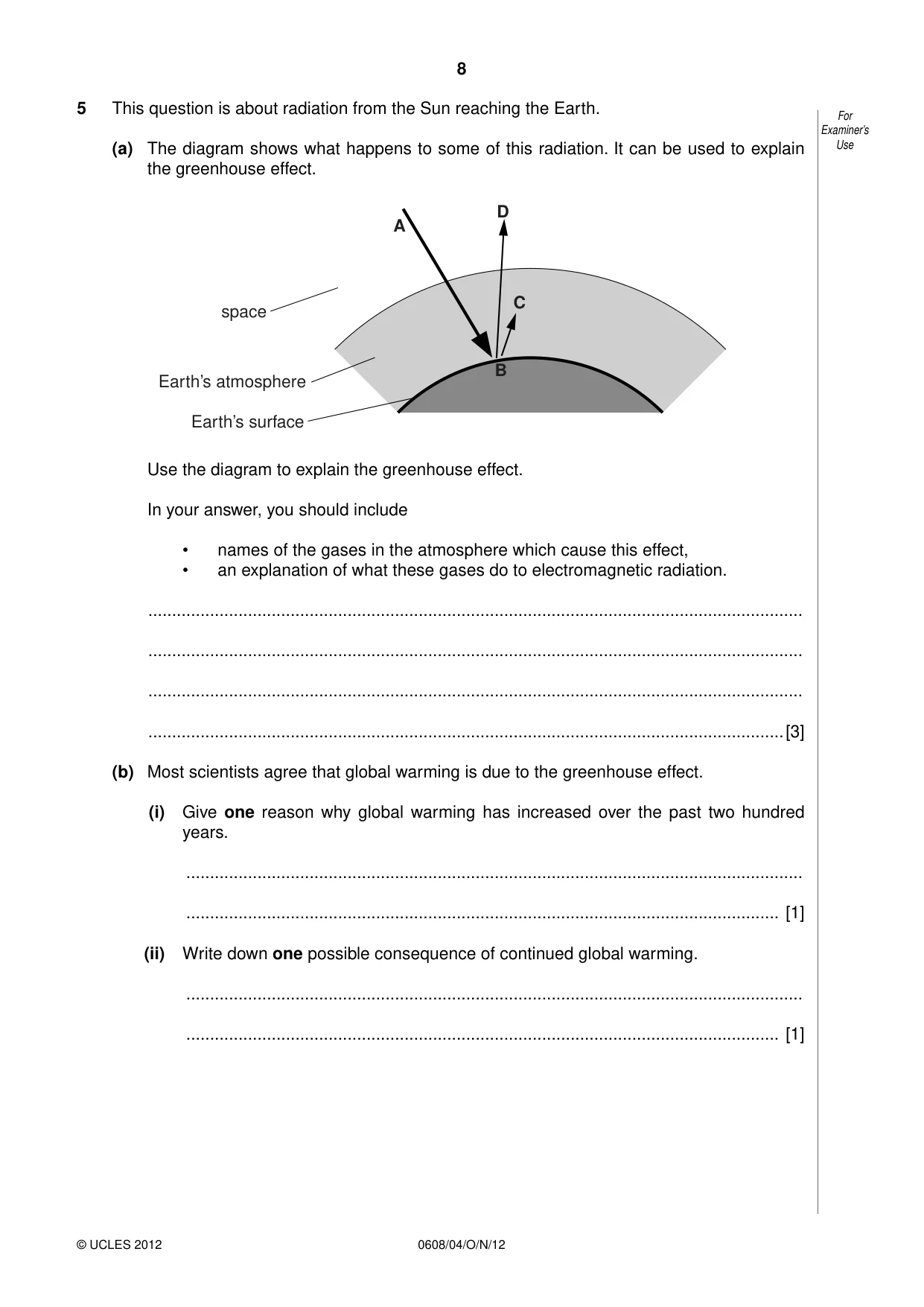
8 0608/04/O/N/12 © UCLES 2012 For Examiner’s Use 5 This question is about radiation from the Sun reaching the Earth. (a) The diagram shows what happens to some of this radiation. It can be used to explain the greenhouse effect. space Earth’s atmosphere Earth’s surface A D C B Use the diagram to explain the greenhouse effect. In your answer, you should include • names of the gases in the atmosphere which cause this effect, • an explanation of what these gases do to electromagnetic radiation. … … … …[3] (b) Most scientists agree that global warming is due to the greenhouse effect. (i) Give one reason why global warming has increased over the past two hundred years. … … [1] (ii) Write down one possible consequence of continued global warming. … … [1]
Question paper, page 9
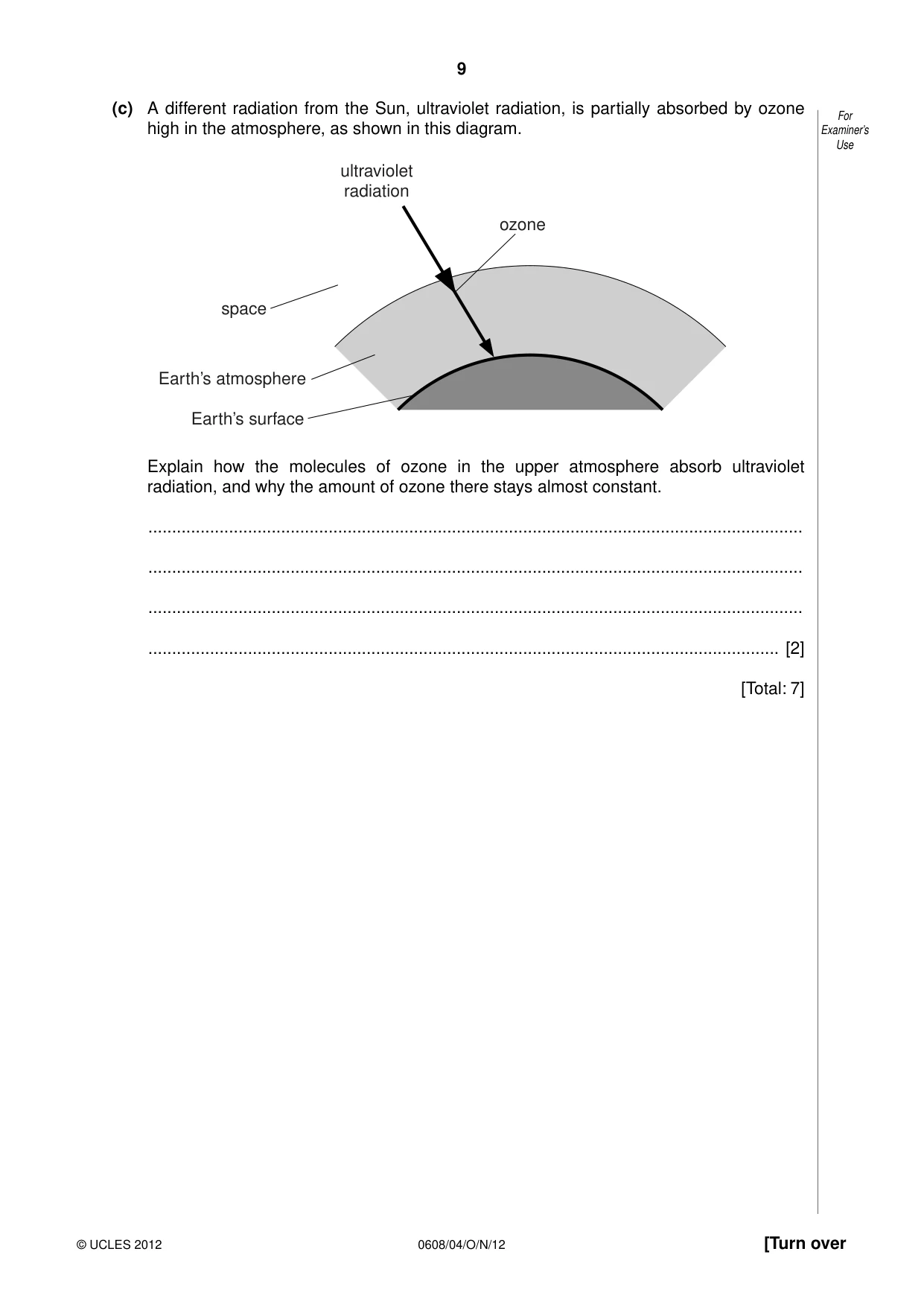
9 0608/04/O/N/12 © UCLES 2012 [Turn over For Examiner’s Use (c) A different radiation from the Sun, ultraviolet radiation, is partially absorbed by ozone high in the atmosphere, as shown in this diagram. space ultraviolet radiation ozone Earth’s atmosphere Earth’s surface Explain how the molecules of ozone in the upper atmosphere absorb ultraviolet radiation, and why the amount of ozone there stays almost constant. … … … … [2] [Total: 7]
Question paper, page 10
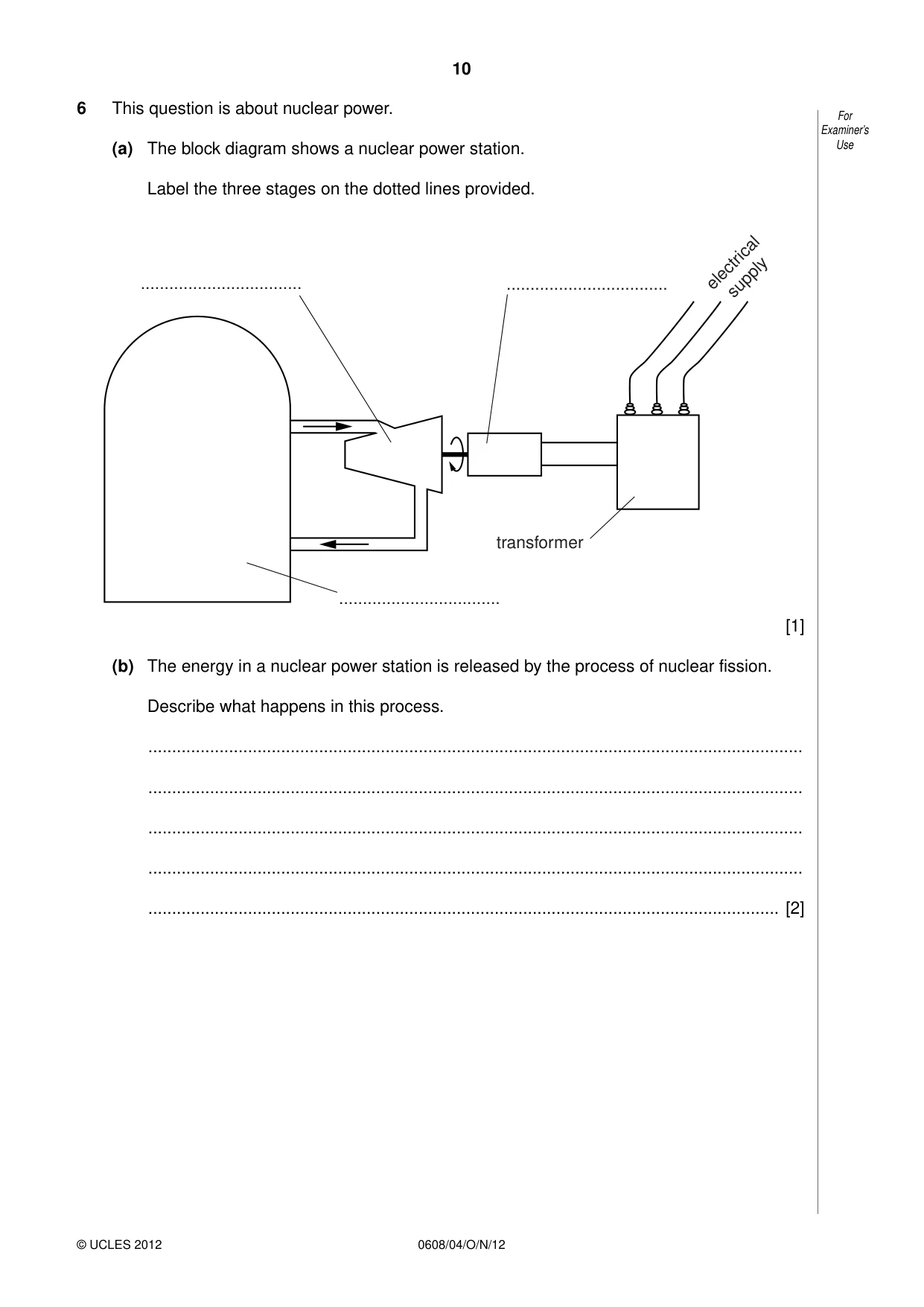
10 0608/04/O/N/12 © UCLES 2012 For Examiner’s Use 6 This question is about nuclear power. (a) The block diagram shows a nuclear power station. Label the three stages on the dotted lines provided. transformer … … … electrical supply [1] (b) The energy in a nuclear power station is released by the process of nuclear fission. Describe what happens in this process. … … … … … [2]
Question paper, page 11
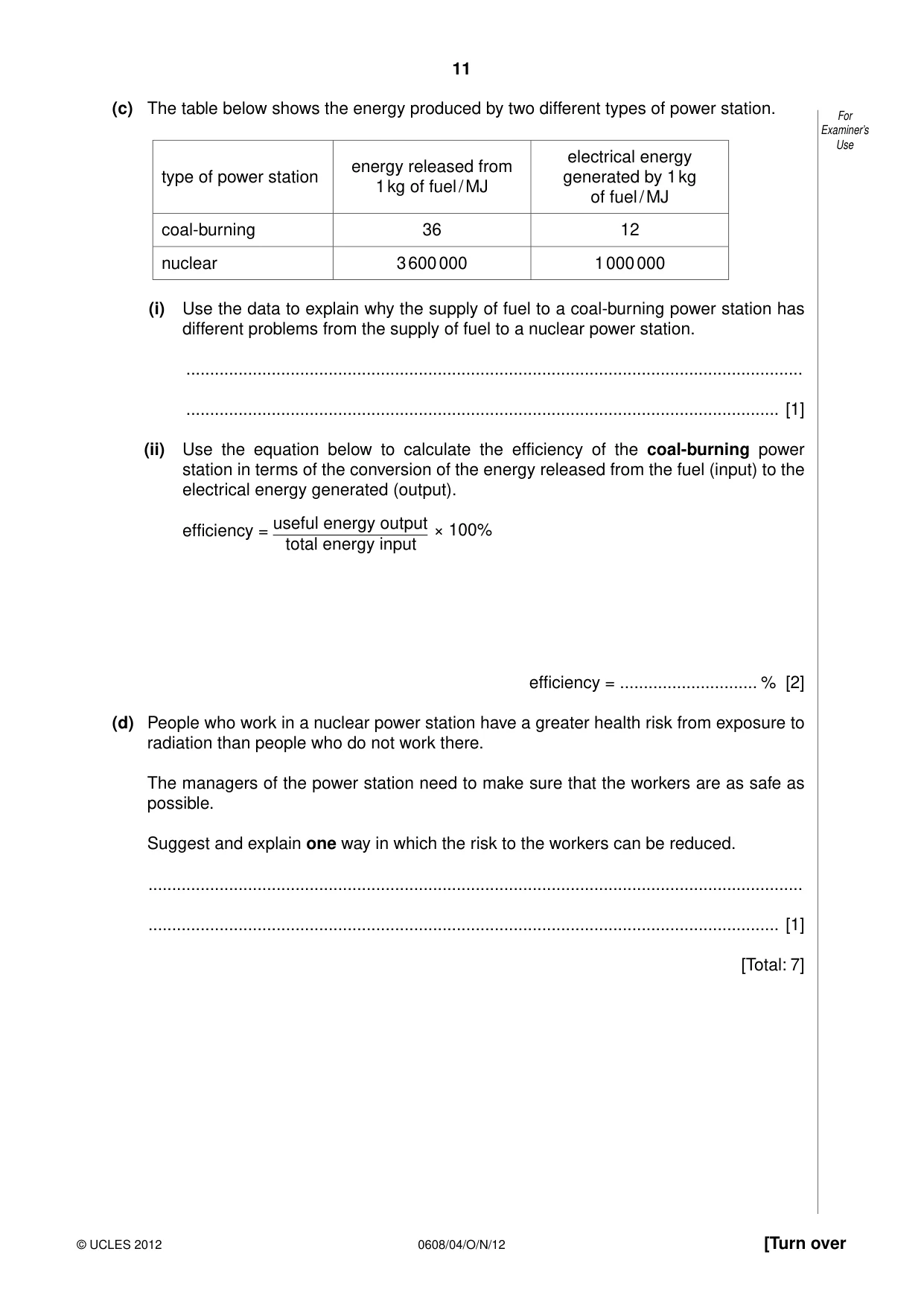
11 0608/04/O/N/12 © UCLES 2012 [Turn over For Examiner’s Use (c) The table below shows the energy produced by two different types of power station. type of power station energy released from 1 kg of fuel / MJ electrical energy generated by 1 kg of fuel / MJ coal-burning 36 12 nuclear 3 600 000 1 000 000 (i) Use the data to explain why the supply of fuel to a coal-burning power station has different problems from the supply of fuel to a nuclear power station. … … [1] (ii) Use the equation below to calculate the efficiency of the coal-burning power station in terms of the conversion of the energy released from the fuel (input) to the electrical energy generated (output). efficiency = useful energy output total energy input × 100% efficiency = … % [2] (d) People who work in a nuclear power station have a greater health risk from exposure to radiation than people who do not work there. The managers of the power station need to make sure that the workers are as safe as possible. Suggest and explain one way in which the risk to the workers can be reduced. … … [1] [Total: 7]
Question paper, page 12
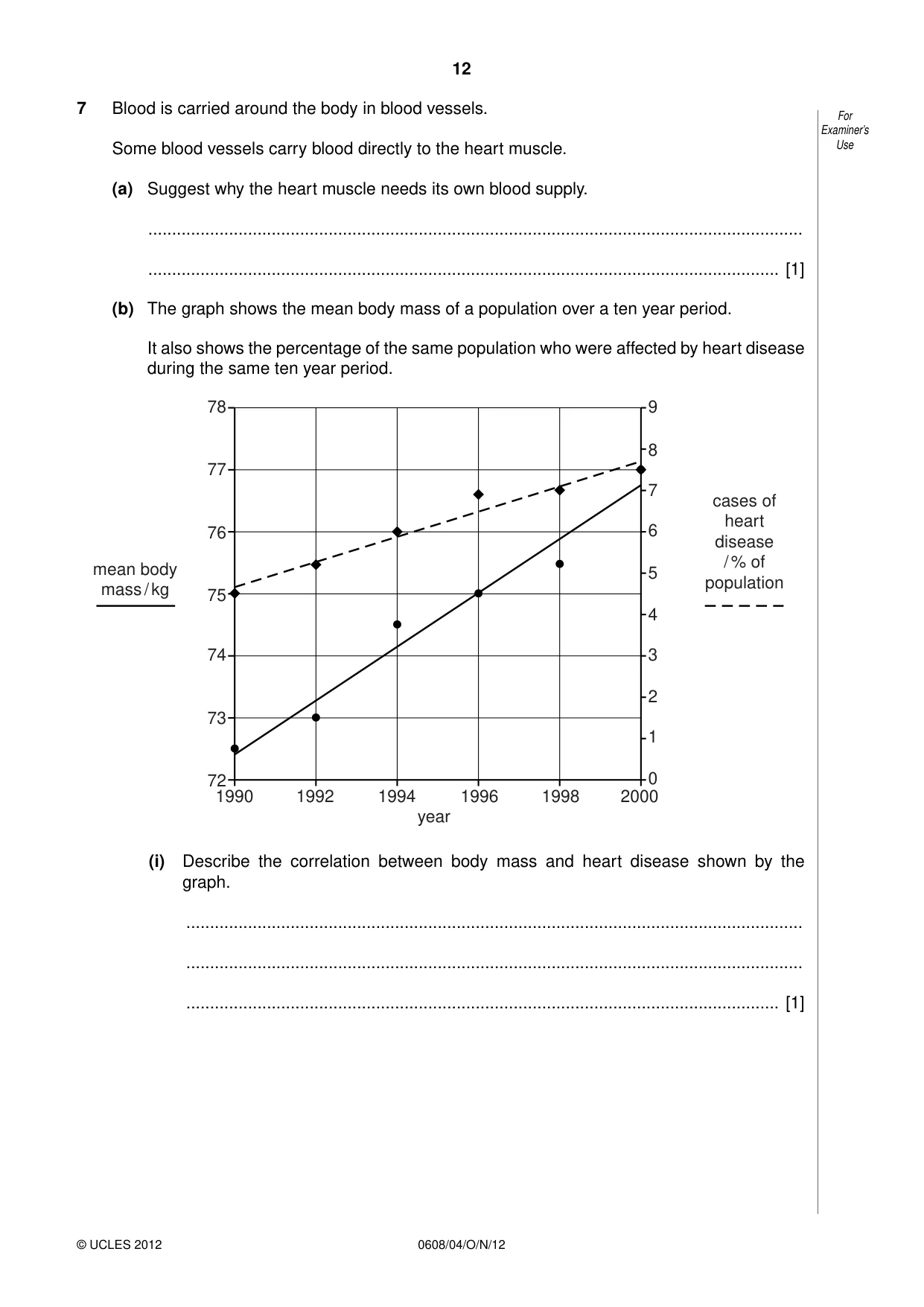
12 0608/04/O/N/12 © UCLES 2012 For Examiner’s Use 7 Blood is carried around the body in blood vessels. Some blood vessels carry blood directly to the heart muscle. (a) Suggest why the heart muscle needs its own blood supply. … … [1] (b) The graph shows the mean body mass of a population over a ten year period. It also shows the percentage of the same population who were affected by heart disease during the same ten year period. 78 9 8 7 6 5 4 3 2 1 0 77 76 mean body mass / kg 75 74 73 72 1990 1992 1994 1996 year 1998 2000 cases of heart disease / % of population (i) Describe the correlation between body mass and heart disease shown by the graph. … … … [1]
Question paper, page 13
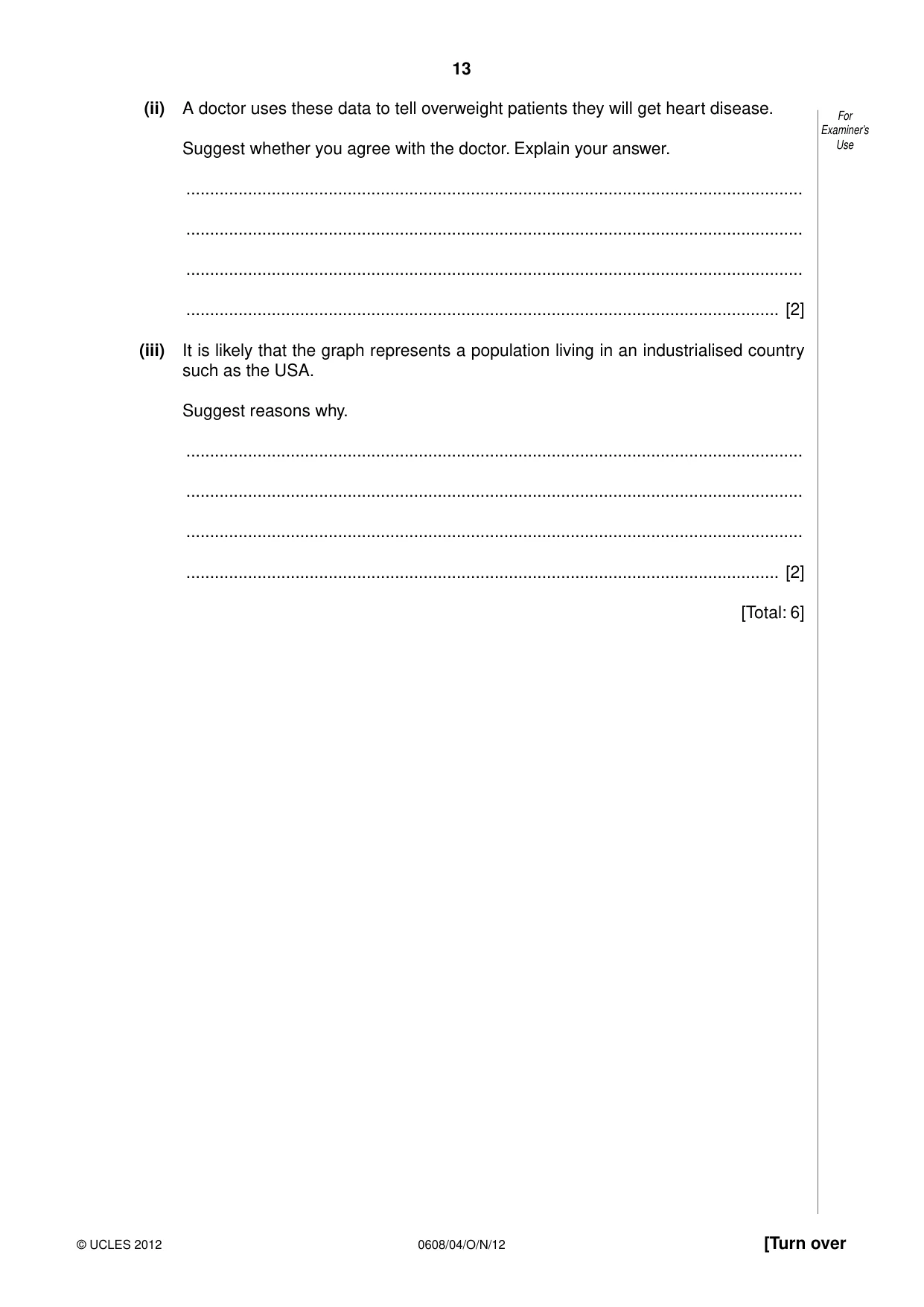
13 0608/04/O/N/12 © UCLES 2012 [Turn over For Examiner’s Use (ii) A doctor uses these data to tell overweight patients they will get heart disease. Suggest whether you agree with the doctor. Explain your answer. … … … … [2] (iii) It is likely that the graph represents a population living in an industrialised country such as the USA. Suggest reasons why. … … … … [2] [Total: 6]
Question paper, page 14
14 0608/04/O/N/12 © UCLES 2012 For Examiner’s Use 8 (a) In 1859, Charles Darwin proposed his theory of evolution. He suggested that the many different species of living things on Earth all developed gradually over time from very simple living things. Suggest two reasons why many people refused to accept his theory. … … … [2] (b) Earthworms are small organisms found living in the soil. Arsenic is a poisonous element. In the early 19th century, some arsenic mines were dug in the south of England. Over time, the amount of arsenic in the soil near to the mines increased. This arsenic killed most of the earthworms living in the soil. However, a small number of live earthworms were found in the soil. These earthworms were different in appearance from the original earthworms, and were not killed by the arsenic. Scientists believe that these earthworms are a new species. The species appears to be resistant to arsenic due to mutation. Explain how this mutation has resulted in the resistant species of earthworm. … … … … … [3]
Question paper, page 15
15 0608/04/O/N/12 © UCLES 2012 [Turn over For Examiner’s Use (c) New species can be created by the process of selective breeding. Describe how this process is carried out. … … … [2] [Total: 7]
Question paper, page 16
16 0608/04/O/N/12 © UCLES 2012 For Examiner’s Use 9 Jack and Jill work for the same employer. He asks them to undergo a genetic test for alleles that cause genetic diseases. Jill does not want to have the test because she might have a genetic disease. She knows that the results of the test may be shared with her employer and her insurance company. (a) Explain why Jill might be unhappy for the information to be shared with her employer and with her insurance company. Give two reasons in each case. employer … … … … insurance company … … … … [4] (b) Jack’s father is a carrier of sickle cell anaemia. Suggest one reason why Jack is willing to undergo the genetic test. … … [1] (c) Describe how a person inherits sickle cell anaemia. … … … … [2] [Total: 7] Copyright Acknowledgements: Question 8 Photograph © Phil Degginger; Ref: B1W6K6; alamy.com. Permission to reproduce items where third-party owned material protected by copyright is included has been sought and cleared where possible. Every reasonable effort has been made by the publisher (UCLES) to trace copyright holders, but if any items requiring clearance have unwittingly been included, the publisher will be pleased to make amends at the earliest possible opportunity. University of Cambridge International Examinations is part of the Cambridge Assessment Group. Cambridge Assessment is the brand name of University of Cambridge Local Examinations Syndicate (UCLES), which is itself a department of the University of Cambridge.
Mark scheme, page 1
CAMBRIDGE INTERNATIONAL EXAMINATIONS International General Certificate of Secondary Education MARK SCHEME for the October/November 2012 series 0608 TWENTY FIRST CENTURY SCIENCE 0608/04 Paper 4 (Extended Written), maximum raw mark 60 This mark scheme is published as an aid to teachers and candidates, to indicate the requirements of the examination. It shows the basis on which Examiners were instructed to award marks. It does not indicate the details of the discussions that took place at an Examiners’ meeting before marking began, which would have considered the acceptability of alternative answers. Mark schemes should be read in conjunction with the question paper and the Principal Examiner Report for Teachers. Cambridge will not enter into discussions about these mark schemes. Cambridge is publishing the mark schemes for the October/November 2012 series for most IGCSE, GCE Advanced Level and Advanced Subsidiary Level components and some Ordinary Level components. www.XtremePapers.com
Mark scheme, page 2
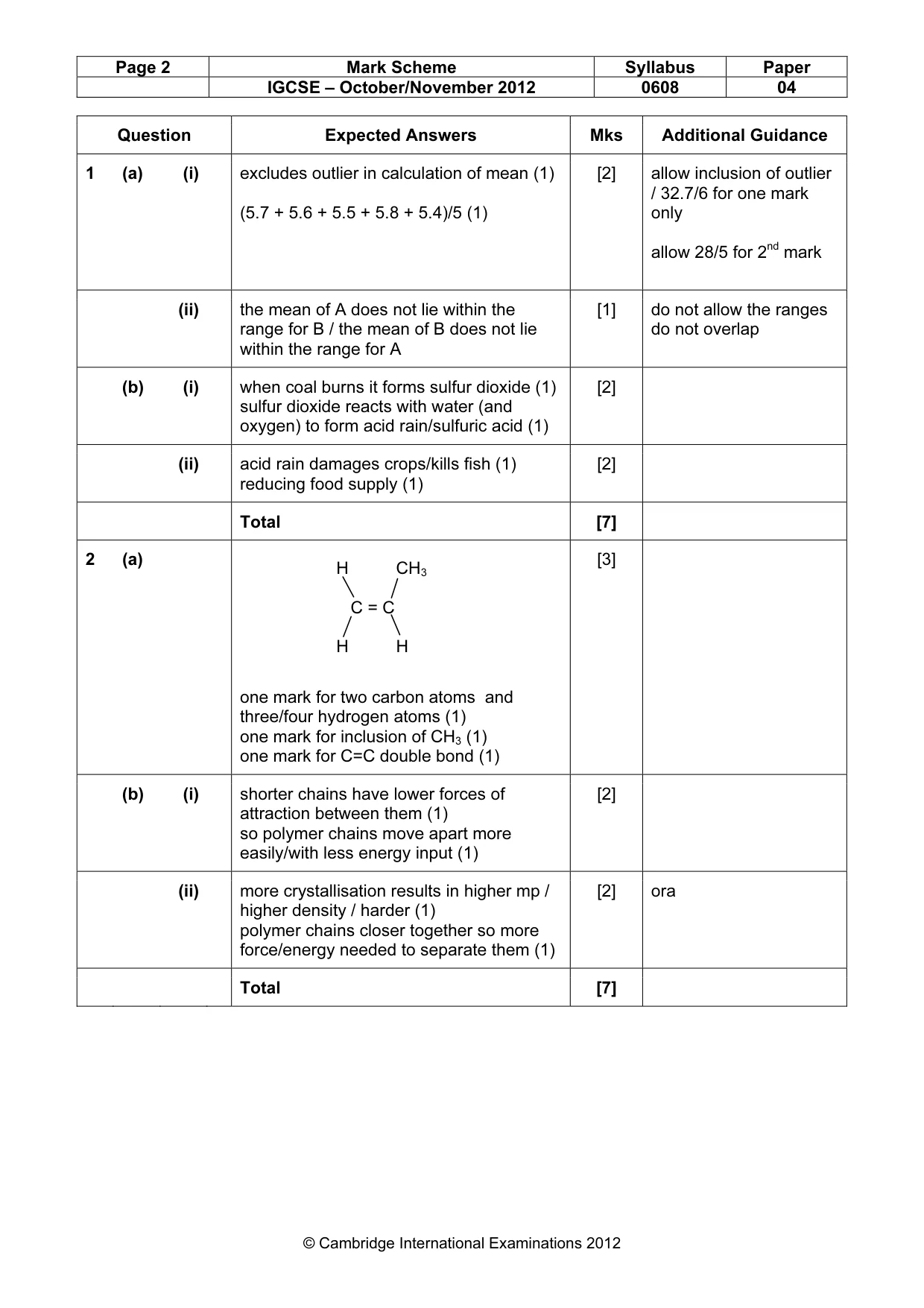
Page 2 Mark Scheme Syllabus Paper IGCSE – October/November 2012 0608 04 © Cambridge International Examinations 2012 Question Expected Answers Mks Additional Guidance 1 (a) (i) excludes outlier in calculation of mean (1) (5.7 + 5.6 + 5.5 + 5.8 + 5.4)/5 (1) [2] allow inclusion of outlier / 32.7/6 for one mark only allow 28/5 for 2nd mark (ii) the mean of A does not lie within the range for B / the mean of B does not lie within the range for A [1] do not allow the ranges do not overlap (b) (i) when coal burns it forms sulfur dioxide (1) sulfur dioxide reacts with water (and oxygen) to form acid rain/sulfuric acid (1) [2] (ii) acid rain damages crops/kills fish (1) reducing food supply (1) [2] Total [7] 2 (a) one mark for two carbon atoms and three/four hydrogen atoms (1) one mark for inclusion of CH3 (1) one mark for C=C double bond (1) [3] (b) (i) shorter chains have lower forces of attraction between them (1) so polymer chains move apart more easily/with less energy input (1) [2] (ii) more crystallisation results in higher mp / higher density / harder (1) polymer chains closer together so more force/energy needed to separate them (1) [2] ora Total [7] H CH3 C = C H H
Mark scheme, page 3
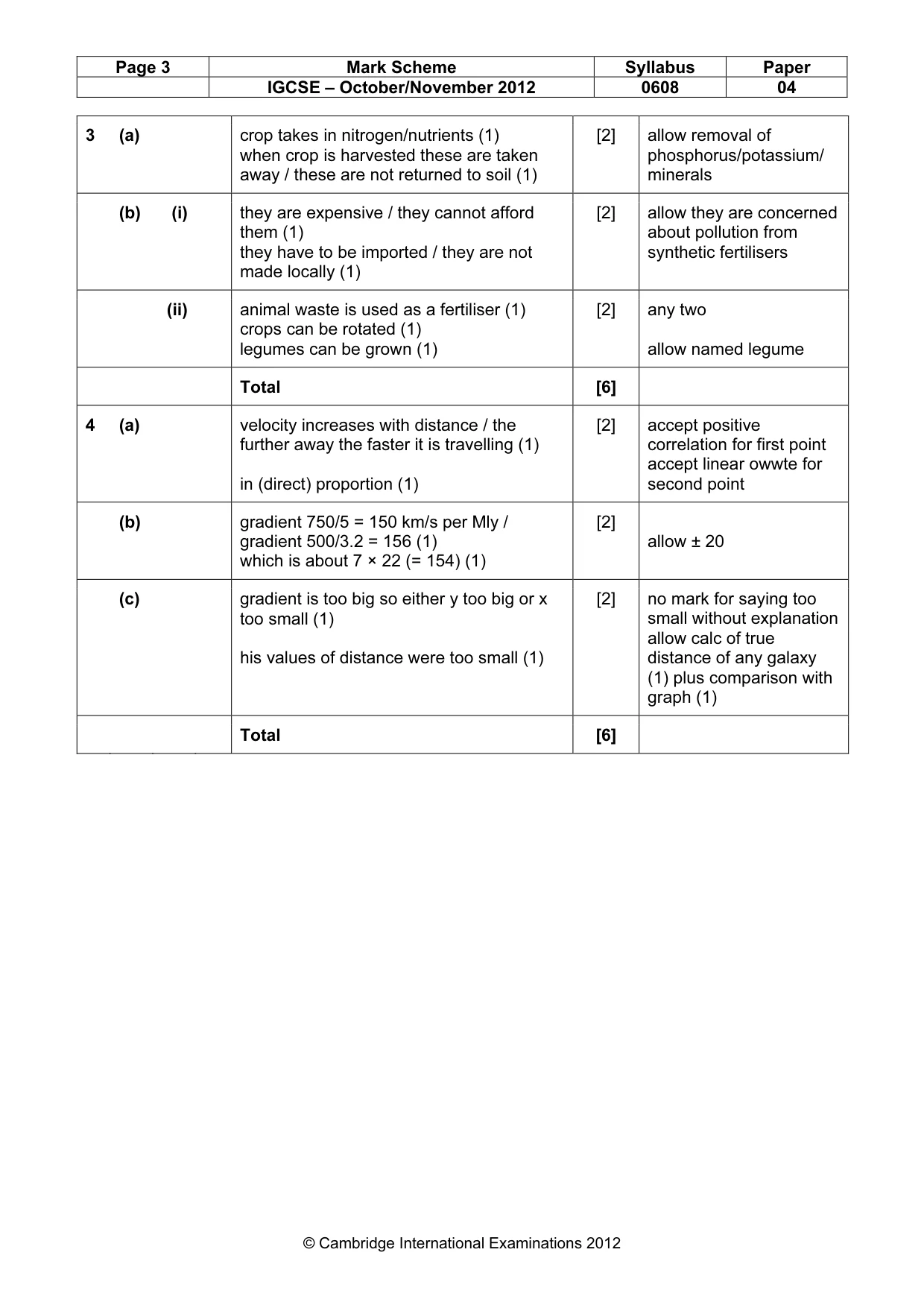
Page 3 Mark Scheme Syllabus Paper IGCSE – October/November 2012 0608 04 © Cambridge International Examinations 2012 3 (a) crop takes in nitrogen/nutrients (1) when crop is harvested these are taken away / these are not returned to soil (1) [2] allow removal of phosphorus/potassium/ minerals (b) (i) they are expensive / they cannot afford them (1) they have to be imported / they are not made locally (1) [2] allow they are concerned about pollution from synthetic fertilisers (ii) animal waste is used as a fertiliser (1) crops can be rotated (1) legumes can be grown (1) [2] any two allow named legume Total [6] 4 (a) velocity increases with distance / the further away the faster it is travelling (1) in (direct) proportion (1) [2] accept positive correlation for first point accept linear owwte for second point (b) gradient 750/5 = 150 km/s per Mly / gradient 500/3.2 = 156 (1) which is about 7 × 22 (= 154) (1) [2] allow ± 20 (c) gradient is too big so either y too big or x too small (1) his values of distance were too small (1) [2] no mark for saying too small without explanation allow calc of true distance of any galaxy (1) plus comparison with graph (1) Total [6]
Mark scheme, page 4
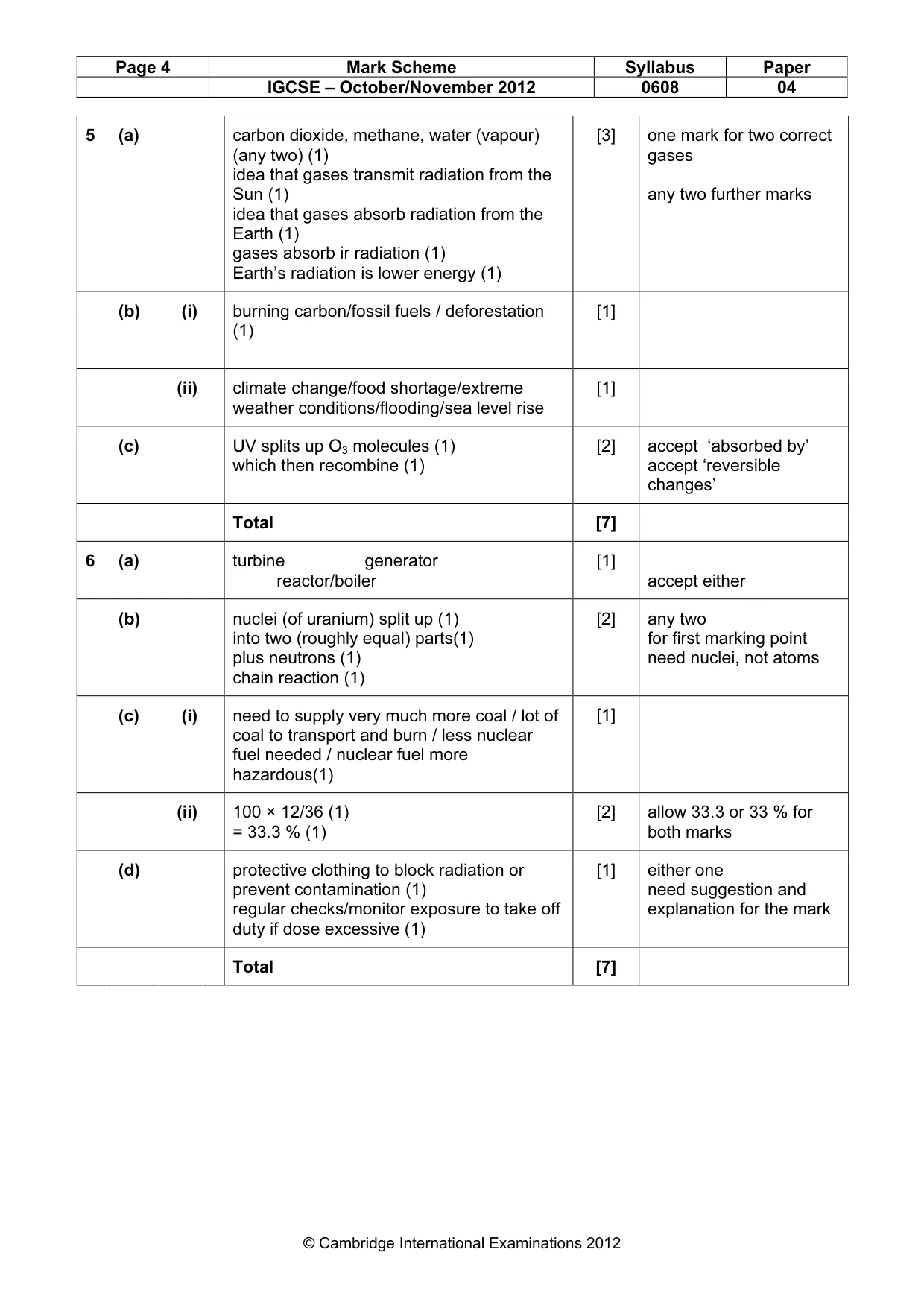
Page 4 Mark Scheme Syllabus Paper IGCSE – October/November 2012 0608 04 © Cambridge International Examinations 2012 5 (a) carbon dioxide, methane, water (vapour) (any two) (1) idea that gases transmit radiation from the Sun (1) idea that gases absorb radiation from the Earth (1) gases absorb ir radiation (1) Earth’s radiation is lower energy (1) [3] one mark for two correct gases any two further marks (b) (i) burning carbon/fossil fuels / deforestation (1) [1] (ii) climate change/food shortage/extreme weather conditions/flooding/sea level rise [1] (c) UV splits up O3 molecules (1) which then recombine (1) [2] accept ‘absorbed by’ accept ‘reversible changes’ Total [7] 6 (a) turbine generator reactor/boiler [1] accept either (b) nuclei (of uranium) split up (1) into two (roughly equal) parts(1) plus neutrons (1) chain reaction (1) [2] any two for first marking point need nuclei, not atoms (c) (i) need to supply very much more coal / lot of coal to transport and burn / less nuclear fuel needed / nuclear fuel more hazardous(1) [1] (ii) 100 × 12/36 (1) = 33.3 % (1) [2] allow 33.3 or 33 % for both marks (d) protective clothing to block radiation or prevent contamination (1) regular checks/monitor exposure to take off duty if dose excessive (1) [1] either one need suggestion and explanation for the mark Total [7]
Mark scheme, page 5
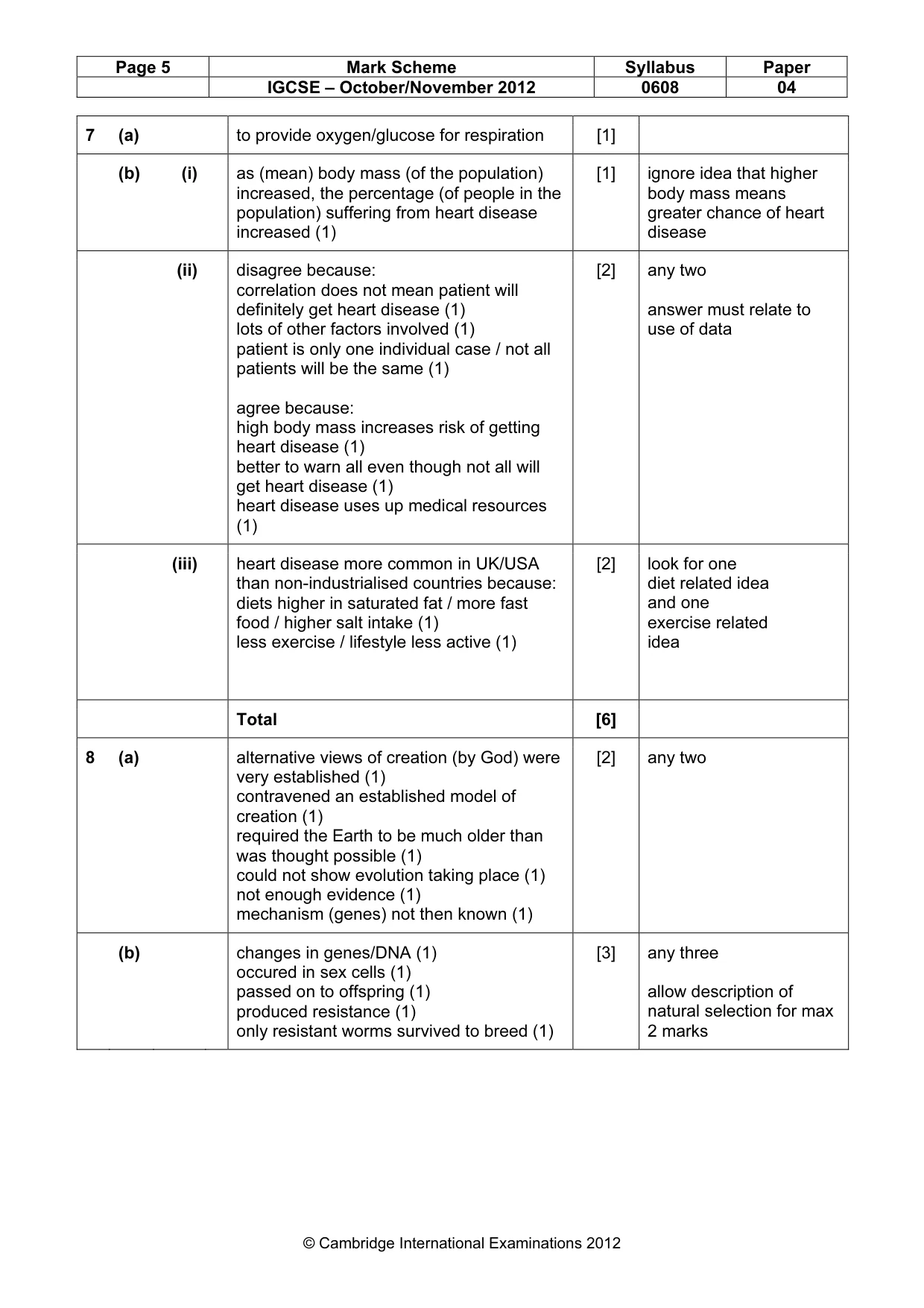
Page 5 Mark Scheme Syllabus Paper IGCSE – October/November 2012 0608 04 © Cambridge International Examinations 2012 7 (a) to provide oxygen/glucose for respiration [1] (b) (i) as (mean) body mass (of the population) increased, the percentage (of people in the population) suffering from heart disease increased (1) [1] ignore idea that higher body mass means greater chance of heart disease (ii) disagree because: correlation does not mean patient will definitely get heart disease (1) lots of other factors involved (1) patient is only one individual case / not all patients will be the same (1) agree because: high body mass increases risk of getting heart disease (1) better to warn all even though not all will get heart disease (1) heart disease uses up medical resources (1) [2] any two answer must relate to use of data (iii) heart disease more common in UK/USA than non-industrialised countries because: diets higher in saturated fat / more fast food / higher salt intake (1) less exercise / lifestyle less active (1) [2] look for one diet related idea and one exercise related idea Total [6] 8 (a) alternative views of creation (by God) were very established (1) contravened an established model of creation (1) required the Earth to be much older than was thought possible (1) could not show evolution taking place (1) not enough evidence (1) mechanism (genes) not then known (1) [2] any two (b) changes in genes/DNA (1) occured in sex cells (1) passed on to offspring (1) produced resistance (1) only resistant worms survived to breed (1) [3] any three allow description of natural selection for max 2 marks
Mark scheme, page 6
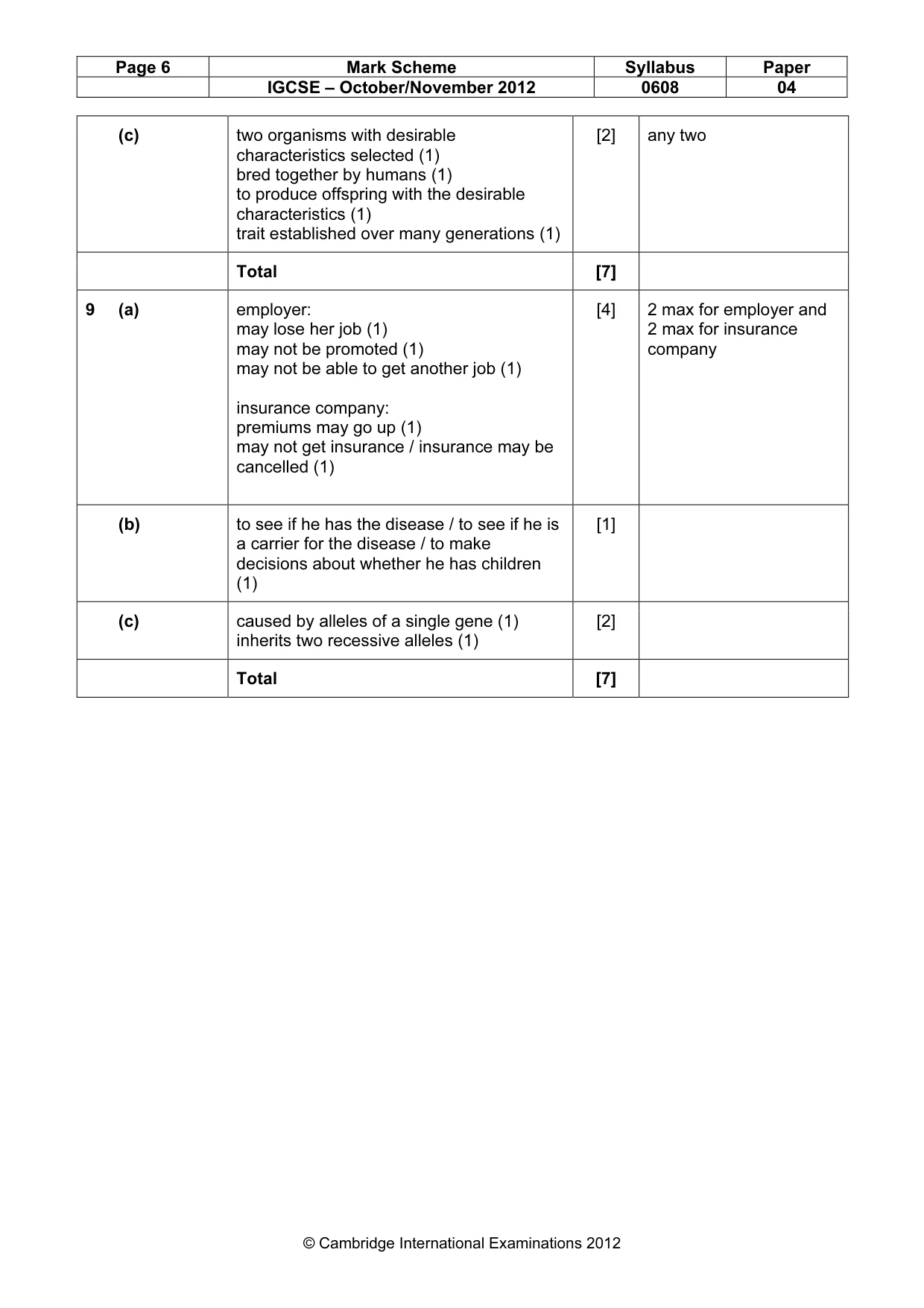
Page 6 Mark Scheme Syllabus Paper IGCSE – October/November 2012 0608 04 © Cambridge International Examinations 2012 (c) two organisms with desirable characteristics selected (1) bred together by humans (1) to produce offspring with the desirable characteristics (1) trait established over many generations (1) [2] any two Total [7] 9 (a) employer: may lose her job (1) may not be promoted (1) may not be able to get another job (1) insurance company: premiums may go up (1) may not get insurance / insurance may be cancelled (1) [4] 2 max for employer and 2 max for insurance company (b) to see if he has the disease / to see if he is a carrier for the disease / to make decisions about whether he has children (1) [1] (c) caused by alleles of a single gene (1) inherits two recessive alleles (1) [2] Total [7]