Cambridge IGCSE Twenty-First Century Science 0608 — 2011 May/June Paper 4 · Variant 1
0608/41/M/J/11 · 60 marks · ≈68 min
The question paper and its mark scheme, free to read here and free to download. This is Cambridge’s own paper, exactly as it was sat.
Question paper16 pages



Mark scheme4 pages
Answers below. Sit the paper first if you are practising.
Paper as text
Question paper, page 1
This document consists of 13 printed pages and 3 blank pages. DC (LEO/SW) 35749/2 © UCLES 2011 [Turn over UNIVERSITY OF CAMBRIDGE INTERNATIONAL EXAMINATIONS International General Certificate of Secondary Education READ THESE INSTRUCTIONS FIRST Write your Centre number, candidate number and name on all the work you hand in. Write in dark blue or black pen. You may use a pencil for any diagrams or graphs. Do not use staples, paper clips, highlighters, glue or correction fluid. DO NOT WRITE IN ANY BARCODES. Answer all questions. At the end of the examination, fasten all your work securely together. The number of marks is given in brackets [ ] at the end of each question or part question. * 6 4 9 1 1 5 6 4 0 5 * TWENTY FIRST CENTURY SCIENCE 0608/04 Paper 4 May/June 2011 1 hour 30 minutes Candidates answer on the Question Paper. No Additional Materials are required. For Examiner’s Use 1 2 3 4 5 6 7 8 9 Total www.XtremePapers.com
Question paper, page 2
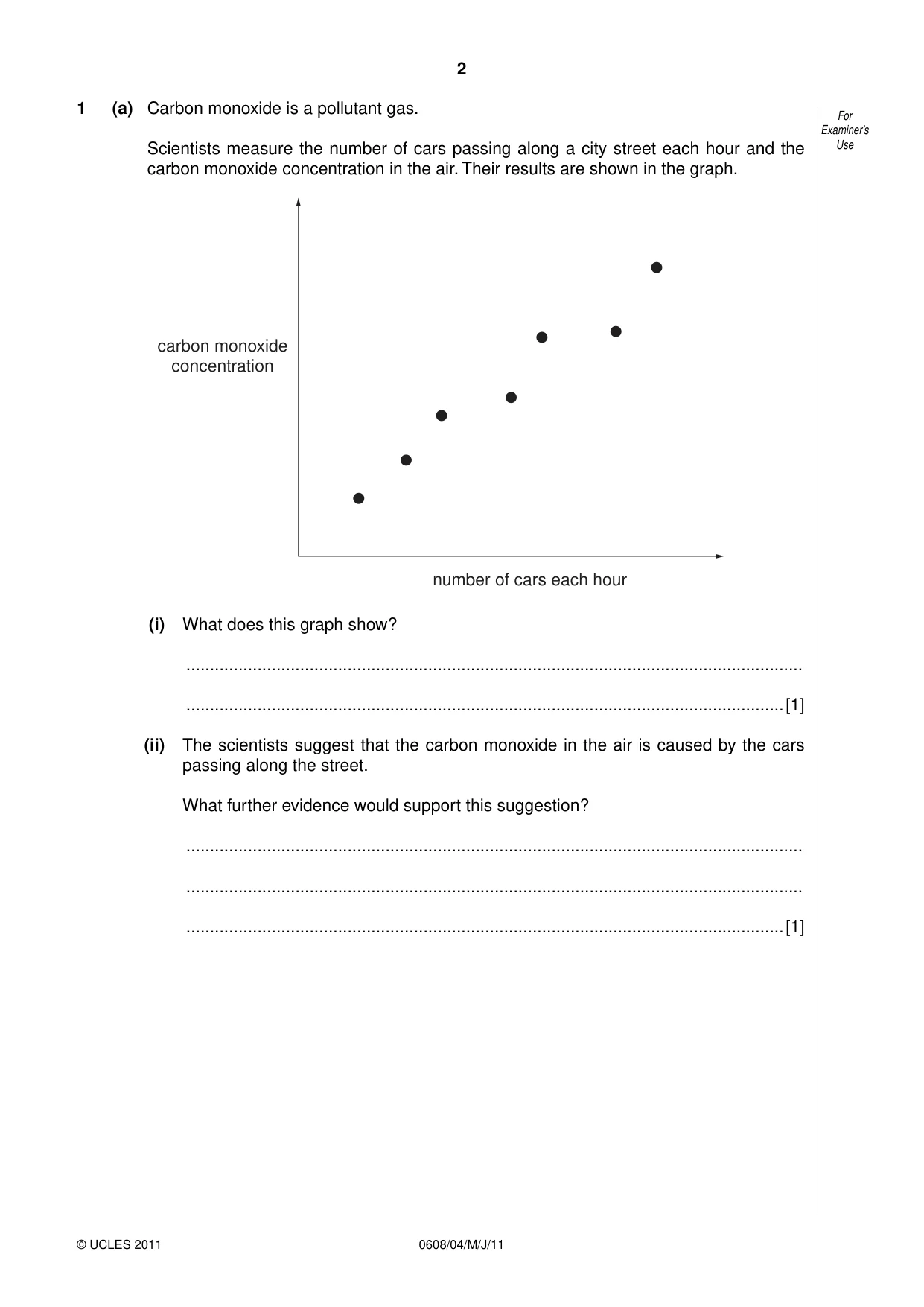
2 0608/04/M/J/11 © UCLES 2011 For Examiner’s Use 1 (a) Carbon monoxide is a pollutant gas. Scientists measure the number of cars passing along a city street each hour and the carbon monoxide concentration in the air. Their results are shown in the graph. number of cars each hour carbon monoxide concentration (i) What does this graph show? … …[1] (ii) The scientists suggest that the carbon monoxide in the air is caused by the cars passing along the street. What further evidence would support this suggestion? … … …[1]
Question paper, page 3
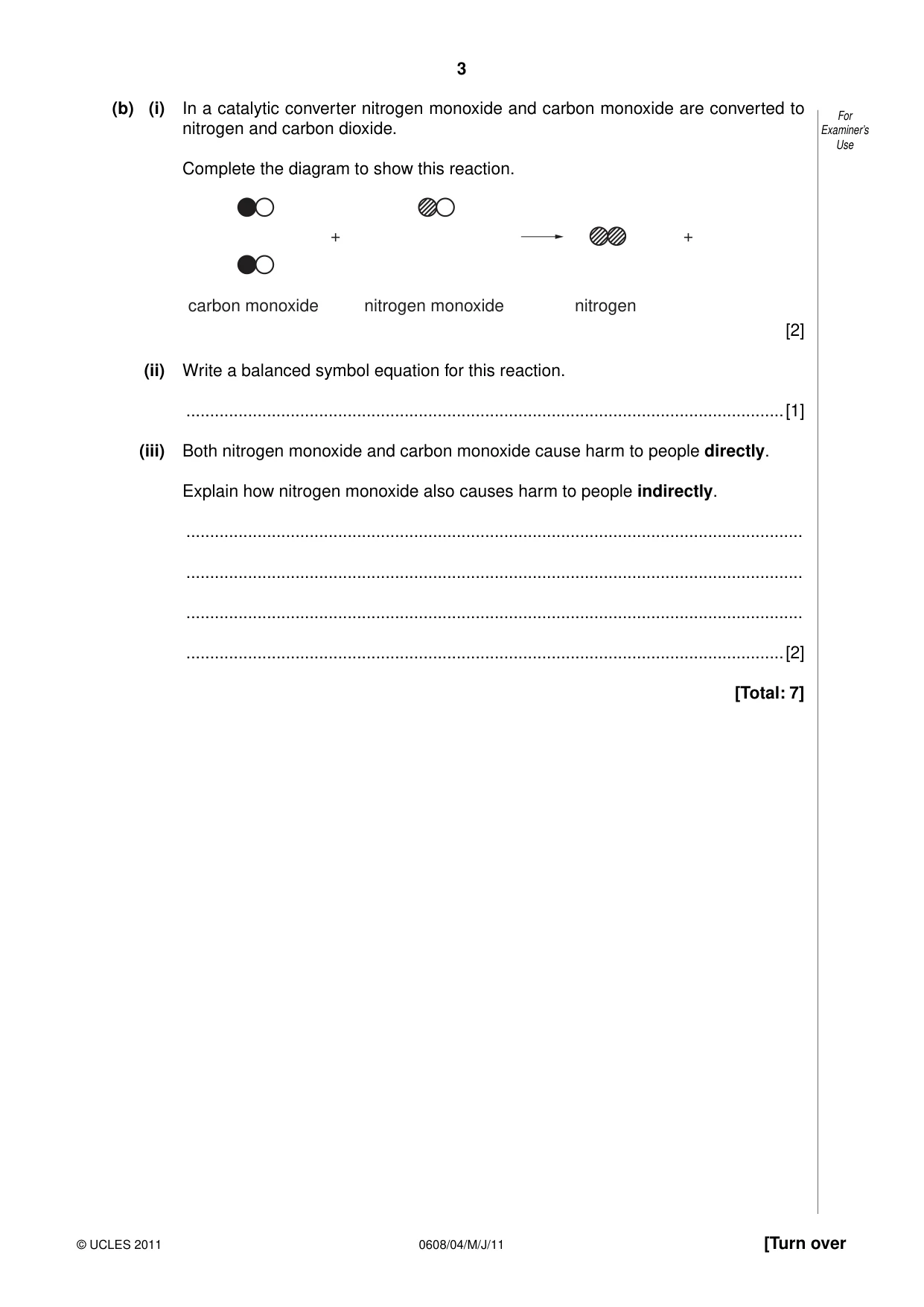
3 0608/04/M/J/11 © UCLES 2011 [Turn over For Examiner’s Use (b) (i) In a catalytic converter nitrogen monoxide and carbon monoxide are converted to nitrogen and carbon dioxide. Complete the diagram to show this reaction. + + carbon monoxide nitrogen monoxide nitrogen [2] (ii) Write a balanced symbol equation for this reaction. …[1] (iii) Both nitrogen monoxide and carbon monoxide cause harm to people directly. Explain how nitrogen monoxide also causes harm to people indirectly. … … … …[2] [Total: 7]
Question paper, page 4
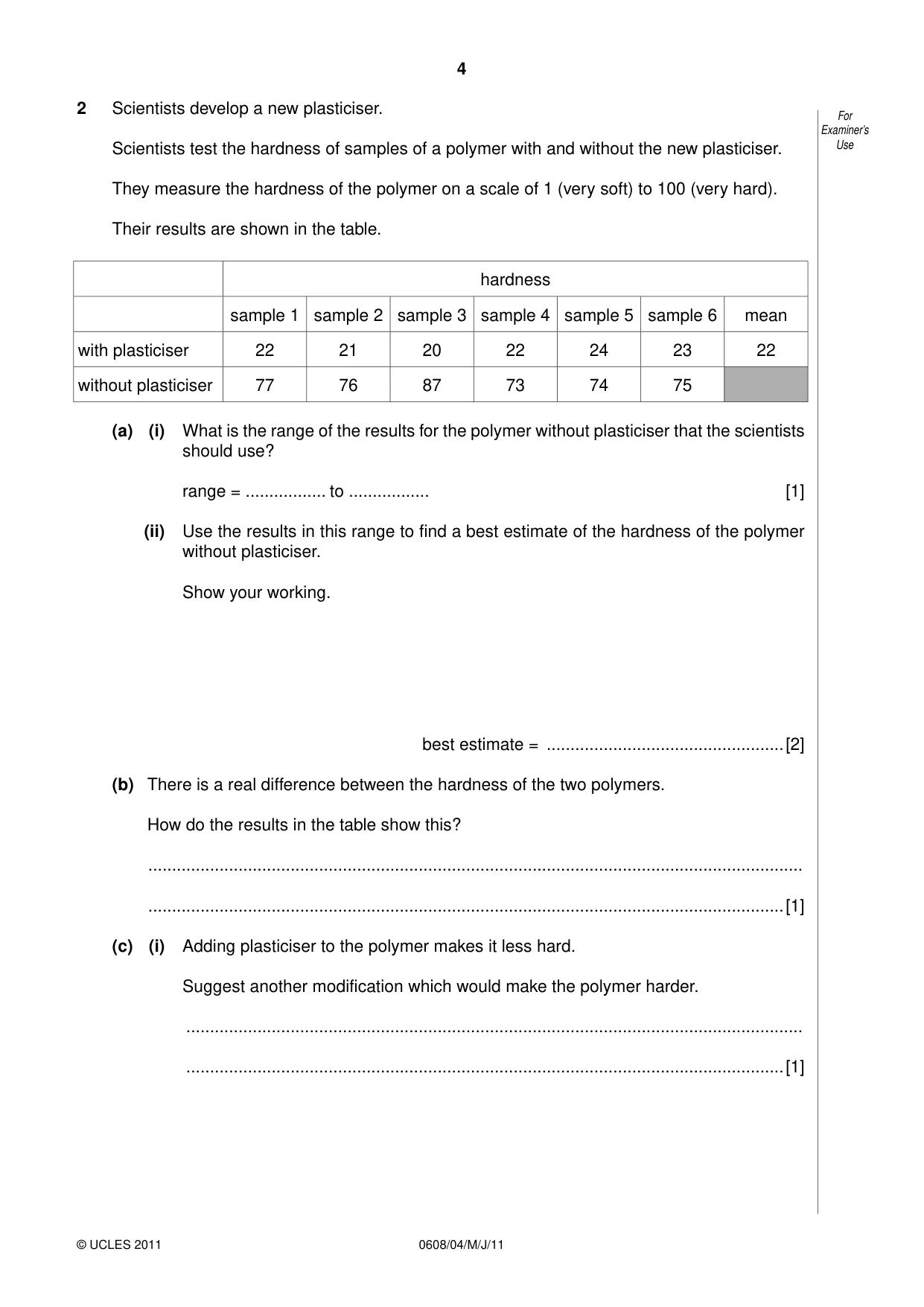
4 0608/04/M/J/11 © UCLES 2011 For Examiner’s Use 2 Scientists develop a new plasticiser. Scientists test the hardness of samples of a polymer with and without the new plasticiser. They measure the hardness of the polymer on a scale of 1 (very soft) to 100 (very hard). Their results are shown in the table. hardness sample 1 sample 2 sample 3 sample 4 sample 5 sample 6 mean with plasticiser 22 21 20 22 24 23 22 without plasticiser 77 76 87 73 74 75 (a) (i) What is the range of the results for the polymer without plasticiser that the scientists should use? range = … to … [1] (ii) Use the results in this range to find a best estimate of the hardness of the polymer without plasticiser. Show your working. best estimate = …[2] (b) There is a real difference between the hardness of the two polymers. How do the results in the table show this? … …[1] (c) (i) Adding plasticiser to the polymer makes it less hard. Suggest another modification which would make the polymer harder. … …[1]
Question paper, page 5
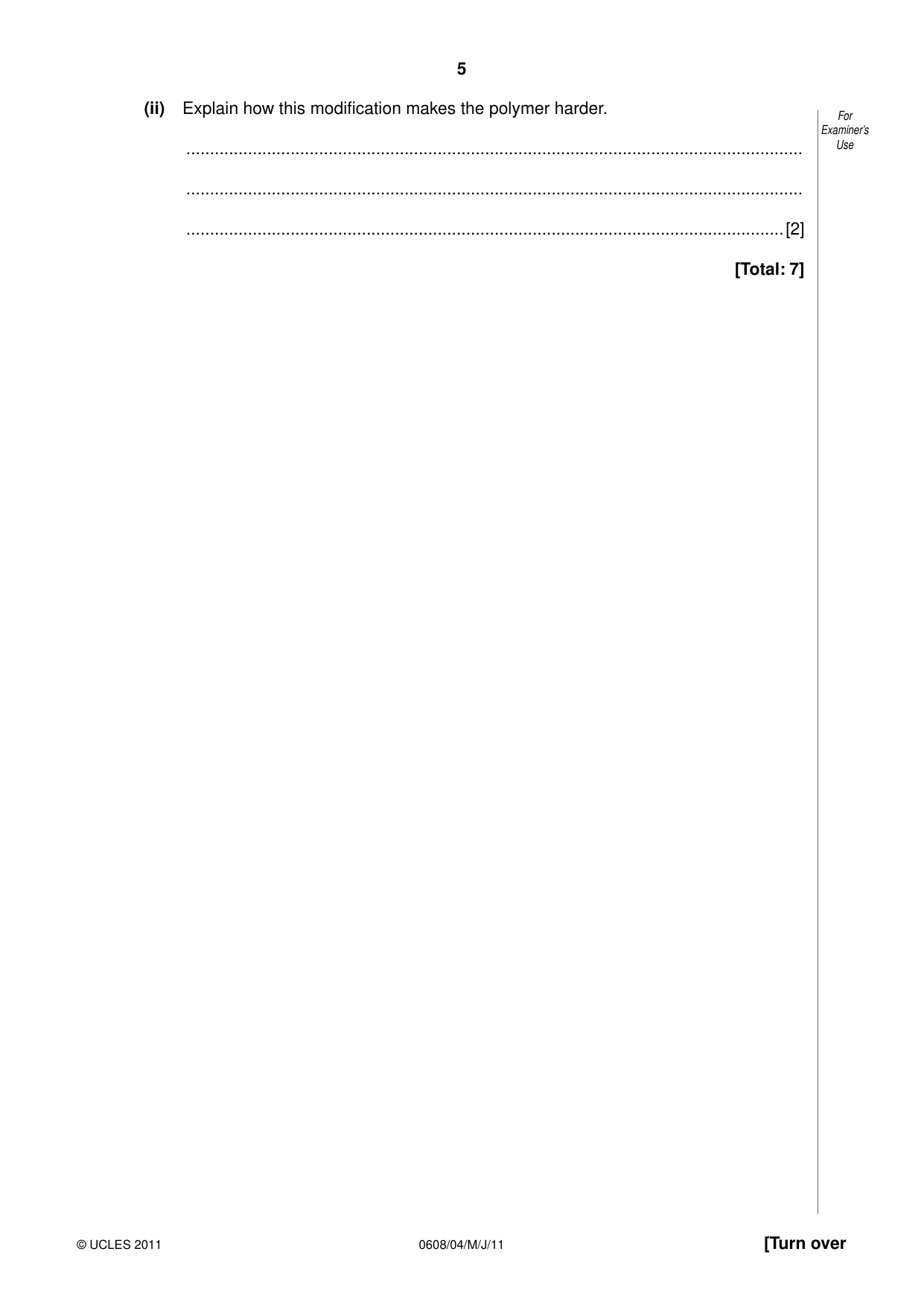
5 0608/04/M/J/11 © UCLES 2011 [Turn over For Examiner’s Use (ii) Explain how this modification makes the polymer harder. … … …[2] [Total: 7]
Question paper, page 6
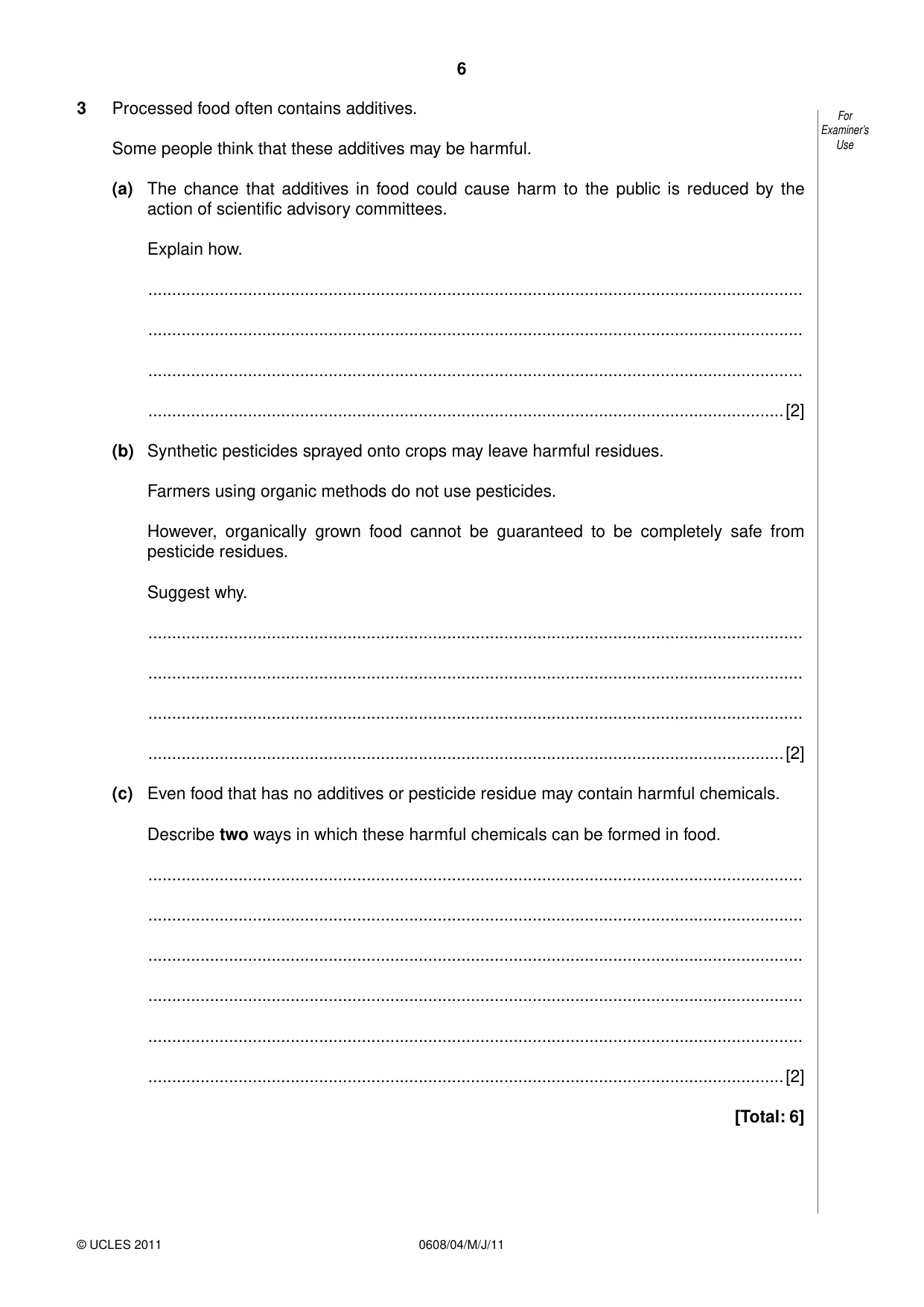
6 0608/04/M/J/11 © UCLES 2011 For Examiner’s Use 3 Processed food often contains additives. Some people think that these additives may be harmful. (a) The chance that additives in food could cause harm to the public is reduced by the action of scientific advisory committees. Explain how. … … … …[2] (b) Synthetic pesticides sprayed onto crops may leave harmful residues. Farmers using organic methods do not use pesticides. However, organically grown food cannot be guaranteed to be completely safe from pesticide residues. Suggest why. … … … …[2] (c) Even food that has no additives or pesticide residue may contain harmful chemicals. Describe two ways in which these harmful chemicals can be formed in food. … … … … … …[2] [Total: 6]
Question paper, page 7
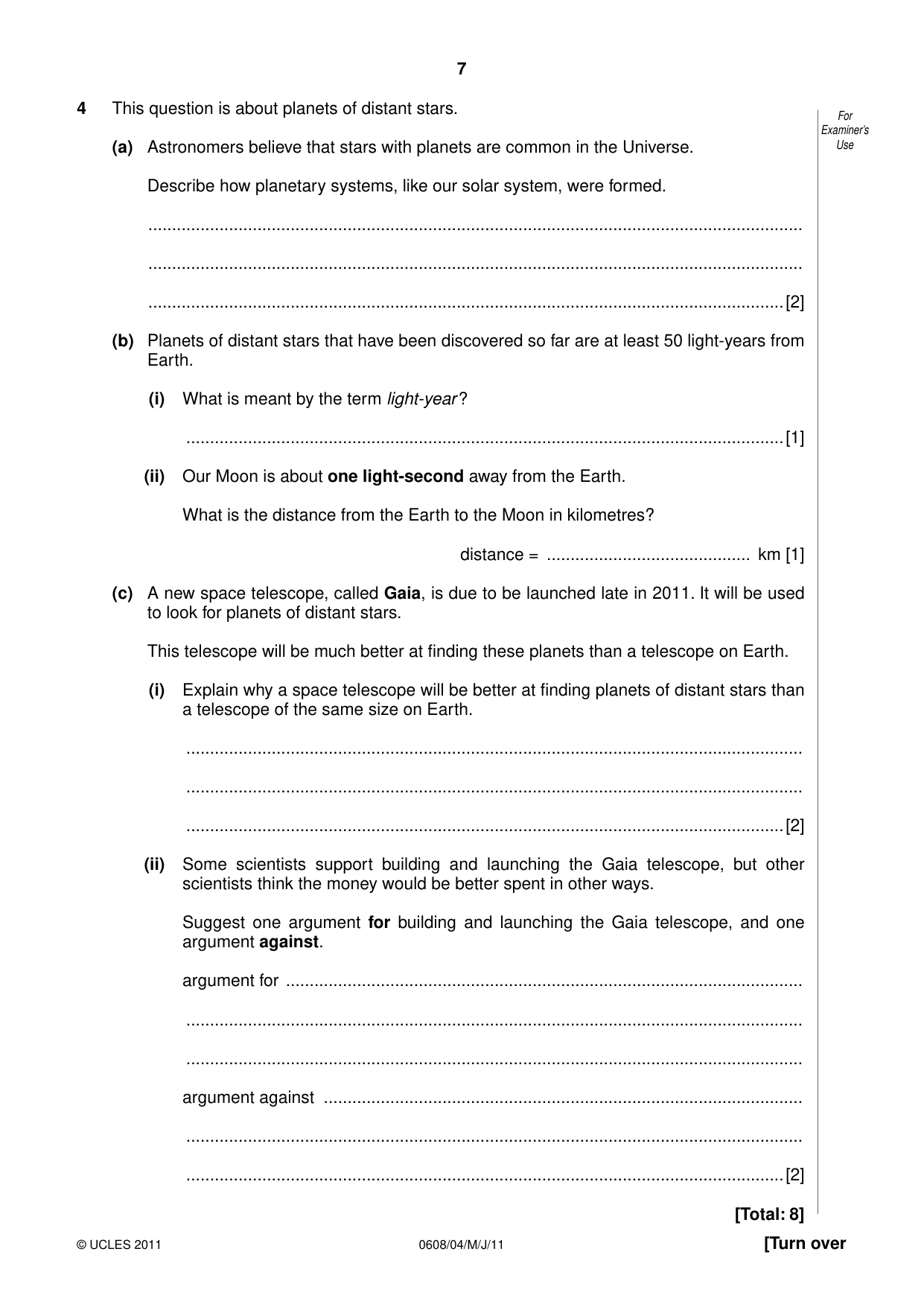
7 0608/04/M/J/11 © UCLES 2011 [Turn over For Examiner’s Use 4 This question is about planets of distant stars. (a) Astronomers believe that stars with planets are common in the Universe. Describe how planetary systems, like our solar system, were formed. … … …[2] (b) Planets of distant stars that have been discovered so far are at least 50 light-years from Earth. (i) What is meant by the term light-year ? …[1] (ii) Our Moon is about one light-second away from the Earth. What is the distance from the Earth to the Moon in kilometres? distance = … km [1] (c) A new space telescope, called Gaia, is due to be launched late in 2011. It will be used to look for planets of distant stars. This telescope will be much better at finding these planets than a telescope on Earth. (i) Explain why a space telescope will be better at finding planets of distant stars than a telescope of the same size on Earth. … … …[2] (ii) Some scientists support building and launching the Gaia telescope, but other scientists think the money would be better spent in other ways. Suggest one argument for building and launching the Gaia telescope, and one argument against. argument for … … … argument against … … …[2] [Total: 8]
Question paper, page 8
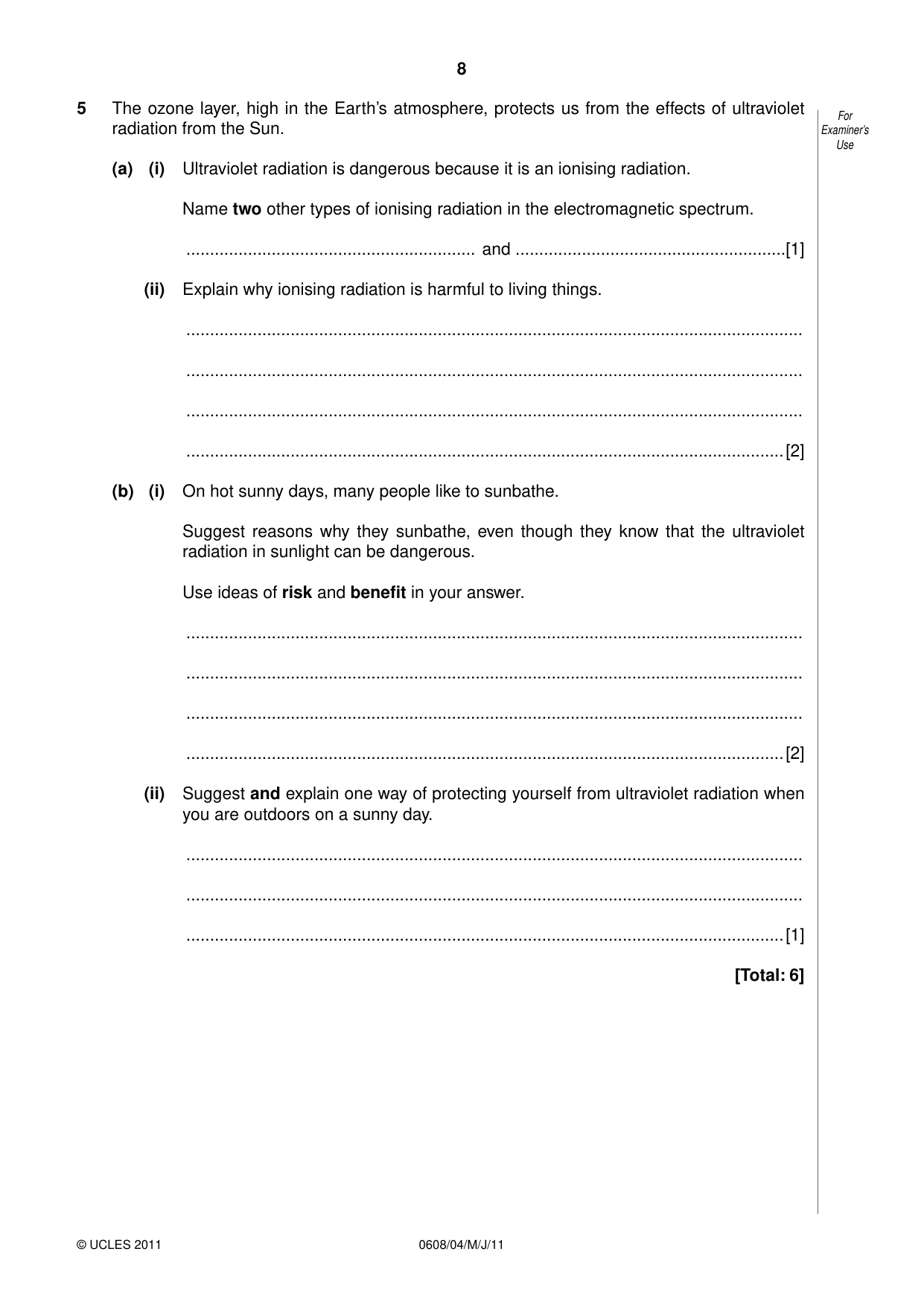
8 0608/04/M/J/11 © UCLES 2011 For Examiner’s Use 5 The ozone layer, high in the Earth’s atmosphere, protects us from the effects of ultraviolet radiation from the Sun. (a) (i) Ultraviolet radiation is dangerous because it is an ionising radiation. Name two other types of ionising radiation in the electromagnetic spectrum. … and …[1] (ii) Explain why ionising radiation is harmful to living things. … … … …[2] (b) (i) On hot sunny days, many people like to sunbathe. Suggest reasons why they sunbathe, even though they know that the ultraviolet radiation in sunlight can be dangerous. Use ideas of risk and benefit in your answer. … … … …[2] (ii) Suggest and explain one way of protecting yourself from ultraviolet radiation when you are outdoors on a sunny day. … … …[1] [Total: 6]
Question paper, page 9
9 0608/04/M/J/11 © UCLES 2011 [Turn over BLANK PAGE Please turn over for Question 6.
Question paper, page 10
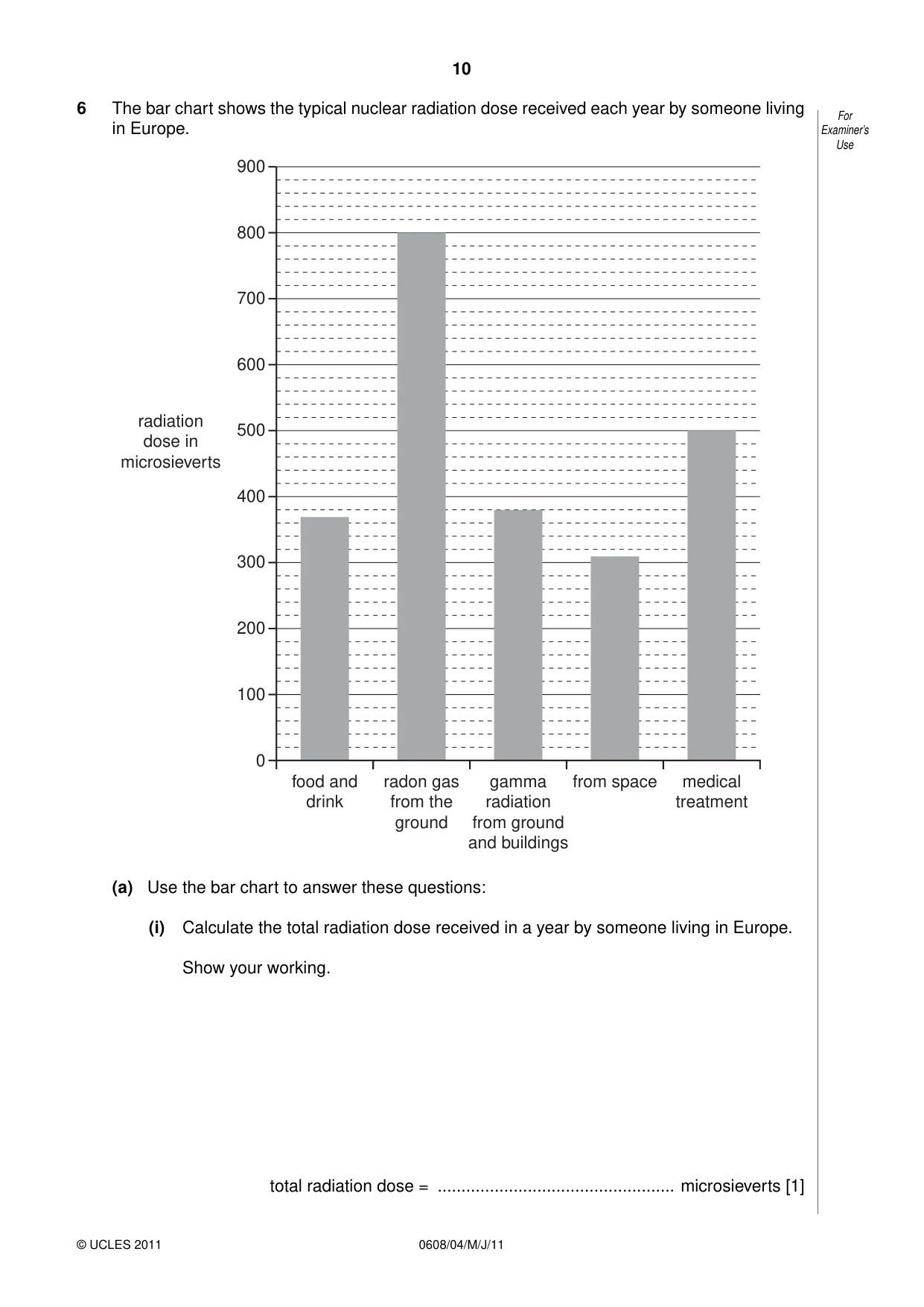
10 0608/04/M/J/11 © UCLES 2011 For Examiner’s Use 6 The bar chart shows the typical nuclear radiation dose received each year by someone living in Europe. 100 200 300 400 500 600 700 800 900 0 food and drink radon gas from the ground radiation dose in microsieverts gamma radiation from ground and buildings from space medical treatment (a) Use the bar chart to answer these questions: (i) Calculate the total radiation dose received in a year by someone living in Europe. Show your working. total radiation dose = … microsieverts [1]
Question paper, page 11
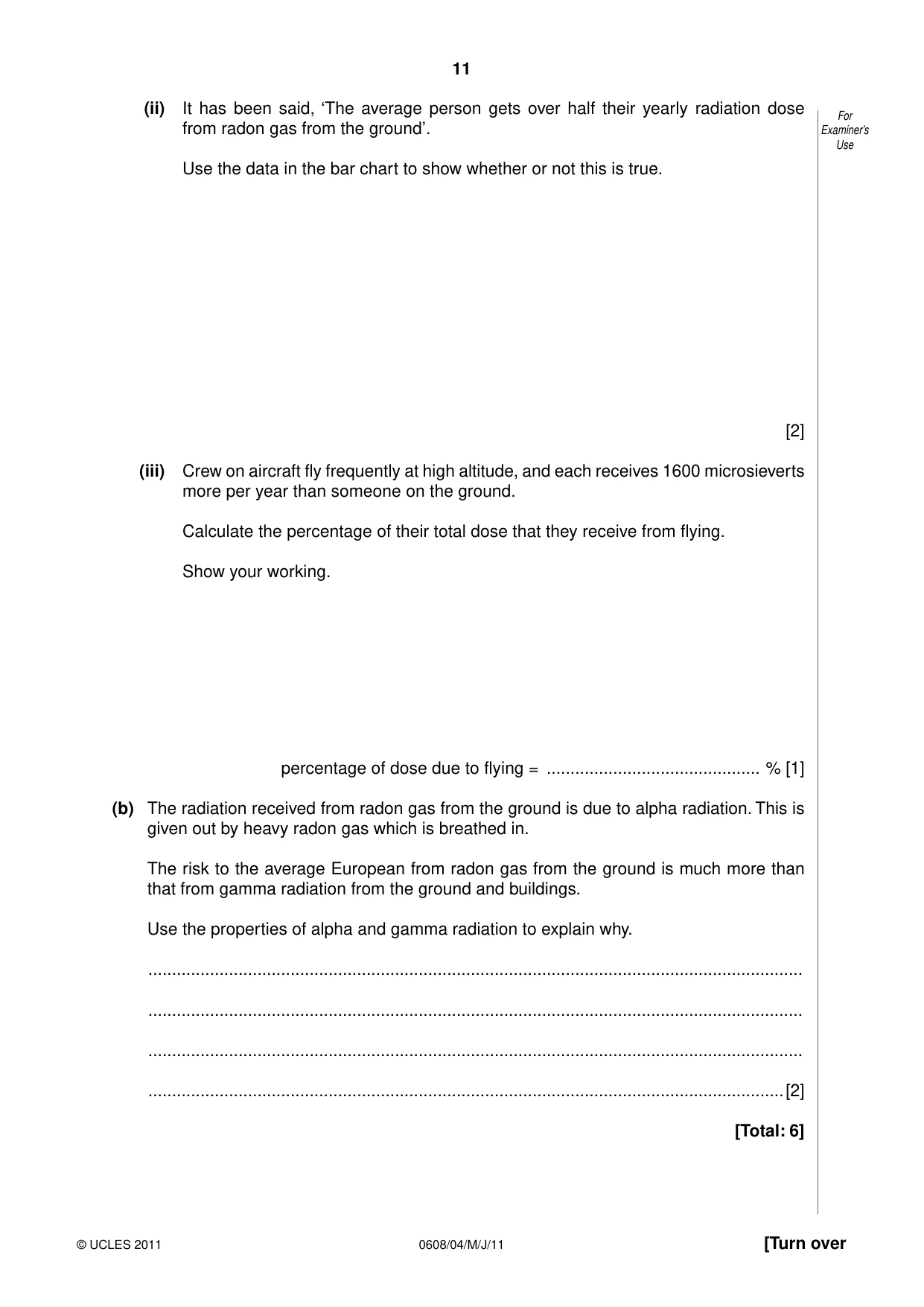
11 0608/04/M/J/11 © UCLES 2011 [Turn over For Examiner’s Use (ii) It has been said, ‘The average person gets over half their yearly radiation dose from radon gas from the ground’. Use the data in the bar chart to show whether or not this is true. [2] (iii) Crew on aircraft fly frequently at high altitude, and each receives 1600 microsieverts more per year than someone on the ground. Calculate the percentage of their total dose that they receive from flying. Show your working. percentage of dose due to flying = … % [1] (b) The radiation received from radon gas from the ground is due to alpha radiation. This is given out by heavy radon gas which is breathed in. The risk to the average European from radon gas from the ground is much more than that from gamma radiation from the ground and buildings. Use the properties of alpha and gamma radiation to explain why. … … … …[2] [Total: 6]
Question paper, page 12
12 0608/04/M/J/11 © UCLES 2011 For Examiner’s Use 7 The gender of an embryo is determined by the sex chromosomes inherited from its parents. (a) State the combination of sex chromosomes inherited to produce a male and a female embryo. male embryo … female embryo … [2] (b) Gender is controlled by a gene on one of the sex chromosomes. Describe the specific role of that gene. … … …[2] (c) George’s grandfather and father both suffer from an inherited genetic condition that develops after the age of 40 years. George is 26 years old. He is asked to complete a medical questionnaire by his employer. Give two reasons why George may not want his employer to know about the genetic condition in his family. … … …[2] (d) George is trying to decide whether he should be screened to see if he has the gene for this inherited condition. (i) Suggest two reasons why George might want to be screened for the condition. … … …[2] (ii) One reason why George might not want to be screened for the condition is that he does not want his employers to know the result. Suggest another reason why George might not want to be screened for the condition. … …[1] [Total: 9]
Question paper, page 13
13 0608/04/M/J/11 © UCLES 2011 [Turn over For Examiner’s Use 8 There are many different factors that increase the risk of suffering from heart disease. (a) State two lifestyle factors that increase this risk. 1. … 2. …[2] (b) Read these sentences. A Scientists have found a link between heart disease and air pollution. B The scientists studied 66 000 women over a period of nine years. C 1816 of the women suffered from heart disease during this time. D These 1816 women lived in areas where the level of air pollution was high. E The small pollution particles can enter the blood and affect the blood vessels. F The risk of heart disease increases in places where there is more air pollution. Choose from sentences A, B, C, D, E and F to answer the following questions (i) Which sentence describes the correlation between air pollution and heart disease? …[1] (ii) Which two other sentences, when put together, describe the same correlation? … and …[1] (iii) Which sentence suggests a causal link between air pollution and heart disease? …[1] (c) The study was carried out over a period of nine years. Suggest why such a long period was used. … …[1] (d) Calculate the percentage of women in the study that suffered from heart disease. Show your working. percentage of women that suffered from heart disease = … % [1] [Total: 7]
Question paper, page 14
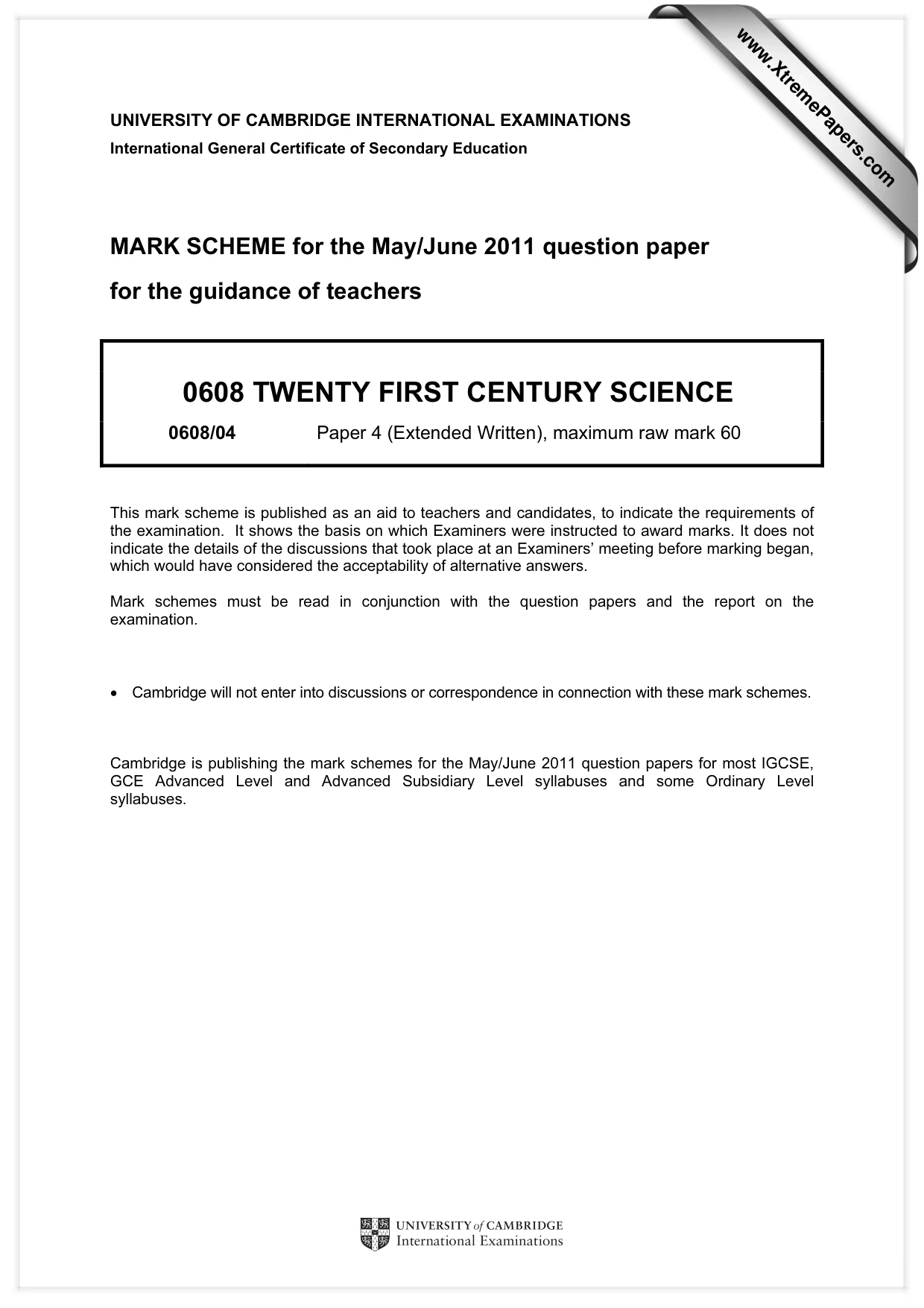
14 0608/04/M/J/11 © UCLES 2011 For Examiner’s Use 9 Look at the food web showing the feeding relationships between different animal and plant species living in the sea. loggerhead turtle horseshoe crab striped bass sanderling grackle razor clam diamondback terrapin plankton (small plants) (a) All living organisms are dependent on the environment and other species for their survival. Name the source of energy for all species in a food web. …[1] (b) Competition for food occurs between different species. Name two species from the food web that compete with each other for razor clams. … and … [1] (c) The loggerhead turtle is an endangered species. Suggest and explain what would happen to the number of striped bass if the loggerhead turtle became extinct. … … …[2] [Total: 4]
Question paper, page 15
15 0608/04/M/J/11 © UCLES 2011 BLANK PAGE
Question paper, page 16
16 0608/04/M/J/11 © UCLES 2011 Permission to reproduce items where third-party owned material protected by copyright is included has been sought and cleared where possible. Every reasonable effort has been made by the publisher (UCLES) to trace copyright holders, but if any items requiring clearance have unwittingly been included, the publisher will be pleased to make amends at the earliest possible opportunity. University of Cambridge International Examinations is part of the Cambridge Assessment Group. Cambridge Assessment is the brand name of University of Cambridge Local Examinations Syndicate (UCLES), which is itself a department of the University of Cambridge. BLANK PAGE
Mark scheme, page 1
UNIVERSITY OF CAMBRIDGE INTERNATIONAL EXAMINATIONS International General Certificate of Secondary Education MARK SCHEME for the May/June 2011 question paper for the guidance of teachers 0608 TWENTY FIRST CENTURY SCIENCE 0608/04 Paper 4 (Extended Written), maximum raw mark 60 This mark scheme is published as an aid to teachers and candidates, to indicate the requirements of the examination. It shows the basis on which Examiners were instructed to award marks. It does not indicate the details of the discussions that took place at an Examiners’ meeting before marking began, which would have considered the acceptability of alternative answers. Mark schemes must be read in conjunction with the question papers and the report on the examination. • Cambridge will not enter into discussions or correspondence in connection with these mark schemes. Cambridge is publishing the mark schemes for the May/June 2011 question papers for most IGCSE, GCE Advanced Level and Advanced Subsidiary Level syllabuses and some Ordinary Level syllabuses. www.XtremePapers.com
Mark scheme, page 2
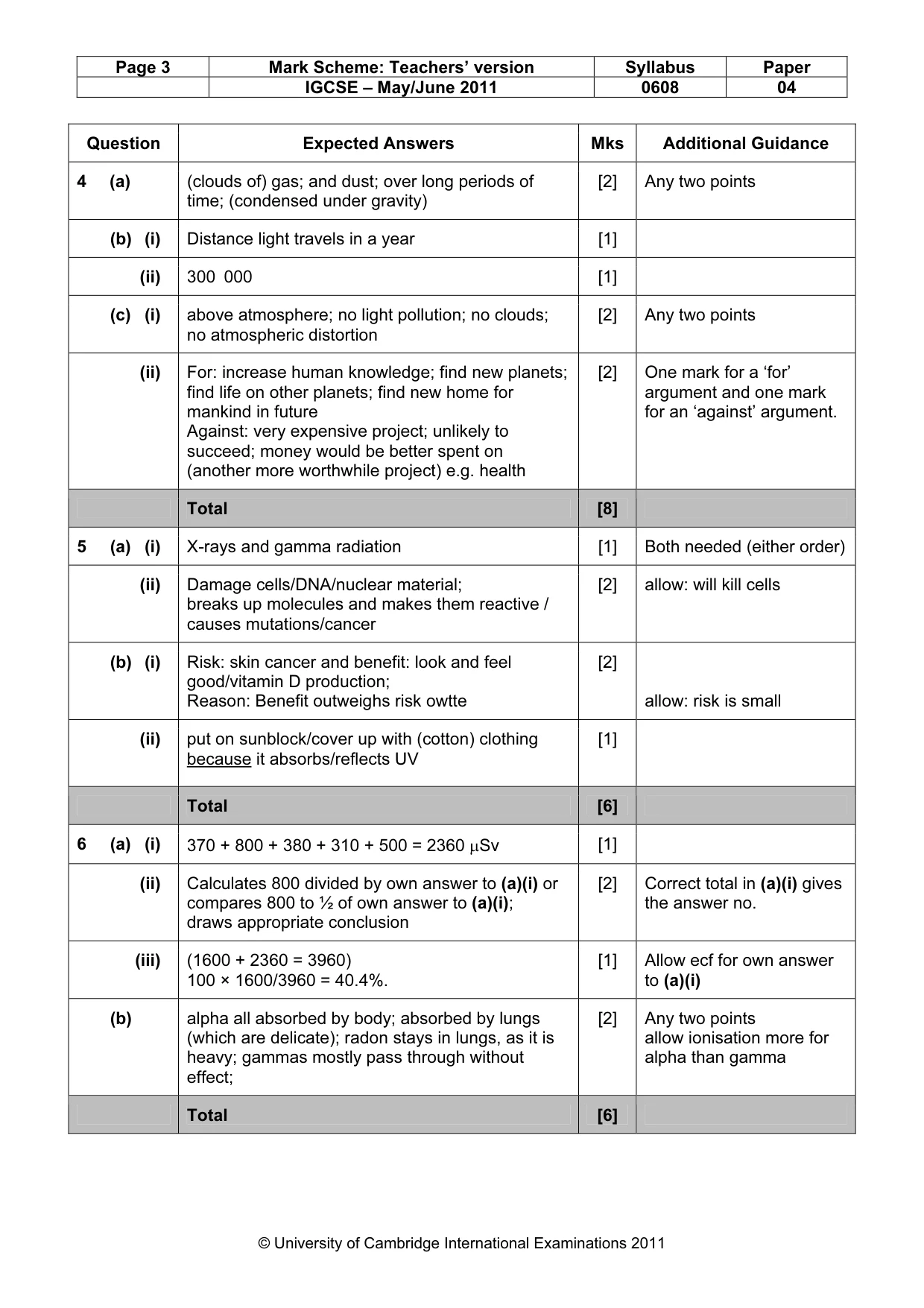
Page 2 Mark Scheme: Teachers’ version Syllabus Paper IGCSE – May/June 2011 0608 04 © University of Cambridge International Examinations 2011 Question Expected Answers Mks Additional Guidance 1 (a) (i) a correlation between carbon monoxide concentration and number of cars / as the number of cars increases so does the carbon monoxide concentration [1] (ii) results can be repeated (by other scientists) / more data can be obtained [1] allow: causal link found (b) (i) second nitrogen monoxide molecule on left; two carbon dioxide molecules on right [2] (ii) 2CO + 2NO → N2 + 2CO2 [1] do not allow ecf from (b)(i) (iii) it causes acid rain; that attacks crops [2] allow: other correct damage from acid rain Total [7] 2 (a) (i) 73 to 77 [1] (ii) (77+76+73+74+75)/5; = 75 [2] allow one mark for 77 (b) mean of polymer A does not lie in range of polymer B; [1] allow: ranges do no overlap (c) (i) make chains longer / add cross linking [1] allow: increased crystallinity (ii) increases forces between chains; more energy is needed to separate chains [2] Total [7] 3 (a) they carry out carry out risk assessments; to find the safe levels of chemicals in food [2] (b) pesticide chemicals may get into organic food from other sources; e.g. blow from other farms / in water supply [2] allow: soil may contain pesticides from previous use (c) moulds/bacteria/microbes grow on food in storage (and release toxic chemicals); toxic chemicals may be formed during cooking; toxic chemicals may be produced by a plant as it grows; chemicals in the plant may cause an allergic reaction [2] any two Total [6]
Mark scheme, page 3
Page 3 Mark Scheme: Teachers’ version Syllabus Paper IGCSE – May/June 2011 0608 04 © University of Cambridge International Examinations 2011 Question Expected Answers Mks Additional Guidance 4 (a) (clouds of) gas; and dust; over long periods of time; (condensed under gravity) [2] Any two points (b) (i) Distance light travels in a year [1] (ii) 300 000 [1] (c) (i) above atmosphere; no light pollution; no clouds; no atmospheric distortion [2] Any two points (ii) For: increase human knowledge; find new planets; find life on other planets; find new home for mankind in future Against: very expensive project; unlikely to succeed; money would be better spent on (another more worthwhile project) e.g. health [2] One mark for a ‘for’ argument and one mark for an ‘against’ argument. Total [8] 5 (a) (i) X-rays and gamma radiation [1] Both needed (either order) (ii) Damage cells/DNA/nuclear material; breaks up molecules and makes them reactive / causes mutations/cancer [2] allow: will kill cells (b) (i) Risk: skin cancer and benefit: look and feel good/vitamin D production; Reason: Benefit outweighs risk owtte [2] allow: risk is small (ii) put on sunblock/cover up with (cotton) clothing because it absorbs/reflects UV [1] Total [6] 6 (a) (i) 370 + 800 + 380 + 310 + 500 = 2360 µSv [1] (ii) Calculates 800 divided by own answer to (a)(i) or compares 800 to ½ of own answer to (a)(i); draws appropriate conclusion [2] Correct total in (a)(i) gives the answer no. (iii) (1600 + 2360 = 3960) 100 × 1600/3960 = 40.4%. [1] Allow ecf for own answer to (a)(i) (b) alpha all absorbed by body; absorbed by lungs (which are delicate); radon stays in lungs, as it is heavy; gammas mostly pass through without effect; [2] Any two points allow ionisation more for alpha than gamma Total [6]
Mark scheme, page 4
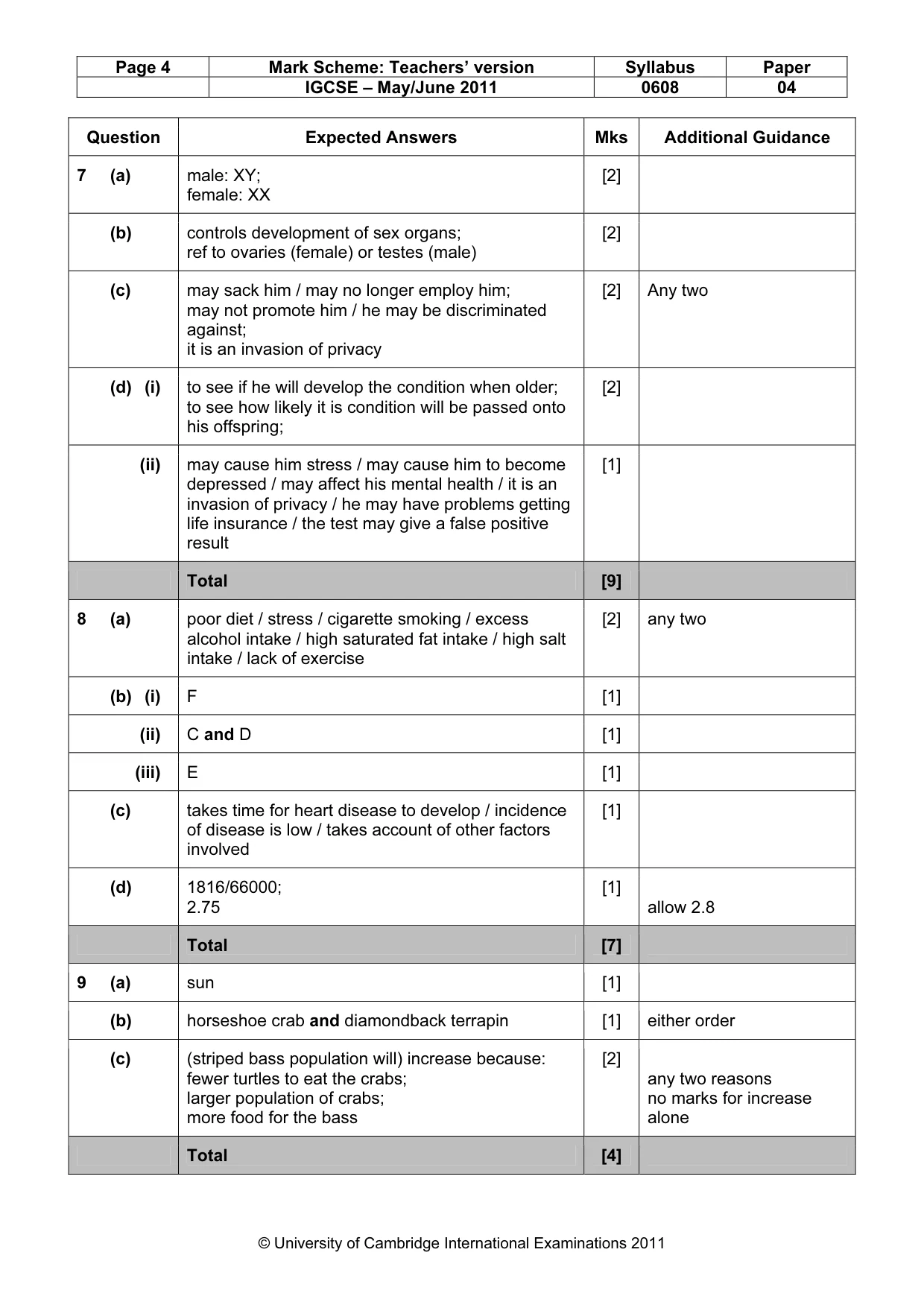
Page 4 Mark Scheme: Teachers’ version Syllabus Paper IGCSE – May/June 2011 0608 04 © University of Cambridge International Examinations 2011 Question Expected Answers Mks Additional Guidance 7 (a) male: XY; female: XX [2] (b) controls development of sex organs; ref to ovaries (female) or testes (male) [2] (c) may sack him / may no longer employ him; may not promote him / he may be discriminated against; it is an invasion of privacy [2] Any two (d) (i) to see if he will develop the condition when older; to see how likely it is condition will be passed onto his offspring; [2] (ii) may cause him stress / may cause him to become depressed / may affect his mental health / it is an invasion of privacy / he may have problems getting life insurance / the test may give a false positive result [1] Total [9] 8 (a) poor diet / stress / cigarette smoking / excess alcohol intake / high saturated fat intake / high salt intake / lack of exercise [2] any two (b) (i) F [1] (ii) C and D [1] (iii) E [1] (c) takes time for heart disease to develop / incidence of disease is low / takes account of other factors involved [1] (d) 1816/66000; 2.75 [1] allow 2.8 Total [7] 9 (a) sun [1] (b) horseshoe crab and diamondback terrapin [1] either order (c) (striped bass population will) increase because: fewer turtles to eat the crabs; larger population of crabs; more food for the bass [2] any two reasons no marks for increase alone Total [4]
What you needed in this session
Cambridge’s own grade thresholds for 2011 May/June, Paper 4 · Variant 1. A higher threshold means an easier paper — the bar moves with how the cohort did.