Cambridge IGCSE Travel and Tourism 0471 — 2022 Oct/Nov Paper 2 · Variant 2
0471/22/O/N/22 · 100 marks · ≈113 min
The question paper and its mark scheme, free to read here and free to download. This is Cambridge’s own paper, exactly as it was sat.
Question paper16 pages



Mark scheme15 pages
Answers below. Sit the paper first if you are practising.

Paper as text
Question paper, page 1
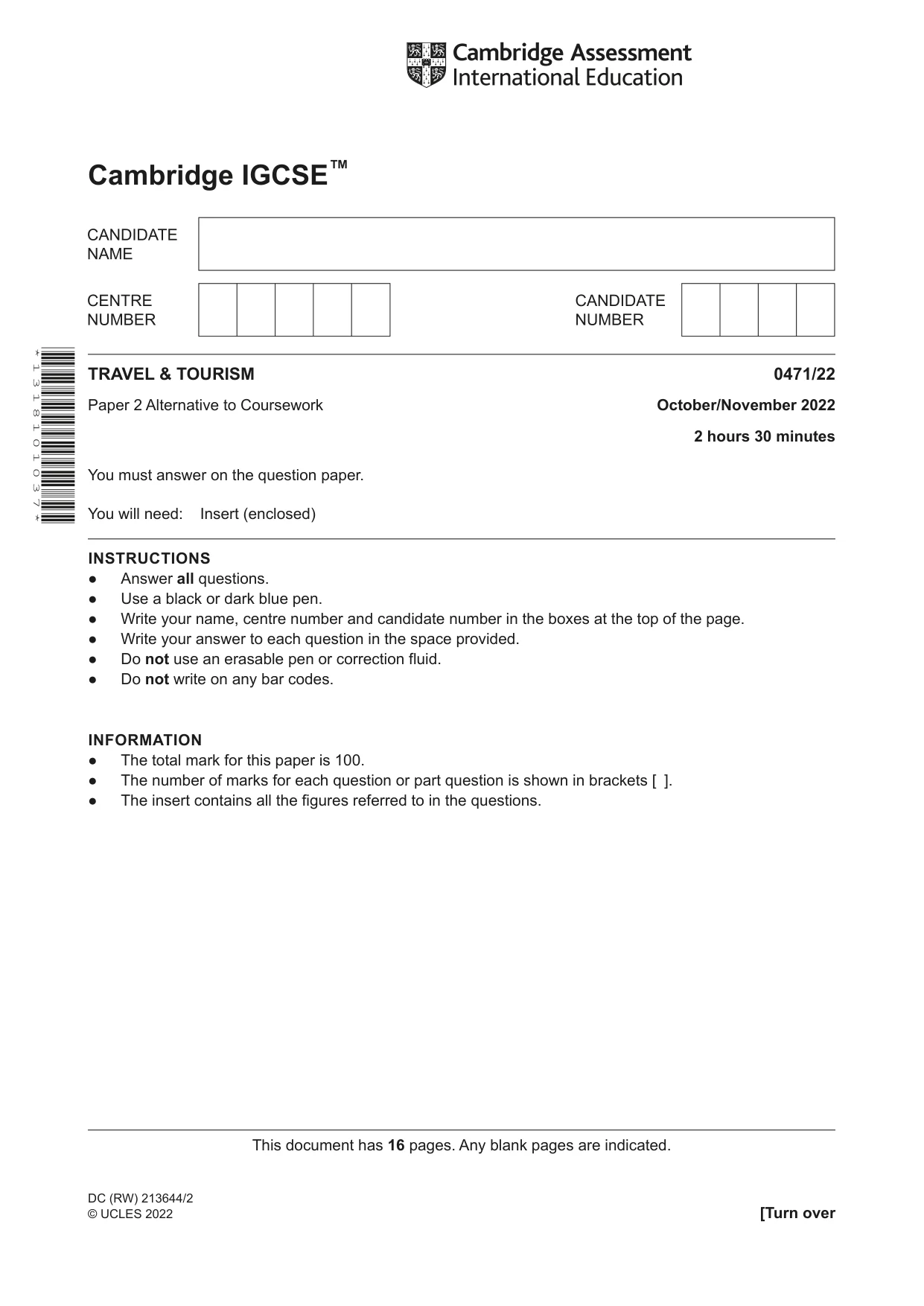
This document has 16 pages. Any blank pages are indicated. [Turn over DC (RW) 213644/2 © UCLES 2022 * 1 3 1 8 1 0 1 0 3 7 * TRAVEL & TOURISM 0471/22 Paper 2 Alternative to Coursework October/November 2022 2 hours 30 minutes You must answer on the question paper. You will need: Insert (enclosed) INSTRUCTIONS ● Answer all questions. ● Use a black or dark blue pen. ● Write your name, centre number and candidate number in the boxes at the top of the page. ● Write your answer to each question in the space provided. ● Do not use an erasable pen or correction fluid. ● Do not write on any bar codes. INFORMATION ● The total mark for this paper is 100. ● The number of marks for each question or part question is shown in brackets [ ]. ● The insert contains all the figures referred to in the questions. Cambridge IGCSE™
Question paper, page 2
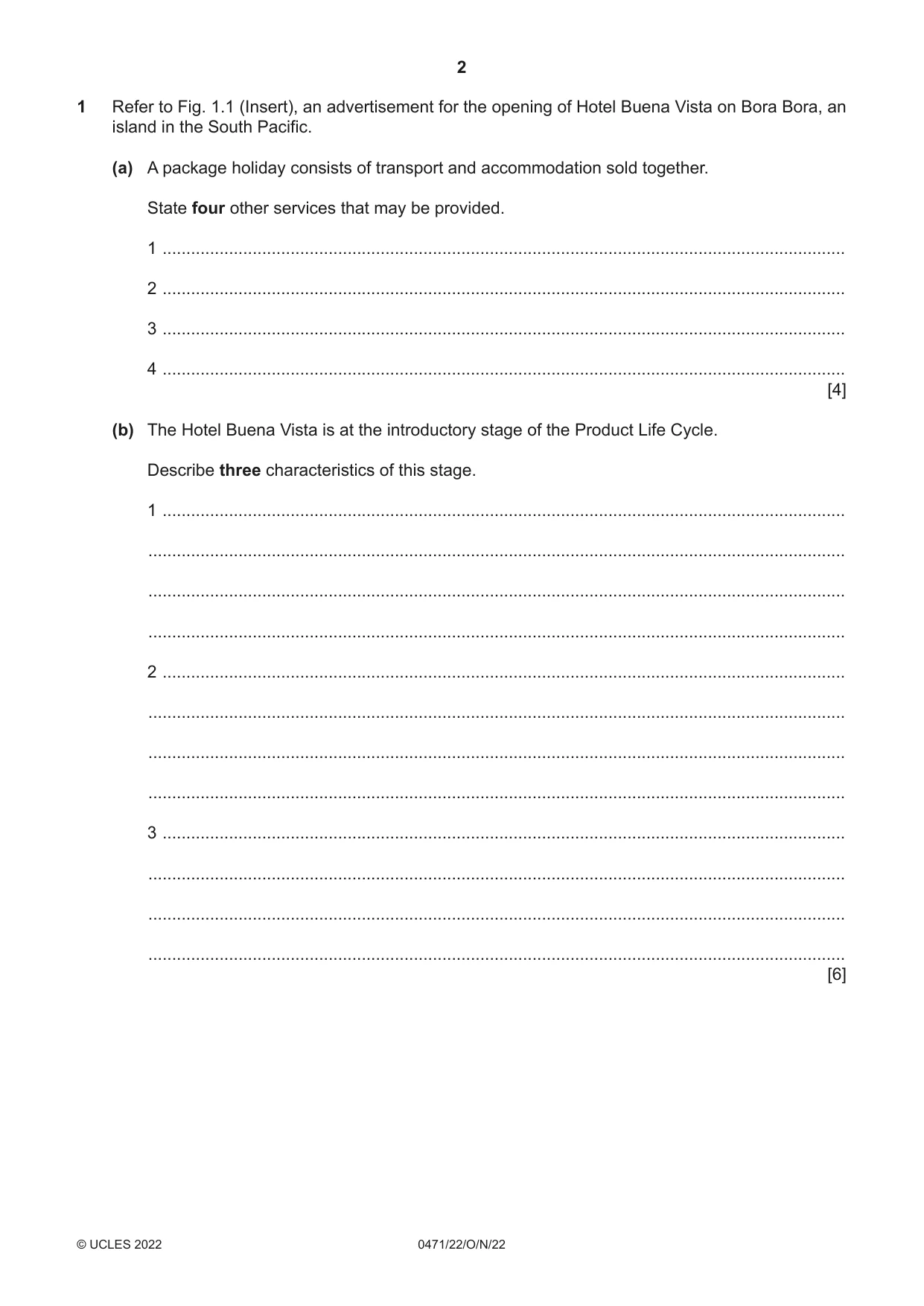
2 0471/22/O/N/22 © UCLES 2022 1 Refer to Fig. 1.1 (Insert), an advertisement for the opening of Hotel Buena Vista on Bora Bora, an island in the South Pacific. (a) A package holiday consists of transport and accommodation sold together. State four other services that may be provided. 1 … 2 … 3 … 4 … [4] (b) The Hotel Buena Vista is at the introductory stage of the Product Life Cycle. Describe three characteristics of this stage. 1 … … … … 2 … … … … 3 … … … … [6]
Question paper, page 3
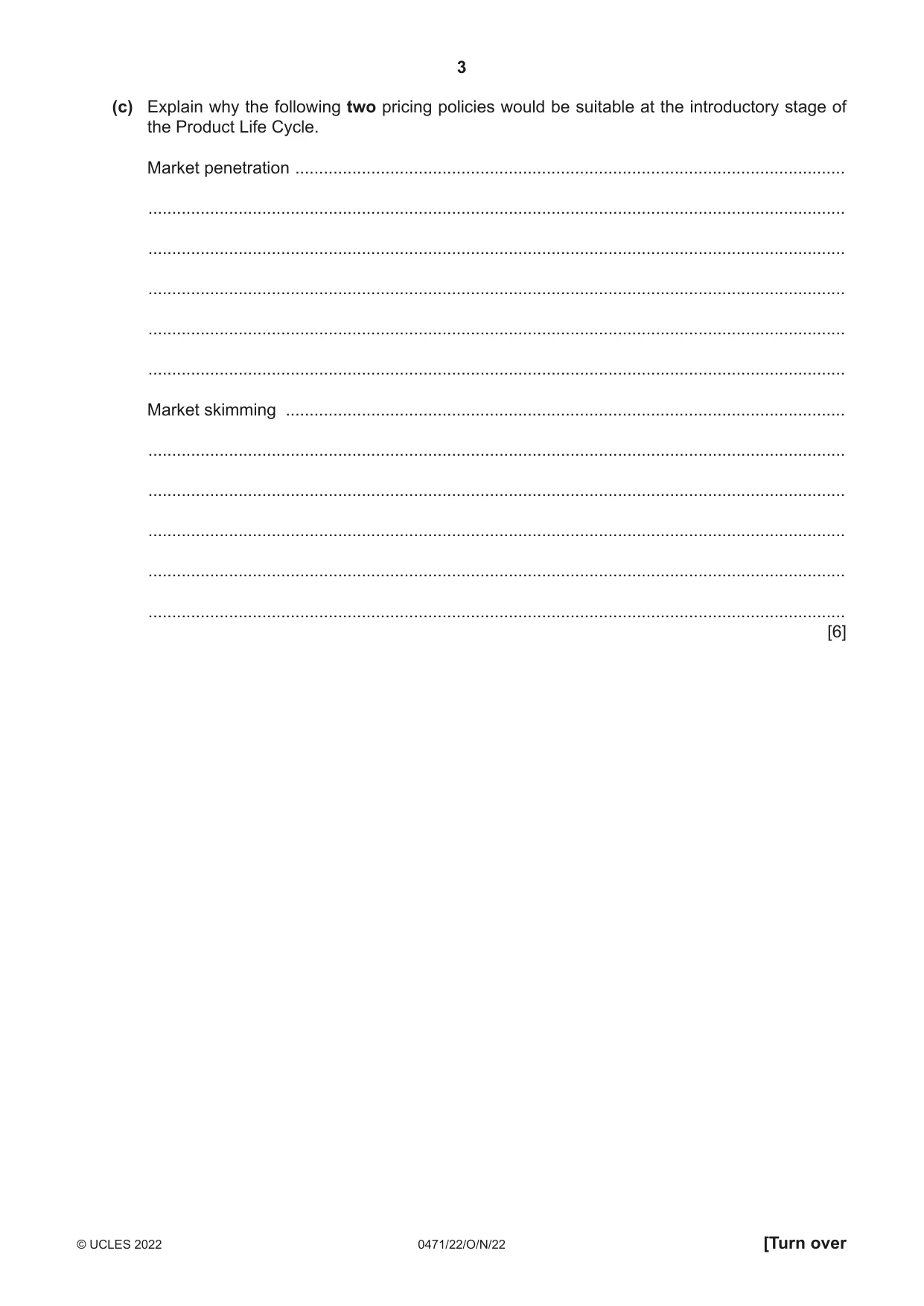
3 0471/22/O/N/22 © UCLES 2022 [Turn over (c) Explain why the following two pricing policies would be suitable at the introductory stage of the Product Life Cycle. Market penetration … … … … … … Market skimming … … … … … … [6]
Question paper, page 4
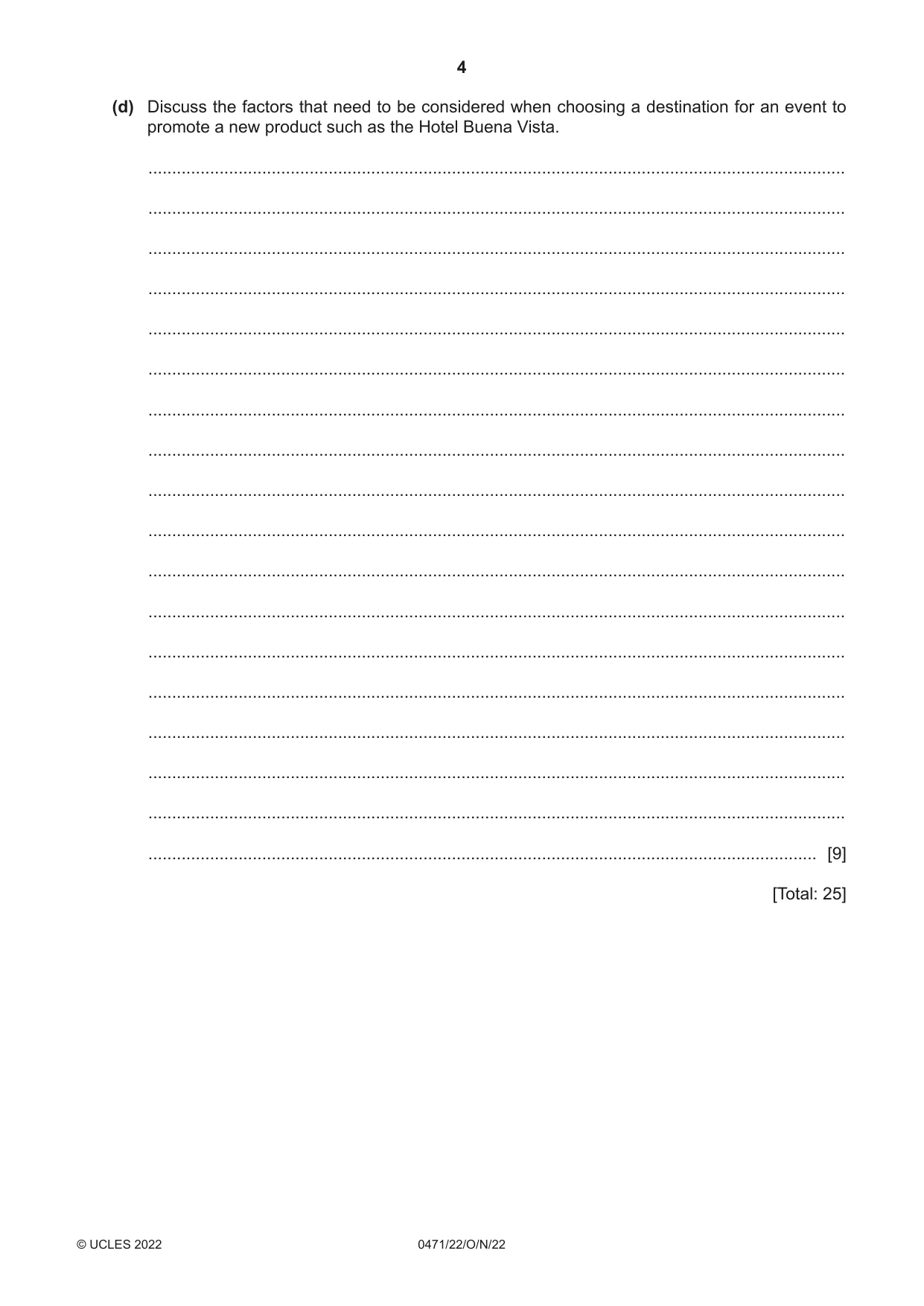
4 0471/22/O/N/22 © UCLES 2022 (d) Discuss the factors that need to be considered when choosing a destination for an event to promote a new product such as the Hotel Buena Vista. … … … … … … … … … … … … … … … … … … [9] [Total: 25]
Question paper, page 5
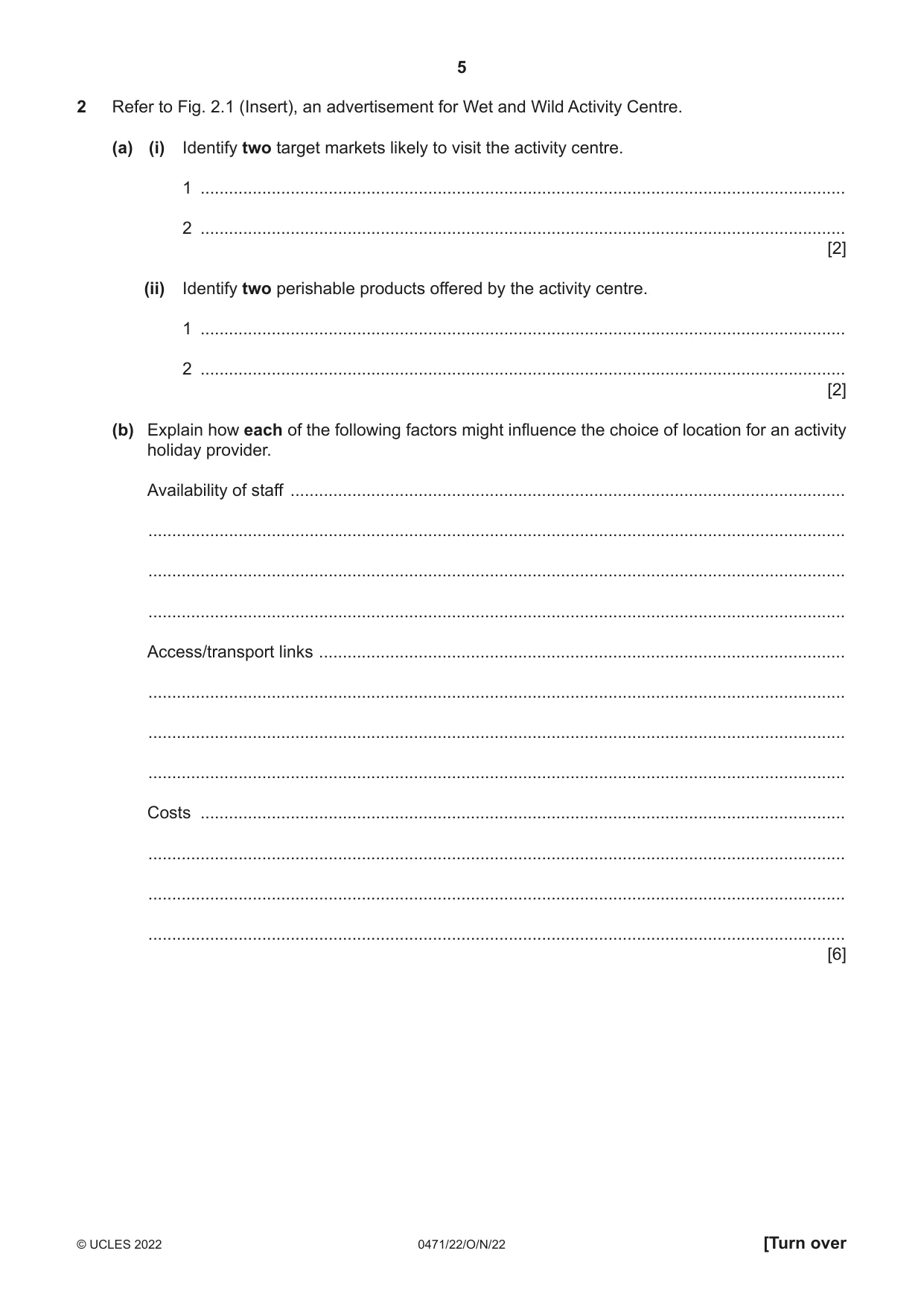
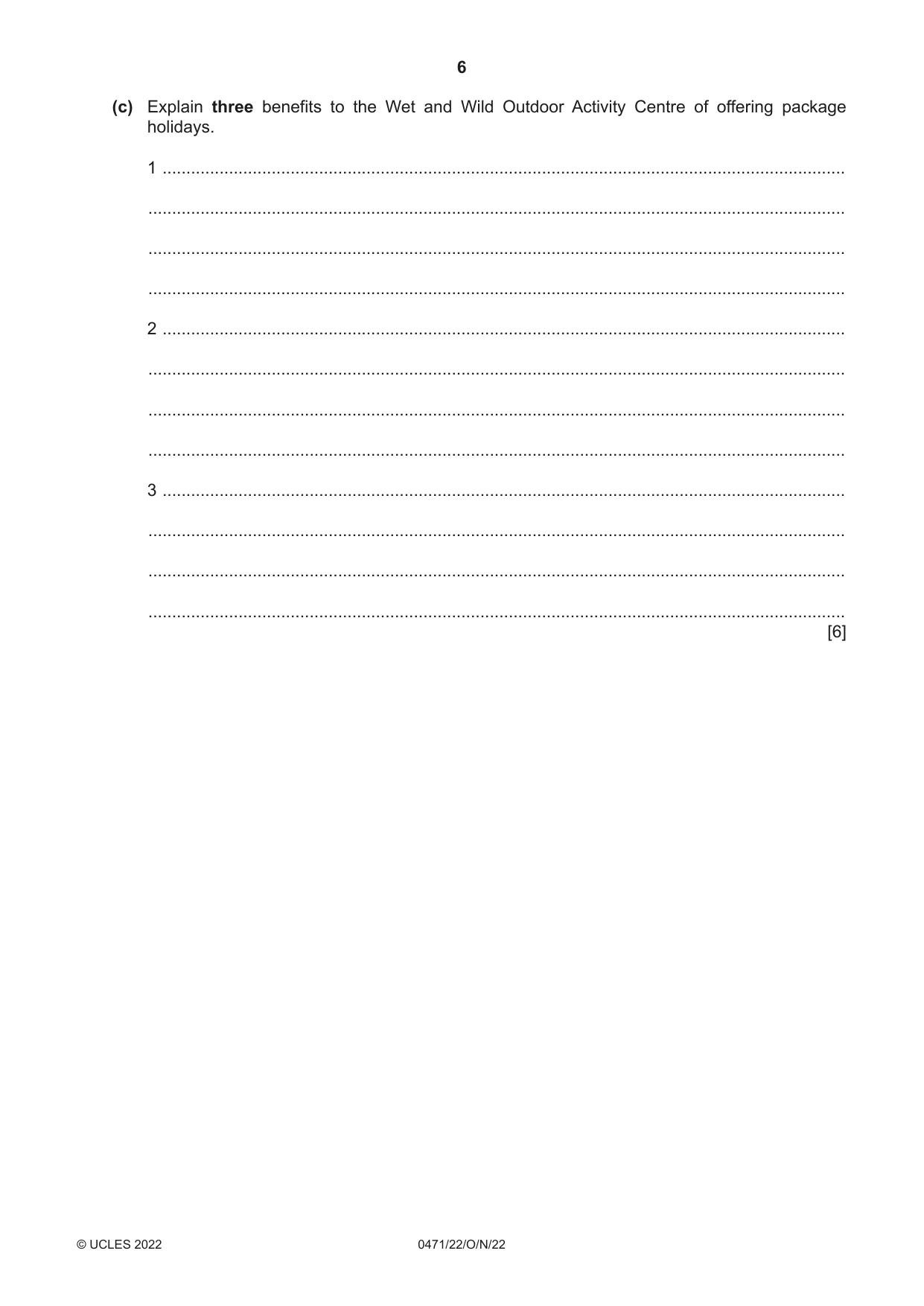
5 0471/22/O/N/22 © UCLES 2022 [Turn over 2 Refer to Fig. 2.1 (Insert), an advertisement for Wet and Wild Activity Centre. (a) (i) Identify two target markets likely to visit the activity centre. 1 … 2 … [2] (ii) Identify two perishable products offered by the activity centre. 1 … 2 … [2] (b) Explain how each of the following factors might influence the choice of location for an activity holiday provider. Availability of staff … … … … Access/transport links … … … … Costs … … … … [6]
Question paper, page 6
6 0471/22/O/N/22 © UCLES 2022 (c) Explain three benefits to the Wet and Wild Outdoor Activity Centre of offering package holidays. 1 … … … … 2 … … … … 3 … … … … [6]
Question paper, page 7
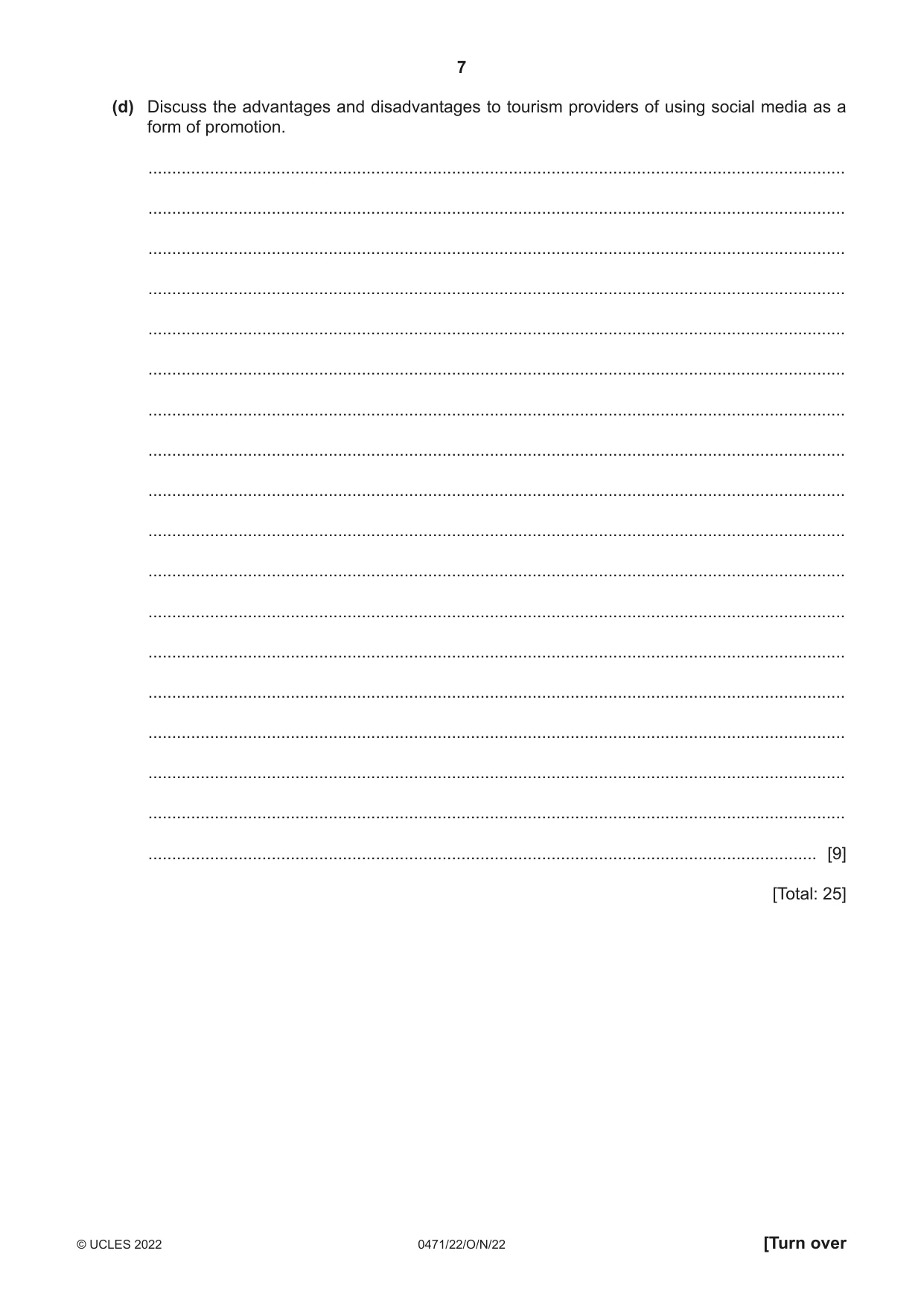
7 0471/22/O/N/22 © UCLES 2022 [Turn over (d) Discuss the advantages and disadvantages to tourism providers of using social media as a form of promotion. … … … … … … … … … … … … … … … … … … [9] [Total: 25]
Question paper, page 8
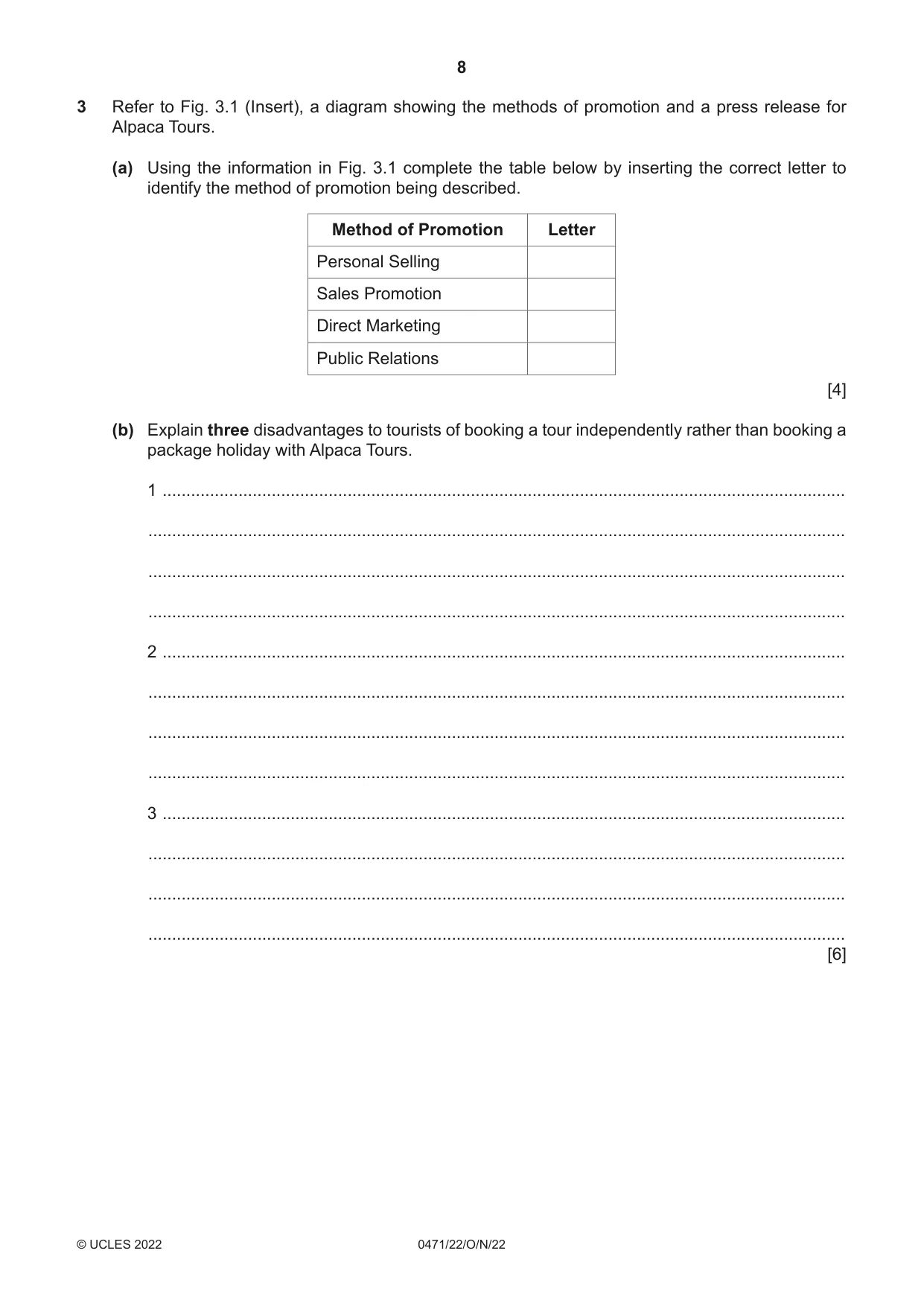
8 0471/22/O/N/22 © UCLES 2022 3 Refer to Fig. 3.1 (Insert), a diagram showing the methods of promotion and a press release for Alpaca Tours. (a) Using the information in Fig. 3.1 complete the table below by inserting the correct letter to identify the method of promotion being described. Method of Promotion Letter Personal Selling Sales Promotion Direct Marketing Public Relations [4] (b) Explain three disadvantages to tourists of booking a tour independently rather than booking a package holiday with Alpaca Tours. 1 … … … … 2 … … … … 3 … … … … [6]
Question paper, page 9
9 0471/22/O/N/22 © UCLES 2022 [Turn over (c) Explain two disadvantages of using online travel services to book a holiday. 1 … … … … … … 2 … … … … … … [6]
Question paper, page 10
10 0471/22/O/N/22 © UCLES 2022 (d) Discuss the benefits to tourism providers of using personal selling as a method of promotion. … … … … … … … … … … … … … … … … … … [9] [Total: 25]
Question paper, page 11
11 0471/22/O/N/22 © UCLES 2022 [Turn over 4 Refer to Fig. 4.1 (Insert), a marketing email from SunshineClub Holidays. (a) (i) Define the term ‘customer loyalty’. … … [1] (ii) Give three rewards loyal customers may receive. 1 … 2 … 3 … [3] (b) Describe each of the following promotional pricing policies: competitive pricing … … … … prestige pricing … … … … price bundling … … … … [6]
Question paper, page 12
12 0471/22/O/N/22 © UCLES 2022 (c) Explain three ways SunshineClub Holidays can achieve customer loyalty. 1 … … … … 2 … … … … 3 … … … … [6]
Question paper, page 13
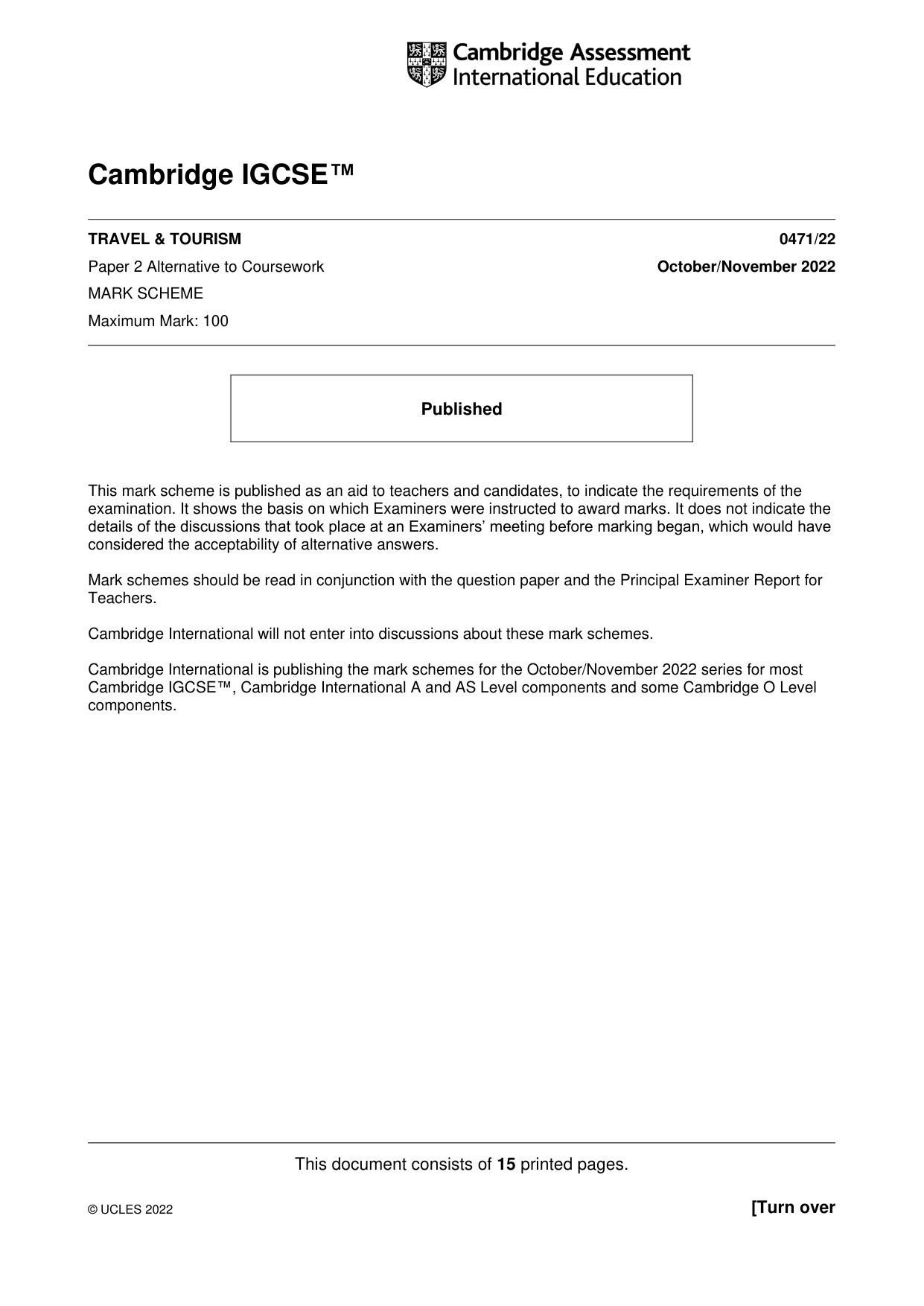
13 0471/22/O/N/22 © UCLES 2022 (d) Using the AIDA principle evaluate the effectiveness of the promotional email from SunshineClub Holidays. … … … … … … … … … … … … … … … … … … [9] [Total: 25]
Question paper, page 14
14 0471/22/O/N/22 © UCLES 2022 BLANK PAGE
Question paper, page 15
15 0471/22/O/N/22 © UCLES 2022 BLANK PAGE
Question paper, page 16
16 0471/22/O/N/22 © UCLES 2022 The boundaries and names shown, the designations used and the presentation of material on any maps contained in this question paper/insert do not imply official endorsement or acceptance by Cambridge Assessment International Education concerning the legal status of any country, territory, or area or any of its authorities, or of the delimitation of its frontiers or boundaries. Permission to reproduce items where third-party owned material protected by copyright is included has been sought and cleared where possible. Every reasonable effort has been made by the publisher (UCLES) to trace copyright holders, but if any items requiring clearance have unwittingly been included, the publisher will be pleased to make amends at the earliest possible opportunity. To avoid the issue of disclosure of answer-related information to candidates, all copyright acknowledgements are reproduced online in the Cambridge Assessment International Education Copyright Acknowledgements Booklet. This is produced for each series of examinations and is freely available to download at www.cambridgeinternational.org after the live examination series. Cambridge Assessment International Education is part of Cambridge Assessment. Cambridge Assessment is the brand name of the University of Cambridge Local Examinations Syndicate (UCLES), which is a department of the University of Cambridge. BLANK PAGE
Mark scheme, page 1
This document consists of 15 printed pages. © UCLES 2022 [Turn over Cambridge IGCSE™ TRAVEL & TOURISM 0471/22 Paper 2 Alternative to Coursework October/November 2022 MARK SCHEME Maximum Mark: 100 Published This mark scheme is published as an aid to teachers and candidates, to indicate the requirements of the examination. It shows the basis on which Examiners were instructed to award marks. It does not indicate the details of the discussions that took place at an Examiners’ meeting before marking began, which would have considered the acceptability of alternative answers. Mark schemes should be read in conjunction with the question paper and the Principal Examiner Report for Teachers. Cambridge International will not enter into discussions about these mark schemes. Cambridge International is publishing the mark schemes for the October/November 2022 series for most Cambridge IGCSE™, Cambridge International A and AS Level components and some Cambridge O Level components.
Mark scheme, page 2
0471/22 Cambridge IGCSE – Mark Scheme PUBLISHED October/November 2022 © UCLES 2022 Page 2 of 15 Generic Marking Principles These general marking principles must be applied by all examiners when marking candidate answers. They should be applied alongside the specific content of the mark scheme or generic level descriptors for a question. Each question paper and mark scheme will also comply with these marking principles. GENERIC MARKING PRINCIPLE 1: Marks must be awarded in line with: • the specific content of the mark scheme or the generic level descriptors for the question • the specific skills defined in the mark scheme or in the generic level descriptors for the question • the standard of response required by a candidate as exemplified by the standardisation scripts. GENERIC MARKING PRINCIPLE 2: Marks awarded are always whole marks (not half marks, or other fractions). GENERIC MARKING PRINCIPLE 3: Marks must be awarded positively: • marks are awarded for correct/valid answers, as defined in the mark scheme. However, credit is given for valid answers which go beyond the scope of the syllabus and mark scheme, referring to your Team Leader as appropriate • marks are awarded when candidates clearly demonstrate what they know and can do • marks are not deducted for errors • marks are not deducted for omissions • answers should only be judged on the quality of spelling, punctuation and grammar when these features are specifically assessed by the question as indicated by the mark scheme. The meaning, however, should be unambiguous. GENERIC MARKING PRINCIPLE 4: Rules must be applied consistently, e.g. in situations where candidates have not followed instructions or in the application of generic level descriptors. GENERIC MARKING PRINCIPLE 5: Marks should be awarded using the full range of marks defined in the mark scheme for the question (however; the use of the full mark range may be limited according to the quality of the candidate responses seen). GENERIC MARKING PRINCIPLE 6: Marks awarded are based solely on the requirements as defined in the mark scheme. Marks should not be awarded with grade thresholds or grade descriptors in mind.
Mark scheme, page 3
0471/22 Cambridge IGCSE – Mark Scheme PUBLISHED October/November 2022 © UCLES 2022 Page 3 of 15 Social Science-Specific Marking Principles (for point-based marking) 1 Components using point-based marking: • Point marking is often used to reward knowledge, understanding and application of skills. We give credit where the candidate’s answer shows relevant knowledge, understanding and application of skills in answering the question. We do not give credit where the answer shows confusion. From this it follows that we: a DO credit answers which are worded differently from the mark scheme if they clearly convey the same meaning (unless the mark scheme requires a specific term) b DO credit alternative answers/examples which are not written in the mark scheme if they are correct c DO credit answers where candidates give more than one correct answer in one prompt/numbered/scaffolded space where extended writing is required rather than list-type answers. For example, questions that require n reasons (e.g. State two reasons …). d DO NOT credit answers simply for using a ‘key term’ unless that is all that is required. (Check for evidence it is understood and not used wrongly.) e DO NOT credit answers which are obviously self-contradicting or trying to cover all possibilities f DO NOT give further credit for what is effectively repetition of a correct point already credited unless the language itself is being tested. This applies equally to ‘mirror statements’ (i.e. polluted/not polluted). g DO NOT require spellings to be correct, unless this is part of the test. However spellings of syllabus terms must allow for clear and unambiguous separation from other syllabus terms with which they may be confused (e.g. Corrasion/Corrosion) 2 Presentation of mark scheme: • Slashes (/) or the word ‘or’ separate alternative ways of making the same point. • Semi colons (;) bullet points (•) or figures in brackets (1) separate different points. • Content in the answer column in brackets is for examiner information/context to clarify the marking but is not required to earn the mark (except Accounting syllabuses where they indicate negative numbers). 3 Calculation questions: • The mark scheme will show the steps in the most likely correct method(s), the mark for each step, the correct answer(s) and the mark for each answer • If working/explanation is considered essential for full credit, this will be indicated in the question paper and in the mark scheme. In all other instances, the correct answer to a calculation should be given full credit, even if no supporting working is shown. • Where the candidate uses a valid method which is not covered by the mark scheme, award equivalent marks for reaching equivalent stages. • Where an answer makes use of a candidate’s own incorrect figure from previous working, the ‘own figure rule’ applies: full marks will be given if a correct and complete method is used. Further guidance will be included in the mark scheme where necessary and any exceptions to this general principle will be noted.
Mark scheme, page 4
0471/22 Cambridge IGCSE – Mark Scheme PUBLISHED October/November 2022 © UCLES 2022 Page 4 of 15 4 Annotation: • For point marking, ticks can be used to indicate correct answers and crosses can be used to indicate wrong answers. There is no direct relationship between ticks and marks. Ticks have no defined meaning for levels of response marking. • For levels of response marking, the level awarded should be annotated on the script. • Other annotations will be used by examiners as agreed during standardisation, and the meaning will be understood by all examiners who marked that paper.
Mark scheme, page 5
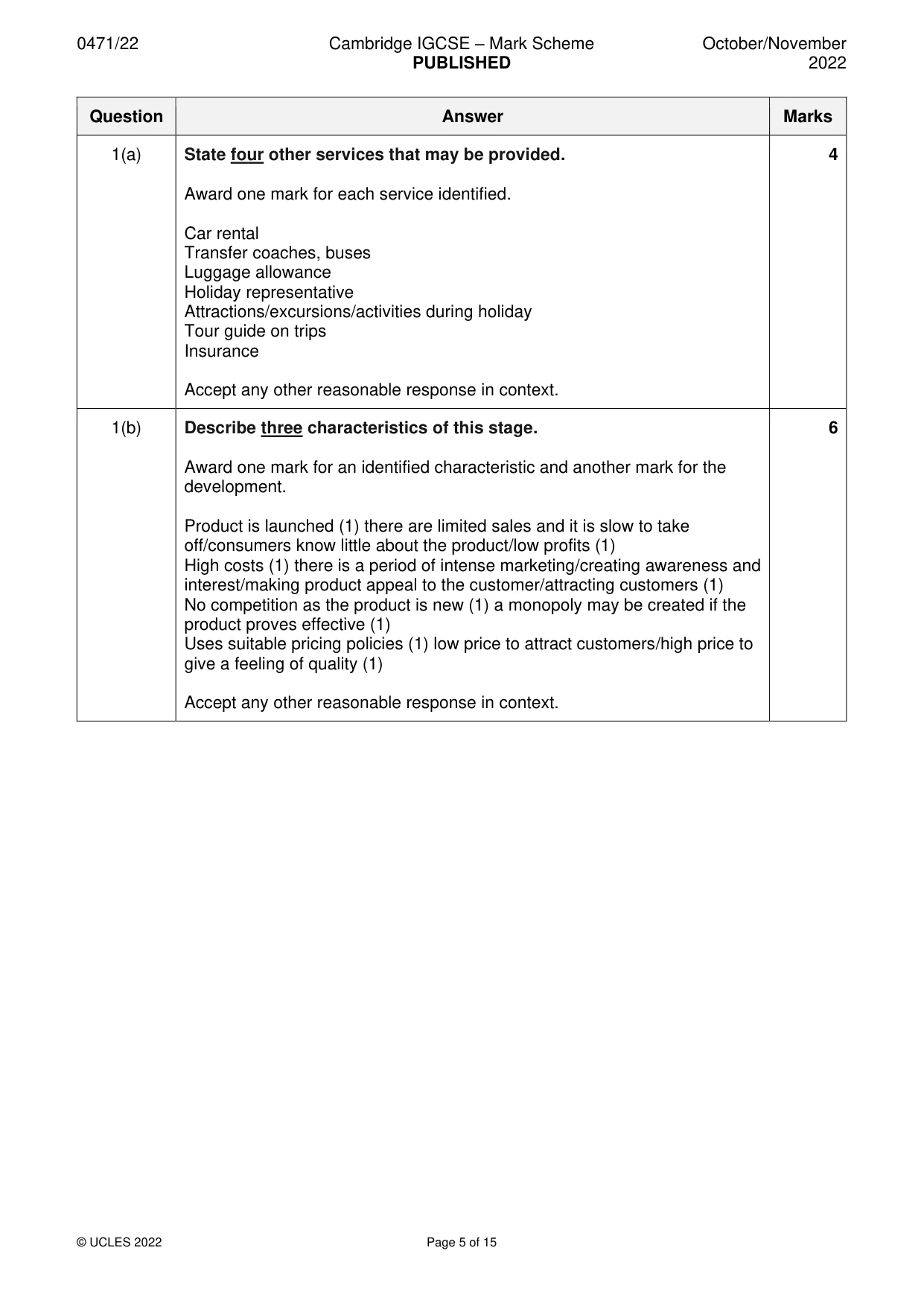
0471/22 Cambridge IGCSE – Mark Scheme PUBLISHED October/November 2022 © UCLES 2022 Page 5 of 15 Question Answer Marks 1(a) State four other services that may be provided. Award one mark for each service identified. Car rental Transfer coaches, buses Luggage allowance Holiday representative Attractions/excursions/activities during holiday Tour guide on trips Insurance Accept any other reasonable response in context. 4 1(b) Describe three characteristics of this stage. Award one mark for an identified characteristic and another mark for the development. Product is launched (1) there are limited sales and it is slow to take off/consumers know little about the product/low profits (1) High costs (1) there is a period of intense marketing/creating awareness and interest/making product appeal to the customer/attracting customers (1) No competition as the product is new (1) a monopoly may be created if the product proves effective (1) Uses suitable pricing policies (1) low price to attract customers/high price to give a feeling of quality (1) Accept any other reasonable response in context. 6
Mark scheme, page 6
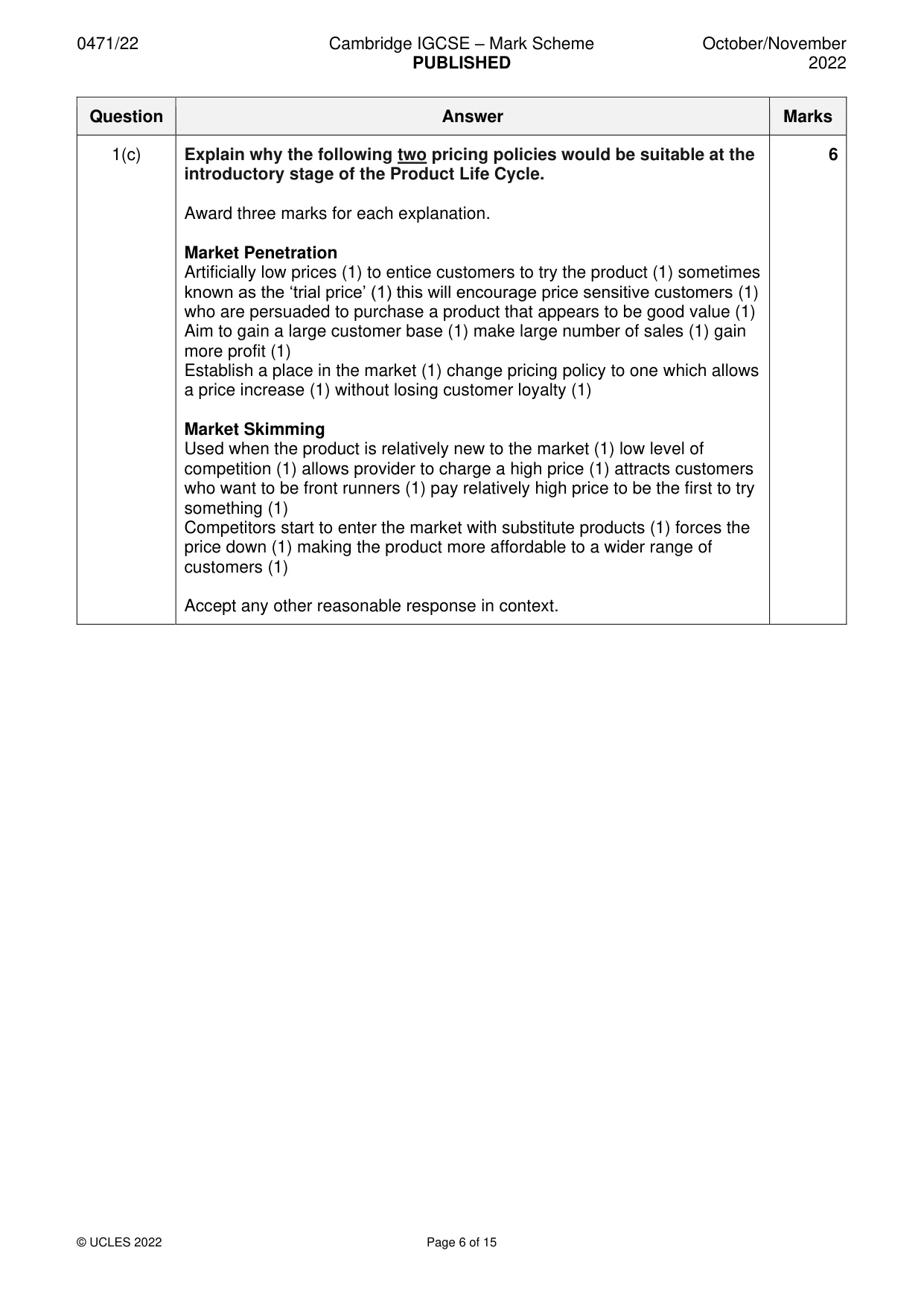
0471/22 Cambridge IGCSE – Mark Scheme PUBLISHED October/November 2022 © UCLES 2022 Page 6 of 15 Question Answer Marks 1(c) Explain why the following two pricing policies would be suitable at the introductory stage of the Product Life Cycle. Award three marks for each explanation. Market Penetration Artificially low prices (1) to entice customers to try the product (1) sometimes known as the ‘trial price’ (1) this will encourage price sensitive customers (1) who are persuaded to purchase a product that appears to be good value (1) Aim to gain a large customer base (1) make large number of sales (1) gain more profit (1) Establish a place in the market (1) change pricing policy to one which allows a price increase (1) without losing customer loyalty (1) Market Skimming Used when the product is relatively new to the market (1) low level of competition (1) allows provider to charge a high price (1) attracts customers who want to be front runners (1) pay relatively high price to be the first to try something (1) Competitors start to enter the market with substitute products (1) forces the price down (1) making the product more affordable to a wider range of customers (1) Accept any other reasonable response in context. 6
Mark scheme, page 7
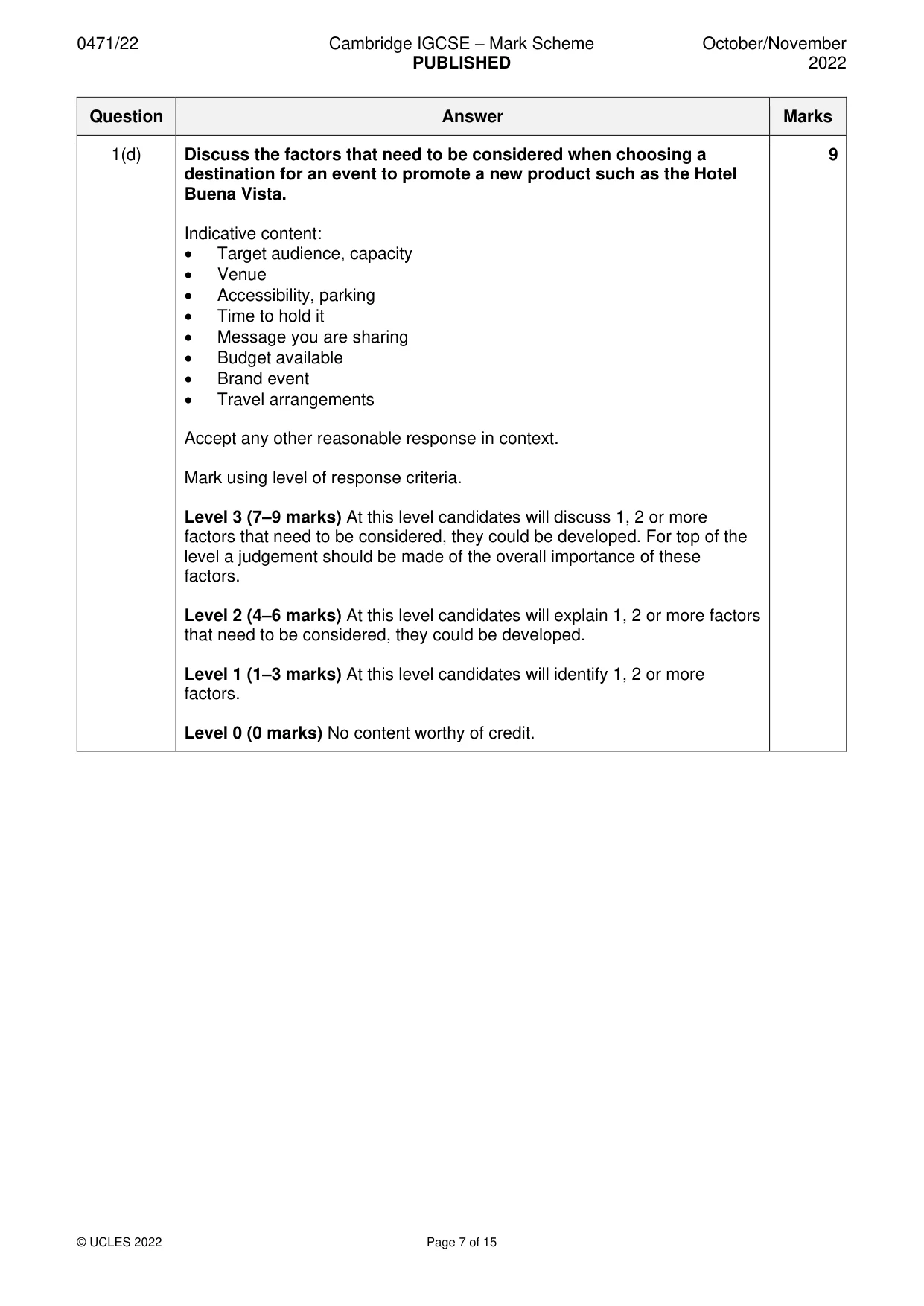
0471/22 Cambridge IGCSE – Mark Scheme PUBLISHED October/November 2022 © UCLES 2022 Page 7 of 15 Question Answer Marks 1(d) Discuss the factors that need to be considered when choosing a destination for an event to promote a new product such as the Hotel Buena Vista. Indicative content: • Target audience, capacity • Venue • Accessibility, parking • Time to hold it • Message you are sharing • Budget available • Brand event • Travel arrangements Accept any other reasonable response in context. Mark using level of response criteria. Level 3 (7–9 marks) At this level candidates will discuss 1, 2 or more factors that need to be considered, they could be developed. For top of the level a judgement should be made of the overall importance of these factors. Level 2 (4–6 marks) At this level candidates will explain 1, 2 or more factors that need to be considered, they could be developed. Level 1 (1–3 marks) At this level candidates will identify 1, 2 or more factors. Level 0 (0 marks) No content worthy of credit. 9
Mark scheme, page 8
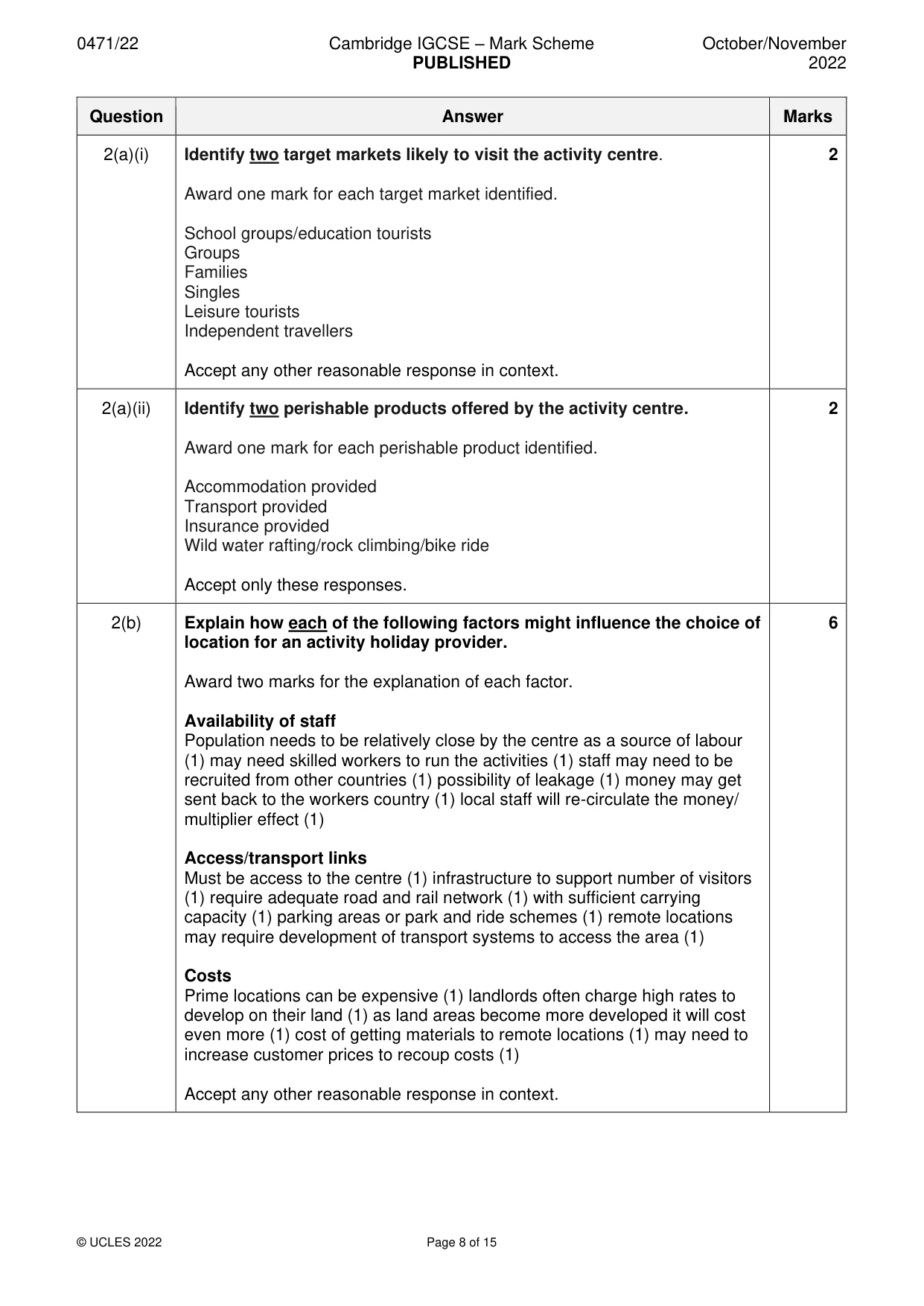
0471/22 Cambridge IGCSE – Mark Scheme PUBLISHED October/November 2022 © UCLES 2022 Page 8 of 15 Question Answer Marks 2(a)(i) Identify two target markets likely to visit the activity centre. Award one mark for each target market identified. School groups/education tourists Groups Families Singles Leisure tourists Independent travellers Accept any other reasonable response in context. 2 2(a)(ii) Identify two perishable products offered by the activity centre. Award one mark for each perishable product identified. Accommodation provided Transport provided Insurance provided Wild water rafting/rock climbing/bike ride Accept only these responses. 2 2(b) Explain how each of the following factors might influence the choice of location for an activity holiday provider. Award two marks for the explanation of each factor. Availability of staff Population needs to be relatively close by the centre as a source of labour (1) may need skilled workers to run the activities (1) staff may need to be recruited from other countries (1) possibility of leakage (1) money may get sent back to the workers country (1) local staff will re-circulate the money/ multiplier effect (1) Access/transport links Must be access to the centre (1) infrastructure to support number of visitors (1) require adequate road and rail network (1) with sufficient carrying capacity (1) parking areas or park and ride schemes (1) remote locations may require development of transport systems to access the area (1) Costs Prime locations can be expensive (1) landlords often charge high rates to develop on their land (1) as land areas become more developed it will cost even more (1) cost of getting materials to remote locations (1) may need to increase customer prices to recoup costs (1) Accept any other reasonable response in context. 6
Mark scheme, page 9
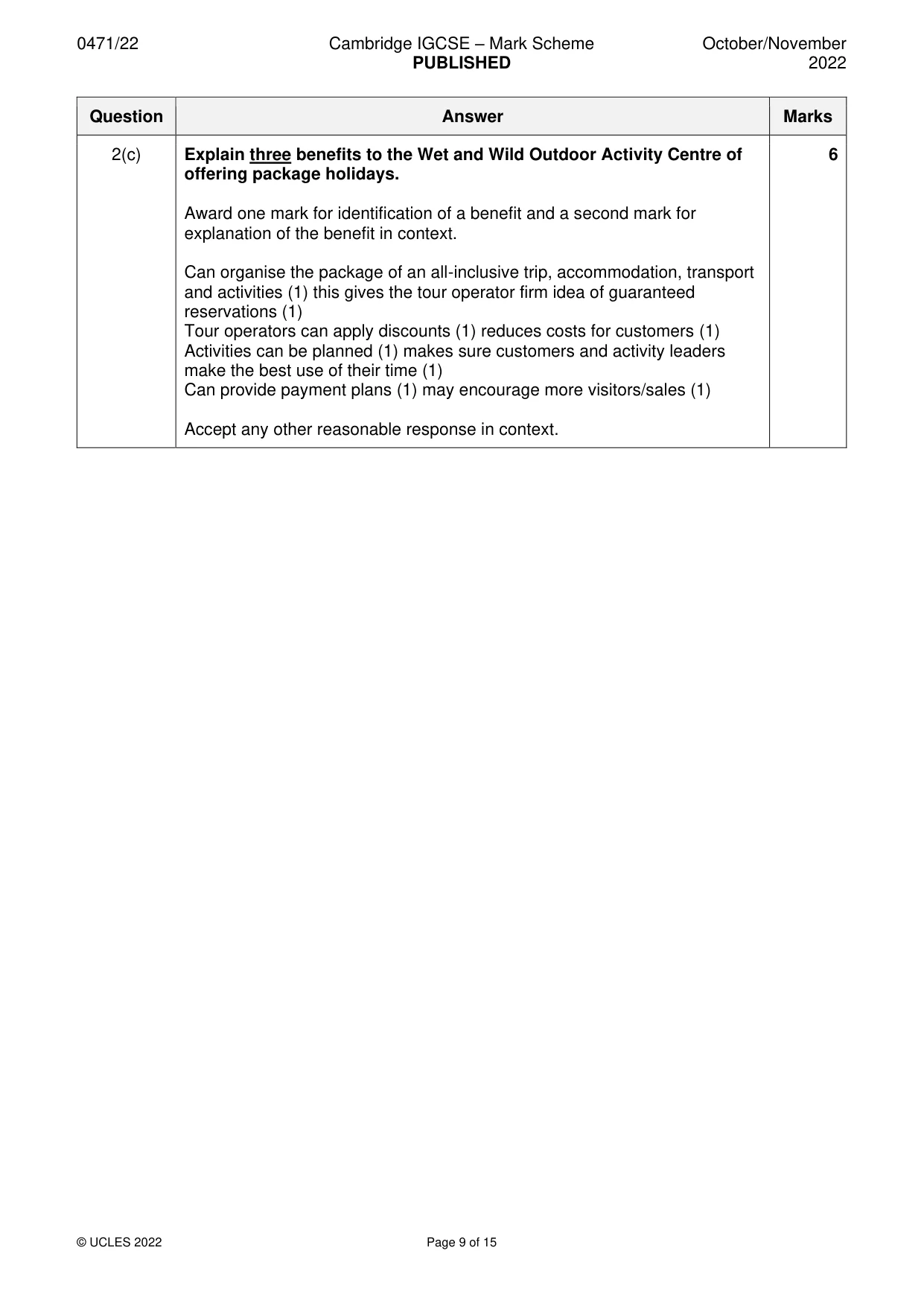
0471/22 Cambridge IGCSE – Mark Scheme PUBLISHED October/November 2022 © UCLES 2022 Page 9 of 15 Question Answer Marks 2(c) Explain three benefits to the Wet and Wild Outdoor Activity Centre of offering package holidays. Award one mark for identification of a benefit and a second mark for explanation of the benefit in context. Can organise the package of an all-inclusive trip, accommodation, transport and activities (1) this gives the tour operator firm idea of guaranteed reservations (1) Tour operators can apply discounts (1) reduces costs for customers (1) Activities can be planned (1) makes sure customers and activity leaders make the best use of their time (1) Can provide payment plans (1) may encourage more visitors/sales (1) Accept any other reasonable response in context. 6
Mark scheme, page 10
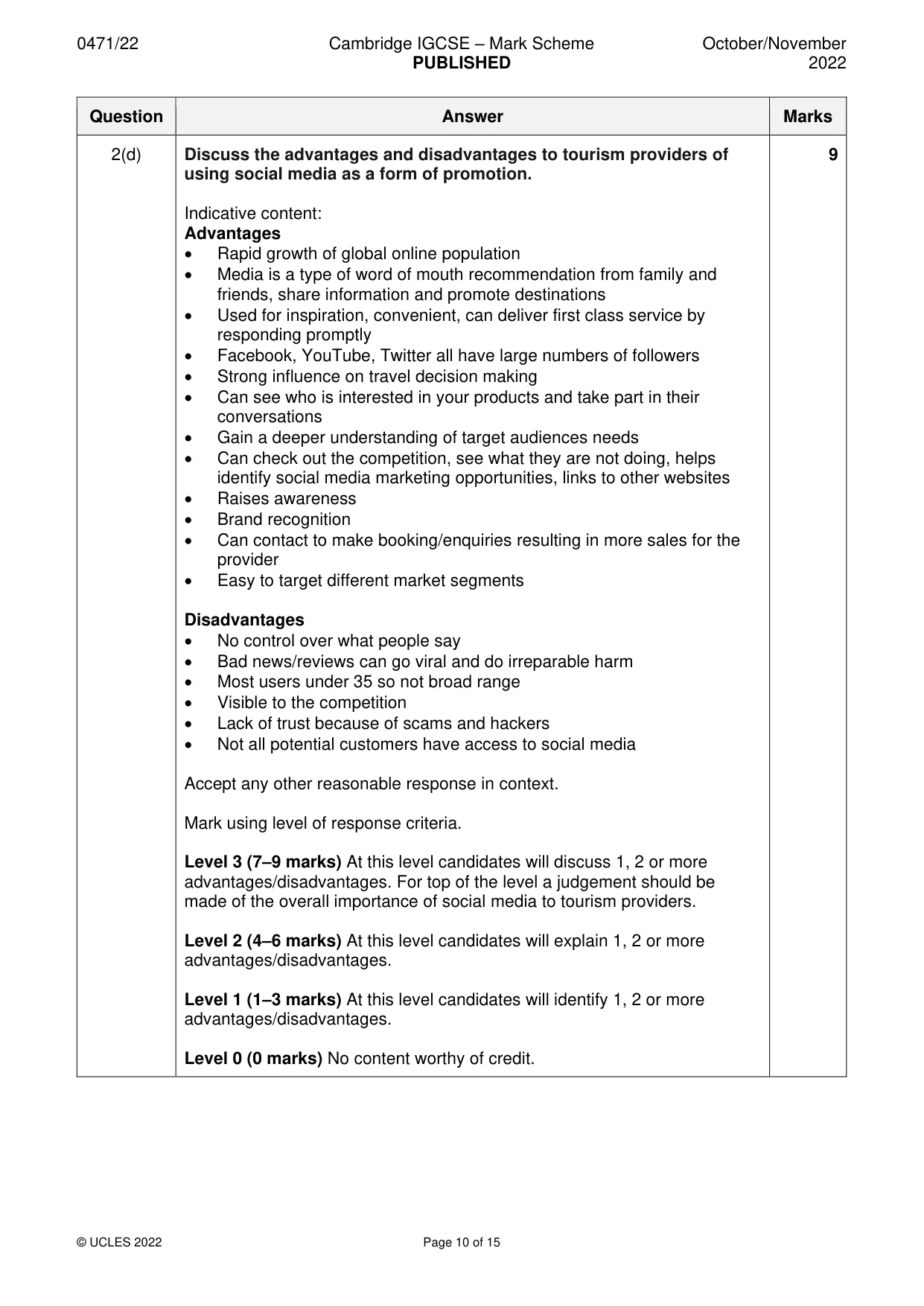
0471/22 Cambridge IGCSE – Mark Scheme PUBLISHED October/November 2022 © UCLES 2022 Page 10 of 15 Question Answer Marks 2(d) Discuss the advantages and disadvantages to tourism providers of using social media as a form of promotion. Indicative content: Advantages • Rapid growth of global online population • Media is a type of word of mouth recommendation from family and friends, share information and promote destinations • Used for inspiration, convenient, can deliver first class service by responding promptly • Facebook, YouTube, Twitter all have large numbers of followers • Strong influence on travel decision making • Can see who is interested in your products and take part in their conversations • Gain a deeper understanding of target audiences needs • Can check out the competition, see what they are not doing, helps identify social media marketing opportunities, links to other websites • Raises awareness • Brand recognition • Can contact to make booking/enquiries resulting in more sales for the provider • Easy to target different market segments Disadvantages • No control over what people say • Bad news/reviews can go viral and do irreparable harm • Most users under 35 so not broad range • Visible to the competition • Lack of trust because of scams and hackers • Not all potential customers have access to social media Accept any other reasonable response in context. Mark using level of response criteria. Level 3 (7–9 marks) At this level candidates will discuss 1, 2 or more advantages/disadvantages. For top of the level a judgement should be made of the overall importance of social media to tourism providers. Level 2 (4–6 marks) At this level candidates will explain 1, 2 or more advantages/disadvantages. Level 1 (1–3 marks) At this level candidates will identify 1, 2 or more advantages/disadvantages. Level 0 (0 marks) No content worthy of credit. 9
Mark scheme, page 11
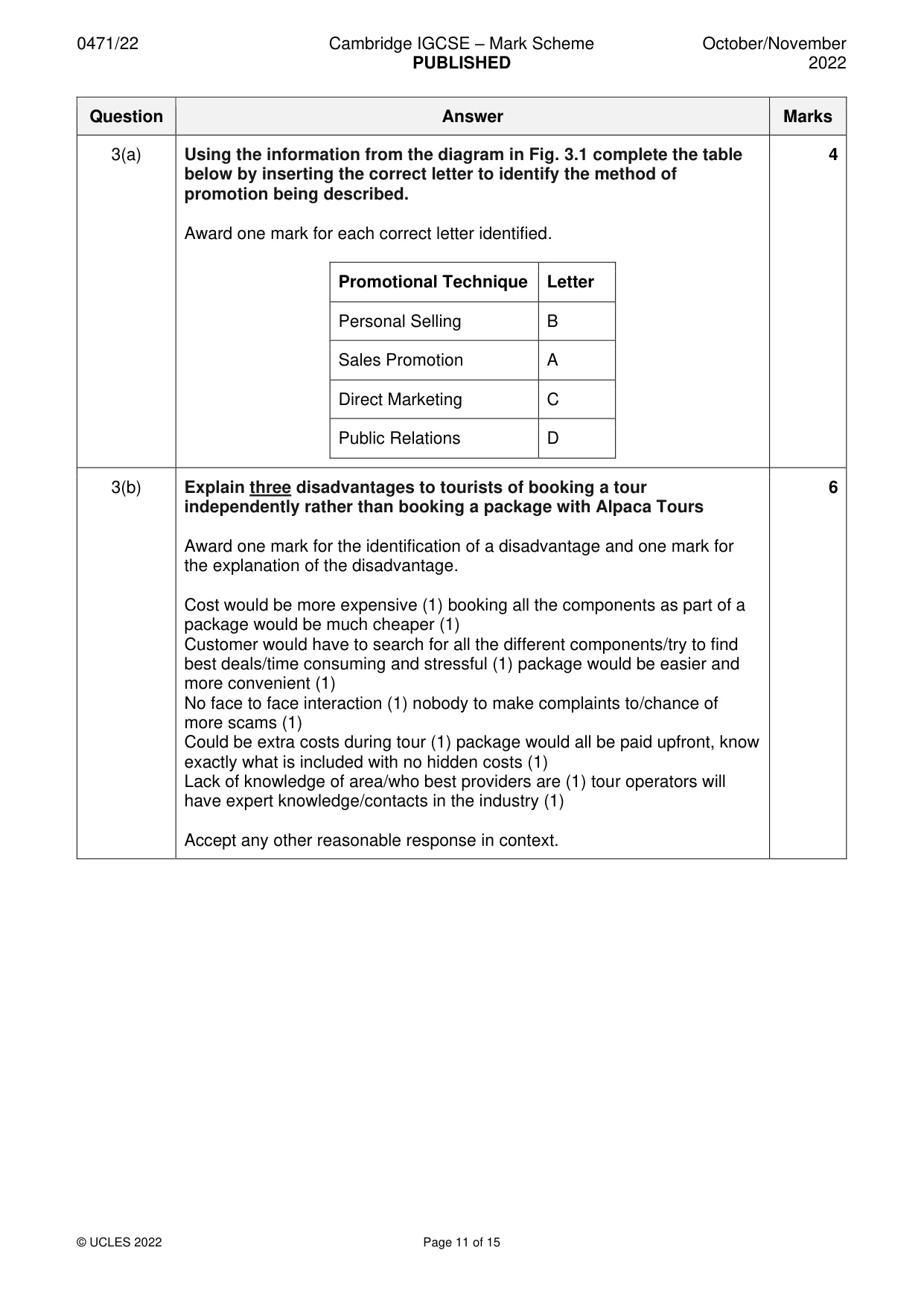
0471/22 Cambridge IGCSE – Mark Scheme PUBLISHED October/November 2022 © UCLES 2022 Page 11 of 15 Question Answer Marks 3(a) Using the information from the diagram in Fig. 3.1 complete the table below by inserting the correct letter to identify the method of promotion being described. Award one mark for each correct letter identified. Promotional Technique Letter Personal Selling B Sales Promotion A Direct Marketing C Public Relations D 4 3(b) Explain three disadvantages to tourists of booking a tour independently rather than booking a package with Alpaca Tours Award one mark for the identification of a disadvantage and one mark for the explanation of the disadvantage. Cost would be more expensive (1) booking all the components as part of a package would be much cheaper (1) Customer would have to search for all the different components/try to find best deals/time consuming and stressful (1) package would be easier and more convenient (1) No face to face interaction (1) nobody to make complaints to/chance of more scams (1) Could be extra costs during tour (1) package would all be paid upfront, know exactly what is included with no hidden costs (1) Lack of knowledge of area/who best providers are (1) tour operators will have expert knowledge/contacts in the industry (1) Accept any other reasonable response in context. 6
Mark scheme, page 12
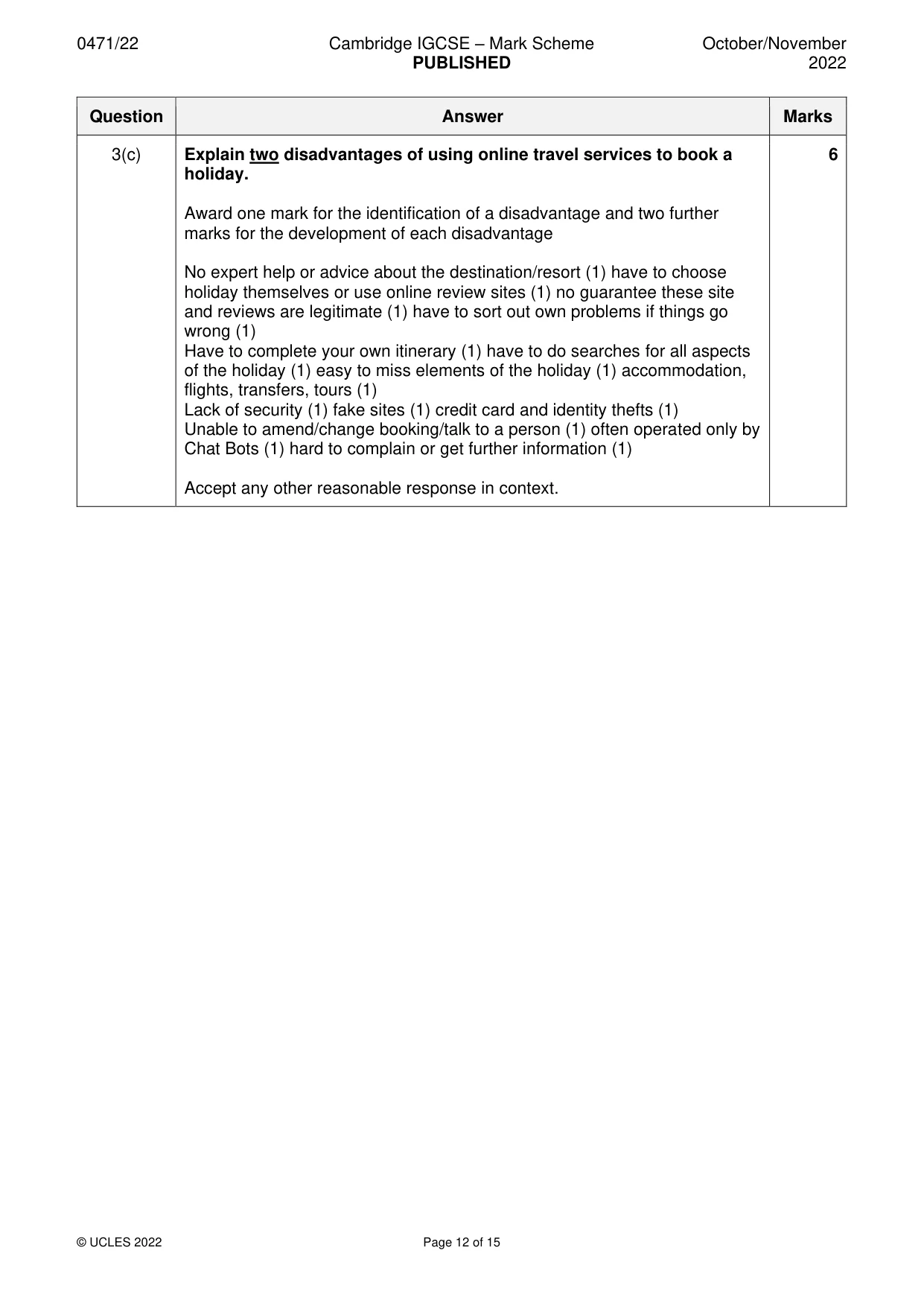
0471/22 Cambridge IGCSE – Mark Scheme PUBLISHED October/November 2022 © UCLES 2022 Page 12 of 15 Question Answer Marks 3(c) Explain two disadvantages of using online travel services to book a holiday. Award one mark for the identification of a disadvantage and two further marks for the development of each disadvantage No expert help or advice about the destination/resort (1) have to choose holiday themselves or use online review sites (1) no guarantee these site and reviews are legitimate (1) have to sort out own problems if things go wrong (1) Have to complete your own itinerary (1) have to do searches for all aspects of the holiday (1) easy to miss elements of the holiday (1) accommodation, flights, transfers, tours (1) Lack of security (1) fake sites (1) credit card and identity thefts (1) Unable to amend/change booking/talk to a person (1) often operated only by Chat Bots (1) hard to complain or get further information (1) Accept any other reasonable response in context. 6
Mark scheme, page 13
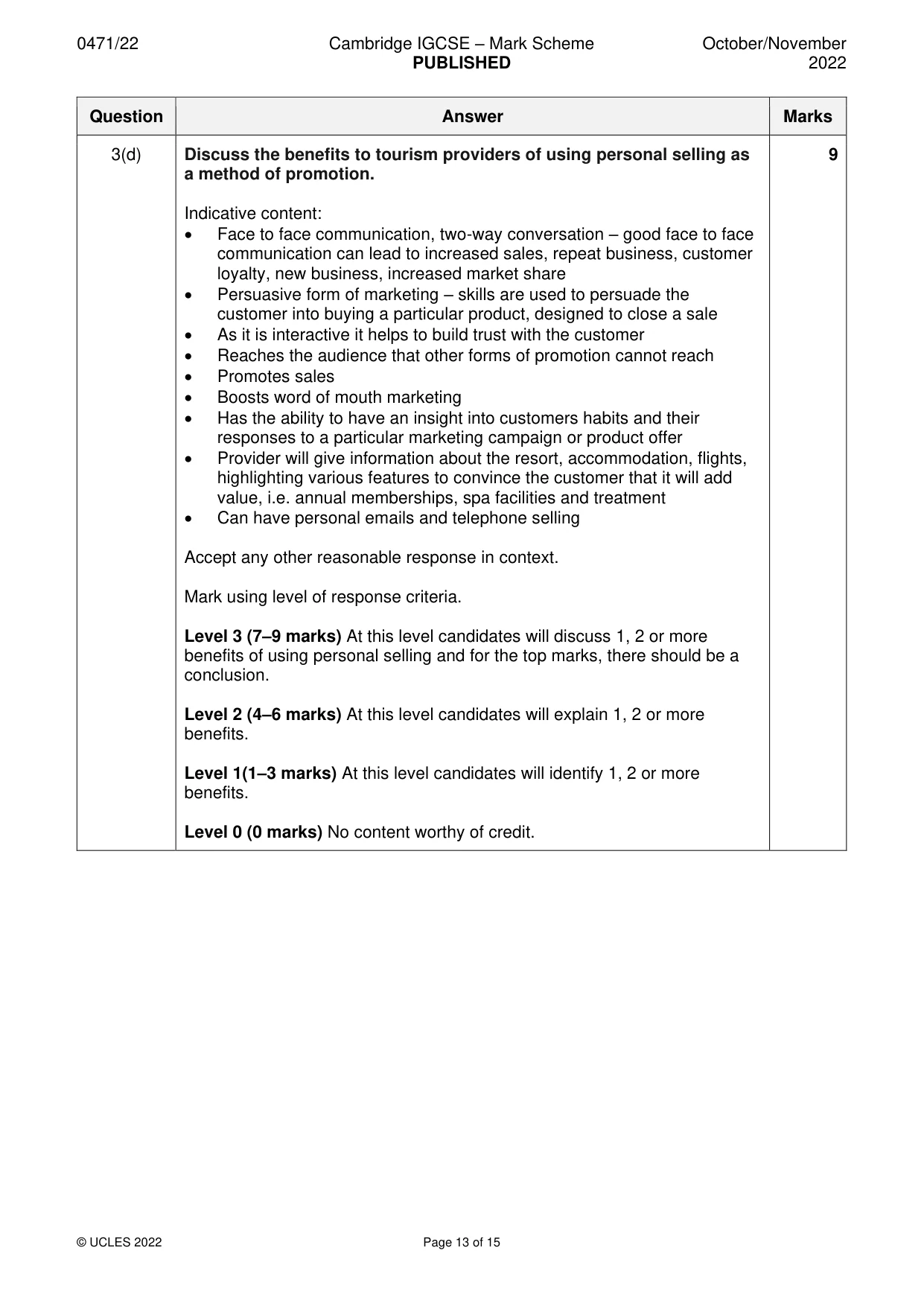
0471/22 Cambridge IGCSE – Mark Scheme PUBLISHED October/November 2022 © UCLES 2022 Page 13 of 15 Question Answer Marks 3(d) Discuss the benefits to tourism providers of using personal selling as a method of promotion. Indicative content: • Face to face communication, two-way conversation – good face to face communication can lead to increased sales, repeat business, customer loyalty, new business, increased market share • Persuasive form of marketing – skills are used to persuade the customer into buying a particular product, designed to close a sale • As it is interactive it helps to build trust with the customer • Reaches the audience that other forms of promotion cannot reach • Promotes sales • Boosts word of mouth marketing • Has the ability to have an insight into customers habits and their responses to a particular marketing campaign or product offer • Provider will give information about the resort, accommodation, flights, highlighting various features to convince the customer that it will add value, i.e. annual memberships, spa facilities and treatment • Can have personal emails and telephone selling Accept any other reasonable response in context. Mark using level of response criteria. Level 3 (7–9 marks) At this level candidates will discuss 1, 2 or more benefits of using personal selling and for the top marks, there should be a conclusion. Level 2 (4–6 marks) At this level candidates will explain 1, 2 or more benefits. Level 1(1–3 marks) At this level candidates will identify 1, 2 or more benefits. Level 0 (0 marks) No content worthy of credit. 9
Mark scheme, page 14
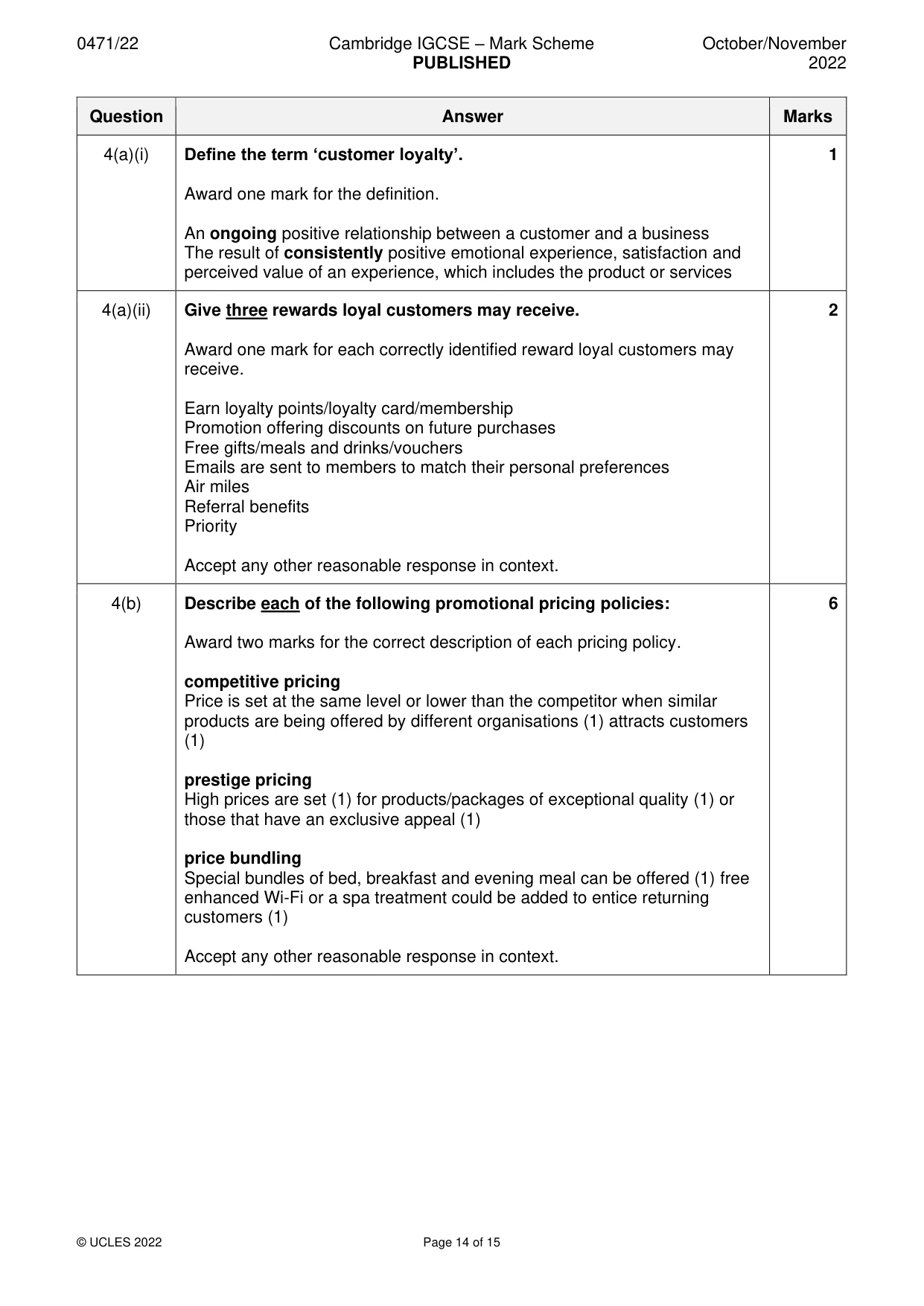
0471/22 Cambridge IGCSE – Mark Scheme PUBLISHED October/November 2022 © UCLES 2022 Page 14 of 15 Question Answer Marks 4(a)(i) Define the term ‘customer loyalty’. Award one mark for the definition. An ongoing positive relationship between a customer and a business The result of consistently positive emotional experience, satisfaction and perceived value of an experience, which includes the product or services 1 4(a)(ii) Give three rewards loyal customers may receive. Award one mark for each correctly identified reward loyal customers may receive. Earn loyalty points/loyalty card/membership Promotion offering discounts on future purchases Free gifts/meals and drinks/vouchers Emails are sent to members to match their personal preferences Air miles Referral benefits Priority Accept any other reasonable response in context. 2 4(b) Describe each of the following promotional pricing policies: Award two marks for the correct description of each pricing policy. competitive pricing Price is set at the same level or lower than the competitor when similar products are being offered by different organisations (1) attracts customers (1) prestige pricing High prices are set (1) for products/packages of exceptional quality (1) or those that have an exclusive appeal (1) price bundling Special bundles of bed, breakfast and evening meal can be offered (1) free enhanced Wi-Fi or a spa treatment could be added to entice returning customers (1) Accept any other reasonable response in context. 6
Mark scheme, page 15
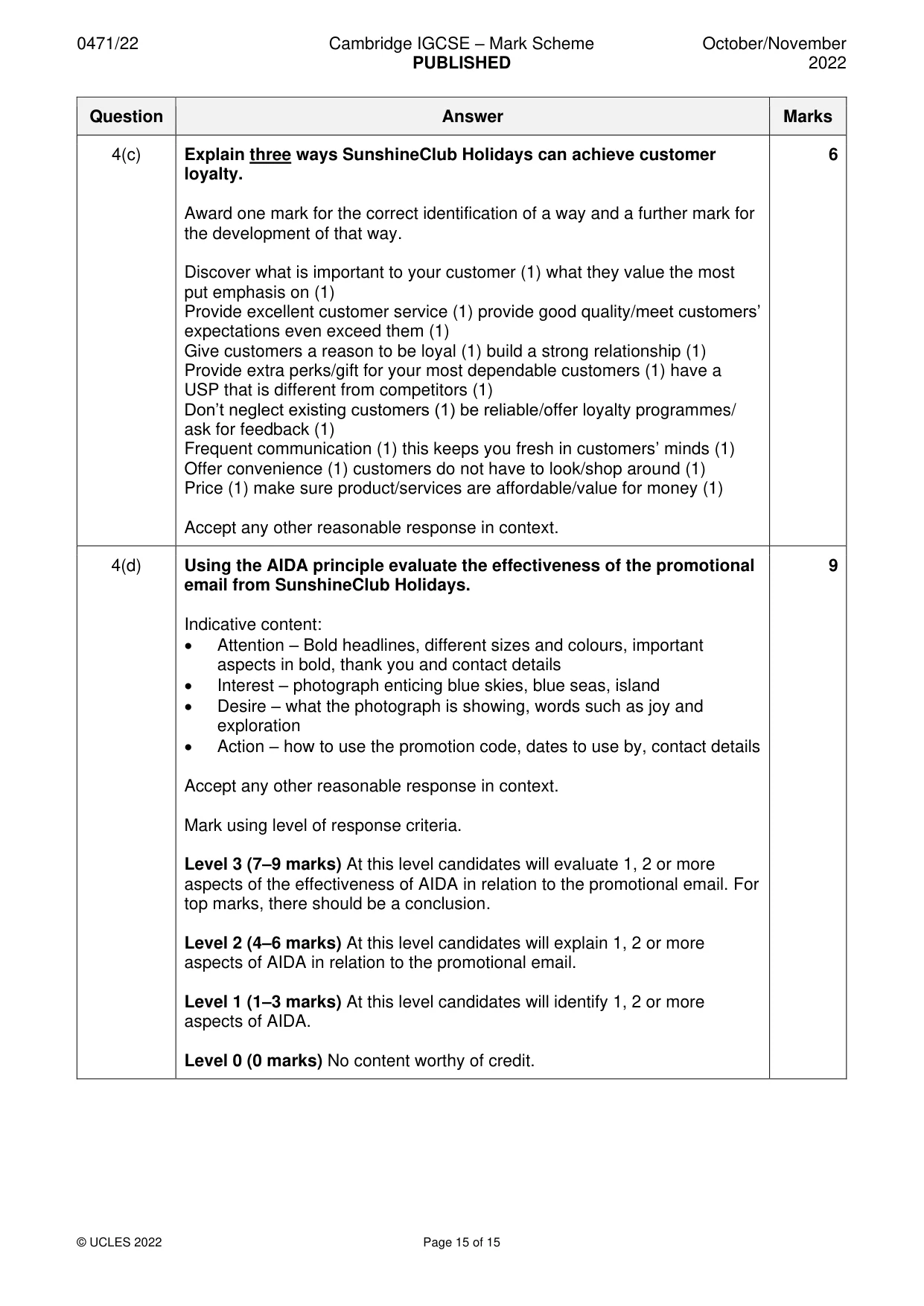
0471/22 Cambridge IGCSE – Mark Scheme PUBLISHED October/November 2022 © UCLES 2022 Page 15 of 15 Question Answer Marks 4(c) Explain three ways SunshineClub Holidays can achieve customer loyalty. Award one mark for the correct identification of a way and a further mark for the development of that way. Discover what is important to your customer (1) what they value the most put emphasis on (1) Provide excellent customer service (1) provide good quality/meet customers’ expectations even exceed them (1) Give customers a reason to be loyal (1) build a strong relationship (1) Provide extra perks/gift for your most dependable customers (1) have a USP that is different from competitors (1) Don’t neglect existing customers (1) be reliable/offer loyalty programmes/ ask for feedback (1) Frequent communication (1) this keeps you fresh in customers’ minds (1) Offer convenience (1) customers do not have to look/shop around (1) Price (1) make sure product/services are affordable/value for money (1) Accept any other reasonable response in context. 6 4(d) Using the AIDA principle evaluate the effectiveness of the promotional email from SunshineClub Holidays. Indicative content: • Attention – Bold headlines, different sizes and colours, important aspects in bold, thank you and contact details • Interest – photograph enticing blue skies, blue seas, island • Desire – what the photograph is showing, words such as joy and exploration • Action – how to use the promotion code, dates to use by, contact details Accept any other reasonable response in context. Mark using level of response criteria. Level 3 (7–9 marks) At this level candidates will evaluate 1, 2 or more aspects of the effectiveness of AIDA in relation to the promotional email. For top marks, there should be a conclusion. Level 2 (4–6 marks) At this level candidates will explain 1, 2 or more aspects of AIDA in relation to the promotional email. Level 1 (1–3 marks) At this level candidates will identify 1, 2 or more aspects of AIDA. Level 0 (0 marks) No content worthy of credit. 9
What you needed in this session
Cambridge’s own grade thresholds for 2022 Oct/Nov, Paper 2 · Variant 2. A higher threshold means an easier paper — the bar moves with how the cohort did.