Cambridge IGCSE Travel and Tourism 0471 — 2020 May/June Paper 2 · Variant 2
0471/22/M/J/20
The question paper and its mark scheme, free to read here and free to download. This is Cambridge’s own paper, exactly as it was sat.
Question paper16 pages



Mark scheme10 pages
Answers below. Sit the paper first if you are practising.
Paper as text
Question paper, page 1
Cambridge IGCSE™ * 4 6 0 2 1 5 0 4 1 4 * DC (PQ) 179922/1 © UCLES 2020 [Turn over This document has 16 pages. Blank pages are indicated. TRAVEL & TOURISM 0471/22 Paper 2 Alternative to Coursework May/June 2020 2 hours 30 minutes You must answer on the question paper. You will need: Insert (enclosed) INSTRUCTIONS ● Answer all questions. ● Use a black or dark blue pen. ● Write your name, centre number and candidate number in the boxes at the top of the page. ● Write your answer to each question in the space provided. ● Do not use an erasable pen or correction fluid. ● Do not write on any bar codes. INFORMATION ● The total mark for this paper is 100. ● The number of marks for each question or part question is shown in brackets [ ]. ● The insert contains all the figures referred to in the questions.
Question paper, page 2
2 0471/22/M/J/20 © UCLES 2020 Question 1 Refer to Fig. 1.1 (Insert), information about tourism development in Ethiopia, a country in Africa. (a) (i) State two features of Ethiopia that make it a potential tourist destination. 1 … … 2 … … [2] (ii) Give two examples of how tourism rivals of Ethiopia offer better products and services. 1 … … 2 … … [2] (b) Explain three ways the external marketing environment has improved for Ethiopia in recent years. 1 … … … … 2 … … … … 3 … … … … [6]
Question paper, page 3
3 0471/22/M/J/20 © UCLES 2020 [Turn over (c) Explain two ways Ethiopia is working to improve its accessibility to tourists. 1 … … … … … … 2 … … … … … … [6]
Question paper, page 4
4 0471/22/M/J/20 © UCLES 2020 (d) Discuss the likely benefits to an emerging destination of doubling the number of visitors it receives. … … … … … … … … … … … … … … … … … … [9] [Total: 25]
Question paper, page 5
5 0471/22/M/J/20 © UCLES 2020 [Turn over Question 2 Refer to Fig. 2.1 (Insert), information about the CityTICKET, a tourism product available in Chicago, a city in the USA. (a) Describe two characteristics of the CityTICKET as a travel and tourism product. 1 … … … … 2 … … … … [4] (b) Explain three reasons why the CityTICKET product is likely to meet customers’ needs and wants. 1 … … … … 2 … … … … 3 … … … … [6]
Question paper, page 6
6 0471/22/M/J/20 © UCLES 2020 (c) Explain two reasons why tourists might prefer to buy the CityTICKET from retailers in Chicago rather than online. 1 … … … … … … 2 … … … … … … [6]
Question paper, page 7
7 0471/22/M/J/20 © UCLES 2020 [Turn over (d) Recommend a suitable pricing strategy for the CityTICKET. Justify the reasons for your recommendation. … … … … … … … … … … … … … … … … … … [9] [Total: 25]
Question paper, page 8
8 0471/22/M/J/20 © UCLES 2020 Question 3 Refer to Fig. 3.1 (Insert), a tour itinerary for the Ifugao Heritage Tour of the rice terraces in the Philippines. The Philippines is a Southeast Asian country in the Western Pacific. (a) (i) Identify two cultural attractions of the Ifugao Heritage Tour. 1 … 2 … [2] (ii) Define, using an example, what is meant by the term ‘supplement’. … … … … [2] (b) Explain three ways the Ifugao Heritage Tour product has been targeted towards the backpacker market. 1 … … … … 2 … … … … 3 … … … … [6]
Question paper, page 9
9 0471/22/M/J/20 © UCLES 2020 [Turn over (c) Explain two reasons why the new charter flight from Manila is important for tourism providers in the Ifugao region. 1 … … … … … … 2 … … … … … … [6]
Question paper, page 10
10 0471/22/M/J/20 © UCLES 2020 (d) Discuss how guaranteed departure days might help the tour operator to manage the issue of seasonality. … … … … … … … … … … … … … … … … … … [9] [Total: 25]
Question paper, page 11
11 0471/22/M/J/20 © UCLES 2020 [Turn over Question 4 Refer to Fig. 4.1 (Insert), information about point of sales (POS) materials for high street travel agents. (a) Describe two point of sales display techniques that travel agents use to attract customers. 1 … … … … 2 … … … … [4] (b) Explain three benefits to a travel agency of offering its own exchange rates. 1 … … … … 2 … … … … 3 … … … … [6]
Question paper, page 12
12 0471/22/M/J/20 © UCLES 2020 (c) Explain two reasons why high street travel agents must use promotion. 1 … … … … … … 2 … … … … … … [6]
Question paper, page 13
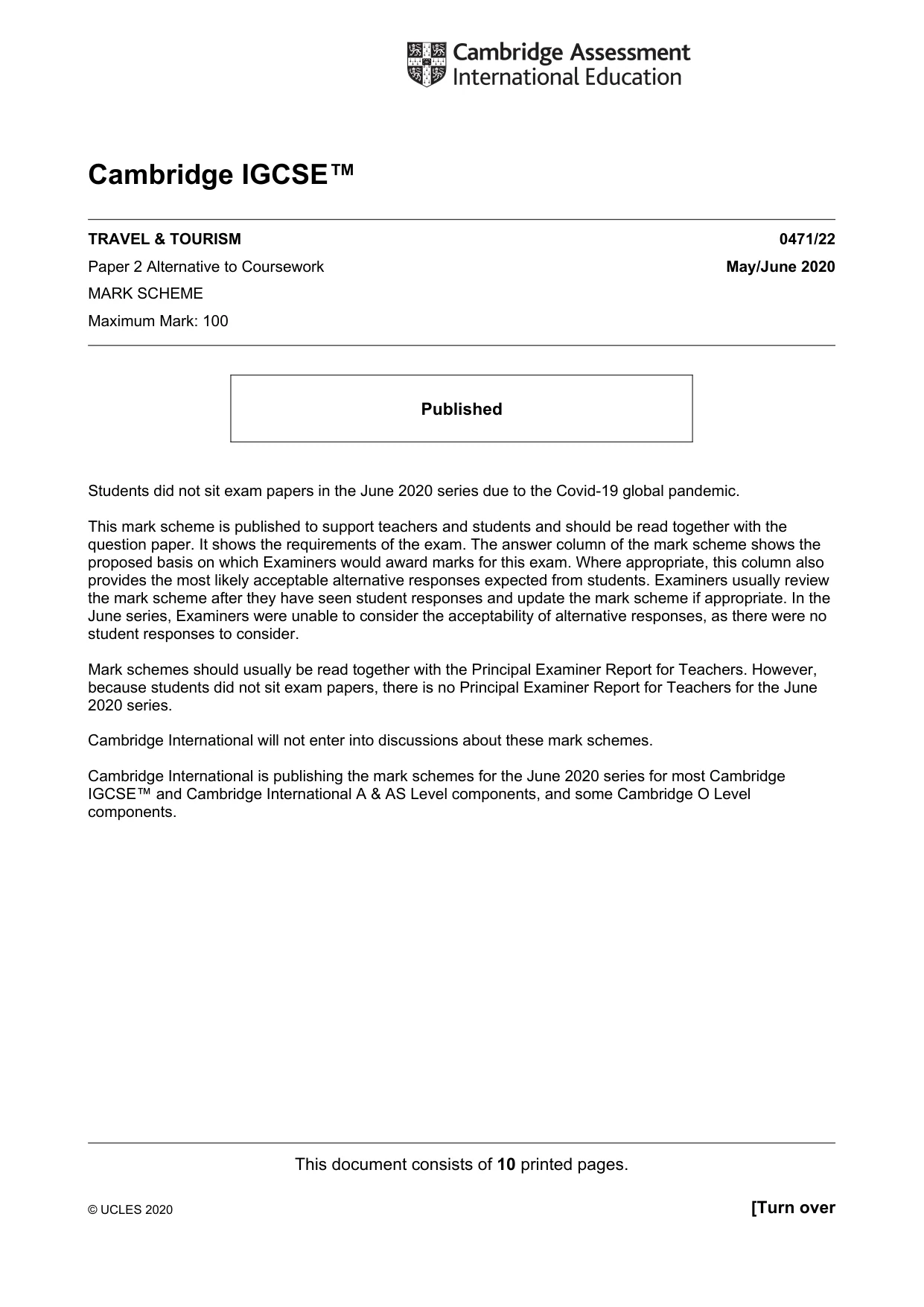
13 0471/22/M/J/20 © UCLES 2020 (d) Discuss how a travel agency might use the AIDA principle to assess the marketing messages within its holiday posters. … … … … … … … … … … … … … … … … … … [9] [Total: 25]
Question paper, page 14
14 0471/22/M/J/20 © UCLES 2020 BLANK PAGE
Question paper, page 15
15 0471/22/M/J/20 © UCLES 2020 BLANK PAGE
Question paper, page 16
16 0471/22/M/J/20 © UCLES 2020 Permission to reproduce items where third-party owned material protected by copyright is included has been sought and cleared where possible. Every reasonable effort has been made by the publisher (UCLES) to trace copyright holders, but if any items requiring clearance have unwittingly been included, the publisher will be pleased to make amends at the earliest possible opportunity. To avoid the issue of disclosure of answer-related information to candidates, all copyright acknowledgements are reproduced online in the Cambridge Assessment International Education Copyright Acknowledgements Booklet. This is produced for each series of examinations and is freely available to download at www.cambridgeinternational.org after the live examination series. Cambridge Assessment International Education is part of the Cambridge Assessment Group. Cambridge Assessment is the brand name of the University of Cambridge Local Examinations Syndicate (UCLES), which itself is a department of the University of Cambridge. BLANK PAGE
Mark scheme, page 1
This document consists of 10 printed pages. © UCLES 2020 [Turn over Cambridge IGCSE™ TRAVEL & TOURISM 0471/22 Paper 2 Alternative to Coursework May/June 2020 MARK SCHEME Maximum Mark: 100 Published Students did not sit exam papers in the June 2020 series due to the Covid-19 global pandemic. This mark scheme is published to support teachers and students and should be read together with the question paper. It shows the requirements of the exam. The answer column of the mark scheme shows the proposed basis on which Examiners would award marks for this exam. Where appropriate, this column also provides the most likely acceptable alternative responses expected from students. Examiners usually review the mark scheme after they have seen student responses and update the mark scheme if appropriate. In the June series, Examiners were unable to consider the acceptability of alternative responses, as there were no student responses to consider. Mark schemes should usually be read together with the Principal Examiner Report for Teachers. However, because students did not sit exam papers, there is no Principal Examiner Report for Teachers for the June 2020 series. Cambridge International will not enter into discussions about these mark schemes. Cambridge International is publishing the mark schemes for the June 2020 series for most Cambridge IGCSE™ and Cambridge International A & AS Level components, and some Cambridge O Level components.
Mark scheme, page 2
0471/22 Cambridge IGCSE – Mark Scheme PUBLISHED May/June 2020 © UCLES 2020 Page 2 of 10 Generic Marking Principles These general marking principles must be applied by all examiners when marking candidate answers. They should be applied alongside the specific content of the mark scheme or generic level descriptors for a question. Each question paper and mark scheme will also comply with these marking principles. GENERIC MARKING PRINCIPLE 1: Marks must be awarded in line with: • the specific content of the mark scheme or the generic level descriptors for the question • the specific skills defined in the mark scheme or in the generic level descriptors for the question • the standard of response required by a candidate as exemplified by the standardisation scripts. GENERIC MARKING PRINCIPLE 2: Marks awarded are always whole marks (not half marks, or other fractions). GENERIC MARKING PRINCIPLE 3: Marks must be awarded positively: • marks are awarded for correct/valid answers, as defined in the mark scheme. However, credit is given for valid answers which go beyond the scope of the syllabus and mark scheme, referring to your Team Leader as appropriate • marks are awarded when candidates clearly demonstrate what they know and can do • marks are not deducted for errors • marks are not deducted for omissions • answers should only be judged on the quality of spelling, punctuation and grammar when these features are specifically assessed by the question as indicated by the mark scheme. The meaning, however, should be unambiguous. GENERIC MARKING PRINCIPLE 4: Rules must be applied consistently e.g. in situations where candidates have not followed instructions or in the application of generic level descriptors. GENERIC MARKING PRINCIPLE 5: Marks should be awarded using the full range of marks defined in the mark scheme for the question (however; the use of the full mark range may be limited according to the quality of the candidate responses seen). GENERIC MARKING PRINCIPLE 6: Marks awarded are based solely on the requirements as defined in the mark scheme. Marks should not be awarded with grade thresholds or grade descriptors in mind.
Mark scheme, page 3
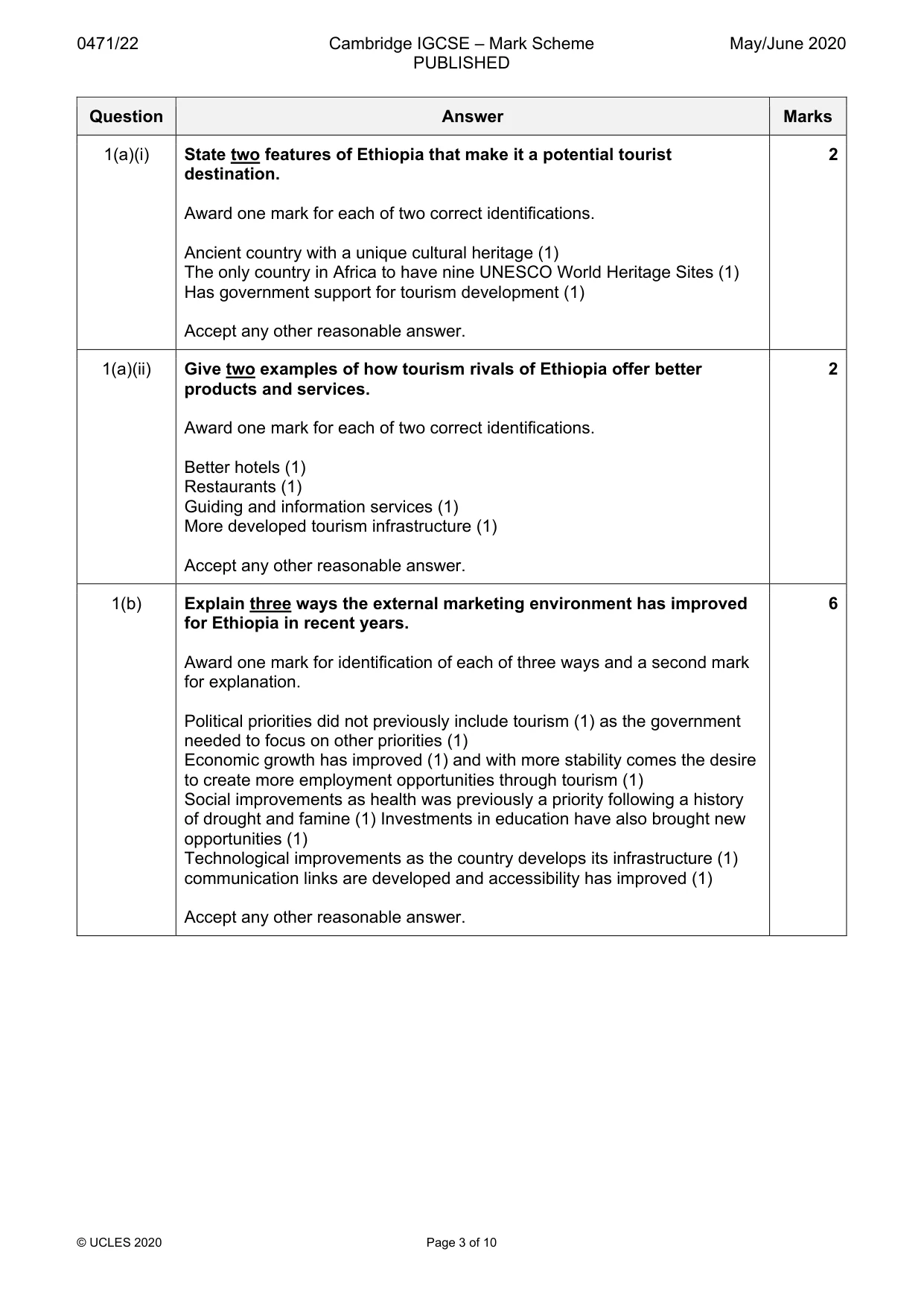
0471/22 Cambridge IGCSE – Mark Scheme PUBLISHED May/June 2020 © UCLES 2020 Page 3 of 10 Question Answer Marks 1(a)(i) State two features of Ethiopia that make it a potential tourist destination. Award one mark for each of two correct identifications. Ancient country with a unique cultural heritage (1) The only country in Africa to have nine UNESCO World Heritage Sites (1) Has government support for tourism development (1) Accept any other reasonable answer. 2 1(a)(ii) Give two examples of how tourism rivals of Ethiopia offer better products and services. Award one mark for each of two correct identifications. Better hotels (1) Restaurants (1) Guiding and information services (1) More developed tourism infrastructure (1) Accept any other reasonable answer. 2 1(b) Explain three ways the external marketing environment has improved for Ethiopia in recent years. Award one mark for identification of each of three ways and a second mark for explanation. Political priorities did not previously include tourism (1) as the government needed to focus on other priorities (1) Economic growth has improved (1) and with more stability comes the desire to create more employment opportunities through tourism (1) Social improvements as health was previously a priority following a history of drought and famine (1) Investments in education have also brought new opportunities (1) Technological improvements as the country develops its infrastructure (1) communication links are developed and accessibility has improved (1) Accept any other reasonable answer. 6
Mark scheme, page 4
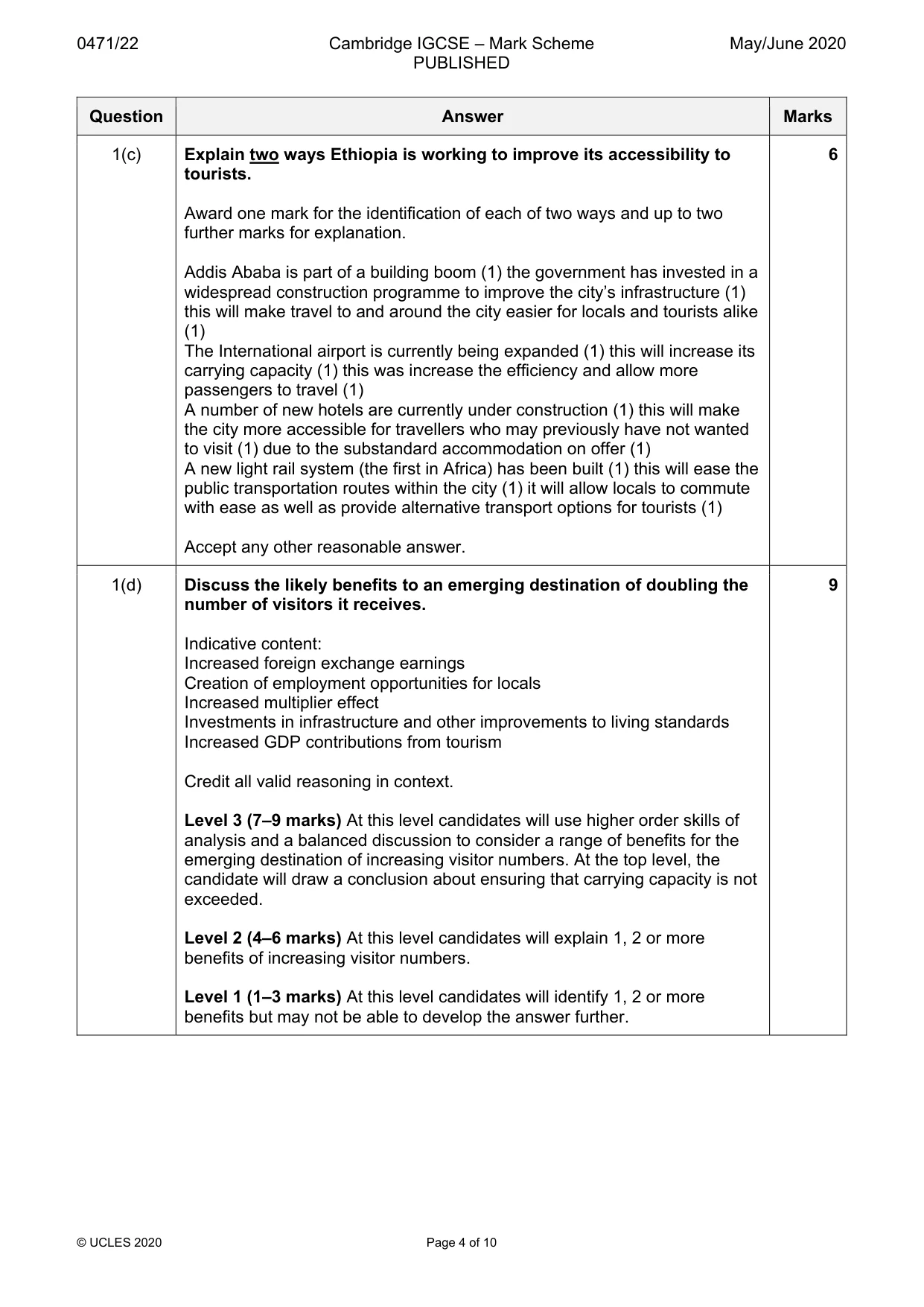
0471/22 Cambridge IGCSE – Mark Scheme PUBLISHED May/June 2020 © UCLES 2020 Page 4 of 10 Question Answer Marks 1(c) Explain two ways Ethiopia is working to improve its accessibility to tourists. Award one mark for the identification of each of two ways and up to two further marks for explanation. Addis Ababa is part of a building boom (1) the government has invested in a widespread construction programme to improve the city’s infrastructure (1) this will make travel to and around the city easier for locals and tourists alike (1) The International airport is currently being expanded (1) this will increase its carrying capacity (1) this was increase the efficiency and allow more passengers to travel (1) A number of new hotels are currently under construction (1) this will make the city more accessible for travellers who may previously have not wanted to visit (1) due to the substandard accommodation on offer (1) A new light rail system (the first in Africa) has been built (1) this will ease the public transportation routes within the city (1) it will allow locals to commute with ease as well as provide alternative transport options for tourists (1) Accept any other reasonable answer. 6 1(d) Discuss the likely benefits to an emerging destination of doubling the number of visitors it receives. Indicative content: Increased foreign exchange earnings Creation of employment opportunities for locals Increased multiplier effect Investments in infrastructure and other improvements to living standards Increased GDP contributions from tourism Credit all valid reasoning in context. Level 3 (7–9 marks) At this level candidates will use higher order skills of analysis and a balanced discussion to consider a range of benefits for the emerging destination of increasing visitor numbers. At the top level, the candidate will draw a conclusion about ensuring that carrying capacity is not exceeded. Level 2 (4–6 marks) At this level candidates will explain 1, 2 or more benefits of increasing visitor numbers. Level 1 (1–3 marks) At this level candidates will identify 1, 2 or more benefits but may not be able to develop the answer further. 9
Mark scheme, page 5
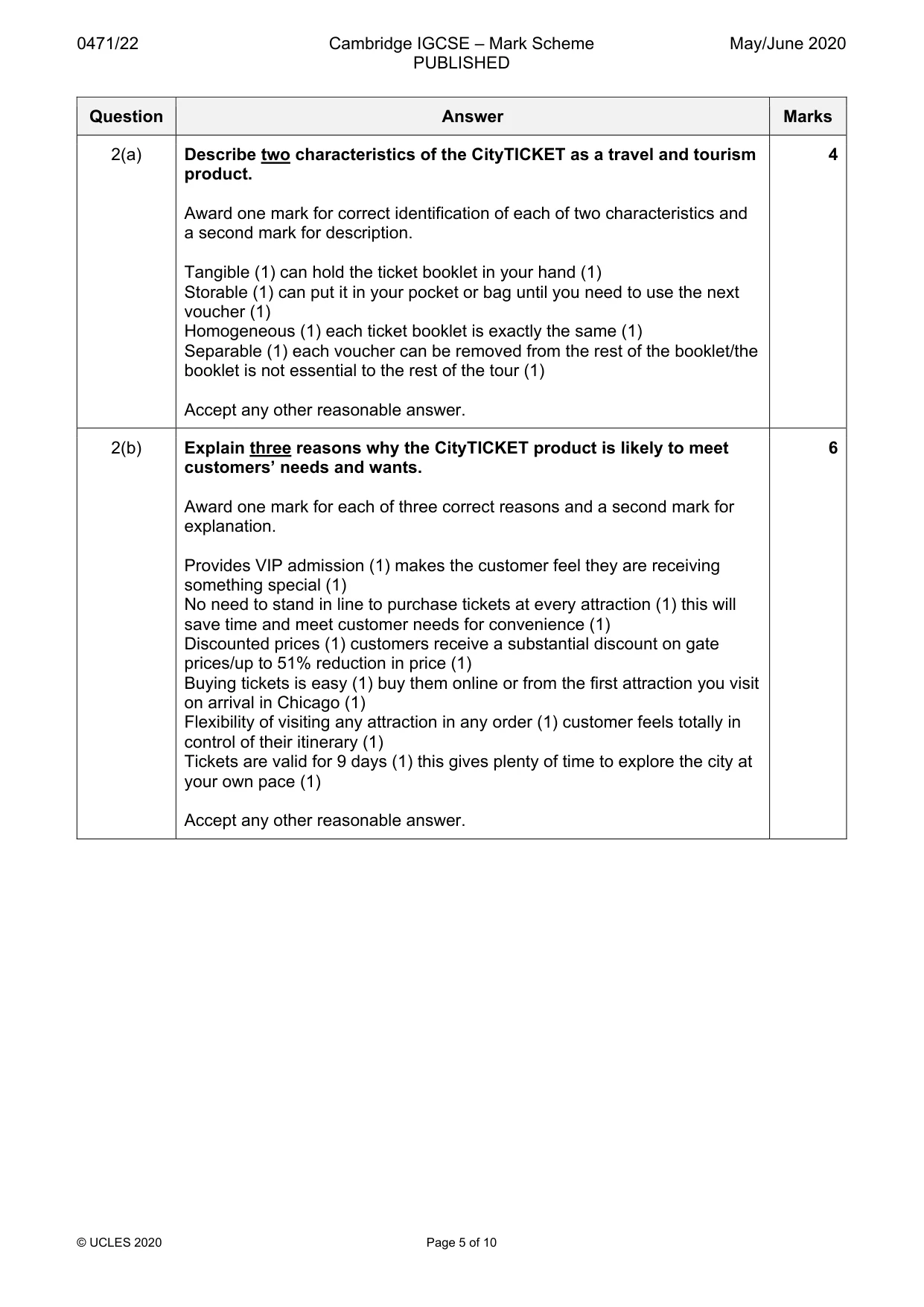
0471/22 Cambridge IGCSE – Mark Scheme PUBLISHED May/June 2020 © UCLES 2020 Page 5 of 10 Question Answer Marks 2(a) Describe two characteristics of the CityTICKET as a travel and tourism product. Award one mark for correct identification of each of two characteristics and a second mark for description. Tangible (1) can hold the ticket booklet in your hand (1) Storable (1) can put it in your pocket or bag until you need to use the next voucher (1) Homogeneous (1) each ticket booklet is exactly the same (1) Separable (1) each voucher can be removed from the rest of the booklet/the booklet is not essential to the rest of the tour (1) Accept any other reasonable answer. 4 2(b) Explain three reasons why the CityTICKET product is likely to meet customers’ needs and wants. Award one mark for each of three correct reasons and a second mark for explanation. Provides VIP admission (1) makes the customer feel they are receiving something special (1) No need to stand in line to purchase tickets at every attraction (1) this will save time and meet customer needs for convenience (1) Discounted prices (1) customers receive a substantial discount on gate prices/up to 51% reduction in price (1) Buying tickets is easy (1) buy them online or from the first attraction you visit on arrival in Chicago (1) Flexibility of visiting any attraction in any order (1) customer feels totally in control of their itinerary (1) Tickets are valid for 9 days (1) this gives plenty of time to explore the city at your own pace (1) Accept any other reasonable answer. 6
Mark scheme, page 6
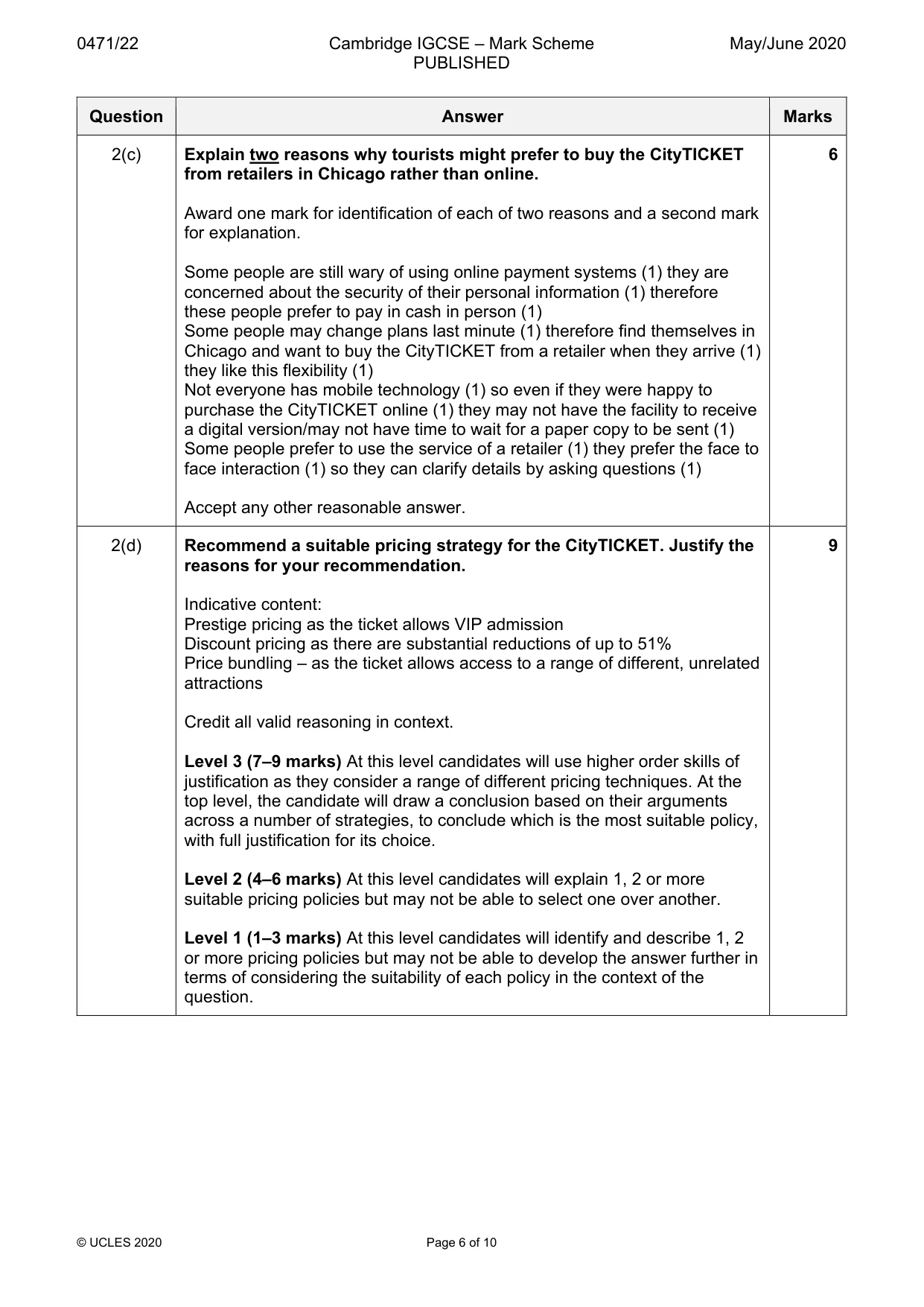
0471/22 Cambridge IGCSE – Mark Scheme PUBLISHED May/June 2020 © UCLES 2020 Page 6 of 10 Question Answer Marks 2(c) Explain two reasons why tourists might prefer to buy the CityTICKET from retailers in Chicago rather than online. Award one mark for identification of each of two reasons and a second mark for explanation. Some people are still wary of using online payment systems (1) they are concerned about the security of their personal information (1) therefore these people prefer to pay in cash in person (1) Some people may change plans last minute (1) therefore find themselves in Chicago and want to buy the CityTICKET from a retailer when they arrive (1) they like this flexibility (1) Not everyone has mobile technology (1) so even if they were happy to purchase the CityTICKET online (1) they may not have the facility to receive a digital version/may not have time to wait for a paper copy to be sent (1) Some people prefer to use the service of a retailer (1) they prefer the face to face interaction (1) so they can clarify details by asking questions (1) Accept any other reasonable answer. 6 2(d) Recommend a suitable pricing strategy for the CityTICKET. Justify the reasons for your recommendation. Indicative content: Prestige pricing as the ticket allows VIP admission Discount pricing as there are substantial reductions of up to 51% Price bundling – as the ticket allows access to a range of different, unrelated attractions Credit all valid reasoning in context. Level 3 (7–9 marks) At this level candidates will use higher order skills of justification as they consider a range of different pricing techniques. At the top level, the candidate will draw a conclusion based on their arguments across a number of strategies, to conclude which is the most suitable policy, with full justification for its choice. Level 2 (4–6 marks) At this level candidates will explain 1, 2 or more suitable pricing policies but may not be able to select one over another. Level 1 (1–3 marks) At this level candidates will identify and describe 1, 2 or more pricing policies but may not be able to develop the answer further in terms of considering the suitability of each policy in the context of the question. 9
Mark scheme, page 7
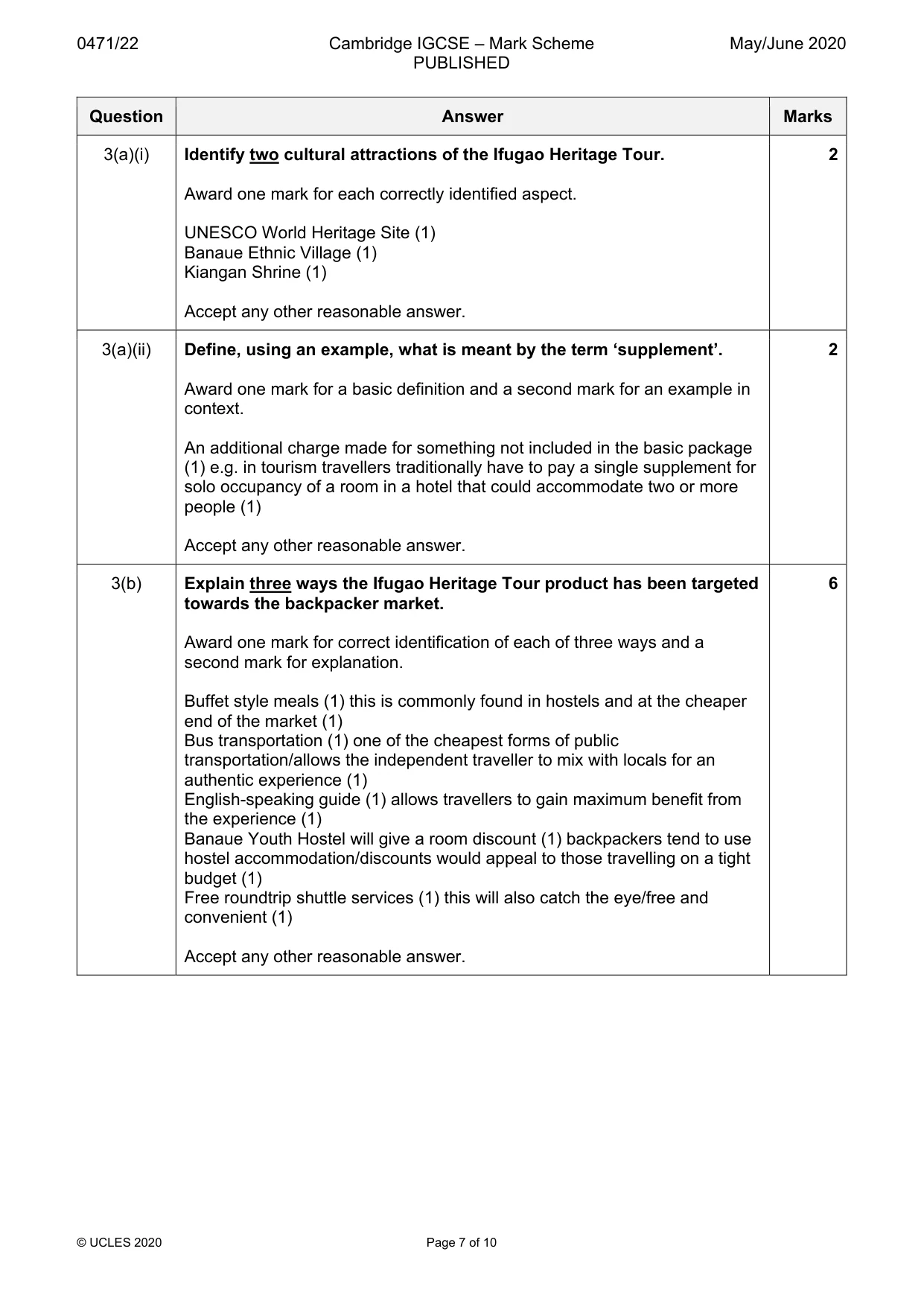
0471/22 Cambridge IGCSE – Mark Scheme PUBLISHED May/June 2020 © UCLES 2020 Page 7 of 10 Question Answer Marks 3(a)(i) Identify two cultural attractions of the Ifugao Heritage Tour. Award one mark for each correctly identified aspect. UNESCO World Heritage Site (1) Banaue Ethnic Village (1) Kiangan Shrine (1) Accept any other reasonable answer. 2 3(a)(ii) Define, using an example, what is meant by the term ‘supplement’. Award one mark for a basic definition and a second mark for an example in context. An additional charge made for something not included in the basic package (1) e.g. in tourism travellers traditionally have to pay a single supplement for solo occupancy of a room in a hotel that could accommodate two or more people (1) Accept any other reasonable answer. 2 3(b) Explain three ways the Ifugao Heritage Tour product has been targeted towards the backpacker market. Award one mark for correct identification of each of three ways and a second mark for explanation. Buffet style meals (1) this is commonly found in hostels and at the cheaper end of the market (1) Bus transportation (1) one of the cheapest forms of public transportation/allows the independent traveller to mix with locals for an authentic experience (1) English-speaking guide (1) allows travellers to gain maximum benefit from the experience (1) Banaue Youth Hostel will give a room discount (1) backpackers tend to use hostel accommodation/discounts would appeal to those travelling on a tight budget (1) Free roundtrip shuttle services (1) this will also catch the eye/free and convenient (1) Accept any other reasonable answer. 6
Mark scheme, page 8
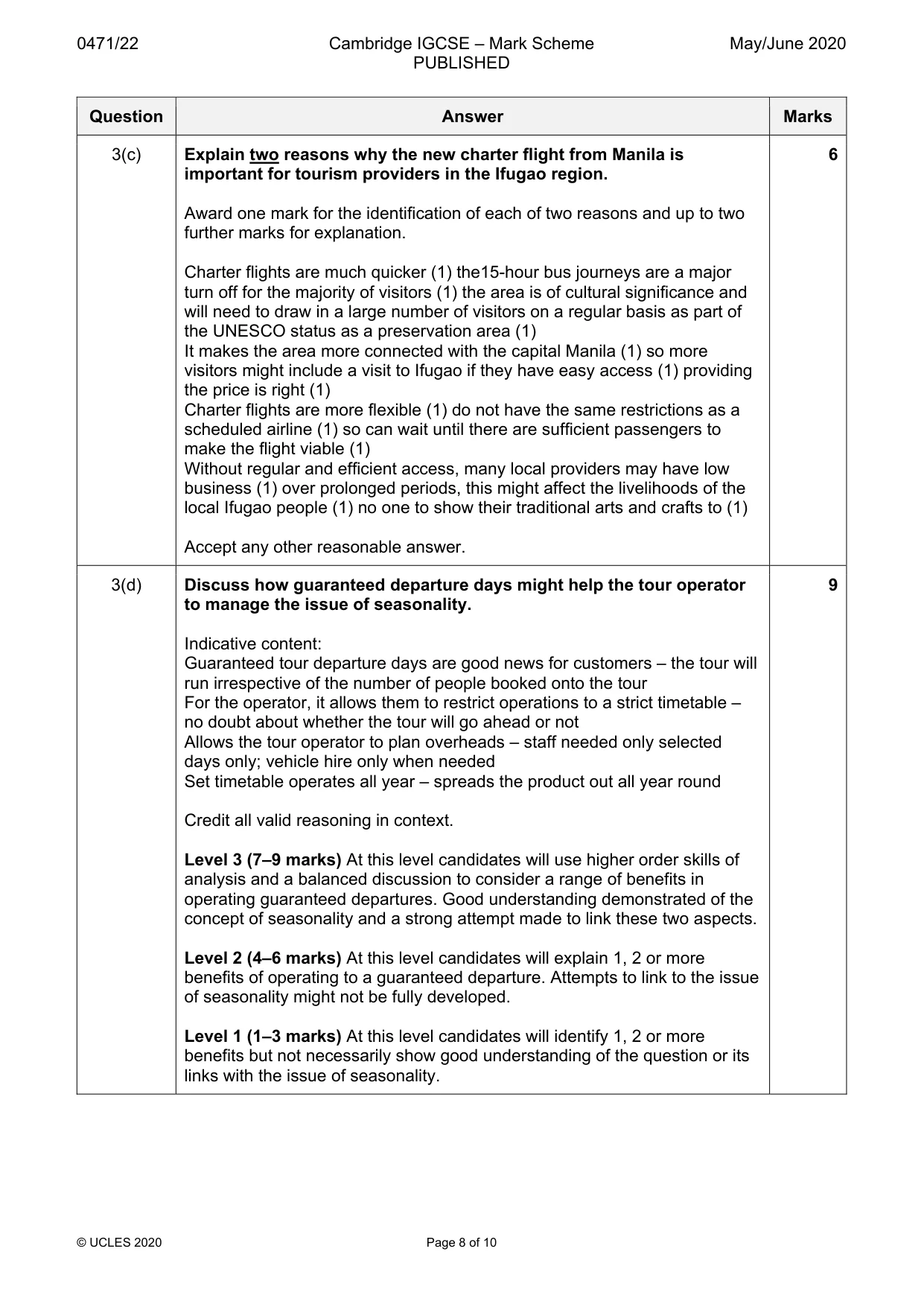
0471/22 Cambridge IGCSE – Mark Scheme PUBLISHED May/June 2020 © UCLES 2020 Page 8 of 10 Question Answer Marks 3(c) Explain two reasons why the new charter flight from Manila is important for tourism providers in the Ifugao region. Award one mark for the identification of each of two reasons and up to two further marks for explanation. Charter flights are much quicker (1) the15-hour bus journeys are a major turn off for the majority of visitors (1) the area is of cultural significance and will need to draw in a large number of visitors on a regular basis as part of the UNESCO status as a preservation area (1) It makes the area more connected with the capital Manila (1) so more visitors might include a visit to Ifugao if they have easy access (1) providing the price is right (1) Charter flights are more flexible (1) do not have the same restrictions as a scheduled airline (1) so can wait until there are sufficient passengers to make the flight viable (1) Without regular and efficient access, many local providers may have low business (1) over prolonged periods, this might affect the livelihoods of the local Ifugao people (1) no one to show their traditional arts and crafts to (1) Accept any other reasonable answer. 6 3(d) Discuss how guaranteed departure days might help the tour operator to manage the issue of seasonality. Indicative content: Guaranteed tour departure days are good news for customers – the tour will run irrespective of the number of people booked onto the tour For the operator, it allows them to restrict operations to a strict timetable – no doubt about whether the tour will go ahead or not Allows the tour operator to plan overheads – staff needed only selected days only; vehicle hire only when needed Set timetable operates all year – spreads the product out all year round Credit all valid reasoning in context. Level 3 (7–9 marks) At this level candidates will use higher order skills of analysis and a balanced discussion to consider a range of benefits in operating guaranteed departures. Good understanding demonstrated of the concept of seasonality and a strong attempt made to link these two aspects. Level 2 (4–6 marks) At this level candidates will explain 1, 2 or more benefits of operating to a guaranteed departure. Attempts to link to the issue of seasonality might not be fully developed. Level 1 (1–3 marks) At this level candidates will identify 1, 2 or more benefits but not necessarily show good understanding of the question or its links with the issue of seasonality. 9
Mark scheme, page 9
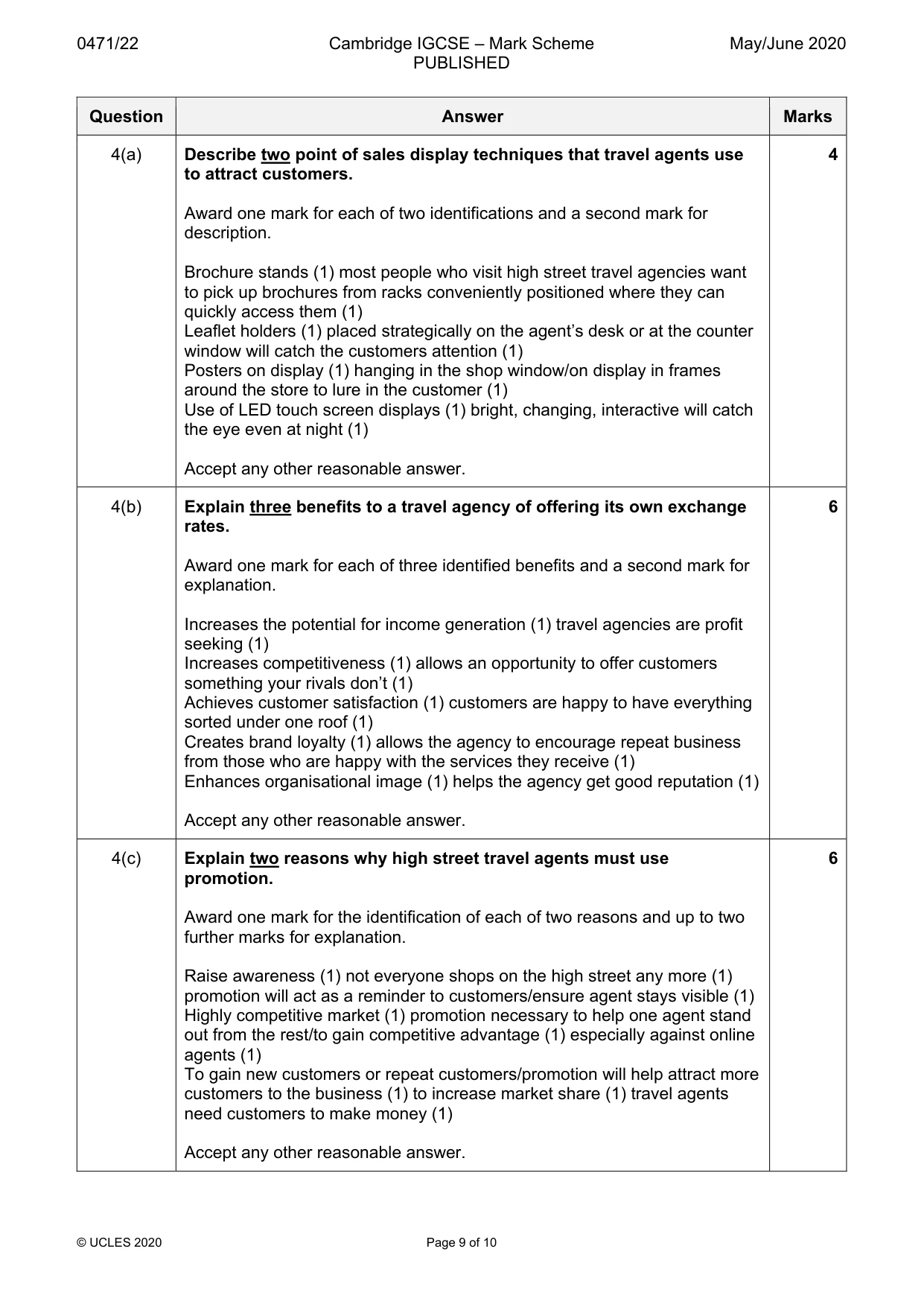
0471/22 Cambridge IGCSE – Mark Scheme PUBLISHED May/June 2020 © UCLES 2020 Page 9 of 10 Question Answer Marks 4(a) Describe two point of sales display techniques that travel agents use to attract customers. Award one mark for each of two identifications and a second mark for description. Brochure stands (1) most people who visit high street travel agencies want to pick up brochures from racks conveniently positioned where they can quickly access them (1) Leaflet holders (1) placed strategically on the agent’s desk or at the counter window will catch the customers attention (1) Posters on display (1) hanging in the shop window/on display in frames around the store to lure in the customer (1) Use of LED touch screen displays (1) bright, changing, interactive will catch the eye even at night (1) Accept any other reasonable answer. 4 4(b) Explain three benefits to a travel agency of offering its own exchange rates. Award one mark for each of three identified benefits and a second mark for explanation. Increases the potential for income generation (1) travel agencies are profit seeking (1) Increases competitiveness (1) allows an opportunity to offer customers something your rivals don’t (1) Achieves customer satisfaction (1) customers are happy to have everything sorted under one roof (1) Creates brand loyalty (1) allows the agency to encourage repeat business from those who are happy with the services they receive (1) Enhances organisational image (1) helps the agency get good reputation (1) Accept any other reasonable answer. 6 4(c) Explain two reasons why high street travel agents must use promotion. Award one mark for the identification of each of two reasons and up to two further marks for explanation. Raise awareness (1) not everyone shops on the high street any more (1) promotion will act as a reminder to customers/ensure agent stays visible (1) Highly competitive market (1) promotion necessary to help one agent stand out from the rest/to gain competitive advantage (1) especially against online agents (1) To gain new customers or repeat customers/promotion will help attract more customers to the business (1) to increase market share (1) travel agents need customers to make money (1) Accept any other reasonable answer. 6
Mark scheme, page 10
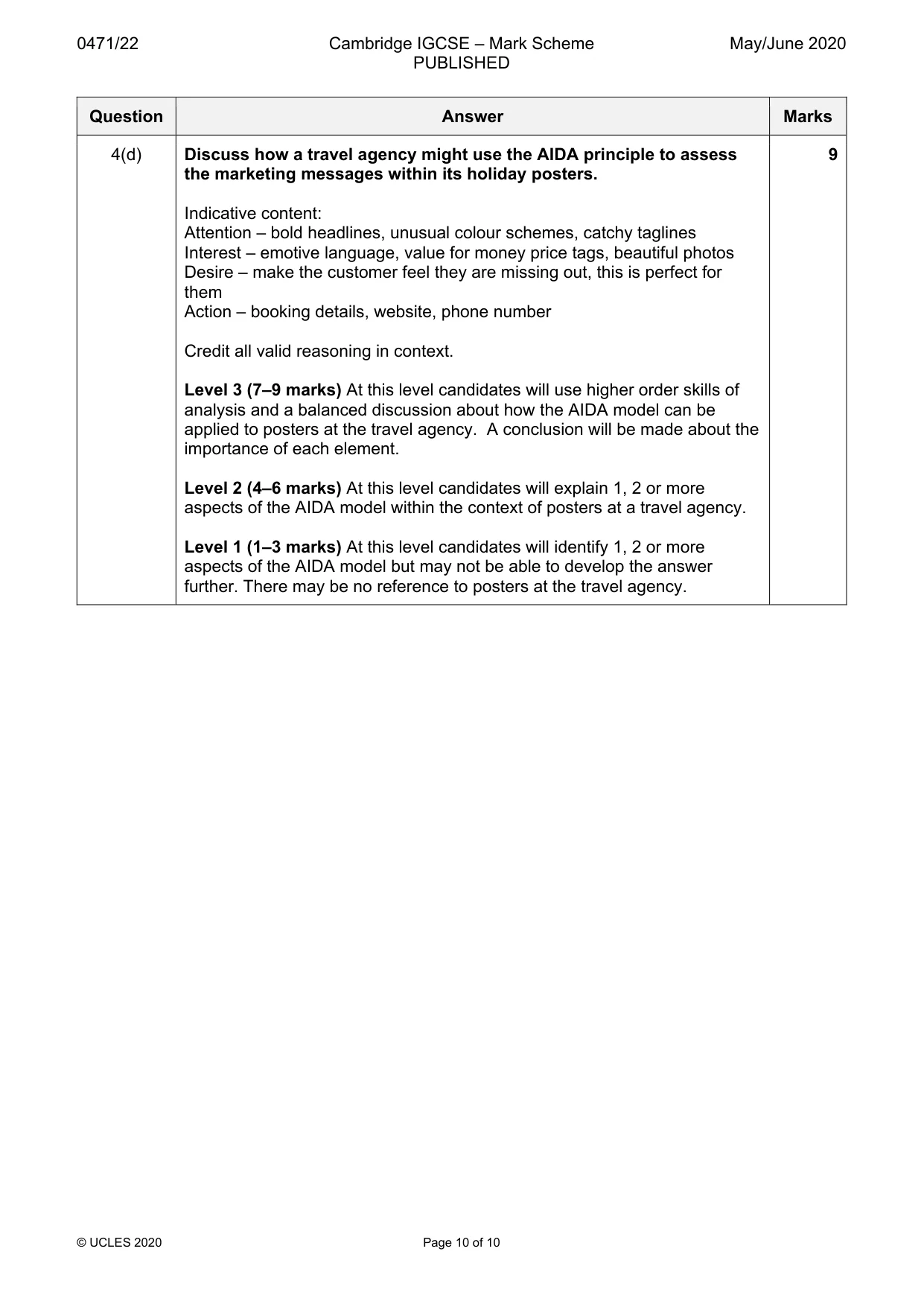
0471/22 Cambridge IGCSE – Mark Scheme PUBLISHED May/June 2020 © UCLES 2020 Page 10 of 10 Question Answer Marks 4(d) Discuss how a travel agency might use the AIDA principle to assess the marketing messages within its holiday posters. Indicative content: Attention – bold headlines, unusual colour schemes, catchy taglines Interest – emotive language, value for money price tags, beautiful photos Desire – make the customer feel they are missing out, this is perfect for them Action – booking details, website, phone number Credit all valid reasoning in context. Level 3 (7–9 marks) At this level candidates will use higher order skills of analysis and a balanced discussion about how the AIDA model can be applied to posters at the travel agency. A conclusion will be made about the importance of each element. Level 2 (4–6 marks) At this level candidates will explain 1, 2 or more aspects of the AIDA model within the context of posters at a travel agency. Level 1 (1–3 marks) At this level candidates will identify 1, 2 or more aspects of the AIDA model but may not be able to develop the answer further. There may be no reference to posters at the travel agency. 9